EP3796209B1 - Procédé et système pour déterminer une activité d'un occupant d'un véhicule - Google Patents
Procédé et système pour déterminer une activité d'un occupant d'un véhicule Download PDFInfo
- Publication number
- EP3796209B1 EP3796209B1 EP19197820.4A EP19197820A EP3796209B1 EP 3796209 B1 EP3796209 B1 EP 3796209B1 EP 19197820 A EP19197820 A EP 19197820A EP 3796209 B1 EP3796209 B1 EP 3796209B1
- Authority
- EP
- European Patent Office
- Prior art keywords
- computer
- occupant
- car
- sensor data
- image
- Prior art date
- Legal status (The legal status is an assumption and is not a legal conclusion. Google has not performed a legal analysis and makes no representation as to the accuracy of the status listed.)
- Active
Links
Images




Classifications
-
- G—PHYSICS
- G06—COMPUTING OR CALCULATING; COUNTING
- G06V—IMAGE OR VIDEO RECOGNITION OR UNDERSTANDING
- G06V40/00—Recognition of biometric, human-related or animal-related patterns in image or video data
- G06V40/10—Human or animal bodies, e.g. vehicle occupants or pedestrians; Body parts, e.g. hands
- G06V40/103—Static body considered as a whole, e.g. static pedestrian or occupant recognition
-
- B—PERFORMING OPERATIONS; TRANSPORTING
- B60—VEHICLES IN GENERAL
- B60W—CONJOINT CONTROL OF VEHICLE SUB-UNITS OF DIFFERENT TYPE OR DIFFERENT FUNCTION; CONTROL SYSTEMS SPECIALLY ADAPTED FOR HYBRID VEHICLES; ROAD VEHICLE DRIVE CONTROL SYSTEMS FOR PURPOSES NOT RELATED TO THE CONTROL OF A PARTICULAR SUB-UNIT
- B60W40/00—Estimation or calculation of non-directly measurable driving parameters for road vehicle drive control systems not related to the control of a particular sub unit, e.g. by using mathematical models
-
- B—PERFORMING OPERATIONS; TRANSPORTING
- B60—VEHICLES IN GENERAL
- B60W—CONJOINT CONTROL OF VEHICLE SUB-UNITS OF DIFFERENT TYPE OR DIFFERENT FUNCTION; CONTROL SYSTEMS SPECIALLY ADAPTED FOR HYBRID VEHICLES; ROAD VEHICLE DRIVE CONTROL SYSTEMS FOR PURPOSES NOT RELATED TO THE CONTROL OF A PARTICULAR SUB-UNIT
- B60W40/00—Estimation or calculation of non-directly measurable driving parameters for road vehicle drive control systems not related to the control of a particular sub unit, e.g. by using mathematical models
- B60W40/08—Estimation or calculation of non-directly measurable driving parameters for road vehicle drive control systems not related to the control of a particular sub unit, e.g. by using mathematical models related to drivers or passengers
- B60W40/09—Driving style or behaviour
-
- B—PERFORMING OPERATIONS; TRANSPORTING
- B60—VEHICLES IN GENERAL
- B60W—CONJOINT CONTROL OF VEHICLE SUB-UNITS OF DIFFERENT TYPE OR DIFFERENT FUNCTION; CONTROL SYSTEMS SPECIALLY ADAPTED FOR HYBRID VEHICLES; ROAD VEHICLE DRIVE CONTROL SYSTEMS FOR PURPOSES NOT RELATED TO THE CONTROL OF A PARTICULAR SUB-UNIT
- B60W50/00—Details of control systems for road vehicle drive control not related to the control of a particular sub-unit, e.g. process diagnostic or vehicle driver interfaces
-
- G—PHYSICS
- G06—COMPUTING OR CALCULATING; COUNTING
- G06F—ELECTRIC DIGITAL DATA PROCESSING
- G06F18/00—Pattern recognition
- G06F18/20—Analysing
- G06F18/24—Classification techniques
- G06F18/241—Classification techniques relating to the classification model, e.g. parametric or non-parametric approaches
- G06F18/2411—Classification techniques relating to the classification model, e.g. parametric or non-parametric approaches based on the proximity to a decision surface, e.g. support vector machines
-
- G—PHYSICS
- G06—COMPUTING OR CALCULATING; COUNTING
- G06F—ELECTRIC DIGITAL DATA PROCESSING
- G06F18/00—Pattern recognition
- G06F18/20—Analysing
- G06F18/25—Fusion techniques
- G06F18/253—Fusion techniques of extracted features
-
- G—PHYSICS
- G06—COMPUTING OR CALCULATING; COUNTING
- G06N—COMPUTING ARRANGEMENTS BASED ON SPECIFIC COMPUTATIONAL MODELS
- G06N3/00—Computing arrangements based on biological models
- G06N3/02—Neural networks
-
- G—PHYSICS
- G06—COMPUTING OR CALCULATING; COUNTING
- G06V—IMAGE OR VIDEO RECOGNITION OR UNDERSTANDING
- G06V10/00—Arrangements for image or video recognition or understanding
- G06V10/40—Extraction of image or video features
- G06V10/44—Local feature extraction by analysis of parts of the pattern, e.g. by detecting edges, contours, loops, corners, strokes or intersections; Connectivity analysis, e.g. of connected components
- G06V10/443—Local feature extraction by analysis of parts of the pattern, e.g. by detecting edges, contours, loops, corners, strokes or intersections; Connectivity analysis, e.g. of connected components by matching or filtering
- G06V10/449—Biologically inspired filters, e.g. difference of Gaussians [DoG] or Gabor filters
- G06V10/451—Biologically inspired filters, e.g. difference of Gaussians [DoG] or Gabor filters with interaction between the filter responses, e.g. cortical complex cells
- G06V10/454—Integrating the filters into a hierarchical structure, e.g. convolutional neural networks [CNN]
-
- G—PHYSICS
- G06—COMPUTING OR CALCULATING; COUNTING
- G06V—IMAGE OR VIDEO RECOGNITION OR UNDERSTANDING
- G06V10/00—Arrangements for image or video recognition or understanding
- G06V10/70—Arrangements for image or video recognition or understanding using pattern recognition or machine learning
- G06V10/764—Arrangements for image or video recognition or understanding using pattern recognition or machine learning using classification, e.g. of video objects
-
- G—PHYSICS
- G06—COMPUTING OR CALCULATING; COUNTING
- G06V—IMAGE OR VIDEO RECOGNITION OR UNDERSTANDING
- G06V10/00—Arrangements for image or video recognition or understanding
- G06V10/70—Arrangements for image or video recognition or understanding using pattern recognition or machine learning
- G06V10/77—Processing image or video features in feature spaces; using data integration or data reduction, e.g. principal component analysis [PCA] or independent component analysis [ICA] or self-organising maps [SOM]; Blind source separation
- G06V10/80—Fusion, i.e. combining data from various sources at the sensor level, preprocessing level, feature extraction level or classification level
- G06V10/806—Fusion, i.e. combining data from various sources at the sensor level, preprocessing level, feature extraction level or classification level of extracted features
-
- G—PHYSICS
- G06—COMPUTING OR CALCULATING; COUNTING
- G06V—IMAGE OR VIDEO RECOGNITION OR UNDERSTANDING
- G06V10/00—Arrangements for image or video recognition or understanding
- G06V10/70—Arrangements for image or video recognition or understanding using pattern recognition or machine learning
- G06V10/82—Arrangements for image or video recognition or understanding using pattern recognition or machine learning using neural networks
-
- G—PHYSICS
- G06—COMPUTING OR CALCULATING; COUNTING
- G06V—IMAGE OR VIDEO RECOGNITION OR UNDERSTANDING
- G06V20/00—Scenes; Scene-specific elements
- G06V20/50—Context or environment of the image
- G06V20/59—Context or environment of the image inside of a vehicle, e.g. relating to seat occupancy, driver state or inner lighting conditions
- G06V20/597—Recognising the driver's state or behaviour, e.g. attention or drowsiness
-
- G—PHYSICS
- G06—COMPUTING OR CALCULATING; COUNTING
- G06V—IMAGE OR VIDEO RECOGNITION OR UNDERSTANDING
- G06V40/00—Recognition of biometric, human-related or animal-related patterns in image or video data
- G06V40/10—Human or animal bodies, e.g. vehicle occupants or pedestrians; Body parts, e.g. hands
- G06V40/107—Static hand or arm
-
- B—PERFORMING OPERATIONS; TRANSPORTING
- B60—VEHICLES IN GENERAL
- B60W—CONJOINT CONTROL OF VEHICLE SUB-UNITS OF DIFFERENT TYPE OR DIFFERENT FUNCTION; CONTROL SYSTEMS SPECIALLY ADAPTED FOR HYBRID VEHICLES; ROAD VEHICLE DRIVE CONTROL SYSTEMS FOR PURPOSES NOT RELATED TO THE CONTROL OF A PARTICULAR SUB-UNIT
- B60W50/00—Details of control systems for road vehicle drive control not related to the control of a particular sub-unit, e.g. process diagnostic or vehicle driver interfaces
- B60W2050/0001—Details of the control system
-
- B—PERFORMING OPERATIONS; TRANSPORTING
- B60—VEHICLES IN GENERAL
- B60W—CONJOINT CONTROL OF VEHICLE SUB-UNITS OF DIFFERENT TYPE OR DIFFERENT FUNCTION; CONTROL SYSTEMS SPECIALLY ADAPTED FOR HYBRID VEHICLES; ROAD VEHICLE DRIVE CONTROL SYSTEMS FOR PURPOSES NOT RELATED TO THE CONTROL OF A PARTICULAR SUB-UNIT
- B60W2540/00—Input parameters relating to occupants
- B60W2540/01—Occupants other than the driver
-
- B—PERFORMING OPERATIONS; TRANSPORTING
- B60—VEHICLES IN GENERAL
- B60W—CONJOINT CONTROL OF VEHICLE SUB-UNITS OF DIFFERENT TYPE OR DIFFERENT FUNCTION; CONTROL SYSTEMS SPECIALLY ADAPTED FOR HYBRID VEHICLES; ROAD VEHICLE DRIVE CONTROL SYSTEMS FOR PURPOSES NOT RELATED TO THE CONTROL OF A PARTICULAR SUB-UNIT
- B60W2540/00—Input parameters relating to occupants
- B60W2540/229—Attention level, e.g. attentive to driving, reading or sleeping
Definitions
- the present disclosure relates to methods and systems for determining an activity of an occupant of a vehicle, in particular to interior sensing in a vehicle.
- driver assistance systems are increasing the amount of automation in series production vehicles.
- the human driver can hand over the control of the vehicle to the car in certain circumstances and scenarios.
- level 3 driver assistance functions relieve the driver of several driving tasks, letting him focus on other activities besides driving.
- the driver is still responsible for the driving task. Even with higher levels of automation, the human driver will remain responsible for monitoring the vehicle and, if required, has to be able to take back the control of the vehicle in a reasonable time. Thus, the driver still acts as a fallback for critical situations. To allow the driver to focus on other activities and simultaneously use him as a fallback, proper knowledge of the driver state is required to warn or inform the driver efficiently if needed.
- US 10 322 728 B1 discloses a system for determining distress of a driver of a vehicle, comprising a plurality of sensors, including interior vehicle image sensors, an interior vehicle audio sensor, vehicle data sensors, and Global Positioning System (GPS) data sensors.
- the system also includes one or more processors configured to receive inputs from the plurality of sensors, and process the received inputs to obtain a driver heat change estimate, a driver expression estimate, a driver gesture estimate, an on-board diagnostics estimate, and a GPS estimate.
- GPS Global Positioning System
- the one or more processors are further configured to store the estimates in a memory, use the stored estimates to generate deviation scores for each of the estimates, execute a machine learning algorithm to classify driver behavior as normal or impaired based on the deviation scores, and generate a warning based on the classification indicating impaired driver behavior.
- the present disclosure provides a computer implemented method, a computer system and a non-transitory computer readable medium according to the independent claims. Embodiments are given in the subclaims, the description and the drawings.
- the present disclosure is directed at a computer implemented method for determining an activity of an occupant of a vehicle, the method comprising the following steps performed (in other words: carried out) by computer hardware components: capturing sensor data of the occupant using at least one sensor; determining respective three-dimensional coordinates for a plurality of pre-determined portions of the body of the occupant based on the sensor data; determining at least one portion of the sensor data showing a pre-determined body part of the occupant based on the sensor data and the two-dimensional or three-dimensional coordinates; and determining the activity of the occupant based on the two-dimensional or three-dimensional coordinates and the at least one portion of the sensor data.
- the sensor data comprises an image (captured by an image sensor) or a plurality of images (captured by the image sensor), and further sensor data (captured by at least one further sensor), and the at least one portion of the sensor data comprises at least one portion of the image.
- the at least one portion of the image is determined based on the further sensor data and/or the image and the three-dimensional coordinates.
- an activity of an occupant (driver or passenger) of a vehicle is determined (or estimated) based on coordinates (in three dimensions) of pre-determined portions of the occupant's body and based on portions of an image showing relevant portions of the occupant's body, wherein the portions of the image may be determined based on the image itself or based on other sensor data different from the sensor that captured the image.
- the image may be a conventional image, which may also be referred to as intensity image or 2D image.
- the image may be a grayscale image or a color image.
- the further sensor may be a sensor which is different from the image sensor, or which provides sensor data which is different from a (conventional) image.
- the further sensor may provide distance information (or depth information); for example, the further sensor may be a ToF (time of flight) camera, a radar sensor, a lidar sensor, an ultrasound sensor, or an infrared sensor.
- ToF time of flight
- the two- or three-dimensional coordinates may be provided in a coordinate system, for example a coordinate system with an origin defined by the further sensor, or a coordinate system with an origin defined by a pre-determined point of the vehicle.
- the at least one portion of the image may include a portion of the image of any shape.
- the at least one portion of the image may be rectangular or circular, or of any other shape.
- the various portions may have the same shape or different shapes, and may have the same size or different sizes.
- a size of the portion may refer to the number of pixels of the portion of the image (for example, for a rectangular portion of the image, the size of the portion of the image may be given by the width and height (each in pixels) of the rectangular shape).
- using only the at least one portion of the image may enhance the results of the activity determination. For example, when using a neural network for determining the activity, using only the at least one portion of the image may avoid an overfitting of a neural network (or another classifier) to non-relevant parts of the image.
- the image comprises a plurality of intensity pixels, each intensity pixel indicating an intensity of light of a pre-determined wavelength or wavelength range received at the respective intensity pixel, and the further sensor data comprises a plurality of distance pixels, each distance pixel indicates a distance between the further sensor and an object corresponding to the respective distance pixel.
- the image provides a visual representation of what a human observer would visually observe, while the further sensor data comprises distance information. It has been found that combining the visual representation of the image with the distance information of the further sensor data provides reliable results of the action determination.
- the pre-determined body part of the occupant comprises one of the occupant's hands and/ or the occupant's face and/ or one of the occupant's shoulders. It has been found that using these body parts (in particular using one or two of the occupant's hands and/ or the occupant's face) provides reliable results when determining the occupant's activity. However, it will be understood that any other body part may be used.
- the at least one portion of the image is determined based on the three-dimensional coordinates.
- the sensor data of a present time and of previous times may be used.
- a classifier that incorporates information from several timesteps, like a 3D convolutional network, a recurrent neural network or an LSTM (long short-term memory) may be used to consider sensor data of previous time steps.
- a plurality of images and a plurality of further sensor data are captured, and the two-dimensional or three-dimensional coordinates are determined based on at least one of the plurality of images and the plurality of further sensor data.
- an image and further sensor data may be captured at a plurality of points in time (or time steps), and the two-dimensional or three-dimensional coordinates, the at least one portion of the image, and the activity may be determined for each of the points in time. It has been found that having a history of determined activity may enhance further processing, for example may enhance determining an action of the vehicle to take or not to take, compared to having a determined activity at a single point in time only.
- the activity is determined based on one or more neural networks.
- neural networks may be used to determine feature vectors based on the at least one portion of the image. Further feature vectors may be determined based on the two-dimensional or three-dimensional coordinates. The feature vectors determined based on the at least one portion of the image and the further feature vector may be provided to a classifier that incorporates information from several timesteps, like a 3D convolutional network, a recurrent neural network or an LSTM (in other words: a neural network with a LSTM structure).
- a classifier that incorporates information from several timesteps, like a 3D convolutional network, a recurrent neural network or an LSTM (in other words: a neural network with a LSTM structure).
- the activity is determined based on a softmax method.
- a softmax function which may also be referred to as softargmax or normalized exponential function, may be a function that takes as input a vector of real numbers, and normalizes it into a probability distribution consisting of probabilities proportional to the exponentials of the input numbers.
- some vector components Prior to applying softmax, some vector components may be negative, or greater than one, and may not sum to 1. After applying softmax, each component may be in the interval between 0 and 1, and the components may add up to 1, so that they can be interpreted as probabilities.
- the output of the classifier that incorporates information from several timesteps may be provided to the softmax method, and the result of the softmax method may represent (or encode) the determined activity.
- determining the activity comprises classifying an action of a driver into one or more classes of a plurality of classes of actions.
- Classifying into a class may include indicating a probability that the action is in the respective class, and the classification may be provided as an identifier of an action, or as an array (or vector) of determined actions, if more than one action is identified.
- classifying comprises determining a probability vector, wherein each entry of the probability vector indicates a respective probability for each class of the plurality of classes of actions.
- the probability may be expressed as a real number between 0 and 1 (or between 0% and 100%), but that any other representation may be possible, for example a fuzzy representation, for example with probability levels of "most probably not", “maybe not”, “maybe”, “most probably yes”, or any other representation suitable for indicating a probability.
- providing a vector of probabilities enhances the further processing based on the determined activity, for example in situations where the activity determination provides a result that is not determined with high confidence.
- Providing the vector of probabilities may not only provide the most probable activity, but a probability for each possible activity.
- the plurality of classes of actions comprises one or more of the following actions: entering a car; leaving a car; inserting an object to a car; removing an object from a car; inserting a baby seat to a car; removing a baby seat from a car; inserting a child to a car; removing a child from a car; inserting a baby to a car, removing a baby from a car, buckeling up a seat belt; unbuckeling a seat belt; interacting with a phone; holding a phone; active control of a phone; typing on a phone; talking on a phone; interacting with an object; interacting with a book; interacting with a magazine; interacting with a laptop; interacting with a tablet; interacting with the steering wheel; smoking; eating; drinking; operation of the vehicle infotainment system; operation of vehicle controls.
- the present disclosure is directed at a computer system, said computer system comprising a plurality of computer hardware components configured to carry out several or all steps of the computer implemented method described herein.
- the computer system may comprise a plurality of computer hardware components (for example a processing unit, at least one memory unit and at least one non-transitory data storage). It will be understood that further computer hardware components may be provided and used for carrying out steps of the computer implemented method in the computer system.
- the non-transitory data storage and/or the memory unit may comprise a computer program for instructing the computer to perform several or all steps or aspects of the computer implemented method described herein, for example using the processing unit and the at least one memory unit.
- the computer system includes the image sensor and the at least one further sensor.
- the at least one further sensor may include or may be a time of flight camera.
- the image sensor and the at least one further sensor may be provided as a combined sensor (for example, the image sensor and the at least one further sensor may share a common housing and/or processing components).
- the present disclosure is also directed at a computer program for instructing a computer to perform several or all steps or aspects of the computer implemented method described herein.
- a method for recognizing the current activity of the driver for example based on conventional (intensity) images and depth images of a time-of-flight (ToF) camera mounted inside the car, may be provided.
- the method may be based on time of flight image sequences (i.e. sequences of distance information), driver body keypoints and a trained artificial neural network to classify different actions of a driver.
- Key parts of the driver's body may be localized, and relevant image regions may be evaluated in order to classify a number of behaviors and activities that drivers may typically perform while sitting in the car. Besides body movements, the most helpful information for recognizing the activity of a person may be found next to their hands, in particular in the somewhat restricted case of someone sitting in a car.
- Fig. 1 shows an illustration 100 of how input data to driver activity classification may be determined according to various embodiments.
- a sensor (or two or more sensors) may determine sensor data 102.
- the sensor data 102 may include (grayscale) image sequences and corresponding depth information recorded by a time of flight camera.
- the time of flight camera provides grayscale images and depth information in a field of view (for example a field of view of 120°) covering the front seats of a car. These images and depth information may be cropped to contain only the driver side.
- Body keypoints data 104 may be determined in the sensor data 102; in other words: data in the sensor data 102 which is related to the body keypoints may be determined; for example, the portion of the sensor data 102 which is related to the body keypoints (in other words: which represents a pre-determined region around the body keypoints) may be identified (and selected) in the sensor data 102.
- the following nine body keypoints may be used to model the driver's pose: left shoulder, right shoulder, left elbow, right elbow, left hand, right hand, left hip, right hip, left knee, and right knee.
- three-dimensional (3D) body keypoints 106 and hand crops 108 and/or a face crop 110 may be determined.
- the three-dimensional (3D) body keypoints 106 include three-dimensional coordinates of positions of the respective body parts, for example in a coordinate system of the sensor, or in a coordinate system of the vehicle.
- the hand crops 108 may be portions of an image that include the left hand and/ or the right hand of an occupant of the vehicle.
- the face crop 110 may be a portion of an image that includes the face of an occupant of the vehicle.
- body keypoints for example one or more hands, one or more elbows, one or more shoulders, one or more hip points, and/ or one or more knees
- body keypoints for example one or more hands, one or more elbows, one or more shoulders, one or more hip points, and/ or one or more knees
- 3D body keypoints 106 may be used as input for the actual activity recognition system.
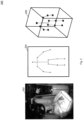
- Fig. 2 shows an illustration 200 of exemplary body keypoints.
- a grayscale image 202 with lines indicating a skeleton, a full 2D skeleton 204, and a full 3D skeleton 206 are shown.
- Some of the keypoints may not be visible in the grayscale image 202 (for example the left shoulder and the left hip), and these keypoints may be estimated for further processing or may be neglected in further processing.
- a fully convolutional neural network may be trained on a data set as described in more detail below, on single depth frames (i.e. the keypoints and their corresponding confidences may be calculated for each frame independently). For each keypoint, the network outputs a heatmap indicating its location if the respective body part is visible. In the training phase, the ground truth heatmaps contain the values of a Gaussian distribution centered at the desired keypoint location if the body part is visible, and are completely black otherwise. Consequently, if the network localizes a body keypoint well, the returned heatmap has a strong and roughly Gaussian shaped spot at its location.
- a confidence value may be calculated based on the intensity of the heatmap region around the maximal value, and the weighted standard deviation with relation to that maximal point. If the intensity values around that maximum are high and the standard deviation is low, these results may be of high confidence.
- the 2D location of the keypoint may be calculated as the center of gravity of the heatmap values. To avoid distortion by faraway nonzero values, only the pixels near the point with the maximal value may be used for the determination of the center of gravity.
- the 2D body keypoints may then be transformed into 3D camera coordinates using the depth image.
- the median depth value from a small window around it in the depth map may be used.
- the 3D position of the point may be calculated from its 2D coordinates and depth.
- the keypoint has been localized in two or more 2D (or 3D) camera images, its 3D position can be calculated from these two or more 2D positions considering the geometric relationship of the cameras.
- the 3D coordinates, together with the confidence, serve as part of the input to the recurrent part of the action recognition network.
- the most relevant parts of the scene may be described by the body keypoints, and may be used to determine image subregions (or crops) of interest, for example image subregions containing the driver's hands. For example, patches (or crops) of the (intensity) images where the hands are located may be used. To get these patches, an area around the calculated hand keypoints may be cropped out dynamically for each frame.
- Fig. 3 shows an illustration 300 of determining hand patches (in other words: cropped regions 304, 306) from an (intensity, color or depth) image 302 with body keypoints according to various embodiments. Cropped regions 304, 306 around left and right hands of an occupant are shown. Circles 308, 310 illustrate the calculated hand locations, and the cropped regions 304, 306 are cropped around these hand locations.
- the cropped regions 304, 306 may be of a pre-determined fixed size, or may be variable in size, for example depending on how big the hands are shown in the intensity image 302 and/or their distance to the camera.
- the cropped regions 304, 306 may be used as input to the neural network, like described in more detail below.
- the driver's current activity may be recognized in an efficient way that is robust to background changes.
- the activity information thus gained can for example be used to estimate the ability of the driver to react to emergency situations or take over control of a semi-autonomous car at any moment, and it may also be useful to configure e.g. entertainment systems, illumination or climate control.
- the body keypoints and 3D body keypoints are determined based on the ToF camera, various other sensors may be used.
- Fig. 4 shows an illustration 400 of body keypoints data fusion according to various embodiments.
- a ToF system 402 may be used to determine ToF related body keypoints 408.
- the 2D camera 404 may be used to determine 2D camera related body keypoints 410.
- the other sensor 406 may be used to determine other sensor related body keypoints 412.
- One or more of the ToF related body keypoints 408, the 2D camera related body keypoints 410, and the other sensor related body keypoints 412 may be used to determine the 3D body keypoints 106.
- the ToF related body keypoints 408 the 2D camera related body keypoints 410
- the other sensor related body keypoints 412 may be used to determine the 3D body keypoints 106.
- the 3D body keypoints 106 may also be used to determine one or more of the ToF related body keypoints 408, the 2D camera related body keypoints 410, and the other sensor related body keypoints 412 (i.e. the determination may be provided in a reverse direction).
- the respective keypoints may then be used to supplement or enhance the respective sensor data.
- the ToF related body keypoints 408 may be used to enhance the sensor data provided by the ToF system 402
- the 2D camera related body keypoints 410 may be used to enhance the sensor data provided by the 2D camera 404
- the other sensor related body keypoints 412 may be used to enhance the sensor data provided by the other sensor 406.
- the respective keypoints include portion of the respective data that shows (or includes or represents) the pre-determined portions of the body of the occupant.
- the ToF related body keypoints 408 may be one or more portions of the data provided by the ToF system 402 which show (or include or capture) one or more of the pre-determined portions of the body of the occupant;
- the 2D camera related body keypoints 410 may be one or more portions of the data provided by the 2D camera 404 which show (or include or capture) one or more of the pre-determined portions of the body of the occupant;
- the other sensor related body keypoints 412 may be one or more portions of the data provided by the other sensor 406 which show (or include or capture) one or more of the pre-determined portions of the body of the occupant.
- Fig. 5 shows an illustration 500 of determining input data for an action classifier 502 according to various embodiments.
- the ToF system 402 may provide the ToF related body keypoints 408, which may be used for determining the 3D body keypoints 106 and the hand crops 108.
- the data provided by the ToF system 402, the hand crops 108, and the 3D body keypoints 106 may be provided as input to the action classifier 502.
- Fig. 6 shows an illustration 600 of a classification system according to various embodiments.
- Sensor data 602 (for example on different scales, or from different sensors) may be provided to a data fusion module 604.
- the data fusion module 604 may carry out processing like described above with reference to Fig. 4 .
- the results of data fusion may be a first set of features 606, which may for example include keypoints, for example 2D keypoints and/ or 3D keypoints.
- the first set of features 606 may be used to determine a second set of features 610, like illustrated by arrow 608.
- the second set of features 610 may include features related to the occupant's body (for example a segmentation), related to the occupant's hands (for example crops, a segmentation, or a finger point vector, for example a vector indicating a location or direction to which the occupant points with one of his fingers), and/or related to the occupant's face (for example a crop, a segmentation, and/or a direction of view, for example a vector indicating a location or direction to which the occupant directs his face or to which he is looking).
- the second set of features 610 may be provided to a classifier ensemble 614 (in other words: a classifier or a classifier module), like indicated by arrow 612.
- Fig. 7 shows an illustration 700 of a classification system according to various embodiments.
- Various portions of the classification system illustrated in Fig. 7 may be similar or identical to portions of the classification system illustrated in Fig. 6 , so that the same reference signs may be used and duplicate description may be omitted.
- the first set of feature points may include 2D body keypoints 702, for example determined based on various different sensors, like described above with reference to Fig. 4 . Based on these 2D body keypoints 702, the 3D body keypoints 106 are determined.
- the second set of features 610 may be based on feature extraction, and may for example include body segmentation 704, hand crops 706 of different scales, a face crop 708 of different scales, and/or a direction of view 710.
- the classifier ensemble 614 may include an occupancy classifier 712 configured to determine whether a seat is occupied by an occupant, a position classifier 714 configured to determine whether an occupant of a vehicle is in a driving position, a hand occupancy classifier 716 configured to determine whether the occupant's hands are occupied (for example by using a mobile phone), and a hand action classifier 718 configured to classify an action of the occupant.
- the position classifier 714 (and subsequently the hand occupancy classifier 716, the hand action classifier 718) may only be used if it is determined by the occupancy classifier 712 that the seat is occupied.
- the hand occupancy classifier 716 (and subsequently the hand action classifier 718) may only be used if it is determined by the position classifier 714 that the occupant is in a driving position.
- the hand action classifier 718 may only be used if it is determined by the hand occupancy classifier 716 that the occupant's hands are occupied.
- a many-to-many CNN (convolutional neural network)-LSTM (long short-term memory) architecture or generally any classifier that incorporates information from several timesteps, like a 3D convolutional network, a recurrent neural network or an LSTM
- a classification result is determined for each input example frame, also taking into account information obtained from the past input.
- Fig. 8 shows an illustration 800 of a classification system using the hand crops 304, 306 and the 3D skeleton data 206 according to various embodiments.
- the hand crops 304, 306 may be fed into one or multiple convolutional neural networks (CNN) (for example, the hand crop 304 of the left hand may be fed into a first neural network 802, and the hand crop 306 of the right hand may be fed into a second neural network 804) to encode the image content to some embeddedings (feature vectors 806, 808, which may be learnt by the network, and which may have or may not have a meaning that can be interpreted by a human operator).
- CNN convolutional neural networks
- the first neural network 802 and the second neural network 804 may be identical, for example trained identically, or different, for example networks with different structure, or networks with identical structure but trained differently, for example with different training data, or partially different (with some parts identical, and some parts different, for example with partially different structure, or with parts which are trained differently).
- the feature vectors 806, 808 from both the left hand and the right hand are concatenated (or appended). Furthermore, based on the 3D body key points of the 3D skeleton data 206, 3D coordinates (and optionally the respective uncertainties) are included in a further feature vector 810. The feature vectors 806, 808 and the further feature vector 810 are appended to obtain a joined feature vector 812.
- the joined feature vector 812 which represents the current time step, is fed into a temporal network structure, for example, an LSTM (long short-term memory) network 814 to take into account temporal aspects of actions.
- a temporal network structure for example, an LSTM (long short-term memory) network 814 to take into account temporal aspects of actions.
- LSTM long short-term memory
- the final output of the classification vector 818 may be generated in a classification step, for example using a softmax method 816.
- the classification vector 818 may be a probability vector, wherein each entry of the probability vector indicates a respective probability for each class of the plurality of classes of actions that the action falls into the respective class.
- datasets may be used which include sequences recorded with a time of flight camera.
- Each sequence contains an action performed by a person sitting in the driver seat of one of the test cars.
- the camera covers a field of view (for example 120°) of the front interior of different cars.
- the images have two channels, a grayscale channel (or intensity channel) and a depth channel.
- the following actions may be considered: no action, enter car, dismount car, strap seat belt, unstrap seat belt, smartphone: idle, smartphone: phone call, smartphone: interaction, bottle: idle, bottle: drinking, bottle: interaction.
- the data may be augmented with several augmentation techniques. For example, noise may be added to the body keypoints by randomly shifting the 2D positions within a fixed range. Due to this, the hand images are augmented automatically, as the hand positions move slightly each time the keypoints are shifted. Moreover, random noise may be added to the images.
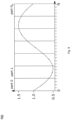
- a sine oscillation may be calculated, which describes the usage of frames in a sequence.
- the dilation and the phase angle of the sine wave are selected randomly in a predefined range.
- An amplitude of 0.5 and a bias of 1 may be assigned to the oscillation, to get values between 0.5 and 1.5.
- Fig. 9 shows an illustration 900 of such a sine wave.
- the sequence may be split in N parts and one value of the sine wave may be assigned to each part sequentially. These values are a factor which describes how many frames of a part are used. E.g. with a factor of 0.5, only half of the frames of this part would be used, which results in speeding up this part of the sequence by a factor of 2. In this way, the action sequence may be speeded up or slowed down randomly.
- the overall system may include at least one camera (a 2D camera, in other words: intensity/grayscale or RGB (red-green-blue) or RGBIR (red-green-blue-infrared) or IR (infrared) or other camera, and/or a 3D camera, for example a ToF or stereo camera system), a processing unit, and an output unit that transmits output signals to at least one other processing unit.
- a 2D camera in other words: intensity/grayscale or RGB (red-green-blue) or RGBIR (red-green-blue-infrared) or IR (infrared) or other camera
- a 3D camera for example a ToF or stereo camera system
- a processing unit for example a ToF or stereo camera system
- an output unit that transmits output signals to at least one other processing unit.
- methods and devices for action and object interaction recognition for driver activity classification may be provided.
- the temporal aspects of actions may be considered based on motion information and image sequences as input.
- the activity of the occupant may be classified based on the following classes): detection of a person entering or leaving a car; detection of a person inserting or removing an object to or from a car, detection of a person inserting or removing a baby seat to or from a car, detection of a person inserting or removing a child/ baby to or from a car, detection of a person buckeling up a seat belt/ unbuckeling a seat belt, detection of a person interacting with a phone (for example distinguishing between holding a phone and active control, i.e.
- infotainment or other vehicle controls may be used to derive statistics on vehicle usage.
- the data may be uploaded and analyzed inside or outside the vehicle (e.g. cloud service), and such data may be used to improve user experience (for example related to which features are used frequently or which features are used rarely), and may help the OEMS (original equipment manufacturers) to modify HMI (human machine interface) concepts in future vehicles.
- OEMS original equipment manufacturers
- ADAS advanced driver-assistance systems
- Fig. 10 shows a flow diagram 1000 illustrating a method for determining an activity of an occupant of a vehicle according to various embodiments.
- sensor data of the occupant may be captured using at least one sensor.
- respective two-dimensional or three-dimensional coordinates may be determined for a plurality of pre-determined portions of the body of the occupant based on the sensor data.
- at least one portion of the sensor data showing a pre-determined body part of the occupant may be determined based on the sensor data and the three-dimensional coordinates.
- the activity of the occupant may be determined based on the three-dimensional coordinates and the at least one portion of the sensor data.
- the sensor data may include or may be an image and further sensor data, and the at least one portion of the sensor data may include or may be at least one portion of the image.
- the image may include a plurality of intensity pixels, each intensity pixel indicating an intensity of light of a pre-determined wavelength or wavelength range received at the respective intensity pixel, and the further sensor data may include a plurality of distance pixels, each distance pixel indicates a distance between the further sensor and an object corresponding to the respective distance pixel.
- the pre-determined body part of the occupant may include one of the occupant's hands and/ or the occupant's face and/ or one of the occupant's shoulders.
- the at least one portion of the image may be determined based on a neural network.
- a plurality of images and a plurality of further sensor data may be captured, the two-dimensional or three-dimensional coordinates may be determined based on at least one of the plurality of images and the plurality of further sensor data.
- the activity may be determined based on a softmax method.
- Determining the activity includes or is classifying an action of a driver into one or more classes of a plurality of classes of actions.
- Classifying includes or is determining a probability vector, wherein each entry of the probability vector indicates a respective probability for each class of the plurality of classes of actions.
- the plurality of classes of actions may include or may be one or more of the following actions: entering a car; leaving a car; inserting an object to a car; removing an object from a car; inserting a baby seat to a car; removing a baby seat from a car; inserting a child to a car; removing a child from a car; inserting a baby to a car; removing a baby from a car, buckeling up a seat belt; unbuckeling a seat belt; interacting with a phone; holding a phone; active control of a phone; typing on a phone; talking on a phone; interacting with an object; interacting with a book; interacting with a magazine; interacting with a laptop; interacting with a tablet; interacting with the steering wheel; smoking; eating; drinking.
- steps 1002, 1004, 1006, 1008 and the further steps described above may be performed by computer hardware components.
Landscapes
- Engineering & Computer Science (AREA)
- Theoretical Computer Science (AREA)
- Physics & Mathematics (AREA)
- General Physics & Mathematics (AREA)
- Multimedia (AREA)
- Evolutionary Computation (AREA)
- Computer Vision & Pattern Recognition (AREA)
- Artificial Intelligence (AREA)
- Health & Medical Sciences (AREA)
- General Health & Medical Sciences (AREA)
- Computing Systems (AREA)
- Software Systems (AREA)
- Databases & Information Systems (AREA)
- Medical Informatics (AREA)
- Data Mining & Analysis (AREA)
- Life Sciences & Earth Sciences (AREA)
- Human Computer Interaction (AREA)
- Mathematical Physics (AREA)
- Automation & Control Theory (AREA)
- Mechanical Engineering (AREA)
- Transportation (AREA)
- Biomedical Technology (AREA)
- Molecular Biology (AREA)
- General Engineering & Computer Science (AREA)
- Evolutionary Biology (AREA)
- Bioinformatics & Computational Biology (AREA)
- Bioinformatics & Cheminformatics (AREA)
- Biodiversity & Conservation Biology (AREA)
- Biophysics (AREA)
- Computational Linguistics (AREA)
- Traffic Control Systems (AREA)
- Image Analysis (AREA)
Claims (12)
- Procédé mis en œuvre par ordinateur pour déterminer une activité (502) d'un occupant d'un véhicule, le procédé comprenant les étapes suivantes exécutées par des composants matériels informatiques et consistant à :- capturer (1002) des données de capteur (102) de l'occupant à l'aide d'au moins un capteur ;- déterminer (1004) les coordonnées respectives d'une pluralité de parties prédéterminées du corps de l'occupant (308, 310) sur la base des données de capteur, et inclure des données de position dans un vecteur de caractéristiques (810) ;- déterminer (1006) au moins une partie des données de capteur (108, 304, 306) montrant une partie prédéterminée du corps de l'occupant sur la base des données de capteur et des coordonnées, et coder le contenu des données de capteur dans d'autres vecteurs de caractéristiques (806, 808) ;- ajouter les autres vecteurs de caractéristiques et le vecteur de caractéristiques pour obtenir un vecteur de caractéristiques joint ; et- déterminer (1008) l'activité de l'occupant sur la base du vecteur de caractéristiques joint (812) ;dans lequel déterminer l'activité consiste à classifier une action d'un conducteur dans une ou plusieurs classes d'une pluralité de classes d'actions ; etdans lequel classifier consiste à déterminer un vecteur de probabilités (818), dans lequel chaque entrée du vecteur de probabilités indique une probabilité respective pour chaque classe de la pluralité de classes d'actions ;caractérisé en ce quelesdites coordonnées sont des coordonnées tridimensionnelles (106) et les données de position incluses dans le vecteur de caractéristiques sont les coordonnées tridimensionnelles.
- Procédé mis en œuvre par ordinateur selon la revendication 1,dans lequel les données de capteur comprennent une image et d'autres données de capteur ;dans lequel ladite au moins une partie des données de capteur comprend au moins une partie de l'image.
- Procédé mis en œuvre par ordinateur selon la revendication 2,dans lequel l'image comprend une pluralité de pixels d'intensité, chaque pixel d'intensité indiquant une intensité de lumière d'une longueur d'onde ou d'une plage de longueurs d'onde prédéterminée reçue au niveau du pixel d'intensité respectif ; etdans lequel les autres données du capteur comprennent une pluralité de pixels de distance, chaque pixel de distance indiquant une distance entre l'autre capteur et un objet correspondant au pixel de distance respectif.
- Procédé mis en œuvre par ordinateur selon l'une quelconque des revendications 1 à 3,
dans lequel la partie du corps prédéterminée de l'occupant comprend l'une des mains de l'occupant et/ou le visage de l'occupant. - Procédé mis en œuvre par ordinateur selon l'une quelconque des revendications 1 à 4,dans lequel une pluralité d'images et une pluralité d'autres données de capteur sont capturées ; etdans lequel les coordonnées tridimensionnelles sont déterminées sur la base d'au moins l'une de la pluralité d'images et de la pluralité d'autres données de capteur.
- Procédé mis en œuvre par ordinateur selon l'une quelconque des revendications 1 à 5,
dans lequel l'activité est déterminée sur la base d'un réseau neuronal. - Procédé mis en œuvre par ordinateur selon l'une quelconque des revendications 1 à 6,
dans lequel l'activité est déterminée sur la base d'un procédé softmax. - Procédé mis en œuvre par ordinateur selon l'une quelconque des revendications 1 à 7,
dans lequel la pluralité de classes d'actions comprend une ou plusieurs des actions suivantes : entrer dans une voiture ; quitter une voiture ; insérer un objet dans une voiture ; retirer un objet d'une voiture ; insérer un siège bébé dans une voiture ; retirer un siège bébé d'une voiture ; installer un enfant dans une voiture ; retirer un enfant d'une voiture ; installer un bébé dans une voiture ; retirer un bébé d'une voiture, boucler une ceinture de sécurité ; déboucler une ceinture de sécurité ; interagir avec un téléphone ; tenir un téléphone ; commander activement un téléphone ; taper sur un téléphone ; parler au téléphone ; interagir avec un objet ; interagir avec un livre ; interagir avec un magazine ; interagir avec un ordinateur portable ; interagir avec une tablette ; interagir avec le volant ; fumer ; manger ; boire ; actionner un système d'infodivertissement du véhicule ; actionner des commandes du véhicule. - Système informatique, le système informatique comprenant une pluralité de composants matériels informatiques configurés pour exécuter toutes les étapes du procédé mis en œuvre par ordinateur selon au moins l'une des revendications 1 à 8,
le système informatique comprenant en outre un capteur d'image et au moins un autre capteur. - Système informatique selon la revendication 9,
dans lequel ledit au moins un autre capteur comprend une caméra temps de vol. - Système informatique selon l'une quelconque des revendications 9 ou 10,
dans lequel le capteur d'image et ledit au moins un autre capteur sont prévus sous la forme d'un capteur combiné. - Support non transitoire lisible par ordinateur comprenant des instructions qui, lorsque les instructions sont exécutées par le système informatique selon la revendication 9, amènent le système informatique à exécuter le procédé mis en œuvre par ordinateur selon au moins l'une des revendications 1 à 8.
Priority Applications (3)
| Application Number | Priority Date | Filing Date | Title |
|---|---|---|---|
| EP19197820.4A EP3796209B1 (fr) | 2019-09-17 | 2019-09-17 | Procédé et système pour déterminer une activité d'un occupant d'un véhicule |
| US17/006,652 US11308722B2 (en) | 2019-09-17 | 2020-08-28 | Method and system for determining an activity of an occupant of a vehicle |
| CN202010966496.3A CN112519789A (zh) | 2019-09-17 | 2020-09-15 | 确定车辆乘员的活动的方法和系统 |
Applications Claiming Priority (1)
| Application Number | Priority Date | Filing Date | Title |
|---|---|---|---|
| EP19197820.4A EP3796209B1 (fr) | 2019-09-17 | 2019-09-17 | Procédé et système pour déterminer une activité d'un occupant d'un véhicule |
Publications (2)
| Publication Number | Publication Date |
|---|---|
| EP3796209A1 EP3796209A1 (fr) | 2021-03-24 |
| EP3796209B1 true EP3796209B1 (fr) | 2025-05-21 |
Family
ID=67997371
Family Applications (1)
| Application Number | Title | Priority Date | Filing Date |
|---|---|---|---|
| EP19197820.4A Active EP3796209B1 (fr) | 2019-09-17 | 2019-09-17 | Procédé et système pour déterminer une activité d'un occupant d'un véhicule |
Country Status (3)
| Country | Link |
|---|---|
| US (1) | US11308722B2 (fr) |
| EP (1) | EP3796209B1 (fr) |
| CN (1) | CN112519789A (fr) |
Families Citing this family (21)
| Publication number | Priority date | Publication date | Assignee | Title |
|---|---|---|---|---|
| EP3493116B1 (fr) | 2017-12-04 | 2023-05-10 | Aptiv Technologies Limited | Système et procédé pour générer une valeur de confiance pour au moins un état à l'intérieur d'un véhicule |
| US11422551B2 (en) * | 2018-12-27 | 2022-08-23 | Intel Corporation | Technologies for providing a cognitive capacity test for autonomous driving |
| CN112668359A (zh) * | 2019-10-15 | 2021-04-16 | 富士通株式会社 | 动作识别方法、动作识别装置和电子设备 |
| WO2021098441A1 (fr) * | 2019-11-20 | 2021-05-27 | Oppo广东移动通信有限公司 | Procédé et appareil d'estimation de posture de main, dispositif et support de stockage informatique |
| US11776319B2 (en) * | 2020-07-14 | 2023-10-03 | Fotonation Limited | Methods and systems to predict activity in a sequence of images |
| DE102020120600A1 (de) * | 2020-08-05 | 2022-02-10 | Gestigon Gmbh | Verfahren und vorrichtung zum automatischen schätzen eines körpergewichts einer person |
| DE102020214910A1 (de) * | 2020-11-27 | 2022-06-02 | Robert Bosch Gesellschaft mit beschränkter Haftung | Verfahren zur Überwachung eines Fahrzeuginnenraums |
| CN113406659A (zh) * | 2021-05-28 | 2021-09-17 | 浙江大学 | 一种基于激光雷达信息的移动机器人位置重识别方法 |
| US12183091B2 (en) | 2021-06-30 | 2024-12-31 | Tobii Technologies Limited | Vehicle occupant monitoring system and method |
| EP4125063B1 (fr) * | 2021-07-29 | 2025-12-24 | Aptiv Technologies AG | Procédés et systèmes de prédiction de classe d'occupation et procédés et systèmes de détermination de valeur d'occlusion |
| GB2609913A (en) * | 2021-08-12 | 2023-02-22 | Continental Automotive Gmbh | Vehicle cabin sensing system |
| US12299930B2 (en) * | 2021-11-05 | 2025-05-13 | Image Metrics, Ltd. | Real-time body pose estimation system and method in unconstrained video |
| EP4216172A1 (fr) * | 2022-01-21 | 2023-07-26 | Aptiv Technologies Limited | Procédé et système permettant de détecter un type d'occupation de siège |
| CN114495072A (zh) * | 2022-01-29 | 2022-05-13 | 上海商汤临港智能科技有限公司 | 乘员状态检测方法及装置、电子设备和存储介质 |
| CN114701409B (zh) * | 2022-04-28 | 2023-09-05 | 东风汽车集团股份有限公司 | 一种手势交互式智能座椅调节方法和系统 |
| CN115565138A (zh) * | 2022-10-27 | 2023-01-03 | 上海东普信息科技有限公司 | 物流区域的抽烟行为管控方法、装置、设备及存储介质 |
| EP4394729A1 (fr) * | 2022-12-30 | 2024-07-03 | Aptiv Technologies AG | Vérification de la ceinture de sécurité |
| US20240310523A1 (en) * | 2023-03-16 | 2024-09-19 | Ford Global Technologies, Llc | Systems and methods for in-cabin monitoring with liveliness detection |
| DE102023117314A1 (de) * | 2023-06-30 | 2025-01-02 | Fraunhofer-Gesellschaft zur Förderung der angewandten Forschung eingetragener Verein | Verfahren zur Analyse von Körperhaltungen eines Fahrzeuginsassen |
| DE102023118063A1 (de) * | 2023-07-07 | 2025-01-09 | Bayerische Motoren Werke Aktiengesellschaft | Verfahren zur manipulationsprüfung einer sichtbeschränkten anzeigeeinrichtung in einem fahrzeug |
| US20250242822A1 (en) * | 2024-01-26 | 2025-07-31 | Robert Bosch Gmbh | Controlling vehicle operation based on driver attentiveness |
Family Cites Families (29)
| Publication number | Priority date | Publication date | Assignee | Title |
|---|---|---|---|---|
| JPH0727552B2 (ja) * | 1983-04-27 | 1995-03-29 | 株式会社日立製作所 | 画像歪の補正方法 |
| US6445988B1 (en) | 1997-02-06 | 2002-09-03 | Automotive Technologies International Inc. | System for determining the occupancy state of a seat in a vehicle and controlling a component based thereon |
| US6810309B2 (en) * | 2002-04-25 | 2004-10-26 | Visteon Global Technologies, Inc. | Vehicle personalization via biometric identification |
| WO2004081850A1 (fr) | 2003-03-13 | 2004-09-23 | Intelligent Mechatronic Systems Inc. | Classification visuelle et estimation de la posture de plusieurs occupants d'un vehicule visual classification and posture estimation of multiple vehicle occupants |
| US7791670B2 (en) * | 2005-05-11 | 2010-09-07 | Delphi Technologies, Inc. | Method of operation for a vision-based occupant sensing system |
| US7472007B2 (en) | 2005-09-02 | 2008-12-30 | Delphi Technologies, Inc. | Method of classifying vehicle occupants |
| US7483866B2 (en) | 2005-12-19 | 2009-01-27 | Trw Automotive U.S. Llc | Subclass partitioning in a pattern recognition classifier for controlling deployment of an occupant restraint system |
| JP2008269496A (ja) * | 2007-04-24 | 2008-11-06 | Takata Corp | 乗員情報検出システム、乗員拘束システム、車両 |
| US8135511B2 (en) * | 2009-03-20 | 2012-03-13 | Toyota Motor Engineering & Manufacturing North America (Tema) | Electronic control system, electronic control unit and associated methodology of adapting a vehicle system based on visually detected vehicle occupant information |
| US8396252B2 (en) * | 2010-05-20 | 2013-03-12 | Edge 3 Technologies | Systems and related methods for three dimensional gesture recognition in vehicles |
| US20130204457A1 (en) | 2012-02-06 | 2013-08-08 | Ford Global Technologies, Llc | Interacting with vehicle controls through gesture recognition |
| DE102013000083A1 (de) * | 2013-01-08 | 2014-07-10 | Audi Ag | Kraftfahrzeug mit einer personenspezifischen Bedienschnittstelle |
| CN103707781B (zh) * | 2013-12-26 | 2016-02-24 | 苏州清研微视电子科技有限公司 | 基于距离图像的驾驶员座椅位置自动调整系统 |
| US10147007B1 (en) * | 2015-01-13 | 2018-12-04 | State Farm Mutual Automobile Insurance Company | Apparatuses, systems and methods for determining whether a vehicle is being operated in autonomous mode or manual mode |
| FR3051584B1 (fr) * | 2016-05-20 | 2019-11-01 | Safran | Procede de reconstruction tridimensionnelle a l'aide d'une camera plenoptique. |
| US10318831B2 (en) * | 2016-07-21 | 2019-06-11 | Gestigon Gmbh | Method and system for monitoring the status of the driver of a vehicle |
| US10466714B2 (en) * | 2016-09-01 | 2019-11-05 | Ford Global Technologies, Llc | Depth map estimation with stereo images |
| US10112505B2 (en) * | 2016-09-21 | 2018-10-30 | Intel Corporation | Occupant profiling system |
| CN110114246B (zh) * | 2016-12-07 | 2022-03-01 | 乔伊森安全系统收购有限责任公司 | 3d飞行时间有源反射感测系统和方法 |
| US10290158B2 (en) * | 2017-02-03 | 2019-05-14 | Ford Global Technologies, Llc | System and method for assessing the interior of an autonomous vehicle |
| US10997421B2 (en) * | 2017-03-30 | 2021-05-04 | Hrl Laboratories, Llc | Neuromorphic system for real-time visual activity recognition |
| US10592785B2 (en) | 2017-07-12 | 2020-03-17 | Futurewei Technologies, Inc. | Integrated system for detection of driver condition |
| EP3493116B1 (fr) | 2017-12-04 | 2023-05-10 | Aptiv Technologies Limited | Système et procédé pour générer une valeur de confiance pour au moins un état à l'intérieur d'un véhicule |
| CN108038453A (zh) * | 2017-12-15 | 2018-05-15 | 罗派智能控制技术(上海)有限公司 | 一种基于rgbd的汽车驾驶员状态检测和识别系统 |
| US10628667B2 (en) * | 2018-01-11 | 2020-04-21 | Futurewei Technologies, Inc. | Activity recognition method using videotubes |
| US10296102B1 (en) * | 2018-01-31 | 2019-05-21 | Piccolo Labs Inc. | Gesture and motion recognition using skeleton tracking |
| US10322728B1 (en) * | 2018-02-22 | 2019-06-18 | Futurewei Technologies, Inc. | Method for distress and road rage detection |
| CN108764185B (zh) * | 2018-06-01 | 2022-07-19 | 京东方科技集团股份有限公司 | 一种图像处理方法及装置 |
| US20200017124A1 (en) * | 2018-07-12 | 2020-01-16 | Sf Motors, Inc. | Adaptive driver monitoring for advanced driver-assistance systems |
-
2019
- 2019-09-17 EP EP19197820.4A patent/EP3796209B1/fr active Active
-
2020
- 2020-08-28 US US17/006,652 patent/US11308722B2/en active Active
- 2020-09-15 CN CN202010966496.3A patent/CN112519789A/zh active Pending
Also Published As
| Publication number | Publication date |
|---|---|
| CN112519789A (zh) | 2021-03-19 |
| US11308722B2 (en) | 2022-04-19 |
| US20210081689A1 (en) | 2021-03-18 |
| EP3796209A1 (fr) | 2021-03-24 |
Similar Documents
| Publication | Publication Date | Title |
|---|---|---|
| EP3796209B1 (fr) | Procédé et système pour déterminer une activité d'un occupant d'un véhicule | |
| US11100316B2 (en) | Activity recognition method using videotubes | |
| US11535280B2 (en) | Method and device for determining an estimate of the capability of a vehicle driver to take over control of a vehicle | |
| US10678253B2 (en) | Control systems, control methods and controllers for an autonomous vehicle | |
| US11042999B2 (en) | Advanced driver assist systems and methods of detecting objects in the same | |
| US10902279B2 (en) | Training saliency | |
| US10955842B2 (en) | Control systems, control methods and controllers for an autonomous vehicle | |
| US20200210721A1 (en) | Hierarchical machine-learning network architecture | |
| US20190361454A1 (en) | Control systems, control methods and controllers for an autonomous vehicle | |
| KR102887567B1 (ko) | 학습 데이터를 생성하는 인공 지능 장치 및 방법 | |
| US11106211B2 (en) | Vision-based sample-efficient reinforcement learning framework for autonomous driving | |
| CN108388834A (zh) | 利用循环神经网络和级联特征映射的对象检测 | |
| CN111695401A (zh) | 针对遗留在自主车辆中的物品的光度立体对象检测 | |
| Weyers et al. | Action and object interaction recognition for driver activity classification | |
| CN112989915A (zh) | 用于检测自主载具中的异常乘客行为的系统和方法 | |
| Sengar et al. | PoseViNet: Distracted driver action recognition framework using multi-view pose estimation and vision transformer | |
| US20230206654A1 (en) | Embedded Deep Learning Multi-Scale Object Detection Model Using Real-Time Distant Region Locating Device and Method Thereof | |
| Khan et al. | An Analytical Framework to Enhance Autonomous Vehicle Perception for Smart Cities | |
| US12371072B2 (en) | Operator take-over prediction | |
| Vaghasiya | Detecting the unexpected: a safety enabled multi-task approach towards unknown object-segmentation and depth estimation | |
| Dong | Machine Learning and Deep Learning Algorithms in Thermal Imaging Vehicle Perception Systems | |
| CN118053062A (zh) | 使用多个神经网络执行电子设备或车辆的感知任务的方法 | |
| Ohn-Bar | Contextual Visual Object Recognition and Behavior Modeling for Human-Robot Interactivity |
Legal Events
| Date | Code | Title | Description |
|---|---|---|---|
| PUAI | Public reference made under article 153(3) epc to a published international application that has entered the european phase |
Free format text: ORIGINAL CODE: 0009012 |
|
| STAA | Information on the status of an ep patent application or granted ep patent |
Free format text: STATUS: THE APPLICATION HAS BEEN PUBLISHED |
|
| AK | Designated contracting states |
Kind code of ref document: A1 Designated state(s): AL AT BE BG CH CY CZ DE DK EE ES FI FR GB GR HR HU IE IS IT LI LT LU LV MC MK MT NL NO PL PT RO RS SE SI SK SM TR |
|
| AX | Request for extension of the european patent |
Extension state: BA ME |
|
| STAA | Information on the status of an ep patent application or granted ep patent |
Free format text: STATUS: REQUEST FOR EXAMINATION WAS MADE |
|
| 17P | Request for examination filed |
Effective date: 20210924 |
|
| RBV | Designated contracting states (corrected) |
Designated state(s): AL AT BE BG CH CY CZ DE DK EE ES FI FR GB GR HR HU IE IS IT LI LT LU LV MC MK MT NL NO PL PT RO RS SE SI SK SM TR |
|
| STAA | Information on the status of an ep patent application or granted ep patent |
Free format text: STATUS: EXAMINATION IS IN PROGRESS |
|
| 17Q | First examination report despatched |
Effective date: 20230210 |
|
| RAP3 | Party data changed (applicant data changed or rights of an application transferred) |
Owner name: APTIV TECHNOLOGIES LIMITED |
|
| RAP1 | Party data changed (applicant data changed or rights of an application transferred) |
Owner name: APTIV TECHNOLOGIES AG |
|
| RAP3 | Party data changed (applicant data changed or rights of an application transferred) |
Owner name: APTIV TECHNOLOGIES AG |
|
| REG | Reference to a national code |
Ref country code: DE Ref legal event code: R079 Free format text: PREVIOUS MAIN CLASS: G06K0009000000 Ipc: G06V0010440000 Ref document number: 602019070177 Country of ref document: DE |
|
| GRAP | Despatch of communication of intention to grant a patent |
Free format text: ORIGINAL CODE: EPIDOSNIGR1 |
|
| STAA | Information on the status of an ep patent application or granted ep patent |
Free format text: STATUS: GRANT OF PATENT IS INTENDED |
|
| RIC1 | Information provided on ipc code assigned before grant |
Ipc: G06F 18/25 20230101ALI20241206BHEP Ipc: G06V 40/10 20220101ALI20241206BHEP Ipc: G06V 20/59 20220101ALI20241206BHEP Ipc: G06V 10/82 20220101ALI20241206BHEP Ipc: G06V 10/80 20220101ALI20241206BHEP Ipc: G06V 10/764 20220101ALI20241206BHEP Ipc: G06V 10/44 20220101AFI20241206BHEP |
|
| INTG | Intention to grant announced |
Effective date: 20241223 |
|
| GRAS | Grant fee paid |
Free format text: ORIGINAL CODE: EPIDOSNIGR3 |
|
| GRAA | (expected) grant |
Free format text: ORIGINAL CODE: 0009210 |
|
| STAA | Information on the status of an ep patent application or granted ep patent |
Free format text: STATUS: THE PATENT HAS BEEN GRANTED |
|
| P01 | Opt-out of the competence of the unified patent court (upc) registered |
Free format text: CASE NUMBER: APP_14901/2025 Effective date: 20250327 |
|
| AK | Designated contracting states |
Kind code of ref document: B1 Designated state(s): AL AT BE BG CH CY CZ DE DK EE ES FI FR GB GR HR HU IE IS IT LI LT LU LV MC MK MT NL NO PL PT RO RS SE SI SK SM TR |
|
| REG | Reference to a national code |
Ref country code: GB Ref legal event code: FG4D |
|
| REG | Reference to a national code |
Ref country code: CH Ref legal event code: EP |
|
| REG | Reference to a national code |
Ref country code: DE Ref legal event code: R096 Ref document number: 602019070177 Country of ref document: DE |
|
| REG | Reference to a national code |
Ref country code: IE Ref legal event code: FG4D |
|
| REG | Reference to a national code |
Ref country code: NL Ref legal event code: MP Effective date: 20250521 |
|
| PG25 | Lapsed in a contracting state [announced via postgrant information from national office to epo] |
Ref country code: FI Free format text: LAPSE BECAUSE OF FAILURE TO SUBMIT A TRANSLATION OF THE DESCRIPTION OR TO PAY THE FEE WITHIN THE PRESCRIBED TIME-LIMIT Effective date: 20250521 Ref country code: PT Free format text: LAPSE BECAUSE OF FAILURE TO SUBMIT A TRANSLATION OF THE DESCRIPTION OR TO PAY THE FEE WITHIN THE PRESCRIBED TIME-LIMIT Effective date: 20250922 Ref country code: ES Free format text: LAPSE BECAUSE OF FAILURE TO SUBMIT A TRANSLATION OF THE DESCRIPTION OR TO PAY THE FEE WITHIN THE PRESCRIBED TIME-LIMIT Effective date: 20250521 |
|
| PGFP | Annual fee paid to national office [announced via postgrant information from national office to epo] |
Ref country code: DE Payment date: 20250814 Year of fee payment: 7 |
|
| REG | Reference to a national code |
Ref country code: LT Ref legal event code: MG9D |
|
| PG25 | Lapsed in a contracting state [announced via postgrant information from national office to epo] |
Ref country code: NO Free format text: LAPSE BECAUSE OF FAILURE TO SUBMIT A TRANSLATION OF THE DESCRIPTION OR TO PAY THE FEE WITHIN THE PRESCRIBED TIME-LIMIT Effective date: 20250821 Ref country code: GR Free format text: LAPSE BECAUSE OF FAILURE TO SUBMIT A TRANSLATION OF THE DESCRIPTION OR TO PAY THE FEE WITHIN THE PRESCRIBED TIME-LIMIT Effective date: 20250822 |
|
| PG25 | Lapsed in a contracting state [announced via postgrant information from national office to epo] |
Ref country code: PL Free format text: LAPSE BECAUSE OF FAILURE TO SUBMIT A TRANSLATION OF THE DESCRIPTION OR TO PAY THE FEE WITHIN THE PRESCRIBED TIME-LIMIT Effective date: 20250521 Ref country code: NL Free format text: LAPSE BECAUSE OF FAILURE TO SUBMIT A TRANSLATION OF THE DESCRIPTION OR TO PAY THE FEE WITHIN THE PRESCRIBED TIME-LIMIT Effective date: 20250521 |
|
| PG25 | Lapsed in a contracting state [announced via postgrant information from national office to epo] |
Ref country code: BG Free format text: LAPSE BECAUSE OF FAILURE TO SUBMIT A TRANSLATION OF THE DESCRIPTION OR TO PAY THE FEE WITHIN THE PRESCRIBED TIME-LIMIT Effective date: 20250521 |
|
| PGFP | Annual fee paid to national office [announced via postgrant information from national office to epo] |
Ref country code: GB Payment date: 20250924 Year of fee payment: 7 |
|
| PG25 | Lapsed in a contracting state [announced via postgrant information from national office to epo] |
Ref country code: HR Free format text: LAPSE BECAUSE OF FAILURE TO SUBMIT A TRANSLATION OF THE DESCRIPTION OR TO PAY THE FEE WITHIN THE PRESCRIBED TIME-LIMIT Effective date: 20250521 |
|
| PGFP | Annual fee paid to national office [announced via postgrant information from national office to epo] |
Ref country code: FR Payment date: 20250908 Year of fee payment: 7 |
|
| PG25 | Lapsed in a contracting state [announced via postgrant information from national office to epo] |
Ref country code: RS Free format text: LAPSE BECAUSE OF FAILURE TO SUBMIT A TRANSLATION OF THE DESCRIPTION OR TO PAY THE FEE WITHIN THE PRESCRIBED TIME-LIMIT Effective date: 20250821 |
|
| PG25 | Lapsed in a contracting state [announced via postgrant information from national office to epo] |
Ref country code: IS Free format text: LAPSE BECAUSE OF FAILURE TO SUBMIT A TRANSLATION OF THE DESCRIPTION OR TO PAY THE FEE WITHIN THE PRESCRIBED TIME-LIMIT Effective date: 20250921 |
|
| PG25 | Lapsed in a contracting state [announced via postgrant information from national office to epo] |
Ref country code: LV Free format text: LAPSE BECAUSE OF FAILURE TO SUBMIT A TRANSLATION OF THE DESCRIPTION OR TO PAY THE FEE WITHIN THE PRESCRIBED TIME-LIMIT Effective date: 20250521 |
|
| REG | Reference to a national code |
Ref country code: AT Ref legal event code: MK05 Ref document number: 1797461 Country of ref document: AT Kind code of ref document: T Effective date: 20250521 |
|
| PG25 | Lapsed in a contracting state [announced via postgrant information from national office to epo] |
Ref country code: AT Free format text: LAPSE BECAUSE OF FAILURE TO SUBMIT A TRANSLATION OF THE DESCRIPTION OR TO PAY THE FEE WITHIN THE PRESCRIBED TIME-LIMIT Effective date: 20250521 Ref country code: DK Free format text: LAPSE BECAUSE OF FAILURE TO SUBMIT A TRANSLATION OF THE DESCRIPTION OR TO PAY THE FEE WITHIN THE PRESCRIBED TIME-LIMIT Effective date: 20250521 Ref country code: SM Free format text: LAPSE BECAUSE OF FAILURE TO SUBMIT A TRANSLATION OF THE DESCRIPTION OR TO PAY THE FEE WITHIN THE PRESCRIBED TIME-LIMIT Effective date: 20250521 |
|
| PG25 | Lapsed in a contracting state [announced via postgrant information from national office to epo] |
Ref country code: CZ Free format text: LAPSE BECAUSE OF FAILURE TO SUBMIT A TRANSLATION OF THE DESCRIPTION OR TO PAY THE FEE WITHIN THE PRESCRIBED TIME-LIMIT Effective date: 20250521 |
|
| PG25 | Lapsed in a contracting state [announced via postgrant information from national office to epo] |
Ref country code: EE Free format text: LAPSE BECAUSE OF FAILURE TO SUBMIT A TRANSLATION OF THE DESCRIPTION OR TO PAY THE FEE WITHIN THE PRESCRIBED TIME-LIMIT Effective date: 20250521 |
|
| PG25 | Lapsed in a contracting state [announced via postgrant information from national office to epo] |
Ref country code: SK Free format text: LAPSE BECAUSE OF FAILURE TO SUBMIT A TRANSLATION OF THE DESCRIPTION OR TO PAY THE FEE WITHIN THE PRESCRIBED TIME-LIMIT Effective date: 20250521 Ref country code: RO Free format text: LAPSE BECAUSE OF FAILURE TO SUBMIT A TRANSLATION OF THE DESCRIPTION OR TO PAY THE FEE WITHIN THE PRESCRIBED TIME-LIMIT Effective date: 20250521 |
|
| PG25 | Lapsed in a contracting state [announced via postgrant information from national office to epo] |
Ref country code: IT Free format text: LAPSE BECAUSE OF FAILURE TO SUBMIT A TRANSLATION OF THE DESCRIPTION OR TO PAY THE FEE WITHIN THE PRESCRIBED TIME-LIMIT Effective date: 20250521 |
|
| REG | Reference to a national code |
Ref country code: DE Ref legal event code: R097 Ref document number: 602019070177 Country of ref document: DE |
|
| PLBE | No opposition filed within time limit |
Free format text: ORIGINAL CODE: 0009261 |
|
| STAA | Information on the status of an ep patent application or granted ep patent |
Free format text: STATUS: NO OPPOSITION FILED WITHIN TIME LIMIT |
|
| REG | Reference to a national code |
Ref country code: CH Ref legal event code: L10 Free format text: ST27 STATUS EVENT CODE: U-0-0-L10-L00 (AS PROVIDED BY THE NATIONAL OFFICE) Effective date: 20260402 |