EP3799165A1 - Positivelektrodenaktivmaterial, positive elektrodenplatte, elektrochemische energiespeichervorrichtung und vorrichtung - Google Patents
Positivelektrodenaktivmaterial, positive elektrodenplatte, elektrochemische energiespeichervorrichtung und vorrichtung Download PDFInfo
- Publication number
- EP3799165A1 EP3799165A1 EP19901673.4A EP19901673A EP3799165A1 EP 3799165 A1 EP3799165 A1 EP 3799165A1 EP 19901673 A EP19901673 A EP 19901673A EP 3799165 A1 EP3799165 A1 EP 3799165A1
- Authority
- EP
- European Patent Office
- Prior art keywords
- active material
- positive active
- sub
- energy storage
- electrochemical energy
- Prior art date
- Legal status (The legal status is an assumption and is not a legal conclusion. Google has not performed a legal analysis and makes no representation as to the accuracy of the status listed.)
- Pending
Links
Images

Classifications
-
- H—ELECTRICITY
- H01—ELECTRIC ELEMENTS
- H01M—PROCESSES OR MEANS, e.g. BATTERIES, FOR THE DIRECT CONVERSION OF CHEMICAL ENERGY INTO ELECTRICAL ENERGY
- H01M4/00—Electrodes
- H01M4/02—Electrodes composed of, or comprising, active material
- H01M4/36—Selection of substances as active materials, active masses, active liquids
- H01M4/48—Selection of substances as active materials, active masses, active liquids of inorganic oxides or hydroxides
- H01M4/52—Selection of substances as active materials, active masses, active liquids of inorganic oxides or hydroxides of nickel, cobalt or iron
- H01M4/525—Selection of substances as active materials, active masses, active liquids of inorganic oxides or hydroxides of nickel, cobalt or iron of mixed oxides or hydroxides containing iron, cobalt or nickel for inserting or intercalating light metals, e.g. LiNiO2, LiCoO2 or LiCoOxFy
-
- H—ELECTRICITY
- H01—ELECTRIC ELEMENTS
- H01M—PROCESSES OR MEANS, e.g. BATTERIES, FOR THE DIRECT CONVERSION OF CHEMICAL ENERGY INTO ELECTRICAL ENERGY
- H01M4/00—Electrodes
- H01M4/02—Electrodes composed of, or comprising, active material
- H01M4/36—Selection of substances as active materials, active masses, active liquids
- H01M4/48—Selection of substances as active materials, active masses, active liquids of inorganic oxides or hydroxides
- H01M4/485—Selection of substances as active materials, active masses, active liquids of inorganic oxides or hydroxides of mixed oxides or hydroxides for inserting or intercalating light metals, e.g. LiTi2O4 or LiTi2OxFy
-
- C—CHEMISTRY; METALLURGY
- C01—INORGANIC CHEMISTRY
- C01G—COMPOUNDS CONTAINING METALS NOT COVERED BY SUBCLASSES C01D OR C01F
- C01G53/00—Compounds of nickel
- C01G53/40—Complex oxides containing nickel and at least one other metal element
- C01G53/42—Complex oxides containing nickel and at least one other metal element containing alkali metals, e.g. LiNiO2
- C01G53/44—Complex oxides containing nickel and at least one other metal element containing alkali metals, e.g. LiNiO2 containing manganese
- C01G53/50—Complex oxides containing nickel and at least one other metal element containing alkali metals, e.g. LiNiO2 containing manganese of the type (MnO2)n-, e.g. Li(NixMn1-x)O2 or Li(MyNixMn1-x-y)O2
-
- H—ELECTRICITY
- H01—ELECTRIC ELEMENTS
- H01M—PROCESSES OR MEANS, e.g. BATTERIES, FOR THE DIRECT CONVERSION OF CHEMICAL ENERGY INTO ELECTRICAL ENERGY
- H01M10/00—Secondary cells; Manufacture thereof
- H01M10/05—Accumulators with non-aqueous electrolyte
- H01M10/052—Li-accumulators
- H01M10/0525—Rocking-chair batteries, i.e. batteries with lithium insertion or intercalation in both electrodes; Lithium-ion batteries
-
- H—ELECTRICITY
- H01—ELECTRIC ELEMENTS
- H01M—PROCESSES OR MEANS, e.g. BATTERIES, FOR THE DIRECT CONVERSION OF CHEMICAL ENERGY INTO ELECTRICAL ENERGY
- H01M10/00—Secondary cells; Manufacture thereof
- H01M10/05—Accumulators with non-aqueous electrolyte
- H01M10/056—Accumulators with non-aqueous electrolyte characterised by the materials used as electrolytes, e.g. mixed inorganic/organic electrolytes
- H01M10/0564—Accumulators with non-aqueous electrolyte characterised by the materials used as electrolytes, e.g. mixed inorganic/organic electrolytes the electrolyte being constituted of organic materials only
- H01M10/0566—Liquid materials
-
- H—ELECTRICITY
- H01—ELECTRIC ELEMENTS
- H01M—PROCESSES OR MEANS, e.g. BATTERIES, FOR THE DIRECT CONVERSION OF CHEMICAL ENERGY INTO ELECTRICAL ENERGY
- H01M10/00—Secondary cells; Manufacture thereof
- H01M10/42—Methods or arrangements for servicing or maintenance of secondary cells or secondary half-cells
- H01M10/4235—Safety or regulating additives or arrangements in electrodes, separators or electrolyte
-
- H—ELECTRICITY
- H01—ELECTRIC ELEMENTS
- H01M—PROCESSES OR MEANS, e.g. BATTERIES, FOR THE DIRECT CONVERSION OF CHEMICAL ENERGY INTO ELECTRICAL ENERGY
- H01M4/00—Electrodes
- H01M4/02—Electrodes composed of, or comprising, active material
- H01M4/36—Selection of substances as active materials, active masses, active liquids
- H01M4/362—Composites
- H01M4/366—Composites as layered products
-
- H—ELECTRICITY
- H01—ELECTRIC ELEMENTS
- H01M—PROCESSES OR MEANS, e.g. BATTERIES, FOR THE DIRECT CONVERSION OF CHEMICAL ENERGY INTO ELECTRICAL ENERGY
- H01M4/00—Electrodes
- H01M4/02—Electrodes composed of, or comprising, active material
- H01M4/36—Selection of substances as active materials, active masses, active liquids
- H01M4/38—Selection of substances as active materials, active masses, active liquids of elements or alloys
- H01M4/386—Silicon or alloys based on silicon
-
- H—ELECTRICITY
- H01—ELECTRIC ELEMENTS
- H01M—PROCESSES OR MEANS, e.g. BATTERIES, FOR THE DIRECT CONVERSION OF CHEMICAL ENERGY INTO ELECTRICAL ENERGY
- H01M4/00—Electrodes
- H01M4/02—Electrodes composed of, or comprising, active material
- H01M4/36—Selection of substances as active materials, active masses, active liquids
- H01M4/48—Selection of substances as active materials, active masses, active liquids of inorganic oxides or hydroxides
- H01M4/50—Selection of substances as active materials, active masses, active liquids of inorganic oxides or hydroxides of manganese
- H01M4/505—Selection of substances as active materials, active masses, active liquids of inorganic oxides or hydroxides of manganese of mixed oxides or hydroxides containing manganese for inserting or intercalating light metals, e.g. LiMn2O4 or LiMn2OxFy
-
- H—ELECTRICITY
- H01—ELECTRIC ELEMENTS
- H01M—PROCESSES OR MEANS, e.g. BATTERIES, FOR THE DIRECT CONVERSION OF CHEMICAL ENERGY INTO ELECTRICAL ENERGY
- H01M4/00—Electrodes
- H01M4/02—Electrodes composed of, or comprising, active material
- H01M4/36—Selection of substances as active materials, active masses, active liquids
- H01M4/58—Selection of substances as active materials, active masses, active liquids of inorganic compounds other than oxides or hydroxides, e.g. sulfides, selenides, tellurides, halogenides or LiCoFy; of polyanionic structures, e.g. phosphates, silicates or borates
- H01M4/583—Carbonaceous material, e.g. graphite-intercalation compounds or CFx
- H01M4/587—Carbonaceous material, e.g. graphite-intercalation compounds or CFx for inserting or intercalating light metals
-
- C—CHEMISTRY; METALLURGY
- C01—INORGANIC CHEMISTRY
- C01P—INDEXING SCHEME RELATING TO STRUCTURAL AND PHYSICAL ASPECTS OF SOLID INORGANIC COMPOUNDS
- C01P2002/00—Crystal-structural characteristics
- C01P2002/50—Solid solutions
- C01P2002/52—Solid solutions containing elements as dopants
-
- C—CHEMISTRY; METALLURGY
- C01—INORGANIC CHEMISTRY
- C01P—INDEXING SCHEME RELATING TO STRUCTURAL AND PHYSICAL ASPECTS OF SOLID INORGANIC COMPOUNDS
- C01P2002/00—Crystal-structural characteristics
- C01P2002/50—Solid solutions
- C01P2002/52—Solid solutions containing elements as dopants
- C01P2002/54—Solid solutions containing elements as dopants one element only
-
- C—CHEMISTRY; METALLURGY
- C01—INORGANIC CHEMISTRY
- C01P—INDEXING SCHEME RELATING TO STRUCTURAL AND PHYSICAL ASPECTS OF SOLID INORGANIC COMPOUNDS
- C01P2004/00—Particle morphology
- C01P2004/51—Particles with a specific particle size distribution
-
- C—CHEMISTRY; METALLURGY
- C01—INORGANIC CHEMISTRY
- C01P—INDEXING SCHEME RELATING TO STRUCTURAL AND PHYSICAL ASPECTS OF SOLID INORGANIC COMPOUNDS
- C01P2004/00—Particle morphology
- C01P2004/60—Particles characterised by their size
-
- C—CHEMISTRY; METALLURGY
- C01—INORGANIC CHEMISTRY
- C01P—INDEXING SCHEME RELATING TO STRUCTURAL AND PHYSICAL ASPECTS OF SOLID INORGANIC COMPOUNDS
- C01P2004/00—Particle morphology
- C01P2004/60—Particles characterised by their size
- C01P2004/61—Micrometer sized, i.e. from 1-100 micrometer
-
- C—CHEMISTRY; METALLURGY
- C01—INORGANIC CHEMISTRY
- C01P—INDEXING SCHEME RELATING TO STRUCTURAL AND PHYSICAL ASPECTS OF SOLID INORGANIC COMPOUNDS
- C01P2006/00—Physical properties of inorganic compounds
- C01P2006/12—Surface area
-
- C—CHEMISTRY; METALLURGY
- C01—INORGANIC CHEMISTRY
- C01P—INDEXING SCHEME RELATING TO STRUCTURAL AND PHYSICAL ASPECTS OF SOLID INORGANIC COMPOUNDS
- C01P2006/00—Physical properties of inorganic compounds
- C01P2006/40—Electric properties
-
- H—ELECTRICITY
- H01—ELECTRIC ELEMENTS
- H01M—PROCESSES OR MEANS, e.g. BATTERIES, FOR THE DIRECT CONVERSION OF CHEMICAL ENERGY INTO ELECTRICAL ENERGY
- H01M4/00—Electrodes
- H01M4/02—Electrodes composed of, or comprising, active material
- H01M2004/021—Physical characteristics, e.g. porosity, surface area
-
- H—ELECTRICITY
- H01—ELECTRIC ELEMENTS
- H01M—PROCESSES OR MEANS, e.g. BATTERIES, FOR THE DIRECT CONVERSION OF CHEMICAL ENERGY INTO ELECTRICAL ENERGY
- H01M4/00—Electrodes
- H01M4/02—Electrodes composed of, or comprising, active material
- H01M2004/026—Electrodes composed of, or comprising, active material characterised by the polarity
- H01M2004/028—Positive electrodes
-
- H—ELECTRICITY
- H01—ELECTRIC ELEMENTS
- H01M—PROCESSES OR MEANS, e.g. BATTERIES, FOR THE DIRECT CONVERSION OF CHEMICAL ENERGY INTO ELECTRICAL ENERGY
- H01M2220/00—Batteries for particular applications
- H01M2220/20—Batteries in motive systems, e.g. vehicle, ship, plane
-
- Y—GENERAL TAGGING OF NEW TECHNOLOGICAL DEVELOPMENTS; GENERAL TAGGING OF CROSS-SECTIONAL TECHNOLOGIES SPANNING OVER SEVERAL SECTIONS OF THE IPC; TECHNICAL SUBJECTS COVERED BY FORMER USPC CROSS-REFERENCE ART COLLECTIONS [XRACs] AND DIGESTS
- Y02—TECHNOLOGIES OR APPLICATIONS FOR MITIGATION OR ADAPTATION AGAINST CLIMATE CHANGE
- Y02E—REDUCTION OF GREENHOUSE GAS [GHG] EMISSIONS, RELATED TO ENERGY GENERATION, TRANSMISSION OR DISTRIBUTION
- Y02E60/00—Enabling technologies; Technologies with a potential or indirect contribution to GHG emissions mitigation
- Y02E60/10—Energy storage using batteries
Definitions
- This application relates to the field of electrochemical technologies, and in particular, to a positive active material, a positive electrode plate, an electrochemical energy storage apparatus, and an apparatus.
- Lithium-ion batteries have been widely used in various fields due to their advantages such as high specific energy, a wide range of application temperatures, a low self-discharge rate, long cycle life, good safety performance, and no pollution.
- the replacement of conventional diesel vehicles with new energy vehicles using lithium-ion batteries as energy systems has also been gradually tried all over the world.
- commonly used positive active materials such as lithium iron phosphate (LiFePO 4 ) and low-nickel ternary materials (LiNi 1/3 Co 1/3 Mn 1/3 O 2 ) cannot fully meet requirements of lithium-ion batteries for energy densities due to the nature of the materials.
- methods for alleviating the gas production problem of lithium-ion batteries mainly include reducing content of nickel in the ternary material, and washing to reduce residual lithium content on a surface of the positive active material.
- the foregoing methods all cause different degrees of damage to performance of the lithium-ion batteries, for example, decreased reversible capacity per gram and deteriorated cycle performance of the lithium-ion batteries.
- an objective of this application is to provide a positive active material, a positive electrode plate, an electrochemical energy storage apparatus, and an apparatus.
- This application can effectively reduce side reactions between the positive active material and an electrolyte solution, decrease gas production of the electrochemical energy storage apparatus, and improve storage performance of the electrochemical energy storage apparatus without deteriorating an energy density, cycle performance, and rate performance of the electrochemical energy storage apparatus.
- the positive active material is Li x Ni y Co z M k Me p O r A m , or Li x Ni y Co z M k Me p O r A m with a coating layer on its surface, where 0.85 ⁇ x ⁇ 1.15, 0 ⁇ y ⁇ 1, 0 ⁇ z ⁇ 1, 0 ⁇ k ⁇ 1, 0 ⁇ p ⁇ 0.1, 1 ⁇ r ⁇ 2, 0 ⁇ m ⁇ 1, m+r ⁇ 2, M is selected from one or two of Mn and Al, Me is selected from one or more of Zr, Zn, Cu, Cr, Mg, Fe, V, Ti, Sr, Sb, Y, W, and Nb, and A is selected from one or more of N, F, S, and Cl.
- the positive active material is single crystal or quasi-single crystal particles, and a particle size D n 10 of the positive active material satisfies: 0.3 ⁇ m ⁇ D n 10 ⁇ 2 ⁇ m.
- this application provides a positive electrode plate, where the positive electrode plate includes the positive active material in the one aspect of this application.
- this application provides an electrochemical energy storage apparatus, where the electrochemical energy storage apparatus includes the positive active material in another aspect of this application.
- this application provides an apparatus, where the apparatus is a vehicle and includes the electrochemical energy storage apparatus in the still another aspect of this application.
- particle morphology of the positive active material and an amount of micro powder in the positive active material are properly controlled, to effectively reduce side reactions between the positive active material and the electrolyte solution, decrease gas production of the electrochemical energy storage apparatus, and improve storage performance of the electrochemical energy storage apparatus without deteriorating an energy density, cycle performance, and rate performance of the electrochemical energy storage apparatus.
- the apparatus in this application includes the electrochemical energy storage apparatus, and therefore has at least the same advantages as the electrochemical energy storage apparatus.
- the following describes in detail a positive active material and a preparation method, a positive electrode plate, an electrochemical energy storage apparatus, and an apparatus in this application.
- the positive active material according to the first aspect of this application is Li x Ni y Co z M k Me p O r A m , or Li x Ni y Co z M k Me p O r A m with a coating layer on its surface, where 0.85 ⁇ x ⁇ 1.15, 0 ⁇ y ⁇ 1, 0 ⁇ z ⁇ 1, 0 ⁇ k ⁇ 1, 0 ⁇ p ⁇ 0.1, 1 ⁇ r ⁇ 2, 0 ⁇ m ⁇ 1, m+r ⁇ 2, M is selected from one or two of Mn and Al, Me is selected from one or more of Zr, Zn, Cu, Cr, Mg, Fe, V, Ti, Sr, Sb, Y, W, and Nb, and A is selected from one or more of N, F, S, and Cl.
- a ternary material In an actual production process of a ternary material, due to problems of possible impurity and a low melting point of a raw material lithium salt used, melting, decomposition, and volatilization loss may occur on the ternary material at a relatively low temperature. Therefore, in a process of preparing the ternary material, excessive lithium salt is added to compensate for lithium loss caused during a sintering process.
- a surface of the ternary material has active oxygen anions, which react with CO 2 and H 2 O in the air to form carbonate. Meanwhile, lithium ions migrate from the body to the surface and form Li 2 CO 3 on the surface of the ternary material. This process is accompanied by formation of a distorted surface oxide layer resulting from deoxidization of the surface of the ternary material.
- adding the excessive lithium salt during synthesis of the ternary material results in that main products of the excessive lithium salt calcined at high temperature are oxides of Li.
- the oxides of Li react with CO 2 and H 2 O in the air to form LiOH and Li 2 CO 3 , which remain on the surface of the ternary material, resulting in a relatively high pH value of the ternary material.
- Li 2 CO 3 remaining on the surface of the ternary material decomposes to generate CO 2 . Because a pressure of the CO 2 gas changes with a temperature (especially when a reaction process is accompanied by a thermal reaction), swelling of an electrochemical energy storage apparatus is intensified, and storage performance of the electrochemical energy storage apparatus is deteriorated.
- Providing a coating layer on a surface of Li x Ni y Co z M k Me p O r A m can reduce residual lithium content (such as LiOH or Li 2 CO 3 ) on the surface of the positive active material to a specific extent, and achieve the purpose of improving storage performance of the electrochemical energy storage apparatus.
- providing a coating layer on a surface of Li x Ni y Co z M k Me p O r A m can also reduce a probability of side reactions due to direct contact between Li x Ni y Co z M k Me p O r A m and an electrolyte solution, thereby further reducing an amount of oxygen released for balancing charges by the positive active material during the charging and discharging process, and reducing the risk of crystal structure collapse therefrom, where content of Li 2 CO 3 on the surface of the positive active material obtained by providing a coating layer on the surface of Li x Ni y Co z M k Me p O r A m is less than that of LiOH.
- the content of Li 2 CO 3 is less than 3000 ppm, and the content of LiOH is less than 5000 ppm.
- the positive active material in the first aspect of this application is single crystal or quasi-single crystal particles, and a particle size D n 10 of the positive active material satisfies: 0.3 ⁇ m ⁇ D n 10 ⁇ 2 ⁇ m.
- the particle size D n 10 of the positive active material satisfies: 0.5 ⁇ m ⁇ D n 10 ⁇ 1.5 ⁇ m.
- the ternary material is a positive active material that mainly includes transition metal elements Ni and Co adjacent to each other in a same period, and achieves charge balance through changes in valence states of Ni and Co, where Ni is one of main active metal components, and mainly in the form of +2 valence.
- Ni 2+ is oxidized to Ni 3+ and Ni 4+ .
- Co is also one of the active metal components, and mainly in the form of +3 valence.
- Co 3+ is oxidized to Co 4+ .
- the ternary material mainly achieves charge balance through changes in valence states of Ni and Co. As proportions of Ni and Co change, the energy density, storage performance, cycle performance, and rate performance of the electrochemical energy storage apparatus change to different degrees.
- Ni content in the ternary material usually indicates larger capacity per gram of the ternary material, and is more helpful in increasing the energy density of the electrochemical energy storage apparatus.
- Ni content in the ternary material is relatively high, a layered structure of the ternary material collapses due to mixing of Ni 2+ and Li + , making Li + more difficult to be deintercalated/intercalated in the ternary material, and ultimately leading to deterioration of the cycle performance of the electrochemical energy storage apparatus.
- An increase of the Ni content in the ternary material further reduces a thermal decomposition temperature of the ternary material, resulting in more heat release and deterioration of thermal stability of the ternary material.
- the energy density, storage performance, cycle performance, and rate performance of the electrochemical energy storage apparatus are further affected by a compaction density of the positive active material, and the compaction density of the positive active material is mainly affected by morphology and a structure of the positive active material.
- a commonly used ternary material is usually secondary particles formed by agglomeration of primary particles; and is mostly spherical and has poor uniformity. There are a relatively large number of voids between the primary particles forming the secondary particles, resulting in a low compaction density of the positive electrode plate and accordingly affecting the energy density of the electrochemical energy storage apparatus.
- compression resistance capabilities of the secondary particles are relatively weak, and during a compaction process, some of the secondary particles may be crushed. Some of the crushed particles fall off the positive electrode plate because they are not in contact with a binder, and some of the crushed particles are not in contact with a conductive agent, resulting in local deterioration of performance of the positive electrode plate.
- the positive active material in the first aspect of this application is a ternary material in single crystal or quasi-single crystal particle morphology: Li x Ni y Co z M k Me p O r A m , or Li x Ni y Co z M k Me p O r A m with a coating layer on its surface.
- the single crystal or quasi-single crystal particles are in close contact with each other and have small voids after being made into the positive electrode plate, which is helpful in increasing the compaction density of the positive electrode plate and enhancing the energy density of the electrochemical energy storage apparatus. Because the single crystal or quasi-single crystal particles have internal lattice with fewer defects and high structural stability, they can provide a three-dimensional channel for migration and diffusion of lithium ions and accelerate a migration rate of the lithium ions during the charging and discharging process of the electrochemical energy storage apparatus, and therefore do not deteriorate the cycle performance and rate performance of the electrochemical energy storage apparatus.
- content of lithium and nickel in single crystal or quasi-single crystal particles of a small particle size is usually greater than an average value (that is, excessive lithium and nickel), while content of lithium and nickel in single crystal or quasi-single crystal particles of a large particle size is less than the average value (that is, insufficient lithium and nickel).
- an average value that is, excessive lithium and nickel
- a single crystal or quasi-single crystal particle of a small particle size has a larger specific surface area and has more side reactions when coming into contact with the electrolyte solution.
- the single crystal or quasi-single crystal particle of a small particle size releases more oxygen, which not only destroys a crystal structure of the single crystal or quasi-single crystal particle of a small particle size, but also aggravates the swelling of the electrochemical energy storage apparatus and deteriorates the storage performance of the electrochemical energy storage apparatus.
- a volume percentage of powder of a small particle size, especially micro powder, in the positive active material is insignificant. Therefore, it is not accurate to express content of the micro powder in the positive active material by using a conventional volume particle size, and it is more accurate and intuitive to express the content of the micro powder in the positive active material by using a number particle size, which is helpful in properly controlling the swelling of the electrochemical energy storage apparatus.
- the positive active material in the first aspect of this application is further a ternary material Li x Ni y Co z M k Me p O r A m , or Li x Ni y Co z M k Me p O r A m with a coating layer on its surface, with a particle size D n 10 satisfying 0.3 ⁇ m ⁇ D n 10 ⁇ 2 ⁇ m, which can effectively reduce a probability of damaging the structure of the positive active material with single crystal or quasi-single crystal particle morphology and decrease the gas production.
- particle morphology of the positive active material and an amount of micro powder in the positive active material are properly controlled, to effectively reduce side reactions between the positive active material and the electrolyte solution, decrease gas production of the electrochemical energy storage apparatus, and improve storage performance of the electrochemical energy storage apparatus without deteriorating an energy density, cycle performance, and rate performance of the electrochemical energy storage apparatus.
- Li x Ni y Co z M k Me p O r A m 0.50 ⁇ y ⁇ 0.90, 0.05 ⁇ z ⁇ 0.2, 0.05 ⁇ k ⁇ 0.4, and 0 ⁇ p ⁇ 0.05.
- Li x Ni y Co z M k Me p O r A m 0.70 ⁇ y ⁇ 0.90, 0.05 ⁇ z ⁇ 0.2, 0.05 ⁇ k ⁇ 0.2, and 0 ⁇ p ⁇ 0.05.
- a relative amount of micro powder of a small particle size has more significant impact on residual lithium content and gas production of the positive active material.
- controlling D n 10 of the high-nickel ternary material with single crystal or quasi-single crystal particle morphology: Li x Ni y Co z M k Me p O r A m , or Li x Ni y Co z M k Me p O r A m with a coating layer on its surface to be within 0.3 ⁇ m to 2 ⁇ m is an effective means to solve the problem of gas production.
- Li x Ni y Co z M k Me p O r A m may be LiNi 1/3 Co 1/3 Mn 1/3 O 2 , LiNi 0.5 Co 0.2 Mn 0.3 O 2 , LiNi 0.5 Co 0.25 Mn 0.25 O 2 , LiNi 0.55 Co 0.15 Mn 0.3 O 2 , LiNi 0.55 Co 0.1 Mn 0.35 O 2 , LiNi 0.55 Co 0.05 Mn 0.4 O 2 , LiNi 0.6 Co 0.2 Mn 0.2 O 2 , LiNi 0.75 Co 0.1 Mn 0.15 O 2 , LiNi 0.8 Co 0.1 Mn 0.1 O 2 , LiNi 0.85 Co 0.05 Mn 0.1 O 2 , LiNi 0.88 Co 0.05 Mn 0.07 O 2 , or LiNi 0.9 Co 0.05 Mn 0.05 O 2 , or may be a substance obtained through modification by partially substituting the doping element Me and/or the doping element A for an element in the foregoing substance.
- coating the surface of Li x Ni y Co z M k Me p O r A m can avoid direct contact between Li x Ni y Co z M k Me p O r A m and the electrolyte solution, and reduce side reactions between the positive active material and the electrolyte solution.
- a coating element in the coating layer is selected from one or a combination of Al, Ba, Zn, Ti, Co, W, Y, Si, Sn, B, and P. More preferably, a coating element in the coating layer is selected from a combination of two or more of Al, Ba, Zn, Ti, Co, W, Y, Si, Sn, B, and P.
- the coating layer includes an oxide of the foregoing coating element. More preferably, the coating layer includes oxides formed by two or more of the foregoing coating elements.
- the coating layer includes oxides formed by the at least two coating elements, stability of adhesion of the coating layer to the surface of Li x Ni y Co z M k Me p O r A m can be improved, so that the coating layer has a specific degree of ion conductivity and electron conductivity, thereby mitigating impact of the coating layer on polarization of the positive active material.
- the particle size D n 10 of the positive active material measured in ⁇ m and a particle size D v 10 of the positive active material measured in ⁇ m satisfy: 0.15 ⁇ D n 10 ⁇ D v 10 ⁇ 6. More preferably, the particle size D n 10 of the positive active material measured in ⁇ m and the particle size D v 10 of the positive active material measured in ⁇ m satisfy: 0.45 ⁇ D n 10 ⁇ D v 10 ⁇ 6, where D v 10 is a corresponding particle size when a cumulative volume distribution percentage of the positive active material reaches 10%, and D n 10 is a corresponding particle size when a cumulative number distribution percentage of the positive active material reaches 10%.
- the particle size D v 10 of the positive active material is 0.5 ⁇ m to 3 ⁇ m. More preferably, the particle size D v 1 0 of the positive active material is 1 ⁇ m to 2 ⁇ m.
- a theoretical specific surface area BET 1 of the positive active material and an actual specific surface area BET 2 of the positive active material satisfy: 0.3 ⁇ (BET 2 -BET 1 )/BET 1 ⁇ 5.5.
- the theoretical specific surface area of the positive active material BET 1 6/( ⁇ D v 50).
- p is an actual density of the positive active material, with a unit of measurement being g/cm 3 .
- D v 50 is a corresponding particle size when the cumulative volume distribution percentage of the positive active material reaches 50%, with a unit of measurement being ⁇ m.
- the actual specific surface area BET 2 of the positive active material can be measured by using the N 2 adsorption method. For details, refer to GB/T19587-2004.
- (BET 2 -BET 1 )/BET 1 represents a degree of deviation between the theoretical specific surface area and the actual specific surface area of the positive active material, and can reflect a degree of unevenness on the surface of the positive active material. Controlling the degree of deviation between the theoretical specific surface area and the actual specific surface area of the positive active material to be within a specific range can ensure that the surface of the positive active material formed is relatively flat, with fewer unevenness structures, and can also indicate a relatively good uniformity of sizes of the single crystal or quasi-single crystal particles. This is helpful in reducing the polarization of the positive active material, improving ion transport performance, further decreasing the gas production, and optimizing dynamic performance.
- the actual specific surface area BET 2 of the positive active material is 0.5 m 2 /g to 1.5 m 2 /g.
- a contact area between the electrolyte solution and the positive active material is relatively small. This is helpful in inhibiting side reactions, and avoiding that the swelling problem of the electrochemical energy storage apparatus is aggravated because of corrosion damage caused by the electrolyte solution to the crystal structure of the positive active material.
- the actual specific surface area of the positive active material is within the foregoing range, it is further helpful in achieving relatively strong adhesion of the positive active material to the binder and the conductive agent with fewer auxiliary materials in making a positive slurry through mixing, thereby helping to increase the energy density of the electrochemical energy storage apparatus.
- the particle size D v 50 of the positive active material is 1 ⁇ m to 6 ⁇ m. More preferably, the particle size D v 50 of the positive active material is 2 ⁇ m to 5 ⁇ m.
- a particle size D v 90 of the positive active material is 3 ⁇ m to 12 ⁇ m. More preferably, the particle size D v 90 of the positive active material is 3 ⁇ m to 10 ⁇ m.
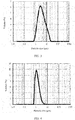
- a differential particle size distribution curve of the positive active material has one and only one peak.
- the differential particle size distribution curve includes both a differential volume-based particle size distribution curve and a differential number-based particle size distribution curve.
- the method includes the following steps: placing a ternary material precursor (a compound containing Ni, Co, and M), a Li-containing compound, a compound containing the doping element Me, and a compound containing the doping element A into a mixing device for mixing, then placing them into an atmosphere furnace for sintering, and after the sintering is completed, performing graded screening to obtain the positive active material.
- a ternary material precursor a compound containing Ni, Co, and M
- Li-containing compound a compound containing the doping element Me
- a compound containing the doping element A into a mixing device for mixing
- graded screening is not specifically limited, and can be selected based on an actual condition.
- the graded screening may be air flow graded screening or sieve-based screening.
- a specific process of the air flow graded screening is as follows: A sintered material is put into an air flow classifier, and the sintered material is then ejected from a nozzle with an air flow of a specific pressure; particles are separated by size by using the principle that particles of different sizes have inconsistent weights, where a particle with a smaller weight is lighter and flies closer, while a particle with a larger weight is heavier and flies farther. A distance between a collector and the nozzle is adjusted to screen an appropriate particle size, so as to obtain the positive active material.
- a specific process of the sieve-based screening is as follows: A sintered material is put into a 200- to 1000-mesh sieve for sieving. Due to different particle sizes of the particles, particles of a small particle size are screened out by the sieve, and particles of a required particle size can be retained on the sieve, to obtain the positive active material. Preferably, a number of meshes of the sieve is 500 meshes to 800 meshes.
- the ternary material precursor may include but is not limited to: Ni 1/3 Co 1/3 Mn 1/3 (OH) 2 , Ni 0.5 Co 0.2 Mn 0.3 (OH) 2 , Ni 0.5 Co 0.25 Mn 0.25 (OH) 2 , Ni 0.55 Co 0.15 Mn 0.3 (OH) 2 , Ni 0.55 Co 0.1 Mn 0.35 (OH) 2 , Ni 0.55 Co 0.05 Mn 0.4 (OH) 2 , Ni 0.6 Co 0.2 Mn 0.2 (OH) 2 , Ni 0.75 Co 0.1 Mn 0.15 (OH) 2 , Ni 0.8 Co 0.1 Mn 0.1 (OH) 2 , Ni 0.88 Co 0.05 Mn 0.07 (OH) 2 , 0.9Ni 0.8 CO 0.2 (OH) 2 ⁇ 0.1Al 2 (OH) 3 , and 0.9Ni 0.9 CO 0.05 Mn 0.05 (OH) 2 ⁇ 0.1Al 2 (OH) 3 .
- the Li-containing compound may include but is not limited to one or a combination of LiOH ⁇ H 2 O, LiOH, Li 2 CO 3 , and Li 2 O.
- the compound containing the doping element Me may be one or a combination of an oxide, nitrate, and carbonate containing at least one element of Zr, Zn, Cu, Cr, Mg, Fe, V, Ti, Sr, Sb, Y, W, and Nb.
- the compound containing the doping element A may include but is not limited to one or a combination of LiF, NaCl, Na 2 S, and Li 3 N.
- Conditions of the sintering may be 700°C to 800°C, and oxygen concentration ⁇ 20%.
- the method includes the following steps: S1. Place a ternary material precursor (a compound containing Ni, Co, and M), a Li-containing compound, a compound containing the doping element Me, and a compound containing the doping element A into a mixing device for mixing, and then place them into an atmosphere furnace for primary sintering. S2. Place a material obtained after the primary sintering and a compound containing the coating element into the mixing device for mixing, and then place them into the atmosphere furnace for secondary sintering. S3. Perform graded screening on a material obtained after the secondary sintering to obtain the positive active material.
- a ternary material precursor a compound containing Ni, Co, and M
- a Li-containing compound a compound containing the doping element Me
- a compound containing the doping element A into a mixing device for mixing, and then place them into an atmosphere furnace for primary sintering.
- S2. Place a material obtained after the primary sintering and a compound containing the coating element into the mixing device for
- graded screening is not specifically limited, and can be selected based on an actual condition.
- the graded screening may be air flow graded screening or sieve-based screening.
- a specific process of the air flow graded screening is as follows: The material obtained after the secondary sintering is put into an air flow classifier, and the material is then ejected from a nozzle with an air flow of a specific pressure; particles are separated by size by using the principle that particles of different sizes have inconsistent weights, where a particle with a smaller weight is lighter and flies closer, while a particle with a larger weight is heavier and flies farther. A distance between a collector and the nozzle is adjusted to screen an appropriate particle size, so as to obtain the positive active material.
- a specific process of the sieve-based screening is as follows: The material obtained after the secondary sintering is put into a 200- to 1000-mesh sieve for sieving. Due to different particle sizes of the particles, particles of a small particle size are screened out by the sieve, and particles of a required particle size can be retained on the sieve, to obtain the positive active material. Preferably, a number of meshes of the sieve is 500 meshes to 800 meshes.
- the ternary material precursor may include but is not limited to: Ni 1/3 Co 1/3 Mn 1/3 (OH) 2 , Ni 0.5 Co 0.2 Mn 0.3 (OH) 2 , Ni 0.5 Co 0.25 Mn 0.25 (OH) 2 , Ni 0.55 Co 0.15 Mn 0.3 (OH) 2 , Ni 0.55 Co 0.1 Mn 0.35 (OH) 2 , Ni 0.55 Co 0.05 Mn 0.4 (OH) 2 , Ni 0.6 Co 0.2 Mn 0.2 (OH) 2 , Ni 0.75 Co 0.1 Mn 0.15 (OH) 2 , Ni 0.8 Co 0.1 Mn 0.1 (OH) 2 , Ni 0.88 Co 0.05 Mn 0.07 (OH) 2 , 0.9Ni 0.8 CO 0.2 (OH) 2 ⁇ 0.1Al 2 (OH) 3 , and 0.9Ni 0.9 Co 0.05 Mn 0.05 (OH) 2 ⁇ 0.1Al 2 (OH) 3 .
- the Li-containing compound may include but is not limited to one or a combination of LiOH ⁇ H 2 O, LiOH, Li 2 CO 3 , and Li 2 O.
- the compound containing the doping element Me may be one or a combination of an oxide, nitrate, and carbonate containing at least one element of Zr, Zn, Cu, Cr, Mg, Fe, V, Ti, Sr, Sb, Y, W, and Nb.
- the compound containing the doping element A may include but is not limited to one or a combination of LiF, NaCl, Na 2 S, and Li 3 N.
- the compound containing the coating element may be one or a combination of an oxide, nitrate, phosphate, and carbonate containing one or more elements of Al, Ba, Zn, Ti, Co, W, Y, Si, Sn, B, and P.
- a usage amount of the compound containing the coating element may be 0.01% to 0.5% of total mass of the positive active material.
- Conditions of the primary sintering may be 700°C to 800°C, and oxygen concentration ⁇ 20%.
- a condition of the secondary sintering may be 200°C to 700°C.
- the positive electrode plate includes a positive electrode current collector and a positive membrane that is provided on at least one surface of the positive electrode current collector and that includes the positive active material according to the first aspect of this application.
- the positive membrane may be disposed on one surface of the positive electrode current collector, or may be disposed on two surfaces of the positive electrode current collector.
- the positive membrane may further include a conductive agent and a binder, where types and content of the conductive agent and the binder are not specifically limited, and may be selected based on actual needs.
- the binder usually includes a fluorine-containing polyolefin binder.
- water is usually a good solvent, that is, the fluorine-containing polyolefin binder usually has good solubility in water.
- the fluorine-containing polyolefin binder may include but is not limited to polyvinylidene fluoride (PVDF), vinylidene fluoride copolymer or a modified (for example, modified with carboxylic acid, acrylic acid, or acrylonitrile) derivative thereof, or the like.
- the conductive agent may be various conductive agents suitable for an electrochemical energy storage apparatus in the art, for example, including but not limited to one or a combination of acetylene black, conductive carbon black, carbon fiber, carbon nanotube, and Ketjen black.
- a type of the positive electrode current collector is not specifically limited either, and may be selected based on actual needs.
- the positive electrode current collector may usually be a layer body, and the positive electrode current collector is usually a structure or component that can collect a current.
- the positive electrode current collector may be various materials suitable to be used as a positive electrode current collector of an electrochemical energy storage apparatus in the art.
- the positive electrode current collector may include but is not limited to a metal foil, and more specifically, may include but is not limited to a nickel foil or an aluminum foil.
- the electrochemical energy storage apparatus includes the positive active material in the first aspect of this application.
- the electrochemical energy storage apparatus may be a supercapacitor, a lithium-ion battery, a lithium metal battery, or a sodium-ion battery.
- the electrochemical energy storage apparatus is a lithium-ion battery is provided, but this application is not limited thereto.
- the electrochemical energy storage apparatus in the fifth aspect of this application may include a positive electrode plate, a negative electrode plate, a separator sandwiched between the positive electrode plate and the negative electrode plate, and an electrolyte solution, where the positive electrode plate is the positive electrode plate in the fourth aspect of this application, and the positive electrode plate includes the positive active material in the first aspect of this application.
- the positive electrode plate, the separator, and the negative electrode plate each may be a layer body, which thus can be cut to a target size and then stacked in sequence, also can be wound to a target size to form an electrode assembly, and can be further combined with the electrolyte solution to form the electrochemical energy storage apparatus.
- the negative electrode plate usually includes a negative electrode current collector and a negative active material layer that is located on a surface of the negative electrode current collector.
- the negative active material layer usually includes a negative active material.
- the negative active material may be various materials suitable for a negative active material of an electrochemical energy storage apparatus in the art, for example, including but not limited to one or a combination of graphite, soft carbon, hard carbon, carbon fiber, a mesophase carbon microsphere, a silicon-based material, a tin-based material, lithium titanate, and another metal that can form an alloy with lithium.
- the graphite may be selected from one or a combination of artificial graphite, natural graphite, and modified graphite.
- the silicon-based material may be selected from one or a combination of elemental silicon, a silicon-oxygen compound, a silicon-carbon composite, and a silicon alloy.
- the tin-based material may be selected from one or a combination of elemental tin, a tin-oxygen compound, and a tin alloy.
- the negative electrode current collector is usually a structure or component that collects a current.
- the negative electrode current collector may be various materials suitable to be used as a negative electrode current collector of an electrochemical energy storage apparatus in the art.
- the negative electrode current collector may include but is not limited to a metal foil, and more specifically, may include but is not limited to a copper foil.
- the negative electrode plate may alternatively be a lithium plate.
- the separator may be various materials suitable for a separator of an electrochemical energy storage apparatus in the art, for example, including but not limited to one or a combination of polyethylene, polypropylene, polyvinylidene fluoride, aramid, polyethylene terephthalate, polytetrafluoroethylene, polyacrylonitrile, polyimide, polyamide, polyester, and natural fiber.
- the electrolyte solution may be various electrolyte solutions suitable for an electrochemical energy storage apparatus in the art.
- the electrolyte solution usually includes an electrolyte and a solvent, and the electrolyte may usually include lithium salt.
- the lithium salt may be inorganic lithium salt and/or organic lithium salt, and may specifically include but is not limited to one or a combination of LiPF 6 , LiBF 4 , LiN(SO 2 F) 2 (LiFSI for short), LiN(CF 3 SO 2 ) 2 (LiTFSI for short), LiClO 4 , LiAsF 6 , LiB(C 2 O 4 ) 2 (LiBOB for short), and LiBF 2 C 2 O 4 (LiDFOB for short).
- concentration of the electrolyte may be 0.8 mol/L to 1.5 mol/L.
- the solvent may be various solvents suitable for an electrolyte solution of an electrochemical energy storage apparatus in the art.
- the solvent of the electrolyte solution is usually a non-aqueous solvent, preferably an organic solvent, and may specifically include but is not limited to one or a combination of ethylene carbonate, propylene carbonate, 2,3-butylene carbonate, prenyl carbonate, dimethyl carbonate, diethyl carbonate, dipropyl carbonate, ethyl methyl carbonate, and a halogenated derivative thereof.
- the electrochemical energy storage apparatus may include an outer package for encapsulating the positive electrode plate, the negative electrode plate, and the electrolyte.
- the positive electrode plate, the negative electrode plate, and the separator may be stacked or wound to form an electrode assembly of a stacked structure or an electrode assembly of a wound structure, and the electrode assembly is encapsulated in the outer package.
- the electrolyte may use an electrolyte solution, and the electrolyte solution is immersed in the electrode assembly.
- the outer package of the electrochemical energy storage apparatus may be a soft package, for example, a soft bag.
- a material of the soft package may be plastic, for example, one or more of polypropylene (PP), polybutylene terephthalate (PBT), and polybutylene succinate (PBS).
- the outer package of the electrochemical energy storage apparatus may be a hard shell, for example, an aluminum shell.
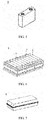
- FIG. 5 shows an electrochemical energy storage apparatus 5 of a square structure as an example.
- the electrochemical energy storage apparatus may be assembled into a battery module, and the battery module may include a plurality of electrochemical energy storage apparatuses. A specific number may be adjusted based on application and capacity of the battery module.
- FIG. 6 shows a battery module 4 as an example.
- a plurality of electrochemical energy storage apparatuses 5 may be arranged in sequence along a length direction of the battery module 4, or may be arranged in any other manners. Further, the plurality of electrochemical energy storage apparatuses 5 may be fastened by using a fastener.
- the battery module 4 may further include a housing that has an accommodating space, and the plurality of electrochemical energy storage apparatuses 5 are accommodated in the accommodating space.
- the foregoing battery module may be further assembled into a battery pack, and a number of battery modules included in the battery pack may be adjusted based on application and capacity of the battery pack.
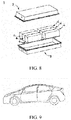
- FIG. 7 and FIG. 8 show a battery pack 1 as an example.
- the battery pack 1 may include a battery cabinet and a plurality of battery modules 4 disposed in the battery cabinet.
- the battery cabinet includes an upper cabinet body 2 and a lower cabinet body 3.
- the upper cabinet body 2 can cover the lower cabinet body 3 and form an enclosed space for accommodating the battery modules 4.
- the plurality of battery modules 4 may be arranged in the battery cabinet in any manner.
- the apparatus includes the electrochemical energy storage apparatus according to the fifth aspect of this application, and the electrochemical energy storage apparatus may serve as a power supply of the apparatus or serve as an energy storage unit of the apparatus.
- the apparatus includes but is not limited to an electric vehicle (for example, a pure-electric vehicle, a hybrid electric vehicle, a plug-in hybrid electric vehicle, an electric bicycle, an electric scooter, an electric golf vehicle, or an electric truck), an electric train, a ship, a satellite, and the like.
- the electric train, the ship, and the satellite all are carrying tools and belong to vehicles in a broad sense.
- An electrochemical energy storage apparatus, a battery module, or a battery pack may be selected for the apparatus according to use requirements of the apparatus.
- FIG. 9 shows an apparatus as an example.
- the apparatus is a pure-electric vehicle, a hybrid electric vehicle, a plug-in hybrid electric vehicle, or the like.
- a battery pack or a battery module may be used.
- Lithium-ion batteries in Examples 1 to 8 and Comparative Examples 1 and 2 were prepared according to the following method.
- Ternary material precursors Ni 0.8 Co 0.1 Mn 0.1 (OH) 2 , LiOH ⁇ H 2 O, and ZrO 2 at a molar ratio of 0.997:1.05:0.003 were placed into a mixer for mixing, and then were placed into an oxygen-filled atmosphere furnace for sintering. After the sintering was completed, graded screening was performed to select an appropriate particle size, so as to obtain a positive active material Li(Ni 0.8 Co 0.1 Mn 0.1 ) 0.997 Zr 0.003 O 2 .
- the positive active material, a binder polyvinylidene fluoride, and a conductive agent acetylene black were mixed at a mass ratio of 98:1:1, then N-methylpyrrolidone was added, and then the mixture was stirred evenly by using a vacuum mixer, to obtain a positive slurry.
- the positive slurry was uniformly applied onto a 12- ⁇ m-thick aluminum foil, namely, a positive electrode current collector, the aluminum foil was dried at room temperature and transferred to an oven at 100°C to 130°C for further drying, and then cold pressing and cutting were performed to obtain a positive electrode plate.
- a negative active material graphite, a thickener sodium carboxymethyl cellulose, a binder styrene butadiene rubber, and a conductive agent acetylene black were mixed at a mass ratio of 97:1:1:1, deionized water was added, and the mixture was stirred by using a vacuum mixer to obtain a negative electrode slurry.
- the negative electrode slurry was uniformly applied onto an 8- ⁇ m-thick copper foil, the copper foil was dried at room temperature and transferred to an oven at 100°C to 130°C for further drying, and then cold pressing and cutting were performed to obtain a negative electrode plate.
- An organic solvent was a mixture of ethylene carbonate (EC), ethyl methyl carbonate (EMC), and diethyl carbonate (DEC), where a volume ratio of EC, EMC, and DEC was 20:20:60.
- EC ethylene carbonate
- EMC ethyl methyl carbonate
- DEC diethyl carbonate
- a volume ratio of EC, EMC, and DEC was 20:20:60.
- fully dried lithium salt LiPF 6 was dissolved in the organic solvent to obtain an evenly mixed electrolyte solution, where concentration of the lithium salt was 1 mol/L.
- a 12- ⁇ m-thick polypropylene membrane was used as a separator.
- the positive electrode plate, the separator, and the negative electrode plate were stacked in sequence, so that the separator was sandwiched between the positive and negative electrode plates for isolation. After they were wound into a square-shaped electrode assembly, the electrode assembly was wrapped with an aluminum plastic film for baking at 80°C to remove water. The electrolyte solution was injected, and sealing was performed. Then standing, hot-cold pressing, chemical conversion, clamping, aging, and other processes were performed to obtain a lithium-ion battery.
- a lithium-ion battery in Example 9 was prepared according to the following method.
- Ternary material precursors Ni 0.8 Co 0.1 Mn 0.1 (OH) 2 , LiOH ⁇ H 2 O, and ZrO 2 at a molar ratio of 0.997:1.05:0.003 were placed into a mixer for mixing, and then were placed into an oxygen-filled atmosphere furnace for primary sintering.
- a material obtained after the primary sintering and 0.5wt% Al 2 O 3 were placed into the mixing device for mixing, and then were placed into the atmosphere furnace for secondary sintering. Then, graded screening was performed on a material obtained after the secondary sintering to select an appropriate particle size, so as to obtain a positive active material Li(Ni 0.8 Co 0.1 Mn 0.1 ) 0.997 Zr 0.003 O 2 with Al 2 O 3 on its surface.
- the positive active material, a binder polyvinylidene fluoride, and a conductive agent acetylene black were mixed at a mass ratio of 98:1:1, then N-methylpyrrolidone was added, and then the mixture was stirred evenly by using a vacuum mixer, to obtain a positive slurry.
- the positive slurry was uniformly applied onto a 12- ⁇ m-thick aluminum foil, namely, a positive electrode current collector, the aluminum foil was dried at room temperature and transferred to an oven at 100°C to 130°C for further drying, and then cold pressing and cutting were performed to obtain a positive electrode plate.
- a negative active material graphite, a thickener sodium carboxymethyl cellulose, a binder styrene butadiene rubber, and a conductive agent acetylene black were mixed at a mass ratio of 97:1:1:1, deionized water was added, and the mixture was stirred by using a vacuum mixer to obtain a negative electrode slurry.
- the negative electrode slurry was uniformly applied onto an 8- ⁇ m-thick copper foil, the copper foil was dried at room temperature and transferred to an oven at 100°C to 130°C for further drying, and then cold pressing and cutting were performed to obtain a negative electrode plate.
- An organic solvent was a mixture of ethylene carbonate (EC), ethyl methyl carbonate (EMC), and diethyl carbonate (DEC), where a volume ratio of EC, EMC, and DEC was 20:20:60.
- EC ethylene carbonate
- EMC ethyl methyl carbonate
- DEC diethyl carbonate
- a volume ratio of EC, EMC, and DEC was 20:20:60.
- fully dried lithium salt LiPF 6 was dissolved in the organic solvent to obtain an evenly mixed electrolyte solution, where concentration of the lithium salt was 1 mol/L.
- a 12- ⁇ m-thick polypropylene membrane was used as a separator.
- the positive electrode plate, the separator, and the negative electrode plate were stacked in sequence, so that the separator was sandwiched between the positive and negative electrode plates for isolation. After they were wound into a square-shaped electrode assembly, the electrode assembly was wrapped with an aluminum plastic film for baking at 80°C to remove water. The electrolyte solution was injected, and sealing was performed. Then standing, hot-cold pressing, chemical conversion, clamping, aging, and other processes were performed to obtain a lithium-ion battery.
- a lithium-ion battery of Example 10 was prepared by using a method similar to the method for preparing the lithium-ion battery in Example 9, and a difference lied in that Al 2 O 3 of 0.5wt% was replaced with B 2 O 3 of 0.5wt% in Example 10.
- the lithium-ion battery was charged to a voltage of 4.2V at a constant current of 1C, then the lithium-ion battery was charged to a current of 0.05C at a constant voltage of 4.2V, and the lithium-ion battery was discharged to a final voltage of 2.8V at a constant current of 1C. Discharge capacity of the first cycle was recorded. Then repeated charging and discharging was performed according to the foregoing operations. When 80% of initial capacity was reached after repetitions, charging and discharging stopped. In this case, a number of cycles was a high-temperature cycle life.
- the lithium-ion battery was stood in a constant temperature environment of 25°C for 2 hours, then charged to 4.2V at 1/3C from 2.8V to 4.2V, then charged to a current less than or equal to 0.05 mA at a constant voltage of 4.2V, then stood for 5min, and discharged to 2.8V at 1C. Capacity of the lithium-ion battery was recorded, and the measured capacity was divided by the mass of the positive active material in the battery to obtain capacity of the positive active material in the lithium-ion battery.
- Example 1 Parameters of the positive active materials in Examples 1 to 10 and Comparative Examples 1 and 2 D n 10 ( ⁇ m) D v 10 ( ⁇ m) D v 50 ( ⁇ m) BET 2 (m 2 /g) (BET 2 -BET 1 )/BET 1 Coating substance
- Example 1 0.30 0.50 3.3 1.00 1.59 ⁇
- Example 2 0.60 0.90 4.0 0.80 1.51 ⁇
- Example 3 0.90 1.50 4.3 0.90 2.03 ⁇
- Example 4 1.30 2.10 5.1 1.10 3.39 ⁇
- Example 5 1.80 2.30 5.5 0.80 2.45 ⁇
- Example 6 2.00 3.00 6.0 0.70 2.29 ⁇
- Example 7 0.60 1.40 5.3 1.50 5.23 ⁇
- Example 8 0.80 1.30 2.5 0.70 0.37 ⁇
- Example 9 1.00 1.40 3.3 0.70 0.81 Al 2 O 3
- Example 10 0.80 1.50 2.5 0.80 0.57 B 2 O 3
- Comparative Example 1 0.10 1.10 4.0 0.50 0.57 ⁇
- the relative amount of micro powder in the positive active material was too large, because a specific surface area of the micro powder was larger, an amount of residual lithium on the surface was higher, and a contact area with the electrolyte solution was larger, more side reactions occurred when the positive active material came into contact with the electrolyte solution.
- the positive active material with micro powder released more oxygen, which not only destroyed a crystal structure of the positive active material, but also aggravated the swelling of the lithium-ion battery and deteriorated the storage performance of the lithium-ion battery.
- D n 10 of the positive active material was 2.5 ⁇ m.
- content of micro powder in the positive active material was relatively low, but due to particularity of single crystal or quasi-single crystal morphology, D v 50 needed to be kept within a specific range to maintain high ion transport performance and low polarization strength. Therefore, the particle size distribution of the positive active material was too narrow; as a result, for particle sizes of the positive active material, matching of small and large particles could not be implemented, and it was difficult to achieve a high compaction density. Particles of the positive active material were more likely to be crushed during processes of cold pressing and battery cycling of the electrode plate, resulting in direct contact between a large amount of fresh surfaces and the electrolyte solution, which aggravated the swelling of the lithium-ion battery.
- Examples 9 and 10 provided a positive active material obtained by coating the surface of the positive active material in Example 1. After the coating, direct contact between Li(Ni 0.8 Co 0.1 Mn 0.1 ) 0.997 Zr 0.003 O 2 and the electrolyte solution could be avoided, and a probability of side reactions between the positive active material and the electrolyte solution could be reduced.
- a coating layer with Al 2 O 3 and B 2 O 3 had good ion conductivity and electron conductivity, which could alleviate the gas production problem while minimizing impact of the coating layer on the polarization of the positive active material.
Landscapes
- Chemical & Material Sciences (AREA)
- General Chemical & Material Sciences (AREA)
- Chemical Kinetics & Catalysis (AREA)
- Electrochemistry (AREA)
- Inorganic Chemistry (AREA)
- Engineering & Computer Science (AREA)
- Manufacturing & Machinery (AREA)
- Composite Materials (AREA)
- Organic Chemistry (AREA)
- Materials Engineering (AREA)
- Physics & Mathematics (AREA)
- Condensed Matter Physics & Semiconductors (AREA)
- General Physics & Mathematics (AREA)
- Battery Electrode And Active Subsutance (AREA)
- Inorganic Compounds Of Heavy Metals (AREA)
Applications Claiming Priority (2)
| Application Number | Priority Date | Filing Date | Title |
|---|---|---|---|
| CN201811647026.XA CN110233259B (zh) | 2018-12-29 | 2018-12-29 | 正极活性材料、正极极片及电化学储能装置 |
| PCT/CN2019/129369 WO2020135767A1 (zh) | 2018-12-29 | 2019-12-27 | 正极活性材料、正极极片、电化学储能装置及装置 |
Publications (2)
| Publication Number | Publication Date |
|---|---|
| EP3799165A1 true EP3799165A1 (de) | 2021-03-31 |
| EP3799165A4 EP3799165A4 (de) | 2021-10-20 |
Family
ID=67861909
Family Applications (1)
| Application Number | Title | Priority Date | Filing Date |
|---|---|---|---|
| EP19901673.4A Pending EP3799165A4 (de) | 2018-12-29 | 2019-12-27 | Positivelektrodenaktivmaterial, positive elektrodenplatte, elektrochemische energiespeichervorrichtung und vorrichtung |
Country Status (6)
| Country | Link |
|---|---|
| US (3) | US11699789B2 (de) |
| EP (1) | EP3799165A4 (de) |
| JP (1) | JP7165271B2 (de) |
| CN (2) | CN110233259B (de) |
| DE (1) | DE202019006201U1 (de) |
| WO (1) | WO2020135767A1 (de) |
Cited By (2)
| Publication number | Priority date | Publication date | Assignee | Title |
|---|---|---|---|---|
| EP3800710A4 (de) * | 2018-12-29 | 2021-07-28 | Contemporary Amperex Technology Co., Limited | Positivelektrodenmaterial mit hoher kompaktierter dichte und elektrochemischer energiespeicher |
| EP4481854A4 (de) * | 2022-02-15 | 2025-11-05 | Byd Co Ltd | Lithiumeisenphosphat-positivelektrodenaktivmaterial, positivelektrodenfolie und lithium-ionen-batterie |
Families Citing this family (29)
| Publication number | Priority date | Publication date | Assignee | Title |
|---|---|---|---|---|
| CN110233259B (zh) * | 2018-12-29 | 2021-02-09 | 宁德时代新能源科技股份有限公司 | 正极活性材料、正极极片及电化学储能装置 |
| CN112968150B (zh) * | 2019-12-12 | 2023-02-10 | 比亚迪股份有限公司 | 一种正极材料及其制备方法 |
| CA3177378A1 (en) * | 2020-03-27 | 2021-09-30 | Board Of Regents, The University Of Texas System | Low-cobalt and cobalt-free, high-energy cathode materials for lithium batteries |
| CN111682175B (zh) * | 2020-06-09 | 2022-06-14 | 蜂巢能源科技有限公司 | 一种无钴单晶复合材料、其制备方法和用途 |
| KR102938713B1 (ko) * | 2020-10-31 | 2026-03-12 | 컨템포러리 엠퍼렉스 테크놀로지 (홍콩) 리미티드 | 양극 활성재료 및 이의 제조방법, 이차 전지, 전지 모듈, 전지팩과 장치 |
| CN112599742B (zh) * | 2020-12-14 | 2022-03-18 | 宁德新能源科技有限公司 | 电化学装置和电子装置 |
| CN112919551B (zh) * | 2021-01-28 | 2023-12-15 | 湖南桑瑞新材料有限公司 | 正极材料及其制备方法、正极和锂离子电池 |
| WO2022196830A1 (en) | 2021-03-19 | 2022-09-22 | Sekisui Chemical Co., Ltd. | Positive electrode for non-aqueous electrolyte secondary battery, and non-aqueous electrolyte secondary battery, battery module and battery system using the same |
| CN113161531A (zh) * | 2021-03-31 | 2021-07-23 | 溧阳紫宸新材料科技有限公司 | 锂离子电池碳包覆硅氧化物负极材料及其制备方法和应用 |
| KR102847215B1 (ko) * | 2021-06-02 | 2025-08-14 | 삼성에스디아이 주식회사 | 복합양극활물질, 그 제조방법, 이를 포함하는 양극 및 상기 양극을 함유한 리튬이차전지 |
| US20230117276A1 (en) * | 2021-10-14 | 2023-04-20 | Lg Energy Solution, Ltd. | Lithium secondary battery |
| CN116601794B (zh) * | 2021-12-13 | 2024-10-11 | 宁德时代新能源科技股份有限公司 | 一种正极活性材料及其相关的极片、二次电池、电池模块、电池包和装置 |
| CN115513515B (zh) * | 2022-09-29 | 2023-12-29 | 欣旺达动力科技股份有限公司 | 一种二次电池及其制备方法 |
| CN115472841B (zh) * | 2022-10-10 | 2025-05-06 | 宁波容百新能源科技股份有限公司 | 一种正极活性材料及其制备方法、应用 |
| CN115483393A (zh) * | 2022-10-28 | 2022-12-16 | 欣旺达电动汽车电池有限公司 | 正极材料、二次电池和用电设备 |
| CN120390995A (zh) * | 2023-01-02 | 2025-07-29 | 株式会社Lg化学 | 正极活性材料、包含其的正极和锂二次电池 |
| KR102811915B1 (ko) * | 2023-01-02 | 2025-05-27 | 주식회사 엘지화학 | 양극 활물질, 이를 포함하는 양극 및 리튬 이차전지 |
| CN118486792B (zh) * | 2023-02-03 | 2026-01-30 | 宁德时代新能源科技股份有限公司 | 正极活性材料及其制备方法、正极极片、二次电池和用电装置 |
| JP7719316B2 (ja) | 2023-04-17 | 2025-08-05 | ベイジン イースプリング マテリアル テクノロジー カンパニー リミテッド | 多元正極材料及びその製造方法、リチウムイオン電池 |
| CN118841527B (zh) * | 2023-04-23 | 2025-10-17 | 比亚迪股份有限公司 | 正极活性材料、正极、电池和用电设备 |
| CN118867144B (zh) * | 2023-04-23 | 2025-10-17 | 比亚迪股份有限公司 | 正极活性材料、正极、电池和用电设备 |
| KR102947473B1 (ko) * | 2023-05-31 | 2026-04-01 | (주)포스코퓨처엠 | 리튬 이차 전지용 양극 활물질 및 이를 포함하는 리튬 이차 전지 |
| CN116487525B (zh) * | 2023-06-05 | 2024-02-02 | 中创新航科技集团股份有限公司 | 一种正极片、含有其的电池 |
| CN116805685B (zh) | 2023-08-22 | 2024-01-23 | 深圳海辰储能控制技术有限公司 | 正极活性材料、正极极片、锂离子电池及用电设备 |
| KR20250044011A (ko) * | 2023-09-22 | 2025-03-31 | (주)포스코퓨처엠 | 리튬 이차 전지용 양극 활물질 및 이를 포함하는 리튬 이차 전지 |
| WO2025089820A1 (ko) * | 2023-10-25 | 2025-05-01 | 주식회사 에코프로비엠 | 양극 활물질 및 이를 포함하는 리튬 이차전지 |
| CN118782737B (zh) * | 2024-03-08 | 2026-03-24 | 宁德时代新能源科技股份有限公司 | 电池单体、电池和用电装置 |
| CN118610395B (zh) * | 2024-05-09 | 2025-07-29 | 深圳市贝特瑞纳米科技有限公司 | 正极材料及电池 |
| CN121123261A (zh) * | 2024-12-26 | 2025-12-12 | 深圳市贝特瑞纳米科技有限公司 | 正极材料及其制备方法、正极极片及二次电池 |
Family Cites Families (24)
| Publication number | Priority date | Publication date | Assignee | Title |
|---|---|---|---|---|
| EP2144314B1 (de) * | 2001-04-20 | 2015-01-28 | GS Yuasa International Ltd. | Positive aktive Materialien und Herstellungsverfahren dafür, positive Elektrode für eine Sekundärbatterie mit nichtwässrigem Elektrolyten und Sekundärbatterie mit nichtwässrigem Elektrolyten damit |
| JP2003109592A (ja) * | 2001-09-28 | 2003-04-11 | Sanyo Electric Co Ltd | リチウム二次電池およびその製造方法 |
| KR101234965B1 (ko) * | 2007-11-06 | 2013-02-20 | 파나소닉 주식회사 | 비수전해질 이차전지용 양극 활물질 및 그것을 이용한 비수전해질 이차전지 |
| CA2751819C (en) * | 2009-02-20 | 2013-12-10 | Umicore | Non-homogeneous positive electrode materials combining high safety and high power in a li rechargeable battery |
| CN101847722A (zh) * | 2009-03-26 | 2010-09-29 | 青岛新正锂业有限公司 | 高能锂离子电池正极材料及其制备方法 |
| WO2012118117A1 (ja) * | 2011-03-02 | 2012-09-07 | 三井金属鉱業株式会社 | スピネル型リチウムマンガン系複合酸化物 |
| KR20130090312A (ko) | 2012-02-03 | 2013-08-13 | 주식회사 엘지화학 | 리튬 이차전지용 리튬 복합 전이금속 산화물의 전구체 입자들 및 이를 포함하는 양극 활물질 |
| CN102593442A (zh) * | 2012-03-02 | 2012-07-18 | 宁波金和新材料股份有限公司 | 高压实密度锂电池正极材料的制备方法 |
| JP6244713B2 (ja) * | 2013-07-24 | 2017-12-13 | 住友金属鉱山株式会社 | 非水電解質二次電池用正極活物質の製造方法 |
| CN104425795B (zh) * | 2013-09-10 | 2017-03-08 | 万向一二三股份公司 | 一种高能量高安全性能锂离子动力电池 |
| TWI600202B (zh) * | 2014-03-06 | 2017-09-21 | 烏明克公司 | 用於在汽車應用中的電池組之摻雜並且塗覆的鋰過渡金屬氧化物陰極材料 |
| CN105226271B (zh) * | 2014-05-30 | 2017-12-12 | 宁德时代新能源科技股份有限公司 | 复合正极活性材料及锂离子二次电池 |
| US10193150B2 (en) * | 2014-07-07 | 2019-01-29 | Hitachi Metals, Ltd. | Lithium ion secondary battery cathode material, lithium ion secondary battery cathode and lithium ion secondary battery that use same, and method for manufacturing lithium ion secondary battery cathode material |
| ES2962432T3 (es) * | 2014-09-23 | 2024-03-19 | Jiangsu Hengtron Nanotech Co Ltd | Baterías que contienen óxido metálico de litio con capacidad de velocidad mejorada |
| CN104852043A (zh) | 2014-12-31 | 2015-08-19 | 常州益辉新能源科技有限公司 | 一种高电压锂离子电池正极材料及其制备方法 |
| PL3386015T3 (pl) | 2015-11-30 | 2025-06-09 | Lg Energy Solution, Ltd. | Materiał aktywny katody do akumulatora i zawierający go akumulator |
| CN105958062A (zh) * | 2016-06-12 | 2016-09-21 | 湖南杉杉新能源有限公司 | 锂离子电池用多晶高镍正极材料及其制备方法 |
| CN108206278A (zh) * | 2016-12-20 | 2018-06-26 | 宁德时代新能源科技股份有限公司 | 改性锂离子电池正极材料及其制备方法、锂离子电池 |
| JP6929682B2 (ja) * | 2017-03-31 | 2021-09-01 | 住友化学株式会社 | リチウムニッケル複合酸化物の製造方法 |
| CN108878795B (zh) * | 2017-05-15 | 2021-02-02 | 宁德时代新能源科技股份有限公司 | 改性正极活性材料及其制备方法及电化学储能装置 |
| CN108923041B (zh) | 2018-05-29 | 2020-12-08 | 深圳市德方纳米科技股份有限公司 | 三元正极材料及其制备方法和锂离子电池 |
| CN113423497A (zh) * | 2018-12-20 | 2021-09-21 | 6K有限公司 | 用于锂离子电池的锂过渡金属氧化物的等离子体处理 |
| CN112436115B (zh) * | 2018-12-29 | 2021-12-28 | 宁德时代新能源科技股份有限公司 | 正极活性材料、正极极片及电化学储能装置 |
| CN110233259B (zh) | 2018-12-29 | 2021-02-09 | 宁德时代新能源科技股份有限公司 | 正极活性材料、正极极片及电化学储能装置 |
-
2018
- 2018-12-29 CN CN201811647026.XA patent/CN110233259B/zh active Active
- 2018-12-29 CN CN202110077988.1A patent/CN112909238B/zh active Active
-
2019
- 2019-12-27 WO PCT/CN2019/129369 patent/WO2020135767A1/zh not_active Ceased
- 2019-12-27 US US17/418,401 patent/US11699789B2/en active Active
- 2019-12-27 EP EP19901673.4A patent/EP3799165A4/de active Pending
- 2019-12-27 DE DE202019006201.7U patent/DE202019006201U1/de active Active
- 2019-12-27 JP JP2021538110A patent/JP7165271B2/ja active Active
-
2023
- 2023-05-22 US US18/321,318 patent/US12347859B2/en active Active
-
2025
- 2025-05-20 US US19/213,557 patent/US20250279426A1/en active Pending
Cited By (2)
| Publication number | Priority date | Publication date | Assignee | Title |
|---|---|---|---|---|
| EP3800710A4 (de) * | 2018-12-29 | 2021-07-28 | Contemporary Amperex Technology Co., Limited | Positivelektrodenmaterial mit hoher kompaktierter dichte und elektrochemischer energiespeicher |
| EP4481854A4 (de) * | 2022-02-15 | 2025-11-05 | Byd Co Ltd | Lithiumeisenphosphat-positivelektrodenaktivmaterial, positivelektrodenfolie und lithium-ionen-batterie |
Also Published As
| Publication number | Publication date |
|---|---|
| DE202019006201U1 (de) | 2026-01-13 |
| US20220077464A1 (en) | 2022-03-10 |
| CN110233259A (zh) | 2019-09-13 |
| US11699789B2 (en) | 2023-07-11 |
| US20250279426A1 (en) | 2025-09-04 |
| CN112909238A (zh) | 2021-06-04 |
| WO2020135767A1 (zh) | 2020-07-02 |
| JP7165271B2 (ja) | 2022-11-02 |
| EP3799165A4 (de) | 2021-10-20 |
| JP2022515872A (ja) | 2022-02-22 |
| CN110233259B (zh) | 2021-02-09 |
| US20230307635A1 (en) | 2023-09-28 |
| CN112909238B (zh) | 2022-04-22 |
| US12347859B2 (en) | 2025-07-01 |
Similar Documents
| Publication | Publication Date | Title |
|---|---|---|
| US12347859B2 (en) | Positive active material, positive electrode plate, electrochemical energy storage apparatus, and apparatus | |
| EP3796433B1 (de) | Positives aktivmaterial, positive elektrodenplatte, elektrochemische energiespeichervorrichtung und vorrichtung | |
| EP3930052B1 (de) | Ternäres positives elektrodenmaterial mit niedriger gasausbeute | |
| CN114556614B (zh) | 一种用于二次电池的正极极片、二次电池、电池模块、电池包和装置 | |
| EP4203106A1 (de) | Positivelektrodenfolie für sekundärbatterie, sekundärbatterie, batteriemodul, batteriepack und vorrichtung | |
| EP4170755A1 (de) | Positivelektrodenmaterial, positivelektrodenpolteil, lithiumsekundärbatterie, batteriemodul, batteriepack und vorrichtung | |
| EP4071860A1 (de) | Negativelektrodenaktivmaterial, herstellungsverfahren dafür, sekundärbatterie, batteriemodul mit sekundärbatterie, batteriepack und vorrichtung | |
| EP3561927B1 (de) | Sekundärbatterie | |
| EP1291941B1 (de) | Aktivmaterial für Batterie und Verfahren zu seiner Herstellung | |
| EP3783709B1 (de) | Negatives elektrodenstück, sekundärbatterie, batteriemodul, batteriepack und vorrichtung | |
| EP3675245B1 (de) | Negativelektrodenaktivmaterial, batterie und vorrichtung | |
| US12230810B2 (en) | Secondary battery and apparatus containing the same | |
| EP3955349A1 (de) | Negativelektrodenaktivmaterial, herstellungsverfahren dafür, sekundärbatterie und vorrichtung mit sekundärbatterie | |
| EP4601050A1 (de) | Positivelektrodenfolie und herstellungsverfahren dafür, batteriezelle, batterie und elektrische vorrichtung | |
| US20230126587A1 (en) | Ternary positive electrode material with low gas generation and high capacity | |
| EP4571883A1 (de) | Negativelektrodenaktivmaterial auf siliciumbasis, sekundärbatterie und elektrische vorrichtung |
Legal Events
| Date | Code | Title | Description |
|---|---|---|---|
| STAA | Information on the status of an ep patent application or granted ep patent |
Free format text: STATUS: THE INTERNATIONAL PUBLICATION HAS BEEN MADE |
|
| PUAI | Public reference made under article 153(3) epc to a published international application that has entered the european phase |
Free format text: ORIGINAL CODE: 0009012 |
|
| STAA | Information on the status of an ep patent application or granted ep patent |
Free format text: STATUS: REQUEST FOR EXAMINATION WAS MADE |
|
| 17P | Request for examination filed |
Effective date: 20201221 |
|
| AK | Designated contracting states |
Kind code of ref document: A1 Designated state(s): AL AT BE BG CH CY CZ DE DK EE ES FI FR GB GR HR HU IE IS IT LI LT LU LV MC MK MT NL NO PL PT RO RS SE SI SK SM TR |
|
| AX | Request for extension of the european patent |
Extension state: BA ME |
|
| A4 | Supplementary search report drawn up and despatched |
Effective date: 20210916 |
|
| RIC1 | Information provided on ipc code assigned before grant |
Ipc: C01G 53/00 20060101ALI20210910BHEP Ipc: H01M 4/36 20060101ALI20210910BHEP Ipc: H01M 4/525 20100101ALI20210910BHEP Ipc: H01M 4/505 20100101ALI20210910BHEP Ipc: H01M 4/485 20100101AFI20210910BHEP |
|
| DAV | Request for validation of the european patent (deleted) | ||
| DAX | Request for extension of the european patent (deleted) | ||
| STAA | Information on the status of an ep patent application or granted ep patent |
Free format text: STATUS: EXAMINATION IS IN PROGRESS |
|
| 17Q | First examination report despatched |
Effective date: 20230508 |
|
| RAP1 | Party data changed (applicant data changed or rights of an application transferred) |
Owner name: CONTEMPORARY AMPEREX TECHNOLOGY(HONG KONG) LIMITED |