EP3799239A1 - Dispositif conducteur électrique - Google Patents
Dispositif conducteur électrique Download PDFInfo
- Publication number
- EP3799239A1 EP3799239A1 EP19200091.7A EP19200091A EP3799239A1 EP 3799239 A1 EP3799239 A1 EP 3799239A1 EP 19200091 A EP19200091 A EP 19200091A EP 3799239 A1 EP3799239 A1 EP 3799239A1
- Authority
- EP
- European Patent Office
- Prior art keywords
- yarn
- insulating jacket
- conductor arrangement
- conductor
- electrical
- Prior art date
- Legal status (The legal status is an assumption and is not a legal conclusion. Google has not performed a legal analysis and makes no representation as to the accuracy of the status listed.)
- Withdrawn
Links
- 239000004020 conductor Substances 0.000 title claims abstract description 70
- 230000005684 electric field Effects 0.000 claims abstract description 11
- 229920005989 resin Polymers 0.000 claims description 24
- 239000011347 resin Substances 0.000 claims description 24
- 239000011241 protective layer Substances 0.000 claims description 11
- 238000004804 winding Methods 0.000 claims description 11
- 239000000835 fiber Substances 0.000 claims description 9
- 239000004952 Polyamide Substances 0.000 claims description 6
- 229920002647 polyamide Polymers 0.000 claims description 6
- 238000004519 manufacturing process Methods 0.000 claims description 5
- 230000001681 protective effect Effects 0.000 claims description 5
- 229920000049 Carbon (fiber) Polymers 0.000 claims description 3
- 229920000914 Metallic fiber Polymers 0.000 claims description 3
- 239000004917 carbon fiber Substances 0.000 claims description 3
- VNWKTOKETHGBQD-UHFFFAOYSA-N methane Chemical compound C VNWKTOKETHGBQD-UHFFFAOYSA-N 0.000 claims description 3
- 239000000203 mixture Substances 0.000 claims description 3
- 239000011295 pitch Substances 0.000 claims description 3
- 238000004026 adhesive bonding Methods 0.000 claims description 2
- 239000003575 carbonaceous material Substances 0.000 claims description 2
- 239000010410 layer Substances 0.000 description 11
- 239000000463 material Substances 0.000 description 8
- 239000000126 substance Substances 0.000 description 4
- OKTJSMMVPCPJKN-UHFFFAOYSA-N Carbon Chemical compound [C] OKTJSMMVPCPJKN-UHFFFAOYSA-N 0.000 description 2
- 239000004696 Poly ether ether ketone Substances 0.000 description 2
- 239000000853 adhesive Substances 0.000 description 2
- 230000001070 adhesive effect Effects 0.000 description 2
- 229920002530 polyetherether ketone Polymers 0.000 description 2
- RYGMFSIKBFXOCR-UHFFFAOYSA-N Copper Chemical compound [Cu] RYGMFSIKBFXOCR-UHFFFAOYSA-N 0.000 description 1
- 230000009286 beneficial effect Effects 0.000 description 1
- 229910052799 carbon Inorganic materials 0.000 description 1
- 239000000919 ceramic Substances 0.000 description 1
- 238000000576 coating method Methods 0.000 description 1
- 229910052802 copper Inorganic materials 0.000 description 1
- 239000010949 copper Substances 0.000 description 1
- 229920003020 cross-linked polyethylene Polymers 0.000 description 1
- 239000004703 cross-linked polyethylene Substances 0.000 description 1
- 230000007423 decrease Effects 0.000 description 1
- 230000006735 deficit Effects 0.000 description 1
- 238000006073 displacement reaction Methods 0.000 description 1
- 230000000694 effects Effects 0.000 description 1
- 239000003822 epoxy resin Substances 0.000 description 1
- 239000010439 graphite Substances 0.000 description 1
- 229910002804 graphite Inorganic materials 0.000 description 1
- 238000009413 insulation Methods 0.000 description 1
- 239000004922 lacquer Substances 0.000 description 1
- 238000000034 method Methods 0.000 description 1
- 239000010445 mica Substances 0.000 description 1
- 229910052618 mica group Inorganic materials 0.000 description 1
- 239000004033 plastic Substances 0.000 description 1
- 229920003023 plastic Polymers 0.000 description 1
- 229920000647 polyepoxide Polymers 0.000 description 1
- 229920000642 polymer Polymers 0.000 description 1
- 229920001296 polysiloxane Polymers 0.000 description 1
- 239000004800 polyvinyl chloride Substances 0.000 description 1
- 229910001220 stainless steel Inorganic materials 0.000 description 1
- 239000010935 stainless steel Substances 0.000 description 1
- 229920003002 synthetic resin Polymers 0.000 description 1
- 239000000057 synthetic resin Substances 0.000 description 1
Images

Classifications
-
- H—ELECTRICITY
- H02—GENERATION; CONVERSION OR DISTRIBUTION OF ELECTRIC POWER
- H02G—INSTALLATION OF ELECTRIC CABLES OR LINES, OR OF COMBINED OPTICAL AND ELECTRIC CABLES OR LINES
- H02G15/00—Cable fittings
- H02G15/02—Cable terminations
- H02G15/06—Cable terminating boxes, frames or other structures
- H02G15/064—Cable terminating boxes, frames or other structures with devices for relieving electrical stress
- H02G15/068—Cable terminating boxes, frames or other structures with devices for relieving electrical stress connected to the cable shield only
-
- H—ELECTRICITY
- H05—ELECTRIC TECHNIQUES NOT OTHERWISE PROVIDED FOR
- H05K—PRINTED CIRCUITS; CASINGS OR CONSTRUCTIONAL DETAILS OF ELECTRIC APPARATUS; MANUFACTURE OF ASSEMBLAGES OF ELECTRICAL COMPONENTS
- H05K9/00—Screening of apparatus or components against electric or magnetic fields
- H05K9/0073—Shielding materials
- H05K9/0081—Electromagnetic shielding materials, e.g. EMI, RFI shielding
- H05K9/009—Electromagnetic shielding materials, e.g. EMI, RFI shielding comprising electro-conductive fibres, e.g. metal fibres, carbon fibres, metallised textile fibres, electro-conductive mesh, woven, non-woven mat, fleece, cross-linked
-
- H—ELECTRICITY
- H01—ELECTRIC ELEMENTS
- H01B—CABLES; CONDUCTORS; INSULATORS; SELECTION OF MATERIALS FOR THEIR CONDUCTIVE, INSULATING OR DIELECTRIC PROPERTIES
- H01B7/00—Insulated conductors or cables characterised by their form
- H01B7/17—Protection against damage caused by external factors, e.g. sheaths or armouring
- H01B7/18—Protection against damage caused by wear, mechanical force or pressure; Sheaths; Armouring
-
- H—ELECTRICITY
- H01—ELECTRIC ELEMENTS
- H01B—CABLES; CONDUCTORS; INSULATORS; SELECTION OF MATERIALS FOR THEIR CONDUCTIVE, INSULATING OR DIELECTRIC PROPERTIES
- H01B1/00—Conductors or conductive bodies characterised by the conductive materials; Selection of materials as conductors
- H01B1/20—Conductive material dispersed in non-conductive organic material
-
- H—ELECTRICITY
- H01—ELECTRIC ELEMENTS
- H01B—CABLES; CONDUCTORS; INSULATORS; SELECTION OF MATERIALS FOR THEIR CONDUCTIVE, INSULATING OR DIELECTRIC PROPERTIES
- H01B13/00—Apparatus or processes specially adapted for manufacturing conductors or cables
- H01B13/22—Sheathing; Armouring; Screening; Applying other protective layers
-
- H—ELECTRICITY
- H01—ELECTRIC ELEMENTS
- H01B—CABLES; CONDUCTORS; INSULATORS; SELECTION OF MATERIALS FOR THEIR CONDUCTIVE, INSULATING OR DIELECTRIC PROPERTIES
- H01B13/00—Apparatus or processes specially adapted for manufacturing conductors or cables
- H01B13/22—Sheathing; Armouring; Screening; Applying other protective layers
- H01B13/26—Sheathing; Armouring; Screening; Applying other protective layers by winding, braiding or longitudinal lapping
-
- H—ELECTRICITY
- H01—ELECTRIC ELEMENTS
- H01B—CABLES; CONDUCTORS; INSULATORS; SELECTION OF MATERIALS FOR THEIR CONDUCTIVE, INSULATING OR DIELECTRIC PROPERTIES
- H01B17/00—Insulators or insulating bodies characterised by their form
- H01B17/56—Insulating bodies
- H01B17/58—Tubes, sleeves, beads, or bobbins through which the conductor passes
-
- H—ELECTRICITY
- H01—ELECTRIC ELEMENTS
- H01B—CABLES; CONDUCTORS; INSULATORS; SELECTION OF MATERIALS FOR THEIR CONDUCTIVE, INSULATING OR DIELECTRIC PROPERTIES
- H01B7/00—Insulated conductors or cables characterised by their form
- H01B7/0009—Details relating to the conductive cores
-
- H—ELECTRICITY
- H01—ELECTRIC ELEMENTS
- H01B—CABLES; CONDUCTORS; INSULATORS; SELECTION OF MATERIALS FOR THEIR CONDUCTIVE, INSULATING OR DIELECTRIC PROPERTIES
- H01B7/00—Insulated conductors or cables characterised by their form
- H01B7/02—Disposition of insulation
-
- H—ELECTRICITY
- H01—ELECTRIC ELEMENTS
- H01B—CABLES; CONDUCTORS; INSULATORS; SELECTION OF MATERIALS FOR THEIR CONDUCTIVE, INSULATING OR DIELECTRIC PROPERTIES
- H01B7/00—Insulated conductors or cables characterised by their form
- H01B7/17—Protection against damage caused by external factors, e.g. sheaths or armouring
- H01B7/28—Protection against damage caused by moisture, corrosion, chemical attack or weather
- H01B7/2806—Protection against damage caused by corrosion
-
- H—ELECTRICITY
- H02—GENERATION; CONVERSION OR DISTRIBUTION OF ELECTRIC POWER
- H02G—INSTALLATION OF ELECTRIC CABLES OR LINES, OR OF COMBINED OPTICAL AND ELECTRIC CABLES OR LINES
- H02G15/00—Cable fittings
- H02G15/08—Cable junctions
- H02G15/18—Cable junctions protected by sleeves, e.g. for communication cable
- H02G15/184—Cable junctions protected by sleeves, e.g. for communication cable with devices for relieving electrical stress
-
- H—ELECTRICITY
- H05—ELECTRIC TECHNIQUES NOT OTHERWISE PROVIDED FOR
- H05K—PRINTED CIRCUITS; CASINGS OR CONSTRUCTIONAL DETAILS OF ELECTRIC APPARATUS; MANUFACTURE OF ASSEMBLAGES OF ELECTRICAL COMPONENTS
- H05K9/00—Screening of apparatus or components against electric or magnetic fields
- H05K9/0073—Shielding materials
- H05K9/0098—Shielding materials for shielding electrical cables
-
- H—ELECTRICITY
- H01—ELECTRIC ELEMENTS
- H01B—CABLES; CONDUCTORS; INSULATORS; SELECTION OF MATERIALS FOR THEIR CONDUCTIVE, INSULATING OR DIELECTRIC PROPERTIES
- H01B17/00—Insulators or insulating bodies characterised by their form
- H01B17/56—Insulating bodies
- H01B17/60—Composite insulating bodies
Definitions
- the invention relates to an electrical conductor arrangement with an electrical conductor, an electrically insulating insulating jacket arranged around at least one conductor section of the conductor, and an electrically conductive sheath arranged around an insulating jacket section of the insulating jacket.
- Such conductor arrangements are used in and / or on many electrical equipment, for example in electrical feedthroughs through housing openings, or on cables, the electrically conductive sheath of a conductor arrangement serving, for example, to shield electrical fields.
- a particular weak point of such a conductor arrangement is the area in which the sheath ends around the insulating jacket. In this area, due to the high field strengths of an electric field at the end of the shell acting as an electrical electrode, considerable discharges (“sparks”) can occur on the surface of the insulating jacket, which can damage or destroy the insulating jacket in a short time. This effect is further intensified if the end of the shell is sharp-edged, because small radii of an edge of the shell in the vicinity of the edge lead to particularly high electrical field strengths.
- Field controls are called field controls.
- Various measures are used depending on the requirements for the field control. For example, it can be sufficient to make the radii of an electrode large enough to keep the field strength at the interface below the electrical strength of the insulating jacket. This type of field control is known as geometric field control.
- weakly conductive coatings in the form of lacquers, tapes or filled plastics can be applied to the surface of the insulating jacket as field control elements.
- the electric field drives a current through these substances, which together with their resistance leads to a voltage drop.
- This voltage drop in turn defines the potential along the surface.
- This type of field control is called resistive field control.
- the field strength in the case of alternating voltage is not constant, since part of the current flows capacitively via the insulating jacket to the conductor of the conductor arrangement. This means that the voltage drop further away from the shell is less. This can be counteracted by lowering the resistance over the length of the field control element.
- Another possibility is to use materials whose conductivity shows a strong dependence on the applied field strength. Such substances become more conductive at points that are particularly subject to field strength, which further reduces the field strength. This type of field control is called non-linear field control.
- refractive materials which have a high relative permittivity, can be used for AC voltage systems. These substances "break" the electrical field at their interface with the insulation and thus force it away from the electrode edge. This type of field control is called refractive field control.
- the invention is based on the object of specifying an electrical conductor arrangement of the type described above with a field control that can be implemented simply, precisely and adaptably to the respective requirements, in particular for electrical bushings and cables.
- an electrical conductor arrangement with the features of claim 1 a method for producing an electrical conductor arrangement with the features of claim 12, an electrical bushing with the features of claim 13 and a cable with the features of claim 14.
- An electrical conductor arrangement comprises an electrical conductor, an electrically insulating insulating sheath arranged around at least one conductor section of the conductor, an electrically conductive sheath arranged around a first insulating sheath section of the insulating sheath, and an electrically conductive yarn which is used for electrical field control around a to the first insulating jacket portion adjoining second insulating jacket portion of the insulating jacket is wound.
- An electrical conductor arrangement thus has an electrically conductive yarn for field control.
- the yarn is wound around an insulating jacket section of an insulating jacket which has an insulating jacket section adjacent thereto between a conductor and an electrically conductive sheath of the conductor arrangement.
- the yarn is used as a field control element for an electric field at the end of the electrically conductive sheath.
- a yarn end section of the yarn is connected to a sheath end section of the sheath, for example by gluing.
- a yarn end portion of the yarn is fixed in the vicinity of the sheath end portion of the sheath and the yarn is galvanically and / or capacitively electrically coupled to the sheath.
- the yarn is wound helically around the second insulating jacket section.
- the helical winding of the yarn can have different pitches.
- the electrical resistance of the winding and its local variation in a direction parallel to the conductor can be flexibly adapted to the respective requirements of the field control.
- the yarn has a lower specific electrical conductivity than the sheath.
- the wound yarn has an electrical resistance in the range between 1 M ⁇ / m and 100 M ⁇ / m.
- the yarn is made from a polyamide fiber that is coated with an electrically conductive carbonaceous material, or from a fiber mixture that comprises at least one polyamide fiber and one electrically conductive carbon fiber, or from a metallic fiber.
- the materials mentioned enable the production of wound yarn with poor electrical conductivity and are therefore particularly suitable for the production of yarn for a conductor arrangement according to the invention.
- the yarn is surrounded by a protective layer or protective sheath.
- the yarn can advantageously be protected against mechanical and / or chemical impairments.
- the dielectric strength of the system consisting of the yarn and the protective layer or protective sheath can be increased.
- the yarn is fixed to the second insulating jacket section by a hardening or hardenable resin.
- the yarn can advantageously be stabilized and protected against local and global mechanical displacements.
- the local slopes of the winding can be fixed.
- a hardening or curable resin is accordingly applied to the second insulating jacket section in order to fix the yarn to the second insulating jacket section and the yarn is wrapped around the second insulating jacket section before the resin on the resin has completely hardened.
- An electrical bushing according to the invention through a housing opening of a housing of electrical equipment has a conductor arrangement according to the invention, the casing of which is electrically connected to the housing and is guided with the conductor and the insulating jacket through the housing opening.
- a cable according to the invention has a conductor arrangement according to the invention.
- FIG 1 shows an embodiment of an electrical conductor arrangement 1 according to the invention in a partially sectioned illustration, the upper part of the FIG 1 the conductor arrangement 1 is shown in section.
- the conductor arrangement 1 comprises an electrical conductor 3, an electrically insulating insulating jacket 5, an electrically conductive sheath 7, an electrically conductive yarn 9 for electrical field control, a resin layer 11 and a protective layer 13.
- the insulating jacket 5 is arranged around a conductor section 3.1 of the conductor 3.
- the sheath 7 is arranged around a first insulating jacket section 5.1 of the insulating jacket 5.
- the resin layer 11 is applied to an outer surface of a second insulating jacket section 5.2 of the insulating jacket 5 adjoining the first insulating jacket section 5.1.
- the yarn 9 is helically wound around the second insulating jacket section 5.2 on the resin layer 11.
- the resin layer 11 fixes the yarn 9 to the second insulating jacket section 5.2.
- a yarn end section 9.1 of the yarn 9 is connected in an electrically conductive manner to a sheath end section 7.1 of the sheath 7 and is fixed to the sheath end section 7.1 in a materially bonded manner by an adhesive 15.
- the sleeve end section 7.1 has an outer diameter that decreases conically towards the second insulating jacket section 5.2.
- the protective layer 13 is around that Yarn 9 and the resin layer 11 are arranged around.
- the protective layer 13 is shown as transparent, but it can also be made non-transparent.
- the conductor 3 is made of copper, for example.
- the insulating jacket 5 is made, for example, of polyetheretherketone (PEEK), crosslinked polyethylene (VPE), polyvinyl chloride (PVC) or a comparable polymer, oil paper, ceramic, silicone, resin-impregnated mica tapes or synthetic resin.
- the sheath 7 is made, for example, from a stainless steel.
- the yarn 9 is made, for example, from a polyamide fiber which is covered by an electrically conductive carbon-containing material, from a fiber mixture which comprises at least one polyamide fiber and an electrically conductive carbon fiber, or from a thin metallic fiber.
- the resin layer 11 is made of a hardening or hardenable resin, for example epoxy resin.
- the protective layer 13 is, for example, also made from a hardening or hardenable resin, in particular from the same resin as the resin layer 11.
- the yarn 9 has a lower specific electrical conductivity than the sheath 7.
- the wound yarn 9 has an electrical resistance in the range between 1 M ⁇ / m and 100 M ⁇ / m.
- a base body is first produced which comprises the conductor 3, the insulating jacket 5 and the sheath 7.
- Resin for the resin layer 11 is then applied to the second insulating jacket section 5.2.
- the yarn 9 is wrapped around the sleeve end section 7.1 and around the second insulating jacket section 5.2 and is pressed against the resin and connected to the sleeve end section 7.1 by the adhesive 15.
- material for the protective layer 13 is applied to the yarn 9 and the resin layer 11.
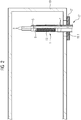
- FIG 2 shows a partially sectioned illustration of an embodiment of an electrical feedthrough 17 according to the invention through a housing opening 19.1 of an electrically conductive housing 19 of electrical equipment.
- the electrical equipment is, for example, an electrical machine such as a motor, a generator or a transformer, or an electrical switching device such as a circuit breaker or a disconnector.
- the implementation 17 comprises one as in FIG 1 formed conductor arrangement 1 and a seal 21.
- the housing 19 and the seal 21 are shown in section, the conductor arrangement 1 is as in FIG Figure 1 shown partially cut.
- the insulating jacket section 5.2 of the conductor arrangement 1 is arranged inside the housing 19.
- the shell 7 protrudes from the housing opening 19.1.
- the seal 21 extends annularly around the casing 7, connects the casing 7 in an electrically conductive manner to the housing 19 and seals the housing opening 19.1.
- the sheath 7 is made of a material that contains graphite.
- the conductor 3 is connected or can be connected to a current path of the electrical equipment (in the case that the electrical equipment is an electrical machine, the conductor 3 is, for example, connected to a winding of the machine; in the case that the electrical equipment is an electrical switching device, the conductor 3 is connected, for example, to a switching contact of the switching device).
- the shell 7 and the housing 19 are connected to ground potential, for example.
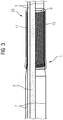
- FIG 3 shows analogously to FIG 1 a partially sectioned illustration of an embodiment of a cable 23 according to the invention.
- the cable 23 comprises one as in FIG FIG 1 formed conductor arrangement 1, which forms a first cable end of the cable 23, wherein the insulating jacket 5 extends around the conductor 3 to a (not shown) second cable end of the cable 23.
- the second cable end can be designed like the first cable end.
- Exemplary embodiments shown of conductor arrangements 1 can be modified in various ways.
- the helical winding of the yarn 9 can have locally different slopes in order to change the electrical resistance of the winding along its course and to adapt it to the requirements of the field control.
- a protective layer 13 instead of a protective layer 13, a protective cover which envelops the yarn 9 and the resin layer 11 can be provided.
- Further exemplary embodiments of a conductor arrangement 1 according to the invention have no resin layer 11 and / or no protective layer 13 at all.
- the yarn 9 is not electrically connected to the sheath 7, but rather only capacitively coupled to the sheath 7.
Landscapes
- Engineering & Computer Science (AREA)
- Manufacturing & Machinery (AREA)
- Microelectronics & Electronic Packaging (AREA)
- Physics & Mathematics (AREA)
- Electromagnetism (AREA)
- Textile Engineering (AREA)
- Chemical & Material Sciences (AREA)
- Spectroscopy & Molecular Physics (AREA)
- Dispersion Chemistry (AREA)
- Insulators (AREA)
- Insulated Conductors (AREA)
- Communication Cables (AREA)
- Insulating Bodies (AREA)
Priority Applications (5)
| Application Number | Priority Date | Filing Date | Title |
|---|---|---|---|
| EP19200091.7A EP3799239A1 (fr) | 2019-09-27 | 2019-09-27 | Dispositif conducteur électrique |
| CN202080067905.4A CN114503222A (zh) | 2019-09-27 | 2020-07-15 | 电导体装置 |
| PCT/EP2020/069943 WO2021058160A1 (fr) | 2019-09-27 | 2020-07-15 | Ensemble à conducteur électrique |
| EP20746896.8A EP4000149B1 (fr) | 2019-09-27 | 2020-07-15 | Dispositif conducteur électrique |
| US17/764,071 US12356597B2 (en) | 2019-09-27 | 2020-07-15 | Electric conductor assembly |
Applications Claiming Priority (1)
| Application Number | Priority Date | Filing Date | Title |
|---|---|---|---|
| EP19200091.7A EP3799239A1 (fr) | 2019-09-27 | 2019-09-27 | Dispositif conducteur électrique |
Publications (1)
| Publication Number | Publication Date |
|---|---|
| EP3799239A1 true EP3799239A1 (fr) | 2021-03-31 |
Family
ID=68072261
Family Applications (2)
| Application Number | Title | Priority Date | Filing Date |
|---|---|---|---|
| EP19200091.7A Withdrawn EP3799239A1 (fr) | 2019-09-27 | 2019-09-27 | Dispositif conducteur électrique |
| EP20746896.8A Active EP4000149B1 (fr) | 2019-09-27 | 2020-07-15 | Dispositif conducteur électrique |
Family Applications After (1)
| Application Number | Title | Priority Date | Filing Date |
|---|---|---|---|
| EP20746896.8A Active EP4000149B1 (fr) | 2019-09-27 | 2020-07-15 | Dispositif conducteur électrique |
Country Status (4)
| Country | Link |
|---|---|
| US (1) | US12356597B2 (fr) |
| EP (2) | EP3799239A1 (fr) |
| CN (1) | CN114503222A (fr) |
| WO (1) | WO2021058160A1 (fr) |
Citations (4)
| Publication number | Priority date | Publication date | Assignee | Title |
|---|---|---|---|---|
| DE1777892U (de) * | 1954-06-21 | 1958-11-20 | Siemens Ag | Vorrichtung zur herstellung von endverschluessen fuer hochspannungskabel od. dgl. aus giessbaren massen mit potentialsteuernden einlagen und damit hergestellter endverschluss. |
| DE7722352U1 (de) * | 1977-07-16 | 1977-10-20 | Kabel- Und Lackdrahtfabriken Gmbh, 6800 Mannheim | Kabelendverschluß |
| EP0445490A1 (fr) * | 1990-03-08 | 1991-09-11 | Italco S.P.A. | Ruban pour le revêtement de terminaisons de câbles à moyenne tension et d'isolations lisses |
| JPH10243540A (ja) * | 1997-02-26 | 1998-09-11 | Hitachi Cable Ltd | Cvケーブル終端箱の導電層接地処理方法 |
Family Cites Families (17)
| Publication number | Priority date | Publication date | Assignee | Title |
|---|---|---|---|---|
| DE3312025A1 (de) * | 1983-04-02 | 1984-10-04 | Felten & Guilleaume Energietechnik GmbH, 5000 Köln | Hoechstspannungskabel mit einem endverschluss mit gewickelter keule |
| CA2096066C (fr) * | 1993-05-12 | 1998-02-24 | John Chung Chan | Cable electrique muni d'elements bloquant le passage de l'eau |
| IT1291526B1 (it) * | 1997-04-10 | 1999-01-11 | Pirelli Cavi S P A Ora Pirelli | Terminale secco per cavo elettrico |
| BR9916813A (pt) | 1998-12-14 | 2001-10-16 | Siemens Ag | Dispositivo e método para controlar a intensidade de campo da região de uma instalação polar para cabos dielétricos |
| DE19904133B4 (de) * | 1999-02-03 | 2007-02-08 | Degussa Ag | Oberflächenmodifizierter Isolator und Verfahren zur Modifizierung der Oberfläche eines Isolators |
| SE514210C2 (sv) | 1999-05-28 | 2001-01-22 | Abb Ab | Styrning av fält vid högspänning |
| DE10227227A1 (de) | 2002-06-18 | 2004-01-22 | Siemens Ag | Glimmschutz |
| JP4195848B2 (ja) | 2003-10-08 | 2008-12-17 | 昭和電線ケーブルシステム株式会社 | 気中終端用ポリマー套管およびこれを用いたケーブル気中終端接続部 |
| US6810847B1 (en) * | 2004-01-09 | 2004-11-02 | Ernest T. Jefferson | Charge dissipative cover for spark plug, ignition wire and boot |
| US7402753B2 (en) * | 2005-01-12 | 2008-07-22 | Schlumberger Technology Corporation | Enhanced electrical cables |
| US8413723B2 (en) * | 2006-01-12 | 2013-04-09 | Schlumberger Technology Corporation | Methods of using enhanced wellbore electrical cables |
| EP1870975B1 (fr) | 2006-06-21 | 2010-08-04 | ABB Technology Ltd | Dispositif de commande de champ électrique |
| EP1995850B1 (fr) * | 2007-05-25 | 2010-06-30 | Siemens Aktiengesellschaft | Dispositif anti-effluves |
| FR2991808B1 (fr) * | 2012-06-08 | 2015-07-17 | Nexans | Dispositif comprenant une couche piegeuse de charges d'espace |
| DE102015107479A1 (de) * | 2015-05-12 | 2016-11-17 | Bundesrepublik Deutschland, Vertreten Durch Den Bundesminister Für Wirtschaft Und Energie, Dieser Vertreten Durch Den Präsidenten Der Bundesanstalt Für Materialforschung Und -Prüfung (Bam) | Hochspannungskabelgarnitur und Verfahren zum Herstellen einer Hochspannungskabelgarnitur |
| US9773585B1 (en) * | 2016-12-20 | 2017-09-26 | American Fire Wire, Inc. | Fire resistant coaxial cable |
| CN109802351B (zh) * | 2017-11-17 | 2022-08-12 | 3M中国有限公司 | 全干式电缆终端和电缆组件及其制造、组装或改进方法 |
-
2019
- 2019-09-27 EP EP19200091.7A patent/EP3799239A1/fr not_active Withdrawn
-
2020
- 2020-07-15 CN CN202080067905.4A patent/CN114503222A/zh active Pending
- 2020-07-15 EP EP20746896.8A patent/EP4000149B1/fr active Active
- 2020-07-15 US US17/764,071 patent/US12356597B2/en active Active
- 2020-07-15 WO PCT/EP2020/069943 patent/WO2021058160A1/fr not_active Ceased
Patent Citations (4)
| Publication number | Priority date | Publication date | Assignee | Title |
|---|---|---|---|---|
| DE1777892U (de) * | 1954-06-21 | 1958-11-20 | Siemens Ag | Vorrichtung zur herstellung von endverschluessen fuer hochspannungskabel od. dgl. aus giessbaren massen mit potentialsteuernden einlagen und damit hergestellter endverschluss. |
| DE7722352U1 (de) * | 1977-07-16 | 1977-10-20 | Kabel- Und Lackdrahtfabriken Gmbh, 6800 Mannheim | Kabelendverschluß |
| EP0445490A1 (fr) * | 1990-03-08 | 1991-09-11 | Italco S.P.A. | Ruban pour le revêtement de terminaisons de câbles à moyenne tension et d'isolations lisses |
| JPH10243540A (ja) * | 1997-02-26 | 1998-09-11 | Hitachi Cable Ltd | Cvケーブル終端箱の導電層接地処理方法 |
Also Published As
| Publication number | Publication date |
|---|---|
| US12356597B2 (en) | 2025-07-08 |
| EP4000149B1 (fr) | 2025-05-21 |
| WO2021058160A1 (fr) | 2021-04-01 |
| EP4000149A1 (fr) | 2022-05-25 |
| CN114503222A (zh) | 2022-05-13 |
| US20220361383A1 (en) | 2022-11-10 |
Similar Documents
| Publication | Publication Date | Title |
|---|---|---|
| EP1476928B1 (fr) | Enveloppe pour cable haute tension, et element de cable muni d'une telle enveloppe | |
| DE2948280C2 (fr) | ||
| DE2937253C2 (fr) | ||
| DE69610400T2 (de) | Universeller Kabeladapter, mit Hilfe des Adapters hergestellte Kabelverbindung sowie Verfahren zur Herstellung derselben | |
| DE69738421T2 (de) | Kabelendstück | |
| DE69403619T2 (de) | Vorrichtung zum Verbinden von Energiekabeln | |
| DE69708727T2 (de) | Gleichstromdurchführung | |
| EP1490881B1 (fr) | Cable a trois fils | |
| DE2822829A1 (de) | Bipolarer elektrodenkatheter fuer einen herzschrittmacher | |
| EP3080819B1 (fr) | Système anti-effluves, notamment système anti-effluves extérieur, pour machine électrique | |
| DE3229352A1 (de) | Halogenfreies, flammwidriges kabel mit funktionserhalt im brandfall fuer eine bestimmte zeit | |
| DE3689563T2 (de) | Dichtungsanordnung für kabel. | |
| EP3818602B1 (fr) | Manchon de raccordement | |
| EP4000149B1 (fr) | Dispositif conducteur électrique | |
| EP0017953B1 (fr) | Garniture pour l'extrémité d'un câble moyenne tension ou haute tension | |
| DE69601649T2 (de) | Feldsteuerung für hochspannungskabelendverschluss | |
| DE3042595C2 (de) | Aufschiebbare, mit geteiltem Isolierkörper versehene Verbindungsmuffe für kunststoffisolierte Mittelspannungskabel | |
| EP3074984B1 (fr) | Câble à haute tension | |
| WO2017031602A1 (fr) | Corps de manchon préfabriqué pour raccorder deux câbles polymères à haute tension pour courant continu | |
| DE69736916T2 (de) | Garnitur für Kabelendverschluss und Material für die Bildung der Garnitur | |
| DE102018201160A1 (de) | Hochspannungsdurchführung, elektrisches Gerät mit Hochspannungsdurchführung und Verfahren zur Herstellung des elektrischen Gerätes | |
| DE69710433T2 (de) | Abgeschirmtes Kabel | |
| DE1801077C3 (de) | Hochspannungskabel | |
| DE102014219439A1 (de) | Glimmschutzsystem für eine elektrische Maschine | |
| DE3831127C2 (de) | Kabelendverschluß für Mittelspannungskabel |
Legal Events
| Date | Code | Title | Description |
|---|---|---|---|
| PUAI | Public reference made under article 153(3) epc to a published international application that has entered the european phase |
Free format text: ORIGINAL CODE: 0009012 |
|
| STAA | Information on the status of an ep patent application or granted ep patent |
Free format text: STATUS: THE APPLICATION HAS BEEN PUBLISHED |
|
| AK | Designated contracting states |
Kind code of ref document: A1 Designated state(s): AL AT BE BG CH CY CZ DE DK EE ES FI FR GB GR HR HU IE IS IT LI LT LU LV MC MK MT NL NO PL PT RO RS SE SI SK SM TR |
|
| AX | Request for extension of the european patent |
Extension state: BA ME |
|
| STAA | Information on the status of an ep patent application or granted ep patent |
Free format text: STATUS: THE APPLICATION IS DEEMED TO BE WITHDRAWN |
|
| 18D | Application deemed to be withdrawn |
Effective date: 20211001 |