EP3804672B1 - Vorrichtung zur vorhofstimulation, vorrichtung zur behandlung von schwindel und vorrichtung zur gesundheitsförderung - Google Patents
Vorrichtung zur vorhofstimulation, vorrichtung zur behandlung von schwindel und vorrichtung zur gesundheitsförderung Download PDFInfo
- Publication number
- EP3804672B1 EP3804672B1 EP19811002.5A EP19811002A EP3804672B1 EP 3804672 B1 EP3804672 B1 EP 3804672B1 EP 19811002 A EP19811002 A EP 19811002A EP 3804672 B1 EP3804672 B1 EP 3804672B1
- Authority
- EP
- European Patent Office
- Prior art keywords
- sound
- stimulation
- subject person
- function
- vestibule
- Prior art date
- Legal status (The legal status is an assumption and is not a legal conclusion. Google has not performed a legal analysis and makes no representation as to the accuracy of the status listed.)
- Active
Links
Images






Classifications
-
- A—HUMAN NECESSITIES
- A61—MEDICAL OR VETERINARY SCIENCE; HYGIENE
- A61F—FILTERS IMPLANTABLE INTO BLOOD VESSELS; PROSTHESES; DEVICES PROVIDING PATENCY TO, OR PREVENTING COLLAPSING OF, TUBULAR STRUCTURES OF THE BODY, e.g. STENTS; ORTHOPAEDIC, NURSING OR CONTRACEPTIVE DEVICES; FOMENTATION; TREATMENT OR PROTECTION OF EYES OR EARS; BANDAGES, DRESSINGS OR ABSORBENT PADS; FIRST-AID KITS
- A61F11/00—Methods or devices for treatment of the ears or hearing sense; Non-electric hearing aids; Methods or devices for enabling ear patients to achieve auditory perception through physiological senses other than hearing sense; Protective devices for the ears, carried on the body or in the hand
-
- A—HUMAN NECESSITIES
- A61—MEDICAL OR VETERINARY SCIENCE; HYGIENE
- A61B—DIAGNOSIS; SURGERY; IDENTIFICATION
- A61B5/00—Measuring for diagnostic purposes; Identification of persons
- A61B5/40—Detecting, measuring or recording for evaluating the nervous system
- A61B5/4005—Detecting, measuring or recording for evaluating the nervous system for evaluating the sensory system
- A61B5/4023—Evaluating sense of balance
-
- A—HUMAN NECESSITIES
- A61—MEDICAL OR VETERINARY SCIENCE; HYGIENE
- A61M—DEVICES FOR INTRODUCING MEDIA INTO, OR ONTO, THE BODY; DEVICES FOR TRANSDUCING BODY MEDIA OR FOR TAKING MEDIA FROM THE BODY; DEVICES FOR PRODUCING OR ENDING SLEEP OR STUPOR
- A61M21/00—Other devices or methods to cause a change in the state of consciousness; Devices for producing or ending sleep by mechanical, optical, or acoustical means, e.g. for hypnosis
-
- A—HUMAN NECESSITIES
- A61—MEDICAL OR VETERINARY SCIENCE; HYGIENE
- A61M—DEVICES FOR INTRODUCING MEDIA INTO, OR ONTO, THE BODY; DEVICES FOR TRANSDUCING BODY MEDIA OR FOR TAKING MEDIA FROM THE BODY; DEVICES FOR PRODUCING OR ENDING SLEEP OR STUPOR
- A61M21/00—Other devices or methods to cause a change in the state of consciousness; Devices for producing or ending sleep by mechanical, optical, or acoustical means, e.g. for hypnosis
- A61M2021/0005—Other devices or methods to cause a change in the state of consciousness; Devices for producing or ending sleep by mechanical, optical, or acoustical means, e.g. for hypnosis by the use of a particular sense, or stimulus
- A61M2021/0027—Other devices or methods to cause a change in the state of consciousness; Devices for producing or ending sleep by mechanical, optical, or acoustical means, e.g. for hypnosis by the use of a particular sense, or stimulus by the hearing sense
-
- A—HUMAN NECESSITIES
- A61—MEDICAL OR VETERINARY SCIENCE; HYGIENE
- A61M—DEVICES FOR INTRODUCING MEDIA INTO, OR ONTO, THE BODY; DEVICES FOR TRANSDUCING BODY MEDIA OR FOR TAKING MEDIA FROM THE BODY; DEVICES FOR PRODUCING OR ENDING SLEEP OR STUPOR
- A61M21/00—Other devices or methods to cause a change in the state of consciousness; Devices for producing or ending sleep by mechanical, optical, or acoustical means, e.g. for hypnosis
- A61M21/0094—Isolation chambers used therewith, i.e. for isolating individuals from external stimuli
-
- A—HUMAN NECESSITIES
- A61—MEDICAL OR VETERINARY SCIENCE; HYGIENE
- A61M—DEVICES FOR INTRODUCING MEDIA INTO, OR ONTO, THE BODY; DEVICES FOR TRANSDUCING BODY MEDIA OR FOR TAKING MEDIA FROM THE BODY; DEVICES FOR PRODUCING OR ENDING SLEEP OR STUPOR
- A61M2205/00—General characteristics of the apparatus
- A61M2205/33—Controlling, regulating or measuring
- A61M2205/332—Force measuring means
-
- A—HUMAN NECESSITIES
- A61—MEDICAL OR VETERINARY SCIENCE; HYGIENE
- A61M—DEVICES FOR INTRODUCING MEDIA INTO, OR ONTO, THE BODY; DEVICES FOR TRANSDUCING BODY MEDIA OR FOR TAKING MEDIA FROM THE BODY; DEVICES FOR PRODUCING OR ENDING SLEEP OR STUPOR
- A61M2205/00—General characteristics of the apparatus
- A61M2205/42—Reducing noise
-
- A—HUMAN NECESSITIES
- A61—MEDICAL OR VETERINARY SCIENCE; HYGIENE
- A61M—DEVICES FOR INTRODUCING MEDIA INTO, OR ONTO, THE BODY; DEVICES FOR TRANSDUCING BODY MEDIA OR FOR TAKING MEDIA FROM THE BODY; DEVICES FOR PRODUCING OR ENDING SLEEP OR STUPOR
- A61M2205/00—General characteristics of the apparatus
- A61M2205/50—General characteristics of the apparatus with microprocessors or computers
- A61M2205/502—User interfaces, e.g. screens or keyboards
- A61M2205/505—Touch-screens; Virtual keyboard or keypads; Virtual buttons; Soft keys; Mouse touches
-
- A—HUMAN NECESSITIES
- A61—MEDICAL OR VETERINARY SCIENCE; HYGIENE
- A61M—DEVICES FOR INTRODUCING MEDIA INTO, OR ONTO, THE BODY; DEVICES FOR TRANSDUCING BODY MEDIA OR FOR TAKING MEDIA FROM THE BODY; DEVICES FOR PRODUCING OR ENDING SLEEP OR STUPOR
- A61M2205/00—General characteristics of the apparatus
- A61M2205/60—General characteristics of the apparatus with identification means
- A61M2205/609—Biometric patient identification means
-
- A—HUMAN NECESSITIES
- A61—MEDICAL OR VETERINARY SCIENCE; HYGIENE
- A61M—DEVICES FOR INTRODUCING MEDIA INTO, OR ONTO, THE BODY; DEVICES FOR TRANSDUCING BODY MEDIA OR FOR TAKING MEDIA FROM THE BODY; DEVICES FOR PRODUCING OR ENDING SLEEP OR STUPOR
- A61M2210/00—Anatomical parts of the body
- A61M2210/06—Head
- A61M2210/0662—Ears
- A61M2210/0668—Middle ear
-
- A—HUMAN NECESSITIES
- A61—MEDICAL OR VETERINARY SCIENCE; HYGIENE
- A61M—DEVICES FOR INTRODUCING MEDIA INTO, OR ONTO, THE BODY; DEVICES FOR TRANSDUCING BODY MEDIA OR FOR TAKING MEDIA FROM THE BODY; DEVICES FOR PRODUCING OR ENDING SLEEP OR STUPOR
- A61M2230/00—Measuring parameters of the user
- A61M2230/62—Posture
-
- A—HUMAN NECESSITIES
- A61—MEDICAL OR VETERINARY SCIENCE; HYGIENE
- A61M—DEVICES FOR INTRODUCING MEDIA INTO, OR ONTO, THE BODY; DEVICES FOR TRANSDUCING BODY MEDIA OR FOR TAKING MEDIA FROM THE BODY; DEVICES FOR PRODUCING OR ENDING SLEEP OR STUPOR
- A61M2230/00—Measuring parameters of the user
- A61M2230/63—Motion, e.g. physical activity
-
- G—PHYSICS
- G10—MUSICAL INSTRUMENTS; ACOUSTICS
- G10K—SOUND-PRODUCING DEVICES; METHODS OR DEVICES FOR PROTECTING AGAINST, OR FOR DAMPING, NOISE OR OTHER ACOUSTIC WAVES IN GENERAL; ACOUSTICS NOT OTHERWISE PROVIDED FOR
- G10K11/00—Methods or devices for transmitting, conducting or directing sound in general; Methods or devices for protecting against, or for damping, noise or other acoustic waves in general
- G10K11/16—Methods or devices for protecting against, or for damping, noise or other acoustic waves in general
- G10K11/175—Methods or devices for protecting against, or for damping, noise or other acoustic waves in general using interference effects; Masking sound
- G10K11/178—Methods or devices for protecting against, or for damping, noise or other acoustic waves in general using interference effects; Masking sound by electro-acoustically regenerating the original acoustic waves in anti-phase
-
- H—ELECTRICITY
- H04—ELECTRIC COMMUNICATION TECHNIQUE
- H04R—LOUDSPEAKERS, MICROPHONES, GRAMOPHONE PICK-UPS OR LIKE ACOUSTIC ELECTROMECHANICAL TRANSDUCERS; ELECTRIC HEARING AIDS; PUBLIC ADDRESS SYSTEMS
- H04R3/00—Circuits for transducers
Definitions
- the present disclosure relates to a technology and an apparatus for improving balance function and motor function of human beings by sound stimulation.
- the main role of the interior ear is to transform vibration into an electrical signal and transmit the electric signal to the nerve or brain.
- the three semicircular ducts and the vestibule included in the interior ear are known to be related to the function of maintaining the balance of the body (balance function).
- the vestibule includes the saccule and utricle. Hair cells coupled to the ear stone and otolithic membrane above are located in each of the saccule and utricle. People sense the inclination of the body as the ear stone is inclined in the direction of gravity in association with the inclination of the body.
- Document US 2018/133102 A1 discloses devices and methods for reducing the symptoms of maladies of the vestibular system, the one or more devices having a signal generator operable to generate one or more non-combined, initial signals; an amplifying section operable to receive the one or more non-combined, initial signals and generate one or more amplified signals at one or more variable power levels; and one or more vibration generating elements, each element operable to, receive the one or more amplified signals, generate one or more physical vibratory signals, and propagate the one or more physical vibratory signals to the prioprioceptive vestiublar system.
- the one or more vibratory signals may comprise signals at one or more harmonics of a frequency in the range 10 Hz to less than 200 Hz.
- US 2013/225915 A1 describes a headband comprising a flexible sheet of padding having a first surface; one or more bone conduction transducers, located on said first surface, the bone conduction transducers configured to emit sound waves with frequencies betweeen 50 and 4,000 Hz that provides bone conduction stimulating the vestibular systems of a human body; a sound source coupled to and transmitting signals to the one or more bone conduction transducers.
- WO 2017/040741 A1 systems, devices and methods for galvanic vestibular stimulation having an envelope modulation are disclosed.
- Said document further teaches a galvanic vestibular stimulation device having first and second electrodes; and a controller comprising a waveform generator that is configured to deliver a modulated electrical signal to a subject via transdermal electrical stimulation through the first and second electrodes, the modulated electrical signal comprising an amplitude and a carrier frequency, at least one of the amplitude and the carrier frequency being modulated based on a modulation waveform to modulate an eletrical signal, the modulation waveform comprising a modulation frequency that is less than the carrier frequency.
- Some embodiments according to said document utilize sound-based stimulation and/or electronic stimulation based on sounds.
- EP 2 636 392 A1 describes a device for tinnitus treatment comprising an operating console with a user interface and with at least one earplug for the introduction of a tone pattern of tones with tone pitches in a frequency of more than 30 Hz into the external auditory canal of the ear.
- Said device is characterised in that the earplug is connected via a pressure tube to a pressure generator which generates pressure pulsations with a pulsation frequency of less than 10 Hz and a pressure difference of less than 1 bar.
- Non-patent literature 1 discloses a result of adding a solution containing a fluorescence probe (FM1-43) to the interior ear of a mouse to evaluate the function of hair cells in the vestibule and observing a fluorescence signal generated.
- FM1-43 emits a fluorescence signal when taken up by the cell.
- intense fluorescence is observed.
- TMC transmembrane channel-like
- TMC2 transmembrane channel-like
- Non Patent Literature 1 Mechanotransduction in mouse inner ear hair cells requires transmembrane channel-like genes. J Clin Invest 121:4796-4809, 2011 .
- Dizziness begins with a disorder of the balance function.
- the disclosure addresses the above-described issue, and a general purpose thereof is to provide a technology in which sound stimulation suitable for improvement of human balance function is used.
- a vestibule stimulation apparatus includes: a setting unit that sets a sound stimulation; and a sound generation unit that generates the sound stimulation thus set.
- the setting unit sets a sound stimulation having a sound volume level of a value between 70 and 85 decibels and a frequency of a value between 20 and 140 hertz, as a sound stimulation for activating a vestibular function via an ear stone of a subject person.
- ear stone is used as a term that encompasses ear stone and otolithic membrane.
- Another embodiment of the present disclosure relates to a program including computer-implemented modules including: a setting module that sets a sound stimulation having a sound volume level of a value between 70 and 85 decibels and a frequency of a value between 20 and 140 hertz, as a sound stimulation for activating a vestibular function via an ear stone of a subject person; and a sound stimulation generation module that generates the sound stimulation thus set.
- a setting module that sets a sound stimulation having a sound volume level of a value between 70 and 85 decibels and a frequency of a value between 20 and 140 hertz, as a sound stimulation for activating a vestibular function via an ear stone of a subject person
- a sound stimulation generation module that generates the sound stimulation thus set.
- Fig. 1 shows a configuration of a vestibule stimulation apparatus 1 according to an embodiment.
- the vestibule stimulation apparatus 1 is a sound generation apparatus for generating and outputting sound in a stimulation pattern of a frequency and sound volume that activate the vestibular function of human beings.
- the sound itself or the sound signal generated in a stimulation pattern of a preset frequency and sound volume may be called "sound stimulation”.
- the vestibule stimulation apparatus 1 includes a user operation acknowledgment unit 2 that acknowledges a user operation to select a sound stimulation, a setting unit that sets a sound stimulation in accordance with a user operation for selection, a sound generation unit 4 that generates and outputs the sound stimulation thus set, an information acquisition unit 5 that acquires information related to the vestibular function of a subject person, and a position identification unit 6 that identifies the position of the subject person relative to the sound generation unit 4.
- the sound generation unit 4 of the embodiment has a function of outputting pure sound having a specific frequency to the subject person in a temporally continuous manner, but other frequency components may be output simultaneously.
- the sound generation unit 4 may have a function of a speaker and output sound outside from the vestibule stimulation apparatus 1. Alternatively, the sound generation unit 4 may output sound from a headphone or earphone connected to the vestibule stimulation apparatus 1.
- Fig. 1 The elements illustrated in Fig. 1 as executing various processes are implemented in hardware such as circuit blocks, memories, or other LSIs and in software such as a program loaded into a memory. Therefore, it will be understood by those skilled in the art that these functional blocks may be implemented in a variety of manners by hardware only, software only, or by a combination of hardware and software.
- the vestibule stimulation apparatus 1 of the embodiment outputs a sound stimulation having a sound volume level of a value between 70 and 85 decibel (dB) and a frequency of a value between 20 and 140 hertz (Hz) in order to improve the motor function and balance function of a subject person or promote the anti-aging benefit for the subject person, the detail of which will be described later.
- the sound volume level means a sound volume level at a position where the subject person is positioned.
- the sound stimulation is preferably a continuous sound output in a temporarily continuous manner.
- the sound stimulation is preferably a continuous sound that continues at least for one second or longer, and, more preferably, 30 seconds or longer. In sound stimulation using continuous sound, a sound of a frequency and loudness showing a benefit at the position of the subject person is given continuously.
- the vestibule stimulation apparatus 1 may be built in a dizziness treatment apparatus and installed at a medical facility like a hospital.
- the dizziness treatment apparatus can ameliorate the symptom of dizziness by outputting, to a patient of dizziness, a sound stimulation that activates the vestibular function via the ear stone (hereinafter, "ear stone” includes ear stone and otolithic membrane).
- ear stone includes ear stone and otolithic membrane.
- the vestibule stimulation apparatus 1 outputs a sound stimulation that stimulates the ear stone and so can be said to be an ear stone stimulation apparatus.
- the doctor may be allowed to set the sound volume level within a range from 70 to 85 dB and set the frequency within a range from 20 to 140 Hz in accordance with the symptom of the patient or information related to the vestibular function.
- Sound stimulation of a sound volume between 70 and 85 dB and a frequency between 20 and 140 Hz comprises sound that people are daily exposed to in terms of sound volume and frequency components and that is highly safe because it meets the environmental criteria. For this reason, the dizziness treatment apparatus provided with the vestibule stimulation apparatus 1 can be used for home therapy under the management of a doctor.
- the vestibule stimulation apparatus 1 may be commercially available as health equipment and used for the purpose of improving the motor function and balance function of a healthy person or promoting the anti-aging benefit. It is preferred to form the vestibule stimulation apparatus 1 to be compact so that it can be carried around. It is expected, for example, that an athlete hears the sound stimulation output from the vestibule stimulation apparatus 1 via a headphone before a match. In recent years, prevention of locomotive syndromes is proposed. Prevention and amelioration of locomotive syndromes associated with improvement of the balance function are expected by distributing the vestibule stimulation apparatus 1 as health equipment. Prevention and amelioration of motion disease, which includes travel sickness, and of space sickness, which causes disorder in the vestibular function due to gravitational change, are also expected. It is also expected the apparatus is used to rehabilitation astronauts returning from a stay in the space.
- the vestibule stimulation apparatus 1 may be implemented by installing a sound generation application in a mobile terminal apparatus like a smartphone and a tablet. Sound in the range from 70 to 85 dB and the range from 20 to 140 Hz is difficult for ordinary people to hear and, in that sense, can be said to be sound that is not bothering even when it is heard. Therefore, when the user of the mobile terminal apparatus is listening to the music using the music player application, the continuous sound generated by the music generation application may be mixed with the music sound played back. Continuous sound that improves balance function has a low volume and contains relatively lower frequencies than music sound. Therefore, the user can listen to the music without being aware of the continuous sound that is mixed.
- the sound generation application may be built as a function of the music player application.
- the sound generation application may be built in other types of applications that output sound such as moving image applications as well as in music player applications.
- the vestibule stimulation apparatus 1 may be attached to a chamber that accommodates a subject person and used as a health promotion apparatus. By using the vestibule stimulation apparatus 1 to output a sound stimulation that improves the balance function of the user to the space inside the chamber while the user is in the chamber, the balance function of the user is improved.
- the health promotion apparatus may be installed at a health club, etc.
- FIG. 2A shows a result of a rotor rod test on mice.
- a rotor rod test is a test in which a mouse is placed on a rotating rod, the speed is increased gradually, and the time elapsed until the mouse drops is measured. If the motor function and balance function are proper, the time elapsed until the mouse drops from the rod is long. If the motor function and balance function are deteriorated, the time elapsed until the mouse drops from the rod is short.
- line t1 denotes a result of measuring the time elapsed until the mouse drops before a sound stimulation is given and after a sound stimulation is given. In this test, a sound stimulation of 75 dB and 100 Hz is given for one hour. Line t1 denotes a variation in the time elapsed until the drop between a point of time before the sound stimulation is given, a point of time immediately after the sound stimulation is given, and one day after the stound stimulation is given. The plots at the respective points of time denote the median value of the time elapsed until the drop of a plurality of mice subject to measurement.
- Line t2 denotes a result of measuring the time elapsed until the drop of a mouse not receiving a sound stimulation shown for the purpose of comparison with line t1.
- the time elapsed until the drop of a mouse not receiving a sound stimulation is measured at the same points of time (same time intervals) as the mouse receiving a sound stimulation.
- the plots at the respective points of time denote the median value of the time elapsed until the drop of a plurality of mice subject to measurement.
- the rotor rod test shows that the time elapsed until the drop of a mouse receiving a sound stimulation is significantly longer than the time elapsed until the drop of a mouse not receiving a sound simulation. That the time indicated by line t2 grows longer as the rotor rod test is repeated means that the mouse became accustomed to the exercise on the rotor rod. Comparing line t1 and line t2, the motor function and balance function of the mouse are improved by receiving a sound stimulation of a suitable sound volume and frequency.
- Fig. 2B shows a result of a balance beam test on mice.
- the number of times that the mouse slips until the mouse finishes crossing the balance beam is measured. If the motor function and balance function are proper, the number of times of slips will be small. If the motor function and balance function are deteriorated, the number of times of slips will be large.
- mice are organized into a group not receiving a sound stimulation, a group receiving a sound stimulation (100 Hz) of 98 dB, and a group receiving a sound stimulation (100 Hz) of 80 dB for the purpose of examining the relationship between the sound volume level and the motor function and balance function.
- the average value of the numbers of times of slips is measured for each group.
- the test revealed that the group receiving a sound stimulation of 98 dB showed a poorer record than the group not receiving a sound stimulation. Meanwhile, the group receiving a sound stimulation of 80 dB showed a good record.
- Non-patent literature 1 discloses that the activity of the TMC1/2 ion channel is enhanced, and the balance function, and, ultimately, the vestibule function are improved, when the hair cells of the vestibule take up FM1-43.
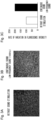
- Fig. 3A shows fluorescence in the utricle observed in the absence of a sound stimulation.
- Fig. 3B shows fluorescence in the utricle observed after a continuous sound of 100 Hz and 85 dB is given for five minutes.
- Fig. 3C shows a rate of variation in the fluorescence intensity with reference to the fluorescence intensity in the absence of a sound stimulation.
- the uptake test revealed that the fluorescence intensity is increased by about 100% after a continuous sound stimulation is given. That the fluorescence intensity is increased by giving a continuous sound stimulation means that more of the fluorescent probe is taken up, i.e., that the activity of the TMC1/2 ion channel is enhanced.
- Fig. 4A shows fluorescence in the utricle observed in the absence of a sound stimulation.
- Fig. 4B shows fluorescence in the utricle observed after a discontinuous sound of 100 Hz and 85 dB is given for five minutes.
- Discontinuous sound is sound that is not generated in a temporarily continuous manner. The term signifies that generation of sound is temporarily intermittent.
- the discontinuous sound given in this test is a sound stimulation in which a sound output period when a sound of 100 Hz and 85 dB is output and a non-output period in which sound is output are alternately repeated.
- the sound output period is configured to last 10 m seconds, and the non-output period is configured to last 600 m seconds so that the non-output period is longer than the sound output period.
- Fig. 4A shows fluorescence in the utricle observed in the absence of a sound stimulation.
- Fig. 4B shows fluorescence in the utricle observed after a discontinuous sound of 100 Hz and 85
- 4C shows a rate of variation in the fluorescence intensity with reference to the fluorescence intensity in the absence of a sound stimulation.
- the uptake test revealed that the fluorescence intensity is decreased by about 70% after a discontinuous sound stimulation is given. That the fluorescence intensity is decreased by giving a discontinuous sound stimulation means that the TMC1/2 ion channel became less active.
- FIG. 5A shows a fluorescent state observed when a sound stimulation is not given to the ear stone. In the absence of a sound stimulation, the heat shock protein 70 is not expressed in the ear stone.
- Fig. 5B shows a fluorescent state observed when a sound stimulation is given to the ear stone. When a sound stimulation is given, the heat shock protein 70 is expressed in the ear stone, and green fluorescence is expressed strongly. It is confirmed from this that sound stimulation directly acts upon the ear stone.
- Figs. 5C and 5D are schematical illustrations of Figs. 5A and 5B , which show a state in which a a sound stimulation is not given and a state in which a sound stimulation is given, respectively.
- Fig. 5C schematically shows relative positions of the ear stone and hair cells in the vestibule. The ear stone forms a layer above the hair cells. When a movement in the direction of inclination is applied, the hair cells detect a displacement of the ear stone and transmits a signal to the vestibular nerve. This allows the person to sense the inclination of the body.
- Fig. 5D is a schematic view showing that a sound stimulation stimulates the ear stone.
- Fig. 6A shows fluorescence in the utricle observed when a sound stimulation is not given in the presence of the ear stone. Because a sound stimulation is not given, the vestibular hair cells are not activated.
- Fig. 6B shows fluorescence in the utricle observed when a sound stimulation is given in the presence of the ear stone. In this experiment, as in the experiment shown in Fig.
- a continuous sound of 100 Hz and 85 dB is given for five minutes, and the fluorescence intensity is increased by about 100% by the continuous sound stimulation. This means that the activity of the TMC1/2 ion channel is enhanced, i.e., the vestibular function is activated.
- Fig. 6C shows fluorescence in the utricle observed when a sound stimulation is not given with the ear stone being removed. Since a sound stimulation is not given, the vestibular hair cells are not activated.
- Fig. 6D shows fluorescence in the utricle observed when a sound stimulation is given with the ear stone being removed. In this experiment, the fluorescence intensity is not increased regardless of the fact that a continuous sound of 100 Hz and 85 dB is given for five minutes. In other words, it was confirmed that the vestibular hair cells are not activated even if a sound stimulation is given with the ear stone being removed.
- Figs. 7A-7B show fluorescence levels indicating the activity of hair cells in the utricle observed after a continuous sound stimulation of 85 dB is given at a plurality of frequencies.
- Fig. 7A shows the fluorescence states at the respective frequencies
- Fig. 7B shows a rate of variation in the fluorescence intensity with reference to the fluorescence intensity in the absence of a sound stimulation.
- the uptake test confirmed that the benefit of activating the vestibular function is not observed at the frequency of 200 Hz or higher and the benefit of activating the vestibular function via the ear stone is observed at the frequencies lower than 200 Hz.
- VEMP vestibular evoked myogenic potential
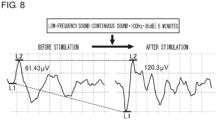
- Fig. 8 shows a variation in VEMP of a healthy person.
- the test result obtained before a sound stimulation is shown on the left side of Fig. 8
- the test result obtained after a sound stimulation is shown on the right side.
- the sound stimulation comprises a continuous sound of a sound volume level of 85 dB and a frequency of 100 Hz that lasts for five minutes.
- the amplitude expansion (L2-L1) in the potential difference in the VEMP test shows improvement in the vestibular function including the ear stone function and, ultimately, improvement in the balance function and promotion of the anti-aging benefit.
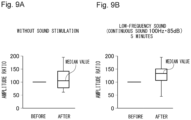
- Fig. 9A shows amplitude ratios for comparison in the VEMP test.
- the amplitude ratio shown on the right and labeled "After” represents the potential difference in the second test as contrasted with the potential difference in the first test.
- a sound stimulation is not given in the second test so that a potential difference substantially identical to that of the first test is measured.
- Fig. 9B shows amplitude ratios measured in the VEMP test in which a sound stimulation is given.
- the amplitude ratio shown on the right and labeled "After” represents the potential difference in the second test as contrasted with the potential difference in the first test.
- a continuous sound having a sound volume level of 85 dB and a frequency of 100 Hz is given for five minutes in the second test, and the amplitude measured is larger than that of the first test.
- the VEMP test result shown in Figs. 9A-9B confirms that the balance function of a subject person is improved by giving a sound stimulation for activating the vestibular function via the ear stone of the subject person.
- Figs. 10A-10B show a method of gravimetric test.
- a gravimetric test is used not only to test the balance function but also to test the motor function.
- Fig. 10A shows a center-of-gravity trajectory observed when the eyes are open
- Fig. 10B shows a center-of-gravity trajectory observed when the eyes are closed.
- a romberg test which is one of gravimetric tests, a subject person stands erect with feet together. The eyes-open center-of-gravity trajectory over a period of 60 seconds and the eyes-closed center-of-gravity trajectory over a period of 60 seconds are measured.
- a romberg coefficient of a trajectory length indicated by (eyes-closed trajectory length/eyes-open trajectory length) and a romberg coefficient of a circumscribed area indicated by (eyes-closed trajectory area (area defined by the trajectory)/eyes-open trajectory area) are used.
- Figs. 11A and 11B show center-of-gravity trajectories observed when the eyes are open and when the eyes are closed before a sound stimulation is given to a healthy person.
- Figs. 11C and 11D show center-of-gravity trajectories observed when the eyes are open and when the eyes are closed after a sound stimulation is given to a healthy person.
- the sound stimulation comprises a continuous sound of a sound level of 85 dB and a frequency of 100 Hz that lasts for five minutes. Referring to the eyes-closed center-of-gravity trajectories shown in Figs. 11B and 11D , the measurement shows that the center-of-gravity sway is smaller after the sound stimulation than before the sound stimulation.
- Fig. 12A shows trajectory length romberg coefficients for comparison in a gravimetric test on a healthy person.
- the trajectory length ratio shown on the right and labeled "After” represents the trajectory length romberg coefficient of the second test as contrasted with the trajectory length romberg coefficient of the first test.
- a sound stimulation is not given in the second test so that a trajectory length romberg coefficient substantially identical to that of the first test is calculated.
- Fig. 12B shows trajectory length romberg coefficients in a gravimetric test on a healthy person in which a sound stimulation is given.
- the trajectory length ratio shown on the right and labeled "After” represents the trajectory length romberg coefficient of the second test as contrasted with the trajectory length romberg coefficient of the first test.
- a continuous sound having a sound volume level of 85 dB and a frequency of 100 Hz is given for five minutes in the second test, and the trajectory length romberg coefficient is smaller than that of the first test. The result confirms that the motor function and balance function of a healthy person are improved by giving a sound stimulation of a suitable pattern to a healthy person.
- Fig. 13A shows circumscribed area romberg coefficients for comparison in a gravimetric test on a healthy person.
- the circumscribed area ratio shown on the right and labeled "After” represents the circumscribed area romberg coefficient of the second test as contrasted with the circumscribed area romberg coefficient of the first test.
- a sound stimulation is not given in the second test so that a circumscribed area romberg coefficient substantially identical to that of the first test is calculated.
- Fig. 13B shows circumscribed area romberg coefficients in a gravimetric test on a healthy person in which a sound stimulation is given.
- the circumscribed area ratio shown on the right and labeled "After” represents the circumscribed area romberg coefficient of the second test as contrasted with the circumscribed area romberg coefficient of the first test.
- a continuous sound having a sound volume level of 85 dB and a frequency of 100 Hz is given for five minutes in the second test, and the circumscribed area romberg coefficient is smaller than that of the first test. The result confirms that the motor function and balance function of a healthy person are improved by giving a suitable sound stimulation to the healthy person.
- Figs. 11A-13B show results of gravimetric tests using eyes-open and eyes-closed center-or-gravity trajectories.
- the tests shown in Figs. 14-16 examine the benefit of sound stimulation for the vestibular function of a person affected with motion sickness.
- the center-of-gravity trajectory of a subject person is measured first. The same subject person is caused to sit on a chair, and the center-of-gravity trajectory of the subject person is measured after rotating the chair 12 times for one minute.
- Fig. 14 shows a center-of-gravity trajectory observed before a rotational stimulation and a center-of-gravity trajectory observed after the rotational stimulation.
- a sound stimulation is not given to the subject person.
- the fluctuation of center-of-gravity given by was 16.0.
- FIG. 15A shows a center-of-gravity trajectory observed before a rotational stimulation and a center-of-gravity trajectory after the rotational stimulation.
- a sound stimulation of 70 dB and 100 Hz was given to a subject person for one minute while the chair was being rotated.
- the fluctuation of center-of-gravity in this case is 3.1. It was confirmed that the vestibular function is activated and the balance function is significantly improved as compared with the fluctuation in the case shown in Fig. 14 in which a sound stimulation is not given.
- Fig. 15B shows a center-of-gravity trajectory observed before a rotational stimulation and a center-of-gravity trajectory observed after the rotational stimulation.
- a sound stimulation of 85 dB and 100 Hz was given to a subject person for one minute while the chair is being rotated.
- the fluctuation of center-of-gravity in this case is 1.3. It was confirmed that the vestibular function is activated and the balance function is significantly improved as compared with the fluctuation in the case shown in Fig. 14 in which a sound stimulation is not given.
- Fig. 16 shows proportions of subject persons showing improvement in the balance function at the respective frequencies.
- the sound volume level of a sound stimulation given while the chair is being rotated is fixed at 85 dB, and the proportion of subject persons showing improvement in the balance function is measured at a plurality of frequencies from 20 Hz to 150 Hz. It was confirmed that the benefit of improvement in the balance function was confirmed in 67% of the subject persons at 20 Hz, 100% at 50-120 Hz, 67% at 130 Hz, and 75% at 140 Hz. Meanwhile, improvement in the balance function was not confirmed at 150 Hz.
- a sound stimulation having a sound volume level of 85 dB and a frequency in a range from 20 Hz and 140 Hz provides the benefit of activating the vestibular function via the ear stone of the subject person.
- a similar benefit of improvement was also confirmed in the case the sound volume level is set to 70 dB as in the case of 85 dB.
- the results shown in Figs. 14-16 confirmed that the sound stimulation in the above range may also stimulate the semicircular canal.
- Figs. 17-18 examine the benefit of sound stimulation exerted on the vestibular function when a seated position is maintained.
- Fig. 17 shows how the fluctuation of center-of-gravity is changed when the seated position is maintained.
- a sound stimulation is not given to the subject person in the seated position.
- the fluctuation of center-of-gravity observed before the subject person takes the seated position was 1.7
- the fluctuation of center-of-gravity observed after the subject person maintained the seated position for one hour was 3.2.
- This test confirmed that the ear stone is not stimulated because the subject person remained seated still in the char for one hour and that a disorder is caused in the balance function.
- Fig. 18 shows how the fluctuation of center-of-gravity is changed when the seated position is maintained.
- a continuous sound stimulation of 85 dB and 100 Hz was given three times to a subject person maintaining a seated position for one hour. Specifically, the sound stimulation was given for 5 minutes immediately after the seated position is started, for five minutes after 25 minutes, and for five minutes after 55 minutes.
- the fluctuation of center-of-gravity observed before the subject person takes the seated position was 1.8
- the fluctuation of center-of-gravity observed after the subject person maintained the seated position for one hour was also 1.8.
- This test confirmed that a disorder in the balance function is not caused as a result of stimulating the ear stone by giving a continuous sound stimulation of five minutes three times while the subject person remain seated in the chair for one hour.
- Fig. 19A and 19B show variations in VEMP of patients of dizziness.
- Fig. 19A shows a variation in VEMP of a patient in his(her) 80's suffering from serious dizziness
- Fig. 19B shows a variation in VEMP of a patient in his(her) 50's suffering from mild dizziness.
- the sound stimulation comprises a continuous sound of a sound level of 70 dB and a frequency of 100 Hz that lasts for five minutes.
- the amplitude of the potential difference (L2-L1) in the VEMP test is expanded. The amplitude expansion shows that there is improvement in the vestibular function of the patients of dizziness regardless of the age and the seriousness of symptom of the patient of dizziness.
- a continuous sound stimulation of a sound level of 85 dB and a frequency of 100 Hz that lasts five minutes is given to a healthy person.
- a continuous sound stimulation of a sound level of 70 dB and a frequency of 100 Hz that lasts five minutes is given to a patient of dizziness. In either case, results showing improvement in the balance function were obtained. Described above is an objective evaluation result. In practice, a lot of patients of dizziness reported that the symptom is ameliorated.
- a continuous sound having a sound volume level of a between 70 and 85 dB and a frequency of a value between 20 and 140 Hz is a sound stimulation that stimulates the ear stone of a subject person and is effective to remedy or improve the balance function by activating the vestibular function via the ear stone.
- the setting unit 3 in the vestibule stimulation apparatus 1 sets a sound stimulation having a sound volume level of a between 70 and 85 dB and a frequency of a value between 20 and 140 Hz, and the sound generation unit 4 generates the sound stimulation thus set and outputs it to the subject person.
- the information acquisition unit 5 acquires information related to the vestibular function of the subject person.
- the information related to the vestibular function includes status information representing the status of the current vestibular function of the subject person.
- the status information may be information that makes it possible to estimate whether the current vestibular function is proper or degraded.
- the information acquisition unit 5 may acquire a duration in which the seated position of the subject person is maintained, as the information indicating the vestibular function.
- the information acquisition unit 5 may, for example, acquire a camera image capturing the subject person and acquire the duration of the seated position by performing image analysis.
- the information acquisition unit 5 may acquire the duration of the seated position of the subject person by referring to the value detected by a load sensor provided on the seat of the chair.
- the camera may be installed in advance to capture the desk, and the information acquisition unit 5 may be supplied with an image from the camera.
- the duration of the seated position may be measured by a further device and supplied to the information acquisition unit 5.
- the setting unit 3 sets at least one of the sound volume level or frequency of the sound stimulation in accordance with the information related to the vestibular function acquired by the information acquisition unit 5. For example, when the duration of the seated position of the subject person is provided from the information acquisition unit 5, the setting unit 3 may not generate a sound stimulation if the duration of the seated position is within a predetermined time (e.g., 30 minutes) and generate a sound stimulation if the duration exceeds the predetermined time, setting the sound volume level in a range 70-85 dB.
- the setting unit 3 may set at least one of the sound volume level or frequency of the sound stimulation in accordance with the duration of the seated position. Thus, it is preferred that the setting unit 3 set a sound stimulation suited to the status of the vestibular function of the subject person in accordance with the information related to the vestibular function of the subject person.
- the information acquisition unit 5 may acquire information related to the movement of the head of the subject person, as the information related to the vestibular function.
- the information acquisition unit 5 may acquire the degree of movement of the head by, for example, acquiring a camera image capturing the subject person and performing image analysis.
- the information acquisition unit 5 may acquire the information related to the movement of the head measured by a further device from the further device. When the head is still, the ear stone is not stimulated, and the balance function tends to be degraded. Accordingly, the information acquisition unit 5 may acquire the information related to the movement of the head and provide the information to the setting unit 3 as the information related to the current vestibular function.
- the setting unit 3 may set at least one of the sound volume level or frequency of a sound stimulation in accordance with the information related to the movement of the head of the subject person. If the amount of movement of the head is relatively great, for example, the sound volume level of the sound stimulation may be decreased within the range 70-85 dB, and, if the amount of movement of the head is relatively small, the sound volume level of the sound stimulation may be increased within the range 70-85 dB.
- the movement of the head may be acquired by a motion sensor, acceleration sensor, or the like.
- the information acquisition unit 5 may acquire the movement of the center of gravity of the subject person in a seated position, as the information related to the vestibular function.
- the information acquisition unit 5 may acquire the movement of the eyes of the subject person, the change in the facial expression of the subject, etc. as the status information representing the status of the current vestibular function.
- the information acquisition unit 5 may acquire attribute information such as age, sex, BMI of the subject person and provide the attribute information to the setting unit 3, and the setting unit 3 may use the attribute information as a compensation coefficient for the sound volume level and frequency that are set.
- the position identification unit 6 identifies the position of the subject person relative to the sound generation unit 4, and the setting unit 3 determines the sound volume level output from the sound generation unit 4 in accordance with the position of the subject person. More specifically, the setting unit 3 determines the sound volume level output from the sound generation unit 4 such that the sound volume level at the position where the subject person is positioned is of a value between 70 and 85 dB.
- the position identification unit 6 may identify the position of the subject person by, for example, referring to a camera image capturing the subject person.
- the setting unit 3 derives a distance between the sound generation unit 4 and the subject person and determines the sound volume level output from the sound generation unit 4, allowing for the distance attenuation of the sound. If the sound volume level for the subject person is set to be 75 dB, for example, the output level of the sound generation unit 4 may be determined to be a sound volume level derived from adding the distance attenuation component to 75 dB.
- the sound generation unit 4 may include the first sound generation unit that generates a sound stimulation toward one of the ears of the subject person and the second sound generation unit that generates a sound stimulation toward the other ear of the subject person.
- the setting unit 3 may control the output of the first sound generation unit and the output of the second sound generation unit independently such that the sound volume levels for stimulating the left and right ear stones of the subject person are substantially equal.
- the first sound generation unit and the second generation unit may be provided at positions that sandwich a subject person seated in a chair from left and from right.
- the setting unit 3 may set the output level of the first sound generation unit and the output level of the second sound generation unit such that the sound volume levels for stimulating the left and right ear stones of the subject person are substantially equal.
- the user operation acknowledgment unit 2 may acknowledge a user operation to select a sound stimulation for improving the motor function, improving the balance function, or promoting the anti-aging benefit.
- Fig. 20 shows an exemplary screen displayed in the vestibule stimulation apparatus 1.
- the vestibule stimulation apparatus 1 may be a mobile terminal apparatus such as a smartphone in which a sound generation application is installed.
- a plurality of types of modes for setting a sound stimulation are prepared in the sound generation application. In this example, "dizziness amelioration mode" for patients of dizziness and "balance function improvement mode” for healthy persons are displayed as being selectable, but other modes may be prepared.
- the sound volume level is smaller in the "dizziness amelioration mode" than in the "balance function improvement mode". For example, a continuous sound having a sound volume level of 70 dB and a frequency of 100 Hz that lasts five minutes is registered as the stound stimulation in the "dizziness amelioration mode", and a continuous sound having a sound volume level of 85 dB and a frequency of 100 Hz that lasts five minutes is registered as the sound stimulation in the "balance function improvement mode".
- the setting unit 3 has a function capable of setting a sound stimulation suited to the plurality of types of modes.
- the user operation acknowledgment unit 2 acknowledges a mode selection operation from the user, and the setting unit 3 sets a sound stimulation suited to the mode selection operation acknowledged.
- the user need not set a parameter such as a sound volume level and a frequency individually and can set a sound stimulation merely by using a mode button. Thus, the usability of the vestibule stimulation apparatus 1 is improved.
- the sound generation unit 4 may include, in consideration of the safety of the user, a function of limiting the time for which the sound is generated within a prescribed time frame to be a predetermined period of time or shorter. For example, the sound generation unit 4 may limit the time for which the user can hear the sound within a time frame of 24 hours to be 30 minutes or shorter.
- the vestibule stimulation apparatus 1 may have a function of identifying the user by biometric authentication, and the sound generation unit 4 may count, for each user, the time for which the sound is generated within a prescribed time frame and prohibit generation of sound beyond a predetermined period of time.
- the sound generation unit 4 may generate a preset sound stimulation while music data is being played back. This lets the user derive the benefit of improving the balance function while listening to the music.
- the vestibule stimulation apparatus 1 by mounting the vestibule stimulation apparatus 1 in various transportation means including automobiles, trucks, ships, airplanes, rockets, and spaceships and generating a sound stimulation of a continuous sound having a sound volume level of a value between 70 and 85 decibels and a frequency of a value between 20 and 140 hertz, improvement in balance function of healthy and aged persons, reduction of traffic accidents due to improvement in balance function, relief of motion sickness and space sickness, etc. are expected. Further, by installing the vestibule stimulation apparatus 1 in residences and factories, improvement in balance function, reduction of slip and fall accidents due to improvement in balance function, and creation of healthful residences (smart houses) and healthful working places (smart factories) are expected.
- the information acquisition unit 5 to acquire the duration of the seated position of the subject person and the information related to the movement of the head, and by using the setting unit 3 to set at least one of the sound volume level or frequency of the sound stimulation in accordance with the acquired information, the deterioration of the balance function is properly inhibited in accordance with the situation of the subject person.
- a camera at a position where the camera can capture the place such as a school, residence, working place, etc. where the subject person takes a seated position and using the information acquisition unit 5 to acquire status information representing the status of the current vestibular function, anti-aging benefit from stimulation of the ear stone is also expected.
- Fig. 21 shows a configuration of a vehicle-mounted vestibule stimulation apparatus 1a according to an example.
- the vehicle-mounted vestibule stimulation apparatus 1a is produced by adding a noise cancellation unit 7 to the configuration of the vestibule stimulation apparatus 1 in order to cause the vestibule stimulation apparatus 1 shown in Fig. 1 to function as an apparatus for use in a vehicle.
- the vehicle-mounted vestibule stimulation apparatus 1a is mounted on a vehicle like an automobile and has a function of preventing or inhibiting travel sickness of a passenger. Alternatively, the apparatus may be mounted on other transportation means (e.g., ships, airplanes, rockets, spaceships).
- the position identification unit 6 in the vehicle-mounted vestibule stimulation apparatus 1a detects whether a passenger is present inside the vehicle.
- the position identification unit 6 may detect whether a passenger is present or not by acquiring an image from a camera for capturing the scene in the vehicle interior and subjecting the image thus taken to image analysis.
- the position identification unit 6 identifies the position of the passenger in the vehicle interior.
- the setting unit 3 sets a sound stimulation of a continuous sound having a sound volume level of a value between 70 and 85 decibels and a frequency of a value between 20 and 140 hertz and configured to prevent or inhibit motion sickness including travel sickness, and the sound generation unit 4 generates the sound stimulation thus set and outputs the generated stimulation inside the vehicle. It is preferred that the sound generation unit 4 have a directional speaker and output the sound stimulation toward the position of the passenger identified by the position identification unit 6. By outputting the sound stimulation toward the passenger, travel sickness of the passenger is effectively prevented.
- the sound generation unit 4 may generate the sound stimulation set by the setting unit 3.
- the sound generation unit 4 may generate a sound stimulation automatically in accordance with the running condition of the vehicle, and, more specifically, when the vehicle is in a running condition in which the vehicle is rocked heavily and travel sickness occurs easily. Whether the vehicle is in a running condition in which travel sickness occurs easily may be judged by the information acquisition unit 5 based on the value detected by a vehicle-mounted acceleration sensor.
- Balance function is directly linked to the driving technique, which will be appreciated by seeing drunk driving and meandering driving of aged people.
- Causing the sound generation unit 4 to output a sound stimulation toward the driver is expected to improve the driving technique by improving the balance function of the driver. Meanwhile, the output toward a passenger is expected to reduce carsickness.
- the noise cancellation unit 7 has a role of canceling the noise inside the vehicle.
- the noise cancellation unit 7 detects the noise generated inside the vehicle and generates a sound having a phase opposite to that of the noise to cancel the noise. By canceling the noise, the benefit of the sound stimulation output by the sound generation unit 4 is enhanced.
- An acoustic insulation member or a silencing apparatus may be provided inside the vehicle to cancel the noise.
- a vestibule stimulation apparatus includes: a setting unit that sets a sound stimulation; and a sound generation unit that generates the sound stimulation thus set.
- the setting unit sets a sound stimulation having a sound volume level of a value between 70 and 85 decibels and a frequency of a value between 20 and 140 hertz, as a sound stimulation for activating a vestibular function via an ear stone of a subject person.
- the vestibule stimulation apparatus may further include: an information acquisition unit that acquires information related to the vestibular function of the subject person.
- the setting unit may set at least one of the sound volume level or a frequency of the sound stimulation in accordance with the information related to the vestibular function thus acquired.
- the information acquisition unit may acquire status information representing a status of a current vestibular function.
- the information acquisition unit may acquire a duration of a seated position of the subject person or acquire information related to a movement of a head of the subject person.
- the vestibule stimulation apparatus may include an acknowledgment unit that acknowledges a user operation to select a sound stimulation for improving a motor function, improving a balance function, or enhancing an anti-aging benefit.
- the setting unit may set a sound stimulation for improving a motor function, improving a balance function, or enhancing an anti-aging benefit.
- the setting unit may set a sound stimulation for preventing or inhibiting motion sickness including travel sickness.
- the vestibule stimulation apparatus may further include a position identification unit that identifies a position of the subject person relative to the sound generation unit.
- the setting unit may determine the sound volume level output from the sound generation unit in accordance with the position of the subject person.
- the setting unit may determine the sound volume level output from the sound generation unit such that the sound volume level at a position where the subject person is positioned is of a value between 70 and 85 decibels.
- the setting unit may control an output of the sound generation unit such that sound volume levels for stimulating left and right ear stones of the subject person are substantially equal.
- the sound generation unit may include a first sound generation unit that generates a sound stimulation toward one of ears of the subject person, and a second sound generation unit that generates a sound stimulation toward the other ear of the subject person.
- the setting unit may control an output of the first sound generation unit and an output of the second sound generation unit independently.
- Another embodiment of the present disclosure relates to a program including computer-implemented modules including: a sound stimulation setting module that sets a sound stimulation having a sound volume level of a value between 70 and 85 decibels and a frequency of a value between 20 and 140 hertz, as a sound stimulation for activating a vestibular function via an ear stone of a subject person; and a sound stimulation generation module that generates the sound stimulation thus set.
- a sound stimulation setting module that sets a sound stimulation having a sound volume level of a value between 70 and 85 decibels and a frequency of a value between 20 and 140 hertz, as a sound stimulation for activating a vestibular function via an ear stone of a subject person
- a sound stimulation generation module that generates the sound stimulation thus set.
- the program may include a computer-implemented information acquisition module that acquires information related to the vestibular function of the subject person.
- the sound stimulation setting module may include a module that sets at least one of the sound volume level or a frequency of the sound stimulation in accordance with the information related to the vestibular function thus acquired.
- the information acquisition module may include a module that acquires status information representing a status of a current vestibular function.
- the sound generation module may include a module that limits a time for which a sound is generated within a prescribed time frame to be a predetermined period of time or shorter. Further, the sound generation module may include a module that generates a preset sound stimulation while music data is being played back.
- the sound stimulation setting module may include a module capable of setting a sound stimulation suited to a plurality of types of modes.
- the program may further include a computer-implemented module that acknowledges a user operation to select one of a plurality of types of modes, and the sound stimulation setting module may include a module that sets a sound stimulation suited to a mode selection operation acknowledged.
- the present disclosure relates to a technology for improving balance function and motor function of people by sound stimulation.
Landscapes
- Health & Medical Sciences (AREA)
- Life Sciences & Earth Sciences (AREA)
- Heart & Thoracic Surgery (AREA)
- Veterinary Medicine (AREA)
- Public Health (AREA)
- Physics & Mathematics (AREA)
- General Health & Medical Sciences (AREA)
- Animal Behavior & Ethology (AREA)
- Engineering & Computer Science (AREA)
- Biomedical Technology (AREA)
- Acoustics & Sound (AREA)
- Biophysics (AREA)
- Psychology (AREA)
- Vascular Medicine (AREA)
- Otolaryngology (AREA)
- Neurosurgery (AREA)
- Physiology (AREA)
- Medical Informatics (AREA)
- Neurology (AREA)
- Pathology (AREA)
- Anesthesiology (AREA)
- Hematology (AREA)
- Surgery (AREA)
- Molecular Biology (AREA)
- Percussion Or Vibration Massage (AREA)
Claims (15)
- Eine Vorrichtung zur Stimulation des Vestibüls (1), umfassend:eine Einstelleinheit (3), die eine Tonstimulation einstellt; undeine Tonerzeugungseinheit (4), die die so eingestellte Tonstimulation erzeugt, dadurch gekennzeichnet, dassdie Einstelleinheit (3) eine Tonstimulation mit einem Lautstärkepegel von einem Wert zwischen 70 und 85 Dezibel und einer Frequenz von einem Wert zwischen 20 und 140 Hertz als eine Tonstimulation zur Aktivierung einer vestibulären Funktion über einen Ohrstein einer Person einstellt.
- Vorrichtung zur Stimulation des Vestibüls (1) nach Anspruch 1, ferner umfassend:eine Informationserfassungseinheit (5), die Informationen in Bezug auf die vestibuläre Funktion der Person erfasst, wobeidie Einstelleinheit (3) die Lautstärke oder die Frequenz der akustischen Stimulation in Abhängigkeit von den so gewonnenen Informationen über die vestibuläre Funktion einstellt.
- Vorrichtung zur Stimulation des Vestibüls (1) nach Anspruch 2, wobei
die Informationserfassungseinheit (5) Statusinformationen erfasst, die einen Status einer aktuellen vestibulären Funktion darstellen. - Vorrichtung zur Stimulation des Vestibüls (1) nach Anspruch 2 oder 3, wobei
die Informationserfassungseinheit (5) eine Dauer einer Sitzposition der Person und/oder Informationen in Bezug auf eine Kopfbewegung der Person erfasst. - Vorrichtung zur Stimulation des Vestibüls (1) nach einem der Ansprüche 1 bis 4, umfassend:eine Bestätigungseinheit (2), die eine Benutzeroperation zur Auswahl einer Tonstimulation zur Verbesserung einer motorischen Funktion, zur Verbesserung einer Gleichgewichtsfunktion oder zur Verstärkung eines Anti-Aging-Vorteils bestätigt, wobeiwenn die Bestätigungseinheit (2) die Benutzerbedienung bestätigt, die Einstellungseinheit eine Tonstimulation zur Verbesserung einer motorischen Funktion, zur Verbesserung einer Gleichgewichtsfunktion oder zur Verbesserung eines Anti-Aging-Vorteils einstellt.
- Vorrichtung zur Stimulation des Vestibüls (1) nach einem der Ansprüche 1 bis 5, wobei
die Einstelleinheit (3) eine akustische Stimulation einstellt, um die Reisekrankheit zu verhindern oder zu hemmen. - Vorrichtung zur Stimulation des Vestibüls (1) nach einem der Ansprüche 1 bis 6, ferner umfassend:eine Positionserkennungseinheit (6), die eine Position der Person relativ zur Tonerzeugungseinheit identifiziert, wobeidie Einstelleinheit (3) den von der Tonerzeugungseinheit ausgegebenen Lautstärkepegel in Abhängigkeit von der Position der Person bestimmt.
- Vorrichtung zur Stimulation des Vestibüls (1) nach einem der Ansprüche 1 bis 7, wobei
die Einstelleinheit (3) den von der Tonerzeugungseinheit ausgegebenen Lautstärkepegel so bestimmt, dass der Lautstärkepegel an einer Position, an der sich die Person befindet, einen Wert zwischen 70 und 85 Dezibel hat. - Vorrichtung zur Stimulation des Vestibüls (1) nach einem der Ansprüche 1 bis 8, wobeidie Einstelleinheit (3) eine Ausgabe der Tonerzeugungseinheit so steuert, dass die Lautstärkepegel für die Stimulation des linken und rechten Ohrsteins der Person im Wesentlichen gleich sindund/oder wobeidie Tonerzeugungseinheit (4) eine erste Tonerzeugungseinheit, die eine Tonstimulation in Richtung eines der Ohren der Testperson erzeugt, und eine zweite Tonerzeugungseinheit, die eine Tonstimulation in Richtung des anderen Ohrs der Testperson erzeugt, umfasst, unddie Einstelleinheit (3) einen Ausgang der ersten Tonerzeugungseinheit und einen Ausgang der zweiten Tonerzeugungseinheit unabhängig voneinander steuert.
- Vorrichtung zur Behandlung von Schwindel, die die Vorrichtung zur Stimulation des Vestibüls (1) nach einem der Ansprüche 1 bis 9 umfasst.
- Vorrichtung zur Gesundheitsförderung, die Folgendes umfasst:die Vorrichtung zur Stimulation des Vestibüls (1) nach einem der Ansprüche 1 bis 9; undeine Kammer, in der eine Person untergebracht ist.
- Ein Computerprogramm, das, wenn es von dem computergestützten System nach Anspruch 1 ausgeführt wird, die Vorrichtung nach Anspruch 1 veranlasst, die Schritte auszuführen:das Einstellungsmodul stellt eine Tonstimulation ein; unddas Modul zur Erzeugung von Tonstimulation erzeugt die so eingestellten Tonstimulation, dadurch gekennzeichnet, dass,das Einstellungsmodul die Tonstimulation mit einem Lautstärkepegel von einem Wert zwischen 70 und 85 Dezibel und einer Frequenz von einem Wert zwischen 20 und 140 Hertz als eine Tonstimulation zur Aktivierung einer vestibulären Funktion über einen Ohrstein einer Person einstellt.
- Programm nach Anspruch 12, das ferner ein computerimplementiertes Informationserfassungsmodul umfasst, das Informationen in Bezug auf die vestibuläre Funktion der Person erfasst, wobei
das Modul zum Einstellen der Tonstimulation ein Modul enthält, das die Lautstärke oder die Frequenz der Tonstimulation in Abhängigkeit von den so gewonnenen Informationen über die vestibuläre Funktion einstellt. - Programm nach Anspruch 13, wobei das Informationserfassungsmodul ein Modul enthält, das Statusinformationen erfasst, die einen Status einer aktuellen vestibulären Funktion darstellen
und/oder wobeidas Modul zur Erzeugung von Tonstimulation ein Modul enthält, das die Zeit, für die ein Ton erzeugt wird, innerhalb eines vorgeschriebenen Zeitrahmens auf eine vorbestimmte Zeitspanne oder kürzer begrenzt und/oder wobeidas Modul zur Erzeugung von Tonstimulation ein Modul enthält, das eine voreingestellte Tonstimulation erzeugt, während Musikdaten wiedergegeben werden. - Programm nach einem der Ansprüche 12 bis 14, wobeidas Modul zur Einstellung der Tonstimulation ein Modul enthält, das eine Tonstimulation einstellen kann, die für eine Vielzahl von Modi geeignet ist
und/oderferner ein computerimplementiertes Modul umfasst, das eine Benutzeroperation zur Auswahl einer von mehreren Arten von Modi bestätigt, wobeidas Modul zum Einstellen der Tonstimulation ein Modul enthält, das eine Tonstimulation einstellt, die für eine bestätigte Modusauswahl geeignet ist.
Applications Claiming Priority (2)
| Application Number | Priority Date | Filing Date | Title |
|---|---|---|---|
| JP2018104637 | 2018-05-31 | ||
| PCT/JP2019/021688 WO2019230941A1 (ja) | 2018-05-31 | 2019-05-31 | 前庭刺激装置、めまい治療装置、健康促進装置 |
Publications (3)
| Publication Number | Publication Date |
|---|---|
| EP3804672A1 EP3804672A1 (de) | 2021-04-14 |
| EP3804672A4 EP3804672A4 (de) | 2022-01-19 |
| EP3804672B1 true EP3804672B1 (de) | 2025-05-21 |
Family
ID=68697525
Family Applications (1)
| Application Number | Title | Priority Date | Filing Date |
|---|---|---|---|
| EP19811002.5A Active EP3804672B1 (de) | 2018-05-31 | 2019-05-31 | Vorrichtung zur vorhofstimulation, vorrichtung zur behandlung von schwindel und vorrichtung zur gesundheitsförderung |
Country Status (5)
| Country | Link |
|---|---|
| US (1) | US12023222B2 (de) |
| EP (1) | EP3804672B1 (de) |
| JP (1) | JP7191400B2 (de) |
| CN (1) | CN112243368B (de) |
| WO (1) | WO2019230941A1 (de) |
Families Citing this family (8)
| Publication number | Priority date | Publication date | Assignee | Title |
|---|---|---|---|---|
| MY194782A (en) * | 2021-01-22 | 2022-12-15 | Togl Tech Sdn Bhd | Device and method for processing, storing and transmitting a signal in a media file |
| CN113183901B (zh) * | 2021-06-03 | 2022-11-22 | 亿咖通(湖北)技术有限公司 | 车载座舱环境控制方法、车辆以及电子设备 |
| JP7620881B2 (ja) * | 2021-06-22 | 2025-01-24 | 公立大学法人奈良県立医科大学 | 重力感受性障害治療装置 |
| WO2023168012A1 (en) * | 2022-03-02 | 2023-09-07 | University Of Mississippi Medical Center | Method and device for improved clinical vestibular testing |
| JP2023145935A (ja) * | 2022-03-29 | 2023-10-12 | 小林製薬株式会社 | 沢瀉湯エキス製剤 |
| JPWO2024014055A1 (de) | 2022-07-13 | 2024-01-18 | ||
| CN115738023A (zh) * | 2022-12-10 | 2023-03-07 | 上海金磊医疗科技有限公司 | 眩晕治疗装置及系统 |
| EP4729037A1 (de) | 2023-07-27 | 2026-04-22 | Kowa Company, Ltd. | Vestibuläre funktionsverbesserungsvorrichtung und vestibuläres funktionsverbesserungsverfahren |
Family Cites Families (16)
| Publication number | Priority date | Publication date | Assignee | Title |
|---|---|---|---|---|
| US10076655B2 (en) * | 2007-09-21 | 2018-09-18 | Koninklijke Philips N.V. | Vestibular stimulation system |
| JP5275910B2 (ja) | 2009-05-15 | 2013-08-28 | 株式会社大野興業 | 三半規管障害患者の治療用器具及びその製造方法 |
| US10112029B2 (en) * | 2009-06-19 | 2018-10-30 | Integrated Listening Systems, LLC | Bone conduction apparatus and multi-sensory brain integration method |
| EP2974770B1 (de) * | 2010-01-12 | 2018-06-13 | The Johns Hopkins University | Implantierbare vorhofprothese |
| CN102144914A (zh) | 2010-02-05 | 2011-08-10 | 华中科技大学同济医学院附属协和医院 | 人体平衡感觉干扰系统 |
| US8751012B2 (en) | 2012-01-17 | 2014-06-10 | Med-El Elektromedizinische Geraete Gmbh | Implantable vestibular prosthesis system with power saving mode including soft start and soft power-down |
| DE102012101917A1 (de) * | 2012-03-07 | 2013-09-12 | Christian Veitl | Vorrichtung zur Tinnitusbehandlung |
| US20160089298A1 (en) | 2014-09-29 | 2016-03-31 | Otolith Sound Inc | Device for Mitigating Motion Sickness and Other Responses to Inconsistent Sensory Information |
| WO2016069143A1 (en) * | 2014-10-29 | 2016-05-06 | Qatar Foundation For Education, Science And Community Development | Stress relief training method and device |
| CN104799999B (zh) * | 2015-05-17 | 2018-06-05 | 宋鹏龙 | 耳石振动治疗仪 |
| US10232139B1 (en) * | 2015-06-12 | 2019-03-19 | Chrona Sleep, Inc. | Smart pillow cover and alarm to improve sleeping and waking |
| US10945880B2 (en) * | 2015-09-04 | 2021-03-16 | Scion Neurostim, Llc | Systems, devices and methods for galvanic vestibular stimulation having an envelope modulation |
| US20170245555A1 (en) * | 2016-02-26 | 2017-08-31 | Happiest Baby, Inc. | Sleep sack for infant calming/sleep aid |
| US20180133102A1 (en) | 2016-11-14 | 2018-05-17 | Otolith Sound, Inc. | Devices And Methods For Reducing The Symptoms Of Maladies Of The Vestibular System |
| US10259451B2 (en) * | 2017-07-19 | 2019-04-16 | GM Global Technology Operations LLC | Motion sickness mitigation system and method |
| DE102017126432A1 (de) * | 2017-11-10 | 2019-05-16 | Sennheiser Electronic Gmbh & Co. Kg | Hörer |
-
2019
- 2019-05-31 JP JP2020522624A patent/JP7191400B2/ja active Active
- 2019-05-31 WO PCT/JP2019/021688 patent/WO2019230941A1/ja not_active Ceased
- 2019-05-31 US US17/059,127 patent/US12023222B2/en active Active
- 2019-05-31 CN CN201980035902.XA patent/CN112243368B/zh active Active
- 2019-05-31 EP EP19811002.5A patent/EP3804672B1/de active Active
Also Published As
| Publication number | Publication date |
|---|---|
| CN112243368A (zh) | 2021-01-19 |
| US20210205137A1 (en) | 2021-07-08 |
| WO2019230941A1 (ja) | 2019-12-05 |
| US12023222B2 (en) | 2024-07-02 |
| JPWO2019230941A1 (ja) | 2021-07-08 |
| EP3804672A1 (de) | 2021-04-14 |
| JP7191400B2 (ja) | 2022-12-19 |
| CN112243368B (zh) | 2023-04-04 |
| EP3804672A4 (de) | 2022-01-19 |
Similar Documents
| Publication | Publication Date | Title |
|---|---|---|
| EP3804672B1 (de) | Vorrichtung zur vorhofstimulation, vorrichtung zur behandlung von schwindel und vorrichtung zur gesundheitsförderung | |
| CA2697997C (en) | Method and system for improving a subject's sensory, reflex and/or motor mechanisms via auditory, tactile or visual stimulations | |
| Todd et al. | Tuning and sensitivity of the human vestibular system to low-frequency vibration | |
| US9987191B2 (en) | Device and method for auditory stimulation | |
| EP3122308B1 (de) | Vorrichtung zur behandlung von schmerzen | |
| US20180001088A1 (en) | Device for non-invasive neuro-stimulation by means of multichannel bursts | |
| WO2002062264A2 (en) | Eeg feedback controlled sound therapy for tinnitus | |
| EP3337395B1 (de) | System zur überwachung der gehirnaktivität und zur ermöglichung, das gehirn wieder ins gleichgewicht zu bringen | |
| JP2023541826A (ja) | 音楽及び同期律動刺激を介した神経刺激の方法及びシステム | |
| JP2009136662A (ja) | 音響信号を用いた聴覚細胞刺激方法及び装置 | |
| KR102140834B1 (ko) | 개인 청력상태에 따른 이명 자가 치료 시스템 | |
| JPH11262480A (ja) | 超音波信号に対する感度測定装置及び感度測定方法 | |
| RU2525223C2 (ru) | Способ стимулирования области волосковых сенсорных клеток | |
| Kopelovich et al. | Frequency and electrode discrimination in children with cochlear implants | |
| AU2014200477B2 (en) | Method and System for Improving a Suject's Sensory, Reflex and/or Motor Mechanisms via Auditory, Tactile or Visual Stimulations | |
| Merchel et al. | Equal intensity contours for whole-body vibrations compared with vibrations cross-modally matched to isophones | |
| RU2611909C1 (ru) | Способ проведения теста восприятия ритмических последовательностей стимулов | |
| JP2002323898A (ja) | 環境制御機器 | |
| Adams et al. | Klickgeräusche durch bewegliche Magnete bei Cochlea Implantaten: Fallbeschreibung und akustische Messungen | |
| Adams | Click-noise observed with moveable magnets in cochlear implants: case report and acoustic measurements | |
| Lin et al. | A model study of resonance effect on ocular vestibular-evoked myogenic potential | |
| WO2025023314A1 (ja) | 前庭機能改善装置及び前庭機能改善方法 | |
| Blackmon et al. | Effect of lingual vibrotactile stimulation on the averaged cortical evoked response | |
| HK1134011B (en) | System for improving a subject's sensory, reflex and/or motor mechanisms via auditory, tactile or visual stimulations | |
| FR2901145A1 (fr) | Appareil sonore de diagnostic et de traitement medical |
Legal Events
| Date | Code | Title | Description |
|---|---|---|---|
| STAA | Information on the status of an ep patent application or granted ep patent |
Free format text: STATUS: THE INTERNATIONAL PUBLICATION HAS BEEN MADE |
|
| PUAI | Public reference made under article 153(3) epc to a published international application that has entered the european phase |
Free format text: ORIGINAL CODE: 0009012 |
|
| STAA | Information on the status of an ep patent application or granted ep patent |
Free format text: STATUS: REQUEST FOR EXAMINATION WAS MADE |
|
| 17P | Request for examination filed |
Effective date: 20201211 |
|
| AK | Designated contracting states |
Kind code of ref document: A1 Designated state(s): AL AT BE BG CH CY CZ DE DK EE ES FI FR GB GR HR HU IE IS IT LI LT LU LV MC MK MT NL NO PL PT RO RS SE SI SK SM TR |
|
| AX | Request for extension of the european patent |
Extension state: BA ME |
|
| DAV | Request for validation of the european patent (deleted) | ||
| DAX | Request for extension of the european patent (deleted) | ||
| A4 | Supplementary search report drawn up and despatched |
Effective date: 20211221 |
|
| RIC1 | Information provided on ipc code assigned before grant |
Ipc: G01N 33/00 20060101ALI20211215BHEP Ipc: A61F 11/00 20060101AFI20211215BHEP |
|
| GRAP | Despatch of communication of intention to grant a patent |
Free format text: ORIGINAL CODE: EPIDOSNIGR1 |
|
| STAA | Information on the status of an ep patent application or granted ep patent |
Free format text: STATUS: GRANT OF PATENT IS INTENDED |
|
| INTG | Intention to grant announced |
Effective date: 20241216 |
|
| RIN1 | Information on inventor provided before grant (corrected) |
Inventor name: SUGIMOTO, SATOFUMI Inventor name: SONE, MICHIHIKO Inventor name: OHGAMI, NOBUTAKA Inventor name: KATO, MASASHI |
|
| GRAS | Grant fee paid |
Free format text: ORIGINAL CODE: EPIDOSNIGR3 |
|
| GRAA | (expected) grant |
Free format text: ORIGINAL CODE: 0009210 |
|
| STAA | Information on the status of an ep patent application or granted ep patent |
Free format text: STATUS: THE PATENT HAS BEEN GRANTED |
|
| AK | Designated contracting states |
Kind code of ref document: B1 Designated state(s): AL AT BE BG CH CY CZ DE DK EE ES FI FR GB GR HR HU IE IS IT LI LT LU LV MC MK MT NL NO PL PT RO RS SE SI SK SM TR |
|
| REG | Reference to a national code |
Ref country code: GB Ref legal event code: FG4D |
|
| REG | Reference to a national code |
Ref country code: CH Ref legal event code: EP |
|
| REG | Reference to a national code |
Ref country code: DE Ref legal event code: R096 Ref document number: 602019070298 Country of ref document: DE |
|
| REG | Reference to a national code |
Ref country code: IE Ref legal event code: FG4D |
|
| PGFP | Annual fee paid to national office [announced via postgrant information from national office to epo] |
Ref country code: DE Payment date: 20250528 Year of fee payment: 7 |
|
| PGFP | Annual fee paid to national office [announced via postgrant information from national office to epo] |
Ref country code: FR Payment date: 20250526 Year of fee payment: 7 |
|
| REG | Reference to a national code |
Ref country code: NL Ref legal event code: MP Effective date: 20250521 |
|
| PG25 | Lapsed in a contracting state [announced via postgrant information from national office to epo] |
Ref country code: PT Free format text: LAPSE BECAUSE OF FAILURE TO SUBMIT A TRANSLATION OF THE DESCRIPTION OR TO PAY THE FEE WITHIN THE PRESCRIBED TIME-LIMIT Effective date: 20250922 Ref country code: FI Free format text: LAPSE BECAUSE OF FAILURE TO SUBMIT A TRANSLATION OF THE DESCRIPTION OR TO PAY THE FEE WITHIN THE PRESCRIBED TIME-LIMIT Effective date: 20250521 Ref country code: ES Free format text: LAPSE BECAUSE OF FAILURE TO SUBMIT A TRANSLATION OF THE DESCRIPTION OR TO PAY THE FEE WITHIN THE PRESCRIBED TIME-LIMIT Effective date: 20250521 |
|
| REG | Reference to a national code |
Ref country code: LT Ref legal event code: MG9D |
|
| PG25 | Lapsed in a contracting state [announced via postgrant information from national office to epo] |
Ref country code: GR Free format text: LAPSE BECAUSE OF FAILURE TO SUBMIT A TRANSLATION OF THE DESCRIPTION OR TO PAY THE FEE WITHIN THE PRESCRIBED TIME-LIMIT Effective date: 20250822 Ref country code: NO Free format text: LAPSE BECAUSE OF FAILURE TO SUBMIT A TRANSLATION OF THE DESCRIPTION OR TO PAY THE FEE WITHIN THE PRESCRIBED TIME-LIMIT Effective date: 20250821 |
|
| PG25 | Lapsed in a contracting state [announced via postgrant information from national office to epo] |
Ref country code: NL Free format text: LAPSE BECAUSE OF FAILURE TO SUBMIT A TRANSLATION OF THE DESCRIPTION OR TO PAY THE FEE WITHIN THE PRESCRIBED TIME-LIMIT Effective date: 20250521 Ref country code: PL Free format text: LAPSE BECAUSE OF FAILURE TO SUBMIT A TRANSLATION OF THE DESCRIPTION OR TO PAY THE FEE WITHIN THE PRESCRIBED TIME-LIMIT Effective date: 20250521 |
|
| PG25 | Lapsed in a contracting state [announced via postgrant information from national office to epo] |
Ref country code: BG Free format text: LAPSE BECAUSE OF FAILURE TO SUBMIT A TRANSLATION OF THE DESCRIPTION OR TO PAY THE FEE WITHIN THE PRESCRIBED TIME-LIMIT Effective date: 20250521 |
|
| PG25 | Lapsed in a contracting state [announced via postgrant information from national office to epo] |
Ref country code: HR Free format text: LAPSE BECAUSE OF FAILURE TO SUBMIT A TRANSLATION OF THE DESCRIPTION OR TO PAY THE FEE WITHIN THE PRESCRIBED TIME-LIMIT Effective date: 20250521 |
|
| PG25 | Lapsed in a contracting state [announced via postgrant information from national office to epo] |
Ref country code: RS Free format text: LAPSE BECAUSE OF FAILURE TO SUBMIT A TRANSLATION OF THE DESCRIPTION OR TO PAY THE FEE WITHIN THE PRESCRIBED TIME-LIMIT Effective date: 20250821 |
|
| PG25 | Lapsed in a contracting state [announced via postgrant information from national office to epo] |
Ref country code: IS Free format text: LAPSE BECAUSE OF FAILURE TO SUBMIT A TRANSLATION OF THE DESCRIPTION OR TO PAY THE FEE WITHIN THE PRESCRIBED TIME-LIMIT Effective date: 20250921 |
|
| PG25 | Lapsed in a contracting state [announced via postgrant information from national office to epo] |
Ref country code: LV Free format text: LAPSE BECAUSE OF FAILURE TO SUBMIT A TRANSLATION OF THE DESCRIPTION OR TO PAY THE FEE WITHIN THE PRESCRIBED TIME-LIMIT Effective date: 20250521 |
|
| REG | Reference to a national code |
Ref country code: AT Ref legal event code: MK05 Ref document number: 1796165 Country of ref document: AT Kind code of ref document: T Effective date: 20250521 |
|
| REG | Reference to a national code |
Ref country code: CH Ref legal event code: H13 Free format text: ST27 STATUS EVENT CODE: U-0-0-H10-H13 (AS PROVIDED BY THE NATIONAL OFFICE) Effective date: 20251223 |
|
| PG25 | Lapsed in a contracting state [announced via postgrant information from national office to epo] |
Ref country code: AT Free format text: LAPSE BECAUSE OF FAILURE TO SUBMIT A TRANSLATION OF THE DESCRIPTION OR TO PAY THE FEE WITHIN THE PRESCRIBED TIME-LIMIT Effective date: 20250521 Ref country code: DK Free format text: LAPSE BECAUSE OF FAILURE TO SUBMIT A TRANSLATION OF THE DESCRIPTION OR TO PAY THE FEE WITHIN THE PRESCRIBED TIME-LIMIT Effective date: 20250521 Ref country code: SM Free format text: LAPSE BECAUSE OF FAILURE TO SUBMIT A TRANSLATION OF THE DESCRIPTION OR TO PAY THE FEE WITHIN THE PRESCRIBED TIME-LIMIT Effective date: 20250521 |
|
| PG25 | Lapsed in a contracting state [announced via postgrant information from national office to epo] |
Ref country code: LU Free format text: LAPSE BECAUSE OF NON-PAYMENT OF DUE FEES Effective date: 20250531 |
|
| PG25 | Lapsed in a contracting state [announced via postgrant information from national office to epo] |
Ref country code: CH Free format text: LAPSE BECAUSE OF NON-PAYMENT OF DUE FEES Effective date: 20250531 |
|
| PG25 | Lapsed in a contracting state [announced via postgrant information from national office to epo] |
Ref country code: CZ Free format text: LAPSE BECAUSE OF FAILURE TO SUBMIT A TRANSLATION OF THE DESCRIPTION OR TO PAY THE FEE WITHIN THE PRESCRIBED TIME-LIMIT Effective date: 20250521 |
|
| PG25 | Lapsed in a contracting state [announced via postgrant information from national office to epo] |
Ref country code: EE Free format text: LAPSE BECAUSE OF FAILURE TO SUBMIT A TRANSLATION OF THE DESCRIPTION OR TO PAY THE FEE WITHIN THE PRESCRIBED TIME-LIMIT Effective date: 20250521 |
|
| PG25 | Lapsed in a contracting state [announced via postgrant information from national office to epo] |
Ref country code: SK Free format text: LAPSE BECAUSE OF FAILURE TO SUBMIT A TRANSLATION OF THE DESCRIPTION OR TO PAY THE FEE WITHIN THE PRESCRIBED TIME-LIMIT Effective date: 20250521 Ref country code: RO Free format text: LAPSE BECAUSE OF FAILURE TO SUBMIT A TRANSLATION OF THE DESCRIPTION OR TO PAY THE FEE WITHIN THE PRESCRIBED TIME-LIMIT Effective date: 20250521 |
|
| PG25 | Lapsed in a contracting state [announced via postgrant information from national office to epo] |
Ref country code: IT Free format text: LAPSE BECAUSE OF FAILURE TO SUBMIT A TRANSLATION OF THE DESCRIPTION OR TO PAY THE FEE WITHIN THE PRESCRIBED TIME-LIMIT Effective date: 20250521 |
|
| REG | Reference to a national code |
Ref country code: BE Ref legal event code: MM Effective date: 20250531 |
|
| PG25 | Lapsed in a contracting state [announced via postgrant information from national office to epo] |
Ref country code: MC Free format text: LAPSE BECAUSE OF FAILURE TO SUBMIT A TRANSLATION OF THE DESCRIPTION OR TO PAY THE FEE WITHIN THE PRESCRIBED TIME-LIMIT Effective date: 20250521 |
|
| REG | Reference to a national code |
Ref country code: DE Ref legal event code: R097 Ref document number: 602019070298 Country of ref document: DE |
|
| PLBE | No opposition filed within time limit |
Free format text: ORIGINAL CODE: 0009261 |
|
| STAA | Information on the status of an ep patent application or granted ep patent |
Free format text: STATUS: NO OPPOSITION FILED WITHIN TIME LIMIT |
|
| REG | Reference to a national code |
Ref country code: CH Ref legal event code: L10 Free format text: ST27 STATUS EVENT CODE: U-0-0-L10-L00 (AS PROVIDED BY THE NATIONAL OFFICE) Effective date: 20260402 |
|
| PG25 | Lapsed in a contracting state [announced via postgrant information from national office to epo] |
Ref country code: IE Free format text: LAPSE BECAUSE OF NON-PAYMENT OF DUE FEES Effective date: 20250531 |
|
| PG25 | Lapsed in a contracting state [announced via postgrant information from national office to epo] |
Ref country code: BE Free format text: LAPSE BECAUSE OF NON-PAYMENT OF DUE FEES Effective date: 20250531 |
|
| 26N | No opposition filed |
Effective date: 20260224 |