EP3805437A1 - Neuartiger zwirn - Google Patents
Neuartiger zwirn Download PDFInfo
- Publication number
- EP3805437A1 EP3805437A1 EP20194126.7A EP20194126A EP3805437A1 EP 3805437 A1 EP3805437 A1 EP 3805437A1 EP 20194126 A EP20194126 A EP 20194126A EP 3805437 A1 EP3805437 A1 EP 3805437A1
- Authority
- EP
- European Patent Office
- Prior art keywords
- thread
- fibers
- thread according
- yarns
- yarn
- Prior art date
- Legal status (The legal status is an assumption and is not a legal conclusion. Google has not performed a legal analysis and makes no representation as to the accuracy of the status listed.)
- Granted
Links
Images


Classifications
-
- D—TEXTILES; PAPER
- D02—YARNS; MECHANICAL FINISHING OF YARNS OR ROPES; WARPING OR BEAMING
- D02G—CRIMPING OR CURLING FIBRES, FILAMENTS, THREADS, OR YARNS; YARNS OR THREADS
- D02G3/00—Yarns or threads, e.g. fancy yarns; Processes or apparatus for the production thereof, not otherwise provided for
- D02G3/22—Yarns or threads characterised by constructional features, e.g. blending, filament/fibre
- D02G3/40—Yarns in which fibres are united by adhesives; Impregnated yarns or threads
- D02G3/404—Yarns or threads coated with polymeric solutions
-
- B—PERFORMING OPERATIONS; TRANSPORTING
- B33—ADDITIVE MANUFACTURING TECHNOLOGY
- B33Y—ADDITIVE MANUFACTURING, i.e. MANUFACTURING OF THREE-DIMENSIONAL [3D] OBJECTS BY ADDITIVE DEPOSITION, ADDITIVE AGGLOMERATION OR ADDITIVE LAYERING, e.g. BY 3D PRINTING, STEREOLITHOGRAPHY OR SELECTIVE LASER SINTERING
- B33Y70/00—Materials specially adapted for additive manufacturing
- B33Y70/10—Composites of different types of material, e.g. mixtures of ceramics and polymers or mixtures of metals and biomaterials
-
- D—TEXTILES; PAPER
- D02—YARNS; MECHANICAL FINISHING OF YARNS OR ROPES; WARPING OR BEAMING
- D02G—CRIMPING OR CURLING FIBRES, FILAMENTS, THREADS, OR YARNS; YARNS OR THREADS
- D02G3/00—Yarns or threads, e.g. fancy yarns; Processes or apparatus for the production thereof, not otherwise provided for
- D02G3/02—Yarns or threads characterised by the material or by the materials from which they are made
- D02G3/16—Yarns or threads made from mineral substances
-
- B—PERFORMING OPERATIONS; TRANSPORTING
- B29—WORKING OF PLASTICS; WORKING OF SUBSTANCES IN A PLASTIC STATE IN GENERAL
- B29C—SHAPING OR JOINING OF PLASTICS; SHAPING OF MATERIAL IN A PLASTIC STATE, NOT OTHERWISE PROVIDED FOR; AFTER-TREATMENT OF THE SHAPED PRODUCTS, e.g. REPAIRING
- B29C64/00—Additive manufacturing, i.e. manufacturing of three-dimensional [3D] objects by additive deposition, additive agglomeration or additive layering, e.g. by 3D printing, stereolithography or selective laser sintering
- B29C64/10—Processes of additive manufacturing
- B29C64/106—Processes of additive manufacturing using only liquids or viscous materials, e.g. depositing a continuous bead of viscous material
- B29C64/118—Processes of additive manufacturing using only liquids or viscous materials, e.g. depositing a continuous bead of viscous material using filamentary material being melted, e.g. fused deposition modelling [FDM]
-
- B—PERFORMING OPERATIONS; TRANSPORTING
- B33—ADDITIVE MANUFACTURING TECHNOLOGY
- B33Y—ADDITIVE MANUFACTURING, i.e. MANUFACTURING OF THREE-DIMENSIONAL [3D] OBJECTS BY ADDITIVE DEPOSITION, ADDITIVE AGGLOMERATION OR ADDITIVE LAYERING, e.g. BY 3D PRINTING, STEREOLITHOGRAPHY OR SELECTIVE LASER SINTERING
- B33Y10/00—Processes of additive manufacturing
-
- D—TEXTILES; PAPER
- D02—YARNS; MECHANICAL FINISHING OF YARNS OR ROPES; WARPING OR BEAMING
- D02G—CRIMPING OR CURLING FIBRES, FILAMENTS, THREADS, OR YARNS; YARNS OR THREADS
- D02G3/00—Yarns or threads, e.g. fancy yarns; Processes or apparatus for the production thereof, not otherwise provided for
- D02G3/22—Yarns or threads characterised by constructional features, e.g. blending, filament/fibre
- D02G3/26—Yarns or threads characterised by constructional features, e.g. blending, filament/fibre with characteristics dependent on the amount or direction of twist
- D02G3/28—Doubled, plied, or cabled threads
Definitions
- the present invention relates to a new impregnated thread comprising finite carbon fibers, a method for producing such a thread and its use.
- EP 3059340 A1 describes a mixed yarn which contains continuous thermoplastic resin fibers and continuous reinforcing fibers, it being possible to use carbon fibers as reinforcing fibers.
- yarn is a collective term for all linear textile structures, ie a yarn is a long, thin structure made of one or more fibers.
- Yarns that contain continuous carbon fibers are, however, limited in their bending flexibility. This restricted bending flexibility leads to poor drapability of the yarn, since the minimum bending radii are large.
- yarns are not as compact, ie they do not have such a high degree of stability.
- There are also disadvantages in terms of logistics and processing since larger bobbins are necessary to pull the yarn out winding up continuous fibers. Processing becomes even more expensive if continuous carbon fibers with a low number of filaments are used to produce the yarns.
- a twist is created when at least two yarns are twisted together. If a thread consists of staple fiber yarns that have been produced using a spinning process with a certain twist, an opposite twist can usefully compensate for this, which stabilizes the textile processing.
- An impregnated thread containing finite carbon fibers has improved mechanical properties, such as improved transverse strength, improved modulus of elasticity or improved flexural strength.
- the improvement in the mechanical properties is due to the fact that forces are better introduced via the impregnated polymer and distributed between the fibers.
- the fibers in the thread thus act as reinforcing fibers, while the impregnated polymer represents a matrix.
- the previously known impregnated (sewing) yarns or twisted threads can, for example, be used to a limited extent as printing filaments in fused deposition modeling (FDM), also called filament 3D printing, because they have good mechanical properties such as high stability and limited bending flexibility.
- FDM fused deposition modeling
- this bending flexibility is not sufficient to enable smaller curve radii in the FDM, which would increase the variety and complexity of the printed image.
- the object of the present invention is therefore to provide a textile structure containing carbon fibers which has good mechanical properties, in particular improved bending flexibility, with at the same time sufficiently high stability.
- this textile structure should be able to be produced more cost-effectively.
- this object is achieved by a thread comprising at least two threads, at least one thread containing finite carbon fibers, and the thread being impregnated with at least one polymer selected from the group consisting of thermoplastically processable polymers, thermosets and / or elastomers , characterized in that the fiber volume content in the thread is less than 50%.
- a fiber volume content of less than 50% in such an impregnated thread on the one hand provides sufficient strength, but on the other hand increases the flexural flexibility of the thread compared to higher fiber volume contents. If such a thread is used as a 3D printing filament, for example, the higher the polymer content, the greater the adhesion between the printing layers and the feeding of the filament in the printing process is improved and facilitated by the bending flexibility.
- twisting yarns to form a twisted thread preferably 2 to 7 yarns, more preferably 2 to 5 yarns, and even more preferably 2 to 3 yarns are used. If less than 2 yarns are used, the desired stability effect will not be achieved when twisting; if more than 7 threads are used, the thread becomes too thick and therefore too uneven in cross-section. With 7 yarns there is also a so-called cable effect, i.e. 1 yarn is straight and 6 more yarns are twisted around this first yarn.
- the impregnated thread according to the invention has 2-21 yarns, more preferably 2-16 yarns, even more preferably 2-10 yarns, particularly preferably 2-7 yarns, very particularly preferably 2-5 yarns and most preferably 2- 3 yarns on. Impregnated threads with more than 7 threads can be obtained, for example, if several threads, each with 2-7 threads, are subjected to a pultrusion process in which the impregnation also takes place at the same time.
- Yarns are made from carbon fibers by spinning the fibers. All known processes, such as ring spinning, friction spinning, dry spinning, melt spinning or wet spinning, can be used for this.
- the at least one yarn, more preferably all yarns comprises at least 25-100 tex, preferably 30-80, particularly preferably 30-60 tex. If the tex is less than 25, the thread produced with it no longer has adequate stability; if the tex is greater than 100, it is no longer possible to ensure good impregnation of the thread produced therewith and the flexibility of the thread decreases. This means that fine components can no longer be manufactured. With a Tex of 25, there is sufficient stability.
- Tex is a measure of the thickness, diameter or strength of textiles such as yarns. The smaller the diameter of such a structure, the finer it is or the greater its fineness. One tex corresponds to 1 gram per 1000 m.
- the thread has at least one yarn which is formed from finite carbon fibers, more preferably all yarns are formed from finite carbon fibers.
- the finite carbon fibers which are processed into a yarn represent stretch-broken fibers or staple fibers. It is also possible for a mixture of stretch-broken fibers and staple fibers to be processed into a yarn.
- Stretch-broken fibers are produced by stretching or drawing fibers until these fibers tear in a controlled manner, as in the U.S. 4,825,635 A is shown. Staple fibers can be made by cutting fibers.
- stretch-broken fibers or staple fibers Single filaments or multifilament strands, preferably multifilament strands, can be used.
- a multifilament strand also called roving, is understood here to be a bundle of individual filaments;
- This roving preferably comprises individual filaments in a range from 2,000 to 80,000 filaments, more preferably in a range from 6,000 to 50,000 filaments, even more preferably in a range from 12,000 to 50,000 filaments, particularly preferably in a range from 20,000 to 50,000 filaments.
- the finite carbon fibers have a length in a range from 2-250 mm, more preferably in a range from 5 to 200, even more preferably in a range from 5-150 mm, particularly preferably in a range of 10 - 130 mm.
- the fiber volume content of the carbon fibers in the impregnated thread according to the invention is preferably in a range of 10-45%, more preferably in a range of 25-40%. If the fiber volume content is below 10%, it makes more sense in terms of process technology and economics to use a commercially available short fiber filament that can offer similar strengths at a lower price. If the fiber volume content is higher than 50%, the cohesion of the individual print layers is no longer optimal when used in FDM 3 printing. Furthermore, with a fiber volume content below 50%, the bending flexibility of the impregnated thread is sufficiently high to ensure good feeding in the printing process.
- At least one yarn can contain finite secondary fibers selected from the group consisting of glass fibers, aramid fibers, polyethylene fibers, thermoplastic fibers, natural fibers, basalt fibers or ceramic fibers or any mixtures thereof. These fibers can also be present as stretch-broken fibers or as staple fibers; for these secondary fibers, the manufacturing processes specified above for the carbon fibers apply, Filament and length ranges. If secondary fibers are used, it is preferred that all of the yarns used to make the twisted yarn contain such secondary fibers. In the context of the invention, these secondary fibers are either added to the carbon fibers during yarn production or a yarn or yarns made of carbon fibers and a yarn or yarns made of secondary fibers are twisted into a twisted thread.
- finite secondary fibers selected from the group consisting of glass fibers, aramid fibers, polyethylene fibers, thermoplastic fibers, natural fibers, basalt fibers or ceramic fibers or any mixtures thereof. These fibers can also be present as stretch-broken fibers or
- a thread according to the invention contains secondary fibers
- the fiber volume content of these fibers is in a range from 1 to 69%, preferably in a range from 1 to 40%, more preferably in a range from 5 to 20%. If the fiber volume content of the secondary fibers is below 1%, the fibers have no noticeable effect on the properties of the thread; if the fiber volume is over 69%, the thread loses the properties of the carbon fibers.
- the thread according to the invention is impregnated with at least one polymer selected from the group consisting of thermoplastically processable polymers, thermosets and / or elastomers.
- the impregnation of the thread enables the thread to withstand mechanical pressure loads, which enables components to be manufactured from these threads.
- At least one thermoplastic is preferably used as the polymer for the impregnation.
- the use of a thermoplastic has the advantage that this material has a high degree of toughness and can be shaped quickly.
- the at least one thermoplastically processable polymer from the group consisting of benzoxazines, polyamide 6, polyamide 6.6, polyamide 12, polyamide 4.10, polylactides, polyhydroxyalkanoates, polyhydroxybutyrates, styrene-acrylonitrile copolymers, acrylonitrile-butadiene-styrene copolymers, Acrylic ester-styrene-acrylonitrile copolymers, polycarbonates, polystyrenes, polyvinyl alcohols, polyvinyl acetates, cellulose acetates, polyethylene terephthalates, polybutylene terephthalates, polymethyl methacrylates, polyether ether ketones, polyether ketones, polyether imides, polyphenylene ethers, polyethersulfones, thermoplastic elastomers, novolaks, resols and novolak-resol mixtures, polyethylenes, (co) polyesters, and polypropy
- the twisted thread according to the invention is a twisted twist, i.e. at least two yarns are twisted together to form a twisted thread.
- the term “beat” includes in particular twisting, twisting, helically twisting and twisting.
- a lay here comprises a full twist and thus indicates the periodicity of the thread along its longitudinal direction.
- the twisted thread according to the invention has a lay number in a range from 50 to 1000 m -1 , preferably in a range from 50 to 750 m -1 , more preferably in a range from 100 to 600 m -1 , even more preferably in a range from 100 to 400 m -1 , particularly preferably in a range from 150 to 300 m -1 .
- the thread according to the invention can be a pultruded thread.
- Pultrusion is generally understood to be an extrusion process. If pultrusion is used to produce the thread according to the invention, this thread can be impregnated by pulling threads through the pultrusion system and impregnating them at the same time. It is also possible for the thread to be profiled on the outside during pultrusion. Such profiling of the thread can, however, also take place after pultrusion.
- step c) impregnation with a reactive liquid, with a melt, with a reactive or non-reactive powder, with a film or with knitted thermoplastic fibers or any mixture thereof.
- reactive means that the impregnation takes place on the basis of chemical reactions; Monomers and / or oligomers react here to form a polymer. Impregnation is preferably carried out with the melt, since a faster process can be ensured here.
- the twine is evenly impregnated with the polymer, as this “introduces” itself evenly and into possibly existing gaps due to the possibly resulting liquid state.
- a pultrusion step is used to produce the thread according to the invention, this step takes place either before the cooling of the thread according to step d) or after step b), the impregnation of the thread according to step c) taking place during the pultrusion.
- the twisted thread according to the invention is suitable for use as FDM (fused deposition modeling) printing filament for 3D printing, as a reinforcement framework for, for example, injection molding, as an electrical conductor and / or as an antenna structure.
- FDM fused deposition modeling
- a thread available under the trade name SIGRAFIL C SB70-3.3 / 240-R100, was fed to a pultrusion system and, during pultrusion, was impregnated with a liquid melt of polyamide 6 (PA6, thermoplastic), pulled through a nozzle with a diameter of 0.4 mm and wound up.
- PA6 polyamide 6
- a carbon fiber roving comprising 50k filaments was stretch-broken and spun into a 70 tex yarn using known spinning processes.
- a total of 7 of these threads were fed to a pultrusion system and, during the pultrusion, were impregnated with a liquid form of a thermoplastically processable polymer, drawn together through a nozzle with a diameter of 1.2 mm and wound up.
- the product produced in this way with a fiber volume content of 48% could be used as a printing filament on commercially available FDM 3D printers, for example with a 1.2 mm nozzle (hot end) for the production of fiber-reinforced 3D printed products.
- conventional printing filaments printing filaments with continuous fiber reinforcement are used which contain stretched parallel fibers, for example carbon fibers, in the form of so-called rovings.
- 3D printed products with small deflection radii can be produced; This means that 3D printed products with complex geometries can be produced.
- such small deflection radii are very difficult to implement, which means that complex and filigree structures can only be produced with great difficulty.
- the use of a staple fiber yarn increases the transverse force connection between the individual pressure layers.
- the printing process is simplified and the material costs can be reduced in contrast to the use of continuous carbon fibers.
- FIG 1A shows an impregnated yarn 100 known from the prior art which is based on the core-shell geometry and which can be used as FDM printing filament.
- the continuous fiber 110 is guided in the core and is already impregnated with a matrix material.
- the jacket of the printing filament for example, there is unreinforced matrix material.
- This FDM printing filament has a core with parallel continuous fibers 110 and a shell 120 which contains excess matrix material.
- Figure 1B shows a thread 200 according to the invention, which can be used, for example, as an FDM printing filament.
- two yarns 210 are twisted helically with one another to form a thread and impregnated.
- the excess matrix material 220 remains as a reservoir in channels along the helix.
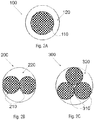
- FIG. 13 shows a top view of a yarn based on the core-shell geometry according to the prior art
- FIG Figures 2B and 2C each show a top view of twisted yarns according to the invention, comprising two or three yarns.
- Both the yarn and the twisted threads can be used as FDM printing filament.
- the fiber volume content of the threads according to the invention is higher than that of the impregnated yarn, which means that the mechanical stability of the threads and thus of the components produced with them is higher in comparison with the impregnated yarn.
- the twisted thread according to the invention is used as an FDM printing filament, the 3D printed product produced with it has a higher mechanical stability.
- Figure 3 shows a side view of a thread 500 comprising two threads 510 containing finite carbon fibers. These finite carbon fibers have radially protruding filament ends 512. In the case of an impregnated thread, these radially protruding filament ends improve the interaction between the yarns and within the impregnated thread.
- the transverse strengths of the printing layers are increased.
Landscapes
- Engineering & Computer Science (AREA)
- Mechanical Engineering (AREA)
- Textile Engineering (AREA)
- Chemical & Material Sciences (AREA)
- Ceramic Engineering (AREA)
- Civil Engineering (AREA)
- Composite Materials (AREA)
- Structural Engineering (AREA)
- Manufacturing & Machinery (AREA)
- Materials Engineering (AREA)
- Yarns And Mechanical Finishing Of Yarns Or Ropes (AREA)
Abstract
Description
- Die vorliegende Erfindung betrifft einen neuen imprägnierten Zwirn umfassend endliche Kohlenstofffasern, ein Verfahren zur Herstellung eines solchen Zwirns und dessen Verwendung.
-
EP 3059340 A1 beschreibt ein gemischtes Garn, welches kontinuierliche Thermoplastharzfasern und kontinuierliche Verstärkungsfasern enthält, wobei als Verstärkungsfasern Kohlenstofffasern eingesetzt werden können. - Aus der
US 2014/0329086 A geht ein Verbundgarn umfassend kontinuierliche Kohlenstofffasern und kontinuierliche Thermoplastharzfasern hervor; dieses Verbundgarn kann erwärmt werden, so dass das Thermoplastharz im Garn schmilzt und eine thermoplastische Harzmatrix bildet. Hier wird auch die Verwendung von Kohlenstoff-Stapelfasern beschrieben, was allerdings zu schlechteren mechanischen Eigenschaften des Garns führt. Über die Bildung einer Harzmatrix wird es ermöglicht, dass Bauteile umfassend kontinuierliche Kohlenstofffasern, gute mechanische Eigenschaften aufweisen. -
DE 102010030773 A1 beschreibt Nähgarne, umfassend Stapelfasern, welche Kohlenstofffasern enthalten können; die Garne können imprägniert sein, und zwar mit einem Imprägniergehalt in einem Bereich von 0,1 bis 50 %. Diese Nähgarne können einem Zwirnprozess unterzogen werden. Diese Nähgarne sollen ein konstantes Eigenschaftsprofil aufweisen und besser verarbeitbar sein. - Der Begriff "Garn" ist ein Sammelbegriff für alle linienförmigen textilen Gebilde, d.h. ein Garn stellt ein langes, dünnes Gebilde aus einer oder mehreren Fasern dar. Garne, die kontinuierliche Kohlenstofffasern enthalten, sind allerdings in ihrer Biegeflexibilität eingeschränkt. Diese eingeschränkte Biegeflexibilität führt zu einer schlechteren Drapierbarkeit des Garns, da die minimalen Biegeradien groß sind. Garne sind zudem nicht so kompakt, d.h. sie weisen eine nicht so hohe Stabilität auf. Weiterhin gibt es Nachteile in der Logistik und Verarbeitung, da größere Spulen notwendig sind, um das Garn aus kontinuierlichen Fasern aufzuwickeln. Die Verarbeitung wird zudem noch teurer, wenn zur Herstellung der Garne kontinuierliche Kohlenstofffasern mit niedriger Filamentzahl verwendet werden.
- Ein Zwirn entsteht, wenn mindestens zwei Garne miteinander verdrillt werden. Besteht ein Zwirn aus Stapelfasergarnen, die über einen Spinnprozess mit einem gewissen Drall hergestellt wurden, kann eine entgegensetzte Zwirndrehung diesen sinnvollerweise ausgleichen, was die textile Verarbeitung stabilisiert.
- Ein imprägnierter Zwirn enthaltend endliche Kohlenstofffasern weist verbesserte mechanische Eigenschaften, wie eine verbesserte Querfestigkeit, ein verbessertes E-Modul oder eine verbesserte Biegefestigkeit auf. Die Verbesserung der mechanischen Eigenschaften ist darauf zurückzuführen, dass Kräfte über das imprägnierte Polymer besser eingeleitet und zwischen den Fasern verteilt werden. Die Fasern im Zwirn fungieren also als Verstärkungsfasern, während das imprägnierte Polymer eine Matrix darstellt.
- Die bisher bekannten imprägnierten (Näh)garne bzw. Zwirne können beispielsweise begrenzt als Druckfilament im Fused Deposition Modelling (FDM), auch Filament 3D-Druck genannt, eingesetzt werden, da sie gute mechanische Eigenschaften wie eine hohe Stabilität und eine beschränkte Biegeflexibilität aufweisen. Allerdings ist diese Biegeflexibilität nicht ausreichend, um kleinere Kurvenradien beim FDM zu ermöglichen, was die Vielfalt und Komplexität des Druckbilds vergrößern würde.
- Daher besteht die Aufgabe der vorliegenden Erfindung darin, ein textiles Gebilde enthaltend Kohlenstofffasern bereitzustellen, welches gute mechanische Eigenschaften, insbesondere eine verbesserte Biegeflexibilität bei gleichzeitig ausreichend hoher Stabilität, aufweist. Zudem soll dieses textile Gebilde kostengünstiger hergestellt werden können.
- Im Rahmen der vorliegenden Erfindung wird diese Aufgabe gelöst durch einen Zwirn, umfassend mindestens zwei Garne, wobei mindestens ein Garn endliche Kohlenstofffasern enthält, und der Zwirn mit mindestens einem Polymer ausgewählt aus der Gruppe bestehend aus thermoplastisch verarbeitbare Polymeren, Duroplasten und/oder Elastomeren imprägniert ist, dadurch gekennzeichnet, dass der Faservolumengehalt im Zwirn weniger als 50 % beträgt.
- Erfindungsgemäß wurde erkannt, dass durch einen Faservolumengehalt von weniger als 50 % in solch einem imprägnierten Zwirn einerseits eine ausreichende Festigkeit vorhanden ist, andererseits aber die Biegeflexibilität des Zwirns im Vergleich zu höheren Faservolumengehalten erhöht wird. Wird ein solcher Zwirn als beispielsweise 3D-Druckfilament verwendet, ist bei einem höheren Polymeranteil die Haftung zwischen den Drucklagen erhöht und die Zuführung des Filaments im Druckprozess wird durch die Biegeflexibilität verbessert und erleichtert.
- Bei der Verdrillung von Garnen zu einem Zwirn werden bevorzugt 2 - 7 Garne, bevorzugter 2 - 5 Garne, und noch bevorzugter 2 - 3 Garne eingesetzt. Werden weniger als 2 Garne verwendet, wird bei der Verzwirnung nicht der gewünschte Stabilitätseffekt erzielt; bei Verwendung von mehr als 7 Garnen wird der Zwirn zu dick und damit im Querschnitt zu ungleichmäßig. Bei 7 Garnen ergibt sich zudem ein sogenannter Kabeleffekt, d.h. 1 Garn ist gerade und 6 weitere Garne werden um dieses erste Garn verdrillt.
- Gemäß einer bevorzugten Ausführungsform der vorliegenden Erfindung weist der erfindungsgemäße imprägnierte Zwirn 2 - 21 Garne, bevorzugter 2 - 16 Garne, noch bevorzugter 2 - 10 Garne, besonders bevorzugt 2 - 7 Garne, ganz besonders bevorzugt 2 - 5 Garne und am meisten bevorzugt 2 - 3 Garne auf. Imprägnierte Zwirne aufweisend mehr als 7 Garne können beispielsweise erhalten werden, wenn mehrere Zwirne, jeweils aufweisend 2 - 7 Garne einem Pultrusionsvorgang unterzogen werden, bei welchem gleichzeitig auch die Imprägnierung erfolgt.
- Die Garnherstellung aus Kohlenstofffasern erfolgt durch Verspinnen der Fasern. Hierfür können alle bekannten Verfahren, wie zum Beispiel das Ringspinnen, das Friktionsspinnen, das Trockenspinnen, das Schmelzspinnen oder das Nasspinnen eingesetzt werden.
- In einer weiteren bevorzugten Ausführung der vorliegenden Erfindung umfasst das mindestens ein Garn, bevorzugter alle Garne, mindestens 25 - 100 Tex, bevorzugt 30 - 80, besonders bevorzugt 30 - 60 Tex. Bei einem Tex kleiner als 25 ist eine ausreichende Stabilität des damit hergestellten Zwirns nicht mehr gegeben; bei einem Tex von größer als 100 kann keine gute Imprägnierung des damit hergestellten Zwirns mehr sichergestellt werden und die Flexibilität des Zwirns nimmt ab. Somit können keine feinen Bauteile mehr hergestellt werden. Bei einem Tex von 25 ist eine ausreichende Stabilität gegeben.
- Tex stellt ein Maß für die Dicke, den Durchmesser oder die Stärke von Textilien wie Garnen dar. Je kleiner der Durchmesser eines solchen Gebildes ist, desto feiner ist es bzw. desto größer ist seine Feinheit. Ein Tex entspricht 1 Gramm pro 1000 m.
- Gemäß einer noch weiteren bevorzugten Ausführungsform der vorliegenden Erfindung weist der Zwirn mindestens ein Garn auf, welches aus endlichen Kohlenstofffasern gebildet ist, bevorzugter werden alle Garne aus endlichen Kohlenstofffasern gebildet.
- Gemäß einer noch weiteren bevorzugten Ausführungsform der vorliegenden Erfindung stellen die endlichen Kohlenstofffasern, die zu einem Garn verarbeitet werden, streckgerissene Fasern oder Stapelfasern dar. Es ist auch möglich, dass eine Mischung aus streckgerissenen Fasern und Stapelfasern zu einem Garn verarbeitet wird.
- Streckgerissene Fasern werden hergestellt, indem Fasern so lange gedehnt bzw. gestreckt bzw. gezogen werden, bis diese Fasern kontrolliert reißen, so wie es in der
US 4,825,635 A dargestellt ist. Stapelfasern können hergestellt werden, indem Fasern geschnitten werden. Zur Herstellung der streckgerissenen Fasern oder Stapelfasern können Einzelfilamente oder Multifilamentstränge, bevorzugt Multifilamentstränge, verwendet werden. Unter einem Multifilamentstrang, auch Roving genannt, wird hierbei ein Bündel von Einzelfilamenten verstanden; bevorzugt umfasst dieser Roving Einzelfilamente in einem Bereich von 2000 bis 80000 Filamenten, bevorzugter in einem Bereich von 6000 bis 50000 Filamenten, noch bevorzugter in einem Bereich 12000 bis 50000 Filamenten, besonders bevorzugt in einem Bereich von 20000 bis 50000 Filamenten. - Im Rahmen der vorliegenden Erfindung wird es bevorzugt, dass die endlichen Kohlenstofffasern eine Länge in einem Bereich von 2 - 250 mm, bevorzugter in einem Bereich von 5 bis 200, noch bevorzugter in einem Bereich von 5 - 150 mm, besonders bevorzugt in einem Bereich von 10 - 130 mm aufweisen.
- Der Faservolumengehalt der Kohlenstofffasern im erfindungsgemäßen imprägnierten Zwirn liegt bevorzugt in einem Bereich von 10 - 45 %, bevorzugter in einem Bereich von 25 - 40 %. Liegt der Faservolumengehalt unter 10 % ist es prozesstechnisch und ökonomisch sinnvoller auf ein kommerziell bereits erhältliches Kurzfaserfilament zurückzugreifen, welches ähnliche Festigkeiten zu einem günstigeren Preis bieten kann. Bei höheren Faservolumengehalten über 50 % ist der Zusammenhalt der einzelnen Drucklagen bei Verwendung im FDM 3Druck nicht mehr optimal gegeben. Des Weiteren ist bei einem Faservolumengehalt unter 50 % die Biegeflexibilität des imprägnierten Zwirns ausreichend hoch, um eine gute Zuführung im Druckprozess zu gewährleisten.
- Gemäß einer noch weiteren bevorzugten Ausführungsform der vorliegenden Erfindung kann mindestens ein Garn neben den endlichen Kohlenstofffasern endliche sekundäre Fasern ausgewählt aus der Gruppe bestehend aus Glasfasern, Aramidfasern, Polyethylenfasern, Thermoplastfasern, Naturfasern, Basaltfasern oder Keramikfasern oder beliebige Mischungen davon enthalten. Diese Fasern können ebenfalls als streckgerissene Fasern oder als Stapelfaser vorliegen; für diese sekundären Fasern gelten die für die Kohlenstofffasern oben angegebenen Herstellungsverfahren, Filament- und Längenbereiche. Wenn sekundäre Fasern eingesetzt werden, so wird bevorzugt, dass alle Garne, die für die Herstellung der Zwirne verwendet werden, solche sekundären Fasern enthalten. Im Rahmen der Erfindung werden diese sekundären Fasern entweder den Kohlenstoffasern bei der Garnherstellung beigemischt oder es wird ein Garn bzw. Garne aus Kohlenstofffasern und ein Garn bzw. Garne aus sekundären Fasern zu einem Zwirn verdreht.
- Enthält ein erfindungsgemäßer Zwirn sekundäre Fasern, so liegt der Faservolumengehalt dieser Fasern in einem Bereich von 1 - 69 %, bevorzugt in einem Bereich von 1 - 40 %, bevorzugter in einem Bereich von 5 - 20 %. Ist der Faservolumengehalt der sekundären Fasern unterhalb von 1 %, so haben die Fasern keine erkennbare Auswirkung auf die Eigenschaften des Zwirns; liegt der Faservolumengehalt bei über 69 %, so verliert der Zwirn die Eigenschaften der Kohlenstofffasern.
- Der erfindungsgemäße Zwirn ist mit mindestens einem Polymer, ausgewählt aus der Gruppe bestehend aus thermoplastisch verarbeitbaren Polymeren, Duroplasten und/oder Elastomeren imprägniert. Durch die Imprägnierung des Zwirns wird es ermöglicht, dass der Zwirn mechanische Druckbelastungen aushält, womit die Herstellung von Bauteilen aus diesen Zwirnen ermöglicht wird. Bevorzugt wird zur Imprägnierung als Polymer mindestens ein Thermoplast eingesetzt. Die Verwendung eines Thermoplastes hat den Vorteil, dass dieses Material eine hohe Zähigkeit und eine schnelle Formbarkeit aufweist.
- Im Rahmen der Erfindung wird das mindestens eine thermoplastisch verarbeitbare Polymer aus der Gruppe bestehend aus Benzoxazine, Polyamid 6, Polyamid 6.6, Polyamid 12, Polyamid 4.10, Polylactide, Polyhydroxyalkanoate, Polyhydroxybutyrate, Styrol-Acrylnitril-Copolymere, Acrylnitril-Butadien-Styrol-Copolymere, Acrylester-Styrol-Acrylnitril-Copolymere, Polycarbonate, Polystyrole, Polyvinylalkohole, Polyvinylacetate, Celluloseacetate, Polyethylenterephthalate, Polybutylenterephthalate, Polymethylmethacrylate, Polyetheretherketone, Polyetherketone, Polyetherimide, Polyphenylenethere, Polyethersulfone, thermoplastische Polyurethane, thermoplastische Elastomere, Novolake, Resole und Novolak-Resol Mischungen,, Polyethylene, (Co) Polyester, und Polypropylene, Polypropylene und/ oder Polyvinyidenfluoride ausgewählt. Bevorzugter wird als Thermoplast Polyamid 6, Polyamid 6.6, Polyamid 12, Polyamid 4.10, Polyetheretherketon, Polyetherketon, Polyetherimid, Polyphenylenether, Polyethersulfon oder Polypropylen eingesetzt.
- Bei dem erfindungsgemäßen Zwirn handelt es sich um einen geschlagenen Zwirn, d.h. mindestens zwei Garne sind miteinander zu einem Zwirn geschlagen. Der Begriff "schlagen" umfasst insbesondere verdrillen, verdrehen, helikal verdrehen und verzwirnen. Ein Schlag umfasst hierbei eine volle Verdrillung und gibt somit die Periodizität des Zwirns entlang seiner Längsrichtung an.
- Der erfindungsgemäße Zwirn weist eine Schlagzahl in einem Bereich von 50 bis 1000 m-1, bevorzugt in einem Bereich von 50 bis 750 m-1, bevorzugter in einem Bereich von 100 bis 600 m-1, noch bevorzugter in einem Bereich von 100 bis 400 m-1, besonders bevorzugt in einem Bereich von 150 bis 300 m-1, auf.
- Weiterhin kann es sich bei dem erfindungsgemäßen Zwirn um einen pultrudierten Zwirn handeln. Unter Pultrusion wird im Allgemeinen ein Strangziehverfahren verstanden. Wird die Pultrusion zur Herstellung des erfindungsgemäßen Zwirns eingesetzt, so kann die Imprägnierung dieses Zwirns erfolgen, indem Zwirne durch die Pultrusionsanlage gezogen und dabei zeitgleich imprägniert werden. Es ist auch möglich, dass während der Pultrusion der Zwirn an der Außenseite eine Profilierung erhält. Eine solche Profilierung des Zwirns kann allerdings auch nach der Pultrusion erfolgen.
- Ein Verfahren zur Herstellung eines erfindungsgemäßen Zwirns umfasst folgende Schritte:
- a) Bereitstellen mindestens zweier Garne, wobei mindestens ein Garn endliche Kohlenstofffasern enthält,
- b) Schlagen der mindestens zwei Garne zu einem Zwirn,
- c) Imprägnieren des Zwirns mit einem Polymer ausgewählt aus der Gruppe bestehend aus thermoplastisch verarbeitbaren Polymeren, Duroplasten und/oder Elastomeren und
- d) Kühlen des Zwirns.
- Hierbei kann in Schritt c) das Imprägnieren mit einer reaktiven Flüssigkeit, mit einer Schmelze, mit einem reaktiven oder nicht reaktiven Pulver, mit einer Folie oder mit verwirkten Thermoplastfasern oder einer beliebigen Mischung davon erfolgen.
- Reaktiv bedeutet im Sinne der vorliegenden Erfindung, dass die Imprägnierung aufgrund von chemischen Reaktionen erfolgt; Monomere und/oder Oligomere reagieren hierbei zu einem Polymer. Bevorzugt erfolgt die Imprägnierung mit der Schmelze, da hier ein schneller Prozess sichergestellt werden kann. Der Zwirn wird gleichmäßig mit dem Polymer imprägniert, da sich dieses durch den ggf. herbeizuführenden flüssigen Zustand gleichmäßig und in möglicherweise bestehende Zwischenräume "einbringt".
- Wird zur Herstellung des erfindungsgemäßen Zwirns ein Pultrusionsschritt verwendet, so erfolgt dieser Schritt entweder vor dem Kühlen des Zwirns gemäß Schritt d) oder nach Schritt b), wobei das Imprägnieren des Zwirns gemäß Schritt c) während der Pultrusion erfolgt.
- Der erfindungsgemäße Zwirn eignet sich zur Verwendung als FDM (Fused Deposition Modelling) -Druckfilament für 3D-Druck, als Verstärkungsgerüst für beispielsweise Spritzguss, als elektrischer Leiter und/oder als Antennenstruktur.
- Nachfolgend wird die vorliegende Erfindung anhand von diese erläuternden, diese aber nicht einschränkenden Beispielen beschrieben.
- Ein Zwirn, erhältlich unter dem Handelsnamen SIGRAFIL C SB70-3.3/240-R100, wurde einer Pultrusionsanlage zugeführt und während der Pultrusion mit einer flüssigen Schmelze von Polyamid 6 (PA6, Thermoplast) imprägniert, durch eine Düse mit 0,4 mm Durchmesser gezogen und aufgespult. Das so erhaltene Produkt, mit einem Faservolumengehalt von 31 %, konnte als Druckfilament auf handelsüblichen FDM-3D-Druckern zur Herstellung von faserverstärkten 3D-Druckerzeugnissen verwendet werden.
- Bei der Herstellung von SIGRAFIL C SB70-3.3/240-R100 werden Kohlenstofffaserrovings, umfassend 50.000 (50k) Filamente streckgerissen und mit bekannten Spinnverfahren zu einem 35 Tex Garn versponnen. Dann werden 2 Garne zu einem Zwirn mit insgesamt 70 Tex (1k-CF äquivalent) verdrillt, wobei die Schlagzahl 230 beträgt. Spinn- und Zwirndrehung laufen entgegengesetzt, sodass sich die auftretenden Momente im Produkt aufheben. Abschließend wird ein SBR (Styrol Butadien Rubber) basierendes Coating aufgebracht.
- Ein Kohlenstofffaserroving, umfassend 50k Filamente wurde streckgerissen und mit bekannten Spinnverfahren zu einem 70 tex Garn versponnen.
- Dann wurden 2 Garne zu einem Zwirn mit 140 Tex verdrillt, wobei die Schlagzahl 230 beträgt. Spinn- und Zwirndrehung laufen entgegengesetzt, so dass sich die auftretenden Momente im Produkt aufheben. Abschließend wird ein Sizing aufgebracht, das auf den später aufgebrachten Thermoplast abgestimmt ist.
- Insgesamt 7 dieser Zwirne wurden einer Pultrusionsanlage zugeführt und während der Pultrusion mit einer flüssigen Form eines thermoplastisch verarbeitbaren Polymeren imprägniert, zusammen durch eine Düse mit 1,2 mm Durchmesser gezogen und aufgespult. Das so hergestellte Produkt mit einem Faservolumengehalt von 48 % konnte als Druckfilament auf handelsüblichen FDM-3D-Druckern, beispielsweise mit einer 1,2 mm Düse (hot end) zur Herstellung von faserverstärkten 3D-Druckerzeugnissen, verwendet werden.
- Vorteilhafterweise führt dies dazu, dass bei einer Biegung und/oder einem Umlenken des erfindungsgemäßen Zwirns (als Druckfilament) geringe Druckspannungen erzeugt werden, insbesondere werden geringere Druckspannungen als bei herkömmlichen Druckfilamenten erzeugt. Als herkömmliche Druckfilamente werden Druckfilamente mit Endlosfaserverstärkung eingesetzt, welche gestreckte parallele Fasern, z.B. Kohlenstofffasern, in Form von sogenannten Rovings enthalten. Weiterhin können durch die Verwendung der erfindungsgemäßen Zwirne 3D-Druckerzeugnisse mit geringen Umlenkradien hergestellt werden; somit können 3D-Druckerzeugnisse mit komplexen Geometrien hergestellt werden. Bei Verwendung von herkömmlichen Druckfilamenten sind solche geringen Umlenkradien nur sehr schwer umsetzbar, was dazu führt, das komplexe und filigrane Strukturen nur sehr schwer hergestellt werden können. Außerdem erhöht die Verwendung eines Stapelfasergarns die Querkraftverbindung der einzelnen Drucklagen. Weiterhin wird der Druckprozess vereinfacht und die Materialkosten können im Gegensatz zur Verwendung von kontinuierlichen Carbonfasern gesenkt werden.
- Die Figuren zeigen:
-
Figur 1A zeigt eine Seitenansicht eines imprägnierten Garns gemäß dem Stand der Technik. -
Figur 1B zeigt eine Seitenansicht eines erfindungsgemäßen Zwirns. -
Figur 2A zeigt eine Draufsicht eines imprägnierten Garns gemäß dem Stand der Technik. -
Figuren 2B und 2C zeigen jeweils eine Draufsicht von erfindungsgemäßen Zwirnen, aufweisend zwei bzw. Garne. -
Figur 3 zeigt eine Seitenansicht eines Zwirns ohne Imprägnierung, welcher aus zwei Garnen enthaltend endliche Kohlenstofffasern hergestellt worden ist. - In
Figur 1A wird ein aus dem Stand der Technik bekanntes imprägniertes Garn 100 gezeigt, welches auf der Kern-Schale-Geometrie basiert, und welches als FDM-Druckfilament verwendet werden kann. Hierbei wird die Endlosfaser 110 im Kern geführt und ist bereits mit einem Matrixmaterial getränkt. Im Mantel des z.B. Druckfilaments befindet sich unverstärktes Matrixmaterial. Dieses FDM-Druckfilament weist einen Kern mit parallelen Endlosfasern 110 und eine Schale 120 auf, welches überschüssiges Matrixmaterial enthält. -
Figur 1B zeigt einen erfindungsgemäßen Zwirn 200, welcher z.B. als FDM-Druckfilament verwendet werden kann. Hierbei werden zwei Garne 210 miteinander helikal zu einem Zwirn verdreht, und imprägniert. Das überschüssige Matrixmaterial 220 verbleibt als Reservoir in Kanälen entlang der Helix. -
Figur 2A zeigt eine Draufsicht eines auf der Kern-Schale-Geometrie basierenden Garns gemäß dem Stand der Technik, und dieFiguren 2B und 2C zeigen jeweils eine Draufsicht von erfindungsgemäßen Zwirnen, aufweisend zwei bzw. drei Garne. Sowohl das Garn als auch die Zwirne können als FDM-Druckfilament eingesetzt werden. Wie aus den Figuren ersichtlich, ist das Faservolumengehalt der erfindungsgemäßen Zwirne höher als bei dem imprägnierten Garn, was dazu führt, dass die mechanische Stabilität der Zwirne und damit der damit hergestellten Bauteile, im Vergleich mit dem imprägnierten Garn höher ist. Wird z.B. der erfindungsgemäße Zwirn als FDM-Druckfilament eingesetzt, so weist das damit hergestellte 3D-Druckerzeugnis also eine höhere mechanische Stabilität auf. -
Figur 3 zeigt eine Seitenansicht eines Zwirns 500 umfassend zwei Garne 510 enthaltend endliche Kohlenstofffasern. Diese endlichen Kohlenstofffasern weisen radial abstehende Filamentenden 512 auf. Bei einem imprägnierten Zwirn werden durch diese radial abstehenden Filamentenden die Interaktion zwischen den Garnen und innerhalb des imprägnierten Zwirns verbessert. Bei Verwendung eines erfindungsgemäßen Zwirns als FDM-Druckfilament werden die Querfestigkeiten der Drucklagen gesteigert.
Claims (15)
- Zwirn, umfassend mindestens zwei Garne, wobei mindestens ein Garn endliche Kohlenstofffasern enthält, und der Zwirn mit mindestens einem Polymer ausgewählt aus der Gruppe bestehend aus thermoplastisch verarbeitbaren Polymeren, Duroplasten und/oder Elastomeren, imprägniert ist, dadurch gekennzeichnet, dass der Faservolumengehalt im Zwirn weniger als 50 % beträgt,
- Zwirn nach Anspruch 1, dadurch gekennzeichnet, dass der Zwirn 2 - 21 Garne aufweist.
- Zwirn nach Anspruch 1 oder 2, dadurch gekennzeichnet, dass mindestens ein Garn 25 - 100 Tex aufweist.
- Zwirn nach Anspruch 1, dadurch gekennzeichnet, dass mindestens ein Garn, aus endlichen Kohlenstofffasern gebildet ist.
- Zwirn nach Anspruch 1, dadurch gekennzeichnet, dass mindestens ein Garn neben den endlichen Kohlenstofffasern endliche sekundäre Fasern ausgewählt aus der Gruppe bestehend aus Glasfasern, Aramidfasern, Polyethylenfasern, Thermoplastfasern, Naturfasern, Basaltfasern oder Keramikfasern oder beliebige Mischungen davon enthält.
- Zwirn nach Anspruch 4 oder 5, dadurch gekennzeichnet, dass die endlichen Fasern streckgerissene Fasern und/oder Stapelfasern, bevorzugt streckgerissene Fasern, sind.
- Zwirn nach Anspruch 6, dadurch gekennzeichnet, dass die Länge der endlichen Fasern in einem Bereich von 2 - 250 mm liegt.
- Zwirn nach Anspruch 1, dadurch gekennzeichnet, dass der Faservolumengehalt im Zwirn in einem Bereich von 10 - 45 % liegt.
- Zwirn nach Anspruch 1, dadurch gekennzeichnet, dass das mindestens eine Polymer ein thermoplastisch verarbeitbares Polymer ist.
- Zwirn nach Anspruch 9, dadurch gekennzeichnet, dass das thermoplastisch verarbeitbare Polymer aus der Gruppe bestehend aus Benzoxazine, Polyamid 6, Polyamid 6.6, Polyamid 12, Polyamid 4.10, Polylactide, Polyhydroxyalkanoate, Polyhydroxybutyrate, Styrol-Acrylnitril-Copolymere, Acrylnitril-Butadien-Styrol-Copolymere, Acrylester-Styrol-Acrylnitril-Copolymere, Polycarbonate, Polystyrole, Polyvinylalkohole, Polyvinylacetate, Celluloseacetate, Polyethylenterephthalate, Polybutylenterephthalate, Polymethylmethacrylate, Polyetheretherketone, Polyetherketone, Polyetherimide, Polyphenylenethere, Polyethersulfone, thermoplastische Polyurethane, thermoplastische Elastomere, Novolake, Resole und Novolak-Resol Mischungen, Polyethylene, (Co) Polyester und Polypropylene und/ oder Polyvinylidenfluoride ausgewählt. wird.
- Zwirn nach Anspruch 1, dadurch gekennzeichnet, dass der Zwirn geschlagen ist.
- Zwirn nach Anspruch 11, dadurch gekennzeichnet, dass die Schlagzahl in einem Bereich von 50 bis 1000 m-1, liegt.
- Verfahren zur Herstellung eines Zwirns nach einem der Ansprüche 1 bis 12 umfassend folgende Schritte:a) Bereitstellen mindestens zweier Garne, wobei mindestens ein Garn endliche Kohlenstofffasern enthält,b) Schlagen der mindestens zwei Garne zu einem Zwirn,c) Imprägnieren des Zwirns mit einem Polymer ausgewählt aus der Gruppe bestehend aus thermoplastisch verarbeitbaren Polymeren, Duroplasten und/oder Elastomeren undd) Kühlen des Zwirns.
- Verfahren zur Herstellung eines Zwirns nach Anspruch 13, dadurch gekennzeichnet, dass ein Pultrusionsschritt erfolgt, entweder vor dem Kühlen des Zwirns gemäß Schritt d) oder nach Schritt b), wobei das Imprägnieren des Zwirns gemäß Schritt c) während der Pultrusion erfolgt.
- Verwendung eines Zwirns nach mindestens einem der Ansprüche 1 bis 12 als FDM-Druckfilament, als Verstärkungsgerüst, als elektrische Leiter oder als Antennenstruktur.
Applications Claiming Priority (1)
| Application Number | Priority Date | Filing Date | Title |
|---|---|---|---|
| DE102019213250.2A DE102019213250A1 (de) | 2019-09-02 | 2019-09-02 | Neuartiger Zwirn |
Publications (2)
| Publication Number | Publication Date |
|---|---|
| EP3805437A1 true EP3805437A1 (de) | 2021-04-14 |
| EP3805437B1 EP3805437B1 (de) | 2024-03-13 |
Family
ID=72340302
Family Applications (1)
| Application Number | Title | Priority Date | Filing Date |
|---|---|---|---|
| EP20194126.7A Active EP3805437B1 (de) | 2019-09-02 | 2020-09-02 | Neuartiger zwirn |
Country Status (2)
| Country | Link |
|---|---|
| EP (1) | EP3805437B1 (de) |
| DE (1) | DE102019213250A1 (de) |
Cited By (2)
| Publication number | Priority date | Publication date | Assignee | Title |
|---|---|---|---|---|
| EP4520507A4 (de) * | 2022-06-10 | 2025-08-27 | Kobe Steel Ltd | Verfahren zur generativen fertigung, vorrichtung zur generativen fertigung und programm |
| EP4516486A4 (de) * | 2022-05-31 | 2025-09-17 | Kobe Steel Ltd | Filament und verfahren zur herstellung von geformten objekten |
Citations (5)
| Publication number | Priority date | Publication date | Assignee | Title |
|---|---|---|---|---|
| US4825635A (en) | 1986-12-18 | 1989-05-02 | S. A. Schappe | Carbon fiber yarn |
| DE102010030773A1 (de) | 2010-06-30 | 2012-01-05 | Sgl Carbon Se | Garn oder Nähgarn und Verfahren zum Herstellen eines Garns oder Nähgarns |
| US20140329086A1 (en) | 2013-05-06 | 2014-11-06 | Hyundai Motor Company | Continuous carbon fiber/thermoplastic resin fiber composite yarn and method for manufacturing the same |
| EP3059340A1 (de) | 2013-10-18 | 2016-08-24 | Mitsubishi Gas Chemical Company, Inc. | Vermischtes garn, verfahren zur herstellung davon und textilie |
| US20180096799A1 (en) * | 2016-10-03 | 2018-04-05 | Board Of Regents, The University Of Texas System | Cord-yarn structured supercapacitor |
Family Cites Families (2)
| Publication number | Priority date | Publication date | Assignee | Title |
|---|---|---|---|---|
| WO2014197732A2 (en) * | 2013-06-05 | 2014-12-11 | Markforged, Inc. | Methods for fiber reinforced additive manufacturing |
| DE102015119700A1 (de) * | 2014-11-17 | 2016-05-19 | Walter Jansen | Verfahren zur Konditionierung der Oberflächen pultrudierter und/oder anderweitig durch Harze oder Kleber zusammengefasster Carbonfasern zu Carbonfaserprofilen oder Carbonfaserflächen und Anordnung zur Durchführung des Verfahrens |
-
2019
- 2019-09-02 DE DE102019213250.2A patent/DE102019213250A1/de not_active Ceased
-
2020
- 2020-09-02 EP EP20194126.7A patent/EP3805437B1/de active Active
Patent Citations (5)
| Publication number | Priority date | Publication date | Assignee | Title |
|---|---|---|---|---|
| US4825635A (en) | 1986-12-18 | 1989-05-02 | S. A. Schappe | Carbon fiber yarn |
| DE102010030773A1 (de) | 2010-06-30 | 2012-01-05 | Sgl Carbon Se | Garn oder Nähgarn und Verfahren zum Herstellen eines Garns oder Nähgarns |
| US20140329086A1 (en) | 2013-05-06 | 2014-11-06 | Hyundai Motor Company | Continuous carbon fiber/thermoplastic resin fiber composite yarn and method for manufacturing the same |
| EP3059340A1 (de) | 2013-10-18 | 2016-08-24 | Mitsubishi Gas Chemical Company, Inc. | Vermischtes garn, verfahren zur herstellung davon und textilie |
| US20180096799A1 (en) * | 2016-10-03 | 2018-04-05 | Board Of Regents, The University Of Texas System | Cord-yarn structured supercapacitor |
Cited By (2)
| Publication number | Priority date | Publication date | Assignee | Title |
|---|---|---|---|---|
| EP4516486A4 (de) * | 2022-05-31 | 2025-09-17 | Kobe Steel Ltd | Filament und verfahren zur herstellung von geformten objekten |
| EP4520507A4 (de) * | 2022-06-10 | 2025-08-27 | Kobe Steel Ltd | Verfahren zur generativen fertigung, vorrichtung zur generativen fertigung und programm |
Also Published As
| Publication number | Publication date |
|---|---|
| DE102019213250A1 (de) | 2021-03-04 |
| EP3805437B1 (de) | 2024-03-13 |
Similar Documents
| Publication | Publication Date | Title |
|---|---|---|
| DE3851023T2 (de) | Kohlenstoffaserverstärkte Harz-Pultrusionsgegenstände und Verfahren zu ihrer Herstellung. | |
| DE69115891T2 (de) | Faserverstärkte verbundwerkstoffe | |
| DE69107535T2 (de) | Hybridgarn für Kompositwerkstoffe basierend auf thermoplastischer Matrix und Verfahren zu seiner Herstellung. | |
| EP0579047B1 (de) | Verfahren zur Herstellung von faserverstärkten Halbzeug aus mittel- bis hochviskosen Thermoplasten | |
| DE69328379T2 (de) | Faser-Harzzusammensetzung | |
| DE60301698T2 (de) | Galsfaserverstärkte thermoplastische harzpellets und verfahren zu ihrer herstellung | |
| DE69330100T2 (de) | Gewebe mit kette und schuss auf basis von technischen multifilamenten garnen hauptsächlich ohne torsion und verfahren zur herstellung | |
| EP3277473B1 (de) | Verfahren zur herstellung eines faserverbundwerkstoffs | |
| EP2361752B1 (de) | Faserverbundbauteil und Verfahren zur Herstellung desselben | |
| EP3805437B1 (de) | Neuartiger zwirn | |
| DE102016210040A1 (de) | Verfahren zum Herstellen eines zumindest bereichsweise profilierten, faserverstärkten Kunststoffprofils, ein profiliertes, faserverstärktes Kunststoffprofil und seine Verwendung | |
| DE69319098T2 (de) | Faserverstärkter Kunstoffstab und sein Herstellungsverfahren | |
| EP3738753B1 (de) | Verfahren und vorrichtung zur herstellung eines hybridfaserbündels | |
| DE102017219774B4 (de) | Verfahren und Anlage zur Herstellung von Faser-Matrix-Verbund-Profilen mit axial rotierendem Querschnitt und einstellbarer Faserorientierung, sowie Verwendung eines entsprechenden Verfahrens und einer Anlage | |
| DE68902483T2 (de) | Verfahren und anlage zur herstellung eines bandes, das aus mindestens einem garn besteht, das mit einem thermoplastischen polymer impraegniert ist. | |
| DE69302915T2 (de) | Formverfahren zur Herstellung eines Verbundwerkstoffproduktes | |
| EP0185960B1 (de) | Herstellung von verstärktem Kunststoff | |
| EP1920907A1 (de) | Verfahren zur Herstellung von Harzmatten, Glasfaservlies, Harzmatte und Verwendung von Airlaid Vorrichtungen zur Herstellung von Glasfaservliesen für Harzmatten | |
| DE2853208C2 (de) | Fadenförmiges und flexibles Textilmaterial | |
| DE102019204427B4 (de) | Verfahren zur Herstellung von mit Fasern verstärkten Bauteilen aus Kunststoff | |
| DE102015013341A1 (de) | Verfahren zur Herstellung eines Faserstapelgarns aus bei der Herstellung von faserverstärkten Bauteilen als Verschnittabfällen oder beim Recyceln von faserverstärkten Bauteilen angefallenen Verstärkungsfasern | |
| DE69900954T2 (de) | Thermoplastisches Harz-Glasfaser Basismaterial, Verfahren zu dessen Herstellung und seine Verwendung | |
| DE102022107856B4 (de) | Vorrichtung und Verfahren zur in-situ Herstellung von hybriden, kontinuierlich faserverstärkten und hochorientierten thermoplastischen Faserverbundstrukturen mit hohem Faservolumengehalt und starken geometrischen Krümmungen | |
| EP4489961B1 (de) | Vorrichtung und verfahren zur herstellung von filamenten | |
| EP2784202B1 (de) | Verfahren und Vorrichtung zur Herstellung eines Bändchens zur Herstellung von Formteilen, Bändchen, textiles Flächengebilde und Formteil |
Legal Events
| Date | Code | Title | Description |
|---|---|---|---|
| PUAI | Public reference made under article 153(3) epc to a published international application that has entered the european phase |
Free format text: ORIGINAL CODE: 0009012 |
|
| STAA | Information on the status of an ep patent application or granted ep patent |
Free format text: STATUS: THE APPLICATION HAS BEEN PUBLISHED |
|
| AK | Designated contracting states |
Kind code of ref document: A1 Designated state(s): AL AT BE BG CH CY CZ DE DK EE ES FI FR GB GR HR HU IE IS IT LI LT LU LV MC MK MT NL NO PL PT RO RS SE SI SK SM TR |
|
| AX | Request for extension of the european patent |
Extension state: BA ME |
|
| STAA | Information on the status of an ep patent application or granted ep patent |
Free format text: STATUS: REQUEST FOR EXAMINATION WAS MADE |
|
| 17P | Request for examination filed |
Effective date: 20211014 |
|
| RBV | Designated contracting states (corrected) |
Designated state(s): AL AT BE BG CH CY CZ DE DK EE ES FI FR GB GR HR HU IE IS IT LI LT LU LV MC MK MT NL NO PL PT RO RS SE SI SK SM TR |
|
| GRAP | Despatch of communication of intention to grant a patent |
Free format text: ORIGINAL CODE: EPIDOSNIGR1 |
|
| STAA | Information on the status of an ep patent application or granted ep patent |
Free format text: STATUS: GRANT OF PATENT IS INTENDED |
|
| INTG | Intention to grant announced |
Effective date: 20231009 |
|
| GRAS | Grant fee paid |
Free format text: ORIGINAL CODE: EPIDOSNIGR3 |
|
| GRAA | (expected) grant |
Free format text: ORIGINAL CODE: 0009210 |
|
| STAA | Information on the status of an ep patent application or granted ep patent |
Free format text: STATUS: THE PATENT HAS BEEN GRANTED |
|
| AK | Designated contracting states |
Kind code of ref document: B1 Designated state(s): AL AT BE BG CH CY CZ DE DK EE ES FI FR GB GR HR HU IE IS IT LI LT LU LV MC MK MT NL NO PL PT RO RS SE SI SK SM TR |
|
| REG | Reference to a national code |
Ref country code: GB Ref legal event code: FG4D Free format text: NOT ENGLISH |
|
| REG | Reference to a national code |
Ref country code: CH Ref legal event code: EP |
|
| REG | Reference to a national code |
Ref country code: DE Ref legal event code: R096 Ref document number: 502020007318 Country of ref document: DE |
|
| REG | Reference to a national code |
Ref country code: IE Ref legal event code: FG4D Free format text: LANGUAGE OF EP DOCUMENT: GERMAN |
|
| PG25 | Lapsed in a contracting state [announced via postgrant information from national office to epo] |
Ref country code: LT Free format text: LAPSE BECAUSE OF FAILURE TO SUBMIT A TRANSLATION OF THE DESCRIPTION OR TO PAY THE FEE WITHIN THE PRESCRIBED TIME-LIMIT Effective date: 20240313 |
|
| REG | Reference to a national code |
Ref country code: LT Ref legal event code: MG9D |
|
| PG25 | Lapsed in a contracting state [announced via postgrant information from national office to epo] |
Ref country code: GR Free format text: LAPSE BECAUSE OF FAILURE TO SUBMIT A TRANSLATION OF THE DESCRIPTION OR TO PAY THE FEE WITHIN THE PRESCRIBED TIME-LIMIT Effective date: 20240614 |
|
| REG | Reference to a national code |
Ref country code: NL Ref legal event code: MP Effective date: 20240313 |
|
| PG25 | Lapsed in a contracting state [announced via postgrant information from national office to epo] |
Ref country code: HR Free format text: LAPSE BECAUSE OF FAILURE TO SUBMIT A TRANSLATION OF THE DESCRIPTION OR TO PAY THE FEE WITHIN THE PRESCRIBED TIME-LIMIT Effective date: 20240313 Ref country code: RS Free format text: LAPSE BECAUSE OF FAILURE TO SUBMIT A TRANSLATION OF THE DESCRIPTION OR TO PAY THE FEE WITHIN THE PRESCRIBED TIME-LIMIT Effective date: 20240613 |
|
| PG25 | Lapsed in a contracting state [announced via postgrant information from national office to epo] |
Ref country code: ES Free format text: LAPSE BECAUSE OF FAILURE TO SUBMIT A TRANSLATION OF THE DESCRIPTION OR TO PAY THE FEE WITHIN THE PRESCRIBED TIME-LIMIT Effective date: 20240313 |
|
| P01 | Opt-out of the competence of the unified patent court (upc) registered |
Free format text: CASE NUMBER: APP_37869/2024 Effective date: 20240625 |
|
| PG25 | Lapsed in a contracting state [announced via postgrant information from national office to epo] |
Ref country code: RS Free format text: LAPSE BECAUSE OF FAILURE TO SUBMIT A TRANSLATION OF THE DESCRIPTION OR TO PAY THE FEE WITHIN THE PRESCRIBED TIME-LIMIT Effective date: 20240613 Ref country code: NO Free format text: LAPSE BECAUSE OF FAILURE TO SUBMIT A TRANSLATION OF THE DESCRIPTION OR TO PAY THE FEE WITHIN THE PRESCRIBED TIME-LIMIT Effective date: 20240613 Ref country code: LT Free format text: LAPSE BECAUSE OF FAILURE TO SUBMIT A TRANSLATION OF THE DESCRIPTION OR TO PAY THE FEE WITHIN THE PRESCRIBED TIME-LIMIT Effective date: 20240313 Ref country code: HR Free format text: LAPSE BECAUSE OF FAILURE TO SUBMIT A TRANSLATION OF THE DESCRIPTION OR TO PAY THE FEE WITHIN THE PRESCRIBED TIME-LIMIT Effective date: 20240313 Ref country code: GR Free format text: LAPSE BECAUSE OF FAILURE TO SUBMIT A TRANSLATION OF THE DESCRIPTION OR TO PAY THE FEE WITHIN THE PRESCRIBED TIME-LIMIT Effective date: 20240614 Ref country code: FI Free format text: LAPSE BECAUSE OF FAILURE TO SUBMIT A TRANSLATION OF THE DESCRIPTION OR TO PAY THE FEE WITHIN THE PRESCRIBED TIME-LIMIT Effective date: 20240313 Ref country code: ES Free format text: LAPSE BECAUSE OF FAILURE TO SUBMIT A TRANSLATION OF THE DESCRIPTION OR TO PAY THE FEE WITHIN THE PRESCRIBED TIME-LIMIT Effective date: 20240313 Ref country code: BG Free format text: LAPSE BECAUSE OF FAILURE TO SUBMIT A TRANSLATION OF THE DESCRIPTION OR TO PAY THE FEE WITHIN THE PRESCRIBED TIME-LIMIT Effective date: 20240313 |
|
| PG25 | Lapsed in a contracting state [announced via postgrant information from national office to epo] |
Ref country code: SE Free format text: LAPSE BECAUSE OF FAILURE TO SUBMIT A TRANSLATION OF THE DESCRIPTION OR TO PAY THE FEE WITHIN THE PRESCRIBED TIME-LIMIT Effective date: 20240313 Ref country code: LV Free format text: LAPSE BECAUSE OF FAILURE TO SUBMIT A TRANSLATION OF THE DESCRIPTION OR TO PAY THE FEE WITHIN THE PRESCRIBED TIME-LIMIT Effective date: 20240313 |
|
| PG25 | Lapsed in a contracting state [announced via postgrant information from national office to epo] |
Ref country code: NL Free format text: LAPSE BECAUSE OF FAILURE TO SUBMIT A TRANSLATION OF THE DESCRIPTION OR TO PAY THE FEE WITHIN THE PRESCRIBED TIME-LIMIT Effective date: 20240313 |
|
| PG25 | Lapsed in a contracting state [announced via postgrant information from national office to epo] |
Ref country code: NL Free format text: LAPSE BECAUSE OF FAILURE TO SUBMIT A TRANSLATION OF THE DESCRIPTION OR TO PAY THE FEE WITHIN THE PRESCRIBED TIME-LIMIT Effective date: 20240313 |
|
| PG25 | Lapsed in a contracting state [announced via postgrant information from national office to epo] |
Ref country code: IS Free format text: LAPSE BECAUSE OF FAILURE TO SUBMIT A TRANSLATION OF THE DESCRIPTION OR TO PAY THE FEE WITHIN THE PRESCRIBED TIME-LIMIT Effective date: 20240713 |
|
| PGFP | Annual fee paid to national office [announced via postgrant information from national office to epo] |
Ref country code: DE Payment date: 20240919 Year of fee payment: 5 |
|
| PG25 | Lapsed in a contracting state [announced via postgrant information from national office to epo] |
Ref country code: SM Free format text: LAPSE BECAUSE OF FAILURE TO SUBMIT A TRANSLATION OF THE DESCRIPTION OR TO PAY THE FEE WITHIN THE PRESCRIBED TIME-LIMIT Effective date: 20240313 Ref country code: PT Free format text: LAPSE BECAUSE OF FAILURE TO SUBMIT A TRANSLATION OF THE DESCRIPTION OR TO PAY THE FEE WITHIN THE PRESCRIBED TIME-LIMIT Effective date: 20240715 |
|
| PGFP | Annual fee paid to national office [announced via postgrant information from national office to epo] |
Ref country code: GB Payment date: 20240923 Year of fee payment: 5 |
|
| PGFP | Annual fee paid to national office [announced via postgrant information from national office to epo] |
Ref country code: FR Payment date: 20240924 Year of fee payment: 5 |
|
| PG25 | Lapsed in a contracting state [announced via postgrant information from national office to epo] |
Ref country code: CZ Free format text: LAPSE BECAUSE OF FAILURE TO SUBMIT A TRANSLATION OF THE DESCRIPTION OR TO PAY THE FEE WITHIN THE PRESCRIBED TIME-LIMIT Effective date: 20240313 Ref country code: EE Free format text: LAPSE BECAUSE OF FAILURE TO SUBMIT A TRANSLATION OF THE DESCRIPTION OR TO PAY THE FEE WITHIN THE PRESCRIBED TIME-LIMIT Effective date: 20240313 |
|
| PG25 | Lapsed in a contracting state [announced via postgrant information from national office to epo] |
Ref country code: PL Free format text: LAPSE BECAUSE OF FAILURE TO SUBMIT A TRANSLATION OF THE DESCRIPTION OR TO PAY THE FEE WITHIN THE PRESCRIBED TIME-LIMIT Effective date: 20240313 |
|
| PG25 | Lapsed in a contracting state [announced via postgrant information from national office to epo] |
Ref country code: SK Free format text: LAPSE BECAUSE OF FAILURE TO SUBMIT A TRANSLATION OF THE DESCRIPTION OR TO PAY THE FEE WITHIN THE PRESCRIBED TIME-LIMIT Effective date: 20240313 |
|
| PG25 | Lapsed in a contracting state [announced via postgrant information from national office to epo] |
Ref country code: SM Free format text: LAPSE BECAUSE OF FAILURE TO SUBMIT A TRANSLATION OF THE DESCRIPTION OR TO PAY THE FEE WITHIN THE PRESCRIBED TIME-LIMIT Effective date: 20240313 Ref country code: SK Free format text: LAPSE BECAUSE OF FAILURE TO SUBMIT A TRANSLATION OF THE DESCRIPTION OR TO PAY THE FEE WITHIN THE PRESCRIBED TIME-LIMIT Effective date: 20240313 Ref country code: RO Free format text: LAPSE BECAUSE OF FAILURE TO SUBMIT A TRANSLATION OF THE DESCRIPTION OR TO PAY THE FEE WITHIN THE PRESCRIBED TIME-LIMIT Effective date: 20240313 Ref country code: PT Free format text: LAPSE BECAUSE OF FAILURE TO SUBMIT A TRANSLATION OF THE DESCRIPTION OR TO PAY THE FEE WITHIN THE PRESCRIBED TIME-LIMIT Effective date: 20240715 Ref country code: PL Free format text: LAPSE BECAUSE OF FAILURE TO SUBMIT A TRANSLATION OF THE DESCRIPTION OR TO PAY THE FEE WITHIN THE PRESCRIBED TIME-LIMIT Effective date: 20240313 Ref country code: IS Free format text: LAPSE BECAUSE OF FAILURE TO SUBMIT A TRANSLATION OF THE DESCRIPTION OR TO PAY THE FEE WITHIN THE PRESCRIBED TIME-LIMIT Effective date: 20240713 Ref country code: EE Free format text: LAPSE BECAUSE OF FAILURE TO SUBMIT A TRANSLATION OF THE DESCRIPTION OR TO PAY THE FEE WITHIN THE PRESCRIBED TIME-LIMIT Effective date: 20240313 Ref country code: CZ Free format text: LAPSE BECAUSE OF FAILURE TO SUBMIT A TRANSLATION OF THE DESCRIPTION OR TO PAY THE FEE WITHIN THE PRESCRIBED TIME-LIMIT Effective date: 20240313 |
|
| PG25 | Lapsed in a contracting state [announced via postgrant information from national office to epo] |
Ref country code: IT Free format text: LAPSE BECAUSE OF FAILURE TO SUBMIT A TRANSLATION OF THE DESCRIPTION OR TO PAY THE FEE WITHIN THE PRESCRIBED TIME-LIMIT Effective date: 20240313 |
|
| REG | Reference to a national code |
Ref country code: DE Ref legal event code: R097 Ref document number: 502020007318 Country of ref document: DE |
|
| PG25 | Lapsed in a contracting state [announced via postgrant information from national office to epo] |
Ref country code: IT Free format text: LAPSE BECAUSE OF FAILURE TO SUBMIT A TRANSLATION OF THE DESCRIPTION OR TO PAY THE FEE WITHIN THE PRESCRIBED TIME-LIMIT Effective date: 20240313 |
|
| PG25 | Lapsed in a contracting state [announced via postgrant information from national office to epo] |
Ref country code: DK Free format text: LAPSE BECAUSE OF FAILURE TO SUBMIT A TRANSLATION OF THE DESCRIPTION OR TO PAY THE FEE WITHIN THE PRESCRIBED TIME-LIMIT Effective date: 20240313 |
|
| PLBE | No opposition filed within time limit |
Free format text: ORIGINAL CODE: 0009261 |
|
| STAA | Information on the status of an ep patent application or granted ep patent |
Free format text: STATUS: NO OPPOSITION FILED WITHIN TIME LIMIT |
|
| PG25 | Lapsed in a contracting state [announced via postgrant information from national office to epo] |
Ref country code: DK Free format text: LAPSE BECAUSE OF FAILURE TO SUBMIT A TRANSLATION OF THE DESCRIPTION OR TO PAY THE FEE WITHIN THE PRESCRIBED TIME-LIMIT Effective date: 20240313 |
|
| 26N | No opposition filed |
Effective date: 20241216 |
|
| PG25 | Lapsed in a contracting state [announced via postgrant information from national office to epo] |
Ref country code: SI Free format text: LAPSE BECAUSE OF FAILURE TO SUBMIT A TRANSLATION OF THE DESCRIPTION OR TO PAY THE FEE WITHIN THE PRESCRIBED TIME-LIMIT Effective date: 20240313 Ref country code: MC Free format text: LAPSE BECAUSE OF FAILURE TO SUBMIT A TRANSLATION OF THE DESCRIPTION OR TO PAY THE FEE WITHIN THE PRESCRIBED TIME-LIMIT Effective date: 20240313 |
|
| REG | Reference to a national code |
Ref country code: CH Ref legal event code: PL |
|
| PG25 | Lapsed in a contracting state [announced via postgrant information from national office to epo] |
Ref country code: LU Free format text: LAPSE BECAUSE OF NON-PAYMENT OF DUE FEES Effective date: 20240902 |
|
| REG | Reference to a national code |
Ref country code: BE Ref legal event code: MM Effective date: 20240930 |
|
| PG25 | Lapsed in a contracting state [announced via postgrant information from national office to epo] |
Ref country code: BE Free format text: LAPSE BECAUSE OF NON-PAYMENT OF DUE FEES Effective date: 20240930 |
|
| PG25 | Lapsed in a contracting state [announced via postgrant information from national office to epo] |
Ref country code: CH Free format text: LAPSE BECAUSE OF NON-PAYMENT OF DUE FEES Effective date: 20240930 |
|
| PG25 | Lapsed in a contracting state [announced via postgrant information from national office to epo] |
Ref country code: IE Free format text: LAPSE BECAUSE OF NON-PAYMENT OF DUE FEES Effective date: 20240902 |
|
| PGFP | Annual fee paid to national office [announced via postgrant information from national office to epo] |
Ref country code: AT Payment date: 20251020 Year of fee payment: 5 |
|
| PG25 | Lapsed in a contracting state [announced via postgrant information from national office to epo] |
Ref country code: CY Free format text: LAPSE BECAUSE OF FAILURE TO SUBMIT A TRANSLATION OF THE DESCRIPTION OR TO PAY THE FEE WITHIN THE PRESCRIBED TIME-LIMIT; INVALID AB INITIO Effective date: 20200902 |
|
| PG25 | Lapsed in a contracting state [announced via postgrant information from national office to epo] |
Ref country code: HU Free format text: LAPSE BECAUSE OF FAILURE TO SUBMIT A TRANSLATION OF THE DESCRIPTION OR TO PAY THE FEE WITHIN THE PRESCRIBED TIME-LIMIT; INVALID AB INITIO Effective date: 20200902 |
|
| REG | Reference to a national code |
Ref country code: DE Ref legal event code: R119 Ref document number: 502020007318 Country of ref document: DE |
|
| GBPC | Gb: european patent ceased through non-payment of renewal fee |
Effective date: 20250902 |
|
| PG25 | Lapsed in a contracting state [announced via postgrant information from national office to epo] |
Ref country code: TR Free format text: LAPSE BECAUSE OF FAILURE TO SUBMIT A TRANSLATION OF THE DESCRIPTION OR TO PAY THE FEE WITHIN THE PRESCRIBED TIME-LIMIT Effective date: 20240313 |
|
| PG25 | Lapsed in a contracting state [announced via postgrant information from national office to epo] |
Ref country code: GB Free format text: LAPSE BECAUSE OF NON-PAYMENT OF DUE FEES Effective date: 20250902 |
|
| PG25 | Lapsed in a contracting state [announced via postgrant information from national office to epo] |
Ref country code: DE Free format text: LAPSE BECAUSE OF NON-PAYMENT OF DUE FEES Effective date: 20260401 |
|
| PG25 | Lapsed in a contracting state [announced via postgrant information from national office to epo] |
Ref country code: FR Free format text: LAPSE BECAUSE OF NON-PAYMENT OF DUE FEES Effective date: 20250930 |