EP3805437A1 - Nouveau fil tordu - Google Patents
Nouveau fil tordu Download PDFInfo
- Publication number
- EP3805437A1 EP3805437A1 EP20194126.7A EP20194126A EP3805437A1 EP 3805437 A1 EP3805437 A1 EP 3805437A1 EP 20194126 A EP20194126 A EP 20194126A EP 3805437 A1 EP3805437 A1 EP 3805437A1
- Authority
- EP
- European Patent Office
- Prior art keywords
- thread
- fibers
- thread according
- yarns
- yarn
- Prior art date
- Legal status (The legal status is an assumption and is not a legal conclusion. Google has not performed a legal analysis and makes no representation as to the accuracy of the status listed.)
- Granted
Links
Images


Classifications
-
- D—TEXTILES; PAPER
- D02—YARNS; MECHANICAL FINISHING OF YARNS OR ROPES; WARPING OR BEAMING
- D02G—CRIMPING OR CURLING FIBRES, FILAMENTS, THREADS, OR YARNS; YARNS OR THREADS
- D02G3/00—Yarns or threads, e.g. fancy yarns; Processes or apparatus for the production thereof, not otherwise provided for
- D02G3/22—Yarns or threads characterised by constructional features, e.g. blending, filament/fibre
- D02G3/40—Yarns in which fibres are united by adhesives; Impregnated yarns or threads
- D02G3/404—Yarns or threads coated with polymeric solutions
-
- B—PERFORMING OPERATIONS; TRANSPORTING
- B33—ADDITIVE MANUFACTURING TECHNOLOGY
- B33Y—ADDITIVE MANUFACTURING, i.e. MANUFACTURING OF THREE-DIMENSIONAL [3D] OBJECTS BY ADDITIVE DEPOSITION, ADDITIVE AGGLOMERATION OR ADDITIVE LAYERING, e.g. BY 3D PRINTING, STEREOLITHOGRAPHY OR SELECTIVE LASER SINTERING
- B33Y70/00—Materials specially adapted for additive manufacturing
- B33Y70/10—Composites of different types of material, e.g. mixtures of ceramics and polymers or mixtures of metals and biomaterials
-
- D—TEXTILES; PAPER
- D02—YARNS; MECHANICAL FINISHING OF YARNS OR ROPES; WARPING OR BEAMING
- D02G—CRIMPING OR CURLING FIBRES, FILAMENTS, THREADS, OR YARNS; YARNS OR THREADS
- D02G3/00—Yarns or threads, e.g. fancy yarns; Processes or apparatus for the production thereof, not otherwise provided for
- D02G3/02—Yarns or threads characterised by the material or by the materials from which they are made
- D02G3/16—Yarns or threads made from mineral substances
-
- B—PERFORMING OPERATIONS; TRANSPORTING
- B29—WORKING OF PLASTICS; WORKING OF SUBSTANCES IN A PLASTIC STATE IN GENERAL
- B29C—SHAPING OR JOINING OF PLASTICS; SHAPING OF MATERIAL IN A PLASTIC STATE, NOT OTHERWISE PROVIDED FOR; AFTER-TREATMENT OF THE SHAPED PRODUCTS, e.g. REPAIRING
- B29C64/00—Additive manufacturing, i.e. manufacturing of three-dimensional [3D] objects by additive deposition, additive agglomeration or additive layering, e.g. by 3D printing, stereolithography or selective laser sintering
- B29C64/10—Processes of additive manufacturing
- B29C64/106—Processes of additive manufacturing using only liquids or viscous materials, e.g. depositing a continuous bead of viscous material
- B29C64/118—Processes of additive manufacturing using only liquids or viscous materials, e.g. depositing a continuous bead of viscous material using filamentary material being melted, e.g. fused deposition modelling [FDM]
-
- B—PERFORMING OPERATIONS; TRANSPORTING
- B33—ADDITIVE MANUFACTURING TECHNOLOGY
- B33Y—ADDITIVE MANUFACTURING, i.e. MANUFACTURING OF THREE-DIMENSIONAL [3D] OBJECTS BY ADDITIVE DEPOSITION, ADDITIVE AGGLOMERATION OR ADDITIVE LAYERING, e.g. BY 3D PRINTING, STEREOLITHOGRAPHY OR SELECTIVE LASER SINTERING
- B33Y10/00—Processes of additive manufacturing
-
- D—TEXTILES; PAPER
- D02—YARNS; MECHANICAL FINISHING OF YARNS OR ROPES; WARPING OR BEAMING
- D02G—CRIMPING OR CURLING FIBRES, FILAMENTS, THREADS, OR YARNS; YARNS OR THREADS
- D02G3/00—Yarns or threads, e.g. fancy yarns; Processes or apparatus for the production thereof, not otherwise provided for
- D02G3/22—Yarns or threads characterised by constructional features, e.g. blending, filament/fibre
- D02G3/26—Yarns or threads characterised by constructional features, e.g. blending, filament/fibre with characteristics dependent on the amount or direction of twist
- D02G3/28—Doubled, plied, or cabled threads
Definitions
- the present invention relates to a new impregnated thread comprising finite carbon fibers, a method for producing such a thread and its use.
- EP 3059340 A1 describes a mixed yarn which contains continuous thermoplastic resin fibers and continuous reinforcing fibers, it being possible to use carbon fibers as reinforcing fibers.
- yarn is a collective term for all linear textile structures, ie a yarn is a long, thin structure made of one or more fibers.
- Yarns that contain continuous carbon fibers are, however, limited in their bending flexibility. This restricted bending flexibility leads to poor drapability of the yarn, since the minimum bending radii are large.
- yarns are not as compact, ie they do not have such a high degree of stability.
- There are also disadvantages in terms of logistics and processing since larger bobbins are necessary to pull the yarn out winding up continuous fibers. Processing becomes even more expensive if continuous carbon fibers with a low number of filaments are used to produce the yarns.
- a twist is created when at least two yarns are twisted together. If a thread consists of staple fiber yarns that have been produced using a spinning process with a certain twist, an opposite twist can usefully compensate for this, which stabilizes the textile processing.
- An impregnated thread containing finite carbon fibers has improved mechanical properties, such as improved transverse strength, improved modulus of elasticity or improved flexural strength.
- the improvement in the mechanical properties is due to the fact that forces are better introduced via the impregnated polymer and distributed between the fibers.
- the fibers in the thread thus act as reinforcing fibers, while the impregnated polymer represents a matrix.
- the previously known impregnated (sewing) yarns or twisted threads can, for example, be used to a limited extent as printing filaments in fused deposition modeling (FDM), also called filament 3D printing, because they have good mechanical properties such as high stability and limited bending flexibility.
- FDM fused deposition modeling
- this bending flexibility is not sufficient to enable smaller curve radii in the FDM, which would increase the variety and complexity of the printed image.
- the object of the present invention is therefore to provide a textile structure containing carbon fibers which has good mechanical properties, in particular improved bending flexibility, with at the same time sufficiently high stability.
- this textile structure should be able to be produced more cost-effectively.
- this object is achieved by a thread comprising at least two threads, at least one thread containing finite carbon fibers, and the thread being impregnated with at least one polymer selected from the group consisting of thermoplastically processable polymers, thermosets and / or elastomers , characterized in that the fiber volume content in the thread is less than 50%.
- a fiber volume content of less than 50% in such an impregnated thread on the one hand provides sufficient strength, but on the other hand increases the flexural flexibility of the thread compared to higher fiber volume contents. If such a thread is used as a 3D printing filament, for example, the higher the polymer content, the greater the adhesion between the printing layers and the feeding of the filament in the printing process is improved and facilitated by the bending flexibility.
- twisting yarns to form a twisted thread preferably 2 to 7 yarns, more preferably 2 to 5 yarns, and even more preferably 2 to 3 yarns are used. If less than 2 yarns are used, the desired stability effect will not be achieved when twisting; if more than 7 threads are used, the thread becomes too thick and therefore too uneven in cross-section. With 7 yarns there is also a so-called cable effect, i.e. 1 yarn is straight and 6 more yarns are twisted around this first yarn.
- the impregnated thread according to the invention has 2-21 yarns, more preferably 2-16 yarns, even more preferably 2-10 yarns, particularly preferably 2-7 yarns, very particularly preferably 2-5 yarns and most preferably 2- 3 yarns on. Impregnated threads with more than 7 threads can be obtained, for example, if several threads, each with 2-7 threads, are subjected to a pultrusion process in which the impregnation also takes place at the same time.
- Yarns are made from carbon fibers by spinning the fibers. All known processes, such as ring spinning, friction spinning, dry spinning, melt spinning or wet spinning, can be used for this.
- the at least one yarn, more preferably all yarns comprises at least 25-100 tex, preferably 30-80, particularly preferably 30-60 tex. If the tex is less than 25, the thread produced with it no longer has adequate stability; if the tex is greater than 100, it is no longer possible to ensure good impregnation of the thread produced therewith and the flexibility of the thread decreases. This means that fine components can no longer be manufactured. With a Tex of 25, there is sufficient stability.
- Tex is a measure of the thickness, diameter or strength of textiles such as yarns. The smaller the diameter of such a structure, the finer it is or the greater its fineness. One tex corresponds to 1 gram per 1000 m.
- the thread has at least one yarn which is formed from finite carbon fibers, more preferably all yarns are formed from finite carbon fibers.
- the finite carbon fibers which are processed into a yarn represent stretch-broken fibers or staple fibers. It is also possible for a mixture of stretch-broken fibers and staple fibers to be processed into a yarn.
- Stretch-broken fibers are produced by stretching or drawing fibers until these fibers tear in a controlled manner, as in the U.S. 4,825,635 A is shown. Staple fibers can be made by cutting fibers.
- stretch-broken fibers or staple fibers Single filaments or multifilament strands, preferably multifilament strands, can be used.
- a multifilament strand also called roving, is understood here to be a bundle of individual filaments;
- This roving preferably comprises individual filaments in a range from 2,000 to 80,000 filaments, more preferably in a range from 6,000 to 50,000 filaments, even more preferably in a range from 12,000 to 50,000 filaments, particularly preferably in a range from 20,000 to 50,000 filaments.
- the finite carbon fibers have a length in a range from 2-250 mm, more preferably in a range from 5 to 200, even more preferably in a range from 5-150 mm, particularly preferably in a range of 10 - 130 mm.
- the fiber volume content of the carbon fibers in the impregnated thread according to the invention is preferably in a range of 10-45%, more preferably in a range of 25-40%. If the fiber volume content is below 10%, it makes more sense in terms of process technology and economics to use a commercially available short fiber filament that can offer similar strengths at a lower price. If the fiber volume content is higher than 50%, the cohesion of the individual print layers is no longer optimal when used in FDM 3 printing. Furthermore, with a fiber volume content below 50%, the bending flexibility of the impregnated thread is sufficiently high to ensure good feeding in the printing process.
- At least one yarn can contain finite secondary fibers selected from the group consisting of glass fibers, aramid fibers, polyethylene fibers, thermoplastic fibers, natural fibers, basalt fibers or ceramic fibers or any mixtures thereof. These fibers can also be present as stretch-broken fibers or as staple fibers; for these secondary fibers, the manufacturing processes specified above for the carbon fibers apply, Filament and length ranges. If secondary fibers are used, it is preferred that all of the yarns used to make the twisted yarn contain such secondary fibers. In the context of the invention, these secondary fibers are either added to the carbon fibers during yarn production or a yarn or yarns made of carbon fibers and a yarn or yarns made of secondary fibers are twisted into a twisted thread.
- finite secondary fibers selected from the group consisting of glass fibers, aramid fibers, polyethylene fibers, thermoplastic fibers, natural fibers, basalt fibers or ceramic fibers or any mixtures thereof. These fibers can also be present as stretch-broken fibers or
- a thread according to the invention contains secondary fibers
- the fiber volume content of these fibers is in a range from 1 to 69%, preferably in a range from 1 to 40%, more preferably in a range from 5 to 20%. If the fiber volume content of the secondary fibers is below 1%, the fibers have no noticeable effect on the properties of the thread; if the fiber volume is over 69%, the thread loses the properties of the carbon fibers.
- the thread according to the invention is impregnated with at least one polymer selected from the group consisting of thermoplastically processable polymers, thermosets and / or elastomers.
- the impregnation of the thread enables the thread to withstand mechanical pressure loads, which enables components to be manufactured from these threads.
- At least one thermoplastic is preferably used as the polymer for the impregnation.
- the use of a thermoplastic has the advantage that this material has a high degree of toughness and can be shaped quickly.
- the at least one thermoplastically processable polymer from the group consisting of benzoxazines, polyamide 6, polyamide 6.6, polyamide 12, polyamide 4.10, polylactides, polyhydroxyalkanoates, polyhydroxybutyrates, styrene-acrylonitrile copolymers, acrylonitrile-butadiene-styrene copolymers, Acrylic ester-styrene-acrylonitrile copolymers, polycarbonates, polystyrenes, polyvinyl alcohols, polyvinyl acetates, cellulose acetates, polyethylene terephthalates, polybutylene terephthalates, polymethyl methacrylates, polyether ether ketones, polyether ketones, polyether imides, polyphenylene ethers, polyethersulfones, thermoplastic elastomers, novolaks, resols and novolak-resol mixtures, polyethylenes, (co) polyesters, and polypropy
- the twisted thread according to the invention is a twisted twist, i.e. at least two yarns are twisted together to form a twisted thread.
- the term “beat” includes in particular twisting, twisting, helically twisting and twisting.
- a lay here comprises a full twist and thus indicates the periodicity of the thread along its longitudinal direction.
- the twisted thread according to the invention has a lay number in a range from 50 to 1000 m -1 , preferably in a range from 50 to 750 m -1 , more preferably in a range from 100 to 600 m -1 , even more preferably in a range from 100 to 400 m -1 , particularly preferably in a range from 150 to 300 m -1 .
- the thread according to the invention can be a pultruded thread.
- Pultrusion is generally understood to be an extrusion process. If pultrusion is used to produce the thread according to the invention, this thread can be impregnated by pulling threads through the pultrusion system and impregnating them at the same time. It is also possible for the thread to be profiled on the outside during pultrusion. Such profiling of the thread can, however, also take place after pultrusion.
- step c) impregnation with a reactive liquid, with a melt, with a reactive or non-reactive powder, with a film or with knitted thermoplastic fibers or any mixture thereof.
- reactive means that the impregnation takes place on the basis of chemical reactions; Monomers and / or oligomers react here to form a polymer. Impregnation is preferably carried out with the melt, since a faster process can be ensured here.
- the twine is evenly impregnated with the polymer, as this “introduces” itself evenly and into possibly existing gaps due to the possibly resulting liquid state.
- a pultrusion step is used to produce the thread according to the invention, this step takes place either before the cooling of the thread according to step d) or after step b), the impregnation of the thread according to step c) taking place during the pultrusion.
- the twisted thread according to the invention is suitable for use as FDM (fused deposition modeling) printing filament for 3D printing, as a reinforcement framework for, for example, injection molding, as an electrical conductor and / or as an antenna structure.
- FDM fused deposition modeling
- a thread available under the trade name SIGRAFIL C SB70-3.3 / 240-R100, was fed to a pultrusion system and, during pultrusion, was impregnated with a liquid melt of polyamide 6 (PA6, thermoplastic), pulled through a nozzle with a diameter of 0.4 mm and wound up.
- PA6 polyamide 6
- a carbon fiber roving comprising 50k filaments was stretch-broken and spun into a 70 tex yarn using known spinning processes.
- a total of 7 of these threads were fed to a pultrusion system and, during the pultrusion, were impregnated with a liquid form of a thermoplastically processable polymer, drawn together through a nozzle with a diameter of 1.2 mm and wound up.
- the product produced in this way with a fiber volume content of 48% could be used as a printing filament on commercially available FDM 3D printers, for example with a 1.2 mm nozzle (hot end) for the production of fiber-reinforced 3D printed products.
- conventional printing filaments printing filaments with continuous fiber reinforcement are used which contain stretched parallel fibers, for example carbon fibers, in the form of so-called rovings.
- 3D printed products with small deflection radii can be produced; This means that 3D printed products with complex geometries can be produced.
- such small deflection radii are very difficult to implement, which means that complex and filigree structures can only be produced with great difficulty.
- the use of a staple fiber yarn increases the transverse force connection between the individual pressure layers.
- the printing process is simplified and the material costs can be reduced in contrast to the use of continuous carbon fibers.
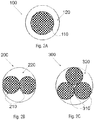
- FIG 1A shows an impregnated yarn 100 known from the prior art which is based on the core-shell geometry and which can be used as FDM printing filament.
- the continuous fiber 110 is guided in the core and is already impregnated with a matrix material.
- the jacket of the printing filament for example, there is unreinforced matrix material.
- This FDM printing filament has a core with parallel continuous fibers 110 and a shell 120 which contains excess matrix material.
- Figure 1B shows a thread 200 according to the invention, which can be used, for example, as an FDM printing filament.
- two yarns 210 are twisted helically with one another to form a thread and impregnated.
- the excess matrix material 220 remains as a reservoir in channels along the helix.
- FIG. 13 shows a top view of a yarn based on the core-shell geometry according to the prior art
- FIG Figures 2B and 2C each show a top view of twisted yarns according to the invention, comprising two or three yarns.
- Both the yarn and the twisted threads can be used as FDM printing filament.
- the fiber volume content of the threads according to the invention is higher than that of the impregnated yarn, which means that the mechanical stability of the threads and thus of the components produced with them is higher in comparison with the impregnated yarn.
- the twisted thread according to the invention is used as an FDM printing filament, the 3D printed product produced with it has a higher mechanical stability.
- Figure 3 shows a side view of a thread 500 comprising two threads 510 containing finite carbon fibers. These finite carbon fibers have radially protruding filament ends 512. In the case of an impregnated thread, these radially protruding filament ends improve the interaction between the yarns and within the impregnated thread.
- the transverse strengths of the printing layers are increased.
Landscapes
- Engineering & Computer Science (AREA)
- Mechanical Engineering (AREA)
- Textile Engineering (AREA)
- Chemical & Material Sciences (AREA)
- Ceramic Engineering (AREA)
- Civil Engineering (AREA)
- Composite Materials (AREA)
- Structural Engineering (AREA)
- Manufacturing & Machinery (AREA)
- Materials Engineering (AREA)
- Yarns And Mechanical Finishing Of Yarns Or Ropes (AREA)
Applications Claiming Priority (1)
| Application Number | Priority Date | Filing Date | Title |
|---|---|---|---|
| DE102019213250.2A DE102019213250A1 (de) | 2019-09-02 | 2019-09-02 | Neuartiger Zwirn |
Publications (2)
| Publication Number | Publication Date |
|---|---|
| EP3805437A1 true EP3805437A1 (fr) | 2021-04-14 |
| EP3805437B1 EP3805437B1 (fr) | 2024-03-13 |
Family
ID=72340302
Family Applications (1)
| Application Number | Title | Priority Date | Filing Date |
|---|---|---|---|
| EP20194126.7A Active EP3805437B1 (fr) | 2019-09-02 | 2020-09-02 | Nouveau fil présentant un certain degré de torsion |
Country Status (2)
| Country | Link |
|---|---|
| EP (1) | EP3805437B1 (fr) |
| DE (1) | DE102019213250A1 (fr) |
Cited By (2)
| Publication number | Priority date | Publication date | Assignee | Title |
|---|---|---|---|---|
| EP4520507A4 (fr) * | 2022-06-10 | 2025-08-27 | Kobe Steel Ltd | Procédé de fabrication additive, équipement de fabrication additive et programme |
| EP4516486A4 (fr) * | 2022-05-31 | 2025-09-17 | Kobe Steel Ltd | Filament et procédé de fabrication d'objets façonnés |
Citations (5)
| Publication number | Priority date | Publication date | Assignee | Title |
|---|---|---|---|---|
| US4825635A (en) | 1986-12-18 | 1989-05-02 | S. A. Schappe | Carbon fiber yarn |
| DE102010030773A1 (de) | 2010-06-30 | 2012-01-05 | Sgl Carbon Se | Garn oder Nähgarn und Verfahren zum Herstellen eines Garns oder Nähgarns |
| US20140329086A1 (en) | 2013-05-06 | 2014-11-06 | Hyundai Motor Company | Continuous carbon fiber/thermoplastic resin fiber composite yarn and method for manufacturing the same |
| EP3059340A1 (fr) | 2013-10-18 | 2016-08-24 | Mitsubishi Gas Chemical Company, Inc. | Fil mélangé, procédé de production de celui-ci et textile |
| US20180096799A1 (en) * | 2016-10-03 | 2018-04-05 | Board Of Regents, The University Of Texas System | Cord-yarn structured supercapacitor |
Family Cites Families (2)
| Publication number | Priority date | Publication date | Assignee | Title |
|---|---|---|---|---|
| WO2014197732A2 (fr) * | 2013-06-05 | 2014-12-11 | Markforged, Inc. | Procédés de fabrication d'additif renforcé de fibres |
| DE102015119700A1 (de) * | 2014-11-17 | 2016-05-19 | Walter Jansen | Verfahren zur Konditionierung der Oberflächen pultrudierter und/oder anderweitig durch Harze oder Kleber zusammengefasster Carbonfasern zu Carbonfaserprofilen oder Carbonfaserflächen und Anordnung zur Durchführung des Verfahrens |
-
2019
- 2019-09-02 DE DE102019213250.2A patent/DE102019213250A1/de not_active Ceased
-
2020
- 2020-09-02 EP EP20194126.7A patent/EP3805437B1/fr active Active
Patent Citations (5)
| Publication number | Priority date | Publication date | Assignee | Title |
|---|---|---|---|---|
| US4825635A (en) | 1986-12-18 | 1989-05-02 | S. A. Schappe | Carbon fiber yarn |
| DE102010030773A1 (de) | 2010-06-30 | 2012-01-05 | Sgl Carbon Se | Garn oder Nähgarn und Verfahren zum Herstellen eines Garns oder Nähgarns |
| US20140329086A1 (en) | 2013-05-06 | 2014-11-06 | Hyundai Motor Company | Continuous carbon fiber/thermoplastic resin fiber composite yarn and method for manufacturing the same |
| EP3059340A1 (fr) | 2013-10-18 | 2016-08-24 | Mitsubishi Gas Chemical Company, Inc. | Fil mélangé, procédé de production de celui-ci et textile |
| US20180096799A1 (en) * | 2016-10-03 | 2018-04-05 | Board Of Regents, The University Of Texas System | Cord-yarn structured supercapacitor |
Cited By (2)
| Publication number | Priority date | Publication date | Assignee | Title |
|---|---|---|---|---|
| EP4516486A4 (fr) * | 2022-05-31 | 2025-09-17 | Kobe Steel Ltd | Filament et procédé de fabrication d'objets façonnés |
| EP4520507A4 (fr) * | 2022-06-10 | 2025-08-27 | Kobe Steel Ltd | Procédé de fabrication additive, équipement de fabrication additive et programme |
Also Published As
| Publication number | Publication date |
|---|---|
| DE102019213250A1 (de) | 2021-03-04 |
| EP3805437B1 (fr) | 2024-03-13 |
Similar Documents
| Publication | Publication Date | Title |
|---|---|---|
| DE3851023T2 (de) | Kohlenstoffaserverstärkte Harz-Pultrusionsgegenstände und Verfahren zu ihrer Herstellung. | |
| DE69115891T2 (de) | Faserverstärkte verbundwerkstoffe | |
| DE69107535T2 (de) | Hybridgarn für Kompositwerkstoffe basierend auf thermoplastischer Matrix und Verfahren zu seiner Herstellung. | |
| EP0579047B1 (fr) | Procédé de fabrication de semi-produits en résines thermoplastiques de moyenne ou haute viscosité | |
| DE69328379T2 (de) | Faser-Harzzusammensetzung | |
| DE60301698T2 (de) | Galsfaserverstärkte thermoplastische harzpellets und verfahren zu ihrer herstellung | |
| DE69330100T2 (de) | Gewebe mit kette und schuss auf basis von technischen multifilamenten garnen hauptsächlich ohne torsion und verfahren zur herstellung | |
| EP3277473B1 (fr) | Procédé pour produire un matériau composite fibreux | |
| EP2361752B1 (fr) | Composant en composite de fibre et son procédé de fabrication | |
| EP3805437B1 (fr) | Nouveau fil présentant un certain degré de torsion | |
| DE102016210040A1 (de) | Verfahren zum Herstellen eines zumindest bereichsweise profilierten, faserverstärkten Kunststoffprofils, ein profiliertes, faserverstärktes Kunststoffprofil und seine Verwendung | |
| DE69319098T2 (de) | Faserverstärkter Kunstoffstab und sein Herstellungsverfahren | |
| EP3738753B1 (fr) | Procédé et dispositif de fabrication d'un faisceau de fibres hybrides | |
| DE102017219774B4 (de) | Verfahren und Anlage zur Herstellung von Faser-Matrix-Verbund-Profilen mit axial rotierendem Querschnitt und einstellbarer Faserorientierung, sowie Verwendung eines entsprechenden Verfahrens und einer Anlage | |
| DE68902483T2 (de) | Verfahren und anlage zur herstellung eines bandes, das aus mindestens einem garn besteht, das mit einem thermoplastischen polymer impraegniert ist. | |
| DE69302915T2 (de) | Formverfahren zur Herstellung eines Verbundwerkstoffproduktes | |
| EP0185960B1 (fr) | Fabrication de matière plastique renforcée | |
| EP1920907A1 (fr) | Procédé de fabrication de préimprégnés, non-tissés de fibre de verres, préimprégnés et utilisation du dispositif Airlaid dans la fabrication de non-tissés de fibre de verres pour préimprégnés | |
| DE2853208C2 (de) | Fadenförmiges und flexibles Textilmaterial | |
| DE102019204427B4 (de) | Verfahren zur Herstellung von mit Fasern verstärkten Bauteilen aus Kunststoff | |
| DE102015013341A1 (de) | Verfahren zur Herstellung eines Faserstapelgarns aus bei der Herstellung von faserverstärkten Bauteilen als Verschnittabfällen oder beim Recyceln von faserverstärkten Bauteilen angefallenen Verstärkungsfasern | |
| DE69900954T2 (de) | Thermoplastisches Harz-Glasfaser Basismaterial, Verfahren zu dessen Herstellung und seine Verwendung | |
| DE102022107856B4 (de) | Vorrichtung und Verfahren zur in-situ Herstellung von hybriden, kontinuierlich faserverstärkten und hochorientierten thermoplastischen Faserverbundstrukturen mit hohem Faservolumengehalt und starken geometrischen Krümmungen | |
| EP4489961B1 (fr) | Dispositif et procédé de production de filaments | |
| EP2784202B1 (fr) | Procédé et dispositif de fabrication d'une bandelette pour la fabrication de pièces moulées, bandelette, structure plate textile et pièce moulée |
Legal Events
| Date | Code | Title | Description |
|---|---|---|---|
| PUAI | Public reference made under article 153(3) epc to a published international application that has entered the european phase |
Free format text: ORIGINAL CODE: 0009012 |
|
| STAA | Information on the status of an ep patent application or granted ep patent |
Free format text: STATUS: THE APPLICATION HAS BEEN PUBLISHED |
|
| AK | Designated contracting states |
Kind code of ref document: A1 Designated state(s): AL AT BE BG CH CY CZ DE DK EE ES FI FR GB GR HR HU IE IS IT LI LT LU LV MC MK MT NL NO PL PT RO RS SE SI SK SM TR |
|
| AX | Request for extension of the european patent |
Extension state: BA ME |
|
| STAA | Information on the status of an ep patent application or granted ep patent |
Free format text: STATUS: REQUEST FOR EXAMINATION WAS MADE |
|
| 17P | Request for examination filed |
Effective date: 20211014 |
|
| RBV | Designated contracting states (corrected) |
Designated state(s): AL AT BE BG CH CY CZ DE DK EE ES FI FR GB GR HR HU IE IS IT LI LT LU LV MC MK MT NL NO PL PT RO RS SE SI SK SM TR |
|
| GRAP | Despatch of communication of intention to grant a patent |
Free format text: ORIGINAL CODE: EPIDOSNIGR1 |
|
| STAA | Information on the status of an ep patent application or granted ep patent |
Free format text: STATUS: GRANT OF PATENT IS INTENDED |
|
| INTG | Intention to grant announced |
Effective date: 20231009 |
|
| GRAS | Grant fee paid |
Free format text: ORIGINAL CODE: EPIDOSNIGR3 |
|
| GRAA | (expected) grant |
Free format text: ORIGINAL CODE: 0009210 |
|
| STAA | Information on the status of an ep patent application or granted ep patent |
Free format text: STATUS: THE PATENT HAS BEEN GRANTED |
|
| AK | Designated contracting states |
Kind code of ref document: B1 Designated state(s): AL AT BE BG CH CY CZ DE DK EE ES FI FR GB GR HR HU IE IS IT LI LT LU LV MC MK MT NL NO PL PT RO RS SE SI SK SM TR |
|
| REG | Reference to a national code |
Ref country code: GB Ref legal event code: FG4D Free format text: NOT ENGLISH |
|
| REG | Reference to a national code |
Ref country code: CH Ref legal event code: EP |
|
| REG | Reference to a national code |
Ref country code: DE Ref legal event code: R096 Ref document number: 502020007318 Country of ref document: DE |
|
| REG | Reference to a national code |
Ref country code: IE Ref legal event code: FG4D Free format text: LANGUAGE OF EP DOCUMENT: GERMAN |
|
| PG25 | Lapsed in a contracting state [announced via postgrant information from national office to epo] |
Ref country code: LT Free format text: LAPSE BECAUSE OF FAILURE TO SUBMIT A TRANSLATION OF THE DESCRIPTION OR TO PAY THE FEE WITHIN THE PRESCRIBED TIME-LIMIT Effective date: 20240313 |
|
| REG | Reference to a national code |
Ref country code: LT Ref legal event code: MG9D |
|
| PG25 | Lapsed in a contracting state [announced via postgrant information from national office to epo] |
Ref country code: GR Free format text: LAPSE BECAUSE OF FAILURE TO SUBMIT A TRANSLATION OF THE DESCRIPTION OR TO PAY THE FEE WITHIN THE PRESCRIBED TIME-LIMIT Effective date: 20240614 |
|
| REG | Reference to a national code |
Ref country code: NL Ref legal event code: MP Effective date: 20240313 |
|
| PG25 | Lapsed in a contracting state [announced via postgrant information from national office to epo] |
Ref country code: HR Free format text: LAPSE BECAUSE OF FAILURE TO SUBMIT A TRANSLATION OF THE DESCRIPTION OR TO PAY THE FEE WITHIN THE PRESCRIBED TIME-LIMIT Effective date: 20240313 Ref country code: RS Free format text: LAPSE BECAUSE OF FAILURE TO SUBMIT A TRANSLATION OF THE DESCRIPTION OR TO PAY THE FEE WITHIN THE PRESCRIBED TIME-LIMIT Effective date: 20240613 |
|
| PG25 | Lapsed in a contracting state [announced via postgrant information from national office to epo] |
Ref country code: ES Free format text: LAPSE BECAUSE OF FAILURE TO SUBMIT A TRANSLATION OF THE DESCRIPTION OR TO PAY THE FEE WITHIN THE PRESCRIBED TIME-LIMIT Effective date: 20240313 |
|
| P01 | Opt-out of the competence of the unified patent court (upc) registered |
Free format text: CASE NUMBER: APP_37869/2024 Effective date: 20240625 |
|
| PG25 | Lapsed in a contracting state [announced via postgrant information from national office to epo] |
Ref country code: RS Free format text: LAPSE BECAUSE OF FAILURE TO SUBMIT A TRANSLATION OF THE DESCRIPTION OR TO PAY THE FEE WITHIN THE PRESCRIBED TIME-LIMIT Effective date: 20240613 Ref country code: NO Free format text: LAPSE BECAUSE OF FAILURE TO SUBMIT A TRANSLATION OF THE DESCRIPTION OR TO PAY THE FEE WITHIN THE PRESCRIBED TIME-LIMIT Effective date: 20240613 Ref country code: LT Free format text: LAPSE BECAUSE OF FAILURE TO SUBMIT A TRANSLATION OF THE DESCRIPTION OR TO PAY THE FEE WITHIN THE PRESCRIBED TIME-LIMIT Effective date: 20240313 Ref country code: HR Free format text: LAPSE BECAUSE OF FAILURE TO SUBMIT A TRANSLATION OF THE DESCRIPTION OR TO PAY THE FEE WITHIN THE PRESCRIBED TIME-LIMIT Effective date: 20240313 Ref country code: GR Free format text: LAPSE BECAUSE OF FAILURE TO SUBMIT A TRANSLATION OF THE DESCRIPTION OR TO PAY THE FEE WITHIN THE PRESCRIBED TIME-LIMIT Effective date: 20240614 Ref country code: FI Free format text: LAPSE BECAUSE OF FAILURE TO SUBMIT A TRANSLATION OF THE DESCRIPTION OR TO PAY THE FEE WITHIN THE PRESCRIBED TIME-LIMIT Effective date: 20240313 Ref country code: ES Free format text: LAPSE BECAUSE OF FAILURE TO SUBMIT A TRANSLATION OF THE DESCRIPTION OR TO PAY THE FEE WITHIN THE PRESCRIBED TIME-LIMIT Effective date: 20240313 Ref country code: BG Free format text: LAPSE BECAUSE OF FAILURE TO SUBMIT A TRANSLATION OF THE DESCRIPTION OR TO PAY THE FEE WITHIN THE PRESCRIBED TIME-LIMIT Effective date: 20240313 |
|
| PG25 | Lapsed in a contracting state [announced via postgrant information from national office to epo] |
Ref country code: SE Free format text: LAPSE BECAUSE OF FAILURE TO SUBMIT A TRANSLATION OF THE DESCRIPTION OR TO PAY THE FEE WITHIN THE PRESCRIBED TIME-LIMIT Effective date: 20240313 Ref country code: LV Free format text: LAPSE BECAUSE OF FAILURE TO SUBMIT A TRANSLATION OF THE DESCRIPTION OR TO PAY THE FEE WITHIN THE PRESCRIBED TIME-LIMIT Effective date: 20240313 |
|
| PG25 | Lapsed in a contracting state [announced via postgrant information from national office to epo] |
Ref country code: NL Free format text: LAPSE BECAUSE OF FAILURE TO SUBMIT A TRANSLATION OF THE DESCRIPTION OR TO PAY THE FEE WITHIN THE PRESCRIBED TIME-LIMIT Effective date: 20240313 |
|
| PG25 | Lapsed in a contracting state [announced via postgrant information from national office to epo] |
Ref country code: NL Free format text: LAPSE BECAUSE OF FAILURE TO SUBMIT A TRANSLATION OF THE DESCRIPTION OR TO PAY THE FEE WITHIN THE PRESCRIBED TIME-LIMIT Effective date: 20240313 |
|
| PG25 | Lapsed in a contracting state [announced via postgrant information from national office to epo] |
Ref country code: IS Free format text: LAPSE BECAUSE OF FAILURE TO SUBMIT A TRANSLATION OF THE DESCRIPTION OR TO PAY THE FEE WITHIN THE PRESCRIBED TIME-LIMIT Effective date: 20240713 |
|
| PGFP | Annual fee paid to national office [announced via postgrant information from national office to epo] |
Ref country code: DE Payment date: 20240919 Year of fee payment: 5 |
|
| PG25 | Lapsed in a contracting state [announced via postgrant information from national office to epo] |
Ref country code: SM Free format text: LAPSE BECAUSE OF FAILURE TO SUBMIT A TRANSLATION OF THE DESCRIPTION OR TO PAY THE FEE WITHIN THE PRESCRIBED TIME-LIMIT Effective date: 20240313 Ref country code: PT Free format text: LAPSE BECAUSE OF FAILURE TO SUBMIT A TRANSLATION OF THE DESCRIPTION OR TO PAY THE FEE WITHIN THE PRESCRIBED TIME-LIMIT Effective date: 20240715 |
|
| PGFP | Annual fee paid to national office [announced via postgrant information from national office to epo] |
Ref country code: GB Payment date: 20240923 Year of fee payment: 5 |
|
| PGFP | Annual fee paid to national office [announced via postgrant information from national office to epo] |
Ref country code: FR Payment date: 20240924 Year of fee payment: 5 |
|
| PG25 | Lapsed in a contracting state [announced via postgrant information from national office to epo] |
Ref country code: CZ Free format text: LAPSE BECAUSE OF FAILURE TO SUBMIT A TRANSLATION OF THE DESCRIPTION OR TO PAY THE FEE WITHIN THE PRESCRIBED TIME-LIMIT Effective date: 20240313 Ref country code: EE Free format text: LAPSE BECAUSE OF FAILURE TO SUBMIT A TRANSLATION OF THE DESCRIPTION OR TO PAY THE FEE WITHIN THE PRESCRIBED TIME-LIMIT Effective date: 20240313 |
|
| PG25 | Lapsed in a contracting state [announced via postgrant information from national office to epo] |
Ref country code: PL Free format text: LAPSE BECAUSE OF FAILURE TO SUBMIT A TRANSLATION OF THE DESCRIPTION OR TO PAY THE FEE WITHIN THE PRESCRIBED TIME-LIMIT Effective date: 20240313 |
|
| PG25 | Lapsed in a contracting state [announced via postgrant information from national office to epo] |
Ref country code: SK Free format text: LAPSE BECAUSE OF FAILURE TO SUBMIT A TRANSLATION OF THE DESCRIPTION OR TO PAY THE FEE WITHIN THE PRESCRIBED TIME-LIMIT Effective date: 20240313 |
|
| PG25 | Lapsed in a contracting state [announced via postgrant information from national office to epo] |
Ref country code: SM Free format text: LAPSE BECAUSE OF FAILURE TO SUBMIT A TRANSLATION OF THE DESCRIPTION OR TO PAY THE FEE WITHIN THE PRESCRIBED TIME-LIMIT Effective date: 20240313 Ref country code: SK Free format text: LAPSE BECAUSE OF FAILURE TO SUBMIT A TRANSLATION OF THE DESCRIPTION OR TO PAY THE FEE WITHIN THE PRESCRIBED TIME-LIMIT Effective date: 20240313 Ref country code: RO Free format text: LAPSE BECAUSE OF FAILURE TO SUBMIT A TRANSLATION OF THE DESCRIPTION OR TO PAY THE FEE WITHIN THE PRESCRIBED TIME-LIMIT Effective date: 20240313 Ref country code: PT Free format text: LAPSE BECAUSE OF FAILURE TO SUBMIT A TRANSLATION OF THE DESCRIPTION OR TO PAY THE FEE WITHIN THE PRESCRIBED TIME-LIMIT Effective date: 20240715 Ref country code: PL Free format text: LAPSE BECAUSE OF FAILURE TO SUBMIT A TRANSLATION OF THE DESCRIPTION OR TO PAY THE FEE WITHIN THE PRESCRIBED TIME-LIMIT Effective date: 20240313 Ref country code: IS Free format text: LAPSE BECAUSE OF FAILURE TO SUBMIT A TRANSLATION OF THE DESCRIPTION OR TO PAY THE FEE WITHIN THE PRESCRIBED TIME-LIMIT Effective date: 20240713 Ref country code: EE Free format text: LAPSE BECAUSE OF FAILURE TO SUBMIT A TRANSLATION OF THE DESCRIPTION OR TO PAY THE FEE WITHIN THE PRESCRIBED TIME-LIMIT Effective date: 20240313 Ref country code: CZ Free format text: LAPSE BECAUSE OF FAILURE TO SUBMIT A TRANSLATION OF THE DESCRIPTION OR TO PAY THE FEE WITHIN THE PRESCRIBED TIME-LIMIT Effective date: 20240313 |
|
| PG25 | Lapsed in a contracting state [announced via postgrant information from national office to epo] |
Ref country code: IT Free format text: LAPSE BECAUSE OF FAILURE TO SUBMIT A TRANSLATION OF THE DESCRIPTION OR TO PAY THE FEE WITHIN THE PRESCRIBED TIME-LIMIT Effective date: 20240313 |
|
| REG | Reference to a national code |
Ref country code: DE Ref legal event code: R097 Ref document number: 502020007318 Country of ref document: DE |
|
| PG25 | Lapsed in a contracting state [announced via postgrant information from national office to epo] |
Ref country code: IT Free format text: LAPSE BECAUSE OF FAILURE TO SUBMIT A TRANSLATION OF THE DESCRIPTION OR TO PAY THE FEE WITHIN THE PRESCRIBED TIME-LIMIT Effective date: 20240313 |
|
| PG25 | Lapsed in a contracting state [announced via postgrant information from national office to epo] |
Ref country code: DK Free format text: LAPSE BECAUSE OF FAILURE TO SUBMIT A TRANSLATION OF THE DESCRIPTION OR TO PAY THE FEE WITHIN THE PRESCRIBED TIME-LIMIT Effective date: 20240313 |
|
| PLBE | No opposition filed within time limit |
Free format text: ORIGINAL CODE: 0009261 |
|
| STAA | Information on the status of an ep patent application or granted ep patent |
Free format text: STATUS: NO OPPOSITION FILED WITHIN TIME LIMIT |
|
| PG25 | Lapsed in a contracting state [announced via postgrant information from national office to epo] |
Ref country code: DK Free format text: LAPSE BECAUSE OF FAILURE TO SUBMIT A TRANSLATION OF THE DESCRIPTION OR TO PAY THE FEE WITHIN THE PRESCRIBED TIME-LIMIT Effective date: 20240313 |
|
| 26N | No opposition filed |
Effective date: 20241216 |
|
| PG25 | Lapsed in a contracting state [announced via postgrant information from national office to epo] |
Ref country code: SI Free format text: LAPSE BECAUSE OF FAILURE TO SUBMIT A TRANSLATION OF THE DESCRIPTION OR TO PAY THE FEE WITHIN THE PRESCRIBED TIME-LIMIT Effective date: 20240313 Ref country code: MC Free format text: LAPSE BECAUSE OF FAILURE TO SUBMIT A TRANSLATION OF THE DESCRIPTION OR TO PAY THE FEE WITHIN THE PRESCRIBED TIME-LIMIT Effective date: 20240313 |
|
| REG | Reference to a national code |
Ref country code: CH Ref legal event code: PL |
|
| PG25 | Lapsed in a contracting state [announced via postgrant information from national office to epo] |
Ref country code: LU Free format text: LAPSE BECAUSE OF NON-PAYMENT OF DUE FEES Effective date: 20240902 |
|
| REG | Reference to a national code |
Ref country code: BE Ref legal event code: MM Effective date: 20240930 |
|
| PG25 | Lapsed in a contracting state [announced via postgrant information from national office to epo] |
Ref country code: BE Free format text: LAPSE BECAUSE OF NON-PAYMENT OF DUE FEES Effective date: 20240930 |
|
| PG25 | Lapsed in a contracting state [announced via postgrant information from national office to epo] |
Ref country code: CH Free format text: LAPSE BECAUSE OF NON-PAYMENT OF DUE FEES Effective date: 20240930 |
|
| PG25 | Lapsed in a contracting state [announced via postgrant information from national office to epo] |
Ref country code: IE Free format text: LAPSE BECAUSE OF NON-PAYMENT OF DUE FEES Effective date: 20240902 |
|
| PGFP | Annual fee paid to national office [announced via postgrant information from national office to epo] |
Ref country code: AT Payment date: 20251020 Year of fee payment: 5 |
|
| PG25 | Lapsed in a contracting state [announced via postgrant information from national office to epo] |
Ref country code: CY Free format text: LAPSE BECAUSE OF FAILURE TO SUBMIT A TRANSLATION OF THE DESCRIPTION OR TO PAY THE FEE WITHIN THE PRESCRIBED TIME-LIMIT; INVALID AB INITIO Effective date: 20200902 |
|
| PG25 | Lapsed in a contracting state [announced via postgrant information from national office to epo] |
Ref country code: HU Free format text: LAPSE BECAUSE OF FAILURE TO SUBMIT A TRANSLATION OF THE DESCRIPTION OR TO PAY THE FEE WITHIN THE PRESCRIBED TIME-LIMIT; INVALID AB INITIO Effective date: 20200902 |
|
| REG | Reference to a national code |
Ref country code: DE Ref legal event code: R119 Ref document number: 502020007318 Country of ref document: DE |
|
| GBPC | Gb: european patent ceased through non-payment of renewal fee |
Effective date: 20250902 |
|
| PG25 | Lapsed in a contracting state [announced via postgrant information from national office to epo] |
Ref country code: TR Free format text: LAPSE BECAUSE OF FAILURE TO SUBMIT A TRANSLATION OF THE DESCRIPTION OR TO PAY THE FEE WITHIN THE PRESCRIBED TIME-LIMIT Effective date: 20240313 |
|
| PG25 | Lapsed in a contracting state [announced via postgrant information from national office to epo] |
Ref country code: GB Free format text: LAPSE BECAUSE OF NON-PAYMENT OF DUE FEES Effective date: 20250902 |
|
| PG25 | Lapsed in a contracting state [announced via postgrant information from national office to epo] |
Ref country code: DE Free format text: LAPSE BECAUSE OF NON-PAYMENT OF DUE FEES Effective date: 20260401 |
|
| PG25 | Lapsed in a contracting state [announced via postgrant information from national office to epo] |
Ref country code: FR Free format text: LAPSE BECAUSE OF NON-PAYMENT OF DUE FEES Effective date: 20250930 |