EP3808538A1 - Procédé d'élimination automatisée d'un feuille de protection de peinture d'au moins une partie d'une carrosserie - Google Patents
Procédé d'élimination automatisée d'un feuille de protection de peinture d'au moins une partie d'une carrosserie Download PDFInfo
- Publication number
- EP3808538A1 EP3808538A1 EP20196743.7A EP20196743A EP3808538A1 EP 3808538 A1 EP3808538 A1 EP 3808538A1 EP 20196743 A EP20196743 A EP 20196743A EP 3808538 A1 EP3808538 A1 EP 3808538A1
- Authority
- EP
- European Patent Office
- Prior art keywords
- adhesive strip
- unmasking
- protective
- film
- unmasking device
- Prior art date
- Legal status (The legal status is an assumption and is not a legal conclusion. Google has not performed a legal analysis and makes no representation as to the accuracy of the status listed.)
- Withdrawn
Links
Images


Classifications
-
- B—PERFORMING OPERATIONS; TRANSPORTING
- B29—WORKING OF PLASTICS; WORKING OF SUBSTANCES IN A PLASTIC STATE IN GENERAL
- B29C—SHAPING OR JOINING OF PLASTICS; SHAPING OF MATERIAL IN A PLASTIC STATE, NOT OTHERWISE PROVIDED FOR; AFTER-TREATMENT OF THE SHAPED PRODUCTS, e.g. REPAIRING
- B29C63/00—Lining or sheathing, i.e. applying preformed layers or sheathings of plastics; Apparatus therefor
- B29C63/0004—Component parts, details or accessories; Auxiliary operations
- B29C63/0013—Removing old coatings
-
- B—PERFORMING OPERATIONS; TRANSPORTING
- B29—WORKING OF PLASTICS; WORKING OF SUBSTANCES IN A PLASTIC STATE IN GENERAL
- B29C—SHAPING OR JOINING OF PLASTICS; SHAPING OF MATERIAL IN A PLASTIC STATE, NOT OTHERWISE PROVIDED FOR; AFTER-TREATMENT OF THE SHAPED PRODUCTS, e.g. REPAIRING
- B29C63/00—Lining or sheathing, i.e. applying preformed layers or sheathings of plastics; Apparatus therefor
- B29C63/0056—Provisional sheathings
-
- B—PERFORMING OPERATIONS; TRANSPORTING
- B29—WORKING OF PLASTICS; WORKING OF SUBSTANCES IN A PLASTIC STATE IN GENERAL
- B29C—SHAPING OR JOINING OF PLASTICS; SHAPING OF MATERIAL IN A PLASTIC STATE, NOT OTHERWISE PROVIDED FOR; AFTER-TREATMENT OF THE SHAPED PRODUCTS, e.g. REPAIRING
- B29C63/00—Lining or sheathing, i.e. applying preformed layers or sheathings of plastics; Apparatus therefor
- B29C63/0073—Lining or sheathing, i.e. applying preformed layers or sheathings of plastics; Apparatus therefor of non-flat surfaces, e.g. curved, profiled
-
- B—PERFORMING OPERATIONS; TRANSPORTING
- B29—WORKING OF PLASTICS; WORKING OF SUBSTANCES IN A PLASTIC STATE IN GENERAL
- B29C—SHAPING OR JOINING OF PLASTICS; SHAPING OF MATERIAL IN A PLASTIC STATE, NOT OTHERWISE PROVIDED FOR; AFTER-TREATMENT OF THE SHAPED PRODUCTS, e.g. REPAIRING
- B29C63/00—Lining or sheathing, i.e. applying preformed layers or sheathings of plastics; Apparatus therefor
- B29C63/02—Lining or sheathing, i.e. applying preformed layers or sheathings of plastics; Apparatus therefor using sheet or web-like material
Definitions
- the invention relates to a method for the automated removal of a protective paint film from at least part of a body.
- Automobile bodies are increasingly being painted in two colors. This so-called "two-tone" painting requires the body to pass through a painting line twice in order to apply a first layer of paint to a first part of the body, for example the entire body, and to dry it in a drying step. In a second painting process, a second layer of paint is then applied, for example only on the body roof. So that only those body parts are painted in the second painting process that are intended for this purpose, those body parts that are not to be painted are covered with a paint protective film and fastened with adhesive strips before the second painting process. Paint protection films exist in various designs. Foils can be cut to size and attached to the body using adhesive tapes, e.g. B. with special, highly flexible adhesive tapes such as tesaflex® 4174.
- adhesive tapes e.g. B. with special, highly flexible adhesive tapes such as tesaflex® 4174.
- the protective paint film (s) including adhesive tapes are removed by hand by one or more workers. If car bodies are coated with a wet masking process, workers can be exposed to solvent vapors and aerosols. But even if the paint on a painted body is first dried in a drying oven, there is a risk of injury due to the heated body and possible escaping vapors. In any case, this manual work requires comprehensive occupational safety measures such as wearing gloves, protective goggles and breathing apparatus or overpressure suits or compressed air protective suits, which means that these activities are physically stressful, as the free breathing and freedom of movement of the workers are impaired.
- the removal of the protective paint film which is also called unmasking, requires the adhesive strips to be pulled off in a controlled and uniform manner, with the protective paint film having to be folded at the same time. Improper removal of the protective paint film by a worker can also cause the painted body to come into contact with the painted side of the protective paint film, causing the body to become waste from production.
- colored edges can also arise that do not meet the quality standards of the manufacturing process and have to be reworked and corrected at great expense, if this is possible. This happens in particular when workers pull off the adhesive tape too quickly or too forcefully, so that it tears or pulls it off the body at unfavorable peeling angles, so that it underflows or comes into contact with it. Pulling too hard can even damage the paint and the paint layer can become detached or even flake off.
- the invention achieves this object by a method for the automated removal of a paint protective film from at least part of a surface of a body according to the subject matter of claim 1.
- a protective paint film is a protective film that protects a body, in particular a car body, from a paint layer and from paint mist. These foils are usually tear-proof and impermeable to water and resistant to solvents. They often consist of plastics such as PP, PE, LDPE, or PET, but can also consist of coated paper or fabric webs.
- a paint protection film covers at least part of a surface of a body and protects it from being painted and from paint mist. As already described at the beginning, the paint protection film can consist of a simple film which is attached to the body with at least one adhesive strip. This can be the case, for example, when the sides of a vehicle body are to be painted in two colors.
- a film is fixed along the side by means of at least one adhesive strip or adhesive strip section.
- An adhesive strip is partially stuck to the then already painted body and partially to the protective paint film.
- the adhesive strip and the protective paint film are only brought together shortly before application or during application to the body.
- a special masking product such as. If, for example, tesa Roll Masker is used, the protective coating film and adhesive strip are already connected to one another and form a unit. In this case, for masking, only the adhesive surface of the special paint protection film needs to be glued to the corresponding position on the body in order to define the paint edge.
- the blanks of the protective paint film are essentially rectangular, but can also have cut shapes that are adapted to the geometry of the body. Regardless of the shape of the blank, an adhesive strip is or is always connected to the protective lacquer film on a cut edge of the protective lacquer film, so that the adhesive strip is only partially stuck to the protective lacquer film and another part of the adhesive strip protrudes beyond the protective lacquer film. This protruding part of the adhesive strip is then attached to the body and serves, on the one hand, to fix the paint protective film and, on the other hand, the painting edge is formed by the adhesive strip on the body. Additional special adhesive strips are used on body parts on which the requirements for the sharpness of the contours of the paint edge are particularly high.
- These special adhesive strips are also called fineline tape and are often made of soft, supple and flexible material such as, for. B. PVC or soft PVC or special papers, e.g. B. Washi paper.
- These fineline tapes are either stuck directly on the relevant body parts in sections and a protective coating film is then glued to the fineline tape.
- a fineline tape is stuck to an adhesive strip of a protective paint film that has already been glued to a body, so that the fineline tape protrudes over the adhesive strip of the protective paint film and forms the edge of the paint.
- the adhesive strip connected to the protective paint film and the body is preferably detached from the body at one end after a painting process. It is peeled off in such a way that it can be pulled off in the longitudinal direction of the adhesive strip. In other words, the adhesive strip is peeled off at one of its cut ends, which run essentially perpendicular to the longitudinal direction of the adhesive strip. In a further step, this end of the adhesive strip is then connected to a unmasking device.
- the detachment and / or connection can be done manually, for example. But it can also be done automatically.
- the protective paint film can also be connected to the unmasking device. This can also be done manually or automatically.
- the unmasking device is then designed to pull off the adhesive strip. This takes place in that the unmasking device is moved relative to the body along a travel path.
- the relative movement is carried out in such a way that a tensile force is exerted on the adhesive strip that is still adhering to the body.
- the adhesive strip becomes detached from the surface of the body (adhesive break).
- the adhesive connection between the protective paint film and the adhesive strip is retained by the tensile force that acts, so the adhesive strip is not detached from the protective paint film.
- the relative movement can be a translational movement, a rotational movement or a combination of both types of movement.
- the protective paint film is connected to the unmasking device and the tensile force acts on the adhesive strip via the protective paint film.
- the adhesive strip becomes detached from the surface of the body.
- the adhesive connection between the protective coating film and the adhesive strip is retained despite the tensile force acting, so the adhesive strip is not detached from the protective coating film.
- the tensile force is measured so that it is greater than the adhesive force between the adhesive strip and the surface of the body.
- the adhesive strip becomes detached from the surface of the body.
- it is smaller than the cohesive force of the protective paint film and / or the cohesive force of the adhesive strip.
- the protective paint film and / or the adhesive strip therefore do not tear as a result of the tensile force.
- the tensile force that is exerted on the protective paint film and / or the at least one adhesive strip is preferably in a range between 1 N / cm and 12 N / cm, preferably between 2 N / cm to 4 N / cm.
- the tensile force mentioned here is a specific tensile force related to the width of the adhesive strip. The width is 1 cm.
- the tensile force can also be generated by a rotational movement of a winding aid or a gripping aid and / or can be generated by the relative movement of the unmasking device and the body to one another. If the tensile force is generated by a rotational movement of a wrapping aid or a gripping aid, the torque or a physical quantity proportional to the torque can also be used to determine the tensile force acting on the protective coating film and / or the adhesive strip.
- the paint protective film is connected to at least one adhesive strip on the surface of the body or on the surface of the body that has already been painted.
- the protective paint film can also be attached to the body using several adhesive strips.
- a continuous paint protection film can be glued to a fender with a first adhesive strip section, the paint protection film can be attached along a roof spar with a second adhesive strip section and finally it can be adhered along a trunk door using a third adhesive strip section.
- the unmasking device has at least one receptacle for the protective paint film and / or at least one adhesive strip.
- the unmasking device can essentially be formed by a receiving device that can be moved or is attached to an end effector of a robot, for example a multi-axis industrial robot.
- the unmasking device can also be a complex electromechanical system, which uses force sensors and / or torque sensors to determine the tensile force acting on the protective paint film, a sensor system for detecting the connection of the protective paint film and / or the adhesive strip.
- the unmasking device can also have electrically or pneumatically operated actuators for fixing the protective paint film and / or the adhesive strip to the unmasking device.
- the unmasking device is attached to a robot.
- This robot is preferably a multi-axis industrial robot.
- Such industrial robots are very often used in automobile production in production lines and painting lines. These are, for example, sufficiently known from EP0511977B1 and should not be described further here.
- the unmasking device can, however, also be a device which is arranged above a body.
- it can have a pick-up rod with which the paint protection film and / or the at least one adhesive strip is connected to the unmasking device.
- the unmasking device can be mounted in a stationary or movable manner. It is essential that a movement takes place relatively between the unmasking device and the body.
- the method can advantageously be further developed in that in step b) the protective paint film and / or the at least one adhesive strip is wound up by the unmasking device, and the unmasking device is designed to wind up the protective paint film and / or the at least one adhesive strip, so that the protective paint film and / or the at least one adhesive strip form a roll.
- the paint protective film and / or the at least one adhesive strip has been detached from the surface of the body, it can be wound up by the unmasking device. Because the removed material (protective paint film and / or adhesive strip) is wound up directly, the unmasking device can be moved near the surface of the body, for example by an industrial robot. As it is wound up, the material forms a roll in the form of an Archimedean spiral.
- the unmasking device is moved at a direct distance from the surface of the body, the unmasking device being guided directly over the adhesive strip or in its vicinity and winding it up after detachment.
- Immediate distance should be understood here to mean a distance in the range of centimeters.
- the unmasking device is preferably guided along the surface of the body at a distance of between 2 cm and 100 cm. It is particularly preferred that the distance is 2 cm to 20 cm.
- step a) the protective paint film and / or the at least one adhesive strip is connected to a winding aid and the winding aid is connected to the unmasking device or is detachably connected to the unmasking device.
- the winding aid is a shaft to which one end of the protective coating film and / or the adhesive strip is attached. This can be done by the remaining adhesive strength of the removed adhesive strip or an additional fixing adhesive strip can be used with which the protective coating film and / or the adhesive strip is attached to the wrapping aid. It can also be preferred that the fastening takes place by means of a clamping device, for example a clamp or a clasp, or a fastening strap or fastening opening on or in the winding aid. The detached end of the adhesive strip is preferably attached to the winding aid.
- the unmasking device has a receiving device for a winding aid.
- a winding aid can be understood to mean a roll core, such as is used, for example, as the core material in adhesive tapes, or a simple cardboard or plastic cylinder.
- the shape of the winding aid is preferably cylindrical, but can also have other shapes.
- the winding aid can be a square, pentagonal or hexagonal core.
- a winding aid with a polygonal basic shape is also suitable.
- the receiving device of the unmasking device is adapted to the shape of the winding aid and is designed accordingly to receive such an angular winding aid.
- the advantage is that, due to the non-rotationally symmetrical shape of the winding aid, the receiving device can engage in the winding aid or the winding aid can be inserted into the receiving device and a torque can be transmitted particularly well from the unmasking device to the winding aid (positive connection).
- an angular configuration of the auxiliary winding means has the advantage that a rolled-up protective coating film does not slip off the auxiliary winding means so easily, for example when the auxiliary winding means is removed from the unmasking device. This improves handling and makes an automated process more reliable.
- This winding aid is connected by a worker or robot to the receiving device of the unmasking device, for example placed on it.
- the aforementioned fastening options can also be used here.
- the protective paint film and / or the adhesive strip can also first be attached to the winding aid, followed by the step in which the winding aid is then connected to the unmasking device.
- the winding aid preferably has a diameter of a few centimeters, preferably between 2 cm and 25 cm.
- the winding aid preferably has a diameter of a few centimeters, preferably between 2 cm and 25 cm.
- the material can be wound onto the winding aid in a reliable and reproducible manner.
- Smaller outside diameters make the initial winding more difficult and reduce the process stability, while if the outside diameter of the winding aid is too large, the force per area that acts between the layers can be too low and the roll does not have a sufficiently tight winding.
- the unmasking device is designed to rotate the winding aid, as a result of which the material is then wound up.
- the unmasking device is moved along the surface of the body and the protective paint film and / or the adhesive strip is removed.
- the length of the winding aid is advantageously between 2 cm and 100 cm. If the unmasking device is attached above the body, it can be advantageous that the winding aid has a length of up to 350 cm.
- a winding aid The advantages of using a winding aid are that the process stability can be improved as a result, since the winding can take place with defined parameters. In addition, the use of a winding aid facilitates disposal, since the material is formed into a roll or an elongated roll that can be handled particularly easily by workers or a robot.
- the method can advantageously be further developed in that in step a) the protective paint film and / or the at least one adhesive strip are connected to a gripping aid, and the gripping aid is detachably connected to the unmasking device.
- a gripping aid is to be understood as a winding aid that is stored or placed at a defined location.
- a robot in particular an industrial robot to which the unmasking device is preferably attached, can then grasp this gripping aid at a defined position and pick it up reliably in an automated manner.
- the inherently difficult process of the automated connection of the protective paint film can be made more reliable when unmasking.
- This step can preferably take place before painting.
- a worker connects one end of the protective paint film and / or the adhesive strip with the gripping aid when masking the body.
- the gripping aid can then be placed in a defined position on the vehicle or in front of the vehicle.
- the gripping aid is preferably deposited in a defined position. This also has the advantage that, as part of quality assurance, which always takes place before painting, it can be checked at the same time whether the gripping aid is correctly positioned and aligned.
- the gripping aid is connected to a holding device, the holding device being firmly connected to a support frame on which the body is conveyed through the production or painting line. This ensures that the gripping aid is provided at a defined position in a defined position in order to connect it to the unmasking device.
- the protective paint film and / or the adhesive strip are already equipped with a gripping aid and no further steps are required for connecting to the gripping aid.
- This is a particularly time-saving embodiment, but requires that the protective paint film and / or the adhesive strip are already equipped with such a gripping aid.
- a gripping aid can also be a material loop that is formed from the protective paint film and / or the adhesive strip.
- the unmasking device then grasps the material loop and establishes a connection in order to enable the protective paint film and / or the adhesive strip to be wound up. No additional material is required, which saves resources.
- the protective paint film and / or the adhesive strip does not have to be coated with another material, e.g. B. be connected to a cardboard tube or a plastic roll. This connection can represent a weak point if it is not carried out correctly or if the adhesive strength of the adhesive strip or the fixing adhesive strip is not sufficiently high. Tearing off is almost impossible when using a material loop.
- the method can advantageously be further developed by rotating the winding aid or the gripping aid through the unmasking device during the movement of the unmasking device and the body relative to one another along a travel path in such a way that the side of the protective paint film that faces the body is unwound after winding the winding aid or the gripping aid forms an outside of the roll.
- the unmasking device rotates in a winding direction that moves the painted outside of the protective paint film and / or the adhesive strip into the inside of the roll, which is formed by the Archimedean spiral, the outside of the roll is through the unpainted underside of the protective paint film or through the adhesive side of the adhesive strip, that is, the side that rests or is glued onto the body is formed.
- the handling of the roll produced can also be improved as a result, since when the roll is removed and disposed of by a worker or a robot, paint that has not dried or cured cannot accidentally come into contact with the worker or the production plant.
- the method can advantageously be further developed in that, in a further step, the painting protective film and / or the at least one adhesive strip of a painting protective film and / or the at least one adhesive strip including the winding aid or the gripping aid are fed to a disposal facility.
- the disposal device can be a press, a shredder, which shreds the protective coating film and / or the adhesive strip and collects it in a space-efficient manner.
- the method can advantageously be developed in that a speed at which the at least one adhesive strip is pulled off the surface of the body is between 1 m / min and 30 m / min.
- a speed in this range has the advantage that the adhesive layer of the at least one adhesive strip has sufficient time to detach itself from the body without leaving any residue and also prevents that part from being spared when the adhesive strip is applied to an already painted part of the body becomes.
- a sufficiently quick removal is ensured so that unmasking takes place within a work station or production station.
- the method can advantageously be developed in that a relative speed at which the unmasking device and the body are moved relative to one another along a travel path is between 1 m / min and 5 m / min, particularly preferably 1.5 m / min to 3 m / min is. This is particularly advantageous since the work cycle in production or painting lines is in this area. The process is thus linked to the production cycle.
- a relative speed at which the unmasking device and the body are moved relative to one another along a travel path is between 1 m / min and 5 m / min, particularly preferably 1.5 m / min to 3 m / min is.
- This is particularly advantageous since the work cycle in production or painting lines is in this area.
- the process is thus linked to the production cycle.
- by limiting the relative speed collaborative work between workers and a robot equipped with the unmasking device is made possible, since the relative speeds are limited and, in the event of a collision of the unmasking device or the robot with a worker, only limited kinetic energy to one Worker
- the method can advantageously be developed in that the unmasking device and the body are moved relative to one another in such a way that the protective paint film is removed from the body starting from the front of the body.
- the bodies are usually conveyed and processed front-facing.
- the method can advantageously be further developed in that the at least one adhesive strip is peeled off the body at an angle ⁇ of 1 ° to 179 °, particularly preferably at an angle between 1 ° and 90 °, the angle ⁇ between the surface of the body and the portion of the adhesive strip peeled from the body is included.
- the adhesive strip is peeled from the surface of the body at an angle ⁇ between 1 ° and 90 °, this has the advantage that it avoids the stick-slip effect of the part of the adhesive strip that has already been peeled off and the part connected to it
- the film is set in vibration, as a result of which paint that has not yet dried or cured on the film and / or the adhesive strip is detached from it and the painted surfaces of the body are soiled. It is also avoided that the film is set in vibration and comes into contact with the surface of the body. This could happen especially in narrow spaces such as in crevices.
- the method can advantageously be further developed in that the at least one adhesive strip is peeled off the body at an angle ⁇ of 1 ° to 179 °, particularly preferably at an angle ⁇ between 30 ° and 45 °, the angle ⁇ by the part of the adhesive strip which is stuck on the surface of the body and the projection of the part of the adhesive strip which is detached from the surface of the body onto the surface of the body.
- the adhesive strip is peeled from the surface of the body at an angle ⁇ between 30 ° and 45 °, this has the advantage that the protective paint film is moved away from the surface of the body immediately during or after it is peeled off, whereby a contact is made the surface of the body is prevented with the adhesive tape or the film.
- the method can advantageously be further developed in that the method described above is carried out in each case by means of a first unmasking device and by means of a second unmasking device, the first unmasking device being arranged on a first side of the body (left) and the second unmasking device on a second side of the Body (right) is arranged.
- This arrangement made it possible to unmask a masked body on a driver's side (left) and a passenger side (right) at the same time.
- protective paint films can be removed particularly easily from the front, fenders, door sides, B-pillar and the rear.
- the automated removal of multiple protective paint films can be carried out in a particularly time-efficient manner.
- the method can advantageously be developed in that the method described above is carried out by a unmasking device and the unmasking device is arranged above the body.
- This unmasking device can be a third unmasking device, provided that a first and a second unmasking device are already arranged on the sides of a body.
- Arranging a unmasking device above a body is particularly advantageous when a protective paint film is applied to parts of the body roof, the engine hood, the A-pillars, the roof pillars, the C-pillars, or the trunk lid.
- a protective paint film can be particularly easily removed automatically from these body parts from a position above the body.
- unmasking devices arranged on the sides of the vehicle are limited in their radius of action and they can only carry out movements in the vicinity of the body roof to a limited extent. It can be advantageous to use several unmasking devices that carry out the aforementioned method, since the vehicle sides can be covered separately by a first and second protective paint film and the top side of the body can be covered by a third protective paint film.
- the order in which the unmasking devices remove the protective paint films from the body depends on the order in which the protective paint films were applied to the body. This sequence is always application-dependent.
- FIG. 1 shows an example of a sequence of the method according to the invention.
- a body 7 is shown, wherein essentially the side of the body 7 has been covered with a protective paint film 1.
- the film 2 was attached to the surface of the body 7 with an adhesive strip 3.
- a painted edge is formed by the adhesive strip.
- the protective paint film covers several parts of the body, namely the front, a front and a rear fender, two side doors and parts of the rear. Thus, these parts were protected from being painted.
- the unmasking device is moved by a multi-axis industrial robot 6 along the surface of the body 7.
- the unmasking device 4 is attached to a multi-axis industrial robot 7.
- the paint protective film 1 is wound onto a winding aid 5 or gripping aid 5.
- both a winding aid and a gripping aid can be involved, which is why both aids are mentioned at this point.
- the unmasking device 4 is moved by the multi-axis industrial robot in such a way that the winding aid 5 or gripping aid 5 is always at a distance of a few centimeters above the surface of the body 7.
- the robot 6 essentially follows the path on which the adhesive strip 3 of the protective paint film 1 is stuck.
- FIG 1 b shows the proceeding.
- the body 7 is continuously conveyed forwards in the production line, that is to say in the direction of the front of the vehicle. This takes place at a speed of approx. 2 m / min.
- the industrial robot 6 moves the unmasking device 4 while maintaining a distance of a few centimeters along the surface of the body 7 and pulls the adhesive strip 3 of the protective paint film 1 from the surface of the body 7.
- the peeled off adhesive strip 3 and the film 2 of the protective coating film 1 are wound onto the winding aid 5 or gripping aid 5.
- a roll consisting of the protective coating film is thus formed on the winding aid 5 or gripping aid 5.
- the movement of the body and the movement of the unmasking device thus overlap.
- the control of the robot is adapted accordingly and also ensures that the rotational speed of the winding aid 5 or gripping aid 5 is adapted.
- the superposition of the aforementioned movements results in a relative movement between the unmasking device and the surface of the body.
- Figure 1 c) shows that the body 7 has passed the robot 6 and the unmasking device and the protective paint film has been removed from the body in an automated manner.
- the protective coating film 1, together with the film 2 and adhesive strip 3, is wound onto the winding aid 5 or gripping aid 5 in the form of a roll.
- the roll can be moved as a whole from the unmasking device to a waste press and automatically dropped and disposed of (not shown).
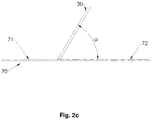
- the Figure 2 shows a detailed representation of the peel angles ⁇ and ⁇ , under which the at least one adhesive strip 3, 3a, 3b of a protective paint film or with which a film is on a simply painted surface of the body 70, 72 is glued, is peeled off.
- the single painted area 72 and the double painted area 71 adjoin one another and form the painted edge 73.
- FIG. 2 a) shows a three-dimensional representation of the adhesive strip 3 of a paint protective film 1 stuck to the surface of a body.
- the film 2 is not shown for reasons of clarity.
- the Figure 2 b) represents a plan view that Figure 2 c)
- FIG. 3 is a side view of FIG Figure 2 a) .
- the angle ⁇ is included the surface of the body 70, 72 and the part of the adhesive strip 3b peeled off from the body.
- the angle ⁇ is enclosed by the part of the adhesive strip 3a that is stuck to the surface of the body and the projection onto the surface of the body 70, 72 of the part of the adhesive strip 3b that is detached from the surface of the body 70, 72.
Landscapes
- Engineering & Computer Science (AREA)
- Manufacturing & Machinery (AREA)
- Application Of Or Painting With Fluid Materials (AREA)
- Details Or Accessories Of Spraying Plant Or Apparatus (AREA)
- Automobile Manufacture Line, Endless Track Vehicle, Trailer (AREA)
Applications Claiming Priority (1)
| Application Number | Priority Date | Filing Date | Title |
|---|---|---|---|
| DE102019215943.5A DE102019215943A1 (de) | 2019-10-16 | 2019-10-16 | Verfahren zum automatisierten Entfernen einer Lackier-Schutzfolie von mindestens einem Teil einer Karosserie |
Publications (1)
| Publication Number | Publication Date |
|---|---|
| EP3808538A1 true EP3808538A1 (fr) | 2021-04-21 |
Family
ID=72615552
Family Applications (1)
| Application Number | Title | Priority Date | Filing Date |
|---|---|---|---|
| EP20196743.7A Withdrawn EP3808538A1 (fr) | 2019-10-16 | 2020-09-17 | Procédé d'élimination automatisée d'un feuille de protection de peinture d'au moins une partie d'une carrosserie |
Country Status (3)
| Country | Link |
|---|---|
| EP (1) | EP3808538A1 (fr) |
| CN (1) | CN112660531A (fr) |
| DE (1) | DE102019215943A1 (fr) |
Families Citing this family (3)
| Publication number | Priority date | Publication date | Assignee | Title |
|---|---|---|---|---|
| JP7623691B2 (ja) | 2021-06-02 | 2025-01-29 | カモ井加工紙株式会社 | マスキングテープの巻取装置 |
| JP7615956B2 (ja) * | 2021-08-11 | 2025-01-17 | トヨタ自動車株式会社 | 車両および塗装方法 |
| EP4344418A1 (fr) * | 2022-06-30 | 2024-04-03 | 3M Innovative Properties Company | Système et procédé de retrait de bande à commande optimale |
Citations (5)
| Publication number | Priority date | Publication date | Assignee | Title |
|---|---|---|---|---|
| EP0511977B1 (fr) | 1990-01-23 | 1994-03-02 | KUKA Schweissanlagen GmbH | Robot industriel a plusieurs axes |
| WO2002055302A1 (fr) * | 2001-01-12 | 2002-07-18 | 3M Innovative Properties Company | Procede et appareil d'enlevement de film adhesif |
| EP1301427A2 (fr) | 2000-07-20 | 2003-04-16 | DaimlerChrysler AG | Outil de devidage et d'application d'adhesifs et procede d'application automatisee en serie de bandes adhesives |
| US20030155067A1 (en) * | 2002-02-15 | 2003-08-21 | John Syron | Method and article for masking portions of a vehicle by adherent appliques |
| DE102004021775A1 (de) | 2004-04-30 | 2005-11-24 | Tesa Ag | Klebeband insbesondere zur Abdeckung von Fensterflanschen |
Family Cites Families (5)
| Publication number | Priority date | Publication date | Assignee | Title |
|---|---|---|---|---|
| US9855732B2 (en) * | 1999-01-25 | 2018-01-02 | 3M Innovative Properties Company | Method of applying adhesive coated film |
| GB0502560D0 (en) * | 2005-02-08 | 2005-03-16 | Junair Spraybooths Ltd | Localised extraction system |
| JP2007230740A (ja) * | 2006-03-02 | 2007-09-13 | Tokyo Seimitsu Co Ltd | 表面保護フィルム剥離方法および表面保護フィルム剥離装置 |
| CN101077746A (zh) * | 2006-05-26 | 2007-11-28 | 中国国际海运集装箱(集团)股份有限公司 | 去除金属板料保护膜的设备和方法 |
| CN102923364B (zh) * | 2012-11-09 | 2015-03-04 | 京东方科技集团股份有限公司 | 薄膜拆卸机构 |
-
2019
- 2019-10-16 DE DE102019215943.5A patent/DE102019215943A1/de not_active Withdrawn
-
2020
- 2020-09-17 EP EP20196743.7A patent/EP3808538A1/fr not_active Withdrawn
- 2020-10-15 CN CN202011101668.7A patent/CN112660531A/zh active Pending
Patent Citations (5)
| Publication number | Priority date | Publication date | Assignee | Title |
|---|---|---|---|---|
| EP0511977B1 (fr) | 1990-01-23 | 1994-03-02 | KUKA Schweissanlagen GmbH | Robot industriel a plusieurs axes |
| EP1301427A2 (fr) | 2000-07-20 | 2003-04-16 | DaimlerChrysler AG | Outil de devidage et d'application d'adhesifs et procede d'application automatisee en serie de bandes adhesives |
| WO2002055302A1 (fr) * | 2001-01-12 | 2002-07-18 | 3M Innovative Properties Company | Procede et appareil d'enlevement de film adhesif |
| US20030155067A1 (en) * | 2002-02-15 | 2003-08-21 | John Syron | Method and article for masking portions of a vehicle by adherent appliques |
| DE102004021775A1 (de) | 2004-04-30 | 2005-11-24 | Tesa Ag | Klebeband insbesondere zur Abdeckung von Fensterflanschen |
Also Published As
| Publication number | Publication date |
|---|---|
| DE102019215943A1 (de) | 2021-04-22 |
| CN112660531A (zh) | 2021-04-16 |
Similar Documents
| Publication | Publication Date | Title |
|---|---|---|
| EP0838398B1 (fr) | Procédé et dispositif pour l'application de film protecteur auto-adhésif aux carrosseries de véhicules | |
| EP1058649B1 (fr) | Procede et dispositif pour appliquer un film protecteur auto-adhesif sur des carrosseries | |
| EP0838403B1 (fr) | Procédé et dispositif pour couper un film protecteur dans la région couvrant des joints et des nervures de carrosseries de véhicules | |
| DE19642831A1 (de) | Verfahren und Vorrichtung zum Applizieren von selbsthaftender Schutzfolie auf Karosserien | |
| EP2226183B1 (fr) | Procédé d'application d'une feuille de laque sur une pièce d'un véhicule | |
| EP3808538A1 (fr) | Procédé d'élimination automatisée d'un feuille de protection de peinture d'au moins une partie d'une carrosserie | |
| DE4020954B4 (de) | Ansetzband, insbesondere zum fliegenden Ansetzen von Papierbahnen | |
| DE10230034B4 (de) | Verfahren und Vorrichtung zum automatisierten Applizieren von Lackfolie auf Karosserieteile sowie automationsgerecht gestalteter Lackfolienverbund | |
| DE102021130056B4 (de) | System zur installation von emblemen | |
| DE19606395C1 (de) | Verfahren und Vorrichtung zum Applizieren einer Folie auf eine Oberfläche | |
| DE102016123487A1 (de) | Verfahren zum Anbringen von Dichtungsprofilen mit einer Klebeschicht an Fahrzeugkarosserien oder deren Teilen | |
| DE102004014052B3 (de) | Anlage zum automatisierten Applizieren von selbsthaftender Schutzfolie auf Fahrzeugkarosserien | |
| WO2018041559A1 (fr) | Procédé de montage de profilés d'étanchéité au moyen d'une couche adhésive sur des carrosseries de véhicule ou des parties de celles-ci | |
| DE10013224A1 (de) | Verfahren und Vorrichtung zum Aufbringen von selbstklebenden Folienzuschnitten, insbesondere auf Kfz-Karosserieteile | |
| DE19809516B4 (de) | Vorrichtung und Verfahren zum automatischen Wechseln von Folienrollen | |
| DE19724040C2 (de) | Verfahren und Vorrichtung zum Durchtrennen von Schutzfolie im Bereich überklebter Fugen und Sicken von Karosserien | |
| DE202017007136U1 (de) | Vorrichtung zur Herstellung einer Materialstranganordnung und Vorrichtung zum Aufbringen eines Materialstrangstreifens auf ein Fahrzeugteil | |
| DE19718204A1 (de) | Verfahren und Vorrichtung zum Applizieren von selbsthaftender Schutzfolie auf Karosserien | |
| EP3587084B1 (fr) | Procédé de fabrication d'un composant en matière plastique | |
| DE3008807C2 (fr) | ||
| DE19537099B4 (de) | Verfahren und Vorrichtung zur Herstellung von gefalteten Bandabschnitten, insbesondere Beipackzetteln für Zigarettenschachteln | |
| DE2643845A1 (de) | Verfahren zum abdecken von waehrend des lackspritzvorganges nicht zu lackierenden teilen von kraftfahrzeugen | |
| EP0588758B1 (fr) | Procédé et dispositif de fabrication de paquets tubulaires d'articles imprimés munis d'une bande de déchirement | |
| DE102009015476B4 (de) | Verfahren und Vorrichtung zur Zuführung gleicher oder verschiedener Folienbänder | |
| EP1140679A1 (fr) | Procede et dispositif pour le raccord de bandes de materiau |
Legal Events
| Date | Code | Title | Description |
|---|---|---|---|
| PUAI | Public reference made under article 153(3) epc to a published international application that has entered the european phase |
Free format text: ORIGINAL CODE: 0009012 |
|
| STAA | Information on the status of an ep patent application or granted ep patent |
Free format text: STATUS: THE APPLICATION HAS BEEN PUBLISHED |
|
| AK | Designated contracting states |
Kind code of ref document: A1 Designated state(s): AL AT BE BG CH CY CZ DE DK EE ES FI FR GB GR HR HU IE IS IT LI LT LU LV MC MK MT NL NO PL PT RO RS SE SI SK SM TR |
|
| AX | Request for extension of the european patent |
Extension state: BA ME |
|
| STAA | Information on the status of an ep patent application or granted ep patent |
Free format text: STATUS: REQUEST FOR EXAMINATION WAS MADE |
|
| 17P | Request for examination filed |
Effective date: 20211021 |
|
| RBV | Designated contracting states (corrected) |
Designated state(s): AL AT BE BG CH CY CZ DE DK EE ES FI FR GB GR HR HU IE IS IT LI LT LU LV MC MK MT NL NO PL PT RO RS SE SI SK SM TR |
|
| STAA | Information on the status of an ep patent application or granted ep patent |
Free format text: STATUS: THE APPLICATION IS DEEMED TO BE WITHDRAWN |
|
| 18D | Application deemed to be withdrawn |
Effective date: 20211022 |