EP3813540B1 - Verbesserte essbare tintenformulierungen mit calciumcarbonat - Google Patents
Verbesserte essbare tintenformulierungen mit calciumcarbonat Download PDFInfo
- Publication number
- EP3813540B1 EP3813540B1 EP19827215.5A EP19827215A EP3813540B1 EP 3813540 B1 EP3813540 B1 EP 3813540B1 EP 19827215 A EP19827215 A EP 19827215A EP 3813540 B1 EP3813540 B1 EP 3813540B1
- Authority
- EP
- European Patent Office
- Prior art keywords
- edible ink
- alcohol
- ink formulation
- formulation
- edible
- Prior art date
- Legal status (The legal status is an assumption and is not a legal conclusion. Google has not performed a legal analysis and makes no representation as to the accuracy of the status listed.)
- Active
Links
Images




Classifications
-
- A—HUMAN NECESSITIES
- A23—FOODS OR FOODSTUFFS; TREATMENT THEREOF, NOT COVERED BY OTHER CLASSES
- A23G—COCOA; COCOA PRODUCTS, e.g. CHOCOLATE; SUBSTITUTES FOR COCOA OR COCOA PRODUCTS; CONFECTIONERY; CHEWING GUM; ICE-CREAM; PREPARATION THEREOF
- A23G3/00—Sweetmeats; Confectionery; Marzipan; Coated or filled products
- A23G3/34—Sweetmeats, confectionery or marzipan; Processes for the preparation thereof
- A23G3/50—Sweetmeats, confectionery or marzipan; Processes for the preparation thereof characterised by shape, structure or physical form, e.g. products with supported structure
- A23G3/54—Composite products, e.g. layered, coated, filled
-
- A—HUMAN NECESSITIES
- A23—FOODS OR FOODSTUFFS; TREATMENT THEREOF, NOT COVERED BY OTHER CLASSES
- A23G—COCOA; COCOA PRODUCTS, e.g. CHOCOLATE; SUBSTITUTES FOR COCOA OR COCOA PRODUCTS; CONFECTIONERY; CHEWING GUM; ICE-CREAM; PREPARATION THEREOF
- A23G3/00—Sweetmeats; Confectionery; Marzipan; Coated or filled products
- A23G3/0002—Processes of manufacture not relating to composition and compounding ingredients
- A23G3/0063—Coating or filling sweetmeats or confectionery
- A23G3/0089—Coating with atomised liquid, droplet bed, liquid spray
-
- A—HUMAN NECESSITIES
- A23—FOODS OR FOODSTUFFS; TREATMENT THEREOF, NOT COVERED BY OTHER CLASSES
- A23G—COCOA; COCOA PRODUCTS, e.g. CHOCOLATE; SUBSTITUTES FOR COCOA OR COCOA PRODUCTS; CONFECTIONERY; CHEWING GUM; ICE-CREAM; PREPARATION THEREOF
- A23G3/00—Sweetmeats; Confectionery; Marzipan; Coated or filled products
- A23G3/0002—Processes of manufacture not relating to composition and compounding ingredients
- A23G3/0097—Decorating sweetmeats or confectionery
-
- A—HUMAN NECESSITIES
- A23—FOODS OR FOODSTUFFS; TREATMENT THEREOF, NOT COVERED BY OTHER CLASSES
- A23G—COCOA; COCOA PRODUCTS, e.g. CHOCOLATE; SUBSTITUTES FOR COCOA OR COCOA PRODUCTS; CONFECTIONERY; CHEWING GUM; ICE-CREAM; PREPARATION THEREOF
- A23G3/00—Sweetmeats; Confectionery; Marzipan; Coated or filled products
- A23G3/34—Sweetmeats, confectionery or marzipan; Processes for the preparation thereof
- A23G3/343—Products for covering, coating, finishing, decorating
-
- A—HUMAN NECESSITIES
- A23—FOODS OR FOODSTUFFS; TREATMENT THEREOF, NOT COVERED BY OTHER CLASSES
- A23G—COCOA; COCOA PRODUCTS, e.g. CHOCOLATE; SUBSTITUTES FOR COCOA OR COCOA PRODUCTS; CONFECTIONERY; CHEWING GUM; ICE-CREAM; PREPARATION THEREOF
- A23G3/00—Sweetmeats; Confectionery; Marzipan; Coated or filled products
- A23G3/34—Sweetmeats, confectionery or marzipan; Processes for the preparation thereof
- A23G3/36—Sweetmeats, confectionery or marzipan; Processes for the preparation thereof characterised by the composition containing organic or inorganic compounds
- A23G3/362—Sweetmeats, confectionery or marzipan; Processes for the preparation thereof characterised by the composition containing organic or inorganic compounds containing inorganic compounds
-
- A—HUMAN NECESSITIES
- A23—FOODS OR FOODSTUFFS; TREATMENT THEREOF, NOT COVERED BY OTHER CLASSES
- A23L—FOODS, FOODSTUFFS OR NON-ALCOHOLIC BEVERAGES, NOT OTHERWISE PROVIDED FOR; PREPARATION OR TREATMENT THEREOF
- A23L5/00—Preparation or treatment of foods or foodstuffs, in general; Food or foodstuffs obtained thereby; Materials therefor
- A23L5/40—Colouring or decolouring of foods
- A23L5/42—Addition of dyes or pigments, e.g. in combination with optical brighteners
-
- A—HUMAN NECESSITIES
- A23—FOODS OR FOODSTUFFS; TREATMENT THEREOF, NOT COVERED BY OTHER CLASSES
- A23G—COCOA; COCOA PRODUCTS, e.g. CHOCOLATE; SUBSTITUTES FOR COCOA OR COCOA PRODUCTS; CONFECTIONERY; CHEWING GUM; ICE-CREAM; PREPARATION THEREOF
- A23G2200/00—COCOA; COCOA PRODUCTS, e.g. CHOCOLATE; SUBSTITUTES FOR COCOA OR COCOA PRODUCTS; CONFECTIONERY; CHEWING GUM; ICE-CREAM; PREPARATION THEREOF containing organic compounds, e.g. synthetic flavouring agents
-
- A—HUMAN NECESSITIES
- A23—FOODS OR FOODSTUFFS; TREATMENT THEREOF, NOT COVERED BY OTHER CLASSES
- A23G—COCOA; COCOA PRODUCTS, e.g. CHOCOLATE; SUBSTITUTES FOR COCOA OR COCOA PRODUCTS; CONFECTIONERY; CHEWING GUM; ICE-CREAM; PREPARATION THEREOF
- A23G2210/00—COCOA; COCOA PRODUCTS, e.g. CHOCOLATE; SUBSTITUTES FOR COCOA OR COCOA PRODUCTS; CONFECTIONERY; CHEWING GUM; ICE-CREAM; PREPARATION THEREOF containing inorganic compounds or water in high or low amount
-
- A—HUMAN NECESSITIES
- A23—FOODS OR FOODSTUFFS; TREATMENT THEREOF, NOT COVERED BY OTHER CLASSES
- A23G—COCOA; COCOA PRODUCTS, e.g. CHOCOLATE; SUBSTITUTES FOR COCOA OR COCOA PRODUCTS; CONFECTIONERY; CHEWING GUM; ICE-CREAM; PREPARATION THEREOF
- A23G2220/00—Products with special structure
Definitions
- the presently disclosed subject matter relates to novel edible ink formulations comprising calcium carbonate as a white pigment and aqueous alcohol-based solvents.
- the formulations of the present disclosure provide a desired print whiteness and opacity, successfully interfacing with machine printing and providing improved visual print quality and print durability.
- Pigment grade titanium dioxide (TiO 2 ) is often used as a white pigment in a variety of applications, including paints, glazes, and colorants, and across a variety of industries including home goods, construction, paper products, consumer products, personal care products, and cosmetics. Titanium dioxide is also commonly used to provide a desirable white color and opacity to various food and confectionery products, including edible ink formulations.
- WO 2018/126109 A1 describes alcohol-based, edible ink formulations comprising scalenohedral calcium carbonate particles.
- EP 0462093B1 relates to a method for preparing confectionery products printed with edible ink, in particular printed chocolate.
- the ink to be used contains at least a solvent, a suspended pigment, a sugar and a surfactant.
- AU 2012 216 272 B2 describes methods of printing high resolution images on edible substrates with dispersed pigmented inks using a drop-on-demand ink-jet printer. Dispersed pigmented white inks are also disclosed.
- CN 103 131 250 A discloses a composition of printing ink on surfaces of food.
- the composition of the printing ink on the surface of the food is made by the following raw materials, by weight: 20% to 30% of sorbic acid sugar alcohol, 1% to 4% of ethanol, 0.1% to 1% of citric acid, 5% to 15% of food coloring, 20% to 30% of calcium carbonate, 5% to 10% of propylene glycol, 1% to 8% of starch, and 5% to 10% of water.
- JP 2010 235764 A describes a white edible pigment including shell powders mixed with a solvent containing a spreading agent and a wetting agent to produce a liquid edible white ink to be coated onto an object.
- the edible pigment includes a calcium carbonate powder having a particle diameter of ⁇ 20 ⁇ m which is obtained by heat treatment of shells at 160-400°C.
- the present invention is defined in and by the appended claims and provides improved edible ink formulations comprising scalenohedral calcium carbonate particles.
- the improved aqueous-alcohol solvent based inks provide machine print compatibility with improved print quality and print durability compared with previous calcium carbonate based ink formulations.
- the presently disclosed edible ink formulations can be used as a substitute for edible ink formulations comprising titanium dioxide.
- the present disclosure provides an edible ink formulation.
- the edible ink formulation includes scalenohedral calcium carbonate particles, an alcohol solvent comprising one or more C4 to C6 alcohol and one or more C2 to C3 alcohol and an aqueous solvent.
- the edible ink formulation exhibits a print durability score of less than 70.
- the edible ink formulation can have an applied wet film thickness of about 60 ⁇ m or less.
- the edible ink formulation can have a dried film thickness of 30 ⁇ m or less.
- the calcium carbonate particles are present in an amount from about 10 wt-% to about 30 wt-%.
- the dried print has a print durability score of less than 10.
- the dried print has an overall print rating of greater than 4.
- the alcohol aqueous solvent comprises a high molecular weight alcohol and a lower molecular weight alcohol in a ratio of greater than about 1:1.
- the edible ink formulation comprises one or more binders.
- the binder is selected from hydroxypropylmethylcellulose (HPMC), hydroxypropylcellulose (HPC), methylcellulose, shellac, polyvinylpyrrolidone (PVP), carboxymethylcellulose (CMC), or sodium carboxymethylcellulose (NaCMC).
- the alcohol can be one or more of C2 to C6 alcohols selected from isopropanol, 1- propanol, ethanol, 1-butanol, 3-methyl-1-butanol (isoamyl alcohol), 2-butanol, and hexanol.
- the aqueous solvent is water or a mixture of water and ammonia.
- the present disclosure further provides food products comprising the edible ink formulations.
- the food product can be a confectionery product.
- the confectionery product can be a hard-panned candy.
- the hard-panned candy can include a polish coating.
- the food product can be a snack food product.
- an edible ink formulation that does not contain titanium dioxide, but which is able to provide desirable white color and provide improved visual print quality and print durability.
- the present disclosure provides such edible ink formulations, which include scalenohedral calcium carbonate particles as a white pigment.
- the edible ink formulations further include alcohol-aqueous-based solvents. These edible ink formulations are food-safe and can be used to provide white color to a variety of food products, confectionery products, and snack food products.
- food product or “food product composition” includes ingestible products including but not limited to human foods, animal or pet foods, pharmaceutical products, and consumer products.
- the food products may be printed upon directly, or on a coating, shell, or glaze with the edible ink formulation.
- Typical coatings or shells may comprise sugars, polyols, fats, yogurt and combinations thereof.
- the coatings of the food products may have a glaze coating comprising shellac, wax, or combinations thereof.
- Confectionery product refers to a sweet or dessert food product.
- Confectionery products with surfaces suitable for the printing of an edible ink formulation can include, but are not limited to, candies (hard and soft), compressed mints, chewing gums, gelatins, chocolates, fudge, fondant, liquorice, taffy, jellybeans, and combinations thereof.
- the confectionery product may be printed upon directly, or on a coating, shell, or glaze of the confectionery product with the edible ink formulation.
- the term "snack food product” refers to a sweet or savory food product, such as fruit snacks, chips/crisps, extruded snacks, ice cream, tortilla/com chips, popcorn, pretzels, nuts, granola/muesli bars, breakfast bars, energy bars, fruit bars, other snack bars, and combinations thereof.
- Edible ink formulations may be applied directly to a snack food product, or on a coating, shell, or glaze of the snack food product.
- viscosity refers to the dynamic or shear viscosity of a material, e . g ., a liquid edible ink formulation. Viscosity is indicative of the thickness of the material, or its resistance to flow. Viscosity can be expressed in terms of centipoise (cP). Viscosity can be measured using a viscometer, e . g ., Model MCR 302 Controlled Stress Rheometer produced by Anton Paar GmbH, of Graz, Austria or Discovery Hybrid Rheometer - 3, produced by TA Instruments, of New Castle, Delaware, USA.
- the terms “applied wet film thickness” or “wet film thickness” refer to the thickness of an edible ink formulation when applied to the surface of a product or a drawdown card to be treated and prior to being dried.
- the term “dried film thickness” refers to the thickness of an edible ink formulation when applied and dried to the surface of a product. It is the thickness of the ink formulation measured above the substrate to which it is applied and dried to.
- weight percent refers to the quantity by weight of a component in a material (e . g ., an edible ink formulation) as a percentage of the total wet weight of the material ( i.e. , prior to being dried).
- scalenohedral shape means that the calcium carbonate particles are not limited to any particular number of faces, but approximately every face of the particle is a scalene triangle.
- all print quality means a rating of print quality as defined in Figure 3 .
- the rating of overall print quality is based on an assessment of the overall visual impression made by the printed ⁇ m' image. The attributes of vibrancy of the print and completeness of the image are taken into account when making this assessment.
- the rating of print resolution is based on an assessment of how well defined the "m" image is on the candy.
- the attributes for the resolution are how clear the outline of the print is and how evenly distributed the colorant is within the image.
- print durability is defined the difference in the number of printed product pieces showing print defects before and after a defined shake test based on a 100 piece sample set.
- kinematic viscosity is defined as the ratio of absolute (or dynamic) viscosity to density.
- the kinematic viscosity can be measured using a Zahn Cup and the value is expressed in centiStokes (cSt).
- the present application relates to improved edible ink formulations including a white pigment.
- the white pigment is scalenohedral calcium carbonate (CaCO 3 ) particles.
- the edible ink formulation can produce a white color when printed onto a surface.
- the edible ink formulation can have optical properties similar to those exhibited by formulations containing titanium dioxide in order to produce a white edible ink formulation that can be used in place of formulations containing titanium dioxide.
- the edible ink formulation can have improved print quality and improved print durability.
- the dried edible ink formulation on the surface of a confectionery product has a print durability rating of less than about 70, or less than about 60, or less than about 50, or less that about 40, or less than about 30, or less than about 20, or less than about 10, or less than about 5, or less than about 2. In a certain aspect, the dried edible ink formulation has a print durability rating of less than about 1.
- the dried edible ink formulation on the surface of a confectionery product can have an overall print quality score of about 4 or above, or about 5 or above, or about 6 or above, or about 7 or above, or about 8 or above.
- the dried edible ink formulation on the surface of a confectionery product can have a print resolution score of about 4 or above, or about 5 or above, or about 6 or above, or about 7 or above, or about 8 or above.
- the edible ink formulation can be combined with other pigments or dyes to formulate other colors.
- the edible ink formulation can be combined with a black or gray pigment to form a gray ink.
- Suitable black pigments include iron oxides and vegetable carbon black.
- the edible ink formulation can be combined with one or more colored pigments or dyes, such as a red, orange, yellow, green, blue, or violet pigment or dye.
- Such pigments and dyes can be any artificial or non-artificial color, as known in the art. Combinations of artificial or non-artificial dyes or pigments can also be combined to give a black, or near black color, which can be added to a scalenohedral calcium carbonate ink to produce a gray ink.
- the edible ink formulation can have additional properties to facilitate the printing or application of the edible ink formulations to various surfaces.
- the edible ink formulation can have a certain viscosity.
- the viscosity can be calibrated to be compatible with existing manufacturing equipment, e.g., printers. Additionally, or alternatively, the viscosity can be calibrated to be compatible with the surface.
- a viscosity can be chosen such that the edible ink does not run or smudge when applied to a surface.
- the viscosity of the edible ink formulation can range from about 30 cP to about 500,000 cP.
- the viscosity of the edible ink formulation can range from about 30 cP to about 30,000 cP, from about 100 cP to about 10,000 cP, from about 500 to about 8000 cP, from about 1000 cP to about 7000 cP, from about 1000 cP to about 6000 cP, from about 1500 cP to about 5000 cP, or from about 2000 cP to about 4000 cP.
- the viscosity of the edible ink formulation can range from about 30cP to about 300cP, from about 300cP to about 3000cP, from about 3000cP to about 300,000cP.
- the edible ink viscosity can also have a certain kinematic viscosity.
- the kinematic viscosity of the edible ink can range from about 350 cSt to about 1500 cSt, from about 400 cSt to about 1000 cSt, from about 400 cSt to 800 cSt.
- the kinematic viscosity of the edible can range from about from about 400 cSt to 800 cSt, or is less than 800 cSt.
- scalenohedral refers to a particle shape, wherein approximately every face of the particle is a scalene triangle.
- scalenohedral particles described herein are not limited to any particular number of faces, and need not be strictly scalenohedrons as long as the particles have a scalenohedral shape.
- Precipitated calcium carbonate exists in three primary crystalline forms: calcite, aragonite and vaterite, with calcite being the most stable polymorph of calcium carbonate. There are many different polymorphs (crystal habits) for each of these crystalline forms. Calcite has a trigonal structure with typical crystal habits such as scalenohedral, rhombohedral, hexagonal prismatic, pinacoidal, colloidal, cubic, or prismatic. Scalenohedral calcium carbonate has been found to exhibit desirable light-scattering properties when incorporated into edible ink compositions.
- suitable scalenohedral particles are described in U.S. Patent Publication No. US2016/0023915 .
- Further non-limiting examples of suitable scalenohedral particles include ViCALity TM particles from Minerals Technologies, Inc.
- the calcium carbonate particles can have a mean particle size ranging from about 0.5 ⁇ m to about 15 ⁇ m, or from about 0.5 ⁇ m to about 8 ⁇ m, or from about 0.5 ⁇ m to about 5 ⁇ m, or from about 0.5 ⁇ m to about 3 ⁇ m, or from about 1 ⁇ m to about 3 ⁇ m, or from about 1.5 ⁇ m to about 3 ⁇ m.
- an edible ink formulation comprising calcium carbonate particles can include a suitable amount of calcium carbonate particles.
- an edible ink formulation can include less than about 35 wt-% calcium carbonate particles, or less than about 30 wt-% calcium carbonate particles, or less than about 25 wt-%, or less than about 20 wt-% calcium carbonate particles.
- an edible ink formulation can include from about 10 wt-% to about 30 wt-%, or from about 15 wt-% to about 25 wt-%, or from about 18 wt-% to about 25 wt-%, or from about 20 wt-% to about 23 wt-% calcium carbonate particles.
- the calcium carbonate particles can be prepared using any suitable method as known in the art. The preparation method can be chosen based on the desired shape and size of the calcium carbonate particles.
- the edible ink formulations can further include one or more additional components.
- the edible ink formulations can include any suitable solvents and binders, as necessary to ensure suitable viscosity and compatibility with an underlying surface.
- suitable viscosity means an ink viscosity that allows acceptable performance with the ink printing apparatus.
- compatibility with the surface means an ink with wetting characteristics such that the application of the ink to the surface to be printed conforms to the intended design of the image.
- any additional materials included in the edible ink formulations should be compatible with the calcium carbonate pigment, so as to not detract from the white color provided by the calcium carbonate. Also, any additional materials should not detract from the performance of the ink in a transfer rotogravure printer and the effective transfer of the ink from one stage of the printer to the next, i.e. , from the engraved roll to the rubber roll to the candy surface.
- Additional components include, but are not limited to, salts, fatty acids, celluloses such as carboxymethylcellulose, colorants, preservatives, natural or artificial flavor compounds, plasticizers, dispersants, emulsifiers, fillers, micronutrients, etc.
- a binder could be used to modify the particle surface.
- Solvents of the presently disclosed subject matter are alcohol and aqueous based and include at least two alcohols in combination with water or an aqueous solution.
- the solvents can include two alcohols, three alcohols, four alcohols, or more.
- suitable solvents include one or more alcohols that are C2 alcohols to C3 alcohols and one or more alcohols that are C4 alcohols to C6 alcohols.
- the one or more alcohols can include but are not limited to isopropanol, 1-propanol, ethanol, 1-butanol, 3-methyl-1-butanol (isoamyl alcohol), 2-butanol, and hexanol.
- the aqueous component of the solvent can include a high proportion of high MW to low MW alcohols.
- the aqueous component of the solvent can be a solution of ammonium hydroxide in water.
- the aqueous component of the solvent can be water, a combination of water and ammonia, or a combination or water with other aqueous solvents.
- the ratio of high MW alcohol to low MW alcohol on wt% basis can be greater than 1:1, or greater than 2:1, or greater than 3:1, or greater than 4:1, or greater than 5:1.
- the ratio of high MW alcohol to low MW alcohol on wt% basis is between from about 3:1 and to about 10:1, or from about 4:1 and to about 9:1, or from about 5:1 and to about 8:1, or from about 5:1 and to about 10:1, or from about 6:1 and to about 10:1, or from about 7:1 and to about 10:1.
- the ratio of high MW alcohol to low MW alcohol on wt% basis is between from about 4:1 to about 8:1.
- the suitable solvent can include diols, such as propylene glycol (PG), polyethylene glycol (PEG), and glycerol.
- diols such as propylene glycol (PG), polyethylene glycol (PEG), and glycerol.
- PG propylene glycol
- PEG polyethylene glycol
- glycerol glycerol
- a propylene glycol content of the edible ink formulation can be present in a range from about 0.1 wt% to about 15 wt%, from about 1.0 wt% to about 10 wt%, from about 2 wt% to about 7 wt%, from about 3 wt% to about 6 wt%, or from about 4 wt% to about 5 wt%.
- an alcohol content of the edible ink formulation can be present in a range of from about 30 wt-% to about 55 wt-%, from about 35 wt-% to about 52 wt-%, from about 37 wt-% to about 50 wt-%, or from about 40 wt-% to about 48 wt-%.
- an aqueous content of the edible ink formulation can be present at less than about 30%, less than about 25%, less than about 20%, or less than about 15%. In certain aspects, an aqueous content of the edible ink is present in a range of from about 10 wt-% to about 30 wt-%, from about 10 wt-% to about 25 wt-%, or from about 15 wt-% to about 20 wt-%.
- the total solvent present in the edible ink formulation can be in a range of from about 30 wt-% to about 75 wt-%, from about 40 wt-% to about 70 wt-%, from about 50 wt-% to about 65 wt-%, or from about 60 wt-% to about 70 wt-%.
- edible ink formulations including scalenohedral calcium carbonate particles and alcohol water-containing solvents were surprisingly found to have improved print quality and print durability compared to previous edible ink formulations.
- the formulations of the disclosed subject matter surprisingly and successfully address the challenges of having a CaCO 3 ink transfer effectively through a printer such as a rotogravure printer and deliver high print quality with high print resolution and high print durability.
- Edible ink formulations according to the disclosed subject matter can further contain one or more binders.
- a binder is understood to refer to an ingredient that forms a continuous matrix which binds the pigment particles together and to the surface being printed after all the solvent is removed and the image cured on the substrate.
- the binder or mixture of binders is soluble in mixtures of alcohol and water or an aqueous solution.
- suitable binders include resins, such as hydroxypropylmethylcellulose (HPMC), hydroxypropylcellulose (HPC), sodium carboxymethylcellulose (NaCMC), shellac, polvinvylpyrrolidone (PVP), or combinations thereof.
- HPMC hydroxypropylmethylcellulose
- HPMC hydroxypropylmethylcellulose
- HPMC hydroxypropylmethylcellulose
- HPC hydroxypropylcellulose
- NaCMC sodium carboxymethylcellulose
- PVP polvinvylpyrrolidone
- the binder is hydroxypropylmethylcellulose (HPMC).
- the degree of methoxyl substitution (DS), moles of hydroxypropoxyl substitution (MS), and degree of polymerization (measured in 2% solution viscosity) can be selected to achieve the desired flow characteristics of the ink formulation in suiting the method of application to a given substrate.
- hydroxypropylmethylcellulose (HPMC) is available from Dow Chemical Company as Methocel ® E, F, and K which are derived from different cellulose ethers having different methoxyl substitution (DS), moles of hydroxypropoxyl substitution (MS), and degree of polymerization (measured in 2% solution viscosity).
- the aqueous portion of the solvent can be a solution of ammonium hydroxide in water.
- the concentration of ammonium hydroxide in water can be about 14 wt-%.
- the composition of the presently disclosed subject matter can include a binder in a range of from about 5 wt-% to about 20 wt-% or from about 7 wt-% to about 18 wt-% based on the total weight of the edible ink composition.
- the binder is present in a range of from about 8 wt-% to about 16 wt-%, from about 9 wt-% to about 14 wt-%, or from about 10 wt-% to about 12 wt-% based on the total weight of the edible ink composition.
- the binder is present in a range of from about 10 wt-% to about 11 wt-% based on the total weight of the edible ink composition.
- the ratio of high molecular weight alcohol (C4 to C6 alcohols) to low molecular weight alcohol (C2 to C3 alcohol) is greater than 1:1 on a weight percent basis.
- the edible ink formulations of the presently disclosed subject matter can be applied to the surface of various food products, such as pet snacks, cereal bars, ice cream etc., also including confectionery products such as candies (hard and soft), compressed mints, chewing gums, gelatins, chocolates, fudge, jellybeans, fondant, liquorice, and taffy.
- confectionery products such as candies (hard and soft), compressed mints, chewing gums, gelatins, chocolates, fudge, jellybeans, fondant, liquorice, and taffy.
- the edible ink formulas are applied to fat-based or yogurt-based coatings applied to food products or confectionery products.
- the edible ink formulation is applied to the surface of a hard-panned confectionery product.
- a hard-panned confectionery product can comprise a center core and at least one coating layer containing crystallized sugar.
- a hard-panned confectionery product can comprise a plurality of coating layers.
- the edible core can comprise chocolate.
- the surface of the hard-panned confectionery product can further comprise a polish coating that is applied prior to the edible ink formulation. As such, the edible ink formulation can be printed as a dry film on the polish coating.
- the hard-panned confectionery product can be a dragée type confectionery product.
- Non-limiting examples of the type of cores in a dragée type confectionery product can include a natural center (e.g. , almond, hazelnut or groundnut) or a "confectionery” center (e.g., caramel, fondant or chocolate).
- the cores can then be coated with chocolate, with successive layers of sugars or other substances such as polyols, gums and natural polymers that can further include one or more color compositions.
- the methods for manufacturing hard-panned confectionery products can comprise the deposition of a plurality of sublayers, for example between about 5 and about 30, by a succession of phases of application and drying carried out, for example, in a pan.
- a hard-panning process multiple applications of a highly concentrated sugar syrup can be used to build up the uncolored portion of a sugar coating on an edible product center. This can be followed by multiple applications of a concentrated sugar syrup containing a colorant composition.
- the hard-panning process comprises the repetitive application of thin layers of a coating solution or composition onto an intermixed mass of centers, and the drying of each layer of coating solution or composition during which the sugar in the coating crystallizes between the applications of layers. Additional non-limiting examples of methods for producing hard panned confectionaries are provided in International Patent Publication Nos. WO 2014/150438 and WO 2014/152417 .
- a colorant composition can be added to the coating solution in the later stages of the coating process.
- a number of applications of a sugar syrup comprising a colorant composition are applied to provide the color coat.
- the color coat can require 30 or more applications of a colored coating solution to achieve the desired color.
- a polish coating can be applied to the outer surface of the coating.
- the food products can include snack food products such as fruit snacks, chips/crisps, extruded snacks, ice cream, tortilla/corn chips, popcorn, pretzels, nuts, granola/muesli bars, breakfast bars, energy bars, fruit bars, and other snack bars.
- the food product can be a chocolate-coated or yogurt-coated food product.
- the edible ink formulation can be used on the surface of a pharmaceutical product, such as a tablet, capsule, or coated pharmaceutical product, or any other consumer product with a suitable surface for edible ink printing.
- the edible ink formulation When printed onto the surface of a product, the edible ink formulation can be localized to a particular region of the surface. For example, a shape, logo, lettering, or another localized image can be printed onto the surface of the product. Alternatively, the edible ink formulation can cover the surface, either as a solid coating across the entire surface or as a pattern across the entire surface.
- the presently disclosed edible ink formulations can be applied to a surface, e.g. , a surface of a food product, using any suitable method, as known in the art.
- the edible ink formulations can be applied using a contact printing process, such as an offset rotogravure process.
- a contact printing process the edible ink formulations can be transferred from a film or roller to the desired surface when contacted with the surface. The contact printing can be facilitated by pressure between the surface to be treated and the film or roller.
- the edible ink formulation can be dried, for example by heating, after application to the surface of the edible product.
- an engraved or etched roll (also known as the "transfer roller” or the “design roll”) rotates partially submerged in a tray of ink which fills the engraved areas and the roll surface.
- a doctor blade which is pressed against the roll surface, removes the excess ink from roll surface.
- the engraved roll then makes tangential contact with the rubber printing roll (also known as the "printing roller” or the “printing roll”).
- a portion of the edible ink in the engraved area is transferred to the surface of the rubber roll. About one-half of the edible ink volume can be transferred from roll to roll and then again about one-half of the volume of the edible ink on the rubber roll is typically transferred to the candy.
- the rubber roll rotates further until it makes tangential contact with candy pieces and the ink is transferred to the candy which is conveyed in pockets in an 'endless belt' of carrier bars.
- the offset rotogravure printing process and suitable printers are described in U.S. Patent Nos. 2,859,689 , 4,528,904 , and 5,655,453 .
- a higher quantity of CaCOs-based ink may be needed to be printed onto a product as compared to a TiO 2 -based ink.
- higher volume etches of the CaCO 3 -based ink can be used.
- Etches used for CaCO 3 -based ink can comprise, for example, from about 10 % to about 300 %, from about 10% to about 200% or from about 10% to about 100% more volume as compared to etches typically used for a TiO 2 -based ink.
- the etch rolls of the present application may be modified by: 1) changing the volume of the etch within the etch rolls, and/or, 2) changing the coarseness of the etch (smooth vs. textured), depending on the substrate the edible ink formulation is applied.
- suitable printing processes can be used, including but not limited to, digital printing, rotogravure, screen printing, flexo printing, offset lithography, inkjet printing, and pad printing.
- the scalenohedral CaCO 3 in the edible inks of the present disclosure are expected to provide good whiteness and opacity in other types of printing; however, the formulations would be different and performance in these other printer systems would need to be determined.
- application to inkjet printing would require adherence to particle size requirements for that technology.
- the surface can be modified prior to printing in order to facilitate adhesion of the edible ink formulation to the surface.
- the surface can be etched or otherwise modified to provide a better surface to receive the edible ink formulation.
- the surface can be textured to provide additional adhesion between the edible ink formulation and the surface.
- an adhesive component such as a binder, glaze, or surfactant, can be applied to the surface prior to or after the edible ink formulation to improve the adhesion of the edible ink formulation to the surface.
- the edible ink formulation can be applied to the surface at a particular thickness.
- the thickness of the edible ink formulation can depend, for example, on the surface, the desired end use, and the desired opacity of the applied edible ink formulation.
- the thickness can be measured as an applied wet film thickness, referring to the thickness of a film of edible ink formulation when applied and prior to drying.
- the applied wet film thickness can be from about 0.2 ⁇ m to about 60 ⁇ m, from about 2 ⁇ m to about 40 ⁇ m, from about 4 ⁇ m to about 30 ⁇ m, or from about 10 ⁇ m to about 20 ⁇ m.
- the wet film thickness is less than 60 ⁇ m.
- the thickness may also be measured as dried film thickness - application after drying.
- the dried film thickness can be from about 0.1 ⁇ m to about 30 ⁇ m, from about 1 ⁇ m to 20 about ⁇ m, from about 2 ⁇ m to 15 ⁇ m, or from 5 ⁇ m to about 10 ⁇ m.
- the dried film thickness is less than 30 ⁇ m.
- the presently disclosed edible ink formulations including scalenohedral calcium carbonate particles are able to achieve desirable lightness even when applied at these small thicknesses.
- the Zahn cup and kinematic viscosity measurement equipment described in the present disclosure are shown below:
- the Zahn cup (#1-5) was selected for the expected viscosity of the liquid to be evaluated.
- the cup and thermometer were immersed into the sample container and stirred to ensure for uniformity of temperature and density.
- the sample was then calibrated by leaving the Zahn cup in the sample for 5 minutes to stabilize the temperature.
- the cup was then lifted out of the sample container vertically by the ring of the cup. As the top of the cup broke the surface of the liquid, the timer was started. The timer was then stopped at the first definite break in the stream of liquid at the base of the Zahn cup.
- An edible ink formulation including HPMC, alcohol, and water can be prepared by the following method.
- a stirrer e.g., a motorized stirrer equipped with a cross blade impeller (Fisher Scientific)
- the predetermined amount of alcohol e.g., isopropanol, butanol, isoamyl alcohol
- propylene glycol e.g., propylene glycol
- an aqueous ingredient e.g., deionized water or deionized water with ammonium hydroxide
- Binder can be added into the solvent solution portion-wise (over a period of approx. 1-5 minutes while mixing at approx. 500-1500 rpms).
- the speed (i.e., rpms) of the stirrer can be increased due to a thickening of the mixture.
- the container can be covered during mixing of the solution, for example, for minimal evaporation.
- the container can be secured by lead ring weights on the lid, for example, to reduce sample movement at increased speeds.
- the sample can be continuously mixed until the binder is dispersed in the solvent system (e.g., for approx. 10-20 minutes at approx. 1400-1500 rpms). Once the binder is dissolved into solution, the predetermined amount of scalenohedral calcium carbonate can be added portion-wise to the solution while mixing (e.g., over the period of approx. 1-5 minutes). When the scalenohedral calcium carbonate has been added, the sample can be continually mixed with the stirrer (e.g., a motorized stirrer for approx. 15 minutes at approx. 1400-1500rpms). When the sample is well mixed, the sample can be stored in a sealable container.
- the stirrer e.g., a motorized stirrer for approx. 15 minutes at approx. 1400-1500rpms.
- An edible ink formulation including shellac and alcohol can be prepared by the following method.
- Isopropanol and flake shellac can be combined in a container (e.g., a 1L plastic container with screw top).
- the solution can be sonicated (e.g., at approx. 60°C for 5 x 100 minute cycles). After each cycle, the solution can be mixed on a vortex shaker (e.g., for approx. 1 minute) to disperse the shellac and then further sonicated.
- the remaining solvents can be added to the shellac solution while stirring using a stirrer (e.g., a motorized stirrer equipped with a cross blade impeller (Fischer Scientific).
- a stirrer e.g., a motorized stirrer equipped with a cross blade impeller (Fischer Scientific).
- the shellac solution can be stirred at approx. 500 rpms.
- the solution can be further stirred (e.g., at about500-1500 rpms for approx. 2 minutes). Stirring can be continued and a predetermined amount scalenohedral calcium carbonate can be added portion-wise to the solution while mixing (e.g., over a period of approx. 1-5 minutes).
- the scalenohedral calcium carbonate has been added, the sample can be continually mixed using a stirrer (e.g., for approx. 20 minutes at approx. 1400-1500rpms).
- the sample can be stored in a sealable container.
- Example 1 Comparison of Shellac/Alcohol Based Edible Ink Formulations and HPMC/Alcohol/Aqueous Based Edible Ink Formulations
- Ink compositions in accordance with various non-limiting aspects and comparative formulations were prepared and tested for print quality and print durability. Each formulation was measured resulting in an overall print score, resolution score, and a print durability score.
- Comparative Formulation 1 was a shellac and alcohol based ink including a scalenohedral calcium carbonate. The ingredients and proportions thereof are provided in Table 1. Comparative Formulation 1 included isopropanol (approx. 40.0% b.w.), isoamyl alcohol (approx. 20.0% b.w.), flake shellac (approx. 10.0% b.w.), and ViCALity TM Light CaCO 3 (approx. 30.0 % b.w.), based on the total weight of Comparative Formulation 1.
- Decolorized flake shellac (Stroever Schellack GmbH, SSB 56 Sonne FL Cat # 0400 0001) was dissolved in isopropanol (Sigma Aldrich W292907). The solution was heated and stirred resulting in a homogeneous solution. The solution was cooled to ambient temperature and stirred with an overhead stirrer. The overhead stirrer included a crossed blade impeller. While the solution was stirred, additional alcoholic solvents as described in the formulation in Table 1 were added. Additional alcoholic solvents as described in the formulation in Table 1 were added as stirring continued. At this point any additives specified in the formulation were added and to mixture portion wise. The calcium carbonate (Specialty Minerals ViCALity TM Light) was added portion wise and stirring was continued for approximately 20 minutes (at approx. 1500-2000 rpm) following complete addition to produce a finished ink (Comparative Formulation 1).
- Comparative Formulation 1 was run on an Ackley 5 inch offset rotogravure printer and used to print sugar shelled chocolate candies.
- the sugar shelled chocolate candies had various base colors.
- the overall print quality and print resolution was scored based on a 100 piece sample on a 10 point scale. The printed pieces are shown in FIG. 2 .
- the printed candy was subjected to a shaking test to assess print durability.
- the overall print score, the resolution score, and the print durability score of Comparative Formulation 1 is shown in Table 2.
- Ink composition formulations were prepared (Formulations 2-4).
- the ingredients and proportions thereof are provided in Table 1.
- Formulation 3 included isopropanol (approx. 4.625% b.w.), isoamyl alcohol (approx. 41.375% b.w.), propylene glycol (approx. 4.0% b.w.), 13% NH 4 OH in water (approx. 20.0% b.w.), HPMC (approx. 10% b.w.), and ViCALity TM Light CaCO 3 (approx. 20.0% b.w.), based on the total weight of Formulation 3.
- Formulation 4 included isopropanol (approx. 4.625% b.w.), 1-butanol (approx.
- Methocel E3 Premium the speed (rpms) on the motorized stirrer were increased due to thickening of the mixture.
- the container was covered during mixing for minimal evaporation. The container was then held down by lead ring weights on the lid, for example, to reduce sample movement at higher mixing speeds.
- the sample was continuously mixed until the Methocel E3 Premium was fully dispersed in the solvent system for approx. 10-20 minutes (at approx. 1400-1500rpms).
- the prescribed amount of ViCALity TM Light CaCO 3 was added portion-wise to the solution while mixing over the period of approx. 1-5 minutes.
- the solution was mixed for approx. 15 minutes (at approx. 1400-1500 rpms).
- the formulated inks (Formulations 2-4) were run on an Ackley 5" offset rotogravure printer and used to print sugar shelled chocolate candies.
- the sugar shelled chocolate candies had various base colors.
- the overall print quality and print resolution was scored based on a 100 piece sample on a 10 point scale.
- the printed candy was then subjected to a shaking test to assess print durability.
- the printed samples from Formulation 4 is shown in FIG. 3 .
- the overall print score, the resolution score, and the print durability score of Formulations 2-4 are shown in Table 2.
- the print durability test compared the legibility of the print before and after a standard shaking procedure, based on the assessment 100 piece samples.
- the difference in the number score before and after shaking is the print durability score.
- Zero would be a highly desirable print durability score and 100 would be a least desirable print durability score.
- the print durability score is less than about 90, or less than about 80, or less than about 70, less than about 60, or less than about 50, or less than about 40, less than about 30, or less than about 20, or less than about 10, less than about 5, or less than about 3, or less than about 2, less than about 1, or most preferably about 0.
- a sample of printed candies (approx. 200g) were placed into a plastic container (16 ounce).
- the plastic container was mounted on a shaker (Burrell Scientific Wrist Action Shaker model 75).
- the samples can be mounted in pairs. If only one sample was to be tested, a blank sample of similar weight is used for balance.
- the machine timer is set to approx. 30 seconds and the motion arm setting is set to 5. The machine is started and will shake the product vigorously for approx. 30 seconds. After shaking, 100 pieces of candy were arranged with print side up for evaluation of print legibility as provided herein.
- Printed candies are collected from the printer and 100 lentils are placed on a tray and oriented with the printed side facing up.
- the number of "illegible” printed lentils were assessed in the following manner. If more than half of one leg of the 'm' or any sum of parts equaling more than half of one leg is missing the print is considered “illegible”. This assessment is repeated on printed candies following the shaking describe above.
- the print durability score is calculated as the difference between "illegible” before shaking and "illegible” after shaking. Table 1.
- Comparative Formulation 1 As shown in Table 2, the print durability score of Comparative Formulation 1 was higher than print durability scores of each of the formulations including an aqueous-alcohol based solvent. Thus, the Comparative Formulation 1 including shellac/alcohol based inks had a decreased print durability as compared to the ink formulations including an aqueous-alcohol based solvent (Comparative Formulation 2 and Formulations 3-4).
- FIGS. 2 and 3 are images of hard-panned candies, which have been printed with white edible ink formulations.
- FIG. 2 is an image of hard-panned candies printed with white edible ink formulations corresponding to Comparative Formulation 1.
- Comparative Formulation 1 was a shellac and alcohol based ink including a scalenohedral calcium carbonate.
- FIG. 3 is an image of hard-panned candies printed with white edible ink formulations corresponding to Formulation 4.
- Formulation 4 included scalenohedral calcium carbonate with HPMC as the binder and an aqueous/alcohol solvent base.
- the top two rows comprise a brown, blue and green candy (from left to right), and the bottom two rows comprise a red, orange and yellow candy (from left to right).
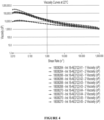
- Edible ink formulations according to certain non-limiting aspects of the present disclosure were prepared and tested for viscosity.
- Graphical representations of the data pertaining to viscosity (cP) over shear rate (s -1 ) are represented in FIGS. 4-7 .
Landscapes
- Chemical & Material Sciences (AREA)
- Life Sciences & Earth Sciences (AREA)
- Engineering & Computer Science (AREA)
- Food Science & Technology (AREA)
- Polymers & Plastics (AREA)
- Inorganic Chemistry (AREA)
- Health & Medical Sciences (AREA)
- Nutrition Science (AREA)
- General Preparation And Processing Of Foods (AREA)
- Coloring Foods And Improving Nutritive Qualities (AREA)
- Inks, Pencil-Leads, Or Crayons (AREA)
Claims (15)
- Essbare Tintenformulierung umfassend skalenoedrische Calciumcarbonatpartikel und einen Alkohol und ein wässriges Lösungsmittel, wobei die essbare Tintenformulierung, wenn als ein Film aufgebracht, einen Druckhaltbarkeitswert von weniger als 70 zeigt, wobei das alkoholische Lösungsmittel einen oder mehrere C4- bis C6-Alkohole und einen oder mehrere C2-bis C3-Alkohole umfasst.
- Essbare Tintenformulierung gemäß Anspruch 1, wobei der aufgebrachte Film ein feuchter Film mit einer Dicke von 60 µm oder weniger ist.
- Essbare Tintenformulierung gemäß Anspruch 1, wobei der aufgebrachte Film ein getrockneter Film mit einer Dicke von 30 µm oder weniger ist.
- Essbare Tintenformulierung gemäß Anspruch 1, wobei die Calciumcarbonatpartikel in einer Menge von 10 Gew.-% bis 30 Gew.-% vorhanden sind.
- Essbare Tintenformulierung gemäß Anspruch 1, wobei das wässrige alkoholische Lösungsmittel einen C4- bis C6-Alkohol und einen C2- bis C3-Alkohol in einem Verhältnis von höher als 1:1, gegebenenfalls höher als 3:1, gegebenenfalls höher als 5:1, auf einer Gew.-%-Basis umfasst.
- Essbare Tintenformulierung gemäß Anspruch 1, wobei das wässrige alkoholische Lösungsmittel einen C4- bis C6-Alkohol und einen C2- bis C3-Alkohol in einem Verhältnis von 3:1 bis 10:1 und gegebenenfalls in einem Verhältnis von 5:1 bis 10:1 auf einer Gew.-%-Basis umfasst.
- Essbare Tintenformulierung gemäß Anspruch 1, ferner umfassend ein Bindemittel, vorzugsweise wobei das Bindemittel ausgewählt ist aus Hydroxypropylmethylcellulose (HPMC), Hydroxypropylcellulose (HPC), Methylcellulose, Schellack, Polyvinylpyrrolidon und Natriumcarboxymethylcellulose (NaCMC).
- Essbare Tintenformulierung gemäß Anspruch 1, wobei der Alkohol zwei oder mehr C2- bis C6-Alkohole ausgewählt aus der Gruppe bestehend aus Isopropanol, 1-Propanol, Ethanol, 1-Butanol, 3-Methyl-1-butanol (Isoamylalkohol), 2-Butanol und Hexanol umfasst.
- Essbare Tintenformulierung gemäß Anspruch 1, wobei das wässrige Lösungsmittel Wasser oder ein Gemisch von Wasser und Ammoniak ist.
- Lebensmittelprodukt umfassend die essbare Tintenformulierung gemäß Anspruch 1.
- Lebensmittelprodukt gemäß Anspruch 10, wobei das Lebensmittelprodukt ein Süßwarenprodukt ist, vorzugsweisewobei das Süßwarenprodukt ein hartes Bonbon ist und bevorzugterwobei das harte Bonbon eine Glanzbeschichtung umfasst.
- Lebensmittelprodukt gemäß Anspruch 10, wobei das Lebensmittelprodukt ein Snack-Lebensmittelprodukt ist.
- Essbare Tintenformulierung gemäß Anspruch 1, wobei die essbare Tintenformulierung, wenn als trockener Film hergestellt, einen Druckhaltbarkeitswert von weniger als 70 zeigt und wobei vorzugsweise das Bindemittel Hydroxypropylmethylcellulose ist.
- Essbare Tintenformulierung gemäß Anspruch 13, wobei die essbare Tinte auf Glasurbeschichtung aufgebracht wird.
- Essbare Tintenformulierung gemäß Anspruch 13, ferner umfassend ein oder mehrere Pigmente ausgewählt aus der Gruppe bestehend aus pflanzlichem Ruß, Eisenoxiden, künstlichen Farbstoffen und nicht-künstlichen Farbstoffen.
Priority Applications (1)
| Application Number | Priority Date | Filing Date | Title |
|---|---|---|---|
| EP24197379.1A EP4516109A1 (de) | 2018-06-28 | 2019-06-28 | Verbesserte essbare tintenformulierungen mit calciumcarbonat |
Applications Claiming Priority (2)
| Application Number | Priority Date | Filing Date | Title |
|---|---|---|---|
| US201862691581P | 2018-06-28 | 2018-06-28 | |
| PCT/US2019/039739 WO2020006362A1 (en) | 2018-06-28 | 2019-06-28 | Improved edible ink formulations including calcium carbonate |
Related Child Applications (2)
| Application Number | Title | Priority Date | Filing Date |
|---|---|---|---|
| EP24197379.1A Division EP4516109A1 (de) | 2018-06-28 | 2019-06-28 | Verbesserte essbare tintenformulierungen mit calciumcarbonat |
| EP24197379.1A Division-Into EP4516109A1 (de) | 2018-06-28 | 2019-06-28 | Verbesserte essbare tintenformulierungen mit calciumcarbonat |
Publications (3)
| Publication Number | Publication Date |
|---|---|
| EP3813540A1 EP3813540A1 (de) | 2021-05-05 |
| EP3813540A4 EP3813540A4 (de) | 2022-04-06 |
| EP3813540B1 true EP3813540B1 (de) | 2024-10-09 |
Family
ID=68986866
Family Applications (2)
| Application Number | Title | Priority Date | Filing Date |
|---|---|---|---|
| EP19827215.5A Active EP3813540B1 (de) | 2018-06-28 | 2019-06-28 | Verbesserte essbare tintenformulierungen mit calciumcarbonat |
| EP24197379.1A Pending EP4516109A1 (de) | 2018-06-28 | 2019-06-28 | Verbesserte essbare tintenformulierungen mit calciumcarbonat |
Family Applications After (1)
| Application Number | Title | Priority Date | Filing Date |
|---|---|---|---|
| EP24197379.1A Pending EP4516109A1 (de) | 2018-06-28 | 2019-06-28 | Verbesserte essbare tintenformulierungen mit calciumcarbonat |
Country Status (6)
| Country | Link |
|---|---|
| US (2) | US12302921B2 (de) |
| EP (2) | EP3813540B1 (de) |
| CN (1) | CN112351687A (de) |
| ES (1) | ES3001095T3 (de) |
| PL (1) | PL3813540T3 (de) |
| WO (1) | WO2020006362A1 (de) |
Families Citing this family (3)
| Publication number | Priority date | Publication date | Assignee | Title |
|---|---|---|---|---|
| EP3562313B1 (de) | 2016-12-29 | 2021-12-01 | Mars, Incorporated | Scalenohedrische calciumcarbonatpartikel enthaltende essbare tinte |
| WO2024054917A1 (en) * | 2022-09-08 | 2024-03-14 | Wm. Wrigley Jr. Company | Edible ink compositions and related products and methods |
| JP7302725B1 (ja) * | 2022-11-10 | 2023-07-04 | 凸版印刷株式会社 | インクジェット印刷用可食性インク |
Family Cites Families (38)
| Publication number | Priority date | Publication date | Assignee | Title |
|---|---|---|---|---|
| US2859689A (en) | 1953-10-28 | 1958-11-11 | Hartnett Co R W | Pellet marking machine |
| US3258347A (en) | 1963-08-19 | 1966-06-28 | Miles Lab | Edible pharmaceutical inks |
| US4528904A (en) | 1983-10-24 | 1985-07-16 | Ackley E Michael | Ink reservoir removing and inserting structure for article marking apparatus |
| US5655453A (en) | 1987-02-06 | 1997-08-12 | Ackley; E. Michael | Method and apparatus for marking pellet shaped articles |
| US5006362A (en) * | 1988-05-09 | 1991-04-09 | Berwind Pharmaceutical Services, Inc. | Branding pharmaceutical dosage forms, food and confectionery products with aqueous ingestible inks |
| US5006363A (en) | 1988-12-08 | 1991-04-09 | Matsushita Electric Industries Co., Ltd. | Plasma assited MO-CVD of perooskite dalectric films |
| BE1003568A5 (nl) * | 1990-05-23 | 1992-04-21 | Met Beperkte Aansprakelijkheid | Werkwijze voor het vervaardigen van met eetbare inkt bedrukt suikerwerk en daarbij te gebruiken inkt. |
| US5741505A (en) | 1995-01-20 | 1998-04-21 | Mars, Incorporated | Edible products having inorganic coatings |
| US5643631A (en) * | 1995-03-17 | 1997-07-01 | Minerals Tech Inc | Ink jet recording paper incorporating novel precipitated calcium carbonate pigment |
| US6569472B1 (en) | 2000-09-01 | 2003-05-27 | Wm. Wrigley Jr. Company | Coated chewing gum products containing antacid and method of making |
| AU2012216272B2 (en) | 2000-06-02 | 2014-10-16 | Mars, Incorporated | High resolution ink-jet printing on edibles and products made |
| AU2012200064B2 (en) | 2000-06-02 | 2012-05-24 | Mars, Incorporated | High resolution ink-jet printing on edibles and products made |
| US7884953B1 (en) * | 2000-06-02 | 2011-02-08 | Mars Incorporated | High resolution ink-jet printing on edibles and products made |
| US7115288B2 (en) | 2000-06-09 | 2006-10-03 | Wm. Wrigley Jr. Company | Method for making coated chewing gum products with a coating including an aldehyde flavor and a dipeptide sweetener |
| NZ532096A (en) * | 2001-09-28 | 2006-10-27 | Mcneil Ppc Inc | Dosage forms having an inner core and outer shell with different shapes |
| US7029112B2 (en) | 2002-08-05 | 2006-04-18 | Mars, Incorporated | Ink-jet printing on surface modified edibles and products made |
| DE602004013934D1 (de) | 2003-03-07 | 2008-07-03 | Mars Inc | |
| JP4581465B2 (ja) | 2004-04-16 | 2010-11-17 | 東洋インキ製造株式会社 | インキ |
| US7247199B2 (en) * | 2004-05-12 | 2007-07-24 | Baydo Robert A | Food grade ink jet inks for printing on edible substrates |
| US20070014913A1 (en) | 2005-07-13 | 2007-01-18 | Specialty Minerals (Michigan) Inc. | Calcium fortified soymilk based frozen dessert |
| US20070218222A1 (en) | 2006-03-17 | 2007-09-20 | Eastman Kodak Company | Inkjet recording media |
| ES2677875T3 (es) | 2009-01-07 | 2018-08-07 | Chr. Hansen Natural Colors A/S | Una composición que comprende carbonato de calcio como un pigmento blanco |
| JP5555855B2 (ja) | 2009-03-31 | 2014-07-23 | 株式会社 カロリアジャパン | 可食性インクの製造方法 |
| JP5028442B2 (ja) | 2009-04-13 | 2012-09-19 | 紀州技研工業株式会社 | インクジェットインキ、その製造方法およびその使用方法 |
| WO2011143347A2 (en) * | 2010-05-11 | 2011-11-17 | Sensient Colors Llc | Film coating composition and methods of making and using the same |
| ES2549029T3 (es) | 2011-05-16 | 2015-10-22 | Omya International Ag | Método para la producción de carbonato de calcio precipitado a partir de desecho de la molienda de pulpa |
| EP2537900B1 (de) | 2011-06-21 | 2015-09-30 | Omya International AG | Verfahren zur Herstellung von ausgefälltem Calciumcarbonat |
| US8420057B2 (en) | 2011-09-01 | 2013-04-16 | Qualicaps, Inc. | Capsule having broad color spectrum |
| CN103131250A (zh) | 2011-11-25 | 2013-06-05 | 汤继国 | 一种食品表面印刷油墨的组合物 |
| EP2607432A1 (de) | 2011-12-21 | 2013-06-26 | Merck Patent GmbH | Effektpigmente basierend auf Substraten die einen Kreisformfaktor von 1,2-2 aufweisen |
| JP5893795B2 (ja) | 2012-03-23 | 2016-03-23 | オムヤ インターナショナル アーゲー | 偏三角面体状の沈降炭酸カルシウムを調製するための方法 |
| JP6005968B2 (ja) | 2012-04-02 | 2016-10-12 | 株式会社ミマキエンジニアリング | 食品包装用印刷物 |
| US10736334B2 (en) | 2013-03-15 | 2020-08-11 | Mars, Incorporated | Hard panned coating and confection comprising the same |
| RU2629257C2 (ru) | 2013-03-15 | 2017-08-28 | Марс, Инкорпорейтед | Способ выделения фракций синих антоцианинов |
| EP2967109B1 (de) | 2013-03-15 | 2017-05-10 | Wm. Wrigley Jr. Company | Konfektüberzüge mit saccharoseestern |
| BE1022280B1 (nl) | 2014-12-22 | 2016-03-10 | C&B Logistics Bvba | Werkwijze voor het bedrukken van meerlagige chocolade holfiguren |
| CN106280685A (zh) * | 2016-08-17 | 2017-01-04 | 湖北科亿华科技有限公司 | 一种耐水可食用印刷油墨及其制备方法 |
| EP3562313B1 (de) * | 2016-12-29 | 2021-12-01 | Mars, Incorporated | Scalenohedrische calciumcarbonatpartikel enthaltende essbare tinte |
-
2019
- 2019-06-28 EP EP19827215.5A patent/EP3813540B1/de active Active
- 2019-06-28 CN CN201980043740.4A patent/CN112351687A/zh active Pending
- 2019-06-28 US US17/254,064 patent/US12302921B2/en active Active
- 2019-06-28 EP EP24197379.1A patent/EP4516109A1/de active Pending
- 2019-06-28 WO PCT/US2019/039739 patent/WO2020006362A1/en not_active Ceased
- 2019-06-28 PL PL19827215.5T patent/PL3813540T3/pl unknown
- 2019-06-28 ES ES19827215T patent/ES3001095T3/es active Active
-
2025
- 2025-02-28 US US19/066,290 patent/US20250194630A1/en active Pending
Also Published As
| Publication number | Publication date |
|---|---|
| WO2020006362A1 (en) | 2020-01-02 |
| EP4516109A1 (de) | 2025-03-05 |
| ES3001095T3 (es) | 2025-03-04 |
| US20250194630A1 (en) | 2025-06-19 |
| EP3813540A1 (de) | 2021-05-05 |
| EP3813540A4 (de) | 2022-04-06 |
| CN112351687A (zh) | 2021-02-09 |
| PL3813540T3 (pl) | 2025-03-24 |
| US20210259275A1 (en) | 2021-08-26 |
| US12302921B2 (en) | 2025-05-20 |
Similar Documents
| Publication | Publication Date | Title |
|---|---|---|
| US20250194630A1 (en) | Edible ink formulations including calcium carbonate | |
| EP1601728B1 (de) | Wässrige tinten zum bedrucken von süssware | |
| AU2010201568B2 (en) | Ink-jet printing on surface modified confectionery and respective products | |
| EP1551930B1 (de) | Essbare tinten f r tintenstrahldruck auf essbaren substraten | |
| EP3562313B1 (de) | Scalenohedrische calciumcarbonatpartikel enthaltende essbare tinte | |
| KR101727917B1 (ko) | (1)패닝(panning), 제과류, 부착 및 코팅;(2)식용 필름 및 향료 캡슐화; 및 (3)리소그라피에서의 아라비아 검 대체물 | |
| JP5555855B2 (ja) | 可食性インクの製造方法 | |
| JP5651823B2 (ja) | 可食性インクの塗布方法 | |
| JP2022551545A (ja) | 干渉顔料 | |
| RU2799528C2 (ru) | Усовершенствованные составы съедобной краски, содержащие карбонат кальция | |
| AU2019291941B2 (en) | Titanium free opacifying compositions | |
| US20230217950A1 (en) | Edible ink formulations including scalenohedral calcium carbonate particles | |
| JP5970172B2 (ja) | 糖衣液および糖衣ガム | |
| RU2806831C2 (ru) | Не содержащие титана придающие непрозрачность композиции | |
| WO2024054917A1 (en) | Edible ink compositions and related products and methods |
Legal Events
| Date | Code | Title | Description |
|---|---|---|---|
| STAA | Information on the status of an ep patent application or granted ep patent |
Free format text: STATUS: THE INTERNATIONAL PUBLICATION HAS BEEN MADE |
|
| PUAI | Public reference made under article 153(3) epc to a published international application that has entered the european phase |
Free format text: ORIGINAL CODE: 0009012 |
|
| STAA | Information on the status of an ep patent application or granted ep patent |
Free format text: STATUS: REQUEST FOR EXAMINATION WAS MADE |
|
| 17P | Request for examination filed |
Effective date: 20201222 |
|
| AK | Designated contracting states |
Kind code of ref document: A1 Designated state(s): AL AT BE BG CH CY CZ DE DK EE ES FI FR GB GR HR HU IE IS IT LI LT LU LV MC MK MT NL NO PL PT RO RS SE SI SK SM TR |
|
| DAV | Request for validation of the european patent (deleted) | ||
| DAX | Request for extension of the european patent (deleted) | ||
| A4 | Supplementary search report drawn up and despatched |
Effective date: 20220303 |
|
| RIC1 | Information provided on ipc code assigned before grant |
Ipc: A23G 3/36 20060101ALI20220225BHEP Ipc: A23G 3/54 20060101ALI20220225BHEP Ipc: A23L 5/47 20160101ALI20220225BHEP Ipc: A23G 3/34 20060101AFI20220225BHEP |
|
| STAA | Information on the status of an ep patent application or granted ep patent |
Free format text: STATUS: EXAMINATION IS IN PROGRESS |
|
| 17Q | First examination report despatched |
Effective date: 20230414 |
|
| GRAP | Despatch of communication of intention to grant a patent |
Free format text: ORIGINAL CODE: EPIDOSNIGR1 |
|
| STAA | Information on the status of an ep patent application or granted ep patent |
Free format text: STATUS: GRANT OF PATENT IS INTENDED |
|
| INTG | Intention to grant announced |
Effective date: 20240506 |
|
| GRAS | Grant fee paid |
Free format text: ORIGINAL CODE: EPIDOSNIGR3 |
|
| GRAA | (expected) grant |
Free format text: ORIGINAL CODE: 0009210 |
|
| STAA | Information on the status of an ep patent application or granted ep patent |
Free format text: STATUS: THE PATENT HAS BEEN GRANTED |
|
| AK | Designated contracting states |
Kind code of ref document: B1 Designated state(s): AL AT BE BG CH CY CZ DE DK EE ES FI FR GB GR HR HU IE IS IT LI LT LU LV MC MK MT NL NO PL PT RO RS SE SI SK SM TR |
|
| REG | Reference to a national code |
Ref country code: CH Ref legal event code: EP |
|
| REG | Reference to a national code |
Ref country code: DE Ref legal event code: R096 Ref document number: 602019060189 Country of ref document: DE |
|
| REG | Reference to a national code |
Ref country code: IE Ref legal event code: FG4D |
|
| P01 | Opt-out of the competence of the unified patent court (upc) registered |
Free format text: CASE NUMBER: APP_54419/2024 Effective date: 20241002 |
|
| REG | Reference to a national code |
Ref country code: NL Ref legal event code: FP |
|
| REG | Reference to a national code |
Ref country code: LT Ref legal event code: MG9D |
|
| REG | Reference to a national code |
Ref country code: ES Ref legal event code: FG2A Ref document number: 3001095 Country of ref document: ES Kind code of ref document: T3 Effective date: 20250304 |
|
| REG | Reference to a national code |
Ref country code: AT Ref legal event code: MK05 Ref document number: 1729520 Country of ref document: AT Kind code of ref document: T Effective date: 20241009 |
|
| PG25 | Lapsed in a contracting state [announced via postgrant information from national office to epo] |
Ref country code: IS Free format text: LAPSE BECAUSE OF FAILURE TO SUBMIT A TRANSLATION OF THE DESCRIPTION OR TO PAY THE FEE WITHIN THE PRESCRIBED TIME-LIMIT Effective date: 20250209 Ref country code: HR Free format text: LAPSE BECAUSE OF FAILURE TO SUBMIT A TRANSLATION OF THE DESCRIPTION OR TO PAY THE FEE WITHIN THE PRESCRIBED TIME-LIMIT Effective date: 20241009 Ref country code: PT Free format text: LAPSE BECAUSE OF FAILURE TO SUBMIT A TRANSLATION OF THE DESCRIPTION OR TO PAY THE FEE WITHIN THE PRESCRIBED TIME-LIMIT Effective date: 20250210 |
|
| PG25 | Lapsed in a contracting state [announced via postgrant information from national office to epo] |
Ref country code: FI Free format text: LAPSE BECAUSE OF FAILURE TO SUBMIT A TRANSLATION OF THE DESCRIPTION OR TO PAY THE FEE WITHIN THE PRESCRIBED TIME-LIMIT Effective date: 20241009 |
|
| PG25 | Lapsed in a contracting state [announced via postgrant information from national office to epo] |
Ref country code: BG Free format text: LAPSE BECAUSE OF FAILURE TO SUBMIT A TRANSLATION OF THE DESCRIPTION OR TO PAY THE FEE WITHIN THE PRESCRIBED TIME-LIMIT Effective date: 20241009 |
|
| PG25 | Lapsed in a contracting state [announced via postgrant information from national office to epo] |
Ref country code: NO Free format text: LAPSE BECAUSE OF FAILURE TO SUBMIT A TRANSLATION OF THE DESCRIPTION OR TO PAY THE FEE WITHIN THE PRESCRIBED TIME-LIMIT Effective date: 20250109 |
|
| PG25 | Lapsed in a contracting state [announced via postgrant information from national office to epo] |
Ref country code: LV Free format text: LAPSE BECAUSE OF FAILURE TO SUBMIT A TRANSLATION OF THE DESCRIPTION OR TO PAY THE FEE WITHIN THE PRESCRIBED TIME-LIMIT Effective date: 20241009 Ref country code: GR Free format text: LAPSE BECAUSE OF FAILURE TO SUBMIT A TRANSLATION OF THE DESCRIPTION OR TO PAY THE FEE WITHIN THE PRESCRIBED TIME-LIMIT Effective date: 20250110 Ref country code: AT Free format text: LAPSE BECAUSE OF FAILURE TO SUBMIT A TRANSLATION OF THE DESCRIPTION OR TO PAY THE FEE WITHIN THE PRESCRIBED TIME-LIMIT Effective date: 20241009 |
|
| PG25 | Lapsed in a contracting state [announced via postgrant information from national office to epo] |
Ref country code: RS Free format text: LAPSE BECAUSE OF FAILURE TO SUBMIT A TRANSLATION OF THE DESCRIPTION OR TO PAY THE FEE WITHIN THE PRESCRIBED TIME-LIMIT Effective date: 20250109 |
|
| PG25 | Lapsed in a contracting state [announced via postgrant information from national office to epo] |
Ref country code: SM Free format text: LAPSE BECAUSE OF FAILURE TO SUBMIT A TRANSLATION OF THE DESCRIPTION OR TO PAY THE FEE WITHIN THE PRESCRIBED TIME-LIMIT Effective date: 20241009 |
|
| PGFP | Annual fee paid to national office [announced via postgrant information from national office to epo] |
Ref country code: PL Payment date: 20250605 Year of fee payment: 7 Ref country code: DE Payment date: 20250627 Year of fee payment: 7 |
|
| PG25 | Lapsed in a contracting state [announced via postgrant information from national office to epo] |
Ref country code: DK Free format text: LAPSE BECAUSE OF FAILURE TO SUBMIT A TRANSLATION OF THE DESCRIPTION OR TO PAY THE FEE WITHIN THE PRESCRIBED TIME-LIMIT Effective date: 20241009 |
|
| PGFP | Annual fee paid to national office [announced via postgrant information from national office to epo] |
Ref country code: GB Payment date: 20250627 Year of fee payment: 7 |
|
| REG | Reference to a national code |
Ref country code: DE Ref legal event code: R097 Ref document number: 602019060189 Country of ref document: DE |
|
| PGFP | Annual fee paid to national office [announced via postgrant information from national office to epo] |
Ref country code: NL Payment date: 20250626 Year of fee payment: 7 |
|
| PG25 | Lapsed in a contracting state [announced via postgrant information from national office to epo] |
Ref country code: EE Free format text: LAPSE BECAUSE OF FAILURE TO SUBMIT A TRANSLATION OF THE DESCRIPTION OR TO PAY THE FEE WITHIN THE PRESCRIBED TIME-LIMIT Effective date: 20241009 |
|
| PGFP | Annual fee paid to national office [announced via postgrant information from national office to epo] |
Ref country code: FR Payment date: 20250625 Year of fee payment: 7 |
|
| PG25 | Lapsed in a contracting state [announced via postgrant information from national office to epo] |
Ref country code: RO Free format text: LAPSE BECAUSE OF FAILURE TO SUBMIT A TRANSLATION OF THE DESCRIPTION OR TO PAY THE FEE WITHIN THE PRESCRIBED TIME-LIMIT Effective date: 20241009 |
|
| PG25 | Lapsed in a contracting state [announced via postgrant information from national office to epo] |
Ref country code: SK Free format text: LAPSE BECAUSE OF FAILURE TO SUBMIT A TRANSLATION OF THE DESCRIPTION OR TO PAY THE FEE WITHIN THE PRESCRIBED TIME-LIMIT Effective date: 20241009 |
|
| PG25 | Lapsed in a contracting state [announced via postgrant information from national office to epo] |
Ref country code: CZ Free format text: LAPSE BECAUSE OF FAILURE TO SUBMIT A TRANSLATION OF THE DESCRIPTION OR TO PAY THE FEE WITHIN THE PRESCRIBED TIME-LIMIT Effective date: 20241009 |
|
| PLBE | No opposition filed within time limit |
Free format text: ORIGINAL CODE: 0009261 |
|
| STAA | Information on the status of an ep patent application or granted ep patent |
Free format text: STATUS: NO OPPOSITION FILED WITHIN TIME LIMIT |
|
| PG25 | Lapsed in a contracting state [announced via postgrant information from national office to epo] |
Ref country code: SE Free format text: LAPSE BECAUSE OF FAILURE TO SUBMIT A TRANSLATION OF THE DESCRIPTION OR TO PAY THE FEE WITHIN THE PRESCRIBED TIME-LIMIT Effective date: 20241009 |
|
| 26N | No opposition filed |
Effective date: 20250710 |
|
| PGFP | Annual fee paid to national office [announced via postgrant information from national office to epo] |
Ref country code: ES Payment date: 20250701 Year of fee payment: 7 |
|
| PGFP | Annual fee paid to national office [announced via postgrant information from national office to epo] |
Ref country code: IT Payment date: 20250619 Year of fee payment: 7 |
|
| REG | Reference to a national code |
Ref country code: CH Ref legal event code: H13 Free format text: ST27 STATUS EVENT CODE: U-0-0-H10-H13 (AS PROVIDED BY THE NATIONAL OFFICE) Effective date: 20260127 |
|
| PG25 | Lapsed in a contracting state [announced via postgrant information from national office to epo] |
Ref country code: MC Free format text: LAPSE BECAUSE OF FAILURE TO SUBMIT A TRANSLATION OF THE DESCRIPTION OR TO PAY THE FEE WITHIN THE PRESCRIBED TIME-LIMIT Effective date: 20241009 |
|
| PG25 | Lapsed in a contracting state [announced via postgrant information from national office to epo] |
Ref country code: LU Free format text: LAPSE BECAUSE OF NON-PAYMENT OF DUE FEES Effective date: 20250628 |
|
| REG | Reference to a national code |
Ref country code: BE Ref legal event code: MM Effective date: 20250630 |
|
| PG25 | Lapsed in a contracting state [announced via postgrant information from national office to epo] |
Ref country code: IE Free format text: LAPSE BECAUSE OF NON-PAYMENT OF DUE FEES Effective date: 20250628 |
|
| PG25 | Lapsed in a contracting state [announced via postgrant information from national office to epo] |
Ref country code: BE Free format text: LAPSE BECAUSE OF NON-PAYMENT OF DUE FEES Effective date: 20250630 |
|
| PG25 | Lapsed in a contracting state [announced via postgrant information from national office to epo] |
Ref country code: CH Free format text: LAPSE BECAUSE OF NON-PAYMENT OF DUE FEES Effective date: 20250630 |