EP3816232B1 - Harzzusammensetzung und formgegenstand - Google Patents
Harzzusammensetzung und formgegenstand Download PDFInfo
- Publication number
- EP3816232B1 EP3816232B1 EP19826809.6A EP19826809A EP3816232B1 EP 3816232 B1 EP3816232 B1 EP 3816232B1 EP 19826809 A EP19826809 A EP 19826809A EP 3816232 B1 EP3816232 B1 EP 3816232B1
- Authority
- EP
- European Patent Office
- Prior art keywords
- structural unit
- unit derived
- polyamide resin
- dicarboxylic acid
- mol
- Prior art date
- Legal status (The legal status is an assumption and is not a legal conclusion. Google has not performed a legal analysis and makes no representation as to the accuracy of the status listed.)
- Active
Links
Classifications
-
- C—CHEMISTRY; METALLURGY
- C08—ORGANIC MACROMOLECULAR COMPOUNDS; THEIR PREPARATION OR CHEMICAL WORKING-UP; COMPOSITIONS BASED THEREON
- C08L—COMPOSITIONS OF MACROMOLECULAR COMPOUNDS
- C08L77/00—Compositions of polyamides obtained by reactions forming a carboxylic amide link in the main chain; Compositions of derivatives of such polymers
- C08L77/06—Polyamides derived from polyamines and polycarboxylic acids
-
- C—CHEMISTRY; METALLURGY
- C08—ORGANIC MACROMOLECULAR COMPOUNDS; THEIR PREPARATION OR CHEMICAL WORKING-UP; COMPOSITIONS BASED THEREON
- C08G—MACROMOLECULAR COMPOUNDS OBTAINED OTHERWISE THAN BY REACTIONS ONLY INVOLVING UNSATURATED CARBON-TO-CARBON BONDS
- C08G69/00—Macromolecular compounds obtained by reactions forming a carboxylic amide link in the main chain of the macromolecule
- C08G69/02—Polyamides derived from amino-carboxylic acids or from polyamines and polycarboxylic acids
- C08G69/26—Polyamides derived from amino-carboxylic acids or from polyamines and polycarboxylic acids derived from polyamines and polycarboxylic acids
- C08G69/265—Polyamides derived from amino-carboxylic acids or from polyamines and polycarboxylic acids derived from polyamines and polycarboxylic acids from at least two different diamines or at least two different dicarboxylic acids
-
- C—CHEMISTRY; METALLURGY
- C08—ORGANIC MACROMOLECULAR COMPOUNDS; THEIR PREPARATION OR CHEMICAL WORKING-UP; COMPOSITIONS BASED THEREON
- C08L—COMPOSITIONS OF MACROMOLECULAR COMPOUNDS
- C08L2205/00—Polymer mixtures characterised by other features
- C08L2205/02—Polymer mixtures characterised by other features containing two or more polymers of the same C08L -group
-
- C—CHEMISTRY; METALLURGY
- C08—ORGANIC MACROMOLECULAR COMPOUNDS; THEIR PREPARATION OR CHEMICAL WORKING-UP; COMPOSITIONS BASED THEREON
- C08L—COMPOSITIONS OF MACROMOLECULAR COMPOUNDS
- C08L2205/00—Polymer mixtures characterised by other features
- C08L2205/02—Polymer mixtures characterised by other features containing two or more polymers of the same C08L -group
- C08L2205/025—Polymer mixtures characterised by other features containing two or more polymers of the same C08L -group containing two or more polymers of the same hierarchy C08L, and differing only in parameters such as density, comonomer content, molecular weight, structure
Definitions
- the present invention relates to a resin composition and a molded article.
- it relates to a resin composition using an amorphous polyamide resin.
- a polyamide resin was conventionally a crystalline resin, but in recent years, an amorphous polyamide resin has been examined due to its high transparency.
- Patent Document 1 discloses a heat-resistant polyamide resin comprising a diamine component comprising not less than 40 mol% of bis(aminomethyl)cyclohexane and a dicarboxylic acid component comprising not less than 50 mol% of isophthalic acid and/or terephthalic acid.
- Grilamid TR-55 available from EMS-CHEMIE as an amorphous polyamide resin comprising 4,4'-methylenebis(2-methylcyclohexane-1-amine) and isophthalic acid as the main raw materials
- Grilamid TR-90 available from EMS-CHEMIE as an amorphous polyamide resin comprising 4,4'-methylenebis(2-methylcyclohexane-1-amine) and dodecanedioic acid as the main raw materials are known.
- Patent Document 1 JP 2010-285553 A US 6,008,288 A and US 6,277,911 B1 describe transparent, colorless, amorphous (co)polyamides.
- An amorphous polyamide resin is advantageously used for its transparency, and widely used for wide variety of applications from industrial applications to applications having high design properties such as switch covers, lenses, and frames of glasses.
- the amorphous polyamide resin has no apparent melting point and tends to lack heat resistance.
- the amorphous polyamide resin having a high glass transition temperature has high melt viscosity and needs to be molded at a high temperature.
- Several problems are known for use at a high temperature and in particular, gelation, degradation, and an increased outgas amount are issues of concern.
- a plasticizer or a low molecular weight body may be added.
- there are problems such as volatilization as an outgas during molding or a reduction in mechanical properties.
- a problem to be solved by the present invention is to satisfy such a demand, and an object of the present invention is to provide a low-viscosity resin composition having excellent fluidity while maintaining the amorphous polyamide-specific transparency, and a molded article formed from the resin composition.
- the inventors of the present invention have found that blending a specific amorphous polyamide resin in a known amorphous polyamide resin can provide a low-viscosity resin composition with excellent fluidity while maintaining transparency.
- the problem described above is solved by the resin composition as defined in claims 1 to 11, and a molded article as defined in claim 12.
- the present invention it has become possible to provide a low-viscosity resin composition formed from an amorphous polyamide resin, the resin composition having excellent fluidity while maintaining the transparency of the amorphous polyamide, and a molded article formed from the resin composition.
- the resin composition according to the present invention includes a first polyamide resin and a second polyamide resin, as defined in claim 1 in a second polyamide resin is from 10 to 90 % by mass; the content of the first polyamide resin in the resin composition being 10% by mass or more and 90% by mass or less; the content of the second polyamide resin in the resin composition being 10% by mass or more and 90% by mass or less.
- the present invention can provide a resin composition that has transparency and can maintain excellent properties inherent to the second polyamide resin while maintaining properties of the first polyamide resin, that is, relatively low melt viscosity.
- the present invention can provide a resin composition which maintains high impact resistance and has high elastic modulus, for example.
- the resin composition according to the present invention can retain high chemical resistance of the first polyamide resin.
- an amorphous polyamide resin comprising a structural unit comprising two or more alicyclic structures is known in a related art.
- an amorphous polyamide resin comprising 4,4'-methylenebis(2-methylcyclohexane-1-amine) and isophthalic acid as main ingredients as described above (Grilamid TR-55, available from EMS-CHEMIE); an amorphous polyamide resin comprising 4,4'-methylenebis(2-methylcyclohexane-1-amine) and dodecanedioic acid as main ingredients (Grilamid TR-90, available from EMS-CHEMIE); an amorphous polyamide resin comprising 4,4'-methylenebis(cyclohexane-1-amine) and dodecanedioic acid as main ingredients (Trogamid myCX, available from Dicel-Evonik Ltd.); an amorphous polyamide resin comprising 4,4'-methylenebis(2-methylcyclohexane-1-amine) and sebacic
- Such amorphous polyamide resin (second polyamide resin) having a structural unit that includes two or more alicyclic structures typically has high melt viscosity and poor fluidity.
- the first polyamide resin is blended in the second polyamide resin, and the melt viscosity of the resin composition is successfully reduced while maintaining high transparency.
- miscibility tends to be poor, and further, there is concern for a decrease in transparency with a decrease in miscibility.
- the miscibility of the polyamide resins is improved by appropriately selecting the types of the first polyamide resin and the second polyamide resin.
- the amorphous polyamide resin according to the present invention is a resin that has a crystal melting enthalpy ⁇ Hm is less than 10 J/g, preferably 5 J/g or less, and more preferably 3 J/g or less, and the crystal melting enthalpy may be 1 J/g or less.
- the crystal melting enthalpy is measured in accordance with the method described in the examples below.
- the resin composition according to the present invention includes a first polyamide resin as defined in claim 1.
- the first polyamide resin is an amorphous polyamide resin comprising a structural unit derived from a diamine and a structural unit derived from a dicarboxylic acid, in which not less than 70 mol% of the structural unit derived from a diamine is a structural unit derived from isophorone diamine and the structural unit derived from a dicarboxylic acid includes a structural unit derived from an ⁇ , ⁇ -linear aliphatic dicarboxylic acid having 8 to 14 carbon atoms and a structural unit derived from an aromatic dicarboxylic acid, which comprises at least one of a structural unit derived from 2,6-naphthalene-dicarboxylic acid and a structural unit derived from isophtalic acid.
- mol%, more preferably not less than 90 mol%, even more preferably not less than 95 mol%, and yet even more preferably not less than 99 mol% of the structural unit derived from a diamine is a structural unit derived from isophorone diamine.
- diamine other than isophorone diamine examples include aliphatic diamines, such as 1,3-bis(aminomethyl)cyclohexane, 1,4-bis(aminomethyl)cyclohexane, tetramethylene diamine, pentamethylene diamine, hexamethylene diamine, octamethylene diamine, and nonamethylene diamine; aromatic diamines, such as p-phenylenediamine, m-xylylenediamine, and p-xylylenediamine. A single type of these other diamines may be used, or two or more types thereof may be used.
- the structural unit derived from a dicarboxylic acid includes a structural unit derived from an ⁇ , ⁇ -linear aliphatic dicarboxylic acid having 8 to 14 carbon atoms and a structural unit derived from an aromatic dicarboxylic acid
- the structural unit derived from a dicarboxylic acid includes from 30 to 80 mol% of a structural unit derived from an ⁇ , ⁇ -linear aliphatic dicarboxylic acid having from 8 to 14 carbon atoms and from 70 to 20 mol% of a structural unit derived from an aromatic dicarboxylic acid (however, the total amount does not exceed 100 mol%).
- Preferably from 45 to 80 mol%, further preferably from 50 to 80 mol%, even more preferably from 60 to 80 mol%, and yet even more preferably from 65 to 80 mol% of the structural unit derived from a dicarboxylic acid is a structural unit derived from an ⁇ , ⁇ -linear aliphatic dicarboxylic acid having from 8 to 14 carbon atoms.
- preferably from 55 to 20 mol%, further preferably from 50 to 20 mol%, even more preferably from 40 to 20 mol%, and yet even more preferably from 35 to 20 mol% of the structural unit derived from a dicarboxylic acid is a structural unit derived from an aromatic dicarboxylic acid.
- the first polyamide resin only one type, or two or more types of the ⁇ , ⁇ -linear aliphatic dicarboxylic acid having from 8 to 14 carbon atoms and the aromatic dicarboxylic acid each may be used.
- the total amount is preferably within the range described above.
- the total amount of the structural units derived from an ⁇ , ⁇ -linear aliphatic dicarboxylic acid having from 8 to 14 carbons and the structural units derived from an aromatic dicarboxylic acid is preferably 90 mol% or more, more preferably 95 mol% or more, and even more preferably 99 mol% or more.
- the ⁇ , ⁇ -linear aliphatic dicarboxylic acid having from 8 to 14 carbon atoms is preferably an ⁇ , ⁇ -linear aliphatic dicarboxylic acid having from 8 to 12 carbon atoms.
- Examples of the ⁇ , ⁇ -linear aliphatic dicarboxylic acid having from 8 to 14 carbon atoms include suberic acid, azelaic acid, sebacic acid, 1,9-nonanedicarboxylic acid, and dodecanedioic acid, and at least one of sebacic acid and dodecanedioic acid is preferable.
- aromatic dicarboxylic acid examples include terephthalic acid, isophthalic acid, 1,3-naphthalenedicarboxylic acid, 1,4-naphthalenedicarboxylic acid, 1,8-naphthalenedicarboxylic acid, and 2,6-naphthalenedicarboxylic acid. According to the claims, the aromatic dicarboxylic acid comprises at least on type of 2,6-naphthalenedicarboxylic acid and isophthalic acid.
- Examples of the embodiment of the first polyamide resin include a form comprising substantially no structural unit derived from terephthalic acid.
- “Comprising substantially no structural unit derived from terephthalic acid” means that the proportion of the structural unit derived from terephthalic acid is 5 mol% or less, preferably 3 mol% or less, and more preferably 1 mol% or less, of the structural units derived from a dicarboxylic acid included in the first polyamide resin.
- dicarboxylic acid other dicarboxylic acids
- dicarboxylic acids other than the ⁇ , ⁇ -linear aliphatic dicarboxylic acid having 8 to 14 carbon atoms and the aromatic dicarboxylic acid
- examples of the dicarboxylic acid include an ⁇ , ⁇ -linear aliphatic dicarboxylic acid having 8 or less carbon atoms (e.g., adipic acid and pimelic acid), and an alicyclic dicarboxylic acid (e.g., 1,3-cyclohexanedicarboxylic acid).
- One type, or two or more types of the other dicarboxylic acids may be used.
- the molar ratio of the structural unit derived from an ⁇ , ⁇ -linear aliphatic dicarboxylic acid having 8 to 14 carbon atoms and the structural unit derived from an aromatic dicarboxylic acid, (the structural unit derived from an ⁇ , ⁇ -linear aliphatic dicarboxylic acid having from 8 to 14 carbon atoms)/(the structural unit derived from an aromatic dicarboxylic acid), in the structural unit derived from a dicarboxylic acid is preferably from 0.5 to 3.5, more preferably from 0.8 to 3.2, and even more preferably from 2.0 to 3.1. Within such a range, an amorphous polyamide resin excellent in various performances can be obtained.
- Embodiments of preferred amorphous polyamide resins of the present invention are described below. Of course, the present invention is not limited to these embodiments.
- a first embodiment of the first polyamide resin is an amorphous polyamide resin in which not less than 90 mol% of the structural unit derived from a diamine is a structural unit derived from isophorone diamine;
- the structural unit derived from a dicarboxylic acid includes from 30 to 80 mol% of a structural unit derived from an ⁇ , ⁇ -linear aliphatic dicarboxylic acid having from 8 to 14 carbon atoms and from 70 to 20 mol% of a structural unit derived from an aromatic dicarboxylic acid;
- the structural unit derived from an ⁇ , ⁇ -linear aliphatic dicarboxylic acid having from 8 to 14 carbon atoms includes at least one of a structural unit derived from sebacic acid and a structural unit derived from dodecanedioic acid;
- the structural unit derived from an aromatic dicarboxylic acid includes at least one of a structural unit derived from 2,6-naphthalenedicarboxylic acid and a structural unit derived
- an aspect in which the structural unit derived from an ⁇ , ⁇ -linear aliphatic dicarboxylic acid having from 8 to 14 carbon atoms includes either one of the structural unit derived from sebacic acid and the structural unit derived from dodecanedioic acid, and an aspect in which it includes both of them are exemplified. Furthermore, in the first embodiment, an aspect in which either one of the structural unit derived from 2,6-naphthalenedicarboxylic acid and the structural unit derived from isophthalic acid is included, or an aspect in which both of them are included are exemplified.
- a second embodiment of the first polyamide resin is an aspect in which the structural unit derived from a dicarboxylic acid includes from 30 to 80 mol% of the structural unit derived from dodecanedioic acid and from 70 to 20 mol% of the structural unit derived from an aromatic dicarboxylic acid in the first embodiment.
- (the structural unit derived from dodecanedioic acid)/(the structural unit derived from an aromatic dicarboxylic acid) is preferably from 2.8 to 3.2.
- a third embodiment of the first polyamide resin is an aspect in which, in the first embodiment, the structural unit derived from a dicarboxylic acid includes from 30 to 80 mol% of the structural unit derived from sebacic acid and from 70 to 20 mol% of the structural unit derived from an aromatic dicarboxylic acid.
- the structural unit derived from an ⁇ , ⁇ -linear aliphatic dicarboxylic acid having from 8 to 14 carbon atoms is preferably from 0.8 to 2.5.
- a fourth embodiment of the first polyamide resin is an aspect in which the structural unit derived from a dicarboxylic acid includes from 30 to 80 mol% of the structural unit derived from an ⁇ , ⁇ -linear aliphatic dicarboxylic acid having 8 to 14 carbon atoms and from 70 to 20 mol% of the structural unit derived from 2,6-naphthalenedicarboxylic acid in the first embodiment.
- the structural unit derived from dodecanedioic acid)/(the structural unit derived from an aromatic dicarboxylic acid) is preferably from 2.8 to 3.2.
- a fifth embodiment of the first polyamide resin is an aspect in which the structural unit derived from a dicarboxylic acid includes from 30 to 80 mol% of the structural unit derived from an ⁇ , ⁇ -linear aliphatic dicarboxylic acid having from 8 to 14 carbon atoms and from 70 to 20 mol% of the structural unit derived from isophthalic acid in the first embodiment.
- the structural unit derived from an aromatic dicarboxylic acid is preferably from 0.8 to 3.2.
- the first polyamide resin includes a structural unit derived from a dicarboxylic acid and a structural unit derived from a diamine, while it may also include a structural unit besides the structural unit derived from a dicarboxylic acid and the structural unit derived from a diamine, or other moieties such as a terminal group.
- other structural units include, but not limited to, a structural unit derived from lactams such as ⁇ -caprolactam, valerolactam, laurolactam, and undecalactam; and aminocarboxylic acids such as 11-aminoundecanoic acid and 12-aminododecanoic acid.
- the first polyamide resin may include minor components such as additives used for synthesis.
- the first polyamide resin used in the present invention is the structural unit derived from a dicarboxylic acid or the structural unit derived from a diamine.
- the first polyamide resin is produced through a melt polycondensation (melt polymerization) method by adding a compound comprising a phosphorus atom.
- a melt polycondensation method preferable is a method in which a raw material diamine is added dropwise to a molten raw material dicarboxylic acid and heated under pressure to polymerize while condensed water is removed, or a method in which a salt formed from a raw material diamine and a raw material dicarboxylic acid is heated under pressure in the presence of water to polymerize in the molten state while added water and condensed water are removed.
- Examples of the compound comprising a phosphorus atom added in the polycondensation system of the first polyamide resin include dimethylphosphinic acid, phenylmethylphosphinic acid, hypophosphorous acid, sodium hypophosphite, potassium hypophosphite, lithium hypophosphite, calcium hypophosphite, ethyl hypophosphite, phenylphosphonite, sodium phenylphosphonite, potassium phenylphosphonite, lithium phenylphosphonite, ethyl phenylphosphonite, phenyl phosphonic acid, ethyl phosphonic acid, sodium phenylphosphonate, potassium phenylphosphonate, lithium phenylphosphonate, diethyl phenylphosphonate, sodium ethylphosphonate, potassium ethylphosphonate, phosphorous acid, sodium hydrogen phosphite, sodium phosphite, triethyl phosphite, triphen
- metal hypophosphites such as sodium hypophosphite, potassium hypophosphite, lithium hypophosphite, and calcium hypophosphite, are preferably used due to a good effect of promoting the amidation reaction and an excellent anti-coloring effect.
- Calcium hypophosphite and sodium hypophosphite are particularly preferable.
- the compound comprising a phosphorus atom that can be used in the present invention is not limited to these compounds.
- the first polyamide resin obtained by melt polycondensation is preferably taken out once, pelletized, and then dried to be used.
- the first polyamide resin preferably has a melt viscosity of 100 Pa-s or more at 280°C, the apparent shear rate of 122 sec -1 , and the holding time period of 6 minutes, and more preferably 120 Pa s or more.
- the upper limit of the melt viscosity is preferably 2300 Pa ⁇ s or less, more preferably 1000 Pa ⁇ s or less, further preferably 600 Pa ⁇ s or less, even more preferably 550 Pa ⁇ s or less, and yet even more preferably 490 Pa s or less, and may be 300 Pa ⁇ s or less, 290 Pa ⁇ s or less, 280 Pa-s or less, and 275 Pa ⁇ s or less.
- the first polyamide resin preferably has a melt viscosity of 80 Pa-s or more at 280°C, the apparent shear rate of 1216 sec -1 , and the holding time period of 6 minutes, and more preferably 90 Pa ⁇ s or more.
- the upper limit of the melt viscosity is preferably 350 Pa ⁇ s or less, more preferably 300 Pa ⁇ s or less, even more preferably 250 Pa ⁇ s or less, and yet even more preferably 230 Pa ⁇ s or less, and may be 150 Pa ⁇ s or less, 145 Pa ⁇ s or less, and 140 Pa ⁇ s or less.
- the method for measuring the melt viscosity follows the method described in the examples described below. If the equipment employed in the examples is not readily available due to discontinuation of the equipment or the like, other equipment having the equivalent performance can be used. The same applies to other measurement methods described below.
- the lower limit of a number average molecular weight of the first polyamide resin is preferably 8000 or more, and more preferably 10000 or more.
- the upper limit of the number average molecular weight is preferably 25000 or less, and more preferably 20000 or less.
- the method for measuring the number average molecular weight follows the method described in the examples described below.
- the melt viscosity value can be adjusted.
- the first polyamide resin has the glass transition temperature of preferably 130°C or higher, more preferably 140°C or higher, and even more preferably 145°C or higher.
- the resin composition of the present invention is highly valuable in that it can have a low melt viscosity while maintaining a high glass transition temperature.
- the upper limit of the glass transition temperature is not particularly limited and, for example, is preferably 220°C or lower or may be 200°C, and even the glass transition temperature of 170°C or lower is practically sufficient.
- the method for measuring the glass transition temperature follows the method described in the examples described below.
- the content of the first polyamide resin in the resin composition has a lower limit of 10 % by mass or more, and may be 15 % by mass or more, 25 % by mass or more, 35 % by mass or more, and 45 % by mass or more. Furthermore, the upper limit of the content of the first polyamide resin in the resin composition is 90 % by mass or less, and may be 85 % by mass or less, 75 % by mass or less, 65 % by mass or less, and 55 % by mass or less.
- the resin composition according to an embodiment of the present invention may contain only one type of the first polyamide resin or may contain two or more types of the first polyamide resin.
- the total amount is preferably in the above range.
- the melt viscosity, molecular weight, glass transition temperature, and the like of the first polyamide resin are defined as the melt viscosity and the like of the mixture. The same applies to the second polyamide resins.
- the resin composition of the present invention includes a second polyamide resin.
- the second polyamide resin is an amorphous polyamide resin in which at least one type of the structural unit is a structural unit comprising two or more alicyclic structures.
- the "structural unit” refers to a repeating unit comprising one raw material monomer, and at least one type of a structural unit derived from a compound having two or three or more amino groups, a structural unit derived from a compound having two or three or more carboxy groups, and a structural unit derived from an aminocarboxylic acid (comprising a lactone ring in which an amino group and a carboxy group are dehydrated and condensed) is exemplified, and at least one type of a structural unit derived from a diamine and a structural unit derived from a dicarboxylic acid is preferable.
- the structural unit comprising two or more cyclic structures preferably includes two to four cyclic structures, more preferably two or three cyclic structures, and even more preferably two cyclic structures in one structural unit.
- the second polyamide resin includes two or more cyclic structures in this way, the miscibility with the first polyamide resin is increased to effectively maintain high transparency inherent to the amorphous polyamide resin.
- the melt viscosity of the resin composition can be relatively low compared to a case where only the second polyamide resin is used.
- the alicyclic structure may be a single ring formed from one alicyclic ring, or may be a fused ring formed from two or more alicyclic rings.
- the second polyamide resin has two or more such cyclic structures in one structural unit.
- the two or more cyclic structures may be connected by a single bond in one structural unit or may be a group comprising a combination of two or more cyclic structures and other groups.
- the alicyclic ring forming the cyclic structure is preferably a 5-membered ring and a 6-membered ring, and more preferably a 6-membered ring.
- Examples of an embodiment of the structural unit include a structural unit represented by -NH-R-cyclic structure-R-cyclic structure-R-NH- (R represents a single bond or a divalent linking group, hereinafter the same), a structural unit represented by - CO-R-cyclic structure-R-cyclic structure-R-CO-, or a structural unit represented by -COR-cyclic structure-R-cyclic structure -R-NH-, and the structural unit represented by -NH-R-cyclic structure-R-cyclic structure-R-NH- is preferable.
- the preferred range of the divalent linking group as R is the same as that of R in Formula (1) described below.
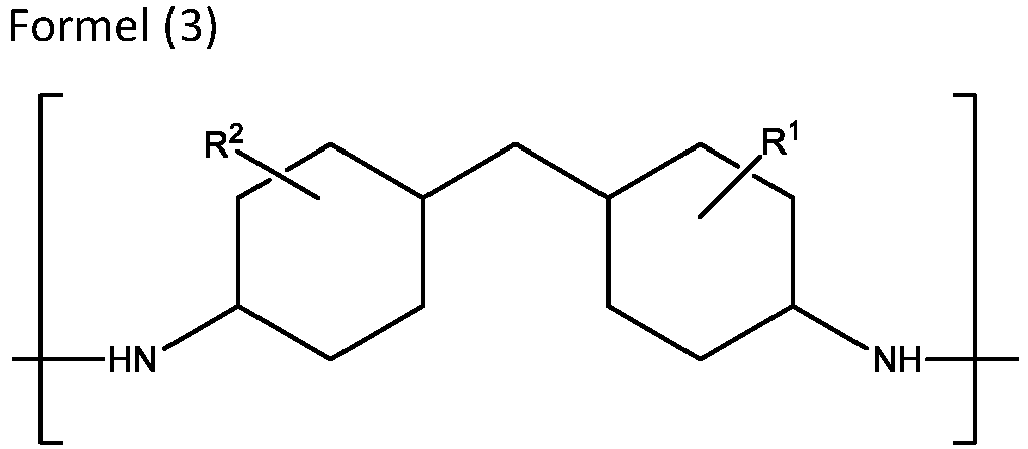
- the structural unit comprising two or more alicyclic structures is more particularly preferably a structural unit represented by Formula (1), more preferably a structural unit represented by Formula (2), even more preferably a structural unit represented by Formula (3), and yet even more preferably a structural unit represented by Formula (4).
- R 1 and R 2 each independently represent a hydrogen atom, or an alkyl group having 1 to 4 carbon atoms
- R is a single bond or a divalent linking group
- Xs each are independently NH or CO
- n1 and n2 each are independently an integer from 1 to 6.
- R 1 and R 2 each independently represent a hydrogen atom, or an alkyl group having from 1 to 4 carbon atoms
- R is a single bond or a divalent linking group
- n1 and n2 each are independently an integer from 1 to 6.
- R 1 and R 2 each independently represent a hydrogen atom, or an alkyl group having from 1 to 4 carbon atoms.
- R 1 and R 2 each independently represent a hydrogen atom, or an alkyl group having from 1 to 4 carbon atoms.
- Xs each are independently NH or CO, and preferably NH.
- R is a single bond or a divalent linking group.
- the divalent linking group is not particularly limited, but is preferably a group comprising an aliphatic hydrocarbon group or a combination of an aliphatic hydrocarbon group and -O- and/or -S-, and more preferably an aliphatic hydrocarbon group.
- the aliphatic hydrocarbon group is preferably a linear or branched alkylene group, and more preferably a linear alkylene group.
- the number of carbons in the alkylene group is preferably from 1 to 15, more preferably from 1 to 8, even more preferably from 1 to 5, and yet even more preferably from 1 to 3.
- Examples of the alkylene group include a methylene group, an ethylene group, a propylene group, and a butylene group.
- R 1 and R 2 each are independently preferably a hydrogen atom, a methyl group, an ethyl group, and a propyl group, more preferably a hydrogen atom, a methyl group, and an ethyl group, and even more preferably a hydrogen atom and a methyl group.
- the R 1 and R 2 may be the same group or may be different, but is preferably the same group.
- n1 and n2 each are independently preferably an integer from 1 to 6, more preferably an integer from 1 to 4, even more preferably 1 or 2, and yet even more preferably 1.
- Examples of a monomer that becomes a raw material of the structural unit comprising two or more cyclic structures include 4,4'-methylenebis(2-methylcyclohexane-1-amine), 4,4'-methylenebis(cyclohexane-1-amine), (4,4'-oxobis(cyclohexane-1-amine)), 4,4'-thiobis(cyclohexane-1-amine), 4,4'-methylenebis(2-methylcyclohexane-1-carboxylic acid), 4,4'-methylenebis(cyclohexane-1-carboxylic acid), (4,4 '-oxobis(cyclohexane-1-carboxylic acid)), 4,4'-thiobis(cyclohexane-1-carboxylic acid), decahydro-1,4-naphthalene dicarboxylic acid.
- the second polyamide resin is an amorphous polyamide resin in which 40 mol% or more of the total of the structural unit included in the second polyamide resin is a structural unit comprising two or more alicyclic structures.
- the upper limit of the structural unit comprising two or more alicyclic structures may be all of the total of the structural unit (100 mol%), but preferably 50 mol% or less.
- Examples of a structural unit besides the structural unit containing two or more alicyclic structures, which may be included in the second polyamide resin, include a structural unit comprising one alicyclic structure, a structural unit derived from an aliphatic diamine, a structural unit derived from an aliphatic dicarboxylic acid, a structural unit derived from an aromatic diamine, a structural unit derived from an aromatic dicarboxylic acid, and a structural unit derived from an aminocarboxylic acid other than an aminocarboxylic acid comprising two or more alicyclic structures.
- the aliphatic diamine refers to a linear or branched aliphatic diamine, and a linear aliphatic diamine is preferable.
- Specific examples of the aliphatic diamine include tetramethylene diamine, pentamethylene diamine, hexamethylene diamine, 2-methylpentamethylene diamine, undecamethylene diamine, dodecamethylene diamine, 2,2,4-/2,4,4-trimethylhexamethylene diamine, and 5-methylnonamethylene diamine.
- the aliphatic dicarboxylic acid refers to a linear or branched aliphatic dicarboxylic acid, a linear aliphatic dicarboxylic acid is preferable, an ⁇ , ⁇ -linear aliphatic dicarboxylic acid having from 6 to 20 carbon atoms is more preferable, an ⁇ , ⁇ -linear aliphatic dicarboxylic acid having from 6 to 15 carbon atoms is even more preferable, and an ⁇ , ⁇ -linear aliphatic dicarboxylic acid having from 10 to 12 carbon atoms is yet even more preferable.
- aliphatic dicarboxylic acid examples include adipic acid, pimelic acid, suberic acid, azelaic acid, sebacic acid, 1,9-nonanedicarboxylic acid, and dodecanedioic acid, and sebacic acid, 1,9-nonanedicarboxylic acid, and dodecanedioic acid are preferable, and sebacic acid and dodecanedioic acid are more preferable.
- aromatic diamine examples include metaxylylene diamine and paraxylylene diamine.
- aromatic dicarboxylic acid examples include terephthalic acid, isophthalic acid, 1,3-naphthalenedicarboxylic acid, 1,4-naphthalenedicarboxylic acid, 1,8-naphthalenedicarboxylic acid, and 2,6-naphthalenedicarboxylic acid.
- At least one type of isophthalic acid, 1,3-naphthalenedicarboxylic acid, 1,4-naphthalenedicarboxylic acid, 1,8-naphthalenedicarboxylic acid, and 2,6-naphthalenedicarboxylic acid is preferable, at least one of isophthalic acid and 2,6-naphthalenedicarboxylic acid is more preferable, and isophthalic acid is even more preferable.
- the aminocarboxylic acid is preferably an NH 2 -linear or branched aliphatic group-COOH and an NH 2 -group containing an aromatic ring-COOH. Furthermore, the aminocarboxylic acid also includes a lactam in which an amino group and a carboxy group are dehydrated and condensed.
- the linear or branched aliphatic group is preferably a linear or branched aliphatic group having from 6 to 20 carbon atoms, and more preferably a linear or branched aliphatic group having from 6 to 15 carbon atoms.
- the aliphatic group included in the aminocarboxylic acid is preferably a linear aliphatic group.
- aminocarboxylic acid examples include lactams such as ⁇ -caprolactam, valerolactam, laurolactam, and undecalactam, and amino carboxylic acids such as 11-aminoundecanoic acid and 12-aminododecanoic acid, 12-aminododecanoic acid and laurolactam are more preferable, and 12-aminododecanoic acid is even more preferable.
- the second polyamide resin may or need not include a structural unit derived from isophorone diamine.
- the proportion of the structural unit derived from isophorone diamine in the second polyamide resin is preferably less than 70 mol%, more preferably 20 mol% or less, still more preferably 10 mol% or less, even more preferably 5 mol% or less, and yet even more preferably 1 mol% of the structural unit derived from a diamine.
- the higher the proportion of isophorone diamine the better the miscibility with the first polyamide resin, and the lower the melt viscosity of the resulting resin composition.
- the lower the proportion of isophorone diamine the more properties derived from the second polyamide resin can be imparted to the resulting resin composition.
- the proportion of isophorone diamine can be appropriately adjusted depending on the desired application.
- the structural unit included in the second polyamide resin refers to a structural unit derived from a dicarboxylic acid, a structural unit derived from a diamine, and a structural unit derived from an aminocarboxylic acid.
- the second polyamide resin includes (1) a structural unit derived from a diamine and a structural unit derived from a dicarboxylic acid; (2) a structural unit derived from an aminocarboxylic acid; or (3) at least one type of a structural unit derived from a diamine and a structural unit derived from a dicarboxylic acid (preferably both a structural unit derived from a diamine and a structural unit derived from a dicarboxylic acid), and a structural unit derived from an aminocarboxylic acid.
- the second polyamide resin may include other moieties such as a terminal group, additive components used for synthesis of the polyamide resin, and the like.
- the total of the structural unit derived from a diamine, the structural unit derived from a dicarboxylic acid, and the structural unit derived from an aminocarboxylic acid preferably accounts for 90 % by mass or more, more preferably 95 % by mass or more, and even more preferably 98 % by mass or more in the second polyamide resin.
- the second polyamide resin preferably includes (1) a structural unit derived from a diamine and a structural unit derived from a dicarboxylic acid, or (3) at least one type of a structural unit derived from a diamine and a structural unit derived from a dicarboxylic acid, and a structural unit derived from an aminocarboxylic acid.
- an amorphous polyamide resin in which preferably 50 mol% or more, more preferably 70 mol% or more, still more preferably 90 mol% or more, even more preferably 95 mol% or more, and yet even more preferably 99 mol% or more of the structural unit derived from a diamine includes a structural unit comprising two or more alicyclic structures is exemplified.
- an example of the first embodiment is a polyamide resin in which preferably 50 mol% or more, more preferably 70 mol% or more, even more preferably 80 mol% or more, still more preferably 90 mol% or more, yet even more preferably 95 mol% or more, and particularly even more preferably 99 mol% or gresater of the structural unit derived from a dicarboxylic acid is derived from an aromatic dicarboxylic acid or an ⁇ , ⁇ -linear aliphatic dicarboxylic acid having from 6 to 20 carbon atoms.
- another example of the first embodiment is a polyamide resin in which preferably 50 mol% or more, more preferably 70 mol% or more, even more preferably 80 mol% or more, still more preferably 90 mol% or more, yet even more preferably 95 mol% or more, and particularly even more preferably 99 mol% or more of the structural unit derived from a dicarboxylic acid is a structural unit derived from an aromatic dicarboxylic acid.
- still another example of the first embodiment is a polyamide resin in which preferably 50 mol% or more, more preferably 70 mol% or more, even more preferably 80 mol% or more, still more preferably 90 mol% or more, yet even more preferably 95 mol% or more, and particularly even more preferably 99 mol% or more of the structural unit derived from a dicarboxylic acid is a structural unit derived from an ⁇ , ⁇ -linear aliphatic dicarboxylic acid having from 6 to 20 carbon atoms.
- the proportion of the structural unit derived from an aminocarboxylic acid is preferably 30 mol% or less, more preferably 25 mol% or less, and even more preferably 20 mol% or less, and may be 5 mol% or less or 4 mol% or less.
- the proportion of the structural unit derived from an aminocarboxylic acid may be 0 mol% or may be 1 mol% or more.
- an amorphous polyamide resin in which preferably 50 mol% or more, more preferably 70 mol% or more, still more preferably 90 mol% or more, even more preferably 95 mol% or more, and yet even more preferably 99 mol% or more of the structural unit derived from a dicarboxylic acid includes a structural unit comprising two or more alicyclic structures is exemplified.
- the structural unit derived from a diamine is preferably an aromatic diamine and an aliphatic diamine.
- the proportion of the structural unit derived from an aminocarboxylic acid is preferably 30 mol% or less, more preferably 25 mol% or less, and even more preferably 20 mol% or less, and may be 5 mol% or less or 4 mol% or less.
- the proportion of the structural unit derived from an aminocarboxylic acid may be 0 mol% or may be 1 mol% or more.
- an amorphous polyamide resin in which preferably 50 mol% or more, more preferably 70 mol% or more, still more preferably 90 mol% or more, even more preferably 95 mol% or more, and yet even more preferably 99 mol% or more of the structural unit derived from a aminocarboxylic acid includes a structural unit comprising two or more alicyclic structures is exemplified.
- the first embodiment is more preferable.
- the second polyamide resin preferably has a melt viscosity of 150 Pa ⁇ s or more at 280°C, the apparent shear rate of 122 sec -1 , and the holding time period of 6 minutes, and more preferably 200 Pa s or more.
- the upper limit of the melt viscosity is preferably 3000 Pa ⁇ s or less, more preferably 2500 Pa ⁇ s or less, even more preferably 2000 Pa ⁇ s or less, yet even more preferably 1800 Pa ⁇ s or less, still more preferably 1600 Pa ⁇ s or less, yet even more preferably 1400 Pa ⁇ s or less, and particularly even more preferably 1200 Pa s or less.
- the second polyamide resin preferably has a melt viscosity of 100 Pa ⁇ s or more at 280°C, the apparent shear rate of 1216 sec -1 , and the holding time period of 6 minutes, and more preferably 120 Pa s or more.
- the upper limit of the melt viscosity is preferably 600 Pa ⁇ s or less, more preferably 550 Pa ⁇ s or less, even more preferably 500 Pa ⁇ s or less, still more preferably 450 Pa ⁇ s or less, and yet even more preferably 420 Pa ⁇ s or less.
- the method for measuring the melt viscosity follows the method described in the examples described below.
- the lower limit of a number average molecular weight of the second polyamide resin is preferably 8000 or more, and more preferably 10000 or more.
- the upper limit of the number average molecular weight is preferably 25000 or less, and more preferably 20000 or less.
- the method for measuring the number average molecular weight follows the method described in the examples described below.
- the second polyamide resin has the glass transition temperature of preferably 100°C or higher, more preferably 120°C or higher, and even more preferably 130°C or higher. In the present invention, such a high Tg can be achieved, and therefore has the advantage of having hardly reduced physical properties even under high-temperature conditions.
- the upper limit of the glass transition temperature is not particularly limited and, for example, is preferably 200°C or lower or may be 180°C, and even the glass transition temperature of 170°C or lower is practically sufficient.
- the method for measuring the glass transition temperature follows the method described in the examples described below.
- the lower limit of the content of the second polyamide resin in the resin composition is 10% by mass or more, and may be 15 % by mass or more, 25 % by mass or more, 35 % by mass or more, or 45 % by mass or more.
- the upper limit of the content of the second polyamide resin in the resin composition is 90 % by mass or less, and may be 85 % by mass or less, 75 % by mass or less, 65 % by mass or less, and 55 % by mass or less.
- the resin composition according to an embodiment of the present invention may contain only one type of the second polyamide resin or may contain two or more types thereof.
- the resin composition containing two or more types of the second polyamide preferably has a total amount of the second polyamide resin in the above range.
- the mass ratio of the first polyamide resin and the second polyamide resin in the resin composition according to an embodiment of the present invention is such that the mass ratio of the second polyamide resin to the sum of the first polyamide resin and the second polyamide resin is from 10 to 90 % by mass.
- a lower limit of the mass ratio of the second polyamide resin is preferably 15 % by mass or more and may be 25 % by mass or more, 35 % by mass or more, or 45 % by mass or more.
- an upper limit of the mass ratio of the second polyamide resin is 90 % by mass or less, and may be 85 % by mass or less, 75 % by mass or less, 65 % by mass or less or 55 % by mass or less.
- the second polyamide resin typically has a higher melt viscosity than that of the first polyamide resin.
- the difference between the melt viscosities of the first polyamide resin and the second polyamide resin is preferably 50 Pa ⁇ s or more in the melt viscosities, more preferably 100 Pa - s or more, even more preferably 200 Pa s or more, and may be 300 Pa-s or more, 400 Pa ⁇ s or more, and 500 Pa-s or more, at 280°C, the apparent shear rate of 122 sec -1 , and the holding time period of 6 minutes.
- the upper limit of the difference between the melt viscosities of the first polyamide resin and the second polyamide resin is not particularly limited, but, for example, the melt viscosity of the second polyamide resin minus 80 Pa ⁇ s or less.
- the difference between melt viscosities of the first polyamide resin and the second polyamide resin is preferably 30 Pa ⁇ s or more in the melt viscosities, more preferably 50 Pa s or more, more preferably 100 Pa s or more, and may be 200 Pa s or more, 250 Pa ⁇ s or more, and 270 Pa s or more, at 280°C, the apparent shear rate of 1216 sec -1 , and the holding time period of 6 minutes.
- the upper limit of the difference between the melt viscosities of the first polyamide resin and the second polyamide resin is not particularly limited, but, for example, the melt viscosity of the second polyamide resin minus 60 Pa s or less.
- the polyamide resin having the difference in melt viscosity By blending the polyamide resin having the difference in melt viscosity in this way, it is possible to achieve characteristics (mechanical strength and heat resistance, for example) inherent to the second polyamide resin while maintaining a low melt viscosity inherent to the first polyamide resin.
- characteristics mechanical strength and heat resistance, for example
- miscibility between the two can be enhanced, and it is possible to make a low-viscosity resin composition with excellent fluidity while maintaining the amorphous polyamide-specific transparency.
- the resin composition according to an embodiment of the present invention may include an amorphous polyamide resin and a crystalline polyamide resin besides the first polyamide resin and the second polyamide resin.
- specific examples of such other polyamide resins include polyamide 6, polyamide 66, polyamide 46, polyamide 6/66 (copolymer formed from a polyamide 6 component and a polyamide 66 component), polyamide 610, polyamide 612, polyamide 11, polyamide 12, MXD6 (poly(m-xylylene adipamide)), MPXD6 (poly(m-, p-xylylene adipamide)), MXD10 (poly(m-xylylene sebacamide)), MPXD10 (poly(m-, p-xylylene sebacamide)), and PXD10 (poly(p-xylylene sebacamide)).
- One of these other polyamide resins, or two or more thereof may be used.
- the content thereof is preferably 10 % by mass or less, and more preferably from 1 to 10 % by mass, of the resin component included in the resin composition of the present invention.
- the resin composition according to an embodiment of the present invention can be configured to include substantially no amorphous polyamide resin other than the first polyamide resin and the second polyamide resin. "Substantially no amorphous polyamide resin” means less than 1 % by mass of the resin component included in the resin composition according to an embodiment of the present invention.
- the content thereof is preferably 10 % by mass or less, and more preferably from 1 to 10 % by mass, of the resin component included in the resin composition according to the present invention.
- the resin composition according to an embodiment of the present invention may be configured to include substantially no crystalline polyamide resin. "Substantially no crystalline polyamide resin” means less than 1 % by mass of the resin component included in the resin composition according to an embodiment of the present invention.
- the resin composition according to an embodiment of the present invention may contain a thermoplastic resin besides the polyamide resins described above.
- the thermoplastic resin other than the polyamide resins include: polyester resins such as polyethylene terephthalate, polybutylene terephthalate, polyethylene naphthalate, and polybutylene naphthalate; and polyolefin resins such as polypropylene (PP), cycloolefin polymer (COP), and cycloolefin copolymer (COC).
- PP polypropylene
- COP cycloolefin polymer
- COC cycloolefin copolymer
- the content thereof is preferably 10 % by mass or less, and more preferably from 1 to 10 % by mass, of the resin component included in the resin composition according to the present invention.
- the resin composition according to an embodiment of the present invention may be configured to include substantially no thermoplastic resin other than the polyamide resins. "Substantially no thermoplastic resin” means less than 1 % by mass or less of the resin component included in the resin composition according to an embodiment of the present invention.
- the resin composition according to an embodiment of the present invention may include only the first polyamide resin and the second polyamide resin, or may include other components.
- additives such as fillers, matting agents, heat resistant stabilizers, weather resistant stabilizers, ultraviolet absorbents, plasticizers, flame retardants, antistatic agents, anti-coloration agents, anti-gelling agents, impact modifiers, lubricants, colorants, and conductive additives can be added as necessary.
- additives such as fillers, matting agents, heat resistant stabilizers, weather resistant stabilizers, ultraviolet absorbents, plasticizers, flame retardants, antistatic agents, anti-coloration agents, anti-gelling agents, impact modifiers, lubricants, colorants, and conductive additives can be added as necessary.
- additives such as fillers, matting agents, heat resistant stabilizers, weather resistant stabilizers, ultraviolet absorbents, plasticizers, flame retardants, antistatic agents, anti-coloration agents, anti-gelling agents, impact modifiers, lubricants, colorants, and conductive additives can be added as necessary.
- one of these additives, or two or more thereof may be used.
- the resin composition according to an embodiment of the present invention preferably has an upper limit of the melt viscosity of 1400 Pa ⁇ s or less, more preferably 1200 Pa-s or less, even more preferably 1000 Pa ⁇ s or less, and yet even more preferably 950 Pa ⁇ s or less, and may have an upper limit value of 920 Pa ⁇ s or less, at 280°C, the apparent shear rate of 122 sec -1 , and the holding time period of 6 minutes.
- the lower limit of the melt viscosity is preferably 160 Pa ⁇ s or more, and more preferably 200 Pa ⁇ s or more.
- the resin composition according to an embodiment of the present invention preferably has an upper limit of the melt viscosity of 500 Pa ⁇ s or less, and more preferably 450 Pa ⁇ S or less, even more preferably 400 Pa ⁇ s or less, and yet even more preferably 380 Pa s or less, and may have an upper limit value of 350 Pa ⁇ s or less and 340 Pa ⁇ s or less, at 280°C, the apparent shear rate of 1216 sec -1 , and the holding time period of 6 minutes.
- the lower limit of the melt viscosity is preferably 100 Pa ⁇ s or more, and more preferably 120 Pa ⁇ s or more.
- the melt viscosity of the resin composition is measured in accordance with the description of the examples below.
- the resin composition according to an embodiment of the present invention can be a polyamide resin having excellent mechanical strength.
- the resin composition according to an embodiment of the present invention has a flexural modulus in accordance with JIS K 7171 of preferably 1.6 GPa or more, and may has a flexural modulus of 2.0 GPa or more.
- the upper limit thereof is not particularly limited and, for example, the upper limit of 4.0 GPa or less or even 3.5 GPa or less is a practically sufficient.
- the resin composition according to an embodiment of the present invention has a notched Charpy impact strength in accordance with JIS K 7111-1 of preferably 4.0 kJ/m 2 or more, and more preferably 4.3 kJ/m 2 or more.
- the upper limit thereof is not particularly limited and, for example, the upper limit of 9.0 kJ/m 2 or less or even 8.7 kJ/m 2 or less is a practically sufficient.
- a haze value measured when the resin composition according to an embodiment of the present invention is molded to have a thickness of 2 mm is preferably 2.0% or less, more preferably 1.7% or less, even more preferably 1.6% or less, and yet even more preferably 1.5% or less.
- the lower limit of the haze value is ideally 0%, but even a haze value of 1.0% or more is a practically sufficient.
- the flexural modulus, Charpy impact strength, and haze are measured in accordance with the description of the examples below.
- the resin composition according to an embodiment of the present invention can be made into a fiber-reinforced resin composition by blending reinforcing fibers therein.
- reinforcing fibers include carbon fibers and glass fibers.
- the fiber-reinforced resin composition include a pellet obtained by melt-kneading a composition comprising the resin composition according to an embodiment of the present invention and reinforcing fibers, and a prepreg in which reinforcing fibers are impregnated with the resin composition according to an embodiment of the present invention or the resin composition is brought in proximity to reinforcing fibers.
- the resin composition according to an embodiment of the present invention can be also molded by a known molding method such as injection molding, blow molding, extrusion molding, compression molding, stretching, and vacuum molding.
- a molded article formed from the resin composition according to an embodiment of the present invention can be used in various molded articles comprising a film, a sheet, a thin-walled molded article, a hollow molded article, a fiber, a hose, and a tube.
- the resin composition according to an embodiment of the present invention is preferably used in engineering plastic applications.
- Examples of fields of use of such molded articles include transportation equipment components such as automobiles, general mechanical parts, precision mechanical parts, electronic and electrical equipment components, OA device parts, building materials and resident related components, medical devices, optical products, industrial materials, leisure sporting devices, amusements, medical products, articles for daily use such as food packaging films, and defense and aerospace products.
- Examples of the molded article of the present invention include housing of electronic and electrical components and sunglasses.
- Another example of an embodiment of the molded article formed from the resin composition of the present invention is a single layer or multi-layer container comprising a layer formed from the resin composition of the present invention.
- the multi-layer container include a multi-layer container comprising a layer formed from a composition comprising a polyolefin resin, a layer formed from the resin composition of the present invention, and a layer formed from a composition comprising a polyolefin resin in this order.
- the polyolefin resin include polypropylene (PP), cycloolefin polymer (COP), and cycloolefin copolymer (COC).
- an adhesive layer may be provided between a layer formed from a composition comprising the polyolefin resin and a layer formed from the resin composition of the present invention.
- Such multi-layer containers can be preferably used as food or pharmaceutical containers.
- pharmaceutical containers include ampoules, vials, vacuum blood collection tubes, and prefilled syringes.
- a pressure-resistant reaction vessel having an internal volume of 50 L and equipped with a stirrer, a partial condenser, a total condenser, a pressure regulator, a thermometer, a dropping funnel and a pump, an aspirator, a nitrogen introduction tube, a bottom drain valve, and a strand die
- DDA dodecanedioic acid
- PIA isophthalic acid
- PIA isophthalic acid
- PIA available from Mitsubishi Gas Chemical Co., Ltd.
- 1.67 g (0.0016 mol) of sodium hypophosphite available from Kanto Chemical Co., Ltd.
- 1.16 g (0.0141 mol) of sodium acetate available from Kanto Chemical Co., Inc.
- IPDA isophorone diamine
- melt viscosity at 280°C, the apparent shear rate of 1216 sec -1 , and the holding time period of 6 minutes, and the melt viscosity at 280°C, the apparent shear rate 122 sec -1 , and the holding time period of 6 minutes of the obtained polyamide resin are shown in Reference Example 1 in Table 1.
- the glass transition temperature of the obtained polyamide resin was 146°C, and the number average molecular weight was 12900.
- a pressure-resistant reaction vessel having an internal volume of 50 L and equipped with a stirrer, a partial condenser, a total condenser, a pressure regulator, a thermometer, a dropping funnel and a pump, an aspirator, a nitrogen-introducing tube, a bottom drain valve, and a strand die, precisely weighed 8000 g (34.74 mol) of DDA, 2503 g (11.58 mol) of 2,6-naphthalenedicarboxylic acid (2,6-NDCA, available from BP), 1.37 g (0.0081 mol) of calcium hypophosphite (available from Kanto Chemical Co., Inc.), and 0.5 g (0.0073 mol) of sodium acetate (available from Kanto Chemical Co., Inc.) were charged, and after it was purged with nitrogen sufficiently, the inside of the reaction vessel was sealed, and the temperature was raised to 180°C under stirring while the pressure in the vessel was maintained at 0.4 MPa.
- the inside of the reaction tank was pressurized with nitrogen, the bottom drain valve was opened, and the polymer was extruded from the strand die to form a strand and then cooled and pelletized by using a pelletizer to obtain a polyamide resin.
- melt viscosity at 280°C, the apparent shear rate of 1216 sec -1 , and the holding time period of 6 minutes, and the melt viscosity at 280°C, the apparent shear rate of 122 sec -1 , and the holding time period of 6 minutes of the formed polyamide resin are shown in Reference Example 3 in the table described below.
- the glass transition temperature of the formed polyamide resin was 150°C, and the number average molecular weight was 17000.
- melt viscosity at 280°C, the apparent shear rate of 1216 sec -1 , and the holding time period of 6 minutes, and the melt viscosity at 280°C, the apparent shear rate of 122 sec -1 , and the holding time period of 6 minutes of the formed polyamide resin are shown in Reference Example 2 in the table described below.
- the glass transition temperature of the formed polyamide resin was 161°C, and the number average molecular weight was 14700.
- the melt viscosity at 280°C, the apparent shear rate of 1216 sec -1 , and the holding time period of 6 minutes, and the melt viscosity at 280°C, the apparent shear rate of 122 sec -1 , and the holding time period of 6 minutes of TR55 are shown in Comparative Example 1 in Table 1.
- the glass transition temperature of TR55 was 165°C.
- An amorphous polyamide resin formed by polycondensing Trogamid myCX, 4,4'-methylenebis(cyclohexane-1-amine) available from Daicel-Evonik Ltd. and dodecanedioic acid.
- the melt viscosity at 280°C, the apparent shear rate of 1216 sec -1 , and the holding time period of 6 minutes, and the melt viscosity at 280°C, the apparent shear rate of 122 sec -1 , and the holding time period of 6 minutes of myCX are shown in Comparative Example 2 in Table 2.
- the glass transition temperature of Trogamid myCX was 130°C.
- the melt viscosity at 280°C, the apparent shear rate of 1216 sec -1 , and the holding time period of 6 minutes, and the melt viscosity at 280°C, the apparent shear rate of 122 sec -1 , and the holding time period of 6 minutes of Rilsan Clear are shown in Comparative Example 3 in Table 2.
- the glass transition temperature of Rilsan Clear was 145°C.
- the melt viscosity at 280°C, the apparent shear rate of 1216 sec -1 , and the holding time period of 6 minutes, and the melt viscosity at 280°C, the apparent shear rate of 122 sec -1 , and the holding time period of 6 minutes of TR90 are shown in Comparative Example 4 in Table 2.
- the glass transition temperature of TR90 was 156°C.
- polyamide resins other than G21 and Trogamid myCX had crystal melting enthalpies ⁇ Hm of substantially 0 J/g in the process of increasing temperature, and these were amorphous polyamide resins.
- DSC differential scanning calorimeter
- the crystal melting enthalpy ⁇ Hm of the polyamide resin was measured during the process of increasing the temperature.
- the mixture was cooled to 80°C or lower in a nitrogen stream, after which under agitation, the inner wall of the container was rinsed with 10 mL of methanol, and neutralization titration was performed with a 0.01 mol/L sodium hydroxide aqueous solution to determine the terminal carboxyl group concentration [COOH].
- the polyamide resin described above (in the form of a pellet) was weighed to have an amount (part by mass) described below, dry-blended, loaded into a twin-screw extruder (TEM26SX, available from Toshiba Machine Co., Ltd.) from its base, and then melted and extruded at 260 to 300°C, and the resulting strand was water-cooled in a water bath and then pelletized to produce a pellet.
- TEM26SX twin-screw extruder
- the obtained pellet was vacuum-dried at 120°C (dew point: -40°C) for 24 hours, and then molded with an injection molding machine (SE130DU-HP, available from Sumitomo Heavy Industries, Ltd.) to ISO test pieces of 4 mm ⁇ 10 mm ⁇ 80 mm, under conditions of 100°C of the mold temperature and 280°C of the cylinder temperature.
- SE130DU-HP injection molding machine
- a haze measurement test piece of 2 mm ⁇ 100 mm ⁇ 100 mm was produced for haze measurement.
- the ISO test piece obtained above was processed in accordance with JIS K 7144 into a notched test piece.
- Charpy notched impact strength was measured in accordance with JIS K 7111-1.
- Flexural modulus of the ISO test piece described above was measured by the method in accordance with JIS K 7171.
- the Bend Graph II available from Toyo Seiki Seisaku-sho, Ltd. was used as the flexural tester.
- Haze of the test piece for haze measurement obtained above was measured using a haze meter.
- the COH400 available from Nippon Denshoku Industries Co., Ltd. was used for the measurement.
- Flexural properties were measured for the ISO test pieces at Day 7 and Day 30 after immersion.
- the flexural property retention rate was calculated as follows. Note that the flexural modulus was measured in accordance with the method described above and the flexural strength was measured by the method in accordance with JIS K7171.
- Flexural property retention rate flexural property of ISO test piece immersed in toluene / flexural property of ISO test piece before immersion in toluene ⁇ 100 unit: % [Table 1] Reference Example 1 Example 1 Example 2 Example 3 Example 4 Example 5 Example 6 Example 7 Comparative Example 1 Type of first polyamide resin IPD12I Proportion of first polyamide resin 100 80 70 60 50 40 30 20 0 Type of second polyamide resin TR55 Proportion of second polyamide resin 0 20 30 40 50 60 70 80 100 Melt viscosity 122 sec -1 149 300 381 474 551 596 700 808 1000 1216 sec -1 93 170 198 230 258 275 308 338 414 Charpy impact strength kJ/m 2 4.4 4.5 4.7 5 6.3 6.4 6.6 6.7 8.5 Flexural modulus GPa 2.2 2.2 2.2 2.1 2.1 2.1 2.1 1.9 Haze % 1.4 1.4 1.4 1.4 1.4 1.3 1.4 1.3 1.2 [Table 2] Example 8 Example 8 Example
- the resin composition of the present invention had excellent chemical resistance (Table 4).
Landscapes
- Chemical & Material Sciences (AREA)
- Health & Medical Sciences (AREA)
- Chemical Kinetics & Catalysis (AREA)
- Medicinal Chemistry (AREA)
- Polymers & Plastics (AREA)
- Organic Chemistry (AREA)
- Polyamides (AREA)
- Compositions Of Macromolecular Compounds (AREA)
Claims (12)
- Eine Harzzusammensetzung, umfassend ein erstes Polyamidharz und ein zweites Polyamidharz,wobei das erste Polyamidharz ein amorphes Polyamidharz ist, umfassend eine Struktureinheit, abgeleitet von einem Diamin, und eine Struktureinheit, abgeleitet von einer Dicarbonsäure, wobei 95 Massen-% oder mehr des ersten Polyamidharzes die Struktureinheit, abgeleitet von einer Dicarbonsäure, oder die Struktureinheit, abgeleitet von einem Diamin, istwobei 70 Mol-% oder mehr der Struktureinheit, abgeleitet von einem Diamin, eine Struktureinheit, abgeleitet von Isophorondiamin, ist,wobei die Struktureinheit, abgeleitet von einer Dicarbonsäure, von 30 bis 80 Mol-% einer Struktureinheit, abgeleitet von einer α,ω-linearen aliphatischen Dicarbonsäure mit von 8 bis 14 Kohlenstoffatomen, und von 70 bis 20 Mol-% einer Struktureinheit, abgeleitet von einer aromatischen Dicarbonsäure, umfasst, wobei die aromatische Dicarbonsäure mindestens eines aus einer Struktureinheit, abgeleitet von 2,6-Naphthalendicarbonsäure, und einer Struktureinheit, abgeleitet von Isophthalsäure, umfasst;wobei das zweite Polyamidharz ein amorphes Polyamidharz ist, bei dem mindestens eine Art der in dem zweiten Polyamidharz beinhalteten Struktureinheit eine Struktureinheit ist, die zwei oder mehr alicyclische Strukturen umfasst, wobei 40 Mol-% oder mehr der Gesamtmenge der in dem zweiten Polyamidharz enthaltenen Struktureinheit die Struktureinheit, umfassend zwei oder mehr alicyclische Strukturen, ist undwobei ein Massenverhältnis des zweiten Polyamidharzes zur Summe des ersten Polyamidharzes und des zweiten Polyamidharzes von 10 bis 90 Massen% beträgt;wobei der Gehalt des ersten Polyamidharzes in der Harzzusammensetzung 10 Massen-% oder mehr und 90 Massen-% oder weniger beträgt;wobei der Gehalt des zweiten Polyamidharzes in der Harzzusammensetzung 10 Massen-% oder mehr und 90 Massen-% oder weniger beträgt.
- Die Harzzusammensetzung gemäß Anspruch 1, wobei in dem ersten Polyamidharz die Struktureinheit, abgeleitet von einer α,ω-linearen aliphatischen Dicarbonsäure mit 8 bis 14 Kohlenstoffatomen, mindestens eines aus einer Struktureinheit, abgeleitet von Sebacinsäure, und einer Struktureinheit, abgeleitet von Dodecandisäure, umfasst.
- Die Harzzusammensetzung gemäß Anspruch 1, wobeiin dem ersten Polyamidharz 90 Mol-% oder mehr der Struktureinheit, abgeleitet von einem Diamin, eine Struktureinheit, abgeleitet von einem Isophorondiamin, ist,die Struktureinheit, abgeleitet von einer α,ω-linearen aliphatischen Dicarbonsäure mit 8 bis 14 Kohlenstoffatomen, mindestens eines aus einer Struktureinheit, abgeleitet von Sebacinsäure, und einer Struktureinheit, abgeleitet von Dodecandisäure, umfasst unddie Struktureinheit, abgeleitet von einer aromatischen Dicarbonsäure, mindestens eines aus einer Struktureinheit, abgeleitet von 2,6-Naphthalendicarbonsäure, und einer Struktureinheit, abgeleitet von Isophthalsäure, umfasst.
- Die Harzzusammensetzung gemäß einem der Ansprüche 1 bis 3, wobei das zweite Polyamidharz eine Struktureinheit, abgeleitet von einem Diamin, und eine Struktureinheit, abgeleitet von einer Dicarbonsäure, umfasst und 50 Mol-% oder mehr der Struktureinheit, abgeleitet von einem Diamin, die Struktureinheit, umfassend zwei oder mehr alicyclische Strukturen, ist.
- Die Harzzusammensetzung gemäß einem der Ansprüche 1 bis 4, wobei das zweite Polyamidharz eine Struktureinheit, abgeleitet von einem Diamin, und eine Struktureinheit, abgeleitet von einer Dicarbonsäure, umfasst und wobei 70 Mol-% oder mehr der Struktureinheit, abgeleitet von einem Diamin, die Struktureinheit, umfassend zwei oder mehr alicyclische Strukturen, ist.
- Die Harzzusammensetzung gemäß Anspruch 4 oder 5, wobei das zweite Polyamidharz eine Struktureinheit, abgeleitet von einem Diamin, und eine Struktureinheit, abgeleitet von einer Dicarbonsäure, umfasst und 50 Mol-% oder mehr der Struktureinheit, abgeleitet von einer Dicarbonsäure, eine Struktureinheit, abgeleitet von einer aromatischen Dicarbonsäure, ist.
- Die Harzzusammensetzung gemäß einem der Ansprüche 4 bis 6, wobei das zweite Polyamidharz eine Struktureinheit, abgeleitet von einem Diamin, und eine Struktureinheit, abgeleitet von einer Dicarbonsäure, umfasst und 50 Mol-% oder mehr der Struktureinheit, abgeleitet von einer Dicarbonsäure, eine Struktureinheit, abgeleitet von einer α,ω-linearen aliphatischen Dicarbonsäure mit 6 bis 20 Kohlenstoffatomen, ist.
- Die Harzzusammensetzung gemäß einem der Ansprüche 1 bis 7, wobei die im zweiten Polyamidharz enthaltene Struktureinheit, umfassend zwei oder mehr alicyclische Strukturen, dargestellt ist durch Formel (1):

- Die Harzzusammensetzung gemäß einem der Ansprüche 1 bis 7, wobei die in dem zweiten Polyamidharz enthaltene Struktureinheit, umfassend zwei oder mehr alicyclische Strukturen, durch Formel (3) dargestellt ist:
- Die Harzzusammensetzung gemäß einem der Ansprüche 1 bis 9, wobei ein Massenverhältnis des zweiten Polyamidharzes zur Summe des ersten Polyamidharzes und des zweiten Polyamidharzes von 20 bis 80 Massen-% beträgt.
- Die Harzzusammensetzung gemäß einem der Ansprüche 1 bis 10, wobei eine Schmelzviskosität der Harzzusammensetzung bei 280 °C, einer scheinbaren Schergeschwindigkeit von 1216 sek-1 und einer Haltezeitdauer von 6 Minuten bei 380 Pa·s oder weniger liegt, wenn sie wie in der Beschreibung dargelegt gemessen wird.
- Ein Formgegenstand, gebildet aus der Harzzusammensetzung wie in einem der Ansprüche 1 bis 11 beschrieben.
Applications Claiming Priority (2)
| Application Number | Priority Date | Filing Date | Title |
|---|---|---|---|
| JP2018121881 | 2018-06-27 | ||
| PCT/JP2019/023820 WO2020004096A1 (ja) | 2018-06-27 | 2019-06-17 | 樹脂組成物および成形品 |
Publications (3)
| Publication Number | Publication Date |
|---|---|
| EP3816232A1 EP3816232A1 (de) | 2021-05-05 |
| EP3816232A4 EP3816232A4 (de) | 2021-09-08 |
| EP3816232B1 true EP3816232B1 (de) | 2024-04-03 |
Family
ID=68986299
Family Applications (1)
| Application Number | Title | Priority Date | Filing Date |
|---|---|---|---|
| EP19826809.6A Active EP3816232B1 (de) | 2018-06-27 | 2019-06-17 | Harzzusammensetzung und formgegenstand |
Country Status (5)
| Country | Link |
|---|---|
| US (1) | US11279826B2 (de) |
| EP (1) | EP3816232B1 (de) |
| JP (1) | JP6708313B2 (de) |
| CN (1) | CN112313288B (de) |
| WO (1) | WO2020004096A1 (de) |
Families Citing this family (2)
| Publication number | Priority date | Publication date | Assignee | Title |
|---|---|---|---|---|
| WO2015168332A2 (en) | 2014-04-30 | 2015-11-05 | Osseodyne Surgical Solutions, Llc | Osseointegrative surgical implant |
| CN112566961B (zh) * | 2018-08-21 | 2022-02-25 | 三菱瓦斯化学株式会社 | 非晶性聚酰胺树脂的制造方法 |
Family Cites Families (11)
| Publication number | Priority date | Publication date | Assignee | Title |
|---|---|---|---|---|
| US5989453A (en) | 1990-05-11 | 1999-11-23 | Societe Nouvelle De Chimie Industrielle S.A. | Process for the manufacture of pigments, especially fluorescent pigments |
| EP0542669B1 (de) * | 1991-11-04 | 1997-04-16 | Societe Nouvelle De Chimie Industrielle S.A. | Verfahren zur Herstellung von Pigmenten, insbesondere fluoreszierenden Pigmenten |
| JPH05125276A (ja) * | 1991-11-01 | 1993-05-21 | Day Glo Color Corp | ポリアミド蛍光顔料 |
| US6277911B1 (en) * | 1995-02-01 | 2001-08-21 | Ems Inventa Ag | Transparent, colorless, amorphous copolyamides and molded articles made therefrom |
| US6008288A (en) * | 1995-02-01 | 1999-12-28 | Ems-Inventa Ag | Transparent, colorless, amorphous polyamides and molded articles |
| US6103006A (en) * | 1998-01-28 | 2000-08-15 | Day-Glo Color Corporation | Fluorescent polymeric pigments |
| DE102006057957B4 (de) * | 2006-12-08 | 2017-03-23 | Ems-Chemie Ag | Transparenter Formkörper aus einer Polyamidformmasse sowie dessen Verwendung |
| TWI453552B (zh) | 2008-12-16 | 2014-09-21 | Fuji Electric Co Ltd | An electrophotographic photoreceptor, a manufacturing method thereof, and an electrophotographic apparatus |
| JP2010285553A (ja) | 2009-06-12 | 2010-12-24 | Mitsubishi Gas Chemical Co Inc | 耐熱性ポリアミド樹脂 |
| EP2460858B1 (de) * | 2010-12-02 | 2014-01-22 | EMS-Patent AG | Polyamidformmassen auf Basis von Mischungen aus transparenten Copolyamiden und aliphatischen Homopolyamiden zur Herstellung von transparenten Formteilen |
| EP3587472A4 (de) * | 2017-02-21 | 2020-04-01 | Mitsubishi Gas Chemical Company, Inc. | Amorphes polyamidharz und formartikel |
-
2019
- 2019-06-17 EP EP19826809.6A patent/EP3816232B1/de active Active
- 2019-06-17 US US17/255,929 patent/US11279826B2/en active Active
- 2019-06-17 JP JP2019555050A patent/JP6708313B2/ja active Active
- 2019-06-17 WO PCT/JP2019/023820 patent/WO2020004096A1/ja not_active Ceased
- 2019-06-17 CN CN201980042219.9A patent/CN112313288B/zh active Active
Also Published As
| Publication number | Publication date |
|---|---|
| CN112313288B (zh) | 2021-04-27 |
| US20210163740A1 (en) | 2021-06-03 |
| US11279826B2 (en) | 2022-03-22 |
| EP3816232A4 (de) | 2021-09-08 |
| JPWO2020004096A1 (ja) | 2020-07-02 |
| CN112313288A (zh) | 2021-02-02 |
| EP3816232A1 (de) | 2021-05-05 |
| WO2020004096A1 (ja) | 2020-01-02 |
| JP6708313B2 (ja) | 2020-06-10 |
Similar Documents
| Publication | Publication Date | Title |
|---|---|---|
| CN102918080B (zh) | 聚酰胺树脂 | |
| KR101846525B1 (ko) | 폴리에테르 폴리아미드 엘라스토머 | |
| US20200317867A1 (en) | Material for fused deposition modeling 3d printer and filament for fused deposition modeling 3d printer using the same | |
| JP6024671B2 (ja) | ポリエーテルポリアミドエラストマー | |
| KR102447869B1 (ko) | 비정성 폴리아미드 수지 및 성형품 | |
| KR20180019553A (ko) | 폴리아미드 수지 및 성형품 | |
| CN102933638B (zh) | 聚酰胺及聚酰胺组合物 | |
| CN111378277B (zh) | 聚酰胺树脂组合物和由其形成的制品 | |
| EP3816232B1 (de) | Harzzusammensetzung und formgegenstand | |
| JP7120020B2 (ja) | ポリアミド樹脂および成形品 | |
| US20220259379A1 (en) | Copolyamides obtainable from 4-(aminomethyl)benzoic acid | |
| WO2023089941A1 (ja) | ポリアミド樹脂の製造方法、および、樹脂組成物 | |
| JP7013386B2 (ja) | ポリアミド系樹脂、成形体、積層体、医療機器、及びポリアミド系樹脂の製造方法 | |
| EP3916038A1 (de) | Polyamidharz, zusammensetzung und formartikel | |
| WO2016182002A1 (ja) | ポリアミドエラストマー、医療機器及びポリアミドエラストマーの製造方法 | |
| WO2019225422A1 (ja) | ポリアミド樹脂及びその製造方法 | |
| JPWO2020040009A1 (ja) | 非晶性ポリアミド樹脂の製造方法 | |
| US12037455B2 (en) | Resin composition, molded product, method for producing molded product, and antioxidant |
Legal Events
| Date | Code | Title | Description |
|---|---|---|---|
| STAA | Information on the status of an ep patent application or granted ep patent |
Free format text: STATUS: THE INTERNATIONAL PUBLICATION HAS BEEN MADE |
|
| PUAI | Public reference made under article 153(3) epc to a published international application that has entered the european phase |
Free format text: ORIGINAL CODE: 0009012 |
|
| STAA | Information on the status of an ep patent application or granted ep patent |
Free format text: STATUS: REQUEST FOR EXAMINATION WAS MADE |
|
| 17P | Request for examination filed |
Effective date: 20210122 |
|
| AK | Designated contracting states |
Kind code of ref document: A1 Designated state(s): AL AT BE BG CH CY CZ DE DK EE ES FI FR GB GR HR HU IE IS IT LI LT LU LV MC MK MT NL NO PL PT RO RS SE SI SK SM TR |
|
| A4 | Supplementary search report drawn up and despatched |
Effective date: 20210805 |
|
| RIC1 | Information provided on ipc code assigned before grant |
Ipc: C08G 69/26 20060101ALI20210730BHEP Ipc: C08L 77/06 20060101AFI20210730BHEP |
|
| DAV | Request for validation of the european patent (deleted) | ||
| DAX | Request for extension of the european patent (deleted) | ||
| STAA | Information on the status of an ep patent application or granted ep patent |
Free format text: STATUS: EXAMINATION IS IN PROGRESS |
|
| 17Q | First examination report despatched |
Effective date: 20230310 |
|
| GRAP | Despatch of communication of intention to grant a patent |
Free format text: ORIGINAL CODE: EPIDOSNIGR1 |
|
| STAA | Information on the status of an ep patent application or granted ep patent |
Free format text: STATUS: GRANT OF PATENT IS INTENDED |
|
| INTG | Intention to grant announced |
Effective date: 20231129 |
|
| RIN1 | Information on inventor provided before grant (corrected) |
Inventor name: OGURO, HATSUKI Inventor name: ODA, TAKAFUMI Inventor name: YAMASHITA, MOMOKO |
|
| GRAS | Grant fee paid |
Free format text: ORIGINAL CODE: EPIDOSNIGR3 |
|
| GRAA | (expected) grant |
Free format text: ORIGINAL CODE: 0009210 |
|
| STAA | Information on the status of an ep patent application or granted ep patent |
Free format text: STATUS: THE PATENT HAS BEEN GRANTED |
|
| AK | Designated contracting states |
Kind code of ref document: B1 Designated state(s): AL AT BE BG CH CY CZ DE DK EE ES FI FR GB GR HR HU IE IS IT LI LT LU LV MC MK MT NL NO PL PT RO RS SE SI SK SM TR |
|
| REG | Reference to a national code |
Ref country code: CH Ref legal event code: EP |
|
| REG | Reference to a national code |
Ref country code: IE Ref legal event code: FG4D |
|
| REG | Reference to a national code |
Ref country code: DE Ref legal event code: R096 Ref document number: 602019049658 Country of ref document: DE |
|
| REG | Reference to a national code |
Ref country code: LT Ref legal event code: MG9D |
|
| REG | Reference to a national code |
Ref country code: NL Ref legal event code: MP Effective date: 20240403 |
|
| REG | Reference to a national code |
Ref country code: AT Ref legal event code: MK05 Ref document number: 1672306 Country of ref document: AT Kind code of ref document: T Effective date: 20240403 |
|
| PG25 | Lapsed in a contracting state [announced via postgrant information from national office to epo] |
Ref country code: NL Free format text: LAPSE BECAUSE OF FAILURE TO SUBMIT A TRANSLATION OF THE DESCRIPTION OR TO PAY THE FEE WITHIN THE PRESCRIBED TIME-LIMIT Effective date: 20240403 |
|
| PG25 | Lapsed in a contracting state [announced via postgrant information from national office to epo] |
Ref country code: NL Free format text: LAPSE BECAUSE OF FAILURE TO SUBMIT A TRANSLATION OF THE DESCRIPTION OR TO PAY THE FEE WITHIN THE PRESCRIBED TIME-LIMIT Effective date: 20240403 |
|
| PG25 | Lapsed in a contracting state [announced via postgrant information from national office to epo] |
Ref country code: IS Free format text: LAPSE BECAUSE OF FAILURE TO SUBMIT A TRANSLATION OF THE DESCRIPTION OR TO PAY THE FEE WITHIN THE PRESCRIBED TIME-LIMIT Effective date: 20240803 |
|
| PG25 | Lapsed in a contracting state [announced via postgrant information from national office to epo] |
Ref country code: BG Free format text: LAPSE BECAUSE OF FAILURE TO SUBMIT A TRANSLATION OF THE DESCRIPTION OR TO PAY THE FEE WITHIN THE PRESCRIBED TIME-LIMIT Effective date: 20240403 |
|
| PG25 | Lapsed in a contracting state [announced via postgrant information from national office to epo] |
Ref country code: HR Free format text: LAPSE BECAUSE OF FAILURE TO SUBMIT A TRANSLATION OF THE DESCRIPTION OR TO PAY THE FEE WITHIN THE PRESCRIBED TIME-LIMIT Effective date: 20240403 Ref country code: FI Free format text: LAPSE BECAUSE OF FAILURE TO SUBMIT A TRANSLATION OF THE DESCRIPTION OR TO PAY THE FEE WITHIN THE PRESCRIBED TIME-LIMIT Effective date: 20240403 |
|
| PG25 | Lapsed in a contracting state [announced via postgrant information from national office to epo] |
Ref country code: GR Free format text: LAPSE BECAUSE OF FAILURE TO SUBMIT A TRANSLATION OF THE DESCRIPTION OR TO PAY THE FEE WITHIN THE PRESCRIBED TIME-LIMIT Effective date: 20240704 |
|
| PG25 | Lapsed in a contracting state [announced via postgrant information from national office to epo] |
Ref country code: PT Free format text: LAPSE BECAUSE OF FAILURE TO SUBMIT A TRANSLATION OF THE DESCRIPTION OR TO PAY THE FEE WITHIN THE PRESCRIBED TIME-LIMIT Effective date: 20240805 |
|
| PG25 | Lapsed in a contracting state [announced via postgrant information from national office to epo] |
Ref country code: ES Free format text: LAPSE BECAUSE OF FAILURE TO SUBMIT A TRANSLATION OF THE DESCRIPTION OR TO PAY THE FEE WITHIN THE PRESCRIBED TIME-LIMIT Effective date: 20240403 |
|
| PG25 | Lapsed in a contracting state [announced via postgrant information from national office to epo] |
Ref country code: CZ Free format text: LAPSE BECAUSE OF FAILURE TO SUBMIT A TRANSLATION OF THE DESCRIPTION OR TO PAY THE FEE WITHIN THE PRESCRIBED TIME-LIMIT Effective date: 20240403 |
|
| PG25 | Lapsed in a contracting state [announced via postgrant information from national office to epo] |
Ref country code: AT Free format text: LAPSE BECAUSE OF FAILURE TO SUBMIT A TRANSLATION OF THE DESCRIPTION OR TO PAY THE FEE WITHIN THE PRESCRIBED TIME-LIMIT Effective date: 20240403 |
|
| PG25 | Lapsed in a contracting state [announced via postgrant information from national office to epo] |
Ref country code: PL Free format text: LAPSE BECAUSE OF FAILURE TO SUBMIT A TRANSLATION OF THE DESCRIPTION OR TO PAY THE FEE WITHIN THE PRESCRIBED TIME-LIMIT Effective date: 20240403 |
|
| PG25 | Lapsed in a contracting state [announced via postgrant information from national office to epo] |
Ref country code: LV Free format text: LAPSE BECAUSE OF FAILURE TO SUBMIT A TRANSLATION OF THE DESCRIPTION OR TO PAY THE FEE WITHIN THE PRESCRIBED TIME-LIMIT Effective date: 20240403 |
|
| PG25 | Lapsed in a contracting state [announced via postgrant information from national office to epo] |
Ref country code: PT Free format text: LAPSE BECAUSE OF FAILURE TO SUBMIT A TRANSLATION OF THE DESCRIPTION OR TO PAY THE FEE WITHIN THE PRESCRIBED TIME-LIMIT Effective date: 20240805 Ref country code: PL Free format text: LAPSE BECAUSE OF FAILURE TO SUBMIT A TRANSLATION OF THE DESCRIPTION OR TO PAY THE FEE WITHIN THE PRESCRIBED TIME-LIMIT Effective date: 20240403 Ref country code: NO Free format text: LAPSE BECAUSE OF FAILURE TO SUBMIT A TRANSLATION OF THE DESCRIPTION OR TO PAY THE FEE WITHIN THE PRESCRIBED TIME-LIMIT Effective date: 20240703 Ref country code: LV Free format text: LAPSE BECAUSE OF FAILURE TO SUBMIT A TRANSLATION OF THE DESCRIPTION OR TO PAY THE FEE WITHIN THE PRESCRIBED TIME-LIMIT Effective date: 20240403 Ref country code: IS Free format text: LAPSE BECAUSE OF FAILURE TO SUBMIT A TRANSLATION OF THE DESCRIPTION OR TO PAY THE FEE WITHIN THE PRESCRIBED TIME-LIMIT Effective date: 20240803 Ref country code: HR Free format text: LAPSE BECAUSE OF FAILURE TO SUBMIT A TRANSLATION OF THE DESCRIPTION OR TO PAY THE FEE WITHIN THE PRESCRIBED TIME-LIMIT Effective date: 20240403 Ref country code: GR Free format text: LAPSE BECAUSE OF FAILURE TO SUBMIT A TRANSLATION OF THE DESCRIPTION OR TO PAY THE FEE WITHIN THE PRESCRIBED TIME-LIMIT Effective date: 20240704 Ref country code: FI Free format text: LAPSE BECAUSE OF FAILURE TO SUBMIT A TRANSLATION OF THE DESCRIPTION OR TO PAY THE FEE WITHIN THE PRESCRIBED TIME-LIMIT Effective date: 20240403 Ref country code: ES Free format text: LAPSE BECAUSE OF FAILURE TO SUBMIT A TRANSLATION OF THE DESCRIPTION OR TO PAY THE FEE WITHIN THE PRESCRIBED TIME-LIMIT Effective date: 20240403 Ref country code: CZ Free format text: LAPSE BECAUSE OF FAILURE TO SUBMIT A TRANSLATION OF THE DESCRIPTION OR TO PAY THE FEE WITHIN THE PRESCRIBED TIME-LIMIT Effective date: 20240403 Ref country code: BG Free format text: LAPSE BECAUSE OF FAILURE TO SUBMIT A TRANSLATION OF THE DESCRIPTION OR TO PAY THE FEE WITHIN THE PRESCRIBED TIME-LIMIT Effective date: 20240403 Ref country code: AT Free format text: LAPSE BECAUSE OF FAILURE TO SUBMIT A TRANSLATION OF THE DESCRIPTION OR TO PAY THE FEE WITHIN THE PRESCRIBED TIME-LIMIT Effective date: 20240403 Ref country code: RS Free format text: LAPSE BECAUSE OF FAILURE TO SUBMIT A TRANSLATION OF THE DESCRIPTION OR TO PAY THE FEE WITHIN THE PRESCRIBED TIME-LIMIT Effective date: 20240703 |
|
| REG | Reference to a national code |
Ref country code: DE Ref legal event code: R097 Ref document number: 602019049658 Country of ref document: DE |
|
| PG25 | Lapsed in a contracting state [announced via postgrant information from national office to epo] |
Ref country code: DK Free format text: LAPSE BECAUSE OF FAILURE TO SUBMIT A TRANSLATION OF THE DESCRIPTION OR TO PAY THE FEE WITHIN THE PRESCRIBED TIME-LIMIT Effective date: 20240403 |
|
| PG25 | Lapsed in a contracting state [announced via postgrant information from national office to epo] |
Ref country code: EE Free format text: LAPSE BECAUSE OF FAILURE TO SUBMIT A TRANSLATION OF THE DESCRIPTION OR TO PAY THE FEE WITHIN THE PRESCRIBED TIME-LIMIT Effective date: 20240403 |
|
| PG25 | Lapsed in a contracting state [announced via postgrant information from national office to epo] |
Ref country code: SK Free format text: LAPSE BECAUSE OF FAILURE TO SUBMIT A TRANSLATION OF THE DESCRIPTION OR TO PAY THE FEE WITHIN THE PRESCRIBED TIME-LIMIT Effective date: 20240403 Ref country code: RO Free format text: LAPSE BECAUSE OF FAILURE TO SUBMIT A TRANSLATION OF THE DESCRIPTION OR TO PAY THE FEE WITHIN THE PRESCRIBED TIME-LIMIT Effective date: 20240403 |
|
| PG25 | Lapsed in a contracting state [announced via postgrant information from national office to epo] |
Ref country code: SM Free format text: LAPSE BECAUSE OF FAILURE TO SUBMIT A TRANSLATION OF THE DESCRIPTION OR TO PAY THE FEE WITHIN THE PRESCRIBED TIME-LIMIT Effective date: 20240403 |
|
| PG25 | Lapsed in a contracting state [announced via postgrant information from national office to epo] |
Ref country code: SM Free format text: LAPSE BECAUSE OF FAILURE TO SUBMIT A TRANSLATION OF THE DESCRIPTION OR TO PAY THE FEE WITHIN THE PRESCRIBED TIME-LIMIT Effective date: 20240403 Ref country code: SK Free format text: LAPSE BECAUSE OF FAILURE TO SUBMIT A TRANSLATION OF THE DESCRIPTION OR TO PAY THE FEE WITHIN THE PRESCRIBED TIME-LIMIT Effective date: 20240403 Ref country code: RO Free format text: LAPSE BECAUSE OF FAILURE TO SUBMIT A TRANSLATION OF THE DESCRIPTION OR TO PAY THE FEE WITHIN THE PRESCRIBED TIME-LIMIT Effective date: 20240403 Ref country code: EE Free format text: LAPSE BECAUSE OF FAILURE TO SUBMIT A TRANSLATION OF THE DESCRIPTION OR TO PAY THE FEE WITHIN THE PRESCRIBED TIME-LIMIT Effective date: 20240403 Ref country code: DK Free format text: LAPSE BECAUSE OF FAILURE TO SUBMIT A TRANSLATION OF THE DESCRIPTION OR TO PAY THE FEE WITHIN THE PRESCRIBED TIME-LIMIT Effective date: 20240403 Ref country code: MC Free format text: LAPSE BECAUSE OF FAILURE TO SUBMIT A TRANSLATION OF THE DESCRIPTION OR TO PAY THE FEE WITHIN THE PRESCRIBED TIME-LIMIT Effective date: 20240403 |
|
| REG | Reference to a national code |
Ref country code: CH Ref legal event code: PL |
|
| PLBE | No opposition filed within time limit |
Free format text: ORIGINAL CODE: 0009261 |
|
| STAA | Information on the status of an ep patent application or granted ep patent |
Free format text: STATUS: NO OPPOSITION FILED WITHIN TIME LIMIT |
|
| PG25 | Lapsed in a contracting state [announced via postgrant information from national office to epo] |
Ref country code: LU Free format text: LAPSE BECAUSE OF NON-PAYMENT OF DUE FEES Effective date: 20240617 |
|
| 26N | No opposition filed |
Effective date: 20250106 |
|
| GBPC | Gb: european patent ceased through non-payment of renewal fee |
Effective date: 20240703 |
|
| PG25 | Lapsed in a contracting state [announced via postgrant information from national office to epo] |
Ref country code: IE Free format text: LAPSE BECAUSE OF NON-PAYMENT OF DUE FEES Effective date: 20240617 |
|
| PG25 | Lapsed in a contracting state [announced via postgrant information from national office to epo] |
Ref country code: CH Free format text: LAPSE BECAUSE OF NON-PAYMENT OF DUE FEES Effective date: 20240630 Ref country code: SI Free format text: LAPSE BECAUSE OF FAILURE TO SUBMIT A TRANSLATION OF THE DESCRIPTION OR TO PAY THE FEE WITHIN THE PRESCRIBED TIME-LIMIT Effective date: 20240403 Ref country code: BE Free format text: LAPSE BECAUSE OF NON-PAYMENT OF DUE FEES Effective date: 20240630 |
|
| PG25 | Lapsed in a contracting state [announced via postgrant information from national office to epo] |
Ref country code: FR Free format text: LAPSE BECAUSE OF NON-PAYMENT OF DUE FEES Effective date: 20240630 |
|
| PG25 | Lapsed in a contracting state [announced via postgrant information from national office to epo] |
Ref country code: GB Free format text: LAPSE BECAUSE OF NON-PAYMENT OF DUE FEES Effective date: 20240703 |
|
| REG | Reference to a national code |
Ref country code: BE Ref legal event code: MM Effective date: 20240630 |
|
| PGFP | Annual fee paid to national office [announced via postgrant information from national office to epo] |
Ref country code: DE Payment date: 20250429 Year of fee payment: 7 |
|
| PG25 | Lapsed in a contracting state [announced via postgrant information from national office to epo] |
Ref country code: SE Free format text: LAPSE BECAUSE OF FAILURE TO SUBMIT A TRANSLATION OF THE DESCRIPTION OR TO PAY THE FEE WITHIN THE PRESCRIBED TIME-LIMIT Effective date: 20240403 |
|
| PG25 | Lapsed in a contracting state [announced via postgrant information from national office to epo] |
Ref country code: CY Free format text: LAPSE BECAUSE OF FAILURE TO SUBMIT A TRANSLATION OF THE DESCRIPTION OR TO PAY THE FEE WITHIN THE PRESCRIBED TIME-LIMIT; INVALID AB INITIO Effective date: 20190617 |
|
| PG25 | Lapsed in a contracting state [announced via postgrant information from national office to epo] |
Ref country code: IT Free format text: LAPSE BECAUSE OF FAILURE TO SUBMIT A TRANSLATION OF THE DESCRIPTION OR TO PAY THE FEE WITHIN THE PRESCRIBED TIME-LIMIT Effective date: 20240403 |
|
| PG25 | Lapsed in a contracting state [announced via postgrant information from national office to epo] |
Ref country code: HU Free format text: LAPSE BECAUSE OF FAILURE TO SUBMIT A TRANSLATION OF THE DESCRIPTION OR TO PAY THE FEE WITHIN THE PRESCRIBED TIME-LIMIT; INVALID AB INITIO Effective date: 20190617 |