EP3819302B1 - Fucosyliertes chondroitinsulfat-oligosaccharid, verfahren zu seiner herstellung, zusammensetzung und verwendung davon - Google Patents
Fucosyliertes chondroitinsulfat-oligosaccharid, verfahren zu seiner herstellung, zusammensetzung und verwendung davon Download PDFInfo
- Publication number
- EP3819302B1 EP3819302B1 EP19838347.3A EP19838347A EP3819302B1 EP 3819302 B1 EP3819302 B1 EP 3819302B1 EP 19838347 A EP19838347 A EP 19838347A EP 3819302 B1 EP3819302 B1 EP 3819302B1
- Authority
- EP
- European Patent Office
- Prior art keywords
- deoxy
- galactopyranosyl
- formula
- acetamido
- benzoyl
- Prior art date
- Legal status (The legal status is an assumption and is not a legal conclusion. Google has not performed a legal analysis and makes no representation as to the accuracy of the status listed.)
- Active
Links
Classifications
-
- C—CHEMISTRY; METALLURGY
- C12—BIOCHEMISTRY; BEER; SPIRITS; WINE; VINEGAR; MICROBIOLOGY; ENZYMOLOGY; MUTATION OR GENETIC ENGINEERING
- C12P—FERMENTATION OR ENZYME-USING PROCESSES TO SYNTHESISE A DESIRED CHEMICAL COMPOUND OR COMPOSITION OR TO SEPARATE OPTICAL ISOMERS FROM A RACEMIC MIXTURE
- C12P19/00—Preparation of compounds containing saccharide radicals
- C12P19/04—Polysaccharides, i.e. compounds containing more than five saccharide radicals attached to each other by glycosidic bonds
-
- C—CHEMISTRY; METALLURGY
- C08—ORGANIC MACROMOLECULAR COMPOUNDS; THEIR PREPARATION OR CHEMICAL WORKING-UP; COMPOSITIONS BASED THEREON
- C08B—POLYSACCHARIDES; DERIVATIVES THEREOF
- C08B37/00—Preparation of polysaccharides not provided for in groups C08B1/00 - C08B35/00; Derivatives thereof
- C08B37/006—Heteroglycans, i.e. polysaccharides having more than one sugar residue in the main chain in either alternating or less regular sequence; Gellans; Succinoglycans; Arabinogalactans; Tragacanth or gum tragacanth or traganth from Astragalus; Gum Karaya from Sterculia urens; Gum Ghatti from Anogeissus latifolia; Derivatives thereof
- C08B37/0063—Glycosaminoglycans or mucopolysaccharides, e.g. keratan sulfate; Derivatives thereof, e.g. fucoidan
- C08B37/0069—Chondroitin-4-sulfate, i.e. chondroitin sulfate A; Dermatan sulfate, i.e. chondroitin sulfate B or beta-heparin; Chondroitin-6-sulfate, i.e. chondroitin sulfate C; Derivatives thereof
-
- C—CHEMISTRY; METALLURGY
- C07—ORGANIC CHEMISTRY
- C07H—SUGARS; DERIVATIVES THEREOF; NUCLEOSIDES; NUCLEOTIDES; NUCLEIC ACIDS
- C07H11/00—Compounds containing saccharide radicals esterified by inorganic acids; Metal salts thereof
-
- A—HUMAN NECESSITIES
- A61—MEDICAL OR VETERINARY SCIENCE; HYGIENE
- A61K—PREPARATIONS FOR MEDICAL, DENTAL OR TOILETRY PURPOSES
- A61K31/00—Medicinal preparations containing organic active ingredients
- A61K31/70—Carbohydrates; Sugars; Derivatives thereof
- A61K31/715—Polysaccharides, i.e. having more than five saccharide radicals attached to each other by glycosidic linkages; Derivatives thereof, e.g. ethers, esters
- A61K31/737—Sulfated polysaccharides, e.g. chondroitin sulfate, dermatan sulfate
-
- A—HUMAN NECESSITIES
- A61—MEDICAL OR VETERINARY SCIENCE; HYGIENE
- A61P—SPECIFIC THERAPEUTIC ACTIVITY OF CHEMICAL COMPOUNDS OR MEDICINAL PREPARATIONS
- A61P29/00—Non-central analgesic, antipyretic or antiinflammatory agents, e.g. antirheumatic agents; Non-steroidal antiinflammatory drugs [NSAID]
-
- A—HUMAN NECESSITIES
- A61—MEDICAL OR VETERINARY SCIENCE; HYGIENE
- A61P—SPECIFIC THERAPEUTIC ACTIVITY OF CHEMICAL COMPOUNDS OR MEDICINAL PREPARATIONS
- A61P7/00—Drugs for disorders of the blood or the extracellular fluid
- A61P7/02—Antithrombotic agents; Anticoagulants; Platelet aggregation inhibitors
-
- C—CHEMISTRY; METALLURGY
- C07—ORGANIC CHEMISTRY
- C07H—SUGARS; DERIVATIVES THEREOF; NUCLEOSIDES; NUCLEOTIDES; NUCLEIC ACIDS
- C07H13/00—Compounds containing saccharide radicals esterified by carbonic acid or derivatives thereof, or by organic acids, e.g. phosphonic acids
- C07H13/02—Compounds containing saccharide radicals esterified by carbonic acid or derivatives thereof, or by organic acids, e.g. phosphonic acids by carboxylic acids
- C07H13/08—Compounds containing saccharide radicals esterified by carbonic acid or derivatives thereof, or by organic acids, e.g. phosphonic acids by carboxylic acids having the esterifying carboxyl radicals directly attached to carbocyclic rings
-
- C—CHEMISTRY; METALLURGY
- C07—ORGANIC CHEMISTRY
- C07H—SUGARS; DERIVATIVES THEREOF; NUCLEOSIDES; NUCLEOTIDES; NUCLEIC ACIDS
- C07H5/00—Compounds containing saccharide radicals in which the hetero bonds to oxygen have been replaced by the same number of hetero bonds to halogen, nitrogen, sulfur, selenium, or tellurium
- C07H5/04—Compounds containing saccharide radicals in which the hetero bonds to oxygen have been replaced by the same number of hetero bonds to halogen, nitrogen, sulfur, selenium, or tellurium to nitrogen
- C07H5/06—Aminosugars
-
- C—CHEMISTRY; METALLURGY
- C08—ORGANIC MACROMOLECULAR COMPOUNDS; THEIR PREPARATION OR CHEMICAL WORKING-UP; COMPOSITIONS BASED THEREON
- C08L—COMPOSITIONS OF MACROMOLECULAR COMPOUNDS
- C08L5/00—Compositions of polysaccharides or of their derivatives not provided for in groups C08L1/00 or C08L3/00
- C08L5/08—Chitin; Chondroitin sulfate; Hyaluronic acid; Derivatives thereof
-
- C—CHEMISTRY; METALLURGY
- C12—BIOCHEMISTRY; BEER; SPIRITS; WINE; VINEGAR; MICROBIOLOGY; ENZYMOLOGY; MUTATION OR GENETIC ENGINEERING
- C12P—FERMENTATION OR ENZYME-USING PROCESSES TO SYNTHESISE A DESIRED CHEMICAL COMPOUND OR COMPOSITION OR TO SEPARATE OPTICAL ISOMERS FROM A RACEMIC MIXTURE
- C12P19/00—Preparation of compounds containing saccharide radicals
- C12P19/14—Preparation of compounds containing saccharide radicals produced by the action of a carbohydrase (EC 3.2.x), e.g. by alpha-amylase, e.g. by cellulase, hemicellulase
-
- C—CHEMISTRY; METALLURGY
- C12—BIOCHEMISTRY; BEER; SPIRITS; WINE; VINEGAR; MICROBIOLOGY; ENZYMOLOGY; MUTATION OR GENETIC ENGINEERING
- C12P—FERMENTATION OR ENZYME-USING PROCESSES TO SYNTHESISE A DESIRED CHEMICAL COMPOUND OR COMPOSITION OR TO SEPARATE OPTICAL ISOMERS FROM A RACEMIC MIXTURE
- C12P19/00—Preparation of compounds containing saccharide radicals
- C12P19/26—Preparation of nitrogen-containing carbohydrates
-
- Y—GENERAL TAGGING OF NEW TECHNOLOGICAL DEVELOPMENTS; GENERAL TAGGING OF CROSS-SECTIONAL TECHNOLOGIES SPANNING OVER SEVERAL SECTIONS OF THE IPC; TECHNICAL SUBJECTS COVERED BY FORMER USPC CROSS-REFERENCE ART COLLECTIONS [XRACs] AND DIGESTS
- Y02—TECHNOLOGIES OR APPLICATIONS FOR MITIGATION OR ADAPTATION AGAINST CLIMATE CHANGE
- Y02P—CLIMATE CHANGE MITIGATION TECHNOLOGIES IN THE PRODUCTION OR PROCESSING OF GOODS
- Y02P20/00—Technologies relating to chemical industry
- Y02P20/50—Improvements relating to the production of bulk chemicals
- Y02P20/55—Design of synthesis routes, e.g. reducing the use of auxiliary or protecting groups
Definitions
- the application relates but is not limited to the technical field of medicinal chemistry, and more specifically, relates to fucosylated chondroitin sulfate oligosaccharides, preparation method and compositions thereof, and use of the compound.
- Fucosylated chondroitin sulfate is a class of glycosaminoglycan extracted from sea cucumber. Chondroitin sulfate polysaccharide is the backbone of the structure while fucose side chain is attached to the hydroxyl group of the 3-position of the uronic acid, and there are sulfonate groups at different positions, thereby forming trisaccharide repeating units ( J. Biol. Chem. 1988, 263, 18176 ).
- Fucosylated chondroitin sulfate has biological functions such as anticoagulation, anti-HIV, anti-inflammation, wound repair and others ( Mar. Drugs 2014, 12, 232 ). Its anticoagulant activity adopts a different pharmacological mechanism compared with that of heparin drugs, and it significantly reduces the risk of bleeding ( P Natl Acad Sci USA, 2015, 112, 8284 ), and is orally effective ( Thromb. Haemostasis, 2006, 96, 822 ), and thereby it has good development prospects and significant research values.
- Fucosylated chondroitin sulfate polysaccharide extracted from nature has side effects of factor XII activation and thrombocytopenia.
- various methods for degrading the polysaccharide have been developed, including free radical degradation ( Food. Chem, 2010, 122, 716 ), photochemical degradation ( J. Biol. Chem, 2014, 289, 28284 ) and ⁇ -elimination degradation ( Carbohydr. Polym, 2015, 127, 427 ), which reduce the side effects of polysaccharide while retaining the anticoagulant activity.
- the inventors using inexpensive chondroitin sulfate polysaccharide as raw material, obtained fucosylated chondroitin sulfate oligosaccharide through enzymolysis, chemical modification and fucosylation.
- the synthetic route is simple and has a high efficiency, and the structure of the compound is definite, and the synthetic route has overcome the deficiencies in prior arts.
- the present application provides a fucosylated chondroitin sulfate oligosaccharide shown as formula J:
- Ac is acetyl; q is a positive integer and q ⁇ 10; Y is H, alkali metal, alkaline earth metal, or N(R 6 ) 4 , wherein R 6 is C1-C4 alkyl; R is azido, C1-C4 alkoxy, phenoxy, C1-C4 alkylthio, C1-C4 alkanoylthio, benzoyloxy or benzoylthio.
- the present application provides a synthesis method for the fucosylated chondroitin sulfate oligosaccharide described above.
- the fucosylated chondroitin sulfate oligosaccharide may be obtained by using chondroitin sulfate polysaccharide as raw material, and through enzymolysis, chemical modification and fucosylation.
- the present application provides intermediate compounds for synthesizing fucosylated chondroitin sulfate oligosaccharide.
- the present application provides a pharmaceutical composition including the fucosylated chondroitin sulfate oligosaccharide described above.
- the present application provides use of the fucosylated chondroitin sulfate oligosaccharide described above.
- the present application provides a fucosylated chondroitin sulfate oligosaccharide shown as formula J:
- Ac is acetyl; q is a positive integer and q ⁇ 10; Y is H, alkali metal, alkaline earth metal, or N(R 6 ) 4 , wherein R 6 is C1-C4 alkyl; R is azido, C1-C4 alkoxy, phenoxy, C1-C4 alkylthio, C1-C4 alkanoylthio, benzoyloxy or benzoylthio.
- the present application provides a fucosylated chondroitin sulfate oligosaccharide shown as formula J, wherein when R is azido, phenoxy, C1-C4 alkylthio, C1-C4 alkanoylthio, benzoyloxy, or benzoylthio, is in ⁇ configuration; and when R is C1-C4 alkoxy, is in ⁇ configuration.
- the present application provides a fucosylated chondroitin sulfate oligosaccharide shown as formula J, wherein R is azido and is in ⁇ configuration.
- the present application provides a fucosylated chondroitin sulfate oligosaccharide shown as formula J, wherein R is methyl and is in ⁇ configuration.
- the present application provides a fucosylated chondroitin sulfate oligosaccharide shown as formula J, wherein in formula J, q is 1, 2, 3 or 4; Y is H, sodium, lithium, potassium, calcium or magnesium; R is azido, and is in ⁇ configuration; or, R is methyl, and is in ⁇ configuration.
- the present application provides a fucosylated chondroitin sulfate oligosaccharide shown as formula J, wherein in formula J, q is 1, 2, 3 or 4; Y is sodium; R is azido, and is in ⁇ configuration; or, R is methyl, and is in ⁇ configuration.
- the fucosylated chondroitin sulfate oligosaccharide shown as formula J provided by the present application is selected from one of the following compounds:
- the present application provides a synthesis method of the fucosylated chondroitin sulfate oligosaccharide described above, including the following steps:
- M is sodium, potassium, lithium or calcium (preferably selected from sodium).
- source of the inorganic acid is selected from one or more of hydrogen chloride, sulfuric acid, nitric acid and phosphoric acid, preferably being hydrogen chloride or sulfuric acid;
- the C1-C4 alkanol is methanol or ethanol, preferably selected from methanol; and the MOH base is NaOH, KOH, or LiOH, preferably NaOH.
- the hyaluronidase has an activity of 400-1000 IU/mg, and is added in an amount of 2.0-3.0% of the mass of chondroitin, and the reaction temperature is 37 ⁇ ; weakly acidic refers to the pH value of the buffer solution being 3.0-6.5 (preferably selected from 5.0-5.2); the buffer solution refers to one of: acetic acid - sodium acetate buffer, acetic acid - potassium acetate buffer, sodium dihydrogen phosphate - disodium hydrogen phosphate buffer or potassium dihydrogen phosphate - dipotassium hydrogen phosphate buffer, preferably selected from acetic acid - sodium acetate buffer; the concentration of the buffer is selected from 0.01 M to 1 M, and preferably is selected from 0.1 M acetic acid - sodium acetate buffer; sodium chloride of a certain concentration refers to a concentration of sodium
- step (3) when RX is sodium azide, sodium phenolate, sodium C1-C4 alkylthio, sodium C1-C4 alkanoylthio, sodium benzoate or sodium benzoylthio, the compound of formula C reacts with sodium azide, sodium phenolate, sodium C1-C4 alkylthio, sodium C1-C4 alkanoylthio, sodium benzoate or sodium benzoylthio, in a basic solution with the presence of 2-chloro-1,3-dimethyl imidazoline chloride, to obtain a compound of formula D, and in the compound of formula D, is in ⁇ configuration; wherein the organic base used in the basic solution is selected from one or more of triethylamine, N-methylmorpholine, pyridine, 2,6-dimethylpyridine and diisopropylethylamine; when RX is C1
- under acid catalysis refers to being in the presence of the following protic acids or Lewis acids: preferably, in the presence of p-toluenesulfonic acid or camphorsulfonic acid.
- the base used in step (5) is selected from one or more of sodium methoxide and sodium acetate.
- under acid catalysis refers to being in the presence of the following protic acids or Lewis acids: one or more selected from trifluoromethanesulfonic acid, alkylsilyl trifluoromethanesulfonate, metal salt of trifluoromethanesulfonate and boron trifluoride etherate, preferably selected from metal salt of trifluoromethanesulfonate;
- the reaction in step (6) is carried out in an organic solvent selected from one or more of dichloromethane, N, N-dimethylformamide, chloroform, diethyl ether and toluene, preferably from a mixed solvent of dichloromethane and N, N-dimethylformamide, wherein the volume ratio of dichloromethane to N, N-dimethylformamide is 3: 1-2: 1;
- the acid used in the step (7) is selected from one or more of acetic acid, camphorsulfonic acid and p-toluenesulfonic acid.
- the reagent used for "selectively removing the protective group R 4 on fucose" is selected from one of ceric ammonium nitrate and 2,3-dichloro-5,6-dicyano-p-benzoquinone (DDQ).
- the reagent used for sulfation is selected from one of pyridine sulfur trioxide complex, sulfur trioxide trimethylamine complex and sulfur trioxide triethylamine complex, and the sulfation is optionally carried out in anhydrous pyridine or anhydrous DMF; deprotection is carry out in a mixed solvent of tetrahydrofuran and water. Volumn ratio of tetrahydrofuran to water is 3:1-2:1, and the base is one or two of lithium hydroxide and sodium hydroxide.
- the present application provides an intermediate compound for synthesizing fucosylated chondroitin sulfate oligosaccharide.
- the intermediate compound is selected from one of the compounds of formula D to formula I:
- each substituent is as defined in the above synthesis method.
- R is azido, phenoxy, C1-C4 alkylthio, C1-C4 alkanoylthio, benzoyloxy, or benzoylthio
- R is in ⁇ configuration
- R is C1-C4 alkoxy
- the present application provides intermediate compounds for preparing the above key intermediate.
- the intermediate compound is selected from:
- the present application provides a pharmaceutical composition including the fucosylated chondroitin sulfate oligosaccharide described above.
- the above pharmaceutical composition provided in the present application may be in a form for oral or parenteral administration.
- the dosage may be 0.1-1000 mg/time/ day.
- the present application provides use of the fucosylated chondroitin sulfate oligosaccharide described above in the preparation of an anticoagulant medicament.
- the fucosylated chondroitin sulfate oligosaccharide compound provided by the present application possesses good anticoagulant activity, can significantly prolong activated partial thrombin time (APTT), and has no significant influence on prothrombin time (PT) and thrombin time (TT).
- the fucosylated chondroitin sulfate oligosaccharide is obtained by using chondroitin sulfate polysaccharide, which is easy to produce and extract, as a raw material, and hydrolyzing the raw material with inexpensive hyaluronidase of an animal testis origin to obtain oligosaccharide fragments which are convenient for chemical modification, and then performing conventional procedures of group protection and glycosylation.
- the whole route is simple and highly effective, and there are groups that can be labeled (for example, the azide group, which is convenient for labeling by click reaction at later stage), which provides a support for the biological function exploration and medicinal chemical research of the fucosylated chondroitin sulfate.
- Example 2 Synthesis of ( ⁇ -D-glucopyranosyluronic acid)-(1 ⁇ 3)-(2-deoxy-N-acetamino- ⁇ -D-galactopyranosyl)-(1 ⁇ 4)-( ⁇ -D-glucopyranosyluronic acid)-(1 ⁇ 3)-2-deoxy-N-acetamino-D-galactopyranose disodium salt, ( ⁇ -D-glucopyranosyluronic acid) -(1 ⁇ 3)-(2-deoxy-N-acetamido- ⁇ -D-galactopyranosyl)- (1 ⁇ 4)-( ⁇ -D-glucopyranosyluronic acid)-(1 ⁇ 3)-(2-deoxy-N-acetamido- ⁇ -D-galactopyranosyl)-(1 ⁇ 4)-( ⁇ -D-glucopyranosyluronic acid)-(1 ⁇ 3)-2-deoxy-N-acetamino-D-galactopyr
- chondroitin polysaccharide obtained in Example 1 was added into 750 mL of 0.10 M sodium acetate-acetic acid buffer containing 0.15 M sodium chloride with a pH of 5.00. Temperature of the reaction solution was raised to 37.0 °C by thermostatic water bath, 375 mg of hyaluronidase dry powder (purchased from Sigma-Aldrich, Catalog number H-3506, Lot #SLBL1922V) was added and stirred at 37 °C for 7 days. At the end of the reaction, the reaction solution was heated to boil and stirred at 105 °C for 15 min.
- Spectral data of target oligosaccharides are consistent with those reported in literature.
- Example 3 synthesis of azido[( ⁇ -D-glucopyranosyluronic acid)-(1 ⁇ 3)-(2-deoxy-2- N -acetamido- ⁇ -D-galactopyranosyl)-(1 ⁇ 4)-( ⁇ -D-glucopyranosyluronic acid)-(1 ⁇ 3)-(2-deoxy-2- N -acetamido- ⁇ -D-galactopyranosyl)] disodium salt
- Example 4 synthesis of azido[( ⁇ -D-glucopyranosyluronic acid)-(1 ⁇ 3)-(2-deoxy-2- N -acetamido- ⁇ -D-galactopyranosyl)-(1 ⁇ 4)-( ⁇ -D-glucopyranosyluronic acid)-(1 ⁇ 3)-(2-deoxy-2- N -acetamido- ⁇ -D-galactopyranosyl)-(1 ⁇ 4)-( ⁇ -D-glucopyranosyluronic acid)-(1 ⁇ 3)-(2-deoxy-2 -N -acetamido- ⁇ -D-galactopyranosyl)] trisodium salt
- 2-chloro-1,3-dimethylimidazolinium chloride (0.7 g, 4.2 mmol) was added and stirred for 15 min, and then the ice bath was removed. Temperature was raised naturally to room temperature, and the reaction was continued for 36 hours. After the reaction was completed, the solvent was removed by concentration, followed by desalting using Sephadex LH-20 and lyophilization, and a white solid (383 mg, 75%) was obtained.
- Example 5 synthesis of azido[( ⁇ -D-glucopyranosyluronic acid)-(1 ⁇ 3)-(4,6- O -benzylidene-2-deoxy-2- N -acetamido- ⁇ -D-galactopyranosyl)-(1 ⁇ 4)-( ⁇ -D-gluco pyranosyluronic acid)-(1 ⁇ 3)-(4,6- O -benzylidene-2-deoxy-2- N -acetamido- ⁇ -D-galactopyranosyl)] disodium salt
- Benzaldehyde dimethyl acetal (1.5 mL, 9.6mmol) was added, heated to 45 °C and allowed tp react under reduced pressure for 5 hours. After the reaction was completed with monitoring by TLC, saturated sodium bicarbonate solution was added dropwise for quenching, and the reaction solution was directly purified by Sephadex LH-20 (eluted with pure water) followed by lyophilization, and a white solid (556 mg, 85%) was obtained.
- Example 6 synthesis of azido[( ⁇ -D-glucopyranosyluronic acid)-(1 ⁇ 3)-(4,6- O -benzylidene -2-deoxy-2- N -acetamido- ⁇ -D-galactopyranosyl)-(1 ⁇ 4)-( ⁇ -D-glucopyranosyluronic acid)-(1 ⁇ 3)-(4,6- O -benzylidene-2-deoxy-2- N -acetamido- ⁇ -D-galactopyranosyl)-(1 ⁇ 4)-( ⁇ -D-gluco pyranosyluronic acid)-(1 ⁇ 3)-(4,6- O -benzylidene-2-deoxy-2- N -acetamido- ⁇ -D -galactopyranosyl)] trisodium salt
- Benzaldehyde dimethyl acetal (1.35 mL, 9.0 mmol) was added, heated to 45 °C and allowed to react under reduced pressure for 5 hours. After the reaction was completed with monitoring by TLC, saturated sodium bicarbonate solution was added dropwise for quenching, and the reaction solution was directly purified by Sephadex LH-20 (eluted with pure water) followed by lyophilization, and a white solid (445 mg, 81%) was obtained.
- Example 7 synthesis of azido[(2,4-di-O-benzoyl- ⁇ -D-methyl glucopyranosyluronate)-(1 ⁇ 3)-(4,6-O-benzylidene-2-deoxy-2- N -acetamido- ⁇ -D-galactopyranosyl) -(1 ⁇ 4)-(2-O-benzylidene- ⁇ -D-methyl glucopyranosyluronate)-(1 ⁇ 3)-(4,6-O-benzylidene-2-deoxy-2- N -acetamido- ⁇ -D-galactopyranosyl) ]
- Example 8 synthesis of azido[(2,4-di-O-benzoyl- ⁇ -D-methyl glucopyranosyluronate)-(1 ⁇ 3)-(4,6-O-benzylidene-2-deoxy-2- N -acetamido- ⁇ -D-galactopyranosyl) -(1 ⁇ 4)-(2-O-benzoyl- ⁇ -D-methyl glucopyranosyluronate)-(1 ⁇ 3)-(4,6-O-benzylidene-2-deoxy-2- N -acetamido- ⁇ -D-galactopyranosyl) -(1 ⁇ 4)-(2-O-benzylidene- ⁇ -D-methyl glucopyranosyluronate)-(1 ⁇ 3)-(4,6-O-benzylidene-2-deoxy-2- N -acetamido- ⁇ -D-galactopyranosyl) ]
- Example 9 synthesis of azido ⁇ (2,4-di- O -p-methoxybenzyl-3- O -acetylpropionyl- ⁇ -L-fucosyl)-(1 ⁇ 3)-(2,4-di-O-benzoyl- ⁇ -D-methyl glucopyranosyluronate)-(1 ⁇ 3)-(4,6-O-benzylidene-2-deoxy-2- N -acetamino- ⁇ -D-galactopyranosyl) -(1 ⁇ 4)-[(2,4-di- O -p-methoxybenzyl-3- O -acetylpropionyl- ⁇ -L-fucosyl)-(1 ⁇ 3)-(2-O-benzoyl- ⁇ -D-me thyl glucopyranosyluronate)-(1 ⁇ 3)-(4,6-O-benzylidene-2-deoxy-2- N -acetamido- ⁇ -D-gal
- Example 10 synthesis of azido ⁇ (2,4-di- O -p-methoxybenzyl-3- O -acetylpropionyl- ⁇ -L-fucosyl)-(1 ⁇ 3)-(2,4-di-O-benzoyl- ⁇ -D-methyl glucopyranosyluronate)-(1 ⁇ 3)-(4,6-O-benzylidene-2-deoxy-2- N- acetamino- ⁇ -D-galactopyranosyl)-(1 ⁇ 4)-[(2,4-di- O -p-methoxybenzyl-3- O -acetylpropionyl- ⁇ -L-fuc osyl)-(1 ⁇ 3)-(2-O-benzoyl- ⁇ -D-methyl glucopyranosyluronate)-(1 ⁇ 3)-(4,6-O-benzylidene-2-deoxy-2- N -acetamido- ⁇ -D-galact
- Example 11 synthesis of azido ⁇ (3-O-acetylpropionyl- ⁇ -L-fucosyl) -(1 ⁇ 3)-(2,4-di-O-benzoyl- ⁇ -D-methyl glucopyranosyluronate)-(1 ⁇ 3)-(2-deoxy - 2- N- acetamino- ⁇ -D-galactopyranosyl)-(1 ⁇ 4)-[(3- O -acetylpropionyl- ⁇ -L-fucosyl)-(1 ⁇ 3)-(2-O-benzoyl- ⁇ -D-methyl glucopyranosyluronate)-(1 ⁇ 3)-(2-deoxy-2- N -acetamido- ⁇ -D-galactopyranosyl)] ⁇
- reaction solution was diluted with dichloromethane, and the organic phase was washed with saturated sodium bicarbonate/sodium thiosulfate solution (1:1) and brine sequentially, and then stripped with dichloromethane for three times.
- Example 12 synthesis of azido ⁇ (3- O -acetylpropionyl- ⁇ -L-fucosyl)-(1 ⁇ 3)-(2,4-di-O-benzoyl- ⁇ -D-methyl glucopyranosyluronate)-(1 ⁇ 3)-(2-deoxy-2- N -acetamino- ⁇ -D-galactopyranosyl)-(1 ⁇ 4)-[(3- O -acety lpropionyl- ⁇ -L-fucosyl)-(1 ⁇ 3)-(2-O-benzoyl- ⁇ -D-methyl glucopyranosyluronate)-(1 ⁇ 3)-(2-deoxy-2- N -acetamido- ⁇ -D-galactopyranosyl)]-(1 ⁇ 4)-[(3- O -acet ylpropionyl- ⁇ -L-fucosyl)-(1 ⁇ 3)-(2-O-benzoyl- ⁇ -D-
- reaction solution was diluted with dichloromethane, and the organic phase was washed with saturated sodium bicarbonate/sodium thiosulfate solution (1:1) and brine sequentially, and then stripped with dichloromethane for three times.
- Example 13 synthesis of azido ⁇ (2,4-di- O -sulfo- ⁇ -L-fucosyl)-(1 ⁇ 3)- ( ⁇ -D-glucopyranosyluronic acid)-(1 ⁇ 3)-(4,6-di- O -sulfo-2-deoxy-2- N -acetamino- ⁇ -D-galactopyranosyl)-(1 ⁇ 4)-[(2,4-di- O -sulfo- ⁇ -L-fucosyl)-(1 ⁇ 3)-( ⁇ -D-glucopyranosyluronic acid)-(1 ⁇ 3)-(4,6-di- O -sulfo-2-deoxy-2- N -acetamido- ⁇ -D-galactopyranosyl)]) decasodium salt
- Example 14 synthesis of azido ⁇ (2,4-di- O -sulfo- ⁇ -L-fucosyl)-(1 ⁇ 3)- ( ⁇ -D-glucopyranosyluronic acid)-(1 ⁇ 3)-(4,6-di- O -sulfo-2-deoxy-2- N -acetamino- ⁇ -D-galactopyranosyl)-(1 ⁇ 4)-[(2,4-di- O -sulfo- ⁇ -L-fucosyl)-(1 ⁇ 3)-( ⁇ -D-glucopyranosyluronic acid)-(1 ⁇ 3)-(4,6-di- O -sulfo-2-deoxy-2- N -acetamido- ⁇ -D-galactopyranosyl)]-(1 ⁇ 4)-[(2,4-di- O -sulfo- ⁇ -L-fucosyl)-(1 ⁇ 3)-( ⁇ -D-glucopyranosyl
- Sulfur trioxide trimethylamine complex (206 mg, 1.47 mmol) was added to react for 90 hours at 50 °C, and cooled to room temperature. The reaction was quenched by adding triethylamine (100 ⁇ L) and methanol (150 ⁇ L) sequentially, purified by Sephadex LH-20 with dichloromethane/methanol 1:1 used directly as eluent, and concentrated under reduced pressure to obtain a white solid. The white solid was dissolved in mixed solvent of tetrahydrofuran-water (3:1, 2 mL), cooled to-5 °C, and a newly made 1 M lithium hydroxide-35% hydrogen peroxide mixed solution (2:1, 0.75 mL) was added dropwise.
- Example 15 synthesis of methyl-[( ⁇ -D-glucopyranosyluronic acid)-(1 ⁇ 3)-(2-deoxy-2- N -acetamido- ⁇ -D-galactopyranosyl)-(1 ⁇ 4)-( ⁇ -D-glucopyranosyluronic acid)-(1 ⁇ 3)-(2-deoxy-2- N -acetamido- ⁇ -D-galactopyranosyl) disodium salt
- Example 16 synthesis of methyl-[( ⁇ -D-glucopyranosyluronic acid)-(1 ⁇ 3)-(4,6- O -benzylidene-2-deoxy-2- N -acetamido- ⁇ -D-galactopyranosyl)-(1 ⁇ 4)-( ⁇ -D-gluco pyranosyluronic acid)-(1 ⁇ 3)-(4,6- O -benzylidene-2-deoxy-2- N -acetamido- ⁇ -D- galactopyranosyl)] disodium salt
- Example 17 synthesis of methyl-[(2,4-di-O-benzoyl- ⁇ -D-methyl glucopyranosyluronate)-(1 ⁇ 3)-(4,6-O-benzylidene-2-deoxy-2- N -acetamido- ⁇ -D-galactopyranosyl) -(1 ⁇ 4)-(2-O-benzoyl- ⁇ -D-methyl glucopyranosyluronate)-(1 ⁇ 3)-(4,6-O-benzylidene-2-deoxy-2- N -acetamido- ⁇ -D-galactopyranosyl)]
- Example 18 synthesis of methyl- ⁇ (2,4-di- O -p-methoxybenzyl-3- O -acetylpropionyl- ⁇ -L-fucosyl)-(1 ⁇ 3)-(2,4-di-O-benzoyl- ⁇ -D-methyl glucopyranosyluronate)-(1 ⁇ 3)-(4,6-O-benzylidene-2-deoxy-2- N -acetamino- ⁇ -D-galactopyranosyl) -(1 ⁇ 4)-[(2,4-di- O -p-methoxybenzyl-3- O -acetylpropionyl- ⁇ -L-fucosyl)-(1 ⁇ 3)-(2-O-benzoyl- ⁇ -D-me thyl glucopyranosyluronate)-(1 ⁇ 3)-(4,6-O-benzylidene-2-deoxy-2- N -acetamido- ⁇ -D-gal
- Example 19 synthesis of methyl- ⁇ (3- O -acetylpropionyl- ⁇ -L-fucosyl)-(1 ⁇ 3)-(2,4-di-O-benzoyl- ⁇ -D-methyl glucopyranosyluronate)-(1 ⁇ 3)-(2-deoxy-2- N -acetamino- ⁇ -D-galactopyranosyl)-(1 ⁇ 4)-[(3- O -acety lpropionyl- ⁇ -L-fucosyl)-(1 ⁇ 3)-(2-O-benzoyl- ⁇ -D-methyl glucopyranosyluronate)-(1 ⁇ 3)-(2-deoxy-2 -N -acetamido- ⁇ -D-galactopyranosyl)] ⁇
- Example 20 synthesis of methyl-[(2,4-di- O -sulfo- ⁇ -L-fucosyl)-(1 ⁇ 3)-( ⁇ -D-glucopyranosyluronic acid)-(1 ⁇ 3)-(4,6-di- O -sulfo-2-deoxy-2- N -acetamino- ⁇ -D-galactopyranosyl)-(1 ⁇ 4)-[(2,4-di- O -sulfo- ⁇ -L-fucosyl)-(1 ⁇ 3)-( ⁇ -D-glucopyranosyluronic acid)-(1 ⁇ 3)-(4,6-di- O -sulfo-2-deoxy-2 -N -acetamido- ⁇ -D-galactopyranosyl)] ⁇ decasodium salt
- APTT activated partial thrombin time
- PT prothrombin time
- TT thrombin time
- the whole experiment was carried out according to the instruction of the APTT kit. Firstly, 20 ul of platelet-poor plasma and 5 ul of the solution to be tested (control or sample solution) were mixed into a test cup and incubated in preheating zone at 37 °C for 3 min. Then 25 ul of APTT reagent was added to the mixed system, and then continued to incubate at 37°C for 3 min. Next, the test cup was moved to the test zone, and 25 ul of calcium chloride solution preheated for 5 min was added. At the same time, recording of fibrin formation time was immediately initiated, and when the experiment was completed, the fibrin formation time was read from the coagulation analyzer.
- the whole experiment was carried out according to the instruction of the PT kit. Firstly, 20 ul of platelet-poor plasma and 5 ul of the solution to be tested (control or sample solution) were mixed into a test cup and incubated in preheating zone at 37 °C for 3 min. Then the test cup was moved to the test zone, and 50 ul of preheated PT reagent was added (preheating time is longer than 10 min, but not more than 30 min). At the same time, recording of fibrin formation time was immediately initiated, and when the experiment was completed, the fibrin formation time was read from the coagulation analyzer.
- the whole experiment was carried out according to the instruction of the TT kit. Firstly, 20 ul of platelet-poor plasma and 5 ul of the solution to be tested (control or sample solution) were mixed into a test cup and incubated in preheating zone at 37°C for 3 min. Then the test cup was moved to the test zone, and 50 ul of preheated TT reagent was added (preheating time is longer than 10 min, but not more than 30 min). At the same time, recording of fibrin formation time was immediately initiated, and when the experiment was completed, the fibrin formation time was read from the coagulation analyzer.
- Results of the assays are as follows (data in the table represent the concentration required to double APTT/PT/TT: Compound APTT, ⁇ g/ml PT, ⁇ g/ml PT, ⁇ g/ml J1 120.39 >128 >128 J2 22.73 >128 >128 J3 9.71 >128 >128 J4 6.56 >128 >128 Low molecular weight heparin (Enoxaparin sodium) 11.61 >128 4-8
Landscapes
- Chemical & Material Sciences (AREA)
- Health & Medical Sciences (AREA)
- Organic Chemistry (AREA)
- Life Sciences & Earth Sciences (AREA)
- Engineering & Computer Science (AREA)
- General Health & Medical Sciences (AREA)
- Biochemistry (AREA)
- Chemical Kinetics & Catalysis (AREA)
- Molecular Biology (AREA)
- Zoology (AREA)
- Wood Science & Technology (AREA)
- Biotechnology (AREA)
- Genetics & Genomics (AREA)
- General Chemical & Material Sciences (AREA)
- Medicinal Chemistry (AREA)
- Bioinformatics & Cheminformatics (AREA)
- Veterinary Medicine (AREA)
- General Engineering & Computer Science (AREA)
- Microbiology (AREA)
- Pharmacology & Pharmacy (AREA)
- Animal Behavior & Ethology (AREA)
- Public Health (AREA)
- Dermatology (AREA)
- Nuclear Medicine, Radiotherapy & Molecular Imaging (AREA)
- Polymers & Plastics (AREA)
- Materials Engineering (AREA)
- Hematology (AREA)
- Diabetes (AREA)
- Epidemiology (AREA)
- Pain & Pain Management (AREA)
- Rheumatology (AREA)
- Pharmaceuticals Containing Other Organic And Inorganic Compounds (AREA)
- Polysaccharides And Polysaccharide Derivatives (AREA)
- Saccharide Compounds (AREA)
- Enzymes And Modification Thereof (AREA)
- Preparation Of Compounds By Using Micro-Organisms (AREA)
Claims (11)
- Fucosyliertes Chondroitinsulfat-Oligosaccharid, gezeigt als Formel J:

- Fucosyliertes Chondroitinsulfat-Oligosaccharid nach Anspruch 1, wobei, wenn R Azido, Phenoxy, C1-C4-Alkylthio, C1-C4-Alkanoylthio, Benzoyloxy oder Benzoylthio ist,in β-Konfiguration vorliegt; und wenn R C1-C4-Alkoxy ist,
 in α-Konfiguration vorliegt.
 - Fucosyliertes Chondroitinsulfat-Oligosaccharid nach Anspruch 1, wobei in Formel J q 1, 2, 3 oder 4 ist; Y H, Natrium, Lithium, Kalium, Calcium oder Magnesium ist; wobei in Formel J q vorzugsweise 1, 2, 3 oder 4 ist; Y Natrium ist.
- Fucosyliertes Chondroitinsulfat-Oligosaccharid nach Anspruch 1, ausgewählt aus einer der folgenden Verbindungen:Azido {(2,4-di-O-sulfo-α-L-Fucosyl)-(1→3)-(β-D-Glucopyranosyluronsäure)-(1→3)-(4,6-di-O-sulfo-2-desoxy-2-N-acetamino-β-D-Galactopyranosyl)-(1-4)-[(2,4-di-O-sulfo-α-L-Fucosyl)-(1→3)-(β-D-Glucopyranosyluronsäure)-(1→3)-(4,6-di-O-sulfo-2-desoxy-2-N-acetamido-β-D-Galactopyranosyl)]}-Decanatriumsalz;Azido {((2,4-di-O-sulfo-α-L-Fucosyl)-(1→3)-(α-D-Glucopyranosyluronsäure)-(1→3)-(4,6-di-O-sulfo-2-desoxy-2-N-acetamino-β-D-Galactopyranosyl)-(1→4)-[(2,4-di-O-sulfo-α-L-Fucosyl)-(1→3)-β-D-Glucopyranosyluronsäure)-(1→3)-(4,6-di-O-sulfo-2-desoxy-2-N-acetamido-β-D-Galactopyranosyl)-(1→4)-[(2,4-Di-O-sulfo-α-L-Fucosyl)-(1→3)-(β-D-Glucopyranosyluronsäure)-(1→3)-(4,6-di-O-sulfo-2-desoxy-2-N-acetamido-β-D-Galactopyranosyl)]}-Pentadecanatriumsalz; undMethyl-{((2,4-di-O-sulfo-α-L-Fucosyl)-(1→3)-(β-D-Glucopyranosyluronsäure)-(1→3)-(4,6-di-O-sulfo-2-desoxy-2-N-acetamino-β-D-Galactopyranosyl)-(1→4)-[(2,4-di-O-sulfo-α-L-Fucosyl)-(1→3)-(β-D-Glucopyranosyluronsäure)-(1→3)-(4,6-di-O-sulfo-2-desoxy-2-N-acetamido-α-D-Galactopyranosyl)]}-Decanatriumsalz.
- Verfahren zur Synthese des fucosylierten Chondroitinsulfat-Oligosaccharids nach einem der Ansprüche 1 bis 4, umfassend die folgenden Schritte:(1) Entfernen der Sulfonatgruppe aus einer Verbindung der Formel A in einer C1-C4-Alkanollösung einer anorganischen Säure und Behandeln mit einer MOH-Base, um eine Verbindung der Formel B zu erhalten; wobei m in Formel A und n in Formel B positive ganze Zahlen sind und 20 ≤ n ≤ m;
 (2) Unterwerfen der Verbindung der Formel B einer schwach sauren Pufferlösung, die Natriumchlorid enthält, und durch die Aktivität von Hyaluronidase, um eine Verbindung der Formel C zu erhalten; wobei die Hyaluronidase aus Tierhoden stammt, die ausgewählt sind aus Rinderhoden oder Schafshoden, vorzugsweise aus Rinderhoden, mit einer Aktivität von 400 bis 1000 IE/mg; q eine positive ganze Zahl von 1 bis 10 ist;
 (3) Reagierenlassen der Verbindung der Formel C mit einem nukleophilen Reagens RX, um eine Verbindung der Formel D zu erhalten;
 (4) Unterwerfen der Verbindung der Formel D einem selektiven Schutz des 4,6-Dihydroxy des Acetylgalactosamin-Restes der Verbindung der Formel D in Gegenwart von R1C(O)H oder R1C(O)H-dialiphatischem Alkohol und unter Säurekatalyse, um eine Verbindung der Formel E zu erhalten;
 (5) Cyclisieren der Verbindung der Formel E in Gegenwart des Anhydrids R2-O-R2, gefolgt von Lactonringöffnung in R3OH-Lösung unter Basenkatalyse, um eine Verbindung der Formel F zu erhalten;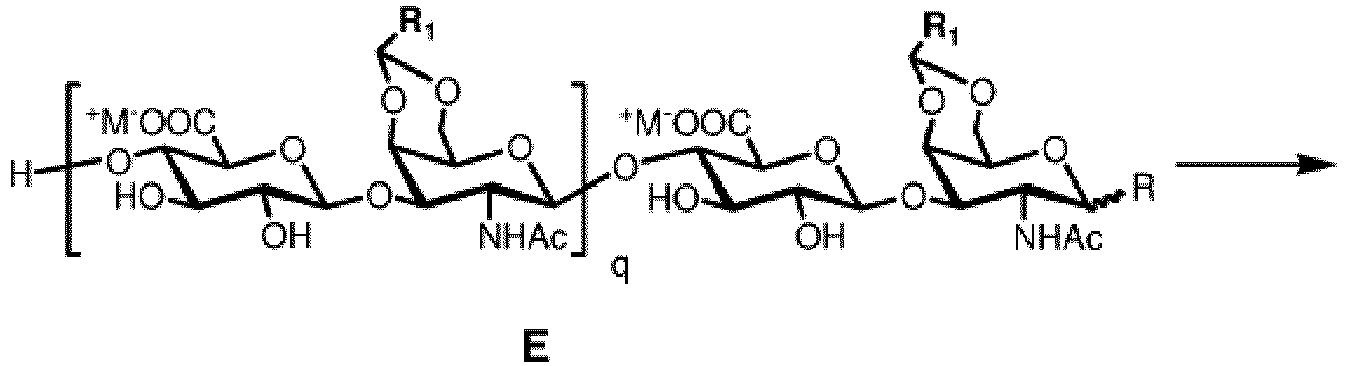
 (6) Reagierenlassen der Verbindung der Formel F mit einer Verbindung der Formel G als Fucose-Donor unter Säurekatalyse, um eine Verbindung der Formel H zu erhalten;
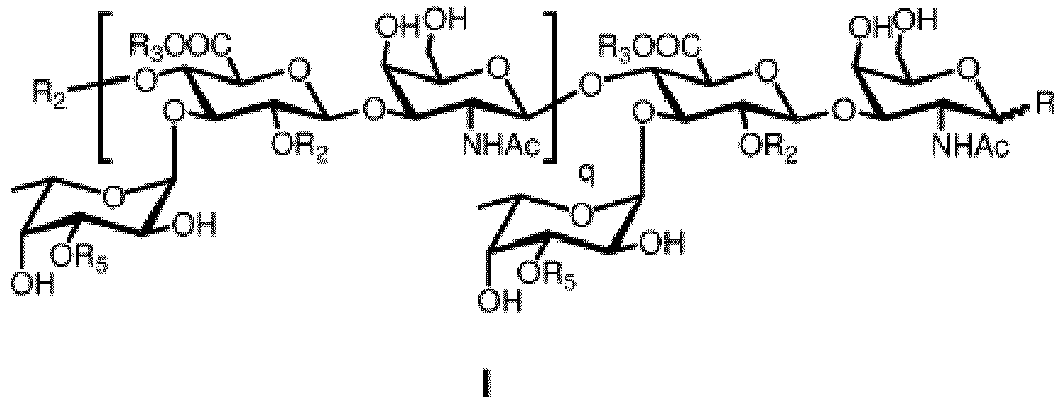
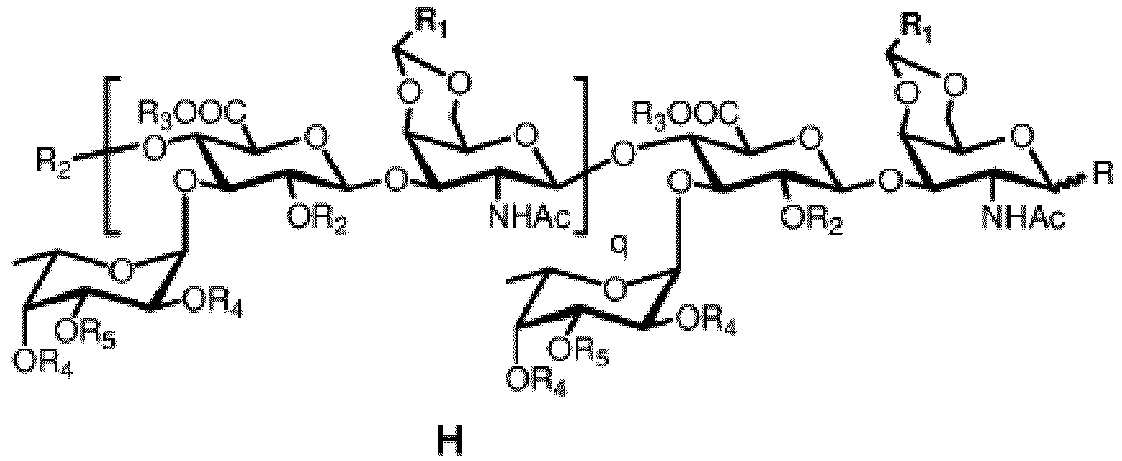 (7) Entfernen des Galactosamin-4,6-OH-Schutzes von der Verbindung der Formel H in Gegenwart einer Säure, gefolgt von selektivem Entfernen der Schutzgruppe R4 an der Fucose, um eine Verbindung der Formel I zu erhalten;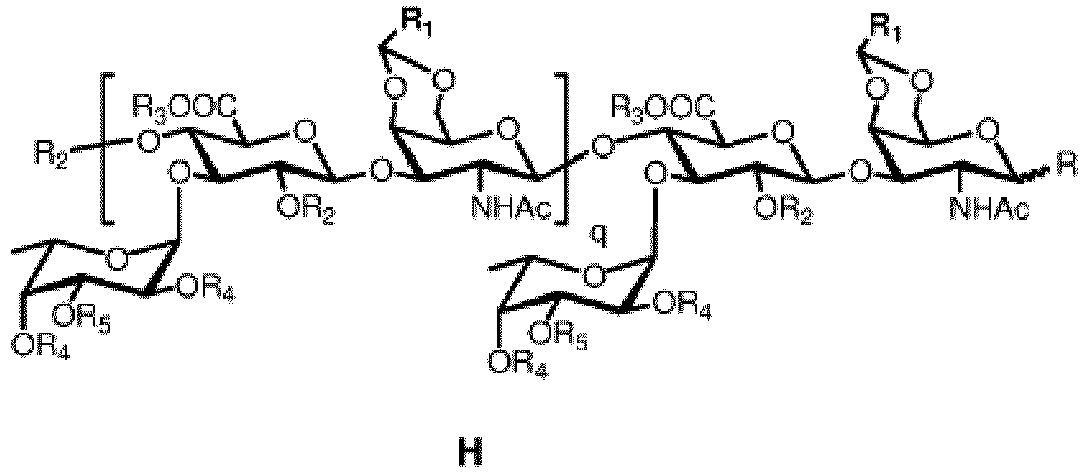
 (8) Unterziehen der Verbindung der Formel I einer Sulfatierung und Entschützung, um die Verbindung der Formel J' zu erhalten;
 wobei in den Verbindungen der Formeln D bis J und RX R Azido, C1-C4-Alkoxy, Phenoxy, C1-C4-Alkylthio, C1-C4-Alkanoylthio, Benzoyloxy oder Benzoylthio ist; wobei vorzugsweise, wenn R Azido, Phenoxy, C1-C4-Alkylthio, C1-C4-Alkanoylthio, Benzoyloxy oder Benzoylthio ist,in β-Konfiguration vorliegt; wenn R C1-C4-Alkoxy ist,in α-Konfiguration vorliegt;wobei X in RX Wasserstoff oder Alkalimetall ist;wobei in R1C(O)H oder R1C(O)H-dialiphatischem Alkohol und den Verbindungen der Formeln E bis H R1 unsubstituiertes Phenyl oder substituiertes Phenyl ist, wobei sich das substituierte Phenyl auf einen Benzolring bezieht, der durch einen oder zwei oder mehrere Substituenten substituiert ist, die ausgewählt sind aus einem oder mehreren von Halogen, Nitro, C1-C4-Alkyl, C1-C4-Haloalkyl und C1-C4-Alkoxy; und, gegebenenfalls sich der Substituent an einer beliebigen Position des Benzolrings befindet; vorzugsweise R1 ausgewählt ist aus einem von Phenyl, 4-Methoxyphenyl, 4-Chlorphenyl und 4-Bromphenyl, besonders bevorzugt R1 ausgewählt ist aus einem von Phenyl und 4-Methoxyphenyl; wobei der aliphatische Alkohol in R1C(O)H oder R1C(O)H-dialiphatischem Alkohol Cl-C4-Alkanol, vorzugsweise Methanol, ist;wobei in dem Anhydrid R2-O-R2 oder den Verbindungen der Formeln F bis I R2 ausgewählt ist aus aliphatischem Acyl, unsubstituiertem Benzoyl oder substituiertem Benzoyl und Acetylpropionyl; wobei sich das aliphatische Acyl auf C2-C6-Alkanoyl bezieht; das substituierte Benzoyl sich auf den Benzolring bezieht, der durch einen oder zwei oder mehrere Substituenten substituiert ist, die ausgewählt sind aus einem oder mehreren von Halogen, Nitro, C1-C4-Alkyl, C1-C4-Haloalkyl und C1-C4-Alkoxy; und, gegebenenfalls sich der Substituent an einer beliebigen Position des Benzolrings befindet; vorzugsweise R2 ausgewählt ist aus einem von Acetyl, Benzoyl, 4-ChlorBenzoyl und 4-BromBenzoyl, besonders bevorzugt R2 ausgewählt ist aus Acetyl und Benzoyl; wobei in R3OH oder den Verbindungen der Formeln F bis I R3 ausgewählt ist aus unsubstituiertem Benzyl oder substituiertem Benzyl, C1-C4-Alkyl, C1-C4-Alkoxy und Allyl; wobei sich das substituierte Benzyl auf einen Benzolring bezieht, der durch einen oder zwei oder mehrere Substituenten substituiert ist, die ausgewählt sind aus einem oder mehreren von Halogen, Nitro, Cl-C4-Alkyl, C1-C4-Haloalkyl und C1-C4-Alkoxy; und, gegebenenfalls sich der Substituent an einer beliebigen Position des Benzolrings befindet; vorzugsweise R3 ausgewählt ist aus einem von Methyl, Ethyl, Allyl, Benzyl und 4-Methoxybenzyl, besonders bevorzugt R3 ausgewählt ist aus Methyl, Ethyl und Benzyl;wobei in den Verbindungen der Formeln G bis H R4 ausgewählt ist aus unsubstituiertem Benzyl oder substituiertem Benzyl; sich das substituierte Benzyl auf einen Benzolring bezieht, der durch einen oder zwei oder mehrere Substituenten substituiert ist, die ausgewählt sind aus einem oder mehreren von Halogen, Nitro, C1-C4-Alkyl, C1-C4-Haloalkyl und C1-C4-Alkoxy; und, gegebenenfalls sich der Substituent an einer beliebigen Position des Benzolrings befindet; vorzugsweise R4 Benzyl oder p-Methoxybenzyl ist;wobei in den Verbindungen der Formeln G bis I R5 ausgewählt ist aus einem von aliphatischem Acyl, unsubstituiertem Benzoyl oder substituiertem Benzoyl und Acetylpropionyl; wobei sich das aliphatische Acyl auf C2-C6-Alkanoyl bezieht; das substituierte Benzoyl sich auf den Benzolring bezieht, der durch einen oder zwei oder mehrere Substituenten substituiert ist, die ausgewählt sind aus einem oder mehreren von Halogen, Nitro, C1-C4-Alkyl, C1-C4-Haloalkyl und C1-C4-Alkoxy; und, gegebenenfalls sich der Substituent an einer beliebigen Position des Benzolrings befindet; vorzugsweise R5 ausgewählt ist aus einem von Acetyl, Benzoyl, Acetylpropionyl, 4-ChlorBenzoyl und 4-BromBenzoyl, besonders bevorzugt Acetyl, Acetylpropionyl oder Benzoyl;wobei Et in der Verbindung der Formel G Ethyl ist;wobei in den Formeln A bis D und der MOH-Base M Natrium, Kalium, Lithium oder Calcium ist, vorzugsweise ausgewählt aus Natrium.
 - Verfahren zur Synthese des fucosylierten Chondroitinsulfat-Oligosaccharids nach Anspruch 5, wobei in Schritt (1) die anorganische Säure ausgewählt ist aus einem oder mehreren von Chlorwasserstoff, Schwefelsäure, Salpetersäure und Phosphorsäure, vorzugsweise Chlorwasserstoff oder Schwefelsäure; das C1-C4-Alkanol Methanol oder Ethanol ist, vorzugsweise ausgewählt aus Methanol; und die MOH-Base NaOH, KOH oder LiOH, vorzugsweise NaOH ist.
- Verfahren zur Synthese des fucosylierten Chondroitinsulfat-Oligosaccharids nach Anspruch 5, wobei in Schritt (2) die Hyaluronidase vorzugsweise eine Aktivität von 400-1000 IE/mg aufweist und in einer Menge von 2,0 bis 3,0 % der Masse von Chondroitin zugegeben wird, d. h. der Verbindung der Formel B, und die Reaktionstemperatur 37 °C beträgt; "schwach sauer" sich auf einen pH-Wert der Pufferlösung von 3,0 bis 6,5 bezieht, vorzugsweise ausgewählt aus 5,0 bis 5,2; die Pufferlösung sich auf einen der Folgenden bezieht: Essigsäure-Natriumacetat-Puffer, Essigsäure-Kaliumacetat-Puffer, Natriumdihydrogenphosphat-Dinatriumhydrogenphosphat-Puffer oder Kaliumdihydrogenphosphat-Dikaliumhydrogenphosphat-Puffer, vorzugsweise ausgewählt aus Essigsäure-Natriumacetat-Puffer; die Konzentration des Puffers ausgewählt ist aus 0,01 M bis 1 M, vorzugsweise der Puffer ausgewählt ist aus 0,1 M Essigsäure-Natriumacetat-Puffer; Natriumchlorid einer Konzentration sich auf eine Konzentration von Natriumchlorid bezieht, ausgewählt aus 0,05 M bis 0,5 M, vorzugsweise ausgewählt aus 0,15 M; die Hyaluronidase ausgewählt ist aus einer Hyaluronidase, die aus Tierhoden stammt;wobei gegebenenfalls in Schritt (3), wenn RX Natriumazid, Natriumphenolat, Natrium-C1-C4-alkylthio, Natrium-C1-C4-Alkanoylthio, Natriumbenzoat oder NatriumBenzoylthio ist, die Verbindung der Formel C mit Natriumazid, Natriumphenolat, Natrium-C1-C4-Alkylthio, Natrium-C1-C4-Alkanoylthio, Natriumbenzoat oder NatriumBenzoylthio reagiert, in einer basischen Lösung in Gegenwart von 2-Chlor-1,3-dimethylimidazolinchlorid, um die Verbindung der Formel D zu erhalten, und in der Verbindung der Formel Din β-Konfiguration ist; wobei die in der basischen Lösung verwendete organische Base ausgewählt ist aus einem oder mehreren von Triethylamin, N-Methylmorpholin, Pyridin, 2,6-Dimethylpyridin und Diisopropylethylamin; wenn RX C1-C4-Alkylalkohol ist, die Verbindung der Formel C über Nacht in einer Alkylalkohollösung von HCl reagiert und dann Carboxyl unter basischen Bedingungen freisetzt, um die Verbindung der Formel D zu erhalten, und in der Verbindung der Formel D: in einer α-Konfiguration ist;wobei die unter basischen Bedingungen verwendete anorganische Base ausgewählt ist aus einem oder mehreren von Natriumhydroxid, Kaliumhydroxid und Lithiumhydroxid;wobei gegebenenfalls in Schritt (4) "unter Säurekatalyse" sich auf das Vorliegen der folgenden Protonensäuren oder Lewis-Säuren bezieht: vorzugsweise in Gegenwart von p-Toluolsulfonsäure oder Camphersulfonsäure;wobei gegebenenfalls die in Schritt (5) verwendete Base ausgewählt ist aus einem oder mehreren von Natriummethoxid und Natriumacetat;wobei gegebenenfalls in Schritt (6) "unter Säurekatalyse" sich auf das Vorliegen der folgenden Protonensäuren oder Lewis-Säuren bezieht: eine oder mehrere ausgewählt aus Trifluormethansulfonsäure, Alkylsilyltrifluormethansulfonat, Metallsalz von Trifluormethansulfonat und Bortrifluoridetherat, vorzugsweise ausgewählt aus Metallsalz von Trifluormethansulfonat; die Reaktion in einem organischen Lösungsmittel durchgeführt wird, ausgewählt aus einem oder mehreren von Dichlormethan, N,N-Dimethylformamid, Chloroform, Diethylether und Toluol, vorzugsweise aus einem gemischten Lösungsmittel aus Dichlormethan und N,N-Dimethylformamid, wobei das Volumenverhältnis von Dichlormethan zu N,N-Dimethylformamid 3 : 1 bis 2 : 1 ist;wobei gegebenenfalls in Schritt (7) die verwendete Säure ausgewählt ist aus einer oder mehreren von Essigsäure, Camphersulfonsäure und p-Toluolsulfonsäure; das zum "selektiven Entfernen der Schutzgruppe R4 an der Fucose" verwendete Reagens ausgewählt ist aus Cerammoniumnitrat und DDQ;wobei gegebenenfalls in Schritt (8) das zur Sulfatierung verwendete Reagens ausgewählt ist aus einem von Pyridin-Schwefeltrioxid-Komplex, Schwefeltrioxid-Trimethylamin-Komplex und Schwefeltrioxid-Triethylamin-Komplex, und die Sulfatierung gegebenenfalls in wasserfreiem Pyridin oder wasserfreiem DMF durchgeführt wird; die Entschützung in einem gemischten Lösungsmittel aus Tetrahydrofuran und Wasser durchgeführt wird, wobei das Verhältnis von Tetrahydrofuran zu Wasser 3 : 1 bis 2 : 1 beträgt und die Base eines oder zwei von Lithiumhydroxid und Natriumhydroxid ist.
- Zwischenverbindung zum Synthetisieren von fucosyliertem Chondroitinsulfat-Oligosaccharid, wobei die Zwischenverbindung ausgewählt ist aus einer der Verbindungen der Formeln D bis I:


- Zwischenverbindung nach Anspruch 8, wobei die Zwischenverbindung aus einer der folgenden Verbindungen ausgewählt ist:Azido[(β-D-Glucopyranosyluronsäure)-(1→3)-(2-desoxy-2-N-acetamido-β-D-Galactopyranosyl)-(1→4)-(β-D-Glucopyranosyluronsäure)-(1→3)-(2-desoxy-2-N-acetamido-β-D-Galactopyranosyl)]-Dinatriumsalz;Azido[(β-D-Glucopyranosyluronsäure)-(1→3)-(2-desoxy-2-N-acetamido-β-D-Galactopyranosyl)-(1→4)-(β-D-Glucopyranosyluronsäure)-(1→3)-(2-desoxy-2-N-acetamido-β-D-Galactopyranosyl)-(1→4)-(β-D-Glucopyranosyluronsäure)-(1→3)-(2-desoxy-2-N-acetamido-β-D-Galactopyranosyl)-Trinatriumsalz;Azido[(β-D-Glucopyranosyluronsäure)-(1→3)-(4,6-O-Benzyliden-2-desoxy-2-N-acetamido-β-D-Galactopyranosyl)-(1→4)-(β-D-Glucopyranosyluronsäure)-(1→3)-(4,6-O-Benzyliden-2-desoxy-2-N-acetamido-β-D-Galactopyranosyl)]-Dinatriumsalz;Azido[(β-D-Glucopyranosyluronsäure)-(1→3)-(4,6-O-Benzyliden-2-desoxy-2-N-acetamido-β-D-Galactopyranosyl)-(1→4)-(β-D-Glucopyranosyluronsäure)-(1→3)-(4,6-O-Benzyliden-2-desoxy-2-N-acetamido-β-D-Galactopyranosyl)-(1→4)-(β-D-Glucopyranosyluronsäure)-(1→3)-(4,6-O-Benzyliden-2-desoxy-2-N-acetamido-β-D-Galactopyranosyl)]-Trinatriumsalz;Azido[(2,4-di-O-Benzoyl-β-D-Methylglucopyranosyluronat)-(1→3)-(4,6-O-Benzyliden-2-desoxy-2-N-acetamido-β-D-Galactopyranosyl)-(1→4)-(2-O-Benzoyl-β-D-Methylglucopyranosyluronat)-(1→3)-(4,6-O-Benzyliden-2-desoxy-2-N-acetainido-β-D-Galactopyranosyl)],Azido[(2,4-di-O-Benzoyl-β-D-Methylglucopyranosyluronat)-(1→3)-(4,6-O-Benzyliden-2-desoxy-2-N-acetamido-β-D-Galactopyranosyl)-(1→4)-(2-O-Benzoyl-β-D-Methylglucopyranosyluronat)-(1→3)-(4,6-O-Benzyliden-2-desoxy-2-N-acetainido-β-D-Galactopyranosyl)-(1→4)-(2-O-Benzoyl-β-D-Methylglucopyranosyluronat)-(1→3)-(4,6-O-Benzyliden-2-desoxy-2-N-acetamido-β-D-Galactopyranosyl)];Azido{(2,4-di-O-p-Methoxybenzyl-3-O-Acetylpropionyl-α-L-Fucosyl)-(1→3)-(2,4-di-O-Benzoyl-β-D-Methylglucopyranosyluronat)-(1→3)-(4,6-O-Benzyliden-2-desoxy-2-N-acetamino-β-D-Galactopyranosyl)-(1→4)-[(2,4-di-O-p-Methoxybenzyl-3-O-Acetylpropionyl-α-L-Fucosyl)-(1→3)-(2-O-Benzoyl-β-D-Methylglucopyranosyluronat)-(1→3)-(4,6-O-Benzyliden-2-desoxy-2-N-acetamido-ß-D-Galactopyranosyl)] };Azido{(2,4-di-O-p-Methoxybenzyl-3-O-Acetylpropionyl-α-L-Fucosyl)-(1→3)-(2,4-di-O-Benzoyl-β-D-Methylglucopyranosyluronat)-(1→3)-(4,6-O-Benzyliden-2-desoxy-2-N-acetamino-β-D-Galactopyranosyl)-(1→4)-[(2,4-di-O-p-Methoxybenzyl-3-O-Acetylpropionyl-α-L-Fucosyl)-(1→3)-(2-O-Benzoyl-β-D-Methylglucopyranosyluronat)-(1→3)-(4,6-O-Benzyliden-2-desoxy-2-N-acetamido-β-D-Galactopyranosyl)]-(1→4)-[(2,4-di-O-p-Methoxybenzyl-3-O-Acetylpropionyl-α-L-Fucosyl)-(1→3)-(2-O-Benzoyl-β-D-Methylglucopyranosyluronat)-(1→3)-(4,6-O-Benzyliden-2-desoxy-2-N-acetamido-β-D-Galactopyranosyl)]};Azido{(3-O-Acetylpropionyl-α-L-Fucosyl)-(1→3)-(2,4-di-O-Benzoyl-β-D-Methylglucopyranosyluronat)-(1→3)-(2-desoxy-2-N-acetamino-β-D-Galactopyranosyl)-(1→4)-[(3-O-Acetylpropionyl-α-L-Fucosyl)-(1→3)-(2-O-Benzoyl-β-D-Methylglucopyranosyluronat)-(1→3)-(2-desoxy-2-N-acetamido-β-D-Galactopyranosyl)]};Azido{(3-O-Acetylpropionyl-α-L-Fucosyl)-(1→3)-(2,4-di-O-Benzoyl-β-D-Methylglucopyranosyluronat)-(1→3)-(2-desoxy-2-N-acetamino-β-D-Galactopyranosyl)-(1→4)-[(3-O-Acetylpropionyl-α-L-Fucosyl)-(1→3)-(2-O-Benzoyl-β-D-Methylglucopyranosyluronat)-(1→3)-(2-desoxy-2-N-acetamido-β-D-Galactopyranosyl)]-(1→4)-[(3-O-Acetylpropionyl-α-L-Fucosyl)-(1→3)-(2-O-Benzoyl-β-D-Methylglucopyranosyluronat)-(1→3)-(2-desoxy-2-N-acetamido-β-D-Galactopyranosyl)]};Methyl-[(β-D-Glucopyranosyluronsäure)-(1→3)-(2-desoxy-2-N-acetamido-β-D-Galactopyranosyl)-(1→4)-(β-D-Glucopyranosyluronsäure)-(1→3)-(2-desoxy-2-N-acetamido-α-D-Galactopyranosyl)]-Dinatriumsalz;Methyl-[(β-D-Glucopyranosyluronsäure)-(1→3)-(4,6-O-Benzyliden-2-desoxy-2-N-acetamido-β-D-Galactopyranosyl)-(1→4)-(β-D-Glucopyranosyluronsäure)-(1→3)-(4,6-O-Benzyliden-2-desoxy-2-N-acetamido-α-D-Galactopyranosyl)]-Dinatriumsalz;Methyl-[(2,4-di-O-Benzoyl-β-D-Methylglucopyranosyluronat)-(1→3)-(4,6-O-Benzyliden-2-desoxy-2-N-acetamido-β-D-Galactopyranosyl)-(1→4)-(2-O-Benzoyl-β-D-Methylglucopyranosyluronat)-(1→3)-(4,6-O-Benzyliden-2-desoxy-2-N-acetamido-α-D-Galactopyranosyl)];Methyl-{(2,4-di-O-p-Methoxybenzyl-3-O-Acetylpropionyl-α-L-Fucosyl)-(1→3)-(2,4-di-O-Benzoyl-β-D-Methylglucopyranosyluronat)-(1→3)-(4,6-O-Benzyliden-2-desoxy-2-N-acetamino-β-D-Galactopyranosyl)-(1→4)-[(2,4-di-O-p-Methoxybenzyl-3-O-Acetylpropionyl-α-L-Fucosyl)-(1→3)-(2-O-Benzoyl-β-D-Methylglucopyranosyluronat)-(1→3)-(4,6-O-Benzyliden-2-desoxy-2-N-acetamido-α-D-Galactopyranosyl)]}; undMethyl-{(3-O-Acetylpropionyl-α-L-Fucosyl)-(1→3)-(2,4-di-O-Benzoyl-β-D-Methylglucopyranosyluronat)-(1→3)-(2-desoxy-2-N-acetamino-β-D-Galactopyranosyl)-(1→4)-[(3-O-Acetylpropionyl-α-L-Fucosyl)-(1→3)-(2-O-Benzoyl-β-D-Methylglucopyranosyluronat)-(1→3)-(2-desoxy-2-N-acetamido-α-D-Galactopyranosyl)]}.
- Pharmazeutische Zusammensetzung, umfassend das fucosylierte Chondroitinsulfat-Oligosaccharid nach einem der Ansprüche 1 bis 4.
- Verwendung des fucosylierten Chondroitinsulfat-Oligosaccharids nach einem der Ansprüche 1 bis 4 oder der pharmazeutischen Zusammensetzung nach Anspruch 10 bei der Herstellung eines gerinnungshemmenden Medikaments.
Applications Claiming Priority (2)
| Application Number | Priority Date | Filing Date | Title |
|---|---|---|---|
| CN201810778733 | 2018-07-16 | ||
| PCT/CN2019/096033 WO2020015612A1 (zh) | 2018-07-16 | 2019-07-15 | 岩藻糖基化硫酸软骨素寡糖及其制备方法、组合物和用途 |
Publications (3)
| Publication Number | Publication Date |
|---|---|
| EP3819302A1 EP3819302A1 (de) | 2021-05-12 |
| EP3819302A4 EP3819302A4 (de) | 2021-10-13 |
| EP3819302B1 true EP3819302B1 (de) | 2022-10-19 |
Family
ID=69163991
Family Applications (1)
| Application Number | Title | Priority Date | Filing Date |
|---|---|---|---|
| EP19838347.3A Active EP3819302B1 (de) | 2018-07-16 | 2019-07-15 | Fucosyliertes chondroitinsulfat-oligosaccharid, verfahren zu seiner herstellung, zusammensetzung und verwendung davon |
Country Status (7)
| Country | Link |
|---|---|
| US (1) | US12421270B2 (de) |
| EP (1) | EP3819302B1 (de) |
| JP (1) | JP7166450B2 (de) |
| CN (1) | CN110724209B (de) |
| ES (1) | ES2934583T3 (de) |
| PT (1) | PT3819302T (de) |
| WO (1) | WO2020015612A1 (de) |
Families Citing this family (5)
| Publication number | Priority date | Publication date | Assignee | Title |
|---|---|---|---|---|
| CN111471120B (zh) * | 2020-06-16 | 2021-02-26 | 北京赫尔默技术有限公司 | 一种硫酸软骨素的制备方法及应用 |
| JP7747369B2 (ja) * | 2021-09-29 | 2025-10-01 | 北京大学 | 細菌莢膜オリゴ糖誘導体及びその製造方法、医薬組成物、使用 |
| CN114990175B (zh) * | 2021-10-22 | 2023-03-31 | 岩唐生物科技(杭州)有限责任公司 | 一种岩藻糖衍生物的合成方法 |
| WO2025157248A1 (zh) * | 2024-01-26 | 2025-07-31 | 烟台东诚药业集团股份有限公司 | 一种岩藻糖基化硫酸软骨素寡糖衍生物及其应用 |
| CN119708287B (zh) * | 2024-11-28 | 2025-11-18 | 复旦大学 | 一种用于治疗心肌梗塞的化合物 |
Family Cites Families (9)
| Publication number | Priority date | Publication date | Assignee | Title |
|---|---|---|---|---|
| CN101735336B (zh) * | 2009-11-06 | 2012-07-18 | 深圳海王药业有限公司 | 低聚岩藻糖化糖胺聚糖及其制备方法 |
| CN104558070B (zh) | 2013-10-14 | 2017-10-24 | 北京大学 | 新芒果苷的化学合成方法及中间体化合物 |
| CN106467563B (zh) | 2015-08-21 | 2019-08-06 | 北京大学 | 硫酸软骨素四糖的合成方法及其中间体化合物 |
| JP6147322B2 (ja) | 2015-10-01 | 2017-06-14 | ゼリアヘルスウエイ株式会社 | サーチュイン1活性化剤 |
| CN106349407A (zh) * | 2016-08-29 | 2017-01-25 | 中国海洋大学 | 一种低分子量岩藻糖化硫酸软骨素及其制备方法和在制备抗特鲁索综合征的药物中的应用 |
| CN106645483B (zh) | 2016-12-26 | 2019-05-21 | 大连工业大学 | 一种定量检测海参多糖的方法 |
| CN108794653B (zh) | 2017-05-05 | 2020-07-17 | 烟台东诚药业集团股份有限公司 | 岩藻糖基化硫酸软骨素寡糖糖簇及其制备方法 |
| CN107261147A (zh) | 2017-05-29 | 2017-10-20 | 钟术光 | 一种稳定活体生物活性材料的组合物 |
| CN109912668B (zh) | 2019-01-17 | 2022-06-14 | 中国科学院昆明植物研究所 | 岩藻糖化硫酸软骨素三糖的制备方法、中间体和用途 |
-
2019
- 2019-07-15 ES ES19838347T patent/ES2934583T3/es active Active
- 2019-07-15 CN CN201910637636.XA patent/CN110724209B/zh active Active
- 2019-07-15 US US17/775,893 patent/US12421270B2/en active Active
- 2019-07-15 WO PCT/CN2019/096033 patent/WO2020015612A1/zh not_active Ceased
- 2019-07-15 EP EP19838347.3A patent/EP3819302B1/de active Active
- 2019-07-15 PT PT198383473T patent/PT3819302T/pt unknown
- 2019-07-15 JP JP2021525352A patent/JP7166450B2/ja active Active
Also Published As
| Publication number | Publication date |
|---|---|
| PT3819302T (pt) | 2022-12-23 |
| ES2934583T3 (es) | 2023-02-23 |
| US20230029252A1 (en) | 2023-01-26 |
| EP3819302A4 (de) | 2021-10-13 |
| JP2021529877A (ja) | 2021-11-04 |
| CN110724209B (zh) | 2021-11-19 |
| US12421270B2 (en) | 2025-09-23 |
| EP3819302A1 (de) | 2021-05-12 |
| CN110724209A (zh) | 2020-01-24 |
| WO2020015612A1 (zh) | 2020-01-23 |
| JP7166450B2 (ja) | 2022-11-07 |
Similar Documents
| Publication | Publication Date | Title |
|---|---|---|
| US12421270B2 (en) | Oligosaccharide, preparation method therefor, composition thereof and use thereof | |
| US5543403A (en) | Sulfated glycosaminoglycanoid derivatives of the heparin and heparan sulfate type | |
| CN104245718B (zh) | 制备磺达肝素钠的方法及其合成中使用的中间体 | |
| RU2167163C2 (ru) | Синтетические полисахариды, способ их получения и содержащая их фармацевтическая композиция | |
| CN104144938B (zh) | 用于制造磺达肝素钠的有效和可扩缩方法 | |
| KR100324583B1 (ko) | 3-데옥시올리고사카라이드,상기화합물을제조하는방법및상기화합물을함유하는약제학적조성물 | |
| HU215152B (hu) | Eljárás pentaszacharid egységet tartalmazó szénhidrátszármazékok és ezeket tartalmazó gyógyszerkészítmények előállítására | |
| NO179452B (no) | Sulfaterte glukosamin-glukanoid-derivater | |
| CA2253113C (en) | Carbohydrate derivatives | |
| Zhou et al. | Toward synthesis of the regular sequence of heparin: synthesis of two tetrasaccharide precursors | |
| US5773605A (en) | Sulfated glycosaminoglycanoid derivatives of the heparin sulfate type | |
| CN106467563B (zh) | 硫酸软骨素四糖的合成方法及其中间体化合物 | |
| BR9709722B1 (pt) | polissacarÍdeos sintÉticos, processo para sua preparaÇço, composiÇÕes farmacÉuticas que os contÉm e ultilizaÇço dos mesmos. | |
| Sawant et al. | Formal synthesis of a disaccharide repeating unit (IdoA–GlcN) of heparin and heparan sulfate | |
| Kuszmann et al. | Synthesis of 2, 5-anhydro-(β-d-glucopyranosyluronate)-and (α-l-idopyranosyluronate)-d-mannitol hexa-O-sulfonate hepta sodium salt | |
| Herczeg et al. | Synthesis of disaccharide fragments of the AT-III binding domain of heparin and their sulfonatomethyl analogues | |
| US5529985A (en) | Sulfated glycosaminoglycanoid derivatives of the dermatan sulfate and chondroitin sulfate type | |
| Maki et al. | Studies on the Fischer's Glucal-hydrobromid-diacetat and Glucal-hydrobromid-triacetat | |
| Miranda et al. | Ferric chloride: a mild and versatile reagent for the formation of 1, 6-anhydro glucopyranoses | |
| US20220289782A1 (en) | A Compound with High Anticoagulant Activity and Its Preparation Method and Application | |
| Du et al. | A simple access to 3, 6-branched oligosaccharides: Synthesis of a glycopeptide derivative that relates to Lycium barbarum L. | |
| CN114478659B (zh) | 一种二糖化合物的制备方法 | |
| EP2857411B1 (de) | Verfahren zur herstellung eines heparin-pentasaccharids für vollen schutz und zwischenprodukt davon | |
| Tsuda et al. | Preparation of Novel 1, 6-Anhydro-. BETA.-lactose Derivatives for the Synthesis of N-Acetyllactosamine-Containing Oligosaccharides. | |
| EP2272855A2 (de) | Herstellung von L-Iduronat-Haltigen Polysacchariden |
Legal Events
| Date | Code | Title | Description |
|---|---|---|---|
| STAA | Information on the status of an ep patent application or granted ep patent |
Free format text: STATUS: THE INTERNATIONAL PUBLICATION HAS BEEN MADE |
|
| PUAI | Public reference made under article 153(3) epc to a published international application that has entered the european phase |
Free format text: ORIGINAL CODE: 0009012 |
|
| STAA | Information on the status of an ep patent application or granted ep patent |
Free format text: STATUS: REQUEST FOR EXAMINATION WAS MADE |
|
| 17P | Request for examination filed |
Effective date: 20210208 |
|
| AK | Designated contracting states |
Kind code of ref document: A1 Designated state(s): AL AT BE BG CH CY CZ DE DK EE ES FI FR GB GR HR HU IE IS IT LI LT LU LV MC MK MT NL NO PL PT RO RS SE SI SK SM TR |
|
| A4 | Supplementary search report drawn up and despatched |
Effective date: 20210915 |
|
| RIC1 | Information provided on ipc code assigned before grant |
Ipc: A61P 29/00 20060101ALI20210909BHEP Ipc: C07H 13/08 20060101ALI20210909BHEP Ipc: C07H 11/00 20060101AFI20210909BHEP |
|
| DAV | Request for validation of the european patent (deleted) | ||
| DAX | Request for extension of the european patent (deleted) | ||
| RIC1 | Information provided on ipc code assigned before grant |
Ipc: C08B 37/00 20060101ALI20220406BHEP Ipc: A61P 29/00 20060101ALI20220406BHEP Ipc: C07H 13/08 20060101ALI20220406BHEP Ipc: C07H 11/00 20060101AFI20220406BHEP |
|
| GRAP | Despatch of communication of intention to grant a patent |
Free format text: ORIGINAL CODE: EPIDOSNIGR1 |
|
| STAA | Information on the status of an ep patent application or granted ep patent |
Free format text: STATUS: GRANT OF PATENT IS INTENDED |
|
| INTG | Intention to grant announced |
Effective date: 20220513 |
|
| GRAS | Grant fee paid |
Free format text: ORIGINAL CODE: EPIDOSNIGR3 |
|
| GRAA | (expected) grant |
Free format text: ORIGINAL CODE: 0009210 |
|
| STAA | Information on the status of an ep patent application or granted ep patent |
Free format text: STATUS: THE PATENT HAS BEEN GRANTED |
|
| AK | Designated contracting states |
Kind code of ref document: B1 Designated state(s): AL AT BE BG CH CY CZ DE DK EE ES FI FR GB GR HR HU IE IS IT LI LT LU LV MC MK MT NL NO PL PT RO RS SE SI SK SM TR |
|
| REG | Reference to a national code |
Ref country code: GB Ref legal event code: FG4D |
|
| REG | Reference to a national code |
Ref country code: CH Ref legal event code: EP |
|
| REG | Reference to a national code |
Ref country code: IE Ref legal event code: FG4D |
|
| REG | Reference to a national code |
Ref country code: DE Ref legal event code: R096 Ref document number: 602019020917 Country of ref document: DE |
|
| REG | Reference to a national code |
Ref country code: AT Ref legal event code: REF Ref document number: 1525501 Country of ref document: AT Kind code of ref document: T Effective date: 20221115 |
|
| REG | Reference to a national code |
Ref country code: PT Ref legal event code: SC4A Ref document number: 3819302 Country of ref document: PT Date of ref document: 20221223 Kind code of ref document: T Free format text: AVAILABILITY OF NATIONAL TRANSLATION Effective date: 20221220 |
|
| REG | Reference to a national code |
Ref country code: NL Ref legal event code: FP |
|
| REG | Reference to a national code |
Ref country code: SE Ref legal event code: TRGR |
|
| REG | Reference to a national code |
Ref country code: LT Ref legal event code: MG9D |
|
| REG | Reference to a national code |
Ref country code: ES Ref legal event code: FG2A Ref document number: 2934583 Country of ref document: ES Kind code of ref document: T3 Effective date: 20230223 |
|
| REG | Reference to a national code |
Ref country code: AT Ref legal event code: MK05 Ref document number: 1525501 Country of ref document: AT Kind code of ref document: T Effective date: 20221019 |
|
| PG25 | Lapsed in a contracting state [announced via postgrant information from national office to epo] |
Ref country code: NO Free format text: LAPSE BECAUSE OF FAILURE TO SUBMIT A TRANSLATION OF THE DESCRIPTION OR TO PAY THE FEE WITHIN THE PRESCRIBED TIME-LIMIT Effective date: 20230119 Ref country code: LT Free format text: LAPSE BECAUSE OF FAILURE TO SUBMIT A TRANSLATION OF THE DESCRIPTION OR TO PAY THE FEE WITHIN THE PRESCRIBED TIME-LIMIT Effective date: 20221019 Ref country code: FI Free format text: LAPSE BECAUSE OF FAILURE TO SUBMIT A TRANSLATION OF THE DESCRIPTION OR TO PAY THE FEE WITHIN THE PRESCRIBED TIME-LIMIT Effective date: 20221019 Ref country code: AT Free format text: LAPSE BECAUSE OF FAILURE TO SUBMIT A TRANSLATION OF THE DESCRIPTION OR TO PAY THE FEE WITHIN THE PRESCRIBED TIME-LIMIT Effective date: 20221019 |
|
| PG25 | Lapsed in a contracting state [announced via postgrant information from national office to epo] |
Ref country code: RS Free format text: LAPSE BECAUSE OF FAILURE TO SUBMIT A TRANSLATION OF THE DESCRIPTION OR TO PAY THE FEE WITHIN THE PRESCRIBED TIME-LIMIT Effective date: 20221019 Ref country code: PL Free format text: LAPSE BECAUSE OF FAILURE TO SUBMIT A TRANSLATION OF THE DESCRIPTION OR TO PAY THE FEE WITHIN THE PRESCRIBED TIME-LIMIT Effective date: 20221019 Ref country code: LV Free format text: LAPSE BECAUSE OF FAILURE TO SUBMIT A TRANSLATION OF THE DESCRIPTION OR TO PAY THE FEE WITHIN THE PRESCRIBED TIME-LIMIT Effective date: 20221019 Ref country code: IS Free format text: LAPSE BECAUSE OF FAILURE TO SUBMIT A TRANSLATION OF THE DESCRIPTION OR TO PAY THE FEE WITHIN THE PRESCRIBED TIME-LIMIT Effective date: 20230219 Ref country code: HR Free format text: LAPSE BECAUSE OF FAILURE TO SUBMIT A TRANSLATION OF THE DESCRIPTION OR TO PAY THE FEE WITHIN THE PRESCRIBED TIME-LIMIT Effective date: 20221019 Ref country code: GR Free format text: LAPSE BECAUSE OF FAILURE TO SUBMIT A TRANSLATION OF THE DESCRIPTION OR TO PAY THE FEE WITHIN THE PRESCRIBED TIME-LIMIT Effective date: 20230120 |
|
| REG | Reference to a national code |
Ref country code: DE Ref legal event code: R097 Ref document number: 602019020917 Country of ref document: DE |
|
| PG25 | Lapsed in a contracting state [announced via postgrant information from national office to epo] |
Ref country code: SM Free format text: LAPSE BECAUSE OF FAILURE TO SUBMIT A TRANSLATION OF THE DESCRIPTION OR TO PAY THE FEE WITHIN THE PRESCRIBED TIME-LIMIT Effective date: 20221019 Ref country code: RO Free format text: LAPSE BECAUSE OF FAILURE TO SUBMIT A TRANSLATION OF THE DESCRIPTION OR TO PAY THE FEE WITHIN THE PRESCRIBED TIME-LIMIT Effective date: 20221019 Ref country code: EE Free format text: LAPSE BECAUSE OF FAILURE TO SUBMIT A TRANSLATION OF THE DESCRIPTION OR TO PAY THE FEE WITHIN THE PRESCRIBED TIME-LIMIT Effective date: 20221019 Ref country code: DK Free format text: LAPSE BECAUSE OF FAILURE TO SUBMIT A TRANSLATION OF THE DESCRIPTION OR TO PAY THE FEE WITHIN THE PRESCRIBED TIME-LIMIT Effective date: 20221019 Ref country code: CZ Free format text: LAPSE BECAUSE OF FAILURE TO SUBMIT A TRANSLATION OF THE DESCRIPTION OR TO PAY THE FEE WITHIN THE PRESCRIBED TIME-LIMIT Effective date: 20221019 |
|
| PLBE | No opposition filed within time limit |
Free format text: ORIGINAL CODE: 0009261 |
|
| STAA | Information on the status of an ep patent application or granted ep patent |
Free format text: STATUS: NO OPPOSITION FILED WITHIN TIME LIMIT |
|
| PG25 | Lapsed in a contracting state [announced via postgrant information from national office to epo] |
Ref country code: SK Free format text: LAPSE BECAUSE OF FAILURE TO SUBMIT A TRANSLATION OF THE DESCRIPTION OR TO PAY THE FEE WITHIN THE PRESCRIBED TIME-LIMIT Effective date: 20221019 Ref country code: AL Free format text: LAPSE BECAUSE OF FAILURE TO SUBMIT A TRANSLATION OF THE DESCRIPTION OR TO PAY THE FEE WITHIN THE PRESCRIBED TIME-LIMIT Effective date: 20221019 |
|
| 26N | No opposition filed |
Effective date: 20230720 |
|
| PG25 | Lapsed in a contracting state [announced via postgrant information from national office to epo] |
Ref country code: SI Free format text: LAPSE BECAUSE OF FAILURE TO SUBMIT A TRANSLATION OF THE DESCRIPTION OR TO PAY THE FEE WITHIN THE PRESCRIBED TIME-LIMIT Effective date: 20221019 |
|
| PG25 | Lapsed in a contracting state [announced via postgrant information from national office to epo] |
Ref country code: MC Free format text: LAPSE BECAUSE OF FAILURE TO SUBMIT A TRANSLATION OF THE DESCRIPTION OR TO PAY THE FEE WITHIN THE PRESCRIBED TIME-LIMIT Effective date: 20221019 |
|
| PG25 | Lapsed in a contracting state [announced via postgrant information from national office to epo] |
Ref country code: MC Free format text: LAPSE BECAUSE OF FAILURE TO SUBMIT A TRANSLATION OF THE DESCRIPTION OR TO PAY THE FEE WITHIN THE PRESCRIBED TIME-LIMIT Effective date: 20221019 |
|
| PG25 | Lapsed in a contracting state [announced via postgrant information from national office to epo] |
Ref country code: LU Free format text: LAPSE BECAUSE OF NON-PAYMENT OF DUE FEES Effective date: 20230715 |
|
| PG25 | Lapsed in a contracting state [announced via postgrant information from national office to epo] |
Ref country code: LU Free format text: LAPSE BECAUSE OF NON-PAYMENT OF DUE FEES Effective date: 20230715 |
|
| REG | Reference to a national code |
Ref country code: IE Ref legal event code: MM4A |
|
| PG25 | Lapsed in a contracting state [announced via postgrant information from national office to epo] |
Ref country code: IE Free format text: LAPSE BECAUSE OF NON-PAYMENT OF DUE FEES Effective date: 20230715 |
|
| PG25 | Lapsed in a contracting state [announced via postgrant information from national office to epo] |
Ref country code: IE Free format text: LAPSE BECAUSE OF NON-PAYMENT OF DUE FEES Effective date: 20230715 |
|
| PG25 | Lapsed in a contracting state [announced via postgrant information from national office to epo] |
Ref country code: BG Free format text: LAPSE BECAUSE OF FAILURE TO SUBMIT A TRANSLATION OF THE DESCRIPTION OR TO PAY THE FEE WITHIN THE PRESCRIBED TIME-LIMIT Effective date: 20221019 |
|
| PG25 | Lapsed in a contracting state [announced via postgrant information from national office to epo] |
Ref country code: BG Free format text: LAPSE BECAUSE OF FAILURE TO SUBMIT A TRANSLATION OF THE DESCRIPTION OR TO PAY THE FEE WITHIN THE PRESCRIBED TIME-LIMIT Effective date: 20221019 |
|
| PGFP | Annual fee paid to national office [announced via postgrant information from national office to epo] |
Ref country code: PT Payment date: 20250604 Year of fee payment: 7 |
|
| PG25 | Lapsed in a contracting state [announced via postgrant information from national office to epo] |
Ref country code: CY Free format text: LAPSE BECAUSE OF FAILURE TO SUBMIT A TRANSLATION OF THE DESCRIPTION OR TO PAY THE FEE WITHIN THE PRESCRIBED TIME-LIMIT; INVALID AB INITIO Effective date: 20190715 |
|
| PG25 | Lapsed in a contracting state [announced via postgrant information from national office to epo] |
Ref country code: HU Free format text: LAPSE BECAUSE OF FAILURE TO SUBMIT A TRANSLATION OF THE DESCRIPTION OR TO PAY THE FEE WITHIN THE PRESCRIBED TIME-LIMIT; INVALID AB INITIO Effective date: 20190715 |
|
| PGFP | Annual fee paid to national office [announced via postgrant information from national office to epo] |
Ref country code: NL Payment date: 20250722 Year of fee payment: 7 |
|
| PGFP | Annual fee paid to national office [announced via postgrant information from national office to epo] |
Ref country code: ES Payment date: 20250801 Year of fee payment: 7 |
|
| PGFP | Annual fee paid to national office [announced via postgrant information from national office to epo] |
Ref country code: DE Payment date: 20250724 Year of fee payment: 7 |
|
| PGFP | Annual fee paid to national office [announced via postgrant information from national office to epo] |
Ref country code: IT Payment date: 20250722 Year of fee payment: 7 |
|
| PGFP | Annual fee paid to national office [announced via postgrant information from national office to epo] |
Ref country code: BE Payment date: 20250721 Year of fee payment: 7 Ref country code: GB Payment date: 20250722 Year of fee payment: 7 |
|
| PGFP | Annual fee paid to national office [announced via postgrant information from national office to epo] |
Ref country code: FR Payment date: 20250722 Year of fee payment: 7 |
|
| PGFP | Annual fee paid to national office [announced via postgrant information from national office to epo] |
Ref country code: CH Payment date: 20250801 Year of fee payment: 7 Ref country code: SE Payment date: 20250721 Year of fee payment: 7 |
|
| PG25 | Lapsed in a contracting state [announced via postgrant information from national office to epo] |
Ref country code: TR Free format text: LAPSE BECAUSE OF FAILURE TO SUBMIT A TRANSLATION OF THE DESCRIPTION OR TO PAY THE FEE WITHIN THE PRESCRIBED TIME-LIMIT Effective date: 20221019 |