EP3824868B1 - Härtbare zusammensetzung für einen zahnabdruck - Google Patents
Härtbare zusammensetzung für einen zahnabdruck Download PDFInfo
- Publication number
- EP3824868B1 EP3824868B1 EP19210349.7A EP19210349A EP3824868B1 EP 3824868 B1 EP3824868 B1 EP 3824868B1 EP 19210349 A EP19210349 A EP 19210349A EP 3824868 B1 EP3824868 B1 EP 3824868B1
- Authority
- EP
- European Patent Office
- Prior art keywords
- integer
- curable composition
- independently
- surfactant
- group
- Prior art date
- Legal status (The legal status is an assumption and is not a legal conclusion. Google has not performed a legal analysis and makes no representation as to the accuracy of the status listed.)
- Active
Links
Classifications
-
- A—HUMAN NECESSITIES
- A61—MEDICAL OR VETERINARY SCIENCE; HYGIENE
- A61K—PREPARATIONS FOR MEDICAL, DENTAL OR TOILETRY PURPOSES
- A61K6/00—Preparations for dentistry
- A61K6/90—Compositions for taking dental impressions
-
- C—CHEMISTRY; METALLURGY
- C08—ORGANIC MACROMOLECULAR COMPOUNDS; THEIR PREPARATION OR CHEMICAL WORKING-UP; COMPOSITIONS BASED THEREON
- C08L—COMPOSITIONS OF MACROMOLECULAR COMPOUNDS
- C08L83/00—Compositions of macromolecular compounds obtained by reactions forming in the main chain of the macromolecule a linkage containing silicon with or without sulfur, nitrogen, oxygen or carbon only; Compositions of derivatives of such polymers
- C08L83/10—Block- or graft-copolymers containing polysiloxane sequences
- C08L83/12—Block- or graft-copolymers containing polysiloxane sequences containing polyether sequences
-
- A—HUMAN NECESSITIES
- A61—MEDICAL OR VETERINARY SCIENCE; HYGIENE
- A61K—PREPARATIONS FOR MEDICAL, DENTAL OR TOILETRY PURPOSES
- A61K31/00—Medicinal preparations containing organic active ingredients
- A61K31/695—Silicon compounds
-
- B—PERFORMING OPERATIONS; TRANSPORTING
- B01—PHYSICAL OR CHEMICAL PROCESSES OR APPARATUS IN GENERAL
- B01J—CHEMICAL OR PHYSICAL PROCESSES, e.g. CATALYSIS OR COLLOID CHEMISTRY; THEIR RELEVANT APPARATUS
- B01J23/00—Catalysts comprising metals or metal oxides or hydroxides, not provided for in group B01J21/00
- B01J23/38—Catalysts comprising metals or metal oxides or hydroxides, not provided for in group B01J21/00 of noble metals
- B01J23/54—Catalysts comprising metals or metal oxides or hydroxides, not provided for in group B01J21/00 of noble metals combined with metals, oxides or hydroxides provided for in groups B01J23/02 - B01J23/36
- B01J23/56—Platinum group metals
-
- C—CHEMISTRY; METALLURGY
- C08—ORGANIC MACROMOLECULAR COMPOUNDS; THEIR PREPARATION OR CHEMICAL WORKING-UP; COMPOSITIONS BASED THEREON
- C08L—COMPOSITIONS OF MACROMOLECULAR COMPOUNDS
- C08L83/00—Compositions of macromolecular compounds obtained by reactions forming in the main chain of the macromolecule a linkage containing silicon with or without sulfur, nitrogen, oxygen or carbon only; Compositions of derivatives of such polymers
- C08L83/04—Polysiloxanes
-
- C—CHEMISTRY; METALLURGY
- C08—ORGANIC MACROMOLECULAR COMPOUNDS; THEIR PREPARATION OR CHEMICAL WORKING-UP; COMPOSITIONS BASED THEREON
- C08G—MACROMOLECULAR COMPOUNDS OBTAINED OTHERWISE THAN BY REACTIONS ONLY INVOLVING UNSATURATED CARBON-TO-CARBON BONDS
- C08G77/00—Macromolecular compounds obtained by reactions forming a linkage containing silicon with or without sulfur, nitrogen, oxygen or carbon in the main chain of the macromolecule
- C08G77/04—Polysiloxanes
- C08G77/12—Polysiloxanes containing silicon bound to hydrogen
-
- C—CHEMISTRY; METALLURGY
- C08—ORGANIC MACROMOLECULAR COMPOUNDS; THEIR PREPARATION OR CHEMICAL WORKING-UP; COMPOSITIONS BASED THEREON
- C08G—MACROMOLECULAR COMPOUNDS OBTAINED OTHERWISE THAN BY REACTIONS ONLY INVOLVING UNSATURATED CARBON-TO-CARBON BONDS
- C08G77/00—Macromolecular compounds obtained by reactions forming a linkage containing silicon with or without sulfur, nitrogen, oxygen or carbon in the main chain of the macromolecule
- C08G77/04—Polysiloxanes
- C08G77/14—Polysiloxanes containing silicon bound to oxygen-containing groups
- C08G77/16—Polysiloxanes containing silicon bound to oxygen-containing groups to hydroxy groups
-
- C—CHEMISTRY; METALLURGY
- C08—ORGANIC MACROMOLECULAR COMPOUNDS; THEIR PREPARATION OR CHEMICAL WORKING-UP; COMPOSITIONS BASED THEREON
- C08G—MACROMOLECULAR COMPOUNDS OBTAINED OTHERWISE THAN BY REACTIONS ONLY INVOLVING UNSATURATED CARBON-TO-CARBON BONDS
- C08G77/00—Macromolecular compounds obtained by reactions forming a linkage containing silicon with or without sulfur, nitrogen, oxygen or carbon in the main chain of the macromolecule
- C08G77/04—Polysiloxanes
- C08G77/20—Polysiloxanes containing silicon bound to unsaturated aliphatic groups
-
- C—CHEMISTRY; METALLURGY
- C08—ORGANIC MACROMOLECULAR COMPOUNDS; THEIR PREPARATION OR CHEMICAL WORKING-UP; COMPOSITIONS BASED THEREON
- C08G—MACROMOLECULAR COMPOUNDS OBTAINED OTHERWISE THAN BY REACTIONS ONLY INVOLVING UNSATURATED CARBON-TO-CARBON BONDS
- C08G77/00—Macromolecular compounds obtained by reactions forming a linkage containing silicon with or without sulfur, nitrogen, oxygen or carbon in the main chain of the macromolecule
- C08G77/42—Block-or graft-polymers containing polysiloxane sequences
- C08G77/46—Block-or graft-polymers containing polysiloxane sequences containing polyether sequences
Definitions
- the present invention relates to a curable composition for dental impression and a use thereof.
- the present invention also relates to a method of taking an impression.
- Room temperature vulcanizing silicone rubbers are known as dental impression materials, especially for their mechanical performances and elastic properties. Moreover, addition silicones have a good dimensional stability after days from the impression taking.
- Addition silicones impression materials are usually made by polysiloxanes vinyl terminated and cross linkers having Si-H groups into the chain: they typically react in the presence of a platinum catalyst (hydrosilylation reaction - see e.g. US7592377B2 , Dental Materials and Their selection, William J. O'Brien, Quintessence Publishing Co. - ISBN-13: 978-0867154375 ).
- Condensation silicones impression materials that are normally made by polysiloxanes hydroxy terminated and alkoxysilanes cross linkers: they react usually in the presence of a tin catalyst (see e.g. Dental Materials and Their selection, William J. O'Brien, Quintessence Publishing Co. - ISBN-13: 978-0867154375 , US4389496A , US5925723A , US6218461 B1 ).
- Fillers and additives are typically added both to addition and condensation silicones to improve their mechanical performances or get specific organoleptic properties.
- the fluid materials named extra light, light, regular or monophase, can therefore easily penetrate in the gingival sulcus with a better marginal sulcus detail reproduction.
- the surfactant performance into a dental impression material is evaluated with the contact angle measurement and in particular with the sessile drop method.
- modified trisiloxane polyalkyleneoxides super spreading surfactants having the following formula: was reported in US4657959 .
- the modified trisiloxane polyalkyleneoxides are a powerful class of surfactants, since they have at the same time a quite high efficacy in reducing the surface tension ( ⁇ 20mN/m) and, especially, a very high spread area with respect to other surfactants with a more pronounced effect in reducing the surface tension ( Kovalchuk et al, Fluoro vs Hydrocarbon surfactants: why do they differ in wetting performance? Advance in Colloid and Interface Science, Volume 210 (2014), pages 65-71 ).
- the efficacy as a superspreader is lower when it is englobed in a matrix. This is caused by the lower migration capacity towards the impression material surface.
- the modified trisiloxane polyalkyleneoxides cannot reach the critical wetting concentration (CWC) when they are dispersed into a complicated mixture of ingredients.
- CWC critical wetting concentration
- the CWC is the concentration where these surfactants become superspreader and has been determined by Svitova and others (Langmuir 1998, 14, 5023-5031 ).
- compositions containing one or more additional surfactants, have been proposed to help the modified trisiloxane polyalkyleneoxides to perform properly and reach easily the impression material surface (see e.g. EP1976479B1 , US7812065 , DE112007000073 , EP2231102B1 ed US8466210 ).
- compositions proposed so far have some drawbacks, among which the following are hereby cited: the concentration of the modified trisiloxane polyalkyleneoxides (in particular, when it is used alone) needs to be relatively high; the proposed additional surfactant/s has/have a negative environmental impact, not being biodegradable; and the contact angles obtained are not always satisfactory.
- a curable composition for dental impression a use of a dental composition and a method of taking an impression are provided, as recited in the following independent claims and, preferably, in any one of the claims directly or indirectly depending on the independent claims.
- aliphatic means a non-aromatic and non-substituted (radical) hydrocarbon (unless the contrary is specified), saturated or unsaturated, linear, branched and/or cyclic.
- Non-limiting examples of aliphatic groups are: t-butyl, ethenyl, 1- or 2-propenyl, cyclohexyl.
- C x -C y refers to a group that is meant as having from x to y carbon atoms.
- alkyl means a saturated aliphatic (i.e., an aliphatic group without double or triple carbon-carbon bonds).
- alkyls are: methyl, n-propyl, t-butyl, cyclohexyl.
- PFC perfluorinated compound
- polyfluoroalkyl an organofluorine compound (radical) containing only carbon-fluorine bonds and C-C bonds (no C-H bonds).
- alkoxy means an alkyl containing an oxygen which is bonded to two carbons.
- a curable composition for dental impression comprising:
- R is a methyl.
- (each) R 1 is -C 3 H 6 -.
- (each) R 2 is an -H.
- (each) R 3 is selected (independently of the others) from a group consisting of: -H and a methyl; in particular, (each) R 3 is a methyl.
- x is an integer from 0 to 1 (in particular, x is zero).
- y is an integer from 1 to 5 (in particular, y is 1 or 2; more in particular, y is 1).
- a is an integer from 5 to 20 (in particular, a is 6 to 8; more in particular a is 7).
- b is zero.
- the surfactant system further comprises a second surfactant, which, according to some non-limiting embodiments, has (is at least one compound having) the following formula (II):
- first surfactant (I) works synergistically with second surfactant (II) so as to permit the composition to have a surprisingly low contact angle. Please note that these results were achieved with relatively low concentration of the surfactants. In this respect, it has been supposed that the second surfactant increases the migration capacity of the first surfactant towards the impression material surface.
- both the first and the second surfactant are biodegradable and therefore the composition has an environmental impact appreciably more positive with respect to the composition of the state of the art.
- the fluorinated chains of the second surfactant are relatively short.
- k, j, z, r, d and t are each, independently of one another, an integer from 1 to 6, in particular from 1 to 3.
- q is an integer from 1 to 40, in particular from 1 to 20 (more particularly, q is an integer from 1 to 10).
- Rf are each, independently of one another, a C 1 -C 4 fluorine containing alkyl (in particular, a perfluorinated alkyl).
- Rf i are each, independently of one another, selected from a group consisting of: CF 3 -CF 2 -CF 2 -O-CF(CF 3 )-CH 2 -, CF 3 -(CF 2 ) 2 -(CH 2 )- and CF 3 -(CF 2 )-(CH 2 )-.
- R 4 represent the structural formula (III)
- R 5 represents the structural formula (V) and R 6 represents the structural formula (VII).
- R 5 represents the structural formula (V)
- R 4 represents the structural formula (III)
- R 6 represents the structural formula (VII).
- R 6 represents the structural formula (VII)
- R 4 represents the structural formula (III); R 5 represents the structural formula (V); and R 6 represents the structural formula (VII). These types of compounds are also disclosed US2017/0217863 .
- R 4 represent the structural formula (IV)
- R 5 represents the structural formula (VI) and R 6 represents the structural formula (VIII).
- R 5 represents the structural formula (VI)
- R 4 represents the structural formula (IV)
- R 6 represents the structural formula (VIII).
- R 6 represents the structural formula (VIII)
- the second surfactant is selected in the group consisting of: Tividia FL2500, Tividia FL2300, Tividia FL3000 and a combination thereof. In some cases, the second surfactant is selected in the group consisting of: Tividia FL2500, Tividia FL2300 and a combination thereof. In particularly advantageous embodiments, the second surfactant comprises (is) Tividia FL2500.
- the curable composition comprises from approximately 0.1% (in particular, from approximately 1%), in particular to approximately 7% (in particular, to approximately 6%) in weight, with respect to the total weight of the curable composition, of the first surfactant.
- the curable composition comprises from approximately 0.1% (in particular, from approximately 0.3%; more in particular, from approximately 0.5%), in particular to approximately 7% (in particular, to approximately 5%; more in particular, to approximately 3%) in weight, with respect to the total weight of the curable composition, of the second surfactant.
- the curable base composition comprises (in particular, consists of) a first component, comprising a (in particular, consisting of at least one) curable organopolysiloxane polymer; a second component, comprising a (in particular, consisting of at least one) a crosslinker compound capable of crosslinking said organopolysiloxane polymer; and (optionally) a third component, comprising (in particular, consisting of) a catalyst capable of catalysing a crosslinking reaction of the first component and the second component.
- the third component is a Platinum or Tin comprising catalyst.
- the curable composition comprises at least approximately 0.005% (more precisely, from approximately 0.01 %), in particular up to approximately 5% (more precisely, to approximately 2%) in weight, with respect to the total weight of the curable composition, of the catalyst.
- the curable composition comprises at least approximately 0.005% (more precisely, from approximately 0.08%), in particular up to approximately 1% (more precisely, to approximately 0.1%) in weight, with respect to the total weight of the curable composition, of the catalyst.
- the curable composition comprises at least approximately 0.5% (more precisely, from approximately 0. 8%), in particular up to approximately 3% (more precisely, to approximately 2%) in weight, with respect to the total weight of the curable composition, of the catalyst.
- the curable base composition also comprises one or more fillers (e.g. quartz and/or fumed silica and/or precipitated silica and/or zirconium oxide and/or aluminum silicate and/or aluminum hydroxide and/or calcium silicates and/or calcium carbonate).
- the curable composition comprises silicon dioxide (e.g. quartz and/or fumed silica).
- the curable composition comprises from approximately 25% (in particular, from approximately 30%; more in particular, from approximately 34%) to approximately 55% (in particular, to approximately 50%) in weight, with respect to the total weight of the curable composition, of silicon dioxide.
- the curable base composition comprises (in particular, consists of) the first component, comprising a (in particular, consisting of at least one) organopolysiloxane with at least two ethylene unsaturated groups; and the second component (a cross-linker), in particular having (at least two, in particular at least three) Si-H groups (into the chain).
- R A and R B can comprise double bonds.
- R A and R B are methyl, ethyl, phenyl, vinyl or 3,3,3-trifluoropropyl radical.
- At least one of R A and R B is a methyl.
- integer w is such that the viscosity of the polymer at 23° C is between 50 cP and 1,000,000 cP.
- Preferred viscosities are of 200-100,000 cP.
- Silicone oils with different viscosities without vinyl groups can be present as plasticizers.
- the third component comprises a hydrosilylation catalyst.
- Said hydrosilylation catalyst can be chloroplatinic acid or a Pt siloxane complex.
- said catalyst can be a metal such as Rh or Pd.
- the total content of SiH in the curable base composition should be such as to ensure the complete reaction of all vinyls present in the curable base composition and, furthermore, the second component (cross-linker) can also be present in slight excess.
- the curable base composition comprises linear or cyclic organopolysiloxanes containing a high concentration of vinyls.
- the presence of said linear or cyclic organopolysiloxanes containing a high concentration of vinyls has the function of adjusting the reactivity of platinum present in the Catalyst.
- curable base composition Other substances that can be present in the curable base composition are pigments and colorants, aromatic substances.
- filler which can be chosen among: extending fillers conferring filling, sliding and appearance properties; and reinforcing fillers with reinforcing function.
- the first one i.e. extending fillers
- the second ones i.e. reinforcing fillers, consist of fumed silica or precipitated silica with quite high BET surface and generally silanized.
- the first component (the organopolysiloxane) has a viscosity from approximately 20 cP to approximately 50000 cP (in particular, from approximately 500 cP to approximately 20000 cP).
- the second component comprises (in particular, consists of) an organohydrogen siloxane and/or an organohydrogen polysiloxane.
- the second component comprises (in particular, consists of) methylhydrogensiloxane. More precisely, the second component (in particular, the methylhydrogensiloxane) has a viscosity of 10 (in particular, from approximately 50) to approximately 200 (in particular, to approximately 70) cP (even more precisely about 60 cP).
- the methylhydrogensiloxane has 1 to 10 mmol/g SiH content.
- the third component is a Platinum comprising catalyst.
- the curable composition comprises at least approximately 0.005% (more precisely, from approximately 0.08%), in particular up to approximately 1% (more precisely, to approximately 0.1%) in weight, with respect to the total weight of the curable composition, of the catalyst.
- the Platinum comprising catalyst comprise (is) Karstedt catalyst.
- the curable composition comprises at least approximately 35% (more precisely, at least approximately 40%), in particular up to approximately 70% (more precisely, up to approximately 65%) in weight, with respect to the total weight of the curable composition, of the first component.
- the curable composition comprises at least approximately 35% (more precisely, at least approximately 40%), in particular up to approximately 55% (more precisely, up to approximately 50%) in weight, with respect to the total weight of the curable composition, of the first component (organopolysiloxane with at least two ethylene unsaturated groups).
- the curable composition comprises at least approximately 1% (more precisely, at least approximately 5%), in particular up to approximately 20% (more precisely, up to approximately 15%) in weight, with respect to the total weight of the curable composition, of the second component.
- the curable composition comprises at least approximately 3% (more precisely, at least approximately 5%), in particular up to approximately 15% (more precisely, up to approximately 10%) in weight, with respect to the total weight of the curable composition, of the second component (organohydrogen siloxane and/or organohydrogen polysiloxane).
- the curable base composition comprises (in particular, consists of) a first component, comprising a (in particular, consisting of at least one) hydroxy terminated organopolysiloxane; and a second component (a cross-linker) comprising (in particular, consisting of) an alkoxysilane.
- hydroxy terminated organopolysiloxanes i.e. organopolysiloxanes that can harden by means of a condensation reaction
- organopolysiloxanes that can harden by means of a condensation reaction
- hydroxy terminated organopolysiloxanes are compounds have the following formula (XVI) HO-SiR* 2 -B1-SiR* 2 -OH (XVI) wherein, R* are each, independently of one another, a C 1 -C 4 aliphatic (in particular, alkyl; more in particular, a methyl); B1 stands for a radical having the formula -O-(SiR' 2 -O) m2 -, wherein R' are each, independent of one another, a (in particular C 1 -C 6 , more in particular C 1 -C 4 ) alkyl, alkenyl, alkinyl, cycloalkyl, aryl and/or aralkyl (which might be substituted), and m2 is an integer from 10 to 6000, preferably from 20 to 2000.
- R' are each, independent of one another, a (in particular C 1 -C 6 , more in particular C 1 -C 4 ) alkyl (such as a methyl, ethyl, n-propyl, isopropyl or n-butyl).
- a (in particular C 1 -C 6 , more in particular C 1 -C 4 ) alkyl such as a methyl, ethyl, n-propyl, isopropyl or n-butyl).
- alkoxysilanes are compounds with one of the following formulas (XVII), (XVIII) and (XIX).
- R"O m3 -SiR" 3-m3 -B2-SiR" 3-m3 -(OR") m3 (XVII) SiR" m4 (OR**) 4-m4 (XVIII) wherein R" are each, independent of one another, a (in particular C 1 -C 6 , more in particular C 1 -C 4 ) alkyl, alkenyl, alkinyl, cycloalkyl, aryl and/or aralkyl (which might be substituted); R** are each, independent of one another, a (in particular C 1 -C 6 , more in particular C 1 -C 4 ) alkyl, alkenyl, alkinyl, cycloalkyl, aryl and/or aralkyl (which might be substituted); m3 is an integer from 1 to 3; m
- R** are each, independent of one another, a (in particular C 1 -C 6 , more in particular C 1 -C 4 ) alkyl (such as a methyl, ethyl, n-propyl, isopropyl or n-butyl).
- a (in particular C 1 -C 6 , more in particular C 1 -C 4 ) alkyl such as a methyl, ethyl, n-propyl, isopropyl or n-butyl).
- R" are each, independent of one another, a (in particular C 1 -C 6 , more in particular C 1 -C 4 ) alkyl (such as a methyl, ethyl, n-propyl, isopropyl or n-butyl).
- a (in particular C 1 -C 6 , more in particular C 1 -C 4 ) alkyl such as a methyl, ethyl, n-propyl, isopropyl or n-butyl).
- R 1t are each, independent of one another, a (in particular C 1 -C 6 , more in particular C 1 -C 4 ) alkyl (such as a methyl, ethyl, n-propyl, isopropyl or n-butyl).
- a (in particular C 1 -C 6 , more in particular C 1 -C 4 ) alkyl such as a methyl, ethyl, n-propyl, isopropyl or n-butyl).
- the third component is a Tin comprising catalyst.
- the curable composition comprises at least approximately 0.5% (more precisely, from approximately 0. 8%), in particular up to approximately 3% (more precisely, to approximately 2%) in weight, with respect to the total weight of the curable composition, of the catalyst.
- the Tin comprising catalyst comprises (is) Dibutyl-Tin Dilaurate (IUPAC name [Dibutyl(dodecanoyloxy)stannyl] dodecanoate), Dibutyl-Tin Diacetate (IUPAC name [acetyloxy(dibutyl)stannyl] acetate ), Dioctyl-Tin oxide (IUPAC name Dioctyl(oxo)tin - CAS number 870-08-6) and/or Tin(II) Octanoate (IUPAC name lead(2+) octanoate).
- the Tin comprising catalyst comprises (is) Dioctyl-Tin oxide.
- the first component (hydroxy terminated organopolysiloxane) has a viscosity from approximately 500 cP to approximately 80000 cP (in particular, from 1000 cP to approximately 20000 cP).
- the second component comprises (is) Methyltrimethoxysilane, Methyltriethoxysilane, Ethyltrimethoxysilane, Ethyltriethoxysilane, n-Propyltrimethoxysilane, Tetrakis-(butoxy-ethoxy)silane ((CH 3 -(CH 2 ) 3 -O-(CH 2 ) 2 -O) 4 -Si), Methyltriacethoxysilane (CAS No.: 4253-34-3).
- the curable composition comprises from approximately 1% (in particular, from approximately 2%) to approximately 5% (in particular, to approximately 4%) in weight, with respect to the total weight of the curable composition, of the second component (the alkoxysilane).
- the second surfactant has (is at least one compound having) the following formula (IX): wherein Rf ii represents a C 1 -C 6 fluorine containing alkyl; R 7 represents a C 1 -C 4 alkyl; Ra represents a C 1 -C 3 alkyl; Rb represents a C 1 -C 3 alkyl; Rc is selected in the group consisting of: a C 1 -C 6 aliphatic (in particular, alkyl) and a C 1 -C 6 alkoxy; Rp represents a C 1 -C 6 alkyl; ax is an integer from 1 to 10; ay is an integer from 1 to 10; aa is an integer from 0 to 20; ab is an integer from 0 to 20; ac is an integer from 1 to 20; ae is an integer from 0 to 1; with the proviso that when Rc is an alkoxy, ae is 1, and when Rc is an al
- Rc is an alkoxy
- Rq represents a C 1 -C 6 alkyl (and, in particular, is identical to Rp).
- first surfactant (I) works synergistically with second surfactant (IX) so as to surprisingly permit the composition to have a lower contact angle. Please note that these results are reached with relatively low concentrations of the surfactants. In this respect, it has been supposed that the second surfactant increases migration capacity of the first surfactant towards the impression material surface.
- both the first and the second surfactant are biodegradable and therefore the composition has an environmental impact appreciably more positive with respect to the composition of the state of the art.
- Rf represents a C 1 -C 4 (in particular, C 3 -C 4 ; more in particular, C 4 ) fluorine containing (in particular, a perfluorinated) alkyl.
- R 7 represents a C 1 -C 2 alkyl.
- Ra represents a C 2 alkyl (in particular, an ethyl).
- Rb represents a C 2 alkyl (in particular, an ethyl).
- Rc is selected in the group consisting of: a C 3 -C 5 alkyl, a C 2 -C 4 alkoxy.
- ax is an integer from 1 to 6
- ay is an integer from 1 to 6.
- aa is an integer from 0 to 12;
- ab is an integer from 0 to 12.
- ac is an integer from 1 to 16.
- Rf ii represents a C 2 -C 4 fluorine containing (in particular, a perfluorinted) alkyl.
- R 7 represents a C 1 -C 2 alkyl.
- ax is an integer from 1 (in particular, from 4) to 6 (in particular, to 5).
- ay is an integer from 1 (in particular, from 4) to 6 (in particular, to 5).
- aa is zero.
- ab is zero.
- ac is 1.
- Rc represents a C 3 -C 5 alkyl.
- ae is zero.
- ax plus ay is from 4 (in particular, from 5) to 8 (in particular, to 7).
- ac is from 10 (in particular, from 14) to 20 (in particular, to 18); in some specific case, ac is 16.
- Rc is C 3 -C 4 alkoxy (more precisely, -CH 2 -CH(CH 3 )-O-).
- the second surfactant comprises (is) a (at least one) a compound having a formula selected from the group consisting of: and wherein the sum of ax and ay is an integer from 4 to 6.
- the second surfactant comprises (is) a (at least one) compound having a formula selected from the group consisting of: (XIII) and (XIV). In more specific non-limiting case, the second surfactant comprises (is) a (at least one) compound having formula (XIII).
- the second surfactant comprises (is) a surfactant having the following formula: more precisely, the second surfactant is Polyfox PF 159 (Omnova Solutions TM ).
- the second surfactant comprises (is) the surfactant of example 3 (Polyfox PF 7002) reported below.
- the curable composition comprises a fluoro compound, which (has) is at least one compound having a formula selected from the group consisting of: and wherein xx is an integer from 2 to 10; m is an integer from 1 to 20; n is an integer from 0 to 200 (in particular, to 100); Rd are each, independently of one another, selected from a group consisting of: -F, -CF 3 .
- up to two Rd are each a -CF 3 and the remaining Rd are each -F. More particularly, the two -CF 3 are in meta position with respect to each other.
- the fluoro compound is (has) at least one compound having a formula selected from the group consisting of formula (XI) and formula (XII).
- the fluoro compound is (has) at least one compound having the formula (X).
- the curable composition comprises from 0.1% to approximately 3% (in particular, to approximately 1.5%) in weight, with respect to the total weight of the curable composition, of the fluoro compound.
- a use of the curable composition according to the first aspect of the present invention for taking a mold of at least a part of a mouth comprises contacting the curable composition with at least a part of the mouth.
- a method of taking an impression comprising contacting said curable composition according to the first aspect of the present invention with at least a part of a mouth.
- the viscosity measurements are considered to be carried out in accordance to the following.
- the viscosities are and were measured using a Brookfield viscometer DVII. The measurement is performed at 23°C and 20 rpm of the spindle.
- An ULA spindle is and was used with a viscosity in the range 20-200 cP.
- the spindle SC4-21 is and was used with a viscosity in the range 500-1000 cP.
- the spindle SC4-29 is and was used with a viscosity in the range 2000-20000 cP,
- the spindle SC4-29 is and was used with a viscosity in the range 50000-100000 cP.
- This example discloses the procedure followed for the measurement of the contact angles (sessile drop technique).
- a distilled water drop was put on the hardened silicone surface, 50 ⁇ m thick, at the following environment conditions: temperature 23 ⁇ 1°C and relative humidity 50 ⁇ 10%.
- the measurement was performed after 5 and 30 seconds starting from the deposition.
- compositions tested in examples from 2 to 15 and had the following components ADDITION SILICONES Base Catalyst COMPONENTS: Polyvinylsiloxane 31,25 % 57,29 % Micronized quartz (1-10 ⁇ m) 52,08 % 42,69 % Methylhydrogensiloxane 15,63 % Platinum catalyst 0,02 % Pigments 0,52 % Flavors 0,52 % Surfactant s weight phr t weight phr
- Polyvinylsiloxane had the following viscosities: 200 cP (15% with respect to base plus catalyst, 0.28 mmol/g vinyl content), 1000 cP (5% with respect to Base plus Catalyst, 0.127 mmol/g vinyl content), 2000 cP (20% with respect to Base plus Catalyst, 0.097 mmol/g vinyl content), 20000 cP (5% with respect to base plus catalyst, 0.04 mmol/g vinyl content).
- Methylhydrogensiloxane had a viscosity of 60 cP and 1.7 mmol/g as SiH content.
- the components mixing was performed using the following working instruction.
- the Base prepared using a vertical mixer with a cowless (sawblade impeller): pigments were dispersed in Polyvinylsiloxane for 5 minutes; thereafter, quartz and fumed silica were added and mixed for 20 minutes. During this last step, also the flavors were added and mixed for 10 minutes.
- the Catalyst was prepared using a vertical mixer with a cowless (sawblade impeller): pigments were dispersed in Methylhydrogensiloxane for 5 minutes; and then quartz and fumed silica were added and mixed for 20 minutes. During the last step, the Platinum catalyst was added and mixed for 10 minutes.
- the surfactant was added to the blends described above and mixed for a total of 15 minutes.
- the surfactant was added between 3 weight phr (parts per hundred rubber/resin - in weight) and 6.4 weight phr to both the blends (s and t from 3 to 6.4 weight phr).
- the phr is to be considered with respect to the weight of all the other components/ingredients of the composition/blend. For example, if the surfactant had 6.4 weight phr, the total weight of the composition would be 106.4 and the ratio of the weight of the surfactant with respect of the total weight of the composition would 6.4/106.4 (corresponding to about 6wt%).
- the Base and the Catalyst obtained after the addition of the surfactant were introduced in a 50 ml cartridge (25 ml of Base and 25 ml of Catalyst, 1:1), mixing was therefore performed using a dispenser and mixing tip for each example.
- compositions tested the examples 16 to 19 had the following components.
- CONDENSATION SILICONES Base Catalyst COMPONENTS Polysiloxane hydroxy terminated 60,50 % Micronized quartz (1-10 ⁇ m) 38,50 % Alkoxysilanes 70,00 % Tin catalyst 29,00 % Pigments 0,5 % 0,5 % Flavours 0,5 % 0,5 % Surfactant s weight phr t weight phr
- Polysiloxane hydroxy terminated had the following viscosities: 2000 cP (25% with respect to the base), 5000 cP (35.5% with respect to the base).
- Silicon dioxide was quartz and fumed silica.
- Alkoxysilane was Tetrakis-(butoxy-ethoxy)silane - (CH 3 -(CH 2 ) 3 -O-(CH 2 ) 2 -0) 4 -Si.
- Tin catalyst was Dioctyltin oxide.
- the components mixing was performed using the following working instruction.
- the Base was prepared using a vertical mixer with a cowless: pigments were dispersed in Polysiloxane hydroxy terminated in 5 minutes, then quartz and fumed silica were added and mixed for 20 minutes. During this last step, the flavors were added and mixed for 10 minutes (the last 5 minutes under vacuum).
- the Catalyst was prepared in the following way: hydrocarbons were melted in a reactor at 90°C and mixed with pigments for a total period of 3 hours, then alkoxysilanes and flavours were added and mixed for 1 hour.
- the surfactant was added to the blends described above and mixed for a total of 15 minutes.
- the surfactant was added with a percentage between 1 weight phr and 2.5 weight phr (s and t from 1 to 2.5 weight phr).
- Base was introduced in a 140 ml tube and Catalyst in a 60 ml tube for each example.
- the surfactant was 3 weight phr Silwet L77 (Momentive TM ), which had the following formula: where R and R 3 was -CH 3 , R 1 was -C 3 H 6 -, R 2 was hydrogen, x was 0 or 1, y was 1 or 2, a was about 7 and b was 0.
- the contact angle was 33.7° at 5 seconds and 15.5° at 30 seconds.
- the surfactant was 3 weight phr Silwet L77 and 1 weight phr Polyfox PF 7002 (Omnova Solutions TM ), whose structure was the following one:
- the contact angle was 37.1° at 5 seconds and 11.5° at 30 seconds.
- the contact angle was 22.3° at 5 seconds and 10.3° at 30 seconds.
- composition had a better contact angle than the example 3, where Polyfox PF 7002 was alone together with Silwet L77.
- the surfactant was 3 weight phr Silwet L77, 1 weight phr Polyfox PF 7002 and 0.5 weight phr Perfluorodecalin, whose structure was the following one:
- the contact angle was 24.9° at 5 seconds and 6.9° at 30 seconds.
- the fluorinated compound led the composition to have a better contact angle than that of the example 3, where Polyfox PF 7002 was alone together with Silwet L77.
- the surfactant was 3 weight phr Silwet L77, 1 weight phr Polyfox PF 7002 and 0.2 weight phr Perfluoro-1 ,3-dimethylcyclohexane, whose was the following one:
- the contact angle was 27.5 ° at 5 seconds and 8.3° at 30 seconds.
- composition had a better contact angle than that of example 3, where Polyfox PF 7002 was alone together with Silwet L77.
- the surfactant was 3 weight phr Silwet L77, 1 weight phr Polyfox PF 7002 and 0.5 weight phr Perfluoro-1,3-dimethylcyclohexane (see above).
- the contact angle was 24.6 ° at 5 seconds and 7.8° at 30 seconds.
- composition had a better contact angle than that of example 3, where Polyfox PF 7002 was alone together with Silwet L77.
- the increase in Perfluoro-1,3-dimethylcyclohexane quantity did not have a significant effect on the contact angle reduction.
- the surfactant was 3 weight phr Silwet L77, 1 weight phr Polyfox PF 7002 and 0.8 weight phr Perfluoro-1,3-dimethylcyclohexane (see above).
- the contact angle was 25.4° at 5 seconds and 7.8° at 30 seconds.
- composition had a better contact angle than that of example 3, where Polyfox PF 7002 was alone together with Silwet L77.
- the increase in Perfluoro-1,3-dimethylcyclohexane quantity did not have a significant effect on the contact angle reduction.
- the surfactant was 3 weight phr Silwet L77 and 1 weight phr Tivida FL2500 (Merck TM ) (whose structure was the one below, wherein k, j, z, r, d and t were each, independently of one another, an integer from 1 to 10; Rf were each, independently of one another, a C 1 -C 6 fluorine containing alkyl.
- the contact angle was 21.3° at 5 seconds and 1.7° at 30 seconds.
- the performances were better than the reference (example 2), especially at 30 seconds.
- the surfactant was 3 weight phr Silwet L77 and 3.4 weight phr Tivida FL2500 (Merck TM ) (whose structure was the one below, wherein k, j, z, r, d and t were each, independently of one another, an integer from 1 to 10; Rf were each, independently of one another, a C 1 -C 6 fluorine containing alkyl).
- the contact angle was 6.5° at 5 seconds and 1.4° at 30 seconds.
- the performances were significantly better than the reference (example 2), even at 5 seconds.
- the surfactant was 3 weight phr Silwet L77 and 3.4 weight phr Tivida FL2300 (Merck TM ) (whose structure was the one below, wherein k, j, z, r, d and t were each, independently of one another, an integer from 1 to 10; Rf were each, independently of one another, a C 1 -C 6 fluorine containing alkyl).
- the contact angle was 29.1° at 5 seconds and 8.7° at 30 seconds.
- the performances were better than the reference (example 2).
- the surfactant was 3 weight phr Silwet L77 and 1 weight phr Tivida FL3000 (Merck TM ) (whose structure was the one below; wherein q was an integer from 1 to 20 and Rf i were each, independently of one another, selected from a group consisting of: CF 3 -CF 2 -CF 2 -O-CF(CF 3 )-CH 2 - and CF 3 -(CF 2 ) e -(CH 2 )f-, wherein e was an integer from 1 to 7 and f was an integer from 1 to 10).
- the contact angle was 9.4° at 5 seconds and 6.4° at 30 seconds.
- the performances were significantly better than the reference (example 2), even at 5 seconds.
- the surfactant was 3 weight phr Silwet L77 and 1 weight phr FluorN 561 (Cytonix TM ) (whose structure contains 4 groups pendant from a matrix based on polypropylene glycol: 2 perfluoro and 2 polyethylene glycol).
- the contact angle was 46° at 5 seconds and 18.4° at 30 seconds.
- the performances were worse than the reference (example 2).
- the surfactant was 3 weight phr Silwet L77 and 1 weight phr FluorN 562 (Cytonix TM ) (whose structure contains 4 groups pendant from a matrix based on polypropylene glycol: 1 perfluoro and 3 polyethylene glycol).
- the contact angle was 42.1° at 5 seconds and 16.4° at 30 seconds.
- the performances were worse than the reference (example 2).
- the surfactant was 3 weight phr Silwet L77 and 1 weight phr FluorN 2900 (Cytonix) (whose structure was a perfluoroethylene with a high molecular weight, glycol terminated).
- the contact angle was 29.5° at 5 seconds and 13.1° at 30 seconds.
- the performances were not better than the reference (example 2).
- the surfactant was 1 weight phr Silwet L77 (Momentive), which had the following formula: where R and R 3 was -CH 3 , R' was -C 3 H 6 -, R 2 was hydrogen, x was 0 or 1, y was 1 or 2, a was about 7 and b was 0.
- the contact angle was 52.9% at 5 seconds and 35.8° at 30 seconds.
- the surfactant was 1 weight phr Silwet L77 and 1 weight phr Tivida FL3000 (Merck) (whose structure was the one below; wherein q was an integer from 1 to 100 and Rf i were each, independently of one another, selected from a group consisting of: CF 3 -CF 2 -CF 2 -O-CF(CF 3 )-CH 2 - and CF 3 -(CF 2 ) e -(CH 2 )f-, wherein e was an integer from 1 to 7 and m was an integer from 1 to 10).
- the contact angle was 25.4° at 5 seconds and 16.4° at 30 seconds.
- the performances were significantly better than the reference (example 16), even at 5 seconds.
- the surfactant was 1 weight phr Silwet L77 and 1 weight phr Polyfox PF 7002 (Omnova Solutions) (whose structure was the one below).
- the contact angle was 52.1° at 5 seconds and 31.5° at 30 seconds.
- the surfactant was 1 weight phr Silwet L77, 1 weight phr Polyfox PF 7002 and 0.5 weight phr Perfluorodecalin (whose structure was the one below below).
- the contact angle was 27.2° at 5 seconds and 19.5° at 30 seconds.
Landscapes
- Health & Medical Sciences (AREA)
- Chemical & Material Sciences (AREA)
- Oral & Maxillofacial Surgery (AREA)
- Animal Behavior & Ethology (AREA)
- Life Sciences & Earth Sciences (AREA)
- General Health & Medical Sciences (AREA)
- Public Health (AREA)
- Veterinary Medicine (AREA)
- Epidemiology (AREA)
- Organic Chemistry (AREA)
- Medicinal Chemistry (AREA)
- Chemical Kinetics & Catalysis (AREA)
- Polymers & Plastics (AREA)
- Pharmacology & Pharmacy (AREA)
- Engineering & Computer Science (AREA)
- Materials Engineering (AREA)
- Dental Preparations (AREA)
- Compositions Of Macromolecular Compounds (AREA)
Claims (15)
- Härtbare Zusammensetzung für einen Zahnabdruck, umfassend:eine härtbare Basiszusammensetzung undein Tensidsystem, aufweised ein erstes Tensid, das mindestens eine Verbindung mit der folgenden Formel (I) ist
 wobei R jeweils unabhängig voneinander ein C1-C4-Aliphat ist; jedes R1 unabhängig von den anderen ein C1-C6-Aliphat ist; jedes R2 unabhängig von den anderen ausgewählt ist aus einer Gruppe bestehend aus: H und C1-C3-Aliphat; jedes R3, unabhängig von den anderen, ausgewählt ist aus einer Gruppe, bestehend aus: H und C1-C4-Aliphat; x eine ganze Zahl von 0 bis 5 ist; y eine ganze Zahl von 1 bis 10 ist; a eine ganze Zahl von 1 bis 30 ist; b eine ganze Zahl von 0 bis 5 ist;und ein zweites Tensid, das mindestens eine Verbindung mit der folgenden Formel (II) ist:
 wobei R4 ausgewählt ist aus einer Gruppe bestehend aus:
 R5 ausgewählt ist aus einer Gruppe bestehend aus:
 R6 ausgewählt ist aus einer Gruppe bestehend aus:
 wobei k, j, z, r, d und t jeweils unabhängig voneinander eine ganze Zahl von 1 bis 10 sind; q eine ganze Zahl von 1 bis 100 ist; Rf jeweils unabhängig voneinander ein C1-C6-fluorhaltiges Alkyl sind; und Rf' jeweils unabhängig voneinander aus einer Gruppe ausgewählt sind, bestehend aus: CF3-CF2-CF2-O-CF(CF3)-CH2- und CF3-(CF2)e-(CH2)f-, wobei e eine ganze Zahl von 1 bis 7 ist und f eine ganze Zahl von 1 bis 10 ist.
 - Härtbare Zusammensetzung nach Anspruch 1, wobei jedes R ein Methyl ist; jedes R1 eine -C3H6-Gruppe ist; jedes R2 ein H ist; jedes R3 unabhängig von den anderen aus einer Gruppe ausgewählt ist, bestehend aus: H und Methyl; x eine ganze Zahl von 0 bis 1 ist; y eine ganze Zahl von 1 bis 5 ist; a eine ganze Zahl von 5 bis 20 ist; b Null ist;
k, j, z, r, d und t jeweils unabhängig voneinander eine ganze Zahl von 1 bis 6 sind, insbesondere von 1 bis 3; q eine ganze Zahl von 1 bis 40 ist, insbesondere von 1 bis 20; Rf jeweils unabhängig voneinander ein C1-C4-fluorhaltiges Alkyl ist; und Rf' jeweils unabhängig voneinander ausgewählt ist aus einer Gruppe bestehend aus: CF3-CF2-CF2-O-CF(CF3)-CH2-, CF3-(CF2)2-(CH2)- und CF3-(CF2)-(CH2)-. - Härtbare Zusammensetzung nach Anspruch 1 oder 2, wobei R4 Folgendes darstellt:
 R5 stellt dar:
 R6 stellt dar:
- Härtbare Zusammensetzung nach Anspruch 1 oder 2, wobei R4 Folgendes darstellt:
 R5 stellt dar:
 R6 stellt dar:
- Härtbare Zusammensetzung für einen Zahnabdruck, umfassend:eine härtbare Basiszusammensetzung undein Tensidsystem, aufweised ein erstes Tensid, das mindestens eine Verbindung mit der folgenden Formel (I) ist
 wobei R jeweils unabhängig voneinander ein C1-C4-Aliphat ist; jedes R1 unabhängig von den anderen ein C1-C6-Aliphat ist; jedes R2 unabhängig von den anderen ausgewählt ist aus einer Gruppe bestehend aus: H und C1-C3-Aliphat; jedes R3, unabhängig von den anderen, ausgewählt ist aus einer Gruppe, bestehend aus: H und C1-C4-Aliphat; x eine ganze Zahl von 0 bis 5 ist; y eine ganze Zahl von 1 bis 10 ist; a eine ganze Zahl von 1 bis 30 ist; b eine ganze Zahl von 1 bis 5 ist;und ein zweites Tensid, das mindestens eine Verbindung mit der folgenden Formel (IX) ist:
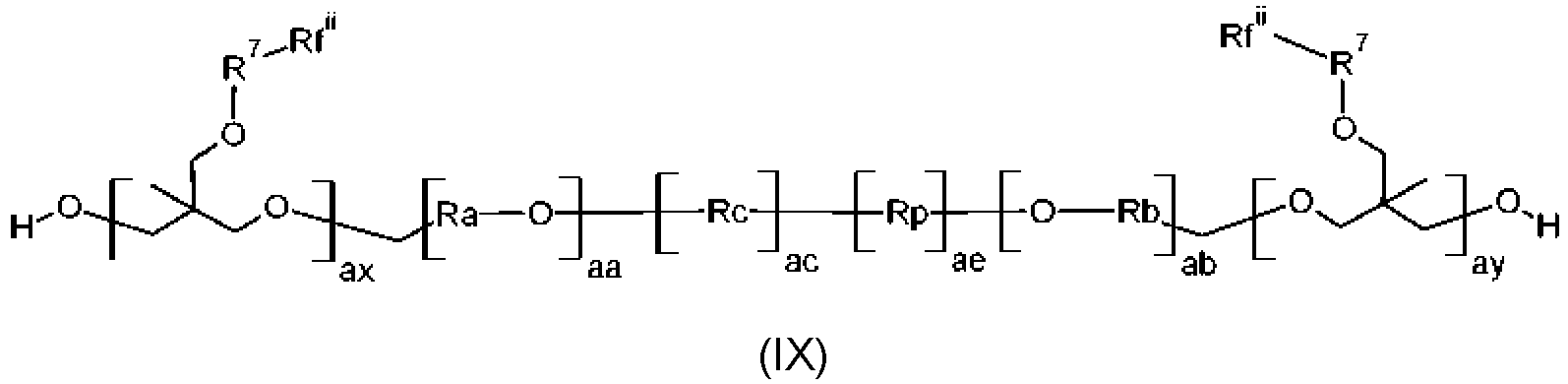 wobei Rfii ein C1-C6-fluorhaltiges Alkyl darstellt; R7 ein C1-C4-Alkyl darstellt; Ra ein C1-C3-Alkyl darstellt; Rb ein C1-C3-Alkyl darstellt; Rc ausgewählt ist aus der Gruppe bestehend aus: einem C1-C6--Aliphat, einem C1-C6-Alkoxy;Rp ein C1-C6-Alkyl darstellt; ax eine ganze Zahl von 1 bis 10 ist; ay eine ganze Zahl von 1 bis 10 ist; aa eine ganze Zahl von 0 bis 20 ist; ab eine ganze Zahl von 0 bis 20 ist;ac eine ganze Zahl von 1 bis 20 ist; ae eine ganze Zahl von 0 bis 1 ist; mit der Maßgabe, dass, wenn Rc ein Alkoxy ist, ae 1 ist, und wenn Rc ein Alkyl ist, ae Null ist.
 - Härtbare Zusammensetzung nach Anspruch 5, wobei Rfii ein C1-C4-fluorhaltiges Alkyl darstellt; R7 ein C1-C2-Alkyl darstellt; Ra ein Ethyl darstellt; Rb ein Ethyl darstellt; Rc ausgewählt ist aus der Gruppe bestehend aus: einem Cs-Cs-Alkyl, einem C2-C4-Alkoxy; ax eine ganze Zahl von 1 bis 6 ist; ay eine ganze Zahl von 1 bis 6 ist; aa eine ganze Zahl von 0 bis 12 ist; ab eine ganze Zahl von 0 bis 12 ist; ac eine ganze Zahl von 1 bis 16 ist.
- Härtbare Zusammensetzung nach Anspruch 5 oder 6, worin Rfii ein C2-C4-Fluor enthaltendes Alkyl darstellt; R7 ein C1-C2-Alkyl darstellt; Rc ein C3-C5-Alkyl darstellt; ax eine ganze Zahl von 1 bis 5 ist; ay eine ganze Zahl von 1 bis 5 ist; aa Null ist; ab Null ist; ac 1 ist; ae Null ist.
- Härtbare Zusammensetzung nach einem der Ansprüche 5 bis 7, und umfassend eine Fluorverbindung, bei der es sich um mindestens eine Verbindung handelt, die eine Formel aufweist, ausgewählt aus der Gruppe bestehend aus:

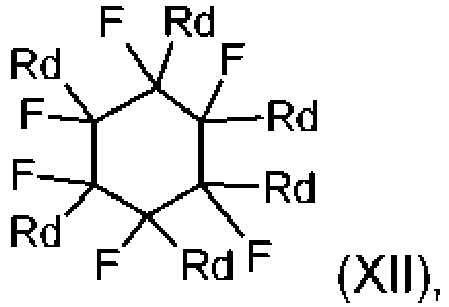
- Härtbare Zusammensetzung nach Anspruch 8, wobei die Fluorverbindung mindestens eine Verbindung ist, die eine Formel aufweist, die aus der Gruppe ausgewählt ist, die aus der Formel (XI) und der Formel (XII) besteht, wobei bis zu zwei Rd jeweils a -CF3 sind und die verbleibenden Rd jeweils -F sind; insbesondere mit der Maßgabe, dass die beiden Rd, die jeweils a -CF3 sind, in meta-Position zueinander stehen.
- Härtbare Zusammensetzung nach einem der vorhergehenden Ansprüche, wobei die härtbare Basiszusammensetzung eine erste Komponente aufweist, die ein härtbares Organopolysiloxanpolymer aufweist; eine zweite Komponente, die eine Vernetzerverbindung aufweist, die in der Lage ist, das Organopolysiloxanpolymer zu vernetzen; eine dritte Komponente, die einen Katalysator aufweist, der in der Lage ist, eine Vernetzungsreaktion der ersten Komponente und der zweiten Komponente zu katalysieren; insbesondere ist die dritte Komponente ein Platin oder Zinn umfassender Katalysator.
- Härtbare Zusammensetzung nach Anspruch 10,
wobei die härtbare Basiszusammensetzung eine erste Komponente aufweist, die ein Organopolysiloxan mit mindestens zwei ungesättigten Ethylengruppen aufweist; eine zweite Komponente, die ein Organowasserstoffsiloxan und/oder ein Organopolysiloxan mit Si-H-Gruppen aufweist; insbesondere ist die dritte Komponente ein Platin enthaltender Katalysator. - Härtbare Zusammensetzung nach Anspruch 10, wobei
die härtbare Basiszusammensetzung eine erste Komponente aufweist, die ein Polysiloxan mit Hydroxy-Endgruppen aufweist; eine zweite Komponente, die ein Alkoxysilan aufweist; insbesondere ist die dritte Komponente ein Zinn, das einen Katalysator aufweist. - Härtbare Zusammensetzung nach einem der vorhergehenden Ansprüche, und aufweisend etwa 0,1 bis etwa 7 Gew.-%, bezogen auf etwa das Gesamtgewicht der härtbaren Zusammensetzung, des ersten Tensids und etwa 0,1 bis etwa 7 Gew.-%, bezogen auf das Gesamtgewicht der härtbaren Zusammensetzung, des zweiten Tensids.
- Verwendung der härtbaren Zusammensetzung nach einem der vorhergehenden Ansprüche zur Entnahme eines Abdrucks von mindestens einem Teil eines Mundes; wobei die Verwendung insbesondere das Inkontaktbringen der härtbaren Zusammensetzung mit mindestens einem Teil des Mundes aufweist.
- Verfahren zur Entnahme eines Abdrucks, umfassend das Inkontaktbringen der härtbaren Zusammensetzung nach einem der Ansprüche 1 bis 13 mit mindestens einem Teil eines Mundes.
Priority Applications (7)
| Application Number | Priority Date | Filing Date | Title |
|---|---|---|---|
| EP19210349.7A EP3824868B1 (de) | 2019-11-20 | 2019-11-20 | Härtbare zusammensetzung für einen zahnabdruck |
| US17/776,280 US12589056B2 (en) | 2019-11-20 | 2020-11-19 | Curable composition for dental impression |
| CA3161425A CA3161425A1 (en) | 2019-11-20 | 2020-11-19 | Curable composition for dental impression |
| CN202080081037.5A CN115151232B (zh) | 2019-11-20 | 2020-11-19 | 用于牙印模的可固化组合物 |
| PCT/EP2020/082681 WO2021099462A1 (en) | 2019-11-20 | 2020-11-19 | Curable composition for dental impression |
| EP20807759.4A EP4061308A1 (de) | 2019-11-20 | 2020-11-19 | Härtbare zusammensetzung für einen zahnabdruck |
| JP2022529552A JP7766593B2 (ja) | 2019-11-20 | 2020-11-19 | 歯科用印象のための硬化性組成物 |
Applications Claiming Priority (1)
| Application Number | Priority Date | Filing Date | Title |
|---|---|---|---|
| EP19210349.7A EP3824868B1 (de) | 2019-11-20 | 2019-11-20 | Härtbare zusammensetzung für einen zahnabdruck |
Publications (3)
| Publication Number | Publication Date |
|---|---|
| EP3824868A1 EP3824868A1 (de) | 2021-05-26 |
| EP3824868B1 true EP3824868B1 (de) | 2023-10-11 |
| EP3824868C0 EP3824868C0 (de) | 2023-10-11 |
Family
ID=68766470
Family Applications (2)
| Application Number | Title | Priority Date | Filing Date |
|---|---|---|---|
| EP19210349.7A Active EP3824868B1 (de) | 2019-11-20 | 2019-11-20 | Härtbare zusammensetzung für einen zahnabdruck |
| EP20807759.4A Withdrawn EP4061308A1 (de) | 2019-11-20 | 2020-11-19 | Härtbare zusammensetzung für einen zahnabdruck |
Family Applications After (1)
| Application Number | Title | Priority Date | Filing Date |
|---|---|---|---|
| EP20807759.4A Withdrawn EP4061308A1 (de) | 2019-11-20 | 2020-11-19 | Härtbare zusammensetzung für einen zahnabdruck |
Country Status (6)
| Country | Link |
|---|---|
| US (1) | US12589056B2 (de) |
| EP (2) | EP3824868B1 (de) |
| JP (1) | JP7766593B2 (de) |
| CN (1) | CN115151232B (de) |
| CA (1) | CA3161425A1 (de) |
| WO (1) | WO2021099462A1 (de) |
Families Citing this family (2)
| Publication number | Priority date | Publication date | Assignee | Title |
|---|---|---|---|---|
| EP3824868B1 (de) | 2019-11-20 | 2023-10-11 | Zhermack S.p.a. | Härtbare zusammensetzung für einen zahnabdruck |
| EP4337728A1 (de) * | 2021-05-12 | 2024-03-20 | Ludwig-Maximilians-Universität München | Zusammensetzungen und verfahren zur verringerung der aggregation von molekülen |
Family Cites Families (20)
| Publication number | Priority date | Publication date | Assignee | Title |
|---|---|---|---|---|
| DE2910560A1 (de) | 1979-03-17 | 1980-09-25 | Bayer Ag | Thixotrop eingestellte silikonpasten fuer zahn- und schleimhaut-abformungen |
| US4657959A (en) | 1985-11-15 | 1987-04-14 | Minnesota Mining And Manufacturing Company | Hydrophilic silicones |
| DE4137698A1 (de) | 1991-11-15 | 1993-05-19 | Wacker Chemie Gmbh | Zinnverbindung enthaltende massen als eine der beiden komponenten von bei raumtemperatur zu organopolysiloxanelastomeren vernetzenden zweikomponentensystemen |
| EP0748621B1 (de) | 1995-06-16 | 2003-09-03 | GE Bayer Silicones GmbH & Co. KG | Neue Katalysator/Vernetzer-Kompositionen, ein Verfahren zu deren Herstellung und deren Verwendung |
| DE19808557A1 (de) | 1998-02-28 | 1999-09-09 | Heraeus Kulzer Gmbh | Bei Raumtemperatur aushärtende Silicon-Masse und ihre Verwendung |
| CA2447132C (en) | 2001-05-14 | 2008-10-07 | Omnova Solutions Inc. | Polymeric surfactants derived from cyclic monomers having pendant fluorinated carbon groups |
| DE60301490T3 (de) | 2003-05-16 | 2010-05-20 | Zhermack S.P.A., Badia Polesine | Röntgenopakes und aseptisches Material zum Abdrucknehmen zur Verwendung in Implantodontika |
| DE102006001126A1 (de) | 2006-01-09 | 2007-07-12 | Kettenbach Gmbh & Co. Kg | Dentalabformmassen, daraus hergestellte gehärtete Produkte und Verwendung von Tensiden zur Herstellung von Dentalabformmassen |
| JP2007212195A (ja) | 2006-02-07 | 2007-08-23 | Denso Corp | 温度センサ及びその製造方法 |
| EP2231102B1 (de) | 2007-12-18 | 2011-09-21 | 3M Innovative Properties Company | Dentalzusammensetzung mit einem tensid und eine f-haltige verbindung, herstellungs- und verwendungsverfahren dafür |
| DE102009021553A1 (de) * | 2009-05-09 | 2010-11-18 | Kettenbach Gmbh & Co. Kg | Härtbare Zusammensetzungen, daraus hergestellte gehärtete Produkte und deren Verwendung |
| DE102010028973A1 (de) * | 2010-05-12 | 2011-11-17 | Voco Gmbh | Tenside enthaltende Zusammensetzung zur dentalen Abformung |
| WO2012084118A1 (de) * | 2010-12-21 | 2012-06-28 | Merck Patent Gmbh | Derivate von perfluoroalkoxy-sulfosuccinaten als oberflächenaktive tenside |
| JP5919854B2 (ja) | 2012-02-01 | 2016-05-18 | 株式会社リコー | インクジェット記録用インク |
| JP6341938B2 (ja) * | 2013-02-25 | 2018-06-13 | スリーエム イノベイティブ プロパティズ カンパニー | 安定化歯科用印象組成物、部品キット、及びそれらの使用 |
| RU2017106261A (ru) | 2014-07-28 | 2018-08-28 | Мерк Патент Гмбх | Фтортензиды |
| JP6363925B2 (ja) | 2014-10-01 | 2018-07-25 | 株式会社ニッペコ | グリース基油拡散防止剤を配合したグリース組成物 |
| CN105199110B (zh) * | 2015-10-19 | 2018-10-19 | 苏州思德新材料科技有限公司 | 一种制备慢回弹聚氨酯泡沫用的表面活性剂及其制备工艺 |
| WO2017079239A1 (en) * | 2015-11-02 | 2017-05-11 | DENTSPLY SIRONA, Inc. | Hydrophilic impression material with improved storage stability |
| EP3824868B1 (de) | 2019-11-20 | 2023-10-11 | Zhermack S.p.a. | Härtbare zusammensetzung für einen zahnabdruck |
-
2019
- 2019-11-20 EP EP19210349.7A patent/EP3824868B1/de active Active
-
2020
- 2020-11-19 WO PCT/EP2020/082681 patent/WO2021099462A1/en not_active Ceased
- 2020-11-19 JP JP2022529552A patent/JP7766593B2/ja active Active
- 2020-11-19 CA CA3161425A patent/CA3161425A1/en active Pending
- 2020-11-19 EP EP20807759.4A patent/EP4061308A1/de not_active Withdrawn
- 2020-11-19 CN CN202080081037.5A patent/CN115151232B/zh active Active
- 2020-11-19 US US17/776,280 patent/US12589056B2/en active Active
Also Published As
| Publication number | Publication date |
|---|---|
| CA3161425A1 (en) | 2021-05-27 |
| CN115151232A (zh) | 2022-10-04 |
| EP3824868A1 (de) | 2021-05-26 |
| US20220409494A1 (en) | 2022-12-29 |
| CN115151232B (zh) | 2024-07-30 |
| EP4061308A1 (de) | 2022-09-28 |
| US12589056B2 (en) | 2026-03-31 |
| WO2021099462A1 (en) | 2021-05-27 |
| JP7766593B2 (ja) | 2025-11-10 |
| EP3824868C0 (de) | 2023-10-11 |
| JP2023502479A (ja) | 2023-01-24 |
Similar Documents
| Publication | Publication Date | Title |
|---|---|---|
| EP1167455B1 (de) | Bei Raumtemperatur schnell härtbare Siliconzusammensetzung | |
| JP6497390B2 (ja) | 室温硬化性オルガノポリシロキサン組成物及び該室温硬化性オルガノポリシロキサン組成物の硬化物である成形物 | |
| GB1494670A (en) | Manufacture of curable organopolysiloxane compositions | |
| EP1970874B1 (de) | Hydrosilylierungshemmer, Hydrosilylierungskatalysator und härtbare Zusammensetzung | |
| JPH0639570B2 (ja) | パテ状硬化性オルガノポリシロキサン組成物 | |
| US12589056B2 (en) | Curable composition for dental impression | |
| JP2741436B2 (ja) | 表面処理アルミナ及びそれを含有する熱伝導性シリコーン組成物 | |
| EP3824869B1 (de) | Härtbare zusammensetzung für einen zahnabdruck | |
| JP7660996B2 (ja) | ミラブル型シリコーンゴム組成物及びシリコーンゴム硬化物 | |
| GB2196638A (en) | Vinyl polysiloxane liquid injection molding composition | |
| JPH07331076A (ja) | 室温硬化性オルガノポリシロキサン組成物 | |
| CA3161776C (en) | Curable composition for dental impression | |
| JPH06157914A (ja) | 硬化性シリコーンゴム組成物 | |
| JP4256324B2 (ja) | 室温硬化性オルガノポリシロキサン組成物 | |
| JP7687238B2 (ja) | 室温硬化性オルガノポリシロキサン組成物の製造方法及び末端封鎖剤 | |
| TW202229460A (zh) | 固化性氟矽氧組成物 | |
| TW202502912A (zh) | 含有甲醇官能化聚有機矽氧烷之聚矽氧組成物 | |
| JP2025064157A (ja) | 付加反応硬化型シリコーン組成物 | |
| CN102056991A (zh) | 可室温固化的有机基聚硅氧烷组合物 | |
| JP2550749C (de) |
Legal Events
| Date | Code | Title | Description |
|---|---|---|---|
| PUAI | Public reference made under article 153(3) epc to a published international application that has entered the european phase |
Free format text: ORIGINAL CODE: 0009012 |
|
| STAA | Information on the status of an ep patent application or granted ep patent |
Free format text: STATUS: THE APPLICATION HAS BEEN PUBLISHED |
|
| AK | Designated contracting states |
Kind code of ref document: A1 Designated state(s): AL AT BE BG CH CY CZ DE DK EE ES FI FR GB GR HR HU IE IS IT LI LT LU LV MC MK MT NL NO PL PT RO RS SE SI SK SM TR |
|
| STAA | Information on the status of an ep patent application or granted ep patent |
Free format text: STATUS: REQUEST FOR EXAMINATION WAS MADE |
|
| 17P | Request for examination filed |
Effective date: 20211126 |
|
| RBV | Designated contracting states (corrected) |
Designated state(s): AL AT BE BG CH CY CZ DE DK EE ES FI FR GB GR HR HU IE IS IT LI LT LU LV MC MK MT NL NO PL PT RO RS SE SI SK SM TR |
|
| RIC1 | Information provided on ipc code assigned before grant |
Ipc: C08G 77/46 20060101ALN20230329BHEP Ipc: C08G 77/20 20060101ALN20230329BHEP Ipc: C08G 77/16 20060101ALN20230329BHEP Ipc: C08G 77/12 20060101ALN20230329BHEP Ipc: C08L 83/12 20060101ALI20230329BHEP Ipc: C08L 83/04 20060101ALI20230329BHEP Ipc: A61K 6/90 20200101AFI20230329BHEP |
|
| GRAP | Despatch of communication of intention to grant a patent |
Free format text: ORIGINAL CODE: EPIDOSNIGR1 |
|
| STAA | Information on the status of an ep patent application or granted ep patent |
Free format text: STATUS: GRANT OF PATENT IS INTENDED |
|
| INTG | Intention to grant announced |
Effective date: 20230509 |
|
| RIC1 | Information provided on ipc code assigned before grant |
Ipc: C08G 77/46 20060101ALN20230424BHEP Ipc: C08G 77/20 20060101ALN20230424BHEP Ipc: C08G 77/16 20060101ALN20230424BHEP Ipc: C08G 77/12 20060101ALN20230424BHEP Ipc: C08L 83/12 20060101ALI20230424BHEP Ipc: C08L 83/04 20060101ALI20230424BHEP Ipc: A61K 6/90 20200101AFI20230424BHEP |
|
| P01 | Opt-out of the competence of the unified patent court (upc) registered |
Effective date: 20230524 |
|
| GRAS | Grant fee paid |
Free format text: ORIGINAL CODE: EPIDOSNIGR3 |
|
| GRAA | (expected) grant |
Free format text: ORIGINAL CODE: 0009210 |
|
| STAA | Information on the status of an ep patent application or granted ep patent |
Free format text: STATUS: THE PATENT HAS BEEN GRANTED |
|
| AK | Designated contracting states |
Kind code of ref document: B1 Designated state(s): AL AT BE BG CH CY CZ DE DK EE ES FI FR GB GR HR HU IE IS IT LI LT LU LV MC MK MT NL NO PL PT RO RS SE SI SK SM TR |
|
| REG | Reference to a national code |
Ref country code: GB Ref legal event code: FG4D |
|
| REG | Reference to a national code |
Ref country code: CH Ref legal event code: EP |
|
| REG | Reference to a national code |
Ref country code: DE Ref legal event code: R096 Ref document number: 602019039052 Country of ref document: DE |
|
| GRAT | Correction requested after decision to grant or after decision to maintain patent in amended form |
Free format text: ORIGINAL CODE: EPIDOSNCDEC |
|
| REG | Reference to a national code |
Ref country code: IE Ref legal event code: FG4D |
|
| GRAM | Information related to correction after decision after decision to grant or to maintain patent in amended form deleted |
Free format text: ORIGINAL CODE: EPIDOSDCDEC |
|
| U01 | Request for unitary effect filed |
Effective date: 20231108 |
|
| P04 | Withdrawal of opt-out of the competence of the unified patent court (upc) registered |
Effective date: 20231124 |
|
| U07 | Unitary effect registered |
Designated state(s): AT BE BG DE DK EE FI FR IT LT LU LV MT NL PT SE SI Effective date: 20231129 |
|
| U20 | Renewal fee for the european patent with unitary effect paid |
Year of fee payment: 5 Effective date: 20231129 |
|
| PG25 | Lapsed in a contracting state [announced via postgrant information from national office to epo] |
Ref country code: GR Free format text: LAPSE BECAUSE OF FAILURE TO SUBMIT A TRANSLATION OF THE DESCRIPTION OR TO PAY THE FEE WITHIN THE PRESCRIBED TIME-LIMIT Effective date: 20240112 |
|
| PG25 | Lapsed in a contracting state [announced via postgrant information from national office to epo] |
Ref country code: IS Free format text: LAPSE BECAUSE OF FAILURE TO SUBMIT A TRANSLATION OF THE DESCRIPTION OR TO PAY THE FEE WITHIN THE PRESCRIBED TIME-LIMIT Effective date: 20240211 |
|
| PG25 | Lapsed in a contracting state [announced via postgrant information from national office to epo] |
Ref country code: ES Free format text: LAPSE BECAUSE OF FAILURE TO SUBMIT A TRANSLATION OF THE DESCRIPTION OR TO PAY THE FEE WITHIN THE PRESCRIBED TIME-LIMIT Effective date: 20231011 |
|
| PG25 | Lapsed in a contracting state [announced via postgrant information from national office to epo] |
Ref country code: IS Free format text: LAPSE BECAUSE OF FAILURE TO SUBMIT A TRANSLATION OF THE DESCRIPTION OR TO PAY THE FEE WITHIN THE PRESCRIBED TIME-LIMIT Effective date: 20240211 Ref country code: GR Free format text: LAPSE BECAUSE OF FAILURE TO SUBMIT A TRANSLATION OF THE DESCRIPTION OR TO PAY THE FEE WITHIN THE PRESCRIBED TIME-LIMIT Effective date: 20240112 Ref country code: ES Free format text: LAPSE BECAUSE OF FAILURE TO SUBMIT A TRANSLATION OF THE DESCRIPTION OR TO PAY THE FEE WITHIN THE PRESCRIBED TIME-LIMIT Effective date: 20231011 |
|
| PG25 | Lapsed in a contracting state [announced via postgrant information from national office to epo] |
Ref country code: RS Free format text: LAPSE BECAUSE OF FAILURE TO SUBMIT A TRANSLATION OF THE DESCRIPTION OR TO PAY THE FEE WITHIN THE PRESCRIBED TIME-LIMIT Effective date: 20231011 Ref country code: PL Free format text: LAPSE BECAUSE OF FAILURE TO SUBMIT A TRANSLATION OF THE DESCRIPTION OR TO PAY THE FEE WITHIN THE PRESCRIBED TIME-LIMIT Effective date: 20231011 Ref country code: NO Free format text: LAPSE BECAUSE OF FAILURE TO SUBMIT A TRANSLATION OF THE DESCRIPTION OR TO PAY THE FEE WITHIN THE PRESCRIBED TIME-LIMIT Effective date: 20240111 Ref country code: HR Free format text: LAPSE BECAUSE OF FAILURE TO SUBMIT A TRANSLATION OF THE DESCRIPTION OR TO PAY THE FEE WITHIN THE PRESCRIBED TIME-LIMIT Effective date: 20231011 |
|
| REG | Reference to a national code |
Ref country code: DE Ref legal event code: R097 Ref document number: 602019039052 Country of ref document: DE |
|
| PG25 | Lapsed in a contracting state [announced via postgrant information from national office to epo] |
Ref country code: CZ Free format text: LAPSE BECAUSE OF FAILURE TO SUBMIT A TRANSLATION OF THE DESCRIPTION OR TO PAY THE FEE WITHIN THE PRESCRIBED TIME-LIMIT Effective date: 20231011 |
|
| PG25 | Lapsed in a contracting state [announced via postgrant information from national office to epo] |
Ref country code: SK Free format text: LAPSE BECAUSE OF FAILURE TO SUBMIT A TRANSLATION OF THE DESCRIPTION OR TO PAY THE FEE WITHIN THE PRESCRIBED TIME-LIMIT Effective date: 20231011 |
|
| PG25 | Lapsed in a contracting state [announced via postgrant information from national office to epo] |
Ref country code: SM Free format text: LAPSE BECAUSE OF FAILURE TO SUBMIT A TRANSLATION OF THE DESCRIPTION OR TO PAY THE FEE WITHIN THE PRESCRIBED TIME-LIMIT Effective date: 20231011 Ref country code: SK Free format text: LAPSE BECAUSE OF FAILURE TO SUBMIT A TRANSLATION OF THE DESCRIPTION OR TO PAY THE FEE WITHIN THE PRESCRIBED TIME-LIMIT Effective date: 20231011 Ref country code: RO Free format text: LAPSE BECAUSE OF FAILURE TO SUBMIT A TRANSLATION OF THE DESCRIPTION OR TO PAY THE FEE WITHIN THE PRESCRIBED TIME-LIMIT Effective date: 20231011 Ref country code: CZ Free format text: LAPSE BECAUSE OF FAILURE TO SUBMIT A TRANSLATION OF THE DESCRIPTION OR TO PAY THE FEE WITHIN THE PRESCRIBED TIME-LIMIT Effective date: 20231011 |
|
| PLBE | No opposition filed within time limit |
Free format text: ORIGINAL CODE: 0009261 |
|
| STAA | Information on the status of an ep patent application or granted ep patent |
Free format text: STATUS: NO OPPOSITION FILED WITHIN TIME LIMIT |
|
| PG25 | Lapsed in a contracting state [announced via postgrant information from national office to epo] |
Ref country code: MC Free format text: LAPSE BECAUSE OF FAILURE TO SUBMIT A TRANSLATION OF THE DESCRIPTION OR TO PAY THE FEE WITHIN THE PRESCRIBED TIME-LIMIT Effective date: 20231011 |
|
| PG25 | Lapsed in a contracting state [announced via postgrant information from national office to epo] |
Ref country code: MC Free format text: LAPSE BECAUSE OF FAILURE TO SUBMIT A TRANSLATION OF THE DESCRIPTION OR TO PAY THE FEE WITHIN THE PRESCRIBED TIME-LIMIT Effective date: 20231011 |
|
| REG | Reference to a national code |
Ref country code: IE Ref legal event code: MM4A |
|
| 26N | No opposition filed |
Effective date: 20240712 |
|
| PG25 | Lapsed in a contracting state [announced via postgrant information from national office to epo] |
Ref country code: IE Free format text: LAPSE BECAUSE OF NON-PAYMENT OF DUE FEES Effective date: 20231120 |
|
| PG25 | Lapsed in a contracting state [announced via postgrant information from national office to epo] |
Ref country code: IE Free format text: LAPSE BECAUSE OF NON-PAYMENT OF DUE FEES Effective date: 20231120 |
|
| U20 | Renewal fee for the european patent with unitary effect paid |
Year of fee payment: 6 Effective date: 20241007 |
|
| P05 | Withdrawal of opt-out of the competence of the unified patent court (upc) changed |
Free format text: CASE NUMBER: APP_589374/2023 Effective date: 20231129 |
|
| PGFP | Annual fee paid to national office [announced via postgrant information from national office to epo] |
Ref country code: CH Payment date: 20241201 Year of fee payment: 6 |
|
| PG25 | Lapsed in a contracting state [announced via postgrant information from national office to epo] |
Ref country code: CY Free format text: LAPSE BECAUSE OF FAILURE TO SUBMIT A TRANSLATION OF THE DESCRIPTION OR TO PAY THE FEE WITHIN THE PRESCRIBED TIME-LIMIT; INVALID AB INITIO Effective date: 20191120 |
|
| PG25 | Lapsed in a contracting state [announced via postgrant information from national office to epo] |
Ref country code: HU Free format text: LAPSE BECAUSE OF FAILURE TO SUBMIT A TRANSLATION OF THE DESCRIPTION OR TO PAY THE FEE WITHIN THE PRESCRIBED TIME-LIMIT; INVALID AB INITIO Effective date: 20191120 |
|
| U20 | Renewal fee for the european patent with unitary effect paid |
Year of fee payment: 7 Effective date: 20251022 |
|
| PG25 | Lapsed in a contracting state [announced via postgrant information from national office to epo] |
Ref country code: TR Free format text: LAPSE BECAUSE OF FAILURE TO SUBMIT A TRANSLATION OF THE DESCRIPTION OR TO PAY THE FEE WITHIN THE PRESCRIBED TIME-LIMIT Effective date: 20231011 |
|
| PGFP | Annual fee paid to national office [announced via postgrant information from national office to epo] |
Ref country code: GB Payment date: 20251023 Year of fee payment: 7 |