EP3828177B1 - Pyridonverbindung und fungizid für landwirtschaft und gartenbau mit dieser als wirkstoff - Google Patents
Pyridonverbindung und fungizid für landwirtschaft und gartenbau mit dieser als wirkstoff Download PDFInfo
- Publication number
- EP3828177B1 EP3828177B1 EP19840988.0A EP19840988A EP3828177B1 EP 3828177 B1 EP3828177 B1 EP 3828177B1 EP 19840988 A EP19840988 A EP 19840988A EP 3828177 B1 EP3828177 B1 EP 3828177B1
- Authority
- EP
- European Patent Office
- Prior art keywords
- group
- substituent
- optionally substituted
- defined hereinabove
- same
- Prior art date
- Legal status (The legal status is an assumption and is not a legal conclusion. Google has not performed a legal analysis and makes no representation as to the accuracy of the status listed.)
- Active
Links
Classifications
-
- A—HUMAN NECESSITIES
- A01—AGRICULTURE; FORESTRY; ANIMAL HUSBANDRY; HUNTING; TRAPPING; FISHING
- A01N—PRESERVATION OF BODIES OF HUMANS OR ANIMALS OR PLANTS OR PARTS THEREOF; BIOCIDES, e.g. AS DISINFECTANTS, AS PESTICIDES OR AS HERBICIDES; PEST REPELLANTS OR ATTRACTANTS; PLANT GROWTH REGULATORS
- A01N43/00—Biocides, pest repellants or attractants, or plant growth regulators containing heterocyclic compounds
- A01N43/48—Biocides, pest repellants or attractants, or plant growth regulators containing heterocyclic compounds having rings with two nitrogen atoms as the only ring hetero atoms
- A01N43/56—1,2-Diazoles; Hydrogenated 1,2-diazoles
-
- C—CHEMISTRY; METALLURGY
- C07—ORGANIC CHEMISTRY
- C07D—HETEROCYCLIC COMPOUNDS
- C07D401/00—Heterocyclic compounds containing two or more hetero rings, having nitrogen atoms as the only ring hetero atoms, at least one ring being a six-membered ring with only one nitrogen atom
- C07D401/02—Heterocyclic compounds containing two or more hetero rings, having nitrogen atoms as the only ring hetero atoms, at least one ring being a six-membered ring with only one nitrogen atom containing two hetero rings
- C07D401/04—Heterocyclic compounds containing two or more hetero rings, having nitrogen atoms as the only ring hetero atoms, at least one ring being a six-membered ring with only one nitrogen atom containing two hetero rings directly linked by a ring-member-to-ring-member bond
-
- A—HUMAN NECESSITIES
- A01—AGRICULTURE; FORESTRY; ANIMAL HUSBANDRY; HUNTING; TRAPPING; FISHING
- A01N—PRESERVATION OF BODIES OF HUMANS OR ANIMALS OR PLANTS OR PARTS THEREOF; BIOCIDES, e.g. AS DISINFECTANTS, AS PESTICIDES OR AS HERBICIDES; PEST REPELLANTS OR ATTRACTANTS; PLANT GROWTH REGULATORS
- A01N43/00—Biocides, pest repellants or attractants, or plant growth regulators containing heterocyclic compounds
- A01N43/48—Biocides, pest repellants or attractants, or plant growth regulators containing heterocyclic compounds having rings with two nitrogen atoms as the only ring hetero atoms
- A01N43/50—1,3-Diazoles; Hydrogenated 1,3-diazoles
Definitions
- the present invention relates to pyridone compounds and to agricultural chemicals containing the compounds as active ingredients.
- 1,3,5,6-substituted-2-pyridone compounds are known.
- 1,3,5,6-substituted-2-pyridone compounds having an aryl group or a heteroaryl group at the 3-position are disclosed as GABA alpha 2/3 ligands (see, for example, WO 98/55480 ).
- 1,3,5,6-substituted-2-pyridone compounds having a carboxyl group at the 3-position are disclosed as bacterial infection treatment agents (see, for example, EP Patent No. 0308020 ).
- Patent Literature 4 provides a 1,3,5,6-substituted-2-pyridone compound of a formula (1) that is effective as an agricultural/horticultural bactericide.
- R1 represents a C1-C6 alkyl group that may be substituted, a C1-C6 haloalkyl group or the like
- R2 represents a halogen atom, a C1-C6 alkyl group that may be substituted, a C1-C6 alkoxy group that may be substituted or the like
- R3 represents a hydrogen atom, a halogen atom, a C1-C6 alkyl group that may be substituted or the like
- n represents an integer from 0 to 5
- X represents an oxygen atom or a sulfur atom
- Y represents a phenyl group or a pyridyl group having a substituent at an ortho position
- the bond with a broken line represents a double bond or a single bond.
- Patent Literature 5 provides a pyrimidine derivative or a salt thereof, an agricultural and horticultural insecticide containing the compound as an active ingredient, and a method for using the same.
- Patent Literature 6 provides an acrylic acid derivative, a process for producing the same, and a fungicide for agricultural and horticultural use comprising the acrylic acid derivative as an active ingredient.
- An object of the present invention is to provide novel compounds that are effective as agricultural and horticultural fungicides.
- the present inventors have extensively studied 1,3,5,6-substituted-2-pyridone compounds and 1,5,6-substituted-2-pyridone compounds.
- the present inventors have found that new compounds which have an azole group such as a pyrazole group and an imidazole group introduced at the 5-position in the 2-pyridone skeleton exhibit an excellent control activity against plant diseases, thus completing the present invention.
- the present invention is as follows.
- novel compounds provided according to the present invention are effective as agricultural and horticultural fungicides.
- Cx-Cy means that the number of carbon atoms that are possessed ranges from x to y.
- x and y are integers and are understood to disclose all individual integers between x and y inclusive.
- C1-C6 means that the number of carbon atoms that are possessed is 1, 2, 3, 4, 5 or 6
- C1-C5 means that the number of carbon atoms that are possessed is 1, 2, 3, 4 or 5
- C2-C6 means that the number of carbon atoms that are possessed is 2, 3, 4, 5 or 6
- C3-C8 means that the number of carbon atoms that are possessed is 3, 4, 5, 6, 7 or 8
- C3-C6 means that the number of carbon atoms that are possessed is 3, 4, 5 or 6.
- the C1-C6 alkyl group may be linear or branched. Specific examples thereof include methyl group, ethyl group, propyl group, isopropyl group, butyl group, isobutyl group, sec-butyl group, t-butyl group, pentyl group, isopentyl group, 1-methylbutyl group, 2-methylbutyl group, neopentyl group, 1-ethylpropyl group, 1,2-dimethylpropyl group, hexyl group, 1-methylpentyl group, 2-methylpentyl group, 3-methylpentyl group, 4-methylpentyl group, 1,1-dimethylbutyl group, 2,2-dimethylbutyl group, 3,3-dimethylbutyl group, 1,2-dimethylbutyl group, 1,3-dimethylbutyl group, 2,3-dimethylbutyl group, 2-ethylbutyl group, 1-isopropylpropyl group, 1,1,
- halogen atoms include fluorine atom, chlorine atom, bromine atom, and iodine atom.
- the C1-C6 haloalkyl group is a group resulting from the substitution of the above C1-C6 alkyl group with one, or two or more halogen atoms in place of any hydrogen atom(s).
- the halogen atoms may be the same as or different from one another, and the number thereof is not particularly limited as long as such substitution is possible.
- C1-C6 haloalkyl groups include monofluoromethyl group, difluoromethyl group, trifluoromethyl group, monochloromethyl group, dichloromethyl group, monobromomethyl group, dibromomethyl group, monoiodomethyl group, diiodomethyl group, chlorodifluoromethyl group, bromodifluoromethyl group, trichloromethyl group, 1-fluoroethyl group, 2-fluoroethyl group, 1,1-difluoroethyl group, 2,2-difluoroethyl group, 2,2,2-trifluoroethyl group, 1,1,2,2-tetrafluoroethyl group, pentafluoroethyl group, 2,2,2-trichloroethyl group, 3,3-difluoropropyl group, 3,3,3-trifluoropropyl group, heptafluoropropyl group, heptafluororoiso
- C3-C8 cycloalkyl groups include cyclopropyl group, cyclobutyl group, cyclopentyl group, cyclohexyl group, cycloheptyl group, cyclooctyl group, and the like.
- the C2-C6 alkenyl group is an unsaturated hydrocarbon group which has one, or two or more double bonds and is linear or branched.
- the group may be E-isomer, Z-isomer or a mixture containing E-isomer and Z-isomer in any proportions without limitation as long as the number of carbon atoms indicated is satisfied.
- C2-C6 alkenyl groups include vinyl group, 1-propenyl group, allyl group, 1-butenyl group, 2-butenyl group, 3-butenyl group, 1-pentenyl group, 2-pentenyl group, 3-pentenyl group, 4-pentenyl group, 3-methyl-2-butenyl group, 1-hexenyl group, 2-hexenyl group, 3-hexenyl group, 4-hexenyl group, 5-hexenyl group, 4-methyl-3-pentenyl group, 3-methyl-2-pentenyl group, and the like.
- the C2-C6 haloalkenyl group is a group resulting from the substitution of the above C2-C6 alkenyl group with one, or two or more halogen atoms in place of any hydrogen atom(s).
- the halogen atoms may be the same as or different from one another, and the number thereof is not particularly limited as long as such substitution is possible.
- C2-C6 haloalkenyl groups include 2-fluorovinyl group, 2,2-difluorovinyl group, 2,2-dichlorovinyl group, 3-fluoroallyl group, 3,3-difluoroallyl group, 3,3-dichloroallyl group, 4,4-difluoro-3-butenyl group, 5,5-difluoro-4-pentenyl group, 6,6-difluoro-5-hexenyl group, and the like.
- the C2-C6 alkynyl group is an unsaturated hydrocarbon group which has one, or two or more triple bonds and is linear or branched.
- Specific examples of the C2-C6 alkynyl groups include ethynyl group, 1-propynyl group, propargyl group, 1-butynyl group, 2-butynyl group, 3-butynyl group, 1-pentynyl group, 2-pentynyl group, 3-pentynyl group, 4-pentynyl group, 1,1-dimethyl-2-propynyl group, 1-hexynyl group, 2-hexynyl group, 3-hexynyl group, 4-hexynyl group, 5-hexynyl group, and the like.
- the C2-C6 haloalkynyl group is a group resulting from the substitution of the above C2-C6 alkynyl group with one, or two or more halogen atoms in place of any hydrogen atom(s).
- the halogen atoms may be the same as or different from one another, and the number thereof is not particularly limited as long as such substitution is possible.
- C2-C6 haloalkynyl groups include 2-fluoroethynyl group, 2-chloroethynyl group, 2-bromoethynyl group, 2-iodoethynyl group, 3,3-difluoro-1-propynyl group, 3-chloro-3,3-difluoro-1-propynyl group, 3-bromo-3,3-difluoro-1-propynyl group, 3,3,3-trifluoro-1-propynyl group, 4,4-difluoro-1-butynyl group, 4,4-difluoro-2-butynyl group, 4-chloro-4,4-difluoro-1-butynyl group, 4-chloro-4,4-difluoro-2-butynyl group, 4-bromo-4,4-difluoro-1-butynyl group, 4-bromo-4,4-difluoro
- the C1-C6 alkoxy group is a combination of the C1-C6 alkyl group described hereinabove and an oxygen atom as a bonding site.
- Specific examples of the C1-C6 alkoxy groups include methoxy group, ethoxy group, propyloxy group, isopropyloxy group, butoxy group, isobutoxy group, sec-butoxy group, t-butoxy group, pentyloxy group, isopentyloxy group, 1-methylbutoxy group, 2-methylbutoxy group, neopentyloxy group, 1-ethylpropyloxy group, 1,2-dimethylpropyloxy group, hexyloxy group, 1-methylpentyloxy group, 2-methylpentyloxy group, 3-methylpentyloxy group, 4-methylpentyloxy group, 1,1-dimethylbutoxy group, 2,2-dimethylbutoxy group, 3,3-dimethylbutoxy group, 1,2-dimethylbutoxy group, 1,3-dimethylbut
- the C1-C6 haloalkoxy group is a group resulting from the substitution of the above C1-C6 alkoxy group with one, or two or more halogen atoms in place of any hydrogen atom(s).
- the halogen atoms may be the same as or different from one another, and the number thereof is not particularly limited as long as such substitution is possible.
- C1-C6 haloalkoxy groups include monofluoromethoxy group, difluoromethoxy group, trifluoromethoxy group, chlorodifluoromethoxy group, bromodifluoromethoxy group, 2-fluoroethoxy group, 2,2-difluoroethoxy group, 2,2,2-trifluoroethoxy group, 1,1,2,2-tetrafluoroethoxy group, pentafluoroethoxy group, 2,2,2-trichloroethoxy group, 3,3-difluoropropyloxy group, 3,3,3-trifluoropropyloxy group, heptafluoropropyloxy group, heptafluoroisopropyloxy group, 2,2,2-trifluoro-1-(trifluoromethyl)-ethoxy group, nonafluorobutoxy group, nonafluoro-sec-butoxy group, 3,3,4,4,5,5,5-heptafluoropentyloxy group, undecafluor
- the C3-C8 cycloalkoxy group is a combination of the C3-C8 cycloalkyl group described hereinabove and an oxygen atom as a bonding site.
- Specific examples of the C3-C8 cycloalkoxy groups include cyclopropyloxy group, cyclobutoxy group, cyclopentyloxy group, cyclohexyloxy group, cycloheptyloxy group, cyclooctyloxy group, and the like.
- the C2-C6 alkenyloxy group is a combination of the C2-C6 alkenyl group described hereinabove and an oxygen atom as a bonding site.
- the group may be E-isomer, Z-isomer or a mixture containing E-isomer and Z-isomer in any proportions without limitation as long as the number of carbon atoms indicated is satisfied.
- C2-C6 alkenyloxy groups include vinyloxy group, 1-propenyloxy group, allyloxy group, 1-butenyloxy group, 2-butenyloxy group, 3-butenyloxy group, 1-pentenyloxy group, 2-pentenyloxy group, 3-pentenyloxy group, 4-pentenyloxy group, 3-methyl-2-butenyloxy group, 1-hexenyloxy group, 2-hexenyloxy group, 3-hexenyloxy group, 4-hexenyloxy group, 5-hexenyloxy group, 3-methyl-2-pentenyloxy group, 4-methyl-3-pentenyloxy group, and the like.
- the C2-C6 haloalkenyloxy group is a group resulting from the substitution of the above C2-C6 alkenyloxy group with one, or two or more halogen atoms in place of any hydrogen atom(s).
- the halogen atoms may be the same as or different from one another, and the number thereof is not particularly limited as long as such substitution is possible.
- C2-C6 haloalkenyloxy groups include 2-fluorovinyloxy group, 2,2-difluorovinyloxy group, 2,2-dichlorovinyloxy group, 3-fluoroallyloxy group, 3,3-difluoroallyloxy group, 3,3-dichloroallyloxy group, 4,4-difluoro-3-butenyloxy group, 5,5-difluoro-4-pentenyloxy group, 6,6-difluoro-5-hexenyloxy group, and the like.
- the C3-C6 alkynyloxy group is a combination of any C3-C6 alkynyl group belonging to the C2-C6 alkynyl groups described hereinabove, and an oxygen atom as a bonding site.
- Specific examples of the C3-C6 alkynyloxy groups include propargyloxy group, 2-butynyloxy group, 3-butynyloxy group, 2-pentynyloxy group, 3-pentynyloxy group, 4-pentynyloxy group, 1,1-dimethyl-2-propynyloxy group, 2-hexynyloxy group, 3-hexynyloxy group, 4-hexynyloxy group, 5-hexynyloxy group, and the like.
- the C3-C6 haloalkynyloxy group is a group resulting from the substitution of the above C3-C6 alkynyloxy group with one, or two or more halogen atoms in place of any hydrogen atom(s).
- the halogen atoms may be the same as or different from one another, and the number thereof is not particularly limited as long as such substitution is possible.
- C3-C6 haloalkynyloxy groups include 1,1-difluoro-2-propynyloxy group, 4,4-difluoro-2-butynyloxy group, 4-chloro-4,4-difluoro-2-butynyloxy group, 4-bromo-4,4-difluoro-2-butynyloxy group, 4,4,4-trifluoro-2-butynyloxy group, 5,5-difluoro-3-pentynyloxy group, 5-chloro-5,5-difluoro-3-pentynyloxy group, 5-bromo-5,5-difluoro-3-pentynyloxy group, 5,5,5-trifluoro-3-pentynyloxy group, 6,6-difluoro-4-hexynyloxy group, 6-chloro-6,6-difluoro-4-hexynyloxy group, 6-bromo-6,
- the aralkyloxy group represents a combination of an aralkyl group resulting from the substitution of a hydrogen atom in a C1-C3 alkyl group with an aryl group such as a phenyl group or a naphthyl group, and an oxygen atom as a bonding site.
- Specific examples of the aralkyloxy group include benzyloxy group, phenethyloxy group, phenylpropyloxy group, naphthalenyl methoxy group, naphthalenyl ethoxy group, naphthalenyl propoxy group, and the like.
- C2-C6 alkylene groups include ethylene group, propylene group, butylene group, pentylene group, hexylene group, and the like.
- 3 to 6-membered ring groups containing 1 to 2 oxygen atoms include 1,2-epoxyethanyl group, oxetanyl group, oxolanyl group, oxanyl group, 1,3-dioxolanyl group, 1,3-dioxanyl group, 1,4-dioxanyl group, and the like.
- the C2-C6 alkoxyalkoxy group is a group resulting from the substitution of any C1-C5 alkoxy group belonging to the C1-C6 alkoxy groups described hereinabove with one, or two or more C1-C5 alkoxy groups in place of any hydrogen atom(s).
- This alkoxyalkoxy group is not particularly limited as long as the total number of carbon atoms is as indicated.
- C2-C6 alkoxyalkoxy groups include methoxymethoxy group, ethoxymethoxy group, propyloxymethoxy group, isopropyloxymethoxy group, methoxyethoxy group, ethoxyethoxy group, propyloxyethoxy group, isopropyloxyethoxy group, methoxypropyloxy group, ethoxypropyloxy group, propyloxypropyloxy group, isopropyloxypropyloxy group, and the like.
- the pyridone compounds of the present invention include those compounds represented by the following formula (1), or salts thereof (hereinafter referred to as the "compound(s) of the present invention").
- R1 represents a hydroxy group, a cyano group, a C1-C6 alkyl group optionally substituted with substituent(s) A, a C1-C6 haloalkyl group, a C3-C8 cycloalkyl group optionally substituted with substituent(s) A, a C2-C6 alkenyl group optionally substituted with substituent(s) A, a C2-C6 haloalkenyl group, a C2-C6 alkynyl group optionally substituted with substituent(s) A, a C2-C6 haloalkynyl group, a C1-C6 alkoxy group optionally substituted with substituent(s) A, a C1-C6 haloalkoxy group, a C3-C8 cycloalkoxy group optionally substituted with substituent(s) A, a C2-C6 alkenyloxy group optionally substituted with substituent(s) A, a C2-C6 alken
- R1 is preferably a hydroxyl group, a C1-C6 alkyl group optionally substituted with substituent(s) A, a C1-C6 haloalkyl group, a C2-C6 alkenyl group optionally substituted with substituent(s) A, a C2-C6 haloalkenyl group, a C2-C6 alkynyl group optionally substituted with substituent(s) A, a C1-C6 alkoxy group optionally substituted with substituent(s) A, a C1-C6 haloalkoxy group, a C2-C6 alkenyloxy group optionally substituted with substituent(s) A, a C3-C6 alkynyloxy group optionally substituted with substituent(s) A, an aralkyloxy group optionally substituted with 0 to 5 substituent(s) A, or RaRbN- (wherein Ra and Rb are the same as defined hereinabove), and
- R1 is particularly preferably a hydroxyl group, a C 1-C6 alkyl group optionally substituted with substituent(s) A, a C1-C6 haloalkyl group, a C2-C6 alkenyl group optionally substituted with substituent(s) A, a C1-C6 alkoxy group optionally substituted with substituent(s) A, a C1-C6 haloalkoxy group, a C2-C6 alkenyloxy group optionally substituted with substituent(s) A, a C3-C6 alkynyloxy group optionally substituted with substituent(s) A, an aralkyloxy group optionally substituted with 0 to 5 substituent(s) A, or RaRbN- (wherein Ra and Rb are the same as defined hereinabove).
- R1 may represent a hydroxy group or a cyano group.
- the C1-C6 alkyl group is the same as defined hereinabove, and is preferably a methyl group, an ethyl group, a propyl group or a butyl group, and more preferably a methyl group, an ethyl group or a propyl group.
- this group has substituent(s) A
- the C1-C6 alkyl group is optionally substituted with substituent(s) A in place of any hydrogen atom(s).
- C1-C6 haloalkyl group represented by R1 in the formula (1) is the same as defined hereinabove, and is preferably a 2-fluoroethyl group, a 2,2-difluoroethyl group, a 2,2,2-trifluoroethyl group, a 1,1,2,2-tetrafluoroethyl group, a pentafluoroethyl group, a 3,3-difluoropropyl group or a 3,3,3-trifluoropropyl group, and more preferably a 2-fluoroethyl group, a 2,2-difluoroethyl group, a 2,2,2-trifluoroethyl group, a 1,1,2,2-tetrafluoroethyl group or a pentafluoroethyl group,.
- the C3-C8 cycloalkyl group is the same as defined hereinabove, and is preferably a cyclopropyl group, a cyclobutyl group, a cyclopentyl group or a cyclohexyl group, and more preferably a cyclopropyl group or a cyclobutyl group.
- this group has substituent(s) A
- the C3-C8 cycloalkyl group is appropriately substituted with substituent(s) A in place of any hydrogen atom(s).
- the C2-C6 alkenyl group is the same as defined hereinabove, and is preferably a vinyl group, a 1-propenyl group or an allyl group, and more preferably a vinyl group or an allyl group.
- this group has substituent(s) A
- the C2-C6 alkenyl group is optionally substituted with substituent(s) A in place of any hydrogen atom(s).
- C2-C6 haloalkenyl group represented by R1 in the formula (1) is the same as defined hereinabove, and is preferably a 2-fluorovinyl group, a 2,2-difluorovinyl group, a 3-fluoroallyl group or a 3,3-difluoroallyl group, and more preferably a 2-fluorovinyl group or a 2,2-difluorovinyl group.
- the C2-C6 alkynyl group is the same as defined hereinabove, and is preferably a propargyl group, a 2-butynyl group or a 3-butynyl group, and more preferably a propargyl group.
- this group has substituent(s) A
- the C2-C6 alkynyl group is optionally substituted with substituent(s) A in place of any hydrogen atom(s).
- C2-C6 haloalkynyl group represented by R1 in the formula (1) is the same as defined hereinabove, and is preferably a 4,4-difluoro-2-butynyl group, a 4-chloro-4,4-difluoro-2-butynyl group, a 4-bromo-4,4-difluoro-2-butynyl group or a 4,4,4-trifluoro-2-butynyl group, and more preferably a 4,4-difluoro-2-butynyl group or a 4,4,4-trifluoro-2-butynyl group.
- the C1-C6 alkoxy group is the same as defined hereinabove, and is preferably a methoxy group, an ethoxy group or a propyloxy group, and more preferably a methoxy group or an ethoxy group.
- this group has substituent(s) A
- the C1-C6 alkoxy group is optionally substituted with substituent(s) A in place of any hydrogen atom(s).
- C1-C6 haloalkoxy group represented by R1 in the formula (1) is the same as defined hereinabove, and is preferably a monofluoromethoxy group, a difluoromethoxy group, a trifluoromethoxy group, a 2,2-difluoroethoxy group, a 2,2,2-trifluoroethoxy group, a 3,3-difluoropropyloxy group or a 3,3,3-trifluoropropyloxy group, and more preferably a monofluoromethoxy group, a difluoromethoxy group or a trifluoromethoxy group.
- the C3-C8 cycloalkoxy group is the same as defined hereinabove, and is preferably a cyclopropyloxy group, a cyclobutoxy group, a cyclopentyloxy group or a cyclohexyloxy group, and more preferably a cyclopropyloxy group or a cyclobutoxy group.
- this group has substituent(s) A
- the C3-C8 cycloalkoxy group is optionally substituted with substituent(s) A in place of any hydrogen atom(s).
- the C2-C6 alkenyloxy group is the same as defined hereinabove, and is preferably a vinyloxy group, a 1-propenyloxy group or an allyloxy group, and more preferably a vinyloxy group or an allyloxy group.
- this group has substituent(s) A
- the C2-C6 alkenyloxy group is optionally substituted with substituent(s) A in place of any hydrogen atom(s).
- C2-C6 haloalkenyloxy group represented by R1 in the formula (1) is the same as defined hereinabove, and is preferably a 2-fluorovinyloxy group, a 2,2-difluorovinyloxy group, a 3-fluoroallyloxy group or a 3,3-difluoroallyloxy group, and more preferably a 2-fluorovinyloxy group or a 2,2-difluorovinyloxy group.
- the C3-C6 alkynyloxy group is the same as defined hereinabove, and is preferably a propargyloxy group, a 2-butynyloxy group or a 3-butynyloxy group, and more preferably a propargyloxy group.
- this group has substituent(s) A
- the C3-C6 alkynyloxy group is optionally substituted with substituent(s) A in place of any hydrogen atom(s).
- C3-C6 haloalkynyloxy group represented by R1 in the formula (1) is the same as defined hereinabove, and is preferably a 4,4-difluoro-2-butynyloxy group, a 4-chloro-4,4-difluoro-2-butynyloxy group, a 4-bromo-4,4-difluoro-2-butynyloxy group or a 4,4,4-trifluoro-2-butynyloxy group, and more preferably a 4,4-difluoro-2-butynyloxy group or a 4,4,4-trifluoro-2-butynyloxy group.
- the aralkyloxy group of the "aralkyloxy group optionally substituted with 0 to 5 substituent(s) A" represented by R1 in the formula (1) is the same as defined hereinabove, and is preferably a benzyloxy group, a phenethyloxy group or a phenylpropyloxy group, and more preferably a benzyloxy group or a phenethyloxy group.
- the aralkyloxy group is optionally substituted with substituent(s) A in place of any hydrogen atom(s).
- substituents A each is independent.
- Ra and RbN- are independent of one another and each represent a hydrogen atom, a C1-C6 alkyl group optionally substituted with substituent(s) B, a C1-C6 haloalkyl group or a C3-C8 cycloalkyl group, or Ra and Rb together with the nitrogen atom to which they are bonded form an aziridinyl group, an azetidinyl group, a pyrrolidinyl group, a piperidinyl group, a morpholinyl group, a homopiperidinyl group or an azocanyl group) represented by R1 in the formula (1), the terms are the same as defined hereinabove.
- the C1-C6 alkyl group optionally substituted with substituent(s) B has substituent(s) B
- the C1-C6 alkyl group is optionally substituted with substituent(s) B in place of any hydrogen atom(s).
- Ra and Rb are preferanly a hydrogen atom, a C1-C6 alkyl group optionally substituted with substituent(s) B, or a C1-C6 haloalkyl group, and more preferably a hydrogen atom or a C1-C6 alkyl group optionally substituted with substituent(s) B.
- RaRbN- is preferably an amino group, a methylamino group, an ethylamino group, a (methoxymethyl)amino group, a (2-methoxyethyl)amino group, a (cyanomethyl)amino group, a (2-cyanoethyl)amino group, a dimethylamino group, an ethylmethylamino group, a diethylamino group, a (methoxymethyl)methylamino group, a (2-methoxyethyl)methylamino group, a (cyanomethyl)methylamino group, a (2-cyanoethyl)methylamino group, a 2,2-difluoroethylamino group, a 2,2,2-trifluoroethylamino group, a cyclopropylamino group, a (cyclopropyl)methylamino group, a pyrrolidinyl
- R1 is a hydroxyl group, a methyl group, an ethyl group, a propyl group, a 2-hydroxyethyl group, a 2-fluoroethyl group, a 2,2-difluoroethyl group, a 2,2,2-trifluoroethyl group, 1,1,2,2-tetrafluoroethyl group, an allyl group, a methoxy group, an ethoxy group, a monofluoromethoxy group, a difluoromethoxy group, an allyloxy group, a propargyloxy group, a benzyloxy group, an amino group or a methylamino group.
- R2, R3 and R4 in the formula (1) are independent of one another and each represent a hydrogen atom, a halogen atom, a hydroxy group, a cyano group, a nitro group, a C1-C6 alkyl group optionally substituted with substituent(s) C, a C1-C6 haloalkyl group, a C3-C8 cycloalkyl group optionally substituted with substituent(s) C, a C2-C6 alkenyl group optionally substituted with substituent(s) C, a C2-C6 haloalkenyl group, a C2-C6 alkynyl group optionally substituted with substituent(s) C, a C2-C6 haloalkynyl group, a C1-C6 alkoxy group optionally substituted with substituent(s) C, a C1-C6 haloalkoxy group, a C3-C8 cycloalkoxy group optionally substituted with substituent(
- R2, R3 and R4 are preferably independent of one another and each represent a hydrogen atom, a halogen atom, a hydroxy group, a cyano group, a nitro group, a C1-C6 alkyl group optionally substituted with substituent(s) C, a C1-C6 haloalkyl group, a C3-C8 cycloalkyl group optionally substituted with substituent(s) C, a C2-C6 alkenyl group optionally substituted with substituent(s) C, a C2-C6 alkynyl group optionally substituted with substituent(s) C, a C1-C6 alkoxy group optionally substituted with substituent(s) C, a C1-C6 haloalkoxy group, a C3-C8 cycloalkoxy group optionally substituted with substituent(s) C, a C2-C6 alkenyloxy group optionally substituted with substituent(s) C, a C2-C
- R2 may represent a hydrogen atom, a hydroxy group, a cyano group or a nitro group.
- the halogen atom represented by R2 in the formula (1) is the same as defined hereinabove, and is preferably a fluorine atom, a chlorine atom, a bromine atom or an iodine atom.
- the C1-C6 alkyl group is the same as defined hereinabove, and is preferably a methyl group, an ethyl group, a propyl group, an isopropyl group, a butyl group or an isobutyl group, and more preferably a methyl group, an ethyl group, a propyl group or an isopropyl group.
- the C1-C6 alkyl group is optionally substituted with substituent(s) C in place of any hydrogen atom(s).
- C1-C6 haloalkyl group represented by R2 in the formula (1) is the same as defined hereinabove, and is preferably a difluoromethyl group, a trifluoromethyl group, a 2,2-difluoroethyl group or a 2,2,2-trifluoroethyl group, and more preferably a difluoromethyl group or a trifluoromethyl group.
- the C3-C8 cycloalkyl group is the same as defined hereinabove, and is preferably a cyclopropyl group, a cyclobutyl group, a cyclopentyl group or a cyclohexyl group, and more preferably a cyclopropyl group or a cyclobutyl group.
- this group has substituent(s) C
- the C3-C8 cycloalkyl group is optionally substituted with substituent(s) C in place of any hydrogen atom(s).
- the C2-C6 alkenyl group is the same as defined hereinabove, and is preferably a vinyl group, a 1-propenyl group, an allyl group, a 1-butenyl group, a 2-butenyl group or a 3-butenyl group, and more preferably a vinyl group, a 1-propenyl group or an allyl group.
- the C2-C6 alkenyl group is optionally substituted with substituent(s) C in place of any hydrogen atom(s).
- C2-C6 haloalkenyl group represented by R2 in the formula (1) is the same as defined hereinabove, and is preferably a 2-fluorovinyl group, a 2,2-difluorovinyl group, a 2,2-dichlorovinyl group, a 3-fluoroallyl group, a 3,3-difluoroallyl group or a 3,3-dichloroallyl group, and more preferably a 2-fluorovinyl group or a 2,2-difluorovinyl group.
- the C2-C6 alkynyl group is the same as defined hereinabove, and is preferably an ethynyl group, a 1-propynyl group, a propargyl group, a 1-butynyl group, a 2-butynyl group or a 3-butynyl group, and more preferably an ethynyl group, a 1-propynyl group or a propargyl group.
- this group has substituent(s) C
- the C2-C6 alkynyl group is optionally substituted with substituent(s) C in place of any hydrogen atom(s).
- C2-C6 haloalkynyl group represented by R2 in the formula (1) is the same as defined hereinabove, and is preferably a 3,3-difluoro-1-propynyl group, a 3,3,3-trifluoro-1-propynyl group, a 4,4-difluoro-1-butynyl group, a 4,4-difluoro-2-butynyl group, a 4,4,4-trifluoro-1-butynyl group or a 4,4,4-trifluoro-2-butynyl group, and more preferably a 3,3-difluoro-1-propynyl group or a 3,3,3-trifluoro-1-propynyl group.
- the C1-C6 alkoxy group is the same as defined hereinabove, and is preferably a methoxy group, an ethoxy group, a propyloxy group, an isopropyloxy group, a butoxy group, an isobutoxy group or a pentyloxy group, and more preferably a methoxy group, an ethoxy group, a propyloxy group or an isopropyloxy group.
- the C1-C6 alkoxy group is optionally substituted with substituent(s) C in place of any hydrogen atom(s).
- C1-C6 haloalkoxy group represented by R2 in the formula (1) is the same as defined hereinabove, and is preferably a difluoromethoxy group, a trifluoromethoxy group, a 2,2-difluoroethoxy group, a 2,2,2-trifluoroethoxy group, a 3,3-difluoropropyloxy group or a 3,3,3-trifluoropropyloxy group, and more preferably a difluoromethoxy group, a trifluoromethoxy group, a 2,2-difluoroethoxy group or a 2,2,2-trifluoroethoxy group.
- the C3-C8 cycloalkoxy group is the same as defined hereinabove, and is preferably a cyclopropyloxy group, a cyclobutoxy group, a cyclopentyloxy group or a cyclohexyloxy group, and more preferably a cyclopropyloxy group or a cyclobutoxy group.
- this group has substituent(s) C
- the C3-C8 cycloalkoxy group is optionally substituted with substituent(s) C in place of any hydrogen atom(s).
- the C2-C6 alkenyloxy group is the same as defined hereinabove, and is preferably a vinyloxy group, a 1-propenyloxy group, an allyloxy group, a 1-butenyloxy group, a 2-butenyloxy group or a 3-butenyloxy group, and more preferably a vinyloxy group, a 1-propenyloxy group or an allyloxy group.
- the C2-C6 alkenyloxy group is optionally substituted with substituent(s) C in place of any hydrogen atom(s).
- C2-C6 haloalkenyloxy group represented by R2 in the formula (1) is the same as defined hereinabove, and is preferably a 2-fluorovinyloxy group, a 2,2-difluorovinyloxy group, a 2,2-dichlorovinyloxy group, a 3-fluoroallyloxy group, a 3,3-difluoroallyloxy group or a 3,3-dichloroallyloxy group, and more preferably a 2-fluorovinyloxy group or a 2,2-difluorovinyloxy group.
- the C3-C6 alkynyloxy group is the same as defined hereinabove, and is preferably a propargyloxy group, a 2-butynyloxy group or a 3-butynyloxy group, and more preferably a propargyloxy group or a 2-butynyloxy group.
- this group has substituent(s) C
- the C3-C6 alkynyloxy group is optionally substituted with substituent(s) C in place of any hydrogen atom(s).
- C3-C6 haloalkynyloxy group represented by R2 in the formula (1) is the same as defined hereinabove, and is preferably a 4,4-difluoro-2-butynyloxy group, a 4-chloro-4,4-difluoro-2-butynyloxy group, a 4-bromo-4,4-difluoro-2-butynyloxy group or a 4,4,4-trifluoro-2-butynyloxy group, and more preferably a 4,4-difluoro-2-butynyloxy group or a 4,4,4-trifluoro-2-butynyloxy group.
- C1-C6 alkyl group optionally substituted with substituent(s) B has substituent(s) B
- the C1-C6 alkyl group is optionallyoptionally substituted with substituent(s) B in place of any hydrogen atom(s).
- Rd is preferably a C1-C6 alkyl group optionally substituted with substituent(s) B, or a C1-C6 alkoxy group, and more preferably a C1-C6 alkyl group optionally substituted with substituent(s) B.
- Rd is the same as defined hereinabove.
- Rd is preferably a C1-C6 alkyl group optionally substituted with substituent(s) B, or a C1-C6 alkoxy group, and more preferably a C1-C6 alkyl group optionally substituted with substituent(s) B.
- Rc-L- (wherein Rc represents a C1-C6 alkyl group or a C1-C6 haloalkyl group and L represents S, SO or SO 2 ) represented by R2 in the formula (1), the terms are the same as defined hereinabove.
- Rc-L- is preferably a methylthio group, a methanesulfinyl group, a methanesulfonyl group, an ethylthio group, an ethanesulfinyl group, an ethanesulfonyl group, a trifluoromethylthio group, a trifluoromethanesulfinyl group or a trifluoromethanesulfonyl group, and more preferably a methylthio group, a methanesulfinyl group or a methanesulfonyl group.
- Rc is the same as defined hereinabove.
- Rc is preferably a C1-C6 alkyl group.
- Rc-SO 2 -O- is preferably a methanesulfonyloxy group, an ethanesulfonyloxy group, or a trifluoromethanesulfonyloxy group, and more preferably a methanesulfonyloxy group, or an ethanesulfonyloxy group.
- Ra and Rb are the same as defined hereinabove.
- Ra and Rb represent preferably a hydrogen atom, a C1-C6 alkyl group optionally substituted with substituent(s) B, or a C1-C6 haloalkyl group, or Ra and Rb are taken together with the nitrogen atom to which they are bonded to form a pyrrolidinyl group, a piperidinyl group, or a morpholyl group
- Ra and Rb represent more preferably a hydrogen atom, or a C1-C6 alkyl group optionally substituted with substituent(s) B, or Ra and Rb are taken together with the nitrogen atom to which they are bonded to form a pyrrolidinyl group, a piperidinyl group, or a morpholyl group.
- RaRbN- is preferably an amino group, a methylamino group, an ethylamino group, a (methoxymethyl)amino group, a (2-methoxyethyl)amino group, a (cyanomethyl)amino group, a (2-cyanoethyl)amino group, a dimethylamino group, an ethylmethylamino group, a diethylamino group, a (methoxymethyl)methylamino group, a (2-methoxyethyl)methylamino group, a (cyanomethyl)methylamino group, a (2-cyanoethyl)methylamino group, a 2,2-difluoroethylamino group, a 2,2,2-trifluoroethylamino group, a cyclopropylamino group, a (cyclopropyl)methylamino group, a pyrrolidinyl
- Re represents a hydrogen atom, a C1-C6 alkyl group optionally substituted with substituent(s) B, a C1-C6 haloalkyl group, a C3-C8 cycloalkyl group, a C1-C6 alkoxy group, a C1-C6 haloalkoxy group, a C3-C8 cycloalkoxy group, or RaRbN- (wherein Ra and Rb are the same as defined hereinabove), and Rf represents a hydrogen atom, a C1-C6 alkyl group optionally substituted with substituent(s) B, a C1-C6 haloalkyl group, or a C3-C8 cycloalkyl group) represented by R2 in the formula (1), the terms are the same as defined hereinabove.
- the C1-C6 alkyl group optionally substituted with substituent(s) B represented by Re and Rf has substituent(s) B
- the C1-C6 alkyl group is optionally substituted with substituent(s) B in place of any hydrogen atom(s).
- Re is preferably a hydrogen atom, a C1-C6 alkyl group optionally substituted with substituent(s) B, a C1-C6 haloalkyl group, a C1-C6 alkoxy group, or a C1-C6 haloalkoxy group, and more preferably a C1-C6 alkyl group optionally substituted with substituent(s) B.
- Re include preferably a hydrogen atom, a methyl group, a methoxymethyl group, a cyanomethyl group, an ethyl group, a difluoromethyl group, a trifluoromethyl group, a cyclopropyl group, a methoxy group, an ethoxy group, a 2,2-difluoroethoxy group, a 2,2,2-trifluoroethoxy group, a cyclopropyloxy group, an amino group, a methylamino group, an ethylamino group, a (methoxymethyl)amino group, a (2-methoxyethyl)amino group, a (cyanomethyl)amino group, a (2-cyanoethyl)amino group, a dimethylamino group, an ethylmethylamino group, a diethylamino group, a (methoxymethyl)methylamino group, a (2-methoxy
- Rf is preferably a hydrogen atom, a C1-C6 alkyl group optionally substituted with substituent(s) B, or a C1-C6 haloalkyl group, and more preferably a hydrogen atom, or a C1-C6 alkyl group optionally substituted with substituent(s) B.
- Rf include preferably a hydrogen atom, a methyl group, a methoxymethyl group, an ethoxymethyl group, a cyanomethyl group, an ethyl group, a 2-methoxyethyl group, a 2-ethoxyethyl group, a 2-cyanoethyl group, a propyl group, a 2,2-difluoroethyl group, a 2,2,2-trifluoroethyl group, or a cyclopropyl group, and more preferably a hydrogen atom, a methyl group, or an ethyl group.
- R3 is defined the same as R2.
- R4 is defined the same as R2.
- R2, R3 and R4 in the formula (1) are independent of one another and may be the same as or different from one another without limitation.
- R2, R3 and R4 are independent of one another and each represent a hydrogen atom, a fluorine atom, a chlorine atom, a bromine atom, a hydroxyl group, a cyano group, a nitro group, a methyl group, an ethyl group, a propyl group, a cyclopropyl group, an ethynyl group, a methoxy group, a methoxymethoxy group, an ethoxy group, a 2-methoxyethoxy group, a difluoromethoxy group, a trifluoromethoxy group, a 2,2-difluoroethoxy group, a 2,2,2-trifluoroethoxy group, a propargyloxy group, an acetyl oxy group, a methanesulfonyloxy group, an amino group, a methylamino group, a dimethylamino group, a morpholin
- the partial structure Ph: in the formula (1) is a phenyl group, a 3-fluorophenyl group, a 3-chlorophenyl group, a 3-bromophenyl group, a 4-fluorophenyl group, a 4-chlorophenyl group, a 4-bromophenyl group, a 3-chloro-4-fluorophenyl group, a 4-chloro-3-fluorophenyl group, a 3-bromo-4-fluorophenyl group, a 3,4-difluorophenyl group, a 3,5-difluorophenyl group, a 3,4-dichlorophenyl group, a 3,4,5-trifluorophenyl group, a 4-fluoro-3-methylphenyl group, a 4-fluoro-3-ethynylphenyl group, a 4-hydroxyphenyl group, a 4-cyanophenyl group, a 4-nitrophen
- R5 in the formula (1) represents a hydrogen atom, a halogen atom, a cyano group, a nitro group, a C1-C6 alkyl group optionally substituted with substituent(s) A, a C1-C6 haloalkyl group, a C3-C8 cycloalkyl group optionally substituted with substituent(s) A, a C2-C6 alkenyl group optionally substituted with substituent(s) A, a C2-C6 haloalkenyl group, a C2-C6 alkynyl group optionally substituted with substituent(s) A, a C2-C6 haloalkynyl group, a C1-C6 alkoxy group optionally substituted with substituent(s) A, a C1-C6 haloalkoxy group, a C3-C8 cycloalkoxy group optionally substituted with substituent(s) A, a C2-C6 alkenyloxy group optionally
- R5 may represent a hydrogen atom, a cyano group or a nitro group.
- the halogen atom represented by R5 in the formula (1) is the same as defined hereinabove, and is preferably a fluorine atom, a chlorine atom, a bromine atom or an iodine atom.
- the C1-C6 alkyl group is the same as defined hereinabove, and is preferably a methyl group, an ethyl group, a propyl group, an isopropyl group, a butyl group or an isobutyl group, and more preferably a methyl group or an ethyl group.
- the C1-C6 alkyl group is optionally substituted with substituent(s) A in place of any hydrogen atom(s).
- C1-C6 haloalkyl group represented by R5 in the formula (1) is the same as defined hereinabove, and is preferably a difluoromethyl group, a trifluoromethyl group, a 2,2-difluoroethyl group, a 2,2,2-trifluoroethyl group, a 3,3-difluoropropyl group or a 3,3,3-trifluoropropyl group, and more preferably a difluoromethyl group or a trifluoromethyl group.
- the C3-C8 cycloalkyl group is the same as defined hereinabove, and is preferably a cyclopropyl group, a cyclobutyl group, a cyclopentyl group or a cyclohexyl group, and more preferably a cyclopropyl group or a cyclobutyl group.
- this group has substituent(s) A
- the C3-C8 cycloalkyl group is optionally substituted with substituent(s) A in place of any hydrogen atom(s).
- the C2-C6 alkenyl group is the same as defined hereinabove, and is preferably a vinyl group, a 1-propenyl group, an allyl group, a 1-butenyl group, a 2-butenyl group or a 3-butenyl group, and more preferably a vinyl group, a 1-propenyl group or an allyl group.
- this group has substituent(s) A
- the C2-C6 alkenyl group is optionally substituted with substituent(s) A in place of any hydrogen atom(s).
- C2-C6 haloalkenyl group represented by R5 in the formula (1) is the same as defined hereinabove, and is preferably a 2-fluorovinyl group, a 2,2-difluorovinyl group, a 2,2-dichlorovinyl group, a 3-fluoroallyl group, a 3,3-difluoroallyl group or a 3,3-dichloroallyl group, and more preferably a 2-fluorovinyl group or a 2,2-difluorovinyl group.
- the C2-C6 alkynyl group is the same as defined hereinabove, and is preferably an ethynyl group, a 1-propynyl group, a propargyl group, a 1-butynyl group, a 2-butynyl group or a 3-butynyl group, and more preferably an ethynyl group, a 1-propynyl group or a propargyl group.
- this group has substituent(s) A
- the C2-C6 alkynyl group is optionally substituted with substituent(s) A in place of any hydrogen atom(s).
- C2-C6 haloalkynyl group represented by R5 in the formula (1) is the same as defined hereinabove, and is preferably a 3,3-difluoro-1-propynyl group, a 3,3,3-trifluoro-1-propynyl group, a 4,4-difluoro-1-butynyl group, a 4,4-difluoro-2-butynyl group, a 4,4,4-trifluoro-1-butynyl group or a 4,4,4-trifluoro-2-butynyl group, and more preferably a 3,3-difluoro-1-propynyl group or a 3,3,3-trifluoro-1-propynyl group.
- the C1-C6 alkoxy group is the same as defined hereinabove, and is preferably a methoxy group, an ethoxy group, a propyloxy group, an isopropyloxy group, a butoxy group or an isobutoxy group, and more preferably a methoxy group or an ethoxy group.
- the C1-C6 alkoxy group is optionally substituted with substituent(s) A in place of any hydrogen atom(s).
- C1-C6 haloalkoxy group represented by R5 in the formula (1) is the same as defined hereinabove, and is preferably a difluoromethoxy group, a trifluoromethoxy group, a 2,2-difluoroethoxy group, a 2,2,2-trifluoroethoxy group, a 3,3-difluoropropyloxy group or a 3,3,3-trifluoropropyloxy group, and more preferably a difluoromethoxy group, a trifluoromethoxy group, a 2,2-difluoroethoxy group or a 2,2,2-trifluoroethoxy group.
- the C3-C8 cycloalkoxy group is the same as defined hereinabove, and is preferably a cyclopropyloxy group, a cyclobutoxy group, a cyclopentyloxy group or a cyclohexyloxy group, and more preferably a cyclopropyloxy group or a cyclobutoxy group.
- this group has substituent(s) A
- the C3-C8 cycloalkoxy group is optionally substituted with substituent(s) A in place of any hydrogen atom(s).
- the C2-C6 alkenyloxy group is the same as defined hereinabove, and is preferably a vinyloxy group, a 1-propenyloxy group, an allyloxy group, a 1-butenyloxy group, a 2-butenyloxy group or a 3-butenyloxy group, and more preferably a vinyloxy group, a 1-propenyloxy group or an allyloxy group.
- this group has substituent(s) A
- the C2-C6 alkenyloxy group is optionally substituted with substituent(s) A in place of any hydrogen atom(s).
- C2-C6 haloalkenyloxy group represented by R5 in the formula (1) is the same as defined hereinabove, and may be a 2-fluorovinyloxy group, a 2,2-difluorovinyloxy group, a 2,2-dichlorovinyloxy group, a 3-fluoroallyloxy group, a 3,3-difluoroallyloxy group or a 3,3-dichloroallyloxy group, and more preferably a 2-fluorovinyloxy group or a 2,2-difluorovinyloxy group.
- the C3-C6 alkynyloxy group is the same as defined hereinabove, and is preferably a propargyloxy group, a 2-butynyloxy group or a 3-butynyloxy group, and more preferably a propargyloxy group.
- this group has substituent(s) A
- the C3-C6 alkynyloxy group is optionally substituted with substituent(s) A in place of any hydrogen atom(s).
- C3-C6 haloalkynyloxy group represented by R5 in the formula (1) is the same as defined hereinabove, and is preferably a 4,4-difluoro-2-butynyloxy group, a 4-chloro-4,4-difluoro-2-butynyloxy group, a 4-bromo-4,4-difluoro-2-butynyloxy group or a 4,4,4-trifluoro-2-butynyloxy group, and more preferably a 4,4-difluoro-2-butynyloxy group or a 4,4,4-trifluoro-2-butynyloxy group.
- Rc-L- represented by R5 in the formula (1)
- Rc and L are the same as defined hereinabove.
- Rc-L- is preferably a methylthio group, a methanesulfinyl group, an ethylthio group, an ethanesulfinyl group, an ethanesulfonyl group, a methanesulfonyl group, a trifluoromethylthio group, a trifluoromethanesulfinyl group or a trifluoromethanesulfonyl group, and more preferably a methylthio group, a methanesulfinyl group or a methanesulfonyl group.
- Ra and Rb are the same as defined hereinabove.
- Ra and Rb are preferably a hydrogen atom, a C1-C6 alkyl group optionally substituted with substituent(s) B, or a C1-C6 haloalkyl group, and more preferably a hydrogen atom, or a C1-C6 alkyl group optionally substituted with substituent(s) B.
- RaRbN- is preferably an amino group, a methylamino group, an ethylamino group, a (methoxymethyl)amino group, a (2-methoxyethyl)amino group, a (cyanomethyl)amino group, a (2-cyanoethyl)amino group, a dimethylamino group, an ethylmethylamino group, a diethylamino group, a (methoxymethyl)methylamino group, a (2-methoxyethyl)methylamino group, a (cyanomethyl)methylamino group, a (2-cyanoethyl)methylamino group, a 2,2-difluoroethylamino group, a 2,2,2-trifluoroethylamino group, a cyclopropylamino group, a (cyclopropyl)methylamino group, a pyrrolidinyl
- R5 is a hydrogen atom, a chlorine atom, a bromine atom, an iodine atom, a nitro group, a methyl group, an ethyl group, a 1-hydroxyethyl group, a vinyl group, a methoxy group, an amino group, a methylamino group, a dimethylamino group, or an acetyl group.
- X in the formula (1) represents an oxygen atom or a sulfur atom.
- Preferred X is an oxygen atom.
- Y represents R8-C or a nitrogen atom
- Z represents R9-C or a nitrogen atom
- Z represents a nitrogen atom, or, when Y is a nitrogen atom, Z is preferably a combination represented by R9-C.
- R6 in the formula (1) represents a hydrogen atom, a halogen atom, a hydroxy group, a cyano group, a nitro group, a C1-C6 alkyl group optionally substituted with substituent(s) C, a C1-C6 haloalkyl group, a C3-C8 cycloalkyl group optionally substituted with substituent(s) C, a C2-C6 alkenyl group optionally substituted with substituent(s) C, a C2-C6 haloalkenyl group, a C2-C6 alkynyl group optionally substituted with substituent(s) C, a C2-C6 haloalkynyl group, a C1-C6 alkoxy group optionally substituted with substituent(s) C, a C1-C6 haloalkoxy group, a C3-C8 cycloalkoxy group optionally substituted with substituent(s) C, a C2-C6 alken
- R6 in the formula (1) includes a hydrogen atom, a hydroxy group, cyano group, and a nitro group.
- the halogen atom presented by R6 in the formula (1) is the same as defined hereinabove, and is preferably a fluorine atom, a chlorine atom, a bromine atom, or an iodine atom.
- the C1-C6 alkyl group is the same as defined hereinabove, and is preferably a methyl group, an ethyl group, a propyl group, an isopropyl group, a butyl group, an isobutyl group, a sec-butyl group, a t-butyl group, or a pentyl group, and more preferably a methyl group, an ethyl group, a propyl group, an isopropyl group, a butyl group, an isobutyl group, a sec-butyl group, or a t-butyl group.
- this group has substituent(s) C
- the C1-C6 alkyl group is optionally substituted with substituent(s) C in place of any hydrogen atom(s).
- C1-C6 haloalkyl group represented by R6 in the formula (1) is the same as defined hereinabove, and is preferably a monofluoromethyl group, a monochloromethyl group, a monobromomethyl group, a difluoromethyl group, a dibromomethyl group, a trifluoromethyl group, a chlorodifluoromethyl group, a bromodifluoromethyl group, a trichloromethyl group, a 1,1-difluoroethyl group, a 2,2-difluoroethyl group, a 2,2,2-trifluoroethyl group, a 1,1,2,2-tetrafluoroethyl group, a pentafluoroethyl group, a 3,3-difluoropropyl group, or a 3,3,3-trifluoropropyl group, and more preferably a difluoromethyl group, a trifluoromethyl group, and more
- the C3-C8 cycloalkyl group is the same as defined hereinabove, and is preferably a cyclopropyl group, a cyclobutyl group, a cyclopentyl group, or a cyclohexyl group, and more preferably a cyclopropyl group, or a cyclobutyl group.
- this group has substituent(s) C
- the C3-C8 cycloalkyl group is optionally substituted with substituent(s) C in place of any hydrogen atom(s).
- the C2-C6 alkenyl group is the same as defined hereinabove, and is preferably a vinyl group, a 1-propenyl group, or an allyl group, and more preferably a vinyl group.
- this group has substituent(s) C
- the C2-C6 alkenyl group is optionally substituted with substituent(s) C in place of any hydrogen atom(s).
- C2-C6 haloalkenyl group represented by R6 in the formula (1) is the same as defined hereinabove, and is preferably a 2-fluorovinyl group, a 2,2-difluorovinyl group, a 2,2-dichlorovinyl group, a 3-fluoroallyl group, a 3,3-difluoroallyl group, or a 3,3-dichloroallyl group, and more preferably a 2-fluorovinyl group, or a 2,2-difluorovinyl group.
- the C2-C6 alkynyl group is the same as defined hereinabove, and is preferably an ethynyl group, a 1-propynyl group, a propargyl group, a 1-butynyl group, a 2-butynyl group, or a 3-butynyl group, and more preferably an ethynyl group, a 1-propynyl group, or a propargyl group.
- this group has substituent(s) C
- the C2-C6 alkynyl group is optionally substituted with substituent(s) C in place of any hydrogen atom(s).
- C2-C6 haloalkynyl group represented by R6 in the formula (1) is the same as defined hereinabove, and is preferably a 3,3-difluoro-1-propynyl group, a 3,3,3-trifluoro-1-propynyl group, a 4,4-difluoro-1-butynyl group, a 4,4-difluoro-2-butynyl group, a 4,4,4-trifluoro-1-butynyl group, or a 4,4,4-trifluoro-2-butynyl group, and more preferably a 3,3-difluoro-1-propynyl group, or a 3,3,3-trifluoro-1-propynyl group.
- the C1-C6 alkoxy group is the same as defined hereinabove, and is preferably a methoxy group, an ethoxy group, a propyloxy group, or an isopropyloxy group, and more preferably a methoxy group, or an ethoxy group.
- the C1-C6 alkoxy group is optionally substituted with substituent(s) C in place of any hydrogen atom(s).
- C1-C6 haloalkoxy group represented by R6 in the formula (1) is the same as defined hereinabove, and is preferably a difluoromethoxy group, a trifluoromethoxy group, a 2,2-difluoroethoxy group, a 2,2,2-trifluoroethoxy group, a 3,3-difluoropropyloxy group, or a 3,3,3-trifluoropropyloxy group, and more preferably a difluoromethoxy group, a trifluoromethoxy group, a 2,2-difluoroethoxy group, or a 2,2,2-trifluoroethoxy group.
- the C3-C8 cycloalkoxy group is the same as defined hereinabove, and is preferably a cyclopropyloxy group, a cyclobutoxy group, a cyclopentyloxy group, or a cyclohexyloxy group, and more preferably a cyclopropyloxy group, or a cyclobutoxy group.
- this group has substituent(s) C
- the C3-C8 cycloalkoxy group is optionally substituted with substituent(s) C in place of any hydrogen atom(s).
- the C2-C6 alkenyloxy group is the same as defined hereinabove, and is preferably a vinyloxy group, a 1-propenyloxy group, or an allyloxy group, and more preferably a vinyloxy group.
- this group has substituent(s) C
- the C2-C6 alkenyloxy group is optionally substituted with substituent(s) C in place of any hydrogen atom(s).
- C2-C6 haloalkenyloxy group represented by R6 in the formula (1) is the same as defined hereinabove, and is preferably a 2-fluorovinyloxy group, a 2,2-difluorovinyloxy group, a 2,2-dichlorovinyloxy group, a 3-fluoroallyloxy group, a 3,3-difluoroallyloxy group, or a 3,3-dichloroallyloxy group, and more preferably a 2-fluorovinyloxy group, or a 2,2-difluorovinyloxy group.
- the C3-C6 alkynyloxy group is the same as defined hereinabove, and is preferably a propargyloxy group, a 2-butynyloxy group, or a 3-butynyloxy group, and more preferably a propargyloxy group.
- this group has substituent(s) C
- the C3-C6 alkynyloxy group is optionally substituted with substituent(s) C in place of any hydrogen atom(s).
- C3-C6 haloalkynyloxy group represented by R6 in the formula (1) is the same as defined hereinabove, and is preferably a 4,4-difluoro-2-butynyloxy group, a 4-chloro-4,4-difluoro-2-butynyloxy group, a 4-bromo-4,4-difluoro-2-butynyloxy group, or a 4,4,4-trifluoro-2-butynyloxy group, and more preferably a 4,4-difluoro-2-butynyloxy group, or a 4,4,4-trifluoro-2-butynyloxy group.
- Rd is the same as defined hereinabove.
- Rd is preferably a C1-C6 alkyl group optionally substituted with substituent(s) B, a C1-C6 alkoxy group or a C1-C6 haloalkoxy group, and more preferably a C1-C6 alkoxy group.
- Rd is the same as defined hereinabove.
- Rc-L- represented by R6 in the formula (1)
- Rc and L are the same as defined hereinabove.
- Rc-L- is preferably a methylthio group, a methanesulfinyl group, a methanesulfonyl group, an ethylthio group, an ethanesulfinyl group, an ethanesulfonyl group, a trifluoromethylthio group, a trifluoromethanesulfinyl group or a trifluoromethanesulfonyl group, and more preferably a methylthio group, a methanesulfinyl group or a methanesulfonyl group.
- Ra and Rb in "RaRbN-" represented by R6 in the formula (1) are the same as defined hereinabove.
- Ra and Rb are preferably a hydrogen atom, a C1-C6 alkyl group optionally substituted with substituent(s) B, or a C1-C6 haloalkyl group, and more preferably a hydrogen atom, or a C1-C6 alkyl group optionally substituted with substituent(s) B.
- RaRbN- is preferably an amino group, a methylamino group, an ethylamino group, a (methoxymethyl)amino group, a (2-methoxyethyl)amino group, a (cyanomethyl)amino group, a (2-cyanoethyl)amino group, a dimethylamino group, an ethylmethylamino group, a diethylamino group, a (methoxymethyl)methylamino group, a (2-methoxyethyl)methylamino group, a (cyanomethyl)methylamino group, a (2-cyanoethyl)methylamino group, a 2,2-difluoroethylamino group, a 2,2,2-trifluoroethylamino group, a cyclopropylamino group, a (cyclopropyl)methylamino group, a pyrrolidinyl
- Specific examples of Re include preferably a hydrogen atom, a methyl group, a methoxymethyl group, a cyanomethyl group, an ethyl group, a difluoromethyl group, a trifluoromethyl group, a cyclopropyl group, a methoxy group, an ethoxy group, a 2,2-difluoroethoxy group, a 2,2,2-trifluoroethoxy group, a cyclopropyloxy group, an amino group, a methylamino group, an ethylamino group, a (methoxymethyl)amino group, a (2-methoxyethyl)amino group, a (cyanomethyl) amino group, a (2-cyanoethyl) amino group, a dimethylamino group, an ethy
- Rf include preferably a hydrogen atom, a methyl group, a methoxymethyl group, an ethoxymethyl group, a cyanomethyl group, an ethyl group, a 2-methoxyethyl group, a 2-ethoxyethyl group, a 2-cyanoethyl group, a propyl group, a 2,2-difluoroethyl group, a 2,2,2-trifluoroethyl group, or a cyclopropyl group, and more preferably a hydrogen atom, a methyl group, or an ethyl group.
- R7 in the formula (1) represents a hydrogen atom, a halogen atom, a hydroxy group, a cyano group, a nitro group, a C1-C6 alkyl group optionally substituted with substituent(s) C, a C1-C6 haloalkyl group, a C3-C8 cycloalkyl group optionally substituted with substituent(s) C, a C2-C6 alkenyl group optionally substituted with substituent(s) C, a C2-C6 haloalkenyl group, a C2-C6 alkynyl group optionally substituted with substituent(s) C, a C2-C6 haloalkynyl group, a C1-C6 alkoxy group optionally substituted with substituent(s) C, a C1-C6 haloalkoxy group, a C3-C8 cycloalkoxy group optionally substituted with substituent(s) C, a C2-C6 alken
- R7 in the formula (1) includes a hydrogen atom, a hydroxy group, a cyano group, and a nitro group.
- the halogen atom represented by R7 in the formula (1) is the same as defined hereinabove, and is preferably a fluorine atom, a chlorine atom, a bromine atom, or an iodine atom.
- the C1-C6 alkyl group is the same as defined hereinabove, and is preferably a methyl group, an ethyl group, a propyl group, an isopropyl group, a butyl group, an isobutyl group, a sec-butyl group, a t-butyl group, or a pentyl group, and more preferably a methyl group, an ethyl group, a propyl group, an isopropyl group, or a butyl group.
- substituent(s) C the C1-C6 alkyl group is optionally substituted with substituent(s) B in place of any hydrogen atom(s).
- C1-C6 haloalkyl group represented by R7 in the formula (1) is the same as defined hereinabove, and is preferably a monofluoromethyl group, a monochloromethyl group, a monobromomethyl group, a difluoromethyl group, a dibromomethyl group, a trifluoromethyl group, a 2,2-difluoroethyl group, a 2,2,2-trifluoroethyl group, a 3,3-difluoropropyl group, or a 3,3,3-trifluoropropyl group, and more preferably a monofluoromethyl group, a monochloromethyl group, a monobromomethyl group, a difluoromethyl group, a dibromomethyl group,or a trifluoromethyl group.
- the C3-C8 cycloalkyl group is the same as defined hereinabove, and is preferably a cyclopropyl group, a cyclobutyl group, a cyclopentyl group or a cyclohexyl group, and more preferably a cyclopropyl group or a cyclobutyl group.
- this group has substituent(s) C
- the C3-C8 cycloalkyl group is optionallyoptionally substituted with substituent(s) C in place of any hydrogen atom(s).
- the C2-C6 alkenyl group is the same as defined hereinabove, and is preferably a vinyl group, a 1-propenyl group, or an allyl group, and more preferably a vinyl group.
- this group has substituent(s) C
- the C2-C6 alkenyl group is optionally substituted with substituent(s) C in place of any hydrogen atom(s).
- C2-C6 haloalkenyl group represented by R7 in the formula (1) is the same as defined hereinabove, and is preferably a 2-fluorovinyl group, a 2,2-difluorovinyl group, a 2,2-dichlorovinyl group, a 3-fluoroallyl group, a 3,3-difluoroallyl group or a 3,3-dichloroallyl group, and more preferably a 2-fluorovinyl group or a 2,2-difluorovinyl group.
- the C2-C6 alkynyl group is the same as defined hereinabove, and is preferably an ethynyl group, a 1-propynyl group, a propargyl group, a 1-butynyl group, a 2-butynyl group or a 3-butynyl group, and more preferably an ethynyl group, a 1-propynyl group or a propargyl group.
- this group has substituent(s) C
- the C2-C6 alkynyl group is optionally substituted with substituent(s) C in place of any hydrogen atom(s).
- C2-C6 haloalkynyl group represented by R7 in the formula (1) is the same as defined hereinabove, and is preferably a 3,3-difluoro-1-propynyl group, a 3,3,3-trifluoro-1-propynyl group, a 4,4-difluoro-1-butynyl group, a 4,4-difluoro-2-butynyl group, a 4,4,4-trifluoro-1-butynyl group or a 4,4,4-trifluoro-2-butynyl group, and more preferably a 3,3-difluoro-1-propynyl group or a 3,3,3-trifluoro-1-propynyl group.
- the C1-C6 alkoxy group is the same as defined hereinabove, and is preferably a methoxy group, an ethoxy group, a propyloxy group, or an isopropyloxy group, and more preferably a methoxy group, or an ethoxy group.
- the C1-C6 alkoxy group is optionally substituted with substituent(s) C in place of any hydrogen atom(s).
- C1-C6 haloalkoxy group represented by R7 in the formula (1) is the same as defined hereinabove, and is preferably a difluoromethoxy group, a trifluoromethoxy group, a 2,2-difluoroethoxy group, a 2,2,2-trifluoroethoxy group, a 3,3-difluoropropyloxy group or a 3,3,3-trifluoropropyloxy group, and more preferably a difluoromethoxy group, a trifluoromethoxy group, a 2,2-difluoroethoxy group or a 2,2,2-trifluoroethoxy group.
- the C3-C8 cycloalkoxy group is the same as defined hereinabove, and is preferably a cyclopropyloxy group, a cyclobutoxy group, a cyclopentyloxy group or a cyclohexyloxy group, and more preferably a cyclopropyloxy group or a cyclobutoxy group.
- this group has substituent(s) C
- the C3-C8 cycloalkoxy group is optionally substituted with substituent(s) C in place of any hydrogen atom(s).
- the C2-C6 alkenyloxy group is the same as defined hereinabove, and is preferably a vinyloxy group, a 1-propenyloxy group, or an allyloxy group, and more preferably a vinyloxy group.
- this group has substituent(s) C
- the C2-C6 alkenyloxy group is optionally substituted with substituent(s) C in place of any hydrogen atom(s).
- C2-C6 haloalkenyloxy group represented by R7 in the formula (1) is the same as defined hereinabove, and is preferably a 2-fluorovinyloxy group, a 2,2-difluorovinyloxy group, a 2,2-dichlorovinyloxy group, a 3-fluoroallyloxy group, a 3,3-difluoroallyloxy group or a 3,3-dichloroallyloxy group, and more preferably a 2-fluorovinyloxy group or a 2,2-difluorovinyloxy group.
- the C3-C6 alkynyloxy group is the same as defined hereinabove, and is preferably a propargyloxy group, a 2-butynyloxy group or a 3-butynyloxy group, and more preferably a propargyloxy group.
- this group has substituent(s) C
- the C3-C6 alkynyloxy group is optionally substituted with substituent(s) C in place of any hydrogen atom(s).
- C3-C6 haloalkynyloxy group represented by R7 in the formula (1) is the same as defined hereinabove, and is preferably a 4,4-difluoro-2-butynyloxy group, a 4-chloro-4,4-difluoro-2-butynyloxy group, a 4-bromo-4,4-difluoro-2-butynyloxy group or a 4,4,4-trifluoro-2-butynyloxy group, and more preferably a 4,4-difluoro-2-butynyloxy group or a 4,4,4-trifluoro-2-butynyloxy group.
- Rd is the same as defined hereinabove.
- Rd is preferably a hydrogen atom, a C1-C6 alkyl group optionally substituted with substituent(s) B, a C1-C6 haloalkyl group, a C1-C6 alkoxy group, or a C1-C6 haloalkoxy group, and more preferably a hydrogen atom, a C1-C6 alkyl group optionally substituted with substituent(s) B, or a C1-C6 haloalkoxy group.
- Rd is the same as defined hereinabove.
- Rc-L- represented by R7 in the formula (1)
- Rc and L are the same as defined hereinabove.
- Rc-L- is preferably a methylthio group, a methanesulfinyl group, a methanesulfonyl group, an ethylthio group, an ethanesulfinyl group, an ethanesulfonyl group, a trifluoromethylthio group, a trifluoromethanesulfinyl group, or a trifluoromethanesulfonyl group, and more preferably a methylthio group, a methanesulfinyl group, or a methanesulfonyl group.
- Ra and Rb are the same as defined hereinabove.
- Ra and Rb are preferably a hydrogen atom, a C1-C6 alkyl group optionally substituted with substituent(s) B, or a C1-C6 haloalkyl group, and more preferably a hydrogen atom, or a C1-C6 alkyl group optionally substituted with substituent(s) B.
- RaRbN- include preferably an amino group, a methylamino group, an ethylamino group, a (methoxymethyl)amino group, a (2-methoxyethyl)amino group, a (cyanomethyl)amino group, a (2-cyanoethyl)amino group, a dimethylamino group, an ethylmethylamino group, a diethylamino group, a (methoxymethyl)methylamino group, a (2-methoxyethyl)methylamino group, a (cyanomethyl)methylamino group, a (2-cyanoethyl)methylamino group, a 2,2-difluoroethylamino group, a 2,2,2-trifluoroethylamino group, a cyclopropylamino group, a (cyclopropyl)methylamino group, a pyrroli
- Re and Rf are the same as defined hereinabove.
- Specific examples of Re include preferably a hydrogen atom, a methyl group, a methoxymethyl group, a cyanomethyl group, an ethyl group, a difluoromethyl group, a trifluoromethyl group, a cyclopropyl group, a methoxy group, an ethoxy group, a 2,2-difluoroethoxy group, a 2,2,2-trifluoroethoxy group, a cyclopropyloxy group, an amino group, a methylamino group, an ethylamino group, a (methoxymethyl)amino group, a (2-methoxyethyl)amino group, a (cyanomethyl)amino group, a (2-cyanoethyl)amino group, a dimethylamino group, an e
- Rf include preferably a hydrogen atom, a methyl group, a methoxymethyl group, an ethoxymethyl group, a cyanomethyl group, an ethyl group, a 2-methoxyethyl group, a 2-ethoxyethyl group, a 2-cyanoethyl group, a propyl group, a 2,2-difluoroethyl group, a 2,2,2-trifluoroethyl group, or a cyclopropyl group, and more preferably a hydrogen atom, a methyl group, or an ethyl group.
- R8 in the formula (1) represents a hydrogen atom, a halogen atom, a hydroxy group, a cyano group, a nitro group, a C1-C6 alkyl group optionally substituted with substituent(s) C, a C1-C6 haloalkyl group, a C3-C8 cycloalkyl group optionally substituted with substituent(s) C, a C2-C6 alkenyl group optionally substituted with substituent(s) C, a C2-C6 haloalkenyl group, a C2-C6 alkynyl group optionally substituted with substituent(s) C, a C2-C6 haloalkynyl group, a C1-C6 alkoxy group optionally substituted with substituent(s) C, a C1-C6 haloalkoxy group, a C3-C8 cycloalkoxy group optionally substituted with substituent(s) C, a C2-C6 alken
- R8 is more preferably a hydrogen atom, a halogen atom, a C1-C6 alkyl group optionally substituted with substituent(s) C, or a C1-C6 haloalkyl group.
- R8 in the formula (1) includes a hydrogen atom, a hydroxy group, a cyano group, and a nitro group.
- the halogen atom represented by R8 in the formula (1) is the same as defined hereinabove, and is preferably a fluorine atom, a chlorine atom, a bromine atom, or an iodine atom.
- the C1-C6 alkyl group is the same as defined hereinabove, and is preferably a methyl group, an ethyl group, a propyl group, an isopropyl group, or a butyl group, and more preferably a methyl group, or an ethyl group.
- the C1-C6 alkyl group is optionally substituted with substituent(s) B in place of any hydrogen atom(s).
- C1-C6 haloalkyl group represented by R8 in the formula (1) is the same as defined hereinabove, and is preferably a difluoromethyl group, a dibromomethyl group, a trifluoromethyl group, a 2,2-difluoroethyl group, a 2,2,2-trifluoroethyl group, a 3,3-difluoropropyl group, or a 3,3,3-trifluoropropyl group, and more preferably a difluoromethyl group, or a trifluoromethyl group.
- the C3-C8 cycloalkyl group is the same as defined hereinabove, and is preferably a cyclopropyl group, a cyclobutyl group, a cyclopentyl group, or a cyclohexyl group, and more preferably a cyclopropyl group, or a cyclobutyl group.
- this group has substituent(s) C
- the C3-C8 cycloalkyl group is optionally substituted with substituent(s) C in place of any hydrogen atom(s).
- the C2-C6 alkenyl group is the same as defined hereinabove, and is preferably a vinyl group, a 1-propenyl group, or an allyl group, and more preferably a vinyl group.
- this group has substituent(s) C
- the C2-C6 alkenyl group is optionally substituted with substituent(s) C in place of any hydrogen atom(s).
- C2-C6 haloalkenyl group represented by R8 in the formula (1) is the same as defined hereinabove, and is preferably a 2-fluorovinyl group, a 2,2-difluorovinyl group, a 2,2-dichlorovinyl group, a 3-fluoroallyl group, a 3,3-difluoroallyl group, or a 3,3-dichloroallyl group, and more preferably a 2-fluorovinyl group, or a 2,2-difluorovinyl group.
- the C2-C6 alkynyl group is the same as defined hereinabove, and is preferably an ethynyl group, a 1-propynyl group, a propargyl group, a 1-butynyl group, a 2-butynyl group, or a 3-butynyl group, and more preferably an ethynyl group, a 1-propynyl group, or a propargyl group.
- this group has substituent(s) C
- the C2-C6 alkynyl group is optionally substituted with substituent(s) C in place of any hydrogen atom(s).
- C2-C6 haloalkynyl group represented by R8 in the formula (1) is the same as defined hereinabove, and is preferably a 3,3-difluoro-1-propynyl group, a 3,3,3-trifluoro-1-propynyl group, a 4,4-difluoro-1-butynyl group, a 4,4-difluoro-2-butynyl group, a 4,4,4-trifluoro-1-butynyl group, or a 4,4,4-trifluoro-2-butynyl group, and more preferably a 3,3-difluoro-1-propynyl group, or a 3,3,3-trifluoro-1-propynyl group.
- the C1-C6 alkoxy group is the same as defined hereinabove, and is preferably a methoxy group, an ethoxy group, a propyloxy group, or an isopropyloxy group, and more preferably a methoxy group, or an ethoxy group.
- the C1-C6 alkoxy group is optionally substituted with substituent(s) C in place of any hydrogen atom(s).
- C1-C6 haloalkoxy group represented by R8 in the formula (1) is the same as defined hereinabove, and is preferably a difluoromethoxy group, a trifluoromethoxy group, a 2,2-difluoroethoxy group, a 2,2,2-trifluoroethoxy group, a 3,3-difluoropropyloxy group, or a 3,3,3-trifluoropropyloxy group, and more preferably a difluoromethoxy group, a trifluoromethoxy group, a 2,2-difluoroethoxy group, or a 2,2,2-trifluoroethoxy group.
- the C3-C8 cycloalkoxy group is the same as defined hereinabove, and is preferably a cyclopropyloxy group, a cyclobutoxy group, a cyclopentyloxy group, or a cyclohexyloxy group, and more preferably a cyclopropyloxy group, or a cyclobutoxy group.
- this group has substituent(s) C
- the C3-C8 cycloalkoxy group is optionally substituted with substituent(s) C in place of any hydrogen atom(s).
- the C2-C6 alkenyloxy group is the same as defined hereinabove, and is preferably a vinyloxy group, a 1-propenyloxy group, or an allyloxy group, and more preferably a vinyloxy group.
- this group has substituent(s) C
- the C2-C6 alkenyloxy group is optionally substituted with substituent(s) C in place of any hydrogen atom(s).
- C2-C6 haloalkenyloxy group represented by R8 in the formula (1) is the same as defined hereinabove, and is preferably a 2-fluorovinyloxy group, a 2,2-difluorovinyloxy group, a 2,2-dichlorovinyloxy group, a 3-fluoroallyloxy group, a 3,3-difluoroallyloxy group, or a 3,3-dichloroallyloxy group, and more preferably a 2-fluorovinyloxy group, or a 2,2-difluorovinyloxy group.
- the C3-C6 alkynyloxy group is the same as defined hereinabove, and is preferably a propargyloxy group, a 2-butynyloxy group, or a 3-butynyloxy group, and more preferably a propargyloxy group.
- this group has substituent(s) C
- the C3-C6 alkynyloxy group is optionally substituted with substituent(s) C in place of any hydrogen atom(s).
- C3-C6 haloalkynyloxy group represented by R8 in the formula (1) is the same as defined hereinabove, and is preferably a 4,4-difluoro-2-butynyloxy group, a 4-chloro-4,4-difluoro-2-butynyloxy group, a 4-bromo-4,4-difluoro-2-butynyloxy group, or a 4,4,4-trifluoro-2-butynyloxy group, and more preferably a 4,4-difluoro-2-butynyloxy group, or a 4,4,4-trifluoro-2-butynyloxy group.
- Rd is the same as defined hereinabove.
- Rd is preferably a hydrogen atom, a C1-C6 alkyl group optionally substituted with substituent(s) B, a C1-C6 haloalkyl group, or a C1-C6 alkoxy group, and more preferably a hydrogen atom, a C1-C6 alkyl group optionally substituted with substituent(s) B, or a C1-C6 alkoxy group,.
- Rd is the same as defined hereinabove.
- Rc-L- represented by R8 in the formula (1)
- Rc and L are the same as defined hereinabove.
- Rc-L- is preferably a methylthio group, a methanesulfinyl group, a methanesulfonyl group, an ethylthio group, an ethanesulfinyl group, an ethanesulfonyl group, a trifluoromethylthio group, a trifluoromethanesulfinyl group, or a trifluoromethanesulfonyl group, and more preferably a methylthio group, a methanesulfinyl group, or a methanesulfonyl group.
- Ra and Rb are the same as defined hereinabove.
- Ra and Rb is preferably a hydrogen atom, a C1-C6 alkyl group optionally substituted with substituent(s) B, or a C1-C6 haloalkyl group, and more preferably a hydrogen atom, or a C1-C6 alkyl group optionally substituted with substituent(s) B.
- RaRbN- is preferably an amino group, a methylamino group, an ethylamino group, a (methoxymethyl)amino group, a (2-methoxyethyl)amino group, a (cyanomethyl)amino group, a (2-cyanoethyl)amino group, a dimethylamino group, an ethylmethylamino group, a diethylamino group, a (methoxymethyl)methylamino group, a (2-methoxyethyl)methylamino group, a (cyanomethyl)methylamino group, a (2-cyanoethyl)methylamino group, a 2,2-difluoroethylamino group, a 2,2,2-trifluoroethylamino group, a cyclopropylamino group, a (cyclopropyl)methylamino group, a pyrrolidinyl
- Re and Rf are the same as defined hereinabove.
- Specific examples of Re include preferably a hydrogen atom, a methyl group, a methoxymethyl group, a cyanomethyl group, an ethyl group, a difluoromethyl group, a trifluoromethyl group, a cyclopropyl group, a methoxy group, an ethoxy group, a 2,2-difluoroethoxy group, a 2,2,2-trifluoroethoxy group, a cyclopropyloxy group, an amino group, a methylamino group, an ethylamino group, a (methoxymethyl)amino group, a (2-methoxyethyl)amino group, a (cyanomethyl)amino group, a (2-cyanoethyl)amino group, a dimethylamino group, an e
- Rf include preferably a hydrogen atom, a methyl group, a methoxymethyl group, an ethoxymethyl group, a cyanomethyl group, an ethyl group, a 2-methoxyethyl group, a 2-ethoxyethyl group, a 2-cyanoethyl group, a propyl group, a 2,2-difluoroethyl group, a 2,2,2-trifluoroethyl group, or a cyclopropyl group, and more preferably a hydrogen atom, a methyl group, or an ethyl group.
- R9 in the formula (1) represents a hydrogen atom, a halogen atom, a hydroxy group, a cyano group, a nitro group, a C1-C6 alkyl group optionally substituted with substituent(s) C, a C1-C6 haloalkyl group, a C3-C8 cycloalkyl group optionally substituted with substituent(s) C, a C2-C6 alkenyl group optionally substituted with substituent(s) C, a C2-C6 haloalkenyl group, a C2-C6 alkynyl group optionally substituted with substituent(s) C, a C2-C6 haloalkynyl group, a C1-C6 alkoxy group optionally substituted with substituent(s) C, a C1-C6 haloalkoxy group, a C3-C8 cycloalkoxy group optionally substituted with substituent(s) C, a C2-C6 alken
- R9 is more preferably a hydrogen atom, or a halogen atom.
- R9 in the formula (1) includes a hydrogen atom, a hydroxy group, a cyano group, and a nitro group.
- the halogen atom represented by R9 in the formula (1) is the same as defined hereinabove, and is preferably a fluorine atom, a chlorine atom, a bromine atom, or an iodine atom.
- the C1-C6 alkyl group is the same as defined hereinabove, and is preferably a methyl group, an ethyl group, a propyl group, an isopropyl group, or a butyl group, and more preferably a methyl group, or an ethyl group.
- the C1-C6 alkyl group is optionally substituted with substituent(s) B in place of any hydrogen atom(s).
- C1-C6 haloalkyl group represented by R9 in the formula (1) is the same as defined hereinabove, and is preferably a difluoromethyl group, a dibromomethyl group, a trifluoromethyl group, a 2,2-difluoroethyl group, a 2,2,2-trifluoroethyl group, a 3,3-difluoropropyl group, or a 3,3,3-trifluoropropyl group, and more preferably a difluoromethyl group, a trifluoromethyl group, or a trichloromethyl group.
- the C3-C8 cycloalkyl group is the same as defined hereinabove, and is preferably a cyclopropyl group, a cyclobutyl group, a cyclopentyl group, or a cyclohexyl group, and more preferably a cyclopropyl group, or a cyclobutyl group.
- this group has substituent(s) C
- the C3-C8 cycloalkyl group is optionally substituted with substituent(s) C in place of any hydrogen atom(s).
- the C2-C6 alkenyl group is the same as defined hereinabove, and is preferably a vinyl group, a 1-propenyl group, or an allyl group, and more preferably a vinyl group.
- this group has substituent(s) C
- the C2-C6 alkenyl group is optionally substituted with substituent(s) C in place of any hydrogen atom(s).
- C2-C6 haloalkenyl group represented by R9 in the formula (1) is the same as defined hereinabove, and is preferably a 2-fluorovinyl group, a 2,2-difluorovinyl group, a 2,2-dichlorovinyl group, a 3-fluoroallyl group, a 3,3-difluoroallyl group, or a 3,3-dichloroallyl group, and more preferably a 2-fluorovinyl group, or a 2,2-difluorovinyl group.
- the C2-C6 alkynyl group is the same as defined hereinabove, and is preferably an ethynyl group, a 1-propynyl group, a propargyl group, a 1-butynyl group, a 2-butynyl group, or a 3-butynyl group, and more preferably an ethynyl group, a 1-propynyl group, or a propargyl group.
- this group has substituent(s) C
- the C2-C6 alkynyl group is optionally substituted with substituent(s) C in place of any hydrogen atom(s).
- C2-C6 haloalkynyl group represented by R9 in the formula (1) is the same as defined hereinabove, and is preferably a 3,3-difluoro-1-propynyl group, a 3,3,3-trifluoro-1-propynyl group, a 4,4-difluoro-1-butynyl group, a 4,4-difluoro-2-butynyl group, a 4,4,4-trifluoro-1-butynyl group, or a 4,4,4-trifluoro-2-butynyl group, and more preferably a 3,3-difluoro-1-propynyl group, or a 3,3,3-trifluoro-1-propynyl group.
- the C1-C6 alkoxy group is the same as defined hereinabove, and is preferably a methoxy group, an ethoxy group, a propyloxy group, or an isopropyloxy group, and more preferably a methoxy group, or an ethoxy group.
- the C1-C6 alkoxy group is optionally substituted with substituent(s) C in place of any hydrogen atom(s).
- C1-C6 haloalkoxy group represented by R9 in the formula (1) is the same as defined hereinabove, and is preferably a difluoromethoxy group, a trifluoromethoxy group, a 2,2-difluoroethoxy group, a 2,2,2-trifluoroethoxy group, a 3,3-difluoropropyloxy group, or a 3,3,3-trifluoropropyloxy group, and more preferably a difluoromethoxy group, a trifluoromethoxy group, a 2,2-difluoroethoxy group, or a 2,2,2-trifluoroethoxy group.
- the C3-C8 cycloalkoxy group is the same as defined hereinabove, and is preferably a cyclopropyloxy group, a cyclobutoxy group, a cyclopentyloxy group, or a cyclohexyloxy group, and more preferably a cyclopropyloxy group, or a cyclobutoxy group.
- this group has substituent(s) C
- the C3-C8 cycloalkoxy group is optionally substituted with substituent(s) C in place of any hydrogen atom(s).
- the C2-C6 alkenyloxy group is the same as defined hereinabove, and is preferably a vinyloxy group, a 1-propenyloxy group, or an allyloxy group, and more preferably a vinyloxy group.
- this group has substituent(s) C
- the C2-C6 alkenyloxy group is optionally substituted with substituent(s) C in place of any hydrogen atom(s).
- C2-C6 haloalkenyloxy group represented by R9 in the formula (1) is the same as defined hereinabove, and is preferably a 2-fluorovinyloxy group, a 2,2-difluorovinyloxy group, a 2,2-dichlorovinyloxy group, a 3-fluoroallyloxy group, a 3,3-difluoroallyloxy group, or a 3,3-dichloroallyloxy group, and more preferably a 2-fluorovinyloxy group, or a 2,2-difluorovinyloxy group.
- the C3-C6 alkynyloxy group is the same as defined hereinabove, and is preferably a propargyloxy group, a 2-butynyloxy group, or a 3-butynyloxy group, and more preferably a propargyloxy group.
- this group has substituent(s) C
- the C3-C6 alkynyloxy group is optionally substituted with substituent(s) C in place of any hydrogen atom(s).
- C3-C6 haloalkynyloxy group represented by R9 in the formula (1) is the same as defined hereinabove, and is preferably a 4,4-difluoro-2-butynyloxy group, a 4-chloro-4,4-difluoro-2-butynyloxy group, a 4-bromo-4,4-difluoro-2-butynyloxy group, or a 4,4,4-trifluoro-2-butynyloxy group, and more preferably a 4,4-difluoro-2-butynyloxy group, or a 4,4,4-trifluoro-2-butynyloxy group.
- Rd is the same as defined hereinabove.
- Rd is preferably a hydrogen atom, a C1-C6 alkyl group optionally substituted with substituent(s) B, or a C1-C6 haloalkyl group, or a C1-C6 alkoxy group, and more preferably a hydrogen atom, a C1-C6 alkyl group optionally substituted with substituent(s) B, or a C1-C6 alkoxy group.
- Rd is the same as defined hereinabove.
- Rc-L- represented by R9 in the formula (1)
- Rc and L are the same as defined hereinabove.
- Rc-L- is preferably a methylthio group, a methanesulfinyl group, a methanesulfonyl group, an ethylthio group, an ethanesulfinyl group, an ethanesulfonyl group, a trifluoromethylthio group, a trifluoromethanesulfinyl group, or a trifluoromethanesulfonyl group, and more preferably a methylthio group, a methanesulfinyl group, or a methanesulfonyl group.
- Ra and Rb are the same as defined hereinabove.
- Ra and Rb is preferably a hydrogen atom, a C1-C6 alkyl group optionally substituted with substituent(s) B, or a C1-C6 haloalkyl group, and more preferably a hydrogen atom, or a C1-C6 alkyl group optionally substituted with substituent(s) B.
- RaRbN- is preferably an amino group, a methylamino group, an ethylamino group, a (methoxymethyl)amino group, a (2-methoxyethyl)amino group, a (cyanomethyl)amino group, a (2-cyanoethyl)amino group, a dimethylamino group, an ethylmethylamino group, a diethylamino group, a (methoxymethyl)methylamino group, a (2-methoxyethyl)methylamino group, a (cyanomethyl)methylamino group, a (2-cyanoethyl)methylamino group, a 2,2-difluoroethylamino group, a 2,2,2-trifluoroethylamino group, a cyclopropylamino group, a (cyclopropyl)methylamino group, a pyrrolidinyl
- Re and Rf are the same as defined hereinabove.
- Specific examples of Re include preferably a hydrogen atom, a methyl group, a methoxymethyl group, a cyanomethyl group, an ethyl group, a difluoromethyl group, a trifluoromethyl group, a cyclopropyl group, a methoxy group, an ethoxy group, a 2,2-difluoroethoxy group, a 2,2,2-trifluoroethoxy group, a cyclopropyloxy group, an amino group, a methylamino group, an ethylamino group, a (methoxymethyl)amino group, a (2-methoxyethyl)amino group, a (cyanomethyl)amino group, a (2-cyanoethyl)amino group, a dimethylamino group, an amino group, a methylamino group, an ethylamino group,
- Rf include preferably a hydrogen atom, a methyl group, a methoxymethyl group, an ethoxymethyl group, a cyanomethyl group, an ethyl group, a 2-methoxyethyl group, a 2-ethoxyethyl group, a 2-cyanoethyl group, a propyl group, a 2,2-difluoroethyl group, a 2,2,2-trifluoroethyl group, or a cyclopropyl group, and more preferably a hydrogen atom, a methyl group, or an ethyl group.
- R6 and R7 are taken together to form a C2-C6 alkylene group, and, R8 and R9 represent those as defined hereinabove" in the formula (1), the C2-C6 alkylene group is the same as defined hereinabove, and is preferably an ethylene group, a propylene group, a butylene group, or a pentylene group, and more preferably a propylene group, or a butylene group.
- the compound is represented by the formula (1-e): wherein R1, R2, R3, R4, R5, X, Y, Z and the broken line are the same as defined in the formula (1), or a salt thereof.
- R6, R7, R8 and R9 in the formula (1) are independent of one another and may be the same as or different from one another without limitation.
- R6, R7, R8 and R9 are independent of one onother and each represent a hydrogen atom, a fluorine atom, a chlorine atom, a bromine atom, a nitro group, a methyl group, an ethyl group, a propyl group, an isopropyl group, a t-butyl group, a hydroxymethyl group, a 1-hydroxyethyl group, a 1-hydroxypropyl group, a 2-hydroxypropan-2-yl group, a methoxymethyl group, a monochloromethyl group, a monobromomethyl group, a difluoromethyl group, a dibromomethyl group, a trifluoromethyl group, a chlorodifluoromethyl group, a bromodifluoromethyl group, a trichloromethyl group, a 1,1-difluoroethyl group, a 1,1,2,2-tetrafluoroethy
- R6 is a hydrogen atom, a chlorine atom, a bromine atom, a methyl group, an ethyl group, an isopropyl group, a t-butyl group, a difluoromethyl group, a trifluoromethyl group, a chlorodifluoromethyl group, a bromodifluoromethyl group, a trichloromethyl group, a 1,1-difluoroethyl group, a 1,1,2,2-tetrafluoroethyl group, a pentafluoroethyl group, a cyclopropyl group, a methoxy group, a methoxycarbonyl group, a methylthio group, a methanesulfinyl group, or a methanesulfonyl group.
- R7 is a hydrogen atom, a fluorine atom, a chlorine atom, a bromine atom, a nitro group, a methyl group, an ethyl group, a propyl group, an isopropyl group, a methoxymethyl group, a hydroxymethyl group, a 1-hydroxyethyl group, a 1-hydroxypropyl group, a 2-hydroxypropan-2-yl group, a monochloromethyl group, a monobromomethyl group, a difluoromethyl group, a dibromomethyl group, a vinyl group, an ethynyl group, a propargyl group, a 1-hydroxyprop-2-yn-1-yl group, a formyl group, an acetyl group, an ethoxycarbonyl group, or an amino group.
- R8 is a hydrogen atom, a chlorine atom, a bromine atom, a methyl group, an ethyl group, or a trifluoromethyl group.
- R9 is a hydrogen atom or a chlorine atom.
- R6 and R7 are taken together to form a propylene group or a butylene group.
- R5 in the formula (1b) is a substituent other than hydrogen
- the compound is R-isomer, S-isomer, or a mixture containing R-isomer and S-isomer in any proportions.
- the compound represented by the formula (1) may have one or two chiral axes.
- the compound may be any single isomer or a mixture of isomers in any proportions without limitation.
- the compound represented by the formula (1) may have a chiral atom.
- the compound may be any single isomer or a mixture of isomers in any proportions without limitation.
- the compound represented by the formula (1) may have geometric isomeric forms.
- the compound may be any single isomer or a mixture of isomers in any proportions without limitation.
- the compound represented by the formula (1) may form a salt with, for example, an acid such as hydrochloric acid, sulfuric acid, acetic acid, fumaric acid or maleic acid, or a metal such as sodium, potassium or calcium.
- an acid such as hydrochloric acid, sulfuric acid, acetic acid, fumaric acid or maleic acid, or a metal such as sodium, potassium or calcium.
- the form of the salt is not particularly limited as long as the salt may be used as an agricultural and horticultural fungicide.
- the "substituent(s) A" in the formula (1) is at least one selected from the group consisting of hydroxy group, cyano group, C3-C8 cycloalkyl groups, C1-C6 alkoxy groups, C1-C6 haloalkoxy groups, C3-C8 cycloalkoxy groups, RaRbN- (wherein Ra and Rb are the same as defined hereinabove) and Rc-L- (wherein Rc and L are the same as defined hereinabove).
- the substituent(s) A is preferably a hydroxy group, a cyano group, a C1-C6 alkoxy group or Rc-L- (wherein Rc and L are the same as defined hereinabove), and the substituent(s) A is particularly preferably a hydroxy group or a C1-C6 alkoxy group.
- substituents A are hydroxy group; cyano group;
- the "substituent(s) B" in the formula (1) is at least one selected from the group consisting of cyano group, C1-C6 alkoxy groups, C1-C6 haloalkoxy groups and C3-C8 cycloalkoxy groups.
- the substituent(s) B is preferably a cyano group or a C1-C6 alkoxy group.
- substituents B are cyano group
- substituents B are cyano group
- the substituent(s) C is preferably a hydroxy group, a cyano group, a C3-C8 cycloalkyl group, a C1-C6 alkoxy group, a C1-C6 haloalkoxy group, or Rc-L-(wherein Rc and L are the same as defined hereinabove), and the substituent(s) C is particularly preferably a hydroxy group, or a C1-C6 alkoxy group.
- substituents C are hydroxy group; cyano group;
- the present invention also includes a compound represented by the following formula (2) or a salt thereof: wherein R2, R3, R4, R5, R6, R7, R8, R9, X, Y and Z are the same as defined hereinabove.
- the compound represented by the formula (2) may be a useful intermediate for the production of a compound of the formula (1) of the present invention.
- Table 1-1 Table 1 P-1 P-2 P-3 P-4 P-5 P-6 P-7 P-8 P-9 P-10 P-11 P-12 P-13 P-14 P-15 P-16 P-17 P-18 P-19 P-20 P-21 P-22 P-23 P-24 P-25 P-26 P-27 P-28 P-29 P-30 P-31 P-32 P-33 P-34 P-35 Table 1-2 Continuation of Table 1 P-36 P-37 P-38 P-39 P-40 P-41 P-42 P-43 P-44 P-45 P-46 P-47 P-48 P-49 P-50 P-51 P-52 P-53 P-54 P-55 P-58 P-57 P-58 P-59 P-60 P-61 P-62 P-63 P-84 P-65 P-68 P-67 P-68 P-69 P-70 Table 1-3 Continuation of Table 1 P-71 P-72 P-73 P-74 P-75 P-76 P-71 P-78 P-79 P-80 P-81 P-82 P-83 P-84 P-85 P-
- R10 represents a hydrogen atom, or a C1-C6 alkyl group
- R2, R3, R4, R5, R6, R7, X, Y and Z are the same as defined hereinabove.
- Production Process A is a process for synthesizing an intermediate for production represented by the formula (5), the process comprising reacting a compound represented by the formula (3) with a compound represented by the formula (4) in the presence of a base in a solvent.
- the compound represented by the formula (3) used in the reaction may be synthesized in accordance with a known method or reference example.
- the compound represented by the formula (4) used in the reaction may be purchased from the market or may be produced by a known method.
- the amount of the compound represented by the formula (4) used in the reaction is at least 1 equivalent amount relative to the compound represented by the formula (3) and is not particularly limited as long as the target reaction takes place, but is usually 1 equivalent amount to 3 equivalent amounts.
- bases used in the reaction include inorganic bases such as sodium carbonate, potassium carbonate, cesium carbonate and tripotassium phosphate, metal alkoxides such as sodium methoxide, sodium ethoxide, sodium t-butoxide and potassium t-butoxide, organic bases such as triethylamine, tributylamine, 1,8-diazabicyclo[5.4.0]-7-undecene and 1,4-diazabicyclo[2.2.2]octane, and the like.
- inorganic bases such as sodium carbonate, potassium carbonate, cesium carbonate and tripotassium phosphate
- metal alkoxides such as sodium methoxide, sodium ethoxide, sodium t-butoxide and potassium t-butoxide
- organic bases such as triethylamine, tributylamine, 1,8-diazabicyclo[5.4.0]-7-undecene and 1,4-diazabicyclo[2.2.2]
- the amount of the base used in the reaction is at least a catalytic amount and is not particularly limited as long as the target reaction takes place, but is usually 0.01 equivalent amount to 3 equivalent amounts relative to the compound represented by the formula (3).
- solvents used in the reaction include ether solvents such as diethyl ether, diisopropyl ether, methyl-t-butyl ether, dimethoxyethane, tetrahydrofuran and dioxane, benzene-based solvents such as benzene, toluene, xylene, mesitylene, chlorobenzene and dichlorobenzene, ester solvents such as ethyl acetate, isopropyl acetate and butyl acetate, nitrile solvents such as acetonitrile, amide solvents such as N-methylpyrrolidone, N,N-dimethylformamide and N,N-dimethylacetamide, urea solvents such as 1,3-dimethyl-2-imidazolidinone, halogen solvents such as dichloromethane, dichloroethane, chloroform and carbon tetrachloride, sulfur solvents such as dimethyls
- the amount of the solvent used in the reaction is not particularly limited as long as the target reaction takes place, but is usually 3 to 200 times the weight of the compound represented by the formula (3).
- the temperature at which the reaction is performed is not particularly limited as long as the target reaction takes place, but is usually from -50°C to 150°C or is not more than the boiling point of the solvent.
- water or an appropriate aqueous solution may be added to the reaction mixture to perform separation.
- the aqueous solution that is used here may be, for example, an acidic aqueous solution such as of hydrochloric acid, sulfuric acid or ammonium chloride, an alkaline aqueous solution such as of potassium hydroxide, sodium hydroxide, sodium carbonate, potassium carbonate, sodium hydrogen carbonate or potassium hydrogen carbonate, or brine.
- a water immiscible solvent may be added as required, with examples including benzene-based solvents such as toluene, xylene, benzene, chlorobenzene and dichlorobenzene, ester solvents such as ethyl acetate, isopropyl acetate and butyl acetate, ether solvents such as diethyl ether, diisopropyl ether and methyl-t-butyl ether, halogen solvents such as dichloromethane, dichloroethane, chloroform and carbon tetrachloride, hydrocarbon solvents such as hexane, heptane, cyclohexane and methylcyclohexane, and the like. Also, the solvents may be used singly, or two or more may be mixed in any proportions. The number of separation operations is not particularly limited and may be determined in accordance with the desired purity or yield.
- the reaction mixture including the compound represented by the formula (5) obtained above may be dehydrated with a desiccant such as sodium sulfate or magnesium sulfate. This drying process may be omitted.
- a desiccant such as sodium sulfate or magnesium sulfate. This drying process may be omitted.
- the reaction mixture including the compound represented by the formula (5) obtained above may be distilled under reduced pressure to remove the solvent while avoiding the decomposition of the compound.
- reaction mixture including the compound represented by the formula (5) may be purified by, for example, washing, reprecipitation, recrystallization or column chromatography using an appropriate solvent.
- the purification process may be selected appropriately in accordance with the desired purity.
- R10a represents a C1-C6 alkyl group
- R2, R3, R4, R5, R6, R7, X, Y and Z are the same as defined hereinabove.
- Production Process B is a process for producing an intermediate for production represented by the formula (5b), which belongs to the compounds represented by the formula (5), the process comprising reacting a compound represented by the formula (5a) under acidic or basic conditions in a solvent.
- acids used in the reaction include inorganic acids such as hydrochloric acid, hydrobromic acid and phosphoric acid, and organic acids such as acetic acid, methanesulfonic acid, p-toluenesulfonic acid and trifluoroacetic acid.
- the acids are not particularly limited as long as the target reaction takes place.
- the amount of the acid used in the reaction is at least a catalytic amount and is not particularly limited as long as the target reaction takes place, but is usually at least 0.01 equivalent amount relative to the compound represented by the formula (5a). Also, when the acid used is liquid, the acid may also serve as a solvent.
- the solvent used in the reaction is not particularly limited as long as the target reaction takes place, and examples thereof include aqueous solvents, acidic solvents such as acetic acid and methanesulfonic acid, ether solvents such as diethyl ether, diisopropyl ether, methyl-t-butyl ether, dimethoxyethane, tetrahydrofuran and dioxane, alcohol solvents such as methanol, ethanol and isopropanol, benzene-based solvents such as benzene, toluene, xylene, mesitylene, chlorobenzene and dichlorobenzene, ester solvents such as ethyl acetate, isopropyl acetate and butyl acetate, nitrile solvents such as acetonitrile, amide solvents such as N-methylpyrrolidone, N,N-dimethylformamide and N,N-dimethylacetamide, urea
- the amount of the solvent used in the reaction is not particularly limited as long as the target reaction takes place, but is usually 3 to 200 times the weight of the compound represented by the formula (5a).
- the temperature at which the reaction is performed is not particularly limited as long as the target reaction takes place, but is usually 0°C to 180°C or is not more than the boiling point of the solvent.
- Examples of the bases used in the reaction include inorganic bases such as lithium hydroxide, sodium hydroxide and potassium hydroxide and is not particularly limited as long as the target reaction takes place.
- the amount of the base used in the reaction is at least 1 equivalent amount relative to the compound represented by the formula (5a) and is not particularly limited as long as the target reaction takes place, but is usually 1 equivalent amount to 30 equivalent amounts.
- the solvent used in the reaction is not particularly limited as long as the target reaction takes place, and examples thereof include aqueous solvents, ether solvents such as diethyl ether, diisopropyl ether, methyl-t-butyl ether, dimethoxyethane, tetrahydrofuran and dioxane, alcohol solvents such as methanol, ethanol and isopropanol, benzene-based solvents such as benzene, toluene, xylene, mesitylene, chlorobenzene and dichlorobenzene, ester solvents such as ethyl acetate, isopropyl acetate and butyl acetate, nitrile solvents such as acetonitrile, amide solvents such as N-methylpyrrolidone, N,N-dimethylformamide and N,N-dimethylacetamide, urea solvents such as 1,3-dimethyl-2-imidazolidinone,
- the amount of the solvent used in the reaction is not particularly limited as long as the target reaction takes place, but is usually 3 to 200 times the weight of the compound represented by the formula (5a).
- the temperature at which the reaction is performed is not particularly limited as long as the target reaction takes place, but is usually from -20°C to 180°C or is not more than the boiling point of the solvent.
- the post treatment after the reaction may be performed by a common method irrespective of whether the reaction conditions are acidic or basic.
- Water or an appropriate aqueous solution may be added to the reaction mixture to perform separation.
- the aqueous solution that is used here may be, for example, an acidic aqueous solution such as of hydrochloric acid, sulfuric acid or ammonium chloride, an alkaline aqueous solution such as of potassium hydroxide, sodium hydroxide, sodium carbonate, potassium carbonate, sodium hydrogen carbonate or potassium hydrogen carbonate, or brine.
- a water immiscible solvent may be added as required, with examples including benzene-based solvents such as toluene, xylene, benzene, chlorobenzene and dichlorobenzene, ester solvents such as ethyl acetate, isopropyl acetate and butyl acetate, ether solvents such as diethyl ether, diisopropyl ether and methyl-t-butyl ether, halogen solvents such as dichloromethane, dichloroethane, chloroform and carbon tetrachloride, hydrocarbon solvents such as hexane, heptane, cyclohexane and methylcyclohexane, and the like. Also, the solvents may be used singly, or two or more may be mixed in any proportions. The number of separation operations is not particularly limited and may be determined in accordance with the desired purity or yield.
- the reaction mixture including the compound represented by the formula (5b) obtained above may be dehydrated with a desiccant such as sodium sulfate or magnesium sulfate. This drying process may be omitted.
- a desiccant such as sodium sulfate or magnesium sulfate. This drying process may be omitted.
- the reaction mixture including the compound represented by the formula (5b) obtained above may be distilled under reduced pressure to remove the solvent while avoiding the decomposition of the compound.
- reaction mixture including the compound represented by the formula (5b) may be purified by, for example, washing, reprecipitation, recrystallization or column chromatography using an appropriate solvent.
- the purification process may be selected appropriately in accordance with the desired purity.
- the compound represented by the formula (5b) also comprises an isomer represented by the formula (5b'): wherein R2, R3, R4, R5, R6, R7, X, Y and Z are the same as defined hereinabove.
- the compound represented by the Formula (5b') may be handled similarly to the compound represented by the formula (5b), and may be applied to Production Process C. Also, the compound represented by the Formula (5b') has an asymmetric carbon, and may be a single isomer or a mixture of isomers in an appropriate ratio. Further, a mixture of the compound represented by the formula (5b) and the compound represented by the formula (5b') may be used, and each of these compounds may be a single isomer or a mixture of isomers in an appropriate ratio.
- R1a represents a hydrogen atom, a hydroxy group, a cyano group, a C1-C6 alkyl group optionally substituted with substituent(s) A, a C1-C6 haloalkyl group, a C3-C8 cycloalkyl group optionally substituted with substituent(s) A, a C2-C6 alkenyl group optionally substituted with substituent(s) A, a C2-C6 haloalkenyl group, a C2-C6 alkynyl group optionally substituted with substituent(s) A, a C2-C6 haloalkynyl group, a C1-C6 alkoxy group optionally substituted with substituent(s) A, a C1-C6 haloalkoxy group, a C3-C8 cycloalkoxy group optionally substituted with substituent(s) A, a C2-C6 alkenyloxy group optionally substituted with substituent(s) A,
- Production Process C is a process of obtaining a compound represented by the formula (2a) including an inventive compound and an intermediate for production of the present invention, the process comprising reacting a compound represented by the formula (5) with R1a-NH 2 in the presence of an acid.
- R1a-NH 2 used in the reaction may be purchased from the market or may be produced by a known method.
- R1a-NH 2 may be in the form of a salt with an acidic compound such as hydrochloric acid and acetic acid and is not particularly limited as long as the target reaction takes place.
- R1a-NH 2 used in the reaction is at least 1 equivalent amount relative to the compound represented by the formula (5) and is not particularly limited as long as the target reaction takes place, but is usually 1 equivalent amount to 200 equivalent amounts.
- Examples of the acids used in the reaction include inorganic acids such as hydrochloric acid and sulfuric acid, and organic acids such as acetic acid, methanesulfonic acid and p-toluenesulfonic acid and is not particularly limited as long as the target reaction takes place, but acetic acid is preferable. Also, the use of an acid is not indispensable when the R1a-NH 2 is used as a salt with an acidic compound.
- the amount of the acid used in the reaction is at least 1 equivalent amount relative to R1a-NH 2 and is not particularly limited as long as the target reaction takes place, but is usually 1 equivalent amount to 200 equivalent amounts. Also, when the acid used is liquid, the acid may also serve as a solvent.
- the reaction may involve a solvent, but not indispensable.
- the solvent used in the reaction is not particularly limited as long as the target reaction takes place, and examples thereof include acidic solvents such as acetic acid and methanesulfonic acid, ether solvents such as diethyl ether, diisopropyl ether, methyl-t-butyl ether, dimethoxyethane, tetrahydrofuran and dioxane, alcohol solvents such as methanol, ethanol and isopropanol, benzene-based solvents such as benzene, toluene, xylene, mesitylene, chlorobenzene and dichlorobenzene, ester solvents such as ethyl acetate, isopropyl acetate and butyl acetate, nitrile solvents such as acetonitrile, amide solvents such as N-methylpyrrolidone, N,N-dimethylformamide and N,N-dimethylacetamide, urea solvents such as 1,3-
- the amount of the solvent used in the reaction is not particularly limited as long as the target reaction takes place, but is usually 3 to 200 times the weight of the compound represented by the formula (5).
- the temperature at which the reaction is performed is not particularly limited as long as the target reaction takes place, but is usually from 50°C to 180°C or is not more than the boiling point of the solvent.
- water or an appropriate aqueous solution may be added to the reaction mixture to perform separation.
- the aqueous solution that is used here may be, for example, an acidic aqueous solution such as hydrochloric acid, sulfuric acid or ammonium chloride, an alkaline aqueous solution such as of potassium hydroxide, sodium hydroxide, sodium carbonate, potassium carbonate, sodium hydrogen carbonate or potassium hydrogen carbonate, or brine.
- a water immiscible solvent may be added as required, with examples including benzene-based solvents such as toluene, xylene, benzene, chlorobenzene and dichlorobenzene, ester solvents such as ethyl acetate, isopropyl acetate and butyl acetate, ether solvents such as diethyl ether, diisopropyl ether and methyl-t-butyl ether, halogen solvents such as dichloromethane, dichloroethane, chloroform and carbon tetrachloride, hydrocarbon solvents such as hexane, heptane, cyclohexane and methylcyclohexane, and the like. Also, the solvents may be used singly, or two or more may be mixed in any proportions. The number of separation operations is not particularly limited and may be determined in accordance with the desired purity or yield.
- the reaction mixture including the compound represented by the formula (2a) obtained above may be dehydrated with a desiccant such as sodium sulfate or magnesium sulfate. This drying process may be omitted.
- a desiccant such as sodium sulfate or magnesium sulfate. This drying process may be omitted.
- the reaction mixture including the compound represented by the formula (2a) obtained above may be distilled under reduced pressure to remove the solvent while avoiding the decomposition of the compound.
- reaction mixture including the compound represented by the formula (2a) may be purified by, for example, washing, reprecipitation, recrystallization or column chromatography using an appropriate solvent.
- the purification process may be selected appropriately in accordance with the desired purity.
- a compound produced by Production Process C that is represented by the formula (2a) in which R1a is a hydrogen atom, namely, a compound represented by the formula (2), may be a useful intermediate for the production of a compound of the formula (1) of the present invention.
- Lv represents a leaving group such as a methanesulfonyl group, a trifluoromethanesulfonyl group, a p-toluenesulfonyl group and a halogen atom
- R1, R2, R3, R4, R5, R6, R7, X, Y and Z are the same as defined hereinabove.
- Production Process D is a process of obtaining a compound represented by the formula (1b), the process comprising reacting an intermediate for production represented by the formula (2) with R1-Lv in the presence of a base in a solvent.
- R1-Lv used in the reaction may be purchased from the market or may be produced by a known method.
- the amount of R1-Lv used in the reaction is at least 1 equivalent amount relative to the compound represented by the formula (2) and is not particularly limited as long as the target reaction takes place, but is usually 1 equivalent amount to 10 equivalent amounts.
- bases used in the reaction include inorganic bases such as sodium hydroxide, potassium hydroxide, sodium carbonate, potassium carbonate, cesium carbonate and sodium hydride and is not particularly limited as long as the target reaction takes place.
- the amount of the base used in the reaction is at least 1 equivalent amount relative to the compound represented by the formula (2) and is not particularly limited as long as the target reaction takes place, but is usually 1 equivalent amount to 10 equivalent amounts.
- the solvent used in the reaction is not particularly limited as long as the target reaction takes place, and examples thereof include ether solvents such as diethyl ether, diisopropyl ether, methyl-t-butyl ether, dimethoxyethane, tetrahydrofuran and dioxane, alcohol solvents such as methanol, ethanol and isopropanol, benzene-based solvents such as benzene, toluene, xylene, mesitylene, chlorobenzene and dichlorobenzene, ester solvents such as ethyl acetate, isopropyl acetate and butyl acetate, nitrile solvents such as acetonitrile, amide solvents such as N-methylpyrrolidone, N,N-dimethylformamide and N,N-dimethylacetamide, urea solvents such as 1,3-dimethyl-2-imidazolidinone, halogen solvents such as dich
- the amount of the solvent used in the reaction is not particularly limited as long as the target reaction takes place, but is usually 3 to 200 times the weight of the compound represented by the formula (2).
- the temperature at which the reaction is performed is not particularly limited as long as the target reaction takes place, but is usually from 0°C to 150°C or is not more than the boiling point of the solvent.
- water or an appropriate aqueous solution may be added to the reaction mixture to perform separation.
- the aqueous solution that is used here may be, for example, an acidic aqueous solution such as of hydrochloric acid, sulfuric acid or ammonium chloride, an alkaline aqueous solution such as of potassium hydroxide, sodium hydroxide, sodium carbonate, potassium carbonate, sodium hydrogen carbonate or potassium hydrogen carbonate, an aqueous solution of a sulfur-containing salt such as of sodium thiosulfate or sodium sulfite, or brine.
- an acidic aqueous solution such as of hydrochloric acid, sulfuric acid or ammonium chloride
- an alkaline aqueous solution such as of potassium hydroxide, sodium hydroxide, sodium carbonate, potassium carbonate, sodium hydrogen carbonate or potassium hydrogen carbonate
- an aqueous solution of a sulfur-containing salt such as of sodium thiosulfate or sodium sulfite, or brine.
- a water immiscible solvent may be added as required, with examples including benzene-based solvents such as toluene, xylene, benzene, chlorobenzene and dichlorobenzene, ester solvents such as ethyl acetate, isopropyl acetate and butyl acetate, ether solvents such as diethyl ether, diisopropyl ether and methyl t-butyl ether, halogen solvents such as dichloromethane, dichloroethane, chloroform and carbon tetrachloride, hydrocarbon solvents such as hexane, heptane, cyclohexane and methylcyclohexane, and the like.
- the solvents may be used singly, or two or more may be mixed in any proportions.
- the number of separation operations is not particularly limited and may be determined in accordance with the desired purity or yield.
- the reaction mixture including the compound of the formula (1b) may be dehydrated with a desiccant such as sodium sulfate or magnesium sulfate. This drying process may be omitted.
- a desiccant such as sodium sulfate or magnesium sulfate. This drying process may be omitted.
- the reaction mixture including the compound of the formula (1b) may be distilled under reduced pressure to remove the solvent while avoiding the decomposition of the compound.
- reaction mixture including the compound of the formula (1b) may be purified by, for example, washing, reprecipitation, recrystallization or column chromatography using an appropriate solvent.
- the purification process may be selected appropriately in accordance with the desired purity.
- SR represents a sulfurizing agent
- R1, R2, R3, R4, R5, R6, Y and Z are the same as defined hereinabove.
- Production Process E is a method for producing a compound of the formula (1b-b) which belongs to the compounds represented by the formula (1b). This production process includes reacting a compound of the formula (1b-a) with a sulfurizing reagent (SR) in a solvent.
- SR sulfurizing reagent
- sulfurizing reagents used in the reaction include Lawesson's reagent (2,4-bis(4-methoxyphenyl)-1,3-dithia-2,4-diphosphetane-2,4-disulfide), and the like.
- the amount of the sulfurizing reagent used in the reaction is at least 0.5 equivalent amounts relative to the compound of the formula (1b-a) and is not particularly limited as long as the above equivalent amount is satisfied and also the target reaction takes place.
- the amount is usually 1 equivalent amount to 10 equivalent amounts.
- the solvent used in the reaction is not particularly limited as long as the target reaction takes place.
- the solvents include ether solvents such as diethyl ether, diisopropyl ether, methyl t-butyl ether, dimethoxyethane, tetrahydrofuran and dioxane, benzene-based solvents such as benzene, toluene, xylene, mesitylene, chlorobenzene and dichlorobenzene, and the like.
- the solvents may be used singly, or two or more may be used in combination in any ratio.
- the amount of the solvent used in the reaction is not particularly limited as long as the target reaction takes place, but is usually 3 to 200 times the weight of the compound represented by the formula (1b-a).
- the temperature at which the reaction is performed is not particularly limited as long as the target reaction takes place, but is usually from 50°C to 180°C or is not more than the boiling point of the solvent.
- water or an appropriate aqueous solution may be added to the reaction mixture to perform separation.
- the aqueous solution that is used here may be, for example, an acidic aqueous solution such as of hydrochloric acid, sulfuric acid or ammonium chloride, an alkaline aqueous solution such as of potassium hydroxide, sodium hydroxide, sodium carbonate, potassium carbonate, sodium hydrogen carbonate or potassium hydrogen carbonate, or brine.
- a water immiscible solvent may be added as required, with examples including benzene-based solvents such as toluene, xylene, benzene, chlorobenzene and dichlorobenzene, ester solvents such as ethyl acetate, isopropyl acetate and butyl acetate, ether solvents such as diethyl ether, diisopropyl ether and methyl t-butyl ether, halogen solvents such as dichloromethane, dichloroethane, chloroform and carbon tetrachloride, hydrocarbon solvents such as hexane, heptane, cyclohexane and methylcyclohexane, and the like.
- the solvents may be used singly, or two or more may be mixed in any proportions.
- the number of separation operations is not particularly limited and may be determined in accordance with the desired purity or yield. In this reaction, the separation operations may be omitted
- the reaction mixture including the compound of the formula (1b-b) may be dehydrated with a desiccant such as sodium sulfate or magnesium sulfate. This drying process may be omitted.
- a desiccant such as sodium sulfate or magnesium sulfate. This drying process may be omitted.
- the reaction mixture including the compound of the formula (1b-b) may be distilled under reduced pressure to remove the solvent while avoiding the decomposition of the compound.
- reaction mixture including the compound of the formula (1b-b) may be purified by, for example, washing, reprecipitation, recrystallization or column chromatography using an appropriate solvent.
- the purification process may be selected appropriately in accordance with the desired purity.
- Ox represents an oxidizer
- R1, R2, R3, R4, R5, R6, R7, X, Y and Z are the same as defined hereinabove.
- Production Process F is a process of obtaining a compound represented by the formula (1a), the process comprising reacting a compound represented by the formula (1b) with an oxidizing agent (Ox) in a solvent.
- oxidizers examples include a combination of metal oxides, benzoquinones, radical initiators, halogenating reagents, and the like.
- Examples of the metal oxides used in the reaction include manganese dioxide, and the like.
- the amount of the oxidizer used in the reaction is at least 1 equivalent amount relative to the compound of the formula (1b) and is not particularly limited as long as the above equivalent amount is satisfied and also the target reaction takes place.
- the amount is usually 1 equivalent amount to 200 equivalent amounts.
- the solvent used in the reaction is not particularly limited as long as the target reaction takes place.
- the solvents include benzene-based solvents such as benzene, toluene, xylene, mesitylene, chlorobenzene and dichlorobenzene, halogen solvents such as dichloromethane, dichloroethane, chloroform and carbon tetrachloride, and the like.
- the solvents may be used singly, or two or more may be used in combination in any ratio.
- the amount of the solvent used in the reaction is not particularly limited as long as the target reaction takes place, but is usually 3 to 200 times the weight of the compound represented by the formula (1b).
- the temperature at which the reaction is performed is not particularly limited as long as the target reaction takes place, but is usually from 0°C to 150°C or is not more than the boiling point of the solvent.
- insoluble metals may be removed by filtration. Further, water or an appropriate aqueous solution may be added to the reaction mixture to perform separation.
- the aqueous solution that is used here may be, for example, an acidic aqueous solution such as of hydrochloric acid, sulfuric acid or ammonium chloride, an alkaline aqueous solution such as of potassium hydroxide, sodium hydroxide, sodium carbonate, potassium carbonate, sodium hydrogen carbonate or potassium hydrogen carbonate, or brine.
- a water immiscible solvent may be added as required, with examples including benzene-based solvents such as toluene, xylene, benzene, chlorobenzene and dichlorobenzene, ester solvents such as ethyl acetate, isopropyl acetate and butyl acetate, ether solvents such as diethyl ether, diisopropyl ether and methyl t-butyl ether, halogen solvents such as dichloromethane, dichloroethane, chloroform and carbon tetrachloride, hydrocarbon solvents such as hexane, heptane, cyclohexane and methylcyclohexane, and the like.
- the solvents may be used singly, or two or more may be mixed in any proportions.
- the number of separation operations is not particularly limited and may be determined in accordance with the desired purity or yield. In this reaction, the separation operations may be omitted
- the reaction mixture including the compound of the formula (1a) may be dehydrated with a desiccant such as sodium sulfate or magnesium sulfate. This drying process may be omitted.
- a desiccant such as sodium sulfate or magnesium sulfate. This drying process may be omitted.
- the reaction mixture including the compound of the formula (1a) may be distilled under reduced pressure to remove the solvent while avoiding the decomposition of the compound.
- reaction mixture including the compound of the formula (1a) may be purified by, for example, washing, reprecipitation, recrystallization or column chromatography using an appropriate solvent.
- the purification process may be selected appropriately in accordance with the desired purity.
- benzoquinones used in the reaction include 2,3-dichloro-5,6-dicyano-p-benzoquinone, and the like.
- the amount of the oxidizer used in the reaction is at least 1 equivalent amount relative to the compound of the formula (1b) and is not particularly limited as long as the above equivalent amount is satisfied and also the target reaction takes place.
- the amount is usually 1 equivalent amount to 20 equivalent amounts.
- the solvent used in the reaction is not particularly limited as long as the target reaction takes place.
- the solvents include benzene-based solvents such as benzene, toluene, xylene, mesitylene, chlorobenzene and dichlorobenzene, halogen solvents such as dichloromethane, dichloroethane, chloroform and carbon tetrachloride, and the like.
- the solvents may be used singly, or two or more may be used in combination in any ratio.
- the amount of the solvent used in the reaction is not particularly limited as long as the target reaction takes place, but is usually 3 to 200 times the weight of the compound represented by the formula (1b).
- the temperature at which the reaction is performed is not particularly limited as long as the target reaction takes place, but is usually from 0°C to 150°C or is not more than the boiling point of the solvent.
- water or an appropriate aqueous solution may be added to the reaction mixture to perform separation.
- the aqueous solution that is used here may be, for example, an acidic aqueous solution such as of hydrochloric acid, sulfuric acid or ammonium chloride, an alkaline aqueous solution such as of potassium hydroxide, sodium hydroxide, sodium carbonate, potassium carbonate, sodium hydrogen carbonate or potassium hydrogen carbonate, or brine.
- a water immiscible solvent may be added as required, with examples including benzene-based solvents such as toluene, xylene, benzene, chlorobenzene and dichlorobenzene, ester solvents such as ethyl acetate, isopropyl acetate and butyl acetate, ether solvents such as diethyl ether, diisopropyl ether and methyl t-butyl ether, halogen solvents such as dichloromethane, dichloroethane, chloroform and carbon tetrachloride, hydrocarbon solvents such as hexane, heptane, cyclohexane and methylcyclohexane, and the like.
- the solvents may be used singly, or two or more may be mixed in any proportions.
- the number of separation operations is not particularly limited and may be determined in accordance with the desired purity or yield. In this reaction, the separation operations may be omitted
- the reaction mixture including the compound of the formula (1a) may be dehydrated with a desiccant such as sodium sulfate or magnesium sulfate. This drying process may be omitted.
- a desiccant such as sodium sulfate or magnesium sulfate. This drying process may be omitted.
- the reaction mixture including the compound of the formula (1a) may be distilled under reduced pressure to remove the solvent while avoiding the decomposition of the compound.
- reaction mixture including the compound of the formula (1a) may be purified by, for example, washing, reprecipitation, recrystallization or column chromatography using an appropriate solvent.
- the purification process may be selected appropriately in accordance with the desired purity.
- radical initiators used in the reaction include azobisisobutyronitrile, 2,2'-azobis(4-methoxy-2,4-dimethylvaleronitrile), benzoyl peroxide, and the like.
- the amount of radical initiator used in the reaction is at least 0.01 equivalent amount relative to the compound represented by the formula (1b) and is not particularly limited as long as the target reaction takes place, but is usually 0.01 equivalent amount to 1 equivalent amount.
- halogenating reagents used in the reaction include N-chlorosuccinimide, N-bromosuccinimide, N-iodosuccinimide, 1,3-dichloro-5,5-dimethylhydantoin, 1,3-dibromo-5,5-dimethylhydantoin, 1,3-diiodo-5,5-dimethylhydantoin, and the like.
- the amount of the halogenating reagent used in the reaction is at least 1.0 equivalent amount relative to the compound represented by the formula (1b) and is not particularly limited as long as the target reaction takes place, but is usually 1 equivalent amount to 3 equivalent amounts.
- the amount of the halogenating reagent containing hydantoin is at least 0.5 equivalent amount and is not particularly limited as long as the target reaction takes place, but is usually 0.5 equivalent amount to 1.5 equivalent amounts.
- the solvent used in the reaction is not particularly limited as long as the target reaction takes place.
- the solvents include halogenated benzene-based solvents such as chlorobenzene and dichlorobenzene, ester solvents such as ethyl acetate, isopropyl acetate and butyl acetate, halogen solvents such as dichloromethane, dichloroethane, chloroform and carbon tetrachloride, hydrocarbon solvents such as hexane, heptane, cyclohexane and methylcyclohexane, and the like.
- the solvents may be used singly, or two or more may be used in combination in any ratio.
- the amount of the solvent used in the reaction is not particularly limited as long as the target reaction takes place, but is usually 3 to 200 times the weight of the compound represented by the formula (1b).
- the temperature at which the reaction is performed is not particularly limited as long as the target reaction takes place, but is usually from 20°C to 150°C or is not more than the boiling point of the solvent.
- water or an appropriate aqueous solution may be added to the reaction mixture to perform separation.
- the aqueous solution that is used here may be, for example, an acidic aqueous solution such as of hydrochloric acid, sulfuric acid or ammonium chloride, an alkaline aqueous solution such as of potassium hydroxide, sodium hydroxide, sodium carbonate, potassium carbonate, sodium hydrogen carbonate or potassium hydrogen carbonate, an aqueous solution of a sulfur-containing salt such as of sodium thiosulfate or sodium sulfite, or brine.
- an acidic aqueous solution such as of hydrochloric acid, sulfuric acid or ammonium chloride
- an alkaline aqueous solution such as of potassium hydroxide, sodium hydroxide, sodium carbonate, potassium carbonate, sodium hydrogen carbonate or potassium hydrogen carbonate
- an aqueous solution of a sulfur-containing salt such as of sodium thiosulfate or sodium sulfite, or brine.
- a water immiscible solvent may be added as required, with examples including benzene-based solvents such as toluene, xylene, benzene, chlorobenzene and dichlorobenzene, ester solvents such as ethyl acetate, isopropyl acetate and butyl acetate, ether solvents such as diethyl ether, diisopropyl ether and methyl t-butyl ether, halogen solvents such as dichloromethane, dichloroethane and chloroform, hydrocarbon solvents such as hexane, heptane, cyclohexane and methylcyclohexane, and the like.
- the solvents may be used singly, or two or more may be mixed in any proportions.
- the number of separation operations is not particularly limited and may be determined in accordance with the desired purity or yield.
- the reaction mixture including the compound of the formula (1a) may be dehydrated with a desiccant such as sodium sulfate or magnesium sulfate. This drying process may be omitted.
- a desiccant such as sodium sulfate or magnesium sulfate. This drying process may be omitted.
- the reaction mixture including the compound of the formula (1a) may be distilled under reduced pressure to remove the solvent while avoiding the decomposition of the compound.
- reaction mixture including the compound of the formula (1a) may be purified by, for example, washing, reprecipitation, recrystallization or column chromatography using an appropriate solvent.
- the purification process may be selected appropriately in accordance with the desired purity.
- R5a represents a halogen atom
- HalR represents a halogenating reagent
- R1, R2, R3, R4, R6, R7, X, Y and Z are the same as defined hereinabove.
- Production Process G is a method for obtaining a compound of the formula (la-b), which belongs to the compound represented by the formula (1a), in which R5a is a halogen atom.
- This production process includes reacting a compound of the formula (la-a) with a halogenating reagent (HaIR) in a solvent.
- HaIR halogenating reagent
- halogenating reagents used in the reaction include Selectfluor (N-fluoro-N'-triethylenediamine bis(tetrafluoroborate)), N-chlorosuccinimide, N-bromosuccinimide, N-iodosuccinimide, 1,3-dichloro-5,5-dimethylhydantoin, 1,3-dibromo-5,5-dimethylhydantoin, 1,3-diiodo-5,5-dimethylhydantoin, bromine, iodine, and the like.
- the amount of the halogenating reagent used in the reaction is at least 1 equivalent amount relative to the compound of the formula (1a-a), and is not particularly limited as long as the above equivalent amount is satisfied and also the target reaction takes place.
- the amount is usually 1 equivalent amount to 10 equivalent amounts.
- the halogenating reagent contains hydantoin, the amount thereof is at least 0.5 equivalent amounts, and, although not particularly limited as long as the above equivalent amount is satisfied and also the target reaction takes place, is usually 1 equivalent amount to 5 equivalent amounts.
- an acid may be added, with examples including inorganic acids such as hydrochloric acid and sulfuric acid, organic acids such as acetic acid, trifluoroacetic acid, methanesulfonic acid and trifluoromethanesulfonic acid, and the like.
- the amount of the acid used when the halogenating reagent in the reaction is an iodizing agent is at least 0.01 equivalent amount relative to the compound of the formula (1a-a), and is not particularly limited as long as the above equivalent amount is satisfied and also the target reaction takes place.
- the amount is usually 0.1 equivalent amount to 3 equivalent amounts.
- the solvent used in the reaction is not particularly limited as long as the target reaction takes place.
- the solvents include acidic solvents such as sulfuric acid, acetic acid, trifluoroacetic acid, methanesulfonic acid and trifluoromethanesulfonic acid, ether solvents such as diethyl ether, diisopropyl ether, methyl t-butyl ether, dimethoxyethane, tetrahydrofuran and dioxane, alcohol solvents such as methanol, ethanol and isopropanol, benzene-based solvents such as benzene, toluene, xylene, mesitylene, chlorobenzene and dichlorobenzene, ester solvents such as ethyl acetate, isopropyl acetate and butyl acetate, nitrile solvents such as acetonitrile, amide solvents such as N-methylpyrrolidone, N,N-d
- the amount of the solvent used in the reaction is not particularly limited as long as the target reaction takes place, but is usually 3 to 200 times the weight of the compound represented by the formula (1a-a).
- the temperature at which the reaction is performed is not particularly limited as long as the target reaction takes place, but is usually from 0°C to 150°C or is not more than the boiling point of the solvent.
- water or an appropriate aqueous solution may be added to the reaction mixture to perform separation.
- the aqueous solution that is used here may be, for example, an acidic aqueous solution such as of hydrochloric acid, sulfuric acid or ammonium chloride, an alkaline aqueous solution such as of potassium hydroxide, sodium hydroxide, sodium carbonate, potassium carbonate, sodium hydrogen carbonate or potassium hydrogen carbonate, an aqueous solution of a sulfur-containing salt such as of sodium thiosulfate or sodium sulfite, or brine.
- an acidic aqueous solution such as of hydrochloric acid, sulfuric acid or ammonium chloride
- an alkaline aqueous solution such as of potassium hydroxide, sodium hydroxide, sodium carbonate, potassium carbonate, sodium hydrogen carbonate or potassium hydrogen carbonate
- an aqueous solution of a sulfur-containing salt such as of sodium thiosulfate or sodium sulfite, or brine.
- a water immiscible solvent may be added as required, with examples including benzene-based solvents such as toluene, xylene, benzene, chlorobenzene and dichlorobenzene, ester solvents such as ethyl acetate, isopropyl acetate and butyl acetate, ether solvents such as diethyl ether, diisopropyl ether and methyl t-butyl ether, halogen solvents such as dichloromethane, dichloroethane, chloroform and carbon tetrachloride, hydrocarbon solvents such as hexane, heptane, cyclohexane and methylcyclohexane, and the like.
- the solvents may be used singly, or two or more may be mixed in any proportions.
- the number of separation operations is not particularly limited and may be determined in accordance with the desired purity or yield.
- the reaction mixture including the compound of the formula (1a-b) may be dehydrated with a desiccant such as sodium sulfate or magnesium sulfate. This drying process may be omitted.
- a desiccant such as sodium sulfate or magnesium sulfate. This drying process may be omitted.
- the reaction mixture including the compound of the formula (1a-b) may be distilled under reduced pressure to remove the solvent while avoiding the decomposition of the compound.
- reaction mixture including the compound of the formula (1a-b) may be purified by, for example, washing, reprecipitation, recrystallization or column chromatography using an appropriate solvent.
- the purification process may be selected appropriately in accordance with the desired purity.
- R5b represents a halogen atom, a cyano group, a nitro group, a C1-C6 alkyl group optionally substituted with substituent(s) A, a C1-C6 haloalkyl group, a C3-C8 cycloalkyl group optionally substituted with substituent(s) A, a C2-C6 alkenyl group optionally substituted with substituent(s) A, a C2-C6 haloalkenyl group, a C2-C6 alkynyl group optionally substituted with substituent(s) A, a C2-C6 haloalkynyl group, a C1-C6 alkoxy group optionally substituted with substituent(s) A, a C1-C6 haloalkoxy group, a C3-C8 cycloalkoxy group optionally substituted with substituent(s) A, a C2-C6 alkenyloxy group optionally substituted with substituent(s) A
- Production Process H is a production process of obtaining a compound represented by the formula (1a-d), which belongs to the compounds represented by the formula (1a), in which R6a is a halogen atom, the process comprising reacting a compound represented by the formula (1a-c) with a halogenating reagent (HaIR) in a solvent.
- a halogenating reagent HaIR
- halogenating reagents used in the reaction include Selectfluor (N-fluoro-N'-triethylenediamine bis(tetrafluoroborate)), N-chlorosuccinimide, N-bromosuccinimide, N-iodosuccinimide, 1,3-dichloro-5,5-dimethylhydantoin, 1,3-dibromo-5,5-dimethylhydantoin, 1,3-diiodo-5,5-dimethylhydantoin, bromine, iodine and the like.
- the amount of the halogenating reagent used in the reaction is at least 1 equivalent amount relative to the compound represented by the formula (1a-c) and is not particularly limited as long as the target reaction takes place, but is usually 1 equivalent amount to 10 equivalent amounts.
- the amount of the halogenating reagent containing hydantoin is at least 0.5 equivalent amount and is not particularly limited as long as the target reaction takes place, but is usually 1 equivalent amount to 5 equivalent amounts.
- the reaction may involve an acid, for example, inorganic acids such as hydrochloric acid and sulfuric acid, and organic acids such as acetic acid, trifluoroacetic acid, methanesulfonic acid and trifluoromethanesulfonic acid.
- inorganic acids such as hydrochloric acid and sulfuric acid
- organic acids such as acetic acid, trifluoroacetic acid, methanesulfonic acid and trifluoromethanesulfonic acid.
- the amount of the acid, which is added when the halogenating reagent used in the reaction is an iodinating agent, is at least 0.01 equivalent amount relative to the compound represented by the formula (1a-c) and is not particularly limited as long as the target reaction takes place, but is usually 0.1 equivalent amount to 3 equivalent amounts.
- a halogenotrialkylsilane such as chlorotrimethylsilane and bromotrimethylsilane may be added.
- the halogenotrialkylsilane may be selected such that the halogen atom thereof is identical to that of the halogenating reagent used.
- the halogenating reagents used include chlorotrialkylsilanes for chlorinating and bromotrialkylsilanes for brominating.
- the addition of the halogenotrialkylsilane is not indispensable.
- the amount of the halogenotrialkylsilane used in the reaction usually 1 equivalent amount to 20 equivalent amounts.
- the solvent used in the reaction is not particularly limited as long as the target reaction takes place, and examples thereof include acidic solvents such as sulfuric acid, acetic acid, trifluoroacetic acid, methanesulfonic acid and trifluoromethanesulfonic acid, ether solvents such as diethyl ether, diisopropyl ether, methyl-t-butyl ether, dimethoxyethane, tetrahydrofuran and dioxane, alcohol solvents such as methanol, ethanol and isopropanol, benzene-based solvents such as benzene, toluene, xylene, mesitylene, chlorobenzene and dichlorobenzene, ester solvents such as ethyl acetate, isopropyl acetate and butyl acetate, nitrile solvents such as acetonitrile, amide solvents such as N-methylpyrrolidone, N,N-dimethyl
- the amount of the solvent used in the reaction is not particularly limited as long as the target reaction takes place, but is usually 3 to 200 times the weight of the compound represented by the formula (1a-c).
- the temperature at which the reaction is performed is not particularly limited as long as the target reaction takes place, but is usually from 0°C to 150°C or is not more than the boiling point of the solvent.
- water or an appropriate aqueous solution may be added to the reaction mixture to perform separation.
- the aqueous solution that is used here may be, for example, an acidic aqueous solution such as of hydrochloric acid, sulfuric acid or ammonium chloride, an alkaline aqueous solution such as of potassium hydroxide, sodium hydroxide, sodium carbonate, potassium carbonate, sodium hydrogen carbonate or potassium hydrogen carbonate, an aqueous solution of a sulfur-containing salt such as of sodium thiosulfate or sodium sulfite, or brine.
- an acidic aqueous solution such as of hydrochloric acid, sulfuric acid or ammonium chloride
- an alkaline aqueous solution such as of potassium hydroxide, sodium hydroxide, sodium carbonate, potassium carbonate, sodium hydrogen carbonate or potassium hydrogen carbonate
- an aqueous solution of a sulfur-containing salt such as of sodium thiosulfate or sodium sulfite, or brine.
- a water immiscible solvent may be added as required, with examples including benzene-based solvents such as toluene, xylene, benzene, chlorobenzene and dichlorobenzene, ester solvents such as ethyl acetate, isopropyl acetate and butyl acetate, ether solvents such as diethyl ether, diisopropyl ether and methyl-t-butyl ether, halogen solvents such as dichloromethane, dichloroethane, chloroform and carbon tetrachloride, hydrocarbon solvents such as hexane, heptane, cyclohexane and methylcyclohexane, and the like. Also, the solvents may be used singly, or two or more may be mixed in any proportions. The number of separation operations is not particularly limited and may be determined in accordance with the desired purity or yield.
- the reaction mixture including the compound represented by the formula (1a-d) obtained above may be dehydrated with a desiccant such as sodium sulfate or magnesium sulfate. This drying process may be omitted.
- a desiccant such as sodium sulfate or magnesium sulfate. This drying process may be omitted.
- the reaction mixture including the compound represented by the formula (1a-d) obtained above may be distilled under reduced pressure to remove the solvent while avoiding the decomposition of the compound.
- reaction mixture including the compound represented by the formula (1a-d) may be purified by, for example, washing, reprecipitation, recrystallization or column chromatography using an appropriate solvent.
- the purification process may be selected appropriately in accordance with the desired purity.
- Production Process G may involve halogenated ethanes as the halogenating reagents.
- halogenated ethanes as the halogenating reagents.
- an alternative process will be described assuming that the halogenated ethanes are used.
- halogenating reagents used in the reaction include halogenated ethanes such as hexachloroethane and 1,2-dibromo-1,1,2,2-tetrachloroethane.
- the amount of the halogenating reagent used in the reaction is at least 1 equivalent amount relative to the compound represented by the formula (1a-c) and is not particularly limited as long as the target reaction takes place, but is usually 1 equivalent amount to 10 equivalent amounts.
- Examples of the bases used in the reaction include metal hydrides such as sodium hydride, organolithiums such as methyllithium, butyllithium, sec-butyllithium, t-butyllithium and hexyllithium, and metal amides such as lithium diisopropylamide, hexamethyldisilazane lithium, hexamethyldisilazane sodium and hexamethyldisilazane potassium.
- metal hydrides such as sodium hydride
- organolithiums such as methyllithium, butyllithium, sec-butyllithium, t-butyllithium and hexyllithium
- metal amides such as lithium diisopropylamide, hexamethyldisilazane lithium, hexamethyldisilazane sodium and hexamethyldisilazane potassium.
- the amount of the base used in the reaction is at least 1 equivalent amount relative to the compound represented by the formula (1a-c) and is not particularly limited as long as the target reaction takes place, but is usually 1 equivalent amount to 10 equivalent amounts.
- the solvent used in the reaction is not particularly limited as long as the target reaction takes place, and examples thereof include ether solvents such as diethyl ether, diisopropyl ether, methyl-t-butyl ether, dimethoxyethane, tetrahydrofuran and dioxane, benzene-based solvents such as benzene, toluene, xylene, mesitylene, chlorobenzene and dichlorobenzene, hydrocarbon solvents such as hexane, heptane, cyclohexane and methylcyclohexane, and the like.
- the solvents may be used singly, or two or more may be mixed in any proportions.
- the amount of the solvent used in the reaction is not particularly limited as long as the target reaction takes place, but is usually 3 to 200 times the weight of the compound represented by the formula (1a-c).
- the temperature at which the reaction is performed is not particularly limited as long as the target reaction takes place, but is usually from -80°C to 100°C or is not more than the boiling point of the solvent.
- water or an appropriate aqueous solution may be added to the reaction mixture to perform separation.
- the aqueous solution that is used here may be, for example, an acidic aqueous solution such as of hydrochloric acid, sulfuric acid or ammonium chloride, an alkaline aqueous solution such as of potassium hydroxide, sodium hydroxide, sodium carbonate, potassium carbonate, sodium hydrogen carbonate or potassium hydrogen carbonate, an aqueous solution of a sulfur-containing salt such as of sodium thiosulfate or sodium sulfite, or brine.
- an acidic aqueous solution such as of hydrochloric acid, sulfuric acid or ammonium chloride
- an alkaline aqueous solution such as of potassium hydroxide, sodium hydroxide, sodium carbonate, potassium carbonate, sodium hydrogen carbonate or potassium hydrogen carbonate
- an aqueous solution of a sulfur-containing salt such as of sodium thiosulfate or sodium sulfite, or brine.
- a water immiscible solvent may be added as required, with examples including benzene-based solvents such as toluene, xylene, benzene, chlorobenzene and dichlorobenzene, ester solvents such as ethyl acetate, isopropyl acetate and butyl acetate, ether solvents such as diethyl ether, diisopropyl ether and methyl-t-butyl ether, halogen solvents such as dichloromethane, dichloroethane, chloroform and carbon tetrachloride, hydrocarbon solvents such as hexane, heptane, cyclohexane and methylcyclohexane, and the like. Also, the solvents may be used singly, or two or more may be mixed in any proportions. The number of separation operations is not particularly limited and may be determined in accordance with the desired purity or yield.
- the reaction mixture including the compound represented by the formula (1a-d) obtained above may be dehydrated with a desiccant such as sodium sulfate or magnesium sulfate. This drying process may be omitted.
- a desiccant such as sodium sulfate or magnesium sulfate. This drying process may be omitted.
- the reaction mixture including the compound represented by the formula (1a-d) obtained above may be distilled under reduced pressure to remove the solvent while avoiding the decomposition of the compound.
- reaction mixture including the compound represented by the formula (1a-d) may be purified by, for example, washing, reprecipitation, recrystallization or column chromatography using an appropriate solvent.
- the purification process may be selected appropriately in accordance with the desired purity.
- R1, R2, R3, R4, R5a, R7, R8, X and HaIR are the same as defined hereinabove.
- Production Process I is a production process of obtaining a compound represented by the formula (1a-f), which belongs to the compounds represented by the formula (1a), in which R5a is a halogen atom, the process comprising reacting a compound represented by the formula (1a-e) with a halogenating reagent (HaIR) in a solvent.
- a halogenating reagent HaIR
- halogenating reagents used in the reaction include Selectfluor (N-fluoro-N'-triethylenediamine bis(tetrafluoroborate)), N-chlorosuccinimide, N-bromosuccinimide, N-iodosuccinimide, 1,3-dichloro-5,5-dimethylhydantoin, 1,3-dibromo-5,5-dimethylhydantoin, 1,3-diiodo-5,5-dimethylhydantoin, bromine, iodine and the like.
- the amount of the halogenating reagent used in the reaction is at least 2 equivalents relative to the compound represented by the formula (1a-e) and is not particularly limited as long as the target reaction takes place, but is usually 2 equivalent amounts to 10 equivalent amounts.
- the amount of the halogenating reagent containing hydantoin is at least 1 equivalent amount and is not particularly limited as long as the target reaction takes place, but is usually 1 equivalent amount to 5 equivalent amounts.
- the reaction may involve an acid, for example, inorganic acids such as hydrochloric acid and sulfuric acid, and organic acids such as acetic acid, trifluoroacetic acid, methanesulfonic acid, trifluoromethanesulfonic acid.
- inorganic acids such as hydrochloric acid and sulfuric acid
- organic acids such as acetic acid, trifluoroacetic acid, methanesulfonic acid, trifluoromethanesulfonic acid.
- the amount of the acid, which is added when the halogenating reagent used in the reaction is an iodinating agent, is at least 0.01 equivalent amount relative to the compound represented by the formula (1a-e) and is not particularly limited as long as the target reaction takes place, but is usually 0.1 equivalent amount to 3 equivalent amounts.
- a halogenotrialkylsilane such as chlorotrimethylsilane and bromotrimethylsilane may be added.
- the halogenotrialkylsilane may be selected such that the halogen atom thereof is identical to that of the halogenating reagent used.
- the halogenating reagents used include chlorotrialkylsilanes for chlorinating and bromotrialkylsilanes for brominating. however, the addition of the halogenotrialkylsilane is not indispensable.
- the amount of the halogenotrialkylsilane used in the reaction usually 1 equivalent amount to 20 equivalent amounts.
- the solvent used in the reaction is not particularly limited as long as the target reaction takes place, and examples thereof include acidic solvents such as sulfuric acid, acetic acid, trifluoroacetic acid, methanesulfonic acid and trifluoromethanesulfonic acid, ether solvents such as diethyl ether, diisopropyl ether, methyl-t-butyl ether, dimethoxyethane, tetrahydrofuran and dioxane, alcohol solvents such as methanol, ethanol and isopropanol, benzene-based solvents such as benzene, toluene, xylene, mesitylene, chlorobenzene and dichlorobenzene, ester solvents such as ethyl acetate, isopropyl acetate and butyl acetate, nitrile solvents such as acetonitrile, amide solvents such as N-methylpyrrolidone, N,N-dimethyl
- the amount of the solvent used in the reaction is not particularly limited as long as the target reaction takes place, but is usually 3 to 200 times the weight of the compound represented by the formula (1a-e).
- the temperature at which the reaction is performed is not particularly limited as long as the target reaction takes place, but is usually from 0°C to 150°C or is not more than the boiling point of the solvent.
- water or an appropriate aqueous solution may be added to the reaction mixture to perform separation.
- the aqueous solution that is used here may be, for example, an acidic aqueous solution such as of hydrochloric acid, sulfuric acid or ammonium chloride, an alkaline aqueous solution such as of potassium hydroxide, sodium hydroxide, sodium carbonate, potassium carbonate, sodium hydrogen carbonate or potassium hydrogen carbonate, an aqueous solution of a sulfur-containing salt such as of sodium thiosulfate or sodium sulfite, or brine.
- an acidic aqueous solution such as of hydrochloric acid, sulfuric acid or ammonium chloride
- an alkaline aqueous solution such as of potassium hydroxide, sodium hydroxide, sodium carbonate, potassium carbonate, sodium hydrogen carbonate or potassium hydrogen carbonate
- an aqueous solution of a sulfur-containing salt such as of sodium thiosulfate or sodium sulfite, or brine.
- a water immiscible solvent may be added as required, with examples including benzene-based solvents such as toluene, xylene, benzene, chlorobenzene and dichlorobenzene, ester solvents such as ethyl acetate, isopropyl acetate and butyl acetate, ether solvents such as diethyl ether, diisopropyl ether and methyl-t-butyl ether, halogen solvents such as dichloromethane, dichloroethane, chloroform and carbon tetrachloride, hydrocarbon solvents such as hexane, heptane, cyclohexane and methylcyclohexane, and the like. Also, the solvents may be used singly, or two or more may be mixed in any proportions. The number of separation operations is not particularly limited and may be determined in accordance with the desired purity or yield.
- the reaction mixture including the compound represented by the formula (1a-f) obtained above may be dehydrated with a desiccant such as sodium sulfate or magnesium sulfate. This drying process may be omitted.
- a desiccant such as sodium sulfate or magnesium sulfate. This drying process may be omitted.
- the reaction mixture including the compound represented by the formula (1a-f) obtained above may be distilled under reduced pressure to remove the solvent while avoiding the decomposition of the compound.
- reaction mixture including the compound represented by the formula (1a-f) may be purified by, for example, washing, reprecipitation, recrystallization or column chromatography using an appropriate solvent.
- the purification process may be selected appropriately in accordance with the desired purity.
- J represents an oxygen atom or a sulfur atom
- R5c represents a C1-C6 alkyl group optionally substituted with substituent(s) A, a C1-C6 haloalkyl group, a C3-C8 cycloalkyl group optionally substituted with substituent(s) A, a C2-C6 alkenyl group optionally substituted with substituent(s) A, a C2-C6 haloalkenyl group, a C3-C6 alkynyl group optionally substituted with substituent(s) A, or a C3-C6 haloalkynyl group
- J is an sulfur atom
- R5c represents a C1-C6 alkyl group or a C1-C6 haloalkyl group
- Q represents a hydrogen atom or a metal
- R1, R2, R3, R4, R5a, R6, R7, X, Y and Z are the same as defined herein
- Production Process J is a process for synthesizing a compound represented by the formula (1a-g), which belongs to the compounds represented by the formula (1a), in which J represents an oxygen atom or a sulfur atom, when J is an oxygen atom, R5c represents a C1-C6 alkyl group optionally substituted with substituent(s) A, a C1-C6 haloalkyl group, a C3-C8 cycloalkyl group optionally substituted with substituent(s) A, a C2-C6 alkenyl group optionally substituted with substituent(s) A, a C2-C6 haloalkenyl group, a C3-C6 alkynyl group optionally substituted with substituent(s) A, or a C3-C6 haloalkynyl group, when J is an sulfur atom, R5c represents a C1-C6 alkyl group or a C1-C6 haloalkyl group, the process comprising obtaining the
- R5a is preferably a chlorine atom, a bromine atom, or an iodine atom.
- R5c-J-Q used in the reaction may be purchased from the market or may be produced by a known method.
- Q is preferably a hydrogen atom, or an alkali metal such as sodium and potassium.
- the amount of R5c-J-Q used in the reaction is at least 1 equivalent amount relative to the compound represented by the formula (1a-b) and is not particularly limited as long as the target reaction takes place.
- the reagent may be used also as a solvent.
- the transition metal used in the reaction may have a ligand, and examples thereof include palladium materials such as palladium acetate, [1,1'-bis(diphenylphosphino)ferrocene]palladium dichloride, tris(dibenzylideneacetone)dipalladium, tetrakis(triphenylphosphine)palladium, bis(triphenylphosphine)palladium dichloride.
- palladium materials such as palladium acetate, [1,1'-bis(diphenylphosphino)ferrocene]palladium dichloride, tris(dibenzylideneacetone)dipalladium, tetrakis(triphenylphosphine)palladium, bis(triphenylphosphine)palladium dichloride.
- the amount of transition metal used in the reaction is 0.001 equivalent amount to 1 equivalent amount relative to the compound represented by the formula (1a-b) and is not particularly limited as long as the target reaction takes place.
- a phosphine ligand such as triphenylphosphine, 1,1'-bis(diphenylphosphino)ferrocene, 2-dicyclohexylphosphino-2'4'6'-triisopropylbiphenyl and 2-di-t-butylphosphino-2'4'6'-triisopropylbiphenyl may be added.
- the amount of the phosphine ligand used in the reaction is 0.001 equivalent amount to 1 equivalent amount relative to the compound represented by the formula (1a-b) and is not particularly limited as long as the target reaction takes place.
- bases used in the reaction include inorganic bases such as sodium carbonate, potassium carbonate and cesium carbonate, organic bases such as triethylamine, tributylamine, diisopropylethylamine, and the like.
- inorganic bases such as sodium carbonate, potassium carbonate and cesium carbonate
- organic bases such as triethylamine, tributylamine, diisopropylethylamine, and the like.
- Q is an alkali metal
- a base is not indispensable.
- the amount of the base used in the reaction is at least 1 equivalent amount relative to the compound represented by the formula (1a-b) and is not particularly limited as long as the target reaction takes place, but is usually 1 equivalent amount to 50 equivalent amounts.
- the solvent used in the reaction is not particularly limited as long as the target reaction takes place, and examples thereof include alcohol solvents represented by R5c-J-H (wherein R5c is the same as defined hereinabove, J is an oxygen atom), ether solvents such as diethyl ether, diisopropyl ether, methyl-t-butyl ether, dimethoxyethane, tetrahydrofuran and dioxane, benzene-based solvents such as benzene, toluene, xylene, mesitylene, chlorobenzene and dichlorobenzene, and the like.
- the solvents may be used singly, or two or more may be mixed in any proportions.
- the amount of the solvent used in the reaction is not particularly limited as long as the target reaction takes place, but is usually 3 to 200 times the weight of the compound represented by the formula (1a-b).
- the temperature at which the reaction is performed is not particularly limited as long as the target reaction takes place, but is usually from 30°C to 200°C or is not more than the boiling point of the solvent.
- water or an appropriate aqueous solution may be added to the reaction mixture to perform separation.
- the aqueous solution that is used here may be, for example, an acidic aqueous solution such as of hydrochloric acid, sulfuric acid or ammonium chloride, an alkaline aqueous solution such as of potassium hydroxide, sodium hydroxide, sodium carbonate, potassium carbonate, sodium hydrogen carbonate or potassium hydrogen carbonate, or brine.
- a water immiscible solvent may be added as required, with examples including benzene-based solvents such as toluene, xylene, benzene, chlorobenzene and dichlorobenzene, ester solvents such as ethyl acetate, isopropyl acetate and butyl acetate, ether solvents such as diethyl ether, diisopropyl ether and methyl-t-butyl ether, halogen solvents such as dichloromethane, dichloroethane, chloroform and carbon tetrachloride, hydrocarbon solvents such as hexane, heptane, cyclohexane and methylcyclohexane, and the like.
- benzene-based solvents such as toluene, xylene, benzene, chlorobenzene and dichlorobenzene
- ester solvents such as ethyl acetate, isopropy
- the solvents may be used singly, or two or more may be mixed in any proportions.
- the number of separation operations is not particularly limited and may be determined in accordance with the desired purity or yield. Also, insolubles may be removed by filtration, but this operation is not indispensable.
- the reaction mixture including the compound represented by the formula (1a-g) obtained above may be dehydrated with a desiccant such as sodium sulfate or magnesium sulfate. This drying process may be omitted.
- a desiccant such as sodium sulfate or magnesium sulfate. This drying process may be omitted.
- the reaction mixture including the compound represented by the formula (1a-g) obtained above may be distilled under reduced pressure to remove the solvent while avoiding the decomposition of the compound.
- reaction mixture including the compound represented by the formula (1a-g) may be purified by, for example, washing, reprecipitation, recrystallization or column chromatography using an appropriate solvent.
- the purification process may be selected appropriately in accordance with the desired purity.
- R5d represents a C1-C6 alkyl group optionally substituted with substituent(s) A, a C1-C6 haloalkyl group, a C3-C8 cycloalkyl group optionally substituted with substituent(s) A, a C2-C6 alkenyl group optionally substituted with substituent(s) A, or a C2-C6 haloalkenyl group
- R5d-B represents an organoboronic acid
- R1, R2, R3, R4, R5a, R6, R7, X, Y and Z are the same as defined hereinabove.
- Production Process K is a method for synthesizing a compound of the formula (1a-h), which belongs to the compounds represented by the formula (1a), in which R5d represents a C1-C6 alkyl group optionally substituted with substituent(s) A, a C1-C6 haloalkyl group, a C3-C8 cycloalkyl group optionally substituted with substituent(s) A, a C2-C6 alkenyl group optionally substituted with substituent(s) A, or a C2-C6 haloalkenyl group.
- This production process includes reacting a compound of the formula (1a-b) with an organoboronic acid (R5d-B) by the Suzuki-Miyaura coupling reaction in the presence of a transition metal and a base in a solvent.
- R5a is preferably a chlorine atom, a bromine atom or an iodine atom.
- R5d-B used in the reaction is an organoboronic acid such as an organic boronic acid or an organic boronate ester, and may be purchased from the market or may be produced by a known method.
- the amount of R5d-B used in the reaction is at least 1 equivalent amount relative to the compound of the formula (1a-b), and is not particularly limited as long as the above equivalent amount is satisfied and also the target reaction takes place.
- the amount is usually 1 equivalent amount to 10 equivalent amounts.
- the transition metal used in the reaction may be, for example, palladium, nickel or ruthenium, and may have a ligand.
- Palladiums are preferable, with examples including palladium acetate, [1,1'-bis(diphenylphosphino)ferrocene]palladium dichloride, tris(dibenzylideneacetone)dipalladium, tetrakis(triphenylphosphine)palladium, bis(triphenylphosphine)palladium dichloride, and the like.
- the amount of the transition metal used in the reaction is 0.001 equivalent amount to 1 equivalent amount relative to the compound of the formula (la-b), but is not particularly limited thereto as long as the target reaction takes place.
- phosphine ligand such as triphenylphosphine or tricyclohexylphosphine may be added.
- the amount of the phosphine ligand used in the reaction is 0.001 equivalent amount to 1 equivalent amount relative to the compound of the formula (1a-b), and is not particularly limited as long as the above equivalent amount is satisfied and also the target reaction takes place.
- bases used in the reaction include inorganic bases such as sodium carbonate, potassium carbonate, cesium carbonate and tripotassium phosphate, metal alkoxides such as sodium methoxide, sodium ethoxide, sodium t-butoxide and potassium t-butoxide, and the like.
- the amount of the base used in the reaction is at least 1 equivalent amount relative to the compound of the formula (1a-b) and is not particularly limited as long as the above equivalent amount is satisfied and also the target reaction takes place.
- the amount is usually 1 equivalent amount to 50 equivalent amounts.
- the solvent used in the reaction is not particularly limited as long as the target reaction takes place.
- the solvents include water solvent, ether solvents such as diethyl ether, diisopropyl ether, methyl t-butyl ether, dimethoxyethane, tetrahydrofuran and dioxane, benzene-based solvents such as benzene, toluene, xylene, mesitylene, chlorobenzene and dichlorobenzene, and the like.
- the solvents may be used singly, or two or more may be used in combination in any ratio.
- the amount of the solvent used in the reaction is not particularly limited as long as the target reaction takes place, but is usually 3 to 200 times the weight of the compound represented by the formula (1a-b).
- the temperature at which the reaction is performed is not particularly limited as long as the target reaction takes place, but is usually from 30°C to 200°C or is not more than the boiling point of the solvent.
- water or an appropriate aqueous solution may be added to the reaction mixture to perform separation.
- the aqueous solution that is used here may be, for example, an acidic aqueous solution such as of hydrochloric acid, sulfuric acid or ammonium chloride, an alkaline aqueous solution such as of potassium hydroxide, sodium hydroxide, sodium carbonate, potassium carbonate, sodium hydrogen carbonate or potassium hydrogen carbonate, or brine.
- a water immiscible solvent may be added as required, with examples including benzene-based solvents such as toluene, xylene, benzene, chlorobenzene and dichlorobenzene, ester solvents such as ethyl acetate, isopropyl acetate and butyl acetate, ether solvents such as diethyl ether, diisopropyl ether and methyl t-butyl ether, halogen solvents such as dichloromethane, dichloroethane, chloroform and carbon tetrachloride, hydrocarbon solvents such as hexane, heptane, cyclohexane and methylcyclohexane, and the like.
- the solvents may be used singly, or two or more may be mixed in any proportions.
- the number of separation operations is not particularly limited and may be determined in accordance with the desired purity or yield. Further, insolubles may be removed by filtration, water
- the reaction mixture including the compound of the formula (1a-h) may be dehydrated with a desiccant such as sodium sulfate or magnesium sulfate. This drying process may be omitted.
- a desiccant such as sodium sulfate or magnesium sulfate. This drying process may be omitted.
- the reaction mixture including the compound of the formula (1a-h) may be distilled under reduced pressure to remove the solvent while avoiding the decomposition of the compound.
- reaction mixture including the compound of the formula (1a-h) may be purified by, for example, washing, reprecipitation, recrystallization or column chromatography using an appropriate solvent.
- the purification process may be selected appropriately in accordance with the desired purity.
- R5e represents a C2-C6 alkynyl group optionally substituted with substituent(s) A, or a C2-C6 haloalkynyl group
- R1, R2, R3, R4, R5a, R6, R7, X, Y and Z are the same as defined hereinabove.
- Production Process L is a method for synthesizing a compound of the formula (1a-i), which belongs to the compounds represented by the formula (1a), in which R5e represents a C2-C6 alkynyl group optionally substituted with substituent(s) A, or a C2-C6 haloalkynyl group.
- This production process includes reacting a compound of the formula (1a-b) with an alkyne-terminated compound by the Sonogashira coupling reaction in the presence of transition metals and a base in a solvent.
- R5a is preferably a chlorine atom, a bromine atom or an iodine atom.
- the alkyne-terminated compound used in the reaction may be purchased from the market or may be produced by a known method.
- Trimethylsilylacetylene is also usable as the alkyne-terminated compound.
- a trimethylsilylethynyl group is introduced into the compound of the formula (1a-b), and the compound is desilylated later.
- the desilylation may be performed with reference to non patent literature such as Journal of the American Chemical Society, vol. 131, No. 2, pp. 634-643 (2009 ) and Journal of Organometallic Chemistry, vol. 696, No. 25, pp. 4039-4045 (2011 ).
- the amount of the alkyne-terminated compound used in the reaction is at least 1 equivalent amount relative to the compound of the formula (1a-b) and is not particularly limited as long as the above equivalent amount is satisfied and also the target reaction takes place.
- the amount is usually 1 equivalent amount to 10 equivalent amounts.
- the transition metals used in the reaction may have a ligand.
- Examples thereof include palladiums such as palladium acetate, [1,1' -bis(diphenylphosphino)ferrocene]palladium dichloride, tris(dibenzylideneacetone)dipalladium, tetrakis(triphenylphosphine)palladium and bis(triphenylphosphine)palladium dichloride, and the like.
- Coppers such as copper chloride, copper bromide and copper iodide are used concurrently.
- the amounts of the transition metals used in the reaction are such that the amounts of the palladium and the copper are each at least 0.001 equivalent amount relative to the compound of the formula (1a-b), and are not particularly limited as long as the above equivalent amounts are satisfied and also the target reaction takes place.
- the amounts are preferably both 0.001 equivalent amount to 1 equivalent amount.
- bases used in the reaction include organic amines such as triethylamine, tributylamine, isopropylamine, diethylamine, diisopropylamine and diisopropylethylamine, inorganic bases such as sodium carbonate, potassium carbonate and cesium carbonate, and the like.
- the amount of the base used in the reaction is at least 1 equivalent amount relative to the compound of the formula (1a-b) and is not particularly limited as long as the above equivalent amount is satisfied and also the target reaction takes place.
- the amount is usually 1 equivalent amount to 50 equivalent amounts.
- a liquid organic base may also serve as a solvent.
- a phosphine ligand such as tri-t-butylphosphine or 2-dicyclohexylphosphino-2',4',6'-triisopropylbiphenyl may be added, although the use of such a ligand is not indispensable.
- the amount of the phosphine ligand used in the reaction is 0.001 equivalent amount to 1 equivalent amount relative to the compound of the formula (la-b), but is not particularly limited thereto as long as the target reaction takes place.
- the solvent used in the reaction is not particularly limited as long as the target reaction takes place.
- the solvents include ether solvents such as diethyl ether, diisopropyl ether, methyl t-butyl ether, dimethoxyethane, tetrahydrofuran and dioxane, benzene-based solvents such as benzene, toluene, xylene, mesitylene, chlorobenzene and dichlorobenzene, ester solvents such as ethyl acetate, isopropyl acetate and butyl acetate, nitrile solvents such as acetonitrile, amide solvents such as N-methylpyrrolidone, N,N-dimethylformamide and N,N-dimethylacetamide, urea solvents such as 1,3-dimethyl-2-imidazolidinone, halogen solvents such as dichloromethane, dichloroethane, chloroform and carbon
- the amount of the solvent used in the reaction is not particularly limited as long as the target reaction takes place, but is usually 3 to 200 times the weight of the compound represented by the formula (1a-b).
- the temperature at which the reaction is performed is not particularly limited as long as the target reaction takes place, but is usually from 0°C to 150°C or is not more than the boiling point of the solvent.
- water or an appropriate aqueous solution may be added to the reaction mixture to perform separation.
- the aqueous solution that is used here may be, for example, an acidic aqueous solution such as of hydrochloric acid, sulfuric acid or ammonium chloride, an alkaline aqueous solution such as of potassium hydroxide, sodium hydroxide, sodium carbonate, potassium carbonate, sodium hydrogen carbonate or potassium hydrogen carbonate, or brine.
- a water immiscible solvent may be added as required, with examples including benzene-based solvents such as toluene, xylene, benzene, chlorobenzene and dichlorobenzene, ester solvents such as ethyl acetate, isopropyl acetate and butyl acetate, ether solvents such as diethyl ether, diisopropyl ether and methyl t-butyl ether, halogen solvents such as dichloromethane, dichloroethane, chloroform and carbon tetrachloride, hydrocarbon solvents such as hexane, heptane, cyclohexane and methylcyclohexane, and the like.
- the solvents may be used singly, or two or more may be mixed in any proportions.
- the number of separation operations is not particularly limited and may be determined in accordance with the desired purity or yield. Further, insolubles may be removed by filtration, water
- the reaction mixture including the compound of the formula (1a-i) may be dehydrated with a desiccant such as sodium sulfate or magnesium sulfate. This drying process may be omitted.
- a desiccant such as sodium sulfate or magnesium sulfate. This drying process may be omitted.
- the reaction mixture including the compound of the formula (1a-i) may be distilled under reduced pressure to remove the solvent while avoiding the decomposition of the compound.
- reaction mixture including the compound of the formula (1a-i) may be purified by, for example, washing, reprecipitation, recrystallization or column chromatography using an appropriate solvent.
- the purification process may be selected appropriately in accordance with the desired purity.
- Rxa represents a hydrogen atom, a hydroxy group, a cyano group, a nitro group, a C1-C6 alkyl group optionally substituted with substituent(s) C, a C1-C6 haloalkyl group, a C3-C8 cycloalkyl group optionally substituted with substituent(s) C, a C2-C6 alkenyl group optionally substituted with substituent(s) C, a C2-C6 haloalkenyl group, a C2-C6 alkynyl group optionally substituted with substituent(s) C, a C2-C6 haloalkynyl group, a C1-C6 alkoxy group optionally substituted with substituent(s) C, a C1-C6 haloalkoxy group, a C3-C8 cycloalkoxy group optionally substituted with substituent(s) C, a C2-C6 alkenyloxy group optionally substituted with substituent
- Za represents Rxa-C, Rxb-C (in this case, Rxb-C is a substrate state before the reaction is performed.
- Rxb-C When Rxb-C is selected, Rxb is not selected at the position of R6, R7 and R8 in the compound represented by the formula (1)), or a nitrogen atom, na represents an integer of 1 to 3 (provided that na is 2 or more, 2 or more Rxas are independent of one another and each represent a substituent, and they may be same or different), and R1, R2, R3, R4, R5, X and the broken line are the same as defined hereinabove.
- Rxa, Rxb and Rxc in the compound represented by the formula (1-f) and Formula (1-g) are substituted at any appropriate position of R6, R7, R8 or R9 in the compound represented by the formula (1).
- Production Process M is a process for synthesizing a compound represented by the formula (1-g), which belongs to the compounds represented by the formula (1), in which Rxc is a C1-C6 alkyl group optionally substituted with substituent(s) C, a C1-C6 haloalkyl group, a C3-C8 cycloalkyl group optionally substituted with substituent(s) C, a C2-C6 alkenyl group optionally substituted with substituent(s) C, or a C2-C6 haloalkenyl group, the process comprising obtaining the compound by Suzuki-Miyaura coupling reaction that reacts a compound represented by the formula (1-f) with an organoboronic acid (Rxc-B) in the presence of a transition metal and a base in a solvent.
- Rxc is a C1-C6 alkyl group optionally substituted with substituent(s) C, a C1-C6 haloalkyl group, a C
- Rxb is preferably a chlorine atom, a bromine atom, or an iodine atom.
- Rxc-B used in the reaction represents an organoboronic acid such as an organoboronic acid or an organoboronate ester and may be purchased from the market or may be produced by a known method.
- Production Process M may be performed in accordance with Production Process K while replacing the compound represented by the formula (1a-b) and R5d-B in Production Process K by the compound represented by the formula (1-f) and Rxc-B, respectively.
- Rxd represents a C2-C6 alkynyl group optionally substituted with substituent(s) C, or a C2-C6 haloalkynyl group
- R1, R2, R3, R4, R5, Rxa, Rxb, X, Ya, Za, the broken line and na are the same as defined hereinabove.
- Rxa, Rxb and Rxd in the compound represented by the formula (1-f) and Formula (1-i) are substituted at any appropriate position of R6, R7, R8 or R9 in the compound represented by the formula (1).
- Production Process N is a process for synthesizing a compound represented by the formula (1-i), which belongs to the compounds represented by the formula (1), in which Rxd is a C2-C6 alkynyl group optionally substituted with substituent(s) C, or a C2-C6 haloalkynyl group, the process comprising obtaining the compound by Sonogashira coupling reaction that reacts a compound represented by the formula (1-f) with an alkyne-terminated compound in the presence of a transition metal and a base in a solvent.
- Rxb is preferably a chlorine atom, a bromine atom, or an iodine atom.
- the alkyne-terminated compound used in the reaction may be purchased from the market or may be produced by a known method.
- Production Process N may be performed in accordance with Production Process L while replacing the compound represented by the formula (1a-b) in Production Process L by the compound represented by the formula (1-f).
- Rxe and Rxf are independent of one another and each represent a hydrogen atom, a hydroxy group, a cyano group, a nitro group, a C1-C6 alkyl group optionally substituted with substituent(s) C, a C1-C6 haloalkyl group, a C3-C8 cycloalkyl group optionally substituted with substituent(s) C, a C2-C6 alkenyl group optionally substituted with substituent(s) C, a C2-C6 haloalkenyl group, a C2-C6 alkynyl group optionally substituted with substituent(s) C, a C2-C6 haloalkynyl group, a C1-C6 alkoxy group optionally substituted with substituent(s) C, a C1-C6 haloalkoxy group, a C3-C8 cycloalkoxy group optionally substituted with substituent(s) C, a C2-C6 al
- Production Process O is a process for synthesizing a compound represented by the formula (1-k), which belongs to the compounds represented by the formula (1), in which J represents an oxygen atom or a sulfur atom, when J is an oxygen atom, Rxg represents a C1-C6 alkyl group optionally substituted with substituent(s) C, a C1-C6 haloalkyl group, a C3-C8 cycloalkyl group optionally substituted with substituent(s) C, a C2-C6 alkenyl group optionally substituted with substituent(s) C, a C2-C6 haloalkenyl group, a C3-C6 alkynyl group optionally substituted with substituent(s) C, or a C3-C6 haloalkynyl group, and when J is an sulfur atom, Rxg represents a C1-C6 alkyl group or a C1-C6 haloalkyl group, the process comprising obtaining the compound
- Rxb is preferably a chlorine atom, a bromine atom, or an iodine atom.
- Rxg-J-Q used in the reaction may be purchased from the market or may be produced by a known method.
- Production Process O may be performed in accordance with Production Process J while replacing the compound represented by the formula (1a-b) and R5c-J-Q in Production Process J by the compound represented by the formula (1-j) and Rxg-J-Q, respectively.
- R1, R5, R6, R7, Rxb, Rxc, Rxe, Rxf, X, Y, Z and the broken line are the same as defined hereinabove.
- Rxb, Rxc, Rxe and Rxf in the compound represented by the formula (1-j) and Formula (1-1) are substituted at any appropriate position of R2, R3 or R4 in the compound represented by the formula (1).
- Production Process P is a process for synthesizing a compound represented by the formula (1-1), which belongs to the compounds represented by the formula (1), in which Rxc is a C1-C6 alkyl group optionally substituted with substituent(s) C, a C1-C6 haloalkyl group, a C3-C8 cycloalkyl group optionally substituted with substituent(s) C, a C2-C6 alkenyl group optionally substituted with substituent(s) C, or a C2-C6 haloalkenyl group, the process comprising obtaining the compound by Suzuki-Miyaura coupling reaction that reacts a compound represented by the formula (1-j) with an organoboronic acid (Rxc-B) in the presence of a transition metal and a base in a solvent.
- Rxc is a C1-C6 alkyl group optionally substituted with substituent(s) C, a C1-C6 haloalkyl group, a C3
- Rxb is preferably a chlorine atom, a bromine atom, or an iodine atom.
- Rxc-B used in the reaction represents an organoboronic acid such as an organoboronic acid or an organoboronate ester and may be purchased from the market or may be produced by a known method.
- Production Process P may be performed in accordance with Production Process K while replacing the compound represented by the formula (1a-b) and R5d-B in Production Process K by the compound represented by the formula (1-j) and Rxc-B, respectively.
- R1, R5, R6, R7, Rxb, Rxe, Rxf, Rxd, X, Y, Z and the broken line are the same as defined hereinabove.
- Rxb, Rxd, Rxe and Rxf in the compound represented by the formula (1-j) and Formula (1-m) are substituted at any appropriate position of R2, R3 or R4 in the compound represented by the formula (1).
- Production Process Q is a process for synthesizing a compound represented by the formula (1-m), which belongs to the compounds represented by the formula (1), in which Rxd is a C2-C6 alkynyl group optionally substituted with substituent(s) C, or a C2-C6 haloalkynyl group, the processes comprising obtaining the compound by Sonogashira coupling reaction that reacts a compound represented by the formula (1-j) with an alkyne-terminated compound in the presence of a transition metal and a base in a solvent.
- Rxb is preferably a chlorine atom, a bromine atom, or an iodine atom.
- the alkyne-terminated compound used in the reaction may be purchased from the market or may be produced by a known method.
- Production Process Q may be performed in accordance with Production Process L while replacing the compound represented by the formula (1a-b) in Production Process L by the compound represented by the formula (1-j).
- Production Process R is a process for synthesizing a compound represented by the formula (1-n) having a hydroxy group at any appropriate position of R1, R2, R3, R4, R5, R7, R8 and R9 in the compound represented by the formula (1), the process comprising reacting a compound represented by the formula (1-m) with an alkylthiol in the precence of halogenated aluminum in a solvent.
- halogenated aluminums used in the reaction examples include aluminum chloride, for example.
- the amount of the halogenated aluminum used in the reaction is at least 1 equivalent amount relative to the compound represented by the formula (1-m) and is not particularly limited as long as the target reaction takes place, but is usually 1 equivalent amount to 10 equivalent amounts.
- alkylthiols used in the reaction include methanethiol, ethanethiol, 1-propanethiol, 1-butanethiol, 1-octanethiol, 1-decanethiol, and the like.
- the amount of alkylthiol the used in the reaction is at least 1 equivalent amount relative to the compound represented by the formula (1-m) and is not particularly limited as long as the target reaction takes place, but is usually 1 equivalent amount to 10 equivalent amounts.
- the solvent used in the reaction is not particularly limited as long as the target reaction takes place, and examples thereof include benzene-based solvents such as benzene, toluene, xylene, mesitylene, chlorobenzene and dichlorobenzene, halogen solvents such as dichloromethane, dichloroethane, chloroform and carbon tetrachloride, and the like.
- the solvents may be used singly, or two or more may be mixed in any proportions.
- the amount of the solvent used in the reaction is not particularly limited as long as the target reaction takes place, but is usually 3 to 200 times the weight of the compound represented by the formula (1-m).
- the temperature at which the reaction is performed is not particularly limited as long as the target reaction takes place, but is usually from -10°C to 200°C or is not more than the boiling point of the solvent.
- water or an appropriate aqueous solution may be added to the reaction mixture to perform separation.
- the aqueous solution that is used here may be, for example, an acidic aqueous solution such as of hydrochloric acid, sulfuric acid or ammonium chloride, an alkaline aqueous solution such as of potassium hydroxide, sodium hydroxide, sodium carbonate, potassium carbonate, sodium hydrogen carbonate or potassium hydrogen carbonate, or brine.
- a water immiscible solvent may be added as required, with examples including benzene-based solvents such as toluene, xylene, benzene, chlorobenzene and dichlorobenzene, ester solvents such as ethyl acetate, isopropyl acetate and butyl acetate, ether solvents such as diethyl ether, diisopropyl ether and methyl t-butyl ether, halogen solvents such as dichloromethane, dichloroethane, chloroform and carbon tetrachloride, hydrocarbon solvents such as hexane, heptane, cyclohexane and methylcyclohexane, and the like.
- the solvents may be used singly, or two or more may be mixed in any proportions.
- the number of separation operations is not particularly limited and may be determined in accordance with the desired purity or yield.
- the reaction mixture including the compound of the formula (1-n) may be dehydrated with a desiccant such as sodium sulfate or magnesium sulfate. This drying process may be omitted.
- a desiccant such as sodium sulfate or magnesium sulfate. This drying process may be omitted.
- the reaction mixture including the compound of the formula (1-n) may be distilled under reduced pressure to remove the solvent while avoiding the decomposition of the compound.
- reaction mixture including the compound of the formula (1-n) may be purified by, for example, washing, reprecipitation, recrystallization or column chromatography using an appropriate solvent.
- the purification process may be selected appropriately in accordance with the desired purity.
- the compound represented by the formula (1-m) may be converted into a compound represented by the formula (1-n) using an acid.
- an alternative process will be described.
- Production Process R is a process for synthesizing a compound represented by the formula (1-n) having a hydroxy group at any appropriate position of R1, R2, R3, R4, R5, R7, R8 and R9, which belongs to the compounds represented by the formula (1), the process comprising reacting a compound represented by the formula (1-m) with an acid in a solvent.
- acids used in the reaction include boron halides such as boron trichloride and boron tribromide, and the like.
- the amount of the acid used in the reaction is at least 1 equivalent amount relative to the compound represented by the formula (1-m) and is not particularly limited as long as the target reaction takes place, but is usually 1 equivalent amount to 10 equivalent amounts.
- the solvent used in the reaction is not particularly limited as long as the target reaction takes place, and examples thereof include benzene-based solvents such as benzene, toluene, xylene, mesitylene, chlorobenzene and dichlorobenzene, nitrile solvents such as acetonitrile, halogen solvents such as dichloromethane, dichloroethane, chloroform and carbon tetrachloride, hydrocarbon solvents such as hexane, heptane, cyclohexane and methylcyclohexane, and the like.
- the solvents may be used singly, or two or more may be mixed in any proportions.
- the amount of the solvent used in the reaction is not particularly limited as long as the target reaction takes place, but is usually 3 to 200 times the weight of the compound represented by the formula (1-m).
- the temperature at which the reaction is performed is not particularly limited as long as the target reaction takes place, but is usually from -80°C to 100°C or is not more than the boiling point of the solvent.
- La represents S
- Lb represents SO or SO 2
- Ox' represents an oxidizing agent
- Production Process S is a process for synthesizing a compound represented by the formula (Lb) in which Lb in R1, R2, R3, R4, R5, R6, R7, R8 and R9 in the compound represented by the formula (1) is SO or SO 2 , the process comprising reacting a compound represented by the formula (La) in which La in R1, R2, R3, R4, R5, R6, R7, R8 and R9 in the compound represented by the formula (1) is S with an oxidizing agent (Ox') in a solvent.
- Lb Lb in R1, R2, R3, R4, R5, R6, R7, R8 and R9 in the compound represented by the formula (1) is SO or SO 2
- the process comprising reacting a compound represented by the formula (La) in which La in R1, R2, R3, R4, R5, R6, R7, R8 and R9 in the compound represented by the formula (1) is S with an oxidizing agent (Ox') in a solvent.
- the oxidizer used in the reaction may be a peroxide such as hydrogen peroxide solution or m-chloroperbenzoic acid. Transition metals such as sodium tungstate may be added.
- the amount of the oxidizer used in the reaction is usually 1.0 equivalent amount to 1.2 equivalent amounts relative to the compound having the formula (La).
- the amount is usually 2 equivalent amounts to 10 equivalent amounts relative to the compound having the formula (La).
- the amount thereof is usually 0.001 equivalent amount to 1 equivalent amount.
- the solvent used in the reaction is not particularly limited as long as the target reaction takes place.
- the solvents include water solvent, acidic solvents such as acetic acid, benzene-based solvents such as benzene, toluene, xylene, mesitylene, chlorobenzene and dichlorobenzene, nitrile solvents such as acetonitrile, halogen solvents such as dichloromethane, dichloroethane, chloroform and carbon tetrachloride, and the like.
- the solvents may be used singly, or two or more may be used in combination in any ratio.
- the amount of the solvent used in the reaction is not particularly limited as long as the target reaction takes place, but is usually 3 to 200 times the weight of the compound having the formula (La).
- the temperature at which the reaction is performed is not particularly limited as long as the target reaction takes place, but is usually from -10°C to 120°C or is not more than the boiling point of the solvent.
- water or an appropriate aqueous solution may be added to the reaction mixture to perform separation.
- the aqueous solution that is used here may be, for example, an acidic aqueous solution such as of hydrochloric acid, sulfuric acid or ammonium chloride, an alkaline aqueous solution such as of potassium hydroxide, sodium hydroxide, sodium carbonate, potassium carbonate, sodium hydrogen carbonate or potassium hydrogen carbonate, an aqueous solution of a sulfur-containing salt such as of sodium thiosulfate or sodium sulfite, or brine.
- an acidic aqueous solution such as of hydrochloric acid, sulfuric acid or ammonium chloride
- an alkaline aqueous solution such as of potassium hydroxide, sodium hydroxide, sodium carbonate, potassium carbonate, sodium hydrogen carbonate or potassium hydrogen carbonate
- an aqueous solution of a sulfur-containing salt such as of sodium thiosulfate or sodium sulfite, or brine.
- a water immiscible solvent may be added as required, with examples including benzene-based solvents such as toluene, xylene, benzene, chlorobenzene and dichlorobenzene, ester solvents such as ethyl acetate, isopropyl acetate and butyl acetate, ether solvents such as diethyl ether, diisopropyl ether and methyl t-butyl ether, halogen solvents such as dichloromethane, dichloroethane, chloroform and carbon tetrachloride, hydrocarbon solvents such as hexane, heptane, cyclohexane and methylcyclohexane, and the like.
- the solvents may be used singly, or two or more may be used in combination in any ratio.
- the number of separation operations is not particularly limited and may be determined in accordance with the desired purity or yield.
- the reaction mixture including the compound with the formula (Lb) may be dehydrated with a desiccant such as sodium sulfate or magnesium sulfate. This drying process may be omitted.
- a desiccant such as sodium sulfate or magnesium sulfate. This drying process may be omitted.
- the reaction mixture including the compound with the formula (Lb) may be distilled under reduced pressure to remove the solvent while avoiding the decomposition of the compound.
- reaction mixture including the compound with the formula (Lb) may be purified by, for example, washing, reprecipitation, recrystallization or column chromatography using an appropriate solvent.
- the purification process may be selected appropriately in accordance with the desired purity.
- Rxg represents a C1-C6 alkyl group optionally substituted with substituent
- Rxg-Lv used in the reaction may be purchased from the market or may be produced by a known method.
- the amount of Rxg-Lv used in the reaction is at least 1 equivalent amount relative to the compound represented by the formula (1-o) and is not particularly limited as long as the target reaction takes place, but is usually 1 equivalent amount to 10 equivalent amounts.
- bases used in the reaction include inorganic bases such as sodium carbonate, potassium carbonate, cesium carbonate, sodium hydride, and organic bases such as triethylamine, tributylamine, diisopropylethylamine, pyridine, 4-dimethylaminopyridine, collidine and lutidine and is not particularly limited as long as the target reaction takes place.
- inorganic bases such as sodium carbonate, potassium carbonate, cesium carbonate, sodium hydride
- organic bases such as triethylamine, tributylamine, diisopropylethylamine, pyridine, 4-dimethylaminopyridine, collidine and lutidine and is not particularly limited as long as the target reaction takes place.
- the amount of the base used in the reaction is at least 1 equivalent amount relative to the compound represented by the formula (1-o) and is not particularly limited as long as the target reaction takes place, but is usually 1 equivalent amount to 10 equivalent amounts.
- the solvent used in the reaction is not particularly limited as long as the target reaction takes place.
- the solvents used in the reaction include ether solvents such as diethyl ether, diisopropyl ether, methyl t-butyl ether, dimethoxyethane, tetrahydrofuran and dioxane, alcohol solvents such as methanol, ethanol and isopropanol, benzene-based solvents such as benzene, toluene, xylene, mesitylene, chlorobenzene and dichlorobenzene, ester solvents such as ethyl acetate, isopropyl acetate and butyl acetate, nitrile solvents such as acetonitrile, amide solvents such as N-methylpyrrolidone, N,N-dimethylformamide and N,N-dimethylacetamide, urea solvents such as 1,3-dimethyl-2-imidazolidinone, hal
- the amount of the solvent used in the reaction is not particularly limited as long as the target reaction takes place, but is usually 3 to 200 times the weight of the compound represented by the formula (1-o).
- the temperature at which the reaction is performed is not particularly limited as long as the target reaction takes place, but is usually from -80°C to 150°C or is not more than the boiling point of the solvent.
- water or an appropriate aqueous solution may be added to the reaction mixture to perform separation.
- the aqueous solution that is used here may be, for example, an acidic aqueous solution such as of hydrochloric acid, sulfuric acid or ammonium chloride, an alkaline aqueous solution such as of potassium hydroxide, sodium hydroxide, sodium carbonate, potassium carbonate, sodium hydrogen carbonate or potassium hydrogen carbonate, an aqueous solution in which a salt containing a sulfur atom such as sodium thiosulfate or sodium sulfite is dissolved, or brine.
- an acidic aqueous solution such as of hydrochloric acid, sulfuric acid or ammonium chloride
- an alkaline aqueous solution such as of potassium hydroxide, sodium hydroxide, sodium carbonate, potassium carbonate, sodium hydrogen carbonate or potassium hydrogen carbonate
- a salt containing a sulfur atom such as sodium thiosulfate or sodium sulfite
- a water immiscible solvent may be added as required, with examples including benzene-based solvents such as toluene, xylene, benzene, chlorobenzene and dichlorobenzene, ester solvents such as ethyl acetate, isopropyl acetate and butyl acetate, ether solvents such as diethyl ether, diisopropyl ether and methyl t-butyl ether, halogen solvents such as dichloromethane, dichloroethane, chloroform and carbon tetrachloride, hydrocarbon solvents such as hexane, heptane, cyclohexane and methylcyclohexane, and the like.
- the solvents may be used singly, or two or more may be mixed in any proportions.
- the number of separation operations is not particularly limited and may be determined in accordance with the desired purity or yield.
- the reaction mixture including the compound of the formula (1-p) may be dehydrated with a desiccant such as sodium sulfate or magnesium sulfate. This drying process may be omitted.
- a desiccant such as sodium sulfate or magnesium sulfate. This drying process may be omitted.
- the reaction mixture including the compound of the formula (1-p) may be distilled under reduced pressure to remove the solvent while avoiding the decomposition of the compound.
- reaction mixture including the compound of the formula (1-p) may be purified by, for example, washing, reprecipitation, recrystallization or column chromatography using an appropriate solvent.
- the purification process may be selected appropriately in accordance with the desired purity.
- HO-C When HO-C is selected, a hydroxy group is not selected at the position of R6, R7 and R9 in the compound represented by the formula (1)), or a nitrogen atom, Zb represents Rxj-C, HO-C (in this case, HO-C is a substrate state before the reaction is performed.
- HO-C When HO-C is selected, a hydroxy group is not selected at the position of R6, R7 and R8 in the compound represented by the formula (1)), or a nitrogen atom, and R1, R2, R3, R4, R5, na, X, Lv, the broken line and na are the same as defined hereinabove.
- the hydroxy group, Rxa and Rxi-O- in the compound represented by the formula (1-q) and Formula (1-r) are substituted at any appropriate position of R6, R7, R8 or R9 in the compound represented by the formula (1).
- Rxi represents a C1-C6 alkyl group optionally substituted with substituent
- Rxi-Lv used in the reaction may be purchased from the market or may be produced by a known method.
- Production Process U may be performed in accordance with Production Process T while replacing the compound represented by the formula (1-o) and Rxg-Lv in Production Process T by the compound represented by the formula (1-q) and Rxi-Lv, respectively.
- R11 represents a hydrogen atom or a methoxy group
- Rya represents a C1-C6 alkyl group or a benzyl group
- R1, R2, R3, R4, R5, X and the broken line are the same as defined hereinabove.
- Production Process V is a process for synthesizing an intermediate for production represented by the formula (1-t), the process comprising reacting a compound represented by the formula (1-s) with a compound represented by the formula (6) in the presence of a base in a solvent.
- the compound represented by the formula (1-s) used in the reaction may be synthesized in accordance with a reference example.
- the compound represented by the formula (6) used in the reaction may be purchased from the market or may be produced by a known method.
- the amount of the compound represented by the formula (6) used in the reaction is at least 1 equivalent amount relative to the compound represented by the formula (1-s) and is not particularly limited as long as the target reaction takes place, but is usually 1 equivalent amount to 20 equivalent amounts.
- Examples of the bases used in the reaction include metal hydrides such as sodium hydride, inorganic bases such as sodium carbonate, potassium carbonate and cesium carbonate, metal alkoxides such as sodium methoxide, sodium ethoxide, sodium t-butoxide, potassium t-butoxide, and metal amides such as lithium diisopropylamide, hexamethyldisilazane lithium, hexamethyldisilazane sodium and hexamethyldisilazane potassium.
- metal hydrides such as sodium hydride
- inorganic bases such as sodium carbonate, potassium carbonate and cesium carbonate
- metal alkoxides such as sodium methoxide, sodium ethoxide, sodium t-butoxide, potassium t-butoxide
- metal amides such as lithium diisopropylamide, hexamethyldisilazane lithium, hexamethyldisilazane sodium and hexamethyldisilazan
- the amount of the base used in the reaction is at least 1 equivalent amount relative to the compound represented by the formula (1-s) and is not particularly limited as long as the target reaction takes place, but is usually 1 equivalent amount to 20 equivalent amounts.
- the solvent used in the reaction is not particularly limited as long as the target reaction takes place, and examples thereof include ether solvents such as diethyl ether, diisopropyl ether, methyl-t-butyl ether, dimethoxyethane, tetrahydrofuran and dioxane, amide solvents such as N-methylpyrrolidone, N,N-dimethylformamide and N,N-dimethylacetamide, urea solvents such as 1,3-dimethyl-2-imidazolidinone, and the like.
- the solvents may be used singly, or two or more may be mixed in any proportions.
- the amount of the solvent used in the reaction is not particularly limited as long as the target reaction takes place, but is usually 3 to 200 times the weight of the compound represented by the formula (1-s).
- the temperature at which the reaction is performed is not particularly limited as long as the target reaction takes place, but is usually from -80°C to 150°C or is not more than the boiling point of the solvent.
- water or an appropriate aqueous solution may be added to the reaction mixture to perform separation.
- the aqueous solution that is used here may be, for example, an acidic aqueous solution such as of hydrochloric acid, sulfuric acid or ammonium chloride, an alkaline aqueous solution such as of potassium hydroxide, sodium hydroxide, sodium carbonate, potassium carbonate, sodium hydrogen carbonate or potassium hydrogen carbonate, an aqueous solution of a sulfur-containing salt such as of sodium thiosulfate or sodium sulfite, or brine.
- an acidic aqueous solution such as of hydrochloric acid, sulfuric acid or ammonium chloride
- an alkaline aqueous solution such as of potassium hydroxide, sodium hydroxide, sodium carbonate, potassium carbonate, sodium hydrogen carbonate or potassium hydrogen carbonate
- an aqueous solution of a sulfur-containing salt such as of sodium thiosulfate or sodium sulfite, or brine.
- a water immiscible solvent may be added as required, with examples including benzene-based solvents such as toluene, xylene, benzene, chlorobenzene and dichlorobenzene, ester solvents such as ethyl acetate, isopropyl acetate and butyl acetate, ether solvents such as diethyl ether, diisopropyl ether and methyl-t-butyl ether, halogen solvents such as dichloromethane, dichloroethane, chloroform and carbon tetrachloride, hydrocarbon solvents such as hexane, heptane, cyclohexane and methylcyclohexane, and the like. Also, the solvents may be used singly, or two or more may be mixed in any proportions. The number of separation operations is not particularly limited and may be determined in accordance with the desired purity or yield.
- the reaction mixture including the compound represented by the formula (1-t) obtained above may be dehydrated with a desiccant such as sodium sulfate or magnesium sulfate. This drying process may be omitted.
- a desiccant such as sodium sulfate or magnesium sulfate. This drying process may be omitted.
- the reaction mixture including the compound represented by the formula (1-t) obtained above may be distilled under reduced pressure to remove the solvent while avoiding the decomposition of the compound.
- reaction mixture including the compound represented by the formula (1-t) may be purified by, for example, washing, reprecipitation, recrystallization or column chromatography using an appropriate solvent.
- the purification process may be selected appropriately in accordance with the desired purity.
- R1, R2, R3, R4, R5, R6, R7, R8, Rya, X and the broken line are the same as defined hereinabove.
- Production Process W is a process for synthesizing a compound represented by the formula (1-b), which belongs to the compounds represented by the formula (1), the process comprising reacting a compound represented by the formula (1-t) with a compound represented by the formula (7) in the presence of an acid in a solvent.
- Rya is preferably a t-butoxy group.
- the compound represented by the formula (7) used in the reaction may be purchased from the market or may be produced by a known method.
- the compound represented by the formula (7) includes the reaction equivalents represented by the following formulae: wherein nb represents an integer of 1 to 4, and R6, R7, R8 and Ry are the same as defined hereinabove.
- R8 represents a hydrogen atom
- the compound represented by the formula (7) includes the compounds represented by the following formulae: wherein Ryc represents a C1-C6 alkyl group, and R6, R7, R8, Ry and nb are the same as defined hereinabove.
- the broken line represents geometric isomerism, the group may be either the E-isomer or the Z-isomer, or may be a mixture of the E-isomer and the Z-isomer in an appropriate ratio.
- the amount of the compound represented by the formula (7) used in the reaction is at least 1 equivalent amount relative to the compound represented by the formula (1-t) and is not particularly limited as long as the target reaction takes place, but is usually 1 equivalent amount to 10 equivalent amounts.
- acids used in the reaction include inorganic acids such as hydrochloric acid and sulfuric acid, and organic acids such as acetic acid, methanesulfonic acid and p-toluenesulfonic acid, and are not particularly limited as long as the target reaction takes place.
- the amount of the acid used in the reaction is at least a catalytic amount relative to the compound represented by the formula (1-t) and is not particularly limited as long as the target reaction takes place, but is usually 1 equivalent amount to 20 equivalent amounts.
- the solvent used in the reaction is not particularly limited as long as the target reaction takes place, and examples thereof include ether solvents such as diethyl ether, diisopropyl ether, methyl-t-butyl ether, dimethoxyethane, tetrahydrofuran and dioxane, alcohol solvents such as methanol, ethanol and isopropanol, and the like.
- ether solvents such as diethyl ether, diisopropyl ether, methyl-t-butyl ether, dimethoxyethane, tetrahydrofuran and dioxane
- alcohol solvents such as methanol, ethanol and isopropanol, and the like.
- the solvents may be used singly, or two or more may be mixed in any proportions.
- the amount of the solvent used in the reaction is not particularly limited as long as the target reaction takes place, but is usually 3 to 200 times the weight of the compound represented by the formula (1-t).
- the temperature at which the reaction is performed is not particularly limited as long as the target reaction takes place, but is usually from -80°C to 150°C or is not more than the boiling point of the solvent.
- water or an appropriate aqueous solution may be added to the reaction mixture to perform separation.
- the aqueous solution that is used here may be, for example, an acidic aqueous solution such as of hydrochloric acid, sulfuric acid or ammonium chloride, an alkaline aqueous solution such as of potassium hydroxide, sodium hydroxide, sodium carbonate, potassium carbonate, sodium hydrogen carbonate or potassium hydrogen carbonate, an aqueous solution of a sulfur-containing salt such as of sodium thiosulfate or sodium sulfite, or brine.
- an acidic aqueous solution such as of hydrochloric acid, sulfuric acid or ammonium chloride
- an alkaline aqueous solution such as of potassium hydroxide, sodium hydroxide, sodium carbonate, potassium carbonate, sodium hydrogen carbonate or potassium hydrogen carbonate
- an aqueous solution of a sulfur-containing salt such as of sodium thiosulfate or sodium sulfite, or brine.
- a water immiscible solvent may be added as required, with examples including benzene-based solvents such as toluene, xylene, benzene, chlorobenzene and dichlorobenzene, ester solvents such as ethyl acetate, isopropyl acetate and butyl acetate, ether solvents such as diethyl ether, diisopropyl ether and methyl-t-butyl ether, halogen solvents such as dichloromethane, dichloroethane, chloroform and carbon tetrachloride, hydrocarbon solvents such as hexane, heptane, cyclohexane and methylcyclohexane, and the like. Also, the solvents may be used singly, or two or more may be mixed in any proportions. The number of separation operations is not particularly limited and may be determined in accordance with the desired purity or yield.
- the reaction mixture including the compound represented by the formula (1-b) obtained above may be dehydrated with a desiccant such as sodium sulfate or magnesium sulfate. This drying process may be omitted.
- a desiccant such as sodium sulfate or magnesium sulfate. This drying process may be omitted.
- the reaction mixture including the compound represented by the formula (1-b) obtained above may be distilled under reduced pressure to remove the solvent while avoiding the decomposition of the compound.
- reaction mixture including the compound represented by the formula (1-b) may be purified by, for example, washing, reprecipitation, recrystallization or column chromatography using an appropriate solvent.
- the purification process may be selected appropriately in accordance with the desired purity.
- Rxk represents a hydrogen atom, a halogen atom, a hydroxy group, a cyano group, a C1-C6 alkyl group optionally substituted with substituent(s) C, a C1-C6 haloalkyl group, a C3-C8 cycloalkyl group optionally substituted with substituent(s) C, a C2-C6 alkenyl group optionally substituted with substituent(s) C, a C2-C6 haloalkenyl group, a C2-C6 alkynyl group optionally substituted with substituent(s) C, a C2-C6 haloalkynyl group, a C1-C6 alkoxy group optionally substituted with substituent(s) C, a C1-C6 haloalkoxy group, a C3-C8 cycloalkoxy group optionally substituted with substituent(s) C, a C2-C6 alkenyloxy group optionally substituted with
- Production Process X is a process for synthesizing a compound represented by the formula (1-v) having an amino group, which belongs to the compounds represented by the formula (1), the process comprising reacting a compound represented by the formula (1-u) with a reducing agent in a solvent.
- Examples of the reducing agents used in the reaction include a combination of hydrogen with palladium, and a combination of an acid with tin, and the like and is not particularly limited as long as the target reaction takes place.
- a combination of an acid with iron will be described.
- the amount of the iron used in the reaction is at least 3 equivalent amounts relative to the compound represented by the formula (1-u) and is not particularly limited as long as the target reaction takes place, but is usually 3 equivalent amounts to 50 equivalent amounts.
- Examples of the acids used in the reaction include inorganic acids such as hydrochloric acid and ammonium chloride.
- the amount of the acid used in the reaction is at least a catalytic amount relative to the compound represented by the formula (1-u) and is not particularly limited as long as the target reaction takes place, but is usually 1 equivalent amount to 20 equivalent amounts.
- the solvent used in the reaction is not particularly limited as long as the target reaction takes place, and examples thereof include aqueous solvents, alcohol solvents such as methanol, ethanol and isopropanol, and the like.
- the solvents may be used singly, or two or more may be mixed in any proportions.
- the amount of the solvent used in the reaction is not particularly limited as long as the target reaction takes place, but is usually 3 to 200 times the weight of the compound represented by the formula (1-u).
- the temperature at which the reaction is performed is not particularly limited as long as the target reaction takes place, but is usually from 0°C to 150°C or is not more than the boiling point of the solvent.
- water or an appropriate aqueous solution may be added to the reaction mixture to perform separation.
- the aqueous solution that is used here may be, for example, an acidic aqueous solution such as of hydrochloric acid, sulfuric acid or ammonium chloride, an alkaline aqueous solution such as of potassium hydroxide, sodium hydroxide, sodium carbonate, potassium carbonate, sodium hydrogen carbonate or potassium hydrogen carbonate, an aqueous solution of a sulfur-containing salt such as of sodium thiosulfate or sodium sulfite, or brine.
- an acidic aqueous solution such as of hydrochloric acid, sulfuric acid or ammonium chloride
- an alkaline aqueous solution such as of potassium hydroxide, sodium hydroxide, sodium carbonate, potassium carbonate, sodium hydrogen carbonate or potassium hydrogen carbonate
- an aqueous solution of a sulfur-containing salt such as of sodium thiosulfate or sodium sulfite, or brine.
- a water immiscible solvent may be added as required, with examples including benzene-based solvents such as toluene, xylene, benzene, chlorobenzene and dichlorobenzene, ester solvents such as ethyl acetate, isopropyl acetate and butyl acetate, ether solvents such as diethyl ether, diisopropyl ether and methyl-t-butyl ether, halogen solvents such as dichloromethane, dichloroethane, chloroform and carbon tetrachloride, hydrocarbon solvents such as hexane, heptane, cyclohexane and methylcyclohexane, and the like.
- benzene-based solvents such as toluene, xylene, benzene, chlorobenzene and dichlorobenzene
- ester solvents such as ethyl acetate, isopropy
- the solvents may be used singly, or two or more may be mixed in any proportions.
- the number of separation operations is not particularly limited and may be determined in accordance with the desired purity or yield. Also, insolubles may be removed by filtration, but this operation is not indispensable.
- the reaction mixture including the compound represented by the formula (1-v) obtained above may be dehydrated with a desiccant such as sodium sulfate or magnesium sulfate. This drying process may be omitted.
- a desiccant such as sodium sulfate or magnesium sulfate. This drying process may be omitted.
- the reaction mixture including the compound represented by the formula (1-v) obtained above may be distilled under reduced pressure to remove the solvent while avoiding the decomposition of the compound.
- reaction mixture including the compound represented by the formula (1-v) may be purified by, for example, washing, reprecipitation, recrystallization or column chromatography using an appropriate solvent.
- the purification process may be selected appropriately in accordance with the desired purity.
- Rxl represents a hydrogen atom, a halogen atom, a hydroxy group or a cyano group
- R1, R2, R3, R4, R5, Rxk, X, Yc, Zc, the broken line and na are the same as defined hereinabove.
- Rxk, Rxl and the amino group in the compound represented by in the formula (1-v) and Formula (1-w) are substituted at any appropriate position of R6, R7, R8 or R9 in the compound represented by the formula (1).
- Production Process Y is a process for synthesizing a compound represented by the formula (1-w), which belongs to the compounds represented by the formula (1), the process comprising reacting a compound represented by the formula (1-v) with a nitrite in a solvent followed by Sandmeyer reaction that reacts the resulting product with a nucleophilic reagent.
- nitrites used in the reaction include metal nitrites such as sodium nitrite, nitrite esters such as isoamyl nitrite and t-butyl nitrite, and the like.
- the amount of the nitrite used in the reaction is at least 1 equivalent amount relative to the compound represented by the formula (1-v) and is not particularly limited as long as the target reaction takes place, but is usually 1 equivalent amount to 10 equivalent amounts.
- the nucleophile used in the reaction may be selected appropriately depending on a substituent to be introduced, and as the nucleophile, hypophosphorous acid is used when the substituent is a hydrogen atom, copper chloride is used when the substituent is a chlorine atom, copper bromide is used when the substituent is a bromine atom, copper iodide is used when the substituent is an iodine atom, water is used when the substituent is a hydroxy group, and copper cyanide is used when the substituent is a cyano group, for example.
- the amount of the nucleophile used in the reaction is at least 1 equivalent amount relative to the compound represented by the formula (1-v) and is not particularly limited as long as the target reaction takes place.
- the solvent used in the reaction is not particularly limited as long as the target reaction takes place, and examples thereof include aqueous solvents, ether solvents such as diethyl ether, diisopropyl ether, methyl-t-butyl ether, dimethoxyethane, tetrahydrofuran and dioxane, alcohol solvents such as methanol, ethanol and isopropanol, benzene-based solvents such as benzene, toluene, xylene, mesitylene, chlorobenzene and dichlorobenzene, nitrile solvents such as acetonitrile, amide solvents such as N-methylpyrrolidone, N,N-dimethylformamide and N,N-dimethylacetamide, urea solvents such as 1,3-dimethyl-2-imidazolidinone, halogen solvents such as dichloromethane, dichloroethane, chloroform and carbon tetrachloride
- the amount of the solvent used in the reaction is not particularly limited as long as the target reaction takes place, but is usually 3 to 200 times the weight of the compound represented by the formula (1-v).
- the temperature at which the reaction is performed is not particularly limited as long as the target reaction takes place, but is usually from -20°C to 150°C or is not more than the boiling point of the solvent.
- water or an appropriate aqueous solution may be added to the reaction mixture to perform separation.
- the aqueous solution that is used here may be, for example, an acidic aqueous solution such as of hydrochloric acid, sulfuric acid or ammonium chloride, an alkaline aqueous solution such as of potassium hydroxide, sodium hydroxide, sodium carbonate, potassium carbonate, sodium hydrogen carbonate or potassium hydrogen carbonate, an aqueous solution of a sulfur-containing salt such as of sodium thiosulfate or sodium sulfite, or brine.
- an acidic aqueous solution such as of hydrochloric acid, sulfuric acid or ammonium chloride
- an alkaline aqueous solution such as of potassium hydroxide, sodium hydroxide, sodium carbonate, potassium carbonate, sodium hydrogen carbonate or potassium hydrogen carbonate
- an aqueous solution of a sulfur-containing salt such as of sodium thiosulfate or sodium sulfite, or brine.
- a water immiscible solvent may be added as required, with examples including benzene-based solvents such as toluene, xylene, benzene, chlorobenzene and dichlorobenzene, ester solvents such as ethyl acetate, isopropyl acetate and butyl acetate, ether solvents such as diethyl ether, diisopropyl ether and methyl-t-butyl ether, halogen solvents such as dichloromethane, dichloroethane, chloroform and carbon tetrachloride, hydrocarbon solvents such as hexane, heptane, cyclohexane and methylcyclohexane, and the like.
- benzene-based solvents such as toluene, xylene, benzene, chlorobenzene and dichlorobenzene
- ester solvents such as ethyl acetate, isopropy
- the solvents may be used singly, or two or more may be mixed in any proportions.
- the number of separation operations is not particularly limited and may be determined in accordance with the desired purity or yield. Also, insolubles may be removed by filtration, but this operation is not indispensable.
- the reaction mixture including the compound represented by the formula (1-w) obtained above may be dehydrated with a desiccant such as sodium sulfate or magnesium sulfate. This drying process may be omitted.
- a desiccant such as sodium sulfate or magnesium sulfate. This drying process may be omitted.
- the reaction mixture including the compound represented by the formula (1-w) obtained above may be distilled under reduced pressure to remove the solvent while avoiding the decomposition of the compound.
- reaction mixture including the compound represented by the formula (1-w) may be purified by, for example, washing, reprecipitation, recrystallization or column chromatography using an appropriate solvent.
- the purification process may be selected appropriately in accordance with the desired purity.
- Rxm represents a hydrogen atom, a halogen atom, a hydroxy group, a cyano group, a nitro group, a C1-C6 haloalkyl group, a C3-C8 cycloalkyl group optionally substituted with substituent(s) C, a C2-C6 alkenyl group optionally substituted with substituent(s) C, a C2-C6 haloalkenyl group, a C2-C6 alkynyl group optionally substituted with substituent(s) C, a C2-C6 haloalkynyl group, a C1-C6 alkoxy group optionally substituted with substituent(s) C, a C1-C6 haloalkoxy group, a C3-C8 cycloalkoxy group optionally substituted with substituent(s) C, a C2-C6 alkenyloxy group optionally substituted with substituent(s) C, a C2-C6 haloal
- Rxm-C represents Rxm-C, Me-C (in this case, Me-C is a substrate state before the reaction is performed.
- Me-C is a methyl group is not selected at the position of R6, R7, R8 in the compound represented by the formula (1)), or a nitrogen atom
- R1, R2, R3, R4, R5, X, HalR, the broken line and na are the same as defined hereinabove.
- Rxm, the methyl group and (Rxb) 2 C- in the compound represented by the formula (1-x) and Formula (1-y) are substituted at any appropriate position of R6, R7, R8 or R9 in the compound represented by the formula (1).
- Production Process Z is a process of obtaining a compound represented by the formula (1-y), which belongs to the compounds represented by the formula (1), in which Rxb is a halogen atom, the process comprising reacting a compound represented by the formula (1-x) using a radical initiator and a halogenating reagent (HaIR) in a solvent.
- Rxb is a halogen atom
- Rxb is preferably a chlorine atom, a bromine atom, or an iodine atom.
- radical initiators used in the reaction include azobisisobutyronitrile, 2,2'-azobis(4-methoxy-2,4-dimethylvaleronitrile), benzoyl peroxide, and the like.
- the amount of radical initiator used in the reaction is not particularly limited as long as the target reaction takes place, but is usually 0.01 equivalent amount to 1.0 equivalent amount relative to the compound represented by the formula (1-x).
- halogenating reagents used in the reaction include N-chlorosuccinimide, N-bromosuccinimide, N-iodosuccinimide, 1,3-dichloro-5,5-dimethylhydantoin, 1,3-dibromo-5,5-dimethylhydantoin, 1,3-diiodo-5,5-dimethylhydantoin, and the like.
- the amount of the halogenating reagent used in the reaction is at least 2 equivalent amounts relative to the compound represented by the formula (1-x) and is not particularly limited as long as the target reaction takes place, but is usually 2 equivalent amounts to 2.8 equivalent amounts.
- the amount of the halogenating reagent containing hydantoin is at least 1 equivalent amount and is not particularly limited as long as the target reaction takes place, but is usually 1 equivalent amount to 1.4 equivalent amounts.
- the solvent used in the reaction is not particularly limited as long as the target reaction takes place, and examples thereof include halogenated benzene-based solvents such as chlorobenzene and dichlorobenzene, ester solvents such as ethyl acetate, isopropyl acetate and butyl acetate, halogen solvents such as dichloromethane, dichloroethane, chloroform and carbon tetrachloride, hydrocarbon solvents such as hexane, heptane, cyclohexane and methylcyclohexane, and the like.
- the solvents may be used singly, or two or more may be mixed in any proportions.
- the amount of the solvent used in the reaction is not particularly limited as long as the target reaction takes place, but is usually 3 to 200 times the weight of the compound represented by the formula (1-x).
- the temperature at which the reaction is performed is not particularly limited as long as the target reaction takes place, but is usually from 20°C to 150°C or is not more than the boiling point of the solvent.
- water or an appropriate aqueous solution may be added to the reaction mixture to perform separation.
- the aqueous solution that is used here may be, for example, an acidic aqueous solution such as of hydrochloric acid, sulfuric acid or ammonium chloride, an alkaline aqueous solution such as of potassium hydroxide, sodium hydroxide, sodium carbonate, potassium carbonate, sodium hydrogen carbonate or potassium hydrogen carbonate, an aqueous solution of a sulfur-containing salt such as of sodium thiosulfate or sodium sulfite, or brine.
- an acidic aqueous solution such as of hydrochloric acid, sulfuric acid or ammonium chloride
- an alkaline aqueous solution such as of potassium hydroxide, sodium hydroxide, sodium carbonate, potassium carbonate, sodium hydrogen carbonate or potassium hydrogen carbonate
- an aqueous solution of a sulfur-containing salt such as of sodium thiosulfate or sodium sulfite, or brine.
- a water immiscible solvent may be added as required, with examples including benzene-based solvents such as toluene, xylene, benzene, chlorobenzene and dichlorobenzene, ester solvents such as ethyl acetate, isopropyl acetate and butyl acetate, ether solvents such as diethyl ether, diisopropyl ether and methyl-t-butyl ether, halogen solvents such as dichloromethane, dichloroethane and chloroform, hydrocarbon solvents such as hexane, heptane, cyclohexane and methylcyclohexane, and the like. Also, the solvents may be used singly, or two or more may be mixed in any proportions. The number of separation operations is not particularly limited and may be determined in accordance with the desired purity or yield.
- the reaction mixture including the compound represented by the formula (1-y) obtained above may be dehydrated with a desiccant such as sodium sulfate or magnesium sulfate. This drying process may be omitted.
- a desiccant such as sodium sulfate or magnesium sulfate. This drying process may be omitted.
- the reaction mixture including the compound represented by the formula (1-y) obtained above may be distilled under reduced pressure to remove the solvent while avoiding the decomposition of the compound.
- reaction mixture including the compound represented by the formula (1-y) may be purified by, for example, washing, reprecipitation, recrystallization or column chromatography using an appropriate solvent.
- the purification process may be selected appropriately in accordance with the desired purity.
- R1, R2, R3, R4, R5, Rxb, Rxm, X, Yd, Zd, the broken line and na are the same as defined hereinabove.
- Rxm, the formyl group and (Rxb) 2 C- in the compound represented by the formula (1-y) and Formula (1-z) are substituted at any appropriate position of R6, R7, R8 or R9 in the compound represented by the formula (1).
- Production Process AA is a process for synthesizing a compound represented by the formula (1-z) having a formyl group, which belongs to the compounds represented by the formula (1), the process comprising hydrolyzing a compound represented by the formula (1-y) in the presence of a water in a solvent.
- Rxb is preferably a chlorine atom, a bromine atom, or an iodine atom.
- the amount of water used in the reaction is at least 1 equivalent amount relative to the compound represented by the formula (1-y) and is not particularly limited as long as the target reaction takes place. Also, water may be used as a solvent.
- the amount of silver nitrate used in the reaction is at least 2 equivalent amounts relative to the compound represented by the formula (1-y) and is not particularly limited as long as the target reaction takes place, but is usually 2 equivalent amounts to 10 equivalent amounts.
- the solvent used in the reaction is not particularly limited as long as the target reaction takes place, and examples thereof include aqueous solvents, ether solvents such as diethyl ether, diisopropyl ether, methyl-t-butyl ether, dimethoxyethane, tetrahydrofuran and dioxane, nitrile solvents such as acetonitrile, and the like.
- ether solvents such as diethyl ether, diisopropyl ether, methyl-t-butyl ether, dimethoxyethane, tetrahydrofuran and dioxane
- nitrile solvents such as acetonitrile
- the amount of the solvent used in the reaction is not particularly limited as long as the target reaction takes place, but is usually 3 to 200 times the weight of the compound represented by the formula (1-y).
- the temperature at which the reaction is performed is not particularly limited as long as the target reaction takes place, but is usually from -10°C to 100°C or is not more than the boiling point of the solvent.
- insoluble metals may be removed by filtration. Further, water or an appropriate aqueous solution may be added to the reaction mixture to perform separation.
- the aqueous solution that is used here may be, for example, an acidic aqueous solution such as of hydrochloric acid, sulfuric acid or ammonium chloride, an alkaline aqueous solution such as of potassium hydroxide, sodium hydroxide, sodium carbonate, potassium carbonate, sodium hydrogen carbonate or potassium hydrogen carbonate, an aqueous solution of a sulfur-containing salt such as of sodium thiosulfate or sodium sulfite, or brine.
- a water immiscible solvent may be added as required, with examples including benzene-based solvents such as toluene, xylene, benzene, chlorobenzene and dichlorobenzene, ester solvents such as ethyl acetate, isopropyl acetate and butyl acetate, ether solvents such as diethyl ether, diisopropyl ether and methyl-t-butyl ether, halogen solvents such as dichloromethane, dichloroethane, chloroform and carbon tetrachloride, hydrocarbon solvents such as hexane, heptane, cyclohexane and methylcyclohexane, and the like. Also, the solvents may be used singly, or two or more may be mixed in any proportions. The number of separation operations is not particularly limited and may be determined in accordance with the desired purity or yield.
- the reaction mixture including the compound represented by the formula (1-z) obtained above may be dehydrated with a desiccant such as sodium sulfate or magnesium sulfate. This drying process may be omitted.
- a desiccant such as sodium sulfate or magnesium sulfate. This drying process may be omitted.
- the reaction mixture including the compound represented by the formula (1-z) obtained above may be distilled under reduced pressure to remove the solvent while avoiding the decomposition of the compound.
- reaction mixture including the compound represented by the formula (1-z) may be purified by, for example, washing, reprecipitation, recrystallization or column chromatography using an appropriate solvent.
- the purification process may be selected appropriately in accordance with the desired purity.
- R1, R2, R3, R4, R6, R7, X, Y and Z are the same as defined hereinabove.
- Production Process AB is a process for synthesizing a compound represented by the formula (1a-j) having a nitro group, which belongs to the compounds represented by the formula (1a), the process comprising reacting a compound represented by the formula (1a-a) with a copper nitrate in a solvent.
- hydrate such as copper nitrate trihydrate can also be used.
- the amount of the copper nitrate used in the reaction is not particularly limited as long as the target reaction takes place, but is preferably 1 equivalent amount to 10 equivalent amounts.
- the solvent used in this reaction is preferably acetic anhydride.
- the amount of the solvent used in the reaction is not particularly limited as long as the target reaction takes place, but is usually 3 to 200 times the weight of the compound represented by the formula (1a-a).
- the temperature at which the reaction is performed is not particularly limited as long as the target reaction takes place, but is usually from -10°C to the boiling point of the solvent.
- insoluble metals may be removed by filtration. Further, water or an appropriate aqueous solution may be added to the reaction mixture to perform separation.
- the aqueous solution that is used here may be, for example, an acidic aqueous solution such as of hydrochloric acid, sulfuric acid or ammonium chloride, an alkaline aqueous solution such as of potassium hydroxide, sodium hydroxide, sodium carbonate, potassium carbonate, sodium hydrogen carbonate or potassium hydrogen carbonate, an aqueous solution of a sulfur-containing salt such as of sodium thiosulfate or sodium sulfite, or brine.
- a water immiscible solvent may be added as required, with examples including benzene-based solvents such as toluene, xylene, benzene, chlorobenzene and dichlorobenzene, ester solvents such as ethyl acetate, isopropyl acetate and butyl acetate, ether solvents such as diethyl ether, diisopropyl ether and methyl-t-butyl ether, halogen solvents such as dichloromethane, dichloroethane, chloroform and carbon tetrachloride, hydrocarbon solvents such as hexane, heptane, cyclohexane and methylcyclohexane, and the like. Also, the solvents may be used singly, or two or more may be mixed in any proportions. The number of separation operations is not particularly limited and may be determined in accordance with the desired purity or yield.
- the reaction mixture including the compound represented by the formula (1a-j) obtained above may be dehydrated with a desiccant such as sodium sulfate or magnesium sulfate. This drying process may be omitted.
- a desiccant such as sodium sulfate or magnesium sulfate. This drying process may be omitted.
- the reaction mixture including the compound represented by the formula (1a-j) obtained above may be distilled under reduced pressure to remove the solvent while avoiding the decomposition of the compound.
- reaction mixture including the compound represented by the formula (1a-j) may be purified by, for example, washing, reprecipitation, recrystallization or column chromatography using an appropriate solvent.
- the purification process may be selected appropriately in accordance with the desired purity.
- R1, R2, R3, R4, R6, R7, X, Y and Z are the same as defined hereinabove.
- Production Process AC is a process for synthesizing a compound represented by the formula (1a-k) having a amino group, which belongs to the compounds represented by the formula (1a), the process comprising reacting a compound represented by the formula (1a-j) with a reducing agent in a solvent.
- Production Process AC may be performed in accordance with Production Process X while replacing the compound represented by the formula (1-u) in Production Process X by the compound represented by the formula (1a-j).
- R1, R2, R3, R4, R6, R7, Ra, Rb, X, Y and Z are the same as defined hereinabove.
- Production Process AD is a process for synthesizing a compound represented by the formula (1a-l) having a amino group, which belongs to the compounds represented by the formula (1a), the process comprising reacting a compound represented by the formula (1a-k) with an alkylating agent in the presence of a base in a solvent.
- the alkylating agent used in this reaction may include Ra-Lv (wherein Ra and Lv are the same as defined hereinabove) and Rb-Lv (wherein Ra and Lv are the same as defined hereinabove).
- Ra and Rb are taken together with the nitrogen atom to which they are bounded to form an aziridinyl group, an azetidinyl group, a pyrrolidinyl group, a piperidinyl group, a morpholinyl group, a homopiperidinyl group, or an azocanyl group
- an example of an alkylating agent may include Lv-Rh-Lv (wherein Rh represents an ethylene group, a propylene group, a butylene group, a pentylene group, a hexylene group, a heptylene group, or -CH 2 CH 2 OCH 2 CH 2 -, and Lv is the same as defined hereinabove).
- the equivalent amount of the alkylating agent, Ra-Lv used in this reaction may be 1 equivalent amount or more with respect to the compound represented by the formula (1a-k), and is not particularly limited as long as the target reaction takes place, and is usually1 equivalent amount to 1.5 equivalent amounts.
- the equivalent amount of the alkylating agent, Lv-Rh-Lv may be 1 equivalent or more with respect to the compound represented by the formula (1a-k), and is not particularly limited as long as the target reaction takes place, and. is usually 1 equivalent amount to 10 equivalent amounts.
- the equivalent amount of the alkylating agent, Ra-Lv may be 2 equivalents or more with respect to the compound represented by the formula (1a-k), and is not particularly limited as long as the target reaction takes place, and is usually 2 equivalent amount to 30 equivalent amounts.
- Examples of the base used in this reaction include inorganic bases such as sodium carbonate, potassium carbonate, cesium carbonate and sodium hydride, but is not particularly limited as long as the target reaction takes place.
- the amount of the base used in the reaction is at least 1 equivalent amount relative to the compound represented by the formula (1a-k) and is not particularly limited as long as the target reaction takes place, and is usually 1 equivalent amount to 10 equivalent amounts.
- the amount of the base used in this reaction may be 2 equivalents or more with respect to the compound represented by formula (1a-k), and is not particularly limited as long as the target reaction takes place, ans is usually 2 equivalents to 30 equivalents.
- the solvent used in the reaction is not particularly limited as long as the target reaction takes place, and examples thereof include ether solvents such as diethyl ether, diisopropyl ether, methyl-t-butyl ether, dimethoxyethane, tetrahydrofuran and dioxane, alcohol solvents such as methanol, ethanol and isopropanol, benzene solvents such as benzene, toluene, xylene, mesitylene, chlorobenzene and dichlorobenzene, ester solvents such as ethyl acetate, isopropyl acetate and butyl acetate, nitrile solvents such as acetonitrile, amide solvents such as N-methylpyrrolidone, N, N-dimethylformamide and N, N-dimethylacetamide, urea solvents such as 1,3-dimethyl-2-imidazolidinone, halogen solvents such as dichlorome
- the amount of the solvent used in the reaction is not particularly limited as long as the target reaction takes place, but is usually 3 to 200 times the weight of the compound represented by the formula (1a-k).
- the temperature at which the reaction is performed is not particularly limited as long as the target reaction takes place, but is usually from 0°C to 150°C or is not more than the boiling point of the solvent.
- water or an appropriate aqueous solution may be added to the reaction mixture to perform separation.
- the aqueous solution that is used here may be, for example, an acidic aqueous solution such as of hydrochloric acid, sulfuric acid or ammonium chloride, an alkaline aqueous solution such as of potassium hydroxide, sodium hydroxide, sodium carbonate, potassium carbonate, sodium hydrogen carbonate or potassium hydrogen carbonate, an aqueous solution of a sulfur-containing salt such as of sodium thiosulfate or sodium sulfite, or brine.
- an acidic aqueous solution such as of hydrochloric acid, sulfuric acid or ammonium chloride
- an alkaline aqueous solution such as of potassium hydroxide, sodium hydroxide, sodium carbonate, potassium carbonate, sodium hydrogen carbonate or potassium hydrogen carbonate
- an aqueous solution of a sulfur-containing salt such as of sodium thiosulfate or sodium sulfite, or brine.
- a water immiscible solvent may be added as required, with examples including benzene-based solvents such as toluene, xylene, benzene, chlorobenzene and dichlorobenzene, ester solvents such as ethyl acetate, isopropyl acetate and butyl acetate, ether solvents such as diethyl ether, diisopropyl ether and methyl-t-butyl ether, halogen solvents such as dichloromethane, dichloroethane, chloroform and carbon tetrachloride, hydrocarbon solvents such as hexane, heptane, cyclohexane and methylcyclohexane, and the like. Also, the solvents may be used singly, or two or more may be mixed in any proportions. The number of separation operations is not particularly limited and may be determined in accordance with the desired purity or yield.
- the reaction mixture including the compound represented by the formula (1a-l) obtained above may be dehydrated with a desiccant such as sodium sulfate or magnesium sulfate. This drying process may be omitted.
- a desiccant such as sodium sulfate or magnesium sulfate. This drying process may be omitted.
- the reaction mixture including the compound represented by the formula (1a-l) obtained above may be distilled under reduced pressure to remove the solvent while avoiding the decomposition of the compound.
- reaction mixture including the compound represented by the formula (1a-l) may be purified by, for example, washing, reprecipitation, recrystallization or column chromatography using an appropriate solvent.
- the purification process may be selected appropriately in accordance with the desired purity.
- R1b represents a C1-C6 alkyl group optionally substituted with substituent(s) A, a C1-C6 haloalkyl group, a C-C8 cycloalkyl group optionally substituted with a substituent(s) A, a C2-C6 alkenyl group optionally substituted with a substituent(s) A, a C2-C6 haloalkenyl group, a C2-C6 alkynyl group optionally substituted with a substituent(s) A, or a C2-C6 haloalkynyl group, the wavy line represents geometric isomerism, and R2, R3, R4, R5, R6, R7, X, Y and Z are the same as defined hereinabove.
- Production Process AE is a process for synthesizing a intermediate for production represented by the formula (5c), the process comprising reacting a compound represented by the formula (5b) with R1b-O-NH 2 in a solvent.
- the compound represented by the formula (5c) represents either only E form or Z form, or a mixture of E form and Z form in any ratio.
- R1b-O-NH 2 used in this reaction can be obtained as a commercial product or can be produced by a known method.
- R1b-O-NH 2 may form a salt with an acidic compound such as hydrochloric acid or acetic acid, and is not particularly limited as long as the target reaction takes place.
- an acidic compound such as hydrochloric acid or acetic acid
- desalting with a basic substance is preferable.
- bases used for desalting include inorganic bases such as acid sodium, potassium carbonate, cesium carbonate and sodium hydride, organic bases such as triethylamine, tributylamine, diisopropylethylamine, pyridine, 4-dimethylaminopyridine, collidine and lutidine, but is not particularly limited as long as the target reaction takes place.
- the amount of the base used for desalting may be at least one equivalent with respect to R1b-O-NH 2 , and is not particularly limited as long as the target reaction takes place, and is usually 1 equivalent, to 10 equivalents.
- the amount of R1b-O-NH 2 used in this reaction may be 1 equivalent or more with respect to the compound represented by the formula (5b), and is not particularly limited as long as the target reaction takes place, ans is usually from 1 equivalent to 10 equivalents.
- the solvent used in the reaction is not particularly limited as long as the target reaction takes place, and examples thereof include ether solvents such as diethyl ether, diisopropyl ether, methyl-t-butyl ether, dimethoxyethane, tetrahydrofuran and dioxane, alcohol solvents such as methanol, ethanol and isopropanol, benzene solvents such as benzene, toluene, xylene, mesitylene, chlorobenzene and dichlorobenzene, ester solvents such as ethyl acetate, isopropyl acetate and butyl acetate, nitrile solvents such as acetonitrile, amide solvents such as N-methylpyrrolidone, N, N-dimethylformamide and N, N-dimethylacetamide, urea solvents such as 1,3-dimethyl-2-imidazolidinone, halogen solvents such as dichlorome
- the amount of the solvent used in the reaction is not particularly limited as long as the target reaction takes place, and is usually 3 to 200 times the weight of the compound represented by the formula (5b).
- the temperature at which the reaction is performed is not particularly limited as long as the target reaction takes place, but is usually from 0°C to 150°C or is not more than the boiling point of the solvent.
- water or an appropriate aqueous solution may be added to the reaction mixture to perform separation.
- the aqueous solution that is used here may be, for example, an acidic aqueous solution such as of hydrochloric acid, sulfuric acid or ammonium chloride, an alkaline aqueous solution such as of potassium hydroxide, sodium hydroxide, sodium carbonate, potassium carbonate, sodium hydrogen carbonate or potassium hydrogen carbonate, an aqueous solution of a sulfur-containing salt such as of sodium thiosulfate or sodium sulfite, or brine.
- an acidic aqueous solution such as of hydrochloric acid, sulfuric acid or ammonium chloride
- an alkaline aqueous solution such as of potassium hydroxide, sodium hydroxide, sodium carbonate, potassium carbonate, sodium hydrogen carbonate or potassium hydrogen carbonate
- an aqueous solution of a sulfur-containing salt such as of sodium thiosulfate or sodium sulfite, or brine.
- a water immiscible solvent may be added as required, with examples including benzene-based solvents such as toluene, xylene, benzene, chlorobenzene and dichlorobenzene, ester solvents such as ethyl acetate, isopropyl acetate and butyl acetate, ether solvents such as diethyl ether, diisopropyl ether and methyl-t-butyl ether, halogen solvents such as dichloromethane, dichloroethane, chloroform and carbon tetrachloride, hydrocarbon solvents such as hexane, heptane, cyclohexane and methylcyclohexane, and the like. Also, the solvents may be used singly, or two or more may be mixed in any proportions. The number of separation operations is not particularly limited and may be determined in accordance with the desired purity or yield.
- the reaction mixture including the compound represented by the formula (5c) obtained above may be dehydrated with a desiccant such as sodium sulfate or magnesium sulfate. This drying process may be omitted.
- a desiccant such as sodium sulfate or magnesium sulfate. This drying process may be omitted.
- the reaction mixture including the compound represented by the formula (5c) obtained above may be distilled under reduced pressure to remove the solvent while avoiding the decomposition of the compound.
- reaction mixture including the compound represented by the formula (5c) may be purified by, for example, washing, reprecipitation, recrystallization or column chromatography using an appropriate solvent.
- the purification process may be selected appropriately in accordance with the desired purity.
- R1, R2, R3, R4, R5, R6, R7, X, Y and Z are the same as defined hereinabove.
- Production Process AF is a process for synthesizing a compound represented by the formula (1b-c), which belongs to the compounds represented by the formula (1b), the process comprising reacting a compound represented by the formula (5c) with an acid chloride forming agent in a solvent.
- Examples of the acid chloride forming agent used in this reaction include thionyl chloride, phosphorus oxychloride, oxalyl chloride and the like.
- the amount of the acid chloride forming agent used in this reaction may be at least 1 equivalent with respect to the compound represented by the formula (5c), and is not particularly limited as long as the target reaction takes place, and is usually 1 equivalent to 10 equivalents.
- N, N-dimethylformamide can be added to facilitate the reaction, it is not essential.
- the amount of N, N-dimethylformamide may be a catalytic amount relative to the acid chloride forming agent, and is not particularly limited as long as the desired reaction takes place, and is usually 1 equivalent or less.
- the solvent used in the reaction is not essential, and is not particularly limited as long as the target reaction takes place, and examples thereof include ether solvents such as diethyl ether, diisopropyl ether, methyl-t-butyl ether, dimethoxyethane, tetrahydrofuran and dioxane, benzene solvents such as benzene, toluene, xylene, mesitylene, chlorobenzene and dichlorobenzene, ester solvents such as ethyl acetate, isopropyl acetate and butyl acetate, nitrile solvents such as acetonitrile, halogen solvents such as dichloromethane, dichloroethane, chloroform and carbon tetrachloride, sulfur solvents such as dimethyl sulfoxide and sulfolane, ketone solvents such as acetone, methyl ethyl ketone and methyl isobutyl
- the amount of the solvent used in the reaction is not particularly limited as long as the target reaction takes place, and is usually 200 times or less by weight of the compound represented by the formula (5c).
- the temperature at which the reaction is performed is not particularly limited as long as the target reaction takes place, but is usually from -10°C to 150°C or is not more than the boiling point of the solvent.
- water or an appropriate aqueous solution may be added to the reaction mixture to perform separation.
- the aqueous solution that is used here may be, for example, an acidic aqueous solution such as of hydrochloric acid, sulfuric acid or ammonium chloride, an alkaline aqueous solution such as of potassium hydroxide, sodium hydroxide, sodium carbonate, potassium carbonate, sodium hydrogen carbonate or potassium hydrogen carbonate, an aqueous solution of a sulfur-containing salt such as of sodium thiosulfate or sodium sulfite, or brine.
- an acidic aqueous solution such as of hydrochloric acid, sulfuric acid or ammonium chloride
- an alkaline aqueous solution such as of potassium hydroxide, sodium hydroxide, sodium carbonate, potassium carbonate, sodium hydrogen carbonate or potassium hydrogen carbonate
- an aqueous solution of a sulfur-containing salt such as of sodium thiosulfate or sodium sulfite, or brine.
- a water immiscible solvent may be added as required, with examples including benzene-based solvents such as toluene, xylene, benzene, chlorobenzene and dichlorobenzene, ester solvents such as ethyl acetate, isopropyl acetate and butyl acetate, ether solvents such as diethyl ether, diisopropyl ether and methyl-t-butyl ether, halogen solvents such as dichloromethane, dichloroethane, chloroform and carbon tetrachloride, hydrocarbon solvents such as hexane, heptane, cyclohexane and methylcyclohexane, and the like. Also, the solvents may be used singly, or two or more may be mixed in any proportions. The number of separation operations is not particularly limited and may be determined in accordance with the desired purity or yield.
- the reaction mixture including the compound represented by the formula (1b-c) obtained above may be dehydrated with a desiccant such as sodium sulfate or magnesium sulfate. This drying process may be omitted.
- a desiccant such as sodium sulfate or magnesium sulfate. This drying process may be omitted.
- the reaction mixture including the compound represented by the formula (1b-c) obtained above may be distilled under reduced pressure to remove the solvent while avoiding the decomposition of the compound.
- reaction mixture including the compound represented by the formula (1b-c) may be purified by, for example, washing, reprecipitation, recrystallization or column chromatography using an appropriate solvent.
- the purification process may be selected appropriately in accordance with the desired purity.
- R2, R3, R4, R5, R6, R7, R10a, X, Y, Z and a broken line are the same as defined hereinabove.
- Production Process AG is a process for synthesizing a compound represented by the formula (1-aa) having a difluoromethoxy group, which belongs to the compounds represented by the formula (1), the process comprising reacting a compound represented by the formula (1-z) with a compound represented by the formula (8) in the presence of a base in a solvent.
- the compound represented by the formula (8) used in this reaction can be obtained as a commercial product, or can be produced by a known method.
- the amount of the compound represented by the formula (8) used in this reaction may be 1 equivalent or more with respect to the compound represented by the formula (1-z), and is not particularly limited as long as the target reaction takes place, and is usually 1 equivalent to 10 equivalents.
- Examples of the base used in this reaction include inorganic bases such as lithium hydroxide, sodium hydroxide and potassium hydroxide.
- the amount of the base used in this reaction may be 2 equivalents or more with respect to the compound represented by the formula (1-z), and is not particularly limited as long as the target reaction takes place, and is usually 2 equivalents to 50 equivalents.
- the solvent used in this reaction is not particularly limited as long as the target reaction takes place, and examples thereof include water solvents, ether solvents such as tetrahydrofuran and dioxane, nitrile solvents such as acetonitrile, and the like.
- the solvents may be used singly, or two or more may be mixed in any proportions.
- the amount of the solvent used in the reaction is not particularly limited as long as the target reaction takes place, and is usually 3 times to 200 times the weight of the compound represented by the formula (1-z).
- the temperature at which the reaction is performed is not particularly limited as long as the target reaction takes place, but is usually from -80°C to 150°C or is not more than the boiling point of the solvent.
- water or an appropriate aqueous solution may be added to the reaction mixture to perform separation.
- the aqueous solution that is used here may be, for example, an acidic aqueous solution such as of hydrochloric acid, sulfuric acid or ammonium chloride, an alkaline aqueous solution such as of potassium hydroxide, sodium hydroxide, sodium carbonate, potassium carbonate, sodium hydrogen carbonate or potassium hydrogen carbonate, an aqueous solution of a sulfur-containing salt such as of sodium thiosulfate or sodium sulfite, or brine.
- an acidic aqueous solution such as of hydrochloric acid, sulfuric acid or ammonium chloride
- an alkaline aqueous solution such as of potassium hydroxide, sodium hydroxide, sodium carbonate, potassium carbonate, sodium hydrogen carbonate or potassium hydrogen carbonate
- an aqueous solution of a sulfur-containing salt such as of sodium thiosulfate or sodium sulfite, or brine.
- a water immiscible solvent may be added as required, with examples including benzene-based solvents such as toluene, xylene, benzene, chlorobenzene and dichlorobenzene, ester solvents such as ethyl acetate, isopropyl acetate and butyl acetate, ether solvents such as diethyl ether, diisopropyl ether and methyl-t-butyl ether, halogen solvents such as dichloromethane, dichloroethane, chloroform and carbon tetrachloride, hydrocarbon solvents such as hexane, heptane, cyclohexane and methylcyclohexane, and the like.
- benzene-based solvents such as toluene, xylene, benzene, chlorobenzene and dichlorobenzene
- ester solvents such as ethyl acetate, isopropy
- the solvents may be used singly, or two or more may be mixed in any proportions.
- the number of separation operations is not particularly limited and may be determined in accordance with the desired purity or yield. It is also possible, but not essential, to remove insolubles by carrying out a filtration operation.
- the reaction mixture including the compound represented by the formula (1-aa) obtained above may be dehydrated with a desiccant such as sodium sulfate or magnesium sulfate. This drying process may be omitted.
- a desiccant such as sodium sulfate or magnesium sulfate. This drying process may be omitted.
- the reaction mixture including the compound represented by the formula (1-aa) obtained above may be distilled under reduced pressure to remove the solvent while avoiding the decomposition of the compound.
- reaction mixture including the compound represented by the formula (1-aa) may be purified by, for example, washing, reprecipitation, recrystallization or column chromatography using an appropriate solvent.
- the purification process may be selected appropriately in accordance with the desired purity.
- R2, R3, R4, R5, R6, R7, R11, X, Y, Z and a broken line are the same as defined hereinabove.
- Production Process AH is a process for synthesizing a compound represented by the formula (1-ac), which belongs to the compounds represented by the formula (1), the process comprising reacting a compound represented by the formula (1-ab) with a compound represented by the formula (6) in the presence of a base in a solvent.
- Production Process AH can be carried out according to Production Process V by replacing the compound represented by the formula (1-s) in Production Process V with the compound represented by the formula (1-ab),
- R2, R3, R4, R5, R6, R7, X, Y, and Z are the same as defined hereinabove.
- Production Process AI is a process for synthesizing a compound represented by the formula (1-ad) having an amino group, which belongs to the compounds represented by the formula (1a), the process comprising reacting a compound represented by the formula (1-ac) with an alkylating agent in the presence of a base in a solvent.
- Production Process AI can be carried out according to Production Process AD by replacing the compound represented by the formula (1a-k) in Production Process AD with the compound represented by the formula (1-ac),
- the compounds represented by the formula (1) may be produced by an appropriate combination of Production Process A to Production Process AI described hereinabove.
- the compounds of the formula (1) may be also produced by an appropriate combination of a known process and any of Production Process A to Production Process AI.
- the inventive compounds can protect plants from harmful organisms and thus may be used as agricultural chemicals, particularly as agricultural and horticultural fungicides.
- inventive compounds may be used as agricultural and horticultural fungicides in farms, paddy fields, tea gardens, orchards, meadows, grasses, forests, gardens, roadside trees, etc. for the prevention and treatment of plant diseases.
- Plant diseases in the present invention mean that systemic abnormal pathological symptoms such as wilting, damping-off, yellowing, dwarfism and spindly growth, or partial pathological symptoms such as spotting, leaf blight, mosaic pattern, leaf rolling, die back, root rot, clubroot and knotting, are induced in plants such as crops, flowering plants, flowering trees and shrubs, and trees.
- the term means that plants become or have become ill.
- Some main pathogens that cause plant diseases are fungi, bacteria, spiroplasmas, phytoplasmas, viruses, viroids, parasitic higher plants and nematodes.
- the inventive compounds are effective against fungi, which are not limitative.
- fungi Diseases caused by fungi are mainly fungal diseases.
- the fungi (pathogens) that cause fungal diseases include Plasmodiophora, Oomycetes, Zygomycetes, Ascomycetes, Basidiomycetes, Deuteromycetes, and the like.
- the Plasmodiophora include clubroot fungus, potato powdery scab fungus, beet necrotic yellow vein virus, and the like.
- Oomycetes include blight fungus, downy mildew fungus, Pythium species, Aphanomyces species, and the like.
- the Zygomycetes include Rhizopus species, and the like.
- Ascomycetes include peach leaf curl fungus, corn southern leaf blight fungus, rice blast fungus, powdery mildew fungus, anthracnose fungus, fusarium head blight fungus, bakanae fungus, stem rot fungus, and the like.
- Basidiomycetes include rust fungus, smut fungus, violet root rot fungus, blister blight fungus, rice sheath blight fungus, and the like.
- Examples of the Deuteromycetes include gray mold fungus, Alternaria species, Fusarium species, Penicillium species, Rhizoctonia species, southern blight fungus, and the like.
- the inventive compounds are effective against various plant diseases.
- the following provides specific examples of disease names and pathogens thereof.
- bacterial brown stripe Acidovorax avenae subsp. avenae ), bacterial palea browning ( Erwinia ananas ), bacterial seeding blight ( Burkholderia plantarii ), bacterial grain rot ( Burkholderia glumae ), sheath brown rot ( Pseudomonas fuscovaginae ), bacterial halo blight ( Pseudomonas syringae pv. oryzae ), bacterial foot rot ( Erwinia chrysanthemi ), yellow dwarf ( Phytoplasma oryzae ), rice stripe (Rice stripe tenuivirus), rice dwarf (Rice dwarf reovirus);
- inventive compounds may be used singly, and may be preferably used as compositions such as powders, water-dispersible powders, water-dispersible granules, water-soluble powders, water-soluble granules, granules, emulsions, solutions, microemulsions, aqueous suspension preparations, aqueous emulsion preparations and suspoemulsion preparations by being mixed with solid carriers, liquid carriers, gas carriers, surfactants, binders, dispersants, stabilizers and the like.
- the form of use is not limited to such compositions as long as effects are obtained.
- the inventive compound (10 parts by mass), a sodium salt of naphthalene sulfonate formaldehyde condensate (5 parts by mass), polyoxyethylene aryl phenyl ether (1 part by mass), propylene glycol (5 parts by mass), a silicone antifoaming agent (0.1 part by mass), xanthan gum (0.2 parts by mass), and ion exchanged water (78.7 parts by mass) are mixed to give a slurry. Further, the slurry is wet milled with Dyno-Mill KDL using glass beads having a diameter of 1.0 mm to give a flowable.
- the inventive compound (5 parts by mass) is dissolved into a mixed solution of xylene (40 parts by mass) and cyclohexane (35 parts by mass). Tween 20 (20 parts by mass) is added to the resultant solution, and the mixture is mixed to give an emulsion.
- the inventive compound (10 parts by mass), white carbon (10 parts by mass), polyvinyl alcohol (2 parts by mass), sodium dioctylsulfosuccinate (0.5 parts by mass), sodium alkylbenzenesulfonate (5 parts by mass), calcined diatomaceous earth (10 parts by mass), and kaolinite clay (62.5 parts by mass) are mixed thoroughly, and the mixture is milled with an air mill to give a water-dispersible powder.
- the present invention includes a method for controlling a plant disease, including applying the agricultural and horticultural fungicide described above to a plant, a plant seed, or a soil for plant cultivation.
- compositions such as agricultural and horticultural fungicides
- inventive compounds will be described hereinbelow.
- a composition containing the inventive compound may be applied by being brought into contact with a plant body or seeds, or by being added to cultivation soil and brought into contact with the roots or underground stem of a plant.
- the manners of application include spraying of the composition onto the stem and leaves of an individual plant, injection treatment, seedling nursery box treatment, cell tray treatment, spraying of the composition to plant seeds, plant seed coating treatment, plant seed immersion treatment, plant seed dressing treatment, spraying of the composition onto the surface of soil, spraying of the composition onto the surface of soil followed by mixing into the soil, injection into soil, injection and subsequent mixing into soil, irrigation to soil, irrigation and subsequent mixing into soil, and the like.
- the compositions offer sufficient effects when applied by any methods usually used by a person skilled in the art.
- plant used in the present invention refers to one which thrives by photosynthesis without moving. Specific examples thereof include rice, wheat, barley, corn, coffee, bananas, grapes, apples, pears, peaches, cherries, persimmons, citrus fruits, soybeans, kidney beans, cotton, strawberries, potatoes, cabbage, lettuce, tomatoes, cucumbers, eggplants, watermelons, sugar beets, spinach, field peas, squash, sugar cane, tobacco, green peppers, sweet potatoes, taro potatoes, konjak, cotton, sunflowers, roses, tulips, chrysanthemums, grasses, etc., and F1 hybrids, etc. of the above plants.
- Examples further include gene recombinant crops that are created by genetic or other artificial manipulation and are inherently not present in nature, with specific examples including agricultural and horticultural crops such as soybeans, corn, cotton and the like which have been imparted with resistance to herbicides, rice, tobacco and the like acclimated to cold climates, and corn, cotton and the like which have been given the ability to produce insecticidal substances.
- Examples further include trees such as pines, ash trees, ginkgoes, maples, evergreen oaks, poplars, and zelkova trees, and the like.
- the term "plant body” used in the present invention is a generic term for all portions that constitute an individual plant, for example, stems, leaves, roots, seeds, flowers, fruits and the like.
- seed used in the present invention refers to one which stores nutrients for the germination of seedlings and is used for agricultural production. Specific examples thereof include seeds of corn, soybeans, cotton, rice, sugar beets, wheat, barley, sunflowers, tomatoes, cucumbers, eggplants, spinach, field peas, squash, sugar cane, tobacco, green peppers, rape, etc., seeds of F1 hybrids, etc. of the above plants, seed tubers of taro potatoes, potatoes, sweet potatoes, konjak, etc., bulbs of edible lilies, tulips, etc., seed bulbs of scallions, etc., seeds and tubers of gene recombinant crops, and the like.
- the amount and concentration in which the composition containing the inventive compound is applied may vary depending on factors such as the type of target crop, the type of target disease, the degree of progression of the disease, the formulation form of the compound, the application method and various environmental conditions.
- the amount applied in terms of active ingredient may be suitably 0.1 to 10,000 g per hectare, and preferably 10 to 1,000 g per hectare.
- the amount used in terms of active ingredient may be 0.0001 to 1,000 g, and preferably 0.001 to 100 g per kg of seeds.
- the treatment may be carried out after the composition is diluted to an appropriate concentration with a suitable carrier.
- the composition containing the inventive compound is brought into contact with plant seeds, the seeds may be immersed, dressed, sprayed or coated after the composition is diluted to an appropriate concentration.
- the amount of the composition in terms of active ingredient is usually about 0.05 to 50% of the dry weight of the plant seeds, and is preferably 0.1 to 30%, but is not limited thereto and may be determined appropriately depending on the form of the composition and the type of plant seeds to be treated.
- inventive compounds may be used as mixtures with other agricultural chemicals, for example, agricultural chemicals such as fungicides, insecticides (including miticides and nematicides), herbicides, biological pesticides and plant growth regulators, disease control agents containing nucleic acids as active ingredients ( WO 2014/062775 ), soil improvers and fertilizing substances.
- agricultural chemicals such as fungicides, insecticides (including miticides and nematicides), herbicides, biological pesticides and plant growth regulators, disease control agents containing nucleic acids as active ingredients ( WO 2014/062775 ), soil improvers and fertilizing substances.
- a mixture of the inventive compound and the other agricultural chemical may be used in such a manner that the inventive compound and the other agricultural chemical are formulated into a single preparation, that each is formulated into separate preparations and the preparations are mixed together before use, that each is formulated into separate preparations and the preparations are used concurrently, or that each is formulated into separate preparations and the preparations are used successively.
- fungicides which may be used as mixtures with the inventive compounds include those belonging to Group b below, and salts, isomers and N-oxides thereof.
- the fungicides are not limited thereto, and known fungicides may be used.
- phenylamide fungicides examples include [b-1.1] benalaxyl, [b-1.2] benalaxyl-M or kiralaxyl, [b-1.3] furalaxyl, [b-1.4] metalaxyl, [b-1.5] metalaxyl-M or mefenoxam, [b-1.6] oxadixyl, [b-1.7] ofurace, and the like.
- mitosis inhibitors and cell division inhibitors examples include [b-2.1] benomyl, [b-2.2] carbendazim, [b-2.3] fuberidazole, [b-2.4] thiabendazole, [b-2.5] thiophanate, [b-2.6] thiophanate-methyl, [b-2.7] diethofencarb, [b-2,8] zoxamide, [b-2.9] ethaboxam, [b-2.10] pencycuron, [b-2.11] fluopicolide, [b-2.12] phenamacril, and the like.
- SDHI Succinic dehydrogenase inhibitors
- succinic dehydrogenase inhibitors examples include [b-3.1] benodanil, [b-3.2] benzovindiflupyr, [b-3.3] bixafen, [b-3.4] boscalid, [b-3.5] carboxin, [b-3.6] fenfuram, [b-3.7] fluopyram, [b-3.8] flutolanil, [b-3.9] fluxapyroxad, [b-3.10] furametpyr, [b-3.11] isofetamid, [b-3.12] isopyrazam, [b-3.13] mepronil, [b-3.14] oxycarboxin, [b-3.15] penthiopyrad, [b-3.16] penflufen, [b-3.17] pydiflumetofen, [b-3.18] sedaxane, [b-3.19] thifluzamide, [b-3.20] pyraziflumid, and the like.
- quinone outside inhibitors examples include [b-4.1] azoxystrobin, [b-4.2] coumoxystrobin, [b-4.3] dimoxystrobin, [b-4.4] enoxastrobin, [b-4.5] famoxadone, [b-4.6] fenamidone, [b-4.7] fenaminstrobin, [b-4.8] flufenoxystrobin, [b-4.9] fluoxastrobin, [b-4.10] kresoxim-methyl, [b-4.11] mandestrobin, [b-4.12] metominostrobin, [b-4.13] orysastrobin, [b-4.14] picoxystrobin, [b-4.15] pyraclostrobin, [b-4.16] pyrametostrobin, [b-4.17] pyraoxystrobin, [b-4.18] pyribencarb, [b-4.19] triclopyricarb, [
- quinone inside inhibitors examples include [b-5.1] cyazofamid, [b-5.2] amisulbrom, and the like.
- oxidative phosphorylation uncoupling inhibitors examples include [b-6.1] binapacryl, [b-6.2] meptyldinocap, [b-6.3] dinocap, [b-6.4] fluazinam, and the like.
- quinone outside stigmatellin binding subsite inhibitors examples include [b-7.1] ametoctradin, and the like.
- amino acid biosynthesis inhibitors examples include [b-8.1] cyprodinil, [b-8.2] mepanipyrim, [b-8.3] pyrimethanil, and the like.
- protein biosynthesis inhibitors examples include [b-9.1] streptomycin, [b-9.2] blasticidin-S, [b-9.3] kasugamycin, [b-9.4] oxytetracycline, and the like.
- Examples of the signal transduction inhibitors include [b-10.1] fenpiclonil, [b-10.2] fludioxonil, [b-10.3] quinoxyfen, [b-10.4] proquinazid, [b-10.5] chlozolinate, [b-10.6] dimethachlone, [b-10.7] iprodione, [b-10.8] procymidone, [b-10.9] vinclozolin, and the like.
- lipid and cell membrane biosynthesis inhibitors examples include [b-11.1] edifenphos, [b-11.2] iprobenfos, [b-11.3] pyrazophos, [b-11.4] isoprothiolane,
- Examples of the demethylation inhibitors include [b-12.1] azaconazole, [b-12.2] bitertanol, [b-12.3] bromuconazole, [b-12.4] cyproconazole, [b-12.5] difenoconazole, [b-12.6] diniconazole, [b-12.7] diniconazole-M, [b-12.8] epoxiconazole, [b-12.9] etaconazole, [b-12.10] fenarimol, [b-12.11] fenbuconazole, [b-12.12] fluquinconazole, [b-12.13] quinconazole, [b-12.14] flusilazole, [b-12.15] flutriafol, [b-12.16] hexaconazole, [b-12.17] imazalil, [b-12.18] imibenconazole, [b-12.19] ipconazole, [b-12
- amine fungicides examples include [b-13.1] aldimorph, [b-13.2] dodemorph, [b-13.3] fenpropimorph, [b-13.4] tridemorph, [b-13.5] fenpropidin, [b-13.6] piperalin, [b-13.7] spiroxamine, and the like.
- Examples of the 3-keto reductase inhibitors in C4-demethylation in sterol biosynthesis include [b-14.1] fenhexamid, [b-14.2] fenpyrazamine, and the like.
- Examples of the squalene epoxidase inhibitors in sterol biosynthesis include [b-15.1] pyributicarb, [b-15.2] naftifine, [b-15.3] terbinafine, and the like.
- cell wall biosynthesis inhibitors examples include [b-16.1] polyoxins, [b-16.2] dimethomorph, [b-16.3] flumorph, [b-16.4] pyrimorph, [b-16.5] benthiavalicarb, [b-16.6] benthiavalicarb-isopropyl, [b-16.7] iprovalicarb, [b-16.8] mandipropamid, [b-17.9] valifenalate, and the like.
- melanin biosynthesis inhibitors examples include [b-17.1] phthalide or fthalide, [b-17.2] pyroquilone, [b-17.3] tricyclazole, [b-17.4] carpropamid, [b-17.5] diclocymet, [b-17.6] fenoxanil, [b-17.7] tolprocarb, and the like.
- Examples of the host plant resistance inducers include [b-18.1] acibenzolar-S-methyl, [b-18.2] probenazole, [b-18.3] tiadinil, [b-18.4] isotianil, [b-18.5] laminarin, and the like.
- dithiocarbamate fungicides examples include [b-19.1] mancozeb or manzeb, [b-19.2] maneb, [b-19.3] metiram, [b-19.4] propineb, [b-19.5] thiram, [b-19.6] zineb, [b-19.7] ziram, [b-19.8] ferbam, and the like.
- phthalimide fungicides examples include [b-20.1] captan, [b-20.2] captafol, [b-20.3] folpet, [b-20.4] fluorofolpet, and the like.
- guanidine fungicides examples include [b-21.1] guazatine, [b-21.2] iminoctadine, [b-21.3] iminoctadine albesilate, [b-21.4] iminoctadine triacetate, and the like.
- Examples of the multi-site contact active fungicides include [b-22.1] copper oxychloride, [b-22.2] copper (II) hydroxide, [b-22.3] copper hydroxide sulfate, [b-22.4] organocopper compound, [b-22.5] dodecylbenzenesulphonic acid bisethylenediamine copper [II] salt, DBEDC, [b-22.6] sulphur, [b-22.7] fluoroimide, [b-22.8] chlorothalonil, [b-22.9] dichlofluanid, [b-22.10] tolylfluanid, [b-22.11] anilazine, [b-22.12] dithianon, [b-22.13] chinomethionat or quinomethionate, [b-22.14] extract from lupine seedling cotyledons, and the like.
- Examples of other fungicides include [b-23.1] dichlobentiazox, [b-23.2] fenpicoxamid, [b-23.3] dipymetitrone, [b-23.4] bupirimate, [b-23.5] dimethirimol, [b-23.6] ethirimol, [b-23.7] fentin acetate, [b-23.8] fentin chloride, [b-23.9] fentin hydroxide, [b-23.10] oxolinic acid, [b-23.11] hymexazol, [b-23.12] octhilinone, [b-23.13] fosetyl, [b-23.14] phosphorous acid, [b-23.15] sodium phosphite, [b-23.16] ammonium phosphite, [b-23.17] potassium phosphite, [b-23.18] tecloftalam, [b-23.19] tri
- A3 represents a hydrogen atom, a halogen atom, a C1-C6 alkyl group, a C1-C6 haloalkyl group or a cyano group
- A4 represents a hydrogen atom, a C1-C6 alkyl group, a C1-C6 haloalkyl group or a C3-C8 cycloalkyl group (see WO 14/095675 )
- m1 represents an integer of 0 to 3
- A5 and A6 are independent of one another and each represent a halogen atom or a C1-C6 alkyl group
- A7 and A8 are independent of one another and each represent a halogen atom or a C1-C6 alkoxy group
- m1 is 2 or greater
- the two or more substituents A7 are independent of one another and may be the same as or different from one another (see WO 09/137538 and WO 09/137651 ),
- A9 and A10 are independent of one another and each represent a hydrogen atom or a halogen atom, A11 represents a halogen atom, A12 represents a halogen atom or a C1-C6 alkyl group, and A13 represents a halogen atom, a cyano group, a C1-C6 alkyl group or a C1-C6 alkoxy group (see WO 12/031061 ),
- m2 represents an integer of 0 to 6
- A14 and A15 are independent of one another and each represent a halogen atom, a cyano group or a C1-C6 alkyl group
- A16 represents a hydrogen atom, a halogen atom or a C1-C6 alkoxy group
- A17 represents a halogen atom or a C1-C6 alkoxy group
- A18 and A19 are independent of one another and each represent a halogen atom, a cyano group or a C1-C6 alkyl group
- A20, A21 and A22 are independent of one another and each represent a hydrogen atom, a halogen atom or a C1-C6 alkoxy group (see WO 07/066601 )
- A23 and A24 are independent of one another and each represent a hydrogen atom, a halogen atom, a C1-C6 alkyl group or a C3-C8 cycloalkyl group, and X represents an oxygen atom or a sulfur atom (see WO 07/087906 , WO 09/016220 and WO 10/130767 ),
- m3 represents an integer of 0 to 5
- A25 represents a halogen atom, a C1-C6 alkyl group, a C1-C6 haloalkyl group, a C1-C6 alkoxy group, a C1-C6 haloalkoxy group or a C3-C8 cycloalkyl group, and when m3 is 2 or greater, the two or more substituents A25 are independent of one another and may be the same as or different from one another (see WO 13/092224 ),
- A26 represents a hydrogen atom or a halogen atom
- V1 and V2 are independent of one another and each represent an oxygen atom or a sulfur atom (see WO 12/025450 )
- A27 represents a C1-C6 alkyl group
- A28 represents a halogen atom, a cyano group, a C1-C6 alkyl group or a C1-C6 haloalkyl group wherein when m4 is 2 or greater, the two or more substituents A28 are independent of one another and may be the same as or different from one another
- A29 represents a C1-C6 alkyl group, a C2-C6 alkenyl group or a C3-C6 alkynyl group (see WO 13/037717 ),
- A30 represents a C1-C6 alkyl group
- A31 represents a halogen atom, a cyano group, a C1-C6 alkyl group or a C1-C6 haloalkyl group wherein when m5 is 2 or greater, the two or more substituents A31 are independent of one another and may be the same as or different from one another
- A32 represents a C1-C6 alkyl group, a C2-C6 alkenyl group or a C3-C6 alkynyl group (see WO 13/037717 ),
- A33, A34, A35 and A36 are independent of one another and each represent a hydrogen atom or a halogen atom, and A37 represents a hydrogen atom, an acetyl group or a benzoyl group (see WO 06/031631 and WO 10/069882 ),
- A38 represents a C1-C6 alkyl group or a C1-C6 haloalkyl group
- A39 and A40 are independent of one another and each represent a hydrogen atom or a halogen atom (see WO 14/043376 )
- A41 represents a hydrogen atom, a hydrosulfide group (-SH), a thiocyanate group (-SCN) or a C1-C6 alkylthio group
- A42, A43, A44 and A45 are independent of one another and each represent a hydrogen atom or a halogen atom (see WO 09/077443 ),
- A46 represents a hydrogen atom or a halogen atom
- A47 represents a C1-C6 alkyl group
- A48 represents a halogen atom (see WO 11/070771 )
- A49, A50 and A51 are independent of one another and each represent a hydrogen atom or a halogen atom (see WO 11/081174 ), and the like.
Landscapes
- Life Sciences & Earth Sciences (AREA)
- Dentistry (AREA)
- Zoology (AREA)
- Agronomy & Crop Science (AREA)
- Pest Control & Pesticides (AREA)
- Plant Pathology (AREA)
- Health & Medical Sciences (AREA)
- Environmental Sciences (AREA)
- General Health & Medical Sciences (AREA)
- Engineering & Computer Science (AREA)
- Wood Science & Technology (AREA)
- Chemical & Material Sciences (AREA)
- Organic Chemistry (AREA)
- Plural Heterocyclic Compounds (AREA)
- Agricultural Chemicals And Associated Chemicals (AREA)
- Nitrogen Condensed Heterocyclic Rings (AREA)
Claims (6)
- Verbindung, dargestellt durch die Formel (1), oder ein Salz davon:
 eine Hydroxygruppe,eine Cyanogruppe,eine C1-C6-Alkylgruppe, optional substituiert mit Substituent(en) A,eine C1-C6-Halogenalkylgruppe,eine C3-C8-Cycloalkylgruppe, optional substituiert mit Substituent(en) A,eine C2-C6-Alkenylgruppe, optional substituiert mit Substituent(en) A,eine C2-C6-Halogenalkenylgruppe,eine C2-C6-Alkinylgruppe, optional substituiert mit Substituent(en) A,eine C2-C6-Halogenalkynylgruppe,eine C1-C6-Alkoxygruppe, optional substituiert mit Substituent(en) A,eine C1-C6-Halogenalkoxygruppe,eine C3-C8-Cycloalkoxygruppe, optional substituiert mit Substituent(en) A,eine C2-C6-Alkenyloxygruppe, optional substituiert mit Substituent(en) A,eine C2-C6-Halogenalkenyloxygruppeeine C3-C6-Alkinyloxygruppe, optional substituiert mit Substituent(en) A,eine C3-C6-Halogenalkinyloxygruppe,eine Aralkyloxygruppe, optional substituiert mit 0 bis 5 Substituent(en) A, oderRaRbN-, wobei Ra und Rb unabhängig voneinander sind und jeweils ein Wasserstoffatom, eine optional mit Substituent(en) B substituierte C1-C6-Alkylgruppe, eine C1-C6-Halogenalkylgruppe oder eine C3-C8-Cycloalkylgruppe darstellen, oder Ra und Rb zusammen mit dem Stickstoffatom, an das sie gebunden sind, eine Aziridinylgruppe, eine Azetidinylgruppe, eine Pyrrolidinylgruppe, eine Piperidinylgruppe, eine Morpholylgruppe, eine Homopiperidinylgruppe oder eine Azocanylgruppe bilden;R2, R3 und R4 unabhängig voneinander sind und jeweils darstellenein Wasserstoffatom,ein Halogenatom,eine Hydroxygruppe,eine Cyanogruppe,eine Nitrogruppe,eine C1-C6-Alkylgruppe, optional substituiert mit Substituent(en) C,eine C1-C6-Halogenalkylgruppe,eine C3-C8-Cycloalkylgruppe, optional substituiert mit Substituent(en) C,eine C2-C6-Alkenylgruppe, optional substituiert mit Substituent(en) C,eine C2-C6-Halogenalkenylgruppe,eine C2-C6-Alkinylgruppe, optional substituiert mit Substituent(en) C,eine C2-C6-Halogenalkynylgruppe,eine C1-C6-Alkoxygruppe, optional substituiert mit Substituent(en) C,eine C1-C6-Halogenalkoxygruppe,eine C3-C8-Cycloalkoxygruppe, optional substituiert mit Substituent(en) C,eine C2-C6-Alkenyloxygruppe, optional substituiert mit Substituent(en) C,eine C2-C6-Halogenalkenyloxygruppeeine C3-C6-Alkinyloxygruppe, optional substituiert mit Substituent(en) C,eine C3-C6-Halogenalkinyloxygruppe,RdC(=O)-, wobei Rd ein Wasserstoffatom, eine optional mit Substituent(en) B substituierte C1-C6-Alkylgruppe, eine C1-C6-Halogenalkylgruppe, eine C3-C8-Cycloalkylgruppe, eine C1-C6-Alkoxygruppe, eine C1-C6-Halogenalkoxygruppe, eine C3-C8-Cycloalkoxygruppe oder RaRbN- darstellt, wobei Ra und Rb die gleiche Bedeutung wie oben definiert haben,RdC(=O)O-, wobei Rd die gleiche Bedeutung wie oben definiert hat,Rc-L-, wobei Re eine C1-C6-Alkylgruppe oder eine C1-C6-Halogenalkylgruppe darstellt und L S, SO oder SO2 darstellt,Rc-SO2-O-, wobei Re die gleiche Bedeutung wie oben definiert hat,RaRbN-, wobei Ra und Rb die gleiche Bedeutung wie oben definiert haben, oderReC(=O)N(Rf)-, wobei Re ein Wasserstoffatom, eine optional mit Substituent(en) B substituierte C1-C6-Alkylgruppe, eine C1-C6-Halogenalkylgruppe, eine C3-C8-Cycloalkylgruppe, eine C1-C6-Alkoxygruppe, eine C1-C6-Halogenalkoxygruppe, eine C3-C8-Cycloalkoxygruppe oder RaRbN- darstellt wobei Ra und Rb die gleiche Bedeutung wie oben definiert haben und Rf ein Wasserstoffatom, eine C1-C6-Alkylgruppe, optional substituiert mit Substituent(en) B, eine C1-C6-Halogenalkylgruppe oder eine C3-C8-Cycloalkylgruppe darstellt;R5 darstelltein Wasserstoffatom,ein Halogenatom,eine Cyanogruppe,eine Nitrogruppe,eine C1-C6-Alkylgruppe, optional substituiert mit Substituent(en) A,eine C1-C6-Halogenalkylgruppe,eine C3-C8-Cycloalkylgruppe, optional substituiert mit Substituent(en) A,eine C2-C6-Alkenylgruppe, optional substituiert mit Substituent(en) A,eine C2-C6-Halogenalkenylgruppe,eine C2-C6-Alkinylgruppe, optional substituiert mit Substituent(en) A,eine C2-C6-Halogenalkynylgruppe,eine C1-C6-Alkoxygruppe, optional substituiert mit Substituent(en) A,eine C1-C6-Halogenalkoxygruppe,eine C3-C8-Cycloalkoxygruppe, optional substituiert mit Substituent(en) A,eine C2-C6-Alkenyloxygruppe, optional substituiert mit Substituent(en) A,eine C2-C6-Halogenalkenyloxygruppe,eine C3-C6-Alkinyloxygruppe, optional substituiert mit Substituent(en) A,eine C3-C6-Halogenalkinyloxygruppe,Rc-L-, wobei Re und L die gleiche Bedeutung wie oben definiert haben,RaRbN-, wobei Ra und Rb die gleiche Bedeutung wie oben definiert haben, oderRgC(=O)-, wobei Rg ein Wasserstoffatom, eine Hydroxygruppe, eine optional mit Substituent(en) B substituierte C1-C6-Alkylgruppe, eine C1-C6-Halogenalkylgruppe, eine C3-C8-Cycloalkylgruppe, eine C1-C6-Alkoxygruppe, eine C1-C6-Halogenalkoxygruppe, eine C3-C8-Cycloalkoxygruppe oder RaRbN- darstellt, wobei Ra und Rb die gleiche Bedeutung wie oben definiert haben;X ein Sauerstoffatom oder ein Schwefelatom darstellt;Y R8-C oder ein Stickstoffatom darstellt;Z R9-C oder ein Stickstoffatom darstellt;R6, R7, R8 und R9 unabhängig voneinander sind und jeweils darstellenein Wasserstoffatom,ein Halogenatom,eine Hydroxygruppe,eine Cyanogruppe,eine Nitrogruppe,eine C1-C6-Alkylgruppe, optional substituiert mit Substituent(en) C,eine C1-C6-Halogenalkylgruppe,eine C3-C8-Cycloalkylgruppe, optional substituiert mit Substituent(en) C,eine C2-C6-Alkenylgruppe, optional substituiert mit Substituent(en) C,eine C2-C6-Halogenalkenylgruppe,eine C2-C6-Alkinylgruppe, optional substituiert mit Substituent(en) C,eine C2-C6-Halogenalkynylgruppe,eine C1-C6-Alkoxygruppe, optional substituiert mit Substituent(en) C,eine C1-C6-Halogenalkoxygruppe,eine C3-C8-Cycloalkoxygruppe, optional substituiert mit Substituent(en) C,eine C2-C6-Alkenyloxygruppe, optional substituiert mit Substituent(en) C,eine C2-C6-Halogenalkenyloxygruppeeine C3-C6-Alkinyloxygruppe, optional substituiert mit Substituent(en) C,eine C3-C6-Halogenalkinyloxygruppe,RdC(=O)-, wobei Rd die gleiche Bedeutung wie oben definiert hat,RdC(=O)O-, wobei Rd die gleiche Bedeutung wie oben definiert hat,Rc-L-, wobei Re und L die gleiche Bedeutung wie oben definiert haben,RaRbN-, wobei Ra und Rb die gleiche Bedeutung wie oben definiert haben, oderReC(=O)N(Rf)-, wobei Re und Rf die gleiche Bedeutung wie oben definiert haben, oderR6 und R7 zusammengenommen eine C2-C6-Alkylengruppe bilden, und R8 und R9 die gleiche Bedeutung wie oben definiert haben;die Bindung mit der gestrichelten Linie eine Doppelbindung oder eine Einfachbindung darstellt; undder/die Substituent(en) A mindestens einer ist/sind, ausgewählt aus der Gruppe bestehend aus einer Hydroxygruppe, einer Cyanogruppe, einer C3-C8-Cycloalkylgruppe, einer C1-C6-Alkoxygruppe, einer C1-C6-Halogenalkoxygruppe, einer C3-C8-Cycloalkoxygruppe, RaRbN-, wobei Ra und Rb die gleiche Bedeutung wie oben definiert haben, und Rc-L-, wobei Re und L die gleiche Bedeutung wie oben definiert haben;der/die Substituent(en) B mindestens einer ist/sind, ausgewählt aus der Gruppe bestehend aus einer Cyanogruppe, einer C1-C6-Alkoxygruppe, einer C1-C6-Halogenalkoxygruppe und einer C3-C8-Cycloalkoxygruppe; undder/die Substituent(en) C mindestens einer ist/sind, ausgewählt aus der Gruppe bestehend aus einer Hydroxygruppe, einer Cyanogruppe, einer C3-C8-Cycloalkylgruppe, einer C1-C6-Alkoxygruppe, einer C1-C6-Halogenalkoxygruppe, einer C3-C8-Cycloalkoxygruppe, einer C2-C6-Alkoxyalkoxygruppe, RaRbN-, wobei Ra und Rb die gleiche Bedeutung wie oben definiert haben, Rc-L-, wobei Re und L die gleiche Bedeutung wie oben definiert haben, RdC(=O)-, wobei Rd die gleiche Bedeutung wie oben definiert hat, und eine 3- bis 6-gliedrige Ringgruppe, die 1 bis 2 Sauerstoffatome enthält.
 - Verbindung nach Anspruch 1 oder ein Salz davon, wobeiR1 darstellteine Hydroxylgruppe,eine C1-C6-Alkylgruppe, optional substituiert mit Substituent(en) A,eine C1-C6-Halogenalkylgruppe,eine C2-C6-Alkenylgruppe, optional substituiert mit Substituent(en) A,eine C2-C6-Halogenalkenylgruppe,eine C2-C6-Alkinylgruppe, optional substituiert mit Substituent(en) A,eine C1-C6-Alkoxygruppe, optional substituiert mit Substituent(en) A,eine C1-C6-Halogenalkoxygruppe,eine C2-C6-Alkenyloxygruppe, optional substituiert mit Substituent(en) A,eine C3-C6-Alkinyloxygruppe, optional substituiert mit Substituent(en) A,eine Aralkyloxygruppe, optional substituiert mit 0 bis 5 Substituent(en) A, oderRaRbN-, wobei Ra und Rb unabhängig voneinander sind und jeweils ein Wasserstoffatom, eine optional mit Substituent(en) B substituierte C1-C6-Alkylgruppe, eine C1-C6-Halogenalkylgruppe oder eine C3-C8-Cycloalkylgruppe darstellen, oder Ra und Rb zusammen mit dem Stickstoffatom, an das sie gebunden sind, eine Aziridinylgruppe, eine Azetidinylgruppe, eine Pyrrolidinylgruppe, eine Piperidinylgruppe, eine Morpholylgruppe, eine Homopiperidinylgruppe oder eine Azocanylgruppe bilden;R2, R3 und R4 unabhängig voneinander sind und jeweils darstellenein Wasserstoffatom,ein Halogenatom,eine Hydroxygruppe,eine Cyanogruppe,eine Nitrogruppe,eine C1-C6-Alkylgruppe, optional substituiert mit Substituent(en) C,eine C1-C6-Halogenalkylgruppe,eine C3-C8-Cycloalkylgruppe, optional substituiert mit Substituent(en) C,eine C2-C6-Alkenylgruppe, optional substituiert mit Substituent(en) C,eine C2-C6-Alkinylgruppe, optional substituiert mit Substituent(en) C,eine C1-C6-Alkoxygruppe, optional substituiert mit Substituent(en) C,eine C1-C6-Halogenalkoxygruppe,eine C3-C8-Cycloalkoxygruppe, optional substituiert mit Substituent(en) C,eine C2-C6-Alkenyloxygruppe, optional substituiert mit Substituent(en) C,eine C3-C6-Alkinyloxygruppe, optional substituiert mit Substituent(en) C,RdC(=O)O-, wobei Rd ein Wasserstoffatom, eine optional mit Substituent(en) B substituierte C1-C6-Alkylgruppe, eine C1-C6-Halogenalkylgruppe, eine C3-C8-Cycloalkylgruppe, eine C1-C6-Alkoxygruppe, eine C1-C6-Halogenalkoxygruppe, eine C3-C8-Cycloalkoxygruppe oder RaRbN- darstellt, wobei Ra und Rb die gleiche Bedeutung wie oben definiert haben,Rc-L-, wobei Re eine C1-C6-Alkylgruppe oder eine C1-C6-Halogenalkylgruppe darstellt und L S, SO oder SO2 darstellt,Rc-SO2-O-, wobei Re die gleiche Bedeutung wie oben definiert hat,RaRbN-, wobei Ra und Rb die gleiche Bedeutung wie oben definiert haben, oderReC(=O)N(Rf)-, wobei Re ein Wasserstoffatom, eine optional mit Substituent(en) B substituierte C1-C6-Alkylgruppe, eine C1-C6-Halogenalkylgruppe, eine C3-C8-Cycloalkylgruppe, eine C1-C6-Alkoxygruppe, eine C1-C6-Halogenalkoxygruppe, eine C3-C8-Cycloalkoxygruppe oder RaRbN- darstellt, oder wobei Ra und Rb die gleiche Bedeutung wie oben definiert haben und Rf ein Wasserstoffatom, eine C1-C6-Alkylgruppe, optional substituiert mit Substituent(en) B, eine C1-C6-Halogenalkylgruppe oder eine C3-C8-Cycloalkylgruppe darstellt;R5 darstelltein Wasserstoffatom,ein Halogenatom,eine Nitrogruppe,eine C1-C6-Alkylgruppe, optional substituiert mit Substituent(en) A,eine C1-C6-Halogenalkylgruppe,eine C2-C6-Alkenylgruppe, optional substituiert mit Substituent(en) A,eine C2-C6-Alkinylgruppe, optional substituiert mit Substituent(en) A,eine C1-C6-Alkoxygruppe, optional substituiert mit Substituent(en) A,RaRbN-, wobei Ra und Rb die gleiche Bedeutung wie oben definiert haben, oderRgC(=O)-, wobei Rg ein Wasserstoffatom, eine Hydroxygruppe, eine optional mit Substituent(en) B substituierte C1-C6-Alkylgruppe, eine C1-C6-Halogenalkylgruppe, eine C3-C8-Cycloalkylgruppe, eine C1-C6-Alkoxygruppe, eine C1-C6-Halogenalkoxygruppe, eine C3-C8-Cycloalkoxygruppe oder RaRbN- darstellt, oder wobei Ra und Rb die gleiche Bedeutung wie oben definiert haben, oderR6, R7, R8 und R9 unabhängig voneinander sind und jeweils darstellenein Wasserstoffatom,ein Halogenatom,eine Cyanogruppe,eine Nitrogruppe,eine C1-C6-Alkylgruppe, optional substituiert mit Substituent(en) C,eine C1-C6-Halogenalkylgruppe,eine C3-C8-Cycloalkylgruppe, optional substituiert mit Substituent(en) C,eine C2-C6-Alkenylgruppe, optional substituiert mit Substituent(en) C,eine C2-C6-Alkinylgruppe, optional substituiert mit Substituent(en) C,eine C1-C6-Alkoxygruppe, optional substituiert mit Substituent(en) C,eine C2-C6-Alkenyloxygruppe, optional substituiert mit Substituent(en) C,eine C3-C6-Alkinyloxygruppe, optional substituiert mit Substituent(en) C,RdC(=O)-, wobei Rd die gleiche Bedeutung wie oben definiert hat,Rc-L-, wobei Re und L die gleiche Bedeutung wie oben definiert haben,RaRbN-, wobei Ra und Rb die gleiche Bedeutung wie oben definiert haben, oderReC(=O)N(Rf)-, wobei Re und Rf die gleiche Bedeutung wie oben definiert haben, oderR6 und R7 zusammengenommen eine C2-C6-Alkylengruppe bilden, und R8 und R9 die gleiche Bedeutung wie oben definiert haben.
- Verbindung nach Anspruch 2 oder ein Salz davon, wobeiR1 darstellteine Hydroxylgruppe,eine C1-C6-Alkylgruppe, optional substituiert mit Substituent(en) A,eine C1-C6-Halogenalkylgruppe,eine C2-C6-Alkenylgruppe, optional substituiert mit Substituent(en) A,eine C1-C6-Alkoxygruppe, optional substituiert mit Substituent(en) A,eine C1-C6-Halogenalkoxygruppe,eine C2-C6-Alkenyloxygruppe, optional substituiert mit Substituent(en) A,eine C3-C6-Alkinyloxygruppe, optional substituiert mit Substituent(en) A,eine Aralkyloxygruppe, optional substituiert mit 0 bis 5 Substituent(en) A, oderRaRbN-, wobei Ra und Rb unabhängig voneinander sind und jeweils ein Wasserstoffatom, eine optional mit Substituent(en) B substituierte C1-C6-Alkylgruppe, eine C1-C6-Halogenalkylgruppe oder eine C3-C8-Cycloalkylgruppe darstellen, oder Ra und Rb zusammen mit dem Stickstoffatom, an das sie gebunden sind, eine Aziridinylgruppe, eine Azetidinylgruppe, eine Pyrrolidinylgruppe, eine Piperidinylgruppe, eine Morpholylgruppe, eine Homopiperidinylgruppe oder eine Azocanylgruppe bilden;R2, R3 und R4 unabhängig voneinander sind und jeweils darstellenein Wasserstoffatom,ein Halogenatom,eine Hydroxygruppe,eine Cyanogruppe,eine Nitrogruppe,eine C1-C6-Alkylgruppe, optional substituiert mit Substituent(en) C,eine C3-C8-Cycloalkylgruppe, optional substituiert mit Substituent(en) C,eine C2-C6-Alkinylgruppe, optional substituiert mit Substituent(en) C,eine C1-C6-Alkoxygruppe, optional substituiert mit Substituent(en) C,eine C1-C6-Halogenalkoxygruppe,eine C3-C6-Alkinyloxygruppe, optional substituiert mit Substituent(en) C,RdC(=O)O-, wobei Rd ein Wasserstoffatom, eine optional mit Substituent(en) B substituierte C1-C6-Alkylgruppe, eine C1-C6-Halogenalkylgruppe, eine C3-C8-Cycloalkylgruppe, eine C1-C6-Alkoxygruppe, eine C1-C6-Halogenalkoxygruppe, eine C3-C8-Cycloalkoxygruppe oder RaRbN- darstellt, oder wobei Ra und Rb unabhängig voneinander sind und jeweils ein Wasserstoffatom, eine optional mit Substituent(en) B substituierte C1-C6-Alkylgruppe, eine C1-C6-Halogenalkylgruppe oder eine C3-C8-Cycloalkylgruppe darstellen, oder Ra und Rb zusammen mit dem Stickstoffatom, an das sie gebunden sind, eine Aziridinylgruppe, eine Azetidinylgruppe, eine Pyrrolidinylgruppe, eine Piperidinylgruppe, eine Morpholylgruppe, eine Homopiperidinylgruppe oder eine Azocanylgruppe bilden,Rc-SO2-O-, wobei Re eine C1-C6-Alkylgruppe oder eine C1-C6-Halogenalkylgruppe darstellt und L S, SO oder SO2 darstellt,RaRbN-, wobei Ra und Rb die gleiche Bedeutung wie oben definiert haben, oderReC(=O)N(Rf)-, wobei Re ein Wasserstoffatom, eine optional mit Substituent(en) B substituierte C1-C6-Alkylgruppe, eine C1-C6-Halogenalkylgruppe, eine C3-C8-Cycloalkylgruppe, eine C1-C6-Alkoxygruppe, eine C1-C6-Halogenalkoxygruppe, eine C3-C8-Cycloalkoxygruppe oder RaRbN- darstellt, oder wobei Ra und Rb die gleiche Bedeutung wie oben definiert haben und Rf ein Wasserstoffatom, eine C1-C6-Alkylgruppe, optional substituiert mit Substituent(en) B, eine C1-C6-Halogenalkylgruppe oder eine C3-C8-Cycloalkylgruppe darstellt;R5 darstelltein Wasserstoffatom,ein Halogenatom,eine Nitrogruppe,eine C1-C6-Alkylgruppe, optional substituiert mit Substituent(en) A,eine C2-C6-Alkenylgruppe, optional substituiert mit Substituent(en) A,eine C1-C6-Alkoxygruppe, optional substituiert mit Substituent(en) A,RaRbN-, wobei Ra und Rb die gleiche Bedeutung wie oben definiert haben, oderRgC(=O)-, wobei Rg ein Wasserstoffatom, eine Hydroxygruppe, eine optional mit Substituent(en) B substituierte C1-C6-Alkylgruppe, eine C1-C6-Halogenalkylgruppe, eine C3-C8-Cycloalkylgruppe, eine C1-C6-Alkoxygruppe, eine C1-C6-Halogenalkoxygruppe, eine C3-C8-Cycloalkoxygruppe oder RaRbN- darstellt, wobei Ra und Rb die gleiche Bedeutung wie oben definiert haben;X ein Sauerstoffatom darstellt;wenn Y R8-C ist, Z für ein Stickstoffatom steht, oder wenn Y ein Stickstoffatom ist, Z für R9-C steht;R6, R7, R8 und R9 unabhängig voneinander sind und jeweils darstellenein Wasserstoffatom,ein Halogenatom,eine Nitrogruppe,eine C1-C6-Alkylgruppe, optional substituiert mit Substituent(en) C,eine C1-C6-Halogenalkylgruppe,eine C3-C8-Cycloalkylgruppe, optional substituiert mit Substituent(en) C,eine C2-C6-Alkenylgruppe, optional substituiert mit Substituent(en) C,eine C2-C6-Alkinylgruppe, optional substituiert mit Substituent(en) C,eine C1-C6-Alkoxygruppe, optional substituiert mit Substituent(en) C,RdC(=O)-, wobei Rd die gleiche Bedeutung wie oben definiert hat,Rc-L-, wobei Re und L die gleiche Bedeutung wie oben definiert haben, oderRaRbN-, wobei Ra und Rb die gleiche Bedeutung wie oben definiert haben, oderR6 und R7 zusammengenommen eine C2-C6-Alkylengruppe bilden, und R8 und R9 die gleiche Bedeutung wie oben definiert haben.
- Verbindung, dargestellt durch die Formel (2), oder ein Salz davon:
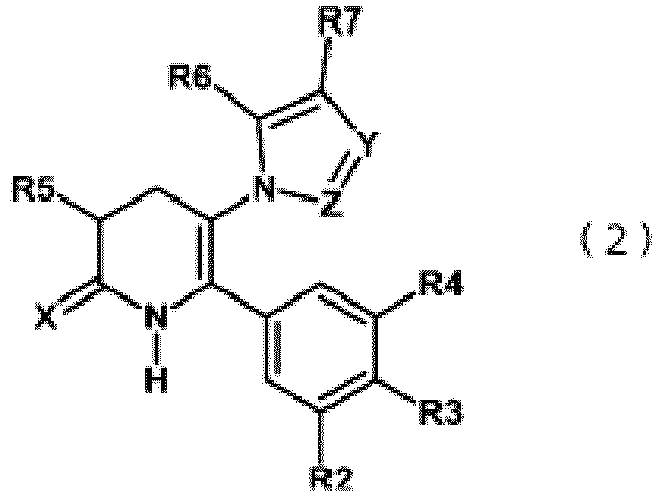
- Landwirtschaftliches und gartenbauliches Fungizid, umfassend die in Anspruch 1 beschriebene Verbindung oder ein Salz davon als aktiven Wirkstoff.
- Verfahren zur Vorbeugung und/oder Behandlung einer Pflanzenkrankheit, umfassend die Anwendung des in Anspruch 5 beschriebenen landwirtschaftlichen und gartenbaulichen Fungizids auf eine Pflanze, einen Pflanzensamen oder einen Boden für den Pflanzenanbau.
Applications Claiming Priority (2)
| Application Number | Priority Date | Filing Date | Title |
|---|---|---|---|
| JP2018139462 | 2018-07-25 | ||
| PCT/JP2019/029138 WO2020022412A1 (ja) | 2018-07-25 | 2019-07-25 | ピリドン化合物およびそれを有効成分とする農園芸用殺菌剤 |
Publications (3)
| Publication Number | Publication Date |
|---|---|
| EP3828177A1 EP3828177A1 (de) | 2021-06-02 |
| EP3828177A4 EP3828177A4 (de) | 2022-03-16 |
| EP3828177B1 true EP3828177B1 (de) | 2023-11-29 |
Family
ID=69181753
Family Applications (1)
| Application Number | Title | Priority Date | Filing Date |
|---|---|---|---|
| EP19840988.0A Active EP3828177B1 (de) | 2018-07-25 | 2019-07-25 | Pyridonverbindung und fungizid für landwirtschaft und gartenbau mit dieser als wirkstoff |
Country Status (6)
| Country | Link |
|---|---|
| US (1) | US12114658B2 (de) |
| EP (1) | EP3828177B1 (de) |
| JP (1) | JP7291143B2 (de) |
| AR (1) | AR115844A1 (de) |
| TW (1) | TWI828725B (de) |
| WO (1) | WO2020022412A1 (de) |
Families Citing this family (1)
| Publication number | Priority date | Publication date | Assignee | Title |
|---|---|---|---|---|
| GB201905721D0 (en) | 2019-04-24 | 2019-06-05 | Univ Dundee | Compounds |
Family Cites Families (65)
| Publication number | Priority date | Publication date | Assignee | Title |
|---|---|---|---|---|
| EP0308020A3 (de) | 1987-09-18 | 1990-12-05 | Merck & Co. Inc. | 5-(Aryl und Heteroaryl)-6-(Aryl und Heteroaryl)-1,2-dihydro-2-oxo-3-pyridincarbonsäure und Derivate davon |
| JPH02160813A (ja) | 1988-08-23 | 1990-06-20 | Copolymer Rubber & Chem Corp | 熱可塑性ポリエステル樹脂用のオレフィン系耐衝撃性改良剤及び該耐衝撃性改良剤とポリエステル樹脂とのブレンド |
| JPH02121970A (ja) * | 1988-10-28 | 1990-05-09 | Sumitomo Chem Co Ltd | アクリル酸誘導体、その製造法、その用途および中間体 |
| US5093347A (en) | 1991-01-28 | 1992-03-03 | Monsanto Company | 3-difluoromethylpyrazolecarboxamide fungicides, compositions and use |
| TWI252231B (en) | 1997-04-14 | 2006-04-01 | American Cyanamid Co | Fungicidal trifluorophenyl-triazolopyrimidines |
| GB9711753D0 (en) | 1997-06-06 | 1997-08-06 | Merck Sharp & Dohme | Therapeutic agents |
| DE602005014359D1 (de) | 2004-06-09 | 2009-06-18 | Sumitomo Chemical Co | Pyridazinverbindung und deren verwendung |
| CN101696221B (zh) | 2004-09-10 | 2013-05-29 | 先正达有限公司 | 作为杀真菌剂的取代异噁唑 |
| CN1295228C (zh) | 2004-11-23 | 2007-01-17 | 华东理工大学 | 硝基亚甲基衍生物及其用途 |
| KR20080081914A (ko) | 2005-12-07 | 2008-09-10 | 스미또모 가가꾸 가부시끼가이샤 | 피리다진 화합물 및 이의 용도 |
| AR056882A1 (es) | 2006-02-01 | 2007-10-31 | Bayer Cropscience Sa | Derivados del fungicida n- cicloalquil- bencil- amida |
| EP1969930A1 (de) | 2007-03-12 | 2008-09-17 | Bayer CropScience AG | Phenoxyphenylamidine und deren Verwendung als Fungizide |
| CL2008001647A1 (es) | 2007-06-08 | 2008-10-10 | Syngenta Participations Ag | Compuestos derivados de feniletil-amida de acido-1h-pirazol-4-carboxilico; compuestos derivados de (feniletil)amina; metodo para controlar o prevenir la infestacion de plantas por parte de microorganismos fitopatogenos; y composicion para el control |
| WO2009016220A1 (en) | 2007-07-31 | 2009-02-05 | Bayer Cropscience Sa | Fungicidal n-cycloalkyl-benzyl-thiocarboxamides or n-cycloalkyl-benzyl-n' -substituted-amidine derivatives |
| GB0720126D0 (en) | 2007-10-15 | 2007-11-28 | Syngenta Participations Ag | Chemical compounds |
| CN101945580A (zh) | 2007-12-19 | 2011-01-12 | 巴斯夫欧洲公司 | 唑基甲基环氧乙烷、其应用和包含它们的组合物 |
| PE20091953A1 (es) | 2008-05-08 | 2010-01-09 | Du Pont | Azoles sustituidos como fungicidas |
| UA104293C2 (en) | 2008-06-27 | 2014-01-27 | Байер Кропсайенс Аг | Thiadiazolyloxy-phenylamidines anduse thereof as fungicides |
| EP2184273A1 (de) | 2008-11-05 | 2010-05-12 | Bayer CropScience AG | Halogen-substituierte Verbindungen als Pestizide |
| GB0823002D0 (en) | 2008-12-17 | 2009-01-28 | Syngenta Participations Ag | Isoxazoles derivatives with plant growth regulating properties |
| JP5747440B2 (ja) | 2009-02-06 | 2015-07-15 | 住友化学株式会社 | ヒドラジド化合物及びその有害生物防除用途 |
| UA107791C2 (en) | 2009-05-05 | 2015-02-25 | Dow Agrosciences Llc | Pesticidal compositions |
| AR076839A1 (es) | 2009-05-15 | 2011-07-13 | Bayer Cropscience Ag | Derivados fungicidas de pirazol carboxamidas |
| NZ596546A (en) | 2009-05-29 | 2012-12-21 | Syngenta Participations Ag | Substituted quinazolines as fungicides |
| TWI487486B (zh) | 2009-12-01 | 2015-06-11 | Syngenta Participations Ag | 以異唑啉衍生物為主之殺蟲化合物 |
| UA108867C2 (uk) | 2009-12-08 | 2015-06-25 | Похідні азолу, спосіб їх одержання (варіанти), проміжні продукти, засіб для сільського господарства і садівництва | |
| CU24144B1 (es) | 2010-01-04 | 2016-01-29 | Nippon Soda Co | Compuesto heterocíclico conteniendo nitrógeno y fungicida para el uso en agricultura y jardinería |
| UA109780C2 (uk) | 2010-01-07 | 2015-10-12 | ДАУ АГРОСАЙЄНСІЗ ЕлЕлСі | ТІАЗОЛО[5,4-d]ПІРИМІДИНИ І ЇХ ЗАСТОСУВАННЯ ЯК АГРОХІМІЧНИХ ЗАСОБІВ |
| PH12012502138B1 (en) | 2010-04-26 | 2019-09-25 | Adama Makhteshim Ltd | N3-substituted-n1-sulfonyl-5-fluoropyrimidinone derivatives |
| EP2382865A1 (de) | 2010-04-28 | 2011-11-02 | Bayer CropScience AG | Synergistische Wirkstoffkombinationen |
| JP5918130B2 (ja) | 2010-06-01 | 2016-05-18 | クミアイ化学工業株式会社 | トリアゾール化合物を含有する有害生物防除剤、及び有害生物防除方法 |
| JP5613461B2 (ja) | 2010-06-02 | 2014-10-22 | 日本農薬株式会社 | ピリミジン誘導体及び該誘導体を含有する農園芸用殺虫剤並びにその使用方法 |
| ITMI20101564A1 (it) | 2010-08-23 | 2012-02-24 | Isagro Ricerca Srl | Fenilammidine ad elevata attivita' fungicida e relativo uso |
| US8759527B2 (en) | 2010-08-25 | 2014-06-24 | Bayer Cropscience Ag | Heteroarylpiperidine and -piperazine derivatives as fungicides |
| WO2012027521A1 (en) | 2010-08-26 | 2012-03-01 | Dow Agrosciences Llc | Pesticidal compositions |
| AU2011297160B2 (en) | 2010-08-31 | 2014-11-20 | Mitsui Chemicals Crop & Life Solutions, Inc. | Noxious organism control agent |
| TWI504350B (zh) | 2010-09-01 | 2015-10-21 | Du Pont | 殺真菌吡唑及其混合物 |
| IT1403275B1 (it) | 2010-12-20 | 2013-10-17 | Isagro Ricerca Srl | Indanilanilidi ad elevata attività fungicida e loro composizioni fitosanitarie |
| EP2699563B3 (de) | 2011-04-21 | 2024-06-12 | Basf Se | Neue pyrazolverbindungen als pestizide |
| JP5717853B2 (ja) | 2011-06-01 | 2015-05-13 | アグロカネショウ株式会社 | 3−アミノオキサリルアミノベンズアミド誘導体及びこれを有効成分とする殺虫、殺ダニ剤 |
| ES2558166T3 (es) | 2011-08-12 | 2016-02-02 | Basf Se | Compuestos de N-tio-antranilamida y su uso como pesticidas |
| WO2013037717A1 (en) | 2011-09-12 | 2013-03-21 | Bayer Intellectual Property Gmbh | Fungicidal 4-substituted-3-{phenyl[(heterocyclylmethoxy)imino]methyl}-1,2,4-oxadizol-5(4h)-one derivatives |
| CA2856954C (en) | 2011-12-21 | 2020-09-22 | Basf Se | Use of strobilurin type compounds for combating phytopathogenic fungi resistant to qo inhibitors |
| TWI566701B (zh) | 2012-02-01 | 2017-01-21 | 日本農藥股份有限公司 | 芳烷氧基嘧啶衍生物及包含該衍生物作為有效成分的農園藝用殺蟲劑及其使用方法 |
| JP6107377B2 (ja) | 2012-04-27 | 2017-04-05 | 住友化学株式会社 | テトラゾリノン化合物及びその用途 |
| BR122014028247A2 (pt) | 2012-04-27 | 2019-05-07 | Dow Agrosciences Llc | composições pesticidas, processo para controlar praga, uso de uma molécula, processo para aumentar a saúde, rendimento, vigor, qualidade ou tolerância de uma planta e processos para produção de compostos |
| US9096528B2 (en) | 2012-07-04 | 2015-08-04 | Agro-Kanesho Co., Ltd. | 2-aminonicotinic acid ester derivative and bactericide containing same as active ingredient |
| WO2014005982A1 (de) | 2012-07-05 | 2014-01-09 | Bayer Cropscience Ag | Insektizide und fungizide wirkstoffkombinationen |
| PT2873658T (pt) | 2012-07-12 | 2018-12-05 | Nissan Chemical Corp | Composto de amida substituída com oxima e agente de controlo de pragas |
| US20150246898A1 (en) | 2012-09-12 | 2015-09-03 | Dow Agrosciences Llc | Metalloenzyme inhibitor compounds |
| CR20190436A (es) | 2012-10-02 | 2019-10-29 | Bayer Cropscience Ag | COMPUESTOS HETEROCICLICOS COMO PLAGUICIDAS (Divisional 2015-0182) |
| MX360305B (es) | 2012-10-16 | 2018-10-26 | Monsanto Technology Llc | Metodos y composiciones para controlar la infeccion viral en plantas. |
| BR112015014191B1 (pt) | 2012-12-19 | 2019-08-27 | Bayer Cropscience Ag | indanil carboxamidas difluorometilnicotínicas |
| EP2938601B1 (de) | 2012-12-27 | 2018-05-16 | Sumitomo Chemical Company Limited | Kondensierte oxazolverbindungen und ihre verwendung zur schädlingsbekämpfung |
| AR096022A1 (es) | 2013-04-11 | 2015-12-02 | Basf Se | Compuestos de pirimidinio sustituido, útiles para combatir plagas de animales |
| WO2015025826A1 (ja) | 2013-08-21 | 2015-02-26 | 北興化学工業株式会社 | 置換フェニルエーテル化合物および有害生物防除剤 |
| TWI652014B (zh) | 2013-09-13 | 2019-03-01 | 美商艾佛艾姆希公司 | 雜環取代之雙環唑殺蟲劑 |
| WO2015144683A1 (en) | 2014-03-27 | 2015-10-01 | Bayer Cropscience Ag | Insecticidal and nematocidal active ingredient combinations |
| JP2017521455A (ja) | 2014-07-21 | 2017-08-03 | ヴィーブ ヘルスケア ユーケー リミテッド | 抗HIV作用を有するフェニル及びtert−ブチル酢酸置換ピリジノン |
| ES2741831T3 (es) | 2014-07-31 | 2020-02-12 | Basf Se | Proceso para la preparación de pirazoles |
| US10149477B2 (en) | 2014-10-06 | 2018-12-11 | Basf Se | Substituted pyrimidinium compounds for combating animal pests |
| CN112608300B (zh) | 2015-03-11 | 2024-04-26 | Fmc公司 | 杂环取代的二环唑杀有害生物剂 |
| WO2016144678A1 (en) | 2015-03-12 | 2016-09-15 | E I Du Pont De Nemours And Company | Heterocycle-substituted bicyclic azole pesticides |
| JP6869891B2 (ja) | 2015-10-09 | 2021-05-12 | 三井化学アグロ株式会社 | ピリドン化合物およびそれを有効成分とする農園芸用殺菌剤 |
| AU2018251415B2 (en) * | 2017-04-11 | 2021-08-05 | Mitsui Chemicals Crop & Life Solutions, Inc. | Pyridone compounds and agricultural and horticultural fungicides containing the same as active ingredients |
-
2019
- 2019-07-25 EP EP19840988.0A patent/EP3828177B1/de active Active
- 2019-07-25 US US17/252,349 patent/US12114658B2/en active Active
- 2019-07-25 WO PCT/JP2019/029138 patent/WO2020022412A1/ja not_active Ceased
- 2019-07-25 TW TW108126276A patent/TWI828725B/zh active
- 2019-07-25 AR ARP190102100A patent/AR115844A1/es unknown
- 2019-07-25 JP JP2020532455A patent/JP7291143B2/ja active Active
Also Published As
| Publication number | Publication date |
|---|---|
| EP3828177A4 (de) | 2022-03-16 |
| US20210267202A1 (en) | 2021-09-02 |
| JP7291143B2 (ja) | 2023-06-14 |
| CA3104048A1 (en) | 2020-01-30 |
| WO2020022412A1 (ja) | 2020-01-30 |
| EP3828177A1 (de) | 2021-06-02 |
| AR115844A1 (es) | 2021-03-03 |
| TW202012388A (zh) | 2020-04-01 |
| JPWO2020022412A1 (ja) | 2021-08-19 |
| US12114658B2 (en) | 2024-10-15 |
| TWI828725B (zh) | 2024-01-11 |
Similar Documents
| Publication | Publication Date | Title |
|---|---|---|
| RU2765748C2 (ru) | Пиридоны и содержащие их сельскохозяйственные и садовые фунгициды в качестве активных ингредиентов | |
| EP3575286B1 (de) | Pyridonverbindung und bakterizid für landwirtschaft und gartenbau mit dieser verbindung als wirkstoff | |
| EP3828177B1 (de) | Pyridonverbindung und fungizid für landwirtschaft und gartenbau mit dieser als wirkstoff | |
| EP3636636B1 (de) | Pyridonverbindung sowie fungizid für landwirtschaft und gartenbau | |
| JP7397800B2 (ja) | ピリドン化合物およびそれを有効成分とする農園芸用殺菌剤 | |
| EP3611166B1 (de) | Pyridonverbindung und fungizid für landwirtschaft und gartenbau mit dieser als wirkstoff | |
| CA3104048C (en) | Pyridone compounds and agricultural and horticultural fungicides containing the same as active ingredients | |
| JP7118961B2 (ja) | ピリドン化合物およびそれを有効成分とする農園芸用殺菌剤 | |
| JP7370998B2 (ja) | ピリドン化合物およびそれを有効成分とする農園芸用殺菌剤 | |
| JP7291151B2 (ja) | ピリドン化合物およびそれを有効成分とする農園芸用殺菌剤 | |
| JP7328222B2 (ja) | ピリドン化合物およびそれを有効成分とする農園芸用殺菌剤 | |
| WO2018190349A1 (ja) | ピリドン化合物およびそれを有効成分とする農園芸用殺菌剤 | |
| JP7153645B2 (ja) | ピリドン化合物およびそれを有効成分とする農園芸用殺菌剤 | |
| CA3050864C (en) | Pyridone compounds and agricultural and horticultural fungicides containing the same as active ingredients |
Legal Events
| Date | Code | Title | Description |
|---|---|---|---|
| STAA | Information on the status of an ep patent application or granted ep patent |
Free format text: STATUS: THE INTERNATIONAL PUBLICATION HAS BEEN MADE |
|
| PUAI | Public reference made under article 153(3) epc to a published international application that has entered the european phase |
Free format text: ORIGINAL CODE: 0009012 |
|
| STAA | Information on the status of an ep patent application or granted ep patent |
Free format text: STATUS: REQUEST FOR EXAMINATION WAS MADE |
|
| 17P | Request for examination filed |
Effective date: 20201210 |
|
| AK | Designated contracting states |
Kind code of ref document: A1 Designated state(s): AL AT BE BG CH CY CZ DE DK EE ES FI FR GB GR HR HU IE IS IT LI LT LU LV MC MK MT NL NO PL PT RO RS SE SI SK SM TR |
|
| DAV | Request for validation of the european patent (deleted) | ||
| DAX | Request for extension of the european patent (deleted) | ||
| A4 | Supplementary search report drawn up and despatched |
Effective date: 20220214 |
|
| RIC1 | Information provided on ipc code assigned before grant |
Ipc: A01P 3/00 20060101ALI20220208BHEP Ipc: A01N 43/56 20060101ALI20220208BHEP Ipc: A01N 43/50 20060101ALI20220208BHEP Ipc: C07D 401/04 20060101AFI20220208BHEP |
|
| GRAP | Despatch of communication of intention to grant a patent |
Free format text: ORIGINAL CODE: EPIDOSNIGR1 |
|
| STAA | Information on the status of an ep patent application or granted ep patent |
Free format text: STATUS: GRANT OF PATENT IS INTENDED |
|
| INTG | Intention to grant announced |
Effective date: 20230712 |
|
| RAP3 | Party data changed (applicant data changed or rights of an application transferred) |
Owner name: MITSUI CHEMICALS CROP & LIFE SOLUTIONS, INC. |
|
| GRAS | Grant fee paid |
Free format text: ORIGINAL CODE: EPIDOSNIGR3 |
|
| GRAA | (expected) grant |
Free format text: ORIGINAL CODE: 0009210 |
|
| STAA | Information on the status of an ep patent application or granted ep patent |
Free format text: STATUS: THE PATENT HAS BEEN GRANTED |
|
| RIN1 | Information on inventor provided before grant (corrected) |
Inventor name: FUKUMOTO TAKESHI Inventor name: NAITO RYOHEI Inventor name: OKAYA SHUN Inventor name: UMETANI HIDEKI |
|
| P01 | Opt-out of the competence of the unified patent court (upc) registered |
Effective date: 20231012 |
|
| AK | Designated contracting states |
Kind code of ref document: B1 Designated state(s): AL AT BE BG CH CY CZ DE DK EE ES FI FR GB GR HR HU IE IS IT LI LT LU LV MC MK MT NL NO PL PT RO RS SE SI SK SM TR |
|
| REG | Reference to a national code |
Ref country code: GB Ref legal event code: FG4D |
|
| REG | Reference to a national code |
Ref country code: CH Ref legal event code: EP |
|
| REG | Reference to a national code |
Ref country code: DE Ref legal event code: R096 Ref document number: 602019042542 Country of ref document: DE |
|
| REG | Reference to a national code |
Ref country code: IE Ref legal event code: FG4D |
|
| REG | Reference to a national code |
Ref country code: LT Ref legal event code: MG9D |
|
| REG | Reference to a national code |
Ref country code: NL Ref legal event code: MP Effective date: 20231129 |
|
| PG25 | Lapsed in a contracting state [announced via postgrant information from national office to epo] |
Ref country code: GR Free format text: LAPSE BECAUSE OF FAILURE TO SUBMIT A TRANSLATION OF THE DESCRIPTION OR TO PAY THE FEE WITHIN THE PRESCRIBED TIME-LIMIT Effective date: 20240301 |
|
| PG25 | Lapsed in a contracting state [announced via postgrant information from national office to epo] |
Ref country code: IS Free format text: LAPSE BECAUSE OF FAILURE TO SUBMIT A TRANSLATION OF THE DESCRIPTION OR TO PAY THE FEE WITHIN THE PRESCRIBED TIME-LIMIT Effective date: 20240329 |
|
| PG25 | Lapsed in a contracting state [announced via postgrant information from national office to epo] |
Ref country code: LT Free format text: LAPSE BECAUSE OF FAILURE TO SUBMIT A TRANSLATION OF THE DESCRIPTION OR TO PAY THE FEE WITHIN THE PRESCRIBED TIME-LIMIT Effective date: 20231129 |
|
| PG25 | Lapsed in a contracting state [announced via postgrant information from national office to epo] |
Ref country code: ES Free format text: LAPSE BECAUSE OF FAILURE TO SUBMIT A TRANSLATION OF THE DESCRIPTION OR TO PAY THE FEE WITHIN THE PRESCRIBED TIME-LIMIT Effective date: 20231129 |
|
| PG25 | Lapsed in a contracting state [announced via postgrant information from national office to epo] |
Ref country code: LT Free format text: LAPSE BECAUSE OF FAILURE TO SUBMIT A TRANSLATION OF THE DESCRIPTION OR TO PAY THE FEE WITHIN THE PRESCRIBED TIME-LIMIT Effective date: 20231129 Ref country code: IS Free format text: LAPSE BECAUSE OF FAILURE TO SUBMIT A TRANSLATION OF THE DESCRIPTION OR TO PAY THE FEE WITHIN THE PRESCRIBED TIME-LIMIT Effective date: 20240329 Ref country code: GR Free format text: LAPSE BECAUSE OF FAILURE TO SUBMIT A TRANSLATION OF THE DESCRIPTION OR TO PAY THE FEE WITHIN THE PRESCRIBED TIME-LIMIT Effective date: 20240301 Ref country code: ES Free format text: LAPSE BECAUSE OF FAILURE TO SUBMIT A TRANSLATION OF THE DESCRIPTION OR TO PAY THE FEE WITHIN THE PRESCRIBED TIME-LIMIT Effective date: 20231129 Ref country code: BG Free format text: LAPSE BECAUSE OF FAILURE TO SUBMIT A TRANSLATION OF THE DESCRIPTION OR TO PAY THE FEE WITHIN THE PRESCRIBED TIME-LIMIT Effective date: 20240229 |
|
| REG | Reference to a national code |
Ref country code: AT Ref legal event code: MK05 Ref document number: 1635999 Country of ref document: AT Kind code of ref document: T Effective date: 20231129 |
|
| PG25 | Lapsed in a contracting state [announced via postgrant information from national office to epo] |
Ref country code: NL Free format text: LAPSE BECAUSE OF FAILURE TO SUBMIT A TRANSLATION OF THE DESCRIPTION OR TO PAY THE FEE WITHIN THE PRESCRIBED TIME-LIMIT Effective date: 20231129 |
|
| PG25 | Lapsed in a contracting state [announced via postgrant information from national office to epo] |
Ref country code: SE Free format text: LAPSE BECAUSE OF FAILURE TO SUBMIT A TRANSLATION OF THE DESCRIPTION OR TO PAY THE FEE WITHIN THE PRESCRIBED TIME-LIMIT Effective date: 20231129 Ref country code: RS Free format text: LAPSE BECAUSE OF FAILURE TO SUBMIT A TRANSLATION OF THE DESCRIPTION OR TO PAY THE FEE WITHIN THE PRESCRIBED TIME-LIMIT Effective date: 20231129 Ref country code: PL Free format text: LAPSE BECAUSE OF FAILURE TO SUBMIT A TRANSLATION OF THE DESCRIPTION OR TO PAY THE FEE WITHIN THE PRESCRIBED TIME-LIMIT Effective date: 20231129 Ref country code: NO Free format text: LAPSE BECAUSE OF FAILURE TO SUBMIT A TRANSLATION OF THE DESCRIPTION OR TO PAY THE FEE WITHIN THE PRESCRIBED TIME-LIMIT Effective date: 20240229 Ref country code: NL Free format text: LAPSE BECAUSE OF FAILURE TO SUBMIT A TRANSLATION OF THE DESCRIPTION OR TO PAY THE FEE WITHIN THE PRESCRIBED TIME-LIMIT Effective date: 20231129 Ref country code: LV Free format text: LAPSE BECAUSE OF FAILURE TO SUBMIT A TRANSLATION OF THE DESCRIPTION OR TO PAY THE FEE WITHIN THE PRESCRIBED TIME-LIMIT Effective date: 20231129 Ref country code: HR Free format text: LAPSE BECAUSE OF FAILURE TO SUBMIT A TRANSLATION OF THE DESCRIPTION OR TO PAY THE FEE WITHIN THE PRESCRIBED TIME-LIMIT Effective date: 20231129 |
|
| PG25 | Lapsed in a contracting state [announced via postgrant information from national office to epo] |
Ref country code: DK Free format text: LAPSE BECAUSE OF FAILURE TO SUBMIT A TRANSLATION OF THE DESCRIPTION OR TO PAY THE FEE WITHIN THE PRESCRIBED TIME-LIMIT Effective date: 20231129 |
|
| PG25 | Lapsed in a contracting state [announced via postgrant information from national office to epo] |
Ref country code: AT Free format text: LAPSE BECAUSE OF FAILURE TO SUBMIT A TRANSLATION OF THE DESCRIPTION OR TO PAY THE FEE WITHIN THE PRESCRIBED TIME-LIMIT Effective date: 20231129 Ref country code: CZ Free format text: LAPSE BECAUSE OF FAILURE TO SUBMIT A TRANSLATION OF THE DESCRIPTION OR TO PAY THE FEE WITHIN THE PRESCRIBED TIME-LIMIT Effective date: 20231129 |
|
| PG25 | Lapsed in a contracting state [announced via postgrant information from national office to epo] |
Ref country code: SK Free format text: LAPSE BECAUSE OF FAILURE TO SUBMIT A TRANSLATION OF THE DESCRIPTION OR TO PAY THE FEE WITHIN THE PRESCRIBED TIME-LIMIT Effective date: 20231129 |
|
| PG25 | Lapsed in a contracting state [announced via postgrant information from national office to epo] |
Ref country code: SM Free format text: LAPSE BECAUSE OF FAILURE TO SUBMIT A TRANSLATION OF THE DESCRIPTION OR TO PAY THE FEE WITHIN THE PRESCRIBED TIME-LIMIT Effective date: 20231129 Ref country code: SK Free format text: LAPSE BECAUSE OF FAILURE TO SUBMIT A TRANSLATION OF THE DESCRIPTION OR TO PAY THE FEE WITHIN THE PRESCRIBED TIME-LIMIT Effective date: 20231129 Ref country code: RO Free format text: LAPSE BECAUSE OF FAILURE TO SUBMIT A TRANSLATION OF THE DESCRIPTION OR TO PAY THE FEE WITHIN THE PRESCRIBED TIME-LIMIT Effective date: 20231129 Ref country code: IT Free format text: LAPSE BECAUSE OF FAILURE TO SUBMIT A TRANSLATION OF THE DESCRIPTION OR TO PAY THE FEE WITHIN THE PRESCRIBED TIME-LIMIT Effective date: 20231129 Ref country code: EE Free format text: LAPSE BECAUSE OF FAILURE TO SUBMIT A TRANSLATION OF THE DESCRIPTION OR TO PAY THE FEE WITHIN THE PRESCRIBED TIME-LIMIT Effective date: 20231129 Ref country code: DK Free format text: LAPSE BECAUSE OF FAILURE TO SUBMIT A TRANSLATION OF THE DESCRIPTION OR TO PAY THE FEE WITHIN THE PRESCRIBED TIME-LIMIT Effective date: 20231129 Ref country code: CZ Free format text: LAPSE BECAUSE OF FAILURE TO SUBMIT A TRANSLATION OF THE DESCRIPTION OR TO PAY THE FEE WITHIN THE PRESCRIBED TIME-LIMIT Effective date: 20231129 Ref country code: AT Free format text: LAPSE BECAUSE OF FAILURE TO SUBMIT A TRANSLATION OF THE DESCRIPTION OR TO PAY THE FEE WITHIN THE PRESCRIBED TIME-LIMIT Effective date: 20231129 |
|
| PG25 | Lapsed in a contracting state [announced via postgrant information from national office to epo] |
Ref country code: PT Free format text: LAPSE BECAUSE OF FAILURE TO SUBMIT A TRANSLATION OF THE DESCRIPTION OR TO PAY THE FEE WITHIN THE PRESCRIBED TIME-LIMIT Effective date: 20240401 |
|
| PG25 | Lapsed in a contracting state [announced via postgrant information from national office to epo] |
Ref country code: PT Free format text: LAPSE BECAUSE OF FAILURE TO SUBMIT A TRANSLATION OF THE DESCRIPTION OR TO PAY THE FEE WITHIN THE PRESCRIBED TIME-LIMIT Effective date: 20240401 |
|
| REG | Reference to a national code |
Ref country code: DE Ref legal event code: R097 Ref document number: 602019042542 Country of ref document: DE |
|
| PLBE | No opposition filed within time limit |
Free format text: ORIGINAL CODE: 0009261 |
|
| STAA | Information on the status of an ep patent application or granted ep patent |
Free format text: STATUS: NO OPPOSITION FILED WITHIN TIME LIMIT |
|
| PG25 | Lapsed in a contracting state [announced via postgrant information from national office to epo] |
Ref country code: SI Free format text: LAPSE BECAUSE OF FAILURE TO SUBMIT A TRANSLATION OF THE DESCRIPTION OR TO PAY THE FEE WITHIN THE PRESCRIBED TIME-LIMIT Effective date: 20231129 |
|
| PG25 | Lapsed in a contracting state [announced via postgrant information from national office to epo] |
Ref country code: SI Free format text: LAPSE BECAUSE OF FAILURE TO SUBMIT A TRANSLATION OF THE DESCRIPTION OR TO PAY THE FEE WITHIN THE PRESCRIBED TIME-LIMIT Effective date: 20231129 |
|
| 26N | No opposition filed |
Effective date: 20240830 |
|
| PG25 | Lapsed in a contracting state [announced via postgrant information from national office to epo] |
Ref country code: MC Free format text: LAPSE BECAUSE OF FAILURE TO SUBMIT A TRANSLATION OF THE DESCRIPTION OR TO PAY THE FEE WITHIN THE PRESCRIBED TIME-LIMIT Effective date: 20231129 |
|
| REG | Reference to a national code |
Ref country code: CH Ref legal event code: PL |
|
| PG25 | Lapsed in a contracting state [announced via postgrant information from national office to epo] |
Ref country code: LU Free format text: LAPSE BECAUSE OF NON-PAYMENT OF DUE FEES Effective date: 20240725 |
|
| PG25 | Lapsed in a contracting state [announced via postgrant information from national office to epo] |
Ref country code: LU Free format text: LAPSE BECAUSE OF NON-PAYMENT OF DUE FEES Effective date: 20240725 |
|
| PG25 | Lapsed in a contracting state [announced via postgrant information from national office to epo] |
Ref country code: BE Free format text: LAPSE BECAUSE OF NON-PAYMENT OF DUE FEES Effective date: 20240731 Ref country code: CH Free format text: LAPSE BECAUSE OF NON-PAYMENT OF DUE FEES Effective date: 20240731 |
|
| REG | Reference to a national code |
Ref country code: BE Ref legal event code: MM Effective date: 20240731 |
|
| PG25 | Lapsed in a contracting state [announced via postgrant information from national office to epo] |
Ref country code: IE Free format text: LAPSE BECAUSE OF NON-PAYMENT OF DUE FEES Effective date: 20240725 |
|
| PG25 | Lapsed in a contracting state [announced via postgrant information from national office to epo] |
Ref country code: FI Free format text: LAPSE BECAUSE OF FAILURE TO SUBMIT A TRANSLATION OF THE DESCRIPTION OR TO PAY THE FEE WITHIN THE PRESCRIBED TIME-LIMIT Effective date: 20231129 |
|
| PGFP | Annual fee paid to national office [announced via postgrant information from national office to epo] |
Ref country code: DE Payment date: 20250722 Year of fee payment: 7 |
|
| PGFP | Annual fee paid to national office [announced via postgrant information from national office to epo] |
Ref country code: GB Payment date: 20250722 Year of fee payment: 7 |
|
| PGFP | Annual fee paid to national office [announced via postgrant information from national office to epo] |
Ref country code: FR Payment date: 20250725 Year of fee payment: 7 |
|
| PG25 | Lapsed in a contracting state [announced via postgrant information from national office to epo] |
Ref country code: CY Free format text: LAPSE BECAUSE OF FAILURE TO SUBMIT A TRANSLATION OF THE DESCRIPTION OR TO PAY THE FEE WITHIN THE PRESCRIBED TIME-LIMIT; INVALID AB INITIO Effective date: 20190725 |
|
| PG25 | Lapsed in a contracting state [announced via postgrant information from national office to epo] |
Ref country code: HU Free format text: LAPSE BECAUSE OF FAILURE TO SUBMIT A TRANSLATION OF THE DESCRIPTION OR TO PAY THE FEE WITHIN THE PRESCRIBED TIME-LIMIT; INVALID AB INITIO Effective date: 20190725 |