EP3829666B1 - Wirkstofffreisetzende beschichtungszusammensetzungen - Google Patents
Wirkstofffreisetzende beschichtungszusammensetzungen Download PDFInfo
- Publication number
- EP3829666B1 EP3829666B1 EP19752815.1A EP19752815A EP3829666B1 EP 3829666 B1 EP3829666 B1 EP 3829666B1 EP 19752815 A EP19752815 A EP 19752815A EP 3829666 B1 EP3829666 B1 EP 3829666B1
- Authority
- EP
- European Patent Office
- Prior art keywords
- coating composition
- coating
- balloon
- drug
- range
- Prior art date
- Legal status (The legal status is an assumption and is not a legal conclusion. Google has not performed a legal analysis and makes no representation as to the accuracy of the status listed.)
- Active
Links
Images

Classifications
-
- A—HUMAN NECESSITIES
- A61—MEDICAL OR VETERINARY SCIENCE; HYGIENE
- A61L—METHODS OR APPARATUS FOR STERILISING MATERIALS OR OBJECTS IN GENERAL; DISINFECTION, STERILISATION OR DEODORISATION OF AIR; CHEMICAL ASPECTS OF BANDAGES, DRESSINGS, ABSORBENT PADS OR SURGICAL ARTICLES; MATERIALS FOR BANDAGES, DRESSINGS, ABSORBENT PADS OR SURGICAL ARTICLES
- A61L31/00—Materials for other surgical articles, e.g. stents, stent-grafts, shunts, surgical drapes, guide wires, materials for adhesion prevention, occluding devices, surgical gloves, tissue fixation devices
- A61L31/08—Materials for coatings
- A61L31/10—Macromolecular materials
-
- A—HUMAN NECESSITIES
- A61—MEDICAL OR VETERINARY SCIENCE; HYGIENE
- A61L—METHODS OR APPARATUS FOR STERILISING MATERIALS OR OBJECTS IN GENERAL; DISINFECTION, STERILISATION OR DEODORISATION OF AIR; CHEMICAL ASPECTS OF BANDAGES, DRESSINGS, ABSORBENT PADS OR SURGICAL ARTICLES; MATERIALS FOR BANDAGES, DRESSINGS, ABSORBENT PADS OR SURGICAL ARTICLES
- A61L29/00—Materials for catheters, medical tubing, cannulae, or endoscopes or for coating catheters
- A61L29/08—Materials for coatings
- A61L29/085—Macromolecular materials
-
- A—HUMAN NECESSITIES
- A61—MEDICAL OR VETERINARY SCIENCE; HYGIENE
- A61K—PREPARATIONS FOR MEDICAL, DENTAL OR TOILETRY PURPOSES
- A61K31/00—Medicinal preparations containing organic active ingredients
- A61K31/33—Heterocyclic compounds
- A61K31/395—Heterocyclic compounds having nitrogen as a ring hetero atom, e.g. guanethidine or rifamycins
- A61K31/435—Heterocyclic compounds having nitrogen as a ring hetero atom, e.g. guanethidine or rifamycins having six-membered rings with one nitrogen as the only ring hetero atom
- A61K31/4353—Heterocyclic compounds having nitrogen as a ring hetero atom, e.g. guanethidine or rifamycins having six-membered rings with one nitrogen as the only ring hetero atom ortho- or peri-condensed with heterocyclic ring systems
- A61K31/436—Heterocyclic compounds having nitrogen as a ring hetero atom, e.g. guanethidine or rifamycins having six-membered rings with one nitrogen as the only ring hetero atom ortho- or peri-condensed with heterocyclic ring systems the heterocyclic ring system containing a six-membered ring having oxygen as a ring hetero atom, e.g. rapamycin
-
- A—HUMAN NECESSITIES
- A61—MEDICAL OR VETERINARY SCIENCE; HYGIENE
- A61K—PREPARATIONS FOR MEDICAL, DENTAL OR TOILETRY PURPOSES
- A61K47/00—Medicinal preparations characterised by the non-active ingredients used, e.g. carriers or inert additives; Targeting or modifying agents chemically bound to the active ingredient
- A61K47/30—Macromolecular organic or inorganic compounds, e.g. inorganic polyphosphates
- A61K47/34—Macromolecular compounds obtained otherwise than by reactions only involving carbon-to-carbon unsaturated bonds, e.g. polyesters, polyamino acids, polysiloxanes, polyphosphazines, copolymers of polyalkylene glycol or poloxamers
-
- A—HUMAN NECESSITIES
- A61—MEDICAL OR VETERINARY SCIENCE; HYGIENE
- A61K—PREPARATIONS FOR MEDICAL, DENTAL OR TOILETRY PURPOSES
- A61K47/00—Medicinal preparations characterised by the non-active ingredients used, e.g. carriers or inert additives; Targeting or modifying agents chemically bound to the active ingredient
- A61K47/30—Macromolecular organic or inorganic compounds, e.g. inorganic polyphosphates
- A61K47/36—Polysaccharides; Derivatives thereof, e.g. gums, starch, alginate, dextrin, hyaluronic acid, chitosan, inulin, agar or pectin
- A61K47/38—Cellulose; Derivatives thereof
-
- A—HUMAN NECESSITIES
- A61—MEDICAL OR VETERINARY SCIENCE; HYGIENE
- A61L—METHODS OR APPARATUS FOR STERILISING MATERIALS OR OBJECTS IN GENERAL; DISINFECTION, STERILISATION OR DEODORISATION OF AIR; CHEMICAL ASPECTS OF BANDAGES, DRESSINGS, ABSORBENT PADS OR SURGICAL ARTICLES; MATERIALS FOR BANDAGES, DRESSINGS, ABSORBENT PADS OR SURGICAL ARTICLES
- A61L29/00—Materials for catheters, medical tubing, cannulae, or endoscopes or for coating catheters
- A61L29/14—Materials characterised by their function or physical properties, e.g. lubricating compositions
- A61L29/16—Biologically active materials, e.g. therapeutic substances
-
- A—HUMAN NECESSITIES
- A61—MEDICAL OR VETERINARY SCIENCE; HYGIENE
- A61L—METHODS OR APPARATUS FOR STERILISING MATERIALS OR OBJECTS IN GENERAL; DISINFECTION, STERILISATION OR DEODORISATION OF AIR; CHEMICAL ASPECTS OF BANDAGES, DRESSINGS, ABSORBENT PADS OR SURGICAL ARTICLES; MATERIALS FOR BANDAGES, DRESSINGS, ABSORBENT PADS OR SURGICAL ARTICLES
- A61L31/00—Materials for other surgical articles, e.g. stents, stent-grafts, shunts, surgical drapes, guide wires, materials for adhesion prevention, occluding devices, surgical gloves, tissue fixation devices
- A61L31/14—Materials characterised by their function or physical properties, e.g. injectable or lubricating compositions, shape-memory materials, surface modified materials
- A61L31/16—Biologically active materials, e.g. therapeutic substances
-
- A—HUMAN NECESSITIES
- A61—MEDICAL OR VETERINARY SCIENCE; HYGIENE
- A61L—METHODS OR APPARATUS FOR STERILISING MATERIALS OR OBJECTS IN GENERAL; DISINFECTION, STERILISATION OR DEODORISATION OF AIR; CHEMICAL ASPECTS OF BANDAGES, DRESSINGS, ABSORBENT PADS OR SURGICAL ARTICLES; MATERIALS FOR BANDAGES, DRESSINGS, ABSORBENT PADS OR SURGICAL ARTICLES
- A61L2300/00—Biologically active materials used in bandages, wound dressings, absorbent pads or medical devices
- A61L2300/20—Biologically active materials used in bandages, wound dressings, absorbent pads or medical devices containing or releasing organic materials
- A61L2300/204—Biologically active materials used in bandages, wound dressings, absorbent pads or medical devices containing or releasing organic materials with nitrogen-containing functional groups, e.g. aminoxides, nitriles, guanidines
-
- A—HUMAN NECESSITIES
- A61—MEDICAL OR VETERINARY SCIENCE; HYGIENE
- A61L—METHODS OR APPARATUS FOR STERILISING MATERIALS OR OBJECTS IN GENERAL; DISINFECTION, STERILISATION OR DEODORISATION OF AIR; CHEMICAL ASPECTS OF BANDAGES, DRESSINGS, ABSORBENT PADS OR SURGICAL ARTICLES; MATERIALS FOR BANDAGES, DRESSINGS, ABSORBENT PADS OR SURGICAL ARTICLES
- A61L2300/00—Biologically active materials used in bandages, wound dressings, absorbent pads or medical devices
- A61L2300/40—Biologically active materials used in bandages, wound dressings, absorbent pads or medical devices characterised by a specific therapeutic activity or mode of action
- A61L2300/416—Anti-neoplastic or anti-proliferative or anti-restenosis or anti-angiogenic agents, e.g. paclitaxel, sirolimus
-
- A—HUMAN NECESSITIES
- A61—MEDICAL OR VETERINARY SCIENCE; HYGIENE
- A61L—METHODS OR APPARATUS FOR STERILISING MATERIALS OR OBJECTS IN GENERAL; DISINFECTION, STERILISATION OR DEODORISATION OF AIR; CHEMICAL ASPECTS OF BANDAGES, DRESSINGS, ABSORBENT PADS OR SURGICAL ARTICLES; MATERIALS FOR BANDAGES, DRESSINGS, ABSORBENT PADS OR SURGICAL ARTICLES
- A61L2300/00—Biologically active materials used in bandages, wound dressings, absorbent pads or medical devices
- A61L2300/60—Biologically active materials used in bandages, wound dressings, absorbent pads or medical devices characterised by a special physical form
- A61L2300/602—Type of release, e.g. controlled, sustained, slow
-
- A—HUMAN NECESSITIES
- A61—MEDICAL OR VETERINARY SCIENCE; HYGIENE
- A61L—METHODS OR APPARATUS FOR STERILISING MATERIALS OR OBJECTS IN GENERAL; DISINFECTION, STERILISATION OR DEODORISATION OF AIR; CHEMICAL ASPECTS OF BANDAGES, DRESSINGS, ABSORBENT PADS OR SURGICAL ARTICLES; MATERIALS FOR BANDAGES, DRESSINGS, ABSORBENT PADS OR SURGICAL ARTICLES
- A61L2300/00—Biologically active materials used in bandages, wound dressings, absorbent pads or medical devices
- A61L2300/60—Biologically active materials used in bandages, wound dressings, absorbent pads or medical devices characterised by a special physical form
- A61L2300/606—Coatings
-
- A—HUMAN NECESSITIES
- A61—MEDICAL OR VETERINARY SCIENCE; HYGIENE
- A61L—METHODS OR APPARATUS FOR STERILISING MATERIALS OR OBJECTS IN GENERAL; DISINFECTION, STERILISATION OR DEODORISATION OF AIR; CHEMICAL ASPECTS OF BANDAGES, DRESSINGS, ABSORBENT PADS OR SURGICAL ARTICLES; MATERIALS FOR BANDAGES, DRESSINGS, ABSORBENT PADS OR SURGICAL ARTICLES
- A61L2300/00—Biologically active materials used in bandages, wound dressings, absorbent pads or medical devices
- A61L2300/80—Biologically active materials used in bandages, wound dressings, absorbent pads or medical devices characterised by a special chemical form
- A61L2300/802—Additives, excipients, e.g. cyclodextrins, fatty acids, surfactants
-
- A—HUMAN NECESSITIES
- A61—MEDICAL OR VETERINARY SCIENCE; HYGIENE
- A61L—METHODS OR APPARATUS FOR STERILISING MATERIALS OR OBJECTS IN GENERAL; DISINFECTION, STERILISATION OR DEODORISATION OF AIR; CHEMICAL ASPECTS OF BANDAGES, DRESSINGS, ABSORBENT PADS OR SURGICAL ARTICLES; MATERIALS FOR BANDAGES, DRESSINGS, ABSORBENT PADS OR SURGICAL ARTICLES
- A61L2420/00—Materials or methods for coatings medical devices
- A61L2420/06—Coatings containing a mixture of two or more compounds
Definitions
- the present disclosure pertains to medical devices, and methods for manufacturing medical devices. More particularly, the present disclosure pertains to medical devices for therapeutic agent delivery.
- intracorporeal medical devices have been developed for medical use, for example, intravascular use. Some of these devices include guidewires, catheters, and the like. These devices are manufactured by any one of a variety of different manufacturing methods and may be used according to any one of a variety of methods. Of the known medical devices and methods, each has certain advantages and disadvantages. There is an ongoing need to provide alternative medical devices as well as alternative methods for manufacturing and using medical devices. For example, drug coated medical devices may allow for transfer of a therapeutic agent to a target region within the body. It may be desirable to provide coating compositions which safely and reliably increase drug transfer efficiency.
- WO2014063111 discloses formulations for coating inflatable (catheter)balloons comprising a polymer, a therapeutic agent and binding agents which are cationic/positively charged.
- an elutable coating composition may comprise an excipient comprising a bio-degradable or bio-stable polymer selected from a poly(lactic-co-glycolic acid) (PLGA) or methyl cellulose (MCC), a binding agent comprising ethyl cellulose, and a therapeutic agent, wherein the binding agent comprises in the range of about 5 to about 15 weight percent of the coating composition.
- a bio-degradable or bio-stable polymer selected from a poly(lactic-co-glycolic acid) (PLGA) or methyl cellulose (MCC), a binding agent comprising ethyl cellulose, and a therapeutic agent, wherein the binding agent comprises in the range of about 5 to about 15 weight percent of the coating composition.
- the binding agent comprises ethyl cellulose.
- the excipient may comprise PLGA (50:50).
- the excipient may comprise PLGA (85:15).
- an intrinsic viscosity of the excipient may be in the range of about 0.1 deciliters/gram (dL/g) to about 0.8 dL/g.
- the excipient may comprise MCC having a viscosity in the range of about 10 centipoise (cp) to about 500 cp as a 2% solution in water.
- the excipient may comprise MCC having a viscosity in the range of about 300 centipoise (cp) to about 4,000 cp as a 2% solution in water.
- the therapeutic agent may comprise in the range of about 60 to about 90 weight percent of the coating composition.
- the excipient may comprise in the range of about 5 to about 40 weight percent of the coating composition.
- the binding agent comprises in the range of about 5 to about 15 weight percent of the coating composition.
- the therapeutic agent may comprise about 60 to about 80 weight percent of the coating composition
- the excipient may comprise about 10 to about 35 weight percent of the coating composition
- the binding agent comprises about 5 to about 15 weight percent of the coating composition.
- the therapeutic agent may comprise everolimus.
- a medical article may comprise a medical article substrate that is at least partially covered by a layer of the elutable coating composition in accordance with any of the examples above.
- the medical article substrate may be an expandable balloon.
- the medical article substrate may be a stent.
- an elutable coating composition may comprise an excipient comprising a poly(lactic-co-glycolic acid) (PLGA) having an intrinsic viscosity in the range of about 0.1 deciliters/gram (dL/g) to about 0.8 dL/g, a binding agent, and a therapeutic agent.
- PLGA poly(lactic-co-glycolic acid)
- the binding agent comprises ethyl cellulose.
- the excipient may comprise PLGA (50:50).
- the excipient may comprise PLGA (85:15).
- the therapeutic agent may comprise in the range of about 60 to about 90 weight percent of the coating composition.
- the excipient may comprise in the range of about 5 to about 40 weight percent of the coating composition.
- the binding agent comprises in the range of about 5 to about 15 weight percent of the coating composition.
- the therapeutic agent may comprise about 60 to about 80 weight percent of the coating composition
- the excipient may comprise about 10 to about 35 weight percent of the coating composition
- the binding agent comprises about 5 to about 15 weight percent of the coating composition.
- the therapeutic agent may comprise everolimus.
- an elutable coating composition may comprise an excipient comprising a methyl cellulose (MCC), a binding agent comprising ethyl cellulose, and a therapeutic agent, wherein the binding agent comprises in the range of about 5 to about 15 weight percent of the coating composition.
- MCC methyl cellulose
- binding agent comprising ethyl cellulose
- therapeutic agent wherein the binding agent comprises in the range of about 5 to about 15 weight percent of the coating composition.
- the binding agent comprises ethyl cellulose.
- the MCC may have a viscosity in the range of about 10 centipoise (cp) to about 500 cp as a 2% solution in water.
- the MCC may have a viscosity in the range of about 300 centipoise (cp) to about 4,000 cp as a 2% solution in water.
- the therapeutic agent may comprise in the range of about 60 to about 90 weight percent of the coating composition.
- the excipient may comprise in the range of about 5 to about 40 weight percent of the coating composition.
- the binding agent comprises in the range of about 5 to about 15 weight percent of the coating composition.
- the therapeutic agent may comprise about 60 to about 80 weight percent of the coating composition
- the excipient may comprise about 10 to about 35 weight percent of the coating composition
- the binding agent comprises about 5 to about 15 weight percent of the coating composition .
- the therapeutic agent may comprise everolimus.
- the elutable coating composition in accordance with the invention may be prepared by a method which comprises mixing an excipient comprising poly(lactic-co-glycolic acid) (PLGA) or methyl cellulose (MCC), a binding agent comprising ethyl cellulose (ECC), and a therapeutic agent to form a mixture, dispersing the mixture in a first solvent to form a first suspension, adding the first suspension to a second solvent to form a second suspension, agitating the second suspension, and incubating the second suspension at room temperature for a length of time in the range of 24 to 72 hours.
- PLGA poly(lactic-co-glycolic acid)
- MCC methyl cellulose
- EECC ethyl cellulose
- the excipient, binding agent, and therapeutic agent may be mixed at a weight ratio of about 1:1:8.
- references in the specification to "an embodiment”, “some embodiments”, “other embodiments”, etc. indicate that the embodiment described may include one or more particular features, structures, and/or characteristics. However, such recitations do not necessarily mean that all embodiments include the particular features, structures, and/or characteristics. Additionally, when particular features, structures, and/or characteristics are described in connection with one embodiment, it should be understood that such features, structures, and/or characteristics may also be used connection with other embodiments whether or not explicitly described unless clearly stated to the contrary.
- the body includes various passageways such as blood vessels and body lumens. These passageways sometimes become occluded (for example, by a tumor or plaque).
- balloon catheters can be used, for example, in angioplasty.
- a balloon catheter can include an inflatable and deflatable balloon carried by a long and narrow catheter body.
- the balloon can be initially folded around the catheter body to reduce the radial profile of the balloon catheter for easy insertion into the body.
- the folded balloon can be delivered to a target location in the vessel, for example, a portion occluded by plaque, by threading the balloon catheter over a guide wire previously located in the vessel.
- the balloon is then inflated, for example, by introducing a fluid (such as a gas or a liquid) into the interior of the balloon. Inflating the balloon can radially expand the vessel so that the vessel can permit an increased rate of blood flow. After use, the balloon is typically deflated and withdrawn from the body. In some instances, it may be desirable to coat, layer, or otherwise apply a drug or therapeutic agent to an outer surface of the balloon to deliver and/or administer the drug or therapeutic agent to a lumen wall when the balloon is expanded. During deployment (e.g., expansion of the balloon), the coating including the drug or therapeutic agent may break apart into particulates. Some of the particulates may be partially deposited on the inner surface of the vessel.
- a fluid such as a gas or a liquid
- the efficiency of the transfer of the drug or therapeutic agent may be low. It may be desirable to provide a coating that can maintain high viscosity with sufficient particle bonding to resist drug loss when exposed to blood flow, which may improve drug transfer efficiency, but still maintain reasonable particulate profile (e.g., particulates shed within the body attributable to the coating are at a safe level). While the therapeutic coating described herein is discussed relative to balloons and balloon catheters, it is contemplated that the therapeutic coating can be applied to and/or used in conjunction with other medical devices, such as, but not limited to, stents, embolic filters, implantable devices, treatment devices, etc.
- DCB drug coated balloons
- the coating compositions described herein may allow for high drug transfer efficiency, a safe particulate profile and sustained drug release.
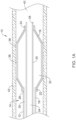
- Figure 1A is a cross-sectional side view of a distal end region of an example medical device 10 that, in this example, takes the form of a catheter, disposed in a body lumen 40.
- the catheter 10 may be a balloon catheter.
- the catheter 10 may include an elongate catheter shaft 12 having a proximal end (not shown) and a distal end region 14.
- the catheter shaft 12 may extend proximally from the distal end region 14 to the proximal end which is configured to remain outside of a patient's body.
- the proximal end of the catheter shaft 12 may include a hub attached thereto for connecting other treatment devices or providing a port for facilitating other treatments. It is contemplated that the stiffness and size of the catheter shaft 12 may be modified to form a catheter 10 for use in various locations within the body.
- the catheter 10 may be configured to be advanced through a guide sheath, delivery sheath, or other guide means.
- the catheter 10 may further include an inflatable balloon 16 affixed adjacent to the distal end region 14 of the catheter shaft 12.
- the size of the balloon 16 may vary based on where in the body it is used (e.g., along the coronary and/or peripheral vasculature, in a pulmonary vessel, along an airway, along another body lumen, or the like).
- the balloon 16 may have an outer diameter (in the inflated state) in the range of 1 millimeter (mm) to 26 mm, or about 2 to 10 mm, or about 2.5 to 8 mm.
- the balloon 16 may have a length in the range of 5 mm to 300 mm, or about 5 to 100 mm, or about 10 to 50 mm.
- the balloon 16 may have a wall thickness in the range of 10 micrometers ( ⁇ m) to 100 ⁇ m, or about 10 to 75 ⁇ m, or about 10 to 50 ⁇ m.
- the catheter shaft 12 may include an outer tubular member 18 and an inner tubular member 20.
- a proximal waist 22 of the balloon 16 may be secured to a distal end region 26 of the outer tubular member 18.
- a distal waist 24 of the balloon 16 may be secured to a distal end region 28 of the inner tubular member 20.
- the inner tubular member 20 may extend distally beyond the distal waist 24 of the balloon 16, although this is not required.
- an annular inflation lumen 30 may be disposed between the outer tubular member 18 and the inner tubular member 20.
- the inflation lumen 30 may allow inflation fluid to pass from an inflation fluid source configured to remain outside the body to the interior region 32 of the balloon 16.
- the inner tubular member 20 may further define a lumen 34 through which a guidewire (not explicitly shown) may be passed in order to advance the catheter 10 to a predetermined position, although this is not required.
- an outer surface 38 of the balloon 16 may be coated with or otherwise include an elutable drug or coating 36.
- the coating 36 may include one or more polymers (e.g., an excipient), a binding agent, and a therapeutic agent or drug.
- the excipient comprises a bio-degradable or bio-stable polymer selected from a poly(lactic-co-glycolic acid) (PLGA) or methyl cellulose (MCC)
- the binding agent comprises ethyl cellulose
- the binding agent comprises in the range of about 5 to about 15 weight percent of the coating composition.
- therapeutic agents include genetic therapeutic agents, non-genetic therapeutic agents, and cells. Therapeutic agents may be used singly or in combination. A wide range of therapeutic agent loadings can be used in conjunction with the devices of the present invention, with the pharmaceutically effective amount being readily determined by those of ordinary skill in the art and ultimately depending, for example, upon the condition to be treated, the nature of the therapeutic agent itself, the tissue into which the dosage form is introduced, and so forth.
- Some specific beneficial agents include anti-thrombotic agents, antiproliferative agents, anti-inflammatory agents, anti-migratory agents, agents affecting extracellular matrix production and organization, antineoplastic agents, anti-mitotic agents, anesthetic agents, anti-coagulants, vascular cell growth promoters, vascular cell growth inhibitors, cholesterol-lowering agents, vasodilating agents, and agents that interfere with endogenous vasoactive mechanisms.
- More specific drugs or therapeutic agents include paclitaxel, rapamycin, sirolimus, everolimus, tacrolimus, heparin, diclofenac, aspirin, Epo D, dexamethasone, estradiol, halofuginone, cilostazole, geldanamycin, ABT-578 (Abbott Laboratories), trapidil, liprostin, Actinomcin D, Resten-NG, Ap-17, abciximab, clopidogrel, Ridogrel, beta-blockers, bARKct inhibitors, phospholamban inhibitors, and Serca 2 gene/protein, resiquimod, imiquimod (as well as other imidazoquinoline immune response modifiers), human apolioproteins (e.g., AI, AII, AIII, AIV, AV, etc.), vascular endothelial growth factors (e.g., VEGF-2), as well as derivatives of the forgoing,
- the drug coating 36 may include one or more excipients, one or more binding agents, and one or more therapeutic agents, such as, but not limited to everolimus. While the drug coating 36 described herein is discussed relative to everolimus, it is contemplated that other drugs or therapeutic agents may be used, as desired.
- the excipients include poly(lactic-co-glycolic acid) (PLGA) or methyl cellulose (MCC).
- the binding agent includes ethyl cellulose.
- the coating may comprise a mixture of poly(lactic-co-glycolic acid) (PLGA), ethyl cellulose (ECC), and everolimus.
- the coating may comprise a mixture of methyl cellulose (MCC), ECC, and everolimus.
- the weight percent (wt%) of the therapeutic agent in the elutable drug coating 36 may be in the range of about 50 to about 99% wt%, about 60 to about 95 wt%, or about 70 to about 90 wt%, or about 80 wt%.
- the weight percent of the excipient in the elutable drug coating 36 may be in the range of about 1 to about 45% wt%, about 5 to about 30 wt%, or about 10 wt%.
- the weight percent of the binding agent in the elutable drug coating 36 is in the range of about 5 to about 15 wt%, or about 10 wt%.
- the properties of PLGA can be manipulated by changing the ratio of lactide to glycolide used during the polymerization process.
- the different forms may be identified by molar ratios of the monomers used.
- PLGA 50:50 identifies a copolymer having a composition that is 50% lactic acid and 50% glycolic acid
- PLGA 75:25 identifies a copolymer having a composition that is 75% lactic acid and 25% glycolic acid.
- PLGA can also be synthesized as a random copolymer or a block copolymer which may additionally be used to control the properties of the PLGA. In some instances, increasing the content of the glycolide may reduce the degradation time of the PLGA.
- PLGA 50:50 may have the fastest degradation time. It is contemplated that release of a drug from a coating including a drug, a binding agent ( ethyl cellulose), and PLGA may be modulated through manipulation of the lactic acid to glycolic acid ratio in the PLGA. For example, increasing the ratio of lactic acid in the PLGA may make the coating more hydrophobic (e.g., less water soluble) which may slow down the PLGA degradation time to modulate release of the therapeutic agent.
- increasing the molecular weight of the PLGA may increase the viscosity of the coating in situ as well as increasing the time it takes for the PLGA to dissolve which may help the therapeutic agent remain on the vessel wall for longer periods of time. Increasing the viscosity and the time to dissolve may increase the contact time of the coating with the vessel or target region thus allowing more drug to be absorbed into the body at the target region.
- PLGA materials useful in the present disclosure include PLGA (50:50) DL 2A, PLGA (85:15) DL 4A, and PLGA (85:15) DL high IV, all available from Evonik Industries AG (Essen, Germany).
- Suitable PLGA materials may have an intrinsic viscosity in the range of about 0.1 deciliters/gram (dL/g) to about 0.8 dL/g. It is further contemplated that PLGA materials having an intrinsic viscosity of less than 0.1 dL/g or greater than 0.8 dL/g may also be used.
- the properties of the coating 36 may be also be manipulated when methyl cellulose is used as the excipient.
- the properties of methyl cellulose can be changed depending on the number of hydroxyl groups that are replaced by methoxide during the synthesis and/or on the average length of the polymer backbone.
- the viscosity of an aqueous solution of the methyl cellulose may be proportional to the molecular weight or chain length of the particular formulation. As described above, increasing the viscosity and the time to dissolve may increase the contact time of the coating with the vessel or target region thus allowing more drug to be absorbed into the body at the target region.
- MCC materials useful in the present disclosure include Methocel ® A15 LV, Methocel ® A4C Premium, and Methocel ® A4M (HV), all available from The Dow Chemical Company, Midland, MI.
- Suitable MCC materials may have a viscosity (based on a 2% solution of MCC in water) in the range of 10 centipoise (cp) to about 4,000 (cp), or about 10 cp to about 500 cp, or about 300 cp to about 4,000 cp. It is further contemplated that MCC materials having a viscosity of less than 10 cp or greater than 4,000 cp may also be used.
- the binding agent may be used to bundle the drug particles together (e.g., through increasing cohesive force). Binding the drug particles may allow the drug to remain at the target region for a longer period of time (e.g., reducing the number of blood particles that get flushed from the target region by a flowing body fluid, such as blood). Ethyl cellulose (ECC) is used as the binding agent.
- the drug such as, but not limited to, everolimus
- the drug may first be converted from an amorphous form to a crystalline form. Briefly, a slurry of the amorphous drug and a solvent may be formed and allowed to age. Illustrative methods for converting amorphous macrolide drugs to crystalline everolimus is described in commonly assigned U.S. Patent No. 8,669,360 . However, in some instances, the everolimus may be converted from an amorphous form to a crystalline form while the liquid coating suspension is being prepared. The liquid suspension may be used to facilitate crystalline grown with a narrower size distribution
- the drug, excipient, and binding agent may then be added to a first solvent, such as, but not limited to, ethyl acetate, to form a first solution or suspension.
- the first suspension e.g., the drug, excipient, binding agent, and first solvent
- a second solvent such as, but not limited to, heptane
- the first suspension may be added dropwise (e.g., from a pipette or dropper) into the second solvent.
- the first and second solvents may be used in various quantities.
- the ratio of the first solvent to the second solvent in the second suspension may range from about 1:10 to about 10:1.
- the second suspension may then be agitated (e.g., shaken or stirred) and allowed to incubate.
- the second suspension may incubate at 29 °C for approximately 72 hours.
- the incubation period may allow an amorphous drug to crystallize.
- the second suspension may be applied to the medical device (e.g., the balloon 16) by any method known in the art including, but not limited to, spraying, dipping, rolling, pipetting, painting (e.g., brush painting, sponge painting, etc.), and so forth.
- the second suspension may then be allowed to dry, by evaporation of the solvent to form the drug coating 36.
- the balloon 16 may be allowed to dry at ambient conditions overnight.
- the balloon 16 may be dried at elevated temperatures (e.g., above room temperature).
- the coating 36 may include about 50 weight percent (wt%) to about 90 wt% of the therapeutic agent, about 5 wt% to about 30 wt% of the excipient, and about 5 wt% to about 15 wt% of the binding agent.
- the therapeutic agent, excipient, and binding agent may have the same or similar weight ratio relative to one another in the suspension form as in the dry coating form.
- some bio-degradable or bio-stable polymers may form microspheres.
- the dried coating may be analyzed (using, for example, differential scanning calorimetry or x-ray diffraction) to determine the percentage of crystallinity. In some cases, the dried coating may have in the range of about 60-90% of the dried coating in crystalline form.
- the dried coating 36 may have a thickness on the balloon 16 in the range of from 0.1 micrometers or less to 20 micrometers or more (e.g., from 0.1 to 0.2 to 0.5 to 1 to 2 to 5 to 10 to 20 micrometers), or about 0.1 to about 5 micrometers.
- the coating thickness may be affected by the percent solids in the second suspension and the technique of application, among other factors. Multiple coatings may be applied to achieve a desired coating thickness.
- the elutable drug coating 36 may cover the entire surface area 38 of the balloon 16. In other embodiments, the elutable drug coating 36 may cover a portion of the surface area of the balloon 16. For example, the elutable drug coating 36 may cover 90% or less (e.g., about 80% or less, about 70% or less, about 60% or less, about 50% or less, about 40% or less, about 30% or less, about 20% or less, or about 10% or less) and/or about 10% or more (e.g., about 20% or more, about 30% or more, about 40% or more, about 50% or more, about 60% or more, about 70% or more, 80% or more, or 90% or more) of the balloon's outer surface 38.
- 90% or less e.g., about 80% or less, about 70% or less, about 60% or less, about 50% or less, about 40% or less, about 30% or less, about 20% or less, or about 10% or less
- about 10% or more e.g., about 20% or more, about 30% or more, about 40% or more, about 50% or more
- the catheter 10 may be advanced through a lumen 40 having a lumen wall 42, with or without a guidewire, or other guide means.
- the balloon 16 When the balloon 16 is positioned adjacent to the desired treatment region, the balloon 16 may be expanded to bring the elutable drug coating 36 into contact with the lumen wall 42.
- the drug coating 36 may elute a therapeutic agent, such as, but not limited to, everolimus microparticles to the body lumen wall 42.
- the balloon 16 may remain inflated for a desired amount of time sufficient to transfer the coating 36 from the balloon 16 to the wall 42.
- the excipient in the coating 36 may be water soluble. Once the coating 36 has been transferred to the wall 42, the coating 36 may begin to dissolve or be washed away by the flow of blood. An excipient that has a higher viscosity as it hydrates may have a longer contact time with the vessel wall 42 (e.g., may wash away less easily) thus allowing for an increased amount of drug transfer from the coating 36 to the lumen wall 42. In other words, as the intrinsic viscosity of the excipient increases, the ability of the coating 36 to remain in contact with the vessel wall 42 may also increase. As used herein, the intrinsic viscosity of the excipient refers to a measure of the solute's (e.g., the excipient's) contribution to the viscosity of a solution.
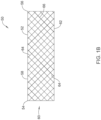
- Figure 1B illustrates a side view of an illustrative endoluminal implant 50, such as, but not limited to, a stent.
- the stent 50 may be formed from an elongated tubular member 52. While the stent 50 is described as generally tubular, it is contemplated that the stent 50 may take any cross-sectional shape desired.
- the stent 50 may have a first, or proximal, end 54 and a second, or distal, end 56.
- the stent 50 may include a lumen 60 extending from a first opening adjacent the first end 54 to a second opening adjacent to the second end 56 to allow for the passage of food, fluids, etc.
- an outer surface 62 of the stent 50 may be coated with or otherwise include an elutable drug or coating 66.
- the coating 66 may be similar in form and function to the elutable drug coating 36 described herein. Alternatively, or additionally, the coating 66 may be coated onto an inner surface of the stent 50.
- the elutable drug coating 66 may cover the entire surface area of the stent 50. In other embodiments, the elutable drug coating 66 may cover a portion of the surface area of the stent 50. For example, the elutable drug coating 66 may cover 90% or less (e.g., about 80% or less, about 70% or less, about 60% or less, about 50% or less, about 40% or less, about 30% or less, about 20% or less, or about 10% or less) and/or about 10% or more (e.g., about 20% or more, about 30% or more, about 40% or more, about 50% or more, about 60% or more, about 70% or more, 80% or more, or 90% or more) of the stent 50.
- 90% or less e.g., about 80% or less, about 70% or less, about 60% or less, about 50% or less, about 40% or less, about 30% or less, about 20% or less, or about 10% or less
- about 10% or more e.g., about 20% or more, about 30% or more, about 40% or
- the stent 50 may be expandable from a first collapsed configuration (not explicitly shown) to a second expanded configuration.
- the stent 50 may be structured to extend across a stricture and to apply a radially outward pressure to the stricture in a lumen to open the lumen and allow for the passage of foods, fluids, air, etc.
- the stent 50 may have a woven structure, fabricated from a number of filaments or struts 64.
- the stent 50 may be braided with one filament.
- the stent 50 may be braided with several filaments, as is found, for example, in the WallFlex ® , WALLSTENT ® , and Polyflex ® stents, made and distributed by Boston Scientific, Corporation.
- the stent 50 may be knitted, such as the Ultraflex TM stents made by Boston Scientific, Corporation.
- the stent 50 may be of a knotted type, such the Precision Colonic TM stents made by Boston Scientific, Corporation.
- the stent 50 may be a laser cut tubular member, such as the EPIC TM stents made by Boston Scientific, Corporation.
- a laser cut tubular member may have an open and/or closed cell geometry including one or more interconnected filaments.
- an inner and/or outer surface of the stent 50 may be entirely, substantially or partially, covered with a polymeric covering or coating.
- a covering or coating which may help reduce food impaction and/or tumor or tissue ingrowth.
- the first coating composition was prepared with a PLGA (50:50) having an intrinsic viscosity (IV) of 0.16 deciliters per gram (dL/g).
- the second coating composition was prepared with a PLGA (85:15) having an intrinsic viscosity of 0.41 dL/g.
- the third coating composition was prepared with a PLGA (85:15) having an intrinsic viscosity of 0.75 dL/g.
- Each coating compositions were individually prepared by first mixing crystalline everolimus, ethyl cellulose (ECC), and PLGA at a weight ratio of 8:1:1 (everolimus:ECC:PLGA) to form a first mixture. Each composition was then dissolved individually in ethyl acetate at a weight ratio of 8:1:1:90 (everolimus:ECC:PLGA:ethyl acetate) to form a first suspension. The first suspension was then dispersed dropwise into heptane at a weight ratio of 1:5 ethyl acetate to heptane to form a second suspension.
- the second suspension was then agitated (e.g., shaken or stirred) and allowed to incubate at 29 °C for approximately 72 hours.
- Each liquid coating composition was then coated onto two different balloons such that six balloons were coated with a PLGA containing composition. The balloons were allowed to dry at ambient conditions overnight. Two balloons were also coated with a coating composition having only crystalline everolimus.
- the dried coating compositions are listed in Table 1 below. Table 1.
- composition 1 Composition 2
- the coated balloons were individually advanced through a plastic tube being flushed with water to simulate blood flow.
- the balloon was expanded to simulate delivery of the therapeutic drug within the body.
- the balloon was then deflated and removed from the tube.
- the water used to flush the plastic tube was collected and analyzed to determine how much of the therapeutic agent (e.g., everolimus) was lost in the simulated blood flow.
- the plastic tube was also analyzed to determine how much of the therapeutic agent was transferred to the tube.
- the balloon was analyzed to determine how much of the therapeutic drug remained on the balloon.
- Transfer Efficiency drug on tube total drug ⁇ 100 where the total drug is the sum of the drug in the water used for flushing, the drug on the tube, and the drug remaining on the balloon.
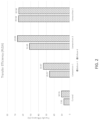
- FIG. 2 illustrates a graph of drug transfer efficiency using a bio-degradable polymer. As can be seen, the additional of PLGA and ECC improves transfer efficiency compared to a coating having only everolimus. The drug transfer efficiency also increases as the intrinsic viscosity of the PLGA increases.
- the water used to flush the tube (e.g., the simulated blood) was also analyzed to determine the particulate burden for the coating compositions.
- the quantity of particulates was determined for three particle sizes (10 micron, 25 micron, and 50 micron) using light obscuration and normalized by the size of the balloon.
- the particulates for each coating and each size range are summarized in the table below: Table 2.
- the first coating composition was prepared with an MCC having a viscosity of 15 centipoise (cp).
- the second coating composition was prepared with an MCC having a viscosity of 400 cp.
- the third coating composition was prepared with an MCC having a viscosity of 3893 cp.
- the viscosity of the different grades of MCC was based on a 2% solution of MCC in water.
- Each coating compositions were individually prepared by first mixing crystalline everolimus, ethyl cellulose (ECC), and MCC at a weight ratio of 8:1:1 (everolimus:ECC:MCC) to form a first mixture. Each composition was then dissolved individually in ethyl acetate at a weight ratio of 8:1:1:90 (everolimus:ECC:PLGA:ethyl acetate) to form a first suspension. The first suspension was then dispersed dropwise into heptane at a weight ratio of 1:5 ethyl acetate to heptane to form a second suspension.
- the second suspension was then agitated (e.g., shaken or stirred) and allowed to incubate at 29 °C for approximately 24-72 hours.
- Each liquid coating composition was then coated onto two different balloons such that six balloons were coated with an MCC containing composition. The balloons were allowed to dry at ambient conditions overnight. Two balloons were also coated with a coating composition having only crystalline everolimus.
- the dried coating compositions are listed in Table 3 below. Table 3.
- composition 1 Composition 2
- Composition 3 Crystalline Everolimus (100 wt%) Crystalline Everolimus (80 wt%) Crystalline Everolimus (80 wt%) Crystalline Everolimus (80 wt%) MCC with a viscosity of 15 cp (2% in water) (10 wt%) MCC with a viscosity of 400 cp (2% in water) (10 wt%) MCC with a viscosity of 3893 cp (2% in water) (10 wt%) Ethyl Cellulose (10 wt%) Ethyl Cellulose (10 wt%) Ethyl Cellulose (10 wt%) Ethyl Cellulose (10 wt%)
- the coated balloons were individually advanced through a plastic tube being flushed with water to simulate blood flow.
- the balloon was expanded to simulate delivery of the therapeutic drug within the body.
- the balloon was then deflated and removed from the tube.
- the water used to flush the plastic tube was collected and analyzed to determine how much of the therapeutic agent (e.g., everolimus) was lost in the simulated blood flow.
- the plastic tube was also analyzed to determine how much of the therapeutic agent was transferred to the tube.
- the balloon was analyzed to determine how much of the therapeutic drug remained on the balloon.
- Transfer Efficiency drug on tube total drug ⁇ 100 where the total drug is the sum of the drug in the water used for flushing, the drug on the tube, and the drug remaining on the balloon.
- FIG. 3 illustrates a graph of drug transfer efficiency using a bio-stable polymer.
- the drug transfer efficiency also increases as the viscosity of the MCC increases. The variation between the samples was also reduced at higher viscosities.
- the water used to flush the tube (e.g., the simulated blood) was also analyzed to determine the particulate burden for the coating compositions.
- the quantity of particulates was determined for three particle sizes (10 micron, 25 micron, and 50 micron) using light obscuration and normalized by the size of the balloon.
- the particulates for each coating and each size range are summarized in the table below: Table 4.
- the particulate burden for the 10 micron size range has increased with the addition of the MCC and ECC, the particulate burden for the 25 and 50 micron ranges has decreased.
- the particulate burden for the 10 micron size range for compositions including MCC and ECC are still within acceptable ranges. It should be noted that having fewer large particulates is very desirable, which is accomplished with the compositions including MCC and ECC.
- catheter 10 and/or other devices disclosed herein
- tubular members disclosed herein may include those commonly associated with medical devices.
- catheter 10 the following discussion makes reference to catheter 10. However, this is not intended to limit the devices and methods described herein, as the discussion may be applied to other similar medical devices and/or components of medical devices disclosed herein.
- Catheter 10 may be made from a metal, metal alloy, polymer (some examples of which are disclosed below), a metal-polymer composite, ceramics, combinations thereof, and the like, or other suitable material.
- suitable metals and metal alloys include stainless steel, such as 304V, 304L, and 316LV stainless steel; mild steel; nickel-titanium alloy such as linear-elastic and/or super-elastic nitinol; other nickel alloys such as nickel-chromium-molybdenum alloys (e.g., UNS: N06625 such as INCONEL ® 625, UNS: N06022 such as HASTELLOY ® C-22 ® , UNS: N10276 such as HASTELLOY ® C276 ® , other HASTELLOY ® alloys, and the like), nickel-copper alloys (e.g., LTNS: N04400 such as MONEL ® 400, NICKELVAC ® 400, NICORRO
- Linear elastic and/or non-super-elastic nitinol may be distinguished from super elastic nitinol in that the linear elastic and/or non-super-elastic nitinol does not display a substantial "superelastic plateau” or “flag region” in its stress/strain curve like super elastic nitinol does.
- linear elastic and/or non-super-elastic nitinol as recoverable strain increases, the stress continues to increase in a substantially linear, or a somewhat, but not necessarily entirely linear relationship until plastic deformation begins or at least in a relationship that is more linear that the super elastic plateau and/or flag region that may be seen with super elastic nitinol.
- linear elastic and/or non-super-elastic nitinol may also be termed "substantially" linear elastic and/or non-super-elastic nitinol.
- linear elastic and/or non-super-elastic nitinol may also be distinguishable from super elastic nitinol in that linear elastic and/or non-super-elastic nitinol may accept up to about 2-5% strain while remaining substantially elastic (e.g., before plastically deforming) whereas super elastic nitinol may accept up to about 8% strain before plastically deforming. Both of these materials can be distinguished from other linear elastic materials such as stainless steel (that can also can be distinguished based on its composition), which may accept only about 0.2 to 0.44 percent strain before plastically deforming.
- the linear elastic and/or non-super-elastic nickel-titanium alloy is an alloy that does not show any martensite/austenite phase changes that are detectable by differential scanning calorimetry (DSC) and dynamic metal thermal analysis (DMTA) analysis over a large temperature range.
- DSC differential scanning calorimetry
- DMTA dynamic metal thermal analysis
- the mechanical bending properties of such material may therefore be generally inert to the effect of temperature over this very broad range of temperature.
- the mechanical bending properties of the linear elastic and/or non-super-elastic nickel-titanium alloy at ambient or room temperature are substantially the same as the mechanical properties at body temperature, for example, in that they do not display a super-elastic plateau and/or flag region.
- the linear elastic and/or non-super-elastic nickel-titanium alloy maintains its linear elastic and/or non-super-elastic characteristics and/or properties.
- the linear elastic and/or non-super-elastic nickel-titanium alloy may be in the range of about 50 to about 60 weight percent nickel, with the remainder being essentially titanium. In some embodiments, the composition is in the range of about 54 to about 57 weight percent nickel.
- a suitable nickel-titanium alloy is FHP-NT alloy commercially available from Furukawa Techno Material Co. of Kanagawa, Japan.
- Some examples of nickel titanium alloys are disclosed in U.S. Patent Nos. 5,238,004 and 6,508. 803 .
- Neo-Metrics and GUM METAL TM (available from Toyota).
- a superelastic alloy for example a superelastic nitinol can be used to achieve desired properties.
- portions or all of catheter 10 may also be doped with, made of or otherwise include a radiopaque material.
- Radiopaque materials are understood to be materials capable of producing a relatively bright image on a fluoroscopy screen or another imaging technique during a medical procedure. This relatively bright image aids the user of catheter 10 in determining its location.
- Some examples of radiopaque materials can include, but are not limited to, gold, platinum, palladium, tantalum, tungsten alloy, polymer material loaded with a radiopaque filler, and the like. Additionally, other radiopaque marker bands and/or coils may also be incorporated into the design of catheter 10 to achieve the same result.
- catheter 10 may be made of a material that does not substantially distort the image and create substantial artifacts (i.e., gaps in the image). Certain ferromagnetic materials, for example, may not be suitable because they may create artifacts in an MRI image. Catheter 10, or portions thereof, may also be made from a material that the MRI machine can image.
- MRI Magnetic Resonance Imaging
- Some materials that exhibit these characteristics include, for example, tungsten, cobalt-chromium-molybdenum alloys (e.g., UNS: R30003 such as ELGILOY ® , PHYNOX ® , and the like), nickel-cobalt-chromium-molybdenum alloys (e.g., UNS: R30035 such as MP35-N ® and the like), nitinol, and the like, and others.
- cobalt-chromium-molybdenum alloys e.g., UNS: R30003 such as ELGILOY ® , PHYNOX ® , and the like
- nickel-cobalt-chromium-molybdenum alloys e.g., UNS: R30035 such as MP35-N ® and the like
- nitinol and the like, and others.
Landscapes
- Health & Medical Sciences (AREA)
- Life Sciences & Earth Sciences (AREA)
- Chemical & Material Sciences (AREA)
- Epidemiology (AREA)
- Animal Behavior & Ethology (AREA)
- General Health & Medical Sciences (AREA)
- Public Health (AREA)
- Veterinary Medicine (AREA)
- Medicinal Chemistry (AREA)
- Pharmacology & Pharmacy (AREA)
- Inorganic Chemistry (AREA)
- Engineering & Computer Science (AREA)
- Biomedical Technology (AREA)
- Molecular Biology (AREA)
- Vascular Medicine (AREA)
- Heart & Thoracic Surgery (AREA)
- Surgery (AREA)
- Proteomics, Peptides & Aminoacids (AREA)
- Pharmaceuticals Containing Other Organic And Inorganic Compounds (AREA)
- Materials For Medical Uses (AREA)
- Media Introduction/Drainage Providing Device (AREA)
- Medicinal Preparation (AREA)
Claims (13)
- Eine eluierbare Beschichtungszusammensetzung, umfassend:einen Exzipienten, der ein biologisch abbaubares oder biostabiles Polymer, ausgewählt aus einer Poly(milchsäure-co-glycolsäure) (PLGA) oder Methylcellulose (MCC), umfasst;ein Bindemittel, das Ethylcellulose umfasst; undeinen therapeutischen Wirkstoff,wobei das Bindemittel im Bereich von etwa 5 bis etwa 15 Gewichtsprozent der Beschichtungszusammensetzung umfasst ist.
- Die eluierbare Beschichtungszusammensetzung nach Anspruch 1, wobei der Exzipient PLGA (50:50) umfasst.
- Die eluierbare Beschichtungszusammensetzung nach Anspruch 1, wobei der Exzipient PLGA (85:15) umfasst.
- Die eluierbare Beschichtungszusammensetzung nach einem der Ansprüche 2-3, wobei eine Grenzviskosität des Exzipienten im Bereich von etwa 0,1 Decilitern/Gramm (dl/g) bis etwa 0,8 dl/g liegt.
- Die eluierbare Beschichtungszusammensetzung nach Anspruch 1, wobei der Exzipient MCC mit einer Viskosität im Bereich von etwa 10 Centipoise (cP) bis etwa 500 cP als 2% Lösung in Wasser umfasst.
- Die eluierbare Beschichtungszusammensetzung nach Anspruch 1, wobei der Exzipient MCC mit einer Viskosität im Bereich von etwa 300 Centipoise (cP) bis etwa 4.000 cP als eine 2% Lösung in Wasser umfasst.
- Die eluierbare Beschichtungszusammensetzung nach einem der Ansprüche 1-6, wobei der therapeutische Wirkstoff im Bereich von etwa 70 bis etwa 90 Gewichtsprozent in der Beschichtungszusammensetzung umfasst ist.
- Die eluierbare Beschichtungszusammensetzung nach einem der Ansprüche 1-7, wobei der Exzipient im Bereich von etwa 5 bis etwa 40 Gewichtsprozent in der Beschichtungszusammensetzung umfasst ist.
- Die eluierbare Beschichtungszusammensetzung nach einem der Ansprüche 1-8, wobei der therapeutische Wirkstoff zu etwa 60 bis etwa 80 Gewichtsprozent in der Beschichtungszusammensetzung umfasst ist, der Exzipient zu etwa 10 bis etwa 20 Gewichtsprozent in der Beschichtungszusammensetzung umfasst ist und das Bindemittel zu etwa 10 bis etwa 20 Gewichtsprozent in der Beschichtungszusammensetzung umfasst ist.
- Die eluierbare Beschichtungszusammensetzung nach einem der Ansprüche 1-9, wobei der therapeutische Wirkstoff Everolimus umfasst.
- Ein medizinischer Gegenstand, umfassend ein Trägermaterial für einen medizinischen Gegenstand, das zumindest teilweise von einer Schicht der eluierbaren Beschichtungszusammensetzung gemäß Anspruch 1 bedeckt ist.
- Der medizinische Gegenstand nach Anspruch 11, wobei das Trägermaterial für den medizinischen Gegenstand ein expandierbarer Ballon ist.
- Der medizinische Gegenstand nach Anspruch 12, wobei das Trägermaterial für den medizinischen Gegenstand ein Stent ist.
Applications Claiming Priority (2)
| Application Number | Priority Date | Filing Date | Title |
|---|---|---|---|
| US201862713081P | 2018-08-01 | 2018-08-01 | |
| PCT/US2019/044244 WO2020028437A1 (en) | 2018-08-01 | 2019-07-30 | Drug release coating compositions |
Publications (2)
| Publication Number | Publication Date |
|---|---|
| EP3829666A1 EP3829666A1 (de) | 2021-06-09 |
| EP3829666B1 true EP3829666B1 (de) | 2023-08-30 |
Family
ID=67614661
Family Applications (1)
| Application Number | Title | Priority Date | Filing Date |
|---|---|---|---|
| EP19752815.1A Active EP3829666B1 (de) | 2018-08-01 | 2019-07-30 | Wirkstofffreisetzende beschichtungszusammensetzungen |
Country Status (5)
| Country | Link |
|---|---|
| US (1) | US12226551B2 (de) |
| EP (1) | EP3829666B1 (de) |
| JP (2) | JP7315658B2 (de) |
| CN (1) | CN112739392A (de) |
| WO (1) | WO2020028437A1 (de) |
Families Citing this family (3)
| Publication number | Priority date | Publication date | Assignee | Title |
|---|---|---|---|---|
| EP3613449A1 (de) * | 2018-08-23 | 2020-02-26 | Biotronik Ag | Verbesserung der polymerschicht bei degradierbaren vorrichtungen |
| CN119431400A (zh) | 2020-03-27 | 2025-02-14 | 波士顿科学国际有限公司 | 用于使药物结晶的方法 |
| US20240307594A1 (en) * | 2023-03-16 | 2024-09-19 | Boston Scientific Scimed, Inc. | Medical devices including therapeutic coatings formed from individually encapsulated therapeutic agent crystals |
Citations (1)
| Publication number | Priority date | Publication date | Assignee | Title |
|---|---|---|---|---|
| WO2009088726A2 (en) * | 2007-12-31 | 2009-07-16 | Acclarent, Inc. | Mucosal tissue dressing and method of use |
Family Cites Families (41)
| Publication number | Priority date | Publication date | Assignee | Title |
|---|---|---|---|---|
| US3544668A (en) * | 1968-07-22 | 1970-12-01 | Davol Inc | Method of manufacturing a balloon catheter |
| US5238004A (en) | 1990-04-10 | 1993-08-24 | Boston Scientific Corporation | High elongation linear elastic guidewire |
| JPH09143059A (ja) | 1995-11-27 | 1997-06-03 | Japan Vilene Co Ltd | 皮膚貼付剤 |
| US6508803B1 (en) | 1998-11-06 | 2003-01-21 | Furukawa Techno Material Co., Ltd. | Niti-type medical guide wire and method of producing the same |
| SE0000363A0 (sv) * | 2000-02-04 | 2001-08-05 | Zoucas Kirurgkonsult Ab | Belagd medicinsk anordning |
| US8211455B2 (en) | 2002-06-19 | 2012-07-03 | Boston Scientific Scimed, Inc. | Implantable or insertable medical devices for controlled delivery of a therapeutic agent |
| TR200500302T3 (tr) | 2003-03-31 | 2005-04-21 | Biogal Gyogyszergyar Rt. | Makrolidlerin kristalizasyonu ve saflaştırılması. |
| KR100501682B1 (ko) | 2003-06-20 | 2005-07-18 | 현대자동차주식회사 | 연료전지용 가스켓 및 그 제조방법 |
| KR20060052722A (ko) | 2003-08-05 | 2006-05-19 | 가부시키가이샤 가네카 | 생체유치용 스텐트 |
| JP2007505658A (ja) | 2003-09-15 | 2007-03-15 | アトリウム メディカル コーポレーション | 拡張可能医療用具を用いた治療物質の組織部位への塗布 |
| JP4691925B2 (ja) * | 2004-08-05 | 2011-06-01 | 田辺三菱製薬株式会社 | 圧縮成型製剤の製造方法 |
| US20060115449A1 (en) * | 2004-11-30 | 2006-06-01 | Advanced Cardiovascular Systems, Inc. | Bioabsorbable, biobeneficial, tyrosine-based polymers for use in drug eluting stent coatings |
| US20070269486A1 (en) * | 2005-03-14 | 2007-11-22 | Conor Medsystems, Llc. | Methods and Devices for Reducing Tissue Damage After Ischemic Injury |
| US20070160641A1 (en) * | 2006-01-12 | 2007-07-12 | Eun-Hyun Jang | Coated medical devices and methods of making the same |
| CN100381179C (zh) * | 2006-06-29 | 2008-04-16 | 上海交通大学 | 具有功能性纳米载药涂层的血管支架 |
| US7812032B2 (en) | 2006-07-25 | 2010-10-12 | Abbott Laboratories | Crystalline forms of rapamycin analogs |
| EP1913962A1 (de) * | 2006-10-22 | 2008-04-23 | Ophir Perelson | Expandierbarer medizinischer Artikel zur Behandlung und Vorbeugung von kardiovaskulären Krankheiten |
| JP2010166936A (ja) | 2007-10-27 | 2010-08-05 | Kaneka Corp | ステント |
| US8409601B2 (en) | 2008-03-31 | 2013-04-02 | Cordis Corporation | Rapamycin coated expandable devices |
| US20100080791A1 (en) | 2008-09-26 | 2010-04-01 | Rousseau Robert A | Composition and Method For Treating Tissue Defects |
| DE102008043736A1 (de) | 2008-11-14 | 2010-05-20 | Biotronik Vi Patent Ag | Biokorrodierbares Implantat mit einer Wirkstoff-enthaltenden Beschichtung |
| EP2421571A2 (de) | 2009-04-24 | 2012-02-29 | Boston Scientific Scimed, Inc. | Verwendung von arzneimittelpolymorphen zur erzielung kontrollierter arzneifreisetzung aus einem beschichteten medizinprodukt |
| US9327060B2 (en) * | 2009-07-09 | 2016-05-03 | CARDINAL HEALTH SWITZERLAND 515 GmbH | Rapamycin reservoir eluting stent |
| US8480620B2 (en) | 2009-12-11 | 2013-07-09 | Abbott Cardiovascular Systems Inc. | Coatings with tunable solubility profile for drug-coated balloon |
| US20110144577A1 (en) * | 2009-12-11 | 2011-06-16 | John Stankus | Hydrophilic coatings with tunable composition for drug coated balloon |
| US8951595B2 (en) * | 2009-12-11 | 2015-02-10 | Abbott Cardiovascular Systems Inc. | Coatings with tunable molecular architecture for drug-coated balloon |
| KR102220710B1 (ko) * | 2011-07-20 | 2021-03-02 | 브라이엄 영 유니버시티 | 소수성 세라게닌 화합물 및 이를 포함하는 기구 |
| WO2013022458A1 (en) | 2011-08-05 | 2013-02-14 | Boston Scientific Scimed, Inc. | Methods of converting amorphous drug substance into crystalline form |
| WO2014063111A1 (en) * | 2012-10-18 | 2014-04-24 | Micell Technologyies, Inc. | Drug delivery medical device |
| AU2012326010B2 (en) * | 2011-10-18 | 2017-05-11 | Micell Technologies, Inc. | Drug delivery medical device |
| WO2013177211A1 (en) | 2012-05-21 | 2013-11-28 | Micell Technologies, Inc. | Safe drug eluting stent with absorbable coating |
| US20150031772A1 (en) * | 2012-02-17 | 2015-01-29 | Bacterin International, Inc. | Adjustable bioactive agent dispersion within a polymeric coating |
| US9956385B2 (en) * | 2012-06-28 | 2018-05-01 | The Spectranetics Corporation | Post-processing of a medical device to control morphology and mechanical properties |
| CN110302168A (zh) * | 2013-01-28 | 2019-10-08 | 万平 | 定位速释生物粘附剂及其制备方法和应用 |
| EP2968687A1 (de) * | 2013-03-15 | 2016-01-20 | Abbott Cardiovascular Systems Inc. | Gewebekleber überzüge für arzneimittel ballon |
| CN104623740B (zh) | 2013-11-15 | 2018-02-16 | 微创心脉医疗科技(上海)有限公司 | 一种药物球囊及其制备方法 |
| CN106029116A (zh) | 2014-01-02 | 2016-10-12 | 波士顿科学国际有限公司 | 具有优选药物取向以提高药物输送效率的药物洗脱球囊 |
| CN103948975B (zh) * | 2014-05-19 | 2015-09-23 | 上海赢生医疗科技有限公司 | 一种靶向药物释放介入类医疗器械及其制备方法 |
| US10012734B2 (en) | 2014-05-21 | 2018-07-03 | DSCG Solutions, Inc. | Devices, systems, and methods for real time tracking of an object |
| WO2016065255A1 (en) * | 2014-10-23 | 2016-04-28 | Gopinath Mani | Formulations for tailored drug release |
| CN107362439B (zh) * | 2017-08-14 | 2020-09-01 | 乐普(北京)医疗器械股份有限公司 | 一种药物涂层球囊导管的制备方法、制备得到的药物涂层球囊导管及其应用 |
-
2019
- 2019-07-30 CN CN201980062058.XA patent/CN112739392A/zh active Pending
- 2019-07-30 US US16/526,912 patent/US12226551B2/en active Active
- 2019-07-30 WO PCT/US2019/044244 patent/WO2020028437A1/en not_active Ceased
- 2019-07-30 JP JP2021505383A patent/JP7315658B2/ja active Active
- 2019-07-30 EP EP19752815.1A patent/EP3829666B1/de active Active
-
2023
- 2023-07-13 JP JP2023114837A patent/JP7706506B2/ja active Active
Patent Citations (1)
| Publication number | Priority date | Publication date | Assignee | Title |
|---|---|---|---|---|
| WO2009088726A2 (en) * | 2007-12-31 | 2009-07-16 | Acclarent, Inc. | Mucosal tissue dressing and method of use |
Also Published As
| Publication number | Publication date |
|---|---|
| EP3829666A1 (de) | 2021-06-09 |
| JP2023133344A (ja) | 2023-09-22 |
| JP7706506B2 (ja) | 2025-07-11 |
| WO2020028437A1 (en) | 2020-02-06 |
| CN112739392A (zh) | 2021-04-30 |
| US20200038559A1 (en) | 2020-02-06 |
| JP7315658B2 (ja) | 2023-07-26 |
| JP2021531917A (ja) | 2021-11-25 |
| US12226551B2 (en) | 2025-02-18 |
Similar Documents
| Publication | Publication Date | Title |
|---|---|---|
| JP7706506B2 (ja) | 薬物放出コーティング組成物 | |
| US8016880B2 (en) | Stent having spiral channel for drug delivery | |
| DE60124286T2 (de) | Beschichtete medizinische geräte | |
| DE60308256T2 (de) | Beschichtetes medizinsches Implantat zur Behandlung von Gefässerkrankungen | |
| US6833004B2 (en) | Stent | |
| EP3294358B1 (de) | Wirkstoffbeschichtete medizinische vorrichtungen | |
| EP1651140B1 (de) | Laminierter arzneimittel-polymer-beschichteter stent und verfahren | |
| US20050149163A1 (en) | Reduced restenosis drug containing stents | |
| US20050180919A1 (en) | Stent with radiopaque and encapsulant coatings | |
| EP2111818B1 (de) | Intrakoronarstent mit asymmetrischer beschichtung mit kontrollierter arzneimittelfreisetzung | |
| JP2008279278A (ja) | 薬物送達脈管内ステントおよび再狭窄を処置するための方法 | |
| CN102387825A (zh) | 含有可生物吸收的聚合物底涂层的可植入医疗器件 | |
| US20080269869A1 (en) | Intraluminal Stent, Delivery System, and Method of Treating a Vascular Condition | |
| CN110461382A (zh) | 腔内装置 | |
| US20100010618A1 (en) | Overlapping Stent | |
| JP2005168937A (ja) | ステント | |
| CN107106309B (zh) | 药物洗脱支架 | |
| US20240342346A1 (en) | Medical Devices Including Therapeutic Coatings Formed From Bioresorbable And Reversible Thermo-Gelling Excipients | |
| JP2010166936A (ja) | ステント | |
| HK1156494B (en) | Drug-delivery endovascular stent | |
| HK1177882B (en) | Drug-delivery endovascular stent and method for treating restenosis | |
| WO2006104650A1 (en) | Stent with reduced profile, delivery system, and method of manufacture | |
| JP2010166935A (ja) | ステント |
Legal Events
| Date | Code | Title | Description |
|---|---|---|---|
| STAA | Information on the status of an ep patent application or granted ep patent |
Free format text: STATUS: UNKNOWN |
|
| STAA | Information on the status of an ep patent application or granted ep patent |
Free format text: STATUS: THE INTERNATIONAL PUBLICATION HAS BEEN MADE |
|
| PUAI | Public reference made under article 153(3) epc to a published international application that has entered the european phase |
Free format text: ORIGINAL CODE: 0009012 |
|
| STAA | Information on the status of an ep patent application or granted ep patent |
Free format text: STATUS: REQUEST FOR EXAMINATION WAS MADE |
|
| 17P | Request for examination filed |
Effective date: 20210301 |
|
| AK | Designated contracting states |
Kind code of ref document: A1 Designated state(s): AL AT BE BG CH CY CZ DE DK EE ES FI FR GB GR HR HU IE IS IT LI LT LU LV MC MK MT NL NO PL PT RO RS SE SI SK SM TR |
|
| DAV | Request for validation of the european patent (deleted) | ||
| DAX | Request for extension of the european patent (deleted) | ||
| STAA | Information on the status of an ep patent application or granted ep patent |
Free format text: STATUS: EXAMINATION IS IN PROGRESS |
|
| 17Q | First examination report despatched |
Effective date: 20220322 |
|
| GRAP | Despatch of communication of intention to grant a patent |
Free format text: ORIGINAL CODE: EPIDOSNIGR1 |
|
| STAA | Information on the status of an ep patent application or granted ep patent |
Free format text: STATUS: GRANT OF PATENT IS INTENDED |
|
| INTG | Intention to grant announced |
Effective date: 20221111 |
|
| GRAJ | Information related to disapproval of communication of intention to grant by the applicant or resumption of examination proceedings by the epo deleted |
Free format text: ORIGINAL CODE: EPIDOSDIGR1 |
|
| STAA | Information on the status of an ep patent application or granted ep patent |
Free format text: STATUS: EXAMINATION IS IN PROGRESS |
|
| GRAP | Despatch of communication of intention to grant a patent |
Free format text: ORIGINAL CODE: EPIDOSNIGR1 |
|
| STAA | Information on the status of an ep patent application or granted ep patent |
Free format text: STATUS: GRANT OF PATENT IS INTENDED |
|
| INTC | Intention to grant announced (deleted) | ||
| INTG | Intention to grant announced |
Effective date: 20230403 |
|
| GRAS | Grant fee paid |
Free format text: ORIGINAL CODE: EPIDOSNIGR3 |
|
| GRAA | (expected) grant |
Free format text: ORIGINAL CODE: 0009210 |
|
| STAA | Information on the status of an ep patent application or granted ep patent |
Free format text: STATUS: THE PATENT HAS BEEN GRANTED |
|
| AK | Designated contracting states |
Kind code of ref document: B1 Designated state(s): AL AT BE BG CH CY CZ DE DK EE ES FI FR GB GR HR HU IE IS IT LI LT LU LV MC MK MT NL NO PL PT RO RS SE SI SK SM TR |
|
| REG | Reference to a national code |
Ref country code: GB Ref legal event code: FG4D |
|
| REG | Reference to a national code |
Ref country code: CH Ref legal event code: EP |
|
| REG | Reference to a national code |
Ref country code: DE Ref legal event code: R096 Ref document number: 602019036199 Country of ref document: DE |
|
| REG | Reference to a national code |
Ref country code: IE Ref legal event code: FG4D |
|
| REG | Reference to a national code |
Ref country code: NL Ref legal event code: FP |
|
| REG | Reference to a national code |
Ref country code: LT Ref legal event code: MG9D |
|
| REG | Reference to a national code |
Ref country code: AT Ref legal event code: MK05 Ref document number: 1604579 Country of ref document: AT Kind code of ref document: T Effective date: 20230830 |
|
| PG25 | Lapsed in a contracting state [announced via postgrant information from national office to epo] |
Ref country code: GR Free format text: LAPSE BECAUSE OF FAILURE TO SUBMIT A TRANSLATION OF THE DESCRIPTION OR TO PAY THE FEE WITHIN THE PRESCRIBED TIME-LIMIT Effective date: 20231201 |
|
| PG25 | Lapsed in a contracting state [announced via postgrant information from national office to epo] |
Ref country code: IS Free format text: LAPSE BECAUSE OF FAILURE TO SUBMIT A TRANSLATION OF THE DESCRIPTION OR TO PAY THE FEE WITHIN THE PRESCRIBED TIME-LIMIT Effective date: 20231230 |
|
| PG25 | Lapsed in a contracting state [announced via postgrant information from national office to epo] |
Ref country code: SE Free format text: LAPSE BECAUSE OF FAILURE TO SUBMIT A TRANSLATION OF THE DESCRIPTION OR TO PAY THE FEE WITHIN THE PRESCRIBED TIME-LIMIT Effective date: 20230830 Ref country code: RS Free format text: LAPSE BECAUSE OF FAILURE TO SUBMIT A TRANSLATION OF THE DESCRIPTION OR TO PAY THE FEE WITHIN THE PRESCRIBED TIME-LIMIT Effective date: 20230830 Ref country code: NO Free format text: LAPSE BECAUSE OF FAILURE TO SUBMIT A TRANSLATION OF THE DESCRIPTION OR TO PAY THE FEE WITHIN THE PRESCRIBED TIME-LIMIT Effective date: 20231130 Ref country code: LV Free format text: LAPSE BECAUSE OF FAILURE TO SUBMIT A TRANSLATION OF THE DESCRIPTION OR TO PAY THE FEE WITHIN THE PRESCRIBED TIME-LIMIT Effective date: 20230830 Ref country code: LT Free format text: LAPSE BECAUSE OF FAILURE TO SUBMIT A TRANSLATION OF THE DESCRIPTION OR TO PAY THE FEE WITHIN THE PRESCRIBED TIME-LIMIT Effective date: 20230830 Ref country code: IS Free format text: LAPSE BECAUSE OF FAILURE TO SUBMIT A TRANSLATION OF THE DESCRIPTION OR TO PAY THE FEE WITHIN THE PRESCRIBED TIME-LIMIT Effective date: 20231230 Ref country code: HR Free format text: LAPSE BECAUSE OF FAILURE TO SUBMIT A TRANSLATION OF THE DESCRIPTION OR TO PAY THE FEE WITHIN THE PRESCRIBED TIME-LIMIT Effective date: 20230830 Ref country code: GR Free format text: LAPSE BECAUSE OF FAILURE TO SUBMIT A TRANSLATION OF THE DESCRIPTION OR TO PAY THE FEE WITHIN THE PRESCRIBED TIME-LIMIT Effective date: 20231201 Ref country code: FI Free format text: LAPSE BECAUSE OF FAILURE TO SUBMIT A TRANSLATION OF THE DESCRIPTION OR TO PAY THE FEE WITHIN THE PRESCRIBED TIME-LIMIT Effective date: 20230830 Ref country code: AT Free format text: LAPSE BECAUSE OF FAILURE TO SUBMIT A TRANSLATION OF THE DESCRIPTION OR TO PAY THE FEE WITHIN THE PRESCRIBED TIME-LIMIT Effective date: 20230830 |
|
| PG25 | Lapsed in a contracting state [announced via postgrant information from national office to epo] |
Ref country code: PL Free format text: LAPSE BECAUSE OF FAILURE TO SUBMIT A TRANSLATION OF THE DESCRIPTION OR TO PAY THE FEE WITHIN THE PRESCRIBED TIME-LIMIT Effective date: 20230830 |
|
| PG25 | Lapsed in a contracting state [announced via postgrant information from national office to epo] |
Ref country code: ES Free format text: LAPSE BECAUSE OF FAILURE TO SUBMIT A TRANSLATION OF THE DESCRIPTION OR TO PAY THE FEE WITHIN THE PRESCRIBED TIME-LIMIT Effective date: 20230830 |
|
| PG25 | Lapsed in a contracting state [announced via postgrant information from national office to epo] |
Ref country code: SM Free format text: LAPSE BECAUSE OF FAILURE TO SUBMIT A TRANSLATION OF THE DESCRIPTION OR TO PAY THE FEE WITHIN THE PRESCRIBED TIME-LIMIT Effective date: 20230830 Ref country code: RO Free format text: LAPSE BECAUSE OF FAILURE TO SUBMIT A TRANSLATION OF THE DESCRIPTION OR TO PAY THE FEE WITHIN THE PRESCRIBED TIME-LIMIT Effective date: 20230830 Ref country code: ES Free format text: LAPSE BECAUSE OF FAILURE TO SUBMIT A TRANSLATION OF THE DESCRIPTION OR TO PAY THE FEE WITHIN THE PRESCRIBED TIME-LIMIT Effective date: 20230830 Ref country code: EE Free format text: LAPSE BECAUSE OF FAILURE TO SUBMIT A TRANSLATION OF THE DESCRIPTION OR TO PAY THE FEE WITHIN THE PRESCRIBED TIME-LIMIT Effective date: 20230830 Ref country code: DK Free format text: LAPSE BECAUSE OF FAILURE TO SUBMIT A TRANSLATION OF THE DESCRIPTION OR TO PAY THE FEE WITHIN THE PRESCRIBED TIME-LIMIT Effective date: 20230830 Ref country code: CZ Free format text: LAPSE BECAUSE OF FAILURE TO SUBMIT A TRANSLATION OF THE DESCRIPTION OR TO PAY THE FEE WITHIN THE PRESCRIBED TIME-LIMIT Effective date: 20230830 Ref country code: PT Free format text: LAPSE BECAUSE OF FAILURE TO SUBMIT A TRANSLATION OF THE DESCRIPTION OR TO PAY THE FEE WITHIN THE PRESCRIBED TIME-LIMIT Effective date: 20240102 Ref country code: SK Free format text: LAPSE BECAUSE OF FAILURE TO SUBMIT A TRANSLATION OF THE DESCRIPTION OR TO PAY THE FEE WITHIN THE PRESCRIBED TIME-LIMIT Effective date: 20230830 |
|
| PG25 | Lapsed in a contracting state [announced via postgrant information from national office to epo] |
Ref country code: IT Free format text: LAPSE BECAUSE OF FAILURE TO SUBMIT A TRANSLATION OF THE DESCRIPTION OR TO PAY THE FEE WITHIN THE PRESCRIBED TIME-LIMIT Effective date: 20230830 |
|
| REG | Reference to a national code |
Ref country code: DE Ref legal event code: R097 Ref document number: 602019036199 Country of ref document: DE |
|
| PLBE | No opposition filed within time limit |
Free format text: ORIGINAL CODE: 0009261 |
|
| STAA | Information on the status of an ep patent application or granted ep patent |
Free format text: STATUS: NO OPPOSITION FILED WITHIN TIME LIMIT |
|
| PG25 | Lapsed in a contracting state [announced via postgrant information from national office to epo] |
Ref country code: SI Free format text: LAPSE BECAUSE OF FAILURE TO SUBMIT A TRANSLATION OF THE DESCRIPTION OR TO PAY THE FEE WITHIN THE PRESCRIBED TIME-LIMIT Effective date: 20230830 |
|
| 26N | No opposition filed |
Effective date: 20240603 |
|
| PG25 | Lapsed in a contracting state [announced via postgrant information from national office to epo] |
Ref country code: BG Free format text: LAPSE BECAUSE OF FAILURE TO SUBMIT A TRANSLATION OF THE DESCRIPTION OR TO PAY THE FEE WITHIN THE PRESCRIBED TIME-LIMIT Effective date: 20230830 |
|
| PG25 | Lapsed in a contracting state [announced via postgrant information from national office to epo] |
Ref country code: BG Free format text: LAPSE BECAUSE OF FAILURE TO SUBMIT A TRANSLATION OF THE DESCRIPTION OR TO PAY THE FEE WITHIN THE PRESCRIBED TIME-LIMIT Effective date: 20230830 |
|
| PG25 | Lapsed in a contracting state [announced via postgrant information from national office to epo] |
Ref country code: MC Free format text: LAPSE BECAUSE OF FAILURE TO SUBMIT A TRANSLATION OF THE DESCRIPTION OR TO PAY THE FEE WITHIN THE PRESCRIBED TIME-LIMIT Effective date: 20230830 |
|
| REG | Reference to a national code |
Ref country code: CH Ref legal event code: PL |
|
| PG25 | Lapsed in a contracting state [announced via postgrant information from national office to epo] |
Ref country code: LU Free format text: LAPSE BECAUSE OF NON-PAYMENT OF DUE FEES Effective date: 20240730 |
|
| PG25 | Lapsed in a contracting state [announced via postgrant information from national office to epo] |
Ref country code: LU Free format text: LAPSE BECAUSE OF NON-PAYMENT OF DUE FEES Effective date: 20240730 |
|
| PG25 | Lapsed in a contracting state [announced via postgrant information from national office to epo] |
Ref country code: BE Free format text: LAPSE BECAUSE OF NON-PAYMENT OF DUE FEES Effective date: 20240731 Ref country code: CH Free format text: LAPSE BECAUSE OF NON-PAYMENT OF DUE FEES Effective date: 20240731 |
|
| REG | Reference to a national code |
Ref country code: BE Ref legal event code: MM Effective date: 20240731 |
|
| PGFP | Annual fee paid to national office [announced via postgrant information from national office to epo] |
Ref country code: GB Payment date: 20250619 Year of fee payment: 7 |
|
| PGFP | Annual fee paid to national office [announced via postgrant information from national office to epo] |
Ref country code: NL Payment date: 20250620 Year of fee payment: 7 |
|
| PGFP | Annual fee paid to national office [announced via postgrant information from national office to epo] |
Ref country code: FR Payment date: 20250620 Year of fee payment: 7 |
|
| PGFP | Annual fee paid to national office [announced via postgrant information from national office to epo] |
Ref country code: IE Payment date: 20250623 Year of fee payment: 7 |
|
| PGFP | Annual fee paid to national office [announced via postgrant information from national office to epo] |
Ref country code: DE Payment date: 20250620 Year of fee payment: 7 |
|
| PG25 | Lapsed in a contracting state [announced via postgrant information from national office to epo] |
Ref country code: CY Free format text: LAPSE BECAUSE OF FAILURE TO SUBMIT A TRANSLATION OF THE DESCRIPTION OR TO PAY THE FEE WITHIN THE PRESCRIBED TIME-LIMIT; INVALID AB INITIO Effective date: 20190730 |
|
| PG25 | Lapsed in a contracting state [announced via postgrant information from national office to epo] |
Ref country code: HU Free format text: LAPSE BECAUSE OF FAILURE TO SUBMIT A TRANSLATION OF THE DESCRIPTION OR TO PAY THE FEE WITHIN THE PRESCRIBED TIME-LIMIT; INVALID AB INITIO Effective date: 20190730 |