EP3831815A1 - Adhésif à base de benzoxazine pour polyimide et son procédé de préparation et d'application - Google Patents
Adhésif à base de benzoxazine pour polyimide et son procédé de préparation et d'application Download PDFInfo
- Publication number
- EP3831815A1 EP3831815A1 EP20178116.8A EP20178116A EP3831815A1 EP 3831815 A1 EP3831815 A1 EP 3831815A1 EP 20178116 A EP20178116 A EP 20178116A EP 3831815 A1 EP3831815 A1 EP 3831815A1
- Authority
- EP
- European Patent Office
- Prior art keywords
- adhesive
- benzoxazine
- amino
- polyimide
- phenolic hydroxyl
- Prior art date
- Legal status (The legal status is an assumption and is not a legal conclusion. Google has not performed a legal analysis and makes no representation as to the accuracy of the status listed.)
- Pending
Links
Images
Classifications
-
- C—CHEMISTRY; METALLURGY
- C08—ORGANIC MACROMOLECULAR COMPOUNDS; THEIR PREPARATION OR CHEMICAL WORKING-UP; COMPOSITIONS BASED THEREON
- C08G—MACROMOLECULAR COMPOUNDS OBTAINED OTHERWISE THAN BY REACTIONS ONLY INVOLVING UNSATURATED CARBON-TO-CARBON BONDS
- C08G73/00—Macromolecular compounds obtained by reactions forming a linkage containing nitrogen with or without oxygen or carbon in the main chain of the macromolecule, not provided for in groups C08G12/00 - C08G71/00
- C08G73/02—Polyamines
- C08G73/0233—Polyamines derived from (poly)oxazolines, (poly)oxazines or having pendant acyl groups
-
- C—CHEMISTRY; METALLURGY
- C09—DYES; PAINTS; POLISHES; NATURAL RESINS; ADHESIVES; COMPOSITIONS NOT OTHERWISE PROVIDED FOR; APPLICATIONS OF MATERIALS NOT OTHERWISE PROVIDED FOR
- C09J—ADHESIVES; NON-MECHANICAL ASPECTS OF ADHESIVE PROCESSES IN GENERAL; ADHESIVE PROCESSES NOT PROVIDED FOR ELSEWHERE; USE OF MATERIALS AS ADHESIVES
- C09J161/00—Adhesives based on condensation polymers of aldehydes or ketones; Adhesives based on derivatives of such polymers
- C09J161/34—Condensation polymers of aldehydes or ketones with monomers covered by at least two of the groups C09J161/04, C09J161/18 and C09J161/20
-
- C—CHEMISTRY; METALLURGY
- C08—ORGANIC MACROMOLECULAR COMPOUNDS; THEIR PREPARATION OR CHEMICAL WORKING-UP; COMPOSITIONS BASED THEREON
- C08G—MACROMOLECULAR COMPOUNDS OBTAINED OTHERWISE THAN BY REACTIONS ONLY INVOLVING UNSATURATED CARBON-TO-CARBON BONDS
- C08G14/00—Condensation polymers of aldehydes or ketones with two or more other monomers covered by at least two of the groups C08G8/00 - C08G12/00
- C08G14/02—Condensation polymers of aldehydes or ketones with two or more other monomers covered by at least two of the groups C08G8/00 - C08G12/00 of aldehydes
- C08G14/04—Condensation polymers of aldehydes or ketones with two or more other monomers covered by at least two of the groups C08G8/00 - C08G12/00 of aldehydes with phenols
- C08G14/06—Condensation polymers of aldehydes or ketones with two or more other monomers covered by at least two of the groups C08G8/00 - C08G12/00 of aldehydes with phenols and monomers containing hydrogen attached to nitrogen
-
- C—CHEMISTRY; METALLURGY
- C08—ORGANIC MACROMOLECULAR COMPOUNDS; THEIR PREPARATION OR CHEMICAL WORKING-UP; COMPOSITIONS BASED THEREON
- C08G—MACROMOLECULAR COMPOUNDS OBTAINED OTHERWISE THAN BY REACTIONS ONLY INVOLVING UNSATURATED CARBON-TO-CARBON BONDS
- C08G14/00—Condensation polymers of aldehydes or ketones with two or more other monomers covered by at least two of the groups C08G8/00 - C08G12/00
- C08G14/14—Block or graft polymers prepared by polycondensation of aldehydes or ketones on to macromolecular compounds
-
- C—CHEMISTRY; METALLURGY
- C09—DYES; PAINTS; POLISHES; NATURAL RESINS; ADHESIVES; COMPOSITIONS NOT OTHERWISE PROVIDED FOR; APPLICATIONS OF MATERIALS NOT OTHERWISE PROVIDED FOR
- C09D—COATING COMPOSITIONS, e.g. PAINTS, VARNISHES OR LACQUERS; FILLING PASTES; CHEMICAL PAINT OR INK REMOVERS; INKS; CORRECTING FLUIDS; WOODSTAINS; PASTES OR SOLIDS FOR COLOURING OR PRINTING; USE OF MATERIALS THEREFOR
- C09D161/00—Coating compositions based on condensation polymers of aldehydes or ketones; Coating compositions based on derivatives of such polymers
- C09D161/34—Condensation polymers of aldehydes or ketones with monomers covered by at least two of the groups C09D161/04, C09D161/18 and C09D161/20
-
- C—CHEMISTRY; METALLURGY
- C09—DYES; PAINTS; POLISHES; NATURAL RESINS; ADHESIVES; COMPOSITIONS NOT OTHERWISE PROVIDED FOR; APPLICATIONS OF MATERIALS NOT OTHERWISE PROVIDED FOR
- C09D—COATING COMPOSITIONS, e.g. PAINTS, VARNISHES OR LACQUERS; FILLING PASTES; CHEMICAL PAINT OR INK REMOVERS; INKS; CORRECTING FLUIDS; WOODSTAINS; PASTES OR SOLIDS FOR COLOURING OR PRINTING; USE OF MATERIALS THEREFOR
- C09D5/00—Coating compositions, e.g. paints, varnishes or lacquers, characterised by their physical nature or the effects produced; Filling pastes
- C09D5/002—Priming paints
-
- C—CHEMISTRY; METALLURGY
- C07—ORGANIC CHEMISTRY
- C07D—HETEROCYCLIC COMPOUNDS
- C07D265/00—Heterocyclic compounds containing six-membered rings having one nitrogen atom and one oxygen atom as the only ring hetero atoms
- C07D265/04—1,3-Oxazines; Hydrogenated 1,3-oxazines
- C07D265/12—1,3-Oxazines; Hydrogenated 1,3-oxazines condensed with carbocyclic rings or ring systems
- C07D265/14—1,3-Oxazines; Hydrogenated 1,3-oxazines condensed with carbocyclic rings or ring systems condensed with one six-membered ring
- C07D265/16—1,3-Oxazines; Hydrogenated 1,3-oxazines condensed with carbocyclic rings or ring systems condensed with one six-membered ring with only hydrogen or carbon atoms directly attached in positions 2 and 4
-
- C—CHEMISTRY; METALLURGY
- C08—ORGANIC MACROMOLECULAR COMPOUNDS; THEIR PREPARATION OR CHEMICAL WORKING-UP; COMPOSITIONS BASED THEREON
- C08J—WORKING-UP; GENERAL PROCESSES OF COMPOUNDING; AFTER-TREATMENT NOT COVERED BY SUBCLASSES C08B, C08C, C08F, C08G or C08H
- C08J2379/00—Characterised by the use of macromolecular compounds obtained by reactions forming in the main chain of the macromolecule a linkage containing nitrogen with or without oxygen, or carbon only, not provided for in groups C08J2361/00 - C08J2377/00
- C08J2379/04—Polycondensates having nitrogen-containing heterocyclic rings in the main chain; Polyhydrazides; Polyamide acids or similar polyimide precursors
- C08J2379/08—Polyimides; Polyester-imides; Polyamide-imides; Polyamide acids or similar polyimide precursors
-
- C—CHEMISTRY; METALLURGY
- C08—ORGANIC MACROMOLECULAR COMPOUNDS; THEIR PREPARATION OR CHEMICAL WORKING-UP; COMPOSITIONS BASED THEREON
- C08J—WORKING-UP; GENERAL PROCESSES OF COMPOUNDING; AFTER-TREATMENT NOT COVERED BY SUBCLASSES C08B, C08C, C08F, C08G or C08H
- C08J2461/00—Characterised by the use of condensation polymers of aldehydes or ketones; Derivatives of such polymers
- C08J2461/34—Condensation polymers of aldehydes or ketones with monomers covered by at least two of the groups C08J2461/04, C08J2461/18, and C08J2461/20
-
- C—CHEMISTRY; METALLURGY
- C08—ORGANIC MACROMOLECULAR COMPOUNDS; THEIR PREPARATION OR CHEMICAL WORKING-UP; COMPOSITIONS BASED THEREON
- C08K—Use of inorganic or non-macromolecular organic substances as compounding ingredients
- C08K3/00—Use of inorganic substances as compounding ingredients
- C08K3/18—Oxygen-containing compounds, e.g. metal carbonyls
- C08K3/20—Oxides; Hydroxides
- C08K3/22—Oxides; Hydroxides of metals
- C08K2003/2265—Oxides; Hydroxides of metals of iron
- C08K2003/2272—Ferric oxide (Fe2O3)
Definitions
- the invention relates to a benzoxazine adhesive for polyimide and the preparation and application method thereof, and belongs to the field of high polymer material preparation and application.
- Polyimide is a kind of organic polymer material with imide ring and heteroaromatic ring constitutional units in the main chain of the molecule. It has strong polarity, stable chemical properties and excellent electrical insulating properties, and is also high and low temperature resistant and radiation resistant. It can be used in a temperature range of 280-450°C. Polyimide based composites have good mechanical and electrical properties, high specific strength and specific stiffness, excellent thermal and chemical stability, a small thermal expansion coefficient, strong solvent resistance, and high dimensional stability, and can be machined into products with complex shapes easily. Therefore, they are widely used in aerospace, electrical and electronic filed, railway transportation and other fields. Thermosetting polyimide is an important variety of polyimide.
- Thermosetting polyimide resin can be processed with a number of methods, and thus is widely used in aviation, aerospace, electrical appliances, machinery, chemical industry, microelectronics, instrumentation, petrochemical industry, metrology and other high-tech fields. It has become an indispensable material in the world for rocket, aerospace and other cutting-edge technology fields.
- thermosetting polyimide materials cannot be adhered to adhesives and metals well.
- the surface modification treatment method has been used in many studies for the polyimide materials.
- the relatively mature polyimide surface modification processes include acid and alkali treatment, plasma treatment, ion implantation and surface grafting.
- the acid and alkali treatment method is mainly to have the imide groups on the surface of the polyimide material hydrolyzed into polyamide acid and polyamide acid metal salts.
- Such polar groups can increase the surface energy of the polyimide material, decrease the contact angle and improve the wettability, so the adhesive can evenly infiltrate into the surface of the material, improving the adhesive properties of the material.
- the treatment liquids that can be used mainly include: sodium hydroxide, potassium hydroxide, potassium permanganate and organic amine solutions, etc.
- Plasma is a completely or partially ionized gas-state substance. It contains atoms, molecules, metastable ions and excited ions, as well as roughly the same amount of electrons, positive ions and negative ions. It has higher matter energy and is easy to have physical, chemical and physiological reactions with other substances. According to the discharge modes, low temperature plasmas can be divided into corona discharge, glow discharge, dielectric barrier discharge and radio-frequency discharge, etc. Plasma treatment can have new functional groups (carboxyl, hydroxyl and/or amino groups) formed on the surface of the polyimide material to improve the adhesion, dyeability, printing property, biocompatibility and other properties of the material surface significantly.
- Ion beam modification technology is an effective means of controlling the molecular aggregation state with physical methods to realize surface modification.
- the ion beam surface modification technology can improve not only the surface mechanical properties, but also the optical, electrical, magnetic and adhesive properties of the polymer.
- the common ion beam modification technologies include reactive oxygen ion beam etching, argon ion beam and nitrogen ion beam irradiation injection modification technology and the like.
- the surface grafting method is to treat the surface of the polyimide material first to have active radicals or active centers of functional groups formed, and then triggers grafting polymerization reactions between the monomers and the substrate surface through contact with the monomers relying on the active radicals or the active centers of functional groups on the surface of the material.
- Plasma treatment on the surface of the polyimide material can introduce polar groups, but the modification effects will decline with time.
- a combination of the plasma treatment and the surface grafting for surface modification can make up for the shortcoming, and create an effective means of enhancing the surface performance of the polyimide material.
- the acid and alkali treatment will produce acid and alkali waster liquid, and may cause damages to the metal equipment and hidden safety hazards to the operators;
- the plasma and ion beam modification technologies constrained by the size of the operating equipment, cannot be used for surface treatment of large-size polyimide materials;
- the surface grafting method may cause potential safety hazards due to the use of organic solvents and also cannot handle the surface of large polyimide parts. Therefore, no existing surface treatment method can solve the surface adhesion problem of the polyimide parts.
- Chinese Patent Document No. CN110229609A has disclosed a polyimide coating with functional material; the polyimide coating is prepared by mixing a polyamide acid solution and a functional inorganic filler. When adhesive force of the coating is tested by using a 3M600 adhesive tape, the falling area of the coating does not exceed 10%.
- Chinese Patent Document No. CN109627764A has disclosed a high-adhesion low-dielectric polyamide film and the preparation method thereof; the invention has presented high adhesion strength by adding fluorinated siloxane grafted modification silicon dioxide pellets into the polyimide.
- Chinese Patent Document No. CN107722883A has disclosed a modified acrylic bonding sheet adhesive and its binding force with the copper foils or polyimide films is up to 2 kg.
- the invention provides a phenolic hydroxyl group-containing benzoxazine adhesive and the preparation and application method thereof.
- the adhesive has significant advantages when used for surface adhesion of the polyimide materials.
- the invention starting from the amino-containing organic compound, can have the phenolic hydroxyl group-containing benzoxazine adhesive prepared through only one step reaction.
- the preparation method of the invention has simple and controllable synthesis conditions and high synthesis efficiency.
- the phenolic hydroxyl group-containing benzoxazine adhesive synthesized with the method described in the invention can be used as an adhesive with high adhesion strength for the polyimide material directly; or used as a basic ingredient to produce another adhesive after being added in other fillers; or used as a primer coating to realize the surface modification of the polyimide material so as to meet the different needs of various special occasions.
- the invention provides a benzoxazine adhesive for polyimide and the preparation and application method thereof.
- the invention starting from the amino-containing organic compound, can have the phenolic hydroxyl group-containing benzoxazine adhesive prepared through only one step reaction.
- the phenolic hydroxyl group-containing benzoxazine adhesive prepared with the method described in the invention can be used as an adhesive directly; or used as a basic ingredient to produce another adhesive after being added in other fillers; or used as a primer coating to meet the different needs of various special occasions.
- a benzoxazine adhesive for polyimide which is a phenolic hydroxyl group-containing benzoxazine compound
- the said adhesive is a compound with the structure as shown in chemical formula (I):
- R 1 to R 4 are various organic groups, including various aliphatic hydrocarbon group, silicon alkyl group and/or aromatic hydrocarbon group; or R 2 to R 4 are directly hydrogen atoms respectively, but R 1 cannot be a hydrogen atom.
- the preparation method of the said benzoxazine adhesive for polyimide comprises the steps as follows: Under the conditions of with or without solvents, the amino-containing organic compound is mixed with the aldehyde (ketone) compound and the organic compound with no less than two phenolic hydroxyl groups in a benzene ring to react with each other to get a phenolic hydroxyl group- containing benzoxazine adhesive.
- the said amino-containing organic compound is an organic compound containing no less than one amino group, including amino-containing small molecule compound, amino-containing linear polymer, amino-containing comb-like macromolecule, amino-containing dendrimer and amino-containing composite material; according to a further preferred embodiment of the invention, the amino-containing compound is small molecule compound containing multiple amino groups, linear polymer with amino groups in the side chain and amino-containing dendrimer.
- the said aldehyde (ketone) compounds are all kinds of aldehyde (ketone) organic compounds that can be dissolved in this system; according to a further preferred embodiment of the invention, the said aldehyde (ketone) compound is small molecule aldehyde (ketone) compound; according to a more preferred embodiment of the invention, the said aldehyde (ketone) compound is formaldehyde, acetone, benzaldehyde or cyclohexanone.
- the said organic compound with no less than two phenolic hydroxyl groups in a benzene ring is an organic compound whose molecular structure contains no less than one benzene ring and no less than two phenolic hydroxyl groups in a certain benzene ring; according to a further preferred embodiment of the invention, the said organic compound with no less than two phenolic hydroxyl groups in a benzene ring indicates all kinds of dihydric phenol compounds, trihydric phenol compounds and tetrahydric phenol compounds; according to a more preferred embodiment of the invention, the said organic compound with no less than two phenolic hydroxyl groups in a benzene ring is catechol, resorcinol, hydroquinone, phloroglucinol and four phenolic group benzene.
- the said solvents are all kinds of polar or non-polar solvents that can dissolve the reactants, but do not react with the reactants; according to a further preferred embodiment, they are methylbenzene, tetrahydrofuran, chloroform, methyl alcohol, diphenyl ether, dimethyl sulfoxide and N, N-dimethyl formamide; according to a more preferred embodiment, they are methylbenzene and methylbenzene.
- the molar ratio of the said amino-containing organic compound, aldehyde (ketone) compound and organic compound with no less than two phenolic hydroxyl groups in a benzene ring is 1: (0.1-15): (0.1-20); according to a further preferred embodiment, the ratio is 1:(2-15):(1-10).
- the reaction temperature of the said amino-containing organic compound, aldehyde (ketone) compound and organic compound with no less than two phenolic hydroxyl groups in a benzene ring is 30-180°C, and is further preferred to be 40-80°C.
- the reaction time of the said amino-containing organic compound, aldehyde (ketone) compound and organic compound with no less than two phenolic hydroxyl groups in a benzene ring is 1-60h.
- a benzoxazine adhesive composition for polyimide comprises the following components in parts by mass: 100 parts of phenolic hydroxyl group-containing benzoxazine adhesive, 0- 10 parts of catalyst, 0-400 parts of filler and 0- 200 parts of auxiliaries.
- the said catalyst A is a compound that can catalyze the ring opening and polymerization reaction of the benzoxazine, including the various generalized lewis acids and bases; according to a further preferred embodiment, it is benzenesulfonic acid, acetic acid and sodium hydroxide, and 0-3 parts is preferred to be used.
- the said filler is a variety of additives that can improve the performance of the benzoxazinyl adhesive, and is further preferred to be fumed silica, precipitated silica, carbon black, calcium carbonate, aluminium hydroxide and/or aluminium hydroxide as well as any of the above compounds that have been specially treated, and is more preferred to be silazane treated white carbon black.
- the dosage of the filler is 0- 400 pars and is preferred to be 0-30 parts.
- the said auxiliaries are the various auxiliaries that do not significantly reduce the performance of the adhesive after being added, including all kinds of functional components and non-functional components; according to a further preferred embodiment, they are thermal oxygen stabilizer, flame retardant, conductive agent, vesicant, deep curing agent, pigment and/or plasticizer; iron red is further preferred and the dosage is preferred to be 0-10 parts.
- the application method of the said benzoxazine adhesive for polyimide comprises the following steps:
- the phenolic hydroxyl group-containing benzoxazine adhesive when used together with other catalysts, fillers and auxiliaries, is to be mixed with catalyst A, fillers and auxiliaries evenly as a basic ingredient; then, the mixture is to be applied to the adhesive interface to realize good adhesion through programed heating.
- the said temperature programming is a process of temperature rising from the initial temperature to the final temperature, with a temperature difference as the gradient and through multiple "temperature rising -constant temperature” links, wherein the said temperature difference is a conditionally controllable temperature gradient allowed by the adhesion conditions, including any temperature difference ranging from 5°C and 100°C, and is preferred to be 20°C; in the said "temperature rising -constant temperature” link, the temperature rising rate is an arbitrary heating rate between 0.1°C/min and 20°C/min, and is preferred to be 10°C/min; in the said "temperature rising -constant temperature” link, the constant temperature time ranges from 1 minute to 180 minutes and is preferred to range from 30 minutes to 120 minutes and more preferred to be 60 minutes; the said initial temperature is an arbitrary temperature value between the room temperature and the final temperature and is preferred to be 60°C; the said final temperature is a temperature value allowed by the adhesion conditions that can achieve the best adhesion performance of the adhesive under such adh
- the reaction route of the invention has combined the hydrogen-bond interaction and the benzoxazine component skillfully. It has realized the preparation of an adhesive with high adhesion strength relying on the no volume shrinkage, high adhesive strength and other characteristics of the benzoxazine during the polymerization and combined with the adhesive properties provided by the hydrogen-bond interaction, and is especially suitable for the surface treatment of the polyimide and other non-stick materials.
- the reaction route of the invention has abandoned the previously reported scheme of using modified polyimide as a surface adhesive for the polyimide material, and has significantly improved the surface adhesion strength of the polyimide material. Relying on simple and controllable synthesis conditions, high synthesis efficiency and good adhesion properties, the invention has achieved remarkable effects.
- the process of the invention comprises one step reaction. Such reaction can occur without the use of any solvent, but the use of solvent is helpful to improve the reaction efficiency. Taking the polarity, boiling point, stability, safety and other aspects of the solvents into consideration, toluene and tetrahydrofuran are preferred.
- the invention is to introduce the phenolic hydroxyl groups into the structure of the benzoxazine relying on the formation process of the benzoxazine groups. Therefore, to improve the product conversion rate, it is necessary to appropriately increase the feeding ratio of the aldehyde (ketone) compound in this step, depending on the specific type of the aldehyde compound. When formaldehyde solution is used, a 10 times feeding ratio can be selected; when tripolyformaldehyde is used, 2 times feeding ratio can be selected.
- the benzoxazine adhesive for polyimide synthesized in the invention can be used directly as an adhesive or as a primer coating, and can also be used to produce other adhesives after compounding with other substances.
- the benzoxazine group has the advantage of zero volume contraction during ring-opening copolymerization, such adhesive realizes crosslinking mainly through the ring-opening copolymerization of the benzoxazine groups.
- the ring opening process of the benzoxazine groups is generally achieved by heating.
- the method of temperature programming is generally used to realize the crosslinking.
- the temperature programming is a process of temperature rising from the initial temperature to the final temperature, with a temperature difference as the gradient and through multiple "temperature rising -constant temperature” links, wherein the said temperature difference is a conditionally controllable temperature gradient allowed by the adhesion conditions, including any temperature difference ranging from 5°C and 100°C, and is preferred to be 20°C; in the said "temperature rising -constant temperature” link, the temperature rising rate is an arbitrary heating rate between 0.1°C/min and 20°C/min, and is preferred to be 10°C/min; in the said "temperature rising -constant temperature” link, the constant temperature time ranges from 1 minute to 180 minutes and is preferred to range from 30 minutes to 120 minutes and more preferred to be 60 minutes; the said initial temperature is an arbitrary temperature value between the room temperature and the final temperature and is preferred to be 60°C; the said final temperature is a temperature value allowed by the adhesion conditions that can achieve the best adhesion performance of the adhesive under such adhesion conditions, including a certain optimum
- catalyst A can accelerate the ring opening and crosslinking of the benzoxazine groups, reduce the reaction temperature and shorten the reaction time. Both the generalized lewis acids and the generalized lewis bases can promote the ring-opening process.
- catalyst A is preferred to be benzenesulfonic acid, acetic acid and sodium hydroxide. A too large dosage of the catalyst A will lead to too fast crosslinking reaction, resulting in internal defects of the adhesive system. Therefore, the dosage of the catalyst shall not be excessive. Through comprehensive consideration, the dosage of the catalyst is preferred to be 0- 3 parts.
- the benzoxazine adhesive for polyimide prepared in the invention can be used directly as an adhesive. However, as performance of such adhesive is greatly affected by other organic groups, it can only achieve adhesion under specific conditions.
- the use of various additives (including various fillers and auxiliaries, etc.) to mix with the adhesive can greatly improve the comprehensive performance of the adhesive, so as to meet the adhesion demands of the various occasions. Examples are as follows:
- the use of various fillers, especially reinforcement fillers, can improve the mechanical properties of the adhesive greatly.
- the base polymer used in the invention contains both benzoxazine groups and phenolic hydroxyl groups, it can be mixed with the various inorganic fillers and organic polar fillers with easy blending, good compatibility, high reinforcement efficiency and other characteristics.
- the invention has further preferred the white carbon black treated with the phenyl group containing compounds for reinforcement, so as to slow down the softening and thermal degradation phenomena of the adhesive when used at high temperatures.
- auxiliaries such as thermal oxygen stabilizer, flame retardant, conductive agent, vesicant, deep curing agent, pigment and plasticizer
- Certain auxiliaries can also play a number of roles.
- the iron red can serve as hot oxygen stabilizer, pigment and reinforcement filler at the same time.
- special polymers can improve the wettability of such kind of adhesives and specific interfaces.
- special coupling agents can improve the adhesive performance of this kind of adhesives and special interfaces. In short, by changing the dosage of additives and using a variety of additives together, a high performance adhesive can be produced to meet the needs of various occasions, with broad application prospects and good market prospects.
- the raw materials used in the embodiments are all conventional raw materials available on the market or can be prepared according to the methods in the references.
- the molar ratios as described in the embodiments are proportions of the amount of substances. All proportions are expressed as parts by mass.
- Aminopropyl-terminated disiloxane, phloroglucinol and trioxymethylene are blended evenly in methylbenzene according to the molar ratio 1:10:4; the temperature is maintained at 80°C and the mixture is mechanically agitated for 6 hours; the phenolic hydroxyl group-containing benzoxazine adhesive is then obtained upon purification with a reaction yield of 85%.
- the aminopropyl-terminated disiloxane is changed to silicon-containing dendrimer with amino groups as the end groups (G1)
- the trioxymethylene is changed to formaldehyde solution (37wt%)
- the phloroglucinol is changed to catechol, and their molar ratio is changed to 1:2:4
- the reaction temperature is changed to 70°C
- the mechanical agitation time is changed to 5 hours
- the benzoxazine adhesive with phenolic hydroxyl group-containing benzoxazine groups at the two ends is obtained, with a reaction yield of 97%.
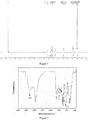
- the h-nuclear magnetic resonance spectrum of the raw material G1 used in the benzoxazine adhesive is as shown in figure 1 : 1 H NMR (CDCl 3 ): ⁇ (ppm) 0.01 (s, 60H, SiCH 3 ), 0.45 (t, 20H, SiCH 2 CH 2 CH 2 N), 1.34- 1.44 (m, 20H, SiCH 2 CH 2 CH 2 N), 2.30 (t, 8H, CH 2 CONH), 2.42 (t, 4H, SiCH 2 CH 2 CH 2 N), 2.65 (t, 8H, SiCH 2 CH 2 CH 2 NH 2 ), 2.74 (t, 8H, NCH 2 CH 2 CONH), 3.15 (t, 8H, SiCH 2 CH 2 CH 2 NHCO).
- IR characterization of the synthesized phenolic hydroxyl group-containing benzoxazine adhesive is as shown in Figure 2 .
- the peak at 1057cm -1 is generated by the asymmetric bending and vibration of the Si-O-Si.
- the peaks at 1185 and 1221cm -1 are respectively the asymmetric stretching vibration peaks of the C-O-C and C-N-C on the oxazine ring.
- the peak at 919cm -1 is the characteristic absorption peak of the benzene ring connected to the oxazine ring, namely a peak of the said oxazine ring, the absorption peak at 1482cm -1 is a stretching vibration peak on the triple-substitution benzene ring, and the bulge peak at 3290cm -1 is resulted in by the hydrogen bonds formed by the hydroxyl groups on the benzene ring.
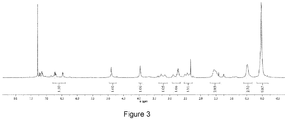
- NMR characterization of the synthesized phenolic hydroxyl group-containing benzoxazine adhesive is as shown in Figure 3 : 1 HNMR (CDCl 3 ): ⁇ (ppm) 0.01 (s, 60H, SiCH 3 ), 0.45 (t, 20H, SiCH 2 CH 2 CH 2 N), 1.34- 1.44 (m, 20H, SiCH 2 CH 2 CH 2 N), 2.30 (t, 8H, CH 2 CONH), 2.42 (t, 4H, SiCH 2 CH 2 CH 2 N), 2.74 (t, 8H, NCH 2 CH 2 CONH), 3.15 (t, 8H, SiCH 2 CH 2 CH 2 NHCO), ⁇ (ppm) 3.94 (s, 8H, O-CH 2 -N), ⁇ (ppm) 4.93(s, 8H,Ar-CH 2 -N), ⁇ (ppm) 6-7(m, 12H,Ar-H).
- Embodiment 2 provided that the silicon-containing dendrimer with amino groups as the end groups is changed to ethylenediamine, while the other parameters are maintained the same; and the benzoxazine adhesive with phenolic hydroxyl group-containing benzoxazine groups at the two ends is obtained, with a reaction yield of 100%.
- Embodiment 3 provided that the ethylenediamine is changed to aminopropyl-terminated polysiloxane (number-average molar mass 1000); and the benzoxazine adhesive of a polysiloxane containing structure with phenolic hydroxyl group-containing benzoxazine groups at the two ends is obtained, with a reaction yield of 100%.
- Embodiment 3 provided that the ethylenediamine is changed to polysiloxane with aminopropyl groups in the side chain (aminopropyl unit content in the polysiloxane: 5%; number-average molar mass: 120000); and finally, the polysiloxane with benzoxazine groups in the side chain is obtained, with a reaction yield of 90%.
- Embodiment 3 provided that the ethylenediamine is changed to hexanediamine; and the benzoxazine adhesive with phenolic hydroxyl group-containing benzoxazine groups at the two ends of the molecule is obtained, with a reaction yield of 96%.
- Embodiment 6 provided that the hexanediamine is changed to aminopropyl trimethoxy silane; and the benzoxazine adhesive with a phenolic hydroxyl group-containing benzoxazine group at one end is obtained, with a reaction yield of 96%.
- the aminopropyl vinyl diethoxy silane is changed to aminopropyl dimethyl ethoxy silane; the formaldehyde solution is changed to p-hydroxy dibenzophenone; the solvent is changed to tetrahydrofuran; and the dimethyl ethoxy silane with a phenolic hydroxyl group-containing benzoxazine group at one end is obtained, with a reaction yield of 95%.
- the aminopropyl vinyl diethoxy silane is changed to aminopropyl dimethyl ethoxy silane; the p-hydroxy benzophenone is changed to p-hydroxy phenyl ethyl ketone; the solvent is changed to methylbenzene; and the dimethyl ethoxy silane with a phenolic hydroxyl group-containing benzoxazine group at one end is obtained, with a reaction yield of 93%.
- the aminopropyl vinyl diethoxy silane is changed to aminopropyl triethoxy silane; the p-hydroxy benzophenone is changed to o-hydroxybenzaldehyde; the solvent is changed to chloroform; and the benzoxazine group-containing triethoxysilane is obtained, with a reaction yield of 96%.
- Embodiment 3 provided that acetic acid is added as the catalyst for the first step reaction and the dosage is 5% of the amount of ethylenediamine; the reaction time is changed to 3h; and the benzoxazine adhesive with benzoxazine groups at the two ends is obtained, with a reaction yield of 94%.
- the benzoxazine adhesive of a siloxysilane structure with phenolic hydroxyl group-containing benzoxazine groups at the two ends obtained in Embodiment 2 is applied to the polyimide plate, and then is cured under certain conditions (curing conditions: heating at 80°C for 1h; heating at 90°C for 1h; heating at 100°C for 1h; heating at 110°C for 1h; and heating at 120°C for 1h).
- the plate is kept still for 1 day after curing, and then is to be tested with a tensile machine.
- the benzoxazine adhesive of a siloxysilane structure with phenolic hydroxyl group-containing benzoxazine groups at the two ends obtained in Embodiment 2 is used as a basic formula component (100 parts) and then is mixed evenly with fumed silica (5 parts) and iron red (1 part); the mixture is then applied evenly to the polyimide plate, and is cured under certain conditions (curing conditions: heating at 80°C for 1h; heating at 90°C for 1h; heating at 100°C for 1h; heating at 110°C for 1h; and heating at 120°C for 1h).
- the plate is kept still for 1 day after curing, and then is to be tested with a tensile machine.
- the benzoxazine adhesive with phenolic hydroxyl group-containing benzoxazine groups at the two ends obtained in Embodiment 3 is applied to the polyimide plate, and then is cured under certain conditions (curing conditions: heating at 120°C for 1h; heating at 130°C for 1h; heating at 140°C for 1h; heating at 150°C for 1h; and heating at 160°C for 1h).
- the plate is kept still for 1 day after curing, and then is to be tested with a tensile machine.
- the benzoxazine adhesive with phenolic hydroxyl group-containing benzoxazine groups at the two ends obtained in Embodiment 3 is used as a basic formula component and then is mixed evenly with acetic acid, M-5 white carbon black treated with silazane (15 parts) and silane coupling agent KH570 (3 parts); the mixture is then applied evenly to the steel plate, and is cured under certain conditions (curing conditions: heating at 90°C for 1h; heating at 100°C for 1h; heating at 110°C for 1h; heating at 120°C for 1h; and heating at 130°C for 1h).
- the plate is kept still for 1 day after curing, and then is to be tested with a tensile machine.
- Adhesive strength data of the embodiments tested are as shown in Table 1.
- Table 1 S/N Adhesive strength, MPa 1 2 3 Average Embodiment 14 Plate fracture*** Plate fracture*** Plate fracture*** Plate fracture*** Embodiment 15 Plate fracture*** Plate fracture*** Plate fracture*** Plate fracture*** Embodiment 16 Plate fracture*** Plate fracture*** Plate fracture*** Plate fracture*** Comparative case 1* - - - 4.3 Comparative case 2* - - - 5 *Note: Data of comparative case 1 come from the patent (publication number: CN109880541A ). **Note: Data of comparative case 2 come from the patent (publication number: CN108641665A ). ***Note: Plate fracture in the table indicates fracture of the PI plates bonded together, and the average tensile force at the plate fracture can reach up to 3.18MPa.
- the phenolic hydroxyl group-containing benzoxazine adhesive prepared in the invention can be used as an adhesive with high strength directly.
- the phenolic hydroxyl group-containing benzoxazine adhesive is mixed with other fillers and auxiliaries, its performance is still very good, and its overall adhesion strength is even higher than the tensile strength data of the polyimide material coatings reported in the literatures.
- Such data show that the adhesive in the invention has obvious superiority in performance. Combined with the advantages of the invention in the preparation process, the creativity of the invention is further demonstrated.
Landscapes
- Chemical & Material Sciences (AREA)
- Organic Chemistry (AREA)
- Health & Medical Sciences (AREA)
- Chemical Kinetics & Catalysis (AREA)
- Medicinal Chemistry (AREA)
- Polymers & Plastics (AREA)
- Life Sciences & Earth Sciences (AREA)
- Engineering & Computer Science (AREA)
- Materials Engineering (AREA)
- Wood Science & Technology (AREA)
- Adhesives Or Adhesive Processes (AREA)
Applications Claiming Priority (1)
| Application Number | Priority Date | Filing Date | Title |
|---|---|---|---|
| CN201911223517.6A CN110804409A (zh) | 2019-12-03 | 2019-12-03 | 一种聚酰亚胺用苯并噁嗪型胶粘剂及其制备与使用方法 |
Publications (1)
| Publication Number | Publication Date |
|---|---|
| EP3831815A1 true EP3831815A1 (fr) | 2021-06-09 |
Family
ID=69492438
Family Applications (1)
| Application Number | Title | Priority Date | Filing Date |
|---|---|---|---|
| EP20178116.8A Pending EP3831815A1 (fr) | 2019-12-03 | 2020-06-03 | Adhésif à base de benzoxazine pour polyimide et son procédé de préparation et d'application |
Country Status (2)
| Country | Link |
|---|---|
| EP (1) | EP3831815A1 (fr) |
| CN (1) | CN110804409A (fr) |
Families Citing this family (2)
| Publication number | Priority date | Publication date | Assignee | Title |
|---|---|---|---|---|
| CN115286756A (zh) * | 2022-09-05 | 2022-11-04 | 瑞声科技(南京)有限公司 | 苯并噁嗪树脂、制备方法及胶粘剂 |
| CN119351014B (zh) * | 2024-12-27 | 2025-04-25 | 常州宏巨电子科技有限公司 | 一种生物基苯并噁嗪胶黏剂及其制备方法和应用 |
Citations (9)
| Publication number | Priority date | Publication date | Assignee | Title |
|---|---|---|---|---|
| US4585728A (en) * | 1983-06-13 | 1986-04-29 | Fuji Photo Film Co., Ltd. | Color photographic light-sensitive material |
| WO1989005803A1 (fr) * | 1987-12-24 | 1989-06-29 | Kuraray Co., Ltd. | Derives de 3,4-dihydro-2h-1,3-benzoxazine et leur utilisation en medecine |
| JPH01258614A (ja) * | 1988-04-05 | 1989-10-16 | Kuraray Co Ltd | 養毛剤 |
| JPH05279340A (ja) * | 1992-03-31 | 1993-10-26 | Kuraray Co Ltd | キノン誘導体 |
| WO2007012580A1 (fr) * | 2005-07-26 | 2007-02-01 | Basf Aktiengesellschaft | Utilisation de tetrahydrobenzoxazines comme agents stabilisants |
| CN107722883A (zh) | 2017-10-25 | 2018-02-23 | 深圳市宝康电子材料有限公司 | 一种改性丙烯酸纯胶膜胶粘剂 |
| CN108997245A (zh) * | 2018-07-20 | 2018-12-14 | 山东大学 | 含儿茶酚基团贻贝仿生聚苯并噁嗪及其合成与应用 |
| CN109627764A (zh) | 2018-12-17 | 2019-04-16 | 无锡创彩光学材料有限公司 | 一种高粘接低介电聚酰亚胺薄膜及其制备方法 |
| CN110229609A (zh) | 2019-05-23 | 2019-09-13 | 东南大学 | 一种带功能材料的聚酰亚胺涂料及采用该涂料制备功能型聚酰亚胺材料的方法 |
Family Cites Families (10)
| Publication number | Priority date | Publication date | Assignee | Title |
|---|---|---|---|---|
| CN101883807B (zh) * | 2007-12-06 | 2013-08-14 | 汉高两合股份公司 | 可固化苯并噁嗪大分子单体、它们的制备及其固化产物 |
| CN101775221B (zh) * | 2010-01-12 | 2012-06-27 | 山东大学 | 多胺化合物交联的热硫化硅橡胶及其制备方法 |
| CN102134254B (zh) * | 2011-01-05 | 2014-04-02 | 山东大学 | 含硅苯并噁嗪树脂及其制备方法与应用 |
| CN104610521B (zh) * | 2014-12-30 | 2016-08-24 | 广州市白云化工实业有限公司 | 硅烷改性酚醛树脂及其制备方法 |
| CN104861650A (zh) * | 2015-06-10 | 2015-08-26 | 花秀兵 | 一种耐热型苯并噁嗪树脂及其制备方法 |
| JP6879451B2 (ja) * | 2016-11-02 | 2021-06-02 | 三菱瓦斯化学株式会社 | シアン酸エステル化合物、シアン酸エステル化合物の製造方法、樹脂組成物、硬化物、単層樹脂シート、積層樹脂シート、プリプレグ、金属箔張積層板、プリント配線板、封止用材料、繊維強化複合材料及び接着剤 |
| CN108641665B (zh) * | 2018-05-14 | 2020-08-21 | 中国科学院化学研究所 | 一种聚酰亚胺胶黏剂及其制备方法 |
| CN109054734B (zh) * | 2018-07-20 | 2020-10-13 | 山东大学 | 一种基于含氨基硅氧烷制备的胶黏剂及其制备和使用方法 |
| CN109867792A (zh) * | 2019-01-16 | 2019-06-11 | 江苏大学 | 一种聚(苯并噁嗪-硅氧烷)共聚物及其制备方法 |
| CN109880541A (zh) * | 2019-01-28 | 2019-06-14 | 东莞市博恩复合材料有限公司 | 可快速固化且具高粘接强度的导热材料 |
-
2019
- 2019-12-03 CN CN201911223517.6A patent/CN110804409A/zh active Pending
-
2020
- 2020-06-03 EP EP20178116.8A patent/EP3831815A1/fr active Pending
Patent Citations (9)
| Publication number | Priority date | Publication date | Assignee | Title |
|---|---|---|---|---|
| US4585728A (en) * | 1983-06-13 | 1986-04-29 | Fuji Photo Film Co., Ltd. | Color photographic light-sensitive material |
| WO1989005803A1 (fr) * | 1987-12-24 | 1989-06-29 | Kuraray Co., Ltd. | Derives de 3,4-dihydro-2h-1,3-benzoxazine et leur utilisation en medecine |
| JPH01258614A (ja) * | 1988-04-05 | 1989-10-16 | Kuraray Co Ltd | 養毛剤 |
| JPH05279340A (ja) * | 1992-03-31 | 1993-10-26 | Kuraray Co Ltd | キノン誘導体 |
| WO2007012580A1 (fr) * | 2005-07-26 | 2007-02-01 | Basf Aktiengesellschaft | Utilisation de tetrahydrobenzoxazines comme agents stabilisants |
| CN107722883A (zh) | 2017-10-25 | 2018-02-23 | 深圳市宝康电子材料有限公司 | 一种改性丙烯酸纯胶膜胶粘剂 |
| CN108997245A (zh) * | 2018-07-20 | 2018-12-14 | 山东大学 | 含儿茶酚基团贻贝仿生聚苯并噁嗪及其合成与应用 |
| CN109627764A (zh) | 2018-12-17 | 2019-04-16 | 无锡创彩光学材料有限公司 | 一种高粘接低介电聚酰亚胺薄膜及其制备方法 |
| CN110229609A (zh) | 2019-05-23 | 2019-09-13 | 东南大学 | 一种带功能材料的聚酰亚胺涂料及采用该涂料制备功能型聚酰亚胺材料的方法 |
Non-Patent Citations (1)
| Title |
|---|
| R. ANDREU ET AL: "Studies on the thermal polymerization of substituted benzoxazine monomers: Electronic effects", JOURNAL OF POLYMER SCIENCE PART A: POLYMER CHEMISTRY, vol. 46, no. 10, 1 January 2008 (2008-01-01), pages 3353 - 3366, XP055063546, ISSN: 0887-624X, DOI: 10.1002/pola.22677 * |
Also Published As
| Publication number | Publication date |
|---|---|
| CN110804409A (zh) | 2020-02-18 |
Similar Documents
| Publication | Publication Date | Title |
|---|---|---|
| TWI512008B (zh) | A method for producing a compatible resin, a thermosetting resin composition, a prepreg, and a laminate | |
| CN111635626B (zh) | 树脂组合物、半固化片、层压片、半固化片的制备方法、层压片的制备方法及其应用 | |
| CN104245779B (zh) | 环氧树脂组合物 | |
| CN108219371B (zh) | 环氧树脂组合物、预浸料、层压板和印刷电路板 | |
| JP6838604B2 (ja) | シアン酸エステル化合物、その製造方法、樹脂組成物、硬化物、プリプレグ、封止用材料、繊維強化複合材料、接着剤、金属箔張積層板、樹脂シート及びプリント配線板 | |
| JP6879451B2 (ja) | シアン酸エステル化合物、シアン酸エステル化合物の製造方法、樹脂組成物、硬化物、単層樹脂シート、積層樹脂シート、プリプレグ、金属箔張積層板、プリント配線板、封止用材料、繊維強化複合材料及び接着剤 | |
| JP2022147022A (ja) | 熱硬化性シトラコンイミド樹脂組成物 | |
| EP3831815A1 (fr) | Adhésif à base de benzoxazine pour polyimide et son procédé de préparation et d'application | |
| WO2020017551A1 (fr) | Stratifié cuivré, carte de circuit imprimé, boîtier de semi-conducteur et procédé de production de stratifié cuivré | |
| CN116888189A (zh) | 热硬化性树脂组合物、硬化物、树脂片材、预浸体、覆金属箔层叠板、多层印刷配线板、密封用材料、纤维加强复合材料、接着剂以及半导体装置 | |
| TW201534643A (zh) | 印刷電路板用樹脂組成物、預浸體、覆金屬箔疊層板、樹脂複合片及印刷電路板 | |
| TW202328337A (zh) | 硬化性樹脂組成物、清漆、預浸體、硬化物 | |
| TW201625709A (zh) | 氰酸酯化合物與其製造方法、樹脂組成物及硬化物 | |
| JP7330333B1 (ja) | ビスマレイミド樹脂組成物およびプリプレグ | |
| JP7730502B2 (ja) | エポキシ樹脂組成物及びエポキシ樹脂硬化物 | |
| CN110869410B (zh) | 印刷电路板用树脂组合物、预浸料、树脂片、层叠板、覆金属箔层叠板、印刷电路板和多层印刷电路板 | |
| JP7305108B2 (ja) | シアン酸エステル化合物、樹脂組成物、硬化物、単層樹脂シート、積層樹脂シート、プリプレグ、金属箔張積層板、プリント配線板、封止用材料、繊維強化複合材料、及び接着剤 | |
| JP2024040585A (ja) | ボンディングフィルム用硬化性樹脂組成物、ボンディングフィルム及びプリント配線板 | |
| WO2019127389A1 (fr) | Composition de résine époxyde, préimprégné, stratifié et carte de circuit imprimé | |
| JP4011458B2 (ja) | 硬化性エポキシ樹脂組成物およびその製造方法 | |
| TWI914905B (zh) | 硬化性樹脂、硬化性樹脂組合物、硬化物及物品 | |
| JP6792204B2 (ja) | 樹脂組成物、プリプレグ、金属箔張積層板、樹脂シート及びプリント配線板 | |
| JP7449498B2 (ja) | 硬化性組成物、プリプレグ、金属箔張積層板及びプリント配線板 | |
| JP6905682B2 (ja) | 樹脂組成物、プリプレグ、金属箔張積層板、樹脂シート及びプリント配線板 | |
| JP6905683B2 (ja) | 樹脂組成物、プリプレグ、金属箔張積層板、樹脂シート及びプリント配線板 |
Legal Events
| Date | Code | Title | Description |
|---|---|---|---|
| PUAI | Public reference made under article 153(3) epc to a published international application that has entered the european phase |
Free format text: ORIGINAL CODE: 0009012 |
|
| STAA | Information on the status of an ep patent application or granted ep patent |
Free format text: STATUS: THE APPLICATION HAS BEEN PUBLISHED |
|
| AK | Designated contracting states |
Kind code of ref document: A1 Designated state(s): AL AT BE BG CH CY CZ DE DK EE ES FI FR GB GR HR HU IE IS IT LI LT LU LV MC MK MT NL NO PL PT RO RS SE SI SK SM TR |
|
| STAA | Information on the status of an ep patent application or granted ep patent |
Free format text: STATUS: REQUEST FOR EXAMINATION WAS MADE |
|
| 17P | Request for examination filed |
Effective date: 20210823 |
|
| RBV | Designated contracting states (corrected) |
Designated state(s): AL AT BE BG CH CY CZ DE DK EE ES FI FR GB GR HR HU IE IS IT LI LT LU LV MC MK MT NL NO PL PT RO RS SE SI SK SM TR |
|
| STAA | Information on the status of an ep patent application or granted ep patent |
Free format text: STATUS: EXAMINATION IS IN PROGRESS |
|
| 17Q | First examination report despatched |
Effective date: 20230227 |
|
| STAA | Information on the status of an ep patent application or granted ep patent |
Free format text: STATUS: THE APPLICATION IS DEEMED TO BE WITHDRAWN |