EP3831994B1 - Gestrickteil - Google Patents
Gestrickteil Download PDFInfo
- Publication number
- EP3831994B1 EP3831994B1 EP19020672.2A EP19020672A EP3831994B1 EP 3831994 B1 EP3831994 B1 EP 3831994B1 EP 19020672 A EP19020672 A EP 19020672A EP 3831994 B1 EP3831994 B1 EP 3831994B1
- Authority
- EP
- European Patent Office
- Prior art keywords
- knitted
- section
- basic
- waistband
- stocking
- Prior art date
- Legal status (The legal status is an assumption and is not a legal conclusion. Google has not performed a legal analysis and makes no representation as to the accuracy of the status listed.)
- Active
Links
Images


Classifications
-
- D—TEXTILES; PAPER
- D04—BRAIDING; LACE-MAKING; KNITTING; TRIMMINGS; NON-WOVEN FABRICS
- D04B—KNITTING
- D04B1/00—Weft knitting processes for the production of fabrics or articles not dependent on the use of particular machines; Fabrics or articles defined by such processes
- D04B1/22—Weft knitting processes for the production of fabrics or articles not dependent on the use of particular machines; Fabrics or articles defined by such processes specially adapted for knitting goods of particular configuration
- D04B1/24—Weft knitting processes for the production of fabrics or articles not dependent on the use of particular machines; Fabrics or articles defined by such processes specially adapted for knitting goods of particular configuration wearing apparel
- D04B1/26—Weft knitting processes for the production of fabrics or articles not dependent on the use of particular machines; Fabrics or articles defined by such processes specially adapted for knitting goods of particular configuration wearing apparel stockings
- D04B1/265—Surgical stockings
-
- A—HUMAN NECESSITIES
- A61—MEDICAL OR VETERINARY SCIENCE; HYGIENE
- A61F—FILTERS IMPLANTABLE INTO BLOOD VESSELS; PROSTHESES; DEVICES PROVIDING PATENCY TO, OR PREVENTING COLLAPSING OF, TUBULAR STRUCTURES OF THE BODY, e.g. STENTS; ORTHOPAEDIC, NURSING OR CONTRACEPTIVE DEVICES; FOMENTATION; TREATMENT OR PROTECTION OF EYES OR EARS; BANDAGES, DRESSINGS OR ABSORBENT PADS; FIRST-AID KITS
- A61F13/00—Bandages or dressings; Absorbent pads
- A61F13/06—Bandages or dressings; Absorbent pads specially adapted for feet or legs; Corn-pads; Corn-rings
- A61F13/08—Elastic stockings; for contracting aneurisms
-
- D—TEXTILES; PAPER
- D04—BRAIDING; LACE-MAKING; KNITTING; TRIMMINGS; NON-WOVEN FABRICS
- D04B—KNITTING
- D04B1/00—Weft knitting processes for the production of fabrics or articles not dependent on the use of particular machines; Fabrics or articles defined by such processes
- D04B1/10—Patterned fabrics or articles
- D04B1/102—Patterned fabrics or articles with stitch pattern
- D04B1/106—Patterned fabrics or articles with stitch pattern at a selvedge, e.g. hems or turned welts
-
- D—TEXTILES; PAPER
- D10—INDEXING SCHEME ASSOCIATED WITH SUBLASSES OF SECTION D, RELATING TO TEXTILES
- D10B—INDEXING SCHEME ASSOCIATED WITH SUBLASSES OF SECTION D, RELATING TO TEXTILES
- D10B2509/00—Medical; Hygiene
- D10B2509/02—Bandages, dressings or absorbent pads
- D10B2509/028—Elastic support stockings or elastic bandages
Definitions
- the present invention relates to a knitted article, preferably a compressive knitted article, according to the preamble of claim 1.
- Such knitted parts are used in particular for the formation of arm or leg clothing, for example as arm or leg stockings.
- these often have one or more compressive areas which serve to exert targeted pressure on a patient's body.
- the pressure exerted on a patient's body is referred to as compression.
- the aim of compression stockings is, among other things, to relieve a patient's damaged venous and/or lymphatic system.
- the applied pressure prevents increasing swelling of the limbs, improves the drainage of venous blood and lymph, and increases blood supply.
- compression stockings are used in sports, they increase performance and improve regeneration.
- these compressive and non-compressive knitted parts they are preferably knitted using a circular knitting machine.
- the knitted parts are knitted from at least one loop-forming knitting thread.
- an elastic weft thread is inserted into the knitted stitches in every row or every Xth row.
- the RAL-GZ 387 standard of the Quality Mark Association exists for the production, in particular for measurement and quality assurance, of compressive arm or leg stockings for medical use.
- the RAL test specifications can be taken from how the pressure of a compression stocking on a leg is to be determined.
- the HOSY measuring device Hohenstein Institute
- the test is carried out by measuring the tension at several measuring points, which varies depending on the respective extensibility of the knitted fabric, i.e., depending on the elasticity of the knitted fabric.
- the compression is calculated from the tension. This means that the greater the elasticity of a knitted fabric in the cross-sectional direction, the lower the compression exerted on the patient. Conversely, the lower the elasticity of the knitted fabric, the greater the compression exerted on the patient.
- a preferably compressive circular knit for pulling over an extremity with a joint is known, for example, from EP 2 792 774 B1 known.
- This known compressive circular knit which is designed to ensure greater comfort, comprises a base knit section comprising a zone with several adjoining knit sections.
- two first knit sections are provided, which are knitted with floats and are spaced apart from one another in the longitudinal direction of the fabric. Between these first knit sections there is a knitted area consisting of further, different knit sections adjoining one another in the circumferential direction. These sections have different float numbers and the floats of one stitch row are knitted offset from the next.
- a section is provided which is knitted in plain fabric. At the upper and lower ends, the compressive circular knit has a waistband which is sewn or knitted on.
- a circular knit is disclosed with a knit section consisting of four differently knitted knit areas, resulting in an anatomically shaped knit that offers increased wearing comfort.
- a disadvantage of the design of the textile fabric known from this prior art is that, although the incorporation of the disclosed comfort zone provides the knitted fabric with a relief zone in some areas, a true adaptation of the base knitted part to the anatomical requirements does not occur.
- the base knitted fabric is knitted continuously, particularly in a tubular shape, in a circular pattern without actually being adapted to the anatomy of an extremity.
- the aforementioned relief zones merely allow for easier adaptation of the knitted stocking to the extremity, which in turn leads to increased wrinkling.
- a further disadvantage of the textile fabric known from the prior art is that the actual position of the knitted fabric on the body and the actual anatomy of the limb are not taken into account. Furthermore, the basic knit, i.e., its knitting structure, particularly the weave, is modified in those areas that require increased adaptation of the knitted part to the shape of the limb. This has the disadvantage that the knitted fabric properties change and possibly even deteriorate in order to improve the fit.
- Waistband sections have a single-layer or double-layered Formation, preferably with a basic weave that differs from the rest of the basic knit, in particular in the form of ribs, requires more space, which in turn can be particularly annoying when wearing the item, especially if it is incorrectly placed on the extremity or lies incorrectly.
- a compression stocking made of an elastic material which can be a woven, knitted, or warp-knitted fabric
- a cuff can be provided at the upper and lower ends of the stocking.
- the upper cuff is preferably arranged at an angle on the compression stocking.
- at least the lower cuff it is proposed to design it as a hemmed waistband. With such a hemmed waistband or hem, the edge of the woven or warp-knitted fabric is folded over and sewn to the remaining woven or warp-knitted section.
- a knitted or crocheted tights consists of a leg section, a trouser section, and an elastic waistband.
- the waistband is designed as an elastic waistband and attached to the trouser section.
- it is recommended to make the tights higher at the back than at the front.
- a wedge-shaped section is incorporated into the tights, or the number of rows of stitches in the back of the trouser section is increased.
- an elastic waistband is typically a knitted, elastic, and usually single-layer fabric that is sewn onto a knitted section.
- the thin knitted fabric usually causes constriction for the wearer of the tights.
- attaching the elastic waistband to the knitted section also requires an additional manufacturing step: the manual sewing of the waistband, which entails additional manufacturing costs and thus increases the price of the tights.
- a knitted garment is also known. At the bottom or edge of the garment, a double hem is provided, produced on a knitting machine and folded over. This hem is created by knitting it flat, folding it over, and then sewing it on.
- a disadvantage of this prior art garment design with a slanted hem is that the bottom edge of the garment is formed by a hem.
- the production of the hem requires the incorporation of a seam to form and secure the hem, which entails an additional manufacturing step. This increases manufacturing costs.
- the present invention is therefore based on the object of creating a knitted part, preferably a compressive knitted part, which avoids the disadvantages of the prior art, in particular significantly improves the fit of a knitted part, while at the same time producing the knitted part cost-effectively and efficiently.
- the knitted part consists of a basic knitted section knitted as a circular knit over several rows of stitches and at least one waistband section adjoining the basic knitted section, knitted onto it and also knitted over several rows of stitches, wherein the rows of stitches of the basic knitted section and the waistband section are arranged at an angle to one another.
- the waistband section thus runs at an angle to the basic knitted section of the knitted part.
- the knitting direction of the two sections thus changes relative to one another. This is preferably achieved by knitting one or more additional partial rows of stitches extending less than 360 degrees in the circumferential direction into or onto the basic knitted section.
- the waistband section knitted onto it can thus be arranged at an angle of 1 to 90 degrees, preferably at an angle of 5 to 45 degrees, to the basic knitted section.
- the base knit section of the knitted part can have one or more base knit stitch rows for the angled arrangement of the waistband section, the stitches of which have at least partially a modified stitch size in the circumferential direction.
- the stitch size preferably increases or decreases in the circumferential direction over several stitch rows.
- the waistband section of the knitted part double-layered.
- the waistband section comprises a knitted outer layer and a second knitted inner layer, whereby the two layers are knitted continuously.
- the waistband section preferably comprises a basic weave type that differs from the basic knitted section.
- the waistband section is knitted with a rib structure.
- it preferably has an adhesive section. This can be achieved by a coating applied to the basic knitted section or by several applied adhesive particles.
- adhesive yarns can also be knitted into the base knit of the waistband section, which are arranged on the surface of the base knit or are raised.
- the waistband section has a width of preferably approximately 1 to 5 cm.
- the width is particularly preferably approximately 2 cm for a leg garment and approximately 5 cm for an arm garment.
- the elasticity in the longitudinal and/or transverse direction of the waistband section is preferably less than that of the base knit section, so that a particularly good hold of the knitted part on the extremity of the wearer is ensured.
- the knitted part in particular the basic knitted section, has at its opposite end a second waistband section which corresponds to or differs from the first waistband section in terms of its technical properties and size.
- a closed toe box adjoins the base knit section, in particular at its opposite end, so that the base knit section and the toe box form a stocking with a closed toe.
- Further functional zones in addition to the toe box, in particular a heel, preferably a swing heel, a relief zone, for example for the wearer's ankle, a transition zone, or a plush zone can also be provided on the base knit section. If a plush zone is formed, it is preferably arranged in the region of the sole of the stocking, the toe box, and/or the heel of the stocking.
- the base knit section has at least one compression region, wherein the compression strength in said region is preferably between 10 and 50 mmHg.
- the compression strength in the compression region decreases or increases, preferably continuously, in the longitudinal direction of the knitted fabric.
- the base knit section thus preferably has a gradual pressure progression. The gradual pressure progression is preferably determined by the manner, in particular by the pretensioning of a weft thread during insertion into the knitted part knitted with a base knit thread and/or by the number of consecutive stitch rows in which the weft thread is deposited.
- the pressure gradient of the basic fabric section which preferably decreases in the longitudinal direction of the fabric, preferably increases in the waistband section following the basic fabric section. This preferably occurs abruptly, ie over a few stitch rows the Compression strength significantly, i.e. preferably by more than 3 mm Hg.
- the weft thread is preferably inserted into the knit of the waistband section with a higher pre-tension compared to the basic knit section, or the number of stitch rows in which the weft thread is inserted is increased in the longitudinal direction of the knit.
- the latter can also be achieved by inserting the weft thread into both layers of the waistband in a double-layered waistband section, i.e. the inner and outer layer.
- the increased compression strength in the waistband section ensures that the knitted part is held better on the wearer. It is of course also conceivable for the compression strength in the waistband section to follow the course or trend of the compression strength in the adjacent basic knit section and thus remain constant, continue to increase, or continue to decrease.
- the waistband section is designed or arranged on the basic knitted section in such a way that, when worn, it essentially follows the course of the big and little toe balls of a wearer and/or overlaps them.
- the waistband section is designed such that, when worn, it extends further towards the wearer's shoulder on the outside of the arm than on the inside of the arm.
- the waistband when worn, preferably lies below the crook of the elbow on the inside of the arm, while on the outside of the arm it extends further towards the wearer's shoulder.
- the angled arrangement of the waistband on the basic knitted section makes it possible to cover the wearer's forearm as comprehensively as possible, while at the same time keeping the crook of the elbow free to ensure greater wearing comfort.
- the armwear item When the armwear item is designed as an upper arm stocking, this can also be implemented in the armpit area. This keeps the armpit free, since the waistband, when worn, preferably lies below the armpit on the inside of the arm, but extends further towards the shoulder on the outside of the arm.
- the knitted part according to the preceding embodiments is designed as a leg stocking, in particular as a sock, leg warmer, leggings or pants, a bandage, or as a knitted part of an orthosis. It is particularly preferably designed as a compressive knitted part. formed, whereby the compression strength in The thickness of the knitted fabric decreases or increases, particularly from the ankle towards the calf muscles.
- the compressive pressures generated by the knitted part in an ankle region of the leg garment are preferably between 10 and 50 mmHg, in the calf region preferably between 5 and 30 mmHg and in a midfoot region preferably between 10 and 30 mmHg.
- This legwear item is characterized by a number of significant advantages.
- the knitted part By forming the knitted part with a base knit section and a waistband section, with the two sections arranged at an angle to each other, the fit of the knitted part is significantly improved.
- the partial forward displacement of the waistband particularly in a medial or lateral and/or proximal or distal direction relative to the wearer's extremity, gives the knitted part an anatomical shape that closely approximates the anatomy of the extremity.
- the knitted part according to the invention ensures an improved fit without the base knitted part having to be stretched particularly strongly to fit the shape of the extremity. Wrinkles are thus avoided.
- This is achieved in particular by changing the knitting direction of the waistband section relative to the knitting direction of the base knitted section. This means that the position of the stitch rows of the base knitted section and the waistband section are arranged at an angle to one another and thus also lie at an angle on the extremity of a wearer. This also results in a particularly even distribution of the compressive pressures of the knitted part.
- the waistband section when the knitted part is worn, essentially follows the course of the big and little toe balls of a wearer or overlaps them.
- This and in particular the design of the waistband section as a double-layered waistband makes it possible to cushion the big and little toe balls.
- the freedom of movement of the toe joints in the proximal direction can be maintained, which plays a particularly important role in compressive legwear items.
- a further advantage of the invention is the cost-effective production of the knitted part, which is particularly well adapted to the anatomy of an extremity and has a knitted, preferably double-layered waistband section. Additional finishing of the waistband to improve the fit of the knitted part is unnecessary.
- the knitted part can be manufactured in a single manufacturing and knitting process, particularly because the base knitted section and the single-layer or double-layered waistband section are knitted in a single knitting process.
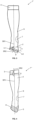
- FIG. 1 A first embodiment of the knitted part 1 in the form of a leg stocking, in particular a preferably compressive medical stocking or sports stocking, is shown in a side view.
- the leg stocking 1 consists of a basic knitted section 2 knitted as a circular knit over several rows of stitches and at least one waistband section 3 adjoining the basic knitted section 2 and also knitted over several rows of stitches.
- the stocking 1 preferably has a second waistband section 4.
- a heel preferably a pendulum heel 6, is knitted into the basic knitted section 2.
- the stocking 1 is a compressive stocking 1
- the compressive pressures generated in an ankle region 9 are preferably between 10 and 50 mmHg, and in a calf region between 5 and 30 mmHg.
- the compression strength preferably decreases from the lower end towards the calf muscles.
- the gradual pressure progression is preferably determined by the manner in which a weft thread 12 is inserted into the knitted part 1 knitted with a base knitting thread 10, in particular by the number of consecutive stitch rows into which the weft thread 3 is inserted, as shown in Figure 5
- the compressive values are measured using the measurement methodology and measuring device presented above, in particular by testing with the HOSY measuring device (Institut Hohenstein).
- an adhesive thread can be knitted into the knitted part 1, particularly in the waistband sections 3 and/or 4.
- the adhesive thread is preferably a silicone thread or a thread that also has an adhesive, preferably slightly sticky, adhesive, or at least slip-resistant surface. An adhesive layer is thus applied to the inside and/or outside of the waistband sections 3 and/or 4.
- the waistband 3 is arranged at an angle to the basic knitted section 2 or is knitted at an angle thereto.
- the waistband section 3 thus runs at an angle ⁇ of preferably greater than 5 degrees and less than 90 degrees to the basic knitted section 2.
- the basic knitted section 2 has, for example, (1) one or more additional partial stitch rows extending less than 360 degrees in the circumferential direction and/or (2) one or more basic knitted stitch rows whose stitches in the circumferential direction at least partially have a changed stitch size.
- the knitted part 1 according to the invention thus has a waistband section 3 which, due to its special arrangement relative to the basic knitted section 2, gives the knitted part 1 according to the invention an anatomical shape that approximates the anatomy of the extremity.
- the arrangement of the collar 3 on the basic knitted fabric section 2 in the area of the sole of the foot or alternatively also in the area of joints, in particular on the inner and outer sides of the joints provides significantly improved wearing comfort.
- the waistband 3 of the knitted part 1 according to the invention is arranged on the basic knitted section 2 in such a way that it is positioned on the underside of the wearer's foot in front of the top of the foot.
- the waistband 3 is in a worn
- the knitted part 1 is positioned further forward toward the toes of the wearer on the underside of the foot than on the top.
- This has the advantage that, for example, the waistband 3 overlaps the big and little toe balls of the wearer's foot and cushions them without restricting the freedom of movement of the toe joints in the proximal direction, which is particularly important for compressive legwear.
- the waistband section 3 is additionally constructed or knitted in two layers, as this provides particularly high cushioning properties.
- the width of the waistband 3 is preferably 1 to 5 cm, particularly preferably 2 cm.
- the waistband 3 is further preferably characterized by having less elasticity in the longitudinal and/or transverse directions than the base knitted section 2.
- Figure 2 shows a non-inventive example of the circularly knitted knitted part 1', namely designed as an arm stocking 1'.
- the arm stocking 1' is also preferably a compressive garment, which exerts compressive pressures on the wearer of the stocking 1', in particular on his upper and/or lower arm.
- the arm stocking 1' has a basic knitted section 2 and also a waistband section 3 arranged at an angle thereto.
- the waistband section 3 extends at an angle ⁇ of preferably greater than 5 degrees to the basic knitted section 2.
- a second collar section 4 is provided at the opposite end, as already in Figure 1 shown.
- the angled arrangement of the waistband section 3, in particular the change in knitting direction SR1 of the basic knitted section 2, so that the waistband 3 is knitted with a second knitting direction SR2 that differs from the first knitting direction SR1, ensures better wearing comfort for the arm stocking 1', especially when designed as an underarm stocking or as an upper arm stocking.
- the partial forward displacement of the waistband 3 such that, when worn, it extends further towards the wearer's shoulder on the outside of the wearer's arm than on the inside of the arm, ensures that, in particular at the level of the crook of the elbow or armpit, the stocking 1' overlaps these areas on the outside, but does not protrude into them on the inside of the arm and thereby restricts freedom of movement.
- Section A marks the area which is Figure 5 shown in the form of a stitch pattern.
- FIG 3 a further example of the knitted part 1" not according to the invention is shown, which is also designed as a leg garment, in particular as a leg stocking 1" with an open toe and a second waistband section 4.
- Figure 3 another particularly preferred example of the angled arrangement of a collar 3 relative to a basic knitted fabric section 2 is shown.
- the leg stocking 1" described in the drawing also comprises, in addition to the basic knitted section 2, a second waistband 4 and at least one compression region 9 in the area of the ankle of a wearer, which compression region extends to the upper end of the stocking. Furthermore, a functional zone, in particular a relief zone 7, is provided in the area of the ankle of a wearer.
- the relief zone 7 is characterized in that the basic knitted section 2 in this area has a higher elasticity in the longitudinal and/or transverse direction than the adjacent basic knitted section 2.
- the waistband section 3 which in this embodiment is arranged at an angle to the basic knitted section 2, is, as can be seen from the drawing, arranged at a double angle to the basic knitted section 2.
- the basic knitted section 2 and the waistband section 3 are arranged at an angle ⁇ of preferably between 5 and 45 degrees to the longitudinal axis of the basic knitted section 2, in particular the foot part of the stocking 1", as in the embodiment in Figure 2 shown, i.e. a lateral, i.e. medial or lateral change of the knitting direction SR1 in relation to the foot of a wearer, and on the other hand, as in the embodiment in Figure 1 shown, are arranged at an angle ⁇ of preferably also between 5 and 45 degrees, i.e.
- Figure 4 1 shows a further example of the knitted part 1′′′ not according to the invention, which is also designed as a preferably compressive leg stocking 1′′′, but now has a closed toe area according to this example.
- the leg stocking 1′′′ thus has a basic knitted section 2 and a toe box 5 arranged distally thereto.
- a waistband section 3 is provided, which according to the invention is arranged at an angle to the basic knitted section, i.e. the leg and/or foot section.
- the stocking 1′′′ preferably also has a further functional zone, namely padding 8 in the area of the toe box 5, i.e. also preferably in the sole area of the stocking 1′′′.
- This is preferably designed as plush, in particular as sandwich plush.
- at least one further plush thread forming a plush loop is preferably incorporated into the basic knitted fabric in the toe and sole area.
- This preferably consists of polyamide, polyester, polypropylene, or natural fiber. This gives the knitted part 1" a cushioning property.
- the at least one padding 8 extends, in addition to the sole of the foot—that is, the toe area, the ball of the foot, and the heel—at least partially along the Achilles tendon toward the calf when the stocking 1" is worn.
- the waistband section 3 arranged at the upper end of the stocking runs at an angle ⁇ of preferably greater than 5 degrees to the basic knitted fabric section 2.
- ⁇ preferably greater than 5 degrees to the basic knitted fabric section 2.
- better wearing comfort is ensured by the angled arrangement of the waistband section 3, in particular by changing the knitting direction SR1 of the basic knitted fabric section 2, so that the waistband 3 is knitted with a second knitting direction SR2 that deviates from the first knitting direction SR1.
- the fit of the stocking 1′′′ is significantly improved by the partial forward displacement of the waistband 3 on the medial side of the leg stocking 1′′′ with respect to a wearer.
- a lateral forward displacement of the waistband 3 can also be advantageous.
- the knitted part according to the invention is designed as a sock, bandage, or as a knitted part of an orthosis.
- Figure 5 a stitch pattern, in particular a section A from the non-inventive example of the knitted part 1' according to Figure 2
- the stitch pattern shows the knitted basic fabric section 2 and waistband section 3, each of which is formed from a basic knitting thread 10 that is knitted to form a stitch over several knitting rows MR1 to MR7 and wales M1 to M18.
- the basic knitting thread is preferably made of plastic, in particular polyamide, polyester, polypropylene or polyurethane. Alternatively, it can be made of natural fibers, in particular wool or cellulose or viscose.
- the stitch rows MR1 to MR4 show a section of the waistband section 3.
- the stitch rows MR5 to MR11 show a section of the basic knit section 2.
- At least one compression-providing weft thread 11 is inserted into the basic knitting stitches in both areas 2 and 3.
- the weft thread is preferably made of an elastomer, preferably PU-based.
- the highly elastic weft thread 3 is inserted into each stitch row. However, this can be configured as desired. It can also be inserted only in every second stitch row or in every nth stitch row.
- the weft thread 11 can also be knitted in sections in one or more wales, forming a stitch, as seen in the circumferential direction.
- the stitch pattern shows that a stitch-forming additional thread 12 is knitted into the basic knitted section 2 for the angled arrangement of the waistband section 3, and thus forms additional stitch rows TR1 to TR4.
- This thread 12 is, in particular for changing the knitting direction, only knitted in sections, i.e. partially and not completely circumferentially, as seen in the circumferential direction, into the basic knitted section 2 and is also locked at its ends in the basic knitting rows, preferably by means of tuck and float.
- the additional stitch rows TR1 to TR4 extend from the section A, which forms the upper side of the Figure 2 shown knitted part 1', into the adjacent cutout shown and thus into the underside of the knitted part 1' according to Figure 2 .
- the additional stitch rows TR1 to TR4 are of different lengths. The length of the partial rows decreases with increasing distance from the waistband section 2. This has proven to be particularly advantageous for forming the angled arrangement of both sections 2 and 3 to one another. However, other designs with regard to the additional stitch row length are also conceivable.
- the knitting direction is changed according to the invention, whereby it is possible for the basic knitted section 2 and the waistband section 3 to be arranged at an angle to one another.
- the angled arrangement of the waistband section 3 one or more Basic knitting stitch rows are provided, the stitches of which have at least partially a changed stitch size in the circumferential direction.
Landscapes
- Engineering & Computer Science (AREA)
- Textile Engineering (AREA)
- Health & Medical Sciences (AREA)
- Life Sciences & Earth Sciences (AREA)
- Heart & Thoracic Surgery (AREA)
- Vascular Medicine (AREA)
- Biomedical Technology (AREA)
- Animal Behavior & Ethology (AREA)
- General Health & Medical Sciences (AREA)
- Public Health (AREA)
- Veterinary Medicine (AREA)
- Socks And Pantyhose (AREA)
- Undergarments, Swaddling Clothes, Handkerchiefs Or Underwear Materials (AREA)
Description
- Die vorliegende Erfindung bezieht sich auf ein Gestrickteil, vorzugsweise auf ein kompressives Gestrickteil, nach dem Oberbegriff des Anspruch 1.
- Derartige Gestrickteile werden, insbesondere für die Ausbildung von Arm- oder Beinbekleidungsstücken, beispielsweise als Arm- oder Beinstrumpf, verwendet. Für den medizinischen Einsatz und/ oder für die Anwendung bei sportlichen Aktivitäten weisen diese oftmals einen oder mehrere kompressive Bereiche auf, welche dazu dienen gezielt Druck auf den Körper eines Patienten auszuüben. Der auf den Körper eines Patienten ausgeübte Druck wird als Kompression bezeichnet. Ziel bei Kompressionsstrümpfen beispielsweise, insbesondere in Form von Beinlingen mit oder ohne Hand- oder Fußteil für den medizinischen Einsatz, ist es unter anderem ein geschädigtes Venen- und/ oder Lymphsystem eines Patienten zu entlasten. Durch den zugeführten Druck wird eine zunehmende Schwellung der Gliedmaßen vermieden, der Abtransport von venösem Blut und Lymphe verbessert und die Blutzufuhr gesteigert. Bei Einsatz von Kompressionsstrümpfen in dem Sportbereich bewirken diese eine Leistungssteigerung bzw. eine verbesserte Regeneration.
- Zur Ausbildung dieser kompressiven und nicht-kompressiven Gestrickteile, werden diese vorzugsweise mittels einer Rundstrickmaschine rundgestrickt. Hierzu werden die Gestrickteile aus wenigstens einem maschenbildenden Strickfaden gestrickt. Zur Bildung kompressiver Gestrickteile wird in die gestrickten Maschen ein elastischer Schussfaden in jeder oder in jede X-te Reihe eingelegt. Zur Herstellung, insbesondere zur Messung und Gütesicherung, von kompressiven Arm- oder Beinstrümpfen für die medizinische Anwendung, existiert die RAL-GZ 387 der Gütezeichengemeinschaft. Aus den Prüfbestimmungen der RAL kann entnommen werden, wie der Druck eines Kompressionsstrumpfes auf ein Bein zu bestimmen ist. Als Messmittel, insbesondere Kompressionsprüfgerät, wird die Prüfung am HOSY Messgerät (Institut Hohenstein) vorgeschlagen. Die Prüfung erfolgt anhand der Messung der Spannkraft in den mehreren Messpunkten, welche abhängig von der jeweiligen Dehnbarkeit des Gestricks, also abhängig von der Elastizität des Gestricks, variiert. Aus der Spannkraft wird die Kompression errechnet. D.h. je mehr Elastizität ein Gestrick in Gestrickquerrichtung aufweist, desto geringer ist die durch das Gestrick am Patienten ausgeübte Kompression. Andererseits je geringer die Elastizität des Gestrickteils ist, desto höher ist die am Patienten ausgeübte Kompression.
- Aus dem Stand der Technik sind eine Vielzahl von, insbesondere rundgestrickten, Gestrickteilen, insbesondere in Form von Arm- oder Beintrümpfen, bekannt.
- Ein vorzugsweise kompressives Rundgestrick zum Überziehen über eine ein Gelenk aufweisende Extremität ist beispielsweise aus der
EP 2 792 774 B1 bekannt. - Dieses bekannte kompressive Rundgestrick, welches es zur Aufgabe hat einen besseren Tragekomfort zu gewährleisten, umfasst einen Grundgestrickabschnitt, welcher eine Zone mit mehreren sich aneinander anschließenden Gestrickabschnitte umfasst. Insbesondere sind zwei in Gestricklängsrichtung voneinander beabstandete erste Gestrickabschnitte, die mit Flottungen gestrickt sind, vorgesehen, zwischen denen ein Gestrickbereich bestehend aus weiteren in Umfangsrichtung aneinander anschließenden unterschiedlichen Gestrickabschnitten angeordnet sind, welche unterschiedliche Flottungszahlen aufweisen und deren Flottungen einer Maschenreihe zur nächsten Maschenreihe versetzt gestrickt sind. Ferner ist ein Abschnitt vorgesehen der glatt gestrickt ist. Am oberen und unteren Ende weist das kompressive Rundgestrick einen Bund auf, welcher angenäht oder angestrickt ist.
- Insgesamt wird somit ein Rundgestrick mit einem Gestrickabschnitt offenbart, der aus vier unterschiedlich gestrickten Gestrickbereichen besteht, wodurch ein anatomisch geformtes Gestrick realisiert wird, das einen erhöhten Tragekomfort aufweist.
- Als nachteilig der aus diesem Stand der Technik bekannten Ausgestaltung des textilen Flächengebildes erweist sich, dass zwar durch das Einarbeiten der offenbarten Komfortzone das Gestrick bereichsweise eine Entlastungszone erhält, jedoch eine echte Anpassung des Grundgestrickteils an die anatomischen Erfordernisse nicht erfolgt. Das Grundgestrick wird nämlich durchgängig, insbesondere röhrenförmig, rundgestrickt, ohne der Anatomie einer Extremität tatsächlich angepasst zu sein. Die genannten Entlastungszonen ermöglichen nämlich lediglich eine leichtere Anpassung des gestrickten Strumpfes an die Extremität, was jedoch wiederum zu einer erhöhten Faltenbildung führt.
- Ein weiterer Nachteil des aus dem Stand der Technik bekannten textilen Flächengebildes ist, dass die tatsächliche Lage des Gestricks am Körper und die tatsächliche Anatomie der Extremität nicht berücksichtig werden. Zudem wird das Grundgestrick, also dessen stricktechnischer Aufbau, insbesondere Bindungsart, in jenen Bereichen geändert, die eine erhöhte Anpassung des Gestrickteils an die Form der Extremität benötigen. Dies hat den Nachteil, dass sich die Gestrickeigenschaften ändern und möglicherweise auch verschlechtern, um die Passform zu erhöhen.
- Schließlich erweist sich auch als nachteilig, dass die Anordnung des Bundes am Rundgestrick sowie die Lage des Bundes zu der Extremität eines Trägers gänzlich unberücksichtigt bleibt. Bundabschnitte weisen durch ihre einlagige oder doppellagige Ausbildung, vorzugsweise mit einer sich zum restlichen Grundgestrick unterscheidenden Grundbindungsart, insbesondere in Form von Rippen, einen erhöhten Platzbedarf auf, was sich wiederum als besonders störend beim Tragen des Gegenstandes auswirken kann, insbesondere auch dann, wenn dieser an der Extremität falsch platziert wird bzw. falsch zum Liegen kommt.
- Aus der
DE 10 2006 048 313 A1 ist ferner ein Kompressionsstrumpf aus einem elastischen Material, welches ein Gewebe, ein Gewirke oder ein Gestrick sein kann, bekannt. Am oberen und unteren Ende des Strumpfes kann ein Bündchen vorgesehen sein. Das obere Bündchen ist vorzugsweise gewinkelt an dem Kompressionsstrumpf angeordnet. Zur Ausbildung eines derartigen Bündchens, zumindest des unteren Bündchens, wird vorgeschlagen diesen als abgesaumten Bund auszugestalten. Bei einem solchen gesaumten Bund bzw. Saum wird die Gewebe- bzw. Gestrickkante umgeschlagen und an den übrigen Gewebe- bzw. Gestrickabschnitt angenäht. - Als nachteilig dieser aus diesem Stand der Technik bekannten Ausgestaltung der Kompressionsstrumpfhose, insbesondere eines derartigen Bündchens, erweisen sich die erhöhten Herstellkosten. Das Anbringen einer Naht zur Befestigung und Ausbildung des Saums stellt einen zusätzlichen und meist manuellen Prozessschritt dar, welcher Zusatzkosten verursacht.
- Aus der
DE 1 802 491 A1 ist eine gewirkte oder gestrickte Strumpfhose bekannt, welche aus einem Beinteil, einem Hosenteil und einem elastischen Abschlussbund besteht. Der Abschlussbund ist als Gummibund ausgebildet und an dem Hosenteil angebracht. Um die Passform der Strumpfhose der Anatomie des Trägers anzupassen, wird vorgeschlagen, die Strumpfhose am hinteren Teil höher auszubilden als am vorderen Teil. Hierzu wird ein keilförmiger Abschnitt in die Strumpfhose eingearbeitet, oder die Anzahl der Maschenreihen im hinteren Bereich des Hosenteils erhöht. - Als nachteilig dieser aus diesem Stand der Technik bekannten Ausgestaltung des Gestrickteils erweist sich der weiterhin schlechte Tragekomfort. Der Tragekomfort wird zwar durch die gewinkelte Anordnung des Bundes verbessert. Bei einem Gummibund handelt es sich jedoch üblicherweise um ein gewirktes, elastisches und meist einlagiges Gewebe, das an einen Gestrickabschnitt angenäht wird. Das dünne gewirkte Gewebe verursacht hierbei meist Einschnürungen beim Träger der Strumpfhose. Ein weiterer Nachteil ist, dass das Anbringen des Gummibunds an den Gestrickabschnitt ebenfalls einen zusätzliche Fertigungsschritt erfordert, nämlich das manuelle Annähen des Bundes, welcher zusätzliche Fertigungskosten mit sich bringt und somit die Strumpfhose verteuert.
- Aus der
DE1 760 82 2A1 ist zudem ein gewirktes Kleidungsstück bekannt. An einem unteren Ende bzw. Rand des Kleidungsstücks ist ein auf einer Wirkmaschine hergestellter und umgelegter Doppelrand vorgesehen. Dieser gebildete Saum wird dadurch erzeugt, dass dieser glatt gewirkt, umgelegt und anschließend angenäht wird. - Als nachteilig dieser aus diesem Stand der Technik bekannten Ausgestaltung des Kleidungsstücks mit einem schrägen Abschlussrand erweist sich auch hier, dass der untere Rand des Kleidungsstücks durch einen Saum ausgebildet ist. Die Herstellung des Saums erfordert, wie bereits oben erwähnt, das Einarbeiten einer Naht zur Ausbildung und Befestigung des Saums, was einen zusätzlichen Fertigungsschritt mit sich bringt. Hierdurch werden die Herstellkosten erhöht.
- Der vorliegenden Erfindung liegt daher die Aufgabe zugrunde ein Gestrickteil, bevorzugt ein kompressives Gestrickteil, zu schaffen, welches die Nachteile aus dem Stand der Technik vermeidet, insbesondere die Passform eines Gestrickteils deutlich verbessert, dies bei einer gleichzeitig kostengünstigen und effizienten Herstellung des Gestrickteils.
- Erfindungsgemäß besteht das Gestrickteil aus einem als Rundgestrick über mehrere Maschenreihen gestrickten Grundgestrickabschnitt sowie zumindest einen sich an den Grundgestrickabschnitt anschließenden, an diesen angestrickten und ebenfalls über mehreren Maschenreihen gestrickten Bundabschnitt, wobei die Maschenreihen des Grundgestrickabschnitts und des Bundabschnitts gewinkelt zueinander angeordnet sind. Der Bundabschnitt verläuft somit gewinkelt zu dem Grundgestrickabschnitt des Gestrickteils. Es änderst sich somit die Strickrichtung beider Abschnitte zueinander. Dies wird bevorzugt dadurch erzielt, dass eine oder mehrere zusätzliche sich in Umfangsrichtung weniger als 360 Grad erstreckende Teilmaschenreihen in bzw. an den Grundgestrickabschnitt ein- bzw. angestrickt werden. Der daran angestrickte Bundabschnitt ist dadurch in einem Winkel von 1 bis 90 Grad, bevorzugt in einem Winkel von 5 bis 45 Grad, an dem Grundgestrickabschnitt anordenbar.
- Gemäß einem Ausführungsbeispiel kann der Grundgestrickabschnitt des Gestrickteils zur gewinkelten Anordnung des Bundabschnitts eine oder mehrere Grundstrickmaschenreihen aufweisen, deren Maschen in Umfangsrichtung zumindest teilweise eine geänderte Maschengröße aufweisen. Hierbei nimmt die Maschengröße vorzugsweise jeweils über mehrere Maschenreihen hinweg in Umfangsrichtung zu bzw. ab.
- Gemäß einem weiteren Ausführungsbeispiel ist der Bundabschnitt des Gestrickteils doppellagig ausgebildet. Hierbei umfasst der Bundabschnitt eine gestrickte äußere Lage sowie eine zweite gestrickte innere Lage, wobei die beiden Lagen durchgängig gestrickt sind. Des Weiteren umfasst der Bundabschnitt bevorzugt eine sich vom Grundgestrickabschnitt unterscheidende Grundbindungsart auf. Bevorzugt ist der Bundabschnitt mit einer Rippenstruktur gestrickt. Um die Haftwirkung des Bundabschnitts zu erhöhen, weist dieser bevorzugt einen Haftabschnitt auf. Dieser kann durch eine auf das Grundgestrick aufgebrachte Beschichtung oder durch mehrere aufgebrachte Haftpartikel ausgebildet sein. Alternativ können auch Haftgarne in das Grundgestrick des Bundabschnitts eingestrickt sein, die an der Oberfläche des Grundgestricks angeordnet sind oder erhaben zum Liegen kommen. Zudem weist er gemäß diesem und der vorherigen Ausführungsbeispiele eine Breite von bevorzugt ungefähr 1 bis 5 cm auf. Besonders bevorzugt beträgt die Breite bei einem Beinbekleidungsstück ca. 2 cm und bei einem Armbekleidungsstück ca. 5 cm. Die Elastizität in Längs- und/oder Querrichtung des Bundabschnitts ist vorzugsweise geringer als jene des Grundgestrickabschnitts, so dass ein besonders guter Halt des Gestrickteils an der Extremität des Trägers gewährleistet wird.
- Gemäß einem weiteren Ausführungsbeispiel weist das Gestrickteil, insbesondere der Grundgestrickabschnitt, an dessen gegenüberliegenden Ende, einen zweiten Bundabschnitt auf, welcher hinsichtlich seiner technischen Eigenschaften und Größe dem ersten Bundabschnitt entspricht oder sich von diesem unterscheidet.
- Gemäß einem weiteren Ausführungsbeispiel des Gestrickteils schließt sich an den Grundgestrickabschnitt, insbesondere an dessen gegenüberliegenden Ende, eine geschlossene Zehenbox an, so dass der Grundgestrickabschnitt und die Zehenbox einen Strumpf mit geschlossener Spitze bilden. Weitere Funktionszonen, neben der Zehenbox, insbesondere eine Ferse, vorzugsweise eine Pendelferse, eine Entlastungszone, beispielsweise für den Knöchel eines Trägers, eine Übergangszone, oder eine Plüschzone können ebenfalls an dem Grundgestrickabschnitt vorgesehen sein. Bei Ausbildung einer Plüschzone ist diese bevorzugt im Bereich der Fußsohle des Strumpfes, der Zehenbox und/ oder der Ferse des Strumpfes angeordnet.
- Gemäß einem weiteren Ausführungsbeispiel des Gestrickteils weist der Grundgestrickabschnitt zumindest einen Kompressionsbereich auf, wobei die Kompressionsstärke in dem genannten Bereich vorzugsweise zwischen 10 und 50 mmHg beträgt. Zudem nimmt die Kompressionsstärke in dem Kompressionsbereich, vorzugsweise kontinuierlich, in Gestrickslängsrichtung ab oder zu. Der Grundgestrickabschnitt weist somit bevorzugt einen graduellen Druckverlauf auf. Der graduelle Druckverlauf wird bevorzugt durch die Art und Weise, insbesondere über die Vorspannung eines Schussfadens beim Einbringen in das mit einem Grundstrickfaden gestrickte Gestrickteil und/ oder über die Anzahl von aufeinanderfolgenden Maschenreihen, in denen der Schussfaden hinterlegt wird, bestimmt.
- Der vorzugsweise in Gestricklängsrichtung abfallende Druckverlauf des Grundgestrickabschnitts nimmt vorzugsweise in dem sich an den Grundgestrickabschnitt anschließenden Bundabschnitt zu. Dies erfolgt vorzugsweise sprungartig, d.h. über wenige Maschenreihen hinweg erhöht sich die Kompressionsstärke deutlich, also um vorzugsweise mehr als 3 mm Hg. Hierzu wird vorzugsweise der Schussfaden bezogen auf den Grundgestrickabschnitt mit einer erhöhten Vorspannung in das Gestrick des Bundabschnitts eingebracht oder es wird die Anzahl an Maschenreihen, in denen der Schussfaden eingelegt ist, in Gestricklängsrichtung erhöht. Letzteres kann auch dadurch erfolgen, dass der Schussfaden bei einem doppellagigen Bundabschnitt in beide Lagen, also der inneren und äußeren Lage, des Bundes eingebracht wird. Die erhöhte Kompressionsstärke im Bundabschnitt gewährleistet einen besseren Halt des Gestrickteils am Träger. Natürlich ist es auch denkbar, dass die Kompressionssträke im Bundabschnitt dem Verlauf bzw. Trend der Kompressionsstärke in dem benachbarten Grundgestrickabschnitt weiter folgt und dadurch konstant bleibt, weiter ansteigt, oder eben weiter abfällt.
- Gemäß einem weiteren Ausführungsbeispiel des Gestrickteils, insbesondere bei Ausbildung des Gestrickteil als Beinbekleidungsstück ist der Bundabschnitt derart ausgebildet bzw. an dem Grundgestrickabschnitt angeordnet, dass dieser im getragenen Zustand im Wesentlichen dem Verlauf der Groß- und Kleinzehenballen eines Trägers folgt und/ oder diese überlappt.
- Gemäß einem nicht erfindungsgemäßen Beispiel, insbesondere bei Ausbildung des Gestrickteils als Armbekleidungsstück, ist der Bundabschnitt derart ausgebildet, dass dieser im getragenen Zustand an der Armaußenseite sich weiter in Richtung der Schulter des Trägers erstreckt, als an der Arminnenseite. Bei Ausbildung des Gestrickteils als Unterarmstrumpf kommt somit der Bund im getragene Zustand an der Arminnenseite bevorzugt unterhalb der Ellenbeuge zum Liegen, wobei er sich an der Armaußenseite weiter in Richtung Schulter des Trägers erstreckt. Es wird durch die gewinkelte Anordnung des Bundes am Grundgestrickabschnitt ermöglicht, den Unterarm eines Trägers möglichst umfassend zu bedecken, aber gleichzeitig die Ellenbeuge frei zu halten, um einen besseren Tragekomfort zu gewährleisten. Bei Ausbildung des Armbekleidungsstücks als Oberarmstrumpf kann dies ebenso im Bereich der Achsel umgesetzt werden. So wird die Achsel frei gehalten, da der Bund vorzugsweise im getragenen Zustand an der Arminnenseite unterhalb der Achselhöhle zum liegen kommt, sich aber an der Armaußenseite weiter in Richtung Schulter erstreckt.
- Das Gestrickteil nach den vorherigen Ausführungsbeispielen ist erfindungsgemäß Beinstrumpf, insbesondere als Socke, Beinling, Legging oder Hose, Bandage, oder als ein Strickteil einer Orthese ausgebildet. Besonders bevorzugt ist es als ein kompressives Gestrickteil ausgebildet, wobei die Kompressionsstärke in Gestricklängsrichtung, insbesondere von der Fessel in Richtung der Wadenmuskulatur, ab oder zunimmt.
- Im Falle eines kompressiven Beinbekleidungsstücks mit einem Fußteil, betragen die durch das Gestrickteil erzeugten kompressiven Drücke in einem Fesselbereich des Beinbekleidungsstücks bevorzugt zwischen 10 und 50 mmHg, im Wadenbereich bevorzugt zwischen 5 und 30 mmHg und in einem Mittelfußbereich bevorzugt zwischen 10 und 30 mmHg.
- Das vorliegende Beinbekleidungsstück zeichnet sich durch eine Reihe erheblicher Vorteile aus.
- Durch die Ausbildung des Gestrickteils mit einem Grundgestrickabschnitt und einem Bundabschnitt, wobei die beiden Abschnitte gewinkelt zueinander angeordnet sind, wird die Passform des Gestrickteils wesentlich verbessert. Die teilweise Vorverlagerung des Bundes, insbesondere in medialer oder lateraler und/ oder proximaler oder distaler Richtung bezogen auf die Extremität eines Trägers, verleiht dem Gestrickteil eine der Anatomie der Extremität sehr stark angenäherte anatomische Form.
- Es wird ferner durch das erfindungsgemäße Gestrickteil eine verbesserte Passform gewährleistet, ohne dass das Grundgestrickteil an die Form der Extremität besonders stark verdehnt werden muss. Eine Faltenbildung wird somit vermieden. Dies wird insbesondere dadurch erzielt, dass sich die Strickrichtung des Bundabschnitts bezogen auf die Strickrichtung des Grundgestrickabschnitts ändert. D.h., dass die Lage der Maschenreihen des Grundgestrickabschnitts und des Bundabschnitts gewinkelt zueinander angeordnet sind und somit auch gewinkelt an der Extremität eines Trägers zum Liegen kommen. Daraus folgt auch, dass die Verteilung der kompressiven Drücke des Gestrickteils besonders gleichmäßig ausfällt.
- Besonders vorteilhaft ist insbesondere die Möglichkeit, bei der erfindungsgemäßen Ausgestaltung des Gestrickteils als Beinbekleidungsstück mit einer gewinkelten Anordnung des Bundabschnitts an dem Grundgestrickabschnitt, dass der Bundabschnitt im getragenen Zustand des Gestrickteils im Wesentlichen dem Verlauf der Groß- und Kleinzehenballen eines Trägers folgt bzw. diesen überlappt. Hierdurch und insbesondere durch die Ausbildung des Bundabschnitts als doppellagigen Bund ist es möglich, die Groß- und Kleinzehenballen zu polstern. Zudem kann durch eine zusätzliche Änderung der Strickrichtung und der daraus folgenden zusätzlichen Rückverlagerung des Bundes in proximaler Richtung, die Bewegungsfreit der Zehengelenke in proximaler Richtung beibehalten werden, was insbesondere bei kompressiven Beinbekleidungsstücken eine wichtige Rolle spielt.
- Einen weiteren Vorteil der Erfindung bildet die kostengünstige Herstellung des einer Anatomie einer Extremität besonders gut angepassten Gestrickteils, welches einen gestrickten vorzugsweise doppellagigen Bundabschnitt, aufweist. Eine zusätzliche Konfektionierung des Bundes zur Verbesserung der Passform des Gestrickteils ist nicht notwendig. Das Gestrickteil kann in einem einzigen Fertigungs- und Strickprozess hergestellt werden, dies insbesondere dadurch, dass der Grundgestrickabschnitt und der einlagige oder doppellagige Bundabschnitt in einem einzigen Strickprozess durchgestrickt sind.
- Nachfolgend wird die Erfindung anhand mehrerer Ausführungsbeispiele und in Verbindung mit den beigefügten Zeichnungen erläutert.
- Dabei zeigt:
-
Figur 1 ein erstes Ausführungsbeispiel des erfindungsgemäßen Gestrickteils, ausgebildet als Beinbekleidungsstück, insbesondere als Beinstrumpf, in der Seitenansicht, -
Figur 2 ein Beispiel eines nicht erfindungsgemäßen Gestrickteils, ausgebildet als Armbekleidungsstück, insbesondere als Armstrumpf, ebenfalls in der Seitenansicht, -
Figur 3 ein weiteres Ausführungsbeispiel des erfindungsgemäßen Gestrickteils, erneut ausgebildet als Beinbekleidungsstück, insbesondere als Beinstrumpf mit offener Spitze, in der Vorderansicht, -
Figur 4 ein Beispiel eines nicht erfindungsgemäßen Gestrickteils in Form eines Beinstrumpfes mit einem geschlossenen Zehenbereich in der Vorderansicht, -
Figur 5 ein Maschenbild eines Ausschnitts A aus dem Beispiel des Gestrickteils gemäßFigur 2 ; - In
Figur 1 ist ein erstes Ausführungsbeispiel des Gestrickteil 1 in Form eines Beinstrumpfes, insbesondere eines vorzugsweise kompressiven medizinischen Strumpfes oder Sportstrumpfes, in der Seitenansicht gezeigt. Der Beinstrumpf 1 besteht aus einem als Rundgestrick über mehrere Maschenreihen gestrickten Grundgestrickabschnitt 2 sowie zumindest einen sich an den Grundgestrickabschnitt 2 anschließenden und ebenfalls über mehreren Maschenreihen gestrickten Bundabschnitt 3. Am oberen Ende des Grundgestrickabschnitts 2, also dem Beinteil des Strumpfes, weist der Strumpf 1 bevorzugt einen zweiten Bundabschnitt 4 auf. Ferner ist in den Grundgestrickabschnitt 2 eine Ferse, vorzugsweise eine Pendelferse 6, eingestrickt. Gemäß einem bevorzugten Ausführungsbeispiel handelt es sich bei dem Strumpf 1 um einen kompressiven Strumpf 1, dessen erzeugte kompressiven Drücke in einem Fesselbereich 9 bevorzugt zwischen 10 und 50 mmHg, und in einem Wadenbereich zwischen 5 und 30 mmHg betragen. Die Kompressionsstärke nimmt hierbei vom unteren Ende in Richtung der Wadenmuskulatur bevorzugt ab. Der graduelle Druckverlauf wird bevorzugt durch die Art und Weise der Einbringung eines Schussfadens 12 in das mit einem Grundstrickfaden 10 gestrickte Gestrickteil 1 bestimmt, insbesondere über die Anzahl von aufeinanderfolgenden Maschenreihen, in den der Schussfaden 3 eingelegt ist, wie inFigur 5 gezeigt. Die kompressiven Werte werden mittels der eingangs vorgestellten Messmethodik und Messgerät, insbesondere mittels der Prüfung am HOSY Messgerät (Institut Hohenstein), gemessen. - Um nun einen sicheren Halt des Strumpfes 1 am Bein des Trägers zu gewährleisten, kann in das Gestrickteil 1, insbesondere in den Bundabschnitten 3 und/ oder 4, ein Haftfaden eingestrickt sein. Bei dem Haftfaden handelt es sich bevorzugt um einen Silikonfaden oder einen Faden, welcher ebenso eine haftende, bevorzugt leicht klebrige, adhäsive, jedenfalls rutschhemmende Oberfläche aufweist. Den Bundabschnitten 3 und/ oder 4 wird so an den Innen- und/ oder Außenseiten eine Haftschicht angebracht.
- Der Bund 3 ist nun gemäß der Erfindung gewinkelt an dem Grundgestrickabschnitt 2 angeordnet bzw. gewinkelt mit diesem verstrickt. So verläuft der Bundabschnitt 3 in einem Winkel α von vorzugsweise größer als 5 Grad und kleiner als 90 Grad zu dem Grundgestrickabschnitt 2. Hierzu weist der Grundgestrickabschnitt 2 beispielsweise (1) eine oder mehrere zusätzliche sich in Umfangsrichtung weniger als 360 Grad erstreckende Teilmaschenreihen und/ oder (2) eine oder mehrere Grundstrickmaschenreihen auf, deren Maschen in Umfangsrichtung zumindest teilweise eine geänderte Maschengröße aufweisen. Hierdurch wird die Strickrichtung SR1 des Grundgestrickabschnitts 2 geändert, so dass der Bund 3 mit einer zweiten von der ersten Strickrichtung SR1 abweichenden Strickrichtung SR2 gestrickt wird. Das erfindungsgemäße Gestrickteil 1 weist dadurch einen Bundabschnitt 3 auf, der auf Grund seiner besonderen Anordnung zum Grundgestrickabschnitt 2 dem erfindungsgemäßen Gestrickteil 1 eine der Anatomie der Extremität angenäherte anatomische Form verleiht. Insbesondere ist durch die erfindungsgemäße Anordnung des Bundes 3 an dem Grundgestrickabschnitt 2 im Bereich der Fußsohle oder alternativ auch im Bereich von Gelenken, insbesondere an den Gelenkinnen- und der Gelenkaußenseiten, ein deutlich verbesserter Tragekomfort gegeben. Gemäß
Figur 1 ist der Bund 3 des erfindungsgemäßen Gestrickteils 1 derart an dem Grundgestrickabschnitt 2 angeordnet, dass dieser an der Fußunterseite eines Trägers gegenüber der Fußoberseite vorgelagert ist. D.h. der Bund 3 ist in einem getragenen Zustand des Gestrickteils 1 weiter vorne in Richtung Fußspitze eines Trägers an der Fußunterseite angeordnet als an der Fußoberseite. Dies bringt den Vorteil mit sich, dass beispielsweise der Bund 3 die Groß- und Kleinzehenballen eines Fußes eines Trägers überlappt und diese polstert, ohne die Bewegungsfreit der Zehengelenke in proximaler Richtung zu beschränken, was insbesondere bei kompressiven Beinbekleidungsstücken eine wichtige Rolle spielt. - Besonders vorteilhaft ist es, wenn der Bundabschnitt 3 zusätzlich doppellagig ausgebildet bzw. doppellagig gestrickt ist, da er dadurch besonders hohe Polstereigenschaften aufweist. Die Breite des Bundes 3 beträgt vorzugsweise 1 bis 5 cm, besonderes bevorzugt 2 cm. Der Bund 3 zeichnet sich ferner bevorzugt dadurch aus, dass dieser eine geringere Elastizität in Längs- und/oder Querrichtung als der Grundgestrickabschnitt 2 aufweist.
-
Figur 2 zeigt ein nicht erfindungsgemäßes Beispiel des rundgestrickten Gestrickteils 1', nämlich ausgebildet als Armstrumpf 1'. Bei dem Armstrumpf 1' handelt es sich ebenfalls bevorzugt um ein kompressives Kleidungsstück, welches kompressive Drücke auf den Träger des Strumpfes 1', insbesondere auf dessen Ober und/ oder Unterarm ausübt. Hierzu weist der Armstrumpf 1' einen Grundgestrickabschnitt 2 sowie ebenfalls einen daran gewinkelt angeordneten Bundabschnitt 3 auf. Der Bundabschnitt 3 verläuft in einem Winkel β von vorzugsweise größer als 5 Grad zu dem Grundgestrickabschnitt 2. An dem gegenüberliegenden Ende ist ebenfalls, wie bereits inFigur 1 gezeigt, ein zweiter Bundabschnitt 4 vorgesehen. - Durch die gewinkelte Anordnung des Bundabschnittes 3, insbesondere durch die Änderung der Strickrichtung SR1 des Grundgestrickabschnitts 2, so dass der Bund 3 mit einer zweiten von der ersten Strickrichtung SR1 abweichenden Strickrichtung SR2 gestrickt wird, wird durch den Armstrumpf 1' ein besserer Tragekomfort gewährleistet, insbesondere wenn dieser als Unterarmstrumpf oder als Oberarmstrumpf ausgebildet ist. Durch die teilweise Vorverlagerung des Bundes 3 derart, dass dieser im getragenen Zustand an der Armaußenseite eines Trägers sich weiter in Richtung der Schulter des Trägers erstreckt, als an der Arminnenseite, wird gewährleistet, dass insbesondere auf Höhe der Ellenbeuge oder Achselhöhle, der Strumpf 1' diese Bereiche außenseitig überlappt, jedoch an der Arminnenseite nicht in diese hineinragt und die Bewegungsfreiheit dadurch einschränkt.
- Der Abschnitt A kennzeichnet jenen Bereich, welcher in
Figur 5 in Form eines Maschenbildes gezeigt wird. - In
Figur 3 ist ein weiteres nicht erfindungsgemäßes Beispiel des Gestrickteils 1" gezeigt, welches ebenfalls als Beinbekleidungsstück, insbesondere als Beinstrumpf 1" mit einer offenen Spitze und einem zweiten Bundabschnitt 4, ausgebildet ist. InFigur 3 wird ein weiteres besonders bevorzugtes Beispiel der gewinkelten Anordnung eines Bundes 3 gegenüber einem Grundgestrickabschnitt 2 gezeigt. - Der vorzugsweise ebenfalls kompressiv, wie in
Figur 1 beschrieben, ausgebildete Beinstrumpf 1" umfasst neben dem Grundgestrickabschnitt 2 ebenfalls einen zweiten Bund 4 sowie zumindest einen Kompressionsbereich 9 im Bereich der Fessel eines Trägers, welcher sich bis zum oberen Strumpfende erstreckt. Ferner ist eine Funktionszone, insbesondere eine Entlastungszone 7, im Bereich des Knöchel eines Trägers vorgesehen. Die Entlastungszone 7 ist dadurch gekennzeichnet, dass der Grundgestrickabschnitt 2 in diesem Bereich eine höhere Elastizität in Längs- und/oder Querrichtung als der benachbarte Grundgestrickabschnitt 2 aufweist. - Der in diesem Ausführungsbeispiel gewinkelt zu dem Grundgestrickabschnitt 2 angeordnete Bundabschnitt 3 ist, wie der Zeichnung zu entnehmen ist, zweifach gewinkelt zu dem Grundgestrickabschnitt 2 angeordnet. D.h. dass der Grundgestrickabschnitt 2 und der Bundabschnitt 3 zum einen in einem Winkel β von vorzugsweise zwischen 5 und 45 Grad gesehen zur Längsachse des Grundgestrickabschnitts 2, insbesondere des Fußteils des Strumpfes 1", wie in dem Ausführungsbeispiel in
Figur 2 gezeigt, also eine bezogen auf den Fuß eines Trägers seitliche, also mediale oder laterale Änderung der Strickrichtung SR1, und zum anderen, wie in dem Ausführungsbeispiel inFigur 1 gezeigt, in einem Winkel α von vorzugsweise ebenfalls zwischen 5 und 45 Grad, also eine Änderung der Strickrichtung SR1 bezogen auf den Träger in proximaler Richtung zueinander angeordnet sind. Letzteres ist in derFigur 3 besonders gut daran zu erkennen, dass der unter Abschnitt 3.1. des Bundabschnitts 3 gegenüber dem oberen Abschnitt 3.2 des Bundabschnitts 3 vorverlagert ist, sich also weiter nach vorne in Richtung der Zehen eines Trägers erstreckt. - Die Strickrichtung SR2 des Bundabschnitts 3 ändert sich somit bezogen auf die Strickrichtung SR1 des Grundgestrickabschnitts 2 bezogen auf den Träger des Strumpfes in lateraler Richtung in proximaler Richtung. D.h. auch, dass die Lage der Maschenreihen des Grundgestrickabschnitts 2 und des Bundabschnitts 3 gewinkelt, vorzugsweise gemäß dem Ausführungsbeispiel 3, zueinander angeordnet sind. Das erfindungsgemäße Gestrickteil 1" weist dadurch einen Bundabschnitt 3 auf, der auf Grund seiner besonderen Anordnung zum Grundgestrickabschnitt 2 dem erfindungsgemäßen Gestrickteil 1 eine der Anatomie der Extremität sehr stark angenäherte anatomische Form verleiht. Besonders bevorzugt folgt bzw. überlappt der Bundabschnitt 3 hierbei im getragenen Zustand im Wesentlichen dem Verlauf der Groß- und Kleinzehenballen eines Trägers. Auch gemäß diesem Ausführungsbeispiel ist der Bundabschnitt 3 bevorzugt doppellagig ausgebildet ist, da er dadurch besonders hohe Polstereigenschaften aufweist.
- In
Figur 4 ist ein weiteres nicht erfindungsgemäßes Beispiel des Gestrickteils 1‴ abgebildet, welches ebenfalls als vorzugsweise kompressiver Beinstrumpf 1‴ ausgebildet ist, jedoch nun gemäß diesem Beispiel einen geschlossenen Zehenbereich aufweist. Der Beinstrumpf 1‴ weist somit einen Grundgestrickabschnitt 2 sowie eine distal daran angeordnete Zehenbox 5 auf. Am oberen, also proximalen, Ende ist ein Bundabschnitt 3 vorgesehen, welcher gemäß der Erfindung gewinkelt zu dem Grundgestrickabschnitt, also dem Bein- und/ oder Fußteil angeordnet ist. Neben einem Kompressionsbereich 9 und einer Entlastungszone 7, wie in den Figuren zuvor beschrieben, weist der Strumpf 1‴ bevorzugt zudem eine weitere Funktionszone, nämlich eine Polsterung 8 im Bereich der Zehenbox 5, also auch bevorzugt im Sohlenbereich des Strumpfes 1‴ auf. Diese ist bevorzugt als Plüsch, insbesondere als Sandwich Plüsch, ausgebildet. Hierzu ist im Zehen- und Sohlenbereich in das Grundgestrick bevorzugt zumindest ein weiterer Plüschhenkel ausbildenden Plüschfaden eingearbeitet. Dieser besteht vorzugsweise aus Polyamid, Polyester, Polypropylen oder Naturfaser. Hierdurch weist das Gestrickteil 1" eine polsternde Eigenschaft auf. Besonders bevorzugt erstreckt sich die zumindest eine Polsterung 8 neben der Fußsohle, also dem Zehenbereich, der Fußballen, sowie der Ferse im getragenen Zustand des Strumpfes 1‴ zusätzlich zumindest teilweise entlang der Achillessehne in Richtung Wade. - Gemäß diesem Beispiel und wie aus der
Figur 4 zu entnehmen ist, verläuft der am oberen Ende des Strumpfes angeordnete Bundabschnitt 3 in einem Winkel β von vorzugsweise größer als 5 Grad zu dem Grundgestrickabschnitt 2. Auch hier wird durch die gewinkelte Anordnung des Bundabschnittes 3, insbesondere durch die Änderung der Strickrichtung SR1 des Grundgestrickabschnitts 2, so dass der Bund 3 mit einer zweiten von der ersten Strickrichtung SR1 abweichenden Strickrichtung SR2 gestrickt wird, ein besserer Tragekomfort gewährleistet. Durch die teilweise Vorverlagerung des Bundes 3 an der bezogen auf einen Träger medialen Seite des Beinstrumpfes 1‴, wird die Passform des Strumpfes 1‴ deutlich verbessert. Alternativ kann auch eine laterale Vorverlagerung des Bundes 3 von Vorteil sein. - Alternativ zu den zuvor gezeigten Ausführungsbeispielen ist es natürlich auch möglich, dass das erfindungsgemäße Gestrickteil als Socke, Bandage, oder als ein Strickteil einer Orthese ausgebildet ist.
- Schließlich zeigt
Figur 5 ein Maschenbild, insbesondere einen Ausschnitt A aus dem nicht erfindungsgemäßen Beispiel des Gestrickteils 1' gemäßFigur 2 . Das Maschenbild zeigt den gestrickten Grundgestrickabschnitt 2 und Bundabschnitt 3, welche jeweils aus einem Grundstrickfaden 10, der maschenbildend über mehrere Strickreihen MR1 bis MR7 und Maschenstäbchen M1 bis M18 hinweg verstrickt ist, gebildet sind. Bevorzugt besteht der Grundstrickfaden aus Kunststoff, insbesondere Polyamid, Polyester, Polypropylen oder Polyurethan. Alternativ ist es möglich, dass dieser aus Naturfasern, insbesondere Wolle oder Zellulose bzw. Viskose, besteht. Die Maschenreihen MR1 bis MR4 zeigen einen Ausschnitt aus dem Bundabschnitt 3. Die Maschenreihen MR5 bis MR 11 zeigen einen Ausschnitt aus dem Grundgestrickabschnitt 2. In die Grundstrickmaschen ist in beiden Bereichen 2 und 3 zumindest ein kompressionsgebender Schussfaden 11 eingelegt. Der Schussfaden ist bevorzugt aus einem Elastomer, vorzugsweise auf PU-Basis. Der hochelastische Schussfaden 3 ist in diesem Ausführungsbeispiel in jeder Maschenreihe eingelegt. Dies ist jedoch beliebig ausbildbar. Er kann auch nur in jeder zweiten Maschenreihe oder in jeder n-ten Maschenreihe eingelegt sein. Des Weiteren kann der Schussfaden 11 in Umfangsrichtung gesehen auch abschnittsweise in einem oder mehreren Maschenstäbchen maschenbildend verstrickt sein. - Neben dem Grundstrickfaden 10 und dem Schussfaden 11 zeigt das Maschenbild, dass in den Grundgestrickabschnitt 2 zur gewinkelten Anordnung des Bundabschnitts 3, ein maschenbildender und somit Zusatzmaschenreihen TR1 bis TR4 bildender Zusatzfaden 12 eingestrickt ist. Dieser Faden 12 ist, insbesondere zur Änderung der Strickrichtung, nur abschnittsweise, also partiell und nicht komplett umlaufend, in Umfangsrichtung gesehen, in den Grundgestrickabschnitt 2 eingestrickt und an dessen Enden auch in den Grundstrickmaschenreihen, vorzugsweise mittels Fang und Flottung, verriegelt. Wie dem Maschenbild zu entnehmen ist, erstrecken sich die Zusatzmaschenreihen TR1 bis TR4 aus den Ausschnitt A, welcher die Oberseite des in
Figur 2 gezeigten Gestrickteils 1' kennzeichnet, in den gezeigten benachbarten Ausschnitt und somit in die Unterseite des Gestrickteils 1' gemäßFigur 2 . Ferner sind gemäß diesem Ausführungsbeispiel die Zusatzmaschenreihen TR1 bis TR4 unterschiedlich lang. Die Länge der Teilreihen nimmt mit zunehmendem Abstand zum Bundabsschnitt 2 ab. Dies hat sich zur Ausbildung der gewinkelten Anordnung beider Abschnitte 2 und 3 zueinander, als besonders vorteilhaft herausgestellt. Denkbar sind jedoch auch andere Ausführungen bezüglich der Zusatzmaschenreihenlänge. Durch die lokale und partielle Erhöhung der Maschenanzahl wird erfindungsgemäß die Strickrichtung geändert, wodurch es möglich ist, dass der Grundgestrickabschnitt 2 und der Bundabschnitt 3 gewinkelt zueinander angeordnet sind. Alternativ ist es auch denkbar, dass zur gewinkelten Anordnung des Bundabschnitts 3 eine oder mehrere Grundstrickmaschenreihen vorgehsehen sind, deren Maschen in Umfangsrichtung zumindest teilweise eine geänderte Maschengröße aufweisen.
Claims (9)
- Gestrickteil (1', 1") bestehend aus einem als Rundgestrick über mehrere Maschenreihen gestrickten Grundgestrickabschnitt (2) sowie einen sich an den Grundgestrickabschnitt (2) anschließenden, an diesen angestrickten und ebenfalls über mehreren Maschenreihen gestrickten ersten Bundabschnitt (3), wobei das Rundgestrick ein Beinstrumpf (1, 1', 1") ist, der Grundgestrickabschnitt (2) eine Funktionszone, die als Ferse (6) ausgebildet ist, aufweist und sich an dem Grundgestrickabschnitt (2), an dessen gegenüberliegenden Ende, ein zweiter Bundabschnitt (4) anschließt, dadurch gekennzeichnet, dass der erste Bundabschnitt (3) im getragenen Zustand im Bereich der Fußsohle angeordnet ist und der Grundgestrickabschnitt (2) und der erste Bundabschnitt (3) derart gewinkelt zueinander angeordnet sind, dass dieser an der Fußunterseite eines Trägers gegenüber der Fußoberseite vorgelagert ist.
- Gestrickteil (1', 1") nach Anspruch 1, dadurch gekennzeichnet, dass der Grundgestrickabschnitt (2) zur gewinkelten Anordnung des ersten Bundabschnitts (3) eine oder mehrere zusätzliche sich in Umfangsrichtung weniger als 360 Grad erstreckende Teilmaschenreihen aufweist.
- Gestrickteil (1', 1") nach Anspruch 1, dadurch gekennzeichnet, dass der Grundgestrickabschnitt (2) zur gewinkelten Anordnung des ersten Bundabschnitts (3) eine oder mehrere Grundstrickmaschenreihen aufweist, deren Maschen in Umfangsrichtung zumindest teilweise eine geänderte Maschengröße aufweisen.
- Gestrickteil (1', 1") nach einem der vorherigen Ansprüche, dadurch gekennzeichnet, dass der Grundgestrickabschnitt (2) und der erste Bundabschnitt (3) in einem Winkel (α, β) von 1 bis 90 Grad, bevorzugt in einem Winkel (α, β) von 5 bis 45 Grad, zueinander angeordnet sind.
- Gestrickteil (1', 1") nach einem der vorherigen Ansprüche, dadurch gekennzeichnet, dass der erste Bundabschnitt (3) doppellagig ausgebildet ist.
- Gestrickteil (1', 1") nach einem der vorherigen Ansprüche, dadurch gekennzeichnet, dass der erste Bundabschnitt (3) eine Breite von ungefähr 1 bis 5 cm aufweist.
- Gestrickteil (1', 1") nach einem der vorherigen Ansprüche, dadurch gekennzeichnet, dass der erste Bundabschnitt (3) eine geringere Elastizität in Längs- und/oder Querrichtung als der Grundgestrickabschnitt (2) aufweist.
- Gestrickteil (1', 1") nach einem der vorherigen Ansprüche, dadurch gekennzeichnet, dass der Grundgestrickabschnitt (2) zumindest einen Kompressionsbereich (9) aufweist, wobei die Kompressionsstärke in dem Bereich (9) zwischen 10 und 50 mmHg beträgt.
- Gestrickteil (1") nach einem der vorherigen Ansprüche, dadurch gekennzeichnet, dass der erste Bundabschnitt (3) derart ausgebildet ist, dass dieser im getragenen Zustand im Wesentlichen dem Verlauf der Groß- und Kleinzehenballen eines Trägers folgen und/ oder diese überlappen kann.
Priority Applications (2)
| Application Number | Priority Date | Filing Date | Title |
|---|---|---|---|
| EP19020672.2A EP3831994B1 (de) | 2019-12-03 | 2019-12-03 | Gestrickteil |
| ES19020672T ES3028434T3 (en) | 2019-12-03 | 2019-12-03 | Knitted piece |
Applications Claiming Priority (1)
| Application Number | Priority Date | Filing Date | Title |
|---|---|---|---|
| EP19020672.2A EP3831994B1 (de) | 2019-12-03 | 2019-12-03 | Gestrickteil |
Publications (2)
| Publication Number | Publication Date |
|---|---|
| EP3831994A1 EP3831994A1 (de) | 2021-06-09 |
| EP3831994B1 true EP3831994B1 (de) | 2025-04-09 |
Family
ID=68766453
Family Applications (1)
| Application Number | Title | Priority Date | Filing Date |
|---|---|---|---|
| EP19020672.2A Active EP3831994B1 (de) | 2019-12-03 | 2019-12-03 | Gestrickteil |
Country Status (2)
| Country | Link |
|---|---|
| EP (1) | EP3831994B1 (de) |
| ES (1) | ES3028434T3 (de) |
Citations (4)
| Publication number | Priority date | Publication date | Assignee | Title |
|---|---|---|---|---|
| CA702307A (en) * | 1965-01-19 | Knohl Herbert | Circular knit garments with added shaping material | |
| US3274804A (en) * | 1964-05-22 | 1966-09-27 | Thorneburg Hosiery Mills Inc | Footlet type sock and method |
| US3479844A (en) * | 1967-07-06 | 1969-11-25 | Pilot Res Corp | Form-fitting seamless garment and method |
| DE4103383A1 (de) * | 1991-02-05 | 1992-08-06 | Beiersdorf Ag | Ellenbogen-bandage |
Family Cites Families (3)
| Publication number | Priority date | Publication date | Assignee | Title |
|---|---|---|---|---|
| DE1802491A1 (de) * | 1968-10-11 | 1970-05-27 | Werner Roessler | Strumpfhose |
| DE102006048313A1 (de) * | 2006-10-02 | 2008-04-03 | Paul Hartmann Ag | Kompressionsstrumpf, Set und Verwendung |
| DE102013103914B3 (de) | 2013-04-18 | 2014-03-20 | Medi Gmbh & Co. Kg | Kompressives Rundgestrick zum Überziehen über eine ein Gelenk aufweisende Extremität |
-
2019
- 2019-12-03 ES ES19020672T patent/ES3028434T3/es active Active
- 2019-12-03 EP EP19020672.2A patent/EP3831994B1/de active Active
Patent Citations (4)
| Publication number | Priority date | Publication date | Assignee | Title |
|---|---|---|---|---|
| CA702307A (en) * | 1965-01-19 | Knohl Herbert | Circular knit garments with added shaping material | |
| US3274804A (en) * | 1964-05-22 | 1966-09-27 | Thorneburg Hosiery Mills Inc | Footlet type sock and method |
| US3479844A (en) * | 1967-07-06 | 1969-11-25 | Pilot Res Corp | Form-fitting seamless garment and method |
| DE4103383A1 (de) * | 1991-02-05 | 1992-08-06 | Beiersdorf Ag | Ellenbogen-bandage |
Also Published As
| Publication number | Publication date |
|---|---|
| EP3831994A1 (de) | 2021-06-09 |
| ES3028434T3 (en) | 2025-06-19 |
Similar Documents
| Publication | Publication Date | Title |
|---|---|---|
| EP3733941B1 (de) | Kompressives gestrickteil mit haftwirkung | |
| DE69311072T2 (de) | Bekleidung | |
| DE102004036344B4 (de) | Strickware zum Stützen und/oder Komprimieren und/oder Kompressionsbehandlung von Körperteilen und Verfahren zur Herstellung einer solchen Strickware | |
| EP3673878B1 (de) | Gestrickter kompressionsartikel | |
| DE102016222480A1 (de) | Bekleidungsstück, das Spinnenseide aufweist oder Schuh, der Spinnenseide aufweist | |
| EP3572570B1 (de) | Kompressionsartikel | |
| DE102019209275B4 (de) | Schuh und Schuhoberteil mit optimierten formbeständigen Eigenschaften | |
| EP3024348A1 (de) | Elastischer schuh | |
| EP3840600B1 (de) | Sportsocken oder sportbandage | |
| DE202015101990U1 (de) | Kompressions- und/oder Stützorthese für ein Gelenk, umfassend wenigstens eine Zone, die an der Haut und/oder an einer bestimmten Fläche anliegt | |
| EP3351667B1 (de) | Kompressions-leibteil oder kompressionsstrumpfhose mit leibteil zur kompressionsbehandlung während der schwangerschaft | |
| DE102017223750A1 (de) | Gestrickte oder gewirkte Komponente | |
| DE602004006851T2 (de) | Kompressionsartikel oder Kompressionsartikelzubehör | |
| DE102015115226B4 (de) | Kompressives Gestrickteil | |
| EP4137626B1 (de) | Verfahren zur herstellung eines nahtlosen kompressionsartikels auf einer flachstrickmaschine | |
| DE102006048313A1 (de) | Kompressionsstrumpf, Set und Verwendung | |
| EP3575463B1 (de) | Beinbekleidungsstück, insbesondere strumpf | |
| EP3620562B1 (de) | Gestrick | |
| DE102016125409A1 (de) | Eingefasste Textilorthese | |
| WO2011117247A1 (de) | Herren-stützhose, insbesondere stütz- oder kompressions-strumpfhose | |
| EP1953284A2 (de) | Medizinisches Gestrick | |
| EP3954817B1 (de) | Beinbekleidungsstück | |
| DE102020208218B4 (de) | Auxetischer Artikel | |
| EP3831994A1 (de) | Gestrickteil | |
| DE102018004065A1 (de) | Kompressives Gestrickteil |
Legal Events
| Date | Code | Title | Description |
|---|---|---|---|
| PUAI | Public reference made under article 153(3) epc to a published international application that has entered the european phase |
Free format text: ORIGINAL CODE: 0009012 |
|
| STAA | Information on the status of an ep patent application or granted ep patent |
Free format text: STATUS: THE APPLICATION HAS BEEN PUBLISHED |
|
| AK | Designated contracting states |
Kind code of ref document: A1 Designated state(s): AL AT BE BG CH CY CZ DE DK EE ES FI FR GB GR HR HU IE IS IT LI LT LU LV MC MK MT NL NO PL PT RO RS SE SI SK SM TR |
|
| STAA | Information on the status of an ep patent application or granted ep patent |
Free format text: STATUS: REQUEST FOR EXAMINATION WAS MADE |
|
| 17P | Request for examination filed |
Effective date: 20211126 |
|
| RBV | Designated contracting states (corrected) |
Designated state(s): AL AT BE BG CH CY CZ DE DK EE ES FI FR GB GR HR HU IE IS IT LI LT LU LV MC MK MT NL NO PL PT RO RS SE SI SK SM TR |
|
| STAA | Information on the status of an ep patent application or granted ep patent |
Free format text: STATUS: EXAMINATION IS IN PROGRESS |
|
| 17Q | First examination report despatched |
Effective date: 20230113 |
|
| P01 | Opt-out of the competence of the unified patent court (upc) registered |
Effective date: 20230427 |
|
| GRAP | Despatch of communication of intention to grant a patent |
Free format text: ORIGINAL CODE: EPIDOSNIGR1 |
|
| STAA | Information on the status of an ep patent application or granted ep patent |
Free format text: STATUS: GRANT OF PATENT IS INTENDED |
|
| INTG | Intention to grant announced |
Effective date: 20241217 |
|
| GRAS | Grant fee paid |
Free format text: ORIGINAL CODE: EPIDOSNIGR3 |
|
| GRAA | (expected) grant |
Free format text: ORIGINAL CODE: 0009210 |
|
| STAA | Information on the status of an ep patent application or granted ep patent |
Free format text: STATUS: THE PATENT HAS BEEN GRANTED |
|
| AK | Designated contracting states |
Kind code of ref document: B1 Designated state(s): AL AT BE BG CH CY CZ DE DK EE ES FI FR GB GR HR HU IE IS IT LI LT LU LV MC MK MT NL NO PL PT RO RS SE SI SK SM TR |
|
| REG | Reference to a national code |
Ref country code: GB Ref legal event code: FG4D Free format text: NOT ENGLISH |
|
| REG | Reference to a national code |
Ref country code: CH Ref legal event code: EP |
|
| REG | Reference to a national code |
Ref country code: DE Ref legal event code: R096 Ref document number: 502019013166 Country of ref document: DE |
|
| REG | Reference to a national code |
Ref country code: IE Ref legal event code: FG4D Free format text: LANGUAGE OF EP DOCUMENT: GERMAN |
|
| REG | Reference to a national code |
Ref country code: ES Ref legal event code: FG2A Ref document number: 3028434 Country of ref document: ES Kind code of ref document: T3 Effective date: 20250619 |
|
| REG | Reference to a national code |
Ref country code: NL Ref legal event code: FP |
|
| PG25 | Lapsed in a contracting state [announced via postgrant information from national office to epo] |
Ref country code: PT Free format text: LAPSE BECAUSE OF FAILURE TO SUBMIT A TRANSLATION OF THE DESCRIPTION OR TO PAY THE FEE WITHIN THE PRESCRIBED TIME-LIMIT Effective date: 20250811 Ref country code: FI Free format text: LAPSE BECAUSE OF FAILURE TO SUBMIT A TRANSLATION OF THE DESCRIPTION OR TO PAY THE FEE WITHIN THE PRESCRIBED TIME-LIMIT Effective date: 20250409 |
|
| REG | Reference to a national code |
Ref country code: LT Ref legal event code: MG9D |
|
| PG25 | Lapsed in a contracting state [announced via postgrant information from national office to epo] |
Ref country code: NO Free format text: LAPSE BECAUSE OF FAILURE TO SUBMIT A TRANSLATION OF THE DESCRIPTION OR TO PAY THE FEE WITHIN THE PRESCRIBED TIME-LIMIT Effective date: 20250709 Ref country code: GR Free format text: LAPSE BECAUSE OF FAILURE TO SUBMIT A TRANSLATION OF THE DESCRIPTION OR TO PAY THE FEE WITHIN THE PRESCRIBED TIME-LIMIT Effective date: 20250710 |
|
| PG25 | Lapsed in a contracting state [announced via postgrant information from national office to epo] |
Ref country code: PL Free format text: LAPSE BECAUSE OF FAILURE TO SUBMIT A TRANSLATION OF THE DESCRIPTION OR TO PAY THE FEE WITHIN THE PRESCRIBED TIME-LIMIT Effective date: 20250409 |
|
| PG25 | Lapsed in a contracting state [announced via postgrant information from national office to epo] |
Ref country code: BG Free format text: LAPSE BECAUSE OF FAILURE TO SUBMIT A TRANSLATION OF THE DESCRIPTION OR TO PAY THE FEE WITHIN THE PRESCRIBED TIME-LIMIT Effective date: 20250409 |
|
| PG25 | Lapsed in a contracting state [announced via postgrant information from national office to epo] |
Ref country code: HR Free format text: LAPSE BECAUSE OF FAILURE TO SUBMIT A TRANSLATION OF THE DESCRIPTION OR TO PAY THE FEE WITHIN THE PRESCRIBED TIME-LIMIT Effective date: 20250409 |
|
| PG25 | Lapsed in a contracting state [announced via postgrant information from national office to epo] |
Ref country code: RS Free format text: LAPSE BECAUSE OF FAILURE TO SUBMIT A TRANSLATION OF THE DESCRIPTION OR TO PAY THE FEE WITHIN THE PRESCRIBED TIME-LIMIT Effective date: 20250709 |
|
| PG25 | Lapsed in a contracting state [announced via postgrant information from national office to epo] |
Ref country code: IS Free format text: LAPSE BECAUSE OF FAILURE TO SUBMIT A TRANSLATION OF THE DESCRIPTION OR TO PAY THE FEE WITHIN THE PRESCRIBED TIME-LIMIT Effective date: 20250809 |
|
| PG25 | Lapsed in a contracting state [announced via postgrant information from national office to epo] |
Ref country code: LV Free format text: LAPSE BECAUSE OF FAILURE TO SUBMIT A TRANSLATION OF THE DESCRIPTION OR TO PAY THE FEE WITHIN THE PRESCRIBED TIME-LIMIT Effective date: 20250409 |
|
| REG | Reference to a national code |
Ref country code: CH Ref legal event code: U11 Free format text: ST27 STATUS EVENT CODE: U-0-0-U10-U11 (AS PROVIDED BY THE NATIONAL OFFICE) Effective date: 20260101 |
|
| PGFP | Annual fee paid to national office [announced via postgrant information from national office to epo] |
Ref country code: DE Payment date: 20251211 Year of fee payment: 7 |
|
| PGFP | Annual fee paid to national office [announced via postgrant information from national office to epo] |
Ref country code: GB Payment date: 20251219 Year of fee payment: 7 |
|
| REG | Reference to a national code |
Ref country code: DE Ref legal event code: R097 Ref document number: 502019013166 Country of ref document: DE |
|
| PG25 | Lapsed in a contracting state [announced via postgrant information from national office to epo] |
Ref country code: DK Free format text: LAPSE BECAUSE OF FAILURE TO SUBMIT A TRANSLATION OF THE DESCRIPTION OR TO PAY THE FEE WITHIN THE PRESCRIBED TIME-LIMIT Effective date: 20250409 Ref country code: SM Free format text: LAPSE BECAUSE OF FAILURE TO SUBMIT A TRANSLATION OF THE DESCRIPTION OR TO PAY THE FEE WITHIN THE PRESCRIBED TIME-LIMIT Effective date: 20250409 |
|
| PGFP | Annual fee paid to national office [announced via postgrant information from national office to epo] |
Ref country code: IT Payment date: 20251223 Year of fee payment: 7 |
|
| PGFP | Annual fee paid to national office [announced via postgrant information from national office to epo] |
Ref country code: NL Payment date: 20251219 Year of fee payment: 7 Ref country code: FR Payment date: 20251229 Year of fee payment: 7 |
|
| PG25 | Lapsed in a contracting state [announced via postgrant information from national office to epo] |
Ref country code: CZ Free format text: LAPSE BECAUSE OF FAILURE TO SUBMIT A TRANSLATION OF THE DESCRIPTION OR TO PAY THE FEE WITHIN THE PRESCRIBED TIME-LIMIT Effective date: 20250409 |
|
| PG25 | Lapsed in a contracting state [announced via postgrant information from national office to epo] |
Ref country code: EE Free format text: LAPSE BECAUSE OF FAILURE TO SUBMIT A TRANSLATION OF THE DESCRIPTION OR TO PAY THE FEE WITHIN THE PRESCRIBED TIME-LIMIT Effective date: 20250409 |
|
| PG25 | Lapsed in a contracting state [announced via postgrant information from national office to epo] |
Ref country code: SK Free format text: LAPSE BECAUSE OF FAILURE TO SUBMIT A TRANSLATION OF THE DESCRIPTION OR TO PAY THE FEE WITHIN THE PRESCRIBED TIME-LIMIT Effective date: 20250409 Ref country code: RO Free format text: LAPSE BECAUSE OF FAILURE TO SUBMIT A TRANSLATION OF THE DESCRIPTION OR TO PAY THE FEE WITHIN THE PRESCRIBED TIME-LIMIT Effective date: 20250409 |
|
| PLBE | No opposition filed within time limit |
Free format text: ORIGINAL CODE: 0009261 |
|
| STAA | Information on the status of an ep patent application or granted ep patent |
Free format text: STATUS: NO OPPOSITION FILED WITHIN TIME LIMIT |
|
| REG | Reference to a national code |
Ref country code: CH Ref legal event code: L10 Free format text: ST27 STATUS EVENT CODE: U-0-0-L10-L00 (AS PROVIDED BY THE NATIONAL OFFICE) Effective date: 20260218 |
|
| 26N | No opposition filed |
Effective date: 20260112 |
|
| PGFP | Annual fee paid to national office [announced via postgrant information from national office to epo] |
Ref country code: ES Payment date: 20260130 Year of fee payment: 7 |
|
| PGFP | Annual fee paid to national office [announced via postgrant information from national office to epo] |
Ref country code: CH Payment date: 20260101 Year of fee payment: 7 |