EP3831994B1 - Pièce tricotée - Google Patents
Pièce tricotée Download PDFInfo
- Publication number
- EP3831994B1 EP3831994B1 EP19020672.2A EP19020672A EP3831994B1 EP 3831994 B1 EP3831994 B1 EP 3831994B1 EP 19020672 A EP19020672 A EP 19020672A EP 3831994 B1 EP3831994 B1 EP 3831994B1
- Authority
- EP
- European Patent Office
- Prior art keywords
- knitted
- section
- basic
- waistband
- stocking
- Prior art date
- Legal status (The legal status is an assumption and is not a legal conclusion. Google has not performed a legal analysis and makes no representation as to the accuracy of the status listed.)
- Active
Links
Images


Classifications
-
- D—TEXTILES; PAPER
- D04—BRAIDING; LACE-MAKING; KNITTING; TRIMMINGS; NON-WOVEN FABRICS
- D04B—KNITTING
- D04B1/00—Weft knitting processes for the production of fabrics or articles not dependent on the use of particular machines; Fabrics or articles defined by such processes
- D04B1/22—Weft knitting processes for the production of fabrics or articles not dependent on the use of particular machines; Fabrics or articles defined by such processes specially adapted for knitting goods of particular configuration
- D04B1/24—Weft knitting processes for the production of fabrics or articles not dependent on the use of particular machines; Fabrics or articles defined by such processes specially adapted for knitting goods of particular configuration wearing apparel
- D04B1/26—Weft knitting processes for the production of fabrics or articles not dependent on the use of particular machines; Fabrics or articles defined by such processes specially adapted for knitting goods of particular configuration wearing apparel stockings
- D04B1/265—Surgical stockings
-
- A—HUMAN NECESSITIES
- A61—MEDICAL OR VETERINARY SCIENCE; HYGIENE
- A61F—FILTERS IMPLANTABLE INTO BLOOD VESSELS; PROSTHESES; DEVICES PROVIDING PATENCY TO, OR PREVENTING COLLAPSING OF, TUBULAR STRUCTURES OF THE BODY, e.g. STENTS; ORTHOPAEDIC, NURSING OR CONTRACEPTIVE DEVICES; FOMENTATION; TREATMENT OR PROTECTION OF EYES OR EARS; BANDAGES, DRESSINGS OR ABSORBENT PADS; FIRST-AID KITS
- A61F13/00—Bandages or dressings; Absorbent pads
- A61F13/06—Bandages or dressings; Absorbent pads specially adapted for feet or legs; Corn-pads; Corn-rings
- A61F13/08—Elastic stockings; for contracting aneurisms
-
- D—TEXTILES; PAPER
- D04—BRAIDING; LACE-MAKING; KNITTING; TRIMMINGS; NON-WOVEN FABRICS
- D04B—KNITTING
- D04B1/00—Weft knitting processes for the production of fabrics or articles not dependent on the use of particular machines; Fabrics or articles defined by such processes
- D04B1/10—Patterned fabrics or articles
- D04B1/102—Patterned fabrics or articles with stitch pattern
- D04B1/106—Patterned fabrics or articles with stitch pattern at a selvedge, e.g. hems or turned welts
-
- D—TEXTILES; PAPER
- D10—INDEXING SCHEME ASSOCIATED WITH SUBLASSES OF SECTION D, RELATING TO TEXTILES
- D10B—INDEXING SCHEME ASSOCIATED WITH SUBLASSES OF SECTION D, RELATING TO TEXTILES
- D10B2509/00—Medical; Hygiene
- D10B2509/02—Bandages, dressings or absorbent pads
- D10B2509/028—Elastic support stockings or elastic bandages
Definitions
- the present invention relates to a knitted article, preferably a compressive knitted article, according to the preamble of claim 1.
- Such knitted parts are used in particular for the formation of arm or leg clothing, for example as arm or leg stockings.
- these often have one or more compressive areas which serve to exert targeted pressure on a patient's body.
- the pressure exerted on a patient's body is referred to as compression.
- the aim of compression stockings is, among other things, to relieve a patient's damaged venous and/or lymphatic system.
- the applied pressure prevents increasing swelling of the limbs, improves the drainage of venous blood and lymph, and increases blood supply.
- compression stockings are used in sports, they increase performance and improve regeneration.
- these compressive and non-compressive knitted parts they are preferably knitted using a circular knitting machine.
- the knitted parts are knitted from at least one loop-forming knitting thread.
- an elastic weft thread is inserted into the knitted stitches in every row or every Xth row.
- the RAL-GZ 387 standard of the Quality Mark Association exists for the production, in particular for measurement and quality assurance, of compressive arm or leg stockings for medical use.
- the RAL test specifications can be taken from how the pressure of a compression stocking on a leg is to be determined.
- the HOSY measuring device Hohenstein Institute
- the test is carried out by measuring the tension at several measuring points, which varies depending on the respective extensibility of the knitted fabric, i.e., depending on the elasticity of the knitted fabric.
- the compression is calculated from the tension. This means that the greater the elasticity of a knitted fabric in the cross-sectional direction, the lower the compression exerted on the patient. Conversely, the lower the elasticity of the knitted fabric, the greater the compression exerted on the patient.
- a preferably compressive circular knit for pulling over an extremity with a joint is known, for example, from EP 2 792 774 B1 known.
- This known compressive circular knit which is designed to ensure greater comfort, comprises a base knit section comprising a zone with several adjoining knit sections.
- two first knit sections are provided, which are knitted with floats and are spaced apart from one another in the longitudinal direction of the fabric. Between these first knit sections there is a knitted area consisting of further, different knit sections adjoining one another in the circumferential direction. These sections have different float numbers and the floats of one stitch row are knitted offset from the next.
- a section is provided which is knitted in plain fabric. At the upper and lower ends, the compressive circular knit has a waistband which is sewn or knitted on.
- a circular knit is disclosed with a knit section consisting of four differently knitted knit areas, resulting in an anatomically shaped knit that offers increased wearing comfort.
- a disadvantage of the design of the textile fabric known from this prior art is that, although the incorporation of the disclosed comfort zone provides the knitted fabric with a relief zone in some areas, a true adaptation of the base knitted part to the anatomical requirements does not occur.
- the base knitted fabric is knitted continuously, particularly in a tubular shape, in a circular pattern without actually being adapted to the anatomy of an extremity.
- the aforementioned relief zones merely allow for easier adaptation of the knitted stocking to the extremity, which in turn leads to increased wrinkling.
- a further disadvantage of the textile fabric known from the prior art is that the actual position of the knitted fabric on the body and the actual anatomy of the limb are not taken into account. Furthermore, the basic knit, i.e., its knitting structure, particularly the weave, is modified in those areas that require increased adaptation of the knitted part to the shape of the limb. This has the disadvantage that the knitted fabric properties change and possibly even deteriorate in order to improve the fit.
- Waistband sections have a single-layer or double-layered Formation, preferably with a basic weave that differs from the rest of the basic knit, in particular in the form of ribs, requires more space, which in turn can be particularly annoying when wearing the item, especially if it is incorrectly placed on the extremity or lies incorrectly.
- a compression stocking made of an elastic material which can be a woven, knitted, or warp-knitted fabric
- a cuff can be provided at the upper and lower ends of the stocking.
- the upper cuff is preferably arranged at an angle on the compression stocking.
- at least the lower cuff it is proposed to design it as a hemmed waistband. With such a hemmed waistband or hem, the edge of the woven or warp-knitted fabric is folded over and sewn to the remaining woven or warp-knitted section.
- a knitted or crocheted tights consists of a leg section, a trouser section, and an elastic waistband.
- the waistband is designed as an elastic waistband and attached to the trouser section.
- it is recommended to make the tights higher at the back than at the front.
- a wedge-shaped section is incorporated into the tights, or the number of rows of stitches in the back of the trouser section is increased.
- an elastic waistband is typically a knitted, elastic, and usually single-layer fabric that is sewn onto a knitted section.
- the thin knitted fabric usually causes constriction for the wearer of the tights.
- attaching the elastic waistband to the knitted section also requires an additional manufacturing step: the manual sewing of the waistband, which entails additional manufacturing costs and thus increases the price of the tights.
- a knitted garment is also known. At the bottom or edge of the garment, a double hem is provided, produced on a knitting machine and folded over. This hem is created by knitting it flat, folding it over, and then sewing it on.
- a disadvantage of this prior art garment design with a slanted hem is that the bottom edge of the garment is formed by a hem.
- the production of the hem requires the incorporation of a seam to form and secure the hem, which entails an additional manufacturing step. This increases manufacturing costs.
- the present invention is therefore based on the object of creating a knitted part, preferably a compressive knitted part, which avoids the disadvantages of the prior art, in particular significantly improves the fit of a knitted part, while at the same time producing the knitted part cost-effectively and efficiently.
- the knitted part consists of a basic knitted section knitted as a circular knit over several rows of stitches and at least one waistband section adjoining the basic knitted section, knitted onto it and also knitted over several rows of stitches, wherein the rows of stitches of the basic knitted section and the waistband section are arranged at an angle to one another.
- the waistband section thus runs at an angle to the basic knitted section of the knitted part.
- the knitting direction of the two sections thus changes relative to one another. This is preferably achieved by knitting one or more additional partial rows of stitches extending less than 360 degrees in the circumferential direction into or onto the basic knitted section.
- the waistband section knitted onto it can thus be arranged at an angle of 1 to 90 degrees, preferably at an angle of 5 to 45 degrees, to the basic knitted section.
- the base knit section of the knitted part can have one or more base knit stitch rows for the angled arrangement of the waistband section, the stitches of which have at least partially a modified stitch size in the circumferential direction.
- the stitch size preferably increases or decreases in the circumferential direction over several stitch rows.
- the waistband section of the knitted part double-layered.
- the waistband section comprises a knitted outer layer and a second knitted inner layer, whereby the two layers are knitted continuously.
- the waistband section preferably comprises a basic weave type that differs from the basic knitted section.
- the waistband section is knitted with a rib structure.
- it preferably has an adhesive section. This can be achieved by a coating applied to the basic knitted section or by several applied adhesive particles.
- adhesive yarns can also be knitted into the base knit of the waistband section, which are arranged on the surface of the base knit or are raised.
- the waistband section has a width of preferably approximately 1 to 5 cm.
- the width is particularly preferably approximately 2 cm for a leg garment and approximately 5 cm for an arm garment.
- the elasticity in the longitudinal and/or transverse direction of the waistband section is preferably less than that of the base knit section, so that a particularly good hold of the knitted part on the extremity of the wearer is ensured.
- the knitted part in particular the basic knitted section, has at its opposite end a second waistband section which corresponds to or differs from the first waistband section in terms of its technical properties and size.
- a closed toe box adjoins the base knit section, in particular at its opposite end, so that the base knit section and the toe box form a stocking with a closed toe.
- Further functional zones in addition to the toe box, in particular a heel, preferably a swing heel, a relief zone, for example for the wearer's ankle, a transition zone, or a plush zone can also be provided on the base knit section. If a plush zone is formed, it is preferably arranged in the region of the sole of the stocking, the toe box, and/or the heel of the stocking.
- the base knit section has at least one compression region, wherein the compression strength in said region is preferably between 10 and 50 mmHg.
- the compression strength in the compression region decreases or increases, preferably continuously, in the longitudinal direction of the knitted fabric.
- the base knit section thus preferably has a gradual pressure progression. The gradual pressure progression is preferably determined by the manner, in particular by the pretensioning of a weft thread during insertion into the knitted part knitted with a base knit thread and/or by the number of consecutive stitch rows in which the weft thread is deposited.
- the pressure gradient of the basic fabric section which preferably decreases in the longitudinal direction of the fabric, preferably increases in the waistband section following the basic fabric section. This preferably occurs abruptly, ie over a few stitch rows the Compression strength significantly, i.e. preferably by more than 3 mm Hg.
- the weft thread is preferably inserted into the knit of the waistband section with a higher pre-tension compared to the basic knit section, or the number of stitch rows in which the weft thread is inserted is increased in the longitudinal direction of the knit.
- the latter can also be achieved by inserting the weft thread into both layers of the waistband in a double-layered waistband section, i.e. the inner and outer layer.
- the increased compression strength in the waistband section ensures that the knitted part is held better on the wearer. It is of course also conceivable for the compression strength in the waistband section to follow the course or trend of the compression strength in the adjacent basic knit section and thus remain constant, continue to increase, or continue to decrease.
- the waistband section is designed or arranged on the basic knitted section in such a way that, when worn, it essentially follows the course of the big and little toe balls of a wearer and/or overlaps them.
- the waistband section is designed such that, when worn, it extends further towards the wearer's shoulder on the outside of the arm than on the inside of the arm.
- the waistband when worn, preferably lies below the crook of the elbow on the inside of the arm, while on the outside of the arm it extends further towards the wearer's shoulder.
- the angled arrangement of the waistband on the basic knitted section makes it possible to cover the wearer's forearm as comprehensively as possible, while at the same time keeping the crook of the elbow free to ensure greater wearing comfort.
- the armwear item When the armwear item is designed as an upper arm stocking, this can also be implemented in the armpit area. This keeps the armpit free, since the waistband, when worn, preferably lies below the armpit on the inside of the arm, but extends further towards the shoulder on the outside of the arm.
- the knitted part according to the preceding embodiments is designed as a leg stocking, in particular as a sock, leg warmer, leggings or pants, a bandage, or as a knitted part of an orthosis. It is particularly preferably designed as a compressive knitted part. formed, whereby the compression strength in The thickness of the knitted fabric decreases or increases, particularly from the ankle towards the calf muscles.
- the compressive pressures generated by the knitted part in an ankle region of the leg garment are preferably between 10 and 50 mmHg, in the calf region preferably between 5 and 30 mmHg and in a midfoot region preferably between 10 and 30 mmHg.
- This legwear item is characterized by a number of significant advantages.
- the knitted part By forming the knitted part with a base knit section and a waistband section, with the two sections arranged at an angle to each other, the fit of the knitted part is significantly improved.
- the partial forward displacement of the waistband particularly in a medial or lateral and/or proximal or distal direction relative to the wearer's extremity, gives the knitted part an anatomical shape that closely approximates the anatomy of the extremity.
- the knitted part according to the invention ensures an improved fit without the base knitted part having to be stretched particularly strongly to fit the shape of the extremity. Wrinkles are thus avoided.
- This is achieved in particular by changing the knitting direction of the waistband section relative to the knitting direction of the base knitted section. This means that the position of the stitch rows of the base knitted section and the waistband section are arranged at an angle to one another and thus also lie at an angle on the extremity of a wearer. This also results in a particularly even distribution of the compressive pressures of the knitted part.
- the waistband section when the knitted part is worn, essentially follows the course of the big and little toe balls of a wearer or overlaps them.
- This and in particular the design of the waistband section as a double-layered waistband makes it possible to cushion the big and little toe balls.
- the freedom of movement of the toe joints in the proximal direction can be maintained, which plays a particularly important role in compressive legwear items.
- a further advantage of the invention is the cost-effective production of the knitted part, which is particularly well adapted to the anatomy of an extremity and has a knitted, preferably double-layered waistband section. Additional finishing of the waistband to improve the fit of the knitted part is unnecessary.
- the knitted part can be manufactured in a single manufacturing and knitting process, particularly because the base knitted section and the single-layer or double-layered waistband section are knitted in a single knitting process.
- FIG. 1 A first embodiment of the knitted part 1 in the form of a leg stocking, in particular a preferably compressive medical stocking or sports stocking, is shown in a side view.
- the leg stocking 1 consists of a basic knitted section 2 knitted as a circular knit over several rows of stitches and at least one waistband section 3 adjoining the basic knitted section 2 and also knitted over several rows of stitches.
- the stocking 1 preferably has a second waistband section 4.
- a heel preferably a pendulum heel 6, is knitted into the basic knitted section 2.
- the stocking 1 is a compressive stocking 1
- the compressive pressures generated in an ankle region 9 are preferably between 10 and 50 mmHg, and in a calf region between 5 and 30 mmHg.
- the compression strength preferably decreases from the lower end towards the calf muscles.
- the gradual pressure progression is preferably determined by the manner in which a weft thread 12 is inserted into the knitted part 1 knitted with a base knitting thread 10, in particular by the number of consecutive stitch rows into which the weft thread 3 is inserted, as shown in Figure 5
- the compressive values are measured using the measurement methodology and measuring device presented above, in particular by testing with the HOSY measuring device (Institut Hohenstein).
- an adhesive thread can be knitted into the knitted part 1, particularly in the waistband sections 3 and/or 4.
- the adhesive thread is preferably a silicone thread or a thread that also has an adhesive, preferably slightly sticky, adhesive, or at least slip-resistant surface. An adhesive layer is thus applied to the inside and/or outside of the waistband sections 3 and/or 4.
- the waistband 3 is arranged at an angle to the basic knitted section 2 or is knitted at an angle thereto.
- the waistband section 3 thus runs at an angle ⁇ of preferably greater than 5 degrees and less than 90 degrees to the basic knitted section 2.
- the basic knitted section 2 has, for example, (1) one or more additional partial stitch rows extending less than 360 degrees in the circumferential direction and/or (2) one or more basic knitted stitch rows whose stitches in the circumferential direction at least partially have a changed stitch size.
- the knitted part 1 according to the invention thus has a waistband section 3 which, due to its special arrangement relative to the basic knitted section 2, gives the knitted part 1 according to the invention an anatomical shape that approximates the anatomy of the extremity.
- the arrangement of the collar 3 on the basic knitted fabric section 2 in the area of the sole of the foot or alternatively also in the area of joints, in particular on the inner and outer sides of the joints provides significantly improved wearing comfort.
- the waistband 3 of the knitted part 1 according to the invention is arranged on the basic knitted section 2 in such a way that it is positioned on the underside of the wearer's foot in front of the top of the foot.
- the waistband 3 is in a worn
- the knitted part 1 is positioned further forward toward the toes of the wearer on the underside of the foot than on the top.
- This has the advantage that, for example, the waistband 3 overlaps the big and little toe balls of the wearer's foot and cushions them without restricting the freedom of movement of the toe joints in the proximal direction, which is particularly important for compressive legwear.
- the waistband section 3 is additionally constructed or knitted in two layers, as this provides particularly high cushioning properties.
- the width of the waistband 3 is preferably 1 to 5 cm, particularly preferably 2 cm.
- the waistband 3 is further preferably characterized by having less elasticity in the longitudinal and/or transverse directions than the base knitted section 2.
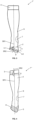
- Figure 2 shows a non-inventive example of the circularly knitted knitted part 1', namely designed as an arm stocking 1'.
- the arm stocking 1' is also preferably a compressive garment, which exerts compressive pressures on the wearer of the stocking 1', in particular on his upper and/or lower arm.
- the arm stocking 1' has a basic knitted section 2 and also a waistband section 3 arranged at an angle thereto.
- the waistband section 3 extends at an angle ⁇ of preferably greater than 5 degrees to the basic knitted section 2.
- a second collar section 4 is provided at the opposite end, as already in Figure 1 shown.
- the angled arrangement of the waistband section 3, in particular the change in knitting direction SR1 of the basic knitted section 2, so that the waistband 3 is knitted with a second knitting direction SR2 that differs from the first knitting direction SR1, ensures better wearing comfort for the arm stocking 1', especially when designed as an underarm stocking or as an upper arm stocking.
- the partial forward displacement of the waistband 3 such that, when worn, it extends further towards the wearer's shoulder on the outside of the wearer's arm than on the inside of the arm, ensures that, in particular at the level of the crook of the elbow or armpit, the stocking 1' overlaps these areas on the outside, but does not protrude into them on the inside of the arm and thereby restricts freedom of movement.
- Section A marks the area which is Figure 5 shown in the form of a stitch pattern.
- FIG 3 a further example of the knitted part 1" not according to the invention is shown, which is also designed as a leg garment, in particular as a leg stocking 1" with an open toe and a second waistband section 4.
- Figure 3 another particularly preferred example of the angled arrangement of a collar 3 relative to a basic knitted fabric section 2 is shown.
- the leg stocking 1" described in the drawing also comprises, in addition to the basic knitted section 2, a second waistband 4 and at least one compression region 9 in the area of the ankle of a wearer, which compression region extends to the upper end of the stocking. Furthermore, a functional zone, in particular a relief zone 7, is provided in the area of the ankle of a wearer.
- the relief zone 7 is characterized in that the basic knitted section 2 in this area has a higher elasticity in the longitudinal and/or transverse direction than the adjacent basic knitted section 2.
- the waistband section 3 which in this embodiment is arranged at an angle to the basic knitted section 2, is, as can be seen from the drawing, arranged at a double angle to the basic knitted section 2.
- the basic knitted section 2 and the waistband section 3 are arranged at an angle ⁇ of preferably between 5 and 45 degrees to the longitudinal axis of the basic knitted section 2, in particular the foot part of the stocking 1", as in the embodiment in Figure 2 shown, i.e. a lateral, i.e. medial or lateral change of the knitting direction SR1 in relation to the foot of a wearer, and on the other hand, as in the embodiment in Figure 1 shown, are arranged at an angle ⁇ of preferably also between 5 and 45 degrees, i.e.
- Figure 4 1 shows a further example of the knitted part 1′′′ not according to the invention, which is also designed as a preferably compressive leg stocking 1′′′, but now has a closed toe area according to this example.
- the leg stocking 1′′′ thus has a basic knitted section 2 and a toe box 5 arranged distally thereto.
- a waistband section 3 is provided, which according to the invention is arranged at an angle to the basic knitted section, i.e. the leg and/or foot section.
- the stocking 1′′′ preferably also has a further functional zone, namely padding 8 in the area of the toe box 5, i.e. also preferably in the sole area of the stocking 1′′′.
- This is preferably designed as plush, in particular as sandwich plush.
- at least one further plush thread forming a plush loop is preferably incorporated into the basic knitted fabric in the toe and sole area.
- This preferably consists of polyamide, polyester, polypropylene, or natural fiber. This gives the knitted part 1" a cushioning property.
- the at least one padding 8 extends, in addition to the sole of the foot—that is, the toe area, the ball of the foot, and the heel—at least partially along the Achilles tendon toward the calf when the stocking 1" is worn.
- the waistband section 3 arranged at the upper end of the stocking runs at an angle ⁇ of preferably greater than 5 degrees to the basic knitted fabric section 2.
- ⁇ preferably greater than 5 degrees to the basic knitted fabric section 2.
- better wearing comfort is ensured by the angled arrangement of the waistband section 3, in particular by changing the knitting direction SR1 of the basic knitted fabric section 2, so that the waistband 3 is knitted with a second knitting direction SR2 that deviates from the first knitting direction SR1.
- the fit of the stocking 1′′′ is significantly improved by the partial forward displacement of the waistband 3 on the medial side of the leg stocking 1′′′ with respect to a wearer.
- a lateral forward displacement of the waistband 3 can also be advantageous.
- the knitted part according to the invention is designed as a sock, bandage, or as a knitted part of an orthosis.
- Figure 5 a stitch pattern, in particular a section A from the non-inventive example of the knitted part 1' according to Figure 2
- the stitch pattern shows the knitted basic fabric section 2 and waistband section 3, each of which is formed from a basic knitting thread 10 that is knitted to form a stitch over several knitting rows MR1 to MR7 and wales M1 to M18.
- the basic knitting thread is preferably made of plastic, in particular polyamide, polyester, polypropylene or polyurethane. Alternatively, it can be made of natural fibers, in particular wool or cellulose or viscose.
- the stitch rows MR1 to MR4 show a section of the waistband section 3.
- the stitch rows MR5 to MR11 show a section of the basic knit section 2.
- At least one compression-providing weft thread 11 is inserted into the basic knitting stitches in both areas 2 and 3.
- the weft thread is preferably made of an elastomer, preferably PU-based.
- the highly elastic weft thread 3 is inserted into each stitch row. However, this can be configured as desired. It can also be inserted only in every second stitch row or in every nth stitch row.
- the weft thread 11 can also be knitted in sections in one or more wales, forming a stitch, as seen in the circumferential direction.
- the stitch pattern shows that a stitch-forming additional thread 12 is knitted into the basic knitted section 2 for the angled arrangement of the waistband section 3, and thus forms additional stitch rows TR1 to TR4.
- This thread 12 is, in particular for changing the knitting direction, only knitted in sections, i.e. partially and not completely circumferentially, as seen in the circumferential direction, into the basic knitted section 2 and is also locked at its ends in the basic knitting rows, preferably by means of tuck and float.
- the additional stitch rows TR1 to TR4 extend from the section A, which forms the upper side of the Figure 2 shown knitted part 1', into the adjacent cutout shown and thus into the underside of the knitted part 1' according to Figure 2 .
- the additional stitch rows TR1 to TR4 are of different lengths. The length of the partial rows decreases with increasing distance from the waistband section 2. This has proven to be particularly advantageous for forming the angled arrangement of both sections 2 and 3 to one another. However, other designs with regard to the additional stitch row length are also conceivable.
- the knitting direction is changed according to the invention, whereby it is possible for the basic knitted section 2 and the waistband section 3 to be arranged at an angle to one another.
- the angled arrangement of the waistband section 3 one or more Basic knitting stitch rows are provided, the stitches of which have at least partially a changed stitch size in the circumferential direction.
Landscapes
- Engineering & Computer Science (AREA)
- Textile Engineering (AREA)
- Health & Medical Sciences (AREA)
- Life Sciences & Earth Sciences (AREA)
- Heart & Thoracic Surgery (AREA)
- Vascular Medicine (AREA)
- Biomedical Technology (AREA)
- Animal Behavior & Ethology (AREA)
- General Health & Medical Sciences (AREA)
- Public Health (AREA)
- Veterinary Medicine (AREA)
- Socks And Pantyhose (AREA)
- Undergarments, Swaddling Clothes, Handkerchiefs Or Underwear Materials (AREA)
Claims (9)
- Pièce tricotée (1', 1"), constituée d'une partie (2) en tricot de base, tricotée en tricot tubulaire sur plusieurs rangées de mailles, ainsi que d'une première partie formant bande (3), se raccordant sur la partie (2) en tricot de base, tricotée à la suite de celle-ci et également tricotée sur plusieurs rangs de mailles, le tricot tubulaire étant une chaussette (1, 1', 1"), la partie (2) en tricot de base comportant une zone fonctionnelle, qui est conçue sous la forme d'un talon (6) et une deuxième partie formant bande (4) se raccordant sur la partie (2) en tricot de base, sur l'extrémité opposée de celle-ci, caractérisée en ce qu'à l'état porté, la première partie formant bande (3) est placée dans la zone de la plante du pied et la partie (2) en tricot de base et la première partie formant bande (3) sont placées sous forme coudée l'une par rapport à l'autre, de telle sorte que celle-ci soit placée en amont sur la face inférieure du pied d'un porteur, au regard de la partie supérieure du pied.
- Pièce tricotée (1', 1") selon la revendication 1, caractérisée en ce que pour le placement coudé de la première partie formant bande (3), la partie (2) en tricot de base comporte un ou plusieurs rangs partiels de mailles supplémentaires, s'étendant sur moins de 360 degrés dans la direction circonférentielle.
- Pièce tricotée (1', 1") selon la revendication 1, caractérisée en ce que pour le placement coudé de la première partie formant bande (3), la partie (2) en tricot de base comporte un ou plusieurs rangs de mailles de tricot de base, dont les mailles présentent au moins en partie dans la direction circonférentielle une dimension des mailles modifiée.
- Pièce tricotée (1', 1") selon l'une quelconque des revendications précédentes, caractérisée en ce que la partie (2) en tricot de base et la première partie formant bande (3) sont placées l'une par rapport à l'autre sous un angle (α, β) de 1 à 90 degrés, de préférence sous un angle (α, β) de 5 à 45 degrés.
- Pièce tricotée (1', 1") selon l'une quelconque des revendications précédentes, caractérisée en ce que la première partie formant bande (3) est conçue en double couche.
- Pièce tricotée (1', 1") selon l'une quelconque des revendications précédentes, caractérisée en ce que la première partie formant bande (3) présente une largeur d'environ 1 à 5 cm.
- Pièce tricotée (1', 1") selon l'une quelconque des revendications précédentes, caractérisée en ce que la première partie formant bande (3) fait preuve d'une élasticité moindre dans la direction longitudinale et / ou transversale que celle de la partie (2) en tricot de base.
- Pièce tricotée (1', 1") selon l'une quelconque des revendications précédentes, caractérisée en ce que la partie (2) en tricot de base comporte au moins une zone de compression (9), la résistance à la compression étant de l'ordre (9) compris entre 10 et 50 mmHg.
- Pièce tricotée (1") selon l'une quelconque des revendications précédentes, caractérisée en ce que la première partie formant bande (3) est conçue de telle sorte qu'à l'état porté, celle-ci puisse suivre sensiblement le trajet du coussinet du gros orteil et du petit orteil et / ou le chevaucher.
Priority Applications (2)
| Application Number | Priority Date | Filing Date | Title |
|---|---|---|---|
| EP19020672.2A EP3831994B1 (fr) | 2019-12-03 | 2019-12-03 | Pièce tricotée |
| ES19020672T ES3028434T3 (en) | 2019-12-03 | 2019-12-03 | Knitted piece |
Applications Claiming Priority (1)
| Application Number | Priority Date | Filing Date | Title |
|---|---|---|---|
| EP19020672.2A EP3831994B1 (fr) | 2019-12-03 | 2019-12-03 | Pièce tricotée |
Publications (2)
| Publication Number | Publication Date |
|---|---|
| EP3831994A1 EP3831994A1 (fr) | 2021-06-09 |
| EP3831994B1 true EP3831994B1 (fr) | 2025-04-09 |
Family
ID=68766453
Family Applications (1)
| Application Number | Title | Priority Date | Filing Date |
|---|---|---|---|
| EP19020672.2A Active EP3831994B1 (fr) | 2019-12-03 | 2019-12-03 | Pièce tricotée |
Country Status (2)
| Country | Link |
|---|---|
| EP (1) | EP3831994B1 (fr) |
| ES (1) | ES3028434T3 (fr) |
Citations (4)
| Publication number | Priority date | Publication date | Assignee | Title |
|---|---|---|---|---|
| CA702307A (en) * | 1965-01-19 | Knohl Herbert | Circular knit garments with added shaping material | |
| US3274804A (en) * | 1964-05-22 | 1966-09-27 | Thorneburg Hosiery Mills Inc | Footlet type sock and method |
| US3479844A (en) * | 1967-07-06 | 1969-11-25 | Pilot Res Corp | Form-fitting seamless garment and method |
| DE4103383A1 (de) * | 1991-02-05 | 1992-08-06 | Beiersdorf Ag | Ellenbogen-bandage |
Family Cites Families (3)
| Publication number | Priority date | Publication date | Assignee | Title |
|---|---|---|---|---|
| DE1802491A1 (de) * | 1968-10-11 | 1970-05-27 | Werner Roessler | Strumpfhose |
| DE102006048313A1 (de) * | 2006-10-02 | 2008-04-03 | Paul Hartmann Ag | Kompressionsstrumpf, Set und Verwendung |
| DE102013103914B3 (de) | 2013-04-18 | 2014-03-20 | Medi Gmbh & Co. Kg | Kompressives Rundgestrick zum Überziehen über eine ein Gelenk aufweisende Extremität |
-
2019
- 2019-12-03 ES ES19020672T patent/ES3028434T3/es active Active
- 2019-12-03 EP EP19020672.2A patent/EP3831994B1/fr active Active
Patent Citations (4)
| Publication number | Priority date | Publication date | Assignee | Title |
|---|---|---|---|---|
| CA702307A (en) * | 1965-01-19 | Knohl Herbert | Circular knit garments with added shaping material | |
| US3274804A (en) * | 1964-05-22 | 1966-09-27 | Thorneburg Hosiery Mills Inc | Footlet type sock and method |
| US3479844A (en) * | 1967-07-06 | 1969-11-25 | Pilot Res Corp | Form-fitting seamless garment and method |
| DE4103383A1 (de) * | 1991-02-05 | 1992-08-06 | Beiersdorf Ag | Ellenbogen-bandage |
Also Published As
| Publication number | Publication date |
|---|---|
| EP3831994A1 (fr) | 2021-06-09 |
| ES3028434T3 (en) | 2025-06-19 |
Similar Documents
| Publication | Publication Date | Title |
|---|---|---|
| EP3733941B1 (fr) | Article de compression tricoté avec effet adhésive | |
| DE69311072T2 (de) | Bekleidung | |
| DE102004036344B4 (de) | Strickware zum Stützen und/oder Komprimieren und/oder Kompressionsbehandlung von Körperteilen und Verfahren zur Herstellung einer solchen Strickware | |
| EP3673878B1 (fr) | Article de contention tricoté | |
| DE102016222480A1 (de) | Bekleidungsstück, das Spinnenseide aufweist oder Schuh, der Spinnenseide aufweist | |
| EP3572570B1 (fr) | Article de compression | |
| DE102019209275B4 (de) | Schuh und Schuhoberteil mit optimierten formbeständigen Eigenschaften | |
| EP3024348A1 (fr) | Chaussure élastique | |
| EP3840600B1 (fr) | Chaussette de sport ou bandage de sport | |
| DE202015101990U1 (de) | Kompressions- und/oder Stützorthese für ein Gelenk, umfassend wenigstens eine Zone, die an der Haut und/oder an einer bestimmten Fläche anliegt | |
| EP3351667B1 (fr) | Corsage de contention ou collant de contention pourvu de corsage permettant le traitement par compression pendant la grossesse | |
| DE102017223750A1 (de) | Gestrickte oder gewirkte Komponente | |
| DE602004006851T2 (de) | Kompressionsartikel oder Kompressionsartikelzubehör | |
| DE102015115226B4 (de) | Kompressives Gestrickteil | |
| EP4137626B1 (fr) | Procédé de fabrication d'un article de compression sans couture sur un métier à tricoter rectiligne | |
| DE102006048313A1 (de) | Kompressionsstrumpf, Set und Verwendung | |
| EP3575463B1 (fr) | Pièce de vêtement pour jambes, en particulier bas | |
| EP3620562B1 (fr) | Textile tricoté | |
| DE102016125409A1 (de) | Eingefasste Textilorthese | |
| WO2011117247A1 (fr) | Caleçon de soutien pour messieurs, en particulier collant de soutien ou de compression | |
| EP1953284A2 (fr) | Tricot médicinal | |
| EP3954817B1 (fr) | Vêtement pour jambes | |
| DE102020208218B4 (de) | Auxetischer Artikel | |
| EP3831994A1 (fr) | Pièce tricotée | |
| DE102018004065A1 (de) | Kompressives Gestrickteil |
Legal Events
| Date | Code | Title | Description |
|---|---|---|---|
| PUAI | Public reference made under article 153(3) epc to a published international application that has entered the european phase |
Free format text: ORIGINAL CODE: 0009012 |
|
| STAA | Information on the status of an ep patent application or granted ep patent |
Free format text: STATUS: THE APPLICATION HAS BEEN PUBLISHED |
|
| AK | Designated contracting states |
Kind code of ref document: A1 Designated state(s): AL AT BE BG CH CY CZ DE DK EE ES FI FR GB GR HR HU IE IS IT LI LT LU LV MC MK MT NL NO PL PT RO RS SE SI SK SM TR |
|
| STAA | Information on the status of an ep patent application or granted ep patent |
Free format text: STATUS: REQUEST FOR EXAMINATION WAS MADE |
|
| 17P | Request for examination filed |
Effective date: 20211126 |
|
| RBV | Designated contracting states (corrected) |
Designated state(s): AL AT BE BG CH CY CZ DE DK EE ES FI FR GB GR HR HU IE IS IT LI LT LU LV MC MK MT NL NO PL PT RO RS SE SI SK SM TR |
|
| STAA | Information on the status of an ep patent application or granted ep patent |
Free format text: STATUS: EXAMINATION IS IN PROGRESS |
|
| 17Q | First examination report despatched |
Effective date: 20230113 |
|
| P01 | Opt-out of the competence of the unified patent court (upc) registered |
Effective date: 20230427 |
|
| GRAP | Despatch of communication of intention to grant a patent |
Free format text: ORIGINAL CODE: EPIDOSNIGR1 |
|
| STAA | Information on the status of an ep patent application or granted ep patent |
Free format text: STATUS: GRANT OF PATENT IS INTENDED |
|
| INTG | Intention to grant announced |
Effective date: 20241217 |
|
| GRAS | Grant fee paid |
Free format text: ORIGINAL CODE: EPIDOSNIGR3 |
|
| GRAA | (expected) grant |
Free format text: ORIGINAL CODE: 0009210 |
|
| STAA | Information on the status of an ep patent application or granted ep patent |
Free format text: STATUS: THE PATENT HAS BEEN GRANTED |
|
| AK | Designated contracting states |
Kind code of ref document: B1 Designated state(s): AL AT BE BG CH CY CZ DE DK EE ES FI FR GB GR HR HU IE IS IT LI LT LU LV MC MK MT NL NO PL PT RO RS SE SI SK SM TR |
|
| REG | Reference to a national code |
Ref country code: GB Ref legal event code: FG4D Free format text: NOT ENGLISH |
|
| REG | Reference to a national code |
Ref country code: CH Ref legal event code: EP |
|
| REG | Reference to a national code |
Ref country code: DE Ref legal event code: R096 Ref document number: 502019013166 Country of ref document: DE |
|
| REG | Reference to a national code |
Ref country code: IE Ref legal event code: FG4D Free format text: LANGUAGE OF EP DOCUMENT: GERMAN |
|
| REG | Reference to a national code |
Ref country code: ES Ref legal event code: FG2A Ref document number: 3028434 Country of ref document: ES Kind code of ref document: T3 Effective date: 20250619 |
|
| REG | Reference to a national code |
Ref country code: NL Ref legal event code: FP |
|
| PG25 | Lapsed in a contracting state [announced via postgrant information from national office to epo] |
Ref country code: PT Free format text: LAPSE BECAUSE OF FAILURE TO SUBMIT A TRANSLATION OF THE DESCRIPTION OR TO PAY THE FEE WITHIN THE PRESCRIBED TIME-LIMIT Effective date: 20250811 Ref country code: FI Free format text: LAPSE BECAUSE OF FAILURE TO SUBMIT A TRANSLATION OF THE DESCRIPTION OR TO PAY THE FEE WITHIN THE PRESCRIBED TIME-LIMIT Effective date: 20250409 |
|
| REG | Reference to a national code |
Ref country code: LT Ref legal event code: MG9D |
|
| PG25 | Lapsed in a contracting state [announced via postgrant information from national office to epo] |
Ref country code: NO Free format text: LAPSE BECAUSE OF FAILURE TO SUBMIT A TRANSLATION OF THE DESCRIPTION OR TO PAY THE FEE WITHIN THE PRESCRIBED TIME-LIMIT Effective date: 20250709 Ref country code: GR Free format text: LAPSE BECAUSE OF FAILURE TO SUBMIT A TRANSLATION OF THE DESCRIPTION OR TO PAY THE FEE WITHIN THE PRESCRIBED TIME-LIMIT Effective date: 20250710 |
|
| PG25 | Lapsed in a contracting state [announced via postgrant information from national office to epo] |
Ref country code: PL Free format text: LAPSE BECAUSE OF FAILURE TO SUBMIT A TRANSLATION OF THE DESCRIPTION OR TO PAY THE FEE WITHIN THE PRESCRIBED TIME-LIMIT Effective date: 20250409 |
|
| PG25 | Lapsed in a contracting state [announced via postgrant information from national office to epo] |
Ref country code: BG Free format text: LAPSE BECAUSE OF FAILURE TO SUBMIT A TRANSLATION OF THE DESCRIPTION OR TO PAY THE FEE WITHIN THE PRESCRIBED TIME-LIMIT Effective date: 20250409 |
|
| PG25 | Lapsed in a contracting state [announced via postgrant information from national office to epo] |
Ref country code: HR Free format text: LAPSE BECAUSE OF FAILURE TO SUBMIT A TRANSLATION OF THE DESCRIPTION OR TO PAY THE FEE WITHIN THE PRESCRIBED TIME-LIMIT Effective date: 20250409 |
|
| PG25 | Lapsed in a contracting state [announced via postgrant information from national office to epo] |
Ref country code: RS Free format text: LAPSE BECAUSE OF FAILURE TO SUBMIT A TRANSLATION OF THE DESCRIPTION OR TO PAY THE FEE WITHIN THE PRESCRIBED TIME-LIMIT Effective date: 20250709 |
|
| PG25 | Lapsed in a contracting state [announced via postgrant information from national office to epo] |
Ref country code: IS Free format text: LAPSE BECAUSE OF FAILURE TO SUBMIT A TRANSLATION OF THE DESCRIPTION OR TO PAY THE FEE WITHIN THE PRESCRIBED TIME-LIMIT Effective date: 20250809 |
|
| PG25 | Lapsed in a contracting state [announced via postgrant information from national office to epo] |
Ref country code: LV Free format text: LAPSE BECAUSE OF FAILURE TO SUBMIT A TRANSLATION OF THE DESCRIPTION OR TO PAY THE FEE WITHIN THE PRESCRIBED TIME-LIMIT Effective date: 20250409 |
|
| REG | Reference to a national code |
Ref country code: CH Ref legal event code: U11 Free format text: ST27 STATUS EVENT CODE: U-0-0-U10-U11 (AS PROVIDED BY THE NATIONAL OFFICE) Effective date: 20260101 |
|
| PGFP | Annual fee paid to national office [announced via postgrant information from national office to epo] |
Ref country code: DE Payment date: 20251211 Year of fee payment: 7 |
|
| PGFP | Annual fee paid to national office [announced via postgrant information from national office to epo] |
Ref country code: GB Payment date: 20251219 Year of fee payment: 7 |
|
| REG | Reference to a national code |
Ref country code: DE Ref legal event code: R097 Ref document number: 502019013166 Country of ref document: DE |
|
| PG25 | Lapsed in a contracting state [announced via postgrant information from national office to epo] |
Ref country code: DK Free format text: LAPSE BECAUSE OF FAILURE TO SUBMIT A TRANSLATION OF THE DESCRIPTION OR TO PAY THE FEE WITHIN THE PRESCRIBED TIME-LIMIT Effective date: 20250409 Ref country code: SM Free format text: LAPSE BECAUSE OF FAILURE TO SUBMIT A TRANSLATION OF THE DESCRIPTION OR TO PAY THE FEE WITHIN THE PRESCRIBED TIME-LIMIT Effective date: 20250409 |
|
| PGFP | Annual fee paid to national office [announced via postgrant information from national office to epo] |
Ref country code: IT Payment date: 20251223 Year of fee payment: 7 |
|
| PGFP | Annual fee paid to national office [announced via postgrant information from national office to epo] |
Ref country code: NL Payment date: 20251219 Year of fee payment: 7 Ref country code: FR Payment date: 20251229 Year of fee payment: 7 |
|
| PG25 | Lapsed in a contracting state [announced via postgrant information from national office to epo] |
Ref country code: CZ Free format text: LAPSE BECAUSE OF FAILURE TO SUBMIT A TRANSLATION OF THE DESCRIPTION OR TO PAY THE FEE WITHIN THE PRESCRIBED TIME-LIMIT Effective date: 20250409 |
|
| PG25 | Lapsed in a contracting state [announced via postgrant information from national office to epo] |
Ref country code: EE Free format text: LAPSE BECAUSE OF FAILURE TO SUBMIT A TRANSLATION OF THE DESCRIPTION OR TO PAY THE FEE WITHIN THE PRESCRIBED TIME-LIMIT Effective date: 20250409 |
|
| PG25 | Lapsed in a contracting state [announced via postgrant information from national office to epo] |
Ref country code: SK Free format text: LAPSE BECAUSE OF FAILURE TO SUBMIT A TRANSLATION OF THE DESCRIPTION OR TO PAY THE FEE WITHIN THE PRESCRIBED TIME-LIMIT Effective date: 20250409 Ref country code: RO Free format text: LAPSE BECAUSE OF FAILURE TO SUBMIT A TRANSLATION OF THE DESCRIPTION OR TO PAY THE FEE WITHIN THE PRESCRIBED TIME-LIMIT Effective date: 20250409 |
|
| PLBE | No opposition filed within time limit |
Free format text: ORIGINAL CODE: 0009261 |
|
| STAA | Information on the status of an ep patent application or granted ep patent |
Free format text: STATUS: NO OPPOSITION FILED WITHIN TIME LIMIT |
|
| REG | Reference to a national code |
Ref country code: CH Ref legal event code: L10 Free format text: ST27 STATUS EVENT CODE: U-0-0-L10-L00 (AS PROVIDED BY THE NATIONAL OFFICE) Effective date: 20260218 |
|
| 26N | No opposition filed |
Effective date: 20260112 |
|
| PGFP | Annual fee paid to national office [announced via postgrant information from national office to epo] |
Ref country code: ES Payment date: 20260130 Year of fee payment: 7 |
|
| PGFP | Annual fee paid to national office [announced via postgrant information from national office to epo] |
Ref country code: CH Payment date: 20260101 Year of fee payment: 7 |