EP3832064A1 - Abschirmungsvorrichtung - Google Patents
Abschirmungsvorrichtung Download PDFInfo
- Publication number
- EP3832064A1 EP3832064A1 EP19843079.5A EP19843079A EP3832064A1 EP 3832064 A1 EP3832064 A1 EP 3832064A1 EP 19843079 A EP19843079 A EP 19843079A EP 3832064 A1 EP3832064 A1 EP 3832064A1
- Authority
- EP
- European Patent Office
- Prior art keywords
- pulley
- driving shaft
- cord
- operation cord
- shading device
- Prior art date
- Legal status (The legal status is an assumption and is not a legal conclusion. Google has not performed a legal analysis and makes no representation as to the accuracy of the status listed.)
- Withdrawn
Links
Images












Classifications
-
- E—FIXED CONSTRUCTIONS
- E06—DOORS, WINDOWS, SHUTTERS, OR ROLLER BLINDS IN GENERAL; LADDERS
- E06B—FIXED OR MOVABLE CLOSURES FOR OPENINGS IN BUILDINGS, VEHICLES, FENCES OR LIKE ENCLOSURES IN GENERAL, e.g. DOORS, WINDOWS, BLINDS, GATES
- E06B9/00—Screening or protective devices for wall or similar openings, with or without operating or securing mechanisms; Closures of similar construction
- E06B9/24—Screens or other constructions affording protection against light, especially against sunshine; Similar screens for privacy or appearance; Slat blinds
- E06B9/26—Lamellar or like blinds, e.g. venetian blinds
- E06B9/28—Lamellar or like blinds, e.g. venetian blinds with horizontal lamellae, e.g. non-liftable
- E06B9/30—Lamellar or like blinds, e.g. venetian blinds with horizontal lamellae, e.g. non-liftable liftable
- E06B9/32—Operating, guiding, or securing devices therefor
- E06B9/322—Details of operating devices, e.g. pulleys, brakes, spring drums, drives
-
- E—FIXED CONSTRUCTIONS
- E06—DOORS, WINDOWS, SHUTTERS, OR ROLLER BLINDS IN GENERAL; LADDERS
- E06B—FIXED OR MOVABLE CLOSURES FOR OPENINGS IN BUILDINGS, VEHICLES, FENCES OR LIKE ENCLOSURES IN GENERAL, e.g. DOORS, WINDOWS, BLINDS, GATES
- E06B9/00—Screening or protective devices for wall or similar openings, with or without operating or securing mechanisms; Closures of similar construction
- E06B9/24—Screens or other constructions affording protection against light, especially against sunshine; Similar screens for privacy or appearance; Slat blinds
- E06B9/26—Lamellar or like blinds, e.g. venetian blinds
- E06B9/262—Lamellar or like blinds, e.g. venetian blinds with flexibly-interconnected horizontal or vertical strips; Concertina blinds, i.e. upwardly folding flexible screens
-
- E—FIXED CONSTRUCTIONS
- E06—DOORS, WINDOWS, SHUTTERS, OR ROLLER BLINDS IN GENERAL; LADDERS
- E06B—FIXED OR MOVABLE CLOSURES FOR OPENINGS IN BUILDINGS, VEHICLES, FENCES OR LIKE ENCLOSURES IN GENERAL, e.g. DOORS, WINDOWS, BLINDS, GATES
- E06B9/00—Screening or protective devices for wall or similar openings, with or without operating or securing mechanisms; Closures of similar construction
- E06B9/24—Screens or other constructions affording protection against light, especially against sunshine; Similar screens for privacy or appearance; Slat blinds
- E06B2009/2423—Combinations of at least two screens
- E06B2009/2441—Screens joined one below the other
-
- E—FIXED CONSTRUCTIONS
- E06—DOORS, WINDOWS, SHUTTERS, OR ROLLER BLINDS IN GENERAL; LADDERS
- E06B—FIXED OR MOVABLE CLOSURES FOR OPENINGS IN BUILDINGS, VEHICLES, FENCES OR LIKE ENCLOSURES IN GENERAL, e.g. DOORS, WINDOWS, BLINDS, GATES
- E06B9/00—Screening or protective devices for wall or similar openings, with or without operating or securing mechanisms; Closures of similar construction
- E06B9/24—Screens or other constructions affording protection against light, especially against sunshine; Similar screens for privacy or appearance; Slat blinds
- E06B9/26—Lamellar or like blinds, e.g. venetian blinds
- E06B9/262—Lamellar or like blinds, e.g. venetian blinds with flexibly-interconnected horizontal or vertical strips; Concertina blinds, i.e. upwardly folding flexible screens
- E06B2009/2625—Pleated screens, e.g. concertina- or accordion-like
-
- E—FIXED CONSTRUCTIONS
- E06—DOORS, WINDOWS, SHUTTERS, OR ROLLER BLINDS IN GENERAL; LADDERS
- E06B—FIXED OR MOVABLE CLOSURES FOR OPENINGS IN BUILDINGS, VEHICLES, FENCES OR LIKE ENCLOSURES IN GENERAL, e.g. DOORS, WINDOWS, BLINDS, GATES
- E06B9/00—Screening or protective devices for wall or similar openings, with or without operating or securing mechanisms; Closures of similar construction
- E06B9/24—Screens or other constructions affording protection against light, especially against sunshine; Similar screens for privacy or appearance; Slat blinds
- E06B9/26—Lamellar or like blinds, e.g. venetian blinds
- E06B9/28—Lamellar or like blinds, e.g. venetian blinds with horizontal lamellae, e.g. non-liftable
- E06B9/30—Lamellar or like blinds, e.g. venetian blinds with horizontal lamellae, e.g. non-liftable liftable
- E06B9/32—Operating, guiding, or securing devices therefor
- E06B9/322—Details of operating devices, e.g. pulleys, brakes, spring drums, drives
- E06B2009/3225—Arrangements to aid the winding of cords rollers
Definitions
- the present embodiment relates to a shading device.
- Shading devices in which two shading members are arranged in parallel, such as blinds, curtains, and partitions, have been known. Such shading devices lift and lower a bottom rail disposed at the lowest end and an intermediate bar disposed between the bottom rail and a headbox separately, thereby lifting and lowering a first shading member disposed between the bottom rail and the intermediate bar and a second shading member disposed between the intermediate bar and the headbox, respectively.
- the shading device includes an operating device including an endless operating cord, a pulley around which the operating cord is wound, an operating shaft connected with the pulley to rotate together and capable of rotating upon receiving an operation force, a clutch capable of rotating integrally with the operating shaft and axially sliding on the operating shaft, and a first transmission member disposed at one axial side of the clutch to transmit driving force to a first driving shaft for lifting and lowering the first shading member and a second transmission member disposed at the other axial side of the clutch to transmit driving force to a second driving shaft for lifting and lowering the second shading member, where the sliding direction of the clutch is determined by the rotational direction of the operating shaft, such that as the clutch sliding on the operating shaft is engaged with one of the transmission members, the rotation of the operating shaft is transmitted to any one of the driving shafts through one of the transmission members.
- the operating shaft is operated to rotate in either direction by one operating cord, and the rotational direction determines the sliding direction of the clutch.
- the transmission member to which the rotation is transmitted is switched between the first transmission member and the second transmission member by the sliding direction of the clutch, and the rotation may be thereby transmitted to either driving shaft by one clutch unit.
- Patent literature 1 JP2011-220077A
- a single operation cord is vertically hanging from two points on the room side and the window side in the front and rear direction of the shading device, and the positions where the operation cord is hanging are substantially aligned in the width direction of the shading device, i.e., the longitudinal direction of the headbox.
- the width direction of the shading device i.e., the longitudinal direction of the headbox.
- the present invention has been made to solve the problems, and an object of the present invention is to allow two types of operation cords to be hanging from a headbox so as to be easily distinguished.
- a shading device includes a first driving shaft that is rotatably supported within a headbox and may drive a first moving member and a second driving shaft that is rotatably supported within the headbox and may drive a second moving member, and includes a first pulley that drives the first driving shaft and a second pulley that is disposed at a position different from the first pulley in a longitudinal direction of the headbox and drives the second driving shaft.
- a shading device capable of hanging two types of operation cords from a headbox in a distinguishable manner may be provided.
- Other effects of the present invention will also be described in Description of Embodiments below.
- a room side surface when the shading device is provided is referred to as a front surface
- an exterior side surface is referred to as a rear surface
- a direction perpendicular to the front surface and the rear surface is referred to as a front-rear direction
- the longitudinal direction of the shading device is referred to as a left-right direction.
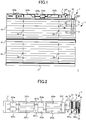
- FIGs. 1 and 2 respectively are a front view and a schematic plan perspective view of the shading device according to the present embodiment.
- FIG. 1 only a headbox is shown in a longitudinal section.
- the shading device 1 is a horizontal pleated screen and includes a headbox 2, a bottom rail 31 as a first moving member, two lifting/lowering cords 32 formed in a string or tape form, a screen 33 as a first shading member, an intermediate bar 41 as a second moving member, two light control cords 42 formed in a string or tape form, a screen 43 as a second shading member, an operating device 5, a first operation cord 6, and a second operation cord 7.
- the headbox 2 is fixed to a window frame, for example, with brackets (not shown) and is formed in an elongated box shape having a housing space therein.
- a first driving shaft 201a, two first winding drums 202a, a first stopper 203a, a first brake 204a, a second driving shaft 201b, two second winding drums 202b, a second stopper 203b, a second brake 204b, and an interlocking gear 205 are housed.
- the first driving shaft 201a, the two first winding drums 202a, the first stopper 203a, and the first brake 204a constitute a first drive system for lifting and lowering the bottom rail 31.
- the second driving shaft 201b, the two second winding drums 202b, the second stopper 203b, and the second brake 204b constitute a second drive system for lifting and lowering the intermediate bar 41.
- the interlocking gear 205 is configured to interlock the second drive system with the first drive system under predetermined conditions.
- the first drive system is disposed on the rear side
- the second drive system is disposed on the front side
- the first drive system and the second drive system are arranged in parallel with each other in the front-rear direction.
- the first drive system and the second drive system may be arranged in parallel in the vertical direction, or the arrangement of the first drive system and the second drive system may be reversed in the front-rear direction or the vertical direction.
- the first driving shaft 201a and the second driving shaft 201b are each prismatic members extending in the left-right direction, and are supported rotatably in the axial direction to the left-right direction within the headbox 2.
- the shaft center of the first driving shaft 201a is positioned behind the shaft center of the second driving shaft 201b, and the shaft centers are at the different positions in the front-rear direction.
- the shaft center of the first driving shaft 201a is referred to as a first shaft center
- the shaft center of the second driving shaft 201b is referred to as a second shaft center.
- the two first winding drums 202a are each penetrated by the first driving shaft 201a to rotate integrally with the first driving shaft 201a, and one ends of the corresponding lifting/lowering cords 32 are coupled so as to be wound around and unwound from the first winding drums 202a.
- the two second winding drums 202b are each penetrated by the second driving shaft 201b to rotate integrally with the second driving shaft 201b, and one ends of the corresponding light control cords 42 are coupled so as to be wound around and unwound from the second winding drums 202b.
- the first stopper 203a restrains the rotation of the first driving shaft 201a.
- the second stopper 203b restrains the rotation of the second driving shaft 201b.
- the first brake 204a decelerates the rotation of the first driving shaft 201a.
- the second brake 204b decelerates the rotation of the second driving shaft 201b.
- the bottom rail 31 is a member formed long in the right and left direction.
- the bottom rail 31 is connected to the other ends of the two lifting/lowering cords 32, and supported by and hung from the headbox 2 so as to be located at the lowest end of the shading device 1.
- the intermediate bar 41 is a member formed long in the right and left direction.
- the intermediate bar 41 is connected to the other ends of the two light control cords 42, and supported by and hung from the headbox 2 so as to be located between the headbox 2 and the bottom rail 31 in the vertical direction.
- the screen 33 is a shading member that is connected to the lower surface of intermediate bar 41 at the upper end, and connected to the upper surface of bottom rail 31 at the lower end.
- the screen 33 is formed in a pleated form that is vertically foldable and the two lifting/lowering cords 32 are partially inserted into the screen 33 in the vertical direction.
- the screen 43 is a shading member that is connected to the lower surface of headbox 2 at the upper end, and connected to the upper surface of the intermediate bar 41 at the lower end.
- the screen 43 is formed in a pleated form that is vertically foldable and the two light control cords 42 are partially inserted into the screen 43 in the vertical direction.
- the operation device 5 is disposed at one of the right end and the left end of the headbox 2, at the right end of the headbox 2 in this embodiment, and includes a case 50 having a housing space formed therein, a first pulley 51, a second pulley 52, a first clutch mechanism 53, a second clutch mechanism 54, and a transmission mechanism 55. These components will be described in detail below.
- the first operation cord 6 includes a cord member 61 formed in a string or a tape and connected at one end to the first pulley 51 to be wound around and unwound from, a gripping portion 62 provided at the other end of the cord member 61, and a stopper 63 fixed at a predetermined position between one end and the other end.
- the gripping portion 62 is a member for an operator of the shading device 1 to operate the first operation cord 6, in particular, to pull the first operation cord 6 downward so that the cord member 61 is unwound from the first pulley 51.
- the stopper 63 prevents the cord member 61 from being wound by the first pulley 51 to a predetermined amount or more.
- the structure of the cord member 61 and the stopper 63 may be such that the two different cords are connected within the stopper 63, or the stopper 63 is fixed in the middle of one cord.
- the second operation cord 7 includes a cord member 71 formed in a string or a tape and connected at one end to the second pulley 52 to be wound around and unwound from, a gripping portion 72 provided at the other end of the cord member 71, and a stopper 73 fixed at a predetermined position between one end and the other end.
- the gripping portion 72 is a member for an operator to operate the second operation cord 7, in particular, to pull the second operation cord 7 downward so that the cord member 71 is unwound from the second pulley 52.
- the stopper 73 prevents the cord member 71 from being wound by the second pulley 52 to a predetermined amount or more.
- the structure of the cord member 71 and the stopper 73 may be such that the two different cords is connected within the stopper 73, or the stopper 73 is fixed in the middle of one cord.
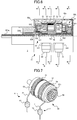
- FIGs. 3 and 4 are a perspective view and an exploded perspective view, respectively, illustrating the configuration of the operating device according to this embodiment.
- FIG. 5 is a perspective view illustrating a configuration of an urging member engaged with the first pulley and the second pulley.
- the operating device 5 includes an urging member 57 and a fixed shaft 56 in addition to the aforementioned first pulley 51, second pulley 52, first clutch mechanism 53, second clutch mechanism 54, and transmission mechanism 55 as the components contained in the space formed in the case 50, which is formed of three members 50a to 50c.
- the transmission mechanism 55 includes a first transmission gear 551 and a second transmission gear 552 that engages with the first transmission gear 551.
- the fixed shaft 56 is provided in the case 50 such that its shaft center is directed to the left and right and the position of its shaft center is substantially coincident with the first shaft center in the vertical and front-rear directions.
- the fixed shaft 56 supports the first pulley 51, the second pulley 52, and the first transmission gear 551 so as to be relatively rotated around its shaft center, and supports the respective portions of the first clutch mechanism 53 and the second clutch mechanism 54 so as not to be relatively rotated.
- the first pulley 51, the second pulley 52, the first clutch mechanism 53, the second clutch mechanism 54, and the transmission mechanism 55 are disposed in the order of the first clutch mechanism 53, the first pulley 51, the second pulley 52, the second clutch mechanism 54, and the transmission mechanism 55, from the inner side of the shading device in the left-right direction.
- the first pulley 51 is a member that is connected to one end of the cord member 61 of the first operation cord 6 and is rotated about the first shaft center, thereby winding and unwinding the cord member 61, and has a surrounding portion 511 that surrounds the urging member 57 from radially outer side.
- the surrounding portion 511 is formed as a circumferential wall extending to the second pulley 52 side in the first shaft center direction so as to surround the urging member 57, and a first locking portion 511a that locks one end of the urging member 57 is formed at a predetermined position in the circumferential direction.
- the second pulley 52 is a member that is connected to one end of the cord member 71 of the second operation cord 7 and is rotated about the first shaft center, thereby winding and unwinding the cord member 71, and has a support shaft 521 that supports the first pulley 51 so as to be relatively rotatable about the first shaft center.
- the support shaft 521 is formed in a cylindrical shape extending toward the first pulley 51 in the first shaft direction, and is insertable through the hole formed in the first pulley 51.
- the support shaft 521 also forms a second locking portion 521a on the second pulley 52 side in the first shaft direction to lock the other end of the urging member 57 in a predetermined circumferential position.
- the urging member 57 is a spiral-wound spring disposed between the first pulley 51 and the second pulley 52 to be wound around the support shaft 521 of the second pulley 52 as central axis in the space surrounded by the surrounding portion 511 of the first pulley 51.
- a first locked portion 571 is formed at one end of the urging member 57, specifically, at the radially outer end portion, and a second locked portion 572 is formed at the other end, specifically, at the radially inner end portion.
- the first locked portion 571 is formed by bending one end of the urging member 57.
- the first locked portion 571 is locked to the first locking portion 511a formed in the surrounding portion 511 of the first pulley 51, whereby one end of the urging member 57 is fixed to the first pulley 51 so as not to be movable in the front-rear direction and the vertical direction.
- the second locked portion 572 is formed by bending the other end of the urging member 57 and is locked to the second locking portion 521a formed in the support shaft 521 of the second pulley 52, whereby the other end of the urging member 57 is fixed to the second pulley 52 so as not to be movable in the front-rear direction and the vertical direction.
- the winding direction of the cord member 61 by the first pulley 51 and the winding direction of the cord member 71 by the second pulley 52 are opposite to each other.
- the first pulley rotates in a first rotation direction when the cord member 61 is unwound
- the second pulley rotates in a second rotation direction opposite to the first rotation direction when the cord member 71 is unwound.
- the first clutch mechanism 53 which is provided adjacent to the first pulley 51 inwardly in the left-right direction, is configured to transmit the rotating force of the first pulley 51 in the first rotation direction to the first driving shaft 201a and to interrupt the transmission of the rotating force of the first pulley 51 in the second rotation direction to the first driving shaft 201a.
- the first transmission gear 551 is supported by the fixed shaft 56 so as to be relatively rotatable and integrally rotates with a portion of the second clutch mechanism 54.
- the second transmission gear 552 is connected with the second driving shaft 201b so as to integrally rotate, and is provided to engage with the first transmission gear 551 and to transmit the rotational force of the first transmission gear 551 to the second driving shaft 201b.
- the second clutch mechanism 54 which is provided adjacent to the second pulley 52 outwardly in the left-right direction, is configured to transmit the rotating force of the second pulley 52 in the second rotation direction to the first transmission gear 551, thereby transmitting the rotating force to the second driving shaft 201b through the second transmission gear 552, and to interrupt the transmission of the rotating force of the second pulley 52 in the first rotation direction to the second driving shaft 201b.
- FIG. 6 is a front sectional view illustrating a configuration of the operating device according to the present embodiment.
- FIG. 7 is a perspective view illustrating the operating device in a non-operation state.
- FIGs. 8, 9 , 10, 11 and 12 are respectively A-A, B-B, C-C, D-D, and E-E cross-sectional views of FIG. 6 in a non-operation state.
- FIG. 6 only a part of the operation device upward from the first shaft center is shown as a cross-sectional plane that passes through the first shaft center and extends in the vertical direction and the left-right direction.
- the second transmission gear is shown transparent.
- the non-operation state indicates that neither the first operation cord nor the second operation cord is operated.
- a first winding restriction unit 501 is formed below the first pulley 51 so as to correspond to the first pulley 51 and a second winding restriction unit 502 is formed below the second pulley 52 so as to correspond to the second pulley 52.
- the first winding restriction unit 501 and the second winding restriction unit 502 are formed at different positions in the left-right direction.
- the first winding restriction unit 501 is formed inward of the left-right direction and the second winding restriction unit 502 is formed outward of the left-right direction according to the arrangement of the first pulley 51 and the second pulley 52.
- the first winding restriction unit 501 and the second winding restriction unit 502 are respectively formed as a housing space for accommodating the stopper 63 of the first operation cord 6 and a housing space for accommodating the stopper 73 of the second operation cord 7, and these accommodation spaces are continuously formed on two surfaces in the front and the bottom so that the front and bottom surfaces are opened.
- An insertion hole 501a (see FIG. 9 ) in which the cord member 61 is insertable is formed at the ceiling wall of the first winding restriction unit 501.
- the insertion hole 501a has a diameter which is larger than the cord member 61 and in which the stopper 63 is not insertable.
- an insertion hole 502a (see FIG. 11 ) in which the cord member 71 is insertable is formed at the ceiling wall of the second winding restriction unit 502.
- the insertion hole 502a has a diameter which is larger than the cord member 71 and in which the stopper 73 is not insertable. As shown in FIG.
- the first winding restriction unit 501 and the stopper 63 prevent the first pulley 51 from winding up the cord member 61 by a predetermined amount or more.
- the second winding restriction unit 502 and the stopper 73 prevent the second pulley 52 from winding up the cord member 71 by a predetermined amount or more.
- the first clutch mechanism 53 includes a relay shaft 531, a clutch drum 532, a clutch spring 533, a cam drive 534, a guide washer 535, an interlocking member 536, and three clutch pins 537.
- the second clutch mechanism 54 includes a relay shaft 541, a clutch drum 542, a clutch spring 543, a cam drive 544, a guide washer 545, an interlocking member 546, and three clutch pins 547.
- the elements of the second clutch mechanism 54 respectively correspond to the same-named elements of the first clutch mechanism 53, and thus the elements of the first clutch mechanism 53 are described in detail for explaining the first clutch mechanism 53 and the second clutch mechanism 54, and the elements of the second clutch mechanism 54 are described only about the differences from the first clutch mechanism 53.
- the relay shaft 531 is supported by the fixed shaft 56 so as not to relatively rotate and supports the clutch drum 532 to prevent relative rotation.
- the clutch drum 532 is formed in a hollow cylinder and is supported by the relay shaft 531 fitted into the hollow portion thereof so as not to relatively rotate.
- the clutch spring 533 is a linear elastic member that is wound around the clutch drum 532 to a degree that is rotated relative to the clutch drum 532 when loosened, and both ends of the clutch spring 533 are bent so as to face radially outward (see FIG. 8 ).
- the cam drive 534 is shaped to have a substantially hollow cylindrical portion which is rotatably supported by the clutch drum 532 and a disc-like side portion which extends radially outward throughout the circumference to form the side surface of the first clutch mechanism 53 on the first pulley 51 side.
- a side surface of the cam drive 534 has three openings 534a (see FIGs. 4 and 9 ) formed at equidistant intervals in the circumferential direction, and three projections 512 provided in the first pulley 51 are inserted in the openings 534a.
- Three projections 512 are formed on the side surface of the first pulley 51 on the first clutch mechanism 53 side at equidistant intervals in the circumferential direction so as to respectively correspond to the three openings 534a, each projecting toward the first clutch mechanism 53.
- the second pulley 52 has three projections 522 (see FIG. 4 ) each formed to project toward the second clutch mechanism 54 so as to be inserted into three openings (not shown) provided in the cam drive 544.
- the cylindrical portion of the cam drive 534 has three cams 534b formed at equidistant intervals on the circumferential wall and has one engagement portion 534c at the internal wall.
- Each of the three cams 534b projects radially outward as a whole and includes a cam surface formed on one side in the circumferential direction.
- the cam surface is formed as an inclined surface that slides the clutch pin 537 radially outward when the cam drive 534 is rotated relative to the guide washer 535 on the side on which the cam surface is formed.
- the engagement portion 534c projects radially inward to be engaged with the guide washer 535.
- the cam drive 534 engages with the three projections 512, thereby rotating in accordance with the first pulley 51 in any direction the first pulley 51 rotates.
- the guide washer 535 is generally formed in a disc having a hole formed at the center, in which the clutch drum 532 is inserted in a relatively rotatable manner.
- the guide washer 535 has three guide portions 535a, which guide the clutch pins 537 to radially appear/disappear and are formed at equidistant intervals in the circumferential direction, and also has two engagement portions 535b formed apart from each other in the circumferential direction.
- One of the engagement portions 535b is formed in contact with the engagement portion 534c of the cam drive 534, and when the cam drive 534 is rotated to move the clutch pin 537 radially outward and the engagement portions 535b is pressed by the engagement portion 534c in the circumferential direction, the cam drive 534 and the guide washer 535 thereby integrally rotate.
- the interlocking member 536 includes a shaft portion 536a supported by the first driving shaft 201a so as not to relatively rotate, and a plurality of engaging portions 536b provided at intervals in the circumferential direction and each projecting radially inward so as to engage with the clutch pins 537.
- the interlocking member 546 is different from the interlocking member 536 in that the interlocking member 546 does not have a shaft portion and is integrally formed with the first transmission gear 551 so as to be rotatably supported by the fixed shaft 56.
- the clutch pin 537 is formed in a cylindrical shape with the bottom surfaces on both sides facing in the left-right direction, and is sandwiched between the cam drive 534 and the guide washer 535 from both sides in the left-right direction.
- the clutch pin 537 is guided by the guide portions 535a of the guide washer 535 and is moved radially outward by the cam 534b of the cam drive 534, the clutch pin 537 is in contact with the engagement portion 536b of the interlocking member 536.
- the guide washer 535 and the interlocking member 536 are engaged through the clutch pin 537 so as to rotate integrally.
- the urging member 57 will be described in detail. As shown in FIG. 10 , the first locked portion 571 formed at the radially outer end of the urging member 57 is locked to the first locking portion 511a formed on the first pulley 51, and the second locked portion 572 formed at the radially inner end of the urging member 57 is locked to the second locking portion 521a formed on the second pulley 52. As described above, the winding direction of the first operation cord 6 by the first pulley 51 is opposite to the winding direction of the second operation cord 7 by the second pulley 52, and the stopper 63 and the stopper 73 prevent the first operation cord 6 and the second operation cord 7 from being wound by a predetermined amount or more.
- the urging member 57 in a non-operation state is housed between the first pulley 51 and the second pulley 52 without being wound around the support shaft 521 of the second pulley 52, where the surrounding portion 511 prevents the urging member 57 from spreading radially outward.
- the surrounding portion 511 may be formed in a member other than the first pulley 51, for example, the second pulley 52 or the case 50. However, in this case as well, the first locking portion 511a needs to be formed in the first pulley 51.
- the transmission mechanism 55 will be described in detail. As shown in FIG. 12 , when the rotational force of the first transmission gear 551 is transmitted to the second transmission gear 552, the rotational direction of the first transmission gear 551 and the rotational direction of the second transmission gear 552 are opposite to each other. As such, even if the winding directions of the first pulley 51 and the second pulley 52 are opposite to each other as described above, the rotational direction of the first driving shaft 201a by the first pulley 51 and the rotational direction of the second driving shaft 201b by the second pulley 52 are the same direction.
- FIG. 13 is a perspective view of the operation device in which the first operation cord is operated.
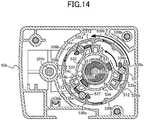
- FIGs. 14 , 15 , and 16 are cross-sectional views taken along line A-A, line B-B, and line C-C of FIG. 6 , respectively, in a state where the first operation cord is operated.
- FIG. 17 is a schematic diagram illustrating the shading device with the bottom rail and the intermediate bar moved to the lower limit.
- FIG. 18 is a schematic diagram illustrating the shading device in a state in which a continuous pulling operation is performed for the first operation cord.
- FIG. 19 is a schematic diagram illustrating the shading device when the interlocking gear is operated.
- FIG. 20 is a schematic diagram illustrating the shading device with the bottom rail and the intermediate bar moved to the upper limit.
- FIG. 21 is a schematic diagram illustrating the shading device when a release operation is performed.
- the first pulley 51 rotates in a first unwinding direction, which is an unwinding direction of the first operation cord 6, and, as shown in FIG. 14 , the rotation of the first pulley 51 is transmitted to the interlocking member 536 of the first clutch mechanism 53. At this time, winding of the second operation cord 7 is restricted, which also restricts the rotation of the second pulley 52. Accordingly, as shown in FIG. 16 , the first locking portion 511a formed in the first pulley 51 rotates relative to the second locking portion 521a formed in the second pulley 52 so as to reduce the diameter of the urging member 57.
- urging force is accumulated in the urging member 57 for the first pulley 51 to wind up the first operation cord 6 that has been unwound from the first pulley 51.
- the first operation cord 6 that has been pulled is wound by the first pulley 51, and the first driving shaft 201a is rotated each time the first operation cord 6 is pulled. This serves to reduce a length to pull the first operation cord 6 required for winding up the lifting/lowering cord 32 in a single pulling operation.
- the second driving shaft 201b follows the first driving shaft 201a and rotates in the same direction as the first driving shaft 201a, and the bottom rail 31 and the intermediate bar 41 are moved upward. Eventually, as shown in FIG. 20 , the bottom rail 31 and the intermediate bar 41 are moved upward to the upper limit.
- the urging member 57 rotates the first pulley 51 in the first winding direction in which the first operation cord 6 is wound, and accordingly, the engagement of the guide washer 535 and the interlocking member 536 through the clutch pin 537 is released. As shown in FIG. 21 , the bottom rail 31 thus moves downward due to its own weight.
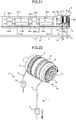
- FIG. 22 is a perspective view of the operation device in which the second operation cord is operated.
- FIGs. 23 and 24 are cross-sectional views taken along line C-C and line D-D of FIG. 6 , respectively, in a state where the second operation cord is operated.
- FIG. 25 is a schematic diagram illustrating the shading device in a state in which a continuous pulling operation is performed for the second operation cord.
- the second locking portion 521a formed in the second pulley 52 rotates relative to the first locking portion 511a formed in the first pulley 51 so as to reduce the diameter of the urging member 57.
- urging force is accumulated in the urging member 57 for the second pulley 52 to wind up the second operation cord 7 that has been unwound from the second pulley 52.
- the second operation cord 7 that has been pulled is wound by the second pulley 52, and the second driving shaft 201b is rotated each time the second operation cord 7 is pulled. This serves to reduce a length to pull the second operation cord 7 required for winding up the light control cord 42 in a single pulling operation.
- the first pulley 51 and the second pulley 52 are disposed in the left-right direction, and thus, the hanging position of the first operation cord 6 and the hanging position of the second operation cord 7 can be different in the left-right direction, and the two types of operation cords can be lowered in a state easy to discriminate.
- the urging member 57 is disposed between the first pulley 51 and the second pulley 52, and is shared in the winding of the first operation cord 6 and the second operation cord 7. This serves to reduce the number of components and achieve space saving.
- FIG. 26 is a schematic plan perspective view of the shading device according to the present embodiment.
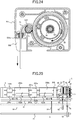
- FIGs. 27 and 28 are respectively a plan view and a perspective view illustrating the configuration of the operating device according to the present embodiment.
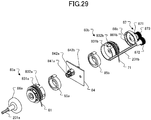
- FIGs. 29 and 30 are exploded perspective views of the operation device viewed from the first interlocking member side and the second interlocking member side, respectively.
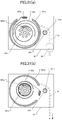
- FIG. 31 is a cross-sectional view taken along line A-A of FIG. 27 , in which (a) shows the non-operation state of the first operation cord, and (b) shows the operation state of the first operation cord.
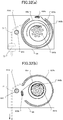
- FIG. 32 is a cross-sectional view taken along line B-B of FIG. 27 , in which (a) shows the non-operation state of the second operation cord, and (b) shows the operation state of the second operation cord.
- FIG. 33 is a side view of the transmission mechanism provided to the operating device.
- the shading device 1a differs from the first embodiment in that, as shown in FIG. 26 , the operation device 8 is provided instead of the operation device 5.
- the operating device 8 includes, as drive mechanism, a first pulley 83a, a second pulley 83b, a support member 84, a first urging member 85a, a second urging member 85b, a first interlocking member 86a, a second interlocking member 86b, and a transmission mechanism 87.
- the first pulley 83a, the first urging member 85a, and the first interlocking member 86a are independently connected to the first drive system described above, and the second pulley 83b, the second urging member 85b, the second interlocking member 86b, and the transmission mechanism 87 are independently connected to the second drive system described above.
- the first pulley 83a is connected to one end of the cord member 61, and the cord member 61 is wound around the circumferential wall of the first pulley 83a so as to be wound around and unwound from the first pulley 83a.
- the cord member 61 is wound so as to be hung from the front in the front-rear direction.
- a surrounding portion 831a is provided so as to surround and cooperatively accommodate the first urging member 85a with the support member 84.
- a portion of the circumferential wall forming the surrounding portion 831a is separated and serves as an outer locking portion 832a for detachably locking one end of the first urging member 85a.
- the first pulley 83a is supported by a first support shaft 841a of the support member 84 described later so as to be relatively rotatable, and rotates in response to the pulling down of the cord member 61.
- the second pulley 83b is connected to one end of the cord member 71, and the cord member 71 is wound around the circumferential wall of the second pulley 83b so as to be wound around and unwound from the second pulley 83b.
- the second pulley 83b is rotatably supported by a second support shaft 841b of the support member 84 described later and rotates in response to the pulling down of the cord member 71.
- the second pulley 83b has the same configuration as the first pulley 83a and is provided with a surrounding portion 831b corresponding to the surrounding portion 831a and an outer locking portion 832b corresponding to the outer locking portion 832a described above.
- the first pulleys 83a and the second pulleys 83b in this embodiment are arranged side by side along the left-right direction so as to be substantially plane-symmetrical with respect to the support member 84, where the first pulley 83a and the second pulley 83b face each other at their surrounding portions and their rotational axes are coaxial.
- the first pulley 83a transmits a rotational force to the left of the left-right direction
- the second pulley 83b transmits a rotational force to the right of the left-right direction.
- the support member 84 is a plate-like member disposed between the first pulley 83a and the second pulley 83b and fixed to the inner wall of a case 80 containing the operation device 8.
- the support member 84 extends in a direction perpendicular to the left-right direction, and is provided with the above-described first support shaft 841a and second support shaft 841b each projecting in the out-of-plane direction on the both surfaces.
- the first support shaft 841a rotatably supports the first pulley 83a at its distal end, and an inner locking portion 842a is formed at its rear end, i.e., its root portion.
- the second support shaft 841b rotatably supports the second pulley 83b at its distal end, and an inner locking portion 842b is formed at its rear end.
- the inner locking portion 842a extends in the front-rear direction and is curved in the circumferential direction.
- the front side of the inner locking portion 842a in the front-rear direction is connected to the first support shaft 841a, and the inner locking portion 842a locks the first urging member 85a when the other end of the first urging member 85a is wound around the surface thereof.
- the inner locking portion 842b has the same shape as the inner locking portion 842a, and locks the second urging member 85b when the other end of the second urging member 85b is wound around the surface thereof.
- the inner locking portions 842a and 842b lock the other ends of the urging members in a simple manner such that the other ends of the urging members are wound around the inner locking portions. This configuration allows the urging members to be easily detachable. This also applies to the outer locking portions 832a and 832b described above.
- the first urging member 85a and the second urging member 85b are wound in the same direction, and thus the inner locking portions 842a and 842b are formed so as to be plane-symmetrical with each other.
- the inner locking portions 842a and 842b are not limited to this shape, but may have any direction to extend and shape if the urging member can be locked.
- the rear side of the inner locking portion in the front-rear direction may be connected to the support shaft, or the inner locking portion may be separated from the support shaft.
- the urging member may be reversely wound as in the present embodiment, and in the latter case, the urging member may have a variable winding direction depending on the situation.
- the support member 84 supports the first pulley 83a and the second pulley 83b, and the first urging member 85a and the second urging member 85b, respectively, using one member each.
- the second driving shaft 201b is disposed in front of the first driving shaft 201a, and thus the support member 84 has an insertion hole 843 for inserting the second driving shaft 201b. If interference with the second driving shaft 201b is avoidable, instead of the insertion hole 843, a slit may be provided or the length of the support members 84 in the front-rear direction may be reduced.
- the first urging member 85a is a spiral spring and is contained in the surrounding portion 831a of the first pulley 83a. Specifically, in a state of being wound as shown in FIG. 31(a) , one end of the first urging member 85a is wound on the outer locking portion 832a of the first pulley 83a to be locked, and the other end is wound on the inner locking portion 842a of the first support shaft 841a to be locked. With this configuration, the first urging member 85a always urges the first pulley 83a to rotate in the winding direction of the first operation cord 6, but the stopper 63 prevents the first operation cord 6 from being wound by a predetermined amount or more.
- the second urging member 85b has the same configuration as the first urging member 85a, and is contained in the surrounding portion 831b of the second pulley 83b, and locked by the outer locking portion 832b of the second pulley 83b and the inner locking portion 842b of the second support shaft 841b.
- the second urging member 85b is disposed in the second pulley 83b in a state of being wound so as to be plane-symmetrical with the first urging member 85a with the support member 84 in between, and always urges the second pulley 83b to rotate in the winding direction.
- the second urging member 85b similarly to the first urging member 85a, when the second operation cord 7 is pulled down, the second urging member 85b gradually reduces in diameter according to the rotation of the first pulley 83a, and the rotation is stopped in a state where the second urging member 85b is wound to the limit at the rear end of the second support shaft 841b.
- the first pulley 83a and the second pulley 83b are disposed so as to be substantially plane-symmetrical with respect to the support member 84.
- the cord member 61 and the cord member 71 are wound so as to be substantially plane-symmetrical, and the first urging member 85a and the second urging member 85b are wound so as to be substantially plane-symmetrical, with respect to the support member 84.
- the first pulley 83a and the second pulley 83b have the same winding and unwinding directions, and respectively have the cord member 61 and the cord member 71 in parallel hanging from the front in the front-rear direction.
- the first interlocking member 86a is formed into a lid that can be mounted to cover the clutch mechanism attached to the first pulley 83a.
- a plurality of engaging projections 861a which project radially inward so as to engage with and disengage from the clutch mechanism, are formed at predetermined intervals in the circumferential direction on the inner surface of the portion of the first interlocking member 86a where the clutch mechanism is covered. This configuration allows the first interlocking member 86a to rotate integrally or relative to the rotation of the first pulley 83a. Further, the first interlocking member 86a has a cylindrical projection at substantially the center of the left surface in the left-right direction.
- the cylindrical projection extends in the out-of-plane direction, and the first driving shaft 201a is inserted therein so as to integrally rotate.
- the second interlocking member 86b is formed into a lid that can be mounted to cover the clutch mechanism attached to the second pulley 83b, and a plurality of engaging projections 861b having the same function as those of the first interlocking member 86a are formed on the inner surface of the portion of the second interlocking member 86b where the clutch mechanism is covered.
- the second interlocking member 86b has a first gear 871 of the transmission mechanism 87 at substantially the center of the right surface in the left-right direction, and integrally rotates with the first gear 871 at the same rotation axis.
- the transmission mechanism 87 includes the first gear 871 rotatably coupled with the second interlocking member 86b, a second gear 872 rotatably coupled with the second driving shaft 201b, and a third gear 873 disposed between the first gear 871 and the second gear 872 and engaged with each gear to transfer the rotational force of the first gear 871 to the second gear 872.
- the transmission mechanism 87 is disposed between the second pulley 83b and the second driving shaft 201b, whereby the rotation of the second pulley 83b is converted to a rotation of the axial position at substantially the same position as the second driving shaft 201b and transmitted to the second driving shaft 201b.
- FIG. 34 is a front view illustrating a configuration of a shading device according to the present embodiment.
- a shading device 1b according to the present embodiment differs from the shading device 1 according to the first embodiment in that the shading device 1b includes a first operation cord 6a and a second operation cord 7a instead of the first operation cord 6 and the second operation cord 7.
- the first operation cord 6a and the second operation cord 7a are configured such that a distance between a gripping portion 62 and a stopper 63 is different from a distance between a gripping portion 72 and a stopper 73.
- the distance between the gripping portion 62 and the stopper 63 is longer than the distance between the gripping portion 72 and the stopper 73, whereby the gripping portion 62 is positioned below the gripping portion 72 in a non-operational state.
- the positional relationship between the gripping portion 62 and the gripping portion 72 in the vertical direction in a non-operation state corresponds to the positional relationship between the bottom rail 31 and the intermediate bar 41, which are to be operated by the first operation cord 6a and the second operation cord 7a, respectively. This allows the operator to easily understand which of the bottom rail 31 and the intermediate bar 41 is operated for each of the first operation cords 6a and the second operation cord 7a.
- the first moving member moved by the rotation of the first driving shaft 201a and the second moving member moved by the rotation of the second driving shaft 201b are respectively referred to as the bottom rail 31 and the intermediate bar 41 each being moved in the vertical direction.
- the movement direction of the first moving member and the second moving member may be any direction, and the first moving member and the second moving member may be disposed in the front-rear direction and move in the vertical direction or the left-right direction, respectively.
- the pleated screen is described as an example of the shading device, although the shading devices may be applied to shading devices such as blinds, curtains, and partitions, including horizontal blinds, vertical blinds, roll screens, honeycomb screens, tucking curtains, and accordion doors, for example.
Landscapes
- Engineering & Computer Science (AREA)
- Structural Engineering (AREA)
- Architecture (AREA)
- Civil Engineering (AREA)
- Blinds (AREA)
- Curtains And Furnishings For Windows Or Doors (AREA)
Applications Claiming Priority (3)
| Application Number | Priority Date | Filing Date | Title |
|---|---|---|---|
| JP2018143424A JP7034029B2 (ja) | 2018-07-31 | 2018-07-31 | 遮蔽装置 |
| JP2018145150A JP7094820B2 (ja) | 2018-08-01 | 2018-08-01 | 遮蔽装置 |
| PCT/JP2019/015153 WO2020026527A1 (ja) | 2018-07-31 | 2019-04-05 | 遮蔽装置 |
Publications (2)
| Publication Number | Publication Date |
|---|---|
| EP3832064A1 true EP3832064A1 (de) | 2021-06-09 |
| EP3832064A4 EP3832064A4 (de) | 2022-04-20 |
Family
ID=69231148
Family Applications (1)
| Application Number | Title | Priority Date | Filing Date |
|---|---|---|---|
| EP19843079.5A Withdrawn EP3832064A4 (de) | 2018-07-31 | 2019-04-05 | Abschirmungsvorrichtung |
Country Status (4)
| Country | Link |
|---|---|
| US (1) | US11448009B2 (de) |
| EP (1) | EP3832064A4 (de) |
| CN (1) | CN112437826B (de) |
| WO (1) | WO2020026527A1 (de) |
Families Citing this family (12)
| Publication number | Priority date | Publication date | Assignee | Title |
|---|---|---|---|---|
| US11639631B2 (en) * | 2019-12-04 | 2023-05-02 | Teh Yor Co., Ltd. | Window shade and actuating system thereof |
| US12078011B2 (en) * | 2019-12-20 | 2024-09-03 | Nien Made Enterprise Co., Ltd. | Motorized window treatment |
| TWM593223U (zh) | 2019-12-20 | 2020-04-11 | 億豐綜合工業股份有限公司 | 窗簾 |
| US12237800B2 (en) | 2019-12-20 | 2025-02-25 | Nien Made Enterprise Co., Ltd. | Electric window covering, control device thereof and control method thereof |
| US20230193688A1 (en) * | 2020-03-18 | 2023-06-22 | Hunter Douglas Inc. | Hybrid covering for an architectural structure |
| CN215169592U (zh) | 2020-12-24 | 2021-12-14 | 亿丰综合工业股份有限公司 | 双向开合式窗帘 |
| TWI739711B (zh) * | 2021-01-28 | 2021-09-11 | 型態同步科技股份有限公司 | 升降控制模組及捲簾升降裝置 |
| US12503913B2 (en) | 2021-01-28 | 2025-12-23 | Syncproto Co., Ltd. | Blind lifting device and a blind lifting control module thereof |
| JP7047156B1 (ja) | 2021-03-08 | 2022-04-04 | 億豐綜合工業股▲分▼有限公司 | 二方向開閉式カーテン |
| CA3203197A1 (en) * | 2021-04-06 | 2022-10-13 | Chien-Fong Huang | Cord winding assembly, actuating system and window shade |
| AU2022349547B2 (en) * | 2021-09-22 | 2024-11-14 | Teh Yor Co., Ltd. | Window shade and actuating system thereof |
| US12565809B2 (en) * | 2022-08-04 | 2026-03-03 | Guangzhou JADY Window Coverings Technology Co., Ltd | Day-and-night curtain dual-rail dual-control correlation type stopper |
Family Cites Families (22)
| Publication number | Priority date | Publication date | Assignee | Title |
|---|---|---|---|---|
| IL124778A0 (en) * | 1997-06-24 | 1999-01-26 | Holis Metal Ind Ltd | Tilting mechanism for a venetian blind |
| US7063122B2 (en) * | 2002-03-20 | 2006-06-20 | Hunter Douglas Inc. | Bottom-up/top-down retractable cellular shade |
| US8511364B2 (en) * | 2006-01-13 | 2013-08-20 | Hunter Douglas Inc. | Spring motor for drive for coverings for architectural openings |
| US7686059B2 (en) * | 2006-09-05 | 2010-03-30 | Hunter Douglas Inc. | Top down/bottom up control system for retractable shade |
| KR100875633B1 (ko) * | 2008-06-16 | 2008-12-26 | 곽재석 | 원 코드 블라인드 |
| JP5107869B2 (ja) | 2008-11-05 | 2012-12-26 | 株式会社ニチベイ | ブラインドの駆動装置 |
| JP5315009B2 (ja) * | 2008-11-05 | 2013-10-16 | 株式会社ニチベイ | ブラインド |
| DE102009041699B3 (de) * | 2009-09-16 | 2011-01-27 | Blöcker Zweigniederlassung der Hunter Douglas Holding GmbH & Co. KG | Vorhanganordnung für eine architektonische Öffnung |
| JP5548013B2 (ja) | 2010-04-14 | 2014-07-16 | 株式会社ニチベイ | ブラインド |
| US8365797B2 (en) * | 2010-04-30 | 2013-02-05 | Hunter Douglas Inc. | Cord tension control for top down/bottom up covering for architectural openings |
| CA2797850C (en) * | 2011-04-28 | 2018-08-14 | Hunter Douglas Inc. | Cord tension control for top down/bottom up covering for architectural openings |
| IL220779A (en) * | 2012-07-05 | 2016-08-31 | Holis Metal Ind Ltd | Two-stage curtain |
| US9988837B2 (en) * | 2012-07-13 | 2018-06-05 | Hunter Douglas Industries Switzerland Gmbh | Variable force brake for a window covering operating system |
| KR101940388B1 (ko) * | 2014-06-09 | 2019-01-18 | 데 요 컴퍼니 리미티드 | 창문 가리개 및 이의 구동 시스템 |
| CA2919685C (en) * | 2015-02-02 | 2017-11-21 | John Morris | Brake device for cordless lift shades |
| US20160281423A1 (en) * | 2015-03-24 | 2016-09-29 | Uni-Soleil Ent. Co. Ltd. | Single-cord control device for roller blind |
| CN107664007B (zh) * | 2016-07-06 | 2019-03-26 | 德侑股份有限公司 | 窗帘 |
| NL2017627B1 (nl) * | 2016-10-17 | 2018-04-24 | Coulisse Bv | Universele bedieningsinrichting voor scherm, zoals raambekleding |
| JP6808448B2 (ja) * | 2016-10-31 | 2021-01-06 | 立川ブラインド工業株式会社 | 操作装置 |
| PL3434857T3 (pl) * | 2017-07-25 | 2020-06-15 | Coulisse B.V. | Zasłona z górną szyną, dolną szyną i środkową szyną i pierwszy kontrolny zespół dla środkowej szyny i drugi kontrolny zespół dla dolnej szyny |
| NL2020367B1 (nl) * | 2018-02-01 | 2019-08-12 | Vako B V | Bedieningsinrichting voor een plisségordijn |
| US11639631B2 (en) * | 2019-12-04 | 2023-05-02 | Teh Yor Co., Ltd. | Window shade and actuating system thereof |
-
2019
- 2019-04-05 CN CN201980041806.6A patent/CN112437826B/zh active Active
- 2019-04-05 US US16/972,324 patent/US11448009B2/en active Active
- 2019-04-05 EP EP19843079.5A patent/EP3832064A4/de not_active Withdrawn
- 2019-04-05 WO PCT/JP2019/015153 patent/WO2020026527A1/ja not_active Ceased
Also Published As
| Publication number | Publication date |
|---|---|
| WO2020026527A1 (ja) | 2020-02-06 |
| US11448009B2 (en) | 2022-09-20 |
| EP3832064A4 (de) | 2022-04-20 |
| CN112437826A (zh) | 2021-03-02 |
| US20210230939A1 (en) | 2021-07-29 |
| CN112437826B (zh) | 2023-06-09 |
Similar Documents
| Publication | Publication Date | Title |
|---|---|---|
| EP3832064A1 (de) | Abschirmungsvorrichtung | |
| JP7034029B2 (ja) | 遮蔽装置 | |
| JP6283024B2 (ja) | 日射遮蔽材昇降装置 | |
| JP2024054408A (ja) | 日射遮蔽装置用の操作装置 | |
| US4844139A (en) | Vertical louver blind having clutched operating mechanism | |
| JP7329643B2 (ja) | 遮蔽装置 | |
| JP7094820B2 (ja) | 遮蔽装置 | |
| CN107532699B (zh) | 传递延迟单元以及遮蔽件升降装置 | |
| JP5521149B2 (ja) | ブラインド | |
| CN105209707B (zh) | 凸轮单元 | |
| JP7581444B2 (ja) | 遮蔽装置 | |
| JP6151556B2 (ja) | 日射遮蔽装置の駆動ユニット | |
| JP4612463B2 (ja) | 昇降コード選択型ローマンシェード | |
| JP7438050B2 (ja) | 日射遮蔽装置及び日射遮蔽装置用の操作装置 | |
| JP7329642B2 (ja) | 遮蔽装置 | |
| JP7510342B2 (ja) | 操作装置 | |
| JP7250975B2 (ja) | 遮蔽装置 | |
| JP7199923B2 (ja) | 遮蔽装置 | |
| JP7438049B2 (ja) | 日射遮蔽装置及び日射遮蔽装置用の操作装置 | |
| JP7679336B2 (ja) | 操作装置、操作方法 | |
| JP7475235B2 (ja) | 日射遮蔽装置及び日射遮蔽装置用の操作装置 | |
| JP7671211B2 (ja) | 操作装置 | |
| JP2020023792A (ja) | 遮蔽装置 | |
| JP2019127720A (ja) | ブラインド |
Legal Events
| Date | Code | Title | Description |
|---|---|---|---|
| STAA | Information on the status of an ep patent application or granted ep patent |
Free format text: STATUS: THE INTERNATIONAL PUBLICATION HAS BEEN MADE |
|
| PUAI | Public reference made under article 153(3) epc to a published international application that has entered the european phase |
Free format text: ORIGINAL CODE: 0009012 |
|
| STAA | Information on the status of an ep patent application or granted ep patent |
Free format text: STATUS: REQUEST FOR EXAMINATION WAS MADE |
|
| 17P | Request for examination filed |
Effective date: 20210301 |
|
| AK | Designated contracting states |
Kind code of ref document: A1 Designated state(s): AL AT BE BG CH CY CZ DE DK EE ES FI FR GB GR HR HU IE IS IT LI LT LU LV MC MK MT NL NO PL PT RO RS SE SI SK SM TR |
|
| DAV | Request for validation of the european patent (deleted) | ||
| DAX | Request for extension of the european patent (deleted) | ||
| A4 | Supplementary search report drawn up and despatched |
Effective date: 20220321 |
|
| RIC1 | Information provided on ipc code assigned before grant |
Ipc: E06B 9/262 20060101ALI20220315BHEP Ipc: E06B 9/322 20060101AFI20220315BHEP |
|
| STAA | Information on the status of an ep patent application or granted ep patent |
Free format text: STATUS: EXAMINATION IS IN PROGRESS |
|
| 17Q | First examination report despatched |
Effective date: 20240718 |
|
| GRAP | Despatch of communication of intention to grant a patent |
Free format text: ORIGINAL CODE: EPIDOSNIGR1 |
|
| STAA | Information on the status of an ep patent application or granted ep patent |
Free format text: STATUS: GRANT OF PATENT IS INTENDED |
|
| INTG | Intention to grant announced |
Effective date: 20250114 |
|
| STAA | Information on the status of an ep patent application or granted ep patent |
Free format text: STATUS: THE APPLICATION IS DEEMED TO BE WITHDRAWN |
|
| 18D | Application deemed to be withdrawn |
Effective date: 20250515 |