EP3833670B1 - 6-(4-amino-3-methyl-2-oxa-8-azaspiro[4.5]decan-8-yl)-3-(2,3-dichlorophenyl)-2-methylpyrimidin-4(3h)-on-derivate und ähnliche verbindungen als ptpn11 (shp2) inhibitoren zur behandlung von krebs - Google Patents
6-(4-amino-3-methyl-2-oxa-8-azaspiro[4.5]decan-8-yl)-3-(2,3-dichlorophenyl)-2-methylpyrimidin-4(3h)-on-derivate und ähnliche verbindungen als ptpn11 (shp2) inhibitoren zur behandlung von krebs Download PDFInfo
- Publication number
- EP3833670B1 EP3833670B1 EP19759185.2A EP19759185A EP3833670B1 EP 3833670 B1 EP3833670 B1 EP 3833670B1 EP 19759185 A EP19759185 A EP 19759185A EP 3833670 B1 EP3833670 B1 EP 3833670B1
- Authority
- EP
- European Patent Office
- Prior art keywords
- group
- alkyl
- independently selected
- amino
- halo
- Prior art date
- Legal status (The legal status is an assumption and is not a legal conclusion. Google has not performed a legal analysis and makes no representation as to the accuracy of the status listed.)
- Active
Links
Images


Classifications
-
- C—CHEMISTRY; METALLURGY
- C07—ORGANIC CHEMISTRY
- C07D—HETEROCYCLIC COMPOUNDS
- C07D471/00—Heterocyclic compounds containing nitrogen atoms as the only ring hetero atoms in the condensed system, at least one ring being a six-membered ring with one nitrogen atom, not provided for by groups C07D451/00 - C07D463/00
- C07D471/02—Heterocyclic compounds containing nitrogen atoms as the only ring hetero atoms in the condensed system, at least one ring being a six-membered ring with one nitrogen atom, not provided for by groups C07D451/00 - C07D463/00 in which the condensed system contains two hetero rings
- C07D471/04—Ortho-condensed systems
-
- C—CHEMISTRY; METALLURGY
- C07—ORGANIC CHEMISTRY
- C07D—HETEROCYCLIC COMPOUNDS
- C07D401/00—Heterocyclic compounds containing two or more hetero rings, having nitrogen atoms as the only ring hetero atoms, at least one ring being a six-membered ring with only one nitrogen atom
- C07D401/02—Heterocyclic compounds containing two or more hetero rings, having nitrogen atoms as the only ring hetero atoms, at least one ring being a six-membered ring with only one nitrogen atom containing two hetero rings
- C07D401/04—Heterocyclic compounds containing two or more hetero rings, having nitrogen atoms as the only ring hetero atoms, at least one ring being a six-membered ring with only one nitrogen atom containing two hetero rings directly linked by a ring-member-to-ring-member bond
-
- C—CHEMISTRY; METALLURGY
- C07—ORGANIC CHEMISTRY
- C07D—HETEROCYCLIC COMPOUNDS
- C07D491/00—Heterocyclic compounds containing in the condensed ring system both one or more rings having oxygen atoms as the only ring hetero atoms and one or more rings having nitrogen atoms as the only ring hetero atoms, not provided for by groups C07D451/00 - C07D459/00, C07D463/00, C07D477/00 or C07D489/00
- C07D491/02—Heterocyclic compounds containing in the condensed ring system both one or more rings having oxygen atoms as the only ring hetero atoms and one or more rings having nitrogen atoms as the only ring hetero atoms, not provided for by groups C07D451/00 - C07D459/00, C07D463/00, C07D477/00 or C07D489/00 in which the condensed system contains two hetero rings
- C07D491/10—Spiro-condensed systems
-
- A—HUMAN NECESSITIES
- A61—MEDICAL OR VETERINARY SCIENCE; HYGIENE
- A61K—PREPARATIONS FOR MEDICAL, DENTAL OR TOILETRY PURPOSES
- A61K31/00—Medicinal preparations containing organic active ingredients
- A61K31/33—Heterocyclic compounds
- A61K31/395—Heterocyclic compounds having nitrogen as a ring hetero atom, e.g. guanethidine or rifamycins
- A61K31/495—Heterocyclic compounds having nitrogen as a ring hetero atom, e.g. guanethidine or rifamycins having six-membered rings with two or more nitrogen atoms as the only ring heteroatoms, e.g. piperazine or tetrazines
- A61K31/505—Pyrimidines; Hydrogenated pyrimidines, e.g. trimethoprim
- A61K31/506—Pyrimidines; Hydrogenated pyrimidines, e.g. trimethoprim not condensed and containing further heterocyclic rings
-
- A—HUMAN NECESSITIES
- A61—MEDICAL OR VETERINARY SCIENCE; HYGIENE
- A61P—SPECIFIC THERAPEUTIC ACTIVITY OF CHEMICAL COMPOUNDS OR MEDICINAL PREPARATIONS
- A61P35/00—Antineoplastic agents
-
- C—CHEMISTRY; METALLURGY
- C07—ORGANIC CHEMISTRY
- C07D—HETEROCYCLIC COMPOUNDS
- C07D491/00—Heterocyclic compounds containing in the condensed ring system both one or more rings having oxygen atoms as the only ring hetero atoms and one or more rings having nitrogen atoms as the only ring hetero atoms, not provided for by groups C07D451/00 - C07D459/00, C07D463/00, C07D477/00 or C07D489/00
- C07D491/02—Heterocyclic compounds containing in the condensed ring system both one or more rings having oxygen atoms as the only ring hetero atoms and one or more rings having nitrogen atoms as the only ring hetero atoms, not provided for by groups C07D451/00 - C07D459/00, C07D463/00, C07D477/00 or C07D489/00 in which the condensed system contains two hetero rings
- C07D491/10—Spiro-condensed systems
- C07D491/107—Spiro-condensed systems with only one oxygen atom as ring hetero atom in the oxygen-containing ring
Definitions
- the invention also relates to pharmaceutical compositions comprising a compound of the invention, the compounds of the invention for use as a medicament, the compounds of the invention for use in the treatment of a disease driven by one or more PTPN11 mutations, the compounds of the invention for use in the treatment of cancer, including leukemia and melanoma, and cancers of the breast, lung, and colon, and the compounds of the invention for use in combination with another therapeutic agent in the treatment of a PTPN11-mediated disease.
- Tyrosyl phosphorylation regulates human cellular processes from cell differentiation to growth and apoptosis, and others. Tyrosyl phosphorylation is regulated by protein-tyrosine kinases (PTK) and protein-tyrosine phosphatases (PTP). The breakdown of regulation governed by PTK and PTP activity is thought to lead to cancer. PTK inhibitors have been developed as potential cancer therapeutic agents. Recent studies disclose a role for PTPs in cellular regulation as well. ( AJ Barr et al. Cell 2009, 136, 352-363 . JN Andersen et al Mol. Cell. Biol. 2001, 21, 7117-7136 ).
- Protein-tyrosine phosphatase non-receptor type 11 (PTPN11, also known as Src Homology-2 phosphatase (SHP2)) is a non-receptor protein tyrosine phosphatase encoded by the PTPN11 gene.
- This PTP contains two tandem Src homology-2 (SH2) domains, which function as phospho-tyrosine binding domains, a catalytic domain, and a C-terminal tail. In the basal state the protein typically exists in an inactive, self-inhibited conformation with the N-terminal SH2 domain blocking the active site.
- SH2 Src Homology-2
- Germ-line and somatic mutations in PTPN11 have been reported in several human diseases resulting in gain-of-function in the catalytic activity, including Noonan Syndrome and Leopard Syndrome; as well as multiple cancers such as juvenile myelomonocytic leukemia, neuroblastoma, myelodysplastic syndrome, B cell acute lymphoblastic leukemia/lymphoma, melanoma, acute myeloid leukemia and cancers of the breast, lung and colon ( MG Mohl, BG Neel, Curr. Opin. Genetics Dev. 2007, 17, 23-30 ).
- PTPN11 is widely expressed in most tissues and plays a regulatory role in various cell signaling events that are important for a diversity of cell functions that includes proliferation, differentiation, cell cycle maintenance, EMT transition, mitogenic activation, metabolic control, transcription regulation, and cell migration, through multiple signaling pathways including the Ras-MAPK, the JAK-STAT or the PI3K-AKT pathways ( Tajan, M. et. al. Eur. J. Medical Genetics, 2015, 58, 509-525 . Prahallad, A. et. al. Cell Reports, 2015, 12, 1978-1985 ).
- PTPN11/SHP2 is implicated in immune evasion during tumorigenesis, and hence a SHP2 inhibitor could stimulate the immune response in cancer patients ( Cancer Res. 2015 Feb 1;75(3):508-18 . T Yokosuka T, J Exp Med. 2012, 209(6), 1201 . S Amarnath Sci Transl Med. 2011, 3, 111ra120 . T Okazaki, PNAS 2001, 98:24, 13866-71 ).
- WO 2016/203405 discloses compounds and compositions for inhibiting the activity of SHP2.
- Novel compounds and pharmaceutical compositions certain of which have been found to inhibit PTPN11 (SHP2) have been discovered, together with the componds for use as medicaments, including in methods for the treatment of PTP-mediated diseases in a patient by administering the compounds.
- compounds are represented by Formula I: or a salt or tautomer thereof, wherein the subscripts a and b, Y 1 , Y 2 , and R 1 , R 2 , R 3 , R 4 , R 5 , R 6 , R 7 , R 8 , R 9 , R 10 , R 11 , and R 13 are as provided herein.
- the present invention provides a pharmaceutical composition including a compound having Formula I, together with a pharmaceutically acceptable carrier.
- the present invention provides a compound of the invention for use as a medicament. In certain embodiments, the present invention provides a compound of the invention for use in the treatment of a disease driven by one or more PTPN11 mutations. In certain embodiments, the present invention provides a compound of the invention for use in the treatment of cancer, including leukemia and melanoma, and cancers of the breast, lung, and colon. In certain embodiments, the present invention provides a compound of the invention for use in a method of treatment of a PTPN11-mediated disease comprising administration of a therapeutically effective amount of said compound; and another therapeutic agent.
- Certain compounds of Formula I disclosed herein may possess useful PTPN11 inhibiting activity, and may be used in the treatment or prophylaxis of a disease or condition in which PTPN11 plays an active role.
- certain embodiments also provide pharmaceutical compositions comprising one or more compounds disclosed herein together with a pharmaceutically acceptable carrier, as well as the compounds for use as medicaments.
- Certain embodiments provide compounds according to the present inventon for use in methods for treating a PTPN11-mediated disorder in a patient in need of such treatment, comprising administering to said patient a therapeutically effective amount of a compound or composition according to the present invention.
- acyl refers to a carbonyl attached to an alkenyl, alkyl, aryl, cycloalkyl, heteroaryl, heterocycle, or any other moiety were the atom attached to the carbonyl is carbon.
- An “acetyl” group refers to a -C(O)CH 3 group.
- An “alkylcarbonyl” or “alkanoyl” group refers to an alkyl group attached to the parent molecular moiety through a carbonyl group. Examples of such groups include methylcarbonyl and ethylcarbonyl. Examples of acyl groups include formyl, alkanoyl and aroyl.
- alkenyl refers to a straight-chain or branched-chain hydrocarbon radical having one or more double bonds and containing from 2 to 20 carbon atoms. In certain embodiments, said alkenyl will comprise from 2 to 6 carbon atoms.
- alkynyl refers to either a straight chain or branched hydrocarbon having at least 2 carbon atoms and at least one triple bond and having the number of carbon atom indicated (i.e., C 2-6 means to two to six carbons).
- Alkynyl can include any number of carbons, such as C 2 , C 2-3 , C 2-4 , C 2-5 , C 2-6 , C 2-7 , C 2-8 , C 2-9 , C 2-10 , C 3 , C 3-4 , C 3-5 , C 3-6 , C 4 , C 4-5 , C 4-6 , C 5 , C 5-6 , and C 6 .
- alkynyl groups include, but are not limited to, acetylenyl, propynyl, 1-butynyl, 2-butynyl, butadiynyl, 1-pentynyl, 2-pentynyl, isopentynyl, 1,3-pentadiynyl, 1,4-pentadiynyl, 1-hexynyl, 2-hexynyl, 3-hexynyl, 1,3-hexadiynyl, 1,4-hexadiynyl, 1,5-hexadiynyl, 2,4-hexadiynyl, or 1,3,5-hexatriynyl.
- alkoxy refers to an alkyl ether radical, wherein the term alkyl is as defined below.
- suitable alkyl ether radicals include methoxy, ethoxy, n-propoxy, isopropoxy, n-butoxy, iso-butoxy, sec-butoxy, tert-butoxy, and the like.
- alkyl refers to a straight-chain or branched-chain alkyl radical containing from 1 to 20 carbon atoms. In certain embodiments, said alkyl will comprise from 1 to 10 carbon atoms. In further embodiments, said alkyl will comprise from 1 to 8 carbon atoms. Alkyl groups are optionally substituted as defined herein. Examples of alkyl radicals include methyl, ethyl, n-propyl, isopropyl, n-butyl, isobutyl, sec-butyl, tert-butyl, pentyl, iso-amyl, hexyl, octyl, noyl and the like.
- alkylene refers to a saturated aliphatic group derived from a straight or branched chain saturated hydrocarbon attached at two or more positions, such as methylene (-CH 2 -). Unless otherwise specified, the term “alkyl” may include “alkylene” groups.
- alkylamino refers to an alkyl group attached to the parent molecular moiety through an amino group. Suitable alkylamino groups may be mono- or dialkylated, forming groups such as, for example, N-methylamino, N-ethylamino, N,N-dimethylamino, N,N-ethylmethylamino and the like.
- alkylthio refers to an alkyl thioether (R-S-) radical wherein the term alkyl is as defined above and wherein the sulfur may be singly or doubly oxidized.
- suitable alkyl thioether radicals include methylthio, ethylthio, n-propylthio, isopropylthio, n-butylthio, iso-butylthio, sec-butylthio, tert-butylthio, methanesulfonyl, ethanesulfinyl, and the like.
- amido and “carbamoyl,” as used herein, alone or in combination, refer to an amino group as described below attached to the parent molecular moiety through a carbonyl group, or vice versa.
- the “amido” group as used herein incudes a “C-amido” and “N-amido” groups.
- C-amido as used herein, alone or in combination, refers to a -C(O)N(RR') group with R and R' as defined herein or as defined by the specifically enumerated "R” groups designated.
- the "amido" group includes -C(O)NH 2 , C 1-4 alkylamido, and di(C 1-4 alkyl)amido.
- C 1-4 alkylamido refers to -C(O)NH(C 1-4 alkyl), wherein C 1-4 alkyl is as defined herein.
- N-amido refers to a RC(O)N(R')- group, with R and R' as defined herein or as defined by the specifically enumerated "R” groups designated.
- acylamino as used herein, alone or in combination, embraces an acyl group attached to the parent moiety through an amino group.
- An example of an “acylamino” group is acetylamino (CH 3 C(O)NH-).
- amino refers to -NRR', wherein R and R' are independently selected from hydrogen, alkyl, acyl, heteroalkyl, aryl, cycloalkyl, heteroaryl, and heterocycloalkyl, any of which may themselves be optionally substituted. Additionally, R and R' may combine to form heterocycloalkyl, either of which is optionally substituted.
- aryl as used herein, alone or in combination, means a carbocyclic aromatic system containing one, two or three rings wherein such polycyclic ring systems are fused together.
- aryl embraces aromatic groups such as phenyl, naphthyl, anthracenyl, and phenanthryl.
- arylalkenyl or “aralkenyl,” as used herein, alone or in combination, refers to an aryl group attached to the parent molecular moiety through an alkenyl group.
- arylalkoxy or “aralkoxy,” as used herein, alone or in combination, refers to an aryl group attached to the parent molecular moiety through an alkoxy group.
- arylalkyl or “aralkyl,” as used herein, alone or in combination, refers to an aryl group attached to the parent molecular moiety through an alkyl group.
- aryloxy refers to an aryl group attached to the parent molecular moiety through an oxy.
- carbamate refers to an ester of carbamic acid (-NHCOO-) which may be attached to the parent molecular moiety from either the nitrogen or acid end, and which is optionally substituted as defined herein.
- O-carbamyl refers to a -OC(O)NRR', group - with R and R' as defined herein.
- N-carbamyl as used herein, alone or in combination, refers to a ROC(O)NR'- group, with R and R' as defined herein.
- carbonyl when alone includes formyl [-C(O)H] and in combination is a -C(O)- group.
- Carboxyl or “carboxy,” as used herein, refers to -C(O)OH or the corresponding “carboxylate” anion, such as is in a carboxylic acid salt.
- An "O-carboxy” group refers to a RC(O)O- group, where R is as defined herein.
- a “C-carboxy” group refers to a -C(O)OR groups where R is as defined herein.
- cyano as used herein, alone or in combination, refers to -CN.
- cycloalkyl or, alternatively, “carbocycle,” as used herein, alone or in combination, refers to a saturated or partially saturated monocyclic, bicyclic or tricyclic alkyl group wherein each cyclic moiety contains from 3 to 12 carbon atom ring members and which may optionally be a benzo fused ring system which is optionally substituted as defined herein.
- cycloalkenyl refers to a cycloalkyl group having one or two double bonds. In certain embodiments, said cycloalkyl (or cycloalkenyl) will comprise from 5 to 7 carbon atoms.
- Examples of such groups include cyclopropyl, cyclobutyl, cyclopentyl, cyclohexyl, cycloheptyl, cyclobutenyl, cyclopentenyl, cyclohexenyl, tetrahydronapthyl, indanyl, octahydronaphthyl, 2,3-dihydro-1H-indenyl, adamantyl and the like.
- "Bicyclic” and “tricyclic” as used herein are intended to include both fused ring systems, such as decahydronaphthalene, octahydronaphthalene as well as the multicyclic (multicentered) saturated or partially unsaturated type. The latter type of isomer is exemplified in general by, bicyclo[1,1,1]pentane, camphor, adamantane, and bicyclo[3,2,1]octane.
- esters refers to a carboxy group bridging two moieties linked at carbon atoms.
- ether refers to an oxy group bridging two moieties linked at carbon atoms.
- halo or halogen, as used herein, alone or in combination, refers to fluorine, chlorine, bromine, or iodine.
- haloalkoxy refers to a haloalkyl group attached to the parent molecular moiety through an oxygen atom.
- haloalkyl refers to an alkyl radical having the meaning as defined above wherein one or more hydrogens are replaced with a halogen. Specifically embraced are monohaloalkyl, dihaloalkyl and polyhaloalkyl radicals.
- a monohaloalkyl radical for one example, may have an iodo, bromo, chloro, or fluoro atom within the radical.
- Dihalo and polyhaloalkyl radicals may have two or more of the same halo atoms or a combination of different halo radicals.
- haloalkyl radicals include fluoromethyl, difluoromethyl, trifluoromethyl, chloromethyl, dichloromethyl, trichloromethyl, pentafluoroethyl, heptafluoropropyl, difluorochloromethyl, dichlorofluoromethyl, difluoroethyl, difluoropropyl, dichloroethyl and dichloropropyl.
- Haloalkylene refers to a haloalkyl group attached at two or more positions. Examples include fluoromethylene (-CFH-), difluoromethylene (-CF 2 -), chloromethylene (-CHCl-) and the like.
- heteroalkyl refers to a stable straight or branched chain, or combinations thereof, fully saturated or containing from 1 to 3 degrees of unsaturation, consisting of the stated number of carbon atoms and from one to three heteroatoms selected from N, O, and S, and wherein the N and S atoms may optionally be oxidized and the N heteroatom may optionally be quaternized.
- the heteroatom(s) may be placed at any interior position of the heteroalkyl group. Up to two heteroatoms may be consecutive, such as, for example, -CH 2 -NH-OCH 3 .
- heteroaryl refers to a 3 to 15 membered unsaturated heteromonocyclic ring, or a fused monocyclic, bicyclic, or tricyclic ring system in which at least one of the fused rings is aromatic, which contains at least one atom selected from N, O, and S.
- said heteroaryl will comprise from 1 to 4 heteroatoms as ring members.
- said heteroaryl will comprise from 1 to 2 heteroatoms as ring members.
- said heteroaryl will comprise from 5 to 7 atoms.
- heterocyclic rings are fused with aryl rings, wherein heteroaryl rings are fused with other heteroaryl rings, wherein heteroaryl rings are fused with heterocycloalkyl rings, or wherein heteroaryl rings are fused with cycloalkyl rings.
- heteroaryl groups include pyrrolyl, pyrrolinyl, imidazolyl, pyrazolyl, pyridyl, pyrimidinyl, pyrazinyl, pyridazinyl, triazolyl, pyranyl, furyl, thienyl, oxazolyl, isoxazolyl, oxadiazolyl, thiazolyl, thiadiazolyl, isothiazolyl, indolyl, isoindolyl, indolizinyl, benzimidazolyl, quinolyl, isoquinolyl, quinoxalinyl, quinazolinyl, indazolyl, benzotriazolyl, benzodioxolyl, benzopyranyl, benzoxazolyl, benzoxadiazolyl, benzothiazolyl, benzothiadiazolyl, benzofuryl, benzothienyl, chromonyl,
- Exemplary tricyclic heterocyclic groups include carbazolyl, benzidolyl, phenanthrolinyl, dibenzofuranyl, acridinyl, phenanthridinyl, xanthenyl and the like.
- heterocycloalkyl and, interchangeably, “heterocycle,” as used herein, alone or in combination, each refer to a saturated, partially unsaturated, or fully unsaturated (but nonaromatic) monocyclic, bicyclic, or tricyclic heterocyclic group containing at least one heteroatom as a ring member, wherein each said heteroatom may be independently selected from nitrogen, oxygen, and sulfur.
- said heterocycloalkyl will comprise from 1 to 4 heteroatoms as ring members.
- said heterocycloalkyl will comprise from 1 to 2 heteroatoms as ring members.
- said heterocycloalkyl will comprise from 3 to 8 ring members in each ring.
- heterocycloalkyl will comprise from 3 to 7 ring members in each ring. In yet further embodiments, said heterocycloalkyl will comprise from 5 to 6 ring members in each ring.
- "Heterocycloalkyl” and “heterocycle” are intended to include sulfones, sulfoxides, N-oxides of tertiary nitrogen ring members, and carbocyclic fused and benzo fused ring systems; additionally, both terms also include systems where a heterocycle ring is fused to an aryl group, as defined herein, or an additional heterocycle group.
- heterocycle groups include aziridinyl, azetidinyl, 1,3-benzodioxolyl, dihydroisoindolyl, dihydroisoquinolinyl, dihydrocinnolinyl, dihydrobenzodioxinyl, dihydro[1,3]oxazolo[4,5-b]pyridinyl, benzothiazolyl, dihydroindolyl, dihydropyridinyl, 1,3-dioxanyl, 1,4-dioxanyl, 1,3-dioxolanyl, isoindolinyl, morpholinyl, piperazinyl, pyrrolidinyl, tetrahydropyridinyl, piperidinyl, thiomorpholinyl, and the like.
- the heterocycle groups are optionally substituted unless specifically prohibited.
- hydrazinyl as used herein, alone or in combination, refers to two amino groups joined by a single bond, i.e., -N-N-.
- hydroxyalkyl refers to a hydroxy group attached to the parent molecular moiety through an alkyl group.
- lower amino refers to -NRR', wherein R and R' are independently selected from hydrogen and lower alkyl, either of which is optionally substituted.
- mercaptyl as used herein, alone or in combination, refers to an RS- group, where R is as defined herein.
- nitro refers to -NO 2 .
- perhaloalkoxy refers to an alkoxy group where all of the hydrogen atoms are replaced by halogen atoms.
- perhaloalkyl refers to an alkyl group where all of the hydrogen atoms are replaced by halogen atoms.
- ring or equivalently, "cycle,” as used herein, in reference to a chemical structure or portion thereof, means a group in which every atom is a member of a common cyclic structure.
- a ring can be saturated or unsaturated, including aromatic, unless otherwise provided, and may have between 3 and 9 members. If the ring is a heterocycle, it may contain between 1 and 4 heteroatoms or heteroatom-comprising groups selected from B, N, O, S, C(O), S(O)m. Unless specifically prohibited, a ring is optionally substituted.
- sulfonate refers to the -SO 3 H group and its anion as the sulfonic acid is used in salt formation.
- sulfonyl as used herein, alone or in combination, refers to -S(O) 2 -.
- tautomer refers to one of two or more isomers that rapidly interconvert. Generally, this interconversion is sufficiently fast so that an individual tautomer is not isolated in the absence of another tautomer.
- the ratio of the amount of tautomers can be dependent on solvent composition, ionic strength, and pH, as well as other solution parameters. The ratio of the amount of tautomers can be different in a particular solution and in the microenvironment of a biomolecular binding site in said solution.
- Examples of tautomers that are well known in the art include keto / enol, enamine / imine, and lactam / lactim tautomers.
- Examples of tautomers that are well known in the art also include 2-hydroxypyridine / 2(1 H )-pyridone and 2-aminopyridine / 2(1 H )-iminopyridone tautomers.
- thia and thio refer to a -S-group or an ether wherein the oxygen is replaced with sulfur.
- the oxidized derivatives of the thio group namely sulfinyl and sulfonyl, are included in the definition of thia and thio.
- thiol as used herein, alone or in combination, refers to an -SH group.
- thiocarbonyl when alone includes thioformyl -C(S)H and in combination is a -C(S)- group.
- N-thiocarbamyl refers to an ROC(S)NR'- group, with R and R' as defined herein.
- O-thiocarbamyl refers to a -OC(S)NRR', group with R and R' as defined herein.
- thiocyanato refers to a -CNS group.
- any definition herein may be used in combination with any other definition to describe a composite structural group.
- the trailing element of any such definition is that which attaches to the parent moiety.
- the composite group alkylamido would represent an alkyl group attached to the parent molecule through an amido group
- the term alkoxyalkyl would represent an alkoxy group attached to the parent molecule through an alkyl group.
- the term "optionally substituted” means the anteceding group may be substituted or unsubstituted.
- the substituents of an "optionally substituted” group may include, without limitation, one or more substituents independently selected from the following groups or a particular designated set of groups, alone or in combination: lower alkyl, lower alkenyl, lower alkynyl, lower alkanoyl, lower heteroalkyl, lower haloalkyl, lower haloalkenyl, lower haloalkynyl, lower perhaloalkyl, lower perhaloalkoxy, phenyl, aryl, aryloxy, lower alkoxy, lower haloalkoxy, oxo, lower acyloxy, carbonyl, carboxyl, lower alkylcarbonyl, lower carboxyester, lower carboxamido, cyano, hydrogen, halogen, hydroxy, amino, lower alkylamino, arylamino, amido, nitro, thio
- two substituents may be joined together to form a fused five-, six-, or seven-membered carbocyclic or heterocyclic ring consisting of zero to three heteroatoms, for example forming methylenedioxy or ethylenedioxy.
- An optionally substituted group may be unsubstituted (e.g., -CH 2 CH 3 ), fully substituted (e.g., -CF 2 CF 3 ), monosubstituted (e.g., -CH 2 CH 2 F) or substituted at a level anywhere in-between fully substituted and monosubstituted (e.g., -CH 2 CF 3 ).
- R or the term R' refers to a moiety selected from hydrogen, alkyl, cycloalkyl, heteroalkyl, aryl, heteroaryl and heterocycloalkyl, any of which is optionally substituted.
- aryl, heterocycle, R, etc. occur more than one time in a formula or generic structure, its definition at each occurrence is independent of the definition at every other occurrence.
- certain groups may be attached to a parent molecule or may occupy a position in a chain of elements from either end as written.
- an unsymmetrical group such as -C(O)N(R)- may be attached to the parent moiety at either the carbon or the nitrogen.
- bonds refers to a covalent linkage between two atoms, or two moieties when the atoms joined by the bond are considered to be part of larger substructure.
- a bond may be single, double, or triple unless otherwise specified.
- a dashed line between two atoms in a drawing of a molecule indicates that an additional bond may be present or absent at that position.
- Conformational isomers exist in the compounds disclosed herein.
- R 1 is aryl or heteroaryl in the formula: the aryl or heteroaryl group can orient in different conformations in relation to the pyrimidinone moiety, as represented by:
- S a or " R a ", depending on the conformation of the aryl or heteroaryl group in relation to the pyrimidinone moeity. Examples of “ S a " and “ R a " forms can be found in Examples 1-20.
- disease as used herein is intended to be generally synonymous, and is used interchangeably with, the terms “disorder,” “syndrome,” and “condition” (as in medical condition), in that all reflect an abnormal condition of the human or animal body or of one of its parts that impairs normal functioning, is typically manifested by distinguishing signs and symptoms, and causes the human or animal to have a reduced duration or quality of life.
- combination therapy means the administration of two or more therapeutic agents to treat a therapeutic condition or disorder described in the present disclosure. Such administration encompasses co-administration of these therapeutic agents in a substantially simultaneous manner, such as in a single capsule having a fixed ratio of active ingredients or in multiple, separate capsules for each active ingredient. In addition, such administration also encompasses use of each type of therapeutic agent in a sequential manner. In either case, the treatment regimen will provide beneficial effects of the drug combination in treating the conditions or disorders described herein.
- PTPN11 inhibitor is used herein to refer to a compound that exhibits an IC 50 with respect to PTPN11 activity of no more than about 100 ⁇ M and more typically not more than about 50 ⁇ M, as measured in the PTPN11 assay described generally herein.
- IC 50 is that concentration of inhibitor which reduces the activity of an enzyme (e.g., PTPN11) to half-maximal level. Certain compounds disclosed herein have been discovered to exhibit inhibition against PTPN11.
- compounds will exhibit an IC 50 with respect to PTPN11 of no more than about 50 ⁇ M; in further embodiments, compounds will exhibit an IC 50 with respect to PTPN11 of no more than about 10 ⁇ M; in yet further embodiments, compounds will exhibit an IC 50 with respect to PTPN11 of not more than about 1 ⁇ M; in yet further embodiments, compounds will exhibit an IC 50 with respect to PTPN11 of not more than about 200 nM, as measured in the PTPN11 assay described herein.
- terapéuticaally effective is intended to qualify the amount of active ingredients used in the treatment of a disease or disorder or on the effecting of a clinical endpoint.
- terapéuticaally acceptable refers to those compounds (or salts, tautomers, zwitterionic forms, etc.) which are suitable for use in contact with the tissues of patients without undue toxicity, irritation, and allergic response, are commensurate with a reasonable benefit/risk ratio, and are effective for their intended use.
- treatment of a patient is intended to include prophylaxis. Treatment may also be preemptive in nature, i.e., it may include prevention of disease. Prevention of a disease may involve complete protection from disease, for example as in the case of prevention of infection with a pathogen, or may involve prevention of disease progression. For example, prevention of a disease may not mean complete foreclosure of any effect related to the diseases at any level, but instead may mean prevention of the symptoms of a disease to a clinically significant or detectable level. Prevention of diseases may also mean prevention of progression of a disease to a later stage of the disease.
- patient is generally synonymous with the term “subject” and includes all mammals including humans. Examples of patients include humans, livestock such as cows, goats, sheep, pigs, and rabbits, and companion animals such as dogs, cats, rabbits, and horses. Preferably, the patient is a human.
- the compounds disclosed herein can exist as therapeutically acceptable salts.
- the present invention includes compounds listed above in the form of salts, including acid addition salts. Suitable salts include those formed with both organic and inorganic acids. Such acid addition salts will normally be pharmaceutically acceptable. However, salts of non-pharmaceutically acceptable salts may be of utility in the preparation and purification of the compound in question. Basic addition salts may also be formed and be pharmaceutically acceptable.
- terapéuticaally acceptable salt represents salts or zwitterionic forms of the compounds disclosed herein which are water or oil-soluble or dispersible and therapeutically acceptable as defined herein.
- the salts can be prepared during the final isolation and purification of the compounds or separately by reacting the appropriate compound in the form of the free base with a suitable acid.
- Representative acid addition salts include acetate, adipate, alginate, L-ascorbate, aspartate, benzoate, benzenesulfonate (besylate), bisulfate, butyrate, camphorate, camphorsulfonate, citrate, digluconate, formate, fumarate, gentisate, glutarate, glycerophosphate, glycolate, hemisulfate, heptanoate, hexanoate, hippurate, hydrochloride, hydrobromide, hydroiodide, 2-hydroxyethansulfonate (isethionate), lactate, maleate, malonate, DL-mandelate, mesitylenesulfonate, methanesulfonate, naphthylenesulfonate, nicotinate, 2-naphthalenesulfonate, oxalate, pamoate, pectinate, persulfate, 3-phenyl
- basic groups in the compounds disclosed herein can be quaternized with methyl, ethyl, propyl, and butyl chlorides, bromides, and iodides; dimethyl, diethyl, dibutyl, and diamyl sulfates; decyl, lauryl, myristyl, and steryl chlorides, bromides, and iodides; and benzyl and phenethyl bromides.
- acids which can be employed to form therapeutically acceptable addition salts include inorganic acids such as hydrochloric, hydrobromic, sulfuric, and phosphoric, and organic acids such as oxalic, maleic, succinic, and citric. Salts can also be formed by coordination of the compounds with an alkali metal or alkaline earth ion.
- the present invention contemplates sodium, potassium, magnesium, and calcium salts of the compounds disclosed herein, and the like.
- Basic addition salts can be prepared during the final isolation and purification of the compounds by reacting a carboxy group with a suitable base such as the hydroxide, carbonate, or bicarbonate of a metal cation or with ammonia or an organic primary, secondary, or tertiary amine.
- a suitable base such as the hydroxide, carbonate, or bicarbonate of a metal cation or with ammonia or an organic primary, secondary, or tertiary amine.
- the cations of therapeutically acceptable salts include lithium, sodium, potassium, calcium, magnesium, and aluminum, as well as nontoxic quaternary amine cations such as ammonium, tetramethylammonium, tetraethylammonium, methylamine, dimethylamine, trimethylamine, triethylamine, diethylamine, ethylamine, tributylamine, pyridine, N,N- dimethylaniline, N -methylpiperidine, N -methylmorpholine, dicyclohexylamine, procaine, dibenzylamine, N,N -dibenzylphenethylamine, 1-ephenamine, and N,N '-dibenzylethylenediamine.
- Other representative organic amines useful for the formation of base addition salts include ethylenediamine, ethanolamine, diethanolamine, piperidine, and piperazine.
- a salt of a compound can be made by reacting the appropriate compound in the form of the free base with the appropriate acid.
- the present invention provides a compound represented by Formula I: or a salt, or ester thereof, wherein:
- the present invention provides a compound represented by Formula I: or a salt, or ester thereof, wherein:
- Y 1 is a direct bond. In some ebodiments, Y 1 is CR 17 R 18 . In some embodiments, R 17 and R 18 are each independently selected from the group consisting of hydrogen, C 1-4 alkyl, and CF 3 . In some embodiments, R 17 and R 18 are each independently hydrogen or C 1-4 alkyl. In some embodimetns, Y 1 is -CH 2 .
- Y 2 is C 1-4 alkyl. In some embodiments, Y 2 is methyl.
- the compound is represented by Formula Ia: wherein the subscripts a and b, Y 1 , R 1 , R 2 , R 3 , R 4 , R 5 , R 6 , R 7 , R 8 , R 9 , R 10 , R 11 , and R 13 are as defined and described herein.
- the compound is represented by Formula Ib: wherein the subscripts a and b, Y 2 , R 1 , R 2 , R 3 , R 4 , R 5 , R 6 , R 7 , R 8 , R 9 , R 10 , R 11 , and R 13 are as defined and described herein.
- the compound is represented by Formula Ic: wherein the subscripts a and b, R 1 , R 2 , R 3 , R 4 , R 5 , R 6 , R 7 , R 8 , R 9 , R 10 , R 11 , and R 13 are as defined and described herein.
- subscripts a and b are each 1.
- R 13 is selected from the group consisting of hydrogen, halo, C 1-6 alkyl, C 1-6 haloalkyl, C 1-6 hydroxyalkyl, C 1-6 dihydroxyalkyl, C 3-8 cycloalkyl, 3- or 6-membered heterocyclyl having 1-3 heteroatoms as ring vertices selected from N, O and S; wherein heterocyclyl and cycloalkyl are substituted with 0 to 3 groups independently selected from the group consisting of C 1-4 alkyl, -OH, -NH 2 , -OR 21 , halo, cyano and oxo.
- R 13 is selected from the group consisting of hydrogen, halo, C 1-6 alkyl, C 1-6 haloalkyl, C 1-6 hydroxyalkyl, C 1-6 dihydroxyalkyl, and C 3-8 cycloalkyl. In some embodiments, R 13 is selected from the group consisting of hydrogen, halo, C 1-6 alkyl, and C 1-6 haloalkyl. In some embodiments, R 13 is selected from the group consisting of hydrogen, halo, C 1-4 alkyl, and C 1-4 haloalkyl. In some embodiments, R 13 is selected from the group consisting of -CH 2 OH, CF 2 OH, and -CHFOH.
- R 13 is selected from the group consisting of hydrogen, Cl, Br, methyl, and CF 3 . In some embodiments, R 13 is hydrogen. In some embodiments, R 13 is Cl. In some embodiments, R 13 is Br. In some embodiments, R 13 is methyl. In some embodiments, R 13 is CF 3 .
- R 1 is selected from the group consisting of C 6-10 aryl and a 5- to 9- membered heteroaryl group having 1 to 4 heteroatoms groups as ring vertices independently selected from N, C(O), O, and S; and is optionally substituted with 1 to 5 R 12 groups independently selected from the group consisting of halo, hydroxy, amino, C 1-4 alkylamino, di(C 1-4 alkyl)amino, cyano, C 1-4 alkyl, C 1-4 alkoxy, C 1-4 hydroxyalkyl, C 1-4 haloalkyl, C 1-4 aminoalkyl, C 3-8 cycloalkyl, C 3-8 cycloalkenyl, NR 15 C(O)R 14 , NR 15 C(O)OR 14 , NR 14 C(O)NR 15 R 16 , NR 15 S(O)R 14 , NR 15 S(O) 2 R 14
- R 1 is selected from the group consisting of C 6-10 aryl and a 5- to 9- membered heteroaryl group having 1 to 4 heteroatoms groups as ring vertices independently selected from N, C(O), O, and S; and is optionally substituted with 1 to 5 R 12 groups independently selected from the group consisting of halo, hydroxy, amino, C 1-4 alkylamino, di(C 1-4 alkyl)amino, cyano, C 1-4 alkyl, C 1-4 alkoxy, C 1-4 hydroxyalkyl, C 1-4 haloalkyl, C 1-4 aminoalkyl, C 3-8 cycloalkyl, C 3-8 cycloalkenyl, NR 15 C(O)R 14 , NR 15 C(O)OR 14 , NR 14 C(O)NR 15 R 16 , NR 15 S(O)R 14 , NR 15 S(O) 2 R 14
- R 1 is selected from the group consisting of C 6-10 aryl and a 5- to 9- membered heteroaryl group having 1 to 4 heteroatoms groups as ring vertices independently selected from N, C(O), O, and S; and is optionally substituted with 1 to 5 R 12 groups independently selected from the group consisting of halo, hydroxy, amino, C 1-4 alkylamino, di(C 1-4 alkyl)amino, cyano, C 1-4 alkyl, C 1-4 alkoxy, C 1-4 hydroxyalkyl, C 1-4 haloalkyl, C 1-4 aminoalkyl, C 3-8 cycloalkyl, C 3-8 cycloalkenyl, NR 15 C(O)R 14 , NR 15 C(O)OR 14 , NR 14 C(O)NR 15 R 16 , NR 15 S(O)R 14 , NR 15 S(O) 2 R 14
- R 1 is phenyl or a 5- to 6-member heteroaryl group having 1 to 4 heteroatoms as ring vertices independently selected from N, O, and S; and is optionally substituted with 1, 2 or 3 R 12 groups independently selected from the group consisting of halo, hydroxy, amino, C 1-4 alkylamino, di(C 1-4 alkyl)amino, C 1-4 alkyl, C 1-4 alkoxy, C 1-4 haloalkyl, C 1-4 aminoalkyl, and OR 14 .
- R 1 is phenyl or a 5- to 6-member heteroaryl group having 1 to 4 heteroatoms as ring vertices independently selected from N, O, and S; and is optionally substituted with 1, 2 or 3 R 12 groups independently selected from the group consisting of halo, hydroxy, amino, C 1-4 alkylamino, di(C 1-4 alkyl)amino, C 1-4 alkyl, C 1-4 alkoxy, C 1-4 haloalkyl, C 1-4 aminoalkyl, and OR 14 ; and R 14 is selected from the group consisting of hydrogen, C 1-4 alkyl, C 3-8 cycloalkyl, C 6-10 aryl and 5-10 membered heteroaryl, each of which is optionally substituted by one or more groups independently selected from the group consisting of amido, amino, halo, hydroxy, cyano, C 1-4 alkyl, C 1-4 alkoxy, C 1-4
- R 1 is phenyl or a 5- to 6-member heteroaryl group having 1 to 4 heteroatoms as ring vertices independently selected from N, O, and S; and is optionally substituted with 1, 2 or 3 R 12 groups independently selected from the group consisting of halo, hydroxy, amino, C 1-4 alkylamino, di(C 1-4 alkyl)amino, C 1-4 alkyl, C 1-4 alkoxy, C 1-4 haloalkyl, C 1-4 aminoalkyl, and OR 14 ; and R 14 is selected from the group consisting of hydrogen, C 1-4 alkyl, C 3-8 cycloalkyl, C 6-10 aryl and 5-10 membered heteroaryl, each of which is optionally substituted by one or more groups independently selected from the group consisting of halo, hydroxy, cyano, and C 1-4 alkyl.
- R 1 is phenyl or a 5- to 6-member heteroaryl group having 1 to 4 heteroatoms as ring vertices independently selected from N, O, and S; and is optionally substituted with 1, 2 or 3 R 12 groups independently selected from the group consisting of halo, hydroxy, amino, C 1-4 alkylamino, di(C 1-4 alkyl)amino, C 1-4 alkyl, C 1-4 alkoxy, C 1-4 haloalkyl, C 1-4 aminoalkyl, and OR 14 ; and R 14 is selected from the group consisting of C 6-10 aryl and a 5-10 membered heteroaryl, each of which is optionally substituted by one or more groups independently selected from the group consisting of C 1-4 alkylamido, amino, halo, hydroxy, cyano, C 1-4 alkyl, C 1-4 alkoxy, C 1-4 haloalkyl, C 1-4 hal
- R 1 is phenyl or a 5- to 6-member heteroaryl group having 1 to 4 heteroatoms as ring vertices independently selected from N, O, and S; and is optionally substituted with 1, 2 or 3 R 12 groups independently selected from the group consisting of halo, hydroxy, amino, C 1-4 alkylamino, di(C 1-4 alkyl)amino, C 1-4 alkyl, C 1-4 alkoxy, C 1-4 haloalkyl, C 1-4 aminoalkyl, and OR 14 ; and R 14 is selected from the group consisting of C 6-10 aryl and a 5-10 membered heteroaryl, each of which is optionally substituted by one or more groups independently selected from the group consisting of halo, hydroxy, cyano, and C 1-4 alkyl.
- R 1 is phenyl or a 5- to 6-member heteroaryl group having 1 to 4 heteroatoms as ring vertices independently selected from N, O, and S; and is optionally substituted with 1, 2 or 3 R 12 groups independently selected from the group consisting of halo, hydroxy, amino, C 1-4 alkylamino, di(C 1-4 alkyl)amino, C 1-4 alkyl, C 1-4 alkoxy, C 1-4 haloalkyl, C 1-4 aminoalkyl, and OR 14 ; and R 14 is phenyl or a 5-6 membered heteroaryl having 1 to 4 heteroatoms as ring vertices independently selected from N, O, and S, each of which is optionally substituted by one or two groups independently selected from the group consisting of C 1-4 alkylamido, amino, halo, hydroxy, cyano, C 1-4 alkyl, C 1-4 alkoxy, C
- R 1 is phenyl or a 5- to 6-member heteroaryl group having 1 to 4 heteroatoms as ring vertices independently selected from N, O, and S; and is optionally substituted with 1, 2 or 3 R 12 groups independently selected from the group consisting of halo, hydroxy, amino, C 1-4 alkylamino, di(C 1-4 alkyl)amino, C 1-4 alkyl, C 1-4 alkoxy, C 1-4 haloalkyl, C 1-4 aminoalkyl, and OR 14 ; and R 14 is phenyl or a 5-6 membered heteroaryl having 1 to 4 heteroatoms as ring vertices independently selected from N, O, and S, each of which is optionally substituted by one or more groups independently selected from the group consisting of halo, hydroxy, cyano, and C 1-4 alkyl.
- R 1 is phenyl or a 5- to 6-member heteroaryl group having 1 to 4 heteroatoms as ring vertices independently selected from N, O, and S; and is optionally substituted with 1, 2 or 3 R 12 groups independently selected from the group consisting of halo, hydroxy, amino, C 1-4 alkylamino, di(C 1-4 alkyl)amino, C 1-4 alkyl, C 1-4 alkoxy, C 1-4 haloalkyl, C 1-4 aminoalkyl, and OR 14 ; and R 14 is phenyl or a 5-6 membered heteroaryl having 1 to 4 heteroatoms as ring vertices independently selected from N, O, and S, each of which is optionally substituted by one or more groups independently selected from the group consisting of C 1-4 alkylamido, halo, hydroxy, cyano, and C 1-4 alkyl.
- R 1 is phenyl or a 5- to 6-member heteroaryl group having 1 to 4 heteroatoms as ring vertices independently selected from N, O, and S; and is optionally substituted with 1, 2 or 3 R 12 groups independently selected from the group consisting of halo, hydroxy, amino, C 1-4 alkylamino, di(C 1-4 alkyl)amino, C 1-4 alkyl, C 1-4 alkoxy, C 1-4 haloalkyl, C 1-4 aminoalkyl, and OR 14 ; and R 14 is phenyl or a 5-6 membered heteroaryl having 1 to 4 heteroatoms as ring vertices independently selected from N, O, and S, each of which is optionally substituted by one or more groups independently selected from the group consisting of C 1-4 alkylamido and C 1-4 alkyl.
- R 1 is phenyl or a 5- to 6-member heteroaryl group having 1 to 4 heteroatoms or groups as ring vertices independently selected from N, C(O), O, and S; and is optionally substituted with 1, 2 or 3 R 12 groups independently selected from the group consisting of halo, hydroxy, amino, C 1-4 alkylamino, di(C 1-4 alkyl)amino, C 1-4 alkyl, C 1-4 alkoxy, C 1-4 haloalkyl, and C 1-4 aminoalkyl.
- R 2 , R 3 , R 10 , and R 11 are independently hydrogen or C 1-4 alkyl. In certain embodiments, R 2 , R 3 , R 10 , and R 11 are each hydrogen.
- R 4 , R 5 , R 8 , and R 9 are independently selected from the group consisting of hydrogen, C 1-4 alkyl, C 1-4 alkoxy, amino, hydroxy, C 3-8 cycloalkyl, and C 1-4 alkylamino. In certain embodiments, R 4 , R 5 , R 8 , and R 9 are independently hydrogen or C 1-4 alkyl. In certain embodiments, R 4 , R 5 , R 8 , and R 9 are each hydrogen.
- R 1 is phenyl or a 5- to 6-member heteroaryl group having 1 to 4 heteroatoms or groups as ring vertices independently selected from N, C(O), O, and S; and is optionally substituted with 1, 2 or 3 R 12 groups independently selected from the group consisting of halo, hydroxy, amino, C 1-4 alkylamino, di(C 1-4 alkyl)amino, C 1-4 alkyl, C 1-4 alkoxy, C 1-4 haloalkyl, and C 1-4 aminoalkyl; and R 4 , R 5 , R 8 , and R 9 are independently selected from the group consisting of hydrogen, C 1-4 alkyl, C 1-4 alkoxy, amino, hydroxy, C 3-6 cycloalkyl, and C 1-4 alkylamino.
- R 2 , R 3 , R 4 , R 5 , R 8 , R 9 , R 10 and R 11 are each hydrogen.
- the compound is represented by Formula II: wherein R 1 , R 6 , R 7 , and R 13 are as defined and described herein.
- R 6 is selected from the group consisting of amino, C 1-4 aminoalkyl, and C 1-4 alkylamino; and R 7 is selected from the group consisting of hydrogen, amido, cyano, halo, and hydroxy, or is selected from the group consisting of C 1-4 alkyl, C 1-4 hydroxyalkyl, C 3-6 cycloalkyl, phenyl, and 5- or 6- membered heteroaryl, any of which is optionally substituted with one to three substituents selected from the group consisting of amino, halo, hydroxy, cyano, trifluoromethyl, trifluoromethoxy, C 1-4 alkyl, and C 1-4 alkoxy.
- R 6 is selected from the group consisting of amino, C 1-4 aminoalkyl, and C 1-4 alkylamino; and R 7 is selected from the group consisting of hydrogen, amido, halo, and hydroxy, or is selected from the group consisting of C 1-4 alkyl, C 1-4 hydroxyalkyl, C 3-6 cycloalkyl, phenyl, and 5- or 6- membered heteroaryl, any of which is optionally substituted with one or two substituents selected from the group consisting of amino, halo, hydroxy, cyano, trifluoromethyl, trifluoromethoxy, C 1-4 alkyl, and C 1-4 alkoxy.
- R 6 is selected from the group consisting of amino, C 1-4 aminoalkyl, and methylamino. In some embodiments, R 6 is amino or C 1-4 aminoalkyl. In certain embodiments, R 6 is amino, aminomethyl, or methylamino. In certain embodiments, R 6 is amino or aminomethyl. In certain embodiments, R 6 is amino. In certain embodiments, R 6 is aminomethyl.
- R 7 is selected from the group consisting of hydroxy, C 1-4 alkyl, C 1-4 hydroxyalkyl, C 3-6 cycloalkyl, phenyl, and 5- or 6-membered heteroaryl, any of which is optionally substituted with one or two groups selected from the group consisting of amino, halo, hydroxy, cyano, trifluoromethyl, trifluoromethoxy, C 1-4 alkyl, and C 1-4 alkoxy.
- R 7 is selected from the group consisting of hydroxy, C 1-4 alkyl, C 1-4 hydroxyalkyl, C 3-6 cycloalkyl, phenyl, and 5- or 6- membered heteroaryl. In some embodiments, R 7 is hydroxy, C 1-4 alkyl, or C 1-4 hydroxyalkyl. In certain embodiments, R 7 is C 1-4 alkyl. In certain embodiments, R 7 is methyl. In certain embodiments, R 7 is ethyl.
- R 6 is C 1-4 aminoalkyl
- R 7 is selected from the group consisting of hydroxy, C 1-4 alkyl, C 1-4 hydroxyalkyl, C 3-6 cycloalkyl, phenyl, and 5- or 6- membered heteroaryl, any of which is optionally substituted with one to three groups independently selected from the group consisting of amino, halo, hydroxy, cyano, trifluoromethyl, trifluoromethoxy, C 1-4 alkyl, and C 1-4 alkoxy.
- R 6 is aminomethyl; and R 7 is selected from the group consisting of hydroxy, C 1-4 alkyl, C 1-4 hydroxyalkyl, C 3-6 cycloalkyl, phenyl, and 5- or 6- membered heteroaryl.
- R 6 is amino; and R 7 is selected from the group consisting of hydroxy, C 1-4 alkyl, C 1-4 hydroxyalkyl, C 3-6 cycloalkyl, phenyl, and 5- or 6- membered heteroaryl, any of which is optionally substituted with one to three groups independently selected from the group consisting of amino, halo, hydroxy, cyano, trifluoromethyl, trifluoromethoxy, C 1-4 alkyl, and C 1-4 alkoxy.
- R 6 is amino; and R 7 is selected from the group consisting of hydroxy, C 1-4 alkyl, C 1-4 hydroxyalkyl, C 3-6 cycloalkyl, phenyl, and 5- or 6- membered heteroaryl.
- R 6 is amino; and R 7 is C 1-4 hydroxyalkyl. In some embodiments, R 6 is amino; and R 7 is hydroxymethyl. In some embodiments, R 6 is amino; and R 7 is C 1-4 alkyl. In certain embodiments, R 6 is amino; and R 7 is methyl. In some embodiments, R 6 is amino; and R 7 is ethyl. In some embodiments, R 6 is aminomethyl; and R 7 is C 1-4 alkyl. In certain embodiments, R 6 is aminomethyl; and R 7 is methyl. In some embodiments, R 6 is aminomethyl; and R 7 is ethyl.
- the amido of R 7 may specifically be -C(O)NH 2 .
- R 6 and R 7 together with the carbon atom to which they are both attached form a 3- to 7-membered saturated or unsaturated ring having 1 to 3 heteroatoms or groups as ring vertices independently selected from N, C(O), O, and S(O) m , and that is optionally substituted with one or two groups independently selected from the group consisting of amino, halo, hydroxy, C 1-4 alkyl, C 1-4 alkoxy, C 1-4 alkylamino and C 1-4 aminoalkyl.
- R 6 and R 7 together with the carbon atom to which they are both attached form a 4- to 6-membered saturated or unsaturated ring having 1 to 3 heteroatoms or groups as ring vertices independently selected from N, C(O), and O, and that is optionally substituted with one or two groups independently selected from the group consisting of amino, halo, hydroxy, C 1-4 alkyl, C 1-4 alkoxy, C 1-4 alkylamino and C 1-4 aminoalkyl.
- R 6 and R 7 together with the carbon atom to which they are both attached form a 3- to 7-membered saturated ring having 1 to 3 heteroatoms or groups as ring vertices independently selected from N, C(O), O, and S(O) m , and that is optionally substituted with one or two groups independently selected from the group consisting of amino, halo, hydroxy, C 1-4 alkyl, C 1-4 alkoxy, C 1-4 alkylamino and C 1-4 aminoalkyl.
- R 6 and R 7 together with the carbon atom to which they are both attached form a 4- to 6-membered saturated ring having 1 to 3 heteroatoms or groups as ring vertices independently selected from N, C(O), and O, and that is optionally substituted with one or two groups independently selected from the group consisting of amino, halo, hydroxy, C 1-4 alkyl, C 1-4 alkoxy, C 1-4 alkylamino and C 1-4 aminoalkyl.
- R 6 and R 7 together with the carbon atom to which they are both attached form a 4- to 6-membered saturated ring having 1 to 3 heteroatoms or groups as ring vertices independently selected from N and O, and that is optionally substituted with one or two groups independently selected from the group consisting of amino, halo, hydroxy, C 1-4 alkyl, C 1-4 alkoxy, C 1-4 alkylamino and C 1-4 aminoalkyl.
- R 6 and R 7 together with the carbon atom to which they are both attached form a 3- to 7- membered cycloalkyl ring that is optionally substituted with one or two groups independently selected from the group consisting of amino, halo, hydroxy, C 1-4 alkyl, C 1-4 alkoxy, C 1-4 alkylamino and C 1-4 aminoalkyl.
- R 6 and R 7 together with the carbon atom to which they are both attached form a 4- to 6- membered cycloalkyl ring that is optionally substituted with one or two groups independently selected from the group consisting of amino, halo, hydroxy, C 1-4 alkyl, C 1-4 alkoxy, C 1-4 alkylamino and C 1-4 aminoalkyl.
- R 1 is phenyl or a 5- to 6-member heteroaryl group having 1 to 4 heteroatoms as ring vertices independently selected from N, O, and S; and is optionally substituted with 1, 2 or 3 R 12 groups independently selected from the group consisting of halo, hydroxy, amino, C 1-4 alkylamino, di(C 1-4 alkyl)amino, C 1-4 alkyl, C 1-4 alkoxy, C 1-4 haloalkyl, C 1-4 aminoalkyl, and OR 14 ; R 14 is phenyl or a 5-6 membered heteroaryl having 1 to 4 heteroatoms as ring vertices independently selected from N, O, and S, each of which is optionally substituted by one or two groups independently selected from the group consisting of C 1-4 alkylamido, amino, halo, hydroxy, cyano, C 1-4 alkyl, C 1-4 alkoxy, C 1-4
- R 1 is phenyl or a 5- to 6-member heteroaryl group having 1 to 4 heteroatoms as ring vertices independently selected from N, O, and S; and is optionally substituted with 1, 2 or 3 R 12 groups independently selected from the group consisting of halo, hydroxy, amino, C 1-4 alkylamino, di(C 1-4 alkyl)amino, C 1-4 alkyl, C 1-4 alkoxy, C 1-4 haloalkyl, C 1-4 aminoalkyl, and OR 14 ; R 14 is phenyl or a 5-6 membered heteroaryl having 1 to 4 heteroatoms as ring vertices independently selected from N, O, and S, each of which is optionally substituted by one or two groups independently selected from the group consisting of C 1-4 alkylamido, amino, halo, hydroxy, cyano, C 1-4 alkyl, C 1-4 alkoxy, C 1-4
- R 1 is phenyl or a 5- to 6-member heteroaryl group having 1 to 4 heteroatoms as ring vertices independently selected from N, O, and S; and is optionally substituted with 1, 2 or 3 R 12 groups independently selected from the group consisting of halo, hydroxy, amino, C 1-4 alkylamino, di(C 1-4 alkyl)amino, C 1-4 alkyl, C 1-4 alkoxy, C 1-4 haloalkyl, C 1-4 aminoalkyl, and OR 14 ; R 14 is phenyl or a 5-6 membered heteroaryl having 1 to 4 heteroatoms as ring vertices independently selected from N, O, and S, each of which is optionally substituted by one or two groups independently selected from the group consisting of C 1-4 alkylamido, amino, halo, hydroxy, cyano, C 1-4 alkyl, C 1-4 alkoxy, C 1-4
- R 1 is phenyl or a 5- to 6-member heteroaryl group having 1 to 4 heteroatoms as ring vertices independently selected from N, O, and S; and is optionally substituted with 1, 2 or 3 R 12 groups independently selected from the group consisting of halo, hydroxy, amino, C 1-4 alkylamino, di(C 1-4 alkyl)amino, C 1-4 alkyl, C 1-4 alkoxy, C 1-4 haloalkyl, C 1-4 aminoalkyl, and OR 14 ; R 14 is phenyl or a 5-6 membered heteroaryl having 1 to 4 heteroatoms as ring vertices independently selected from N, O, and S, each of which is optionally substituted by one or two groups independently selected from the group consisting of C 1-4 alkylamido, amino, halo, hydroxy, cyano, C 1-4 alkyl, C 1-4 alkoxy, C 1-4
- R 1 is phenyl or a 5- to 6-member heteroaryl group having 1 to 4 heteroatoms as ring vertices independently selected from N, O, and S; and is optionally substituted with 1, 2 or 3 R 12 groups independently selected from the group consisting of halo, hydroxy, amino, C 1-4 alkylamino, di(C 1-4 alkyl)amino, C 1-4 alkyl, C 1-4 alkoxy, C 1-4 haloalkyl, C 1-4 aminoalkyl, and OR 14 ; R 14 is phenyl or a 5-6 membered heteroaryl having 1 to 4 heteroatoms as ring vertices independently selected from N, O, and S, each of which is optionally substituted by one or two groups independently selected from the group consisting of C 1-4 alkylamido, amino, halo, hydroxy, cyano, C 1-4 alkyl, C 1-4 alkoxy, C 1-4
- R 1 is phenyl or a 5- to 6-member heteroaryl group having 1 to 4 heteroatoms as ring vertices independently selected from N, O, and S; and is optionally substituted with 1, 2 or 3 R 12 groups independently selected from the group consisting of halo, hydroxy, amino, C 1-4 alkylamino, di(C 1-4 alkyl)amino, C 1-4 alkyl, C 1-4 alkoxy, C 1-4 haloalkyl, and C 1-4 aminoalkyl; R 6 is selected from the group consisting of amino, C 1-4 aminoalkyl, and C 1-4 alkylamino; and R 7 is selected from the group consisting of hydrogen, halo, and hydroxy, or is selected from the group consisting of amido, C 1-4 alkyl, C 1-4 hydroxyalkyl, C 3-6 cycloalkyl, phenyl, and 5- or 6- membered heteroaryl, any
- R 1 is phenyl or a 5- to 6-member heteroaryl group having 1 to 4 heteroatoms as ring vertices independently selected from N, O, and S; and is optionally substituted with 1, 2 or 3 R 12 groups independently selected from the group consisting of halo, hydroxy, amino, C 1-4 alkylamino, di(C 1-4 alkyl)amino, C 1-4 alkyl, C 1-4 alkoxy, C 1-4 haloalkyl, and C 1-4 aminoalkyl; R 6 is amino or aminomethyl; and R 7 is selected from the group consisting of hydroxy, C 1-4 alkyl, and C 1-4 hydroxyalkyl.
- R 1 is phenyl or a 5- to 6-member heteroaryl group having 1 to 4 heteroatoms as ring vertices independently selected from N, O, and S; and is optionally substituted with 1, 2 or 3 R 12 groups independently selected from the group consisting of halo, hydroxy, amino, C 1-4 alkylamino, di(C 1-4 alkyl)amino, C 1-4 alkyl, C 1-4 alkoxy, C 1-4 haloalkyl, and C 1-4 aminoalkyl; and R 6 and R 7 together with the carbon atom to which they are both attached form a 3- to 7-membered saturated or unsaturated ring having 1 to 3 heteroatoms or groups as ring vertices independently selected from N, C(O), O, and S(O) m , and that is optionally substituted with one or two groups independently selected from the group consisting of amino, halo, hydroxy, C 1-4 alkyl
- R 1 is phenyl or a 5- to 6-member heteroaryl group having 1 to 4 heteroatoms as ring vertices independently selected from N, O, and S; and is optionally substituted with 1, 2 or 3 R 12 groups independently selected from the group consisting of halo, hydroxy, amino, C 1-4 alkylamino, di(C 1-4 alkyl)amino, C 1-4 alkyl, C 1-4 alkoxy, C 1-4 haloalkyl, and C 1-4 aminoalkyl; and R 6 and R 7 together with the carbon atom to which they are both attached form a 4- to 6-membered saturated or unsaturated ring having 1 to 3 heteroatoms or groups as ring vertices independently selected from N, C(O), and O, and that is optionally substituted with one or two groups independently selected from the group consisting of amino, halo, hydroxy, C 1-4 alkyl, C 1 - 4 alkoxy
- R 1 is phenyl or a 5- to 6-member heteroaryl group having 1 to 4 heteroatoms as ring vertices independently selected from N, O, and S; and is optionally substituted with 1, 2 or 3 R 12 groups independently selected from the group consisting of halo, hydroxy, amino, C 1-4 alkylamino, di(C 1-4 alkyl)amino, C 1-4 alkyl, C 1-4 alkoxy, C 1-4 haloalkyl, and C 1-4 aminoalkyl; and R 6 and R 7 together with the carbon atom to which they are both attached form a 3- to 7- membered cycloalkyl ring that is optionally substituted with one or two groups independently selected from the group consisting of amino, halo, hydroxy, C 1 - 4 alkyl, C 1 - 4 alkoxy, C 1 - 4 alkylamino and C 1 - 4 aminoalkyl.
- R 1 is selected from the group consisiting of phenyl, pyridyl, pyrimidinyl, pyrazolyl, pyrazinyl, pyridazinyl, and 1,2,4-triazinyl; and is optionally substituted with 1, 2, or 3 R 12 , wherein each R 12 is as defined and described herein,
- R 1 is selected from the group consisiting of phenyl, pyridyl, pyrimidinyl, pyrazinyl, pyridazinyl, and 1,2,4-triazinyl; and is optionally substituted with 1, 2, or 3 R 12 , wherein each R 12 is as defined and described herein.
- R 1 is phenyl or pyridyl; and is optionally substituted with 1, 2, or 3 R 12 , wherein each R 12 is as defined and described herein.
- R 1 is selected from the group consisting of phenyl, pyridyl, pyrimidinyl, pyrazinyl, pyridazinyl, and 1,2,4-triazinyl; and is optionally substituted with 1, 2, or 3 R 12 independently selected from the group consisting of halo, hydroxy, amino, C 1-4 alkylamino, di(C 1-4 alkyl)amino, C 1-4 alkyl, C 1-4 alkoxy, C 1-4 haloalkyl, C 1-4 aminoalkyl, and OR 14 .
- R 1 is selected from the group consisting of phenyl, pyridyl, pyrimidinyl, pyrazinyl, pyridazinyl, and 1,2,4-triazinyl; and is optionally substituted with 1, 2, or 3 R 12 independently selected from the group consisting of halo, hydroxy, amino, C 1-4 alkylamino, di(C 1-4 alkyl)amino, C 1-4 alkyl, C 1-4 alkoxy, C 1-4 haloalkyl, and C 1-4 aminoalkyl.
- R 1 is phenyl or pyridyl, each of which is optionally substituted with 1, 2, or 3 R 12 independently selected from the group consisting of halo, hydroxy, amino, C 1-4 alkylamino, di(C 1-4 alkyl)amino, C 1-4 alkyl, C 1-4 alkoxy, C 1-4 haloalkyl, C 1-4 aminoalkyl, and OR 14 .
- R 1 is phenyl or pyridyl, each of which is optionally substituted with 1, 2, or 3 R 12 independently selected from the group consisting of halo, hydroxy, amino, C 1-4 alkylamino, di(C 1-4 alkyl)amino, C 1-4 alkyl, C 1-4 alkoxy, C 1-4 haloalkyl, and C 1-4 aminoalkyl.
- R 1 is phenyl and is optionally substituted with 1-3 R 12 , each of which is independently selected from the group consisting of halo, hydroxy, amino, C 1-4 alkylamino, di(C 1-4 alkyl)amino, C 1-4 alkyl, C 1-4 alkoxy, C 1-4 haloalkyl, C 1-4 aminoalkyl, and OR 14 .
- R 1 is phenyl and is optionally substituted with 1-3 R 12 , each of which is independently selected from the group consisting of halo, hydroxy, amino, methylamino, dimethylamino, cyano, C 1-4 alkyl, C 1-4 haloalkyl, and C 1-4 alkoxy.
- R 1 is phenyl and is optionally substituted with 1-3 R 12 , each of which is independently selected from the group consisting of halo, hydroxy, C 1-4 alkyl, and C 1-4 alkoxy.
- R 1 is pyridyl and is optionally substituted with 1-3 R 12 , each of which is independently selected from the group consisting of halo, hydroxy, amino, C 1-4 alkylamino, di(C 1-4 alkyl)amino, C 1-4 alkyl, C 1-4 alkoxy, C 1-4 haloalkyl, C 1-4 aminoalkyl, and OR 14 .
- R 1 is pyridyl and is optionally substituted with 1-3 R 12 , each of which is independently selected from the group consisting of halo, hydroxy, amino, methylamino, dimethylamino, cyano, C 1-4 alkyl, C 1-4 haloalkyl, and C 1-4 alkoxy.
- R 1 is pyridyl and is optionally substituted with 1-3 R 12 , each of which is independently selected from the group consisting of halo, hydroxy, C 1-4 alkyl, and C 1-4 alkoxy.
- R 1 is selected from the group consisting of: wherein each R 12 is as defined and described herein.
- R 1 is selected from the group consisting of: and each R 12 is independently selected from the group consisting of halo, hydroxy, amino, C 1-4 alkylamino, di(C 1-4 alkyl)amino, C 1-4 alkyl, C 1-4 alkoxy, C 1-4 haloalkyl, C 1-4 aminoalkyl, and OR 14 , wherein R 14 is as defined and described herein.
- R 1 is selected from the group consisting of: and each R 12 is independently selected from the group consisting of halo, hydroxy, amino, C 1-4 alkylamino, di(C 1-4 alkyl)amino, C 1-4 alkyl, C 1-4 alkoxy, C 1-4 haloalkyl, and C 1-4 aminoalkyl.
- R 1 is selected from the group consisting of: and each R 12 is independently selected from the group consisting of halo, hydroxy, amino, methylamino, dimethylamino, cyano, C 1-4 alkyl, C 1-4 haloalkyl, and C 1-4 alkoxy.
- R 1 is selected from the group consisting of: and each R 12 is independently selected from the group consisting of halo, hydroxy, amino, methylamino, dimethylamino, cyano, C 1-4 alkyl, C 1-4 haloalkyl, and C 1-4 alkoxy.
- R 1 is selected from the group consisting of: and each R 12 is independently selected from the group consisting of halo, hydroxy, amino, methylamino, dimethylamino, cyano, C 1-4 alkyl, C 1-4 haloalkyl, and C 1-4 alkoxy.
- each R 12 is independently selected from the group consisting of halo, hydroxy, amino, C 1-4 alkylamino, di(C 1-4 alkyl)amino, C 1-4 alkyl, C 1-4 alkoxy, C 1-4 haloalkyl, C 1-4 aminoalkyl, and OR 14 .
- each R 12 is independently selected from the group consisting of halo, C 1-4 alkyl, C 1-4 alkoxy, C 1-4 haloalkyl, and OR 14 .
- each R 12 is independently selected from the group consisting of halo, hydroxy, amino, methylamino, dimethylamino, cyano, C 1-4 alkyl, C 1-4 haloalkyl, and C 1-4 alkoxy. In some embodiments, each R 12 is independently selected from the group consisting of halo, C 1-4 alkyl, C 1-4 alkoxy, and C 1-4 haloalkyl. In some embodiments, each R 12 is independently selected from the group consisting of F, Cl, Br, CH 3 , OCH 3 , and CF 3 .
- each R 12 is independently selected from the group consisting of F, Cl, Br, CH 3 , OCH 3 , CF 3 ,
- R 1 is selected from the group consisting of: and each R 12 is independently selected from the group consisting of halo, hydroxy, amino, C 1-4 alkylamino, di(C 1-4 alkyl)amino, C 1-4 alkyl, C 1-4 alkoxy, C 1-4 haloalkyl, C 1-4 aminoalkyl, and OR 14 , wherein R 14 is as defined and described herein.
- R 1 is represented by: and each R 12 is independently selected from the group consisting of halo, C 1-4 alkyl, C 1-4 alkoxy, and C 1-4 haloalkyl. In some embodiments, each R 12 is independently selected from the group consisting of F, Cl, Br, CH 3 , OCH 3 , and CF 3 . In some embodiments, each R 12 is Cl.
- R 1 is represented by: and each R 12 is independently selected from the group consisting of halo, C 1-4 alkyl, C 1-4 alkoxy, and C 1-4 haloalkyl. In some embodiments, each R 12 is independently selected from the group consisting of F, Cl, Br, CH 3 , OCH 3 , and CF 3 . In some embodiments, each R 12 is independently Cl or Br.
- R 14 is independently selected from the group consisting of C 6-10 aryl and a 5-10 membered heteroaryl, each of which is optionally substituted by one or more groups independently selected from the group consisting of C 1-4 alkylamido, amino, halo, hydroxy, cyano, C 1-4 alkyl, C 1-4 alkoxy, C 1-4 haloalkyl, C 1-4 haloalkoxy, C 1 - 4 alkylamino and C 1 - 4 aminoalkyl.
- R 14 is independently selected from the group consisting of C 6-10 aryl and a 5-10 membered heteroaryl, each of which is optionally substituted by one or two groups independently selected from the group consisting of C 1-4 alkylamido, halo, hydroxy, cyano, and C 1-4 alkyl. In some embodiments, R 14 is independently selected from the group consisting of C 6-10 aryl and a 5-10 membered heteroaryl, each of which is optionally substituted by one or two groups independently selected from the group consisting of halo, hydroxy, cyano, and C 1-4 alkyl.
- R 14 is independently phenyl or a 5-6 membered heteroaryl having 1 to 4 heteroatoms as ring vertices independently selected from N, O, and S, each of which is optionally substituted by one or more groups independently selected from the group consisting of C 1-4 alkylamido, amino, halo, hydroxy, cyano, C 1-4 alkyl, C 1-4 alkoxy, C 1-4 haloalkyl, C 1-4 haloalkoxy, C 1 - 4 alkylamino and C 1 - 4 aminoalkyl.
- R 14 is independently phenyl or a 5-6 membered heteroaryl having 1 to 4 heteroatoms as ring vertices independently selected from N, O, and S, each of which is optionally substituted by one or two groups independently selected from the group consisting of C 1-4 alkylamido, halo, hydroxy, cyano, and C 1-4 alkyl.
- R 14 is independently phenyl or a 5-6 membered heteroaryl having 1 to 4 heteroatoms as ring vertices independently selected from N, O, and S, each of which is optionally substituted by one or two groups independently selected from the group consisting of halo, hydroxy, cyano, and C 1-4 alkyl.
- R 14 is phenyl or pyrazolyl, each of which is optionally substituted by one or two groups independently selected from the group consisting of C 1-4 alkylamido, halo, hydroxy, cyano, and C 1-4 alkyl.
- R 14 is phenyl, optionally substituted by one or two groups independently selected from the group consisting of C 1-4 alkylamido, halo, hydroxy, cyano, and C 1-4 alkyl.
- R 14 is phenyl, substituted with C 1-4 alkylamido.
- R 14 is phenyl substituted with -C(O)NHMe.
- R 14 is phenyl. In some embodiments, R 14 is pyrazolyl, optionally substituted by one or two groups independently selected from the group consisting of C 1-4 alkylamido, halo, hydroxy, cyano, and C 1-4 alkyl. In some embodiments, R 14 is pyrazolyl substituted with C 1-4 alkyl. In some embodiments, R 14 is pyrazolyl substituted with methyl. In some embodiments, R 14 is N -methylpyrazolyl. In some embodiments, R 14 is pyrazolyl.
- R 1 is represented by: each R 12 is independently selected from the group consisting of halo, hydroxy, amino, C 1-4 alkylamino, di(C 1-4 alkyl)amino, C 1-4 alkyl, C 1-4 alkoxy, C 1-4 haloalkyl, and C 1-4 aminoalkyl; and R 14 is phenyl or a 5-6 membered heteroaryl having 1 to 4 heteroatoms as ring vertices independently selected from N, O, and S, each of which is optionally substituted by one or two groups independently selected from the group consisting of C 1-4 alkylamido, halo, hydroxy, cyano, and C 1-4 alkyl.
- R 1 is represented by: each R 12 is independently selected from the group consisting of halo, C 1-4 alkyl, C 1-4 alkoxy, C 1-4 haloalkyl, and OR 14 ; and R 14 is phenyl or a 5-6 membered heteroaryl having 1 to 4 heteroatoms as ring vertices independently selected from N, O, and S, each of which is optionally substituted by one or two groups independently selected from the group consisting of C 1-4 alkylamido, halo, hydroxy, cyano, and C 1-4 alkyl.
- R 1 is represented by: each R 12 is independently selected from the group consisting of halo, C 1-4 alkyl, C 1-4 alkoxy, C 1-4 haloalkyl, and OR 14 ; and R 14 is selected from the group consisting of phenyl or pyrazolyl, each of which is optionally substituted by one or two groups independently selected from the group consisting of C 1-4 alkylamido, halo, hydroxy, cyano, and C 1-4 alkyl.
- R 1 is represented by: each R 12 is independently selected from the group consisting of halo, C 1-4 alkyl, C 1-4 alkoxy, C 1-4 haloalkyl, and OR 14 ; and R 14 is selected from the group consisting of phenyl, phenyl substituted with C 1-4 alkylamido, pyrazolyl, and pyrazolyl substituted with C 1-4 alkyl.
- each R 12 is independently selected from the group consisting of F, Cl, Br, CH 3 , OCH 3 , and CF 3 ; and R 14 is selected from the group consisting of phenyl, MeNHC(O)-phenyl, pyrazolyl, and N -methylpyrazolyl.
- each R 12 is Cl; and R 14 is selected from the group consisting of phenyl, MeNHC(O)-phenyl, pyrazolyl, and N -methylpyrazolyl.
- the compound is represented by Formula II: or a salt, or ester thereof, wherein:
- the compound is represented by Formula III: or a salt, or ester thereof, wherein:
- the compound is represented by Formula IV: or a salt, or ester thereof, wherein:
- the compound is represented by Formula V: or a salt, or ester thereof, wherein:
- the compound is represented by Formula VI: or a salt, or ester thereof, wherein:
- the compound is represented by Formula VII: or a salt, or ester thereof, wherein:
- the compound is represented by Formula VIII: or a salt, or ester thereof, wherein:
- the compound is represented by Formula IX: or a salt, or ester thereof, wherein:
- the compound is represented by Formula X: or a salt, or ester thereof, wherein:
- the compound is represented by Formula XI: or a salt, or ester thereof, wherein:
- R 1 , R 6 , R 7 , R 12 , R 13 , and R 14 may have the meanings set forth in any one or more of the selected embodiments noted above.
- R 13 is selected from the group consisting of hydrogen, halo, C 1-6 alkyl, C 1-6 haloalkyl, C 1-6 hydroxyalkyl, C 1-6 dihydroxyalkyl, and C 3-8 cycloalkyl. In some embodiments, R 13 is selected from the group consisting of hydrogen, halo, C 1-6 alkyl, and C 1-6 haloalkyl. In some embodiments, R 13 is selected from the group consisting of hydrogen, halo, C 1-4 alkyl, and C 1-4 haloalkyl. In some embodiments, R 13 is selected from the group consisting of hydrogen, Cl, Br, methyl, and CF 3 . In some embodiments, R 13 is hydrogen. In some embodiments, R 13 is Cl. In some embodiments, R 13 is Br. In some embodiments, R 13 is methyl. In some embodiments, R 13 is CF 3 .
- R 1 is phenyl or pyridyl, each of which is substituted with 1 to 3 R 12 .
- R 1 is phenyl or pyridyl, each of which is substituted with 2 or 3 R 12 .
- R 1 is phenyl substituted with 2 or 3 R 12 .
- R 1 is phenyl substituted with 2 R 12 .
- R 1 is phenyl substituted with 3 R 12 .
- R 1 is pyridyl substituted with 2 R 12 .
- each R 12 is independently selected from the group consisting of halo, C 1-4 alkyl, C 1-4 alkoxy, C 1-4 haloalkyl, and OR 14 .
- each R 12 is independently selected from the group consisting of halo, hydroxy, amino, methylamino, dimethylamino, cyano, C 1-4 alkyl, C 1-4 haloalkyl, and C 1-4 alkoxy.
- each R 12 is independently selected from the group consisting of halo, C 1-4 alkyl, C 1-4 alkoxy, and C 1-4 haloalkyl.
- each R 12 is independently selected from the group consisting of F, Cl, Br, CH 3 , OCH 3 , and CF 3 .
- each R 12 is independently selected from the group consisting of F, Cl, Br, CH 3 , OCH 3 , CF 3 ,
- R 1 is phenyl substituted with 2 R 12 ; and each R 12 is independently selected from the group consisting of F, Cl, Br, CH 3 , OCH 3 , and CF 3 . In some embodiments, R 1 is phenyl substituted with 2 R 12 ; and each R 12 is Cl.
- R 1 is phenyl substituted with 3 R 12 ; and each R 12 is independently selected from the group consisting of F, Cl, Br, CH 3 , OCH 3 , CF 3 , In some embodiments of any one of Formulae II-XI, R 1 is phenyl substituted with 3 R 12 ; the first and second R 12 are each Cl; and the third R 12 is Br. In some embodiments, R 1 is phenyl substituted with 3 R 12 ; the first and second R 12 are each Cl; and the third R 12 is selected from the group consisting of:
- R 14 is phenyl, optionally substituted by one or two groups independently selected from the group consisting of C 1-4 alkylamido, halo, hydroxy, cyano, and C 1-4 alkyl. In some embodiments, R 14 is phenyl, substituted with C 1-4 alkylamido. In some embodiments, R 14 is phenyl substituted with -C(O)NHMe. In some embodiments, R 14 is phenyl.
- R 14 is pyrazolyl, optionally substituted by one or two groups independently selected from the group consisting of C 1-4 alkylamido, halo, hydroxy, cyano, and C 1-4 alkyl. In some embodiments, R 14 is pyrazolyl substituted with C 1-4 alkyl. In some embodiments, R 14 is pyrazolyl substituted with methyl. In some embodiments, R 14 is N -methylpyrazolyl. In some embodiments, R 14 is pyrazolyl.
- R 6 is amino or C 1-4 aminoalkyl. In certain embodiments, R 6 is amino or aminomethyl. In certain embodiments, R 6 is amino. In certain embodiments, R 6 is aminomethyl.
- R 7 is hydroxy, C 1-4 alkyl, or C 1-4 hydroxyalkyl. In certain embodiments, R 7 is C 1-4 alkyl. In certain embodiments, R 7 is methyl. In certain embodiments, R 7 is ethyl.
- R 6 is amino; and R 7 is C 1-4 alkyl. In certain embodiments, R 6 is amino; and R 7 is methyl. In some embodiments, R 6 is amino; and R 7 is ethyl. In some embodiments, R 6 is aminomethyl; and R 7 is C 1-4 alkyl. In certain embodiments, R 6 is aminomethyl; and R 7 is methyl.
- each R a is independently selected from the group consisting of amino, halo, hydroxy, cyano, C 1-4 alkyl, C 1-4 alkoxy, and C 1-4 haloalkyl. In some embodiments, each R a is independently amino or C 1-4 alkyl. In some embodiments, each R a is independently amino or methyl.
- the compound is represented by the formula selected from the group consisting of: and
- two embodiments are "mutually exclusive" when one is defined to be something which is different than the other.
- an embodiment wherein two groups combine to form a cycloalkyl is mutually exclusive with an embodiment in which one group is ethyl the other group is hydrogen.
- an embodiment wherein one group is CH 2 is mutually exclusive with an embodiment wherein the same group is NH.
- composition comprising a compound as disclosed herein, together with a pharmaceutically acceptable carrier.
- the pharmaceutical composition is formulated for oral administration.
- the pharmaceutical composition is formulated for parenteral administration.
- the pharmaceutical composition is formulated for intravenous administration.
- the pharmaceutical composition is formulated for subcutaneous administration.
- the oral pharmaceutical composition is selected from a tablet and a capsule.
- compositions which comprise one or more of certain compounds disclosed herein, or one or more pharmaceutically acceptable salts, esters, amides, or solvates thereof, together with one or more pharmaceutically acceptable carriers thereof and optionally one or more other therapeutic ingredients.
- the carrier(s) must be "acceptable” in the sense of being compatible with the other ingredients of the formulation and not deleterious to the recipient thereof. Proper formulation is dependent upon the route of administration selected. Any of the well-known techniques, carriers, and excipients may be used as suitable and as understood in the art.
- compositions disclosed herein may be manufactured in any manner known in the art, e.g., by means of conventional mixing, dissolving, granulating, dragee-making, levigating, emulsifying, encapsulating, entrapping or compression processes.
- the formulations include those suitable for oral, parenteral (including subcutaneous, intradermal, intramuscular, intravenous, intraarticular, and intramedullary), intraperitoneal, transmucosal, transdermal, rectal and topical (including dermal, buccal, sublingual and intraocular) administration although the most suitable route may depend upon for example the condition and disorder of the recipient.
- the formulations may conveniently be presented in unit dosage form and may be prepared by any of the methods well known in the art of pharmacy. Typically, these methods include the step of bringing into association a compound of the subject invention or a pharmaceutically acceptable salt, ester, amide, or solvate thereof ("active ingredient”) with the carrier which constitutes one or more accessory ingredients.
- active ingredient a pharmaceutically acceptable salt, ester, amide, or solvate thereof
- the formulations are prepared by uniformly and intimately bringing into association the active ingredient with liquid carriers or finely divided solid carriers or both and then, if necessary, shaping the product into the desired formulation.
- Formulations of the compounds disclosed herein suitable for oral administration may be presented as discrete units such as capsules, cachets or tablets each containing a predetermined amount of the active ingredient; as a powder or granules; as a solution or a suspension in an aqueous liquid or a non-aqueous liquid; or as an oil-in-water liquid emulsion or a water-in-oil liquid emulsion.
- the active ingredient may also be presented as a bolus, electuary or paste.
- compositions which can be used orally include tablets, push-fit capsules made of gelatin, as well as soft, sealed capsules made of gelatin and a plasticizer, such as glycerol or sorbitol. Tablets may be made by compression or molding, optionally with one or more accessory ingredients. Compressed tablets may be prepared by compressing in a suitable machine the active ingredient in a free-flowing form such as a powder or granules, optionally mixed with binders, inert diluents, or lubricating, surface active or dispersing agents. Molded tablets may be made by molding in a suitable machine a mixture of the powdered compound moistened with an inert liquid diluent.
- the tablets may optionally be coated or scored and may be formulated so as to provide slow or controlled release of the active ingredient therein. All formulations for oral administration should be in dosages suitable for such administration.
- the push-fit capsules can contain the active ingredients in admixture with filler such as lactose, binders such as starches, and/or lubricants such as talc or magnesium stearate and, optionally, stabilizers.
- the active compounds may be dissolved or suspended in suitable liquids, such as fatty oils, liquid paraffin, or liquid polyethylene glycols.
- stabilizers may be added.
- Dragee cores are provided with suitable coatings.
- concentrated sugar solutions may be used, which may optionally contain gum arabic, talc, polyvinyl pyrrolidone, carbopol gel, polyethylene glycol, and/or titanium dioxide, lacquer solutions, and suitable organic solvents or solvent mixtures.
- Dyestuffs or pigments may be added to the tablets or dragee coatings for identification or to characterize different combinations of active compound doses.
- the compounds may be formulated for parenteral administration by injection, e.g., by bolus injection or continuous infusion.
- Formulations for injection may be presented in unit dosage form, e.g., in ampoules or in multi-dose containers, with an added preservative.
- the compositions may take such forms as suspensions, solutions or emulsions in oily or aqueous vehicles, and may contain formulatory agents such as suspending, stabilizing and/or dispersing agents.
- the formulations may be presented in unit-dose or multi-dose containers, for example sealed ampoules and vials, and may be stored in powder form or in a freeze-dried (lyophilized) condition requiring only the addition of the sterile liquid carrier, for example, saline or sterile pyrogen-free water, immediately prior to use.
- sterile liquid carrier for example, saline or sterile pyrogen-free water
- Extemporaneous injection solutions and suspensions may be prepared from sterile powders, granules and tablets of the kind previously described.
- Formulations for parenteral administration include aqueous and non-aqueous (oily) sterile injection solutions of the active compounds which may contain antioxidants, buffers, bacteriostats and solutes which render the formulation isotonic with the blood of the intended recipient; and aqueous and non-aqueous sterile suspensions which may include suspending agents and thickening agents.
- Suitable lipophilic solvents or vehicles include fatty oils such as sesame oil, or synthetic fatty acid esters, such as ethyl oleate or triglycerides, or liposomes.
- Aqueous injection suspensions may contain substances which increase the viscosity of the suspension, such as sodium carboxymethyl cellulose, sorbitol, or dextran.
- the suspension may also contain suitable stabilizers or agents which increase the solubility of the compounds to allow for the preparation of highly concentrated solutions.
- the compounds may also be formulated as a depot preparation. Such long acting formulations may be administered by implantation (for example subcutaneously or intramuscularly) or by intramuscular injection.
- the compounds may be formulated with suitable polymeric or hydrophobic materials (for example as an emulsion in an acceptable oil) or ion exchange resins, or as sparingly soluble derivatives, for example, as a sparingly soluble salt.
- compositions may take the form of tablets, lozenges, pastilles, or gels formulated in conventional manner.
- Such compositions may comprise the active ingredient in a flavored basis such as sucrose and acacia or tragacanth.
- the compounds may also be formulated in rectal compositions such as suppositories or retention enemas, e.g., containing conventional suppository bases such as cocoa butter, polyethylene glycol, or other glycerides.
- Certain compounds disclosed herein may be administered topically, that is by non-systemic administration. This includes the application of a compound disclosed herein externally to the epidermis or the buccal cavity and the instillation of such a compound into the ear, eye and nose, such that the compound does not significantly enter the blood stream.
- systemic administration refers to oral, intravenous, intraperitoneal and intramuscular administration.
- Formulations suitable for topical administration include liquid or semi-liquid preparations suitable for penetration through the skin to the site of inflammation such as gels, liniments, lotions, creams, ointments or pastes, and drops suitable for administration to the eye, ear or nose.
- the active ingredient for topical administration may comprise, for example, from 0.001% to 10% w/w (by weight) of the formulation. In certain embodiments, the active ingredient may comprise as much as 10% w/w. In other embodiments, it may comprise less than 5% w/w. In certain embodiments, the active ingredient may comprise from 2% w/w to 5% w/w. In other embodiments, it may comprise from 0.1% to 1% w/w of the formulation.
- compounds may be conveniently delivered from an insufflator, nebulizer pressurized packs or other convenient means of delivering an aerosol spray.
- Pressurized packs may comprise a suitable propellant such as dichlorodifluoromethane, trichlorofluoromethane, dichlorotetrafluoroethane, carbon dioxide or other suitable gas.
- the dosage unit may be determined by providing a valve to deliver a metered amount.
- the compounds according to the invention may take the form of a dry powder composition, for example a powder mix of the compound and a suitable powder base such as lactose or starch.
- the powder composition may be presented in unit dosage form, in for example, capsules, cartridges, gelatin or blister packs from which the powder may be administered with the aid of an inhalator or insufflator.
- Preferred unit dosage formulations are those containing an effective dose, as herein below recited, or an appropriate fraction thereof, of the active ingredient.
- formulations described above may include other agents conventional in the art having regard to the type of formulation in question, for example those suitable for oral administration may include flavoring agents.
- Compounds may be administered orally or via injection at a dose of from 0.1 to 500 mg/kg per day.
- the dose range for adult humans is generally from 5 mg to 2 g/day.
- Tablets or other forms of presentation provided in discrete units may conveniently contain an amount of one or more compounds which is effective at such dosage or as a multiple of the same, for instance, units containing 5 mg to 500 mg, usually around 10 mg to 200 mg.
- the amount of active ingredient that may be combined with the carrier materials to produce a single dosage form will vary depending upon the host treated and the particular mode of administration.
- the present invention also relates to a compound for use as a medicament, e.g. for use in a method of treatment of disease comprising inhibiting at least one PTPN11 function comprising the step of contacting PTPN11 with a compound as described herein.
- a compound for use as a medicament e.g. for use in a method of treatment of disease comprising inhibiting at least one PTPN11 function comprising the step of contacting PTPN11 with a compound as described herein.
- the cell phenotype, cell proliferation, activity of PTPN11, change in biochemical output produced by active PTPN11, expression of PTPN11, or binding of PTPN11 with a natural binding partner may be monitored.
- the componds of the invention may also be useful in biological assays, cellular assays, biochemical assays, or the like.
- Also provided herein is a compound for use as a medicament in a method of treatment of a PTPN11-mediated disease comprising the administration of a therapeutically effective amount of a compound as disclosed herein, or a salt or tautomer thereof, to a patient in need thereof.
- the disease is cancer.
- the cancer is selected from breast cancer, colon cancer, leukemia, or melanoma.
- Also provided herein is a compound for use as a medicament in a method of treatment of a PTP-mediated disease comprising the administration of a therapeutically effective amount of a compound as disclosed herein, or a salt or tautomer thereof, to a patient in need thereof.
- the disease is selected from Noonan Syndrome and Cartoon Syndrome.
- the disease is cancer.
- the cancer is selected from breast cancer, colon cancer, leukemia, or melanoma.
- the compounds can be administered in various modes, e.g. orally, topically, or by injection.
- the precise amount of compound administered to a patient will be the responsibility of the attendant physician.
- the specific dose level for any particular patient will depend upon a variety of factors including the activity of the specific compound employed, the age, body weight, general health, sex, diets, time of administration, route of administration, rate of excretion, drug combination, the precise disorder being treated, and the severity of the indication or condition being treated.
- the route of administration may vary depending on the condition and its severity.
- the compounds described herein may be administered in combination with another therapeutic agent.
- another therapeutic agent such as a pharmaceutically acceptable salt, ester, tautomer, thereof.
- the therapeutic effectiveness of one of the compounds described herein may be enhanced by administration of an adjuvant (i.e., by itself the adjuvant may only have minimal therapeutic benefit, but in combination with another therapeutic agent, the overall therapeutic benefit to the patient is enhanced).
- the benefit of experienced by a patient may be increased by administering one of the compounds described herein with another therapeutic agent (which also includes a therapeutic regimen) that also has therapeutic benefit.
- another therapeutic agent which also includes a therapeutic regimen
- increased therapeutic benefit may result by also providing the patient with another therapeutic agent for diabetes.
- the overall benefit experienced by the patient may simply be additive of the two therapeutic agents or the patient may experience a synergistic benefit.
- anti-cancer drugs include, but are not limited to: alkylating agents, anti-metabolites, antimitotics, checkpoint inhibitors, plant alkaloids and terpenoids, topoisomerase inhibitors, cytotoxic antibiotics, aromatase inhibitors, angiogenesis inhibitors, anti-steroids and anti-androgens, mTOR inhibitors, tyrosine kinase inhibitors, and others.
- a PTPN11 (SHP2) inhibitor may be optimally used together with one or more of the following non-limiting examples of anti-cancer agents:
- the multiple therapeutic agents may be administered in any order or even simultaneously. If simultaneously, the multiple therapeutic agents may be provided in a single, unified form, or in multiple forms (by way of example only, either as a single pill or as two separate pills). One of the therapeutic agents may be given in multiple doses, or both may be given as multiple doses. If not simultaneous, the timing between the multiple doses may be any duration of time ranging from a few minutes to four weeks.
- certain embodiments provide a compound of the invention for use as a medicament in methods for treating PTPN11-mediated disorders in a human or animal subject in need of such treatment comprising administering to said subject an amount of a compound disclosed herein effective to reduce or prevent said disorder in the subject, in combination with at least one additional agent for the treatment of said disorder that is known in the art.
- certain embodiments provide therapeutic compositions comprising at least one compound disclosed herein in combination with one or more additional agents for the treatment of PTPN11-mediated disorders.
- compounds of the invention are for use as a medicament to treat a disease condition comprising administering to a subject in need thereof a therapeutically effective amount of a compound of Formula I or pharmaceutically acceptable salt thereof, wherein the condition is cancer which has developed resistance to chemotherapeutic drugs and/or ionizing radiation.
- compounds of the invention are for use as a medicament to treat a disease condition comprising administering to a subject in need thereof a therapeutically effective amount of a compound of Formula I or pharmaceutically acceptable salt thereof, wherein the condition is cancer which has developed resistance to chemotherapeutic drugs and/or ionizing radiation.
- the diseases are one of dysregulated cellular proliferation, including cancer.
- the cancer may be hormone-dependent or hormone-resistant, such as in the case of breast cancers.
- the cancer is a solid tumor.
- the cancer is a lymphoma or leukemia.
- the cancer is and a drug resistant phenotype of a cancer disclosed herein or known in the art. Tumor invasion, tumor growth, tumor metastasis, and angiogenesis may also be treated using the compositions disclosed herein. Precancerous neoplasias are also treated using the compositions disclosed herein.
- Cancers to be treated using the compounds disclosed herein include colon cancer, breast cancer, ovarian cancer, lung cancer and prostate cancer; cancers of the oral cavity and pharynx (lip, tongue, mouth, larynx, pharynx), esophagus, stomach, small intestine, large intestine, colon, rectum, liver and biliary passages; pancreas, bone, connective tissue, skin, cervix, uterus, corpus endometrium, testis, bladder, kidney and other urinary tissues, including renal cell carcinoma (RCC); cancers of the eye, brain, spinal cord, and other components of the central and peripheral nervous systems, as well as associated structures such as the meninges; and thyroid and other endocrine glands.
- RRCC renal cell carcinoma
- cancer also encompasses cancers that do not necessarily form solid tumors, including Hodgkin's disease, non-Hodgkin's lymphomas, multiple myeloma and hematopoietic malignancies including leukemias (Chronic Lymphocytic Leukemia (CLL), Acute Lymphocytic Leukemia (ALL), Chronic Myelogenous Leukemia (CML), Acute Myelogenous Leukemia (AML),) and lymphomas including lymphocytic, granulocytic and monocytic.
- CLL Chironic Lymphocytic Leukemia
- ALL Acute Lymphocytic Leukemia
- CML Chronic Myelogenous Leukemia
- AML Acute Myelogenous Leukemia
- lymphomas including lymphocytic, granulocytic and monocytic.
- cancers which may be treated using the compounds of the invention include, but are not limited to, adenocarcinoma, angiosarcoma, astrocytoma, acoustic neuroma, anaplastic astrocytoma, basal cell carcinoma, blastoglioma, chondrosarcoma, choriocarcinoma, chordoma, craniopharyngioma, cutaneous melanoma, cystadenocarcinoma, endotheliosarcoma, embryonal carcinoma, ependymoma, Ewing's tumor, epithelial carcinoma, fibrosarcoma, gastric cancer, genitourinary tract cancers, glioblastoma multiforme, head and neck cancer, hemangioblastoma, hepatocellular carcinoma, hepatoma, Kaposi's sarcoma, large cell carcinoma, leiomyosarcoma, leukemias, liposarcoma
- compositions disclosed herein are useful for preventing or reducing tumor invasion and tumor metastasis.
- certain compounds and formulations disclosed herein may also be for use in veterinary treatment of companion animals, exotic animals and farm animals, including mammals, rodents, and the like. More preferred animals include horses, dogs, and cats.
- the chirality of the molecule is described by specifying its configuration using the Cahn-Ingold-Prelog convention, using the descriptors R and S for central chirality and R a and S a for axial chirality.
- PAC 1996, 68, 2193 , Basic terminology of stereochemistry ( IUPAC Recommendations 1996), doi:10.1351/pac199668122193 ; Preferred IUPAC Names Chapter 9, September, 2004 .
- Aryl halide A can be transformed into the corresponding protected amine B using a "Pd" catalyst and ligand such as Pd 2 dba 3 and Xantphos.
- Amine B can be deprotected to afford C and the corresponding acetimidamide D can be formed by treatment of amine C with acetonitrile and an acid such as HCl.
- Aryl substituted-6-hydroxy-2-methylpyrimidin-4(3H)-one E is formed by reacting D with the desired malonate to afford E .
- E can be transformed to the corresponding halide by treatment with reagent eg POCl 3 or triflate by Tf 2 O and DIEA in DCM.
- Subsequent SNAr reaction can provide protected amine G that can be transformed to the unprotected amine H.
- F can directly transformed to H in an SNAr reaction.
- Direct conversion of E to H can be performed by applying reagents such as BOP and DBU.
- H can be further functionalized to the corresponding bromide, chloride or CF 3 derivative ( I ) by applying reagent such as NBS, NCS or bis(((trifluoromethyl)sulfinyl)oxy)zinc in the presence of tert -butyl hydroperoxide.
- Fluoronitrobenzene derivative J can be transferred to corresponding ether K using an alcohol or phenol and a base such as sodium hydride under SNAr reaction conditions.
- the nitro derivative can be reduced to the amine L using a reducing agent such as SnCl 2 .2H 2 O.
- Compound L subsequently can be transformed to the desired pyrimidinone derivative M as described in Scheme I.
- the compound of Step 3 can exist as a mixture of 6-Chloro-3-( S a )-(2,3-dichlorophenyl)-2-methylpyrimidin-4(3H)-one and 6-chloro-3-( R a )-(2,3-dichlorophenyl)-2-methylpyrimidin-4(3H)-one.
- Step 4 Tert-butyl (1-(1-(2,3-dichlorophenyl)-2-methyl-6-oxo-1,6-dihydropyrimidin-4-yl)-4-methylpiperidin-4-yl)carbamate
- the compound of Step 4 can exist as a mixture of Tert-butyl (1-(1-( S a )-(2,3-dichlorophenyl)-2-methyl-6-oxo-1,6-dihydropyrimidin-4-yl)-4-methylpiperidin-4-yl)carbamate and tert-butyl (1-(1-( R a )-(2,3-dichlorophenyl)-2-methyl-6-oxo-1,6-dihydropyrimidin-4-yl)-4-methylpiperidin-4-yl)carbamate.
- the compound of Example 1 can exist as a mixture of 6-(4-amino-4-methylpiperidin-1-yl)-3-( S a )-(2,3-dichlorophenyl)-2-methylpyrimidin-4(3H)-one TFA salt and 6-(4-amino-4-methylpiperidin-1-yl)-3-( R a )-(2,3-dichlorophenyl)-2-methylpyrimidin-4(3H)-one TFA salt.
- Example 1 The following Examples were synthesized with synthetic methods that were similar to that used for Example 1 and 2, and can generally be made by methods disclosed herein.
- the Examples may be made as free bases or as TFA salts.
- Table 1 Examples 3-8 Ex # Structure and IUPAC Name Calc.
- the compound of Example 3 can exist as a mixture of 6-[4-(aminomethyl)-4-methylpiperidin-1-yl]-3-( S a )-(2,3-dichlorophenyl)-2-methyl-3,4-dihydropyrimidin-4-one and 6-[4-(aminomethyl)-4-methylpiperidin-1-yl]-3-( R a )-(2,3-dichlorophenyl)-2-methyl-3,4-dihydropyrimidin-4-one.
- the compound of Example 4 can exist as a mixture of 6-(4-amino-4-ethylpiperidin-1-yl)-3-( S a )-(2,3-dichlorophenyl)-2-methyl-3,4-dihydropyrimidin-4-one and 6-(4-amino-4-ethylpiperidin-1-yl)-3-(R a )-(2,3-dichlorophenyl)-2-methyl-3,4-dihydropyrimidin-4-one.
- the compound of Example 5 can exist as a mixture of 6-[(3S,4S)-4-amino-3-methyl-2-oxa-8-azaspiro[4.5]decan-8-yl]-3-( S a )-(2,3-difluorophenyl)-2-methyl-3,4-dihydropyrimidin-4-one and 6-[(3S,4S)-4-amino-3-methyl-2-oxa-8-azaspiro[4.5]decan-8-yl]-3-( R a )-(2,3-difluorophenyl)-2-methyl-3,4-dihydropyrimidin-4-one.
- the compound of Example 6 can exist as a mixture of 6-((3S,4S)-4-amino-3-methyl-2-oxa-8-azaspiro[4.5]decan-8-yl)-3-( S a )-(4-bromo-2,3-dichlorophenyl)-2-methylpyrimidin-4(3H)-one and 6-((3S,4S)-4-amino-3-methyl-2-oxa-8-azaspiro[4.5]decan-8-yl)-3-( R a )-(4-bromo-2,3-dichlorophenyl)-2-methylpyrimidin-4(3H)-one.
- the compound of Example 8 can exist as a mixture of 6-((3S,4S)-4-amino-3-methyl-2-oxa-8-azaspiro[4.5]decan-8-yl)-3-( S a )-(2-bromo-3-chlorophenyl)-2-methylpyrimidin-4(3H)-one and 6-((3S,4S)-4-amino-3-methyl-2-oxa-8-azaspiro[4.5]decan-8-yl)-3-( R a )-(2-bromo-3-chlorophenyl)-2-methylpyrimidin-4(3H)-one.
- Step 1 3-(2,3-Dichlorophenyl)-6-hydroxy-2,5-dimethylpyrimidin-4(3 H )-one
- the compound of Step 1 can exist as a mixture of 3-( S a )-(2,3-dichlorophenyl)-6-hydroxy-2,5-dimethylpyrimidin-4(3 H )-one and 3-( R a )-(2,3-dichlorophenyl)-6-hydroxy-2,5-dimethylpyrimidin-4(3 H )-one.
- Step 2 6-((3 S ,4 S )-4-Amino-3-methyl-2-oxa-8-azaspiro[4.5]decan-8-yl)-3-( S a )-(2,3-dichlorophenyl)-2,5-dimethylpyrimidin-4(3 H )-one (Example 10a) and 6-((3 S ,4 S )-4-amino-3-methyl-2-oxa-8-azaspiro[4.5]decan-8-yl)-3-( R a )-(2,3-dichlorophenyl)-2,5-dimethylpyrimidin-4(3 H )-one (Example 10b)
- Step 1 1-( R a )-(2,3-Dichlorophenyl)-2,5-dimethyl-6-oxo-1,6-dihydropyrimidin-4-yl trifluoromethanesulfonate
- Step 2 6-((3 S ,4 S )-4-Amino-3-methyl-2-oxa-8-azaspiro[4.5]decan-8-yl)-3-( R a )-(2,3-dichlorophenyl)-2,5-dimethylpyrimidin-4(3 H )-one (Example 10b)
- the compound of Step 1 can exist as a mixture of 5-bromo-( S a )-(2,3-dichlorophenyl)-6-hydroxy-2-methylpyrimidin-4(3H)-one and 5-bromo-( R a )-(2,3-dichlorophenyl)-6-hydroxy-2-methylpyrimidin-4(3H)-one.
- Step 2 6-((3S,4S)-4-Amino-3-methyl-2-oxa-8-azaspiro[4.5]decan-8-yl)-5-bromo-3-( R a )-(2,3-dichlorophenyl)-2-methylpyrimidin-4(3H)-one (Example 12a) and 6-((3S,4S)-4-amino-3-methyl-2-oxa-8-azaspiro[4.5]decan-8-yl)-5-bromo-3-( S a )-(2,3-dichlorophenyl)-2-methylpyrimidin-4(3H)-one (Example 12b)
- Example 12a As white solid (18 mg, 16%) and Example 12b as a white solid (15 mg, 13%).
- the compound of Step 4 can exist as a mixture of 3-( S a ) (2-chloro-3-methylphenyl)-6-hydroxy-2-methylpyrimidin-4(3H)-one and 3-( R a ) (2-chloro-3-methylphenyl)-6-hydroxy-2-methylpyrimidin-4(3H)-one.
- Step 5 6-((3S,4S)-4-Amino-3-methyl-2-oxa-8-azaspiro[4.5]decan-8-yl)-3-( S a )-(2-chloro-3-methylphenyl)-2-methylpyrimidin-4(3H)-one TFA salt (Example 13a) and 6-((3S,4S)-4-amino-3-methyl-2-oxa-8-azaspiro[4.5]decan-8-yl)-3-( R a )-(2-chloro-3-methylphenyl)-2-methylpyrimidin-4(3H)-one TFA salt (Example 13b)
- Example 13b 6-((3S,4S)-4-Amino-3-methyl-2-oxa-8-azaspiro[4.5]decan-8-yl)-3-( R a )-(2-chloro-3-methylphenyl)-2-methylpyrimidin-4(3H)-one TFA salt: MS (ES+) C 23 H 28 ClF 3 N 4 O 4 requires: 402, found: 403 [M+H] + ; 1H NMR (500 MHz, DMSO) ⁇ 8.01(s, 3H), 7.49-7.47 (m, 1H), 7.41-7.38 (m, 1H), 7.29-7.28 (m, 1H), 5.43 (s, 1H), 4.22-4.19 (m, 2H), 3.88-3.86 (m, 2H), 3.69 - 3.68 (m, 1H), 3.42 - 3.40 (m, 1H), 3.06 - 3.00 (m, 2H), 2.41 (s, 3H), 1.96 (s, 3H), 1.71-1.68
- Examples 14a and 14b were synthesized with synthetic methods that were similar to that used for Examples 13a and 13b, and can generally be made by methods disclosed herein.
- the Examples may be made as free bases or as TFA salts.
- the compound of Step 4 can exist as a mixture of 3-( S a )-(2,3-dichloro-4-phenoxyphenyl)-6-hydroxy-2-methylpyrimidin-4(3H)-one and 3-( R a )-(2,3-dichloro-4-phenoxyphenyl)-6-hydroxy-2-methylpyrimidin-4(3H)-one.
- Step 5 6-((3S,4S)-4-Amino-3-methyl-2-oxa-8-azaspiro[4.5]decan-8-yl)-3-( R a )-(2,3-dichloro-4-phenoxyphenyl)-2-methylpyrimidin-4(3H)-one (Example 15a) and 6-((3S,4S)-4-amino-3-methyl-2-oxa-8-azaspiro[4.5]decan-8-yl)-3-( R a )-(2,3-dichloro-4-phenoxyphenyl)-2-methylpyrimidin-4(3H)-one (Example 15b)
- Example 15a 25 mg, 18%) and 15b (27 mg, 19%).
- Examples 16a and 16b were synthesized with synthetic methods that were similar to that used for Examples 15a and 15b, and can generally be made by methods disclosed herein.
- the Examples may be made as free bases or as TFA salts.
- Example 16a 6-((3S,4S)-4-Amino-3-methyl-2-oxa-8-azaspiro[4.5]decan-8-yl)-3-( S a )-(2,3-dichloro-4-((1-methyl-1H-pyrazol-3-yl)oxy)phenyl)-2-methylpyrimidin-4(3H)-one TFA salt: MS (ES+) C 24 H 28 Cl 2 N 6 O 3 requires: 518, found: 519 [M+H] + .
- Example 16b 6-((3S,4S)-4-Amino-3-methyl-2-oxa-8-azaspiro[4.5]decan-8-yl)-3-( R a )-(2,3-dichloro-4-((1-methyl-1H-pyrazol-3-yl)oxy)phenyl)-2-methylpyrimidin-4(3H)-one TFA salt: MS (ES+) C 24 H 28 Cl 2 N 6 O 3 requires: 518, found: 519 [M+H] + .
- the compound of Step 2 can exist as a mixture of 3-( R a )-(2,3-Dichloropyridin-4-yl)-6-hydroxy-2-methylpyrimidin-4(3H)-one and 3-( S a )-(2,3-dichloropyridin-4-yl)-6-hydroxy-2-methylpyrimidin-4(3H)-one.
- Step 3 6-((3S,4S)-4-Amino-3-methyl-2-oxa-8-azaspiro[4.5]decan-8-yl)-3-(2,3-dichloropyridin-4-yl)-2-methylpyrimidin-4(3H)-one
- the compound of Step 3 can exist as a mixture of 6-((3S,4S)-4-amino-3-methyl-2-oxa-8-azaspiro[4.5]decan-8-yl)-3-( R a )-(2,3-dichloropyridin-4-yl)-2-methylpyrimidin-4(3H)-one and 6-((3S,4S)-4-amino-3-methyl-2-oxa-8-azaspiro[4.5]decan-8-yl)-3-( S a )-(2,3-dichloropyridin-4-yl)-2-methylpyrimidin-4(3H)-one.
- Step 4 6-((3S,4S)-4-Amino-3-methyl-2-oxa-8-azaspiro[4.5]decan-8-yl)-5-chloro-3-(2,3-dichloropyridin-4-yl)-2-methylpyrimidin-4(3H)-one
- the compound of Example 17 can exist as a mixture of 6-((3S,4S)-4-amino-3-methyl-2-oxa-8-azaspiro[4.5]decan-8-yl)-5-chloro-3-( S a )-(2,3-dichloropyridin-4-yl)-2-methylpyrimidin-4(3H)-one and 6-((3S,4S)-4-amino-3-methyl-2-oxa-8-azaspiro[4.5]decan-8-yl)-5-chloro-3-( R a )-(2,3-dichloropyridin-4-yl)-2-methylpyrimidin-4(3H)-one.
- Step 4 3-(2,3-Dichloro-4-((1-methyl-1H-pyrazol-3-yl)oxy)phenyl)-6-hydroxy-2,5-dimethylpyrimidin-4(3H)-one
- the compound of Step 4 can exist as a mixture of 3-( S a )-(2,3-dichloro-4-((1-methyl-1H-pyrazol-3-yl)oxy)phenyl)-6-hydroxy-2,5-dimethylpyrimidin-4(3H)-one and 3-( R a )-(2,3-dichloro-4-((1-methyl-1H-pyrazol-3-yl)oxy)phenyl)-6-hydroxy-2,5-dimethylpyrimidin-4(3H)-one.
- Step 5 6-((3S,4S)-4-Amino-3-methyl-2-oxa-8-azaspiro[4.5]decan-8-yl)-3-( S a )-(2,3-dichloro-4-((1-methyl-1H-pyrazol-3-yl)oxy)phenyl)-2,5-dimethylpyrimidin-4(3H)-one (Example 18a) and 6-((3S,4S)-4-Amino-3-methyl-2-oxa-8-azaspiro[4.5]decan-8-yl)-3-( R a )-(2,3-dichloro-4-((1-methyl-1H-pyrazol-3-yl)oxy)phenyl)-2,5-dimethylpyrimidin-4(3H)-one (Example 18b)
- Examples 19a and 19b were synthesized with synthetic methods that were similar to that used for Examples 15a and 15b, and can generally be made by methods disclosed herein.
- the Examples may be made as free bases or as TFA salts.
- Example 19a 4-(4-(4-((3S,4S)-4-Amino-3-methyl-2-oxa-8-azaspiro[4.5]decan-8-yl)-2,5-dimethyl-6-oxopyrimidin-1(6H)-yl)-( S a )-(2,3-dichlorophenoxy)-N-methylbenzamide: MS (ES+) C 29 H 33 Cl 2 N 5 O 4 requires: 585, found: 586 [M+H] + .
- Example 19b 4-(4-(4-((3S,4S)-4-Amino-3-methyl-2-oxa-8-azaspiro[4.5]decan-8-yl)-2,5-dimethyl-6-oxopyrimidin-1(6H)-yl)-( R a )-(2,3-dichlorophenoxy)-N-methylbenzamide: MS (ES+) C 29 H 33 Cl 2 N 5 O 4 requires: 585, found: 586 [M+H] + .
- Step 1 tert-Butyl 3-(2,3-dichloro-4-nitrophenoxy)-1H-pyrazole-1-carboxylate
- Step 2 tert-Butyl 3-(4-amino-2,3-dichlorophenoxy)-1H-pyrazole-1-carboxylate
- Step 4 3-(4-((1H-Pyrazol-3-yl)oxy)-2,3-dichlorophenyl)-6-hydroxy-2,5-dimethylpyrimidin-4(3H)-one
- the compound of Step 4 can exist as a mixture of 3-(4-((1H-pyrazol-3-yl)oxy)-( S a )-2,3-dichlorophenyl)-6-hydroxy-2,5-dimethylpyrimidin-4(3H)-one and 3-(4-((1H-pyrazol-3-yl)oxy)-( R a )-2,3-dichlorophenyl)-6-hydroxy-2,5-dimethylpyrimidin-4(3H)-one.
- Step 5 3-(4-((1H-Pyrazol-3-yl)oxy)-( S a )-2,3-dichlorophenyl)-6-((3S,4S)-4-amino-3-methyl-2-oxa-8-azaspiro[4.5]decan-8-yl)-2,5-dimethylpyrimidin-4(3H)-one (Example 20a) and 3-(4-((1H-pyrazol-3-yl)oxy)-( R a )-2,3-dichlorophenyl)-6-((3S,4S)-4-amino-3-methyl-2-oxa-8-azaspiro[4.5]decan-8-yl)-2,5-dimethylpyrimidin-4(3H)-one (Example 20b)
- Example 20a 15 mg, 11%) and Example 20b (13 mg, 11%) as a white solid.
- Phosphatase activity of full length wild-type PTPN11 (PTPN11 -WT) or PTPN11-E76K mutant enzyme was measured using the fluorogenic 6,8-difluoro-4-methylumbelliferyl phosphate (DiFMUP; Molecular Probes) as the substrate.
- Enzyme 250 pM was incubated with or without increasing concentrations of compounds in assay buffer (62.5 mM HEPES, 125 mM NaCl, 1 mM EDTA, 1.25 mM TECP, 0.1% BSA) for 30 min at room temperature. Reaction was initiated by addition of DiFMUP (50 ⁇ M) at room temperature in 384-well black plate with a final reaction volume of 20 uL in assay buffer.
- Biological Activity for inhibition of PTPN11-E76K mutant enzyme Example # IC 50 , nM 1 510 2a 7047 2b 122 3 310 4 480 5 1172 6 203 7a >10000 7b 153 8 360 9 45 10a 2583 10b 28 11 366 12a 3457 12b 20 13a 7500 13b 186 14a >1000 14b 703 15a >1000 15b 148 16a 9552 16b 92 17 618 18a 511 18b 3 19b 12 20b 5
- KYSE-520 cells (10k cells/well) are plated onto 384-well plate in 20 uL of medium (RPMI-1640, without phenol red, containing 10% FBS) and incubated at 37°C, 5% CO 2 16h.
- DMSO control
- increasing concentrations of compounds are diluted in medium, added to the 384-well plate (10 uL/well, final DMSO concentration of 1%), and cells are then incubated with compounds for 2 hr.
- Phospho-ERK levels are measured using a TR-FRET based phospho-ERK1/2 HTRF kit (CisBio, 64ERKPEH) following manufacturer's recommendations, and fluoresence signal was measured at 665 nm and 620 nm using Synergy Neo plate reader.
- Dose-response curves were analyzed using IC 50 regression curve fitting (GeneData Screener). Curves were normalized to a high controls without inhibitor, and low controls with 1 ⁇ M of selumetinib. Some compounds of this invention showed IC 50 ⁇ 1 ⁇ M.
- KYSE-520 cells (2000 cells/well) are plated in 6-well plate containing 2 mL of medium (RPMI-1640, containing 10% FBS), in presence of DMSO (control; 1% final concentration) or increasing compound concentration. After 14 days of culture at 37°C in a humidified 5% CO 2 incubator, colonies are fixed and stained with 0.1% crystal violet and 15% ethanol solution. Plates are imaged and colony area quantified and normalized to DMSO with ImageJ, Colony Area plugin. ( Guzmán, Camilo, PloS one 2014 ). Some compounds of this invention displayed IC 50 ⁇ 1 ⁇ M).
- Example 2b The in vivo anti-tumor efficacy of Example 2b was evaluated in NSG (NOD scid gamma) mice with subcutaneously implanted KYSE520 xenografts.
- Example 2b was administered by oral gavage once a day for 21 days at dosing levels of 300 mg/kg, 50 mg/kg, 15 mg/kg and 5 mg/kg.
- Example 2b exhibited a dose-dependent tumor growth inhibition in the KYSE520 xenograft model at tolerated dose, as shown in FIG. 1 .
- Example 10b The in vivo anti-tumor efficacy of Example 10b was evaluated in NSG mice with subcutaneously implanted KYSE520 xenografts.
- Example 10b was administered by oral gavage once a day for 21 days at 200 mg/kg, 150 mg/kg, 100 mg/kg, 30 mg/kg, 10 mg/kg and 3 mg/kg.
- Example 10b exhibited a dose-dependent tumor growth inhibition in the KYSE520 xenograft model at tolerated dose, as shown in FIG. 2 .
Landscapes
- Chemical & Material Sciences (AREA)
- Organic Chemistry (AREA)
- Health & Medical Sciences (AREA)
- Life Sciences & Earth Sciences (AREA)
- General Health & Medical Sciences (AREA)
- Veterinary Medicine (AREA)
- Public Health (AREA)
- Pharmacology & Pharmacy (AREA)
- Medicinal Chemistry (AREA)
- Animal Behavior & Ethology (AREA)
- Chemical Kinetics & Catalysis (AREA)
- General Chemical & Material Sciences (AREA)
- Nuclear Medicine, Radiotherapy & Molecular Imaging (AREA)
- Epidemiology (AREA)
- Pharmaceuticals Containing Other Organic And Inorganic Compounds (AREA)
- Plural Heterocyclic Compounds (AREA)
- Nitrogen Condensed Heterocyclic Rings (AREA)
- Medicines That Contain Protein Lipid Enzymes And Other Medicines (AREA)
Claims (26)
- Verbindung, die durch Formel I dargestellt ist
 oder die ein Salz davon ist, wobei bevorzugt das Salz ein therapeutisch annehmbares Salz ist,wobei:tiefgestelltes a 0 oder 1 ist;tiefgestelltes b 0 oder 1 ist;Y1 eine direkte Bindung oder CR17R18 ist;Y2 ausgewählt ist aus der Gruppe bestehend aus C1-4-Alkyl, Amino, C1-4-AlkylC(O)O-, C1-4-Alkylamino und C1-4-Aminoalkyl;R1 ausgewählt ist aus der Gruppe bestehend aus C6-10-Aryl, C3-8-Cycloalkyl, C3-8-Cycloalkenyl und einer 5-10-gliedrigen Heteroarylgruppe mit 1 bis 4 Heteroatomen oder Gruppen als Ringscheitel, unabhängig ausgewählt aus N, C(O), O und S; wobei das Aryl oder Heteroaryl von R1 optional mit 1 bis 5 R12-Gruppen substituiert ist, unabhängig ausgewählt aus der Gruppe bestehend aus Halo, Hydroxy, Amino, C1-4-Alkylamino, di(C1-4-Alkyl)-Amino, Cyano, C1-4-Alkyl, C1-4-Alkoxy, C1-4-Hydroxyalkyl, C1-4-Haloalkyl, C1-4-Aminoalkyl, C3-8-Cycloalkyl, C3-8-Cycloalkenyl, NR15C(O)R14, NR15C(O)OR14, NR14C(O)NR1sR16, NR15S(O)R14, NR15S(O)2R14, C(O)NR15R16, S(O)NR15R16, S(O)2NR15R16, C(O)R14, C(O)OR14, OR14, SR14, S(O)R14 und S(O)2R14;R2, R3, R10 und R11 jeweils unabhängig ausgewählt sind aus der Gruppe bestehend aus Wasserstoff, C1-4-Alkyl und C3-8-Cycloalkyl;R4, R5, R8 und R9 jeweils unabhängig ausgewählt sind aus der Gruppe bestehend aus Wasserstoff, Cyano, C1-4-Alkyl, C1-4-Alkoxy, Amino, Hydroxy, C3-8-Cycloalkyl, Halo und C1-4-Alkylamino;R6 ausgewählt ist aus der Gruppe bestehend aus Amino, C1-4-Aminoalkyl und C1-4-Alkylamino;R7 ausgewählt ist aus der Gruppe bestehend aus Wasserstoff, Amido, Cyano, Halo und Hydroxy, oder ausgewählt ist aus der Gruppe bestehend aus C1-4-Alkyl, C1-4-Hydroxyalkyl, C3-6-Cycloalkyl, Phenyl und 5- oder 6-gliedrigem Heteroaryl, wovon jegliches optional substituiert ist mit einer bis fünf Gruppen, unabhängig ausgewählt aus der Gruppe bestehend aus Amino, Halo, Hydroxy, Cyano, C1-4-Alkyl, C1-4-Alkoxy, C1-4-Haloalkyl, C1-4-Haloalkoxy, C1-4-Alkylamino und C1-4-Aminoalkyl;oder R6 und R7 zusammen mit dem Kohlenstoffatom, an dem beide befestigt sind, einen 3- bis 7-gliedrigen gesättigten oder ungesättigten Ring bilden, mit 0 bis 3 Heteroatomen oder Gruppen als Ringscheitel, unabhängig ausgewählt aus N, C(O), O und S(O)m;tiefgestelltes m 0, 1 oder 2 ist;der gesättigte oder ungesättigte Ring, gebildet durch R6 und R7, unsubstituiert oder substituiert mit 1 bis 3 Gruppen ist, unabhängig ausgewählt aus der Gruppe bestehend aus Amino, Halo, Hydroxy, Cyano, C1-4-Alkyl, C1-4-Alkoxy, C1-4-Haloalkyl, C1-4-Haloalkoxy, C1-4-Alkylamino und C1-4-Aminoalkyl;jegliche zwei Gruppen aus R2, R3, R4, R5, R7, R8, R9, R10 und R11 einen 5- bis 6-gliedrigen Ring bilden können, mit 0 bis 2 Heteroatomen als Ringscheitel, ausgewählt aus N, O und S;jegliche zwei Gruppen aus R2, R4, R6, R8 und R10 eine direkte Bindung oder eine Kohlenstoffbrücke mit 1 oder 2 Atomen bilden können;R13 ausgewählt ist aus der Gruppe bestehend aus Wasserstoff, Halo, Cyano, C1-6-Alkyl, C1-6-Haloalkyl, C1-6-Hydroxyalkyl, C1-6-Dihydroxyalkyl, -NH-NHR19, -NHR19, -OR19, - NHC(O)R19, -NHC(O)NHR19, -NHS(O)2NHR19, -NHS(O)2R19, -C(O)OR19, -C(O)NR19R20, - C(O)NH(CH2)qOH, -C(O)NH(CH2)qR21, -C(O)R21, -NH2, -OH, -S(O)2NR19R20, C3-8-Cycloalkyl, Aryl, Heterocyclyl mit 1-5 Heteroatmen als Ringscheitel, ausgewählt aus N, O, S und P, Heteroaryl mit 1-5 Heteroatomen als Ringscheitel, ausgewählt aus N, O, S und P; wobei das tiefgestellte q eine Ganzzahl von 0 bis 6 ist; und wobei Aryl, Heteroaryl, Heterocyclyl und Cycloalkyl substituiert sind mit 0 bis 3 Gruppen, unabhängig ausgewählt aus der Gruppe bestehend aus C1-4-Alkyl, -OH, -NH2, -OR21, Halo, Cyano und Oxo;R14, R15 und R16 jeweils unabhängig ausgewählt sind aus der Gruppe bestehend aus Wasserstoff, C1-4-Alkyl, C3-8-Cycloalkyl, C6-10-Aryl und 5-10-gliedrigem Heteroaryl, wovon jedes optional substituiert ist durch eine oder mehrere Gruppen, unabhängig ausgewählt aus der Gruppe bestehend aus Amido, Amino, Halo, Hydroxy, Cyano, C1-4-Alkyl, C1-4-Alkoxy, C1-4-Haloalkyl, C1-4-Haloalkoxy, C1-4-Alkylamino und C1-4-Aminoalkyl;R17 und R18 jeweils unabhängig ausgewählt sind aus der Gruppe bestehend aus Wasserstoff, C1-4-Alkyl und CF3;R19 und R20 jeweils unabhängig ausgewählt sind aus der Gruppe bestehend aus Wasserstoff, C1-6-Alkyl, C1-6-Haloalkyl, C1-6-Hydroxyalkyl, C2-6-Alkenyl, C2-6-Alkynyl und C3-6-Cycloalkyl; undjedes R21 unabhängig ausgewählt ist aus der Gruppe bestehend aus Wasserstoff, -OH, C1-6-Alkyl, C1-6-Haloalkyl, C1-6-Hydroxyalkyl, C2-6-Alkenyl, C2-6-Alkynyl und C3-6-Cycloalkyl.
 - Verbindung nach Anspruch 1, wobei:tiefgestelltes a 0 oder 1 ist;tiefgestelltes b 0 oder 1 ist;Y1 eine direkte Bindung oder CR17R18 ist;Y2 ausgewählt ist aus der Gruppe bestehend aus C1-4-Alkyl, Amino, C1-4-AlkylC(O)O-, C1-4-Alkylamino und C1-4-Aminoalkyl;R1 ausgewählt ist aus der Gruppe bestehend aus C6-10-Aryl, C3-8-Cycloalkyl, C3-8-Cycloalkenyl und einer 5-10-gliedrigen Heteroarylgruppe mit 1 bis 4 Heteroatomen oder Gruppen als Ringscheitel, unabhängig ausgewählt aus N, C(O), O und S; wobei das Aryl oder Heteroaryl von R1 optional mit 1 bis 5 R12-Gruppen substituiert ist, unabhängig ausgewählt aus der Gruppe bestehend aus Halo, Hydroxy, Amino, C1-4-Alkylamino, di(C1-4-Alkyl)-Amino, Cyano, C1-4-Alkyl, C1-4-Alkoxy, C1-4-Hydroxyalkyl, C1-4-Haloalkyl, C1-4-Aminoalkyl, C3-8-Cycloalkyl, C3-8-Cycloalkenyl, NR15C(O)R14, NR15C(O)OR14, NR14C(O)NR1sR16, NR15S(O)R14, NR15S(O)2R14, C(O)NR15R16, S(O)NR15R16, S(O)2NR15R16, C(O)R14, C(O)OR14, OR14, SR14, S(O)R14 und S(O)2R14;R2, R3, R10 und R11 jeweils unabhängig ausgewählt sind aus der Gruppe bestehend aus Wasserstoff, C1-4-Alkyl und C3-8-Cycloalkyl;R4, R5, R8 und R9 jeweils unabhängig ausgewählt sind aus der Gruppe bestehend aus Wasserstoff, Cyano, C1-4-Alkyl, C1-4-Alkoxy, Amino, Hydroxy, C3-8-Cycloalkyl, Halo und C1-4-Alkylamino;R6 ausgewählt ist aus der Gruppe bestehend aus Amino, C1-4-Aminoalkyl und C1-4-Alkylamino;R7 ausgewählt ist aus der Gruppe bestehend aus Wasserstoff, Halo und Hydroxy, oder ausgewählt ist aus der Gruppe bestehend aus Amido, C1-4-Alkyl, C1-4-Hydroxyalkyl, C3-6-Cycloalkyl, Phenyl und 5- oder 6-gliedrigem Heteroaryl, wovon jegliches optional substituiert ist mit einer bis fünf Gruppen, unabhängig ausgewählt aus der Gruppe bestehend aus Amino, Halo, Hydroxy, Cyano, C1-4-Alkyl, C1-4-Alkoxy, C1-4-Haloalkyl, C1-4-Haloalkoxy, C1-4-Alkylamino und C1-4-Aminoalkyl;oder R6 und R7 zusammen mit dem Kohlenstoffatom, an dem beide befestigt sind, einen 3- bis 7-gliedrigen gesättigten oder ungesättigten Ring bilden, mit 0 bis 3 Heteroatomen oder Gruppen als Ringscheitel, unabhängig ausgewählt aus N, C(O), O und S(O)m;tiefgestelltes m 0, 1 oder 2 ist;der gesättigte oder ungesättigte Ring, gebildet durch R6 und R7, unsubstituiert oder substituiert mit 1 bis 3 Gruppen ist, unabhängig ausgewählt aus der Gruppe bestehend aus Amino, Halo, Hydroxy, Cyano, C1-4-Alkyl, C1-4-Alkoxy, C1-4-Haloalkyl, C1-4-Haloalkoxy, C1-4-Alkylamino und C1-4-Aminoalkyl;jegliche zwei Gruppen aus R2, R3, R4, R5, R7, R8, R9, R10 und R11 einen 5- bis 6-gliedrigen Ring bilden können, mit 0 bis 2 Heteroatomen als Ringscheitel, ausgewählt aus N, O und S;jegliche zwei Gruppen aus R2, R4, R6, R8 und R10 eine direkte Bindung oder eine Kohlenstoffbrücke mit 1 oder 2 Atomen bilden können;R13 ausgewählt ist aus der Gruppe bestehend aus Wasserstoff, Halo, Cyano, C1-6-Alkyl, C1-6-Haloalkyl, C1-6-Hydroxyalkyl, C1-6-Dihydroxyalkyl, -NH-NHR19, -NHR19, -OR19, - NHC(O)R19, -NHC(O)NHR19, -NHS(O)2NHR19, -NHS(O)2R19, -C(O)OR19, -C(O)NR19R20, - C(O)NH(CH2)qOH, -C(O)NH(CH2)qR21, -C(O)R21, -NH2, -OH, -S(O)2NR19R20, C3-8-Cycloalkyl, Aryl, Heterocyclyl mit 1-5 Heteroatmen als Ringscheitel, ausgewählt aus N, O, S und P, Heteroaryl mit 1-5 Heteroatomen als Ringscheitel, ausgewählt aus N, O, S und P; wobei das tiefgestellte q eine Ganzzahl von 0 bis 6 ist; und wobei Aryl, Heteroaryl, Heterocyclyl und Cycloalkyl substituiert sind mit 0 bis 3 Gruppen, unabhängig ausgewählt aus der Gruppe bestehend aus C1-4-Alkyl, -OH, -NH2, -OR21, Halo, Cyano und Oxo;R14, R15 und R16 jeweils unabhängig ausgewählt sind aus der Gruppe bestehend aus Wasserstoff, C1-4-Alkyl, C3-8-Cycloalkyl, C6-10-Aryl und 5-10-gliedrigem Heteroaryl, wovon jedes optional substituiert ist durch eine oder mehrere Gruppen, unabhängig ausgewählt aus der Gruppe bestehend aus Halo, Hydroxy, Cyano und C1-4-Alkyl;R17 und R18 jeweils unabhängig ausgewählt sind aus der Gruppe bestehend aus Wasserstoff, C1-4-Alkyl und CF3;R19 und R20 jeweils unabhängig ausgewählt sind aus der Gruppe bestehend aus Wasserstoff, C1-6-Alkyl, C1-6-Haloalkyl, C1-6-Hydroxyalkyl, C2-6-Alkenyl, C2-6-Alkynyl und C3-6-Cycloalkyl; undjedes R21 unabhängig ausgewählt ist aus der Gruppe bestehend aus Wasserstoff, -OH, C1-6-Alkyl, C1-6-Haloalkyl, C1-6-Hydroxyalkyl, C2-6-Alkenyl, C2-6-Alkynyl und C3-6-Cycloalkyl.
- Verbindung nach Anspruch 1 oder 2, wobei tiefgestelltes a und b jeweils 1 sind.
- Verbindung nach einem der Ansprüche 1 bis 3, wobei Y1 eine direkte Bindung ist.
- Verbindung nach einem der Ansprüche 1 bis 4, wobei Y2 C1-4-Alkyl ist, wobei optional Y2 Methyl ist.
- Verbindung nach einem der Ansprüche 1 bis 5, wobeiR13 ausgewählt ist aus der Gruppe bestehend aus Wasserstoff, Halo, C1-6-Alkyl, C1-6-Haloalkyl, C1-6-Hydroxyalkyl, C1-6-Dihydroxyalkyl, C3-8-Cycloalkyl, einem 3- oder 6-gliedrigen Heterocyclyl mit 1-3 Heteroatomen als Ringscheitel, ausgewählt aus N, O und S; wobei Heterocyclyl und Cycloalkyl substituiert sind mit 0 bis 3 Gruppen, unabhängig ausgewählt aus der Gruppe bestehend aus C1-4-Alkyl, -OH, -NH2, -OR21, Halo, Cyano und Oxo; optionalwobei R13 ausgewählt ist aus der Gruppe bestehend aus Wasserstoff, Halo, C1-6-Alkyl und C1-6-Haloalkyl; optionalwobei R13 Wasserstoff, Cl, Br, Methyl oder CF3 ist.
- Verbindung nach einem der Ansprüche 1 bis 6, wobei
R1 ausgewählt ist aus der Gruppe bestehend aus C6-10-Aryl und einer 5- bis 9-gliedrigen Heteroarylgruppe mit 1 bis 4 Heteroatomgruppen als Ringscheitel, unabhängig ausgewählt aus N, C(O), O und S; und optional substituiert ist mit 1 bis 5 R12-Gruppen, unabhängig ausgewählt aus der Gruppe bestehend aus Halo, Hydroxy, Amino, C1-4-Alkylamino, di(C1-4-Alkyl)-Amino, Cyano, C1-4-Alkyl, C1-4-Alkoxy, C1-4-Hydroxyalkyl, C1-4-Haloalkyl, C1-4-Aminoalkyl, C3-8-Cycloalkyl, C3-8-Cycloalkenyl, NR15C(O)R14, NR15C(O)OR14, NR14C(O)NR1sR16, NR15S(O)R14, NR15S(O)2R14, C(O)NR15R16, S(O)NR15R16, S(O)2NR15R16, C(O)R14, C(O)OR14, OR14, SR14, S(O)R14 und S(O)2R14; wobei optional R1 Phenyl oder eine 5- bis 6-gliedrige Heteroarylgruppe mit 1 bis 4 Heteroatomen als Ringscheitel ist, unabhängig ausgewählt aus N, O und S; und optional substituiert ist mit 1, 2 oder 3 R12-Gruppen, unabhängig ausgewählt aus der Gruppe bestehend aus Halo, Hydroxy, Amino, C1-4-Alkylamino, di(C1-4-Alkyl)-Amino, C1-4-Alkyl, C1-4-Alkoxy, C1-4-Haloalkyl, C1-4-Aminoalkyl und OR14. - Verbindung nach einem der Ansprüche 1 bis 7, wobei R2, R3, R4, R5, R8, R9, R10 und R11 Wasserstoff sind.
- Verbindung nach einem der Ansprüche 1 bis 8, wobei:(a) R6 ausgewählt ist aus der Gruppe bestehend aus Amino, C1-4-Aminoalkyl und C1-4-Alkylamino; undR7 ausgewählt ist aus der Gruppe bestehend aus Wasserstoff, Amido, Cyano, Halo und Hydroxy oder ausgewählt ist aus der Gruppe bestehend aus C1-4-Alkyl, C1-4-Hydroxyalkyl, C3-6-Cycloalkyl, Phenyl und 5- oder 6- gliedrigem Heteroaryl, wovon jegliches optional substituiert ist mit einer oder zwei Gruppen, ausgewählt aus der Gruppe bestehend aus Amino, Halo, Hydroxy, Cyano, Trifluormethyl, Trifluormethoxy, C1-4-Alkyl und C1-4-Alkoxy, wobei optional R6 Amino oder Aminomethyl ist; undR7 ausgewählt ist aus der Gruppe bestehend aus Hydroxy, C1-4-Alkyl und C1-4-Hydroxyalkyl; oder(b) R6 und R7 zusammen mit dem Kohlenstoffatom, an dem beide befestigt sind, einen 3- bis 7-gliedrigen gesättigten oder ungesättigten Ring bilden, mit 1 bis 3 Heteroatomen oder Gruppen als Ringscheitel, unabhängig ausgewählt aus N, C(O), O und S(O)m, und der optional substituiert ist mit einer oder zwei Gruppen, unabhängig ausgewählt aus der Gruppe bestehend aus Amino, Halo, Hydroxy, C1-4-Alkyl, C1-4-Alkoxy, C1-4-Alkylamino und C1-4-Aminoalkyl; wobei optional R6 und R7 zusammen mit dem Kohlenstoffatom, an dem beide befestigt sind, einen 4- bis 6-gliedrigen gesättigten Ring bilden, mit 1 bis 3 Heteroatomen als Ringscheitel, unabhängig ausgewählt aus N und O, und der optional substituiert ist mit einer oder zwei Gruppen, unabhängig ausgewählt aus der Gruppe bestehend aus Amino, Halo, Hydroxy, C1-4-Alkyl, C1-4-Alkoxy, C1-4-Alkylamino und C1-4-Aminoalkyl; oder(c) R6 und R7 zusammen mit dem Kohlenstoffatom, an dem beide befestigt sind, einen 3- bis 7-gliedrigen Cycloalkylring bilden, der optional substituiert ist mit einer oder zwei Gruppen, unabhängig ausgewählt aus der Gruppe bestehend aus Amino, Halo, Hydroxy, C1-4-Alkyl, C1-4-Alkoxy, C1-4-Alkylamino und C1-4-Aminoalkyl.
- Verbindung nach einem der Ansprüche 1 bis 9, wobei(a) R1 ausgewählt ist aus der Gruppe bestehend aus Phenyl, Pyridyl, Pyrimidinyl, Pyrazinyl, Pyridazinyl und 1,2,4-Triazinyl; und optional substituiert ist mit 1, 2 oder 3 R12, unabhängig ausgewählt aus der Gruppe bestehend aus Halo, Hydroxy, Amino, C1-4-Alkylamino, di(C1-4-Alkyl)-Amino, C1-4-Alkyl, C1-4-Alkoxy, C1-4-Haloalkyl, C1-4-Aminoalkyl und OR14; optional
wobei R1 Phenyl oder Pyridyl ist, wovon jedes substituiert ist mit 1 bis 3 R12; oder(b) wobei R1 ausgewählt ist aus der Gruppe bestehend aus:


 wobei jedes R12 unabhängig ausgewählt ist aus der Gruppe bestehend aus Halo, Hydroxy, Amino, C1-4-Alkylamino, di(C1-4-Alkyl)-Amino, C1-4-Alkyl, C1-4-Alkoxy, C1-4-Haloalkyl, C1-4-Aminoalkyl und OR14; optionalwobei R1 ausgewählt ist aus der Gruppe bestehend aus:
- Verbindung nach einem der Ansprüche 1 bis 10,(a) wobei R14 ausgewählt ist aus der Gruppe bestehend aus C6-10-Aryl und einem 5-10-gliedrigen Heteroaryl, wovon jedes optional substituiert ist durch eine oder mehrere Gruppen, unabhängig ausgewählt aus der Gruppe bestehend aus Halo, Hydroxy, Cyano und C1-4-Alkyl; optional
wobei R14 Phenyl oder ein 5-6-gliedriges Heteroaryl ist mit 1 bis 4 Heteroatomen als Ringscheitel, unabhängig ausgewählt aus N, O und S, wovon jedes optional substituiert ist durch eine oder zwei Gruppen, unabhängig ausgewählt aus der Gruppe bestehend aus Halo, Hydroxy, Cyano und C1-4-Alkyl. - Verbindung nach Anspruch 1, wobei R14 ausgewählt ist aus der Gruppe bestehend aus C6-10-Aryl und einem 5-10-gliedrigen Heteroaryl, wovon jedes optional substituiert ist durch eine oder mehrere Gruppen, unabhängig ausgewählt aus der Gruppe bestehend aus C1-4-Alkylamido, Amino, Halo, Hydroxy, Cyano, C1-4-Alkyl, C1-4-Alkoxy, C1-4-Haloalkyl, C1-4-Haloalkoxy, C1-4-Alkylamino und C1-4-Aminoalkyl.
- Verbindung nach Anspruch 1, wobei R1
 wobei jedes R12 unabhängig ausgewählt ist aus der Gruppe bestehend aus Halo, Hydroxy, Amino, C1-4-Alkylamino, di(C1-4-Alkyl)-Amino, C1-4-Alkyl, C1-4-Alkoxy, C1-4-Haloalkyl und C1-4-Aminoalkyl; undR14 Phenyl oder ein 5-6-gliedriges Heteroaryl ist mit1 bis 4 Heteroatomen als Ringscheitel, unabhängig ausgewählt aus N, O und S, wovon jedes optional substituiert ist durch eine oder zwei Gruppen, unabhängig ausgewählt aus der Gruppe bestehend aus C1-4-Alkylamido, Halo, Hydroxy, Cyano und C1-4-Alkyl.
 - Verbindung nach Anspruch 1, wobei jedes R12 unabhängig ausgewählt ist aus der Gruppe bestehend aus F, Cl, Br, CH3, OCH3, CF3,

- Verbindung nach Anspruch 1 mit einer Struktur, ausgewählt aus der Gruppe bestehend aus:


- Verbindung nach Anspruch 1, dargestellt durch die Formel:

- Verbindung nach Anspruch 1, dargestellt durch die Formel:
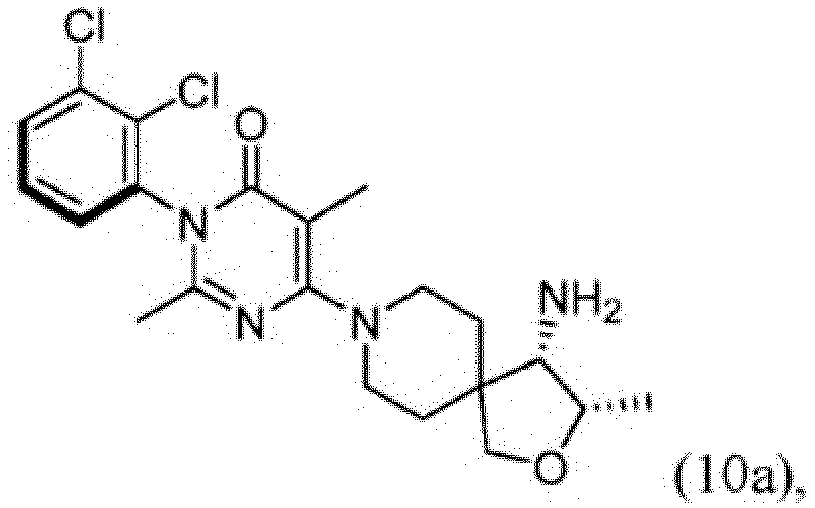
- Verbindung nach Anspruch 1, dargestellt durch die Formel:
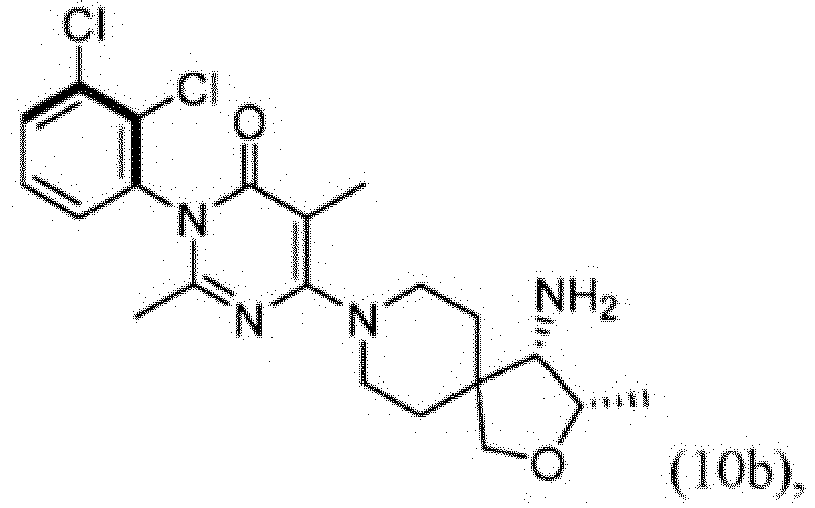
- Verbindung nach Anspruch 1, dargestellt durch die Formel:

- Verbindung nach Anspruch 1, dargestellt durch die Formel:

- Verbindung nach Anspruch 1, dargestellt durch die Formel:

- Pharmazeutische Zusammensetzung, umfassend eine Verbindung nach einem der Ansprüche 1 bis 21, zusammen mit einem pharmazeutisch annehmbaren Träger.
- Verbindung nach einem der Ansprüche 1 bis 21 zur Verwendung als ein Medikament.
- Verbindung nach einem der Ansprüche 1 bis 21 zur Verwendung bei der Behandlung einer Krankheit, die durch eine oder mehrere PTPN11-Mutationen getrieben wird.
- Verbindung nach einem der Ansprüche 1 bis 21 zur Verwendung bei der Behandlung von Krebs, wobei optional der Krebs ausgewählt ist aus der Gruppe bestehend aus Leukämie, Melanom, Brustkrebs und Darmkrebs.
- Verbindung nach einem der Ansprüche 1 bis 21 zur Verwendung in einem Verfahren der Behandlung einer PTPN11-vermittelten Krankheit, umfassend die Verabreichung von:c. einer therapeutisch wirksamen Menge der Verbindung; undd. eines anderen Therapeutikums,optionalwobei die Krankheit Krebs ist, optionalwobei der Krebs ausgewählt ist aus der Gruppe bestehend aus Brustkrebs, Darmkrebs, Leukämie und Melanom.
Priority Applications (5)
| Application Number | Priority Date | Filing Date | Title |
|---|---|---|---|
| HRP20240861TT HRP20240861T1 (hr) | 2018-08-10 | 2019-08-09 | Derivati 6-(4-amino-3-metil-2-oksa-8-azaspiro[4.5]dekan-8-il)-3-(2,3-dihlorofenil)-2-metilpirimidin-4(3h)-ona i srodni spojevi kao inhibitori ptpn11 (shp2) za liječenje raka |
| SI201930743T SI3833670T1 (sl) | 2018-08-10 | 2019-08-09 | Derivati spojine 6-(4-amino-3-metil-2-oksa-8-azaspiro(4.5)dekan-8-il)-3-(2,3-diklorofenil -2-metilpirimidin-4(3H)-on in sorodne spojine kot zaviralci PTPN11 (SHP2)za zdravljenje raka |
| RS20240780A RS65728B1 (sr) | 2018-08-10 | 2019-08-09 | Derivati 6-(4-amino-3-metil-2-oksa-8-azaspiro[4.5]dekan-8-il)-3-(2,3-dihlorofenil)-2-metilpirimidin-4(3h)-ona i srodna jedinjenja kao inhibitori ptpn11 (shp2) za lečenje kancera |
| EP24161326.4A EP4356973A3 (de) | 2018-08-10 | 2019-08-09 | 6-(4-amino-3-methyl-2-oxa-8-azaspiro[4.5!decan-8-yl)-3-(2,3-dichlorophenyl)-2-methylpyrimidin-4(3h)-onderivate und verwandte verbindungen als ptpn11(shp2)-hemmer |
| SM20240192T SMT202400192T1 (it) | 2018-08-10 | 2019-08-09 | Derivati di 6-(4-ammino-3-metil-2-ossa-8-azaspiro[4.5]decan-8-il)-3-(2,3-diclorofenil)-2-metilpirimidin-4(3h)-one e composti correlati come inibitori di pt'pn11 (shp2) per il trattamento del cancro. |
Applications Claiming Priority (3)
| Application Number | Priority Date | Filing Date | Title |
|---|---|---|---|
| US201862717588P | 2018-08-10 | 2018-08-10 | |
| US201862773921P | 2018-11-30 | 2018-11-30 | |
| PCT/US2019/045903 WO2020033828A1 (en) | 2018-08-10 | 2019-08-09 | 6-(4-amino-3-methyl-2-oxa-8-azaspiro[4.5]decan-8-yl)-3-(2,3-dichlorophenyl)-2-methylpyrimidin-4(3h)-one derivatives and related compounds as ptpn11 (shp2) inhibitors for treating cancer |
Related Child Applications (2)
| Application Number | Title | Priority Date | Filing Date |
|---|---|---|---|
| EP24161326.4A Division EP4356973A3 (de) | 2018-08-10 | 2019-08-09 | 6-(4-amino-3-methyl-2-oxa-8-azaspiro[4.5!decan-8-yl)-3-(2,3-dichlorophenyl)-2-methylpyrimidin-4(3h)-onderivate und verwandte verbindungen als ptpn11(shp2)-hemmer |
| EP24161326.4A Division-Into EP4356973A3 (de) | 2018-08-10 | 2019-08-09 | 6-(4-amino-3-methyl-2-oxa-8-azaspiro[4.5!decan-8-yl)-3-(2,3-dichlorophenyl)-2-methylpyrimidin-4(3h)-onderivate und verwandte verbindungen als ptpn11(shp2)-hemmer |
Publications (2)
| Publication Number | Publication Date |
|---|---|
| EP3833670A1 EP3833670A1 (de) | 2021-06-16 |
| EP3833670B1 true EP3833670B1 (de) | 2024-04-17 |
Family
ID=67766350
Family Applications (2)
| Application Number | Title | Priority Date | Filing Date |
|---|---|---|---|
| EP24161326.4A Pending EP4356973A3 (de) | 2018-08-10 | 2019-08-09 | 6-(4-amino-3-methyl-2-oxa-8-azaspiro[4.5!decan-8-yl)-3-(2,3-dichlorophenyl)-2-methylpyrimidin-4(3h)-onderivate und verwandte verbindungen als ptpn11(shp2)-hemmer |
| EP19759185.2A Active EP3833670B1 (de) | 2018-08-10 | 2019-08-09 | 6-(4-amino-3-methyl-2-oxa-8-azaspiro[4.5]decan-8-yl)-3-(2,3-dichlorophenyl)-2-methylpyrimidin-4(3h)-on-derivate und ähnliche verbindungen als ptpn11 (shp2) inhibitoren zur behandlung von krebs |
Family Applications Before (1)
| Application Number | Title | Priority Date | Filing Date |
|---|---|---|---|
| EP24161326.4A Pending EP4356973A3 (de) | 2018-08-10 | 2019-08-09 | 6-(4-amino-3-methyl-2-oxa-8-azaspiro[4.5!decan-8-yl)-3-(2,3-dichlorophenyl)-2-methylpyrimidin-4(3h)-onderivate und verwandte verbindungen als ptpn11(shp2)-hemmer |
Country Status (32)
| Country | Link |
|---|---|
| US (3) | US11104675B2 (de) |
| EP (2) | EP4356973A3 (de) |
| JP (2) | JP2021534124A (de) |
| KR (1) | KR102707409B1 (de) |
| CN (1) | CN112601750B (de) |
| AU (1) | AU2019319971B2 (de) |
| BR (1) | BR112021002327A2 (de) |
| CA (1) | CA3109181A1 (de) |
| CL (1) | CL2021000355A1 (de) |
| CO (1) | CO2021003074A2 (de) |
| CR (1) | CR20210132A (de) |
| DK (1) | DK3833670T3 (de) |
| ES (1) | ES2981592T3 (de) |
| FI (1) | FI3833670T3 (de) |
| HR (1) | HRP20240861T1 (de) |
| HU (1) | HUE067297T2 (de) |
| IL (2) | IL307361B2 (de) |
| LT (1) | LT3833670T (de) |
| MX (2) | MX2021001608A (de) |
| PE (1) | PE20211050A1 (de) |
| PH (1) | PH12021550268A1 (de) |
| PL (1) | PL3833670T3 (de) |
| PT (1) | PT3833670T (de) |
| RS (1) | RS65728B1 (de) |
| SA (1) | SA521421205B1 (de) |
| SG (1) | SG11202100199UA (de) |
| SI (1) | SI3833670T1 (de) |
| SM (1) | SMT202400192T1 (de) |
| TW (1) | TWI827646B (de) |
| UA (1) | UA128559C2 (de) |
| WO (1) | WO2020033828A1 (de) |
| ZA (1) | ZA202101449B (de) |
Families Citing this family (52)
| Publication number | Priority date | Publication date | Assignee | Title |
|---|---|---|---|---|
| US11466017B2 (en) | 2011-03-10 | 2022-10-11 | Board Of Regents, The University Of Texas System | Heterocyclic inhibitors of PTPN11 |
| WO2017210134A1 (en) | 2016-05-31 | 2017-12-07 | Board Of Regents, University Of Texas System | Heterocyclic inhibitors of ptpn11 |
| WO2018057884A1 (en) | 2016-09-22 | 2018-03-29 | Relay Therapeutics, Inc. | Shp2 phosphatase inhibitors and methods of use thereof |
| TW202500565A (zh) | 2016-10-24 | 2025-01-01 | 美商傳達治療有限公司 | Shp2磷酸酶抑制劑及其使用方法 |
| EP3630770B1 (de) | 2017-05-26 | 2024-08-28 | Relay Therapeutics, Inc. | Pyrazolo[3,4-b]pyrazin-derivate als shp2-phosphatase-inhibitoren |
| EP3687997A1 (de) | 2017-09-29 | 2020-08-05 | Relay Therapeutics, Inc. | Pyrazolo[3,4-b]pyrazin-derivate als shp2-phosphatase-inhibitoren |
| US12138263B2 (en) | 2018-03-21 | 2024-11-12 | Relay Therapeutics, Inc. | Pyrazolo[3,4-b]pyrazine SHP2 phosphatase inhibitors and methods of use thereof |
| AU2019240299B2 (en) | 2018-03-21 | 2023-06-22 | D.E. Shaw Research, Llc | SHP2 phosphatase inhibitors and methods of use thereof |
| MX2020011528A (es) | 2018-05-02 | 2021-02-09 | Navire Pharma Inc | Inhibidores heterociclicos sustituidos de ptpn11. |
| CN112601750B (zh) | 2018-08-10 | 2023-10-31 | 纳维尔制药有限公司 | Ptpn11(shp2)抑制剂 |
| CR20210175A (es) | 2018-09-18 | 2021-06-01 | Nikang Therapeutics Inc | Derivados de anillo tricíclico condensado como inhibidores de la fosfatasa de homología a src 2 (shp2) |
| JP7558942B2 (ja) | 2018-11-30 | 2024-10-01 | コメット セラピューティクス インコーポレイテッド | パンテテイン誘導体及びその使用 |
| WO2020112700A1 (en) | 2018-11-30 | 2020-06-04 | Merck Sharp & Dohme Corp. | 9-substituted amino triazolo quinazoline derivatives as adenosine receptor antagonists, pharmaceutical compositions and their use |
| CU20210080A7 (es) | 2019-04-02 | 2022-05-11 | Array Biopharma Inc | Triazinas sustituidas como inhibidores de proteína tirosina fosfatasa |
| JP7586834B2 (ja) | 2019-04-08 | 2024-11-19 | メルク パテント ゲゼルシャフト ミット ベシュレンクテル ハフツング | Shp2拮抗薬としてのピリミジノン誘導体 |
| MX2022003454A (es) | 2019-09-24 | 2022-04-19 | Relay Therapeutics Inc | Inhibidores de fosfatasa shp2 y metodos para su fabricacion y uso. |
| CA3156359A1 (en) | 2019-11-08 | 2021-05-14 | Adrian Liam Gill | Bicyclic heteroaryl compounds and uses thereof |
| IL299131A (en) | 2020-06-18 | 2023-02-01 | Revolution Medicines Inc | Methods for delaying, preventing and treating acquired resistance to RAS inhibitors |
| US20250195521A1 (en) | 2020-09-03 | 2025-06-19 | Revolution Medicines, Inc. | Use of sos1 inhibitors to treat malignancies with shp2 mutations |
| CA3194067A1 (en) | 2020-09-15 | 2022-03-24 | Revolution Medicines, Inc. | Ras inhibitors |
| KR20240017811A (ko) | 2021-05-05 | 2024-02-08 | 레볼루션 메디슨즈, 인크. | 암의 치료를 위한 ras 억제제 |
| JP2024516450A (ja) | 2021-05-05 | 2024-04-15 | レボリューション メディシンズ インコーポレイテッド | 共有結合性ras阻害剤及びその使用 |
| TW202309052A (zh) | 2021-05-05 | 2023-03-01 | 美商銳新醫藥公司 | Ras抑制劑 |
| WO2022259157A1 (en) | 2021-06-09 | 2022-12-15 | Novartis Ag | A triple pharmaceutical combination comprising dabrafenib, trametinib and a shp2 inhibitor |
| TW202317100A (zh) | 2021-06-23 | 2023-05-01 | 瑞士商諾華公司 | 包含kras g12c抑制劑的藥物組合及其用於治療癌症之用途 |
| KR20240055778A (ko) | 2021-09-01 | 2024-04-29 | 노파르티스 아게 | Tead 억제제를 포함하는 제약 조합물 및 암의 치료를 위한 이의 용도 |
| WO2023056037A1 (en) * | 2021-09-30 | 2023-04-06 | Navire Pharma, Inc. | Combination therapy using substituted pyrimidin-4(3h)-ones and sotorasib |
| TW202342043A (zh) | 2021-09-30 | 2023-11-01 | 美商納維爾製藥有限公司 | 使用ptpn11抑制劑及egfr抑制劑之組合療法 |
| IL311957A (en) * | 2021-10-06 | 2024-06-01 | Bridgebio Services Inc | Substituted pyrimidin-4(3h)-ones for use in treating cancer |
| AR127308A1 (es) | 2021-10-08 | 2024-01-10 | Revolution Medicines Inc | Inhibidores ras |
| JP2025510572A (ja) | 2022-03-08 | 2025-04-15 | レボリューション メディシンズ インコーポレイテッド | 免疫不応性肺癌を治療するための方法 |
| WO2023205795A1 (en) * | 2022-04-22 | 2023-10-26 | Bristol-Myers Squbb Company | Combination therapy using a substituted pyrimidin-4(3h)-one and nivolumab as well as its use in the treatment of cancer |
| WO2023205794A1 (en) | 2022-04-22 | 2023-10-26 | Bristol-Myers Squibb Company | Combination therapy using a pyrimidone derivative as ptpn11 inhibitor and a pd-1/pd-l1 inhibitor and its use in the treatment of cancer |
| WO2023240263A1 (en) | 2022-06-10 | 2023-12-14 | Revolution Medicines, Inc. | Macrocyclic ras inhibitors |
| AU2024241633A1 (en) | 2023-03-30 | 2025-11-06 | Revolution Medicines, Inc. | Compositions for inducing ras gtp hydrolysis and uses thereof |
| CR20250420A (es) | 2023-04-07 | 2025-11-20 | Revolution Medicines Inc | Inhibidores macrocíclicos de ras |
| AR132338A1 (es) | 2023-04-07 | 2025-06-18 | Revolution Medicines Inc | Inhibidores de ras |
| CN121464140A (zh) | 2023-04-14 | 2026-02-03 | 锐新医药公司 | Ras抑制剂的结晶形式、含有其的组合物及其使用方法 |
| CN121100123A (zh) | 2023-04-14 | 2025-12-09 | 锐新医药公司 | Ras抑制剂的结晶形式 |
| TW202508595A (zh) | 2023-05-04 | 2025-03-01 | 美商銳新醫藥公司 | 用於ras相關疾病或病症之組合療法 |
| US20250049810A1 (en) | 2023-08-07 | 2025-02-13 | Revolution Medicines, Inc. | Methods of treating a ras protein-related disease or disorder |
| AU2024360465A1 (en) | 2023-10-12 | 2026-04-09 | Revolution Medicines, Inc. | Macrocyclic ras inhibitors |
| WO2025171296A1 (en) | 2024-02-09 | 2025-08-14 | Revolution Medicines, Inc. | Ras inhibitors |
| TW202547461A (zh) | 2024-05-17 | 2025-12-16 | 美商銳新醫藥公司 | Ras抑制劑 |
| WO2025255438A1 (en) | 2024-06-07 | 2025-12-11 | Revolution Medicines, Inc. | Methods of treating a ras protein-related disease or disorder |
| WO2025265060A1 (en) | 2024-06-21 | 2025-12-26 | Revolution Medicines, Inc. | Therapeutic compositions and methods for managing treatment-related effects |
| WO2026015801A1 (en) | 2024-07-12 | 2026-01-15 | Revolution Medicines, Inc. | Methods of treating a ras related disease or disorder |
| WO2026015790A1 (en) | 2024-07-12 | 2026-01-15 | Revolution Medicines, Inc. | Methods of treating a ras related disease or disorder |
| WO2026015796A1 (en) | 2024-07-12 | 2026-01-15 | Revolution Medicines, Inc. | Methods of treating a ras related disease or disorder |
| WO2026015825A1 (en) | 2024-07-12 | 2026-01-15 | Revolution Medicines, Inc. | Use of ras inhibitor for treating pancreatic cancer |
| WO2026050446A1 (en) | 2024-08-29 | 2026-03-05 | Revolution Medicines, Inc. | Ras inhibitors |
| WO2026072904A2 (en) | 2024-09-26 | 2026-04-02 | Revolution Medicines, Inc. | Compositions and methods for treating lung cancer |
Family Cites Families (67)
| Publication number | Priority date | Publication date | Assignee | Title |
|---|---|---|---|---|
| CA2537916A1 (en) | 2003-09-03 | 2005-03-31 | Neurogen Corporation | 5-aryl-pyrazolo[4,3-d]pyrimidines, pyridines, and pyrazines and related compounds |
| CN1934111A (zh) | 2004-02-27 | 2007-03-21 | 霍夫曼-拉罗奇有限公司 | 杂芳基稠合的吡唑并衍生物 |
| EP1732541A4 (de) | 2004-04-07 | 2008-03-05 | Takeda Pharmaceutical | Cyclische verbindungen |
| WO2006058120A1 (en) | 2004-11-22 | 2006-06-01 | Vertex Pharmaceuticals Incorporated | Bicyclic inhibitors or rho kinase |
| GB0427604D0 (en) | 2004-12-16 | 2005-01-19 | Novartis Ag | Organic compounds |
| GB0506147D0 (en) | 2005-03-24 | 2005-05-04 | Merck Sharp & Dohme | Therapeutic agents |
| US20080153810A1 (en) | 2006-11-15 | 2008-06-26 | Forest Laboratories Holdings Limited | Indazole derivatives useful as melanin concentrating receptor ligands |
| US20100069458A1 (en) * | 2007-02-15 | 2010-03-18 | Peter Wisdom Atadja | Combination of lbh589 with other therapeutic agents for treating cancer |
| JP2012504630A (ja) | 2008-10-03 | 2012-02-23 | シェーリング コーポレイション | グルカゴン受容体アンタゴニストとしてのスピロイミダゾロン誘導体 |
| JP2010111624A (ja) | 2008-11-06 | 2010-05-20 | Shionogi & Co Ltd | Ttk阻害作用を有するインダゾール誘導体 |
| KR20110049217A (ko) | 2009-11-04 | 2011-05-12 | 다우어드밴스드디스플레이머티리얼 유한회사 | 신규한 유기 발광 화합물 및 이를 채용하고 있는 유기 전계 발광 소자 |
| JP2011246389A (ja) | 2010-05-26 | 2011-12-08 | Oncotherapy Science Ltd | Ttk阻害作用を有する縮環ピラゾール誘導体 |
| WO2012011592A1 (ja) * | 2010-07-23 | 2012-01-26 | 武田薬品工業株式会社 | 複素環化合物およびその用途 |
| AU2012212323A1 (en) | 2011-02-01 | 2013-09-12 | The Board Of Trustees Of The University Of Illinois | HDAC inhibitors and therapeutic methods using the same |
| WO2013052263A2 (en) | 2011-09-16 | 2013-04-11 | Microbiotix, Inc. | Antifungal compounds |
| WO2013040527A1 (en) | 2011-09-16 | 2013-03-21 | Microbiotix, Inc. | Antimicrobial compounds |
| US9738610B2 (en) | 2012-09-24 | 2017-08-22 | Whitehead Institute For Biomedical Research | Indazole derivatives and uses thereof |
| CA2944198C (en) | 2013-04-26 | 2021-11-16 | Indiana University Research & Technology Corporation | Hydroxyindole carboxylic acid based inhibitors for oncogenic src homology-2 domain containing protein tyrosine phosphatase-2 (shp2) |
| EP3003302A4 (de) | 2013-05-24 | 2016-12-14 | Scripps Research Inst | Bidentat-bindende modulatoren von lrrk2- und jnk-kinasen |
| WO2015099481A1 (ko) | 2013-12-27 | 2015-07-02 | 주식회사 두산 | 유기 전계 발광 소자 |
| WO2015107494A1 (en) | 2014-01-17 | 2015-07-23 | Novartis Ag | 1 -(triazin-3-yi_/pyridazin-3-yl)-piper(-azine)idine derivatives and compositions thereof for inhibiting the activity of shp2 |
| JO3517B1 (ar) | 2014-01-17 | 2020-07-05 | Novartis Ag | ان-ازاسبيرو الكان حلقي كبديل مركبات اريل-ان مغايرة وتركيبات لتثبيط نشاط shp2 |
| ES2699351T3 (es) | 2014-01-17 | 2019-02-08 | Novartis Ag | Derivados de 1-piridazin/triazin-3-il-piper(-azina)/idina/pirolidina y composiciones de las mismas para inhibir la actividad de SHP2 |
| KR101998435B1 (ko) | 2014-06-09 | 2019-07-09 | 주식회사 두산 | 유기 전계 발광 소자 |
| FI3511319T3 (fi) * | 2014-07-03 | 2023-07-20 | Celgene Quanticel Res Inc | Lysiinispesifisen demetylaasi-1:n inhibiittoreita |
| KR101708097B1 (ko) | 2014-10-22 | 2017-02-17 | 주식회사 두산 | 유기 전계 발광 소자 |
| WO2016151501A1 (en) | 2015-03-25 | 2016-09-29 | Novartis Ag | Pharmaceutical combinations |
| EP3310779B1 (de) | 2015-06-19 | 2019-05-08 | Novartis AG | Verbindungen und zusammensetzungen zur hemmung der aktivität von shp2 |
| US10287266B2 (en) | 2015-06-19 | 2019-05-14 | Novartis Ag | Compounds and compositions for inhibiting the activity of SHP2 |
| WO2016203405A1 (en) * | 2015-06-19 | 2016-12-22 | Novartis Ag | Compounds and compositions for inhibiting the activity of shp2 |
| WO2017156397A1 (en) | 2016-03-11 | 2017-09-14 | Board Of Regents, The University Of Texas Sysytem | Heterocyclic inhibitors of ptpn11 |
| CN107286150B (zh) | 2016-04-11 | 2020-07-07 | 中国科学院上海有机化学研究所 | N-杂环类化合物、其中间体、制备方法、药物组合物和应用 |
| WO2017210134A1 (en) | 2016-05-31 | 2017-12-07 | Board Of Regents, University Of Texas System | Heterocyclic inhibitors of ptpn11 |
| MX388576B (es) | 2016-06-07 | 2025-03-20 | Jacobio Pharmaceuticals Co Ltd | Derivados heterociclicos novedosos utiles como inhibidores de shp2. |
| WO2017216706A1 (en) | 2016-06-14 | 2017-12-21 | Novartis Ag | Compounds and compositions for inhibiting the activity of shp2 |
| EP4302834A3 (de) | 2016-07-12 | 2024-07-17 | Revolution Medicines, Inc. | 2,5-disubstituierte 3-methyl pyrazine und 2,5,6-trisubstituierte 3-methylpyrazine als allosterische shp2-inhibitoren |
| WO2018057884A1 (en) | 2016-09-22 | 2018-03-29 | Relay Therapeutics, Inc. | Shp2 phosphatase inhibitors and methods of use thereof |
| TW202500565A (zh) | 2016-10-24 | 2025-01-01 | 美商傳達治療有限公司 | Shp2磷酸酶抑制劑及其使用方法 |
| CA3048340A1 (en) | 2017-01-10 | 2018-07-19 | Novartis Ag | Pharmaceutical combination comprising an alk inhibitor and a shp2 inhibitor |
| JP7240319B2 (ja) | 2017-01-23 | 2023-03-15 | レヴォリューション・メディスンズ,インコーポレイテッド | アロステリックshp2阻害剤としての二環式化合物 |
| KR20190110588A (ko) | 2017-01-23 | 2019-09-30 | 레볼루션 메디슨즈, 인크. | 알로스테릭 shp2 억제제로서의 피리딘 화합물 |
| EA202190196A1 (ru) | 2017-03-23 | 2021-08-31 | Джакобио Фармасьютикалс Ко., Лтд. | Новые гетероциклические производные, применимые в качестве ингибиторов shp2 |
| EP3630770B1 (de) | 2017-05-26 | 2024-08-28 | Relay Therapeutics, Inc. | Pyrazolo[3,4-b]pyrazin-derivate als shp2-phosphatase-inhibitoren |
| CA3074690A1 (en) | 2017-09-07 | 2019-03-14 | Revolution Medicines, Inc. | Shp2 inhibitor compositions and methods for treating cancer |
| JP7447002B2 (ja) | 2017-09-11 | 2024-03-11 | クルーゾン・ファーマシューティカルズ・インコーポレイテッド | SHP2のオクタヒドロシクロペンタ[c]ピロールのアロステリック阻害剤 |
| EP3687997A1 (de) | 2017-09-29 | 2020-08-05 | Relay Therapeutics, Inc. | Pyrazolo[3,4-b]pyrazin-derivate als shp2-phosphatase-inhibitoren |
| TW201930292A (zh) | 2017-10-12 | 2019-08-01 | 美商銳新醫藥公司 | 作為變構shp2抑制劑的吡啶、吡嗪和三嗪化合物 |
| JP7361693B2 (ja) | 2017-12-15 | 2023-10-16 | レヴォリューション・メディスンズ,インコーポレイテッド | アロステリックshp2阻害剤としての多環式化合物 |
| WO2019152454A1 (en) | 2018-01-30 | 2019-08-08 | Research Development Foundation | Shp2 inhibitors and methods of use thereof |
| JP7335882B2 (ja) | 2018-02-13 | 2023-08-30 | ブルーレイ セラピューティクス (シャンハイ) カンパニー,リミティド | ピリミジン縮合環式化合物及びその製造方法、並びに使用 |
| WO2019165073A1 (en) | 2018-02-21 | 2019-08-29 | Relay Therapeutics, Inc. | Shp2 phosphatase inhibitors and methods of use thereof |
| IL276232B2 (en) | 2018-03-02 | 2024-04-01 | Otsuka Pharma Co Ltd | Pyrazine derivatives, pharmaceutical compositions comprising them and their use for treating diseases |
| US12138263B2 (en) | 2018-03-21 | 2024-11-12 | Relay Therapeutics, Inc. | Pyrazolo[3,4-b]pyrazine SHP2 phosphatase inhibitors and methods of use thereof |
| AU2019240299B2 (en) | 2018-03-21 | 2023-06-22 | D.E. Shaw Research, Llc | SHP2 phosphatase inhibitors and methods of use thereof |
| RU2020133727A (ru) | 2018-03-21 | 2022-04-21 | Сучжоу Пухе Биофарма Ко., Лтд. | Ингибиторы shp2 и их применение |
| MX2020010719A (es) | 2018-04-10 | 2020-11-06 | Revolution Medicines Inc | Composiciones de inhibidores de shp2, metodos para tratar el cancer y metodos para identificar a un sujeto con mutaciones en shp2. |
| MX2020011528A (es) | 2018-05-02 | 2021-02-09 | Navire Pharma Inc | Inhibidores heterociclicos sustituidos de ptpn11. |
| CN110143949A (zh) | 2018-05-09 | 2019-08-20 | 北京加科思新药研发有限公司 | 可用作shp2抑制剂的新型杂环衍生物 |
| EP3801613A1 (de) | 2018-06-04 | 2021-04-14 | Bayer Aktiengesellschaft | Inhibitoren von shp2 |
| MX2021000795A (es) | 2018-07-24 | 2021-04-12 | Taiho Pharmaceutical Co Ltd | Compuestos heterociclicos para inhibir la actividad de shp2. |
| TWI825144B (zh) | 2018-08-10 | 2023-12-11 | 美商思達利醫藥公司 | 第二型轉麩醯胺酸酶(tg2)抑制劑 |
| CN112601750B (zh) | 2018-08-10 | 2023-10-31 | 纳维尔制药有限公司 | Ptpn11(shp2)抑制剂 |
| WO2020110056A1 (en) | 2018-11-30 | 2020-06-04 | Glaxosmithkline Intellectual Property Development Limited | Compounds useful in hiv therapy |
| JP7558942B2 (ja) | 2018-11-30 | 2024-10-01 | コメット セラピューティクス インコーポレイテッド | パンテテイン誘導体及びその使用 |
| AR117183A1 (es) | 2018-11-30 | 2021-07-14 | Syngenta Crop Protection Ag | Derivados de tiazol microbiocidas |
| AR117200A1 (es) | 2018-11-30 | 2021-07-21 | Syngenta Participations Ag | Derivados de tiazol microbiocidas |
| WO2020112700A1 (en) | 2018-11-30 | 2020-06-04 | Merck Sharp & Dohme Corp. | 9-substituted amino triazolo quinazoline derivatives as adenosine receptor antagonists, pharmaceutical compositions and their use |
-
2019
- 2019-08-09 CN CN201980046071.6A patent/CN112601750B/zh active Active
- 2019-08-09 FI FIEP19759185.2T patent/FI3833670T3/fi active
- 2019-08-09 HU HUE19759185A patent/HUE067297T2/hu unknown
- 2019-08-09 WO PCT/US2019/045903 patent/WO2020033828A1/en not_active Ceased
- 2019-08-09 SI SI201930743T patent/SI3833670T1/sl unknown
- 2019-08-09 US US16/536,923 patent/US11104675B2/en active Active
- 2019-08-09 AU AU2019319971A patent/AU2019319971B2/en active Active
- 2019-08-09 DK DK19759185.2T patent/DK3833670T3/da active
- 2019-08-09 KR KR1020217003134A patent/KR102707409B1/ko active Active
- 2019-08-09 EP EP24161326.4A patent/EP4356973A3/de active Pending
- 2019-08-09 PE PE2021000191A patent/PE20211050A1/es unknown
- 2019-08-09 JP JP2021506929A patent/JP2021534124A/ja not_active Ceased
- 2019-08-09 EP EP19759185.2A patent/EP3833670B1/de active Active
- 2019-08-09 ES ES19759185T patent/ES2981592T3/es active Active
- 2019-08-09 RS RS20240780A patent/RS65728B1/sr unknown
- 2019-08-09 SM SM20240192T patent/SMT202400192T1/it unknown
- 2019-08-09 HR HRP20240861TT patent/HRP20240861T1/hr unknown
- 2019-08-09 CA CA3109181A patent/CA3109181A1/en active Pending
- 2019-08-09 BR BR112021002327-5A patent/BR112021002327A2/pt unknown
- 2019-08-09 MX MX2021001608A patent/MX2021001608A/es unknown
- 2019-08-09 PL PL19759185.2T patent/PL3833670T3/pl unknown
- 2019-08-09 IL IL307361A patent/IL307361B2/en unknown
- 2019-08-09 LT LTEPPCT/US2019/045903T patent/LT3833670T/lt unknown
- 2019-08-09 PT PT197591852T patent/PT3833670T/pt unknown
- 2019-08-09 SG SG11202100199UA patent/SG11202100199UA/en unknown
- 2019-08-09 IL IL280701A patent/IL280701B2/en unknown
- 2019-08-09 CR CR20210132A patent/CR20210132A/es unknown
- 2019-08-09 UA UAA202101174A patent/UA128559C2/uk unknown
- 2019-08-12 TW TW108128631A patent/TWI827646B/zh active
-
2021
- 2021-02-04 PH PH12021550268A patent/PH12021550268A1/en unknown
- 2021-02-08 SA SA521421205A patent/SA521421205B1/ar unknown
- 2021-02-09 MX MX2024001249A patent/MX2024001249A/es unknown
- 2021-02-10 CL CL2021000355A patent/CL2021000355A1/es unknown
- 2021-03-03 ZA ZA2021/01449A patent/ZA202101449B/en unknown
- 2021-03-09 CO CONC2021/0003074A patent/CO2021003074A2/es unknown
- 2021-07-20 US US17/380,943 patent/US11945815B2/en active Active
-
2023
- 2023-08-17 JP JP2023132960A patent/JP7579402B2/ja active Active
-
2024
- 2024-08-09 US US18/799,303 patent/US20250188074A1/en active Pending
Also Published As
Similar Documents
| Publication | Publication Date | Title |
|---|---|---|
| EP3833670B1 (de) | 6-(4-amino-3-methyl-2-oxa-8-azaspiro[4.5]decan-8-yl)-3-(2,3-dichlorophenyl)-2-methylpyrimidin-4(3h)-on-derivate und ähnliche verbindungen als ptpn11 (shp2) inhibitoren zur behandlung von krebs | |
| US11840536B2 (en) | Heterocyclic inhibitors of PTPN11 | |
| WO2019213318A1 (en) | Substituted heterocyclic inhibitors of ptpn11 | |
| WO2017156397A1 (en) | Heterocyclic inhibitors of ptpn11 | |
| US11466017B2 (en) | Heterocyclic inhibitors of PTPN11 | |
| HK40039574A (en) | Ptpn11(shp2) inhibitors | |
| HK40039574B (zh) | Ptpn11(shp2)抑制剂 | |
| HK40006960A (en) | Heterocyclic inhibitors of ptpn11 | |
| HK40006960B (en) | Heterocyclic inhibitors of ptpn11 |
Legal Events
| Date | Code | Title | Description |
|---|---|---|---|
| REG | Reference to a national code |
Ref country code: HR Ref legal event code: TUEP Ref document number: P20240861T Country of ref document: HR |
|
| STAA | Information on the status of an ep patent application or granted ep patent |
Free format text: STATUS: UNKNOWN |
|
| STAA | Information on the status of an ep patent application or granted ep patent |
Free format text: STATUS: THE INTERNATIONAL PUBLICATION HAS BEEN MADE |
|
| PUAI | Public reference made under article 153(3) epc to a published international application that has entered the european phase |
Free format text: ORIGINAL CODE: 0009012 |
|
| STAA | Information on the status of an ep patent application or granted ep patent |
Free format text: STATUS: REQUEST FOR EXAMINATION WAS MADE |
|
| 17P | Request for examination filed |
Effective date: 20210303 |
|
| AK | Designated contracting states |
Kind code of ref document: A1 Designated state(s): AL AT BE BG CH CY CZ DE DK EE ES FI FR GB GR HR HU IE IS IT LI LT LU LV MC MK MT NL NO PL PT RO RS SE SI SK SM TR |
|
| DAV | Request for validation of the european patent (deleted) | ||
| DAX | Request for extension of the european patent (deleted) | ||
| GRAP | Despatch of communication of intention to grant a patent |
Free format text: ORIGINAL CODE: EPIDOSNIGR1 |
|
| STAA | Information on the status of an ep patent application or granted ep patent |
Free format text: STATUS: GRANT OF PATENT IS INTENDED |
|
| INTG | Intention to grant announced |
Effective date: 20230201 |
|
| RIN1 | Information on inventor provided before grant (corrected) |
Inventor name: CROSS, JASON Inventor name: MANDAL, PIJUS Inventor name: CARROLL, CHRISTOPHER L. Inventor name: CZAKO, BARBARA Inventor name: JONES, PHILIP |
|
| GRAJ | Information related to disapproval of communication of intention to grant by the applicant or resumption of examination proceedings by the epo deleted |
Free format text: ORIGINAL CODE: EPIDOSDIGR1 |
|
| STAA | Information on the status of an ep patent application or granted ep patent |
Free format text: STATUS: REQUEST FOR EXAMINATION WAS MADE |
|
| GRAP | Despatch of communication of intention to grant a patent |
Free format text: ORIGINAL CODE: EPIDOSNIGR1 |
|
| STAA | Information on the status of an ep patent application or granted ep patent |
Free format text: STATUS: GRANT OF PATENT IS INTENDED |
|
| INTC | Intention to grant announced (deleted) | ||
| INTG | Intention to grant announced |
Effective date: 20230620 |
|
| GRAJ | Information related to disapproval of communication of intention to grant by the applicant or resumption of examination proceedings by the epo deleted |
Free format text: ORIGINAL CODE: EPIDOSDIGR1 |
|
| STAA | Information on the status of an ep patent application or granted ep patent |
Free format text: STATUS: REQUEST FOR EXAMINATION WAS MADE |
|
| GRAP | Despatch of communication of intention to grant a patent |
Free format text: ORIGINAL CODE: EPIDOSNIGR1 |
|
| STAA | Information on the status of an ep patent application or granted ep patent |
Free format text: STATUS: GRANT OF PATENT IS INTENDED |
|
| INTG | Intention to grant announced |
Effective date: 20231106 |
|
| GRAS | Grant fee paid |
Free format text: ORIGINAL CODE: EPIDOSNIGR3 |
|
| RAP3 | Party data changed (applicant data changed or rights of an application transferred) |
Owner name: NAVIRE PHARMA, INC. |
|
| GRAA | (expected) grant |
Free format text: ORIGINAL CODE: 0009210 |
|
| STAA | Information on the status of an ep patent application or granted ep patent |
Free format text: STATUS: THE PATENT HAS BEEN GRANTED |
|
| P01 | Opt-out of the competence of the unified patent court (upc) registered |
Effective date: 20240213 |
|
| AK | Designated contracting states |
Kind code of ref document: B1 Designated state(s): AL AT BE BG CH CY CZ DE DK EE ES FI FR GB GR HR HU IE IS IT LI LT LU LV MC MK MT NL NO PL PT RO RS SE SI SK SM TR |
|
| REG | Reference to a national code |
Ref country code: GB Ref legal event code: FG4D |
|
| REG | Reference to a national code |
Ref country code: CH Ref legal event code: EP |
|
| REG | Reference to a national code |
Ref country code: DE Ref legal event code: R096 Ref document number: 602019050465 Country of ref document: DE |
|
| REG | Reference to a national code |
Ref country code: IE Ref legal event code: FG4D |
|
| REG | Reference to a national code |
Ref country code: DK Ref legal event code: T3 Effective date: 20240508 |
|
| REG | Reference to a national code |
Ref country code: FI Ref legal event code: FGE |
|
| REG | Reference to a national code |
Ref country code: PT Ref legal event code: SC4A Ref document number: 3833670 Country of ref document: PT Date of ref document: 20240522 Kind code of ref document: T Free format text: AVAILABILITY OF NATIONAL TRANSLATION Effective date: 20240515 |
|
| REG | Reference to a national code |
Ref country code: RO Ref legal event code: EPE |
|
| REG | Reference to a national code |
Ref country code: SE Ref legal event code: TRGR |
|
| REG | Reference to a national code |
Ref country code: NL Ref legal event code: FP |
|
| PGFP | Annual fee paid to national office [announced via postgrant information from national office to epo] |
Ref country code: IE Payment date: 20240612 Year of fee payment: 6 |
|
| PGFP | Annual fee paid to national office [announced via postgrant information from national office to epo] |
Ref country code: MC Payment date: 20240621 Year of fee payment: 6 Ref country code: DK Payment date: 20240625 Year of fee payment: 6 |
|
| REG | Reference to a national code |
Ref country code: EE Ref legal event code: FG4A Ref document number: E024272 Country of ref document: EE Effective date: 20240514 |
|
| PGFP | Annual fee paid to national office [announced via postgrant information from national office to epo] |
Ref country code: NL Payment date: 20240611 Year of fee payment: 6 |
|
| PGFP | Annual fee paid to national office [announced via postgrant information from national office to epo] |
Ref country code: BG Payment date: 20240627 Year of fee payment: 6 |
|
| REG | Reference to a national code |
Ref country code: SK Ref legal event code: T3 Ref document number: E 44334 Country of ref document: SK |
|
| PGFP | Annual fee paid to national office [announced via postgrant information from national office to epo] |
Ref country code: LU Payment date: 20240726 Year of fee payment: 6 |
|
| PGFP | Annual fee paid to national office [announced via postgrant information from national office to epo] |
Ref country code: LV Payment date: 20240610 Year of fee payment: 6 |
|
| REG | Reference to a national code |
Ref country code: GR Ref legal event code: EP Ref document number: 20240401633 Country of ref document: GR Effective date: 20240819 |
|
| REG | Reference to a national code |
Ref country code: HR Ref legal event code: ODRP Ref document number: P20240861T Country of ref document: HR Payment date: 20240701 Year of fee payment: 6 |
|
| PGFP | Annual fee paid to national office [announced via postgrant information from national office to epo] |
Ref country code: IS Payment date: 20240712 Year of fee payment: 6 |
|
| REG | Reference to a national code |
Ref country code: ES Ref legal event code: FG2A Ref document number: 2981592 Country of ref document: ES Kind code of ref document: T3 Effective date: 20241009 |
|
| PGFP | Annual fee paid to national office [announced via postgrant information from national office to epo] |
Ref country code: FI Payment date: 20240715 Year of fee payment: 6 |
|
| PGFP | Annual fee paid to national office [announced via postgrant information from national office to epo] |
Ref country code: GR Payment date: 20240711 Year of fee payment: 6 |
|
| REG | Reference to a national code |
Ref country code: HR Ref legal event code: T1PR Ref document number: P20240861 Country of ref document: HR |
|
| PGFP | Annual fee paid to national office [announced via postgrant information from national office to epo] |
Ref country code: BE Payment date: 20240816 Year of fee payment: 6 |
|
| PGFP | Annual fee paid to national office [announced via postgrant information from national office to epo] |
Ref country code: CH Payment date: 20240901 Year of fee payment: 6 |
|
| PGFP | Annual fee paid to national office [announced via postgrant information from national office to epo] |
Ref country code: EE Payment date: 20240708 Year of fee payment: 6 |
|
| PGFP | Annual fee paid to national office [announced via postgrant information from national office to epo] |
Ref country code: AT Payment date: 20240612 Year of fee payment: 6 |
|
| REG | Reference to a national code |
Ref country code: HU Ref legal event code: AG4A Ref document number: E067297 Country of ref document: HU |
|
| PGFP | Annual fee paid to national office [announced via postgrant information from national office to epo] |
Ref country code: NO Payment date: 20240809 Year of fee payment: 6 Ref country code: SE Payment date: 20240624 Year of fee payment: 6 |
|
| REG | Reference to a national code |
Ref country code: DE Ref legal event code: R097 Ref document number: 602019050465 Country of ref document: DE |
|
| PLBE | No opposition filed within time limit |
Free format text: ORIGINAL CODE: 0009261 |
|
| STAA | Information on the status of an ep patent application or granted ep patent |
Free format text: STATUS: NO OPPOSITION FILED WITHIN TIME LIMIT |
|
| 26N | No opposition filed |
Effective date: 20250120 |
|
| REG | Reference to a national code |
Ref country code: HR Ref legal event code: ODRP Ref document number: P20240861 Country of ref document: HR Payment date: 20250801 Year of fee payment: 7 |
|
| PGFP | Annual fee paid to national office [announced via postgrant information from national office to epo] |
Ref country code: HU Payment date: 20240814 Year of fee payment: 7 |
|
| PGFP | Annual fee paid to national office [announced via postgrant information from national office to epo] |
Ref country code: SM Payment date: 20250730 Year of fee payment: 7 |
|
| PGFP | Annual fee paid to national office [announced via postgrant information from national office to epo] |
Ref country code: PT Payment date: 20250731 Year of fee payment: 7 Ref country code: ES Payment date: 20250901 Year of fee payment: 7 |
|
| PGFP | Annual fee paid to national office [announced via postgrant information from national office to epo] |
Ref country code: LT Payment date: 20250723 Year of fee payment: 7 Ref country code: DE Payment date: 20250827 Year of fee payment: 7 |
|
| PGFP | Annual fee paid to national office [announced via postgrant information from national office to epo] |
Ref country code: TR Payment date: 20250804 Year of fee payment: 7 Ref country code: PL Payment date: 20250728 Year of fee payment: 7 Ref country code: IT Payment date: 20250820 Year of fee payment: 7 |
|
| PGFP | Annual fee paid to national office [announced via postgrant information from national office to epo] |
Ref country code: GB Payment date: 20250827 Year of fee payment: 7 |
|
| PGFP | Annual fee paid to national office [announced via postgrant information from national office to epo] |
Ref country code: HR Payment date: 20250801 Year of fee payment: 7 |
|
| PGFP | Annual fee paid to national office [announced via postgrant information from national office to epo] |
Ref country code: AL Payment date: 20250802 Year of fee payment: 7 Ref country code: FR Payment date: 20250825 Year of fee payment: 7 |
|
| PGFP | Annual fee paid to national office [announced via postgrant information from national office to epo] |
Ref country code: MT Payment date: 20250723 Year of fee payment: 7 |
|
| PGFP | Annual fee paid to national office [announced via postgrant information from national office to epo] |
Ref country code: RS Payment date: 20250801 Year of fee payment: 7 Ref country code: CZ Payment date: 20250804 Year of fee payment: 7 |
|
| PGFP | Annual fee paid to national office [announced via postgrant information from national office to epo] |
Ref country code: RO Payment date: 20250804 Year of fee payment: 7 |
|
| PGFP | Annual fee paid to national office [announced via postgrant information from national office to epo] |
Ref country code: SK Payment date: 20250805 Year of fee payment: 7 |
|
| PGFP | Annual fee paid to national office [announced via postgrant information from national office to epo] |
Ref country code: SI Payment date: 20250731 Year of fee payment: 7 |
|
| PGFP | Annual fee paid to national office [announced via postgrant information from national office to epo] |
Ref country code: MK Payment date: 20250723 Year of fee payment: 7 |
|
| PGFP | Annual fee paid to national office [announced via postgrant information from national office to epo] |
Ref country code: CY Payment date: 20250724 Year of fee payment: 7 |
|
| REG | Reference to a national code |
Ref country code: DK Ref legal event code: EBP Effective date: 20250831 |
|
| REG | Reference to a national code |
Ref country code: CH Ref legal event code: H13 Free format text: ST27 STATUS EVENT CODE: U-0-0-H10-H13 (AS PROVIDED BY THE NATIONAL OFFICE) Effective date: 20260324 |
|
| PG25 | Lapsed in a contracting state [announced via postgrant information from national office to epo] |
Ref country code: MC Free format text: LAPSE BECAUSE OF NON-PAYMENT OF DUE FEES Effective date: 20250901 |
|
| REG | Reference to a national code |
Ref country code: NL Ref legal event code: MM Effective date: 20250901 |
|
| PG25 | Lapsed in a contracting state [announced via postgrant information from national office to epo] |
Ref country code: NO Free format text: LAPSE BECAUSE OF NON-PAYMENT OF DUE FEES Effective date: 20250831 |
|
| PG25 | Lapsed in a contracting state [announced via postgrant information from national office to epo] |
Ref country code: FI Free format text: LAPSE BECAUSE OF NON-PAYMENT OF DUE FEES Effective date: 20250809 Ref country code: AT Free format text: LAPSE BECAUSE OF NON-PAYMENT OF DUE FEES Effective date: 20250809 |
|
| PG25 | Lapsed in a contracting state [announced via postgrant information from national office to epo] |
Ref country code: LU Free format text: LAPSE BECAUSE OF NON-PAYMENT OF DUE FEES Effective date: 20250809 |
|
| REG | Reference to a national code |
Ref country code: AT Ref legal event code: MM01 Ref document number: 1677173 Country of ref document: AT Kind code of ref document: T Effective date: 20250809 |
|
| PG25 | Lapsed in a contracting state [announced via postgrant information from national office to epo] |
Ref country code: CH Free format text: LAPSE BECAUSE OF NON-PAYMENT OF DUE FEES Effective date: 20250831 |
|
| PG25 | Lapsed in a contracting state [announced via postgrant information from national office to epo] |
Ref country code: GR Free format text: LAPSE BECAUSE OF NON-PAYMENT OF DUE FEES Effective date: 20260309 |
|
| PG25 | Lapsed in a contracting state [announced via postgrant information from national office to epo] |
Ref country code: LV Free format text: LAPSE BECAUSE OF NON-PAYMENT OF DUE FEES Effective date: 20250809 Ref country code: EE Free format text: LAPSE BECAUSE OF NON-PAYMENT OF DUE FEES Effective date: 20250831 |