EP3836712B1 - Procédé d'accès aléatoire - Google Patents
Procédé d'accès aléatoire Download PDFInfo
- Publication number
- EP3836712B1 EP3836712B1 EP19847443.9A EP19847443A EP3836712B1 EP 3836712 B1 EP3836712 B1 EP 3836712B1 EP 19847443 A EP19847443 A EP 19847443A EP 3836712 B1 EP3836712 B1 EP 3836712B1
- Authority
- EP
- European Patent Office
- Prior art keywords
- message
- identification information
- terminal device
- send
- network device
- Prior art date
- Legal status (The legal status is an assumption and is not a legal conclusion. Google has not performed a legal analysis and makes no representation as to the accuracy of the status listed.)
- Active
Links
Images



Classifications
-
- H—ELECTRICITY
- H04—ELECTRIC COMMUNICATION TECHNIQUE
- H04W—WIRELESS COMMUNICATION NETWORKS
- H04W76/00—Connection management
- H04W76/10—Connection setup
- H04W76/11—Allocation or use of connection identifiers
-
- H—ELECTRICITY
- H04—ELECTRIC COMMUNICATION TECHNIQUE
- H04J—MULTIPLEX COMMUNICATION
- H04J13/00—Code division multiplex systems
- H04J13/0007—Code type
- H04J13/004—Orthogonal
-
- H—ELECTRICITY
- H04—ELECTRIC COMMUNICATION TECHNIQUE
- H04J—MULTIPLEX COMMUNICATION
- H04J13/00—Code division multiplex systems
- H04J13/16—Code allocation
- H04J13/18—Allocation of orthogonal codes
-
- H—ELECTRICITY
- H04—ELECTRIC COMMUNICATION TECHNIQUE
- H04L—TRANSMISSION OF DIGITAL INFORMATION, e.g. TELEGRAPHIC COMMUNICATION
- H04L5/00—Arrangements affording multiple use of the transmission path
- H04L5/0001—Arrangements for dividing the transmission path
- H04L5/0014—Three-dimensional division
- H04L5/0016—Time-frequency-code
-
- H—ELECTRICITY
- H04—ELECTRIC COMMUNICATION TECHNIQUE
- H04W—WIRELESS COMMUNICATION NETWORKS
- H04W72/00—Local resource management
- H04W72/04—Wireless resource allocation
- H04W72/044—Wireless resource allocation based on the type of the allocated resource
- H04W72/0453—Resources in frequency domain, e.g. a carrier in FDMA
-
- H—ELECTRICITY
- H04—ELECTRIC COMMUNICATION TECHNIQUE
- H04W—WIRELESS COMMUNICATION NETWORKS
- H04W74/00—Wireless channel access
- H04W74/002—Transmission of channel access control information
-
- H—ELECTRICITY
- H04—ELECTRIC COMMUNICATION TECHNIQUE
- H04W—WIRELESS COMMUNICATION NETWORKS
- H04W74/00—Wireless channel access
- H04W74/08—Non-scheduled access, e.g. ALOHA
- H04W74/0808—Non-scheduled access, e.g. ALOHA using carrier sensing, e.g. carrier sense multiple access [CSMA]
-
- H—ELECTRICITY
- H04—ELECTRIC COMMUNICATION TECHNIQUE
- H04W—WIRELESS COMMUNICATION NETWORKS
- H04W74/00—Wireless channel access
- H04W74/08—Non-scheduled access, e.g. ALOHA
- H04W74/0833—Random access procedures, e.g. with 4-step access
-
- H—ELECTRICITY
- H04—ELECTRIC COMMUNICATION TECHNIQUE
- H04W—WIRELESS COMMUNICATION NETWORKS
- H04W74/00—Wireless channel access
- H04W74/08—Non-scheduled access, e.g. ALOHA
- H04W74/0833—Random access procedures, e.g. with 4-step access
- H04W74/0836—Random access procedures, e.g. with 4-step access with 2-step access
Definitions
- This invention relates to the field of communications technologies, and in particular, to a random access method.
- a terminal device may synchronize with the cell, to receive downlink data. However, the terminal device needs to synchronize with the cell before sending uplink data.
- the terminal device may synchronize with the cell by using a contention-based random access process.
- the contention-based random access process is implemented in four steps: The terminal device sends a preamble (namely, Msg1) to a network device.
- the network device sends a random access response (Random Access Response, RAR) (namely, Msg2) to the terminal device based on the received preamble.
- RAR Random Access Response
- the terminal device performs uplink scheduling transmission (namely, Msg3) with the network device for the first time.
- the network device feeds back contention resolution (namely, Msg4) to the terminal device.
- Document KR 2017 0114971 A is considered to be the closest state of the art and relates to a communication technique and system thereof that fuses a 5G communication system with IoT technology to support higher data rates than a 4G system.
- This document describes a method which is performed by a UE and includes a step of transmitting a random access preamble through a resource associated with a resource that receives a downlink synchronization signal, a step of receiving a random access response message for the random access preamble, and a step of decoding the random access response message using information determined based on the resource.
- orthogonal cover code, OCC can be applied to the method for increasing the capacity through the some RACH OFDM symbol or the RACH sequence.
- Document WO 2017/209417 A1 describes an information transmission method and terminal for: determining from a base station that a beam mismatch has occurred; transmitting a terminal-specifically allocated RACH preamble to the base station in order to transmit beam-related information indicating that the beam mismatch to the base station; receiving, from the base station, a message (for example, RACH response) for requesting transmission of the beam-related information; and transmitting uplink control information including the beam-related information to the base station.
- a message for example, RACH response
- the invention is set out in the appended set of claims and provides a random access method to simplify a random access process, reduce a delay, and reduce signaling overheads.
- this disclosure provides a communication method, including: sending a first message to a network device, where the first message includes first identification information scrambled by using an orthogonal cover code OCC, and the first message is used by a terminal device corresponding to the first identification information to request random access to the network device; and receiving a second message sent by the network device, where the second message includes identification information of one or more terminal devices that succeed in random access, so that it can be determined, based on whether the identification information of the one or more terminal devices includes the first identification information, whether the random access succeeds.
- OCC orthogonal cover code
- Beneficial effects of this disclosure include: This disclosure provides a two-step random access method, to simplify a random access procedure, reduce an access delay of random access, and reduce signaling overheads.
- the first identification information of the terminal device is scrambled by using the orthogonal cover code OCC, to increase a possibility that first identification information of different terminal devices is different, thereby reducing a probability of a collision between the different terminal devices in a random access process, and increasing a capacity of a random access channel.
- the first message further includes a preamble sequence.
- the second message further may include a timing advance TA that is generated by the network device based on the preamble sequence, to improve uplink synchronization accuracy.
- mapping relationship between a frequency domain resource used to send the preamble sequence and a frequency domain resource used to send the first identification information.
- the frequency domain resource used to send the preamble sequence is the same as the frequency domain resource used to send the first identification information, or there is a preset offset between the frequency domain resource used to send the preamble sequence and the frequency domain resource used to send the first identification information.
- a random access radio network temporary identifier RA-RNTI of the terminal device is determined by using the OCC used to scramble the first identification information, to reduce a probability of a collision between RA-RNTIs.
- the RA-RNTI is determined by using the OCC used to scramble the first identification information, a sequence number of a frequency domain resource used to send the first message, and a sequence number of a time domain resource used to send the first message and/or a total quantity of OCCs available for the terminal device, to increase a possibility that RA-RNTIs determined by different terminal devices based on different OCCs are different, thereby reducing a probability of a collision between the RA-RNTIs.
- a sequence number of the frequency domain resource used to send the first message is a sequence number, of the frequency domain resource used to send the first message, in interlaced resource allocation.
- the method further includes: if the identification information of the one or more terminal devices includes the first identification information, sending a third message to the network device, where the third message is used to indicate that the terminal device corresponding to the first identification information succeeds in the random access; or if the identification information of the one or more terminal devices does not include the first identification information, or the terminal device sending the first message fails to decode the second message, sending a fourth message to the network device, to enable the network device to resend the second message to the terminal device based on the fourth message, where the fourth message is used to indicate that the terminal device corresponding to the first identification information fails in the random access.
- sending the third message to the network device can avoid a resource waste caused because the network device sends the second message to the terminal device.
- Sending the fourth message to the network device can enable the network device to resend the second message in time without waiting for preset duration, to effectively reduce a random access delay.
- the first message further includes a sequence number of the preamble sequence.
- the network device may indicate, based on the sequence number of the preamble sequence, the terminal device to repeat the preamble.
- the first message further includes a sequence number of the preamble sequence and a sequence number of a frequency domain resource used to send the preamble sequence.
- the network device may generate an RA-RNTI based on the received first identification information and the received sequence number of the frequency domain resource of the preamble sequence, and indicate, on a PDCCH scrambled by using the RA-RNTI, the terminal device corresponding to the sequence number of the preamble sequence to repeat the preamble, to ensure that the preamble is repeated.
- sequence number of the preamble sequence and the first identification information are sent on a same time-frequency resource, or all of the sequence number of the preamble sequence, the first identification information, and the sequence number of the frequency domain resource used to send the preamble sequence are sent on a same time-frequency resource, to reduce a resource occupied by the first message.
- the first message further includes information about an optimal downlink transmit beam of the network device.
- efficiency of sending the second message can be improved.
- the second message further includes configuration information of a physical uplink control channel PUCCH used to send the third message or used to send the fourth message, so that the terminal device sends, based on the configuration information of the PUCCH in the second message, the third message or the fourth message on a resource indicated by the configuration information of the PUCCH, to prevent congestion from occurring when a plurality of terminal devices send third messages or fourth messages at the same time.
- PUCCH physical uplink control channel
- the first identification information is a global unique network identifier S-TMSI of the terminal device, to reduce a probability of a collision between different terminal devices.
- the first identification information is a cell radio network temporary identifier C-RNTI of the terminal device.
- the sending a first message to a network device includes: performing listen before talk LBT in a plurality of symbol locations in the time-frequency resource available for sending the first message, and sending the first message in the first symbol location in which LBT succeeds. In this way, a sending success rate of the first message can be increased.
- the receiving a second message sent by the network device includes: after receiving a physical downlink control channel PDCCH that is scrambled by using the RA-RNTI and that is sent by the network device, receiving, based on the PDCCH, the second message sent by the network device, to accurately receive the second message.
- the sending a first message to a network device includes: randomly selecting an OCC from a plurality of OCCs available for the terminal device, and scrambling the first identification information by using the selected OCC; and sending, to the network device on a randomly selected time-frequency resource used for random access, the first message carrying the scrambled first identification information. In this way, the first identification information is scrambled by using the randomly selected OCC, to increase a possibility that first identification information of different terminal devices is different, thereby reducing a probability of a collision between the terminal devices.
- the second message further includes a timing advance TA, to improve uplink synchronization accuracy.
- TA timing advance
- this disclosure provides a random access method, including: receiving a first message sent by a terminal device, where the first message includes first identification information scrambled by using an orthogonal cover code OCC, and the first message is used by the terminal device corresponding to the first identification information to request random access to the network device; and sending a second message to the terminal device based on the first message, where the second message includes identification information of one or more terminal devices that succeed in random access, and the identification information of the one or more terminal devices includes the first identification information.
- Beneficial effects of this disclosure include: This disclosure provides a two-step random access method, to simplify a random access procedure, reduce an access delay of random access, and reduce signaling overheads.
- the first identification information of the terminal device is scrambled by using the orthogonal cover code OCC, to increase a possibility that first identification information of different terminal devices is different, thereby reducing a probability of a collision between the different terminal devices in a random access process, and increasing a capacity of a random access channel.
- the first message further includes a preamble sequence.
- the sending a second message to the terminal device based on the first message may include: generating a timing advance TA based on the preamble sequence; and sending the second message to the terminal device, where the second message includes the TA. In this way, uplink synchronization accuracy can be improved.
- mapping relationship between a frequency domain resource used to send the preamble sequence and a frequency domain resource used to send the first identification information.
- the frequency domain resource used to send the preamble sequence is the same as the frequency domain resource used to send the first identification information, or there is a preset offset between the frequency domain resource used to send the preamble sequence and the frequency domain resource used to send the first identification information.
- the receiving a first message sent by the terminal device includes: blindly detecting a time-frequency resource used for random access, and detecting the preamble sequence; and receiving, based on the mapping relationship between the preamble sequence and the OCC, the first identification information scrambled by using the OCC.
- the network device it is convenient for the network device to obtain the first message through detection, that is, when one of the preamble sequence and the first identification information is obtained through detection, the other can be obtained, to reduce complexity of blindly detecting, by the network device, the first message, and improve efficiency of receiving, by the network device, the first message.
- the receiving a first message sent by the terminal device includes: blindly detecting a time-frequency resource used for random access, and obtaining, through detection, the frequency domain resource used to send the preamble sequence; and obtaining, based on the mapping relationship between the frequency domain resource used to send the preamble sequence and the frequency domain resource used to send the first identification information, the frequency domain resource used to send the first identification information, and receiving the first identification information on the frequency domain resource used to send the first identification information.
- the network device may leam a location of the other frequency domain resource, and perform receiving in the location of the frequency domain resource, to reduce complexity of blindly detecting, by the network device, the first message, and improve efficiency of receiving, by the network device, the first message.
- the method further includes: determining a random access radio network temporary identifier RA-RNTI of the terminal device based on the OCC used to scramble the first identification information, scrambling a physical downlink control channel PDCCH by using the RA-RNTI, and sending the second message to the terminal device on a time-frequency resource indicated by the scrambled PDCCH, to reduce a probability of a collision between RA-RNTIs.
- the determining a random access radio network temporary identifier RA-RNTI of the terminal device based on the OCC used to scramble the first identification information includes: determining the RA-RNTI based on the OCC used to scramble the first identification information, a sequence number of a frequency domain resource used to send the first message, and a sequence number of a time domain resource used to send the first message and/or a total quantity of OCCs available for the terminal device.
- a possibility that RA-RNTIs determined by different terminal devices based on different OCCs are different can be further increased, to reduce a probability of a collision between the RA-RNTIs.
- the method further includes: receiving a third message sent by the terminal device, where the third message is used to indicate that the terminal device corresponding to the first identification information succeeds in the random access; or receiving a fourth message sent by the terminal device, and resending the second message based on the fourth message, where the fourth message is used to indicate that the terminal device corresponding to the first identification information fails in the random access.
- sending the third message to the network device can avoid a resource waste caused because the network device sends the second message to the terminal device.
- Sending the fourth message to the network device can enable the network device to resend the second message in time without waiting for preset duration, to effectively reduce a random access delay.
- the first message further includes a sequence number of the preamble sequence.
- the network device may indicate, based on the sequence number of the preamble sequence, the terminal device to repeat the preamble.
- the first message further includes a sequence number of the preamble sequence and a sequence number of a frequency domain resource used to send the preamble sequence.
- the network device may generate an RA-RNTI based on the received first identification information and the received sequence number of the frequency domain resource of the preamble sequence, and indicate, on a PDCCH scrambled by using the RA-RNTI, the terminal device corresponding to the sequence number of the preamble sequence to repeat the preamble, to ensure that the preamble is repeated.
- sequence number of the preamble sequence and the first identification information are sent on a same time-frequency resource, or all of the sequence number of the preamble sequence, the first identification information, and the sequence number of the frequency domain resource used to send the preamble sequence are sent on a same time-frequency resource, to reduce a resource occupied by the first message.
- the first message further includes information about an optimal downlink transmit beam of the network device.
- efficiency of sending the second message can be improved.
- the second message further includes configuration information of a physical uplink control channel PUCCH used to send the third message or used to send the fourth message, so that the terminal device sends, based on the configuration information of the PUCCH in the second message, the third message or the fourth message on a resource indicated by the configuration information of the PUCCH, to prevent congestion from occurring when a plurality of terminal devices send third messages or fourth messages at the same time.
- PUCCH physical uplink control channel
- the first identification information is a global unique network identifier S-TMSI of the terminal device, to reduce a probability of a collision between different terminal devices.
- the first identification information is a cell radio network temporary identifier C-RNTI of the terminal device.
- FIG. 1 is a schematic diagram of a communications system according to an embodiment of this disclosure. As shown in FIG. 1 , the communications system includes a network device and terminal devices.
- a network device is a device in a wireless network, for example, a radio access network (radio access network, RAN) node that connects a terminal to the wireless network.
- RAN nodes are: a gNB, a transmission reception point (transmission reception point, TRP), an evolved Node B (evolved Node B, eNB), a radio network controller (radio network controller, RNC), a node B (Node B, NB), a base station controller (base station controller, BSC), a base transceiver station (base transceiver station, BTS), a home base station (for example, a home evolved NodeB, or a home Node B, HNB), a baseband unit (baseband unit, BBU), or a wireless fidelity (wireless fidelity, Wi-Fi) access point (access point, AP).
- the network device may include a centralized unit (centralized unit, CU) node, a distributed unit (distributed unit, DU) node, or a RAN device including a CU node and a DU node. This is not limited herein.
- a terminal device may be a wireless terminal device or a wired terminal device.
- the wireless terminal device may be a device having a wireless transceiver function, and may be deployed on land, for example, a device deployed indoors or outdoors, or a handheld or vehicle-mounted device; or may be deployed on water (for example, a ship); or may be deployed in the air (for example, on an airplane, a balloon, or a satellite).
- the terminal device may be a mobile phone (mobile phone), a tablet computer (Pad), a computer with a wireless transceiver function, a virtual reality (Virtual Reality, VR) terminal device, an augmented reality (Augmented Reality, AR) terminal device, a wireless terminal device in industrial control (industrial control), a wireless terminal device in self-driving (self-driving), a wireless terminal device in remote medical (remote medical), a wireless terminal device in a smart grid (smart grid), a wireless terminal device in transportation safety (transportation safety), a wireless terminal device in a smart city (smart city), a wireless terminal device in a smart home (smart home), or the like.
- the terminal device may be alternatively referred to as user equipment (user equipment, UE).
- a Global System for Mobile Communications Global System for Mobile Communications, GSM
- GSM Global System for Mobile Communications
- CDMA Code Division Multiple Access
- TDMA Time Division Multiple Access
- WCDMA Wideband Code Division Multiple Access
- FDMA Frequency Division Multiple Access
- OFDMA Orthogonal Frequency-Division Multiple Access
- SC-FDMA single-carrier FDMA
- GPRS General Packet Radio Service
- LTE Long Term Evolution
- a terminal device needs to randomly access the network device:
- Random access includes contention-based random access and non-contention-based random access.
- a random access method provided in the embodiments is for a contention-based random access process.
- An existing contention-based random access process includes four steps: A terminal device sends a preamble (namely, Msg1) to a network device. The network device sends a random access response (Random Access Response, RAR) (namely, Msg2) to the terminal device based on the received preamble. Then, the terminal device performs uplink scheduling transmission (namely, Msg3) with the network device for the first time. Finally, the network device feeds back contention resolution (namely, Msg4) to the terminal device.
- RAR Random Access Response
- Msg3 uplink scheduling transmission
- Msg4 contention resolution
- the existing contention-based random access process is relatively complex, and has a long access time, an access delay, and high signaling overheads.
- the embodiments of this disclosure provide a two-step random access method, to simplify a random access procedure, reduce an access delay of random access, and reduce signaling overheads.
- first identification information of a terminal device is scrambled by using an orthogonal cover code (Orthogonal Cover Code, OCC), to increase a possibility that first identification information of different terminal devices is different, thereby reducing a probability of a collision between the different terminal devices in a random access process, and increasing a capacity of a random access channel.
- orthogonal cover code Orthogonal Cover Code
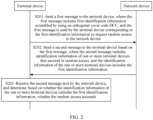
- FIG. 2 is a flowchart of a random access method according to Embodiment 1 of this disclosure. As shown in FIG. 2 , a two-step random access process in this embodiment includes the following steps.
- a terminal device sends a first message to a network device, where the first message includes first identification information scrambled by using an orthogonal cover code OCC, and the first message is used by the terminal device corresponding to the first identification information to request random access to the network device.
- the first message includes first identification information scrambled by using an orthogonal cover code OCC, and the first message is used by the terminal device corresponding to the first identification information to request random access to the network device.
- the terminal device when initiating a random access request to the network device, in other words, sending the first message to the network device, the terminal device directly adds the first identification information of the terminal device to the first message.
- a terminal device can send msg3 carrying first identification information of the terminal device to a network device only after two steps, that is, the terminal device sends a preamble sequence (preamble) to the network device and the network device configures a temporary network identifier for the terminal device. It can be learned that in this step, directly adding the first identification information of the terminal device to the first message can reduce random access steps, thereby reducing signaling overheads.
- the first identification information of the terminal device may be a unique identifier of the terminal device or a temporary identifier of the terminal device.
- the first identification information of the terminal device may be a global unique network identifier (SAE-Temporary Mobile Subscriber Identity, S-TMSI) of the terminal device.
- SAE-Temporary Mobile Subscriber Identity S-TMSI
- the first identification information of the terminal device may be a network temporary identifier of the terminal device.
- the first identification information may be a cell radio network temporary identifier (Cell Radio Network Temporary Identifier, C-RNTI) of the terminal device.
- C-RNTI Cell Radio Network Temporary Identifier
- first identification information is scrambled by using an orthogonal cover code OCC, so that the scrambled first identification information is orthogonal to each other, to improve anti-interference performance in a process of transmitting the first identification information.
- OCC orthogonal cover code
- different terminal devices may select different OCCs to scramble respective first identification information, to increase a possibility that the scrambled first identification information is different, thereby reducing a probability of a collision between the different terminal devices in a random access process.
- first identification information 1 of a terminal device 1 is the same as first identification information 2 of a terminal device 2, but OCCs selected by the terminal device 1 and the terminal device 2 are different. In this way, the first identification information 1 and the first identification information 2 that are scrambled by using the different OCCs are different.
- the network device can accurately learn, through distinguishment based on the scrambled first identification information 1 and the scrambled first identification information 2 that are carried in the first messages, that two different terminal devices initiate random access requests, and further may separately allocate uplink access resources to the terminal device 1 and the terminal device 2, to increase a random access success rate of terminal devices having same first identification information, and increase a capacity of a random access channel.
- one terminal device may have a plurality of available OCCs. If an OCC used to scramble first identification information is configured by the network device, for example, configured by the network device in remaining minimum system information (Remaining minimum system information, RMSI) or other system information (Other system information, OSI), the terminal device scrambles the first identification information by using the OCC specified by the network device.
- remaining minimum system information RMSI
- OSI Olether system information
- S201 may include S201a and S201b.
- S201a The terminal device randomly selects the OCC from a plurality of OCCs available for the terminal device, and scrambles the first identification information by using the selected OCC.
- a quantity and lengths of the OCCs corresponding to the terminal device may be provided in a standard, or may be configured by the network device in the RMSI or the OSI.
- a quantity of OCCs used to scramble the first identification information may be determined by a quantity of symbols needed for sending the first identification information. For example, if two symbols are needed for sending the first identification information, the quantity of OCCs used to scramble the first identification information is also 2.
- the two OCCs may be [+1, +1] and [+1, -1], or may be [+1, +1] and [-1, +1], or may be [-1, -1] and [-1, +1], or may be [-1, -1] and [+1, -1].
- the two OCCs may be alternatively orthogonal codes of other lengths.
- the terminal device may randomly select the OCC from the plurality of available OCCs to scramble the first identification information of the terminal device. For example, the terminal device 1 selects the OCC [+1, -1] to scramble the first identification information of the terminal device 1, and the terminal device 2 selects the OCC [+1, +1] to scramble the first identification information of the terminal device 2. In this way, the scrambled two pieces of first identification information are orthogonal.
- first identification information carried in the first messages is orthogonal, to improve anti-interference performance between the first messages.
- a probability that a collision occurs when the plurality of terminal devices send the first messages can be reduced, and a capacity of a random access channel can be increased.
- the terminal device sends, to the network device on a randomly selected time-frequency resource used for random access, the first message carrying the scrambled first identification information.
- the terminal device After the terminal device scrambles the first identification information according to the method in S201a, the terminal device randomly selects a slot (namely, a time domain resource) and a frequency domain resource that can be used for random access, and sends the first message carrying the scrambled first identification information to the network device in the slot and on the frequency domain resource, to implement sending of the first message.
- a slot namely, a time domain resource
- a frequency domain resource that can be used for random access
- the network device sends a second message to the terminal device based on the first message, where the second message includes identification information of one or more terminal devices that succeed in random access, and the identification information of the one or more terminal devices includes the first identification information.
- the network device when a plurality of terminal devices send random access requests to the network device, the network device has received, at the same time, first messages sent by the plurality of terminal devices.
- the network device When the network device has received the first messages sent by the one or more terminal devices, it indicates that the one or more terminal devices succeed in random access.
- the network device parses the first messages sent by the one or more terminal devices, and descrambles first identification information that is scrambled by using OCCs and that is in the one or more first messages. Then, the network device allocates an uplink access resource to a terminal device corresponding to each piece of descrambled first identification information. Each allocated uplink resource and each piece of descrambled first identification information are added to the second message, and the second message is sent to the terminal device.
- the second message in this embodiment includes the identification information of the one or more terminal devices that succeed in random access.
- the terminal device sending the first message receives the second message sent by the network device, and determines, based on whether the identification information of the one or more terminal devices includes the first identification information, whether the random access succeeds.
- the terminal device listens to, in a time window, the second message sent by the network device.
- the terminal device parses the second message, and determines whether the identification information of the one or more terminal devices that is carried in the second message includes the first identification information of the terminal device. If the identification information includes the first identification information of the terminal device, the current random access succeeds. If the second message does not include the first identification information of this terminal device, it is determined that the current random access fails.
- the terminal device sending the first message has not received, within a preset time, the second message sent by the network device, the terminal device determines that current the random access fails, and the terminal device may adjust an uplink transmit power, and resend the first message to the network device by using an adjusted uplink transmit power.
- the identification information of the terminal device that succeeds in the random access is directly added to the second message.
- the terminal device can determine, based on whether the second message includes the first identification information of the terminal device, whether the random access succeeds.
- the random access process is simple and can be completed in only two steps.
- MTC Machine Type Communication
- URLLC Ultra-Reliable Low-Latency Communication
- the terminal device scrambles the first identification information of the terminal device by using the OCC, and sends the first message to the network device, where the first message includes the scrambled first identification information.
- the network device After receiving the first message sent by the terminal device, the network device sends the second message to the terminal device based on the first message, where the second message includes the identification information of the one or more terminal devices that succeed in random access, so that the terminal device sending the first message can determine, based on whether the one or more terminal devices include the first identification information of this terminal device, whether this terminal device succeeds or fails in the random access.
- the first identification information of the terminal device is added to the first message, to implement two-step random access, thereby simplifying a random access procedure, reducing an access delay of random access, and reducing signaling overheads.
- the first identification information of the terminal device is scrambled by using the OCC, to increase a possibility that first identification information of different terminal devices is different, thereby reducing a probability of a collision between the different terminal devices in a random access process, and increasing a capacity of a random access channel.
- the method in this embodiment further includes the following steps. S204a. If the identification information of the one or more terminal devices includes the first identification information, the terminal device sends a third message to the network device, where the third message is used to indicate that the terminal device corresponding to the first identification information succeeds in the random access.
- the network device receives the third message sent by the terminal device sending the first message.
- the method in this embodiment further includes the following steps.
- the terminal device sending the first message sends a fourth message to the network device, to enable the network device to resend the second message based on the fourth message, where the fourth message is used to indicate that the terminal device corresponding to the first identification information (namely, the terminal device sending the first message) fails in the random access.
- the network device receives the fourth message sent by the terminal device sending the first message, and resends the second message based on the fourth message.
- the network device may resend the message to the terminal device.
- the terminal device After receiving the second message sent by the network device, the terminal device sends a response message to the network device in time, to reduce a random access delay and prevent a waste of a random access resource.
- the terminal device sending the first message parses the second message, and determines whether the identification information that is of the one or more terminal devices succeeding in random access and that is included in the second message includes the first identification information of this terminal device.
- the terminal device sends the third message (for example, a hybrid automatic repeat request acknowledgement (Hybrid Automatic Repeat Request Acknowledgement, HARQ ACK)) to the network device, where the third message is used to indicate that the terminal device corresponding to the first identification information succeeds in the random access.
- the network device stops sending the second message to the terminal device sending the first message, to prevent a waste of a random access resource.
- the second message fails to be sent and the terminal device has not received the second message, or the second message changes in a sending, transmission, and receiving process.
- the terminal device may send the fourth message (for example, a hybrid automatic repeat request negative acknowledgement (Hybrid Automatic Repeat Request Negative Acknowledgement, HARQ NACK)) to the network device, so that the network device resends the second message to the terminal device.
- HARQ NACK Hybrid Automatic Repeat Request Negative Acknowledgement
- the terminal device sends the fourth message to the network device, where the fourth message is used to indicate that the terminal device corresponding to the first identification information fails in the random access.
- the network device After receiving the fourth message, the network device resends the second message to the terminal device. In this way, a problem that the random access fails because the second message fails to be sent can be resolved.
- the terminal device actively sends the fourth message to the network device to enable the network device to resend the second message in time without waiting for preset duration, to effectively reduce a random access delay.
- the identification information of the one or more terminal devices that is included in the second message still does not include the first identification information of this terminal device after the network device sends the second message to the terminal device for a preset quantity of times (for example, three times), it is determined that this terminal device fails in the random access.
- the network device after receiving the fourth message sent by the terminal device, the network device resends the second message to the terminal device as described above.
- the network device if the network device has received the fourth message sent by the terminal device and a third message sent by another terminal device, it indicates that the terminal device sending the third message succeeds in access, that is, a process of sending the second message is normal, but a conflict occurs.
- the network device does not resend the second message to the terminal device.
- the second message in this embodiment further includes configuration information of a physical uplink control channel (Physical Uplink Control Channel, PUCCH) used to send the third message or used to send the fourth message.
- PUCCH Physical Uplink Control Channel
- a PUCCH configured by a system for sending a third message or a fourth message may not be able to carry the third messages or the fourth messages of all the terminal devices.
- the network device in this embodiment adds, to the second message, configuration information of the PUCCH used to send the third message or the fourth message, so that the terminal devices send, based on the configuration information of the PUCCH in the second message, the third messages or the fourth messages on a resource indicated by the configuration information of the PUCCH, to prevent congestion during sending of the third messages or the fourth messages, and ensure that the network device can receive the third messages or the fourth messages of all the random access terminal devices.
- the configuration information of the PUCCH may include at least one of a time domain location, a frequency domain location, and a used cyclic shift (cyclic shift) value.
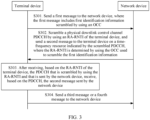
- FIG. 3 is an interaction flowchart of a random access method according to Embodiment 2 of this disclosure. Based on the foregoing embodiment, as shown in FIG. 3 , the random access method in this embodiment may include the following steps.
- a terminal device sends a first message to a network device, where the first message includes first identification information scrambled by using an OCC.
- the network device scrambles a PDCCH by using an RA-RNTI of the terminal device, and sends a second message to the terminal device on a time-frequency resource indicated by the scrambled PDCCH, where the RA-RNTI of the terminal device is determined by using the OCC used to scramble the first identification information.
- the terminal device After receiving, based on the RA-RNTI of the terminal device sending the first message, the PDCCH that is scrambled by using the RA-RNTI and that is sent by the network device, the terminal device receives, based on the PDCCH, the second message sent by the network device.
- the terminal device sends the first message to the network device, and before receiving the second message, determines the random access radio network temporary identifier (Random Access Radio Network Temporary Identifier, RA-RNTI) of the terminal device by using the OCC used to scramble the first identification information.
- RA-RNTI Random Access Radio Network Temporary Identifier
- the network device blindly detects the first message by using all possible OCCs and on each frequency domain resource (for example, each interlace) in each slot used for random access.
- the network device may obtain the OCC used to scramble the first message.
- the network device determines, by using the OCC used to scramble the first message, the RA-RNTI of the terminal device sending the first message.
- the network device sends the second message to the terminal device sending the first message, on the time-frequency resource that is indicated by the scrambled PDCCH and that is used to send the second message.
- the PDCCH carries the RA-RNTI.
- the terminal device sending the first message continuously listens to, in a time window based on the RA-RNTI of the terminal device, the PDCCH that is scrambled by using the RA-RNTI and that is sent by the network device. After obtaining, through detection in the time window, the PDCCH scrambled by using the RA-RNTI of the terminal device, the terminal device decodes the second message carried on the time-frequency resource indicated by the PDCCH, to accurately receive the second message.
- a process in which the terminal device determines the RA-RNTI is the same as a process in which the network device determines the RA-RNTI.
- the following provides description by using an example in which the terminal device determines the RA-RNTI.
- the RA-RNTI of the terminal device in this embodiment is determined by using the OCC used to scramble the first identification information, so that the RA-RNTI changes with different OCCs.
- the RA-RNTI of the terminal device is determined by using a quantity of OCCs and/or a number of the OCC used to scramble the first identification information.
- the terminal device selects the OCC [+1, -1] to scramble the first identification information of this terminal device.
- the RA-RNTI of the terminal device may be determined by using a total quantity (for example, 2) of the OCCs available for this terminal device.
- the RA-RNTI of this terminal device is determined by using a number (for example, 1) of the OCC used to scramble the first identification information.
- the RA-RNTI of this terminal device is determined by using a total quantity of OCCs available for the terminal device and a number of the OCC used to scramble the first identification information.
- total quantities of OCCs available for different terminal devices may be different, and numbers of OCCs that are selected by the terminal devices from a plurality of OCCs to scramble first identification information may also be different, to increase a possibility that RA-RNTIs determined by different terminal devices based on different OCCs are different, thereby reducing a probability of a collision between RA-RNTIs.
- the RA-RNTI of the terminal device may be determined by using the OCC used to scramble the first identification information and a frequency domain resource used to send the first message.
- the RA-RNTI of the terminal device is determined by using the number of the OCC used to scramble the first identification information and the frequency domain resource used to send the first message.
- the RA-RNTI of the terminal device is determined by using the total quantity of OCCs available for the terminal device and a frequency domain resource used to send the first message.
- the RA-RNTI is determined by using the OCC and the frequency domain resource that is used to send the first message, to further reduce a probability of a collision between RA-RNTIs.
- OCCs selected by a terminal device 1 and a terminal device 2 to scramble respective first identification information are the same, but frequency domain resources selected by the terminal device 1 and the terminal device 2 to send first messages are different. Therefore, RA-RNTIs of the terminal device 1 and the terminal device 2 that are obtained according to formula (2) are different, to prevent a collision between the RA-RNTIs of the two devices.
- OCCs available for a terminal device 1 and a terminal device 2 are the same, but frequency domain resources selected by the terminal device 1 and the terminal device 2 to send first messages are different. Therefore, RA-RNTIs of the terminal device 1 and the terminal device 2 that are obtained according to formula (3) are different, to prevent a collision between the RA-RNTIs of the two devices.
- the RA-RNTI of the terminal device may be determined by using the OCC used to scramble the first identification information, a sequence number of a frequency domain resource used to send the first message, and a sequence number of a time domain resource used to send the first message and/or the total quantity of OCCs available for the terminal device.
- the total quantity of OCCs available for the terminal device is the same as a quantity of symbols included in the time domain resource used to send the first message.
- the total quantity of OCCs available for the terminal is greater than or equal to the quantity of symbols included in the time domain resource used to send the first message.
- the RA-RNTI of the terminal device is determined by using the number of the OCC used to scramble the first identification information, the sequence number of the frequency domain resource used to send the first message, and the sequence number of the time domain resource used to send the first message.
- the RA-RNTI of the terminal device is determined by using the number of the OCC used to scramble the first identification information, the sequence number of the frequency domain resource used to send the first message, and the total quantity of OCCs available for the terminal device.
- the RA-RNTI is determined by using the number of the OCC used to scramble the first identification information, the sequence number of the frequency domain resource used to send the first message, the sequence number of the time domain resource used to send the first message, and the total quantity of OCCs available for the terminal device.
- a probability that time-frequency resources selected by different terminal devices to send first messages are the same and OCCs selected by the different terminal devices are the same is greatly reduced, and determining the RA-RNTI based on the number of the OCC, the sequence number of the frequency domain resource used to send the first message, and the sequence number of the time domain resource used to send the first message and/or the total quantity of OCCs available for the terminal device can effectively reduce a probability of a collision between RA-RNTIs.
- an allocation manner of the frequency domain resource used to send the first message is an interlaced resource allocation manner
- the sequence number of the frequency domain resource used to send the first message is a sequence number, of the frequency domain resource used to send the first message, in interlaced resource allocation.
- a frequency band used to transmit the first message in this embodiment is an unlicensed frequency band
- data transmission on the unlicensed frequency band imposes requirements on a ratio of a transmission bandwidth to a channel bandwidth and on a transmit power limit (a maximum power allowed per MHz).
- the terminal device performs uplink transmission in an interlaced (interlace) resource allocation manner.
- a 20 MHz channel bandwidth includes 106 resource blocks (Resource Block, RB).
- 100 RBs in the 106 RBs are divided into 10 parts, and each part is used as one interlace.
- An interlace includes a specific quantity of RBs distributed at intervals in an entire transmission bandwidth.
- RBs allocated to a terminal device are not consecutive, but have a same interval or different intervals. In other words, in an interlace allocated to a terminal device, RBs may be distributed at equal intervals or distributed at non-equal intervals.
- each interlace includes 10 RBs.
- the terminal device may use one or more interlaces to perform uplink transmission (and to send the first message). For example, if the terminal device selects an interlace 0 to send the first message, the terminal device performs transmission on RBs 0, 10, 20, ..., and 90. For example, if the terminal device selects an interlace 5 to send the first message, the terminal device performs transmission on RBs 5, 15, 25, ..., and 95.
- the interlace may also be used to send the first message.
- the terminal device may perform transmission on an interlace 0, and the interlace 0 includes RBs 0, 15, 20, 35, 40, 65, 70, 75, 85, and 90.
- An RB mapping manner of an interlace may be provided in a standard, or may be flexibly configured by the network device and indicated in RMSI/OSI or other system information.
- the sequence number of the frequency domain resource used to send the first message in the foregoing formulas is a sequence number of a selected interlace used to send the first message.
- the sequence number of the frequency domain resource selected by the terminal device to send the first message is 5, and a frequency domain resource corresponding to an interlace 5 is RBs 5, 15, 25, ..., and 95.
- the terminal device may send the first message on the frequency domain resource: RBs 5, 15, 25, ..., and 95.
- the frequency band used to transmit the first message is an unlicensed frequency band
- a listen before talk (Listen Before Talk, LBT for short) channel contention access mechanism is used.
- the random access method in this embodiment includes two steps, and LBT needs to be performed only twice, to reduce a quantity of times of LBT, thereby further reducing a random access delay.
- the first message lasts for 13 symbols, and is mapped to the last 13 symbols in one 14-symbol slot (slot), and the first symbol is used to perform LBT.
- slot 14-symbol slot
- S301 may include: performing listen before talk LBT in a plurality of symbol locations in the time-frequency resource available for sending the first message, and sending the first message in the first symbol location in which LBT succeeds.
- the terminal device may attempt to send the first message in a plurality of symbol locations, to increase a sending success probability of the first message. For example, the terminal device performs LBT in symbol 1, and if LBT succeeds, the terminal device sends the first message in symbols 2 to 14, or if LBT fails, the terminal device performs LBT in symbol 2, and sends the first message in symbols 3 to 15 if LBT succeeds.
- the terminal device may send the first message on a time domain resource including 13 consecutive symbols that are in symbols 1-14, symbols 2-15, ..., and symbols 14-27 and that follow a symbol in which LBT succeeds for the first time, to increase a sending success probability of the first message, and improve timely sending of the first message.
- this embodiment may further include S304.
- the terminal device sending the first message sends a third message or a fourth message to the network device.
- the terminal device sending the first message parses the second message, and if the identification information of the terminal device carried in the second message is consistent with the first identifier of this terminal device, sends, to the network device, the third message indicating that random access succeeds.
- the terminal device sends the fourth message to the network device, to enable the network device to resend the second message to the terminal device.
- the RA-RNTI of the terminal device is determined based on the OCC used to scramble the first identification information. Because OCCs selected by different terminal devices may be different, determining the RA-RNTIs based on the OCCs can increase a possibility that RA-RNTIs of the different terminal devices are different, thereby reducing a probability of a collision between the RA-RNTIs.
- FIG. 4 is an interaction flowchart of a random access method according to Embodiment 3 of this disclosure.
- a first signal in this embodiment includes first identification information but does not include a preamble sequence (Preamble), and a random access process in this embodiment may include the following steps.
- Preamble preamble sequence
- a terminal device sends a first message to a network device, where the first message includes first identification information scrambled by using an OCC, and does not include a preamble.
- the network device scrambles a PDCCH by using an RA-RNTI of the terminal device, and sends the second message to the terminal device on a time-frequency resource indicated by the scrambled PDCCH, where the RA-RNTI is determined by using the OCC used to scramble the first identification information.
- the terminal device sending the first message After receiving the PDCCH that is scrambled by using the RA-RNTI and that is sent by the network device, the terminal device sending the first message receives, based on the PDCCH, the second message sent by the network device.
- the terminal device sending the first message sends a third message or a fourth message to the network device.
- duration of an entire preamble is two symbols.
- SCS subcarrier Spacing
- a length of a cyclic prefix (Cyclic Prefix, CP) corresponding to the 15 KHz subcarrier spacing is 144 Ts, namely, 4.68 ⁇ s.
- a transmission delay of about 6.7 ⁇ s is generated for a cellular cell with a radius of 1 km. Therefore, the 4.68 ⁇ s CP may correspond to a cell radius of about 700 meters.
- a CP with a 15 KHz subcarrier spacing can eliminate an impact caused by a transmission delay on signal receiving.
- the terminal device does not need to send a preamble for the network device to estimate an uplink time error of the terminal device.
- the terminal device adds the first identification information of the terminal device to the first message, and does not need to add the preamble. In this way, a resource used to send the first message can be reduced, and a delay caused when the terminal device selects the preamble can be avoided.
- the first message includes only the first identification information of the terminal device sending the first message. Therefore, a sequence number that is of a frequency domain resource used to send the first message and that is used to calculate the RA-RNTI is a sequence number of a frequency domain resource used to send the first identification information, and a sequence number that is of a time domain resource used to send the first message and that is used to calculate the RA-RNTI is a sequence number of a time domain resource used to send the first identification information.
- a demodulation reference signal (Demodulation reference signal, DMRS) may be carried on the first one or more symbols in a symbol used to send the first message, and the DMRS is used for uplink channel estimation.
- DMRS demodulation reference signal
- the DMRS may be alternatively carried on a middle symbol in an uplink channel.
- the first message includes only the first identification information of the terminal device, but does not include the preamble. In this way, a resource used to send the first message can be reduced, and a delay caused when the terminal device selects the preamble can be avoided.
- FIG. 6 is a flowchart of a random access method according to Embodiment 3 of this disclosure.
- a first signal in this embodiment includes first identification information and a preamble sequence, and a random access process in this embodiment may include the following steps.
- a terminal device sends a first message to a network device, where the first message includes a preamble sequence and first identification information that is scrambled by using an OCC.
- signal propagation needs time, and signals sent by terminal devices at different locations arrive at the network device at different times.
- signals of the different terminal devices are asynchronous, and interference is caused because orthogonal frequency division multiplexing (Orthogonal Frequency Division Multiplexing, OFDM) symbols are not orthogonal.
- OFDM Orthogonal Frequency Division Multiplexing
- Timing Advance Timing Advance
- the first message includes the preamble, where the preamble is used for the network device to evaluate a timing advance of the terminal device, to improve uplink synchronization accuracy.
- precise uplink synchronization helps to perform data transmission between the network device and the terminal device by using a higher modulation and coding scheme (Modulation and Coding Scheme, MCS).
- MCS Modulation and Coding Scheme
- the terminal device may randomly select one of the preamble and the OCC, and determine the other based on the mapping relationship between the preamble and the OCC. For example, the terminal device randomly selects the preamble, and then may determine, based on the mapping relationship between the preamble and the OCC, the OCC corresponding to the preamble. Alternatively, the terminal device randomly selects the OCC, and then may determine, based on the mapping relationship between the preamble and the OCC, the preamble corresponding to the OCC, to improve efficiency of selecting, by the terminal device, the preamble and the OCC.
- the terminal device transmits the preamble by using two symbols.
- an OCC used by the terminal device to scramble the first identification information is, for example, [+1 +1]
- an OCC used by the terminal device to scramble the first identification information is, for example, [+1 -1].
- all preambles may be divided into two groups, and each group corresponds to two OCCs.
- Configuration information of the preamble and the OCC may be configured by using signaling such as a physical broadcast channel (Physical Broadcast Channel, PBCH), remaining minimum system information (Remaining Minimum System Information, RMSI), other system information (Other System Information, OSI), or radio resource control (Radio Resource Control, RRC), or may be directly provided in a standard.
- signaling such as a physical broadcast channel (Physical Broadcast Channel, PBCH), remaining minimum system information (Remaining Minimum System Information, RMSI), other system information (Other System Information, OSI), or radio resource control (Radio Resource Control, RRC), or may be directly provided in a standard.
- PBCH Physical Broadcast Channel
- RMSI remaining Minimum System Information
- OSI Operating System Information
- RRC Radio Resource Control
- the network device obtains the preamble through detection, and may obtain, through detection based on the mapping relationship between the preamble and the OCC, the first identifier scrambled by using the OCC, to improve efficiency of receiving, by the network device, the first message.
- the terminal device can quickly determine, based on the mapping relationship between the frequency domain resource used to send the preamble and the frequency domain resource used to send the first identification information, the frequency domain resource used to send the first identification information, to improve efficiency of determining, by the terminal device, the frequency domain resource used to send the preamble and the frequency domain resource used to send the first identification information.
- the network device it is also convenient for the network device to detect the first message.
- the preamble is a sequence.
- the network device may first obtain the preamble through detection, and then quickly learn, based on the mapping relationship between the frequency domain resource used to send the preamble and the frequency domain resource used to send the first identification information, the frequency domain resource used to send the first identification information, and receive the first identification information on the frequency domain resource, to improve efficiency of receiving, by the network device, the first message.
- mapping relationship between the preamble and the OCC or is the mapping relationship between the frequency domain resource used to send the preamble and the frequency domain resource used to send the first identification information, which may be provided in a standard, or may be configured by the network device in RMSI/OSI.
- that there is the mapping relationship between the frequency domain resource used to send the preamble and the frequency domain resource used to send the first identification information may include two cases: Case 1: The frequency domain resource used to send the preamble sequence is the same as the frequency domain resource used to send the first identification information. In other words, the preamble and the first identification information are sent on a same frequency domain resource.
- Case 2 There is a preset offset between the frequency domain resource used to send the preamble sequence and the frequency domain resource used to send the first identification information.
- the preset offset is configured by the network device according to an actual requirement, or is provided in a standard. Offsets between frequency domain resources corresponding to different preamble sequences and frequency domain resources corresponding to different first identification information may be the same or different.
- the first message in this embodiment further includes a sequence number of the preamble sequence.
- the network device may determine an RA-RNTI of the terminal device based on the OCC used to scramble the first identification information and a sequence number of a time-frequency resource of the preamble (it is assumed that the frequency domain resource used to send the first identification information is the same as the frequency domain resource used to send the preamble). Then, the network device indicates, by using a PDCCH scrambled by using the RA-RNTI, the terminal device to resend the preamble or the preamble and the first identification information based on the sequence number of the preamble.
- the sequence number of the preamble sequence and the first identification information are sent on a same time-frequency resource, that is, both the sequence number of the preamble sequence and the first identification information are carried on a physical uplink shared channel (Physical Uplink Shared Channel, PUSCH).
- PUSCH Physical Uplink Shared Channel
- the first message further includes a sequence number of the preamble sequence and a sequence number of the frequency domain resource used to send the preamble sequence (for example, a sequence number of the foregoing interlace).
- the network device may determine an RA-RNTI of the terminal device based on the OCC used to scramble the first identification information and the sequence number of the frequency domain resource used to send the preamble. Then, the network device indicates, by using a PDCCH scrambled by using the RA-RNTI, the terminal device to resend the preamble or the preamble and the first identification information based on
- all of the sequence number of the preamble sequence, the first identification information, and the sequence number of the frequency domain resource used to send the preamble sequence are sent on a same time-frequency resource, that is, all of the sequence number of the preamble sequence, the first identification information, and the sequence number of the frequency domain resource used to send the preamble sequence are carried on a PUSCH.
- the network device can receive the other two, to reduce complexity of blind detection of the network device and reduce a resource occupied by the first message.
- a length of the preamble is not limited in this embodiment.
- the preamble may be a sequence with a length of 139, or may be a DMRS sequence with a length of 120, for example, a DMRS sequence in Multefire (another cellular standard operating on an unlicensed frequency band).
- the frequency domain resource and a time domain resource that are used for the preamble may be provided in a standard, or may be configured by the network device in RMSI/OSI.
- an allocation manner of the frequency domain resource used to send the preamble is an interlaced resource allocation manner
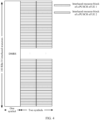
- a configuration manner of the frequency domain resource of the preamble is shown in FIG. 7 .
- an allocation manner of a frequency domain resource used to send the first message is an interlaced resource allocation manner
- duration of the first message is 14 symbols
- the preamble lasts for two symbols
- a channel bandwidth is 20 MHz
- a length of the preamble is 139.
- the preamble occupies, in frequency domain, two extra RBs and one interlace (for example, interlace 5) that includes 10 RBs, and each RB includes 12 subcarriers.
- the two extra RBs may be two RBs in another interlace (namely, an interlace other than the interlace 5), or may be any two of six RBs other than the interlaces (it can be learned from the foregoing that 20 MHz includes 106 RBs, 100 RBs are divided into 10 interlaces, and six RBs remain).
- interlaced resource allocation may be alternatively uneven, that is, an interval between every two adjacent RBs in an interlace may not always be the same, so that the network device can estimate a timing advance more precisely.
- the interlaced resource allocation manner is used, so that a capacity of a communications system can be increased.
- each group may include six different preambles, and each preamble corresponds to a different OCC.
- a PUSCH lasts for 12 symbols, a quantity of available OCCs is 12.
- each group may include 12 different preambles, and each preamble corresponds to a different OCC.
- a PUSCH lasts for 12 symbols, a quantity of available OCCs is 12.
- each preamble corresponds to two interlaces. Therefore, each preamble can be repeatedly sent twice, to increase a sending success rate of the preamble.
- a sequence number that is of the frequency domain resource used to send the first message and that is used to calculate the RA-RNTI may be a sequence number of the frequency domain resource used to send the first identification information, or a sequence number of the frequency domain resource used to send the preamble, or an average value or a sum value of the sequence number of the frequency domain resource used to send the first identification information and the sequence number of the frequency domain resource used to send the preamble.
- a sequence number that is of a time domain resource used for the first message and that is used to calculate the RA-RNTI may be a sequence number of a time domain resource used to send the first identification information, or may be a sequence number of the time domain resource used to send the preamble.
- the network device receives the first message sent by the terminal device.
- S602 may include S602a and S602b.
- the network device blindly detects a time-frequency resource used for random access, and obtains the preamble sequence through detection.
- the network device receives, based on the mapping relationship between the preamble sequence obtained through detection and the OCC, the first identification information scrambled by using the OCC.
- the preamble is a sequence, and is easily obtained by the network device through detection.
- the network device After the network device obtains the preamble through detection, for example, preamble 1, because there is a mapping relationship between preamble 1 and OCC 1, the network device can determine that the OCC used to scramble the first identification information is OCC 1.
- the network device performs blind detection by using the OCC 1 on the time-frequency resource used for random access, and can receive the first identification information sent by the terminal device, to reduce complexity of blindly detecting, by the network device, the first identification information, quickly detect the first identification information, and further reduce a random access delay.
- S602 may include S602c and S602d.
- the network device blindly detects a time-frequency resource used for random access, and obtains, through detection, the frequency domain resource used to send the preamble sequence.
- the network device obtains, based on the mapping relationship between the frequency domain resource used to send the preamble sequence and the frequency domain resource used to send the first identification information, the frequency domain resource used to send the first identification information, and receives the first identification information on the frequency domain resource used to send the first identification information.
- the network device may obtain the frequency domain resource used to send the preamble.
- the network device can obtain, based on the mapping relationship between the frequency domain resource used to send the preamble and the frequency domain resource used to send the first identification information, the frequency domain resource used to send the first identification information.
- the network device receives the first identification information on the frequency domain resource used to send the first identification information, to reduce complexity of blindly detecting, by the network device, the first identification information, quickly receive the first identification information, and further reduce a random access delay.
- a result of receiving, by the network device, the first message and a subsequent action include the following several cases: In a first case, when the network device has not received the preamble and the first identification information in the first message, current random access fails, and the terminal device resends, in a next available random access channel (Random Access Channel, RACH) resource window, the preamble and the scrambled first identification information. In a second case, when the network device has received the preamble and the first identification information in the first message, the network device sends a second message in a random access response message (Random Access Response, RAR) window to reply to the terminal device.
- RAR Random Access Response
- the network device when the network device successfully receives the preamble sent by the terminal device, but fails to decode the first identification information, the network device may obtain, based on the mapping relationship between the preamble and the OCC, the OCC used to scramble the first identification information, and calculate the RA-RNTI of the terminal device based on the OCC and a sequence number of a time-frequency resource of the preamble.
- the network device may indicate, by using the PDCCH scrambled by using the RA-RNTI, the terminal device to resend the first identification information.
- the sequence number of the frequency domain resource used to send the first identification information (for example, a sequence number of an interlace used to send the first identification information) and the time domain resource used to send the first identification information are added to a media access control control element (Medium Access Control Control Element, MAC CE) of a PDSCH indicated by the PDCCH, and optionally, information about the OCC used to scramble the first identification information may be further added.
- a media access control control element Medium Access Control Control Element, MAC CE
- the network device successfully receives the first identification information sent by the terminal device, but fails to decode the preamble, the following is included.
- the network device obtains the OCC used to scramble the first identification information, obtains, based on the mapping relationship between the preamble and the OCC, the sequence number of the preamble corresponding to the OCC, and calculates, based on the OCC and the sequence number of the time-frequency resource of the preamble, the RA-RNTI of the terminal device sending the first message.
- the network device may indicate, by using the PDCCH scrambled by using the RA-RNTI, the terminal device to resend the preamble or the preamble and the first identification information.
- the sequence number of the frequency domain resource used to send the preamble (for example, a sequence number of an interlace used to send the preamble), the time domain resource, and the sequence number of the preamble corresponding to the OCC are added to a MAC CE of a PDSCH indicated by the PDCCH.
- the network device may determine the RA-RNTI of the terminal device based on the OCC used to scramble the first identification information and the sequence number of the time-frequency resource of the preamble. Then, the network device indicates, by using the PDCCH scrambled by using the RA-RNTI, the terminal device to resend the preamble or the preamble and the first identification information. To be specific, the sequence number of the frequency domain resource used to send the preamble, the time domain resource, and the sequence number of the preamble are added to a MAC CE of a PDSCH indicated by the PDCCH.
- both of the foregoing cases are for a scenario in which the frequency domain resource used to send the first identification information is the same as the frequency domain resource used to send the preamble.
- the network device may determine the RA-RNTI of the terminal device based on the OCC used to scramble the first identification information and the sequence number of the frequency domain resource used to send the preamble. Then, the network device indicates, by using the PDCCH scrambled by using the RA-RNTI, the terminal device to resend the preamble or the preamble and the first identification information. To be specific, the sequence number of the frequency domain resource used to send the preamble, the time domain resource, and the sequence number of the preamble are added to a MAC CE of a PDSCH indicated by the PDCCH.
- the network device scrambles the PDCCH by using the RA-RNTI of the terminal device, and sends the second message to the terminal device on a time-frequency resource indicated by the scrambled PDCCH, where the second message includes a TA, and the RA-RNTI is determined by using the OCC used to scramble the first identification information.
- the second message in this embodiment not only includes identification information of one or more terminal devices that succeed in random access, but also includes the TA obtained in the foregoing step.
- a method for generating, by the network device, the TAbased on the preamble sequence is the same as an existing method, and details are not described in this embodiment.
- the network device generates the TA for the terminal device, adds the TA to the second message, and sends the second message to the terminal device. In this way, when sending a message to the network device next time, the terminal device sends the message to the network device based on the TA, to implement uplink synchronization.
- the terminal device sending the first message After receiving the PDCCH that is scrambled by using the RA-RNTI and that is sent by the network device, the terminal device sending the first message receives, based on the PDCCH, the second message sent by the network device.
- the terminal device sending the first message sends a third message or a fourth message to the network device.
- the terminal device sending the first message sends a third message or a fourth message to the network device.
- the first identification information of the terminal device and the preamble are added to the first message, so that the network device generates the TA for the terminal device, to enable the terminal device to send the message to the network device based on the TA, to improve uplink synchronization precision of each terminal device.
- the first message in this embodiment further includes information about an optimal downlink transmit beam of the network device.
- the first message in this embodiment may further carry the information about the optimal downlink transmit beam of the network device, so that the network device sends the second message to the terminal device on the optimal downlink transmit beam, to improve efficiency of sending the second message.
- the information about the optimal downlink transmit beam of the network device may be a sequence number of the optimal downlink transmit beam of the network device.
- the first message in this embodiment further includes information about at least one downlink transmit beam of the network device.
- the first message includes the information about the at least one downlink transmit beam of the network device.
- the network device can select one downlink transmit beam from the at least one downlink transmit beam to send the second message.
- the information about the at least one downlink transmit beam is a sequence number of the at least one downlink transmit beam.
- operations and steps implemented by the terminal device may be implemented by a component (for example, a chip or a circuit) that may be used for the terminal device
- operations and steps implemented by the network device may be implemented by a component (for example, a chip or a circuit) that may be used for the network device. This is not limited in this embodiment of this disclosure.
- FIG. 8 is a schematic structural diagram of a random access device according to an embodiment of this disclosure.
- the random access device 900 in this embodiment may be a terminal device (or a component that may be used for the terminal device) or a network device (or a component that may be used for the network device) mentioned in the foregoing method embodiments.
- the random access device may be configured to implement the method corresponding to the terminal device or the network device described in the foregoing method embodiments. For details, refer to the descriptions in the foregoing method embodiments.
- the random access device 900 may include one or more processors 901.
- the processor 901 may be alternatively referred to as a processing unit, and may implement a specific control or processing function.
- the processor 901 may be a general purpose processor, a dedicated processor, or the like, for example, may be a baseband processor or a central processing unit.
- the baseband processor may be configured to process a communications protocol and communication data
- the central processing unit may be configured to control the communications apparatus, execute a software program, and process data of the software program.
- the processor 901 may further store an instruction 903 or data (for example, intermediate data).
- the instruction 903 may be run by the processor, to enable the random access device 900 to perform the method corresponding to the terminal device or the network device described in the foregoing method embodiments.
- the random access device 900 may include a circuit, and the circuit may implement a sending, receiving, or communication function in the foregoing method embodiments.
- the random access device 900 may include one or more memories 902, and the memory 902 may store an instruction 904.
- the instruction may be run on the processor 901, to enable the random access device 900 to perform the method described in the foregoing method embodiments.
- the memory 902 may further store data.
- the processor 901 and the memory 902 may be disposed separately, or may be integrated together.
- the random access device 900 may further include a receiver 905 and a transmitter 906.
- the receiver 905 and the transmitter 906 may be disposed separately, or may be integrated together.
- the processor 901 may be referred to as a processing unit, and control a random access apparatus (a terminal device or a network device).
- the receiver 905 may be referred to as a receiving unit, a receiving circuit, or the like, and is configured to implement a receiving function of the random access device.
- the transmitter 906 may be referred to as a sending unit, a sending circuit, or the like, and is configured to implement a sending function of the random access device.
- the transmitter 906 may send a first message to the network device, where the first message includes first identification information scrambled by using an orthogonal cover code OCC, and the first message is used by the terminal device corresponding to the first identification information to request random access to the network device, and the receiver 905 may receive a second message sent by the network device, where the second message includes identification information of one or more terminal devices that succeed in random access; and determine, based on whether the identification information of the one or more terminal devices includes the first identification information, whether the random access succeeds.
- OCC orthogonal cover code
- an RA-RNTI of the terminal device is determined by using the OCC used to scramble the first identification information.
- the receiver is configured to receive a first message sent by the terminal device
- the transmitter is configured to send a second message to the terminal device based on the first message.
- the first message includes first identification information scrambled by using an orthogonal cover code OCC
- the first message is used by the terminal device corresponding to the first identification information to request random access to the network device
- the second message includes identification information of one or more terminal devices that succeed in random access
- the identification information of the one or more terminal devices includes the first identification information.
- the transmitter is specifically configured to scramble a physical downlink control channel PDCCH by using a random access radio network temporary identifier RA-RNTI of the terminal device, and send the second message to the terminal device on a time-frequency resource indicated by the scrambled PDCCH, where the RA-RNTI is determined by using the OCC used to scramble the first identification information.
- RA-RNTI random access radio network temporary identifier
- the processor 901, the receiver 905, and the transmitter 906 described in this disclosure may be implemented on an integrated circuit (integrated circuit, IC), an analog IC, a radio frequency integrated circuit (radio frequency integrated circuit, RFIC), a mixed-signal IC, an application specific integrated circuit (application specific integrated circuit, ASIC), a printed circuit board (printed circuit board, PCB), an electronic device, and the like.
- integrated circuit integrated circuit, IC
- analog IC analog a radio frequency integrated circuit
- RFIC radio frequency integrated circuit
- RFIC radio frequency integrated circuit
- mixed-signal IC mixed-signal IC
- ASIC application specific integrated circuit
- PCB printed circuit board
- the processor 901, the receiver 905, and the transmitter 906 may also be manufactured by using various 1C process technologies, for example, a complementary metal oxide semiconductor (complementary metal oxide semiconductor, CMOS), an nMetal-oxide-semiconductor (nMetal-oxide-semiconductor, NMOS), a P-channel metal oxide semiconductor (positive channel metal oxide semiconductor, PMOS), a bipolar junction transistor (Bipolar Junction Transistor, BJT), a bipolar CMOS (BiCMOS), silicon-germanium (SiGe), gallium arsenide (GaAs), and the like.
- CMOS complementary metal oxide semiconductor
- NMOS nMetal-oxide-semiconductor
- PMOS positive channel metal oxide semiconductor
- BJT bipolar junction transistor
- BiCMOS bipolar CMOS
- SiGe silicon-germanium
- GaAs gallium arsenide
- the random access device 900 is described by using the terminal device or the network device as an example. However, a range of the random access device in this disclosure is not limited to the terminal device or the network device, and a structure of the random access device may not be limited to FIG. 8 .
- the random access device 900 may be an independent device or may be a part of a large device. For example, the device may be:
- FIG. 9 is a schematic structural diagram of a terminal device according to an embodiment of this disclosure.
- the terminal device may be the terminal device described in the foregoing embodiments of this disclosure.
- FIG. 9 shows only main components of the terminal device.
- the terminal device 1000 includes a processor, a memory, a control circuit, an antenna, and an input/output apparatus.
- the processor is mainly configured to: process a communications protocol and communications data, control the entire terminal, execute a software program, and process data of the software program.
- the memory is mainly configured to store the software program and the data.
- a radio frequency circuit is mainly configured to: perform conversion between a baseband signal and a radio frequency signal, and process the radio frequency signal.
- the antenna is mainly configured to receive and transmit a radio frequency signal in an electromagnetic wave form.
- the input/output apparatus such as a touchscreen, a display screen, or a keyboard, is mainly configured to receive data entered by a user and output data to the user.
- the processor can read the software program in a memory, interpret and execute an instruction of the software program, and process the data of the software program.
- the processor outputs a baseband signal to the radio frequency circuit.
- the radio frequency circuit After performing radio frequency processing on the baseband signal, the radio frequency circuit sends a radio frequency signal in an electromagnetic wave form by using the antenna.
- the radio frequency circuit receives a radio frequency signal by using the antenna, converts the radio frequency signal into a baseband signal, and outputs the baseband signal to the processor.
- the processor converts the baseband signal into data, and processes the data.
- FIG. 9 shows only one memory and only one processor.
- An actual terminal device may have a plurality of processors and a plurality of memories.
- the memory may also be referred to as a storage medium, a storage device, or the like. This is not limited in this embodiment of this disclosure.
- the processor may include a baseband processor and a central processing unit.
- the baseband processor is mainly configured to process the communications protocol and the communications data
- the central processing unit is mainly configured to: control the entire terminal, execute the software program, and process the data of the software program. Functions of the baseband processor and the central processing unit are integrated into the processor in FIG. 9 .
- the baseband processor and the central processing unit each may be an independent processor, and are interconnected by using a technology such as a bus.
- the terminal device may include a plurality of baseband processors to adapt to different network standards, the terminal may include a plurality of central processing units to improve a processing capability of the terminal, and the components of the terminal device may be connected by using various buses.
- the baseband processor may also be expressed as a baseband processing circuit or a baseband processing chip.
- the central processing unit may also be expressed as a central processing circuit or a central processing chip.
- a function of processing the communications protocol and the communications data may be built in the processor, or may be stored in the storage unit in a form of a software program.
- the processor executes the software program to implement a baseband processing function.
- the antenna and the control circuit that have receiving and sending functions may be considered as a transceiver 1001 of the terminal device 1000.
- the terminal device 1000 includes the transceiver 1001 and the processor 1002.
- a component that is in the transceiver unit 1001 and is configured to implement a receiving function may be considered as a receiver
- a component that is in the transceiver unit 1001 and is configured to implement a sending function may be considered as a transmitter, that is, the transceiver unit 1001 includes the receiver and the transmitter.
- the receiver may also be referred to as a receiver, a receiving circuit, or the like
- the transmitter may be referred to as a transmitter, a sending circuit, or the like.
- FIG. 10 is a schematic structural diagram of a random access apparatus according to an embodiment of this disclosure.
- the random access apparatus may be a terminal device, or may be a component (for example, an integrated circuit or a chip) of a terminal device, or may be another communications module, configured to implement an operation or a step of the terminal device in the foregoing method embodiments.
- the random access apparatus 700 may include a sending module 701, a receiving module 702, and a processing module 703.
- the sending module 701 is configured to send a first message to a network device, where the first message includes first identification information scrambled by using an orthogonal cover code OCC, and the first message is used by a terminal device corresponding to the first identification information to request random access to the network device.
- the receiving module 702 is configured to receive a second message sent by the network device, where the second message includes identification information of one or more terminal devices that succeed in random access.
- the processing module 703 is configured to determine, based on whether the identification information of the one or more terminal devices includes the first identification information, whether the random access succeeds.
- the random access apparatus in this embodiment may be configured to execute the technical solutions of the terminal device in the foregoing method embodiments.
- the implementation principles and technical effects are similar, and details are not further described herein.
- the first message in this embodiment further includes a preamble sequence.
- mapping relationship between the preamble sequence and the OCC there is a mapping relationship between a frequency domain resource used to send the preamble sequence and a frequency domain resource used to send the first identification information.
- the frequency domain resource used to send the preamble sequence is the same as the frequency domain resource used to send the first identification information, or there is a preset offset between the frequency domain resource used to send the preamble sequence and the frequency domain resource used to send the first identification information.
- a random access radio network temporary identifier RA-RNTI of the terminal device is determined by using the OCC used to scramble the first identification information.
- the RA-RNTI is determined by using the OCC used to scramble the first identification information, a sequence number of a frequency domain resource used to send the first message, and a sequence number of a time domain resource used to send the first message and/or a total quantity of OCCs available for the terminal device.
- a sequence number of the frequency domain resource used to send the first message is a sequence number, of the frequency domain resource used to send the first message, in interlaced resource allocation.
- the sending module is further configured to: if the identification information of the one or more terminal devices includes the first identification information, send a third message to the network device, where the third message is used to indicate that the terminal device corresponding to the first identification information succeeds in the random access; or if the identification information of the one or more terminal devices does not include the first identification information, or the second message fails to be decoded, send a fourth message to the network device, to enable the network device to resend the second message to the terminal device based on the fourth message, where the fourth message is used to indicate that the terminal device corresponding to the first identification information fails in the random access.
- the first message further includes a sequence number of the preamble sequence, or the first message further includes a sequence number of the preamble sequence and a sequence number of a frequency domain resource used to send the preamble sequence.
- sequence number of the preamble sequence and the first identification information are sent on a same time-frequency resource, or all of the sequence number of the preamble sequence, the first identification information, and the sequence number of the frequency domain resource used to send the preamble sequence are sent on a same time-frequency resource.
- the first message further includes information about an optimal downlink transmit beam of the network device.
- the second message further includes configuration information of a physical uplink control channel PUCCH used to send the third message or used to send the fourth message.
- the first identification information is a global unique network identifier S-TMSI of the terminal device.
- the first identification information is a cell radio network temporary identifier C-RNTI of the terminal device.
- the sending module 701 is further configured to: if a time-frequency resource available for sending the first message is greater than a time-frequency resource occupied by the first message, perform listen before talk LBT in a plurality of symbol locations in the time-frequency resource available for sending the first message, and send the first message in the first symbol location in which LBT succeeds.
- the receiving module 702 is specifically configured to: after receiving a physical downlink control channel PDCCH that is scrambled by using the RA-RNTI and that is sent by the network device, receive, based on the PDCCH, the second message sent by the network device.
- PDCCH physical downlink control channel
- the processing module 703 is further configured to: randomly select an OCC from a plurality of OCCs available for the terminal device, and scramble the first identification information by using the selected OCC.
- the sending module 701 is configured to send, to the network device on a randomly selected time-frequency resource used for random access, the first message carrying the scrambled first identification information.
- the second message further includes a timing advance TA.
- the random access apparatus in this embodiment may be configured to execute the technical solutions of the terminal device in the foregoing method embodiments.
- the implementation principles and technical effects are similar, and details are not further described herein.
- FIG. 11 is a schematic structural diagram of a random access apparatus according to an embodiment of this disclosure.
- the random access apparatus may be a network device, or may be a component (for example, an integrated circuit or a chip) of a network device, or may be another communications module, configured to implement an operation of the network device in the foregoing method embodiments.
- the random access apparatus 800 may include a receiving module 801 and a sending module 802.
- the receiving module 801 is configured to receive a first message sent by a terminal device, where the first message includes first identification information scrambled by using an orthogonal cover code OCC, and the first message is used by the terminal device corresponding to the first identification information to request random access to the network device.
- the sending module 802 is configured to send a second message to the terminal device based on the first message, where the second message includes identification information of one or more terminal devices that succeed in random access, and the identification information of the one or more terminal devices includes the first identification information.
- the random access apparatus in this embodiment may be configured to execute the technical solutions of the network device in the foregoing method embodiments.
- the implementation principles and technical effects are similar, and details are not further described herein.
- the first message further includes a preamble sequence.
- mapping relationship between the preamble sequence and the OCC there is a mapping relationship between a frequency domain resource used to send the preamble sequence and a frequency domain resource used to send the first identification information.
- the frequency domain resource used to send the preamble sequence is the same as the frequency domain resource used to send the first identification information, or there is a preset offset between the frequency domain resource used to send the preamble sequence and the frequency domain resource used to send the first identification information.
- the receiving module 801 is specifically configured to: blindly detect a time-frequency resource used for random access, detect the preamble sequence, and receive, based on the mapping relationship between the preamble sequence and the OCC, the first identification information scrambled by using the OCC.
- the receiving module 801 is specifically configured to: blindly detect a time-frequency resource used for random access, obtain, through detection, the frequency domain resource used to send the preamble sequence, obtain, based on the mapping relationship between the frequency domain resource used to send the preamble sequence and the frequency domain resource used to send the first identification information, the frequency domain resource used to send the first identification information, and receive the first identification information on the frequency domain resource used to send the first identification information.
- the sending module 802 is specifically configured to scramble a physical downlink control channel PDCCH by using a random access radio network temporary identifier RA-RNTI of the terminal device, and send the second message to the terminal device on a time-frequency resource indicated by the scrambled PDCCH, where the RA-RNTI is determined by using the OCC used to scramble the first identification information.
- RA-RNTI random access radio network temporary identifier
- the RA-RNTI is determined by using the OCC used to scramble the first identification information, a sequence number of a frequency domain resource used to send the first message, and a sequence number of a time domain resource used to send the first message and/or a total quantity of OCCs available for the terminal device.
- the sequence number of the frequency domain resource used to send the first message is a sequence number, of the frequency domain resource used to send the first message, in interlaced resource allocation.
- the receiving module 801 is further configured to receive a third message sent by the terminal device, where the third message is used to indicate that the terminal device corresponding to the first identification information succeeds in the random access; or configured to receive a fourth message sent by the terminal device, where the fourth message is used to indicate that the terminal device corresponding to the first identification information fails in the random access; and the sending module 802 is further configured to resend the second message to the terminal device based on the fourth message.
- the first message further includes a sequence number of the preamble sequence, or the first message further includes a sequence number of the preamble sequence and a sequence number of a frequency domain resource used to send the preamble sequence.
- sequence number of the preamble sequence and the first identification information are sent on a same time-frequency resource, or all of the sequence number of the preamble sequence, the first identification information, and the sequence number of the frequency domain resource used to send the preamble sequence are sent on a same time-frequency resource.
- the first message further includes information about an optimal downlink transmit beam of the network device.
- the second message further includes configuration information of a physical uplink control channel PUCCH used to send the third message or used to send the fourth message.
- the first identification information is a global unique network identifier S-TMSI of the terminal device.
- the first identification information is a cell radio network temporary identifier C-RNTI of the terminal device.
- the second message further includes a timing advance TA generated based on the preamble sequence.
- the random access apparatus in this embodiment may be configured to execute the technical solutions of the network device in the foregoing method embodiments. The implementation principles and technical effects are similar, and details are not further described herein.
- division into modules in the embodiments of this disclosure is an example, and is merely a logical function division. In actual implementation, another division manner may be used.
- Functional modules in the embodiments of this disclosure may be integrated into one processing module, or each of the modules may exist alone physically, or two or more modules are integrated into one module.
- the integrated module may be implemented in a form of hardware, or may be implemented in a form of a software functional module.
- the integrated module When the integrated module is implemented in the form of a software functional module and sold or used as an independent product, the integrated unit may be stored in a computer-readable storage medium. Based on such an understanding, the technical solutions of this disclosure essentially, or the part contributing to the prior art, or all or some of the technical solutions may be implemented in a form of a software product.
- the computer software product is stored in a storage medium and includes several instructions for instructing a computer device (which may be a personal computer, a server, a network device, or the like) or a processor (processor) to perform all or some of the steps of the methods described in the embodiments of this disclosure.
- the foregoing storage medium includes: any medium that can store program code, such as a USB flash drive, a removable hard disk, a read-only memory (Read-Only Memory, ROM), a random access memory (Random Access Memory, RAM), a magnetic disk, or an optical disc. All or some of the foregoing embodiments may be implemented by using software, hardware, firmware, or any combination thereof. When software is used to implement the embodiments, the embodiments may be implemented completely or partially in a form of a computer program product.
- the computer program product includes one or more computer instructions. When the computer program instructions are loaded and executed on a computer, the procedure or functions according to the embodiments of this disclosure are all or partially generated.
- the computer may be a general-purpose computer, a dedicated computer, a computer network, or other programmable apparatuses.
- the computer instructions may be stored in a computer-readable storage medium or may be transmitted from a computer-readable storage medium to another computer-readable storage medium.
- the computer instructions may be transmitted from a website, computer, server, or data center to another website, computer, server, or data center in a wired (for example, a coaxial cable, an optical fiber, or a digital subscriber line (DSL)) or wireless (for example, infrared, radio, or microwave) manner.
- the computer-readable storage medium may be any usable medium accessible by a computer, or a data storage device, such as a server or a data center, integrating one or more usable media.
- the usable medium may be a magnetic medium (for example, a floppy disk, a hard disk, or a magnetic tape), an optical medium (for example, a DVD), a semiconductor medium (for example, a solid-state drive (Solid-State Disk, SSD)), or the like.
- a magnetic medium for example, a floppy disk, a hard disk, or a magnetic tape
- an optical medium for example, a DVD
- a semiconductor medium for example, a solid-state drive (Solid-State Disk, SSD)
Landscapes
- Engineering & Computer Science (AREA)
- Signal Processing (AREA)
- Computer Networks & Wireless Communication (AREA)
- Mobile Radio Communication Systems (AREA)
Claims (15)
- Procédé d'accès aléatoire, comprenant :l'envoi, par un dispositif terminal (1000), d'un premier message à un dispositif réseau (900), dans lequel le premier message comprend des premières informations d'identification brouillées à l'aide d'un code de couverture orthogonal, OCC, et le premier message est utilisé par le dispositif terminal (1000) correspondant aux premières informations d'identification pour demander un accès aléatoire au dispositif réseau (900) ; etla réception, par le dispositif terminal (1000), d'un deuxième message envoyé par le dispositif réseau (900), dans lequel le deuxième message comprend des informations d'identification d'un ou de plusieurs dispositifs terminaux (1000) qui réussissent un accès aléatoire, et la détermination, par le terminal dispositif (1000), selon que les informations d'identification des un ou plusieurs dispositifs terminaux (1000) comprennent ou non les premières informations d'identification, si l'accès aléatoire réussit,dans lequelle premier message comprend en outre une séquence de préambule, etcaractérisé en ce queil existe une relation de mappage entre une ressource dans le domaine fréquentiel utilisée pour envoyer la séquence de préambule et une ressource dans le domaine fréquentiel utilisée pour envoyer les premières informations d'identification, dans lequel la ressource dans le domaine fréquentiel utilisée pour envoyer la séquence de préambule est la même que la ressource dans le domaine fréquentiel utilisée pour envoyer les premières informations d'identification, ou il existe un décalage prédéfini entre la ressource dans le domaine fréquentiel utilisée pour envoyer la séquence de préambule et la ressource dans le domaine fréquentiel utilisée pour envoyer les premières informations d'identification.
- Procédé selon la revendication 1, dans lequel un identifiant temporaire de réseau radio à accès aléatoire, RA-RNTI, du dispositif terminal (1000) est déterminé, par le dispositif réseau (900), à l'aide de l' OCC utilisé pour brouiller les premières informations d'identification.
- Procédé selon la revendication 2, dans lequel le RA-RNTI est déterminé, par le dispositif réseau (900), à l'aide de l' OCC utilisé pour brouiller les premières informations d'identification, d'un numéro de séquence d'une ressource dans le domaine fréquentiel utilisée pour envoyer le premier message et d'un numéro de séquence d'une ressource dans le domaine temporel utilisée pour envoyer le premier message et/ou une quantité totale d'OCC disponibles pour le dispositif terminal (1000).
- Procédé selon la revendication 2, dans lequel si une manière d'attribution d'une ressource dans le domaine fréquentiel utilisée pour envoyer le premier message est une manière d'attribution de ressource entrelacée, un numéro de séquence de la ressource dans le domaine fréquentiel utilisée pour envoyer le premier message est un numéro de séquence, de la ressource dans le domaine fréquentiel utilisée pour envoyer le premier message, en attribution de ressource entrelacée.
- Procédé selon la revendication 1, dans lequel après la réception d'un deuxième message envoyé par le dispositif réseau (900), le procédé comprend en outre :si les informations d'identification des un ou plusieurs dispositifs terminaux (1000) comprennent les premières informations d'identification, l'envoi d'un troisième message au dispositif réseau (900), dans lequel le troisième message est utilisé pour indiquer que le dispositif terminal (1000) correspondant aux premières informations d'identification réussit dans l'accès aléatoire ; ousi les informations d'identification des un ou plusieurs dispositifs terminaux (1000) ne comprennent pas les premières informations d'identification du dispositif terminal (1000) envoyant le premier message, ou si le deuxième message ne parvient pas à être décodé, l'envoi d'un quatrième message au dispositif réseau (900), pour permettre au dispositif réseau (900) de renvoyer le deuxième message au dispositif terminal (1000) sur la base du quatrième message, dans lequel le quatrième message est utilisé pour indiquer que le dispositif terminal (1000) correspondant aux premières informations d'identification échoue dans l'accès aléatoire.
- Procédé selon la revendication 1, dans lequel le premier message comprend en outre un numéro de séquence de la séquence de préambule, ou le premier message comprend en outre un numéro de séquence de la séquence de préambule et un numéro de séquence d'une ressource dans le domaine fréquentiel utilisée pour envoyer la séquence de préambule.
- Procédé selon la revendication 6, dans lequel le numéro de séquence de la séquence de préambule et les premières informations d'identification sont envoyés sur une même ressource temps-fréquence, ou
l'ensemble du numéro de séquence de la séquence de préambule, des premières informations d'identification et du numéro de séquence de la ressource dans le domaine fréquentiel utilisée pour envoyer la séquence de préambule sont envoyés sur une même ressource temps-fréquence. - Procédé selon la revendication 1, dans lequel si une ressource temps-fréquence disponible pour l'envoi du premier message est supérieure à une ressource temps-fréquence occupée par le premier message, l'envoi d'un premier message à un dispositif réseau (900) comprend :
l'exécution d'une écoute avant de parler, LBT, dans une pluralité d'emplacements de symbole dans la ressource temps-fréquence disponible pour l'envoi du premier message, et l'envoi du premier message à l'emplacement de symbole de début dans lequel la LBT réussit. - Procédé selon la revendication 2, dans lequel la réception d'un deuxième message envoyé par le dispositif réseau (900) comprend :
après la réception d'un canal de commande de liaison descendante physique PDCCH qui est brouillé à l'aide du RA-RNTI et qui est envoyé par le dispositif réseau (900), la réception, sur la base du PDCCH, du deuxième message envoyé par le dispositif réseau (900). - Procédé selon la revendication 1, dans lequel l'envoi d'un premier message à un dispositif réseau (900) comprend : la sélection aléatoire d'un OCC parmi une pluralité d'OCC disponibles pour le dispositif terminal (1000), et le brouillage des premières informations d'identification à l'aide de l'OCC sélectionné ; et
l'envoi, au dispositif réseau (900) sur une ressource temps-fréquence sélectionnée de manière aléatoire utilisée pour un accès aléatoire, du premier message transportant les premières informations d'identification brouillées. - Procédé d'accès aléatoire, comprenant :la réception, par un dispositif réseau (900), d'un premier message envoyé par un dispositif terminal (1000), dans lequel le premier message comprend des premières informations d'identification brouillées à l'aide d'un code de couverture orthogonal, OCC, et le premier message est utilisé par le dispositif terminal (1000) correspondant aux premières informations d'identification pour demander un accès aléatoire au dispositif réseau (900) ; etl'envoi, par le dispositif réseau (900), d'un deuxième message au dispositif terminal (1000) sur la base du premier message, dans lequel le deuxième message comprend des informations d'identification d'un ou de plusieurs dispositifs terminaux (1000) qui réussissent dans l'accès aléatoire, et les informations d'identification des un ou plusieurs dispositifs terminaux (1000) comprennent les premières informations d'identification,dans lequel le premier message comprend en outre une séquence de préambule, et caractérisé en ce queil existe une relation de mappage entre une ressource dans le domaine fréquentiel utilisée pour envoyer la séquence de préambule et une ressource dans le domaine fréquentiel utilisée pour envoyer les premières informations d'identification, dans lequel la ressource dans le domaine fréquentiel utilisée pour envoyer la séquence de préambule est la même que la ressource dans le domaine fréquentiel utilisée pour envoyer les premières informations d'identification, ou il existe un décalage prédéfini entre la ressource dans le domaine fréquentiel utilisée pour envoyer la séquence de préambule et la ressource dans le domaine fréquentiel utilisée pour envoyer les premières informations d'identification.
- Procédé selon la revendication 11, dans lequel la réception d'un premier message envoyé par le dispositif terminal (1000) comprend :la détection à l'aveugle, par le dispositif réseau (900), d'une ressource temps-fréquence utilisée pour un accès aléatoire, et l'obtention, par le dispositif réseau (900), par détection, de la ressource dans le domaine fréquentiel utilisée pour envoyer la séquence de préambule ; etl'obtention, par le dispositif réseau (900), sur la base de la relation de mappage entre la ressource dans le domaine fréquentiel utilisée pour envoyer la séquence de préambule et la ressource dans le domaine fréquentiel utilisée pour envoyer les premières informations d'identification, de la ressource dans le domaine fréquentiel utilisée pour envoyer les premières informations d'identification, et la réception des premières informations d'identification sur la ressource dans le domaine fréquentiel utilisée pour envoyer les premières informations d'identification.
- Procédé selon l'une quelconque des revendications 11 à 12, dans lequel l'envoi, par le dispositif réseau (900), d'un deuxième message au dispositif terminal (1000) comprend :
le brouillage, par le dispositif réseau (900), d'un canal de commande de liaison descendante physique PDCCH à l'aide d'un identifiant temporaire de réseau radio à accès aléatoire RA-RNTI du dispositif terminal (1000), et l'envoi, par le dispositif réseau (900), du deuxième message au dispositif terminal (1000) sur une ressource temps-fréquence indiquée par le PDCCH brouillé, dans lequel le RA-RNTI est déterminé, par le dispositif réseau (900), à l'aide de l'OCC utilisé pour brouiller les premières informations d'identification. - Procédé selon la revendication 13, dans lequel le RA-RNTI est déterminé, par le dispositif réseau (900), à l'aide de l'OCC utilisé pour brouiller les premières informations d'identification, d'un numéro de séquence d'une ressource dans le domaine fréquentiel utilisée pour envoyer le premier message et d'un numéro de séquence d'une ressource dans le domaine temporel utilisée pour envoyer le premier message et/ou une quantité totale d'OCC disponibles pour le dispositif terminal (1000).
- Procédé selon la revendication 14, dans lequel si une manière d'attribution de la ressource dans le domaine fréquentiel utilisée pour envoyer le premier message est une manière d'attribution de ressource entrelacée, le numéro de séquence de la ressource dans le domaine fréquentiel utilisée pour envoyer le premier message est un numéro de séquence, de la ressource dans le domaine fréquentiel utilisée pour envoyer le premier message, en attribution de ressource entrelacée.
Applications Claiming Priority (2)
| Application Number | Priority Date | Filing Date | Title |
|---|---|---|---|
| CN201810912253.4A CN110831230B (zh) | 2018-08-10 | 2018-08-10 | 随机接入方法、装置、设备及存储介质 |
| PCT/CN2019/099936 WO2020030087A1 (fr) | 2018-08-10 | 2019-08-09 | Procédé, dispositif et équipement d'accès aléatoire et support d'informations |
Publications (3)
| Publication Number | Publication Date |
|---|---|
| EP3836712A1 EP3836712A1 (fr) | 2021-06-16 |
| EP3836712A4 EP3836712A4 (fr) | 2021-11-03 |
| EP3836712B1 true EP3836712B1 (fr) | 2024-10-09 |
Family
ID=69413233
Family Applications (1)
| Application Number | Title | Priority Date | Filing Date |
|---|---|---|---|
| EP19847443.9A Active EP3836712B1 (fr) | 2018-08-10 | 2019-08-09 | Procédé d'accès aléatoire |
Country Status (5)
| Country | Link |
|---|---|
| US (1) | US11882603B2 (fr) |
| EP (1) | EP3836712B1 (fr) |
| CN (1) | CN110831230B (fr) |
| BR (1) | BR112021002427A2 (fr) |
| WO (1) | WO2020030087A1 (fr) |
Families Citing this family (18)
| Publication number | Priority date | Publication date | Assignee | Title |
|---|---|---|---|---|
| WO2020076201A1 (fr) * | 2018-10-08 | 2020-04-16 | Telefonaktiebolaget Lm Ericsson (Publ) | Détection de prach dans un réseau d'accès radio |
| KR102880148B1 (ko) * | 2019-03-28 | 2025-11-04 | 삼성전자주식회사 | 비면허 대역을 활용하는 무선통신시스템에서 상향링크 LBT (Listen-Before-Talk) 실패를 감지하는 방법 및 장치 |
| US11751250B2 (en) * | 2019-10-17 | 2023-09-05 | Mediatek Singapore Pte. Ltd. | Method and apparatus for random access channel preamble design in non-terrestrial network communications |
| WO2021168774A1 (fr) * | 2020-02-28 | 2021-09-02 | Qualcomm Incorporated | Procédure d'accès aléatoire en deux étapes dans une communication sans fil |
| WO2021223160A1 (fr) | 2020-05-07 | 2021-11-11 | Oppo广东移动通信有限公司 | Procédé d'accès initial, dispositif commandé et dispositif de commande |
| CN112020084B (zh) * | 2020-07-21 | 2021-07-20 | 北京邮电大学 | 一种卫星场景下两步随机接入信道设计及信号检测方法 |
| CN114364048B (zh) * | 2020-10-12 | 2023-10-27 | 维沃移动通信有限公司 | 前导序列的处理方法、装置及终端 |
| CN114866201B (zh) * | 2021-01-20 | 2023-07-25 | 大唐移动通信设备有限公司 | 接入传输方法、网络侧设备、终端和存储介质 |
| CN120416981A (zh) * | 2024-01-31 | 2025-08-01 | 华为技术有限公司 | 一种通信方法及相关装置 |
| WO2025166520A1 (fr) * | 2024-02-05 | 2025-08-14 | Oppo广东移动通信有限公司 | Procédé et appareil d'accès aléatoire, dispositif et support de stockage |
| WO2025166521A1 (fr) * | 2024-02-05 | 2025-08-14 | Oppo广东移动通信有限公司 | Procédé et appareil de communication sans fil, dispositif et support de stockage |
| CN120499865A (zh) * | 2024-02-08 | 2025-08-15 | 荣耀终端股份有限公司 | 随机接入方法及设备 |
| WO2025184786A1 (fr) * | 2024-03-04 | 2025-09-12 | Oppo广东移动通信有限公司 | Procédé et appareil de transmission d'informations, dispositif et support de stockage |
| CN120730533A (zh) * | 2024-03-27 | 2025-09-30 | 华为技术有限公司 | 一种随机接入方法及装置 |
| CN121220173A (zh) * | 2024-04-01 | 2025-12-26 | 北京小米移动软件有限公司 | 信息的传输方法、终端、网络设备及存储介质 |
| WO2025209418A1 (fr) * | 2024-04-03 | 2025-10-09 | 华为技术有限公司 | Procédé et appareil de communication |
| WO2025208584A1 (fr) * | 2024-04-04 | 2025-10-09 | Nokia Shanghai Bell Co., Ltd. | Réponse d'accès aléatoire avec un code de couverture orthogonal utilisé |
| CN121547886B (zh) * | 2026-01-20 | 2026-04-21 | 中国星网网络应用有限公司 | 随机接入方法、装置、设备、存储介质及程序产品 |
Family Cites Families (26)
| Publication number | Priority date | Publication date | Assignee | Title |
|---|---|---|---|---|
| JP4928621B2 (ja) * | 2010-05-27 | 2012-05-09 | シャープ株式会社 | 無線通信システム、基地局装置、移動局装置、無線通信方法および集積回路 |
| CN101980576B (zh) * | 2010-10-19 | 2013-08-28 | 华为技术有限公司 | 随机接入处理方法和用户设备 |
| WO2013097656A1 (fr) * | 2011-12-27 | 2013-07-04 | 华为技术有限公司 | Procédé de notification de déclenchement d'accès aléatoire, procédé de notification de ressource d'accès aléatoire et station de base maître |
| WO2017026974A1 (fr) * | 2015-08-12 | 2017-02-16 | Intel Corporation | Systèmes et procédés de communication à entrées multiples et sorties multiples multi-utilisateur |
| KR102568497B1 (ko) * | 2015-08-13 | 2023-08-21 | 삼성전자 주식회사 | 무선 통신 시스템에서 통신 방법 및 장치 |
| JP6272371B2 (ja) * | 2016-02-04 | 2018-01-31 | 株式会社Nttドコモ | ユーザ端末、無線基地局及び無線通信方法 |
| US10834709B2 (en) * | 2016-03-03 | 2020-11-10 | Lg Electronics Inc. | Method and apparatus for transreceiving wireless signal in wireless communication system |
| CN107231689B (zh) * | 2016-03-24 | 2020-03-24 | 电信科学技术研究院 | 一种终端发起的数据传输方法及装置 |
| CN114884640B (zh) * | 2016-03-31 | 2024-07-30 | 北京三星通信技术研究有限公司 | 通信系统中的终端、基站及其方法 |
| KR102909813B1 (ko) * | 2016-04-04 | 2026-01-09 | 삼성전자 주식회사 | 무선 통신 시스템에서 피드백 송수신 방법 및 장치 |
| WO2017196067A1 (fr) * | 2016-05-10 | 2017-11-16 | 엘지전자 주식회사 | Procédé de réception de données dans un système de communication sans fil, et appareil associé |
| WO2017209417A1 (fr) * | 2016-06-03 | 2017-12-07 | 엘지전자 주식회사 | Procédé de transmission d'informations de commande de liaison montante dans un système de communication sans fil et dispositif associé |
| CN107666712B (zh) * | 2016-07-27 | 2020-04-24 | 中国移动通信有限公司研究院 | 一种上行传输方法及设备 |
| CN107734709A (zh) * | 2016-08-12 | 2018-02-23 | 华为技术有限公司 | 随机接入控制方法及装置 |
| KR20180035642A (ko) * | 2016-09-29 | 2018-04-06 | 삼성전자주식회사 | 무선 셀룰라 통신 시스템에서 상향링크 제어신호 전송 방법 및 장치 |
| ES2952241T3 (es) * | 2016-09-29 | 2023-10-30 | Samsung Electronics Co Ltd | Procedimiento y aparato para transmisión de señal de control de enlace ascendente en un sistema de comunicación celular inalámbrica |
| CN108282899B (zh) * | 2017-01-05 | 2020-03-06 | 电信科学技术研究院 | 一种两步竞争随机接入方法和装置 |
| US20190387550A1 (en) * | 2017-01-06 | 2019-12-19 | Idac Holdings, Inc. | Physical broadcast channel, initial uplink transmission and system acquisition associated with new radio |
| CN108282901B (zh) * | 2017-01-06 | 2019-08-09 | 电信科学技术研究院 | 一种随机接入响应方法和装置 |
| US10848287B2 (en) * | 2017-01-13 | 2020-11-24 | Motorola Mobility Llc | Method and apparatus for performing contention based random access in a carrier frequency |
| US10652775B2 (en) * | 2017-03-14 | 2020-05-12 | Qualcomm Incorporated | Techniques for mitigating interference for transmissions of a periodic multi-beam discovery reference signal |
| US10827530B2 (en) * | 2017-05-04 | 2020-11-03 | Electronics And Telecommunications Research Institute | Method for transmitting and receiving message for random access in multi beam system |
| US20180367358A1 (en) * | 2017-06-14 | 2018-12-20 | Huawei Technologies Co., Ltd. | User equipment related reference signal design, transmission and reception |
| CN108111270B (zh) * | 2017-06-16 | 2022-12-30 | 中兴通讯股份有限公司 | 导频信号发送、接收方法及装置 |
| US11956831B2 (en) * | 2018-08-09 | 2024-04-09 | Lg Electronics Inc. | Method and device for transmitting/receiving signal in wireless communication system |
| WO2020032742A1 (fr) * | 2018-08-09 | 2020-02-13 | 엘지전자 주식회사 | Procédé et appareil d'émission ou de réception d'un signal sans fil dans un système de communication sans fil |
-
2018
- 2018-08-10 CN CN201810912253.4A patent/CN110831230B/zh active Active
-
2019
- 2019-08-09 BR BR112021002427-1A patent/BR112021002427A2/pt unknown
- 2019-08-09 WO PCT/CN2019/099936 patent/WO2020030087A1/fr not_active Ceased
- 2019-08-09 EP EP19847443.9A patent/EP3836712B1/fr active Active
-
2021
- 2021-02-09 US US17/171,076 patent/US11882603B2/en active Active
Also Published As
| Publication number | Publication date |
|---|---|
| CN110831230A (zh) | 2020-02-21 |
| US11882603B2 (en) | 2024-01-23 |
| CN110831230B (zh) | 2021-10-01 |
| EP3836712A4 (fr) | 2021-11-03 |
| WO2020030087A1 (fr) | 2020-02-13 |
| US20210168876A1 (en) | 2021-06-03 |
| BR112021002427A2 (pt) | 2021-05-04 |
| EP3836712A1 (fr) | 2021-06-16 |
Similar Documents
| Publication | Publication Date | Title |
|---|---|---|
| EP3836712B1 (fr) | Procédé d'accès aléatoire | |
| US11711845B2 (en) | User equipment, network node and methods therein for handling preamble transmissions on a random access channel in a radio communications network | |
| US20240224344A1 (en) | Two-Step Contention-Based Random Access Over Radio Resources in LAA | |
| CN111788861B (zh) | 用于执行随机接入的方法和装置 | |
| EP3668251B1 (fr) | Procédé de réalisation de processus d'accès aléatoire et dispositif associé | |
| EP4054271B1 (fr) | Procédé et appareil permettant d'exécuter une procédure d'accès aléatoire basée sur la contention | |
| CN110583091B (zh) | 执行随机接入过程的方法及其装置 | |
| CN102647783B (zh) | 一种上行时间提前量的控制方法及基站、终端 | |
| EP3554118B1 (fr) | Procédé de transmission sans autorisation, dispositif terminal, et dispositif de réseau | |
| EP3373686B1 (fr) | Procédé de communication utilisant une bande étroite, et dispositif mtc | |
| CN113228716A (zh) | 用于随机接入过程的方法和设备 | |
| CN110612769A (zh) | 执行随机接入过程的方法及其装置 | |
| EP3917232A1 (fr) | Procédé et appareil de traitement de ra-rnti | |
| TWI686070B (zh) | 用於在分時雙工模式的窄頻物聯網(nb-iot)傳輸的nb-iot實體隨機存取頻道(nprach)格式 | |
| CN112087810B (zh) | 一种随机接入方法及装置 | |
| KR20170115933A (ko) | 사물인터넷 환경에서 커버리지 레벨과 서브캐리어 스페이싱 설정 및/또는 멀티-톤 설정을 고려한 랜덤 액세스 방법 | |
| CN118020274A (zh) | 用于发起随机接入过程的方法 |
Legal Events
| Date | Code | Title | Description |
|---|---|---|---|
| STAA | Information on the status of an ep patent application or granted ep patent |
Free format text: STATUS: THE INTERNATIONAL PUBLICATION HAS BEEN MADE |
|
| PUAI | Public reference made under article 153(3) epc to a published international application that has entered the european phase |
Free format text: ORIGINAL CODE: 0009012 |
|
| STAA | Information on the status of an ep patent application or granted ep patent |
Free format text: STATUS: REQUEST FOR EXAMINATION WAS MADE |
|
| 17P | Request for examination filed |
Effective date: 20210308 |
|
| AK | Designated contracting states |
Kind code of ref document: A1 Designated state(s): AL AT BE BG CH CY CZ DE DK EE ES FI FR GB GR HR HU IE IS IT LI LT LU LV MC MK MT NL NO PL PT RO RS SE SI SK SM TR |
|
| A4 | Supplementary search report drawn up and despatched |
Effective date: 20211001 |
|
| RIC1 | Information provided on ipc code assigned before grant |
Ipc: H04W 74/08 20090101ALI20210927BHEP Ipc: H04L 5/00 20060101ALI20210927BHEP Ipc: H04W 74/00 20090101AFI20210927BHEP |
|
| DAV | Request for validation of the european patent (deleted) | ||
| DAX | Request for extension of the european patent (deleted) | ||
| REG | Reference to a national code |
Ref country code: DE Free format text: PREVIOUS MAIN CLASS: H04W0074000000 Ipc: H04J0013000000 Ref country code: DE Ref legal event code: R079 Ref document number: 602019060222 Country of ref document: DE Free format text: PREVIOUS MAIN CLASS: H04W0074000000 Ipc: H04J0013000000 |
|
| GRAP | Despatch of communication of intention to grant a patent |
Free format text: ORIGINAL CODE: EPIDOSNIGR1 |
|
| STAA | Information on the status of an ep patent application or granted ep patent |
Free format text: STATUS: GRANT OF PATENT IS INTENDED |
|
| RIC1 | Information provided on ipc code assigned before grant |
Ipc: H04W 74/08 20090101ALI20240221BHEP Ipc: H04L 5/00 20060101ALI20240221BHEP Ipc: H04W 74/00 20090101ALI20240221BHEP Ipc: H04W 74/0833 20240101ALI20240221BHEP Ipc: H04J 13/18 20110101ALI20240221BHEP Ipc: H04J 13/00 20110101AFI20240221BHEP |
|
| INTG | Intention to grant announced |
Effective date: 20240311 |
|
| GRAS | Grant fee paid |
Free format text: ORIGINAL CODE: EPIDOSNIGR3 |
|
| GRAA | (expected) grant |
Free format text: ORIGINAL CODE: 0009210 |
|
| STAA | Information on the status of an ep patent application or granted ep patent |
Free format text: STATUS: THE PATENT HAS BEEN GRANTED |
|
| AK | Designated contracting states |
Kind code of ref document: B1 Designated state(s): AL AT BE BG CH CY CZ DE DK EE ES FI FR GB GR HR HU IE IS IT LI LT LU LV MC MK MT NL NO PL PT RO RS SE SI SK SM TR |
|
| REG | Reference to a national code |
Ref country code: CH Ref legal event code: EP |
|
| REG | Reference to a national code |
Ref country code: DE Ref legal event code: R096 Ref document number: 602019060222 Country of ref document: DE |
|
| REG | Reference to a national code |
Ref country code: IE Ref legal event code: FG4D |
|
| REG | Reference to a national code |
Ref country code: LT Ref legal event code: MG9D |
|
| REG | Reference to a national code |
Ref country code: NL Ref legal event code: MP Effective date: 20241009 |
|
| REG | Reference to a national code |
Ref country code: AT Ref legal event code: MK05 Ref document number: 1731737 Country of ref document: AT Kind code of ref document: T Effective date: 20241009 |
|
| PG25 | Lapsed in a contracting state [announced via postgrant information from national office to epo] |
Ref country code: NL Free format text: LAPSE BECAUSE OF FAILURE TO SUBMIT A TRANSLATION OF THE DESCRIPTION OR TO PAY THE FEE WITHIN THE PRESCRIBED TIME-LIMIT Effective date: 20241009 |
|
| PG25 | Lapsed in a contracting state [announced via postgrant information from national office to epo] |
Ref country code: NL Free format text: LAPSE BECAUSE OF FAILURE TO SUBMIT A TRANSLATION OF THE DESCRIPTION OR TO PAY THE FEE WITHIN THE PRESCRIBED TIME-LIMIT Effective date: 20241009 |
|
| PG25 | Lapsed in a contracting state [announced via postgrant information from national office to epo] |
Ref country code: HR Free format text: LAPSE BECAUSE OF FAILURE TO SUBMIT A TRANSLATION OF THE DESCRIPTION OR TO PAY THE FEE WITHIN THE PRESCRIBED TIME-LIMIT Effective date: 20241009 Ref country code: IS Free format text: LAPSE BECAUSE OF FAILURE TO SUBMIT A TRANSLATION OF THE DESCRIPTION OR TO PAY THE FEE WITHIN THE PRESCRIBED TIME-LIMIT Effective date: 20250209 Ref country code: PT Free format text: LAPSE BECAUSE OF FAILURE TO SUBMIT A TRANSLATION OF THE DESCRIPTION OR TO PAY THE FEE WITHIN THE PRESCRIBED TIME-LIMIT Effective date: 20250210 |
|
| PG25 | Lapsed in a contracting state [announced via postgrant information from national office to epo] |
Ref country code: FI Free format text: LAPSE BECAUSE OF FAILURE TO SUBMIT A TRANSLATION OF THE DESCRIPTION OR TO PAY THE FEE WITHIN THE PRESCRIBED TIME-LIMIT Effective date: 20241009 |
|
| PG25 | Lapsed in a contracting state [announced via postgrant information from national office to epo] |
Ref country code: BG Free format text: LAPSE BECAUSE OF FAILURE TO SUBMIT A TRANSLATION OF THE DESCRIPTION OR TO PAY THE FEE WITHIN THE PRESCRIBED TIME-LIMIT Effective date: 20241009 |
|
| PG25 | Lapsed in a contracting state [announced via postgrant information from national office to epo] |
Ref country code: ES Free format text: LAPSE BECAUSE OF FAILURE TO SUBMIT A TRANSLATION OF THE DESCRIPTION OR TO PAY THE FEE WITHIN THE PRESCRIBED TIME-LIMIT Effective date: 20241009 |
|
| PG25 | Lapsed in a contracting state [announced via postgrant information from national office to epo] |
Ref country code: NO Free format text: LAPSE BECAUSE OF FAILURE TO SUBMIT A TRANSLATION OF THE DESCRIPTION OR TO PAY THE FEE WITHIN THE PRESCRIBED TIME-LIMIT Effective date: 20250109 |
|
| PG25 | Lapsed in a contracting state [announced via postgrant information from national office to epo] |
Ref country code: LV Free format text: LAPSE BECAUSE OF FAILURE TO SUBMIT A TRANSLATION OF THE DESCRIPTION OR TO PAY THE FEE WITHIN THE PRESCRIBED TIME-LIMIT Effective date: 20241009 Ref country code: AT Free format text: LAPSE BECAUSE OF FAILURE TO SUBMIT A TRANSLATION OF THE DESCRIPTION OR TO PAY THE FEE WITHIN THE PRESCRIBED TIME-LIMIT Effective date: 20241009 Ref country code: GR Free format text: LAPSE BECAUSE OF FAILURE TO SUBMIT A TRANSLATION OF THE DESCRIPTION OR TO PAY THE FEE WITHIN THE PRESCRIBED TIME-LIMIT Effective date: 20250110 |
|
| PG25 | Lapsed in a contracting state [announced via postgrant information from national office to epo] |
Ref country code: PL Free format text: LAPSE BECAUSE OF FAILURE TO SUBMIT A TRANSLATION OF THE DESCRIPTION OR TO PAY THE FEE WITHIN THE PRESCRIBED TIME-LIMIT Effective date: 20241009 |
|
| PG25 | Lapsed in a contracting state [announced via postgrant information from national office to epo] |
Ref country code: RS Free format text: LAPSE BECAUSE OF FAILURE TO SUBMIT A TRANSLATION OF THE DESCRIPTION OR TO PAY THE FEE WITHIN THE PRESCRIBED TIME-LIMIT Effective date: 20250109 |
|
| PG25 | Lapsed in a contracting state [announced via postgrant information from national office to epo] |
Ref country code: SM Free format text: LAPSE BECAUSE OF FAILURE TO SUBMIT A TRANSLATION OF THE DESCRIPTION OR TO PAY THE FEE WITHIN THE PRESCRIBED TIME-LIMIT Effective date: 20241009 |
|
| PG25 | Lapsed in a contracting state [announced via postgrant information from national office to epo] |
Ref country code: DK Free format text: LAPSE BECAUSE OF FAILURE TO SUBMIT A TRANSLATION OF THE DESCRIPTION OR TO PAY THE FEE WITHIN THE PRESCRIBED TIME-LIMIT Effective date: 20241009 |
|
| REG | Reference to a national code |
Ref country code: DE Ref legal event code: R097 Ref document number: 602019060222 Country of ref document: DE |
|
| PG25 | Lapsed in a contracting state [announced via postgrant information from national office to epo] |
Ref country code: EE Free format text: LAPSE BECAUSE OF FAILURE TO SUBMIT A TRANSLATION OF THE DESCRIPTION OR TO PAY THE FEE WITHIN THE PRESCRIBED TIME-LIMIT Effective date: 20241009 |
|
| PG25 | Lapsed in a contracting state [announced via postgrant information from national office to epo] |
Ref country code: RO Free format text: LAPSE BECAUSE OF FAILURE TO SUBMIT A TRANSLATION OF THE DESCRIPTION OR TO PAY THE FEE WITHIN THE PRESCRIBED TIME-LIMIT Effective date: 20241009 |
|
| PG25 | Lapsed in a contracting state [announced via postgrant information from national office to epo] |
Ref country code: SK Free format text: LAPSE BECAUSE OF FAILURE TO SUBMIT A TRANSLATION OF THE DESCRIPTION OR TO PAY THE FEE WITHIN THE PRESCRIBED TIME-LIMIT Effective date: 20241009 |
|
| PG25 | Lapsed in a contracting state [announced via postgrant information from national office to epo] |
Ref country code: CZ Free format text: LAPSE BECAUSE OF FAILURE TO SUBMIT A TRANSLATION OF THE DESCRIPTION OR TO PAY THE FEE WITHIN THE PRESCRIBED TIME-LIMIT Effective date: 20241009 |
|
| PG25 | Lapsed in a contracting state [announced via postgrant information from national office to epo] |
Ref country code: IT Free format text: LAPSE BECAUSE OF FAILURE TO SUBMIT A TRANSLATION OF THE DESCRIPTION OR TO PAY THE FEE WITHIN THE PRESCRIBED TIME-LIMIT Effective date: 20241009 |
|
| PLBE | No opposition filed within time limit |
Free format text: ORIGINAL CODE: 0009261 |
|
| STAA | Information on the status of an ep patent application or granted ep patent |
Free format text: STATUS: NO OPPOSITION FILED WITHIN TIME LIMIT |
|
| PG25 | Lapsed in a contracting state [announced via postgrant information from national office to epo] |
Ref country code: SE Free format text: LAPSE BECAUSE OF FAILURE TO SUBMIT A TRANSLATION OF THE DESCRIPTION OR TO PAY THE FEE WITHIN THE PRESCRIBED TIME-LIMIT Effective date: 20241009 |
|
| 26N | No opposition filed |
Effective date: 20250710 |
|
| PGFP | Annual fee paid to national office [announced via postgrant information from national office to epo] |
Ref country code: DE Payment date: 20250702 Year of fee payment: 7 |
|
| REG | Reference to a national code |
Ref country code: CH Ref legal event code: H13 Free format text: ST27 STATUS EVENT CODE: U-0-0-H10-H13 (AS PROVIDED BY THE NATIONAL OFFICE) Effective date: 20260324 |
|
| PG25 | Lapsed in a contracting state [announced via postgrant information from national office to epo] |
Ref country code: MC Free format text: LAPSE BECAUSE OF FAILURE TO SUBMIT A TRANSLATION OF THE DESCRIPTION OR TO PAY THE FEE WITHIN THE PRESCRIBED TIME-LIMIT Effective date: 20241009 |
|
| PG25 | Lapsed in a contracting state [announced via postgrant information from national office to epo] |
Ref country code: LU Free format text: LAPSE BECAUSE OF NON-PAYMENT OF DUE FEES Effective date: 20250809 |
|
| PG25 | Lapsed in a contracting state [announced via postgrant information from national office to epo] |
Ref country code: CH Free format text: LAPSE BECAUSE OF NON-PAYMENT OF DUE FEES Effective date: 20250831 |