EP3837038B1 - Diversitätsorientierte polymere mit intrinsischer mikroporosität und deren verwendungen - Google Patents
Diversitätsorientierte polymere mit intrinsischer mikroporosität und deren verwendungen Download PDFInfo
- Publication number
- EP3837038B1 EP3837038B1 EP19850375.7A EP19850375A EP3837038B1 EP 3837038 B1 EP3837038 B1 EP 3837038B1 EP 19850375 A EP19850375 A EP 19850375A EP 3837038 B1 EP3837038 B1 EP 3837038B1
- Authority
- EP
- European Patent Office
- Prior art keywords
- alkyl
- formula
- independently
- cycloalkyl
- polymer
- Prior art date
- Legal status (The legal status is an assumption and is not a legal conclusion. Google has not performed a legal analysis and makes no representation as to the accuracy of the status listed.)
- Active
Links
Images







Classifications
-
- B—PERFORMING OPERATIONS; TRANSPORTING
- B01—PHYSICAL OR CHEMICAL PROCESSES OR APPARATUS IN GENERAL
- B01D—SEPARATION
- B01D67/00—Processes specially adapted for manufacturing semi-permeable membranes for separation processes or apparatus
- B01D67/0002—Organic membrane manufacture
- B01D67/0009—Organic membrane manufacture by phase separation, sol-gel transition, evaporation or solvent quenching
- B01D67/00091—Organic membrane manufacture by phase separation, sol-gel transition, evaporation or solvent quenching by evaporation
-
- B—PERFORMING OPERATIONS; TRANSPORTING
- B01—PHYSICAL OR CHEMICAL PROCESSES OR APPARATUS IN GENERAL
- B01D—SEPARATION
- B01D69/00—Semi-permeable membranes for separation processes or apparatus characterised by their form, structure or properties; Manufacturing processes specially adapted therefor
- B01D69/02—Semi-permeable membranes for separation processes or apparatus characterised by their form, structure or properties; Manufacturing processes specially adapted therefor characterised by their properties
-
- B—PERFORMING OPERATIONS; TRANSPORTING
- B01—PHYSICAL OR CHEMICAL PROCESSES OR APPARATUS IN GENERAL
- B01D—SEPARATION
- B01D71/00—Semi-permeable membranes for separation processes or apparatus characterised by the material; Manufacturing processes specially adapted therefor
- B01D71/06—Organic material
- B01D71/52—Polyethers
- B01D71/521—Aliphatic polyethers
- B01D71/5211—Polyethylene glycol or polyethyleneoxide
-
- B—PERFORMING OPERATIONS; TRANSPORTING
- B01—PHYSICAL OR CHEMICAL PROCESSES OR APPARATUS IN GENERAL
- B01D—SEPARATION
- B01D71/00—Semi-permeable membranes for separation processes or apparatus characterised by the material; Manufacturing processes specially adapted therefor
- B01D71/06—Organic material
- B01D71/72—Macromolecular compounds obtained otherwise than by reactions only involving carbon-to-carbon unsaturated bonds, not provided for in a single one of the groups B01D71/46 - B01D71/70 and B01D71/701 - B01D71/702
-
- B—PERFORMING OPERATIONS; TRANSPORTING
- B01—PHYSICAL OR CHEMICAL PROCESSES OR APPARATUS IN GENERAL
- B01D—SEPARATION
- B01D71/00—Semi-permeable membranes for separation processes or apparatus characterised by the material; Manufacturing processes specially adapted therefor
- B01D71/06—Organic material
- B01D71/76—Macromolecular material not specifically provided for in a single one of groups B01D71/08 - B01D71/74
- B01D71/82—Macromolecular material not specifically provided for in a single one of groups B01D71/08 - B01D71/74 characterised by the presence of specified groups, e.g. introduced by chemical after-treatment
-
- B—PERFORMING OPERATIONS; TRANSPORTING
- B01—PHYSICAL OR CHEMICAL PROCESSES OR APPARATUS IN GENERAL
- B01J—CHEMICAL OR PHYSICAL PROCESSES, e.g. CATALYSIS OR COLLOID CHEMISTRY; THEIR RELEVANT APPARATUS
- B01J39/00—Cation exchange; Use of material as cation exchangers; Treatment of material for improving the cation exchange properties
- B01J39/04—Processes using organic exchangers
- B01J39/07—Processes using organic exchangers in the weakly acidic form
-
- B—PERFORMING OPERATIONS; TRANSPORTING
- B01—PHYSICAL OR CHEMICAL PROCESSES OR APPARATUS IN GENERAL
- B01J—CHEMICAL OR PHYSICAL PROCESSES, e.g. CATALYSIS OR COLLOID CHEMISTRY; THEIR RELEVANT APPARATUS
- B01J39/00—Cation exchange; Use of material as cation exchangers; Treatment of material for improving the cation exchange properties
- B01J39/08—Use of material as cation exchangers; Treatment of material for improving the cation exchange properties
- B01J39/16—Organic material
- B01J39/18—Macromolecular compounds
- B01J39/19—Macromolecular compounds obtained otherwise than by reactions only involving unsaturated carbon-to-carbon bonds
-
- C—CHEMISTRY; METALLURGY
- C07—ORGANIC CHEMISTRY
- C07C—ACYCLIC OR CARBOCYCLIC COMPOUNDS
- C07C215/00—Compounds containing amino and hydroxy groups bound to the same carbon skeleton
- C07C215/46—Compounds containing amino and hydroxy groups bound to the same carbon skeleton having hydroxy groups bound to carbon atoms of at least one six-membered aromatic ring and amino groups bound to acyclic carbon atoms or to carbon atoms of rings other than six-membered aromatic rings of the same carbon skeleton
- C07C215/64—Compounds containing amino and hydroxy groups bound to the same carbon skeleton having hydroxy groups bound to carbon atoms of at least one six-membered aromatic ring and amino groups bound to acyclic carbon atoms or to carbon atoms of rings other than six-membered aromatic rings of the same carbon skeleton with rings other than six-membered aromatic rings being part of the carbon skeleton
-
- C—CHEMISTRY; METALLURGY
- C07—ORGANIC CHEMISTRY
- C07D—HETEROCYCLIC COMPOUNDS
- C07D211/00—Heterocyclic compounds containing hydrogenated pyridine rings, not condensed with other rings
- C07D211/04—Heterocyclic compounds containing hydrogenated pyridine rings, not condensed with other rings with only hydrogen or carbon atoms directly attached to the ring nitrogen atom
- C07D211/06—Heterocyclic compounds containing hydrogenated pyridine rings, not condensed with other rings with only hydrogen or carbon atoms directly attached to the ring nitrogen atom having no double bonds between ring members or between ring members and non-ring members
- C07D211/36—Heterocyclic compounds containing hydrogenated pyridine rings, not condensed with other rings with only hydrogen or carbon atoms directly attached to the ring nitrogen atom having no double bonds between ring members or between ring members and non-ring members with hetero atoms or with carbon atoms having three bonds to hetero atoms with at the most one bond to halogen, e.g. ester or nitrile radicals, directly attached to ring carbon atoms
- C07D211/40—Oxygen atoms
- C07D211/44—Oxygen atoms attached in position 4
- C07D211/46—Oxygen atoms attached in position 4 having a hydrogen atom as the second substituent in position 4
-
- C—CHEMISTRY; METALLURGY
- C07—ORGANIC CHEMISTRY
- C07D—HETEROCYCLIC COMPOUNDS
- C07D295/00—Heterocyclic compounds containing polymethylene-imine rings with at least five ring members, 3-azabicyclo [3.2.2] nonane, piperazine, morpholine or thiomorpholine rings, having only hydrogen atoms directly attached to the ring carbon atoms
- C07D295/04—Heterocyclic compounds containing polymethylene-imine rings with at least five ring members, 3-azabicyclo [3.2.2] nonane, piperazine, morpholine or thiomorpholine rings, having only hydrogen atoms directly attached to the ring carbon atoms with substituted hydrocarbon radicals attached to ring nitrogen atoms
- C07D295/12—Heterocyclic compounds containing polymethylene-imine rings with at least five ring members, 3-azabicyclo [3.2.2] nonane, piperazine, morpholine or thiomorpholine rings, having only hydrogen atoms directly attached to the ring carbon atoms with substituted hydrocarbon radicals attached to ring nitrogen atoms substituted by singly or doubly bound nitrogen atoms
- C07D295/135—Heterocyclic compounds containing polymethylene-imine rings with at least five ring members, 3-azabicyclo [3.2.2] nonane, piperazine, morpholine or thiomorpholine rings, having only hydrogen atoms directly attached to the ring carbon atoms with substituted hydrocarbon radicals attached to ring nitrogen atoms substituted by singly or doubly bound nitrogen atoms with the ring nitrogen atoms and the substituent nitrogen atoms separated by carbocyclic rings or by carbon chains interrupted by carbocyclic rings
-
- C—CHEMISTRY; METALLURGY
- C07—ORGANIC CHEMISTRY
- C07D—HETEROCYCLIC COMPOUNDS
- C07D295/00—Heterocyclic compounds containing polymethylene-imine rings with at least five ring members, 3-azabicyclo [3.2.2] nonane, piperazine, morpholine or thiomorpholine rings, having only hydrogen atoms directly attached to the ring carbon atoms
- C07D295/16—Heterocyclic compounds containing polymethylene-imine rings with at least five ring members, 3-azabicyclo [3.2.2] nonane, piperazine, morpholine or thiomorpholine rings, having only hydrogen atoms directly attached to the ring carbon atoms acylated on ring nitrogen atoms
- C07D295/20—Heterocyclic compounds containing polymethylene-imine rings with at least five ring members, 3-azabicyclo [3.2.2] nonane, piperazine, morpholine or thiomorpholine rings, having only hydrogen atoms directly attached to the ring carbon atoms acylated on ring nitrogen atoms by radicals derived from carbonic acid, or sulfur or nitrogen analogues thereof
- C07D295/205—Radicals derived from carbonic acid
-
- C—CHEMISTRY; METALLURGY
- C08—ORGANIC MACROMOLECULAR COMPOUNDS; THEIR PREPARATION OR CHEMICAL WORKING-UP; COMPOSITIONS BASED THEREON
- C08G—MACROMOLECULAR COMPOUNDS OBTAINED OTHERWISE THAN BY REACTIONS ONLY INVOLVING UNSATURATED CARBON-TO-CARBON BONDS
- C08G65/00—Macromolecular compounds obtained by reactions forming an ether link in the main chain of the macromolecule
- C08G65/34—Macromolecular compounds obtained by reactions forming an ether link in the main chain of the macromolecule from hydroxy compounds or their metallic derivatives
- C08G65/38—Macromolecular compounds obtained by reactions forming an ether link in the main chain of the macromolecule from hydroxy compounds or their metallic derivatives derived from phenols
- C08G65/40—Macromolecular compounds obtained by reactions forming an ether link in the main chain of the macromolecule from hydroxy compounds or their metallic derivatives derived from phenols from phenols (I) and other compounds (II), e.g. OH-Ar-OH + X-Ar-X, where X is halogen atom, i.e. leaving group
- C08G65/4006—(I) or (II) containing elements other than carbon, oxygen, hydrogen or halogen as leaving group (X)
-
- C—CHEMISTRY; METALLURGY
- C08—ORGANIC MACROMOLECULAR COMPOUNDS; THEIR PREPARATION OR CHEMICAL WORKING-UP; COMPOSITIONS BASED THEREON
- C08G—MACROMOLECULAR COMPOUNDS OBTAINED OTHERWISE THAN BY REACTIONS ONLY INVOLVING UNSATURATED CARBON-TO-CARBON BONDS
- C08G65/00—Macromolecular compounds obtained by reactions forming an ether link in the main chain of the macromolecule
- C08G65/34—Macromolecular compounds obtained by reactions forming an ether link in the main chain of the macromolecule from hydroxy compounds or their metallic derivatives
- C08G65/48—Polymers modified by chemical after-treatment
-
- H—ELECTRICITY
- H01—ELECTRIC ELEMENTS
- H01M—PROCESSES OR MEANS, e.g. BATTERIES, FOR THE DIRECT CONVERSION OF CHEMICAL ENERGY INTO ELECTRICAL ENERGY
- H01M10/00—Secondary cells; Manufacture thereof
- H01M10/24—Alkaline accumulators
-
- H—ELECTRICITY
- H01—ELECTRIC ELEMENTS
- H01M—PROCESSES OR MEANS, e.g. BATTERIES, FOR THE DIRECT CONVERSION OF CHEMICAL ENERGY INTO ELECTRICAL ENERGY
- H01M50/00—Constructional details or processes of manufacture of the non-active parts of electrochemical cells other than fuel cells, e.g. hybrid cells
- H01M50/40—Separators; Membranes; Diaphragms; Spacing elements inside cells
- H01M50/403—Manufacturing processes of separators, membranes or diaphragms
-
- H—ELECTRICITY
- H01—ELECTRIC ELEMENTS
- H01M—PROCESSES OR MEANS, e.g. BATTERIES, FOR THE DIRECT CONVERSION OF CHEMICAL ENERGY INTO ELECTRICAL ENERGY
- H01M50/00—Constructional details or processes of manufacture of the non-active parts of electrochemical cells other than fuel cells, e.g. hybrid cells
- H01M50/40—Separators; Membranes; Diaphragms; Spacing elements inside cells
- H01M50/409—Separators, membranes or diaphragms characterised by the material
- H01M50/411—Organic material
- H01M50/414—Synthetic resins, e.g. thermoplastics or thermosetting resins
-
- H—ELECTRICITY
- H01—ELECTRIC ELEMENTS
- H01M—PROCESSES OR MEANS, e.g. BATTERIES, FOR THE DIRECT CONVERSION OF CHEMICAL ENERGY INTO ELECTRICAL ENERGY
- H01M50/00—Constructional details or processes of manufacture of the non-active parts of electrochemical cells other than fuel cells, e.g. hybrid cells
- H01M50/40—Separators; Membranes; Diaphragms; Spacing elements inside cells
- H01M50/489—Separators, membranes, diaphragms or spacing elements inside the cells, characterised by their physical properties, e.g. swelling degree, hydrophilicity or shut down properties
- H01M50/491—Porosity
-
- B—PERFORMING OPERATIONS; TRANSPORTING
- B01—PHYSICAL OR CHEMICAL PROCESSES OR APPARATUS IN GENERAL
- B01D—SEPARATION
- B01D2325/00—Details relating to properties of membranes
- B01D2325/02—Details relating to pores or porosity of the membranes
- B01D2325/0283—Pore size
- B01D2325/02831—Pore size less than 1 nm
-
- C—CHEMISTRY; METALLURGY
- C07—ORGANIC CHEMISTRY
- C07C—ACYCLIC OR CARBOCYCLIC COMPOUNDS
- C07C2603/00—Systems containing at least three condensed rings
- C07C2603/93—Spiro compounds
- C07C2603/94—Spiro compounds containing "free" spiro atoms
-
- H—ELECTRICITY
- H01—ELECTRIC ELEMENTS
- H01M—PROCESSES OR MEANS, e.g. BATTERIES, FOR THE DIRECT CONVERSION OF CHEMICAL ENERGY INTO ELECTRICAL ENERGY
- H01M2300/00—Electrolytes
- H01M2300/0002—Aqueous electrolytes
- H01M2300/0014—Alkaline electrolytes
-
- Y—GENERAL TAGGING OF NEW TECHNOLOGICAL DEVELOPMENTS; GENERAL TAGGING OF CROSS-SECTIONAL TECHNOLOGIES SPANNING OVER SEVERAL SECTIONS OF THE IPC; TECHNICAL SUBJECTS COVERED BY FORMER USPC CROSS-REFERENCE ART COLLECTIONS [XRACs] AND DIGESTS
- Y02—TECHNOLOGIES OR APPLICATIONS FOR MITIGATION OR ADAPTATION AGAINST CLIMATE CHANGE
- Y02E—REDUCTION OF GREENHOUSE GAS [GHG] EMISSIONS, RELATED TO ENERGY GENERATION, TRANSMISSION OR DISTRIBUTION
- Y02E60/00—Enabling technologies; Technologies with a potential or indirect contribution to GHG emissions mitigation
- Y02E60/10—Energy storage using batteries
-
- Y—GENERAL TAGGING OF NEW TECHNOLOGICAL DEVELOPMENTS; GENERAL TAGGING OF CROSS-SECTIONAL TECHNOLOGIES SPANNING OVER SEVERAL SECTIONS OF THE IPC; TECHNICAL SUBJECTS COVERED BY FORMER USPC CROSS-REFERENCE ART COLLECTIONS [XRACs] AND DIGESTS
- Y02—TECHNOLOGIES OR APPLICATIONS FOR MITIGATION OR ADAPTATION AGAINST CLIMATE CHANGE
- Y02E—REDUCTION OF GREENHOUSE GAS [GHG] EMISSIONS, RELATED TO ENERGY GENERATION, TRANSMISSION OR DISTRIBUTION
- Y02E60/00—Enabling technologies; Technologies with a potential or indirect contribution to GHG emissions mitigation
- Y02E60/30—Hydrogen technology
- Y02E60/50—Fuel cells
Definitions
- Polymer membranes can be manufactured from microporous polymers, whose glass transition temperatures are typically above their decomposition temperatures, provided they are substantially soluble in casting solvents. Such membranes, which feature pore sizes predominantly in the range of 0.5-2 nm, are useful for gas separations, pervaporation, electrowinning, fuel cells, batteries, (photo)electrochemical cells, etc. ( Li et al. Adv. Mater. 30, 1704953 (2018 ).)
- microporous polymer according to the formula -[A-AB-B] n - described below.
- the microporous polymers contain amine-functionalized monomer segments, amidoxime-functionalized monomer segments, or a combination thereof.
- the monomers are compounds according to Formula (I), (II), (III), (IV), (V), (VI), (VII), or (VIII): and salts thereof, wherein R 1 -R 5 are defined as described below.
- membranes and electrochemical cells containing the microporous polymers of the disclosure are also provided herein.
- the present invention relates to the synthesis and composition of microporous polymers, which feature site specific amino methylated side chains in combination with 1,4-dicyanoarenes and derivatives thereof along the polymer chain.
- microporous polymers which feature site specific amino methylated side chains in combination with 1,4-dicyanoarenes and derivatives thereof along the polymer chain.
- These combinations allow for the tailoring microporous polymer architectures to affect their transport properties for diverse applications, such as gas separations, pervaporation, electrowinning, fuel cells, batteries, (photo)electrochemical cells, etc.
- the introduction of kinks into what are otherwise highly rigid backbones e.g ., ladder-type polymer backbones
- the studies detailed herein demonstrate that these modifications are amenable to variety of substrates with functional groups that can be utilized in conjunction with different transport processes.
- Aqueous electrochemical devices requiring highly conductive, ion-selective cation exchange membranes see impressive gains when configured with membranes containing the polymers of the present disclosure, which utilize exceptionally rigid microporous architectures and high-pH stable, ionizable amidoxime pore functionality to enforce transport selectivity.
- membrane processing and performance can be controlled at the molecular level by varying structure of the monomer's contortion site, whether in 2D or 3D. With this control, a specific membrane architecture was identified from which a variety of Zn-based electrochemical cells, including aqueous Zn-TEMPO-sulfate and Zn-K 4 Fe(CN) 6 cells, were remarkably stable.
- the studies described herein led to the identification of a threshold value for transport selectivity met by such membranes in order for crossover-free operation to materialize. This transport selectivity can be leveraged to provide extended cycle-life and higher round-trip energy efficiency.
- polymer refers to a molecule composed of repeating structural units, referred to herein as monomers or repeat units, connected by covalent chemical bonds. Polymers are generally characterized by a high molecular weight, such as a molecular weight greater than 100 atomic mass units (amu), greater than 500 amu, greater than 1000 amu, greater than 10000 amu or greater than 100000 amu. In some embodiments, a polymer may be characterized by a molecular weight provided in g/mol or kg/mol, such as a molecular weight of about 200 kg/mol or about 80 kg/mol. The term polymer includes homopolymers, or polymers consisting essentially of a single repeating monomer subunit.
- polymer also includes copolymers, which are formed when two or more different types of monomers are linked in the same polymer.
- Copolymers may comprise two or more monomer subunits, and may include random, block, alternating, segmented, grafted, tapered and other copolymers.
- Useful polymers include organic polymers that may be in amorphous, semi-amorphous, crystalline or partially crystalline states. Crosslinked polymers having monomer units that are linked to other polymer molecules or other parts of the same polymer molecule are useful for some applications.
- repeat unit refers to a part of a polymer that represents a repetitive structure of the polymer chain, the repetition of which would make up the complete polymer chain with the exception of end groups corresponding to terminal ends of the polymer chain.
- a repeat unit may also be referred to herein as a monomer.
- Repeat units may be identified in a polymer structure by brackets or parentheses and include a subscript n, which represents the degree of polymerization.
- values for subscript n include integers selected from, for example, 10 to 1000, 50 to 900, 100 to 800, or 200 to 500.
- subscript n is an integer more than 1000. It will be appreciated that a value for subscript n in a polymer may not be explicitly provided, consistent with use by skilled artisans in the field of polymer chemistry.
- micropores refers to a characteristic of a material describing the inclusion of voids, channels, openings, recessed regions, etc., also referred to herein as micropores, in the body of material.
- the micropores have a cross sectional dimension of about 2 nm or less.
- Micropores may have, for example, a cross sectional dimension of about 1.7 nm or less, 1.5 nm or less, 1.2 nm or less, 1 nm or less, or 0.8 nm or less.
- micropores may have cross sectional dimensions selected from the range of 0.5 nm to 2 nm, selected from the range of 0.5 nm to 1.2 nm, or selected from the range of 1.2 nm to 1.7 nm.
- the inclusion of micropores in a material may allow for other materials, such as gases, liquids, ions, etc., to pass through the micropores.
- Intrinsic microporosity refers to a continuous network of interconnected voids in a material formed as a direct consequence of the shape and rigidity of the components of the material. Intrinsic microporosity is achieved in some polymers by the polymers possessing individual structural units that are rigid and that may be oriented relative to one another in such a way that the structural units align to form an opening or pore. Additionally or alternatively, a polymer possessing intrinsic microporosity may have a structure that exhibits frustrated packing.
- Frustrated packing of a polymer may occur when a polymer molecule contacts itself or other like polymer molecules and the rigidity of the molecule(s) causes the molecule(s) to lie in a configuration where spaces between the molecule(s) are created. Such spaces may correspond to micropores in a film or membrane made of the polymer molecules, for example.
- polymer of intrinsic microporosity refers to a polymer that exhibits microporosity due to the shape and rigidity of the molecular structure of the repeat units within the polymer, where the repeat units may align relative to one another such that spaces or openings are generated along the polymer chain. Additionally or alternatively, the repeat units may align in an aggregate of the polymer in a way that frustrates packing of the polymer molecules in the aggregate such that spaces or openings are generated between different polymer molecules and/or between segments of the same polymer molecule. These spaces within the aggregated polymer may, at least in part, provide the microporosity to such a polymer.
- some polymers of intrinsic microporosity may exhibit high surface areas, such as a surface area selected from the range of 300 m 2 g -1 to 1500 m 2 g -1 .
- Example polymers of intrinsic microporosity include, but are not limited to, those described in US 2017/0346104 , US 2018/0085744 , U.S. Patent No. 7,690,514 , U.S. Pat. No. 8,056,732 , WO 2005/012397 , and WO 2005/113121 , as well as those described by McKeown (ISRN Materials Science, Volume 2012, Article ID 513986 ).
- crosslink refers to a process by which covalent bonds are formed between separate polymer molecules or between separate monomer sites on the same polymer molecule.
- a “crosslink” may also refer to a covalent bond formed between separate polymer molecules or between separate monomer sites on the same polymer molecule.
- a crosslink may also refer to a chemical species of one or more atoms that forms covalent bonds with separate polymer molecules or between separate monomer sites on the same polymer molecule.
- crosslinking agent refers to a composition used to facilitate forming crosslinks between separate polymer molecules or between separate monomer sites on the same polymer molecule.
- Some crosslinking agents may, for example, be a catalyst that is not covalently incorporated into the polymer molecule but merely increases a crosslinking rate and/or lowers an energy requirement for a crosslinking reaction.
- Some crosslinking agents may be directly incorporated, at least in part, within a covalent link between polymer molecules or between separate monomer sites on the same polymer molecule.
- Example crosslinking agents include, but are not limited to, 2,6-bis(4-azido-benzyl-idene)cyclohexanone, 2,6-bis(4-azidobenzylidene)-4-methylcyclohexanone, 2,6-bis(4-azidobenzylidene)-4-ethylcyclohexanone, and 4-azidophenylsulfone.
- oxygen may serve as a crosslinking agent.
- Example electrochemical cell refers to a device that produces electrical energy through chemical reactions.
- Example electrochemical cells include batteries and fuel cells. Batteries may include solid-state batteries, semi-solid batteries, wet cell batteries, dry cell batteries, flow batteries, solar flow batteries, primary batteries, secondary batteries, etc.
- a battery may refer to an assembly of a plurality of individual electrochemical cells, such as arranged in a series configuration.
- Example electrochemical cells include an anode, a cathode, a separator between the anode and the cathode, and an electrolyte.
- Electrochemical cells may further include a current collector in electrical contact with an electrode and/or an electrolyte and may be used, in part, to provide a conductive path between the electrode and a load.
- anode refers to an electrode in an electrochemical cell where oxidation occurs during discharge of the electrochemical cell.
- an anode is identified in an electrochemical cell as the negative electrode, where electrons are emitted during discharge for use by a load.
- an anode oxidizes material and releases positive ions to an electrolyte during discharge.
- cathode refers to an electrode in an electrochemical cell where reduction occurs during discharge of the electrochemical cell.
- a cathode is identified in an electrochemical cell as the positive electrode, where electrons are received during discharge after use by a load.
- a cathode reduces positive ions received from an electrolyte during discharge.
- a separator refers to an ion conductive barrier used to separate an anode and a cathode in an electrochemical cell.
- a separator is a porous or semi-permeable membrane that restricts the passage of certain materials across the membrane.
- a separator provides a physical spacing between the anode and the cathode in an electrochemical cell.
- a separator is not electrically conductive and provides a gap in electrical conductivity between the anode and the cathode in an electrochemical cell.
- electrolyte refers to an ionically conductive substance or composition and may include solvents, ionic liquids, metal salts, ions such as metal ions or inorganic ions, polymers, ceramics, and other components.
- An electrolyte may be a solid, in some embodiments.
- An electrolyte may be a liquid, such as a solvent containing dissolved ionic species.
- An electrolyte may be used, in some embodiments, for transporting ions between an anode and a cathode in an electrochemical cell.
- ionic solution refers to a solvent including dissolved ionic species.
- An electrolyte is an example of an ionic solution.
- Useful solvents for ionic solutions include aqueous solvents containing water.
- Useful solvents for ionic solutions include non-aqueous solvents, such as organic solvents.
- anode electrolyte refers to an electrolyte in an electrochemical cell in contact with an anode.
- An anode electrolyte may also be referred to herein as an "anolyte.”
- An anode electrolyte may further be in contact with a separator in an electrochemical cell.
- cathode electrolyte refers to an electrolyte in an electrochemical cell in contact with a cathode.
- a cathode electrolyte may also be referred to herein as a "catholyte.”
- a cathode electrolyte may further be in contact with a separator in an electrochemical cell.
- membrane refers to a web of material that extends in lateral dimensions, which may be orthogonal to a thickness dimension of the membrane.
- membrane may be used interchangeably herein with the term “film” or "interlayer.”
- a membrane separates two regions in space by the physical materials that make up the membrane.
- a membrane may be used as a support or template for other materials in order to provide structure and/or stability to the other material, for example.
- the other material may be attached to one side of the membrane, and or may encapsulate all or portions of the membrane.
- support membrane refers to a structural film that may provide mechanical stability to another material coated onto or otherwise attached to the film.
- a support membrane may be porous or otherwise allow materials, such as ions, gases, or liquids, to pass through the support membrane, though any coated or otherwise supported material may restrict, at least in part, the passage of the ions, gases, or liquids.
- alkyl refers to a straight or branched, saturated, aliphatic radical having the number of carbon atoms indicated.
- Alkyl can include any number of carbons, such as C 1-2 , C 1-3 , C 1-4 , C 1-5 , C 1-6 , C 1-7 , C 1-8 , C 1-9 , C 1-10 , C 2-3 , C 2-4 , C 2-5 , C 2-6 , C 3-4 , C 3-5 , C 3-6 , C 4-5 , C 4-6 and C 5-6 .
- C 1-6 alkyl includes, but is not limited to, methyl, ethyl, propyl, isopropyl, butyl, isobutyl, sec-butyl, tert-butyl, pentyl, isopentyl, hexyl, etc.
- Alkyl can also refer to alkyl groups having up to 20 carbons atoms, such as, but not limited to heptyl, octyl, nonyl, decyl, etc. Alkyl groups can be substituted or unsubstituted.
- "substituted alkyl” groups can be substituted with one or more groups selected from halo, hydroxy, amino, alkylamino, amido, acyl, nitro, cyano, and alkoxy.
- alkenyl refers to an alkyl group, as defined herein, having one or more carbon-carbon double bonds.
- alkynyl refers to an alkyl group, as defined herein, having one or more carbon-carbon triple bonds.
- cycloalkyl by itself or as part of another substituent, refers to a saturated or partially unsaturated, monocyclic, fused bicyclic or bridged polycyclic ring assembly containing from 3 to 12 ring atoms, or the number of atoms indicated. Cycloalkyl can include any number of carbons, such as C 3-6 , C 4-6 , C 5-6 , C 3-8 , C 4-8 , C 5-8 , C 6-8 , C 3-9 , C 3-10 , C 3-11 , and C 3-12 .
- Saturated monocyclic cycloalkyl rings include, for example, cyclopropyl, cyclobutyl, cyclopentyl, cyclohexyl, and cyclooctyl.
- Saturated bicyclic and polycyclic cycloalkyl rings include, for example, norbomane, [2.2.2] bicyclooctane, decahydronaphthalene and adamantane. Cycloalkyl groups can also be partially unsaturated, having one or more double or triple bonds in the ring.
- Representative cycloalkyl groups that are partially unsaturated include, but are not limited to, cyclobutene, cyclopentene, cyclohexene, cyclohexadiene (1,3- and 1,4-isomers), cycloheptene, cycloheptadiene, cyclooctene, cyclooctadiene (1,3-, 1,4- and 1,5-isomers), norbomene, and norbomadiene.
- exemplary groups include, but are not limited to cyclopropyl, cyclobutyl, cyclopentyl, cyclohexyl, cycloheptyl and cyclooctyl.
- exemplary groups include, but are not limited to cyclopropyl, cyclobutyl, cyclopentyl, and cyclohexyl.
- Cycloalkyl groups can be substituted or unsubstituted.
- substituted cycloalkyl can be substituted with one or more groups selected from halo, hydroxy, amino, alkylamino, amido, acyl, nitro, cyano, and alkoxy.
- heteroalkyl refers to an alkyl group of any suitable length and having heteroatoms (e.g., 1-3 heteroatoms) such as N, O and S.
- heteroalkyl can include ethers, thioethers and alkyl-amines. Additional heteroatoms can also be useful, including, but not limited to, B, Al, Si and P.
- the heteroatoms can be oxidized to form moieties such as, but not limited to, -S(O)- and -S(O) 2 -.
- the heteroatom portion of the heteroalkyl can replace a hydrogen of the alkyl group to form a hydroxy, thio, or amino group.
- the heteroatom portion can be the connecting atom, or be inserted between two carbon atoms.
- chalcogenide refers to an atom selected from oxygen, sulfur, selenium, tellurium, and polonium.
- monomers and polymers of the present disclosure contain chalcogenides selected from oxygen and sulfur.
- pnictide refers to an atom selected from nitrogen, phosphorus, arsenic, antimony, and bismuth.
- monomers and polymers of the present disclosure contain pnictides selected from nitrogen and phosphorus.
- halo and halogen, by themselves or as part of another substituent, refer to a fluorine, chlorine, bromine, or iodine atom
- aryl by itself or as part of another substituent, refers to an aromatic ring system having any suitable number of carbon ring atoms and any suitable number of rings.
- Aryl groups can include any suitable number of carbon ring atoms, such as C 6 , C 7 , C 8 , C 9 , C 10 , C 11 , C 12 , C 13 , C 14 , C 15 or C 16 , as well as C 6-10 , C 6-12 , or C 6-14 .
- Aryl groups can be monocyclic, fused to form bicyclic ( e.g ., benzocyclohexyl) or tricyclic groups, or linked by a bond to form a biaryl group.
- aryl groups include phenyl, naphthyl and biphenyl.
- Other aryl groups include benzyl, having a methylene linking group. Some aryl groups have from 6 to 12 ring members, such as phenyl, naphthyl or biphenyl. Other aryl groups have from 6 to 10 ring members, such as phenyl or naphthyl. Some other aryl groups have 6 ring members, such as phenyl.
- Aryl groups can be substituted or unsubstituted. For example, "substituted aryl" groups can be substituted with one or more groups selected from halo, hydroxy, amino, alkylamino, amido, acyl, nitro, cyano, and alkoxy.
- heteroaryl by itself or as part of another substituent, refers to a monocyclic or fused bicyclic or tricyclic aromatic ring assembly containing 5 to 16 ring atoms, where from 1 to 5 of the ring atoms are a heteroatom such as N, O or S. Additional heteroatoms can also be useful, including, but not limited to, B, Al, Si and P. The heteroatoms can be oxidized to form moieties such as, but not limited to, -S(O)- and -S(O) 2 -.
- Heteroaryl groups can include any number of ring atoms, such as C 5-6 , C 3-8 , C 4-8 , C 5-8 , C 6-8 , C 3-9 , C 3-10 , C 3-11 , or C 3-12 , wherein at least one of the carbon atoms is replaced by a heteroatom Any suitable number of heteroatoms can be included in the heteroaryl groups, such as 1, 2, 3, 4; or 5, or 1 to 2, 1 to 3, 1 to 4, 1 to 5, 2 to 3, 2 to 4, 2 to 5, 3 to 4, or 3 to 5.
- heteroaryl groups can be C 5-8 heteroaryl, wherein 1 to 4 carbon ring atoms are replaced with heteroatoms; or C 5-8 heteroaryl, wherein 1 to 3 carbon ring atoms are replaced with heteroatoms; or C 5-6 heteroaryl, wherein 1 to 4 carbon ring atoms are replaced with heteroatoms; or C 5-6 heteroaryl, wherein 1 to 3 carbon ring atoms are replaced with heteroatoms.
- the heteroaryl group can include groups such as pyrrole, pyridine, imidazole, pyrazole, triazole, tetrazole, pyrazine, pyrimidine, pyridazine, triazine (1,2,3-, 1,2,4- and 1,3,5-isomers), thiophene, furan, thiazole, isothiazole, oxazole, and isoxazole.
- heteroaryl groups can also be fused to aromatic ring systems, such as a phenyl ring, to form members including, but not limited to, benzopyrroles such as indole and isoindole, benzopyridines such as quinoline and isoquinoline, benzopyrazine (quinoxaline), benzopyrimidine (quinazoline), benzopyridazines such as phthalazine and cinnoline, benzothiophene, and benzofuran.
- Other heteroaryl groups include heteroaryl rings linked by a bond, such as bipyridine.
- Heteroaryl groups can be substituted or unsubstituted.
- substituted heteroaryl can be substituted with one or more groups selected from halo, hydroxy, amino, alkylamino, amido, acyl, nitro, cyano, and alkoxy.
- the heteroaryl groups can be linked via any position on the ring.
- pyrrole includes 1-, 2- and 3-pyrrole
- pyridine includes 2-, 3- and 4-pyridine
- imidazole includes 1-, 2-, 4- and 5-imidazole
- pyrazole includes 1-, 3-, 4- and 5-pyrazole
- triazole includes 1-, 4- and 5-triazole
- tetrazole includes 1- and 5-tetrazole
- pyrimidine includes 2-, 4-, 5- and 6- pyrimidine
- pyridazine includes 3- and 4-pyridazine
- 1,2,3-triazine includes 4- and 5-triazine
- 1,2,4-triazine includes 3-, 5- and 6-triazine
- 1,3,5-triazine includes 2-triazine
- thiophene includes 2- and 3-thiophene
- furan includes 2- and 3-furan
- thiazole includes 2-, 4- and 5-thiazole
- isothiazole includes 3-, 4- and 5-
- heteroaryl groups include those having from 5 to 10 ring members and from 1 to 3 ring atoms including N, O or S, such as pyrrole, pyridine, imidazole, pyrazole, triazole, pyrazine, pyrimidine, pyridazine, triazine (1,2,3-, 1,2,4- and 1,3,5-isomers), thiophene, furan, thiazole, isothiazole, oxazole, isoxazole, indole, isoindole, quinoline, isoquinoline, quinoxaline, quinazoline, phthalazine, cinnoline, benzothiophene, and benzofuran.
- N, O or S such as pyrrole, pyridine, imidazole, pyrazole, triazole, pyrazine, pyrimidine, pyridazine, triazine (1,2,3-, 1,2,4- and 1,
- heteroaryl groups include those having from 5 to 8 ring members and from 1 to 3 heteroatoms, such as pyrrole, pyridine, imidazole, pyrazole, triazole, pyrazine, pyrimidine, pyridazine, triazine (1,2,3-, 1,2,4- and 1,3,5-isomers), thiophene, furan, thiazole, isothiazole, oxazole, and isoxazole.
- heteroatoms such as pyrrole, pyridine, imidazole, pyrazole, triazole, pyrazine, pyrimidine, pyridazine, triazine (1,2,3-, 1,2,4- and 1,3,5-isomers), thiophene, furan, thiazole, isothiazole, oxazole, and isoxazole.
- heteroaryl groups include those having from 9 to 12 ring members and from 1 to 3 heteroatoms, such as indole, isoindole, quinoline, isoquinoline, quinoxaline, quinazoline, phthalazine, cinnoline, benzothiophene, benzofuran and bipyridine.
- heteroaryl groups include those having from 5 to 6 ring members and from 1 to 2 ring atoms including N, O or S, such as pyrrole, pyridine, imidazole, pyrazole, pyrazine, pyrimidine, pyridazine, thiophene, furan, thiazole, isothiazole, oxazole, and isoxazole.
- heteroaryl groups include from 5 to 10 ring members and only nitrogen heteroatoms, such as pyrrole, pyridine, imidazole, pyrazole, triazole, pyrazine, pyrimidine, pyridazine, triazine (1,2,3-, 1,2,4- and 1,3,5-isomers), indole, isoindole, quinoline, isoquinoline, quinoxaline, quinazoline, phthalazine, and cinnoline.
- Other heteroaryl groups include from 5 to 10 ring members and only oxygen heteroatoms, such as furan and benzofuran.
- heteroaryl groups include from 5 to 10 ring members and only sulfur heteroatoms, such as thiophene and benzothiophene. Still other heteroaryl groups include from 5 to 10 ring members and at least two heteroatoms, such as imidazole, pyrazole, triazole, pyrazine, pyrimidine, pyridazine, triazine (1,2,3-, 1,2,4- and 1,3,5-isomers), thiazole, isothiazole, oxazole, isoxazole, quinoxaline, quinazoline, phthalazine, and cinnoline.
- heterocyclyl by itself or as part of another substituent, refers to a saturated ring system having from 3 to 12 ring members and from 1 to 4 heteroatoms of N, O and S. Additional heteroatoms can also be useful, including, but not limited to, B, Al, Si and P. The heteroatoms can be oxidized to form moieties such as, but not limited to, -S(O)- and -S(O) 2 -.
- Heterocyclyl groups can include any number of ring atoms, such as, C 3-6 , C 4-6 , C 5-6 , C 3-8 , C 4-8 , C 5-8 , C 6-8 , C 3-9 , C 3-10 , C 3-11 , or C 3-12 , wherein at least one of the carbon atoms is replaced by a heteroatom. Any suitable number of carbon ring atoms can be replaced with heteroatoms in the heterocyclyl groups, such as 1, 2, 3, or 4, or 1 to 2, 1 to 3, 1 to 4, 2 to 3, 2 to 4, or 3 to 4.
- the heterocyclyl group can include groups such as aziridine, azetidine, pyrrolidine, piperidine, azepane, azocane, quinuclidine, pyrazolidine, imidazolidine, piperazine (1,2-, 1,3- and 1,4-isomers), oxirane, oxetane, tetrahydrofuran, oxane (tetrahydropyran), oxepane, thiirane, thietane, thiolane (tetrahydrothiophene), thiane (tetrahydrothiopyran), oxazolidine, isoxazolidine, thiazolidine, isothiazolidine, dioxolane, dithiolane, morpholine, thiomorpholine, dioxane, or dithiane.
- groups such as aziridine, azetidine, pyrrolidine, piperidine, azepan
- heterocyclyl groups can also be fused to aromatic or non-aromatic ring systems to form members including, but not limited to, indoline.
- Heterocyclyl groups can be unsubstituted or substituted.
- substituted heterocyclyl groups can be substituted with one or more groups selected from halo, hydroxy, amino, oxo, alkylamino, amido, acyl, nitro, cyano, and alkoxy.
- the heterocyclyl groups can be linked via any position on the ring.
- aziridine can be 1- or 2-aziridine
- azetidine can be 1- or 2- azetidine
- pyrrolidine can be 1-, 2- or 3-pyrrolidine
- piperidine can be 1-, 2-, 3- or 4-piperidine
- pyrazolidine can be 1-, 2-, 3-, or 4-pyrazolidine
- imidazolidine can be 1-, 2-, 3- or 4-imidazolidine
- piperazine can be 1-, 2-, 3- or 4-piperazine
- tetrahydrofuran can be 1- or 2-tetrahydrofuran
- oxazolidine can be 2-, 3-, 4- or 5-oxazolidine
- isoxazolidine can be 2-, 3-, 4- or 5-isoxazolidine
- thiazolidine can be 2-, 3-, 4- or 5-thiazolidine
- isothiazolidine can be 2-, 3-, 4- or 5- isothiazolidine
- heterocyclyl includes 3 to 8 ring members and 1 to 3 heteroatoms
- representative members include, but are not limited to, pyrrolidine, piperidine, tetrahydrofuran, oxane, tetrahydrothiophene, thiane, pyrazolidine, imidazolidine, piperazine, oxazolidine, isoxazolidine, thiazolidine, isothiazolidine, morpholine, thiomorpholine, dioxane and dithiane.
- Heterocyclyl can also form a ring having 5 to 6 ring members and 1 to 2 heteroatoms, with representative members including, but not limited to, pyrrolidine, piperidine, tetrahydrofuran, tetrahydrothiophene, pyrazolidine, imidazolidine, piperazine, oxazolidine, isoxazolidine, thiazolidine, isothiazolidine, and morpholine.
- amino refers to a moiety -NR 2 , wherein each R group is H or alkyl. An amino moiety can be ionized to form the corresponding ammonium cation.
- Dialkylamino refers to an amino moiety wherein each R group is alkyl.
- sulfonyl refers to a moiety -SO 2 R, wherein the R group is alkyl, haloalkyl, or aryl. An amino moiety can be ionized to form the corresponding ammonium cation. "Alkylsulfonyl” refers to an amino moiety wherein the R group is alkyl.
- haloalkyl refers to an alkyl group where some or all of the hydrogen atoms are replaced with halogen atoms.
- alkyl groups can have any suitable number of carbon atoms, such as C 1-6 .
- haloalkyl includes trifluoromethyl, fluoromethyl, etc.
- perfluoro can be used to define a compound or radical where all the hydrogens are replaced with fluorine.
- perfluoromethyl refers to 1,1,1-trifluoromethyl.
- hydroxy refers to the moiety -OH.
- carboxy refers to the moiety -C(O)OH.
- a carboxy moiety can be ionized to form the corresponding carboxylate anion.
- amido refers to a moiety -NRC(O)R or -C(O)NR 2 , wherein each R group is H or alkyl.
- acyl refers to a moiety -C(O)R, wherein R is alkyl.
- nitro refers to the moiety -NO 2 .
- salt in reference to a monomer or polymer as described herein, refers to an acid salt or base salt of the monomer or polymer.
- a monomer or polymer may have one or more salt moieties.
- Illustrative examples of salts are mineral acid salts (e.g ., salts formed with hydrochloric acid, hydrobromic acid, phosphoric acid, or the like), organic acid salts (e.g., salts formed with acetic acid, propionic acid, glutamic acid, citric acid and the like), quaternary ammonium salts (e.g., salts formed with methyl iodide, ethyl iodide, or the like).
- Salts of basic monomers and/or polymers can be formed with acids such as of mineral acids, organic carboxylic acids, and organic sulfonic acids, e.g., hydrochloric acid, methanesulfonic acid, maleic acid, and the like.
- Salts of acidic monomers and/or polymers can be formed with bases including cationic salts such as alkali and alkaline earth metal salts, such as sodium, lithium, potassium, calcium, magnesium salts, as well as ammonium salts, such as ammonium, trimethyl-ammonium, diethylammonium, and tris-(hydroxymethyl)-methyl-ammonium salts.
- the neutral form of a monomer or polymer can be regenerated by contacting the salt with a base or acid and optionally isolating the parent compound.
- Counterions e.g ., anions in a polycationic polymer
- the terms "about” or “approximate” and the like are synonymous and are used to indicate that the value modified by the term has an understood range associated with it, where the range can be ⁇ 20%, ⁇ 15%, ⁇ 10%, ⁇ 5%, or ⁇ 1%.
- the term “substantially” is used to indicate that a value is close to a targeted value, where close can mean, for example, the value is within 80% of the targeted value, within 85% of the targeted value, within 90% of the targeted value, within 95% of the targeted value, or within 99% of the targeted value.
- PIMs intrinsic microporosity
- each alkyl, alkenyl, and alkynyl in R 1 and R 2 optionally and independently comprises one or more chalcogenides (preferably O, S, or Se) or a pnictides.
- each chalcogenide is selected from O, S, and Se.
- each pnictide is selected from N and P.
- R 1 and R 2 are directly bonded together to form a, 3, 4, or 5 membered heterocyclyl or heteroaryl. In some embodiments, R 1 and R 2 are bonded together with a linker X 1 to form a 6, 7, or 8 membered heterocyclyl or heteroaryl. In some embodiments, X 1 is independently selected from the group consisting of C, Si, chalcogenide (preferably O, S, or Se), or a pnictide (preferably N, or P).
- R 4 and R 5 can also be bonded together to form a 4, 5, 6, 7, or 8 membered cycloaryl, heterocyclylaryl, or heteroaryl.
- R 4 and R 5 can also be bonded together with a linker X 2 to form a 6, 7, or 8 membered cycloalkyl, cycloaryl, or heterocyclyl.
- R 6 and R 7 can also be bonded together to form a 4, 5, 6, 7, or 8 membered heterocyclyl or heteroaryl.
- R 6 and R 7 can also be bonded together with a linker X 5 to form a 6, 7, or 8 membered heterocyclyl or heteroaryl.
- R 7 and R 8 can also be bonded together to form a 4, 5, 6, 7, or 8 membered heterocyclyl or heteroaryl. In some embodiments, R 7 and R 8 can also be bonded together with a linker X 6 to form a 6, 7, or 8 membered heterocyclyl or heteroaryl. In some embodiments, X 2 , X 3 , X 4 , X 5 , and/or X 6 are independently selected from the group consisting of C, Si, chalcogenide (preferably O, S, or Se), or a pnictide (preferably N, or P).
- the monomer is a compound according to Formula (I), Formula (II), Formula (III), or Formula (IV), containing any of the R 1 and R 2 moieties set forth above.
- Amine moieties -NR 1 R 2 may be introduced according to the methods provided herein, employing a formaldehyde source and an appropriate amine. Numerous suitable amines are commercially available or can be prepared according to known methods, including those described in Fiesers' Reagentsf for Organic Synthesis Volumes 1-28 (John Wiley & Sons, 2016 ), by March (Advanced Organic Chemistry 6th Ed. John Wiley & Sons, 2007 ), and by Larock (Comprehensive Organic Transformations 3rd Ed. John Wiley & Sons, 2018 ).
- the monomer is a compound according to Formula (I), Formula (II), Formula (III), or Formula (IV), wherein each R 1 and R 2 is independently selected from the group consisting of (C 1-8 )alkyl, (C 2-8 )alkenyl, (C 2-8 )alkynyl, (C 6-12 )aryl, and (C 3-8 )cycloalkyl, each of which is optionally substituted with one or more Z 1 .
- R 1 and R 2 may independently be, for example, substituted or unsubstituted methyl, ethyl, n -propyl, isopropyl, n -butyl, isobutyl, sec -butyl, tert -butyl, n -pentyl, branched pentyl, n -hexyl, branched hexyl, n -heptyl, branched heptyl, n -octyl, or branched octyl.
- the monomer is a compound according to Formula (I).
- the monomer is a compound according to Formula (I), Formula (II), Formula (III), or Formula (IV), wherein R 1 and R 2 are taken together with the nitrogen atom to which they are attached to form 3- to 8-membered heterocyclyl or 5- to 8-membered heteroaryl, each of which is optionally substituted with one or more Z 2 .
- R 1 , R 2 , and the nitrogen atom are taken together to form substituted or unsubstituted 5- to 8-membered heteroaryl, e.g., substituted or unsubstituted pyrrolyl, pyridinyl, imidazolyl, pyrazolyl, triazolyl, thiazolyl, tetrazolyl, pyrazinyl, triazinyl, indolyl, isoindolyl, or quinolinyl.
- the monomer is a compound according to Formula (I).
- R 1 , R 2 , and the nitrogen atom are taken together to form substituted or unsubstituted 3- to 8-membered heterocyclyl, e.g ., substituted or unsubstituted aziridinyl, diaziridinyl, azetidinyl, oxetanyl, diazetidinyl, pyrrolidinyl, imidazolidinyl, pyrazolidinyl, oxazolidinyl, isoxazolidinyl, thiazolidinyl, piperidinyl, piperazinyl, or morpholinyl.
- substituted or unsubstituted 3- to 8-membered heterocyclyl e.g ., substituted or unsubstituted aziridinyl, diaziridinyl, azetidinyl, oxetanyl, diazetidinyl, pyrrolidinyl, imidazolid
- a heterocyclic group such as imidazolidinyl, pyrazolidinyl, piperidinyl, or piperazinyl may be substituted with one or more Z 2 groups independently selected from -OH, hetero(C 1-20 )alkyl (e.g., (2-methoxy)ethyl), or -CO 2 R 6 , wherein R 6 is (C 1-6 )alkyl ( e.g. , -CO 2 R 6 may be tert -butoxycarbonyl).
- the monomer is a compound according to Formula (I).
- the monomer is a compound according to Formula (VI) or Formula (VII), containing any of the R 1 , R 2 , R 3 , R 4 and R 5 moieties set forth above.
- the monomer is a compound according to Formula (VI) or Formula (VII), wherein each R 1 and R 2 is independently selected from the group consisting of (C 1-8 )alkyl, (C 2-8 )alkenyl, (C 2-8 )alkynyl, (C 6-12 )aryl, and (C 3-8 )cycloalkyl, each of which is optionally substituted with one or more Z 1 .
- R 1 and R 2 may independently be, for example, substituted or unsubstituted methyl, ethyl, n -propyl, isopropyl, n -butyl, isobutyl, sec -butyl, tert -butyl, n- pentyl, branched pentyl, n -hexyl, branched hexyl, n -heptyl, branched heptyl, n -octyl, or branched octyl.
- each R 3 in compounds of Formula (VI) and (VII) is independently (C 1-8 )alkyl.
- R 4 and R 5 in compounds of Formula (VII) are also independently (C 1-8 )alkyl.
- the monomer is a compound according to Formula (VI), and R 1 , R 2 , and R 3 are each independently (C 1-8 )alkyl.
- the monomer is a compound according to Formula (VI) or Formula (VII), wherein R 1 and R 2 are taken together with the nitrogen atom to which they are attached to form 3- to 8-membered heterocyclyl or 5- to 8-membered heteroaryl, each of which is optionally substituted with one or more Z 2 .
- R 1 , R 2 , and the nitrogen atom are taken together to form substituted or unsubstituted 5- to 8-membered heteroaryl, e.g ., substituted or unsubstituted pyrrolyl, pyridinyl, imidazolyl, pyrazolyl, triazolyl, thiazolyl, tetrazolyl, pyrazinyl, triazinyl, indolyl, isoindolyl, or quinolinyl.
- each R 3 in compounds of Formula (VI) and (VII) is independently (C 1-8 )alkyl.
- R 4 and R 5 in compounds of Formula (VII) are also independently (C 1-8 )alkyl.
- the monomer is a compound according to Formula (VI)
- R 1 and R 2 are taken together with the nitrogen atom to which they are attached to form 3- to 8-membered heterocyclyl, which is optionally substituted with one or more Z 2
- each R 3 is (C 1-8 )alkyl.
- R 1 , R 2 , and the nitrogen atom in compounds of Formula (VI) or Formula (VII) are taken together to form substituted or unsubstituted 3- to 8-membered heterocyclyl, e.g ., substituted or unsubstituted aziridinyl, diaziridinyl, azetidinyl, oxetanyl, diazetidinyl, pyrrolidinyl, imidazolidinyl, pyrazolidinyl, oxazolidinyl, isoxazolidinyl, thiazolidinyl, piperidinyl, piperazinyl, or morpholinyl.
- substituted or unsubstituted 3- to 8-membered heterocyclyl e.g ., substituted or unsubstituted aziridinyl, diaziridinyl, azetidinyl, oxetanyl, diazetidinyl
- a heterocyclic group such as imidazolidinyl, pyrazolidinyl, piperidinyl, or piperazinyl may be substituted with one or more Z 2 groups independently selected from -OH, hetero(C 1-20 )alkyl ( e.g ., (2-methoxy)ethyl), or - CO 2 R 6 , wherein R 6 is (C 1-6 )alkyl ( e.g ., -CO 2 R 6 may be tert -butoxycarbonyl).
- each R 3 in compounds of Formula (VI) and (VII) is independently (C 1-8 )alkyl.
- R 4 and R 5 in compounds of Formula (VII) are also independently (C 1-8 )alkyl.
- the monomer is a compound according to Formula (VI)
- R 1 and R 2 are taken together with the nitrogen atom to which they are attached to form 3- to 8-membered heterocyclyl, which is optionally substituted with one or more Z 2
- each R 3 is (C 1-8 )alkyl.
- Amine precursors used in the methods may have any combination of R 1 and R 2 set forth above.
- Formaldehyde as well as formaldehyde-generating compounds such as paraformaldehyde or 1,3,5-trioxane, may be employed.
- the amine precursor and the formaldehyde/formaldehyde-generating compound will be used in excess with respect to the starting material.
- 2-250 molar equivalents of the amine precursor and the formaldehyde/formaldehyde-generating compound with respect to the starting material may be used.
- 25-75 molar equivalents of an amine precursor e.g ., pyrrolidine, a substituted or substituted piperazine, or morpholine
- a formaldehyde-generating compound e.g ., paraformaldehyde
- Reactions are typically conducted at temperatures ranging from around -10 °C to about 150 °C for a period of time sufficient to form the monomer product ( e.g ., from about 1 hour to about 18 hours), depending on factors such as the particular starting material or amine precursor used in the reaction.
- the reaction is conducted at ambient temperature (e.g ., about 20 °C, or about 25 °C). Elevated temperatures may be achieved through conventional heating or through microwave-assisted heating. Reaction mixtures may contain a solvent or mixture of solvents including, but not limited to, further comprises a solvent or mixture of solvents.
- the solvent may be, but it not limited to, methanol, ethanol, benzene, p-cresol, toluene, xylene, diethyl ether, glycol, diethyl ether, petroleum ether, hexane, cyclohexane, pentane, methylene chloride, chloroform, carbon tetrachloride, dioxane, tetrahydrofuran (THF), dimethyl sulfoxide, dimethylformamide, hexamethyl-phosphoric triamide, ethyl acetate, pyridine, triethylamine, picoline, and the like, or a mixture thereof.
- microporous polymers e.g ., polymers according to the formula: -[A-AB-B] n - and salts thereof, wherein:
- chain end can contain a monomer segment A-A or a monomer segment B-B, independent of the other chain end.
- moieties represented as for example, in any of the monomer segments depicted herein will be present as catechols:
- R 11 and R 12 can include any of the moieties and combinations thereof as set forth herein.
- each monomer segment A-A is independently a monomer segment according to Formula (A-i), (B-i), (C-i), (D-i), (E-i), (F-i), (G-i) or (H-i): and each monomer segment B-B is independently a monomer segment according to Formula (a-i), (b-i), (c), (d), (e), or (f):
- each monomer segment A-A segment independently a monomer segment according to Formula (A-i), (B-i), (C-i), (D-i), (E-i), (F-i), (G-i), (H), (B-ii), (C-ii), (C-ii), (E-ii), (F-ii), (G-ii), or (H-ii): and each monomer segment B-B is independently a monomer segment according to Formula (a-ii) or (b-ii):
- each monomer segment A-A is independently a monomer segment according to Formula (A-i), (B-i), (C-i), (D-i), (E-i), (F-i), (G-i), (H-i), (B-ii), (C-ii), (D-ii), (E-ii), (F-ii), (G-ii), (H-ii), or (A-ii): and each monomer segment B-B is independently a monomer segment according to Formula (a-iii), (b-iii), (a-iv), (b-iv), (a-v), (b-v), (a-vi), (b-vi), (a-vii), (b-vii), (a-viii), or (b-viii): wherein A + is an inorganic cation or an organic cation.
- the inorganic cation is an alkali cation, such as a lithium cation (Li + ), a sodium cation (Na + ), or a potassium cation (K + ).
- the organic cation is a tetralkylammonium cation (NR 4 + ) or a tetraalkylphosphonium cation (PR 4 + ), wherein each R group is an alkyl group as described herein.
- each monomer segment B-B is independently a monomer segment according to Formula (a-iii), (b-iii), (a-iv), (b-iv), (a-v), (b-v), (a-vi), or (b-vi).
- each monomer segment B-B is independently a monomer segment according to Formula (a-vii), (b-vii), (a-viii), or (b-viii).
- Polymers according to the present disclosure may contain monomer segments according to Formula (A)-(H) and/or Formula (A-i)-(H-i) having any combination of R 1 , R 2 , R 3 , R 4 , and R 5 groups set forth above for monomer compounds according to Formula (I)-(VIII).
- At least one R 12 in one or more monomer segments according to Formula (a) or Formula (b) is -CN.
- Such polymers include, but are not limited to, those having one or more monomer segments according to Formula (a-i) or Formula (b-i), or a combination thereof.
- the polymer contains monomer segments wherein at least one R 12 is -C(NOR 13 )N(R 14 ) 2 , and wherein R 13 and R 14 is H.
- Such polymers include, but are not limited to, those having one or more monomer segments according to Formula (a-ii) or Formula (b-ii), or a combination thereof.
- a polymer of the present disclosure contains monomer segments A-A according to Formula A-ii alone, the polymer will contain at least one monomer segments B-B wherein some embodiments, wherein at least one R 12 is -C(NOR 13 )N(R 14 ) 2 , and at least one R 13 or R 14 is (C 1-20 )alkyl or (C 3-8 )cycloalkyl.
- the polymer consists of monomer segments A-A according to Formula A-ii and monomer segments according to Formula (a) or Formula (b), wherein R 12 is -C(NOR 13 )N(R 14 ) 2 , and each R 13 is (C 1-20 )alkyl or (C 3-8 )cycloalkyl, each of which is optionally and independently substituted with one or more Z 3 .
- each R 12 in one or more monomer segments according to Formula (a) or Formula (b) is -C(NOR 13 )N(R 14 ) 2 .
- each R 13 may independently be (C 1-8 )alkyl, (C 2-8 )alkenyl, (C 2-8 )alkynyl, (C 6-12 )aryl, or (C 3-8 )cycloalkyl, each of which may be optionally substituted with one or more Z 3 .
- R 13 is substituted or unsubstituted methyl, ethyl, n -propyl, isopropyl, n -butyl, isobutyl, sec -butyl, tert- butyl, n- pentyl, branched pentyl, n -hexyl, branched hexyl, n -heptyl, branched heptyl, n -octyl, or branched octyl.
- R 13 is substituted or unsubstituted cyclopropyl, cyclobutyl, cyclopentyl, cyclohexyl, cycloheptyl, bicycloheptyl ( e.g ., bicyclo[2.2.1]heptyl), cyclooctyl, or bicyclooctyl ( e.g ., bicyclo[2.2.2]octyl).
- An alkyl group e.g ., n -propyl, n -butyl, or n-pentyl
- a cycloalkyl group e.g., bicyclo[2.2.1]heptyl
- Z 3 groups independently selected from halogen, -NO 2 , -CN, -OH, -SO 3 H, -NH 2 , and (C 1-8 )alkyl.
- the Z 3 -substituted R 13 moiety is a sulfonate-substituted alkyl group such as 4-sulfonatobutyl, 3-sulfonatopropyl, or the like.
- the Z 3 -substituted R 13 moiety is a bicyclic or polycyclic carbocycle such as 1,7,7-trimethylbicyclo[2.2.1]heptyl, 1,3-dimethyladamantyl, or the like.
- R 14 in any of these instances may be, for example, hydrogen or (C 1-8 )alkyl.
- polymers of intrinsic microporosity may be characterized by a surface area.
- polymers of intrinsic microporosity may be characterized by gas adsorption/desorption amount and rates, such as for N 2 adsorption/desorption, which may allow for determination of their surface area, for example.
- Adsorption isotherms may be determined to allow for determination of a Brunauer, Emmett, and Teller (BET) surface area.
- BET surface areas may allow for comparison of microporosity characters, for example, between different polymers of intrinsic microporosity.
- a first polymer of intrinsic microporosity that exhibits a smaller BET surface area than a second polymer of intrinsic microporosity may be characterized as having less microporosity than the second polymer of intrinsic microporosity.
- Useful unmodified and modified polymers of intrinsic microporosity include, but are not limited to, those exhibiting a surface area of at least 300 m 2 /g, such as a surface area selected from the range of 200 m 2 /g to 1000 m 2 /g, or from the range of 250 m 2 /g to 800 m 2 /g.
- Microporosity and pore sizes of polymers of intrinsic microporosity may be characterized by determining the effective rate of diffusion of one or more gases across a film of the polymer having a known thickness. Microporosity and pore size characteristics of polymers of intrinsic microporosity may also be probed using positron annihilation lifetime spectroscopy.
- polymers of intrinsic microporosity may be characterized by their solubility in organic solvents, such as tetrahydrofuran or chloroform. In some embodiments, polymers of intrinsic microporosity may exhibit high solubility in organic solvents, while other polymers may exhibit low or no solubility in organic solvents.
- polymers of intrinsic microporosity may be characterized by their molecular weights.
- size exclusion chromatography may be useful for determining molecular weights of polymers of intrinsic microporosity.
- gel permeation chromatography may be useful for determining molecular weights of polymers of intrinsic microporosity.
- Molecular weight determination may, in turn, allow for determination of a degree of polymerization of a polymer of intrinsic microporosity.
- Example polymers of intrinsic microporosity include, but are not limited to, those exhibiting molecular weights of at least 50 kg/mol, at least 100 kg/mol, at least 200 kg/mol, or at least 300 kg/mol.
- polymers of intrinsic microporosity exhibit molecular weights selected from the range of about 50 kg/mol to about 250 kg/mol, or from the range of about 80 kg/mol to about 200 kg/mol.
- Example polymers of intrinsic microporosity include, but are not limited to, those exhibiting degrees of polymerization selected from the range of 100 to 1000, from the range of 200 to 900, from the range of 300 to 800, from the range of 400 to 700, or from the range of 500 to 600.
- Chemical structure characterization of polymers of intrinsic microporosity may be accomplished using a variety of techniques. Such characterizations may also allow for determination of modifications and degrees of modifications to polymers of intrinsic microporosity. For example, 1 H and 13 C nuclear magnetic resonance (NMR) spectroscopy may be useful. In some embodiments, infrared spectroscopy may also be useful. Additionally or alternatively, ionization mass spectrometry, such as electrospray ionization mass spectrometry, may also be useful for identifying structural moieties within a polymer of intrinsic microporosity.
- NMR nuclear magnetic resonance
- ionization mass spectrometry such as electrospray ionization mass spectrometry
- polymers of intrinsic microporosity may be characterized by their ultraviolet and/or visible absorption spectra.
- a modified polymer of intrinsic microporosity may be characterized by an extent, density, or degree of crosslinking, such as by use of known standard techniques that evaluate how much a crosslinked polymer swells in a particular solvent at a particular temperature.
- Example standards include ASTM D2765 and ASTM F2214.
- the microporous polymers have any one or more of the following properties: a surface area of ranging from about 5 m 2 g -1 to about 1000 m 2 g -1 ; pore sizes ranging from about 0.4 nm to about 5 nm; and a porosity ranging from about 5% to about 40%.
- the void volume of a particular material can be determined based on pore size characterization as described herein.
- Microporous polymers according to the present disclosure may have varying proportions of spirocyclic biscatechol monomer segments (e.g., A-A monomer segments according to Formula (A), Formula (B), Formula (C), and/or Formula (E)) and bridged bicyclic monomer segments (e.g., A-A monomer segments according to Formula (F) and/or Formula (G)).
- spirocyclic biscatechol monomer segments e.g., A-A monomer segments according to Formula (A), Formula (B), Formula (C), and/or Formula (E)
- bridged bicyclic monomer segments e.g., A-A monomer segments according to Formula (F) and/or Formula (G)
- a polymer may contain spirocyclic biscatechol monomer segments A-A (A-A-1), bridged bicyclic monomer segments A-A (A-A-2), and monomer segments B-B, wherein the molar ratio [A-A-1] : [A-A-2] : [B-B] is in the range of [1-10] : [0-10] : [1-10]. In some embodiments, the molar ratio [A-A-1] : [A-A-2] : [B-B] is in the range of [0-10] : [1-10] : [1-10].
- the molar ratio [A-A-1] : [A-A-2] : [B-B] is in the range of [1-5] : [0-5] : [1-3]. In some embodiments, the molar ratio [A-A-1] : [A-A-2] : [B-B] is in the range of [0-5] : [1-5] : [1-3]. In some embodiments, the molar ratio [A-A-1] : [A-A-2] : [B-B] is in the range of [1-3] : [0-1] : [2]. In any of these embodiments, the ratio ⁇ [A-A-1] + [A-A-2] ⁇ : [B-B] may be approximately 1 : 1.
- the microporous polymer may have the structure: wherein the sum of subscripts a1, a2, and b ranges from 10-10,000. In some embodiments, the sum of subscripts a1, a2, and b ranges from 10-10,000, and the sum ⁇ al + a2 ⁇ is equal to the sum ⁇ b + b ⁇ .
- Such polymers may contain any combination of the R 11 , R 12 , R 3 , groups set forth herein.
- microporous polymers as described herein.
- the methods include:
- any suitable organic base or an inorganic base may be utilized.
- suitable bases include potassium carbonate, sodium carbonate, sodium acetate, Huenig's base (i.e., N , N -diisopropylethylamine), lutidines including 2,6-lutidine (i.e., 2,6-dimethylpyridine), triethylamine, tributylamine, pyridine, 2,6-di- tert -butylpyridine, 1,8-diazabicycloundec-7-ene (DBU), quinuclidine, and the collidines. Combinations of two or more bases can be used.
- the polymerization mixture further comprises solid grinding media, liquid grinding media, or a combination thereof.
- the methods further include shaking or rotating the polymerization mixture, e.g ., in a shaking or rotating container, also called a ball mill.
- At least one monomer segment B-B in the microporous polymer is a monomer segment according to Formula (a-i) or Formula (b-i), and the method further comprises combining the microporous polymer with hydroxyl amine under conditions sufficient to form a modified microporous copolymer having at least one monomer segment B-B according to Formula (a-ii) or Formula (b-ii).
- the methods further include heating the microporous polymer and the hydroxylamine.
- the methods further include combining the modified microporous copolymer with a base and an alkylating agent under conditions sufficient to form an alkylated microporous polymer having at least one monomer segment B-B according to Formula (a-iii), (b-iii), (a-iv), (b-iv), (a-v), (b-v), (a-vi), or (b-vi).
- Any suitable organic base or an inorganic base including those described above and combinations thereof, may be used for the alkylation reaction.
- the alkylating agent may be, for example, may be, for example, a compound having the formula R 13 -R LG , wherein R LG is a leaving group such as a sulfonate or halide.
- R LG may be, for example, bromide, chloride, mesylate (methanesulfonate), triflate (trifluoromethanesulfonate), besylate (benzenesulfonate), tosylate (p-toluenesulfonate), and brosylate (4-bromobenzenesulfonate).
- the alkylating agent is selected from the group consisting of dimethyl sulfate, diethyl sulfate, propane sultone, and butane sulfone.
- the methods further include heating the modified microporous copolymer, the base, and the alkylating agent.
- the alkylated microporous copolymer comprises at least one monomer segment B-B according to Formula (a-v), (b-v), (a-vi), or (b-vi); and the method further comprises combining the alkylated microporous polymer with a salt A + X - under conditions sufficient to form a cation-exchanged microporous polymer, wherein the cation A + is a metal cation or an organic cation, and the anion X - is an organic anion or an inorganic anion.
- a + is a tetralkylammonium ion or a tetraalkylphosphonium ion.
- B - is a halide (e.g ., chloride, bromide, or iodide), a pseudohalgen (e.g., cyanide, isocyanide, or the like), or a bis(sulfonyl)imide (e.g., bis(trifluoromethylsulfonyl)imide) or the like.
- a halide e.g ., chloride, bromide, or iodide
- a pseudohalgen e.g., cyanide, isocyanide, or the like
- a bis(sulfonyl)imide e.g., bis(trifluoromethylsulfonyl)imide
- the methods further include combining the modified microporous copolymer with an acid and carbocation-generating compound to form an alkylated microporous polymer having at least one B-B segment according to Formula (a-vii), (b-vii), (a-iii), or (b-iii).
- the acid is hydrochloric acid, formic acid, acetic acid, or trifluoroacetic acid.
- the carbocation-generating compound is di- tert -butyl carbonate or camphene.
- the methods further include heating the modified microporous copolymer, the acid, and the carbocation-generating compound.
- polymer membranes that contain one or more microporous polymers as described above.
- thickness of the membranes will range from about 0.1 micrometers ( ⁇ m) to about 5000 ⁇ m.
- Membrane thickness may range, for example, from about 0.1 ⁇ m to about 1000 ⁇ m, or from about 25 ⁇ m to about 500 ⁇ m, or from about 50 ⁇ m to about 150 ⁇ m.
- at least one repeat unit of the membrane is crosslinked with a non-adjacent repeat unit by a crosslinker.
- crosslinkers include, but are not limited to, 2,6-bis(4-azidobenzylidene)cyclohexanone, oxygen, 2,6-bis(4-azidobenzylidene)-4-methylcyclohexanone, 2,6-bis(4-azidobenzylidene)-4-ethylcyclohexanone, 4-azidophenylsulfone, and combinations thereof.
- the membrane is in contact with a support material.
- the support material may contain one or more components such as a poly(arylether), a poly(arylether) copolymer, a poly(arylether sulfone) copolymer, polyethylene, a polyethylene copolymer, polypropylene, a polypropylene copolymer, polyacrylonitrile, a polyacrylonitrile copolymer, poly(vinylidene fluoride), poly(tetrafluoroethylene), poly(vinyl chloride), a poly(vinylchloride) copolymer, poly(hexafluoropropylene), a poly(hexafluoropropylene) copolymer, a polyaramide, a polyaramide copolymer, a porous metal, a porous alloyed metal, or a porous metal oxide.
- Membranes may be prepared by suitable method.
- the method of preparing the membrane includes casting at least one microporous polymer as described above from a solution or a dispersion of the polymer in a solvent or mixture of solvents, which are then substantially removed by evaporation to produce the membrane.
- the method includes mixing the polymers in solvent with crosslinking agent before the solvent is evaporated and then exposing to ultraviolet radiation and/or heating to form a crosslinked membrane.
- the method further includes the evaporation of solvent from the microporous polymer on a support to yield a supported membrane, which may be crosslinked or uncrosslinked.
- electrochemical cells cell comprising:
- microporous polymers according to the present disclosure include, but are not limited to, those described in US 2017/0222226 and US 2018/0085744 .
- Microporous polymers according to the presence disclosure can be applied in conjunction with aqueous cell chemistries currently under investigation for redox-flow batteries, hybrid redox-flow batteries, redox-targeting batteries, and solar flow batteries, including metal coordination complexes, organometallics, polyoxometalates, redox-active organic molecules, and redoxmers.
- the separator containing the microporous polymers described above allows the working ion(s) of the electrochemical cell to be passed through it.
- the separator allows for the shuttling of ions between the anode and the cathode, while preventing the transfer of electrons.
- the separator may optionally contain one or more support materials such as glass fiber separators.
- the anode and the cathode can contain any suitable material.
- the anode may include or consist of zinc or lithium.
- the cathode for example, may contain an active material such as sodium (2,2,6,6-tetramethylpiperidin-1-yl)oxyl-4-sulfate, a metal or metal oxide (e.g. , a layered transition metal oxide such as LiNi x Mn y Co z O 2 , referred to as NMC), and/or an electrolyte.
- the electrochemical cell may be a Zn-O 2 cell, Zn-MnO 2 cell, or a Zn-MOF cell.
- the electrodes can be a solid or non-solid form.
- the cathode or the anode is flowable. That is, in some embodiments, the electrode may be substantially fluid and/or easily deformed prior to first use and/or when substantially fully charged.
- the electrode may have a measurable viscosity, and/or the electrode may tend to flow and to conform to the outline of its container, and/or the electrode may have the consistency of a paste.
- the flowable electrode after being left undisturbed for a day or less, may be observably deformed from its original shape, and in some cases, such observable deformations may occur on the time scale of minutes or seconds.
- the electrolytes can include any suitable component.
- the electrolytes can include a metal salt.
- suitable metal salts include, but are not limited to, bis(trifluoromethane)sulfonimide lithium salt (LiTFSI), lithium triflate (LiCF 3 SO 3 ), sodium triflate (NaCF 3 SO 3 ), lithium perchlorate (LiClO 4 ), sodium perchlorate (NaClO 4 ), lithium hexafluorophosphate (LiPF 6 ), sodium hexafluorophosphate (NaPF 6 ), lithium tetrafluoroborate (LiBF 4 ), and/or sodium tetrafluoroborate (NaBF 4 ).
- the molar concentration of the metal salt in the cathode composition is at least about 0.1 M, at least about 0.2 M, at least about 0.5 M (and/or, in certain embodiments, up to about 1 M, or more).
- the metal salt can include any suitable metal as the cation, or any suitable anion.
- the metal can be any alkali metal, alkali earth metal or transition metal.
- the metal can be an alkali metal.
- the metal cation can be lithium or sodium.
- the metal cation can be lithium.
- the anion of the metal salt can be any suitable anion.
- anion of the metal salt can be bis(trifluoromethyl)sulfonimide, trifluoromethylsulfonate, fluorosulfonimide, perchlorate, tetrafluoroborate, hexafluorophosphate, nitrate, fluoride, chloride, bromide, or iodide.
- the metal salt can be lithium bis(trifluoromethyl)sulfonimide, lithium nitrate, or combinations thereof.
- the electrolytes can include a solvent, an ionic liquid, a cation, an anion, or combinations thereof.
- Representative solvents include, but are not limited to, tetraethylene glycol dimethyl ether (TEGDME), dimethoxyethane (DME), diglyme, triglyme, dioxolane (DOL), tetrahydrofuran (THF), methyl-tetrahydrofuran (methyl-THF), ethyl methyl sulfone (EMS), propyl methyl sulfone (PMS), and gamma-butyrolactone (GBL).
- TEGDME tetraethylene glycol dimethyl ether
- DME dimethoxyethane
- DOL dioxolane
- THF tetrahydrofuran
- methyl-THF methyl-tetrahydrofuran
- EMS ethyl methyl sulfone
- PMS propyl methyl s
- the electrolytes can include at least one of diglyme, PGMEA, dimethoxyethane, triglyme, tetraglyme, dioxolane, THF, propylene carbonate, dimethylcarbonate, ethylene carbonate, ethyl methyl sulfone (EMS), propyl methyl sulfone (PMS), water, poly(ethylene oxide) and copolymers thereof, dimethylsulfoxide, N-methylpyrrolidinone, or acetonitrile.
- the electrolytes includes diglyme.
- Electrospray Ionization Mass Spectrometry Spectra for 3-6 were acquired on a Synapt G2 Q-TOF spectrometer. Spectra for 7-10 were acquired on a Bruker MicroTOF spectrometer.
- EA Elemental Analysis
- SEC Size-Exclusion Chromatography
- N 2 adsorption isotherms were collected at 77 K on a Micromeritics Tristar II 3020 gas sorption analyzer.
- CO 2 adsorption isotherms were collected on a Micromeritics ASAP 2020 gas sorption analyzer at 273 K.
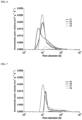
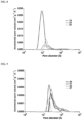
- Nonlocal DFT (NLDFT) pore-size distributions from Nz adsorption isotherms were calculated using SAIEUS software provided by Micromeritics using the 2D Heterogeneous Surface model.
- NLDFT pore-size distributions from CO 2 adsorption isotherms were calculated using the Micromeritics Carbon Slit model with high regularization. Samples were degassed under vacuum at 100-150 °C overnight prior to analysis.
- the crude polymer was dissolved in hot THF (100 mL) and subsequently precipitated into methanol (500 mL), filtered, and washed with an additional portion of methanol (200 mL). This process was repeated in hot chloroform (100 mL) and methanol (500 mL). After drying in vacuo at 65 °C, 15 was isolated as a yellow solid (4.7 g) in 82% yield.
- the product was precipitated in 400 mL MilliQ water, then filtered and rinsed with two 100 mL portions of MilliQ water, followed by an additional precipitation from dimethyl sulfoxide into MilliQ water, and then dried in vacuo at 60 °C to yield 12 (1.28 g, 81%) as a dark yellow solid.
- the product was precipitated in 400 mL MilliQ water, then filtered and rinsed with two 100 mL portions of MilliQ water, followed by an additional precipitation from DMSO into MilliQ water, and then dried in vacuo at 60 °C; The resulting dark yellow solid was isolated 1.34 g of product (84.8 % yield).
- the solid was rinsed with three 50 mL portions of MilliQ water, and then two 50 mL portions of chloroform to remove excess di-tert-butyl dicarbonate, and then dried in vacuo at 60 °C to yield 1-15 as a dark yellow solid (0.90 g, 74 % yield).
- the product was precipitated in MilliQ water (400 mL), filtered and rinsed with two portions of MilliQ water (100 mL each), and then dried in vacuo at 60 °C to give 20 as a dark yellow solid (1.28 g) in 81% yield.
- the solid was rinsed with three portions of MilliQ water (50 mL each), and then two portions of chloroform (50 mL each) to remove excess di- tert -butyl dicarbonate, and then dried in vacuo at 60 °C to give 22 as a dark yellow solid (0.90 g) in 74% yield.
- the solid was rinsed with three portions of MilliQ water (50 mL each), and then two portions of chloroform (50 mL each) to remove excess di-tert-butyl dicarbonate, and then dried in vacuo at 60 °C to give 29 as a dark yellow solid (1.2 g) in 56% yield.
- Polymer inks were prepared in a suitable solvent, such as chloroform or NMP, at a concentration typically of 10-200 mg mL -1 .
- a suitable solvent such as chloroform or NMP
- free-standing membranes were prepared in a desirable thickness from a user-defined volume of ink in a Teflon well under a crystallization dish, which aids in controlling the rate of solvent evaporation.
- freestanding membranes were cast onto a suitable substrate, such as glass, using a wet film applicator, such as a blade-coater.
- glass substrates were prepared by washing with soap and water, followed by rinses with acetone and isopropanol, after which they were submerged in an aqueous bath of 0.1 M H 2 SO 4 for a minimum of 12 h.
- the glass substrates were quickly rinsed with deionized water to remove excess acid, pat-dried with lint-free wipers, and then placed on the bed of a blade coater heated to 40 °C. Kapton tape was applied to the glass substrates to decrease ink migration. Ink was then applied within the well before it was blade coated at a 50-200 ⁇ m height.
- the ink was covered with a crystallization dish and left on the heated bed of the blade coater until it was no longer tacky ( ⁇ 16 h).
- the heated bed was turned off and the membrane was allowed to reach room temperature before being placed in a bath of Milli-Q water for delamination. All membranes were soaked overnight in the appropriate electrolyte before use.
- Thin films of microporous polymers on porous supports can be prepared using a wet film applicator, such as an Elcometer 4340 Automatic Film Applicator.
- Inks of the polymers 25-500 mg mL -1 ) were prepared in a suitable solvent, such as chloroform.
- An appropriate volume of ink was deposited onto the polyolefin battery separator and then applied across the separator surface as a thin film with an Elcometer wire-wound rod with a user-defined wet film height specification, typically 20 ⁇ m.
- the thickness of the polymer layer can be determined using a variety of methods, such as cross-sectional SEM, and thicknesses determined were typically 0.5-5 ⁇ m, depending on the choice of polymer and solvent, the concentration of polymer in the solvent, the viscosity of the ink, the wet film height specification, and other experimental parameters.
- Example 6 Aqueous Electrochemical Cells Implementing a metallic Zinc anode alongside an organic cathode dissolved in electrolyte.
- An interchangeable membrane glass H-cell was employed for battery testing.
- a membrane of 19 with a thickness of 90-100 ⁇ m was soaked in a solution of 1.0 M ammonium chloride overnight and then placed in between the two compartments.
- the catholyte was composed of aqueous 0.035 M sodium (2,2,6,6-tetramethylpiperidin-1-yl)oxyl-4-sulfate and 1.73 M ammonium chloride, with a reticulated vitreous carbon current collector.
- the anolyte was composed of aqueous 0.5 M zinc chloride and 1.0 M ammonium chloride, with a zinc foil current collector, cut to 1 ⁇ 2 cm and pre-treated with 1.0 M hydrochloric acid.
- Example 7 Electrochemical Cells Implementing a metallic Lithium anode coated with a microporous polymer interlayer alongside a composite cathode.
- CR2032 coin cells were assembled with a single spacer and spring pressed at 1000 psi, Celgard 2535 separators, 70 ⁇ L of liquid electrolyte (1.0 M LiPF 6 in EC:DMC (1:1) with 10% w / w fluoroethylene carbonate (FEC) and 1% w / w vinylene carbonate (VC)) and standard Li electrodes onto which PIMs were cast as inks in tetrahydrofuran (12.5 mg mL -1 ), which were dried overnight before cell assembly.
- liquid electrolyte 1.0 M LiPF 6 in EC:DMC (1:1) with 10% w / w fluoroethylene carbonate (FEC) and 1% w / w vinylene carbonate (VC)
- Li-NMC-622 cells were assembled with PIM-1, 13, or 14 cast onto 1.5-mrn thick Li anodes (40 ⁇ L of ink, yielding ⁇ 15 ⁇ m-thick overlayers) alongside NMC-622 (LiNi 0.6 Mn 0.2 Co 0.2 O 2 ) cathodes with areal capacity of 1.44 mAh cm -2 . Cycling was carried out at 25 °C with three initialization cycles at 0.1 mA cm -2 before cycling at 1 mA cm -2 until 70% of the initial capacity was observed. See FIG.
- complementary functional groups newly generated along the polymer backbone e.g., carboxylate-ammonium bridges
- changes in conformational and configurational entropy of the polymer backbone e.g . , due to benzimide or benzimidazole ring-opening.
- alkaline-stable, ionizable functionality should be placed along the polymer backbone, rather than be a part of it, and that the backbone should have characteristically low conformational and configurational entropy (i.e., be endowed with structural rigidity) to avoid changes in packing across a broad range of pH or in response to adventitious chemical degradation.
- the ionizable functionality it is also desirable for the ionizable functionality to be anionic at high pH to afford cation exchange membranes.
- Amidoximes have unique characteristics that are useful for addressing the instability of chemical functionality appended to polymer backbones, used to promote membrane swelling and fast ion transport.
- Amidoximes are polar and ionizable at both low- and high pH (pK al ⁇ 4.5 and pK a2 ⁇ 13.3): at pH ⁇ 4, they are cationic; at pH 5-13, they are primarily charge-neutral; and at pH > 13, they are anionic ( FIG. 16A ).
- Such functionality grants expansive opportunities for cation exchange membrane development at high pH.
- amidoxime-based polymeric materials Prior to their use, described herein, as pore-lining chemical functionality in microporous polymer membranes for electrochemical devices, amidoxime-based polymeric materials have been previously implemented in gas separations and in extracting lanthanides and actinides from processed ores, where their stability at pH > 13 is a strict requirement.
- ladder polymers To address the structural rigidity of the polymer backbone, an architectural platform based on ladder polymers was designed, where conformational and configurational entropy are low and where intrinsic microporosity can be high (10-30%), relative to other classes of polymers (e.g., cellulosics, polysulfones, polyamides, polyimides, polyolefins, etc.). Such ladder polymers are often referred to as polymers of intrinsic microporosity (PIMs).
- PIMs intrinsic microporosity
- PIMs derive their unique sub-nm interconnected porosity from the frustrated packing of polymer chains in the condensed phase, which arises from primarily two macromolecular design characteristics: 1) severely restricted conformational degrees of freedom available to the polymer chain, through the incorporation of spirocyclic or polycyclic monomers into the main chain, or, alternatively, monomers whose bonds are hindered with respect to rotation ( e.g., ortho -substituted arenes, atropisomers, etc.); and 2) persistent kinks along the main chain, in either 2D or 3D, depending on the nature of the site(s) of contortion embodied by the monomer(s).
- the free energy was calculated as a function of center-of-mass separation of dimer branches for each dimer in the neutral and fully deprotonated states ( FIG. 16D ). Due to the difference in the mutual orientation of the branches in the 2D and 3D dimers, the equilibrium separations are slightly different, yet largely independent of the degree of ionization. The curvatures of the free-energy profiles at the equilibrium separations reflect the overall softness of dimers, mostly related to the bending of the dimer branches.
- amidoxime-functionalized AquaPIMs 1-3 were synthesized using a high-yielding, scalable two-step sequence ( FIG. 17A ).
- tetrafluoroterephthalonitrile was polymerized under basic conditions in DMF with varying proportions of bridged bicyclic and spirocyclic biscatechol monomers, which feature 2D and 3D contortion sites, respectively.
- the cyano groups on the polymers were quantitatively interconverted to amidoximes using hydroxylamine under refluxing conditions, yielding AquaPIMs 1-3.
- AquaPIMs 1-3 were soluble polymers, suitable for casting membranes, those incorporating more than 50% of the bridged bicyclic monomer were not immediately; therefore, the analysis detailed below was restricted to these three.
- hydrophobic PIMs 1-3 exhibited a scattering feature at q ⁇ 0.6 ⁇ -1 (9.8-10.8 ⁇ in real-space), as well as peaks at larger q , which track those observed for the AquaPIMs.
- the lack of low- q intensity in the AquaPIM scattering patterns suggested that the polymer network was more densely packed than some other PIMs, which was expected given the hydrogen bond accepting and donating nature of amidoxime groups. This microstructural analysis of the pore network was consistent with that obtained from the N 2 adsorption experiments.
- the architectural attributes for AquaPIMs 1-3 take form as a microporous polymer membrane for aqueous electrochemical devices by solvent casting, since the T g for PIMs is higher than their temperature of decomposition (i.e., PIMs are not thermally processable).
- Both freestanding and supported membranes were prepared using solvent-casting techniques from inks formulated in N -methyl-2-pyrrolidone (100-300 mg mL -1 ). Of the three polymers, membranes cast from AquaPIM 1 were the most robust to handling for a wide range of electrolyte formulations and membrane thicknesses, on or off a support such as Celgard 3501.
- the intrinsic membrane ionic conductivity was then calculated by considering the thickness of the AquaPIM overlayer: ⁇ values of 16.7, 15.0, 6.3 mS cm -1 differentiated the transport properties of AquaPIMs 1-3, respectively.
- the observed changes were consistent with the relative pore architecture of the three polymers ( FIG. 17C ), which are evidently dictated by the ratio of 2D and 3D monomers incorporated into the polymer chains. While all three polymers exhibited high conductivity under these conditions, AquaPIM 1 membranes were particularly promising for direct comparison to other membranes, considering their ease of processability and superior mechanical integrity.
- the ionic conductivity of AquaPIMs 1-3 in aqueous alkaline electrolyte is on par or higher when compared to other polymer membranes-however, most of these membranes have been developed as anion-exchange membranes for fuel cells and other devices.
- the intentional design of AquaPIMs as cation exchange membranes begins to resolve technology gaps for polymer membranes suitable for use in aqueous alkaline electrochemical devices, where the working ions are cations rather than hydroxide or chloride.
- AquaPIM 1's membrane ionic conductivity is 0.18 mS cm -1 for the 1.0 M NaCl electrolyte and 0.70 mS cm -1 for the 1.0 M NH 4 Cl electrolyte
- its conductivity jumps orders of magnitude to 7.9 mS cm -1 for the 1.0 M KOH electrolyte and advances further to 21.5 mS cm -1 at 5.0 M KOH, and eventually backtracks to 16.9 mS cm -1 in 40% aqueous KOH ( w / w ) due to its high viscosity.
- AquaPIM conductivity therefore quickly meets and eventually exceeds that of Nafion 212 with increasing KOH in the electrolyte.
- Sub-Nanometer Pore Architectures Inherent to AquaPIM Membranes Strictly Enforces Membrane Transport Selectivity.
- a variety of cell chemistries based on inorganics, metal coordination complexes, organometallics, polyoxometalates, redox-active organic molecules have recently emerged, setting the stage for membrane development given the challenges faced in managing active-material crossover in cells implementing them.
- three cell chemistries were explored: Zn-TEMPO-sulfate, Zn-K 4 Fe(CN) 4 , and Zn-Na 2 S 4 .
- the crossover of poly sulfides in such cells could lead to the formation of zinc sulfide either in the anolyte, or on the Zn electrode, if left unchecked.
- Complete passivation of the Zn electrode by ionically insulating ZnS would render it inoperable, which would prevent the cell from functioning. Indeed, after cell assembly, only 1% of the 8 mAh theoretical capacity was accessed in the initial cycle, fading to 0.6% of the theoretical capacity after 100 cycles.
Landscapes
- Chemical & Material Sciences (AREA)
- Organic Chemistry (AREA)
- Chemical Kinetics & Catalysis (AREA)
- General Chemical & Material Sciences (AREA)
- Electrochemistry (AREA)
- Engineering & Computer Science (AREA)
- Manufacturing & Machinery (AREA)
- Health & Medical Sciences (AREA)
- Medicinal Chemistry (AREA)
- Polymers & Plastics (AREA)
- Dispersion Chemistry (AREA)
- Organic Low-Molecular-Weight Compounds And Preparation Thereof (AREA)
- Addition Polymer Or Copolymer, Post-Treatments, Or Chemical Modifications (AREA)
Claims (15)
- Mikroporöses Polymer gemäß der Formel:
-[A-AB-B]n-,
oder ein Salz davon,
wobei:n eine ganze Zahl im Bereich von 10 bis 10.000 ist;jedes Monomersegment A-A unabhängig ein Monomersegment gemäß der Formel (A), (B), (C), (D), (E), (F), (G) oder (H) ist:
 jedes Monomersegment B-B unabhängig ein Monomersegment gemäß der Formel (a), (b), (c), (d), (e) oder (f) ist:
 jedes R11 unabhängig aus der Gruppe ausgewählt ist, bestehend aus -CH2NR1R2 und H;jedes R12 unabhängig aus der Gruppe ausgewählt ist, bestehend aus - C(NOR13)N(R14)2 und -CN;wenigstens ein R11 in wenigstens einem Monomersegment A-A -CH2NR1R2 ist, oder wenigstens ein R12 in wenigstens einem Monomersegment B-B - C(NOR13)N(R14)2 ist;jedes R1 und R2 unabhängig aus der Gruppe ausgewählt ist, bestehend aus (C1-20)Alkyl, (C2-20)Alkenyl, (C2-20)Alkinyl, (C6-12)Aryl, (C3-8)Cycloalkyl, (C6-12)Aryl(C1-20)alkyl, (C3-8)Cycloalkyl(C1-20)alkyl, Hetero(C1-20)alkyl, 3- bis 8-gliedrigem Heterocyclyl, 3- bis 8-gliedrigem Heterocyclyl-(C1-20)alkyl, 5- bis 8-gliedrigem Heteroaryl, Heteroaryl(C1-20)alkyl,wobei jedes R1 und R2 optional und unabhängig mit einem oder mehreren Z1 substituiert ist;wobei jedes Alkyl, Alkenyl und Alkinyl in R1 und R2 optional und unabhängig ein oder mehrere Heteroatome umfassen, die unabhängig aus Silicium, einem Chalkogenid und einem Pnictid ausgewählt sind, undwobei ein oder mehrere Atome in R1 und R2 optional und unabhängig in oxidierter Form als C=O, C=S, N=O, N=S, S=O oder S(O)2 vorliegen; oderalternativ jedes R1 optional und unabhängig mit R2 und dem Stickstoffatom, an das beide gebunden sind, zusammengenommen wird, um 3- bis 8-gliedriges Heterocyclyl oder 5- bis 8-gliedriges Heteroaryl auszubilden, wobei jedes davon optional mit einem oder mehreren Z2 substituiert ist;jedes Z1 und Z2 unabhängig aus der Gruppe ausgewählt ist, bestehend aus Halogen, - OH, -NO2, -CN, (C1-20)Alkyl, (C2-20)Alkenyl, (C2-20)Alkinyl, (C6-12)Aryl, (C3-8)Cycloalkyl, (C6-12)Aryl(C1-20)alkyl, Hetero(C1-20)alkyl, 3- bis 8-gliedrigem Heterocyclyl, 5- bis 8-gliedrigem Heteroaryl, (C3-8)Cycloalkyl(C1-20)alkyl, 3-bis 8-gliedrigem Heterocyclyl-(C1-20)alkyl, 5- bis 8-gliedrigem Heteroaryl-(C1-20)alkyl, Halo(C1-20)alkyl, Halo(C1-20)alkyloxy, -OR6, -SR6, -S(O)R6, -S(O)2R6, -SO2NR6R7, -NR6C(O)R7, -NR6S(O)2R7, -NR6C(O)NR7R8, -NR6R7, -CO2R6, - C(O)NR6R7, und -C(O)R6;jedes R3, R4, R5, R6, R7 und R8 unabhängig aus der Gruppe ausgewählt ist, bestehend aus (C1-20)Alkyl, (C2-20)Alkenyl, (C2-20)Alkinyl, (C6-12)Aryl, (C3-8)Cycloalkyl, (C6-12)Aryl(C1-20)alkyl, (C3-8)Cycloalkyl(C1-20)alkyl, Hetero(C1-20)alkyl, 3- bis 8-gliedrigem Heterocyclyl, 3- bis 8-gliedrigem Heterocyclyl-(C1-20)alkyl, 5-bis 8-gliedrigem Heteroaryl, 5- bis 8-gliedrigem Heteroaryl-(C1-20)alkyl; oderalternativ R4 und R5 zusammengenommen werden, um (C4-8)Cycloalkyl, (C6-12)Aryl, 4- bis 8-gliedriges Heterocyclyl oder 5- bis 8-gliedriges Heteroaryl auszubilden; oderalternativ R6 und R7 zusammengenommen werden, um 4- bis 8-gliedriges Heterocyclyl oder 5- bis 8-gliedriges Heteroaryl auszubilden; oderalternativ R7 und R8 zusammengenommen werden, um 4- bis 8-gliedriges Heterocyclyl oder 5- bis 8-gliedriges Heteroaryl auszubilden;jedes R13 aus der Gruppe ausgewählt ist, bestehend aus H, (C1-20)Alkyl und (C3-8)Cycloalkyl, wobei Alkyl und Cycloalkyl optional und unabhängig mit einem oder mehreren Z3 substituiert sind,vorausgesetzt, dass R13 (C1-20)-Alkyl oder (C3-8)-Cycloalkyl ist, von denen jedes optional und unabhängig mit einem oder mehreren Z3 substituiert ist, wenn alle R11-Gruppen in Monomersegmente gemäß Formel (A) H sind;jedes R14 unabhängig aus der Gruppe ausgewählt ist, bestehend aus H, (C1-20)Alkyl und (C3-8)Cycloalkyl, undjedes Z3 unabhängig aus der Gruppe ausgewählt ist, bestehend aus Halogen, -NO2, - CN, -OH, -SO3H, -NH2, (C1-20)Alkyl, (C2-20)Alkenyl, (C2-20)Alkinyl, (C6-12)Aryl, (C3-8)Cycloalkyl, (C6-12)Aryl(C1-20)alkyl, Hetero(C1-20)alkyl, 3- bis 8-gliedrigem Heterocyclyl, 5- bis 8-gliedrigem Heteroaryl, (C3-8)Cycloalkyl-(C1-20)alkyl, 3- bis 8-gliedrigem Heterocyclyl-(C1-20)alkyl, 5- bis 8-gliedrigem Heteroaryl-(C1-20)alkyl, Halo(C1-20)alkyl, Halo(C1-20)alkyloxy, -OR6, -SR6, - S(O)R6, -S(O)2R6, -SO2NR6R7, -NR6C(O)R7, -NR6S(O)2R7, -NR6C(O)NR7R8 - NR6R7, -CO2R6, -C(O)NR6R7, und -C(O)R6.
 - Mikroporöse Polymer nach Anspruch 1 oder ein Salz davon, wobei:(i) jedes Monomersegment A-A unabhängig ein Monomersegment gemäß der Formel (A-i), (B-i), (C-i), (D-i), (E-i), (F-i), (G-i) oder (H-i) ist:

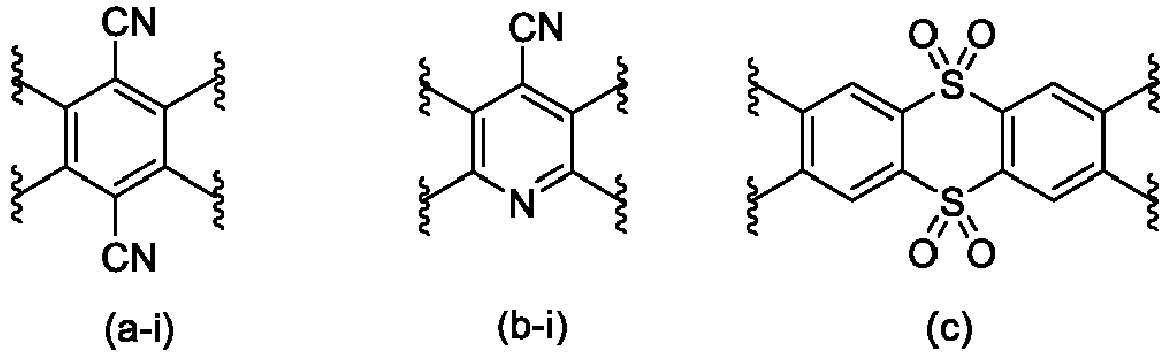
 (ii) jedes Monomersegment A-A unabhängig ein Monomersegment gemäß der Formel (A-i), (B-i), (C-i), (D-i), (E-i), (F-i), (G-i), (H), (B-ii), (C-ii), (C-ii), (E-ii), (F-ii), (G-ii) oder (H-ii) ist:


 (iii) jedes Monomersegment A-A unabhängig ein Monomersegment gemäß der Formel (A-i), (B-i), (C-i), (D-i), (E-i), (F-i), (G-i), (H-i), (B-ii), (C-ii), (D-ii), (E-ii), (F-ii), (G-ii), (H-ii) oder (A-ii) ist:


- Mikroporöses Polymer nach Anspruch 2 oder ein Salz davon, wobei:(i) die mikroporösen Polymer einen Oberflächenbereich von etwa 5 m2 g-1 bis etwa 1000 m2 g-1 aufweisen; oder(ii) die mikroporösen Polymer Porengrößen im Bereich von etwa 0,4 nm bis etwa 5 nm aufweisen; oder(ii) die mikroporösen Polymer eine Porosität im Bereich von etwa 5 % bis etwa 40 % aufweisen.
- Verbindung gemäß den Formeln (I), (II), (III), (IV), (V), (VI), (VII) oder (VIII):

wobei:jedes R1 und R2 unabhängig aus der Gruppe ausgewählt ist, bestehend aus (C1-20)Alkyl, (C2-20)Alkenyl, (C2-20)Alkinyl, (C6-12)Aryl, (C3-8)Cycloalkyl, (C6-12)Aryl-(C1-20)alkyl, (C3-8)Cycloalkyl(C1-20)alkyl, Hetero(C1-20)alkyl, 3- oder 8-gliedrigem Heterocyclyl, 3- bis 8-gliedrigem Heterocyclyl-(C1-20)alkyl, 5- bis 8-gliedrigem Heteroaryl, 5- bis 8-gliedrigem Heteroaryl-(C1-20)alkyl,wobei jedes R1 und R2 optional und unabhängig mit einem oder mehreren Z1 substituiert ist,wobei jedes Alkyl, Alkenyl und Alkinyl in R1 und R2 optional und unabhängig ein oder mehrere Heteroatome umfassen, die unabhängig aus Silicium, einem Chalkogenid und einem Pnictid ausgewählt sind, undwobei ein oder mehrere Atome in R1 und R2 optional und unabhängig in oxidierter Form als C=O, C=S, N=O, N=S, S=O oder S(O)2 vorliegen; oderalternativ jedes R1 optional und unabhängig mit R2 und dem Stickstoffatom, an das beide gebunden sind, zusammengenommen wird, um 3- bis 8-gliedriges Heterocyclyl oder 5- bis 8-gliedriges Heteroaryl auszubilden, wobei jedes davon optional mit einem oder mehreren Z2 substituiert ist;jedes Z1 und Z2 unabhängig aus der Gruppe ausgewählt ist, bestehend aus Halogen, - OH, -NO2, -CN, (C1-20)Alkyl, (C2-20)Alkenyl, (C2-20)Alkinyl, (C6-12)Aryl, (C3-8)Cycloalkyl, (C6-12)Aryl(C1-20)alkyl, Hetero(C1-20)alkyl, 3- bis 8-gliedrigem Heterocyclyl, 5- bis 8-gliedrigem Heteroaryl, (C3-8)Cycloalkyl(C1-20)alkyl, 3-bis 8-gliedrigem Heterocyclyl-(C1-20)alkyl, 5- bis 8-gliedrigem Heteroaryl-(C1-20)alkyl, Halo(C1-20)alkyl, Halo(C1-20)alkyloxy, -OR6, -SR6, -S(O)R6, -S(O)2R6,-SO2NR6R7, -NR6C(O)R7, -NR6S(O)2R7, -NR6C(O)NR7R8, -NR6R7, -CO2R6,-C(O)NR6R7, und -C(O)R6;jedes R3, R4, R5, R6, R7 und R8 unabhängig aus der Gruppe ausgewählt ist, bestehend aus (C1-20)Alkyl, (C2-20)Alkenyl, (C2-20)Alkinyl, (C6-12)Aryl, (C3-8)Cycloalkyl, (C6-12)Aryl(C1-20)alkyl, (C3-8)Cycloalkyl(C1-20)alkyl, Hetero(C1-20)alkyl, 3- bis 8-gliedrigem Heterocyclyl, 3- bis 8-gliedrigem Heterocyclyl-(C1-20)alkyl, 5- bis 8-gliedrigem Heteroaryl, 5- bis 8-gliedrigem Heteroaryl-(C1-20)alkyl; oderalternativ R4 und R5 zusammengenommen werden, um (C4-8)Cycloalkyl, (C6-12)Aryl, 4- bis 8-gliedriges Heterocyclyl oder 5- bis 8-gliedriges Heteroaryl auszubilden; oderalternativ R6 und R7 zusammengenommen werden, um 4- bis 8-gliedriges Heterocyclyl oder 5- bis 8-gliedriges Heteroaryl auszubilden; oderalternativ R7 und R8 zusammengenommen werden, um 4- bis 8-gliedriges Heterocyclyl oder 5- bis 8-gliedriges Heteroaryl auszubilden. - Verfahren zum Herstellen einer Verbindung nach Anspruch 4, wobei das Verfahren umfasst:
Ausbilden einer Mischung, umfassend (i) einen Aminvorläufer mit der Formel R1-NH-R2, (ii) Formaldehyd oder eine formaldehyderzeugende Verbindung und (iii) eine Verbindung, ausgewählt aus (Ia), (IIa), (IIIa), (IVa), (Va), (VIa), (VIIa) oder (Vllla):

- Verfahren nach Anspruch 5, wobei:(i) die Mischung ferner ein Lösungsmittel oder eine Mischung von Lösungsmitteln umfasst; und/oder(ii) die Mischung auf Umgebungstemperatur gehalten wird; und/oder(iii) die Mischung auf einer erhöhten Temperatur gehalten wird, die durch herkömmliches Erwärmen oder durch mikrowellenunterstütztes Erwärmen erreicht wird.
- Verfahren zum Herstellen eines mikroporösen Polymers nach Anspruch 1, wobei das Verfahren umfasst:Ausbilden einer Polymerisationsmischung, umfassend:(1) eine Mehrzahl von A-A-Monomeren, wobei jedes A-A-Monomer unabhängig eine Verbindung gemäß Formel (I), (II), (III), (IV), (V), (VI), (VII) oder (VIII) nach Anspruch 4 oder Formel (Ia), (IIa), (IIIa), (IVa), (Va), (VIa), (VIIa) oder (VIIIa) nach Anspruch 5 ist,(2) einer Mehrzahl von B-B-Monomeren, wobei jedes B-B-Monomer unabhängig eine Verbindung gemäß Formel (i), (ii), (iii), (iv), (v), (vi), (vii) oder (viii) ist:
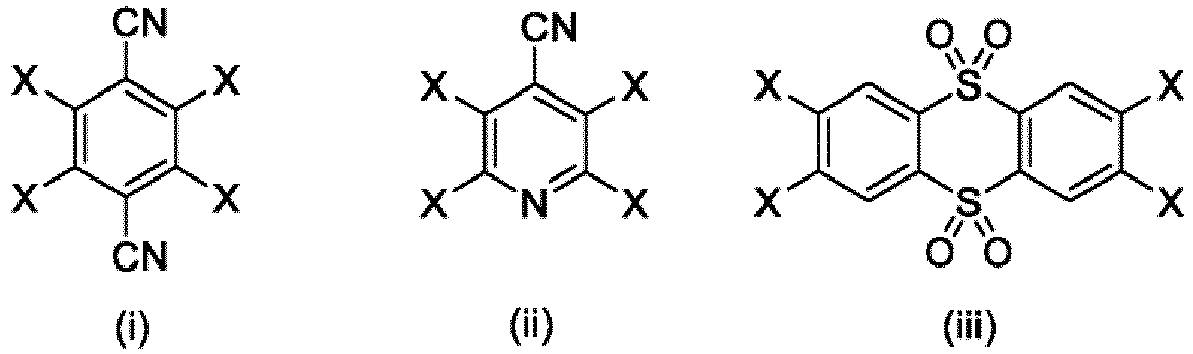
 (3) einer Base, undErwärmen der Polymerisationsmischung, wobei dadurch das mikroporöse Polymer ausgebildet wird.
 - Verfahren nach Anspruch 7, wobei:(i) die Polymerisationsmischung ferner feste Mahlkörper, flüssige Mahlkörper oder eine Kombination davon umfasst; und/oder(ii) das Verfahren ferner das Schütteln oder Rotieren der Polymerisationsmischung umfasst.
- Verfahren nach Anspruch 7 oder 8, wobei wenigstens ein Monomersegment B-B in dem mikroporösen Polymer ein Monomersegment gemäß Formel (a-i) oder Formel (b-i) nach Anspruch 2 ist und das Verfahren ferner das Kombinieren des mikroporösen Polymers mit Hydroxylamin unter Bedingungen umfasst, die ausreichen, um ein modifiziertes mikroporöses Copolymer mit wenigstens einem Monomersegment B-B gemäß Formel (a-ii) oder Formel (b-ii) nach Anspruch 2 auszubilden,
wobei das Verfahren optional ferner das Erwärmen des mikroporösen Polymers und des Hydroxylamins umfasst. - Verfahren nach Anspruch 9, ferner umfassend:Kombinieren des modifizierten mikroporösen Copolymers mit einer Base und einem Alkylierungsmittel unter Bedingungen, die ausreichen, um ein alkyliertes mikroporöses Polymer mit wenigstens einem Monomersegment B-B gemäß Formel (a-iii), (b-iii), (a-iv), (b-iv), (a-v), (b-v), (a-vi) oder (b-vi) nach Anspruch 2 auszubilden,wobei optional:(i) die Base eine organische oder eine anorganische Base ist; und/oder(ii) das Alkylierungsmittel aus der Gruppe ausgewählt ist, bestehend aus Dimethylsulfat, Diethylsulfat, Propansulton und Butansulton; und/oder(iii) das Verfahren ferner das Erwärmen des modifizierten mikroporösen Copolymers, der Base und des Alkylierungsmittels umfasst; und/oder(iv) das alkylierte mikroporöse Copolymer wenigstens ein Monomersegment B-B gemäß Formel (a-v), (b-v), (a-vi) oder (b-vi) umfasst und das Verfahren ferner das Kombinieren des alkylierten mikroporösen Polymers mit einem Salz A+X- unter Bedingungen umfasst, die ausreichen, um ein kationenausgetauschtes mikroporöses Polymer auszubilden, wobei das Kation A+ ein Metallkation oder ein organisches Kation ist, und das Anion X- ein organisches Anion oder ein anorganisches Anion ist.
- Verfahren nach Anspruch 9, umfassend ferner das Kombinieren des modifizierten mikroporösen Copolymers mit einer Säure und einer carbokationerzeugenden Verbindung, um ein alkyliertes mikroporöses Polymer mit wenigstens einem B-B-Segment gemäß der Formel (a-vii), (b-vii), (a-iii) oder (b-iii) nach Anspruch 2 auszubilden, wobei:(i) die carbokationerzeugende Verbindung optional Di-tert-butylcarbonat oder Camphen ist, und(ii) das Verfahren optional ferner das Erwärmen des modifizierten mikroporösen Copolymers, der Säure und der carbokationerzeugenden Verbindung umfasst.
- Membran, umfassend ein oder mehrere mikroporöse Polymere nach einem der Ansprüche 1-3 oder Salze davon, wobei die Membran eine Dicke im Bereich von 0,1-1000 Mikrometern aufweist.
- Membran nach Anspruch 12, wobei:(i) wenigstens eine Wiederholeinheit der Membran mit einer nicht benachbarten Wiederholeinheit durch einen Vernetzer vernetzt ist; und/oder(ii) der Vernetzer aus der Gruppe ausgewählt ist, bestehend aus 2,6-Bis(4-azidobenzyliden)cyclohexanon, Sauerstoff, 2,6-Bis(4-azidobenzyliden)-4-methylcyclohexanon, 2,6-Bis(4-azidobenzyliden)-4-ethylcyclohexanon, 4-Azidophenylsulfon und Kombinationen davon; und/oder(iii) die Membran mit einem Träger in Berührung steht, umfassend ein Poly(arylether), ein Poly(arylether)-Copolymer, ein Poly(arylethersulfon)-Copolymer, Polyethylen, ein Polyethylen-Copolymer, Polypropylen, ein Polypropylen-Copolymer, Polyacrylonitril, ein Polyacrylonitril-Copolymer, Poly(vinylidenfluorid), Poly(tetrafluorethylen), Poly(vinylchlorid), ein Poly(vinylchlorid)-Copolymer, Poly(hexafluorpropylen), ein Poly(hexafluorpropylen)-Copolymer, ein Polyaramid, ein Polyaramid-Copolymer, ein poröses Metall, ein poröses legiertes Metall, ein poröses Metalloxid oder eine Kombination davon.
- Verfahren zum Herstellen einer Membran nach Anspruch 12, umfassend:Gießen wenigstens eines mikroporösen Polymers nach einem der Ansprüche 1-3 aus einer Lösung oder einer Dispersion des Polymers in einem Lösungsmittel oder einer Mischung von Lösungsmitteln, die dann im Wesentlichen durch Verdampfen entfernt werden, um die Membran herzustellen,wobei das Verfahren optional ferner das Mischen der Polymere in einem Lösungsmittel mit einem Vernetzungsmittel, bevor das Lösungsmittel verdampft wird, und dann das anschließende Aussetzen gegenüber ultravioletter Strahlung oder Erwärmen umfasst, undwobei das Verfahren optional ferner das Verdampfen von Lösungsmittel aus dem mikroporösen Polymer auf einem Träger umfasst, um eine geträgerte Membran nach Anspruch 13, Option (iii), zu erhalten.
- Elektrochemische Zelle, umfassend:eine Anode;einen Anodenelektrolyten in Berührung mit der Anode;einen Separator in Berührung mit dem Anodenelektrolyten, wobei der Separator eine Membran nach Anspruch 12 oder 13 umfasst;eine Kathode;einen Kathodenelektrolyten in Berührung mit dem Separator; undeinen Kathodenelektrolyten in Berührung mit der Kathode.
Applications Claiming Priority (2)
| Application Number | Priority Date | Filing Date | Title |
|---|---|---|---|
| US201862719498P | 2018-08-17 | 2018-08-17 | |
| PCT/US2019/046886 WO2020037246A1 (en) | 2018-08-17 | 2019-08-16 | Diversity-oriented polymers of intrinsic microporosity and uses thereof |
Publications (3)
| Publication Number | Publication Date |
|---|---|
| EP3837038A1 EP3837038A1 (de) | 2021-06-23 |
| EP3837038A4 EP3837038A4 (de) | 2022-03-02 |
| EP3837038B1 true EP3837038B1 (de) | 2023-02-15 |
Family
ID=69525859
Family Applications (1)
| Application Number | Title | Priority Date | Filing Date |
|---|---|---|---|
| EP19850375.7A Active EP3837038B1 (de) | 2018-08-17 | 2019-08-16 | Diversitätsorientierte polymere mit intrinsischer mikroporosität und deren verwendungen |
Country Status (3)
| Country | Link |
|---|---|
| US (2) | US12084544B2 (de) |
| EP (1) | EP3837038B1 (de) |
| WO (1) | WO2020037246A1 (de) |
Families Citing this family (18)
| Publication number | Priority date | Publication date | Assignee | Title |
|---|---|---|---|---|
| WO2016161367A1 (en) | 2015-04-03 | 2016-10-06 | The Regents Of The University Of California | Polymeric materials for electrochemical cells and ion separation processes |
| WO2018064365A1 (en) | 2016-09-28 | 2018-04-05 | Sepion Technologies, Inc. | Electrochemical cells with ionic sequestration provided by porous separators |
| EP3551688B1 (de) | 2016-12-07 | 2023-07-26 | Sepion Technologies, Inc. | Mikrostrukturierte ionenleitende verbundwerkstoffe und verwendungen davon |
| CN111675718B (zh) * | 2020-06-16 | 2021-12-21 | 武汉天马微电子有限公司 | 一种化合物及包含其的有机发光器件、显示面板和显示装置 |
| CN111560011B (zh) * | 2020-07-14 | 2020-12-29 | 宁波卢米蓝新材料有限公司 | 一种有机化合物及其制备方法和应用 |
| EP4334987A4 (de) * | 2021-05-05 | 2026-02-11 | Univ California | Materialien, komponenten und designs für hochleistungsbatterien |
| CN113336773B (zh) * | 2021-06-29 | 2022-09-13 | 东华大学 | 螺双苯并噁唑二胺及其制备方法和应用、聚酰亚胺及其制备方法和应用 |
| CN114149448B (zh) * | 2021-11-12 | 2023-03-10 | 山东第一医科大学(山东省医学科学院) | 一种用于检测硝基还原酶的近红外荧光探针及应用 |
| CN114534511B (zh) * | 2022-02-17 | 2023-08-25 | 天津大学 | 一种氢键作用调控的固有微孔高分子膜及其制备和应用 |
| CN115073479B (zh) * | 2022-05-19 | 2024-05-14 | 上海大学 | 一种具有近红外吸收性质的萘并二吡咯构筑的扩展卟啉、其制备方法及其应用 |
| CN115172990B (zh) * | 2022-07-08 | 2024-07-16 | 珠海冠宇电池股份有限公司 | 一种隔膜和电池 |
| CN115093559B (zh) * | 2022-07-18 | 2023-06-13 | 太原理工大学 | 一种自聚微孔离聚物及其制备方法和应用 |
| CN115057858A (zh) * | 2022-07-21 | 2022-09-16 | 青岛科技大学 | 一种双氮杂[5]螺烯化合物及其制备方法 |
| CN115093313B (zh) * | 2022-08-02 | 2023-08-11 | 中国科学院上海有机化学研究所 | 多甲基取代螺二氢茚烷衍生的环戊二烯,其铑络合物、制备方法、中间体及应用 |
| CN115505104B (zh) * | 2022-09-20 | 2024-01-26 | 广西民族师范学院 | 喹喔啉基共轭微孔聚合物、光电化学传感器、其制备方法及多巴胺的检测方法 |
| US20240262960A1 (en) * | 2022-12-22 | 2024-08-08 | Sepion Technologies, Inc. | Spirobisindane polymers of intrinsic microporosity and methods of making |
| EP4736255A2 (de) * | 2023-06-29 | 2026-05-06 | Sepion Technologies, Inc. | Spirobisindancopolymere und verfahren zur herstellung |
| WO2025194129A1 (en) * | 2024-03-14 | 2025-09-18 | Sepion Technologies, Inc. | Crosslinked spirobisindane polymers |
Family Cites Families (59)
| Publication number | Priority date | Publication date | Assignee | Title |
|---|---|---|---|---|
| US4485154A (en) | 1981-09-08 | 1984-11-27 | Institute Of Gas Technology | Electrically rechargeable anionically active reduction-oxidation electrical storage-supply system |
| SE445000B (sv) | 1981-10-08 | 1986-05-20 | Inst Fiz Khim Pisarzhev An | Elektrokemiskt batteri |
| US4592973A (en) | 1983-10-05 | 1986-06-03 | Castle Technology Corp. | Supported liquid membrane electrochemical separators |
| JPS62252067A (ja) | 1986-04-24 | 1987-11-02 | Haruhiko Ooya | 電池類複合隔膜 |
| JP3262708B2 (ja) | 1996-03-26 | 2002-03-04 | 日本電信電話株式会社 | 複合高分子電解質膜 |
| WO2001057940A2 (en) | 2000-02-04 | 2001-08-09 | Amtek Research International Llc | Freestanding microporous separator including a gel-forming polymer |
| US7101947B2 (en) | 2002-06-14 | 2006-09-05 | Florida State University Research Foundation, Inc. | Polyelectrolyte complex films for analytical and membrane separation of chiral compounds |
| GB0317557D0 (en) | 2003-07-26 | 2003-08-27 | Univ Manchester | Microporous polymer material |
| US7354680B2 (en) | 2004-01-06 | 2008-04-08 | Sion Power Corporation | Electrolytes for lithium sulfur cells |
| GB0411463D0 (en) | 2004-05-22 | 2004-06-23 | Univ Manchester | Thin layer composite membrane |
| KR100659820B1 (ko) | 2004-11-17 | 2006-12-19 | 삼성에스디아이 주식회사 | 리튬 이온 이차 전지 |
| US11050095B2 (en) | 2004-12-08 | 2021-06-29 | Maxell Holdings, Ltd. | Separator for electrochemical device, and electrochemical device |
| JP5135678B2 (ja) | 2005-11-24 | 2013-02-06 | 日産自動車株式会社 | 電池構造体、組電池、およびこれらを搭載した車両 |
| DE102006040749A1 (de) | 2006-08-31 | 2008-03-06 | Daimler Ag | Oxidationsstabilisierte Polymer-Elektrolyt-Membranen für Brennstoffzellen |
| US7758751B1 (en) | 2006-11-29 | 2010-07-20 | Uop Llc | UV-cross-linked membranes from polymers of intrinsic microporosity for liquid separations |
| US20090050199A1 (en) | 2007-08-21 | 2009-02-26 | Washington, University Of | Semiconducting polymer films with fixed electronic junctions |
| EP2201628B1 (de) | 2007-08-21 | 2015-02-18 | A123 Systems, Inc. | Trennglied für eine elektrochemische zelle und herstellungsverfahren dafür |
| CN102388483B (zh) | 2009-01-12 | 2016-04-06 | A123系统有限责任公司 | 叠层电池及其制备方法 |
| WO2011057384A1 (en) | 2009-11-12 | 2011-05-19 | National Research Council Of Canada | Polymers of intrinsic microporosity containing tetrazole groups |
| US9370773B2 (en) | 2010-07-04 | 2016-06-21 | Dioxide Materials, Inc. | Ion-conducting membranes |
| WO2016064440A1 (en) | 2014-10-21 | 2016-04-28 | Dioxide Materials | Electrolyzer and membranes |
| WO2012129411A1 (en) | 2011-03-22 | 2012-09-27 | The Regents Of The University Of California | Block copolymer battery separator |
| GB201111609D0 (en) | 2011-07-06 | 2011-08-24 | Unilever Plc | Copolymers and membranes |
| CN102903954B (zh) | 2011-07-25 | 2015-06-03 | 微宏动力系统(湖州)有限公司 | 含有离子液体电解质的锂离子二次电池 |
| CA2853796A1 (en) | 2011-10-28 | 2013-05-02 | Lubrizol Advanced Materials, Inc. | Polyurethane based membranes and/or separators for electrochemical cells |
| CN104936684B (zh) | 2012-11-26 | 2018-07-03 | 联邦科学与工业研究组织 | 混合基质聚合物组合物 |
| JP6378196B2 (ja) | 2012-12-13 | 2018-08-22 | アプライド マテリアルズ インコーポレイテッドApplied Materials,Incorporated | バッテリセパレータ上のセラミック被覆 |
| US9598545B2 (en) | 2013-01-31 | 2017-03-21 | Uchicago Argonne, Llc | Advanced separators based on aromatic polymer for high energy density lithium batteries |
| US20140255636A1 (en) | 2013-03-06 | 2014-09-11 | Saudi Basic Industries Corporation | Polymeric Membranes |
| JP6186783B2 (ja) | 2013-03-19 | 2017-08-30 | ソニー株式会社 | セパレータ、電池、電池パック、電子機器、電動車両、蓄電装置および電力システム |
| KR101700409B1 (ko) | 2013-06-19 | 2017-01-26 | 주식회사 엘지화학 | 바인더 수지 조성물, 그를 포함하는 다공성 분리막 및 그를 이용한 전기 화학 소자 |
| WO2015009990A2 (en) | 2013-07-19 | 2015-01-22 | 24M Technologies, Inc. | Semi-solid electrodes with polymer additive |
| US20150028280A1 (en) | 2013-07-26 | 2015-01-29 | Micron Technology, Inc. | Memory cell with independently-sized elements |
| KR101703957B1 (ko) | 2013-10-31 | 2017-02-08 | 주식회사 엘지화학 | 유기-무기 복합 다공성 막, 이를 포함하는 세퍼레이터 및 전극 구조체 |
| US20160263532A1 (en) | 2013-12-16 | 2016-09-15 | Sabic Global Technologies B.V. | Ultraviolet and plasma-treated polymeric membranes |
| WO2015129925A1 (en) | 2014-02-27 | 2015-09-03 | Kyoto University | Crosslinked polymer, method for producing the same, molecular sieve composition and material separation membranes |
| GB2538446A (en) | 2014-03-05 | 2016-11-16 | A123 Systems Llc | Multivalent metal salts for lithium ion cells having oxygen containing electrode active materials |
| KR102448135B1 (ko) | 2014-03-24 | 2022-09-28 | 코넬 유니버시티 | 금속 기반 배터리의 덴드라이트 억제 전해질 |
| WO2016148869A1 (en) | 2015-03-17 | 2016-09-22 | Dow Global Technologies Llc | Polymers of intrinsic microporosity |
| WO2016161367A1 (en) * | 2015-04-03 | 2016-10-06 | The Regents Of The University Of California | Polymeric materials for electrochemical cells and ion separation processes |
| CN107924769B (zh) | 2015-09-30 | 2020-11-03 | 株式会社大阪曹達 | 凝胶电解质用组合物 |
| KR102486384B1 (ko) | 2015-10-23 | 2023-01-09 | 삼성전자주식회사 | 랜덤공중합체, 이를 포함하는 전해질, 보호 음극 및 리튬전지, 및 랜덤공중합체 제조방법 |
| JP2018533818A (ja) | 2015-10-30 | 2018-11-15 | マサチューセッツ インスティテュート オブ テクノロジー | エアブリージング水性イオウ再充電可能電池 |
| EP3397371B1 (de) | 2015-12-29 | 2021-02-24 | Enlighten Innovations Inc. | Verfahren und vorrichtung zur rückgewinnung von metallen und schwefel aus metallsulfid- und polysulfid-haltigen zuströmen |
| CN107213807A (zh) | 2016-03-22 | 2017-09-29 | 苏州信望膜技术有限公司 | 一种自微孔聚合物的合成及其膜的制备方法与应用 |
| US10363546B2 (en) | 2016-05-02 | 2019-07-30 | Liso Plastics LLC | Multilayer polymeric membrane |
| US11329304B2 (en) | 2016-05-27 | 2022-05-10 | The Regents Of The University Of California | Redox-flow batteries employing oligomeric organic active materials and size-selective microporous polymer membranes |
| WO2018064365A1 (en) | 2016-09-28 | 2018-04-05 | Sepion Technologies, Inc. | Electrochemical cells with ionic sequestration provided by porous separators |
| EP3551688B1 (de) | 2016-12-07 | 2023-07-26 | Sepion Technologies, Inc. | Mikrostrukturierte ionenleitende verbundwerkstoffe und verwendungen davon |
| US10396329B2 (en) | 2017-05-01 | 2019-08-27 | Dioxide Materials, Inc. | Battery separator membrane and battery employing same |
| WO2019006045A1 (en) | 2017-06-27 | 2019-01-03 | Georgia Tech Research Corporation | COMPOSITIONS AND METHODS FOR MEMBRANE SEPARATION OF ACIDIC GAS FROM HYDROCARBON GAS |
| US20210013536A1 (en) | 2018-06-29 | 2021-01-14 | Sepion Technologies, Inc. | Membranes for aqueous redox flow batteries |
| EP3815167A4 (de) | 2018-06-29 | 2022-03-16 | Form Energy, Inc. | Wässrige poylsulfidbasierte elektrochemische zelle |
| US11245134B2 (en) | 2019-01-02 | 2022-02-08 | International Business Machines Corporation | Lithium energy storage device with composite anode |
| US11196088B2 (en) | 2019-04-11 | 2021-12-07 | Ses Holdings Pte. Ltd. | Localized high-salt-concentration electrolytes containing longer-sidechain glyme-based solvents and fluorinated diluents, and uses thereof |
| WO2020264386A1 (en) | 2019-06-28 | 2020-12-30 | Sepion Technologies, Inc. | Membranes for aqueous redox flow batteries |
| US20230216082A1 (en) | 2020-05-27 | 2023-07-06 | Sepion Technologies, Inc. | Polyelectrolyte composites |
| EP4334987A4 (de) | 2021-05-05 | 2026-02-11 | Univ California | Materialien, komponenten und designs für hochleistungsbatterien |
| WO2024015957A1 (en) | 2022-07-15 | 2024-01-18 | Sepion Technologies, Inc. | Battery separator having a polymer layer |
-
2019
- 2019-08-16 EP EP19850375.7A patent/EP3837038B1/de active Active
- 2019-08-16 US US17/269,228 patent/US12084544B2/en active Active
- 2019-08-16 WO PCT/US2019/046886 patent/WO2020037246A1/en not_active Ceased
-
2024
- 2024-09-06 US US18/826,968 patent/US20250236705A1/en active Pending
Also Published As
| Publication number | Publication date |
|---|---|
| US12084544B2 (en) | 2024-09-10 |
| EP3837038A1 (de) | 2021-06-23 |
| EP3837038A4 (de) | 2022-03-02 |
| US20210309802A1 (en) | 2021-10-07 |
| WO2020037246A1 (en) | 2020-02-20 |
| US20250236705A1 (en) | 2025-07-24 |
Similar Documents
| Publication | Publication Date | Title |
|---|---|---|
| EP3837038B1 (de) | Diversitätsorientierte polymere mit intrinsischer mikroporosität und deren verwendungen | |
| US11318455B2 (en) | Polymeric materials for electrochemical cells and ion separation processes | |
| Li et al. | Cationic covalent organic framework based all-solid-state electrolytes | |
| Song et al. | A quinone-based oligomeric lithium salt for superior Li–organic batteries | |
| JP5013776B2 (ja) | 電気化学デバイスおよび電気化学デバイス電解質用組成物 | |
| Gschwind et al. | A fluoride-doped PEG matrix as an electrolyte for anion transportation in a room-temperature fluoride ion battery | |
| US10294245B2 (en) | High performance organic electrodes for secondary batteries | |
| US20240291100A1 (en) | Materials, components, and designs for high power batteries | |
| US20090029250A1 (en) | Polymer Electrolyte The Use Thereof And An Electrochemical Device Containing Said Polymer Electrolyte | |
| EP3811446A1 (de) | Polymerelektrolyt mit mindestens einem organischen lösungsmittel und mindestens einem aromatischen ionomer und verwendungen davon | |
| US10826118B2 (en) | Process for preparing unipolar cation-conducting ionomers from difluoro ionic monomers | |
| EP4736255A2 (de) | Spirobisindancopolymere und verfahren zur herstellung | |
| US20240262960A1 (en) | Spirobisindane polymers of intrinsic microporosity and methods of making | |
| US20200165197A1 (en) | Sulfonamide macromolecules useful as single-ion conducting polymer electrolyte | |
| CN119923737A (zh) | 电池构件用涂布材料、电解质、电池及电池构件用涂布剂 | |
| WO2015104727A1 (en) | Polymer electrolyte membranes and process for the production thereof | |
| US11342573B2 (en) | Ion-imbibed membranes based on proton conducting aromatic polyether type copolymers and their application in redox flow batteries | |
| WO2025194129A1 (en) | Crosslinked spirobisindane polymers | |
| KR102903478B1 (ko) | 액체 전해질 첨가제, 이를 포함하는 액체 전해질 및 이를 포함하는 전기화학소자 | |
| CN121844425A (zh) | 电解质组合物及电池 | |
| WO2025057821A1 (ja) | 電解質組成物及び電池 | |
| JP2025040931A (ja) | 電解質組成物及び電池 | |
| KR20250060882A (ko) | 전해질 조성물, 전해질 및 전지 | |
| JP2010111639A (ja) | ケトン化合物の製造方法および蓄電デバイスの製造方法 |
Legal Events
| Date | Code | Title | Description |
|---|---|---|---|
| STAA | Information on the status of an ep patent application or granted ep patent |
Free format text: STATUS: THE INTERNATIONAL PUBLICATION HAS BEEN MADE |
|
| PUAI | Public reference made under article 153(3) epc to a published international application that has entered the european phase |
Free format text: ORIGINAL CODE: 0009012 |
|
| STAA | Information on the status of an ep patent application or granted ep patent |
Free format text: STATUS: REQUEST FOR EXAMINATION WAS MADE |
|
| 17P | Request for examination filed |
Effective date: 20210212 |
|
| AK | Designated contracting states |
Kind code of ref document: A1 Designated state(s): AL AT BE BG CH CY CZ DE DK EE ES FI FR GB GR HR HU IE IS IT LI LT LU LV MC MK MT NL NO PL PT RO RS SE SI SK SM TR |
|
| DAV | Request for validation of the european patent (deleted) | ||
| DAX | Request for extension of the european patent (deleted) | ||
| A4 | Supplementary search report drawn up and despatched |
Effective date: 20220127 |
|
| RIC1 | Information provided on ipc code assigned before grant |
Ipc: B01D 71/72 20060101ALI20220121BHEP Ipc: B01D 67/00 20060101ALI20220121BHEP Ipc: C08G 65/48 20060101ALI20220121BHEP Ipc: C08G 65/40 20060101ALI20220121BHEP Ipc: B01D 71/82 20060101ALI20220121BHEP Ipc: B01D 71/52 20060101ALI20220121BHEP Ipc: B01D 69/02 20060101AFI20220121BHEP |
|
| REG | Reference to a national code |
Ref country code: DE Ref legal event code: R079 Ref document number: 602019025366 Country of ref document: DE Free format text: PREVIOUS MAIN CLASS: B01D0067000000 Ipc: B01D0069020000 |
|
| GRAP | Despatch of communication of intention to grant a patent |
Free format text: ORIGINAL CODE: EPIDOSNIGR1 |
|
| STAA | Information on the status of an ep patent application or granted ep patent |
Free format text: STATUS: GRANT OF PATENT IS INTENDED |
|
| RIC1 | Information provided on ipc code assigned before grant |
Ipc: B01D 71/72 20060101ALI20220816BHEP Ipc: B01D 67/00 20060101ALI20220816BHEP Ipc: C08G 65/48 20060101ALI20220816BHEP Ipc: C08G 65/40 20060101ALI20220816BHEP Ipc: B01D 71/82 20060101ALI20220816BHEP Ipc: B01D 71/52 20060101ALI20220816BHEP Ipc: B01D 69/02 20060101AFI20220816BHEP |
|
| INTG | Intention to grant announced |
Effective date: 20220905 |
|
| GRAS | Grant fee paid |
Free format text: ORIGINAL CODE: EPIDOSNIGR3 |
|
| GRAA | (expected) grant |
Free format text: ORIGINAL CODE: 0009210 |
|
| STAA | Information on the status of an ep patent application or granted ep patent |
Free format text: STATUS: THE PATENT HAS BEEN GRANTED |
|
| AK | Designated contracting states |
Kind code of ref document: B1 Designated state(s): AL AT BE BG CH CY CZ DE DK EE ES FI FR GB GR HR HU IE IS IT LI LT LU LV MC MK MT NL NO PL PT RO RS SE SI SK SM TR |
|
| REG | Reference to a national code |
Ref country code: CH Ref legal event code: EP Ref country code: GB Ref legal event code: FG4D |
|
| REG | Reference to a national code |
Ref country code: DE Ref legal event code: R096 Ref document number: 602019025366 Country of ref document: DE |
|
| REG | Reference to a national code |
Ref country code: AT Ref legal event code: REF Ref document number: 1547956 Country of ref document: AT Kind code of ref document: T Effective date: 20230315 Ref country code: IE Ref legal event code: FG4D |
|
| REG | Reference to a national code |
Ref country code: NL Ref legal event code: FP |
|
| REG | Reference to a national code |
Ref country code: LT Ref legal event code: MG9D |
|
| P01 | Opt-out of the competence of the unified patent court (upc) registered |
Effective date: 20230512 |
|
| REG | Reference to a national code |
Ref country code: AT Ref legal event code: MK05 Ref document number: 1547956 Country of ref document: AT Kind code of ref document: T Effective date: 20230215 |
|
| PG25 | Lapsed in a contracting state [announced via postgrant information from national office to epo] |
Ref country code: RS Free format text: LAPSE BECAUSE OF FAILURE TO SUBMIT A TRANSLATION OF THE DESCRIPTION OR TO PAY THE FEE WITHIN THE PRESCRIBED TIME-LIMIT Effective date: 20230215 Ref country code: PT Free format text: LAPSE BECAUSE OF FAILURE TO SUBMIT A TRANSLATION OF THE DESCRIPTION OR TO PAY THE FEE WITHIN THE PRESCRIBED TIME-LIMIT Effective date: 20230615 Ref country code: NO Free format text: LAPSE BECAUSE OF FAILURE TO SUBMIT A TRANSLATION OF THE DESCRIPTION OR TO PAY THE FEE WITHIN THE PRESCRIBED TIME-LIMIT Effective date: 20230515 Ref country code: LV Free format text: LAPSE BECAUSE OF FAILURE TO SUBMIT A TRANSLATION OF THE DESCRIPTION OR TO PAY THE FEE WITHIN THE PRESCRIBED TIME-LIMIT Effective date: 20230215 Ref country code: LT Free format text: LAPSE BECAUSE OF FAILURE TO SUBMIT A TRANSLATION OF THE DESCRIPTION OR TO PAY THE FEE WITHIN THE PRESCRIBED TIME-LIMIT Effective date: 20230215 Ref country code: HR Free format text: LAPSE BECAUSE OF FAILURE TO SUBMIT A TRANSLATION OF THE DESCRIPTION OR TO PAY THE FEE WITHIN THE PRESCRIBED TIME-LIMIT Effective date: 20230215 Ref country code: ES Free format text: LAPSE BECAUSE OF FAILURE TO SUBMIT A TRANSLATION OF THE DESCRIPTION OR TO PAY THE FEE WITHIN THE PRESCRIBED TIME-LIMIT Effective date: 20230215 Ref country code: AT Free format text: LAPSE BECAUSE OF FAILURE TO SUBMIT A TRANSLATION OF THE DESCRIPTION OR TO PAY THE FEE WITHIN THE PRESCRIBED TIME-LIMIT Effective date: 20230215 |
|
| PG25 | Lapsed in a contracting state [announced via postgrant information from national office to epo] |
Ref country code: SE Free format text: LAPSE BECAUSE OF FAILURE TO SUBMIT A TRANSLATION OF THE DESCRIPTION OR TO PAY THE FEE WITHIN THE PRESCRIBED TIME-LIMIT Effective date: 20230215 Ref country code: PL Free format text: LAPSE BECAUSE OF FAILURE TO SUBMIT A TRANSLATION OF THE DESCRIPTION OR TO PAY THE FEE WITHIN THE PRESCRIBED TIME-LIMIT Effective date: 20230215 Ref country code: IS Free format text: LAPSE BECAUSE OF FAILURE TO SUBMIT A TRANSLATION OF THE DESCRIPTION OR TO PAY THE FEE WITHIN THE PRESCRIBED TIME-LIMIT Effective date: 20230615 Ref country code: GR Free format text: LAPSE BECAUSE OF FAILURE TO SUBMIT A TRANSLATION OF THE DESCRIPTION OR TO PAY THE FEE WITHIN THE PRESCRIBED TIME-LIMIT Effective date: 20230516 Ref country code: FI Free format text: LAPSE BECAUSE OF FAILURE TO SUBMIT A TRANSLATION OF THE DESCRIPTION OR TO PAY THE FEE WITHIN THE PRESCRIBED TIME-LIMIT Effective date: 20230215 |
|
| PG25 | Lapsed in a contracting state [announced via postgrant information from national office to epo] |
Ref country code: SM Free format text: LAPSE BECAUSE OF FAILURE TO SUBMIT A TRANSLATION OF THE DESCRIPTION OR TO PAY THE FEE WITHIN THE PRESCRIBED TIME-LIMIT Effective date: 20230215 Ref country code: RO Free format text: LAPSE BECAUSE OF FAILURE TO SUBMIT A TRANSLATION OF THE DESCRIPTION OR TO PAY THE FEE WITHIN THE PRESCRIBED TIME-LIMIT Effective date: 20230215 Ref country code: EE Free format text: LAPSE BECAUSE OF FAILURE TO SUBMIT A TRANSLATION OF THE DESCRIPTION OR TO PAY THE FEE WITHIN THE PRESCRIBED TIME-LIMIT Effective date: 20230215 Ref country code: DK Free format text: LAPSE BECAUSE OF FAILURE TO SUBMIT A TRANSLATION OF THE DESCRIPTION OR TO PAY THE FEE WITHIN THE PRESCRIBED TIME-LIMIT Effective date: 20230215 Ref country code: CZ Free format text: LAPSE BECAUSE OF FAILURE TO SUBMIT A TRANSLATION OF THE DESCRIPTION OR TO PAY THE FEE WITHIN THE PRESCRIBED TIME-LIMIT Effective date: 20230215 |
|
| REG | Reference to a national code |
Ref country code: DE Ref legal event code: R097 Ref document number: 602019025366 Country of ref document: DE |
|
| PG25 | Lapsed in a contracting state [announced via postgrant information from national office to epo] |
Ref country code: SK Free format text: LAPSE BECAUSE OF FAILURE TO SUBMIT A TRANSLATION OF THE DESCRIPTION OR TO PAY THE FEE WITHIN THE PRESCRIBED TIME-LIMIT Effective date: 20230215 |
|
| PLBE | No opposition filed within time limit |
Free format text: ORIGINAL CODE: 0009261 |
|
| STAA | Information on the status of an ep patent application or granted ep patent |
Free format text: STATUS: NO OPPOSITION FILED WITHIN TIME LIMIT |
|
| 26N | No opposition filed |
Effective date: 20231116 |
|
| PG25 | Lapsed in a contracting state [announced via postgrant information from national office to epo] |
Ref country code: SI Free format text: LAPSE BECAUSE OF FAILURE TO SUBMIT A TRANSLATION OF THE DESCRIPTION OR TO PAY THE FEE WITHIN THE PRESCRIBED TIME-LIMIT Effective date: 20230215 |
|
| PG25 | Lapsed in a contracting state [announced via postgrant information from national office to epo] |
Ref country code: MC Free format text: LAPSE BECAUSE OF FAILURE TO SUBMIT A TRANSLATION OF THE DESCRIPTION OR TO PAY THE FEE WITHIN THE PRESCRIBED TIME-LIMIT Effective date: 20230215 |
|
| REG | Reference to a national code |
Ref country code: CH Ref legal event code: PL |
|
| PG25 | Lapsed in a contracting state [announced via postgrant information from national office to epo] |
Ref country code: MC Free format text: LAPSE BECAUSE OF FAILURE TO SUBMIT A TRANSLATION OF THE DESCRIPTION OR TO PAY THE FEE WITHIN THE PRESCRIBED TIME-LIMIT Effective date: 20230215 |
|
| PG25 | Lapsed in a contracting state [announced via postgrant information from national office to epo] |
Ref country code: LU Free format text: LAPSE BECAUSE OF NON-PAYMENT OF DUE FEES Effective date: 20230816 |
|
| PG25 | Lapsed in a contracting state [announced via postgrant information from national office to epo] |
Ref country code: LU Free format text: LAPSE BECAUSE OF NON-PAYMENT OF DUE FEES Effective date: 20230816 Ref country code: CH Free format text: LAPSE BECAUSE OF NON-PAYMENT OF DUE FEES Effective date: 20230831 |
|
| REG | Reference to a national code |
Ref country code: BE Ref legal event code: MM Effective date: 20230831 |
|
| REG | Reference to a national code |
Ref country code: IE Ref legal event code: MM4A |
|
| PG25 | Lapsed in a contracting state [announced via postgrant information from national office to epo] |
Ref country code: IT Free format text: LAPSE BECAUSE OF FAILURE TO SUBMIT A TRANSLATION OF THE DESCRIPTION OR TO PAY THE FEE WITHIN THE PRESCRIBED TIME-LIMIT Effective date: 20230215 |
|
| PG25 | Lapsed in a contracting state [announced via postgrant information from national office to epo] |
Ref country code: IE Free format text: LAPSE BECAUSE OF NON-PAYMENT OF DUE FEES Effective date: 20230816 |
|
| PG25 | Lapsed in a contracting state [announced via postgrant information from national office to epo] |
Ref country code: IE Free format text: LAPSE BECAUSE OF NON-PAYMENT OF DUE FEES Effective date: 20230816 |
|
| PG25 | Lapsed in a contracting state [announced via postgrant information from national office to epo] |
Ref country code: BE Free format text: LAPSE BECAUSE OF NON-PAYMENT OF DUE FEES Effective date: 20230831 |
|
| PG25 | Lapsed in a contracting state [announced via postgrant information from national office to epo] |
Ref country code: BG Free format text: LAPSE BECAUSE OF FAILURE TO SUBMIT A TRANSLATION OF THE DESCRIPTION OR TO PAY THE FEE WITHIN THE PRESCRIBED TIME-LIMIT Effective date: 20230215 |
|
| PG25 | Lapsed in a contracting state [announced via postgrant information from national office to epo] |
Ref country code: BG Free format text: LAPSE BECAUSE OF FAILURE TO SUBMIT A TRANSLATION OF THE DESCRIPTION OR TO PAY THE FEE WITHIN THE PRESCRIBED TIME-LIMIT Effective date: 20230215 |
|
| PGFP | Annual fee paid to national office [announced via postgrant information from national office to epo] |
Ref country code: GB Payment date: 20250626 Year of fee payment: 7 |
|
| PGFP | Annual fee paid to national office [announced via postgrant information from national office to epo] |
Ref country code: NL Payment date: 20250613 Year of fee payment: 7 |
|
| PGFP | Annual fee paid to national office [announced via postgrant information from national office to epo] |
Ref country code: FR Payment date: 20250610 Year of fee payment: 7 |
|
| PG25 | Lapsed in a contracting state [announced via postgrant information from national office to epo] |
Ref country code: CY Free format text: LAPSE BECAUSE OF FAILURE TO SUBMIT A TRANSLATION OF THE DESCRIPTION OR TO PAY THE FEE WITHIN THE PRESCRIBED TIME-LIMIT; INVALID AB INITIO Effective date: 20190816 |
|
| PG25 | Lapsed in a contracting state [announced via postgrant information from national office to epo] |
Ref country code: HU Free format text: LAPSE BECAUSE OF FAILURE TO SUBMIT A TRANSLATION OF THE DESCRIPTION OR TO PAY THE FEE WITHIN THE PRESCRIBED TIME-LIMIT; INVALID AB INITIO Effective date: 20190816 |
|
| PGFP | Annual fee paid to national office [announced via postgrant information from national office to epo] |
Ref country code: DE Payment date: 20250624 Year of fee payment: 7 |
|
| PG25 | Lapsed in a contracting state [announced via postgrant information from national office to epo] |
Ref country code: TR Free format text: LAPSE BECAUSE OF FAILURE TO SUBMIT A TRANSLATION OF THE DESCRIPTION OR TO PAY THE FEE WITHIN THE PRESCRIBED TIME-LIMIT Effective date: 20230215 |