EP3839859A1 - Terminal d'enregistrement libre-service, procédé et dispositif de commande - Google Patents
Terminal d'enregistrement libre-service, procédé et dispositif de commande Download PDFInfo
- Publication number
- EP3839859A1 EP3839859A1 EP19217197.3A EP19217197A EP3839859A1 EP 3839859 A1 EP3839859 A1 EP 3839859A1 EP 19217197 A EP19217197 A EP 19217197A EP 3839859 A1 EP3839859 A1 EP 3839859A1
- Authority
- EP
- European Patent Office
- Prior art keywords
- person
- biometric data
- product
- registration terminal
- self
- Prior art date
- Legal status (The legal status is an assumption and is not a legal conclusion. Google has not performed a legal analysis and makes no representation as to the accuracy of the status listed.)
- Pending
Links
Images




Classifications
-
- G—PHYSICS
- G06—COMPUTING OR CALCULATING; COUNTING
- G06Q—INFORMATION AND COMMUNICATION TECHNOLOGY [ICT] SPECIALLY ADAPTED FOR ADMINISTRATIVE, COMMERCIAL, FINANCIAL, MANAGERIAL OR SUPERVISORY PURPOSES; SYSTEMS OR METHODS SPECIALLY ADAPTED FOR ADMINISTRATIVE, COMMERCIAL, FINANCIAL, MANAGERIAL OR SUPERVISORY PURPOSES, NOT OTHERWISE PROVIDED FOR
- G06Q20/00—Payment architectures, schemes or protocols
- G06Q20/38—Payment protocols; Details thereof
- G06Q20/40—Authorisation, e.g. identification of payer or payee, verification of customer or shop credentials; Review and approval of payers, e.g. check credit lines or negative lists
- G06Q20/401—Transaction verification
- G06Q20/4014—Identity check for transactions
- G06Q20/40145—Biometric identity checks
-
- G—PHYSICS
- G06—COMPUTING OR CALCULATING; COUNTING
- G06Q—INFORMATION AND COMMUNICATION TECHNOLOGY [ICT] SPECIALLY ADAPTED FOR ADMINISTRATIVE, COMMERCIAL, FINANCIAL, MANAGERIAL OR SUPERVISORY PURPOSES; SYSTEMS OR METHODS SPECIALLY ADAPTED FOR ADMINISTRATIVE, COMMERCIAL, FINANCIAL, MANAGERIAL OR SUPERVISORY PURPOSES, NOT OTHERWISE PROVIDED FOR
- G06Q20/00—Payment architectures, schemes or protocols
- G06Q20/08—Payment architectures
- G06Q20/18—Payment architectures involving self-service terminals [SST], vending machines, kiosks or multimedia terminals
-
- G—PHYSICS
- G06—COMPUTING OR CALCULATING; COUNTING
- G06Q—INFORMATION AND COMMUNICATION TECHNOLOGY [ICT] SPECIALLY ADAPTED FOR ADMINISTRATIVE, COMMERCIAL, FINANCIAL, MANAGERIAL OR SUPERVISORY PURPOSES; SYSTEMS OR METHODS SPECIALLY ADAPTED FOR ADMINISTRATIVE, COMMERCIAL, FINANCIAL, MANAGERIAL OR SUPERVISORY PURPOSES, NOT OTHERWISE PROVIDED FOR
- G06Q20/00—Payment architectures, schemes or protocols
- G06Q20/08—Payment architectures
- G06Q20/20—Point-of-sale [POS] network systems
- G06Q20/206—Point-of-sale [POS] network systems comprising security or operator identification provisions, e.g. password entry
-
- G—PHYSICS
- G06—COMPUTING OR CALCULATING; COUNTING
- G06Q—INFORMATION AND COMMUNICATION TECHNOLOGY [ICT] SPECIALLY ADAPTED FOR ADMINISTRATIVE, COMMERCIAL, FINANCIAL, MANAGERIAL OR SUPERVISORY PURPOSES; SYSTEMS OR METHODS SPECIALLY ADAPTED FOR ADMINISTRATIVE, COMMERCIAL, FINANCIAL, MANAGERIAL OR SUPERVISORY PURPOSES, NOT OTHERWISE PROVIDED FOR
- G06Q20/00—Payment architectures, schemes or protocols
- G06Q20/38—Payment protocols; Details thereof
- G06Q20/40—Authorisation, e.g. identification of payer or payee, verification of customer or shop credentials; Review and approval of payers, e.g. check credit lines or negative lists
- G06Q20/405—Establishing or using transaction specific rules
-
- G—PHYSICS
- G06—COMPUTING OR CALCULATING; COUNTING
- G06T—IMAGE DATA PROCESSING OR GENERATION, IN GENERAL
- G06T7/00—Image analysis
- G06T7/50—Depth or shape recovery
-
- G—PHYSICS
- G06—COMPUTING OR CALCULATING; COUNTING
- G06V—IMAGE OR VIDEO RECOGNITION OR UNDERSTANDING
- G06V40/00—Recognition of biometric, human-related or animal-related patterns in image or video data
- G06V40/10—Human or animal bodies, e.g. vehicle occupants or pedestrians; Body parts, e.g. hands
- G06V40/16—Human faces, e.g. facial parts, sketches or expressions
- G06V40/161—Detection; Localisation; Normalisation
-
- G—PHYSICS
- G06—COMPUTING OR CALCULATING; COUNTING
- G06V—IMAGE OR VIDEO RECOGNITION OR UNDERSTANDING
- G06V40/00—Recognition of biometric, human-related or animal-related patterns in image or video data
- G06V40/10—Human or animal bodies, e.g. vehicle occupants or pedestrians; Body parts, e.g. hands
- G06V40/16—Human faces, e.g. facial parts, sketches or expressions
- G06V40/161—Detection; Localisation; Normalisation
- G06V40/162—Detection; Localisation; Normalisation using pixel segmentation or colour matching
-
- G—PHYSICS
- G06—COMPUTING OR CALCULATING; COUNTING
- G06V—IMAGE OR VIDEO RECOGNITION OR UNDERSTANDING
- G06V40/00—Recognition of biometric, human-related or animal-related patterns in image or video data
- G06V40/10—Human or animal bodies, e.g. vehicle occupants or pedestrians; Body parts, e.g. hands
- G06V40/16—Human faces, e.g. facial parts, sketches or expressions
- G06V40/172—Classification, e.g. identification
-
- G—PHYSICS
- G06—COMPUTING OR CALCULATING; COUNTING
- G06V—IMAGE OR VIDEO RECOGNITION OR UNDERSTANDING
- G06V40/00—Recognition of biometric, human-related or animal-related patterns in image or video data
- G06V40/10—Human or animal bodies, e.g. vehicle occupants or pedestrians; Body parts, e.g. hands
- G06V40/16—Human faces, e.g. facial parts, sketches or expressions
- G06V40/178—Human faces, e.g. facial parts, sketches or expressions estimating age from face image; using age information for improving recognition
-
- G—PHYSICS
- G06—COMPUTING OR CALCULATING; COUNTING
- G06V—IMAGE OR VIDEO RECOGNITION OR UNDERSTANDING
- G06V40/00—Recognition of biometric, human-related or animal-related patterns in image or video data
- G06V40/40—Spoof detection, e.g. liveness detection
-
- G—PHYSICS
- G06—COMPUTING OR CALCULATING; COUNTING
- G06V—IMAGE OR VIDEO RECOGNITION OR UNDERSTANDING
- G06V40/00—Recognition of biometric, human-related or animal-related patterns in image or video data
- G06V40/50—Maintenance of biometric data or enrolment thereof
-
- G—PHYSICS
- G06—COMPUTING OR CALCULATING; COUNTING
- G06V—IMAGE OR VIDEO RECOGNITION OR UNDERSTANDING
- G06V40/00—Recognition of biometric, human-related or animal-related patterns in image or video data
- G06V40/60—Static or dynamic means for assisting the user to position a body part for biometric acquisition
- G06V40/67—Static or dynamic means for assisting the user to position a body part for biometric acquisition by interactive indications to the user
-
- G—PHYSICS
- G01—MEASURING; TESTING
- G01B—MEASURING LENGTH, THICKNESS OR SIMILAR LINEAR DIMENSIONS; MEASURING ANGLES; MEASURING AREAS; MEASURING IRREGULARITIES OF SURFACES OR CONTOURS
- G01B11/00—Measuring arrangements characterised by the use of optical techniques
- G01B11/24—Measuring arrangements characterised by the use of optical techniques for measuring contours or curvatures
-
- G—PHYSICS
- G06—COMPUTING OR CALCULATING; COUNTING
- G06V—IMAGE OR VIDEO RECOGNITION OR UNDERSTANDING
- G06V2201/00—Indexing scheme relating to image or video recognition or understanding
- G06V2201/12—Acquisition of 3D measurements of objects
Definitions
- Various embodiments relate to a self-service registration terminal, a method and a control device.
- a registration terminal can offer the customer the opportunity to scan the desired products himself (e.g. without assistance) or, alternatively, to be assisted by an employee when scanning the products.
- Such a self-service registration terminal ensures a longer registration and payment process, but more anonymity for the customer, a reduction in waiting times in the queue, a higher throughput for the entire branch and lower personnel costs for the retail sector.
- a self-service registration terminal it is not necessarily a cashier, but each customer who scans the barcodes of the products to be purchased.
- the age verification process can be improved, for example without violating statutory provisions or data protection provisions.
- the ID is clearly read (e.g. optically), e.g. its photo and writing, and based on this, face recognition is carried out and the age of the person on the ID is determined.
- face recognition is carried out and the age of the person on the ID is determined.
- facial recognition of the person in front of the self-service checkout is carried out and it is checked whether the person holding the ID (e.g. its owner) and the customer are identical, i.e. whether they are also the owner of the ID. If all of this applies, the sale of the goods can be approved with age restrictions. For example, the actual functioning of the age verification can thus be more easily traced, in contrast to trained algorithms for age estimation, and incorrect decisions can be avoided.
- a self-service registration terminal a method and a control device are provided which facilitate the process of age verification.
- automation of the age verification is facilitated, e.g. by reading out the exact age from an identity card and / or by checking the authenticity of the identity card on the basis of its security features.
- the legal possession can be checked by means of a biometric 1: 1 comparison of a photo (of the identity card) and a live image (e.g. by means of a camera at the registration terminal).
- manipulation for example of the live image
- a manipulation can, for example, only take place via a high-quality document forgery, against which manual age verification is essentially powerless.
- connection In the context of this description, the terms “connected”, “connected” and “coupled” are used to describe both a direct and an indirect connection (eg ohmic and / or electrically conductive, eg a communication-capable connection), a direct or indirect connection and a direct or indirect coupling.
- an indirect connection eg ohmic and / or electrically conductive, eg a communication-capable connection
- direct or indirect connection eg a communication-capable connection
- control device can be understood as any type of logic-implementing entity that can, for example, have an interconnection and / or a processor that can execute software that is stored in a storage medium, in firmware or in a combination thereof, and can issue instructions based on it.
- the control device can, for example, be configured by means of code segments (e.g. software) in order to control the operation of a system (e.g. its operating point), e.g. a machine or a plant, e.g. its components.
- processor can be understood as any type of entity that allows the processing of data or signals.
- the data or signals may be treated according to at least one (ie, one or more) specific function performed by the processor.
- a processor can be an analog circuit, a digital circuit, a mixed signal circuit, a logic circuit, a microprocessor, a central processing unit (CPU), a graphics processing unit (GPU), a digital signal processor (DSP), a programmable gate arrangement (FPGA), a have integrated circuit or any combination thereof or be formed therefrom. Any other type of implementation of the respective functions, which are described in more detail below, can also be understood as a processor or logic circuit.
- a data memory (also referred to more generally as a storage medium) can be a non-volatile data memory.
- the data memory can, for example, have or be formed from a hard disk and / or at least one semiconductor memory (such as read-only memory, random access memory and / or flash memory).
- the read-only memory can be, for example, an erasable programmable read-only memory (can also be referred to as EPROM).
- the random access memory can be a non-volatile random access memory (can also be referred to as NVRAM - "non-volatile random access memory").
- a database can also be referred to as a reference database
- a processing algorithm can also be referred to as a criterion
- Code segments that implement, for example, one or more than one processing algorithm also referred to as an algorithm in simplified terms.
- the database can have one or more data records, each data record assigning a product identifier to payment information and / or to a sales restriction. This can be read out by the control device.
- the image data can be a digital image of reality (eg of the detection area) at a point in time when the image data is recorded.
- Reality can be depicted, for example, by means of an objective which projects light onto the surface of an image acquisition sensor (for example a Bayer sensor).
- the acquisition of the image data can include reading out the image acquisition sensor during the light is projected onto its surface.
- the image data obtained in this way can initially be in the so-called raw data format (also referred to as RAW), which has the read-out measured values of the image acquisition sensor pixel by pixel and / or is processed as such.
- the image data can optionally be converted into another image format during processing, e.g.
- the transfer can optionally include interpolating the measured values of the image acquisition sensor (for example by means of demosickings), for example in order to obtain complete multicolored color information for each pixel or in order to require less storage space or computing power.
- the image data can optionally be compressed (eg to require less storage space or computing power) or uncompressed (eg to avoid corruption).
- the respective image format can also define the color space according to which the color information is specified.
- the simplest case is a binary color space in which a black and white value is saved for each pixel.
- a more complex color space also referred to as grayscale color space
- intermediate levels between black and white are stored (also referred to as gray values).
- the color space can also be spanned by several (for example two or more) basic colors, such as red, green and blue.
- a wavelength-sensitive image detection sensor can be used. Its measured values can be coded according to a color space, for example.
- the color information or the underlying color space can therefore be multicolored (also referred to as polychrome) or also monochrome (also referred to as monochrome).
- the monochrome color information can only Have gray values (then also referred to as gray value information) or have black and white values (then also referred to as black and white value information) which represent the intensity of the detected radiation at the wavelength or the wavelength range at which the monochrome sensor is sensitive.
- gray value information also referred to as gray value information
- black and white value information represent the intensity of the detected radiation at the wavelength or the wavelength range at which the monochrome sensor is sensitive.
- Depth information can also be assigned to the image data (e.g. as an alternative or in addition to the color information).
- a so-called 3D camera can be used to acquire the depth information, as will be described in more detail later.
- the measured values of the 3D camera can (e.g. pixel by pixel) contain information on a topography of the depicted reality (also referred to as depth information).
- the depth information can indicate what distance one or each pixel of the camera is from a location in space that is mapped onto the pixel.
- the depth information can clearly add a third spatial dimension (referred to herein as depth) to the two spatial dimensions imaged by the image data.
- depth a third spatial dimension
- an object can be represented by means of the image data as a projection onto the two-dimensional surface of the image sensor (also referred to as 2D image data).
- the depth information spans the third spatial dimension.
- the depth information can be assigned values (also as Designated depth values), which indicate their depth.
- the depth information can have depth values assigned to the image data pixel by pixel (ie for each pixel of the image data) which indicate the depth.
- the depth information is obtained by means of a three-dimensional (3D) image acquisition.
- the depth information can be used, for example, to identify whether an object is located outside or behind (viewed from the image capture device) a reference plane. It is thus possible to distinguish the spatial distance at which an object is located from the reference plane.
- the depth information can be obtained through the entire detection area, so that it can be clearly recognized from the side in which spatial position one or more than one object is located relative to the reference plane.
- the reference plane can, for example, be aligned along the direction of gravity if one or more than one perspective of the image capturing device runs transversely to the direction of gravity. More generally speaking, the reference plane may extend along a direction that is transverse to the or each perspective of the image capture device.
- the image data can also be recorded obliquely from above.
- the image capturing device can provide image data of the capturing area from multiple optical perspectives (for example provided by means of multiple lenses) which represent depth information of the capturing area (for example stereoscopic). To determine the depth information, the image data, which are recorded from different perspectives (for example by means of several lenses), can be superimposed on one another, for example taking into account a relative spatial position (position and / or alignment) of the objectives to one another.
- a camera can have an (optical) image capture sensor and at least one lens (also referred to as a lens arrangement) assigned to the image capture sensor.
- the lens arrangement of a plenoptic camera can also have a grid of several microlenses.
- the image capturing device eg RealSense F200, INTEL R200, Intel RealSense D415, Intel RealSense D435 and / or Intel SR300
- the image capturing device can have an RGB image capturing sensor and / or a 3D image capturing sensor.
- An image detection sensor (also referred to as image sensor) is of the optical sensor type and can have one or more photoelectrically active areas (can also be referred to as pixels), which, for example, in response to electromagnetic radiation (e.g. light, e.g. visible light) have an electrical Generate and / or modify signal.
- the image acquisition sensor can, for example, have or be formed from a CCD sensor (charge-coupled device sensor) and / or an active pixel sensor (can also be referred to as a CMOS sensor).
- an image acquisition sensor can be set up to be wavelength-sensitive (e.g. to acquire color information), e.g. by means of several color filters (e.g. in grid form), and thus differentiate between different wavelengths.
- the depth information can be quantified, e.g. by specifying the depth as a value (also referred to as a depth value), coded, or even provided by means of image data, e.g. by assigning image data recorded simultaneously from another perspective (e.g. separately from one another or superimposed on one another).
- the multiple simultaneously recorded perspectives can, for example, be superimposed on one another in order to quantify the depth information.
- Each depth value of the depth information can then correspond, for example, to a discrepancy between the multiple simultaneously recorded perspectives.
- the image data can optionally be segmented using the depth information (also referred to as 3D-based segmentation), e.g. by dividing the image data into segments (e.g. pixels) of two types, depending on whether the depth values assigned to the segments meet a criterion or not.
- the depth values of the segments of a first type can meet the criterion and the depth values of the segments of a second type do not meet the criterion.
- more than two types can be used, for example if more than one criterion is used.
- the boundaries between the segments of the image data run along those depth values which essentially correspond to the criterion.
- the age verification can be simplified, improved and / or secured by a 3D-based segmentation of the image data and a life recognition by an artificial neural network (kNN). For example, only those segments of the image data whose depth values meet a criterion can be fed to the life recognition system (e.g. are clearly as close as possible to the registration terminal). In this way, on the one hand, fraud can be prevented and, on the other hand, the entire process can be analyzed for deviations from normal behavior. This means that the entire registration process (also known as the checkout process) can optionally be assessed according to its suspicion and / or an employee can optionally be informed.
- kNN artificial neural network
- depth-based segmentation also referred to as depth segmentation
- targeted optimization of the architecture des kNN to the given problem in comparison to conventional mechanisms enable a more cost-effective hardware. Obviously, less computing power is required to achieve high recognition rates.
- a registration terminal can be set up to register the products that a customer wants to purchase, for example to detect them by scanning the products on a scanner (for example a barcode scanner).
- the registration terminal can have a (e.g. digital) cash register system (e.g. having a self-service checkout or a cashier's workstation) which is set up to carry out a payment process.
- the payment process can include, for example, that the customer also pays for the products to be purchased.
- the cash register system can have at least one of the following: a screen (e.g. a touch-sensitive screen), a printer (e.g. for printing out an invoice and / or a label), a (e.g.
- the programmable) cash register keyboard can also be part of the touch-sensitive screen
- a Means of payment terminal for accepting a means of payment e.g. cash or a debit card
- the means of payment terminal can for example be an electronic means of payment terminal (can also be referred to as an EC terminal, "EC" - electronic cash, e.g. for reading out a debit card and / or a credit card).
- the registration terminal can have a (e.g. digital) cash register system which is set up to carry out one or more cash register system processes, such as a registration session.
- a registration session can for example have a calculation process, an inventory process and / or a registration process.
- the cash register system and the scanner can be arranged on the same side (for example a column) of the registration terminal, so that these can be operated from one position.
- a non-self-service registration terminal also referred to as a cashier registration terminal
- the cash register system and the scanner can be operated from different sides, for example the scanner can be operated from a cashier's workstation.
- this refers, among other things, to a self-service registration terminal. It can be understood that what has been described can apply analogously to a non-self-service registration terminal or another terminal (e.g. self-service terminal) and vice versa.
- the terminal can be, for example, a self-service kiosk or a vending or dispensing machine (e.g. for a casino, pharmacy, cinema, etc.) or another automated kiosk.
- the terminal does not necessarily have to be set up to record a product identifier, but can also read it out from a memory, e.g. according to a user input.
- the user input can clearly indicate which product (for example held by the terminal) the customer would like to purchase.
- the terminal can, for example, have a warehouse for storing one or more than one physical product (which the customer can purchase for example via user input).
- the terminal can determine the product identifier, for example, in accordance with the user input and / or eject the product accordingly, provided that the payment transaction process has been released and / or completed.
- the user input can include, for example, a keystroke or some other physical action by a user on the terminal, e.g. also inserting a coin (if the terminal e.g. only holds the same products).
- products e.g. goods, can also be referred to as articles
- objects are referred to as objects.
- the What has been described can also apply analogously to other objects that can be transported in a transport container, for example.
- the product can generally be a physical product, but it can also be a virtual product.
- Face recognition can include the determination of visible features in the area of the frontal head (also referred to as face), for example their characteristics (e.g. shape and / or size), relative spatial parameters (e.g. position, distance and / or orientation) and / or their Surface texture, or the like.
- visible features include: eyes, nose, ears, mouth, contours, skin imperfections (such as wrinkles), etc.
- face recognition can take place on the basis of a two-dimensional measurement of the image data, for example to determine spatial parameters (e.g. position, distance and / or alignment) of the features.
- further parameters can be determined, such as their expression and / or texture.
- a three-dimensional measurement of image data can also take place.
- the image data can have depth information, for example, which is fed to face recognition.
- face recognition that performs three-dimensional measurement can inherently perform life recognition.
- a set of features (also referred to in simplified form as face features) can be obtained, which can be stored and / or further processed.
- Each face recognition can result in such a set of features that can be compared, for example, with another set of features.
- Fig. 1 illustrates a method 100 according to various embodiments in a schematic flowchart.
- biometric data of the person can also be recorded and / or processed on the basis of the person himself.
- image data of the person can apply analogously to the other biometric data (e.g. on biometric identification features) which are recorded on the basis of the person, for example for: facial features (e.g. determined on the basis of image data of the face) of the person, a finger line image of the person, a genetic fingerprint of the person, iris features (i.e. features of the iris) of the person, fundus features (i.e. features of the retina) of the person, a height of the person, nail bed pattern of the person, signature features the person, a voice profile of the person (e.g. enabling speaker authentication), etc.
- the method 100 may have, in 101, a first determination of a sales restriction to which a product is subject, based on a detected product identifier of the product; in 103, comparing captured image data of a person (for example a user of a registration terminal) with captured biometric data of an official identity document; and in 105, second determining whether the person meets a criterion of the sales restriction based on a result of the comparison and on the biometric data.
- the second determination may include a constraint comparison 903, as will be described in greater detail later.
- the person's biometric data can be recorded directly by means of a corresponding biometric sensor and / or determined using sensor data provided by the sensor (for example in the case of facial features).
- the biometric data recorded on the basis of the identification certificate can be selected accordingly.
- the biometric data (e.g. on biometric identification features) of the person and the identification certificate can be of the same type or at least comparable.
- the method 100 can optionally include determining a validity of the identity document, the criterion of the sales restriction not being met, for example, if it is determined that the identity document is invalid (e.g. expired or forged).
- the determination of the validity of the identity certificate can comprise recording one or more than one security feature of the identity certificate and / or recording an expiry date of the identity certificate.
- a security feature include: a security feature that is only visible in infrared light (which is e.g.
- a security feature that is only visible in ultraviolet light e.g., which is excited to glow by ultraviolet light
- a security feature that is only visible in a non- visible wavelength range emitted for example above 780 nm and or below 380 nm.
- the validity of the identity certificate can be determined, for example, by means of optical detection.
- the acquisition of the biometric data of the identity certificate or other data of the identity certificate can take place by means of an optical acquisition, as will be described in more detail later.
- optical detection refers to the optical detection of the identity certificate, so that image data of the identity certificate are received and processed, on the basis of which, for example, the biometric data and / or the validity of the identity certificate can be determined.
- What has been described for optical detection can apply analogously to electrical detection, so that the corresponding information (e.g. image data, biometric data and / or proof of validity) can be read from a storage medium of the identity certificate.
- the acquisition of the biometric data can include optically acquiring the identity certificate (e.g. by means of an image acquisition device), as will be described in more detail below.
- the identity certificate can be visually captured, for example, on one side or on both sides (e.g. simultaneously from both sides).
- One-sided capture is easier to implement.
- the two-sided acquisition increases the amount of acquired data and thus the reliability.
- Fig. 2 illustrates a registration terminal 200 according to various embodiments in a schematic configuration diagram.
- the registration terminal 200 may have a recording device 152 (also referred to as a data recording device) and a control device 106.
- the control device 106 can be set up to implement the method 100, as is described by way of example below.
- the acquisition device 152 can for example have as components an image acquisition device 102, a certificate acquisition device 108 and / or a product acquisition device 104.
- the control device 106 may be communicatively coupled 161 to the sensing device 152, e.g., to any of its components 102, 104, 108 (if any), e.g., by means of a fieldbus communication network 161.
- the acquisition device 152 can be set up to acquire data of various types (also referred to as data type), such as, for example: image data of a person at the self-service registration terminal (for example as the first data type); biometric data of an official identity certificate (for example as a second data type) when the identity certificate is presented to the detection device; and / or a product identifier of a product (for example as a third data type) when the product is presented to the detection device.
- the acquisition device 152 can have one or more than one sensor, each sensor of which is set up to acquire data of one or more than one data type.
- the detection device 152 and / or the control device 106 can have a corresponding infrastructure (e.g. having a processor, storage medium and / or bus system) or the like, which implements a measurement chain.
- the measurement chain can be set up to control the corresponding sensors (e.g. camera, scanner, etc.), to process their measured variable as an input variable and, based on this, to provide the image data or product identifier as an output variable.
- a recording device 152 the components of which can provide separate infrastructures (e.g. sensors or measurement chains), e.g. each for recording the product identifier, for recording the image data of the person and for recording the biometric data of the official Identity Certificate.
- several information processing functions can also be provided as components of the same software (also referred to as an application) that is executed by one or more than one processor of the registration terminal 200.
- the acquisition device 152 has: an image acquisition device 102 with an image sensor (eg CCD sensor), which is set up to acquire the image data of the person, a document acquisition device 108 with a second sensor, which is set up, the biometric data to detect, and a product detection device 104 with a third sensor, which is set up to detect the product identifier.
- an image acquisition device 102 with an image sensor eg CCD sensor
- a document acquisition device 108 with a second sensor which is set up, the biometric data to detect
- a product detection device 104 with a third sensor, which is set up to detect the product identifier.
- an image sensor or the image sensor which is set up to capture image data of the identity certificate can be used as the sensor of the document capturing device 108, the document capturing device 108 being set up to extract the biometric data therefrom (e.g. by means of pattern recognition, such as e.g. face recognition and / or text recognition). This ensures that any sovereign powers to read out the biometric data are not interfered with (e.g. statutory provisions).
- the document acquisition device 108 can alternatively or in addition to the image sensor have a chip card reader which is set up to read biometric data stored on the identity document (e.g. its storage medium). This achieves that the biometric data are obtained digitally and with high quality.
- the detection device 152 has: an image detection device with the image sensor, which is set up to detect the image data of the person and the image data of the identity certificate, the detection device 152 being set up to extract the biometric data from the latter, and a Product detection device 104 with the third sensor for detecting the product identifier.
- an image sensor or the image sensor which is set up to acquire image data of the product can be used as the sensor of the product detection device 104, the product detection device 104 is set up to extract the product identifier therefrom.
- the product detection device can alternatively or in addition to the image sensor have a machine code reading device (e.g. a barcode reader) which is set up to detect a machine-readable code of the product (e.g. optically), the product detection device being set up , and extract the product identifier from these.
- a machine code reading device e.g. a barcode reader
- the acquisition device 152 has only one image sensor, which is configured to acquire the image data of the person, the image data of the identity certificate (the acquisition device 152 extracting the biometric data from the latter), and the image data a product acquisition device 104 to detect (the detection device 152 extracting the product identifier from the latter).
- the identity certificate can have one or more than one machine-readable zone (for example in accordance with specification 9303 of the International Civil Aviation Organization for identification documents), which is optically recorded (for example image data thereof).
- the biometric data of the identity certificate can be determined, for example a date of birth.
- the identity certificate itself can have a machine-readable code which can be detected by means of a machine code reading device Provision of the biometric data (e.g. by means of optical text recognition).
- the or each image sensor of the capture device 152 or its image capture device 102 can define, for example, a capture area in front of the registration terminal 200, which (and optionally objects or persons arranged therein) is represented by the captured image data.
- the or each image sensor of the acquisition device 152 or its image acquisition device 102 can be set up to supply the image data (e.g. in raw data format or a preprocessed version of the raw data format), e.g. pixel-based image data (also referred to as raster graphics).
- the or each image capturing device 102 can for example have one or more than one camera which has one or more than one image sensor.
- the detection device 152 (for example its product detection device 104) can be set up to supply the control device 106 with a product identifier detected by it.
- the product identifier can be uniquely assigned to a product or its type, for example.
- the product identifier can, for example, be determined on the basis of an optical feature (also referred to as an identifier) of the product that is being detected.
- the identifier (e.g. a pattern) can have a visual code that represents the product identifier, e.g. a binary code or the like.
- the identification feature can have a barcode or some other machine-readable code.
- the individual product identifications can be ascertained on a product-by-product basis (also referred to as identification detection).
- the area in which the detection device 152 can detect the product can be, for example, a product detection zone.
- the Identifying detection can include that a product to be detected is presented to detection device 152.
- the presenting can include that the product to be detected is arranged in the product detection zone and its identifier is aligned in the direction of the detection device 152.
- the detection device 152 can comprise an optical detection device, an RFID scanning device (radio frequency identification) or the like for detecting the product identifier.
- the optical detection device can have, for example, a barcode scanning device, an image detection device or an image scanning device.
- the barcode scanning device can contain corresponding sensors for implementing a scanning functionality, such as, for example, one or more than one infrared sensor, one or more than one camera and the like.
- the product detection device 104 can be set up, for example, to be able to detect and process the machine-readable code in order to extract the product identifier therefrom.
- the acquisition device 152 (e.g. its image acquisition device 102) can be set up to determine image data of the person, wherein the image data can include color information and / or depth information.
- the image acquisition device 102 can have a 3D camera and / or an RGB camera, as will be described in more detail below.
- one or more cameras can be used to capture the image data of the identification certificate and the image data of the person in front of the registration terminal.
- These image data can, for example, be recorded one after the other by means of the same camera, for example by the person first himself and then the Identification certificate presented or vice versa.
- these image data can also be recorded simultaneously using the same camera, for example by holding the identification certificate next to them when presenting themselves.
- An example that is easy to understand for implementing the method 100 can include data from the identity card and a live image of the person (e.g. one after the other or simultaneously) being recorded.
- a request can be issued to the person to look into the camera (alternatively or additionally, however, it is also possible to film permanently, e.g. without the person's knowledge).
- a template can be displayed as a positioning template.
- the camera for capturing the person's image data can, for example, also be arranged in or on the document capturing device 108, for example the chip card reader, for example in such a way that automatic eye contact occurs when the identification document is presented.
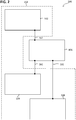
- Fig. 3 illustrates a registration terminal 200 according to various embodiments 300 in a schematic communication diagram.
- the registration terminal 200 can have an information output device 124, which can have one or more than one display device and / or one or more than one loudspeaker.
- the acquisition device 152 (eg its image acquisition device 102) can be set up to supply the control device 106 with acquired image data 202b (eg in raw data format or a preprocessed version of the raw data format), eg as a single image or continuously as a sequence.
- the detection device 152 (for example its product detection device 104) can be set up to the To supply control device 106 with a detected product identifier 202a to 201a.
- the acquisition device 152 (for example its document acquisition device 108) can be set up to supply the biometric data 202c to the control device 106 201c.
- biometric data can include the following information: facial features (e.g. image data of the face), finger line image, genetic fingerprint, iris features (i.e. features of the iris), fundus features (i.e. features of the retina), body size, nail bed pattern, signature features , Date of birth, place of birth, name, origin, nationality. It can be understood that other biometric data can also be used.
- the control device 106 can be set up to determine 101 a sales restriction 214 based on the product identifier 202a.
- the sales restriction 214 can clearly restrict the number of persons who are allowed to purchase the product, for example only to those persons who meet a criterion of the sales restriction 214.
- the sales restriction 214 may define a criterion (e.g., having one or more than one requirement). If a person fulfills the criterion, he or she is entitled to purchase the product, for example.
- the sales restriction can, for example, be a sovereign order, e.g. standardized by means of a law.
- an age restriction ie that the person fulfills the criterion if they are of a certain age.
- What has been described for the age restriction can also apply analogously to another sales restriction, eg a restriction with regard to the legal capacity of the person, with regard to a (eg legal) status of the person (eg a student status), with regard to a Qualification / expertise of the person (e.g. with a fishing license), with regard to a proof of health of the person, or with regard to a sovereign permission of the person (e.g. a driving license or an authorization to blast).
- a restriction with regard to the legal capacity of the person, with regard to a (eg legal) status of the person (eg a student status), with regard to a Qualification / expertise of the person (e.g. with a fishing license), with regard to a proof of health of the person, or with regard to a sovereign permission of the person (e.g. a driving license or an authorization to blast).
- the control device 106 can furthermore be set up, in 101, to determine payment information 204 based on the product identifier 202a (also referred to as payment information determination).
- the payment information 204 can clearly represent which price is called up for the corresponding product with the product identifier 202a.
- the recorded product identifier 202a can be compared with a database for this purpose.
- control device 106 can be set up to start a registration session 202, for example in response to a determined event (also referred to as a session start event), which represents that a self-service registration is to take place.
- a session start event can include that a user stands in front of the registration terminal 200 and / or makes a corresponding input at this, that the detection device 152 is presented with a product, and / or that a previous registration session has ended.
- control device 106 can be set up to end the registration session 202, for example in response to a determined event (also referred to as a session end event), which represents that the self-service registration is to be billed.
- a determined event also referred to as a session end event
- the session end event can include that a user makes a corresponding entry at the registration terminal 200, that a bank card or another means of payment has been recorded by the registration terminal 200, and / or that a predefined period of time has expired since the last product was recorded .
- the control device 106 can be set up to determine accounting information 224 and to output it by means of an information output device of the registration terminal 200.
- the payment information 204 determined during a registration session 202 can be aggregated, for example, and the result of the aggregation can be added to the accounting information 224.
- the accounting information 224 can clearly indicate the amount to be paid for the registered products.
- the accounting information 224 can optionally have further information, such as, for example, the proportion of taxes, a list of the recorded products, an individual listing of the recorded products, or the like.
- a payment process can also be initiated, by means of which the amount to be paid can be paid according to the accounting information 224. Settlement can take place, for example, by means of the payment terminal (not shown).
- the recorded biometric data can have at least two different pieces of information (also referred to as first biometric information and second biometric information), as will be described in more detail below.
- the first biometric information (for example having image information or formed therefrom) can be set up, for example, to be compared with the image data.
- the second biometric information can be set up, for example, to be compared with the criterion. In other words, information / data that are comparable with one another can be used.
- the control device 106 can further be set up to compare 103 the image data 202b with the biometric data 202c (e.g. their first biometric information).
- the result 702 of the comparison 103 (also referred to in simplified terms as biometric comparison 103) can be, for example, that the image data 202b of the person and the biometric data 202c (e.g. the first biometric information) match (as a positive result) or do not match (as a negative result) ).
- one or more than one intermediate step e.g. any number of intermediate steps, which represents a partial agreement, can be used between the two results of the agreement as a positive result and the disagreement as a negative result.
- the result 702 of the comparison 103 can have a degree of agreement, the result of the complete agreement corresponding to a degree of 100% and the result of the disagreement corresponding to a degree of 0%. If the degree of agreement exceeds a stored threshold value, the positive result can be output, for example.
- the biometric comparison 103 can clearly provide, for example, a person comparison in which it is checked whether the identity certificate belongs to the person from whom the image data 202b was captured, e.g. whether this person is also the owner of the identity certificate.
- the control device 106 can furthermore be set up to compare 903 the sales restriction 214 with the biometric data 202c (for example its second biometric information).
- the result 704 of the comparison 903 (also referred to as restriction comparisons 903) can be, for example, that the person's biometric data 202c (e.g. their second biometric information) fulfills the criterion of the sales restriction (as a positive result) or does not fulfill it (as a negative result).
- one or more than one intermediate step eg any number of intermediate steps
- the result 704 of the comparison 903 can have a degree of fulfillment, wherein the result of complete fulfillment corresponds to a degree of 100% and the result of non-fulfillment corresponds to a degree of 0%.
- the intermediate steps make it possible to deal with more complex sales restrictions which, for example, define a set of requirements for purchasing the product as a criterion. If the degree of fulfillment exceeds a stored threshold value, the positive result can be output, for example.
- the restriction comparison 903 can clearly provide, for example, a comparison in which it is checked whether the person from whom the image data 202b was captured also meets the requirements for purchasing the product.
- both the restriction comparison 903 and the biometric comparison 103 produce a positive result, it can be determined as a result 706 that the person (from whom the image data 202b was recorded) meets the criterion of the sales restriction. If the restriction comparison 903 and / or the biometric comparison 103 produce a negative result, it can be determined as a result 706 that the person (from whom the image data 202b was captured) does not meet the criterion of the sales restriction.
- control device 106 can optionally be set up to request the person to present themselves (eg their face) and / or the identity certificate to the detection device 152, eg by means of an information output device of the registration terminal 200.
- the person can be requested as often as possible to present himself or the identity certificate if a negative result 702, 704 is obtained.
- control device 106 can be set up to output a signal 905 which is set up, for example (e.g. by means of instructions) to intervene in the registration session 202 (or another process of the registration terminal 200) and / or to control one or more than one component of the registration terminal 200 , for example, to output perceptible information that represents the result 706.
- the registration session 202 can be put into a waiting state by means of the signal 905, an alarm can be output and / or the payment process can be blocked. This can, for example, prevent the person from purchasing the product.
- the registration session 202 can be continued by means of the signal 905, the alarm can be canceled and / or the payment process can be released. This can, for example, enable the person to purchase the product.
- the approval of the payment process can include, for example, also debiting (e.g. a reserved booking).
- the registration session 202 can be automatically put into a waiting state or the payment process can be blocked in response to the fact that the existence of the sales restriction is determined. Then the signal 905 (e.g. only then) can be output to remove the blockage or the waiting state.
- the signal can be output in response to the fact that the person does not meet the criterion of the sales restriction in order to effect the blockage or the waiting state.
- the alarm is output, which can be, for example, a perceptible alarm or a silent alarm, it may be necessary for this to be acknowledged by means of an employee's authentication, e.g. to remove the blockage or the waiting state.
- control device 106 can be set up to output, by means of the information output device 124, feedback on the acquisition of the image data of the person and / or the biometric data of the official identity certificate.
- the captured image data can be output directly by means of the information output device 124. This makes it easier to capture usable image data.
- a positioning template for example a contour, a template or a frame
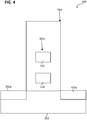
- Fig. 4 illustrates a registration terminal 200 according to various embodiments 400 in a schematic side view in which the registration terminal 200 is set up, for example, as a self-service registration terminal 200 (also referred to as a self-service registration terminal).
- a self-service registration terminal 200 also referred to as a self-service registration terminal.
- the registration terminal 200 may have a structure 352 by means of which various components of the Registration terminals 200 are carried, for example one or more than one storage device 302a, 302b, the detection device 152 (e.g. their product detection device 104 and / or image detection device 102), the control device (not shown), etc. have attached housing, wherein the housing houses the sensitive components of the registration terminal 200.
- the supporting structure 352 can, for example, have a base with which the supporting structure 352 stands on a ground and a vertically extending section 354 (clearly also referred to as a column), which supports the elevated components, e.g. the image capturing device 102 and the product capturing device 104.
- the capture device 152 (e.g., its image capture device 102) can be configured to capture image data, e.g., of a person in front of the registration terminal 200.
- the detection device 152 can have one or more than one camera.
- the detection device 152 can be set up to generate image data that have depth information (e.g. of the person).
- the detection device 152 can have, for example, one or more than one 3D camera (also referred to as a 3-dimension camera).
- a 3D camera can generally be set up to record image data which have the depth information.
- Examples of a 3D camera include: a plenoptic camera (also referred to as a light field camera), a stereoscopic camera (also referred to as a stereo camera for short), a camera with a triangulation system, a TOF camera (time-of-flight camera), a camera with an interference system.
- a stereo camera is a particularly inexpensive one here 3D camera which is easier to implement.
- a stereo camera is also more robust towards reflective surfaces and does not require a laser, which reduces the health risk for people in public spaces.
- the TOF camera can be set up, for example, to illuminate the detection area in front of the registration terminal 200 by means of a light pulse and to record a time (the so-called transit time) for each image point, which the light pulse needs to return.
- a signal of a different type e.g. sound
- a spatial distribution of the time of flight of the signal e.g. an ultrasonic time of flight method
- the camera can be set up to use a variable focus (autofocus) to determine the depth information.
- the focus can also be directed to a moving object (e.g. product and / or hand) so that the distance between the camera and the object can be determined as depth information based on the focus position.
- the depth information can be determined on the basis of an edge contrast measurement and / or a phase comparison.
- the or each depositing device 302b, 302a can be set up in such a way that one or more than one product can be deposited thereon.
- a storage device 302b, 302a can, for example, be a storage shelf, a storage hook for bags and / or a storage table exhibit.
- the or each depositing device 302b, 302a can have a scale which is set up to record a weight of the products deposited on the depositing device.
- the registration terminal 200 can have the information output device 124.
- the information output device 124 can be set up, for example, to output information that can be perceived by humans (e.g. audible or visible), e.g. by means of a display device.
- the information can include, for example, a request and / or assistance (e.g. for the user).
- Fig. 5 illustrates a registration terminal 200 according to various embodiments 500 in the method 100 in a schematic side view.
- an identity card 504 as an identity certificate for easier understanding. What is described for ID 504 can also apply analogously to another identity document, for example a driver's license, a certificate of citizenship, a social security card, a fishing license, a certificate of competence (e.g. for handling explosive substances), a passport or the like.
- a photograph 510 (ie a photograph) is referred to as the first biometric information. What has been described for the photograph 510 can also apply analogously to other biometric information, for example biometric information recorded by means of pattern recognition.
- a date of birth (ie a date) is referred to as second biometric information 512. What has been described for the date of birth can also be analogous to a other biometric information applies, for example biometric information recorded by means of text recognition.
- the document acquisition device 108 can be provided, for example, by means of the means of payment terminal or separately therefrom.
- the image data 202b acquired by means of the acquisition device 152 can include color image data 914 and / or depth image data 912.
- the color image data 914 can have a pixel matrix with (monochrome or polychrome) color information, the color information specifying the color value of each pixel as the value.
- the depth image data 912 can have a pixel matrix with depth information, the depth information indicating the depth value of each pixel as the value.
- the depth image data 912 and the color image data 914 can be acquired by means of the same camera or by means of separate (e.g. separate from one another) cameras.
- a 3D camera can determine the depth image data 912 and an RGB camera can determine the color image data 914.
- the depth image data 912 can, for example, be provided as a 3D camera by means of a stereo camera.
- a stereo camera can have several (e.g. two) lenses arranged next to one another, which are aimed at the detection area in front of the registration terminal 200.
- the plurality of lenses can be set up to image the detection area on one or more than one image detection sensor of the detection device 152.
- the image detection sensor can for example be infrared sensitive, i.e. detect infrared radiation.
- Image data 202b that represent multiple perspectives of the person at the same time are clearly captured by means of the stereo camera denotes), ie which represent the person viewed from different directions and / or from different places.
- the exposure control and / or the focus adjustment of the lenses can be coupled to one another for this purpose, for example.
- the depth information can be determined on the basis of the stereoscopic image data of the person. For example, the different perspectives of the stereoscopic image data can be superimposed on one another and the depth information can be derived therefrom. What has been described for the stereoscopic camera can also apply analogously to a differently set up detection device 152 which implements a different mechanism in order to provide the depth information.
- the depth information 912 can have information that places a plurality of segments of the image data in a spatial relationship to one another and / or to a reference object.
- a depth value which represents the spatial relationship, can be assigned to the corresponding image data segment.
- individual pixels i.e. the depth information 912 can be resolved pixel by pixel
- a plurality of pixels the so-called pixel group
- the reference object can, for example, have the detection device 152 or be formed therefrom.
- the depth information can specify, pixel by pixel, a distance from the reference object as a depth value.
- the biometric comparison 103 can include performing a first face recognition on the basis of the captured image data 202b of the person, for example the depth image data 912 and / or the color image data 914.
- the first face recognition can have that a life recognition is carried out.
- the living recognition can clearly determine whether the image data 202b represent a living person or an inanimate object. This can make it possible, for example, to uncover the attempted fraud through a photo of the person.
- the life detection can, for example, have to determine on the basis of the depth information whether it is a real person (e.g. their face) or only the optical reproduction of the person (e.g. by means of a photo).
- another form of life detection that does not necessarily use the depth information can also be implemented.
- the life detection can, for example, also take place on the basis of a sequence of color image data 914 (e.g. a video) in that it is determined, for example, how and whether the person who is captured by the image data 202b is moving.
- the change in facial features can be detected when the person is alive.
- the time period before and or after the acquisition of the image data which is supplied to the biometric comparison 103 can also take place in order to determine whether the person is alive.
- life detection examples include requests for sequential blinking and its detection (also known as blink test), requests for sequential inclination of the head in different directions and its detection (also known as inclination test), sensors for detecting microscopic unconscious muscular contractions in certain areas of the face with the help of lighting and detection outside the visible spectrum (also known as the twitch test); Detection of eye movement when prompted to follow a point on the screen; Extraction of a biometric feature and verified blood flow in the veins based on a finger or hand vein analysis.
- the blink test and the tilt test can be a hindrance to the problem at hand for reasons of user friendliness and, above all, to speed up the process.
- the blink test and the tilt test require complex instructions to the user.
- the twitch test is used, for example, at border control stations (e.g. at the airport) and is therefore established and robust.
- the twitch test can result in higher implementation costs or problems due to its size.
- the plausibility check with the aid of the depth information does not require any additional action on the part of the user, is inexpensive and very robust in relation to the environment.
- a negative result of the biometric comparison 103 can be output.
- the biometric comparison 103 can include performing a second face recognition based on image data from the ID card 504, for example based on the photo 510 of the ID card 504.
- the ID card can be captured with the camera or an additional camera, for example.
- This has the advantage, for example, that ID cards that do not have a data memory can also be processed.
- this has the advantage that the data memory of the identity card does not have to be read out, so that there is no need to intervene in sovereign law. For example, depending on the prevailing legal situation, non-sovereign institutions may be prohibited from reading out the biometric data of an identity card 504 without authorization.
- the image data of the Identity card 504 represent the front and / or back of the card.
- the biometric comparison 103 can further include comparing the result of the first face recognition (also referred to as first facial features in simplified form) and the result of the second face recognition (also referred to in simplified form as second facial features) with one another, for example to check for correspondence.
- the result 702 of the biometric comparison 103 can be, for example, that the first facial features and the second facial features match (as a positive result) or do not match (as a negative result).
- one or more than one intermediate step e.g. any number of intermediate steps, which represents a partial agreement, can be used between the two results of the agreement as a positive result and the disagreement as a negative result.
- the result can have a degree of correspondence of the facial features, the result of the complete agreement corresponding to a degree of 100% and the result of the disagreement corresponding to a degree of 0%. If the degree of correspondence of the facial features exceeds a stored threshold value, the positive result can be output, for example.
- live face recognition can take place, for example by means of an Intel RealSense camera as image acquisition device 102.
- This image acquisition device 102 can, for example, acquire face depth information 912 and face color information 914, which can be fed to biometric comparison 103.
- the face depth information 912 and / or face color information 914 can clearly serve as reference image data for the biometric comparison 103.
- an optical card capture can take place, e.g. using a Gemalto CR5400 as a document capture device 108.
- the optical card capture for example, the photo of the person, the date of birth (and thus the age) of the person and / or the validity of the ID 504 must be checked.
- the restriction comparison 903 can have the determination of the date of birth 512 based on the image data of the ID card 504. Any desired process of text recognition can be used for this purpose, for example. Furthermore, on the basis of the date of birth 512, the age of the person at the time when the image data 202b was recorded can be determined. For this purpose, the date of birth can be subtracted from the date at the time the image data 202b was captured.
- the restriction comparison 903 can optionally have to determine the validity of the passport 504. If it was determined that the ID is not valid, a negative result of the restriction comparison 903 can be output.
- the criterion of the restriction on sales has, for example, a minimum age, e.g. to be allowed to purchase the product. In other words, if the person is of the minimum age or older, the person meets the sales restriction criterion. If, for example, it is determined that the age of the person is equal to or greater than the minimum age, the result of the restriction comparison 903 can be positive.
- Fig. 6 illustrates a method 100 according to various embodiments 600 in a schematic flow diagram.
- the method 100 may include, in 601, starting the age verification.
- the start of the age verification can take place in response to the detection of an event, which requires age verification.
- the event can include, for example, that an age-related sales restriction was determined 101 (see FIG. 1) to which the product is subject.
- the method 100 may include, in 603, prompting to present the identification.
- the request to present the ID can for example take place by means of the information output device 124, for example optically and / or acoustically.
- the method 100 can include, in 605, receiving the ID, for example by means of the document capture device 108.
- the ID can be inserted into the document capture device 108, for example.
- the method 100 may include, in 607, acquiring data from the ID (e.g. a validity, a photo, a date of birth and / or a checksum).
- data from the ID e.g. a validity, a photo, a date of birth and / or a checksum.
- a cyclical redundancy check for example, can be carried out by means of the checksum.
- the method 100 may comprise, in 609, checking whether the ID is valid and the criterion of the age-related sales restriction is met 903; in 611, extracting biometric information from the photo of the ID; optionally in 613, storing the biometric information extracted from the photo of the ID; in 615, capturing a live photo (optionally with depth information) of the person; in 617, extract biometric information from the live photo; optionally in 619, saving the biometric information extracted from the live photo.
- the method 100 may comprise, in 621, comparing the biometric information extracted from the live photo and from the photo of the ID card; and at 623, determining a degree biometric match based on comparison 621 (similar to 103).
- the method 100 may include, optionally in 625, optically analyzing the depth information to determine a three-dimensional facial characteristic; and optionally in 625, deleting the stored biometric information.
- the method 100 may include, in 629, terminating the age verification.
- the termination of the age verification can include outputting a result 706 of the age verification.
- the result 706 of the age verification can include, for example, the result of the comparison 621, the result of the checking 609 and / or the result of the determination 623 of the degree of agreement.
- Fig. 7 illustrates a method 100 according to various embodiments 700 in a schematic flow diagram.
- the method 100 can have the recorded biometric data being stored, for example on a storage medium of the control device 106 and / or, for example, in a stored database.
- the recorded biometric data can be saved in the meantime and retrieved again at a later point in time.
- the biometric data that are recorded during each registration session 202 can be stored in a database.
- the comparison 103 can include: Retrieving the captured biometric data of the official identity certificate from a storage medium.
- the recorded biometric are stored in the database so that they no longer have to (but can) be asked for their official document each time they are used. This can optionally further require that the person has been determined to be alive (ie positive life detection).
- the person's image data is recorded at a later point in time in response to the determination 101 of the sales restriction, this can first be compared with the stored biometric data (if available), e.g. by comparing the live face recognition with all those already in the database Entries.
- the database can be supplemented in an analogous manner with biometric identification features and corresponding authorizations from another process. These can then in turn be used at a later point in time.
- An example for implementing the method 100 can include: first ascertaining 101 of the sales restriction 214 to which a product is subject, based on a recorded product identifier 202a of the product, for example by the person scanning age-restrictive goods (example: Ü18); optionally outputting a request to the person to present himself or herself (eg the face) to the detection device, for example in that the registration terminal 200 asks the person for a "live face"; Acquisition of image data of the person (for example their face); Determining biometric data of the person on the basis of the image data of the person, for example by extracting them from the image data of the person; optionally carrying out a life recognition on the basis of the image data of the person; Compare 103 the biometric data determined on the basis of the person's image data with stored, previously recorded biometric data in a database (eg Ü18 database).
- a database eg Ü18 database
- the payment process can be released. This can, for example, enable the person to purchase the product.
- the method 100 can furthermore have the following: optional outputting of a request to the person to present the identity certificate to the recording device, for example by the Registration terminal 200 asks the person for a government document; Capturing the identity certificate, e.g. by capturing image data of the identity certificate (e.g. front and / or back of the identity certificate); Determining 701 additional biometric data on the basis of the detection of the identity certificate, for example by extracting these from the image data of the identity certificate; and additional comparison 103 of the biometric data determined on the basis of the image data of the person with the additional biometric data recorded from the identity certificate.
- optional outputting of a request to the person to present the identity certificate to the recording device for example by the Registration terminal 200 asks the person for a government document
- Capturing the identity certificate e.g. by capturing image data of the identity certificate (e.g. front and / or back of the identity certificate); Determining 701 additional biometric data on the basis of the detection of the identity certificate, for example by extracting these from
- the additional comparison 103 can be carried out. Otherwise, the registration session 202 can be put into a waiting state by means of the signal 905, the alarm can be output and / or the payment process can be blocked.
- the biometric data is clearly extracted from a sovereign document and a check is made to determine whether the person is over 18 (also referred to as Ü18).
- the payment process can be released. Otherwise, the registration session 202 can be put into a waiting state by means of the signal 905, an alarm is issued and / or the payment process is blocked.
- the biometric data recorded in 703 on the basis of the identity certificate can be stored in the database (e.g. Ü18 database).
- the database formed in this way contains, for example, only extracted biometric data without reference to identities of persons and / or without image data.
- no image data e.g. images of faces
- the database therefore remains anonymous per se.
- a person's biometric data in a (e.g. Ü18) database enables an even more accelerated verification of the person’s authorization to purchase the product that is subject to a sales restriction (e.g. Ü18 article).
- the database can be stored locally on a storage medium of the registration terminal 200, for example; are stored centrally in a store on a storage medium which can be accessed by several registration terminals of the same store; or stored centrally on a storage medium which the registration terminals of several shops (e.g. the same chain of shops) can access, e.g. via a network.
- Example 1 is a registration terminal (e.g. a self-service registration terminal or a cashier workstation having), comprising: a detection device with at least one sensor, wherein the detection device is set up: to capture first biometric data (for example by means of capturing image data) on the basis of a person at the self-service registration terminal (for example when the person is presented to the detection device); to acquire second biometric data on the basis of an official identity certificate when the identity certificate is presented to the acquisition device; and detect a product identifier of a product when the product is presented to the detection device; a control device that is configured to: first determine a sales restriction to which the product is subject based on the product identifier; Comparing the first biometric data (for example the image data) with the second biometric data (for example in response to the first determination); second determining whether the person fulfills a criterion of the sales restriction based on a result of the comparison and on the second biometric data.
- a registration terminal e.g. a self-service registration terminal
- Example 2 is the registration terminal (e.g. self-service registration terminal) according to Example 1, further comprising: enabling a payment transaction process for the product if the person meets the criterion of the sales restriction, otherwise putting the payment transaction process in a waiting state and / or issuing a Alarm signal.
- a payment transaction process for the product if the person meets the criterion of the sales restriction, otherwise putting the payment transaction process in a waiting state and / or issuing a Alarm signal.
- Example 3 is the registration terminal (e.g. self-service registration terminal) according to Example 1 or 2, wherein the detection device has an image detection sensor which is set up to detect image data of the identity certificate which has the second biometric data.
- the detection device has an image detection sensor which is set up to detect image data of the identity certificate which has the second biometric data.
- Example 4 is the registration terminal (eg self-service registration terminal) according to one of Examples 1 to 3, the detection device having a chip card reader which is set up to read out the second biometric data stored on the identity certificate.
- Example 5 is the registration terminal (e.g. self-service registration terminal) according to one of Examples 1 to 4, the identity certificate having a photo ID, which is for example optically detected by means of the detection device.
- Example 6 is the registration terminal (eg self-service registration terminal) according to one of Examples 1 to 5, wherein the detection device is further set up to carry out a death detection on the basis of the first biometric data, wherein, for example, the second determining whether the person meets the criterion of the sales restriction ( 214) is met, is also carried out based on a result of the life detection.
- the detection device is further set up to carry out a death detection on the basis of the first biometric data, wherein, for example, the second determining whether the person meets the criterion of the sales restriction ( 214) is met, is also carried out based on a result of the life detection.
- Example 7 is the registration terminal (e.g., self-service registration terminal) according to any one of Examples 1 to 6, wherein the detection device is arranged to detect image data of the person having the first biometric data.
- Example 8 is the registration terminal (eg self-service registration terminal) according to one of Examples 1 to 7, wherein the detection device is further set up to detect depth information assigned to the image data of the person, the control device being set up on the basis of a life detection and / or a face detection the depth information.
- the detection device is further set up to detect depth information assigned to the image data of the person, the control device being set up on the basis of a life detection and / or a face detection the depth information.
- Example 9 is the registration terminal (eg, self-service registration terminal) according to one of Examples 1 to 8, the second determination of whether the person fulfills the criterion of the sales restriction being further based on a result of the life recognition.
- Example 10 is the registration terminal (e.g. self-service registration terminal) according to one of Examples 1 to 9, the criterion of the sales restriction having a minimum age of the person.
- Example 11 is the registration terminal (e.g. self-service registration terminal) according to Example 10, the second determination taking into account an age of the person, which is determined on the basis of the first and / or second biometric data.
- Example 12 is the registration terminal (e.g. self-service registration terminal) according to Example 11, the age of the person being determined on the basis of a date (e.g. date of birth) of the second biometric data.
- a date e.g. date of birth
- Example 13 is the registration terminal (eg self-service registration terminal) according to one of Examples 1 to 12, wherein the comparison of the first biometric data (eg image data of the person) with the second biometric data includes performing one or more than one face recognition, eg face recognition based on the first biometric data (for example the image data of the person) and / or face recognition based on the second biometric data.
- the comparison of the first biometric data eg image data of the person
- the second biometric data includes performing one or more than one face recognition, eg face recognition based on the first biometric data (for example the image data of the person) and / or face recognition based on the second biometric data.
- Example 14 is the registration terminal (eg, self-service registration terminal) according to any one of Examples 1 to 13, further comprising: an information output device for outputting perceptible information; wherein the control device is further set up to output the perceptible information by means of the information output device (for example on the basis of a result of the first determination), which has a request, the detection device the Present the identity certificate and / or the person (e.g. their face).
- an information output device for outputting perceptible information
- the control device is further set up to output the perceptible information by means of the information output device (for example on the basis of a result of the first determination), which has a request, the detection device the Present the identity certificate and / or the person (e.g. their face).
- Example 15 is the registration terminal (e.g. self-service registration terminal) according to one of Examples 1 to 14, wherein the control device is also set up to store (e.g. a storage medium) if the second determination shows that the person fulfills the criterion of the sales restriction based on the result of the comparison and on the second biometric data.
- the control device is also set up to store (e.g. a storage medium) if the second determination shows that the person fulfills the criterion of the sales restriction based on the result of the comparison and on the second biometric data.
- Example 16 is the registration terminal (e.g. self-service registration terminal) according to one of Examples 1 to 15, the control device being set up to: read out the biometric data used as second biometric data from a memory and / or acquire them by means of the detection device.
- the control device being set up to: read out the biometric data used as second biometric data from a memory and / or acquire them by means of the detection device.
- Example 17 is the registration terminal (e.g. self-service registration terminal) according to one of Examples 1 to 16, wherein the control device is further set up to record the second biometric data using the official identity certificate (e.g. only if it is determined that no biometric data are stored for which (ie if these are used as second biometric data) the second determination shows that the person fulfills the criterion of the sales restriction.
- the control device is further set up to record the second biometric data using the official identity certificate (e.g. only if it is determined that no biometric data are stored for which (ie if these are used as second biometric data) the second determination shows that the person fulfills the criterion of the sales restriction.
- Example 18 is the registration terminal (eg, self-service registration terminal) according to any one of Examples 1 to 17, wherein the information output device is arranged to be activated by means of the detection device to display captured first biometric data or image data of the person (for example as a sequence).
- the information output device is arranged to be activated by means of the detection device to display captured first biometric data or image data of the person (for example as a sequence).
- Example 19 is a method comprising: first determining a sales restriction to which a product is subject based on a detected product identifier of the product; Comparing first biometric data (e.g. image data) of the person recorded on the basis of a person with second biometric data recorded on the basis of an official identity certificate; second determining whether the person fulfills a criterion of the sales restriction based on a result of the comparison and on the second biometric data.
- first biometric data e.g. image data
- Example 20 is a control device which is set up to carry out the method according to Example 19.
- Example 21 is a non-volatile storage medium that has code segments that, when executed by a processor, are configured to perform the method of Example 19.
- Example 22 is the registration terminal comprising: a detection device for detecting the product identifier, the first biometric data (e.g., the person's image data), and / or the second biometric data; and the control device according to Example 20.
- Example 23 is a terminal (e.g. a self-service terminal), comprising: a detection device with at least one sensor, the detection device being set up: to capture first biometric data (e.g. by capturing image data) on the basis of a person at the terminal (e.g.
- a control device configured to: first determine a sales restriction to which the product is subject; Comparing the first biometric data (for example the image data) with the second biometric data (for example in response to the first determination); second determining whether the person fulfills a criterion of the sales restriction based on a result of the comparison and on the second biometric data.
- Example 24 is the terminal (e.g. self-service registration terminal) according to Example 23, which is further set up according to one of Examples 1 to 18.
Landscapes
- Engineering & Computer Science (AREA)
- Business, Economics & Management (AREA)
- Theoretical Computer Science (AREA)
- Physics & Mathematics (AREA)
- General Physics & Mathematics (AREA)
- Accounting & Taxation (AREA)
- Multimedia (AREA)
- Human Computer Interaction (AREA)
- Finance (AREA)
- General Business, Economics & Management (AREA)
- Strategic Management (AREA)
- Computer Security & Cryptography (AREA)
- General Health & Medical Sciences (AREA)
- Oral & Maxillofacial Surgery (AREA)
- Health & Medical Sciences (AREA)
- Development Economics (AREA)
- Economics (AREA)
- Computer Vision & Pattern Recognition (AREA)
- Collating Specific Patterns (AREA)
- Cash Registers Or Receiving Machines (AREA)
Priority Applications (3)
| Application Number | Priority Date | Filing Date | Title |
|---|---|---|---|
| EP19217197.3A EP3839859A1 (fr) | 2019-12-17 | 2019-12-17 | Terminal d'enregistrement libre-service, procédé et dispositif de commande |
| PCT/EP2020/085197 WO2021122189A1 (fr) | 2019-12-17 | 2020-12-09 | Terminal de caisse libre-service, procédé et dispositif de commande |
| US17/786,279 US20230034021A1 (en) | 2019-12-17 | 2020-12-09 | Self-service checkout terminal, method and control device |
Applications Claiming Priority (1)
| Application Number | Priority Date | Filing Date | Title |
|---|---|---|---|
| EP19217197.3A EP3839859A1 (fr) | 2019-12-17 | 2019-12-17 | Terminal d'enregistrement libre-service, procédé et dispositif de commande |
Publications (1)
| Publication Number | Publication Date |
|---|---|
| EP3839859A1 true EP3839859A1 (fr) | 2021-06-23 |
Family
ID=68944340
Family Applications (1)
| Application Number | Title | Priority Date | Filing Date |
|---|---|---|---|
| EP19217197.3A Pending EP3839859A1 (fr) | 2019-12-17 | 2019-12-17 | Terminal d'enregistrement libre-service, procédé et dispositif de commande |
Country Status (3)
| Country | Link |
|---|---|
| US (1) | US20230034021A1 (fr) |
| EP (1) | EP3839859A1 (fr) |
| WO (1) | WO2021122189A1 (fr) |
Families Citing this family (2)
| Publication number | Priority date | Publication date | Assignee | Title |
|---|---|---|---|---|
| CN114511052B (zh) * | 2022-01-21 | 2023-06-16 | 重庆市规划和自然资源信息中心 | 一种实现不动产登记窗口无纸化办理的系统 |
| US20240193996A1 (en) * | 2022-12-07 | 2024-06-13 | The Adt Security Corporation | Dual authentication method for controlling a premises security system |
Citations (9)
| Publication number | Priority date | Publication date | Assignee | Title |
|---|---|---|---|---|
| EP0991027A2 (fr) * | 1998-09-30 | 2000-04-05 | Ncr International Inc. | Terminal d'enregistrement en libre-service d'articles en sortie ayant un dispositif de détection biométrique pour vérifier l'identité de l'utilisateur et méthode associée |
| US20160180166A1 (en) * | 2014-12-18 | 2016-06-23 | Greg Scott Egan | In-scanner document image processing |
| DE102015106358A1 (de) * | 2015-04-24 | 2016-10-27 | Bundesdruckerei Gmbh | Bilderfassungsvorrichtung zur Aufnahme von Bildern für die Personenidentifikation |
| DE102015108330A1 (de) * | 2015-05-27 | 2016-12-01 | Bundesdruckerei Gmbh | Elektronisches Zugangskontrollverfahren |
| DE102016009619A1 (de) * | 2016-07-29 | 2018-02-01 | LÜTH & DÜMCHEN Automatisierungsprojekt GmbH | Verfahren zum Nachweis der räumlichen Ausdehnung eines Kameraobjektes als Bestandteil einer Lebenderkennung für Vorrichtungen zur Erfassung personenspezifischer Daten |
| EP3291162A1 (fr) * | 2016-08-30 | 2018-03-07 | NCR Corporation | Traitement de vérification préalable |
| US20190164167A1 (en) * | 2017-11-30 | 2019-05-30 | Walmart Apollo, Llc | System and Method for Identity Verification of a User |
| US20190205874A1 (en) * | 2018-01-02 | 2019-07-04 | Laurence Hamid | Wireless based methods and systems for federated key management, asset management, and financial transactions |
| US20190259014A1 (en) * | 2016-11-08 | 2019-08-22 | Panasonic Intellectual Property Management Co., Ltd. | Age verification system and shopping assistance system comprising same |
Family Cites Families (20)
| Publication number | Priority date | Publication date | Assignee | Title |
|---|---|---|---|---|
| US20040133477A1 (en) * | 2001-02-02 | 2004-07-08 | Charles Morris | Self-checkout system with biometric data processing |
| US20050154646A1 (en) * | 2004-01-12 | 2005-07-14 | John Chermesino | Method and system for self-service shopping |
| DE102004053900A1 (de) * | 2004-11-05 | 2006-05-11 | Tbs Holding Ag | Verfahren und Vorrichtung für das Erfassen von biometrischen Daten |
| WO2006110189A1 (fr) * | 2005-04-07 | 2006-10-19 | Michael Daily | Kiosque libre-service et systeme de securite pour vente au detail |
| US20110238296A1 (en) * | 2011-04-29 | 2011-09-29 | Connor Kent Purks | Computer order handling system providing transferrable order delivery through networked electronic kiosks |
| US9256720B2 (en) * | 2011-05-18 | 2016-02-09 | Nextgenid, Inc. | Enrollment kiosk including biometric enrollment and verification, face recognition and fingerprint matching systems |
| US20130268379A1 (en) * | 2012-04-09 | 2013-10-10 | Balance Innovations, Llc | Method and apparatus for fraud and reconciliation control at point of sale |
| US9940620B2 (en) * | 2013-01-14 | 2018-04-10 | Capital One Services, Llc | Systems and methods for processing customer purchase transactions using biometric data |
| US20180225615A1 (en) * | 2013-11-05 | 2018-08-09 | Walmart Apollo, Llc | Systems and methods of remotely monitoring utilization of geographically distributed point-of-sale terminals |
| US10515347B2 (en) * | 2014-01-31 | 2019-12-24 | Ncr Corporation | Techniques for kiosk transactions |
| US9378494B2 (en) * | 2014-08-22 | 2016-06-28 | Paypal, Inc. | Suspending and resuming transactions through wireless beacon communications |
| US10171745B2 (en) * | 2014-12-31 | 2019-01-01 | Dell Products, Lp | Exposure computation via depth-based computational photography |
| US10354391B2 (en) * | 2016-10-27 | 2019-07-16 | Peter Jin-Pyong Yim | Method and system for multi-label image segmentation |
| JP7036540B2 (ja) * | 2017-02-21 | 2022-03-15 | 東芝テック株式会社 | 情報処理装置およびプログラム |
| ES2965673T3 (es) * | 2017-04-28 | 2024-04-16 | Aptos Llc | Sistemas y procedimientos de sincronización de datos de punto de venta |
| US20190205855A1 (en) * | 2018-01-02 | 2019-07-04 | Mastercard International Incorporated | Point-of-sale system for processing a payment transaction across multiple point-of-sale devices |
| JP7156855B2 (ja) * | 2018-08-17 | 2022-10-19 | 東芝テック株式会社 | チェックアウトシステム |
| WO2020125773A1 (fr) * | 2018-12-20 | 2020-06-25 | 云丁网络技术(北京)有限公司 | Procédé et système de confirmation d'identité |
| US11568413B2 (en) * | 2019-11-21 | 2023-01-31 | Rockspoon, Inc. | System and method for minimal contact in-person order fulfillment using a mobile device |
| US11763363B2 (en) * | 2020-02-26 | 2023-09-19 | Toshiba Global Commerce Solutions Holdings Corporation | Method, system, and medium for managing suspended customer transactions in a retail environment |
-
2019
- 2019-12-17 EP EP19217197.3A patent/EP3839859A1/fr active Pending
-
2020
- 2020-12-09 WO PCT/EP2020/085197 patent/WO2021122189A1/fr not_active Ceased
- 2020-12-09 US US17/786,279 patent/US20230034021A1/en active Pending
Patent Citations (9)
| Publication number | Priority date | Publication date | Assignee | Title |
|---|---|---|---|---|
| EP0991027A2 (fr) * | 1998-09-30 | 2000-04-05 | Ncr International Inc. | Terminal d'enregistrement en libre-service d'articles en sortie ayant un dispositif de détection biométrique pour vérifier l'identité de l'utilisateur et méthode associée |
| US20160180166A1 (en) * | 2014-12-18 | 2016-06-23 | Greg Scott Egan | In-scanner document image processing |
| DE102015106358A1 (de) * | 2015-04-24 | 2016-10-27 | Bundesdruckerei Gmbh | Bilderfassungsvorrichtung zur Aufnahme von Bildern für die Personenidentifikation |
| DE102015108330A1 (de) * | 2015-05-27 | 2016-12-01 | Bundesdruckerei Gmbh | Elektronisches Zugangskontrollverfahren |
| DE102016009619A1 (de) * | 2016-07-29 | 2018-02-01 | LÜTH & DÜMCHEN Automatisierungsprojekt GmbH | Verfahren zum Nachweis der räumlichen Ausdehnung eines Kameraobjektes als Bestandteil einer Lebenderkennung für Vorrichtungen zur Erfassung personenspezifischer Daten |
| EP3291162A1 (fr) * | 2016-08-30 | 2018-03-07 | NCR Corporation | Traitement de vérification préalable |
| US20190259014A1 (en) * | 2016-11-08 | 2019-08-22 | Panasonic Intellectual Property Management Co., Ltd. | Age verification system and shopping assistance system comprising same |
| US20190164167A1 (en) * | 2017-11-30 | 2019-05-30 | Walmart Apollo, Llc | System and Method for Identity Verification of a User |
| US20190205874A1 (en) * | 2018-01-02 | 2019-07-04 | Laurence Hamid | Wireless based methods and systems for federated key management, asset management, and financial transactions |
Also Published As
| Publication number | Publication date |
|---|---|
| WO2021122189A1 (fr) | 2021-06-24 |
| US20230034021A1 (en) | 2023-02-02 |
Similar Documents
| Publication | Publication Date | Title |
|---|---|---|
| DE69830306T2 (de) | Vorrichtung zur sicherheitsprüfung | |
| DE60309299T2 (de) | System und Verfahren zur Ablaufverfolgung von Banknoten | |
| CN107679850A (zh) | 一种商品结算方法、装置及系统 | |
| DE102022100559A1 (de) | Materialspektroskopie | |
| CN106991594A (zh) | 一种基于商户的远程实名购买电话卡的方法与系统 | |
| DE112009001618T5 (de) | Vorrichtung und Verfahren für die Rücknahme leerer Getränkebehälter | |
| EP3211611A1 (fr) | Procede de detection de vide assistee par ordinateur d'un recipient de transport et dispositif de detection de vide assistee par ordinateur d'un recipient de transport | |
| EP3839803B1 (fr) | Procédé, dispositif de commande et terminal d'enregistrement pour la reconnaissance assistée par ordinateur de récipients de transport vides | |
| DE212017000037U1 (de) | Selbstbedienungskassensystem | |
| CN113177480A (zh) | 基于人脸识别的金融业务处理方法、装置、设备及介质 | |
| DE112021003012T5 (de) | Selbstkassier-verkaufsstelle | |
| WO2021122189A1 (fr) | Terminal de caisse libre-service, procédé et dispositif de commande | |
| DE102022100672A1 (de) | Materialspektroskopie | |
| DE102011010737A1 (de) | Verfahren zur Verbesserung des Manipulationsschutzes von Geldautomaten, sowie Geldautomat zur Durchführung des Verfahrens | |
| EP2138810B1 (fr) | Balance | |
| EP2711868B1 (fr) | Dispositif d'identification | |
| CN117523748A (zh) | 用于金融支付的结账商品辨识系统 | |
| WO2021023814A1 (fr) | Appareil pour le retour automatisé d'une marchandise et procédé pour faire fonctionner l'appareil | |
| EP3839855B1 (fr) | Terminal d'enregistrement libre-service et procédé | |
| DE102022100554A1 (de) | Materialspektroskopie | |
| DE102011018689A1 (de) | Kassenanordnung | |
| CN111695907A (zh) | 一种安全性高的面部识别支付方法 | |
| EP4064223A1 (fr) | Procédé et dispositif de vérification de l'authenticité d'un objet | |
| DE102007014177B4 (de) | Modulares Merkmal für Oberflächen von Selbstbedienungssystemen | |
| WO2021122306A1 (fr) | Borne de libre-service et procédé de fourniture de sécurité au niveau d'une borne de libre-service |
Legal Events
| Date | Code | Title | Description |
|---|---|---|---|
| PUAI | Public reference made under article 153(3) epc to a published international application that has entered the european phase |
Free format text: ORIGINAL CODE: 0009012 |
|
| STAA | Information on the status of an ep patent application or granted ep patent |
Free format text: STATUS: THE APPLICATION HAS BEEN PUBLISHED |
|
| AK | Designated contracting states |
Kind code of ref document: A1 Designated state(s): AL AT BE BG CH CY CZ DE DK EE ES FI FR GB GR HR HU IE IS IT LI LT LU LV MC MK MT NL NO PL PT RO RS SE SI SK SM TR |
|
| STAA | Information on the status of an ep patent application or granted ep patent |
Free format text: STATUS: REQUEST FOR EXAMINATION WAS MADE |
|
| 17P | Request for examination filed |
Effective date: 20211223 |
|
| RBV | Designated contracting states (corrected) |
Designated state(s): AL AT BE BG CH CY CZ DE DK EE ES FI FR GB GR HR HU IE IS IT LI LT LU LV MC MK MT NL NO PL PT RO RS SE SI SK SM TR |
|
| STAA | Information on the status of an ep patent application or granted ep patent |
Free format text: STATUS: EXAMINATION IS IN PROGRESS |
|
| 17Q | First examination report despatched |
Effective date: 20230301 |
|
| RAP1 | Party data changed (applicant data changed or rights of an application transferred) |
Owner name: DIEBOLD NIXDORF SYSTEMS GMBH |
|
| GRAP | Despatch of communication of intention to grant a patent |
Free format text: ORIGINAL CODE: EPIDOSNIGR1 |
|
| STAA | Information on the status of an ep patent application or granted ep patent |
Free format text: STATUS: GRANT OF PATENT IS INTENDED |
|
| RIC1 | Information provided on ipc code assigned before grant |
Ipc: G06Q 20/40 20120101AFI20251217BHEP Ipc: G06Q 20/20 20120101ALI20251217BHEP Ipc: G06V 40/16 20220101ALI20251217BHEP Ipc: G06V 40/50 20220101ALI20251217BHEP Ipc: G06V 40/60 20220101ALI20251217BHEP Ipc: G06V 40/40 20220101ALI20251217BHEP Ipc: G01B 11/24 20060101ALN20251217BHEP |
|
| INTG | Intention to grant announced |
Effective date: 20260114 |