EP3842008A1 - Articulateur - Google Patents
Articulateur Download PDFInfo
- Publication number
- EP3842008A1 EP3842008A1 EP20215792.1A EP20215792A EP3842008A1 EP 3842008 A1 EP3842008 A1 EP 3842008A1 EP 20215792 A EP20215792 A EP 20215792A EP 3842008 A1 EP3842008 A1 EP 3842008A1
- Authority
- EP
- European Patent Office
- Prior art keywords
- articulator
- model
- digital
- jaw part
- receptacle
- Prior art date
- Legal status (The legal status is an assumption and is not a legal conclusion. Google has not performed a legal analysis and makes no representation as to the accuracy of the status listed.)
- Withdrawn
Links
Images




Classifications
-
- A—HUMAN NECESSITIES
- A61—MEDICAL OR VETERINARY SCIENCE; HYGIENE
- A61C—DENTISTRY; APPARATUS OR METHODS FOR ORAL OR DENTAL HYGIENE
- A61C11/00—Dental articulators, i.e. for simulating movement of the temporo-mandibular joints; Articulation forms or mouldings
- A61C11/02—Dental articulators, i.e. for simulating movement of the temporo-mandibular joints; Articulation forms or mouldings characterised by the arrangement, location or type of the hinge means ; Articulators with pivots
- A61C11/022—Dental articulators, i.e. for simulating movement of the temporo-mandibular joints; Articulation forms or mouldings characterised by the arrangement, location or type of the hinge means ; Articulators with pivots with two adjustable pivoting points, e.g. Argon-type articulators
-
- A—HUMAN NECESSITIES
- A61—MEDICAL OR VETERINARY SCIENCE; HYGIENE
- A61C—DENTISTRY; APPARATUS OR METHODS FOR ORAL OR DENTAL HYGIENE
- A61C11/00—Dental articulators, i.e. for simulating movement of the temporo-mandibular joints; Articulation forms or mouldings
- A61C11/02—Dental articulators, i.e. for simulating movement of the temporo-mandibular joints; Articulation forms or mouldings characterised by the arrangement, location or type of the hinge means ; Articulators with pivots
-
- A—HUMAN NECESSITIES
- A61—MEDICAL OR VETERINARY SCIENCE; HYGIENE
- A61C—DENTISTRY; APPARATUS OR METHODS FOR ORAL OR DENTAL HYGIENE
- A61C11/00—Dental articulators, i.e. for simulating movement of the temporo-mandibular joints; Articulation forms or mouldings
- A61C11/02—Dental articulators, i.e. for simulating movement of the temporo-mandibular joints; Articulation forms or mouldings characterised by the arrangement, location or type of the hinge means ; Articulators with pivots
- A61C11/025—Dental articulators, i.e. for simulating movement of the temporo-mandibular joints; Articulation forms or mouldings characterised by the arrangement, location or type of the hinge means ; Articulators with pivots with a pivotable lower part, i.e. mandibule motion simulator
-
- A—HUMAN NECESSITIES
- A61—MEDICAL OR VETERINARY SCIENCE; HYGIENE
- A61C—DENTISTRY; APPARATUS OR METHODS FOR ORAL OR DENTAL HYGIENE
- A61C11/00—Dental articulators, i.e. for simulating movement of the temporo-mandibular joints; Articulation forms or mouldings
- A61C11/02—Dental articulators, i.e. for simulating movement of the temporo-mandibular joints; Articulation forms or mouldings characterised by the arrangement, location or type of the hinge means ; Articulators with pivots
- A61C11/027—Dental articulators, i.e. for simulating movement of the temporo-mandibular joints; Articulation forms or mouldings characterised by the arrangement, location or type of the hinge means ; Articulators with pivots with a hinge made of resilient material
-
- A—HUMAN NECESSITIES
- A61—MEDICAL OR VETERINARY SCIENCE; HYGIENE
- A61C—DENTISTRY; APPARATUS OR METHODS FOR ORAL OR DENTAL HYGIENE
- A61C11/00—Dental articulators, i.e. for simulating movement of the temporo-mandibular joints; Articulation forms or mouldings
- A61C11/08—Dental articulators, i.e. for simulating movement of the temporo-mandibular joints; Articulation forms or mouldings with means to secure dental casts to articulator
- A61C11/081—Dental articulators, i.e. for simulating movement of the temporo-mandibular joints; Articulation forms or mouldings with means to secure dental casts to articulator with adjusting means thereof
- A61C11/084—Dental articulators, i.e. for simulating movement of the temporo-mandibular joints; Articulation forms or mouldings with means to secure dental casts to articulator with adjusting means thereof for 3D adjustment, e.g. Ball-and-socket
-
- A—HUMAN NECESSITIES
- A61—MEDICAL OR VETERINARY SCIENCE; HYGIENE
- A61C—DENTISTRY; APPARATUS OR METHODS FOR ORAL OR DENTAL HYGIENE
- A61C13/00—Dental prostheses; Making same
- A61C13/0003—Making bridge-work, inlays, implants or the like
- A61C13/0004—Computer-assisted sizing or machining of dental prostheses
-
- B—PERFORMING OPERATIONS; TRANSPORTING
- B33—ADDITIVE MANUFACTURING TECHNOLOGY
- B33Y—ADDITIVE MANUFACTURING, i.e. MANUFACTURING OF THREE-DIMENSIONAL [3D] OBJECTS BY ADDITIVE DEPOSITION, ADDITIVE AGGLOMERATION OR ADDITIVE LAYERING, e.g. BY 3D PRINTING, STEREOLITHOGRAPHY OR SELECTIVE LASER SINTERING
- B33Y80/00—Products made by additive manufacturing
-
- G—PHYSICS
- G06—COMPUTING OR CALCULATING; COUNTING
- G06F—ELECTRIC DIGITAL DATA PROCESSING
- G06F30/00—Computer-aided design [CAD]
- G06F30/10—Geometric CAD
- G06F30/17—Mechanical parametric or variational design
-
- G—PHYSICS
- G06—COMPUTING OR CALCULATING; COUNTING
- G06F—ELECTRIC DIGITAL DATA PROCESSING
- G06F30/00—Computer-aided design [CAD]
- G06F30/20—Design optimisation, verification or simulation
-
- G—PHYSICS
- G06—COMPUTING OR CALCULATING; COUNTING
- G06F—ELECTRIC DIGITAL DATA PROCESSING
- G06F2113/00—Details relating to the application field
- G06F2113/10—Additive manufacturing, e.g. three-dimensional [3D] printing
Definitions
- the invention relates to an articulator for simulating a temporomandibular joint movement, the articulator comprising a first articulator element and a second articulator element.
- Plaster models of the dental arches of the upper and lower jaw are usually mounted in occlusion on such articulators.
- the movement of the jaws to one another can then be simulated using the articulator, which is essential for the production of dentures, partial and full dentures or splints.
- digital impressions of the jaws are increasingly being made.
- a digital 3D jaw model or jaw part model can be created.
- These models are usually manufactured using 3D printing technology.
- These printed full-jaw or partial models must then be mounted on the articulator like the conventional plaster models.
- the present invention is based on the object of creating an articulator that is easy to manufacture and of facilitating the manufacture of an articulator with attached jaw or jaw part models.
- the solution to this object is in particular that the first articulator element comprises an engagement means and the second articulator element comprises a receptacle for the engagement means.
- the first articulator element can, for example, be connected to an upper jaw (partial) model.
- the second articulator element can, for example, have a lower jaw (partial) model can be connected.
- the invention is based on the knowledge that such an articulator can be produced in a simple manner, for example by means of 3D printing technology or milling technology. Furthermore, such an articulator does not require any further components in order to connect the first articulator element to the second articulator element. As a result, the first and second articulator elements can be connected in a simple manner, in particular can be connected releasably.
- first articulator element and / or the second articulator element is formed in one piece. This eliminates the need to subsequently assemble several components of an articulator element, which further simplifies production, in particular production using 3D printing technology.
- first articulator element connected to the second articulator element can be moved relative to the second articulator element in a protrusion direction and / or can be moved in a laterotrusion direction.
- first articulator element and the second articulator element are connected to one another via a connection between the engaging means and the receptacle.
- first articulator element and the second articulator element can be connected by engaging the engaging means in the receptacle.
- a movement of the first articulator element relative to the second articulator element in a protrusion direction and / or in a laterotrusion direction via a corresponding movement, for example via a translational movement or a rotational movement, of the Engaging means can be achieved relative to or within the receptacle.
- the articulator which is easy to manufacture, thus retains the freedom of movement or degrees of freedom required for simulating the jaw movement.
- the first articulator element connected to the second articulator element is rotatable relative to the second articulator element in a direction of rotation, in particular is rotatable about an axis of rotation, the axis of rotation being perpendicular to the or a protrusion direction and / or perpendicular to the or a laterotrusion direction is arranged or wherein the axis of rotation is arranged parallel to the or a laterotrusion direction.
- first articulator element can be rotated relative to the second articulator element about a first axis of rotation to simulate a jaw opening or closing.
- the first axis of rotation is formed, for example, perpendicular to the protrusion direction and perpendicular to a longitudinal direction of the articulator elements.
- first articulator element can be rotated relative to the second articulator element, for example about a second first axis of rotation to simulate a lateral movement of the jaw, that is to say pointing in the laterotrusion direction.
- the second axis of rotation can be formed perpendicular to the first axis of rotation and perpendicular to the longitudinal direction of the articulator elements.
- the engagement means can be attached in the receptacle in a self-retaining manner. This leaves no further means of fixing the first one Articulator element necessary on the second articulator element and further simplifies the manufacture of the articulator.
- the receptacle is elongated, in particular wherein the receptacle is arranged along or parallel to the or a protrusion direction. This enables the protrusion movement of the first articulator element relative to the second articulator element in a simple manner.
- the engagement means is configured spherically. This enables in a simple manner a rotational movement about at least one axis of rotation, in particular about the first and second axis of rotation, of the first articulator element relative to the second articulator element.
- the second articulator element comprises an opening and the engaging means can be attached via the opening in the receptacle and / or inserted into the receptacle, in particular wherein the engaging means can be latched into the receptacle via the opening.
- the opening comprises a first opening diameter which is smaller than a diameter of the engaging means, in particular wherein the opening is funnel-shaped and / or wherein the opening comprises a second opening diameter which is larger than a diameter of the engaging means.
- first articulator element and / or the second articulator element is at least partially made of an elastic material, in particular the engagement means and / or the opening and / or a part of the second articulator element comprising the opening being made of the elastic material is made.
- the squeezing or the engagement of the engagement means in the receptacle can require the application of a deformation force.
- This deformation force is applied, for example, when the articulator is manufactured or when the first and second articulator elements are joined together.
- the deformation force can be too great to be applied to the opening and / or to the engagement means in normal use of the articulator.
- the engagement means in the receptacle or the first articulator element is attached to the articulator element in a self-retaining manner or connected to it in a self-retaining manner.
- first articulator element and / or the second articulator element is manufactured using 3D printing technology and / or using milling technology.
- first articulator element is connectable or connected, in particular integrally connected, to a first jaw part model and / or wherein the second articulator element is connectable or connected, in particular integrally connected, to a second jaw part model.
- first jaw part model a model or partial model of an upper jaw
- the second jaw part model a model or partial model of a lower jaw.
- the articulator comprises two first articulator elements and two second articulator elements, the two first articulator elements each being connectable or connected, in particular integrally connected, to the or a first jaw part model, and the two second articulator elements each being connected to the or one second jaw model connectable or connected, in particular connected in one piece.
- movement of an upper jaw relative to a lower jaw can be simulated by means of two articulators each attached to the upper and lower jaw.
- a computer-implemented method for producing an articulator in particular for producing one of the articulators described above, comprising: creating a first digital 3D articulator model and / or creating a second digital 3D articulator model; Printing the first / and / or the second digital 3D articulator model using 3D printing technology.
- the printed first articulator model can correspond to the first articulator element.
- the printed second articulator model can correspond to the second articulator element.
- the method further comprises: creating a first digital 3D model of the jaw part and / or creating a second 3D model of the jaw part, the first digital 3D model of the jaw part is connected or connectable to the first digital 3D articulator model and / or wherein the second digital 3D jaw part model is connected or connectable to the second digital 3D articulator model, in particular wherein the method further comprises connecting the first digital 3D jaw part model to the first digital 3D articulator model and / or the connection of the first digital 3D jaw part model with the first digital 3D articulator model; wherein the printing of the first / and or the second digital 3D articulator model, the printing, in particular one-piece printing, of the first digital 3D jaw part model and the first digital 3D articulator model and / or the printing, in particular one-piece printing, of the second digital 3D jaw part model and the second digital 3D articulator model.
- the printed first digital 3D jaw part model can correspond to the first jaw part model.
- the printed second digital 3D jaw part model can correspond to the second jaw part model.
- a system for data processing comprising means for carrying out one of the methods described above.
- a computer-readable storage medium comprising instructions which, when executed by the system, cause the system to carry out one of the methods described above.
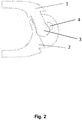
- the Figures 1-5 and 10 show an articulator for simulating a temporomandibular joint movement. Identical or similar features are provided with the same reference symbols.
- the articulator comprises a first articulator element 1 and a second articulator element 2.
- the articulator consists of the first and second articulator elements 1 and 2.
- the first articulator element 1 comprises an engaging means 3.
- the engaging means 3 can be designed circular or spherical.
- the engagement means 3 can in particular be a ball head.
- at least one cross section of the engagement means 3 can be configured spherical or circular.
- the first articulator element 1 and the second articulator element 2 are elongated.
- the first articulator element 1 and the second articulator element 2 each comprise an elongated section.
- the respective elongated sections of the first articulator element 1 and of the second articulator element 2 can be aligned parallel to one another in the assembled state of the articulator elements, in particular in each case parallel to a longitudinal direction of the articulator element 1 and / or the articulator element 2.
- the second articulator element 2 comprises a receptacle 4 for receiving the engagement means 3.
- the receptacle 4 is elongated.
- a longitudinal direction of the receptacle 4 is relative to a longitudinal direction of the first articulator element 1 and / or formed inclined to a longitudinal direction of the second articulator element 2.
- the longitudinal direction of the receptacle 4 forms an angle with the longitudinal direction of the first articulator element 1 and / or the longitudinal direction of the second articulator element 2.
- the angle is not equal to 0 °, for example 30 °.
- the engagement means 3 can be attached in the receptacle 4.
- the engagement means 3 can be attached in the receptacle 4 in a self-retaining manner.
- the engaging means 3 can be held within the receptacle 4, in particular without further components, in any direction of movement of the engaging means 3.
- the engagement means 3 can be supported in any direction of movement of the engagement means 3 within the receptacle 4 on the receptacle 4, in particular on a delimitation of the receptacle 4.
- the engagement means 3 can be moved within the receptacle 4, in particular can be moved in a translatory manner along the longitudinal direction of the receptacle 4. Furthermore, the engagement means 3 can be rotated within the receptacle 4. In other words: the first articulator element 1 can be moved relative to the second articulator element 2 via a movement of the engaging means 3 within the receptacle 4. The first articulator element 1 can be connected to the second articulator element 2, in particular by engaging the engagement means 3 in the receptacle 4.
- the direction of protrusion is parallel to the longitudinal direction of the receptacle 4.
- the direction of protrusion forms an angle with the longitudinal direction of the first articulator element 1 and / or the second articulator element 2.
- a rotational movement of the engaging means 3 within the receptacle 4 results in a rotational movement of the first articulator element 1 relative to the second articulator element 2 about a first axis of rotation.
- the first axis of rotation is arranged perpendicular to the longitudinal direction of the first articulator element 1 and / or the second articulator element 2.
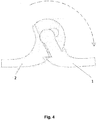
- the first axis of rotation is arranged perpendicular to the longitudinal direction of the receptacle 4. In other words: the first axis of rotation protrudes from the image plane of the Figure 4 out.
- the rotational movement of the first articulator element 1 relative to the second articulator element 2 results in an opening of the articulator.
- the first articulator element 1 and the second articulator element 2 in particular the respective elongate sections of the first articulator element 1 and of the second articulator element 2, enclose an angle.
- This angle can be increased or decreased via the rotational movement of the first articulator element 1 relative to the second articulator element 2 about the first axis of rotation.
- the rotational movement of the first articulator element 1 relative to the second articulator element 2 can in particular encompass or include an angular range from 0 ° to 180 °.
- a further, second rotational movement of the engaging means 3 within the receptacle 4 results in a lateral movement of the first articulator element 1 relative to the second articulator element 2, ie in a movement of the first articulator element 1 relative to the second Articulator element 2 in the laterotrusion direction.
- the first articulator element 1 can be rotated relative to the second articulator element 2 about a second axis of rotation.
- the second axis of rotation is arranged perpendicular to the longitudinal direction of the first articulator element 1 and / or the second articulator element 2.
- the second axis of rotation is also arranged perpendicular to the first axis of rotation.
- the second axis of rotation lies in the image plane of the Figures 2 to 4 and 10 .
- the first articulator element 1 and / or the second articulator element 2 can be produced using 3D printing technology and / or milling technology.
- the first articulator element 1 and the second articulator element 2 are designed in one piece and can be manufactured in one piece by means of 3D printing technology and poor or milling technology.
- the second articulator element 2 shown comprises an opening 5.
- the opening 5 is spatially connected to the receptacle 4.
- the engagement means 3 can be introduced into the receptacle 4 or attached in the receptacle 4 via the opening 5.
- the opening 5 can, for example, be funnel-shaped, truncated pyramidal or frustoconical.
- the opening 5 has a first cross section and a second cross section.
- the opening 5 has a first circumference or diameter, for example the circumference or diameter of the first cross section, and a second circumference or diameter, for example the circumference or diameter of the second cross section.
- the first circumference or diameter is larger than a circumference or diameter of the engaging means 3.
- the second circumference or diameter is smaller than a circumference or diameter of the engaging means 3.
- the first articulator element 1 and the second Articulator element 2 can be made entirely or partially from a flexible material.
- the engaging means 3 is made of a flexible material.
- a part of the second articulator element 2 that encompasses the opening 5 and / or the receptacle 4 is made from a flexible material.
- the flexible material is, for example, a plastic material, in particular a plastic material suitable for 3D printing.
- the engagement means 3 can be inserted into the receptacle 4 via the opening 5 or can be locked into the receptacle 4. In other words: the engagement means 3 can be pressed through the receptacle 5 at the level of the second cross section.
- the opening 5 can be widened at the level of the second cross section by the introduction of the engaging means 3, in particular widened temporarily and / or with the application of force.
- the engaging means 3 If the engaging means 3 is arranged within the receptacle 4, the engaging means 3 cannot be moved through the opening 5 at the level of the second cross section, or cannot be moved without additional effort. In this way, the engagement means 3 can be attached in the receptacle 4 in a self-retaining manner.
- the Figures 6 to 9 show the articulator connected to one or more jaw part models.
- the first articulator element 1 is shown connected to a first jaw part model 6A, in particular connected in one piece.
- the second articulator element 2 is connected to a second jaw part model 7A, in particular connected in one piece.
- first articulator elements 1 can be connected to a third jaw part model 7B or in one piece be connected.
- second articulator elements 2 can be connected to a fourth jaw part model 7B or connected in one piece, as in FIG Figures 8 and 9 shown.
- one of the two first articulator elements 1 is connected to one of the two second articulator elements 2, for example as in FIG Figures 2 to 6 shown, via a respective engagement means 3 and a respective receptacle 4.
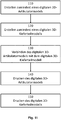
- FIG. 13 shows a flow diagram of a method for producing an articulator, in particular one with reference to FIG Figures 1 to 10 described articulator.
- the method is a computer-implemented method.
- the articulator to be produced comprises at least a first or the first articulator element 1 and a second or the second articulator element 2.
- a first method step 110 comprises the creation of at least one digital 3D articulator model.
- Method step 110 includes, for example, the creation of a first digital 3D articulator model and the creation of a second 3D articulator model.
- the first digital 3D articulator model can be created for the first articulator element 1 and the second digital 3D articulator model can be created for the second articulator element 2.
- the first digital 3D articulator model corresponds to the first articulator element 1
- the second digital 3D articulator model corresponds to the second articulator element 2.
- Method step 120 comprises creating at least one digital 3D model of the jaw part.
- Method step 120 includes, for example, creating a first digital 3D jaw part model and / or a second digital 3D jaw part model.
- the first digital 3D jaw part model can correspond to the first or third jaw part model 6A, 6B.
- the second digital 3D jaw part model can correspond to the second jaw part model 7A, 7B.
- the first digital 3D model of the jaw part can be connected or connectable to the first digital 3D articulator model.
- the second digital 3D model of the jaw part can be connected or connectable to the second digital 3D articulator model.
- the connection of the first or second digital 3D model of the jaw part with the first or second digital 3D articulator model takes place digitally.
- the first or the second digital 3D jaw part model can be digitally connected to the first or the second digital 3D articulator model.
- the first or the second digital 3D jaw part model can be or have been digitally created in one piece with the first or the second digital 3D articulator model.
- the first and / or second digital 3D articulator model is printed using 3D printing technology.
- the first and / or the second digital 3D model of the jaw part is printed using 3D printing technology.
- the method steps 140 and 150 can be connected or implemented in a common method step. In other words: the first digital 3D model of the jaw part can be printed together, in particular in one piece, with the first digital 3D articulator model.
- the second digital 3D model of the jaw part can be printed together, in particular in one piece, with the second digital 3D articulator model.
- Figure 1 shows an articulator (artificial jaw joint) that was specially developed by me for 3D printed jaw models. This is stored in the dental software as a data record and, if the upper and lower jaw model, can be virtual were created as at Figure 6 to be seen attached. It does not matter whether it is as in Figure 6 is a partial model because, as in Figure 8 I have also developed a solution for full jaw models with 2 joints, which are stored in the software with different distances from one another in order to be able to vary with different jaw sizes.
- the articulator consists of two elements a and b Figure 1 which are correctly positioned in relation to one another in the software but are not connected.
- Figure 6 show the upper jaw model (c) and the lower jaw model (d) are also in the correct position in relation to one another and are also not connected.
- Figure 2 , 3 , 4th and 10 show the cross section of the 3D printable articulator to illustrate the functions.
- the software is programmed so that the articulator can be connected to the models. This creates two printable data sets such as the upper jaw part model (c) with attached element (a) and lower jaw part model (d) with attached element (b) as in Figure 6 to see.
- both model parts can be connected by means of a plug connection.
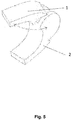
- the ball head of element (a) can now be swiveled back and forth (laterotrusion) in an inclined semicircular recess ( Figure 5 ).
- the lower jaw model Due to the inclined, elongated recess, the lower jaw model can also move forwards and downwards (protrusion) like the cross-sectional representation Figure 3 shows.
- the advantage of this invention is that subsequent assembly in a conventional laboratory articulator is no longer necessary.
- the printed articulator can be opened so wide that both jaw models lie flat on the work table, making work as much easier for the dental technician as it is in the Cross-sectional view Figure 4 and in the oblique view Figure 8 you can see.
- Figure 8 and Figure 9 show full-jaw models that are equipped with 2 of my articulators (artificial jaw joints), which come even closer to the real movement processes in the human skull. The quality is further improved as a result and is at the same time a cost-effective solution, since assembly in a commercially available articulator can also be saved in this variant.
- Figure 7 shows the upper jaw part model (c) in combination with the articulator element (a) and the lower jaw part model (d) in combination with the articulator element (b).
- Figure 10 shows in a cross-sectional view how the articulator element (a) is pressed with its spherical head into the funnel-shaped recess (g) in order to slide into the elongated and inclined recess (h) in the articulator element (b). Its starting position is in the cross-sectional view in Figure 2 clearly visible.
- the protection claims 1 to 5 refer to the fact that there is currently no printable or millable articulator that allows laterotrusion and protrusion movements. This problem is solved with the feature listed in claims 1 to 5. With the invention it is achieved that every dental laboratory or dental practice that has the appropriate dental software can cost-effectively create printable and millable models without having to mount them in a commercially available articulator after production.
- an articulator (data set for 3D printing and milling technology) consisting of articulator elements (a) and (b) is described, characterized in that it is the first articulator that can be printed or milled to perform the protrusion movement as in Figure 3 and also the laterotrusion movement as in Figure 5 shown after production.
- articulator data set for 3D printing and milling technology
- articulator elements (a) and (b) characterized in that it is a single joint as in Figure 6 can be attached to the virtually created upper and lower jaw part model, which can then be manufactured using a 3D printer or milling machine.
- articulator data set for 3D printing and milling technology
- articulator elements (a) and (b) are described, characterized in that it is also available in two versions, as in Figure 8 and Figure 9 can be attached to virtually created full jaw models, which can then be produced using a 3D printer or milling machine.
- an articulator (data set for 3D printing and milling technology) consisting of articulator element (a) and (b) is described, characterized in that the spherical head of articulator element (a) in the elongated and inclined recess (h) in element (b) follows the production by a 3D printer or by a milling machine can be swiveled to the side (lateral movement) and forward down or back up what the protrusion movement ( Figure 3 ) is modeled on the human temporomandibular joint.
- articulator data set for 3D printing and milling technology consisting of articulator elements (a) and (b) is described, characterized in that in Figure 10 Articulator element (b) has a funnel-shaped recess (g) into which the ball head of articulator element (a) is pressed with a little force until it engages in the elongated and inclined recess (h) for a guided protrusion.
Landscapes
- Health & Medical Sciences (AREA)
- Engineering & Computer Science (AREA)
- Physics & Mathematics (AREA)
- Epidemiology (AREA)
- Life Sciences & Earth Sciences (AREA)
- Animal Behavior & Ethology (AREA)
- General Health & Medical Sciences (AREA)
- Public Health (AREA)
- Veterinary Medicine (AREA)
- Dentistry (AREA)
- Oral & Maxillofacial Surgery (AREA)
- Theoretical Computer Science (AREA)
- Geometry (AREA)
- General Physics & Mathematics (AREA)
- Evolutionary Computation (AREA)
- General Engineering & Computer Science (AREA)
- Computer Hardware Design (AREA)
- Chemical & Material Sciences (AREA)
- Manufacturing & Machinery (AREA)
- Materials Engineering (AREA)
- Computational Mathematics (AREA)
- Mathematical Analysis (AREA)
- Mathematical Optimization (AREA)
- Pure & Applied Mathematics (AREA)
- Dental Prosthetics (AREA)
- Toys (AREA)
Priority Applications (3)
| Application Number | Priority Date | Filing Date | Title |
|---|---|---|---|
| US17/145,705 US20220079720A1 (en) | 2020-09-17 | 2021-01-11 | Articulator |
| EP21182436.2A EP3970661B1 (fr) | 2020-09-17 | 2021-06-29 | Dispositif pour simuler des mouvements de mâchoire et procédé de production du dispositif |
| US17/477,709 US12310807B2 (en) | 2020-09-17 | 2021-09-17 | Device for simulating jaw movements and a method for generating the device |
Applications Claiming Priority (1)
| Application Number | Priority Date | Filing Date | Title |
|---|---|---|---|
| DE202020003948 | 2020-09-17 |
Publications (1)
| Publication Number | Publication Date |
|---|---|
| EP3842008A1 true EP3842008A1 (fr) | 2021-06-30 |
Family
ID=73855998
Family Applications (2)
| Application Number | Title | Priority Date | Filing Date |
|---|---|---|---|
| EP20215792.1A Withdrawn EP3842008A1 (fr) | 2020-09-17 | 2020-12-18 | Articulateur |
| EP21182436.2A Active EP3970661B1 (fr) | 2020-09-17 | 2021-06-29 | Dispositif pour simuler des mouvements de mâchoire et procédé de production du dispositif |
Family Applications After (1)
| Application Number | Title | Priority Date | Filing Date |
|---|---|---|---|
| EP21182436.2A Active EP3970661B1 (fr) | 2020-09-17 | 2021-06-29 | Dispositif pour simuler des mouvements de mâchoire et procédé de production du dispositif |
Country Status (3)
| Country | Link |
|---|---|
| US (2) | US20220079720A1 (fr) |
| EP (2) | EP3842008A1 (fr) |
| DE (1) | DE202020005458U1 (fr) |
Families Citing this family (1)
| Publication number | Priority date | Publication date | Assignee | Title |
|---|---|---|---|---|
| DE102022113835A1 (de) | 2022-06-01 | 2023-12-07 | xWERK GmbH | Artikulator mit individualisierbarem stützpunkt |
Citations (4)
| Publication number | Priority date | Publication date | Assignee | Title |
|---|---|---|---|---|
| EP2079393A1 (fr) * | 2006-10-27 | 2009-07-22 | Nobel Biocare Services AG | Modèle dentaire, articulateur et leurs procédés de production |
| US7690919B2 (en) * | 2006-03-28 | 2010-04-06 | Huffman Ronald E | Dental articulator |
| US8573973B2 (en) * | 2000-07-24 | 2013-11-05 | Jose Walter | Disposable articulator having at least one continuous opening for acceptance of stabilization means |
| US20160220336A1 (en) * | 2013-09-17 | 2016-08-04 | Tae-Hee Byun | Articulator |
Family Cites Families (14)
| Publication number | Priority date | Publication date | Assignee | Title |
|---|---|---|---|---|
| JPS4810869B1 (fr) * | 1968-07-31 | 1973-04-07 | ||
| US3624906A (en) * | 1969-08-29 | 1971-12-07 | Ernest R Granger | Dental articulator |
| US4449930A (en) * | 1981-05-07 | 1984-05-22 | Kv33 Corporation | Dental model articulator |
| US5292322A (en) * | 1991-11-05 | 1994-03-08 | Orthofix S.R.L. | Clamping coupling for an external fixator |
| US5494440A (en) * | 1994-05-19 | 1996-02-27 | Condylator, Inc. | Dental articulator |
| US6089863A (en) * | 1996-08-22 | 2000-07-18 | Van Valey; Edwin T. | Flexible mold and dental model formed therefrom |
| US6382969B1 (en) * | 2000-07-31 | 2002-05-07 | Jean J. Elnajjar | Dental articulator |
| US7011469B2 (en) * | 2001-02-07 | 2006-03-14 | R. Sanderson Management, Inc. | Piston joint |
| US7534105B2 (en) * | 2002-09-27 | 2009-05-19 | Nihon University | Occludator, face bow, occlusion-confirming system and temporomandibular joint-reproducing system |
| US20060204920A1 (en) * | 2005-03-14 | 2006-09-14 | Accu-Bite, Inc. | Dental articulator and method for using same |
| US8459995B1 (en) * | 2012-07-16 | 2013-06-11 | Ilya Aronov | Pinless dental articulator and method of using same |
| JP6494394B2 (ja) * | 2015-04-21 | 2019-04-03 | 基夫 室野井 | 咬合器 |
| DE102015110020B4 (de) * | 2015-06-23 | 2022-01-05 | Sicat Gmbh & Co. Kg | Verfahren zur Darstellung anatomischer Gegebenheiten im Kiefergelenk |
| KR102161707B1 (ko) * | 2018-11-26 | 2020-10-15 | 박동효 | 디지털 방식 및 아날로그 방식 겸용 교합기 및 그 교합기를 이용한 교합 치열 모형 제작방법 |
-
2020
- 2020-12-18 EP EP20215792.1A patent/EP3842008A1/fr not_active Withdrawn
- 2020-12-18 DE DE202020005458.5U patent/DE202020005458U1/de active Active
-
2021
- 2021-01-11 US US17/145,705 patent/US20220079720A1/en not_active Abandoned
- 2021-06-29 EP EP21182436.2A patent/EP3970661B1/fr active Active
- 2021-09-17 US US17/477,709 patent/US12310807B2/en active Active
Patent Citations (4)
| Publication number | Priority date | Publication date | Assignee | Title |
|---|---|---|---|---|
| US8573973B2 (en) * | 2000-07-24 | 2013-11-05 | Jose Walter | Disposable articulator having at least one continuous opening for acceptance of stabilization means |
| US7690919B2 (en) * | 2006-03-28 | 2010-04-06 | Huffman Ronald E | Dental articulator |
| EP2079393A1 (fr) * | 2006-10-27 | 2009-07-22 | Nobel Biocare Services AG | Modèle dentaire, articulateur et leurs procédés de production |
| US20160220336A1 (en) * | 2013-09-17 | 2016-08-04 | Tae-Hee Byun | Articulator |
Also Published As
| Publication number | Publication date |
|---|---|
| EP3970661C0 (fr) | 2024-03-27 |
| EP3970661B1 (fr) | 2024-03-27 |
| DE202020005458U1 (de) | 2021-04-20 |
| US20220079719A1 (en) | 2022-03-17 |
| EP3970661A1 (fr) | 2022-03-23 |
| US12310807B2 (en) | 2025-05-27 |
| US20220079720A1 (en) | 2022-03-17 |
Similar Documents
| Publication | Publication Date | Title |
|---|---|---|
| DE102005016245B4 (de) | Verfahren, Computer und computerlesbares Medium betreffend die Prüfung von Datensätzen für Zahnersatzteile | |
| DE102014105190B4 (de) | Verfahren zur Bearbeitung von vorkonfektionierten Prothesenzähnen | |
| DE69918484T2 (de) | Gerät zum Abtasten der zentrischen Relation der Mandibel | |
| EP3661452B1 (fr) | Pilier destiné à maintenir une prothèse dentaire sur un implant de mâchoire | |
| WO2008031562A1 (fr) | procédé de fabrication d'au moins une goupille chirurgicale fendue, en particulier pour la chirurgie maxillofaciale et l'ostéotomie de transformation assistées par ordinateur | |
| DE102009044147A1 (de) | Verfahren zur Erstellung eines digitalen Datenmodells | |
| EP3842008A1 (fr) | Articulateur | |
| DE102014007870A1 (de) | Verfahren zur Herstellung einer zahnmedizinischen Bohrschablone | |
| DE102009019447A1 (de) | Verfahren zur Herstellung eines Zahnsortiments sowie einen Zahnsatzblock und ein hierfür geeignetes Zahnsortiment | |
| DE2824868C2 (de) | Verfahren zur Herstellung einer Zahnstellvorrichtung und Korrelator zur Anwendung des Verfahrens | |
| DE102017131134A1 (de) | Digitaler Transferbogen | |
| EP2957251B1 (fr) | Dispositif d'utilisation dans un procédé de fabrication d'une structure d'implant dentaire | |
| EP4026516A1 (fr) | Modèle modulaire d'apprentissage destiné à l'apprentissage des compétences dentaires, agencement d'un modèle modulaire d'apprentissage sur une tête fantôme, système d'un maxillaire supérieur et d'un maxillaire inférieur, ainsi que procédé d'assemblage d'un modèle modulaire d'apprentissage | |
| EP2789310A2 (fr) | Ébauche pour la fabrication d'un modèle de travail dentaire | |
| DE3542177C2 (fr) | ||
| DE102008060504B4 (de) | Vorrichtung und Verfahren zur Erfassung artikulierter Kiefermodelle mit einer 3D-Sensorik | |
| DE102009043048B4 (de) | Gebisshalterung, Anordnung von Einzelzahnmodellen und Gebisshalterung und Verfahren zur vereinfachten Übertragung einer virtuellen Zahnstellung in ein reales Gebissmodell | |
| EP3545904B1 (fr) | Procédé de fabrication d'un modèle de travail à usage médico-dentaire à partir d'un moulage numérisé | |
| DE3904699C1 (en) | Dental impression tray | |
| DE10215821B4 (de) | Verfahren und Vorrichtung zur Herstellung von Zahnprothesen | |
| WO2014170111A1 (fr) | Procédé de fabrication d'un modele de dentition de precision pour la fabrication/l'adaptation d'une prothese dentaire | |
| DE202019005595U1 (de) | Dentalmodell mit einem lösbaren Zahnstumpf | |
| DE102013207781A1 (de) | Segmentiertes Dentalmodell | |
| LU102803B1 (de) | Restaurationshalterung für die Implantationen am zahnlosen Kiefer | |
| DE102008004741A1 (de) | Verfahren und Modell zur Herstellung eines Zahnersatzteils |
Legal Events
| Date | Code | Title | Description |
|---|---|---|---|
| PUAI | Public reference made under article 153(3) epc to a published international application that has entered the european phase |
Free format text: ORIGINAL CODE: 0009012 |
|
| STAA | Information on the status of an ep patent application or granted ep patent |
Free format text: STATUS: THE APPLICATION HAS BEEN PUBLISHED |
|
| AK | Designated contracting states |
Kind code of ref document: A1 Designated state(s): AL AT BE BG CH CY CZ DE DK EE ES FI FR GB GR HR HU IE IS IT LI LT LU LV MC MK MT NL NO PL PT RO RS SE SI SK SM TR |
|
| STAA | Information on the status of an ep patent application or granted ep patent |
Free format text: STATUS: REQUEST FOR EXAMINATION WAS MADE |
|
| 17P | Request for examination filed |
Effective date: 20211228 |
|
| RBV | Designated contracting states (corrected) |
Designated state(s): AL AT BE BG CH CY CZ DE DK EE ES FI FR GB GR HR HU IE IS IT LI LT LU LV MC MK MT NL NO PL PT RO RS SE SI SK SM TR |
|
| RAP3 | Party data changed (applicant data changed or rights of an application transferred) |
Owner name: XWERK GMBH |
|
| STAA | Information on the status of an ep patent application or granted ep patent |
Free format text: STATUS: EXAMINATION IS IN PROGRESS |
|
| 17Q | First examination report despatched |
Effective date: 20221110 |
|
| STAA | Information on the status of an ep patent application or granted ep patent |
Free format text: STATUS: THE APPLICATION IS DEEMED TO BE WITHDRAWN |
|
| 18D | Application deemed to be withdrawn |
Effective date: 20240719 |