EP3843011A1 - Système et procédé d'assurance qualité des modèles à base de données - Google Patents
Système et procédé d'assurance qualité des modèles à base de données Download PDFInfo
- Publication number
- EP3843011A1 EP3843011A1 EP20176326.5A EP20176326A EP3843011A1 EP 3843011 A1 EP3843011 A1 EP 3843011A1 EP 20176326 A EP20176326 A EP 20176326A EP 3843011 A1 EP3843011 A1 EP 3843011A1
- Authority
- EP
- European Patent Office
- Prior art keywords
- classifier
- input data
- trained
- values
- generator
- Prior art date
- Legal status (The legal status is an assumption and is not a legal conclusion. Google has not performed a legal analysis and makes no representation as to the accuracy of the status listed.)
- Pending
Links
Images

Classifications
-
- G—PHYSICS
- G06—COMPUTING OR CALCULATING; COUNTING
- G06N—COMPUTING ARRANGEMENTS BASED ON SPECIFIC COMPUTATIONAL MODELS
- G06N3/00—Computing arrangements based on biological models
- G06N3/02—Neural networks
- G06N3/08—Learning methods
-
- G—PHYSICS
- G06—COMPUTING OR CALCULATING; COUNTING
- G06N—COMPUTING ARRANGEMENTS BASED ON SPECIFIC COMPUTATIONAL MODELS
- G06N3/00—Computing arrangements based on biological models
- G06N3/02—Neural networks
- G06N3/04—Architecture, e.g. interconnection topology
- G06N3/045—Combinations of networks
-
- G—PHYSICS
- G06—COMPUTING OR CALCULATING; COUNTING
- G06N—COMPUTING ARRANGEMENTS BASED ON SPECIFIC COMPUTATIONAL MODELS
- G06N3/00—Computing arrangements based on biological models
- G06N3/02—Neural networks
- G06N3/04—Architecture, e.g. interconnection topology
- G06N3/045—Combinations of networks
- G06N3/0455—Auto-encoder networks; Encoder-decoder networks
-
- G—PHYSICS
- G06—COMPUTING OR CALCULATING; COUNTING
- G06N—COMPUTING ARRANGEMENTS BASED ON SPECIFIC COMPUTATIONAL MODELS
- G06N3/00—Computing arrangements based on biological models
- G06N3/02—Neural networks
- G06N3/04—Architecture, e.g. interconnection topology
- G06N3/0464—Convolutional networks [CNN, ConvNet]
-
- G—PHYSICS
- G06—COMPUTING OR CALCULATING; COUNTING
- G06N—COMPUTING ARRANGEMENTS BASED ON SPECIFIC COMPUTATIONAL MODELS
- G06N3/00—Computing arrangements based on biological models
- G06N3/02—Neural networks
- G06N3/04—Architecture, e.g. interconnection topology
- G06N3/047—Probabilistic or stochastic networks
-
- G—PHYSICS
- G06—COMPUTING OR CALCULATING; COUNTING
- G06N—COMPUTING ARRANGEMENTS BASED ON SPECIFIC COMPUTATIONAL MODELS
- G06N3/00—Computing arrangements based on biological models
- G06N3/02—Neural networks
- G06N3/04—Architecture, e.g. interconnection topology
- G06N3/0475—Generative networks
-
- G—PHYSICS
- G06—COMPUTING OR CALCULATING; COUNTING
- G06N—COMPUTING ARRANGEMENTS BASED ON SPECIFIC COMPUTATIONAL MODELS
- G06N3/00—Computing arrangements based on biological models
- G06N3/02—Neural networks
- G06N3/08—Learning methods
- G06N3/088—Non-supervised learning, e.g. competitive learning
-
- G—PHYSICS
- G06—COMPUTING OR CALCULATING; COUNTING
- G06N—COMPUTING ARRANGEMENTS BASED ON SPECIFIC COMPUTATIONAL MODELS
- G06N3/00—Computing arrangements based on biological models
- G06N3/02—Neural networks
- G06N3/08—Learning methods
- G06N3/09—Supervised learning
-
- G—PHYSICS
- G06—COMPUTING OR CALCULATING; COUNTING
- G06N—COMPUTING ARRANGEMENTS BASED ON SPECIFIC COMPUTATIONAL MODELS
- G06N3/00—Computing arrangements based on biological models
- G06N3/02—Neural networks
- G06N3/08—Learning methods
- G06N3/094—Adversarial learning
Definitions
- the invention relates to a system and a method for quality assurance of data-based models.
- the invention relates in particular to a system and a method for quality assurance of classifiers or regressors formed by discriminative neural networks, the classifiers serving to determine whether objects, states or events represented by a respective input data record belong to a class or a class of several classes.
- Regressors output a numerical value, e.g. an age specification for a person, if the regressor processes a picture of a person.
- binary classifier units which, for an object, event or state represented by a respective data record, indicate the affiliation or non-affiliation of this object, this state or this event with a class for which the binary classifier unit is trained.
- a neural network is typically structured in such a way that there is an input node for each value, i.e. three input nodes in the example mentioned, of which one input node is provided for gender, a second input node for height and a third input node for weight.
- the latter does not apply to so-called LSTM neural networks (LSTM: long short-term memory).
- the values contained in an input data record are assigned to the (input) nodes of the input layer.
- the input nodes supply their output values as input values to typically several (or all) nodes of the next layer of the artificial neural network.
- An (output) node in an output layer of the artificial neural network finally supplies the membership value, which indicates the probability (or whether) an object, event or state represented by the input data record belongs to a specific class.
- several intermediate layers are provided between the input layer and the output layer, which, together with the input layer and the output layer, define the topology of the neural network.
- a binary classifier can have two nodes in the output layer, namely one that supplies the membership value for class A and one that supplies the membership value for class non-A as the output value.
- a multi-class classifier can have several nodes in the output layer, namely one that supplies a membership value for one of the classes for which the multi-class classifier was trained, and another node that indicates the probability that this is represented by the input data set The object or the state represented by the input data record cannot be assigned to any of the classes for which the multi-class classifier was trained.
- a multi-class classifier can be formed from several binary sub-classification models in such a way that the multi-class classifier is composed of several parallel binary sub-classification models (which form binary sub-paths) each with their own intermediate layers (hidden layers), the several parallel binary classification models having a common input layer and have a common output layer.
- an input layer with its input nodes is followed by several other layers (hidden layers) with nodes.
- each node of a subsequent layer is typically linked to all nodes of the previous layer and in this way can receive the respective output values of the nodes of the previous layer.
- the values received in this way are typically weighted and summed up in a respective node in order to then form an output value of the respective node from the weighted sum, for example using a sigmoid function or another function, which is then output to all nodes of the next layer.
- the number of layers and nodes result in the topology of a neural network.
- the function with which a respective node weights the typically different input values from the nodes of the previous layer and processes them into an output value defines the parameterization of the artificial neural network and defines a model, e.g. a classification model.
- the individual weights are created in the course of a training phase for a respective artificial neural network.
- training data sets are made available to the artificial neural network as input data sets and typically also the class (called label or target) belonging to a respective training data set (feature).
- label or target the class belonging to a respective training data set (feature).
- the deviation of the output value of the nodes at an output layer of the neural network is compared with the expected value.
- An artificial neural network that represents a binary classification model (a binary classifier), for example, has exactly two nodes in the output layer, of which one node delivers a membership value that is supposed to reflect the probability that the input data set belongs to a certain class, while the other node supplies a membership value which indicates the probability that the input data record does not belong to this class.
- the membership values do not necessarily have to be unique, but rather indicate a probability that, for example, the object represented by the input data record belongs to class A or not to class A.
- a possible membership value can therefore e.g. B. 0.78 and mean that the object belongs to class A with 78% probability and not to class A with 22% probability.
- the difference between the expected output values of the artificial neural network and the actual output values of the artificial neural network is determined and based on this this error given by a difference iteratively changes the weights of all nodes and node inputs until the values obtained at the output layer of the artificial neural network roughly correspond to the expected values.
- the weightings are gradually adapted backwards, so to speak, starting from the output layer through all the preceding layers up to the input layer.
- the weights are optimized step by step in an iterative process in such a way that the deviation between a given target value (ie a given class, also called label or target) and the initial value of the classifier is as small as possible.
- the deviation between the specified target value and the initial value of the classifier can be evaluated using a quality criterion and the weights can be optimized using a gradient algorithm in which a typically quadratic quality criterion is optimized, ie minima of the quality criterion are searched for.
- a minimum is approached with the aid of a known gradient algorithm in which the gradients are determined with which the weights change from iteration step to iteration step. Larger gradients correspond to a larger change per iteration step and small gradients correspond to a smaller change per iteration step.
- the changes in the weights from iteration step to iteration step - and thus the corresponding gradient - are typically relatively small.
- changed weights can be determined for the next iteration step.
- the iterative optimization is continued until a specified termination criterion is met, for example the quality criterion has reached a specified level or a specified number of iteration steps has been reached.
- a classifier with many, more or less different input data records is trained as training data records for a respective class and the model parameter values are determined in the course of the optimization process in such a way that, despite deviating input data sets provide a possible reliable membership value for a respective class. If, for example, a given class for an object is "rose" and the values of the input data set represent the pixels of a photo - namely the color and brightness of a respective pixel of the photo - the color of the rose petals is obviously less important than, for example their shape in order to assign the object shown in the photo to the class "Rose".
- the input data records are not vectors but, for example, matrices that can represent recorded images, for example.
- Such matrices for example images, are typically processed with the help of convolutional neural networks (CNN) in which the dimensions of the input matrix are gradually reduced with the help of convolution layers by adding a respective input matrix (on the input level as well as on subsequent levels) with the help of smaller convolution matrices serving as filters (for example 3x3 matrices, which are also referred to as filter kernels).
- the filter kernel is shifted line by line for the respective input matrix.
- the input values of a respective node of a (convolution) layer following the convolution layer are thus determined by means of a discrete convolution.
- the input values of a node in the convolution layer are calculated as the inner product of the convolution matrix (filter kernel) with the values of the input matrix currently assigned in a respective step.
- the comparatively small convolution matrix is moved gradually over the relatively larger input value matrix and the inner product is formed in each case. This is shown quite clearly in https://de.wikipedia.org/wiki/Convolutional Neural Network .
- a fully connected artificial neural network similar to a perceptron
- this can be trained to output a number for an input data record representing an image, for example, which number represents, for example, the age of the person from whom the image originates
- the quality of the classification or the regression depends on the input data sets (matrices, for example images) with which the corresponding convolutional neural network was trained.
- Known problems such as overfitting can mean that a discriminative neural network used as a classifier cannot reliably classify certain input data records if the input data records differ too greatly from the training data records. For example, if the input data sets used for training are too similar or if too few different variants of the same object or input data sets representing status are available for training, the known overfitting can occur. If a classifier unit for the object "rose" were trained only with photos of red roses, for example, it is quite possible that such a classifier unit only determines a low membership value for photos of white roses, although white roses are just like red roses.
- the aim of the invention is to create a way to determine the reliability of an artificial neural network with regard to various input data sets occurring in practice in order to be able to specify the conditions under which, for example, a classifier can be expected to have reliable classifications and under which conditions a classification by the Classifier may be incorrect.
- Input data records can represent, for example, images, tomographies or three-dimensional models that have been obtained using imaging processes in medical technology.
- the input data sets can be very different, depending on how the respective images were taken or the models were created. The differences can result, for example, from the values of the technical parameters that were used in the creation of the image or the modeling.
- Such technical parameters, the values of which influence the properties of the input data records are, in imaging or tomographic methods, for example the contrast range, the image distance, the reconstructed slice thickness, the reconstructed volume or the like.
- a system for this purpose which, on the one hand, has a classifier which is formed by a discriminative neural network and which realizes a binary class model or a multi-class model.
- the system also has a Generator which is formed by a generative neural network. Both the classifier and the generator are trained - for a corresponding class - with the same training data sets and therefore embody corresponding models for this class.
- the classifier and the generator can be spatially separated from one another.
- the classifier can be operated in a confidential environment, while the generator does not have to, since no confidential data need to be supplied to the generator.
- a regressor can also be provided.
- the generator is also trained with the same training data sets as the regressor.
- a generative neural network uses a random input data set, for example an input data set that represents noise, to generate an artificial data set that represents an artificial object, an artificial state or an artificial event and that corresponds, for example, to an input data set for a classifier.
- a generative neural network can generate a data set that represents an image of an object from a matrix that represents noise. This is the case when the generative neural network has been trained with corresponding images of the object as training data sets. This applies in particular to deconvolutional generative networks, which have corresponding layers that process a small, random input matrix step-by-step into a larger output matrix as the output data set. This then represents, for example, an artificially created image of an object.
- a generative neural network can, however, also be constructed in the manner of a perceptron, which is formed from fully connected layers. and has a comparatively large input layer and an output layer of the same size (ie having the same number of nodes) and a plurality of hidden layers that are initially smaller and then larger again.
- Such a generative network can be fed with a random vector at the input layer and then supplies a vector as an output value which represents a specific object, a specific state or a specific event.
- An autoencoder is a preferred variant of a generative neural network for the application described here, in particular for determining a quality criterion.
- the generator - In order to train the generative neural network - that is, the generator - an instance is provided which can determine the deviation of a generative model represented by the generator from the training data sets so that the deviations can be minimized as part of the training.
- This instance can be a loss function that determines a similarity loss, for example.
- the entity determining the deviation - the loss - can, however, also be a discriminator which, similar to the classifiers described above, is formed by a discriminative neural network.
- a generative neural network is used as a generator in connection with a discriminator, that is to say with a discriminative neural network
- the output data set generated by the generator can be fed to the discriminator as an input data set.
- the discriminator is typically trained with training data sets that represent the object for which the generator was also trained. The discriminator can thus determine in the sense of a binary classifier for a respective output data record generated by the generator whether or not this output data record actually represents the corresponding object.
- GAN Geneative Adverserial Network
- GAN Geneative Adverserial Network
- the generator can also be an autoencoder that has been trained with the help of a similarity loss function as the instance that determines the deviation.
- the generator of the system according to the invention is used to determine for which input data sets the classifier can supply meaningful output values. If the classifier is not a binary classifier, but a multi-class classifier, whose discriminative artificial neural network realizes several classification models representing different classes, each of which was generated with different training data sets, then a generator is provided for each classification model that uses the Training data sets were generated for the respective classification model and which can only provide statements for the corresponding classification model.
- an artificial data set representative of the classification model can be generated for a class, which data set is also referred to as an artificial prototype in the context of this description. This is done by supplying the generator in a known manner with an input data set that represents noise - that is, it is formed from random values.
- Different input data sets representing noise are preferably fed to the generator and different prototypes are generated in this way.
- the input data records to be classified represent, for example, magnetic resonance tomographies or computer tomographies
- these technical properties are, for example, the contrast range in Hounsfield units, the image distance or the reconstructed slice thickness, the imaged volume, etc.
- the technical boundary conditions that the input data sets to be classified must meet so that a reliable classification is possible can be determined with the help of the generator, as these are technical Properties can be read on the artificially generated data set representative of the classification model (the prototype).
- a value space for the parameter values can be defined with the help of these different prototypes, which must meet the technical properties of the input data records to be classified so that the classifier can form reliable membership values.
- Parameters whose (parameter) values are relevant are, for example, the contrast range, the image distance, the reconstructed slice thickness, the reconstructed volume or the like on which a respective tomography or image represented by an input data set is based.
- the artificially generated prototypes which are based on different parameter values, can be checked with the help of a loss function and / or a similarity function and / or a similar metric to determine whether the respective artificially generated prototype (and thus the parameter values on which it is based) expect reliable classification results to let.
- the respective loss function provides a measure of the reliability with which a classifier correctly classifies an input data set.
- suitable artificial prototypes can be determined which allow a reliable classification result to be expected.
- the parameter values underlying the artificial prototypes that provide reliable classification results define a range of values for the parameter values of the relevant parameters (e.g. image resolution) within which reliable classification results can be expected.
- a generator that has been trained with training data sets that provide reliable classification results can in particular also be used to check input data sets based on real recordings, images or tomographs to determine whether the input data sets allow a reliable classification result to be expected from the corresponding classifier.
- an artificial prototype generated by the generator can be used with the respective input data set with the aid of a suitable metric, e.g. B. can be compared with the help of a loss function. A low loss then indicates that the input data set allows a reliable classification by the generator to be expected.
- the comparison of input data sets based on real data with artificial prototypes generated by the generator can be used to define (parameter) value spaces that contain parameter values and combinations of parameter values that lead to input data sets that can probably be reliably classified.
- different input data sets based on real data, each of which different parameter values are based are compared with the artificially generated prototypes, so that the parameter values and combinations of parameter values can be determined that lead to a low loss.
- a parameter space determined in this way can be made available to the operator of the classifier so that the operator can check the quality of the input data before a classification is carried out by the classifier. Only those input data sets for which the data with parameter values and value combinations that lie within the parameter space have been obtained meet the quality criterion.
- "Obtaining data with parameter values and value combinations” means here that when the data is generated by a data-generating entity, for example a tomograph, parameter values such as resolution, slice thickness, etc. prevail which influence the generation of the data and thus the data generated .
- the generator can also be connected upstream of the classifier - and thus possibly part of a confidential environment.
- an input data set to be specifically classified by the classifier can first be compared with a corresponding artificial prototype generated by the generator in order to obtain an estimate with regard to the reliability of the classification before the classification.
- the generator is part of the confidential environment.
- the generator in which a parameter value space that is expected to allow reliable classification results is formed, the generator, on the other hand, can also be operated outside of a confidential environment.
- several generators can be operated in their own containers on one or more servers. Since the generators are operated in (software) containers, that is to say in a logically closed area of a server, the generators can also be part of a quasi-confidential area in which the respective classifier is also operated.
- a generator operated in a container can be connected to the respective classifier and / or the confidential environment in which the respective classifier is operated via a VPN connection (VPN: Virtual Private Network).
- VPN Virtual Private Network
- a maximum value is specified for the loss function used in each case, which an artificially generated prototype must not exceed in order to be considered reliable.
- the check can also be carried out by means of a similarity function, which provides a measure of similarity for a respective artificial prototype.
- a minimum value can be specified for the degree of similarity, which must not be fallen below, so that the associated artificial prototype is considered reliable.
- the (parameter) value range determined in accordance with the variant first outlined above is a quality criterion which can be used as a basis for checking input data records to be classified.
- Input data records to be classified which meet the quality criterion because the values of technical parameters represented by the input data records to be classified lie within the value space or value range according to the quality criterion, lead to a reliable classification result.
- a method is also proposed for determining a quality criterion for input data records for a classifier with a discriminative neural network.
- the input data records depend on values of technical parameters that are represented in the input data records and the quality criterion relates to at least one value of one of these technical parameters.
- the classifier is trained with training data sets and embodies a classification model for a class.
- a generator with a generative neural network is first provided and trained with the same training data sets with which the classifier was trained.
- an artificial data record is generated which is representative of the classification model embodied by the classifier and represents an artificial prototype.
- a quality criterion is formed from the determined values of the technical parameters in that a value range or range of values is determined from the determined values of the technical parameters, which depends on the determined values of the technical parameters and depends on a predetermined tolerance range, the classifier supplying a reliable classification result for those input data records which represent values of technical parameters which lie within the value range and thus meet the quality criterion.
- an associated loss function is preferably formed and an output value supplied by the loss function is compared with a predetermined reference value.
- the parameter values on which the respective input data set is based are classified as those which provide a sufficiently reliable classification result.
- a trained generator can also be connected upstream of a classifier and then by means of an entity determining the deviations (e.g. a discriminator or a similarity loss function) for an input data set to be specifically classified in each case, the loss compared to a prototype generated by the generator can be determined in order to in this way to obtain an estimate of the reliability of the classification even before the classification of the input data set.
- an entity determining the deviations (e.g. a discriminator or a similarity loss function) for an input data set to be specifically classified in each case, the loss compared to a prototype generated by the generator can be determined in order to in this way to obtain an estimate of the reliability of the classification even before the classification of the input data set.
- the classifier itself is not connected upstream of the classifier, but instead if only an entity determining a deviation, such as a discriminator or a similarity loss function, is provided in connection with a prototype generated by the generator, in order to be specific for each classifying input data set to determine a loss compared to the prototype.
- entity determining a deviation such as a discriminator or a similarity loss function
- the input data sets to be classified preferably represent tomographic images and the technical parameters, the values of which are determined from the artificially generated data set, are preferably the contrast range, the image distance, the reconstructed slice thickness, the reconstructed volume or a combination thereof.
- FIG. 3 is a sketch of a system 10 that includes a classifier 12 on the one hand and a generator 14 on the other. Instead of the classifier 12, a regressor can also be provided.
- the classifier 12 is formed by a trained discriminative artificial neural network that embodies a one-class model or a multi-class model. Accordingly, the classifier 12 is either a binary classifier or a multi-class classifier. The classifier 12 is trained with the aid of corresponding training data sets for a respective class. As described at the beginning, it depends on the training data sets how the classifier behaves for the respective class.
- the classification result depends on the training data sets 24 with which the classifier 12 was trained (see FIG Figure 2 ).
- each value from an input data set 18 is fed to the nodes of an input layer of the discriminative neural network of the classifier 12 during operation.
- the output values of the nodes of the input layer are then passed on to the nodes of the following hidden layers (hidden layer) until finally the nodes of the output layer generate a signal that represents a membership value that indicates how much the input data set - and thus that represented by the input data set Object, the represented state or the represented event - is to be assigned to one of the classes for which the classifier 12 was trained.
- the discriminative artificial neural network of the classifier 12 can for example be a perceptron or else a convolutional neural network (CNN) with one or more convolution layers at the entrance.
- the input data set is typically a vector of the type described at the outset.
- the input data set is typically a matrix which in most cases represents an image.
- the problem is that for a user of a classifier such as the classifier 12 it is typically not easy to see whether or not he can trust the respective classification result - that is, the membership values supplied by the classifier. In particular, the user does not know for which input data sets the classifier 12 will deliver foreseeable reliable results and for which input data sets the classifier 12 will not deliver any reliable results foreseeably.
- the generator 14 is provided.
- the generator 14 is formed by a generative artificial neural network that is trained with training data sets for the class or one of the classes with which the classifier 12 was also trained for the corresponding class.
- the training data sets themselves are not available to the user of the generator, that is to say the training data sets with which the classifier 12 and also the generator 14 were trained can remain anonymous for outsiders. Accordingly, it is not possible to infer directly from the training data sets under which conditions or prerequisites the classifier 12 is likely to deliver reliable results.
- the generator 14 for a class has been trained with the same training data sets as the classifier 12 for this class, it is possible with the generator 14 to generate an artificial data set from a random input data set that typically represents noise.
- the artificial data record generated in this way represents a type of artificial prototype for an object, a state or an event, which defines the corresponding class for which the classifier 12 is also trained.
- By looking at the artificial prototype it can now be determined what the object, the state or the event looks like for which the classifier is trained for the corresponding class.
- the classifier 12 will typically not provide a high membership value for the corresponding class, even if these differing objects, events or states were to be assigned to the corresponding class.
- the data records can already result from how the (input) data record was generated, which represents a corresponding object, a corresponding state or a corresponding event. That is, the differences in the input data records depend not only on the represented object, the represented state or the represented event, but also on how the corresponding data record for such an object, such an event or such a state was generated.
- the data records can simply differ in the resolution with which a corresponding object, a corresponding event or a corresponding state is represented by the data record. Different resolutions can lead to different classification results. This can be estimated with the aid of the prototype artificially generated by the generator 14.
- the classifier or the regressor can be part of a confidential environment, for example in a hospital with confidential patient data, while the generator does not need to be, because it can be trained with anonymized training data sets (the same ones with which the classifier or the regressor has also been trained) and can deliver a product criterion as a result, which can then be used in the confidential environment in the vicinity of the classifier or regressor to check real input data records.
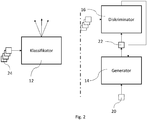
- Figure 2 illustrates that the classifier 12 (the regressor) and the generator 14 were trained with the same training data sets.
- the training data sets themselves are invisible to the operator of the generator 14, so that confidentiality can also be maintained in this respect.
- the generator is formed by a so-called Generative Adverserial Network (GAN), which is formed by an actual generator 14 and an associated discriminator 16.
- GAN Generative Adverserial Network
- the generator 14 To train the generator 14 with the training data sets that are fed to the discriminator 16, the generator 14 generates an artificial data set from an input data set 20 representing noise and thus a data set 22 representing an artificial prototype, which is fed to the discriminator 16 as an input data set.
- the discriminator 16 can determine the deviation between the artificial prototype and the model defined by the training data sets - the so-called loss - and form an output signal representing this deviation.
- the output signal of the discriminator 16 representing the loss is fed back to the generator 14, where the weights of the nodes of the layers of the generator 14 are adjusted.
- the generator 14 can then be used as follows to determine a quality criterion for the input data records to be classified for the classifier: First, a generator with a generative neural network is provided and trained with the same training data sets with which the classifier was trained.
- an artificial data set is generated which is representative of the classification model embodied by the classifier and which is also referred to as an artificial prototype in the context of this description.
- values for technical parameters represented by this artificial data record are determined from the artificial data record.
- a quality criterion is formed from the determined values of the technical parameters in that a value range or range of values is determined from the determined values of the technical parameters, which depends on the determined values of the technical parameters and a specified tolerance range, the classifier for such input data records, the values represent technical parameters which are within the Range of values and thus meet the quality criterion, delivers a reliable classification result.
- the value range or value space serving as a product criterion can also be determined by comparing a data set artificially generated by the generator (i.e. an artificial prototype) with various input data sets based on real data.
- input data sets are used to which different parameter values for the relevant parameters such as B. resolution, layer thickness or the like are based.
- the loss compared to the artificial prototype or the similarity to the artificial prototype is determined, specifically by means of a loss function known per se or a similarity function known per se. If the comparison shows that the loss is low or the similarity is high enough, the parameter values on which the respective input data set is based are assigned to the parameter space that represents sufficient quality.
- a parameter space can be formed with the help of the generator, which can serve as a quality criterion for input data sets to be classified by the classifier - in the sense that input data sets that are based on data, when they are obtained, parameter values from the as a quality criterion used parameter space, meet the quality criterion and allow a reliable classification to be expected.
- the generator is connected upstream of the classifier - and thus part of a possibly confidential environment.
- the loss can then be determined for an input data set to be specifically classified in relation to a prototype generated by the generator in order to obtain an estimate of the reliability of the classification before the input data set is classified.
- the classifier or the regressor
- the generator itself, but instead if only an entity determining a deviation such as a discriminator or a similarity loss function in conjunction with one generated by the generator Prototypes are provided in order to determine a loss compared to the prototype for each input data record to be specifically classified.
- the input data sets to be classified preferably represent tomographic images and the technical parameters, the values of which are determined from the artificially generated data set, are preferably the contrast range, the image distance, the reconstructed slice thickness, the reconstructed volume or a combination thereof.
- an operator of a classifier can only recognize with difficulty whether he is relying on classification results obtained from the classifier - that is, membership values generated by the classifier.
- the latter is namely only the case if the input data records to be classified for the classifier meet technical criteria that match the classification model that is embodied by the classifier.
- technical criteria are the value ranges of the technical parameters that are represented by the respective input data record.
- the classification by the classifier is only reliable if these match the classification model.
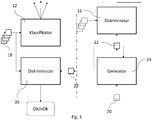
- a quality check of input data sets 18 to be classified can also take place in that the classifier 12 is operated in the confidential environment in connection with a (second) discriminator 26.
- Figure 3 illustrates a corresponding arrangement. On the left in Figure 3 the confidential environment with the classifier 12 and the (second) discriminator 26 is shown.
- the second discriminator 26 is used to determine a loss function, i.e. to determine a measure of an (averaged) deviation between an artificial prototype 22 'generated by the generator 14 and an input data set 18 to be classified Confidential environment can be generated by the generator 14 and then made available for the quality check in the confidential environment.
- the second discriminator 26 can also be viewed as a classifier trained with the artificial prototype 22 ', which for each input data set 18 to be classified belongs to a class "suitable for a reliable classification (OK)" or to a class "for a reliable one Classification not suitable (nOK) " determined.
- the second discriminator 26 can thus be designed as a binary classifier.
- the actual classifier 12 is typically a Multi-class classifier and classifies the input data records 18 by assigning each input data record 18 to one of several classes for which the classifier 12 has been trained.
- the discriminator 26 is an entity that checks the discrepancy between the artificially generated prototype 22 'and an input data set 18 to be classified in each case.
- the discriminator 26 can thus also embody a simple similarity loss function.
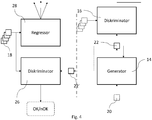
- a regressor 28 can also be provided in the confidential environment. This is in Figure 4 illustrated.
- a regressor typically does not provide an assignment to one of several classes as an output value (as the classifier 12 does), but rather provides a numerical value for a respective input data set.
- the numerical value can represent the age of a person if the input data set checked by the regressor 28 represents an image of this person.
- Other numerical values supplied by a regressor can, for example, indicate the probable length of stay of a patient in the hospital.
- the regressor 28 also embodies a discriminative neural network that has been trained with corresponding training data sets which, for example, represent images of people of different ages.
Landscapes
- Engineering & Computer Science (AREA)
- Physics & Mathematics (AREA)
- Theoretical Computer Science (AREA)
- General Health & Medical Sciences (AREA)
- Computing Systems (AREA)
- Biomedical Technology (AREA)
- Biophysics (AREA)
- Computational Linguistics (AREA)
- Data Mining & Analysis (AREA)
- Evolutionary Computation (AREA)
- Life Sciences & Earth Sciences (AREA)
- Molecular Biology (AREA)
- Artificial Intelligence (AREA)
- General Engineering & Computer Science (AREA)
- General Physics & Mathematics (AREA)
- Mathematical Physics (AREA)
- Software Systems (AREA)
- Health & Medical Sciences (AREA)
- Probability & Statistics with Applications (AREA)
- Image Analysis (AREA)
Priority Applications (4)
| Application Number | Priority Date | Filing Date | Title |
|---|---|---|---|
| EP20830273.7A EP4081950A1 (fr) | 2019-12-23 | 2020-12-23 | Système et procédé d'assurance qualité de modèles basée sur des données |
| CN202080088573.8A CN114930346A (zh) | 2019-12-23 | 2020-12-23 | 用于基于数据的模型的质量保证系统和方法 |
| PCT/EP2020/087822 WO2021130340A1 (fr) | 2019-12-23 | 2020-12-23 | Système et procédé d'assurance qualité de modèles basée sur des données |
| US17/788,025 US12430538B2 (en) | 2019-12-23 | 2020-12-23 | System and method for the quality assurance of data-based models |
Applications Claiming Priority (1)
| Application Number | Priority Date | Filing Date | Title |
|---|---|---|---|
| EP19219525 | 2019-12-23 |
Publications (1)
| Publication Number | Publication Date |
|---|---|
| EP3843011A1 true EP3843011A1 (fr) | 2021-06-30 |
Family
ID=69024135
Family Applications (2)
| Application Number | Title | Priority Date | Filing Date |
|---|---|---|---|
| EP20176326.5A Pending EP3843011A1 (fr) | 2019-12-23 | 2020-05-25 | Système et procédé d'assurance qualité des modèles à base de données |
| EP20830273.7A Pending EP4081950A1 (fr) | 2019-12-23 | 2020-12-23 | Système et procédé d'assurance qualité de modèles basée sur des données |
Family Applications After (1)
| Application Number | Title | Priority Date | Filing Date |
|---|---|---|---|
| EP20830273.7A Pending EP4081950A1 (fr) | 2019-12-23 | 2020-12-23 | Système et procédé d'assurance qualité de modèles basée sur des données |
Country Status (4)
| Country | Link |
|---|---|
| US (1) | US12430538B2 (fr) |
| EP (2) | EP3843011A1 (fr) |
| CN (1) | CN114930346A (fr) |
| WO (1) | WO2021130340A1 (fr) |
Cited By (3)
| Publication number | Priority date | Publication date | Assignee | Title |
|---|---|---|---|---|
| CN114301637A (zh) * | 2021-12-11 | 2022-04-08 | 河南大学 | 一种用于医疗物联网的入侵检测方法和系统 |
| CN114553756A (zh) * | 2022-01-27 | 2022-05-27 | 烽火通信科技股份有限公司 | 基于联合生成对抗网络的设备故障检测方法与电子设备 |
| CN116128954A (zh) * | 2022-12-30 | 2023-05-16 | 上海强仝智能科技有限公司 | 一种基于生成网络的商品布局识别方法、装置及存储介质 |
Families Citing this family (3)
| Publication number | Priority date | Publication date | Assignee | Title |
|---|---|---|---|---|
| US11900534B2 (en) * | 2021-07-30 | 2024-02-13 | The Boeing Company | Systems and methods for synthetic image generation |
| CN116975291B (zh) * | 2023-07-27 | 2026-03-31 | 重庆红江机械有限责任公司 | 一种基于深度学习的工艺公差分类方法及系统 |
| CN118201306B (zh) * | 2024-03-20 | 2025-06-24 | 杭州益川电子有限公司 | 一种基于实时数据的水冷节能控制方法及系统 |
Family Cites Families (9)
| Publication number | Priority date | Publication date | Assignee | Title |
|---|---|---|---|---|
| US11389102B2 (en) * | 2018-03-16 | 2022-07-19 | Ablacon Inc. | Systems, devices, components and methods for detecting the locations of sources of cardiac rhythm disorders in a patient's heart |
| JP6708385B2 (ja) * | 2015-09-25 | 2020-06-10 | キヤノン株式会社 | 識別器作成装置、識別器作成方法、およびプログラム |
| US10043088B2 (en) * | 2016-06-23 | 2018-08-07 | Siemens Healthcare Gmbh | Image quality score using a deep generative machine-learning model |
| US20180307912A1 (en) * | 2017-04-20 | 2018-10-25 | David Lee Selinger | United states utility patent application system and method for monitoring virtual perimeter breaches |
| JP6928371B2 (ja) * | 2017-08-01 | 2021-09-01 | 国立研究開発法人情報通信研究機構 | 分類器、分類器の学習方法、分類器における分類方法 |
| CN108898184A (zh) * | 2018-06-29 | 2018-11-27 | 北京奇虎科技有限公司 | 建立跨域联合分布匹配模型的方法、装置及其应用 |
| CN109409508B (zh) * | 2018-11-06 | 2022-03-15 | 成都信息工程大学 | 一种基于生成对抗网络使用感知损失解决模型崩塌的方法 |
| WO2020113031A1 (fr) * | 2018-11-28 | 2020-06-04 | Google Llc | Apprentissage et/ou utilisation d'un modèle de sélection de langue pour déterminer automatiquement une langue pour la reconnaissance de parole d'un énoncé parlé |
| US11650072B2 (en) * | 2019-11-26 | 2023-05-16 | International Business Machines Corporation | Portable lane departure detection |
-
2020
- 2020-05-25 EP EP20176326.5A patent/EP3843011A1/fr active Pending
- 2020-12-23 WO PCT/EP2020/087822 patent/WO2021130340A1/fr not_active Ceased
- 2020-12-23 EP EP20830273.7A patent/EP4081950A1/fr active Pending
- 2020-12-23 CN CN202080088573.8A patent/CN114930346A/zh active Pending
- 2020-12-23 US US17/788,025 patent/US12430538B2/en active Active
Non-Patent Citations (5)
| Title |
|---|
| HAOWEN ZHONG ET AL: "Transfer Learning Based on Joint Feature Matching and Adversarial Networks", JOURNAL OF SHANGHAI JIAOTONG UNIVERSITY (ENGLISH EDITION), vol. 24, no. 6, 10 December 2019 (2019-12-10), Heidelberg, pages 699 - 705, XP055745695, ISSN: 1007-1172, DOI: 10.1007/s12204-019-2132-0 * |
| HARDY CORENTIN ET AL: "MD-GAN: Multi-Discriminator Generative Adversarial Networks for Distributed Datasets", 2019 IEEE INTERNATIONAL PARALLEL AND DISTRIBUTED PROCESSING SYMPOSIUM (IPDPS), IEEE, 20 May 2019 (2019-05-20), pages 866 - 877, XP033610345, DOI: 10.1109/IPDPS.2019.00095 * |
| INTRATOR YOTAM ET AL: "MDGAN: Boosting Anomaly Detection Using Multi-Discriminator Generative Adversarial Networks", ARXIV (CORNELL UNIVERSITY), 11 October 2018 (2018-10-11), XP093178705, Retrieved from the Internet <URL:https://arxiv.org/pdf/1810.05221> [retrieved on 20240625], DOI: 10.48550/arxiv.1810.05221 * |
| LI ZHUO ET AL: "Sparsely Self-Supervised Generative Adversarial Nets for Radio Frequency Estimation", IEEE JOURNAL ON SELECTED AREAS IN COMMUNICATIONS, IEEE SERVICE CENTER, PISCATAWAY, US, vol. 37, no. 11, 1 November 2019 (2019-11-01), pages 2428 - 2442, XP011750629, ISSN: 0733-8716, [retrieved on 20191015], DOI: 10.1109/JSAC.2019.2933779 * |
| THOMAS SCHLEGL ET AL: "Unsupervised Anomaly Detection with Generative Adversarial Networks to Guide Marker Discovery", ARXIV.ORG, CORNELL UNIVERSITY LIBRARY, 201 OLIN LIBRARY CORNELL UNIVERSITY ITHACA, NY 14853, 17 March 2017 (2017-03-17), XP080757690, DOI: 10.1007/978-3-319-59050-9_12 * |
Cited By (6)
| Publication number | Priority date | Publication date | Assignee | Title |
|---|---|---|---|---|
| CN114301637A (zh) * | 2021-12-11 | 2022-04-08 | 河南大学 | 一种用于医疗物联网的入侵检测方法和系统 |
| CN114301637B (zh) * | 2021-12-11 | 2022-09-02 | 河南大学 | 一种用于医疗物联网的入侵检测方法和系统 |
| CN114553756A (zh) * | 2022-01-27 | 2022-05-27 | 烽火通信科技股份有限公司 | 基于联合生成对抗网络的设备故障检测方法与电子设备 |
| CN114553756B (zh) * | 2022-01-27 | 2023-06-13 | 烽火通信科技股份有限公司 | 基于联合生成对抗网络的设备故障检测方法与电子设备 |
| CN116128954A (zh) * | 2022-12-30 | 2023-05-16 | 上海强仝智能科技有限公司 | 一种基于生成网络的商品布局识别方法、装置及存储介质 |
| CN116128954B (zh) * | 2022-12-30 | 2023-12-05 | 上海强仝智能科技有限公司 | 一种基于生成网络的商品布局识别方法、装置及存储介质 |
Also Published As
| Publication number | Publication date |
|---|---|
| US12430538B2 (en) | 2025-09-30 |
| EP4081950A1 (fr) | 2022-11-02 |
| US20230023058A1 (en) | 2023-01-26 |
| CN114930346A (zh) | 2022-08-19 |
| WO2021130340A1 (fr) | 2021-07-01 |
Similar Documents
| Publication | Publication Date | Title |
|---|---|---|
| EP3843011A1 (fr) | Système et procédé d'assurance qualité des modèles à base de données | |
| DE102019207238B4 (de) | Bereitstellen eines Ergebnisbilddatensatzes | |
| DE69324207T2 (de) | Bildgruppierungsvorrichtung | |
| DE102019215460A1 (de) | Verfahren und Vorrichtung zur Rauschreduktion von Bildaufnahmen | |
| DE69919464T2 (de) | Elektronische Vorrichtung zur Bildausrichtung | |
| DE112018002822T5 (de) | Klassifizieren neuronaler netze | |
| DE102021202189A1 (de) | Maschinell erlernte anomalieerkennung | |
| DE102015212953A1 (de) | Künstliche neuronale Netze zur Klassifizierung von medizinischen Bilddatensätzen | |
| DE102022201347A1 (de) | Verfahren und System zur automatisierten Bestimmung von Untersuchungsergebnissen in einer Bildsequenz | |
| EP3853778B1 (fr) | Procédé et dispositif servant à faire fonctionner un système de commande | |
| DE102022202017A1 (de) | Konzeptbasiertes kontradiktorisches Erzeugungsverfahren mit steuerbarer und diverser Semantik | |
| DE102021201124A1 (de) | Trainieren von bildklassifizierernetzen | |
| DE102020215031A1 (de) | Computerimplementiertes Verfahren zur Auswertung von Magnetresonanzdaten, Magnetresonanzeinrichtung, Computerprogramm und elektronisch lesbarer Datenträger | |
| DE112021005678T5 (de) | Normieren von OCT-Bilddaten | |
| WO2000073980A1 (fr) | Reconnaissance de formes par examen de caracteristiques complementaires apres traitement partiel | |
| WO2020187394A1 (fr) | Procédé d'apprentissage d'un dispositif d'autoencodage et de classification de données ainsi que dispositif d'autoencodage et programme informatique associé | |
| EP3637362A1 (fr) | Procédé d'ajustement d'une impression d'image | |
| DE102010028382A1 (de) | Verfahren und Computersystem zur Bearbeitung tomographischer Bilddaten aus einer Röntgen-CT-Untersuchung eines Untersuchungsobjektes | |
| DE102018220608A1 (de) | Maschinelles Lernsystem, sowie ein Verfahren, ein Computerprogramm und eine Vorrichtung zum Erstellen des maschinellen Lernsystems | |
| EP4205041A1 (fr) | Système pour l'harmonisation automatisée de données structurées à partir de différents dispositifs d'acquisition | |
| DE202021102338U1 (de) | Steuergerät zum Erzeugen von Trainingsdaten zum Trainieren eines Algorithmus des maschinellen Lernens | |
| EP3899809B1 (fr) | Procédé à l'apprentissage d'un réseau neuronal | |
| DE102024204448B3 (de) | Bildgebung zur Abbildung einer bekleideten Person | |
| EP3798989B1 (fr) | Procédé mis en oeuvre par ordinateur permettant de fournir des données de sortie servant à l'apprentissage et / ou à la validation d'un algorithme | |
| EP3376466A1 (fr) | Reduction de bruit dans une image volumetrique d'un objet |
Legal Events
| Date | Code | Title | Description |
|---|---|---|---|
| PUAI | Public reference made under article 153(3) epc to a published international application that has entered the european phase |
Free format text: ORIGINAL CODE: 0009012 |
|
| STAA | Information on the status of an ep patent application or granted ep patent |
Free format text: STATUS: THE APPLICATION HAS BEEN PUBLISHED |
|
| AK | Designated contracting states |
Kind code of ref document: A1 Designated state(s): AL AT BE BG CH CY CZ DE DK EE ES FI FR GB GR HR HU IE IS IT LI LT LU LV MC MK MT NL NO PL PT RO RS SE SI SK SM TR |
|
| STAA | Information on the status of an ep patent application or granted ep patent |
Free format text: STATUS: REQUEST FOR EXAMINATION WAS MADE |
|
| 17P | Request for examination filed |
Effective date: 20220103 |
|
| RBV | Designated contracting states (corrected) |
Designated state(s): AL AT BE BG CH CY CZ DE DK EE ES FI FR GB GR HR HU IE IS IT LI LT LU LV MC MK MT NL NO PL PT RO RS SE SI SK SM TR |
|
| STAA | Information on the status of an ep patent application or granted ep patent |
Free format text: STATUS: EXAMINATION IS IN PROGRESS |
|
| 17Q | First examination report despatched |
Effective date: 20240628 |