EP3848095A1 - Couvercle de protection pour boîtes de collecte et procédé associé - Google Patents
Couvercle de protection pour boîtes de collecte et procédé associé Download PDFInfo
- Publication number
- EP3848095A1 EP3848095A1 EP21150018.6A EP21150018A EP3848095A1 EP 3848095 A1 EP3848095 A1 EP 3848095A1 EP 21150018 A EP21150018 A EP 21150018A EP 3848095 A1 EP3848095 A1 EP 3848095A1
- Authority
- EP
- European Patent Office
- Prior art keywords
- protective housing
- interior
- fire
- opening
- fire protection
- Prior art date
- Legal status (The legal status is an assumption and is not a legal conclusion. Google has not performed a legal analysis and makes no representation as to the accuracy of the status listed.)
- Ceased
Links
- 230000001681 protective effect Effects 0.000 title claims abstract description 138
- 238000000034 method Methods 0.000 title claims abstract description 10
- 229910000831 Steel Inorganic materials 0.000 claims abstract description 12
- 239000010959 steel Substances 0.000 claims abstract description 12
- 239000000463 material Substances 0.000 claims abstract description 11
- RNFJDJUURJAICM-UHFFFAOYSA-N 2,2,4,4,6,6-hexaphenoxy-1,3,5-triaza-2$l^{5},4$l^{5},6$l^{5}-triphosphacyclohexa-1,3,5-triene Chemical compound N=1P(OC=2C=CC=CC=2)(OC=2C=CC=CC=2)=NP(OC=2C=CC=CC=2)(OC=2C=CC=CC=2)=NP=1(OC=1C=CC=CC=1)OC1=CC=CC=C1 RNFJDJUURJAICM-UHFFFAOYSA-N 0.000 claims abstract description 6
- 239000003063 flame retardant Substances 0.000 claims abstract description 6
- XAGFODPZIPBFFR-UHFFFAOYSA-N aluminium Chemical compound [Al] XAGFODPZIPBFFR-UHFFFAOYSA-N 0.000 claims abstract description 5
- 229910052782 aluminium Inorganic materials 0.000 claims abstract description 5
- 239000000779 smoke Substances 0.000 claims description 13
- 238000003780 insertion Methods 0.000 claims description 10
- 230000037431 insertion Effects 0.000 claims description 10
- 238000012544 monitoring process Methods 0.000 claims description 6
- 239000004576 sand Substances 0.000 claims description 5
- 238000011161 development Methods 0.000 claims description 2
- 239000004033 plastic Substances 0.000 claims description 2
- 229920003023 plastic Polymers 0.000 claims description 2
- 230000000007 visual effect Effects 0.000 claims description 2
- UGFAIRIUMAVXCW-UHFFFAOYSA-N Carbon monoxide Chemical compound [O+]#[C-] UGFAIRIUMAVXCW-UHFFFAOYSA-N 0.000 claims 1
- 239000003546 flue gas Substances 0.000 claims 1
- 238000013461 design Methods 0.000 description 15
- 238000003860 storage Methods 0.000 description 13
- 230000007480 spreading Effects 0.000 description 8
- 238000003892 spreading Methods 0.000 description 8
- 239000007789 gas Substances 0.000 description 7
- 229910001416 lithium ion Inorganic materials 0.000 description 6
- 230000001960 triggered effect Effects 0.000 description 6
- HBBGRARXTFLTSG-UHFFFAOYSA-N Lithium ion Chemical compound [Li+] HBBGRARXTFLTSG-UHFFFAOYSA-N 0.000 description 5
- 230000008901 benefit Effects 0.000 description 5
- 238000002372 labelling Methods 0.000 description 5
- 238000002485 combustion reaction Methods 0.000 description 3
- 230000006378 damage Effects 0.000 description 3
- 238000004064 recycling Methods 0.000 description 3
- 230000002269 spontaneous effect Effects 0.000 description 3
- 239000002699 waste material Substances 0.000 description 3
- 230000008859 change Effects 0.000 description 2
- 230000007246 mechanism Effects 0.000 description 2
- 239000000203 mixture Substances 0.000 description 2
- WHXSMMKQMYFTQS-UHFFFAOYSA-N Lithium Chemical compound [Li] WHXSMMKQMYFTQS-UHFFFAOYSA-N 0.000 description 1
- 239000004698 Polyethylene Substances 0.000 description 1
- 208000027418 Wounds and injury Diseases 0.000 description 1
- 239000000853 adhesive Substances 0.000 description 1
- 238000004026 adhesive bonding Methods 0.000 description 1
- 230000001070 adhesive effect Effects 0.000 description 1
- QVGXLLKOCUKJST-UHFFFAOYSA-N atomic oxygen Chemical compound [O] QVGXLLKOCUKJST-UHFFFAOYSA-N 0.000 description 1
- 230000015572 biosynthetic process Effects 0.000 description 1
- 239000007844 bleaching agent Substances 0.000 description 1
- 238000006243 chemical reaction Methods 0.000 description 1
- 238000004140 cleaning Methods 0.000 description 1
- 238000000576 coating method Methods 0.000 description 1
- 238000010276 construction Methods 0.000 description 1
- 230000002950 deficient Effects 0.000 description 1
- 230000003111 delayed effect Effects 0.000 description 1
- 230000018109 developmental process Effects 0.000 description 1
- 239000010791 domestic waste Substances 0.000 description 1
- 230000000694 effects Effects 0.000 description 1
- 239000003517 fume Substances 0.000 description 1
- 239000002920 hazardous waste Substances 0.000 description 1
- 208000014674 injury Diseases 0.000 description 1
- 230000010354 integration Effects 0.000 description 1
- 229910052744 lithium Inorganic materials 0.000 description 1
- 239000001301 oxygen Substances 0.000 description 1
- 229910052760 oxygen Inorganic materials 0.000 description 1
- 229920000573 polyethylene Polymers 0.000 description 1
- 230000008569 process Effects 0.000 description 1
- 238000012545 processing Methods 0.000 description 1
- 239000000126 substance Substances 0.000 description 1
- 239000005028 tinplate Substances 0.000 description 1
- 231100000331 toxic Toxicity 0.000 description 1
- 230000002588 toxic effect Effects 0.000 description 1
- 238000012549 training Methods 0.000 description 1
- 238000012546 transfer Methods 0.000 description 1
Images




Classifications
-
- A—HUMAN NECESSITIES
- A62—LIFE-SAVING; FIRE-FIGHTING
- A62C—FIRE-FIGHTING
- A62C2/00—Fire prevention or containment
- A62C2/06—Physical fire-barriers
-
- B—PERFORMING OPERATIONS; TRANSPORTING
- B65—CONVEYING; PACKING; STORING; HANDLING THIN OR FILAMENTARY MATERIAL
- B65F—GATHERING OR REMOVAL OF DOMESTIC OR LIKE REFUSE
- B65F1/00—Refuse receptacles; Accessories therefor
- B65F1/04—Refuse receptacles; Accessories therefor with removable inserts
- B65F1/08—Refuse receptacles; Accessories therefor with removable inserts with rigid inserts
-
- B—PERFORMING OPERATIONS; TRANSPORTING
- B65—CONVEYING; PACKING; STORING; HANDLING THIN OR FILAMENTARY MATERIAL
- B65F—GATHERING OR REMOVAL OF DOMESTIC OR LIKE REFUSE
- B65F1/00—Refuse receptacles; Accessories therefor
- B65F1/14—Other constructional features; Accessories
- B65F1/16—Lids or covers
- B65F1/1607—Lids or covers with filling openings
-
- B—PERFORMING OPERATIONS; TRANSPORTING
- B65—CONVEYING; PACKING; STORING; HANDLING THIN OR FILAMENTARY MATERIAL
- B65F—GATHERING OR REMOVAL OF DOMESTIC OR LIKE REFUSE
- B65F1/00—Refuse receptacles; Accessories therefor
- B65F1/14—Other constructional features; Accessories
- B65F2001/1494—Refuse receptacles comprising means for preventing or extinguishing fire
-
- B—PERFORMING OPERATIONS; TRANSPORTING
- B65—CONVEYING; PACKING; STORING; HANDLING THIN OR FILAMENTARY MATERIAL
- B65F—GATHERING OR REMOVAL OF DOMESTIC OR LIKE REFUSE
- B65F2240/00—Types of refuse collected
- B65F2240/108—Batteries
Definitions
- the invention relates to a protective housing for an easily combustible collection box and a method as described in claims 1 and 12.
- the collection boxes used are inexpensive and have a low weight, but do not provide any protection in the event of a fire.
- the fire can spread unhindered to the surroundings and the entire building, which subsequently leads to enormous personal injury and property damage.
- the risk of self-ignition also increases, as more and more lithium-ion batteries - which are also thrown into such collection boxes by customers - are being used.
- the risk of self-ignition increases significantly with every thrown in and damaged battery.
- chemical reactions also release toxic fumes. It is also not easy to extinguish the fire after such a battery has spontaneously ignited if it has already lasted a long time. Rapid extinguishing of such a fire with a lithium-ion battery is usually only possible when it starts or immediately afterwards.
- a waste and / or scrap collector is known, in which an object can be thrown in via a throw-in flap and is caught in a pivotably arranged container.
- the object of the invention is therefore to create a protective cover or a protective housing with which, on the one hand, the above-mentioned disadvantages are avoided and, on the other hand, a more secure storage of dangerous substances, in particular of battery mixtures, is made possible.
- the protective housing is characterized in that an attachable cover hood is arranged to form an interior, the interior being designed to accommodate the collection box and an opening for objects to be thrown in, in particular batteries, being arranged in the surface, the protective housing being made of flame-retardant material , in particular made of sheet steel or aluminum.
- the easily flammable collection box which is preferably made of cardboard
- the protective housing is designed in such a way that it prevents or prevents a fire that has developed in the collection box from spreading over a certain period of time. This means that there is enough time available to alert relief organizations that respond in the event of a fire and that they also have enough time to arrive. Especially in times when there are no employees or customers in the business premises, defective batteries can often lead to major fires due to spontaneous combustion if they are not detected in good time.
- the protective housing is placed outside of the opening times in a specially monitored room equipped with fire protection devices, i.e.
- the protective housing is removed from the customer area, preferably in the area of the entrance or the cash desk, is transported into the specially secured room, so that if a fire breaks out, it is recognized and the fire is prevented from spreading through the protective housing for a defined period of time.
- the protective housing it is also possible to equip the protective housing with a corresponding alarm system so that the occurrence of the fire can be recorded directly in the interior of the protective housing, whereby on the one hand the fire is detected much earlier and thus more time is available before it spreads and on the other hand the protective housing no longer has to be transported in a specially secured room, as all sensors, controls and alarm modules are integrated in the protective housing and this therefore works autonomously, i.e. independently. In this way, protective housings of this type can be set up in easily accessible and visible places in a shop.
- the main advantage is that the cardboard collection boxes that are already on the market can continue to be used because they are simply placed in the interior of the protective housing provided for this purpose, whereby these collection boxes are monitored and protected against the spread of a fire. There is therefore no need to create new collection boxes from non-flammable materials, which have the disadvantage that they are very heavy, especially when they are filled with batteries.
- the protective housing can be locked and this prevents direct access by citizens or unauthorized persons to the internal collective container.
- An embodiment is advantageous in which the opening is arranged to correspond to a throw-in opening of a collection box accommodated in the interior. This ensures that the thrown in products, in particular batteries, fall directly into the collection box and are not scattered in the interior. If the interior is much larger than the collecting box used, it is possible that the collecting box can be fixed in a certain position by inserting auxiliary elements (inserts made of sheet steel) in order to align the opening with one another. It is also possible that for a wide variety of collection boxes, corresponding inserts, which have the shape and size of the interior, but have corresponding recesses for inserting the collection boxes.
- the insert is exchanged so that the other insert fits into the interior and at the same time has the recess for inserting the collection box, so that the insertion openings are again arranged in a corresponding manner.
- fire protection elements are arranged in the interior of the protective housing, with both the outer walls, the base plate and the cover or cover hood being equipped with them. Only the opening, in particular the throw-in opening, remains free on the cover hood.
- a design in which the fire protection elements can be used depending on the required fire class is advantageous, with fire protection elements of fire class T30 / T60 or T 90, which are intended to prevent burning through over 30min / 60min or 90 minutes, being integrated.
- a wide variety of protective housings can be easily produced for different requirements.
- a design is also advantageous in which a free space is arranged between the housing and a collecting box arranged in the interior, in which one or more sensors, in particular temperature sensors, smoke gas sensors, etc., are arranged.
- the free space ensures that heated air or smoke gases can collect in this free space. This allows the interior of the protective housing to be monitored via the sensors.
- the protective housing is equipped with a fire smoke alarm system that triggers an alarm if smoke is generated.
- This alarm can be triggered acoustically by a fire alarm located inside the protective housing and also optically by an external lamp mounted on the protective housing. Subsequently, the alarm can also be forwarded to the responsible persons via an appropriate modem as SMS or telephone message or a connection can also be made directly to an emergency call center, which then informs the appropriate emergency services, in particular the fire brigade, about the fire and the location automatically or manually recorded and forwarded, for example, in order to initiate fire fighting as quickly as possible.
- an embodiment is also advantageous in which a guide stub is arranged on the cover to correspond to the opening and which corresponds to the insertion opening when the collection box is received.
- a guide stub is arranged on the cover to correspond to the opening and which corresponds to the insertion opening when the collection box is received.
- a design in which the protective housing is designed as a stand-alone product in which a lower box with or without rollers is arranged is advantageous. This ensures that the protective housing can be set up at any point and that the customer has a comfortable drop-in height. This design also makes it possible to effortlessly place the entire collection unit in a safe room with its own fire compartment when the store closes or to move it during cleaning work, or to move the protective housing and its contents outside in the event of a fire.
- cover hood extends at an angle, in which the rear side is higher than the front side, is also advantageous. This means that the standard collection boxes with labeling areas can be used easily.
- a design is advantageous in which the protective housing is designed in the form of a battery. As a result, the customer can already recognize the product to be disposed of due to the shape of the protective housing.
- An embodiment is advantageous in which an alarm system is arranged in the interior or on the outside of the protective housing, the alarm system being designed to monitor the interior by one or more sensors. This ensures that when or before a fire breaks out due to spontaneous combustion, this is detected early, for example due to a temperature rise or smoke gases, and appropriate measures, such as sending out a light signal, triggering a siren, etc., are carried out in order to to draw attention to the developing fire.
- an embodiment is also advantageous in which an alarm module for sending messages and / or for connecting an emergency call center, in particular the fire brigade, is arranged in the alarm system. This ensures that appropriate help is requested from the alarm module even when people are not present in order to avoid a major fire.
- the protective housing preferably has its own energy source so that it can be set up independently of the location. This energy source can be recharged again and again by plugging it into a public supply network or by replacing the batteries. It is of course also possible to design with a mains connection so that the protective housing can be plugged into a public supply network. It is also provided that in the case of a rechargeable battery or battery operation, when a minimum charge level is reached, a warning signal is transmitted in order to charge the rechargeable battery or to replace the batteries.
- the object of the invention is also achieved by a method for monitoring the interior of the protective housing for easily flammable collection boxes, in particular battery collection boxes, in which a collection box is positioned in the interior of the protective housing, objects, in particular batteries, being thrown in via an opening in the cover hood are, in the interior between the protective housing and the collected collection box, the temperature and / or air conditions, in particular smoke, are monitored via sensors, with an alarm module being activated when adjustable setpoints are exceeded.
- the advantage here is that an early self-ignition of a rechargeable battery or battery is detected and corresponding alarms can be carried out in order to be able to carry out fire fighting at a very early point in time at which the fire has not yet spread within the collection box. In this way, a corresponding warning signal or emergency calls can also be sent.
- the measures are also advantageous in which the alarm module has different alarm modes which are selected automatically according to stored criteria, for example according to times, opening times, etc., or which are set manually.
- the monitoring of the protective housing can be operated as required, that is, for example, during the opening times that are stored in the alarm system, the alarm module only activates the warning light and / or the siren, but does not make an emergency call, whereas the emergency call is automatically made outside of business hours is discontinued and / or. SMS or messages can be sent to stored persons.
- different fire levels can be set so that, for example, when a danger is detected due to a temperature rise before self-ignition, a different alarm is sent out than if a fire has already started.
- the measures are advantageous in which the alarm module is activated when a target temperature is reached in a free space in the protective housing. This means that the danger can be pointed out at an early stage so that appropriate countermeasures can be taken.
- the setpoint temperature can be as follows be chosen so that this is below spontaneous combustion and so that attention is drawn to the dangerous situation before a fire breaks out. This means that the protective housing together with the collection box can be pushed into the open so that it cannot reach into the building if a fire breaks out.
- the measures are advantageous in which an extinguishing device integrated in the interior of the protective housing is activated when a target temperature is reached. This ensures that fire fighting is started early so that even longer protection is achieved via the protective housing.
- an extinguishing device sand baths attached to the cover can be attached, for example, which are destroyed when the target temperature is exceeded so that the sand trickles onto the collection box and preferably into the throw-in opening, so that the air supply is reduced and the fire can be extinguished.
- the measures are advantageous in which the alarm system issues a visual and / or acoustic alarm and / or text messages for cell phones and / or an emergency call. As a result, an alarm for fire fighting can be sent out in good time if a person is present or in the absence of persons.
- protective covers 1 or protective housing 1 are shown, which are designed to accommodate preferably easily combustible collection boxes 2.
- Such collection boxes 2 are usually produced inexpensively in that they are formed from cardboard or from thin, light white bleach.
- the purpose of the collection boxes 2 is to collect environmentally harmful products or objects 3, such as batteries 3, which may not be disposed of with the residual waste of a household.
- cardboard boxes 2 are set up in a wide variety of shops, especially in supermarkets, into which the products 3, in particular the battery 3, can be thrown through an opening 4 on an upper side 5 of the collecting box 2.
- the collection boxes 2 are designed as so-called disposable items that are fed to the recycling process after they have been used, that is, after they have been returned.
- Such collection boxes 2 are preferably set up for the return of used batteries 3, whereby, due to the increasing use of lithium-ion batteries 3 or rechargeable batteries 3, these are also disposed of in such collection boxes 2 by the consumers.
- this type of battery 3 or rechargeable battery 3 poses a very high risk of fire, in particular if the lithium rechargeable battery 3 or battery 3 is damaged, which often leads to self-ignition of the battery 3 or rechargeable batteries 3.
- these cardboard collection boxes 2 do not form any fire protection, but rather promote it when a fire occurs.
- Such collection boxes 2 should therefore be constantly monitored or parked in a secure area overnight.
- a protective housing 1 or a protective cover 1 is created in which an interior 6 of the protective housing 1 is designed to accommodate the collecting box 2 and in the top 7, in particular the cover 8, a corresponding opening 9 for the insertion opening 4 the collecting box 2 for objects 3 to be thrown in, in particular batteries 3, is arranged, ie the customer throws the battery 3 into the opening 9 of the cover 8, whereupon it falls through the throw-in opening 4 into the collecting box 2 and is stored there.
- the protective housing 1 is made from a material that is difficult to combust, in particular the protective housing 1 is made from aluminum or sheet aluminum or sheet steel, the material thickness being between 1 and 3 mm. In the case of the protective housing 1, the empty weight does not matter, since the protective housing 1 remains in the shop and only the collection box 2 is exchanged and transported.
- the protective housing 1 can have the most varied of shapes, as can be seen from the figures. According to the Figs. 1 to 3 a rectangular stand-alone protective housing 1 is shown, which can be set up on the floor 10 and is displaceable via rollers 11, whereas the Fig. 4 and 5 shows a multi-part protective housing 1 or protective cover 1 formed in particular from two parts, namely a base plate 12 and the covering hood 8, which is placed manually on a storage board 13 over a collecting box 2.
- Fig. 6 shows an embodiment of the protective housing 1 in the form of a battery and Fig. 7 a protective housing 1 with an inclined cover 8, the embodiments of Fig. 6 and 7th again as Stand alone products are designed.
- FIGS 8 to 10 show a simplified structure of the protective housing 1 as a stand-alone product ( Figures 8 and 9 ) and once as a protective housing 1 for a storage board 13.
- Figures 8 and 9 show a simplified structure of the protective housing 1 as a stand-alone product
- Figures 8 and 9 once as a protective housing 1 for a storage board 13.
- all stand-alone devices or products can also be designed as a protective housing 1 for a storage board 13 or vice versa.
- the protective housing 1 or the protective cover 1 It is essential for the protective housing 1 or the protective cover 1 that it is made of flame-retardant material to prevent the fire from spreading and that the interior space 6 in which the easily combustible collection box 2 is used is at least the same size, but preferably larger than the collection box 2 is formed and this interior 6 is closed all the way round in order to prevent a fire from spreading over a desired period of time if a fire breaks out, that is, that in the event of a self-ignition of a battery 3 in the collecting box 2, the resulting fire locally on the protective housing 1, in particular on the interior 6 of the protective housing 1, remains limited over a defined period of time, so that sufficient time is available for extinguishing work to prevent the fire from spreading.
- the protective housing 1 has a circumferential outer wall 14 with a base element 12, which is formed by a front side, two side parts, a rear side and the base part 12 in the case of an angular shape and is formed circumferentially by the outer wall 14 in the case of a round shape.
- the cover 8 is pivotably connected to the outer wall 14, in particular the rear side, via hinges 15 and closes off the interior 6 at the top.
- the covering hood 8 as for example in FIG Fig. 2 shown, simply turned upwards or opened so that the collection box 2 can be inserted or removed.
- a connecting lever 16 is provided between the cover 8 and the outer wall 14, which limits the opening angle for opening the cover 8.
- a locking mechanism 17 is provided, which has to be activated, for example, with a key or push button in order to lift or pivot the cover 8.
- the protective housing 1 consists of an upper part, namely the Cover hood 8 and a lower part, namely the circumferential outer wall 14 is formed with the bottom element 12 or only the bottom element 12, whereby the interior space 6 for receiving the collecting box 2 is formed or enclosed.
- the covering hood 8 is designed merely as a closure, that is to say as a cover 8, to the circumferential outer wall 14 with the base element 12.
- the cover 8 has the opening 9 through which the products 3 to be disposed of, in particular batteries 3, can be thrown in.
- the opening 9 is arranged to correspond to the throw-in opening 4, with the cover 8 closed, so that a thrown-in battery 3 falls directly into the collecting box 2, that is, the position of the collecting box 2 in the interior 6 is aligned in such a way that the opening 9 and the throw-in opening 4 are opposite.
- corresponding inserts can be used for positioning and fixing the collection box 2 (not shown).
- the protective housing 1 shown is designed as a so-called stand-alone product, this also has a lower box 18 which is provided with a door 19.
- the lower box 18 can be used as a storage space in which, for example, an empty collection box 2 or an already filled collection box 2 is stored.
- the lower box 18 ensures that a throw-in height 20, that is to say the position of the opening 9 in the covering hood 8, can be easily reached by the customer without the customer having to bend down or stretch. This also ensures that the protective housing 1 can easily be set up on the floor 10 independently of aids such as storage boards 13.
- the protective housing 1 can be set up in the entrance area, where there are usually no storage aids or shelves 13, so that the customer does not have to carry the batteries 3 to the cash desk when shopping, but rather the batteries 3 when they are shopping Entering the shop can be thrown. If the collection boxes 2 are set up in the exit area, the batteries 3 are often forgotten in the shopping bags and the customer takes the batteries 3 back home with him, which creates the risk that the customer will then transfer the batteries 3 disposed of normal household waste.
- Another advantage of such stand-alone protective housings 1 is that they can simply be pushed into the open when an alarm is triggered.
- the fire protection of the protective housing 1 has been increased even further by placing inside the protective housing 1 in the area of the interior 6, i.e. inside the outer walls 14 including the base plate 12 and the Cover hood 8, fire protection panels 21 or fire protection elements 21 are arranged, ie that parallel to the surfaces or walls that surround the interior 6 and form the outer walls, the fire protection elements 21 or fire protection panels 21 are attached so that the interior 6, in which the easily flammable collection box 2 is arranged, has a significantly increased fire protection. It is possible here that, depending on the customer's request, different fire protection elements 21 or fire protection panels 21 with burn-through times of different lengths can be used.
- Fire protection panels 21 of fire protection class T30 or El 2 30-C are preferably used, that is to say that the burning through by the fire protection panel 21 is delayed by approximately 30 minutes. If, on the other hand, fire protection elements 21 of fire class T60 or El 2 60-C or T90 or El 2 90-C are installed, the burn-through resistance increases to approx. 60 or 90 minutes.
- the fastening can be done by simply gluing with a special heat-resistant adhesive or by correspondingly designing the walls with corresponding grooves or undercuts into which the fire protection panels 21 are inserted. It goes without saying that any other type of fastening of the fire protection elements 21 or fire protection plates 21 to the walls of the protective housing 1, in particular in the area of the interior 6, is possible.
- other fire protection elements such as, for example, further sheet steel panels, fire protection coated steel panels, plastic panels or the like, can also be inserted or fastened.
- the protective housing 1 is equipped with an alarm system 22. It is advantageous here if the interior 6 is designed to be larger than the collecting box 2, in order to have a To achieve certain free space 23 at the top or to the side between the housing and the collecting box 2.
- the free space 23 is formed in the front area and above the collecting box 2. The air or smoke gases mentioned can collect in this free space 23 and form a corresponding heat build-up or smoke gas build-up, which is detected by the alarm system 22 via one or more sensors 24, 25.
- the sensors 24, 25 can be integrated in the alarm system 22 or the alarm system 22 can be arranged outside and only the sensors 24, 25 attached in the interior 6, which are connected to the alarm system 22 via lines or wirelessly.
- a temperature sensor 24 and / or a smoke gas sensor 25 is preferably used, which monitor the interior 6 of the protective housing 1.
- the alarm system 22 is equipped with batteries or rechargeable batteries as an energy source 26, whereby it is of course possible that this can be connected directly or additionally to a power supply network.
- the alarm system 22 detects the state in the interior 6, in particular in the free space 23.
- the alarm system 22 preferably compares the state just detected with a state detected at an earlier point in time so that conclusions can be drawn about the risk of self-ignition based on the changes. It is also possible that the recorded states can be saved and read out. It is also possible that a comparison over several previously recorded states is used for the analysis. However, a simple target / actual comparison or a combination is also possible so that an alarm is output if the target value is exceeded. It is also possible for the ambient conditions, in particular temperature, to be detected via sensors (not shown) arranged on the outside and for this to be compared with the temperature in the interior 6 and analyzed.
- the temperature, in particular in the interior 6, and the smoke gases are preferably recorded and observed, so that an alarm is output via an alarm module 27 of the alarm system 22 in the event of a too wide deviation or too rapid change from an output temperature or output air quality.
- a light signal 28 and / or a siren 29 can be activated and on the other hand, an alarm in the event of an emergency call, in particular the fire brigade and / or police, or a message / email can be triggered and sent directly to stored persons. It is also possible that a message is sent first, for example to the manager or operations manager, who has a certain amount of time to acknowledge the alarm before the alarm is forwarded to the emergency call.
- the alarm system 22 is designed for monitoring the interior 6 of the protective housing 1 for easily combustible collection boxes 2, in particular battery collection box 2, in which the collection box 2 is positioned in the interior 6 of the protective housing 1, with an opening 9 of the cover 8, objects 3, in particular batteries 3, are thrown in, the temperature and / or air conditions being monitored via sensors 24, 25 in the interior 6 between the protective housing 1 and the collected collection box 2, with an alarm module 27 being activated if adjustable setpoints are exceeded is activated.
- the flame-retardant protective housing 1 prevents the fire from spreading over a certain period of time and, on the other hand, an alarm is sent out in good time so that the auxiliary staff can arrive in good time before the fire spreads.
- the alarm system 22 can be set so sensitively that an alarm is triggered by the rise in temperature to a correspondingly low temperature value in the free space 26 even before self-ignition. This is mostly used during opening hours, as staff or customers are always on site during opening hours who can carry out checks and take measures to prevent a fire from breaking out.
- FIG. 4 and 5 These measures described above can also be used in a multi-part protective housing 1, as shown in FIG Fig. 4 and 5 is shown.
- the collecting box 2 is positioned on a base plate 12 on the storage board 13, on which the customers often set up their bags for sorting the shopping, which is formed on the one hand from flame-retardant materials and preferably a fire protection element 21 or fire protection plate 21.
- the parked cover 8 of the protective housing 1 is shown, which then, as in Fig. 5 can be seen, is slipped over the collecting box 2.
- the cover 8 in turn has all fire protection measures, that is to say the fire protection panels 21 and the alarm system 22, so that the interior 6 in which the collecting box 2 is located is monitored.
- the commercially available collecting box 2 has an advertising area or labeling area 30 which protrudes beyond the top 5 of the insertion opening 4.
- the cover 8 thus runs at an angle.
- the opening 9 is also spaced significantly further from the insertion opening 4, as a result of which a guide stub 31 is inserted, which directs the inserted battery 3 into the insertion opening 4.
- Such a guide nozzle 31 or throw-in nozzle was also shown in FIG Fig. 3 shown to ensure that the battery 3 is safely thrown into the collecting box 2 to guarantee.
- the base plate 12 forms the lower part of the protective housing 1 and the outer wall 14 is arranged on the cover 8.
- Fig. 6 shows a design of the protective housing 1 in the form of a battery, whereby the customer can see at a glance that batteries 3 can be disposed of here.
- This variant is designed as a stand-alone product, for which a corresponding lower box 18 is arranged in order to achieve a corresponding throw-in height 20.
- a corresponding lower box 18 is arranged in order to achieve a corresponding throw-in height 20.
- Fig. 7 now shows a solution of a stand-alone product for collection boxes 2 with an inscription surface 31, but the side surfaces are trapezoidal, whereby a larger free space 23 is created for the formation of a heat build-up.
- the protective housing 1 is provided with a locking system (not shown) for the opening 9, which is triggered in the event of fire by burning off a retaining pin or holding device, so that a cover element or cap then swivels or covers the opening 9 is rotated. This closes the opening 9 so that the oxygen supply is greatly reduced and the fire can no longer escape from the opening 9. It is also possible that an extinguishing system in the form of sand baths is built into the cover 8, which is melted by a fire and the sand contained in the pads is distributed via the collecting box 2 to contain the fire.
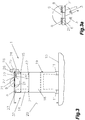
- FIG. 8 to 11 a simplified structure of a protective housing 1 is shown, which can be manufactured inexpensively.
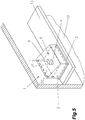
- the Figures 8 and 9 show a stand-alone version, while the Fig. 10 and 11 a Embodiment is shown for placing on a storage board 13 or other objects.
- a basic housing 33 consists of a preferably one-piece tube 34.
- the tube 34 extends from the bottom 10 to the desired drop-in height 20.
- the tube 34 preferably has a diameter 35 of approx. 500 mm and a wall thickness 36 of approx. 12 .5 mm.
- the pipe 34 is preferably made of the material “polyethylene” or other materials that are difficult to ignite, such as sheet steel and the like.
- the base plate 12 is fastened via fastening elements 38 in accordance with the required height 37. It is possible that when elongated holes (not shown) are formed in the tube 34, the floor slab 12 can be adjusted or adapted according to the required height 37.
- a cover 8 or cover 8 is again attached to the tube 34 via a hinge 15, which, as in FIG Fig. 9 shown, are opened, wherein the cover 8 or the cover 8 can be closed via the closing mechanism 17 in order to prevent unauthorized opening of the cover 8.
- an elevation 39 is arranged on the cover 8 so that the appearance or design corresponds to a battery.
- a collection box 2 can be seen, which has no top 5.
- This collection box 2 is, as in the other embodiments of the Figures 1 to 7 , placed in the interior 6 of the basic housing 33, whereupon the cover 8 can be closed.
- the batteries 3 can then be thrown in via the opening 9.
- the collecting box 2 is filled, the collecting box 2 is removed and closed with a cover (not shown) so that it can be shipped or transported.
- a one-piece base housing 33 is used from a tube 34 in which the Base plate 12 is used, the cover 8 being attached to the tube 34, preferably via a hinge 15 for opening.
- fire protection can be guaranteed, i.e. that if a battery 3 spontaneously ignites in the collecting box 2, a fire can break out, but this is limited to the interior 6 of the protective housing 1 over a certain period of time remains limited so that there is sufficient time to fight the fire and / or to travel to aid organizations such as the fire brigade.
- the design of the basic housing 33 as a tube 34 is shown again, the tube height 40 roughly corresponding to the collecting box 2, so that this version has to be set up on an object 13 or storage board 13 in order to be able to conveniently throw in a battery 3. It can also be seen that a rectangular collecting box 2 is placed in the tubular protective housing 1, the protective housing 1 being placed on a cabinet 13.
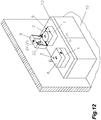
- FIG. 12 an exemplary embodiment is shown in which two protective housings 1 are set up on a cabinet 13, with the collecting boxes 2 being placed in the interior 6 of the protective housing 1.
- the design and execution of the protective housing 1 corresponds to the variant of FIG Figures 1 to 3 , the upper part, that is to say the protective housing 1 consisting of the circumferential outer surfaces 14 with the base plate 12 and the cover 8, was lifted off the lower box 18 and set up on the cabinet 13.
- a protective housing 1 is open, in which the collection box 2 is currently being exchanged, with the customers being able to throw their batteries 3 to be disposed of into the second protective housing 1.
- all the exemplary embodiments shown and described are preferably designed in such a way that the protective housing 1 can be used with or without a lower box 18.
- a protective housing 1 the interior 6 of which is designed in such a way that two or more collection boxes 2 can preferably be positioned next to one another, with two or more openings 9 on the cover corresponding to the insertion openings 4 in the interior 6 collection boxes 2 set up next to one another are arranged, that is to say that several, in particular two collection boxes 2 are arranged in a protective housing 1 and can be filled via separate openings 9.
- the invention is not limited to the embodiment variants shown, but can also include further developments.
- the design variants or individual features of the design variants can also be combined with one another.
Landscapes
- Engineering & Computer Science (AREA)
- Mechanical Engineering (AREA)
- Health & Medical Sciences (AREA)
- Public Health (AREA)
- Business, Economics & Management (AREA)
- Emergency Management (AREA)
- Battery Mounting, Suspending (AREA)
- Fire Alarms (AREA)
Applications Claiming Priority (1)
| Application Number | Priority Date | Filing Date | Title |
|---|---|---|---|
| ATA50005/2020A AT523323B1 (de) | 2020-01-09 | 2020-01-09 | Schutzabdeckung für Sammelboxen und Verfahren hierzu |
Publications (1)
| Publication Number | Publication Date |
|---|---|
| EP3848095A1 true EP3848095A1 (fr) | 2021-07-14 |
Family
ID=74141328
Family Applications (1)
| Application Number | Title | Priority Date | Filing Date |
|---|---|---|---|
| EP21150018.6A Ceased EP3848095A1 (fr) | 2020-01-09 | 2021-01-04 | Couvercle de protection pour boîtes de collecte et procédé associé |
Country Status (2)
| Country | Link |
|---|---|
| EP (1) | EP3848095A1 (fr) |
| AT (1) | AT523323B1 (fr) |
Citations (5)
| Publication number | Priority date | Publication date | Assignee | Title |
|---|---|---|---|---|
| US1160820A (en) * | 1914-01-02 | 1915-11-16 | Edward J Baur | Ash-receptacle. |
| US2170677A (en) * | 1938-05-04 | 1939-08-22 | Borg Warner | Refuse receptacle |
| CH462037A (de) * | 1966-08-25 | 1968-08-31 | Tschalaer Adolf Dipl El Ing | Kehrichtfach |
| EP0443601A1 (fr) * | 1990-02-22 | 1991-08-28 | Fritz Hakemann | Dispositif pour le dépôt de déchets, notamment domestiques et provenant d'établissements gastronomiques |
| DE202010002419U1 (de) | 2010-02-17 | 2010-05-06 | Stumpf Forschungs- Und Entwicklungs-Gmbh | Abfall- und/oder Altstoffsammler |
-
2020
- 2020-01-09 AT ATA50005/2020A patent/AT523323B1/de active
-
2021
- 2021-01-04 EP EP21150018.6A patent/EP3848095A1/fr not_active Ceased
Patent Citations (5)
| Publication number | Priority date | Publication date | Assignee | Title |
|---|---|---|---|---|
| US1160820A (en) * | 1914-01-02 | 1915-11-16 | Edward J Baur | Ash-receptacle. |
| US2170677A (en) * | 1938-05-04 | 1939-08-22 | Borg Warner | Refuse receptacle |
| CH462037A (de) * | 1966-08-25 | 1968-08-31 | Tschalaer Adolf Dipl El Ing | Kehrichtfach |
| EP0443601A1 (fr) * | 1990-02-22 | 1991-08-28 | Fritz Hakemann | Dispositif pour le dépôt de déchets, notamment domestiques et provenant d'établissements gastronomiques |
| DE202010002419U1 (de) | 2010-02-17 | 2010-05-06 | Stumpf Forschungs- Und Entwicklungs-Gmbh | Abfall- und/oder Altstoffsammler |
Also Published As
| Publication number | Publication date |
|---|---|
| AT523323B1 (de) | 2022-07-15 |
| AT523323A1 (de) | 2021-07-15 |
Similar Documents
| Publication | Publication Date | Title |
|---|---|---|
| EP1601417B1 (fr) | Procede de protection contre les incendies et les explosions dans un entrepot a chambres tres hautes pour produits chimiques dangereux et entrepot a chambres tres hautes protege contre les incendies et les explosions | |
| DE202023101699U1 (de) | Behältnis zur Lagerung von Batterien sowie dessen Verwendung | |
| DE202013004963U1 (de) | Sicherheitsbox zum Transport und Lagerung von Batterien | |
| DE2702810A1 (de) | Schutzeinrichtung gegen das eindringen von personen mit schlechten absichten in einen raum | |
| EP4011459A1 (fr) | Récipient de transport et de stockage pour batteries ht et/ou véhicules électriques | |
| DE112010002647T5 (de) | Geldautomaten-Sicherheitssystem | |
| WO1998040858A1 (fr) | Armoire electrique pourvue d'un systeme d'extinction d'incendie | |
| DE2807566A1 (de) | Transportbehaelter fuer wertpapiere, banknoten u.dgl. | |
| DE202021001906U1 (de) | Lagercontainer für Akkus | |
| DE2857734C2 (fr) | ||
| EP4104906B1 (fr) | Dépôt et agencement de stockage d'un véhicule | |
| DE202021103253U1 (de) | Depot zur Aufbewahrung eines Fahrzeugs | |
| AT523323B1 (de) | Schutzabdeckung für Sammelboxen und Verfahren hierzu | |
| EP0745005B1 (fr) | Procede de stockage de dechets heterogenes | |
| DE19644048A1 (de) | Behältnis für eine Traktionsbatterie für Prüfstandszwecke | |
| EP2011094A1 (fr) | Système d'alarme | |
| EP0931735B1 (fr) | Dispositif de collecte et de stockage temporaire de résidues, de déchets ou de marques de production contaminés | |
| CN112814427A (zh) | 一种吸烟室集成台面及吸烟室 | |
| DE8704772U1 (de) | Vorgefertigte Modulbaueinheit zur Lagerung von brennbaren, giftigen und wassergefährdenden Stoffen | |
| DE19539555C2 (de) | Briefkasten, insbesondere Fristenbriefkasten | |
| DE202025002508U1 (de) | Sicherheitsbehältnis für Batterien und Akkus | |
| DE69100234T2 (de) | Alarmsystem für gepanzerte Fahrzeuge mit Wertgegenständen. | |
| EP0416316B1 (fr) | Broyeur avec réceptacle pour les débris broyés | |
| DE29517421U1 (de) | Kabine, insbesondere transportable Bräunungs- und/oder Ruhekabine | |
| CN221368867U (zh) | 一种施工现场灭烟消防与垃圾盛放一体化装置 |
Legal Events
| Date | Code | Title | Description |
|---|---|---|---|
| PUAI | Public reference made under article 153(3) epc to a published international application that has entered the european phase |
Free format text: ORIGINAL CODE: 0009012 |
|
| STAA | Information on the status of an ep patent application or granted ep patent |
Free format text: STATUS: THE APPLICATION HAS BEEN PUBLISHED |
|
| AK | Designated contracting states |
Kind code of ref document: A1 Designated state(s): AL AT BE BG CH CY CZ DE DK EE ES FI FR GB GR HR HU IE IS IT LI LT LU LV MC MK MT NL NO PL PT RO RS SE SI SK SM TR |
|
| STAA | Information on the status of an ep patent application or granted ep patent |
Free format text: STATUS: THE APPLICATION HAS BEEN REFUSED |
|
| 18R | Application refused |
Effective date: 20210802 |