EP3848192A1 - Feuille composite thermoplastique et son procédé de préparation et article fabriqué à partir de celle-ci - Google Patents
Feuille composite thermoplastique et son procédé de préparation et article fabriqué à partir de celle-ci Download PDFInfo
- Publication number
- EP3848192A1 EP3848192A1 EP20151081.5A EP20151081A EP3848192A1 EP 3848192 A1 EP3848192 A1 EP 3848192A1 EP 20151081 A EP20151081 A EP 20151081A EP 3848192 A1 EP3848192 A1 EP 3848192A1
- Authority
- EP
- European Patent Office
- Prior art keywords
- surface layer
- fiber reinforced
- partial reinforcement
- composite
- reinforcement region
- Prior art date
- Legal status (The legal status is an assumption and is not a legal conclusion. Google has not performed a legal analysis and makes no representation as to the accuracy of the status listed.)
- Ceased
Links
Images

Classifications
-
- B—PERFORMING OPERATIONS; TRANSPORTING
- B32—LAYERED PRODUCTS
- B32B—LAYERED PRODUCTS, i.e. PRODUCTS BUILT-UP OF STRATA OF FLAT OR NON-FLAT, e.g. CELLULAR OR HONEYCOMB, FORM
- B32B3/00—Layered products comprising a layer with external or internal discontinuities or unevennesses, or a layer of non-planar shape; Layered products comprising a layer having particular features of form
- B32B3/02—Layered products comprising a layer with external or internal discontinuities or unevennesses, or a layer of non-planar shape; Layered products comprising a layer having particular features of form characterised by features of form at particular places, e.g. in edge regions
- B32B3/08—Layered products comprising a layer with external or internal discontinuities or unevennesses, or a layer of non-planar shape; Layered products comprising a layer having particular features of form characterised by features of form at particular places, e.g. in edge regions characterised by added members at particular parts
- B32B3/085—Layered products comprising a layer with external or internal discontinuities or unevennesses, or a layer of non-planar shape; Layered products comprising a layer having particular features of form characterised by features of form at particular places, e.g. in edge regions characterised by added members at particular parts spaced apart pieces on the surface of a layer
-
- A—HUMAN NECESSITIES
- A45—HAND OR TRAVELLING ARTICLES
- A45C—PURSES; LUGGAGE; HAND CARRIED BAGS
- A45C13/00—Details; Accessories
- A45C13/36—Reinforcements for edges, corners, or other parts
-
- A—HUMAN NECESSITIES
- A45—HAND OR TRAVELLING ARTICLES
- A45C—PURSES; LUGGAGE; HAND CARRIED BAGS
- A45C5/00—Rigid or semi-rigid luggage
- A45C5/02—Materials therefor
-
- B—PERFORMING OPERATIONS; TRANSPORTING
- B29—WORKING OF PLASTICS; WORKING OF SUBSTANCES IN A PLASTIC STATE IN GENERAL
- B29C—SHAPING OR JOINING OF PLASTICS; SHAPING OF MATERIAL IN A PLASTIC STATE, NOT OTHERWISE PROVIDED FOR; AFTER-TREATMENT OF THE SHAPED PRODUCTS, e.g. REPAIRING
- B29C70/00—Shaping composites, i.e. plastics material comprising reinforcements, fillers or preformed parts, e.g. inserts
- B29C70/04—Shaping composites, i.e. plastics material comprising reinforcements, fillers or preformed parts, e.g. inserts comprising reinforcements only, e.g. self-reinforcing plastics
- B29C70/06—Fibrous reinforcements only
- B29C70/10—Fibrous reinforcements only characterised by the structure of fibrous reinforcements, e.g. hollow fibres
- B29C70/16—Fibrous reinforcements only characterised by the structure of fibrous reinforcements, e.g. hollow fibres using fibres of substantial or continuous length
- B29C70/20—Fibrous reinforcements only characterised by the structure of fibrous reinforcements, e.g. hollow fibres using fibres of substantial or continuous length oriented in a single direction, e.g. roofing or other parallel fibres
- B29C70/202—Fibrous reinforcements only characterised by the structure of fibrous reinforcements, e.g. hollow fibres using fibres of substantial or continuous length oriented in a single direction, e.g. roofing or other parallel fibres arranged in parallel planes or structures of fibres crossing at substantial angles, e.g. cross-moulding compound [XMC]
-
- B—PERFORMING OPERATIONS; TRANSPORTING
- B29—WORKING OF PLASTICS; WORKING OF SUBSTANCES IN A PLASTIC STATE IN GENERAL
- B29C—SHAPING OR JOINING OF PLASTICS; SHAPING OF MATERIAL IN A PLASTIC STATE, NOT OTHERWISE PROVIDED FOR; AFTER-TREATMENT OF THE SHAPED PRODUCTS, e.g. REPAIRING
- B29C70/00—Shaping composites, i.e. plastics material comprising reinforcements, fillers or preformed parts, e.g. inserts
- B29C70/04—Shaping composites, i.e. plastics material comprising reinforcements, fillers or preformed parts, e.g. inserts comprising reinforcements only, e.g. self-reinforcing plastics
- B29C70/28—Shaping operations therefor
- B29C70/40—Shaping or impregnating by compression not applied
- B29C70/42—Shaping or impregnating by compression not applied for producing articles of definite length, i.e. discrete articles
-
- B—PERFORMING OPERATIONS; TRANSPORTING
- B29—WORKING OF PLASTICS; WORKING OF SUBSTANCES IN A PLASTIC STATE IN GENERAL
- B29C—SHAPING OR JOINING OF PLASTICS; SHAPING OF MATERIAL IN A PLASTIC STATE, NOT OTHERWISE PROVIDED FOR; AFTER-TREATMENT OF THE SHAPED PRODUCTS, e.g. REPAIRING
- B29C70/00—Shaping composites, i.e. plastics material comprising reinforcements, fillers or preformed parts, e.g. inserts
- B29C70/04—Shaping composites, i.e. plastics material comprising reinforcements, fillers or preformed parts, e.g. inserts comprising reinforcements only, e.g. self-reinforcing plastics
- B29C70/28—Shaping operations therefor
- B29C70/54—Component parts, details or accessories; Auxiliary operations, e.g. feeding or storage of prepregs or SMC after impregnation or during ageing
- B29C70/545—Perforating, cutting or machining during or after moulding
-
- B—PERFORMING OPERATIONS; TRANSPORTING
- B29—WORKING OF PLASTICS; WORKING OF SUBSTANCES IN A PLASTIC STATE IN GENERAL
- B29C—SHAPING OR JOINING OF PLASTICS; SHAPING OF MATERIAL IN A PLASTIC STATE, NOT OTHERWISE PROVIDED FOR; AFTER-TREATMENT OF THE SHAPED PRODUCTS, e.g. REPAIRING
- B29C70/00—Shaping composites, i.e. plastics material comprising reinforcements, fillers or preformed parts, e.g. inserts
- B29C70/88—Shaping composites, i.e. plastics material comprising reinforcements, fillers or preformed parts, e.g. inserts characterised primarily by possessing specific properties, e.g. electrically conductive or locally reinforced
- B29C70/887—Shaping composites, i.e. plastics material comprising reinforcements, fillers or preformed parts, e.g. inserts characterised primarily by possessing specific properties, e.g. electrically conductive or locally reinforced locally reinforced, e.g. by fillers
-
- B—PERFORMING OPERATIONS; TRANSPORTING
- B32—LAYERED PRODUCTS
- B32B—LAYERED PRODUCTS, i.e. PRODUCTS BUILT-UP OF STRATA OF FLAT OR NON-FLAT, e.g. CELLULAR OR HONEYCOMB, FORM
- B32B27/00—Layered products comprising a layer of synthetic resin
- B32B27/12—Layered products comprising a layer of synthetic resin next to a fibrous or filamentary layer
-
- B—PERFORMING OPERATIONS; TRANSPORTING
- B32—LAYERED PRODUCTS
- B32B—LAYERED PRODUCTS, i.e. PRODUCTS BUILT-UP OF STRATA OF FLAT OR NON-FLAT, e.g. CELLULAR OR HONEYCOMB, FORM
- B32B27/00—Layered products comprising a layer of synthetic resin
- B32B27/30—Layered products comprising a layer of synthetic resin comprising vinyl (co)polymers; comprising acrylic (co)polymers
-
- B—PERFORMING OPERATIONS; TRANSPORTING
- B32—LAYERED PRODUCTS
- B32B—LAYERED PRODUCTS, i.e. PRODUCTS BUILT-UP OF STRATA OF FLAT OR NON-FLAT, e.g. CELLULAR OR HONEYCOMB, FORM
- B32B27/00—Layered products comprising a layer of synthetic resin
- B32B27/32—Layered products comprising a layer of synthetic resin comprising polyolefins
-
- B—PERFORMING OPERATIONS; TRANSPORTING
- B32—LAYERED PRODUCTS
- B32B—LAYERED PRODUCTS, i.e. PRODUCTS BUILT-UP OF STRATA OF FLAT OR NON-FLAT, e.g. CELLULAR OR HONEYCOMB, FORM
- B32B27/00—Layered products comprising a layer of synthetic resin
- B32B27/36—Layered products comprising a layer of synthetic resin comprising polyesters
- B32B27/365—Layered products comprising a layer of synthetic resin comprising polyesters comprising polycarbonates
-
- B—PERFORMING OPERATIONS; TRANSPORTING
- B32—LAYERED PRODUCTS
- B32B—LAYERED PRODUCTS, i.e. PRODUCTS BUILT-UP OF STRATA OF FLAT OR NON-FLAT, e.g. CELLULAR OR HONEYCOMB, FORM
- B32B27/00—Layered products comprising a layer of synthetic resin
- B32B27/40—Layered products comprising a layer of synthetic resin comprising polyurethanes
-
- B—PERFORMING OPERATIONS; TRANSPORTING
- B32—LAYERED PRODUCTS
- B32B—LAYERED PRODUCTS, i.e. PRODUCTS BUILT-UP OF STRATA OF FLAT OR NON-FLAT, e.g. CELLULAR OR HONEYCOMB, FORM
- B32B5/00—Layered products characterised by the non- homogeneity or physical structure, i.e. comprising a fibrous, filamentary, particulate or foam layer; Layered products characterised by having a layer differing constitutionally or physically in different parts
- B32B5/02—Layered products characterised by the non- homogeneity or physical structure, i.e. comprising a fibrous, filamentary, particulate or foam layer; Layered products characterised by having a layer differing constitutionally or physically in different parts characterised by structural features of a fibrous or filamentary layer
-
- B—PERFORMING OPERATIONS; TRANSPORTING
- B29—WORKING OF PLASTICS; WORKING OF SUBSTANCES IN A PLASTIC STATE IN GENERAL
- B29C—SHAPING OR JOINING OF PLASTICS; SHAPING OF MATERIAL IN A PLASTIC STATE, NOT OTHERWISE PROVIDED FOR; AFTER-TREATMENT OF THE SHAPED PRODUCTS, e.g. REPAIRING
- B29C2793/00—Shaping techniques involving a cutting or machining operation
- B29C2793/0009—Cutting out
- B29C2793/0018—Cutting out for making a hole
-
- B—PERFORMING OPERATIONS; TRANSPORTING
- B29—WORKING OF PLASTICS; WORKING OF SUBSTANCES IN A PLASTIC STATE IN GENERAL
- B29K—INDEXING SCHEME ASSOCIATED WITH SUBCLASSES B29B, B29C OR B29D, RELATING TO MOULDING MATERIALS OR TO MATERIALS FOR MOULDS, REINFORCEMENTS, FILLERS OR PREFORMED PARTS, e.g. INSERTS
- B29K2101/00—Use of unspecified macromolecular compounds as moulding material
- B29K2101/12—Thermoplastic materials
-
- B—PERFORMING OPERATIONS; TRANSPORTING
- B32—LAYERED PRODUCTS
- B32B—LAYERED PRODUCTS, i.e. PRODUCTS BUILT-UP OF STRATA OF FLAT OR NON-FLAT, e.g. CELLULAR OR HONEYCOMB, FORM
- B32B2250/00—Layers arrangement
- B32B2250/05—5 or more layers
-
- B—PERFORMING OPERATIONS; TRANSPORTING
- B32—LAYERED PRODUCTS
- B32B—LAYERED PRODUCTS, i.e. PRODUCTS BUILT-UP OF STRATA OF FLAT OR NON-FLAT, e.g. CELLULAR OR HONEYCOMB, FORM
- B32B2250/00—Layers arrangement
- B32B2250/40—Symmetrical or sandwich layers, e.g. ABA, ABCBA, ABCCBA
-
- B—PERFORMING OPERATIONS; TRANSPORTING
- B32—LAYERED PRODUCTS
- B32B—LAYERED PRODUCTS, i.e. PRODUCTS BUILT-UP OF STRATA OF FLAT OR NON-FLAT, e.g. CELLULAR OR HONEYCOMB, FORM
- B32B2260/00—Layered product comprising an impregnated, embedded, or bonded layer wherein the layer comprises an impregnation, embedding, or binder material
- B32B2260/02—Composition of the impregnated, bonded or embedded layer
- B32B2260/021—Fibrous or filamentary layer
-
- B—PERFORMING OPERATIONS; TRANSPORTING
- B32—LAYERED PRODUCTS
- B32B—LAYERED PRODUCTS, i.e. PRODUCTS BUILT-UP OF STRATA OF FLAT OR NON-FLAT, e.g. CELLULAR OR HONEYCOMB, FORM
- B32B2260/00—Layered product comprising an impregnated, embedded, or bonded layer wherein the layer comprises an impregnation, embedding, or binder material
- B32B2260/02—Composition of the impregnated, bonded or embedded layer
- B32B2260/021—Fibrous or filamentary layer
- B32B2260/023—Two or more layers
-
- B—PERFORMING OPERATIONS; TRANSPORTING
- B32—LAYERED PRODUCTS
- B32B—LAYERED PRODUCTS, i.e. PRODUCTS BUILT-UP OF STRATA OF FLAT OR NON-FLAT, e.g. CELLULAR OR HONEYCOMB, FORM
- B32B2260/00—Layered product comprising an impregnated, embedded, or bonded layer wherein the layer comprises an impregnation, embedding, or binder material
- B32B2260/04—Impregnation, embedding, or binder material
- B32B2260/046—Synthetic resin
-
- B—PERFORMING OPERATIONS; TRANSPORTING
- B32—LAYERED PRODUCTS
- B32B—LAYERED PRODUCTS, i.e. PRODUCTS BUILT-UP OF STRATA OF FLAT OR NON-FLAT, e.g. CELLULAR OR HONEYCOMB, FORM
- B32B2262/00—Composition or structural features of fibres which form a fibrous or filamentary layer or are present as additives
- B32B2262/02—Synthetic macromolecular fibres
- B32B2262/0261—Polyamide fibres
- B32B2262/0269—Aromatic polyamide fibres
-
- B—PERFORMING OPERATIONS; TRANSPORTING
- B32—LAYERED PRODUCTS
- B32B—LAYERED PRODUCTS, i.e. PRODUCTS BUILT-UP OF STRATA OF FLAT OR NON-FLAT, e.g. CELLULAR OR HONEYCOMB, FORM
- B32B2262/00—Composition or structural features of fibres which form a fibrous or filamentary layer or are present as additives
- B32B2262/10—Inorganic fibres
- B32B2262/106—Carbon fibres, e.g. graphite fibres
-
- B—PERFORMING OPERATIONS; TRANSPORTING
- B32—LAYERED PRODUCTS
- B32B—LAYERED PRODUCTS, i.e. PRODUCTS BUILT-UP OF STRATA OF FLAT OR NON-FLAT, e.g. CELLULAR OR HONEYCOMB, FORM
- B32B2307/00—Properties of the layers or laminate
- B32B2307/50—Properties of the layers or laminate having particular mechanical properties
- B32B2307/558—Impact strength, toughness
Definitions
- the present invention relates to the technical field of composite manufacture.
- the present invention relates to a thermoplastic composite sheet and a preparation method therefor as well as an article made therefrom.
- Luggage cases also known as a suitcase
- a trolley case is carried for storing belongings during a travel. It is voluminous, easy to pull, and can greatly reduce traction force of users. That is why it is increasingly common for use.
- the luggage case was made from wood or other heavy materials. With the popularization of air travel, the material for luggage cases tends to be lighter hard plastics or cloth materials. In the current market of material for luggage cases, composites are one of those available for the manufacture of high-strength, high-hardness luggage cases. However, at the same time, high strength and high hardness often means that the luggage case is quite heavy.
- thermosetting resin material can satisfy application requirements of strength, hardness, hydrolytical stability and pressure resistance.
- conventional molding processes such as resin vacuum infusion, prepreg molding, and autoclave molding for thermosetting resin materials, require a long molding period which is more than 10 minutes in most cases, and thus leads to a quite high processing cost.
- Luggage cases made from carbon fiber reinforced thermoplastic composites are products that have been gradually developed in recent years, and most of the luggage cases are manufactured using carbon fiber prepregs in the form of woven fabrics, unidirectional tape prepregs or a mixture of unidirectional tape prepregs and woven fabric prepregs.
- the above carbon fiber reinforced thermoplastic composites need to be stacked into flat plates and laminated into a sheet, and then hot pressed through a mold to form a semi-finished luggage case.
- the sheet laminated by the woven fabric prepregs has almost the same mechanical strength in two fiber directions.
- the fiber direction of each layer can be designed, for example, 0°/90°/90°/0° or 0°/90°/0°/90°/0°. Asymmetrical lamination may cause warpage of composite sheets and parts.
- the unidirectional tape sheet has uniform thickness and mechanical properties in certain fiber direction.
- the general practice is first laminating thinner woven fabric prepregs or unidirectional tape prepregs (the prepreg described herein is a composite of a thermoplastic resin matrix and a reinforcement material formed by impregnating continuous fibers or fabrics with the thermoplastic resin matrix under strictly controlled conditions, the prepreg formed by impregnating woven fabric continuous fibers is called a woven fabric prepreg, and the prepreg formed by impregnating parallel continuous fibers is called a unidirectional prepreg), and hot-pressing them to form a continuous fiber reinforced composite sheet with certain thickness, then manufacturing the composite sheet into a semi-finished luggage case by the hot press molding technique, and finally assembling it with other fabrics or leather materials to form a complete luggage case.
- the prepreg described herein is a composite of a thermoplastic resin matrix and a reinforcement material formed by impregnating continuous fibers or fabrics with the thermoplastic resin matrix under strictly controlled conditions
- the prepreg formed by impregnating woven fabric continuous fibers is called a woven fabric prep
- the luggage cases made from a carbon fiber reinforced thermoplastic resin are often made with a high thickness, which prevents it from being lightweight.
- An object of the present invention is to provide a partially reinforced luggage case.
- Another object of the present invention is to provide a thermoplastic composite sheet for the manufacture of a partially reinforced luggage case.
- thermoplastic composite sheet comprising an upper surface layer, a lower surface layer, and one or more intermediate layers between the upper surface layer and the lower surface layer laminated together, and having an upper surface formed by the upper surface layer, a lower surface formed by the lower surface layer, and a first side, a second side, a third side and a fourth side adjacent in such an order, wherein the thermoplastic composite sheet has at least one first partial reinforcement region close to at least one intersection of adjacent sides and at least one second partial reinforcement region close to at least one side.
- thermoplastic composite sheet mentioned above, comprising laminating together the upper surface layer, the one or more intermediate layers, the lower surface layer, the at least one first partial reinforcement region and the at least one second partial reinforcement region.
- thermoplastic composite sheet mentioned above.
- thermoplastic composite sheet of the present invention has partial reinforcement regions, and thus an article prepared therefrom becomes partial reinforced and has partially improved impact resistance and/or static load capacity, and a good balance among strength, rigidity and light weight without significant increase in the overall structural weight of the final product.
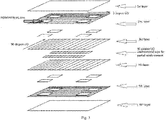
- thermoplastic composite sheet (1) comprising an upper surface layer (11), a lower surface layer (13), and one or more intermediate layers (12) between the upper surface layer (11) and the lower surface layer (13) laminated together, and having an upper surface formed by the upper surface layer (11), a lower surface formed by the lower surface layer (13), and a first side (14), a second side (15), a third side (16) and a fourth side (17) adjacent in such an order, wherein the thermoplastic composite sheet (1) has at least one first partial reinforcement region (18-21) close to at least one intersection of adjacent sides (14-17) and at least one second partial reinforcement region (22-23) close to at least one side (14-17).
- the thermoplastic composite sheet (1) comprises an upper surface layer (11), a lower surface layer (13), and one or more intermediate layers (12) between the upper surface layer (11) and the lower surface layer (13) laminated together, and has an upper surface formed by the upper surface layer (11), a lower surface formed by the lower surface layer (13), and a first side (14), a second side (15), a third side (16) and a fourth side (17). It has at least four first partial reinforcement regions (18-21) each close to each intersection of adjacent sides, respectively, and at least two second partial reinforcement regions (22-23) each close to the first side (14) and the third side (16), respectively.
- the upper surface layer (11), the intermediate layer (12) and the lower surface layer (13) have aligned edges.
- the upper surface layer (11), the intermediate layer (12) and the lower surface layer (13) of the thermoplastic composite sheet (1) are simultaneously rectangular or square.
- the upper surface layer (11), the intermediate layer (12) and the lower surface layer (13) of the thermoplastic composite sheet (1) have aligned edges and are rectangular, and the second partial reinforcement regions (18-21) are close to the sides where the upper surface layer (11), the intermediate layer (12) and the lower surface layer (13) have aligned long edges.
- the at least one first partial reinforcement region (18-21) is located in any one or more layers of the one or more intermediate layers (12).
- the at least one first partial reinforcement region (18-21) has the same thickness as the intermediate layer in which it is located.
- the intermediate layer (12) has two or more layers, such as 2 to 18 layers, preferably 2 to 8 layers.
- the upper surface layer (11) has a thickness of 0.1 to 0.25 mm, preferably 0.15 to 0.25 mm, more preferably 0.15 to 0.2 mm.
- the one or more intermediate layers (12) each independently has a thickness of 0.1 to 0.25 mm, preferably 0.15 to 0.25 mm, more preferably 0.15 to 0.2 mm.
- the lower surface layer (13) has a thickness of 0.1 to 0.25 mm, preferably 0.15 to 0.25 mm, more preferably 0.15 to 0.2 mm.
- each of the first partial reinforcement regions has a thickness of 0.1 to 0.25 mm, preferably 0.15 to 0.25 mm, more preferably 0.15 to 0.2 mm.
- each of the second partial reinforcement regions has a thickness of 0.1 to 0.25 mm, preferably 0.15 to 0.25 mm, more preferably 0.15 to 0.2 mm.
- the thermoplastic composite sheet has a thickness of 1.0 to 2.0 mm, preferably 1.0 to 1.5 mm.
- the at least one second partial reinforcement region (22-23) is located between any two adjacent layers among the upper surface layer (11), the one or more intermediate layers (12), and the lower surface layer (13).
- the at least one second partial reinforcement region (22-23) has substantially the same distance from the upper surface layer (11) as from the lower surface layer (13).
- the at least one second partial reinforcement region (22-23) is located between the third intermediate layer and the fourth intermediate layer from top to bottom.
- the at least one second partially reinforced region (22-23) is located between the fourth intermediate layer and the fifth intermediate layer from top to bottom.
- two adjacent layers refers to layers that are in contact with each other in regions other than the second partial reinforcement regions.
- the at least one first partial reinforcement region (18-21) and the at least one second partial reinforcement region (22-23) are arranged such that the entire thermoplastic composite sheet has substantially a symmetrical structure relative to the intermediate layers.
- the at least one first partial reinforcement region (18-21) each accounts for 1-3% of the entire thermoplastic composite sheet, calculated according to the projected area on the upper surface layer (11).
- the at least one second partial reinforcement region (22-23) each accounts for 3-10% of the entire thermoplastic composite sheet, calculated according to the projected area on the upper surface layer (11).
- a person skilled in the art can determine the distance from the first partial reinforcement region (18-21) to each side, and the distance from the second partial reinforcement region (22-23) to each side, according to subsequent processing, so that in the resulting processed and molded product, the regions often subjected to impact, collision or heavy loads are reinforced.
- thermoplastic composite sheet (1) when a thermoplastic composite sheet is used for preparation of luggage cases, the thermoplastic composite sheet (1) has four first partial reinforcement regions (18-21) and two second partial reinforcement regions (22-23) symmetrically arranged. Only the size of each partial reinforcement region and the position thereof relative to each side are illustrated herein.
- the distance (A) from the first partial reinforcement region (18) to the fourth side (17) is 3% to 5% of the length (L) of the first side (14)
- the distance (C) to the first side (14) is 3% to 5% of the length (1) of the fourth side (17)
- the length (L4) on the fourth side is 10% to 15% of the length (1) of the fourth side (17)
- the length (L1) on the first side is 10% to 15% of the length (L) of the first side (14).
- the size of the first partial reinforcement region (18) and its distance to the adjacent sides are applicable to the size of other first partial reinforcement regions (19-21) and their distance to the adjacent sides.
- the distance (B) from the second partial reinforcement region (22) to the first partial reinforcement region (18) is from 2% to 4% of the length (L) of the first side (14), the distance (D) to the first side (14) is from 8% to 12% of the length (1) of the fourth side (17), the length (L3) on the fourth side (17) is from 8% to 15% of the length (1) of the fourth side (17), and the length (L2) on the first side is from 40% to 60% of the length (L) of the first side (14).
- the size of the second partial reinforcement region (22) and its distance to the adjacent side(s) are applicable to the size of the other second partial reinforcement region (23) and its distance to the adjacent sides.
- the upper surface layer (11), the lower surface layer (13), and the at least one first partial reinforcement region are each independently formed from a polymer material selected from the group consisting of: polycarbonate, polyurethane, and polymethyl methacrylate and polypropylene.
- the upper surface layer (11), the lower surface layer (13) and the at least one first partial reinforcement region are formed from the same polymer material.
- the one or more intermediate layers (12) and the at least one second partial reinforcement region (22-23) are each independently formed from a fiber reinforced resin composite selected from the group consisting of: a carbon fiber reinforced polycarbonate composite, a carbon fiber reinforced thermoplastic polyurethane composite, a carbon fiber reinforced polymethyl methacrylate composite, a carbon fiber reinforced polypropylene composite, a Kevlar fiber reinforced polycarbonate composite, a Kevlar fiber reinforced thermoplastic polyurethane composite, a Kevlar fiber reinforced polymethyl methacrylate composite, and a Kevlar fiber reinforced polypropylene composite; preferably, the one or more intermediate layers (12) and the at least one second partial reinforcement region (22-23) are formed from the same fiber reinforced resin composite.
- all of the upper surface layer (11), the lower surface layer (13) and the at least one first partial reinforcement region are formed from a polycarbonate resin; all of the one or more intermediate layers (12) and the at least one second partial reinforcement region (22-23) are formed from a fiber reinforced resin composite selected from the group consisting of a carbon fiber reinforced polycarbonate composite and a Kevlar fiber reinforced polycarbonate composite.
- all of the upper surface layer (11), the lower surface layer (13), and the at least one first partial reinforcement region are formed from polyurethane; all of the one or more intermediate layers (12) and the at least one second partial reinforcement region (22-23) are formed from a fiber reinforced resin composite selected from the group consisting of a carbon fiber reinforced polyurethane composite and a Kevlar fiber reinforced polyurethane composite.
- all of the upper surface layer (11), the lower surface layer (13), and the at least one first localized reinforcing region are formed from polymethyl methacrylate; all of the one or more intermediate layers (12) and the at least one second partial reinforcement region (22-23) are formed from a fiber reinforced resin composite selected from the group consisting of a carbon fiber reinforced polymethyl methacrylate composite and a Kevlar fiber reinforced polymethyl methacrylate composite.
- all of the upper surface layer (11), the lower surface layer (13), and the at least one first partial reinforcement region are formed from polypropylene; all of the one or more intermediate layers (12) and the at least one second partial reinforcement region (22-23) are formed from a fiber reinforced resin composite selected from the group consisting of a carbon fiber reinforced polypropylene composite and a Kevlar fiber reinforced polypropylene composite.
- thermoplastic composite sheet exhibits a vertically symmetrical structure and is composed of the following layers:
- polycarbonate can be used interchangeably with PC.
- polyurethane can be used interchangeably with PU.
- polymethyl methacrylate can be used interchangeably with PMMA.
- polypropylene can be used interchangeably with PP.
- carbon fiber reinforced polycarbonate composite carbon fiber reinforced thermoplastic polyurethane composite, carbon fiber reinforced polymethyl methacrylate composite, carbon fiber reinforced polypropylene composite, Kevlar fiber reinforced polycarbonate composite, Kevlar fiber reinforced thermoplastic polyurethane composite, Kevlar fiber reinforced polymethyl methacrylate composite, and Kevlar fiber reinforced polypropylene composite, polycarbonate, polyurethane, polymethyl methacrylate and polypropylene are commonly used materials in the composite field.
- the content by volume of the fiber is 35% to 60%, preferably 40% to 55%, more preferably 44% to 50%.
- the polyurethane described in the present application is thermoplastic polyurethane.
- thermoplastic composite sheet according to the present invention can be prepared by a lamination method commonly used in the art.
- thermoplastic composite sheet comprising laminating together the upper surface layer (11), the one or more intermediate layers (12), the lower surface layer (13), the at least one first partial reinforcement region (18-21) and the at least one second partial reinforcement region (22-23).
- thermoplastic composite according to the present invention can be prepared, for example, in the following manner:
- resin films and composite unidirectional tape prepregs are cut by an automatic cutting machine, wherein the resin films are used as the upper surface layer, the lower surface layer, and the first partial reinforcement region(s), and the composite unidirectional prepregs are used as the intermediate layer and the second partial reinforcement region(s).
- the cut unidirectional tape prepregs and resin films are grabbed by a mechanical arm with a suction cup, and then superimposed layer by layer according to the set program.
- the layers are temporarily fixed to one another by an ultrasonic welding torch on the mechanical arm.
- the laminated composites are transferred to a flat hot-pressing machine, and then pressed into a composite sheet under high temperature and high pressure. After cooling, the composite sheet is conveyed to a cutting device for cutting and trimming the edges.
- the mechanical arm has relatively high automation capability and positioning accuracy, it is possible to additionally apply the resin film or composite unidirectional prepregs with high precision to certain regions of the sheet, thereby achieving a partial reinforcement effect.
- the bonding of layers by lamination is a method known in the art.
- a person skilled in the art can select suitable process parameters according to the materials used in each layer and the thickness of each layer.
- all of the upper surface layer (11), the lower surface layer (13), and the at least one first partial reinforcement region are formed from polycarbonate; all of the one or more intermediate layers (12) and the at least one second partial reinforcement region (22-23) are formed from a fiber reinforced resin composite selected from the group consisting of a carbon fiber reinforced polycarbonate composite and a Kevlar fiber reinforced polycarbonate composite; during lamination, the hot plate used has the a temperature of 200 to 260 °C, and a pressure of 1 to 2.5 MPa, and the heating time is 3 to 10 minutes.
- all of the upper surface layer (11), the lower surface layer (13), and the at least one first partial reinforcement region are formed from polyurethane; all of the one or more intermediate layers (12) and the at least one second partial reinforcement region (22-23) are formed from a fiber reinforced resin composite selected from the group consisting of a carbon fiber reinforced polyurethane composite and a Kevlar fiber reinforced polyurethane composite; during lamination, the hot plate used has the a temperature of 180 to 230 °C, and a pressure of 0.8 to 2 MPa, and the heating time is 3 to 10 minutes.
- all of the upper surface layer (11), the lower surface layer (13), and the at least one first localized reinforcing region are formed from polymethyl methacrylate; all of the one or more intermediate layers (12) and the at least one second partial reinforcement region (22-23) are formed from a fiber reinforced resin composite selected from the group consisting of a carbon fiber reinforced polymethyl methacrylate composite and a Kevlar fiber reinforced polymethyl methacrylate composite; during lamination, the hot plate used has the a temperature of 160 to 230 °C, and a pressure of 1 to 2.5 MPa, and the heating time is 3 to 10 minutes.
- all of the upper surface layer (11), the lower surface layer (13), and the at least one first partial reinforcement region are formed from polypropylene; all of the one or more intermediate layers (12) and the at least one second partial reinforcement region (22-23) are formed from a fiber reinforced resin composite selected from the group consisting of a carbon fiber reinforced polypropylene composite and a Kevlar fiber reinforced polypropylene composite; during lamination, the hot plate used has the a temperature of 200 to 215 °C, and a pressure of 0.8 to 1.5 MPa, and the heating time is 2 to 8 minutes.
- thermoplastic composite sheet according to the present invention can be used to prepare various articles, particularly articles requiring local reinforcement.
- thermoplastic composite sheet made from the thermoplastic composite sheet.
- the article may be a case, preferably a luggage case.
- VLPH-200 200 ton flat hot-pressing machine from Vigor Company:
- Platform size 660mm ⁇ 760mm, temperature range: from room temperature (25 °C) to 400 °C, platform flatness: ⁇ 0.5 mm, hot plate temperature uniformity: ⁇ 1.5 °C.
- Working radius 900 mm, 6 axes, The maximum load: 6 kg, repetitive positioning accuracy: ⁇ 0.05 mm.
- Translation speed 800-1500 mm/s
- cutting speed 200-800 mm/s
- repetitive accuracy ⁇ 0.1 mm.
- PC film having a thickness of 0.175 mm.
- Carbon fiber reinforced polycarbonate unidirectional tape having a thickness of 0.175 mm, and the content by volume of carbon fiber of 44%.
- Dropping Test Method for Case and Bag was carried out according to QB/T 2921-2005, the load is 16 kg for a 19-21 inch luggage case, 18 kg for a 22-24 inch luggage case; 20 kg for a 25-28 inch luggage case; 25 kg for a 29-31 inch luggage case; 28 kg for a 32 inch or above luggage case; the dropping height of the flat panel of luggage case is 900 mm, and the dropping height of the edge and corner of luggage case is 600 mm.
- the standard for passing the test is that there is no cracking or deformation.
- Static Load Resistance Test Method for Case and Bag was carried out according to QB/T 2155-2018, the load is 40 kg for a luggage case having a length ranging from 535 mm to 660 mm, and 60 kg for a luggage case having a length ranging from 685 mm to 835 mm, the duration is 4 hours.
- the standard for passing the test is that there is no cracking, deformation, or collapse.
- the polycarbonate composite sheet to be prepared had a vertically symmetrical structure and was composed of the following layers:
- the composite sheet was prepared in the following manner: In accordance with a preset CAD program, polycarbonate resin films and composite unidirectional tape prepregs were cut by an automatic cutting machine. The cut unidirectional tape prepregs and resin film were grabbed by a mechanical arm with a suction cup, and then superimposed layer by layer according to the set program. The layers were temporarily fixed to one another by an ultrasonic welding torch on the mechanical arm. Given that the mechanical arm had relatively high automation capability and positioning accuracy, it was possible to additionally apply the resin film or composite unidirectional prepregs with high precision to certain regions of the sheet, thereby achieving a local reinforcement effect.
- the laminated composites were transferred to a flat hot-pressing machine, and then pressed into a composite sheet under high temperature and high pressure. After cooling, the composite sheet was conveyed to a cutting device for cutting and trimming the edges.
- the process parameters of the flat hot-pressing machine were set as follows:
- the first partial reinforcement regions were arranged corresponding to four corner positions of the luggage case, and the second partial reinforcement regions were arranged corresponding to edges in the lengthwise direction of the luggage case.
- the composite sheet was hot-pressed and molded by a hot press molding machine to form a semi-finished luggage case which was to be assembled into complete luggage case.
- the process parameters of the hot press molding machine were set as follows: Parameters for the hot press molding process Infrared heating temperature (°C) 260 Heating time (min) 4 Material transfer time (s) 20 Clamping time (s) 10 Clamping force (T) 150 Pressure retention time (min) 3 Mold maximum temperature (°C) 180 Demolding temperature (°C) 90
- the Dropping Hammer Impact Test Method for Case and Bag was carried out according to QB/T 2918-2007, the hammer had the weight of 5 kg, and the dropping height of the hammer was 700 mm. It was found that the luggage case had no cracking and no deformation.
- Dropping Test Method for Case and Bag was carried out according to QB/T 2921-2005 with a load of 16 kg, and at the dropping height of the flat panel of luggage case of 900 mm, and the dropping height of the edge and corner of luggage case of 600 mm. No cracking or deformation was observed.
- the Static Load Resistance Test Method for Case and Bag was carried out according to QB/T 2155-2018 under a load of 40 kg for 4 hours. It was found that the luggage case had no cracking, deformation or collapse.
- the polycarbonate composite sheet to be prepared had a vertically symmetrical structure and was composed of the following layers:
- the composite sheet was prepared in the following manner: In accordance with a preset CAD program, a Polycarbonate resin film and composite unidirectional tape prepregs were cut by an automatic cutting machine. The cut unidirectional tape prepregs and resin film were grabbed by a mechanical arm with a suction cup, and then superimposed layer by layer according to the set program. The layers were temporarily fixed to one another by an ultrasonic welding torch on the mechanical arm. When automatic lamination and ultrasonic fixation were finished, the laminated composites were transferred to a flat hot-pressing machine, and then pressed into a composite sheet under high temperature and high pressure. After cooling, the composite sheet was conveyed to a cutting device for cutting and trimming the edges. The process parameters of the flat hot-pressing machine were the same as those in Inventive Example 1.
- thermoplastic composite sheet was hot-pressed and molded by a hot press molding machine to form a semi-finished luggage case which was to be assembled into complete luggage case.
- the process parameters of the hot press molding machine were the same as those described in Inventive Example 1.
- the Dropping Hammer Impact Test Method for Case and Bag was carried out according to QB/T 2918-2007, the hammer had the weight of 5 kg, and the dropping height of the hammer was 700 mm. It was found that the sides of the luggage case were cracked.
- Dropping Test Method for Case and Bag was carried out according to QB/T 2921-2005 with a load of 16 kg, and at the dropping height of the flat panel of luggage case of 900 mm, and the dropping height of the edge and corner of luggage case of 600 mm. It was found that the corners of the luggage case were cracked.
- the Static Load Resistance Test Method for Case and Bag was carried out according to QB/T 2155-2018 under a load of 40 kg for 4 hours. It was found that the edges in the lengthwise direction of the luggage case were cracked, deformed and could not be restored.
Landscapes
- Engineering & Computer Science (AREA)
- Chemical & Material Sciences (AREA)
- Composite Materials (AREA)
- Mechanical Engineering (AREA)
- Materials Engineering (AREA)
- Textile Engineering (AREA)
- Laminated Bodies (AREA)
Priority Applications (1)
| Application Number | Priority Date | Filing Date | Title |
|---|---|---|---|
| EP20151081.5A EP3848192A1 (fr) | 2020-01-10 | 2020-01-10 | Feuille composite thermoplastique et son procédé de préparation et article fabriqué à partir de celle-ci |
Applications Claiming Priority (1)
| Application Number | Priority Date | Filing Date | Title |
|---|---|---|---|
| EP20151081.5A EP3848192A1 (fr) | 2020-01-10 | 2020-01-10 | Feuille composite thermoplastique et son procédé de préparation et article fabriqué à partir de celle-ci |
Publications (1)
| Publication Number | Publication Date |
|---|---|
| EP3848192A1 true EP3848192A1 (fr) | 2021-07-14 |
Family
ID=69157667
Family Applications (1)
| Application Number | Title | Priority Date | Filing Date |
|---|---|---|---|
| EP20151081.5A Ceased EP3848192A1 (fr) | 2020-01-10 | 2020-01-10 | Feuille composite thermoplastique et son procédé de préparation et article fabriqué à partir de celle-ci |
Country Status (1)
| Country | Link |
|---|---|
| EP (1) | EP3848192A1 (fr) |
Citations (5)
| Publication number | Priority date | Publication date | Assignee | Title |
|---|---|---|---|---|
| GB2426736A (en) * | 2005-05-31 | 2006-12-06 | Cotech Inc | Brightened composite shell and making the same by moulding |
| EP3251827A1 (fr) * | 2016-05-30 | 2017-12-06 | Covestro Deutschland AG | Composites combinés de polyuréthane et de polyamide thermoplastiques renforcés par des fibres de carbone et de verre et leur fabrication |
| CN109291467A (zh) | 2018-10-31 | 2019-02-01 | 重庆市凯拉米新材料科技有限公司 | 一种碳纤维热固性材料行李箱热压气囊成型工艺 |
| US20190075897A1 (en) * | 2016-03-10 | 2019-03-14 | Composite Solutions S.R.L. | Method for forming a shell body and shell body obtained therewith |
| EP3473129A1 (fr) * | 2016-06-16 | 2019-04-24 | Carimax Corporation | Feuille multicouche comprenant un tissu et une résine, boîtier de sac de voyage fabriqué à partir de celle-ci et appareil pour sa fabrication |
-
2020
- 2020-01-10 EP EP20151081.5A patent/EP3848192A1/fr not_active Ceased
Patent Citations (5)
| Publication number | Priority date | Publication date | Assignee | Title |
|---|---|---|---|---|
| GB2426736A (en) * | 2005-05-31 | 2006-12-06 | Cotech Inc | Brightened composite shell and making the same by moulding |
| US20190075897A1 (en) * | 2016-03-10 | 2019-03-14 | Composite Solutions S.R.L. | Method for forming a shell body and shell body obtained therewith |
| EP3251827A1 (fr) * | 2016-05-30 | 2017-12-06 | Covestro Deutschland AG | Composites combinés de polyuréthane et de polyamide thermoplastiques renforcés par des fibres de carbone et de verre et leur fabrication |
| EP3473129A1 (fr) * | 2016-06-16 | 2019-04-24 | Carimax Corporation | Feuille multicouche comprenant un tissu et une résine, boîtier de sac de voyage fabriqué à partir de celle-ci et appareil pour sa fabrication |
| CN109291467A (zh) | 2018-10-31 | 2019-02-01 | 重庆市凯拉米新材料科技有限公司 | 一种碳纤维热固性材料行李箱热压气囊成型工艺 |
Similar Documents
| Publication | Publication Date | Title |
|---|---|---|
| WO2021058714A1 (fr) | Feuille composite thermoplastique et son procédé de préparation et article fabriqué à partir de celle-ci | |
| KR100286153B1 (ko) | 복합성형장치, 이를 사용한 고압 동시-경화 성형방법 및 이로부터 제조된 벌집모양 코아 성형제품 | |
| US4963215A (en) | Method for debulking precured thermoplastic composite laminae | |
| EP0722825B1 (fr) | Procédé pour le moulage par transfert de résine en combinaison avec noyau en nid d'abeilles | |
| EP1140475B1 (fr) | Formage d'elements renforces | |
| EP2665596B1 (fr) | Boîtier en matériau composite procédé et système pour sa fabrication | |
| JP2001293790A (ja) | 繊維強化複合材からなる中間成形物品の製造方法 | |
| CN112454938A (zh) | 一种碳纤维蜂窝夹心复合材料构件的成型方法 | |
| WO2008105828A4 (fr) | Stratifié composite et procédé de fabrication | |
| JPH01288437A (ja) | インターリーフを有する繊維強化熱可塑性複合体材料 | |
| EP3778172A1 (fr) | Procédé de production de résine renforcée de fibres | |
| EP3848192A1 (fr) | Feuille composite thermoplastique et son procédé de préparation et article fabriqué à partir de celle-ci | |
| US4784920A (en) | Thin fiber-reinforced plastic composite plate and method of molding the same | |
| KR102418441B1 (ko) | 탄소섬유 강화 플라스틱 성형 방법 | |
| EP0319895A2 (fr) | Procédé de compactage de feuilles thermoplastiques composites partiellement prédurcies | |
| EP3639996B1 (fr) | Procédé de fabrication d'un stratifié composite, procédé de fabrication d'un article moulé en matériau composite renforcé par des fibres, stratifié composite et article moulé en matériau composite renforcé par des fibres | |
| GB2551843B (en) | Moulding composite panels | |
| US20010036992A1 (en) | Material for molded resin articles and molded resin article using the same | |
| US9987768B2 (en) | Composite tools and methods for fabricating composite tools | |
| CN108367509B (zh) | 浸渍遮蔽物 | |
| CN209600012U (zh) | 一种易于热成型的轻质高抗冲高模量多层复合板材 | |
| Rich et al. | Automated Ply-By-Ply Lamination and in-Situ Consolidation of Dry Carbon Fiber Non-Crimp Fabrics for High-Rate Aircraft Manufacturing of Structural Aircraft Components | |
| US20240208161A1 (en) | Method of making golf club head | |
| Mariatti et al. | Influence of different woven geometry and ply effect in woven thermoplastic composite behaviour-Part 2 | |
| JP2025063736A (ja) | 繊維強化シートの製造方法 |
Legal Events
| Date | Code | Title | Description |
|---|---|---|---|
| PUAI | Public reference made under article 153(3) epc to a published international application that has entered the european phase |
Free format text: ORIGINAL CODE: 0009012 |
|
| STAA | Information on the status of an ep patent application or granted ep patent |
Free format text: STATUS: THE APPLICATION HAS BEEN PUBLISHED |
|
| AK | Designated contracting states |
Kind code of ref document: A1 Designated state(s): AL AT BE BG CH CY CZ DE DK EE ES FI FR GB GR HR HU IE IS IT LI LT LU LV MC MK MT NL NO PL PT RO RS SE SI SK SM TR |
|
| STAA | Information on the status of an ep patent application or granted ep patent |
Free format text: STATUS: THE APPLICATION HAS BEEN REFUSED |
|
| 18R | Application refused |
Effective date: 20210726 |