EP3849128A1 - Entrelacement de combinaisons de plusieurs unités de ressources dans un réseau local sans fil - Google Patents
Entrelacement de combinaisons de plusieurs unités de ressources dans un réseau local sans fil Download PDFInfo
- Publication number
- EP3849128A1 EP3849128A1 EP20213847.5A EP20213847A EP3849128A1 EP 3849128 A1 EP3849128 A1 EP 3849128A1 EP 20213847 A EP20213847 A EP 20213847A EP 3849128 A1 EP3849128 A1 EP 3849128A1
- Authority
- EP
- European Patent Office
- Prior art keywords
- rus
- size
- group
- another
- combinations
- Prior art date
- Legal status (The legal status is an assumption and is not a legal conclusion. Google has not performed a legal analysis and makes no representation as to the accuracy of the status listed.)
- Granted
Links
Images





Classifications
-
- H—ELECTRICITY
- H04—ELECTRIC COMMUNICATION TECHNIQUE
- H04L—TRANSMISSION OF DIGITAL INFORMATION, e.g. TELEGRAPHIC COMMUNICATION
- H04L5/00—Arrangements affording multiple use of the transmission path
- H04L5/0001—Arrangements for dividing the transmission path
- H04L5/0003—Two-dimensional division
- H04L5/0005—Time-frequency
-
- H—ELECTRICITY
- H04—ELECTRIC COMMUNICATION TECHNIQUE
- H04L—TRANSMISSION OF DIGITAL INFORMATION, e.g. TELEGRAPHIC COMMUNICATION
- H04L1/00—Arrangements for detecting or preventing errors in the information received
- H04L1/004—Arrangements for detecting or preventing errors in the information received by using forward error control
- H04L1/0056—Systems characterized by the type of code used
- H04L1/0071—Use of interleaving
-
- H—ELECTRICITY
- H04—ELECTRIC COMMUNICATION TECHNIQUE
- H04W—WIRELESS COMMUNICATION NETWORKS
- H04W4/00—Services specially adapted for wireless communication networks; Facilities therefor
- H04W4/06—Selective distribution of broadcast services, e.g. multimedia broadcast multicast service [MBMS]; Services to user groups; One-way selective calling services
- H04W4/08—User group management
-
- H—ELECTRICITY
- H04—ELECTRIC COMMUNICATION TECHNIQUE
- H04L—TRANSMISSION OF DIGITAL INFORMATION, e.g. TELEGRAPHIC COMMUNICATION
- H04L1/00—Arrangements for detecting or preventing errors in the information received
- H04L1/0001—Systems modifying transmission characteristics according to link quality, e.g. power backoff
- H04L1/0006—Systems modifying transmission characteristics according to link quality, e.g. power backoff by adapting the transmission format
- H04L1/0007—Systems modifying transmission characteristics according to link quality, e.g. power backoff by adapting the transmission format by modifying the frame length
-
- H—ELECTRICITY
- H04—ELECTRIC COMMUNICATION TECHNIQUE
- H04L—TRANSMISSION OF DIGITAL INFORMATION, e.g. TELEGRAPHIC COMMUNICATION
- H04L1/00—Arrangements for detecting or preventing errors in the information received
- H04L1/004—Arrangements for detecting or preventing errors in the information received by using forward error control
- H04L1/0041—Arrangements at the transmitter end
-
- H—ELECTRICITY
- H04—ELECTRIC COMMUNICATION TECHNIQUE
- H04L—TRANSMISSION OF DIGITAL INFORMATION, e.g. TELEGRAPHIC COMMUNICATION
- H04L1/00—Arrangements for detecting or preventing errors in the information received
- H04L1/12—Arrangements for detecting or preventing errors in the information received by using return channel
- H04L1/16—Arrangements for detecting or preventing errors in the information received by using return channel in which the return channel carries supervisory signals, e.g. repetition request signals
- H04L1/18—Automatic repetition systems, e.g. Van Duuren systems
- H04L1/1829—Arrangements specially adapted for the receiver end
- H04L1/1861—Physical mapping arrangements
-
- H—ELECTRICITY
- H04—ELECTRIC COMMUNICATION TECHNIQUE
- H04W—WIRELESS COMMUNICATION NETWORKS
- H04W76/00—Connection management
- H04W76/10—Connection setup
-
- H—ELECTRICITY
- H04—ELECTRIC COMMUNICATION TECHNIQUE
- H04W—WIRELESS COMMUNICATION NETWORKS
- H04W84/00—Network topologies
- H04W84/02—Hierarchically pre-organised networks, e.g. paging networks, cellular networks, WLAN [Wireless Local Area Network] or WLL [Wireless Local Loop]
- H04W84/10—Small scale networks; Flat hierarchical networks
- H04W84/12—WLAN [Wireless Local Area Networks]
-
- H—ELECTRICITY
- H04—ELECTRIC COMMUNICATION TECHNIQUE
- H04W—WIRELESS COMMUNICATION NETWORKS
- H04W84/00—Network topologies
- H04W84/18—Self-organising networks, e.g. ad-hoc networks or sensor networks
-
- H—ELECTRICITY
- H04—ELECTRIC COMMUNICATION TECHNIQUE
- H04L—TRANSMISSION OF DIGITAL INFORMATION, e.g. TELEGRAPHIC COMMUNICATION
- H04L5/00—Arrangements affording multiple use of the transmission path
- H04L5/003—Arrangements for allocating sub-channels of the transmission path
- H04L5/0044—Allocation of payload; Allocation of data channels, e.g. PDSCH or PUSCH
-
- H—ELECTRICITY
- H04—ELECTRIC COMMUNICATION TECHNIQUE
- H04L—TRANSMISSION OF DIGITAL INFORMATION, e.g. TELEGRAPHIC COMMUNICATION
- H04L5/00—Arrangements affording multiple use of the transmission path
- H04L5/003—Arrangements for allocating sub-channels of the transmission path
- H04L5/0048—Allocation of pilot signals, i.e. of signals known to the receiver
Definitions
- the present disclosure is generally related to wireless communications and, more particularly, to interleaving of combinations of multiple resource units (RUs) in wireless local area networks (WLANs).
- RUs resource units
- WLANs wireless local area networks
- a resource unit is defined as a group of subcarriers that are allocated and available for transmission.
- the size of an RU can be 26, 52, 106, 242, 484, 996 and 2*996 subcarriers with subcarrier spacing of about 78.1 kHz.
- the number of data tones N SD for each RU can be 24, 48, 102, 234, 468 and 980, respectively.
- IEEE 802.11 be allows multiple RUs to be assigned to a single station (STA).
- STA single station
- data over multi-RUs for one STA can be transmitted at a physical (PHY) layer of a transmitting entity using one Physical Layer Convergence Procedure (PLCP) service data unit (PSDU) received from a medium access control (MAC) layer of the transmitting entity, and information bits for multi-RUs are encoded jointly.
- PHY physical
- PLCP Physical Layer Convergence Procedure
- PSDU Service Data Unit
- MAC medium access control
- An objective of the present disclosure is to provide schemes, concepts, designs, techniques, methods and apparatuses pertaining to interleaving of combinations of multi-RUs in WLANs. Under various proposed schemes in accordance with the present disclosure, it is believed that a better tradeoff between system complexity and performance may be achieved with the various interleaving schemes proposed herein for transmission of multi-RUs. Methods according to the invention are defined in the independent claims. The dependent claims define preferred embodiments thereof.
- a method may involve processing data in a service data unit (SDU). The method may also involve transmitting the processed data to a receiving entity over at least some of a plurality of RUs. In processing the data, the method may involve either: (i) performing tone mapping by using one joint tone interleaver on one or more combinations of multiple RUs of the plurality of RUs within one frequency segment of a predefined bandwidth; or (ii) performing tone mapping by using multiple tone interleavers on the one or more combinations of multiple RUs of the plurality of RUs over multiple frequency segments of the predefined bandwidth.
- SDU service data unit
- a method may involve processing data by interleaving the data over at least some of a plurality of RUs.
- the method may also involve transmitting the processed data to a receiving entity.
- the interleaving of the data over at least some of the plurality of RUs may involve: (i) interleaving one or more combinations of multiple RUs of the plurality of RUs by using one joint interleaver, in an event that a size of each RU of the multiple RUs is less than a predefined size; or (ii) interleaving the one or more combinations of the multiple RUs of the plurality of RUs by using the one joint interleaver, in an even that a size of each RU of the multiple RUs is greater than or equal to the predefined size, responsive to the multiple RUs being within one contiguous frequency segment of a predefined bandwidth; or (iii) interleaving the one or more combinations of the multiple RUs of the plurality of RUs by using multiple tone interlea
- radio access technologies such as, Wi-Fi
- the proposed concepts, schemes and any variation(s)/derivative(s) thereof may be implemented in, for and by other types of radio access technologies, networks and network topologies such as, for example and without limitation, Bluetooth, ZigBee, 5 th Generation (5G)/New Radio (NR), Long-Term Evolution (LTE), LTE-Advanced, LTE-Advanced Pro, Internet-of-Things (loT), Industrial loT (IIoT) and narrowband loT (NB-IoT).
- 5G 5 th Generation
- NR 5 th Generation
- LTE Long-Term Evolution
- LTE-Advanced LTE-Advanced
- LTE-Advanced Pro Internet-of-Things
- IIoT Industrial loT
- NB-IoT narrowband loT
- Implementations in accordance with the present disclosure relate to various techniques, methods, schemes and/or solutions pertaining to interleaving of combinations of multi-RUs in WLANs.
- a number of possible solutions may be implemented separately or jointly. That is, although these possible solutions may be described below separately, two or more of these possible solutions may be implemented in one combination or another.
- examples described herein and illustrated in the figures may show a first RU of size A and a second RU of size B, as in RU A + RU B, various proposed schemes in accordance with the present disclosure may be implemented with RU A + RU B, or vice versa (e.g., RU B + RU A).
- the scope of the present disclosure is not limited to the examples presented herein and, rather, also covers variations thereof.
- the order of RUs may be exchanged in different implementations such as, for example, a first RU of size 484 plus a second RU of size 996 in one implementation or, alternatively, a firs RU of size 996 plus a second RU of size 484 in another implementation.
- FIG. 1 illustrates an example network environment 100 in which various solutions and schemes in accordance with the present disclosure may be implemented.
- FIG. 2 ⁇ FIG. 8 illustrate examples of implementation of various proposed schemes in network environment 100 in accordance with the present disclosure. The following description of various proposed schemes is provided with reference to FIG. 1 ⁇ FIG. 8 .
- network environment 100 may involve a communication entity 110 and a communication entity 120 communicating wirelessly (e.g., in a WLAN in accordance with one or more IEEE 802.11 standards).
- communication entity 110 may be a station (STA) or an access point (AP), and communication entity 120 may be a STA or an AP.
- STA station
- AP access point
- communication entity 110 and communication entity 120 may be configured to perform interleaving of combinations of multi-RUs, as described herein.
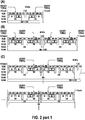
- FIG. 2 illustrates an example scenario 200 of RU combinations in accordance with an implementation of the present disclosure.
- Scenario 200 shows examples of possible RU combinations for small-size RUs such as RUs with a size less than 242. More specifically, scenario 200 shows examples of possible RU combinations in the 20 MHz bandwidth, the 40 MHz bandwidth, and the 80 MHz bandwidth. In scenario 200, one combination of small RUs may be limited to within 20 MHz.
- an RU of size 52, or having 52 tones (herein interchangeably denoted as "RU52”), may be combined with an RU of size 26, or having 26 tones (herein interchangeably denoted as "RU26"). Also, as shown in FIG.
- an RU of size 106, or having 106 tones may be combined with an RU26 (e.g., in the 80 MHz bandwidth).
- RUx denotes an RU of a size x, or having x tones, in the present disclosure.
- DC stands for direct current.
- certain combinations of RUs may be permissible or otherwise allowable/permissible.
- one or more pairs of adjacent and non-overlapping RU26 and RU52, each separated by one or more unused tones in the frequency domain may be combined.
- Examples of permissible RU26 + RU52 combinations under the proposed scheme are shown in part (A) of FIG. 2 for the 20 MHz bandwidth, part (B) of FIG. 2 for the 40 MHz bandwidth, and part (C) of FIG. 2 for the 80 MHz bandwidth.
- one or more pairs of adjacent and non-overlapping RU26 and RU106, each separated by one or more unused tones in the frequency domain may be combined. Examples of permissible RU26 + RU106 combinations under the proposed scheme are shown in part (D) of FIG. 2 for the 80 MHz bandwidth.
- one combination of small RUs may be allowed.
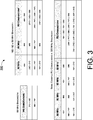
- FIG. 3 illustrates an example scenario 300 of RU combinations in accordance with an implementation of the present disclosure.
- Scenario 300 shows examples of possible RU combinations for large-size RUs such as RUs with a size greater than or equal to 242. More specifically, scenario 300 shows examples of possible RU combinations in the 80 MHz bandwidth, the 160 MHz bandwidth, the 240 MHz bandwidth, and the 320 MHz bandwidth.
- scenario 300 shows examples of possible RU combinations in the 80 MHz bandwidth, the 160 MHz bandwidth, the 240 MHz bandwidth, and the 320 MHz bandwidth.
- RU combinations may be based on 160 MHz and 80+80 MHz.
- LDPC low-density parity-check
- N SD quadrature amplitude modulation (QAM) symbols per stream per orthogonal frequency-division multiplexing (OFDM) symbol after parsing and constellation mapping N SD quadrature amplitude modulation (QAM) symbols per stream per orthogonal frequency-division multiplexing (OFDM) symbol after parsing and constellation mapping.
- QAM quadrature amplitude modulation
- OFDM orthogonal frequency-division multiplexing
- separate tone interleavers may be applied to, or utilized for, RUs or combined multi-RUs in different 80-MHz frequency segments. It is noteworthy that, for multi-RU combinations (e.g., RU242 + RU996, RU484 + RU996, (RU242 + RU484) + RU996), joint tone interleaving schemes may not perform well due to the distance of tone mapping (D TM ) could only be 4.
- D TM distance of tone mapping
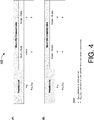
- FIG. 4 illustrates an example scenario 400 of joint tone interleaving schemes for multi-RU combinations in accordance with an implementation of the present disclosure.
- Scenario 400 shows examples of joint tone interleaving schemes for multi-RU combinations in one 80-MHz frequency segment under a proposed scheme in accordance with the present disclosure.
- the joint interleaving scheme may be applied for small-RU combinations (e.g., RU52 + RU26 or RU106 + RU26).
- the joint interleaving scheme may be applied for small-RU combinations (e.g., RU52 + RU26 or RU106 + RU26).
- the joint interleaving scheme may be applied for small-RU combinations (e.g., RU52 + RU26 or RU106 + RU26).
- the joint interleaving scheme may be applied for large-RU Combinations (e.g., RU242 + RU242 and RU242 + RU484)
- the joint tone interleaving scheme may also be applied in case they are within one
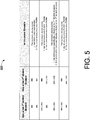
- FIG. 5 illustrates an example scenario 500 of joint tone interleaving schemes for multi-RU combinations in accordance with an implementation of the present disclosure.
- Scenario 500 shows examples of separate interleaving schemes for RUs or multi-RU combinations in different 80-MHz frequency segments.
- FIG. 5 separate tone interleaving schemes proposed in accordance with the present disclosure for 160 MHz and 80+80 MHz are shown.
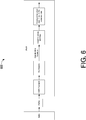
- FIG. 6 illustrates an example architecture 600 of interleaving for multi-RU combinations in accordance with an implementation of the present disclosure.
- architecture 600 for RUs or combined multi-RUs within one 80-MHz frequency segment, the same QAM modulation may be used based on channel state information (CSI) and clear channel assessment (CCA) results at the transmitter.
- CSI channel state information
- CCA clear channel assessment
- a single interleaver may be utilized.
- FIG. 7 illustrates an example architecture 700 of interleaving for multi-RU combinations in accordance with an implementation of the present disclosure.
- architecture 700 for RUs or combined multi-RUs in different 80-MHz frequency segments, different QAM modulations may be used based on CSI and CCA results at the transmitter.
- multiple interleavers may be utilized, with each interleaver corresponding to a respective one of the different 80-MHz segments.
- two different interleavers may be utilized for RUs or combined multi-RUs over two different 80-MHz frequency segments.
- FIG. 8 illustrates an example architecture 800 of interleaving for multi-RU combinations in accordance with an implementation of the present disclosure.
- architecture 800 for RUs or combined multi-RUs in different 80-MHz frequency segments, different QAM modulations may be used based on CSI and CCA results at the transmitter.
- multiple interleavers may be utilized, with each interleaver corresponding to a respective one of the different 80-MHz segments.
- four different interleavers may be utilized for RUs or combined multi-RUs over four different 80-MHz frequency segments.
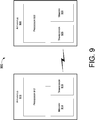
- FIG. 9 illustrates an example system 900 having at least an example apparatus 910 and an example apparatus 920 in accordance with an implementation of the present disclosure.
- apparatus 910 and apparatus 920 may perform various functions to implement schemes, techniques, processes and methods described herein pertaining to interleaving of combinations of multi-RUs in WLANs, including the various schemes described above with respect to various proposed designs, concepts, schemes, systems and methods described above as well as processes described below.
- apparatus 910 may be an example implementation of communication entity 110
- apparatus 920 may be an example implementation of communication entity 120.
- Each of apparatus 910 and apparatus 920 may be a part of an electronic apparatus, which may be a STA or an AP, such as a portable or mobile apparatus, a wearable apparatus, a wireless communication apparatus or a computing apparatus.
- each of apparatus 910 and apparatus 920 may be implemented in a smartphone, a smart watch, a personal digital assistant, a digital camera, or a computing equipment such as a tablet computer, a laptop computer or a notebook computer.
- Each of apparatus 910 and apparatus 920 may also be a part of a machine type apparatus, which may be an loT apparatus such as an immobile or a stationary apparatus, a home apparatus, a wire communication apparatus or a computing apparatus.
- each of apparatus 910 and apparatus 920 may be implemented in a smart thermostat, a smart fridge, a smart door lock, a wireless speaker or a home control center.
- apparatus 910 and/or apparatus 920 may be implemented in a network node, such as an AP in a WLAN.
- each of apparatus 910 and apparatus 920 may be implemented in the form of one or more integrated-circuit (IC) chips such as, for example and without limitation, one or more single-core processors, one or more multi-core processors, one or more reduced-instruction set computing (RISC) processors, or one or more complex-instruction-set-computing (CISC) processors.
- IC integrated-circuit
- RISC reduced-instruction set computing
- CISC complex-instruction-set-computing
- each of apparatus 910 and apparatus 920 may be implemented in or as a STA or an AP.
- Each of apparatus 910 and apparatus 920 may include at least some of those components shown in FIG. 9 such as a processor 912 and a processor 922, respectively, for example.
- Each of apparatus 910 and apparatus 920 may further include one or more other components not pertinent to the proposed scheme of the present disclosure (e.g., internal power supply, display device and/or user interface device), and, thus, such component(s) of apparatus 910 and apparatus 920 are neither shown in FIG. 9 nor described below in the interest of simplicity and brevity.
- other components e.g., internal power supply, display device and/or user interface device
- each of processor 912 and processor 922 may be implemented in the form of one or more single-core processors, one or more multi-core processors, one or more RISC processors or one or more CISC processors. That is, even though a singular term "a processor" is used herein to refer to processor 912 and processor 922, each of processor 912 and processor 922 may include multiple processors in some implementations and a single processor in other implementations in accordance with the present disclosure.
- each of processor 912 and processor 922 may be implemented in the form of hardware (and, optionally, firmware) with electronic components including, for example and without limitation, one or more transistors, one or more diodes, one or more capacitors, one or more resistors, one or more inductors, one or more memristors and/or one or more varactors that are configured and arranged to achieve specific purposes in accordance with the present disclosure.
- each of processor 912 and processor 922 is a special-purpose machine specifically designed, arranged and configured to perform specific tasks including those pertaining to interleaving of combinations of multi-RUs in WLANs in accordance with various implementations of the present disclosure.
- each of processor 912 and processor 922 may be configured with hardware components, or circuitry, implementing one, some or all of example architectures 600, 700 and 800 shown in FIG. 6 ⁇ FIG. 8 .
- apparatus 910 may also include a transceiver 916 coupled to processor 912.
- Transceiver 916 may be capable of wirelessly transmitting and receiving data.
- apparatus 920 may also include a transceiver 926 coupled to processor 922.
- Transceiver 926 may include a transceiver capable of wirelessly transmitting and receiving data.
- apparatus 910 may further include a memory 914 coupled to processor 912 and capable of being accessed by processor 912 and storing data therein.
- apparatus 920 may further include a memory 924 coupled to processor 922 and capable of being accessed by processor 922 and storing data therein.
- RAM random-access memory
- DRAM dynamic RAM
- SRAM static RAM
- T-RAM thyristor RAM
- Z-RAM zero-capacitor RAM
- each of memory 914 and memory 924 may include a type of read-only memory (ROM) such as mask ROM, programmable ROM (PROM), erasable programmable ROM (EPROM) and/or electrically erasable programmable ROM (EEPROM).
- ROM read-only memory
- PROM programmable ROM
- EPROM erasable programmable ROM
- EEPROM electrically erasable programmable ROM
- each of memory 914 and memory 924 may include a type of non-volatile random-access memory (NVRAM) such as flash memory, solid-state memory, ferroelectric RAM (FeRAM), magnetoresistive RAM (MRAM) and/or phase-change memory.
- NVRAM non-volatile random-access memory
- Each of apparatus 910 and apparatus 920 may be a communication entity capable of communicating with each other using various proposed schemes in accordance with the present disclosure.
- a description of capabilities of apparatus 910, as communication entity 110, and apparatus 920, as communication entity 120, is provided below. It is noteworthy that, although the example implementations described below are provided in the context of WLAN, the same may be implemented in other types of networks. Thus, although the following description of example implementations pertains to a scenario in which apparatus 910 functions as a transmitting device and apparatus 920 functions as a receiving device, the same is also applicable to another scenario in which apparatus 910 functions as a receiving device and apparatus 920 functions as a transmitting device.
- processor 912 of apparatus 910 may process data in a service data unit (SDU) (e.g., a PSDU). Additionally, processor 912 may transmit, via transceiver 916, the processed data to a receiving entity (e.g., apparatus 920) over at least some of a plurality of RUs.
- the processing of the data may involve certain operations. For instance, in processing the data, processor 912 may perform tone mapping by using one joint tone interleaver on one or more combinations of multiple RUs of the plurality of RUs within one frequency segment of a predefined bandwidth. Alternatively, in processing the data, processor 912 may perform tone mapping by using multiple tone interleavers on the one or more combinations of multiple RUs of the plurality of RUs over multiple frequency segments of the predefined bandwidth.
- the predefined bandwidth may be 80 MHz.
- the one or more combinations of multiple RUs may include a pair of RUs within a 20-MHz frequency segment with the pair of RUs comprising one RU of size 26 and another RU of size 52.
- the pair of RUs may be adjacent and non-overlapping with respect to each other and separated by one or more unused tones.
- the one or more combinations of multiple RUs may include a pair of RUs within a 20-MHz frequency segment with the pair of RUs comprising one RU of size 26 and another RU of size 106.
- the pair of RUs may be adjacent and non-overlapping with respect to each other and separated by one or more unused tones.
- the one or more combinations of multiple RUs may include a combination of a first RU and a second RU within one 80-MHz frequency segment.
- the first RU may include a RU of size 242 or 484, and the second RU may include a RU of size 242.
- the one or more combinations of multiple RUs may include a plurality of groups of one or more RUs over multiple 80-MHz frequency segments with each of the groups being within a respective one of the multiple 80-MHz frequency segments.
- the plurality of groups of one or more RUs comprise at least a first group of one or more RUs and a second group of one or more RUs.
- any of the following may be implemented: (a) a scenario in which the first group of one or more RUs comprises a RU of size 484, and the second group of one or more RUs comprises a RU of size 996, (b) a scenario in which the first group of one or more RUs comprises one RU of size 242 and another RU of size 242, and the second group of one or more RUs comprises a RU of size 996, (c) a scenario in which the first group of one or more RUs comprises one RU of size 484 and another RU of size 242, and the second group of one or more RUs comprises one RU of size 484 and another RU of size 242, or (d) a scenario in which the first group of one or more RUs comprises one RU of size 484 and another RU of size 242, and the second group of one or more RUs comprises a RU of size 996.
- the plurality of groups of one or more RUs may include at least a first group of one or more RUs, a second group of one or more RUs, a third group of one or more RUs and a fourth group of one or more RUs.
- any of the following may be implemented: (A) a scenario in which the first group of one or more RUs comprises a RU of size 484, the second group of one or more RUs comprises a RU of size 996, the third group of one or more RUs comprises a RU of size 484, and the fourth group of one or more RUs comprises a RU of size 996, (B) a scenario in which the first group of one or more RUs comprises one RU of size 484 and another RU of size 242, the second group of one or more RUs comprises a RU of size 996, the third group of one or more RUs comprises one RU of size 484 and another RU of size 242, and the fourth group of one or more RUs comprises a RU of size 996, or (C) a scenario in which the first group of one or more RUs comprises one RU of size 484 and another RU of size 242, the second group of one or more RUs comprises one RU of size 484 and another
- processor 912 may perform the tone mapping by using the one joint tone interleaver on one or more combinations of multiple RUs each of a size less than a size of 242.
- the one or more combinations of multiple RUs may include a first group of one or more RUs and a second group of one or more RUs. Accordingly, the first group of one or more RUs may include one RU of size 52 and another RU of size 26, and the second group of one or more RUs may include one RU of size 106 and another RU of size 26.
- a first tone mapping distance (D TM ) corresponding to the first group of one or more RUs may be 3 or 6, and a second D TM corresponding to the second group of one or more RUs may be 6.
- a first tone mapping distance with dual-carrier modulation (D TM _D CM ) corresponding to the first group of one or more RUs may be 3, and a second D TM _D CM corresponding to the second group of one or more RUs may be 3.
- processor 912 may perform the tone mapping by using the one joint tone interleaver on one or more combinations of multiple RUs each of a size greater than or equal to a size of 242.
- the multiple RUs may be within one contiguous 80-MHz frequency segment.
- the one or more combinations of multiple RUs may include a first group of one or more RUs and a second group of one or more RUs.
- the first group of one or more RUs may include one RU of size 242 and another RU of size 242, and the second group of one or more RUs may include one RU of size 242 and another RU of size 484.
- a first D TM corresponding to the first group of one or more RUs may be 12, and a second D TM corresponding to the second group of one or more RUs may be 18.
- a first D TM _D CM corresponding to the first group of one or more RUs may be 9, and a second D TM _D CM corresponding to the second group of one or more RUs may be 9.
- processor 912 may perform tone mapping by using two separate tone interleavers on the one or more combinations of multiple RUs of the plurality of RUs over two separate 80-MHz frequency segments.
- the one or more combinations of multiple RUs may include a first group of one or more RUs and a second group of one or more RUs.
- any of the following may be implemented: (a) a scenario in which the first group of one or more RUs comprises a RU of size 484, and the second group of one or more RUs comprises a RU of size 996, (b) a scenario in which the first group of one or more RUs comprises one RU of size 242 and another RU of size 242, and the second group of one or more RUs comprises a RU of size 996, (c) a scenario in which the first group of one or more RUs comprises one RU of size 484 and another RU of size 242, and the second group of one or more RUs comprises one RU of size 484 and another RU of size 242, or (d) a scenario in which the first group of one or more RUs comprises one RU of size 484 and another RU of size 242, and the second group of one or more RUs comprises a RU of size 996.
- processor 912 of apparatus 910 may process data by interleaving the data over at least some of a plurality of RUs. Additionally, processor 912 may transmit, via transceiver 916, the processed data to a receiving entity (e.g., apparatus 920). In interleaving the data, processor 912 may interleave one or more combinations of multiple RUs of the plurality of RUs by using one joint interleaver, in an event that a size of each RU of the multiple RUs is less than a predefined size.
- processor 912 may interleave the one or more combinations of the multiple RUs of the plurality of RUs by using the one joint interleaver, in an even that a size of each RU of the multiple RUs is greater than or equal to the predefined size, responsive to the multiple RUs being within one contiguous frequency segment of a predefined bandwidth. Still alternatively, in interleaving the data, processor 912 may interleave the one or more combinations of the multiple RUs of the plurality of RUs by using multiple tone interleavers responsive to the multiple RUs being over multiple frequency segments of the predefined bandwidth.
- the predefined size may be 242, and the predefined bandwidth may be 80 MHz.
- processor 912 may interleave a pair of RUs within a 20-MHz frequency segment by using the one joint interleaver with the pair of RUs comprising one RU of size 26 and another RU of size 52 or 106.
- the pair of RUs may be adjacent and non-overlapping with respect to each other and separated by one or more unused tones.
- processor 912 may interleave a combination of a first RU and a second RU within one 80-MHz frequency segment by using the one joint interleaver.
- the first RU may include a RU of size 242 or 484, and the second RU may include a RU of size 242.
- processor 912 may interleave a plurality of groups of one or more RUs over multiple 80-MHz frequency segments by using the one joint interleaver, with each of the groups being within a respective one of the multiple 80-MHz frequency segments.
- any of the following may be implemented: (a) a scenario in which a first group of one or more RUs comprises a RU of size 484, and a second group of one or more RUs comprises a RU of size 996, (b) a scenario in which the first group of one or more RUs comprises one RU of size 242 and another RU of size 242, and the second group of one or more RUs comprises a RU of size 996, (c) a scenario in which the first group of one or more RUs comprises one RU of size 484 and another RU of size 242, and the second group of one or more RUs comprises one RU of size 484 and another RU of size 242, or (d) the first group of one or more RUs comprises one RU of size 484 and another RU of size 242, and the second group of one or more RUs comprises a RU of
- any of the following may be implemented: (A) a scenario in which a first group of one or more RUs comprises a RU of size 484, a second group of one or more RUs comprises a RU of size 996, a third group of one or more RUs comprises a RU of size 484, and a fourth group of one or more RUs comprises a RU of size 996, (B) a scenario in which the first group of one or more RUs comprises one RU of size 484 and another RU of size 242, the second group of one or more RUs comprises a RU of size 996, the third group of one or more RUs comprises one RU of size 484 and another RU of size 242, and the fourth group of one or more RUs comprises a RU of size 996, or (C) a scenario in which the first group of one or more RUs comprises one RU of size 484, a second group of one or more RUs comprises a RU of size 996, a third group of one
- processor 912 may interleave a first group of one or more RUs and a second group of one or more RUs of the plurality of RUs by using the one joint interleaver.
- the first group of one or more RUs may include one RU of size 52 and another RU of size 26
- the second group of one or more RUs may include one RU of size 106 and another RU of size 26.
- a first D TM corresponding to the first group of one or more RUs may be 3 or 6, and a second D TM corresponding to the second group of one or more RUs may be 6. Furthermore, a first D TM _D CM corresponding to the first group of one or more RUs may be 3, and a second D TM _D CM corresponding to the second group of one or more RUs may be 3.
- the first group of one or more RUs may include one RU of size 242 and another RU of size 242, and the second group of one or more RUs may include one RU of size 242 and another RU of size 484.
- a first D TM corresponding to the first group of one or more RUs may be 12, and a second D TM corresponding to the second group of one or more RUs may be 18.
- a first D TM _D CM corresponding to the first group of one or more RUs may be 9, and a second DTM_DCM corresponding to the second group of one or more RUs may be 9.
- processor 912 may interleave by using two separate tone interleavers on the one or more combinations of multiple RUs of the plurality of RUs over two separate 80-MHz frequency segments.
- the one or more combinations of multiple RUs may include a first group of one or more RUs and a second group of one or more RUs.
- any of the following may be implemented: (a) a scenario in which the first group of one or more RUs comprises a RU of size 484, and the second group of one or more RUs comprises a RU of size 996, (b) a scenario in which the first group of one or more RUs comprises one RU of size 242 and another RU of size 242, and the second group of one or more RUs comprises a RU of size 996, (c) a scenario in which the first group of one or more RUs comprises one RU of size 484 and another RU of size 242, and the second group of one or more RUs comprises one RU of size 484 and another RU of size 242, or (d) a scenario in which the first group of one or more RUs comprises one RU of size 484 and another RU of size 242, and the second group of one or more RUs comprises a RU of size 996.
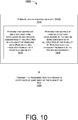
- FIG. 10 illustrates an example process 1000 in accordance with an implementation of the present disclosure.
- Process 1000 may represent an aspect of implementing various proposed designs, concepts, schemes, systems and methods described above. More specifically, process 1000 may represent an aspect of the proposed concepts and schemes pertaining to interleaving of combinations of multi-RUs in WLANs in accordance with the present disclosure.
- Process 1000 may include one or more operations, actions, or functions as illustrated by one or more of blocks 1010 and 1020 as well as sub-blocks 1012 and 1014. Although illustrated as discrete blocks, various blocks of process 1000 may be divided into additional blocks, combined into fewer blocks, or eliminated, depending on the desired implementation. Moreover, the blocks/sub-blocks of process 1000 may be executed in the order shown in FIG. 10 or, alternatively in a different order.
- Process 1000 may be implemented by or in apparatus 910 and apparatus 920 as well as any variations thereof. Solely for illustrative purposes and without limiting the scope, process 1000 is described below in the context of apparatus 910 as communication entity 110 (e.g., a transmitting device whether a STA or an AP) and apparatus 920 as communication entity 120 (e.g., a receiving device whether a STA or an AP) of a wireless network such as a WLAN in accordance with one or more of IEEE 802.11 standards. Process 1000 may begin at block 1010.
- communication entity 110 e.g., a transmitting device whether a STA or an AP
- apparatus 920 as communication entity 120 (e.g., a receiving device whether a STA or an AP) of a wireless network such as a WLAN in accordance with one or more of IEEE 802.11 standards.
- Process 1000 may begin at block 1010.
- process 1000 may involve processor 912 transmitting, via transceiver 916, the processed data to a receiving entity (e.g., apparatus 920) over at least some of a plurality of RUs.
- a receiving entity e.g., apparatus 920
- process 1000 may involve processor 912 performing tone mapping by using one joint tone interleaver on one or more combinations of multiple RUs of the plurality of RUs within one frequency segment of a predefined bandwidth.
- process 1000 may involve processor 912 performing tone mapping by using multiple tone interleavers on the one or more combinations of multiple RUs of the plurality of RUs over multiple frequency segments of the predefined bandwidth.
- the predefined bandwidth may be 80 MHz.
- the one or more combinations of multiple RUs may include a pair of RUs within a 20-MHz frequency segment with the pair of RUs comprising one RU of size 26 and another RU of size 106.
- the pair of RUs may be adjacent and non-overlapping with respect to each other and separated by one or more unused tones.
- the one or more combinations of multiple RUs may include a combination of a first RU and a second RU within one 80-MHz frequency segment.
- the first RU may include a RU of size 242 or 484, and the second RU may include a RU of size 242.
- the one or more combinations of multiple RUs may include a plurality of groups of one or more RUs over multiple 80-MHz frequency segments with each of the groups being within a respective one of the multiple 80-MHz frequency segments.
- the plurality of groups of one or more RUs comprise at least a first group of one or more RUs and a second group of one or more RUs.
- any of the following may be implemented: (a) a scenario in which the first group of one or more RUs comprises a RU of size 484, and the second group of one or more RUs comprises a RU of size 996, (b) a scenario in which the first group of one or more RUs comprises one RU of size 242 and another RU of size 242, and the second group of one or more RUs comprises a RU of size 996, (c) a scenario in which the first group of one or more RUs comprises one RU of size 484 and another RU of size 242, and the second group of one or more RUs comprises one RU of size 484 and another RU of size 242, or (d) a scenario in which the first group of one or more RUs comprises one RU of size 484 and another RU of size 242, and the second group of one or more RUs comprises a RU of size 996.
- the plurality of groups of one or more RUs may include at least a first group of one or more RUs, a second group of one or more RUs, a third group of one or more RUs and a fourth group of one or more RUs.
- any of the following may be implemented: (A) a scenario in which the first group of one or more RUs comprises a RU of size 484, the second group of one or more RUs comprises a RU of size 996, the third group of one or more RUs comprises a RU of size 484, and the fourth group of one or more RUs comprises a RU of size 996, (B) a scenario in which the first group of one or more RUs comprises one RU of size 484 and another RU of size 242, the second group of one or more RUs comprises a RU of size 996, the third group of one or more RUs comprises one RU of size 484 and another RU of size 242, and the fourth group of one or more RUs comprises a RU of size 996, or (C) a scenario in which the first group of one or more RUs comprises one RU of size 484 and another RU of size 242, the second group of one or more RUs comprises one RU of size 484 and another
- process 1000 may involve processor 912 performing the tone mapping by using the one joint tone interleaver on one or more combinations of multiple RUs each of a size less than a size of 242.
- the one or more combinations of multiple RUs may include a first group of one or more RUs and a second group of one or more RUs. Accordingly, the first group of one or more RUs may include one RU of size 52 and another RU of size 26, and the second group of one or more RUs may include one RU of size 106 and another RU of size 26.
- a first tone mapping distance (D TM ) corresponding to the first group of one or more RUs may be 3 or 6, and a second D TM corresponding to the second group of one or more RUs may be 6.
- a first tone mapping distance with dual-carrier modulation (D TM _D CM ) corresponding to the first group of one or more RUs may be 3, and a second D TM _D CM corresponding to the second group of one or more RUs may be 3.
- process 1000 may involve processor 912 performing the tone mapping by using the one joint tone interleaver on one or more combinations of multiple RUs each of a size greater than or equal to a size of 242.
- the multiple RUs may be within one contiguous 80-MHz frequency segment.
- the one or more combinations of multiple RUs may include a first group of one or more RUs and a second group of one or more RUs.
- the first group of one or more RUs may include one RU of size 242 and another RU of size 242, and the second group of one or more RUs may include one RU of size 242 and another RU of size 484.
- a first D TM corresponding to the first group of one or more RUs may be 12, and a second D TM corresponding to the second group of one or more RUs may be 18.
- a first D TM _D CM corresponding to the first group of one or more RUs may be 9, and a second D TM _D CM corresponding to the second group of one or more RUs may be 9.
- process 1000 may involve processor 912 performing tone mapping by using two separate tone interleavers on the one or more combinations of multiple RUs of the plurality of RUs over two separate 80-MHz frequency segments.
- the one or more combinations of multiple RUs may include a first group of one or more RUs and a second group of one or more RUs.
- any of the following may be implemented: (a) a scenario in which the first group of one or more RUs comprises a RU of size 484, and the second group of one or more RUs comprises a RU of size 996, (b) a scenario in which the first group of one or more RUs comprises one RU of size 242 and another RU of size 242, and the second group of one or more RUs comprises a RU of size 996, (c) a scenario in which the first group of one or more RUs comprises one RU of size 484 and another RU of size 242, and the second group of one or more RUs comprises one RU of size 484 and another RU of size 242, or (d) a scenario in which the first group of one or more RUs comprises one RU of size 484 and another RU of size 242, and the second group of one or more RUs comprises a RU of size 996.
- FIG. 11 illustrates an example process 1100 in accordance with an implementation of the present disclosure.
- Process 1100 may represent an aspect of implementing various proposed designs, concepts, schemes, systems and methods described above. More specifically, process 1100 may represent an aspect of the proposed concepts and schemes pertaining to interleaving of combinations of multi-RUs in WLANs in accordance with the present disclosure.
- Process 1100 may include one or more operations, actions, or functions as illustrated by one or more of blocks 1110 and 1120 as well as sub-blocks 1112, 1114 and 1116. Although illustrated as discrete blocks, various blocks of process 1100 may be divided into additional blocks, combined into fewer blocks, or eliminated, depending on the desired implementation. Moreover, the blocks/sub-blocks of process 1100 may be executed in the order shown in FIG.
- Process 1100 may be implemented by or in apparatus 910 and apparatus 920 as well as any variations thereof. Solely for illustrative purposes and without limiting the scope, process 1100 is described below in the context of apparatus 910 as communication entity 110 (e.g., a transmitting device whether a STA or an AP) and apparatus 920 as communication entity 120 (e.g., a receiving device whether a STA or an AP) of a wireless network such as a WLAN in accordance with one or more of IEEE 802.11 standards. Process 1100 may begin at block 1110.
- communication entity 110 e.g., a transmitting device whether a STA or an AP
- apparatus 920 as communication entity 120 (e.g., a receiving device whether a STA or an AP) of a wireless network such as a WLAN in accordance with one or more of IEEE 802.11 standards.
- Process 1100 may begin at block 1110.
- process 1100 may involve processor 912 of apparatus 910 processing data by interleaving the data over at least some of a plurality of RUs by performing alternative operations as represented by sub-blocks 1112, 1114 and 1116. Process 1100 may proceed from 1110 to 1120.
- process 1100 may involve processor 912 transmitting, via transceiver 916, the processed data to a receiving entity (e.g., apparatus 920).
- a receiving entity e.g., apparatus 920.
- process 1100 may involve processor 912 interleaving one or more combinations of multiple RUs of the plurality of RUs by using one joint interleaver, in an event that a size of each RU of the multiple RUs is less than a predefined size.
- process 1100 may involve processor 912 interleaving the one or more combinations of the multiple RUs of the plurality of RUs by using the one joint interleaver, in an even that a size of each RU of the multiple RUs is greater than or equal to the predefined size, responsive to the multiple RUs being within one contiguous frequency segment of a predefined bandwidth.
- process 1100 may involve processor 912 interleaving the one or more combinations of the multiple RUs of the plurality of RUs by using multiple tone interleavers responsive to the multiple RUs being over multiple frequency segments of the predefined bandwidth.
- the predefined size may be 242, and the predefined bandwidth may be 80 MHz.
- process 1100 may involve processor 912 interleaving a pair of RUs within a 20-MHz frequency segment by using the one joint interleaver with the pair of RUs comprising one RU of size 26 and another RU of size 52 or 106.
- the pair of RUs may be adjacent and non-overlapping with respect to each other and separated by one or more unused tones.
- process 1100 may involve processor 912 interleaving a combination of a first RU and a second RU within one 80-MHz frequency segment by using the one joint interleaver.
- the first RU may include a RU of size 242 or 484, and the second RU may include a RU of size 242.
- process 1100 may involve processor 912 interleaving a plurality of groups of one or more RUs over multiple 80-MHz frequency segments by using the one joint interleaver, with each of the groups being within a respective one of the multiple 80-MHz frequency segments.
- any of the following may be implemented: (a) a scenario in which a first group of one or more RUs comprises a RU of size 484, and a second group of one or more RUs comprises a RU of size 996, (b) a scenario in which the first group of one or more RUs comprises one RU of size 242 and another RU of size 242, and the second group of one or more RUs comprises a RU of size 996, (c) a scenario in which the first group of one or more RUs comprises one RU of size 484 and another RU of size 242, and the second group of one or more RUs comprises one RU of size 484 and another RU of size 242, or (d) the first group of one or more RUs comprises one RU of size 484 and another RU of size 242, and the second group of one or more RUs comprises a RU of
- any of the following may be implemented: (A) a scenario in which a first group of one or more RUs comprises a RU of size 484, a second group of one or more RUs comprises a RU of size 996, a third group of one or more RUs comprises a RU of size 484, and a fourth group of one or more RUs comprises a RU of size 996, (B) a scenario in which the first group of one or more RUs comprises one RU of size 484 and another RU of size 242, the second group of one or more RUs comprises a RU of size 996, the third group of one or more RUs comprises one RU of size 484 and another RU of size 242, and the fourth group of one or more RUs comprises a RU of size 996, or (C) a scenario in which the first group of one or more RUs comprises one RU of size 484, a second group of one or more RUs comprises a RU of size 996, a third group of one
- process 1100 may involve processor 912 interleaving a first group of one or more RUs and a second group of one or more RUs of the plurality of RUs by using the one joint interleaver.
- the first group of one or more RUs may include one RU of size 52 and another RU of size 26 and the second group of one or more RUs may include one RU of size 106 and another RU of size 26.
- a first D TM corresponding to the first group of one or more RUs may be 3 or 6, and a second D TM corresponding to the second group of one or more RUs may be 6. Furthermore, a first D TM _D CM corresponding to the first group of one or more RUs may be 3, and a second D TM _D CM corresponding to the second group of one or more RUs may be 3.
- the first group of one or more RUs may include one RU of size 242 and another RU of size 242, and the second group of one or more RUs may include one RU of size 242 and another RU of size 484.
- a first D TM corresponding to the first group of one or more RUs may be 12, and a second D TM corresponding to the second group of one or more RUs may be 18.
- a first D TM _D CM corresponding to the first group of one or more RUs may be 9, and a second DTM_DCM corresponding to the second group of one or more RUs may be 9.
- process 1100 may involve processor 912 interleaving by using two separate tone interleavers on the one or more combinations of multiple RUs of the plurality of RUs over two separate 80-MHz frequency segments.
- the one or more combinations of multiple RUs may include a first group of one or more RUs and a second group of one or more RUs.
- any of the following may be implemented: (a) a scenario in which the first group of one or more RUs comprises a RU of size 484, and the second group of one or more RUs comprises a RU of size 996, (b) a scenario in which the first group of one or more RUs comprises one RU of size 242 and another RU of size 242, and the second group of one or more RUs comprises a RU of size 996, (c) a scenario in which the first group of one or more RUs comprises one RU of size 484 and another RU of size 242, and the second group of one or more RUs comprises one RU of size 484 and another RU of size 242, or (d) a scenario in which the first group of one or more RUs comprises one RU of size 484 and another RU of size 242, and the second group of one or more RUs comprises a RU of size 996.
- any two components so associated can also be viewed as being “operably connected”, or “operably coupled”, to each other to achieve the desired functionality, and any two components capable of being so associated can also be viewed as being “operably couplable”, to each other to achieve the desired functionality.
- operably couplable include but are not limited to physically mateable and/or physically interacting components and/or wirelessly interactable and/or wirelessly interacting components and/or logically interacting and/or logically interactable components.
Landscapes
- Engineering & Computer Science (AREA)
- Signal Processing (AREA)
- Computer Networks & Wireless Communication (AREA)
- Quality & Reliability (AREA)
- Multimedia (AREA)
- Mobile Radio Communication Systems (AREA)
- Error Detection And Correction (AREA)
- Detection And Prevention Of Errors In Transmission (AREA)
Applications Claiming Priority (2)
| Application Number | Priority Date | Filing Date | Title |
|---|---|---|---|
| US201962951196P | 2019-12-20 | 2019-12-20 | |
| US17/114,461 US11601219B2 (en) | 2019-12-20 | 2020-12-07 | Interleaving of combinations of multiple resource units in WLAN |
Publications (3)
| Publication Number | Publication Date |
|---|---|
| EP3849128A1 true EP3849128A1 (fr) | 2021-07-14 |
| EP3849128C0 EP3849128C0 (fr) | 2025-09-17 |
| EP3849128B1 EP3849128B1 (fr) | 2025-09-17 |
Family
ID=73835469
Family Applications (1)
| Application Number | Title | Priority Date | Filing Date |
|---|---|---|---|
| EP20213847.5A Active EP3849128B1 (fr) | 2019-12-20 | 2020-12-14 | Entrelacement de combinaisons de plusieurs unités de ressources dans un réseau local sans fil |
Country Status (4)
| Country | Link |
|---|---|
| US (1) | US11601219B2 (fr) |
| EP (1) | EP3849128B1 (fr) |
| CN (2) | CN113099395B (fr) |
| TW (1) | TWI742957B (fr) |
Families Citing this family (6)
| Publication number | Priority date | Publication date | Assignee | Title |
|---|---|---|---|---|
| US12034533B2 (en) * | 2019-08-12 | 2024-07-09 | Lg Electronics Inc. | Method by which multi-RU receives LDPC-tone-mapped PPDU in wireless LAN system, and apparatus |
| CN116782387B (zh) * | 2020-01-10 | 2024-04-12 | 华为技术有限公司 | 资源分配方法、通信装置及相关设备 |
| US12363691B2 (en) * | 2020-06-17 | 2025-07-15 | Mediatek Singapore Pte. Ltd. | Methods and devices for tone distribution for low power transmissions in a wireless network |
| US12574177B2 (en) * | 2020-11-18 | 2026-03-10 | Lg Electronics Inc. | Trigger frame |
| US12256371B2 (en) * | 2021-07-19 | 2025-03-18 | Mediatek Singapore Pte. Ltd. | Distributed resource unit tone plan optimization for PAPR reduction |
| CN118749223A (zh) * | 2022-03-11 | 2024-10-08 | Oppo广东移动通信有限公司 | 通信方法和设备 |
Citations (2)
| Publication number | Priority date | Publication date | Assignee | Title |
|---|---|---|---|---|
| EP3078150A1 (fr) * | 2013-12-03 | 2016-10-12 | Qualcomm Incorporated | Génération d'un signal de référence dans un système de communication sans fil |
| WO2017044591A1 (fr) * | 2015-09-11 | 2017-03-16 | Interdigital Patent Holdings,Inc. | Attribution d'unités de ressources multiples pour un wlan ofdma |
Family Cites Families (20)
| Publication number | Priority date | Publication date | Assignee | Title |
|---|---|---|---|---|
| US8391383B2 (en) * | 2009-12-28 | 2013-03-05 | Mediatek Singapore Pte. Ltd. | Dynamic tone grouping and encoding for multi-carrier quadrature amplitude in OFDM |
| US9680603B2 (en) * | 2014-04-08 | 2017-06-13 | Intel IP Corporation | High-efficiency (HE) communication station and method for communicating longer duration OFDM symbols within 40 MHz and 80 MHz bandwidth |
| KR20160019381A (ko) * | 2014-08-11 | 2016-02-19 | 뉴라컴 인코포레이티드 | 고효율 무선랜의 물리계층 프로토콜 데이터 유닛을 위한 인터리버 |
| US10375708B2 (en) | 2014-10-06 | 2019-08-06 | Lg Electronics Inc. | Method and apparatus for transmitting data on resource unit including pilot tone in WLAN |
| US9924510B2 (en) * | 2014-12-03 | 2018-03-20 | Intel IP Corporation | Wireless device, method, and computer readable media for orthogonal frequency division multiple access (OFDMA) allocations based on a basic tone resource unit or entire sub-channel |
| KR101994886B1 (ko) * | 2015-02-25 | 2019-09-30 | 엘지전자 주식회사 | 다수의 서브캐리어를 포함하는 자원유닛을 사용하여 신호를 송신하는 방법 및 장치 |
| JP6791879B2 (ja) * | 2015-05-08 | 2020-11-25 | ニューラコム,インコーポレイテッド | 直交周波数分割多元接続のためのパイロットの送信及び受信 |
| CN113037448B (zh) * | 2015-08-07 | 2023-11-21 | 纽瑞科姆有限公司 | 用于wlan系统中的多用户传输的控制信息 |
| US10211948B2 (en) * | 2015-10-12 | 2019-02-19 | Mediatek Inc. | LDPC tone mapping schemes for dual-sub-carrier modulation in WLAN |
| US10110406B2 (en) * | 2015-10-30 | 2018-10-23 | Qualcomm Incorporated | Systems and methods for channel interleaving in wireless networks |
| EP3182628B1 (fr) | 2015-12-17 | 2022-05-11 | Mediatek, Inc. | Conception d'entrelaceur de double modulation de sous-porteuse dans un réseau local sans fil |
| CN107919945B (zh) | 2016-10-11 | 2020-11-06 | 联发科技股份有限公司 | 发送数据分组的方法及无线站 |
| US20190141717A1 (en) * | 2017-11-06 | 2019-05-09 | Qualcomm Incorporated | Techniques for interleaving in single user preamble puncturing |
| US11044056B2 (en) * | 2018-02-01 | 2021-06-22 | Mediatek Singapore Pte. Ltd. | Enhanced resource unit allocation schemes for OFDMA transmission in WLAN |
| US10856311B2 (en) * | 2018-03-06 | 2020-12-01 | Qualcomm Incorporated | Systems and methods of communicating via sub-bands in wireless communication networks |
| CN110690939A (zh) * | 2018-07-06 | 2020-01-14 | 华为技术有限公司 | 编码比特的传输方法及装置 |
| US11728942B2 (en) * | 2019-03-22 | 2023-08-15 | Qualcomm Incorporated | Data parsing to support resource unit aggregation |
| US11115163B2 (en) * | 2019-08-09 | 2021-09-07 | Newracom Inc. | Enhanced resource unit allocation in wireless local area network |
| US11889532B2 (en) * | 2019-11-08 | 2024-01-30 | Maxlinear, Inc. | Multi-link range extension |
| US12219590B2 (en) * | 2019-11-27 | 2025-02-04 | Qualcomm Incorporated | Parser and interleaving parameter design for resource unit aggregation |
-
2020
- 2020-12-07 US US17/114,461 patent/US11601219B2/en active Active
- 2020-12-08 CN CN202011444334.XA patent/CN113099395B/zh active Active
- 2020-12-08 CN CN202211584907.8A patent/CN115835144B/zh active Active
- 2020-12-09 TW TW109143351A patent/TWI742957B/zh active
- 2020-12-14 EP EP20213847.5A patent/EP3849128B1/fr active Active
Patent Citations (2)
| Publication number | Priority date | Publication date | Assignee | Title |
|---|---|---|---|---|
| EP3078150A1 (fr) * | 2013-12-03 | 2016-10-12 | Qualcomm Incorporated | Génération d'un signal de référence dans un système de communication sans fil |
| WO2017044591A1 (fr) * | 2015-09-11 | 2017-03-16 | Interdigital Patent Holdings,Inc. | Attribution d'unités de ressources multiples pour un wlan ofdma |
Also Published As
| Publication number | Publication date |
|---|---|
| TWI742957B (zh) | 2021-10-11 |
| CN115835144A (zh) | 2023-03-21 |
| CN113099395B (zh) | 2023-01-13 |
| EP3849128C0 (fr) | 2025-09-17 |
| CN115835144B (zh) | 2025-03-07 |
| CN113099395A (zh) | 2021-07-09 |
| US20210194630A1 (en) | 2021-06-24 |
| EP3849128B1 (fr) | 2025-09-17 |
| TW202126013A (zh) | 2021-07-01 |
| US11601219B2 (en) | 2023-03-07 |
Similar Documents
| Publication | Publication Date | Title |
|---|---|---|
| EP3849128B1 (fr) | Entrelacement de combinaisons de plusieurs unités de ressources dans un réseau local sans fil | |
| CN113346984B (zh) | 用于无线通信中混合终端传输的eht前文设计 | |
| US11711786B2 (en) | Optimization of resource unit and segment parser design for aggregated and multi-resource unit operations in extreme high-throughput systems | |
| EP3879740B1 (fr) | Traitement de bits restants pour l'analyse proportionnelle d'unités de ressources de permutation circulaire dans les systèmes à très haut débit | |
| US12483454B2 (en) | Scalable waveform and numerology designs for next-generation WLAN in 60GHz frequency band | |
| US20250310162A1 (en) | Wide bandwidth resource unit tone plan designs for next-generation wlan | |
| EP3937448A1 (fr) | Modulation à deux porteuses dupliquées à faible papr pour bpsk dans des communications sans fil | |
| US12477530B2 (en) | Scalable waveform and numerology designs for next-generation WLAN in 60GHz band | |
| EP4319028A1 (fr) | Procédés de transmission de distribution d'unité de ressource et de répétition de tonalité pour des communications à longue portée améliorées | |
| EP4340266A1 (fr) | Conceptions de paramètres de couche physique permettant une duplication d'unités de ressources et une répétition de tonalité pour un wlan de prochaine génération | |
| US20250080295A1 (en) | Distributed-Tone Resource Unit Based Enhanced Long Range Communication Schemes In WLAN | |
| US20240364445A1 (en) | Proportional Round Robin Segment Parser Designs For Wider Bandwidths In Wireless Communications | |
| WO2023237037A1 (fr) | Conception de plans de tonalité d'unités de ressources à large bande passante pour wlan de nouvelle génération | |
| WO2023237111A1 (fr) | Conceptions de multi-ru dans une ppdu à bande passante plus large pour wlan de prochaine génération | |
| WO2024160248A1 (fr) | Schémas de modulation adaptative basés sur une unité de sous-ressources dans des communications sans fil | |
| WO2024165054A1 (fr) | Analyseur de segments et procédés de transmission pour unités de ressources à tonalité distribuée sur des largeurs de bande plus larges |
Legal Events
| Date | Code | Title | Description |
|---|---|---|---|
| PUAI | Public reference made under article 153(3) epc to a published international application that has entered the european phase |
Free format text: ORIGINAL CODE: 0009012 |
|
| STAA | Information on the status of an ep patent application or granted ep patent |
Free format text: STATUS: THE APPLICATION HAS BEEN PUBLISHED |
|
| PUAB | Information related to the publication of an a document modified or deleted |
Free format text: ORIGINAL CODE: 0009199EPPU |
|
| PUAI | Public reference made under article 153(3) epc to a published international application that has entered the european phase |
Free format text: ORIGINAL CODE: 0009012 |
|
| AK | Designated contracting states |
Kind code of ref document: A1 Designated state(s): AL AT BE BG CH CY CZ DE DK EE ES FI FR GB GR HR HU IE IS IT LI LT LU LV MC MK MT NL NO PL PT RO RS SE SI SK SM TR |
|
| STAA | Information on the status of an ep patent application or granted ep patent |
Free format text: STATUS: REQUEST FOR EXAMINATION WAS MADE |
|
| 17P | Request for examination filed |
Effective date: 20220113 |
|
| RBV | Designated contracting states (corrected) |
Designated state(s): AL AT BE BG CH CY CZ DE DK EE ES FI FR GB GR HR HU IE IS IT LI LT LU LV MC MK MT NL NO PL PT RO RS SE SI SK SM TR |
|
| P01 | Opt-out of the competence of the unified patent court (upc) registered |
Effective date: 20230629 |
|
| STAA | Information on the status of an ep patent application or granted ep patent |
Free format text: STATUS: EXAMINATION IS IN PROGRESS |
|
| 17Q | First examination report despatched |
Effective date: 20240626 |
|
| GRAP | Despatch of communication of intention to grant a patent |
Free format text: ORIGINAL CODE: EPIDOSNIGR1 |
|
| STAA | Information on the status of an ep patent application or granted ep patent |
Free format text: STATUS: GRANT OF PATENT IS INTENDED |
|
| INTG | Intention to grant announced |
Effective date: 20250422 |
|
| GRAS | Grant fee paid |
Free format text: ORIGINAL CODE: EPIDOSNIGR3 |
|
| GRAA | (expected) grant |
Free format text: ORIGINAL CODE: 0009210 |
|
| STAA | Information on the status of an ep patent application or granted ep patent |
Free format text: STATUS: THE PATENT HAS BEEN GRANTED |
|
| AK | Designated contracting states |
Kind code of ref document: B1 Designated state(s): AL AT BE BG CH CY CZ DE DK EE ES FI FR GB GR HR HU IE IS IT LI LT LU LV MC MK MT NL NO PL PT RO RS SE SI SK SM TR |
|
| REG | Reference to a national code |
Ref country code: GB Ref legal event code: FG4D |
|
| REG | Reference to a national code |
Ref country code: CH Ref legal event code: EP |
|
| RIN2 | Information on inventor provided after grant (corrected) |
Inventor name: PARE, JR., THOMAS EDWARD Inventor name: LIU, JIANHAN Inventor name: HU, SHENGQUAN |
|
| REG | Reference to a national code |
Ref country code: IE Ref legal event code: FG4D |
|
| REG | Reference to a national code |
Ref country code: DE Ref legal event code: R096 Ref document number: 602020058872 Country of ref document: DE |
|
| PGFP | Annual fee paid to national office [announced via postgrant information from national office to epo] |
Ref country code: GB Payment date: 20250924 Year of fee payment: 6 |
|
| U01 | Request for unitary effect filed |
Effective date: 20251014 |
|
| U07 | Unitary effect registered |
Designated state(s): AT BE BG DE DK EE FI FR IT LT LU LV MT NL PT RO SE SI Effective date: 20251020 |
|
| P04 | Withdrawal of opt-out of the competence of the unified patent court (upc) registered |
Free format text: CASE NUMBER: APP_540561_1/2023 Effective date: 20251020 |
|
| PG25 | Lapsed in a contracting state [announced via postgrant information from national office to epo] |
Ref country code: NO Free format text: LAPSE BECAUSE OF FAILURE TO SUBMIT A TRANSLATION OF THE DESCRIPTION OR TO PAY THE FEE WITHIN THE PRESCRIBED TIME-LIMIT Effective date: 20251217 |
|
| U20 | Renewal fee for the european patent with unitary effect paid |
Year of fee payment: 6 Effective date: 20251209 |
|
| PG25 | Lapsed in a contracting state [announced via postgrant information from national office to epo] |
Ref country code: HR Free format text: LAPSE BECAUSE OF FAILURE TO SUBMIT A TRANSLATION OF THE DESCRIPTION OR TO PAY THE FEE WITHIN THE PRESCRIBED TIME-LIMIT Effective date: 20250917 |
|
| PG25 | Lapsed in a contracting state [announced via postgrant information from national office to epo] |
Ref country code: GR Free format text: LAPSE BECAUSE OF FAILURE TO SUBMIT A TRANSLATION OF THE DESCRIPTION OR TO PAY THE FEE WITHIN THE PRESCRIBED TIME-LIMIT Effective date: 20251218 |
|
| PG25 | Lapsed in a contracting state [announced via postgrant information from national office to epo] |
Ref country code: RS Free format text: LAPSE BECAUSE OF FAILURE TO SUBMIT A TRANSLATION OF THE DESCRIPTION OR TO PAY THE FEE WITHIN THE PRESCRIBED TIME-LIMIT Effective date: 20251217 |
|
| PG25 | Lapsed in a contracting state [announced via postgrant information from national office to epo] |
Ref country code: SM Free format text: LAPSE BECAUSE OF FAILURE TO SUBMIT A TRANSLATION OF THE DESCRIPTION OR TO PAY THE FEE WITHIN THE PRESCRIBED TIME-LIMIT Effective date: 20250917 |
|
| PG25 | Lapsed in a contracting state [announced via postgrant information from national office to epo] |
Ref country code: ES Free format text: LAPSE BECAUSE OF FAILURE TO SUBMIT A TRANSLATION OF THE DESCRIPTION OR TO PAY THE FEE WITHIN THE PRESCRIBED TIME-LIMIT Effective date: 20250917 |
|
| PG25 | Lapsed in a contracting state [announced via postgrant information from national office to epo] |
Ref country code: IS Free format text: LAPSE BECAUSE OF FAILURE TO SUBMIT A TRANSLATION OF THE DESCRIPTION OR TO PAY THE FEE WITHIN THE PRESCRIBED TIME-LIMIT Effective date: 20260117 |
|
| PG25 | Lapsed in a contracting state [announced via postgrant information from national office to epo] |
Ref country code: CZ Free format text: LAPSE BECAUSE OF FAILURE TO SUBMIT A TRANSLATION OF THE DESCRIPTION OR TO PAY THE FEE WITHIN THE PRESCRIBED TIME-LIMIT Effective date: 20250917 |
|
| PG25 | Lapsed in a contracting state [announced via postgrant information from national office to epo] |
Ref country code: PL Free format text: LAPSE BECAUSE OF FAILURE TO SUBMIT A TRANSLATION OF THE DESCRIPTION OR TO PAY THE FEE WITHIN THE PRESCRIBED TIME-LIMIT Effective date: 20250917 |
|
| PG25 | Lapsed in a contracting state [announced via postgrant information from national office to epo] |
Ref country code: SK Free format text: LAPSE BECAUSE OF FAILURE TO SUBMIT A TRANSLATION OF THE DESCRIPTION OR TO PAY THE FEE WITHIN THE PRESCRIBED TIME-LIMIT Effective date: 20250917 |