EP4319028A1 - Procédés de transmission de distribution d'unité de ressource et de répétition de tonalité pour des communications à longue portée améliorées - Google Patents
Procédés de transmission de distribution d'unité de ressource et de répétition de tonalité pour des communications à longue portée améliorées Download PDFInfo
- Publication number
- EP4319028A1 EP4319028A1 EP23189025.2A EP23189025A EP4319028A1 EP 4319028 A1 EP4319028 A1 EP 4319028A1 EP 23189025 A EP23189025 A EP 23189025A EP 4319028 A1 EP4319028 A1 EP 4319028A1
- Authority
- EP
- European Patent Office
- Prior art keywords
- mru
- elr
- referred
- following
- communication
- Prior art date
- Legal status (The legal status is an assumption and is not a legal conclusion. Google has not performed a legal analysis and makes no representation as to the accuracy of the status listed.)
- Pending
Links
Images








Classifications
-
- H—ELECTRICITY
- H04—ELECTRIC COMMUNICATION TECHNIQUE
- H04L—TRANSMISSION OF DIGITAL INFORMATION, e.g. TELEGRAPHIC COMMUNICATION
- H04L27/00—Modulated-carrier systems
- H04L27/26—Systems using multi-frequency codes
- H04L27/2601—Multicarrier modulation systems
- H04L27/2602—Signal structure
-
- H—ELECTRICITY
- H04—ELECTRIC COMMUNICATION TECHNIQUE
- H04L—TRANSMISSION OF DIGITAL INFORMATION, e.g. TELEGRAPHIC COMMUNICATION
- H04L5/00—Arrangements affording multiple use of the transmission path
- H04L5/003—Arrangements for allocating sub-channels of the transmission path
- H04L5/0044—Allocation of payload; Allocation of data channels, e.g. PDSCH or PUSCH
-
- H—ELECTRICITY
- H04—ELECTRIC COMMUNICATION TECHNIQUE
- H04L—TRANSMISSION OF DIGITAL INFORMATION, e.g. TELEGRAPHIC COMMUNICATION
- H04L1/00—Arrangements for detecting or preventing errors in the information received
- H04L1/0001—Systems modifying transmission characteristics according to link quality, e.g. power backoff
- H04L1/0009—Systems modifying transmission characteristics according to link quality, e.g. power backoff by adapting the channel coding
-
- H—ELECTRICITY
- H04—ELECTRIC COMMUNICATION TECHNIQUE
- H04L—TRANSMISSION OF DIGITAL INFORMATION, e.g. TELEGRAPHIC COMMUNICATION
- H04L1/00—Arrangements for detecting or preventing errors in the information received
- H04L1/08—Arrangements for detecting or preventing errors in the information received by repeating transmission, e.g. Verdan system
-
- H—ELECTRICITY
- H04—ELECTRIC COMMUNICATION TECHNIQUE
- H04L—TRANSMISSION OF DIGITAL INFORMATION, e.g. TELEGRAPHIC COMMUNICATION
- H04L27/00—Modulated-carrier systems
- H04L27/26—Systems using multi-frequency codes
- H04L27/2601—Multicarrier modulation systems
- H04L27/2626—Arrangements specific to the transmitter only
- H04L27/2627—Modulators
- H04L27/2634—Inverse fast Fourier transform [IFFT] or inverse discrete Fourier transform [IDFT] modulators in combination with other circuits for modulation
-
- H—ELECTRICITY
- H04—ELECTRIC COMMUNICATION TECHNIQUE
- H04L—TRANSMISSION OF DIGITAL INFORMATION, e.g. TELEGRAPHIC COMMUNICATION
- H04L5/00—Arrangements affording multiple use of the transmission path
- H04L5/003—Arrangements for allocating sub-channels of the transmission path
- H04L5/0037—Inter-user or inter-terminal allocation
- H04L5/0039—Frequency-contiguous, i.e. with no allocation of frequencies for one user or terminal between the frequencies allocated to another
-
- H—ELECTRICITY
- H04—ELECTRIC COMMUNICATION TECHNIQUE
- H04L—TRANSMISSION OF DIGITAL INFORMATION, e.g. TELEGRAPHIC COMMUNICATION
- H04L1/00—Arrangements for detecting or preventing errors in the information received
- H04L1/0001—Systems modifying transmission characteristics according to link quality, e.g. power backoff
- H04L1/0002—Systems modifying transmission characteristics according to link quality, e.g. power backoff by adapting the transmission rate
- H04L1/0003—Systems modifying transmission characteristics according to link quality, e.g. power backoff by adapting the transmission rate by switching between different modulation schemes
-
- H—ELECTRICITY
- H04—ELECTRIC COMMUNICATION TECHNIQUE
- H04L—TRANSMISSION OF DIGITAL INFORMATION, e.g. TELEGRAPHIC COMMUNICATION
- H04L1/00—Arrangements for detecting or preventing errors in the information received
- H04L1/004—Arrangements for detecting or preventing errors in the information received by using forward error control
- H04L1/0041—Arrangements at the transmitter end
-
- H—ELECTRICITY
- H04—ELECTRIC COMMUNICATION TECHNIQUE
- H04L—TRANSMISSION OF DIGITAL INFORMATION, e.g. TELEGRAPHIC COMMUNICATION
- H04L5/00—Arrangements affording multiple use of the transmission path
- H04L5/0001—Arrangements for dividing the transmission path
- H04L5/0003—Two-dimensional division
- H04L5/0005—Time-frequency
Definitions
- the present disclosure is generally related to wireless communications and, more particularly, to transmission methods of resource unit (RU) distribution and tone repetition for Enhanced Long Range (ELR) communications.
- RU resource unit
- ELR Enhanced Long Range
- Wi-Fi Wireless Fidelity
- IEEE Institute of Electrical and Electronics Engineers 802.11
- An objective of the present disclosure is to provide schemes, concepts, designs, techniques, methods and apparatuses pertaining to transmission of RU distribution and tone repetition for ELR communications.
- a method and an apparatus according to the invention are defined in the independent claims. The dependent claims define preferred embodiments thereof.
- a method may involve generating a RU or multi-RU (MRU). The method may also involve performing an ELR communication wirelessly with either or both of: (a) duplication of the RU or MRU; and (b) repetition of tones of the RU or MRU.
- an apparatus may include a transceiver configured to communicate wirelessly and a processor coupled to the transceiver.
- the processor may generate a RU or MRU.
- the processor may also perform an ELR communication wirelessly with either or both of: (a) duplication of the RU or MRU; and (b) repetition of tones of the RU or MRU.
- radio access technologies such as, Wi-Fi
- the proposed concepts, schemes and any variation(s)/derivative(s) thereof may be implemented in, for and by other types of radio access technologies, networks and network topologies such as, for example and without limitation, Bluetooth, ZigBee, 5 th Generation (5G)/New Radio (NR), Long-Term Evolution (LTE), LTE-Advanced, LTE-Advanced Pro, Internet-of-Things (IoT), Industrial IoT (IIoT) and narrowband IoT (NB-IoT).
- 5G 5 th Generation
- NR 5 th Generation
- LTE Long-Term Evolution
- LTE-Advanced LTE-Advanced
- LTE-Advanced Pro Internet-of-Things
- IoT Industrial IoT
- NB-IoT narrowband IoT
- Implementations in accordance with the present disclosure relate to various techniques, methods, schemes and/or solutions pertaining to transmission methods of RU distribution and tone repetition for ELR communications.
- a number of possible solutions may be implemented separately or jointly. That is, although these possible solutions may be described below separately, two or more of these possible solutions may be implemented in one combination or another.
- a regular RU refers to a RU with tones that are continuous (e.g., adjacent to one another) and not interleaved, interlaced or otherwise distributed.
- a 26-tone regular RU may be interchangeably denoted as RU26 (or rRU26)
- a 52-tone regular RU may be interchangeably denoted as RU52 (or rRU52)
- a 106-tone regular RU may be interchangeably denoted as RU106 (or rRU106)
- a 242-tone regular RU may be interchangeably denoted as RU242 (or rRU242), and so on.
- an aggregate (26+52)-tone regular multi-RU may be interchangeably denoted as MRU78 (or rMRU78), an aggregate (26+106)-tone regular MRU may be interchangeably denoted as MRU132 (or rMRU132), and so on.
- a bandwidth of 20MHz may be interchangeably denoted as BW20 or BW20M
- a bandwidth of 40MHz may be interchangeably denoted as BW40 or BW40M
- a bandwidth of 80MHz may be interchangeably denoted as BW80 or BW80M
- a bandwidth of 160MHz may be interchangeably denoted as BW160 or BW160M
- a bandwidth of 240MHz may be interchangeably denoted as BW240 or BW240M
- a bandwidth of 320MHz may be interchangeably denoted as BW320 or BW320M
- a bandwidth of 480MHz may be interchangeably denoted as BW480 or BW480M
- a bandwidth of 500MHz may be interchangeably denoted as BW500 or BW500M
- a bandwidth of 520MHz may be interchangeably denoted as BW520 or BW520M
- a bandwidth of 540MHz may be interchangeably denoted as BW540 or BW540M
- a bandwidth of 640MHz may be
- FIG. 1 illustrates an example network environment 100 in which various solutions and schemes in accordance with the present disclosure may be implemented.
- FIG. 2 ⁇ FIG. 18 illustrate examples of implementation of various proposed schemes in network environment 100 in accordance with the present disclosure. The following description of various proposed schemes is provided with reference to FIG. 1 ⁇ FIG. 18 .
- network environment 100 may involve at least a station (STA) 110 communicating wirelessly with a STA 120.
- STA 110 and STA 120 may be an access point (AP) STA or, alternatively, either of STA 110 and STA 120 may function as a non-AP STA.
- STA 110 and STA 120 may be associated with a basic service set (BSS) in accordance with one or more IEEE 802.11 standards (e.g., IEEE 802.11be and future-developed standards).
- BSS basic service set
- IEEE 802.11 e.g., IEEE 802.11be and future-developed standards.
- Each of STA 110 and STA 120 may be configured to communicate with each other by utilizing the transmission methods of RU distribution and tone repetition for ELR communications in accordance with various proposed schemes described below.
- STA 110 and STA 120 may function as a "user" in the proposed schemes and examples described below. It is noteworthy that, while the various proposed schemes may be individually or separately described below, in actual implementations some or all of the proposed schemes may be utilized or otherwise implemented jointly. Of course, each of the proposed schemes may be utilized or otherwise implemented individually or separately.
- Enhanced Range (ER) mode is only for single-user (SU) scenarios, and only for the primary 20MHz frequency subblock.
- transmission of a 242-tone RU in ER mode for SU (ER-SU-242) is in the primary 20MHz frequency subblock and transmission of a 106-tone RU in ER mode for SU (ER-SU-106) is for a higher-frequency 106-tone RU in the primary 20MHz frequency subblock.
- MCS modulation and coding scheme
- MCS 0, 1, 2 with one spatial stream (1ss) only (e.g., Mcs0 for ER-SU-106), with a data rate of 1.6Mbps ⁇ 25.8Mbps.
- DUP duplication
- MCS binary phase-shift keying
- DCM dual-carrier modulation
- eR effective coding rate
- the DUP mode is for 1ss only, with a data rate of 7.3Mbps ⁇ 36Mbps.
- the ER according to IEEE 802.11ax and DUP according to IEEE 802.11be may be extended with some considerations.
- ELR transmission may be performed based on IEEE 802.1be tone plan, RU and MRU
- IEEE 802.11be DUP mode of BPSK + DCM may be extended to 20MHz bandwidth and RUs/MRUs.
- multiple repetitions e.g., 2x, 3x, 4x, 4x, 8x
- the proposed schemes may: (i) reuse IEEE 802.11be RU/MRU tone plan; (ii) not introduce any new RU/MRU size; (iii) reuse existing RU/MRU allocation subfield tables; (iv) flexibly schedule different RU sizes and coding rates (e.g., by a number of repetitions (Nx)); (v) utilize simpler signaling to enable ELR for both non-OFDMA and OFDMA operations; and (vi) reuse existing encoding and padding designs.
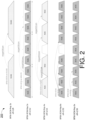
- FIG. 2 illustrates an example design 200 under a proposed scheme in accordance with the present disclosure.
- Design 200 may pertain to non-OFDMA for SU ELR with RU duplication/repetition.
- FIG. 3 illustrates an example design 300 under a proposed scheme in accordance with the present disclosure.
- Design 300 may pertain to OFDMA for MU ELR with RU duplication/repetition.
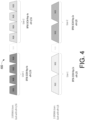
- FIG. 4 illustrates an example scenario 400 under a proposed scheme in accordance with the present disclosure.
- Scenario 400 may pertain to OFDMA for MU ELR with RU duplication/repetition for two users.
- FIG. 5 illustrates an example scenario 500 under a proposed scheme in accordance with the present disclosure.
- Scenario 500 may pertain to OFDMA for MU ELR with RU duplication/repetition for three users.
- Part (B) of FIG. 5 shows an example of three OFDMA users each with a different RU size and a different eR.
- FIG. 6 illustrates an example scenario 600 under a proposed scheme in accordance with the present disclosure.
- Scenario 600 may pertain to OFDMA for MU ELR with RU duplication/repetition for four users.
- Part (B) of FIG. 6 shows an example of four OFDMA users each with a different RU size and a different eR.
- FIG. 7 illustrates an example design 700 under a proposed scheme in accordance with the present disclosure.
- Design 700 may pertain to transmission functional blocks for ELR with RU DUP with low-density parity check (LDPC) coding.
- a stream of bits of data and/or information may be processed as a single spatial stream through a number of functional blocks, including: pre-forward error correction (pre-FEC) physical-layer (PHY) padding, scrambler, LDPC encoder, post-FEC PHY padding, stream parser (with the number of spatial stream, N ss , of 1), constellation mapper (for BPSK + DCM), LDPC tone mapper, frequency-domain (FD) duplication, and spatial mapper.
- pre-FEC physical-layer
- PHY physical-layer
- LDPC encoder post-FEC PHY padding
- stream parser with the number of spatial stream, N ss , of 1
- constellation mapper for BPSK + DCM
- LDPC tone mapper frequency-
- the FD duplication functional block may perform FD repetition of two times (2x), three times (3x), four times (4x), six times (6x) and/or eight times (8x).
- the spatial mapper functional block may output multiple streams of tones to multiple transmit chains (with a quantity of N TX ) for transmission.
- Each of the N TX transmit chains may include a number of functional blocks, including: inverse discrete Fourier transformation (IDFT), insertion of guard interval (GI) and window, and analog and radio frequency (RF).
- IDFT inverse discrete Fourier transformation
- GI guard interval
- RF analog and radio frequency
- FIG. 8 illustrates an example design 800 under a proposed scheme in accordance with the present disclosure.
- Design 800 may pertain to transmission functional blocks for ELR with RU DUP with binary convolutional code (BCC) coding.
- BCC binary convolutional code
- a stream of bits of data and/or information may be processed as a single spatial stream through a number of functional blocks, including: pre-FEC PHY padding, scrambler, BCC encoder, post-FEC PHY padding, BCC interleaver, stream parser (with the number of spatial stream, N ss , of 1), constellation mapper (for BPSK + DCM), FD duplication, and spatial mapper.
- the FD duplication functional block may perform FD repetition of 2x, 3x, 4x, 6x and/or 8x.
- the spatial mapper functional block may output multiple streams of tones to multiple transmit chains (with a quantity of N TX ) for transmission.
- Each of the N TX transmit chains may include a number of functional blocks, including: IDFT, insertion of GI and window, and analog and RF.
- FIG. 9 illustrates an example design 900 under a proposed scheme in accordance with the present disclosure.
- Design 900 may pertain to modulation, coding rate and data rate for ELR communications with RU duplication/repetition for non-OFDMA SU scenarios with one spatial stream.
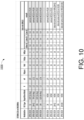
- FIG. 10 illustrates an example design 1000 under a proposed scheme in accordance with the present disclosure.
- Design 1000 may pertain to modulation, coding rate and data rate for ELR communications with RU duplication/repetition for OFDMA MU scenarios with one spatial stream.
- tone repetition may be performed in the frequency domain and for each RU or MRU.
- the RU/MRU may be based on IEEE 802.11ax/be tone plan with 4x numerology and a subcarrier spacing of 78.125kHz.
- the number of tone repetition may be 2x, 3x, 4x, 6x, 8x, 9x, 12x, and so on.
- the tones may be uniformly repeated or distributed over a RU or MRU.
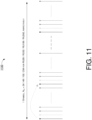
- FIG. 11 illustrates an example scenario 1100 under a proposed scheme in accordance with the present disclosure.
- Scenario 1100 may pertain to FD tone repetition for ELR communications.
- N sd 24/48/102/234 for RU26/52/106/242.
- FIG. 12 illustrates an example scenario 1200 with respect to tone repetition with leftover tones under a proposed scheme in accordance with the present disclosure.
- N sd,ru denotes the number of data tones for a given RU
- N x,rep denotes the number of times of tone repetition.
- tone repetition may be performed in a round-robin and uniformly-distributing fashion. For instance, in case of leftover tones, there may be two options. In a first option (Option-1), the repetition may continue in the leftover tones. In a second option (Option-2), no transmissions may be performed in the leftover tones.
- Option-1 the repetition may continue in the leftover tones.
- Option-2 no transmissions may be performed in the leftover tones.
- FIG. 13 illustrates an example design 1300 under a proposed scheme in accordance with the present disclosure.
- design 1300 under the proposed scheme, a number of tone repetitions may correspond to respective effective coding rates.
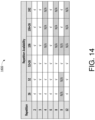
- FIG. 14 illustrates an example design 1400 with respect to repetition availability without leftover tones under a proposed scheme in accordance with the present disclosure.
- design 1400 under the proposed scheme, each of a number of tone repetitions may be available or feasible for certain sizes of RU/MRU without leftover tones.
- FIG. 15 illustrates an example design 1500 with respect to the number of leftover tones for different RU/MRU sizes and numbers of repetition under a proposed scheme in accordance with the present disclosure.
- design 1500 under the proposed scheme, each of a number of tone repetitions may result in zero or some leftover tones for certain sizes of RU/MRU.
- FIG. 16 illustrates an example design 1600 under a proposed scheme in accordance with the present disclosure.
- Design 1600 may pertain to transmission functional blocks and processing flow for tone repetition in the frequency domain.
- Part (A) of FIG. 16 shows the transmission functional blocks and processing flow for tone repetition in the frequency domain with BCC coding.
- the transmission functional blocks and processing flow may include: pre-FEC padding, scrambler, BCC encoder (with a coding rate, R, of 1 ⁇ 2, 1/3 or1 ⁇ 4), BCC interleaver, post-FEC padding, modulation, tone repetition, and frequency mapping.
- the pre-FEC padding functional block may utilize new N sd,short parameters for RU and the number of repetition.
- the BCC interleaver functional block may utilize new BCC interleaver parameters for the number of repetition.
- the post-FEC padding functional block may utilize new N sd,short parameters for RU and the number of repetition.
- Part (B) of FIG. 16 shows the transmission functional blocks and processing flow for tone repetition in the frequency domain with LDPC coding.
- the transmission functional blocks and processing flow may include: pre-FEC padding, scrambler, LDPC encoder (with a coding rate, R, of 1 ⁇ 2, 1/3 or 1 ⁇ 4), post-FEC padding, modulation, tone repetition, tone mapper, and frequency mapping.
- the transmission functional blocks and processing flow may include: pre-FEC padding, scrambler, LDPC encoder (with a coding rate, R, of 1 ⁇ 2, 1/3 or 1 ⁇ 4), post-FEC padding, modulation, tone mapper, tone repetition, and frequency mapping.
- the pre-FEC padding functional block may utilize new N sd,short parameters for RU and the number of repetition.
- the post-FEC padding functional block may utilize new N sd,short parameters for RU and the number of repetition.
- the tone mapper functional block may utilize new LDPC tone mapper parameters for the number of repetition.
- FIG. 17 illustrates an example system 1700 having at least an example apparatus 1710 and an example apparatus 1720 in accordance with an implementation of the present disclosure.
- apparatus 1710 and apparatus 1720 may perform various functions to implement schemes, techniques, processes and methods described herein pertaining to transmission methods of RU distribution and tone repetition for ELR communications, including the various schemes described above with respect to various proposed designs, concepts, schemes, systems and methods described above as well as processes described below.
- apparatus 1710 may be implemented in STA 110 and apparatus 1720 may be implemented in STA 120, or vice versa.
- Each of apparatus 1710 and apparatus 1720 may be a part of an electronic apparatus, which may be a non-AP STA or an AP STA, such as a portable or mobile apparatus, a wearable apparatus, a wireless communication apparatus or a computing apparatus.
- an electronic apparatus which may be a non-AP STA or an AP STA, such as a portable or mobile apparatus, a wearable apparatus, a wireless communication apparatus or a computing apparatus.
- each of apparatus 1710 and apparatus 1720 may be implemented in a smartphone, a smart watch, a personal digital assistant, a digital camera, or a computing equipment such as a tablet computer, a laptop computer or a notebook computer.
- Each of apparatus 1710 and apparatus 1720 may also be a part of a machine type apparatus, which may be an IoT apparatus such as an immobile or a stationary apparatus, a home apparatus, a wire communication apparatus or a computing apparatus.
- each of apparatus 1710 and apparatus 1720 may be implemented in a smart thermostat, a smart fridge, a smart door lock, a wireless speaker or a home control center.
- apparatus 1710 and/or apparatus 1720 may be implemented in a network node, such as an AP in a WLAN.
- each of apparatus 1710 and apparatus 1720 may be implemented in the form of one or more integrated-circuit (IC) chips such as, for example and without limitation, one or more single-core processors, one or more multicore processors, one or more reduced-instruction set computing (RISC) processors, or one or more complex-instruction-set-computing (CISC) processors.
- IC integrated-circuit
- RISC reduced-instruction set computing
- CISC complex-instruction-set-computing
- each of apparatus 1710 and apparatus 1720 may be implemented in or as a STA or an AP.
- Each of apparatus 1710 and apparatus 1720 may include at least some of those components shown in FIG. 17 such as a processor 1712 and a processor 1722, respectively, for example.
- Each of apparatus 1710 and apparatus 1720 may further include one or more other components not pertinent to the proposed scheme of the present disclosure (e.g., internal power supply, display device and/or user interface device), and, thus, such component(s) of apparatus 1710 and apparatus 1720 are neither shown in FIG. 17 nor described below in the interest of simplicity and brevity.
- other components e.g., internal power supply, display device and/or user interface device
- each of processor 1712 and processor 1722 may be implemented in the form of one or more single-core processors, one or more multicore processors, one or more RISC processors or one or more CISC processors. That is, even though a singular term "a processor" is used herein to refer to processor 1712 and processor 1722, each of processor 1712 and processor 1722 may include multiple processors in some implementations and a single processor in other implementations in accordance with the present disclosure.
- each of processor 1712 and processor 1722 may be implemented in the form of hardware (and, optionally, firmware) with electronic components including, for example and without limitation, one or more transistors, one or more diodes, one or more capacitors, one or more resistors, one or more inductors, one or more memristors and/or one or more varactors that are configured and arranged to achieve specific purposes in accordance with the present disclosure.
- each of processor 1712 and processor 1722 is a special-purpose machine specifically designed, arranged and configured to perform specific tasks including those pertaining to transmission methods of RU distribution and tone repetition for ELR communications in accordance with various implementations of the present disclosure.
- apparatus 1710 may also include a transceiver 1716 coupled to processor 1712.
- Transceiver 1716 may include a transmitter capable of wirelessly transmitting and a receiver capable of wirelessly receiving data.
- apparatus 1720 may also include a transceiver 1726 coupled to processor 1722.
- Transceiver 1726 may include a transmitter capable of wirelessly transmitting and a receiver capable of wirelessly receiving data.
- transceiver 1716 and transceiver 1726 are illustrated as being external to and separate from processor 1712 and processor 1722, respectively, in some implementations, transceiver 1716 may be an integral part of processor 1712 as a system on chip (SoC), and transceiver 1726 may be an integral part of processor 1722 as a SoC.
- SoC system on chip
- apparatus 1710 may further include a memory 1714 coupled to processor 1712 and capable of being accessed by processor 1712 and storing data therein.
- apparatus 1720 may further include a memory 1724 coupled to processor 1722 and capable of being accessed by processor 1722 and storing data therein.
- RAM random-access memory
- DRAM dynamic RAM
- SRAM static RAM
- T-RAM thyristor RAM
- Z-RAM zero-capacitor RAM
- each of memory 1714 and memory 1724 may include a type of read-only memory (ROM) such as mask ROM, programmable ROM (PROM), erasable programmable ROM (EPROM) and/or electrically erasable programmable ROM (EEPROM).
- ROM read-only memory
- PROM programmable ROM
- EPROM erasable programmable ROM
- EEPROM electrically erasable programmable ROM
- each of memory 1714 and memory 1724 may include a type of non-volatile random-access memory (NVRAM) such as flash memory, solid-state memory, ferroelectric RAM (FeRAM), magnetoresistive RAM (MRAM) and/or phase-change memory.
- NVRAM non-volatile random-access memory
- Each of apparatus 1710 and apparatus 1720 may be a communication entity capable of communicating with each other using various proposed schemes in accordance with the present disclosure.
- a description of capabilities of apparatus 1710, as STA 110, and apparatus 1720, as STA 120, is provided below. It is noteworthy that, although a detailed description of capabilities, functionalities and/or technical features of apparatus 1720 is provided below, the same may be applied to apparatus 1710 although a detailed description thereof is not provided solely in the interest of brevity. It is also noteworthy that, although the example implementations described below are provided in the context of WLAN, the same may be implemented in other types of networks.
- processor 1712 of apparatus 1710 may generate a RU or MRU.
- processor 1712 may perform, via transceiver 1716, an ELR communication wirelessly (e.g., with apparatus 1720) with either or both of: (a) duplication of the RU or MRU; and (b) repetition of tones of the RU or MRU.
- processor 1712 in performing the OFDMA MU ELR communication with duplication of the RU or MRU, may duplicate RUs or MRUs associated with multiple users with the RUs or MURs having a same size such that a same effective coding rate is achieved for the multiple users.
- processor 1712 in performing the OFDMA MU ELR communication with duplication of the RU or MRU, may duplicate RUs or MRUs associated with multiple users with the RUs or MURs having different sizes such that different effective coding rates are achieved for the multiple users.
- processor 1712 may duplicate the RU or MRU with an MCS using BPSK plus DCM.
- processor 1712 may perform the ELR communication with repetition of the tones of the RU or MRU in a frequency domain with the tones uniformly distributed over the RU or MRU in a round-robin fashion. In some implementations, in performing the ELR communication with repetition of the tones of the RU or MRU, processor 1712 may perform certain operations. For instance, processor 1712 may perform the ELR communication with repetition of the tones of the RU or MRU with one or more leftover tones. Moreover, processor 1712 may handle the one or more leftover tones by: (a) continuing the repetition in the one or more leftover tones; or (b) performing no transmission on the one or more leftover tones.
- FIG. 18 illustrates an example process 1800 in accordance with an implementation of the present disclosure.
- Process 1800 may represent an aspect of implementing various proposed designs, concepts, schemes, systems and methods described above. More specifically, process 1800 may represent an aspect of the proposed concepts and schemes pertaining to transmission methods of RU distribution and tone repetition for ELR communications in accordance with the present disclosure.
- Process 1800 may include one or more operations, actions, or functions as illustrated by one or more of blocks 1810 and 1820. Although illustrated as discrete blocks, various blocks of process 1800 may be divided into additional blocks, combined into fewer blocks, or eliminated, depending on the desired implementation. Moreover, the blocks/sub-blocks of process 1800 may be executed in the order shown in FIG. 18 or, alternatively in a different order.
- Process 1800 may be implemented by or in apparatus 1710 and apparatus 1720 as well as any variations thereof. Solely for illustrative purposes and without limiting the scope, process 1800 is described below in the context of apparatus 1710 implemented in or as STA 110 functioning as a non-AP STA and apparatus 1720 implemented in or as STA 120 functioning as an AP STA of a wireless network such as a WLAN in network environment 100 in accordance with one or more of IEEE 802.11 standards. Process 1800 may begin at block 1810.
- process 1800 may involve processor 1712 of apparatus 1710 generating a RU or MRU. Process 1800 may proceed from 1810 to 1820.
- process 1800 may involve processor 1712 performing, via transceiver 1716, an ELR communication wirelessly (e.g., with apparatus 1720) with either or both of: (a) duplication of the RU or MRU; and (b) repetition of tones of the RU or MRU.
- ELR communication wirelessly (e.g., with apparatus 1720) with either or both of: (a) duplication of the RU or MRU; and (b) repetition of tones of the RU or MRU.
- process 1800 may involve processor 1712 performing a non-OFDMA SU ELR communication with duplication of the RU or MRU.
- process 1800 may involve processor 1712 performing an OFDMA MU ELR communication with duplication of the RU or MRU.
- process 1800 may involve processor 1712 duplicating RUs or MRUs associated with multiple users with the RUs or MURs having a same size such that a same effective coding rate is achieved for the multiple users.
- process 1800 may involve processor 1712 duplicating RUs or MRUs associated with multiple users with the RUs or MURs having different sizes such that different effective coding rates are achieved for the multiple users.
- process 1800 may involve processor 1712 duplicating the RU or MRU with an MCS using BPSK plus DCM.
- process 1800 may involve processor 1712 performing the ELR communication with repetition of the tones of the RU or MRU in a frequency domain with the tones uniformly distributed over the RU or MRU in a round-robin fashion.
- process 1800 may involve processor 1712 performing certain operations. For instance, process 1800 may involve processor 1712 performing the ELR communication with repetition of the tones of the RU or MRU with one or more leftover tones.
- process 1800 may involve processor 1712 handling the one or more leftover tones by: (a) continuing the repetition in the one or more leftover tones; or (b) performing no transmission on the one or more leftover tones.
- any two components so associated can also be viewed as being “operably connected”, or “operably coupled”, to each other to achieve the desired functionality, and any two components capable of being so associated can also be viewed as being “operably couplable”, to each other to achieve the desired functionality.
- operably couplable include but are not limited to physically mateable and/or physically interacting components and/or wirelessly interactable and/or wirelessly interacting components and/or logically interacting and/or logically interactable components.
Landscapes
- Engineering & Computer Science (AREA)
- Signal Processing (AREA)
- Computer Networks & Wireless Communication (AREA)
- Physics & Mathematics (AREA)
- Discrete Mathematics (AREA)
- General Physics & Mathematics (AREA)
- Mathematical Physics (AREA)
- Quality & Reliability (AREA)
- Mobile Radio Communication Systems (AREA)
- Reduction Or Emphasis Of Bandwidth Of Signals (AREA)
Applications Claiming Priority (2)
| Application Number | Priority Date | Filing Date | Title |
|---|---|---|---|
| US202263370288P | 2022-08-03 | 2022-08-03 | |
| US18/226,828 US20240048418A1 (en) | 2022-08-03 | 2023-07-27 | Transmission Methods Of Resource Unit Duplication And Tone Repetition For Enhanced Long Range Communications |
Publications (1)
| Publication Number | Publication Date |
|---|---|
| EP4319028A1 true EP4319028A1 (fr) | 2024-02-07 |
Family
ID=87553853
Family Applications (1)
| Application Number | Title | Priority Date | Filing Date |
|---|---|---|---|
| EP23189025.2A Pending EP4319028A1 (fr) | 2022-08-03 | 2023-08-01 | Procédés de transmission de distribution d'unité de ressource et de répétition de tonalité pour des communications à longue portée améliorées |
Country Status (3)
| Country | Link |
|---|---|
| US (1) | US20240048418A1 (fr) |
| EP (1) | EP4319028A1 (fr) |
| TW (1) | TW202408191A (fr) |
Families Citing this family (2)
| Publication number | Priority date | Publication date | Assignee | Title |
|---|---|---|---|---|
| US20250279850A1 (en) * | 2024-03-01 | 2025-09-04 | Avago Technologies International Sales Pte. Limited | Systems and methods for extended long range communication in wireless local area networks (wlans) |
| WO2026085865A1 (fr) * | 2024-10-25 | 2026-04-30 | Oppo广东移动通信有限公司 | Procédé et dispositif de communication sans fil, ainsi que puce et support de stockage |
Citations (3)
| Publication number | Priority date | Publication date | Assignee | Title |
|---|---|---|---|---|
| US20210144695A1 (en) * | 2019-11-08 | 2021-05-13 | Semiconductor Components Industries, Llc | Multi-link range extension |
| US20220116921A1 (en) * | 2020-10-14 | 2022-04-14 | Lg Electronics Inc. | Extended range transmission in wireless local area network |
| EP4277188A1 (fr) * | 2022-05-13 | 2023-11-15 | MEDIATEK Inc. | Schémas de communication à longue portée améliorés dans des communications sans fil |
Family Cites Families (5)
| Publication number | Priority date | Publication date | Assignee | Title |
|---|---|---|---|---|
| CN106953721B (zh) * | 2016-01-07 | 2020-09-08 | 华为技术有限公司 | 一种距离扩展模式的传输方法和装置 |
| US12004153B2 (en) * | 2018-11-01 | 2024-06-04 | Telefonaktiebolaget Lm Ericsson (Publ) | Scheduling transmissions over preconfigured uplink resources |
| US11115163B2 (en) * | 2019-08-09 | 2021-09-07 | Newracom Inc. | Enhanced resource unit allocation in wireless local area network |
| US11641657B2 (en) * | 2019-09-04 | 2023-05-02 | Intel Corporation | Resource unit (RU) allocation for EHT for power spectral density limitations |
| US12363691B2 (en) * | 2020-06-17 | 2025-07-15 | Mediatek Singapore Pte. Ltd. | Methods and devices for tone distribution for low power transmissions in a wireless network |
-
2023
- 2023-07-27 US US18/226,828 patent/US20240048418A1/en active Pending
- 2023-08-01 EP EP23189025.2A patent/EP4319028A1/fr active Pending
- 2023-08-04 TW TW112129328A patent/TW202408191A/zh unknown
Patent Citations (3)
| Publication number | Priority date | Publication date | Assignee | Title |
|---|---|---|---|---|
| US20210144695A1 (en) * | 2019-11-08 | 2021-05-13 | Semiconductor Components Industries, Llc | Multi-link range extension |
| US20220116921A1 (en) * | 2020-10-14 | 2022-04-14 | Lg Electronics Inc. | Extended range transmission in wireless local area network |
| EP4277188A1 (fr) * | 2022-05-13 | 2023-11-15 | MEDIATEK Inc. | Schémas de communication à longue portée améliorés dans des communications sans fil |
Also Published As
| Publication number | Publication date |
|---|---|
| TW202408191A (zh) | 2024-02-16 |
| US20240048418A1 (en) | 2024-02-08 |
Similar Documents
| Publication | Publication Date | Title |
|---|---|---|
| CN113346984B (zh) | 用于无线通信中混合终端传输的eht前文设计 | |
| EP4277188B1 (fr) | Schémas de communication à longue portée améliorés dans des communications sans fil | |
| US11711786B2 (en) | Optimization of resource unit and segment parser design for aggregated and multi-resource unit operations in extreme high-throughput systems | |
| EP4373024B1 (fr) | Schémas de transmission à bande passante étroite dans un wlan longue portée amélioré de prochaine génération | |
| EP4340286A2 (fr) | Amélioration de performance de duplication de ru avec des motifs d'entrelacement prédéfinis dans des communications sans fil | |
| EP3982679B1 (fr) | Codage et commande de la puissance pour les transmissions ppdu basées sur un déclenchement de liaison montante de taille réduite dans des systèmes de réseau local sans fil de nouvelle génération | |
| EP3849128A1 (fr) | Entrelacement de combinaisons de plusieurs unités de ressources dans un réseau local sans fil | |
| US20240048418A1 (en) | Transmission Methods Of Resource Unit Duplication And Tone Repetition For Enhanced Long Range Communications | |
| EP4319071A1 (fr) | Réduction de papr pour duplication d'unité de ressource et répétition de tonalité | |
| EP4340266A1 (fr) | Conceptions de paramètres de couche physique permettant une duplication d'unités de ressources et une répétition de tonalité pour un wlan de prochaine génération | |
| WO2024165054A1 (fr) | Analyseur de segments et procédés de transmission pour unités de ressources à tonalité distribuée sur des largeurs de bande plus larges | |
| US12477530B2 (en) | Scalable waveform and numerology designs for next-generation WLAN in 60GHz band | |
| CN117527505A (zh) | 增强型长距离通信的资源单元复制和音调重复的传输方法 | |
| CN117713994A (zh) | 利用ru复制或音调重复的无线通信方法及其装置 | |
| US20240364445A1 (en) | Proportional Round Robin Segment Parser Designs For Wider Bandwidths In Wireless Communications | |
| WO2024217483A1 (fr) | Conceptions d'analyseur de flux pour des transmissions à modulation inégale avec de multiples flux spatiaux | |
| WO2024165047A1 (fr) | Répétition de symboles de domaine temporel pour wi-fi à longue portée améliorée | |
| WO2024251277A1 (fr) | Procédés de transmission mru multiples pour systèmes wlan de prochaine génération | |
| WO2025247376A1 (fr) | Réduction de papr pour transmission de ppdu elr avec duplication de ru dans des communications sans fil | |
| WO2025185726A1 (fr) | Transmission de données pour une ppdu à longue portée améliorée de wi-fi nouvelle génération dans des communications sans fil | |
| US20240364391A1 (en) | MU-MIMO Transmission With Mixed Bandwidths And Unequal Modulations In Wireless Communications | |
| WO2025185610A1 (fr) | Transmission à longue portée améliorée pour wi-fi de prochaine génération dans des communications sans fil | |
| US20250080295A1 (en) | Distributed-Tone Resource Unit Based Enhanced Long Range Communication Schemes In WLAN | |
| WO2024160248A1 (fr) | Schémas de modulation adaptative basés sur une unité de sous-ressources dans des communications sans fil | |
| EP4675951A1 (fr) | Analyseur de flux et conceptions d'analyseur de segment pour une modulation inégale de flux spatiaux dans des communications sans fil |
Legal Events
| Date | Code | Title | Description |
|---|---|---|---|
| PUAI | Public reference made under article 153(3) epc to a published international application that has entered the european phase |
Free format text: ORIGINAL CODE: 0009012 |
|
| STAA | Information on the status of an ep patent application or granted ep patent |
Free format text: STATUS: THE APPLICATION HAS BEEN PUBLISHED |
|
| AK | Designated contracting states |
Kind code of ref document: A1 Designated state(s): AL AT BE BG CH CY CZ DE DK EE ES FI FR GB GR HR HU IE IS IT LI LT LU LV MC ME MK MT NL NO PL PT RO RS SE SI SK SM TR |
|
| STAA | Information on the status of an ep patent application or granted ep patent |
Free format text: STATUS: REQUEST FOR EXAMINATION WAS MADE |
|
| 17P | Request for examination filed |
Effective date: 20240718 |
|
| RBV | Designated contracting states (corrected) |
Designated state(s): AL AT BE BG CH CY CZ DE DK EE ES FI FR GB GR HR HU IE IS IT LI LT LU LV MC ME MK MT NL NO PL PT RO RS SE SI SK SM TR |
|
| STAA | Information on the status of an ep patent application or granted ep patent |
Free format text: STATUS: EXAMINATION IS IN PROGRESS |
|
| 17Q | First examination report despatched |
Effective date: 20250929 |