EP3851261A2 - Präventive holzbehandlung - Google Patents
Präventive holzbehandlung Download PDFInfo
- Publication number
- EP3851261A2 EP3851261A2 EP21152165.3A EP21152165A EP3851261A2 EP 3851261 A2 EP3851261 A2 EP 3851261A2 EP 21152165 A EP21152165 A EP 21152165A EP 3851261 A2 EP3851261 A2 EP 3851261A2
- Authority
- EP
- European Patent Office
- Prior art keywords
- wood
- impregnation
- solution
- tank
- salt
- Prior art date
- Legal status (The legal status is an assumption and is not a legal conclusion. Google has not performed a legal analysis and makes no representation as to the accuracy of the status listed.)
- Granted
Links
Images

Classifications
-
- B—PERFORMING OPERATIONS; TRANSPORTING
- B27—WORKING OR PRESERVING WOOD OR SIMILAR MATERIAL; NAILING OR STAPLING MACHINES IN GENERAL
- B27K—PROCESSES, APPARATUS OR SELECTION OF SUBSTANCES FOR IMPREGNATING, STAINING, DYEING, BLEACHING OF WOOD OR SIMILAR MATERIALS, OR TREATING OF WOOD OR SIMILAR MATERIALS WITH PERMEANT LIQUIDS, NOT OTHERWISE PROVIDED FOR; CHEMICAL OR PHYSICAL TREATMENT OF CORK, CANE, REED, STRAW OR SIMILAR MATERIALS
- B27K3/00—Impregnating wood, e.g. impregnation pretreatment, for example puncturing; Wood impregnation aids not directly involved in the impregnation process
- B27K3/02—Processes; Apparatus
- B27K3/0278—Processes; Apparatus involving an additional treatment during or after impregnation
- B27K3/0292—Processes; Apparatus involving an additional treatment during or after impregnation for improving fixation
-
- B—PERFORMING OPERATIONS; TRANSPORTING
- B27—WORKING OR PRESERVING WOOD OR SIMILAR MATERIAL; NAILING OR STAPLING MACHINES IN GENERAL
- B27K—PROCESSES, APPARATUS OR SELECTION OF SUBSTANCES FOR IMPREGNATING, STAINING, DYEING, BLEACHING OF WOOD OR SIMILAR MATERIALS, OR TREATING OF WOOD OR SIMILAR MATERIALS WITH PERMEANT LIQUIDS, NOT OTHERWISE PROVIDED FOR; CHEMICAL OR PHYSICAL TREATMENT OF CORK, CANE, REED, STRAW OR SIMILAR MATERIALS
- B27K3/00—Impregnating wood, e.g. impregnation pretreatment, for example puncturing; Wood impregnation aids not directly involved in the impregnation process
- B27K3/02—Processes; Apparatus
- B27K3/0207—Pretreatment of wood before impregnation
- B27K3/0214—Drying
-
- B—PERFORMING OPERATIONS; TRANSPORTING
- B27—WORKING OR PRESERVING WOOD OR SIMILAR MATERIAL; NAILING OR STAPLING MACHINES IN GENERAL
- B27K—PROCESSES, APPARATUS OR SELECTION OF SUBSTANCES FOR IMPREGNATING, STAINING, DYEING, BLEACHING OF WOOD OR SIMILAR MATERIALS, OR TREATING OF WOOD OR SIMILAR MATERIALS WITH PERMEANT LIQUIDS, NOT OTHERWISE PROVIDED FOR; CHEMICAL OR PHYSICAL TREATMENT OF CORK, CANE, REED, STRAW OR SIMILAR MATERIALS
- B27K3/00—Impregnating wood, e.g. impregnation pretreatment, for example puncturing; Wood impregnation aids not directly involved in the impregnation process
- B27K3/02—Processes; Apparatus
- B27K3/08—Impregnating by pressure, e.g. vacuum impregnation
-
- B—PERFORMING OPERATIONS; TRANSPORTING
- B27—WORKING OR PRESERVING WOOD OR SIMILAR MATERIAL; NAILING OR STAPLING MACHINES IN GENERAL
- B27K—PROCESSES, APPARATUS OR SELECTION OF SUBSTANCES FOR IMPREGNATING, STAINING, DYEING, BLEACHING OF WOOD OR SIMILAR MATERIALS, OR TREATING OF WOOD OR SIMILAR MATERIALS WITH PERMEANT LIQUIDS, NOT OTHERWISE PROVIDED FOR; CHEMICAL OR PHYSICAL TREATMENT OF CORK, CANE, REED, STRAW OR SIMILAR MATERIALS
- B27K3/00—Impregnating wood, e.g. impregnation pretreatment, for example puncturing; Wood impregnation aids not directly involved in the impregnation process
- B27K3/16—Inorganic impregnating agents
- B27K3/163—Compounds of boron
-
- B—PERFORMING OPERATIONS; TRANSPORTING
- B27—WORKING OR PRESERVING WOOD OR SIMILAR MATERIAL; NAILING OR STAPLING MACHINES IN GENERAL
- B27K—PROCESSES, APPARATUS OR SELECTION OF SUBSTANCES FOR IMPREGNATING, STAINING, DYEING, BLEACHING OF WOOD OR SIMILAR MATERIALS, OR TREATING OF WOOD OR SIMILAR MATERIALS WITH PERMEANT LIQUIDS, NOT OTHERWISE PROVIDED FOR; CHEMICAL OR PHYSICAL TREATMENT OF CORK, CANE, REED, STRAW OR SIMILAR MATERIALS
- B27K3/00—Impregnating wood, e.g. impregnation pretreatment, for example puncturing; Wood impregnation aids not directly involved in the impregnation process
- B27K3/16—Inorganic impregnating agents
- B27K3/22—Compounds of zinc or copper
-
- B—PERFORMING OPERATIONS; TRANSPORTING
- B27—WORKING OR PRESERVING WOOD OR SIMILAR MATERIAL; NAILING OR STAPLING MACHINES IN GENERAL
- B27K—PROCESSES, APPARATUS OR SELECTION OF SUBSTANCES FOR IMPREGNATING, STAINING, DYEING, BLEACHING OF WOOD OR SIMILAR MATERIALS, OR TREATING OF WOOD OR SIMILAR MATERIALS WITH PERMEANT LIQUIDS, NOT OTHERWISE PROVIDED FOR; CHEMICAL OR PHYSICAL TREATMENT OF CORK, CANE, REED, STRAW OR SIMILAR MATERIALS
- B27K3/00—Impregnating wood, e.g. impregnation pretreatment, for example puncturing; Wood impregnation aids not directly involved in the impregnation process
- B27K3/16—Inorganic impregnating agents
- B27K3/32—Mixtures of different inorganic impregnating agents
-
- B—PERFORMING OPERATIONS; TRANSPORTING
- B27—WORKING OR PRESERVING WOOD OR SIMILAR MATERIAL; NAILING OR STAPLING MACHINES IN GENERAL
- B27K—PROCESSES, APPARATUS OR SELECTION OF SUBSTANCES FOR IMPREGNATING, STAINING, DYEING, BLEACHING OF WOOD OR SIMILAR MATERIALS, OR TREATING OF WOOD OR SIMILAR MATERIALS WITH PERMEANT LIQUIDS, NOT OTHERWISE PROVIDED FOR; CHEMICAL OR PHYSICAL TREATMENT OF CORK, CANE, REED, STRAW OR SIMILAR MATERIALS
- B27K3/00—Impregnating wood, e.g. impregnation pretreatment, for example puncturing; Wood impregnation aids not directly involved in the impregnation process
- B27K3/34—Organic impregnating agents
- B27K3/38—Aromatic compounds
- B27K3/42—Aromatic compounds nitrated, or nitrated and halogenated
-
- B—PERFORMING OPERATIONS; TRANSPORTING
- B27—WORKING OR PRESERVING WOOD OR SIMILAR MATERIAL; NAILING OR STAPLING MACHINES IN GENERAL
- B27K—PROCESSES, APPARATUS OR SELECTION OF SUBSTANCES FOR IMPREGNATING, STAINING, DYEING, BLEACHING OF WOOD OR SIMILAR MATERIALS, OR TREATING OF WOOD OR SIMILAR MATERIALS WITH PERMEANT LIQUIDS, NOT OTHERWISE PROVIDED FOR; CHEMICAL OR PHYSICAL TREATMENT OF CORK, CANE, REED, STRAW OR SIMILAR MATERIALS
- B27K3/00—Impregnating wood, e.g. impregnation pretreatment, for example puncturing; Wood impregnation aids not directly involved in the impregnation process
- B27K3/52—Impregnating agents containing mixtures of inorganic and organic compounds
-
- B—PERFORMING OPERATIONS; TRANSPORTING
- B27—WORKING OR PRESERVING WOOD OR SIMILAR MATERIAL; NAILING OR STAPLING MACHINES IN GENERAL
- B27K—PROCESSES, APPARATUS OR SELECTION OF SUBSTANCES FOR IMPREGNATING, STAINING, DYEING, BLEACHING OF WOOD OR SIMILAR MATERIALS, OR TREATING OF WOOD OR SIMILAR MATERIALS WITH PERMEANT LIQUIDS, NOT OTHERWISE PROVIDED FOR; CHEMICAL OR PHYSICAL TREATMENT OF CORK, CANE, REED, STRAW OR SIMILAR MATERIALS
- B27K5/00—Treating of wood not provided for in groups B27K1/00, B27K3/00
- B27K5/02—Staining or dyeing wood; Bleaching wood
Definitions
- the invention relates to a method of preventive treatment of wood, in particular a method of impregnating wood, and more particularly a method of double impregnating wood.
- preventive wood treatment process The objective of a preventive wood treatment process is to give wood an artificial durability when its natural durability is insufficient in the face of the risks of biological degradation to which it is exposed during the duration of its implementation.
- a preventive treatment must make a suitable product penetrate into the wood and fix it in such a way that it ensures the durability of the protected structure while avoiding any subsequent emission that is dangerous for human health and the environment.
- Wood protected by an appropriate preventive treatment can increase the life of the treated structure but can also reduce the impact on natural resources.
- the objective of the invention is to provide a method of preventive treatment of wood more reliable over time and allowing more sustainable management of forests, in which the treated wood is of better quality and does not present a danger to the worker. , the installer, or for the user or the animal.
- a method of preventive treatment of wood comprising the following steps: a first impregnation of the wood using a first solution comprising a first salt, and a second impregnation of the wood using a second solution comprising a second salt.
- the embodiments of the invention are based inter alia on the inventive idea of a method comprising a double impregnation of the wood to be treated, using a first solution comprising a first salt, and a second solution. comprising a second salt.
- the maximum concentration of salts in the solution being limited, it is impossible to add a double dose of salt during a single impregnation of the wood.
- the process of the invention thanks to a double impregnation of the wood, it is possible to offer a higher quality than the treated wood.
- a first dose of salt in the first solution deeply penetrates the sapwood of the wood, that is to say the peripheral region of the wood located between the heartwood and the cambium.
- a second dose of salt in the second solution is then used to penetrate the sapwood deeply a second time.
- the word “impregnation” relates to a method of preventive treatment of wood in which a solution comprising a salt penetrates in depth and is fixed within a wood to be treated, in order to protect said wood. wood facing the risks of biological degradation.
- the purpose of the wood impregnation process is to give the wood a preventive protection against, among other things, blue stain, wood-eating fungi, soft rot and the larvae of wood-boring insects, which increases its lifespan by compared to untreated wood.
- the first solution comprising the first salt may be the same or may be different from the second solution comprising the second salt.
- the first solution and the second solution can be of identical compositions, or of different compositions.
- composition is understood to mean chemical composition in the context of the invention.
- Preferred embodiments relate to a method of preventive treatment of softwoods such as spruce, douglas, larch, heath pine, Scots pine, etc.
- softwoods such as spruce, douglas, larch, heath pine, Scots pine, etc.
- coniferous is understood to mean any forest tree rich in coniferous matter, contained in the coniferous canals.
- the wood to be treated is a wood intended to be exposed to bad weather and / or to humidity.
- the ease of impregnation of the wood in other words the ease of penetration into the wood of the first and second salt-based solutions, varies according to the wood species, the humidity, the region. growth, etc.
- the woods treated according to the process of the invention can be respectively used in the following use classes.
- the first class concerned by the process of the invention commonly called “use class 3”, groups together wood exposed to bad weather and / or humidity but not in contact with the ground.
- the second class concerned by the process of the invention commonly called “use class 4”, groups together wood exposed to bad weather and / or humidity and in permanent contact with the ground (“class 4.1”) and / or fresh water (“class 4.2").
- the treatment process of the invention can be applied to the treatment of rough sawn or planed solid wood and debarked or milled round wood, of class 3 or of class 4.1 or 4.2.
- the wood is preferably free of dirt and debarked.
- the moisture content of the batches of wood to be treated is checked by sampling in the week preceding the treatment. Typically, these measurements are performed using a calibrated electric hygrometer.
- the average humidity is preferably between 12% and 30% for wood that is easily impregnated and between 25% and 40% for wood that is difficult to impregnate.
- the loading of wood to be treated is preferably homogeneous, both as regards the wood species and their humidity and the sections of the elements. Otherwise, the operating conditions of the process of the invention may correspond to the part of the batch that is most difficult to impregnate.
- Wood treated with the process of the invention can exhibit specific penetration and retention characteristics.
- the minimum penetration of the first solution and / or of the second solution into the wood may vary depending on whether the wood is easily or difficult to impregnate.
- the minimum penetration values are generally given in mm for wood that is difficult to impregnate and relate to the entire thickness of the sapwood for wood that is easily impregnated, and depend on the use class of the wood to be treated. For a wood of class 3, 4.1 or 4.2, these values are typically between 2.5 mm and 25 mm.
- the quantity of treatment product absorbed by the wood must be such that its concentration measured in the area to be analyzed is at least equal to the defined critical value. for the intended employment class.
- the area of the wood to be analyzed for use class 3 is the outer layer of the wood to a thickness of 6 mm for easily impregnable species and 3 mm for difficult to impregnate species.
- the area to be analyzed is the sapwood for species that are easily impregnated and the outer layer of wood to a thickness of 6 mm (sawn wood) or 25 mm (round wood) for species that are difficult to impregnate.
- Retention values minimum are generally supplied in kg of pure solution, ie, undiluted in water, per m 3 of wood, and depend on the use class of the wood to be treated. For a wood of class 3, 4.1 or 4.2, these values are typically between 3 kg / m 3 and 15 kg / m 3 . It should be noted that in practice, the average amount of solution absorbed depends on various factors, among which the wood species, the section, the moisture content, the temperature, the impregnation product, etc.
- the method of preventive treatment of wood further comprises a step of drying the wood between the first impregnation of the wood and the second impregnation of the wood.
- the drying step between the two impregnation steps it is possible to further increase the quality of the treated wood.
- the wood to be treated dries, also in depth, so that as much water as possible evaporates and the salts remain in the wood. Indeed, the ease of impregnation of the wood varies according to the moisture content of the wood.
- the double impregnation also allows impregnation in the cracks that appear after drying.
- the method of preventive treatment of wood further comprises a step of drying the wood before the first impregnation of the wood.
- drying steps can be carried out in the open air or in an industrial type dryer, the dryer allowing significantly shorter drying times. Indeed, the drying time of wood in the open air varies from 3 to 9 months depending on the time of year, while the drying time of wood in the kiln is of the order of one week to two weeks. at any time.
- the second impregnation of the wood further uses an additive, preferably a colorant, more preferably a brown colorant.
- creosote is a product that emits a disturbing odor for the worker in charge of treating the wood, for the installer of the wood after treatment or for the user of said treated wood.
- a difference in penetration can occur between treating wood using salt-based solutions and treating wood by adding an additive such as brown dye. Even if this difference is generally small, it is however preferable to reserve the addition of the brown dye for the second impregnation of the wood, the brown dye being only one dye added to the second solution.
- This brown dye usually present as a paste, can make the second solution more viscous, which can reduce the penetration rate of the solution. The brown color will naturally evolve towards a gray tint.
- the first impregnation of the wood and the second impregnation of the wood are carried out under vacuum and under pressure in an autoclave.
- an initial vacuum is created in the autoclave before the first impregnation of the wood and / or before the second impregnation of the wood.
- an overpressure of between 10 bars and 14 bars, preferably 12 bars, is applied in the autoclave during the first impregnation of the wood and / or during the second impregnation of the wood.
- the absolute pressure within the autoclave corresponds to the atmospheric pressure of 1 atm to which is added an overpressure of between 10 bars and 14 bars, preferably 12 bars.
- a final vacuum is produced in the autoclave after the first impregnation of the wood and / or after the second impregnation of the wood.
- the wood to be treated according to the process of the invention can be impregnated according to a vacuum-pressure process with full cells comprising the following cycle: initial vacuum, filling of the autoclave by aspiration of the treatment solution, application of a overpressure, hydraulic or pneumatic, delivery of the solution out of the tank, final vacuum.
- the temperature of the first and second solutions is preferably between 2 ° C (provided that the wood to be treated is not frozen) and 40 ° C, preferably around 15 ° C.
- the first solution and / or the second solution are at approximately room temperature.
- a vacuum and pressure autoclave process cycle typically includes the following six processing phases.
- the wood to be treated is loaded in batches into the autoclave tank and the initial vacuum is created within the tank, which has the effect of evacuating the air from the pores and / or cells of the wood to to treat.
- the initial vacuum is maintained in the tank, and said tank is filled with the first solution comprising the first salt.
- the air is extracted from the wood according to the first phase mentioned above, then the first solution is fed into the tank.
- the first solution mainly penetrates into the pores of the wood to be treated.
- the initial pores are large, even if the humidity of the wood should be less than about 25%.
- the pores have narrowed a little, the first solution can penetrate quite easily by pressure within the wood to be treated.
- the overpressure, hydraulic or pneumatic, between 10 bars and 14 bars, preferably 12 bars, is applied in the tank during the first impregnation of the wood, which forces the first solution to penetrate deep into the drink.
- the first solution is discharged from the tank after the application of said overpressure during the first impregnation of the wood.
- the final vacuum is created in the tank after the first impregnation, which has the effect of extracting the excess of the first solution from the wood in the bottom of the tank, then from the bottom of the tank to the exterior for recovery and reuse.
- the final vacuum has the effect of removing the pressure within the wood following the first impregnation, in order to reduce the time during which the first solution will flow out of the wood. Without the application of this final vacuum, the first solution would flow for more than 24 hours.
- a pressure of 1 atm is applied to the first solution on the surface of the wood to be treated, when said wood is again subjected to atmospheric pressure.
- the wood to be treated is then left to dry after the first impregnation step.
- the values typically encountered for the initial and final voids are of the order of 100 mbar to 200 mbar, for example 150 mbar.
- the actual impregnation phase that is to say the phase during which the solution penetrates the wood deeply, corresponds to the overpressure phase of the aforementioned cycle.
- the expression "before the first impregnation of the wood and / or before the second impregnation of the wood ” is interpreted in an equivalent manner to the expression“ during the first impregnation of the wood and / or during the second impregnation of the wood, before the overpressure phase ”.
- the expression “after the first impregnation of the wood and / or after the second impregnation of the wood” is interpreted in an equivalent manner to the expression “during the first impregnation of the wood and / or during the second impregnation of the wood, after the overpressure phase ”.
- the mass fraction of the first solution is between 2.5% and 8%, preferably between 3% and 6%.
- the mass fraction of the second solution is between 2.5% and 8%, preferably between 3% and 6%.
- the mass fraction is expressed in kg of pure solution per kg of solution diluted in water. Taking the exemplary values of minimum retention given above in kg of pure solution per m 3 of wood and taking into account the aforementioned mass fraction, the values in kg of solution diluted in water per m 3 of wood are typically between 100-120 kg / m 3 and 300-360 kg / m 3 for a wood of class 3, 4.1 or 4.2. It should be noted that the above-mentioned typical values may vary depending on the type and class of use of the wood.
- the amount of dilute solution remaining in the wood is expressed in liters, and the minimum retention values expressed this time in liters / m 3 are typically between 100-150 1 / m 3 for a class 3 wood and between 150-300 1 / m 3 for a wood of class 4.1 or 4.2.
- the above-mentioned typical values are understood to be for a total volume of wood to be impregnated, that is to say for a volume comprising both the zone of the wood to be analyzed and the zone of the wood which is not has not been impregnated. If only the area of the wood to be analyzed is considered, the typical values mentioned above would be higher because the volume considered would be smaller.
- the duration of the aforementioned cycle for the first and second impregnations can be adapted to the mass fraction of the first and second. solutions as well as the specific penetration and retention characteristics of the wood to be treated.
- the first salt comprises any one of the following salts: copper (II) carbonate, copper (II) sulfate, or a combination of the aforementioned salts.
- the second salt comprises any of the following salts: copper (II) carbonate, copper (II) sulfate, or a combination of the above salts.
- Copper (II) carbonate also called simply copper carbonate, is a blue-green ionic salt with the chemical formula CuCO 3 . In fact, its color can vary from light blue to green as it can be mixed with copper (II) hydroxide, Cu (OH) 2 , at various stages of hydration.
- Copper (II) sulfate commonly referred to simply as copper sulfate, and characterized by the chemical formula CuSO 4 , is mainly used in the preparation of fungicides for agriculture including organic.
- the most common form is Bordeaux mixture consisting of copper sulphate neutralized with lime, Ca (OH) 2 .
- the first salt and the second salt have different compositions.
- composition of the salts offer many possible combinations for the double impregnation of wood.
- the first solution further comprises any one of the following components: tebuconazole, propiconazole, boric acid, water, or a combination of the aforementioned components.
- the second solution further comprises any of the following components: tebuconazole, propiconazole, boric acid, water, or a combination of the above components.
- Tanalith® E (3475 or 3485). It is a preventive wood treatment product which is soluble in water, without chromium (Cr) or arsenic (As), and which is compatible with an industrial application involving a vacuum and pressure process in an autoclave. Tanalith® E contains copper (Cu), which is an element known for its fungicidal properties and its protection against termites and other insects.
- the solution further includes tebuconazole, which is a triazole-type fungicidal component that protects wood against a wide range of fungi.
- Tanalith® E 3475 has the following characteristics: its physical state is a solution, its active components are copper (II) carbonate (e.g. 16.4% by weight), tebuconazole (e.g. 0.18% by weight ) and propiconazole (for example 0.18% by weight), its dilution takes place in water, and its density is typically 1.23 kg / dm 3 at 20 ° C.
- Tanalith® E 3485 The active components of Tanalith® E 3485 are copper (II) carbonate (eg 22.5% by weight), tebuconazole (eg 0.5% by weight) and boric acid (eg 5% by weight). weight).
- Tanalith® E is a product of which the current formulation is more favorable for the environment, and which is effective for wood of class 3 or 4. In addition, it is practically odorless. Treated wood is a uniform green. It should be noted that other examples of solution exist on the market, such as Embalith® P or Wolmanit® CX10. However, it should be noted that Embalith® P belongs to the class of products containing no metal, while Wolmanit® CX10 also includes copper.
- Tanalith® E Fixation of Tanalith® E is less temperature dependent than is the case with chromium based products. Copper fixation takes place more quickly at high temperatures.
- the treated wood is preferably protected from rain and snow for a minimum period of 48 hours after impregnation.
- Tanalith® E After drying, and for a wood humidity of preferably less than 20%, wood treated with Tanalith® E has the following characteristics: its handling does not require special precautions, it can be put in contact with all construction materials common (metals, porous materials, etc.), it does not risk staining plasters or coatings, it can receive all common types of finishes, and it is compatible with common types of wood glues.
- the first solution and the second solution have different compositions.
- the first and second solutions can both comprise the same salt (for example CuCO 3 or CuSO 4 ), but can be of different compositions due to the use of components other than salts, such as additives. such as the aforementioned brown colored dye or preservative components within the solution, which are different from solution to solution.
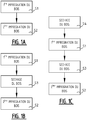
- FIGS. 1A-1C illustrate a method of preventive treatment of wood according to three exemplary embodiments of the invention.
- the invention relates to a method of preventive treatment of wood.
- the method comprises the following steps: a first impregnation S1 of wood using a first solution comprising a first salt, and a second impregnation S2 of wood using a second solution comprising a second salt.
- the method further comprises a step of drying the wood S3 between the first impregnation S1 of the wood and the second impregnation S2 of the wood.
- the method further comprises a step of drying the wood S4 before the first impregnation of the wood S1.
- the wood to be treated dries, also in depth, so that as much water as possible evaporates and the salts remain in the wood.
- the ease of impregnation of the wood also varies according to the moisture content of the wood.
- the moisture content of the wood to be treated is checked by sampling in the week preceding the treatment.
- the average humidity is preferably between 12% and 30% for wood that is easily impregnated and between 25% and 40% for wood that is difficult to impregnate.
- the double impregnation also allows impregnation in the cracks that appear after the S3 drying.
- the S3 and S4 drying stages of Figures 1B and 1C can be carried out in the open air or in an industrial dryer allowing shorter drying times.
- the drying time of wood in the open air varies from 3 to 9 months depending on the time of year, while the drying time of wood in the kiln is of the order of one week to two weeks in any period. .
- the treatment process of the invention can be applied to the treatment of rough sawn or planed solid wood and debarked or milled round wood, of class 3 or of class 4.1 or 4.2.
- the wood is preferably free of dirt and debarked.
- the minimum penetration as well as the minimum retention of the first solution and / or of the second solution within the wood may vary depending on whether the wood is easily or difficult to impregnate.
- the minimum penetration and minimum retention values depend on the use class of the wood to be treated.
- the minimum penetration values are typically between 2.5 mm and 25 mm for wood that is difficult to impregnate and relate to the entire thickness of the sapwood for wood that is easily impregnated, and the minimum retention values are typically between 3 kg / m 3 and 15 kg / m 3 .
- the above-mentioned typical values are understood to be for a total volume of wood to be impregnated, that is to say for a volume comprising both the zone of the wood to be analyzed and the zone of the wood which has not not been impregnated. If only the area of the wood to be analyzed is considered, the typical values mentioned above would be higher because the volume considered would be smaller.
- the average amount of solution absorbed depends on various factors, among which the wood species, the section, the moisture content, the temperature, the impregnation product, etc.
- the ease of impregnation of the wood in other words the ease of penetration into the wood of the first and second salt-based solutions, varies according to the species of wood, the humidity, the region of growth, etc.
- the preventive treatment process relates to softwoods such as spruce, douglas, larch, heath pine, Scots pine, etc.
- the wood to be treated is a wood intended to be exposed to bad weather and / or humidity, in other words, of class 3, 4.1 or 4.2.
- the second S2 impregnation of the wood may further use an additive, preferably a colorant, more preferably a brown colorant giving a beautiful brown appearance to the treated wood.
- an additive preferably a colorant, more preferably a brown colorant giving a beautiful brown appearance to the treated wood.
- a difference in penetration may occur between the first S1 impregnation and the second S2 impregnation using the additive in question. Even though this difference is usually small, the brown dye, usually present as a paste, can make the second solution more viscous than the first, which can reduce the penetration rate of the second solution. The brown color will naturally evolve towards a gray tint.
- the mass fraction of the first solution can be between 2.5% and 8%, preferably between 3% and 6%.
- the mass fraction of the second solution can be between 2.5% and 8%, preferably between 3% and 6%.
- the values in kg of solution diluted in water per m 3 of wood are typically between 100-120 kg / m 3 and 300-360 kg / m 3 for a wood of class 3, 4.1 or 4.2. It should be noted that the above-mentioned typical values may vary depending on the type and class of use of the wood.
- the amount of dilute solution remaining in the wood is expressed in liters, and the minimum retention values expressed this time in liters / m 3 are typically between 100-150 1 / m 3 for a class 3 wood and between 150-300 1 / m 3 for a wood of class 4.1 or 4.2.
- the above-mentioned typical values are understood to be for a total volume of wood to be impregnated, that is to say for a volume comprising both the zone of the wood to be analyzed and the zone of the wood which is not has not been impregnated. If only the area of the wood to be analyzed is considered, the typical values mentioned above would be higher because the volume considered would be smaller.
- the first salt can comprise any of the following salts: copper (II) carbonate, copper (II) sulfate, or a combination of the above salts.
- the second salt can comprise any of the following salts: copper (II) carbonate, copper (II) sulfate, or a combination of the above salts.
- Copper (II) carbonate is a blue-green ionic salt with the chemical formula CuCO 3 .
- Copper (II) sulfate, with the chemical formula CuSO 4 is mainly used in the preparation of fungicides for agriculture including organic.
- the first salt and the second salt can be of the same composition or of different compositions.
- the first solution may further comprise any of the following components: tebuconazole, propiconazole, boric acid, water, or a combination of the above components.
- the second solution may further comprise any of the following components: tebuconazole, propiconazole, boric acid, water, or a combination of the above components.
- Tanalith® E 3475 or 3485. It is a preventive wood treatment product that is soluble in water, without chromium (Cr) nor arsenic (As), and which is compatible with an industrial application involving a vacuum and pressure process in an autoclave.
- Tanalith® E contains copper (Cu), which is an element known for its fungicidal properties and its protection against termites and other insects.
- the solution further includes tebuconazole, a triazole-type fungicidal component that protects the wood against a wide range of fungi.
- Tanalith® E 3475 has the following characteristics: its physical state is a solution, its active components are copper (II) carbonate (e.g. 16.4% by weight), tebuconazole (e.g. 0.18% by weight ) and propiconazole (for example 0.18% by weight), its dilution takes place in water, and its density is typically 1.23 kg / dm 3 at 20 ° C.
- the active components of Tanalith® E 3485 are copper (II) carbonate (eg 22.5% by weight), tebuconazole (eg 0.5% by weight) and boric acid (eg 5% by weight). weight).
- the first solution and the second solution can be of the same composition or of different compositions.
- they can comprise the same salt (for example CuCO 3 or CuSO 4 ), but can be of different compositions due to the use of components other than the salts which are different from one solution to another.
- other examples of solution exist on the market, such as Embalith® P or Wolmanit® CX10.
- Embalith® P belongs to the class of products containing no metal, while Wolmanit® CX10 also includes copper.
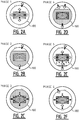
- FIGS. 2A-2F illustrate a method of preventive treatment of wood under vacuum and under pressure in an autoclave according to one embodiment of the invention.
- the first impregnation of the wood and the second impregnation of the wood are carried out under vacuum and pressure in an autoclave.
- An initial vacuum is created in the autoclave before the first impregnation of the wood and before the second impregnation of the wood.
- an overpressure of between 10 bars and 14 bars, preferably 12 bars is applied in the autoclave during the first impregnation of the wood and during the second impregnation of the wood.
- the absolute pressure within the autoclave corresponds to the atmospheric pressure of 1 atm to which is added the overpressure of between 10 bars and 14 bars, preferably 12 bars.
- the first solution is discharged from the tank after the application of said overpressure during the first impregnation of the wood
- the second solution is discharged from the tank after the application of said overpressure during the second impregnation of the wood.
- a final vacuum is created in the autoclave after the first impregnation of the wood and after the second impregnation of the wood.
- the process comprising the following cycle for the first impregnation and for the second impregnation: initial vacuum, filling of the autoclave by aspiration of the treatment solution, application of an overpressure, hydraulic or pneumatic, delivery of the solution out of the tank , and final vacuum.
- the temperature of the first and second solutions is preferably between 2 ° C (provided that the wood to be treated is not frozen) and 40 ° C, preferably around 15 ° C.
- the first solution and / or the second solution is / are approximately at room temperature.
- a vacuum and pressure autoclave process cycle typically includes the following six processing phases. The cycle is described below with reference to the first impregnation of wood, but it is clear to those skilled in the art that the five phases described below can also be applied to the second impregnation step, mutatis mutandis.
- Phase 1 the wood to be treated is loaded in batches into the autoclave tank 100 and the initial vacuum is created within the tank 100, which has the effect of evacuating the air from the pores and / or cells of the wood to be treated.
- Phase 2 the initial vacuum is maintained in the tank 100, and the tank 100 is filled with the first solution comprising the first salt.
- the air is extracted from the wood according to the first phase, Phase 1, mentioned above, then the first solution is fed into the tank 100.
- the first solution mainly penetrates into the pores. wood to be treated. With easily impregnated types of wood, the initial pores are large, even if the humidity of the wood should be less than about 25%. When the pores have narrowed a little, the first solution can penetrate quite easily by pressure within the wood to be treated.
- Phase 3 the overpressure, hydraulic or pneumatic, between 10 bars and 14 bars, preferably 12 bars, is applied in the tank 100 during the first impregnation, which forces the first solution to penetrate in depth. in the woods.
- Phase 4 the first solution is evacuated from the tank 100 after the application of said overpressure during the first impregnation of the wood.
- Phase 5 the final vacuum is produced in the tank 100 after the first impregnation, which has the effect of extracting the excess of the first solution from the wood in the bottom of the tank 100 then outwards. for recovery and reuse.
- the final vacuum has the effect of removing the pressure within the wood following the first impregnation, in order to reduce the time during which the first solution will flow out of the wood. Without the application of this final vacuum, the first solution would flow for more than 24 hours.
- Phase 6 a pressure of 1 atm is applied to the first solution on the surface of the wood to be treated, when the wood is again subjected to atmospheric pressure. The wood to be treated is then left to dry after the first impregnation step.
- the values typically encountered for the initial and final voids are of the order of 100 mbar to 200 mbar, for example 150 mbar.
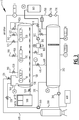
- the Figure 3 illustrates an apparatus for implementing the method of preventive treatment of wood under vacuum and under pressure in an autoclave according to the embodiment of Figures 2A-2F .
- the apparatus 1 comprises a first tank 100 in which a batch of wood to be treated is loaded.
- the volume of wood to be loaded into the tank 100 is of the order of 5 m 3 to 40 m 3 , the method being of the batch type, that is to say one batch at a time.
- the first tank 100 of the Figure 3 corresponds to tank 100 of Figures 2A-2F , seen from another profile.
- the batch of wood, present in the tank 100 on the Figures 2A-2F is not visible on the Figure 3 .
- the apparatus 1 further comprises a second tank 200 located below the first tank 100.
- the second tank 200 may be located above or next to the first tank 100.
- the second tank 200 comprises the first solution or the second solution, depending on whether the process is at the first impregnation or second impregnation stage.
- Two temperature sensors 110, 120 as well as a pressure sensor 130 are present within the first tank 100.
- the first temperature sensor 110 can be located at one end of the first tank 100, while the second temperature sensor 120 may be at the other end.
- the first tank 100 may include a reservoir 140 upstream thereof, which serves to measure the level of the first solution or of the second solution within the first tank 100, in other words, the volume of the first. solution or second solution within the first tank 100.
- the tank 140 can serve as an “overflow” to prevent overflows.
- the apparatus 1 further comprises a circuit 300 for evacuating the first tank 100.
- the vacuum circuit 300 comprises a vacuum pump 340 to produce the initial vacuum and the final vacuum within the first tank 100, as well as an adjustable valve 320 to regulate the suction of air out of the first tank 100 in order to achieve the initial vacuum and the final vacuum.
- the apparatus 1 further comprises a closed loop system 300, 310 configured to cool the vacuum pump 340. Said closed loop system comprises a feed pump 310 as well as a cooling circuit 300 of the vacuum pump 340. .
- the apparatus 1 further comprises a first circuit 400 for conveying the first solution or the second solution from the second tank 200 to the first tank 100, with a view to treating the wood within the first tank 100.
- the first delivery circuit 400 comprises a pipe for conveying the first solution or the second solution to the first tank 100, as well as an adjustable valve 410 to regulate the passage of the first solution or the second solution. Once the adjustable valve 410 is open, the first solution or the second solution is sucked from the second tank 200 to the first tank 100 due to the initial vacuum produced within the first tank 100.
- the vacuum pump 340 of the setting circuit Vacuum 300 mentioned above operates until the first tank 100 is full of either the first solution or the second solution. Therefore, it is not necessary to use a pumping unit in the first routing circuit 400 to convey the first solution or the second solution to the first tank 100.
- the first routing circuit 400 directly connects the first tank 100 to the second tank 200. Used in the opposite direction, the first routing circuit 400 can serve as a recovery circuit making it possible to recover the excess of the first solution or of the second. solution which has not been absorbed by the wood to be treated and / or which has been extracted therefrom during the process under vacuum and pressure in an autoclave, and to redirect this excess towards the second tank 200 in order to reuse it in a step subsequent impregnation. Therefore, it is advantageous to have the first tank 100 above the second tank 200, so as to benefit from the action of gravity to recover this excess.
- the apparatus 1 may further comprise a boiler 500 to regulate the temperature within the first tank 100.
- a thermal circuit 510 connects the boiler 500 to the first tank 100, and comprises an adjustable valve 520 to regulate the passage of a fluid, typically air, heated by the boiler 500 and circulating in the thermal circuit 510.
- the apparatus 1 can further comprise a compressor 600 for applying an overpressure within the first tank 100.
- a pressurization circuit 610 of the first tank 100 connects the compressor 600 to the first tank 100, and comprises an adjustable valve. 620 to regulate the passage of a fluid, typically air, compressed by the compressor 600 and circulating in the pressure circuit 610, with a view to pressurizing the first tank 100.
- a fluid typically air
- an overpressure is applied by compressed air on the free surface of the first solution or the second solution contained in the overflow 140, which pushes the first solution or the second solution from the overflow 140 towards the first tank 100, and the first solution or the second solution penetrates by pressure within the wood to be treated.
- the overpressure pushes the first solution or the second solution out of the overflow 140 towards the first tank 100 without the overflow 140 emptying completely.
- the compressor 600 pushes more of the first solution or of the second solution into the first tank 100 than is absorbed by the wood during the first impregnation or the second impregnation, the pressure gradually increases within the first tank 100.
- the apparatus 1 can include a second routing circuit 700 connecting the second tank 200 to the first tank 100.
- the second routing circuit 700 comprises a pumping unit 710, an adjustable valve 720 for regulating the passage of the first solution or of the second solution conveyed by the pumping unit 710 to the first tank 100 and a non-return valve 730 to prevent the reflux of said solutions towards the second tank 200.
- a volume greater than the volume of the first solution or second solution which has penetrated by pressure within the wood is fed into the first tank 100 thanks to the unit pumping unit 710.
- the pumping unit 710 pumps more of the first solution or second solution into the first tank 100 than is absorbed by the wood during the first impregnation or the second impregnation, the pressure gradually increases as the wood is impregnated. within the first tank 100.
- the second conveying circuit 700 makes it possible to avoid the presence of air in the upper part of the first tank 100 during the first impregnation or the second impregnation, which ensures that the wood located in said upper part always remains in contact with the first solution or the second solution during the first impregnation or the second impregnation.
- the overpressure is between 10 bars and 14 bars, preferably 12 bars, and is applied in the first tank 100 during the first impregnation and during the second impregnation, which forces the first solution and the second solution to penetrate deep into the wood.
- the time required for the pressure to build up depends, among other things, on the type of wood. Since easily impregnated types of wood absorb more quickly than difficult to impregnate types of wood, the pressure rises more slowly for easily impregnated types of wood.
- the device 1 can include a third circuit 810 connecting the first tank 100 to a condensing unit 800, and optionally the first tank 100 to the second tank 200, which circuit 800 comprising a pumping unit 820, an adjustable valve. 830 located upstream of the pumping unit 820 and an adjustable valve 840 located downstream of the pumping unit 820.
- a pumping unit 820 comprising a pumping unit 820, an adjustable valve. 830 located upstream of the pumping unit 820 and an adjustable valve 840 located downstream of the pumping unit 820.
- an adjustable valve 850 is located between the pumping unit 820 and the second tank 200
- a tank 860 is located between the adjustable valve 830 and the pumping unit 820.
- This third circuit 810 is used in combination with the condensing unit after achieving the final vacuum within the first tank 100.
- the device 1 can include input and output circuits for outside air 910, 930 to / from the first tank 100. These circuits 910, 930 are respectively provided with an adjustable valve 920, 940 to regulate. the passage of air to / from the first tank 100.
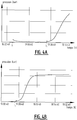
- FIGS 4A-4D illustrate a graph in four parts of the temporal evolution of the pressure within the device 1 described in section Figure 3 , according to the process under vacuum and under pressure in an autoclave described in Figures 2A-2F .
- the wood treatment time during the first impregnation or the second impregnation is represented on the abscissa and is indicated in hours, and the pressure within the first tank 100 of the Figure 3 during the first impregnation or the second impregnation is shown on the ordinate and is indicated in bars.
- the pressure within the tank corresponds to atmospheric pressure, ie 1 atm.
- time t 1 and time t 2 that is to say between approximately 4:30 p.m. and approximately 5:30 p.m. in the example of Figures 4A-4D , the pressure within the tank gradually drops from atmospheric pressure, 1 atm, to a pressure close to 0 bar. This time interval corresponds to Phase 1 of the process described in Figure 2A . It should be noted that the gradual drop in pressure takes place over approximately 1 hour from t 1 according to the example of Figures 4A-4D . In general, the gradual drop in pressure typically lasts between 30 minutes and 1 hour and 30 minutes.
- the tank is filled with the first solution or the second solution. This time interval corresponds to Phase 2 of the process described in Figure 2B .
- the tank is full of the first solution or the second solution.
- the pressure within the tank gradually increases from the pressure corresponding to a vacuum of the order of 100 mbar to 200 mbar to a pressure close to 13 bars (typically between 10 bars and 14 bars) then stabilizes at this pressure of 13 bars.
- This absolute pressure close to 13 bars corresponds to the atmospheric pressure of 1 atm to which is added an overpressure of about 12 bars.
- This time interval corresponds to Phase 3 of the process described in Figure 2C .
- the gradual increase in pressure typically lasts between 30 min and 1 hour, and the maintenance of this stabilized pressure typically lasts between 2 hours and 4 hours.
- time t 3 and time t 4 that is to say between approximately 9:30 p.m. and approximately 9:45 p.m. in the example of Figures 4A-4D , the pressure within the vessel drops rapidly from the pressure close to 13 bars to atmospheric pressure, ie 1 atm, then stabilizes at this pressure.
- the first solution or the second solution is discharged from the impregnation tank and is recovered in the storage tank. This time interval corresponds to Phase 4 of the process described in Figure 2D .
- time t 4 and time t 5 that is to say between approximately 9.45 p.m. and approximately 10.30 p.m. in the example of Figures 4A-4D , the pressure within the tank gradually drops from atmospheric pressure, 1 atm, to a pressure close to 0 bar. This time interval corresponds to Phase 5 of the process described in Figure 2E .
Landscapes
- Life Sciences & Earth Sciences (AREA)
- Engineering & Computer Science (AREA)
- Wood Science & Technology (AREA)
- Forests & Forestry (AREA)
- Chemical & Material Sciences (AREA)
- Inorganic Chemistry (AREA)
- Chemical And Physical Treatments For Wood And The Like (AREA)
Applications Claiming Priority (1)
| Application Number | Priority Date | Filing Date | Title |
|---|---|---|---|
| BE20205037A BE1028001B1 (fr) | 2020-01-20 | 2020-01-20 | Procede de traitement preventif de bois |
Publications (4)
| Publication Number | Publication Date |
|---|---|
| EP3851261A2 true EP3851261A2 (de) | 2021-07-21 |
| EP3851261A3 EP3851261A3 (de) | 2021-09-08 |
| EP3851261B1 EP3851261B1 (de) | 2024-05-15 |
| EP3851261C0 EP3851261C0 (de) | 2024-05-15 |
Family
ID=69375211
Family Applications (1)
| Application Number | Title | Priority Date | Filing Date |
|---|---|---|---|
| EP21152165.3A Active EP3851261B1 (de) | 2020-01-20 | 2021-01-18 | Präventive holzbehandlung |
Country Status (4)
| Country | Link |
|---|---|
| EP (1) | EP3851261B1 (de) |
| BE (1) | BE1028001B1 (de) |
| ES (1) | ES2983829T3 (de) |
| PL (1) | PL3851261T3 (de) |
Cited By (1)
| Publication number | Priority date | Publication date | Assignee | Title |
|---|---|---|---|---|
| CN114789490A (zh) * | 2022-04-18 | 2022-07-26 | 中山市伍氏大观园家具有限公司 | 一种红木家具生产线 |
Family Cites Families (4)
| Publication number | Priority date | Publication date | Assignee | Title |
|---|---|---|---|---|
| GB244178A (en) * | 1924-09-12 | 1925-12-14 | Novocrete And Cement Products | Improvements in or relating to the induration or mineralization of organic matter |
| NZ264079A (en) * | 1993-07-28 | 1996-05-28 | Koshi Preserving Kk | Aqueous wood preservative containing copper, zinc and/or boron compound(s), and a volatile basic compound |
| EP2937193A1 (de) * | 2014-04-24 | 2015-10-28 | ETH Zurich | Mineralisierte Holzwerkstoffe und Verfahren zur Bereitstellung mineralisierter Holzwerkstoffe |
| WO2018065335A2 (en) * | 2016-10-03 | 2018-04-12 | Berner Fachhochschule - Biel Architektur, Holz Und Bau | Mineralizing of wood and cellulosic materials |
-
2020
- 2020-01-20 BE BE20205037A patent/BE1028001B1/fr active IP Right Grant
-
2021
- 2021-01-18 PL PL21152165.3T patent/PL3851261T3/pl unknown
- 2021-01-18 EP EP21152165.3A patent/EP3851261B1/de active Active
- 2021-01-18 ES ES21152165T patent/ES2983829T3/es active Active
Cited By (2)
| Publication number | Priority date | Publication date | Assignee | Title |
|---|---|---|---|---|
| CN114789490A (zh) * | 2022-04-18 | 2022-07-26 | 中山市伍氏大观园家具有限公司 | 一种红木家具生产线 |
| CN114789490B (zh) * | 2022-04-18 | 2023-08-08 | 中山市伍氏大观园家具有限公司 | 一种红木家具生产线 |
Also Published As
| Publication number | Publication date |
|---|---|
| BE1028001B1 (fr) | 2021-08-16 |
| EP3851261B1 (de) | 2024-05-15 |
| PL3851261T3 (pl) | 2024-07-08 |
| EP3851261A3 (de) | 2021-09-08 |
| ES2983829T3 (es) | 2024-10-25 |
| EP3851261C0 (de) | 2024-05-15 |
| BE1028001A1 (fr) | 2021-08-12 |
Similar Documents
| Publication | Publication Date | Title |
|---|---|---|
| FR2700970A1 (fr) | Solution d'un soluté inorganique dans un solvant aqueux, procédé d'obtention et applications au traitement du bois. | |
| FR2589776A2 (fr) | Composition et procede de traitement pour la protection du bois. | |
| US20080178490A1 (en) | Method for drying lumber, method of impregnating lumber with chemicals, and drying apparatus | |
| EP3851261B1 (de) | Präventive holzbehandlung | |
| US20130230668A1 (en) | Method Of Delivering Compositions To Substrates | |
| WO2008101331A1 (fr) | Procédé de traitement du bois pour améliorer sa durée de vie et bois ainsi obtenu | |
| Priadi et al. | Dimensional stability, color change, and durability of boron-MMA treated red jabon (Antochephalus macrophyllus) wood | |
| FR2562463A1 (fr) | Composition et procede de traitement pour la protection du bois | |
| Muin et al. | Feasibility of supercritical carbon dioxide as a carrier solvent for preservative treatment of wood-based composites | |
| AU2011200045B2 (en) | Wood Impregnation | |
| CH624339A5 (en) | Method for treating wood | |
| JP2714266B2 (ja) | 木材加工剤、加工木材及びその加工方法 | |
| EP2061325A1 (de) | Erhöhte penetration von bioziden | |
| US2012976A (en) | Composition for impregnating wood | |
| Amusant et al. | Biological properties of an OSB eco-product manufactured from a mixture of durable and non durable species and natural resins | |
| WO2023247273A1 (fr) | Procédé de reconditionnement d'un contenant en bois comportant une étape d'imprégnation tannique et/ou aromatique du contenant en bois | |
| EP1258330A9 (de) | Verfahren zur Behandlung eines porösen Materials | |
| JP4400821B2 (ja) | 木材の防腐防蟻および干割れ防止剤 | |
| EP3146840A2 (de) | Biozid-zusammensetzung für die holzbehandlung | |
| Mitsuhashi et al. | Migration of boron from Douglas-fir lumber subjected to simulated rainfall | |
| AU2003288825B2 (en) | Method of delivering compositions to substrates | |
| Olaniran et al. | RESISTANCE OF RUBBERWOOD (HEVEA BRASILIENSIS MULL. ARG.) TO BROWNROT FUNGUS (SERPULA LACRYMANS) AFTER TREATMENT WITH TEAK HEARTWOOD EXTRACTS. | |
| FI20235571A1 (en) | Procedure for imaging, sorting and processing wood pieces | |
| Liibert et al. | A two-step wood protection process using alternative wood protection agents in combination with an oil treatment | |
| Cooper et al. | Comparison of empty-cell and full-cell treatment of red pine and lodgepole pine pole sections with CCA-PEG |
Legal Events
| Date | Code | Title | Description |
|---|---|---|---|
| PUAI | Public reference made under article 153(3) epc to a published international application that has entered the european phase |
Free format text: ORIGINAL CODE: 0009012 |
|
| STAA | Information on the status of an ep patent application or granted ep patent |
Free format text: STATUS: THE APPLICATION HAS BEEN PUBLISHED |
|
| AK | Designated contracting states |
Kind code of ref document: A2 Designated state(s): AL AT BE BG CH CY CZ DE DK EE ES FI FR GB GR HR HU IE IS IT LI LT LU LV MC MK MT NL NO PL PT RO RS SE SI SK SM TR |
|
| PUAL | Search report despatched |
Free format text: ORIGINAL CODE: 0009013 |
|
| AK | Designated contracting states |
Kind code of ref document: A3 Designated state(s): AL AT BE BG CH CY CZ DE DK EE ES FI FR GB GR HR HU IE IS IT LI LT LU LV MC MK MT NL NO PL PT RO RS SE SI SK SM TR |
|
| RIC1 | Information provided on ipc code assigned before grant |
Ipc: B27K 5/02 20060101ALI20210804BHEP Ipc: B27K 3/52 20060101ALI20210804BHEP Ipc: B27K 3/42 20060101ALI20210804BHEP Ipc: B27K 3/32 20060101ALI20210804BHEP Ipc: B27K 3/22 20060101ALI20210804BHEP Ipc: B27K 3/16 20060101ALI20210804BHEP Ipc: B27K 3/08 20060101ALI20210804BHEP Ipc: B27K 3/02 20060101AFI20210804BHEP |
|
| STAA | Information on the status of an ep patent application or granted ep patent |
Free format text: STATUS: REQUEST FOR EXAMINATION WAS MADE |
|
| RBV | Designated contracting states (corrected) |
Designated state(s): AL AT BE BG CH CY CZ DE DK EE ES FI FR GB GR HR HU IE IS IT LI LT LU LV MC MK MT NL NO PL PT RO RS SE SI SK SM TR |
|
| 17P | Request for examination filed |
Effective date: 20211105 |
|
| STAA | Information on the status of an ep patent application or granted ep patent |
Free format text: STATUS: EXAMINATION IS IN PROGRESS |
|
| 17Q | First examination report despatched |
Effective date: 20230418 |
|
| GRAP | Despatch of communication of intention to grant a patent |
Free format text: ORIGINAL CODE: EPIDOSNIGR1 |
|
| STAA | Information on the status of an ep patent application or granted ep patent |
Free format text: STATUS: GRANT OF PATENT IS INTENDED |
|
| INTG | Intention to grant announced |
Effective date: 20231207 |
|
| GRAS | Grant fee paid |
Free format text: ORIGINAL CODE: EPIDOSNIGR3 |
|
| GRAA | (expected) grant |
Free format text: ORIGINAL CODE: 0009210 |
|
| STAA | Information on the status of an ep patent application or granted ep patent |
Free format text: STATUS: THE PATENT HAS BEEN GRANTED |
|
| AK | Designated contracting states |
Kind code of ref document: B1 Designated state(s): AL AT BE BG CH CY CZ DE DK EE ES FI FR GB GR HR HU IE IS IT LI LT LU LV MC MK MT NL NO PL PT RO RS SE SI SK SM TR |
|
| REG | Reference to a national code |
Ref country code: CH Ref legal event code: EP |
|
| REG | Reference to a national code |
Ref country code: IE Ref legal event code: FG4D Free format text: LANGUAGE OF EP DOCUMENT: FRENCH |
|
| REG | Reference to a national code |
Ref country code: DE Ref legal event code: R096 Ref document number: 602021013187 Country of ref document: DE |
|
| U01 | Request for unitary effect filed |
Effective date: 20240515 |
|
| U07 | Unitary effect registered |
Designated state(s): AT BE BG DE DK EE FI FR IT LT LU LV MT NL PT SE SI Effective date: 20240603 |
|
| PG25 | Lapsed in a contracting state [announced via postgrant information from national office to epo] |
Ref country code: HR Free format text: LAPSE BECAUSE OF FAILURE TO SUBMIT A TRANSLATION OF THE DESCRIPTION OR TO PAY THE FEE WITHIN THE PRESCRIBED TIME-LIMIT Effective date: 20240515 |
|
| PG25 | Lapsed in a contracting state [announced via postgrant information from national office to epo] |
Ref country code: GR Free format text: LAPSE BECAUSE OF FAILURE TO SUBMIT A TRANSLATION OF THE DESCRIPTION OR TO PAY THE FEE WITHIN THE PRESCRIBED TIME-LIMIT Effective date: 20240816 |
|
| REG | Reference to a national code |
Ref country code: ES Ref legal event code: FG2A Ref document number: 2983829 Country of ref document: ES Kind code of ref document: T3 Effective date: 20241025 |
|
| PG25 | Lapsed in a contracting state [announced via postgrant information from national office to epo] |
Ref country code: HR Free format text: LAPSE BECAUSE OF FAILURE TO SUBMIT A TRANSLATION OF THE DESCRIPTION OR TO PAY THE FEE WITHIN THE PRESCRIBED TIME-LIMIT Effective date: 20240515 Ref country code: GR Free format text: LAPSE BECAUSE OF FAILURE TO SUBMIT A TRANSLATION OF THE DESCRIPTION OR TO PAY THE FEE WITHIN THE PRESCRIBED TIME-LIMIT Effective date: 20240816 Ref country code: RS Free format text: LAPSE BECAUSE OF FAILURE TO SUBMIT A TRANSLATION OF THE DESCRIPTION OR TO PAY THE FEE WITHIN THE PRESCRIBED TIME-LIMIT Effective date: 20240815 |
|
| PG25 | Lapsed in a contracting state [announced via postgrant information from national office to epo] |
Ref country code: CZ Free format text: LAPSE BECAUSE OF FAILURE TO SUBMIT A TRANSLATION OF THE DESCRIPTION OR TO PAY THE FEE WITHIN THE PRESCRIBED TIME-LIMIT Effective date: 20240515 |
|
| PG25 | Lapsed in a contracting state [announced via postgrant information from national office to epo] |
Ref country code: RO Free format text: LAPSE BECAUSE OF FAILURE TO SUBMIT A TRANSLATION OF THE DESCRIPTION OR TO PAY THE FEE WITHIN THE PRESCRIBED TIME-LIMIT Effective date: 20240515 Ref country code: SK Free format text: LAPSE BECAUSE OF FAILURE TO SUBMIT A TRANSLATION OF THE DESCRIPTION OR TO PAY THE FEE WITHIN THE PRESCRIBED TIME-LIMIT Effective date: 20240515 |
|
| PG25 | Lapsed in a contracting state [announced via postgrant information from national office to epo] |
Ref country code: SM Free format text: LAPSE BECAUSE OF FAILURE TO SUBMIT A TRANSLATION OF THE DESCRIPTION OR TO PAY THE FEE WITHIN THE PRESCRIBED TIME-LIMIT Effective date: 20240515 |
|
| PG25 | Lapsed in a contracting state [announced via postgrant information from national office to epo] |
Ref country code: SM Free format text: LAPSE BECAUSE OF FAILURE TO SUBMIT A TRANSLATION OF THE DESCRIPTION OR TO PAY THE FEE WITHIN THE PRESCRIBED TIME-LIMIT Effective date: 20240515 Ref country code: SK Free format text: LAPSE BECAUSE OF FAILURE TO SUBMIT A TRANSLATION OF THE DESCRIPTION OR TO PAY THE FEE WITHIN THE PRESCRIBED TIME-LIMIT Effective date: 20240515 Ref country code: RO Free format text: LAPSE BECAUSE OF FAILURE TO SUBMIT A TRANSLATION OF THE DESCRIPTION OR TO PAY THE FEE WITHIN THE PRESCRIBED TIME-LIMIT Effective date: 20240515 Ref country code: CZ Free format text: LAPSE BECAUSE OF FAILURE TO SUBMIT A TRANSLATION OF THE DESCRIPTION OR TO PAY THE FEE WITHIN THE PRESCRIBED TIME-LIMIT Effective date: 20240515 |
|
| REG | Reference to a national code |
Ref country code: DE Ref legal event code: R097 Ref document number: 602021013187 Country of ref document: DE |
|
| U20 | Renewal fee for the european patent with unitary effect paid |
Year of fee payment: 5 Effective date: 20250127 |
|
| PLBE | No opposition filed within time limit |
Free format text: ORIGINAL CODE: 0009261 |
|
| STAA | Information on the status of an ep patent application or granted ep patent |
Free format text: STATUS: NO OPPOSITION FILED WITHIN TIME LIMIT |
|
| 26N | No opposition filed |
Effective date: 20250218 |
|
| PG25 | Lapsed in a contracting state [announced via postgrant information from national office to epo] |
Ref country code: MC Free format text: LAPSE BECAUSE OF FAILURE TO SUBMIT A TRANSLATION OF THE DESCRIPTION OR TO PAY THE FEE WITHIN THE PRESCRIBED TIME-LIMIT Effective date: 20240515 |
|
| REG | Reference to a national code |
Ref country code: CH Ref legal event code: U11 Free format text: ST27 STATUS EVENT CODE: U-0-0-U10-U11 (AS PROVIDED BY THE NATIONAL OFFICE) Effective date: 20260201 |
|
| U20 | Renewal fee for the european patent with unitary effect paid |
Year of fee payment: 6 Effective date: 20260127 |
|
| PGFP | Annual fee paid to national office [announced via postgrant information from national office to epo] |
Ref country code: GB Payment date: 20260127 Year of fee payment: 6 |
|
| PGFP | Annual fee paid to national office [announced via postgrant information from national office to epo] |
Ref country code: ES Payment date: 20260202 Year of fee payment: 6 |
|
| PGFP | Annual fee paid to national office [announced via postgrant information from national office to epo] |
Ref country code: NO Payment date: 20260128 Year of fee payment: 6 Ref country code: IE Payment date: 20260127 Year of fee payment: 6 |
|
| PGFP | Annual fee paid to national office [announced via postgrant information from national office to epo] |
Ref country code: IS Payment date: 20260121 Year of fee payment: 6 |
|
| PGFP | Annual fee paid to national office [announced via postgrant information from national office to epo] |
Ref country code: CH Payment date: 20260201 Year of fee payment: 6 |
|
| PGFP | Annual fee paid to national office [announced via postgrant information from national office to epo] |
Ref country code: PL Payment date: 20260104 Year of fee payment: 6 |
|
| PG25 | Lapsed in a contracting state [announced via postgrant information from national office to epo] |
Ref country code: CY Free format text: LAPSE BECAUSE OF FAILURE TO SUBMIT A TRANSLATION OF THE DESCRIPTION OR TO PAY THE FEE WITHIN THE PRESCRIBED TIME-LIMIT Effective date: 20240515 |
|
| PG25 | Lapsed in a contracting state [announced via postgrant information from national office to epo] |
Ref country code: TR Free format text: LAPSE BECAUSE OF FAILURE TO SUBMIT A TRANSLATION OF THE DESCRIPTION OR TO PAY THE FEE WITHIN THE PRESCRIBED TIME-LIMIT Effective date: 20240515 |