EP3854873A1 - Compositions et procédés permettant d'identifier des mutations de manière précise - Google Patents
Compositions et procédés permettant d'identifier des mutations de manière précise Download PDFInfo
- Publication number
- EP3854873A1 EP3854873A1 EP20215829.1A EP20215829A EP3854873A1 EP 3854873 A1 EP3854873 A1 EP 3854873A1 EP 20215829 A EP20215829 A EP 20215829A EP 3854873 A1 EP3854873 A1 EP 3854873A1
- Authority
- EP
- European Patent Office
- Prior art keywords
- nucleic acid
- cypher
- nucleotides
- stranded
- double
- Prior art date
- Legal status (The legal status is an assumption and is not a legal conclusion. Google has not performed a legal analysis and makes no representation as to the accuracy of the status listed.)
- Pending
Links
Images




Classifications
-
- C—CHEMISTRY; METALLURGY
- C12—BIOCHEMISTRY; BEER; SPIRITS; WINE; VINEGAR; MICROBIOLOGY; ENZYMOLOGY; MUTATION OR GENETIC ENGINEERING
- C12Q—MEASURING OR TESTING PROCESSES INVOLVING ENZYMES, NUCLEIC ACIDS OR MICROORGANISMS; COMPOSITIONS OR TEST PAPERS THEREFOR; PROCESSES OF PREPARING SUCH COMPOSITIONS; CONDITION-RESPONSIVE CONTROL IN MICROBIOLOGICAL OR ENZYMOLOGICAL PROCESSES
- C12Q1/00—Measuring or testing processes involving enzymes, nucleic acids or microorganisms; Compositions therefor; Processes of preparing such compositions
- C12Q1/68—Measuring or testing processes involving enzymes, nucleic acids or microorganisms; Compositions therefor; Processes of preparing such compositions involving nucleic acids
- C12Q1/6869—Methods for sequencing
- C12Q1/6874—Methods for sequencing involving nucleic acid arrays, e.g. sequencing by hybridisation
-
- C—CHEMISTRY; METALLURGY
- C12—BIOCHEMISTRY; BEER; SPIRITS; WINE; VINEGAR; MICROBIOLOGY; ENZYMOLOGY; MUTATION OR GENETIC ENGINEERING
- C12N—MICROORGANISMS OR ENZYMES; COMPOSITIONS THEREOF; PROPAGATING, PRESERVING, OR MAINTAINING MICROORGANISMS; MUTATION OR GENETIC ENGINEERING; CULTURE MEDIA
- C12N15/00—Mutation or genetic engineering; DNA or RNA concerning genetic engineering, vectors, e.g. plasmids, or their isolation, preparation or purification; Use of hosts therefor
- C12N15/09—Recombinant DNA-technology
- C12N15/10—Processes for the isolation, preparation or purification of DNA or RNA
-
- C—CHEMISTRY; METALLURGY
- C12—BIOCHEMISTRY; BEER; SPIRITS; WINE; VINEGAR; MICROBIOLOGY; ENZYMOLOGY; MUTATION OR GENETIC ENGINEERING
- C12N—MICROORGANISMS OR ENZYMES; COMPOSITIONS THEREOF; PROPAGATING, PRESERVING, OR MAINTAINING MICROORGANISMS; MUTATION OR GENETIC ENGINEERING; CULTURE MEDIA
- C12N15/00—Mutation or genetic engineering; DNA or RNA concerning genetic engineering, vectors, e.g. plasmids, or their isolation, preparation or purification; Use of hosts therefor
- C12N15/09—Recombinant DNA-technology
- C12N15/10—Processes for the isolation, preparation or purification of DNA or RNA
- C12N15/1034—Isolating an individual clone by screening libraries
- C12N15/1065—Preparation or screening of tagged libraries, e.g. tagged microorganisms by STM-mutagenesis, tagged polynucleotides, gene tags
-
- C—CHEMISTRY; METALLURGY
- C12—BIOCHEMISTRY; BEER; SPIRITS; WINE; VINEGAR; MICROBIOLOGY; ENZYMOLOGY; MUTATION OR GENETIC ENGINEERING
- C12N—MICROORGANISMS OR ENZYMES; COMPOSITIONS THEREOF; PROPAGATING, PRESERVING, OR MAINTAINING MICROORGANISMS; MUTATION OR GENETIC ENGINEERING; CULTURE MEDIA
- C12N15/00—Mutation or genetic engineering; DNA or RNA concerning genetic engineering, vectors, e.g. plasmids, or their isolation, preparation or purification; Use of hosts therefor
- C12N15/09—Recombinant DNA-technology
- C12N15/10—Processes for the isolation, preparation or purification of DNA or RNA
- C12N15/1034—Isolating an individual clone by screening libraries
- C12N15/1093—General methods of preparing gene libraries, not provided for in other subgroups
-
- C—CHEMISTRY; METALLURGY
- C12—BIOCHEMISTRY; BEER; SPIRITS; WINE; VINEGAR; MICROBIOLOGY; ENZYMOLOGY; MUTATION OR GENETIC ENGINEERING
- C12N—MICROORGANISMS OR ENZYMES; COMPOSITIONS THEREOF; PROPAGATING, PRESERVING, OR MAINTAINING MICROORGANISMS; MUTATION OR GENETIC ENGINEERING; CULTURE MEDIA
- C12N15/00—Mutation or genetic engineering; DNA or RNA concerning genetic engineering, vectors, e.g. plasmids, or their isolation, preparation or purification; Use of hosts therefor
- C12N15/09—Recombinant DNA-technology
- C12N15/63—Introduction of foreign genetic material using vectors; Vectors; Use of hosts therefor; Regulation of expression
- C12N15/70—Vectors or expression systems specially adapted for E. coli
-
- C—CHEMISTRY; METALLURGY
- C12—BIOCHEMISTRY; BEER; SPIRITS; WINE; VINEGAR; MICROBIOLOGY; ENZYMOLOGY; MUTATION OR GENETIC ENGINEERING
- C12N—MICROORGANISMS OR ENZYMES; COMPOSITIONS THEREOF; PROPAGATING, PRESERVING, OR MAINTAINING MICROORGANISMS; MUTATION OR GENETIC ENGINEERING; CULTURE MEDIA
- C12N15/00—Mutation or genetic engineering; DNA or RNA concerning genetic engineering, vectors, e.g. plasmids, or their isolation, preparation or purification; Use of hosts therefor
- C12N15/09—Recombinant DNA-technology
- C12N15/63—Introduction of foreign genetic material using vectors; Vectors; Use of hosts therefor; Regulation of expression
- C12N15/79—Vectors or expression systems specially adapted for eukaryotic hosts
- C12N15/80—Vectors or expression systems specially adapted for eukaryotic hosts for fungi
- C12N15/81—Vectors or expression systems specially adapted for eukaryotic hosts for fungi for yeasts
-
- C—CHEMISTRY; METALLURGY
- C12—BIOCHEMISTRY; BEER; SPIRITS; WINE; VINEGAR; MICROBIOLOGY; ENZYMOLOGY; MUTATION OR GENETIC ENGINEERING
- C12N—MICROORGANISMS OR ENZYMES; COMPOSITIONS THEREOF; PROPAGATING, PRESERVING, OR MAINTAINING MICROORGANISMS; MUTATION OR GENETIC ENGINEERING; CULTURE MEDIA
- C12N15/00—Mutation or genetic engineering; DNA or RNA concerning genetic engineering, vectors, e.g. plasmids, or their isolation, preparation or purification; Use of hosts therefor
- C12N15/09—Recombinant DNA-technology
- C12N15/63—Introduction of foreign genetic material using vectors; Vectors; Use of hosts therefor; Regulation of expression
- C12N15/79—Vectors or expression systems specially adapted for eukaryotic hosts
- C12N15/85—Vectors or expression systems specially adapted for eukaryotic hosts for animal cells
-
- C—CHEMISTRY; METALLURGY
- C12—BIOCHEMISTRY; BEER; SPIRITS; WINE; VINEGAR; MICROBIOLOGY; ENZYMOLOGY; MUTATION OR GENETIC ENGINEERING
- C12Q—MEASURING OR TESTING PROCESSES INVOLVING ENZYMES, NUCLEIC ACIDS OR MICROORGANISMS; COMPOSITIONS OR TEST PAPERS THEREFOR; PROCESSES OF PREPARING SUCH COMPOSITIONS; CONDITION-RESPONSIVE CONTROL IN MICROBIOLOGICAL OR ENZYMOLOGICAL PROCESSES
- C12Q1/00—Measuring or testing processes involving enzymes, nucleic acids or microorganisms; Compositions therefor; Processes of preparing such compositions
- C12Q1/68—Measuring or testing processes involving enzymes, nucleic acids or microorganisms; Compositions therefor; Processes of preparing such compositions involving nucleic acids
- C12Q1/6813—Hybridisation assays
- C12Q1/6827—Hybridisation assays for detection of mutation or polymorphism
-
- C—CHEMISTRY; METALLURGY
- C12—BIOCHEMISTRY; BEER; SPIRITS; WINE; VINEGAR; MICROBIOLOGY; ENZYMOLOGY; MUTATION OR GENETIC ENGINEERING
- C12Q—MEASURING OR TESTING PROCESSES INVOLVING ENZYMES, NUCLEIC ACIDS OR MICROORGANISMS; COMPOSITIONS OR TEST PAPERS THEREFOR; PROCESSES OF PREPARING SUCH COMPOSITIONS; CONDITION-RESPONSIVE CONTROL IN MICROBIOLOGICAL OR ENZYMOLOGICAL PROCESSES
- C12Q1/00—Measuring or testing processes involving enzymes, nucleic acids or microorganisms; Compositions therefor; Processes of preparing such compositions
- C12Q1/68—Measuring or testing processes involving enzymes, nucleic acids or microorganisms; Compositions therefor; Processes of preparing such compositions involving nucleic acids
- C12Q1/6869—Methods for sequencing
-
- C—CHEMISTRY; METALLURGY
- C40—COMBINATORIAL TECHNOLOGY
- C40B—COMBINATORIAL CHEMISTRY; LIBRARIES, e.g. CHEMICAL LIBRARIES
- C40B40/00—Libraries per se, e.g. arrays, mixtures
- C40B40/04—Libraries containing only organic compounds
- C40B40/06—Libraries containing nucleotides or polynucleotides, or derivatives thereof
- C40B40/08—Libraries containing RNA or DNA which encodes proteins, e.g. gene libraries
-
- C—CHEMISTRY; METALLURGY
- C40—COMBINATORIAL TECHNOLOGY
- C40B—COMBINATORIAL CHEMISTRY; LIBRARIES, e.g. CHEMICAL LIBRARIES
- C40B50/00—Methods of creating libraries, e.g. combinatorial synthesis
- C40B50/06—Biochemical methods, e.g. using enzymes or whole viable microorganisms
-
- Y—GENERAL TAGGING OF NEW TECHNOLOGICAL DEVELOPMENTS; GENERAL TAGGING OF CROSS-SECTIONAL TECHNOLOGIES SPANNING OVER SEVERAL SECTIONS OF THE IPC; TECHNICAL SUBJECTS COVERED BY FORMER USPC CROSS-REFERENCE ART COLLECTIONS [XRACs] AND DIGESTS
- Y02—TECHNOLOGIES OR APPLICATIONS FOR MITIGATION OR ADAPTATION AGAINST CLIMATE CHANGE
- Y02E—REDUCTION OF GREENHOUSE GAS [GHG] EMISSIONS, RELATED TO ENERGY GENERATION, TRANSMISSION OR DISTRIBUTION
- Y02E50/00—Technologies for the production of fuel of non-fossil origin
- Y02E50/10—Biofuels, e.g. bio-diesel
Definitions
- the present disclosure relates to compositions and methods for accurately detecting mutations using sequencing and, more particularly, uniquely tagging double stranded nucleic acid molecules such that sequence data obtained for a sense strand can be linked to sequence data obtained from the anti-sense strand when obtained via massively parallel sequencing methods.
- Detection of spontaneous mutations e . g ., substitutions, insertions, deletions, duplications
- induced mutations that occur randomly throughout a genome
- the most direct way to detect mutations is by sequencing, but the available sequencing methods are not sensitive enough to detect rare mutations.
- mutations that arise de novo in mitochondrial DNA mtDNA
- mtDNA mitochondrial DNA
- these mutations are not easily found since a mutation must be present in as much as 10-25% of a population of molecules to be detected by sequencing ( Jones et al., Proc. Nat'l. Acad. Sci.
- the spontaneous somatic mutation frequency in genomic DNA has been estimated to be as low as 1 x 10 -8 and 2.1 x 10 -6 in human normal and cancerous tissues, respectively ( Bielas et al., Proc. Nat'l Acad. Sci. U.S.A. 103:18238-42, 2008 ).
- the present disclosure provides a double-stranded nucleic acid molecule library that includes a plurality of target nucleic acid molecules and a plurality of random cyphers, wherein the nucleic acid library comprises molecules having a formula of X a -X b -Y, X b -X a -Y, Y-X a -X b , Y-X b -X a , X a -Y-X b , or X b -Y-X a (in 5' to 3' order), wherein (a) X a comprises a first random cypher, (b) Y comprises a target nucleic acid molecule, and (c) X b comprises a second random cypher.
- each of the plurality of random cyphers comprise a length ranging from about 5 nucleotides to about 50 nucleotides (or about 5 nucleotides to about 10 nucleotides, or a length of about 6, about 7, about 8, about 9, about 10, about 11, about 12, about 13, about 14, about 15, about 16, about 17, about 18, about 19, or about 20 nucleotides).
- the double-stranded sequence of the X a cypher for each target nucleic acid molecule is different from the double-stranded sequence of the X b cypher.
- the double-stranded nucleic acid library is contained in a self-replicating vector, such as a plasmid, cosmid, YAC, or viral vector.
- the present disclosure provides a method for obtaining a nucleic acid sequence or accurately detecting a true mutation in a nucleic acid molecule by amplifying each strand of the aforementioned double-stranded nucleic acid library wherein a plurality of target nucleic acid molecules and plurality of random cyphers are amplified, and sequencing each strand of the plurality of target nucleic acid molecules and plurality of random cyphers.
- the sequencing is performed using massively parallel sequencing methods.
- the sequence of one strand of a target nucleic acid molecule associated with the first random cypher aligned with the sequence of the complementary strand associated with the second random cypher results in a measureable sequencing error rate ranging from about 10 -6 to about 10 -8 .
- the present disclosure provides a double-stranded nucleic acid library wherein target nucleic acid molecules include dual cyphers (i.e., barcodes or origin identifier tags), one on each end (same or different), so that sequencing each complementary strand can be connected or linked back to the original molecule.
- the unique cypher on each strand links each strand with its original complementary strand (e.g., before any amplification), so that each paired sequence serves as its own internal control.
- sequence data obtained from one strand of a single nucleic acid molecule can be specifically linked to sequence data obtained from the complementary strand of that same double-stranded nucleic acid molecule.
- sequence data obtained from one end of a double-stranded target nucleic acid molecule can be specifically linked to sequence data obtained from the opposite end of that same double-stranded target nucleic acid molecule (if, for example, it is not possible to obtain sequence data across the entire target nucleic acid molecule fragment of the library).
- compositions and methods of this disclosure allow a person of ordinary skill in the art to more accurately distinguish true mutations (i.e., naturally arising in vivo mutations) of a nucleic acid molecule from artifact "mutations" (i.e., ex vivo mutations or errors) of a nucleic acid molecule that may arise for various reasons, such as a downstream amplification error, a sequencing error, or physical or chemical damage.
- a transition mutation of adenine (A) to guanine (G) identified on one strand will be complemented with a thymine (T) to cysteine (C) transition on the other strand.
- artifact "mutations" that arise later on an individual (separate) DNA strand due to polymerase errors during isolation, amplification or sequencing are extremely unlikely to have a matched base change in the complementary strand.
- the approach of this disclosure provides compositions and methods for distinguishing systematic errors (e.g., polymerase read fidelity errors) and biological errors (e . g ., chemical or other damage) from actual known or newly identified true mutations or single nucleotide polymorphisms (SNPs).
- the two cyphers on each target molecule have sequences that are distinct from each other and, therefore, provide a unique pair of identifiers wherein one cypher identifies (or is associated with) a first end of a target nucleic acid molecule and the second cypher identifies (or is associated with) the other end of the target nucleic acid molecule.
- the two cyphers on each target molecule have the same sequence and, therefore, provide a unique identifier for each strand of the target nucleic acid molecule.
- Each strand of the double-stranded nucleic acid library e .
- genomic DNA, cDNA can be amplified and sequenced using, for example, next generation sequencing technologies (such as, emulsion PCR or bridge amplification combined with pyrosequencing or sequencing by synthesis, or the like).
- sequence information from each complementary strand of a first double-stranded nucleic acid molecule can be linked and compared (e . g ., computationally "de-convoluted") due to the unique cyphers associated with each end or strand of that particular double-stranded nucleic acid molecule.
- each original double-stranded nucleic acid molecule fragment found in a library of molecules can be individually reconstructed due to the presence of an associated unique barcode or pair of barcode (identifier tag) sequences on each target fragment or strand.
- any spontaneous or induced mutation will be present in both strands of a native genomic, double-stranded DNA molecule.
- a mutant DNA template amplified using PCR will result in a PCR product in which 100% of the molecules produced by PCR include the mutation.
- a change due to polymerase error will only appear in one strand of the initial template DNA molecule (while the other strand will not have the artifact mutation). If all DNA strands in a PCR reaction are copied equally efficiently, then any polymerase error that emerges from the first PCR cycle likely will be found in at least 25% of the total PCR product.
- DNA sequences amplified from the strand that incorporated an erroneous nucleotide base during the initial amplification might constitute more or less than 25% of the population of amplified DNA sequences depending on the efficiency of amplification, but still far less than 100%.
- any polymerase error that occurs in later PCR cycles will generally represent an even smaller proportion of PCR products ( i.e., 12.5% for the second cycle, 6.25% for the third, etc .) containing a "mutation.”
- PCR-induced mutations may be due to polymerase errors or due to the polymerase bypassing damaged nucleotides, thereby resulting in an error ( see , e.g.
- cytosine which is recognized by Taq polymerase as a uracil and results in a cytosine to thymine transition mutation ( Zheng et al., Mutat. Res. 599:11-20, 2006 ) - that is, an alteration in the original DNA sequence may be detected when the damaged DNA is sequenced, but such a change may or may not be recognized as a sequencing reaction error or due to damage arising ex vivo ( e.g., during or after nucleic acid isolation).
- Next generation sequencing has opened the door to sequencing multiple copies of an amplified single nucleic acid molecule - referred to as deep sequencing.
- deep sequencing is that if a particular nucleotide of a nucleic acid molecule is sequenced multiple times, then one can more easily identify rare sequence variants or mutations.
- the amplification and sequencing process has an inherent error rate (which may vary depending on DNA quality, purity, concentration (e.g., cluster density), or other conditions), so no matter how few or how many times a nucleic acid molecule is sequenced, a person of skill in the art cannot distinguish a polymerase error artifact from a true mutation (especially rare mutations).
- the present disclosure in a further aspect, provides methods for identifying mutations present before amplification or sequencing of a double-stranded nucleic acid library wherein the target molecules include a single double-stranded cypher or dual cyphers ( i.e., barcodes or identifier tags), one on each end, so that sequencing each complementary strand can be connected back to the original molecule.
- the target molecules include a single double-stranded cypher or dual cyphers (i.e., barcodes or identifier tags), one on each end, so that sequencing each complementary strand can be connected back to the original molecule.
- the method enhances the sensitivity of the sequencing method such that the error rate is 5 x 10 -6 , 10 -6 , 5 x 10 -7 , 10 -7 , 5 x 10 -8 , 10 -8 or less when sequencing many different target nucleic acid molecules simultaneously or such that the error rate is 5 x 10 -7 , 10 -7 , 5 x 10 -8 , 10 -8 or less when sequencing a single target nucleic acid molecule in depth.
- any concentration range, percentage range, ratio range, or integer range is to be understood to include the value of any integer within the recited range and, when appropriate, fractions thereof (such as one tenth and one hundredth of an integer), unless otherwise indicated.
- any number range recited herein relating to any physical feature, such as polymer subunits, size or thickness are to be understood to include any integer within the recited range, unless otherwise indicated.
- the terms “about” and “consisting essentially of' mean ⁇ 20% of the indicated range, value, or structure, unless otherwise indicated. It should be understood that the terms “a” and “an” as used herein refer to “one or more" of the enumerated components.
- the term "random cypher” or “cypher” or “barcode” or “identifier tag” and variants thereof are used interchangeably and refer to a nucleic acid molecule having a length ranging from about 5 to about 50 nucleotides.
- all of the nucleotides of the cypher are not identical (i.e., comprise at least two different nucleotides) and optionally do not contain three contiguous nucleotides that are identical.
- the cypher is comprised of about 5 to about 15 nucleotides, about 6 to about 10 nucleotides, and preferably about 7 to about 12 nucleotides. Cyphers will generally be located at one or both ends a target molecule may, which may be incorporated directly onto target molecules of interest or onto a vector into which target molecules will be later added.
- target nucleic acid molecules and variants thereof refer to a plurality of double-stranded nucleic acid molecules that may be fragments or shorter molecules generated from longer nucleic acid molecules, including from natural samples ( e.g., a genome), or the target nucleic acid molecules may be synthetic (e.g. , cDNA), recombinant, or a combination thereof.
- Target nucleic acid fragments from longer molecules may be generated using a variety of techniques known in the art, such as mechanical shearing or specific cleavage with restriction endonucleases.
- nucleic acid molecule library refers to a collection of nucleic acid molecules or fragments.
- the collection of nucleic acid molecules or fragments is incorporated into a vector, which can be transformed or transfected into an appropriate host cell.
- the target nucleic acid molecules of this disclosure may be introduced into a variety of different vector backbones (such as plasmids, cosmids, viral vectors, or the like) so that recombinant production of a nucleic acid molecule library can be maintained in a host cell of choice (such as bacteria, yeast, mammalian cells, or the like).
- a collection of nucleic acid molecules representing the entire genome is called a genomic library and a collection of DNA copies of messenger RNA is referred to as a complimentary DNA (cDNA) library.
- cDNA complimentary DNA
- the ends of the target nucleic acid fragments may have overhangs or may be "polished" (i.e., blunted).
- the target nucleic acid molecule fragments can be, for example, cloned directly into a cypher vector to generate a vector library, or be ligated with adapters to generate, for example, polonies.
- the target nucleic acid molecules which are the nucleic acid molecules of interest for amplification and sequencing, may range in size from a few nucleotides ( e.g., 50) to many thousands ( e.g., 10,000).
- the target fragments in the library range in size from about 100 nucleotides to about 750 nucleotides or about 1,000 nucleotides, or from about 150 nucleotides to about 250 nucleotides or about 500 nucleotides.
- nucleic acid molecule priming site or “PS” and variants thereof are short, known nucleic acid sequences contained in the vector.
- a PS sequence can vary in length from 5 nucleotides to about 50 nucleotides in length, about 10 nucleotides to about 30 nucleotides, and preferably are about 15 nucleotides to about 20 nucleotides in length.
- a PS sequence may be included at the one or both ends or be an integral part of the random cypher nucleic acid molecules, or be included at the one or both ends or be an integral part of an adapter sequence, or be included as part of the vector.
- a nucleic acid molecule primer that is complementary to a PS included in a library of the present disclosure can be used to initiate a sequencing reaction.
- a primer complementary to the PS can be used to prime a sequencing reaction to obtain the sequence of the random cypher and some sequence of a target nucleic acid molecule cloned downstream of the cypher.
- a primer complementary to the first PS can be used to prime a sequencing reaction to obtain the sequence of the random cypher, the second PS and some sequence of a target nucleic acid molecule cloned downstream of the second PS.
- a primer complementary to the second PS can be used to prime a sequencing reaction to directly obtain the sequence of the target nucleic acid molecule cloned downstream of the second PS.
- more target molecule sequence information will be obtained since the sequencing reaction beginning from the second PS can extend further into the target molecule than does the reaction having to extend through both the cypher and the target molecule.
- next generation sequencing refers to high-throughput sequencing methods that allow the sequencing of thousands or millions of molecules in parallel.
- next generation sequencing methods include sequencing by synthesis, sequencing by ligation, sequencing by hybridization, polony sequencing, and pyrosequencing.
- primers By attaching primers to a solid substrate and a complementary sequence to a nucleic acid molecule, a nucleic acid molecule can be hybridized to the solid substrate via the primer and then multiple copies can be generated in a discrete area on the solid substrate by using polymerase to amplify (these groupings are sometimes referred to as polymerase colonies or polonies). Consequently, during the sequencing process, a nucleotide at a particular position can be sequenced multiple times ( e . g ., hundreds or thousands of times) - this depth of coverage is referred to as "deep sequencing.”
- base calling refers to the computational conversion of raw or processed data from a sequencing instrument into quality scores and then actual sequences.
- many of the sequencing platforms use optical detection and charge coupled device (CCD) cameras to generate images of intensity information (i.e ., intensity information indicates which nucleotide is in which position of a nucleic acid molecule), so base calling generally refers to the computational image analysis that converts intensity data into sequences and quality scores.
- CCD charge coupled device
- ion torrent sequencing technology which employs a proprietary semiconductor ion sensing technology to detect release of hydrogen ions during incorporation of nucleotide bases in sequencing reactions that take place in a high density array of micro-machined wells.
- nucleic acid fragments e.g., genomic or cDNA library.
- use with other nucleic acid libraries or methods for making a library of nucleic acid fragments may also be suitable.
- a double-stranded nucleic acid library comprises a plurality of target nucleic acid molecules and a plurality of random cyphers, wherein the nucleic acid library comprises molecules having a formula of X a -Y-X b (in 5' to 3' order), wherein (a) X a comprises a first random cypher, (b) Y comprises a target nucleic acid molecule, and (c) X b comprises a second random cypher; wherein each of the plurality of random cyphers have a length of about 5 to about 50 nucleotides.
- the double-stranded sequence of the X a cypher for each target nucleic acid molecule is different from the double-stranded sequence of the X b cypher.
- the double-stranded X a cypher is identical to the X b cypher for one or more target nucleic acid molecules, provided that the double-stranded cypher for each target nucleic acid molecule is different.
- the plurality or pool of random cyphers used in the double-stranded nucleic acid molecule library or vector library comprise from about 5 nucleotides to about 40 nucleotides, about 5 nucleotides to about 30 nucleotides, about 6 nucleotides to about 30 nucleotides, about 6 nucleotides to about 20 nucleotides, about 6 nucleotides to about 10 nucleotides, about 6 nucleotides to about 8 nucleotides, about 7 nucleotides to about 9 or about 10 nucleotides, or about 6, about 7 or about 8 nucleotides.
- a cypher preferably has a length of about 6, about 7, about 8, about 9, about 10, about 11, about 12, about 13, about 14, about 15, about 16, about 17, about 18, about 19, or about 20 nucleotides.
- a pair of random cyphers associated with nucleic acid sequences or vectors will have different lengths or have the same length.
- a target nucleic acid molecule or vector may have an upstream (5') first random cypher of about 6 nucleotides in length and a downstream (3') second random cypher of about 9 nucleotides in length, or a target nucleic acid molecule or vector may have an upstream (5') first random cypher of about 7 nucleotides in length and a downstream (3') second random cypher of about 7 nucleotides in length.
- both the X a cypher and the X b cypher each comprise 6 nucleotides, 7 nucleotides, 8 nucleotides, 9 nucleotides, 10 nucleotides, 11 nucleotides, 12 nucleotides, 13 nucleotides, 14 nucleotides, 15 nucleotides, 16 nucleotides, 17 nucleotides, 18 nucleotides, 19 nucleotides, or 20 nucleotides.
- the X a cypher comprises 6 nucleotides and the X b cypher comprises 7 nucleotides or 8 nucleotides; or the X a cypher comprises 7 nucleotides and the X b cypher comprises 6 nucleotides or 8 nucleotides; or the X a cypher comprises 8 nucleotides and the X b cypher comprises 6 nucleotides or 7 nucleotides; or the X a cypher comprises 10 nucleotides and the X b cypher comprises 11 nucleotides or 12 nucleotides.
- each of the random cyphers or barcodes will govern the total number of possible barcodes available for use in a library. Shorter barcodes allow for a smaller number of unique cyphers, which may be useful when performing a deep sequence of one or a few nucleotide sequences, whereas longer barcodes may be desirable when examining a population of nucleic acid molecules, such as cDNAs or genomic fragments. In certain embodiments, multiplex sequencing may be desired when targeting specific nucleic acid molecules, specific genomic regions, smaller genomes, or a subset of cDNA transcripts.
- Multiplex sequencing involves amplifying two or more samples that have been pooled into, for example, a single lane of a flow cell for bridge amplification to exponentially increase the number of molecules analyzed in a single run without sacrificing time or cost.
- a unique index sequence (comprising a length ranging from about 4 nucleotides to about 25 nucleotides) specific for a particular sample is included with each dual cypher vector library.
- index sequences will be used such that ten dual cypher vector libraries are used in which each library has a single, unique index sequence identifier (but each library has a plurality of random cyphers).
- a barcode of 7 nucleotides would have a formula of 5'-NNNNNNN-3' (SEQ ID NO.:1), wherein N may be any naturally occurring nucleotide.
- the four naturally occurring nucleotides are A, T, C, and G, so the total number of possible random cyphers is 4 7 , or 16,384 possible random arrangements ( i.e., 16,384 different or unique cyphers).
- the number of random cyphers would be 4,096 and 65,536, respectively.
- nucleotide cyphers there may be fewer than the pool of 4,094, 16,384 or 65,536 unique cyphers, respectively, available for use when excluding, for example, sequences in which all the nucleotides are identical (e.g., all A or all T or all C or all G) or when excluding sequences in which three contiguous nucleotides are identical or when excluding both of these types of molecules.
- the first about 5 nucleotides to about 20 nucleotides of the target nucleic acid molecule sequence may be used as a further identifier tag together with the sequence of an associated random cypher.
- a double-stranded nucleic acid library comprises a plurality of target nucleic acid molecules and a plurality of random cyphers, wherein the nucleic acid library comprises molecules having a formula of X a -Y-X b (in 5' to 3' order), wherein (a) X a comprises a first random cypher, (b) Y comprises a target nucleic acid molecule, and (c) X b comprises a second random cypher; wherein each of the plurality of random cyphers have a length of about 5 to about 50 nucleotides and wherein (i) at least two of those nucleotides are different in each cypher or (ii) each cypher does not contain three contiguous nucleotides that are identical.
- each cypher does not contain three contiguous nucleotides that are identical
- the double-stranded X a cypher is identical to the X b cypher for one or more target nucleic acid molecules, provided that the double-stranded cypher for each target nucleic acid molecule is different.
- a double-stranded nucleic acid library comprises a plurality of target nucleic acid molecules and a plurality of random cyphers, wherein the nucleic acid library comprises molecules having a formula of X a -X b -Y, X b -X a -Y, Y-X a -X b , Y-X b -X a , X a -Y, X b -Y, Y-X a , or Y-X b (in 5' to 3' order), wherein (a) X a comprises a first random cypher, (b) Y comprises a target nucleic acid molecule, and (c) X b comprises a second random cypher; wherein each of the plurality of random cyphers have a length of about 5 to about 50 nucleotides.
- an X a cypher further comprises about a 5 nucleotide to about a 20 nucleotide sequence of the target nucleic acid molecule that is downstream of the X a cypher, or an X b cypher further comprises about a 5 nucleotide to about a 20 nucleotide sequence of the target nucleic acid molecule that is upstream of the X b cypher, or an X a cypher and X b cypher further comprise about a 5 nucleotide to about a 20 nucleotide sequence of the target nucleic acid molecule that is downstream or upstream, respectively, of each cypher.
- a first target molecule is associated with and disposed between a first random cypher X a and a second random cypher X b
- a second target molecule is associated with and disposed between a third random cypher X a and a fourth random cypher X b
- the target molecules of a library or of a vector library each has a unique X a cypher ( i .
- first random cypher X a and second random cypher X b there will a total of 16,384 different barcodes available as first random cypher X a and second random cypher X b .
- each target nucleic acid molecule of a library will have a unique pair of cyphers that differ from each of the other pairs of cyphers found associated with each other target nucleic acid molecule of the library.
- random cypher sequences from a particular pool of cyphers may be used more than once.
- each target nucleic acid molecule or a subset of target molecules has a different (unique) pair of cyphers.
- each target nucleic acid molecule or a subset of target molecules has identical cyphers on each end of one or more target nucleic acid molecules, provided that the double-stranded cypher for each target nucleic acid molecule is different.
- a second target molecule having identical cyphers on each end will have to have a different cypher - such as random cypher number 555 or the like - which may be any other cypher other than 10.
- target nucleic acid molecules of the nucleic acid molecule library will each have dual unique cyphers X a and X b , wherein none of the X a cyphers have the same sequence as any other X a cypher, none of the X b cyphers have the same sequence as any other X b cypher, and none of the X a cyphers have the same sequence as any X b cypher.
- target nucleic acid molecules of the nucleic acid molecule library will each have a unique pair of X a -X b cyphers wherein none of the X a or X b cyphers have the same sequence.
- a mixture of any of the aforementioned embodiments may make up a nucleic acid molecule library of this disclosure.
- the plurality of target nucleic acid molecules that together are used to generate a nucleic acid molecule library may each have a length that ranges from about 10 nucleotides to about 10,000 nucleotides, from about 50 nucleotides to about 5,000 nucleotides, from about 100 nucleotides to about 1,000 nucleotides, or from about 150 nucleotides to about 750 nucleotides, or from about 250 nucleotides to about 500 nucleotides.
- the plurality of random cyphers may further be linked to a first nucleic acid molecule priming site (PS1), linked to a second nucleic acid molecule priming site (PS2), or linked to both a first and a second nucleic acid molecule priming site.
- a plurality of random cyphers may each be associated with and disposed between a first nucleic acid molecule priming site (PS1) and a second nucleic acid molecule priming site (PS2), wherein the double-stranded sequence of PS1 is different from the double-stranded sequence of PS2.
- each pair of X a -X b cyphers may be associated with and disposed between an upstream and a downstream nucleic acid molecule priming site (PS1) ( see , e.g ., Fig. 2 ).
- PS1 nucleic acid molecule priming site
- a first nucleic acid molecule priming site PS1 will be located upstream (5') of the first random cypher X a and the first nucleic acid molecule priming site PS1 will also be located downstream (3') of the second random cypher X b .
- an oligonucleotide primer complementary to the sense strand of PS1 can be used to prime a sequencing reaction to obtain the sequence of the sense strand of the first random cypher X a or to prime a sequencing reaction to obtain the sequence of the anti-sense strand of the second random cypher X b
- an oligonucleotide primer complementary to the anti-sense strand of PS1 can be used to prime a sequencing reaction to obtain the sequence of the anti-sense strand of the first random cypher X a or to prime a sequencing reaction to obtain the sequence of the sense strand of the second random cypher X b .
- the second nucleic acid molecule priming site PS2 will be located downstream (3') of the first random cypher X a and the second nucleic acid molecule priming site PS2 will also be located upstream (5') of the second random cypher X b .
- an oligonucleotide primer complementary to the sense strand of PS2 can be used to prime a sequencing reaction to obtain the sequence of the sense strand from the 5'-end of the associated double-stranded target nucleic acid molecule or to prime a sequencing reaction to obtain the sequence of the anti-sense strand from the 3'-end of the associated double-stranded target nucleic acid molecule, whereas an oligonucleotide primer complementary to the anti-sense strand of PS2 can be used to prime a sequencing reaction to obtain the sequence of the anti-sense strand from the 5'-end of the associated double-stranded target nucleic acid molecule or to prime a sequencing reaction to obtain the sequence of the sense strand from the 3'-end of the associated double-stranded target nucleic acid molecule.
- the entire target nucleic acid molecule sequence may be obtained if it is short enough or only a portion of the entire target nucleic acid molecule sequence may be obtained if it is longer than about 100 nucleotides to about 250 nucleotides.
- compositions and methods of the instant disclosure is that even though a target nucleic acid molecule is too long to obtain sequence data for the entire molecule or fragment, the sequence data obtained from one end of a double-stranded target molecule can be specifically linked to sequence data obtained from the opposite end or from the second strand of that same double-stranded target molecule because each target molecule in a library of this disclosure will have double-stranded cyphers, or a unique X a -X b pair of cyphers. Linking the sequence data of the two strands allows for sensitive identification of "true" mutations wherein deeper sequencing actually increases the sensitivity of the detection, and these methods can provide sufficient data to quantify the number of artifact mutations.
- a plurality of random cyphers may further comprise a first restriction endonuclease recognition sequence (RE1) and a second restriction endonuclease recognition sequence (RE2), wherein the first restriction endonuclease recognition sequence RE1 is located upstream (5') of the first random cypher X a and the second restriction endonuclease recognition sequence RE2 is located downstream (3') of the second random cypher X b .
- a first restriction endonuclease recognition sequence RE1 and a second restriction endonuclease recognition sequence RE2 are the same or different.
- RE1, RE2, or both RE1 and RE2 are "rare-cutter” restriction endonucleases that have a recognition sequence that occurs only rarely within a genome or within a target nucleic acid molecule sequence or are "blunt-cutters” that generate nucleic acid molecules with blunt ends after digestion ( e.g. , Sma I) .
- Such rare cutter enzymes generally have longer recognition sites with seven- or eight-nucleotide or longer recognition sequences, such as AarI, Abe I , Asc I , Asi SI , Bbv CI , Bst RZ2461, Bst SWI , Cci NI, Csi BI , Csp BI , Fse I , Not I , Mch AI , Msp SWI , Mss I , Pac I , Pme I , Sbf I , Sda I , Sgf I , Smi I , Srf I , Sse 232I , Sse 8387I, Swa I , Taq II , Vpa K32I , or the like.
- AarI Abe I , Asc I , Asi SI , Bbv CI , Bst RZ2461
- Bst SWI Cci NI, Csi BI , Csp BI
- a nucleic acid molecule library comprises nucleic acid molecules having a formula of 5'-RE1-PS1-X a -PS2-Y-PS2-X b -PS1-RE2-3', wherein RE1 is a first restriction endonuclease recognition sequence, PS1 is a first nucleic acid molecule priming site, PS2 is a second nucleic acid molecule priming site, RE2 is a second restriction endonuclease recognition sequence, Y comprises a target nucleic acid molecule, and X a and X b are cyphers comprising a length ranging from about 5 nucleotides to about 50 nucleotides or about 6 nucleotides to about 15 nucleotides or about 7 nucleotides to about 9 nucleotides.
- RE1 and RE2 are sequences recognized by the same restriction endonuclease or an isoschizomer or neoschizomer thereof, or RE1 and RE2 have different sequences recognized by different restriction endonucleases.
- PS1 and PS2 have different sequences.
- target nucleic acid molecules of the nucleic acid molecule library will each have dual unique cyphers X a and X b , wherein none of the X a cyphers have the same sequence as any other X a cypher, none of the X b cyphers have the same sequence as any other X b cypher, and none of the X a cyphers have the same sequence as any X b cypher.
- target nucleic acid molecules of the nucleic acid molecule library will each have a unique cypher or pair of X a -X b cyphers wherein none of the X a or X b cyphers have the same sequence.
- bridge amplification may involve ligating adapter sequences to each end of a population of target nucleic acid molecules.
- Single-stranded oligonucleotide primers complementary to the adapters are immobilized on a solid substrate, the target molecules containing the adapter sequences are denatured into single strands, and hybridized to complementary primers on the solid substrate.
- An extension reaction is used to copy the hybridized target molecule and the double-stranded product is denatured into single strands again.
- the copied single strands then loop over (form a "bridge") and hybridize with a complementary primer on the solid substrate, upon which the extension reaction is run again.
- many target molecules may be amplified at the same time and the resulting product is subject to massive parallel sequencing.
- a nucleic acid molecule library comprises nucleic acid molecules having a formula of 5'-RE1-AS-PS1-X a -PS2-Y-PS2-X b -PS1-AS-RE2-3', wherein RE1 and RE2 are first and second restriction endonuclease recognition sequences, PS1 and PS2 are a first and second nucleic acid molecule priming sites, AS is an adapter sequence comprising a length ranging from about 20 nucleotides to about 100 nucleotides, Y comprises a target nucleic acid molecule, and X a and X b are cyphers comprising a length ranging from about 5 nucleotides to about 50 nucleotides or about 6 nucleotides to about 15 nucleotides or about 7 nucleotides to about 9 nucleotides.
- a nucleic acid molecule library comprises nucleic acid molecules having a formula of 5'-RE1-AS-PS1-X a -Y-X b -PS1-AS-RE2-3', wherein RE1 and RE2 are first and second restriction endonuclease recognition sequences, PS1 is a first nucleic acid molecule priming site, AS is an adapter sequence comprising a length ranging from about 20 nucleotides to about 100 nucleotides, Y comprises a target nucleic acid molecule, and X a and X b are cyphers comprising a length ranging from about 5 nucleotides to about 50 nucleotides or about 6 nucleotides to about 15 nucleotides or about 7 nucleotides to about 9 nucleotides.
- the AS adapter sequence of the aforementioned vector may further comprise a PS2 that is a second nucleic acid molecule priming site or the PS2 may be a part of the original AS sequence.
- the nucleic acid molecule library may further comprise an index sequence (comprising a length ranging from about 4 nucleotides to about 25 nucleotides) located between each of the first and second AS and the PS1 so that the library can be pooled with other libraries having different index sequences to facilitate multiplex sequencing (also referred to as multiplexing) either before or after amplification.
- Each of the aforementioned dual barcoded target nucleic acid molecules may be assembled into a carrier library in the form of, for example, a self-replicating vector, such as a plasmid, cosmid, YAC, viral vector or other vectors known in the art.
- a self-replicating vector such as a plasmid, cosmid, YAC, viral vector or other vectors known in the art.
- any of the aforementioned double-stranded nucleic acid molecules comprising a plurality of target nucleic acid molecules and a plurality of random cyphers are contained in a vector.
- such a vector library is carried in a host cell, such as bacteria, yeast, or mammalian cells.
- the present disclosure also provides vectors useful for generating a library of dual barcoded target nucleic acid molecules according to this disclosure.
- Exemplary vectors comprising cyphers and other elements of this disclosure are illustrated in Figures 1 and 2 .
- a plurality of nucleic acid vectors comprising a plurality of random cyphers, wherein each vector comprises a region having a formula of 5'-RE1-PS1-X a -PS2-RE3-PS2-X b -PS1-RE2-3', wherein (a) RE1 is a first restriction endonuclease recognition sequence, (b) PS1 is a first nucleic acid molecule priming site, (c) X a comprises a first random cypher, (d) RE3 is a third restriction endonuclease recognition sequence, wherein RE3 is a site into which a target nucleic acid molecule can be inserted, (e) X b comprises a second random cypher, (f) PS2 is a second nucleic acid molecule priming site, and (g) RE2 is a second restriction endonuclease recognition sequence; and wherein each of the plurality of random c
- the sequence of the X a cypher is different from the sequence of the X b cypher in each vector (that is, each vector has a unique pair).
- the plurality of nucleic acid vectors may further comprise at least one adapter sequence (AS) between RE1 and PS1 and at least one AS between PS1 and RE2, or comprise at least one AS between RE1 and X a cypher and at least one AS between X b cypher and RE2, wherein the AS optionally has a priming site.
- AS adapter sequence
- the plurality of random cyphers can each have the same or different number of nucleotides, and comprise from about 6 nucleotides to about 8 nucleotides to about 10 nucleotides to about 12 nucleotides to about 15 nucleotides.
- a plurality of target nucleic acid molecules comprising from about 10 nucleotides to about 10,000 nucleotides or comprising from about 100 nucleotides to about 750 nucleotides or to about 1,000 nucleotides, may be inserted into the vector at RE3.
- RE3 will cleave DNA into blunt ends and the plurality of target nucleic acid molecules ligated into this site will also be blunt-ended.
- the plurality of nucleic acid vectors wherein each vector comprises a region having a formula of 5'-RE1-PS1-X a -PS2-RE3-PS2-X b -PS1-RE2-3' the X a cyphers and X b cyphers on each vector is sequenced before a target nucleic acid molecule is inserted into each vector.
- the plurality of nucleic acid vectors wherein each vector comprises a region having a formula of 5'-RE1-PS1-X a -PS2-RE3-PS2-X b -PS1-RE2-3' the X a cyphers and X b cyphers on each vector is sequenced after a target nucleic acid molecule is inserted into each vector or is sequenced at the same time a target nucleic acid molecule insert is sequenced.
- the dual barcoded target nucleic acid molecules and the vectors containing such molecules of this disclosure may further be used in sequencing reactions to determine the sequence and mutation frequency of the molecules in the library.
- this disclosure provides a method for obtaining a nucleic acid sequence by preparing a double-stranded dual barcoded nucleic acid library as described herein and then sequencing each strand of the plurality of target nucleic acid molecules and plurality of random cyphers.
- target nucleic acid molecules and and associated cyphers are excised for sequencing directly from the vector using restriction endonuclease enzymes prior to amplification.
- next generation sequencing methods are used to determine the sequence of library molecules, such as sequencing by synthesis, pyrosequencing, reversible dye-terminator sequencing or polony sequencing.
- determining the error rate due to amplification and sequencing by determining the sequence of one strand of a target nucleic acid molecule associated with the first random cypher and aligning with the sequence of the complementary strand associated with the second random cypher to distinguish between a pre-existing mutation and an amplification or sequencing artifact mutation, wherein the measured sequencing error rate will range from about 10 -6 to about 5 x 10 -6 to about 10 -7 to about 5 x 10 -7 to about 10 -8 to about 10 -9 .
- a person of ordinary skill in the art can associate each DNA sequence read to an original template DNA. Given that both strands of the original double-stranded DNA are barcoded with associated barcodes, this increases the sensitivity of the sequencing base call by more easily identifying artifact "mutations" sequence changes introduced during the sequencing process.
- compositions and methods of this instant disclosure will be useful in detecting rare mutants against a large background signal, such as when monitoring circulating tumor cells; detecting circulating mutant DNA in blood, monitoring or detecting disease and rare mutations by direct sequencing, monitoring or detecting disease or drug response associated mutations. Additional embodiments may be used to quantify DNA damage, quantify or detect mutations in viral genomes ( e . g ., HIV and other viral infections) or other infectious agents that may be indicative of response to therapy or may be useful in monitoring disease progression or recurrence. In yet other embodiments, these compositions and methods may be useful in detecting damage to DNA from chemotherapy, or in detection and quantitation of specific methylation of DNA sequences.
- Cancer cells contain numerous clonal mutations, i.e. , mutations that are present in most or all malignant cells of a tumor and have presumably been selected because they confer a proliferative advantage.
- An important question is whether cancer cells also contain a large number of random mutations, i.e. , randomly distributed unselected mutations that occur in only one or a few cells of a tumor. Such random mutations could contribute to the morphologic and functional heterogeneity of cancers and include mutations that confer resistance to therapy.
- the instant disclosure provides compositions and methods for distinguishing clonal mutations from random mutations.
- genomic DNA from patient-matched normal and tumor tissue is prepared using Qiagen® kits (Valencia, CA), and quantified by optical absorbance and quantitative PCR (qPCR).
- the isolated genomic DNA is fragmented to a size of about 150-250 base pairs (short insert library) or to a size of about 300-700 base pairs (long insert library) by shearing.
- the DNA fragments having overhang ends are repaired ( i.e.
- T4 DNA polymerase having both 3' to 5' exonuclease activity and 5' to 3' polymerase activity
- T4 polynucleotide kinase Quick Blunting Kit I, New England Biolabs
- the end-repaired DNA fragments are ligated into the Sma I site of the library of dual cypher vectors shown in Figure 2 to generate a target genomic library.
- the ligated cypher vector library is purified and the target genomic library fragments are amplified by using, for example, the following PCR protocol: 30 seconds at 98°C; five to thirty cycles of 10 seconds at 98°C, 30 seconds at 65°C, 30 seconds at 72°C; 5 minutes at 72°C; and then store at 4°C.
- the amplification is performed using sense strand and anti-sense strand primers that anneal to a sequence located within the adapter region (in certain embodiments, the primer will anneal to a sequence upstream of the AS), and is upstream of the unique cypher and the target genomic insert (and, if present, upstream of an index sequence if multiplex sequencing is desired; see , e.g. , Fig. 2 ) for Illumina bridge sequencing.
- the sequencing of the library described above will be performed using, for example, an Illumina® Genome Analyzer II sequencing instrument as specified by the manufacturer.
- the unique cypher tags are used to computationally deconvolute the sequencing data and map all sequence reads to single molecules ( i.e., distinguish PCR and sequencing errors from real mutations).
- Base calling and sequence alignment will be performed using, for example, the Eland pipeline (Illumina, San Diego, CA).
- the data generated will allow identification of tumor heterogeneity at the single-nucleotide level and reveal tumors having a mutator phenotype.
- mtDNA mitochondrial DNA
- mtDNA mitochondrial DNA
- Dual cypher sequencing of present disclosure can be leveraged to quantify circulating tumor cells (CTCs) and circulating tumor mtDNA (ctmtDNA) could be used to diagnose and stage cancer, assess response to therapy, and evaluate progression and recurrence after surgery.
- CTCs circulating tumor cells
- ctmtDNA circulating tumor mtDNA
- mtDNA isolated for prostatic cancer and peripheral blood cells from the same patient will be sequenced to identify somatic homoplasmic mtDNA mutations.
- These mtDNA biomarkers will be statistically assessed for their potential fundamental and clinical significance with respect to Gleason score, clinical stage, recurrence, therapeutic response, and progression.
- TP53 is mutated in 96% of high grade serous ovarian carcinoma (HGSC), responsible for two-thirds of all ovarian cancer deaths ( Cancer Genome Atlas Research Network, Nature 474:609, 2011 ), and current models indicate that TP53 loss is an early event in HGSC pathogenesis ( Bowtell, Nat. Rev. Cancer 10:803, 2010 ).
- HGSC high grade serous ovarian carcinoma
- HGSC pathogenesis Bowtell, Nat. Rev. Cancer 10:803, 2010
- Dual cypher sequencing of present disclosure was used to detect somatic TP53 mutations that arose during replication in E. coli.
- the product was then purified (Zymo Research DNA Clean & Concentrator-5) and subjected to Eco RI/ Bam HI restriction digest using Bam HI-HF (New England BioLabs) and Eco RI-HF (New England BioLabs) to prepare the construct for ligation into an Eco RI/ Bam HI-digested pUC19 backbone.
- Digested vector and construct were run on a 1.5% UltraPure Low-Melting Point Agarose (Invitrogen) electrophoresis gel with 1X SybrSafe (Invitrogen) and the appropriate bands were excised.
- the DNA in the gel fragments was purified using a Zymo-Clean gel DNA recovery kit (Zymo Research) and quantified using a spectrophotometer (Nanophotometer, Implen). Ligation reactions using T4 DNA ligase HC (Invitrogen) and a 1:3 vector to insert molar ratio at room temperature for 2 hours were carried out, then ethanol precipitated, and resuspended in water. Purified DNA (2 ⁇ l) was electroporated into ElectroMAX DH10B T1 Phage Resistant Cells (Invitrogen).
- the transformed cells were plated at a 1:100 dilution on LB agar media containing 100 ⁇ g/mL carbenicillin and incubated overnight at 37°C to determine colony counts, and the remainder of the transformation was spiked into LB cultures for overnight growth at 37°C.
- the DNA from the overnight cultures was purified using the QIAquick Spin Miniprep Kit (Qiagen).
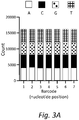
- FIG. 3A shows that the each nucleotide was detected at approximately the same rate at each random position of the cypher (here the 5' cyphers were sequenced).
- SKOV-3 human ovarian carcinoma cell line
- McCoy's 5a Medium supplemented with 10% Fetal Bovine Serum, 1.5 mM/L-glutamine, 2200 mg/L sodium bicarbonate, and Penicillin/Streptomycin.
- SKOV-3 cells were harvested and DNA was extracted using a DNeasy Blood and Tissue Kit (Qiagen).
- PCR primers were designed to amplify exon 4 of human TP53; forward primer sequence: TCTGTCTCCTTCCTCTTCCTACA (SEQ ID NO.:5) and reverse primer sequence: AACCAGCCCTGTCGTCTCT (SEQ ID NO.:6).
- PCR Thirty cycles of PCR were performed on SKOV-3 DNA using 0.5 ⁇ M primers and GoTaq Hot Start Colorless Master Mix (Promega) under the following cycling conditions: 95°C for 2 minutes; 30 cycles of 95°C for 30 seconds, 63°C for 30 seconds, 72°C for 1 minute; followed by 72°C for 5 minutes.
- Each PCR product was then cloned into TOPO vectors (Invitrogen), transformed into One Shot TOP10 Chemically Competent E . coli cells (Invitrogen), plated on LB agar media containing 100 ⁇ g/mL carbenicillin and incubated overnight at 37°C.
- the TP53 exon 4 DNA band was then manually excised and purified using the Zymo-Clean gel DNA recovery kit followed by phenol/chloroform/isoamyl alcohol extraction and ethanol precipitation.
- the digested DNA was then blunted and phosphorylated using the Quick Blunting Kit (New England BioLabs) and purified with a phenol / chloroform / isoamyl alcohol extraction and ethanol precipitation.
- the Cypher Seq vector library was digested with Sma I , treated with Antartic Phosphatase (New England BioLabs), and run on a 1.5% UltraPure Low-Melting Point Agarose gel. The appropriate band was excised and purified using the Zymo-Clean gel DNA recovery kit, followed by phenol/chloroform/isoamyl alcohol extraction and ethanol precipitation. Blunt-end ligations of the vector and TP53 exon 4 DNA were then carried out in 20 ⁇ l reactions using T4 DNA Ligase HC (Invitrogen) and a 1:10 vector to insert molar ratio.
- T4 DNA Ligase HC Invitrogen
- the ligations were incubated at 16°C overnight, ethanol precipitated, and transformed into ElectroMAX DH10b T1-phage resistant cells. Bacteria were grown overnight at 37°C in LB containing 100 ⁇ g/mL carbenicillin and DNA was purified using the QIAquick Spin Miniprep Kit. The presence of the appropriate insert was verified by diagnostic restriction digest and gel electrophoresis.
- the sequencing construct containing the Illumina adapters, barcodes, and TP53 DNA was then amplified using 10 cycles of PCR and primers designed against the adapter ends (forward primer: AATGATACGGCGACCACCGA, SEQ ID NO.:7; and reverse primer: CAAGCAGAAGACGGCATACGA, SEQ ID NO.:8).
- PCR cycling conditions were as follows: 95°C for 2 minutes; 10 cycles of 95°C for 30 seconds, 63°C for 30 seconds, 72°C for 1 minute; followed by 72°C for 5 minutes.
- the sequencing construct was gel purified (Zymo-Clean gel DNA recovery kit), phenol/chloroform/isoamyl alcohol extracted and ethanol precipitated.
- the library was quantified using the Quant-iT PicoGreen assay (Invitrogen) before loading onto the Illumina MiSeq® flow cell. Finally, the library was sequenced. Sequencing was performed as instructed by the manufacturer's protocol with MiSeq® at Q30 quality level (Illumina).
- TP53 Exon 4 DNA from a dual cypher vector library produced in E. coli was sequenced with a depth of over a million, and all sequencing reads with identical cypher pairs and their reverse complements were grouped into families to create a consensus sequence.
- Figure 3B errors introduced during library preparation (open circle) and during sequencing (gray circle and triangle) were computationally eliminated from the consensus sequence and only mutations present in all reads (black diamonds, Figure 3B ) of a cypher family were counted as true mutations ( see bottom of Figure 3B ).
- Wild-type TP53 Exon 4 sequence was compared to the actual sequence results and substitutions were plotted before ( Figure 4A ) and after correction with Cypher Seq ( Figure 4B ).
- the detected error frequency was 3.9 x 10 -4 /bp ( Figure 4A ).
- the initial error frequency reflects assay-related errors (e.g., PCR, sequencing, and other errors introduced after bar-coding). This means that detecting a rare mutation is difficult due to the noise-to-signal ratio being very high.
- the error frequency dropped to 8.8 x 10 -7 /bp ( Figure 4B ).
- the remaining substitutions are most likely biological in nature and most likely reflect errors introduced during replication in E. coli prior to ligation into the barcoded vectors.
- true mutations i.e., those that arise naturally in a cell during replication
- true mutations are readily detectable using the cypher system of the instant disclosure.
- the application discloses, inter alia, the following items:
Landscapes
- Life Sciences & Earth Sciences (AREA)
- Health & Medical Sciences (AREA)
- Chemical & Material Sciences (AREA)
- Genetics & Genomics (AREA)
- Organic Chemistry (AREA)
- Engineering & Computer Science (AREA)
- Zoology (AREA)
- Wood Science & Technology (AREA)
- Bioinformatics & Cheminformatics (AREA)
- Biotechnology (AREA)
- General Engineering & Computer Science (AREA)
- Molecular Biology (AREA)
- Biochemistry (AREA)
- Biomedical Technology (AREA)
- General Health & Medical Sciences (AREA)
- Microbiology (AREA)
- Biophysics (AREA)
- Physics & Mathematics (AREA)
- Proteomics, Peptides & Aminoacids (AREA)
- Plant Pathology (AREA)
- Analytical Chemistry (AREA)
- Immunology (AREA)
- Crystallography & Structural Chemistry (AREA)
- Chemical Kinetics & Catalysis (AREA)
- General Chemical & Material Sciences (AREA)
- Medicinal Chemistry (AREA)
- Mycology (AREA)
- Bioinformatics & Computational Biology (AREA)
- Measuring Or Testing Involving Enzymes Or Micro-Organisms (AREA)
Applications Claiming Priority (4)
| Application Number | Priority Date | Filing Date | Title |
|---|---|---|---|
| US201261600535P | 2012-02-17 | 2012-02-17 | |
| EP18150361.6A EP3363901B1 (fr) | 2012-02-17 | 2013-02-15 | Compositions et procédés permettant d'identifier des mutations de manière précise |
| PCT/US2013/026505 WO2013123442A1 (fr) | 2012-02-17 | 2013-02-15 | Compositions et procédés permettant d'identifier de manière précise des mutations |
| EP13706397.0A EP2814959B1 (fr) | 2012-02-17 | 2013-02-15 | Compositions et procédés permettant d'identifier de manière précise des mutations |
Related Parent Applications (2)
| Application Number | Title | Priority Date | Filing Date |
|---|---|---|---|
| EP18150361.6A Division EP3363901B1 (fr) | 2012-02-17 | 2013-02-15 | Compositions et procédés permettant d'identifier des mutations de manière précise |
| EP13706397.0A Division EP2814959B1 (fr) | 2012-02-17 | 2013-02-15 | Compositions et procédés permettant d'identifier de manière précise des mutations |
Publications (1)
| Publication Number | Publication Date |
|---|---|
| EP3854873A1 true EP3854873A1 (fr) | 2021-07-28 |
Family
ID=47750867
Family Applications (3)
| Application Number | Title | Priority Date | Filing Date |
|---|---|---|---|
| EP13706397.0A Revoked EP2814959B1 (fr) | 2012-02-17 | 2013-02-15 | Compositions et procédés permettant d'identifier de manière précise des mutations |
| EP18150361.6A Active EP3363901B1 (fr) | 2012-02-17 | 2013-02-15 | Compositions et procédés permettant d'identifier des mutations de manière précise |
| EP20215829.1A Pending EP3854873A1 (fr) | 2012-02-17 | 2013-02-15 | Compositions et procédés permettant d'identifier des mutations de manière précise |
Family Applications Before (2)
| Application Number | Title | Priority Date | Filing Date |
|---|---|---|---|
| EP13706397.0A Revoked EP2814959B1 (fr) | 2012-02-17 | 2013-02-15 | Compositions et procédés permettant d'identifier de manière précise des mutations |
| EP18150361.6A Active EP3363901B1 (fr) | 2012-02-17 | 2013-02-15 | Compositions et procédés permettant d'identifier des mutations de manière précise |
Country Status (15)
| Country | Link |
|---|---|
| US (25) | US10011871B2 (fr) |
| EP (3) | EP2814959B1 (fr) |
| CY (1) | CY1123973T1 (fr) |
| DK (2) | DK3363901T3 (fr) |
| ES (2) | ES2855130T3 (fr) |
| HR (1) | HRP20210504T1 (fr) |
| HU (1) | HUE053360T2 (fr) |
| LT (1) | LT3363901T (fr) |
| NO (1) | NO2864470T3 (fr) |
| PL (2) | PL3363901T3 (fr) |
| PT (2) | PT3363901T (fr) |
| RS (1) | RS61631B1 (fr) |
| SI (1) | SI3363901T1 (fr) |
| SM (1) | SMT202100154T1 (fr) |
| WO (1) | WO2013123442A1 (fr) |
Families Citing this family (151)
| Publication number | Priority date | Publication date | Assignee | Title |
|---|---|---|---|---|
| ES2726702T3 (es) | 2009-01-15 | 2019-10-08 | Adaptive Biotechnologies Corp | Perfilado de la inmunidad adaptativa y métodos para la generación de anticuerpos monoclonales |
| US9085798B2 (en) | 2009-04-30 | 2015-07-21 | Prognosys Biosciences, Inc. | Nucleic acid constructs and methods of use |
| US20190300945A1 (en) | 2010-04-05 | 2019-10-03 | Prognosys Biosciences, Inc. | Spatially Encoded Biological Assays |
| WO2011127099A1 (fr) | 2010-04-05 | 2011-10-13 | Prognosys Biosciences, Inc. | Tests biologiques à codage spatial |
| US10787701B2 (en) | 2010-04-05 | 2020-09-29 | Prognosys Biosciences, Inc. | Spatially encoded biological assays |
| WO2012129363A2 (fr) | 2011-03-24 | 2012-09-27 | President And Fellows Of Harvard College | Détection et analyse d'acide nucléique d'une cellule isolée |
| GB201106254D0 (en) | 2011-04-13 | 2011-05-25 | Frisen Jonas | Method and product |
| WO2013123442A1 (fr) * | 2012-02-17 | 2013-08-22 | Fred Hutchinson Cancer Research Center | Compositions et procédés permettant d'identifier de manière précise des mutations |
| EP3372694A1 (fr) | 2012-03-05 | 2018-09-12 | Adaptive Biotechnologies Corporation | Détermination de chaînes de récepteur immunitaire appariées de sous-unités à adaptation de fréquence |
| PT2828218T (pt) | 2012-03-20 | 2020-11-11 | Univ Washington Through Its Center For Commercialization | Métodos para baixar a taxa de erro da sequenciação paralela massiva de adn utilizando sequenciação duplex de consensus |
| HUE029357T2 (en) | 2012-05-08 | 2017-02-28 | Adaptive Biotechnologies Corp | Preparations and devices for measuring and calibrating amplification distortion in multiplex PCR reactions |
| AU2013267609C1 (en) | 2012-05-31 | 2019-01-03 | Board Of Regents, The University Of Texas System | Method for accurate sequencing of DNA |
| AU2013302756C1 (en) | 2012-08-14 | 2018-05-17 | 10X Genomics, Inc. | Microcapsule compositions and methods |
| US10584381B2 (en) | 2012-08-14 | 2020-03-10 | 10X Genomics, Inc. | Methods and systems for processing polynucleotides |
| US10323279B2 (en) | 2012-08-14 | 2019-06-18 | 10X Genomics, Inc. | Methods and systems for processing polynucleotides |
| US11591637B2 (en) | 2012-08-14 | 2023-02-28 | 10X Genomics, Inc. | Compositions and methods for sample processing |
| US9701998B2 (en) | 2012-12-14 | 2017-07-11 | 10X Genomics, Inc. | Methods and systems for processing polynucleotides |
| US20160040229A1 (en) | 2013-08-16 | 2016-02-11 | Guardant Health, Inc. | Systems and methods to detect rare mutations and copy number variation |
| US10876152B2 (en) | 2012-09-04 | 2020-12-29 | Guardant Health, Inc. | Systems and methods to detect rare mutations and copy number variation |
| CN104781421B (zh) | 2012-09-04 | 2020-06-05 | 夸登特健康公司 | 检测稀有突变和拷贝数变异的系统和方法 |
| US11913065B2 (en) | 2012-09-04 | 2024-02-27 | Guardent Health, Inc. | Systems and methods to detect rare mutations and copy number variation |
| EP4592400A3 (fr) | 2012-10-17 | 2025-10-29 | 10x Genomics Sweden AB | Procédés et produits pour optimiser la detection localisée ou spatiale de l'expression génique dans un échantillon de tissu |
| WO2015160439A2 (fr) | 2014-04-17 | 2015-10-22 | Adaptive Biotechnologies Corporation | Quantification de génomes de cellules de l'immunité acquise dans un mélange complexe de cellules |
| JP6338221B2 (ja) | 2012-10-24 | 2018-06-06 | タカラ バイオ ユーエスエー, インコーポレイテッド | 核酸生成物を生成するための、テンプレートスイッチに基づく方法 |
| US10533221B2 (en) * | 2012-12-14 | 2020-01-14 | 10X Genomics, Inc. | Methods and systems for processing polynucleotides |
| KR20200140929A (ko) | 2013-02-08 | 2020-12-16 | 10엑스 제노믹스, 인크. | 폴리뉴클레오티드 바코드 생성 |
| CN114574581A (zh) | 2013-03-15 | 2022-06-03 | 夸登特健康公司 | 检测稀有突变和拷贝数变异的系统和方法 |
| CA2916662C (fr) | 2013-06-25 | 2022-03-08 | Prognosys Biosciences, Inc. | Procedes et systemes pour determiner des motifs spatiales de cibles biologiques dans un echantillon |
| US9708657B2 (en) * | 2013-07-01 | 2017-07-18 | Adaptive Biotechnologies Corp. | Method for generating clonotype profiles using sequence tags |
| JP6602294B2 (ja) | 2013-10-17 | 2019-11-06 | タカラ バイオ ユーエスエー, インコーポレイテッド | アダプタを核酸に追加する方法、及びこの方法を実行するための組成物 |
| WO2015073711A1 (fr) * | 2013-11-13 | 2015-05-21 | Nugen Technologies, Inc. | Compositions et procédés pour l'identification d'une lecture de séquençage en double |
| ES2693217T3 (es) * | 2013-12-02 | 2018-12-10 | Personal Genome Diagnostics Inc. | Método para evaluar variantes minoritarias en una muestra |
| WO2015094861A1 (fr) | 2013-12-17 | 2015-06-25 | Clontech Laboratories, Inc. | Procédés d'ajout d'adaptateurs à des acides nucléiques et compositions pour leur mise en œuvre |
| ES2660989T3 (es) | 2013-12-28 | 2018-03-27 | Guardant Health, Inc. | Métodos y sistemas para detectar variantes genéticas |
| EP3099820A4 (fr) | 2014-01-27 | 2018-01-03 | The General Hospital Corporation | Procédés de préparation d'acides nucléiques pour le séquençage |
| US10066265B2 (en) | 2014-04-01 | 2018-09-04 | Adaptive Biotechnologies Corp. | Determining antigen-specific t-cells |
| EA035092B1 (ru) * | 2014-05-14 | 2020-04-27 | Барбара Бурвинкель | Синтез двухцепочечных нуклеиновых кислот |
| WO2015200893A2 (fr) | 2014-06-26 | 2015-12-30 | 10X Genomics, Inc. | Procédés d'analyse d'acides nucléiques provenant de cellules individuelles ou de populations de cellules |
| US12312640B2 (en) | 2014-06-26 | 2025-05-27 | 10X Genomics, Inc. | Analysis of nucleic acid sequences |
| GB201411603D0 (en) * | 2014-06-30 | 2014-08-13 | Vela Operations Pte Ltd | Compositions for quantitative and/or semiquantitative mutation detection methods |
| EP3169799B1 (fr) | 2014-07-15 | 2019-09-04 | Qiagen Sciences, LLC | Codes à barres semi-aléatoires pour l'analyse d'acides nucléiques |
| CA2966201A1 (fr) | 2014-10-29 | 2016-05-06 | Adaptive Biotechnologies Corp. | Detection simultanee hautement multiplexee d'acides nucleiques codant pour des heterodimeres de recepteurs de l'immunite adaptative apparies a partir de nombreux echantillons |
| US10000799B2 (en) | 2014-11-04 | 2018-06-19 | Boreal Genomics, Inc. | Methods of sequencing with linked fragments |
| US10246701B2 (en) | 2014-11-14 | 2019-04-02 | Adaptive Biotechnologies Corp. | Multiplexed digital quantitation of rearranged lymphoid receptors in a complex mixture |
| CA2976580A1 (fr) | 2015-02-24 | 2016-09-01 | Adaptive Biotechnologies Corp. | Methodes pour le diagnostic d'une maladie infectieuse et la determination du statut hla a l'aide du sequencage du repertoire immunitaire |
| US20180119214A1 (en) * | 2015-03-31 | 2018-05-03 | Fred Hutchinson Cancer Research Center | Compositions and methods for target nucleic acid molecule enrichment |
| EP3277294B1 (fr) | 2015-04-01 | 2024-05-15 | Adaptive Biotechnologies Corp. | Procédé d'identification des récepteurs de lymphocytes t spécifiques à compatibilité humaine pour une cible antigénique |
| EP3901282B1 (fr) | 2015-04-10 | 2023-06-28 | Spatial Transcriptomics AB | Analyse de plusieurs acides nucléiques spatialement différenciés de spécimens biologiques |
| GB201515557D0 (en) * | 2015-09-02 | 2015-10-14 | 14M Genomics Ltd | Method of sequencing |
| WO2017062970A1 (fr) | 2015-10-10 | 2017-04-13 | Guardant Health, Inc. | Procédés et applications de la détection de la fusion de gènes dans l'analyse d'adn exempt de cellules |
| CA3006792A1 (fr) | 2015-12-08 | 2017-06-15 | Twinstrand Biosciences, Inc. | Adaptateurs ameliores, procedes, et compositions pour le sequencage en double helice |
| SG11201805119QA (en) | 2015-12-17 | 2018-07-30 | Guardant Health Inc | Methods to determine tumor gene copy number by analysis of cell-free dna |
| EP3978627A1 (fr) * | 2016-03-25 | 2022-04-06 | Karius, Inc. | Procédé utilisant des spike-ins d'acides nucléiques synthétiques |
| US10961573B2 (en) | 2016-03-28 | 2021-03-30 | Boreal Genomics, Inc. | Linked duplex target capture |
| WO2017168332A1 (fr) | 2016-03-28 | 2017-10-05 | Boreal Genomics, Inc. | Capture de cible duplex liée |
| WO2017176630A1 (fr) | 2016-04-07 | 2017-10-12 | The Board Of Trustees Of The Leland Stanford Junior University | Diagnostics non invasifs par séquençage d'adn acellulaire 5-hydroxyméthylé |
| US11384382B2 (en) | 2016-04-14 | 2022-07-12 | Guardant Health, Inc. | Methods of attaching adapters to sample nucleic acids |
| ES3002715T3 (en) | 2016-04-14 | 2025-03-07 | Guardant Health Inc | Methods for early detection of cancer |
| EP3452591B1 (fr) | 2016-05-02 | 2023-08-16 | Encodia, Inc. | Analyse de macromolécules au moyen du codage par acides nucléiques |
| GB201609221D0 (en) | 2016-05-25 | 2016-07-06 | Oxford Nanopore Tech Ltd | Method |
| WO2017217694A2 (fr) * | 2016-06-16 | 2017-12-21 | 한국한의학연구원 | Procédé de mesure du taux de mutation |
| KR101915701B1 (ko) | 2016-06-16 | 2018-11-07 | 한국한의학연구원 | 돌연변이 발생률의 측정 방법 |
| US11821028B2 (en) | 2016-07-12 | 2023-11-21 | QIAGEN Sciences, LLP | Single end duplex DNA sequencing |
| US10428325B1 (en) | 2016-09-21 | 2019-10-01 | Adaptive Biotechnologies Corporation | Identification of antigen-specific B cell receptors |
| EP3461274B1 (fr) | 2016-09-30 | 2020-11-04 | Guardant Health, Inc. | Procédés d'analyse multirésolution d'acides nucléiques acellulaires |
| US20190256928A1 (en) * | 2016-10-20 | 2019-08-22 | Fred Hutchinson Cancer Research Center | Systems and methods for detecting disseminated or circulating cells or dna |
| CN110114473A (zh) * | 2016-11-23 | 2019-08-09 | 斯特拉斯堡大学 | 靶分子的串联条形码添加以便以单实体分辨率对靶分子进行绝对定量 |
| GB201620450D0 (en) | 2016-12-01 | 2017-01-18 | Oxford Nanopore Tech Ltd | Method |
| US11268137B2 (en) | 2016-12-09 | 2022-03-08 | Boreal Genomics, Inc. | Linked ligation |
| WO2018183942A1 (fr) | 2017-03-31 | 2018-10-04 | Grail, Inc. | Préparation de banques améliorées et leur utilisation pour la correction d'erreurs basées sur le séquençage et/ou l'identification de variants |
| GB201707140D0 (en) | 2017-05-04 | 2017-06-21 | Oxford Nanopore Tech Ltd | Method |
| JP7390027B2 (ja) | 2017-10-31 | 2023-12-01 | エンコディア, インコーポレイテッド | 核酸エンコーディングおよび/または標識を使用する解析のためのキット |
| AU2018366213B2 (en) | 2017-11-08 | 2025-05-15 | Twinstrand Biosciences, Inc. | Reagents and adapters for nucleic acid sequencing and methods for making such reagents and adapters |
| US11254980B1 (en) | 2017-11-29 | 2022-02-22 | Adaptive Biotechnologies Corporation | Methods of profiling targeted polynucleotides while mitigating sequencing depth requirements |
| WO2019126803A1 (fr) | 2017-12-22 | 2019-06-27 | Grail, Inc. | Suppression des erreurs par des méthodes améliorées de préparation de bibliothèques |
| GB201809323D0 (en) | 2018-06-06 | 2018-07-25 | Oxford Nanopore Tech Ltd | Method |
| MX2020013994A (es) | 2018-06-22 | 2021-05-27 | Bluestar Genomics Inc | Análisis de hidroximetilación de muestras de ácido nucleico sin células para asignación de tejido de origen, y métodos relacionados de uso. |
| BR112021000409A2 (pt) | 2018-07-12 | 2021-04-06 | Twinstrand Biosciences, Inc. | Métodos e reagentes para caracterizar edição genômica, expansão clonal e aplicações associadas |
| US12098419B2 (en) | 2018-08-23 | 2024-09-24 | Ncan Genomics, Inc. | Linked target capture and ligation |
| US11519033B2 (en) | 2018-08-28 | 2022-12-06 | 10X Genomics, Inc. | Method for transposase-mediated spatial tagging and analyzing genomic DNA in a biological sample |
| JP7535998B2 (ja) | 2018-08-31 | 2024-08-19 | ガーダント ヘルス, インコーポレイテッド | マージされたリードおよびマージされないリードに基づいた遺伝的変異体の検出 |
| EP3853383A1 (fr) | 2018-09-19 | 2021-07-28 | Bluestar Genomics, Inc. | Profils d'hydroxyméthylation d'adn acellulaires dans l'évaluation de lésions pancréatiques |
| US10696994B2 (en) | 2018-09-28 | 2020-06-30 | Bioo Scientific Corporation | Size selection of RNA using poly(A) polymerase |
| US11104941B2 (en) | 2018-09-28 | 2021-08-31 | Bioo Scientific Corporation | 5′ adapter comprising an internal 5′-5′ linkage |
| EP4700161A3 (fr) | 2018-11-21 | 2026-03-11 | Karius, Inc. | Procédés, systèmes et compositions de bibliothèque directe |
| WO2020123316A2 (fr) | 2018-12-10 | 2020-06-18 | 10X Genomics, Inc. | Procédés de détermination d'un emplacement d'un analyte biologique dans un échantillon biologique |
| EP4538389A3 (fr) | 2019-01-03 | 2025-07-30 | Ncan Genomics, Inc. | Capture de cible liée |
| US11649485B2 (en) | 2019-01-06 | 2023-05-16 | 10X Genomics, Inc. | Generating capture probes for spatial analysis |
| US11926867B2 (en) | 2019-01-06 | 2024-03-12 | 10X Genomics, Inc. | Generating capture probes for spatial analysis |
| WO2020185967A1 (fr) * | 2019-03-11 | 2020-09-17 | Red Genomics, Inc. | Procédés et réactifs pour une conversion améliorée de bibliothèque de séquençage de nouvelle génération et incorporation de codes-barres dans des acides nucléiques |
| CN114072499B (zh) | 2019-04-30 | 2024-08-06 | Encodia公司 | 用于制备分析物的方法和相关试剂盒 |
| WO2020243579A1 (fr) | 2019-05-30 | 2020-12-03 | 10X Genomics, Inc. | Procédés de détection de l'hétérogénéité spatiale d'un échantillon biologique |
| WO2021022237A1 (fr) * | 2019-08-01 | 2021-02-04 | Twinstrand Biosciences, Inc. | Procédés et réactifs pour le séquençage d'acides nucléiques et applications associées |
| GB2627085B (en) | 2019-11-06 | 2024-11-13 | Univ Leland Stanford Junior | Methods and systems for analysing nucleic acid molecules |
| WO2021091611A1 (fr) | 2019-11-08 | 2021-05-14 | 10X Genomics, Inc. | Agents de capture d'analytes marqués spatialement pour le multiplexage d'analytes |
| CN115135984B (zh) | 2019-12-23 | 2025-12-23 | 10X基因组学有限公司 | 可逆固定试剂及其使用方法 |
| EP4081656A1 (fr) | 2019-12-23 | 2022-11-02 | 10X Genomics, Inc. | Compositions et méthodes d'utilisation d'échantillons biologiques fixés dans des dosages basés sur des compartiments |
| ES2982420T3 (es) | 2019-12-23 | 2024-10-16 | 10X Genomics Inc | Métodos para el análisis espacial mediante el uso de la ligazón con plantilla de ARN |
| US12365942B2 (en) | 2020-01-13 | 2025-07-22 | 10X Genomics, Inc. | Methods of decreasing background on a spatial array |
| US12405264B2 (en) | 2020-01-17 | 2025-09-02 | 10X Genomics, Inc. | Electrophoretic system and method for analyte capture |
| US11702693B2 (en) | 2020-01-21 | 2023-07-18 | 10X Genomics, Inc. | Methods for printing cells and generating arrays of barcoded cells |
| US11732299B2 (en) | 2020-01-21 | 2023-08-22 | 10X Genomics, Inc. | Spatial assays with perturbed cells |
| US20210230681A1 (en) | 2020-01-24 | 2021-07-29 | 10X Genomics, Inc. | Methods for spatial analysis using proximity ligation |
| US11821035B1 (en) | 2020-01-29 | 2023-11-21 | 10X Genomics, Inc. | Compositions and methods of making gene expression libraries |
| US12076701B2 (en) | 2020-01-31 | 2024-09-03 | 10X Genomics, Inc. | Capturing oligonucleotides in spatial transcriptomics |
| US11898205B2 (en) | 2020-02-03 | 2024-02-13 | 10X Genomics, Inc. | Increasing capture efficiency of spatial assays |
| US12110541B2 (en) | 2020-02-03 | 2024-10-08 | 10X Genomics, Inc. | Methods for preparing high-resolution spatial arrays |
| US11732300B2 (en) | 2020-02-05 | 2023-08-22 | 10X Genomics, Inc. | Increasing efficiency of spatial analysis in a biological sample |
| WO2021158925A1 (fr) | 2020-02-07 | 2021-08-12 | 10X Genomics, Inc. | Évaluation quantitative et automatisée de la performance de perméabilisation pour la transcriptomique spatiale |
| US11835462B2 (en) | 2020-02-11 | 2023-12-05 | 10X Genomics, Inc. | Methods and compositions for partitioning a biological sample |
| US12281357B1 (en) | 2020-02-14 | 2025-04-22 | 10X Genomics, Inc. | In situ spatial barcoding |
| US12399123B1 (en) | 2020-02-14 | 2025-08-26 | 10X Genomics, Inc. | Spatial targeting of analytes |
| US11891654B2 (en) | 2020-02-24 | 2024-02-06 | 10X Genomics, Inc. | Methods of making gene expression libraries |
| US11926863B1 (en) | 2020-02-27 | 2024-03-12 | 10X Genomics, Inc. | Solid state single cell method for analyzing fixed biological cells |
| US11768175B1 (en) | 2020-03-04 | 2023-09-26 | 10X Genomics, Inc. | Electrophoretic methods for spatial analysis |
| EP4139485B1 (fr) | 2020-04-22 | 2023-09-06 | 10X Genomics, Inc. | Procédés d'analyse spatiale utilisant un appauvrissement d'arn ciblée |
| US12416603B2 (en) | 2020-05-19 | 2025-09-16 | 10X Genomics, Inc. | Electrophoresis cassettes and instrumentation |
| EP4414459B1 (fr) | 2020-05-22 | 2025-09-03 | 10X Genomics, Inc. | Mesure spatio-temporelle simultanée de l'expression génique et de l'activité cellulaire |
| EP4153776B1 (fr) | 2020-05-22 | 2025-03-05 | 10X Genomics, Inc. | Analyse spatiale pour détecter des variants de séquence |
| WO2021242834A1 (fr) | 2020-05-26 | 2021-12-02 | 10X Genomics, Inc. | Procédé de réinitialisation d'un réseau |
| US12265079B1 (en) | 2020-06-02 | 2025-04-01 | 10X Genomics, Inc. | Systems and methods for detecting analytes from captured single biological particles |
| EP4600376A3 (fr) | 2020-06-02 | 2025-10-22 | 10X Genomics, Inc. | Transcriptome spatial pour récepteurs d'antigènes |
| AU2021283174A1 (en) | 2020-06-02 | 2023-01-05 | 10X Genomics, Inc. | Nucleic acid library methods |
| US12031177B1 (en) | 2020-06-04 | 2024-07-09 | 10X Genomics, Inc. | Methods of enhancing spatial resolution of transcripts |
| EP4421186B1 (fr) | 2020-06-08 | 2025-08-13 | 10X Genomics, Inc. | Procédés de détermination d'une marge chirurgicale et procédés d'utilisation de ceux-ci |
| EP4165207B1 (fr) | 2020-06-10 | 2024-09-25 | 10X Genomics, Inc. | Methode pour determiner la position d'un analyte dans un echantillon biologique |
| US12435363B1 (en) | 2020-06-10 | 2025-10-07 | 10X Genomics, Inc. | Materials and methods for spatial transcriptomics |
| WO2021252747A1 (fr) | 2020-06-10 | 2021-12-16 | 1Ox Genomics, Inc. | Procédés de distribution de fluide |
| ES2994976T3 (en) | 2020-06-25 | 2025-02-05 | 10X Genomics Inc | Spatial analysis of dna methylation |
| US11761038B1 (en) | 2020-07-06 | 2023-09-19 | 10X Genomics, Inc. | Methods for identifying a location of an RNA in a biological sample |
| US12209280B1 (en) | 2020-07-06 | 2025-01-28 | 10X Genomics, Inc. | Methods of identifying abundance and location of an analyte in a biological sample using second strand synthesis |
| US11981960B1 (en) | 2020-07-06 | 2024-05-14 | 10X Genomics, Inc. | Spatial analysis utilizing degradable hydrogels |
| US12553898B1 (en) | 2020-08-10 | 2026-02-17 | 10X Genomics, Inc. | Fluorescent hybridization of antibody-oligonucleotide for multiplexing and signal amplification |
| US11981958B1 (en) | 2020-08-20 | 2024-05-14 | 10X Genomics, Inc. | Methods for spatial analysis using DNA capture |
| WO2022061150A2 (fr) | 2020-09-18 | 2022-03-24 | 10X Geonomics, Inc. | Appareil de manipulation d'échantillons et procédés d'enregistrement d'images |
| US11926822B1 (en) | 2020-09-23 | 2024-03-12 | 10X Genomics, Inc. | Three-dimensional spatial analysis |
| US11827935B1 (en) | 2020-11-19 | 2023-11-28 | 10X Genomics, Inc. | Methods for spatial analysis using rolling circle amplification and detection probes |
| EP4729631A2 (fr) | 2020-12-21 | 2026-04-22 | 10X Genomics, Inc. | Procédés, compositions et systèmes de capture de sondes et/ou de codes à barres |
| EP4421491A3 (fr) | 2021-02-19 | 2024-11-27 | 10X Genomics, Inc. | Procédé d'utilisation d'un dispositif de support d'analyse modulaire |
| AU2022238446A1 (en) | 2021-03-18 | 2023-09-07 | 10X Genomics, Inc. | Multiplex capture of gene and protein expression from a biological sample |
| EP4305196B1 (fr) | 2021-04-14 | 2025-04-02 | 10X Genomics, Inc. | Procédés de mesure d'une mauvaise localisation d'un analyte |
| US11783912B2 (en) | 2021-05-05 | 2023-10-10 | The Board Of Trustees Of The Leland Stanford Junior University | Methods and systems for analyzing nucleic acid molecules |
| EP4320271B1 (fr) | 2021-05-06 | 2025-03-19 | 10X Genomics, Inc. | Procédés pour augmenter la résolution d'une analyse spatiale |
| WO2022256503A1 (fr) | 2021-06-03 | 2022-12-08 | 10X Genomics, Inc. | Procédés, compositions, kits et systèmes pour améliorer la capture d'analytes pour une analyse spatiale |
| US12553805B2 (en) | 2021-08-02 | 2026-02-17 | 10X Genomics, Inc. | Methods of preserving a biological sample |
| WO2023034489A1 (fr) | 2021-09-01 | 2023-03-09 | 10X Genomics, Inc. | Procédés, compositions et kits pour bloquer une sonde de capture sur un réseau spatial |
| WO2023086880A1 (fr) | 2021-11-10 | 2023-05-19 | 10X Genomics, Inc. | Procédés, compositions et kits pour déterminer l'emplacement d'un analyte dans un échantillon biologique |
| EP4430615A4 (fr) * | 2021-11-10 | 2026-01-21 | Albert Einstein College Medicine | Procédé de mesure de mutation somatique d'adn et profils d'endommagement d'adn et kit de diagnostic approprié |
| WO2023102118A2 (fr) | 2021-12-01 | 2023-06-08 | 10X Genomics, Inc. | Procédés, compositions et systèmes pour la détection améliorée d'analytes in situ et analyse spatiale |
| WO2023122033A1 (fr) | 2021-12-20 | 2023-06-29 | 10X Genomics, Inc. | Auto-test pour dispositif d'imagerie |
| EP4482979B1 (fr) | 2022-11-09 | 2025-10-01 | 10X Genomics, Inc. | Procédés, compositions et kits pour déterminer l'emplacement de plusieurs analytes dans un échantillon biologique |
Citations (12)
| Publication number | Priority date | Publication date | Assignee | Title |
|---|---|---|---|---|
| WO1993006239A1 (fr) * | 1991-09-24 | 1993-04-01 | Keygene N.V. | Amplification selective de fragments de restriction: procede general de dactyloscopie genetique |
| WO1998044151A1 (fr) | 1997-04-01 | 1998-10-08 | Glaxo Group Limited | Methode d'amplification d'acide nucleique |
| WO2000018957A1 (fr) | 1998-09-30 | 2000-04-06 | Applied Research Systems Ars Holding N.V. | Procedes d'amplification et de sequençage d'acide nucleique |
| US6143496A (en) | 1997-04-17 | 2000-11-07 | Cytonix Corporation | Method of sampling, amplifying and quantifying segment of nucleic acid, polymerase chain reaction assembly having nanoliter-sized sample chambers, and method of filling assembly |
| WO2004081183A2 (fr) * | 2003-03-07 | 2004-09-23 | Rubicon Genomics, Inc. | Immortalisation d'adn in vitro et amplification genomique complete a l'aide de bibliotheques generees a partir d'adn fragmente de manière aleatoire |
| US6833246B2 (en) | 1999-09-29 | 2004-12-21 | Solexa, Ltd. | Polynucleotide sequencing |
| WO2006008413A1 (fr) | 2004-07-09 | 2006-01-26 | Peugeot Citroën Automobiles SA | Dispositif d'affichage pour vehicule automobile |
| US20090099041A1 (en) | 2006-02-07 | 2009-04-16 | President And Fellows Of Harvard College | Methods for making nucleotide probes for sequencing and synthesis |
| US20100069263A1 (en) * | 2008-09-12 | 2010-03-18 | Washington, University Of | Sequence tag directed subassembly of short sequencing reads into long sequencing reads |
| US7754429B2 (en) | 2006-10-06 | 2010-07-13 | Illumina Cambridge Limited | Method for pair-wise sequencing a plurity of target polynucleotides |
| US20100227329A1 (en) | 2007-09-21 | 2010-09-09 | Katholieke Universiteit Leuven K.U.Leuven R&D | Tools and methods for genetic tests using next generation sequencing |
| WO2012142213A2 (fr) * | 2011-04-15 | 2012-10-18 | The Johns Hopkins University | Système de séquençage sûr |
Family Cites Families (76)
| Publication number | Priority date | Publication date | Assignee | Title |
|---|---|---|---|---|
| US4683195A (en) | 1986-01-30 | 1987-07-28 | Cetus Corporation | Process for amplifying, detecting, and/or-cloning nucleic acid sequences |
| US5308751A (en) | 1992-03-23 | 1994-05-03 | General Atomics | Method for sequencing double-stranded DNA |
| US6013445A (en) | 1996-06-06 | 2000-01-11 | Lynx Therapeutics, Inc. | Massively parallel signature sequencing by ligation of encoded adaptors |
| US5695934A (en) | 1994-10-13 | 1997-12-09 | Lynx Therapeutics, Inc. | Massively parallel sequencing of sorted polynucleotides |
| WO2000000637A2 (fr) | 1998-06-26 | 2000-01-06 | Visible Genetics Inc. | Procede de sequençage d'acides nucleiques, avec un taux reduit d'erreurs |
| JP2002540802A (ja) | 1999-04-06 | 2002-12-03 | イェール ユニバーシティ | 配列標識の固定されたアドレス分析 |
| US6818395B1 (en) | 1999-06-28 | 2004-11-16 | California Institute Of Technology | Methods and apparatus for analyzing polynucleotide sequences |
| US7244559B2 (en) | 1999-09-16 | 2007-07-17 | 454 Life Sciences Corporation | Method of sequencing a nucleic acid |
| JP2004523243A (ja) | 2001-03-12 | 2004-08-05 | カリフォルニア インスティチュート オブ テクノロジー | 非同期性塩基伸長によってポリヌクレオチド配列を分析するための方法および装置 |
| CN1665938B (zh) | 2002-06-28 | 2012-10-10 | 普里梅拉蒂斯有限公司 | 检测序列差异的方法 |
| US20050019776A1 (en) | 2002-06-28 | 2005-01-27 | Callow Matthew James | Universal selective genome amplification and universal genotyping system |
| US7452699B2 (en) | 2003-01-15 | 2008-11-18 | Dana-Farber Cancer Institute, Inc. | Amplification of DNA in a hairpin structure, and applications |
| US20060084064A1 (en) | 2003-01-22 | 2006-04-20 | Aird William C | Endocan compositions and methods for the treatment of neoplasms |
| AU2004286201B2 (en) | 2003-09-10 | 2010-09-09 | Altheadx, Inc. | Expression profiling using microarrays |
| US7169560B2 (en) | 2003-11-12 | 2007-01-30 | Helicos Biosciences Corporation | Short cycle methods for sequencing polynucleotides |
| WO2005063980A1 (fr) | 2003-12-31 | 2005-07-14 | Toudai Tlo, Ltd. | Procede de construction enzymatique d'une bibliotheque d'arni |
| GB0400584D0 (en) | 2004-01-12 | 2004-02-11 | Solexa Ltd | Nucleic acid chacterisation |
| WO2005071110A2 (fr) | 2004-01-23 | 2005-08-04 | Lingvitae As | Amelioration des reactions de ligature de polynucleotides |
| CA2596117A1 (fr) | 2005-02-03 | 2006-08-10 | Perkinelmer Las, Inc. | Systemes de detection ultrasensible utilisant des signaux multidimensionnels |
| US7393665B2 (en) | 2005-02-10 | 2008-07-01 | Population Genetics Technologies Ltd | Methods and compositions for tagging and identifying polynucleotides |
| EP1712639B1 (fr) | 2005-04-06 | 2008-08-27 | Maurice Stroun | Méthode de diagnostic de cancer au moyen de la détection d'ADN et ARN |
| DK2302070T3 (da) | 2005-06-23 | 2012-11-26 | Keygene Nv | Strategier til identifikation og detektion af polymorfismer med højt gennemløb |
| US7666593B2 (en) | 2005-08-26 | 2010-02-23 | Helicos Biosciences Corporation | Single molecule sequencing of captured nucleic acids |
| WO2007037678A2 (fr) | 2005-09-29 | 2007-04-05 | Keygene N.V. | Criblage a haut debit de populations mutagenisees |
| CN103937899B (zh) | 2005-12-22 | 2017-09-08 | 凯津公司 | 用于基于aflp的高通量多态性检测的方法 |
| CN101365803B (zh) | 2005-12-22 | 2013-03-20 | 关键基因股份有限公司 | 采用高通量测序技术的改进的转录谱描述策略 |
| WO2007087312A2 (fr) | 2006-01-23 | 2007-08-02 | Population Genetics Technologies Ltd. | Décompte moléculaire |
| EP1991698B1 (fr) * | 2006-03-01 | 2013-12-18 | Keygene N.V. | Detection de snp a haut debit basee sur des sequences a l'aide de tests de ligature |
| CN101460633A (zh) | 2006-03-14 | 2009-06-17 | 基尼宗生物科学公司 | 用于核酸测序的方法和装置 |
| EP3239304B1 (fr) | 2006-04-04 | 2020-08-19 | Keygene N.V. | Détection à haut débit de marqueurs moléculaires sur la base d'aflp et de séquençage à haut débit |
| US7282337B1 (en) | 2006-04-14 | 2007-10-16 | Helicos Biosciences Corporation | Methods for increasing accuracy of nucleic acid sequencing |
| US8262900B2 (en) | 2006-12-14 | 2012-09-11 | Life Technologies Corporation | Methods and apparatus for measuring analytes using large scale FET arrays |
| GB2457851B (en) | 2006-12-14 | 2011-01-05 | Ion Torrent Systems Inc | Methods and apparatus for measuring analytes using large scale fet arrays |
| US8349167B2 (en) | 2006-12-14 | 2013-01-08 | Life Technologies Corporation | Methods and apparatus for detecting molecular interactions using FET arrays |
| WO2008093098A2 (fr) | 2007-02-02 | 2008-08-07 | Illumina Cambridge Limited | Procedes pour indexer des echantillons et sequencer de multiples matrices nucleotidiques |
| US20090156412A1 (en) | 2007-12-17 | 2009-06-18 | Helicos Biosciences Corporation | Surface-capture of target nucleic acids |
| DE102008025656B4 (de) | 2008-05-28 | 2016-07-28 | Genxpro Gmbh | Verfahren zur quantitativen Analyse von Nukleinsäuren, Marker dafür und deren Verwendung |
| US20100041048A1 (en) * | 2008-07-31 | 2010-02-18 | The Johns Hopkins University | Circulating Mutant DNA to Assess Tumor Dynamics |
| US20100035252A1 (en) | 2008-08-08 | 2010-02-11 | Ion Torrent Systems Incorporated | Methods for sequencing individual nucleic acids under tension |
| US8586310B2 (en) | 2008-09-05 | 2013-11-19 | Washington University | Method for multiplexed nucleic acid patch polymerase chain reaction |
| US20100137143A1 (en) | 2008-10-22 | 2010-06-03 | Ion Torrent Systems Incorporated | Methods and apparatus for measuring analytes |
| US20100301398A1 (en) | 2009-05-29 | 2010-12-02 | Ion Torrent Systems Incorporated | Methods and apparatus for measuring analytes |
| US8546128B2 (en) | 2008-10-22 | 2013-10-01 | Life Technologies Corporation | Fluidics system for sequential delivery of reagents |
| EP2391732B1 (fr) | 2009-01-30 | 2015-05-27 | Oxford Nanopore Technologies Limited | Methodes qui utilisent des adaptateurs pour la construction d'acides nucleiques pour le sequençage transmembranaire |
| SG174617A1 (en) | 2009-04-02 | 2011-10-28 | Fluidigm Corp | Multi-primer amplification method for barcoding of target nucleic acids |
| CN102625850B (zh) | 2009-04-03 | 2014-11-26 | 蒂莫西·Z·刘 | 多重核酸检测方法和系统 |
| US9085798B2 (en) | 2009-04-30 | 2015-07-21 | Prognosys Biosciences, Inc. | Nucleic acid constructs and methods of use |
| EP2425240A4 (fr) | 2009-04-30 | 2012-12-12 | Good Start Genetics Inc | Procédés et compositions d'évaluation de marqueurs génétiques |
| US8673627B2 (en) | 2009-05-29 | 2014-03-18 | Life Technologies Corporation | Apparatus and methods for performing electrochemical reactions |
| US8574835B2 (en) | 2009-05-29 | 2013-11-05 | Life Technologies Corporation | Scaffolded nucleic acid polymer particles and methods of making and using |
| US8835358B2 (en) | 2009-12-15 | 2014-09-16 | Cellular Research, Inc. | Digital counting of individual molecules by stochastic attachment of diverse labels |
| US9080210B2 (en) | 2010-06-09 | 2015-07-14 | Keygene N.V. | High throughput screening using combinatorial sequence barcodes |
| ES2523140T3 (es) | 2010-09-21 | 2014-11-21 | Population Genetics Technologies Ltd. | Aumento de la confianza en las identificaciones de alelos con el recuento molecular |
| CA3210003A1 (fr) | 2010-10-22 | 2012-04-26 | Cold Spring Harbor Laboratory | Comptage varietal d'acides nucleiques pour obtenir des informations sur le nombre de copies genomiques |
| CN103443338B (zh) * | 2011-02-02 | 2017-09-22 | 华盛顿大学商业化中心 | 大规模平行邻接作图 |
| WO2012129363A2 (fr) * | 2011-03-24 | 2012-09-27 | President And Fellows Of Harvard College | Détection et analyse d'acide nucléique d'une cellule isolée |
| US9809904B2 (en) | 2011-04-21 | 2017-11-07 | University Of Washington Through Its Center For Commercialization | Methods for retrieval of sequence-verified DNA constructs |
| SG10201605049QA (en) * | 2011-05-20 | 2016-07-28 | Fluidigm Corp | Nucleic acid encoding reactions |
| WO2013123442A1 (fr) | 2012-02-17 | 2013-08-22 | Fred Hutchinson Cancer Research Center | Compositions et procédés permettant d'identifier de manière précise des mutations |
| WO2013138510A1 (fr) | 2012-03-13 | 2013-09-19 | Patel Abhijit Ajit | Mesure des variants d'acide nucléique au moyen du séquençage hautement multiplexé, à très haut débit et à suppression d'erreur |
| PT2828218T (pt) * | 2012-03-20 | 2020-11-11 | Univ Washington Through Its Center For Commercialization | Métodos para baixar a taxa de erro da sequenciação paralela massiva de adn utilizando sequenciação duplex de consensus |
| AU2013267609C1 (en) | 2012-05-31 | 2019-01-03 | Board Of Regents, The University Of Texas System | Method for accurate sequencing of DNA |
| US20160040229A1 (en) | 2013-08-16 | 2016-02-11 | Guardant Health, Inc. | Systems and methods to detect rare mutations and copy number variation |
| CN104781421B (zh) | 2012-09-04 | 2020-06-05 | 夸登特健康公司 | 检测稀有突变和拷贝数变异的系统和方法 |
| WO2015094861A1 (fr) | 2013-12-17 | 2015-06-25 | Clontech Laboratories, Inc. | Procédés d'ajout d'adaptateurs à des acides nucléiques et compositions pour leur mise en œuvre |
| ES2660989T3 (es) | 2013-12-28 | 2018-03-27 | Guardant Health, Inc. | Métodos y sistemas para detectar variantes genéticas |
| KR102001554B1 (ko) | 2014-01-16 | 2019-07-18 | 일루미나, 인코포레이티드 | 고형 지지체 상에서의 앰플리콘 제조 방법 및 시퀀싱 |
| US10017759B2 (en) | 2014-06-26 | 2018-07-10 | Illumina, Inc. | Library preparation of tagged nucleic acid |
| US10385387B2 (en) | 2015-04-20 | 2019-08-20 | Pacific Biosciences Of California, Inc. | Methods for selectively amplifying and tagging nucleic acids |
| US10844428B2 (en) | 2015-04-28 | 2020-11-24 | Illumina, Inc. | Error suppression in sequenced DNA fragments using redundant reads with unique molecular indices (UMIS) |
| EP4086357A1 (fr) | 2015-08-28 | 2022-11-09 | Illumina, Inc. | Analyse de séquences d'acides nucléiques provenant de cellules isolées |
| EP3377656B1 (fr) | 2015-11-18 | 2025-07-02 | Pacific Biosciences of California, Inc. | Chargement d'acides nucléiques sur des substrats |
| CA3006792A1 (fr) | 2015-12-08 | 2017-06-15 | Twinstrand Biosciences, Inc. | Adaptateurs ameliores, procedes, et compositions pour le sequencage en double helice |
| US11624064B2 (en) | 2016-06-13 | 2023-04-11 | Grail, Llc | Enrichment of mutated cell free nucleic acids for cancer detection |
| US11566284B2 (en) | 2016-08-10 | 2023-01-31 | Grail, Llc | Methods of preparing dual-indexed DNA libraries for bisulfite conversion sequencing |
| US20210277457A1 (en) | 2016-08-12 | 2021-09-09 | Grail, Inc. | Method for accurate quantification of genomic copies in cell-free dna |
-
2013
- 2013-02-15 WO PCT/US2013/026505 patent/WO2013123442A1/fr not_active Ceased
- 2013-02-15 EP EP13706397.0A patent/EP2814959B1/fr not_active Revoked
- 2013-02-15 DK DK18150361.6T patent/DK3363901T3/da active
- 2013-02-15 RS RS20210380A patent/RS61631B1/sr unknown
- 2013-02-15 ES ES18150361T patent/ES2855130T3/es active Active
- 2013-02-15 DK DK13706397.0T patent/DK2814959T3/en active
- 2013-02-15 SM SM20210154T patent/SMT202100154T1/it unknown
- 2013-02-15 US US14/378,870 patent/US10011871B2/en active Active
- 2013-02-15 EP EP18150361.6A patent/EP3363901B1/fr active Active
- 2013-02-15 ES ES13706397.0T patent/ES2665071T3/es active Active
- 2013-02-15 PT PT181503616T patent/PT3363901T/pt unknown
- 2013-02-15 PL PL18150361T patent/PL3363901T3/pl unknown
- 2013-02-15 HU HUE18150361A patent/HUE053360T2/hu unknown
- 2013-02-15 SI SI201331854T patent/SI3363901T1/sl unknown
- 2013-02-15 LT LTEP18150361.6T patent/LT3363901T/lt unknown
- 2013-02-15 EP EP20215829.1A patent/EP3854873A1/fr active Pending
- 2013-02-15 PT PT137063970T patent/PT2814959T/pt unknown
- 2013-02-15 PL PL13706397T patent/PL2814959T3/pl unknown
- 2013-06-21 NO NO13806177A patent/NO2864470T3/no unknown
-
2016
- 2016-06-30 US US15/199,784 patent/US10450606B2/en active Active
-
2018
- 2018-09-04 US US16/121,559 patent/US20180363049A1/en not_active Abandoned
- 2018-09-04 US US16/121,555 patent/US20180363048A1/en not_active Abandoned
-
2019
- 2019-10-18 US US16/657,881 patent/US20200048706A1/en not_active Abandoned
- 2019-10-18 US US16/657,898 patent/US20200048707A1/en not_active Abandoned
-
2020
- 2020-06-10 US US16/898,152 patent/US20200299766A1/en not_active Abandoned
- 2020-06-10 US US16/898,155 patent/US20200299767A1/en not_active Abandoned
- 2020-08-18 US US16/996,682 patent/US20200385804A1/en not_active Abandoned
- 2020-11-06 US US17/091,676 patent/US11441180B2/en active Active
-
2021
- 2021-03-19 CY CY20211100236T patent/CY1123973T1/el unknown
- 2021-03-29 HR HRP20210504TT patent/HRP20210504T1/hr unknown
- 2021-03-31 US US17/219,543 patent/US20210222243A1/en active Pending
- 2021-04-20 US US17/235,750 patent/US20210238676A1/en not_active Abandoned
- 2021-04-20 US US17/235,788 patent/US20210238678A1/en not_active Abandoned
- 2021-04-20 US US17/235,837 patent/US20210246504A1/en not_active Abandoned
- 2021-06-23 US US17/356,293 patent/US20210317526A1/en active Pending
- 2021-06-23 US US17/356,288 patent/US20210317525A1/en not_active Abandoned
- 2021-07-13 US US17/374,917 patent/US20210340619A1/en not_active Abandoned
- 2021-08-25 US US17/412,105 patent/US20210388435A1/en active Pending
- 2021-09-01 US US17/464,341 patent/US20210395818A1/en active Pending
-
2022
- 2022-06-29 US US17/853,716 patent/US20220349004A1/en active Pending
- 2022-09-27 US US17/935,880 patent/US20230193381A1/en active Pending
-
2024
- 2024-01-17 US US18/415,344 patent/US20240200131A1/en active Pending
- 2024-03-27 US US18/619,081 patent/US20240409996A1/en active Pending
- 2024-03-28 US US18/620,758 patent/US20240417790A1/en active Pending
- 2024-04-04 US US18/627,305 patent/US20240401128A1/en active Pending
Patent Citations (12)
| Publication number | Priority date | Publication date | Assignee | Title |
|---|---|---|---|---|
| WO1993006239A1 (fr) * | 1991-09-24 | 1993-04-01 | Keygene N.V. | Amplification selective de fragments de restriction: procede general de dactyloscopie genetique |
| WO1998044151A1 (fr) | 1997-04-01 | 1998-10-08 | Glaxo Group Limited | Methode d'amplification d'acide nucleique |
| US6143496A (en) | 1997-04-17 | 2000-11-07 | Cytonix Corporation | Method of sampling, amplifying and quantifying segment of nucleic acid, polymerase chain reaction assembly having nanoliter-sized sample chambers, and method of filling assembly |
| WO2000018957A1 (fr) | 1998-09-30 | 2000-04-06 | Applied Research Systems Ars Holding N.V. | Procedes d'amplification et de sequençage d'acide nucleique |
| US6833246B2 (en) | 1999-09-29 | 2004-12-21 | Solexa, Ltd. | Polynucleotide sequencing |
| WO2004081183A2 (fr) * | 2003-03-07 | 2004-09-23 | Rubicon Genomics, Inc. | Immortalisation d'adn in vitro et amplification genomique complete a l'aide de bibliotheques generees a partir d'adn fragmente de manière aleatoire |
| WO2006008413A1 (fr) | 2004-07-09 | 2006-01-26 | Peugeot Citroën Automobiles SA | Dispositif d'affichage pour vehicule automobile |
| US20090099041A1 (en) | 2006-02-07 | 2009-04-16 | President And Fellows Of Harvard College | Methods for making nucleotide probes for sequencing and synthesis |
| US7754429B2 (en) | 2006-10-06 | 2010-07-13 | Illumina Cambridge Limited | Method for pair-wise sequencing a plurity of target polynucleotides |
| US20100227329A1 (en) | 2007-09-21 | 2010-09-09 | Katholieke Universiteit Leuven K.U.Leuven R&D | Tools and methods for genetic tests using next generation sequencing |
| US20100069263A1 (en) * | 2008-09-12 | 2010-03-18 | Washington, University Of | Sequence tag directed subassembly of short sequencing reads into long sequencing reads |
| WO2012142213A2 (fr) * | 2011-04-15 | 2012-10-18 | The Johns Hopkins University | Système de séquençage sûr |
Non-Patent Citations (20)
| Title |
|---|
| "Cancer Genome Atlas Research Network", NATURE, vol. 474, 2011, pages 609 |
| "Current Protocols in Molecular Biology", 1995, GREENE PUBLISHING AND WILEY-INTERSCIENCE |
| "Methods in Enzymology", vol. 152, 1987, ACADEMIC PRESS, INC., article "Guide to Molecular Cloning Techniques" |
| BIELAS ET AL., PROC. NAT I ACAD. SCI. U.S.A., vol. 103, 2008, pages 18238 - 42 |
| BIELASLOEB, NAT. METHODS, vol. 2, 2005, pages 285 - 90 |
| BOWTELL, NAT. REV. CANCER, vol. 10, 2010, pages 803 |
| CHATTERJEE ET AL., ONCOGENE, vol. 25, 2006, pages 4647 |
| CLIFF MELDRUM ET AL: "Next-Generation Sequencing for Cancer Diagnostics: a Practical Perspective", CLIN BIOCHEM REV VOL, vol. 32, 1 November 2011 (2011-11-01), pages 177 - 195, XP055533960 * |
| COPELAND ET AL., CANCER INVEST, vol. 20, 2002, pages 557 |
| I. KINDE ET AL: "Detection and quantification of rare mutations with massively parallel sequencing", PROCEEDINGS OF THE NATIONAL ACADEMY OF SCIENCES, vol. 108, no. 23, 17 May 2011 (2011-05-17), pages 9530 - 9535, XP055732702, ISSN: 0027-8424, DOI: 10.1073/pnas.1105422108 * |
| JONES ET AL., PROC. NAT'L. ACAD. SCI. U.S.A., vol. 105, 2008, pages 4283 - 88 |
| KINDE ET AL., PROC. NAT'L. ACAD. SCI. U.S.A., vol. 108, 2011, pages 9530 - 5 |
| KINDE I. ET AL: "Supporting Information: Detection and quantification of rare mutations with massively parallel sequencing", PROCEEDINGS OF THE NATIONAL ACADEMY OF SCIENCES, vol. 108, no. 23, 7 June 2011 (2011-06-07), pages 9530 - 9535, XP055815700, ISSN: 0027-8424, Retrieved from the Internet <URL:https://www.pnas.org/content/pnas/suppl/2011/05/17/1105422108.DCSupplemental/pnas.201105422SI.pdf?targetid=nameddest=STXT> DOI: 10.1073/pnas.1105422108 * |
| KRAYTSBERG ET AL., METHODS, vol. 46, 2008, pages 269 - 73 |
| NIEDRINGHAUS ET AL., ANAL. CHEM., vol. 83, 2011, pages 4327 |
| SAMBROOK ET AL.: "Molecular Cloning: A Laboratory Manual", vol. 1-3, 1989, COLD SPRING HARBOR LABORATORY |
| SAMUEL MYLLYKANGAS ET AL: "Targeted sequencing library preparation by genomic DNA circularization", BMC BIOTECHNOLOGY, BIOMED CENTRAL LTD, vol. 11, no. 1, 14 December 2011 (2011-12-14), pages 122, XP021130659, ISSN: 1472-6750, DOI: 10.1186/1472-6750-11-122 * |
| SCHMITT MICHAEL W. ET AL: "Detection of ultra-rare mutations by next-generation sequencing", PROCEEDINGS OF THE NATIONAL ACADEMY OF SCIENCES, vol. 109, no. 36, 1 August 2012 (2012-08-01), pages 14508 - 14513, XP055928698, ISSN: 0027-8424, DOI: 10.1073/pnas.1208715109 * |
| TAYLORTURNBULL, NAT. REV. GENET., vol. 6, 2005, pages 389 |
| ZHENG ET AL., MUTAT. RES., vol. 599, 2006, pages 11 - 20 |
Also Published As
Similar Documents
| Publication | Publication Date | Title |
|---|---|---|
| US20240401128A1 (en) | Compositions and methods for accurately identifying mutations | |
| JP6664025B2 (ja) | まれな変異およびコピー数多型を検出するためのシステムおよび方法 | |
| US10954542B2 (en) | Size selection of RNA using poly(A) polymerase | |
| HK40058587A (en) | Compositions and methods for accurately identifying mutations | |
| WO2024033411A1 (fr) | Procédés pour déterminer l'emplacement d'une séquence cible et ses utilisations | |
| HK1259880A1 (en) | Compositions and methods for accurately identifying mutations | |
| HK1259880B (en) | Compositions and methods for accurately identifying mutations |
Legal Events
| Date | Code | Title | Description |
|---|---|---|---|
| PUAI | Public reference made under article 153(3) epc to a published international application that has entered the european phase |
Free format text: ORIGINAL CODE: 0009012 |
|
| STAA | Information on the status of an ep patent application or granted ep patent |
Free format text: STATUS: THE APPLICATION HAS BEEN PUBLISHED |
|
| AC | Divisional application: reference to earlier application |
Ref document number: 3363901 Country of ref document: EP Kind code of ref document: P Ref document number: 2814959 Country of ref document: EP Kind code of ref document: P |
|
| AK | Designated contracting states |
Kind code of ref document: A1 Designated state(s): AL AT BE BG CH CY CZ DE DK EE ES FI FR GB GR HR HU IE IS IT LI LT LU LV MC MK MT NL NO PL PT RO RS SE SI SK SM TR |
|
| STAA | Information on the status of an ep patent application or granted ep patent |
Free format text: STATUS: REQUEST FOR EXAMINATION WAS MADE |
|
| 17P | Request for examination filed |
Effective date: 20220127 |
|
| RBV | Designated contracting states (corrected) |
Designated state(s): AL AT BE BG CH CY CZ DE DK EE ES FI FR GB GR HR HU IE IS IT LI LT LU LV MC MK MT NL NO PL PT RO RS SE SI SK SM TR |
|
| REG | Reference to a national code |
Ref country code: HK Ref legal event code: DE Ref document number: 40058587 Country of ref document: HK |
|
| RAP1 | Party data changed (applicant data changed or rights of an application transferred) |
Owner name: FRED HUTCHINSON CANCER CENTER |
|
| P01 | Opt-out of the competence of the unified patent court (upc) registered |
Effective date: 20230506 |
|
| STAA | Information on the status of an ep patent application or granted ep patent |
Free format text: STATUS: EXAMINATION IS IN PROGRESS |
|
| 17Q | First examination report despatched |
Effective date: 20240522 |