EP3855652A1 - Procédé et appareil de réglage de taille de fenêtre de contention, et dispositif de transmission de données - Google Patents
Procédé et appareil de réglage de taille de fenêtre de contention, et dispositif de transmission de données Download PDFInfo
- Publication number
- EP3855652A1 EP3855652A1 EP18934105.0A EP18934105A EP3855652A1 EP 3855652 A1 EP3855652 A1 EP 3855652A1 EP 18934105 A EP18934105 A EP 18934105A EP 3855652 A1 EP3855652 A1 EP 3855652A1
- Authority
- EP
- European Patent Office
- Prior art keywords
- data units
- data
- nack
- target
- transmitted
- Prior art date
- Legal status (The legal status is an assumption and is not a legal conclusion. Google has not performed a legal analysis and makes no representation as to the accuracy of the status listed.)
- Pending
Links
- 238000000034 method Methods 0.000 title claims abstract description 49
- 238000004364 calculation method Methods 0.000 claims abstract description 57
- 230000005540 biological transmission Effects 0.000 claims description 59
- 230000009471 action Effects 0.000 claims description 3
- 101000741965 Homo sapiens Inactive tyrosine-protein kinase PRAG1 Proteins 0.000 claims 57
- 102100038659 Inactive tyrosine-protein kinase PRAG1 Human genes 0.000 claims 57
- 238000004891 communication Methods 0.000 description 17
- 238000010586 diagram Methods 0.000 description 16
- 238000005516 engineering process Methods 0.000 description 6
- 230000003287 optical effect Effects 0.000 description 5
- 238000001514 detection method Methods 0.000 description 4
- 230000003993 interaction Effects 0.000 description 4
- 230000008569 process Effects 0.000 description 4
- 230000005236 sound signal Effects 0.000 description 4
- 238000001228 spectrum Methods 0.000 description 4
- 230000007246 mechanism Effects 0.000 description 3
- 230000001133 acceleration Effects 0.000 description 2
- 230000002093 peripheral effect Effects 0.000 description 2
- 230000011664 signaling Effects 0.000 description 2
- 230000006978 adaptation Effects 0.000 description 1
- 230000009286 beneficial effect Effects 0.000 description 1
- 230000008859 change Effects 0.000 description 1
- 238000003384 imaging method Methods 0.000 description 1
- 239000004973 liquid crystal related substance Substances 0.000 description 1
- 230000007774 longterm Effects 0.000 description 1
- 238000012986 modification Methods 0.000 description 1
- 230000004048 modification Effects 0.000 description 1
- 230000003068 static effect Effects 0.000 description 1
Images




Classifications
-
- H—ELECTRICITY
- H04—ELECTRIC COMMUNICATION TECHNIQUE
- H04W—WIRELESS COMMUNICATION NETWORKS
- H04W74/00—Wireless channel access
- H04W74/002—Transmission of channel access control information
- H04W74/006—Transmission of channel access control information in the downlink, i.e. towards the terminal
-
- H—ELECTRICITY
- H04—ELECTRIC COMMUNICATION TECHNIQUE
- H04L—TRANSMISSION OF DIGITAL INFORMATION, e.g. TELEGRAPHIC COMMUNICATION
- H04L1/00—Arrangements for detecting or preventing errors in the information received
- H04L1/12—Arrangements for detecting or preventing errors in the information received by using return channel
- H04L1/16—Arrangements for detecting or preventing errors in the information received by using return channel in which the return channel carries supervisory signals, e.g. repetition request signals
- H04L1/18—Automatic repetition systems, e.g. Van Duuren systems
- H04L1/1867—Arrangements specially adapted for the transmitter end
- H04L1/1893—Physical mapping arrangements
-
- H—ELECTRICITY
- H04—ELECTRIC COMMUNICATION TECHNIQUE
- H04L—TRANSMISSION OF DIGITAL INFORMATION, e.g. TELEGRAPHIC COMMUNICATION
- H04L1/00—Arrangements for detecting or preventing errors in the information received
- H04L1/12—Arrangements for detecting or preventing errors in the information received by using return channel
- H04L1/16—Arrangements for detecting or preventing errors in the information received by using return channel in which the return channel carries supervisory signals, e.g. repetition request signals
- H04L1/18—Automatic repetition systems, e.g. Van Duuren systems
- H04L1/1867—Arrangements specially adapted for the transmitter end
- H04L1/187—Details of sliding window management
-
- H—ELECTRICITY
- H04—ELECTRIC COMMUNICATION TECHNIQUE
- H04L—TRANSMISSION OF DIGITAL INFORMATION, e.g. TELEGRAPHIC COMMUNICATION
- H04L1/00—Arrangements for detecting or preventing errors in the information received
- H04L1/12—Arrangements for detecting or preventing errors in the information received by using return channel
- H04L1/16—Arrangements for detecting or preventing errors in the information received by using return channel in which the return channel carries supervisory signals, e.g. repetition request signals
- H04L1/1607—Details of the supervisory signal
- H04L1/1657—Implicit acknowledgement of correct or incorrect reception, e.g. with a moving window
-
- H—ELECTRICITY
- H04—ELECTRIC COMMUNICATION TECHNIQUE
- H04L—TRANSMISSION OF DIGITAL INFORMATION, e.g. TELEGRAPHIC COMMUNICATION
- H04L1/00—Arrangements for detecting or preventing errors in the information received
- H04L1/12—Arrangements for detecting or preventing errors in the information received by using return channel
- H04L1/16—Arrangements for detecting or preventing errors in the information received by using return channel in which the return channel carries supervisory signals, e.g. repetition request signals
- H04L1/18—Automatic repetition systems, e.g. Van Duuren systems
- H04L1/1812—Hybrid protocols; Hybrid automatic repeat request [HARQ]
-
- H—ELECTRICITY
- H04—ELECTRIC COMMUNICATION TECHNIQUE
- H04L—TRANSMISSION OF DIGITAL INFORMATION, e.g. TELEGRAPHIC COMMUNICATION
- H04L1/00—Arrangements for detecting or preventing errors in the information received
- H04L1/12—Arrangements for detecting or preventing errors in the information received by using return channel
- H04L1/16—Arrangements for detecting or preventing errors in the information received by using return channel in which the return channel carries supervisory signals, e.g. repetition request signals
- H04L1/18—Automatic repetition systems, e.g. Van Duuren systems
- H04L1/1867—Arrangements specially adapted for the transmitter end
- H04L1/188—Time-out mechanisms
- H04L1/1883—Time-out mechanisms using multiple timers
-
- H—ELECTRICITY
- H04—ELECTRIC COMMUNICATION TECHNIQUE
- H04L—TRANSMISSION OF DIGITAL INFORMATION, e.g. TELEGRAPHIC COMMUNICATION
- H04L1/00—Arrangements for detecting or preventing errors in the information received
- H04L1/12—Arrangements for detecting or preventing errors in the information received by using return channel
- H04L1/16—Arrangements for detecting or preventing errors in the information received by using return channel in which the return channel carries supervisory signals, e.g. repetition request signals
- H04L1/18—Automatic repetition systems, e.g. Van Duuren systems
- H04L1/1867—Arrangements specially adapted for the transmitter end
- H04L1/1896—ARQ related signaling
-
- H—ELECTRICITY
- H04—ELECTRIC COMMUNICATION TECHNIQUE
- H04L—TRANSMISSION OF DIGITAL INFORMATION, e.g. TELEGRAPHIC COMMUNICATION
- H04L5/00—Arrangements affording multiple use of the transmission path
- H04L5/003—Arrangements for allocating sub-channels of the transmission path
- H04L5/0053—Allocation of signalling, i.e. of overhead other than pilot signals
- H04L5/0055—Physical resource allocation for ACK/NACK
-
- H—ELECTRICITY
- H04—ELECTRIC COMMUNICATION TECHNIQUE
- H04W—WIRELESS COMMUNICATION NETWORKS
- H04W74/00—Wireless channel access
- H04W74/08—Non-scheduled access, e.g. ALOHA
- H04W74/0808—Non-scheduled access, e.g. ALOHA using carrier sensing, e.g. carrier sense multiple access [CSMA]
Definitions
- the disclosure relates to the field of communication technologies, and particularly to a method and an apparatus for adjusting a contention window size, a data transmission device, and a computer-readable storage medium.
- the Listen Before Talk (LBT) channel detection is required before the unlicensed spectrum is used.
- the channel is idle, the unlicensed spectrum may be accessed.
- the LBT mechanism for transmitting data is a LBT mechanism of Category 4 (cat.4 for short).
- the principle of the LBT mechanism of cat.4 is as follows. First, it is checked whether the channel is idle at the first time granularity. When the channel is idle, the Contention Window Size (CWS) may be determined. Then a random number N is selected between 0-CWS. It is checked subsequently whether the channel is idle at the second time granularity.
- CWS Contention Window Size
- the random number N When the channel is idle, the random number N reduces by 1; otherwise, it is checked whether the channel is idle at the first time granularity. When the channel is idle, the random number N is reduced by 1. It is subsequently converted to check whether the channel is idle at the second time granularity, and this may continue. When the random number N is reduced to 0, it indicates that the channel is idle and it starts to occupy the channel. However, after the maximum channel occupation duration is over, it is required to perform the channel detection again.
- the size of the CWS determines a value range of the random number N, and there are different parameters for different channel access priorities. Different channel access priorities have different optional values of the CWS.
- a minimum value of the CWS is selected.
- the channel After the channel is detected to be idle for the first time and the maximum channel occupation duration is over, it needs to determine the value of the CWS in the second channel detection based on a reception error rate of data transmission during one of sub-frames (reference sub-frame) within a channel occupation duration for the first time.
- NACK non-acknowledgement
- the adjustment of the CWS is determined by the NACK ratio of Hybrid Automatic Repeat reQuest Acknowledgement (HARQ-ACK) feedback of all data transmitted by the base station during the reference sub-frame.
- HARQ-ACK Hybrid Automatic Repeat reQuest Acknowledgement
- the HARQ is fed back based on a Transport Block, that is, one HARQ-ACK is fed back from one TB.
- each TB may be divided into multiple Code Block Groups (CBGs), in which the HARQ-ACK and retransmission may be in units of CBG or TB. Therefore, it is a technical problem to be solved how to determine the NACK ratio based on the HARQ-ACK feedback of CBGs to determine the adjustment of the CWS.
- CBGs Code Block Groups
- the disclosure provides a method and an apparatus for adjusting a CWS, a data transmission device, and a computer-readable storage medium, so as to make the NACK ratio calculation more accurate, thereby making the subsequent CWS selection more reasonable.
- a method for adjusting a CWS is applicable to a data transmission terminal.
- the method includes: receiving Hybrid Automatic Repeat reQuest (HARQ) feedback information for first data units and/or second data units from a data reception terminal within a reference duration, the HARQ feedback information including acknowledgement (ACK) information or non-acknowledgement (NACK) information, one second data unit including one or more first data units; determining target first data units or target second data units, for which the HARQ feedback information is counted as the NACK information; calculating a NACK ratio within the reference duration based on the determined target first data units and/or target second data units; and adjusting the CWS based on the NACK ratio.
- HARQ Hybrid Automatic Repeat reQuest
- determining the target first data units or the target second data units, for which the HARQ feedback information is counted as the NACK information includes: when receiving the NACK information for first data units that are not transmitted or second data units that are not transmitted, from the data reception terminal, ignoring the NACK information, and determining the first data units that are not transmitted or the second data units that are not transmitted not as the target first data units or the target second data units; in which all or part of time-frequency resources allocated for the first data units that are not transmitted or the second data units that are not transmitted are pre-empted by other first data units that are transmitted or other second data units that are transmitted.
- determining the target first data units or the target second data units, for which the HARQ feedback information is counted as the NACK information includes: when receiving the NACK information for first data units that are transmitted or second data units that are transmitted, from the data reception terminal, or when not receiving the HARQ feedback information for first data units that are transmitted or second data units that are transmitted, from the data reception terminal, determining the first data units that are transmitted or the second data units that are transmitted as the target first data units or the target second data units; in which the first data units that are transmitted or the second data units that are transmitted, represent, first data units or second data units in which all contents are transmitted.
- calculating the NACK ratio within the reference duration based on the determined target first data units and/or target second data units includes: counting a first number of the target first data units based on the determined target first data units; and calculating the NACK ratio based on the first number and a number of all first data units that are transmitted within the reference duration.
- calculating the NACK ratio within the reference duration based on the determined target first data units and/or target second data units includes: determining a ratio of a number of target first data units in each second data unit to a number of first data units that are transmitted in the corresponding second data unit as a NACK ratio in the corresponding second data unit; calculating a sum of NACK ratios in all second data units; acquiring a second number of all second data units that are transmitted within the reference duration; and calculating the NACK ratio based on the sum of NACK ratios in all second data units and the second number.
- calculating the NACK ratio within the reference duration based on the determined target first data units and/or target second data units includes: counting a third number of the target second data units based on the determined target second data units; and calculating the NACK ratio based on the third number and a number of all second data units that are transmitted within the reference duration.
- calculating the NACK ratio within the reference duration based on the determined target first data units and/or target second data units includes: with respect to the HARQ feedback information for the first data units, normalizing second data units located by the first data units to acquire NACK ratios in the second data units; with respect to the HARQ feedback information for the second data units, determining a NACK ratio in the second data unit to be 1 when the second data unit is the target second data unit, and determining a NACK ratio in the second data unit to be 0 when the second data unit is not the target second data unit; and calculating the NACK ratio based on a sum of the NACK ratios in all second data units and a number of all second data units that are transmitted within the reference duration.
- normalizing the second data units located by the first data units to obtain the NACK ratios in the second data units includes: when a ratio of a number of target first data units in the second data unit to a number of first data units in the second data unit reaches a preset ratio, determining the corresponding second data unit as the target second data unit, and a NACK ratio in the second data unit as 1; or acquiring a NACK ratio in the second data unit based on a ratio of a number of target first data units in the second data unit to a number of first data units in the second data unit.
- adjusting the CWS based on the NACK ratio includes: when the NACK ratio is greater than a preset threshold, increasing a value of the CWS.
- the method further includes: when times that the value of the CWS maintains a preset maximum value, reaches a preset number of times, setting the value of the CWS to a preset minimum value.
- adjusting the CWS based on the NACK ratio includes: when the NACK ratio is less than 1, setting a value of the CWS to a preset minimum value.
- an apparatus for adjusting a CWS includes: a receiving module, configured to receive Hybrid Automatic Repeat reQuest (HARQ) feedback information for first data units and/or second data units from a data reception terminal within a reference duration, the HARQ feedback information including acknowledgement (ACK) information or non-acknowledgement (NACK) information, one second data unit including one or more first data units; a determining module, configured to determine target first data units or target second data units, for which the HARQ feedback information received by the receiving module is counted as the NACK information; a calculation module, configured to calculate a NACK ratio within the reference duration based on the target first data units and/or target second data units determined by the determining module; and an adjusting module, configured to adjust the CWS based on the NACK ratio calculated by the calculation module.
- HARQ Hybrid Automatic Repeat reQuest
- the determining module is configured to: when the NACK information for first data units that are not transmitted or second data units that are not transmitted, is received from the data reception terminal, ignore the NACK information, and determine the first data units that are not transmitted or the second data units that are not transmitted not as the target first data units or the target second data units; in which all or part of time-frequency resources allocated for the first data units that are not transmitted or the second data units that are not transmitted are pre-empted by other first data units that are transmitted or other second data units that are transmitted.
- the determining module is configured to: when the NACK information for first data units that are transmitted or second data units that are transmitted, is received from the data reception terminal, or when the HARQ feedback information for first data units that are transmitted or second data units that are transmitted, is not received from the data reception terminal, determine the first data units that are transmitted or the second data units that are transmitted as the target first data units or the target second data units; in which the first data units that are transmitted or the second data units that are transmitted, represent, first data units or second data units in which all contents are transmitted.
- the calculation module when the HARQ feedback information received within the reference duration only includes the HARQ feedback information for the first data units, includes: a first statistical submodule, configured to count a first number of the target first data units based on the determined target first data units; and a first calculation submodule, configured to calculate the NACK ratio based on the first number acquired by the first statistical submodule and a number of all first data units that are transmitted within the reference duration.
- the calculation module when the HARQ feedback information received within the reference duration only includes the HARQ feedback information for the first data units, includes: a first determining submodule, configured to determine a ratio of a number of target first data units in each second data unit to a number of first data units that are transmitted in the corresponding second data unit as a NACK ratio in the corresponding second data unit; a second calculation submodule, configured to calculate a sum of NACK ratios in all second data units; an acquiring submodule, configured to acquire a second number of all second data units that are transmitted within the reference duration; and a third calculation submodule, configured to calculate the NACK ratio based on the sum of NACK ratios in all second data units, acquired by the second calculation submodule, and the second number acquired by the acquiring submodule.
- the calculation module when the HARQ feedback information received within the reference duration only includes the HARQ feedback information for the second data units, includes: a second statistical submodule, configured to count a third number of the target second data units based on the determined target second data units; and a fourth calculation submodule, configured to calculate the NACK ratio based on the third number calculated by the second statistical submodule and a number of all second data units that are transmitted within the reference duration.
- the calculation module when the HARQ feedback information received within the reference duration includes the HARQ feedback information for the first data units and the HARQ feedback information for the second data units, the calculation module includes: a processing submodule, configured to, with respect to the HARQ feedback information for the first data units, normalize second data units located by the first data units to acquire NACK ratios in the second data units; a second determining submodule, configured to, with respect to the HARQ feedback information for the second data units, determine a NACK ratio in the second data unit to be 1 when the second data unit is the target second data unit, and determine a NACK ratio in the second data unit to be 0 when the second data unit is not the target second data unit; and a fifth calculation submodule, configured to calculate the NACK ratio based on a sum of the NACK ratios in all second data units acquired by the processing submodule and the second determining submodule, and a number of all second data units that are transmitted within the reference duration.
- a processing submodule configured to, with respect
- the processing submodule includes: a first processing unit, configured to, when a ratio of a number of target first data units in the second data unit to a number of first data units in the second data unit reaches a preset ratio, determine the corresponding second data unit as the target second data unit, and a NACK ratio in the second data unit as 1; or a second processing unit, configured to acquire a NACK ratio in the second data unit based on a ratio of a number of target first data units in the second data unit to a number of first data units in the second data unit.
- the adjusting module is configured to: when the NACK ratio is greater than a preset threshold, increase a value of the CWS.
- the adjusting module is further configured to: when times that the value of the CWS maintains a preset maximum value, reaches a preset number of times, set the value of the CWS to a preset minimum value.
- the adjusting module is configured to: when the NACK ratio is less than 1, set a value of the CWS to a preset minimum value.
- a data transmission device includes: a processor; and a memory configured to store instructions executable by the processor.
- the processor is configured to: receive Hybrid Automatic Repeat reQuest (HARQ) feedback information for first data units and/or second data units from a data reception terminal within a reference duration, the HARQ feedback information including acknowledgement (ACK) information or non-acknowledgement (NACK) information, one second data unit including one or more first data units; determine target first data units or target second data units, for which the HARQ feedback information is counted as the NACK information; calculate a NACK ratio within the reference duration based on the determined target first data units and/or target second data units; and adjust the CWS based on the NACK ratio.
- HARQ Hybrid Automatic Repeat reQuest
- a computer-readable storage medium having computer instructions stored thereon.
- the instructions are executed by a processor, actions of the above method for adjusting the CWS are implemented.
- the target first data units or target second data units, for which the HARQ feedback information is counted as the NACK information, may be determined, and the NACK ratio within the reference duration may be calculated based on the determined target first data units and/or target second data units. Therefore, the NACK ratio calculation is more accurate and the subsequent CWS selection is more reasonable.
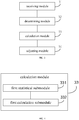
- FIG. 1 is a flowchart illustrating a method for adjusting a CWS according to exemplary embodiments of the disclosure.
- the embodiments may be described from a data transmission terminal.
- the data transmission terminal may be a base station, and the corresponding data reception terminal may be a user equipment (UE).
- the data transmission terminal may be a UE, and the corresponding data reception terminal may be a base station.
- the data transmission terminal may be a UE, and the corresponding data reception terminal may also be a UE, such as Device to Device Communication (sidelink) or Internet of Vehicles communication.
- the method for adjusting the CWS includes the following.
- Hybrid Automatic Repeat reQuest (HARQ) feedback information for first data units and/or second data units within a reference duration is received from a data reception terminal.
- the HARQ feedback information includes acknowledgement (ACK) information or non-acknowledgement (NACK) information.
- ACK acknowledgement
- NACK non-acknowledgement
- One second data unit includes one or more first data unit.
- the first data unit may include but be not limited to a Code Block Group (CBG).
- the second data unit may include but be not limited to a Transport Block (TB).
- CBG Code Block Group
- TB Transport Block
- target first data units or target second data units are determined, for which the HARQ feedback information is counted as the NACK information.
- the data transmission terminal After the data transmission terminal receives the HARQ feedback information within the reference duration, it is needed to determine the target first data units or the target second data units, for which the HARQ feedback information is counted as the NACK information.
- the NACK information for first data units that are not transmitted or second data units that are not transmitted when the NACK information for first data units that are not transmitted or second data units that are not transmitted is received from the data reception terminal, the NACK information may be ignored, and the first data units that are not transmitted or the second data units that are not transmitted are not determined as the target first data units or the target second data units. All or part of time-frequency resources allocated for the first data units that are not transmitted or the second data units that are not transmitted are pre-empted by other first data units that are transmitted or other second data units that are transmitted.
- the base station originally plans to transmit CBG#a in a type of enhanced Mobile BroadBand (eMBB) service on this time-frequency resource and notifies UE#a that it needs to receive CBG#a on this time-frequency resource.
- eMBB enhanced Mobile BroadBand
- CBG#b of Ultra Reliable Low Latency Communications (URLLC) service with higher delay requirements needs to be transmitted on this time-frequency resource, that is to say, the time-frequency resource of CBG#a is pre-empted.
- URLLC Ultra Reliable Low Latency Communications
- the data unit for which the time-frequency resource is pre-empted may be ignored. Because the data unit is not actually transmitted, the NACK information for this CBG may not reflect the channel state. Therefore, ignoring the NACK feedback for this type CBG makes the NACK ratio calculation more accurate and the subsequent CWS selection more reasonable.
- the first data units that are transmitted or the second data units that are transmitted may be determined as the target first data units or the target second data units.
- the first data units that are transmitted or the second data units that are transmitted represent, first data units or second data units in which all contents are transmitted.
- the data transmission terminal is a base station
- the data reception terminal is a UE
- the first data unit is a CBG
- the base station actually transmits CBG#c
- the feedback received from UE for CBG#c is the NACK or any HARQ feedback information has not received
- CBG#c is determined as the target CBG.
- a NACK ratio within the reference duration is calculated based on the determined target first data units and/or target second data units.
- Calculating the NACK ratio within the reference duration based on the determined target first data units and/or target second data units may include but be not limited to the following ways.
- the numerator and denominator of the NACK ratio obtained are X and Y respectively. That is, in other TBs, the total number of CBGs that may be counted as NACK is X; and the total number of CBGs that are transmitted is Y.
- TB#a located by CBG#a supposing that TB#a includes N CBGs, since CBG#a is a CBG that is not actually transmitted due to resource occupation, CBG#a is not the target CBG.
- the HARQ feedback of M CBGs may be counted as NACK. Then when the NACK ratio is calculated and the influence of TB#a is considered, the numerator for calculating the NACK ratio turns into X+M, and the denominator turns into Y+N-1 or Y+N.
- 3 TBs are transmitted within the reference duration: a total of 4 CBGs are transmitted in TB#1, and 1 CBG may be counted as CBG of NACK, and then the influence of this TB on the numerator of the NACK ratio is adding 1 and the influence of this TB on the denominator of the NACK ratio is adding 4; a total of 3 CBGs are transmitted in TB#2, and 0 CBG may be counted as CBG of NACK, and then the influence of this TB on the numerator of the NACK ratio is adding 0 and the influence of this TB on the denominator of the NACK ratio is adding 3; there are 4 CBGs in TB#3, in which 3 CBGs are transmitted, one CBG that has not transmitted but the corresponding NACK feedback is received (this CBG may not be counted as CBG of NACK, and may be ignored), and one CBG may be counted as CBG of NACK, and then the influence of this TB on the numerator of the NACK
- a ratio of a number of target first data units in each second data unit to a number of first data units that are transmitted in the corresponding second data unit is determined as a NACK ratio in the corresponding second data unit; a sum of NACK ratios in all second data units is calculated; a second number of all second data units that are transmitted within the reference duration is acquired; and the NACK ratio is calculated based on the sum of NACK ratios in all second data units and the second number.
- the NACK ratio in each TB is calculated first, and the sum of the NACK ratios in all TBs is calculated.
- the sum of the NACK ratios is used as the numerator, and the second number of all TBs that are transmitted within the reference duration is used as the denominator.
- the NACK ratio is calculated.
- 3 TBs are transmitted within the reference duration: 4 CBGs are transmitted in TB#1, and 1 CBG may be counted as CBG of NACK, and then the NACK ratio in the TB is 1/4; a total of 3 CBGs are transmitted in TB#2, and 0 CBG may be counted as CBG of NACK, and then the NACK ratio in the TB is 0; 3 of 4 CBGs in TB#3 are transmitted, there is one CBG that has not transmitted and the corresponding NACK feedback (this CBG may not be counted as CBG of NACK, and may be ignored) is received, and one CBG may be counted as CBG of NACK, and then the NACK ratio of the TB is 1/3 or 1/4.
- HARQ feedback information received within the reference duration only includes the HARQ feedback information for the second data units
- a third number of the target second data units is counted based on the determined target second data units; and the NACK ratio is calculated based on the third number and a number of all second data units that are transmitted within the reference duration.
- the second data unit may be a TB, and the calculation method may be similar to the calculation method in Way 1).
- the reference duration there are 4 TBs in the reference duration, one of which is not fully transmitted but the corresponding NACK feedback of UE (this TB may not be counted as TB of NACK, and may be ignored) is received, and there is another TB that may be counted as TB of NACK.
- the NACK ratio within the reference duration is 1/3 or 1/4.
- this calculation way is suitable for the scenario where the data transmission terminal is a base station and the data reception terminal is a UE, and also suitable for the scenario where the data transmission terminal and the data reception terminal are both UEs, for example, D2D or V2X scenario.
- the HARQ feedback information received within the reference duration includes the HARQ feedback information for the first data units and the HARQ feedback information for the second data units: with respect to the HARQ feedback information for the first data units, second data units located by the first data units may be normalized to acquire NACK ratios in the second data units; with respect to the HARQ feedback information for the second data units, a NACK ratio in the second data unit is determined to be 1 when the second data unit is the target second data unit, and a NACK ratio in the second data unit is determined to be 0 when the second data unit is not the target second data unit; and the NACK ratio is calculated based on a sum of the NACK ratios in all second data units and a number of all second data units that are transmitted within the reference duration.
- the sum of NACK ratios in all second data units, such as TBs, is used as the numerator, and the number of all second data units that are transmitted within the reference duration as the denominator.
- the NACK ratio is calculated.
- 3 TBs are transmitted within the reference duration: TB#1 is based on the transmission and the HARQ feedback of TB, in which the feedback is ACK, and TB#1 is not counted as TB of NACK, and then the NACK ratio in the TB#1 is 0; TB#2 is based on the transmission and the HARQ feedback of TB, in which the feedback is NACK, and TB#2 is counted as TB of NACK, and then the NACK ratio in this TB is 1; TB#3 is based on the transmission and the HARQ feedback of CBG, in which 3 of 4 CBGs are transmitted, and there is one CBG that is not transmitted but the corresponding NACK feedback (this CBG may not be counted as CBG of NACK, and may be ignored) is received, and one CBG may be counted as CBG of NACK, and then the NACK ratio in this TB#3 is z.
- the NACK ratio within the reference duration is (1+z)/3.
- Normalizing the second data units located by the first data units to acquire the NACK ratios in the second data units may include but be not limited to the following scenarios.
- Scenario 1 when a ratio of a number of target first data units in the second data unit to a number of first data units in the second data unit reaches a preset ratio, the corresponding second data unit is determined as the target second data unit, and a NACK ratio in the second data unit is determined as 1.
- the preset ratio may be set flexibly according needs.
- a NACK ratio in the second data unit is acquired based on a ratio of a number of target first data units in the second data unit to a number of first data units in the second data unit.
- the embodiment may normalize the second data units in which the HARQ feedback proceeds based on the first data units through multiple methods and may be implemented flexibly.
- multiple methods may be adopted to calculate the NACK ratio within the reference duration, which may be implemented flexibly with a high accuracy.
- the CWS is adjusted based on the NACK ratio.
- adjusting the CWS based on the NACK ratio may include: when the NACK ratio is greater than a preset threshold, increasing a value of the CWS. In addition, when times that the value of the CWS maintains a preset maximum value, reaches a preset number of times, the value of the CWS is set to a preset minimum value.
- adjusting the CWS based on the NACK ratio may include: when the NACK ratio is less than 1, setting a value of the CWS to a preset minimum value.
- the target first data units or target second data units, for which the HARQ feedback information is counted as the NACK information may be determined, and the NACK ratio within the reference duration may be calculated based on the determined target first data units and/or target second data units. Therefore, the NACK ratio calculation is more accurate and the subsequent CWS selection is more reasonable.
- FIG. 2 is a signaling flowchart illustrating a method for adjusting a CWS according to exemplary embodiments of the disclosure. The embodiments may be described from the perspective of interaction between the base station and the UE.
- the base station is the data transmission terminal and the UE is the data reception terminal.
- the method for adjusting the CWS includes the following.
- the base station transmits data to the UE in a unit of CBG within a reference duration.
- the UE returns HARQ feedback information to the base station in a unit of CBG within the reference duration.
- the HARQ feedback information includes ACK information or NACK information.
- the base station receives the HARQ feedback information from the UE within the reference duration, and determines the target CBGs for which the HARQ feedback information is counted as the NACK information.
- the NACK ratio within the reference duration is calculated based on the determined target CBGs.
- the base station adjusts the CWS based on the NACK ratio.
- the base station may calculate the NACK ratio within the reference duration based on the determined target CBGs, so that the NACK ratio calculation is more accurate and the subsequent CWS selection is more reasonable.
- FIG. 3 is a block diagram illustrating an apparatus for adjusting a CWS according to exemplary embodiments.
- the apparatus may be applicable to the data transmission terminal.
- the data transmission terminal may be a base station, and the corresponding data reception terminal may be a UE.
- the data transmission terminal may be a UE, and the corresponding data reception terminal may be a base station.
- the data transmission terminal may be a UE, and the corresponding data reception terminal may also be a UE, such as Device to Device Communication (sidelink) or Internet of Vehicles communication.
- the apparatus includes a receiving module 31, a determining module 32, a calculation module 33, and an adjusting module 34.
- the receiving module 31 is configured to receive Hybrid Automatic Repeat reQuest (HARQ) feedback information for first data units and/or second data units from a data reception terminal within a reference duration.
- the HARQ feedback information includes acknowledgement ACK information or non-acknowledgement NACK information.
- One second data unit includes one or more first data units.
- the first data unit may include but be not limited to a Code Block Group (CBG).
- the second data unit may include but be not limited to a Transport Block (TB).
- CBG Code Block Group
- TB Transport Block
- the determining module 32 is configured to determine target first data units or target second data units, for which the HARQ feedback information received by the receiving module 31 is counted as the NACK information.
- the NACK information for first data units that are not transmitted or second data units that are not transmitted when the NACK information for first data units that are not transmitted or second data units that are not transmitted is received from the data reception terminal, the NACK information may be ignored, and the first data units that are not transmitted or the second data units that are not transmitted are not determined as the target first data units or the target second data units. All or part of time-frequency resources allocated for the first data units that are not transmitted or the second data units that are not transmitted are pre-empted by other first data units that are transmitted or other second data units that are transmitted.
- the base station originally plans to transmit CBG#a in a type of enhanced Mobile BroadBand (eMBB) service on this time-frequency resource and notifies UE#a that it needs to receive CBG#a on this time-frequency resource.
- eMBB enhanced Mobile BroadBand
- CBG#b of Ultra Reliable Low Latency Communications (URLLC) service with higher delay requirements needs to be transmitted on this time-frequency resource, that is to say, the time-frequency resource of CBG#a is pre-empted.
- URLLC Ultra Reliable Low Latency Communications
- the data unit for which the time-frequency resource is pre-empted may be ignored. Because the data unit is not actually transmitted, the NACK information for this CBG may not reflect the channel state. Therefore, ignoring the NACK feedback for this type CBG makes the NACK ratio calculation more accurate and the subsequent CWS selection more reasonable.
- the first data units that are transmitted or the second data units that are transmitted may be determined as the target first data units or the target second data units.
- the first data units that are transmitted or the second data units that are transmitted represent, first data units or second data units in which all contents are transmitted.
- the data transmission terminal is a base station
- the data reception terminal is a UE
- the first data unit is a CBG
- the base station actually transmits CBG#c
- the feedback received from UE for CBG#c is the NACK or any HARQ feedback information has not received
- CBG#c is determined as the target CBG.
- the calculation module 33 is configured to calculate a NACK ratio within the reference duration based on the target first data units and/or target second data units determined by the determining module 32.
- the adjusting module 34 is configured to adjust the CWS based on the NACK ratio calculated by the calculation module 33.
- adjusting the CWS based on the NACK ratio may include: when the NACK ratio is greater than a preset threshold, increasing a value of the CWS. In addition, when times that the value of the CWS maintains a preset maximum value, reaches a preset number of times, the value of the CWS is set to a preset minimum value.
- adjusting the CWS based on the NACK ratio may include: when the NACK ratio is less than 1, setting a value of the CWS to a preset minimum value.
- the target first data units or target second data units, for which the HARQ feedback information is counted as the NACK information may be determined, and the NACK ratio within the reference duration may be calculated based on the determined target first data units and/or target second data units. Therefore, the NACK ratio calculation is more accurate and the subsequent CWS selection is more reasonable.
- FIG. 4 is a block diagram illustrating another apparatus for adjusting a CWS according to exemplary embodiments.
- the calculation module 33 may include a first statistical submodule 331 and a first calculation submodule 332.
- the first statistical submodule 331 is configured to count a first number of the target first data units based on the determined target first data units.
- the first calculation submodule 332 is configured to calculate the NACK ratio based on the first number acquired by the first statistical submodule 331 and a number of all first data units that are transmitted within the reference duration.
- the numerator and denominator of the NACK ratio obtained are X and Y respectively. That is, in other TBs, the total number of CBGs that may be counted as NACK is X; and the total number of CBGs that are transmitted is Y.
- TB#a located by CBG#a supposing that TB#a includes N CBGs, since CBG#a is a CBG that is not actually transmitted due to resource occupation, CBG#a is not the target CBG.
- the HARQ feedback of M CBGs may be counted as NACK. Then when the NACK ratio is calculated and the influence of TB#a is considered, the numerator for calculating the NACK ratio turns into X+M, and the denominator turns into Y+N-1 or Y+N.
- 3 TBs are transmitted within the reference duration: a total of 4 CBGs are transmitted in TB#1, and 1 CBG may be counted as CBG of NACK, and then the influence of this TB on the numerator of the NACK ratio is adding 1 and the influence of this TB on the denominator of the NACK ratio is adding 4; a total of 3 CBGs are transmitted in TB#2, and 0 CBG may be counted as CBG of NACK, and then the influence of this TB on the numerator of the NACK ratio is adding 0 and the influence of this TB on the denominator of the NACK ratio is adding 3; there are 4 CBGs in TB#3, in which 3 CBGs are transmitted, one CBG that has not transmitted but the corresponding NACK feedback is received (this CBG may not be counted as CBG of NACK, and may be ignored), and one CBG may be counted as CBG of NACK, and then the influence of this TB on the numerator of the NACK
- the NACK ratio is calculated based on the first number calculated by the first statistical submodule and the number of all first data units that are transmitted within the reference duration, so that the calculated NACK ratio has a high accuracy rate.
- FIG. 5 is a block diagram illustrating another apparatus for adjusting a CWS according to exemplary embodiments.
- the calculation module 33 may include: a first determining submodule 333, a second calculation submodule 334, an acquiring submodule 335, and a third calculation submodule 336.
- the first determining submodule 333 is configured to determine a ratio of a number of target first data units in each second data unit to a number of first data units that are transmitted in the corresponding second data unit as a NACK ratio in the corresponding second data unit.
- the second calculation submodule 334 is configured to calculate a sum of NACK ratios in all second data units.
- the acquiring submodule 335 is configured to acquire a second number of all second data units that are transmitted within the reference duration.
- the third calculation submodule 336 is configured to calculate the NACK ratio based on the sum of NACK ratios in all second data units, acquired by the second calculation submodule 334, and the second number acquired by the acquiring submodule 335.
- the NACK ratio in each TB is calculated first, and the sum of the NACK ratios in all TBs is calculated.
- the sum of the NACK ratios is used as the numerator, and the second number of all TBs that are transmitted within the reference duration is used as the denominator.
- the NACK ratio is calculated.
- 3 TBs are transmitted within the reference duration: 4 CBGs are transmitted in TB#1, and 1 CBG may be counted as CBG of NACK, and then the NACK ratio in the TB is 1/4; a total of 3 CBGs are transmitted in TB#2, and 0 CBG may be counted as CBG of NACK, and then the NACK ratio in the TB is 0; 3 of 4 CBGs in TB#3 are transmitted, there is one CBG that has not transmitted and the corresponding NACK feedback (this CBG may not be counted as CBG of NACK, and may be ignored) is received, and one CBG may be counted as CBG of NACK, and then the NACK ratio of the TB is 1/3 or 1/4.
- the NACK ratio is calculated based on the sum of the NACK ratios in all the second data units calculated by the second calculation submodule and the second number acquired by the acquiring submodule, so that the calculated NACK ratio has a high accuracy rate.
- FIG. 6 is a block diagram illustrating another apparatus for adjusting a CWS according to exemplary embodiments.
- the calculation module 33 may include: a second statistical submodule 336 and a fourth calculation submodule 337.
- the second statistical submodule 336 is configured to count a third number of the target second data units based on the determined target second data units.
- the fourth calculation submodule 337 is configured to calculate the NACK ratio based on the third number calculated by the second statistical submodule 336 and a number of all second data units that are transmitted within the reference duration.
- the second data unit may be a TB, and the calculation method may be similar to the calculation method in Way 1).
- the reference duration there are 4 TBs in the reference duration, one of which is not fully transmitted but the corresponding NACK feedback of UE (this TB may not be counted as TB of NACK, and may be ignored) is received, and there is another TB that may be counted as TB of NACK.
- the NACK ratio within the reference duration is 1/3 or 1/4.
- this calculation way is suitable for the scenario where the data transmission terminal is a base station and the data reception terminal is a UE, and also suitable for the scenario where the data transmission terminal and the data reception terminal are both UEs, for example, D2D or V2X scenario.
- the NACK ratio is calculated based on the third number calculated by the second statistical submodule and the number of all second data units that are transmitted within the reference duration, so that the calculated NACK ratio has a high accuracy rate.
- FIG. 7 is a block diagram illustrating another apparatus for adjusting a CWS according to exemplary embodiments.
- the calculation module 33 may include: a processing submodule 338, a second determining submodule 339, and a fifth calculation submodule 340.
- the processing submodule 338 is configured to, with respect to the HARQ feedback information for the first data units, normalize second data units located by the first data units to acquire NACK ratios in the second data units.
- the second determining submodule 339 is configured to, with respect to the HARQ feedback information for the second data units, determine a NACK ratio in the second data unit to be 1 when the second data unit is the target second data unit, and determine a NACK ratio in the second data unit to be 0 when the second data unit is not the target second data unit.
- the fifth calculation submodule 340 is configured to calculate the NACK ratio based on a sum of the NACK ratios in all second data units acquired by the processing submodule 338 and the second determining submodule 339, and a number of all second data units that are transmitted within the reference duration.
- 3 TBs are transmitted within the reference duration: TB#1 is based on the transmission and the HARQ feedback of TB, in which the feedback is ACK, and TB#1 is not counted as TB of NACK, and then the NACK ratio in the TB#1 is 0; TB#2 is based on the transmission and the HARQ feedback of TB, in which the feedback is NACK, and TB#2 is counted as TB of NACK, and then the NACK ratio in this TB is 1; TB#3 is based on the transmission and the HARQ feedback of CBG, in which 3 of 4 CBGs are transmitted, and there is one CBG that is not transmitted but the corresponding NACK feedback (this CBG may not be counted as CBG of NACK, and may be ignored) is received, and one CBG may be counted as CBG of NACK, and then the NACK ratio in this TB#3 is z.
- the NACK ratio within the reference duration is (1+z)/3.
- the NACK ratio is calculated based on the sum of the NACK ratios in all second data units acquired by the processing submodule and the second determining submodule and the number of all second data units that are transmitted within the reference duration, so that the calculated NACK ratio has a high accuracy rate.
- FIG. 8 is a block diagram illustrating another apparatus for adjusting a CWS according to exemplary embodiments.
- the processing submodule 338 may include: a first processing unit 3381 and a second processing unit 3382.
- the first processing unit 3381 is configured to, when a ratio of a number of target first data units in the second data unit to a number of first data units in the second data unit reaches a preset ratio, determine the corresponding second data unit as the target second data unit, and a NACK ratio in the second data unit as 1.
- the preset ratio may be set flexibly according needs.
- the second processing submodule 3382 is configured to acquire a NACK ratio in the second data unit based on a ratio of a number of target first data units in the second data unit to a number of first data units in the second data unit.
- the second data units in which the HARQ feedback proceeds based on the first data units may be normalized through multiple methods and may be implemented flexibly.
- the embodiments also provide a data transmission device.
- the data transmission device includes a processor; and a memory configured to store instructions executable by the processor.
- the processor is configured to: receive HARQ feedback information for first data units and/or second data units from a data reception terminal within a reference duration, the HARQ feedback information comprising acknowledgement ACK information or non-acknowledgement NACK information, one second data unit comprising one or more first data units; determine target first data units or target second data units, for which the HARQ feedback information is counted as the NACK information; calculate a NACK ratio within the reference duration based on the determined target first data units and/or target second data units; and adjust the CWS based on the NACK ratio.
- the data transmission device may be a UE, or a base station.
- FIG. 9 is a block diagram illustrating a device suitable for adjusting a CWS according to exemplary embodiments.
- the device 900 may be a mobile phone, a computer, a digital broadcasting terminal, a messaging device, a game console, a tablet device, a medical device, a fitness device, a personal digital assistant, etc.
- the device 900 may include one or more of the following components: processing component 902, memory 904, power supply component 906, multimedia component 908, audio component 910, input/output (I/O) interface 912, sensor component 914, and communication component 916.
- the processing component 902 generally controls the overall operations of the device 900, such as operations associated with display, phone calls, data communications, camera operations and recording.
- the processing component 902 may include one or more processors 920 to execute instructions to complete all or part of the steps of the aforementioned methods.
- the processing component 902 may include one or more modules to facilitate the interaction between the processing component 902 and other components.
- the processing component 902 may include a multimedia module to facilitate the interaction between the multimedia component 908 and the processing component 902.
- a processor 920 in the processing module 902 may be configured to: receive HARQ feedback information for first data units and/or second data units from a data reception terminal within a reference duration, the HARQ feedback information including ACK information or NACK information, one second data unit including one or more first data units; determine target first data units or target second data units, for which the HARQ feedback information is counted as the NACK information; calculate a NACK ratio within the reference duration based on the determined target first data units and/or target second data units; and adjust the CWS based on the NACK ratio.
- the memory 904 is configured to store various types of data to support operations on the device 900. Examples of these data include instructions for any application or method operating on the device 900, such as contact data, phone book data, messages, pictures, videos, and so on.
- the memory 904 may be implemented by any type of volatile or non-volatile storage device or their combination, such as Static Random Access Memory (SRAM), Electrically Erasable Programmable Read-Only Memory (EEPROM), Erasable and Programmable Read-Only Memory (EPROM), Programmable Read-Only Memory (PROM), Read-Only Memory (ROM), magnetic memory, flash memory, magnetic disk or optical disk.
- SRAM Static Random Access Memory
- EEPROM Electrically Erasable Programmable Read-Only Memory
- EPROM Erasable and Programmable Read-Only Memory
- PROM Programmable Read-Only Memory
- ROM Read-Only Memory
- the power supply component 906 provides power for various components of the device 900.
- the power supply component 906 may include a power management system, one or more power supplies, and other components associated with the generation, management, and distribution of power for the device 900.
- the multimedia component 908 includes a screen that provides an output interface between the device 900 and a user.
- the screen may include a Liquid Crystal Display (LCD) and a Touch Panel (TP). If the screen includes a touch panel, the screen may be used as a touch screen to receive input signals from the user.
- the touch panel includes one or more touch sensors to sense touch, slide, and gestures on the touch panel. The touch sensor may not only sense the boundary of a touch or slide action, but also detect the duration and pressure related to the touch or slide operation.
- the multimedia component 908 includes a front camera and/or a rear camera. When the device 900 is in an operation mode, such as a shooting mode or a video mode, the front camera and/or the rear camera may receive external multimedia data. Each front camera and rear camera can be a fixed optical lens system or have focal length and optical zoom capability.
- the audio component 910 is configured to output and/or input audio signals.
- the audio component 910 includes a microphone (MIC).
- the microphone is configured to receive external audio signals.
- the received audio signal can be further stored in the memory 904 or transmitted through the communication component 916.
- the audio component 910 includes a speaker for outputting audio signals.
- the I/O interface 912 provides an interface between the processing component 902 and the peripheral interface module.
- the peripheral interface module may be a keyboard, a click wheel, a button, and so on. These buttons may include but are not limited to: home button, volume button, start button, and lock button.
- the sensor component 914 includes one or more sensors for providing the device 900 with various aspects of status assessment.
- the sensor component 914 may detect the on/off state of the device 900 and relative position of components, for example, components as the display and the keypad of the device 900.
- the sensor component 914 may also detect position changes of device 900 or one component of device 900, and the presence or absence of contact between a user and the device 900, the position or acceleration/deceleration of the device 900, and the temperature change of the device 900.
- the sensor component 914 may include a proximity sensor, which is configured to detect the presence of nearby objects when there is no physical contact.
- the sensor component 914 may also include a light sensor, such as a CMOS or CCD image sensor for imaging applications.
- the sensor component 914 may also include an acceleration sensor, a gyroscope sensor, a magnetic sensor, a pressure sensor or a temperature sensor.
- the communication component 916 is configured to facilitate wired or wireless communication between the device 900 and other devices.
- the device 900 may get access to a wireless network based on the communication standard, such as Wi-Fi, 2G or 3G, or their combinations.
- the communication component 916 receives a broadcast signal or related broadcast information from an external broadcast management system through a broadcast channel.
- the communication component 916 further includes a near field communication (NFC) module to facilitate short-range communication.
- the NFC module can be implemented based on radio frequency identification (RFID) technology, infrared data association (IrDA) technology, ultra-wide band (UWB) technology, blue tooth (BT) technology and other technologies.
- RFID radio frequency identification
- IrDA infrared data association
- UWB ultra-wide band
- BT blue tooth
- the device 900 may be implemented by one or more Application Specific Integrated Circuits (ASIC), Digital Signal Processors (DSP), Digital Signal Processing Devices (DSPD), Programmable Logic Devices (PLD), Field-Programmable Gate Array (FPGA), controller, micro-controller, microprocessor, or other electronic components, for performing the above methods.
- ASIC Application Specific Integrated Circuits
- DSP Digital Signal Processors
- DSPD Digital Signal Processing Devices
- PLD Programmable Logic Devices
- FPGA Field-Programmable Gate Array
- controller micro-controller, microprocessor, or other electronic components, for performing the above methods.
- a non-transitory computer-readable storage medium including instructions, such as a memory 904 including instructions.
- the instructions may be executed by the processor 920 of the device 900 to complete the above methods.
- the non-transitory computer-readable storage medium may be a Read-Only Memory (ROM), a Random-Access Memory (RAM), a CD-ROM, a magnetic tape, a floppy disk, an optical data, a storage device, etc.
- FIG. 10 is a block diagram illustrating another device suitable for adjusting a CWS according to exemplary embodiments.
- the device 1000 may be provided as a base station.
- the device 1000 includes a processing component 1022, a wireless transmission/reception component 1024, an antenna component 1026, and a signal processing part especially for wireless interface.
- the processing component 1022 may further include one or more processors.
- a processor in the processing module 1022 may be configured to: receive HARQ feedback information for first data units and/or second data units from a data reception terminal within a reference duration, the HARQ feedback information including ACK information or NACK information, one second data unit including one or more first data units; determine target first data units or target second data units, for which the HARQ feedback information is counted as the NACK information; calculate a NACK ratio within the reference duration based on the determined target first data units and/or target second data units; and adjust the CWS based on the NACK ratio.
- non-transitory computer-readable storage medium including instructions.
- the instructions may be executed by the processing component 1022 of the device 1000 to complete the above methods for adjusting the CWS.
- the non-transitory computer-readable storage medium may be a Read-Only Memory (ROM), a Random-Access Memory (RAM), a CD-ROM, a magnetic tape, a floppy disk, an optical data, a storage device, etc.
- the apparatus/device embodiments since they basically correspond to the method embodiments, reference may be made to the description of the method embodiments for related parts.
- the apparatus/device embodiments described above are merely illustrative, where the units described as separate components may or may not be physically separated, and the components displayed as units may or may not be physical units, that is, they may be located in one place, or may be distributed to multiple network units. Some or all of the modules may be selected according to actual needs to achieve the purpose of solutions of the embodiments. Those skilled in the art may understand and implement them without creative work.
Landscapes
- Engineering & Computer Science (AREA)
- Computer Networks & Wireless Communication (AREA)
- Signal Processing (AREA)
- Detection And Prevention Of Errors In Transmission (AREA)
- Mobile Radio Communication Systems (AREA)
Applications Claiming Priority (1)
| Application Number | Priority Date | Filing Date | Title |
|---|---|---|---|
| PCT/CN2018/107055 WO2020056743A1 (fr) | 2018-09-21 | 2018-09-21 | Procédé et appareil de réglage de taille de fenêtre de contention, et dispositif de transmission de données |
Publications (2)
| Publication Number | Publication Date |
|---|---|
| EP3855652A1 true EP3855652A1 (fr) | 2021-07-28 |
| EP3855652A4 EP3855652A4 (fr) | 2022-05-18 |
Family
ID=65221756
Family Applications (1)
| Application Number | Title | Priority Date | Filing Date |
|---|---|---|---|
| EP18934105.0A Pending EP3855652A4 (fr) | 2018-09-21 | 2018-09-21 | Procédé et appareil de réglage de taille de fenêtre de contention, et dispositif de transmission de données |
Country Status (4)
| Country | Link |
|---|---|
| US (1) | US11811540B2 (fr) |
| EP (1) | EP3855652A4 (fr) |
| CN (2) | CN109314615B (fr) |
| WO (1) | WO2020056743A1 (fr) |
Cited By (2)
| Publication number | Priority date | Publication date | Assignee | Title |
|---|---|---|---|---|
| WO2023019385A1 (fr) | 2021-08-16 | 2023-02-23 | Nec Corporation | Procédé, dispositif et support lisible par ordinateur destinés aux communications |
| WO2023108376A1 (fr) * | 2021-12-13 | 2023-06-22 | Nokia Shanghai Bell Co., Ltd. | Amélioration sur la liaison latérale dans une bande sans licence |
Families Citing this family (21)
| Publication number | Priority date | Publication date | Assignee | Title |
|---|---|---|---|---|
| CN111565089A (zh) | 2019-02-13 | 2020-08-21 | 索尼公司 | 电子装置、无线通信方法和计算机可读介质 |
| US12112183B2 (en) | 2019-02-15 | 2024-10-08 | Lenovo (Beijing) Limited | Method and apparatus for contention window size adjustment |
| CN113228810B (zh) * | 2019-03-21 | 2025-02-07 | 苹果公司 | 基于代码块组的重传配置的竞争窗口大小更新 |
| ES2984909T3 (es) * | 2019-05-02 | 2024-10-31 | Nokia Technologies Oy | Retroalimentación de ajuste de tamaño de ventana de contienda |
| EP3993474A1 (fr) * | 2019-06-28 | 2022-05-04 | Ntt Docomo, Inc. | Station de base, terminal et procédé de détermination de taille de fenêtre de contention |
| US11375399B2 (en) * | 2019-07-10 | 2022-06-28 | Qualcomm Incorporated | Contention window adjustment for multiple transmit receive points |
| CN110547036B (zh) * | 2019-07-26 | 2021-08-24 | 北京小米移动软件有限公司 | 竞争窗口的确定方法及装置、通信设备及存储介质 |
| CN110366264B (zh) * | 2019-07-31 | 2021-04-02 | 展讯通信(上海)有限公司 | 竞争窗口调整方法、网元设备、用户设备及存储介质 |
| BR112022002851A2 (pt) * | 2019-08-16 | 2022-05-17 | Xiaomi Communications Co Ltd | Método e aparelho para determinar uma unidade de domínio de tempo de referência, e, meio de armazenamento legível por computador |
| CN110536473B (zh) * | 2019-08-16 | 2023-03-10 | 中兴通讯股份有限公司 | 信号发送方法、装置及存储介质 |
| WO2021056475A1 (fr) * | 2019-09-27 | 2021-04-01 | 小米通讯技术有限公司 | Procédé et appareil de réglage de taille de fenêtre de contention, dispositif de communication et support de stockage |
| CN114208080B (zh) * | 2019-10-03 | 2023-08-29 | Oppo广东移动通信有限公司 | 竞争窗口大小的确定方法,网络设备,终端设备 |
| CN112654096A (zh) * | 2019-10-11 | 2021-04-13 | 普天信息技术有限公司 | 竞争窗长度自适应调整方法和装置 |
| KR20230117469A (ko) * | 2019-11-07 | 2023-08-08 | 애플 인크. | 무선 통신에서의 채널 액세스 메커니즘들 |
| US12289272B2 (en) | 2020-01-03 | 2025-04-29 | Lenovo (Beijing) Ltd. | Method and apparatus for resource reservation for NR sidelink |
| WO2021162480A1 (fr) | 2020-02-14 | 2021-08-19 | 삼성전자 주식회사 | Procédé et appareil de rétroaction de harq-ack dans un système de communication sans fil |
| EP3982571B1 (fr) * | 2020-10-09 | 2025-10-22 | Nokia Technologies Oy | Transmission de données |
| CN114765899B (zh) * | 2021-01-15 | 2024-08-23 | 展讯通信(上海)有限公司 | 辅链路的cws确定方法及装置、计算机可读存储介质 |
| CN115884426A (zh) * | 2021-12-21 | 2023-03-31 | 中兴通讯股份有限公司 | 信道接入方法、设备和存储介质 |
| KR20250003654A (ko) * | 2022-04-29 | 2025-01-07 | 주식회사 윌러스표준기술연구소 | 무선 통신 시스템에서 신호를 전송하는 방법 및 장치 |
| CN117998661A (zh) * | 2022-11-04 | 2024-05-07 | 华为技术有限公司 | 通信方法及装置 |
Family Cites Families (15)
| Publication number | Priority date | Publication date | Assignee | Title |
|---|---|---|---|---|
| EP3272174B1 (fr) * | 2015-03-17 | 2019-12-18 | Telefonaktiebolaget LM Ericsson (publ) | Dispositif de communication, et procédé associé, pour déterminer une taille de fenêtre de contention dans un réseau de communications |
| CN107580801B (zh) * | 2015-05-12 | 2021-03-30 | Lg 电子株式会社 | 在支持未授权带的无线接入系统中基于harq-ack信息调整竞争窗口大小的方法和支持该方法的设备 |
| US10333656B2 (en) * | 2015-05-14 | 2019-06-25 | Cable Television Laboratories, Inc. | Uplink channel reservation with conflicting wireless communications |
| CN107637158A (zh) * | 2015-05-14 | 2018-01-26 | 三星电子株式会社 | 用于在无线通信系统中管理竞争窗口的方法和装置 |
| US9882700B2 (en) * | 2015-06-30 | 2018-01-30 | Sharp Kabushiki Kaisha | Systems and methods for backoff procedures for licensed-assisted access |
| US10742562B2 (en) * | 2015-07-16 | 2020-08-11 | Samsung Electronics Co., Ltd. | Method and apparatus for adaptive control of contention window in LAA |
| JP6165201B2 (ja) * | 2015-08-05 | 2017-07-19 | 株式会社Nttドコモ | 無線基地局、ユーザ端末及び無線通信方法 |
| EP4084567B1 (fr) * | 2015-08-14 | 2025-10-15 | Electronics and Telecommunications Research Institute | Procédé permettant de faire fonctionner un noeud de communication dans un réseau prenant en charge des bandes autorisées et non autorisées |
| US9622237B2 (en) * | 2015-09-14 | 2017-04-11 | Wilus Institute Of Standards And Technology Inc. | Method, apparatus, and system for channel access in unlicensed band |
| CN108029137B (zh) * | 2015-09-23 | 2021-03-30 | 索尼移动通讯有限公司 | 蜂窝无线电通信网络的基站和在该基站中执行的方法 |
| US11005631B2 (en) * | 2015-09-24 | 2021-05-11 | Ntt Docomo, Inc. | Terminal, base station and radio communication method for separately encoding uplink control information |
| WO2017069798A1 (fr) | 2015-10-20 | 2017-04-27 | Intel IP Corporation | Adaptation de taille de fenêtres de concurrence |
| WO2017074160A1 (fr) * | 2015-10-29 | 2017-05-04 | 주식회사 윌러스표준기술연구소 | Procédé, appareil et système pour l'accès aux canaux dans une bande sans licence |
| CN105682239B (zh) * | 2015-12-31 | 2019-04-12 | 宇龙计算机通信科技(深圳)有限公司 | 非授权频谱上先听后说机制的信道检测配置方法及装置 |
| CN107294662B (zh) * | 2016-03-30 | 2020-11-27 | 上海诺基亚贝尔股份有限公司 | 在ue侧调整cws值以用于ul传输的方法和装置 |
-
2018
- 2018-09-21 CN CN201880001884.9A patent/CN109314615B/zh active Active
- 2018-09-21 CN CN202210138764.1A patent/CN114422092B/zh active Active
- 2018-09-21 US US17/277,598 patent/US11811540B2/en active Active
- 2018-09-21 EP EP18934105.0A patent/EP3855652A4/fr active Pending
- 2018-09-21 WO PCT/CN2018/107055 patent/WO2020056743A1/fr not_active Ceased
Cited By (5)
| Publication number | Priority date | Publication date | Assignee | Title |
|---|---|---|---|---|
| WO2023019385A1 (fr) | 2021-08-16 | 2023-02-23 | Nec Corporation | Procédé, dispositif et support lisible par ordinateur destinés aux communications |
| EP4388815A4 (fr) * | 2021-08-16 | 2024-08-28 | NEC Corporation | Procédé, dispositif et support lisible par ordinateur destinés aux communications |
| JP2024531332A (ja) * | 2021-08-16 | 2024-08-29 | 日本電気株式会社 | ユーザ装置及びその方法 |
| WO2023108376A1 (fr) * | 2021-12-13 | 2023-06-22 | Nokia Shanghai Bell Co., Ltd. | Amélioration sur la liaison latérale dans une bande sans licence |
| EP4449645A4 (fr) * | 2021-12-13 | 2025-05-21 | Nokia Technologies Oy | Amélioration sur la liaison latérale dans une bande sans licence |
Also Published As
| Publication number | Publication date |
|---|---|
| CN114422092B (zh) | 2024-09-13 |
| US11811540B2 (en) | 2023-11-07 |
| CN109314615A (zh) | 2019-02-05 |
| EP3855652A4 (fr) | 2022-05-18 |
| US20220029754A1 (en) | 2022-01-27 |
| CN114422092A (zh) | 2022-04-29 |
| WO2020056743A1 (fr) | 2020-03-26 |
| CN109314615B (zh) | 2022-03-01 |
Similar Documents
| Publication | Publication Date | Title |
|---|---|---|
| US11811540B2 (en) | Method and apparatus for adjusting contention window size, and data transmission device | |
| US11909534B2 (en) | HARQ feedback method and apparatus | |
| EP3790334A1 (fr) | Procédé et appareil de transmission à multiplexage d'informations, et procédé et appareil de réception d'informations | |
| CN109156028B (zh) | 上行消息传输方法、装置及存储介质 | |
| US11019642B2 (en) | Method and apparatus for data transmission, user equipment and base station | |
| US11876625B2 (en) | Hybrid automatic repeat request feedback method and apparatus, user equipment, and base station | |
| US11362766B2 (en) | Method and apparatus for obtaining HARQ feedback and method and apparatus for transmitting HARQ feedback | |
| US11973601B2 (en) | Method and device for transmitting HARQ codebook | |
| US11729767B2 (en) | Method of indicating uplink feedback information and method of transmitting uplink feedback information | |
| US11336397B2 (en) | HARQ feedback method and apparatus, device, and computer readable storage medium | |
| US12052766B2 (en) | Method for determining contention window, and communication device and storage medium | |
| EP3840516A1 (fr) | Procédé et appareil d'attente dans un processus d'émission, dispositif, système et support de stockage | |
| US11503642B2 (en) | Method and device for determining an uplink-downlink switching point | |
| US11464061B2 (en) | Time-frequency resource preemption determining method and device, and user equipment | |
| US12156247B2 (en) | Method and apparatus for detecting unlicensed frequency band | |
| CN110771250B (zh) | 竞争窗口长度确定方法和装置 | |
| CN108702262A (zh) | 数据传输方法、装置、系统及计算机可读存储介质 | |
| CN114073025B (zh) | 持续时长域的值确定方法和装置 |
Legal Events
| Date | Code | Title | Description |
|---|---|---|---|
| STAA | Information on the status of an ep patent application or granted ep patent |
Free format text: STATUS: THE INTERNATIONAL PUBLICATION HAS BEEN MADE |
|
| PUAI | Public reference made under article 153(3) epc to a published international application that has entered the european phase |
Free format text: ORIGINAL CODE: 0009012 |
|
| STAA | Information on the status of an ep patent application or granted ep patent |
Free format text: STATUS: REQUEST FOR EXAMINATION WAS MADE |
|
| 17P | Request for examination filed |
Effective date: 20210414 |
|
| AK | Designated contracting states |
Kind code of ref document: A1 Designated state(s): AL AT BE BG CH CY CZ DE DK EE ES FI FR GB GR HR HU IE IS IT LI LT LU LV MC MK MT NL NO PL PT RO RS SE SI SK SM TR |
|
| DAV | Request for validation of the european patent (deleted) | ||
| DAX | Request for extension of the european patent (deleted) | ||
| A4 | Supplementary search report drawn up and despatched |
Effective date: 20220420 |
|
| RIC1 | Information provided on ipc code assigned before grant |
Ipc: H04L 1/18 20060101ALI20220412BHEP Ipc: H04W 74/08 20090101ALI20220412BHEP Ipc: H04L 1/16 20060101AFI20220412BHEP |
|
| STAA | Information on the status of an ep patent application or granted ep patent |
Free format text: STATUS: EXAMINATION IS IN PROGRESS |
|
| 17Q | First examination report despatched |
Effective date: 20240515 |