EP3856869B1 - Azofarbstoff - Google Patents
Azofarbstoff Download PDFInfo
- Publication number
- EP3856869B1 EP3856869B1 EP19779407.6A EP19779407A EP3856869B1 EP 3856869 B1 EP3856869 B1 EP 3856869B1 EP 19779407 A EP19779407 A EP 19779407A EP 3856869 B1 EP3856869 B1 EP 3856869B1
- Authority
- EP
- European Patent Office
- Prior art keywords
- atoms
- denote
- compounds
- denotes
- another
- Prior art date
- Legal status (The legal status is an assumption and is not a legal conclusion. Google has not performed a legal analysis and makes no representation as to the accuracy of the status listed.)
- Active
Links
Classifications
-
- C—CHEMISTRY; METALLURGY
- C07—ORGANIC CHEMISTRY
- C07D—HETEROCYCLIC COMPOUNDS
- C07D285/00—Heterocyclic compounds containing rings having nitrogen and sulfur atoms as the only ring hetero atoms, not provided for by groups C07D275/00 - C07D283/00
- C07D285/01—Five-membered rings
- C07D285/02—Thiadiazoles; Hydrogenated thiadiazoles
- C07D285/04—Thiadiazoles; Hydrogenated thiadiazoles not condensed with other rings
- C07D285/10—1,2,5-Thiadiazoles; Hydrogenated 1,2,5-thiadiazoles
-
- C—CHEMISTRY; METALLURGY
- C09—DYES; PAINTS; POLISHES; NATURAL RESINS; ADHESIVES; COMPOSITIONS NOT OTHERWISE PROVIDED FOR; APPLICATIONS OF MATERIALS NOT OTHERWISE PROVIDED FOR
- C09K—MATERIALS FOR MISCELLANEOUS APPLICATIONS, NOT PROVIDED FOR ELSEWHERE
- C09K19/00—Liquid crystal materials
- C09K19/52—Liquid crystal materials characterised by components which are not liquid crystals, e.g. additives with special physical aspect: solvents, solid particles
- C09K19/60—Pleochroic dyes
- C09K19/601—Azoic
-
- C—CHEMISTRY; METALLURGY
- C07—ORGANIC CHEMISTRY
- C07D—HETEROCYCLIC COMPOUNDS
- C07D417/00—Heterocyclic compounds containing two or more hetero rings, at least one ring having nitrogen and sulfur atoms as the only ring hetero atoms, not provided for by group C07D415/00
- C07D417/02—Heterocyclic compounds containing two or more hetero rings, at least one ring having nitrogen and sulfur atoms as the only ring hetero atoms, not provided for by group C07D415/00 containing two hetero rings
- C07D417/04—Heterocyclic compounds containing two or more hetero rings, at least one ring having nitrogen and sulfur atoms as the only ring hetero atoms, not provided for by group C07D415/00 containing two hetero rings directly linked by a ring-member-to-ring-member bond
-
- C—CHEMISTRY; METALLURGY
- C07—ORGANIC CHEMISTRY
- C07D—HETEROCYCLIC COMPOUNDS
- C07D417/00—Heterocyclic compounds containing two or more hetero rings, at least one ring having nitrogen and sulfur atoms as the only ring hetero atoms, not provided for by group C07D415/00
- C07D417/02—Heterocyclic compounds containing two or more hetero rings, at least one ring having nitrogen and sulfur atoms as the only ring hetero atoms, not provided for by group C07D415/00 containing two hetero rings
- C07D417/12—Heterocyclic compounds containing two or more hetero rings, at least one ring having nitrogen and sulfur atoms as the only ring hetero atoms, not provided for by group C07D415/00 containing two hetero rings linked by a chain containing hetero atoms as chain links
-
- C—CHEMISTRY; METALLURGY
- C07—ORGANIC CHEMISTRY
- C07D—HETEROCYCLIC COMPOUNDS
- C07D417/00—Heterocyclic compounds containing two or more hetero rings, at least one ring having nitrogen and sulfur atoms as the only ring hetero atoms, not provided for by group C07D415/00
- C07D417/14—Heterocyclic compounds containing two or more hetero rings, at least one ring having nitrogen and sulfur atoms as the only ring hetero atoms, not provided for by group C07D415/00 containing three or more hetero rings
-
- C—CHEMISTRY; METALLURGY
- C07—ORGANIC CHEMISTRY
- C07D—HETEROCYCLIC COMPOUNDS
- C07D513/00—Heterocyclic compounds containing in the condensed system at least one hetero ring having nitrogen and sulfur atoms as the only ring hetero atoms, not provided for in groups C07D463/00, C07D477/00 or C07D499/00 - C07D507/00
- C07D513/02—Heterocyclic compounds containing in the condensed system at least one hetero ring having nitrogen and sulfur atoms as the only ring hetero atoms, not provided for in groups C07D463/00, C07D477/00 or C07D499/00 - C07D507/00 in which the condensed system contains two hetero rings
- C07D513/04—Ortho-condensed systems
-
- C—CHEMISTRY; METALLURGY
- C09—DYES; PAINTS; POLISHES; NATURAL RESINS; ADHESIVES; COMPOSITIONS NOT OTHERWISE PROVIDED FOR; APPLICATIONS OF MATERIALS NOT OTHERWISE PROVIDED FOR
- C09K—MATERIALS FOR MISCELLANEOUS APPLICATIONS, NOT PROVIDED FOR ELSEWHERE
- C09K19/00—Liquid crystal materials
- C09K19/04—Liquid crystal materials characterised by the chemical structure of the liquid crystal components, e.g. by a specific unit
- C09K19/06—Non-steroidal liquid crystal compounds
- C09K19/08—Non-steroidal liquid crystal compounds containing at least two non-condensed rings
- C09K19/30—Non-steroidal liquid crystal compounds containing at least two non-condensed rings containing saturated or unsaturated non-aromatic rings, e.g. cyclohexane rings
- C09K19/3001—Cyclohexane rings
- C09K19/3003—Compounds containing at least two rings in which the different rings are directly linked (covalent bond)
-
- C—CHEMISTRY; METALLURGY
- C09—DYES; PAINTS; POLISHES; NATURAL RESINS; ADHESIVES; COMPOSITIONS NOT OTHERWISE PROVIDED FOR; APPLICATIONS OF MATERIALS NOT OTHERWISE PROVIDED FOR
- C09K—MATERIALS FOR MISCELLANEOUS APPLICATIONS, NOT PROVIDED FOR ELSEWHERE
- C09K19/00—Liquid crystal materials
- C09K19/04—Liquid crystal materials characterised by the chemical structure of the liquid crystal components, e.g. by a specific unit
- C09K19/06—Non-steroidal liquid crystal compounds
- C09K19/08—Non-steroidal liquid crystal compounds containing at least two non-condensed rings
- C09K19/30—Non-steroidal liquid crystal compounds containing at least two non-condensed rings containing saturated or unsaturated non-aromatic rings, e.g. cyclohexane rings
- C09K19/3001—Cyclohexane rings
- C09K19/3066—Cyclohexane rings in which the rings are linked by a chain containing carbon and oxygen atoms, e.g. esters or ethers
- C09K19/3068—Cyclohexane rings in which the rings are linked by a chain containing carbon and oxygen atoms, e.g. esters or ethers chain containing -COO- or -OCO- groups
-
- C—CHEMISTRY; METALLURGY
- C09—DYES; PAINTS; POLISHES; NATURAL RESINS; ADHESIVES; COMPOSITIONS NOT OTHERWISE PROVIDED FOR; APPLICATIONS OF MATERIALS NOT OTHERWISE PROVIDED FOR
- C09K—MATERIALS FOR MISCELLANEOUS APPLICATIONS, NOT PROVIDED FOR ELSEWHERE
- C09K19/00—Liquid crystal materials
- C09K19/04—Liquid crystal materials characterised by the chemical structure of the liquid crystal components, e.g. by a specific unit
- C09K19/06—Non-steroidal liquid crystal compounds
- C09K19/34—Non-steroidal liquid crystal compounds containing at least one heterocyclic ring
- C09K19/3402—Non-steroidal liquid crystal compounds containing at least one heterocyclic ring having oxygen as hetero atom
-
- C—CHEMISTRY; METALLURGY
- C09—DYES; PAINTS; POLISHES; NATURAL RESINS; ADHESIVES; COMPOSITIONS NOT OTHERWISE PROVIDED FOR; APPLICATIONS OF MATERIALS NOT OTHERWISE PROVIDED FOR
- C09K—MATERIALS FOR MISCELLANEOUS APPLICATIONS, NOT PROVIDED FOR ELSEWHERE
- C09K19/00—Liquid crystal materials
- C09K19/52—Liquid crystal materials characterised by components which are not liquid crystals, e.g. additives with special physical aspect: solvents, solid particles
- C09K19/60—Pleochroic dyes
-
- C—CHEMISTRY; METALLURGY
- C09—DYES; PAINTS; POLISHES; NATURAL RESINS; ADHESIVES; COMPOSITIONS NOT OTHERWISE PROVIDED FOR; APPLICATIONS OF MATERIALS NOT OTHERWISE PROVIDED FOR
- C09K—MATERIALS FOR MISCELLANEOUS APPLICATIONS, NOT PROVIDED FOR ELSEWHERE
- C09K19/00—Liquid crystal materials
- C09K19/04—Liquid crystal materials characterised by the chemical structure of the liquid crystal components, e.g. by a specific unit
- C09K2019/0444—Liquid crystal materials characterised by the chemical structure of the liquid crystal components, e.g. by a specific unit characterized by a linking chain between rings or ring systems, a bridging chain between extensive mesogenic moieties or an end chain group
- C09K2019/0466—Liquid crystal materials characterised by the chemical structure of the liquid crystal components, e.g. by a specific unit characterized by a linking chain between rings or ring systems, a bridging chain between extensive mesogenic moieties or an end chain group the linking chain being a -CF2O- chain
-
- C—CHEMISTRY; METALLURGY
- C09—DYES; PAINTS; POLISHES; NATURAL RESINS; ADHESIVES; COMPOSITIONS NOT OTHERWISE PROVIDED FOR; APPLICATIONS OF MATERIALS NOT OTHERWISE PROVIDED FOR
- C09K—MATERIALS FOR MISCELLANEOUS APPLICATIONS, NOT PROVIDED FOR ELSEWHERE
- C09K19/00—Liquid crystal materials
- C09K19/04—Liquid crystal materials characterised by the chemical structure of the liquid crystal components, e.g. by a specific unit
- C09K19/06—Non-steroidal liquid crystal compounds
- C09K19/08—Non-steroidal liquid crystal compounds containing at least two non-condensed rings
- C09K19/10—Non-steroidal liquid crystal compounds containing at least two non-condensed rings containing at least two benzene rings
- C09K19/12—Non-steroidal liquid crystal compounds containing at least two non-condensed rings containing at least two benzene rings at least two benzene rings directly linked, e.g. biphenyls
- C09K2019/121—Compounds containing phenylene-1,4-diyl (-Ph-)
- C09K2019/122—Ph-Ph
-
- C—CHEMISTRY; METALLURGY
- C09—DYES; PAINTS; POLISHES; NATURAL RESINS; ADHESIVES; COMPOSITIONS NOT OTHERWISE PROVIDED FOR; APPLICATIONS OF MATERIALS NOT OTHERWISE PROVIDED FOR
- C09K—MATERIALS FOR MISCELLANEOUS APPLICATIONS, NOT PROVIDED FOR ELSEWHERE
- C09K19/00—Liquid crystal materials
- C09K19/04—Liquid crystal materials characterised by the chemical structure of the liquid crystal components, e.g. by a specific unit
- C09K19/06—Non-steroidal liquid crystal compounds
- C09K19/08—Non-steroidal liquid crystal compounds containing at least two non-condensed rings
- C09K19/10—Non-steroidal liquid crystal compounds containing at least two non-condensed rings containing at least two benzene rings
- C09K19/12—Non-steroidal liquid crystal compounds containing at least two non-condensed rings containing at least two benzene rings at least two benzene rings directly linked, e.g. biphenyls
- C09K2019/121—Compounds containing phenylene-1,4-diyl (-Ph-)
- C09K2019/123—Ph-Ph-Ph
-
- C—CHEMISTRY; METALLURGY
- C09—DYES; PAINTS; POLISHES; NATURAL RESINS; ADHESIVES; COMPOSITIONS NOT OTHERWISE PROVIDED FOR; APPLICATIONS OF MATERIALS NOT OTHERWISE PROVIDED FOR
- C09K—MATERIALS FOR MISCELLANEOUS APPLICATIONS, NOT PROVIDED FOR ELSEWHERE
- C09K19/00—Liquid crystal materials
- C09K19/04—Liquid crystal materials characterised by the chemical structure of the liquid crystal components, e.g. by a specific unit
- C09K19/06—Non-steroidal liquid crystal compounds
- C09K19/08—Non-steroidal liquid crystal compounds containing at least two non-condensed rings
- C09K19/10—Non-steroidal liquid crystal compounds containing at least two non-condensed rings containing at least two benzene rings
- C09K19/20—Non-steroidal liquid crystal compounds containing at least two non-condensed rings containing at least two benzene rings linked by a chain containing carbon and oxygen atoms as chain links, e.g. esters or ethers
- C09K19/2007—Non-steroidal liquid crystal compounds containing at least two non-condensed rings containing at least two benzene rings linked by a chain containing carbon and oxygen atoms as chain links, e.g. esters or ethers the chain containing -COO- or -OCO- groups
- C09K2019/2035—Ph-COO-Ph
-
- C—CHEMISTRY; METALLURGY
- C09—DYES; PAINTS; POLISHES; NATURAL RESINS; ADHESIVES; COMPOSITIONS NOT OTHERWISE PROVIDED FOR; APPLICATIONS OF MATERIALS NOT OTHERWISE PROVIDED FOR
- C09K—MATERIALS FOR MISCELLANEOUS APPLICATIONS, NOT PROVIDED FOR ELSEWHERE
- C09K19/00—Liquid crystal materials
- C09K19/04—Liquid crystal materials characterised by the chemical structure of the liquid crystal components, e.g. by a specific unit
- C09K19/06—Non-steroidal liquid crystal compounds
- C09K19/08—Non-steroidal liquid crystal compounds containing at least two non-condensed rings
- C09K19/30—Non-steroidal liquid crystal compounds containing at least two non-condensed rings containing saturated or unsaturated non-aromatic rings, e.g. cyclohexane rings
- C09K19/3001—Cyclohexane rings
- C09K19/3003—Compounds containing at least two rings in which the different rings are directly linked (covalent bond)
- C09K2019/3004—Cy-Cy
-
- C—CHEMISTRY; METALLURGY
- C09—DYES; PAINTS; POLISHES; NATURAL RESINS; ADHESIVES; COMPOSITIONS NOT OTHERWISE PROVIDED FOR; APPLICATIONS OF MATERIALS NOT OTHERWISE PROVIDED FOR
- C09K—MATERIALS FOR MISCELLANEOUS APPLICATIONS, NOT PROVIDED FOR ELSEWHERE
- C09K19/00—Liquid crystal materials
- C09K19/04—Liquid crystal materials characterised by the chemical structure of the liquid crystal components, e.g. by a specific unit
- C09K19/06—Non-steroidal liquid crystal compounds
- C09K19/08—Non-steroidal liquid crystal compounds containing at least two non-condensed rings
- C09K19/30—Non-steroidal liquid crystal compounds containing at least two non-condensed rings containing saturated or unsaturated non-aromatic rings, e.g. cyclohexane rings
- C09K19/3001—Cyclohexane rings
- C09K19/3003—Compounds containing at least two rings in which the different rings are directly linked (covalent bond)
- C09K2019/3006—Cy-Cy-Cy
-
- C—CHEMISTRY; METALLURGY
- C09—DYES; PAINTS; POLISHES; NATURAL RESINS; ADHESIVES; COMPOSITIONS NOT OTHERWISE PROVIDED FOR; APPLICATIONS OF MATERIALS NOT OTHERWISE PROVIDED FOR
- C09K—MATERIALS FOR MISCELLANEOUS APPLICATIONS, NOT PROVIDED FOR ELSEWHERE
- C09K19/00—Liquid crystal materials
- C09K19/04—Liquid crystal materials characterised by the chemical structure of the liquid crystal components, e.g. by a specific unit
- C09K19/06—Non-steroidal liquid crystal compounds
- C09K19/08—Non-steroidal liquid crystal compounds containing at least two non-condensed rings
- C09K19/30—Non-steroidal liquid crystal compounds containing at least two non-condensed rings containing saturated or unsaturated non-aromatic rings, e.g. cyclohexane rings
- C09K19/3001—Cyclohexane rings
- C09K19/3003—Compounds containing at least two rings in which the different rings are directly linked (covalent bond)
- C09K2019/3009—Cy-Ph
-
- C—CHEMISTRY; METALLURGY
- C09—DYES; PAINTS; POLISHES; NATURAL RESINS; ADHESIVES; COMPOSITIONS NOT OTHERWISE PROVIDED FOR; APPLICATIONS OF MATERIALS NOT OTHERWISE PROVIDED FOR
- C09K—MATERIALS FOR MISCELLANEOUS APPLICATIONS, NOT PROVIDED FOR ELSEWHERE
- C09K19/00—Liquid crystal materials
- C09K19/04—Liquid crystal materials characterised by the chemical structure of the liquid crystal components, e.g. by a specific unit
- C09K19/06—Non-steroidal liquid crystal compounds
- C09K19/08—Non-steroidal liquid crystal compounds containing at least two non-condensed rings
- C09K19/30—Non-steroidal liquid crystal compounds containing at least two non-condensed rings containing saturated or unsaturated non-aromatic rings, e.g. cyclohexane rings
- C09K19/3001—Cyclohexane rings
- C09K19/3003—Compounds containing at least two rings in which the different rings are directly linked (covalent bond)
- C09K2019/301—Cy-Cy-Ph
-
- C—CHEMISTRY; METALLURGY
- C09—DYES; PAINTS; POLISHES; NATURAL RESINS; ADHESIVES; COMPOSITIONS NOT OTHERWISE PROVIDED FOR; APPLICATIONS OF MATERIALS NOT OTHERWISE PROVIDED FOR
- C09K—MATERIALS FOR MISCELLANEOUS APPLICATIONS, NOT PROVIDED FOR ELSEWHERE
- C09K19/00—Liquid crystal materials
- C09K19/04—Liquid crystal materials characterised by the chemical structure of the liquid crystal components, e.g. by a specific unit
- C09K19/06—Non-steroidal liquid crystal compounds
- C09K19/08—Non-steroidal liquid crystal compounds containing at least two non-condensed rings
- C09K19/30—Non-steroidal liquid crystal compounds containing at least two non-condensed rings containing saturated or unsaturated non-aromatic rings, e.g. cyclohexane rings
- C09K19/3001—Cyclohexane rings
- C09K19/3003—Compounds containing at least two rings in which the different rings are directly linked (covalent bond)
- C09K2019/3016—Cy-Ph-Ph
-
- C—CHEMISTRY; METALLURGY
- C09—DYES; PAINTS; POLISHES; NATURAL RESINS; ADHESIVES; COMPOSITIONS NOT OTHERWISE PROVIDED FOR; APPLICATIONS OF MATERIALS NOT OTHERWISE PROVIDED FOR
- C09K—MATERIALS FOR MISCELLANEOUS APPLICATIONS, NOT PROVIDED FOR ELSEWHERE
- C09K19/00—Liquid crystal materials
- C09K19/04—Liquid crystal materials characterised by the chemical structure of the liquid crystal components, e.g. by a specific unit
- C09K19/06—Non-steroidal liquid crystal compounds
- C09K19/08—Non-steroidal liquid crystal compounds containing at least two non-condensed rings
- C09K19/30—Non-steroidal liquid crystal compounds containing at least two non-condensed rings containing saturated or unsaturated non-aromatic rings, e.g. cyclohexane rings
- C09K19/3001—Cyclohexane rings
- C09K19/3003—Compounds containing at least two rings in which the different rings are directly linked (covalent bond)
- C09K2019/3021—Cy-Ph-Ph-Cy
-
- C—CHEMISTRY; METALLURGY
- C09—DYES; PAINTS; POLISHES; NATURAL RESINS; ADHESIVES; COMPOSITIONS NOT OTHERWISE PROVIDED FOR; APPLICATIONS OF MATERIALS NOT OTHERWISE PROVIDED FOR
- C09K—MATERIALS FOR MISCELLANEOUS APPLICATIONS, NOT PROVIDED FOR ELSEWHERE
- C09K19/00—Liquid crystal materials
- C09K19/04—Liquid crystal materials characterised by the chemical structure of the liquid crystal components, e.g. by a specific unit
- C09K19/06—Non-steroidal liquid crystal compounds
- C09K19/08—Non-steroidal liquid crystal compounds containing at least two non-condensed rings
- C09K19/30—Non-steroidal liquid crystal compounds containing at least two non-condensed rings containing saturated or unsaturated non-aromatic rings, e.g. cyclohexane rings
- C09K19/3001—Cyclohexane rings
- C09K19/3003—Compounds containing at least two rings in which the different rings are directly linked (covalent bond)
- C09K2019/3025—Cy-Ph-Ph-Ph
-
- C—CHEMISTRY; METALLURGY
- C09—DYES; PAINTS; POLISHES; NATURAL RESINS; ADHESIVES; COMPOSITIONS NOT OTHERWISE PROVIDED FOR; APPLICATIONS OF MATERIALS NOT OTHERWISE PROVIDED FOR
- C09K—MATERIALS FOR MISCELLANEOUS APPLICATIONS, NOT PROVIDED FOR ELSEWHERE
- C09K19/00—Liquid crystal materials
- C09K19/04—Liquid crystal materials characterised by the chemical structure of the liquid crystal components, e.g. by a specific unit
- C09K19/06—Non-steroidal liquid crystal compounds
- C09K19/08—Non-steroidal liquid crystal compounds containing at least two non-condensed rings
- C09K19/30—Non-steroidal liquid crystal compounds containing at least two non-condensed rings containing saturated or unsaturated non-aromatic rings, e.g. cyclohexane rings
- C09K19/3001—Cyclohexane rings
- C09K19/3003—Compounds containing at least two rings in which the different rings are directly linked (covalent bond)
- C09K2019/3027—Compounds comprising 1,4-cyclohexylene and 2,3-difluoro-1,4-phenylene
-
- C—CHEMISTRY; METALLURGY
- C09—DYES; PAINTS; POLISHES; NATURAL RESINS; ADHESIVES; COMPOSITIONS NOT OTHERWISE PROVIDED FOR; APPLICATIONS OF MATERIALS NOT OTHERWISE PROVIDED FOR
- C09K—MATERIALS FOR MISCELLANEOUS APPLICATIONS, NOT PROVIDED FOR ELSEWHERE
- C09K19/00—Liquid crystal materials
- C09K19/04—Liquid crystal materials characterised by the chemical structure of the liquid crystal components, e.g. by a specific unit
- C09K19/06—Non-steroidal liquid crystal compounds
- C09K19/08—Non-steroidal liquid crystal compounds containing at least two non-condensed rings
- C09K19/30—Non-steroidal liquid crystal compounds containing at least two non-condensed rings containing saturated or unsaturated non-aromatic rings, e.g. cyclohexane rings
- C09K19/3001—Cyclohexane rings
- C09K19/3028—Cyclohexane rings in which at least two rings are linked by a carbon chain containing carbon to carbon single bonds
- C09K2019/3037—Cy-Cy-C2H4-Ph
-
- C—CHEMISTRY; METALLURGY
- C09—DYES; PAINTS; POLISHES; NATURAL RESINS; ADHESIVES; COMPOSITIONS NOT OTHERWISE PROVIDED FOR; APPLICATIONS OF MATERIALS NOT OTHERWISE PROVIDED FOR
- C09K—MATERIALS FOR MISCELLANEOUS APPLICATIONS, NOT PROVIDED FOR ELSEWHERE
- C09K19/00—Liquid crystal materials
- C09K19/04—Liquid crystal materials characterised by the chemical structure of the liquid crystal components, e.g. by a specific unit
- C09K19/06—Non-steroidal liquid crystal compounds
- C09K19/08—Non-steroidal liquid crystal compounds containing at least two non-condensed rings
- C09K19/30—Non-steroidal liquid crystal compounds containing at least two non-condensed rings containing saturated or unsaturated non-aromatic rings, e.g. cyclohexane rings
- C09K19/3001—Cyclohexane rings
- C09K19/3066—Cyclohexane rings in which the rings are linked by a chain containing carbon and oxygen atoms, e.g. esters or ethers
- C09K19/3068—Cyclohexane rings in which the rings are linked by a chain containing carbon and oxygen atoms, e.g. esters or ethers chain containing -COO- or -OCO- groups
- C09K2019/3071—Cy-Cy-COO-Cy
-
- C—CHEMISTRY; METALLURGY
- C09—DYES; PAINTS; POLISHES; NATURAL RESINS; ADHESIVES; COMPOSITIONS NOT OTHERWISE PROVIDED FOR; APPLICATIONS OF MATERIALS NOT OTHERWISE PROVIDED FOR
- C09K—MATERIALS FOR MISCELLANEOUS APPLICATIONS, NOT PROVIDED FOR ELSEWHERE
- C09K19/00—Liquid crystal materials
- C09K19/04—Liquid crystal materials characterised by the chemical structure of the liquid crystal components, e.g. by a specific unit
- C09K19/06—Non-steroidal liquid crystal compounds
- C09K19/08—Non-steroidal liquid crystal compounds containing at least two non-condensed rings
- C09K19/30—Non-steroidal liquid crystal compounds containing at least two non-condensed rings containing saturated or unsaturated non-aromatic rings, e.g. cyclohexane rings
- C09K19/3001—Cyclohexane rings
- C09K19/3066—Cyclohexane rings in which the rings are linked by a chain containing carbon and oxygen atoms, e.g. esters or ethers
- C09K19/3068—Cyclohexane rings in which the rings are linked by a chain containing carbon and oxygen atoms, e.g. esters or ethers chain containing -COO- or -OCO- groups
- C09K2019/3078—Cy-Cy-COO-Ph-Cy
-
- C—CHEMISTRY; METALLURGY
- C09—DYES; PAINTS; POLISHES; NATURAL RESINS; ADHESIVES; COMPOSITIONS NOT OTHERWISE PROVIDED FOR; APPLICATIONS OF MATERIALS NOT OTHERWISE PROVIDED FOR
- C09K—MATERIALS FOR MISCELLANEOUS APPLICATIONS, NOT PROVIDED FOR ELSEWHERE
- C09K19/00—Liquid crystal materials
- C09K19/04—Liquid crystal materials characterised by the chemical structure of the liquid crystal components, e.g. by a specific unit
- C09K19/06—Non-steroidal liquid crystal compounds
- C09K19/34—Non-steroidal liquid crystal compounds containing at least one heterocyclic ring
- C09K19/3402—Non-steroidal liquid crystal compounds containing at least one heterocyclic ring having oxygen as hetero atom
- C09K19/3405—Non-steroidal liquid crystal compounds containing at least one heterocyclic ring having oxygen as hetero atom the heterocyclic ring being a five-membered ring
- C09K2019/3408—Five-membered ring with oxygen(s) in fused, bridged or spiro ring systems
-
- C—CHEMISTRY; METALLURGY
- C09—DYES; PAINTS; POLISHES; NATURAL RESINS; ADHESIVES; COMPOSITIONS NOT OTHERWISE PROVIDED FOR; APPLICATIONS OF MATERIALS NOT OTHERWISE PROVIDED FOR
- C09K—MATERIALS FOR MISCELLANEOUS APPLICATIONS, NOT PROVIDED FOR ELSEWHERE
- C09K19/00—Liquid crystal materials
- C09K19/04—Liquid crystal materials characterised by the chemical structure of the liquid crystal components, e.g. by a specific unit
- C09K19/06—Non-steroidal liquid crystal compounds
- C09K19/34—Non-steroidal liquid crystal compounds containing at least one heterocyclic ring
- C09K19/3402—Non-steroidal liquid crystal compounds containing at least one heterocyclic ring having oxygen as hetero atom
- C09K2019/3422—Non-steroidal liquid crystal compounds containing at least one heterocyclic ring having oxygen as hetero atom the heterocyclic ring being a six-membered ring
-
- Y—GENERAL TAGGING OF NEW TECHNOLOGICAL DEVELOPMENTS; GENERAL TAGGING OF CROSS-SECTIONAL TECHNOLOGIES SPANNING OVER SEVERAL SECTIONS OF THE IPC; TECHNICAL SUBJECTS COVERED BY FORMER USPC CROSS-REFERENCE ART COLLECTIONS [XRACs] AND DIGESTS
- Y02—TECHNOLOGIES OR APPLICATIONS FOR MITIGATION OR ADAPTATION AGAINST CLIMATE CHANGE
- Y02E—REDUCTION OF GREENHOUSE GAS [GHG] EMISSIONS, RELATED TO ENERGY GENERATION, TRANSMISSION OR DISTRIBUTION
- Y02E10/00—Energy generation through renewable energy sources
- Y02E10/50—Photovoltaic [PV] energy
- Y02E10/549—Organic PV cells
Definitions
- the present invention relates to an azo dye, to a liquid crystalline medium comprising the azo dye, the use of the medium for optical, electrooptical and electronic purposes, in particular in devices for regulating the passage of energy from an outside space into an inside space, for example in windows.
- the invention further relates to a device containing the liquid crystalline medium according to the invention.
- Liquid crystals are used in particular as dielectrics in display devices, since the optical properties of such substances can be influenced by an applied voltage.
- Electro-optical devices based on liquid crystals are extremely well known to the person skilled in the art and can be based on various effects. Devices of this type are, for example, cells having dynamic scattering, DAP (deformation of aligned phases) cells, TN cells having a twisted nematic structure, STN (“supertwisted nematic”) cells, SBE (“superbirefringence effect”) cells, OMI (“optical mode interference”) cells and guest-host cells.
- DAP deformation of aligned phases
- TN cells having a twisted nematic structure
- STN supertwisted nematic
- SBE superbirefringence effect
- OMI optical mode interference
- the LC medium comprises one or more dichroic dyes in addition to the liquid crystal. Owing to the directional dependence of the absorption by the dye molecules, the transparency of the liquid crystal to light can be modulated if the dyes change their alignment together with the liquid crystal.
- devices of this type are known as switching elements for regulating the passage of light or energy, for example from WO 2009/141295 and WO 2010/118422 ;
- a device for regulating the passage of energy is in the present application taken to mean a device which regulates the passage of energy through an area which is arranged within a structure of relatively lower energy transmissivity.
- the area of relatively high energy transmissivity can be a glass area or an open area
- the structure of lower energy transmissivity which contains the area of higher energy transmissivity can be a wall.
- the device preferably regulates the passage of energy from insolation, either directly or indirectly.
- the regulated passage of energy takes place from an outside space, preferably the environment exposed directly to insolation, into an inside space, for example a building or a vehicle, or another unit which is substantially sealed off from the environment.
- An advantageous solution is the use of switching layers comprising a liquid-crystalline medium in combination with one or more dichroic dyes.
- a voltage By application of a voltage, a change in the spatial alignment of the molecules of the dichroic compound can be achieved in these switching layers, causing a change in the transmission of the switching layer owing to their direction-dependent absorption.
- a corresponding device is described, for example, in WO 2009/141295 .
- such a change in transmission can also be achieved without electrical voltage by a temperature-induced transition from an isotropic state of the liquid-crystalline medium to a liquid-crystalline state, as described, for example, in US 2010/0259698 .
- liquid-crystal media for display elements of the guest-host type which comprise cyanobiphenyl derivatives and one or more dichroic dyes ( WO 2009/141295 and WO 2010/118422 ).
- LC media which, besides one or more dichroic dyes, comprise one or more compounds each consisting of three ring elements which are substituted by one or more fluorine atoms.
- Rylene dyes have been described for use in the above-mentioned devices, for example in WO 2009/141295 , WO 2013/004677 and WO2014/090373 .
- rylene dyes generally have some disadvantages, in particular they often have low solubility in LC media, result in low low-temperature stability of the liquid-crystal mixture and often exhibit low colour purity, which, in particular, makes use in windows more difficult, where, for architectonic reasons, the aesthetic impression is important and the purest colours possible are desired.
- WO2014/187529 A1 benzothiadiazole dyes are proposed for the above application.
- the invention is based on the object of providing novel dichroic dyes which do not exhibit the above-mentioned disadvantages, or only do so to a small extent, and in addition have at least one, preferably several of the following desired properties: good solubility of the dyes in the liquid-crystalline medium, good light and temperature stability and high anisotropy of the absorption, i.e. a high capacity of the dye to align with the liquid crystal, and very little, preferably no fluorescence in the VIS region of the electromagnetic spectrum.
- the dyes should have strong light absorption in the VIS and/or NIR region of light.
- the invention was based on the object of providing compounds which not only have a favourable combination of the applicational parameters, but also, in addition, are distinguished by particularly high colour purity.
- benzothiadiazole derived azo dyes of formula I are known from S. Subash et al., Phys. Chem. Chem. Phys. 2016, 18(13), 9133-9147 ; and from US 3 481 683 A .
- the invention relates to an LC medium comprising
- component B) is an LC compound or an LC mixture which has a nematic liquid-crystal phase.
- the invention further relates to a compound of formula I as defined above in which the radicals R 11 and R 12 , independently of one another, denote a branched alkyl group having 3 to 25 C atoms, in which one or more H atoms can be replaced by F, one or more CH 2 groups can be replaced by O and/or NH and one or more CH groups can be replaced by N, and where the other radicals and parameters have the meanings defined above, and to its use in electro-optical displays, devices for regulating the passage of energy from an outside space into an inside space, electrical semiconductors, organic field-effect transistors (OFETs), printed circuits, radio frequency identification elements (RFIDs), organic light-emitting diodes (OLEDs), lighting elements, photovoltaic devices, optical sensors, effect pigments, decorative elements or as dye for colouring polymers.
- the radicals R 11 and R 12 independently of one another, denote a branched alkyl group having 3 to 25 C atoms, in which one or more H atoms can be
- the invention further relates to the use of LC media comprising one or more dichroic dyes of the formula I as described above and below for optical, electro-optical and electronic purposes, in particular in devices for regulating the passage of energy from an outside space into an inside space.
- the invention furthermore relates to devices for regulating the passage of energy from an outside space into an inside space comprising an LC medium as set forth above and below.
- the term energy is taken to mean, in particular, energy by electromagnetic radiation in the UV-A, VIS and NIR region. In particular, it is taken to mean energy by radiation which is not absorbed or is only absorbed to a negligible extent by the materials usually used in windows (for example glass).
- the UV-A region is taken to mean a wavelength of 320 to 380 nm
- the VIS region is taken to mean a wavelength of 380 nm to 780 nm
- the NIR region is taken to mean a wavelength of 780 nm to 2000 nm.
- the term light is generally taken to mean electromagnetic radiation having wavelengths between 320 and 2000 nm.
- a dichroic dye is taken to mean a light-absorbing compound in which the absorption properties are dependent on the alignment of the compound with the direction of polarisation of the light.
- a dichroic dye compound in accordance with the present invention typically has an elongate shape, i.e. the compound is significantly longer in one spatial direction (longitudinal axis) than in the other two spatial directions.
- organic group denotes a carbon or hydrocarbon group.
- carbon group denotes a mono- or polyvalent organic group containing at least one carbon atom, where this either contains no further atoms (such as, for example, -C ⁇ C-) or optionally contains one or more further atoms, such as, for example, N, O, S, P, Si, Se, As, Te or Ge (for example carbonyl, etc.).
- hydrocarbon group denotes a carbon group which additionally contains one or more H atoms and optionally one or more heteroatoms, such as, for example, N, O, S, P, Si, Se, As, Te or Ge.
- Halogen denotes F, Cl, Br or I.
- a carbon or hydrocarbon group can be a saturated or unsaturated group. Unsaturated groups are, for example, aryl, alkenyl or alkynyl groups.
- a carbon or hydrocarbon radical having 3 or more atoms can be straight-chain, branched and/or cyclic and may also contain spiro links or condensed rings.
- alkyl also encompass polyvalent groups, for example alkylene, arylene, heteroarylene, etc.
- aryl denotes an aromatic carbon group or a group derived therefrom.
- heteroaryl denotes “aryl” as defined above, containing one or more heteroatoms.
- Preferred carbon and hydrocarbon groups are optionally substituted alkyl, alkenyl, alkynyl, alkoxy, alkylcarbonyl, alkoxycarbonyl, alkylcarbonyloxy and alkoxycarbonyloxy having 1 to 40, preferably 1 to 25, particularly preferably 1 to 18, C atoms, optionally substituted aryl or aryloxy having 6 to 40, preferably 6 to 25, C atoms, or optionally substituted alkylaryl, arylalkyl, alkylaryloxy, arylalkyloxy, arylcarbonyl, aryloxycarbonyl, arylcarbonyloxy and aryloxycarbonyloxy having 6 to 40, preferably 6 to 25, C atoms.
- carbon and hydrocarbon groups are C 1 -C 40 alkyl, C 2 -C 40 alkenyl, C 2 -C 40 alkynyl, C 3 -C 40 allyl, C 4 -C 40 alkyldienyl, C 4 -C 40 polyenyl, C 6 -C 40 aryl, C 6 -C 40 alkylaryl, C 6 -C 40 arylalkyl, C 6 -C 40 alkylaryloxy, C 6 -C 40 arylalkyloxy, C 2 -C 40 heteroaryl, C 4 -C 40 cycloalkyl, C 4 -C 40 cycloalkenyl, etc.
- C 1 -C 22 alkyl Particular preference is given to C 1 -C 22 alkyl, C 2 -C 22 alkenyl, C 2 -C 22 alkynyl, C 3 -C 22 allyl, C 4 -C 22 alkyldienyl, C 6 -C 12 aryl, C 6 -C 20 arylalkyl and C 2 -C 20 heteroaryl.
- R z preferably denotes H, halogen, a straight-chain, branched or cyclic alkyl chain having 1 to 25 C atoms, in which, in addition, one or more non-adjacent C atoms may be replaced by -O-, -S-, -CO-, -CO-O-, -O-CO- or -O-CO-O- and in which one or more H atoms may be replaced by fluorine, an optionally substituted aryl or aryloxy group having 6 to 40 C atoms, or an optionally substituted heteroaryl or heteroaryloxy group having 2 to 40 C atoms.
- Preferred alkyl groups are, for example, methyl, ethyl, n-propyl, isopropyl, n-butyl, isobutyl, s-butyl, t-butyl, 2-methylbutyl, n-pentyl, s-pentyl, cyclopentyl, n-hexyl, cyclohexyl, 2-ethylhexyl, n-heptyl, cycloheptyl, n-octyl, cyclooctyl, n-nonyl, n-decyl, n-undecyl, n-dodecyl, trifluoromethyl, perfluoro-n-butyl, 2,2,2-trifluoroethyl, perfluorooctyl and perfluorohexyl.
- Preferred alkenyl groups are, for example, ethenyl, propenyl, butenyl, pentenyl, cyclopentenyl, hexenyl, cyclohexenyl, heptenyl, cycloheptenyl, octenyl and cyclooctenyl.
- Preferred alkynyl groups are, for example, ethynyl, propynyl, butynyl, pentynyl, hexynyl and octynyl.
- Preferred alkoxy groups are, for example, methoxy, ethoxy, 2-methoxy-ethoxy, n-propoxy, i-propoxy, n-butoxy, i-butoxy, s-butoxy, t-butoxy, 2-methylbutoxy, n-pentoxy, n-hexoxy, n-heptoxy, n-octoxy, n-nonoxy, n-decoxy, n-undecoxy and n-dodecoxy.
- Preferred amino groups are, for example, dimethylamino, methylamino, methylphenylamino and phenylamino.
- Aryl and heteroaryl groups can be monocyclic or polycyclic, i.e. they can contain one ring (such as, for example, phenyl) or two or more rings, which may also be fused (such as, for example, naphthyl) or covalently bonded (such as, for example, biphenyl), or contain a combination of fused and linked rings.
- Heteroaryl groups contain one or more heteroatoms, preferably selected from O, N, S and Se.
- a ring system of this type may also contain individual non-conjugated units, as is the case, for example, in the fluorene basic structure.
- aryl groups having 6 to 25 C atoms and mono-, bi- or tricyclic heteroaryl groups having 2 to 25 C atoms, which optionally contain fused rings and are optionally substituted.
- Preferred aryl groups are derived, for example, from the parent structures benzene, biphenyl, terphenyl, [1,1':3',1"]terphenyl, naphthalene, anthracene, binaphthyl, phenanthrene, pyrene, dihydropyrene, chrysene, perylene, tetracene, pentacene, benzopyrene, fluorene, indene, indenofluorene, spirobifluorene, etc.
- Preferred heteroaryl groups are, for example, 5-membered rings, such as pyrrole, pyrazole, imidazole, 1,2,3-triazole, 1,2,4-triazole, tetrazole, furan, thiophene, selenophene, oxazole, isoxazole, 1,2-thiazole, 1,3-thiazole, 1,2,3-oxadiazole, 1,2,4-oxadiazole, 1,2,5-oxadiazole, 1,3,4-oxadiazole, 1,2,3-thiadiazole, 1,2,4-thiadiazole, 1,2,5-thiadiazole, 1,3,4-thiadiazole, 6-membered rings, such as pyridine, pyridazine, pyrimidine, pyrazine, 1,3,5-triazine, 1,2,4-triazine, 1,2,3-triazine, 1,2,4,5-tetrazine, 1,2,3,4-tetrazine, 1,
- the (non-aromatic) alicyclic and heterocyclic groups encompass both saturated rings, i.e. those containing exclusively single bonds, and also partially unsaturated rings, i.e. those which may also contain multiple bonds.
- Heterocyclic rings contain one or more heteroatoms, preferably selected from Si, O, N, S and Se.
- the (non-aromatic) alicyclic and heterocyclic groups can be monocyclic, i.e. contain only one ring (such as, for example, cyclohexane), or polycyclic, i.e. contain a plurality of rings (such as, for example, decahydronaphthalene or bicyclooctane). Particular preference is given to saturated groups. Preference is furthermore given to mono-, bi- or tricyclic groups having 3 to 25 C atoms, which optionally contain fused rings and are optionally substituted.
- Preferred alicyclic and heterocyclic groups are, for example, 5-membered groups, such as cyclopentane, tetrahydrofuran, tetrahydrothiofuran, pyrrolidine, 6-membered groups, such as cyclohexane, silinane, cyclohexene, tetrahydropyran, tetrahydrothiopyran, 1,3-dioxane, 1,3-dithiane, piperidine, 7-membered groups, such as cycloheptane, and fused groups, such as tetrahydronaphthalene, decahydronaphthalene, indane, bicyclo[1.1.1]-pentane-1,3-diyl, bicyclo[2.2.2]octane-1,4-diyl, spiro[3.3]heptane-2,6-diyl, octahydro-4,7-methanoindane
- the aryl, heteroaryl, carbon and hydrocarbon radicals optionally have one or more substituents, which are preferably selected from the group comprising silyl, sulfo, sulfonyl, formyl, amine, imine, nitrile, mercapto, nitro, halogen, C 1-12 alkyl, C 6-12 aryl, C 1-12 alkoxy, hydroxyl, or combinations of these groups.
- Preferred substituents are, for example, solubility-promoting groups, such as alkyl or alkoxy, and electron-withdrawing groups, such as fluorine, nitro or nitrile.
- Substituted silyl or aryl preferably means substituted by halogen, -CN, R y1 , -OR y1 , -CO-R y1 , -CO-O-R y1 , -O-CO-R y1 or -O-CO-O-R y1 , in which R y1 has the meaning indicated above.
- substituents L are, for example, F, Cl, CN, CH 3 , C 2 H 5 , -CH(CH 3 ) 2 , OCH 3 , OC 2 H 5 , CF 3 , OCF 3 , OCHF 2 , OC 2 F 5 , furthermore phenyl.
- W in formula I denotes -S-.
- a 11 , A 12 , A 21 , A 22 preferably on each occurrence, identically or differently, represent an aryl group having 6 to 15 C atoms or a heteroaryl group having 2 to 15 C atoms, which may be substituted by one or more radicals L.
- a 11 , A 12 , A 21 , A 22 are preferably selected on each occurrence, identically or differently, from groups, optionally substituted by radicals L, derived from the parent substances benzene, fluorene, naphthalene, pyridine, pyrimidine, thiophene, thiadiazole, dihydrothienodioxin, benzothiophene, dibenzothiophene, benzodithiophene, cyclopentadithiophene, thienothiophene, indenothiophene, furan, benzofuran, dibenzofuran and quinoline, very particularly preferably benzene, naphthalene, thiadiazole, thienothiophene and thiophene.
- substituents L are, for example, F, Cl, CN, CH 3 , C 2 H 5 , OCH 3 , CF 3 , OCF 3 , OCHF 2 , OC 2 F 5 , furthermore phenyl.
- one substituent L is OH.
- the groups R 11 and R 12 are preferably, independently of one another, a branched alkyl group having 3 to 25 C atoms, in which one or more H atoms can be replaced by F, one or more CH 2 groups can be replaced by O and/or NH and one or more CH groups can be replaced by N.
- the groups R 11 and R 12 particularly preferably, independently of one another, denote a branched alkyl group, preferably with a methyl, ethyl, n-propyl, n-butyl, or n-pentyl group bonded to an ethyl, n-propyl, n-hexyl, n-heptyl, n-octyl, n-nonyl or n-decyl group, for example 2-ethylhexyl, 2-ethylheptyl, 2-ethyloctyl, 2-ethylnonyl, 2-ethyldecyl, 3-ethylhexyl, 3-ethylheptyl, 3-ethyloctyl, 3-ethylnonyl, 3-ethyldecyl, and the like.
- the groups R 11 and R 12 independently of one another, denote a straight chain or branched alkyl or dialkylamino group having 1 to 25 C atoms per alkyl group.
- R x1 and R x2 are preferably on each occurrence, identically or differently, H, F or an alkyl group having 1 to 6 C atoms.
- R x1 and R x2 are particularly preferably on each occurrence, identically or differently, H or F, very particularly preferably H.
- the compounds of formula I are selected from the group of compounds of the formulae I-1, I-2, I-3 and I-4:
- Particularly preferred compounds of the formula I are selected from the group of compounds of formulae I-1-1 to I-4-7, very particularly of sub-formulae I-1-1 to I-1-8 in which R 11 and R 12 independently from one another denote a straight-chain alkyl or alkoxy group having 1 to 15 C atoms or a branched alkyl or alkoxy group having 3 to 25 C atoms, particularly preferably n-pentyl, n-hexyl, n-heptyl, or 2-ethylhexyl, 2-ethylheptyl, 2-ethyloctyl, 2-ethylnonyl, 2-ethyldecyl, 3-ethylhexyl, 3-ethylheptyl, 3-ethyloctyl, 3-ethylnonyl, 3-ethyldecy, or 2-octyldodecyl.
- the compounds of the formula I can be prepared analogously to processes known to the person skilled in the art and described in standard works of organic chemistry, such as, for example, Houben-Weyl, Methoden der organischen Chemie [Methods of Organic Chemistry], Thieme Verlag, Stuttgart.
- Lg is a leaving group, preferably selected from C!, Br, I, Tosylate, Mesylate and Triflate, Ar, Ar' are aromatic rings having one of the meanings of A 11 defined above for formula I.
- Hal denotes, identically or differently, C!, Br, I.
- Suitable building blocks are commercially available, known in the literature, or can be prepared accordingly.
- Suitable benzothiadiazole derivatives are described in WO 2014/187529 A1 , WO 2016/177449 A1 ,
- Azoarenes for the coupling reaction in Scheme 1 are preferably prepared from nitrocreasenes and aminoarenes as described in for example Drillaud, N. et al., Journal of Organic Chemistry, 77(21), 9553-9561; 2012 .
- the compounds of formulae I-3 and I-4 are preferably prepared starting from the building block 2 according to schemes 2 to 4.
- the compounds 2 are either known to the literature or can be prepared analogously.
- the synthesis is exemplified by the preparation of the compound I-3-1 (scheme 2)
- the compounds of formula I-4 are accessible via the diarylhydrazine 3, a group that can be oxidised to an azo group (scheme 3).
- the compound of the formula I is preferably a positively dichroic dye, i.e. a dye which has a positive degree of anisotropy R.
- the degree of anisotropy R is determined from the value for the extinction coefficient of the LC mixture comprising the dye in the case of alignment of the molecules parallel to the direction of polarisation of the light and the value for the extinction coefficient in the case of perpendicular alignment of the molecules to the direction of polarisation of the light.
- the degree of anisotropy R is particularly preferably greater than 0.4, very particularly preferably greater than 0.6 and most preferably greater than 0.7.
- the absorption preferably reaches a maximum when the polarisation direction of the light is parallel to the direction of the longest elongation of the molecule of the formula I, and it reaches a minimum when the polarisation direction of the light is perpendicular to the direction of the longest elongation of the molecule of the formula I.
- a suitable host mixture is any dielectrically negative or positive LC mixture which is suitable for use in conventional VA, TN, IPS or FFS displays.
- Suitable LC mixtures are known to the person skilled in the art and are described in the literature.
- LC media for VA displays having negative dielectric anisotropy are described in for example EP 1 378 557 A1 .
- Suitable LC mixtures having positive dielectric anisotropy which are suitable for LCDs and especially for IPS displays are known, for example, from JP 07-181 439 (A ), EP 0 667 555 , EP 0 673 986 , DE 195 09 410 ,
- liquid-crystalline medium having negative or positive dielectric anisotropy are indicated below.
- the LC host mixture is preferably a nematic LC mixture, and preferably does not have a chiral LC phase.
- the LC medium contains an LC host mixture with negative dielectric anisotropy.
- Preferred embodiments of such an LC medium, and the corresponding LC host mixture, are those of sections a)-w) below:
- both L 1 and L 2 denote F or one of L 1 and L 2 denotes F and the other denotes C!
- both L 3 and L 4 denote F or one of L 3 and L 4 denotes F and the other denotes Cl.
- the compounds of the formula CY are preferably selected from the group consisting of the following sub-formulae: wherein a denotes 1 or 2, alkyl and alkyl* each, independently of one another, denote a straight-chain alkyl radical having 1-6 C atoms, and alkenyl denotes a straight-chain alkenyl radical having 2-6 C atoms, and (O) denotes an oxygen atom or a single bond.
- the compounds of the formula PY are preferably selected from the group consisting of the following sub-formulae: wherein alkyl and alkyl* each, independently of one another, denote a straight-chain alkyl radical having 1-6 C atoms, and alkenyl denotes a straight-chain alkenyl radical having 2-6 C atoms, and (O) denotes an oxygen atom or a single bond.
- the compounds of the formula AC are preferably selected from the group of compounds of the following sub-formulae: b) LC medium which additionally comprises one or more compounds of the following formula: in which the individual radicals have the following meanings: denotes denotes
- the compounds of the formula ZK are preferably selected from the group consisting of the following sub-formulae: in which alkyl and alkyl* each, independently of one another, denote a straight-chain alkyl radical having 1-6 C atoms, and alkenyl denotes a straight-chain alkenyl radical having 2-6 C atoms.
- Particularly preferred compounds of formula ZK are selected from the following sub-formulae: wherein the propyl, butyl and pentyl groups are straight-chain groups.
- LC medium which additionally comprises one or more compounds of the following formula: in which the individual radicals on each occurrence, identically or differently, have the following meanings:
- the compounds of the formula DK are preferably selected from the group consisting of the following sub-formulae: in which alkyl and alkyl* each, independently of one another, denote a straight-chain alkyl radical having 1-6 C atoms, and alkenyl denotes a straight-chain alkenyl radical having 2-6 C atoms.
- LC medium which additionally comprises one or more compounds of the following formula: in which the individual radicals have the following meanings: denotes with at least one ring F being different from cyclohexylene,
- both radicals L 1 and L 2 denote F or one of the radicals L 1 and L 2 denotes F and the other denotes Cl.
- the compounds of the formula LY are preferably selected from the group consisting of the following sub-formulae: in which R 1 has the meaning indicated above, alkyl denotes a straight-chain alkyl radical having 1-6 C atoms, (O) denotes an oxygen atom or a single bond, and v denotes an integer from 1 to 6.
- the proportion of the biphenyls of the formulae B1 to B3 in the LC mixture is preferably at least 3% by weight, in particular ⁇ 5% by weight.
- the compounds of the formula B2 are particularly preferred.
- the compounds of the formulae B1 to B3 are preferably selected from the group consisting of the following sub-formulae: in which alkyl* denotes an alkyl radical having 1-6 C atoms.
- the medium according to the invention particularly preferably comprises one or more compounds of the formulae B1a and/or B2c.
- LC medium which additionally comprises one or more terphenyl compounds of the following formula: in which R 5 and R 6 each, independently of one another, have one of the meanings indicated above, and each, independently of one another, denote in which L 5 denotes F or Cl, preferably F, and L 6 denotes F, Cl, OCF 3 , CF 3 , CH 3 , CH 2 F or CHF 2 , preferably F.
- the compounds of the formula T are preferably selected from the group consisting of the following sub-formulae: in which R denotes a straight-chain alkyl or alkoxy radical having 1-7 C atoms, R* denotes a straight-chain alkenyl radical having 2-7 C atoms, (O) denotes an oxygen atom or a single bond, and m denotes an integer from 1 to 6.
- R preferably denotes methyl, ethyl, propyl, butyl, pentyl, hexyl, methoxy, ethoxy, propoxy, butoxy or pentoxy.
- LC medium which additionally comprises one or more compounds of the following formula O: wherein denotes denotes
- the compounds of the formula O are preferably selected from the group consisting of the following sub-formulae: in which R O1 and R O2 have the meanings indicated above and preferably each, independently of one another, denote straight-chain alkyl having 1 to 6 C atoms or straight-chain alkenyl having 2 to 6 C atoms.
- Preferred media comprise one or more compounds selected from the formulae 03, 04 and 05.
- k) LC medium which additionally comprises one or more compounds of the following formula: in which denotes
- R 9 denotes H, CH 3 , C 2 H 5 or n-C 3 H 7
- (F) denotes an optional fluorine substituent
- q denotes 1, 2 or 3
- R 7 has one of the meanings indicated for R 1 , preferably in amounts of > 3% by weight, in particular ⁇ 5% by weight and very particularly preferably 5-30% by weight.
- Particularly preferred compounds of the formula Fl are selected from the group consisting of the following sub-formulae: in which R 7 preferably denotes straight-chain alkyl, and R 9 denotes CH 3 , C 2 H 5 or n-C 3 H 7 . Particular preference is given to the compounds of the formulae FI1, FI2 and FI3.
- Particularly preferred compounds of the formulae BC, CR and RC are selected from the group consisting of the following sub-formulae: in which alkyl and alkyl* each, independently of one another, denote a straight-chain alkyl radical having 1-6 C atoms, (O) denotes an oxygen atom or a single bond, c is 1 or 2, and alkenyl and alkenyl* each, independently of one another, denote a straight-chain alkenyl radical having 2-6 C atoms.
- LC medium which additionally comprises one or more fluorinated phenanthrenes and/or dibenzofurans of the following formulae: in which R 11 and R 12 each, independently of one another, have one of the meanings indicated above for R 11 , b denotes 0 or 1, L denotes F, and r denotes 1, 2 or 3.
- Particularly preferred compounds of the formulae PH and BF are selected from the group consisting of the following sub-formulae: in which R and R' each, independently of one another, denote a straight-chain alkyl or alkoxy radical having 1-7 C atoms.
- LC medium which additionally comprises one or more monocyclic compounds of the following formula in which
- both L 1 and L 2 denote F or one of L 1 and L 2 denotes F and the other denotes Cl.
- the compounds of the formula Y are preferably selected from the group consisting of the following sub-formulae: in which, Alkyl and Alkyl* each, independently of one another, denote a straight-chain alkyl radical having 1-6 C atoms, Alkoxy denotes a straight-chain alkoxy radical having 1-6 C atoms, Alkenyl and Alkenyl* each, independently of one another, denote a straight-chain alkenyl radical having 2-6 C atoms, and O denotes an oxygen atom or a single bond.
- Particularly preferred compounds of the formula Y are selected from the group consisting of the following sub-formulae: wherein Alkoxy preferably denotes straight-chain alkoxy with 3, 4, or 5 C atoms.
- the terphenyls are preferably employed in mixtures according to the invention if the ⁇ n value of the mixture is to be ⁇ 0.1.
- Preferred mixtures comprise 2-20% by weight of one or more terphenyl compounds of the formula T, preferably selected from the group of compounds T1 to T22.
- the LC medium contains an LC host mixture with positive dielectric anisotropy.
- Preferred embodiments of such an LC medium, and the corresponding LC host mixture, are those of sections aa) - zz) below:
- the compounds of the formula II are preferably selected from the following formulae: wherein R 20 and X 20 have the meanings indicated above.
- R 20 preferably denotes alkyl having 1 to 6 C atoms.
- X 20 preferably denotes F.
- Particular preference is given to compounds of the formulae IIa and IIb, in particular compounds of the formulae IIa and IIb wherein X denotes F.
- the compounds of the formula III are preferably selected from the following formulae: wherein R 20 and X 20 have the meanings indicated above.
- R 20 preferably denotes alkyl having 1 to 6 C atoms.
- X 20 preferably denotes F.
- Particular preference is given to compounds of the formulae IIIa and IIIe, in particular compounds of the formula IIIa;
- the compounds of the formulae XI and XII are preferably selected from the following formulae: wherein R 20 and X 20 have the meaning indicated above and preferably R 20 denotes alkyl having 1 to 6 C atoms and X 20 denotes F.
- the mixture according to the invention particularly preferably comprises at least one compound of the formula XIIa and/or XIIe.
- the medium comprises one or more compounds of formula T given above, preferably selected from the group of compounds of the formulae T21 toT23 and T25 to T27.
- the mixture according to the invention particularly preferably comprises one or more compounds of the formula XVIII-a, wherein R 20 has the meanings indicated above.
- R 20 preferably denotes straight-chain alkyl, in particular ethyl, n-propyl, n-butyl and n-pentyl and very particularly preferably n-propyl.
- the compound(s) of the formula XVIII, in particular of the formula XVIII-a is (are) preferably employed in the mixtures according to the invention in amounts of 0.5-20% by weight, particularly preferably 1-15% by weight.
- the medium additionally comprises one or more compounds of the formula XIX, wherein R 20 , X 20 and Y 20-25 have the meanings indicated in formula I, s denotes 0 or 1, and denotes
- X 20 may also denote an alkyl radical having 1-6 C atoms or an alkoxy radical having 1-6 C atoms.
- the alkyl or alkoxy radical is preferably straight-chain.
- R 20 preferably denotes alkyl having 1 to 6 C atoms.
- X 20 preferably denotes F;
- the value for ⁇ is preferably in the range from -2.0 to -8.0, more preferably in the range from -3.0 to -6.0, and particularly preferably from -3.5 to -5.0.
- the value for ⁇ is preferably in the range from 3.0 to 60.0, more preferably in the range from 5.0 to 30.0, and particularly preferably from 8.0 to 15.0.
- the liquid-crystal media in accordance with the present invention preferably have a clearing point of 80°C or more, more preferably 90°C or more, even more preferably 105°C or more, and particularly preferably 110°C or more.
- the nematic phase of the media according to the invention preferably extends at least from -10°C or less to 80°C or more, preferably up to 90°C or more, more preferably at least from -20°C or less to 100°C or more and particularly preferably from -30°C or less to 110°C or more.
- the birefringence ( ⁇ n) of the liquid crystal media is in the range of 0.040 or more to 0.080 or less, more preferably in the range of 0.045 or more to 0.070 or less and most preferably in the range of 0.050 or more to 0.060 or less.
- the dielectric anisotropy is positive or negative, preferably negative.
- the ⁇ n of the liquid crystal media is n the range of 0.075 or more to 0.130 or less, more preferably in the range of 0.090 or more to 0.125 or less and most preferably in the range of 0.095 or more to 0.120 or less.
- the ⁇ n of the liquid crystal media is n the range of 0.100 or more to 0.200 or less, more preferably in the range of 0.110 or more to 0.180 or less and most preferably in the range of 0.120 or more to 0.160 or less.
- the dichroic compound of the formula I is preferably present in the switching layer in a proportion of 0.01 to 10% by weight, particularly preferably 0.05 to 7% by weight and very particularly preferably 0.1 to 7% by weight.
- the media preferably comprise one, two, three, four or five compounds of the formula I according to the invention.
- the LC medium according to the invention is preferably a nematic liquid crystal.
- the media according to the invention are prepared in a manner conventional per se.
- the components are dissolved in one another, preferably at elevated temperature.
- the mixing is preferably carried out under inert gas, for example under nitrogen or argon.
- One or more dyes of the formula I and optionally further dichroic dyes are subsequently added, preferably at elevated temperature, particularly preferably at above 40°C and very particularly preferably at above 50°C.
- the desired amount of the components used in smaller amount is dissolved in the components making up the principal constituent.
- the invention furthermore relates to the process for the preparation of the LC media according to the invention.
- the invention furthermore relates to the use of an LC medium comprising at least one compound of the formula I in a liquid-crystal display of the guest-host type.
- the invention furthermore relates to a liquid-crystal display of the guest-host type containing an LC medium which comprises at least one compound of the formula I.
- the invention furthermore relates to the use of a mixture comprising a liquid-crystalline medium and at least one compound of a formula I in a device for regulating the passage of energy from an outside space into an inside space.
- the device according to the invention in addition to one or more compounds of the formula I, and preferably a liquid-crystalline medium, preferably also comprises further dichroic dyes having a different structure to formula I in the switching layer. It particularly preferably comprises one, two, three or four further dyes, very particularly preferably two or three further dyes and most preferably three further dyes having a different structure to formula I.
- the absorption spectra of the dichroic dyes of the switching layer preferably complement one another in such a way that the impression of a black colour arises for the eye.
- the two or more dichroic dyes of the liquid-crystalline medium according to the invention preferably cover a large part of the visible spectrum.
- the precise way in which a mixture of dyes which appears black or grey to the eye can be prepared is known to the person skilled in the art and is described, for example, in Manfred Richter, MacBook in die Farbmetrik [Introduction to Colorimetry], 2nd Edition, 1981, ISBN 3-11-008209-8, Verlag Walter de Gruyter & Co .
- the setting of the colour location of a mixture of dyes is described in the area of colorimetry.
- the spectra of the individual dyes are calculated taking into account the Lambert-Beer law to give an overall spectrum and converted into the corresponding colour locations and luminance values under the associated illumination, for example illuminant D65 for daylight, in accordance with the rules of colorimetry.
- the position of the white point is fixed by the respective illuminant, for example D65, and is quoted in tables (for example reference above).
- Different colour locations can be set by changing the proportions of the various dyes.
- the switching layer comprises one or more dichroic dyes which absorb light in the red and NIR region, i.e. at a wavelength of 600 to 2000 nm, preferably in the range from 650 to 1800 nm, particularly preferably in the range from 650 to 1300 nm.
- these dichroic dyes are selected from azo compounds, anthraquinones, methine compounds, azomethine compounds, merocyanine compounds, naphthoquinones, tetrazines, perylenes, terrylenes, quaterrylenes, higher rylenes, pyrromethenes, azo dyes, nickel dithiolenes, (metal) phthalocyanines, (metal) naphthalocyanines and (metal) porphyrins. Of these, particular preference is given to perylenes and terrylenes.
- the further dichroic dyes of the switching layer having a different structure to the formula I are preferably selected from the dye classes indicated in B. Bahadur, Liquid Crystals - Applications and Uses, Vol. 3, 1992, World Scientific Publishing, Section 11.2.1 , and particularly preferably from the explicit compounds given in the table present therein.
- the said dyes belong to the classes of dichroic dyes which are known to the person skilled in the art and have been described many times in the literature.
- anthraquinone dyes are described in EP 34832 , EP 44893 , EP 48583 , EP 54217 , EP 56492 , EP 59036 , GB 2065158 , GB 2065695 , GB 2081736 , GB 2082196 , GB 2094822 , GB 2094825 , JP-A 55-123673 , DE 3017877 , DE 3040102 , DE 3115147 , DE 3115762 , DE 3150803 and DE 3201120 , naphthoquinone dyes are described in DE 3126108 and DE 3202761 , azo dyes in EP 43904 , DE 3123519 , WO 82/2054 , GB 2079770 , JP-A 56-57850 , JP-A 56-104984 ,
- the switching layer of the device according to the invention comprises, besides compounds of the formula I, exclusively dichroic dyes selected from rylene dyes.
- the switching layer of the device according to the invention comprises one or more quencher compounds. This is particularly preferred if the device according to the invention comprises one or more fluorescent dyes in its switching layer.
- Quencher compounds are compounds which quench the fluorescence.
- the quencher compounds can take on the electronic excitation energy of adjacent molecules, such as, for example, fluorescent dyes, in the switching layer and undergo a transition into an electronically excited state in the process.
- the quenched fluorescent dye is thus converted into the electronic ground state and is thus prevented from emitting fluorescence or undergoing a subsequent reaction.
- the quencher compound itself returns to the ground state through radiation-free deactivation or by emission of light and is again available for further quenching.
- the quencher compound may have various functions in the switching layer of the device according to the invention. Firstly, the quencher compound may contribute to extending the lifetime of a dye system, by deactivation of electronic excitation energy. Secondly, the quencher compound eliminates additional colour effects which may be aesthetically undesired, for example coloured emission in the inside space emanating from the fluorescent dyes in the switching layer.
- the quencher compound should be adapted to the respective dye system, in particular the dye absorbing at the longest wavelength in a dye combination.
- the quencher compound should be adapted to the respective dye system, in particular the dye absorbing at the longest wavelength in a dye combination. The way to do this is known to the person skilled in the art.
- Preferred quencher compounds are described, for example, in Table 8.1 on page 279 in Joseph R. Lakowicz, Principles of Fluorescence Spectroscopy, 3rd Edition, 2010, ISBN 10: 0-387-31278-1, Verlag Springer Science+ Business Media LLC . Further classes of molecule are familiar to the person skilled in the art, for example under the key words dark quencher or black hole quencher. Examples are azo dyes and aminoanthraquinones.
- the quencher compounds used in the switching layer of the device according to the invention may also be non-fluorescent dyes or dyes which only fluoresce in the NIR.
- any quencher compounds present are selected so that fluorescence in the visible part of the spectrum is suppressed.
- only compounds according to the present invention which show no fluorescence in the visible range of the electromagnetic spectrum are used in the liquid crystal medium, and no additional quencher compound is used.
- dyes having a free phenolic OH group can be used in addition to or instead of the compounds of formula I in order to quench fluorescence.
- compounds having a free phenolic group in liquid crystal mixtures because such compounds may cause low voltage holding ratio or can initiate decomposition of dyes or host molecules, especially under UV load, due to their acidic character.
- the device according to the invention is preferably suitable for regulating the passage of energy in the form of sunlight from the environment into an inside space.
- the passage of energy to be regulated here takes place from the environment (the outside space) into an inside space.
- the inside space here can be any desired space that is substantially sealed off from the environment, for example a building, a vehicle or a container.
- the invention therefore furthermore relates to the use of the device for regulating the passage of energy from an outside space into an inside space.
- the device can also be employed for aesthetic room design, for example for light and colour effects.
- door and wall elements containing the device according to the invention in grey or in colour can be switched to transparent.
- the device may also comprise white or coloured flat backlighting which is modulated in brightness or yellow flat backlighting which is modulated in colour by means of a blue guest-host display.
- One or both glass sides of the device according to the invention may be provided with roughened or structured glass for the coupling-out of light and/or for the generation of light effects.
- the device is employed for regulating the incidence of light on the eyes, for example in protective goggles, visors or sunglasses, where the device keeps the incidence of light on the eyes low in one switching state and reduces the incidence of light less in another switching state.
- the device according to the invention is preferably arranged in an opening in a relatively large two-dimensional structure, where the two-dimensional structure itself only allows slight passage of energy, or none at all, and where the opening has relatively high energy transmissivity.
- the two-dimensional structure is preferably a wall or another boundary of an inside space to the outside.
- the two-dimensional structure preferably covers an area of at least equal size, particularly preferably an area at least twice as large as the opening in it in which the device according to the invention is disposed.
- the device is preferably characterised in that it has an area of at least 0.05 m 2 , preferably at least 0.1 m 2 , particularly preferably at least 0.5 m 2 and very particularly preferably at least 0.8 m 2 .
- the device is preferably accommodated in an opening having relatively high energy transmissivity, as described above, in a building, a container, a vehicle or another substantially closed space.
- the device can generally be used for any desired inside spaces, particularly if they have only limited exchange of air with the environment and have light-transmitting boundary surfaces through which input of energy from the outside in the form of light energy can take place.
- the use of the device for inside spaces which are subjected to strong insolation through light-transmitting areas, for example through window areas, is particularly relevant.
- the device according to the invention is switchable. Switching here is taken to mean a change in the passage of energy through the device.
- the device according to the invention is preferably electrically switchable, as described, for example, in WO 2009/141295 and in WO 2014/090373 .
- the switching preferably takes place through a transition from a nematic state to an isotropic state through a change in the temperature of the switching layer comprising the compound of the formula I and a liquid-crystalline medium.
- the molecules of the liquid-crystalline medium are in ordered form and thus so is the compound of the formula I, for example aligned parallel to the surface of the device through the action of an alignment layer.
- the molecules are in unordered form, and thus so is the compound of the formula I.
- the difference between ordered and unordered presence of the dichroic compound of the formula I causes a difference in the light transmissivity of the switching layer of the device according to the invention, in accordance with the principle that dichroic compounds have a higher or lower absorption coefficient depending on the alignment in relation to the plane of vibration of the light.
- the device preferably comprises two or more electrodes, which are installed on both sides of the switching layer.
- the electrodes preferably consist of ITO or a thin, preferably transparent metal and/or metal-oxide layer, for example silver or FTO (fluorine-doped tin oxide) or an alternative material known to the person skilled in the art for this use.
- the electrodes are preferably provided with electrical connections.
- the voltage is preferably provided by a battery, a rechargeable battery or an external power supply.
- the switching operation in the case of electrical switching takes place through an alignment of the molecules of the liquid-crystalline medium by the application of voltage.
- the device is converted from a state having high absorption, i.e. low light transmissivity, which is present without voltage, into a state having lower absorption, i.e. higher light transmissivity.
- the liquid-crystalline medium of the switching layer is preferably nematic in both states.
- the voltage-free state is preferably characterised in that the molecules of the liquid-crystalline medium, and thus the molecules of the compound of the formula I, are aligned parallel to the plane of the switching layer. This is preferably achieved by a correspondingly selected alignment layer.
- the state under voltage is preferably characterised in that the molecules of the liquid-crystalline medium, and thus the molecules of the compound of the formula I, are perpendicular to the plane of the switching layer.
- the device is converted from a state having low absorption, i.e. high light transmissivity, which is present without voltage, into a state having higher absorption, i.e. lower light transmissivity.
- the liquid-crystalline medium of the switching layer is preferably nematic in both states.
- the voltage-free state is preferably characterised in that the molecules of the liquid-crystalline medium of the switching layer, and thus the molecules of the compound of the formula I, are aligned perpendicular to the plane of the switching layer. This is preferably achieved by a correspondingly selected alignment layer.
- the state under voltage is preferably characterised in that the molecules of the liquid-crystalline medium of the switching layer, and thus the molecules of the compound of the formula I, are parallel to the plane of the switching layer.
- the device can be operated without an external power supply by providing the energy required by means of a solar cell or another device for conversion of light and/or heat energy into electrical energy which is connected to the device.
- the provision of the energy by means of the solar cell can take place directly or indirectly, i.e. via a battery or rechargeable battery or other unit for the storage of energy connected in-between.
- the solar cell is preferably mounted on the outside of the device or is an internal component of the device, as disclosed, for example, in WO 2009/141295 . Particular preference is given here to solar cells which are particularly efficient in the case of diffuse light, and transparent solar cells.
- the device according to the invention preferably has the following layer sequence, where further layers may additionally be present.
- the layers indicated below are preferably directly adjacent to one another in the device:
- the device according to the invention preferably comprises one or more, particularly preferably two, alignment layers.
- the alignment layers are preferably directly adjacent to the two sides of the switching layer comprising the compound of the formula I.
- the alignment layers used in the device according to the invention can be any desired layers known to the person skilled in the art for this purpose. Preference is given to polyimide layers, particularly preferably layers comprising rubbed polyimide. Polyimide rubbed in a certain manner known to the person skilled in the art results in alignment of the molecules of the liquid-crystalline medium in the rubbing direction if the molecules are parallel to the alignment layer (planar alignment). It is preferred here for the molecules of the liquid-crystalline medium not to be completely planar on the alignment layer, but instead to have a slight pretilt angle.
- polyimide treated in a certain manner is preferably employed as material for the alignment layer (polyimide for very high pretilt angles).
- polymers obtained by an exposure process to polarised light can be used as alignment layer in order to achieve alignment of the compounds of the liquid-crystalline medium in accordance with an alignment axis (photo-alignment).
- the switching layer in the device according to the invention is furthermore preferably arranged between two substrate layers or enclosed thereby.
- the substrate layers can consist, for example, of glass or a polymer, preferably a light-transmitting polymer.
- the device is preferably characterised in that it does not comprise a polymer-based polariser, particularly preferably does not comprise a polariser in the solid material phase and very particularly preferably comprises no polariser at all.
- the device may also comprise one or more polarisers.
- the polarisers in this case are preferably linear polarisers.
- its absorption direction is preferably perpendicular to the orientation axis of the compounds of the liquid-crystalline medium of the device according to the invention on the side of the switching layer on which the polariser is located.
- both absorptive and also reflective polarisers can be employed. Preference is given to the use of polarisers which are in the form of thin optical films.
- Examples of reflective polarisers which can be used in the device according to the invention are DRPF (diffusive reflective polariser film, 3M), DBEF (dual brightness enhanced film, 3M), DBR (layered-polymer distributed Bragg reflectors, as described in US 7,038,745 and US 6,099,758 ) and APF films (advanced polariser film, 3M, cf. Technical Digest SID 2006, 45.1, US 2011/0043732 and US 7,023,602 ).
- polarisers based on wire grids (WGPs, wire-grid polarisers) which reflect infrared light.
- WGPs wire grids
- absorptive polarisers which can be employed in the devices according to the invention are the Itos XP38 polariser film and the Nitto Denko GU-1220DUN polariser film.
- An example of a circular polariser which can be used in accordance with the invention is the APNCP37-035-STD polariser (American Polarizers).
- a further example is the CP42 polariser (ITOS).
- the device according to the invention furthermore preferably comprises an optical waveguide system which transports the light to a solar cell or another device for the conversion of light and/or heat energy into electrical energy, preferably as described in WO 2009/141295 .
- the optical waveguide system collects and concentrates light hitting the device. It preferably collects and concentrates light emitted by fluorescent dichroic dyes in the switching layer.
- the optical waveguide system is in contact with a device for the conversion of light energy into electrical energy, preferably a solar cell, so that the collected light hits the latter in concentrated form.
- the device for the conversion of light energy into electrical energy is mounted at the edge of the device according to the invention, integrated into the latter and electrically connected to means for the electrical switching of the device.
- the device according to the invention is a constituent of a window, particularly preferably a window comprising at least one glass surface, very particularly preferably a window which comprises multipane insulating glass.
- Window here is taken to mean, in particular, a structure in a building which comprises a frame and at least one glass pane surrounded by this frame. It preferably comprises a heat-insulating frame and two or more glass panes (multipane insulating glass).
- the device according to the invention is applied directly to a glass surface of a window, particularly preferably in the interspace between two glass panes of multipane insulating glass.
- the invention furthermore relates to a window comprising a device according to the invention, preferably having the preferred features indicated above.
- the invention therefore furthermore relates to the use of compounds of the formula I in organic electronic components, such as, for example, organic light-emitting diodes (OLEDs), organic field-effect transistors (OFETs), printed circuits, radio frequency identification elements (RFIDs), lighting elements, photovoltaic devices and optical sensors.
- organic electronic components such as, for example, organic light-emitting diodes (OLEDs), organic field-effect transistors (OFETs), printed circuits, radio frequency identification elements (RFIDs), lighting elements, photovoltaic devices and optical sensors.
- the compounds according to the invention are eminently suitable as dyes.
- the invention therefore likewise relates to the use of dyes of the formula I for colouring a polymer.
- Table C gives the meanings of the codes for the left-hand or right-hand end groups.
- the acronyms are composed of the codes for the ring elements with optional linking groups, followed by a first hyphen and the codes for the left-hand end group, and a second hyphen and the codes for the right-hand end group.
- Table D shows illustrative structures of compounds together with their respective abbreviations.
- n and m each denote integers, and the three dots "" are place-holders for other abbreviations from this table.
- n, m and l preferably, independently of one another, denote 1 to 7.
- Table E shows possible stabilisers which can be added to the LC media according to the invention. (n here denotes an integer from 1 to 12, preferably 1, 2, 3, 4, 5, 6, 7 or 8, terminal methyl groups are not shown).
- the LC media preferably comprise 0 to 10% by weight, in particular 1 ppm to 5% by weight, particularly preferably 1 ppm to 1% by weight, of stabilisers.
- Table F below shows illustrative compounds which can preferably be used as chiral dopants in the mesogenic media according to the present invention.
- the mesogenic media comprise one or more compounds selected from the group of the compounds from Table F.
- the mesogenic media according to the present application preferably comprise two or more, preferably four or more, compounds selected from the group consisting of the compounds from the above tables.
- the liquid-crystal media according to the present invention preferably comprise seven or more, preferably eight or more, individual compounds, preferably of three or more, particularly preferably of four or more, different formulae, selected from the group of the compounds from Table D.
- the proportions of these compounds and other components present in minor amounts are neglected when indicating the proportions of the liquid-crystalline compounds and the dichroic dyes.
- the LC media according to the invention may also comprise compounds in which, for example, H, N, O, Cl or F have been replaced by the corresponding isotopes.
- the degree of anisotropy R is determined from the value for the extinction coefficient E(p) (extinction coefficient of the mixture in the case of parallel alignment of the molecules to the polarisation direction of the light) and the value for the extinction coefficient of the mixture E(s) (extinction coefficient of the mixture in the case of perpendicular alignment of the molecules to the polarisation direction of the light), in each case at the wavelength of the maximum of the absorption band of the dye in question. If the dye has a plurality of absorption bands, the strongest absorption band is selected.
- the alignment of the molecules of the mixture is achieved by an alignment layer, as known to the person skilled in the art in the area of LC display technology. In order to eliminate influences by liquid-crystalline medium, other absorptions or reflections, each measurement is carried out against an identical mixture comprising no dye, and the value obtained is subtracted.
- the measurement is carried out using linear-polarised light whose vibration direction is either parallel to the alignment direction (determination of E(p)) or perpendicular to the alignment direction (determination of E(s)).
- This can be achieved by a linear polariser, where the polariser is rotated with respect to the device in order to achieve the two different vibration directions.
- the measurement of E(p) and E(s) is thus carried out via the rotation of the vibration direction of the incident polarised light.
- a detailed description of the method for the determination of the degree of anisotropy of liquid-crystalline media comprising a dichroic dye is also given in B. Bahadur, Liquid Crystals - Applications and Uses, Vol. 3, 1992, World Scientific Publishing, Section 11.4.2 .
- the dyes prepared are investigated with respect to their physical properties in order to establish their suitability for use in devices for regulating energy transmission.
- the corresponding properties for compounds BTD-1 to BTD-3 and AD-1 to AD-3 known from the state of the are given.
- a stabiliser ST-1 or ST-2 is added to the medium.
- Nematic LC host mixtures N-1 to N-20 are prepared as follows:
- Mixture N-2: Composition Physical properties Compound T(N,I) [°C] 79.5 No.
- the maximum absorption wavelength ( ⁇ max ), the extinction coefficient at the absorption maximum ( ⁇ ( ⁇ max ) ) and the degree of anisotropy (R) are determined as follows (table 2): Table 2.
- Table 2 Mixture Host Compound ⁇ max [nm] ⁇ ( ⁇ max ) R M-25 N-20 Azo-1 417 776 0.79 M-26 N-20 Azo-2 420 542 0.80 M-27 N-20 Azo-3 442 635 0.71 M-28 N-20 Azo-4 424 655 0.78 M-29 N-20 Azo-5 475 470 0.72
- the given concentration of the one or more dyes and optionally stabiliser and of the host mixture add up to a total concentration of 100%.
- the compounds Azo-1 to Azo-5 have similar absorption characteristics and R values as the compounds BTD-1 to BTD-3 and are equally well suitable for the applications according to the invention, especially in devices for regulating the passage of energy from an outside space into an inside space, preferably in windows.
- the compounds according to the invention are distinguished by a surprisingly high solubility in liquid crystalline media and a high degree of anisotropy (R).
- Fluorescence spectra are measured using an Ocean Optics USB-400 fluorescence spectrometer with a Monoscan 2000 monochromator and a UV/Vis/NIR DH-2000-BAL light source in a THF solution at a concentration of 10 mg/l.
- the dyes of formula I according to the invention show acceptably low fluorescence in the visible region of the electromagnetic spectrum compared to compounds of the state of the art.
- the dyes according to the invention are particularly suitable for window applications.
- the dyes BTD-1, BTD-2 and BTD-3 show strong emissions in the visible range with a peak emission at the respective wavelength given in table 4. Under the same conditions, for the compounds Azo-1 to Azo-6 no fluorescence is detectable.
Landscapes
- Chemical & Material Sciences (AREA)
- Organic Chemistry (AREA)
- Crystallography & Structural Chemistry (AREA)
- Engineering & Computer Science (AREA)
- Materials Engineering (AREA)
- Plural Heterocyclic Compounds (AREA)
- Liquid Crystal Substances (AREA)
- Heterocyclic Carbon Compounds Containing A Hetero Ring Having Oxygen Or Sulfur (AREA)
- Liquid Crystal (AREA)
Claims (16)
- FK-Medium, dadurch gekennzeichnet, dass das Medium eine Farbstoffkomponente A) enthaltend eine oder mehrere Verbindungen der Formel I
 W11, W12 gleich oder verschieden O, S oder Se bedeuten,


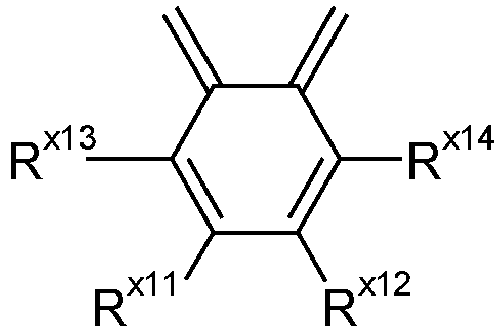 R11, R12 gleich oder verschieden H, F, geradkettiges oder verzweigtes Alkyl mit 1 bis 25 C-Atomen bedeuten, worin zusätzlich eine oder mehrere nicht benachbarte CH2-Gruppen jeweils unabhängig voneinander so durch -C(Rz)=C(Rz)-, -C≡C-, -N(Rz)-, -O-, -S-, -CO-, -CO-O-, -O-CO- oder -O-CO-O- ersetzt sein können, dass O- und/oder S-Atome nicht direkt miteinander verknüpft sind, und worin zusätzlich ein oder mehrere H-Atome durch F, Cl, Br, I oder CN ersetzt sein können,Rz bei jedem Auftreten gleich oder verschieden H, Halogen, geradkettiges, verzweigtes oder cyclisches Alkyl mit 1 bis 25 C-Atomen bedeutet, worin zusätzlich eine oder mehrere nicht benachbarte CH2-Gruppen so durch -O-, -S-, -CO-, -CO-O-, -O-CO- oder -O-CO-O- ersetzt sein können, dass O- und/oder S-Atome nicht direkt miteinander verknüpft sind, und worin zusätzlich ein oder mehrere H-Atome durch F oder Cl ersetzt sein können,A11, A12 jeweils unabhängig voneinander eine Aryl- oder Heteroarylgruppe bedeuten, die durch einen oder mehrere Reste L substituiert sein kann,A21, A22 jeweils unabhängig voneinander wie A11 definiert sind oder eine cyclische Alkylgruppe mit 3 bis 10 C-Atomen bedeuten, worin 1 bis 4 CH2-Gruppen so durch O ersetzt sein können, dass keine zwei O-Atome benachbart sind,L bei jedem Auftreten gleich oder verschieden OH, CH2OH, F, Cl, Br, I, -CN, -NO2, SF5, -NCO, -NCS, -OCN, -SCN, -C(=O)N(Rz)2, -C(=O)Rz, -N(Rz)2, gegebenenfalls substituiertes Silyl, gegebenenfalls substituiertes Aryl mit 6 bis 20 C-Atomen oder geradkettiges oder verzweigtes Alkyl, Alkoxy, Alkylcarbonyl, Alkoxycarbonyl, Alkylcarbonyloxy oder Alkoxycarbonyloxy mit 1 bis 25 C-Atomen, worin zusätzlich ein oder mehrere H-Atome durch F oder Cl ersetzt sein können, eine Aryl- oder Heteroarylgruppe, die durch einen oder mehrere Reste L substituiert sein kann, bedeutet und alternativ zwei benachbarte Gruppen L zusammen auch eine geradkettige oder verzweigte Alkylengruppe mit 2 bis 10 C-Atomen bedeuten, worin ein, mehrere oder alle H-Atome durch F ersetzt sein können und worin eine oder mehrere -CH2CH2-Gruppen durch -CH=CH- ersetzt sein können,Z10, Z11, Z12 bei jedem Auftreten gleich oder verschieden eine Einfachbindung, -N=N-, -CH=N-, -N=CH-, -N=N(O)-, -N(O)=N-, -CRx1=CRx2-, -(CRx1=CRx2)2-, -C≡C-, -C(=O)-, -CH=CH-C(=O)-, -C(=O)-CH=CH-, -CH=CH-COO- oder -OCO-CH=CH- bedeuten,Z21, Z22 bei jedem Auftreten gleich oder verschieden eine der Bedeutungen von Z10 besitzen oder -O-, -S-, -CRy1Ry2-, -CF2O-, -OCF2-, -C(O)-O-, -O-C(O)-, -O-C(O)-O-, -OCH2-, -CH2O-, -SCH2-, -CH2S-, -CF2S-, -SCF2-, -(CH2)n1-, -CF2CH2-, -CH2CF2- oder -(CF2)n1- bedeuten,Rx1, Rx2 unabhängig voneinander H, F, Cl, CN oder Alkyl mit 1-12 C-Atomen bedeuten,Ry1, Ry2 jeweils unabhängig voneinander H oder Alkyl mit 1-12 C-Atomen bedeuten,Rx11, Rx12, Rx13, Rx14 unabhängig voneinander H, F, Cl, CN, Alkyl, Alkenyl, Alkoxy oder Alkenyloxy mit 1-12 C-Atomen bedeuten,r und t unabhängig voneinander 0, 1 oder 2 bedeuten,s 0 oder 1 bedeutet, undn1 1, 2, 3 oder 4 bedeutet,und bei dem einer oder mehrere von Z10, Z11, Z12, Z21, Z22 -N=N-bedeuten,
undgegebenenfalls weitere dichroitische Farbstoffe,
undeine flüssigkristalline Komponente B), auch als "FK-Host-Mischung" bezeichnet, die eine oder mehrere mesogene Verbindungen enthält,
enthält. - FK-Medium nach Anspruch 1, bei dem W11 und W12 in Formel I S bedeuten.
- FK-Medium nach Anspruch 1, bei dem die eine oder mehreren Verbindungen der Formel I ausgewählt sind aus der Gruppe der Verbindungen der folgenden Unterformeln,


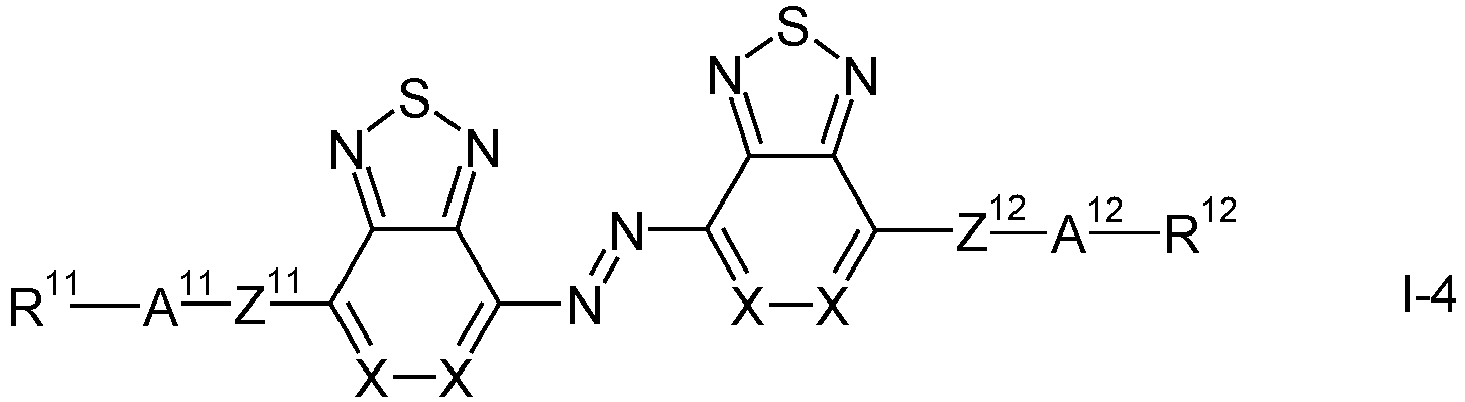
- FK-Medium nach einem oder mehreren der Ansprüche 1 bis 3, bei dem A11 und A12 in Formel I gleich oder verschieden 1,4-Phenylen, 1,4-Naphthylen, 2,6-Naphthylen, Thiazol-2,5-diyl, Thiophen-2,5-diyl oder Thienothiophen-2,5-diyl bedeuten, bei denen gegebenenfalls ein oder mehrere H-Atome durch eine Gruppe L wie in Anspruch 1 definiert ersetzt sind.
- FK-Medium nach einem oder mehreren der Ansprüche 1 bis 4, bei dem in Formel I

 Rx11, Rx12, Rx13, Rx14 unabhängig voneinander H, F, Cl, CN, Alkyl, Alkenyl, Alkoxy oder Alkenyloxy mit jeweils 1-12 C-Atomen bedeuten.
 - FK-Medium nach einem oder mehreren der Ansprüche 1 bis 5, bei dem Z11, Z12, Z22 in Formel I gleich oder verschieden eine Einfachbindung, -CRx1=CRx2- oder -C≡C- bedeuten, worin Rx1 und Rx2 die in Anspruch 1 genannten Bedeutungen besitzen.
- FK-Medium nach einem oder mehreren der Ansprüche 1 bis 6, bei dem R11 und R12 in Formel I unabhängig voneinander eine verzweigte Alkylgruppe mit 3 bis 25 C-Atomen bedeuten, worin ein oder mehrere H-Atome durch F ersetzt sein können, eine oder mehrere CH2-Gruppen durch O und/oder NH ersetzt sein können und eine oder mehrere CH-Gruppen durch N ersetzt sein können.
- FK-Medium nach einem oder mehreren der Ansprüche 1 bis 7, bei dem das Medium eine FK-Host-Mischung mit negativer dielektrischer Anisotropie enthält, die eine oder mehrere Verbindungen enthält, die ausgewählt sind aus der Gruppe der Verbindungen der Formeln CY, PY und AC


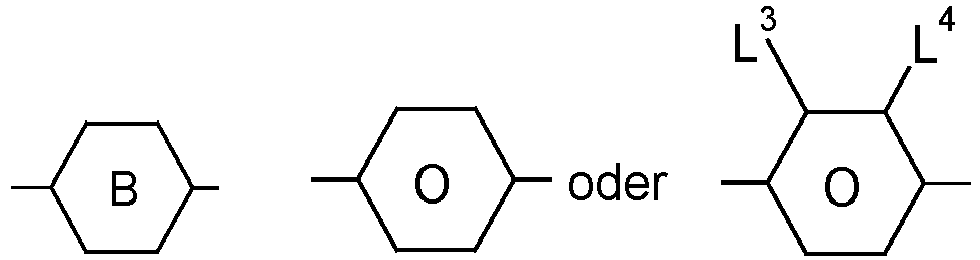
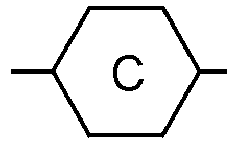


 R1, R2, RAC1, RAC2 jeweils unabhängig voneinander Alkyl mit 1 bis 12 C-Atomen bedeuten, wobei zusätzlich eine oder zwei nicht benachbarte CH2-Gruppen so durch -O-, -CH=CH-, -CO-, -OCO- oder -COO- ersetzt sein können, dass O-Atome nicht direkt miteinander verknüpft sind,Zx , Zy, ZAC jeweils unabhängig voneinander -CH2CH2-, -CH=CH-, -CF2O-, -OCF2-, -CH2O-, -OCH2-, -CO-O-, -O-CO-, -C2F4-, -CF=CF-, -CH=CH-CH2O- oder eine Einfachbindung bedeuten,L1-4 jeweils unabhängig voneinander F, Cl, CN, OCF3, CF3, CH3, CH2F, CHF2 bedeuten.a 1 oder 2 ist,b 0 oder 1 ist,c 0, 1 oder 2 ist,d 0 oder 1 ist.
 - FK-Medium nach einem oder mehreren der Ansprüche 1 bis 7, bei dem das Medium eine FK-Host-Mischung mit positiver dielektrischer Anisotropie enthält, die eine oder mehrere Verbindungen enthält, die ausgewählt sind aus der Gruppe der Verbindungen der Formeln II bis VIII


 R20 jeweils gleich oder verschieden einen halogenierten oder unsubstituierten Alkyl- oder Alkoxyrest mit 1 bis 15 C-Atomen bedeuten, wobei in diesen Resten zusätzlich eine oder mehrere CH2-Gruppen jeweils unabhängig voneinander so durch -C≡C-, -CF2O-, -CH=CH-,
 X20 jeweils gleich oder verschieden F, Cl, CN, SF5, SCN, NCS, einen halogenierten Alkylrest, einen halogenierten Alkenylrest, einen halogenierten Alkoxyrest oder einen halogenierten Alkenyloxyrest mit jeweils bis zu 6 C-Atomen bedeuten, undY20-24 jeweils gleich oder verschieden H oder F bedeuten;Z20 -C2H4-, -(CH2)4-, -CH=CH-, -CF=CF-, -C2F4-, -CH2CF2-, -CF2CH2-, -CH2O-, -OCH2-, -COO- oder -OCF2-, in den Formeln V und VI auch eine Einfachbindung, in den Formeln V und VIII auch -CF2O- bedeutet,r 0 oder 1 bedeutet, unds 0 oder 1 bedeutet.
 - FK-Medium nach einem oder mehreren der Ansprüche 1 bis 9, bei dem das Medium eine oder mehrere Verbindungen enthält, die ausgewählt sind aus der Gruppe der Verbindungen der Formeln DK und O

 R5, R6, RO1 und RO2 jeweils unabhängig voneinander Alkyl mit 1 bis 12 C-Atomen bedeuten, wobei zusätzlich eine oder zwei nicht benachbarte CH2-Gruppen so durch -O-, -CH=CH-, -CO-, -OCO- oder -COO- ersetzt sein können, dass O-Atome nicht direkt miteinander verknüpft sind,



 ZO1 -CH2CH2-, -CF2CF2-, -C=C- oder eine Einfachbindung bedeutet,ZO2 CH2O, -C(O)O-, -CH2CH2-, -CF2CF2- oder eine Einfachbindung bedeutet,o 1 oder 2 ist,e 1 oder 2 ist.
 - FK-Medium nach Anspruch 10, dadurch gekennzeichnet, dass es eine oder mehrere Verbindungen der Formel O enthält, die ausgewählt sind aus der Gruppe der Verbindungen der Unterformeln O3 bis O5



- FK-Medium nach Anspruch 10, dadurch gekennzeichnet, dass es eine oder mehrere Verbindungen der Formel DK enthält, die ausgewählt sind aus der Gruppe der Verbindungen der Unterformeln DK1 bis DK12:





- Vorrichtung zur Regulierung des Energiedurchtritts von einem Außenraum in einen Innenraum, bei der die Vorrichtung eine Schaltschicht enthaltend ein FK-Medium nach einem oder mehreren der Ansprüche 1 bis 12 enthält.
- Fenster enthaltend eine Vorrichtung nach Anspruch 13.
- Verbindung der Formel I wie in den Ansprüchen 1 bis 6 definiert, bei der R11 und R12 unabhängig voneinander eine verzweigte Alkylgruppe mit 3 bis 25 C-Atomen bedeuten, worin ein oder mehrere H-Atome durch F ersetzt sein können, eine oder mehrere CH2-Gruppen durch O und/oder NH ersetzt sein können und eine oder mehrere CH-Gruppen durch N ersetzt sein können.
- Verwendung der Verbindung nach Anspruch 7 in elektrooptischen Anzeigen, Vorrichtungen zur Regulierung des Energiedurchtritts von einem Außenraum in einen Innenraum, elektrischen Halbleitern, organischen Feldeffekttransistoren (OFETs), gedruckten Schaltungen, Radiofrequenz-Identifikationselementen (RFIDs), organischen Leuchtdioden (OLEDs), Beleuchtungselementen, photovoltaischen Vorrichtungen, optischen Sensoren, Effektpigmenten, dekorativen Elementen oder als Farbstoff zum Färben von Polymeren.
Applications Claiming Priority (2)
| Application Number | Priority Date | Filing Date | Title |
|---|---|---|---|
| EP18196594 | 2018-09-25 | ||
| PCT/EP2019/075458 WO2020064591A1 (en) | 2018-09-25 | 2019-09-23 | Azo dye |
Publications (2)
| Publication Number | Publication Date |
|---|---|
| EP3856869A1 EP3856869A1 (de) | 2021-08-04 |
| EP3856869B1 true EP3856869B1 (de) | 2024-04-03 |
Family
ID=63683768
Family Applications (1)
| Application Number | Title | Priority Date | Filing Date |
|---|---|---|---|
| EP19779407.6A Active EP3856869B1 (de) | 2018-09-25 | 2019-09-23 | Azofarbstoff |
Country Status (7)
| Country | Link |
|---|---|
| US (1) | US11702597B2 (de) |
| EP (1) | EP3856869B1 (de) |
| JP (1) | JP7447099B2 (de) |
| KR (1) | KR102910078B1 (de) |
| CN (1) | CN113195684B (de) |
| TW (1) | TWI835865B (de) |
| WO (1) | WO2020064591A1 (de) |
Families Citing this family (1)
| Publication number | Priority date | Publication date | Assignee | Title |
|---|---|---|---|---|
| US11905266B2 (en) * | 2020-12-17 | 2024-02-20 | Korea Advanced Institute Of Science And Technology | Covalent organic framework and method of preparing the same |
Family Cites Families (65)
| Publication number | Priority date | Publication date | Assignee | Title |
|---|---|---|---|---|
| US3388114A (en) * | 1964-07-20 | 1968-06-11 | Daito Chemical Industry Co Ltd | Azo dyes derived from 4-amino benzothiazole-or benzothiadiazole groups |
| JPS55123673A (en) | 1979-03-16 | 1980-09-24 | Mitsui Toatsu Chem Inc | Liquid crystal color display device |
| JPS55152875A (en) | 1979-05-14 | 1980-11-28 | Mitsubishi Chem Ind | Anthraquinone dyestuff for cellulose containing fibers |
| JPS5652440U (de) | 1979-09-29 | 1981-05-09 | ||
| GB2065695B (en) | 1979-10-12 | 1984-07-25 | Hitachi Ltd | Guest-host type liquid crystal composition and liquid crystal display device using the same |
| JPS5657850A (en) | 1979-10-18 | 1981-05-20 | Nippon Kanko Shikiso Kenkyusho:Kk | Azo compound and dichromatic dye for liquid crystal consisting of the same |
| GB2065158A (en) | 1979-12-13 | 1981-06-24 | Standard Telephones Cables Ltd | Anthraquinone Dichroic Dyes |
| JPS56104984A (en) | 1980-01-24 | 1981-08-21 | Nippon Kanko Shikiso Kenkyusho:Kk | Bichromic pigment for yellow liquid crystal |
| DE3007198A1 (de) | 1980-02-26 | 1981-09-03 | Siemens AG, 1000 Berlin und 8000 München | Pleochroitischer anthrachinon-farbstoff, verfahren zu seiner herstellung und verwendung des farbstoffs |
| US4350603A (en) | 1980-06-30 | 1982-09-21 | General Electric Company | Novel tris-azo dyes and liquid crystal compositions made therewith |
| EP0043904A3 (de) | 1980-07-10 | 1982-03-31 | F. HOFFMANN-LA ROCHE & CO. Aktiengesellschaft | Farbstoffhaltige Mischungen, neue Farbstoffe und deren Verwendung in Flüssigkristallmischungen |
| GB2082196B (en) | 1980-07-29 | 1985-01-23 | Secr Defence | Liquid crystal materials containing anthraquinone pleochroic dyes |
| EP0044893B1 (de) | 1980-07-29 | 1984-09-19 | Imperial Chemical Industries Plc | Anthrachinon-Verbindungen und Verfahren zu ihrer Herstellung |
| GB2081736B (en) | 1980-07-29 | 1985-02-20 | Secr Defence | Liquid crystal materials containing diamino-dihydroxy anthraquinone pleochroic dyes |
| US4308161A (en) | 1980-08-04 | 1981-12-29 | General Electric Company | Novel yellow azo dyes and dichroic liquid crystal compositions made therewith |
| EP0047027A1 (de) | 1980-08-22 | 1982-03-10 | BBC Aktiengesellschaft Brown, Boveri & Cie. | Flüssigkristallmischung |
| JPS5755984A (en) | 1980-09-22 | 1982-04-03 | Hitachi Ltd | Liquid crystal composition |
| JPS5763377A (en) | 1980-10-03 | 1982-04-16 | Mitsui Toatsu Chem Inc | Liquid crystal composition for color display |
| DE3040102A1 (de) | 1980-10-24 | 1982-06-03 | Merck Patent Gmbh, 6100 Darmstadt | Dichroitische anthrachinonfarbstoffe, diese enthaltende fluessigkristalline dielektrika und elektrooptisches anzeigeelement |
| US4308162A (en) | 1980-12-08 | 1981-12-29 | General Electric Company | Novel yellow azo dyes and dichroic liquid crystal compositions made therewith |
| DE3046904A1 (de) | 1980-12-12 | 1982-07-15 | Bayer Ag, 5090 Leverkusen | Anthrachinonfarbstoffe, verfahren zu ihrer herstellung ihre verwendung sowie fluessigkristalline materialien enthaltend anthrachinonfarbstoffe |
| EP0056492B1 (de) | 1981-01-10 | 1984-12-12 | BASF Aktiengesellschaft | Farbstoffe für Flüssigkristallmischungen |
| DE3115147A1 (de) | 1981-04-15 | 1982-11-04 | Basf Ag, 6700 Ludwigshafen | Farbstoffe fuer fluessigkristallmischungen |
| JPS57126879A (en) | 1981-01-12 | 1982-08-06 | Sumitomo Chem Co Ltd | Liquid crystal display element |
| DE3201120A1 (de) | 1981-01-17 | 1982-10-21 | Hitachi, Ltd., Tokyo | Fluessigkristall-zusammensetzung |
| EP0142617B1 (de) | 1981-02-25 | 1987-07-22 | Imperial Chemical Industries Plc | Pleochroitische Anthrachinonfarbstoffe |
| GB2094822B (en) | 1981-02-25 | 1986-03-05 | Ici Plc | Anthraquinone dyes |
| DE3110960A1 (de) | 1981-03-20 | 1982-09-30 | Basf Ag, 6700 Ludwigshafen | Elektrophotographisches aufzeichnungsmaterial |
| DE3115762A1 (de) | 1981-04-18 | 1982-11-11 | Merck Patent Gmbh, 6100 Darmstadt | "dichroitische anthrachinonfarbstoffe, diese enthaltende fluessigkristalline dielektrika und elektrooprisches anzeigeelement" |
| DE3123519A1 (de) | 1981-06-13 | 1982-12-30 | Bayer Ag, 5090 Leverkusen | Fluessigkristallines material enthaltend azofarbstoffe |
| JPS581775A (ja) | 1981-06-26 | 1983-01-07 | Mitsubishi Chem Ind Ltd | 液晶組成物 |
| DE3126108A1 (de) | 1981-07-02 | 1983-01-20 | Merck Patent Gmbh, 6100 Darmstadt | "fluessigkristallines dielektrikum, neue dichroitische naphthochinonfarbstoffe und elektrooptisches anzeigeelement" |
| DE3202761A1 (de) | 1982-01-28 | 1983-08-04 | Merck Patent Gmbh, 6100 Darmstadt | Fluessigkristallines dielektrikum, neue farbstoffe, verfahren zu ihrer herstellung und elektrooptisches anzeigeelement |
| US6025897A (en) | 1993-12-21 | 2000-02-15 | 3M Innovative Properties Co. | Display with reflective polarizer and randomizing cavity |
| JPH07181439A (ja) | 1993-12-24 | 1995-07-21 | Hitachi Ltd | アクティブマトリクス型液晶表示装置 |
| JP3543351B2 (ja) | 1994-02-14 | 2004-07-14 | 株式会社日立製作所 | アクティブマトリクス型液晶表示装置 |
| TW262553B (de) | 1994-03-17 | 1995-11-11 | Hitachi Seisakusyo Kk | |
| EP0698649A1 (de) | 1994-08-26 | 1996-02-28 | Basf Aktiengesellschaft | Verwendung von thermoplastisch verarbeitbaren, langzeitstabilen elektrolumineszenten Materialien |
| CN1125158C (zh) | 1995-02-03 | 2003-10-22 | 默克专利股份有限公司 | 电光液晶显示器 |
| DE19528107B4 (de) | 1995-03-17 | 2010-01-21 | Merck Patent Gmbh | Flüssigkristallines Medium und seine Verwendung in einer elektrooptischen Flüssigkristallanzeige |
| DE19528106A1 (de) | 1995-02-03 | 1996-08-08 | Merck Patent Gmbh | Elektrooptische Flüssigkristallanzeige |
| DE19509410A1 (de) | 1995-03-15 | 1996-09-19 | Merck Patent Gmbh | Elektrooptische Flüssigkristallanzeige |
| JPH09137166A (ja) | 1995-11-10 | 1997-05-27 | Chisso Corp | 液晶組成物及び液晶表示素子 |
| US6033598A (en) | 1995-11-10 | 2000-03-07 | Mitsubishi Chemical Corporation | Liquid-crystal composition and liquid-crystal display element |
| US6099758A (en) | 1997-09-17 | 2000-08-08 | Merck Patent Gesellschaft Mit Beschrankter Haftung | Broadband reflective polarizer |
| US7023602B2 (en) | 1999-05-17 | 2006-04-04 | 3M Innovative Properties Company | Reflective LCD projection system using wide-angle Cartesian polarizing beam splitter and color separation and recombination prisms |
| ATE354623T1 (de) | 2002-07-06 | 2007-03-15 | Merck Patent Gmbh | Flüssigkristallines medium |
| WO2004103981A1 (en) * | 2003-05-16 | 2004-12-02 | Dow Global Technologies Inc. | Process for preparing a 4,7-bis(5-halothien-2-yl)-2,1,3-benzothiadiazole and a precursor therefor |
| EP1843407A1 (de) | 2006-04-07 | 2007-10-10 | Basf Aktiengesellschaft | Flüssig-kristalline Rylentetracarbonsäurederivate und deren Verwendung |
| US7826009B2 (en) | 2006-12-21 | 2010-11-02 | 3M Innovative Properties Company | Hybrid polarizer |
| CN102037565B (zh) | 2008-05-21 | 2014-10-29 | 皮尔普拉斯有限公司 | 具有各向异性发光材料的光学器件 |
| CN101324752B (zh) * | 2008-07-21 | 2012-07-25 | 上海天臣防伪技术股份有限公司 | 可以记录反射全息的聚合物液晶感光材料制备方法 |
| EP2166040A1 (de) | 2008-09-22 | 2010-03-24 | Radiant Color N.V. | Neue lipophile fluoreszierende Farbstoffe und ein Prozess für ihre Produktion |
| CN102460238A (zh) | 2009-04-10 | 2012-05-16 | 雷文布里克有限责任公司 | 结合有宾主型结构的热切换滤光器 |
| DE102011118786A1 (de) | 2010-12-17 | 2012-06-21 | Merck Patent Gmbh | Flüssigkristallines Medium |
| US9249356B2 (en) | 2011-07-05 | 2016-02-02 | Peer+ B.V. | Liquid crystal dye mixture |
| ITMI20111516A1 (it) * | 2011-08-08 | 2013-02-09 | Eni Spa | Procedimento per la preparazione di composti benzoetero[1,3]diazolici disostituiti con gruppi eteroarilici |
| KR102171901B1 (ko) | 2012-12-13 | 2020-11-02 | 메르크 파텐트 게엠베하 | 액정 매질 |
| KR102234246B1 (ko) | 2013-05-24 | 2021-04-01 | 메르크 파텐트 게엠베하 | 이색성 염료를 함유하는, 에너지 통과를 조절하기 위한 장치 |
| JP6135608B2 (ja) | 2014-06-25 | 2017-05-31 | トヨタ自動車株式会社 | 車両用駆動装置 |
| WO2016096084A1 (en) * | 2014-12-19 | 2016-06-23 | Merck Patent Gmbh | Liquid-crystalline medium and high-frequency components comprising same |
| DE102015005800A1 (de) * | 2015-05-06 | 2016-11-10 | Merck Patent Gmbh | Thiadiazolochinoxalinderivate |
| KR102357223B1 (ko) | 2016-04-08 | 2022-02-03 | 메르크 파텐트 게엠베하 | 기능성 물질의 합성을 위한 중간체 및 절차 |
| KR20190023089A (ko) | 2016-06-28 | 2019-03-07 | 메르크 파텐트 게엠베하 | 액정 매질 |
| JP6972103B2 (ja) | 2016-07-19 | 2021-11-24 | メルク・パテント・ゲゼルシヤフト・ミツト・ベシユレンクテル・ハフツングMerck Patent GmbH | 液晶媒体 |
-
2019
- 2019-09-23 JP JP2021516791A patent/JP7447099B2/ja active Active
- 2019-09-23 US US17/278,953 patent/US11702597B2/en active Active
- 2019-09-23 WO PCT/EP2019/075458 patent/WO2020064591A1/en not_active Ceased
- 2019-09-23 EP EP19779407.6A patent/EP3856869B1/de active Active
- 2019-09-23 CN CN201980061899.9A patent/CN113195684B/zh active Active
- 2019-09-23 KR KR1020217012133A patent/KR102910078B1/ko active Active
- 2019-09-24 TW TW108134400A patent/TWI835865B/zh active
Also Published As
| Publication number | Publication date |
|---|---|
| KR102910078B1 (ko) | 2026-01-12 |
| CN113195684A (zh) | 2021-07-30 |
| EP3856869A1 (de) | 2021-08-04 |
| TW202024245A (zh) | 2020-07-01 |
| TWI835865B (zh) | 2024-03-21 |
| JP7447099B2 (ja) | 2024-03-11 |
| US20230056437A1 (en) | 2023-02-23 |
| CN113195684B (zh) | 2024-10-29 |
| KR20210069062A (ko) | 2021-06-10 |
| JP2022502540A (ja) | 2022-01-11 |
| US11702597B2 (en) | 2023-07-18 |
| WO2020064591A1 (en) | 2020-04-02 |
Similar Documents
| Publication | Publication Date | Title |
|---|---|---|
| EP3487955B1 (de) | Flüssigkristallines medium | |
| EP3884011B1 (de) | Dichroitische farbstoffzusammensetzung | |
| EP3810725B1 (de) | Flüssigkristallines medium | |
| EP3475389B1 (de) | Flüssigkristallines medium | |
| US11667845B2 (en) | Liquid crystalline medium | |
| EP3856869B1 (de) | Azofarbstoff | |
| WO2024251656A1 (en) | Liquid crystalline medium | |
| EP4588991A1 (de) | Flüssigkristallines medium |
Legal Events
| Date | Code | Title | Description |
|---|---|---|---|
| STAA | Information on the status of an ep patent application or granted ep patent |
Free format text: STATUS: UNKNOWN |
|
| STAA | Information on the status of an ep patent application or granted ep patent |
Free format text: STATUS: THE INTERNATIONAL PUBLICATION HAS BEEN MADE |
|
| PUAI | Public reference made under article 153(3) epc to a published international application that has entered the european phase |
Free format text: ORIGINAL CODE: 0009012 |
|
| STAA | Information on the status of an ep patent application or granted ep patent |
Free format text: STATUS: REQUEST FOR EXAMINATION WAS MADE |
|
| 17P | Request for examination filed |
Effective date: 20210323 |
|
| AK | Designated contracting states |
Kind code of ref document: A1 Designated state(s): AL AT BE BG CH CY CZ DE DK EE ES FI FR GB GR HR HU IE IS IT LI LT LU LV MC MK MT NL NO PL PT RO RS SE SI SK SM TR |
|
| DAV | Request for validation of the european patent (deleted) | ||
| DAX | Request for extension of the european patent (deleted) | ||
| STAA | Information on the status of an ep patent application or granted ep patent |
Free format text: STATUS: EXAMINATION IS IN PROGRESS |
|
| 17Q | First examination report despatched |
Effective date: 20230223 |
|
| P01 | Opt-out of the competence of the unified patent court (upc) registered |
Effective date: 20230519 |
|
| GRAP | Despatch of communication of intention to grant a patent |
Free format text: ORIGINAL CODE: EPIDOSNIGR1 |
|
| STAA | Information on the status of an ep patent application or granted ep patent |
Free format text: STATUS: GRANT OF PATENT IS INTENDED |
|
| INTG | Intention to grant announced |
Effective date: 20231011 |
|
| GRAJ | Information related to disapproval of communication of intention to grant by the applicant or resumption of examination proceedings by the epo deleted |
Free format text: ORIGINAL CODE: EPIDOSDIGR1 |
|
| STAA | Information on the status of an ep patent application or granted ep patent |
Free format text: STATUS: EXAMINATION IS IN PROGRESS |
|
| GRAP | Despatch of communication of intention to grant a patent |
Free format text: ORIGINAL CODE: EPIDOSNIGR1 |
|
| STAA | Information on the status of an ep patent application or granted ep patent |
Free format text: STATUS: GRANT OF PATENT IS INTENDED |
|
| INTC | Intention to grant announced (deleted) | ||
| INTG | Intention to grant announced |
Effective date: 20240105 |
|
| GRAS | Grant fee paid |
Free format text: ORIGINAL CODE: EPIDOSNIGR3 |
|
| GRAA | (expected) grant |
Free format text: ORIGINAL CODE: 0009210 |
|
| STAA | Information on the status of an ep patent application or granted ep patent |
Free format text: STATUS: THE PATENT HAS BEEN GRANTED |
|
| AK | Designated contracting states |
Kind code of ref document: B1 Designated state(s): AL AT BE BG CH CY CZ DE DK EE ES FI FR GB GR HR HU IE IS IT LI LT LU LV MC MK MT NL NO PL PT RO RS SE SI SK SM TR |
|
| REG | Reference to a national code |
Ref country code: CH Ref legal event code: EP |
|
| REG | Reference to a national code |
Ref country code: DE Ref legal event code: R096 Ref document number: 602019049575 Country of ref document: DE |
|
| REG | Reference to a national code |
Ref country code: IE Ref legal event code: FG4D |
|
| REG | Reference to a national code |
Ref country code: NL Ref legal event code: FP |
|
| REG | Reference to a national code |
Ref country code: LT Ref legal event code: MG9D |
|
| PGFP | Annual fee paid to national office [announced via postgrant information from national office to epo] |
Ref country code: NL Payment date: 20240705 Year of fee payment: 6 |
|
| REG | Reference to a national code |
Ref country code: AT Ref legal event code: MK05 Ref document number: 1672331 Country of ref document: AT Kind code of ref document: T Effective date: 20240403 |
|
| PG25 | Lapsed in a contracting state [announced via postgrant information from national office to epo] |
Ref country code: IS Free format text: LAPSE BECAUSE OF FAILURE TO SUBMIT A TRANSLATION OF THE DESCRIPTION OR TO PAY THE FEE WITHIN THE PRESCRIBED TIME-LIMIT Effective date: 20240803 |
|
| PG25 | Lapsed in a contracting state [announced via postgrant information from national office to epo] |
Ref country code: BG Free format text: LAPSE BECAUSE OF FAILURE TO SUBMIT A TRANSLATION OF THE DESCRIPTION OR TO PAY THE FEE WITHIN THE PRESCRIBED TIME-LIMIT Effective date: 20240403 |
|
| PG25 | Lapsed in a contracting state [announced via postgrant information from national office to epo] |
Ref country code: HR Free format text: LAPSE BECAUSE OF FAILURE TO SUBMIT A TRANSLATION OF THE DESCRIPTION OR TO PAY THE FEE WITHIN THE PRESCRIBED TIME-LIMIT Effective date: 20240403 Ref country code: FI Free format text: LAPSE BECAUSE OF FAILURE TO SUBMIT A TRANSLATION OF THE DESCRIPTION OR TO PAY THE FEE WITHIN THE PRESCRIBED TIME-LIMIT Effective date: 20240403 |
|
| PG25 | Lapsed in a contracting state [announced via postgrant information from national office to epo] |
Ref country code: GR Free format text: LAPSE BECAUSE OF FAILURE TO SUBMIT A TRANSLATION OF THE DESCRIPTION OR TO PAY THE FEE WITHIN THE PRESCRIBED TIME-LIMIT Effective date: 20240704 |
|
| PG25 | Lapsed in a contracting state [announced via postgrant information from national office to epo] |
Ref country code: PT Free format text: LAPSE BECAUSE OF FAILURE TO SUBMIT A TRANSLATION OF THE DESCRIPTION OR TO PAY THE FEE WITHIN THE PRESCRIBED TIME-LIMIT Effective date: 20240805 |
|
| PG25 | Lapsed in a contracting state [announced via postgrant information from national office to epo] |
Ref country code: ES Free format text: LAPSE BECAUSE OF FAILURE TO SUBMIT A TRANSLATION OF THE DESCRIPTION OR TO PAY THE FEE WITHIN THE PRESCRIBED TIME-LIMIT Effective date: 20240403 |
|
| PG25 | Lapsed in a contracting state [announced via postgrant information from national office to epo] |
Ref country code: CZ Free format text: LAPSE BECAUSE OF FAILURE TO SUBMIT A TRANSLATION OF THE DESCRIPTION OR TO PAY THE FEE WITHIN THE PRESCRIBED TIME-LIMIT Effective date: 20240403 |
|
| PG25 | Lapsed in a contracting state [announced via postgrant information from national office to epo] |
Ref country code: AT Free format text: LAPSE BECAUSE OF FAILURE TO SUBMIT A TRANSLATION OF THE DESCRIPTION OR TO PAY THE FEE WITHIN THE PRESCRIBED TIME-LIMIT Effective date: 20240403 |
|
| PG25 | Lapsed in a contracting state [announced via postgrant information from national office to epo] |
Ref country code: PL Free format text: LAPSE BECAUSE OF FAILURE TO SUBMIT A TRANSLATION OF THE DESCRIPTION OR TO PAY THE FEE WITHIN THE PRESCRIBED TIME-LIMIT Effective date: 20240403 |
|
| PG25 | Lapsed in a contracting state [announced via postgrant information from national office to epo] |
Ref country code: LV Free format text: LAPSE BECAUSE OF FAILURE TO SUBMIT A TRANSLATION OF THE DESCRIPTION OR TO PAY THE FEE WITHIN THE PRESCRIBED TIME-LIMIT Effective date: 20240403 |
|
| PG25 | Lapsed in a contracting state [announced via postgrant information from national office to epo] |
Ref country code: PT Free format text: LAPSE BECAUSE OF FAILURE TO SUBMIT A TRANSLATION OF THE DESCRIPTION OR TO PAY THE FEE WITHIN THE PRESCRIBED TIME-LIMIT Effective date: 20240805 Ref country code: PL Free format text: LAPSE BECAUSE OF FAILURE TO SUBMIT A TRANSLATION OF THE DESCRIPTION OR TO PAY THE FEE WITHIN THE PRESCRIBED TIME-LIMIT Effective date: 20240403 Ref country code: NO Free format text: LAPSE BECAUSE OF FAILURE TO SUBMIT A TRANSLATION OF THE DESCRIPTION OR TO PAY THE FEE WITHIN THE PRESCRIBED TIME-LIMIT Effective date: 20240703 Ref country code: LV Free format text: LAPSE BECAUSE OF FAILURE TO SUBMIT A TRANSLATION OF THE DESCRIPTION OR TO PAY THE FEE WITHIN THE PRESCRIBED TIME-LIMIT Effective date: 20240403 Ref country code: IS Free format text: LAPSE BECAUSE OF FAILURE TO SUBMIT A TRANSLATION OF THE DESCRIPTION OR TO PAY THE FEE WITHIN THE PRESCRIBED TIME-LIMIT Effective date: 20240803 Ref country code: HR Free format text: LAPSE BECAUSE OF FAILURE TO SUBMIT A TRANSLATION OF THE DESCRIPTION OR TO PAY THE FEE WITHIN THE PRESCRIBED TIME-LIMIT Effective date: 20240403 Ref country code: GR Free format text: LAPSE BECAUSE OF FAILURE TO SUBMIT A TRANSLATION OF THE DESCRIPTION OR TO PAY THE FEE WITHIN THE PRESCRIBED TIME-LIMIT Effective date: 20240704 Ref country code: FI Free format text: LAPSE BECAUSE OF FAILURE TO SUBMIT A TRANSLATION OF THE DESCRIPTION OR TO PAY THE FEE WITHIN THE PRESCRIBED TIME-LIMIT Effective date: 20240403 Ref country code: ES Free format text: LAPSE BECAUSE OF FAILURE TO SUBMIT A TRANSLATION OF THE DESCRIPTION OR TO PAY THE FEE WITHIN THE PRESCRIBED TIME-LIMIT Effective date: 20240403 Ref country code: CZ Free format text: LAPSE BECAUSE OF FAILURE TO SUBMIT A TRANSLATION OF THE DESCRIPTION OR TO PAY THE FEE WITHIN THE PRESCRIBED TIME-LIMIT Effective date: 20240403 Ref country code: BG Free format text: LAPSE BECAUSE OF FAILURE TO SUBMIT A TRANSLATION OF THE DESCRIPTION OR TO PAY THE FEE WITHIN THE PRESCRIBED TIME-LIMIT Effective date: 20240403 Ref country code: AT Free format text: LAPSE BECAUSE OF FAILURE TO SUBMIT A TRANSLATION OF THE DESCRIPTION OR TO PAY THE FEE WITHIN THE PRESCRIBED TIME-LIMIT Effective date: 20240403 Ref country code: RS Free format text: LAPSE BECAUSE OF FAILURE TO SUBMIT A TRANSLATION OF THE DESCRIPTION OR TO PAY THE FEE WITHIN THE PRESCRIBED TIME-LIMIT Effective date: 20240703 |
|
| REG | Reference to a national code |
Ref country code: DE Ref legal event code: R097 Ref document number: 602019049575 Country of ref document: DE |
|
| PG25 | Lapsed in a contracting state [announced via postgrant information from national office to epo] |
Ref country code: DK Free format text: LAPSE BECAUSE OF FAILURE TO SUBMIT A TRANSLATION OF THE DESCRIPTION OR TO PAY THE FEE WITHIN THE PRESCRIBED TIME-LIMIT Effective date: 20240403 |
|
| PG25 | Lapsed in a contracting state [announced via postgrant information from national office to epo] |
Ref country code: EE Free format text: LAPSE BECAUSE OF FAILURE TO SUBMIT A TRANSLATION OF THE DESCRIPTION OR TO PAY THE FEE WITHIN THE PRESCRIBED TIME-LIMIT Effective date: 20240403 |
|
| PG25 | Lapsed in a contracting state [announced via postgrant information from national office to epo] |
Ref country code: RO Free format text: LAPSE BECAUSE OF FAILURE TO SUBMIT A TRANSLATION OF THE DESCRIPTION OR TO PAY THE FEE WITHIN THE PRESCRIBED TIME-LIMIT Effective date: 20240403 Ref country code: SK Free format text: LAPSE BECAUSE OF FAILURE TO SUBMIT A TRANSLATION OF THE DESCRIPTION OR TO PAY THE FEE WITHIN THE PRESCRIBED TIME-LIMIT Effective date: 20240403 |
|
| PG25 | Lapsed in a contracting state [announced via postgrant information from national office to epo] |
Ref country code: SM Free format text: LAPSE BECAUSE OF FAILURE TO SUBMIT A TRANSLATION OF THE DESCRIPTION OR TO PAY THE FEE WITHIN THE PRESCRIBED TIME-LIMIT Effective date: 20240403 |
|
| PG25 | Lapsed in a contracting state [announced via postgrant information from national office to epo] |
Ref country code: SM Free format text: LAPSE BECAUSE OF FAILURE TO SUBMIT A TRANSLATION OF THE DESCRIPTION OR TO PAY THE FEE WITHIN THE PRESCRIBED TIME-LIMIT Effective date: 20240403 Ref country code: SK Free format text: LAPSE BECAUSE OF FAILURE TO SUBMIT A TRANSLATION OF THE DESCRIPTION OR TO PAY THE FEE WITHIN THE PRESCRIBED TIME-LIMIT Effective date: 20240403 Ref country code: RO Free format text: LAPSE BECAUSE OF FAILURE TO SUBMIT A TRANSLATION OF THE DESCRIPTION OR TO PAY THE FEE WITHIN THE PRESCRIBED TIME-LIMIT Effective date: 20240403 Ref country code: EE Free format text: LAPSE BECAUSE OF FAILURE TO SUBMIT A TRANSLATION OF THE DESCRIPTION OR TO PAY THE FEE WITHIN THE PRESCRIBED TIME-LIMIT Effective date: 20240403 Ref country code: DK Free format text: LAPSE BECAUSE OF FAILURE TO SUBMIT A TRANSLATION OF THE DESCRIPTION OR TO PAY THE FEE WITHIN THE PRESCRIBED TIME-LIMIT Effective date: 20240403 |
|
| PLBE | No opposition filed within time limit |
Free format text: ORIGINAL CODE: 0009261 |
|
| STAA | Information on the status of an ep patent application or granted ep patent |
Free format text: STATUS: NO OPPOSITION FILED WITHIN TIME LIMIT |
|
| 26N | No opposition filed |
Effective date: 20250106 |
|
| PG25 | Lapsed in a contracting state [announced via postgrant information from national office to epo] |
Ref country code: MC Free format text: LAPSE BECAUSE OF FAILURE TO SUBMIT A TRANSLATION OF THE DESCRIPTION OR TO PAY THE FEE WITHIN THE PRESCRIBED TIME-LIMIT Effective date: 20240403 Ref country code: SI Free format text: LAPSE BECAUSE OF FAILURE TO SUBMIT A TRANSLATION OF THE DESCRIPTION OR TO PAY THE FEE WITHIN THE PRESCRIBED TIME-LIMIT Effective date: 20240403 |
|
| REG | Reference to a national code |
Ref country code: CH Ref legal event code: PL |
|
| PG25 | Lapsed in a contracting state [announced via postgrant information from national office to epo] |
Ref country code: LU Free format text: LAPSE BECAUSE OF NON-PAYMENT OF DUE FEES Effective date: 20240923 |
|
| REG | Reference to a national code |
Ref country code: BE Ref legal event code: MM Effective date: 20240930 |
|
| PG25 | Lapsed in a contracting state [announced via postgrant information from national office to epo] |
Ref country code: BE Free format text: LAPSE BECAUSE OF NON-PAYMENT OF DUE FEES Effective date: 20240930 |
|
| PG25 | Lapsed in a contracting state [announced via postgrant information from national office to epo] |
Ref country code: FR Free format text: LAPSE BECAUSE OF NON-PAYMENT OF DUE FEES Effective date: 20240930 |
|
| PG25 | Lapsed in a contracting state [announced via postgrant information from national office to epo] |
Ref country code: CH Free format text: LAPSE BECAUSE OF NON-PAYMENT OF DUE FEES Effective date: 20240930 |
|
| PG25 | Lapsed in a contracting state [announced via postgrant information from national office to epo] |
Ref country code: IE Free format text: LAPSE BECAUSE OF NON-PAYMENT OF DUE FEES Effective date: 20240923 |
|
| PG25 | Lapsed in a contracting state [announced via postgrant information from national office to epo] |
Ref country code: SE Free format text: LAPSE BECAUSE OF FAILURE TO SUBMIT A TRANSLATION OF THE DESCRIPTION OR TO PAY THE FEE WITHIN THE PRESCRIBED TIME-LIMIT Effective date: 20240403 |
|
| PGFP | Annual fee paid to national office [announced via postgrant information from national office to epo] |
Ref country code: DE Payment date: 20250820 Year of fee payment: 7 |
|
| PGFP | Annual fee paid to national office [announced via postgrant information from national office to epo] |
Ref country code: GB Payment date: 20250820 Year of fee payment: 7 |
|
| PG25 | Lapsed in a contracting state [announced via postgrant information from national office to epo] |
Ref country code: IT Free format text: LAPSE BECAUSE OF FAILURE TO SUBMIT A TRANSLATION OF THE DESCRIPTION OR TO PAY THE FEE WITHIN THE PRESCRIBED TIME-LIMIT Effective date: 20240403 Ref country code: CY Free format text: LAPSE BECAUSE OF FAILURE TO SUBMIT A TRANSLATION OF THE DESCRIPTION OR TO PAY THE FEE WITHIN THE PRESCRIBED TIME-LIMIT; INVALID AB INITIO Effective date: 20190923 |
|
| PG25 | Lapsed in a contracting state [announced via postgrant information from national office to epo] |
Ref country code: HU Free format text: LAPSE BECAUSE OF FAILURE TO SUBMIT A TRANSLATION OF THE DESCRIPTION OR TO PAY THE FEE WITHIN THE PRESCRIBED TIME-LIMIT; INVALID AB INITIO Effective date: 20190923 |