EP3857268B1 - Récupération de signal fondée sur un apprentissage automatique - Google Patents
Récupération de signal fondée sur un apprentissage automatique Download PDFInfo
- Publication number
- EP3857268B1 EP3857268B1 EP19866442.7A EP19866442A EP3857268B1 EP 3857268 B1 EP3857268 B1 EP 3857268B1 EP 19866442 A EP19866442 A EP 19866442A EP 3857268 B1 EP3857268 B1 EP 3857268B1
- Authority
- EP
- European Patent Office
- Prior art keywords
- signal
- noise
- machine learning
- computer
- denoised
- Prior art date
- Legal status (The legal status is an assumption and is not a legal conclusion. Google has not performed a legal analysis and makes no representation as to the accuracy of the status listed.)
- Active
Links
Images




Classifications
-
- G—PHYSICS
- G01—MEASURING; TESTING
- G01V—GEOPHYSICS; GRAVITATIONAL MEASUREMENTS; DETECTING MASSES OR OBJECTS; TAGS
- G01V1/00—Seismology; Seismic or acoustic prospecting or detecting
- G01V1/28—Processing seismic data, e.g. for interpretation or for event detection
- G01V1/36—Effecting static or dynamic corrections on records, e.g. correcting spread; Correlating seismic signals; Eliminating effects of unwanted energy
- G01V1/364—Seismic filtering
-
- G—PHYSICS
- G06—COMPUTING OR CALCULATING; COUNTING
- G06N—COMPUTING ARRANGEMENTS BASED ON SPECIFIC COMPUTATIONAL MODELS
- G06N20/00—Machine learning
-
- H—ELECTRICITY
- H04—ELECTRIC COMMUNICATION TECHNIQUE
- H04Q—SELECTING
- H04Q9/00—Arrangements in telecontrol or telemetry systems for selectively calling a substation from a main station, in which substation desired apparatus is selected for applying a control signal thereto or for obtaining measured values therefrom
-
- G—PHYSICS
- G01—MEASURING; TESTING
- G01V—GEOPHYSICS; GRAVITATIONAL MEASUREMENTS; DETECTING MASSES OR OBJECTS; TAGS
- G01V2210/00—Details of seismic processing or analysis
- G01V2210/30—Noise handling
- G01V2210/32—Noise reduction
- G01V2210/324—Filtering
-
- G—PHYSICS
- G01—MEASURING; TESTING
- G01V—GEOPHYSICS; GRAVITATIONAL MEASUREMENTS; DETECTING MASSES OR OBJECTS; TAGS
- G01V2210/00—Details of seismic processing or analysis
- G01V2210/30—Noise handling
- G01V2210/32—Noise reduction
- G01V2210/324—Filtering
- G01V2210/3246—Coherent noise, e.g. spatially coherent or predictable
-
- G—PHYSICS
- G01—MEASURING; TESTING
- G01V—GEOPHYSICS; GRAVITATIONAL MEASUREMENTS; DETECTING MASSES OR OBJECTS; TAGS
- G01V2210/00—Details of seismic processing or analysis
- G01V2210/30—Noise handling
- G01V2210/32—Noise reduction
- G01V2210/324—Filtering
- G01V2210/3248—Incoherent noise, e.g. white noise
-
- G—PHYSICS
- G06—COMPUTING OR CALCULATING; COUNTING
- G06N—COMPUTING ARRANGEMENTS BASED ON SPECIFIC COMPUTATIONAL MODELS
- G06N7/00—Computing arrangements based on specific mathematical models
- G06N7/01—Probabilistic graphical models, e.g. probabilistic networks
-
- H—ELECTRICITY
- H04—ELECTRIC COMMUNICATION TECHNIQUE
- H04Q—SELECTING
- H04Q2209/00—Arrangements in telecontrol or telemetry systems
- H04Q2209/30—Arrangements in telecontrol or telemetry systems using a wired architecture
-
- H—ELECTRICITY
- H04—ELECTRIC COMMUNICATION TECHNIQUE
- H04Q—SELECTING
- H04Q2209/00—Arrangements in telecontrol or telemetry systems
- H04Q2209/40—Arrangements in telecontrol or telemetry systems using a wireless architecture
-
- H—ELECTRICITY
- H04—ELECTRIC COMMUNICATION TECHNIQUE
- H04Q—SELECTING
- H04Q2209/00—Arrangements in telecontrol or telemetry systems
- H04Q2209/80—Arrangements in the sub-station, i.e. sensing device
- H04Q2209/88—Providing power supply at the sub-station
- H04Q2209/883—Providing power supply at the sub-station where the sensing device enters an active or inactive mode
Definitions
- aspects of the present inventive concept generally relate to recovery of relatively weak signals that are contaminated by noise and learn otherwise non recoverable using conventional processing methods.
- Various types of data may be collected via use of one or a network of various types of sensors such as audio sensors, cameras, etc.
- Examples of such data can be seismic data collected in a field that can be analyzed to understand surface/subsurface seismic activity, surface temperature data, weather data, traffic data, etc.
- Such data may be contaminated by noise during the collection process.
- various conventional noise attenuation methods are utilized to recover signals representing the collected data. These conventional noise attenuation methods often use different characteristics in frequency, wave number or other transform domains to separate the signals representing the collected data from the noise.
- noise attenuating methods include, but are not limited to, f-x projection filtering for random noise attenuation, a prediction error filtering to estimate coherent signal in the f-x domain, using low-rank structure in the t-f domain to attenuate ice-break noise, etc.
- noise attenuation methods all involve a trade-off between preservation of the signals and the amount of filtered noise such that as noise attenuation increases, the target signals (e.g., seismic signals) are adversely affected. Moreover, some signals are several orders of magnitude lower than the contaminating noise. Therefore, these signals are lost/eliminated together with the noise during the filtering process, which adversely affect an accurate and complete analysis of the seismic data for underlying applications.
- target signals e.g., seismic signals
- US 2007/027660 A1 discloses a method for assembling an architectural site model facilitates repeated placement and removal of foliage to the model.
- the site model is constructed as an upper shell portion and a lower base portion.
- Model foliage is attached to the shell portion.
- the upper shell portion of the site model is configured for removable attachment to the lower base portion.
- WO 2014/195508 A2 discloses a method for de-noising seismic data recorded by seismic receivers including the steps of processing a first seismic data having a first signal-to-noise ratio (SNR) to derive a denoising operator; and applying the de-noising operator to a second seismic data having a second SNR to remove noise from the second seismic data wherein the first SNR is greater than the second SNR.
- SNR signal-to-noise ratio
- the present inventive concept provides a system and method to extract signals that represent underlying collected data from contaminating noise signals, and to prevent the loss of portions of such signals that are several orders of magnitude smaller than the noise signals, which may be referred to as weak signals or relatively weak signals.
- the system and method of the present inventive concept are operable to apply machine learning to preserve weak signals during a de-noising process for extracting the signals.
- a computer-implemented method of noise contaminated signal recovery includes receiving, at a server, a first signal including a first portion and a second portion, the first portion indicative of data collected by a plurality of sensors, the second portion representing noise; performing a first denoising process on the first signal to remove the noise to yield a first denoised signal; applying a machine learning model to determine a residual signal indicative of a difference between the first signal and the first denoised signal; and determining a second signal by adding the residual signal to the first denoised signal, the second signal comprising (i) signals of the first portion with higher magnitudes than the noise in the second portion, and (ii) signals of the first portion having lower magnitudes than the noise in the second portion.
- the method further includes training the machine learning model with the first denoised signal every time the server receives a different instance of the first signal and determines a corresponding first denoised signal.
- training the machine learning model includes determining a solution to an optimization problem using a k-singular value decomposition algorithm.
- training the machine learning model is unsupervised.
- determining the residual signal includes determining a solution to a dual domain sparse inversion problem using a sparse representation of the residual signal and the noise.
- solving the dual domain sparse inversion problem includes using a deterministic algorithm, the deterministic algorithm corresponding to one of a nonmonotone alternating direction method, or stochastic algorithm such as matching pursuit.
- a system for noise contaminated signal recovery includes memory having computer-readable instruction stored therein, and one or more processors.
- the one or more processors are configured to execute the computer-readable instructions to receive a signal contaminated by noise, the signal including data collected by a plurality of sensors, perform a denoising process on the signal to remove the noise to yield a denoised signal; apply the machine learning model to determine a residual signal indicative of a difference between the signal and the denoised signal; and determine the processed signal by adding the residual signal to the denoised signal.
- the one or more processors are configured to control the plurality of sensors to determine the residual signal by determining a solution to a dual domain sparse inversion problem using a sparse representation of the residual signal and the noise.
- the one or more processors are configured to execute the computer-readable instructions to train the machine learning model with the denoised signal every time a different instance of the signal is received and a corresponding denoised signal is determined.
- the one or more processors are configured to execute the computer-readable instructions to train the machine learning model by determining a solution to an optimization problem using a k-singular value decomposition algorithm.
- the training the machine learning model is unsupervised.
- the method comprises that determining the second signal is based on a single dictionary representing the noise trained using the machine learning model.
- the method comprises that determining the second signal is based on a dual dictionary representing the noise and the data, the dual dictionary being trained using the machine learning model.
- references to "one embodiment” or “an embodiment” means that a particular feature, structure, or characteristic described in connection with the example embodiment is included in at least one example embodiment of the present inventive concept.
- the appearances of the phrase “in one embodiment” in various places in the specification are not necessarily all referring to the same example embodiment, nor are separate or alternative example embodiments mutually exclusive of other example embodiments.
- various features are described which may be exhibited by some example embodiments and not by others.
- Environment or setting 100 illustrates a field 102 throughout which various types of sensors 104 may be deployed to collect one or more types of data.
- field 102 may be a large geographical area over land, sea, air, etc.
- the one or more types of data may include, but are not limited to, data on surface/subsurface seismic activity, surface/subsurface temperatures, movements of objects such as animals, radioactive substances, water flow, surface movement or displacement, etc.
- Sensors 104 may be any type of known or to be developed device capable of collecting the underlying data including, but not limited to, conventional cameras, infrared cameras, audio/video sensors, etc.
- sensors 104 may be equipped with known or to be developed components for communicating with other sensors and/or other network components such as access points 106 and/or processing center 110 (which may also be referred to as receiver 110 or server 110). These components can be wireless connection interfaces, ports for wired connection to other devices, etc.
- Setting 100 further includes one or more access points 106, which may include any type of known or to be developed access point such as a wireless access point, a base station, a 4G/5G node B, etc.
- access points 106 may include any type of known or to be developed access point such as a wireless access point, a base station, a 4G/5G node B, etc.
- Sensors 104 and access points 106 may communicate via any known or to be developed wired and/or wireless communication schemes and protocols.
- Access points 106 may be communicatively coupled to processing center 110 via internet 108.
- Processing center 110 may be a single unit or comprised of multiple units remotely placed from one another but communicatively coupled with one another.
- Processing center 110 may function to provide a network operator with the capability to access, monitor, manage and maintain access points 106 and/or sensors 104, as will be described below.
- FIG. 2 illustrates an example process for machine learning based signal recovery, according to an aspect of the present inventive concept.
- FIG. 2 will be described from the perspective of processing center 110.
- processing center 110 has components such as a processor and a memory (which will be described with reference to FIG. 7 ), where such processor executes computer-readable instructions stored on such memory to carry the functionalities described below with reference to FIG. 2 .
- processing center 200 may be a single processor (CPU), a cluster of processors (CPUs), a cloud computing environment, etc.
- processing center 110 may receive collected data from sensors 104 via one or more of access points 106, as described above with reference to FIG. 1 .
- processing center 110 may configure sensors 104 to collect such data continuously or for a specific period of time (e.g., for 24 hours, 48 hours, a week, a month, etc.).
- the collected data may be sent to processing center 110 by sensors 104 as a live stream as the data is being collected or may be sent all at once after collection (e.g., after the data is collected for the specified period of time).
- a command sent by processing center 110 to sensors 104 may trigger transmission of the collected data from sensors 104 to processing center 110.
- processing center 110 may group the collected data or portions thereof together to create a dataset to be analyzed. This grouping of the collected data or portions thereof may be based on timestamps associated with the received data. For example, when processing center 110 receives the collected data continuously, at S202, processing center 110 may select a portion of the data received over a specific period of time (last 24 hours, 48 hours, week, month, etc.) into a dataset to be analyzed.
- sensors 104 may not be operating continuously.
- processing center 110 may be able to turn them on and off.
- processing center 110 prior to S200, may turn sensors 104 on, receive the collected data for a specific period of time, turn sensor 104 off and then at S202 group the received data into a dataset.
- This dataset may be represented by d.
- processing center 110 may perform an initial filtering (denoising) process for filtering out (removing) the noise portion to the extent possible using any known or to be developed filtering/denoising process.
- the signal portion after the initial filtering process may be denoted as û (may be referred to as the initial filtering result).
- the initial filter process may apply a simple filtering method due to their efficiency such as an f-x deconvolution process or f-k filter with moveout correction to filter the noise portion or any other known or to be developed filtering methods or algorithms.
- the processing center 110 may rearrange (partition/divide) û into overlapping patches and vectorizes each path.
- a dictionary D may be trained using û . Accordingly, at S206, processing center 110 applies the initial filtering result ( û ) to train dictionary D.
- training dictionary D is based on formula (2) below: min D ,x û ⁇ Dx F 2 s .t . x 0 ⁇ T .
- T is a sparse threshold
- T represents the sparsity threshold
- ⁇ . ⁇ F denotes the Frobenius norm
- ⁇ . ⁇ 0 referred to as the I 0 norm counts the number of nonzero entries.
- Formula (3) is an example of an optimization problem that can be solved using a K- Singular Value Decomposition (K-SVD) algorithm. Adopting the idea of block coordinate descent, the K-SVD algorithm can reduce the I 0 minimization problem into two subproblems --sparse coding and dictionary updating.
- K-SVD K- Singular Value Decomposition
- the sparse coding aspect includes calculating the sparse coefficients through orthogonal matching pursuit (OMP) or a variant of OMP for a given dictionary D, while the dictionary updating step updates atoms by solving a series of rank-1 approximations to decrease the data misfit.
- Dictionary updating involves performing singular value decomposition repeatedly. To reduce the complexity of dictionary learning, exact singular value decomposition may be replaced with randomized singular value decomposition, or the solution thereof approximated by taking a single iteration of gradient descent.
- processing center 110 updates dictionary D with the solution to the optimization problem given by formula (3). Accordingly, as more and more data is collected, dictionary D is trained, which will then be used to extract relatively weak signals that may otherwise be filtered with noise using conventional noise filtering/ attenuation processes. The accuracy of the residual signal recovery using dictionary D increases as more and more data is used to train dictionary D.
- processing center 110 stores the updated dictionary D in a memory or an associated database of processing center 110.
- processing center 110 applies the stored dictionary D to derive a residual signal, which is a difference between d and û, given by formula (4) below:
- d ⁇ d ⁇ u ⁇ which denotes the residual signal with noise.
- the sparse representation of the residual signal, x 1 can be obtained by solving: min X 1 x 1 1 s .t . d ⁇ ⁇ Dx 1 F 2 ⁇ ⁇ , where ⁇ is the error threshold dictated by the noise variance, and ⁇ . ⁇ 1 denotes the I 1 norm used to impose sparsity with robustness.
- the assumption of Gaussian noise is rarely held for field data and, therefore, solving the standard sparse inversion problem may provide suboptimal results.
- This residual signal is a signal that contains the relatively weak signals (e.g., weak seismic signal relative to the magnitude of the contaminating noise signal) and therefore by applying dictionary D thereto, the relatively weak signals can be recovered and added to û to obtain a final denoised signal.
- This final denoised signal has more signals, including the relatively weak signals, retained therein, when compared to the final denoised signals obtained by apply conventional filtering methods to d, as previously discussed.
- processing center 110 may invert both (the residual signal and the noise) simultaneously using a dual domain sparse inversion processing given by formula (6) below: min x 1 , x 2 x 1 0 + ⁇ x 2 0 s . t . d ⁇ ⁇ Dx 1 ⁇ Sx 2 F ⁇ ⁇
- x 1 and x 2 are sparse representations of the residual signal and the noise signal (i.e., e ), S is the chosen sparsity basis for the noise, ⁇ is a configuration error tolerance, which may be determined according to experiments and/or empirical studies indicative of the collected data (e.g., seismic data) and ⁇ x 1 ⁇ 0 / ⁇ x 2 ⁇ 0 may be referred to as the I 0 - norm.
- sparsity of the noise and residual signals may be imposed using I 1 ,-norm instead of I 0 -norm.
- the final filtered (denoised) signal derived per process of FIG. 2 may be used for further analysis of the underlying data for the intended application (e.g., studying and understanding surface/subsurface seismic activity, temperatures, weather pattern, etc.). This further processing may be performed by processing center 110 or may be output by processing center 110 to another processing component for completing the further analysis.
- the above process described with reference to FIG. 2 may be referred to as signal recovery with single dictionary learning method.
- a similar process but instead of one dictionary, there can be a dual dictionary learning for signal recovery, where both noise and underlying signal components are learned.
- the proposed method of FIG. 2 with single dictionary learning demands a predefined S to characterize noise. It works well for incoherent noise or well-behaved coherent noise, with energy focused in a transform domain.
- the method with single dictionary training may not be optimal or effectively represent the noise that is highly dispersive or scattered.
- a natural extension of the method is to build S by learning in a similar way and utilizes both adaptive dictionaries for inverting residual signal.
- n ⁇ g d .
- the noise model n ⁇ may be partitioned/rearranged in a same way as the signal model û described above with reference to FIG. 2 .
- the formed noise matrix is then input to train the dictionary S by solving a similar dictionary learning problem as in Formula (3) using the K-SVD.
- the predefined transform is replaced by the trained dictionary S adapted from the noise estimate.
- a similar dual-domain sparse inversion as in formula (6) can be employed to invert the residual signal from the noisy data d ⁇ .
- the dual dictionary learning may require additional estimate of the noise model and one more training step prior to recovery, which unavoidably increases the computation cost.
- the method provides an effective alternative for attenuating some of the most complex noise.
- the proposed method with single or dual dictionary learning differs from many residual signal recovery methods since it requires no assumptions on local similarities between the initial estimate and the residual signal. A common set of bases functions in a global context suffices to assure the recovery.
- One advantage of determining the final filtered signal per process of FIG. 2 is that the process, unlike conventional filtering methods, does not need any assumption on neither local similarities nor signal coherency in any transfer domain between the initial estimate and the residual signal. In other words, a common set of base functions in a global context suffices to assure the success of signal recovery, where relatively weak signals are preserved and as such, a more accurate and complete analysis of the received data can be performed.
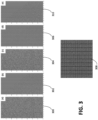
- FIG. 3 illustrates example outputs of the process of FIG. 2 , according to an aspect of the present inventive concept.
- Graph 300 is an example of a noisy input received at S200 at processing center 110.
- Graph 302 is an example of the results of the initial filtering performed by processing center 110 on the received noisy input at S204.
- Graph 304 is an example of a difference between the noisy input of graph 300 and the initial filtering result of graph 302 (e.g., d ⁇ per formula (4) described above with reference to FIG. 2 ).
- Graph 306 is an example of applying dictionary D to the residual signal (e.g., Dx 1 ).
- Graph 308 is an example of a subset of dictionary D with each patch (grid) in graph 308 representing an atom in the dictionary D .
- graph 310 is an example of u out determined at S214, as described above.
- FIG. 4 illustrates example outputs of the process of FIG. 2 , according to an aspect of the present inventive concept. While FIG. 3 illustrates results of applying the process of FIG. 2 to synthetic/computer generated data, FIG. 4 illustrates the result of applying the process of FIG. 2 to real world data collected on the Alaskan North Slope using sensors 104 (e.g., point sources, point receivers as well as Compressive Sensing Imaging (CSI) technology).
- sensors 104 e.g., point sources, point receivers as well as Compressive Sensing Imaging (CSI) technology.
- the collected data of FIG. 4 is contaminated by strong noise due to extreme weather conditions within the region in which the data is collected.
- the collected data is first sorted into offset-vector tiles (OVTs) shown in graph 400.
- initial filtering process is performed using Singular Spectrum Analysis (SSA) to reduce noise and generate initial signal estimate in the OVT domain.
- SSA Singular Spectrum Analysis
- Graph 402 illustrates the collected data after the initial filter process of S204 using SSA while graph 404 illustrate the difference between graphs 400 and 402 (in other words, graph 404 illustrates the removed noise).
- Results of graph 402 is then fed into the above described dictionary to derive the residual signal shown in graph 406 (S206 to S212 of FIG. 2 and using dual sparse inversion as described above).
- the process of S214 is then applied to residual signals shown in graph 406 to provide the final filtered signal shown in graph 408.
- Graph 410 illustrates the difference between the final denoised result of graph 408 and the initial collected data shown in graph 400.
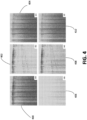
- FIG. 5 illustrates example outputs of the process of FIG. 2 , according to an aspect of the present inventive concept.
- FIG. 5 illustrates an example of coherent noise attenuation via dual dictionary learning as described above.
- High-density dataset over a producing field in Permian Basin using CSI technology was taken.
- objective is to improve image quality for unconventional reservoir development.
- the field from which data is taken is known to be a difficult seismic data area- salt dissolution in the near surface leads to a strong back-scattering.
- Graph 500 exhibits a typical raw data, in which the scattered noise together with ground roll created a complex noise pattern. In the near and mid offsets, the scattered energy is more than 30dB higher than the reflected energy
- envelop soft mute For initial noise attenuation, envelop soft mute followed by windowed Fourier domain filtering (WFT) is employed to preserve flat or near-flat events after static and moveout corrections.
- Graph 502 shows the initial denoised result which was served as the signal estimate for training.
- envelop soft mute was applied again on the differences to extract the high-amplitude portion of the scattered and ground roll noise, as shown in graph 504. Both models are next input for dictionary learning to adaptively form D and S, described above.
- Graphs 506 and 508 displays the subsets of learned dictionaries- atoms with distinct characters were trained which enables further separation of signal and noise.
- Graph 510 shows the recovered residual signal by incorporating dual dictionaries in inversion, and graph 512 shows the final denoised result with signal recovery.
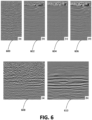
- FIG. 6 illustrates example outputs of the process of FIG. 2 , according to an aspect of the present inventive concept.
- the raw stack still exhibits strong distortions from near-surface scattering, as shown in Graph 600.
- Graphs 602, 604 and 606 plot the stacks of initial denoised data using WFT, recovered residual signal and final denoised data, respectively. Comparing Graphs 602 and 604, we can observe the primary energy has been successfully recovered for both shallow and deep reflectors. The final denoised stack in Graph 606 indicates a good denoising quality with minimal distortions and primary leakage.
- Graphs 608 and 610 illustrate a comparison of a shallow migrated image (0-8, 000ft) between raw and final denoised data.
- the significant uplifts above 3,500ft make the very shallow image interpretable and allow better planning for hazard avoidance.
- the Delaware horizon (bright reflector around 4,500ft) and below is also evidently better imaged, with reduced migration artifacts and clearly defined faults.
- the positive result from such a difficult data area suggests a good performance of the proposed learning-based method in attenuating coherent noise.
- N dictionaries may be used where N is a positive integer greater than 2 conditions on input signal being partitioned into N distinct signals/noises, where sparse invention can be applied to such N dictionaries to recover underlying data signal.
- Examples described above provide an unsupervised machine learning and sparse inversion based method for recovery of weak signals indicative of seismic activity (weak relative to existing noise signals) that would otherwise be lost during noise filtering/attenuation process utilized by current signal recovery methods. These examples are equally applicable to both coherent and incoherent noise on pre-stack and/or stacked images.
- System 700 can be implemented as processing center 110 or a server of processing center 110 for implementing functionalities described with reference to FIG. 2 .
- System 700 can include components in electrical communication with each other using a connection 705, such as a bus.
- System 700 includes a processing unit (CPU or processor) 710 and connection 705 that couples various system components including the system memory 715, read only memory (ROM) 720 and/or random access memory (RAM) 725, to the processor 710.
- System 700 can include a cache 712 of high-speed memory connected directly with, in close proximity to, or integrated as part of processor 710.
- System 700 can copy data from memory 715 and/or storage device 730 to cache 712 for quick access by processor 710. In this way, cache 712 can provide a performance boost that avoids processor 710 delays while waiting for data.
- These and other modules can control or be configured to control processor 710 to perform various actions.
- Other system memory 715 may be available for use as well.
- Memory 715 can include multiple different types of memory with different performance characteristics.
- Processor 710 can include any general purpose processor and a hardware or software service, such as service 1 732, service 2 734, and service 3 736 stored in storage device 730, configured to control processor 710 as well as a special-purpose processor where software instructions are incorporated into the actual processor design.
- Processor 710 may be a completely self-contained computing system, containing multiple cores or processors, a bus, memory controller, cache, etc.
- a multi-core processor may be symmetric or asymmetric.
- an input device 745 can represent any number of input mechanisms, such as a microphone for speech, a touch-sensitive screen for gesture or graphical input, keyboard, mouse, motion input, speech and so forth.
- An output device 735 can also be one or more of a number of output mechanisms known to those of skill in the art.
- multimodal systems can enable a user to provide multiple types of input to communicate with system 700.
- Communications interface 740 can generally govern and manage the user input and system output. There is no restriction on operating on any particular hardware arrangement and therefore the basic features here may easily be substituted for improved hardware or firmware arrangements as they are developed.
- Storage device 730 is a non-volatile memory and can be a hard disk or other types of computer readable media which can store data that are accessible by a computer, such as magnetic cassettes, flash memory cards, solid state memory devices, digital versatile disks, cartridges, random access memories (RAMs) 725, read only memory (ROM) 720, and hybrids thereof.
- RAMs random access memories
- ROM read only memory
- Storage device 730 can include service 1 732, service 2 734 and/or service 3 736 for execution by processor 710 to cause processor 710 to carryout functionalities described above with reference to FIG. 2 .
- Other hardware or software modules are contemplated.
- Storage device 730 can be connected to connection 705.
- a hardware module that performs a particular function can include the software component stored in a computer- readable medium in connection with the necessary hardware components, such as processor 710, connection 705, output device 735, and so forth, to carry out the function.
- the present technology may be presented as including individual functional blocks including functional blocks comprising devices, device components, steps or routines in a method embodied in software, or combinations of hardware and software.
- the computer-readable storage devices, mediums, and memories can include a cable or wireless signal containing a bit stream and the like.
- non-transitory computer-readable storage media expressly exclude media such as energy, carrier signals, electromagnetic waves, and signals per se.
- Such instructions can comprise, for example, instructions and data which cause or otherwise configure a general purpose computer, special purpose computer, or special purpose processing device to perform a certain function or group of functions. Portions of computer resources used can be accessible over a network.
- the computer executable instructions may be, for example, binaries, intermediate format instructions such as assembly language, firmware, or source code. Examples of computer-readable media that may be used to store instructions, information used, and/or information created during methods according to described examples include magnetic or optical disks, flash memory, USB devices provided with non-volatile memory, networked storage devices, and so on.
- Devices implementing methods according to the present inventive concept can comprise hardware, firmware and/or software, and can take any of a variety of form factors. Typical examples of such form factors include laptops, smart phones, small form factor personal computers, personal digital assistants, rackmount devices, standalone devices, and so on. Functionality described herein also can be embodied in peripherals or add-in cards. Such functionality can also be implemented on a circuit board among different chips or different processes executing in a single device, by way of further example.
- the instructions, media for conveying such instructions, computing resources for executing them, and other structures for supporting such computing resources are means for providing the functions described herein with respect to the present inventive concept.
Landscapes
- Engineering & Computer Science (AREA)
- Physics & Mathematics (AREA)
- Software Systems (AREA)
- Life Sciences & Earth Sciences (AREA)
- Remote Sensing (AREA)
- Theoretical Computer Science (AREA)
- General Physics & Mathematics (AREA)
- Mathematical Physics (AREA)
- Acoustics & Sound (AREA)
- Computing Systems (AREA)
- General Engineering & Computer Science (AREA)
- Evolutionary Computation (AREA)
- Data Mining & Analysis (AREA)
- Computer Vision & Pattern Recognition (AREA)
- Artificial Intelligence (AREA)
- Computer Networks & Wireless Communication (AREA)
- Medical Informatics (AREA)
- Environmental & Geological Engineering (AREA)
- Geology (AREA)
- General Life Sciences & Earth Sciences (AREA)
- Geophysics (AREA)
- Image Processing (AREA)
- Soundproofing, Sound Blocking, And Sound Damping (AREA)
- Geophysics And Detection Of Objects (AREA)
Claims (14)
- Procédé mis en œuvre par ordinateur de récupération de signal contaminé par le bruit, le procédé comprenant :la réception, au niveau d'un serveur (110), d'un premier signal incluant une première partie et une seconde partie, la première partie indiquant des données collectées par une pluralité de capteurs (104), la seconde partie représentant le bruit, caractérisé parla réalisation d'un premier processus de débruitage sur le premier signal pour éliminer le bruit afin de produire un premier signal débruité ;l'application d'un modèle d'apprentissage automatique pour déterminer un signal résiduel indiquant une différence entre le premier signal et le premier signal débruité ; etla détermination d'un second signal en ajoutant le signal résiduel au premier signal débruité, le second signal comprenant (i) des signaux de la première partie présentant des amplitudes supérieures au bruit dans la seconde partie, et (ii) des signaux de la première partie présentant des amplitudes inférieures au bruit dans la seconde partie.
- Procédé mis en œuvre par ordinateur selon la revendication 1, comprenant en outre :
la formation du modèle d'apprentissage automatique avec le premier signal débruité chaque fois que le serveur (110) reçoit une instance différente du premier signal et détermine un premier signal débruité correspondant. - Procédé mis en œuvre par ordinateur selon la revendication 2, dans lequel la formation du modèle d'apprentissage automatique comprend la détermination d'une solution à un problème d'optimisation en utilisant un algorithme de décomposition en k valeurs singulières.
- Procédé mis en œuvre par ordinateur selon la revendication 2 ou la revendication 3, dans lequel la formation du modèle d'apprentissage automatique n'est pas supervisée.
- Procédé mis en œuvre par ordinateur selon une quelconque revendication précédente, dans lequel la détermination du signal résiduel comprend la détermination d'une solution à un problème d'inversion clairsemée à double domaine en utilisant une représentation clairsemée du signal résiduel et du bruit.
- Procédé mis en œuvre par ordinateur selon la revendication 5, dans lequel la résolution du problème d'inversion clairsemée à double domaine comprend l'utilisation d'un algorithme déterministe, l'algorithme déterministe correspondant à l'un d'un procédé de direction alternée non monotone, ou d'un algorithme stochastique tel que la poursuite de correspondance.
- Système (700) de récupération de signal contaminé par le bruit, le système (700) comprenant :une mémoire (715) dans laquelle sont stockées des instructions lisibles par ordinateur ; etun ou plusieurs processeurs (710) configurés pour exécuter les instructions lisibles par ordinateur pour :recevoir un signal contaminé par du bruit, le signal incluant des données collectées par une pluralité de capteurs (104), caractérisé parla réalisation d'un processus de débruitage sur le signal pour éliminer le bruit afin de produire un signal débruité ;l'application du modèle d'apprentissage automatique pour déterminer un signal résiduel indiquant une différence entre le premier signal et le premier signal débruité ; etla détermination du signal traité en ajoutant le signal résiduel au signal débruité.
- Système selon la revendication 7, dans lequel les un ou plusieurs processeurs (710) sont configurés pour commander la pluralité de capteurs (104) pour déterminer le signal résiduel en déterminant une solution à un problème d'inversion clairsemée à double domaine en utilisant une représentation clairsemée du signal résiduel et du bruit.
- Système selon la revendication 7, dans lequel les un ou plusieurs processeurs (710) sont configurés pour exécuter les instructions lisibles par ordinateur pour :
former le modèle d'apprentissage automatique avec le signal débruité chaque fois qu'une instance différente du signal est reçue et qu'un signal débruité correspondant est déterminé. - Système selon la revendication 9, dans lequel les un ou plusieurs processeurs (710) sont configurés pour exécuter les instructions lisibles par ordinateur pour former le modèle d'apprentissage automatique en déterminant une solution à un problème d'optimisation en utilisant un algorithme de décomposition en k valeurs singulières.
- Système selon la revendication 9 ou la revendication 10, dans lequel la formation du modèle d'apprentissage automatique n'est pas supervisée.
- Système selon l'une quelconque des revendications 7-11, dans lequel les un ou plusieurs processeurs (710) sont configurés pour commander la pluralité de capteurs (104) pour collecter les données sur une période de temps spécifiée.
- Procédé selon l'une quelconque des revendications 1 à 6, dans lequel la détermination du second signal est basée sur un seul dictionnaire représentant le bruit formé à l'aide du modèle d'apprentissage automatique.
- Procédé selon l'une quelconque des revendications 1 à 6 ou la revendication 13, dans lequel la détermination du second signal est basée sur un dictionnaire double représentant le bruit et les données, le dictionnaire double étant formé en utilisant le modèle d'apprentissage automatique.
Applications Claiming Priority (2)
| Application Number | Priority Date | Filing Date | Title |
|---|---|---|---|
| US201862739260P | 2018-09-30 | 2018-09-30 | |
| PCT/US2019/053174 WO2020069143A1 (fr) | 2018-09-30 | 2019-09-26 | Récupération de signal fondée sur un apprentissage automatique |
Publications (3)
| Publication Number | Publication Date |
|---|---|
| EP3857268A1 EP3857268A1 (fr) | 2021-08-04 |
| EP3857268A4 EP3857268A4 (fr) | 2022-09-14 |
| EP3857268B1 true EP3857268B1 (fr) | 2024-10-23 |
Family
ID=69945546
Family Applications (1)
| Application Number | Title | Priority Date | Filing Date |
|---|---|---|---|
| EP19866442.7A Active EP3857268B1 (fr) | 2018-09-30 | 2019-09-26 | Récupération de signal fondée sur un apprentissage automatique |
Country Status (5)
| Country | Link |
|---|---|
| US (1) | US11481677B2 (fr) |
| EP (1) | EP3857268B1 (fr) |
| AU (1) | AU2019346601B2 (fr) |
| CA (1) | CA3111405A1 (fr) |
| WO (1) | WO2020069143A1 (fr) |
Families Citing this family (16)
| Publication number | Priority date | Publication date | Assignee | Title |
|---|---|---|---|---|
| US10605941B2 (en) | 2014-12-18 | 2020-03-31 | Conocophillips Company | Methods for simultaneous source separation |
| US10267939B2 (en) | 2015-09-28 | 2019-04-23 | Conocophillips Company | 3D seismic acquisition |
| US10809402B2 (en) | 2017-05-16 | 2020-10-20 | Conocophillips Company | Non-uniform optimal survey design principles |
| AU2018368796B2 (en) | 2017-11-20 | 2023-10-12 | Shearwater Geoservices Software Inc. | Offshore application of non-uniform optimal sampling survey design |
| US10601454B1 (en) * | 2018-11-30 | 2020-03-24 | International Business Machines Corporation | Separating two additive signal sources |
| EP3912126B1 (fr) * | 2019-01-15 | 2023-10-11 | Services Pétroliers Schlumberger | Détection de signal résiduel pour une atténuation de bruit |
| US20200284937A1 (en) * | 2019-03-04 | 2020-09-10 | Chevron U.S.A. Inc. | System and method for displaying seismic events in distributed acoustic sensing data |
| US11657300B2 (en) * | 2020-02-26 | 2023-05-23 | Samsung Electronics Co., Ltd. | Systems and methods for predicting storage device failure using machine learning |
| CN111192226B (zh) * | 2020-04-15 | 2020-07-31 | 苏宁云计算有限公司 | 一种图像融合去噪方法及装置、系统 |
| CN113589383B (zh) * | 2020-04-30 | 2024-03-19 | 中国石油化工股份有限公司 | 基于深度学习的地震资料线性干扰噪音消除方法 |
| CN112713907B (zh) * | 2020-12-23 | 2022-03-15 | 中南大学 | 一种基于字典学习的海洋csem降噪方法及系统 |
| KR102428242B1 (ko) * | 2021-01-05 | 2022-08-02 | 한국과학기술원 | 감마 스펙트럼의 희소 표현화를 통한 다중핵종 판별 방법 및 그 시스템 |
| CN113625338B (zh) * | 2021-08-11 | 2023-07-11 | 成都理工大学 | 一种基于差分的地震弱信号提取方法 |
| CN114330459B (zh) * | 2022-01-06 | 2025-04-01 | 北京交通大学 | 基于多层分解的振源响应信噪分离方法及系统 |
| US12406338B2 (en) * | 2022-08-03 | 2025-09-02 | Nvidia Corporation | Pseudoinverse guidance for data restoration with diffusion models |
| CN116741191A (zh) * | 2023-07-06 | 2023-09-12 | 北京达佳互联信息技术有限公司 | 音频信号处理方法、装置、电子设备及存储介质 |
Family Cites Families (150)
| Publication number | Priority date | Publication date | Assignee | Title |
|---|---|---|---|---|
| US2906363A (en) | 1955-05-06 | 1959-09-29 | Jersey Prod Res Co | Multiple transducer array |
| US4330873A (en) | 1970-07-27 | 1982-05-18 | United Geophysical Corporation | Aplanatic geophysical exploration system |
| US4553221A (en) | 1970-12-28 | 1985-11-12 | Hyatt Gilbert P | Digital filtering system |
| US3747055A (en) | 1971-06-16 | 1973-07-17 | Texaco Inc | High resolution shooting with space domain filtering |
| US3747056A (en) | 1971-06-16 | 1973-07-17 | Texaco Inc | High resolution reflection shooting with data mixing |
| US3840845A (en) | 1973-06-29 | 1974-10-08 | Chevron Res | Method of initiating and collecting seismic data related to strata underlying bodies of water using a continuously moving seismic exploration system located on a single boat using separate streamers |
| US3877033A (en) | 1973-08-15 | 1975-04-08 | Hillel Unz | Nonuniformly optimally spaced array with uniform amplitudes |
| US4958331A (en) | 1974-02-25 | 1990-09-18 | The United States Of America As Represented By The Secretary Of The Navy | Towed sonar receiving array |
| US4404684A (en) | 1980-07-31 | 1983-09-13 | Unitika Ltd. | Object solid figure recognizing method and apparatus |
| US4509151A (en) | 1982-01-22 | 1985-04-02 | Sea World, Inc. | Marine acoustic analysis system and method |
| US4596005A (en) | 1983-04-20 | 1986-06-17 | Chevron Research Company | Method of seismic collection utilizing multicomponent processing receivers and processing resultant conventional and converted P- or S-wave data |
| US4597066A (en) | 1983-04-20 | 1986-06-24 | Chevron Research Company | Method of seismic processing and displaying simultaneously collected conventional and converted P- or S-wave data |
| US4559605A (en) | 1983-09-16 | 1985-12-17 | The Boeing Company | Method and apparatus for random array beamforming |
| FR2599517B1 (fr) | 1986-06-02 | 1989-12-29 | Geophysique Cie Gle | Procede et dispositif de traitement de donnees sismographiques par correlation |
| US4721180A (en) | 1986-11-26 | 1988-01-26 | Western Atlas International, Inc. | Marine seismic source array |
| US4967400A (en) | 1988-02-26 | 1990-10-30 | Syntron, Inc. | Digital marine seismic system |
| NO173206C (no) | 1988-06-06 | 1999-11-11 | Geco As | Fremgangsmåte til posisjonsbestemmelse av minst to seismiske kabler i et refleksjonsseismisk målesystem |
| NO167423C (no) | 1989-05-31 | 1991-10-30 | Geco As | Fremgangsmaate ved samtidig innsamling av seismiske data for grunne og dype maal. |
| US5079703A (en) | 1990-02-20 | 1992-01-07 | Atlantic Richfield Company | 3-dimensional migration of irregular grids of 2-dimensional seismic data |
| US5092423A (en) | 1990-12-12 | 1992-03-03 | Atlantic Richfield Company | Downhole seismic array system |
| US5168472A (en) | 1991-11-13 | 1992-12-01 | The United States Of America As Represented By The Secretary Of The Navy | Dual-frequency receiving array using randomized element positions |
| US5353223A (en) | 1992-10-26 | 1994-10-04 | Western Atlas International, Inc. | Marine navigation method for geophysical exploration |
| US5469404A (en) | 1992-11-12 | 1995-11-21 | Barber; Harold P. | Method and apparatus for seismic exploration |
| US5402391A (en) | 1993-10-08 | 1995-03-28 | Geophysical Exploration & Development Corp. | Arrangement of source and receiver lines for three-dimensional seismic data acquisition |
| US5517463A (en) | 1994-10-21 | 1996-05-14 | Exxon Production Research Company | Method of determining optimal seismic multistreamer spacing |
| GB9424744D0 (en) | 1994-12-08 | 1995-02-08 | Geco As | Method of and apparatus for marine seismic surveying |
| US5724306A (en) | 1995-12-29 | 1998-03-03 | Western Atlas International, Inc. | Method for correcting dual sensor data for imperfect geophone coupling using production seismic data |
| CA2176058C (fr) | 1996-05-08 | 1999-03-02 | William Nicholas Goodway | Acquisition de donnees sismiques tridimensionnelles |
| US5835450A (en) | 1996-06-26 | 1998-11-10 | Pgs Exploration As | Lead-in configuration for multiple streamers and telemetry method |
| US5774417A (en) | 1996-10-25 | 1998-06-30 | Atlantic Richfield Company | Amplitude and phase compensation in dual-sensor ocean bottom cable seismic data processing |
| US6590831B1 (en) | 1997-12-30 | 2003-07-08 | Westerngeco L.L.C. | Method and apparatus for controlling and optimizing seismic data acquisition |
| US6009042A (en) | 1998-04-09 | 1999-12-28 | Western Atlas International, Inc. | Marine seismic web |
| US6493636B1 (en) | 1998-11-05 | 2002-12-10 | Shell Oil Company | Method of marine seismic exploration utilizing vertically and horizontally offset streamers |
| US6993433B2 (en) | 1999-04-02 | 2006-01-31 | Conocophillips Company | Modeling gravity and tensor gravity data using poisson's equation for airborne, surface and borehole applications |
| GB9924987D0 (en) | 1999-10-21 | 1999-12-22 | Geco As | Seismic data acquisition and processing method |
| US6509871B2 (en) | 2000-02-04 | 2003-01-21 | General Dynamics Information Systems, Inc. | Partially coherent beamformer for sparse, irregular arrays |
| US6691038B2 (en) | 2001-06-15 | 2004-02-10 | Westerngeco L.L.C. | Active separation tracking and positioning system for towed seismic arrays |
| JP2003174495A (ja) | 2001-09-28 | 2003-06-20 | Nec Corp | 折り畳み式携帯情報端末 |
| GB2383414B (en) | 2001-12-22 | 2005-07-13 | Westerngeco Ltd | A method of and apparatus for processing seismic data |
| US7183941B2 (en) | 2003-07-30 | 2007-02-27 | Lear Corporation | Bus-based appliance remote control |
| CA2534519C (fr) | 2003-08-11 | 2010-03-30 | Exxonmobil Upstream Research Company | Procede pour faire varier et separer en continu de multiples vibrateurs sismiques |
| US6985405B2 (en) | 2003-10-23 | 2006-01-10 | Pgs Americas, Inc. | Method for stable estimation of anisotropic parameters for P-wave prestack imaging |
| US7359283B2 (en) | 2004-03-03 | 2008-04-15 | Pgs Americas, Inc. | System for combining signals of pressure sensors and particle motion sensors in marine seismic streamers |
| US20110286302A1 (en) | 2004-03-17 | 2011-11-24 | Westerngeco, L.L.C. | Marine Seismic Survey Method and System |
| US8824239B2 (en) | 2004-03-17 | 2014-09-02 | Westerngeco L.L.C. | Marine seismic survey method and system |
| US7451717B1 (en) | 2004-05-21 | 2008-11-18 | Conocophillips Company | Systems and processes for covering openings of marine vessel hulls |
| US7167412B2 (en) | 2004-12-17 | 2007-01-23 | Pgs Americas, Inc. | Apparatus for steering a marine seismic streamer via controlled bending |
| US7477992B2 (en) * | 2005-02-18 | 2009-01-13 | Exxonmobil Upstream Research Company | Method for combining seismic data sets |
| US7271747B2 (en) | 2005-05-10 | 2007-09-18 | Rice University | Method and apparatus for distributed compressed sensing |
| US7586841B2 (en) | 2005-05-31 | 2009-09-08 | Cisco Technology, Inc. | System and method for protecting against failure of a TE-LSP tail-end node |
| US7660191B2 (en) | 2005-07-12 | 2010-02-09 | Westerngeco L.L.C. | Methods and apparatus for acquisition of marine seismic data |
| US7343216B2 (en) | 2005-07-13 | 2008-03-11 | Swift Lawrence W | Applying foliage and terrain features to architectural scaled physical models |
| US7234407B1 (en) | 2005-12-19 | 2007-06-26 | Conocophillips Company | Active anti-fouling systems and processes for marine vessels |
| EP1982305B1 (fr) * | 2006-01-31 | 2011-06-15 | Canadian Space Agency | Procede et systeme permettant d'augmenter le rapport signal sur bruit |
| FR2898209B1 (fr) | 2006-03-01 | 2008-12-12 | Parrot Sa | Procede de debruitage d'un signal audio |
| US7987074B2 (en) | 2006-03-08 | 2011-07-26 | Exxonmobil Upstream Research Company | Efficient computation method for electromagnetic modeling |
| US7545703B2 (en) | 2006-07-06 | 2009-06-09 | Pgs Geophysical As | Marine seismic streamer with varying spacer distances for reducing towing noise |
| US20080008037A1 (en) | 2006-07-07 | 2008-01-10 | Welker Kenneth E | Acoustic propagation velocity modeling methods, apparatus and systems |
| US7379386B2 (en) | 2006-07-12 | 2008-05-27 | Westerngeco L.L.C. | Workflow for processing streamer seismic data |
| EP1895328A1 (fr) | 2006-08-31 | 2008-03-05 | Bp Exploration Operating Company Limited | Procédé d'exploration sismique |
| EP2087313A4 (fr) | 2006-09-22 | 2015-04-01 | Sercel Inc | Réseau sismique pourvu de sources espacées à pression variable |
| US7974153B2 (en) | 2006-09-29 | 2011-07-05 | Geokinetics Acquisition Company Inc. | Three-dimensional seismic survey methods using a perturbation pattern to provide bin fractionation |
| US7835225B2 (en) | 2006-10-11 | 2010-11-16 | Pgs Geophysical As | Method for attenuating particle motion sensor noise in dual sensor towed marine seismic streamers |
| US8559267B2 (en) | 2006-10-26 | 2013-10-15 | Schlumberger Technology Corporation | Methods and apparatus of borehole seismic surveys |
| US7499374B2 (en) | 2006-12-14 | 2009-03-03 | Westerngeco L.L.C. | Determining acceptability of sensor locations used to perform a seismic survey |
| US7881159B2 (en) | 2006-12-18 | 2011-02-01 | Pgs Geophysical As | Seismic streamers which attentuate longitudinally traveling waves |
| US7835223B2 (en) | 2006-12-21 | 2010-11-16 | Westerngeco L.L.C. | Removing noise from seismic data obtained from towed seismic sensors |
| US20080225642A1 (en) | 2007-03-16 | 2008-09-18 | Ian Moore | Interpolation of Irregular Data |
| US8108211B2 (en) * | 2007-03-29 | 2012-01-31 | Sony Corporation | Method of and apparatus for analyzing noise in a signal processing system |
| US7616522B2 (en) | 2007-05-18 | 2009-11-10 | Input/Output, Inc. | Seismic streamer with irregularly spaced hydrophones |
| US20090010101A1 (en) | 2007-07-05 | 2009-01-08 | Nils Lunde | Seismic streamer having longitudinally symmetrically sensitive sensors to reduce effects of longitudinally traveling waves |
| US8116166B2 (en) | 2007-09-10 | 2012-02-14 | Westerngeco L.L.C. | 3D deghosting of multicomponent or over / under streamer recordings using cross-line wavenumber spectra of hydrophone data |
| US9158015B2 (en) | 2007-10-04 | 2015-10-13 | Westerngeco L.L.C. | Seismic streamer platform |
| WO2009059279A1 (fr) | 2007-11-01 | 2009-05-07 | University Of Maryland | Système et procédé d'acquisition comprimee pour l'estimation d'azimut de sources éparses dans le domaine angulaire |
| US8553490B2 (en) | 2007-11-09 | 2013-10-08 | Pgs Geophysical As | Array grouping of seismic sensors in a marine streamer for optimum noise attenuation |
| WO2009066057A2 (fr) | 2007-11-19 | 2009-05-28 | Geco Technology B.V. | Procédé de traitement de données sismiques pour une atténuation multiple de surface |
| US7646671B2 (en) | 2007-12-11 | 2010-01-12 | Pgs Geophysical As | Method for processing marine towed streamer seismic data from regular multi-azimuth surveys |
| US8194498B2 (en) | 2008-01-18 | 2012-06-05 | Westerngeco L.L.C. | Using a wave propagator for transversely isotropic media |
| US7751277B2 (en) | 2008-03-17 | 2010-07-06 | Pgs Geophysical As | Method for interpolating seismic data by anti-alias, anti-leakage Fourier transform |
| US7986586B2 (en) | 2008-04-08 | 2011-07-26 | Pgs Geophysical As | Method for deghosting marine seismic streamer data with irregular receiver positions |
| US8976622B2 (en) | 2008-04-21 | 2015-03-10 | Pgs Geophysical As | Methods for controlling towed marine sensor array geometry |
| US20090279386A1 (en) | 2008-05-07 | 2009-11-12 | David Monk | Method for determining adequacy of seismic data coverage of a subsurface area being surveyed |
| US20090279384A1 (en) | 2008-05-07 | 2009-11-12 | Ion Geophysical Corporation | Control Methods for Distributed Nodes |
| US8391101B2 (en) | 2008-07-03 | 2013-03-05 | Conocophillips Company | Marine seismic acquisition with controlled streamer flaring |
| US8559270B2 (en) | 2008-08-15 | 2013-10-15 | Bp Corporation North America Inc. | Method for separating independent simultaneous sources |
| US20110156494A1 (en) | 2008-08-25 | 2011-06-30 | Governing Dynamics Llc | Wireless Energy Transfer System |
| US9213119B2 (en) | 2008-10-29 | 2015-12-15 | Conocophillips Company | Marine seismic acquisition |
| AU2009311440B2 (en) | 2008-11-10 | 2014-03-27 | Conocophillips Company | Practical autonomous seismic recorder implementation and use |
| US8509027B2 (en) | 2008-11-26 | 2013-08-13 | Westerngeco L.L.C. | Continuous adaptive surface wave analysis for three-dimensional seismic data |
| US7993164B2 (en) | 2008-12-31 | 2011-08-09 | Hewlett-Packard Development Company, L.P. | Compact power adapter with interchangeable heads |
| US20100195434A1 (en) | 2009-01-30 | 2010-08-05 | Conocophillips Company | Heterodyned Seismic Source |
| US9052410B2 (en) | 2009-02-12 | 2015-06-09 | Conocophillips Company | Multiple seismic signal inversion |
| US8699297B2 (en) | 2009-02-13 | 2014-04-15 | Westerngeco L.L.C. | Deghosting and reconstructing a seismic wavefield |
| GB2473418A (en) | 2009-06-25 | 2011-03-16 | Statoilhydro Asa | Re-deploying seismic receiver cables while carrying out a marine seismic survey |
| WO2011059896A1 (fr) | 2009-11-11 | 2011-05-19 | Conocophillips Company | Acquisition sismique dans des environnements marins en utilisant des tracés sismiques suivant une série de tracés déviés connectés et procédés d'utilisation associés |
| EP2507654B1 (fr) | 2009-12-02 | 2022-09-28 | ConocoPhillips Company | Extraction d'enregistrements discrets d'enregistrements sismiques continus |
| US8681581B2 (en) | 2009-12-30 | 2014-03-25 | Westerngeco L.L.C. | Randomization of data acquisition in marine seismic and electromagnetic acquisition |
| US8711654B2 (en) | 2009-12-30 | 2014-04-29 | Westerngeco L.L.C. | Random sampling for geophysical acquisitions |
| US8612156B2 (en) | 2010-03-05 | 2013-12-17 | Vialogy Llc | Active noise injection computations for improved predictability in oil and gas reservoir discovery and characterization |
| US9529102B2 (en) | 2010-04-30 | 2016-12-27 | Conocophillips Company | Caterpillar-style seismic data acquisition using autonomous, continuously recording seismic data recorders |
| WO2011156237A1 (fr) | 2010-06-07 | 2011-12-15 | Conocophillips Company | Méthodologies de positionnement de capteurs pour l'acquisition de données sismiques marines |
| AU2011264929B2 (en) | 2010-06-09 | 2014-08-07 | Shearwater Geoservices Software Inc. | Seismic data acquisition using designed non-uniform receiver spacing |
| US8688616B2 (en) | 2010-06-14 | 2014-04-01 | Blue Prism Technologies Pte. Ltd. | High-dimensional data analysis |
| US10001575B2 (en) | 2010-06-29 | 2018-06-19 | Pgs Geophysical As | Seismic data acquisition system with selectively enabled sensor units, and associated methods |
| US8818730B2 (en) | 2010-07-19 | 2014-08-26 | Conocophillips Company | Unique composite relatively adjusted pulse |
| US8400876B2 (en) | 2010-09-30 | 2013-03-19 | Mitsubishi Electric Research Laboratories, Inc. | Method and system for sensing objects in a scene using transducer arrays and coherent wideband ultrasound pulses |
| WO2012061735A2 (fr) | 2010-11-05 | 2012-05-10 | Conocophillips Company | Flûtes sismiques arrondies et évasées à guidage actif |
| US20120143604A1 (en) | 2010-12-07 | 2012-06-07 | Rita Singh | Method for Restoring Spectral Components in Denoised Speech Signals |
| CA2833308C (fr) | 2011-05-06 | 2019-11-26 | Conocophilips Company | Acquisition sismique continue |
| US8644110B2 (en) * | 2011-05-20 | 2014-02-04 | Schlumberger Technology Corporation | Methods and systems for spurious cancellation in seismic signal detection |
| US9116255B2 (en) | 2011-05-27 | 2015-08-25 | Conocophillips Company | Two-way wave equation targeted data selection for improved imaging of prospects among complex geologic structures |
| WO2012166737A2 (fr) | 2011-05-27 | 2012-12-06 | Conocophillips Company | Sélection de données ciblées d'une équation d'onde à deux voies pour acquisition sismique de structures géologiques complexes |
| US9110177B1 (en) | 2011-06-07 | 2015-08-18 | Russell R. Opfer | Generation and use of seismic survey designs violating Freznel zone constraints |
| US9075162B2 (en) | 2011-11-10 | 2015-07-07 | Pgs Geophysical As | Method and system for separating seismic sources in marine simultaneous shooting acquisition |
| US9103943B2 (en) | 2011-11-28 | 2015-08-11 | Fugro-Geoteam As | Acquisition and processing of multi-source broadband marine seismic data |
| BR112014017319A8 (pt) | 2012-01-13 | 2017-07-04 | Geco Technology Bv | método para conduzir um levantamento sísmico marinho usando uma técnica de fonte simultânea tendo sequências de disparo nss, sistema de levantamento sísmico marinho, sistema de processamento para processar |
| US9137600B2 (en) | 2012-02-16 | 2015-09-15 | 2236008 Ontario Inc. | System and method for dynamic residual noise shaping |
| US9188693B2 (en) | 2012-03-26 | 2015-11-17 | Apache Corporation | Method for acquiring marine seismic data |
| US9116257B2 (en) | 2012-05-07 | 2015-08-25 | Fugro Norway As | Method and apparatus for sea current aided, enhanced azimuth seismic data acquisition |
| JP5728432B2 (ja) | 2012-06-01 | 2015-06-03 | 日立コンシューマエレクトロニクス株式会社 | ホログラム用光ピックアップ装置及び光情報記録再生装置 |
| US20150272506A1 (en) | 2012-10-10 | 2015-10-01 | Westerngeco Llc | Wave equation processing |
| US8619497B1 (en) | 2012-11-15 | 2013-12-31 | Cggveritas Services Sa | Device and method for continuous data acquisition |
| US8724428B1 (en) | 2012-11-15 | 2014-05-13 | Cggveritas Services Sa | Process for separating data recorded during a continuous data acquisition seismic survey |
| EP2738575B1 (fr) | 2012-11-28 | 2017-11-08 | Sercel | Procédé de gestion de tirs d'un système sismique multi-vaisseau |
| US9268060B2 (en) | 2013-03-14 | 2016-02-23 | Bp Corporation North America Inc. | System and method for computational geology |
| AU2014201780A1 (en) | 2013-04-03 | 2014-10-23 | Cgg Services Sa | Device and method for de-blending simultaneous shot data |
| US20140334260A1 (en) * | 2013-05-09 | 2014-11-13 | Schlumberger Technology Corporation | Neural Network Signal Processing of Microseismic Events |
| US10224900B2 (en) | 2013-06-07 | 2019-03-05 | Cgg Service Sas | Systems and methods for de-noising seismic data |
| US10514474B2 (en) | 2013-09-19 | 2019-12-24 | Conocophillips Company | Method for synchronizing continuous seismic survey |
| US9632193B2 (en) | 2013-11-01 | 2017-04-25 | Conocophillips Company | Compressive sensing |
| US20170031045A1 (en) | 2014-04-14 | 2017-02-02 | Cgg Services Sa | Method and apparatus for modeling and separation of primaries and multiples using multi-order green's function |
| CN103954993A (zh) | 2014-04-17 | 2014-07-30 | 中国石油天然气集团公司 | 基于地震信号连续小波变换的尺度域多道滤波方法及装置 |
| JP6347480B2 (ja) * | 2014-05-27 | 2018-06-27 | 独立行政法人石油天然ガス・金属鉱物資源機構 | 振動検出システム、信号処理装置及び信号処理方法 |
| EP3143249B1 (fr) * | 2014-07-17 | 2023-03-08 | Halliburton Energy Services, Inc. | Élimination de bruit pour des données de détection acoustique répartie |
| US9823372B2 (en) | 2014-07-17 | 2017-11-21 | Conocophillips Company | Controlled spaced streamer acquisition |
| EP3170028A1 (fr) | 2014-07-17 | 2017-05-24 | CGG Services SA | Écart systématique par rapport à une régularité de motif dans une acquisition de données sismiques |
| US10605941B2 (en) | 2014-12-18 | 2020-03-31 | Conocophillips Company | Methods for simultaneous source separation |
| WO2016187252A1 (fr) | 2015-05-20 | 2016-11-24 | Conocophillips Company | Tomographie en ondes de surface utilisant l'acquisition de données éparses |
| US10234584B2 (en) * | 2015-09-01 | 2019-03-19 | Pgs Geophysical As | Method and system of inducing vibrations onto a sensor streamer |
| US10267939B2 (en) | 2015-09-28 | 2019-04-23 | Conocophillips Company | 3D seismic acquisition |
| US10267940B2 (en) * | 2015-10-05 | 2019-04-23 | Pgs Geophysical As | Noise template adaptation |
| US10436924B2 (en) * | 2015-10-14 | 2019-10-08 | Pgs Geophysical As | Denoising seismic data |
| WO2017124044A1 (fr) * | 2016-01-15 | 2017-07-20 | The Regents Of The University Of California | Débruitage basé sur l'apprentissage machine d'un signal d'écoulement sanguin et de pression intracrânienne par ultrasons doppler |
| US20180003846A1 (en) * | 2016-06-30 | 2018-01-04 | Schlumberger Technology Corporation | System and methodology for removing noise associated with sonic logging |
| US11035968B2 (en) | 2016-11-02 | 2021-06-15 | Conocophillips Company | Use nuos technology to acquire optimized 2D data |
| US10768328B2 (en) * | 2017-01-12 | 2020-09-08 | Pgs Geophysical As | Seismic noise attenuation using dip map data structure |
| AU2018231078A1 (en) * | 2017-03-08 | 2019-10-10 | Saudi Arabian Oil Company | Automated system and methods for adaptive robust denoising of large-scale seismic data sets |
| US10809402B2 (en) | 2017-05-16 | 2020-10-20 | Conocophillips Company | Non-uniform optimal survey design principles |
| AU2018368796B2 (en) | 2017-11-20 | 2023-10-12 | Shearwater Geoservices Software Inc. | Offshore application of non-uniform optimal sampling survey design |
| US11080621B2 (en) * | 2018-06-18 | 2021-08-03 | Western Digital Technologies, Inc. | Machine learning-based read channel data detection |
-
2019
- 2019-09-26 WO PCT/US2019/053174 patent/WO2020069143A1/fr not_active Ceased
- 2019-09-26 CA CA3111405A patent/CA3111405A1/fr active Pending
- 2019-09-26 AU AU2019346601A patent/AU2019346601B2/en active Active
- 2019-09-26 US US16/583,528 patent/US11481677B2/en active Active
- 2019-09-26 EP EP19866442.7A patent/EP3857268B1/fr active Active
Also Published As
| Publication number | Publication date |
|---|---|
| WO2020069143A1 (fr) | 2020-04-02 |
| AU2019346601A1 (en) | 2021-03-25 |
| CA3111405A1 (fr) | 2020-04-02 |
| US11481677B2 (en) | 2022-10-25 |
| EP3857268A1 (fr) | 2021-08-04 |
| US20200104745A1 (en) | 2020-04-02 |
| EP3857268A4 (fr) | 2022-09-14 |
| AU2019346601B2 (en) | 2024-08-01 |
Similar Documents
| Publication | Publication Date | Title |
|---|---|---|
| EP3857268B1 (fr) | Récupération de signal fondée sur un apprentissage automatique | |
| Wu et al. | Parametric convolutional neural network-domain full-waveform inversion | |
| US10436924B2 (en) | Denoising seismic data | |
| CN104751420B (zh) | 一种基于稀疏表示和多目标优化的盲复原方法 | |
| Patel et al. | Separated component-based restoration of speckled SAR images | |
| Chaudhuri et al. | Blind deconvolution methods: A review | |
| CN103983973B (zh) | 基于图像稀疏域噪声分布约束的合成孔径雷达成像方法 | |
| CN105046659A (zh) | 一种基于稀疏表示的单透镜计算成像psf估算方法 | |
| Kapoor et al. | Skiing on simplices: Kernel interpolation on the permutohedral lattice for scalable gaussian processes | |
| Jon et al. | Weighted hyper-Laplacian prior with overlapping group sparsity for image restoration under Cauchy noise | |
| CN114114397B (zh) | 一种基于深度张量神经网络的无监督地震数据去噪方法 | |
| Cai et al. | A denoising method for salt and pepper noise in remote sensing based on Swin‐Transformer convolution U‐Net and filtering—FSCU‐Net | |
| CN113344985A (zh) | 一种针对相移结构光成像的多径干扰的解扰方法 | |
| CN116167940A (zh) | 一种基于卷积神经网络的地震图像去噪方法 | |
| Coelho et al. | Signals and Images: Advances and Results in Speech, Estimation, Compression, Recognition, Filtering, and Processing | |
| Wang et al. | Hyperspectral unmixing via plug-and-play priors | |
| Jiang et al. | Adaptive multiple subtraction based on an accelerating iterative curvelet thresholding method | |
| Sha et al. | Efficient seismic denoising techniques using robust principal component analysis | |
| Fu et al. | Adaptive overcomplete dictionary learning-based sparsity-promoting regularization for full-waveform inversion | |
| Qian et al. | Tensor Low-Rank Approximation for Seismic Footprint Suppression | |
| CN109727200A (zh) | 基于贝叶斯张量分解的相似块堆聚图像消噪方法及系统 | |
| Al-Marzouqi et al. | Similarity index for seismic data sets using adaptive curvelets | |
| Hugo et al. | Physics-based super-resolved simulation of 3d elastic wave propagation adopting scalable diffusion transformer | |
| Jiang et al. | Faint space target information extraction based on small aperture telescope in complex background | |
| Chen et al. | Low-rank constraint with sparse representation for image restoration under multiplicative noise |
Legal Events
| Date | Code | Title | Description |
|---|---|---|---|
| STAA | Information on the status of an ep patent application or granted ep patent |
Free format text: STATUS: THE INTERNATIONAL PUBLICATION HAS BEEN MADE |
|
| PUAI | Public reference made under article 153(3) epc to a published international application that has entered the european phase |
Free format text: ORIGINAL CODE: 0009012 |
|
| STAA | Information on the status of an ep patent application or granted ep patent |
Free format text: STATUS: REQUEST FOR EXAMINATION WAS MADE |
|
| 17P | Request for examination filed |
Effective date: 20210401 |
|
| AK | Designated contracting states |
Kind code of ref document: A1 Designated state(s): AL AT BE BG CH CY CZ DE DK EE ES FI FR GB GR HR HU IE IS IT LI LT LU LV MC MK MT NL NO PL PT RO RS SE SI SK SM TR |
|
| DAV | Request for validation of the european patent (deleted) | ||
| DAX | Request for extension of the european patent (deleted) | ||
| A4 | Supplementary search report drawn up and despatched |
Effective date: 20220818 |
|
| RIC1 | Information provided on ipc code assigned before grant |
Ipc: G06N 20/00 20190101ALI20220811BHEP Ipc: G06N 7/00 20060101ALI20220811BHEP Ipc: G10L 21/02 20130101ALI20220811BHEP Ipc: G01V 1/37 20060101ALI20220811BHEP Ipc: G01V 1/36 20060101ALI20220811BHEP Ipc: G01V 1/30 20060101ALI20220811BHEP Ipc: H04Q 9/00 20060101AFI20220811BHEP |
|
| RAP1 | Party data changed (applicant data changed or rights of an application transferred) |
Owner name: SHEARWATER GEOSERVICES SOFTWARE INC. |
|
| REG | Reference to a national code |
Ref country code: DE Free format text: PREVIOUS MAIN CLASS: G01V0001300000 Ref country code: DE Ref legal event code: R079 Ref document number: 602019060911 Country of ref document: DE Free format text: PREVIOUS MAIN CLASS: G01V0001300000 Ipc: H04Q0009000000 |
|
| RIC1 | Information provided on ipc code assigned before grant |
Ipc: G06N 20/00 20190101ALI20240417BHEP Ipc: G06N 7/00 20060101ALI20240417BHEP Ipc: G10L 21/02 20130101ALI20240417BHEP Ipc: G01V 1/37 20060101ALI20240417BHEP Ipc: G01V 1/36 20060101ALI20240417BHEP Ipc: G01V 1/30 20060101ALI20240417BHEP Ipc: H04Q 9/00 20060101AFI20240417BHEP |
|
| GRAP | Despatch of communication of intention to grant a patent |
Free format text: ORIGINAL CODE: EPIDOSNIGR1 |
|
| STAA | Information on the status of an ep patent application or granted ep patent |
Free format text: STATUS: GRANT OF PATENT IS INTENDED |
|
| RIC1 | Information provided on ipc code assigned before grant |
Ipc: G06N 7/01 20230101ALN20240515BHEP Ipc: G01V 1/36 20060101ALN20240515BHEP Ipc: G06N 20/00 20190101ALI20240515BHEP Ipc: H04Q 9/00 20060101AFI20240515BHEP |
|
| INTG | Intention to grant announced |
Effective date: 20240607 |
|
| GRAS | Grant fee paid |
Free format text: ORIGINAL CODE: EPIDOSNIGR3 |
|
| GRAA | (expected) grant |
Free format text: ORIGINAL CODE: 0009210 |
|
| STAA | Information on the status of an ep patent application or granted ep patent |
Free format text: STATUS: THE PATENT HAS BEEN GRANTED |
|
| AK | Designated contracting states |
Kind code of ref document: B1 Designated state(s): AL AT BE BG CH CY CZ DE DK EE ES FI FR GB GR HR HU IE IS IT LI LT LU LV MC MK MT NL NO PL PT RO RS SE SI SK SM TR |
|
| REG | Reference to a national code |
Ref country code: GB Ref legal event code: FG4D |
|
| REG | Reference to a national code |
Ref country code: CH Ref legal event code: EP |
|
| REG | Reference to a national code |
Ref country code: DE Ref legal event code: R096 Ref document number: 602019060911 Country of ref document: DE |
|
| REG | Reference to a national code |
Ref country code: IE Ref legal event code: FG4D |
|
| P01 | Opt-out of the competence of the unified patent court (upc) registered |
Free format text: CASE NUMBER: APP_60317/2024 Effective date: 20241108 |
|
| REG | Reference to a national code |
Ref country code: LT Ref legal event code: MG9D |
|
| REG | Reference to a national code |
Ref country code: NL Ref legal event code: MP Effective date: 20241023 |
|
| REG | Reference to a national code |
Ref country code: AT Ref legal event code: MK05 Ref document number: 1735823 Country of ref document: AT Kind code of ref document: T Effective date: 20241023 |
|
| PG25 | Lapsed in a contracting state [announced via postgrant information from national office to epo] |
Ref country code: NL Free format text: LAPSE BECAUSE OF FAILURE TO SUBMIT A TRANSLATION OF THE DESCRIPTION OR TO PAY THE FEE WITHIN THE PRESCRIBED TIME-LIMIT Effective date: 20241023 |
|
| PG25 | Lapsed in a contracting state [announced via postgrant information from national office to epo] |
Ref country code: NL Free format text: LAPSE BECAUSE OF FAILURE TO SUBMIT A TRANSLATION OF THE DESCRIPTION OR TO PAY THE FEE WITHIN THE PRESCRIBED TIME-LIMIT Effective date: 20241023 |
|
| PG25 | Lapsed in a contracting state [announced via postgrant information from national office to epo] |
Ref country code: PT Free format text: LAPSE BECAUSE OF FAILURE TO SUBMIT A TRANSLATION OF THE DESCRIPTION OR TO PAY THE FEE WITHIN THE PRESCRIBED TIME-LIMIT Effective date: 20250224 Ref country code: HR Free format text: LAPSE BECAUSE OF FAILURE TO SUBMIT A TRANSLATION OF THE DESCRIPTION OR TO PAY THE FEE WITHIN THE PRESCRIBED TIME-LIMIT Effective date: 20241023 Ref country code: IS Free format text: LAPSE BECAUSE OF FAILURE TO SUBMIT A TRANSLATION OF THE DESCRIPTION OR TO PAY THE FEE WITHIN THE PRESCRIBED TIME-LIMIT Effective date: 20250223 |
|
| PG25 | Lapsed in a contracting state [announced via postgrant information from national office to epo] |
Ref country code: FI Free format text: LAPSE BECAUSE OF FAILURE TO SUBMIT A TRANSLATION OF THE DESCRIPTION OR TO PAY THE FEE WITHIN THE PRESCRIBED TIME-LIMIT Effective date: 20241023 |
|
| PG25 | Lapsed in a contracting state [announced via postgrant information from national office to epo] |
Ref country code: BG Free format text: LAPSE BECAUSE OF FAILURE TO SUBMIT A TRANSLATION OF THE DESCRIPTION OR TO PAY THE FEE WITHIN THE PRESCRIBED TIME-LIMIT Effective date: 20241023 |
|
| PG25 | Lapsed in a contracting state [announced via postgrant information from national office to epo] |
Ref country code: ES Free format text: LAPSE BECAUSE OF FAILURE TO SUBMIT A TRANSLATION OF THE DESCRIPTION OR TO PAY THE FEE WITHIN THE PRESCRIBED TIME-LIMIT Effective date: 20241023 |
|
| PG25 | Lapsed in a contracting state [announced via postgrant information from national office to epo] |
Ref country code: AT Free format text: LAPSE BECAUSE OF FAILURE TO SUBMIT A TRANSLATION OF THE DESCRIPTION OR TO PAY THE FEE WITHIN THE PRESCRIBED TIME-LIMIT Effective date: 20241023 Ref country code: LV Free format text: LAPSE BECAUSE OF FAILURE TO SUBMIT A TRANSLATION OF THE DESCRIPTION OR TO PAY THE FEE WITHIN THE PRESCRIBED TIME-LIMIT Effective date: 20241023 Ref country code: GR Free format text: LAPSE BECAUSE OF FAILURE TO SUBMIT A TRANSLATION OF THE DESCRIPTION OR TO PAY THE FEE WITHIN THE PRESCRIBED TIME-LIMIT Effective date: 20250124 |
|
| PG25 | Lapsed in a contracting state [announced via postgrant information from national office to epo] |
Ref country code: PL Free format text: LAPSE BECAUSE OF FAILURE TO SUBMIT A TRANSLATION OF THE DESCRIPTION OR TO PAY THE FEE WITHIN THE PRESCRIBED TIME-LIMIT Effective date: 20241023 |
|
| PG25 | Lapsed in a contracting state [announced via postgrant information from national office to epo] |
Ref country code: RS Free format text: LAPSE BECAUSE OF FAILURE TO SUBMIT A TRANSLATION OF THE DESCRIPTION OR TO PAY THE FEE WITHIN THE PRESCRIBED TIME-LIMIT Effective date: 20250123 |
|
| PG25 | Lapsed in a contracting state [announced via postgrant information from national office to epo] |
Ref country code: SM Free format text: LAPSE BECAUSE OF FAILURE TO SUBMIT A TRANSLATION OF THE DESCRIPTION OR TO PAY THE FEE WITHIN THE PRESCRIBED TIME-LIMIT Effective date: 20241023 |
|
| PG25 | Lapsed in a contracting state [announced via postgrant information from national office to epo] |
Ref country code: DK Free format text: LAPSE BECAUSE OF FAILURE TO SUBMIT A TRANSLATION OF THE DESCRIPTION OR TO PAY THE FEE WITHIN THE PRESCRIBED TIME-LIMIT Effective date: 20241023 |
|
| PG25 | Lapsed in a contracting state [announced via postgrant information from national office to epo] |
Ref country code: EE Free format text: LAPSE BECAUSE OF FAILURE TO SUBMIT A TRANSLATION OF THE DESCRIPTION OR TO PAY THE FEE WITHIN THE PRESCRIBED TIME-LIMIT Effective date: 20241023 |
|
| PG25 | Lapsed in a contracting state [announced via postgrant information from national office to epo] |
Ref country code: RO Free format text: LAPSE BECAUSE OF FAILURE TO SUBMIT A TRANSLATION OF THE DESCRIPTION OR TO PAY THE FEE WITHIN THE PRESCRIBED TIME-LIMIT Effective date: 20241023 |
|
| REG | Reference to a national code |
Ref country code: DE Ref legal event code: R097 Ref document number: 602019060911 Country of ref document: DE |
|
| PG25 | Lapsed in a contracting state [announced via postgrant information from national office to epo] |
Ref country code: SK Free format text: LAPSE BECAUSE OF FAILURE TO SUBMIT A TRANSLATION OF THE DESCRIPTION OR TO PAY THE FEE WITHIN THE PRESCRIBED TIME-LIMIT Effective date: 20241023 |
|
| PG25 | Lapsed in a contracting state [announced via postgrant information from national office to epo] |
Ref country code: CZ Free format text: LAPSE BECAUSE OF FAILURE TO SUBMIT A TRANSLATION OF THE DESCRIPTION OR TO PAY THE FEE WITHIN THE PRESCRIBED TIME-LIMIT Effective date: 20241023 |
|
| PG25 | Lapsed in a contracting state [announced via postgrant information from national office to epo] |
Ref country code: IT Free format text: LAPSE BECAUSE OF FAILURE TO SUBMIT A TRANSLATION OF THE DESCRIPTION OR TO PAY THE FEE WITHIN THE PRESCRIBED TIME-LIMIT Effective date: 20241023 |
|
| PLBE | No opposition filed within time limit |
Free format text: ORIGINAL CODE: 0009261 |
|
| STAA | Information on the status of an ep patent application or granted ep patent |
Free format text: STATUS: NO OPPOSITION FILED WITHIN TIME LIMIT |
|
| PG25 | Lapsed in a contracting state [announced via postgrant information from national office to epo] |
Ref country code: SE Free format text: LAPSE BECAUSE OF FAILURE TO SUBMIT A TRANSLATION OF THE DESCRIPTION OR TO PAY THE FEE WITHIN THE PRESCRIBED TIME-LIMIT Effective date: 20241023 |
|
| 26N | No opposition filed |
Effective date: 20250724 |
|
| PGFP | Annual fee paid to national office [announced via postgrant information from national office to epo] |
Ref country code: NO Payment date: 20250730 Year of fee payment: 7 |
|
| PGFP | Annual fee paid to national office [announced via postgrant information from national office to epo] |
Ref country code: GB Payment date: 20250805 Year of fee payment: 7 |
|
| PGFP | Annual fee paid to national office [announced via postgrant information from national office to epo] |
Ref country code: FR Payment date: 20250807 Year of fee payment: 7 |
|
| REG | Reference to a national code |
Ref country code: CH Ref legal event code: H13 Free format text: ST27 STATUS EVENT CODE: U-0-0-H10-H13 (AS PROVIDED BY THE NATIONAL OFFICE) Effective date: 20260425 |