EP3858401A1 - Medizinische vorrichtung - Google Patents
Medizinische vorrichtung Download PDFInfo
- Publication number
- EP3858401A1 EP3858401A1 EP19881520.1A EP19881520A EP3858401A1 EP 3858401 A1 EP3858401 A1 EP 3858401A1 EP 19881520 A EP19881520 A EP 19881520A EP 3858401 A1 EP3858401 A1 EP 3858401A1
- Authority
- EP
- European Patent Office
- Prior art keywords
- housing
- welded
- welded portion
- living body
- adhesion
- Prior art date
- Legal status (The legal status is an assumption and is not a legal conclusion. Google has not performed a legal analysis and makes no representation as to the accuracy of the status listed.)
- Withdrawn
Links
- 239000000853 adhesive Substances 0.000 claims abstract description 41
- 230000001070 adhesive effect Effects 0.000 claims abstract description 41
- 238000003780 insertion Methods 0.000 claims description 17
- 230000037431 insertion Effects 0.000 claims description 17
- 230000000149 penetrating effect Effects 0.000 claims description 6
- 229940079593 drug Drugs 0.000 abstract description 31
- 239000003814 drug Substances 0.000 abstract description 31
- 230000002708 enhancing effect Effects 0.000 abstract description 2
- 239000007788 liquid Substances 0.000 description 18
- 238000003466 welding Methods 0.000 description 14
- 239000002390 adhesive tape Substances 0.000 description 11
- NOESYZHRGYRDHS-UHFFFAOYSA-N insulin Chemical compound N1C(=O)C(NC(=O)C(CCC(N)=O)NC(=O)C(CCC(O)=O)NC(=O)C(C(C)C)NC(=O)C(NC(=O)CN)C(C)CC)CSSCC(C(NC(CO)C(=O)NC(CC(C)C)C(=O)NC(CC=2C=CC(O)=CC=2)C(=O)NC(CCC(N)=O)C(=O)NC(CC(C)C)C(=O)NC(CCC(O)=O)C(=O)NC(CC(N)=O)C(=O)NC(CC=2C=CC(O)=CC=2)C(=O)NC(CSSCC(NC(=O)C(C(C)C)NC(=O)C(CC(C)C)NC(=O)C(CC=2C=CC(O)=CC=2)NC(=O)C(CC(C)C)NC(=O)C(C)NC(=O)C(CCC(O)=O)NC(=O)C(C(C)C)NC(=O)C(CC(C)C)NC(=O)C(CC=2NC=NC=2)NC(=O)C(CO)NC(=O)CNC2=O)C(=O)NCC(=O)NC(CCC(O)=O)C(=O)NC(CCCNC(N)=N)C(=O)NCC(=O)NC(CC=3C=CC=CC=3)C(=O)NC(CC=3C=CC=CC=3)C(=O)NC(CC=3C=CC(O)=CC=3)C(=O)NC(C(C)O)C(=O)N3C(CCC3)C(=O)NC(CCCCN)C(=O)NC(C)C(O)=O)C(=O)NC(CC(N)=O)C(O)=O)=O)NC(=O)C(C(C)CC)NC(=O)C(CO)NC(=O)C(C(C)O)NC(=O)C1CSSCC2NC(=O)C(CC(C)C)NC(=O)C(NC(=O)C(CCC(N)=O)NC(=O)C(CC(N)=O)NC(=O)C(NC(=O)C(N)CC=1C=CC=CC=1)C(C)C)CC1=CN=CN1 NOESYZHRGYRDHS-UHFFFAOYSA-N 0.000 description 10
- 102000004877 Insulin Human genes 0.000 description 5
- 108090001061 Insulin Proteins 0.000 description 5
- 229940125396 insulin Drugs 0.000 description 5
- 239000000463 material Substances 0.000 description 5
- 238000012986 modification Methods 0.000 description 5
- 230000004048 modification Effects 0.000 description 5
- 238000007689 inspection Methods 0.000 description 4
- 230000007423 decrease Effects 0.000 description 3
- 238000000034 method Methods 0.000 description 3
- -1 polypropylene Polymers 0.000 description 3
- 239000004745 nonwoven fabric Substances 0.000 description 2
- 238000012545 processing Methods 0.000 description 2
- 239000011347 resin Substances 0.000 description 2
- 229920005989 resin Polymers 0.000 description 2
- 238000003860 storage Methods 0.000 description 2
- QNRATNLHPGXHMA-XZHTYLCXSA-N (r)-(6-ethoxyquinolin-4-yl)-[(2s,4s,5r)-5-ethyl-1-azabicyclo[2.2.2]octan-2-yl]methanol;hydrochloride Chemical compound Cl.C([C@H]([C@H](C1)CC)C2)CN1[C@@H]2[C@H](O)C1=CC=NC2=CC=C(OCC)C=C21 QNRATNLHPGXHMA-XZHTYLCXSA-N 0.000 description 1
- 229920000742 Cotton Polymers 0.000 description 1
- 239000004698 Polyethylene Substances 0.000 description 1
- 239000004743 Polypropylene Substances 0.000 description 1
- 229920000297 Rayon Polymers 0.000 description 1
- 239000003522 acrylic cement Substances 0.000 description 1
- 238000005422 blasting Methods 0.000 description 1
- 238000004891 communication Methods 0.000 description 1
- 238000005520 cutting process Methods 0.000 description 1
- 206010012601 diabetes mellitus Diseases 0.000 description 1
- 230000000694 effects Effects 0.000 description 1
- 238000004049 embossing Methods 0.000 description 1
- 239000004744 fabric Substances 0.000 description 1
- 239000012530 fluid Substances 0.000 description 1
- 230000002093 peripheral effect Effects 0.000 description 1
- 229920003229 poly(methyl methacrylate) Polymers 0.000 description 1
- 229920000515 polycarbonate Polymers 0.000 description 1
- 239000004417 polycarbonate Substances 0.000 description 1
- 229920000728 polyester Polymers 0.000 description 1
- 229920000573 polyethylene Polymers 0.000 description 1
- 229920000139 polyethylene terephthalate Polymers 0.000 description 1
- 239000005020 polyethylene terephthalate Substances 0.000 description 1
- 239000004926 polymethyl methacrylate Substances 0.000 description 1
- 229920001155 polypropylene Polymers 0.000 description 1
- 239000002964 rayon Substances 0.000 description 1
- 239000013464 silicone adhesive Substances 0.000 description 1
- 238000002604 ultrasonography Methods 0.000 description 1
- XLYOFNOQVPJJNP-UHFFFAOYSA-N water Chemical compound O XLYOFNOQVPJJNP-UHFFFAOYSA-N 0.000 description 1
Images




Classifications
-
- A—HUMAN NECESSITIES
- A61—MEDICAL OR VETERINARY SCIENCE; HYGIENE
- A61M—DEVICES FOR INTRODUCING MEDIA INTO, OR ONTO, THE BODY; DEVICES FOR TRANSDUCING BODY MEDIA OR FOR TAKING MEDIA FROM THE BODY; DEVICES FOR PRODUCING OR ENDING SLEEP OR STUPOR
- A61M5/00—Devices for bringing media into the body in a subcutaneous, intra-vascular or intramuscular way; Accessories therefor, e.g. filling or cleaning devices, arm-rests
- A61M5/14—Infusion devices, e.g. infusing by gravity; Blood infusion; Accessories therefor
- A61M5/142—Pressure infusion, e.g. using pumps
- A61M5/14244—Pressure infusion, e.g. using pumps adapted to be carried by the patient, e.g. portable on the body
- A61M5/14248—Pressure infusion, e.g. using pumps adapted to be carried by the patient, e.g. portable on the body of the skin patch type
-
- A—HUMAN NECESSITIES
- A61—MEDICAL OR VETERINARY SCIENCE; HYGIENE
- A61M—DEVICES FOR INTRODUCING MEDIA INTO, OR ONTO, THE BODY; DEVICES FOR TRANSDUCING BODY MEDIA OR FOR TAKING MEDIA FROM THE BODY; DEVICES FOR PRODUCING OR ENDING SLEEP OR STUPOR
- A61M5/00—Devices for bringing media into the body in a subcutaneous, intra-vascular or intramuscular way; Accessories therefor, e.g. filling or cleaning devices, arm-rests
- A61M5/14—Infusion devices, e.g. infusing by gravity; Blood infusion; Accessories therefor
- A61M5/158—Needles for infusions; Accessories therefor, e.g. for inserting infusion needles, or for holding them on the body
- A61M2005/1585—Needle inserters
-
- A—HUMAN NECESSITIES
- A61—MEDICAL OR VETERINARY SCIENCE; HYGIENE
- A61M—DEVICES FOR INTRODUCING MEDIA INTO, OR ONTO, THE BODY; DEVICES FOR TRANSDUCING BODY MEDIA OR FOR TAKING MEDIA FROM THE BODY; DEVICES FOR PRODUCING OR ENDING SLEEP OR STUPOR
- A61M5/00—Devices for bringing media into the body in a subcutaneous, intra-vascular or intramuscular way; Accessories therefor, e.g. filling or cleaning devices, arm-rests
- A61M5/14—Infusion devices, e.g. infusing by gravity; Blood infusion; Accessories therefor
- A61M5/1413—Modular systems comprising interconnecting elements
Definitions
- This disclosure relates to a medical device.
- a portable drug solution delivery apparatus for delivering a drug solution continuously or intermittently in a state of being attached to skin of a patient or a subject to be delivered (for example, see PTL 1).
- the drug solution delivery apparatus described above includes a housing and an adhesion portion (adhesive portion) on a surface (for example, a bottom surface) of the housing which faces a living body surface.
- the adhesion portion maintains the state in which the apparatus is attached to a living body.
- an adhesive tape having adhesive surfaces on both surfaces of a surface on a housing side and a surface on a living body surface side can be used.
- a fixing force between the housing and the adhesive tape may not be maintained only by an adhesive force of the adhesive tape.
- a method for welding and fixing an adhesive tape to a housing is considered.
- the adhesive force to the living body surface may be reduced due to an influence of heat generated at the time of welding in a portion where the adhesive tape is welded and fixed.
- a hole or the like penetrating the housing is formed in the housing and it is difficult to secure a large contact area between the housing and the adhesive tape around the hole. Thus, the adhesive tape is likely to be detached from the housing.
- An object of this disclosure is to provide a medical device capable of enhancing a fixing force between a housing and an adhesion portion and an adhesive force between the adhesion portion and a living body surface.
- a medical device includes: a housing attachable to a living body; a sheet-shaped adhesion portion provided on one surface on a living body side of the housing; and a fixing region to which the housing and the adhesion portion are fixed.
- the housing includes a hole portion formed in the one surface of the housing and penetrating the one surface.
- the adhesion portion includes an adhesive portion formed in at least a part of a surface facing the living body.
- the fixing region includes a welded portion formed near the hole portion and a non-welded portion formed at a position adjacent to the welded portion.
- a medical device that enhances a fixing force between a housing and an adhesion portion and an adhesive force between the adhesion portion and a living body surface can be provided.
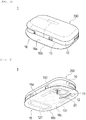
- Fig. 1 is an exploded perspective view of a drug solution delivery apparatus (medical device) 1 according to the present embodiment
- Figs. 2 and 3 are perspective views of the drug solution delivery apparatus (medical device) 1
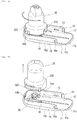
- Figs. 4 and 5 show a housing 10 and a puncture apparatus 35
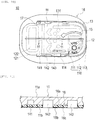
- Fig. 6 is a plan view of the housing 10.
- the drug solution delivery apparatus 1 serves as a portable insulin delivery apparatus that delivers insulin serving as a drug solution into a living body of a diabetic patient who is a user.
- the drug solution is not limited to the insulin, and may be other drug solutions.
- the drug solution delivery apparatus 1 generally includes the housing 10 attachable to a living body, a sheet-shaped adhesion portion 16 provided on a bottom surface (corresponding to one surface) 11b on a living body side of the housing 10, and a fixing region 110 to which the housing 10 and the adhesion portion 16 are fixed.
- the housing 10 has a fitting hole 12 (corresponding to a hole portion) formed in the bottom surface 11b of the housing 10 and penetrating the bottom surface.
- the adhesion portion 16 includes an adhesive portion 16c formed on at least a part of the bottom surface 16b (corresponding to one surface) facing a living body.
- the fixing region 110 includes welded portions 111 formed near the fitting hole 12 and non-welded portions 112 formed at positions adjacent to the welded portions 111.
- the drug solution delivery apparatus 1 includes a liquid delivering mechanism 200 connectable to and separable from the housing 10.
- the liquid delivering mechanism 200 is not particularly limited as long as the liquid delivering mechanism can deliver a drug solution into a living body.
- a liquid delivering mechanism including a reuse portion 210 including a drive mechanism 211 or the like that generates a drive force for driving a member necessary for a liquid delivering operation, and a disposable portion 220 including a drug solution storage unit 221 or the like filled with insulin and connectable to and separatable from the reuse portion 210 can be used.
- the user can connect the liquid delivering mechanism 200 to the housing 10 in a state where the reuse portion 210 and the disposable unit 220 are connected to each other.
- Figs. 4 and 5 show the puncture apparatus 35.
- the puncture apparatus 35 is configured to connect a delivery port portion 30 that delivers the drug solution into the living body to the housing 10, and to puncture a puncture needle 20 (see Fig. 3 ) that punctures the living body.
- the user connects the delivery port portion 30 to the housing 10 by using the puncture apparatus 35 before connecting the liquid delivering mechanism 200 to the housing 10.
- the delivery port portion 30 is fixed by being fitted into the fitting hole 12 (see Fig. 6 ) of the housing 10.
- the user uses the puncture apparatus 35 to protrude the puncture needle 20 from a bottom surface 11b side of the housing 10 and puncture the living body with the puncture needle 20.
- the puncture needle 20 can be constituted by, for example, a double needle including a cannula having an inner cavity and an inner needle inserted through the cannula.
- the puncture apparatus 35 connects the delivery port portion 30 to the housing 10 and protrudes the puncture needle 20 by a rotation operation relative to the housing 10.
- the puncture apparatus 35 includes a first guide portion 310, a second guide portion 320, and a third guide portion 330 that guide the operation of the puncture apparatus 35 when the puncture apparatus 35 is rotated.
- a side wall 13 of the housing 10 is formed with a first hole portion 14a through which the first guide portion 310 is inserted and a second hole portion 14b through which the second guide portion 320 is inserted.
- a third hole portion 15 into which the third guide portion 330 is inserted is formed in a bottom portion 11 of the housing 10.
- the guide portions 310, 320, 330 of the puncture apparatus 35 are inserted into and engaged with the hole portions 14a, 14b, 15, respectively.
- the user can guide the rotation of the puncture apparatus 35 by the guide portions 310, 320, 330 while rotating the puncture apparatus 35. Therefore, the user can rotate the puncture apparatus 35 in parallel with the bottom portion 11 of the housing 10.
- the engagement between the hole portions 14a, 14b, 15 and the guide portions 310, 320, 330 is released.
- the user can separate the puncture apparatus 35 from the housing 10 by lifting the puncture apparatus 35 after the engagement between the hole portions 14a, 14b, 15 and the guide portions 310, 320, 330 is released.
- the puncture apparatus 35 can be connected to the housing 10 before the liquid delivering mechanism 200 is connected to the housing 10.
- the user attaches the housing 10 to a living body surface of the user by using the adhesion portion 16 formed on the housing 10.
- the user connects the delivery port portion 30 to the housing 10 and punctures the living body with the puncture needle 20 by using the puncture apparatus 35 in a state where the housing 10 is attached to the living body surface.
- the user connects the liquid delivering mechanism 200 to the housing 10 as shown in Figs. 2 and 3 .
- the user fluidly communicates the delivery port portion 30, the cannula of the puncture needle 20, and the drug solution storage unit 221.
- the user can deliver the drug solution into the living body by operating a predetermined controller to drive the drive mechanism 211.
- the housing 10 includes the bottom portion 11 to be attached to the living body via the adhesion portion 16, the side wall 13 surrounding a part of a periphery of the bottom portion 11, and insertion portions 17 for insertion of the liquid delivering mechanism 200 into the housing 10 when connecting the liquid delivering mechanism 200 to the housing 10.
- the bottom portion 11 includes a placement surface (upper surface) 11a on which the liquid delivering mechanism 200 can be placed, the bottom surface 11b located on a back surface side of the placement surface 11a, the fitting hole (hole portion) 12 into which the delivery port portion 30 can be fitted, and the third hole portion 15 into which the third guide portion 330 of the puncture apparatus 35 is inserted.
- the housing 10 has a substantially elliptical planar shape.
- the fitting hole 12 has a substantially circular planar shape.
- the insertion portions 17 are constituted by opening portions formed by cutting out a part of the side wall 13.
- the third hole portion 15 has a planar shape extending in a substantially arc shape along a longitudinal direction (left-right direction in Fig. 6 ) of the housing 10.
- the housing 10 can be formed of a resin material such as polypropylene, polyethylene terephthalate, polymethyl methacrylate, or polycarbonate.
- the fitting hole 12 penetrates the bottom portion 11 of the housing 10 in a thickness direction.
- the third hole portion 15 penetrates the bottom portion 11 of the housing 10 in the thickness direction.
- the insertion portions 17 are formed on one end portion side in the longitudinal direction of the housing 10 in which the fitting hole 12 is disposed and the other portion side opposite to the one end portion side.
- the adhesion portion 16 includes an upper surface 16a disposed on the bottom surface 11b side of the housing 10, a bottom surface 16b located on a back surface side of the upper surface 16a, and the adhesive portion 16c (simply shown by oblique lines in Fig. 3 ) formed on the bottom surface 16b.
- the adhesion portion 16 is larger than the housing 10 to protrude from an outer periphery of the housing 10 in the plan view shown in Fig. 6 .
- the upper surface 16a of the adhesion portion 16 is fixed to the bottom surface 11b of the housing 10 by welding. With such a structure, an adhesive area is increased, peeling generated from the outer periphery of the housing 10 can be prevented, and the state where the housing 10 is attached to the living body surface can be stably maintained.
- a hole portion through which the puncture needle 20 is inserted is formed in the adhesion portion 16 at a position corresponding to the fitting hole 12 of the housing 10.
- a hole portion through which the third guide portion 330 of the puncture apparatus 35 is inserted is formed in the adhesion portion 16 at a position corresponding to the third hole portion 15 of the housing 10.
- the adhesion portion 16 can be constituted by an adhesive member (single-sided adhesive tape) including a sheet-shaped base material and the adhesive portion 16c provided on a bottom surface of the base material (the bottom surface 16b of the adhesion portion 16).
- the base material can be constituted by, for example, a polyethylene film, a polyester nonwoven fabric, a rayon nonwoven fabric, or a resin coated cotton fabric.
- the adhesive portion 16c can be constituted by an adhesive, for example, an acrylic adhesive, a silicone adhesive, or a gel adhesive.
- the adhesion portion 16 may be provided with a release paper or the like that covers the bottom surface 16b of the adhesion portion 16 until the housing 10 is attached to the living body.
- the adhesion portion 16 is not limited to a single-sided tape and may be constituted by a double-sided tape, an adhesive to be applied to the base material, or the like, but the single-sided adhesive tape is preferable due to the structure protruding from the outer periphery of the housing 10.
- the welded portions 111 and the non-welded portions 112 surround a periphery of the fitting hole 12.
- the welded portions 111 and the non-welded portions 112 are alternately disposed along the outer periphery of the fitting hole 12.
- the welded portions 111 refer to portions (portions indicated by broken lines in Fig. 6 ) where the housing 10 and the adhesion portion 16 are welded to each other in the fixing region 110
- the non-welded portions 112 refer to portions (regions) where the housing 10 and the adhesion portion 16 are not welded to each other in the fixing region 110.
- other welded portions 113, 114 may be formed close to the welded portions 111 and the non-welded portions 112 in the fixing region 110.
- the welded portion 113 extends to connect the linear welded portions 111 around the fitting hole 12.
- the welded portion 113 extends from the fitting hole 12 to a vicinity of the third hole portion 15.
- the welded portion (corresponding to an auxiliary welded portion) 114 extends substantially linearly from the welded portion 111 along the longitudinal direction of the housing 10.
- Each of the welded portions 113, 114 may be or may not continuous with the welded portions 111.
- the welded portions 111 are formed in four linear patterns extending radially from the fitting hole 12.
- the non-welded portions 112 formed between the welded portions 111 have a substantially triangular planar shape surrounded by the welded portions 111 and the welded portion 113.
- the pattern of the welded portions 111, 113, 114 and a shape of the non-welded portions 112 are not particularly limited.
- the state where the housing 10 is attached to the living body surface via the adhesion portion 16 may not be stably maintained.
- the fixing force between the adhesion portion 16 and the housing 10 and/or the adhesive force of the adhesive portion 16c decreases in the vicinity of the fitting hole 12, the puncture needle 20 punctured into the living body may come off, and the fluid communication at the delivery port portion 30 serving as a connection portion may be released.
- both the welded portions 111 and the non-welded portions 112 are formed around the fitting hole 12 in the fixing region 110, it is possible to prevent a significant decrease in the adhesive force of the adhesive portion 16c of the adhesion portion 16 and increase the fixing force for fixing the housing 10 to the adhesion portion 16.
- the drug solution delivery apparatus 1 further includes a welded portion (corresponding to another welded portion) 121 in which the housing 10 and the adhesion portion 16 are welded to each other in a vicinity of the insertion portions 17.
- a welded portion corresponding to another welded portion
- the housing 10 and the adhesion portion 16 are welded to each other in a vicinity of the insertion portions 17.
- the welded portion 121 is formed in a frame shape in a direction intersecting the longitudinal direction of the housing 10.
- a non-welded portion 122 is formed in a region surrounded by the welded portion 121.
- the specific shapes of the welded portion 121 and the non-welded portion 122 are not particularly limited.
- the drug solution delivery apparatus 1 further includes a welded portion 131 formed on a side wall 13 side (an outer peripheral side of the housing 10) relative to the third hole portion 15.
- the welded portion 131 extends along the longitudinal direction of the housing 10.
- the fixing region 110 is preferably formed, for example, in a range of 0% to 50% of an entire length of the housing 10 along the longitudinal direction of the housing 10 from one end portion (an end portion on a right side in Fig. 6 ) of the housing 10.
- the welded portion 121 is preferably formed, for example, in a range of 10% to 40%, and more preferably in a range of 15% to 35%, of the entire length of the housing 10 along the longitudinal direction of the housing 10 from the other end portion (an end portion on a left side in Fig. 6 ) of the housing 10.
- the adhesive force of the adhesive portion 16c of the adhesion portion 16 is larger than that of other portions.
- the welded portion 131 can be formed in the same range as the fixing region 110.
- each of the welded portions 111, 113, 114, 121, 131 can be formed by continuously connecting any of the welded portions.
- Other welded portions (not shown) (for example, welded portions extending linearly in the longitudinal direction of the housing 10 or in the direction intersecting the longitudinal direction) may be formed, and the welded portions 111, 113, 114, 121, 131 may be selectively connected to each other via corresponding welded portions.
- a method for forming each of the welded portions 111, 113, 114, 121, 131 is not particularly limited, and for example, a known method such as thermal welding by embossing, ultrasound welding, laser welding, vibration welding (horn welding), hot air, or spin welding can be performed.
- a known method such as thermal welding by embossing, ultrasound welding, laser welding, vibration welding (horn welding), hot air, or spin welding can be performed.
- horn welding vibration welding
- the drug solution delivery apparatus 1 includes the housing 10 attachable to a living body, the sheet-shaped adhesion portion 16 provided on the bottom surface 11b of the housing 10, and the fixing region 110 to which the housing 10 and the adhesion portion 16 are fixed.
- the housing 10 includes the fitting hole 12 formed in the bottom surface 11b of the housing 10 and penetrating the bottom surface 11b.
- the adhesion portion 16 includes the adhesive portion 16c formed on at least a part of the bottom surface 16b of the adhesion portion 16.
- the fixing region 110 includes the welded portions 111 formed near the fitting hole 12 and the non-welded portions 112 formed at positions adjacent to the welded portions 111.
- the fixing force between the adhesion portion 16 and the housing 10 can be increased by the welded portions 111 provided in the fixing region 110.
- the non-welded portions 112 provided in the fixing region 110 can prevent the adhesive force of the adhesive portion 16c from being excessively reduced in the fixing region 110. Therefore, in the drug solution delivery apparatus 1, the fixing force between the housing 10 and the adhesion portion 16 and the adhesive force between the adhesion portion 16 and the living body surface are increased.
- the fixing region 110 surrounds the periphery of the fitting hole 12, and the welded portions 111 and the non-welded portions 112 are alternately disposed along the outer periphery of the fitting hole 12. Since both the welded portions 111 and the non-welded portions 112 are formed around the fitting hole 12 in the fixing region 110, it is possible to prevent a significant decrease in the adhesive force of the adhesive portion 16c of the adhesion portion 16 and increase the fixing force for fixing the housing 10 to the adhesion portion 16. As a result, the fixing force between the housing 10 and the adhesion portion 16 around the fitting hole 12 and the adhesive force between the adhesion portion 16 and the living body surface are maintained, so that a state of the puncture needle 20 puncturing the living body is more reliable.
- the housing 10 further includes the welded portion 113 formed at a position different from the welded portions 111 along one direction of the housing 10. Therefore, the fixing force between the housing 10 and the adhesion portion 16 can be further increased.
- the housing 10 includes the insertion portions 17 for insertion of the liquid delivering mechanism 200 to be connected to the housing 10 into the housing 10.
- the housing 10 includes the welded portion 121 in which the housing 10 and the adhesion portion 16 are welded to each other in the vicinity of the insertion portions 17. Therefore, when the liquid delivering mechanism 200 is attached to or detached from the housing 10, it is possible to prevent the adhesion portion 16 from being peeled off from the housing 10 or the adhesion portion 16 from being twisted.
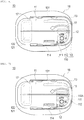
- the patterns (shapes) of the welded portions 111 and the non-welded portions 112 provided in the fixing region 110 are not limited to the patterns shown in Fig. 6 .
- the welded portions 111 and the non-welded portions 112 may be formed in parallel linear patterns in which the welded portions 111 and the non-welded portions 112 are spaced apart from each other in a fixing region 110A.
- the welded portions 111 and the non-welded portions 112 can be formed, for example, in a shape linearly extending in the longitudinal direction (left-right direction in Fig. 7 ) of the housing 10.
- the welded portions 111 and the non-welded portions 112 may be formed in a shape linearly extending in a direction (vertical direction in Fig. 8 ) intersecting the longitudinal direction of the housing 10 in a fixing region 110B.
- the welded portions 111 and the non-welded portions 112 may be formed in a lattice-shaped pattern in which the welded portions 111 and the non-welded portions 112 intersect with each other in a fixing region 110C.
- a passage 141 that allows air to flow on the bottom surface 11b side of the housing 10 groove portions 142, 143 that reduce a contact area between the living body surface and the bottom surface 11b of the housing 10, and the like may be formed.
- the passage 141 prevents a user from feeling uncomfortable due to an increase in humidity between the housing 10 and the living body surface by flowing air on the bottom surface 11b side of the housing 10.
- the groove portions 142, 143 can reduce an influence of the adhesive portion 16c on skin of the user by reducing the contact area between the living body surface and the bottom surface 11b of the housing 10.
- a vent hole 145 penetrating the bottom portion 11 of the housing 10 may be formed in the region of the housing 10 where the welded portions 111, 113, 114, 121, 131 are not formed.
- water vapor or the like can be released from the space between the housing 10 and the living body surface, so that the influence on the skin of the user can be reduced.
- Each of the groove portions 142, 143 can be formed by blasting, surface processing using a mold, or the like.
- the passage 141 can be formed by the surface processing using a mold or the like. Specific shapes, positions, and the like of the passage 141, the groove portions 142, 143, and the vent hole 145 are not limited to those described with reference to the drawings.
- the pattern (shape) of the welded portion 121 formed in the vicinity of the insertion portions 17 is not limited to the pattern shown in Fig. 6 .
- the welded portion 121 may have a pattern in which two triangular shapes in which non-welded portions 122 are formed are connected to each other.
- the welded portion 121 may have a pattern in a geometric shape that is continuously connected.
- the welded portion 121 may have a rhombic pattern.
- the welded portion 121 may have an elliptical pattern.
- the welded portion 121 may have a pattern in which a part of an elliptical shape is missing.
- the welded portion 121 may have an L-shaped pattern.
- the drug solution delivery apparatus is an application example of the medical device according to this disclosure, but the medical device is not limited to the drug solution delivery apparatus only.
- the medical device may be, for example, an inspection apparatus or the like including an inspection portion to be inserted into a living body.
- a fixing region can be disposed around an insertion portion (hole or the like) formed in a housing through which the inspection portion is inserted into a living body.
Landscapes
- Health & Medical Sciences (AREA)
- Dermatology (AREA)
- Vascular Medicine (AREA)
- Engineering & Computer Science (AREA)
- Anesthesiology (AREA)
- Biomedical Technology (AREA)
- Heart & Thoracic Surgery (AREA)
- Hematology (AREA)
- Life Sciences & Earth Sciences (AREA)
- Animal Behavior & Ethology (AREA)
- General Health & Medical Sciences (AREA)
- Public Health (AREA)
- Veterinary Medicine (AREA)
- Infusion, Injection, And Reservoir Apparatuses (AREA)
- Media Introduction/Drainage Providing Device (AREA)
Applications Claiming Priority (2)
| Application Number | Priority Date | Filing Date | Title |
|---|---|---|---|
| JP2018209904 | 2018-11-07 | ||
| PCT/JP2019/038040 WO2020095565A1 (ja) | 2018-11-07 | 2019-09-26 | 医療機器 |
Publications (2)
| Publication Number | Publication Date |
|---|---|
| EP3858401A1 true EP3858401A1 (de) | 2021-08-04 |
| EP3858401A4 EP3858401A4 (de) | 2021-11-17 |
Family
ID=70611941
Family Applications (1)
| Application Number | Title | Priority Date | Filing Date |
|---|---|---|---|
| EP19881520.1A Withdrawn EP3858401A4 (de) | 2018-11-07 | 2019-09-26 | Medizinische vorrichtung |
Country Status (4)
| Country | Link |
|---|---|
| EP (1) | EP3858401A4 (de) |
| JP (1) | JPWO2020095565A1 (de) |
| CN (1) | CN112823033A (de) |
| WO (1) | WO2020095565A1 (de) |
Family Cites Families (10)
| Publication number | Priority date | Publication date | Assignee | Title |
|---|---|---|---|---|
| US7309326B2 (en) * | 2003-11-18 | 2007-12-18 | Icu Medical, Inc. | Infusion set |
| EP2146760B1 (de) | 2007-04-30 | 2018-10-10 | Medtronic MiniMed, Inc. | Reservoir-füllung, blasenkontrolle und infusionsmedium-abgabesysteme und verfahren dafür |
| CN102256657A (zh) * | 2008-12-22 | 2011-11-23 | 犹诺医药有限公司 | 包括粘合垫的医疗器械 |
| CN202477977U (zh) * | 2012-03-16 | 2012-10-10 | 何婷婷 | 防过敏透明敷料贴 |
| US9375537B2 (en) * | 2013-10-14 | 2016-06-28 | Medtronic Minimed, Inc. | Therapeutic agent injection device |
| CN203555889U (zh) * | 2013-11-15 | 2014-04-23 | 栾素娴 | 一种产妇护理垫 |
| JP2016154599A (ja) * | 2015-02-23 | 2016-09-01 | テルモ株式会社 | 薬液投与装置 |
| US11065381B2 (en) * | 2015-10-05 | 2021-07-20 | E3D A.C.A.L. | Infusion pump device and method for use thereof |
| CN205108570U (zh) * | 2015-10-12 | 2016-03-30 | 新乡市强盛医疗器械有限公司 | 一种一次性使用输液贴 |
| CN106860434A (zh) * | 2017-04-14 | 2017-06-20 | 王学昌 | 增加粘力、减少外溢的新型传统膏贴 |
-
2019
- 2019-09-26 EP EP19881520.1A patent/EP3858401A4/de not_active Withdrawn
- 2019-09-26 CN CN201980066339.2A patent/CN112823033A/zh active Pending
- 2019-09-26 WO PCT/JP2019/038040 patent/WO2020095565A1/ja not_active Ceased
- 2019-09-26 JP JP2020556676A patent/JPWO2020095565A1/ja active Pending
Also Published As
| Publication number | Publication date |
|---|---|
| JPWO2020095565A1 (ja) | 2021-09-24 |
| WO2020095565A1 (ja) | 2020-05-14 |
| EP3858401A4 (de) | 2021-11-17 |
| CN112823033A (zh) | 2021-05-18 |
Similar Documents
| Publication | Publication Date | Title |
|---|---|---|
| CN101460207B (zh) | 包括皮肤可安装设备及其包装件的组件 | |
| KR102687585B1 (ko) | 경피 침투제 도포 장치 | |
| US8235949B2 (en) | Application systems for use with medical devices | |
| JP4210782B2 (ja) | 採血位置表示具 | |
| US10632256B2 (en) | Drug solution administration apparatus | |
| CN101426542A (zh) | 含经涂覆的密封构件的包装件中的可安装在表皮上的装置 | |
| EP3482697A1 (de) | Hämostatisches instrument | |
| ITTO20011228A1 (it) | Contenitore per ago monouso. | |
| KR20090028701A (ko) | 장착 패드 | |
| JP2005527254A (ja) | 動物の皮膚を通して物質を供給または引き抜くマイクロデバイスおよび方法 | |
| JP2010046476A (ja) | 経皮投薬デバイス | |
| WO2016114307A1 (ja) | 経皮投与デバイス収容体 | |
| RU107038U1 (ru) | Гемостатическое устройство | |
| JP2021506412A (ja) | 医療装置の包装 | |
| EP4111986B1 (de) | Kompressionsvorrichtung | |
| EP4111987A1 (de) | Kompressionsvorrichtung und verfahren zur befestigung einer kompressionsvorrichtung | |
| JP5996862B2 (ja) | マイクロニードルアレイとマイクロニードルアレイ装置 | |
| EP3858401A1 (de) | Medizinische vorrichtung | |
| CN116018167A (zh) | 带有改进的释放衬垫移除的贴片式注射装置 | |
| EP4212193A1 (de) | Verpackung für medizinische vorrichtung | |
| JP2013236865A (ja) | 皮下注射装置及びその製造方法 | |
| JP6068057B2 (ja) | 経皮投薬装置及びその装置に使用される薬液注入針 | |
| JP7761633B2 (ja) | 薬液投与装置 | |
| JP6662177B2 (ja) | 経皮投与デバイス収容体 | |
| EP3974011A1 (de) | Selbsthaltende vorrichtung |
Legal Events
| Date | Code | Title | Description |
|---|---|---|---|
| STAA | Information on the status of an ep patent application or granted ep patent |
Free format text: STATUS: THE INTERNATIONAL PUBLICATION HAS BEEN MADE |
|
| PUAI | Public reference made under article 153(3) epc to a published international application that has entered the european phase |
Free format text: ORIGINAL CODE: 0009012 |
|
| STAA | Information on the status of an ep patent application or granted ep patent |
Free format text: STATUS: REQUEST FOR EXAMINATION WAS MADE |
|
| 17P | Request for examination filed |
Effective date: 20210426 |
|
| AK | Designated contracting states |
Kind code of ref document: A1 Designated state(s): AL AT BE BG CH CY CZ DE DK EE ES FI FR GB GR HR HU IE IS IT LI LT LU LV MC MK MT NL NO PL PT RO RS SE SI SK SM TR |
|
| REG | Reference to a national code |
Ref country code: DE Ref legal event code: R079 Free format text: PREVIOUS MAIN CLASS: A61M0005142000 Ipc: A61M0005140000 |
|
| A4 | Supplementary search report drawn up and despatched |
Effective date: 20211018 |
|
| RIC1 | Information provided on ipc code assigned before grant |
Ipc: A61M 25/02 20060101ALI20211012BHEP Ipc: A61M 5/158 20060101ALI20211012BHEP Ipc: A61M 5/142 20060101ALI20211012BHEP Ipc: A61M 5/14 20060101AFI20211012BHEP |
|
| DAV | Request for validation of the european patent (deleted) | ||
| DAX | Request for extension of the european patent (deleted) | ||
| STAA | Information on the status of an ep patent application or granted ep patent |
Free format text: STATUS: EXAMINATION IS IN PROGRESS |
|
| 17Q | First examination report despatched |
Effective date: 20240126 |
|
| STAA | Information on the status of an ep patent application or granted ep patent |
Free format text: STATUS: THE APPLICATION HAS BEEN WITHDRAWN |
|
| 18W | Application withdrawn |
Effective date: 20240510 |