EP3860397B1 - Dispositif de maintien pour équipement portable - Google Patents
Dispositif de maintien pour équipement portable Download PDFInfo
- Publication number
- EP3860397B1 EP3860397B1 EP19786902.7A EP19786902A EP3860397B1 EP 3860397 B1 EP3860397 B1 EP 3860397B1 EP 19786902 A EP19786902 A EP 19786902A EP 3860397 B1 EP3860397 B1 EP 3860397B1
- Authority
- EP
- European Patent Office
- Prior art keywords
- piston
- cylinder
- housing
- spring
- cams
- Prior art date
- Legal status (The legal status is an assumption and is not a legal conclusion. Google has not performed a legal analysis and makes no representation as to the accuracy of the status listed.)
- Active
Links
Images



Classifications
-
- A—HUMAN NECESSITIES
- A45—HAND OR TRAVELLING ARTICLES
- A45F—TRAVELLING OR CAMP EQUIPMENT: SACKS OR PACKS CARRIED ON THE BODY
- A45F5/00—Holders or carriers for hand articles; Holders or carriers for use while travelling or camping
- A45F5/004—Holders or carriers for hand articles; Holders or carriers for use while travelling or camping with an automatic spring reel
-
- A—HUMAN NECESSITIES
- A45—HAND OR TRAVELLING ARTICLES
- A45F—TRAVELLING OR CAMP EQUIPMENT: SACKS OR PACKS CARRIED ON THE BODY
- A45F5/00—Holders or carriers for hand articles; Holders or carriers for use while travelling or camping
- A45F5/1516—Holders or carriers for portable handheld communication devices, e.g. pagers or smart phones
-
- A—HUMAN NECESSITIES
- A45—HAND OR TRAVELLING ARTICLES
- A45F—TRAVELLING OR CAMP EQUIPMENT: SACKS OR PACKS CARRIED ON THE BODY
- A45F5/00—Holders or carriers for hand articles; Holders or carriers for use while travelling or camping
- A45F5/1541—Holders or carriers for eyeglasses or spectacles
-
- B—PERFORMING OPERATIONS; TRANSPORTING
- B65—CONVEYING; PACKING; STORING; HANDLING THIN OR FILAMENTARY MATERIAL
- B65H—HANDLING THIN OR FILAMENTARY MATERIAL, e.g. SHEETS, WEBS, CABLES
- B65H75/00—Storing webs, tapes, or filamentary material, e.g. on reels
- B65H75/02—Cores, formers, supports, or holders for coiled, wound, or folded material, e.g. reels, spindles, bobbins, cop tubes, cans, mandrels or chucks
- B65H75/34—Cores, formers, supports, or holders for coiled, wound, or folded material, e.g. reels, spindles, bobbins, cop tubes, cans, mandrels or chucks specially adapted or mounted for storing and repeatedly paying-out and re-storing lengths of material provided for particular purposes, e.g. anchored hoses, power cables
- B65H75/38—Cores, formers, supports, or holders for coiled, wound, or folded material, e.g. reels, spindles, bobbins, cop tubes, cans, mandrels or chucks specially adapted or mounted for storing and repeatedly paying-out and re-storing lengths of material provided for particular purposes, e.g. anchored hoses, power cables involving the use of a core or former internal to, and supporting, a stored package of material
- B65H75/44—Constructional details
- B65H75/4418—Arrangements for stopping winding or unwinding; Arrangements for releasing the stop means
- B65H75/4428—Arrangements for stopping winding or unwinding; Arrangements for releasing the stop means acting on the reel or on a reel blocking mechanism
- B65H75/4434—Arrangements for stopping winding or unwinding; Arrangements for releasing the stop means acting on the reel or on a reel blocking mechanism actuated by pulling on or imparting an inclination to the material
-
- A—HUMAN NECESSITIES
- A45—HAND OR TRAVELLING ARTICLES
- A45F—TRAVELLING OR CAMP EQUIPMENT: SACKS OR PACKS CARRIED ON THE BODY
- A45F5/00—Holders or carriers for hand articles; Holders or carriers for use while travelling or camping
- A45F5/1533—Holders or carriers for cameras
Definitions
- the invention relates to a holding device for portable equipment, in particular cameras, according to the preamble of patent claim 1.
- the object of the invention is therefore to provide a holding device for portable pieces of equipment that allows a user to use pieces of equipment attached thereto without forces affecting the equipment that interfere with use.
- the invention solves this problem with a holding device according to claim 1.
- the configuration of the holding device with a bistable locking mechanism advantageously ensures that the items of equipment can be used without disruptive tensile forces acting on them when the locking mechanism is in the locked position.
- such an embodiment of the locking mechanism ensures that it is only locked in the end position, which allows the greatest possible range of movement when using the equipment.
- the locking mechanism If the locking mechanism is in the unlocked position, a tensile force is exerted on the roller element by the return element and the tension element is rolled up on the roller element and drawn into the housing.
- the locking mechanism is transferred from the locked position to the unlocked position and vice versa from the unlocked position to the locked position when the pulling element is brought into the end position.
- This configuration of the locking mechanism as a bistable locking mechanism advantageously ensures that items of equipment, such as a camera, are kept safely within reach of the user when the pulling element is in its initial state.
- the user pulls on the traction element until it is in the end position and the equipment can be used without any traction forces acting on it. If the piece of equipment is to be stowed away again, the user pulls on the pull element again until it is transferred to the end position, the pull element is rolled up and the equipment is again safely stored on the holding device.
- a locking mechanism constructed in this way advantageously requires a small number of individual components, which can be manufactured inexpensively from plastic, for example, and can be manufactured in different dimensions in order to be able to use them in holding devices of different sizes.
- a structurally simple, material-saving configuration of a locking mechanism can be provided if the cylinder is designed as a hollow cylinder and the cams are arranged on the inside of the wall surface of the cylinder, with the pairs of extensions being arranged on the outside of the piston, and with the cylinder and the Pistons are designed such that the piston is at least partially slidable into the cylinder.
- a further design of a locking mechanism that is favorable in terms of production technology can be provided if the piston is at least partially designed as a hollow cylinder and the pairs of extensions are arranged on the inside of the wall surface of the piston and the cams are arranged on the outside of the cylinder, and the cylinder and the Pistons are designed such that the piston is at least partially displaceable over the cylinder, so that the cylinder is at least partially accommodated in the interior of the piston.
- Damage to the sawtooth-like cams can advantageously be prevented if the pairs of extensions have run-on surfaces corresponding to the sawtooth-like cams, which slide along the sawtooth-like cams when the pulling element is moved into the end position.
- the ends of the sawtooth-like cams each face the end faces of the cylinder and extend at most to the end face of the cylinder.
- a particularly simple and stable fixation of the pulling element on the piston can be achieved if the piston is completely penetrated by an elongated channel, the pulling element being guided through the channel and attached to the end of the piston which is remote from the recess in the housing one, in particular spherical, locking element is fixed.
- an adapter for fixing portable equipment in particular a camera, can be arranged on the end of the pulling element that is guided out of the housing.
- This configuration of the holding device advantageously makes it possible to arrange a suitable adapter on the holding device for a wide variety of portable pieces of equipment, so that the items can be easily attached to the holding device and removed again.
- a suitable adapter can also be designed in such a way that it can be exchanged.
- Particularly effective restoring or spring elements can be provided if the restoring element is designed as a spiral spring or torsion spring and/or the spring element is designed as a compression spring.
- the restoring element By selecting the restoring element in this way, a long service life of the holding device can be achieved without the restoring element showing signs of fatigue, for example, so that the tension element is rolled up properly on the roller element throughout the service life of the holding device.
- the design of the spring element as a compression spring advantageously ensures a compact, space-saving design of the locking mechanism.
- a particularly compact and structurally simple holding device can be provided if the housing has a cover, the roller element being fixed by the cover against displacement in the direction of the axis of rotation of the roller element.
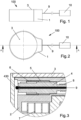
- a first exemplary embodiment of a holding device 100 according to the invention is shown viewed from the outside.
- the holding device 100 comprises a housing 1, from which one end of a pulling element 9 is led out. Equipment to be stored is attached to this end.
- the holding device 100 as in the Figures 1 and 2 shown, a cover 3 and / or an adapter 10, which is attached to the end of the pulling element 9, which protrudes from the housing 1, comprise.
- an adapter 10 can be used for particularly secure attachment of portable pieces of equipment, such as cameras, and can be designed to be interchangeable, with one for a wide variety of items suitable adapter 10 at the end of the pulling element 9, which protrudes from the housing 1, is attached.
- the holding device 100 in the first exemplary embodiment further comprises a roller element 2 and a restoring element 7 which are arranged in the housing 1 .
- the roller element 2 is rotatably mounted on the housing 1 relative to the housing 1, which, for example, via a trained on the inside of the housing, z.
- Radial bearings, as in Figures 4 to 7 is shown as an example can be achieved.
- the tension element 9, one end of which protrudes from the housing 1 and is used to fasten objects, is completely rolled up on the roller element 2 in an initial state.
- the pulling element 9 is rolled up on the outer circumference of the roller element 2 .
- the restoring element 7 is arranged between the housing 1 and the roller element 2 and exerts a tensile force on the roller element 2, so that the tension element 9 is rolled up on the roller element 2 in the initial state.
- the restoring element 7 is a spiral spring which is fixed to the bearing on which the roller element 2 rests, on the one hand, and to the inside of the wall surface of the roller element 2, on the other hand.
- the restoring element 7 is by no means necessarily designed as a spiral spring, but can also be designed, for example, as a torsion spring or as another restoring element known from the prior art.
- the tension element 9 is automatically at least partially rolled up, for example on the outer circumference of the roller element 2, when a tensile force acts on the tension element 9 that is smaller than the tensile force exerted by the restoring element 7 exerts on the roller element 2.
- the initial state is understood to mean that the tension element 9 is completely rolled up on the roller element 2 and only one end of the tension element 9 protrudes from the housing 1 .
- the pulling element 9 can be rolled out to an end position and moved away from the housing 1 or out of the housing 1 to be pulled out. As an end position (see figure 5 ) will be in Understood in connection with the invention that the pulling element 9 is completely unrolled from the roller element 2 and pulled out of the housing 1 .
- a holding device 100 comprises a bistable locking mechanism 20.
- a bistable locking mechanism 20 is understood in connection with the invention as a locking mechanism which has two switching positions, namely a locking position (see 6 ) and an unlock position (see 4 ). Apart from these two stable positions, the locking mechanism 20 has no other stable position.
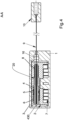
- the locking mechanism 20 is shown in detail in FIGS Figures 3 to 6 shown.
- the pulling element 9 can be pulled out 80 to 99% or 95 to 99% in the locked position.
- the roller element 2 is rotatable relative to the housing 1 and the tension element 9 is rolled up on the roller element 2 when no tension force exceeding the force of the return element 7 acts on it.
- the locking mechanism 20 can be transferred between the two stable switching positions by bringing the pull element 9 into the end position. This means that the locking mechanism 20 is transferred from the locked position to the unlocked position, for example, when the pulling element 9 is brought into the end position.
- the pull element 9 can be pulled out of the housing 1 when the locking mechanism 20 is in the unlocked position, and the roller element 2 can rotate relative to the housing 1 . If the pull element 9 is brought into the end position again, the locking mechanism 20 is transferred from the unlocked position to the locked position.
- the locking mechanism 20 has a movable locking element which can be moved and displaced in the locking mechanism 20 or in the roller element 2 .
- the pulling element 9 can be attached to one end of the Be fixed locking element and out of the housing 1.
- the locking mechanism 20 can be switched between the two stable switching positions by bringing the pull element 9 into the end position. If the locking mechanism is brought into the locking position, the locking element dips at least partially into a recess 16 in the housing 1, so that the rotation of the roller element 2 relative to the housing 1 is blocked in the locking position. If the locking mechanism is brought into the unlocked position, the locking element is pushed out of a recess 16 in the housing 1, back into the roller element 2 and rotation of the roller element 2 relative to the housing 1 is possible in the unlocked position.
- a user transfers the locking mechanism 20 into the locking position, the user can use an item of equipment fixed to the holding device 100, e.g. a camera, without disturbing force influences acting on it. Should the camera accidentally fall out of the user's hand during use, the pull element 9 is pulled out to its end position by the weight of the camera. If the restoring force that the restoring element 7 exerts on the pulling element 9 exceeds the weight of the fixed piece of equipment, the locking mechanism 20 is transferred to the unlocking position and the camera is pulled onto the holding device 100 by the automatic rolling up of the pulling element 9 on the roller element 2 .
- an item of equipment fixed to the holding device 100 e.g. a camera
- the restoring element 7 can therefore optionally be matched to the weight of an item of equipment, so that the item of equipment moves the locking mechanism 20 into the unlocked position when it falls down and is pulled against the holding device 100 .
- the locking mechanism 20 is arranged centrally in the roller element 2 in a recess 430 of the roller element 2 .
- the locking mechanism 20 can be arranged eccentrically, for example on the housing 1 or in the roller element 2 .
- the blocking mechanism 20 can thus optionally also be arranged differently, as long as a blocking effect of the relative movement can be achieved between the housing 1 and the roller element 2 .
- the locking mechanism 20 and its operation are in detail in the Figures 3 to 6 shown.
- the locking mechanism 20 (see 7 ) comprises in the embodiment shown a cylinder 5, a piston 4 and a spring element 8, the coaxial are arranged in the roller element 2 or in a recess 200 of the roller element 2 and have a common longitudinal axis 21 .
- the cylinder 5 is mounted within the roller element 2 in such a way that it can be rotated about the common longitudinal axis 21 but cannot be displaced along the longitudinal axis 21 .
- the cylinder 5 has two end faces 51 , 52 , the first end face 51 of the cylinder 5 facing the roller element 2 and the second end face 52 facing the piston 4 .
- the piston 4 is mounted in the roller element 2 so that it can be displaced along the common longitudinal axis 21 and has an extension section 41 and a spring section 42 .
- the extension section 41 and the spring section 42 are separated from one another by a shoulder 44 .
- the spring element 8 for example a compression spring in the first exemplary embodiment, at least partially surrounds the spring section 42 of the piston 4 and can be seated on the shoulder 44 of the piston 4 . That end of the pulling element 9 which is in the housing 1 is fastened to the piston 4, while the other end of the pulling element 9 is guided out of the housing 1 through an opening 21 in the roller element 2 and through a recess 16 in the housing 1.
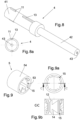
- the piston 4 can, for example, be completely penetrated by an elongate channel 43 for fastening the tension element 9 (see FIG 8 ), wherein the pulling element 9 is guided through the channel 43.
- the pulling element 9 can be fixed with a locking element 430, in particular a spherical one.
- other types of fixing of the pulling element 9 on the piston 4 are also possible, for example by gluing.
- a sleeve 6, as in the Figures 3 to 6 may be arranged between the roller element 2 and the cylinder 5.
- the sleeve 6 is arranged so as to be rigid in terms of movement and rotation by gluing it to the roller element 2 .
- One end face 61 of the sleeve 6 faces the rolling element 2 and a second end face 62 of the sleeve 6 is in contact with the first end face 51 of the cylinder 5 .
- the sleeve 6 thus serves as a spacer for the cylinder 5, but does not restrict its ability to rotate about the common longitudinal axis 21.
- the piston 4 in the first exemplary embodiment has two pairs of extensions 11, 13 which are arranged on the piston 4 at a distance from one another along the common longitudinal axis 21.
- more than two pairs of extensions 11, 13 can be arranged on the piston 4.
- the extension pairs 11 , 13 are arranged on the extension section 41 of the piston 4 .
- a rear pair of extensions 11 is arranged on the extension section 41 at its end remote from the spring section 42 and a front pair of extensions 13 is arranged at its end close to the spring section 42 .
- Figures 12 and 12a As can be seen, the two pairs of extensions 11, 13 are not arranged in complete alignment with one another on the extension section 41 of the piston 4, but are offset from one another in such a way that one flank of the extensions of one pair of extensions 11 is aligned with a flank of the extensions of the other pair of extensions 13. However, this arrangement is likewise in no way mandatory and arrangements in which the extensions of the pairs of extensions 11, 13 are spaced radially from one another and are not aligned are also possible.
- the cylinder 5 has sawtooth cams 12, 14 arranged on its two end faces 51, 52.
- the cams 12 , 14 are interrupted by a number of grooves 15 running in the direction of the common longitudinal axis 21 .
- rear cams 12 are arranged, for example, in the initial area of that end face 51 of cylinder 5 that faces roller element 2, and front cams 14 are arranged in the initial area of that end face 52 that faces piston 4, as is shown in FIG Figure 9b is shown in detail.
- the ends of the sawtooth-like cams 12, 14 extend in the illustrated embodiment in the direction of the end faces 51, 52 of the cylinder 5, ie the ends of the sawtooth-like cams 12, 14 face the end faces 51, 52. Furthermore, the ends of the cams 12, 14 extend up to the maximum respective end faces 51, 52 of the cylinder 5. This advantageously ensures a particularly material-saving design of the cylinder 5, in which the ends of the saber-toothed cams 12, 14 are protected from increased wear.
- this arrangement of the cams 12, 14 is by no means mandatory and the ends of the cams 12, 14 can also be arranged on the cylinder 5, for example, in such a way that they protrude beyond the end faces 51, 52.
- the cylinder 5 is designed as a hollow cylinder and the cams 12, 14 are arranged on the inside of the wall surface 54 of the cylinder 5.
- the pairs of extensions 11, 13 are arranged on the outside of the piston 4 and the piston 4 and the cylinder 5 are designed and dimensioned in such a way that the piston 4 can be displaced at least partially into the cylinder 5.
- the sawtooth-like cams 12, 14 are designed in the first exemplary embodiment in such a way that they alternately have inclined surfaces running in the direction of the ends of the cams 12, 14, followed by longitudinal surfaces running parallel to the common longitudinal axis 21.
- those ends of the extensions of the pairs of extensions 11, 13 which face the sawtooth-like cams 12, 14 or engage in them have ramp surfaces which correspond to the cams 12, 14 and slide along the sawtooth-like cams 12, 14.
- This embodiment of the pairs of extensions 11, 13 advantageously ensures that the ends of the pairs of extensions 11, 13 are worn as little as possible, but is in no way mandatory.
- the pairs of extensions 11, 12 can also have, for example, ramp surfaces that run straight.
- the sawtooth-like cams 12, 14 and the grooves 15 of the cylinder 5 interact with the pairs of extensions 11, 13 of the piston 4 in such a way that when the tension element 9 is moved into the end position, the locking mechanism 20 is transferred between the locked position and the unlocked position.
- the locking mechanism 20 is in the unlocked position, as shown in 4 is shown and the pulling element 9 is not in the end position but is partially wound up on the roller element 2, the pulling element 9 exerts a force in the radial direction towards the common longitudinal axis 21 of the piston 4 and the piston 4 remains inside the roller element 2 .
- the rear cams 12 interact with the rear pair of extensions 11 in such a way that the cylinder 5 is rotated about the common longitudinal axis 21 and the front Extension pair 13 in the grooves 15 of the cylinder 5 is immersed.
- the locking mechanism 20 is in the unlocked position (see 4 , 10 ) and the spring portion 42 of the piston 4 is withdrawn from the recess 16 in the housing 1.
- the roller element 2 can be rotated relative to the housing 1 .
- the piston 4 can optionally be configured at least partially as a hollow cylinder.
- the extension section 41 can be designed as a hollow cylinder and the pairs of extensions 11, 13 can be located on the inside of the wall surface of the piston 4.
- the sawtooth-like cams 12, 14 can be located on the outside of the cylinder 5, the cylinder 5 and the piston 4 being designed and dimensioned in such a way that the piston 4 can be displaced at least partially over the cylinder 5.
- a holding device 100 according to the invention can include any other bistable locking mechanism 20 that has two switch positions and can be transferred between the two switch positions by moving the pull element 9 to the end position.
- the unlocking position corresponds to the operating mechanism of the ballpoint pen with the refill retracted state, while the locking position corresponds to the operating mechanism with the refill extended state.
- the locking mechanism has, for example, a cylinder and a piston which are arranged coaxially in the roller element and have a common longitudinal axis.
- the cylinder is mounted in the roller element in a radially and axially immovable manner and at least one pair of cylinder extensions is arranged on the cylinder, the two extensions of which are spaced radially from one another and have inclined ramp surfaces.
- the piston has an extension section and a spring section which is surrounded by a spring element.
- the two sections of the piston are separated by a shoulder and the piston has a pair of extensions also having inclined ramps directed in the same direction as the ramps of the pair of cylinder extensions.
- the piston is mounted in the roller element such that it can be displaced along the common longitudinal axis, but cannot rotate about the common longitudinal axis.
- the pulling element is arranged on the piston and the piston can be adjusted at least partially into a recess in the housing.
- the locking mechanism in this case has a ring element with sawtooth-like cams, which at least partially surrounds the extension section of the piston, so that the axis of the ring element coincides with the common longitudinal axis.
- the ring element is mounted in the roller element such that it can rotate about the common longitudinal axis and sits on the shoulder.
- the sawtooth cams have at least two locking indentations and at least two unlocking indentations.
- the locking indentations and the unlocking indentations of the ring member are radially opposed to each other on the ring member.
- the cams of the ring element can be arranged on the inside of the ring element or can form the end edge of the ring element facing the pair of piston extensions and the pair of cylinder shoulders.
- the extensions of the cylinder, the piston and the sawtooth-like cams of the ring element interact when the pulling element is adjusted into the end position in such a way that the pair of piston extensions presses against the ramp surfaces of the sawtooth-like cams of the ring element, so that the ring element is rotated.
- the ramp surfaces of the ring element slide along the ramp surfaces of the cylinder, the pair of cylinder extensions dives into the locking recesses of the ring element due to the action of the spring force exerted on the piston by the spring element and the Locking mechanism is transferred from the unlocked position to the locked position.
- the spring section of the piston dips into a recess in the housing and rotation of the roller element relative to the housing is inhibited.
- the pair of piston extensions is again pressed against the corresponding ramp surfaces of the ring element, so that the ring element is rotated again.
- the abutment surfaces of the cams of the ring element slide along the abutment surfaces of the cylinder, the pair of cylinder extensions plunges into the unlocking recesses of the ring element as a result of the spring force exerted on the piston by the spring element and the locking mechanism is transferred from the locked position to the unlocked position.
- the spring portion of the plunger is withdrawn from the recess in the housing and the roller member is rotatable relative to the housing.
- the extensions of the cylinder or the extensions of the piston are arranged in such a way that a side surface of each extension of the piston slides along a side surface of an extension of the cylinder when the pulling element is adjusted into the end position.
- the sawtooth-like cams of the ring element are designed to correspond to the abutment surfaces of the extensions of the piston and the cylinder, i.e. they have corresponding abutment surfaces which alternate with straight surfaces running parallel to the common longitudinal axis.
- any other bistable ballpoint pen actuation mechanism can be used.
- an adapter 10 for fixing portable pieces of equipment can be arranged at that end of the pulling element 9 which is guided out of the housing 1 .
- Such an adapter 10 can advantageously be correspondingly adapted to the object that the user wants to fix on the holding device 100 .
- the housing 1 of the holding device 100 has a cover 3 (see FIG 11 ).
- a cover 3 on the one hand fixes the roller element 2 against displacement in the direction of the axis of rotation of the roller element 2 and on the other hand protects the Components of the holding device 100, which are located within the housing 1, from contamination.
- Such a housing 1 can be closed all around, for example, so that the only opening is the recess 16 in the housing 1, through which one end of the pulling element 9 is guided out of the housing 1 .
Landscapes
- Devices For Conveying Motion By Means Of Endless Flexible Members (AREA)
- Clamps And Clips (AREA)
- Rolls And Other Rotary Bodies (AREA)
Claims (13)
- Dispositif de support (100) pour pièces d'équipement portables, en particulier des caméras, comprenant- un boîtier (1) dans lequel sont disposés un élément de roulement (2) et un élément de rappel (7), dans lequel l'élément de roulement (2) est disposé sur le boîtier (1) et est monté de manière rotative par rapport au boîtier (1),- un élément de traction (9) pour la fixation de pièces d'équipement, dans lequel l'élément de traction (9) est complètement enroulé dans un état initial sur l'élément de roulement (2) et seule une extrémité de l'élément de traction (9) fait saillie hors du boîtier (1),- dans lequel l'élément de rappel (7) est disposé entre le boîtier (1) et l'élément de roulement (2) de telle sorte que l'élément de rappel (7) exerce une force de traction sur l'élément de roulement (2), de sorte que l'élément de traction (9) peut être enroulé sur l'élément de roulement (2),- dans lequel l'élément de traction (9), lorsqu'une force de traction orientée à l'opposé du boîtier (1) agit sur l'élément de traction (9), qui est supérieure à la force exercée par l'élément de rappel (7) sur l'élément de roulement (2), jusqu'à une position finale, dans laquelle l'élément de traction (9) est déroulé entièrement de l'élément de roulement (2), peut être déroulé et est extensible à partir de celui-ci par rapport au boîtier (1) et- dans lequel l'élément de traction (9), lorsqu'une force de traction orientée à l'opposé du boîtier (1) agit sur l'élément de traction (9), qui est inférieure à la force exercée par l'élément de rappel (7) sur l'élément de roulement (2), peut être enroulé jusqu'à l'état initial et est extensible dans celui-ci par rapport au boîtier (1), dans lequelle dispositif de support (100) comprend un mécanisme de verrouillage (20) bistable, qui présente deux positions de commutation, notamment une position de verrouillage et une position de déverrouillage,- dans lequel la rotation de l'élément de roulement (2) est bloquée par rapport au boîtier (1) dans la position de verrouillage et l'élément de traction (9) est déroulé d'au moins 80 %, en particulier de 80 à 99 %, de préférence de 95 à 99 %,- dans lequel l'élément de roulement (2) peut tourner par rapport au boîtier (1) dans la position de déverrouillage et- dans lequel le mécanisme de verrouillage (20) peut être transféré respectivement de la position de verrouillage à la position de déverrouillage en amenant l'élément de traction (9) dans la position finale,caractérisé en ce quele mécanisme de verrouillage (20) comprend un élément de verrouillage mobile, déplaçable dans le mécanisme de verrouillage (20) et/ou dans l'élément de roulement (2),dans lequel l'élément de traction (9) est fixé sur une extrémité de l'élément de verrouillage et dirigé hors du boîtier (1),dans lequel, dans la position de verrouillage du mécanisme de verrouillage (20), l'élément de verrouillage est immergé au moins partiellement dans un évidement (16) du boîtier (1), de sorte que la rotation de l'élément de roulement (2) est bloquée par rapport au boîtier (1) etdans lequel, dans la position de déverrouillage du mécanisme de verrouillage (20), l'élément de verrouillage est redéplacé de l'évidement (16) du boîtier (1) dans l'élément de roulement (2), de sorte que l'élément de roulement (2) peut pivoter par rapport au boîtier (1).
- Dispositif de support (100) selon la revendication 1, caractérisé en ce que le mécanisme de verrouillage (20) comprend un cylindre (5), un piston (4) et un élément formant ressort (8),- dans lequel est prévu en particulier que le cylindre (5), le piston (4) et l'élément formant ressort (8) sont disposés, de préférence au centre de l'élément de roulement (2),- dans lequel les axes longitudinaux du cylindre (5), du piston (4) et de l'élément formant ressort (8) sont coaxiaux et forment un axe longitudinal commun (21),- dans lequel le cylindre (5) est monté de manière à ne pas pouvoir être déplacé le long de l'axe longitudinal commun (21) dans l'élément de roulement (2), et dans lequel la première face avant (51) du cylindre (5) est orientée vers l'élément de roulement (2) et la seconde face avant (52) est orientée vers le piston (4),- dans lequel le piston (4) est monté de manière à pouvoir être déplacé le long de l'axe longitudinal commun (21), et présente une section d'extension (41) et une section de ressort (42), dans lequel la section d'extension (41) et la section de ressort (42) sont séparées l'une de l'autre par un épaulement (44),- dans lequel l'élément formant ressort (8) est placé sur l'épaulement (44) et entoure au moins partiellement la section de ressort (42) et- dans lequel l'une des extrémités de l'élément de traction (9) est fixée au piston (4) et l'autre extrémité de l'élément de traction (9) est dirigée à travers une ouverture (21) dans l'élément de roulement (2) et à travers un évidement (16) du boîtier (1).
- Dispositif de support (100) selon la revendication 2, caractérisé en ce que- deux paires d'extension (11, 13) sont disposées au moins partiellement au niveau du piston (4), dans lequel les deux paires d'extension (11, 13) sont espacées l'une de l'autre le long de l'axe longitudinal commun (21), et- le cylindre (5) peut tourner autour de l'axe longitudinal commun (21) et présente des cames en dents de scie (12, 14) disposées au niveau de ses deux faces avant, qui sont interrompues par un certain nombre de rainures (15) s'étendant dans la direction de l'axe longitudinal commun (21),- dans lequel les cames (12, 14) et les rainures (15) interagissent avec les paires d'extension (11, 13) de telle sorte que lors du réglage de l'élément de traction (9) dans la position finale, le mécanisme de verrouillage (20) est transféré respectivement de la position de verrouillage à la position de déverrouillage.
- Dispositif de support (100) selon la revendication 2 ou 3, caractérisé en ce que- au moins une paire d'extension arrière (11) est disposée sur la section d'extension (41) du piston (4) au niveau de son extrémité éloignée de la section de ressort (42) et au moins une paire d'extension avant (13) est disposée au niveau de son extrémité à proximité de la section de ressort (42), et- dans le cylindre (5), des cames arrière (12) sont disposées dans la zone initiale de sa face avant (51) orientée vers l'élément de roulement (2) et des cames avant (14) sont disposées dans la zone initiale de sa face avant (52) orientée vers le piston (4).
- Dispositif de support (100) selon la revendication 4, caractérisé en ce que- lors du réglage de l'élément de traction (9) dans la position finale, les cames arrière (12) interagissent avec la paire d'extension arrière (11) de telle sorte que le cylindre (5) est mis en rotation autour de l'axe longitudinal commun (21) et la paire d'extension avant (13) est poussée par l'action d'une force élastique exercée par l'élément de ressort (8) sur le piston (4) dans la came avant (13) du cylindre (5),
de sorte que le mécanisme de verrouillage (20) est transféré dans la position de verrouillage, et la section de ressort (42) du piston (4) est immergée dans un évidement (16) du boîtier (1) et une déformation de l'élément de roulement (2) est empêchée par rapport au boîtier (1) et- lors d'un nouveau réglage de l'élément de traction (9) dans la position finale, les cames arrière (12) interagissent avec la paire d'extension arrière (11) de telle sorte que le cylindre (5) est mis en rotation autour de l'axe longitudinal commun (21) et la paire d'extension avant (13) est immergé dans les rainures (15) du cylindre (5) par l'action de la force élastique exercée par l'élément de ressort (8) sur le piston (4),
de sorte que le mécanisme de verrouillage (20) est transféré dans la position de déverrouillage, et la section de ressort (42) du piston (4) est retirée de l'évidement (16) du boîtier (1) et l'élément de roulement (2) peut pivoter par rapport au boîtier (1). - Dispositif de support (100) selon l'une quelconque des revendications 3 à 5, caractérisé en ce que le cylindre (5) est réalisé sous la forme d'un cylindre creux et les cames (12, 14) sont disposées sur la face interne de la surface de paroi du cylindre (5), dans lequel les paires d'extension (11, 13) sont disposées sur la face externe du piston (4), et dans lequel le cylindre (5) et le piston (4) sont agencés de telle sorte que le piston peut être déplacé au moins partiellement dans le cylindre (5).
- Dispositif de support (100) selon l'une quelconque des revendications 3 à 5, caractérisé en ce que le piston (4) est réalisé au moins partiellement sous la forme d'un cylindre creux et les paires d'extension (11, 13) sont disposées sur la face interne de la surface de paroi du piston et les cames (12, 14) sont disposées sur la face externe du cylindre (5), et dans lequel le cylindre (5) et le piston (4) sont agencés de telle sorte que le piston (4) peut être déplacé au moins partiellement sur le cylindre (5), de sorte que le cylindre (5) est reçu au moins partiellement dans l'espace interne du piston (4).
- Dispositif de support (100) selon l'une quelconque des revendications 3 à 7, caractérisé en ce que les deux extensions de chaque paire d'extension (11, 13) sont radialement opposées l'une par rapport à l'autre sur le piston (4) et/ou
en ce que les paires d'extension (11, 13) munies des cames en dents de scie (12, 14) présentent des surfaces de contact correspondantes, qui glissent le long des cames en dents de scie (12, 14) lors du transfert de l'élément de traction (9) dans la position finale. - Dispositif de support (100) selon l'une quelconque des revendications 3 à 8, caractérisé en ce que les extrémités des cames en dents de scie (12, 14) sont orientées respectivement vers les surfaces avant du cylindre (5) et s'étendent au maximum jusqu'à la face avant du cylindre (5).
- Dispositif de support (100) selon l'une quelconque des revendications 2 à 9, caractérisé en ce que le piston (4) est entièrement traversé par un canal longitudinal (43), dans lequel l'élément de traction (9) est dirigé à travers le canal (43) et est fixé au niveau de l'extrémité du piston (4), qui est éloigné de l'évidement (16) du boîtier (1), avec un élément de verrouillage (430), en particulier sphérique.
- Dispositif de support (100) selon l'une quelconque des revendications précédentes, caractérisé en ce qu'au niveau de l'extrémité dirigée hors du boîtier (1), un adaptateur (10) est disposé pour la fixation de pièces d'équipement portables, en particulier d'un appareil photo.
- Dispositif de support (100) selon l'une quelconque des revendications précédentes, caractérisé en ce que l'élément de rappel (7) est réalisé sous la forme d'un ressort hélicoïdal ou d'un ressort de torsion et/ou l'élément formant ressort (8) est réalisé sous la forme d'un ressort de compression.
- Dispositif de support (100) selon l'une quelconque des revendications précédentes, caractérisé en ce que le boîtier (1) présente un couvercle (3), dans lequel l'élément de roulement (2) est fixé par le couvercle (3) pour empêcher un déplacement dans la direction de l'axe de rotation de l'élément de roulement (2).
Applications Claiming Priority (3)
| Application Number | Priority Date | Filing Date | Title |
|---|---|---|---|
| AT601652018 | 2018-10-04 | ||
| ATA50042/2019A AT521616B1 (de) | 2018-10-04 | 2019-01-21 | Ausziehbare Equipment-Halterung mit Endposition-Sperrmechanismus |
| PCT/AT2019/060321 WO2020069545A1 (fr) | 2018-10-04 | 2019-10-01 | Dispositif de support pour pièces d'équipement portables |
Publications (3)
| Publication Number | Publication Date |
|---|---|
| EP3860397A1 EP3860397A1 (fr) | 2021-08-11 |
| EP3860397C0 EP3860397C0 (fr) | 2023-06-07 |
| EP3860397B1 true EP3860397B1 (fr) | 2023-06-07 |
Family
ID=69740929
Family Applications (1)
| Application Number | Title | Priority Date | Filing Date |
|---|---|---|---|
| EP19786902.7A Active EP3860397B1 (fr) | 2018-10-04 | 2019-10-01 | Dispositif de maintien pour équipement portable |
Country Status (4)
| Country | Link |
|---|---|
| US (1) | US11882924B2 (fr) |
| EP (1) | EP3860397B1 (fr) |
| AT (1) | AT521616B1 (fr) |
| WO (1) | WO2020069545A1 (fr) |
Families Citing this family (1)
| Publication number | Priority date | Publication date | Assignee | Title |
|---|---|---|---|---|
| US20260202009A1 (en) | 2022-12-06 | 2026-07-16 | Reeloq Gmbh | Equipment-securing means for portable items of equipment |
Family Cites Families (13)
| Publication number | Priority date | Publication date | Assignee | Title |
|---|---|---|---|---|
| CA642639A (en) | 1962-06-12 | M.A.E. Dhome Jacques | Retractable ball or writing point improved fountain pen | |
| US5918658A (en) * | 1997-12-17 | 1999-07-06 | Schartner; Elena E. | Retractable blind pull |
| US20050072819A1 (en) * | 2003-09-16 | 2005-04-07 | Wilfredo Maldonado | Retractable tether system for cellular phone |
| US7374123B2 (en) * | 2006-09-05 | 2008-05-20 | Louis A. Kish | Rewind mechanism |
| US7755483B2 (en) * | 2006-11-02 | 2010-07-13 | Marilyn Schmidt | Article holding and tracking device |
| JP4610591B2 (ja) * | 2007-09-14 | 2011-01-12 | ケイワークプランニング株式会社 | 携帯保持具 |
| US20090084697A1 (en) * | 2007-09-27 | 2009-04-02 | Gross Travis A | Retractable carrying device for an optical device |
| CN103159090B (zh) * | 2011-12-14 | 2017-04-12 | 富泰华工业(深圳)有限公司 | 容置装置 |
| US9521896B2 (en) * | 2014-03-31 | 2016-12-20 | Patsi Peterson | Retractable and extendable tether device |
| US20160192767A1 (en) * | 2015-01-05 | 2016-07-07 | George Signorelli | Retractable strap system |
| US20180070705A1 (en) * | 2016-09-13 | 2018-03-15 | Boban Jose | Portable receptacle with an integrated lanyard reel |
| US10997956B2 (en) * | 2016-09-18 | 2021-05-04 | Jonathan Amos Bodnar | Strap length adjusting apparatus |
| US11026502B1 (en) * | 2018-06-11 | 2021-06-08 | Francisco Erold | Portable electronic device leash and associated use thereof |
-
2019
- 2019-01-21 AT ATA50042/2019A patent/AT521616B1/de active
- 2019-10-01 WO PCT/AT2019/060321 patent/WO2020069545A1/fr not_active Ceased
- 2019-10-01 US US17/281,981 patent/US11882924B2/en active Active
- 2019-10-01 EP EP19786902.7A patent/EP3860397B1/fr active Active
Also Published As
| Publication number | Publication date |
|---|---|
| AT521616B1 (de) | 2020-03-15 |
| US11882924B2 (en) | 2024-01-30 |
| WO2020069545A1 (fr) | 2020-04-09 |
| EP3860397C0 (fr) | 2023-06-07 |
| AT521616A4 (de) | 2020-03-15 |
| EP3860397A1 (fr) | 2021-08-11 |
| US20210368969A1 (en) | 2021-12-02 |
Similar Documents
| Publication | Publication Date | Title |
|---|---|---|
| DE19528814C1 (de) | Teleskopierbares Staubsauger-Saugrohr mit doppelter Verriegelung | |
| EP1583932B1 (fr) | Matraque | |
| DE2633669B2 (de) | Vorrichtung zur automatischen Entriegelung des Deckels eines Behälters für Sicherheitsausrüstung, insbesondere für ein Notbeatmungsgerät an Bord eines Flugzeuges | |
| DE102013205046B4 (de) | Universalschlüssel | |
| EP1106754B1 (fr) | Clé plate | |
| EP2807320A1 (fr) | Dispositif d'ouverture pour au moins deux éléments de meuble coulissants | |
| DE102005034063B3 (de) | Vorrichtung zum Verschließen von Gebäudeöffnungen | |
| DE102012100542A1 (de) | Druckgerät für Bremszylinder | |
| DE102019108469A1 (de) | Teleskopanordnung | |
| DE102019101228A1 (de) | Vorrichtung zur Verstellung eines Schaftteils an einem Gewehrschaft und Gewehrschaft mit einer derartigen Vorrichtung | |
| AT521616B1 (de) | Ausziehbare Equipment-Halterung mit Endposition-Sperrmechanismus | |
| EP1941525B1 (fr) | Dispositif d' encliquetage pour entrainement a ressort accumulateur | |
| DE3005490C2 (de) | Auch unter Druck kuppelbare Schnellverschlußkupplung | |
| EP3795420B1 (fr) | Poutres de blocage | |
| DE202016003562U1 (de) | Anordnung mit einer Aktions-Spiralfeder zur Erzeugung einer Kraft und mit einem Rastmechanismus zum Auslösen der gespannten und zum Spannen der entspannten Aktions-Spiralfeder | |
| DE102019206031A1 (de) | Spreizeinrichtung für eine Trommelbremse | |
| DE3831978B4 (de) | Automatische Spannungsreguliereinrichtung | |
| DE102013221419A1 (de) | Sicht-/Sonnen- oder Fliegenschutz und Fliehkraftbremse mit Freilauf für einen Sicht-/Sonnen- oder Fliegenschutz | |
| DE102010015997A1 (de) | Scharnier | |
| DE10029947C2 (de) | Teleskopierbares Staubsauger-Saugrohr mit stufenloser Verstellung | |
| DE102016221167B4 (de) | Anschlagdämpfer für eine Schaltwelle | |
| DE29911126U1 (de) | Okular-Schutzdeckel für Ferngläser | |
| DE102010063968A1 (de) | Schieber für eine Wandstange | |
| DE202019100266U1 (de) | Vorrichtung zur Verstellung eines Schaftteils an einem Gewehrschaft und Gewehrschaft mit einer derartigen Vorrichtung | |
| AT219404B (de) | Aufnahmekamera, insbesondere Filmkamera mit einem Objektiv fester Brennweite |
Legal Events
| Date | Code | Title | Description |
|---|---|---|---|
| STAA | Information on the status of an ep patent application or granted ep patent |
Free format text: STATUS: UNKNOWN |
|
| STAA | Information on the status of an ep patent application or granted ep patent |
Free format text: STATUS: THE INTERNATIONAL PUBLICATION HAS BEEN MADE |
|
| PUAI | Public reference made under article 153(3) epc to a published international application that has entered the european phase |
Free format text: ORIGINAL CODE: 0009012 |
|
| STAA | Information on the status of an ep patent application or granted ep patent |
Free format text: STATUS: REQUEST FOR EXAMINATION WAS MADE |
|
| 17P | Request for examination filed |
Effective date: 20210318 |
|
| AK | Designated contracting states |
Kind code of ref document: A1 Designated state(s): AL AT BE BG CH CY CZ DE DK EE ES FI FR GB GR HR HU IE IS IT LI LT LU LV MC MK MT NL NO PL PT RO RS SE SI SK SM TR |
|
| DAV | Request for validation of the european patent (deleted) | ||
| DAX | Request for extension of the european patent (deleted) | ||
| GRAP | Despatch of communication of intention to grant a patent |
Free format text: ORIGINAL CODE: EPIDOSNIGR1 |
|
| STAA | Information on the status of an ep patent application or granted ep patent |
Free format text: STATUS: GRANT OF PATENT IS INTENDED |
|
| INTG | Intention to grant announced |
Effective date: 20220316 |
|
| GRAJ | Information related to disapproval of communication of intention to grant by the applicant or resumption of examination proceedings by the epo deleted |
Free format text: ORIGINAL CODE: EPIDOSDIGR1 |
|
| STAA | Information on the status of an ep patent application or granted ep patent |
Free format text: STATUS: REQUEST FOR EXAMINATION WAS MADE |
|
| INTC | Intention to grant announced (deleted) | ||
| GRAP | Despatch of communication of intention to grant a patent |
Free format text: ORIGINAL CODE: EPIDOSNIGR1 |
|
| STAA | Information on the status of an ep patent application or granted ep patent |
Free format text: STATUS: GRANT OF PATENT IS INTENDED |
|
| INTG | Intention to grant announced |
Effective date: 20220919 |
|
| GRAS | Grant fee paid |
Free format text: ORIGINAL CODE: EPIDOSNIGR3 |
|
| GRAA | (expected) grant |
Free format text: ORIGINAL CODE: 0009210 |
|
| STAA | Information on the status of an ep patent application or granted ep patent |
Free format text: STATUS: THE PATENT HAS BEEN GRANTED |
|
| AK | Designated contracting states |
Kind code of ref document: B1 Designated state(s): AL AT BE BG CH CY CZ DE DK EE ES FI FR GB GR HR HU IE IS IT LI LT LU LV MC MK MT NL NO PL PT RO RS SE SI SK SM TR |
|
| REG | Reference to a national code |
Ref country code: GB Ref legal event code: FG4D Free format text: NOT ENGLISH |
|
| REG | Reference to a national code |
Ref country code: CH Ref legal event code: EP Ref country code: AT Ref legal event code: REF Ref document number: 1572127 Country of ref document: AT Kind code of ref document: T Effective date: 20230615 |
|
| REG | Reference to a national code |
Ref country code: DE Ref legal event code: R096 Ref document number: 502019008111 Country of ref document: DE |
|
| U01 | Request for unitary effect filed |
Effective date: 20230629 |
|
| U07 | Unitary effect registered |
Designated state(s): AT BE BG DE DK EE FI FR IT LT LU LV MT NL PT SE SI Effective date: 20230706 |
|
| REG | Reference to a national code |
Ref country code: LT Ref legal event code: MG9D |
|
| PG25 | Lapsed in a contracting state [announced via postgrant information from national office to epo] |
Ref country code: NO Free format text: LAPSE BECAUSE OF FAILURE TO SUBMIT A TRANSLATION OF THE DESCRIPTION OR TO PAY THE FEE WITHIN THE PRESCRIBED TIME-LIMIT Effective date: 20230907 Ref country code: ES Free format text: LAPSE BECAUSE OF FAILURE TO SUBMIT A TRANSLATION OF THE DESCRIPTION OR TO PAY THE FEE WITHIN THE PRESCRIBED TIME-LIMIT Effective date: 20230607 |
|
| U20 | Renewal fee for the european patent with unitary effect paid |
Year of fee payment: 5 Effective date: 20231016 |
|
| PG25 | Lapsed in a contracting state [announced via postgrant information from national office to epo] |
Ref country code: RS Free format text: LAPSE BECAUSE OF FAILURE TO SUBMIT A TRANSLATION OF THE DESCRIPTION OR TO PAY THE FEE WITHIN THE PRESCRIBED TIME-LIMIT Effective date: 20230607 Ref country code: HR Free format text: LAPSE BECAUSE OF FAILURE TO SUBMIT A TRANSLATION OF THE DESCRIPTION OR TO PAY THE FEE WITHIN THE PRESCRIBED TIME-LIMIT Effective date: 20230607 Ref country code: GR Free format text: LAPSE BECAUSE OF FAILURE TO SUBMIT A TRANSLATION OF THE DESCRIPTION OR TO PAY THE FEE WITHIN THE PRESCRIBED TIME-LIMIT Effective date: 20230908 |
|
| PG25 | Lapsed in a contracting state [announced via postgrant information from national office to epo] |
Ref country code: SK Free format text: LAPSE BECAUSE OF FAILURE TO SUBMIT A TRANSLATION OF THE DESCRIPTION OR TO PAY THE FEE WITHIN THE PRESCRIBED TIME-LIMIT Effective date: 20230607 |
|
| PG25 | Lapsed in a contracting state [announced via postgrant information from national office to epo] |
Ref country code: IS Free format text: LAPSE BECAUSE OF FAILURE TO SUBMIT A TRANSLATION OF THE DESCRIPTION OR TO PAY THE FEE WITHIN THE PRESCRIBED TIME-LIMIT Effective date: 20231007 |
|
| PG25 | Lapsed in a contracting state [announced via postgrant information from national office to epo] |
Ref country code: SM Free format text: LAPSE BECAUSE OF FAILURE TO SUBMIT A TRANSLATION OF THE DESCRIPTION OR TO PAY THE FEE WITHIN THE PRESCRIBED TIME-LIMIT Effective date: 20230607 Ref country code: SK Free format text: LAPSE BECAUSE OF FAILURE TO SUBMIT A TRANSLATION OF THE DESCRIPTION OR TO PAY THE FEE WITHIN THE PRESCRIBED TIME-LIMIT Effective date: 20230607 Ref country code: RO Free format text: LAPSE BECAUSE OF FAILURE TO SUBMIT A TRANSLATION OF THE DESCRIPTION OR TO PAY THE FEE WITHIN THE PRESCRIBED TIME-LIMIT Effective date: 20230607 Ref country code: IS Free format text: LAPSE BECAUSE OF FAILURE TO SUBMIT A TRANSLATION OF THE DESCRIPTION OR TO PAY THE FEE WITHIN THE PRESCRIBED TIME-LIMIT Effective date: 20231007 Ref country code: CZ Free format text: LAPSE BECAUSE OF FAILURE TO SUBMIT A TRANSLATION OF THE DESCRIPTION OR TO PAY THE FEE WITHIN THE PRESCRIBED TIME-LIMIT Effective date: 20230607 |
|
| PG25 | Lapsed in a contracting state [announced via postgrant information from national office to epo] |
Ref country code: PL Free format text: LAPSE BECAUSE OF FAILURE TO SUBMIT A TRANSLATION OF THE DESCRIPTION OR TO PAY THE FEE WITHIN THE PRESCRIBED TIME-LIMIT Effective date: 20230607 |
|
| REG | Reference to a national code |
Ref country code: DE Ref legal event code: R097 Ref document number: 502019008111 Country of ref document: DE |
|
| PLBE | No opposition filed within time limit |
Free format text: ORIGINAL CODE: 0009261 |
|
| STAA | Information on the status of an ep patent application or granted ep patent |
Free format text: STATUS: NO OPPOSITION FILED WITHIN TIME LIMIT |
|
| 26N | No opposition filed |
Effective date: 20240308 |
|
| PG25 | Lapsed in a contracting state [announced via postgrant information from national office to epo] |
Ref country code: MC Free format text: LAPSE BECAUSE OF FAILURE TO SUBMIT A TRANSLATION OF THE DESCRIPTION OR TO PAY THE FEE WITHIN THE PRESCRIBED TIME-LIMIT Effective date: 20230607 |
|
| REG | Reference to a national code |
Ref country code: CH Ref legal event code: PL |
|
| GBPC | Gb: european patent ceased through non-payment of renewal fee |
Effective date: 20231001 |
|
| PG25 | Lapsed in a contracting state [announced via postgrant information from national office to epo] |
Ref country code: GB Free format text: LAPSE BECAUSE OF NON-PAYMENT OF DUE FEES Effective date: 20231001 |
|
| PG25 | Lapsed in a contracting state [announced via postgrant information from national office to epo] |
Ref country code: CH Free format text: LAPSE BECAUSE OF NON-PAYMENT OF DUE FEES Effective date: 20231031 |
|
| PG25 | Lapsed in a contracting state [announced via postgrant information from national office to epo] |
Ref country code: GB Free format text: LAPSE BECAUSE OF NON-PAYMENT OF DUE FEES Effective date: 20231001 Ref country code: CH Free format text: LAPSE BECAUSE OF NON-PAYMENT OF DUE FEES Effective date: 20231031 |
|
| PG25 | Lapsed in a contracting state [announced via postgrant information from national office to epo] |
Ref country code: IE Free format text: LAPSE BECAUSE OF NON-PAYMENT OF DUE FEES Effective date: 20231001 |
|
| PG25 | Lapsed in a contracting state [announced via postgrant information from national office to epo] |
Ref country code: IE Free format text: LAPSE BECAUSE OF NON-PAYMENT OF DUE FEES Effective date: 20231001 |
|
| U20 | Renewal fee for the european patent with unitary effect paid |
Year of fee payment: 6 Effective date: 20241009 |
|
| PG25 | Lapsed in a contracting state [announced via postgrant information from national office to epo] |
Ref country code: CY Free format text: LAPSE BECAUSE OF FAILURE TO SUBMIT A TRANSLATION OF THE DESCRIPTION OR TO PAY THE FEE WITHIN THE PRESCRIBED TIME-LIMIT; INVALID AB INITIO Effective date: 20191001 |
|
| PG25 | Lapsed in a contracting state [announced via postgrant information from national office to epo] |
Ref country code: HU Free format text: LAPSE BECAUSE OF FAILURE TO SUBMIT A TRANSLATION OF THE DESCRIPTION OR TO PAY THE FEE WITHIN THE PRESCRIBED TIME-LIMIT; INVALID AB INITIO Effective date: 20191001 |
|
| U20 | Renewal fee for the european patent with unitary effect paid |
Year of fee payment: 7 Effective date: 20251013 |
|
| PG25 | Lapsed in a contracting state [announced via postgrant information from national office to epo] |
Ref country code: TR Free format text: LAPSE BECAUSE OF FAILURE TO SUBMIT A TRANSLATION OF THE DESCRIPTION OR TO PAY THE FEE WITHIN THE PRESCRIBED TIME-LIMIT Effective date: 20230607 |