EP3864125B1 - Mehrkomponenten-waschmittel mit catechol-metallkomplex - Google Patents
Mehrkomponenten-waschmittel mit catechol-metallkomplex Download PDFInfo
- Publication number
- EP3864125B1 EP3864125B1 EP19732321.5A EP19732321A EP3864125B1 EP 3864125 B1 EP3864125 B1 EP 3864125B1 EP 19732321 A EP19732321 A EP 19732321A EP 3864125 B1 EP3864125 B1 EP 3864125B1
- Authority
- EP
- European Patent Office
- Prior art keywords
- component
- formula
- detergent according
- catechol
- detergent
- Prior art date
- Legal status (The legal status is an assumption and is not a legal conclusion. Google has not performed a legal analysis and makes no representation as to the accuracy of the status listed.)
- Active
Links
Classifications
-
- C—CHEMISTRY; METALLURGY
- C11—ANIMAL OR VEGETABLE OILS, FATS, FATTY SUBSTANCES OR WAXES; FATTY ACIDS THEREFROM; DETERGENTS; CANDLES
- C11D—DETERGENT COMPOSITIONS; USE OF SINGLE SUBSTANCES AS DETERGENTS; SOAP OR SOAP-MAKING; RESIN SOAPS; RECOVERY OF GLYCEROL
- C11D17/00—Detergent materials or soaps characterised by their shape or physical properties
- C11D17/04—Detergent materials or soaps characterised by their shape or physical properties combined with or containing other objects
- C11D17/041—Compositions releasably affixed on a substrate or incorporated into a dispensing means
- C11D17/042—Water soluble or water disintegrable containers or substrates containing cleaning compositions or additives for cleaning compositions
- C11D17/043—Liquid or thixotropic (gel) compositions
-
- C—CHEMISTRY; METALLURGY
- C07—ORGANIC CHEMISTRY
- C07F—ACYCLIC, CARBOCYCLIC OR HETEROCYCLIC COMPOUNDS CONTAINING ELEMENTS OTHER THAN CARBON, HYDROGEN, HALOGEN, OXYGEN, NITROGEN, SULFUR, SELENIUM OR TELLURIUM
- C07F11/00—Compounds containing elements of Groups 6 or 16 of the Periodic Table
- C07F11/005—Compounds containing elements of Groups 6 or 16 of the Periodic Table compounds without a metal-carbon linkage
-
- C—CHEMISTRY; METALLURGY
- C07—ORGANIC CHEMISTRY
- C07F—ACYCLIC, CARBOCYCLIC OR HETEROCYCLIC COMPOUNDS CONTAINING ELEMENTS OTHER THAN CARBON, HYDROGEN, HALOGEN, OXYGEN, NITROGEN, SULFUR, SELENIUM OR TELLURIUM
- C07F13/00—Compounds containing elements of Groups 7 or 17 of the Periodic Table
- C07F13/005—Compounds without a metal-carbon linkage
-
- C—CHEMISTRY; METALLURGY
- C07—ORGANIC CHEMISTRY
- C07F—ACYCLIC, CARBOCYCLIC OR HETEROCYCLIC COMPOUNDS CONTAINING ELEMENTS OTHER THAN CARBON, HYDROGEN, HALOGEN, OXYGEN, NITROGEN, SULFUR, SELENIUM OR TELLURIUM
- C07F15/00—Compounds containing elements of Groups 8, 9, 10 or 18 of the Periodic Table
- C07F15/02—Iron compounds
- C07F15/025—Iron compounds without a metal-carbon linkage
-
- C—CHEMISTRY; METALLURGY
- C09—DYES; PAINTS; POLISHES; NATURAL RESINS; ADHESIVES; COMPOSITIONS NOT OTHERWISE PROVIDED FOR; APPLICATIONS OF MATERIALS NOT OTHERWISE PROVIDED FOR
- C09B—ORGANIC DYES OR CLOSELY-RELATED COMPOUNDS FOR PRODUCING DYES, e.g. PIGMENTS; MORDANTS; LAKES
- C09B57/00—Other synthetic dyes of known constitution
- C09B57/10—Metal complexes of organic compounds not being dyes in uncomplexed form
-
- C—CHEMISTRY; METALLURGY
- C11—ANIMAL OR VEGETABLE OILS, FATS, FATTY SUBSTANCES OR WAXES; FATTY ACIDS THEREFROM; DETERGENTS; CANDLES
- C11D—DETERGENT COMPOSITIONS; USE OF SINGLE SUBSTANCES AS DETERGENTS; SOAP OR SOAP-MAKING; RESIN SOAPS; RECOVERY OF GLYCEROL
- C11D1/00—Detergent compositions based essentially on surface-active compounds; Use of these compounds as a detergent
- C11D1/66—Non-ionic compounds
- C11D1/83—Mixtures of non-ionic with anionic compounds
-
- C—CHEMISTRY; METALLURGY
- C11—ANIMAL OR VEGETABLE OILS, FATS, FATTY SUBSTANCES OR WAXES; FATTY ACIDS THEREFROM; DETERGENTS; CANDLES
- C11D—DETERGENT COMPOSITIONS; USE OF SINGLE SUBSTANCES AS DETERGENTS; SOAP OR SOAP-MAKING; RESIN SOAPS; RECOVERY OF GLYCEROL
- C11D17/00—Detergent materials or soaps characterised by their shape or physical properties
- C11D17/04—Detergent materials or soaps characterised by their shape or physical properties combined with or containing other objects
- C11D17/041—Compositions releasably affixed on a substrate or incorporated into a dispensing means
- C11D17/042—Water soluble or water disintegrable containers or substrates containing cleaning compositions or additives for cleaning compositions
- C11D17/045—Multi-compartment
-
- C—CHEMISTRY; METALLURGY
- C11—ANIMAL OR VEGETABLE OILS, FATS, FATTY SUBSTANCES OR WAXES; FATTY ACIDS THEREFROM; DETERGENTS; CANDLES
- C11D—DETERGENT COMPOSITIONS; USE OF SINGLE SUBSTANCES AS DETERGENTS; SOAP OR SOAP-MAKING; RESIN SOAPS; RECOVERY OF GLYCEROL
- C11D3/00—Other compounding ingredients of detergent compositions covered in group C11D1/00
- C11D3/16—Organic compounds
- C11D3/168—Organometallic compounds or orgometallic complexes
-
- C—CHEMISTRY; METALLURGY
- C11—ANIMAL OR VEGETABLE OILS, FATS, FATTY SUBSTANCES OR WAXES; FATTY ACIDS THEREFROM; DETERGENTS; CANDLES
- C11D—DETERGENT COMPOSITIONS; USE OF SINGLE SUBSTANCES AS DETERGENTS; SOAP OR SOAP-MAKING; RESIN SOAPS; RECOVERY OF GLYCEROL
- C11D3/00—Other compounding ingredients of detergent compositions covered in group C11D1/00
- C11D3/40—Dyes ; Pigments
-
- C—CHEMISTRY; METALLURGY
- C11—ANIMAL OR VEGETABLE OILS, FATS, FATTY SUBSTANCES OR WAXES; FATTY ACIDS THEREFROM; DETERGENTS; CANDLES
- C11D—DETERGENT COMPOSITIONS; USE OF SINGLE SUBSTANCES AS DETERGENTS; SOAP OR SOAP-MAKING; RESIN SOAPS; RECOVERY OF GLYCEROL
- C11D3/00—Other compounding ingredients of detergent compositions covered in group C11D1/00
- C11D3/43—Solvents
-
- C—CHEMISTRY; METALLURGY
- C11—ANIMAL OR VEGETABLE OILS, FATS, FATTY SUBSTANCES OR WAXES; FATTY ACIDS THEREFROM; DETERGENTS; CANDLES
- C11D—DETERGENT COMPOSITIONS; USE OF SINGLE SUBSTANCES AS DETERGENTS; SOAP OR SOAP-MAKING; RESIN SOAPS; RECOVERY OF GLYCEROL
- C11D1/00—Detergent compositions based essentially on surface-active compounds; Use of these compounds as a detergent
- C11D1/02—Anionic compounds
- C11D1/12—Sulfonic acids or sulfuric acid esters; Salts thereof
- C11D1/22—Sulfonic acids or sulfuric acid esters; Salts thereof derived from aromatic compounds
-
- C—CHEMISTRY; METALLURGY
- C11—ANIMAL OR VEGETABLE OILS, FATS, FATTY SUBSTANCES OR WAXES; FATTY ACIDS THEREFROM; DETERGENTS; CANDLES
- C11D—DETERGENT COMPOSITIONS; USE OF SINGLE SUBSTANCES AS DETERGENTS; SOAP OR SOAP-MAKING; RESIN SOAPS; RECOVERY OF GLYCEROL
- C11D1/00—Detergent compositions based essentially on surface-active compounds; Use of these compounds as a detergent
- C11D1/66—Non-ionic compounds
- C11D1/72—Ethers of polyoxyalkylene glycols
-
- C—CHEMISTRY; METALLURGY
- C11—ANIMAL OR VEGETABLE OILS, FATS, FATTY SUBSTANCES OR WAXES; FATTY ACIDS THEREFROM; DETERGENTS; CANDLES
- C11D—DETERGENT COMPOSITIONS; USE OF SINGLE SUBSTANCES AS DETERGENTS; SOAP OR SOAP-MAKING; RESIN SOAPS; RECOVERY OF GLYCEROL
- C11D2111/00—Cleaning compositions characterised by the objects to be cleaned; Cleaning compositions characterised by non-standard cleaning or washing processes
- C11D2111/10—Objects to be cleaned
- C11D2111/12—Soft surfaces, e.g. textile
Definitions
- the present invention relates to a multi-component detergent which comprises a first liquid component K1 which contains at least one catechol compound and a second liquid component K2 which contains at least one surfactant. Furthermore, the present invention relates to the use of the multi-component detergent for removing bleachable stains and a method for washing textiles using the multi-component detergent.
- the polymerizable substances are primarily polyphenolic dyes, preferably flavonoids, especially from the class of anthocyanidins or anthocyanins.
- the soiling can in particular have been caused by food products or beverages that contain the corresponding dyes.
- the stains can in particular be fruit or vegetable stains or red wine stains, which in particular contain polyphenolic dyes, especially those from the class of anthocyanidins or anthocyanins.
- the registration U.S. 2018/016527 A1 discloses an aqueous composition comprising a pigment or dye and a chelating agent, and water-soluble multi-component sachets containing such a liquid preparation.
- Detergent compositions containing 1,2-dihydroxybenzene-3,5-disulphonic acid (Tiron) and a ligand that can chelate Fe 3+ ions, the resulting complex not having a reddish tinge, are disclosed in U.S. 2009/176684 A1 disclosed.
- the international patent application WO 2013/092263 A1 relates to improving the performance of detergents and cleaning agents through the use of oligohydroxybenzoic acid amides.
- German patent applications DE 102016214660 A1 and UK 102014222833 relate to the use of dihydroxyterephthalic acid derivatives in detergents and cleaning agents to improve washing or cleaning performance.
- the detergents and cleaning agents in these publications have an alkaline pH.
- Aesthetics play an important role in liquid detergents, especially in transparent or translucent bottles or in pre-portioned products such as pouches.
- products with intensive and strong colors are desired by the consumer.
- One risk of using new dyes and/or using large amounts of dyes is that these dyes will be absorbed by the textile during the washing process, resulting in local or uniform discoloration. The effect can be measured in laboratory tests with the "staining tendency" and is also visually perceptible to the consumer. The washed item of clothing may have been irreversibly damaged and the discoloration cannot be removed even if you wash it again.
- the components of a multi-component detergent are enclosed separately from one another in different chambers of a water-soluble container, it is also advantageous if the color of the components does not transfer to the casing and stains it at the point of contact or even through the material of the casing into another chamber migrated and the composition therein discolored.
- the object of the present invention was therefore to provide a multi-component detergent that has an intense color during storage and is color-stable, but does not discolor the textile in the washing process.
- the inventors of the present invention have surprisingly found that this task is possible through the use of specific catechol metal complex compounds as a dye.
- the use of special catechol-metal complexes reduces the risk of unwanted textile staining, since said complexes have a very low affinity for natural and synthetic fabrics.
- water-soluble materials in the container are not colored by these new dyes. A migration of the dye is prevented.
- multi-component detergents with the catechol-metal complex compounds according to the invention show a good bleaching effect in the presence of an excess of free catechol ligands.
- the detergents are particularly advantageous in terms of their cleaning action against soiling that can only be removed by bleaching.
- These stains are those that contain polymerizable substances.
- the polymerizable substances are primarily polyphenolic dyes, preferably flavonoids, especially from the class of anthocyanidins or anthocyanins.
- the soiling can in particular have been caused by food products or beverages that contain the corresponding dyes.
- the stains can in particular be fruit or vegetable stains or red wine stains, which in particular contain polyphenolic dyes, especially those from the class of anthocyanidins or anthocyanins.
- the water content as defined herein refers to the water content determined by Karl Fischer titration ( Angewandte Chemie 1935, 48, 394-396; ISBN 3-540-12846-8 Eugene Scholz ).
- Liquid as used herein in relation to compositions according to the invention, includes all compositions which are flowable at standard conditions (20° C., 1013 mbar) and in particular also encompasses gels and pasty compositions. In particular, the term also includes non-Newtonian liquids that have a yield point.
- At least one refers to 1 or more, for example 1, 2, 3, 4, 5, 6, 7, 8, 9 or more. In the context of components of the compositions described herein, this statement does not refer to the absolute amount of molecules but to the type of component.
- At least one nonionic surfactant thus means, for example, one or more different nonionic surfactants, i.e. one or more different types of nonionic surfactants. Together with quantities, the quantities refer to the total quantity of the corresponding type of ingredient as already defined above.
- substantially free means that the respective compound is present in less than 0.01% by weight (i.e. 0 to below 0.01% by weight), preferably less than 0.001% by weight (i.e. 0 to below 0.001% by weight), more preferably less than 0.0001% by weight (i.e. 0 to below 0.0001% by weight), most preferably not present at all in the respective component or composition.
- a chemical compound is an organic compound if the molecule of the chemical compound contains at least one covalent bond between carbon and hydrogen. This definition applies, inter alia, to "organic bleach activators" as a chemical compound, mutatis mutandis.
- a chemical compound is an inorganic compound if the molecule of the chemical compound does not contain a covalent bond between carbon and hydrogen.
- the components are spatially separated from one another.
- the present invention contains at least two liquid components K1 and K2, further components can also be solid or be in the form of granules. It is preferred that all components are liquid. If other liquid components are present, they can be defined as K1 or K2. Multi-component detergents according to the invention are preferably characterized in that at least one further component is present, the further components being defined in each case as component K2 or being a powdered composition or granules.
- molecular masses or relative molecular masses or molar masses are described in the present invention, then, unless explicitly stated otherwise, it is the number-average molecular weight M N , which can be determined by means of gel permeation chromatography using polystyrene standards.
- ligand refers to those molecules which, in the presence of a substance (e.g. metal ion) functioning as a central atom or central ion, are bound to this substance to form a complex.
- a substance e.g. metal ion
- free ligand or "uncomplexed ligand” the ligand is in uncomplexed form, unbound without grouping about a central atom or ion.
- Preferred multi-component detergents contain the catechol-metal complex compounds of the formula (I) and the free catechol compounds of the formula (II) essentially only in component K1.
- preferred multi-component detergents are characterized in that the second component and any additional components present in the multi-component detergent are essentially free of compounds of the formula (I) and compounds of the formula (II). It is particularly preferred if component K2 and any additional components of the multicomponent detergent each contain less than 0.001% by weight of compounds of the formula (I) and less than 0.001% by weight of compounds of the formula (II).
- the cationic charge of the complex cation is compensated by a corresponding anion equivalent while maintaining electroneutrality, which is preferably selected from the preferably suitable anions for X - of the formula (I) ( vide infra ) .
- the anionic charge of the complex cation is compensated by a corresponding cation equivalent while maintaining electroneutrality.
- the radicals R 1 and R 2 according to formula (I) independently represent a said C 1 -C 20 hydrocarbon radical.
- the hydrocarbon radicals having 1 to 20 carbon atoms in formula (I) can be linear or branched, saturated or unsaturated, cyclic or alicyclic or aromatic.
- Preferred suitable catechol metal complex compounds of the formula (I) are characterized in that in formula (I) the radicals R 1 and R 2 independently represent an alkyl group, an alkoxyalkyl group, a hydroxyalkyl group, a hydroxyalkyloxyalkyl group, (N-hydroxyethyl)- aminoethyl, (N-methoxyethyl)aminoethyl or (N-ethoxyethyl)aminoethyl, or an aromatic group.
- preferred alkyl groups are linear (C.sub.1 -C.sub.10 ) alkyl groups or branched ( C.sub.3 -C.sub.10 ) alkyl groups or C.sub.5 -C.sub.6 -cycloalkyl .
- Methyl, ethyl, n-propyl, isopropyl, n-butyl, sec-butyl, tert-butyl, isobutyl, n-pentyl, isopentyl, neopentyl, hexyl are particularly preferred alkyl groups according to formula (I) (extremely preferably methyl , ethyl, n-propyl, iso-propyl).
- preferred alkenyl groups are allyl, vinyl, butenyl.
- Preferred alkoxyalkyl groups of the formula (I) are methoxyethyl, methoxypropyl, (2-methoxy)-ethoxyethyl, ethoxyethyl, ethoxypropyl or (2-ethoxy)-ethoxyethyl.
- preferred hydroxyalkyl groups are 2-hydroxyethyl, 3-hydroxypropyl, 2-hydroxypropyl, 1,2-dihydroxypropyl.
- Preferred hydroxyalkyloxyalkyl groups according to formula (I) are 2-hydroxyethoxyethyl.
- the radicals R 1 and R 2 of the formula (I) are particularly preferably, independently of one another, methyl, ethyl, n-propyl, isopropyl, n-butyl, sec-butyl, tert-butyl, isobutyl, n-pentyl, iso- Pentyl, Neopentyl, Hexyl, Allyl, Butenyl, 2-Hydroxyethyl, 2-Hydroxypropyl, 3-Hydroxypropyl, 1,2-Dihydroxypropyl, 2-Methoxyethyl, 2-Ethoxyethyl, 2-Methoxypropyl, 3-Methoxypropyl, 2-Ethoxypropyl, 3- ethoxypropyl, 2-(N-hydroxyethyl)aminoethyl, 2-(N-me
- R 1 and R 2 in formula (I) are identical.
- R 1 and R 2 are methyl, ethyl, n -propyl, isopropyl, n -butyl, sec -butyl, tert -butyl, iso -butyl, n -pentyl, isopentyl, neopentyl, hexyl, 2-hydroxyethyl , 2-Hydroxypropyl, 3-Hydroxypropyl, 2-Methoxyethyl, 2-Ethoxyethyl, 2-Methoxypropyl, 3-Methoxypropyl, 2-Ethoxypropyl, 3-Ethoxypropyl.
- Methyl, ethyl, n-propyl, iso-propyl are highly preferred groups for R 1 and R 2 of the catechol metal complex compounds of formula (I).
- X - is according to formula (I) preferably from the group consisting of lactate, citrate, tartrate, succinate, perchlorate, tetrafluoroborate, hexafluorophosphate, alkyl sulfonate, alkyl sulfate, hydrogen sulfate, sulfate, dihydrogen phosphate, hydrogen phosphate, phosphate, isocyanate, rhodanide, nitrate, fluoride, chloride , bromide, bicarbonate and carbonate and mixtures of at least two of these selected, the charge balance in the presence of polyvalent anions by the presence of several cationic basic structures of the general formula (I) or optionally by the presence of additional cations such as sodium or ammonium ions can be ensured .
- the dashed lines according to formula (I) represent coordinate bonds of the ligand to the metal cation M.
- Highly preferred catechol compounds of formula (I) are the compounds of formulas (Ia) and/or (Ib). in which Z 1 , Z 2 , p, r, q and M are defined according to formula (I).
- the catechol metal complex compounds of the present invention contain a metal cation M which represents a metal cation of a transition metal or lanthanide.
- a transition metal to mean metals from the transition elements of the periodic table of the elements according to the definition given according to IUPAC rule I-3.8.2 of inorganic chemistry.
- Lanthanides are known to those skilled in the art as lanthanum and the elements of the rare earth metals with atomic numbers 58 to 70 that follow lanthanum.
- Preferred catechol metal complex compounds of the formulas (I), (I-a) and (I-b) contain a metal cation M selected from Ti, Zr, Hf, V, Nb, Ta, Cr. Mo, W, Mn, Fe, Ru, Co, Ni, Cu, Zn, Ce, Sm or hydrates of these metal ions.
- catechol-metal complex compounds of the formula (I) are particularly suitable in which in formula (I) M is selected as the metal cation from a metal cation of Fe, Mn, Cr, Ni, Co, Ce, Cu or hydrates of these metal ions (in particular selected from Fe(II), Fe(III), Mn(II), Mn(IV), Ni(II), Co(II), Co(III), Ce(III), Cu(II) or hydrates of these metal ions ).
- catechol metal complex compounds of the formulas (I), (Ia) and (Ib) are colored.
- Preferred catechol-metal complex compounds of the formula (I) are characterized in that they absorb light at a wavelength of 400 to 800 nm, measured using a UV-VIS spectrophotometer (eg Specord® S 600 with photodiode array from Analytik Jena AG) at a concentration of the complex of 10 -5 mol/L in water at 20°C, a pH value of 8 and a layer thickness of 1 cm.
- a UV-VIS spectrophotometer eg Specord® S 600 with photodiode array from Analytik Jena AG
- the catechol-metal complex compounds of the formula (I) according to the invention can be prepared by dissolving 0.1 ⁇ r mmol of free ligand in the form of the corresponding catechol compound in 10 ml of methanol. To this is added 0.1 ⁇ r mmol of KOH (as a 0.5M solution in methanol) (r is as defined in formula (I) ( vide supra )). 0.1 mmol of the metal chloride is dissolved in 4 mL of methanol, this solution is added to the first solution. It is stirred for one hour, the resulting solution is concentrated to 4 mL and 50 mL of diethyl ether are added to it. The precipitated metal complex is isolated by filtration.
- the catechol-metal complex compound of the formula (I) in component K1 is present in a total amount of from 0.001 to 10.0% by weight, preferably from 0.01 to 3.0% by weight. %, is included. It is in turn particularly preferred if component K2 and any other components of the multi-component detergent present are each essentially free of compounds of the formula (I) and compounds of the formula (II), preferably if component K2 and any other components present components of the multi-component detergent each contain less than 0.001% by weight of compounds of the formula (I) and each less than 0.001% by weight of compounds of the formula (II).
- Component K1 of the multi-component detergent according to the invention must contain at least one free catechol compound of the formula (II).
- the "free catechol compound” of formula (II) within the scope of the above, exists as an uncomplexed ligand and/or as a complex other than compounds of formula (I).
- the salt of the free catechol compound of the formula (II) is present in deprotonated form on at least one of the OH groups directly binding to the catechol phenyl ring, the resulting negative charge being neutralized by a corresponding cation equivalent.
- the salt of the free catechol compound can be present in dissociated form in the detergent according to the invention and/or be a complex with a cation equivalent as the central ion, said cation equivalent being different from the metal cation M of the formula (I).
- Preferred cation equivalents of the salt of the free catechol compound of formula (II) are selected from alkali metal ion (preferably Na + or K + ), alkaline earth metal ion (preferably Ca 2+ or Mg 2+ ), ammonium ion, alkanolammonium ion.
- Preferred alkanolammonium ions are 2-ammonioethan-1-ol, tris(2-hydroxyethyl)ammonium, 3-ammoniopropan-1-ol, 4-ammoninbutan-1-ol, 5-amnoniopentan-1-ol, 1-ammoniopropan-2- ol, 1-ammoniobutan-2-ol, 1-ammoniopentan-2-ol, 1-ammoniopentan-3-ol, 1-ammoniopentan-4-ol, 3-ammonio-2-methylpropan-1-ol, 1-ammonio- 2-methylpropan-2-ol, 3-ammoniopropan-1,2-diol, 2-ammonio-2-methylpropan-1,3-diol (particularly 2-ammonioethan-1-ol, tris(2-hydroxyethyl)ammonium, 2nd -ammonio-2-methylpropan-1-ol, 2-ammonio-2-methylpropane-1,3-diol), or mixtures thereof
- the radicals R 3 and R 4 of the formula (II) preferably independently represent an alkyl group, an alkoxyalkyl group, a hydroxyalkyl group, a hydroxyalkyloxyalkyl group, (N-hydroxyethyl)aminoethyl, (N-methoxyethyl) -aminoethyl or (N-ethoxyethyl)-aminoethyl, or an aromatic group (preferably methyl, ethyl, n-propyl, isopropyl, n-butyl, sec-butyl, tert-butyl, isobutyl, n-pentyl, iso -pentyl, neopentyl, hexyl, 2-hydroxyethyl, 2-hydroxypropyl, 3-hydroxypropyl, 2-methoxyethyl, 2-ethoxyethyl, 3-methoxypropy
- Preferred compounds of the formula (II) are those in which the radicals R 3 and R 4 are identical.
- the preferred R 3 and R 4 radicals of formula (II) are selected from the preferred R 1 and R 2 radicals of formula (I).
- radicals R 3 and R 4 of the formula (II) are very particularly preferably selected depending on the radicals R 1 and R 2 of the formula (I), the radicals R 1 , R 2 , R 3 and R 4 most preferably being identical .
- catechol compounds of formula (II) is at least one compound of general formula (II-a), in which m and n independently represent 0 to 5 and A and B independently represent a hydrogen atom, -NR 1 R 2 , -N + R 1 R 2 R 3 X - , and R 1 , R 2 and R 3 independently from one another are H or a linear or branched aliphatic hydrocarbon radical having 1 to 3, preferably 1 to 2, carbon atoms and X - is an anion.
- general formula (II-a) in which m and n independently represent 0 to 5 and A and B independently represent a hydrogen atom, -NR 1 R 2 , -N + R 1 R 2 R 3 X - , and R 1 , R 2 and R 3 independently from one another are H or a linear or branched aliphatic hydrocarbon radical having 1 to 3, preferably 1 to 2, carbon atoms and X - is an anion.
- X - according to formula (II-a) is preferably from the group consisting of lactate, citrate, tartrate, succinate, perchlorate, tetrafluoroborate, hexafluorophosphate, alkyl sulfonate, alkyl sulfate, hydrogen sulfate, sulfate, dihydrogen phosphate, hydrogen phosphate, phosphate, isocyanate, thiocyanate, nitrate, fluoride , Chloride, bromide, bicarbonate and carbonate and mixtures of at least two of these selected, the charge balance in the presence of polyvalent anions being ensured by the presence of a plurality of cationic basic structures of the general formula (II) or, if appropriate, by the presence of additional cations such as sodium or ammonium ions can be.
- a and B stand for a hydrogen atom.
- Preferred multi-component detergents according to the invention contain the free catechol compound according to formula (II) in component K1 in a total amount of 0.5% by weight to 50% by weight, preferably 1.0% by weight, based on the total weight of the first liquid composition. % to 40% by weight, more preferably from 3.0% to 30% by weight, most preferably from 5.0% to 20.0% by weight.
- component K2 and any other components of the multi-component detergent present are each essentially free of compounds of the formula (I) and compounds of the formula (II), preferably if component K2 and any other components present components of the multi-component detergent each contain less than 0.001% by weight of compounds of the formula (I) and each less than 0.001% by weight of compounds of the formula (II).
- the multi-component detergent according to the invention contains the free catechol compound of the formula (II) in a total amount of from 0.1 to 10.0% by weight, preferably from 0.3 to 3.0% by weight, based on its total weight %. It is in turn particularly preferred if component K2 and any other components of the multi-component detergent present are each essentially free of compounds of the formula (I) and compounds of the formula (II), preferably if component K2 and any other components present components of the multi-component detergent each contain less than 0.001% by weight of compounds of the formula (I) and each less than 0.001% by weight of compounds of the formula (II).
- the second liquid composition of component K2 of the multi-component detergent according to the invention contains at least one surfactant. At least one surfactant can also be contained in the other components of said multi-component detergent. In particular, it is preferred if component K1 contains at least one surfactant.
- surfactant is present in a total amount of 10 to 70% by weight, in particular 20 to 65% by weight, very particularly preferably 30 to 65% by weight, in particular 30 up to 60% by weight.
- the group of surfactants includes the nonionic, the anionic, the cationic and the amphoteric surfactants.
- the composition can comprise one or more of the surfactants mentioned. It particularly preferably comprises at least one or more anionic surfactants, which are particularly preferably present in a total amount of 15 to 50% by weight, in particular 20 to 40% by weight, based on the weight of the multicomponent detergent according to the invention .
- the at least one anionic surfactant is preferably selected from the group consisting of C 9 -C 13 -alkylbenzene sulfonates, olefin sulfonates, C 12 -C 19 -alkane sulfonates, ester sulfonates, alk(en)yl sulfates, fatty alcohol ether sulfates and mixtures thereof. It has been found that these sulfonate and sulfate surfactants are particularly useful in preparing stable liquid compositions with a yield point.
- Multi-component detergents and particularly preferred second liquid compositions each comprising C 9 -C 13 -alkylbenzene sulfonates and fatty alcohol ether sulfates as anionic surfactant, have particularly good dispersing properties.
- Surfactants of the sulfonate type are preferably C 9 -C 13 -alkylbenzene sulfonates, olefin sulfonates, i.e.
- mixtures of alkene and hydroxyalkane sulfonates and disulfonates such as are obtained, for example, from C 12 -C 18 -monoolefins with a terminal or internal double bond by sulfonation with gaseous sulfur trioxide and subsequent alkaline or acidic hydrolysis of the sulfonation products.
- Alk(en)yl sulfates are the alkali and in particular the sodium salts of the sulfuric acid half esters of C 12 -C 18 fatty alcohols, for example from coconut fatty alcohol, tallow fatty alcohol, lauryl, myristyl, cetyl or stearyl alcohol or the C 10 -C 20 oxoate alcohols and those half esters of secondary alcohols of these chain lengths are preferred.
- C 12 -C 16 -alkyl sulfates and C 12 -C 15 -alkyl sulfates and also C 14 -C 15 -alkyl sulfates are preferred for reasons of washing technology.
- 2,3-Alkyl sulfates are also suitable anionic surfactants.
- Preferred alk(en)yl sulfates are the salts of the sulfuric acid monoesters of fatty alcohols having 12 to 18 carbon atoms, for example from coconut fatty alcohol, tallow fatty alcohol, lauryl, myristyl, cetyl or stearyl alcohol or oxo alcohols having 10 to 20 carbon atoms and those half esters of secondary alcohols of these chain lengths are preferred.
- Alkyl sulfates having 12 to 16 carbon atoms and alkyl sulfates having 12 to 15 carbon atoms and alkyl sulfates having 14 and 15 carbon atoms are preferred for reasons of washing technology.
- 2,3-Alkyl sulfates are also suitable anionic surfactants.
- Fatty alcohol ether sulfates such as the sulfuric acid monoesters of the straight-chain or branched C 7 -C 21 alcohols ethoxylated with 1 to 6 moles of ethylene oxide, such as 2-methyl-branched C9-11 alcohols with an average of 3.5 moles of ethylene oxide (EO) or C12 18 fatty alcohols with 1 to 4 EO are suitable.
- Alkyl ether sulfates having the formula (A-1) are preferred R 1 -O-(AO) n -SO 3 - X + (A-1)
- R 1 represents a linear or branched, substituted or unsubstituted alkyl group, preferably a linear unsubstituted alkyl group, especially preferably for a fatty alcohol residue.
- Preferred radicals R 1 of the formula (A-1) are selected from decyl, undecyl, dodecyl, tridecyl, tetradecyl, pentadecyl, hexadecyl, heptadecyl, octadecyl, nonadecyl, eicosyl radicals and mixtures thereof, wherein the Representatives with an even number of carbon atoms are preferred.
- radicals R 1 of the formula (A-1) are derived from fatty alcohols having 12 to 18 carbon atoms, for example from coconut fatty alcohol, tallow fatty alcohol, lauryl, myristyl, cetyl or stearyl alcohol or from oxo alcohols having 10 to 20 carbon atoms .
- AO in formula (A-1) represents an ethylene oxide (EO) or propylene oxide (PO) group, preferably an ethylene oxide group.
- the index n of the formula (A-1) is an integer from 1 to 50, preferably from 1 to 20 and in particular from 2 to 10. n is very particularly preferably 2, 3, 4, 5, 6, 7 or 8.
- X is a monovalent cation or the nth part of an n-valent cation, preference being given to the alkali metal ions and including Na + or K + , with Na + being extremely preferred. Further cations X + can be selected from NH4 + , 1 ⁇ 2 Zn 2+ , 1 ⁇ 2 Mg 2+ , 1 ⁇ 2 Ca 2+ , 1 ⁇ 2 Mn 2+ , and mixtures thereof.
- the degree of ethoxylation given represents a statistical average, which can be a whole or a fractional number for a specific product.
- the degrees of alkoxylation given represent statistical averages, which can be an integer or a fraction for a specific product.
- Preferred alkoxylates/ethoxylates have a narrow homolog distribution (narrow range ethoxylates, NRE).
- the multi-component detergent according to the invention and particularly preferred second liquid compositions contain a mixture of sulphonate and sulphate surfactants.
- the composition contains C9-13 alkyl benzene sulfonates and, if appropriate, additionally fatty alcohol ether sulfates as anionic surfactant.
- the composition contains at least one anionic surfactant of the formula (A-3), in the R' and R" are independently H or alkyl and together contain 9 to 19, preferably 9 to 15 and in particular 9 to 13 carbon atoms, and Y + is a monovalent cation or the nth part of an n-valent cation (in particular Na + ) mean.
- said multi-component detergents and particularly preferred second liquid compositions may also contain soaps.
- Saturated and unsaturated fatty acid soaps such as the salts of lauric acid, myristic acid, palmitic acid, stearic acid, (hydrogenated) erucic acid and behenic acid, and in particular soap mixtures derived from natural fatty acids, for example coconut, palm kernel, olive oil or tallow fatty acids, are suitable.
- the anionic surfactants and the soaps can be in the form of their sodium, potassium or magnesium or ammonium salts.
- the anionic surfactants are preferably in the form of their ammonium salts, the ammonium ion being derived from at least one (C 2 -C 6 )alkanolamine.
- Other preferred counterions for the anionic surfactants are also the protonated forms of choline, triethylamine, monoethanolamine, triethanolamine or methylethylamine.
- the multi-component detergent according to the invention and particularly preferred first liquid compositions and particularly preferred second liquid compositions can (preferably together with at least one anionic surfactant) also have at least one nonionic surfactant.
- the nonionic surfactant includes alkoxylated fatty alcohols, alkoxylated fatty acid alkyl esters, fatty acid amides, alkoxylated fatty acid amides, polyhydroxy fatty acid amides, alkyl phenol polyglycol ethers, amine oxides, alkyl polyglucosides, and mixtures thereof. It is in turn particularly preferred if nonionic surfactant is present in a total amount of 10 to 40% by weight, in particular 15 to 35% by weight, based on the weight of the composition according to the invention.
- the nonionic surfactants used are preferably alkoxylated, advantageously ethoxylated, in particular primary alcohols preferably having 8 to 18 carbon atoms and an average of 4 to 12 moles of ethylene oxide (EO) per mole of alcohol, in which the alcohol radical can be linear or preferably methyl-branched in the 2-position or may contain linear and methyl-branched radicals in the mixture, such as are usually present in oxo alcohol radicals.
- EO ethylene oxide
- the alcohol radical can be linear or preferably methyl-branched in the 2-position or may contain linear and methyl-branched radicals in the mixture, such as are usually present in oxo alcohol radicals.
- Preferred ethoxylated alcohols include, for example, C12-14 alcohols with 4 EO or 7 EO, C9-11 alcohol with 7 EO, C13-15 alcohols with 5 EO, 7 EO or 8 EO, C12-C18 alcohols with 5 EO or 7 EO and mixtures of these.
- the degrees of ethoxylation given represent statistical averages, which can be an integer or a fraction for a specific product.
- Preferred alcohol ethoxylates have a narrow homolog distribution (narrow range ethoxylates, NRE).
- fatty alcohols with more than 12 EO can also be used. Examples of this are tallow fatty alcohol with 14 EO, 25 EO, 30 EO or 40 EO.
- Nonionic surfactants which contain EO and PO (propylene oxide) groups together in the molecule can also be used according to the invention. Also suitable are a mixture of a (more) branched ethoxylated fatty alcohol and an unbranched ethoxylated fatty alcohol, such as a mixture of a C 16 -C 18 fatty alcohol with 7 EO and 2-propylheptanol with 7 EO.
- the detergent particularly preferably contains a C 12 -C 18 fatty alcohol with 7 EO or a C 13 -C 15 oxoate cohot with 7 EO as nonionic surfactant.
- R 1 represents a linear or branched, substituted or unsubstituted alkyl group.
- R 1 is a linear or branched alkyl radical having 5 to 30 carbon atoms, preferably having 7 to 25 carbon atoms and in particular having 10 to 19 carbon atoms.
- Preferred radicals R 1 are selected from decyl, undecyl, dodecyl, tridecyl, tetradecyl, pentadecyl, hexadecyl, heptadecyl, octadecyl, nonadecyl radicals and mixtures thereof, representatives with an even number of carbon atoms being preferred .
- radicals R 1 are derived from fatty alcohols having 12 to 19 carbon atoms, for example from coconut fatty alcohol, tallow fatty alcohol, lauryl, myristyl, cetyl or stearyl alcohol or from oxo alcohols having 10 to 19 carbon atoms.
- AO of formula (N-1) is an ethylene oxide (EO) or propylene oxide (PO) moiety, preferably an ethylene oxide moiety.
- the index m of the formula (N-1) is an integer from 1 to 50, preferably from 2 to 20 and preferably from 2 to 10. In particular m is 3, 4, 5, 6 or 7.
- the composition according to the invention can contain mixtures of nonionic surfactants which have different degrees of ethoxylation. Surfactants with degrees of alkoxylation/ethoxylation of at least 5 are preferred.
- Such fatty alcohol or oxo alcohol ethoxylates are available under the trade names Dehydol® LT7 (BASF), Lutensol® AO7 (BASF), Lutensol® M7 (BASF) and Neodol® 45-7 (Shell Chemicals).
- the multi-component detergents according to the invention preferably contain at least one alkalizing agent or its salt in a total amount of from 1 to 20% by weight, preferably from 2 to 15% by weight. It is preferred that alkalizing agent is contained in component K1 and/or K2.
- the total amount of the alkalizing agent and its salt is calculated on the basis of the base form, i.e. if the alkalizing agent in the detergent according to the invention is (partially) present in its salt form, the counterion is neglected in the calculation of the quantity and only for the salt fraction assumed the base form without the incorporated proton.
- the alkalizing agents are preferably selected from (C 2 to C 6 ) alkanolamine, sodium hydroxide, potassium hydroxide, sodium carbonate, sodium bicarbonate or mixtures thereof.
- the term (C 2 to C 6 )-alkanolamine is to be understood as meaning organic amine compounds which have a carbon skeleton of two to six carbon atoms to which at least one amino group (preferably exactly one amino group) and at least one hydroxy group (again preferably exactly one hydroxy group ) binds.
- (C 2 to C 6 )-alkanolamines which are preferred according to the invention are primary amines.
- This is again preferably a primary amine.
- composition according to the invention preferably contains at least one (C 2 to C 6 )-alkanolamine selected from 2-aminoethan-1-ol (monoethanolamine), tris(2-hydroxyethyl)amine (triethanolamine), 3-aminopropan-1-ol, 4- Aminobutan-1-ol, 5-aminopentan-1-ol, 1-aminopropan-2-ol, 1-aminobutan-2-ol, 1-aminopentan-2-ol, 1-aminopentan-3-ol, 1-aminopentan- 4-ol, 3-amino-2-methylpropan-1-ol, 1-amino-2-methylpropan-2-ol, 3-aminopropane-1,2-diol, 2-amino-2-methylpropan-1,3- diol (especially among 2-aminoethan-1-ol, 2-amino-2-methylpropan-1-ol, 2-amino-2-methylpropane-1,3-diol), or
- (C 2 to C 6 )-alkanolamine or its salt is particularly preferably present in the detergents according to the invention in a total amount of 1 to 20% by weight, preferably 2 to 15% by weight, based in each case on the basic form.
- first liquid composition and/or the second liquid composition contain at least one organic solvent. It is particularly preferred according to the invention if at least the first liquid composition contains at least one organic solvent.
- the additional at least one organic solvent preferably has at least one hydroxyl group but no amino group and has a molecular weight of at most 500 g/mol.
- Said at least one organic solvent is in turn preferably selected from (C 2 -C 8 )-alkanols having at least one hydroxyl group (particularly preferably selected from the group consisting of ethanol, ethylene glycol, 1,2-propanediol, glycerol, 1,3-propanediol, n -Propanol, isopropanol, 1,1,1-trimethylolpropane, 2-methyl-1,3-propanediol, 2-hydroxymethyl-1,3-propanediol, or mixtures thereof), triethylene glycol, butyl diglycol, polyethylene glycols with a weight-average molar mass M w of not more than 500 g/mol, glycerol carbonate, propylene carbonate, 1-methoxy-2-propanol, 3-methoxy-3-methyl-1-butanol, butyl lactate, 2-isobutyl-2-methyl-4-hydroxymethyl-1,3-dioxolane,
- one component of the multi-component detergent contains said organic solvent in a total amount of from 5 to 40% by weight, in particular from 10 to 35% by weight liquid composition is included.
- the multi-component detergent according to the invention preferably contains water. It is preferred if a liquid composition of one component of the multi-component detergent (particularly component K1 and component K2) contains water, based on the total weight of said liquid composition, in a total amount of between 0 and 45% by weight, particularly preferably between 0 and 25% by weight.
- the proportion of water in said liquid composition is very particularly preferably 25% by weight or less, more preferably 20% by weight or less, again more preferably 15% by weight, or less, in particular between 12 and 4% by weight. %.
- the percentages by weight relate to the total weight of the said liquid composition of one component of the multi-component detergent according to the invention.
- the components of the multi-component detergent according to the invention can additionally contain at least one dye. This can serve to color the component and/or as a bluing agent to increase the whiteness of the laundry.
- preferred multi-component detergents according to the invention are characterized in that component K1 of the multi-component detergent is essentially free of dyes which differ from the catechol-metal complex compound of the formula (I).
- At least one active substance is preferably selected from enzymes, optical brighteners, builders, solvents, antiredeposition agents, color transfer inhibitors, preservatives, perfume or mixtures of at least two of the aforementioned active substances.
- the additional active substances are preferably contained in the components which essentially have no catechol compound according to formula (I), preferably in component K2.
- the multi-component detergent can also contain an additional bleaching agent other than the catechol compound according to formula (I). In a preferred embodiment, essentially no further bleaching agent is included.
- the multi-component detergent according to the invention additionally contains at least one enzyme, in particular selected from protease, amylase, lipase, mannanase, cellulase, pectate lyase or mixtures thereof.
- variant at the protein level is the equivalent term to "mutant" at the nucleic acid level.
- the precursor or starting molecules can be wild-type enzymes, ie those obtainable from natural sources. It can also be enzymes which are already variants per se, ie have already been modified compared to the wild-type molecules. This includes, for example, point mutants, those with changes in the amino acid sequence over several positions or longer contiguous regions, or also hybrid molecules which are composed of mutually complementary sections of different wild-type enzymes.
- Amino acid exchanges are to be understood as meaning substitutions of one amino acid for another amino acid. According to the invention, such substitutions are given in the internationally customary one-letter code, indicating the positions in which the exchange takes place, optionally combined with the relevant amino acids.
- "Exchange in position 320” means, for example, that a variant has a different amino acid in the position which has position 320 in the sequence of a reference protein. Such exchanges are usually carried out at the DNA level via mutations of individual base pairs (see above).
- “R320K” means, for example, that the reference enzyme has the amino acid arginine at position 320, while the variant under consideration has the amino acid lysine at the position that can be homologated with it.
- 320K means that any amino acid, that is, as a rule, a naturally predetermined amino acid at a position that corresponds to position 320, is replaced by a lysine, which is located precisely at this point in the present molecule.
- R320K,L means that the amino acid arginine at position 320 is replaced with lysine or leucine.
- R320X means that the amino acid arginine in position 320 has been replaced by any other amino acid in principle.
- amino acid substitutions according to the invention referred to in the present application are not restricted to being the only substitutions in which the relevant variant differs from the wild-type molecule. It is known in the prior art that the advantageous properties of individual point mutations can complement one another. Thus, embodiments of the present invention include all variants that aside other exchanges compared to the wild-type molecule also have the exchanges according to the invention.
- a protease is an enzyme that cleaves peptide bonds by hydrolysis.
- Each of the enzymes from class EC 3.4 is included according to the invention (including each of the thirteen subclasses included).
- the EC number corresponds to the Enzyme Nomenclature 1992 of the NC-IUBMB, Academic Press, San Diego, California , including supplements 1 to 5, published in Eur. J. Biochem. 1994, 223, 1-5 ; Eur. J. Biochem. 1995, 232, 1-6 ; Eur. J. Biochem. 1996, 237, 1-5 ; Eur. J. Biochem. 1997, 250, 1-6 ; other Eur. J. Biochem. 1999, 264, 610-650 .
- Subtilase names a subgroup of the serine proteases.
- the serine proteases or serine peptidases are a subgroup of proteases that have serine in the active site of the enzyme that forms a covalent adduct with the substrate.
- the subtilases (and the serine proteases) are characterized in that, in addition to said serine, they have two further amino acid residues in the active center with histidine and aspartame.
- the subtilases can be divided into 6 subclasses, namely the subtilisin family, the thermitase family, the proteinase K family, the lantibiotic peptidase family, the kexin family and the pyrolysin family.
- the proteases which are preferably excluded from or preferably contained in reduced amounts as a component of the compositions according to the invention are endopeptidases (EC 3.4.21).
- protease activity is present according to the invention if the enzyme has proteolytic activity (EC 3.4).
- protease activity Various types of protease activity are known: The three main types are: trypsin-like, in which cleavage of the amide substrate occurs after the amino acids Arg or Lys at P1; chymotrypsin-like, with cleavage occurring after one of the hydrophobic amino acids at P1; and elastase-like, with cleavage of the amide substrate to Ala at P1.
- the protease activity can be determined according to the in Surfactants, Vol. 7 (1970), pp. 125-132 method described can be determined. Accordingly, it is given in PU (protease units).
- the protease activity of an enzyme can be determined according to common standard methods, such as in particular using BSA as a substrate (bovine albumin) and/or using the AAPF method.
- protease of the alkaline protease type from Bacillus lentus DSM 5483 or a protease sufficiently similar thereto (in terms of sequence identity), which has several of these changes in combination, is particularly suitable for use in the composition according to the invention and is advantageous therein is stabilized better. Advantages of using this protease thus result in particular with regard to washing performance and/or stability.
- sequence comparison is based on the BLAST algorithm that is established and commonly used in the prior art (cf. for example Altschul SF, Gish W, Miller W, Myers EW & Lipman DJ (1990) "Basic local alignment search tool.” J. Mol. Biol.
- the Clustal series for example, is frequently used (cf. e.g Chenna et al. (2003): Multiple sequence alignment with the Clustal series of programs. Nucleic Acid Research 31 , 3497-3500 ), T-Coffee (cf. for example Notredame et al. (2000): T-Coffee: A novel method for multiple sequence alignments. J. Mol. Biol. 302, 205-217 ) or programs based on these programs or algorithms.
- sequence comparisons were created with the computer program Vector NTI ® Suite 10.3 (Invitrogen Corporation, 1600 Faraday Avenue, Carlsbad, California, USA) with the specified standard parameters, whose AlignX module for sequence comparisons is based on ClustalW .
- Such a comparison also allows a statement to be made about the similarity of the compared sequences to one another. It is usually given as a percentage of identity, ie the proportion of identical nucleotides or amino acid residues in the same positions or in positions that correspond to one another in an alignment.
- identity ie the proportion of identical nucleotides or amino acid residues in the same positions or in positions that correspond to one another in an alignment.
- amino acid sequences the broader concept of homology includes conserved amino acid exchanges, i.e. amino acids with similar chemical activity, since these usually have similar chemical activities within the protein. Therefore, the similarity of the compared sequences can also be indicated as percent homology or percent similarity. Identity and/or homology statements can be made about entire polypeptides or genes or only about individual regions.
- homologous or identical regions of different nucleic acid or amino acid sequences are therefore defined by similarities in the sequences. Such areas often show identical functions. They can be small, containing only a few nucleotides or amino acids. Such small regions often perform essential functions for the overall activity of the protein. It can therefore make sense to relate sequence matches only to individual, possibly small areas. However, unless otherwise stated, identity or homology statements in the present application relate to the total length of the particular nucleic acid or amino acid sequence stated.
- the concentration of the protease in the multi-component detergent is, based on its total weight, from 0.001-0.1% by weight, preferably from 0.01 to 0.06% by weight, based on active protein.
- compositions according to the invention (particularly preferably in addition to the protease) preferably contain at least one enzyme selected from ⁇ -amylase, cellulase, mannanase, lipase, pectate lyase as the enzyme.
- the enzymes contained in a composition according to the invention can be adsorbed on carriers and/or embedded in encapsulating substances in order to protect them against premature inactivation.
- the enzymes obtained can be added to compositions according to the invention in any form established in the prior art. These include, in particular, the solid preparations obtained by granulation, extrusion or lyophilization, advantageously as concentrated as possible, low in water and/or mixed with stabilizers.
- the enzymes can also be encapsulated, for example by spray drying or extrusion of the enzyme solution together with a preferably natural polymer or in the form of capsules, for example those in which the enzymes are enclosed as in a solidified gel, or in those from Core-shell type in which an enzyme-containing core is coated with a water, air and/or chemical impermeable protective layer.
- Additional active ingredients for example stabilizers, emulsifiers, pigments or dyes, can also be applied in superimposed layers.
- Such capsules are applied by methods known per se, for example by shaking or rolling granulation or in fluid-bed processes.
- Such granules for example due to the application of polymeric film formers, produce little dust and are stable in storage due to the coating.
- compositions preferably additionally contain at least one cellulase.
- a cellulase is an enzyme. Synonymous terms can be used for cellulases, in particular endoglucanase, endo-1,4-beta-glucanase, carboxymethyl cellulase, endo-1,4-beta-D-glucanase, beta-1,4-glucanase, beta-1,4-endoglucan hydrolase , celludextrinase or avicelase.
- the decisive factor in determining whether an enzyme is a cellulase within the meaning of the invention is its ability to hydrolyze 1,4- ⁇ -D-glucosidic bonds in cellulose.
- Cellulases which can be prepared according to the invention include, for example, the fungal cellulase preparation rich in endoglucanase (EG) or its further developments, which is offered by the company Novozymes under the trade name Celluzyme® .
- the products Endolase ® and Carezyme ® which are also available from the company Novozymes, are based on the 50 kD EG or the 43 kD EG from Humicola insolens DSM 1800.
- Other usable commercial products from this company are Cellusoft ® , Renozyme ® and Celluclean ® .
- cellulases which are available from AB Enzymes, Finland, under the trade names Ecostone® and Biotouch® and which are at least partly based on the 20 kD EG from Melanocarpus.
- Other cellulases from the company AB Enzymes are Econase ® and Ecopulp ® .
- suitable cellulases are from Bacillus sp. CBS 670.93 and CBS 669.93, wherein the Bacillus sp. CBS 670.93 is available from the Danisco/Genencor company under the tradename Puradax® .
- Other usable commercial products from the company Danisco/Genencor are “Genencor detergent cellulase L” and IndiAge® Neutra.
- Variants of these enzymes obtainable by point mutations can also be used according to the invention.
- Particularly preferred cellulases are Thielavia terrestris cellulase variants described in International Laid-Open Specification WO 98/12307 are disclosed, cellulases from Melanocarpus, in particular Melanocarpus albomyces, which are disclosed in International Offenlegungsschrift WO 97/14804 are disclosed, EGIII-type cellulases from Trichoderma reesei, which are disclosed in European patent application EP 1 305 432 are disclosed or variants obtainable therefrom, in particular those disclosed in the European patent applications EP1240525 and EP1305432 , as well as cellulases disclosed in the International Laid-Open Specifications WO1992006165 , WO 96/29397 and WO 02/099091 . Reference is therefore expressly made to their respective disclosure or their relevant disclosure content is therefore expressly included in the present invention.
- Compositions which are particularly preferred according to the invention are characterized in that at least one cellulase from Melanocarpus sp. or Myriococcum sp. available 20K cellulase or those having greater than 80% homology (increasingly preferably greater than 81%, 82%, 83%, 84%, 85%, 86%, 87%, 88%, 89%, 90%, 90 .5%, 91%, 91.5%, 92%, 92.5%, 93%, 93.5%, 94%, 94.5%, 95%, 95.5%, 96%, 96.5 %, 97%, 97.5%, 98%, 98.5%, 99.0%, 99.1%, 99.2%, 99.3%, 99.4%, 99.5%, 99, 6%, 99.7%, 99.8%, 99.9%) thereto.
- the from Melanocarpus sp. or Myriococcum sp. available 20K cellulase is from the international patent application WO 97/14804 known. As described there, it has a molecular weight of about 20 kDa and, at 50° C. in the pH range from 4 to 9, has at least 80% of their maximum activity, with almost 50% of the maximum activity remaining at pH 10. As also described there, it can be isolated from Melanocarpus albomyces and produced in genetically engineered Trichoderma reseei transformants.
- cellulases which have a homology greater than 80% (increasingly preferably greater than 81%, 82%, 83%, 84%, 85%, 86%, 87%, 88%, 89%, 90 %, 90.5%, 91%, 91.5%, 92%, 92.5%, 93%, 93.5%, 94%, 94.5%, 95%, 95.5%, 96%, 96.5%, 97%, 97.5%, 98%, 98.5%, 99.0%, 99.1%, 99.2%, 99.3%, 99.4%, 99.5% , 99.6%, 99.7%, 99.8%, 99.9%) to 20K cellulase.
- K20 cellulase is preferably used in such amounts that a composition according to the invention has a cellulolytic activity of 1 NCU / g to 500 NCU / g (determinable by hydrolyzing 1 weight percent carboxymethylcellulose at 50 ° C and neutral pH and determining the reducing thereby released Sugar using dinitrosalicylic acid, as described by MJ Bailey et al. in Enzyme Microb. technol. 3:153 (1981 ) described; 1 NCU defines the amount of enzyme that generates reducing sugars in an amount corresponding to 1 nmol glucose per second), in particular from 2 NCU/g to 400 NCU/g and more preferably from 6 NCU/g to 200 NCU/g.
- the composition according to the invention can optionally contain other cellulases.
- a composition according to the invention preferably contains from 0.001 mg to 0.5 mg, in particular from 0.02 mg to 0.3 mg, of cellulolytic protein per gram of the total composition.
- Protein concentration can be determined using known methods, for example, the bicinchonic acid method (BCA method, Pierce Chemical Co., Rockford, IL) or the biuret method ( AG Gornall, CS Bardawill and MM David, J. Biol. Chem. 177, 751-766, 1948 ) are determined.
- compositions according to the invention additionally contain at least one lipase.
- Lipase enzymes preferred according to the invention are selected from at least one enzyme from the group formed from triacylglycerol lipase (EC 3.1.1.3) and lipoprotein lipase (EC 3.1.1.34) and monoglyceride lipase (EC 3.1.1.23).
- the lipase preferably contained in a composition according to the invention is naturally present in a microorganism of the species Thermomyces lanuginosus or Rhizopus oryzae or Mucor javanicus or is derived from the aforementioned naturally present lipases by mutagenesis.
- compositions according to the invention particularly preferably contain at least one lipase which is naturally present in a microorganism of the species Thermomyces lanuginosus or which is derived by mutagenesis from the aforementioned lipases which are naturally present in Thermomyces lanuginosus .
- the lipase is an enzyme of the microorganism itself.
- the lipase can thus be expressed in the microorganism from a nucleic acid sequence which is part of the chromosomal DNA of the microorganism in its wild-type form. It or the nucleic acid sequence coding for it is consequently present in the wild-type form of the microorganism and/or can be isolated from the wild-type form of the microorganism.
- a lipase not naturally present in the microorganism or the nucleic acid sequence coding for it would have been specifically introduced into the microorganism with the aid of genetic engineering methods, so that the microorganism would have been enriched by the lipase or the nucleic acid sequence coding for it.
- a lipase which is naturally present in a microorganism of the species Thermomyces lanuginosus or Rhizopus oryzae or Mucor javanicus may well have been produced recombinantly by another organism.
- the fungus Thermomyces lanuginosus (also known as Humicola lanuginosa ) belongs to the class Eurotiomycetes (subclass Eurotiomycetidae), herein to the order Eurotiales and herein to the family Trichocomaceae and the genus Thermomyces.
- the fungus Rhizopus oryzae belongs to the class of Zygomycetes (subclass Incertae sedis), here to the order Mucorales and here in turn to the family Mucoraceae and the genus Rhizopus.
- the fungus Mucor javanicus also belongs to the class of zygomycetes (subclass Incertae sedis), here to the order Mucorales and here in turn to the family Mucoraceae, here then to the genus Mucor.
- the designations Thermomyces lanuginosus, Rhizopus oryzae and Mucor javanicus are the biological species designations within the respective genus.
- preferred lipases are the lipase enzymes available from Amano Pharmaceuticals under the names Lipase M- AP10® , Lipase LE® and Lipase F® (also Lipase JV® ).
- the lipase F ® is naturally present in Rhizopus oryzae.
- the lipase M- AP10® is naturally present in Mucor javanicus.
- compositions of a most preferred embodiment of the invention contain at least one lipase selected from at least one or more polypeptides having an amino acid sequence at least 90% (and more preferably at least 81%, 82%, 83%, 84%, 85%, 86%, 87%, 88%, 89%, 90%, 90.5%, 91%, 91.5%, 92%, 92.5%, 93%, 93.5%, 94%, 94.5%, 95%, 95.5%, 96%, 96.5%, 97% , 97.5%, 98%, 98.5%, 99.0%, 99.1%, 99.2%, 99.3%, 99.4%, 99.5%, 99.6%, 99 .7%, 99.8%, 99.9%) is identical to the wild-type lipase from the strain DSM 4109 Thermomyces lanuginosus . It is again preferred if, starting from said wild-type lipase from strain DSM 4109, at least the amino acid change N233R is present.
- those lipases derived from the wild-type lipase from the DSM 4109 strain can preferably be used according to the invention, which are selected from at least one lipase enzyme according to at least one of claims 1 to 13 of the publication WO 00/60063 A1 .
- the revelation pamphlet WO 00/60063 A1 is expressly referred to in its entirety.
- At least one lipase is particularly preferably used in the compositions of the invention, which is derived from the wild-type lipase from the strain DSM 4109 and in which, starting from said wild-type lipase, at least one substitution of an electrically neutral or negatively charged amino acid by a positively charged amino acid took place.
- the charge is determined in water at pH 10.
- Negative amino acids within the meaning of the invention are E, D, Y and C.
- Positively charged amino acids within the meaning of the invention are R, K and H, in particular R and K.
- Neutral amino acids within the meaning of the invention are G, A, V, L, I , P, F, W, S, T, M, N, Q and C when C forms a disulfide bridge.
- At least one of the following amino acid substitutions is present in positions D96L, T213R and/or N233R, particularly preferably T213R and N233R.
- a highly preferred lipase is commercially available under the trade name Lipex® from the company Novozymes (Denmark) and can be used advantageously in the cleaning compositions according to the invention.
- the lipase Lipex® 100 L (ex Novozymes A/S, Denmark) is particularly preferred here.
- Preferred multi-component detergents according to the invention contain said lipase enzyme from Lipex® 100 L in a total amount of 0.01 to 1.0% by weight, in particular 0.02 to 0.1% by weight, based on their total weight is.
- compositions according to the invention can additionally contain at least one mannanase as an enzyme.
- a mannanase contained in the composition according to the invention (in particular in a detergent and cleaning agent for textiles which is preferred according to the invention). catalyzes the hydrolysis of 1,4-beta-D-mannosidic bonds in mannans, galactomannans, glucomannans and galactoglucomannans as part of its mannanase activity.
- Said mannanase enzymes according to the invention are classified according to enzyme nomenclature as EC 3.2.1.78.
- the mannanase activity of a polypeptide or enzyme can be determined according to test methods known from the literature. For example, a test solution is placed in holes with a diameter of 4 mm in an agar plate containing 0.2% by weight of AZGL galactomannan (carob), i.e. Substrate for the endo-1,4-beta-D-mannanase assay, available under catalog number I-AZGMA from Megazyme (http://www.megazyme.com).
- compositions according to the invention contain, for example, the mannanase which is marketed under the name Mannaway® by the Novozymes company.
- Mannanase enzymes have been identified in numerous Bacillus organisms: WO 99/64619 discloses examples of liquid, protease-containing detergent compositions with a high total surfactant content of at least 20% by weight, which additionally comprise mannanase enzyme.
- the multi-component detergents according to the invention preferably contain mannanase in a total amount of from 0.01 to 1.0% by weight, in particular from 0.02 to 0.1% by weight, based on their total weight.
- the composition according to the invention contains at least one ⁇ -amylase in addition to the preferred protease of the alkaline protease type from Bacillus lentus DSM 5483 or in addition to the protease sufficiently similar thereto (based on the sequence identity) which has several of these changes in combination.
- ⁇ -amylases hydrolyze internal ⁇ -1,4-glycosidic bonds of starch and starch-like polymers.
- This ⁇ -amylase activity is, for example, the applications WO 97/03160 A1 and GB1296839 measured in KNU (kilo novo units).
- 1 KNU stands for the amount of enzyme which hydrolyzes 5.25 g of starch (available from Merck, Darmstadt, Germany) per hour at 37° C., pH 5.6 and in the presence of 0.0043 M calcium ions.
- An alternative activity determination method is the so-called DNS method, which is used, for example, in the application WO 02/10356 A2 is described.
- the oligosaccharides, disaccharides and glucose units released by the enzyme during the hydrolysis of starch are detected by oxidation of the reducing ends with dinitrosalicylic acid (DNA).
- the activity is expressed in ⁇ mol of reducing sugars (relative to on maltose) obtained per min and ml; this results in activity values in TAU.
- the same enzyme can be determined using different methods, whereby the respective conversion factors can vary depending on the enzyme and must therefore be determined using a standard. It can be roughly calculated that 1 KNU corresponds to approx. 50 TAU.
- Another activity determination method is measurement using the Quick-Start ® test kit from Abbott, Abbott Park, Illinois, USA.
- a preferred area of use according to the invention for the multi-component detergents according to the invention is the cleaning of textiles. Because detergents and cleaning agents for textiles predominantly have alkaline pH values, ⁇ -amylases in particular, which are active in an alkaline medium, are used for this purpose. Such are produced and secreted by microorganisms, ie fungi or bacteria, especially those of the genera Aspergillus and Bacillus. Based on these natural enzymes, there is still an almost unmanageable wealth of variants that have been derived via mutagenesis and have specific advantages depending on the area of application.
- ⁇ -amylases from Bacillus licheniformis, from B. amyloliquefaciens and from B. stearothermophilus and their improved further developments for use in detergents or cleaning agents.
- the enzyme from B. licheniformis is available from Novozymes under the name Termamyl® and from Genencor under the name Purastar® ST. Further development products of this ⁇ -amylase are available from Novozymes under the trade names Duramyl® and Termamyl® ultra, from Genencor under the name Purastar® OxAm and from Daiwa Seiko Inc., Tokyo, Japan, as Keistase® .
- amyloliquefaciens is marketed by the company Novozymes under the name BAN® , and variants derived from the ⁇ -amylase from B. stearothermophilus under the names BSG® and Novamyl® , also from the company Novozymes.
- ⁇ -amylases from other organisms are the further developments of ⁇ -amylase from Aspergillus niger and A. oryzae available under the trade name Fungamyl® from Novozymes.
- Another commercial product is, for example, Amylase-LT ® .
- WO 96/23873 A1 partly describes several different point mutations in a total of more than 30 different positions in four different wild-type amylases and claims such for all amylases with at least 80% identity to one of these four; they should have altered enzymatic properties with regard to thermal stability, oxidation stability and calcium dependence.
- the registration WO 00/60060 A2 also names a variety at possible amino acid exchanges in 10 different positions on the ⁇ -amylases from two different microorganisms and claims such for all amylases with a homology of at least 96% identity to these.
- WO 01/66712 A2 designates 31 different amino acid positions, some of which are identical to those mentioned above, which are present in one of the two in the application WO 00/60060 A2 mentioned ⁇ -amylases have been mutated.
- WO 96/23873 A1 shows, for example, the concrete possibility of replacing an M in position 9 according to the count of AA560 with an L, in position 202 M with L and those in positions 182 and 183 (or 183 and 184) in the ⁇ -amylases mentioned delete amino acids.
- WO 00/60060 A2 specifically discloses, inter alia, the amino acid variation N195X (i.e. in principle against any other amino acid).
- WO 01/66712 A2 discloses, inter alia, the amino acid variations R118K, G186X (including in particular the replacement G186R which is not relevant here), N299X (including in particular the replacement N299A which is not relevant here), R320K, E345R and R458K.
- the composition according to the invention contains, in addition to the preferred protease of the alkaline protease type from Bacillus lentus DSM 5483 or a protease sufficiently similar thereto (based on the sequence identity), which has several of these changes in combination, additionally at least one ⁇ -amylase, which has a higher activity at temperatures between 10 and 20° C. than the amylase with the trade name “Stainzyme 12 L” from Novozymes.
- Multicomponent detergents according to the invention that are preferred according to the invention contain ⁇ -amylase in a total amount of from 0.01 to 1.0% by weight, in particular from 0.02 to 0.1% by weight, based on their total weight.
- At least one optical brightener from the substance classes of distyrylbiphenyls, stilbenes, 4,4'-diamino-2,2'-stilbenedisulfonic acids, coumarins, dihydroquinolinones, 1,3-diarylpyrazolines, naphthalimides, the Benzoxazole systems, benzisoxazole systems, benzimidazole systems, pyrene derivatives substituted by heterocycles and mixtures thereof.
- These substance classes of optical brighteners have high stability, high light and oxygen resistance and a high affinity for fibers.
- optical brighteners which are selected from the group consisting of disodium 4,4'-bis-(2-morpholino-4-anilino-s-triazin-6-ylamino)stilbene disulfonate, disodium 2,2 '-bis(phenyl-styryl)disulfonate, 4,4'-bis[(4-anilino-6-[bis(2-hydroxyethyl)amino]-1,3,5-triazin-2-yl)amino]stilbene -2,2'-disulfonic acid, hexasodium 2,2'-[vinylenebis[(3-sulphonato-4,1-phenylene)imino[6-(diethylamino)-1,3,5-triazine-4,2-diyl ]imino]]bis-(benzene-1,4-disulfonate), 2,2'-(2,5-thiophenediyl)bis[5-1,1-di
- the multi-component detergent can also comprise builders.
- Polymeric polycarboxylates for example, are suitable as builders. These are, for example, the alkali metal salts of polyacrylic acid or polymethacrylic acid, for example those with a relative molecular weight of 600 to 750,000 g/mol.
- Suitable polymers are, in particular, polyacrylates, which preferably have a molecular weight of 1000 to 15,000 g/mol. Because of their superior solubility, the short-chain polyacrylates which have molar masses from 1000 to 10,000 g/mol, and particularly preferably from 1000 to 5000 g/mol, may in turn be preferred from this group.
- copolymeric polycarboxylates in particular those of acrylic acid with methacrylic acid and acrylic acid or methacrylic acid with maleic acid.
- the polymers can also contain allyl sulfonic acids, such as allyloxybenzene sulfonic acid and methallyl sulfonic acid, as a monomer.
- silicates aluminum silicates (in particular zeolites), carbonates, salts of organic di- and polycarboxylic acids and mixtures of these substances should also be mentioned as builders which can be present in the composition according to the invention.
- Organic builders are particularly suitable as additional builders, for example the polycarboxylic acids which can be used in the form of their sodium salts or also as acids, polycarboxylic acids being understood to mean those carboxylic acids which carry more than one acid function.
- these are adipic acid, succinic acid, glutaric acid, malic acid, tartaric acid, maleic acid, fumaric acid, sugar acids, aminocarboxylic acids, in particular glutamic acid-N,N-diacetic acid (GLDA) and methylglycine-N,N-diacetic acid (MGDA), and mixtures of these.
- Polymeric polycarboxylates are also suitable as builders. These are, for example, the alkali metal salts of polyacrylic acid or polymethacrylic acid, for example those with a relative molecular weight of 600 to 750,000 g/mol. Suitable polymers are, in particular, polyacrylates, which preferably have a molecular weight of 1000 to 15,000 g/mol.
- the short-chain polyacrylates which have molar masses from 1000 to 10,000 g/mol, and particularly preferably from 1000 to 5000 g/mol, may in turn be preferred from this group.
- copolymeric polycarboxylates in particular those of acrylic acid with methacrylic acid and acrylic acid or methacrylic acid with maleic acid.
- the polymers can also contain allyl sulfonic acids, such as allyloxybenzene sulfonic acid and methallyl sulfonic acid, as a monomer.
- soluble builders such as acrylic polymers with a molar mass of 1000 to 5000 g/mol.
- soluble builders such as citric acid, or acrylic polymers with a molar mass of 1000 to 5000 g/mol are particularly preferably used.
- the liquid components preferably also contain one or more non-aqueous solvents.
- Suitable non-aqueous solvents include mono- or polyhydric alcohols or glycol ethers such as ethanol, n-propanol, i-propanol, butanols, glycol, propanediol, butanediol, methylpropanediol, glycerol, glycols such as diglycol, propyl diglycol, butyl diglycol, hexylene glycol, ethylene glycol methyl ether, ethylene glycol ethyl ether , ethylene glycol propyl ether, ethylene glycol mono-n-butyl ether, diethylene glycol methyl ether, diethylene glycol ethyl ether, propylene glycol methyl ether, propylene glycol methyl ether, propylene glycol methyl ether, propylene glycol methyl ether, propylene glycol methyl ether, propy
- the solvents are preferably selected from ethanol, n-propanol, i-propanol, butanols, glycol, propanediol, butanediol, methylpropanediol, glycerol, diglycol, propyldiglycol, butyldiglycol, hexylene glycol, ethylene glycol methyl ether, ethylene glycol ethyl ether, ethylene glycol propyl ether, ethylene glycol mono-n-butyl ether, diethylene glycol methyl ether, Diethylene glycol ethyl ether, propylene glycol methyl ether, propylene glycol ethyl ether, propylene glycol propyl ether, dipropylene glycol monomethyl ether, dipropylene glycol monoethyl ether, methoxytriglycol, ethoxytriglycol, butoxytriglycol, 1-butoxyethoxy-2-propanol,
- the multi-component detergents according to the invention can also contain components which have a positive effect on the ability to be washed out of oil and grease from textiles, so-called soil-release active ingredients. This effect becomes particularly clear when a textile is soiled that has already been washed several times with an agent that contains this oil and fat-dissolving component.
- the preferred oil and fat-dissolving components include, for example, non-ionic cellulose ethers such as methyl cellulose and methyl hydroxypropyl cellulose containing 15 to 30% by weight of methoxyl groups and 1 to 15% by weight of hydroxypropoxyl groups, based in each case on the non-ionic cellulose ether, and the polymers of phthalic acid and/or terephthalic acid known from the prior art, or of derivatives thereof with monomers and/or polymers
- Diols in particular polymers of ethylene terephthalates and/or polyethylene glycol terephthalates or anionically and/or nonionically modified derivatives of these. Such are commercially available, for example, under the trade name Texcare ® .
- (co)polymers based on polyethyleneimine, polyvinyl acetate and polyethylene glycol can be used as antiredeposition agents, preferably in mixtures with antiredeposition agents.
- the multi-component detergent can preferably also contain color transfer inhibitors, preferably in amounts of 0.1% by weight to 2% by weight, in particular 0.1% by weight to 1% by weight, which in a preferred embodiment of the Invention are polymers of vinylpyrrolidone, vinylimidazole, vinylpyridine-N-oxide or copolymers of these.
- Graying inhibitors have the task of keeping the dirt detached from the textile fibers suspended in the liquor.
- Water-soluble colloids usually of an organic nature, are suitable for this purpose, for example starch, glue, gelatin, salts of ether carboxylic acids or ether sulfonic acids of starch or cellulose or salts of acidic sulfuric acid esters of cellulose or starch.
- Water-soluble polyamides containing acidic groups are also suitable for this purpose.
- starch derivatives other than those mentioned above can be used, for example aldehyde starches.
- Cellulose ethers such as carboxymethyl cellulose (Na salt), methyl cellulose, hydroxyalkyl cellulose and mixed ethers, such as methyl hydroxyethyl cellulose, methyl hydroxypropyl cellulose, methyl carboxymethyl cellulose and mixtures thereof, can preferably be used, for example in amounts of 0.1 to 5% by weight, based on the multi-component detergent will.
- the dye transfer inhibitor is a polymer or copolymer of cyclic amines such as vinyl pyrrolidone and/or vinyl imidazole.
- Polymers useful as dye transfer inhibitors include polyvinylpyrrolidone (PVP), polyvinylimidazole (PVI), copolymers of vinylpyrrolidone and vinylimidazole (PVP/PVI), polyvinylpyridine N-oxide, poly-N-carboxymethyl-4-vinylpyridium chloride, polyethylene glycol-modified copolymers of vinylpyrrolidone and vinylimidazole, and mixtures from it.
- Polyvinylpyrrolidone (PVP), polyvinylimidazole (PVI) or copolymers of vinylpyrrolidone and vinylimidazole (PVP/PVI) are particularly preferably used as color transfer inhibitor.
- the polyvinylpyrrolidones (PVP) used preferably have an average molecular weight of 2,500 to 400,000 and are commercially available from ISP Chemicals as PVP K 15, PVP K 30, PVP K 60 or PVP K 90 or from BASF as Sokalan® HP 50 or Sokalan® HP 53 available.
- the copolymers of vinylpyrrolidone and vinylimidazole (PVP/PVI) used preferably have a molecular weight in the range from 5,000 to 100,000 g/mol.
- a PVP/PVI copolymer is commercially available, for example from BASF under the name Sokalan® HP 56.
- a further color transfer inhibitors which can be used extremely preferably are polyethylene glycol-modified copolymers of vinylpyrrolidone and vinylimidazole, which are available, for example, under the name Sokalan® HP 66 from BASF.
- the at least one liquid composition of the multi-component detergent according to the invention is preferably transparent or translucent. If a liquid composition according to the invention has a residual light output (transmission) of at least 20% in the spectral range between 380 nm and 780 nm, based on the reference measurement, it is considered to be transparent within the meaning of the invention.
- NTU Nephelometric Turbidity Unit
- the HACH Turbidimeter 2100Q turbidimeter from the Hach Company, Loveland, Colorado (USA) is used with the calibration substances StablCal Solution HACH (20 NTU), StablCal Solution HACH (100 NTU) and StablCal Solution HACH (800 NTU) , all of which can also be ordered from the Hach Company.
- the measurement is filled with the composition to be examined in a 10 ml measuring cuvette with a cap and the measurement is carried out at 20.degree.
- liquid compositions At an NTU value (at 20°C) of 60 or more, liquid compositions have a perceptible turbidity visible to the naked eye within the meaning of the invention. It is therefore preferred if the liquid compositions according to the invention have an NTU value (at 20° C.) of at most 120, more preferably at most 110, more preferably at most 100, particularly preferably at most 80.
- the transparency of the detergents according to the invention was determined by a transmission measurement in the visible light spectrum over a wavelength range from 380 nm to 780 nm at 20.degree.
- a reference sample water, fully desalinated
- a cuvette path length 10 mm
- the cuvette is then filled with a sample of the liquid composition according to the invention and measured again.
- the transparent liquid composition of the present invention has a transmittance (20°C) of more preferably at least 25%, more preferably at least 30%, more preferably at least 40%, in particular at least 50%, particularly preferably at least 60%.
- the transparent liquid composition according to the invention has a transmission (at 20° C.) of at least 30% (in particular at least 40%, more preferably at least 50%, particularly preferably at least 60%) and an NTU value (at 20°C) of at most 120 (more preferably at most 110, more preferably at most 100, particularly preferably at most 80).
- the multi-component detergent is used in particular as part of a washing process for textiles.
- the compositions described herein are suitable on the one hand as washing aids, which are used as textile pre- and aftertreatment agents in textile washing, i.e. as agents with which the item of laundry is brought into contact before the actual wash, for example for loosening stubborn dirt.
- a surfactant-containing liquor is a liquid preparation for treating a substrate that can be obtained by using the multicomponent detergent of the present invention with dilution with at least one solvent (preferably water). Fabrics or textiles (e.g. clothing) can be used as a substrate.
- the compositions according to the invention are preferably used to provide a surfactant-containing liquor in machine cleaning processes, such as those carried out in a washing machine for textiles.
- the other components of the multi-component detergent can be present in any dosage form established according to the prior art and/or in any expedient form. These include, for example, liquid, gel-like or pasty dosage forms.
- the container is preferably a pouch with two, three, four, five, six, seven or eight chambers, both in large containers and in portions.
- at least one solid composition can also be present as the third component K3.
- the multi-component detergent comprises exclusively liquid components, with the liquid components preferably being packaged separately from one another by an envelope.
- the multi-component detergent is a multi-component color detergent, in particular a liquid detergent, ie a textile detergent for colored textiles.
- the container can be a prefabricated portion for a wash cycle (eg as a water-soluble multi-chamber pouch) or a multi-chamber storage container with a possible mixing chamber.
- a wash cycle eg as a water-soluble multi-chamber pouch
- a multi-chamber storage container with a possible mixing chamber.
- the particularly liquid composition is preferably located in a container (pouch) made of water-soluble material.
- the container for said multi-component detergent comprises at least two chambers (multi-chamber pouch), for example 2, 3, 4, 5, 6, 7 or 8 chambers. These chambers are separated from one another in such a way that the contained liquid or liquid and solid components of the detergent do not come into contact with one another. This separation can be done, for example, by a wall made of the same material as the container itself.
- the multi-component detergent in a container made of water-soluble material, in particular water-soluble film, with at least two separate chambers, with component K1 being in at least one chamber and component K1 being in at least one chamber different therefrom K2 located.
- a material is water-soluble in the context of the present invention if, at 20° C., 0.1 g of the material with stirring (stirring speed, magnetic stirrer 300 rpm, stirring rod: 6.8 cm long, diameter 10 mm, 1000 mL beaker, low form from Schott , Mainz) within 600 seconds in 800 mL of water in such a way that individual solid particles of the material are no longer visible to the naked eye.
- the water solubility of the material used for the production of pouches in the form of a film can be checked using a square film of the said material (film: 22 x 22 mm with a thickness of 76 ⁇ m) can be determined according to the following measurement protocol.
- Said framed film is immersed in 800 mL of distilled water at a temperature of 20 °C in a 1 liter beaker with a circular bottom (Schott, Mainz, 1000 mL beaker, low shape) so that the surface of the clamped film is at right angles to the bottom surface of the beaker, the top edge of the frame is 1 cm below the water surface and the bottom edge of the frame is oriented parallel to the bottom surface of the beaker such that the bottom edge of the frame runs along the radius of the bottom surface of the beaker and the center of the bottom edge of the frame located above the center of the radius of the bottom of the beaker.
- the material should dissolve within 600 seconds with stirring (stirring speed, magnetic stirrer 300 rpm, stirring rod: 6.8 cm long, diameter 10 mm) in such a way that individual solid film particles are no longer visible to the naked eye.
- the water soluble or water dispersible material may comprise a polymer, a copolymer or mixtures thereof.
- Water-soluble polymers for the purposes of the invention are those polymers which are more than 2.5% by weight soluble in water at room temperature.
- Preferred water-soluble materials preferably comprise at least in part at least one substance from the group consisting of (acetalized) polyvinyl alcohol, polyvinylpyrrolidone, polyethylene oxide, gelatin, polyvinyl alcohols substituted with sulfate, carbonate and/or citrate, polyalkylene oxides, acrylamides, cellulose esters, cellulose ethers, cellulose amides, cellulose, polyvinyl acetates , Polycarboxylic acids and their salts, polyamino acids or peptides, polyamides, polyacrylamides, copolymers of maleic acid and acrylic acid, copolymers of acrylamides and (meth)acrylic acid, polysaccharides, such as starch or guar derivatives, gelatin and under the INCI names Polyquaternium 2, Polyquaternium 17 , Polyquaternium 18 and Polyquaternium 27.
- the water soluble material is a polyvinyl alcohol.
- the water-soluble material comprises mixtures of different substances. Such mixtures allow the mechanical properties of the container to be adjusted and can affect the degree of water solubility.
- the water-soluble material preferably contains at least one polyvinyl alcohol and/or at least one polyvinyl alcohol copolymer.
- Polyvinyl alcohol (abbreviation PVAL or PVA, occasionally also PVOH) is the designation for polymers of the general structure which in small proportions (about 2%) also structural units of the type contain.
- polyvinyl alcohols which are available as yellowish-white powders or granules with a degree of polymerization in the range from about 100 to 2500 (molar masses from about 4000 to 100,000 g/mol), have degrees of hydrolysis of 98 to 99 mol% or 87 to 89 mol -%, so still contain a residual content of acetyl groups.
- the polyvinyl alcohols are characterized by the manufacturer by specifying the degree of polymerization of the starting polymer, the degree of hydrolysis, the saponification number or the solution viscosity.
- polyvinyl alcohols are soluble in water and a few strongly polar organic solvents (formamide, dimethylformamide, dimethyl sulfoxide); they are not attacked by (chlorinated) hydrocarbons, esters, fats and oils.
- Polyvinyl alcohols are classified as toxicologically harmless and are at least partially biodegradable.
- the water solubility can be reduced by post-treatment with aldehydes (acetalization), by complexing with Ni or Cu salts or by treatment with dichromates, boric acid or borax.
- the polyvinyl alcohol coatings are largely impervious to gases such as oxygen, nitrogen, helium, hydrogen, carbon dioxide, but allow water vapor to pass through.
- the water-soluble material at least partially comprises a polyvinyl alcohol whose degree of hydrolysis is 70 to 100 mol%, preferably 80 to 90 mol%, particularly preferably 81 to 89 mol% and in particular 82 to 88 mol -% amounts to.
- the water-soluble material consists of at least 20% by weight, more preferably at least 40% by weight, very preferably at least 60% by weight and in particular at least 80% by weight of a polyvinyl alcohol, its Degree of hydrolysis is 70 to 100 mol%, preferably 80 to 90 mol%, particularly preferably 81 to 89 mol% and in particular 82 to 88 mol%.
- polyvinyl alcohols described above are widely available commercially, for example under the trade name Mowiol® (Clariant).
- Mowiol® Commercially, for example under the trade name Mowiol® (Clariant).
- particularly suitable polyvinyl alcohols are, for example, Mowiol 3-83, Mowiol ® 4-88, Mowiol ® 5-88, Mowiol ® 8-88 and L648, L734, Mowiflex LPTC 221 ex KSE and the compounds from Texas Polymers such as for example Vinex 2034.
- preferred polyvinyl alcohol copolymers include dicarboxylic acids as further monomers. Suitable dicarboxylic acids are itaconic acid, malonic acid, succinic acid and mixtures thereof, with itaconic acid being preferred.
- polyvinyl alcohol copolymers include, in addition to vinyl alcohol, an ethylenically unsaturated carboxylic acid, its salt or its ester.
- Such polyvinyl alcohol copolymers particularly preferably contain, in addition to vinyl alcohol, acrylic acid, methacrylic acid, acrylic acid esters, methacrylic acid esters or mixtures thereof.
- polyvinyl alcohol polymer can be changed by post-treatment with aldehydes (acetalization) or ketones (ketalization).
- Polyvinyl alcohols which have been found to be particularly preferred and particularly advantageous because of their extremely good solubility in cold water are those which are mixed with the aldehyde or Keto groups of saccharides or polysaccharides or mixtures thereof are acetalized or ketalized.
- the water solubility can be changed by complexing with Ni or Cu salts or by treatment with dichromates, boric acid, borax and thus adjusted to desired values. These are preferably not included.
- PVAL films are largely impenetrable to gases such as oxygen, nitrogen, helium, hydrogen and carbon dioxide, but allow water vapor to pass through.
- polymers selected from the group comprising acrylic acid-containing polymers, polyacrylamides, oxazoline polymers, polystyrene sulfonates, polyurethanes, polyesters, polyethers, polylactic acid and/or mixtures of the above polymers can be added to the film material suitable as water-soluble material.
- Suitable water-soluble films for use as the water-soluble material of the water-soluble portion according to the invention are films sold under the designation Monosol M8630 or M8720 by MonoSol LLC.
- Other suitable films include Solublon® PT, Solublon® KA, Solublon® KC or Solublon® KL films from Aicello Chemical Europe GmbH or Kuraray VF-HP films.
- Preferred water-soluble materials are characterized in that they comprise hydroxypropylmethylcellulose (HPMC) having a degree of substitution (average number of methoxy groups per anhydroglucose unit of the cellulose) from 1.0 to 2.0, preferably from 1.4 to 1.9, and has a molar substitution (average number of hydroxypropoxyl groups per anhydroglucose unit of the cellulose) of from 0.1 to 0.3, preferably from 0.15 to 0.25.
- HPMC hydroxypropylmethylcellulose
- Polyvinylpyrrolidones are produced by free-radical polymerization of 1-vinylpyrrolidone.
- Commercially available PVP have molar masses in the range of approx. 2,500 to 750,000 g/mol and are offered as white, hygroscopic powders or as aqueous solutions.
- Polyethylene oxides short PEOX, are polyalkylene glycols of the general formula H-[O-CH 2 -CH 2 ] n -OH which are produced industrially by base-catalyzed polyaddition of ethylene oxide (oxirane) in systems that usually contain small amounts of water, with ethylene glycol as the starter molecule. They usually have molar masses in the range from about 200 to 5,000,000 g/mol, accordingly
- Gelatine is a polypeptide (molecular weight: approx. 15,000 to >250,000 g/mol) that is mainly obtained by hydrolysis of the collagen contained in the skin and bones of animals under acidic or alkaline conditions.
- the amino acid composition of gelatin largely corresponds to that of the collagen from which it was obtained and varies depending on its provenance.
- the use of gelatine as a water-soluble shell material is extremely widespread, particularly in pharmacy, in the form of hard or soft gelatine capsules. In the form of foils, gelatin is used only sparingly because of its high price compared to the polymers mentioned above.
- water-soluble materials which comprise a polymer from the group consisting of starch and starch derivatives, cellulose and cellulose derivatives, in particular methyl cellulose and mixtures thereof.
- Starch is a homoglycan in which the glucose units are ⁇ -glycosidically linked. Starch is made up of two components with different molecular weights (MW): approx. 20 to 30% straight-chain amylose (MW approx. 50,000 to 150,000 g/mol) and 70 to 80% branched-chain amylopectin (MW approx. 300,000 to 2,000,000 g/mol). mol). It also contains small amounts of lipids, phosphoric acid and cations.
- MW molecular weights
- amylose forms long, helical, intertwined chains with about 300 to 1,200 glucose molecules as a result of the binding in the 1,4 position
- the chain in amylopectin branches after an average of 25 glucose building blocks through a 1,6 bond to form a branch-like structure with about 1,500 to 12,000 molecules of glucose.
- starch derivatives which can be obtained from starch by polymer-analogous reactions are also suitable for the production of water-soluble containers within the scope of the present invention.
- Such chemically modified starches include, for example, products from esterifications or etherifications in which hydroxy hydrogen atoms have been substituted.
- starches in which the hydroxy groups have been replaced by functional groups that are not bonded via an oxygen atom can also be used as starch derivatives.
- the group of starch derivatives includes, for example, alkali starches, carboxymethyl starch (CMS), starch esters and ethers, and amino starches.
- Pure cellulose has the formal gross composition (C 6 H 10 O 5 ) and, viewed formally, represents a ⁇ -1,4-polyacetal of cellobiose, which in turn is made up of two molecules of glucose. Suitable celluloses consist of about 500 to 5,000 glucose units and therefore have average molar masses of 50,000 to 500,000 g/mol. Cellulosic disintegrants usable in the present invention also cellulose derivatives, which can be obtained from cellulose by polymer-analogous reactions. Such chemically modified celluloses include, for example, products from esterifications or etherifications in which hydroxy hydrogen atoms have been substituted.
- celluloses in which the hydroxy groups have been replaced by functional groups that are not bonded via an oxygen atom can also be used as cellulose derivatives.
- the group of cellulose derivatives includes, for example, alkali celluloses, carboxymethyl cellulose (CMC), cellulose esters and ethers, and aminocelluloses.
- the water-soluble material may contain other additives. These are, for example, plasticizers such as dipropylene glycol, ethylene glycol or diethylene glycol, water or disintegrating agents.
- Polyvinyl alcohol is particularly preferably used as the water-soluble material. On the one hand, this is easy to process and inexpensive to obtain. In addition, it is particularly easily soluble in water and thus enables a wide range of possible uses for the container produced.
- Multi-component detergent in a container made of water-soluble material, in particular water-soluble film, with at least two separate chambers, with component K1 in at least one chamber and component K2 in at least one chamber that differs from it.
- component K1 and/or component K2 and/or the water-soluble material of the container are also considered to be preferred.
- bittering agent is contained in the multi-component detergent to increase product safety. It is preferred if the bittering agent is contained in component K1 and/or in component K2 and/or in the water-soluble material of the container, in particular in the water-soluble film.
- Preferred bittering agents have a bitterness value of at least 1,000, preferably at least 10,000, particularly preferably at least 200,000.
- the standardized method described in the European Pharmacopoeia (5th edition of Grundtechnik, Stuttgart 2005, volume 1, general part, monograph groups, 2.8.15 bitter value, p. 278) is used to determine the bitter value.
- An aqueous solution of quinine hydrochloride serves as a comparison, the bitter value of which is set at 200,000. This means that 1 gram of quinine hydrochloride makes 200 liters of water bitter.
- the inter-individual taste differences in the organoleptic testing of bitterness are compensated for by a correction factor in this method.
- Very particularly preferred bittering agents are selected from denatonium benzoate, glycosides, isoprenoids, alkaloids, amino acids and mixtures thereof, particularly preferably denatonium benzoate.
- Glycosides are organic compounds of the general structure R-O-Z in which an alcohol (R-OH) is linked to a sugar moiety (Z) via a glycosidic bond.
- Suitable glycosides are, for example, flavonoids such as quercetin or naringin or iridoid glycosides such as aucubin and, in particular, secoiridoid, such as amarogentin, dihydrofoliamentin, gentiopicroside, gentiopicrin, wertiamarin, sweroside, gentioflavoside, centauroside, metiafolin, harpagoside and centapicrine, sailicin or condurangin.
- flavonoids such as quercetin or naringin
- iridoid glycosides such as aucubin and, in particular, secoiridoid, such as amarogentin, dihydrofoliamentin, gentiopicroside, gentiopicrin, wertiamarin, sweroside, gentioflavoside, centauroside, metiafolin, harpagoside and centapicrine, sailicin or condu
- Isoprenoids are compounds formally derived from isoprene. Examples are in particular terpenes and terpenoids.
- Suitable isoprenoids include, for example, sequiterpene lactones such as absinthine, artabsine, cnicine, lactucin, lactucopicrine or salonitenolide, monoterpene ketones (thujone) such as ⁇ -thujone or ⁇ -thujone, tetranortriterpenes (limonoids) such as deoxylimonene, deoxylimonic acid, limonine, ichangine, iso-obacunoic acid , obacunone, obacunonic acid, nomilin or nomilic acid, terpenes such as marrubin, premarrubin, carnosol, carnosic acid or quassin.
- sequiterpene lactones such as absinthine, artabsine, cnicine, lactucin, lactucopicrine or salonitenolide
- monoterpene ketones thujone
- Alkaloids are naturally occurring, chemically heterogeneous, mostly alkaline, nitrogen-containing organic compounds of the secondary metabolism that affect the animal or human organism.
- alkaloids examples include quinine hydrochloride, quinine hydrogen sulfate, quinine dihydrochloride, quinine sulfate, columbine and caffeine.
- Suitable amino acids include, for example, threonine, methionine, phenylalanine, tryptophan, arginine, histidine, valine and aspartic acid.
- the water-soluble material preferably contains bittering agents (particularly preferably denatonium benzoate) in a total amount of at most 1 part by weight of bitter substance to 250 parts by weight of viscoelastic, solid-form composition (1:250), particularly preferably at most 1:500, very particularly preferably at most 1 : 1000.
- bittering agents particularly preferably denatonium benzoate
- the multi-component detergent according to the invention for washing textiles, in particular for removing bleachable stains preferably used for removing soiling based on components and residues of deodorants, rust, berries, tea and red wine.
- the soiling with the composition according to the invention can be pretreated before the actual washing process and/or a surfactant-containing liquor can first be provided as a washing solution which contains the multi-component detergent according to the invention and which is then brought into contact with the textile to be cleaned.
- Processes for cleaning textiles are generally characterized in that various cleaning-active substances are applied to the items to be cleaned in several process steps and washed off after the exposure time, or that the items to be cleaned are treated in some other way with a detergent or a solution of the composition.
- a further object of the invention is therefore a method for washing textiles, comprising the steps adding a multi-component detergent according to the invention to a fabric or textile; and Carrying out a washing procedure, preferably in a washing machine.
- step (b) the textile is in contact with the aqueous liquor produced according to (a) for 10 to 240 minutes, in particular 20 to 180 minutes.
- step (b) It is also preferred if the textile is rinsed and dried after step (b).
- step (a) the textile is placed in the drum of the washing machine.
- a multi-component detergent according to the invention is filled into the dispensing compartment of the washing machine or placed in the drum of the washing machine together with the textiles. It is preferred here to add the multi-component detergent according to the invention to the drum of the washing machine together with the textiles.
- the textile is not stained by the catechol-metal complex compound according to the invention. This applies even if the detergent or multi-component detergent according to the invention is dosed into the drum of the washing machine and comes into direct contact with the textile.
- 10 to 110 g, in particular 15 to 100 g of the multi-component detergent according to the invention are mixed with 5 to 25 l of water, in particular with 10 to 20 l of water, to produce said solution.
- temperatures of 60° C. or less, for example 50° C. or less are used in various embodiments of the invention. These temperatures are based on the temperatures used in step (b).
- the soiling can be pretreated with the multi-component detergent according to the invention before the actual washing process and/or first a surfactant-containing liquor is provided as a washing solution which contains the multi-component detergent according to the invention and which is then brought into contact with the textile to be cleaned becomes.
- ligand L N,N'-dipropyl-2,3-dihydroxyterephthaldiamide
- KOH as a 0.5M solution in methanol
- 0.1 mmol of the metal(III) chloride and 0.15 mmol of the metal(II) chloride were dissolved in 4 mL of methanol. This solution was then added to the first solution. After a stirring time of one hour, the resulting solution was concentrated to 4 mL and then 50 mL diethyl ether was added. The precipitated metal complex was isolated by filtration.
- a solution for each dye and pH at pH 8, pH 9.5 and pH 10 was prepared from a spatula tip of a dye with pH adjustment using NaOH. Increasing the pH of the respective solutions did not lead to any visible color change.
- UV/VIS spectra of the complexes Fe(III)L 3 (red), Ce(III)L 3 (violet), and Mn(II)L 2 (green) were recorded in aqueous solution at pH 8 (NaOH) and 20° C included.
- Table 1 Maxima in the UV/VIS spectrum at a wavelength between 400 and 800 nm Catechol metal complex Maximum (wavelength in nm) Fe(III)L 3 444 (shoulder 495) Ce(III)L 3 531 Mn(II)L 2 626
- first liquid compositions FZ1 for the production of a multi-component detergent in a 2-chamber pouch, the following first liquid compositions FZ1 according to the invention according to Table 2 were first produced as component K1 with stirring.
- Table 2 first liquid composition as component K1 FZ1 [% by weight] N,N'-dipropyl-2,3-dihydroxyterephthaldiamide 10.0 2-position branched C 13-15 alkyl alcohol ethoxylated with 8 moles of ethylene oxide 70.0 Fe(III)L 3 0.005 ethanol to 100
- the following second liquid composition FZ2 according to the invention according to Table 3 was also prepared as component K2 with stirring.
- Table 3 second liquid composition as component K2 FZ2 [% by weight] C 11-13 alkyl benzene sulfonic acid 22.0 2-position branched C 13-15 alkyl alcohol ethoxylated with 8 moles of ethylene oxide 24.0 glycerin 10.5 2-aminoethanol 6.0 ethoxylated polyethylenimine 6.0 C 12-18 fatty acid 7.5 Diethylenetriamine-N,N,N',N',N''-penta(methylenephosphonic acid), heptasodium salt 0.7 1,2-propylene glycol 8.2 ethanol 3.0 sodium bisulfite 0.1 denatonium benzoate 0.001 Soil release polymer of ethylene terephthalate and polyethylene oxide terephthalate 1.4 Optical brightener 0.6 Perfume 1.7 protease, amylase, lipase, cellulase
- a polyvinyl alcohol-based M8630 film from Monosol (88 ⁇ m) containing denatonium benzoate was clamped onto a heatable mold with a double cavity.
- the stretched film was heated at 105°C for a period of 2400 ms and then pulled into the cavity by means of a vacuum.
- 8.4 g of the first liquid composition from Table 2 were filled into the first cavity using a syringe and then 16.6 g of the liquid composition FZ2 from Table 3 were given into the second cavity using a syringe.
- a top film (M8630, 90 ⁇ m) was then applied to seal the cavities and heat-sealed to the first film (150°C, 1000 ms). After breaking the vacuum, the portion obtained was removed from the cavity.
- washing tests were carried out using the detergents F1 and F3 in Table 2 in accordance with the following test conditions.
- WFK 10A White fabrics
- WFK 20A White fabrics
- WFK 30A White fabrics
- WFK 10A washed twice in a row in a Miele washing machine type 318 at 16°d and 40°C in the short program with 35 g of the powder detergent of the commercial product "Wingtoner Riese Universal”.
- a washing cycle without detergent was then carried out.
- WFK 10 A fabric is sold by "wfk TestTextile GmbH” as "Standard Cotton” (standard cotton)
- WFK 20A as “Polyester/Cotton (65%/35%)” (polyester/cotton 65%/35%)
- WFK 30A as referred to as "polyester”.
- the multi-component detergent according to the invention was placed in the drum of a Miele Type 318 washing machine. Then the white fabrics (WFK 10A, WFK 20A and WFK 30A) that had been prewashed as described above were added to the drum next to 23 white hand towels, 5 white terry towels and 6 white T-shirts (total load of laundry 3 kg) and at 16°d and 40°C in the main wash for 60 minutes, then rinsed and hung to dry. This procedure was repeated 3 times in a row.
- the white fabrics showed no discoloration and no blotchy discolorations. This proves that the catechol-metal complex used according to the invention does not stain the textile even after repeated washing.
Landscapes
- Chemical & Material Sciences (AREA)
- Organic Chemistry (AREA)
- Life Sciences & Earth Sciences (AREA)
- Engineering & Computer Science (AREA)
- Chemical Kinetics & Catalysis (AREA)
- Oil, Petroleum & Natural Gas (AREA)
- Wood Science & Technology (AREA)
- Inorganic Chemistry (AREA)
- Dispersion Chemistry (AREA)
- Detergent Compositions (AREA)
Description
- Die vorliegende Erfindung betrifft ein Mehrkomponenten-Waschmittel, das eine erste flüssige Komponente K1 umfasst, die mindestens eine Catecholverbindung enthält, und eine zweite flüssige Komponente K2 umfasst, die mindestens ein Tensid enthält. Ferner betrifft die vorliegende Erfindung die Verwendung des Mehrkomponenten-Waschmittels zum Entfernen von bleichbaren Anschmutzungen sowie ein Verfahren zum Waschen von Textilien unter Verwenden des Mehrkomponenten-Waschmittels.
- Während die Formulierung pulverförmiger, Bleichmittel enthaltender Wasch- und Reinigungsmittel heute keinerlei Probleme mehr bereitet, stellt die Formulierung stabiler flüssiger, Bleichmittel enthaltender Wasch- und Reinigungsmittel nach wie vor ein Problem dar. Aufgrund des üblicherweise Fehlens des Bleichmittels in flüssigen Wasch- und Reinigungsmitteln werden solche Anschmutzungen, die normalerweise insbesondere aufgrund der enthaltenen Bleichmittel entfernt werden, entsprechend häufig nur in unzureichender Weise entfernt. Ein ähnliches Problem besteht auch für Bleichmittel-freie Color-Waschmittel, bei denen das Bleichmittel weggelassen wird, um die Farbstoffe im Textil zu schonen und deren Ausbleichen zu verhindern. Bei fehlendem Bleichmittel kommt erschwerend hinzu, dass anstatt der Entfernung der sogenannten bleichbaren Anschmutzungen, die normalerweise durch den Einsatz von Bleichmittel auf Persauerstoffbasis wenigstens anteilsweise entfernt werden, aufgrund des Waschvorgangs häufig im Gegenteil sogar eine Intensivierung und/oder Verschlechterung der Entfernbarkeit der Anschmutzung herbeigeführt wird, was nicht zuletzt auf initiierte chemische Reaktionen zurückzuführen sein dürfte, die beispielsweise in der Polymerisierung bestimmter in den Anschmutzungen enthaltener Farbstoffe bestehen können.
- Derartige Probleme treten insbesondere bei Anschmutzungen auf, die polymerisierbare Substanzen enthalten. Bei den polymerisierbaren Substanzen handelt es sich vor allem um polyphenolische Farbstoffe, vorzugsweise um Flavonoide, insbesondere aus der Klasse der Anthocyanidine oder Anthocyane. Die Anschmutzungen können insbesondere durch Lebensmittelprodukte oder Getränke verursacht worden sein, die entsprechende Farbstoffe enthalten. Bei den Anschmutzungen kann es sich insbesondere um Flecken von Früchten oder Gemüse oder auch Rotweinflecken handeln, die insbesondere polyphenolische Farbstoffe, vor allem solche aus der Klasse der Anthocyanidine oder Anthocyane, enthalten.
- Aus der internationalen Patentanmeldung
WO 2011/023716 A1 ist die Verwendung von Gallussäureestern wie Propylgallat in Wasch- und Reinigungsmitteln zur verbesserten Entfernung von Anschmutzungen, die polymerisierbare Substanzen enthalten, bekannt. - Die Anmeldung
US 2018/016527 A1 offenbart eine wässrige Zusammensetzung, umfassend ein Pigment oder Farbstoff und einen Chelatbildner sowie wasserlösliche Mehrkomponentenbeutel enthaltend eine solche flüssige Zubereitung. - Reinigungsmittelzusammensetzungen enthaltend 1,2-Dihydroxybenzol-3,5-disulfonsäure (Tiron) und einen Liganden, der Fe3+-Ionen chelatieren kann, wobei der entstandene Komplex keine rötliche Färbung aufweist, werden in
US 2009/176684 A1 offenbart. - Die internationale Patentanmeldung
WO 2013/092263 A1 betrifft die Verbesserung der Leistung von Wasch- und Reinigungsmitteln durch den Einsatz von Oligohydroxybenzoesäureamiden. - Die deutschen Patentanmeldungen
DE 102016214660 A1 undDE 102014222833 betreffen die Verwendung von Dihydroxyterephthalsäurederivaten in Wasch- und Reinigungsmitteln zur Verbesserung der Wasch- oder Reinigungsleistung. Die Wasch- und Reinigungsmittel dieser Veröffentlichungen weisen einen alkalischen pH-Wert auf. - Die Ästhetik spielt bei Flüssigwaschmitteln, insbesondere in durchsichtigen oder transluzenten Flaschen oder bei vorportionierten Produkten wie Pouches, eine wichtige Rolle. Insbesondere Produkte mit intensiven und kräftigen Farben sind vom Verbraucher gewünscht. Ein Risiko bei der Verwendung neuer Farbstoffe und/oder hoher Einsatzmengen von Farbstoffen besteht darin, dass diese Farbstoffe während des Waschprozesses auf das Textil aufziehen und es zu einer lokalen oder einheitlichen Verfärbung kommt. Der Effekt ist in Labortests mit der "Anfärbeneigung" messbar und ist auch für den Konsumenten visuell wahrnehmbar. Das gewaschene Kleidungsstück ist unter Umständen irreversibel geschädigt und die Verfärbung lässt sich auch mit erneutem Waschen nicht mehr entfernen.
- Werden die Komponenten eines Mehrkomponenten-Waschmittels getrennt voneinander in verschiedenen Kammern eines wasserlöslichen Behälters eingeschlossen, ist es ebenso von Vorteil, wenn die Farbe der Komponenten nicht auf die Umhüllung übergeht und diese an der Kontaktstelle einfärbt oder gar durch das Material der Umhüllung in eine andere Kammer migriert und die darin befindliche Zusammensetzung verfärbt.
- Die Aufgabe der vorliegenden Erfindung war es deshalb ein Mehrkomponenten-Waschmittel bereitzustellen, dass bei Lagerung eine intensive Farbe aufweist und farbstabil ist, jedoch das Textil im Waschprozess nicht verfärbt.
- Die Erfinder der vorliegenden Erfindung haben überraschend gefunden, dass diese Aufgabe durch die Verwendung spezieller Catechol-Metallkomplexverbindungen als Farbstoff möglich ist. Die Verwendung spezieller Catechol-Metallkomplexverbindungen reduziert das Risiko der unerwünschten Textilanfärbung, da besagte Komplexverbindungen eine sehr geringe Affinität für natürliche und synthetische Gewebe aufweisen. Zudem werden wasserlösliche Materialien des Behälters durch diese neuen Farbstoffe nicht eingefärbt. Eine Migration des Farbstoffes wird unterbunden.
- Zudem zeigen Mehrkomponenten-Waschmittel mit den erfindungsgemäßen Catechol-Metallkomplexverbindungen in Gegenwart eines Überschusses an freiem Catecholliganden eine gute Bleichwirkung. Die Waschmittel sind besonders vorteilhaft in ihrer Reinigungswirkung gegenüber Anschmutzungen, die nur durch Bleichen entfernt werden können. Bei diesen Anschmutzungen handelt es sich um solche, die polymerisierbare Substanzen enthalten. Bei den polymerisierbaren Substanzen handelt es sich vor allem um polyphenolische Farbstoffe, vorzugsweise um Flavonoide, insbesondere aus der Klasse der Anthocyanidine oder Anthocyane. Die Anschmutzungen können insbesondere durch Lebensmittelprodukte oder Getränke verursacht worden sein, die entsprechende Farbstoffe enthalten. Bei den Anschmutzungen kann es sich insbesondere um Flecken von Früchten oder Gemüse oder auch Rotweinflecken handeln, die insbesondere polyphenolische Farbstoffe, vor allem solche aus der Klasse der Anthocyanidine oder Anthocyane, enthalten.
- Ein erster Gegenstand der vorliegenden Erfindung ist daher ein Mehrkomponenten-Waschmittel umfassend mindestens zwei Komponenten, welches in einem Behälter mit mindestens zwei Kammern enthalten ist, wobei
eine erste Komponente K1 eine erste flüssige Zusammensetzung ist, enthaltend - mindestens eine Catechol-Metallkomplexverbindung der Formel (I)

- R1 und R2
- unabhängig voneinander für einen Kohlenwasserstoffrest mit 1 bis 20 Kohlenstoffatomen stehen, der gegebenenfalls mit mindestens einem Rest substituiert ist, ausgewählt aus Hydroxy, (C1-C4)-Alkoxy, (C1-C4)-Alkoxy(CH2CH2O)n-, -NR'R" oder -N+R'R"R‴X-, wobei n = 1 bis 10, R', R" und R‴ unabhängig voneinander für H oder einen linearen oder verzweigten aliphatischen Kohlenwasserstoffrest mit 1 bis 3, vorzugsweise 1 bis 2 Kohlenstoffatomen und X- für ein Anion stehen,
- Z1 und Z2
- unabhängig voneinander für OH oder O- stehen,
- M
- steht für ein Metallkation eines Übergangsmetalls oder Lanthanoids, (insbesondere für ein Metallkation aus Ti, Zr, Hf, V, Nb, Ta, Cr. Mo, W, Mn, Fe, Ru, Co, Ni, Cu, Zn, Ce oder Sm),
- q
- als Ladungszahl des Metallkations M für eine Zahl 2, 3 oder 4 steht,
- p
- als Ladungszahl des Catecholliganden für eine Zahl 0, 1 oder 2 steht,
- r
- für eine Zahl 1, 2, 3 oder 4 steht, und
- mindestens eine freie Catecholverbindung der Formel (II) oder deren Salz

- R3 und R4
- unabhängig voneinander für einen Kohlenwasserstoffrest mit 1 bis 20 Kohlenstoffatomen stehen, der gegebenenfalls mit mindestens einem Rest substituiert ist, ausgewählt aus Hydroxy, (C1-C4)-Alkoxy, (C1-C4)-Alkoxy(CH2CH2O)n-, -NR'R" oder -N+R'R"R‴X-, wobei n = 1 bis 10, R', R" und R‴ unabhängig voneinander für H oder einen linearen oder verzweigten aliphatischen Kohlenwasserstoffrest mit 1 bis 3, vorzugsweise 1 bis 2 Kohlenstoffatomen und X- für ein Anion stehen,
und eine zweite Komponente K2 eine zweite flüssige Zusammensetzung ist, enthaltend mindestens ein Tensid. - Der Wassergehalt wie hierin definiert bezieht sich auf den mittels der Karl Fischer Titration ermittelten Wassergehalt (Angewandte Chemie 1935, 48, 394-396; ISBN 3-540-12846-8 Eugen Scholz).
- "Flüssig", wie hierin in Bezug auf erfindungsgemäße Zusammensetzungen verwendet, schließt alle bei Standardbedingungen (20 °C, 1013 mbar) fließfähigen Zusammensetzungen ein und erfasst insbesondere auch Gele und pastöse Zusammensetzungen. Insbesondere schließt der Begriff auch Nicht-Newtonsche Flüssigkeiten, die eine Fließgrenze besitzen, ein.
- Alle im Zusammenhang mit den hierin beschriebenen Bestandteilen des Waschmittels angegeben Mengenangaben beziehen sich, sofern nichts anderes angegeben ist, auf Gew.% jeweils bezogen auf das Gesamtgewicht der Zusammensetzung. Des Weiteren beziehen sich derartige Mengenangaben, die sich auf mindestens einen Bestandteil beziehen, immer auf die Gesamtmenge dieser Art von Bestandteil, die im Waschmittel enthalten ist, sofern nicht explizit etwas anderes angegeben ist. Das heißt, dass sich derartige Mengenangaben, beispielsweise im Zusammenhang mit "mindestens einem nichtionischen Tensid", auf die Gesamtmenge von nichtionischen Tensiden die im Waschmittel enthalten ist, beziehen.
- "Mindestens ein", wie hierin verwendet, bezieht sich auf 1 oder mehr, beispielsweise 1, 2, 3, 4, 5, 6, 7, 8, 9 oder mehr. Im Zusammenhang mit Bestandteilen der hierin beschriebenen Zusammensetzungen bezieht sich diese Angabe nicht auf die absolute Menge an Molekülen sondern auf die Art des Bestandteils. "Mindestens ein nichtionisches Tensid" bedeutet daher beispielsweise ein oder mehrere verschiedene nichtionische Tenside, d.h. eine oder mehrere verschiedene Arten von nichtionischen Tensiden. Zusammen mit Mengenangaben beziehen sich die Mengenangaben auf die Gesamtmenge der entsprechend bezeichneten Art von Bestandteil, wie bereits oben definiert.
- "Im Wesentlichen frei" wie hierin verwendet, bedeutet, dass die jeweilige Verbindung in weniger als 0,01 Gew.-% (i.e. 0 bis unter 0,01 Gew.-%), bevorzugt weniger als 0,001 Gew.-% (i.e. 0 bis unter 0,001 Gew.-%), stärker bevorzugt weniger als 0,0001 Gew.-% (i.e. 0 bis unter 0,0001 Gew.-%), am stärksten bevorzugt gar nicht in der jeweiligen Komponente oder Zusammensetzung enthalten ist.
- Werden im Rahmen der Anmeldung Zahlenbereiche von einer Zahl bis zu einer anderen Zahl definiert, so sind von dem Bereich die Grenzwerte mitumfasst.
- Werden im Rahmen der Anmeldung Zahlenbereiche zwischen einer Zahl und einer anderen Zahl definiert, so sind von dem Bereich die Grenzwerte nicht mitumfasst.
- Eine chemische Verbindung ist eine organische Verbindung, wenn das Molekül der chemischen Verbindung mindestens eine kovalente Bindung zwischen Kohlenstoff und Wasserstoff enthält. Diese Definition gilt unter anderem für "organische Bleichaktivatoren" als chemische Verbindung mutatis mutandis.
- Eine chemische Verbindung ist im Umkehrschluss zur Definition der organischen Verbindung eine anorganische Verbindung, wenn das Molekül der chemischen Verbindung keine kovalente Bindung zwischen Kohlenstoff und Wasserstoff enthält.
- Sind Verbindungen in der vorliegenden Erfindung als substituiert beschrieben, so sind die möglichen Substituenten dem Fachmann bekannt. Insbesondere bevorzugt, falls nicht explizit anders angegeben, sind die Substituenten ausgewählt aus -F, -Cl, -Br, -I, -OH, =O, -OR1, -NH2, -NHR1, -NR1 2 und -COOR1, wobei R1 ein Alkylrest mit 1 bis 10 Kohlenstoffatomen ist.
- Gemäß der vorliegenden Erfindung liegen die Komponenten räumlich voneinander getrennt vor.
- Die vorliegende Erfindung enthält mindestens zwei flüssige Komponenten K1 und K2, weitere Komponenten können auch fest sein oder als Granulat vorliegen. Bevorzugt ist, dass alle Komponenten flüssig sind. Sind weitere flüssige Komponenten vorhanden, so können diese wie K1 oder K2 definiert sein. Erfindungsgemäße Mehrkomponenten-Waschmittel sind bevorzugt dadurch gekennzeichnet, dass mindestens eine weitere Komponente enthalten ist, wobei die weiteren Komponenten jeweils definiert sind wie Komponente K2 oder eine pulverförmige Zusammensetzung oder ein Granulat sind.
- Sind in der vorliegenden Erfindung Molekülmassen oder relative Molekülmassen oder Molmassen beschrieben, so handelt es sich, außer explizit anders angegeben um das zahlenmittlere Molekulargewicht MN, welches mittels Gelpermeationschromatographie unter Verwendung von Polystyrolstandards bestimmt werden kann.
- Als "Ligand" werden in der Komplexchemie solche Moleküle bezeichnet, die in Gegenwart eines als Zentralatom oder Zentralion fungierenden Stoffes (z.B. Metallion) unter Ausbildung eines Komplexes an diesen Stoff gebunden sind. Als "freier Ligand" oder "unkomplexierter Ligand" liegt der Ligand in nichtkomplexierter Form ungebunden ohne Gruppierung um ein Zentralatom oder Zentralion vor.
- Bevorzugte Mehrkomponenten-Waschmittel enthalten im Wesentlichen nur in der Komponente K1 die Catechol-Metallkomplexverbindungen der Formel (I) und die freien Catechol-Verbindungen der Formel (II). Das bedeutet, dass bevorzugte Mehrkomponenten-Waschmittel dadurch gekennzeichnet sind, dass die zweite Komponente und die gegebenenfalls vorhandenen zusätzlichen Komponenten des Mehrkomponenten-Waschmittels im Wesentlichen frei sind von Verbindungen der Formel (I) und Verbindungen der Formel (II). Es ist besonders bevorzugt, wenn die Komponente K2 und die gegebenenfalls zusätzlich vorhandenen Komponenten des Mehrkomponenten-Waschmittels jeweils weniger als 0,001 Gew.% von Verbindungen der Formel (I) und jeweils weniger als 0,001 Gew.% von Verbindungen der Formel (II) enthalten.
- Die Catechol-Metallkomplexverbindungen der Formel (I) können als Komplexkationen (q > r · p), Komplexanion (q < r · p) oder als neutraler Komplex (q = r · p) vorliegen. Im ersten Fall wird die kationische Ladung des Komplexkations durch ein entsprechendes Anion-Äquivalent unter Wahrung der Elektroneutralität kompensiert, das bevorzugt unter den bevorzugt geeigneten Anionen für X- der Formel (I) ausgewählt wird (vide infra).
- Im zweiten Fall wird die anionische Ladung des Komplexkations durch ein entsprechendes Kation-Äquivalent unter Wahrung der Elektroneutralität kompensiert.
- Die Reste R1 und R2 gemäß Formel (I) stehen unabhängig voneinander für einen besagten C1-C20-Kohlenwasserstoffrest. Die Kohlenwasserstoffreste mit 1 bis 20 Kohlenstoffatomen in Formel (I) können linear oder verzweigt, gesättigt oder ungesättigt, cyclisch oder alicyclisch oder aromatisch sein. Solche Reste sind bevorzugt ausgewählt aus C1-C20-Alkyl, C1-C20-Alkenyl, C6-C20-Aryl, Alkylaryl mit insgesamt 7 bis 20 Kohlenstoffatomen (z.B. Benzyl), der jeweils gegebenenfalls mit mindestens einem Rest substituiert ist, ausgewählt aus Hydroxy, (C1-C4)-Alkoxy, (C1-C4)-Alkoxy(CH2CH2O)n-, -NR'R" oder -N+R'R"R‴X-, wobei n = 1 bis 10, R', R" und R‴ unabhängig voneinander für H oder einen linearen oder verzweigten aliphatischen Kohlenwasserstoffrest mit 1 bis 3, vorzugsweise 1 bis 2 Kohlenstoffatomen und X- für ein Anion stehen.
- Bevorzugt geeignete Catechol-Metallkomplexverbindungen der Formel (I) sind dadurch gekennzeichnet, dass in Formel (I) die Reste R1 und R2 unabhängig voneinander für eine Alkylgruppe, eine Alkoxyalkylgruppe, eine Hydroxyalkylgruppe, eine Hydroxyalkyloxyalkyl-Gruppe, (N-Hydroxyethyl)-aminoethyl, (N-Methoxyethyl)-aminoethyl oder (N-Ethoxyethyl)-aminoethyl, oder eine aromatische Gruppe stehen.
- Bevorzugte Alkylgruppen sind gemäß Formel (I) lineare (C1-C10)-Alkylgruppen oder verzweigte (C3-C10)-Alkylgruppen oder C5-C6-Cycloalkyl. Methyl, Ethyl, n-Propyl, Isopropyl, n-Butyl, sec-Butyl, tert-Butyl, iso-Butyl, n-pentyl, iso-Pentyl, Neopentyl, Hexyl sind besonders bevorzugte Alkylgruppen gemäß Formel (I) (äußerst bevorzugt Methyl, Ethyl, n-Propyl, iso-Propyl).
- Bevorzugte Alkenylgruppen sind gemäß Formel (I) Allyl, Vinyl, Butenyl.
- Bevorzugte Alkoxyalkylgruppen der Formel (I) sind Methoxyethyl, Methoxypropyl, (2-Methoxy)-ethoxyethyl, Ethoxyethyl, Ethoxypropyl oder (2-Ethoxy)-ethoxyethyl.
- Bevorzugte Hydroxyalkylgruppen sind gemäß Formel (I) 2-Hydroxyethyl, 3-Hydroxypropyl, 2-Hydroxypropyl, 1,2-Dihydroxypropyl.
- Bevorzugte Hydroxyalkyloxyalkyl-Gruppen gemäß Formel (I) sind 2-Hydroxyethoxyethyl. Besonders bevorzugt stehen die Reste R1 und R2 der Formel (I) unabhängig voneinander für Methyl, Ethyl, n-Propyl, Isopropyl, n-Butyl, sec-Butyl, tert-Butyl, iso-Butyl, n-pentyl, iso-Pentyl, Neopentyl, Hexyl, Allyl, Butenyl, 2-Hydroxyethyl, 2-Hydroxypropyl, 3-Hydroxypropyl, 1,2-Dihydroxypropyl, 2-Methoxyethyl, 2-Ethoxyethyl, 2-Methoxypropyl, 3-Methoxypropyl, 2-Ethoxypropyl, 3-Ethoxypropyl, 2-(N-Hydroxyethyl)-aminoethyl, 2-(N-Methoxyethyl)-aminoethyl oder 2-(N-Ethoxyethyl)-aminoethyl, Benzyl oder Phenyl.
- Es hat sich als ganz besonders bevorzugt erwiesen, wenn in Formel (I) die Reste R1 und R2 gleich sind. Am bevorzugtesten stehen R1 und R2 für Methyl, Ethyl, n-Propyl, Isopropyl, n-Butyl, sec-Butyl, tert-Butyl, iso-Butyl, n-pentyl, iso-Pentyl, Neopentyl, Hexyl, 2-Hydroxyethyl, 2-Hydroxypropyl, 3-Hydroxypropyl, 2-Methoxyethyl, 2-Ethoxyethyl, 2-Methoxypropyl, 3-Methoxypropyl, 2-Ethoxypropyl, 3-Ethoxypropyl. Methyl, Ethyl, n-Propyl, iso-Propyl sind äußerst bevorzugte Gruppen für R1 und R2 der Catechol-Metallkomplexverbindungen der Formel (I).
- X- wird gemäß Formel (I) vorzugsweise aus der Gruppe umfassend Lactat, Citrat, Tartrat, Succinat, Perchlorat, Tetrafluoroborat, Hexafluorophosphat, Alkylsulfonat, Alkylsulfat, Hydrogensulfat, Sulfat, Dihydrogenphosphat, Hydrogenphosphat, Phosphat, Isocyanat, Rhodanid, Nitrat, Fluorid, Chlorid, Bromid, Hydrogencarbonat und Carbonat sowie Mischungen aus mindestens zweien von diesen ausgewählt, wobei der Ladungsausgleich bei Anwesenheit mehrwertiger Anionen durch die Anwesenheit entsprechend mehrerer kationischer Grundgerüste der allgemeinen Formel (I) oder gegebenenfalls durch die Anwesenheit zusätzlicher Kationen wie Natrium- oder Ammoniumionen gewährleistet werden kann.
- Die gestrichelten Linien gemäß Formel (I) repräsentieren koordinative Bindungen des Liganden an das Metallkation M.
- Höchst bevorzugte Catechol-Verbindungen der Formel (I) sind die Verbindungen der Formeln (I-a) und/oder (I-b).

- Die Catechol-Metallkomplexverbindungen der vorliegenden Erfindung enthalten ein Metallkation M, das für ein Metallkation eines Übergangsmetalls oder Lanthanoids steht. Unter einem Übergangsmetall versteht der Fachmann Metalle aus den Übergangselementen des Periodensystems der Elemente gemäß der nach IUPAC-Regel I-3.8.2 der Anorganischen Chemie gegebenen Definition. Lanthanoide sind dem Fachmann als Lanthan und die auf Lanthan folgenden Elemente der Seltenerdmetalle mit den Ordnungszahlen 58 bis 70 bekannt.
- Bevorzugte Catechol-Metallkomplexverbindungen der Formeln (I), (I-a) und (I-b) enthalten ein Metallkation M ausgewählt aus Ti, Zr, Hf, V, Nb, Ta, Cr. Mo, W, Mn, Fe, Ru, Co, Ni, Cu, Zn, Ce, Sm oder Hydraten dieser Metallionen. Darunter sind wiederum solche Catechol-Metallkomplexverbindungen der Formel (I) besonders geeignet, bei denen in Formel (I) M als Metallkation ausgewählt ist aus einem Metallkation von Fe, Mn, Cr, Ni, Co, Ce, Cu oder Hydraten dieser Metallionen (insbesondere ausgewählt aus Fe(II), Fe(III), Mn(II), Mn(IV), Ni(II), Co(II), Co(III), Ce(III), Cu(II) oder Hydraten dieser Metallionen).
- Die Catechol-Metallkomplexverbindungen der der Formeln (I), (I-a) und (I-b) sind farbig. Bevorzugte Catechol-Metallkomplexverbindungen der Formel (I) sind dadurch gekennzeichnet, dass sie Licht in einer Wellenlänge von 400 bis 800 nm absorbieren, gemessen mittels UV-VIS-Spektralphotometer (z.B. Specord® S 600 mit Photodiodenarray der Firma Analytik Jena AG) bei einer Konzentration des Komplexes von 10-5 mol/L in Wasser bei 20°C, einem pH-Wert von 8 und einer Schichtdicke von 1 cm.
- Die erfindungsgemäßen Catechol-Metallkomplexverbindungen der Formel (I) lassen sich bereitstellen, in dem 0,1·r mmol freier Ligand in Form der korrespondierenden Catecholverbindung in 10 mL Methanol gelöst werden. Dazu gibt man 0,1·r mmol KOH (als 0,5M Lösung in Methanol) (r ist wie in Formel (I) definiert (vide supra)). 0,1 mmol des Metallchlorids werden in 4 mL Methanol gelöst, diese Lösung wird zur ersten Lösung zugegeben. Man rührt für eine Stunde, engt die resultierende Lösung auf 4 mL ein und gibt zu ihr 50 mL Diethylether hinzu. Der ausgefällte Metallkomplex wird durch Filtration isoliert.
- Dabei ist es bevorzugt, wenn bezogen auf das Gesamtgewicht der ersten flüssigen Zusammensetzung die Catechol-Metallkomplexverbindung der Formel (I) in Komponente K1 in einer Gesamtmenge von 0,001 bis 10,0 Gew.%, bevorzugt von 0,01 bis 3,0 Gew.%, enthalten ist. Dabei ist es wiederum besonders bevorzugt, wenn die Komponente K2 und die gegebenenfalls weiteren vorhandenen Komponenten des Mehrkomponenten-Waschmittels jeweils im Wesentlichen frei sind von Verbindungen der Formel (I) und Verbindungen der Formel (II), bevorzugt wenn die Komponente K2 und die gegebenenfalls weiteren vorhandenen Komponenten des Mehrkomponenten-Waschmittels jeweils weniger als 0,001 Gew.% von Verbindungen der Formel (I) und jeweils weniger als 0,001 Gew.% von Verbindungen der Formel (II) enthalten.
- Die Komponente K1 des erfindungsgemäßen Mehrkomponenten-Waschmittels enthält zwingend mindestens eine freie Catechol-Verbindung gemäß Formel (II). Die "freie Catecholverbindung" der Formel (II) liegt im Rahmen der obigen Maßgabe als unkomplexierter Ligand vor und/oder als Komplex, der von Verbindungen der Formel (I) verschieden ist. Das Salz der freien Catecholverbindung der Formel (II) liegt an mindestens einer der direkt an den Catechol-Phenylring bindenden OH-Gruppen deprotoniert vor, wobei die entstehende negative Ladung durch ein entsprechendes Kation-Äquivalent neutralisiert wird. Dabei kann das Salz der freien Catecholverbindung in dem erfindungsgemäßen Waschmittel dissoziiert vorliegen und/oder ein Komplex an ein Kation-Äquivalent als Zentralion sein, wobei besagtes Kation-Äquivalent von dem Metallkation M der Formel (I) verschieden ist.
- Bevorzugte Kation-Äquivalente des Salzes der freien Catecholverbindung der Formel (II) werden ausgewählt aus Alkalimetallion (bevorzugt Na+ oder K+), Erdalkalimetallion (bevorzugt Ca2+ oder Mg2+), Ammoniumion, Alkanolammoniumion. Als Alkanolammoniumionen kommen bevorzugt 2-Ammonioethan-1-ol, Tris(2-hydroxyethyl)ammonium, 3-Ammoniopropan-1-ol, 4-Ammoninbutan-1-ol, 5-Amnoniopentan-1-ol, 1-Ammoniopropan-2-ol, 1-Ammoniobutan-2-ol, 1-Ammoniopentan-2-ol, 1-Ammoniopentan-3-ol, 1-Ammoniopentan-4-ol, 3-Ammonio-2-methylpropan-1-ol, 1-Ammonio-2-methylpropan-2-ol, 3-Ammoniopropan-1,2-diol, 2-Ammonio-2-methylpropan-1,3-diol (insbesondere 2-Ammonioethan-1-ol, Tris(2-hydroxyethyl)ammonium, 2-Ammonio-2-methylpropan-1-ol, 2-Ammonio-2-methyl-propan-1,3-diol), oder Mischungen davon in Betracht.
- Bevorzugt stehen in dem erfindungsgemäßen Mehrkomponenten-Waschmittel die Reste R3 und R4 der Formel (II) unabhängig voneinander für eine Alkylgruppe, eine Alkoxyalkylgruppe, eine Hydroxyalkylgruppe, eine Hydroxyalkyloxyalkyl-Gruppe, (N-Hydroxyethyl)-aminoethyl, (N-Methoxyethyl)-aminoethyl oder (N-Ethoxyethyl)-aminoethyl, oder eine aromatische Gruppe stehen (bevorzugt für Methyl, ethyl, n-Propyl, Isopropyl, n-Butyl, sec-Butyl, tert-Butyl, iso-Butyl, n-pentyl, iso-Pentyl, Neopentyl, Hexyl, 2-Hydroxyethyl, 2-Hydroxypropyl, 3-Hydroxypropyl, 2-Methoxyethyl, 2-Ethoxyethyl, 3-Methoxypropyl, 3-Ethoxypropyl, (N-Hydroxyethyl)-aminoethyl, (N-Methoxyethyl)-aminoethyl oder (N-Ethoxyethyl)-aminoethyl oder Phenyl).
- Bevorzugte Verbindungen der Formel (II) sind solche, bei denen die Reste R3 und R4 gleich sind.
- Die bevorzugtem Reste R3 und R4 der Formel (II) werden unter den bevorzugten Resten R1 und R2 der Formel (I) ausgewählt.
- Ganz besonders bevorzugt werden die Reste R3 und R4 der Formel (II) abhängig von den Resten R1 und R2 der Formel (I) ausgewählt, wobei am bevorzugtesten die Reste R1, R2, R3 und R4 identisch sind.
- Weitere bevorzugte ausgewählte Catechol-Verbindungen der Formel (II) ist mindestens eine Verbindung der allgemeinen Formel (II-a),

- Unter den Verbindungen der allgemeinen Formel (II-a) sind solche bevorzugt, in denen A und B gleich sind.
- X- gemäß Formel (II-a) wird vorzugsweise aus der Gruppe umfassend Lactat, Citrat, Tartrat, Succinat, Perchlorat, Tetrafluoroborat, Hexafluorophosphat, Alkylsulfonat, Alkylsulfat, Hydrogensulfat, Sulfat, Dihydrogenphosphat, Hydrogenphosphat, Phosphat, Isocyanat, Rhodanid, Nitrat, Fluorid, Chlorid, Bromid, Hydrogencarbonat und Carbonat sowie Mischungen aus mindestens zweien von diesen ausgewählt, wobei der Ladungsausgleich bei Anwesenheit mehrwertiger Anionen durch die Anwesenheit entsprechend mehrerer kationischer Grundgerüste der allgemeinen Formel (II) oder gegebenenfalls durch die Anwesenheit zusätzlicher Kationen wie Natrium- oder Ammoniumionen gewährleistet werden kann.
- Es ist erfindungsgemäß bevorzugt, wenn gemäß Formel (II-a) A und B für ein Wasserstoffatom stehen.
- Höchst bevorzugte Catechol-Verbindungen der Formel (II) sind die Verbindungen der Formeln (IIb) und/oder (II-c).

- Bevorzugte erfindungsgemäße Mehrkomponenten-Waschmittel enthalten bezogen auf das Gesamtgewicht der ersten flüssigen Zusammensetzung die freie Catechol-Verbindung gemäß Formel (II) in Komponente K1 in einer Gesamtmenge von 0,5 Gew.% bis 50 Gew.%, bevorzugt von 1,0 Gew.% bis 40 Gew.%, weiter bevorzugt von 3,0 Gew.% bis 30 Gew.%, am bevorzugtesten von 5,0 Gew.% bis 20,0 Gew.%. Dabei ist es wiederum besonders bevorzugt, wenn die Komponente K2 und die gegebenenfalls weiteren vorhandenen Komponenten des Mehrkomponenten-Waschmittels jeweils im Wesentlichen frei sind von Verbindungen der Formel (I) und Verbindungen der Formel (II), bevorzugt wenn die Komponente K2 und die gegebenenfalls weiteren vorhandenen Komponenten des Mehrkomponenten-Waschmittels jeweils weniger als 0,001 Gew.% von Verbindungen der Formel (I) und jeweils weniger als 0,001 Gew.% von Verbindungen der Formel (II) enthalten.
- Es ist bevorzugt, wenn das erfindungsgemäße Mehrkomponenten-Waschmittel bezogen auf dessen Gesamtgewicht die freie Catechol-Verbindung der Formel (II) in einer Gesamtmenge von 0,1 bis 10,0 Gew.-%, bevorzugt von 0,3 bis 3,0 Gew.-%, enthält. Dabei ist es wiederum besonders bevorzugt, wenn die Komponente K2 und die gegebenenfalls weiteren vorhandenen Komponenten des Mehrkomponenten-Waschmittels jeweils im Wesentlichen frei sind von Verbindungen der Formel (I) und Verbindungen der Formel (II), bevorzugt wenn die Komponente K2 und die gegebenenfalls weiteren vorhandenen Komponenten des Mehrkomponenten-Waschmittels jeweils weniger als 0,001 Gew.% von Verbindungen der Formel (I) und jeweils weniger als 0,001 Gew.% von Verbindungen der Formel (II) enthalten.
- Die zweite flüssige Zusammensetzung der Komponente K2 des erfindungsgemäßen Mehrkomponenten-Waschmittels enthält mindestens ein Tensid. Dabei kann mindestens ein Tensid zusätzlich in den weiteren Komponenten des besagten Mehrkomponenten-Waschmittels enthalten sein. Insbesondere ist es bevorzugt, wenn die Komponente K1 mindestens ein Tensid enthält.
- Es ist wiederum besonders bevorzugt, wenn bezogen auf das Gewicht des erfindungsgemäßen Mehrkomponenten-Waschmittels Tensid in einer Gesamtmenge von 10 bis 70 Gew.-%, insbesondere 20 bis 65 Gew.-%, ganz besonders bevorzugt 30 bis 65 Gew.-% insbesondere 30 bis 60 Gew.-% enthalten ist.
- Zur Gruppe der Tenside werden die nichtionischen, die anionischen, die kationischen und die amphoteren Tenside gezählt. Erfindungsgemäß kann die Zusammensetzung eines oder mehrere der genannten Tenside umfassen. Besonders bevorzugt umfasst sie wenigstens ein oder mehrere Aniontenside (anionische Tenside), welche besonders bevorzugt bezogen auf das Gewicht des erfindungsgemäßen Mehrkomponenten-Waschmittels in einer Gesamtmenge von 15 bis 50 Gew.-%, insbesondere von 20 bis 40 Gew.-%, enthalten sind.
- Das wenigstens eine anionische Tensid ist bevorzugt ausgewählt aus der Gruppe umfassend C9-C13-Alkylbenzolsulfonaten, Olefinsulfonaten, C12-C19-Alkansulfonaten, Estersulfonaten, Alk(en)ylsulfaten, Fettalkohohlethersulfaten und Mischungen daraus. Es hat sich gezeigt, dass sich diese Sulfonat- und Sulfat-Tenside besonders gut zur Herstellung stabiler flüssiger Zusammensetzungen mit Fließgrenze eignen. Mehrkomponenten-Waschmittel und besonders bevorzugte zweite flüssige Zusammensetzungen, die jeweils als anionisches Tensid C9-C13-Alkylbenzolsulfonate und Fettalkoholethersulfate umfassen, weisen besonders gute, dispergierende Eigenschaften auf. Als Tenside vom Sulfonat-Typ kommen dabei vorzugsweise C9-C13-Alkylbenzolsulfonate, Olefinsulfonate, das heißt Gemische aus Alken- und Hydroxyalkansulfonaten sowie Disulfonaten, wie man sie beispielsweise aus C12-C18-Monoolefinen mit end- oder innenständiger Doppelbindung durch Sulfonieren mit gasförmigem Schwefeltrioxid und anschließende alkalische oder saure Hydrolyse der Sulfonierungsprodukte erhält, in Betracht. Geeignet sind auch C12-C18-Alkansulfonate und die Ester von α-Sulfofettsäuren (Estersulfonate), zum Beispiel die α-sulfonierten Methylester der hydrierten Kokos-, Palmkern- oder Talgfettsäuren.
- Als Alk(en)ylsulfate werden die Alkali- und insbesondere die Natriumsalze der Schwefelsäurehalbester der C12-C18-Fettalkohole, beispielsweise aus Kokosfettalkohol, Talgfettalkohol, Lauryl-, Myristyl-, Cetyl- oder Stearylalkohol oder der C10-C20-Oxoatkohote und diejenigen Halbester sekundärer Alkohole dieser Kettenlängen bevorzugt. Aus waschtechnischem Interesse sind die C12-C16-Alkylsulfate und C12-C15-Alkylsulfate sowie C14-C15-Alkylsulfate bevorzugt. Auch 2,3-Alkylsulfate sind geeignete anionische Tenside.
- Als Alk(en)ylsulfate werden bevorzugt die Salze der Schwefelsäurehalbester der Fettalkohole mit 12 bis 18 C-Atomen, beispielsweise aus Kokosfettalkohol, Talgfettalkohol, Lauryl-, Myristyl-, Cetyl- oder Stearylalkohol oder der Oxo-Alkohole mit 10 bis 20 C-Atomen und diejenigen Halbester sekundärer Alkohole dieser Kettenlängen bevorzugt. Aus waschtechnischem Interesse sind die Alkylsulfate mit 12 bis 16 C-Atomen und Alkylsulfate mit 12 bis 15 C-Atomen sowie Alkylsulfate mit 14 und 15 C-Atomen bevorzugt. Auch 2,3-Alkylsulfate sind geeignete anionische Tenside.
- Auch Fettalkoholethersulfate, wie die Schwefelsäuremonoester der mit 1 bis 6 Mol Ethylenoxid ethoxylierten geradkettigen oder verzweigten C7-C21-Alkohole, wie 2-Methyl-verzweigte C9-11-Alkohole mit im Durchschnitt 3,5 Mol Ethylenoxid (EO) oder C12-18-Fettalkohole mit 1 bis 4 EO, sind geeignet. Bevorzugt sind Alkylethersulfate mit der Formel (A-1)
R1-O-(AO)n-SO3- X+ (A-1)
- In dieser Formel (A-1) steht R1 für einen linearen oder verzweigten, substituierten oder unsubstituierten Alkylrest, vorzugsweise für einen linearen, unsubstituierten Alkylrest, besonders bevorzugt für einen Fettalkoholrest. Bevorzugte Reste R1 der Formel (A-1) sind ausgewählt aus Decyl-, Undecyl-, Dodecyl-, Tridecyl-, Tetradecyl, Pentadecyl-, Hexadecyl-, Heptadecyl-, Octadecyl-, Nonadecyl-, Eicosylresten und deren Mischungen, wobei die Vertreter mit gerader Anzahl an C-Atomen bevorzugt sind. Besonders bevorzugte Reste R1 der Formel (A-1) sind abgeleitet von Fettalkoholen mit 12 bis 18 C-Atomen, beispielsweise von Kokosfettalkohol, Talgfettalkohol, Lauryl-, Myristyl-, Cetyl- oder Stearylalkohol oder von Oxoalkoholen mit 10 bis 20 C-Atomen.
- AO steht in Formel (A-1) für eine Ethylenoxid- (EO) oder Propylenoxid- (PO) Gruppierung, vorzugsweise für eine Ethylenoxidgruppierung. Der Index n der Formel (A-1) ist eine ganze Zahl von 1 bis 50, vorzugsweise von 1 bis 20 und insbesondere von 2 bis 10. Ganz besonders bevorzugt ist n 2, 3, 4, 5, 6, 7 oder 8. X ist ein einwertiges Kation oder den n-ten Teil eines n-wertigen Kations, bevorzugt sind dabei die Alkalimetallionen und darunter Na+ oder K+, wobei Na+ äußerst bevorzugt ist. Weitere Kationen X+ können ausgewählt sein aus NH4+, ½ Zn2+, ½ Mg2+,½ Ca2+,½ Mn2+, und deren Mischungen.
- Besonders bevorzugte Mehrkomponenten-Waschmittel und besonders bevorzugte zweite flüssige Zusammensetzungen enthalten ein Alkylethersulfat ausgewählt aus Fettalkoholethersulfaten der Formel A-2

- Es ist bevorzugt, dass das erfindungsgemäße Mehrkomponenten-Waschmittel und besonders bevorzugte zweite flüssige Zusammensetzungen eine Mischung aus Sulfonat- und Sulfat-Tensiden enthalten. In einer besonders bevorzugten Ausführungsform enthält die Zusammensetzung C9-13-Alkylbenzolsulfonate und gegebenenfalls zusätzlich Fettalkoholethersulfate als anionisches Tensid.
- Es ist ganz besonders bevorzugt, wenn in der Zusammensetzung mindestens ein anionisches Tensid der Formel (A-3) enthalten ist,

R' und R" unabhängig H oder Alkyl sind und zusammen 9 bis 19, vorzugsweise 9 bis 15 und insbesondere 9 bis 13 C-Atome enthalten, und Y+ ein einwertiges Kation oder den n-ten Teil eines n-wertigen Kations (insbesondere Na+) bedeuten. - Zusätzlich zu dem anionischen Tensid können besagte Mehrkomponenten-Waschmittel und besonders bevorzugte zweite flüssige Zusammensetzungen auch Seifen enthalten. Geeignet sind gesättigte und ungesättigte Fettsäureseifen, wie die Salze der Laurinsäure, Myristinsäure, Palmitinsäure, Stearinsäure, (hydrierten) Erucasäure und Behensäure sowie insbesondere aus natürlichen Fettsäuren, zum Beispiel Kokos-, Palmkern-, Olivenöl- oder Talgfettsäuren, abgeleitete Seifengemische.
- Die anionischen Tenside sowie die Seifen können in Form ihrer Natrium-, Kalium- oder Magnesium- oder Ammoniumsalze vorliegen. Vorzugsweise liegen die anionischen Tenside in Form ihrer Ammoniumsalze vor, wobei sich das Ammonium-Ion von mindestens einem (C2-C6)-Alkanolamin ableitet. Weitere bevorzugte Gegenionen für die anionischen Tenside sind auch die protonierten Formen von Cholin, Triethylamin, Monoethanolamin, Triethanolamin oder Methylethylamin.
- Das erfindungsgemäße Mehrkomponenten-Waschmittel und besonders bevorzugte erste flüssige Zusammensetzungen und besonders bevorzugte zweite flüssige Zusammensetzungen können (bevorzugt gemeinsam mit mindestens einem anionischen Tensid) auch wenigstens ein nichtionisches Tensid aufweisen. Das nichtionische Tensid umfasst alkoxylierte Fettalkohole, alkoxylierte Fettsäurealkylester, Fettsäureamide, alkoxylierte Fettsäureamide, Polyhydroxyfettsäureamide, Alkylphenolpolyglycolether, Aminoxide, Alkylpolyglucoside und Mischungen daraus. Es ist wiederum besonders bevorzugt, wenn bezogen auf das Gewicht der erfindungsgemäßen Zusammensetzung nichtionisches Tensid in einer Gesamtmenge von 10 bis 40 Gew.-%, insbesondere von 15 bis 35 Gew.-%, enthalten ist.
- Als nichtionisches Tensid werden vorzugsweise alkoxylierte, vorteilhafterweise ethoxylierte, insbesondere primäre Alkohole mit vorzugsweise 8 bis 18 C-Atomen und durchschnittlich 4 bis 12 Mol Ethylenoxid (EO) pro Mol Alkohol eingesetzt, in denen der Alkoholrest linear oder bevorzugt in 2-Stellung methylverzweigt sein kann beziehungsweise lineare und methylverzweigte Reste im Gemisch enthalten kann, so wie sie üblicherweise in Oxoalkoholresten vorliegen. Insbesondere sind jedoch Alkoholethoxylate mit linearen Resten aus Alkoholen nativen Ursprungs mit 12 bis 18 C-Atomen, zum Beispiel aus Kokos-, Palm-, Talgfett- oder Oleylalkohol, und durchschnittlich 5 bis 8 EO pro Mol Alkohol bevorzugt. Zu den bevorzugten ethoxylierten Alkoholen gehören beispielsweise C12-14-Alkohole mit 4 EO oder 7 EO, C9-11-Alkohol mit 7 EO, C13-15-Alkohole mit 5 EO, 7 EO oder 8 EO, C12-C18-Atkohote mit 5 EO oder 7 EO und Mischungen aus diesen. Die angegebenen Ethoxylierungsgrade stellen statistische Mittelwerte dar, die für ein spezielles Produkt eine ganze oder eine gebrochene Zahl sein können. Bevorzugte Alkoholethoxylate weisen eine eingeengte Homologenverteilung auf (narrow range ethoxylates, NRE). Zusätzlich zu diesen nichtionischen Tensiden können auch Fettalkohole mit mehr als 12 EO eingesetzt werden. Beispiele hierfür sind Talgfettalkohol mit 14 EO, 25 EO, 30 EO oder 40 EO. Auch nichtionische Tenside, die EO- und PO (Propylenoxid)-Gruppen zusammen im Molekül enthalten, sind erfindungsgemäß einsetzbar. Geeignet sind ferner auch eine Mischung aus einem (stärker) verzweigten ethoxylierten Fettalkohol und einem unverzweigten ethoxylierten Fettalkohol, wie beispielsweise eine Mischung aus einem C16-C18-Fettalkohol mit 7 EO und 2-Propylheptanol mit 7 EO. Insbesondere bevorzugt enthält das Waschmittel einen C12-C18-Fettalkohol mit 7 EO oder einen C13-C15-Oxoatkohot mit 7 EO als nichtionisches Tensid.
- Besonders bevorzugt enthält das erfindungsgemäße Mehrkomponenten-Waschmittel, insbesondere die Komponente K1, mindestens ein nichtionisches Tensid gemäß Formel (N-1)
R3-O-(XO)m-H, (N-1)
in der - R3
- für einen linearen oder verzweigten C8-C18-Alkylrest, einen Arylrest oder Alkylarylrest,
- XO
- unabhängig voneinander für eine Ethylenoxid- (EO) oder Propylenoxid- (PO) Gruppierung,
- m
- für ganze Zahlen von 1 bis 50 stehen.
- In der vorstehenden Formel (N-1) steht R1 für einen linearen oder verzweigten, subtituierten oder unsubstituierten Alkylrest. In einer bevorzugten Ausführungsform der vorliegenden Erfindung ist R1 ein linearer oder verzweigter Alkylrest mit 5 bis 30 C-Atomen, vorzugsweise mit 7 bis 25 C-Atomen und insbesondere mit 10 bis 19 C-Atomen. Bevorzugte Reste R1 sind ausgewählt aus Decyl-, Undecyl-, Dodecyl-, Tridecyl-, Tetradecyl, Pentadecyl-, Hexadecyl-, Heptadecyl-, Octadecyl-, Nonadecylresten und deren Mischungen, wobei die Vertreter mit gerader Anzahl an C-Atomen bevorzugt sind. Besonders bevorzugte Reste R1 sind abgeleitet von Fettalkoholen mit 12 bis 19 C-Atomen, beispielsweise von Kokosfettalkohol, Talgfettalkohol, Lauryl-, Myristyl-, Cetyl- oder Stearylalkohol oder von Oxoalkoholen mit 10 bis 19 C-Atomen.
- AO der Formel (N-1) ist eine Ethylenoxid- (EO) oder Propylenoxid- (PO) Gruppierung, vorzugsweise eine Ethylenoxidgruppierung. Der Index m der Formel (N-1) ist eine ganze Zahl von 1 bis 50, vorzugsweise 2 bis 20 und bevorzugt 2 bis 10. Insbesondere ist m 3, 4, 5, 6 oder 7. Die erfindungsgemäße Zusammensetzung kann Mischungen von nichtionischen Tensiden enthalten, die verschiedene Ethoxylierungsgrade aufweisen. Bevorzugt sind Tenside mit Alkoxylierungs-/Ethoxylierungsgraden von mindestens 5.
- Zusammenfassend sind besonders bevorzugte Fettalkoholalkoxylate solche der Formel

- Solche Fettalkohol- oder Oxoalkoholethoxylate sind unter den Verkaufsbezeichnungen Dehydol® LT7 (BASF), Lutensol® AO7 (BASF), Lutensol® M7 (BASF) und Neodol® 45-7 (Shell Chemicals) erhältlich.
- Die erfindungsgemäßen Mehrkomponenten-Waschmittel enthalten bevorzugt mindestens ein Alkalisierungsmittel oder dessen Salz in einer Gesamtmenge von 1 bis 20 Gew.-%, bevorzugt von 2 bis 15 Gew.-%. Dabei ist es bevorzugt, dass Alkalisierungsmittel in der Komponente K1 und/oder K2 enthalten ist.
- Die Gesamtmenge des Alkalisierungsmittels und dessen Salz, bzw die Gesamtmenge aller folgenden bevorzugten Vertreter, wird auf Basis der Basenform berechnet, d.h. wenn das Alkalisierungsmittel im erfindungsgemäßen Waschmittel (teilweise) in seiner Salzform vorliegt, wird bei der Mengenberechnung das Gegenion vernachlässigt und für den Salzanteil nur die Basenform ohne das aufgenommene Proton angenommen.
- Die Alkalisierungsmittel werden bevorzugt ausgewählt aus (C2 bis C6)-Alkanolamin, Natriumhydroxid, Kaliumhydroxid, Natriumcarbonat, Natriumhydrogencarbonat oder Mischungen daraus.
- Unter dem Begriff (C2 bis C6)-Alkanolamin sind erfindungsgemäß organische Aminverbindungen zu verstehen, die ein Kohlenstoffgerüst aus zwei bis sechs Kohlenstoffatomen besitzen, an das mindestens eine Aminogruppe (bevorzugt genau eine Aminogruppe) und mindestens eine Hydroxygruppe (wiederum bevorzugt genau eine Hydroxygruppe) bindet.
- Bei erfindungsgemäß bevorzugten (C2 bis C6)-Alkanolaminen handelt es sich um primäre Amine.
- Im Rahmen der Erfindung ist es bevorzugt mindestens ein (C2 bis C6)-Alkanolamin mit genau einer Aminogruppe einzusetzen. Hierbei handelt es sich wiederum bevorzugt um ein primäres Amin.
- Die erfindungsgemäße Zusammensetzung enthält bevorzugt mindestens ein (C2 bis C6)-Alkanolamin ausgewählt unter 2-Aminoethan-1-ol (Monoethanolamin), Tris(2-hydroxyethyl)amin (Triethanolamin), 3-Aminopropan-1-ol, 4-Aminobutan-1-ol, 5-Aminopentan-1-ol, 1-Aminopropan-2-ol, 1-Aminobutan-2-ol, 1-Aminopentan-2-ol, 1-Aminopentan-3-ol, 1-Aminopentan-4-ol, 3-Amino-2-methylpropan-1-ol, 1-Amino-2-methylpropan-2-ol, 3-Aminopropan-1,2-diol, 2-Amino-2-methylpropan-1,3-diol (insbesondere unter 2-Aminoethan-1-ol, 2-Amino-2-methylpropan-1-ol, 2-Amino-2-methyl-propan-1,3-diol), oder Mischungen davon. Monoethanolamin hat sich als ganz besonders geeignetes (C2 bis C6)-Alkanolamin als Alkalisierungsmittel erwiesen.
- (C2 bis C6)-Alkanolamin oder dessen Salz ist besonders bevorzugt in einer Gesamtmenge von 1 bis 20 Gew.-%, bevorzugt von 2 bis 15 Gew.-%, in den erfindungsgemäßen Waschmitteln enthalten, jeweils bezogen auf die basische Form.
- Es hat sich als erfindungsgemäß bevorzugt erwiesen, wenn die erste flüssige Zusammensetzung, und/oder die zweite flüssige Zusammensetzung mindestens ein organisches Lösemittel enthalten. Dabei ist es erfindungsgemäß besonders bevorzugt, wenn zumindest die erste flüssige Zusammensetzung mindestens ein organisches Lösemittel enthält.
- Vorzugsweise weist das zusätzliche mindestens eine organische Lösemittel mindestens eine Hydroxylgruppe aber keine Aminogruppe auf und hat ein Molekulargewicht von höchstens 500 g/mol.
- Besagtes mindestens eine organische Lösemittel wird wiederum bevorzugt ausgewählt aus (C2-C8)-Alkanolen mit mindestens einer Hydroxylgruppe (besonders bevorzugt ausgewählt aus der Gruppe, Ethanol, Ethylenglycol,1,2-Propandiol, Glycerin, 1,3-Propandiol, n-Propanol, Isopropanol, 1,1,1-Trimethylolpropan, 2-Methyl-1,3-propandiol, 2-Hydroxymethyl-1,3-propandiol, oder Mischungen daraus), Triethylenglycol, Butyldiglycol, Polyethylenglycolen mit einer gewichtsmittleren Molmasse Mw von höchstens 500 g/mol, Glycerincarbonat, Propylencarbonat, 1-Methoxy-2-propanol, 3-Methoxy-3-methyl-1-butanol, Butyllactat, 2-Isobutyl-2-methyl-4-hydroxymethyl-1,3-dioxolan, 2,2-Dimethyl-4-hydroxymethyl-1,3-dioxolan, Dipropylenglycol, oder Mischungen daraus.
- Dabei ist es wiederum besonders bevorzugt, wenn bezogen auf das Gesamtgewicht der besagten flüssigen Zusammensetzung einer Komponente des Mehrkomponenten-Waschmittels besagtes organisches Lösemittel in einer Gesamtmenge von 5 bis 40 Gew.-%, insbesondere von 10 bis 35 Gew.-%, in dieser besagten flüssigen Zusammensetzung enthalten ist.
- Das erfindungsgemäße Mehrkomponenten-Waschmittel enthält bevorzugt Wasser. Es ist bevorzugt, wenn in einer flüssigen Zusammensetzung einer Komponente des Mehrkomponenten-Waschmittels (insbesondere der Komponente K1 und der Komponente K2) Wasser bezogen auf das Gesamtgewicht der besagten flüssigen Zusammensetzung in einer Gesamtmenge zwischen 0 und 45 Gew.-%, besonders bevorzugt zwischen 0 und 25 Gew.-% enthalten ist. Der Anteil an Wasser in der besagten flüssigen Zusammensetzung beträgt ganz besonders bevorzugt 25 Gew.-% oder weniger, wiederum bevorzugter 20 Gew.-% oder weniger, wiederum bevorzugter 15 Gew.-%, oder weniger, insbesondere zwischen 12 und 4 Gew.-%. Die Angaben in Gew.-% beziehen sich auf das Gesamtgewicht der besagten flüssigen Zusammensetzung einer Komponente des erfindungsgemäßen Mehrkomponenten-Waschmittels.
- Die Komponenten des erfindungsgemäßen Mehrkomponenten-Waschmittels können zusätzlich mindestens einen Farbstoff enthalten. Dieser kann zur Anfärbung der Komponente dienen und/oder als Bläuungsmittel zur Steigerung des Weißgrads der Wäsche. Bevorzugte erfindungsgemäße Mehrkomponenten-Waschmittel sind jedoch dadurch gekennzeichnet, dass die Komponente K1 des Mehrkomponenten-Waschmittels im Wesentlichen frei ist von Farbstoffen, die von der Catechol-Metallkomplexverbindung der Formel (I) verschieden sind.
- Das erfindungsgemäße Mehrkomponenten-Waschmittel enthält in mindestens einer seiner Komponenten bevorzugt zusätzlich mindestens einen Aktivstoff. Aktivstoffe im Sinne der vorliegenden Erfindung sind insbesondere:
- Textilpflegemittel wie Weichmacher, Phobier- und Imprägniermittel gegen Wasser und Wiederanschmutzungen, Bleichaktivatoren, Enzyme, Silikonöle, Antiredepositionsmittel, optische Aufheller, Vergrauungsinhibitoren, Einlaufverhinderer, Knitterschutzmittel, Farbübertragungsinhibitoren, antimikrobiellen Wirkstoffe, Germizide, Fungizide, Antioxidantien, Antistatika, Bügelhilfsmittel, Quell- und Schiebefestmittel, UV-Absorber, kationische Polymere,
- Hautpflegemittel oder
- Parfüm(öl) oder Riechstoffe.
- Bevorzugt ist mindestens ein Aktivstoff ausgewählt aus Enzymen, optischen Aufhellern, Gerüststoffen, Lösemitteln, Antiredepositionsmitteln, Farbtransferinhibitoren, Konservierungsmitteln, Parfüm oder Mischungen aus mindestens zwei der vorgenannten Aktivstoffe.
- Die zusätzlichen Aktivstoffe sind bevorzugt in den Komponenten enthalten, welche im Wesentlichen keine Catecholverbindung gemäß Formel (I) aufweisen, bevorzugt in Komponente K2.
- Das Mehrkomponenten-Waschmittel kann ferner ein von der Catecholverbindung gemäß Formel (I) verschiedenes zusätzliches Bleichmittel enthalten. In einer bevorzugten Ausführungsform ist im Wesentlichen kein weiteres Bleichmittel enthalten.
- Es ist bevorzugt, wenn das erfindungsgemäße Mehrkomponenten-Waschmittel zusätzlich mindestens ein Enzym, insbesondere ausgewählt aus Protease, Amylase, Lipase, Mannanase, Cellulase, Pectatlyase oder Mischungen daraus, enthält.
- "Variante" ist auf der Ebene der Proteine der zu "Mutante" entsprechende Begriff auf der Ebene der Nukleinsäuren. Bei den Vorgänger- oder Ausgangsmolekülen kann es sich um Wildtypenzyme handeln, das heißt solche, die aus natürlichen Quellen erhältlich sind. Es kann sich auch um Enzyme handeln, die an sich bereits Varianten darstellen, das heißt gegenüber den Wildtypmolekülen bereits verändert worden sind. Darunter sind beispielsweise Punktmutanten, solche mit Änderungen der Aminosäuresequenz, über mehrere Positionen oder längere zusammenhängende Bereiche, oder auch Hybridmoleküle zu verstehen, die aus einander ergänzenden Abschnitten verschiedener Wildtyp Enzyme zusammengesetzt sind.
- Unter Aminosäureaustauschen sind Substitutionen einer Aminosäure gegen eine andere Aminosäure zu verstehen. Erfindungsgemäß werden solche Substitutionen unter Bezeichnung der Positionen, in der der Austausch erfolgt, gegebenenfalls kombiniert mit den betreffenden Aminosäuren im international gebräuchlichen Einbuchstabencode angegeben. "Austausch in Position 320" bedeutet beispielsweise, dass eine Variante in der Position, die in der Sequenz eines Referenzproteins die Position 320 aufweist, eine andere Aminosäure aufweist. Üblicherweise werden solche Austausche auf der DNA-Ebene über Mutationen einzelner Basenpaare durchgeführt (siehe oben). "R320K" bedeutet beispielsweise, dass das Referenzenzym an der Position 320 die Aminosäure Arginin aufweist, während die betrachtete Variante an der hiermit homologisierbaren Position über die Aminosäure Lysin verfügt. "320K" bedeutet, dass jede beliebige, das heißt in der Regel eine natürlicherweise vorgegebene Aminosäure an einer Position, die der Position 320 entspricht, gegen ein Lysin ersetzt ist, welches sich im vorliegenden Molekül eben an dieser Stelle befindet. "R320K, L" bedeutet, dass die Aminosäure Arginin in Position 320 gegen Lysin oder Leucin ersetzt ist. Und "R320X" bedeutet, dass die Aminosäure Arginin in Position 320 gegen eine prinzipiell beliebige andere Aminosäure ersetzt ist.
- Grundsätzlich sind die mit der vorliegenden Anmeldung bezeichneten erfindungsgemäßen Aminosäureaustausche nicht darauf beschränkt, dass sie die einzigen Austausche sind, in denen sich die betreffende Variante von dem Wildtypmolekül unterscheidet. Es ist im Stand der Technik bekannt, dass sich die vorteilhaften Eigenschaften einzelner Punktmutationen einander ergänzen können. Somit umfassen Ausführungsformen der vorliegenden Erfindung alle Varianten, die neben anderen Austauschen gegenüber dem Wildtypmolekül auch die erfindungsgemäßen Austausche aufweisen.
- Ferner spielt es prinzipiell keine Rolle, in welcher Reihenfolge die betreffenden Aminosäureaustausche vorgenommen worden sind, das heißt ob eine entsprechende Punktmutante erfindungsgemäß weiterentwickelt wird oder zunächst beispielsweise aus einem Wildtypmolekül eine erfindungsgemäße Variante erzeugt wird, die entsprechend anderer im Stand der Technik zu findender Lehren weiterentwickelt wird. Es können auch gleichzeitig in einem Mutageneseansatz mehrere Austausche vorgenommen werden, etwa erfindungsgemäße und andere zusammen.
- Es ist erfindungsgemäß bevorzugt, wenn als Enzym mindestens eine Protease enthalten ist. Eine Protease ist ein Enzym, das Peptidbindungen mittels Hydrolyse spaltet. Jedes der Enzyme aus der Klasse E.C. 3.4 fällt erfindungsgemäß darunter (umfassend jede der darunterfallenden dreizehn Unterklassen). Die EC-Nummer entspricht der Enzyme Nomenklatur 1992 der NC-IUBMB, Academic Press, San Diego, California, eingeschlossen der Ergänzungen 1 bis 5, publiziert in Eur. J. Biochem. 1994, 223, 1-5; Eur. J. Biochem. 1995, 232, 1-6; Eur. J. Biochem. 1996, 237, 1-5; Eur. J. Biochem. 1997, 250, 1-6; and Eur. J. Biochem. 1999, 264, 610-650.
- Subtilase benennt eine Untergruppe der Serinproteasen. Die Serinproteasen oder Serinpeptidasen sind eine Untergruppe der Proteasen, die Serin im aktiven Zentrums des Enzyms besitzen, das ein kovalentes Addukt mit dem Substrat bildet. Weiterhin sind die Subtilasen (und die Serineproteasen) dadurch charakterisiert, dass sie neben besagtem Serin mit Histidin und Aspartam zwei weitere Aminosäurereste im aktiven Zentrum aufweisen. Die Subtilasen können in 6 Unterklassen, nämlich die Subtilisin Familie, die Thermitase Familie, die Proteinase K Familie, die Familie der lantibiotischen Peptidasen, die Kexin Familie und die Pyrolysin Familie. Die als Bestandteil der erfindungsgemäßen Zusammensetzungen bevorzugt ausgenommenen oder bevorzugt in reduzierten Mengen enthaltenen Proteasen sind Endopeptidasen (EC 3.4.21).
- "Proteaseaktivität" liegt erfindungsgemäß vor, wenn das Enzym proteolytische Aktivität besitzt (EC 3.4). Verschiedenartige Proteaseaktivitäts-Typen sind bekannt: Die drei Haupttypen sind: Trypsin-artig, wobei eine Spaltung des Amidesubstrates nach den Aminosäuren Arg oder Lys bei P1 erfolgt; Chymotrypsin-artig, wobei eine Spaltung nach einer der hydrophoben Aminosäuren bei P1 erfolgt; und Elastase-artig, wobei eine Spaltung des Amidsubstrates nach Ala bei P1 erfolgt.
- Die Proteaseaktivität kann nach der in Tenside, Band 7 (1970), S. 125-132 beschriebenen Methode ermittelt werden. Sie wird dementsprechend in PE (Protease-Einheiten) angegeben. Die Proteaseaktivität eines Enzyms lässt sich gemäß gängigen Standardmethoden, wie insbesondere unter Einsatz von BSA als Substrat (Rinderalbumin) und/oder mit der AAPF-Methode.
- Überraschenderweise wurde festgestellt, dass eine Protease vom Typ der alkalischen Protease aus Bacillus lentus DSM 5483 oder eine hierzu hinreichend ähnliche Protease (bezogen auf die Sequenzidentität), die mehrere dieser Veränderungen in Kombination aufweist, besonders für den Einsatz in der erfindungsgemäßen Zusammensetzung geeignet und darin vorteilhafterweise verbessert stabilisiert wird. Vorteile des Einsatzes dieser Protease ergeben sich somit insbesondere hinsichtlich der Waschleistung und/oder der Stabilität.
- Die Bestimmung der Identität von Nukleinsäure- oder Aminosäuresequenzen erfolgt durch einen Sequenzvergleich. Dieser Sequenzvergleich basiert auf dem im Stand der Technik etablierten und üblicherweise genutzten BLAST-Algorithmus (vgl. beispielsweise Altschul, S.F., Gish, W., Miller, W., Myers, E.W. & Lipman, D.J. (1990) "Basic local alignment search tool." J. Mol. Biol. 215:403-410, und Altschul, Stephan F., Thomas L. Madden, Alejandro A. Schaffer, Jinghui Zhang, Hheng Zhang, Webb Miller, and David J. Lipman (1997): "Gapped BLAST and PSI-BLAST: a new generation of protein database search programs"; Nucleic Acids Res., 25, S.3389-3402) und geschieht prinzipiell dadurch, dass ähnliche Abfolgen von Nukleotiden oder Aminosäuren in den Nukleinsäure- oder Aminosäuresequenzen einander zugeordnet werden. Eine tabellarische Zuordnung der betreffenden Positionen wird als Alignment bezeichnet. Ein weiterer im Stand der Technik verfügbarer Algorithmus ist der FASTA-Algorithmus. Sequenzvergleiche (Alignments), insbesondere multiple Sequenzvergleiche, werden mit Computerprogrammen erstellt. Häufig genutzt werden beispielsweise die Clustal-Serie (vgl. beispielsweise Chenna et al. (2003): Multiple sequence alignment with the Clustal series of programs. Nucleic Acid Research 31, 3497-3500), T-Coffee (vgl. beispielsweise Notredame et al. (2000): T-Coffee: A novel method for multiple sequence alignments. J. Mol. Biol. 302, 205-217) oder Programme, die auf diesen Programmen beziehungsweise Algorithmen basieren. In der vorliegenden Erfindung wurden alle Sequenzvergleiche (Alignments) mit dem Computer-Programm Vector NTI® Suite 10.3 (Invitrogen Corporation, 1600 Faraday Avenue, Carlsbad, Kalifornien, USA) mit den vorgegebenen Standardparametern erstellt, dessen AlignX-Modul für die Sequenzvergleiche auf ClustalW basiert.
- Solch ein Vergleich erlaubt auch eine Aussage über die Ähnlichkeit der verglichenen Sequenzen zueinander. Sie wird üblicherweise in Prozent Identität, das heißt dem Anteil der identischen Nukleotide oder Aminosäurereste an denselben oder in einem Alignment einander entsprechenden Positionen angegeben. Der weiter gefasste Begriff der Homologie bezieht bei Aminosäuresequenzen konservierte Aminosäure-Austausche in die Betrachtung mit ein, also Aminosäuren mit ähnlicher chemischer Aktivität, da diese innerhalb des Proteins meist ähnliche chemische Aktivitäten ausüben. Daher kann die Ähnlichkeit der verglichenen Sequenzen auch Prozent Homologie oder Prozent Ähnlichkeit angegeben sein. Identitäts- und/oder Homologieangaben können über ganze Polypeptide oder Gene oder nur über einzelne Bereiche getroffen werden. Homologe oder identische Bereiche von verschiedenen Nukleinsäure- oder Aminosäuresequenzen sind daher durch Übereinstimmungen in den Sequenzen definiert. Solche Bereiche weisen oftmals identische Funktionen auf. Sie können klein sein und nur wenige Nukleotide oder Aminosäuren umfassen. Oftmals üben solche kleinen Bereiche für die Gesamtaktivität des Proteins essentielle Funktionen aus. Es kann daher sinnvoll sein, Sequenzübereinstimmungen nur auf einzelne, gegebenenfalls kleine Bereiche zu beziehen. Soweit nicht anders angegeben beziehen sich Identitäts- oder Homologieangaben in der vorliegenden Anmeldung aber auf die Gesamtlänge der jeweils angegebenen Nukleinsäure- oder Aminosäuresäuresequenz.
- Die Konzentration der Protease in dem Mehrkomponenten-Waschmittel beträgt bezogen auf dessen Gesamtgewicht von 0,001-0,1 Gew.-%, vorzugsweise von 0,01 bis 0,06 Gew.-%, bezogen auf aktives Protein.
- Die erfindungsgemäßen Zusammensetzungen (besonders bevorzugt zusätzlich zur Protease) enthalten bevorzugt als Enzym mindestens ein Enzym, ausgewählt aus α-Amylase, Cellulase, Mannanase, Lipase, Pectatlyase.
- Im Allgemeinen können die in einer erfindungsgemäßen Zusammensetzung enthaltenen Enzyme an Trägerstoffe adsorbiert und/oder in Hüllsubstanzen eingebettet sein, um sie gegen vorzeitige Inaktivierung zu schützen.
- Erfindungsgemäße Zusammensetzungen können die erhaltenen Enzyme in jeder nach dem Stand der Technik etablierten Form zugesetzt werden. Hierzu gehören insbesondere die durch Granulation, Extrusion oder Lyophilisierung erhaltenen festen Präparationen, vorteilhafterweise möglichst konzentriert, wasserarm und/oder mit Stabilisatoren versetzt. In einer alternativen Darreichungsform können die Enzyme auch verkapselt werden, beispielsweise durch Sprühtrocknung oder Extrusion der Enzymlösung zusammen mit einem, vorzugsweise natürlichen Polymer oder in Form von Kapseln, beispielsweise solchen, bei denen die Enzyme wie in einem erstarrten Gel eingeschlossen sind, oder in solchen vom Kern-Schale-Typ, bei dem ein enzymhaltiger Kern mit einer Wasser-, Luft- und/oder Chemikalien-undurchlässigen Schutzschicht überzogen ist. In aufgelagerten Schichten können zusätzlich weitere Wirkstoffe, beispielsweise Stabilisatoren, Emulgatoren, Pigmente, oder Farbstoffe aufgebracht werden. Derartige Kapseln werden nach an sich bekannten Methoden, beispielsweise durch Schüttel- oder Rollgranulation oder in Fluid-bed-Prozessen aufgebracht. Vorteilhafterweise sind derartige Granulate, beispielsweise durch Aufbringen polymerer Filmbildner, staubarm und aufgrund der Beschichtung lagerstabil.
- Die Zusammensetzungen enthalten bevorzugt zusätzlich mindestens eine Cellulase. Eine Cellulase ist ein Enzym. Für Cellulasen können synonyme Begriffe verwendet werden, insbesondere Endoglucanase, Endo-1,4-beta-Glucanase, Carboxymethylcellulase, Endo-1,4-beta-D-Glucanase, beta-1,4-Glucanase, beta-1,4-Endoglucanhydrolase, Celludextrinase oder Avicelase. Entscheidend dafür, ob ein Enzym eine Cellulase im Sinne der Erfindung ist, ist deren Fähigkeit zur Hydrolyse von 1,4-ß-D-glucosidischen Bindungen in Cellulose.
- Erfindungsgemäß konfektionierbare Cellulasen (Endoglucanasen, EG) umfassen beispielsweise die pilzliche, Endoglucanase(EG)-reiche Cellulase-Präparation beziehungsweise deren Weiterentwicklungen, die von dem Unternehmen Novozymes unter dem Handelsnamen Celluzyme® angeboten wird. Die ebenfalls von dem Unternehmen Novozymes erhältlichen Produkte Endolase® und Carezyme® basieren auf der 50 kD-EG, beziehungsweise der 43 kD-EG aus Humicola insolens DSM 1800. Weitere einsetzbare Handelsprodukte dieses Unternehmens sind Cellusoft®, Renozyme® und Celluclean®. Weiterhin einsetzbar sind beispielsweise Cellulasen, die von dem Unternehmen AB Enzymes, Finnland, unter den Handelsnamen Ecostone® und Biotouch® erhältlich sind, und die zumindest zum Teil auf der 20 kD-EG aus Melanocarpus basieren. Weitere Cellulasen von dem Unternehmen AB Enzymes sind Econase® und Ecopulp®. Weitere geeignete Cellulasen sind aus Bacillus sp. CBS 670.93 und CBS 669.93, wobei die aus Bacillus sp. CBS 670.93 von dem Unternehmen Danisco/Genencor unter dem Handelsnamen Puradax® erhältlich ist. Weitere verwendbare Handelsprodukte des Unternehmens Danisco/Genencor sind "Genencor detergent cellulase L" und IndiAge®Neutra.
- Auch durch Punktmutationen erhältliche Varianten dieser Enzyme können erfindungsgemäß eingesetzt werden. Besonders bevorzugte Cellulasen sind Thielavia terrestris Cellulasevarianten, die in der internationalen Offenlegungsschrift
WO 98/12307 WO 97/14804 EP 1 305 432 offenbart sind bzw. hieraus erhältliche Varianten, insbesondere diejenigen, die offenbart sind in den europäischen PatentanmeldungenEP 1240525 undEP 1305432 , sowie Cellulasen, die offenbart sind in den internationalen OffenlegungsschriftenWO 1992006165 ,WO 96/29397 WO 02/099091 - Erfindungsgemäß besonders bevorzugte Zusammensetzungen sind dadurch gekennzeichnet, dass als zusätzliche Cellulase mindestens eine Cellulase aus Melanocarpus sp. oder Myriococcum sp. erhältlicher 20K-Cellulase oder solcher, die eine Homologie von über 80% (zunehmend bevorzugt von über 81%, 82%, 83%, 84%, 85%, 86%, 87%, 88%, 89%, 90%, 90,5%, 91%, 91,5%, 92%, 92,5%, 93%, 93,5%, 94%, 94,5%, 95%, 95,5%, 96%, 96,5%, 97%, 97,5%, 98%, 98,5%, 99,0%, 99,1%, 99,2%, 99,3%, 99,4%, 99,5%, 99,6%, 99,7%, 99,8%, 99,9%) dazu aufweist.
- Die aus Melanocarpus sp. oder Myriococcum sp. erhältliche 20K-Cellulase ist aus der internationalen Patentanmeldung
WO 97/14804 - K20-Cellulase wird vorzugsweise in solchen Mengen verwendet, dass eine erfindungsgemäße Zusammensetzung eine cellulolytische Aktivität von 1 NCU/g bis 500 NCU/g (bestimmbar durch die Hydrolyse von 1-gewichtsprozentiger Carboxymethylcellulose bei 50 °C und neutralem pH und Bestimmung der dabei freigesetzten reduzierenden Zucker mittels Dinitrosalicylsäure, wie von M.J.Bailey et al. in Enzyme Microb. Technol. 3: 153 (1981) beschrieben; 1 NCU definiert die Enzymmenge, die reduzierenden Zucker in einer Menge erzeugt, die 1 nmol Glukose pro Sekunde entspricht), insbesondere von 2 NCU/g bis 400 NCU/g und besonders bevorzugt von 6 NCU/g bis 200 NCU/g aufweist. Daneben kann die erfindungsgemäße Zusammensetzung gegebenenfalls noch weitere Cellulasen enthalten.
- Eine erfindungsgemäße Zusammensetzung enthält vorzugsweise 0,001 mg bis 0,5 mg, insbesondere 0,02 mg bis 0,3 mg an cellulolytischem Protein pro Gramm der gesamten Zusammensetzung. Die Proteinkonzentration kann mit Hilfe bekannter Methoden, zum Beispiel dem Bicinchonsäure-Verfahren (BCA-Verfahren, Pierce Chemical Co., Rockford, IL) oder dem Biuret-Verfahren (A.G. Gornall, C.S. Bardawill und M.M. David, J. Biol. Chem. 177, 751-766, 1948) bestimmt werden.
- Es ist erfindungsgemäß wiederum besonders bevorzugt, zusätzlich zu mindestens einer ersten Cellulase aus Melanocarpus sp. oder Myriococcum sp. erhältlicher 20K-Cellulase oder solcher, die eine Homologie von über 80% (zunehmend bevorzugt von über 81%, 82%, 83%, 84%, 85%, 86%, 87%, 88%, 89%, 90%, 90,5%, 91%, 91,5%, 92%, 92,5%, 93%, 93,5%, 94%, 94,5%, 95%, 95,5%, 96%, 96,5%, 97%, 97,5%, 98%, 98,5%, 99,0%, 99,1%, 99,2%, 99,3%, 99,4%, 99,5%, 99,6%, 99,7%, 99,8%, 99,9%) dazu aufweist mindestens eine weitere von der ersten Cellulase verschiedene zweite Cellulase einzusetzen.
- Es ist erfindungsgemäß bevorzugt, wenn die erfindungsgemäßen Zusammensetzungen zusätzlich mindestens eine Lipase enthalten. Erfindungsgemäß bevorzugte Lipase-Enzyme werden ausgewählt aus mindestens einem Enzym der Gruppe, die gebildet wird aus Triacylglycerol-Lipase (E.C. 3.1.1.3) und Lipoprotein-Lipase (E.C. 3.1.1.34) und Monoglycerid-Lipase (E.C. 3.1.1.23). Ferner ist die in einer erfindungsgemäßen Zusammensetzung bevorzugt enthaltene Lipase natürlicherweise in einem Mikroorganismus der Art Thermomyces lanuginosus oder Rhizopus oryzae oder Mucor javanicus vorhanden oder von vorgenannten natürlicherweise vorhandenen Lipasen per Mutagenese abgeleitet. Besonders bevorzugt enthalten die erfindungsgemäßen Zusammensetzungen mindestens eine Lipase, die natürlicherweise in einem Mikroorganismus der Art Thermomyces lanuginosus vorhanden oder sich von vorgenannten natürlicherweise in Thermomyces lanuginosus vorhandenen Lipasen per Mutagenese ableitet.
- Natürlicherweise vorhanden bedeutet in diesem Zusammenhang, dass die Lipase ein eigenes Enzym des Mikroorganismus ist. Die Lipase kann folglich in dem Mikroorganismus von einer Nukleinsäuresequenz exprimiert werden, die Teil der chromosomalen DNA des Mikroorganismus in seiner Wildtyp-Form ist. Sie bzw. die für sie codierende Nukleinsäuresequenz ist folglich in der Wildtyp-Form des Mikroorganismus vorhanden und/oder kann aus der Wildtyp-Form des Mikroorganismus aus diesem isoliert werden. Im Gegensatz hierzu wäre eine nicht natürlicherweise in dem Mikroorganismus vorhandene Lipase bzw. die für sie codierende Nukleinsäuresequenz mit Hilfe gentechnischer Verfahren in den Mikroorganismus gezielt eingebracht worden, so dass der Mikroorganismus um die Lipase bzw. die für sie codierende Nukleinsäuresequenz bereichert worden wäre. Jedoch kann eine Lipase, die natürlicherweise in einem Mikroorganismus der Art Thermomyces lanuginosus oder Rhizopus oryzae oder Mucor javanicus vorhanden ist, aber durchaus rekombinant von einem anderen Organismus hergestellt worden sein.
- Der Pilz Thermomyces lanuginosus (auch bekannt unter Humicola lanuginosa) zählt zur Klasse der Eurotiomycetes (Unterklasse Eurotiomycetidae), hierin zur Ordnung der Eurotiales und hierin zur Familie Trichocomaceae und der Gattung Thermomyces. Der Pilz Rhizopus oryzae zählt zur Klasse der Zygomyceten (Unterklasse Incertae sedis), hierin zur Ordnung Mucorales und hierin wiederum zur Familie Mucoraceae und der Gattung Rhizopus. Der Pilz Mucor javanicus zählt ebenfalls zur Klasse der Zygomyceten (Unterklasse Incertae sedis), hierin zur Ordnung Mucorales und hierin wiederum zur Familie Mucoraceae, hierin dann zur Gattung Mucor. Die Bezeichnungen Thermomyces lanuginosus, Rhizopus oryzae und Mucor javanicus sind die biologischen Artbezeichnungen innerhalb der jeweiligen Gattung.
- Erfindungsgemäß bevorzugte Lipasen sind die von dem Unternehmen Amano Pharmaceuticals unter den Bezeichnungen Lipase M-AP10®, Lipase LE® und Lipase F® (auch Lipase JV®) erhältlichen Lipaseenzyme. Die Lipase F® ist beispielsweise natürlicherweise in Rhizopus oryzae vorhanden. Die Lipase M-AP10® ist beispielsweise natürlicherweise in Mucor javanicus vorhanden.
- Zusammensetzungen einer ganz besonders bevorzugten Ausführungsform der Erfindung enthalten mindestens eine Lipase, die ausgewählt wird aus mindestens einem oder mehreren Polypeptiden mit einer Aminosäuresequenz, die zu mindestens 90% (und zunehmend bevorzugt zu mindestens 81%, 82%, 83%, 84%, 85%, 86%, 87%, 88%, 89%, 90%, 90,5%, 91%, 91,5%, 92%, 92,5%, 93%, 93,5%, 94%, 94,5%, 95%, 95,5%, 96%, 96,5%, 97%, 97,5%, 98%, 98,5%, 99,0%, 99,1%, 99,2%, 99,3%, 99,4%, 99,5%, 99,6%, 99,7%, 99,8%, 99,9%) zur Wildtyp Lipase aus dem Stamm DSM 4109 Thermomyces lanuginosus identisch ist. Dabei ist es erneut bevorzugt, wenn ausgehend von besagter Wildtyp Lipase aus dem Stamm DSM 4109 zumindest die Aminosäureänderung N233R vorliegt.
- Es sind im Rahmen einer weiteren Ausführungsform insbesondere solche Lipasen abgeleitet von der Wildtyp Lipase aus dem Stamm DSM 4109 erfindungsgemäß bevorzugt verwendbar, die ausgewählt werden aus mindestens einem Lipase-Enzym gemäß mindestens einem der Ansprüche 1 bis 13 der Druckschrift
WO 00/60063 A1 WO 00/60063 A1 - Besonders bevorzugt wird in den Zusammensetzungen der Erfindung mindestens eine Lipase eingesetzt, die abgeleitet ist von der Wildtyp Lipase aus dem Stamm DSM 4109 und in der ausgehend von besagter Wildtyp Lipase mindestens eine Substitution einer elektrisch neutralen oder negativ geladenen Aminosäure durch eine positiv geladene Aminosäure erfolgte. Die Ladung wird in Wasser bei pH 10 bestimmt. Negative Aminosäuren im Sinne der Erfindung sind E, D, Y und C. Positiv geladene Aminosäuren im Sinne der Erfindung sind R, K und H, insbesondere R und K. Neutrale Aminosäure im Sinne der Erfindung sind G, A, V, L, I, P, F, W, S, T, M, N, Q und C, wenn C eine Disulfidbrücke ausbildet.
- Im Rahmen dieser Ausführungsform der Erfindung ist es ebenfalls bevorzugt, wenn ausgehend von der Wildtyp Lipase aus dem Stamm DSM 4109 mindestens einen der folgenden Aminosäureaustausche in den Positionen D96L, T213R und/oder N233R, besonders bevorzugt T213R und N233R, vorliegt.
- Eine höchst bevorzugte Lipase ist kommerziell unter dem Handelsnamen Lipex® von dem Unternehmen Novozymes (Dänemark) zu beziehen und vorteilhaft in den erfindungsgemäßen Reinigungszusammensetzungen einsetzbar. Besonders bevorzugt ist hierbei die Lipase Lipex® 100 L (ex Novozymes A/S, Dänemark). Bevorzugte erfindungsgemäße Mehrkomponenten-Waschmittel enthalten bezogen auf deren Gesamtgewicht besagtes Lipase-Enzym aus Lipex® 100 L in einer Gesamtmenge von 0,01 bis 1,0 Gew.-%, insbesondere von 0,02 bis 0,1 Gew.-%, enthalten ist.
- Die erfindungsgemäßen Zusammensetzungen können als Enzym zusätzlich mindestens eine Mannanase enthalten. Eine in der erfindungsgemäßen Zusammensetzung (insbesondere in einem erfindungsgemäß bevorzugten Wasch- und Reinigungsmittel für Textilien) enthaltene Mannanase katalysiert im Rahmen ihrer Mannanase-Aktivität die Hydrolyse von 1,4-beta-D-mannosidischen Bindungen in Mannanen, Galactomannanen, Glucomannanen und Galactoglucomannanen. Besagte erfindungsgemäße Mannanase-Enzyme werden gemäß Enzym Nomenklatur als E.C. 3.2.1.78 klassifiziert.
- Die Mannanase-Aktivität eines Polypeptids bzw. Enzyms kann gemäß literaturbekannten Testmethoden bestimmt werden. Dabei wird beispielsweise eine Testlösung in Löcher mit 4 mm Durchmesser einer Agarplatte, enthaltend 0,2 Gew.-% AZGL Galactomannan (carob), i.e. Substrat für das endo-1,4-beta-D-Mannanase Essay, erhältlich unter Katalognummer I-AZGMA der Firma Megazyme (http://www.megazyme.com), eingebracht.
- Geeignete erfindungsgemäße Zusammensetzungen enthalten beispielsweise die Mannanase, die unter dem Namen Mannaway® von der Firma Novozymes vermarktet wird.
- Mannanase-Enzyme wurden in zahlreichen Bacillus Organismen identifiziert:
WO 99/64619 - Bevorzugterweise enthalten die erfindungsgemäßen Mehrkomponenten-Waschmittel bezogen auf deren Gesamtgewicht Mannanase in einer Gesamtmenge von 0,01 bis 1,0 Gew.-%, insbesondere von 0,02 bis 0,1 Gew.-%.
- Besonders bevorzugt, enthält die erfindungsgemäße Zusammensetzung neben der bevorzugten Protease vom Typ der alkalischen Protease aus Bacillus lentus DSM 5483 oder neben der hierzu hinreichend ähnlichen Protease (bezogen auf die Sequenzidentität), die mehrere dieser Veränderungen in Kombination aufweist, zusätzlich mindestens eine α-Amylase.
- α-Amylasen (E.C. 3.2.1.1) hydrolysieren als Enzym interne α-1,4-glycosidische Bindungen von Stärke und stärkeähnlichen Polymeren. Diese α-Amylase-Aktivität wird beispielsweise den Anmeldungen
WO 97/03160 A1 GB 1296839 WO 02/10356 A2 - Ein erfindungsgemäß bevorzugte Einsatzgebiet der erfindungsgemäßen Mehrkomponenten-Waschmittel ist die Reinigung von Textilien. Weil Wasch- und Reinigungsmittel für Textilien überwiegend alkalische pH-Werte aufweisen, werden hierfür insbesondere α-Amylasen eingesetzt, die im alkalischen Medium aktiv sind. Solche werden von Mikroorganismen, das heißt Pilzen oder Bakterien, vor allem denen der Gattungen Aspergillus und Bacillus produziert und sekretiert. Ausgehend von diesen natürlichen Enzymen steht weiterhin eine nahezu unüberschaubare Fülle von Varianten zur Verfügung, die über Mutagenese abgeleitet worden sind und je nach Einsatzgebiet spezifische Vorteile aufweisen.
- Beispiele hierfür sind die α-Amylasen aus Bacillus licheniformis, aus B. amyloliquefaciens und aus B. stearothermophilus sowie deren für den Einsatz in Wasch- oder Reinigungsmitteln verbesserte Weiterentwicklungen. Das Enzym aus B. licheniformis ist von der Firma Novozymes unter dem Namen Termamyl® und von der Firma Genencor unter dem Namen Purastar®ST erhältlich. Weiterentwicklungsprodukte dieser α-Amylase sind von der Firma Novozymes unter den Handelsnamen Duramyl® und Termamyl®ultra, von der Firma Genencor unter dem Namen Purastar®OxAm und von der Firma Daiwa Seiko Inc., Tokyo, Japan, als Keistase® erhältlich. Die α-Amylase von B. amyloliquefaciens wird von der Firma Novozymes unter dem Namen BAN® vertrieben, und abgeleitete Varianten von der α-Amylase aus B. stearothermophilus unter den Namen BSG® und Novamyl®, ebenfalls von der Firma Novozymes.
- Beispiele für α-Amylasen aus anderen Organismen sind die unter den Handelsnamen Fungamyl® von der Firma Novozymes erhältlichen Weiterentwicklungen der α-Amylase aus Aspergillus niger und A. oryzae. Ein weiteres Handelsprodukt ist beispielsweise die Amylase-LT®.
- Zum Stand der Technik gehören unter anderem die drei Patentanmeldungen
WO 96/23873 A1 WO 00/60060 A2 WO 01/66712 A2 WO 96/23873 A1 WO 00/60060 A2 WO 01/66712 A2 WO 00/60060 A2 - Aus
WO 96/23873 A1 WO 00/60060 A2 -
WO 01/66712 A2 - Ganz besonders bevorzugt, enthält die erfindungsgemäße Zusammensetzung neben der bevorzugten Protease vom Typ der alkalischen Protease aus Bacillus lentus DSM 5483 oder eine hierzu hinreichend ähnliche Protease (bezogen auf die Sequenzidentität), die mehrere dieser Veränderungen in Kombination aufweist, zusätzlich mindestens eine α-Amylase, die bei Temperaturen zwischen 10 und 20°C eine höhere Aktivität aufweist, als die Amylase mit dem Handelsnamen "Stainzyme 12 L" der Firma Novozymes.
- Erfindungsgemäß bevorzugte erfindungsgemäße Mehrkomponenten-Waschmittel enthalten bezogen auf deren Gesamtgewicht α-Amylase in einer Gesamtmenge von 0,01 bis 1,0 Gew.-%, insbesondere von 0,02 bis 0,1 Gew.-%.
- Es ist bevorzugt, dass mindestens ein optischer Aufheller aus den Substanzklassen der Distyrylbiphenyle, der Stilbene, der 4,4'-Diamino-2,2'-stilbendisulfonsäuren, der Cumarine, der Dihydrochinolinone, der 1,3-Diarylpyrazoline, der Naphthalsäureimide, der Benzoxazol-Systeme, der Benzisoxazol-Systeme, der Benzimidazol-Systeme, der durch Heterocyclen substituierten Pyrenderivate und Mischungen daraus ausgewählt wird. Diese Substanzklassen an optischen Aufhellern weisen eine hohe Stabilität, eine hohe Licht- und Sauerstoffbeständigkeit und eine hohe Affinität zu Fasern auf.
- Besonders gut und stabil lassen sich die folgenden optischen Aufheller, welche aus der Gruppe bestehend aus Dinatrium-4,4'-bis-(2-morpholino-4-anilino-s-triazin-6-ylamino)stilbendisulfonat, Dinatrium-2,2'-bis-(phenyl-styryl)disulfonat, 4,4'-Bis[(4-anilino-6-[bis(2-hydroxyethyl)amino]-1,3,5-triazin-2-yl)amino]stilben-2,2'-disulfonsäure, Hexanatrium-2,2'-[vinylenbis[(3-sulphonato-4,1-phenylen)imino[6-(diethylamino)-1,3,5-triazin-4,2-diyl]imino]]bis-(benzol-1,4-disulfonat), 2,2'-(2,5-Thiophendiyl)bis[5-1,1-dimethylethyl)-benzoxazol (beispielsweise erhältlich als Tinopal® SFP von BASF SE) und/oder 2,5-Bis(benzoxazol-2-yl)thiophen ausgewählt sind, einarbeiten.
- Das Mehrkomponenten-Waschmittel kann erfindungsgemäß weiterhin Gerüststoffe umfassen. Als Gerüststoffe sind beispielsweise polymere Polycarboxylate geeignet. Dies sind beispielsweise die Alkalimetallsalze der Polyacrylsäure oder der Polymethacrylsäure, zum Beispiel solche mit einer relativen Molekülmasse von 600 bis 750.000 g/mol.
- Geeignete Polymere sind insbesondere Polyacrylate, die bevorzugt eine Molekülmasse von 1.000 bis 15.000 g/mol aufweisen. Aufgrund ihrer überlegenen Löslichkeit können aus dieser Gruppe wiederum die kurzkettigen Polyacrylate, die Molmassen von 1.000 bis 10.000 g/mol, und besonders bevorzugt von 1.000 bis 5.000 g/mol, aufweisen, bevorzugt sein.
- Geeignet sind weiterhin copolymere Polycarboxylate, insbesondere solche der Acrylsäure mit Methacrylsäure und der Acrylsäure oder Methacrylsäure mit Maleinsäure. Zur Verbesserung der Wasserlöslichkeit können die Polymere auch Allylsulfonsäuren, wie Allyloxybenzolsulfonsäure und Methallylsulfonsäure, als Monomer enthalten.
- Als Gerüststoffe, die in der erfindungsgemäßen Zusammensetzung enthalten sein können, sind insbesondere auch Silikate, Aluminiumsilikate (insbesondere Zeolithe), Carbonate, Salze organischer Di- und Polycarbonsäuren sowie Mischungen dieser Stoffe zu nennen. Als zusätzliche Gerüststoffe sind insbesondere organische Gerüststoffe geeignet, beispielsweise die in Form ihrer Natriumsalze oder auch als Säuren einsetzbaren Polycarbonsäuren, wobei unter Polycarbonsäuren solche Carbonsäuren verstanden werden, die mehr als eine Säurefunktion tragen. Beispielsweise sind dies Adipinsäure, Bernsteinsäure, Glutarsäure, Äpfelsäure, Weinsäure, Maleinsäure, Fumarsäure, Zuckersäuren, Aminocarbonsäuren, insbesondere Glutaminsäure-N,N-Diessigsäure (GLDA) und Methylglycin-N,N-Diessigsäure (MGDA), sowie Mischungen aus diesen. Als Gerüststoffe sind weiter polymere Polycarboxylate geeignet. Dies sind beispielsweise die Alkalimetallsalze der Polyacrylsäure oder der Polymethacrylsäure, zum Beispiel solche mit einer relativen Molekülmasse von 600 bis 750.000 g/mol. Geeignete Polymere sind insbesondere Polyacrylate, die bevorzugt eine Molekülmasse von 1.000 bis 15.000 g/mol aufweisen. Aufgrund ihrer überlegenen Löslichkeit können aus dieser Gruppe wiederum die kurzkettigen Polyacrylate, die Molmassen von 1.000 bis 10.000 g/mol, und besonders bevorzugt von 1.000 bis 5.000 g/mol, aufweisen, bevorzugt sein. Geeignet sind weiterhin copolymere Polycarboxylate, insbesondere solche der Acrylsäure mit Methacrylsäure und der Acrylsäure oder Methacrylsäure mit Maleinsäure. Zur Verbesserung der Wasserlöslichkeit können die Polymere auch Allylsulfonsäuren, wie Allyloxybenzolsulfonsäure und Methallylsulfonsäure, als Monomer enthalten.
- In flüssigen Komponenten werden bevorzugt lösliche Gerüststoffe, wie Acrylpolymere mit einer Molmasse von 1.000 bis 5.000 g/mol eingesetzt.
- Besonders bevorzugt werden allerdings lösliche Gerüststoffe, wie beispielsweise Zitronensäure, oder Acryl-polymere mit einer Molmassen von 1.000 bis 5.000 g/mol eingesetzt.
- Die flüssigen Komponenten enthalten bevorzugt weiterhin zusätzlich ein oder mehrere nichtwässrige Lösemittel. Geeignete nichtwässrige Lösungsmittel umfassen ein- oder mehrwertige Alkohole oder Glykolether, wie beispielsweise Ethanol, n-Propanol, i-Propanol, Butanolen, Glykol, Propandiol, Butandiol, Methylpropandiol, Glycerin, Glykolen, wie Diglykol, Propyldiglycol, Butyldiglykol, Hexylenglycol, Ethylenglykolmethylether, Ethylenglykolethylether, Ethylenglykolpropylether, Ethylenglykolmono-n-butylether, Diethylenglykolmethylether, Diethylenglykolethylether, Propylenglykolmethylether, Propylenglykolethylether, Propylenglykolpropylether, Dipropylenglykolmonomethylether, Dipropylenglykolmonoethylether, Methoxytriglykol, Ethoxytriglykol, Butoxytriglykol, 1-Butoxyethoxy-2-propanol, 3-Methyl-3-methoxybutanol, 2,2-dimethyl-4-hydroxymethyl-1,3-dioxolan, Propylen-glykol-t-butylether, Di-n-octylether sowie niedermolekularen Polyalkylenglykolen, wie PEG 400, sowie Mischungen dieser Lösungsmittel.
- Vorzugsweise werden die Lösungsmittel ausgewählt aus Ethanol, n-Propanol, i-Propanol, Butanolen, Glykol, Propandiol, Butandiol, Methylpropandiol, Glycerin, Diglykol, Propyldiglycol, Butyldiglykol, Hexylenglycol, Ethylenglykolmethylether, Ethylenglykolethylether, Ethylenglykolpropylether, Ethylenglykolmono-n-butylether, Diethylenglykolmethylether, Diethylenglykolethylether, Propylenglykolmethylether, Propylenglykolethylether, Propylenglykolpropylether, Dipropylenglykolmonomethylether, Dipropy-lenglykolmonoethylether, Methoxytriglykol, Ethoxytriglykol, Butoxytriglykol, 1-Butoxyethoxy-2-propanol, 3-Methyl-3-methoxybutanol, Propylen-glykol-t-butylether, Di-n-octylether sowie Mischungen dieser Lösungsmittel.
- Zusätzlich können die erfindungsgemäßen Mehrkomponenten-Waschmittel zusätzlich auch Komponenten enthalten, welche die ÖI- und Fettauswaschbarkeit aus Textilien positiv beeinflussen, sogenannte soil release-Wirkstoffe. Dieser Effekt wird besonders deutlich, wenn ein Textil verschmutzt wird, das bereits vorher mehrfach mit einem Mittel, das diese öl- und fettlösende Komponente enthält, gewaschen wurde. Zu den bevorzugten öl- und fettlösenden Komponenten zählen beispielsweise nicht-ionische Celluloseether wie Methylcellulose und Methylhydroxypropylcellulose mit einem Anteil an Methoxyl-Gruppen von 15 bis 30 Gew.-% und an Hydroxypropoxyl-Gruppen von 1 bis 15 Gew.-%, jeweils bezogen auf den nichtionischen Celluloseether, sowie die aus dem Stand der Technik bekannten Polymere der Phthalsäure und/oder der Terephthalsäure bzw. von deren Derivaten mit monomeren und/oder polymeren
- Diolen, insbesondere Polymere aus Ethylenterephthalaten und/oder Polyethylenglykolterephthalaten oder anionisch und/oder nichtionisch modifizierten Derivaten von diesen. Solche sind beispielsweise unter dem Handelsnamen Texcare® kommerziell erhältlich.
- Als Antiredepositionsmittel sind insbesondere auf (Co)Polymere auf Basis von Polyethylenimin, Polyvinylacetat und Polyethylenglykol einsetzbar, bevorzugt in Mischungen mit Antiredepositionsmitteln.
- Das Mehrkomponenten-Waschmittel kann bevorzugt auch Farbübertragungsinhibitoren, vorzugsweise in Mengen von 0,1 Gew.-% bis 2 Gew.-%, insbesondere 0,1 Gew.-% bis 1 Gew.-%, enthalten, die in einer bevorzugten Ausgestaltung der Erfindung Polymere aus Vinylpyrrolidon, Vinylimidazol, Vinylpyridin-N-Oxid oder Copolymere aus diesen sind.
- Vergrauungsinhibitoren haben die Aufgabe, den von der Textilfaser abgelösten Schmutz in der Flotte suspendiert zu halten. Hierzu sind wasserlösliche Kolloide meist organischer Natur geeignet, beispielsweise Stärke, Leim, Gelatine, Salze von Ethercarbonsäuren oder Ethersulfonsäuren der Stärke oder der Cellulose oder Salze von sauren Schwefelsäureestern der Cellulose oder der Stärke. Auch wasserlösliche, saure Gruppen enthaltende Polyamide sind für diesen Zweck geeignet. Weiterhin lassen sich andere als die obengenannten Stärkederivate verwenden, zum Beispiel Aldehydstärken. Bevorzugt können Celluloseether, wie Carboxymethylcellulose (Na-Salz), Methylcellulose, Hydroxyalkylcellulose und Mischether, wie Methylhydroxyethylcellulose, Methylhydroxypropylcellulose, Methylcarboxymethylcellulose und deren Gemische, beispielsweise in Mengen von 0,1 bis 5 Gew.-%, bezogen auf das Mehrkomponenten-Waschmittel, eingesetzt werden.
- Es ist bevorzugt, dass der Farbübertragungsinhibitor ein Polymer oder Copolymer von cyclischen Aminen wie beispielsweise Vinylpyrrolidon und/oder Vinylimidazol ist. Als Farbübertragungsinhibitor geeignete Polymere umfassen Polyvinylpyrrolidon (PVP), Polyvinylimidazol (PVI), Copolymere von Vinylpyrrolidon und Vinylimidazol (PVP/PVI), Polyvinylpyridin-N-oxid, Poly-N-carboxymethyl-4-vinylpyridiumchlorid, Polyethylenglycolmodifizierte Copolymere von Vinylpyrrolidon und Vinylimidazol sowie Mischungen daraus. Besonders bevorzugt werden Polyvinylpyrrolidon (PVP), Polyvinylimidazol (PVI) oder Copolymere von Vinylpyrrolidon und Vinylimidazol (PVP/PVI) als Farbübertragungsinhibitor eingesetzt. Die eingesetzten Polyvinylpyrrolidone (PVP) besitzen bevorzugt ein mittleres Molekular gewicht von 2.500 bis 400.000 und sind kommerziell von ISP Chemicals als PVP K 15, PVP K 30, PVP K 60 oder PVP K 90 oder von der BASF als Sokalan® HP 50 oder Sokalan® HP 53 erhältlich. Die eingesetzten Copolymere von Vinylpyrrolidon und Vinylimidazol (PVP/PVI) weisen vorzugsweise ein Molekulargewicht im Bereich von 5.000 bis 100.000 g/mol auf. Kommerziell erhältlich ist ein PVP/PVI-Copolymer beispielsweise von der BASF unter der Bezeichnung Sokalan® HP 56. Ein weiterer äußerst bevorzugt einsetzbarer Farbübertragungsinhibitor sind Polyethylenglycolmodifizierte Copolymere von Vinylpyrrolidon und Vinylimidazol, welche beispielsweise unter der Bezeichnung Sokalan® HP 66 von der BASF erhältlich sind.
- Die mindestens eine flüssige Zusammensetzung des erfindungsgemäßen Mehrkomponenten-Waschmittels ist bevorzugt transparent oder transluzent. Weist eine erfindungsgemäße flüssige Zusammensetzung im spektralen Bereich zwischen 380 nm und 780 nm eine auf die Referenzmessung bezogene rest-Lichtleistung (Transmission) von mindestens 20 % auf, gilt sie als transparent im Sinne der Erfindung.
- Die Transparenz der erfindungsgemäßen flüssigen Zusammensetzung kann mit verschiedenen Methoden ermittelt werden. Die Nephelometric Turbidity Unit (Nephelometrischer Trübungswert; NTU) wird häufig als Messwert für Transparenz herangezogen. Sie ist eine z.B. in der Wasseraufbereitung verwendete Einheit für Trübungsmessungen z.B. in Flüssigkeiten. Sie ist die Einheit einer mit einem kalibrierten Nephelometer gemessenen Trübung. Hohe NTU-Werte werden für getrübte Zusammensetzungen gemessen, wogegen niedrige Werte für klare, transparente Zusammensetzungen bestimmt werden.
- Der Einsatz des Turbidimeters vom Typ HACH Turbidimeter 2100Q der Fa. Hach Company, Loveland, Colorado (USA) erfolgt dabei unter Verwendung der Kalibriersusbstanzen StablCal Solution HACH (20 NTU), StablCal Solution HACH (100 NTU) und StablCal Solution HACH (800 NTU), alle können ebenfalls von der Firma Hach Company bestellt werden. Die Messung wird in einer 10 ml Messküvette mit Kappe mit der zu untersuchenden Zusammensetzung befüllt und die Messung bei 20 °C durchgeführt.
- Bei einem NTU-Wert (bei 20°C) von 60 oder mehr weisen flüssige Zusammensetzungen mit dem bloßen Auge erkennbar im Sinne der Erfindung eine wahrnehmbare Trübung auf. Daher ist es bevorzugt, wenn die erfindungsgemäßen flüssigen Zusammensetzungen einen NTU-Wert (bei 20°C) von höchstens 120, bevorzugter höchstens 110, bevorzugter höchstens 100, besonders bevorzugt von höchstens 80, aufweisen.
- Im Rahmen der vorliegenden Erfindung wurde die Transparenz der erfindungsgemäßen Waschmittel durch eine Transmissionsmessung im visuellen Lichtspektrum über einen Wellenlängenbereich von 380 nm bis 780 nm bei 20°C bestimmt. Dazu wird zunächst eine Referenzprobe (Wasser, vollentsalzt) in einem Photometer (Fa. Specord S 600 von AnalytikJena) mit einer im zu untersuchendem Spektrum transparenten Küvette (Schichtdicke 10 mm) vermessen. Anschließend wird die Küvette mit einer Probe der erfindungsgemäßen flüssigen Zusammensetzung befüllt und abermals vermessen.
- Es ist bevorzugt, wenn die erfindungsgemäße transparente flüssige Zusammensetzung eine Transmission (20°C) von bevorzugter mindestens 25 %, bevorzugter mindestens 30%, bevorzugter mindestens 40 %, insbesondere von mindestens 50 %, besonders bevorzugt von mindestens 60 %, aufweist.
- Es ist ganz besonders bevorzugt, wenn die erfindungsgemäße transparente flüssige Zusammensetzung eine Transmission (bei 20°C) von mindestens 30 % (insbesondere von mindestens 40 % bevorzugter von mindestens 50 %, besonders bevorzugt von mindestens 60 %) und einen NTU-Wert (bei 20°C) von höchstens 120 (bevorzugter höchstens 110, bevorzugter höchstens 100, besonders bevorzugt von höchstens 80) aufweist.
- Das Mehrkomponenten-Waschmittel wird insbesondere im Rahmen eines Waschprozesses für Textilien eingesetzt. Die hierin beschriebenen Zusammensetzungen eignen sich einerseits als Waschhilfsmittel, die als Textilvor- und Nachbehandlungsmittel bei der Textilwäsche verwendet werden, also als solche Mittel, mit denen das Wäschestück vor der eigentlichen Wäsche in Kontakt gebracht wird, beispielsweise zum Anlösen hartnäckiger Verschmutzungen.
- Eine tensidhaltige Flotte ist im Sinne der Erfindung eine durch Einsatz des Mehrkomponenten-Waschmittels der vorliegenden Erfindung unter Verdünnung mit mindestens einem Lösemittel (bevorzugt Wasser) erhältliche, flüssige Zubereitung für die Behandlung eines Substrats. Als Substrat kommen Gewebe oder Textilien (wie z.B. Kleidung) in Frage. Bevorzugt werden die erfindungsgemäßen Zusammensetzungen zur Bereitstellung einer tensidhaltigen Flotte im Rahmen maschineller Reinigungsverfahren verwendet, wie sie z.B. von einer Waschmaschine für Textilien ausgeführt werden.
- Die weiteren Komponenten des Mehrkomponenten-Waschmittels können in jeder nach dem Stand der Technik etablierten und/oder jeder zweckmäßigen Darreichungsform vorliegen. Dazu zählen beispielsweise flüssige, gelförmige oder pastöse Darreichungsformen. Der Behälter ist bevorzugt ein Pouch mit zwei, drei, vier, fünf, sechs, sieben oder acht Kammern, sowohl in Großgebinden als auch portionsweise abgepackt. Dabei können zusätzlich zu den Komponenten K1 und K2 auch mindestens eine festförmige Zusammensetzung als dritte Komponente K3 enthalten sein.
- Es ist aber erfindungsgemäß ganz besonders bevorzugt, wenn das Mehrkomponenten-Waschmittel ausschließlich flüssige Komponenten umfasst, wobei die flüssigen Komponenten bevorzugt von einer Umhüllung getrennt voneinander konfektioniert sind.
- Bei dem Mehrkomponenten-Waschmittel handelt es sich in einer weiteren besonders bevorzugten Ausführungsform um ein Mehrkomponenten-Color-Waschmittel, insbesondere ein flüssiges, also ein Textilwaschmittel für gefärbte Textilien.
- Der Behälter kann ein für einen Waschgang vorgefertigten Portion (z.B. als wasserlöslichen Mehrkammerpouch) oder ein Mehrkammer-Vorratsgebinde mit eventueller Mischkammer sein.
- Erfindungsgemäß bevorzugt befindet sich die, insbesondere flüssige, Zusammensetzung in einem Behälter (Pouch) aus wasserlöslichem Material. Der Behälter für das besagte Mehrkomponenten-Waschmittel umfasst mindestens zwei Kammern (Mehrkammerpouch), beispielsweise 2, 3, 4, 5, 6, 7 oder 8 Kammern. Diese Kammern sind derart voneinander getrennt, dass die enthaltenen flüssigen oder flüssigen und festen Komponenten des Waschmittels nicht miteinander in Kontakt treten. Diese Trennung kann beispielsweise durch eine Wand erfolgen, die aus demselben Material besteht wie der Behälter selbst.
- Es ist daher erfindungsgemäß besonders bevorzugt, das Mehrkomponenten-Waschmittel, in einem Behälter aus wasserlöslichem Material, insbesondere aus wasserlöslicher Folie, mit mindestens zwei voneinander getrennten Kammern zu konfektionieren, wobei sich in wenigstens einer Kammer Komponente K1 und in wenigstens einer hiervon verschiedenen Kammer die Komponente K2 befinden.
- Wasserlöslich im Sinne der vorliegenden Erfindung ist ein Material, wenn sich bei 20°C 0,1 g des Materials unter Rühren (Rührgeschwindigkeit Magnetrührer 300 rpm, Rührstab: 6,8 cm lang, Durchmesser 10 mm, Becherglas 1000mL niedrige Form der Fa. Schott, Mainz) innerhalb von 600 Sekunden derart in 800 mL Wasser auflöst, dass mit dem bloßen Auge keine einzelnen festförmigen Partikel des Materials mehr sichtbar sind.
- Die Wasserlöslichkeit des für die Herstellung von Pouches zur Umhüllung genutzten Materials in Form eines Films kann mit Hilfe eines in einem quadratischen Rahmen (Kantenlänge auf der Innenseite: 20 mm) fixierten quadratischen Films des besagten Materials (Film: 22 x 22 mm mit einer Dicke von 76 µm) nach folgendem Messprotokoll bestimmt werden. Besagter gerahmter Film wird in 800 mL auf 20 °C temperiertes, destilliertes Wasser in einem 1 Liter Becherglas mit kreisförmiger Bodenfläche (Fa. Schott, Mainz, Becherglas 1000 mL, niedrige Form) eingetaucht, so dass die Fläche des eingespannten Films im rechten Winkel zur Bodenfläche des Becherglases angeordnet ist, die Oberkante des Rahmens 1 cm unter der Wasseroberfläche ist und die Unterkante des Rahmens parallel zur Bodenfläche des Becherglases derart ausgerichtet ist, dass die Unterkante des Rahmens entlang des Radius der Bodenfläche des Becherglases verläuft und die Mitte der Unterkante des Rahmens über der Mitte des Radius des Becherglasbodens angeordnet ist. Das Material sollte sich unter Rühren (Rührgeschwindigkeit Magnetrührer 300 rpm, Rührstab: 6,8 cm lang, Durchmesser 10 mm) innerhalb von 600 Sekunden derart auflösen, dass mit dem bloßen Auge keine einzelnen festförmigen Folienpartikel mehr sichtbar sind.
- Das wasserlösliche oder wasserdispergierbare Material kann ein Polymer, ein Copolymer oder Mischungen dieser umfassen. Wasserlösliche Polymere im Sinne der Erfindung sind solche Polymere, die bei Raumtemperatur in Wasser zu mehr als 2,5 Gew.-% löslich sind.
- Bevorzugte wasserlösliche Materialien umfassen vorzugsweise mindestens anteilsweise wenigstens eine Substanz aus der Gruppe bestehend aus (acetalisierter) Polyvinylalkohol, Polyvinylpyrrolidon, Polyethylenoxid, Gelatine, mit Sulphat, Carbonat und/oder Citrat substituierte Polyvinylalkohole, Polyalkylenoxide, Acrylamide, Celluloseester, Celluloseether, Celluloseamide, Cellulose, Polyvinylacetate, Polycarbonsäuren und deren Salze, Polyaminosäuren oder Peptide, Polyamide, Polyacrylamide, Copolymere von Maleinsäure und Acrylsäure, Copolymere von Acrylamiden und (Meth)Acrylsäure, Polysaccaride, wie beispielsweise Stärke oder Guar-Derivate, Gelatine und unter den INCI Bezeichnungn Polyquaternium 2, Polyquaternium 17, Polyquaternium 18 und Polyquaternium 27 auf. Besonders bevorzugt ist das wasserlösliche Material ein Polivinylalkohol.
- In einer Ausführungsform der Erfindung umfasst das wasserlösliche Material Mischungen unterschiedlicher Substanzen. Solche Mischungen ermöglichen die Einstellung der mechanischen Eigenschaften des Behälters und können den Grad der Wasserlöslichkeit beeinflussen.
- Das wasserlösliche Material enthält bevorzugt mindestens einen Polyvinylalkohol und/oder mindestens ein Polyvinylalkoholcopolymer. "Polyvinylalkohol" (Kurzzeichen PVAL oder PVA gelegentlich auch PVOH) ist dabei die Bezeichnung für Polymere der allgemeinen Struktur


- Handelsübliche Polyvinylalkohole, die als weiß-gelbliche Pulver oder Granulate mit Polymerisationsgraden im Bereich von ca. 100 bis 2500 (Molmassen von ca. 4000 bis 100.000 g/mol) angeboten werden, haben Hydrolysegrade von 98 bis 99 Mol-% beziehungsweise 87 bis 89 Mol-%, enthalten also noch einen Restgehalt an Acetyl-Gruppen. Charakterisiert werden die Polyvinylalkohole von Seiten der Hersteller durch Angabe des Polymerisationsgrades des Ausgangspolymeren, des Hydrolysegrades, der Verseifungszahl beziehungsweise der Lösungsviskosität.
- Polyvinylalkohole sind abhängig vom Hydrolysegrad löslich in Wasser und wenigen stark polaren organischen Lösungsmitteln (Formamid, Dimethylformamid, Dimethylsulfoxid); von (chlorierten) Kohlenwasserstoffen, Estern, Fetten und Ölen werden sie nicht angegriffen. Polyvinylalkohole werden als toxikologisch unbedenklich eingestuft und sind biologisch zumindest teilweise abbaubar. Die Wasserlöslichkeit kann man durch Nachbehandlung mit Aldehyden (Acetalisierung), durch Komplexierung mit Ni- oder Cu-Salzen oder durch Behandlung mit Dichromaten, Borsäure od. Borax verringern. Die Beschichtungen aus Polyvinylalkohol sind weitgehend undurchdringlich für Gase wie Sauerstoff, Stickstoff, Helium, Wasserstoff, Kohlendioxid, lassen jedoch Wasserdampf hindurchtreten.
- Im Rahmen der vorliegenden Erfindung ist es bevorzugt, dass das wasserlösliche Material wenigstens anteilsweise einen Polyvinylalkohol umfasst, dessen Hydrolysegrad 70 bis 100 Mol-%, vorzugsweise 80 bis 90 Mol-%, besonders bevorzugt 81 bis 89 Mol-% und insbesondere 82 bis 88 Mol-% beträgt. In einer bevorzugten Ausführungsform besteht das wasserlösliche Material zu mindestens 20 Gew.-%, besonders bevorzugt zu mindestens 40 Gew.-%, ganz besonders bevorzugt zu mindestens 60 Gew.-% und insbesondere zu mindestens 80 Gew.-% aus einem Polyvinylalkohol, dessen Hydrolysegrad 70 bis 100 Mol-%, vorzugsweise 80 bis 90 Mol%, besonders bevorzugt 81 bis 89 Mol-% und insbesondere 82 bis 88 Mol% beträgt.
- Die vorstehend beschriebenen Polyvinylalkohole sind kommerziell breit verfügbar, beispielsweise unter dem Warenzeichen Mowiol® (Clariant). Im Rahmen der vorliegenden Erfindung besonders geeignete Polyvinylalkohole sind beispielsweise Mowiole 3-83, Mowiol® 4-88, Mowiol® 5-88, Mowiol® 8-88 sowie L648, L734, Mowiflex LPTC 221 ex KSE sowie die Compounds der Firma Texas Polymers wie beispielsweise Vinex 2034.
- Bevorzugte Polyvinylalkoholcopolymere umfassen neben Vinylalkohol Dicarbonsäuren als weitere Monomere. Geeignete Dicarbonsäure sind Itaconsäure, Malonsäure, Bernsteinsäure und Mischungen daraus, wobei Itaconsäure bevorzugt ist.
- Ebenso bevorzugte Polyvinylalkoholcopolymere umfassen neben Vinylalkohol eine ethylenisch ungesättige Carbonsäure, deren Salz oder deren Ester. Besonders bevorzugt enthalten solche Polyvinylalkoholcopolymere neben Vinylalkohol Acrylsäure, Methacrylsäure, Acrylsäureester, Methacrylsäureester oder Mischungen daraus.
- Die Wasserlöslichkeit von Polyvinylalkoholpolymer kann durch Nachbehandlung mit Aldehyden (Acetalisierung) oder Ketonen (Ketalisierung) verändert werden. Als besonders bevorzugt und aufgrund ihrer ausgesprochen guten Kaltwasserlöslichkeit besonders vorteilhaft haben sich hierbei Polyvinylalkohole herausgestellt, die mit den Aldehyd beziehungsweise Ketogruppen von Sacchariden oder Polysacchariden oder Mischungen hiervon acetalisiert beziehungsweise ketalisiert werden.
- Weiterhin lässt sich die Wasserlöslichkeit durch Komplexierung mit Ni- oder Cu-Salzen oder durch Behandlung mit Dichromaten, Borsäure, Borax verändern und so gezielt auf gewünschte Werte einstellen. Bevorzugt sind diese nicht enthalten. Folien aus PVAL sind weitgehend undurchdringlich für Gase wie Sauerstoff, Stickstoff, Helium, Wasserstoff, Kohlendioxid, lassen jedoch Wasserdampf hindurchtreten.
- Dem als wasserlösliches Material geeigneten Folienmaterial kann neben Polyvinylalkohol zusätzlich Polymere, ausgewählt aus der Gruppe umfassend Acrylsäure-haltige Polymere, Polyacrylamide, Oxazolin-Polymere, Polystyrolsulfonate, Polyurethane, Polyester, Polyether Polymilchsäure, und/oder Mischungen der vorstehenden Polymere, zugesetzt sein.
- Geeignete wasserlösliche Folien zum Einsatz als wasserlösliches Material der wasserlöslichen Portion gemäß der Erfindung sind Folien, die unter der Bezeichnung Monosol M8630 oder M8720 von MonoSol LLC vertrieben werden. Andere geeignete Folien umfassen Folien mit der Bezeichnung Solublon® PT, Solublon® KA, Solublon® KC oder Solublon® KL von der Aicello Chemical Europe GmbH oder die Folien VF-HP von Kuraray.
- Bevorzugte wasserlösliche Materialien sind dadurch gekennzeichnet, dass sie Hydroxypropylmethylcellulose (HPMC) umfassen, die einen Substitutionsgrad (durchschnittliche Anzahl von Methoxygruppen pro Anhydroglucose-Einheit der Cellulose) von 1,0 bis 2,0, vorzugsweise von 1,4 bis 1,9, und eine molare Substitution (durchschnittliche Anzahl von Hydroxypropoxylgruppen pro Anhydroglucose-Einheit der Cellulose) von 0,1 bis 0,3, vorzugsweise von 0,15 bis 0,25, aufweist.
- Polyvinylpyrrolidone, kurz als PVP bezeichnet, werden durch radikalische Polymerisation von 1-Vinylpyrrolidon hergestellt. Handelsübliche PVP haben Molmassen im Bereich von ca. 2.500 bis 750.000 g/mol und werden als weiße, hygroskopische Pulver oder als wässrige Lösungen angeboten.
- Polyethylenoxide, kurz PEOX, sind Polyalkylenglykole der allgemeinen Formel
H-[O-CH2-CH2]n-OH
die technisch durch basisch katalysierte Polyaddition von Ethylenoxid (Oxiran) in meist geringe Mengen Wasser enthaltenden Systemen mit Ethylenglykol als Startmolekül hergestellt werden. Sie haben üblicherweise Molmassen im Bereich von ca. 200 bis 5.000.000 g/mol, entsprechend - Polymerisationsgraden n von ca. 5 bis >100.000. Polyethylenoxide besitzen eine äußerst niedrige Konzentration an reaktiven Hydroxy-Endgruppen und zeigen nur noch schwache Glykol-Eigenschaften.
- Gelatine ist ein Polypeptid (Molmasse: ca. 15.000 bis >250.000 g/mol), das vornehmlich durch Hydrolyse des in Haut und Knochen von Tieren enthaltenen Kollagens unter sauren oder alkalischen Bedingungen gewonnen wird. Die Aminosäuren-Zusammensetzung der Gelatine entspricht weitgehend der des Kollagens, aus dem sie gewonnen wurde, und variiert in Abhängigkeit von dessen Provenienz. Die Verwendung von Gelatine als wasserlösliches Hüllmaterial ist insbesondere in der Pharmazie in Form von Hart- oder Weichgelatinekapseln äußerst weit verbreitet. In Form von Folien findet Gelatine wegen ihres im Vergleich zu den vorstehend genannten Polymeren hohen Preises nur geringe Verwendung.
- Bevorzugt sind im Rahmen der vorliegenden Erfindung wasserlösliche Materialien, welche ein Polymer aus der Gruppe Stärke und Stärkederivate, Cellulose und Cellulosederivate, insbesondere Methylcellulose und Mischungen hieraus umfassen.
- Stärke ist ein Homoglykan, wobei die Glucose-Einheiten α-glykosidisch verknüpft sind. Stärke ist aus zwei Komponenten unterschiedlichen Molekulargewichts (MG) aufgebaut: aus ca. 20 bis 30% geradkettiger Amylose (MG ca. 50.000 bis 150.000 g/mol) und 70 bis 80% verzweigtkettigem Amylopektin (MG ca. 300.000 bis 2.000.000 g/mol). Daneben sind noch geringe Mengen Lipide, Phosphorsäure und Kationen enthalten. Während die Amylose infolge der Bindung in 1,4-Stellung lange, schraubenförmige, verschlungene Ketten mit etwa 300 bis 1.200 Glucose-Molekülen bildet, verzweigt sich die Kette beim Amylopektin nach durchschnittlich 25 Glucose-Bausteinen durch 1,6-Bindung zu einem astähnlichen Gebilde mit etwa 1.500 bis 12.000 Molekülen Glucose. Neben reiner Stärke sind zur Herstellung wasserlöslicher Behälter im Rahmen der vorliegenden Erfindung auch Stärke-Derivate geeignet, die durch polymeranaloge Reaktionen aus Stärke erhältlich sind. Solche chemisch modifizierten Stärken umfassen dabei beispielsweise Produkte aus Veresterungen beziehungsweise Veretherungen, in denen Hydroxy-Wasserstoffatome substituiert wurden. Aber auch Stärken, in denen die Hydroxy-Gruppen gegen funktionelle Gruppen, die nicht über ein Sauerstoffatom gebunden sind, ersetzt wurden, lassen sich als Stärke-Derivate einsetzen. In die Gruppe der Stärke-Derivate fallen beispielsweise Alkalistärken, Carboxymethylstärke (CMS), Stärkeester und -ether sowie Aminostärken.
- Reine Cellulose weist die formale Bruttozusammensetzung (C6H10O5), auf und stellt formal betrachtet ein β-1,4-Polyacetal von Cellobiose dar, die ihrerseits aus zwei Molekülen Glucose aufgebaut ist. Geeignete Cellulosen bestehen dabei aus ca. 500 bis 5.000 Glucose-Einheiten und haben demzufolge durchschnittliche Molmassen von 50.000 bis 500.000 g/mol. Als Desintegrationsmittel auf Cellulosebasis verwendbar sind im Rahmen der vorliegenden Erfindung auch Cellulose-Derivate, die durch polymeranaloge Reaktionen aus Cellulose erhältlich sind. Solche chemisch modifizierten Cellulosen umfassen dabei beispielsweise Produkte aus Veresterungen beziehungsweise Veretherungen, in denen Hydroxy-Wasserstoffatome substituiert wurden. Aber auch Cellulosen, in denen die Hydroxy-Gruppen gegen funktionelle Gruppen, die nicht über ein Sauerstoffatom gebunden sind, ersetzt wurden, lassen sich als Cellulose-Derivate einsetzen. In die Gruppe der Cellulose-Derivate fallen beispielsweise Alkalicellulosen, Carboxymethylcellulose (CMC), Celluloseester und -ether sowie Aminocellulosen.
- Das wasserlösliche Material kann weitere Additive aufweisen. Hierbei handelt es sich beispielsweise um Weichmacher, wie beispielsweise Dipropylenglycol, Ethylenglycol oder Diethylenglycol, Wasser oder Aufschlussmittel.
- Besonders bevorzugt wird Polyvinylalkohol als wasserlösliches Material eingesetzt. Dieses ist einerseits leicht zu verarbeiten und kostengünstig zu erhalten. Zudem ist es besonders gut in Wasser löslich und ermöglicht so vielfältige Einsatzmöglichkeiten des hergestellten Behälters.
- Mehrkomponenten-Waschmittel, in einem Behälter aus wasserlöslichem Material, insbesondere aus wasserlöslicher Folie, mit mindestens zwei voneinander getrennten Kammern zu konfektionieren, wobei sich in wenigstens einer Kammer Komponente K1 und in wenigstens einer hiervon verschiedenen Kammer die Komponente K2 befinden.
- Demnach sind solche Mehrkomponenten-Waschmittel bevorzugt, die mindestens zwei Komponenten umfassen und welche in einem Behälter aus wasserlöslichem Material, insbesondere aus wasserlöslicher Folie (insbesondere enthaltend Polyvinylalkohol oder ein Polyvinylalkoholcopolymer), mit mindestens zwei voneinander getrennten Kammern enthalten sind, wobei
- eine erste Komponente K1 eine erste flüssige Zusammensetzung ist, enthaltend
- mindestens eine Catechol-Metallkomplexverbindung der Formel (I)
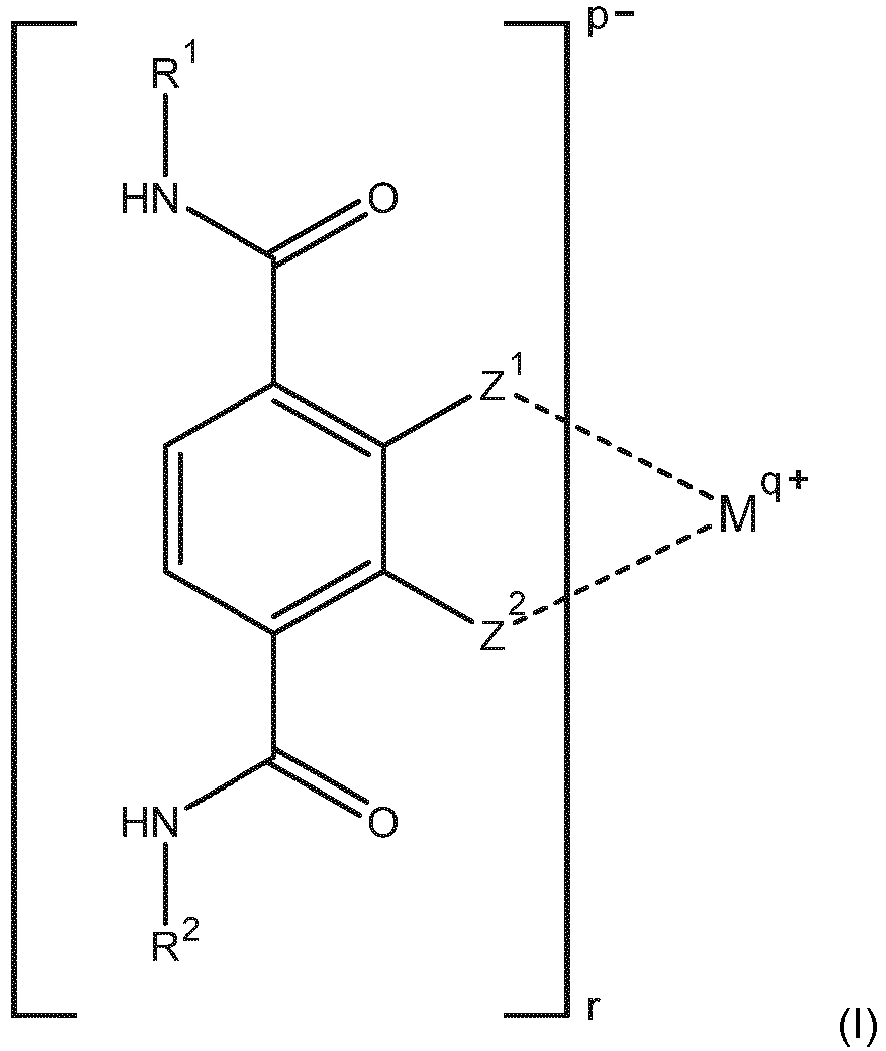
- R1 und R2
- unabhängig voneinander für einen Kohlenwasserstoffrest mit 1 bis 20 Kohlenstoffatomen stehen, der gegebenenfalls mit mindestens einem Rest substituiert ist, ausgewählt aus Hydroxy, (C1-C4)-Alkoxy, (C1-C4)-Alkoxy(CH2CH2O)n-, -NR'R" oder -N+R'R'R‴X-, wobei n = 1 bis 10, R', R" und R‴ unabhängig voneinander für H oder einen linearen oder verzweigten aliphatischen Kohlenwasserstoffrest mit 1 bis 3, vorzugsweise 1 bis 2 Kohlenstoffatomen und X- für ein Anion stehen,
- Z1 und Z2
- unabhängig voneinander für OH oder O- stehen,
- M
- steht für ein Metallkation eines Übergangsmetalls oder Lanthanoids, (insbesondere für ein Metallkation aus Ti, Zr, Hf, V, Nb, Ta, Cr. Mo, W, Mn, Fe, Ru, Co, Ni, Cu, Zn, Ce oder Sm),
- q
- als Ladungszahl des Metallkations M für eine Zahl 2, 3 oder 4 steht,
- p
- als Ladungszahl des Catecholliganden für eine Zahl 0, 1 oder 2 steht,
- r
- für eine Zahl 1, 2, 3 oder 4 steht, und
- mindestens eine freie Catecholverbindung der Formel (II) oder deren Salz

- R3 und R4
- unabhängig voneinander für einen Kohlenwasserstoffrest mit 1 bis 20 Kohlenstoffatomen stehen, der gegebenenfalls mit mindestens einem Rest substituiert ist, ausgewählt aus Hydroxy, (C1-C4)-Alkoxy, (C1-C4)-Alkoxy(CH2CH2O)n-, -NR'R" oder -N+R'R"R‴X-, wobei n = 1 bis 10, R', R" und R‴ unabhängig voneinander für H oder einen linearen oder verzweigten aliphatischen Kohlenwasserstoffrest mit 1 bis 3, vorzugsweise 1 bis 2 Kohlenstoffatomen und X- für ein Anion stehen,
- mindestens eine Catechol-Metallkomplexverbindung der Formel (I)
- und eine zweite Komponente K2 eine zweite flüssige Zusammensetzung ist, enthaltend mindestens ein Tensid. Dabei ist es wiederum bevorzugt, wenn die zweite Komponente K2 und gegebenenfalls vorhandene zusätzliche Komponenten des Mehrkomponenten-Waschmittels dieser Ausführungsform im Wesentlichen frei sind von Verbindungen der Formel (I) und Verbindungen der Formel (II).
- Die zuvor beschriebenen bevorzugten Ausführungsformen der Komponente K1 und/oder der Komponente K2 und/oder des wasserlöslichen Materials des Behälters gelten hierbei ebenso als bevorzugt.
- Davon unabhängig ist es erfindungsgemäß bevorzugt, wenn in dem Mehrkomponenten-Waschmittel zur Erhöhung der Produktsicherheit mindestens ein Bittermittel enthalten ist. Dabei ist es bevorzugt, wenn das Bittermittel in Komponente K1 und/oder in Komponente K2 und/oder in dem wasserlöslichen Material des Behälters, insbesondere in der wasserlöslichen Folie, enthalten ist.
- Bevorzugte Bittermittel weisen einen Bitterwert von mindestens 1.000, bevorzugt mindestens 10.000, besonders bevorzugt mindestens 200.000 auf. Zur Bestimmung des Bitterwertes wird das im Europäischen Arzneibuch (5. Ausgabe Grundwerk, Stuttgart 2005, Band 1 Allgemeiner Teil Monografiegruppen, 2.8.15 Bitterwert S. 278) beschriebene standardisierte Verfahren verwendet. Als Vergleich dient eine wässrige Lösung von Chininhydrochlorid, dessen Bitterwert mit 200.000 festgelegt ist. Dies bedeutet, dass 1 Gramm Chininhydrochlorid 200 Liter Wasser bitter macht. Die interindividuellen Geschmacksunterschiede bei der organoleptischen Prüfung der Bitterkeit werden bei diesem Verfahren durch einen Korrekturfaktor ausgeglichen.
- Ganz besonders bevorzugte Bittermittel werden ausgewählt aus Denatoniumbenzoat, Glycosiden, Isoprenoiden, Alkaloiden, Aminosäuren und Mischungen daraus, besonders bevorzugt Denatoniumbenzoat.
- Glycoside sind organische Verbindungen der allgemeinen Struktur R-O-Z, bei denen ein Alkohol (R-OH) über eine glycosidische Bindung mit einem Zuckerteil (Z) verbunden ist.
- Geeignete Glycoside sind beispielsweise Flavonoide wie Quercetin oder Naringin oder Iridoidglycoside wie Aucubin und insbesondere Secoiridoid, wie Amarogentin, Dihydrofoliamentin, Gentiopikrosid, Gentiopikrin, Swertiamarin, Swerosid, Gentioflavosid, Centaurosid, Methiafolin, Harpagosid und Centapikrin, Sailicin oder Kondurangin.
- Isoprenoide sind Verbindungen, die sich formal von Isopren ableiten. Beispiele sind insbesondere Terpene und Terpenoide.
- Geeignete Isoprenoide umfassen beispielsweise Sequiterpenlactone wie Absinthin, Artabsin, Cnicin, Lactucin, Lactucopikrin oder Salonitenolid, Monoterpen-Ketone (Thujone) wie beispielsweise α-Thujon oder β-Thujon, Tetranortriterpene (Limonoide) wie Desoxylimonen, Desoxylimonensäure, Limonin, Ichangin, Iso-Obacunonsäure, Obacunon, Obacunonsäure, Nomilin oder Nomilinsäure, Terpene wie Marrubin, Prämarrubin, Carnosol, Carnosolsäure oder Quassin.
- Alkaloide bezeichnen natürlich vorkommende, chemisch heterogene, meist alkalische, stickstoffhaltige organische Verbindungen des Sekundärstoffwechsels, die auf den tierischen oder menschlichen Organismus wirken.
- Geeignete Alkaloide sind beispielsweise Chininhydrochlorid, Chininhydrogensulfat, Chinindihydrochlorid, Chininsulfat, Columbin und Coffein.
- Geeignete Aminosäuren umfassen beispielsweise Threonin, Methionin, Phenylalanin, Tryptophan, Arginin, Histidin, Valin und Asparaginsäure.
- Besonders bevorzugte Bitterstoffe sind Chininsulfat (Bitterwert = 10.000), Naringin (Bitterwert = 10.000), Saccharoseoctaacetat (Bitterwert = 100.000), Chininhydrochlorid, Denatoniumbenzoat (Bitterwert > 100.000.000) und Mischungen daraus, ganz besonders bevorzugt Denatoniumbenzoat (z.B. erhältlich als Bitrex®).
- Das wasserlösliche Material enthält bezogen auf dessen Gesamtgewicht bevorzugt Bittermittel (besonders bevorzugt Denatonium Benzoat) in einer Gesamtmenge von höchstens 1 Gewichtsteil Bitterstoff zu 250 Gewichtsteilen viskoelastischer, festförmiger Zusammensetzung (1 : 250), besonders bevorzugt von höchstens 1 : 500, ganz besonders bevorzugt von höchstens 1 : 1000.
- Es ist bevorzugt, das erfindungsgemäße Mehrkomponenten-Waschmittel zum Waschen von Textilien, insbesondere zum Entfernen von bleichbaren Anschmutzungen, ganz besonders bevorzugt zur Entfernung von Anschmutzungen, die auf Bestandteilen und Rückständen von Deodorantien, Rost, Beeren, Tee und Rotwein basieren, zu verwenden.
- Es kann, wie bereits erwähnt, die Anschmutzung mit der erfindungsgemäßen Zusammensetzung dem eigentlichen Waschverfahren vorbehandelt werden und/oder zunächst eine tensidhaltige Flotte als Waschlösung bereitgestellt wird, die das erfindungsgemäße Mehrkomponenten-Waschmittel enthält und die anschließend mit dem zu reinigendem Textil in Kontakt gebracht wird.
- Verfahren zur Reinigung von Textilien zeichnen sich im allgemeinen dadurch aus, dass in mehreren Verfahrensschritten verschiedene reinigungsaktive Substanzen auf das Reinigungsgut aufgebracht und nach der Einwirkzeit abgewaschen werden, oder dass das Reinigungsgut in sonstiger Weise mit einem Waschmittel oder einer Lösung der Zusammensetzung behandelt wird.
- Ein weiterer Gegenstand der Erfindung ist deshalb ein Verfahren zum Waschen von Textilien, umfassend die Schritte,
Zugeben eines erfindungsgemäßen Mehrkomponenten-Waschmittels zu einem Gewebe oder Textil; und
Durchführen einer Waschprozedur, bevorzugt in einer Waschmaschine. - Bevorzugt ist ein Verfahren zur Textilbehandlung umfassend die Verfahrensschritte
- (a) Bereitstellen einer wässrigen Flotte durch Mischen von 0,5 Liter bis 40,0 Liter Wasser mit 0,5 bis 100 g eines erfindungsgemäßen Mehrkomponenten-Waschmittels, und
- (b) In Kontakt bringen eines Textils mit der gemäß (a) hergestellten wässrigen Flotte.
- Es ist bevorzugt, wenn im Schritt (b) das Textil 10 bis 240 Minuten, insbesondere 20 bis 180 Minuten mit der gemäß (a) hergestellten, wässrigen Flotte in Kontakt steht.
- Ferner ist es bevorzugt, wenn das Textil nach Schritt (b) gespült und getrocknet wird.
- Es ist insbesondere bevorzugt, das Verfahren in einer automatischen Waschmaschine durchzuführen. Dabei wird vor dem Schritt (a) das Textil in die Trommel der Waschmaschine gegeben. Ein erfindungsgemäßes Mehrkomponenten-Waschmittel wird in die Einspülkammer der Waschmaschine gefüllt oder gemeinsam mit den Textilien in die Trommel der Waschmaschine gegeben. Dabei ist es bevorzugt, das erfindungsgemäße Mehrkomponenten-Waschmittel gemeinsam mit den Textilien in die Trommel der Waschmaschine zu geben.
- Danach werden 0,5 bis 40 Liter Wasser zugefügt und gemischt. Bemerkenswerterweise wird jeweils das Textil nicht durch die erfindungsgemäße Catechol-Metallkomplexverbindung angefärbt. Dies gilt selbst dann, wenn das erfindungsgemäße Waschmittel bzw. Mehrkomponenten-Waschmittel in die Trommel der Waschmaschine dosiert wird und direkt mit dem Textil in Kontakt tritt.
- Es ist erfindungsgemäß bevorzugt, wenn zur Herstellung der besagten Lösung 10 bis 110 g, insbesondere 15 bis 100 g des erfindungsgemäßen Mehrkomponenten-Waschmittels mit 5 bis 25 I Wasser, insbesondere mit 10 bis 20 I Wasser, vermischt werden.
- In den beschriebenen Verfahren werden in verschiedenen Ausführungsformen der Erfindung Temperaturen von 60°C oder weniger, beispielsweise 50°C oder weniger, eingesetzt. Diese Temperaturangaben beziehen sich auf die im Schritt (b) eingesetzten Temperaturen.
- Es kann, wie bereits erwähnt, die Anschmutzung mit dem erfindungsgemäße Mehrkomponenten-Waschmittel dem eigentlichen Waschverfahren vorbehandelt werden und/oder zunächst eine tensidhaltige Flotte als Waschlösung bereitgestellt wird, die das erfindungsgemäße Mehrkomponenten-Waschmittel enthält und die anschließend mit dem zu reinigenden Textil in Kontakt gebracht wird.
- Alle hierin im Zusammenhang mit dem Mehrkomponenten-Waschmitteln der Erfindung beschriebenen Ausführungsformen, insbesondere im Hinblick auf die Spezifikation der Inhaltsstoffe, sind gleichermaßen auf die beschriebenen Verfahren und Verwendungen anwendbar und umgekehrt.
- 0,3 mmol N,N'-Dipropyl-2,3-dihydroxyterephthaldiamid (Ligand L) wurden in 10 mL Methanol gelöst. Dazu wurden unter Rühren 0,3 mmol KOH (als 0,5M Lösung in Methanol) gegeben. 0,1 mmol des Metall(III)chlorids bzw. 0,15 mmol des Metall(II)chlorids wurden in 4 mL Methanol gelöst. Diese Lösung wurde anschließend zur ersten Lösung zugegeben. Nach Ablauf einer Rührzeit von einer Stunde, wurde die resultierende Lösung auf 4 mL eingeengt und anschließend 50 mL Diethylether hinzugegeben. Der ausgefällte Metallkomplex wurde durch Filtration isoliert.
- Auf diese Weise wurden farbige Pulver der folgenden Metallkomplexe Fe(III)L3 (rot), Ce(III)L3 (violett) und Mn(II)L2 (grün), hergestellt.
- Aus einer Spatelspitze eines Farbstoffes wurden unter pH-Wert Einstellung mit NaOH jeweils eine Lösung pro Farbstoff und pH-Wert bei pH 8, pH 9,5 und pH 10 hergestellt. Eine Anhebung des pH Wertes der jeweiligen Lösungen führte zu keiner sichtbaren Farbänderung.
- Von den Komplexen Fe(III)L3 (rot), Ce(III)L3 (violett) und Mn(II)L2 (grün) wurden UV/VIS-Spektren in wässriger Lösung bei pH 8 (NaOH) und 20°C aufgenommen.
Tabelle 1: Maxima im UV/VIS-Spektrum bei einer Wellenlänge zwischen 400 und 800 nm Catechol-Metallkomplex Maximum (Wellenlänge in nm) Fe(III)L3 444 (Schulter 495) Ce(III)L3 531 Mn(II)L2 626 - Für die Herstellung eines Mehrkomponenten-Waschmittels in einem 2-Kammer-Pouch wurde als Komponente K1 zunächst folgende erfindungsgemäße erste flüssige Zusammensetzungen FZ1 gemäß Tabelle 2 unter Rühren hergestellt.
Tabelle 2: erste flüssige Zusammensetzung als Komponente K1 FZ1 [Gew.-%] N,N'-Dipropyl-2,3-dihydroxyterephthaldiamid 10,0 an 2-Position verzweigter C13-15-Alkylalkohol ethoxyliert mit 8 Mol Ethylenoxid 70,0 Fe(III)L3 0,005 Ethanol ad 100 - Es wurde ebenso als Komponente K2 folgende erfindungsgemäße zweite flüssige Zusammensetzung FZ2 gemäß Tabelle 3 unter Rühren hergestellt.
Tabelle 3: zweite flüssige Zusammensetzung als Komponente K2 FZ2 [Gew.-%] C11-13-Alkylbenzolsulfonsäure 22,0 an 2-Position verzweigter C13-15-Alkylalkohol ethoxyliert mit 8 Mol Ethylenoxid 24,0 Glyzerin 10,5 2-Aminoethanol 6,0 ethoxyliertes Polyethylenimin 6,0 C12-18-Fettsäure 7,5 Diethylentriamin-N,N,N',N',N"-penta(methylenphosphonsäure), Heptanatrium-Salz 0,7 1,2-Propylenglykol 8,2 Ethanol 3,0 Natriumbisulfit 0,1 Denatoniumbenzoat 0,001 Soil-Release Polymer aus Ethylenterephthalat und Polyethylenoxid-terephthalat 1,4 Optischer Aufheller 0,6 Parfüm 1,7 Protease, Amylase, Lipase, Cellulase 0,8 blauer Farbstoff (keine erfindungsgemäße Catechol-Verbindung der Formel (I) 0,005 Wasser ad 100 - Zur Umhüllung der Komponenten mit wasserlöslichem Material wurde eine Denatoniumbenzoathaltige, Polyvinylalkohol-basierte Folie M8630 der Fa. Monosol (88 µm) auf eine heizbare Form mit Doppelkavität aufgespannt. Die aufgespannte Folie wurde für eine Dauer von 2400 ms bei 105°C erhitzt und dann durch ein Vakuum in die Kavität gezogen. Im Anschluss wurden 8,4 g der ersten flüssigen Zusammensetzung der Tabelle 2 mittels einer Spritze in die erste Kavität gefüllt und danach 16,6 g der flüssigen Zusammensetzung FZ2 der Tabelle 3 mittels einer Spritze in die zweite Kavität gegeben. Danach wurde eine Oberfolie (M8630, 90 µm) zum Verschließen der Kavitäten aufgelegt und mittels Hitze (150°C, 1000 ms) mit der ersten Folie verschweißt. Nach dem Brechen des Vakuums wurde die erhaltene Portion der Kavität entnommen.
- Die auf diese Weise erhaltenen erfindungsgemäßen Mehrkomponenten-Waschmittel wurden
- Weiterhin wurden mit den Waschmitteln F1 und F3 der Tabelle 2 jeweils Waschversuche nach den folgenden Testbedingungen durchgeführt.
- Weiße Gewebe (WFK 10A, WFK 20A und WFK 30A) wurden in einer Miele Waschmachine Typ 318 bei 16°d und 40°C im Kurzprogramm zweimal in Folge mit 35 g des Pulverwaschmittels des Handelsproduktes "Weißer Riese Universal" gewaschen. Anschließend wurde ein Waschgang ohne Waschmittel durchgeführt. Gewebe WFK 10 A wird von "wfk Testgewebe GmbH" als "Standard Cotton" (Standard Baumwolle), WFK 20A als "Polyester/Cotton (65 %/35 %)" (Polyester/Baumwolle 65 %/35%) und WFK 30A als "Polyester" bezeichnet.
- Das erfindungsgemäße Mehrkomponenten-Waschmittel wurde in die Trommel einer Miele Waschmachine Typ 318 gegeben. Anschließend wurden die wie zuvor beschriebenen, vorgewaschenen, weißen Gewebe (WFK 10A, WFK 20A und WFK 30A) neben 23 weißen Handtüchern, 5 weißen Frotteetüchern und 6 weißen T-Shirts (Waschladung insgesamt 3 kg) in die Trommel gegeben und bei 16°d und 40°C im Hauptwaschgang 60 Minuten lang gewaschen, anschließend gespült und hängend getrocknet. Diese Prozedur wurde 3 Mal hintereinander durchgeführt.
- Die weißen Gewebe wiesen nach dem Waschprozedere keine Verfärbungen sowie keine fleckigen Einfärbungen auf. Das beweist, dass der erfindungsgemäß eingesetzte Catechol-Metallkomplex auch bei wiederholtem Waschvorgang nicht das Textil anfärbt.
Claims (16)
- Mehrkomponenten-Waschmittel umfassend mindestens zwei Komponenten, welches in einem Behälter mit mindestens zwei Kammern enthalten ist, wobeieine erste Komponente K1 eine erste flüssige Zusammensetzung ist, enthaltend• mindestens eine Catechol-Metallkomplexverbindung der Formel (I)
 R1 und R2 unabhängig voneinander für einen Kohlenwasserstoffrest mit 1 bis 20 Kohlenstoffatomen stehen, der gegebenenfalls mit mindestens einem Rest substituiert ist, ausgewählt aus Hydroxy, (C1-C4)-Alkoxy, (C1-C4)-Alkoxy(CH2CH2O)n-, -NR'R" oder -N+R'R'R‴X-, wobei n = 1 bis 10, R', R" und R‴ unabhängig voneinander für H oder einen linearen oder verzweigten aliphatischen Kohlenwasserstoffrest mit 1 bis 3, vorzugsweise 1 bis 2 Kohlenstoffatomen und X- für ein Anion stehen,Z1 und Z2 unabhängig voneinander für OH oder O- stehen,M steht für ein Metallkation eines Übergangsmetalls oder Lanthanoids, (insbesondere für ein Metallkation aus Ti, Zr, Hf, V, Nb, Ta, Cr. Mo, W, Mn, Fe, Ru, Co, Ni, Cu, Zn, Ce oder Sm),q als Ladungszahl des Metallkations M für eine Zahl 2, 3 oder 4 steht,p als Ladungszahl des Catecholliganden für eine Zahl 0, 1 oder 2 steht,r für eine Zahl 1, 2, 3 oder 4 steht, und• mindestens eine freie Catecholverbindung der Formel (II) oder deren Salz
 R3 und R4 unabhängig voneinander für einen Kohlenwasserstoffrest mit 1 bis 20 Kohlenstoffatomen stehen, der gegebenenfalls mit mindestens einem Rest substituiert ist, ausgewählt aus Hydroxy, (C1-C4)-Alkoxy, (C1-C4)-Alkoxy(CH2CH2O)n-, -NR'R" oder -N+R'R"R‴X-, wobei n = 1 bis 10, R', R" und R‴ unabhängig voneinander für H oder einen linearen oder verzweigten aliphatischen Kohlenwasserstoffrest mit 1 bis 3, vorzugsweise 1 bis 2 Kohlenstoffatomen und X- für ein Anion stehen,mit der Maßgabe, dass die Catecholverbindung der Formel (II) und deren Salz von Verbindungen der Formel (I) verschieden sind,und eine zweite Komponente K2 eine zweite flüssige Zusammensetzung ist, enthaltend mindestens ein Tensid.
 - Mehrkomponenten-Waschmittel nach Anspruch 1, dadurch gekennzeichnet, dass in Formel (I) die Reste R1 und R2 unabhängig voneinander für eine Alkylgruppe, eine Alkoxyalkylgruppe, eine Hydroxyalkylgruppe, eine Hydroxyalkyloxyalkyl-Gruppe, (N-Hydroxyethyl)-aminoethyl, (N-Methoxyethyl)-aminoethyl oder (N-Ethoxyethyl)-aminoethyl, oder eine aromatische Gruppe stehen (bevorzugt für Methyl, ethyl, n-Propyl, Isopropyl, n-Butyl, sec-Butyl, tert-Butyl, iso-Butyl, n-pentyl, iso-Pentyl, Neopentyl, Hexyl, 2-Hydroxyethyl, 2-Hydroxypropyl, 3-Hydroxypropyl, 2-Methoxyethyl, 2-Ethoxyethyl, 3-Methoxypropyl, 3-Ethoxypropyl, (N-Hydroxyethyl)-aminoethyl, (N-Methoxyethyl)-aminoethyl oder (N-Ethoxyethyl)-aminoethyl oder Phenyl).
- Mehrkomponenten-Waschmittel nach einem der Ansprüche 1 oder 2, dadurch gekennzeichnet, dass in Formel (I) die Reste R1 und R2 gleich sind.
- Mehrkomponenten-Waschmittel nach einem der Ansprüche 1 bis 3, dadurch gekennzeichnet, dass in Formel (I) M ausgewählt ist aus Fe, Mn, Cr, Ni, Co, Ce, Cu oder Hydraten dieser Metallionen.
- Mehrkomponenten-Waschmittel nach einem der Ansprüche 1 bis 4, dadurch gekennzeichnet, dass Catechol-Metallkomplexverbindung der Formel (I) Licht in einer Wellenlänge von 400 bis 800 nm absorbiert, gemessen mittels Zweistrahl-Spektralphotometer bei einer Konzentration des Komplexes von 10-5 mol/L in Wasser bei 20°C, einem pH-Wert von 8 und einer Schichtdicke von 1 cm.
- Mehrkomponenten-Waschmittel nach einem der Ansprüche 1 bis 5, dadurch gekennzeichnet, dass bezogen auf das Gesamtgewicht der ersten flüssigen Zusammensetzung die Catechol-Metallkomplexverbindung der Formel (I) in Komponente K1 in 0,001 bis 10,0 Gew.%, bevorzugt 0,01 bis 3,0 Gew.% enthalten ist.
- Mehrkomponenten-Waschmittel nach einem der Ansprüche 1 bis 6, dadurch gekennzeichnet, dass bezogen auf das Gesamtgewicht der ersten flüssigen Zusammensetzung die freie Catechol-Verbindung der Formel (II) in Komponente K1 in einer Gesamtmenge von 0,5 bis 50 Gew.%, bevorzugt von 3 bis 30 Gew.-%, besonders bevorzugt von 5 bis 20 Gew.%, enthalten ist.
- Mehrkomponenten-Waschmittel nach einem der Ansprüche 1 bis 7, wobei die erste flüssige Zusammensetzung der Komponente K1 mindestens ein organisches Lösemittel enthält.
- Mehrkomponenten-Waschmittel nach einem der Ansprüche 1 bis 8, dadurch gekennzeichnet, dass die erste flüssige Zusammensetzung der Komponente K1 mindestens ein Tensid, insbesondere mindestens ein nichtionisches Tensid, enthält.
- Mehrkomponenten-Waschmittel nach einem der Ansprüche 1 bis 9, dadurch gekennzeichnet, dass die zweite Komponente und gegebenenfalls vorhandene zusätzliche Komponenten des Mehrkomponenten-Waschmittels im Wesentlichen frei sind von Verbindungen der Formel (I) und Verbindungen der Formel (II).
- Mehrkomponenten-Waschmittel nach einem der Ansprüche 1 bis 10, dadurch gekennzeichnet, dass bezogen auf das Gesamtgewicht des Mehrkomponenten-Waschmittels die freie Catecholverbindung der Formel (II) in einer Gesamtmenge von 0,1 bis 10,0 Gew.-%, insbesondere von 0,3 bis 3,0 Gew.-%, enthalten ist.
- Mehrkomponenten-Waschmittel nach einem der Ansprüche 1 bis 11, dadurch gekennzeichnet, dass mindestens eine weitere Komponente enthalten ist, wobei die weiteren Komponenten jeweils definiert sind wie Komponente K2 oder eine pulverförmige Zusammensetzung oder ein Granulat sind.
- Mehrkomponenten-Waschmittel nach einem der Ansprüche 1 bis 12, dadurch gekennzeichnet, dass es in einem Behälter aus wasserlöslichem Material, insbesondere aus einer wasserlöslichen Folie, mit mindestens zwei voneinander getrennten Kammern konfektioniert ist, wobei sich in wenigstens einer Kammer Komponente K1 und in wenigstens einer hiervon verschiedenen Kammer die Komponente K2 befinden.
- Mehrkomponenten-Waschmittel nach einem der Ansprüche 1 bis 13, dadurch gekennzeichnet, dass das Mehrkomponenten-Waschmittel ein Bittermittel enthält, bevorzugt ist das Bittermittel in Komponente K1 und/oder K2 und/oder im wasserlöslichen Material des Behälters des Mehrkomponenten-Waschmittels enthalten, insbesondere in der wasserlöslichen Folie.
- Mehrkomponenten-Waschmittel nach einem der Ansprüche 1 bis 14, dadurch gekennzeichnet, dass die flüssige Zusammensetzung einer Komponente des Mehrkomponenten-Waschmittels (insbesondere der Komponente K1 und der Komponente K2) Wasser, insbesondere bezogen auf das Gesamtgewicht der besagten flüssigen Zusammensetzung in einer Menge zwischen 0 und 25 Gew.-%, enthält.
- Verfahren zum Waschen von Textilien, umfassend die Schritte,Zugeben eines Mehrkomponenten-Waschmittels nach einem der Ansprüche 1 bis 15 zu einem Gewebe oder Textil; unddurchführen einer Waschprozedur, bevorzugt in einer Waschmaschine.
Applications Claiming Priority (2)
| Application Number | Priority Date | Filing Date | Title |
|---|---|---|---|
| DE102018217392.3A DE102018217392A1 (de) | 2018-10-11 | 2018-10-11 | Mehrkomponenten-Waschmittel mit Catechol-Metallkomplex |
| PCT/EP2019/065989 WO2020074143A1 (de) | 2018-10-11 | 2019-06-18 | Mehrkomponenten-waschmittel mit catechol-metallkomplex |
Publications (2)
| Publication Number | Publication Date |
|---|---|
| EP3864125A1 EP3864125A1 (de) | 2021-08-18 |
| EP3864125B1 true EP3864125B1 (de) | 2022-11-16 |
Family
ID=66999821
Family Applications (1)
| Application Number | Title | Priority Date | Filing Date |
|---|---|---|---|
| EP19732321.5A Active EP3864125B1 (de) | 2018-10-11 | 2019-06-18 | Mehrkomponenten-waschmittel mit catechol-metallkomplex |
Country Status (5)
| Country | Link |
|---|---|
| US (1) | US11566206B2 (de) |
| EP (1) | EP3864125B1 (de) |
| DE (1) | DE102018217392A1 (de) |
| ES (1) | ES2935470T3 (de) |
| WO (1) | WO2020074143A1 (de) |
Families Citing this family (5)
| Publication number | Priority date | Publication date | Assignee | Title |
|---|---|---|---|---|
| DE102018217392A1 (de) | 2018-10-11 | 2020-04-16 | Henkel Ag & Co. Kgaa | Mehrkomponenten-Waschmittel mit Catechol-Metallkomplex |
| EP4170005B1 (de) * | 2021-10-19 | 2024-05-22 | Henkel AG & Co. KGaA | Konzentrierte fliessfähige waschmittelzubereitung mit verbesserten eigenschaften |
| PL4170006T3 (pl) * | 2021-10-19 | 2024-09-09 | Henkel Ag & Co. Kgaa | Stężony, płynny preparat piorący o ulepszonych właściwościach |
| USD1088343S1 (en) | 2022-05-11 | 2025-08-12 | People Against Dirty Holdings Limited | Packet |
| DE102023202565A1 (de) * | 2023-03-22 | 2024-09-26 | Henkel Ag & Co. Kgaa | Catecholderivate zur Behandlung von Alterungserscheinungen der Haare und/oder der Kopfhaut |
Family Cites Families (25)
| Publication number | Priority date | Publication date | Assignee | Title |
|---|---|---|---|---|
| GB1296839A (de) | 1969-05-29 | 1972-11-22 | ||
| ATE189695T1 (de) | 1991-06-11 | 2000-02-15 | Genencor Int | Cellulasezusammensetzungen mit einem defizit an komponenten des typs-cbh i enthaltende reinigungsmittelzusammensetzungen |
| AR000862A1 (es) | 1995-02-03 | 1997-08-06 | Novozymes As | Variantes de una ó-amilasa madre, un metodo para producir la misma, una estructura de adn y un vector de expresion, una celula transformada por dichaestructura de adn y vector, un aditivo para detergente, composicion detergente, una composicion para lavado de ropa y una composicion para la eliminacion del |
| CN102080070B (zh) | 1995-03-17 | 2016-01-20 | 诺沃奇梅兹有限公司 | 新的内切葡聚糖酶 |
| GB2303145A (en) | 1995-07-08 | 1997-02-12 | Procter & Gamble | Detergent compositions |
| BR9611114A (pt) | 1995-10-17 | 1999-07-13 | Rohm Enzyme Finland Oy | Celulases os genes codificando-as e os usos das mesmas |
| EP1726644A1 (de) | 1996-09-17 | 2006-11-29 | Novozymes A/S | Zellulase Varianten |
| BRPI9911086B1 (pt) | 1998-06-10 | 2016-08-02 | Novozymes As | composição de limpeza, processo para tratar tecidos a máquina, e uso de uma mananase |
| JP4745503B2 (ja) | 1999-03-31 | 2011-08-10 | ノボザイムス アクティーゼルスカブ | アルカリα−アミラーゼ活性を有するポリペプチド及びそれらをコードする核酸 |
| AU3420100A (en) | 1999-03-31 | 2000-10-23 | Novozymes A/S | Lipase variant |
| EP1240525A2 (de) | 1999-12-23 | 2002-09-18 | PHARMACIA & UPJOHN COMPANY | Natriumkanalen als ziele für amyloid beta |
| JP5571274B2 (ja) | 2000-03-08 | 2014-08-13 | ノボザイムス アクティーゼルスカブ | 改変された特性を有する変異体 |
| CN100491525C (zh) | 2000-07-28 | 2009-05-27 | 汉高两合股份公司 | 从芽孢杆菌a7-7(dsm 12368)中提取的新型淀粉分解酶以及含有该新型淀粉分解酶的洗涤剂和清洗剂 |
| JP4907834B2 (ja) | 2000-08-04 | 2012-04-04 | ダニスコ・ユーエス・インコーポレーテッド | 変異体egiiiセルラーゼ、そのようなegiii組成物をコードするdna及びそれを得るための方法 |
| ES2521615T3 (es) | 2001-06-06 | 2014-11-13 | Novozymes A/S | Endo-beta-1,4-glucanasa |
| GB0511874D0 (en) * | 2005-06-11 | 2005-07-20 | Unilever Plc | Bleaching composition |
| GB0511876D0 (en) * | 2005-06-11 | 2005-07-20 | Unilever Plc | Bleaching composition |
| CN101910389A (zh) * | 2008-01-07 | 2010-12-08 | 宝洁公司 | 具有可接受颜色的洗涤剂 |
| DE102008061862A1 (de) * | 2008-12-15 | 2010-06-17 | Henkel Ag & Co. Kgaa | Färbemittel, enthaltend spezielle halogensubstituierte Brenzcatechinaldehyde und spezielle CH-acide Verbindungen |
| DE102009028891A1 (de) | 2009-08-26 | 2011-03-03 | Henkel Ag & Co. Kgaa | Verbesserte Waschleistung durch Radikalfänger |
| DE102011088982A1 (de) | 2011-12-19 | 2013-06-20 | Henkel Ag & Co. Kgaa | Wasch- und Reinigungsmittel mit verbesserter Leistung |
| DE102014222833A1 (de) | 2014-11-10 | 2016-05-12 | Henkel Ag & Co. Kgaa | Wasch- und Reinigungsmittel mit verbesserter Leistung |
| CA2973164A1 (en) * | 2015-02-03 | 2016-08-11 | Basf Se | Aqueous formulations, their manufacture and use |
| DE102016214660A1 (de) * | 2016-08-08 | 2018-02-08 | Henkel Ag & Co. Kgaa | Wasch- und Reinigungsmittel mit verbesserter Leistung |
| DE102018217392A1 (de) | 2018-10-11 | 2020-04-16 | Henkel Ag & Co. Kgaa | Mehrkomponenten-Waschmittel mit Catechol-Metallkomplex |
-
2018
- 2018-10-11 DE DE102018217392.3A patent/DE102018217392A1/de not_active Withdrawn
-
2019
- 2019-06-18 ES ES19732321T patent/ES2935470T3/es active Active
- 2019-06-18 EP EP19732321.5A patent/EP3864125B1/de active Active
- 2019-06-18 WO PCT/EP2019/065989 patent/WO2020074143A1/de not_active Ceased
-
2021
- 2021-04-12 US US17/228,601 patent/US11566206B2/en active Active
Also Published As
| Publication number | Publication date |
|---|---|
| US20210230514A1 (en) | 2021-07-29 |
| EP3864125A1 (de) | 2021-08-18 |
| US11566206B2 (en) | 2023-01-31 |
| ES2935470T3 (es) | 2023-03-07 |
| WO2020074143A1 (de) | 2020-04-16 |
| DE102018217392A1 (de) | 2020-04-16 |
Similar Documents
| Publication | Publication Date | Title |
|---|---|---|
| EP3947615B1 (de) | Verwendung von mannanase-enzym in kombination mit catecholderivaten | |
| EP3864121B1 (de) | Waschmittelzusammensetzung mit catechol-metallkomplexverbindung | |
| EP3864125B1 (de) | Mehrkomponenten-waschmittel mit catechol-metallkomplex | |
| EP3194549A1 (de) | Mittel für die textilbehandlung, enthaltend mindestens einen anionischen, aromatischen polyester und mindestens einen nichtionischen, aromatischen polyester | |
| EP3864120B1 (de) | Flüssigwaschmittel mit catechol-verbindung | |
| EP3864119B1 (de) | Flüssige zusammensetzung mit dihydroxyterephthalsäurediamid-verbindung und hoher tensidmenge | |
| EP3350300A1 (de) | Wasserlöslicher behälter mit einer beschichtung | |
| WO2020074141A1 (de) | Verwendung von übergangsmetallfreien abtönungsfarbstoffen in kombination mit catecholderivaten | |
| EP3390608B1 (de) | Flüssige wasch- oder reinigungsmittel enthaltend acylhydrazon | |
| EP3390605B1 (de) | Flüssige wasch- oder reinigungsmittel enthaltend acylhydrazon und reduktionsmittel | |
| EP3613838A1 (de) | Wasch- oder reinigungsmittel mit gesteigerter proteaseleistung | |
| WO2025124794A1 (de) | Wasch- oder reinigungsmittelformkörper |
Legal Events
| Date | Code | Title | Description |
|---|---|---|---|
| STAA | Information on the status of an ep patent application or granted ep patent |
Free format text: STATUS: UNKNOWN |
|
| STAA | Information on the status of an ep patent application or granted ep patent |
Free format text: STATUS: THE INTERNATIONAL PUBLICATION HAS BEEN MADE |
|
| PUAI | Public reference made under article 153(3) epc to a published international application that has entered the european phase |
Free format text: ORIGINAL CODE: 0009012 |
|
| STAA | Information on the status of an ep patent application or granted ep patent |
Free format text: STATUS: REQUEST FOR EXAMINATION WAS MADE |
|
| 17P | Request for examination filed |
Effective date: 20210330 |
|
| AK | Designated contracting states |
Kind code of ref document: A1 Designated state(s): AL AT BE BG CH CY CZ DE DK EE ES FI FR GB GR HR HU IE IS IT LI LT LU LV MC MK MT NL NO PL PT RO RS SE SI SK SM TR |
|
| DAV | Request for validation of the european patent (deleted) | ||
| DAX | Request for extension of the european patent (deleted) | ||
| GRAP | Despatch of communication of intention to grant a patent |
Free format text: ORIGINAL CODE: EPIDOSNIGR1 |
|
| STAA | Information on the status of an ep patent application or granted ep patent |
Free format text: STATUS: GRANT OF PATENT IS INTENDED |
|
| INTG | Intention to grant announced |
Effective date: 20220707 |
|
| GRAS | Grant fee paid |
Free format text: ORIGINAL CODE: EPIDOSNIGR3 |
|
| GRAA | (expected) grant |
Free format text: ORIGINAL CODE: 0009210 |
|
| STAA | Information on the status of an ep patent application or granted ep patent |
Free format text: STATUS: THE PATENT HAS BEEN GRANTED |
|
| AK | Designated contracting states |
Kind code of ref document: B1 Designated state(s): AL AT BE BG CH CY CZ DE DK EE ES FI FR GB GR HR HU IE IS IT LI LT LU LV MC MK MT NL NO PL PT RO RS SE SI SK SM TR |
|
| REG | Reference to a national code |
Ref country code: GB Ref legal event code: FG4D Free format text: NOT ENGLISH |
|
| REG | Reference to a national code |
Ref country code: CH Ref legal event code: EP |
|
| REG | Reference to a national code |
Ref country code: DE Ref legal event code: R096 Ref document number: 502019006298 Country of ref document: DE |
|
| REG | Reference to a national code |
Ref country code: IE Ref legal event code: FG4D Free format text: LANGUAGE OF EP DOCUMENT: GERMAN |
|
| REG | Reference to a national code |
Ref country code: AT Ref legal event code: REF Ref document number: 1531798 Country of ref document: AT Kind code of ref document: T Effective date: 20221215 |
|
| REG | Reference to a national code |
Ref country code: ES Ref legal event code: FG2A Ref document number: 2935470 Country of ref document: ES Kind code of ref document: T3 Effective date: 20230307 |
|
| REG | Reference to a national code |
Ref country code: LT Ref legal event code: MG9D |
|
| REG | Reference to a national code |
Ref country code: NL Ref legal event code: MP Effective date: 20221116 |
|
| PG25 | Lapsed in a contracting state [announced via postgrant information from national office to epo] |
Ref country code: SE Free format text: LAPSE BECAUSE OF FAILURE TO SUBMIT A TRANSLATION OF THE DESCRIPTION OR TO PAY THE FEE WITHIN THE PRESCRIBED TIME-LIMIT Effective date: 20221116 Ref country code: PT Free format text: LAPSE BECAUSE OF FAILURE TO SUBMIT A TRANSLATION OF THE DESCRIPTION OR TO PAY THE FEE WITHIN THE PRESCRIBED TIME-LIMIT Effective date: 20230316 Ref country code: NO Free format text: LAPSE BECAUSE OF FAILURE TO SUBMIT A TRANSLATION OF THE DESCRIPTION OR TO PAY THE FEE WITHIN THE PRESCRIBED TIME-LIMIT Effective date: 20230216 Ref country code: LT Free format text: LAPSE BECAUSE OF FAILURE TO SUBMIT A TRANSLATION OF THE DESCRIPTION OR TO PAY THE FEE WITHIN THE PRESCRIBED TIME-LIMIT Effective date: 20221116 Ref country code: FI Free format text: LAPSE BECAUSE OF FAILURE TO SUBMIT A TRANSLATION OF THE DESCRIPTION OR TO PAY THE FEE WITHIN THE PRESCRIBED TIME-LIMIT Effective date: 20221116 |
|
| PG25 | Lapsed in a contracting state [announced via postgrant information from national office to epo] |
Ref country code: RS Free format text: LAPSE BECAUSE OF FAILURE TO SUBMIT A TRANSLATION OF THE DESCRIPTION OR TO PAY THE FEE WITHIN THE PRESCRIBED TIME-LIMIT Effective date: 20221116 Ref country code: PL Free format text: LAPSE BECAUSE OF FAILURE TO SUBMIT A TRANSLATION OF THE DESCRIPTION OR TO PAY THE FEE WITHIN THE PRESCRIBED TIME-LIMIT Effective date: 20221116 Ref country code: LV Free format text: LAPSE BECAUSE OF FAILURE TO SUBMIT A TRANSLATION OF THE DESCRIPTION OR TO PAY THE FEE WITHIN THE PRESCRIBED TIME-LIMIT Effective date: 20221116 Ref country code: IS Free format text: LAPSE BECAUSE OF FAILURE TO SUBMIT A TRANSLATION OF THE DESCRIPTION OR TO PAY THE FEE WITHIN THE PRESCRIBED TIME-LIMIT Effective date: 20230316 Ref country code: HR Free format text: LAPSE BECAUSE OF FAILURE TO SUBMIT A TRANSLATION OF THE DESCRIPTION OR TO PAY THE FEE WITHIN THE PRESCRIBED TIME-LIMIT Effective date: 20221116 Ref country code: GR Free format text: LAPSE BECAUSE OF FAILURE TO SUBMIT A TRANSLATION OF THE DESCRIPTION OR TO PAY THE FEE WITHIN THE PRESCRIBED TIME-LIMIT Effective date: 20230217 |
|
| PG25 | Lapsed in a contracting state [announced via postgrant information from national office to epo] |
Ref country code: NL Free format text: LAPSE BECAUSE OF FAILURE TO SUBMIT A TRANSLATION OF THE DESCRIPTION OR TO PAY THE FEE WITHIN THE PRESCRIBED TIME-LIMIT Effective date: 20221116 |
|
| PG25 | Lapsed in a contracting state [announced via postgrant information from national office to epo] |
Ref country code: SM Free format text: LAPSE BECAUSE OF FAILURE TO SUBMIT A TRANSLATION OF THE DESCRIPTION OR TO PAY THE FEE WITHIN THE PRESCRIBED TIME-LIMIT Effective date: 20221116 Ref country code: RO Free format text: LAPSE BECAUSE OF FAILURE TO SUBMIT A TRANSLATION OF THE DESCRIPTION OR TO PAY THE FEE WITHIN THE PRESCRIBED TIME-LIMIT Effective date: 20221116 Ref country code: EE Free format text: LAPSE BECAUSE OF FAILURE TO SUBMIT A TRANSLATION OF THE DESCRIPTION OR TO PAY THE FEE WITHIN THE PRESCRIBED TIME-LIMIT Effective date: 20221116 Ref country code: DK Free format text: LAPSE BECAUSE OF FAILURE TO SUBMIT A TRANSLATION OF THE DESCRIPTION OR TO PAY THE FEE WITHIN THE PRESCRIBED TIME-LIMIT Effective date: 20221116 Ref country code: CZ Free format text: LAPSE BECAUSE OF FAILURE TO SUBMIT A TRANSLATION OF THE DESCRIPTION OR TO PAY THE FEE WITHIN THE PRESCRIBED TIME-LIMIT Effective date: 20221116 |
|
| P01 | Opt-out of the competence of the unified patent court (upc) registered |
Effective date: 20230705 |
|
| REG | Reference to a national code |
Ref country code: DE Ref legal event code: R097 Ref document number: 502019006298 Country of ref document: DE |
|
| PG25 | Lapsed in a contracting state [announced via postgrant information from national office to epo] |
Ref country code: SK Free format text: LAPSE BECAUSE OF FAILURE TO SUBMIT A TRANSLATION OF THE DESCRIPTION OR TO PAY THE FEE WITHIN THE PRESCRIBED TIME-LIMIT Effective date: 20221116 Ref country code: AL Free format text: LAPSE BECAUSE OF FAILURE TO SUBMIT A TRANSLATION OF THE DESCRIPTION OR TO PAY THE FEE WITHIN THE PRESCRIBED TIME-LIMIT Effective date: 20221116 |
|
| PLBE | No opposition filed within time limit |
Free format text: ORIGINAL CODE: 0009261 |
|
| STAA | Information on the status of an ep patent application or granted ep patent |
Free format text: STATUS: NO OPPOSITION FILED WITHIN TIME LIMIT |
|
| 26N | No opposition filed |
Effective date: 20230817 |
|
| PG25 | Lapsed in a contracting state [announced via postgrant information from national office to epo] |
Ref country code: SI Free format text: LAPSE BECAUSE OF FAILURE TO SUBMIT A TRANSLATION OF THE DESCRIPTION OR TO PAY THE FEE WITHIN THE PRESCRIBED TIME-LIMIT Effective date: 20221116 |
|
| PG25 | Lapsed in a contracting state [announced via postgrant information from national office to epo] |
Ref country code: MC Free format text: LAPSE BECAUSE OF FAILURE TO SUBMIT A TRANSLATION OF THE DESCRIPTION OR TO PAY THE FEE WITHIN THE PRESCRIBED TIME-LIMIT Effective date: 20221116 |
|
| PG25 | Lapsed in a contracting state [announced via postgrant information from national office to epo] |
Ref country code: MC Free format text: LAPSE BECAUSE OF FAILURE TO SUBMIT A TRANSLATION OF THE DESCRIPTION OR TO PAY THE FEE WITHIN THE PRESCRIBED TIME-LIMIT Effective date: 20221116 |
|
| REG | Reference to a national code |
Ref country code: CH Ref legal event code: PL |
|
| REG | Reference to a national code |
Ref country code: BE Ref legal event code: MM Effective date: 20230630 |
|
| PG25 | Lapsed in a contracting state [announced via postgrant information from national office to epo] |
Ref country code: LU Free format text: LAPSE BECAUSE OF NON-PAYMENT OF DUE FEES Effective date: 20230618 |
|
| REG | Reference to a national code |
Ref country code: IE Ref legal event code: MM4A |
|
| PG25 | Lapsed in a contracting state [announced via postgrant information from national office to epo] |
Ref country code: LU Free format text: LAPSE BECAUSE OF NON-PAYMENT OF DUE FEES Effective date: 20230618 |
|
| PG25 | Lapsed in a contracting state [announced via postgrant information from national office to epo] |
Ref country code: IE Free format text: LAPSE BECAUSE OF NON-PAYMENT OF DUE FEES Effective date: 20230618 |
|
| PG25 | Lapsed in a contracting state [announced via postgrant information from national office to epo] |
Ref country code: IE Free format text: LAPSE BECAUSE OF NON-PAYMENT OF DUE FEES Effective date: 20230618 Ref country code: CH Free format text: LAPSE BECAUSE OF NON-PAYMENT OF DUE FEES Effective date: 20230630 |
|
| PG25 | Lapsed in a contracting state [announced via postgrant information from national office to epo] |
Ref country code: BE Free format text: LAPSE BECAUSE OF NON-PAYMENT OF DUE FEES Effective date: 20230630 |
|
| PG25 | Lapsed in a contracting state [announced via postgrant information from national office to epo] |
Ref country code: BG Free format text: LAPSE BECAUSE OF FAILURE TO SUBMIT A TRANSLATION OF THE DESCRIPTION OR TO PAY THE FEE WITHIN THE PRESCRIBED TIME-LIMIT Effective date: 20221116 |
|
| PG25 | Lapsed in a contracting state [announced via postgrant information from national office to epo] |
Ref country code: BG Free format text: LAPSE BECAUSE OF FAILURE TO SUBMIT A TRANSLATION OF THE DESCRIPTION OR TO PAY THE FEE WITHIN THE PRESCRIBED TIME-LIMIT Effective date: 20221116 |
|
| PGFP | Annual fee paid to national office [announced via postgrant information from national office to epo] |
Ref country code: DE Payment date: 20250618 Year of fee payment: 7 |
|
| PGFP | Annual fee paid to national office [announced via postgrant information from national office to epo] |
Ref country code: GB Payment date: 20250618 Year of fee payment: 7 |
|
| PGFP | Annual fee paid to national office [announced via postgrant information from national office to epo] |
Ref country code: FR Payment date: 20250627 Year of fee payment: 7 |
|
| PG25 | Lapsed in a contracting state [announced via postgrant information from national office to epo] |
Ref country code: CY Free format text: LAPSE BECAUSE OF FAILURE TO SUBMIT A TRANSLATION OF THE DESCRIPTION OR TO PAY THE FEE WITHIN THE PRESCRIBED TIME-LIMIT; INVALID AB INITIO Effective date: 20190618 |
|
| REG | Reference to a national code |
Ref country code: AT Ref legal event code: MM01 Ref document number: 1531798 Country of ref document: AT Kind code of ref document: T Effective date: 20240618 |
|
| PG25 | Lapsed in a contracting state [announced via postgrant information from national office to epo] |
Ref country code: HU Free format text: LAPSE BECAUSE OF FAILURE TO SUBMIT A TRANSLATION OF THE DESCRIPTION OR TO PAY THE FEE WITHIN THE PRESCRIBED TIME-LIMIT; INVALID AB INITIO Effective date: 20190618 |
|
| PGFP | Annual fee paid to national office [announced via postgrant information from national office to epo] |
Ref country code: ES Payment date: 20250731 Year of fee payment: 7 |
|
| PGFP | Annual fee paid to national office [announced via postgrant information from national office to epo] |
Ref country code: IT Payment date: 20250624 Year of fee payment: 7 |
|
| PG25 | Lapsed in a contracting state [announced via postgrant information from national office to epo] |
Ref country code: AT Free format text: LAPSE BECAUSE OF NON-PAYMENT OF DUE FEES Effective date: 20240618 |
|
| PG25 | Lapsed in a contracting state [announced via postgrant information from national office to epo] |
Ref country code: TR Free format text: LAPSE BECAUSE OF FAILURE TO SUBMIT A TRANSLATION OF THE DESCRIPTION OR TO PAY THE FEE WITHIN THE PRESCRIBED TIME-LIMIT Effective date: 20221116 |
|
| REG | Reference to a national code |
Ref country code: DE Ref legal event code: R084 Ref document number: 502019006298 Country of ref document: DE |
|
| PGFP | Annual fee paid to national office [announced via postgrant information from national office to epo] |
Ref country code: AT Payment date: 20260410 Year of fee payment: 5 |