EP3865425A1 - Station de réception pour recevoir et stocker des déchets - Google Patents
Station de réception pour recevoir et stocker des déchets Download PDFInfo
- Publication number
- EP3865425A1 EP3865425A1 EP20157216.1A EP20157216A EP3865425A1 EP 3865425 A1 EP3865425 A1 EP 3865425A1 EP 20157216 A EP20157216 A EP 20157216A EP 3865425 A1 EP3865425 A1 EP 3865425A1
- Authority
- EP
- European Patent Office
- Prior art keywords
- waste
- receiving
- receiving station
- signal
- container
- Prior art date
- Legal status (The legal status is an assumption and is not a legal conclusion. Google has not performed a legal analysis and makes no representation as to the accuracy of the status listed.)
- Pending
Links
Images




Classifications
-
- B—PERFORMING OPERATIONS; TRANSPORTING
- B65—CONVEYING; PACKING; STORING; HANDLING THIN OR FILAMENTARY MATERIAL
- B65F—GATHERING OR REMOVAL OF DOMESTIC OR LIKE REFUSE
- B65F1/00—Refuse receptacles; Accessories therefor
- B65F1/14—Other constructional features; Accessories
- B65F1/1426—Housings, cabinets or enclosures for refuse receptacles
- B65F1/1447—Housings, cabinets or enclosures for refuse receptacles located underground
-
- B—PERFORMING OPERATIONS; TRANSPORTING
- B65—CONVEYING; PACKING; STORING; HANDLING THIN OR FILAMENTARY MATERIAL
- B65F—GATHERING OR REMOVAL OF DOMESTIC OR LIKE REFUSE
- B65F1/00—Refuse receptacles; Accessories therefor
- B65F1/10—Refuse receptacles; Accessories therefor with refuse filling means, e.g. air-locks
-
- B—PERFORMING OPERATIONS; TRANSPORTING
- B65—CONVEYING; PACKING; STORING; HANDLING THIN OR FILAMENTARY MATERIAL
- B65F—GATHERING OR REMOVAL OF DOMESTIC OR LIKE REFUSE
- B65F1/00—Refuse receptacles; Accessories therefor
- B65F1/14—Other constructional features; Accessories
- B65F1/1468—Means for facilitating the transport of the receptacle, e.g. wheels, rolls
- B65F1/1473—Receptacles having wheels
-
- B—PERFORMING OPERATIONS; TRANSPORTING
- B65—CONVEYING; PACKING; STORING; HANDLING THIN OR FILAMENTARY MATERIAL
- B65F—GATHERING OR REMOVAL OF DOMESTIC OR LIKE REFUSE
- B65F2210/00—Equipment of refuse receptacles
- B65F2210/108—Authorization means
-
- B—PERFORMING OPERATIONS; TRANSPORTING
- B65—CONVEYING; PACKING; STORING; HANDLING THIN OR FILAMENTARY MATERIAL
- B65F—GATHERING OR REMOVAL OF DOMESTIC OR LIKE REFUSE
- B65F2210/00—Equipment of refuse receptacles
- B65F2210/128—Data transmitting means
-
- B—PERFORMING OPERATIONS; TRANSPORTING
- B65—CONVEYING; PACKING; STORING; HANDLING THIN OR FILAMENTARY MATERIAL
- B65F—GATHERING OR REMOVAL OF DOMESTIC OR LIKE REFUSE
- B65F2210/00—Equipment of refuse receptacles
- B65F2210/138—Identification means
-
- B—PERFORMING OPERATIONS; TRANSPORTING
- B65—CONVEYING; PACKING; STORING; HANDLING THIN OR FILAMENTARY MATERIAL
- B65F—GATHERING OR REMOVAL OF DOMESTIC OR LIKE REFUSE
- B65F2210/00—Equipment of refuse receptacles
- B65F2210/144—Level detecting means
-
- B—PERFORMING OPERATIONS; TRANSPORTING
- B65—CONVEYING; PACKING; STORING; HANDLING THIN OR FILAMENTARY MATERIAL
- B65F—GATHERING OR REMOVAL OF DOMESTIC OR LIKE REFUSE
- B65F2210/00—Equipment of refuse receptacles
- B65F2210/162—Pressing means
Definitions
- the present invention relates to a receiving station for receiving and storing waste according to the preamble of independent claim 1. Furthermore, according to the preamble of independent claim 13, the invention is directed to a waste management system including such a waste receiving station. Finally, the present invention is also directed to a method of operating a waste receiving station.
- EP 3 476 770 A1 An example for such an intelligent waste collection system, which allows an autonomous mobility of waste containers, is disclosed in EP 3 476 770 A1 .
- the waste containers get transported by means of a fleet of autonomously moving carrier vehicles, said carrier vehicles travelling along a plurality of paths and communicating with an operations centre via direct telecommunication connections.
- the carrier vehicles move to predetermined delivery sites, where they get discharged.
- Underground waste collection systems In order to temporarily store bigger amounts of waste, underground waste collection systems have become very common.
- Underground waste collection systems per se are well known in the prior art. They usually comprise a receiving pit, which serves as an external housing and which is placed into the ground. In its mounted state, the receiving pit is located at least partially under the ground level.
- the receiving pit serves on the one hand to keep ground water out. On the other hand, it also serves as a protection to keep soil out and to maintain the contour of the system as a whole.
- a waste receiving container is provided inside the receiving pit.
- a removing device is provided by means of which the receiving container can be removed out of the receiving pit.
- a safety system While the receiving container is located outside the receiving pit, a safety system is activated, which may comprise a safety platform, by means of which the pit opening and therefore the empty receiving pit can get closed in order to prevent any accidents such as people falling into the empty receiving pit.
- EP 2 939 955 A1 discloses such an underground waste collection system.
- the system as a whole comprises a movable waste deposit device, which comprises a waste container for temporarily storing waste.
- the waste deposit device is provided to move between different locations.
- the waste deposit device being filled with waste, moves to a receiving station of the underground waste collection system.
- This receiving station comprises a receiving container. Once the waste deposit device has reached the receiving container, it gets discharged into the receiving container.
- the receiving station according to this known solution is not provided for acting autonomously.
- this object is solved, according to a first aspect of the invention, by the receiving station with the features according to independent claim 1, according to a second aspect of the present invention, by the waste management system with the features according to independent claim 13, and, according to a third aspect of the present invention, by the method of operating a waste receiving station with the features according to independent claim 15.
- autonomous preferably means, that a device, in particular the waste receiving station, is able to operate without being controlled directly by an external entity and that the device, in particular the waste receiving station, operates independently, which means that the device, in particular the waste receiving station, is able to make its own decisions.
- control device being part of the waste receiving station. It is the general function of the control device to manage, command, direct and/or regulate the behaviour of the waste receiving station as a whole or of different components of the waste receiving station.
- control device is provided as an intelligent control device.
- An intelligent control device uses techniques which are derived from artificial intelligence, whereby such artificial intelligence is central to the operation of a device, to the operation of the waste receiving station as a whole or to the operation of different components thereof for example.
- the control device according to the present invention is described in more detail with regard to the different aspects of the present invention further below.
- the receiving station is provided for receiving and for storing, in particular for temporarily storing, waste.
- waste is used as a generic term. It includes, besides various types of garbage, any valuable substances as well.
- the waste receiving station is part of a, preferably intelligent, waste management system.
- a system is used for collecting and handling waste.
- This system which will be described in more detail with regard to the second aspect of the invention further below, generally comprises at least one waste receiving station according to the first aspect of the present invention and at least one external entity, a carrier vehicle for example, which is capable of transporting waste from a waste charging location to the waste receiving station, where it gets discharged.
- a waste management system comprises at least one discharge unit.
- a discharge unit might be a refuse truck, preferably an autonomous refuse truck and/or an operations centre, which manages the at least one refuse truck, in particular a fleet of such refuse trucks.
- the waste management system is operated autonomously.
- the present invention is directed to the receiving station for receiving and storing waste comprising the features of independent claim 1.
- this receiving station is referred to as the waste receiving station as well.
- the present invention is not delimited to specific configurations of such a waste receiving stations.
- the waste receiving station is a stationary receiving station. This means that the receiving station is placed at one specific location and that the receiving station is not moving.
- the waste receiving station is an underground receiving station. By use of such an underground waste receiving station, the waste is stored underground. Only a minimum surface area is required above ground.
- the waste receiving station which preferably is a stationary station, is a semi-underground receiving station. That means, that only a portion of the station is visible.
- the waste receiving station independently from any specific configuration, is adapted for receiving and storing large volumes of waste, up to 5m 3 for example.
- the waste receiving station is configured as an underground receiving station.
- an underground waste receiving station comprises a receiving pit, which serves as an exterior housing and which is placed inside the ground, such that the receiving pit is almost located below the ground level.
- the receiving pit is square or rectangular in shape, which means that it has a square or rectangular cross-section.
- the receiving pit which may be made of concrete, metal, steel for example, a plastic material, or the like, preferably comprises a pit side wall, optionally a pit ground or pit bottom at the lower end of the pit side wall and a pit opening at the upper end of the pit side wall.
- the aforementioned components preferably delimit a receiving space, said receiving space being adapted for receiving a receiving container, said receiving container serving as a waste collecting container.
- the volume of the receiving container can range from 1m 3 to 5m 3 .
- the present invention is not limited to specific load capacities for the receiving container.
- the receiving container is adapted for temporarily storing waste, valuable substances or the like.
- the receiving pit serves to keep ground water out of the underground waste receiving station.
- it also serves as a protection to keep soil out and maintain the contour of the underground waste receiving station as a whole.
- the receiving container is movably located inside the receiving pit. That means that the receiving container can get removed, via said pit opening, out of the receiving pit. In the same way, the receiving container can get inserted, once it has been emptied, maintained or the like, via said pit opening into the receiving pit.
- the receiving container comprises a compactor device, said compactor device being configured to compact the waste being stored inside the receiving container.
- the compactor device has the function to press the waste inside the receiving container into a smaller and denser form.
- the present invention is not delimited to specific embodiments of such compactor devices.
- the compactor device is configured as, or it comprises a press device.
- the compacting procedure inside the receiving container can be done by compactor device having a screw device, or the like.
- the receiving container comprises a ceiling element that covers the receiving container at the top, the ceiling element having a receiving opening for waste.
- the receiving container which is located inside the receiving pit and hence almost below ground level, when the underground waste receiving station is in use in the intended manner, serves to actually receive the waste.
- a removing device in particular a handling device, is preferably provided, by means of which the receiving container can get handled and can get removed from the receiving pit.
- the removing device is also used for inserting and lowering the receiving container into the receiving pit.
- waste is preferably charged into the receiving container via a chute device, which may comprise a disposal housing for waste, and which is provided or arranged above the receiving opening of the ceiling element of the receiving container.
- the chute device is connected to the receiving container, in particular to the ceiling element thereof.
- a safety system is activated, said safety system comprising a safety platform, by means of which the empty receiving pit, in particular the open pit opening, is or remains closed, in order to prevent accidents, in particular to prevent people from falling into the receiving pit.
- the receiving station comprises a receiving container with one or more compartments, each compartment being adapted for receiving and storing waste, preferably a waste fraction.
- a fraction of waste refers to the grouping of waste according to its properties. Each waste group is called a waste fraction.
- the fractions or types of waste are subject to separate classifications.
- the receiving container comprises only one single compartment for receiving only one waste fraction or for randomly receiving waste without any sorting.
- the receiving container comprises two or more compartments, each compartment being used for receiving a different waste fraction.
- the receiving container may comprise four such compartments.
- the different compartments are separated from each other by making use of one or more partition walls, each partition wall being arranged and extending inside the receiving container.
- the partition wall(s) may extend orthogonally in relation to the side walls of the receiving container. According to a different preferred embodiment, the partition wall(s) extend diagonally.
- the receiving container further comprises a receiving opening, said receiving opening being provided in such a way, that waste can be or is filled into the receiving container via said receiving opening, If the receiving container is configured as explained further above, the receiving opening is preferably provided at the upper edge of the receiving container. Or the receiving container is closed by a ceiling element. In the latter case the receiving opening is preferably provided and arranged in the ceiling element.
- the waste receiving station comprises an adjustable cover device, said cover device being allocated to said receiving opening. It is the general function of the cover device, which will be described in more detail further below, to either cover the receiving opening of the receiving container or to at least partially release the receiving opening.
- the adjustable cover device is capable of being operated between a first operational mode, in which the receiving opening is closed by the cover device, and a second operational mode, in which the receiving opening is at least partially released by said cover device.
- the cover device prevents, that waste is or can be introduced into the waste receiving container.
- the cover device allows that waste is or can be introduced into the waste receiving container.
- the adjustable cover device is operated by making use of a control device.
- control device which is defined in general terms further above, is configured in a special way. This will now be explained in more detail.
- the waste receiving station according to the first aspect of the invention is operated autonomously. Therefore, the waste receiving station is an autonomous waste receiving station.
- the control device which preferably is an intelligent control device, plays a central role with regard to the operation of the waste receiving station.
- the control device comprises a number of components. These components are a signal receiving unit, a signal processing unit and a signal transmission unit. According to a preferred embodiment, all of these components are incorporated in and provided as one single device. According to a different embodiment, the different components are realized as individual devices. In any case, the different components must be connected to each other in some way, such that a transfer and an exchange of signals, data or the like between the different components is possible. In the latter case, the different units are connected via suitable signal exchange connections.
- a first component of the control device is a signal receiving unit.
- the present invention is not delimited to specific configurations of the signal receiving unit. It is the general function of the signal receiving unit, that any signals which origin from outside the waste receiving station, in particular from an external entity, may enter the waste receiving station, such that they can get further processed by the waste receiving station, inside the control device in particular.
- the signal receiving unit preferably comprises one or more of the following components, such as a logic or an electric circuit comprising electronic components.
- the signal receiving unit preferably comprises an interface being adapted for receiving signals from outside, for example from an external entity carrying waste, from a waste management system, in particular from an operations centre thereof, from the adjustable cover device, or the like.
- the signal receiving unit preferably further comprises an interface to the signal processing unit.
- the signal receiving unit comprises a sensor device for detecting and/or receiving signals with regard to an external entity, or it comprises an interface to such a sensor device.
- the signal receiving unit preferably comprises means for establishing a signal exchange connection to an external device and/or to the signal processing unit, a communication module for example, or the signal receiving unit preferably comprises such a connection.
- the connection is a wireless connection. Nevertheless, the connection can also be a wire-based connection.
- the signal receiving unit is adapted for receiving input signals from an external entity, which is at least temporarily connected to the signal receiving unit via a first signal receiving connection.
- the signal receiving unit preferably acts passively and waits for signals, which are transmitted from an external entity.
- the first signal receiving connection by means of which the external entity is connected to the signal receiving unit, is a data exchange connection or a communication connection, in particular for mobile radio or wireless data exchange or communication.
- the external entity in its operational mode, which is preferably a step of the method of operating the waste receiving station according to the third aspect of the invention, transmits signals from a signal exchange module via said first signal receiving connection to the waste receiving station, in particular to the signal receiving unit of the control device.
- the received signals which represent input signals, get further processed as explained further below.
- the signal receiving unit preferably has an active function.
- the signal receiving unit is adapted for gathering input signals from an external entity.
- the signal receiving unit may comprise an optical sensor device, preferably a camera.
- the signal receiving unit may comprise an electro-mechanical sensor device.
- the external entity the carrier vehicle for example, approaches the waste receiving station.
- the waste receiving station by means of the signal receiving unit gathers signals relating to the approach of the external entity. Such gathered signals, which represent input signals, get further processed as explained further below.
- the present invention is not delimited to any specific types of external entities. According to a preferred embodiment, it is the general function of such an external entity that it is capable of transporting waste from a location remote from the waste receiving station to the waste receiving station, in particular for carrying at least one waste fraction.
- the external entity is a carrier vehicle carrying at least one waste fraction.
- a vehicle is a machine or apparatus that is configured for transporting cargo, waste for example.
- the vehicles can be provide as land-vehicles, air-vehicles or water-vehicles.
- carrier vehicles per se are already known in the prior art. They are adapted for carrying at least one waste fraction or a waste container containing at least one waste fraction.
- the present invention is not limited to specific types of carrier vehicles.
- the external entity can be configured as a drone or a manned vehicle, an electric vehicle for example.
- Other examples of preferred embodiments of carrier vehicles are depicted in the drawings and specified in the description of these drawings further below.
- such external entities are autonomous entities. They therefore preferably comprise a signal exchange module, a communication module for example, said module being adapted for establishing a signal exchange connection to the waste receiving station.
- the present invention is not limited to specific types of signals.
- the signals are data and/or image signals and/or values.
- the signals transmitted from the external entity and received by the signal receiving unit, or the signals gathered by the signal receiving unit preferably are signals for adjusting the cover device and/or signals concerning the type and/or the amount of waste contained in or carried by said external entity.
- the signals may comprise values for adjusting the cover device and/or signals concerning the type and/or the amount of waste contained in or carried by said external entity.
- the input signals which are received by the signal receiving unit from the external device, or which are gathered by the signal receiving unit, are or comprise distance values.
- the control device of the waste receiving station may determine the current distance between the external entity and the waste receiving station. If the distance has reached a specific value, the cover device of the waste receiving station may get adjusted accordingly.
- the input signals are or comprise time values. In this case, the control device of the waste receiving station may determine that the external device approaches at a specific point of time such that the cover device gets adjusted at said specific point of time.
- the input values are or comprise characteristic waste values.
- the control device receives signals with regard to the characteristics of the waste, with regard to the quality and/or quantity of the waste for example, such that the cover device can get adjusted accordingly.
- a second component of the control device is the signal processing unit.
- the present invention is not limited to specific configurations of the signal processing unit. It is the general function of the signal processing unit, that the input signals get further processed in the signal processing unit.
- the input signals are transmitted from the signal receiving unit via a signal exchange connection to the signal processing unit. Therefore, the signal processing unit preferably comprises a suitable interface.
- the signal processing unit is or comprises at least one processor, or a microcontroller or a computing device.
- the signal processing unit is adapted, based on the input signals, for automatically generating adjustment commands for the cover device. In particular, a command is a directive for the cover device to perform a specific task.
- the input data, which were received or gathered by the signal receiving unit are transmitted to the signal processing unit, where they get further processed.
- the control device comprises a data base or has access to a database, said data base comprising reference values and/or threshold values with regard to said signals being processed in the signal processing unit.
- the input signals which were received or gathered via said signal receiving unit preferably are or comprise specific values.
- the signal processing unit By means of the signal processing unit, the input signals, which were transmitted from the signal receiving unit to the signal processing unit, are compared to those values stored in the data base. For example, if an input value exceeds or falls below a respective threshold value stored in the database, the signal processing unit generates a command, by means of which the cover device gets adjusted. Otherwise, if the input signals are or comprise a characteristic waste value, the database may comprise reference values, said reference values being linked to specific commands for the cover device.
- the signal processing unit derives the command linked to the reference value, by means of which the cover device gets adjusted. If such a database comes to use in a waste receiving station, the signal processing unit is at least temporarily linked to said database via a suitable signal exchange connection, a data exchange connection for example.
- a third component of the control device is the signal transmission unit.
- the present invention is not delimited to specific configurations of the signal transmission unit. It is one general function of the signal transmission unit, that the commands that have been generated in the signal processing unit, are transmitted to the adjustable cover device or to a different external device, such as an external entity carrying a waste fraction to the waste receiving system, or to an operations centre of a waste management system.
- the signal transmission unit is connected to the adjustable cover device via a first signal transmission connection.
- the signal transmission unit is adapted for transmitting the adjustment commands to the cover device via said first signal transmission connection.
- the signal transmission unit preferably comprises one or more of the following components, such as a logic or an electric circuit comprising electronic components.
- the signal transmission unit preferably comprises an interface to the signal processing unit.
- the signal processing unit preferably comprises an interface to the signal transmission unit, such that a signal exchange connection can get established between both units.
- the signal transmission unit comprises an interface to the outside, to the adjustable cover device and, for example, to different external devices such as an external entity carrying waste, to a waste management system, in particular to an operations centre thereof, or the like.
- the signal transmission unit preferably comprises means for establishing a signal exchange connection to an external device and/or to the signal processing unit, a communication module for example, or the signal receiving unit preferably comprises such a connection.
- the connection is a wireless connection. Nevertheless, the connection can also be a wire-based connection.
- the cover device Once the cover device has received the commands, it gets adjusted accordingly.
- control device in particular the different components of the control device, preferably act(s) automatically.
- the receiving station comprises at least one sensor device for determining the filling level of waste being stored in the receiving container.
- the filling level of the receiving container can get determined, preferably permanently.
- the sensor device is configured for determining the filling height of waste being stored in the receiving container.
- Such a sensor device can be provided as an optical sensor device for example.
- the receiving station may comprise a sensor device for determining the filling weight of waste being stored in the receiving container.
- a sensor device can be provided as a weighing sensor, a weighing cell, for example.
- the receiving station comprises at least one sensor device which is configured for recognising the waste, in particular the waste fraction being carried by the external entity, and/or the external entity carrying the waste and/or a waste container or waste sack including the waste, said waste container or waste sack being carried by the external entity.
- This sensor device recognizes the waste, by means of an RFID code, a camera and a recognition software recognizing the waste composition or labels, and the like such that the waste can get discharged correctly into the receiving container, for example into the correct waste fraction volume.
- a code can additionally be used to charge a payment to the user, or to evaluate the waste separation quality of the user.
- control device of the waste receiving station in particular the signal receiving unit or the signal processing unit thereof, is adapted for receiving input signals from said sensor device(s), which is/are at least temporarily connected to the control device, in particular to the signal receiving unit, via a second signal receiving connection.
- control device in particular the signal receiving unit, preferably comprises a suitable interface.
- the control device in particular the signal transmission unit thereof, comprises an interface to an external discharge entity, said discharge entity being adapted for handling a discharge operation of the receiving container.
- a signal exchange connection, a communication connection, a data exchange connection or the like is established between the waste receiving station, in particular the control device thereof, and the remote discharge entity.
- the established connection is a wireless connection.
- the discharge entity can be configured as or being part of an operations centre of a waste management system.
- the discharge entity can be or can comprise a server being associated to the waste management system. If the operations centre receives respective signals from the waste receiving station, for example signals with regard to the filling level of the receiving container, the operations centre can guide a refuse truck to the waste receiving station, such that the receiving container can get discharged,
- the discharge entity is configured as a refuse truck.
- the refuse truck is an autonomous refuse truck. If the refuse truck receives respective signals from the waste receiving station, in particular from the control device thereof, the refuse truck drives to the waste receiving station and discharges the receiving container of the waste receiving station.
- the control device preferably the signal transmission unit thereof, comprises an additional interface to a waste management system, preferably to an operations centre thereof. Via said interface, a signal exchange connection, a communication connection, a data exchange connection or the like is established between the waste receiving station, in particular the control device thereof, and the waste management system. As described further above, it is preferably provided that a signal exchange takes place between the control device and the adjustable cover device.
- the connection, over which the signal exchange is performed may be a bidirectional connection. In one direction, the commands being generated in the signal processing unit get transmitted from the signal transmission unit of the control device to the adjustable cover device.
- information related thereto can get transmitted via said bidirectional connection from the cover device to the control device and from there to the waste management system.
- the waste management system receives the information with regard to the error or problem, where suitable actions can be set in motion, by means of the operations centre for example.
- the cover device comprises a lid device.
- This lid device is pivotally arranged on the receiving container, by means of at least one hinge device for example.
- the lid device can be mounted to the ceiling element of the receiving container of the waste receiving station.
- the lid device is adapted for covering the receiving opening of the receiving container.
- the lid device covers, and therefore locks the receiving opening.
- the lid device In its second operational mode, the lid device at least partially releases the receiving opening, such that waste can get charged through said receiving opening into the receiving container.
- the lid device is provided as one single lid element. Therefore, the lid element covers the entire receiving opening, when it is in a closed position. Otherwise, if the lid element is in an open position, it releases the entire receiving opening.
- a single lid element is preferably used, if the receiving container comprises only one compartment for receiving and storing waste. Nevertheless, a single lid element can be used as well, if the receiving container comprises more than one compartment.
- the lid element is pivotally arranged on the receiving container, by means of suitable hinge devices for example.
- the lid element can be configured for performing a sliding movement.
- the lid element is mounted to the ceiling element of the receiving container of the waste receiving station.
- the lid device comprises two or more individual lid segments. Each lid segment covers only a portion of the receiving opening. If the receiving container comprises two or more compartments, one individual lid segment is associated to one compartment respectively. If a lid segment gets opened, the respective compartment being associated thereto is released.
- Each lid segment is pivotally arranged on the receiving container individually and independently from the other lid segment(s), by means of suitable hinge devices for example.
- the lid segment(s) can be configured for performing a sliding movement.
- the lid segments are mounted to the ceiling element of the receiving container of the waste receiving station.
- the lid element or each lid segment comprises at least one drive for generating the pivot motion thereof.
- this drive is an electric drive.
- the present invention is not limited to this specific type of drive.
- the drive or each drive is connected to the signal transmission unit via said first signal transmission connection.
- the command or commands that has/have been generated in the signal processing unit therefore serve to activate the drive or drives such that the lid element or one or more of the lid segments can get brought into a pivot motion such that they open or close the receiving opening.
- the lid device comprises a number of lid segments, each lid segment being associated to a compartment of the receiving container, and each compartment being provided for receiving and storing waste, preferably a specific waste fraction.
- the procedure described with regard to this example forms part of the method according to the third aspect of the present invention as well.
- the signal receiving unit of the control device of the waste receiving station receives and/or gathers input signals from an external entity, in particular from a, preferably autonomous, external entity, a carrier vehicle for example, carrying waste, preferably at least one fraction of waste, via a first signal receiving connection, if the external entity approaches the waste receiving station.
- These input signals comprise or are values and/or data relating to the distance from the external device to the waste receiving station, as well as values and/or data relating to the characteristic of the waste carried by the external entity.
- the input signals are transmitted from the signal receiving unit to the signal processing unit.
- the signal processing unit based on the input signals, automatically generates adjustment commands for the cover device. These commands comprise a first order, that the cover device in form of the lid device has to get opened, such that the external entity is capable to discharge its waste through the receiving opening into the receiving container. Furthermore, since the control device has information with regard to the characteristics of the waste carried by said external entity, the signal processing unit generates a second command comprising an order, which one of the lid segments of the lid device has to get opened, such that the waste of the external entity can get charged into the correct compartment of the receiving container.
- the generated adjustment commands are transmitted from the signal processing unit to the signal transmission unit.
- the commands are then transmitted from the signal transmission unit to the cover device, to at least one drive of at least one lid segment for example.
- the cover device gets adjusted according to the adjustment commands, which means that the correct lid segment gets opened, for example by activating the drive being associated thereto.
- the external entity charges the waste carried by said external entity into the compartment, the lid segment of which being open.
- the signal receiving unit After the external entity has discharged its waste into the receiving container, once again, the signal receiving unit generates or gathers an input signal relating to the departure of the external entity.
- the signal processing unit generates a command that the open lid segment has to get closed again. This command is transmitted from the signal processing unit via said signal transmission unit to the adjustable cover device, in particular to a drive associated to said lid segment. Once the lid segment, respectively the drive has received the command, the lid segment gets closed again.
- the adjustable cover device comprises a waste deposit housing, said waste deposit housing being mounted to the receiving container above the receiving opening and surrounding same.
- the waste deposit housing is some kind of a chute that was described further above.
- the receiving container of the waste receiving station comprises a ceiling element and the receiving opening is provided in the ceiling element
- the waste deposit housing is mounted to the ceiling element from outside and above the receiving opening, such that the receiving opening is located inside the waste deposit housing and is totally hidden behind the walls of the waste deposit housing.
- the walls of the waste deposit housing border an inner space of the waste deposit housing.
- the inner space of the waste deposit housing is completely enclosed by the walls of the waste deposit housing, for example by the sidewall, by a top ceiling element of the waste deposit housing and by the ceiling element of the receiving container, to which the waste deposit housing is mounted.
- the waste deposit housing comprises a waste deposit opening, which is preferably arranged in the side wall of the waste deposit housing,
- the waste deposit housing further comprises a door or flap, which is movably mounted to the waste deposit housing to selectively open and close the waste deposit opening.
- the door or flap is pivotally mounted to the waste deposit housing, via at least one suitable hinge device for example, such that the door or flap can either get tipped up or can pivot sideways.
- the door is configured as a rolling gate.
- the flap or door preferably comprises at least one drive for generating the motion thereof, in particular an electric drive,
- the present invention is not limited to this specific type of drive.
- the drive or each drive is connected to the signal transmission unit via said first signal transmission connection.
- the command or commands, that has/have been generated in the signal processing unit, therefore serve(s) to activate the drive or drives, such that the door or flap can get brought into a pivot motion in order to open or close the waste deposit opening in the waste deposit housing.
- the signal receiving unit of the control device of the waste receiving station receives or gathers input signals from a, preferably autonomous, external entity, for example a carrier vehicle, carrying waste, preferably at least one fraction of waste, via a first signal receiving connection, if the external entity approaches the waste receiving station.
- a, preferably autonomous, external entity for example a carrier vehicle, carrying waste, preferably at least one fraction of waste, via a first signal receiving connection, if the external entity approaches the waste receiving station.
- These input signals comprise values relating to the distance from the external entity to the waste receiving station, and optionally values relating to the characteristic of the waste carried by the external entity.
- the input signals are transmitted from the signal receiving unit to the signal processing unit.
- the signal processing unit based on the input signals, automatically generates adjustment commands for the cover device. These commands comprise a first order, that the cover device in form of the waste deposit housing, in particular the door or flap covering the waste deposit opening in the waste deposit housing, has to get opened, such that the external entity is capable to discharge its waste through the opened waste deposit housing and the receiving opening into the receiving container, or that it is capable to deliver the waste into the waste deposit housing.
- the signal processing unit may generate a second command comprising an order, into which compartment of the receiving container the waste carried by the external entity has to get charged.
- the generated adjustment commands are transmitted from the signal processing unit to the signal transmission unit.
- the commands are then transmitted from the signal transmission unit to the cover device, in particular to the door or flap of the waste deposit housing, preferably to a drive associated thereto.
- the cover device gets adjusted according to the adjustment commands, which means that the door or flap of the waste deposit housing gets opened, by means of activating the drive for example.
- the external entity charges the waste carried by said external entity through the receiving opening into the receiving container.
- the external entity hands over the waste to the waste deposit housing, and the waste deposit housing charges the waste into the receiving container.
- the external entity After the external entity has discharged its waste into the receiving container, or the external entity has handed over the waste to the waste disposal housing, the external entity leaves the waste receiving station again.
- the external entity brings the waste, a waste container or a waste sack for example, inside the open waste deposit housing, places the waste inside the waste deposit housing, a handling device for example which is described further below, and leaves receiving container, The door or flap closes behind the external entity and then the waste is discharged into the receiving container.
- the temporary waste storage containers are 'stacked and stored' inside the receiving station, inside the waste deposit housing or inside the receiving container for example, for later reuse or central collection, or are again collected for reuse in the external entity for distribution, optionally even cleaned/washed inside the receiving container.
- the waste deposit housing is used as a garage for the external entity, once the external entity has entered the inside of the waste deposit housing for discharging or handing over the waste carried, the external entity remains inside the waste deposit housing.
- the signal receiving unit generates a respective input signal.
- the signal processing unit generates a command that the open door or flap of the waste disposal housing has to get closed again.
- This command is transmitted from the signal processing unit via said signal transmission unit to the adjustable cover device, in particular to a drive associated to said door or flap. Once the door or flap, respectively the drive, has received the command, the door or flap gets closed again.
- the waste deposit housing comprises a handling device for handling waste being introduced into the waste deposit housing via said waste deposit opening, in particular for handling a waste container comprising such waste or a waste fraction.
- a handling device is allocated to the waste deposit housing.
- the handling device might be positioned outside the waste deposit housing.
- a handling device is used, if the external entity carrying waste to the waste receiving station does not directly charge the waste into the waste receiving container, but hands the waste over to the waste deposit housing.
- the handling device is provided inside the waste deposit housing.
- the present invention is not limited to specific configurations of such handling devices.
- a suitable configuration mainly depends on the circumstances, under which the external entity carrying waste to the waste receiving station, a carrier vehicle for example, delivers the waste to the waste receiving station.
- the external entity might deliver a waste container containing waste, or it might deliver a waste sack with such waste.
- the external entity is configured as a movable waste container and the waste is contained inside the external entity.
- the handling device comprises a device for taking over a waste container or waste, preferably a waste fraction from an external entity carrying a waste fraction, from a carrier vehicle for example.
- a handling device can be configured as a crane device, as a gripping device, a gripping arm for example, a bracket and/or support, on which the external entity places the waste, or the like.
- the handling device comprises a device for tilting a waste container inside the waste deposit housing,
- a tilting device has the function, that a waste container that has been delivered by the external entity, the carrier vehicle for example, once it has entered the waste deposit housing, gets tilted in such a way, that a discharge opening of the waste container comes into alignment with the receiving opening of the receiving container of the waste receiving station, such that the waste may leave the waste container and enter the receiving container.
- the handling device in particular the tilting device is configured in a way, that release waste that is stuck inside the waste container can get loosened. This goal can be achieved by means of a shaking device or a "hard-stop"-device for example.
- the handling device comprises both of the aforementioned embodiments.
- the handling device comprises a device for positioning and/or aligning a waste container or waste, preferably a waste fraction above the receiving opening of the receiving container.
- the handling device comprises a device for horizontally and/or vertically moving a waste container or waste, preferably a waste fraction, inside the waste deposit housing.
- the operation of the handling device is preferably controlled by the control device of the waste receiving station.
- the waste deposit housing preferably comprises suitable sensor devices, such as optical devices, which determine the position and the kind of waste entering the waste deposit housing, as well as the position of the handling device and/or sensor devices which provide parameters of the handling device when in use.
- the waste deposit housing is provided as a garage for the external entity, in particular for the carrier vehicle-. If the external entity is not in use, it can get parked inside the waste deposit housing, such that it is protected against external influences, against bad weather conditions, against damages, or the like. If the waste receiving station gets operated, the external entity leaves the waste deposit housing, moves to the desired location, where it takes up waste, and returns to the waste receiving station for charging the waste into the waste receiving container of the waste receiving station.
- the receiving station comprises a guiding device for guiding and/or aligning the external entity, in particular the carrier vehicle, in relation to the cover device.
- This guiding device is preferably provided in such a way that it allows the external entity to merge the inside of the waste deposit housing through the open waste deposit opening.
- Such a guiding device can be configured as a ramp for example, or as an internal guiding geometry to align the external entity with the handling device inside the housing.
- This guiding device and/or the handling device can be or comprise a structure that is able to adapt its position to compensate to the not fully straight aligning of the external entity while ensuring a good alignment with the receiving container, such as spring-load bracket, hinging bracket, automatic adapting bracket or alternatively a fixed structure with a good guiding in the sidewalls to position the external entity straight.
- the receiving station comprises a device for generating power, in particular for generating electric power.
- Said device for generating power is adapted for providing energy to the different components of the waste receiving station, in particular to the adjustable cover device and to the control device.
- the device for providing energy is adapted for providing energy for charging the external entity, in particular the carrier vehicle, carrying at least one waste fraction.
- the present invention is not limited to specific types of such devices for generating power.
- the device is configured as a photovoltaic system, which is capable of generating electric power by using solar power. Nevertheless, other regenerative power sources can be used as well.
- the waste receiving station is connected to a power grid.
- the power generating device is provided as a device for, preferably inductive or contact, charging.
- the waste receiving station comprises an inductive loading dock to charge the external entity.
- the waste receiving station according to the first aspect of the present invention is part of a waste management system for handling waste in an environment, an urban environment for example. Therefore, according to the second aspect of the invention, the present invention is also directed to such a waste management system, which comprises the features of independent claim 13.
- the waste management system according to the second aspect of the invention comprises a number of different components.
- a first component is a waste receiving station according the first aspect of the invention.
- the waste management system comprises one or more of such waste receiving stations. Therefore, at this point, full reference is made to the entire disclosure of the waste receiving station according to the invention too.
- the waste management system comprises at least one external entity carrying waste, in particular at least one waste fraction, that is to be delivered to the waste receiving station, in particular an autonomous external entity.
- the external entity is configured as a carrier vehicle, in particular as an autonomous carrier vehicle.
- the waste management system further comprises at least one discharge entity, said discharge entity being adapted for handling the discharge procedure of the receiving container of the receiving station.
- the discharge entity is at least temporarily connected to the waste receiving station via a signal exchange connection.
- the present invention is not limited to specific types of discharge entities.
- the discharge entity is configured as a refuse truck, preferably an autonomous refuse truck.
- the discharge entity is part of an operations centre of the waste management system, which operates at least one refuse truck, preferably a fleet of such refuse trucks. Therefore, it is preferably provided that the waste management system further comprises an operations centre as well.
- the present invention is directed to a method of operating a waste receiving station, said method comprising the features of independent claim 15.
- a method of operating at least one waste receiving station for receiving and storing waste is provided, said receiving station preferably being selected from the group consisting of a stationary receiving station, an underground receiving station or a semi-underground receiving station, said receiving station comprising a receiving container with one or more compartments, each compartment being adapted for receiving and storing waste, in particular a waste fraction, said receiving container comprising a receiving opening, whereby waste gets filled into the receiving container via said receiving opening, an adjustable cover device, said cover device being allocated to said receiving opening and being configured to be operated, by use of a control device of said receiving station, between a first operational mode, in which the receiving opening is closed by the cover device, and a second operational mode, in which the receiving opening is at least partially released by said cover device, wherein the control device is preferably provided as an intelligent control device, wherein the control device comprises a signal receiving unit, a signal processing unit and a signal transmission unit.
- the method is provided for operating a waste receiving station according to the first aspect of the
- the external entity After the external entity has discharged its waste fraction(s) into the receiving container, the external entity leaves the waste receiving station again. Or the external entity hands the waste over to the receiving station, by means of the handling device for example. Or the external entity is parked inside the waste receiving station.
- the signal receiving unit generates an input signal relating to one of the afore mentioned scenarios.
- the signal processing unit generates a command that the cover device has to get adjusted again.
- the techniques underlying to this generation step are similar or identical to those generation steps described further above, when the cover device has to get adjusted in the first part of the method.
- This command is transmitted from the signal processing unit via said signal transmission unit to the adjustable cover device.
- a person, using the waste management system fills a waste container with waste.
- the waste container automatically monitors the filling level. If the waste container is full and ready to get emptied, it sends a signal to an autonomous external entity.
- a waste container is filled by the user, then the user is using an App to request emptying.
- the waste container is preferably commissioned to be linked to the specific user and the container/cartridge will get a waste fraction assigned. For example, today the waste container collects glass, tomorrow the same container can be linked to another user, collecting plastics or paper or a mixture of waste fractions.
- the waste container can be equipped with a visual code, chip, RFID, NFC or active signal to enable linking a specific container to the said user.
- the container is then left at a predetermined location dedicated for the collection of containers, or a random location that the user uses to request the pickup by the external entity.
- the waste receiving station is in a first operational mode, where the receiving opening of the receiving container of the waste receiving station is closed by the adjustable cover device.
- the external entity exchanges signals with the waste receiving station, in particular with a control device of the waste receiving station, preferably with the signal receiving unit of the control device, or the waste receiving station, in particular the control device, gathers signals from the external entity.
- the adjustable cover device gets automatically activated.
- the cover device gets activated in such a way that it at least partially releases the receiving opening of the receiving container of the waste receiving station.
- the cover device is in its second operational mode.
- the external entity hands over the waste carried by the external entity to the waste receiving station, in particular either by handing over the waste to the adjustable cover device or by directly charging the waste into the receiving opening of the receiving container of the waste receiving station.
- the external entity leaves the waste receiving station again and the cover device gets adjusted in such a way that it returns into its first operational mode, or the external entity is parked inside the adjustable cover device. In any case, the receiving opening of the waste receiving container of the waste receiving station gets closed again.
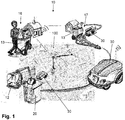
- a waste management system 10 which is established in an urban environment 100, comprises a number of different components and players.
- the waste management system 10 is an intelligent waste management system, which is operated autonomously.
- the waste container 13 automatically monitors the filling level. If the waste container 13 is full and ready to get emptied, it sends a signal to an autonomous external entity 30, a robot carrier vehicle for example. It could alternatively be that a container volume is filled by the user, then the user is using an App to request emptying. For this the waste container 13 is commissioned to be linked to the specific user and the container 13 will get a waste fraction assigned. For example today the waste container 13 collects glass, tomorrow the same container can be linked to another user, collecting plastics of paper or a mixture of waste fractions.
- the waste container 13 can be equipped with a visual code, chip, RFID, NFC or active signal to enable linking a specific container to the said user.
- the container 13 is then left at a predetermined location dedicated for the collection of containers, or a random location that the user uses to request the pickup by the external entity 30.
- the external entity 30 arrives to the waste container 13 and picks up the waste stored in the waste container 13, or the waste container 13 itself. This pickup procedure is designated with reference numeral 17.
- the external entity 30 moves to a waste receiving station 20, preferably by determining its own routing in the urban environment 100, based on received signals for example.
- the external entity 30 reaches the waste receiving station 20 and discharges the collected waste into the waste receiving station 20. This step is performed autonomously.
- the waste receiving station 20 automatically determines its filling level. If the waste receiving station 20 is full and ready to get discharged, it sends a signal to an external discharge entity 12, a refuse truck for example.
- the refuse truck which preferably is an autonomous refuse truck, drives to the waste receiving station 20 and discharges same.
- the waste receiving station 20 preferably is a stationary station, in particular an underground station.
- the waste receiving station comprises a waste receiving container 22.
- the receiving container 22 is equipped with a ceiling element 23.
- the ceiling element 23 comprises a receiving opening 24, through which waste can get charged into the receiving container 22.
- the receiving opening 24 can get closed and at least partially released by means of an adjustable cover device 40, 50. Preferred embodiments of the adjustable cover device 40, 50 are described in more detail further below.
- One central component of the waste receiving station is a control device 60, preferably an intelligent control device, which is connected to further components.
- the control device 60 is connected, at least temporarily, to the external device 30.
- the control device 60 is connected to the adjustable cover device 40, 50.
- the control device is linked to different external devices, such as to an operations centre 11 of the waste management system or to an external discharge entity 12, a refuse truck for example or a part of the operations centre, said part handling and operation a fleet of refuse trucks.
- at least one sensor device 29 is provided inside the receiving container 22, said sensor device 29 being connected to the control device 60 via a signal exchange connection 81.
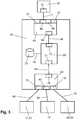
- control device 60 is described in detail.
- a first component of the control device 60 is a signal receiving unit 61. It is the general function of the signal receiving unit 61, that any signals which origin from outside the waste receiving station 20, in particular from an external entity 30, may enter the waste receiving station 20, such that they can get further processed.
- the signal receiving unit 61 comprises an interface 66 being adapted for receiving signals from the external entity 30.
- the signal exchange is performed via a first signal exchange connection 71.
- the external entity 30 comprises a signal exchange module 31.
- the signal receiving unit 61 is adapted for receiving input signals from the external entity 30, which is at least temporarily connected to the signal receiving unit 61 via the first signal receiving connection 71.
- the signal receiving unit 61 preferably acts passively and waits for signals, which are transmitted from an external entity 30.
- the external entity 30 transmits signals from a signal exchange module 31 via said first signal receiving connection 71 to the signal receiving unit 61.
- the signal processing unit 61 preferably has an active function.
- the signal receiving unit 61 is adapted for gathering input signals from the external entity 30.
- the signal receiving unit 61 comprises a sensor device 70 for gathering such signals, an optical sensor device, preferably a camera, for example.
- the external entity 30, the carrier vehicle In its operational mode, the external entity 30, the carrier vehicle for example, approaches the waste receiving station 20.
- the signal receiving unit 61 further comprises an interface 69 to a signal processing unit 61, as well as an interface 67 to an operations centre of the waste management system and an interface 68 to the adjustable cover device 40, 40 of the waste receiving station 20.
- the signals received by the signal receiving unit 61 which are denoted as input signals, are transmitted to a data processing unit 62 via a signal exchange connection 64.
- the signal processing unit 62 comprises a corresponding interface 72 to the signal receiving unit 61.
- a second component of the control device 60 is the signal processing unit 62. It is the general function of the signal processing unit 62, that the input signals get further processed.
- the signal processing unit 62 is adapted, based on the input signals, for automatically generating adjustment commands for the cover device 40, 50.
- the control device 60 comprises a data base 73 or has access to a database 73, said data base 73 comprising reference values and/or threshold values with regard to said signals being processed in the signal processing unit 62.
- the database 73 is connected to the signal processing unit 62 via a signal exchange connection 74.
- the signal processing unit 62 By means of the signal processing unit 62, the input signals, which were transmitted from the signal receiving unit 61 to the signal processing unit 62, are compared to those values stored in the data base 73.
- the signal processing unit 62 generates the commands for adjusting the cover device 40, 50.
- a third component of the control device 60 is the signal transmission unit 63. It is one general function of the signal transmission unit 63, that the commands that have been generated in the signal processing unit 62, are transmitted to further components. For that reason, the signal processing unit 62 comprises an interface 77 to the signal transmission unit 63, which in turn comprises a corresponding interface 76 to the signal processing unit 62 as well. A signal exchange is performed via signal exchange connection 65. The signal transmission unit 63 comprises an interface 78 to the adjustable cover device 40, 50. Via a first signal transmission connection 75, the commands generated by said signal processing unit 62 get transferred from the signal transmission unit 63 to the adjustable cover device 40, 50.
- the signal transmission unit 63 comprises an interface 79 to an external device, an operations centre 11 of the waste management system and/or to the external entity 30 carrying at least one waste fraction for example.
- the signal exchange is performed via signal exchange connection 80.
- the signal transmission unit 63 comprises an interface 82 to an external discharge entity 12, a refuse truck for example.
- the signal exchange is performed via signal exchange connection 83.
- the waste receiving station of Figure 2 by using the control device 60 of Figure 3 will now be explained:
- the waste receiving station 20 is in a first operational mode, where the receiving opening 24 of the receiving container 22 of the waste receiving station 20 is closed by the adjustable cover device 40, 50.
- the external entity 30 exchanges signals with the waste receiving station 20, in particular with a control device 60 of the waste receiving station 20, preferably with the signal receiving unit 61 of the control device 60, or such signals get gathered from the external entity 30.
- the adjustable cover device 40, 50 gets automatically activated in such a way that it at least partially releases the receiving opening of the receiving container of the waste receiving station.
- the signal processing unit 62 In order to operate the cover device 40, 40, the signal processing unit 62 generates suitable adjustment commands, which are transmitted to the cover device 40, 50 via the signal transmission unit 63.
- the cover device 40, 50 is in its second operational mode.
- the external entity 30 hands over the waste carried by the external entity 30 to the waste receiving station 20, in particular either by handing over the waste to the adjustable cover device 40, 50 or by directly charging the waste into the receiving opening 24 of the receiving container 22 of the waste receiving station 20.
- the external entity 30 leaves the waste receiving station 20 again and the cover device 40, 50 gets adjusted in such a way that it returns into its first operational mode, or the external entity 30 is parked inside the adjustable cover device 40, 50. In any case, the receiving opening 24 of the waste receiving container 22 of the waste receiving station 20 gets closed again.
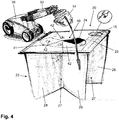
- FIG 4 depicts a first embodiment of the waste receiving station 20 comprising a first embodiment of the adjustable cover device 40.
- the general configuration of the waste receiving station 20 is similar to that shown in Figure 8 . Therefore, with regard to the general configuration, full reference is made to the description of Figure 8 at this point as well.
- the waste receiving container 22 of the waste receiving station 20, which is represented in Figur4 with the sidewalls being removed, comprises a number of different compartments 27, each compartment 27 being separated from the other compartments 27 by a partition wall 28.
- the partition walls 28 are diagonally, radial, or rectangularly arranged inside the waste receiving container 22.
- the receiving container 22 is closed by the ceiling element 23, said ceiling element 23 incorporating the receiving opening 24.
- a device 15 for generating power, by making use of solar power for example, is provided, at the ceiling element 23 in the present embodiment.
- the adjustable cover device 40 comprises a lid device 41, the lid device 41 in turn comprising a number of lid segments 42, each lid segment 42 being associated to a compartment 27 of the receiving container 22, and each compartment 27 being provided for receiving and storing a specific waste fraction.
- the signal receiving unit 61 of the control device 60 of the waste receiving station 20 receives input signals from the external entity 30, in particular from a, preferably autonomous, carrier vehicle carrying at least one fraction of waste via a first signal receiving connection 71, if the external entity 30 approaches the waste receiving station 20.
- the external entity 30 comprises a holding and gripping arm 32, that holds a waste sack 14. According to different scenarios, which are described further below, loading a container onto the external entity by lifting it using a compartment in the external entity for temporary storage/ or placing a bag or container by hand in or on the external entity driving over a container to pick it up/ using an arm to pick it up for placement in or onto the external entity, is performed.
- These input signals comprise values relating to the distance from the external entity 30 to the waste receiving station 20, as well as values relating to the characteristic of the waste fraction carried by the external entity 30.
- the input signals are transmitted from the signal receiving unit 61 to the signal processing unit 62.
- the signal processing unit 62 based on the input signals, automatically generates adjustment commands for the cover device 40.
- These commands comprise a first order, that the cover device 40 in form of the lid device 41 has to get opened, such that the external entity 30 is capable to discharge its waste fraction, here the waste sack 14, through the receiving opening 24 into the receiving container 22.
- the signal processing unit 62 since the control device 60 has information with regard to the characteristics of the waste fraction carried by said external entity 30, the signal processing unit 62 generates a second command comprising an order, which of the lid segments 42 of the lid device 41 is to get opened, such that the waste sack 14 of the external entity 30 can get charged into the correct compartment 27 of the receiving container 22.
- the generated adjustment commands are transmitted from the signal processing unit 62 to the signal transmission unit 63.
- the commands are then transmitted from the signal transmission unit 63 to the cover device 40.
- the cover device 40 gets adjusted according to the adjustment commands, which means that the correct lid segment 42 gets opened.
- the external entity 30 charges the waste sack 14 carried by said external entity 30 into the compartment 27, the lid segment 42 of which being open.
- the external entity 30 After the external entity 30 has discharged its waste sack 14 into the receiving container 22, the external entity 30 leaves the waste receiving station 20 again.
- the signal receiving unit 61 generates an input signal relating to the departure of the external entity 30.
- the signal processing unit 62 generates a command that the open lid segment 42 has to get closed again. This command is transmitted from the signal processing unit 62 via said signal transmission unit 63 to the adjustable cover device 40, in particular to a drive (not shown) associated to said lid segment 42. Once the lid segment 42, respectively the drive has received the command, the lid segment 42 gets closed again.
- the present invention is not limited to specific configurations for the external device 30, a carrier vehicle for example. Some preferred embodiments are shown in Figures 5 to 7 .
- Figure 5 shows an external entity 30, that comprises a gripping and holding arm 32.
- This arm 23 is configured to grip and hold a waste container 13.
- the waste container 13 is configured to receive two different waste fractions. Each waste fraction can get charged in a corresponding compartment of the waste receiving container 22 of waste receiving station 20.
- the external entity 30 itself is configured to store at least one waste fraction, two waste fractions shown in Figure 6 .
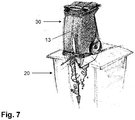
- a different embodiment of an external entity 30, in which at least one waste fraction is stored, is shown in Figure 7 .
- the external entity 30 is configured as a movable waste container 13.
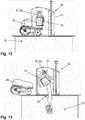
- a different embodiment of a waste receiving station 20 comprising a second preferred embodiment of an adjustable cover device 50 will now be explained in connection with Figures 8 to 13 .
- the underground waste receiving station 20 comprises a receiving pit 21, which serves as an exterior housing and which is placed inside the ground, such that the receiving pit 21 is almost located below the ground level 101.
- the receiving pit is square or rectangular in shape, which means that it has a square or rectangular cross-section.
- the receiving pit 21, which may be made of concrete, metal, steel for example, a plastic material, or the like, preferably comprises a pit side wall, optionally a pit ground or pit bottom at the lower end of the pit side wall and a pit opening at the upper end of the pit side wall.
- the aforementioned components preferably delimit a receiving space, said receiving space being adapted for receiving a receiving container 22, said receiving container 22 serving as a waste collecting container.
- the volume of the receiving container 22 can range from 1m 3 to 5m 3 .
- the present invention is not limited to specific load capacities for the receiving container.
- the receiving container 22 is adapted for temporarily storing waste, valuable substances or the like.
- the receiving container 22 is movably located inside the receiving pit 21. That means that the receiving container 22 can get removed, via a pit opening, out of the receiving pit 21. In the same way, the receiving container 22 can get inserted, once it has been emptied, maintained or the like, via said pit opening into the receiving pit 21.
- the receiving container 22 comprises a ceiling element 23 that covers the receiving container 22 at the top, the ceiling element 23 having a receiving opening 24 for waste.
- waste is charged into the receiving container 22 via chute device 25, which is or comprises an adjustable cover device 50, which comprises a waste deposit housing 51, and which is provided or arranged above the receiving opening 24 of the ceiling element 23 of the receiving container 22.
- a safety system 26 is activated, said safety system 26 comprising a safety platform, by means of which the empty receiving pit 21, in particular the open pit opening, is or remains closed, in order to prevent accidents, in particular to prevent people from falling into the receiving pit 21.
- the adjustable cover device 50 comprises a waste deposit housing 51, said waste deposit housing 51 being mounted to the receiving container 22 above the receiving opening 24 and surrounding same.
- the waste deposit housing 50 is some kind of a chute that was described further above.
- the receiving container 22 of the waste receiving station 20 comprises a ceiling element 23, and the receiving opening 24 is provided in the ceiling element 23, the waste deposit housing 51 is mounted to the ceiling element 23 from outside and above the receiving opening 24, such that the receiving opening 24 is located inside the waste deposit housing 51 and is totally hidden behind the sidewalls 53 of the waste deposit housing 51.
- the sidewalls 53 of the waste deposit housing 51 border an inner space 52 of the waste deposit housing 51.
- the inner space 52 of the waste deposit housing 51 is completely enclosed by the walls of the waste deposit housing 51, for example by the sidewall 53, by a top ceiling element 54 of the waste deposit housing 51 and by the ceiling element 23 of the receiving container 22, to which the waste deposit housing 51 is mounted.
- the waste deposit housing 51 comprises a waste deposit opening 55, which is preferably arranged in the side wall 53 of the waste deposit housing 51,
- the waste deposit housing 51 further comprises a door 56, which is movably mounted to the waste deposit housing 51 to selectively open and close the waste deposit opening 55.
- the door 56 is pivotally mounted to the waste deposit housing 51, via at least one suitable hinge device for example, such that the door 56 can either get tipped up or can pivot sideways.
- the door 56 is configured as a rolling gate.
- the signal receiving unit 61 of the control device 60 (see also Figure 3 ) of the waste receiving station 20 receives or gathers input signals from the external entity 30, for example a carrier vehicle, carrying at least one fraction of waste, via a first signal receiving connection 71, if the external entity 30 approaches the waste receiving station 20.
- These input signals comprise values relating to the distance from the external entity 30 to the waste receiving station 20, and optionally values relating to the characteristic of the waste fraction carried by the external entity 30.
- the input signals are transmitted from the signal receiving unit 61 to the signal processing unit 62.
- the signal processing unit 62 based on the input signals, automatically generates adjustment commands for the cover device 50. These commands comprise a first order, that the cover device 50 in form of the waste deposit housing 51, in particular the door 56 covering the waste deposit opening 55 in the waste deposit housing 51, has to get opened, such that the external entity 30 is capable to discharge its waste fraction through the opened waste deposit housing 51 and the receiving opening 24 into the receiving container 22.
- the signal processing unit 61 may generate a second command comprising an order, into which compartment 27 of the receiving container 22 the waste fraction carried by the external entity 30 has to get charged.
- the generated adjustment commands are transmitted from the signal processing unit 62 to the signal transmission unit 63.
- the commands are then transmitted from the signal transmission unit 63 to the cover device 50, in particular to the door 56 of the waste deposit housing 51, preferably to a drive (not shown) associated thereto.
- the cover device 50 gets adjusted according to the adjustment commands, which means that the door 56 of the waste deposit housing 51 gets opened, by means of activating the drive for example.
- the external entity 30 charges the waste fraction carried by said external entity 30 through the receiving opening 24 into the receiving container 22.
- the external entity 30 hands over the waste fraction to the waste deposit housing 51, and the waste deposit housing 51 charges the waste fraction into the receiving container 22.
- the external entity 30 leaves the waste receiving station 20 again.
- the signal receiving unit 61 generates an input signal relating to the departure of the external entity 30.
- the signal processing unit 61 generates a command that the open door 56 of the waste disposal housing 51 has to get closed again.
- This command is transmitted from the signal processing unit 62 via said signal transmission unit 63 to the adjustable cover device 50, in particular to a drive associated to said door 56. Once the door 56, respectively the drive, has received the command, the door 56 gets closed again.
- the waste deposit housing 51 comprises a handling device 57 for handling waste being introduced into the waste deposit housing 51 via said waste deposit opening, in particular for handling a waste container 13 comprising such waste or a waste fraction.
- a handling device 57 is used, if the external entity 30 carrying a waste fraction to the waste receiving station 20 does not directly charge the waste into the waste receiving container 22, but hands the waste over to the waste deposit housing 51.
- the handling device 57 is provided inside the waste deposit housing 51. Such a handling device is shown in Figures 10 to 13 .
- the handling device 57 is provided as or comprises a tilting device 58.
- the external entity 30 carrying a waste container 13 with waste delivers the waste container 13 into the opened waste deposit housing 51, where it gets handed over to the handling device 57.
- Such a tilting device 58 has the function, that a waste container 13 that has been delivered by the external entity 30, the carrier vehicle for example, once it has entered the waste deposit housing 51, gets tilted in such a way, that a discharge opening of the waste container 13 comes into alignment with the receiving opening 24 of the receiving container 22 of the waste receiving station, such that the waste may leave the waste container 13 and enter the receiving container 22, with potential shaking or a hard-stop to release waste that is stuck in the waste container 13..
- FIG 13 This is shown in Figure 13 .
- the waste deposit housing 51 is provided as a garage for the external entity 30, in particular for the carrier vehicle, carrying at least one waste fraction. This is shown in Figures 10 and 11 . If the external entity 30 is not in use, it can get parked inside the waste deposit housing 51, such that it is protected against external influences, against bad weather conditions, against damages, or the like, or for, preferably inductive or contact, charging. Potentially the waste receiving station 20 can comprise an inductive loading dock to charge the external entity 30. If the waste receiving station 20 gets operated, the external entity 30 leaves the waste deposit housing 51, moves to the desired location, where it takes up waste, and returns to the waste receiving station 20 for charging the waste into the waste receiving container 22 of the waste receiving station 20.
- the waste receiving station 20 optionally comprises a guiding device for guiding and/or aligning the external entity 30, in particular the carrier vehicle, carrying at least one waste fraction, in relation to the cover device 50.
- This guiding device is preferably provided in such a way that it allows the external entity 30 to merge the inside of the waste deposit housing 51 through the open waste deposit opening.
- the handling device 57 comprises or is provided as a device 59 for positioning and/or aligning the waste container 13 above the receiving opening 24 of the receiving container 22.
- a tilting device as shown in Figures 12 and 13 , the waste container 13 can be brought into the correct position.
- the operation of the handling device 57 is preferably controlled by the control device 60 of the waste receiving station 20.
- the waste deposit housing 51 preferably comprises suitable sensor devices (not shown), such as optical devices, which determine the position and the kind of waste entering the waste deposit housing 51, as well as the position of the handling device 57.
Landscapes
- Engineering & Computer Science (AREA)
- Mechanical Engineering (AREA)
- Refuse Collection And Transfer (AREA)
Priority Applications (1)
| Application Number | Priority Date | Filing Date | Title |
|---|---|---|---|
| EP20157216.1A EP3865425A1 (fr) | 2020-02-13 | 2020-02-13 | Station de réception pour recevoir et stocker des déchets |
Applications Claiming Priority (1)
| Application Number | Priority Date | Filing Date | Title |
|---|---|---|---|
| EP20157216.1A EP3865425A1 (fr) | 2020-02-13 | 2020-02-13 | Station de réception pour recevoir et stocker des déchets |
Publications (1)
| Publication Number | Publication Date |
|---|---|
| EP3865425A1 true EP3865425A1 (fr) | 2021-08-18 |
Family
ID=69591548
Family Applications (1)
| Application Number | Title | Priority Date | Filing Date |
|---|---|---|---|
| EP20157216.1A Pending EP3865425A1 (fr) | 2020-02-13 | 2020-02-13 | Station de réception pour recevoir et stocker des déchets |
Country Status (1)
| Country | Link |
|---|---|
| EP (1) | EP3865425A1 (fr) |
Citations (8)
| Publication number | Priority date | Publication date | Assignee | Title |
|---|---|---|---|---|
| US20040034538A1 (en) * | 2002-08-13 | 2004-02-19 | Fenelon Mark S. | Process for the commercialization of waste product disposal |
| US20050281653A1 (en) | 2004-05-27 | 2005-12-22 | Donald Channel | Automated trash delivery system |
| EP2664449A2 (fr) * | 2012-04-16 | 2013-11-20 | Rhino Engineering B.V. | Conteneur à ordures et unité intégrée à cet effet |
| EP2676900A1 (fr) * | 2012-06-21 | 2013-12-25 | Wastec B.V. | Système de collecte de déchets et récipient correspondant |
| EP2808272A1 (fr) * | 2013-05-28 | 2014-12-03 | Conf Industries S.r.l. | Système de mise au rebut |
| EP2939955A1 (fr) | 2014-04-30 | 2015-11-04 | ESE World B.V. | Dispositif d'introduction pour un dispositif de collecte de déchets souterrain et dispositif de collecte de déchets souterrain |
| DE202016003751U1 (de) | 2016-06-15 | 2016-08-12 | Sebastian Franke | Fahrerloses Transportsystem für Mülltonnen |
| EP3476770A1 (fr) | 2017-10-20 | 2019-05-01 | ITALDESIGN-GIUGIARO S.p.A | Système de collecte de déchets avec mobilité autonome de conteneurs de déchets |
-
2020
- 2020-02-13 EP EP20157216.1A patent/EP3865425A1/fr active Pending
Patent Citations (8)
| Publication number | Priority date | Publication date | Assignee | Title |
|---|---|---|---|---|
| US20040034538A1 (en) * | 2002-08-13 | 2004-02-19 | Fenelon Mark S. | Process for the commercialization of waste product disposal |
| US20050281653A1 (en) | 2004-05-27 | 2005-12-22 | Donald Channel | Automated trash delivery system |
| EP2664449A2 (fr) * | 2012-04-16 | 2013-11-20 | Rhino Engineering B.V. | Conteneur à ordures et unité intégrée à cet effet |
| EP2676900A1 (fr) * | 2012-06-21 | 2013-12-25 | Wastec B.V. | Système de collecte de déchets et récipient correspondant |
| EP2808272A1 (fr) * | 2013-05-28 | 2014-12-03 | Conf Industries S.r.l. | Système de mise au rebut |
| EP2939955A1 (fr) | 2014-04-30 | 2015-11-04 | ESE World B.V. | Dispositif d'introduction pour un dispositif de collecte de déchets souterrain et dispositif de collecte de déchets souterrain |
| DE202016003751U1 (de) | 2016-06-15 | 2016-08-12 | Sebastian Franke | Fahrerloses Transportsystem für Mülltonnen |
| EP3476770A1 (fr) | 2017-10-20 | 2019-05-01 | ITALDESIGN-GIUGIARO S.p.A | Système de collecte de déchets avec mobilité autonome de conteneurs de déchets |
Similar Documents
| Publication | Publication Date | Title |
|---|---|---|
| EP3789319B1 (fr) | Système à ia intégré pour optimiser la gestion des déchets par robot autoguidé | |
| CN112046978B (zh) | 智能调控式垃圾回收方法、系统、存储介质、装置及应用 | |
| CN110316493B (zh) | 智能垃圾桶 | |
| US6309164B1 (en) | Method and apparatus for collecting recyclable materials | |
| CN212449131U (zh) | 一种智能调控式垃圾回收装置 | |
| CN111217046A (zh) | 智能垃圾分类回收系统 | |
| US6447235B1 (en) | Waste collection device | |
| GB2240914A (en) | Recycling and waste collection | |
| PL247998B1 (pl) | Zautomatyzowany śmietnik | |
| US5092233A (en) | Trash collection and storage system | |
| CN210794473U (zh) | 小区智能垃圾收集系统 | |
| CN208796348U (zh) | 一种回收装置及回收系统 | |
| CN215157772U (zh) | 一种自主分拣垃圾收集装置及其智能垃圾收集系统 | |
| CN110498166A (zh) | 垃圾回收方法、装置、计算机设备和存储介质 | |
| WO1993001111A1 (fr) | Vehicule de ramassage d'elements recyclables | |
| CN211767924U (zh) | 自动换桶机构 | |
| EP2676900B1 (fr) | Système et procédé de collecte de déchets | |
| JPH07223705A (ja) | 廃棄物の無人収集方法及び装置 | |
| CN220563415U (zh) | 智慧垃圾桶转运系统 | |
| EP0718217B1 (fr) | Dispositif et procédé pour collecter et compacter séparément des déchets au moyen d'un véhicule de ramassage | |
| KR101477254B1 (ko) | 쓰레기 자동집하설비용 수거장치 | |
| EP0963922B1 (fr) | Trémie d'un véhicule de ramassage d'ordures pour le ramassage séparé d'ordures | |
| RU2727549C1 (ru) | Аппаратно-программный комплекс по приему полиэтиленовых бутылок и алюминиевых банок | |
| CN109533708B (zh) | 一种用于垃圾筒发放和收集的系统及其使用步骤 | |
| CN210417876U (zh) | 一种智能垃圾桶 |
Legal Events
| Date | Code | Title | Description |
|---|---|---|---|
| PUAI | Public reference made under article 153(3) epc to a published international application that has entered the european phase |
Free format text: ORIGINAL CODE: 0009012 |
|
| STAA | Information on the status of an ep patent application or granted ep patent |
Free format text: STATUS: THE APPLICATION HAS BEEN PUBLISHED |
|
| AK | Designated contracting states |
Kind code of ref document: A1 Designated state(s): AL AT BE BG CH CY CZ DE DK EE ES FI FR GB GR HR HU IE IS IT LI LT LU LV MC MK MT NL NO PL PT RO RS SE SI SK SM TR |
|
| STAA | Information on the status of an ep patent application or granted ep patent |
Free format text: STATUS: REQUEST FOR EXAMINATION WAS MADE |
|
| 17P | Request for examination filed |
Effective date: 20220210 |
|
| RBV | Designated contracting states (corrected) |
Designated state(s): AL AT BE BG CH CY CZ DE DK EE ES FI FR GB GR HR HU IE IS IT LI LT LU LV MC MK MT NL NO PL PT RO RS SE SI SK SM TR |
|
| STAA | Information on the status of an ep patent application or granted ep patent |
Free format text: STATUS: EXAMINATION IS IN PROGRESS |
|
| 17Q | First examination report despatched |
Effective date: 20250624 |
|
| RAP3 | Party data changed (applicant data changed or rights of an application transferred) |
Owner name: ESE WORLD B.V. |