EP3865675A1 - Système d'aube variable pour une turbomachine avec un levier doté d'une ouverture de réception conique pour un tennon d'un anneau de commande - Google Patents
Système d'aube variable pour une turbomachine avec un levier doté d'une ouverture de réception conique pour un tennon d'un anneau de commande Download PDFInfo
- Publication number
- EP3865675A1 EP3865675A1 EP21154119.8A EP21154119A EP3865675A1 EP 3865675 A1 EP3865675 A1 EP 3865675A1 EP 21154119 A EP21154119 A EP 21154119A EP 3865675 A1 EP3865675 A1 EP 3865675A1
- Authority
- EP
- European Patent Office
- Prior art keywords
- aperture
- bushing
- rotational position
- turbomachine
- vane
- Prior art date
- Legal status (The legal status is an assumption and is not a legal conclusion. Google has not performed a legal analysis and makes no representation as to the accuracy of the status listed.)
- Withdrawn
Links
- 239000012530 fluid Substances 0.000 claims abstract description 23
- 238000000034 method Methods 0.000 claims description 8
- 238000004519 manufacturing process Methods 0.000 claims description 5
- 230000008878 coupling Effects 0.000 claims description 2
- 238000010168 coupling process Methods 0.000 claims description 2
- 238000005859 coupling reaction Methods 0.000 claims description 2
- 239000000463 material Substances 0.000 claims description 2
- 238000002485 combustion reaction Methods 0.000 description 9
- 239000004696 Poly ether ether ketone Substances 0.000 description 4
- 230000013011 mating Effects 0.000 description 4
- 239000000203 mixture Substances 0.000 description 4
- 229920002530 polyetherether ketone Polymers 0.000 description 4
- 230000009471 action Effects 0.000 description 3
- 238000011144 upstream manufacturing Methods 0.000 description 3
- 230000008859 change Effects 0.000 description 2
- 239000000446 fuel Substances 0.000 description 2
- 230000000717 retained effect Effects 0.000 description 2
- 230000002708 enhancing effect Effects 0.000 description 1
- 230000006870 function Effects 0.000 description 1
- 239000012761 high-performance material Substances 0.000 description 1
- 238000003754 machining Methods 0.000 description 1
- 239000002184 metal Substances 0.000 description 1
- 230000008439 repair process Effects 0.000 description 1
- 125000006850 spacer group Chemical group 0.000 description 1
- 230000002123 temporal effect Effects 0.000 description 1
Images




Classifications
-
- F—MECHANICAL ENGINEERING; LIGHTING; HEATING; WEAPONS; BLASTING
- F02—COMBUSTION ENGINES; HOT-GAS OR COMBUSTION-PRODUCT ENGINE PLANTS
- F02C—GAS-TURBINE PLANTS; AIR INTAKES FOR JET-PROPULSION PLANTS; CONTROLLING FUEL SUPPLY IN AIR-BREATHING JET-PROPULSION PLANTS
- F02C9/00—Controlling gas-turbine plants; Controlling fuel supply in air- breathing jet-propulsion plants
- F02C9/16—Control of working fluid flow
- F02C9/20—Control of working fluid flow by throttling; by adjusting vanes
- F02C9/22—Control of working fluid flow by throttling; by adjusting vanes by adjusting turbine vanes
-
- F—MECHANICAL ENGINEERING; LIGHTING; HEATING; WEAPONS; BLASTING
- F01—MACHINES OR ENGINES IN GENERAL; ENGINE PLANTS IN GENERAL; STEAM ENGINES
- F01D—NON-POSITIVE DISPLACEMENT MACHINES OR ENGINES, e.g. STEAM TURBINES
- F01D9/00—Stators
- F01D9/02—Nozzles; Nozzle boxes; Stator blades; Guide conduits, e.g. individual nozzles
- F01D9/04—Nozzles; Nozzle boxes; Stator blades; Guide conduits, e.g. individual nozzles forming ring or sector
- F01D9/042—Nozzles; Nozzle boxes; Stator blades; Guide conduits, e.g. individual nozzles forming ring or sector fixing blades to stators
-
- F—MECHANICAL ENGINEERING; LIGHTING; HEATING; WEAPONS; BLASTING
- F04—POSITIVE - DISPLACEMENT MACHINES FOR LIQUIDS; PUMPS FOR LIQUIDS OR ELASTIC FLUIDS
- F04D—NON-POSITIVE-DISPLACEMENT PUMPS
- F04D29/00—Details, component parts, or accessories
- F04D29/60—Mounting; Assembling; Disassembling
- F04D29/64—Mounting; Assembling; Disassembling of axial pumps
- F04D29/644—Mounting; Assembling; Disassembling of axial pumps especially adapted for elastic fluid pumps
-
- F—MECHANICAL ENGINEERING; LIGHTING; HEATING; WEAPONS; BLASTING
- F01—MACHINES OR ENGINES IN GENERAL; ENGINE PLANTS IN GENERAL; STEAM ENGINES
- F01D—NON-POSITIVE DISPLACEMENT MACHINES OR ENGINES, e.g. STEAM TURBINES
- F01D17/00—Regulating or controlling by varying flow
- F01D17/10—Final actuators
- F01D17/12—Final actuators arranged in stator parts
- F01D17/14—Final actuators arranged in stator parts varying effective cross-sectional area of nozzles or guide conduits
- F01D17/16—Final actuators arranged in stator parts varying effective cross-sectional area of nozzles or guide conduits by means of nozzle vanes
- F01D17/162—Final actuators arranged in stator parts varying effective cross-sectional area of nozzles or guide conduits by means of nozzle vanes for axial flow, i.e. the vanes turning around axes which are essentially perpendicular to the rotor centre line
-
- F—MECHANICAL ENGINEERING; LIGHTING; HEATING; WEAPONS; BLASTING
- F01—MACHINES OR ENGINES IN GENERAL; ENGINE PLANTS IN GENERAL; STEAM ENGINES
- F01D—NON-POSITIVE DISPLACEMENT MACHINES OR ENGINES, e.g. STEAM TURBINES
- F01D9/00—Stators
- F01D9/02—Nozzles; Nozzle boxes; Stator blades; Guide conduits, e.g. individual nozzles
- F01D9/04—Nozzles; Nozzle boxes; Stator blades; Guide conduits, e.g. individual nozzles forming ring or sector
- F01D9/041—Nozzles; Nozzle boxes; Stator blades; Guide conduits, e.g. individual nozzles forming ring or sector using blades
-
- F—MECHANICAL ENGINEERING; LIGHTING; HEATING; WEAPONS; BLASTING
- F04—POSITIVE - DISPLACEMENT MACHINES FOR LIQUIDS; PUMPS FOR LIQUIDS OR ELASTIC FLUIDS
- F04D—NON-POSITIVE-DISPLACEMENT PUMPS
- F04D29/00—Details, component parts, or accessories
- F04D29/40—Casings; Connections of working fluid
- F04D29/52—Casings; Connections of working fluid for axial pumps
- F04D29/54—Fluid-guiding means, e.g. diffusers
- F04D29/56—Fluid-guiding means, e.g. diffusers adjustable
- F04D29/563—Fluid-guiding means, e.g. diffusers adjustable specially adapted for elastic fluid pumps
-
- F—MECHANICAL ENGINEERING; LIGHTING; HEATING; WEAPONS; BLASTING
- F05—INDEXING SCHEMES RELATING TO ENGINES OR PUMPS IN VARIOUS SUBCLASSES OF CLASSES F01-F04
- F05D—INDEXING SCHEME FOR ASPECTS RELATING TO NON-POSITIVE-DISPLACEMENT MACHINES OR ENGINES, GAS-TURBINES OR JET-PROPULSION PLANTS
- F05D2220/00—Application
- F05D2220/30—Application in turbines
- F05D2220/32—Application in turbines in gas turbines
-
- F—MECHANICAL ENGINEERING; LIGHTING; HEATING; WEAPONS; BLASTING
- F05—INDEXING SCHEMES RELATING TO ENGINES OR PUMPS IN VARIOUS SUBCLASSES OF CLASSES F01-F04
- F05D—INDEXING SCHEME FOR ASPECTS RELATING TO NON-POSITIVE-DISPLACEMENT MACHINES OR ENGINES, GAS-TURBINES OR JET-PROPULSION PLANTS
- F05D2230/00—Manufacture
- F05D2230/80—Repairing, retrofitting or upgrading methods
-
- F—MECHANICAL ENGINEERING; LIGHTING; HEATING; WEAPONS; BLASTING
- F05—INDEXING SCHEMES RELATING TO ENGINES OR PUMPS IN VARIOUS SUBCLASSES OF CLASSES F01-F04
- F05D—INDEXING SCHEME FOR ASPECTS RELATING TO NON-POSITIVE-DISPLACEMENT MACHINES OR ENGINES, GAS-TURBINES OR JET-PROPULSION PLANTS
- F05D2240/00—Components
- F05D2240/10—Stators
- F05D2240/12—Fluid guiding means, e.g. vanes
-
- F—MECHANICAL ENGINEERING; LIGHTING; HEATING; WEAPONS; BLASTING
- F05—INDEXING SCHEMES RELATING TO ENGINES OR PUMPS IN VARIOUS SUBCLASSES OF CLASSES F01-F04
- F05D—INDEXING SCHEME FOR ASPECTS RELATING TO NON-POSITIVE-DISPLACEMENT MACHINES OR ENGINES, GAS-TURBINES OR JET-PROPULSION PLANTS
- F05D2250/00—Geometry
- F05D2250/20—Three-dimensional
- F05D2250/29—Three-dimensional machined; miscellaneous
- F05D2250/292—Three-dimensional machined; miscellaneous tapered
-
- F—MECHANICAL ENGINEERING; LIGHTING; HEATING; WEAPONS; BLASTING
- F05—INDEXING SCHEMES RELATING TO ENGINES OR PUMPS IN VARIOUS SUBCLASSES OF CLASSES F01-F04
- F05D—INDEXING SCHEME FOR ASPECTS RELATING TO NON-POSITIVE-DISPLACEMENT MACHINES OR ENGINES, GAS-TURBINES OR JET-PROPULSION PLANTS
- F05D2260/00—Function
- F05D2260/50—Kinematic linkage, i.e. transmission of position
- F05D2260/56—Kinematic linkage, i.e. transmission of position using cams or eccentrics
-
- F—MECHANICAL ENGINEERING; LIGHTING; HEATING; WEAPONS; BLASTING
- F05—INDEXING SCHEMES RELATING TO ENGINES OR PUMPS IN VARIOUS SUBCLASSES OF CLASSES F01-F04
- F05D—INDEXING SCHEME FOR ASPECTS RELATING TO NON-POSITIVE-DISPLACEMENT MACHINES OR ENGINES, GAS-TURBINES OR JET-PROPULSION PLANTS
- F05D2260/00—Function
- F05D2260/50—Kinematic linkage, i.e. transmission of position
- F05D2260/57—Kinematic linkage, i.e. transmission of position using servos, independent actuators, etc.
-
- F—MECHANICAL ENGINEERING; LIGHTING; HEATING; WEAPONS; BLASTING
- F05—INDEXING SCHEMES RELATING TO ENGINES OR PUMPS IN VARIOUS SUBCLASSES OF CLASSES F01-F04
- F05D—INDEXING SCHEME FOR ASPECTS RELATING TO NON-POSITIVE-DISPLACEMENT MACHINES OR ENGINES, GAS-TURBINES OR JET-PROPULSION PLANTS
- F05D2260/00—Function
- F05D2260/70—Adjusting of angle of incidence or attack of rotating blades
-
- F—MECHANICAL ENGINEERING; LIGHTING; HEATING; WEAPONS; BLASTING
- F05—INDEXING SCHEMES RELATING TO ENGINES OR PUMPS IN VARIOUS SUBCLASSES OF CLASSES F01-F04
- F05D—INDEXING SCHEME FOR ASPECTS RELATING TO NON-POSITIVE-DISPLACEMENT MACHINES OR ENGINES, GAS-TURBINES OR JET-PROPULSION PLANTS
- F05D2260/00—Function
- F05D2260/70—Adjusting of angle of incidence or attack of rotating blades
- F05D2260/79—Bearing, support or actuation arrangements therefor
Definitions
- the present disclosure generally relates to a variable vane system, such as a variable inlet guide vane (IGV) system for a turbomachine and, more particularly, relates to a variable vane system with a linkage having a tapered receiving aperture for a unison ring pin.
- IGV variable inlet guide vane
- Turbomachine compressors can be used in a variety of applications. For example, some compressors (e.g., axial compressors) may be included in a gas turbine engine. In many cases, compressors may include a rotor and a variable vane system. The variable vane system may include a plurality of vanes that may be selectively actuated to change fluid flow to the rotor.
- variable vane system may be susceptible to wear.
- manufacture of these variable vane systems may be complex, time consuming, and inconvenient.
- variable vane system wherein the vanes are actuated efficiently and accurately. Furthermore, it is desirable to provide a more robust variable vane system that is less susceptible to wear. Additionally, it is desirable to provide a variable vane system that can be manufactured in a more efficient manner.
- variable vane fluid system for a turbomachine.
- the variable vane fluid system includes a support structure that defines a longitudinal axis.
- the variable vane fluid system also includes a plurality of variable stator vanes including a first stator vane.
- the plurality of variable stator vanes is supported by the support structure for rotational movement for varying fluid flow through the turbomachine.
- the variable vane fluid system also includes a unison actuation structure supported by the support structure for movement about the longitudinal axis between a first rotational position and a second rotational position to coincidentally rotate the plurality of vanes.
- the unison actuation structure has a projection.
- variable vane fluid system further includes an elongate linkage member having a first portion connected to the first stator vane and a second portion with an aperture that receives the projection.
- the aperture includes an inner surface with a tapered inner surface profile to allow the projection to tilt within the aperture as the unison actuation structure rotates between the first rotational position and the second rotational position.
- a method of manufacturing a turbomachine includes attaching a plurality of variable stator vanes including a first stator vane to a support structure, including supporting the plurality of stator vanes with the support structure for rotational movement that varies fluid flow through the turbomachine.
- the method also includes attaching a unison actuation structure with a projection to the support structure, including supporting the unison actuation structure with the support structure for movement about the longitudinal axis between a first rotational position and a second rotational position.
- the method includes coupling the first stator vane to the projection with an elongate linkage member such that movement of the unison actuation structure between the first rotational position and the second rotational position coincidentally rotates the first stator vane, including attaching a first portion of the linkage member to the first stator vane and receiving the projection in an aperture at a second portion of the linkage member.
- the aperture includes an inner surface with a tapered inner surface profile to allow the projection to tilt within the aperture as the unison actuation structure rotates between the first rotational position and the second rotational position.
- variable vane system includes a support structure that defines a longitudinal axis. Furthermore, the variable vane system includes a plurality of variable stator vanes including a first stator vane. The plurality of variable stator vanes is supported by the support structure for rotational movement for varying fluid flow through the gas turbine engine.
- the variable vane system also includes a unison ring supported by the support structure for movement about the longitudinal axis between a first rotational position and a second rotational position to coincidentally rotate the plurality of stator vanes.
- the unison ring has a pin that projects away from the longitudinal axis.
- the variable vane system additionally includes an elongate linkage member with a rigid arm having a first end that is attached to the first stator vane.
- the elongate linkage member has a bushing that is removably attached to a second end of the arm.
- the bushing has an aperture that receives the pin.
- the aperture includes an inner surface with a tapered inner surface profile to allow the pin to tilt within the aperture as the unison ring rotates between the first rotational position and the second rotational position.
- the present disclosure generally relates to a variable vane system with features that allow stator vanes to move efficiently and effectively with relatively low actuating forces.
- the features reduce wear on the components as well. Furthermore, manufacture of the system can be completed quickly, efficiently, and conveniently.
- variable vane system of the present disclosure may include linkages that couple stator vanes to a unison actuation structure (e.g., a unison ring).
- At least one linkage may include an aperture that receives a mating part.
- the aperture may include a tapered interior surface that allows the mating part to pivot within the aperture as the components rotate about respective axes.
- the aperture may be incorporated in a replaceable bushing.
- the bushing may be made from a high-performance material, such as poly ether ether ketone (PEEK) in some embodiments.
- PEEK poly ether ether ketone
- loads on the bushing and the mating part can be relatively low. Also, these components are less susceptible to wear. Additionally, the system may be manufactured efficiently. Furthermore, repair of the joint between the linkage and mating part is convenient, for example, because the bushings may be replaced easily.
- an exemplary turbomachine such as a gas turbine engine 100
- a gas turbine engine 100 is shown that is configured to include a variable vane fluid system of the present disclosure.
- the variable vane fluid system of the present disclosure is discussed with regard to the gas turbine engine 100, the variable vane fluid system of the present disclosure can be employed with any suitable engine, such as a turbojet engine, a scramjet engine, an auxiliary power unit (APU), or other turbomachine without departing from the scope of the present disclosure.
- APU auxiliary power unit
- the exemplary gas turbine engine 100 may include a fan section 102, a compressor section 104, a combustion section 106, a turbine section 108, and an exhaust section 110.
- the fan, combustion, turbine, and exhaust sections 102, 106, 108, 110 can be substantially similar to those of a conventional gas turbine engine; therefore, the fan, combustion, turbine, and exhaust sections 102, 106, 108, 110 will not be discussed in detail herein.
- FIGS. 1 and 2 are merely illustrative and may not be necessarily drawn to scale.
- the fluid moving through the engine 100 may be air, it should be noted that the present disclosure is not so limited. Instead, the present disclosure may apply to any turbomachine that receives any suitable fluid.
- the fan section 102 includes a fan 112 mounted in a fan casing 114.
- the fan 112 induces air from the surrounding environment into the engine 100 and passes this air toward the compressor section 104.
- the compressor section 104 includes at least one compressor and, in this example, includes a low-pressure (LP) compressor 116 (may also be referred to as an intermediate-pressure (IP) compressor, a booster or T-stage) and a high-pressure (HP) compressor 118.
- the LP compressor 116 raises the pressure of the air directed into it from the fan 112 and directs the compressed air into the HP compressor 118.
- the LP compressor 116 and the HP compressor 118 may be axi-symmetrical about a longitudinal centerline axis 120.
- the LP compressor 116 and the HP compressor 118 are mounted in a compressor casing 122 (i.e., shroud).
- the combustion section 106 of the gas turbine engine 100 includes a combustor 124 in which the high-pressure air from the HP compressor 118 is mixed with fuel and combusted to generate a combustion mixture of air and fuel. The combustion mixture is then directed into the turbine section 108.
- the turbine section 108 includes a number of turbines disposed in axial flow series.
- FIG. 2 depicts a high-pressure turbine 126, an intermediate pressure turbine 128, and a low-pressure turbine 130. While three turbines are depicted, it is to be understood that any number of turbines may be included according to design specifics.
- a propulsion gas turbine engine may comprise only a high-pressure turbine and a low-pressure turbine.
- the combustion mixture from the combustion section 106 expands through each turbine 126, 128, 130, causing them to rotate.
- each turbines 126, 128, 130 rotate, each respectively drives equipment in the gas turbine engine 100 via concentrically disposed spools or shafts 132, 134, 136.
- the combustion mixture is then exhausted through the exhaust section 110.
- the HP compressor 118 includes an axial compressor section 138 and a centrifugal compressor section 140.
- the axial compressor section 138 includes one or more rotors 142 and one or more stators 144.
- the one or more rotors 142 and the one or more stators 144 are enclosed by the compressor casing 122 ( FIG. 2 ).
- the axial compressor section 138 may also include an inlet guide vane system (IGV system) 146.
- the centrifugal compressor section 140 can include an impeller 148 as shown.
- the axial compressor section 138 may include one or more compressor stages spaced in an axial direction along the longitudinal centerline axis 120, with the one or more rotors 142 and the one or more stators 144 cooperating to define a stage.
- the axial compressor section 138 comprises a four-stage axial compressor section 138, namely, a first stage 150, a second stage 152, a third stage 154, and a fourth stage 156. It should be noted, however, that the axial compressor section 138 may have any number of stages, and thus, it will be understood that the present teachings herein are not limited to an axial compressor section 138 having four stages.
- the first stage 150 may include a rotor 158 and a stator 160.
- the rotor 158 may be disposed downstream of the IGV system 146 and may be disposed between the IGV system 146 and the stator 160.
- the second stage 152 may include a rotor 162 and a stator 164.
- the rotor 162 may be disposed downstream of the stator 160 and may be disposed between the stator 160 and the stator 164.
- the third stage 154 may include a rotor 166 and a stator 168.
- the rotor 166 may be disposed downstream of the stator 164 and may be disposed between the stator 164 and the stator 168.
- the fourth stage 156 may include a rotor 170 and a stator 172.
- the rotor 170 may be disposed downstream of the stator 168 and may be disposed between the stator 168 and the stator 172.
- the stator 172 of the fourth stage 156 may be disposed upstream of the impeller 148 of the centrifugal compressor section 140.
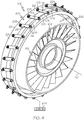
- the IGV system 146 will now be discussed in detail with reference to FIGS. 4 and 5 .
- the IGV system 146 may be selectively adjusted to vary the fluid flow to the rotor 158.
- the IGV system 146 may include one or more features that reduce wear, that provide a robust connection between components, that reduce the input force necessary to adjust the vanes, and/or that facilitate manufacturing. Although these features of the present disclosure are incorporated in the IGV system 146 upstream of the first stage 150 ( FIG. 3 ), it will be appreciated that these features may be incorporated in a variable vane system for any of the stages 150, 152, 154, 156 without departing from the scope of the present disclosure.
- the IGV system 146 may include a support structure 200.
- the support structure 200 may include any number of rigid and strong structures (e.g., rings, brackets, struts, etc.) that support other components of the system 146.
- the support structure 200 may include an outer support ring 201 ( FIGS. 4 and 5 ) and an inner support ring 207 (partially shown in FIG. 5 ).
- the support rings 201, 207 may both be centered about the centerline axis 120 of the engine 100.
- the support rings 201, 207 may be fixed to the compressor casing 122 ( FIG. 1 ) or other housing/support structure(s) of the engine 100.
- the IGV system 146 may include a plurality of variable stator vanes 202, one of which is shown in FIG. 5 .
- the plurality of vanes 202 may radiate about the axis 120 and may extend between the inner and outer support rings 207, 201.
- the ends of each vane 202 may be rotatably attached to the inner and outer support rings 207, 201.
- a vane stem 203 may project outward radially from the respective vane 202 and may extend radially through the outer support ring 201 as shown in FIG. 5 . Accordingly, each vane 202 may be supported for rotation about a respective vane axis 205.
- the vanes 202 may be disposed upstream of blades of the rotor 158. Accordingly, movement of the vanes 202 may selectively change fluid flow to the rotor 158 as will be discussed.
- the IGV system 146 may include a unison actuation structure 204.
- the unison actuation structure 204 may include a ring 206 (i.e., a unison ring).
- the ring 206 may be rigid and strong and may extend annularly about the centerline axis 120.
- the ring 206 may be supported by the support structure 200 for rotation about the axis 120 between various rotational positions with respect to the axis 120.
- the IGV system 146 may include a plurality of projections 208.
- the projections 208 may radiate and project outward radially from an outer diameter surface of the ring 206.
- the projections 208 may be spaced equally about the circumference of the ring 206, and the longitudinal axis of the projections 208 may extend normal to the axis 120.
- at least one of the projections 208 may be a pin that is fixed to the ring 206.
- one or more of the projections 208 may be press-fit into the ring 206.
- the IGV system 146 may further include a plurality of linkages 210.
- the linkages 210 may respectfully include a first portion 212 that is attached to one of the vane stems 203.
- the first portion 212 may include a fastener 213 (e.g., a stack up of a nut, washer(s), spacer(s), etc.) that attaches the first portion 212 to the end of the vane stem 203 projecting outwardly from the outer support ring 201.
- the fastener 213 may removably attach the linkage 210 and the vane stem 203 in some embodiments such that the linkage 210 may be removed, repaired, and/or replaced without permanent damage to the components.
- the linkages 210 may respectively include a second portion 214 that is attached to the unison actuation structure 204.
- the second portion 214 may be attached to respective ones of the projections 208 as shown in FIG. 5 .
- the second portion 214 of the linkage 210 may receive the respective projection 208. Accordingly, as will be discussed, rotation of the ring 206 about the axis 120 may, in turn, coincidentally rotate the linkages 210 and vanes 202 about the respective vane axis 205.
- the attachment between the second portion 214 and the projection 208 of the unison actuation structure 204 may be a moveable (i.e., unfixed) attachment.
- the projections 208 may be somewhat loosely received in the second portion 214 of the linkage 210 such that the projections 208 may tilt or otherwise move relative to the linkage 210.
- rotation of the ring 206 may cause the projection 208 to tilt and/or otherwise move slightly relative to the second portion 214 of the linkage 210.
- the unison actuation structure 204 may be robustly attached to the linkage 210; however, the parts are unlikely to bind, rub, elastically deform, etc. because of the attachment between the linkages 210 and projections 208 of the unison actuation structure 204.
- the IGV system 146 may include an actuator 209, which is illustrated schematically in FIG. 4 .
- the actuator 209 may be a hydraulic linear actuator.
- the actuator 209 may selectively rotate the unison actuation structure 204 in one or both directions about the axis 120. This movement may coincidentally rotate the linkages 210 and vanes 202 about their respective axis 205.
- the actuator 209 may also be operatively connected to a control system, such as a computerized control system, which controls actuation of the actuator 209 to thereby control the position of the vanes 202.
- the control system may selectively control the actuator 209 (and, thus, selectively position the vanes 202) based on detected engine speed or other operating characteristics of the engine 100.
- the linkage 210 may generally include an arm 216 and a bushing 226 that is removably attached to the arm 216; however, it will be appreciated that the linkage 210 may be a unitary (one-piece) member in other embodiments of the present disclosure.
- the arm 216 may be an elongate, flat, rigid bar.
- the arm 216 may have a substantially straight longitudinal axis extending between the first and second portions 212 of the linkage 210.
- the arm 216 may be a stamped sheet metal part in some embodiments.
- the arm 216 may include a first side 218 and an opposite second side 220.
- the first side 218 may face radially outboard and away from the axis 120 of the engine 100, and the second side 220 may face radially inboard and toward the axis 120.
- the arm 216 may include a first hole 222 at the first portion 212 of the linkage 210 and a second hole 224 at the second portion 214 of the linkage 210.
- the first hole 222 may include at least one flat internal surface and, in some embodiments, may be polygonal.
- the first hole 222 may be rectangular and elongated slightly toward the second portion 214.
- the second hole 224 may be a circular hole. Both the first and second holes 222, 224 may be through-holes that extend through the thickness of the arm 216 between the first and second sides 218, 220.
- the first hole 222 may receive and attach to the vane stem 203 (via the fastener 213) as discussed above.
- the flat internal surfaces of the first hole 222 may mate and engage opposing flat surfaces of the vane stem 203 to thereby engage (i.e., rotationally lock) the vane stem 203 and arm 216 for rotation as a unit about the vane axis 205.
- the hole 222 is elongated along the axis of the arm 216, the arm 216 may be supported to slide slightly in a direction that is normal to the axis 205 (i.e., along the longitudinal axis of the arm 216).
- the bushing 226 may be an annular member.
- the bushing 226 may be made from a polymeric material, such as polyether ether ketone (PEEK).
- PEEK polyether ether ketone
- the bushing 226 may be formed via a machining process (e.g., turned on a lathe).
- the bushing 226 may resemble a hollow tube with a first end 228, a second end 230, and an aperture 269 that extends along a straight axis 241 from the first end 228 to the second end 230.
- the second end 230 may be flared outward so as to include an outwardly extending flange 232. As shown in FIG.
- an outer surface 234 of the bushing 226 may also include a collar 236 disposed approximately mid-way between the first and second ends 228, 230.
- the collar 236 may jut outward slightly away from the axis 241 and may be spaced away from the flange 232 along the axis 241. Accordingly, an undercut region 238 may be defined on the outer surface 234 between the collar 236 and the flange 232.
- the aperture 269 of the bushing 226 may be defined by an inner surface 240.
- the inner surface 240 may extend between a first rim 272 of the aperture 269 and a second rim 274 of the aperture 269.
- a width 270 of the aperture 269 (measured normal to the axis 241 between opposite areas of the inner surface 240) may vary along the length of the aperture 269.
- the inner surface 240 may taper with respect to the axis 241 such that the width 270 gradually changes along the longitudinal length of the aperture 269.
- the aperture 269 may have a tapered profile 242 extending between the first rim 272 and the second rim 274 of the aperture 269.
- the tapered profile 242 may have an hourglass shape.
- the tapered profile 242 may include a so-called pinch area 244 where the width 270 of the aperture 269 is smallest.
- the pinch area 244 may be disposed approximately mid-way between the first and second rims 272, 274 of the aperture 269.
- the tapered profile 242 may include a first taper 246 where the aperture 269 tapers outward (increases gradually in width) from the pinch area 244 to the first rim 272.
- the tapered profile 242 may include a second taper 248 where the aperture 269 tapers outward (increases gradually in width) from the pinch area 244 to the second rim 274.
- the width 270 (diameter) at the pinch area 244 may correspond to the diameter of the projection 208 of the unison actuation structure 204. In some embodiments, these widths (diameters) may be substantially equal, or the pinch area 244 may be slightly wider.
- the bushing 226 may be removably attached to the arm 216 as shown in FIGS. 6 and 7 .
- the bushing 226 may be pressed into the second hole 224 of the arm 216 and may project axially from the first side 218 and the second side 220 of the arm 216.
- the arm 216 may be snugly received in the undercut region 238 and retained between the collar 236 and the flange 232 of the bushing 226.
- the second hole 224 may be chamfered at both ends as shown in FIG. 7 such that the bushing 226 is securely retained within the second hole 224.
- the flange 232 may project axially and radially from the second hole 224 at the second side 220 of the arm 216. Also, as shown in FIG.
- the pinch area 244 may be disposed axially between the first side 218 and the second side 220 of the arm 216. Also, the projection 208 may be received in the aperture 269 with the pinch area 244 of the bushing 226 encircling the projection 208.
- the actuator 209 may selectively rotate the unison actuation structure 204 between various rotational positions about the axis 120. Rotation of the unison actuation structure 204 coincidentally rotates the linkages 210 and vanes 202 about the respective vane axis 205. Accordingly, the fluid flow to the rotor 158 may be selectively adjusted for enhancing operating efficiency of the engine 100.
- FIG. 5 illustrates the IGV system 146 in three positions as examples.
- a first (intermediate) position is shown in solid lines
- a second (open) position is shown in phantom
- a third (closed) position is shown in phantom as well.
- the projection 208 is allowed to tilt freely within the aperture 269. More specifically, in the first position, the axis of the projection 208 may be aligned with the axis 241 of the aperture 269 and both may be normal to the axis 120. In the second position, the axis of the projection 208 may be tilted (misaligned) relative to the axis 241 in one direction.
- the axis of the projection 208 may be tilted (misaligned) in the opposite direction.
- the bushing 226 may loosely grip the projection 208 at the pinch area 244, but the first and second tapers 246, 248 may provide sufficient clearance for the projection 208 to tilt within the aperture 269. Because the pinch area 244 is disposed between the first and second sides 218, 220 of the arm 216, loads may transfer between the projection 208 and the arm 216 without creating a significant moment. Also, the arm 216 may remain rigid and unflexed during this movement. Furthermore, while there may be some friction between the bushing 226 and the projection 208, these loads are relatively low and resulting wear may be corrected by removing and replacing the bushing 226.
- the IGV system 146 may allow for selective adjustment of the vanes 202. Input loads from the actuator 209 may be relatively low because of the tapered profile 242 of the linkages 210. Additionally, wear may be reduced using the IGV system 146 of the present disclosure. Moreover, the IGV system 146 may be manufactured efficiently. The IGV system 146 may be repaired conveniently because the bushings 226 may be removable and replaceable.
Landscapes
- Engineering & Computer Science (AREA)
- Mechanical Engineering (AREA)
- General Engineering & Computer Science (AREA)
- Chemical & Material Sciences (AREA)
- Combustion & Propulsion (AREA)
- Physics & Mathematics (AREA)
- Fluid Mechanics (AREA)
- Structures Of Non-Positive Displacement Pumps (AREA)
Applications Claiming Priority (1)
| Application Number | Priority Date | Filing Date | Title |
|---|---|---|---|
| US16/790,449 US20210254557A1 (en) | 2020-02-13 | 2020-02-13 | Variable vane system for turbomachine with linkage having tapered receiving aperture for unison ring pin |
Publications (1)
| Publication Number | Publication Date |
|---|---|
| EP3865675A1 true EP3865675A1 (fr) | 2021-08-18 |
Family
ID=74418154
Family Applications (1)
| Application Number | Title | Priority Date | Filing Date |
|---|---|---|---|
| EP21154119.8A Withdrawn EP3865675A1 (fr) | 2020-02-13 | 2021-01-28 | Système d'aube variable pour une turbomachine avec un levier doté d'une ouverture de réception conique pour un tennon d'un anneau de commande |
Country Status (2)
| Country | Link |
|---|---|
| US (1) | US20210254557A1 (fr) |
| EP (1) | EP3865675A1 (fr) |
Families Citing this family (1)
| Publication number | Priority date | Publication date | Assignee | Title |
|---|---|---|---|---|
| US12196141B2 (en) * | 2023-04-19 | 2025-01-14 | Honeywell International Inc. | Systems and methods with distributed bleed for gas turbine engine compressor stabilization |
Citations (9)
| Publication number | Priority date | Publication date | Assignee | Title |
|---|---|---|---|---|
| AT107213B (de) * | 1926-07-16 | 1927-09-10 | Georg Dr Ing Dettmar | Wellenlagerung. |
| JPS61195748U (fr) * | 1985-05-28 | 1986-12-06 | ||
| US5277544A (en) * | 1991-10-02 | 1994-01-11 | Societe Nationale D'etude Et De Construction De Moteurs D'aviation "S.N.E.C.M.A." | Blade control rod and system of such rods |
| EP1031703A2 (fr) * | 1999-02-23 | 2000-08-30 | ROLLS-ROYCE plc | Dispositifs de commande d'aubes directrices |
| EP1431520A2 (fr) * | 2002-12-16 | 2004-06-23 | United Technologies Corporation | Système de fixation pour une aube variable et un anneau de commande |
| US20050129340A1 (en) * | 2003-12-10 | 2005-06-16 | Arnold Robert A. | Hourglass bearing |
| EP1903187A2 (fr) * | 2006-08-24 | 2008-03-26 | United Technologies Corporation | Aube penchée de guidage d'entrée de compresseur haute pression |
| EP2211026A2 (fr) * | 2009-01-26 | 2010-07-28 | Rolls-Royce plc | Aubes de guidage variables pour turbine à gaz |
| US20120076641A1 (en) * | 2010-09-28 | 2012-03-29 | General Electric Company | Variable vane assembly for a turbine compressor |
Family Cites Families (6)
| Publication number | Priority date | Publication date | Assignee | Title |
|---|---|---|---|---|
| FR2835562B1 (fr) * | 2002-02-07 | 2004-07-16 | Snecma Moteurs | Agencement de pivotement d'aube de stator dans une turbomachine |
| EP1610011B1 (fr) * | 2003-04-02 | 2019-06-12 | Diamet Corporation | Palier fritte impregne d'huile et procede de production de celui-ci |
| FR2853930B1 (fr) * | 2003-04-16 | 2007-02-23 | Snecma Moteurs | Dispositif de commande d'aubes a calage variable dans une turbomachine |
| EP1500804B1 (fr) * | 2003-07-24 | 2014-04-30 | Hitachi, Ltd. | Installation à turbine à gaz |
| DE102006051332A1 (de) * | 2006-10-31 | 2008-05-08 | Robert Bosch Gmbh | Förderpumpe, insbesondere zur Förderung von Dieselkraftstoff mit einer verbesserten Lagerung der Antriebswelle |
| FR3027635B1 (fr) * | 2014-10-27 | 2016-11-04 | Snecma | Systeme de commande d'aubes a calage variable pour une turbomachine |
-
2020
- 2020-02-13 US US16/790,449 patent/US20210254557A1/en not_active Abandoned
-
2021
- 2021-01-28 EP EP21154119.8A patent/EP3865675A1/fr not_active Withdrawn
Patent Citations (9)
| Publication number | Priority date | Publication date | Assignee | Title |
|---|---|---|---|---|
| AT107213B (de) * | 1926-07-16 | 1927-09-10 | Georg Dr Ing Dettmar | Wellenlagerung. |
| JPS61195748U (fr) * | 1985-05-28 | 1986-12-06 | ||
| US5277544A (en) * | 1991-10-02 | 1994-01-11 | Societe Nationale D'etude Et De Construction De Moteurs D'aviation "S.N.E.C.M.A." | Blade control rod and system of such rods |
| EP1031703A2 (fr) * | 1999-02-23 | 2000-08-30 | ROLLS-ROYCE plc | Dispositifs de commande d'aubes directrices |
| EP1431520A2 (fr) * | 2002-12-16 | 2004-06-23 | United Technologies Corporation | Système de fixation pour une aube variable et un anneau de commande |
| US20050129340A1 (en) * | 2003-12-10 | 2005-06-16 | Arnold Robert A. | Hourglass bearing |
| EP1903187A2 (fr) * | 2006-08-24 | 2008-03-26 | United Technologies Corporation | Aube penchée de guidage d'entrée de compresseur haute pression |
| EP2211026A2 (fr) * | 2009-01-26 | 2010-07-28 | Rolls-Royce plc | Aubes de guidage variables pour turbine à gaz |
| US20120076641A1 (en) * | 2010-09-28 | 2012-03-29 | General Electric Company | Variable vane assembly for a turbine compressor |
Also Published As
| Publication number | Publication date |
|---|---|
| US20210254557A1 (en) | 2021-08-19 |
Similar Documents
| Publication | Publication Date | Title |
|---|---|---|
| US11371380B2 (en) | Variable guide vane assembly and vane arms therefor | |
| US7104754B2 (en) | Variable vane arrangement for a turbomachine | |
| US4755104A (en) | Stator vane linkage | |
| JPH06341329A (ja) | ガスタービンエンジン間隙制御装置 | |
| EP1586744A2 (fr) | Aubes de guidage variables pour turbine à gaz | |
| EP4023858B1 (fr) | Aube directrice variable, moteur à turbine à gaz et procédé d'exploitation d'une aube directrice variable | |
| US10753231B2 (en) | Self-retaining bushing assembly | |
| CN114526264B (zh) | 具有衬套环和偏置构件的可变导向叶片组件 | |
| EP4006314B1 (fr) | Moteur à turbine à gaz | |
| US10907476B2 (en) | Shaft assembly | |
| WO2014011379A1 (fr) | Système de réglage de jeu de pale de compresseur radial | |
| EP4039943B1 (fr) | Moteur à turbine à gaz | |
| EP1010863B1 (fr) | Méthode d'assemblage pour des aubes variables | |
| US20200109720A1 (en) | Variable geometry diffuser | |
| CN112443364B (zh) | 用于同心可变定子静叶的促动组件 | |
| EP3865675A1 (fr) | Système d'aube variable pour une turbomachine avec un levier doté d'une ouverture de réception conique pour un tennon d'un anneau de commande | |
| US10590957B2 (en) | Turbine engine compressor, in particular for an aircraft turboprop engine or turbojet engine | |
| EP3680453A1 (fr) | Carénage et procédé d'assemblage de carénage pour ensembles d'aube variable | |
| US12312967B2 (en) | Variable guide vane assembly for gas turbine engine | |
| US12146422B2 (en) | Gas turbine engine including a rotating blade assembly | |
| EP3460196B1 (fr) | Ensemble de roulement pour une aube de stator variable | |
| US20210277799A1 (en) | Bearing support structure with variable stiffness |
Legal Events
| Date | Code | Title | Description |
|---|---|---|---|
| PUAI | Public reference made under article 153(3) epc to a published international application that has entered the european phase |
Free format text: ORIGINAL CODE: 0009012 |
|
| STAA | Information on the status of an ep patent application or granted ep patent |
Free format text: STATUS: THE APPLICATION HAS BEEN PUBLISHED |
|
| AK | Designated contracting states |
Kind code of ref document: A1 Designated state(s): AL AT BE BG CH CY CZ DE DK EE ES FI FR GB GR HR HU IE IS IT LI LT LU LV MC MK MT NL NO PL PT RO RS SE SI SK SM TR |
|
| STAA | Information on the status of an ep patent application or granted ep patent |
Free format text: STATUS: REQUEST FOR EXAMINATION WAS MADE |
|
| 17P | Request for examination filed |
Effective date: 20220127 |
|
| RBV | Designated contracting states (corrected) |
Designated state(s): AL AT BE BG CH CY CZ DE DK EE ES FI FR GB GR HR HU IE IS IT LI LT LU LV MC MK MT NL NO PL PT RO RS SE SI SK SM TR |
|
| RAP3 | Party data changed (applicant data changed or rights of an application transferred) |
Owner name: HONEYWELL INTERNATIONAL INC. |
|
| P01 | Opt-out of the competence of the unified patent court (upc) registered |
Effective date: 20230525 |
|
| STAA | Information on the status of an ep patent application or granted ep patent |
Free format text: STATUS: THE APPLICATION IS DEEMED TO BE WITHDRAWN |
|
| 18D | Application deemed to be withdrawn |
Effective date: 20230801 |