EP3865723A1 - Palier à roulement - Google Patents
Palier à roulement Download PDFInfo
- Publication number
- EP3865723A1 EP3865723A1 EP21156100.6A EP21156100A EP3865723A1 EP 3865723 A1 EP3865723 A1 EP 3865723A1 EP 21156100 A EP21156100 A EP 21156100A EP 3865723 A1 EP3865723 A1 EP 3865723A1
- Authority
- EP
- European Patent Office
- Prior art keywords
- rolling bearing
- bearing according
- external
- frame
- encoder
- Prior art date
- Legal status (The legal status is an assumption and is not a legal conclusion. Google has not performed a legal analysis and makes no representation as to the accuracy of the status listed.)
- Withdrawn
Links
- 238000005096 rolling process Methods 0.000 claims abstract description 68
- 238000007789 sealing Methods 0.000 claims abstract description 57
- 238000004891 communication Methods 0.000 claims abstract description 5
- 230000002787 reinforcement Effects 0.000 claims description 14
- 238000006073 displacement reaction Methods 0.000 claims description 7
- 238000000034 method Methods 0.000 claims description 7
- 230000004323 axial length Effects 0.000 claims description 5
- 230000001419 dependent effect Effects 0.000 claims 1
- 239000011324 bead Substances 0.000 description 3
- 239000003344 environmental pollutant Substances 0.000 description 3
- 239000000314 lubricant Substances 0.000 description 3
- 231100000719 pollutant Toxicity 0.000 description 3
- 230000003068 static effect Effects 0.000 description 3
- 238000011109 contamination Methods 0.000 description 2
- 239000000806 elastomer Substances 0.000 description 2
- 229920001971 elastomer Polymers 0.000 description 2
- 239000000463 material Substances 0.000 description 2
- 239000011159 matrix material Substances 0.000 description 2
- 238000003825 pressing Methods 0.000 description 2
- 239000000725 suspension Substances 0.000 description 2
- 238000005452 bending Methods 0.000 description 1
- 239000006229 carbon black Substances 0.000 description 1
- 229920001577 copolymer Polymers 0.000 description 1
- 239000000945 filler Substances 0.000 description 1
- 229920002313 fluoropolymer Polymers 0.000 description 1
- 239000004811 fluoropolymer Substances 0.000 description 1
- 239000004519 grease Substances 0.000 description 1
- 230000003116 impacting effect Effects 0.000 description 1
- 238000005461 lubrication Methods 0.000 description 1
- 239000006249 magnetic particle Substances 0.000 description 1
- 238000005259 measurement Methods 0.000 description 1
- 239000007769 metal material Substances 0.000 description 1
- 229910001172 neodymium magnet Inorganic materials 0.000 description 1
- 239000002245 particle Substances 0.000 description 1
- 239000004033 plastic Substances 0.000 description 1
- 229920000058 polyacrylate Polymers 0.000 description 1
- 229910052761 rare earth metal Inorganic materials 0.000 description 1
- 150000002910 rare earth metals Chemical class 0.000 description 1
- 230000000284 resting effect Effects 0.000 description 1
- 239000010802 sludge Substances 0.000 description 1
- 229910000859 α-Fe Inorganic materials 0.000 description 1
Images



Classifications
-
- F—MECHANICAL ENGINEERING; LIGHTING; HEATING; WEAPONS; BLASTING
- F16—ENGINEERING ELEMENTS AND UNITS; GENERAL MEASURES FOR PRODUCING AND MAINTAINING EFFECTIVE FUNCTIONING OF MACHINES OR INSTALLATIONS; THERMAL INSULATION IN GENERAL
- F16C—SHAFTS; FLEXIBLE SHAFTS; ELEMENTS OR CRANKSHAFT MECHANISMS; ROTARY BODIES OTHER THAN GEARING ELEMENTS; BEARINGS
- F16C33/00—Parts of bearings; Special methods for making bearings or parts thereof
- F16C33/72—Sealings
- F16C33/76—Sealings of ball or roller bearings
- F16C33/78—Sealings of ball or roller bearings with a diaphragm, disc, or ring, with or without resilient members
- F16C33/7816—Details of the sealing or parts thereof, e.g. geometry, material
- F16C33/782—Details of the sealing or parts thereof, e.g. geometry, material of the sealing region
- F16C33/7823—Details of the sealing or parts thereof, e.g. geometry, material of the sealing region of sealing lips
-
- F—MECHANICAL ENGINEERING; LIGHTING; HEATING; WEAPONS; BLASTING
- F16—ENGINEERING ELEMENTS AND UNITS; GENERAL MEASURES FOR PRODUCING AND MAINTAINING EFFECTIVE FUNCTIONING OF MACHINES OR INSTALLATIONS; THERMAL INSULATION IN GENERAL
- F16C—SHAFTS; FLEXIBLE SHAFTS; ELEMENTS OR CRANKSHAFT MECHANISMS; ROTARY BODIES OTHER THAN GEARING ELEMENTS; BEARINGS
- F16C33/00—Parts of bearings; Special methods for making bearings or parts thereof
- F16C33/72—Sealings
- F16C33/76—Sealings of ball or roller bearings
- F16C33/78—Sealings of ball or roller bearings with a diaphragm, disc, or ring, with or without resilient members
- F16C33/7816—Details of the sealing or parts thereof, e.g. geometry, material
- F16C33/782—Details of the sealing or parts thereof, e.g. geometry, material of the sealing region
- F16C33/7826—Details of the sealing or parts thereof, e.g. geometry, material of the sealing region of the opposing surface cooperating with the seal, e.g. a shoulder surface of a bearing ring
-
- F—MECHANICAL ENGINEERING; LIGHTING; HEATING; WEAPONS; BLASTING
- F16—ENGINEERING ELEMENTS AND UNITS; GENERAL MEASURES FOR PRODUCING AND MAINTAINING EFFECTIVE FUNCTIONING OF MACHINES OR INSTALLATIONS; THERMAL INSULATION IN GENERAL
- F16C—SHAFTS; FLEXIBLE SHAFTS; ELEMENTS OR CRANKSHAFT MECHANISMS; ROTARY BODIES OTHER THAN GEARING ELEMENTS; BEARINGS
- F16C33/00—Parts of bearings; Special methods for making bearings or parts thereof
- F16C33/72—Sealings
- F16C33/76—Sealings of ball or roller bearings
- F16C33/78—Sealings of ball or roller bearings with a diaphragm, disc, or ring, with or without resilient members
- F16C33/7869—Sealings of ball or roller bearings with a diaphragm, disc, or ring, with or without resilient members mounted with a cylindrical portion to the inner surface of the outer race and having a radial portion extending inward
- F16C33/7879—Sealings of ball or roller bearings with a diaphragm, disc, or ring, with or without resilient members mounted with a cylindrical portion to the inner surface of the outer race and having a radial portion extending inward with a further sealing ring
- F16C33/7883—Sealings of ball or roller bearings with a diaphragm, disc, or ring, with or without resilient members mounted with a cylindrical portion to the inner surface of the outer race and having a radial portion extending inward with a further sealing ring mounted to the inner race and of generally L-shape, the two sealing rings defining a sealing with box-shaped cross-section
-
- F—MECHANICAL ENGINEERING; LIGHTING; HEATING; WEAPONS; BLASTING
- F16—ENGINEERING ELEMENTS AND UNITS; GENERAL MEASURES FOR PRODUCING AND MAINTAINING EFFECTIVE FUNCTIONING OF MACHINES OR INSTALLATIONS; THERMAL INSULATION IN GENERAL
- F16C—SHAFTS; FLEXIBLE SHAFTS; ELEMENTS OR CRANKSHAFT MECHANISMS; ROTARY BODIES OTHER THAN GEARING ELEMENTS; BEARINGS
- F16C41/00—Other accessories, e.g. devices integrated in the bearing not relating to the bearing function as such
- F16C41/007—Encoders, e.g. parts with a plurality of alternating magnetic poles
-
- F—MECHANICAL ENGINEERING; LIGHTING; HEATING; WEAPONS; BLASTING
- F16—ENGINEERING ELEMENTS AND UNITS; GENERAL MEASURES FOR PRODUCING AND MAINTAINING EFFECTIVE FUNCTIONING OF MACHINES OR INSTALLATIONS; THERMAL INSULATION IN GENERAL
- F16C—SHAFTS; FLEXIBLE SHAFTS; ELEMENTS OR CRANKSHAFT MECHANISMS; ROTARY BODIES OTHER THAN GEARING ELEMENTS; BEARINGS
- F16C43/00—Assembling bearings
- F16C43/04—Assembling rolling-contact bearings
- F16C43/045—Mounting or replacing seals
-
- F—MECHANICAL ENGINEERING; LIGHTING; HEATING; WEAPONS; BLASTING
- F16—ENGINEERING ELEMENTS AND UNITS; GENERAL MEASURES FOR PRODUCING AND MAINTAINING EFFECTIVE FUNCTIONING OF MACHINES OR INSTALLATIONS; THERMAL INSULATION IN GENERAL
- F16C—SHAFTS; FLEXIBLE SHAFTS; ELEMENTS OR CRANKSHAFT MECHANISMS; ROTARY BODIES OTHER THAN GEARING ELEMENTS; BEARINGS
- F16C19/00—Bearings with rolling contact, for exclusively rotary movement
- F16C19/02—Bearings with rolling contact, for exclusively rotary movement with bearing balls essentially of the same size in one or more circular rows
- F16C19/14—Bearings with rolling contact, for exclusively rotary movement with bearing balls essentially of the same size in one or more circular rows for both radial and axial load
- F16C19/18—Bearings with rolling contact, for exclusively rotary movement with bearing balls essentially of the same size in one or more circular rows for both radial and axial load with two or more rows of balls
- F16C19/181—Bearings with rolling contact, for exclusively rotary movement with bearing balls essentially of the same size in one or more circular rows for both radial and axial load with two or more rows of balls with angular contact
- F16C19/183—Bearings with rolling contact, for exclusively rotary movement with bearing balls essentially of the same size in one or more circular rows for both radial and axial load with two or more rows of balls with angular contact with two rows at opposite angles
- F16C19/184—Bearings with rolling contact, for exclusively rotary movement with bearing balls essentially of the same size in one or more circular rows for both radial and axial load with two or more rows of balls with angular contact with two rows at opposite angles in O-arrangement
-
- F—MECHANICAL ENGINEERING; LIGHTING; HEATING; WEAPONS; BLASTING
- F16—ENGINEERING ELEMENTS AND UNITS; GENERAL MEASURES FOR PRODUCING AND MAINTAINING EFFECTIVE FUNCTIONING OF MACHINES OR INSTALLATIONS; THERMAL INSULATION IN GENERAL
- F16C—SHAFTS; FLEXIBLE SHAFTS; ELEMENTS OR CRANKSHAFT MECHANISMS; ROTARY BODIES OTHER THAN GEARING ELEMENTS; BEARINGS
- F16C2233/00—Monitoring condition, e.g. temperature, load, vibration
-
- F—MECHANICAL ENGINEERING; LIGHTING; HEATING; WEAPONS; BLASTING
- F16—ENGINEERING ELEMENTS AND UNITS; GENERAL MEASURES FOR PRODUCING AND MAINTAINING EFFECTIVE FUNCTIONING OF MACHINES OR INSTALLATIONS; THERMAL INSULATION IN GENERAL
- F16C—SHAFTS; FLEXIBLE SHAFTS; ELEMENTS OR CRANKSHAFT MECHANISMS; ROTARY BODIES OTHER THAN GEARING ELEMENTS; BEARINGS
- F16C2326/00—Articles relating to transporting
- F16C2326/01—Parts of vehicles in general
- F16C2326/02—Wheel hubs or castors
Definitions
- the invention relates to a rolling bearing comprising two members, respectively inner and outer, and rolling bodies arranged in a rolling space formed between said members to allow their relative rotation about an axis, as well as a method of mounting them. a sealing device in one side of the annular space of such a rolling bearing.
- a bearing according to the invention allows the mounting of a driving or non-driving wheel of a motor vehicle, the inner member being rotating and comprising means for fixing the wheel while the outer member is fixed and comprises fixing means on a suspension element of the vehicle.
- At least one side of the bearing space can be equipped with a device for sealing.
- each of the sides of the rolling space can be equipped with a sealing device comprising two rigid frames respectively integral with a member, one of said frames being equipped with a sealing element comprising at least one lip in contact rubbing on a bearing surface of the other reinforcement.
- the reinforcements form between them an annular chamber in communication with, on the one hand, the rolling space via an internal opening and, on the other hand, with the outside via an external opening.
- the bearing can also be equipped with an encoder which is secured to the rotating member by being disposed on one side of the rolling space.
- an encoder which is secured to the rotating member by being disposed on one side of the rolling space.
- Such a bearing when it is equipped with a sensor system for speed of rotation, angular position and / or direction of rotation, can in particular be used for mounting a motor vehicle wheel which is provided with a system on-board anti-lock braking system for said wheel and / or overall chassis control.
- the information delivered by the encoder can then be used by a computer of such a system as well as by any other on-board system using the wheel speed measurement as input data.
- one of the sealing devices provided on one side of the rolling space, respectively, can be equipped with such an encoder, the other sealing device being devoid of such an encoder.
- the outer frame of the sealing device may have a central portion connected, on the one hand, to an inner portion for fixing to the corresponding member of the bearing and, on the other hand, to an outer portion delimiting the external opening, the encoder being associated on the external face of said central portion.
- the encoder also extends over the outer portion so that the geometry of the outer opening depends on that of the encoder, and more generally on the presence or absence of said encoder on the outer frame.
- the sealing performance of the device depends on the geometry of the encoder, and is in particular not the same when two sealing devices of the same structure are mounted on respectively one side of a rolling space and one only one of these devices is equipped with an encoder.
- the invention aims to improve the prior art by proposing in particular a rolling bearing whose sealing of at least one side of the rolling space is ensured by a device whose mounting and sealing performance are not affected by the presence or absence of an encoder on said device, thus making it possible in particular to obtain and facilitate the mounting of a bearing equipped with an encoder by presenting a similar seal at each side of its rolling space.
- the invention provides a rolling bearing comprising two members and rolling bodies arranged in a rolling space formed between said members to allow their relative rotation about an axis, at least one side of the rolling space being equipped with a sealing device comprising an internal frame and an external frame, said frames being integral with a member respectively, forming between it an annular chamber in communication with, on the one hand, the space bearing via an internal opening and, on the other hand, with the outside via an external opening, said external frame having a central portion connected, on the one hand, to an internal portion for fixing to the member and, on the other hand, on the other hand, to an outer portion, the outer portion having an outer segment which extends axially between an inner end and a free end while internally delimiting the outer opening, said end free tee being inscribed in a radial plane which is offset on the outer side with respect to a radial plane in which is inscribed an outer face of the central portion.
- the invention provides a method of mounting a sealing device in one side of the annular space of such a rolling bearing, in which the frames are preassembled, forming the annular chamber between them, and, after arrangement of said pre-assembled frames facing axially on said side, a tool is brought to bear on an inner portion of the outer frame and on the internal frame to apply a force for axial displacement of said frames in said side over a stroke of attachment of each of said reinforcements to a member.
- a rolling bearing is described below, in particular for mounting a driving or non-driving wheel of a motor vehicle.
- the bearing has two members, respectively exterior 1 and interior 2, mounted in relative rotation about an axis by means of at least one row of rolling bodies 3 which is arranged in a rolling space 4 formed between said members.
- the terms “outside” and “inside” are defined with respect to the axis of rotation of the bearing (horizontal in the figures), respectively for a location far from and close to said axis.
- the outer member 1 is intended to be fixed by being associated, for example, with a suspension element of the vehicle and the inner member 2 is intended to be rotating with the wheel.
- the invention can be applied to another rolling bearing configuration comprising two members 1, 2 in relative rotation, possibly intended for an application other than the mounting of a motor vehicle wheel.
- the bearing shown comprises two rows of balls 3 which are axially spaced, said rows each being arranged between two rolling tracks 1a, 2a formed on respectively a member 1, 2 to guide the rotation of the rotating member 2. More precisely, the 'rotating member 2 comprises two rings 5 on each of which is formed an inner raceway 2a.
- the invention is not limited to one embodiment of the bearing, in particular with respect to the geometry of the rolling bodies 3, to the geometry and / or to the relative arrangement of the fixed 1 and rotating 2 members.
- At least one side 6 of the bearing space 4 is equipped with a sealing device 7 to prevent, on the one hand, leakage of lubricant present in the bearing space 4 and, on the other hand, contamination of said space with external pollutants, in particular based on sludge.
- each side 6 of the rolling space 4 is formed between two substantially axial walls 1b, 2b of respectively a member 1, 2, said walls each extending in the external extension of respectively a rolling track 1a, 2a.
- the rolling bearing comprises two sealing devices 7, each side 6 of the rolling space 4 being equipped with one of said sealing devices.
- the sealing device 7 comprises two rigid internal 8 and external 9 reinforcements secured to a member 1, 2, respectively, said reinforcements being able to be made of metallic material, in particular by bending a stamped sheet.
- the respective rolling bearings of the figure 1 and figures 6a, 6b comprise two sealing devices 7 having the same respectively external 9 and internal 8 reinforcements, which makes it possible to facilitate the assembly of said bearings, in particular by being able to use the same tools to mount each of their sealing devices.
- the internal frame 8 has a substantially axial outer portion 8a for fixing to the outer member 1, said outer portion being fitted onto the outer axial wall 1b on the side 6.
- the outer frame 9 has a substantially inner portion 9a. axial fixing to the inner member 2, which is fitted on the inner axial wall 2b of side 6.
- the reinforcements 8, 9 form between them an annular chamber 10 in communication with, on the one hand, the rolling space 4 via an internal opening 11 and, on the other hand, with the outside via an external opening 12.
- the internal reinforcement 8 has an internal portion 8b extending substantially radially from an internal end of the portion 8a for fixing to the member 1, said internal portion having a free internal end 13 which is disposed radially facing each other. the portion 9a for fixing the outer frame 9 to the member 2, in order to delimit with said fixing portion the internal opening 11 of the chamber 10.
- the outer frame 9 has a substantially radial central portion 9b connected, on the one hand, to the inner portion 9a for fixing to the member 2 and, on the other hand, to a substantially axial outer portion 9c, the central portion 9b axially delimiting the annular chamber 10 with the inner portion 8b of the inner frame 8.
- the internal frame 8 carries a sealing element 14 which is disposed in the annular chamber 10, said element having at least one lip 14a, 14b, 14c which is disposed in rubbing contact on the outer frame 9.
- the sealing element 14 has a bead 14d which is placed in abutment on the outer member 1 to form a static seal.
- the outer portion 8a has a free edge 16 which is radially offset, in order to allow contact between the bead 14d and the outer axial wall 1b which guarantees the static seal.
- the sealing element 14 can be associated by overmolding with the internal frame 8.
- the sealing element 14 can be made of a flexible material, for example an elastomer, in particular based on butadiene nitrile copolymer (NBR ), optionally mechanically reinforced with fillers such as carbon black, hydrogenated NBR (HNBR), fluoropolymer or polyacrylate.
- NBR butadiene nitrile copolymer
- HNBR hydrogenated NBR
- the outer portion 9c of the outer frame 9 has a free end 17 which internally delimits the outer opening 12, said free end being inscribed in a radial plane P1 which is offset on the outer side with respect to a radial plane P2 in which is inscribed an outer face 15b of the central portion 9b.
- the outer face 15b of the central portion 9b extends radially.
- a housing for receiving an encoder 18 is formed on the outer face 15b, which makes it possible to equip the sealing device 7 with such an encoder without impacting the axial size of said device.
- the radial length of the external face 15b and the value of the offset between the radial planes P1, P2 define the volume available for the encoder 18.
- the sealing device 7 is equipped with an encoder 18 which is associated on the outer face 15b of the central portion 9b, said encoder having an axial thickness which is less than or equal to the offset between the radial planes P1, P2 in which respectively said outer face and the free end 17.
- the encoder 18 shown in the figures has a thickness which is substantially equal to the offset of the radial planes P1, P2, which makes it possible, in the axial bulk defined by the plane P1, to maximize the power of the signal emitted by said encoder.
- the sealing device 7 has sealing performance which is independent of the presence or absence of an encoder 18.
- the outer portion 9c of the outer frame 9 is devoid of an encoder.
- the rolling bearing comprises two sealing devices respectively left 7g and right 7d, the outer face 15b of the central portion 9b of the outer frame 9 on the right being equipped with an encoder 18, the outer face 15b of the portion central 9b of the outer frame 9 on the left being devoid of encoder.
- the encoder 18 may be formed of an annular magnet, in particular formed of an annular matrix, for example made from a plastic or elastomer material, in which magnetic particles are dispersed, by example of ferrite or rare earth particles such as NdFeB.
- the matrix can be overmolded on the external face 15b of the central portion 9b, which makes it possible to facilitate its association with the external frame 9, and therefore with the sealing device 7.
- the outer opening 12 is formed between the respective outer portions 8a, 9c of the inner 8 and outer 9 frames, the outer portion 8a of the inner frame 8 outwardly delimiting said outer opening.
- the outer portions 8a, 9c each have an axial wall, respectively outer 19a (for the outer frame 9) and inner 19b (for the inner frame 8), the axial walls 19a, 19b being arranged radially facing in forming a reduced clearance A defining an annular duct 20 extending over an axial length B and through which the annular chamber 10 opens into the external opening 12.
- the axial walls 19a, 19b both have sufficiently large dimensions to give the axial length B a maximum dimension, in order to improve the tightness of the device 7 at the level of the external opening 12.
- the parameters A and B are independent of the presence or absence of encoder 18, said parameters defining the geometry and therefore the performance of the entry baffle into chamber 10.
- the proposed arrangement makes it possible to obtain an annular duct 20 whose axial length B is large, in particular by being greater than the sum of the axial offset between the planes P1 and P2 and the thickness of the central portion 9b of the external frame 9, which makes it possible to combine an improvement in the tightness with an invariability of the lip 14a with or without encoder 18.
- the sealing element 14 is equipped with an outer web 14e which is associated on the inner axial wall 19b , in particular by being formed integrally with the bead 14d of static sealing.
- the sealing element 14 further comprises an inner web 14f which extends over the inner portion 8b of the inner frame 8, being formed in one piece with, on the one hand, the outer web 14e delimiting the outer duct 20 and, on the other hand, with the dynamic sealing lips 14a, 14b, 14c arranged in the annular chamber 10.
- the outer portion 9c has an outer segment 21 on which is formed the axial wall 19a delimiting the outer opening 12, said outer segment extending axially between an inner end 22 and the free end 17. Furthermore, the axial segment 21 is connected to the central portion 9b by a connecting segment 23.
- the connecting segment 23 has an inner segment which extends axially between an outer L-shaped end 24 for connecting with the central portion 9b and an inner end 22 in a U-shape connecting with the outer segment 21.
- outer 21 and inner 23 segments are joined radially, which makes it possible to limit the radial dimension of the outer frame 9, but also to increase the rigidity of said outer frame.
- the central portion 9b is directly connected to the fixing portion 9a on the inner member 2, in particular via an inner end 25 in L.
- the central portion 9b is connected to the fixing portion 9a by means of an inner portion 9d of the outer frame 9, said inner portion having an outer face 26 which is inscribed in a radial plane P3 which is offset from the outer side with respect to the radial plane P2 in which the outer face 15b of the central portion 9b is inscribed.
- a bearing zone is formed for the tool 28 for mounting the device 7 which is close to the inner member 2 while being offset from the outer face 15b for the association of an encoder. 18.
- the free end 17 and the outer face 26 are substantially inscribed in the same radial plane P1, P3, so that the tool 28 for mounting the sealing device 7 can simultaneously press on them during assembly of the bearing, as represented on the figures 6a and 6b .
- the encoder 18 has an axial thickness which is less than or equal to the offset between the radial planes P2, P3 between which the outer faces 15b, 26 of the respectively central portions 9b are inscribed. and interior 9d. Likewise, the inner portion 9d of the outer frame 9 has no encoder.
- the inner portion 9d has a segment 27 carrying the outer face 26, said segment having an L-shaped inner end 27a for connection with the fixing portion 9a.
- the segment 27 carrying the external face 26 extends radially.
- the inner portion 9d also has an outer segment 29 which extends axially between an L-shaped inner end 29a for connection with the central portion 9b and an L-shaped outer end 29b for connection with the segment 27 carrying the outer face 26.
- the outer segment 29 is joined radially around the fixing portion 9a, which makes it possible to increase the rigidity of the inner portion 9d, and thus to limit its deformation when the assembly tool 28 is pressed on it. .
- the internal 8 and external 9 frames are preassembled, forming between them the annular sealing chamber 10.
- a lubricant in the form of grease can be placed in the sealing chamber 10, in order to ensure both the lubrication of said chamber and to contribute to the cohesion of the reinforcements 8, 9 during their assembly.
- the method provides for placing a tool 28 resting on the inner portion 9d of the outer frame 9 and on the internal frame 8 to apply an axial displacement force of said reinforcements in said side over a course for fixing each of said reinforcements to a member 1, 2.
- the tool 28 has a bearing surface 30 which extends in a radial plane P, said bearing surface having a radial dimension which is greater than the radial dimension of the inner portion 9d.
- the bearing surface 30 is arranged to apply the displacement force jointly on the inner portion 9d and on the free end 17 of the outer frame 9, which makes it possible to facilitate the displacement of said external frame on its course for fixing to the member 2.
Landscapes
- Engineering & Computer Science (AREA)
- General Engineering & Computer Science (AREA)
- Mechanical Engineering (AREA)
- Rolling Contact Bearings (AREA)
Abstract
L'invention concerne un palier à roulement dont au moins un côté de l'espace de roulement est équipé d'un dispositif d'étanchéité (7) comprenant une armature interne (8) et une armature externe (9) formant entre elle une chambre annulaire (10) en communication avec, d'une part, l'espace de roulement par une ouverture interne (11) et, d'autre part, avec l'extérieur par une ouverture externe (12), ladite armature externe présentant une portion centrale (9b) reliée, d'une part, à une portion intérieure (9a) de fixation à l'organe (2) et, d'autre part, à une portion extérieure (9c), la portion extérieure (9c) présentant un segment extérieur (21) qui s'étend axialement entre une extrémité interne (22) et une extrémité libre (17) en délimitant intérieurement l'ouverture externe (12), ladite extrémité libre étant inscrite dans un plan radial (P1) qui est décalé du côté externe par rapport à un plan radial (P2) dans lequel est inscrite une face externe (15b) de la portion centrale (9b).
Description
- L'invention concerne un palier à roulement comprenant deux organes, respectivement intérieur et extérieur, et des corps roulants disposés dans un espace de roulement formé entre lesdits organes pour permettre leur rotation relative autour d'un axe, ainsi qu'un procédé de montage d'un dispositif d'étanchéité dans un côté de l'espace annulaire d'un tel palier à roulement.
- En particulier, l'invention s'applique aux paliers à roulement de véhicule automobile, notamment aux paliers de roue. De façon avantageuse, un palier suivant l'invention permet le montage d'une roue motrice ou non motrice de véhicule automobile, l'organe intérieur étant tournant et comprenant des moyens de fixation de la roue tandis que l'organe extérieur est fixe et comprend des moyens de fixation sur un élément de suspension du véhicule.
- Pour empêcher d'une part les fuites de lubrifiant présent dans l'espace de roulement et d'autre part la contamination dudit espace avec des polluants extérieurs, au moins un côté de l'espace de roulement peut être équipé d'un dispositif d'étanchéité.
- En particulier, chacun des côtés de l'espace de roulement peut être équipé d'un dispositif d'étanchéité comprenant deux armatures rigides solidaires respectivement d'un organe, une desdites armatures étant équipée d'un élément d'étanchéité comprenant au moins une lèvre en contact frottant sur une portée de l'autre armature.
- Selon un type de réalisation, les armatures forment entre elles une chambre annulaire en communication avec, d'une part, l'espace de roulement par une ouverture interne et, d'autre part, avec l'extérieur par une ouverture externe.
- Le palier peut également être équipé d'un codeur qui est solidarisé à l'organe tournant en étant disposé d'un côté de l'espace de roulement. Un tel palier, lorsqu'il est équipé d'un système capteur de vitesse de rotation, de position angulaire et/ou de sens de rotation, peut notamment être employé pour le montage d'une roue de véhicule automobile qui est pourvu d'un système embarqué d'antiblocage de ladite roue et/ou de contrôle global du châssis. En effet, les informations délivrées par le codeur peuvent alors être utilisées par un calculateur d'un tel système ainsi que par tout autre système embarqué utilisant la mesure de vitesse des roues comme donnée d'entrée.
- Pour ce faire, l'un des dispositifs d'étanchéité prévus sur respectivement un côté de l'espace de roulement peut être équipé d'un tel codeur, l'autre dispositif d'étanchéité étant dépourvu d'un tel codeur.
- En particulier, l'armature externe du dispositif d'étanchéité peut présenter une portion centrale reliée, d'une part, à une portion intérieure de fixation à l'organe correspondant du palier et, d'autre part, à une portion extérieure délimitant l'ouverture externe, le codeur étant associé sur la face externe de ladite portion centrale.
- Dans les paliers à roulement connus, le codeur s'étend également sur la portion extérieure de sorte que la géométrie de l'ouverture externe dépend de celle du codeur, et plus généralement de la présence ou non dudit codeur sur l'armature externe.
- Il en résulte que les performances d'étanchéité du dispositif dépendent de la géométrie du codeur, et ne sont notamment pas les mêmes lorsque deux dispositifs d'étanchéité de même structure sont montés sur respectivement un côté d'un espace de roulement et qu'un seul de ces dispositifs est équipé d'un codeur.
- Par ailleurs, pour le montage du dispositif d'étanchéité dans le côté de l'espace de roulement, en fonction de la présence et de la géométrie du codeur, il est nécessaire d'avoir recours à un outil spécifique pour appliquer un effort de déplacement axial de l'armature sur une course de fixation sur l'organe.
- L'invention vise à perfectionner l'art antérieur en proposant notamment un palier à roulement dont l'étanchéité d'au moins un côté de l'espace de roulement est assurée par un dispositif dont le montage et les performances d'étanchéité ne sont pas affectés par la présence ou non d'un codeur sur ledit dispositif, permettant ainsi notamment d'obtenir et de faciliter le montage d'un palier équipé d'un codeur en présentant une étanchéité analogue au niveau de chacun des côtés de son espace de roulement.
- A cet effet, selon un premier aspect, l'invention propose un palier à roulement comprenant deux organes et des corps roulants disposés dans un espace de roulement formé entre lesdits organes pour permettre leur rotation relative autour d'un axe, au moins un côté de l'espace de roulement étant équipé d'un dispositif d'étanchéité comprenant une armature interne et une armature externe, lesdites armatures étant solidaires de respectivement un organe en formant entre elle une chambre annulaire en communication avec, d'une part, l'espace de roulement par une ouverture interne et, d'autre part, avec l'extérieur par une ouverture externe, ladite armature externe présentant une portion centrale reliée, d'une part, à une portion intérieure de fixation à l'organe et, d'autre part, à une portion extérieure, la portion extérieure présentant un segment extérieur qui s'étend axialement entre une extrémité interne et une extrémité libre en délimitant intérieurement l'ouverture externe, ladite extrémité libre étant inscrite dans un plan radial qui est décalé du côté externe par rapport à un plan radial dans lequel est inscrite une face externe de la portion centrale.
- Selon un deuxième aspect, l'invention propose un procédé de montage d'un dispositif d'étanchéité dans un côté de l'espace annulaire d'un tel palier à roulement, dans lequel les armatures sont préassemblées en formant entre elles la chambre annulaire, et, après disposition desdites armatures préassemblées en regard axial dudit côté, un outil est mis en appui sur une portion intérieure de l'armature externe et sur l'armature interne pour appliquer un effort de déplacement axial desdites armatures dans ledit côté sur une course de fixation de chacun desdites armatures à un organe.
- D'autres objets et avantages de l'invention apparaîtront dans la description qui suit, faite en référence aux figures annexées, dans lesquelles :
- la
figure 1 est une représentation schématique en coupe axiale partielle d'un palier à roulement selon un mode de réalisation de l'invention ; - les
figures 2a et2b représentent schématiquement en coupe axiale partielle le dispositif d'étanchéité équipant le côté gauche du palier à roulement de lafigure 1 , lafigure 2b étant un agrandissement de lafigure 2a centré sur l'ouverture externe dudit dispositif d'étanchéité, ledit dispositif d'étanchéité étant dépourvu de codeur ; - la
figure 3 représente schématiquement en coupe axiale partielle le dispositif d'étanchéité équipant le côté droit du palier à roulement de lafigure 1 , ledit dispositif d'étanchéité étant équipé d'un codeur ; - les
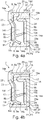
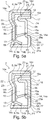
figures 4a, 4b et5a, 5b sont des vues analogues de respectivement lesfigures 2a et3 , et représentent chacune un dispositif d'étanchéité selon respectivement une variante de réalisation de l'invention, respectivement sans (figure 4a ,5a ) et avec un codeur (figure 4b ,5b ) ; - les
figures 6a et 6b représentent schématiquement en coupe longitudinale partielle le montage du dispositif d'étanchéité de respectivement lafigure 4a et lafigure 4b sur un côté d'un palier à roulement. - En relation avec ces figures, on décrit ci-dessous un palier à roulement, en particulier pour le montage d'une roue motrice ou non motrice d'un véhicule automobile.
- Le palier présente deux organes, respectivement extérieur 1 et intérieur 2, montés en rotation relative autour d'un axe par l'intermédiaire d'au moins une rangée de corps roulants 3 qui est disposée dans un espace de roulement 4 formé entre lesdits organes. Dans la description, les termes « extérieur » et « intérieur » sont définis par rapport à l'axe de rotation du palier (horizontal sur les figures), respectivement pour une localisation éloignée et proche dudit axe.
- Dans le mode de réalisation représenté, l'organe extérieur 1 est destiné à être fixe en étant associé par exemple à un élément de suspension du véhicule et l'organe intérieur 2 est destiné à être tournant avec la roue. Toutefois, l'invention peut s'appliquer à une autre configuration de palier à roulement comprenant deux organes 1, 2 en rotation relative, éventuellement destiné à une autre application que le montage d'une roue de véhicule automobile.
- Le palier représenté comprend deux rangées de billes 3 qui sont espacées axialement, lesdites rangées étant chacune disposées entre deux pistes de roulement 1a, 2a formées sur respectivement un organe 1, 2 pour guider la rotation de l'organe tournant 2. Plus précisément, l'organe tournant 2 comprend deux bagues 5 sur chacune desquelles est formée une piste de roulement intérieure 2a.
- Toutefois, l'invention n'est pas limitée à un mode de réalisation du palier, en particulier relativement à la géométrie des corps roulants 3, à la géométrie et/ou à la disposition relative des organes fixe 1 et tournant 2.
- Au moins un côté 6 de l'espace de roulement 4 est équipé d'un dispositif d'étanchéité 7 pour empêcher, d'une part, les fuites de lubrifiant présent dans l'espace de roulement 4 et, d'autre part la contamination dudit espace avec des polluants extérieurs, notamment à base de boues.
- Sur la
figure 1 , chaque côté 6 de l'espace de roulement 4 est formé entre deux parois sensiblement axiales 1b, 2b de respectivement un organe 1, 2, lesdites parois s'étendant chacune dans le prolongement externe de respectivement une piste de roulement 1a, 2a. En outre, le palier à roulement comprend deux dispositifs d'étanchéité 7, chaque côté 6 de l'espace de roulement 4 étant équipé d'un desdits dispositifs d'étanchéité. - Dans la description, les termes « interne » et « externe » sont pris en référence au palier à roulement, notamment tel que représenté sur les
figures 1 ,6a et 6b . - Le dispositif d'étanchéité 7 comprend deux armatures rigides interne 8 et externe 9 solidaires de respectivement un organe 1, 2, lesdites armatures pouvant être réalisées en matériau métallique, notamment par pliage d'une tôle emboutie.
- De façon avantageuse, les paliers à roulement respectifs de la
figure 1 et desfigures 6a, 6b comprennent deux dispositifs d'étanchéité 7 présentant les mêmes armatures respectivement externes 9 et internes 8, ce qui permet de faciliter l'assemblage desdits paliers, notamment en pouvant utiliser les mêmes outils pour monter chacun de leurs dispositifs d'étanchéité. - L'armature interne 8 présente une portion extérieure 8a sensiblement axiale de fixation à l'organe extérieur 1, ladite portion extérieure étant emmanchée sur la paroi axiale extérieure 1b du côté 6. De même, l'armature externe 9 présente une portion intérieure 9a sensiblement axiale de fixation à l'organe intérieur 2, qui est emmanchée sur la paroi axiale intérieure 2b du côté 6.
- Les armatures 8, 9 forment entre elles une chambre annulaire 10 en communication avec, d'une part, l'espace de roulement 4 par une ouverture interne 11 et, d'autre part, avec l'extérieur par une ouverture externe 12.
- En particulier, l'armature interne 8 présente une portion intérieure 8b s'étendant sensiblement radialement depuis une extrémité interne de la portion 8a de fixation à l'organe 1, ladite portion intérieure présentant une extrémité intérieure libre 13 qui est disposée en regard radial de la portion 9a de fixation de l'armature externe 9 à l'organe 2, afin de délimiter avec ladite portion de fixation l'ouverture interne 11 de la chambre 10.
- Par ailleurs, l'armature externe 9 présente une portion centrale 9b sensiblement radiale reliée, d'une part, à la portion intérieure 9a de fixation à l'organe 2 et, d'autre part, à une portion extérieure 9c sensiblement axiale, la portion centrale 9b délimitant axialement la chambre annulaire 10 avec la portion intérieure 8b de l'armature interne 8.
- L'armature interne 8 porte un élément d'étanchéité 14 qui est disposé dans la chambre annulaire 10, ledit élément présentant au moins une lèvre 14a, 14b, 14c qui est disposée en contact frottant sur l'armature externe 9.
- En particulier, l'élément d'étanchéité 14 présente :
- au moins une lèvre 14a en contact frottant sur une face interne 15a de la portion centrale 9b de l'armature externe 9 ; et/ou
- au moins une lèvre 14b, 14c en contact frottant sur la portion 9a de fixation de l'armature externe 9.
- Dans les modes de réalisation représentés, l'élément d'étanchéité 10 présente :
- une lèvre extérieure 14a en contact frottant sur la face interne 15a de la portion centrale 9b ; et
- deux lèvres intérieures respectivement externe 14b et interne 14c en contact frottant en deux points espacés axialement de la portion de fixation 9a.
- En outre, l'élément d'étanchéité 14 présente un bourrelet 14d qui est disposé en appui sur l'organe extérieur 1 pour former étanchéité statique. En particulier, la portion extérieure 8a présente un bord libre 16 qui est décalé radialement, afin de permettre un contact entre le bourrelet 14d et la paroi axiale extérieure 1b qui soit garant de l'étanchéité statique.
- L'élément d'étanchéité 14 peut être associé par surmoulage à l'armature interne 8. En particulier, l'élément d'étanchéité 14 peut être réalisé en matériau souple, par exemple en élastomère, notamment à base de copolymère butadiène nitrile (NBR), éventuellement renforcé mécaniquement par des charges telles que du noir de carbone, de NBR hydrogéné (HNBR), de fluoropolymère ou de polyacrylate.
- La portion extérieure 9c de l'armature externe 9 présente une extrémité libre 17 qui délimite intérieurement l'ouverture externe 12, ladite extrémité libre étant inscrite dans un plan radial P1 qui est décalé du côté externe par rapport à un plan radial P2 dans lequel est inscrite une face externe 15b de la portion centrale 9b. En particulier, dans les modes de réalisation représentés, la face externe 15b de la portion centrale 9b s'étend radialement.
- Ainsi, on forme sur la face externe 15b un logement pour la réception d'un codeur 18, ce qui permet d'équiper le dispositif d'étanchéité 7 d'un tel codeur sans impacter l'encombrement axial dudit dispositif. En particulier, la longueur radiale de la face externe 15b et la valeur du décalage entre les plans radiaux P1, P2 définissent le volume disponible pour le codeur 18.
- Sur les
figures 3 ,4b ,5b et6b , le dispositif d'étanchéité 7 est équipé d'un codeur 18 qui est associé sur la face externe 15b de la portion centrale 9b, ledit codeur présentant une épaisseur axiale qui est inférieure ou égale au décalage entre les plans radiaux P1, P2 dans lesquels sont inscrites respectivement ladite face externe et l'extrémité libre 17. - En particulier, le codeur 18 représenté sur les figures présente une épaisseur qui est sensiblement égale au décalage des plans radiaux P1, P2, ce qui permet, dans l'encombrement axial défini par le plan P1, de maximiser la puissance du signal émis par ledit codeur.
- Par ailleurs, le codeur 18 ne s'étend pas au-delà de l'extrémité libre 17 afin de ne pas être disposé dans l'ouverture externe 12 de la chambre d'étanchéité 10. Ainsi, le dispositif d'étanchéité 7 présente des performances d'étanchéité qui sont indépendantes de la présence ou non d'un codeur 18. Dans les modes de réalisation représentés, la portion extérieure 9c de l'armature externe 9 est dépourvue de codeur.
- Sur la
figure 1 , le palier à roulement comprend deux dispositifs d'étanchéité respectivement gauche 7g et droit 7d, la face externe 15b de la portion centrale 9b de l'armature externe 9 de droite étant équipée d'un codeur 18, la face externe 15b de la portion centrale 9b de l'armature externe 9 de gauche étant dépourvue de codeur. - Le codeur 18 peut être formé d'un aimant annulaire, notamment formé d'une matrice annulaire, par exemple réalisée à base d'un matériau plastique ou élastomère, dans laquelle sont dispersées des particules magnétiques, par exemple des particules de ferrite ou de terres rares comme le NdFeB. En particulier, la matrice peut être surmoulée sur la face externe 15b de la portion centrale 9b, ce qui permet de faciliter son association à l'armature externe 9, et donc au dispositif d'étanchéité 7.
- L'ouverture externe 12 est formée entre les portions extérieures 8a, 9c respectives des armatures interne 8 et externe 9, la portion extérieure 8a de l'armature interne 8 délimitant extérieurement ladite ouverture externe.
- Pour ce faire, les portions extérieures 8a, 9c présentent chacune une paroi axiale respectivement extérieure 19a (pour l'armature externe 9) et intérieure 19b (pour l'armature interne 8), les parois axiales 19a, 19b étant disposées en regard radial en formant un jeu réduit A définissant un conduit annulaire 20 s'étendant sur une longueur axiale B et par lequel la chambre annulaire 10 débouche dans l'ouverture externe 12.
- Les parois axiales 19a, 19b présentent toutes deux des dimensions suffisamment importantes pour conférer à la longueur axiale B une dimension maximale, afin d'améliorer l'étanchéité du dispositif 7 au niveau de l'ouverture externe 12. En particulier, les paramètres A et B sont indépendants de la présence ou non du codeur 18, lesdits paramètres définissant la géométrie et donc les performances de la chicane d'entrée dans la chambre 10.
- En particulier, l'agencement proposé permet d'obtenir un conduit annulaire 20 dont la longueur axiale B est importante, notamment en étant supérieure à la somme du décalage axial entre les plans P1 et P2 et de l'épaisseur de la portion centrale 9b de l'armature externe 9, ce qui permet de cumuler une amélioration de l'étanchéité avec une invariabilité de la lèvre 14a avec ou sans codeur 18.
- Pour réduire la dimension radiale du jeu A, et ainsi limiter le risque l'entrée de polluants extérieurs dans la chambre annulaire 10, l'élément d'étanchéité 14 est équipé d'un voile extérieur 14e qui est associé sur la paroi axiale intérieure 19b, notamment en étant formé d'une seule pièce avec le bourrelet 14d d'étanchéité statique.
- L'élément d'étanchéité 14 comprend en outre un voile intérieur 14f qui s'étend sur la portion intérieure 8b de l'armature interne 8, en étant formé d'une seule pièce avec, d'une part, le voile extérieur 14e délimitant le conduit externe 20 et, d'autre part, avec les lèvres 14a, 14b, 14c d'étanchéité dynamique disposées dans la chambre annulaire 10.
- Dans les modes de réalisation représentés, la portion extérieure 9c présente un segment extérieur 21 sur lequel est formée la paroi axiale 19a délimitant l'ouverture externe 12, ledit segment extérieur s'étendant axialement entre une extrémité interne 22 et l'extrémité libre 17. Par ailleurs, le segment axial 21 est relié à la portion centrale 9b par un segment 23 de liaison.
- En particulier, le segment de liaison 23 présente un segment intérieur qui s'étend axialement entre une extrémité externe 24 en L de liaison avec la portion centrale 9b et une extrémité interne 22 en U de liaison avec le segment extérieur 21.
- De façon avantageuse, les segments extérieur 21 et intérieur 23 sont accolés radialement, ce qui permet de limiter la dimension radiale de l'armature externe 9, mais également d'augmenter la rigidité de ladite armature externe.
- Sur les
figures 1, 2a et3 , la portion centrale 9b est directement reliée à la portion 9a de fixation sur l'organe intérieur 2, notamment par l'intermédiaire d'une extrémité intérieure 25 en L. - Sur les
figures 4a, 4b ,5a, 5b ,6a et 6b , la portion centrale 9b est reliée à la portion de fixation 9a par l'intermédiaire d'une portion intérieure 9d de l'armature externe 9, ladite portion intérieure présentant une face externe 26 qui est inscrite dans un plan radial P3 qui est décalé du côté externe par rapport au plan radial P2 dans lequel est inscrite la face externe 15b de la portion centrale 9b. - Ainsi, on forme avec la face externe 26 une zone d'appui pour l'outil 28 de montage du dispositif 7 qui est proche de l'organe intérieur 2 tout en étant décalée de la face externe 15b pour l'association d'un codeur 18. Cet agencement permet d'éviter un appui de l'outil 28 sur le codeur 18 lorsque le dispositif d'étanchéité 7 en est équipé, mais surtout d'utiliser un même outil 28 pour monter le dispositif 7 sur le palier, qu'il soit ou non équipé d'un codeur 18.
- L'extrémité libre 17 et la face externe 26 sont sensiblement inscrites dans le même plan radial P1, P3, afin que l'outil 28 de montage du dispositif d'étanchéité 7 puisse appuyer simultanément sur elles lors de l'assemblage du palier, comme représenté sur les
figures 6a et 6b . - Pour éviter un appui de l'outil 28 sur le codeur 18, le codeur 18 présente une épaisseur axiale qui est inférieure ou égale au décalage entre les plans radiaux P2, P3 entre lesquels sont inscrits les faces externes 15b, 26 des portions respectivement centrale 9b et intérieure 9d. De même, la portion intérieure 9d de l'armature externe 9 est dépourvue de codeur.
- La portion intérieure 9d présente un segment 27 portant la face externe 26, ledit segment présentant une extrémité interne 27a en L de liaison avec la portion de fixation 9a. En particulier, dans les modes de réalisation représentés, le segment 27 portant la face externe 26 s'étend radialement.
- La portion intérieure 9d présente en outre un segment extérieur 29 qui s'étend axialement entre une extrémité interne 29a en L de liaison avec la portion centrale 9b et une extrémité externe 29b en L de liaison avec le segment 27 portant la face externe 26.
- De façon avantageuse, comme représenté sur les
figures 4a, 4b ,6a et 6b , le segment extérieur 29 est accolé radialement autour de la portion de fixation 9a, ce qui permet d'augmenter la rigidité de la portion intérieure 9d, et ainsi de limiter sa déformation lors de l'appui sur elle de l'outil de montage 28. - En relation avec les
figures 6a et 6b , on décrit à présent un procédé de montage d'un dispositif d'étanchéité 7 dans un côté 6 d'un espace de roulement 4 d'un palier à roulement tel que décrit précédemment. - Avant le montage du dispositif d'étanchéité 7 sur le palier à roulement, les armatures interne 8 et externe 9 sont préassemblées en formant entre elles la chambre annulaire 10 d'étanchéité. Pour ce faire, un lubrifiant sous forme de graisse peut être disposé dans la chambre d'étanchéité 10, afin d'assurer à la fois la lubrification de ladite chambre et de contribuer à la cohésion des armatures 8, 9 lors de leur montage.
- Après disposition des armatures 8, 9 préassemblées en regard axial du côté 6 de l'espace de roulement 4, le procédé prévoit de mettre un outil 28 en appui sur la portion intérieure 9d de l'armature externe 9 et sur l'armature interne 8 pour appliquer un effort de déplacement axial desdites armatures dans ledit côté sur une course de fixation de chacune desdites armatures à un organe 1, 2.
- Pour ce faire, l'outil 28 présente une portée d'appui 30 qui s'étend dans un plan radial P, ladite portée présentant une dimension radiale qui est supérieure à la dimension radiale de la portion intérieure 9d.
- En particulier, dans le mode de réalisation représenté, la portée d'appui 30 est agencée pour appliquer l'effort de déplacement conjointement sur la portion intérieure 9d et sur l'extrémité libre 17 de l'armature externe 9, ce qui permet de faciliter le déplacement de ladite armature externe sur sa course de fixation à l'organe 2.
Claims (21)
- Palier à roulement comprenant deux organes (1, 2) et des corps roulants (3) disposés dans un espace de roulement (4) formé entre lesdits organes pour permettre leur rotation relative autour d'un axe, au moins un côté (6) de l'espace de roulement (4) étant équipé d'un dispositif d'étanchéité (7, 7g, 7d) comprenant une armature interne (8) et une armature externe (9), lesdites armatures étant solidaires de respectivement un organe (1, 2) en formant entre elle une chambre annulaire (10) en communication avec, d'une part, l'espace de roulement (4) par une ouverture interne (11) et, d'autre part, avec l'extérieur par une ouverture externe (12), ladite armature externe présentant une portion centrale (9b) reliée, d'une part, à une portion intérieure (9a) de fixation à l'organe (2) et, d'autre part, à une portion extérieure (9c), ledit palier étant caractérisé en ce que la portion extérieure (9c) présente un segment extérieur (21) qui s'étend axialement entre une extrémité interne (22) et une extrémité libre (17) en délimitant intérieurement l'ouverture externe (12), ladite extrémité libre étant inscrite dans un plan radial (P1) qui est décalé du côté externe par rapport à un plan radial (P2) dans lequel est inscrite une face externe (15b) de la portion centrale (9b).
- Palier à roulement selon la revendication 1, caractérisé en ce que le segment axial (21) est relié à la portion centrale (9b) par un segment de liaison (23).
- Palier à roulement selon la revendication 2, caractérisé en ce que le segment de liaison (23) présente un segment intérieur qui s'étend axialement entre une extrémité externe (24) en L de liaison avec la portion centrale (9b) et une extrémité interne (22) en U de liaison avec le segment extérieur (21).
- Palier à roulement selon la revendication 3, caractérisé en ce que les segments extérieur (21) et intérieur (23) sont accolés radialement.
- Palier à roulement selon l'une quelconque des revendications 1 à 4, caractérisé en ce que l'armature interne (8) présente une portion extérieure (8a) de fixation à l'organe (1), ladite portion délimitant extérieurement l'ouverture externe (12).
- Palier à roulement selon la revendication 5, caractérisé en ce que les portions extérieures (9c, 8a) présentent chacune une paroi axiale (19a, 19b), lesdites parois étant disposées en regard radial en formant un jeu réduit (A) définissant un conduit annulaire (20) s'étendant sur une longueur axiale (B) et par lequel la chambre annulaire (10) débouche dans l'ouverture externe (12).
- Palier à roulement selon la revendication 6, caractérisé en ce que la longueur axiale (B) est supérieure à la somme du décalage axial entre les plans (P1) et (P2) et de l'épaisseur de la portion centrale (9b) de l'armature externe (9).
- Palier à roulement selon l'une quelconque des revendications 1 à 7, caractérisé en ce que l'armature interne (8) porte un élément d'étanchéité (14) qui est disposé dans la chambre annulaire (10), ledit élément présentant au moins une lèvre (14a, 14b, 14c) qui est disposée en contact frottant sur l'armature externe (9).
- Palier à roulement selon l'une quelconque des revendications 1 à 8, caractérisé en ce que la portion centrale (9b) est reliée à la portion de fixation (9a) par l'intermédiaire d'une portion intérieure (9d) de l'armature externe (9), ladite portion intérieure présentant une face externe (26) qui est inscrite dans un plan radial (P3) qui est décalé du côté externe par rapport au plan radial (P2) dans lequel est inscrite la face externe (15b) de la portion centrale (9b).
- Palier à roulement selon la revendication 9, caractérisé en ce que l'extrémité libre (17) et la face externe (26) sont inscrites sensiblement dans le même plan radial (P1, P3).
- Palier à roulement selon l'une des revendications 9 ou 10, caractérisé en ce que la portion intérieure (9d) présente un segment extérieur (29) qui s'étend axialement entre une extrémité interne (29a) en L de liaison avec la portion centrale (9b) et une extrémité externe (29b) en L de liaison avec un segment (27) portant la face externe (26).
- Palier à roulement selon l'une quelconque des revendications 9 à 11, caractérisé en ce que la portion intérieure (9d) présente un segment (27) portant la face externe (26), ledit segment présentant une extrémité interne (27a) en L de liaison avec la portion de fixation (9a).
- Palier à roulement selon l'une quelconque des revendications 1 à 12, caractérisé en ce que le dispositif d'étanchéité (7) est équipé d'un codeur (18) qui est associé sur la face externe (15b) de la portion centrale (9b), ledit codeur présentant une épaisseur axiale qui est inférieure ou égale au décalage entre les plans radiaux (P1, P2) dans lesquels sont inscrits respectivement ladite face externe et l'extrémité libre (17).
- Palier à roulement selon la revendication 13, caractérisé en ce que la portion extérieure (9c) de l'armature externe (9) est dépourvue de codeur.
- Palier à roulement selon l'une des revendication 13 ou 14 lorsqu'elle dépend de la revendication 9, caractérisé en ce que le codeur (18) présente une épaisseur axiale qui est inférieure ou égale au décalage entre les plans radiaux (P2, P3) dans lesquels sont inscrits les faces externes (15b, 26) des portions respectivement intérieure (9d) et centrale (9b).
- Palier à roulement selon la revendication 15, caractérisé en ce que la portion intérieure (9d) de l'armature externe (9) est dépourvue de codeur.
- Palier à roulement selon l'une quelconque des revendications 13 à 16, caractérisé en ce que l'épaisseur du codeur (18) est sensiblement égale au décalage des plans radiaux (P1, P2).
- Palier à roulement selon l'une quelconque des revendications 13 à 17, caractérisé en ce qu'il comprend deux dispositifs d'étanchéité (7, 7g, 7d) présentant les même armatures respectivement externes (9) et internes (8), chaque côté (6) de l'espace de roulement (4) étant équipé d'un desdits dispositifs d'étanchéité, la face externe (15b) de la portion centrale (9b) d'une armature externe (9) étant équipée d'un codeur (18), la face externe (15b) de la portion centrale (9b) de l'autre armature externe (9) étant dépourvue de codeur.
- Procédé de montage d'un dispositif d'étanchéité (7) dans un côté (6) de l'espace annulaire (4) d'un palier à roulement selon l'une quelconque des revendications 9 à 18, dans lequel les armatures (8, 9) sont préassemblées en formant entre elles la chambre annulaire (10), et, après disposition desdites armatures préassemblées en regard axial dudit côté, un outil (28) est mis en appui sur la portion intérieure (9d) de l'armature externe (9) et sur l'armature interne (8) pour appliquer un effort de déplacement axial desdites armatures dans ledit côté sur une course de fixation de chacun desdites armatures à un organe (1, 2).
- Procédé de montage selon la revendication 19, caractérisé en ce que l'outil (28) présente une portée d'appui (30) qui s'étend dans un plan radial (P), ladite portée présentant une dimension radiale qui est supérieure à la dimension radiale de la portion intérieure (9d).
- Procédé de montage selon la revendication 20, caractérisé en ce que la portée d'appui (30) est agencée pour appliquer l'effort de déplacement conjointement sur la portion intérieure (9d) et sur l'extrémité libre (17) de l'armature externe (9).
Applications Claiming Priority (1)
| Application Number | Priority Date | Filing Date | Title |
|---|---|---|---|
| FR2001441A FR3107325B1 (fr) | 2020-02-13 | 2020-02-13 | Palier à roulement |
Publications (1)
| Publication Number | Publication Date |
|---|---|
| EP3865723A1 true EP3865723A1 (fr) | 2021-08-18 |
Family
ID=70295422
Family Applications (1)
| Application Number | Title | Priority Date | Filing Date |
|---|---|---|---|
| EP21156100.6A Withdrawn EP3865723A1 (fr) | 2020-02-13 | 2021-02-09 | Palier à roulement |
Country Status (2)
| Country | Link |
|---|---|
| EP (1) | EP3865723A1 (fr) |
| FR (1) | FR3107325B1 (fr) |
Citations (6)
| Publication number | Priority date | Publication date | Assignee | Title |
|---|---|---|---|---|
| JP2004036817A (ja) * | 2002-07-05 | 2004-02-05 | Koyo Seiko Co Ltd | 転がり軸受の密封装置 |
| WO2006035616A1 (fr) * | 2004-09-29 | 2006-04-06 | Ntn Corporation | Codeur magnetique et roulement de roue equipe de celui-ci |
| JP2008083064A (ja) * | 2007-11-30 | 2008-04-10 | Ntn Corp | 車輪用軸受 |
| JP2009068687A (ja) * | 2007-08-21 | 2009-04-02 | Nok Corp | 金属嵌合部のシール構造およびこれに用いる金属部品 |
| US20090219017A1 (en) * | 2006-01-11 | 2009-09-03 | Uchiyama Manufacturing Corp | Tone Wheel and Method for Manufacturing The Same |
| JP2010091036A (ja) * | 2008-10-09 | 2010-04-22 | Jtekt Corp | 転がり軸受装置 |
-
2020
- 2020-02-13 FR FR2001441A patent/FR3107325B1/fr active Active
-
2021
- 2021-02-09 EP EP21156100.6A patent/EP3865723A1/fr not_active Withdrawn
Patent Citations (6)
| Publication number | Priority date | Publication date | Assignee | Title |
|---|---|---|---|---|
| JP2004036817A (ja) * | 2002-07-05 | 2004-02-05 | Koyo Seiko Co Ltd | 転がり軸受の密封装置 |
| WO2006035616A1 (fr) * | 2004-09-29 | 2006-04-06 | Ntn Corporation | Codeur magnetique et roulement de roue equipe de celui-ci |
| US20090219017A1 (en) * | 2006-01-11 | 2009-09-03 | Uchiyama Manufacturing Corp | Tone Wheel and Method for Manufacturing The Same |
| JP2009068687A (ja) * | 2007-08-21 | 2009-04-02 | Nok Corp | 金属嵌合部のシール構造およびこれに用いる金属部品 |
| JP2008083064A (ja) * | 2007-11-30 | 2008-04-10 | Ntn Corp | 車輪用軸受 |
| JP2010091036A (ja) * | 2008-10-09 | 2010-04-22 | Jtekt Corp | 転がり軸受装置 |
Also Published As
| Publication number | Publication date |
|---|---|
| FR3107325B1 (fr) | 2023-05-19 |
| FR3107325A1 (fr) | 2021-08-20 |
Similar Documents
| Publication | Publication Date | Title |
|---|---|---|
| CN102481959B (zh) | 滚轮装置 | |
| EP3626486A1 (fr) | Butée de suspension de véhicule automobile | |
| WO2012107693A1 (fr) | Palier a roulement presentant une extension annulaire et un dispositif d'etancheite | |
| EP1277978A1 (fr) | Palier à corps roulants coniques pourvu d'un dispostif d'étanchéité | |
| EP2526317B1 (fr) | Butee d'embrayage de vehicule automobile equipee d'un dispositif d'etancheite | |
| FR3001509A1 (fr) | Palier a roulement notamment pour systeme d’entrainement en rotation d’une roue de vehicule automobile | |
| EP3865723A1 (fr) | Palier à roulement | |
| FR2874671A1 (fr) | Palier a roulement a passage d'air comprenant une chambre etanche avec deflecteur | |
| FR3001781A1 (fr) | Palier a roulement | |
| EP3784915B1 (fr) | Palier à roulement | |
| EP2821662B1 (fr) | Ensemble de roulement et moyeu de roue pour véhicule motorisé avec dispositif d'étanchéité | |
| EP3680500B1 (fr) | Palier à roulement équipé d'un dispositif d étanchéité | |
| FR3010753A1 (fr) | Dispositif de butee de debrayage, notamment pour embrayage de vehicule automobile | |
| EP3015728B1 (fr) | Palier à roulement équipé d'un dispositif d étanchéité comprenant une armature | |
| EP4311957A1 (fr) | Joint d'étanchéite statique et ensemble de moyeu de roue motrice l'intégrant | |
| WO2017055724A1 (fr) | Palier à roulement | |
| FR2675862A1 (fr) | Roulement a capteur tachymetrique. | |
| FR2888625A1 (fr) | Procede de montage d'un palier pourvu d'un flasque et a deux rangees de corps roulants | |
| FR3114850A1 (fr) | Dispositif d’étanchéité pour palier à roulement | |
| EP3299649B1 (fr) | Palier à roulement équipé d'un dispositif d'étanchéité | |
| FR3120668A1 (fr) | Dispositif d’étanchéité pour palier comprenant un passage amont équipé d’une gouttière | |
| FR3018874A1 (fr) | Palier a roulement equipe d’un dispositif d’etancheite comprenant une armature | |
| FR3034708B1 (fr) | Systeme d'entrainement en rotation d'une roue de vehicule automobile | |
| FR3109416A1 (fr) | Dispositif d’étanchéité pour un palier à roulement | |
| FR2904671A1 (fr) | Systeme d'articulation instrumente. |
Legal Events
| Date | Code | Title | Description |
|---|---|---|---|
| PUAI | Public reference made under article 153(3) epc to a published international application that has entered the european phase |
Free format text: ORIGINAL CODE: 0009012 |
|
| STAA | Information on the status of an ep patent application or granted ep patent |
Free format text: STATUS: THE APPLICATION HAS BEEN PUBLISHED |
|
| AK | Designated contracting states |
Kind code of ref document: A1 Designated state(s): AL AT BE BG CH CY CZ DE DK EE ES FI FR GB GR HR HU IE IS IT LI LT LU LV MC MK MT NL NO PL PT RO RS SE SI SK SM TR |
|
| STAA | Information on the status of an ep patent application or granted ep patent |
Free format text: STATUS: THE APPLICATION IS DEEMED TO BE WITHDRAWN |
|
| 18D | Application deemed to be withdrawn |
Effective date: 20220219 |