EP3875176A2 - Leimverteileranordnung für eine kantenanleimmaschine und verfahren zum kantenanleimen von platten - Google Patents
Leimverteileranordnung für eine kantenanleimmaschine und verfahren zum kantenanleimen von platten Download PDFInfo
- Publication number
- EP3875176A2 EP3875176A2 EP21157036.1A EP21157036A EP3875176A2 EP 3875176 A2 EP3875176 A2 EP 3875176A2 EP 21157036 A EP21157036 A EP 21157036A EP 3875176 A2 EP3875176 A2 EP 3875176A2
- Authority
- EP
- European Patent Office
- Prior art keywords
- contacting roll
- roll
- glue
- contacting
- collecting chamber
- Prior art date
- Legal status (The legal status is an assumption and is not a legal conclusion. Google has not performed a legal analysis and makes no representation as to the accuracy of the status listed.)
- Withdrawn
Links
- 239000003292 glue Substances 0.000 title claims abstract description 260
- 238000000034 method Methods 0.000 title claims description 34
- 239000002245 particle Substances 0.000 claims abstract description 13
- 239000007787 solid Substances 0.000 claims abstract description 7
- 238000005096 rolling process Methods 0.000 claims description 9
- 238000004891 communication Methods 0.000 claims description 8
- 238000012423 maintenance Methods 0.000 claims description 8
- 239000012530 fluid Substances 0.000 claims description 7
- 238000002347 injection Methods 0.000 claims description 7
- 239000007924 injection Substances 0.000 claims description 7
- 230000005012 migration Effects 0.000 claims description 2
- 238000013508 migration Methods 0.000 claims description 2
- 230000001737 promoting effect Effects 0.000 claims description 2
- 238000004140 cleaning Methods 0.000 abstract description 11
- 230000001464 adherent effect Effects 0.000 abstract description 4
- 239000002421 finishing Substances 0.000 description 36
- 238000000151 deposition Methods 0.000 description 11
- 239000000243 solution Substances 0.000 description 10
- 230000008901 benefit Effects 0.000 description 8
- 238000012545 processing Methods 0.000 description 8
- 238000002844 melting Methods 0.000 description 6
- 230000008018 melting Effects 0.000 description 6
- 230000004888 barrier function Effects 0.000 description 5
- 230000008859 change Effects 0.000 description 5
- 238000010168 coupling process Methods 0.000 description 5
- 238000005859 coupling reaction Methods 0.000 description 5
- 238000009826 distribution Methods 0.000 description 5
- 239000000463 material Substances 0.000 description 5
- 230000000903 blocking effect Effects 0.000 description 4
- 230000000295 complement effect Effects 0.000 description 4
- 230000008878 coupling Effects 0.000 description 4
- 238000004132 cross linking Methods 0.000 description 4
- 230000006870 function Effects 0.000 description 4
- 238000009966 trimming Methods 0.000 description 4
- 239000002023 wood Substances 0.000 description 4
- 230000004913 activation Effects 0.000 description 3
- 230000000712 assembly Effects 0.000 description 3
- 238000000429 assembly Methods 0.000 description 3
- 238000003801 milling Methods 0.000 description 3
- 239000000203 mixture Substances 0.000 description 3
- 239000004814 polyurethane Substances 0.000 description 3
- 230000015572 biosynthetic process Effects 0.000 description 2
- 239000011888 foil Substances 0.000 description 2
- 238000004519 manufacturing process Methods 0.000 description 2
- 238000003756 stirring Methods 0.000 description 2
- 206010053567 Coagulopathies Diseases 0.000 description 1
- 230000005788 Cochlea function Effects 0.000 description 1
- AFCARXCZXQIEQB-UHFFFAOYSA-N N-[3-oxo-3-(2,4,6,7-tetrahydrotriazolo[4,5-c]pyridin-5-yl)propyl]-2-[[3-(trifluoromethoxy)phenyl]methylamino]pyrimidine-5-carboxamide Chemical compound O=C(CCNC(=O)C=1C=NC(=NC=1)NCC1=CC(=CC=C1)OC(F)(F)F)N1CC2=C(CC1)NN=N2 AFCARXCZXQIEQB-UHFFFAOYSA-N 0.000 description 1
- 239000004809 Teflon Substances 0.000 description 1
- 229920006362 Teflon® Polymers 0.000 description 1
- 230000035508 accumulation Effects 0.000 description 1
- 238000009825 accumulation Methods 0.000 description 1
- 238000004026 adhesive bonding Methods 0.000 description 1
- 230000003466 anti-cipated effect Effects 0.000 description 1
- -1 appearance Substances 0.000 description 1
- 230000001174 ascending effect Effects 0.000 description 1
- 230000005540 biological transmission Effects 0.000 description 1
- 238000006243 chemical reaction Methods 0.000 description 1
- 239000011093 chipboard Substances 0.000 description 1
- 230000035602 clotting Effects 0.000 description 1
- 210000003477 cochlea Anatomy 0.000 description 1
- 239000003086 colorant Substances 0.000 description 1
- 238000013461 design Methods 0.000 description 1
- 239000006185 dispersion Substances 0.000 description 1
- 230000000694 effects Effects 0.000 description 1
- 230000008030 elimination Effects 0.000 description 1
- 238000003379 elimination reaction Methods 0.000 description 1
- 239000005038 ethylene vinyl acetate Substances 0.000 description 1
- 230000006872 improvement Effects 0.000 description 1
- IQPQWNKOIGAROB-UHFFFAOYSA-N isocyanate group Chemical group [N-]=C=O IQPQWNKOIGAROB-UHFFFAOYSA-N 0.000 description 1
- 239000007788 liquid Substances 0.000 description 1
- 230000002085 persistent effect Effects 0.000 description 1
- 239000004033 plastic Substances 0.000 description 1
- 229920003023 plastic Polymers 0.000 description 1
- 229920000728 polyester Polymers 0.000 description 1
- 229920000570 polyether Polymers 0.000 description 1
- 229920002635 polyurethane Polymers 0.000 description 1
- 238000006467 substitution reaction Methods 0.000 description 1
- 229920002994 synthetic fiber Polymers 0.000 description 1
- 238000012360 testing method Methods 0.000 description 1
- 229920005992 thermoplastic resin Polymers 0.000 description 1
- 239000002699 waste material Substances 0.000 description 1
Images


Classifications
-
- B—PERFORMING OPERATIONS; TRANSPORTING
- B05—SPRAYING OR ATOMISING IN GENERAL; APPLYING FLUENT MATERIALS TO SURFACES, IN GENERAL
- B05C—APPARATUS FOR APPLYING FLUENT MATERIALS TO SURFACES, IN GENERAL
- B05C1/00—Apparatus in which liquid or other fluent material is applied to the surface of the work by contact with a member carrying the liquid or other fluent material, e.g. a porous member loaded with a liquid to be applied as a coating
- B05C1/006—Apparatus in which liquid or other fluent material is applied to the surface of the work by contact with a member carrying the liquid or other fluent material, e.g. a porous member loaded with a liquid to be applied as a coating for applying liquid or other fluent material to the edges of essentially flat articles
-
- B—PERFORMING OPERATIONS; TRANSPORTING
- B05—SPRAYING OR ATOMISING IN GENERAL; APPLYING FLUENT MATERIALS TO SURFACES, IN GENERAL
- B05C—APPARATUS FOR APPLYING FLUENT MATERIALS TO SURFACES, IN GENERAL
- B05C1/00—Apparatus in which liquid or other fluent material is applied to the surface of the work by contact with a member carrying the liquid or other fluent material, e.g. a porous member loaded with a liquid to be applied as a coating
- B05C1/04—Apparatus in which liquid or other fluent material is applied to the surface of the work by contact with a member carrying the liquid or other fluent material, e.g. a porous member loaded with a liquid to be applied as a coating for applying liquid or other fluent material to work of indefinite length
- B05C1/08—Apparatus in which liquid or other fluent material is applied to the surface of the work by contact with a member carrying the liquid or other fluent material, e.g. a porous member loaded with a liquid to be applied as a coating for applying liquid or other fluent material to work of indefinite length using a roller or other rotating member which contacts the work along a generating line
- B05C1/0813—Apparatus in which liquid or other fluent material is applied to the surface of the work by contact with a member carrying the liquid or other fluent material, e.g. a porous member loaded with a liquid to be applied as a coating for applying liquid or other fluent material to work of indefinite length using a roller or other rotating member which contacts the work along a generating line characterised by means for supplying liquid or other fluent material to the roller
-
- B—PERFORMING OPERATIONS; TRANSPORTING
- B27—WORKING OR PRESERVING WOOD OR SIMILAR MATERIAL; NAILING OR STAPLING MACHINES IN GENERAL
- B27D—WORKING VENEER OR PLYWOOD
- B27D5/00—Other working of veneer or plywood specially adapted to veneer or plywood
- B27D5/003—Other working of veneer or plywood specially adapted to veneer or plywood securing a veneer strip to a panel edge
-
- B—PERFORMING OPERATIONS; TRANSPORTING
- B27—WORKING OR PRESERVING WOOD OR SIMILAR MATERIAL; NAILING OR STAPLING MACHINES IN GENERAL
- B27G—ACCESSORY MACHINES OR APPARATUS FOR WORKING WOOD OR SIMILAR MATERIALS; TOOLS FOR WORKING WOOD OR SIMILAR MATERIALS; SAFETY DEVICES FOR WOOD WORKING MACHINES OR TOOLS
- B27G11/00—Applying adhesives or glue to surfaces of wood to be joined
-
- B—PERFORMING OPERATIONS; TRANSPORTING
- B05—SPRAYING OR ATOMISING IN GENERAL; APPLYING FLUENT MATERIALS TO SURFACES, IN GENERAL
- B05C—APPARATUS FOR APPLYING FLUENT MATERIALS TO SURFACES, IN GENERAL
- B05C1/00—Apparatus in which liquid or other fluent material is applied to the surface of the work by contact with a member carrying the liquid or other fluent material, e.g. a porous member loaded with a liquid to be applied as a coating
- B05C1/04—Apparatus in which liquid or other fluent material is applied to the surface of the work by contact with a member carrying the liquid or other fluent material, e.g. a porous member loaded with a liquid to be applied as a coating for applying liquid or other fluent material to work of indefinite length
- B05C1/08—Apparatus in which liquid or other fluent material is applied to the surface of the work by contact with a member carrying the liquid or other fluent material, e.g. a porous member loaded with a liquid to be applied as a coating for applying liquid or other fluent material to work of indefinite length using a roller or other rotating member which contacts the work along a generating line
- B05C1/0817—Apparatus in which liquid or other fluent material is applied to the surface of the work by contact with a member carrying the liquid or other fluent material, e.g. a porous member loaded with a liquid to be applied as a coating for applying liquid or other fluent material to work of indefinite length using a roller or other rotating member which contacts the work along a generating line characterised by means for removing partially liquid or other fluent material from the roller, e.g. scrapers
-
- B—PERFORMING OPERATIONS; TRANSPORTING
- B05—SPRAYING OR ATOMISING IN GENERAL; APPLYING FLUENT MATERIALS TO SURFACES, IN GENERAL
- B05C—APPARATUS FOR APPLYING FLUENT MATERIALS TO SURFACES, IN GENERAL
- B05C1/00—Apparatus in which liquid or other fluent material is applied to the surface of the work by contact with a member carrying the liquid or other fluent material, e.g. a porous member loaded with a liquid to be applied as a coating
- B05C1/04—Apparatus in which liquid or other fluent material is applied to the surface of the work by contact with a member carrying the liquid or other fluent material, e.g. a porous member loaded with a liquid to be applied as a coating for applying liquid or other fluent material to work of indefinite length
- B05C1/08—Apparatus in which liquid or other fluent material is applied to the surface of the work by contact with a member carrying the liquid or other fluent material, e.g. a porous member loaded with a liquid to be applied as a coating for applying liquid or other fluent material to work of indefinite length using a roller or other rotating member which contacts the work along a generating line
- B05C1/086—Apparatus in which liquid or other fluent material is applied to the surface of the work by contact with a member carrying the liquid or other fluent material, e.g. a porous member loaded with a liquid to be applied as a coating for applying liquid or other fluent material to work of indefinite length using a roller or other rotating member which contacts the work along a generating line a pool of coating material being formed between a roller, e.g. a dosing roller and an element cooperating therewith
- B05C1/0865—Apparatus in which liquid or other fluent material is applied to the surface of the work by contact with a member carrying the liquid or other fluent material, e.g. a porous member loaded with a liquid to be applied as a coating for applying liquid or other fluent material to work of indefinite length using a roller or other rotating member which contacts the work along a generating line a pool of coating material being formed between a roller, e.g. a dosing roller and an element cooperating therewith the cooperating element being a roller, e.g. a coating roller
Definitions
- the present invention refers to a glue distributor assembly, associable to the edgebanding machine, and a method to carry out panel edgebanding.
- Wood panels, solid wood or derivatives thereof, for example chipboard or also plastic material, are used to manufature furnitures, shelving units, shelves and they are generally manufactured with two opposed flat faces and with an edge which is perpendicular to faces.
- the two faces of the raw panels are covered with a foil of ennobled material in suitable processing centers, in order to obtain the desired surface finishing and appearance, wherein such foils can have various colors, appearance, finishing and finishings.
- the edgebanding machines has the function of applying a tape finishing element on the panel edge under processing, such that to ennobling also the panel edge.
- the tape finishing element can also be defined as profile, listel or strip, and it is commonly made of synthetic material.
- the tape finishing element will be named profile, or finishing profile, or edge profile.
- the finishing profiles are glued on the corresponding panel edge, remaining raw after the ennobling of the two faces of the panel.
- the finishing profile is usually applied as protruding: the profile has a width higher than the one of the panel board to which it is glued, in order to be sure to obtain a perfect covering of the edge and, in general, of the panel.
- the splicing is an operation through which the finishing profile is cut to the same length of the panel board; the subsequent trimming operation involves the removal of the higher and lower portions of the finishing profile transversally protruding from the panel edge, beyond the faces.
- the splicing and the trimming are respectively carried out by specific splicing and trimming assembly, respectively; the first moving for a certain period of time together with the panel under processing, i.e. they move jointly to the panels for the time necessary to cut the part of the finishing profile exceeding in length, the second being stationary and carrying out the trimming taking advantage of the panel movement advancing in the edgebanding machine.
- the panel thus processed is then finished with the removal of processing waste and residues, by scrapers and brushes.
- edgebanding machine will be equipped with molded tools in a substantially complementary way with respect to the panel edge.
- edgebanding machine or components thereof: EP 1997597 , EP 2251165 , EP 2062706 , EP 2052822 , EP 1785243 , EP 1588812 , EP 1464470 , EP 0945235 , EP1260277 .
- An object of the present invention is a glue distributor assembly, or more simply a distributor assembly, intended to be installed on a edgebanding machine in order to allow a precise and effective glue application on the panel edge to be ennobled with the finishing profile, and / or in order to allow the precise and effective glue application on the same profile.
- a typical distributor assembly comprises a contacting roll, generally metallic and knurled, configurable to roll on the panel edge, or on the finishing profile, and releasing a glue amount on the related surface, which is sufficient to guarantee the right fastening of the profile on the panel edge.
- the contacting roll is motorized and the related rotation axis is maintained parallel to the surface of the panel edge under processing, or the surface of the finishing profile to be glued.
- the distributor assembly further comprises a heated tank, since the glue commonly used is of the thermal fuse polyurethane-type (PU, PUR, HMPUR), i.e. a glue with a relatively high melting temperature, usually included between 100°C and 140°C, which is to be hot-applied, being liquid, and cross-linking by reaction of isocyanate groups with the air humidity resulting in three-dimensional polyethers and / or polyurethane polyesters, comprising ureic bonds.
- glues containing ethylene vinyl acetate (EVA)-based thermoplastic resins are used, the latter also being hot-applied.
- At least one squeegee is arranged adjacent to the contacting roll, or a blade or a distributing blade-function element which together with the contacting roll defines the useful section for the glue passage towards the panel edge under processing.
- the glue is suitably distributed from the related container to the contacting roll surface, and then being distributed on the panel edge or on the finishing profile, before these two elements are pressed against one another in the edgebanding machine.
- the thickness of the glue layer deposited on the panel edge depends, as anticipated above, on the interstice defined between the squeegee, or the squeegees when more than one, and the contacting roll. Such thickness is adjustable, involving the possibility to adjust, i.e. precisely adjusting the position of the squeegee or squeegees with respect to the contacting roll.
- a first limit relates to the maintenance of glue distributor assemblies.
- the cleaning of the contacting roll is complex, since it is not easy when the distributor assembly is assembled on the edgebanding machine, and a complete disassembly of the distributor assembly, i.e. its removal from the edgebanding machine and disassembly, is often necessary to obtain a deep cleaning.
- the disassembly of the distributor assembly requires a machine downtown, during which the edgebanding machine cannot operate.
- a second limit consists in that, the glue firstly contained in the related tank, and then fed to the contacting roll, can be homogeneous: due to the fact that the temperature distribution between the inner surface of the tank, the outer surface of the contacting roll and the squeegee outer surface can be uniform, over the time the glue can have a different viscosity between one point and another of the distributor assembly and, in the worst case, clumps can be formed or it can locally crosslink.
- a third limit consists in that, the squeegees can damage the contacting roll surface when, during the maintenance operation, are brought to limit stop, in the position of minimum distance from the contacting roll. This case can be critical, since the squeegees can contact the surface of the contacting roll and damaging it if applied with high pressure.
- there is a persistent need to nullify the glue passage section i.e. there is the need for the user, during some operations of maintenance or testing, or fine-tuning of the edgebanding machine, to use the squeegees as barrier to completely intercept the glue passage and preventing the glue to reach the panel.
- a forth limit relates to the thickness variability of panels to be edgebanded and, accordingly, the finishing profiles height: based on the production batch, the panels can have an higher or lower thickness, or can change the height of the panel edge, for example 1.5 cm for a batch and 2 cm for another batch.
- the known distributor assemblies showed to be not very versatile, i.e. not very adaptable, resulting in that, glue distribution is often not optimal, with a dispersion beyond the panel edge, on the related faces, or with an insufficient distribution on the panel edge.
- the results are the excessive fouling of panel faces, and in the second case the consequence is that the adhesion of the finishing profile to the corresponding panel edge is not perfect.
- a fifth limit consists is the tendency of the knurled contacting roll tends to hold wood particles detaching from the edge during panel edgebanding.
- the reason of such phenomenon is mostly due to the double knurling of the contacting roll, right and left, and it defines small rhomboid recesses in which over time, i.e. with the increasing number of edgebanded panels, the accumulated detached particles, are incorporated into the glue and thus affecting the contacting roll.
- a first object of the present invention is to provide a glue distributor assembly which simply and effectively the limits of the solutions today available.
- a first aspect optional of the present invention for which the Applicant reserves the right to file a divisional application, relates to a glue distributor assembly comprising a body provided with a melted glue collecting chamber, and a contacting roll, pivotally supported on the body.
- the collecting chamber of the melted glue can be defined within the body, or it can be external to the body and constrainable to it, such as an outer tank.
- the outer surface of the contacting roll is intended for rolling on a panel edge to be edgebanded, or on a panel finishing profile, to distribute the melted glue collected from the collecting chamber and allowing panels ennoblement.
- the contacting roll is hollow and delimits an inner volume which is connected to the collecting chamber and in use it is crossed by the melted glue.
- the contacting roll has not only the function of distributing the melted glue on the panel edge to be edgebanded, or on the finishing profiles, also being part of a slow circuit of the melted glue, and this feature allows to uniformed temperature distribution in the distributor assembly.
- the melted glue in a specific distributor assembly circuit allows to solve the second drawback described with specific reference to the known solutions, that allows to avoid non-uniformity in the melted glue mass, in particular temperature non-uniformity.
- This result allows to limit or completely preventing clumps formation in the glue, or the crosslinking in glue. Therefore, the proposed solution provides an improvement in the distributor assembly operation, which provides an improved gluing quality, reduced cleaning of the distributor assembly and, accordingly, reduced downtimes of the edgebanding machine.
- the glue collecting chamber is external to the body, it is connected to the flowing circuit through at least a specific connection; alternatively, and preferably, the collecting chamber is directly defined within the distributor assembly body.
- the role of the inner volume of the contacting roll is not limited to the passage of the glue: in the preferred embodiment, the melted glue is subjected to a mixing within the contacting roll, continuous or according to time intervals.
- the inner volume of the contacting roll is configurable as a mixing chamber of the melted glue, arranged in fluid communication with the collecting chamber within the body.
- the mixing of the melted glue within the contacting roll can be obtained through several modes.
- a first mode involves making, above the inner surface, one or more projections, or ribs, so that after the rotation of the contacting roll on their rotation axis the projections, or ribs, provide a thrust on the melted glue, along the contacting roll.
- a second mode which can be implemented alternatively or in addition to the first just described, consists of providing the distributor assembly of a mixing element inserted within the contacting roll.
- the mixing element is pivotable with respect to the contacting roll, and the relative rotation between the mixing element and the melted glue present in the contacting roll generates a thrust on the melted glue along the contacting roll.
- the rotation direction of the contacting roll and the mixing element possibly positioned within defines the direction of the thrust on the melted glue, vertical ascending or vertical descending.
- the projections or ribs, and the mixing element substantially extending as screw, or helix, or double helix.
- the mixing element is inserted in the contacting roll, it is coaxial to the roll and the projections or ribs.
- the collecting chamber extends in the body parallel to the contacting roll, and arranged in fluid communication with the inner volume of the contacting roll, at the ends of the contacting roll.
- the distributor assembly comprises a top pivot and a lower pivot, and the contacting roll is supported on the body by these pivots, which are at least partially inserted in a corresponding end of the contacting roll. At least one between the top pivot and the lower pivot, and preferably both, is/are removable and the removal of the pivot, or pivots, releases the contacting roll from the body, for the disassembly.
- the coupling described above is advantageous since it allows the contacting roll to be assembled on the distributor assembly body, and disassembling the contacting roll from the body, in a simple and rapid manner, without necessarily dismounting the body or removing it from the edgebanding machine, missing the tolerances previously registered. In fact, in order to obtain the cleaning of the contacting roll, or for the substitution thereof, it will be sufficient removing a pivot, or both the pivots, in order to be able to remove the contacting roll from the body, without acting on the body itself.
- the pivots are preferably provided with at least a radial opening allowing the passage of the glue from the inner volume of the contacting roll, i.e. from the mixing chamber, to the collecting chamber, and vice versa.
- the distributor assembly has a through hole extending between an inlet, accessible to the outside of the distributor assembly, and an inner outlet al distributor assembly, by injection of a dye within the distributor assembly.
- the inner outlet of said through hole is arranged in correspondence of the contacting roll or the collecting chamber.
- the injection of the dye is carried out arranging a specific valve on the body of the distributor assembly providing an access to the melted-glue collecting inner chamber, or furthermore, arranging suitable injection means in the collecting chamber when the latter being external to the body.
- the mixing element advantageously allows to obtain a rapid color change of the melted glue color and, especially, a uniform change of all the mass of melted glue present in the flow circuit, rapidly.
- the mixing element can be activated to vigorously mix the melted glue and obtaining a uniform dye distribution.
- the present invention also relates a method, according to claim 6, for the panel edgebanding.
- the method comprises:
- the method also provides arranging the hollow contacting roll and allowing the melted glue to flow from the collecting chamber through the contacting roll, and vice versa, in order to obtain the above described advantages with respect to the distributor assembly.
- the squeegee is substantially cylindrical and is housed in the body of the distributor assembly, parallel to the contacting roll and it is functionally interposed, with glue barrier function, between the outer surface of the contacting roll and the glue collecting chamber.
- the squeegees are two.
- Each squeegee has a flat surface, or flatting, or slot, for example obtained by milling an outer surface portion, defining a side corner of the squeegee.
- Each squeegee is pivotable on its own longitudinal axis, which is parallel to the rotation axis of the contacting roll, and the side corner is accordingly movable between:
- the interstice created between the side corner and the outer surface of the contacting roll, and therefore the thickness of the melted glue on the contacting roll is from 2-3 tenths of a millimeter.
- le squeegees are pivotable on the respective longitudinal axes selectively and independent from each other.
- the activation can be manual, motorized or servo-assisted, and the squeegees can be blocked in the desired angular position.
- the proposed solution allows to effectively adjust, and without malfunctioning risks, the thickness of the glue layer on the contacting roll.
- each squeegee is pivotally on the longitudinal axes thereof, parallel to the rotation axis of the contacting roll.
- the longitudinal axis of each squeegee is at a distance from the rotation axis of the contacting roll corresponding to the sum of the outer radii of the contacting roll and of the squeegee, with a tolerance H/h7. This precaution allows to avoid that a mechanical interference occurs between the squeegees and the contacting roll, and jamming that could cause ruptures.
- a second aspect of the present invention relates also to a method, the second to claim 21, for the panel edgebanding. II method comprises:
- the method also provides:
- An aspect of the present invention concerns the following element optional for the height regulation of the melted glue layer adherent to the outer surface of the contacting roll, where the terms height refers to the extension of the glue layer parallel to the rotation axis of the contacting roll, i.e. parallel to the outer surface of the contacting roll.
- Such adjusting element is even a squeegee, i.e. a cylindrical element, housed in the body parallel to the contacting roll and functionally interposed, with a glue barrier function, between the outer surface of the contacting roll and the glue collecting chamber.
- the squeegees are two.
- Each squeegee has a flat surface, or flatting, e.g. obtained by milling a portion of the outer surface of the squeegee, defining a higher corner of the squeegee.
- Each squeegee is sliding with respect to the contacting roll, on its own longitudinal axis, and the higher corner is accordingly movable between:
- the proposed solution allows to effectively adjust, and without risks of malfunctioning, the height of the glue layer on the contacting roll.
- the squeegees are movable along the respective longitudinal axes, for example moving, selectively and independently from each other.
- the activation can be manual, motorized or servo-assisted, and the squeegees can be blocked in the desired vertical position.
- the present invention is preferably implemented with two squeegee pivotable and sliding on the respective longitudinal axes and provided with both side corner, for adjusting the thickness of the melted glue layer released on the contacting roll, and the higher of the higher corner, for adjusting the height of the melted glue layer released on the contacting roll.
- the distributor assembly comprises, for each squeegee, a seal element, or flap, arranged in the body, in correspondence of the lower end of the respective squeegee, defining a lower corner of the flat surface described above and prevents the leakage of the melted glue from the bottom, i.e. it prevents the that melted glue can pour along the squeegee and leaking from the from the body of the distributor assembly.
- the squeegee being sliding with respect to the seal element thereof to adjust the distance between the higher corner and the lower corner and adjusting, accordingly, the height of the melted glue layer on the contacting roll.
- seal element is constrained to the body and it is blocked against the longitudinal movements against the longitudinal movements.
- the third aspect of the present invention also relates to a method, according the claim 6, for the panel edgebanding, comprising:
- the method also provides:
- An other aspect of the present invention for which the Applicant reserves the possibility to file a divisional patent application, relates to the coupling removable, and interchangeable, of the contacting roll on the body of the distributor assembly, obtained through a fastening element of the ends of the contacting roll of which at least one is removable.
- fastening element are preferably pivots, one higher and one lower to, respectively, constrain the higher end and the lower end of the contacting roll to the body of the distributor assembly.
- Having removable fastening element allows to remove the contacting roll from the body of the distributor assembly, and assembly it again, in a short time, in a simple way and without necessarily disassembling or shifting the body of the distributor assembly.
- the fastening element substantially the pivots, are at least partially hollow and they are part of the flow circuit of the melted glue, meaning that they define a part of the circuit formed by the inner volume of the contacting roll and the collecting chamber of the body.
- the pivots have one or more radial openings exactly to allow the passage of the melted glue from the contacting roll to the collecting chamber, and vice versa.
- This aspect of the present invention also relates to a method for the panel edgebanding, comprising:
- the method also comprises:
- the contacting roll does not have an outer surface with knurling or double knurling, but its outer surface has a continuous helicoidal profile. This precaution allows to promote the migration to the ends of the contacting roll di possible solid particles - initially detached from the panels subjected to edgebanding - present on the outer surface of the same contacting roll or incorporated in the glue. In this way, the formation of glue clumps and solid particles or mixtures is limited or completely prevented.
- the above described features is also object of the method claim 24, and correspond to make self-cleaning the contacting roll with respect to the undesired solid particles.
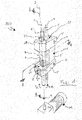
- the attached figures show the preferred embodiment of the glue distributor assembly 100 according to the present invention, hereinafter briefly indicated as distributor assembly.
- the distributor assembly 100 comprises a body 1 supporting the other components.
- the body 1 preferably metallic, has a general C-shape C, i.e. it has two horizontal portions ha due horizontal portions 1' joined by a vertical portion 1". Between the horizontal portions 1' a contacting roll 7 is supported, whose rotation axis 9 is vertical, i.e. parallel to the vertical portion 1" of the body 1.
- the contacting roll 7 is intended to constrain by rolling the edge of a panel to be edgeboarded with the finishing profile (not showed), in order to apply on such edge a glue layer sufficient to guarantee the adhesion of a finishing profile, as described below.
- the contacting roll 7 is pivotally assembled on the body 1 and it is motorized.
- the rotation speed, or rpm, are selected such that between the rotating contacting roll 7 and the panels to be edgeboarded, moving on the edgebanding machine, slipping do not occur.
- a first advantageous feature of the distributor assembly 100 for which the Applicant reserves the possibility to file a divisional patent application, consist in the fact that the contacting roll 7 is easily removable from the body 1 of the distributor assembly 100, in a substantially interchangeable way.
- the fastening means are a top pivot 18 and a lower pivot 19, which operate also as bushings for the pivotable support of the contacting roll 7.
- the pivots 18 and 19 are vertically inserted through the horizontal portions 1' of the body 1, coaxially with respect to the rotation axis 9 of the contacting roll 7.
- At least one between the top pivot 18 and the lower pivot 19, and preferably both, are removable from the body 1 of the distributor assembly 100 to allow the disassembly of the contacting roll 7.
- the contacting roll 7 is laterally or frontally from the body 1, simply with one hand.
- top pivot 18 and the lower pivot 19 are inserted without any clearance, or with minimum tolerances, in corresponding sites 18' and 19' obtained in the body 1 of the distributor assembly 100 and blocked by Seager rings, pins or other mechanical fasteners.
- the top pivot 18 and the lower pivot 19 are addressed to the respective sites 18' and 19'.
- the relative rotation between the contacting roll and the pivots 18, 19 is provided.
- some bushings are inserted, for example, made of teflon.
- the contacting roll 7 and the pivots 18 and 19 rotate integral with respect to the body 1, for example supported by bushings or bearings.
- the inner diameter of the contacting roll 7 has a first value at the central portion, and a second value which is higher than the first one at the end, such that the pivots 18 and 19 are inserted in the contacting roll 7 wired with the inner surface of the central portion, such that to define within the contacting roll 7 a perfectly cylindrical volume.
- the coupling between the contacting roll 7 and the body 1 of the distributor assembly 100 allows to solve the first described drawback relating to the prior art.
- the disassembly of the contacting roll 7 is easily obtainable by simply removing the top pivot 18 and the lower pivot 19 from the body 1, and removing the contacting roll 7, the cleaning and the maintenance of the contacting roll 7 are possible rapidly, in a simple way, as the reassembly.
- a mechanical maintenance technician will insert the contacting roll 7 in the body 1, vertically along the rotation axis 9, between the horizontal portions 1' and parallel to the vertical portion 1", and proceeding by inserting the pivots 18 and 19 through the respective sites 18' and 19', so as to complete the coupling by blocking the pivots 18 and 19 on the body 1.
- the distributor assembly 100 comprises a guard element 2 screwed to the body 1 with screws 2', frontally at the lower horizontal portion 1'.
- the guard element 2 protrudes beyond the higher edge of the lower horizontal portion 1' such that to delimit collecting tray 2" of the residual or excess glue, possibly casted from the contacting roll 7.
- the guard element 2 guarantee that the contacting roll 7 cannot be disassembly from the body 1 without having previously unscrewed and separated the guard element 2 itself.
- a first method of edgebanding according to the present invention provides, therefore, the easy disassembly of the contacting roll 7 from the body 1, simply removing the pivots 18 and 19 and removing the roll from the body 1.
- the contacting roll 7 is removable from the horizontal portions 1' of the body 1 of the distributor assembly 100, simply pulling with a hand.
- the method also involves an easy reassembly of the contacting roll 7: it will be sufficient to reposition the contacting roll 7 between the horizontal portions 1' of the body 1, coaxially to the rotation axis 9, and subsequently inserting pivots 18 and 19 in the respective sites 18' and 19' through le horizontal portions 1' of the body 1.
- a second advantageous feature of the distributor assembly 100 is constituted by the fact that the contacting roll 7 is internally hollow, and the melted glue, i.e. maintained to a temperature higher to the related melting temperature, is allowed to flow and the melting glue is continuously mixed at the molten state, i.e. maintained at a temperature higher to the related melting temperature.
- the top pivot 18 and the lower pivot 19 are hollow, such that to allow the passage of the melted glue, and the inner volume of the contacting roll 7 delimits a mixing chamber 7' of the melted glue.
- the mixing chamber 7' is coaxial with respect to the rotation axis 9, practically extending within the contacting roll 7, and also through the pivots 18 and 19.
- the mixing chamber 7' is connected to a collecting chamber 13 of the melted glue, extending within the vertical portion 1" of the body 1 of the distributor assembly 100 along an axis 27 parallel to the rotation axis 9, such that the two chambers, i.e. the mixing chamber 7' and the collecting chamber 13 define a circuit for the melted glue flowing.
- the melted glue flowing can be counterclockwise (white arrow x) or clockwise (black arrow y), as described below, more in detail.
- the collecting chamber 13 is opened at the top in correspondence of an opening 27', closable by a cap, allowing to load new glue.
- the collecting chamber 13 is external to the body 1, for example positioned next to the body 1, and connected to the mixing chamber 7' through a hole made in the body 1 which allows the access to the flow circuit.
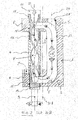
- the top pivot 18 and the lower pivot 19 have each a radial opening, see figure 2 , or they are laterally opened towards the collecting chamber 13, in order to allow the passage of the melted glue from and towards the collecting chamber 13 during the use of the distributor assembly 100.
- the glue is maintained to a temperature higher than the melting temperature from one or more resistors 5 inserted in the body 1 of the distributor assembly 100.
- the resistors 5 dissipate energy by Joule effect.
- a mixing element 21, having the function of promoting the mixing and the movement of the melted glue is housed within the contacting roll 7 .
- the mixing element 21 can be made as a screw-element, or a cochlea, or as an helicoidal stirrer.
- the mixing element extends from the top pivot 18 up to the lower pivot 19, for the whole length of the contacting roll 7, resulting coaxial thereto.
- the mixing element 21 is shorter than the contacting roll 7.
- the flowing of the melted glue can be obtained according two modes, provided that a relative rotation, between the contacting roll 7 and the mixing element 21 housed within it, is obtained.
- the contacting roll 7 is motorized, i.e. it is connected to the crank shaft 20 of an electric motor M, directly as showed in figure 1 or indirectly by a transmission system, in such case, through friction between the inner surface 7 and the melted glue, an axial thrust is created, i.e. along the rotation axis 9, depending on the helix direction of the mixing element 21, resulting glue in that the glue is mixed and allowed to flow.
- the mixing element 21 is motorized, this component being connected to the crank shaft 20 of an electric motor M, through the lower pivot 19. In this case, the mixing element 21 directly thrusts axially the melted glue, mixing and allowed to flow.
- O-ring seals are installed, for example between the pivots 18 and 19 and the body 1.
- the inner surface 7 is provided with protruding ribs (not showed), for example helicoidally, thrust the melted glue upward or downward, according to the rotation directions, when the contacting roll 7 is thrust-rotation.
- the protruding ribs can have a continuous path, or can be interrupted and extending as circle arcs.
- the mixing element 21 can be used in combination with a contacting roll 7 provided with inner protruding ribs, suitably sized to avoid mechanical interferences.
- the distributor assembly 100 is optionally provided with an injection system of a dye within the distributor assembly itself, in particular in the mixing chamber 7'.
- the mixing element 21 is provided on the top with at least a hole 22, see figure 2 , axially extending between an inlet, which is showed in the example as funnel-shaped, and an outlet which opens in the mixing chamber 7' at one or more doors 23; the operator can use the hole 22 to inject the concentrated dye, so as to change the color of the melted glue already present in the mixing chamber 7'.
- the desired color of the melted glue can be obtained without empting the glue circuit to fill it with another glue of the desired color, and therefore maintaining constant the circuit temperature.
- the mixture of the melted glue obtained as described above guarantees the uniform chromatic tone of all the melted glue flowing in the circuit.
- the dye injection can be performed involving a suitable valve on the body 1 of the distributor 100, providing access to the collecting chamber 13.
- a second method of edgebanding according to the present invention involve, therefore, the melted glue flowing not only in the inner collecting chamber 13 to the body 1 of the distributor assembly 100, but also through the contacting roll 7, which is hollow. More in detail, the method involve to make a flow circuit of the melted glue, arranging in flow communication the inner volume of the contacting roll 7 with the collecting chamber 13 of the body 1.
- the thrust on the melted glue will be directed upwards or downwards.
- the secondo method is implemented using a contacting roll internally shaped with the thrust surfaces, projections or ribs, for example at least helicoidally, and / or arranging in the contacting roll 7 a stirring element 21, having a screw-, or helix- or double helix-extension, such that the contacting roll 7 has a cochlea function for the melted glue inside, i.e. such that the rotation causes the movement of the melted glue in the flow circuit.
- the second method optionally involves to change the color of the melted glue color present in the flow circuit, injecting a dye by a through hole present in the stirring element 21 described-above.
- a third feature of the distributor assembly 100 for which the Applicant reserves the possibility to file a divisional patent application, relates to a precaution which allows to effectively adjust the thickness of the glue layer deposited on the panel edge to be edgeboarded.
- the distributor assembly 100 comprises at least one squeegees 4, 6, and preferably due squeegees 4, 6 positioned adjacent to the contacting roll 7 and in particular positioned parallel to each other and with the contacting roll 7.
- the squeegees 4, 6 are almost cylindrical elements, and each being provided with a own longitudinal axis, identified respectively with the reference numbers 3 and 8. Each squeegees 4, 6 being pivotable on the respective longitudinal axis 3, 8 parallel to the rotation axis 9 of the contacting roll 7. Considering that the squeegees 4, 6 rotate on the respective longitudinal axes 3 and 8, also such axes are configured as rotating axes.
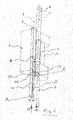
- the contacting roll 7, the squeegees 4 and 6 and the vertical portion 1" of the body 1 of the distributor assembly 100 jointly delimit the collecting chamber 13 described above. It should be considered in figure 3 that, the melted glue moves orthogonally to the design, parallel to the contacting roll 7 and the squeegees 4 and 6.
- the squeegees 4 and 6 are not cylindrical, but they have a flat surface 17 interrupting the circular profile of the squeegees 4 and 6.
- Such flat surface 17 can also be defined flatting and it is obtainable, for example, by milling.
- the intersection between the flat surface 17 and the remaining part of the outer cylindrical surface of the squeegees 4 and 6 defines a corner 10, 11, which can be defined side or vertical corner. Based on the angular position of the squeegees 4 and 6, the related corner 10, 11 is at a corresponding distance from the outer surface of the contacting roll 7.
- the side corner 10, 11 is parallel to the rotation axis 9 of the contacting roll 7 and the longitudinal axis 3, 8 of the respective squeegees 4, 6.
- the corner 10, 11 is movable between a distal position and a proximal position with respect to the contacting roll 7, depending on the angular position of the respective squeegees 4, 6 on the related longitudinal axis 3, 8. Between the corner 10, 11 and the outer surface of the contacting roll 7 a gap or window, through which the melted glue passes, is therefore defined.
- the squeegees 4 and 6 can be rotated on the respective axes 3 and 8 according to a direction to close the gap, and preventing the leakage of melted glue from the collecting chamber 13, or they can be rotate on the respective axes 3 and 8 according to an opposed direction to open or reducing the gap, and allowing the leakage of melted glue from the collecting chamber 13, on the surface of the contacting roll 7.
- the contacting roll 7 rotates on the rotation axis 9, it brings on its surface a certain amount of melted glue depositing on the portion of the contacting roll 7 oriented within the collecting chamber 13.
- the thickness of the glue layer that actually remains on the outer surface of the contacting roll 7 corresponds to the width of the gap defined between the corner 10, 11 of the squeegees 4 and 6 and the outer surface of the contacting roll 7.
- the corners 10 and 11 therefore can act as spatulas holding in the amount of melted glue exceeding the desired limit in the collecting chamber 13.
- the activation of the squeegees 4 and 6 can be manual, for example by an operation through a manual adjustment of the angular position of each squeegees 4, 6 selectively, through an adjusting screw, or the squeegees can be controlled by one or more actuators or servo-controls, according to a selective way.
- the contacting roll 7 rotates counterclockwise, the first squeegee 4 is stationary in an opening position, corresponding to a gap, and therefore corresponding to a thickness of the melted glue layer, equal to 2-3 tenths of a millimeter, and the second squeegee 6 is stationary in a closure position, with the related corner 10 in flush or almost in flush against the side surface of the contacting roll 7.
- the melted glue possibly contaminated by material particles of the panel subjected to edgebanding, does not return in the collecting chamber 13, but is scraped from the surface of the contacting roll to fall in the collecting tray 2".
- the maximum opening position of the squeegees 4, 6 corresponds to a distance from the outer surface of the contacting roll 7 equal to about 1 mm.
- Reference 15 indicates the rotation direction of the squeegees 4 and 6 to obtain the above described configuration.
- the proposed solution allows to precisely adjusting, but at the same time easily and effectively, the thickness of the melted glue layer on the contacting roll 7, guaranteeing at the same time to avoid the fouling of the melted glue in the collecting chamber 13.
- a further advantage provided by the third described feature consists of avoiding the contacting roll to ruin: also in the hypothesis wherein, by mistake, the operator acts clumsily on the squeegees 4 and 6, and disruptive interference with the contacting roll 7 is never created. This result is particularly obtained taking care of positioning the squeegees 4 and 6 with the related longitudinal axes 3 and 8 at the distance from the outer surface of the contacting roll not lower than the radius of the same squeegees 4 and 6, with a tolerance H/h7 according to standard UNI 6388 ISO R.286.
- the distance between the rotation axis 9 of the contacting roll 7 and the longitudinal axis 3 of the first squeegee 4 or the longitudinal axis 8 of the second squeegee 6, will be higher or equal to the outer sum of the outer radius of the contacting roll 7 and the radius of the squeegees 4 and 6, with tolerance H/h7. Therefore, the corner 10, 11 can at the limit be in flush on the surface of the contacting roll 7, to avoid the leakage of the melted glue, without having the possibility to practice any pressure sufficient to damage the knurling or the surface finishing of the contacting roll 7.
- the surface 17 can also be concave, or however can have a non-flat geometry, provided that its extending does not create any interference between the respective squeegees 4, 6 and the contacting roll 7.
- a third method of edgebanding according to the present invention therefore provides adjusting the thickness of the melted glue layer present on the outer surface of the contacting roll, acting on the squeegees 4, 6, and in particular and modifying the angular position thereof, rotating the squeegees 4, 6 on the respective longitudinal axes 3, 8, parallel to the contacting roll 7.
- the third method provides rotating the squeegees 4, 6 to correspondingly modify the orientation of the flat portion 17, and in particular the position of the corner 10, 11, and blocking the squeegees 4, 6 in the desired position, univocally corresponding to the width desiderata of the interstice present between the outer surface of the contacting roll 7 and each squeegees 4, 6; such interstice, being selectively settable for each squeegees 4, 6, defines the width of the melted glue layer that can leave the collecting chamber 13 and depositing on the outer surface of the contacting roll 7.
- a fourth feature of the distributor assembly 100 for which the Applicant reserves the possibility to file a divisional patent application, relates to a precaution which allows to effectively adjust the vertical extending of the melted glue layer deposited on the contacting roll 7, varying the thickness of the panels to be edgeboarded, between one batch and another batch.
- the sites 25 of the squeegees 4 and 6 are holes passing through the body 1 of the distributor assembly 100, in particular passing through le horizontal portions 1' of the body 1.
- the vertical sliding and the block of the squeegees 4 and 6 can be performed manually, by means for example of screw-elements, or each squeegees 4 and 6 can be equipped with of an actuator exactly configured for this purpose.
- the flat surface 17 of the squeegees 4 and 6 ends at the top with a corner 16, i.e. a step, which can be defined as higher corner 16.
- a corner 16 i.e. a step, which can be defined as higher corner 16.
- the corner or step 16 delimits at the top the extension of the melted glue layer, which can leave the collecting chamber 13.
- the vertical position of the corner 16 is also adjustable, i.e. determined by the operator depending on the need.
- the position of the corner 10, 11 of the flat surface 17 of the squeegees 4 and 6 defines, together with the outer surface of the contacting roll 7 the thickness of the glue layer.
- the higher corner 16 is twisted with respect to the longitudinal axis 3, 8 of the respective squeegees 4, 6.
- the lower limit of the flat surface 17 of the squeegees 4, 6 is defined by a seal element, also indicated as flap, 24 having, in transversal section, a shape which is complementary to the section of the respective squeegees 4, 6, or it can complete the circumference thereof.
- the shape of the flap 24 corresponds to the squeegee 4 or 6 portion eliminated to create the flat surface 17.
- the flaps 24 are visible also in figure 6 showing the distributor assembly 100 in a flat view, from the bottom.
- the flaps 24 are constrained to the body 1 of the distributor assembly 100 by means of a fastening element di 26 holding the flaps 24 however leaving a free-grade, i.e. the flaps 24 have the possibility to rotate together with the respective squeegees 4, 6.
- the element di fastening 26 is a guide inserting in a sliding way in an undercut of the flaps 24.
- the flaps 24 are provided with a corner or step 16' equivalent to corner/step 16 described above, and indicated as lower corner 16'.
- the corner or step 16' prevent the melted glue to color along the squeegees 4 and 6 through the holes 25 constituting the sites of the body 1 where the squeegees 4 and 6 rotate and move. This feature allows to maintaining clean the distributor assembly 100 in the lower part thereof.
- a for the method of edgebanding according to the present invention therefore provides adjusting the height of the melted glue layer present on the outer surface of the contacting roll, acting on the squeegees 4, 6, and in particular modifying the vertical position, i.e. the portion.
- the fourth method provides to lifting or lowering the squeegees 4, 6 in the respective sites of the body 1 of the distributor assembly 100, to modify the corresponding portion of the flat portion 17, and in particular the position of the higher corner 16, and blocking the squeegees 4, 6 in the desired position, univocally corresponding to the desired height desiderata of the interstice present between the outer surface of the contacting roll 7 and each squeegees 4, 6; such interstice, selectively configurable for each squeegees 4, 6, defines the height of the melted glue layer which can leave the collecting chamber 13 and depositing on the outer surface of the contacting roll 7. In fact, said height is determined from the distance between the higher corner 16 of the flat surface 17 and the lower corner 16' present on the seal element, or flap 25, closing at the bottom the flat surface 17 e, in general, the corresponding squeegees 4, 6.
- the fourth method can be carried out alternatively or jointly to the third method.
- the angular position of the flat surface 17 defines the thickness of the melted glue layer leaving the collecting chamber 13 on the outer surface of the contacting roll, and the vertical position, or height, of the flat surface 17 defines the height of the melted glue layer, i.e. the extension in a direction parallel to the rotation axis 9 of the contacting roll 7.
- the distributor assembly 100 is configurable by the user based on the thickness of the panels to be edgeboarded, and that can be performed selectively for each batch, even if the thickness changes from one batch to another. The operator can easily obtain the adjustment of the height of the melted glue layer applied to the contacting roll 7 adjusting the vertical position of the squeegees 4 and 6, as explained above.
- the squeegees 4, 6 can be removed from the top, along the related longitudinal axis, interchangeably, for their cleaning or replacing.
- a fifth feature of the distributor assembly 100 for which the Applicant reserves the possibility to file a divisional patent application, relates to a precaution allowing to constantly maintain clean melted glue deposited on the outer surface of the contacting roll 7.
- the outer surface of the contacting roll 7 has preferably an profile helicoidal, and more preferably helicoidal continuous, i.e. of the screw-type, alternatively to the conventional knurling or double knurling.
- This precaution allows to maintain clean the contacting roll 7, because it will be sufficient to equip the distributor assembly 100 with a comb-type scraper of a complementary form with respect to the profile of the contacting roll: thus, glue accumulations on the contacting roll 7 will be avoided.
- the helicoidal profile of the outer surface of the contacting roll 7 allows the particles of panel materials, possibly incorporated in the glue not-detached from the contacting roll 7, to accumulate at the higher or lower ends of the contacting roll 7, based on the rotation directions provided by motor M, which can be clockwise or counterclockwise AO, and depending on the direction of the profile helix.
- the contacting roll 7 with the helicoidal profile outer surface can be defined as self-cleaning, precisely because the particles thrusted upwards or downwards, but do not remain in the zone of the contacting roll 7 intended to roll on the panel edge to be edgeboarded.
- the solid particles possibly detached from the panels and incorporated in the glue present on the contacting roll 7, tend to accumulate to the higher end or to the lower end of the contacting roll 7, where the removal of the excess glue will be easy, for example with manual interventions, by scrapers. In any case, particles are removed and they does not more represent a drawback referring to the fouling of glue and panels under processing.
- a fifth method of edgebanding provides maintaining clean the outer surface of the contacting roll 7 making the same contacting roll 7 with profile helicoidal or screw outer surface, and not with the conventional knurling.
- the helicoidal outer surface promotes the automatic elimination of the undesired particles, which due to the rotation of the contacting roll 7, are thrusted towards the higher end or the lower end of the roll.
- the distributor body 100 has a generic C-shape; however this is not the sole shape possible: for example, the body C can be made with a cylindrical shape, with the collecting chamber 13 coaxial and external with respect to the mixing chamber 7' and the contacting roll 7.
- the present invention also relates to the following points, for each of which the Applicant reserves the possibility to file a divisional patent application.
Landscapes
- Life Sciences & Earth Sciences (AREA)
- Engineering & Computer Science (AREA)
- Mechanical Engineering (AREA)
- Wood Science & Technology (AREA)
- Forests & Forestry (AREA)
- Coating Apparatus (AREA)
- Adhesives Or Adhesive Processes (AREA)
- Rolls And Other Rotary Bodies (AREA)
Applications Claiming Priority (1)
| Application Number | Priority Date | Filing Date | Title |
|---|---|---|---|
| IT102020000004510A IT202000004510A1 (it) | 2020-03-04 | 2020-03-04 | Rullo spalmatore per adesivo termofondente |
Publications (2)
| Publication Number | Publication Date |
|---|---|
| EP3875176A2 true EP3875176A2 (de) | 2021-09-08 |
| EP3875176A3 EP3875176A3 (de) | 2021-11-10 |
Family
ID=72356228
Family Applications (2)
| Application Number | Title | Priority Date | Filing Date |
|---|---|---|---|
| EP21157036.1A Withdrawn EP3875176A3 (de) | 2020-03-04 | 2021-02-15 | Leimverteileranordnung für eine kantenanleimmaschine und verfahren zum kantenanleimen von platten |
| EP21157033.8A Active EP3875175B1 (de) | 2020-03-04 | 2021-02-15 | Leimverteileranordnung für kantenanleimmaschine und verfahren zum kantenanleimen von platten |
Family Applications After (1)
| Application Number | Title | Priority Date | Filing Date |
|---|---|---|---|
| EP21157033.8A Active EP3875175B1 (de) | 2020-03-04 | 2021-02-15 | Leimverteileranordnung für kantenanleimmaschine und verfahren zum kantenanleimen von platten |
Country Status (3)
| Country | Link |
|---|---|
| EP (2) | EP3875176A3 (de) |
| IT (1) | IT202000004510A1 (de) |
| PL (1) | PL3875175T3 (de) |
Cited By (5)
| Publication number | Priority date | Publication date | Assignee | Title |
|---|---|---|---|---|
| CN114701038A (zh) * | 2022-05-17 | 2022-07-05 | 佛山市顺德区拙屹机械制造有限公司 | 一种封边带涂胶送带装置 |
| CN117101941A (zh) * | 2023-07-21 | 2023-11-24 | 索菲亚家居股份有限公司 | 一种热熔胶施胶量的控制方法 |
| IT202200020058A1 (it) * | 2022-09-29 | 2024-03-29 | Scm Group Spa | Macchina bordatrice |
| IT202200020055A1 (it) * | 2022-09-29 | 2024-03-29 | Scm Group Spa | Macchina bordatrice |
| CN118358017A (zh) * | 2024-04-19 | 2024-07-19 | 广东泛荣工贸有限公司 | 一种板材产线圆角压合段的悬挂式输送装置 |
Families Citing this family (2)
| Publication number | Priority date | Publication date | Assignee | Title |
|---|---|---|---|---|
| CN119793814B (zh) * | 2025-02-10 | 2025-09-26 | 厦门特盈自动化科技有限公司 | 一种点胶设备 |
| CN119869869B (zh) * | 2025-03-27 | 2025-08-19 | 山西平榆高速公路有限责任公司 | 用于高速公路桥梁防撞护栏的纳米防腐涂覆设备及方法 |
Citations (10)
| Publication number | Priority date | Publication date | Assignee | Title |
|---|---|---|---|---|
| EP0945235A2 (de) | 1998-03-24 | 1999-09-29 | SCM GROUP S.p.A. | Kantenleimgerät |
| EP1260277A2 (de) | 2001-05-18 | 2002-11-27 | SCM GROUP S.p.A. | Vorrichtung zum Aufbringen von Kleber insbesondere für eine Maschine zur Berbeitung von Holzplatten |
| EP1464470A2 (de) | 2003-04-01 | 2004-10-06 | SCM GROUP S.p.A. | Holzplattekantenlaminierungsvorrichtung mit optischer Vorrichtung und rechnergestütztes System zum Sammeln von Profildaten |
| EP1588812A1 (de) | 2004-04-21 | 2005-10-26 | SCM GROUP S.p.A. | Kantenanleimvorrichtung mit Laserschneidsystem |
| EP1785243A1 (de) | 2005-11-10 | 2007-05-16 | SCM GROUP S.p.A. | Kantenanleimgerät |
| EP1997597A2 (de) | 2007-05-21 | 2008-12-03 | SCM GROUP S.p.A. | Vorrichtung und Verfahren zur Kantenumleimung und Verbundplatte mit angebrachten Kantenbanden |
| EP2052822A1 (de) | 2007-10-22 | 2009-04-29 | SCM GROUP S.p.A. | Kantenanleimverfahren und -vorrichtung |
| EP2062706A1 (de) | 2007-07-31 | 2009-05-27 | SCM GROUP S.p.A. | Verfahren zur Kantenbindung eines Paneels und dadurch gewonnenes Paneel |
| EP1798013B1 (de) * | 2005-11-29 | 2009-07-08 | SCM GROUP S.p.A. | Leimauftragsvorrichtung |
| EP2251165A1 (de) | 2009-05-15 | 2010-11-17 | SCM Group S.p.A. | Kantenanleimmaschine |
Family Cites Families (4)
| Publication number | Priority date | Publication date | Assignee | Title |
|---|---|---|---|---|
| US3623451A (en) * | 1968-10-16 | 1971-11-30 | Advance Products Inc | Glue roller assembly |
| DE3447592A1 (de) * | 1984-12-28 | 1986-07-10 | Hornberger Maschinenbaugesellschaft mbH & Co KG, 7294 Schopfloch | Vorrichtung zum auftragen von schmelzkleber auf fortlaufend bewegte werkstuecke |
| DE4130964A1 (de) * | 1991-09-18 | 1993-03-25 | Reinhard Dimter | Dosier- und foerdervorrichtung fuer fluessige und zaehfluessige medien insbesondere als leimangabe fuer profilverleimung |
| DE202014009945U1 (de) * | 2014-12-18 | 2015-01-14 | Chin-Chi Lin | Klebstoffaufbringvorrichtung für eine Kantenanleimmaschine |
-
2020
- 2020-03-04 IT IT102020000004510A patent/IT202000004510A1/it unknown
-
2021
- 2021-02-15 PL PL21157033.8T patent/PL3875175T3/pl unknown
- 2021-02-15 EP EP21157036.1A patent/EP3875176A3/de not_active Withdrawn
- 2021-02-15 EP EP21157033.8A patent/EP3875175B1/de active Active
Patent Citations (10)
| Publication number | Priority date | Publication date | Assignee | Title |
|---|---|---|---|---|
| EP0945235A2 (de) | 1998-03-24 | 1999-09-29 | SCM GROUP S.p.A. | Kantenleimgerät |
| EP1260277A2 (de) | 2001-05-18 | 2002-11-27 | SCM GROUP S.p.A. | Vorrichtung zum Aufbringen von Kleber insbesondere für eine Maschine zur Berbeitung von Holzplatten |
| EP1464470A2 (de) | 2003-04-01 | 2004-10-06 | SCM GROUP S.p.A. | Holzplattekantenlaminierungsvorrichtung mit optischer Vorrichtung und rechnergestütztes System zum Sammeln von Profildaten |
| EP1588812A1 (de) | 2004-04-21 | 2005-10-26 | SCM GROUP S.p.A. | Kantenanleimvorrichtung mit Laserschneidsystem |
| EP1785243A1 (de) | 2005-11-10 | 2007-05-16 | SCM GROUP S.p.A. | Kantenanleimgerät |
| EP1798013B1 (de) * | 2005-11-29 | 2009-07-08 | SCM GROUP S.p.A. | Leimauftragsvorrichtung |
| EP1997597A2 (de) | 2007-05-21 | 2008-12-03 | SCM GROUP S.p.A. | Vorrichtung und Verfahren zur Kantenumleimung und Verbundplatte mit angebrachten Kantenbanden |
| EP2062706A1 (de) | 2007-07-31 | 2009-05-27 | SCM GROUP S.p.A. | Verfahren zur Kantenbindung eines Paneels und dadurch gewonnenes Paneel |
| EP2052822A1 (de) | 2007-10-22 | 2009-04-29 | SCM GROUP S.p.A. | Kantenanleimverfahren und -vorrichtung |
| EP2251165A1 (de) | 2009-05-15 | 2010-11-17 | SCM Group S.p.A. | Kantenanleimmaschine |
Cited By (7)
| Publication number | Priority date | Publication date | Assignee | Title |
|---|---|---|---|---|
| CN114701038A (zh) * | 2022-05-17 | 2022-07-05 | 佛山市顺德区拙屹机械制造有限公司 | 一种封边带涂胶送带装置 |
| IT202200020058A1 (it) * | 2022-09-29 | 2024-03-29 | Scm Group Spa | Macchina bordatrice |
| IT202200020055A1 (it) * | 2022-09-29 | 2024-03-29 | Scm Group Spa | Macchina bordatrice |
| EP4344842A1 (de) * | 2022-09-29 | 2024-04-03 | SCM Group S.p.A. | Kantenbearbeitungsmaschine |
| EP4344841A1 (de) * | 2022-09-29 | 2024-04-03 | SCM Group S.p.A. | Kantenbrechmaschine |
| CN117101941A (zh) * | 2023-07-21 | 2023-11-24 | 索菲亚家居股份有限公司 | 一种热熔胶施胶量的控制方法 |
| CN118358017A (zh) * | 2024-04-19 | 2024-07-19 | 广东泛荣工贸有限公司 | 一种板材产线圆角压合段的悬挂式输送装置 |
Also Published As
| Publication number | Publication date |
|---|---|
| EP3875176A3 (de) | 2021-11-10 |
| EP3875175C0 (de) | 2024-01-17 |
| EP3875175B1 (de) | 2024-01-17 |
| PL3875175T3 (pl) | 2024-06-10 |
| IT202000004510A1 (it) | 2021-09-04 |
| EP3875175A1 (de) | 2021-09-08 |
Similar Documents
| Publication | Publication Date | Title |
|---|---|---|
| EP3875175B1 (de) | Leimverteileranordnung für kantenanleimmaschine und verfahren zum kantenanleimen von platten | |
| DE69621101T2 (de) | Verfahren und Vorrichtung zum Granulieren von Strängen aus thermoplastischen Kunststoffen | |
| DE69124788T2 (de) | Kompaktes und präzises Extrusionssystem und Verfahren | |
| DE4006006C1 (de) | ||
| DE3815897C1 (de) | ||
| DE69118080T3 (de) | Vorrichtung um ein Formteil am Rand einer Glasscheibe anzuformen | |
| DE3011918A1 (de) | Fliessmischer | |
| EP1243345B1 (de) | Leimbecken für eine Kantenleimmaschine | |
| EP0127828A2 (de) | Vorrichtung zum kontinuierlichen Auftragen von Schaum auf ein damit zu beschichtendes flächiges Gebilde | |
| DE102007058174A1 (de) | Extruder | |
| DE19637098A1 (de) | Vorrichtung zum Mischen und/oder Verfeinern von Schokolademassen | |
| US4338351A (en) | Apparatus and method for producing uniform fired resistors | |
| EP0017041A1 (de) | Vorrichtung zum Herstellen eines massive oder zellförmige Stoffe bildenden Reaktionsgemisches aus fliessfähigen Reaktionskomponenten und Einbringen des Reaktionsgemisches in ein Formwerkzeug | |
| EP3914396B1 (de) | Vorrichtung zum bereitstellen von klebstoff | |
| EP1082205A1 (de) | Filtereinrichtung für strangpressen und spritzgiessmaschinen | |
| EP1481786A1 (de) | Anlage zum Aufbereiten von Stoffen | |
| EP0463199B1 (de) | Verfahren und Vorrichtung zur Herstellung von mittel- oder höherviskosen Zwei- oder Mehrkomponenten-Massen durch Vermischen der Komponenten miteinander | |
| DE20104697U1 (de) | Leimbecken für eine Kantenleimmaschine | |
| EP1754531B1 (de) | Vorrichtung zum Mischen und Aufbringen eines aus mindestens zwei Komponenten bestehenden pastösen Materials auf ein Substrat | |
| DE2611625A1 (de) | Beschichtungsvorrichtung | |
| EP1090756A1 (de) | Farbkammerrakel | |
| DE19834132C2 (de) | Vorrichtung zur Herstellung und Aufbereitung von Verbundwerkstoffen | |
| DE19642399A1 (de) | Druckfarbenwanne für eine Druckerpresse | |
| AT527211B1 (de) | Verschlussdüse für eine Formgebungsmaschine | |
| EP3650185B1 (de) | Vorrichtung und verfahren zum mischen und ausgeben hochviskoser reaktiver mehrphasengemische |
Legal Events
| Date | Code | Title | Description |
|---|---|---|---|
| PUAI | Public reference made under article 153(3) epc to a published international application that has entered the european phase |
Free format text: ORIGINAL CODE: 0009012 |
|
| STAA | Information on the status of an ep patent application or granted ep patent |
Free format text: STATUS: THE APPLICATION HAS BEEN PUBLISHED |
|
| AK | Designated contracting states |
Kind code of ref document: A2 Designated state(s): AL AT BE BG CH CY CZ DE DK EE ES FI FR GB GR HR HU IE IS IT LI LT LU LV MC MK MT NL NO PL PT RO RS SE SI SK SM TR |
|
| PUAL | Search report despatched |
Free format text: ORIGINAL CODE: 0009013 |
|
| AK | Designated contracting states |
Kind code of ref document: A3 Designated state(s): AL AT BE BG CH CY CZ DE DK EE ES FI FR GB GR HR HU IE IS IT LI LT LU LV MC MK MT NL NO PL PT RO RS SE SI SK SM TR |
|
| RIC1 | Information provided on ipc code assigned before grant |
Ipc: B27G 11/00 20060101ALI20211005BHEP Ipc: B27D 5/00 20060101ALI20211005BHEP Ipc: B05C 1/08 20060101ALI20211005BHEP Ipc: B05C 1/00 20060101AFI20211005BHEP |
|
| STAA | Information on the status of an ep patent application or granted ep patent |
Free format text: STATUS: REQUEST FOR EXAMINATION WAS MADE |
|
| 17P | Request for examination filed |
Effective date: 20220216 |
|
| RBV | Designated contracting states (corrected) |
Designated state(s): AL AT BE BG CH CY CZ DE DK EE ES FI FR GB GR HR HU IE IS IT LI LT LU LV MC MK MT NL NO PL PT RO RS SE SI SK SM TR |
|
| STAA | Information on the status of an ep patent application or granted ep patent |
Free format text: STATUS: EXAMINATION IS IN PROGRESS |
|
| 17Q | First examination report despatched |
Effective date: 20230706 |
|
| STAA | Information on the status of an ep patent application or granted ep patent |
Free format text: STATUS: THE APPLICATION IS DEEMED TO BE WITHDRAWN |
|
| 18D | Application deemed to be withdrawn |
Effective date: 20231117 |