EP3876319B1 - Liant d'électrode de batterie secondaire non aqueuse et électrode de batterie secondaire non aqueuse - Google Patents
Liant d'électrode de batterie secondaire non aqueuse et électrode de batterie secondaire non aqueuse Download PDFInfo
- Publication number
- EP3876319B1 EP3876319B1 EP20866911.9A EP20866911A EP3876319B1 EP 3876319 B1 EP3876319 B1 EP 3876319B1 EP 20866911 A EP20866911 A EP 20866911A EP 3876319 B1 EP3876319 B1 EP 3876319B1
- Authority
- EP
- European Patent Office
- Prior art keywords
- electrode
- secondary battery
- active material
- nonaqueous secondary
- free energy
- Prior art date
- Legal status (The legal status is an assumption and is not a legal conclusion. Google has not performed a legal analysis and makes no representation as to the accuracy of the status listed.)
- Active
Links
Images




Classifications
-
- H—ELECTRICITY
- H01—ELECTRIC ELEMENTS
- H01M—PROCESSES OR MEANS, e.g. BATTERIES, FOR THE DIRECT CONVERSION OF CHEMICAL ENERGY INTO ELECTRICAL ENERGY
- H01M4/00—Electrodes
- H01M4/02—Electrodes composed of, or comprising, active material
- H01M4/62—Selection of inactive substances as ingredients for active masses, e.g. binders, fillers
- H01M4/621—Binders
-
- C—CHEMISTRY; METALLURGY
- C08—ORGANIC MACROMOLECULAR COMPOUNDS; THEIR PREPARATION OR CHEMICAL WORKING-UP; COMPOSITIONS BASED THEREON
- C08L—COMPOSITIONS OF MACROMOLECULAR COMPOUNDS
- C08L101/00—Compositions of unspecified macromolecular compounds
- C08L101/12—Compositions of unspecified macromolecular compounds characterised by physical features, e.g. anisotropy, viscosity or electrical conductivity
-
- H—ELECTRICITY
- H01—ELECTRIC ELEMENTS
- H01M—PROCESSES OR MEANS, e.g. BATTERIES, FOR THE DIRECT CONVERSION OF CHEMICAL ENERGY INTO ELECTRICAL ENERGY
- H01M4/00—Electrodes
- H01M4/02—Electrodes composed of, or comprising, active material
- H01M4/62—Selection of inactive substances as ingredients for active masses, e.g. binders, fillers
- H01M4/621—Binders
- H01M4/622—Binders being polymers
-
- C—CHEMISTRY; METALLURGY
- C08—ORGANIC MACROMOLECULAR COMPOUNDS; THEIR PREPARATION OR CHEMICAL WORKING-UP; COMPOSITIONS BASED THEREON
- C08F—MACROMOLECULAR COMPOUNDS OBTAINED BY REACTIONS ONLY INVOLVING CARBON-TO-CARBON UNSATURATED BONDS
- C08F220/00—Copolymers of compounds having one or more unsaturated aliphatic radicals, each having only one carbon-to-carbon double bond, and only one being terminated by only one carboxyl radical or a salt, anhydride ester, amide, imide or nitrile thereof
- C08F220/02—Monocarboxylic acids having less than ten carbon atoms; Derivatives thereof
- C08F220/04—Acids; Metal salts or ammonium salts thereof
- C08F220/06—Acrylic acid; Methacrylic acid; Metal salts or ammonium salts thereof
-
- C—CHEMISTRY; METALLURGY
- C08—ORGANIC MACROMOLECULAR COMPOUNDS; THEIR PREPARATION OR CHEMICAL WORKING-UP; COMPOSITIONS BASED THEREON
- C08L—COMPOSITIONS OF MACROMOLECULAR COMPOUNDS
- C08L33/00—Compositions of homopolymers or copolymers of compounds having one or more unsaturated aliphatic radicals, each having only one carbon-to-carbon double bond, and only one being terminated by only one carboxyl radical, or of salts, anhydrides, esters, amides, imides or nitriles thereof; Compositions of derivatives of such polymers
- C08L33/02—Homopolymers or copolymers of acids; Metal or ammonium salts thereof
-
- H—ELECTRICITY
- H01—ELECTRIC ELEMENTS
- H01M—PROCESSES OR MEANS, e.g. BATTERIES, FOR THE DIRECT CONVERSION OF CHEMICAL ENERGY INTO ELECTRICAL ENERGY
- H01M10/00—Secondary cells; Manufacture thereof
- H01M10/05—Accumulators with non-aqueous electrolyte
-
- H—ELECTRICITY
- H01—ELECTRIC ELEMENTS
- H01M—PROCESSES OR MEANS, e.g. BATTERIES, FOR THE DIRECT CONVERSION OF CHEMICAL ENERGY INTO ELECTRICAL ENERGY
- H01M4/00—Electrodes
- H01M4/02—Electrodes composed of, or comprising, active material
- H01M4/04—Processes of manufacture in general
- H01M4/0402—Methods of deposition of the material
- H01M4/0404—Methods of deposition of the material by coating on electrode collectors
-
- H—ELECTRICITY
- H01—ELECTRIC ELEMENTS
- H01M—PROCESSES OR MEANS, e.g. BATTERIES, FOR THE DIRECT CONVERSION OF CHEMICAL ENERGY INTO ELECTRICAL ENERGY
- H01M4/00—Electrodes
- H01M4/02—Electrodes composed of, or comprising, active material
- H01M4/13—Electrodes for accumulators with non-aqueous electrolyte, e.g. for lithium-accumulators; Processes of manufacture thereof
- H01M4/139—Processes of manufacture
-
- H—ELECTRICITY
- H01—ELECTRIC ELEMENTS
- H01M—PROCESSES OR MEANS, e.g. BATTERIES, FOR THE DIRECT CONVERSION OF CHEMICAL ENERGY INTO ELECTRICAL ENERGY
- H01M4/00—Electrodes
- H01M4/02—Electrodes composed of, or comprising, active material
- H01M4/36—Selection of substances as active materials, active masses, active liquids
- H01M4/362—Composites
- H01M4/364—Composites as mixtures
-
- H—ELECTRICITY
- H01—ELECTRIC ELEMENTS
- H01M—PROCESSES OR MEANS, e.g. BATTERIES, FOR THE DIRECT CONVERSION OF CHEMICAL ENERGY INTO ELECTRICAL ENERGY
- H01M4/00—Electrodes
- H01M4/02—Electrodes composed of, or comprising, active material
- H01M4/36—Selection of substances as active materials, active masses, active liquids
- H01M4/48—Selection of substances as active materials, active masses, active liquids of inorganic oxides or hydroxides
- H01M4/483—Selection of substances as active materials, active masses, active liquids of inorganic oxides or hydroxides for non-aqueous cells
-
- H—ELECTRICITY
- H01—ELECTRIC ELEMENTS
- H01M—PROCESSES OR MEANS, e.g. BATTERIES, FOR THE DIRECT CONVERSION OF CHEMICAL ENERGY INTO ELECTRICAL ENERGY
- H01M4/00—Electrodes
- H01M4/02—Electrodes composed of, or comprising, active material
- H01M4/36—Selection of substances as active materials, active masses, active liquids
- H01M4/58—Selection of substances as active materials, active masses, active liquids of inorganic compounds other than oxides or hydroxides, e.g. sulfides, selenides, tellurides, halogenides or LiCoFy; of polyanionic structures, e.g. phosphates, silicates or borates
- H01M4/583—Carbonaceous material, e.g. graphite-intercalation compounds or CFx
- H01M4/587—Carbonaceous material, e.g. graphite-intercalation compounds or CFx for inserting or intercalating light metals
-
- H—ELECTRICITY
- H01—ELECTRIC ELEMENTS
- H01M—PROCESSES OR MEANS, e.g. BATTERIES, FOR THE DIRECT CONVERSION OF CHEMICAL ENERGY INTO ELECTRICAL ENERGY
- H01M4/00—Electrodes
- H01M4/02—Electrodes composed of, or comprising, active material
- H01M4/64—Carriers or collectors
- H01M4/66—Selection of materials
- H01M4/665—Composites
- H01M4/667—Composites in the form of layers, e.g. coatings
-
- H—ELECTRICITY
- H01—ELECTRIC ELEMENTS
- H01M—PROCESSES OR MEANS, e.g. BATTERIES, FOR THE DIRECT CONVERSION OF CHEMICAL ENERGY INTO ELECTRICAL ENERGY
- H01M10/00—Secondary cells; Manufacture thereof
- H01M10/05—Accumulators with non-aqueous electrolyte
- H01M10/052—Li-accumulators
-
- H—ELECTRICITY
- H01—ELECTRIC ELEMENTS
- H01M—PROCESSES OR MEANS, e.g. BATTERIES, FOR THE DIRECT CONVERSION OF CHEMICAL ENERGY INTO ELECTRICAL ENERGY
- H01M10/00—Secondary cells; Manufacture thereof
- H01M10/05—Accumulators with non-aqueous electrolyte
- H01M10/056—Accumulators with non-aqueous electrolyte characterised by the materials used as electrolytes, e.g. mixed inorganic/organic electrolytes
- H01M10/0564—Accumulators with non-aqueous electrolyte characterised by the materials used as electrolytes, e.g. mixed inorganic/organic electrolytes the electrolyte being constituted of organic materials only
- H01M10/0566—Liquid materials
- H01M10/0569—Liquid materials characterised by the solvents
-
- H—ELECTRICITY
- H01—ELECTRIC ELEMENTS
- H01M—PROCESSES OR MEANS, e.g. BATTERIES, FOR THE DIRECT CONVERSION OF CHEMICAL ENERGY INTO ELECTRICAL ENERGY
- H01M4/00—Electrodes
- H01M4/02—Electrodes composed of, or comprising, active material
- H01M2004/021—Physical characteristics, e.g. porosity, surface area
-
- H—ELECTRICITY
- H01—ELECTRIC ELEMENTS
- H01M—PROCESSES OR MEANS, e.g. BATTERIES, FOR THE DIRECT CONVERSION OF CHEMICAL ENERGY INTO ELECTRICAL ENERGY
- H01M4/00—Electrodes
- H01M4/02—Electrodes composed of, or comprising, active material
- H01M2004/026—Electrodes composed of, or comprising, active material characterised by the polarity
- H01M2004/027—Negative electrodes
-
- H—ELECTRICITY
- H01—ELECTRIC ELEMENTS
- H01M—PROCESSES OR MEANS, e.g. BATTERIES, FOR THE DIRECT CONVERSION OF CHEMICAL ENERGY INTO ELECTRICAL ENERGY
- H01M2300/00—Electrolytes
- H01M2300/0017—Non-aqueous electrolytes
- H01M2300/0025—Organic electrolyte
-
- H—ELECTRICITY
- H01—ELECTRIC ELEMENTS
- H01M—PROCESSES OR MEANS, e.g. BATTERIES, FOR THE DIRECT CONVERSION OF CHEMICAL ENERGY INTO ELECTRICAL ENERGY
- H01M2300/00—Electrolytes
- H01M2300/0017—Non-aqueous electrolytes
- H01M2300/0025—Organic electrolyte
- H01M2300/0028—Organic electrolyte characterised by the solvent
- H01M2300/0034—Fluorinated solvents
-
- H—ELECTRICITY
- H01—ELECTRIC ELEMENTS
- H01M—PROCESSES OR MEANS, e.g. BATTERIES, FOR THE DIRECT CONVERSION OF CHEMICAL ENERGY INTO ELECTRICAL ENERGY
- H01M2300/00—Electrolytes
- H01M2300/0017—Non-aqueous electrolytes
- H01M2300/0025—Organic electrolyte
- H01M2300/0028—Organic electrolyte characterised by the solvent
- H01M2300/0037—Mixture of solvents
- H01M2300/004—Three solvents
-
- H—ELECTRICITY
- H01—ELECTRIC ELEMENTS
- H01M—PROCESSES OR MEANS, e.g. BATTERIES, FOR THE DIRECT CONVERSION OF CHEMICAL ENERGY INTO ELECTRICAL ENERGY
- H01M4/00—Electrodes
- H01M4/02—Electrodes composed of, or comprising, active material
- H01M4/13—Electrodes for accumulators with non-aqueous electrolyte, e.g. for lithium-accumulators; Processes of manufacture thereof
-
- Y—GENERAL TAGGING OF NEW TECHNOLOGICAL DEVELOPMENTS; GENERAL TAGGING OF CROSS-SECTIONAL TECHNOLOGIES SPANNING OVER SEVERAL SECTIONS OF THE IPC; TECHNICAL SUBJECTS COVERED BY FORMER USPC CROSS-REFERENCE ART COLLECTIONS [XRACs] AND DIGESTS
- Y02—TECHNOLOGIES OR APPLICATIONS FOR MITIGATION OR ADAPTATION AGAINST CLIMATE CHANGE
- Y02E—REDUCTION OF GREENHOUSE GAS [GHG] EMISSIONS, RELATED TO ENERGY GENERATION, TRANSMISSION OR DISTRIBUTION
- Y02E60/00—Enabling technologies; Technologies with a potential or indirect contribution to GHG emissions mitigation
- Y02E60/10—Energy storage using batteries
Definitions
- the invention provides an electrode binder for a nonaqueous secondary battery and a nonaqueous secondary battery electrode.
- a secondary battery (nonaqueous secondary battery) using a nonaqueous electrolyte is superior to a secondary battery using an aqueous electrolyte in terms of high voltage, miniaturization, and weight reduction. For this reason, the nonaqueous secondary battery is widely used as a power source for notebook PC, a mobile phone, a power tool, and an electronic and communication equipment. In recent years, the nonaqueous secondary battery has also been used for an electric vehicle and a hybrid vehicle from the viewpoint of environmental vehicle application, but there is a strong demand for higher output, higher capacity, and longer life.
- a lithium ion secondary battery is a typical example of the nonaqueous secondary battery.
- the nonaqueous secondary battery comprises a positive electrode using a metal oxide or the like as an active material, a negative electrode using a carbon material or the like such as graphite as an active material, and a nonaqueous electrolyte solvent containing mainly carbonates or flame-retardant ionic liquids.
- the nonaqueous secondary battery is a secondary battery in which the battery is charged and discharged by the movement of ions between a positive electrode and a negative electrode.
- the positive electrode is obtained by applying a slurry containing a metal oxide and a binder on a surface of a positive electrode current collector such as an aluminum foil, drying the current collector having the slurry, and cutting the current collector into an appropriate size.
- the negative electrode is obtained by applying a slurry containing a carbon material and a binder on the surface of a negative electrode current collector such as a copper foil, drying the current collector having the slurry, and cutting the current collector into an appropriate size.
- the binder serves to bond the active material to each other and bond the active material to the current collector in the positive electrode and the negative electrode, thereby preventing the active material from being separated from the current collector.
- PVDF polyvinylidene fluoride
- NMP organic solvent N-methyl-2-pyrrolidone
- the binder has low binding properties between the active materials and between the active material and the current collector, and a large amount of binder is required for actual use. Therefore, there is a disadvantage that the capacity of the nonaqueous secondary battery is reduced. Further, since NMP, which is an expensive organic solvent, is used for the binder, it is unlikely to reduce the manufacturing cost.
- Patent Document 1 discloses a composite ink for forming a secondary battery electrode containing carboxymethyl cellulose, a water-dispersible binder and water.
- Non-Patent Document 1 KITAZAKI Yasuaki, HATA Toshio, Journal of the Japan Society for Adhesion, vol. 8,131-141(1972 ).
- the water-dispersible binder disclosed in Patent Document 1 requires use of carboxymethyl cellulose as a thickener in combination, and the slurry preparation process is complicated.
- the binder since the bonding properties between active materials and between active material and a current collector are insufficient, when an electrode is produced with a small amount of binder, a part of the active material is peeled off in the process of cutting the current collector.
- the sodium acrylate-N-vinylacetamide copolymer disclosed in Patent Document 1 has a problem that cracks are generated frequently in an electrode having a large film thickness, that is, a large weight per area.
- the present invention is directed to an electrode binder for a nonaqueous secondary battery, which is water-soluble and comprises a resin component and a polyoxyethylene alkyl ether as a surfactant,
- an electrode binder for a nonaqueous secondary battery which can obtain a secondary battery having an electrode active material layer having a few cracks and a high peeling strength with respect to a current collector, and which has a low internal resistance and a good cycle characteristic; and a nonaqueous secondary battery electrode.
- the nonaqueous secondary battery is a secondary battery accompanied by the transfer of ions serving as charge carriers between the positive electrode and the negative electrode in charge/discharge.
- the positive electrode includes a positive electrode active material
- the negative electrode includes a negative electrode active material.
- These electrode active materials are materials capable of ion intercalation and ion deintercalation.
- a preferred example of a secondary battery having such a configuration is a lithium-ion secondary battery.
- (Meth)acrylic acid means one or both of methacrylic acid and acrylic acid.
- (Meth)acrylate refers to one or both of methacrylate and acrylate.
- (Meth)acrylonitrile refers to one or both of methacrylonitrile and acrylonitrile.
- Non-volatile component which is contained in a mixture (for example, a slurry, or a composition) means a component which has a boiling point of 130°C or higher at 1 atmosphere (1013 hPa).
- Non-volatile component concentration of a mixture means the percentage (% by mass) of the components contained in the mixture which have a boiling point of 130°C or higher at 1 atm (1013 hPa).
- the surface free energy, its dispersion force component, its dipole component, and its hydrogen bonding component are values at 23°C unless otherwise specified.
- a nonaqueous secondary battery electrode (hereinafter sometimes referred to as "electrode”) according to the present embodiment includes a current collector and an electrode active material layer formed on the current collector.
- the shape of the electrode may be, for example, a laminate or a wound body, but is not particularly limited.
- the current collector is preferably a sheet-like metal having a thickness of 0.001 to 0.5 mm, and the metal includes iron, copper, aluminum, nickel, stainless steel, and the like.
- the current collector is preferably a copper foil.
- the electrode active material layer of the present embodiment includes an electrode active material (A) and an electrode binder (B).
- the electrode active material layer may contain a conductive auxiliary agent or the like.
- a peeling strength of the electrode active material layer with respect to the current collector is preferably 30 mN/mm or more, more preferably 40 mN/mm or more, and still more preferably 50 mN/mm or more. This is because it is possible to suppress the separation of the electrode active material layer from the current collector due to the manufacturing process such as the electrode manufacturing process, the battery assembly process; and an external force applied to the battery.
- the electrode active material (A) is a material capable of intercalating and deintercalating an ion serving as a charge carrier.
- the charge carrier is a lithium ion
- the nonaqueous secondary battery becomes a lithium ion secondary battery.
- a content of the electrode active material (A) in the electrode active material layer is preferably 85% by mass or more, more preferably 90% by mass or more, and still more preferably 92% by mass or more. This is because it is possible to increase a capacity of intercalating and deintercalating the charge carrier into and from the electrode and to increase the charge/discharge capacity of the nonaqueous secondary battery.
- a content of the electrode active material (A) in the electrode active material layer is preferably 99% by mass or less, more preferably 98% by mass or less, and still more preferably 97% by mass or less. This is because the electrode binder (B) is included in the electrode active material layer (The effect will be described later.).
- examples of the negative electrode active material include a carbon material, a lithium titanate, a silicon, a silicon compound, and the like.
- examples of the carbon material include coke such as petroleum coke, pitch coke, and coal coke; carbonized organic compound; graphite such as artificial graphite and natural graphite.
- Examples of the silicon compound include SiOx (0.1 ⁇ x ⁇ 2.0).
- As the negative electrode active material a material by combining two or more of the materials mentioned above may be used.
- the negative electrode active material preferably includes a Si element-containing material or a carbon material. This is because a charge-discharge capacity is increased while a good cycle characteristics of the nonaqueous secondary battery is maintained. It is more preferable to use a composite material of SiOx and a carbon material, or a composite material of silicon and a carbon material (Si/Graphite) as the negative electrode active material.
- the carbon material further preferably includes graphite. This is because an effect of improving binding property of the negative electrode active material by the electrode binder (B) is high.
- a covalent bond, a hydrogen bond, or the like may be formed between two or more kinds of the materials, but the bond may not be formed.
- SCMG registered trademark
- -XRs manufactured by Showa Denko K.K.
- the nonaqueous secondary battery electrode is a positive electrode of a lithium ion secondary battery
- the positive electrode active material include a lithium cobaltate (LiCoO 2 ), a lithium complex oxide containing nickel, a spinel type lithium manganate (LiMn 2 O 4 ), a olivine type lithium iron phosphate, a chalcogen compound such as TiS 2 , MnO 2 , MoOs, V 2 O 5 or the like.
- the positive electrode active material may contain either one of these compounds alone or a plurality of compounds. Other alkali metal oxides may also be used.
- lithium complex oxide containing nickel examples include a Ni-Co-Mn lithium complex oxide, a Ni-Mn-Al lithium complex oxide, a Ni-Co-Al lithium complex oxide and the like.
- positive electrode active material examples include LiNi 1/3 Mn 1/3 Co 1/3 O 2 or LiNi 3/5 Mn 1/5 Co 1/5 .
- the electrode binder (B) according to the present embodiment is a water-soluble binder containing a resin component.
- the electrode binder (B) according to the present embodiment is used for bonding the electrode active materials (A) to each other and bonding the electrode active material (A) to the current collector.
- a content of the electrode binder (B) is preferably 1.0% by mass or more, and more preferably 3.0% by mass or more. This is because it is possible to suppress slipping down of an electrode active material (A) and to improve peeling strength of the electrode active material layer.
- the content of the electrode binder (B) is preferably 12.0% by mass or less, and more preferably 7.0% by mass or less. This is because it is possible to increase the charge/discharge capacity of a battery by including more electrode active material (A) in the electrode active material layer.
- the surface free energy ⁇ B of the electrode binder (B) at 23°C is 70 mJ/m 2 or less, preferably 66 mJ/m 2 or less, more preferably 55 mJ/m 2 or less, and still more preferably 40 mJ/m 2 or less. This is because a DCR of the battery can be lowered.
- a value of a dipole component ⁇ p B in the surface free energy ⁇ B of the electrode binder (B) is 26 mJ/m 2 or less. This is because DCR of the battery can be lowered and the discharge capacity retention rate of the battery can be enhanced.
- the value of the dipole component ⁇ p B is preferably 22 mJ/m 2 or less, more preferably 19 mJ/m 2 or less, and still more preferably 10 mJ/m 2 or less. This is because a DCR of the battery can be further reduced.
- a value of a hydrogen bonding component ⁇ h B is preferably 24 mJ/m 2 or less, and more preferably 20 mJ/m 2 or less. This is because a peeling strength of the electrode active material layer to the current collector becomes higher.
- the surface free energy ⁇ B of the electrode binder (B); and the dispersion force component ⁇ d B , the dipole component ⁇ p B , and the hydrogen bond component ⁇ h B of the surface free energy ⁇ B are values obtained by the Kitasaki-Hata theory described in Non-Patent Document 1, and are obtained in detail by the method described below.
- ⁇ S represents the surface free energy of the solid S
- ⁇ d S represents its dispersion force component
- ⁇ p S represents its dipole component
- ⁇ h S represents its hydrogen bonding component
- ⁇ L represents the surface free energy of liquid L
- ⁇ d L represents its dispersive component
- ⁇ p L represents its dipole component
- ⁇ h L represents its hydrogen bonding component
- the components ⁇ d S , ⁇ p S and ⁇ h S of the surface free energy of the solid S can be obtained, respectively, by measuring contact angles between the solid S and three kinds of liquids L1, L2 and L3 whose surface free energies are known in advance and solving the following simultaneous equations of three elements.
- ⁇ L1 represents the surface free energy of liquid L1
- ⁇ d L1 represents its dispersion force component
- ⁇ p L1 represents its dipole component
- ⁇ h L1 represents its hydrogen bonding component
- ⁇ 1 represents a contact angle between the solid S and the liquid L1. Then, ⁇ L1 , ⁇ d L1 , ⁇ p L1 , ⁇ h L1 and ⁇ 1 are respectively set to predetermined values.
- ⁇ L2 represents the surface free energy of the liquid L2
- ⁇ d L2 represents its dispersion force component
- ⁇ p L2 represents its dipole component
- ⁇ h L2 represents its hydrogen bonding component
- ⁇ 2 represents a contact angle between the solid S and the liquid L2. Then, ⁇ L2 , ⁇ d L2 , ⁇ p L2 , ⁇ h L2 and ⁇ 2 are respectively set to predetermined values.
- ⁇ L3 represents the surface free energy of liquid L3
- ⁇ d L3 represents its dispersion force component
- ⁇ p L3 represents its dipole component
- ⁇ h L3 represents its hydrogen bonding component.
- ⁇ 3 represents a contact angle between the solid S and the liquid L3. Then, ⁇ L3 , ⁇ d L3 , ⁇ p L3 , ⁇ h L3 and ⁇ 3 are respectively set to predetermined values.
- the surface free energy is a value calculated based on a contact angle obtained by a measurement method described later using diiodomethane ( ⁇ L1 :50.8mJ/m 2 , ⁇ d L1 :46.8mJ/m 2 , ⁇ p L1 :4.0mJ/m 2 , ⁇ h L1 :0.0mJ/m 2 ) as the liquid L1, ethylene glycol ( ⁇ L2 :47.7mJ/m 2 , ⁇ d L2 :30.1mJ/m 2 , ⁇ p L2 :0.0mJ/m 2 , ⁇ h L2 :17.6mJ/m 2 ) as the liquid L2, and distilled water ( ⁇ L3 :72.8mJ/m 2 , ⁇ d L3 :29.1mJ/m 2 , ⁇ p L3 :1.3mJ/m 2 , ⁇ h L3 :42.4mJ/m 2 ).
- the contact angle is measured according to steps (i) to (iii) below.
- Contact angles ⁇ 1 , ⁇ 2 , and ⁇ 3 are measured for diiodomethane (Liquid L1), ethylene glycol (Liquid L2), and distilled water (Liquid L3), respectively, which are used as droplets in the sessile drop method.
- the measured values are substituted into the Equations (2), (3), and (4), respectively, to obtain the surface free energies ⁇ B and each component of ⁇ d B , ⁇ p B , and ⁇ h B , as described above.
- the electrode binder (B) is a water-soluble binder containing a resin component.
- the electrode binder (B) preferably contains 95% by mass or more of a water-soluble organic compound.
- the electrode binder (B) may be composed of one kind of compound or may contain two or more kinds of compounds. In the electrode, all of the water-soluble compounds contained in the electrode active material layer are components of the electrode binder (B). When the electrode is incorporated in the nonaqueous secondary battery, the component dissolved in the solvent of the electrolytic solution is not included in the components constituting the electrode binder (B).
- the resin component includes a copolymer of compounds having an ethylenically unsaturated bond selected from the group consisting of (meth)acrylic acid, a (meth)acrylic acid salt, styrene, a divinylbenzene, a butadiene, an N-vinylacetamide, an N-vinylformamide, a vinyl alcohol, and a vinyl acetate.
- the resin component includes a dispersant selected from the group consisting of a carboxymethyl cellulose and its metal salts.
- the dispersant can improve dispersibility of insoluble components such as an electrode active material (A) and a conductive auxiliary agent in an electrode slurry to be described later, and can disperse the insoluble components better in the electrode active material layer produced by using the electrode slurry.
- the peeling strength of the electrode active material layer with respect to the current collector can be improved.
- the cellulose derivative can greatly reduce the surface free energy ⁇ B of the electrode binder (B), its dipole component ⁇ p B , and its hydrogen bonding component ⁇ h B , when the cellulose derivative is used in an appropriate amount.
- a content of the cellulose derivative in the electrode binder (B) is preferably 8% by mass or more, more preferably 12% by mass or more, and still more preferably 16% by mass or more.
- the content of the cellulose derivative in the electrode binder (B) is preferably 80% by mass or less, more preferably 60% by mass or less, and still more preferably 50% by mass or less.
- the glass transition temperature Tg of the resin component contained in the electrode binder (B) is more preferably 100°C or higher, and more preferably 130°C or higher.
- the glass transition point Tg is a peak top temperature of a DDSC chart which is a derivative of a DSC curve obtained by using EXSTAR DSC/SS 7020 manufactured by Hitachi High-Tech Science Co., Ltd.
- a 2 mm ⁇ 2 mm ⁇ 0.5 mm film obtained by drying an aqueous solution of the resin component was used, and the measurement is carried out while raising the temperature at 10°C/minute.
- the electrode binder (B) contains, in addition to the resin component, a polyoxyethylene alkyl ether as a surfactant; and may contain a polymerization initiator and a catalyst used for synthesis of the resin component, or the like.
- the surfactant is preferably used for effectively adjusting the surface free energy ⁇ B of the electrode binder (B) and the values of its components ⁇ d B , ⁇ p B and ⁇ h B .
- the content of the surfactant in the electrode binder (B) is preferably 2.5% by mass or more, more preferably 8.0% by mass or more, and still more preferably 20% by mass or more. This is because the surface free energy ⁇ B of the electrode binder (B), its dipole component ⁇ p B , and its hydrogen bonding component ⁇ h B can be reduced.
- the content of the surfactant in the electrode binder (B) is preferably 75% by mass or less, more preferably 50% by mass or less, still more preferably 40% by mass or less, and particularly preferably 15% by mass or less. This is because the peeling strength of the electrode active material layer to the current collector and the cycle characteristic of the electrode can be maintained at a high level.
- the electrode active material layer may contain, in addition to the above components, a carbon black, a vapor growth carbon fiber, or the like as a conductive auxiliary agent.
- a carbon black As a specific example of the vapor growth carbon fiber, VGCF (registered trademark)-H (Showa Denko K.K.) or the like may be used.
- the electrode can be manufactured by coating an electrode slurry on a current collector, drying it to obtain an electrode sheet, and then cutting the electrode sheet into an appropriate size and shape as necessary.
- the electrode slurry includes the electrode active material (A) and the electrode binder (B). The detailed configuration of the electrode slurry will be described later.
- Examples of the method for applying the electrode slurry on the current collector include a reverse roll method, a direct roll method, a doctor blade method, a knife method, an extrusion method, a curtain method, a gravure method, a bar method, a dip method and a squeeze method.
- the doctor blade method, the knife method or the extrusion method are preferable, and it is more preferable to applying the electrode slurry by using the doctor blade method. This is because the applying method is suitable for various physical properties of the electrode slurry such as viscosity and is suitable for drying, and because a coating film having a good surface condition can be obtained.
- the electrode slurry may be applied to only one side of the current collector, or may be applied to both sides. When the electrode slurry is applied to both sides of the current collector, it may be applied on one side at a time, or both sides may be applied simultaneously.
- the electrode slurry may be continuously applied to the surface of the current collector or intermittently applied. The amount and range of applying the electrode slurry can be appropriately determined in accordance with the size of the battery etc.
- the weight per area of the electrode active material layer after drying is preferably 4 to 20 mg/cm 2 , more preferably 6 to 16 mg/cm 2 .
- the method of drying the applied electrode slurry is not particularly limited, but for example, hot air, vacuum, (far) infrared radiation, electron beam, microwave, and cold air can be used alone or in combination.
- the drying temperature is preferably from 40°C to 180°C, and the drying time is preferably from 1 minute to 30 minutes.
- the electrode sheet having the electrode active material layer formed on the current collector may be cut to a suitable size and shape as an electrode.
- the cutting method of the electrode sheet is not particularly limited, but slits, lasers, wire cuts, cutters, Thomson, and the like can be used.
- the electrode sheet may be pressed, as necessary, before or after cutting.
- the electrode active material is firmly bound by the current collector, and the battery can be made compact by thinning the electrode.
- the pressing method a general method can be used, and in particular, a die pressing method or a roll pressing method is preferably used.
- the press pressure is not particularly limited, but is preferably 0.5 to 5 t/cm 2 . This is because it is possible to suppress influence on intercalation and deintercalation of a charge carrier such as a lithium ion into and from the electrode active material (A).
- the electrode slurry of the present embodiment includes an electrode active material (A), an electrode binder (B), and an aqueous medium.
- the electrode slurry may optionally include a conductive auxiliary agent, etc.
- the electrode binder (B) is preferably dissolved in an aqueous medium. This is because the electrode binder (B) easily forms a uniform layer on surface of particles of the electrode active material (A) after drying the slurry.
- the aqueous medium contained in the electrode slurry is water, a hydrophilic solvent, or a mixture thereof.
- the non-volatile component concentration of the electrode slurry is preferably 20% by mass or more, more preferably 30% by mass or more, and still more preferably 40% by mass or more. This is because it is possible to form more electrode active material layers with a small amount of the electrode slurry.
- the non-volatile component concentration in the electrode slurry is preferably 80% by mass or less, more preferably 70% by mass or less, and still more preferably 60% by mass or less. This is because the electrode slurry can be easily prepared.
- a content of the electrode active material (A) and a content of the electrode binder (B) in the non-volatile component of the electrode slurry are the same as the content of the electrode active material (A) and the content of the electrode binder (B) in the electrode active material layer, respectively, as described above in the description of the nonaqueous secondary battery electrode.
- An example of a method of manufacturing an electrode slurry is a method of mixing the electrode active material (A), the electrode binder (B), and other components added as necessary, by adding them to an aqueous medium.
- an order in which the components are added may be appropriately adjusted so that the components are easily dissolved or dispersed in the aqueous medium; or after mixing two or more components in the solid phase, these mixtures may be added to the aqueous medium.
- a mixing method in each step is not particularly limited, but for example, a method of mixing necessary components using a mixing device such as a stirring type, a rotating type, or a shaking type may be used.
- the addition order of the components to be mixed is not particularly limited.
- Another example of a method for producing an electrode slurry is a method of mixing a binder solution in which the electrode binder (B) is dissolved in an aqueous medium, the electrode active material (A), and other components as necessary.
- An example of the mixing method is the same as the above example.
- the nonaqueous secondary battery according to the present embodiment preferably uses an alkali metal ion as a charge carrier, and more preferably uses a lithium ion as a charge carrier.
- a lithium ion secondary battery in which a charge carrier is a lithium ion will be described.
- a positive electrode, a negative electrode, an electrolytic solution, and parts such as separators as necessary are housed in an outer package, and a nonaqueous secondary battery electrode manufactured by the above method is used for one or both of the positive electrode and the negative electrode.
- a nonaqueous liquid having ionic conductivity is used as an electrolyte solution.
- the electrolyte solution include a solution in which an electrolyte is dissolved in an organic solvent, an ionic liquid, and the like, but the former is preferable.
- a solution in which an alkali metal salt described below is dissolved in an organic solvent also called “organic solvent solution of alkali metal salt” is more preferable. This is because a nonaqueous secondary battery having a low manufacturing cost and a low internal resistance can be obtained.
- the electrolyte is preferably an alkali metal salt, and can be appropriately selected according to the kind of the electrode active material or the like.
- the electrolyte include LiClO 4 , LiBF 6 , LiPF 6 , LiCF 3 SO 3 , LiCF 3 CO 2 , LiAsF 6 , LiSbF 6 , LiB 10 Cl 10 , LiAlCl 4 , LiCl, LiBr, LiB(C 2 H 5 ) 4 , CF 3 SO 3 Li, CH 3 SO 3 Li, LiCF 3 SO 3 , LiC 4 F 9 SO 3 , Li(CF 3 SO 2 ) 2 N, a lithium aliphatic carboxylate and the like.
- Another alkali metal salt may also be used as the electrolyte.
- Examples of the organic solvent for dissolving the electrolyte include a carbonate compound such as an ethylene carbonate (EC), a propylene carbonate (PC), a diethyl carbonate (DEC), a methylethyl carbonate (MEC), a dimethyl carbonate (DMC), a fluoroethylene carbonate (FEC), a vinylene carbonate (VC); a nitrile compounds such as acetonitrile; and a carboxylic acid ester such as a ethyl acetate, a propyl acetate, a methyl propionate, an ethyl propionate, and a propyl propionate.
- a carbonate compound such as an ethylene carbonate (EC), a propylene carbonate (PC), a diethyl carbonate (DEC), a methylethyl carbonate (MEC), a dimethyl carbonate (DMC), a fluoroethylene carbonate (FEC), a vinylene carbon
- a laminate material of an aluminum foil and a resin film can be suitably used as an outer package.
- the shape of the battery may be any one of a coin type, a button type, a seat type, a cylindrical type, a square type, a flat type, and the like.
- electrode binders (B) of a lithium ion secondary battery, negative electrodes, and lithium ion secondary batteries were prepared, and the effect of the present invention is confirmed by comparing them with comparative examples.
- the methods for producing the copolymers (P1) to (P8) are the same.
- a separable flask equipped with a cooling tube, a thermometer, a stirrer and a dropping funnel was charged with 100 parts by mass of total of the corresponding monomers having the compositions shown in Table 1, 0.2 parts by mass of 2,2'-azobis-(2-methylpropionamidine)dihydrochloride, 0.05 parts by mass of ammonium persulfate and 693 parts by mass of water at 30°C.
- the mixture was heated to 80°C and polymerized for 4 hours. Thereafter, the mixture was cooled to room temperature, dried and ground to obtain powdery copolymers (P1) to (P8), respectively.
- each component was mixed at the ratio shown in Table 2 to prepare a negative electrode slurry.
- the mixing method 37.65 parts by mass of SCMG (registered trademark)-XRs (manufactured by Showa Denko K.K.) as a negative electrode active material, 9.60 parts by mass of silicon monoxide (SiO) (manufactured by Sigma-Aldrich), 2.25 parts by mass of total amount of each component contained in the electrode binder (B) (as shown in Tables 3 and 4), 0.50 parts by mass of VGCF (registered trademark)-H (Showa Denko K.K.), and 23.5 parts by mass of water were added, and the mixture was thickly kneaded using a stirring type mixer (a rotary revolution stirring mixer) at 2000 rotations per minute for 4 minutes.
- a stirring type mixer a rotary revolution stirring mixer
- Electrode binder One of (B1) to (B18), the details are shown in Table 3 and Table 4.
- each contact angle was measured with respect to diiodomethane, ethylene glycol and water by the method described above.
- a dispersion force component ⁇ d B Using the measured contact angle values, a dispersion force component ⁇ d B , a dipole component ⁇ p B , and a hydrogen bonding component ⁇ h B were obtained by solving the ternary simultaneous equations consisting of the above equations (2) to (4).
- ⁇ d B , ⁇ p B , ⁇ h B , and ⁇ B are shown in Tables 3 and 4.
- a negative electrode slurry prepared in each of Examples and Comparative Examples was applied to one side of a 10 ⁇ m thick copper foil (current collector) using a doctor blade so that the weight per area after drying was 8 mg/cm 2 .
- the copper foil coated with the negative electrode slurry was dried at 60°C for 10 minutes and then at 100°C for 5 minutes to prepare a negative electrode sheet having a negative electrode active material layer formed thereon.
- the negative electrode sheet was pressed at a press pressure of 1 t/cm 2 using a die press.
- the pressed negative electrode sheet was cut out to 22 mm ⁇ 22 mm, and a negative electrode was manufactured by attaching a conductive tab.
- a positive electrode slurry was prepared by mixing 90 parts by mass of LiNi 1/3 Mn 1/3 Co 1/3 O 2 , 5 parts by mass of an acetylene black, and 5 parts by mass of a polyvinylidene fluoride, and then mixing 100 parts by mass of N-methylpyrrolidone (The ratio of LiNi 1/3 Mn 1/3 Co 1/3 O 2 in the solids was 0.90.).
- the prepared positive electrode slurry was applied to one side of an aluminum foil (current collector) having 20 ⁇ m thickness using a doctor blade so that the weight per area after drying was 22.5 mg/cm 2 .
- the aluminum foil coated with the positive electrode slurry was dried at 120°C for 5 minutes and then pressed by a roll press to prepare a positive electrode sheet having a positive electrode active material layer having a thickness of 100 ⁇ m.
- the obtained positive electrode sheet was cut out to 20 mm ⁇ 20 mm, and a positive electrode was manufactured by attaching a conductive tab.
- ethylene carbonate (EC), an ethyl methyl carbonate (EMC) and a fluoroethylene carbonate (FEC) were mixed in a volume ratio of 30: 60: 10.
- LiPF 6 and a vinylene carbonate (VC) were dissolved in the resulting mixed solvent at a concentration of 1.0 mol/L and 1.0 % by mass, respectively, to prepare an electrolyte solution.
- the positive electrode and the negative electrode were arranged so that the positive electrode active material layer and the negative electrode active material layer faced each other via a separator made of a polyolefin porous film, and the positive electrode and the negative electrode were housed in a laminate outer package (battery pack) of an aluminum foil and a resin film.
- the lithium ion secondary battery was obtained by injecting the electrolyte solution into the outer package and packing it with a vacuum heat sealer.
- a peeling strength of the negative electrode active material layer was measured in an atmosphere of 23°C and 50% by mass relative humidity in all the processes.
- TENSILON registered trademark, manufactured by A & D Co., Ltd.
- the negative electrode sheet was cut out with a width of 25 mm and a length of 70 mm, which was used as a test piece.
- the negative electrode active material layer on the test piece and a SUS plate having a width of 50 mm and a length of 200 mm were bonded together using a double-sided tape (NITTO TAPE (registered trademark) No 5, manufactured by Nitto Denko Corporation) so that the center of the test piece coincided with the center of the SUS plate.
- the double-sided tape was adhered to cover the entire range of the test piece.
- the copper foil was peeled from one end of the negative electrode active material by 20 mm in the length direction, folded back by 180°, and the peeled part of the copper foil was grasped by the chuck on the upper side of the testing machine. Further, one end of the SUS plate from which the copper foil was removed was grasped by the chuck on the lower side. In this state, the copper foil was peeled from the test piece at a speed of 100 ⁇ 10 mm/min, and a graph of peeling length (mm) - peeling force (mN) was obtained.
- the average value of the peeling force at the peeling length of 10 to 45 mm was calculated, and the value obtained by dividing the average value of the peeling force by the width of the test piece of 25 mm was defined as the peeling strength of the negative electrode active material layer (mN/mm).
- the peeling strength of the negative electrode active material layer was defined as the peeling strength of the negative electrode active material layer (mN/mm).
- the charge-discharge cycle test of the battery was carried out under the condition of 25°C according to the following procedure. First, the battery was charged until the voltage reached 4.2V with a current of 1C (CC charge), and then it was charged until the current reached 1/20C with a voltage of 4.2V (CV charging). After standing for 30 minutes, the battery was discharged until the voltage reached 2.75V with a current of 1C (CC discharge). The sequence of operations of the CC charging, the CV charging, and the CC discharging was set to one cycle.
- the sum of the time integral values of the current in the n-th cycle of the CC charging and the CV charging is defined as an n-th cycle charging capacity (mAh)
- the time integral value of the current in the n-th cycle CC discharging is defined as an n-th cycle discharging capacity (mAh).
- the discharge capacity retention rate of the n-th cycle of the battery is a ratio (%) of the discharge capacity of the n-th cycle to that of the first cycle. In the present examples and the comparative examples, the discharge capacity retention rate at the 100 cycle was evaluated.
- DCR (Q) An internal resistance (DCR (Q)) of the battery was measured under the condition of 25°C by the following procedure. From the rest potential to 3.6V, a constant current of 0.2C was charged, and the state of charge was set to 50% (SOC 50%) of the initial capacity. Thereafter, discharges were performed at the current values of 0.2C, 0.5C, 1C, and 2 C for 60 seconds. From the relationship between these 4 current values (value per second) and voltages, DCR ( ⁇ ) at SOC 50% was determined.
- the electrode binder (B) according to any one of the examples and the comparative examples contains at least a resin component.
- the electrode binder (B) according to any one of the examples and the comparative examples is also water-soluble.
- the relationship between the surface free energy ⁇ B and its components ⁇ d B , ⁇ p B and ⁇ h B in the electrode binder (B); and the values obtained in each evaluation will be discussed.
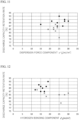
- FIGs. 1 to 4 are plots of a number of cracks in the electrode active material layer with respect to the surface free energy ⁇ B of the electrode binder (B) and its components ⁇ d B , ⁇ p B and ⁇ h B according to the examples and the comparative examples of the present invention.
- ⁇ B of the electrode binder (B) the surface free energy of the electrode binder (B) and its components ⁇ d B , ⁇ p B and ⁇ h B according to the examples and the comparative examples of the present invention.
- an example is shown by • and a comparative example is shown by x.
- FIGs. 5 to 8 are plots of the values of the peeling strength of the electrode active material layer with respect to the surface free energy ⁇ B of the electrode binder (B) and its components ⁇ d B , ⁇ p B and ⁇ h B according to the examples and the comparative examples of the present invention.
- an example is shown by • and a comparative example is shown by x.
- the electrode active material layer with a high peeling strength can be formed by the electrode binder (B).
- FIGs. 9 to 12 are plots of the values of the discharge capacity retention rate of the battery with respect to the surface free energy ⁇ B of the electrode binder (B) and its components ⁇ d B , ⁇ p B , ⁇ h B according to the examples and the comparative examples of the present invention.
- an example is shown by • and a comparative example is shown by x.
- Comparative Examples 6 and 7 since it was impossible to measure the discharge capacity retention rates, plots corresponding to these Comparative Examples are not shown in FIGs. 9 to 12 .
- the electrode binder (B) when the surface free energy ⁇ B of the electrode binder (B) is 70 mJ/m 2 or less and the dipole component ⁇ p B of the surface free energy is 26 mJ/m 2 or less, the electrode binder (B) provides a battery having a high discharge capacity retention rate.
- FIGs. 13 to 16 is a plot of the values of the DCR of the battery with respect to the surface free energy ⁇ B of the electrode binder (B) and its components ⁇ d B , ⁇ p B , ⁇ h B according to the examples and the comparative examples of the present invention.
- an example is shown by • and a comparative example is shown by x.
- the surface free energy ⁇ B of the electrode binder (B) is 70 mJ/m 2 or less, and the dipole component ⁇ p B of the surface free energy is 26 mJ/m 2 or less.
- the electrode binder for a nonaqueous secondary battery (B) of the present invention it is possible to obtain a secondary battery which has an electrode active material layer having few cracks and a high peeling strength to the current collector, and which has a low internal resistance and a good cycle characteristic.
Landscapes
- Chemical & Material Sciences (AREA)
- Chemical Kinetics & Catalysis (AREA)
- Electrochemistry (AREA)
- General Chemical & Material Sciences (AREA)
- Engineering & Computer Science (AREA)
- Manufacturing & Machinery (AREA)
- Materials Engineering (AREA)
- Inorganic Chemistry (AREA)
- Medicinal Chemistry (AREA)
- Health & Medical Sciences (AREA)
- Polymers & Plastics (AREA)
- Organic Chemistry (AREA)
- Composite Materials (AREA)
- General Physics & Mathematics (AREA)
- Condensed Matter Physics & Semiconductors (AREA)
- Physics & Mathematics (AREA)
- Battery Electrode And Active Subsutance (AREA)
- Secondary Cells (AREA)
- Addition Polymer Or Copolymer, Post-Treatments, Or Chemical Modifications (AREA)
Claims (11)
- Liant d'électrode pour une batterie secondaire non aqueuse, qui est soluble dans l'eau et comprend un composant de résine et un polyoxyéthylène alkyl éther en tant que tensioactif,dans lequel une énergie libre superficielle γB à 23 °C est de 70 mJ/m2 ou moins ;une composante dipolaire γp B de l'énergie libre superficielle est de 26 mJ/m2 ou moins ;le composant de résine comprendun copolymère de composés présentant une liaison éthyléniquement insaturée choisis dans le groupe constitué de l'acide (méth)acrylique, d'un sel d'acide (méth)acrylique, d'un styrène, d'un divinylbenzène, d'un butadiène, d'un N-vinylacétamide, d'un N-vinylformamide, d'un alcool vinylique et d'un acétate de vinyle, etun dispersant choisi dans le groupe constitué de la carboxyméthyl cellulose et de ses sels de métal ; etdans lequel l'énergie libre superficielle γB et la composante dipolaire γp B de l'énergie libre superficielle sont déterminées tel que divulgué dans la section « 1-2-2-2 Procédé de détermination de l'énergie libre superficielle » de la description.
- Liant d'électrode pour une batterie secondaire non aqueuse selon la revendication 1, dans lequel l'énergie libre superficielle γB est de 66 mJ/m2 ou moins.
- Liant d'électrode pour une batterie secondaire non aqueuse selon la revendication 1 ou 2, dans lequel la composante dipolaire γp B de l'énergie libre superficielle est de 22 mJ/m2 ou moins.
- Liant d'électrode pour une batterie secondaire non aqueuse selon l'une quelconque des revendications 1 à 3, dans lequel une composante de liaison hydrogène γh B de l'énergie libre superficielle est de 24 mJ/m2 ou moins, dans lequel la composante de liaison hydrogène γh B de l'énergie libre superficielle est déterminée tel que divulgué dans la section « 1-2-2-2 Procédé de détermination de l'énergie libre superficielle » de la description.
- Électrode pour batterie secondaire non aqueuse, comprenant un collecteur de courant et une couche de matériau actif d'électrode,dans laquelle la couche de matériau actif d'électrode comprend un liant d'électrode pour une batterie secondaire non aqueuse selon l'une quelconque des revendications 1 à 4, et un matériau actif d'électrode ; etla couche de matériau actif d'électrode est formée sur le collecteur de courant.
- Électrode pour batterie secondaire non aqueuse selon la revendication 5,
dans laquelle la couche de matériau actif d'électrode comprend 85 % en masse ou plus et 99 % en masse ou moins du matériau actif d'électrode. - Électrode pour batterie secondaire non aqueuse selon la revendication 5 ou 6, dans laquelle le matériau actif d'électrode comprend un matériau contenant un élément de Si et un matériau carboné.
- Électrode pour batterie secondaire non aqueuse selon l'une quelconque des revendications 5 à 7, dans laquelle une résistance au décollement de la couche de matériau actif d'électrode par rapport au collecteur de courant est de 30 mN/mm ou plus.
- Batterie secondaire non aqueuse, qui comprend l'électrode pour batterie secondaire non aqueuse selon l'une quelconque des revendications 5 à 8,
dans laquelle la batterie secondaire non aqueuse utilise un ion de métal alcalin en tant que porteur de charge. - Batterie secondaire non aqueuse selon la revendication 9, comprenant
une solution de solvant organique d'un sel de métal alcalin, en tant que solution d'électrolyte. - Batterie secondaire non aqueuse selon la revendication 10, dans laquelle le solvant organique de la solution d'électrolyte comprend au moins un type choisi dans le groupe constitué d'un composé carbonate, d'un composé nitrile et d'un ester d'acide carboxylique.
Applications Claiming Priority (2)
| Application Number | Priority Date | Filing Date | Title |
|---|---|---|---|
| JP2019233083 | 2019-12-24 | ||
| PCT/JP2020/039678 WO2021131279A1 (fr) | 2019-12-24 | 2020-10-22 | Liant d'électrode de batterie secondaire non aqueuse et électrode de batterie secondaire non aqueuse |
Publications (3)
| Publication Number | Publication Date |
|---|---|
| EP3876319A1 EP3876319A1 (fr) | 2021-09-08 |
| EP3876319A4 EP3876319A4 (fr) | 2022-01-05 |
| EP3876319B1 true EP3876319B1 (fr) | 2023-12-06 |
Family
ID=76217620
Family Applications (1)
| Application Number | Title | Priority Date | Filing Date |
|---|---|---|---|
| EP20866911.9A Active EP3876319B1 (fr) | 2019-12-24 | 2020-10-22 | Liant d'électrode de batterie secondaire non aqueuse et électrode de batterie secondaire non aqueuse |
Country Status (7)
| Country | Link |
|---|---|
| US (1) | US12362363B2 (fr) |
| EP (1) | EP3876319B1 (fr) |
| JP (2) | JP6915190B1 (fr) |
| KR (1) | KR102316285B1 (fr) |
| CN (1) | CN112805856B (fr) |
| TW (1) | TWI841798B (fr) |
| WO (1) | WO2021131279A1 (fr) |
Family Cites Families (14)
| Publication number | Priority date | Publication date | Assignee | Title |
|---|---|---|---|---|
| JPH11219708A (ja) * | 1998-02-02 | 1999-08-10 | Masaru Sugita | 電池構成材料の評価方法とその方法により選定された電池材料 |
| JP2002117860A (ja) | 2000-10-11 | 2002-04-19 | Matsushita Electric Ind Co Ltd | 電極およびリチウム二次電池 |
| JP2009170287A (ja) * | 2008-01-17 | 2009-07-30 | Mitsubishi Chemicals Corp | 非水系電解液二次電池用電極及びそれを用いた非水系電解液二次電池 |
| US8956688B2 (en) * | 2011-10-12 | 2015-02-17 | Ut-Battelle, Llc | Aqueous processing of composite lithium ion electrode material |
| JP5899945B2 (ja) | 2012-01-17 | 2016-04-06 | 三菱レイヨン株式会社 | 二次電池用正極スラリーの製造方法、二次電池用正極の製造方法、およびリチウムイオン二次電池の製造方法 |
| PL2908364T3 (pl) * | 2012-10-10 | 2018-08-31 | Zeon Corporation | Sposób wytwarzania elektrody dodatniej dla akumulatora elektrycznego, akumulator elektryczny i sposób wytwarzania zespołu w postaci stosu dla akumulatora elektrycznego |
| JP6167723B2 (ja) | 2013-07-24 | 2017-07-26 | 東洋インキScホールディングス株式会社 | 二次電池電極形成用合材インキ |
| WO2015146649A1 (fr) * | 2014-03-24 | 2015-10-01 | 昭和電工株式会社 | Suspension pour électrode positive d'accumulateur électrique au lithium-ion, électrode positive obtenue en utilisant ladite suspension, procédé de fabrication de ladite électrode positive, accumulateur électrique au lithium-ion formé en utilisant ladite électrode positive, et procédé de fabrication dudit accumulateur |
| US20180013131A1 (en) * | 2015-01-27 | 2018-01-11 | Sanyo Electric Co., Ltd. | Negative electrode plate for nonaqueous electrolyte secondary battery and nonaqueous electrolyte secondary battery including negative electrode plate |
| CN105504169B (zh) * | 2016-01-07 | 2018-05-01 | 上海交通大学 | 一种用于锂离子电池的粘结剂 |
| JP6153635B1 (ja) | 2016-01-28 | 2017-06-28 | 日東電工株式会社 | 粘着シート |
| EP3425708A4 (fr) * | 2016-03-04 | 2019-11-20 | Showa Denko K.K. | Copolymères pour liants pour électrodes d'accumulateur à électrolyte non aqueux, suspension épaisse pour électrodes d'accumulateur à électrolyte non aqueux, électrode d'accumulateur à électrolyte non aqueux, et accumulateur à électrolyte non aqueux |
| US20190379053A1 (en) | 2016-12-20 | 2019-12-12 | Solvay Specialty Polymers Italy S.P.A. | Aqueous electrode binders for lithium ion batteries |
| JP6756801B2 (ja) | 2018-11-20 | 2020-09-16 | スズキ株式会社 | 車両のルーフサイドメンバ |
-
2020
- 2020-10-22 WO PCT/JP2020/039678 patent/WO2021131279A1/fr not_active Ceased
- 2020-10-22 KR KR1020217008377A patent/KR102316285B1/ko active Active
- 2020-10-22 CN CN202080005272.4A patent/CN112805856B/zh active Active
- 2020-10-22 EP EP20866911.9A patent/EP3876319B1/fr active Active
- 2020-10-22 JP JP2021510246A patent/JP6915190B1/ja active Active
- 2020-10-22 US US17/777,509 patent/US12362363B2/en active Active
- 2020-10-23 TW TW109136809A patent/TWI841798B/zh active
-
2021
- 2021-07-13 JP JP2021115745A patent/JP7608991B2/ja active Active
Also Published As
| Publication number | Publication date |
|---|---|
| EP3876319A1 (fr) | 2021-09-08 |
| TW202125891A (zh) | 2021-07-01 |
| KR20210084434A (ko) | 2021-07-07 |
| EP3876319A4 (fr) | 2022-01-05 |
| TWI841798B (zh) | 2024-05-11 |
| JP7608991B2 (ja) | 2025-01-07 |
| WO2021131279A1 (fr) | 2021-07-01 |
| US20230357469A1 (en) | 2023-11-09 |
| US12362363B2 (en) | 2025-07-15 |
| JPWO2021131279A1 (ja) | 2021-12-23 |
| JP6915190B1 (ja) | 2021-08-04 |
| CN112805856B (zh) | 2023-02-17 |
| JP2021166199A (ja) | 2021-10-14 |
| KR102316285B1 (ko) | 2021-10-21 |
| CN112805856A (zh) | 2021-05-14 |
Similar Documents
| Publication | Publication Date | Title |
|---|---|---|
| EP3859827B1 (fr) | Batterie secondaire et appareil comprenant la batterie secondaire | |
| EP4075538B1 (fr) | Batterie secondaire et son procédé de préparation, et module de batterie, bloc-batterie et appareil contenant la batterie secondaire | |
| JP3652769B2 (ja) | 非水電解液二次電池用電極板 | |
| EP3831859B1 (fr) | Copolymère pour liant d'électrode et batterie secondaire au lithium-ion | |
| KR20090109649A (ko) | 폴리아크릴로니트릴-아크릴산 공중합체 및 바인더를 포함한음극 재료 조성물, 그 제조방법 및 그 음극 재료 조성물을포함하는 리튬 이차 전지 | |
| JP7106762B2 (ja) | 正極シート及びその製造方法、並びにリチウムイオン二次電池 | |
| EP4163310B1 (fr) | Liant pour électrode de batterie rechargeable non aqueuse et suspension d'électrode de batterie rechargeable non aqueuse | |
| EP3866225A1 (fr) | Anode et batterie secondaire au lithium la comprenant | |
| WO2022110041A1 (fr) | Dispositif électrochimique et dispositif électronique | |
| CN116157945A (zh) | 一种二次电池及包含该电池的装置 | |
| EP3872906B1 (fr) | Électrode de batterie secondaire non aqueuse, pâte d'électrode et batterie secondaire non aqueuse | |
| JP2017152122A (ja) | リチウムイオン二次電池用負極活物質、リチウムイオン二次電池用負極およびリチウムイオン二次電池 | |
| KR20190080697A (ko) | 이차전지용 바인더, 이차전지용 바인더 수지 조성물, 이차전지용 전극, 및 이차전지 | |
| EP3825337B1 (fr) | Copolymère destiné à un liant pour une électrode de batterie non aqueuse, et suspension pour la production d'une électrode de batterie non aqueuse | |
| EP4002546A1 (fr) | Système de batterie, son procédé d'utilisation, et bloc-batterie le comprenant | |
| JP2006107753A (ja) | 正極活物質層用塗工組成物、非水電解液二次電池用正極板、及び非水電解液二次電池 | |
| JP4834975B2 (ja) | 活物質層用塗工組成物、非水電解液二次電池用電極板、及び非水電解液二次電池 | |
| EP3876319B1 (fr) | Liant d'électrode de batterie secondaire non aqueuse et électrode de batterie secondaire non aqueuse | |
| EP4645473A1 (fr) | Composition de liant pour électrode négative de batterie secondaire non aqueuse et électrode négative de batterie secondaire non aqueuse | |
| JP7349580B2 (ja) | リチウムイオン電池及び電子装置 | |
| KR102879045B1 (ko) | 전기화학소자용 전극, 그 제조방법 및 이를 포함하는 전기화학소자 | |
| JP2021039918A (ja) | 非水系二次電池用電極の製造方法 |
Legal Events
| Date | Code | Title | Description |
|---|---|---|---|
| STAA | Information on the status of an ep patent application or granted ep patent |
Free format text: STATUS: UNKNOWN |
|
| STAA | Information on the status of an ep patent application or granted ep patent |
Free format text: STATUS: THE INTERNATIONAL PUBLICATION HAS BEEN MADE |
|
| PUAI | Public reference made under article 153(3) epc to a published international application that has entered the european phase |
Free format text: ORIGINAL CODE: 0009012 |
|
| STAA | Information on the status of an ep patent application or granted ep patent |
Free format text: STATUS: REQUEST FOR EXAMINATION WAS MADE |
|
| 17P | Request for examination filed |
Effective date: 20210507 |
|
| AK | Designated contracting states |
Kind code of ref document: A1 Designated state(s): AL AT BE BG CH CY CZ DE DK EE ES FI FR GB GR HR HU IE IS IT LI LT LU LV MC MK MT NL NO PL PT RO RS SE SI SK SM TR |
|
| A4 | Supplementary search report drawn up and despatched |
Effective date: 20211203 |
|
| RIC1 | Information provided on ipc code assigned before grant |
Ipc: H01M 4/02 20060101ALN20211129BHEP Ipc: C08L 101/12 20060101ALI20211129BHEP Ipc: H01M 10/0525 20100101ALI20211129BHEP Ipc: H01M 4/134 20100101ALI20211129BHEP Ipc: H01M 4/133 20100101ALI20211129BHEP Ipc: H01M 10/0569 20100101ALI20211129BHEP Ipc: H01M 4/587 20100101ALI20211129BHEP Ipc: H01M 4/48 20100101ALI20211129BHEP Ipc: H01M 4/38 20060101ALI20211129BHEP Ipc: C08L 101/00 20060101ALI20211129BHEP Ipc: H01M 4/62 20060101AFI20211129BHEP |
|
| STAA | Information on the status of an ep patent application or granted ep patent |
Free format text: STATUS: EXAMINATION IS IN PROGRESS |
|
| 17Q | First examination report despatched |
Effective date: 20220929 |
|
| DAV | Request for validation of the european patent (deleted) | ||
| DAX | Request for extension of the european patent (deleted) | ||
| RAP1 | Party data changed (applicant data changed or rights of an application transferred) |
Owner name: RESONAC CORPORATION |
|
| GRAP | Despatch of communication of intention to grant a patent |
Free format text: ORIGINAL CODE: EPIDOSNIGR1 |
|
| STAA | Information on the status of an ep patent application or granted ep patent |
Free format text: STATUS: GRANT OF PATENT IS INTENDED |
|
| RIC1 | Information provided on ipc code assigned before grant |
Ipc: H01M 4/02 20060101ALN20230609BHEP Ipc: H01M 4/139 20100101ALI20230609BHEP Ipc: H01M 4/13 20100101ALI20230609BHEP Ipc: H01M 4/04 20060101ALI20230609BHEP Ipc: C08L 101/12 20060101ALI20230609BHEP Ipc: H01M 10/0525 20100101ALI20230609BHEP Ipc: H01M 4/134 20100101ALI20230609BHEP Ipc: H01M 4/133 20100101ALI20230609BHEP Ipc: H01M 10/0569 20100101ALI20230609BHEP Ipc: H01M 4/587 20100101ALI20230609BHEP Ipc: H01M 4/48 20100101ALI20230609BHEP Ipc: H01M 4/38 20060101ALI20230609BHEP Ipc: C08L 101/00 20060101ALI20230609BHEP Ipc: H01M 4/62 20060101AFI20230609BHEP |
|
| INTG | Intention to grant announced |
Effective date: 20230704 |
|
| GRAS | Grant fee paid |
Free format text: ORIGINAL CODE: EPIDOSNIGR3 |
|
| GRAA | (expected) grant |
Free format text: ORIGINAL CODE: 0009210 |
|
| STAA | Information on the status of an ep patent application or granted ep patent |
Free format text: STATUS: THE PATENT HAS BEEN GRANTED |
|
| AK | Designated contracting states |
Kind code of ref document: B1 Designated state(s): AL AT BE BG CH CY CZ DE DK EE ES FI FR GB GR HR HU IE IS IT LI LT LU LV MC MK MT NL NO PL PT RO RS SE SI SK SM TR |
|
| REG | Reference to a national code |
Ref country code: GB Ref legal event code: FG4D |
|
| REG | Reference to a national code |
Ref country code: CH Ref legal event code: EP |
|
| REG | Reference to a national code |
Ref country code: DE Ref legal event code: R096 Ref document number: 602020022477 Country of ref document: DE |
|
| REG | Reference to a national code |
Ref country code: IE Ref legal event code: FG4D |
|
| REG | Reference to a national code |
Ref country code: SE Ref legal event code: TRGR |
|
| RAP4 | Party data changed (patent owner data changed or rights of a patent transferred) |
Owner name: RESONAC CORPORATION |
|
| REG | Reference to a national code |
Ref country code: LT Ref legal event code: MG9D |
|
| PG25 | Lapsed in a contracting state [announced via postgrant information from national office to epo] |
Ref country code: GR Free format text: LAPSE BECAUSE OF FAILURE TO SUBMIT A TRANSLATION OF THE DESCRIPTION OR TO PAY THE FEE WITHIN THE PRESCRIBED TIME-LIMIT Effective date: 20240307 |
|
| REG | Reference to a national code |
Ref country code: NL Ref legal event code: MP Effective date: 20231206 |
|
| PG25 | Lapsed in a contracting state [announced via postgrant information from national office to epo] |
Ref country code: LT Free format text: LAPSE BECAUSE OF FAILURE TO SUBMIT A TRANSLATION OF THE DESCRIPTION OR TO PAY THE FEE WITHIN THE PRESCRIBED TIME-LIMIT Effective date: 20231206 |
|
| REG | Reference to a national code |
Ref country code: SK Ref legal event code: T3 Ref document number: E 43628 Country of ref document: SK |
|
| PG25 | Lapsed in a contracting state [announced via postgrant information from national office to epo] |
Ref country code: ES Free format text: LAPSE BECAUSE OF FAILURE TO SUBMIT A TRANSLATION OF THE DESCRIPTION OR TO PAY THE FEE WITHIN THE PRESCRIBED TIME-LIMIT Effective date: 20231206 |
|
| PG25 | Lapsed in a contracting state [announced via postgrant information from national office to epo] |
Ref country code: LT Free format text: LAPSE BECAUSE OF FAILURE TO SUBMIT A TRANSLATION OF THE DESCRIPTION OR TO PAY THE FEE WITHIN THE PRESCRIBED TIME-LIMIT Effective date: 20231206 Ref country code: GR Free format text: LAPSE BECAUSE OF FAILURE TO SUBMIT A TRANSLATION OF THE DESCRIPTION OR TO PAY THE FEE WITHIN THE PRESCRIBED TIME-LIMIT Effective date: 20240307 Ref country code: ES Free format text: LAPSE BECAUSE OF FAILURE TO SUBMIT A TRANSLATION OF THE DESCRIPTION OR TO PAY THE FEE WITHIN THE PRESCRIBED TIME-LIMIT Effective date: 20231206 Ref country code: BG Free format text: LAPSE BECAUSE OF FAILURE TO SUBMIT A TRANSLATION OF THE DESCRIPTION OR TO PAY THE FEE WITHIN THE PRESCRIBED TIME-LIMIT Effective date: 20240306 |
|
| REG | Reference to a national code |
Ref country code: AT Ref legal event code: MK05 Ref document number: 1639269 Country of ref document: AT Kind code of ref document: T Effective date: 20231206 |
|
| PG25 | Lapsed in a contracting state [announced via postgrant information from national office to epo] |
Ref country code: NL Free format text: LAPSE BECAUSE OF FAILURE TO SUBMIT A TRANSLATION OF THE DESCRIPTION OR TO PAY THE FEE WITHIN THE PRESCRIBED TIME-LIMIT Effective date: 20231206 |
|
| PG25 | Lapsed in a contracting state [announced via postgrant information from national office to epo] |
Ref country code: RS Free format text: LAPSE BECAUSE OF FAILURE TO SUBMIT A TRANSLATION OF THE DESCRIPTION OR TO PAY THE FEE WITHIN THE PRESCRIBED TIME-LIMIT Effective date: 20231206 Ref country code: NO Free format text: LAPSE BECAUSE OF FAILURE TO SUBMIT A TRANSLATION OF THE DESCRIPTION OR TO PAY THE FEE WITHIN THE PRESCRIBED TIME-LIMIT Effective date: 20240306 Ref country code: NL Free format text: LAPSE BECAUSE OF FAILURE TO SUBMIT A TRANSLATION OF THE DESCRIPTION OR TO PAY THE FEE WITHIN THE PRESCRIBED TIME-LIMIT Effective date: 20231206 Ref country code: LV Free format text: LAPSE BECAUSE OF FAILURE TO SUBMIT A TRANSLATION OF THE DESCRIPTION OR TO PAY THE FEE WITHIN THE PRESCRIBED TIME-LIMIT Effective date: 20231206 Ref country code: HR Free format text: LAPSE BECAUSE OF FAILURE TO SUBMIT A TRANSLATION OF THE DESCRIPTION OR TO PAY THE FEE WITHIN THE PRESCRIBED TIME-LIMIT Effective date: 20231206 |
|
| PG25 | Lapsed in a contracting state [announced via postgrant information from national office to epo] |
Ref country code: IS Free format text: LAPSE BECAUSE OF FAILURE TO SUBMIT A TRANSLATION OF THE DESCRIPTION OR TO PAY THE FEE WITHIN THE PRESCRIBED TIME-LIMIT Effective date: 20240406 |
|
| PG25 | Lapsed in a contracting state [announced via postgrant information from national office to epo] |
Ref country code: CZ Free format text: LAPSE BECAUSE OF FAILURE TO SUBMIT A TRANSLATION OF THE DESCRIPTION OR TO PAY THE FEE WITHIN THE PRESCRIBED TIME-LIMIT Effective date: 20231206 Ref country code: AT Free format text: LAPSE BECAUSE OF FAILURE TO SUBMIT A TRANSLATION OF THE DESCRIPTION OR TO PAY THE FEE WITHIN THE PRESCRIBED TIME-LIMIT Effective date: 20231206 |
|
| PG25 | Lapsed in a contracting state [announced via postgrant information from national office to epo] |
Ref country code: SM Free format text: LAPSE BECAUSE OF FAILURE TO SUBMIT A TRANSLATION OF THE DESCRIPTION OR TO PAY THE FEE WITHIN THE PRESCRIBED TIME-LIMIT Effective date: 20231206 Ref country code: RO Free format text: LAPSE BECAUSE OF FAILURE TO SUBMIT A TRANSLATION OF THE DESCRIPTION OR TO PAY THE FEE WITHIN THE PRESCRIBED TIME-LIMIT Effective date: 20231206 Ref country code: IT Free format text: LAPSE BECAUSE OF FAILURE TO SUBMIT A TRANSLATION OF THE DESCRIPTION OR TO PAY THE FEE WITHIN THE PRESCRIBED TIME-LIMIT Effective date: 20231206 Ref country code: IS Free format text: LAPSE BECAUSE OF FAILURE TO SUBMIT A TRANSLATION OF THE DESCRIPTION OR TO PAY THE FEE WITHIN THE PRESCRIBED TIME-LIMIT Effective date: 20240406 Ref country code: EE Free format text: LAPSE BECAUSE OF FAILURE TO SUBMIT A TRANSLATION OF THE DESCRIPTION OR TO PAY THE FEE WITHIN THE PRESCRIBED TIME-LIMIT Effective date: 20231206 Ref country code: CZ Free format text: LAPSE BECAUSE OF FAILURE TO SUBMIT A TRANSLATION OF THE DESCRIPTION OR TO PAY THE FEE WITHIN THE PRESCRIBED TIME-LIMIT Effective date: 20231206 Ref country code: AT Free format text: LAPSE BECAUSE OF FAILURE TO SUBMIT A TRANSLATION OF THE DESCRIPTION OR TO PAY THE FEE WITHIN THE PRESCRIBED TIME-LIMIT Effective date: 20231206 |
|
| PG25 | Lapsed in a contracting state [announced via postgrant information from national office to epo] |
Ref country code: PL Free format text: LAPSE BECAUSE OF FAILURE TO SUBMIT A TRANSLATION OF THE DESCRIPTION OR TO PAY THE FEE WITHIN THE PRESCRIBED TIME-LIMIT Effective date: 20231206 Ref country code: PT Free format text: LAPSE BECAUSE OF FAILURE TO SUBMIT A TRANSLATION OF THE DESCRIPTION OR TO PAY THE FEE WITHIN THE PRESCRIBED TIME-LIMIT Effective date: 20240408 |
|
| PG25 | Lapsed in a contracting state [announced via postgrant information from national office to epo] |
Ref country code: PT Free format text: LAPSE BECAUSE OF FAILURE TO SUBMIT A TRANSLATION OF THE DESCRIPTION OR TO PAY THE FEE WITHIN THE PRESCRIBED TIME-LIMIT Effective date: 20240408 Ref country code: PL Free format text: LAPSE BECAUSE OF FAILURE TO SUBMIT A TRANSLATION OF THE DESCRIPTION OR TO PAY THE FEE WITHIN THE PRESCRIBED TIME-LIMIT Effective date: 20231206 |
|
| REG | Reference to a national code |
Ref country code: DE Ref legal event code: R097 Ref document number: 602020022477 Country of ref document: DE |
|
| PG25 | Lapsed in a contracting state [announced via postgrant information from national office to epo] |
Ref country code: DK Free format text: LAPSE BECAUSE OF FAILURE TO SUBMIT A TRANSLATION OF THE DESCRIPTION OR TO PAY THE FEE WITHIN THE PRESCRIBED TIME-LIMIT Effective date: 20231206 |
|
| PLBE | No opposition filed within time limit |
Free format text: ORIGINAL CODE: 0009261 |
|
| STAA | Information on the status of an ep patent application or granted ep patent |
Free format text: STATUS: NO OPPOSITION FILED WITHIN TIME LIMIT |
|
| PG25 | Lapsed in a contracting state [announced via postgrant information from national office to epo] |
Ref country code: SI Free format text: LAPSE BECAUSE OF FAILURE TO SUBMIT A TRANSLATION OF THE DESCRIPTION OR TO PAY THE FEE WITHIN THE PRESCRIBED TIME-LIMIT Effective date: 20231206 |
|
| PG25 | Lapsed in a contracting state [announced via postgrant information from national office to epo] |
Ref country code: SI Free format text: LAPSE BECAUSE OF FAILURE TO SUBMIT A TRANSLATION OF THE DESCRIPTION OR TO PAY THE FEE WITHIN THE PRESCRIBED TIME-LIMIT Effective date: 20231206 Ref country code: DK Free format text: LAPSE BECAUSE OF FAILURE TO SUBMIT A TRANSLATION OF THE DESCRIPTION OR TO PAY THE FEE WITHIN THE PRESCRIBED TIME-LIMIT Effective date: 20231206 |
|
| 26N | No opposition filed |
Effective date: 20240909 |
|
| REG | Reference to a national code |
Ref country code: CH Ref legal event code: PL |
|
| GBPC | Gb: european patent ceased through non-payment of renewal fee |
Effective date: 20241022 |
|
| PG25 | Lapsed in a contracting state [announced via postgrant information from national office to epo] |
Ref country code: MC Free format text: LAPSE BECAUSE OF FAILURE TO SUBMIT A TRANSLATION OF THE DESCRIPTION OR TO PAY THE FEE WITHIN THE PRESCRIBED TIME-LIMIT Effective date: 20231206 |
|
| PG25 | Lapsed in a contracting state [announced via postgrant information from national office to epo] |
Ref country code: GB Free format text: LAPSE BECAUSE OF NON-PAYMENT OF DUE FEES Effective date: 20241022 |
|
| PG25 | Lapsed in a contracting state [announced via postgrant information from national office to epo] |
Ref country code: LU Free format text: LAPSE BECAUSE OF NON-PAYMENT OF DUE FEES Effective date: 20241022 Ref country code: BE Free format text: LAPSE BECAUSE OF NON-PAYMENT OF DUE FEES Effective date: 20241031 |
|
| PG25 | Lapsed in a contracting state [announced via postgrant information from national office to epo] |
Ref country code: CH Free format text: LAPSE BECAUSE OF NON-PAYMENT OF DUE FEES Effective date: 20241031 |
|
| REG | Reference to a national code |
Ref country code: BE Ref legal event code: MM Effective date: 20241031 |
|
| PG25 | Lapsed in a contracting state [announced via postgrant information from national office to epo] |
Ref country code: FI Free format text: LAPSE BECAUSE OF FAILURE TO SUBMIT A TRANSLATION OF THE DESCRIPTION OR TO PAY THE FEE WITHIN THE PRESCRIBED TIME-LIMIT Effective date: 20231207 |
|
| PGFP | Annual fee paid to national office [announced via postgrant information from national office to epo] |
Ref country code: FR Payment date: 20250908 Year of fee payment: 6 |
|
| PGFP | Annual fee paid to national office [announced via postgrant information from national office to epo] |
Ref country code: SE Payment date: 20250910 Year of fee payment: 6 |
|
| PG25 | Lapsed in a contracting state [announced via postgrant information from national office to epo] |
Ref country code: IE Free format text: LAPSE BECAUSE OF NON-PAYMENT OF DUE FEES Effective date: 20241022 |
|
| PGFP | Annual fee paid to national office [announced via postgrant information from national office to epo] |
Ref country code: SK Payment date: 20250912 Year of fee payment: 6 |
|
| PGFP | Annual fee paid to national office [announced via postgrant information from national office to epo] |
Ref country code: DE Payment date: 20250902 Year of fee payment: 6 |
|
| PG25 | Lapsed in a contracting state [announced via postgrant information from national office to epo] |
Ref country code: CY Free format text: LAPSE BECAUSE OF FAILURE TO SUBMIT A TRANSLATION OF THE DESCRIPTION OR TO PAY THE FEE WITHIN THE PRESCRIBED TIME-LIMIT; INVALID AB INITIO Effective date: 20201022 |
|
| PG25 | Lapsed in a contracting state [announced via postgrant information from national office to epo] |
Ref country code: HU Free format text: LAPSE BECAUSE OF FAILURE TO SUBMIT A TRANSLATION OF THE DESCRIPTION OR TO PAY THE FEE WITHIN THE PRESCRIBED TIME-LIMIT; INVALID AB INITIO Effective date: 20201022 |