EP3877438B1 - Verfahren zur herstellung von silanmodifizierten polymeren - Google Patents
Verfahren zur herstellung von silanmodifizierten polymeren Download PDFInfo
- Publication number
- EP3877438B1 EP3877438B1 EP19797739.0A EP19797739A EP3877438B1 EP 3877438 B1 EP3877438 B1 EP 3877438B1 EP 19797739 A EP19797739 A EP 19797739A EP 3877438 B1 EP3877438 B1 EP 3877438B1
- Authority
- EP
- European Patent Office
- Prior art keywords
- group
- polymer
- polymer backbone
- formula
- terminated
- Prior art date
- Legal status (The legal status is an assumption and is not a legal conclusion. Google has not performed a legal analysis and makes no representation as to the accuracy of the status listed.)
- Active
Links
Classifications
-
- C—CHEMISTRY; METALLURGY
- C08—ORGANIC MACROMOLECULAR COMPOUNDS; THEIR PREPARATION OR CHEMICAL WORKING-UP; COMPOSITIONS BASED THEREON
- C08G—MACROMOLECULAR COMPOUNDS OBTAINED OTHERWISE THAN BY REACTIONS ONLY INVOLVING UNSATURATED CARBON-TO-CARBON BONDS
- C08G18/00—Polymeric products of isocyanates or isothiocyanates
- C08G18/06—Polymeric products of isocyanates or isothiocyanates with compounds having active hydrogen
- C08G18/28—Polymeric products of isocyanates or isothiocyanates with compounds having active hydrogen characterised by the compounds used containing active hydrogen
- C08G18/40—High-molecular-weight compounds
- C08G18/48—Polyethers
- C08G18/50—Polyethers having heteroatoms other than oxygen
- C08G18/5096—Polyethers having heteroatoms other than oxygen containing silicon
-
- C—CHEMISTRY; METALLURGY
- C08—ORGANIC MACROMOLECULAR COMPOUNDS; THEIR PREPARATION OR CHEMICAL WORKING-UP; COMPOSITIONS BASED THEREON
- C08G—MACROMOLECULAR COMPOUNDS OBTAINED OTHERWISE THAN BY REACTIONS ONLY INVOLVING UNSATURATED CARBON-TO-CARBON BONDS
- C08G65/00—Macromolecular compounds obtained by reactions forming an ether link in the main chain of the macromolecule
- C08G65/02—Macromolecular compounds obtained by reactions forming an ether link in the main chain of the macromolecule from cyclic ethers by opening of the heterocyclic ring
- C08G65/32—Polymers modified by chemical after-treatment
- C08G65/329—Polymers modified by chemical after-treatment with organic compounds
- C08G65/336—Polymers modified by chemical after-treatment with organic compounds containing silicon
-
- C—CHEMISTRY; METALLURGY
- C08—ORGANIC MACROMOLECULAR COMPOUNDS; THEIR PREPARATION OR CHEMICAL WORKING-UP; COMPOSITIONS BASED THEREON
- C08G—MACROMOLECULAR COMPOUNDS OBTAINED OTHERWISE THAN BY REACTIONS ONLY INVOLVING UNSATURATED CARBON-TO-CARBON BONDS
- C08G18/00—Polymeric products of isocyanates or isothiocyanates
- C08G18/06—Polymeric products of isocyanates or isothiocyanates with compounds having active hydrogen
- C08G18/28—Polymeric products of isocyanates or isothiocyanates with compounds having active hydrogen characterised by the compounds used containing active hydrogen
- C08G18/40—High-molecular-weight compounds
- C08G18/42—Polycondensates having carboxylic or carbonic ester groups in the main chain
- C08G18/46—Polycondensates having carboxylic or carbonic ester groups in the main chain having heteroatoms other than oxygen
-
- C—CHEMISTRY; METALLURGY
- C08—ORGANIC MACROMOLECULAR COMPOUNDS; THEIR PREPARATION OR CHEMICAL WORKING-UP; COMPOSITIONS BASED THEREON
- C08G—MACROMOLECULAR COMPOUNDS OBTAINED OTHERWISE THAN BY REACTIONS ONLY INVOLVING UNSATURATED CARBON-TO-CARBON BONDS
- C08G63/00—Macromolecular compounds obtained by reactions forming a carboxylic ester link in the main chain of the macromolecule
- C08G63/68—Polyesters containing atoms other than carbon, hydrogen and oxygen
- C08G63/685—Polyesters containing atoms other than carbon, hydrogen and oxygen containing nitrogen
- C08G63/6854—Polyesters containing atoms other than carbon, hydrogen and oxygen containing nitrogen derived from polycarboxylic acids and polyhydroxy compounds
- C08G63/6856—Dicarboxylic acids and dihydroxy compounds
-
- C—CHEMISTRY; METALLURGY
- C08—ORGANIC MACROMOLECULAR COMPOUNDS; THEIR PREPARATION OR CHEMICAL WORKING-UP; COMPOSITIONS BASED THEREON
- C08G—MACROMOLECULAR COMPOUNDS OBTAINED OTHERWISE THAN BY REACTIONS ONLY INVOLVING UNSATURATED CARBON-TO-CARBON BONDS
- C08G63/00—Macromolecular compounds obtained by reactions forming a carboxylic ester link in the main chain of the macromolecule
- C08G63/68—Polyesters containing atoms other than carbon, hydrogen and oxygen
- C08G63/695—Polyesters containing atoms other than carbon, hydrogen and oxygen containing silicon
- C08G63/6954—Polyesters containing atoms other than carbon, hydrogen and oxygen containing silicon derived from polxycarboxylic acids and polyhydroxy compounds
- C08G63/6956—Dicarboxylic acids and dihydroxy compounds
-
- C—CHEMISTRY; METALLURGY
- C08—ORGANIC MACROMOLECULAR COMPOUNDS; THEIR PREPARATION OR CHEMICAL WORKING-UP; COMPOSITIONS BASED THEREON
- C08G—MACROMOLECULAR COMPOUNDS OBTAINED OTHERWISE THAN BY REACTIONS ONLY INVOLVING UNSATURATED CARBON-TO-CARBON BONDS
- C08G63/00—Macromolecular compounds obtained by reactions forming a carboxylic ester link in the main chain of the macromolecule
- C08G63/91—Polymers modified by chemical after-treatment
- C08G63/914—Polymers modified by chemical after-treatment derived from polycarboxylic acids and polyhydroxy compounds
- C08G63/916—Dicarboxylic acids and dihydroxy compounds
-
- C—CHEMISTRY; METALLURGY
- C08—ORGANIC MACROMOLECULAR COMPOUNDS; THEIR PREPARATION OR CHEMICAL WORKING-UP; COMPOSITIONS BASED THEREON
- C08G—MACROMOLECULAR COMPOUNDS OBTAINED OTHERWISE THAN BY REACTIONS ONLY INVOLVING UNSATURATED CARBON-TO-CARBON BONDS
- C08G71/00—Macromolecular compounds obtained by reactions forming a ureide or urethane link, otherwise, than from isocyanate radicals in the main chain of the macromolecule
- C08G71/04—Polyurethanes
-
- C—CHEMISTRY; METALLURGY
- C09—DYES; PAINTS; POLISHES; NATURAL RESINS; ADHESIVES; COMPOSITIONS NOT OTHERWISE PROVIDED FOR; APPLICATIONS OF MATERIALS NOT OTHERWISE PROVIDED FOR
- C09J—ADHESIVES; NON-MECHANICAL ASPECTS OF ADHESIVE PROCESSES IN GENERAL; ADHESIVE PROCESSES NOT PROVIDED FOR ELSEWHERE; USE OF MATERIALS AS ADHESIVES
- C09J175/00—Adhesives based on polyureas or polyurethanes; Adhesives based on derivatives of such polymers
- C09J175/04—Polyurethanes
Definitions
- the invention relates to a process for preparing an alkoxysilane polymer via a carbamate, thiocarbonate or carbonate terminated prepolymer which can be prepared in high yield.
- Silane-modified polymers have been known to those skilled in the art for some time. Said compounds are generally moisture-reactive polymers and are used in particular in moisture-curing sealants or adhesives.
- silane-modified polymers have in common is that, in addition to an organic polymer backbone (also called “backbone”), they have at least one hydrolyzable silyl group which is bonded to the polymer chain via appropriate binding groups ("coupling groups").
- the polymers are also described by the reaction of an isocyanate group with an isocyanate-reactive group.
- WO 03/018658 describes a method in which a silane having an OH, SH or NHR 3 group with a isocyanate-terminated prepolymer is implemented.
- EP-A-1371670 describes a process in which a vinyl polymer having at least one hydroxyl group is reacted with a compound which, in addition to a silyl group, has a group which can react with the hydroxyl group.
- An isocyanate group is also specifically mentioned in this regard.
- EP-A-2341116 describes a polymeric compound comprising a polymer chain and at least one silyl group bonded to the polymer chain, the polymer chain and the silyl group being linked together by a ⁇ -hydroxyamine group.
- the amine- or epoxy-terminated prepolymers used as starting material for the synthesis of these polymers are only available to a limited extent on a large scale and are relatively expensive.
- the educts are used as additives in polymer compositions, but not as prepolymers for an independent polymer, which severely affects their availability.
- U.S. 2006/0247407 describes a process for preparing compounds having at least one urea group and at least one silyl group, in which a compound having at least one amino group and a carbamate are reacted as reactants, with at least one of the reactants carrying a silyl group.
- WO 2018/042030 describes the use of an organocarbonate-modified prepolymer as starting material for the production of isocyanate-free and isothiocyanate-free alkoxysilane polymers. Disadvantage of this Methods are the low yields of alkyl and aryl terminated prepolymers.
- the process for producing an alkoxysilane polymer according to the present invention involves the production of a carbamate-, thiocarbonate- or carbonate-terminated prepolymer (IIIa) or (IIIb) which can be produced in high yield.
- the alkoxysilane polymer obtained by the process according to the invention has essentially the same viscosity as the amino-, mercapto- or hydroxy-terminated polymer used for the preparation. A possible explanation for this could be that the method according to the invention is preferably carried out at room temperature.
- the alkoxysilane polymer obtained has essentially the same viscosity as the amino-, mercapto- or hydroxy-terminated polymer used for the production.
- Viscosity can be measured with a Haake Rheostress RS6000, for example, which has a 40mm cone/plate measuring system.
- the prepolymer (III) is obtained with high yields of over 75%.
- the reaction can be carried out at room temperature, which is an ecological and economic advantage. Furthermore, no by-products that damage the stability occur.
- the carbamate, thiocarbonate or carbonate terminated prepolymer is prepared by reacting a polymer backbone of formula (I) terminated with at least two amino, mercapto or hydroxyl groups and a chloroformic acid ester of formula (IIa).
- the prepolymer according to the invention obtained in this way can be produced inexpensively and with a high yield.
- the carbamate, thiocarbonate or carbonate terminated prepolymer is obtained by reacting a polymer backbone of formula (I) terminated with at least two amino, mercapto or hydroxyl groups and a pyrocarbonate of formula (IIb).
- the first reaction step of the process according to the invention is preferably carried out in the absence of a first catalyst I.
- a first catalyst I is understood as meaning a catalyst for the first reaction step. This is a compound that only catalyzes the reaction but does not act as an acid scavenger. Amines that serve as acid scavengers do not come under the term first catalyst I, since they primarily serve as acid scavengers. Possible amines which are not first catalysts (I) for the purposes of the present invention are, for example, TEA (triethylamine), other amines or cycloaromatic amines.
- Both reaction steps are preferably carried out in the absence of a catalyst.
- both reaction steps are preferably carried out in the absence of a catalyst.
- the use of a catalyst for the second reaction step can be helpful due to the long reaction time of several days in its absence.
- R 1 in the chloroformic ester of formula (IIa) represents a mono- or polycyclic aliphatic ring system having 5 to 18 carbon atoms in the ring system, which may be substituted by one or more R 2 groups, where n is preferably 0 or 1 and most preferably 0 is R 2 is preferably selected from the group consisting of a linear or branched, saturated or unsaturated alkyl or alkenyl group having 1 to 10 carbon atoms, a nitro group, a carboxylic acid ester group, a carboxylic acid group, a sulfone group and a halogen group, with the halogen group preferably being selected from the group consisting of Cl, F, I and Br.
- Examples of possible mono- or polycyclic aliphatic ring systems are cyclopentyl, cyclohexyl or cycloheptyl.
- R 1 in the chloroformic acid ester of the formula (IIa) is preferably a mono- or polycyclic aromatic ring system having 6 to 18 carbon atoms in the ring system, since these prepolymers in particular can be prepared with very high yields.
- the ring system is not substituted, since unsubstituted ring systems are cheaper. However, substituted ring systems each have a higher reactivity.
- R 1 is particularly preferably a ring system selected from the group consisting of phenyl, 4-nitrophenyl, 4-methoxyphenyl, 4-methoxycarbonylphenyl, 1-naphthyl, 4-nitro-1-naphthyl, 4-methoxy-1-naphthyl, 4-Methoxycarbonyl-1-Naphthyl, 2-Naphthyl, 1-Anthryl, 2-Anthryl, 9-Anthryl, 1-Phenanthryl and 9-Phenanthryl and n is 0 or 1.
- R 1 is phenyl, 4-nitrophenyl or 4 -Methoxyphenyl and n is 0 or 1, ie the chloroformic acid ester of the formula (IIa) is particularly preferably selected from the group consisting of phenyl chloroformate, 4-nitrophenyl chloroformate, 4-methoxyphenyl chloroformate, benzyl chloroformate, 4-nitrobenzyl chloroformate and 4-methoxybenzyl chloroformate.
- R 1 can also be an alkyl group selected from the group consisting of methyl, ethyl, propyl, isopropyl, n-butyl, isobutyl, tert-butyl, n-pentyl, isopentyl, n-hexyl, n-heptyl , n-octyl, n-nonyl and n-decyl.
- R 1 is particularly preferably iso-butyl.
- the polymer backbone of the formula (I) has exactly two amino, mercapto or hydroxyl groups.
- Such prepolymers lead to alkoxysilane polymers with a low degree of crosslinking, which are particularly preferred for Applications that require high elasticity and low modulus, such as elastic sealants.
- the polymer backbone of the formula (I) has more than two amino, mercapto or hydroxyl groups.
- Such prepolymers result in alkoxysilane polymers with a high degree of crosslinking, which are particularly preferred for applications requiring high modulus, high tensile strength, or high hardness, such as adhesives or coatings.
- an amino, mercapto, or hydroxyl group may be contained in the side chain of the monomer unit of the polymer backbone.
- essentially each monomeric unit has a side chain with an amino, mercapto or hydroxyl group capable of reacting with a chloroformic acid ester of formula (IIa).
- the polymer backbone A is selected from the group consisting of polyethers, polyalcohols, polyolefins, polyesters, polycarbonates, polyacrylates, polysulfides, polysiloxanes, polyamines, polyamides, polyacetals and copolymers thereof.
- polyethers polyalcohols
- polyolefins polyesters
- polycarbonates polyacrylates
- polysulfides polysiloxanes
- polyamines polyamides
- polyacetals polyacetals and copolymers thereof.
- polypropylene glycol and polyesters such as poly(3-methyl-1,5-pentanediol adipate).
- the prepolymer of the formula (III) which can be prepared using the process according to the invention is preferably selected from the group consisting of: where m represents the number of monomer units and the molecular weight is between 1,000 and 100,000 g/mol, preferably between 2,000 and 50,000 g/mol and thus defines the number m of monomer units.
- the chloroformates of the formula (IIa) can first be converted into a pyrocarbonate of the formula (IIb) and then these can be further reacted with the polymer bearing amino, mercapto or hydroxyl groups.
- Such a method is recommended in particular for the alkyl chloroformates, which are very sensitive.
- the prepolymer obtained using the process according to the invention is accordingly reacted further in one embodiment with an aminoalkoxysilane to form a carbamate (urethane).
- the reaction preferably takes place at -20 to 150°C, more preferably at 20 to 100°C and most preferably at 20 to 60°C.
- the aminoalkoxysilane is preferably a compound selected from the group consisting of 3-aminopropyltrimethoxysilane, 3-aminopropyltriethoxysilane, N-(n-butyl)-3-aminopropyltrimethoxysilane, N-(n-butyl)-3-aminopropylmethyldimethoxysilane, N-(n -butyl) -3-aminopropyltriethoxysilane, N-ethylaminoisobutyltrimethoxysilane, N-ethylaminoisobutylmethyldimethoxysilane, 3-piperazinopropyltrimethoxysilane, 3-piperazinopropylmethyldimethoxysilane, 3-piperazinopropyltriethoxysilane, N-(2-aminoethyl)-3-aminopropyltrimethoxysilane, N-(2-a
- alpha-silanes such as N-cyclohexylaminomethyltrietoxysilane and N-(6-aminohexyl) aminomethoxyltriethoxysilane or ureidosilane such as 3-ureidopropyl trimethoxysilane suitable.
- an equimolar reaction product of a diamine with an epoxysilane such as the equimolar reaction product of piperazine and 3-glycidoxypropyltrimethoxysilane is a suitable alkoxysilane.
- Alkoxysilanes having a primary amino group or a cyclic amino group are particularly preferred, since these are particularly reactive.
- a catalyst can be used for this reaction.
- the catalyst can be heterogeneous or homogeneous catalysts such as MCM-41 (Mobil Composition of Matter No. 41; a mesoporous material with hierarchical pore structure from a family of siliceous and aluminosilicate solids), organically modified MCM-41, Mg/ La metal oxides, nanocrystalline MgO, LiOH, Li 2 C0 3 , K 2 C0 3 , Cs 2 C0 3 , Mg 5 (OH) 2 (CO 3 ) 4 , zirconium (IV) butoxide, zirconium (IV) propoxide, zirconium ( IV ) tert-butoxide, zirconium(IV) isopropoxide, titanium tetraalcoholate, dibutyltin dilaurate, dibutyltin oxide, bistributyltin oxide, yttrium(III) acetylacetonate, zircon(III
- the alkoxysilane polymer thus obtained can be obtained with a high yield.
- the prepolymer according to the invention is further reacted with a mercaptoalkoxysilane to give a thiocarbonate.
- the reaction preferably takes place at -20 to 150°C, more preferably at 20 to 100°C and most preferably at 20 to 60°C.
- the thiol is preferably a mercaptoalkoxysilane selected from the group consisting of 3-mercaptopropyltrimethoxysilane, 3-mercaptopropyltriethoxysilane, 3-mercaptopropylmethyldimethoxysilane and 3-mercaptopropyltrimethoxysilane.
- the prepolymer according to the invention is reacted with a suitable diamine, triamine, dithiol or trithiol, if appropriate in the presence of a catalyst (II).
- a suitable diamine are, for example, hexamethyldiamine, octamethylenediamine, methylpentanediamine, metaxylylenediamine, trimethylenehexamethylenediamine, piperazine, aminoethylpiperazine or isophoronediamine.
- Possible triamines are, for example, pentane-1,2,5-triamine, 1,2,3-propanetriamine, phenyl-1,2,4-triamine, phenyl-1,3,5-triamine, pyrimidine-2,4,6-triamine.
- Examples are dithiothreitol, 1,2-ethanedithiol, 1,2-propanedithiol, 1,3-propanedithiol, 1,4-butanedithiol, 1,5-pentanedithiol, 1,6-hexanedithiol, 1,7-heptanedithiol, 1,8- Octanedithiol, 1,9-nonanedithiol, 1,10-decanedithiol, 1,12-dodecanedithiol, 2,2-dimethyl-1,3-propanedithiol, 3-methyl-1,5-pentanedithiol, 2-methyl-l,8- octanedithiol, 1, 1, 1-tris(mercaptomethyl)ethane, 2-ethyl-2-mercaptomethyl- 1,3-propanedithiol, tetrakis(mercaptomethyl)methane, 1,4-cyclohexanedithiol, 1,
- the resulting modified prepolymer is then, in a second step, reacted with an alkoxysilane compound containing an epoxide group to form the alkoxysilane polymer.
- This reaction between a terminal amine of a polymer and an epoxide group-having alkoxysilane compound is in European Patent Application EP 2 341 116 , described in particular in paragraphs [0024] to [0042].
- the alkoxysilane polymer is obtained by reacting a modified prepolymer with at least one alkoxysilane compound having an epoxide group
- the preferred number of silyl groups per polymer for primary amino groups is generally between 1 and twice the number of amino groups and for secondary amino groups between 1 and once number of amino groups.
- the reactivity between the prepolymer having at least two amino or mercapto groups and the compound having the epoxy group is relatively high.
- the reaction can optionally be further accelerated by the presence of a catalyst (II).
- Possible catalysts are triflates such as bismuth (III) triflate, lanthanum (III) triflate, ytterbium (III) triflate, yttrium (III) triflate, zirconyl triflate, tertiary amines such as triethylamine, benzyldimethylamine, triethanolamine, phenol derivatives such as tris-(dimethylaminomethyl) phenol.
- triflates such as bismuth (III) triflate, lanthanum (III) triflate, ytterbium (III) triflate, yttrium (III) triflate, zirconyl triflate, tertiary amines such as triethylamine, benzyldimethylamine, triethanolamine, phenol derivatives such as tris-(dimethylaminomethyl) phenol.
- the prepolymer obtained by the process according to the invention can be transesterified with an alcohol or an activated alcohol before the reaction steps according to variant (A) or variant (B) (variant (C)).
- the activated alcohol is glycerol carbonate.
- the reaction leads to a modified prepolymer in which cyclic carbonate groups are additionally bonded to the linear carbonate groups.
- the cyclic carbonate groups show a significantly higher reactivity.
- An aminoalkoxysilane or a mercaptoalkoxysilane can then be attached to the modified prepolymer via a hydroxyurethane or a hydroxythiourethane linkage.
- the average number of silyl groups per alkoxysilane polymer ranges from 1 to 10 and depends on the number of carbonate groups in the prepolymer. In the case of a linear polymer backbone, the number is generally around 2, and in the case of a branched polymer backbone, it is generally higher.
- the alkoxysilane polymers obtained according to the reaction process described above are preferably contained in a composition which is used as a moisture-curing sealant or adhesive.
- a composition which is used as a moisture-curing sealant or adhesive.
- Such a composition is essentially anhydrous.
- a moisture-curing sealant or adhesive cures to form a sealant or sealant upon exposure to atmospheric moisture glue off.
- the alkoxysilane polymers obtainable according to the invention are stable on storage in the absence of atmospheric moisture.
- the choice of polymer backbone can influence the properties of the pasty composition, such as the toxic profile, viscosity, rheology, processability, stability, etc., on the one hand.
- the properties of the cured mass can be influenced by the choice of the polymer backbone.
- resistance e.g. heat resistance, fire resistance, low-temperature flexibility, low-temperature processability, UV stability, weather stability, chemical resistance, faecal resistance, oil and fuel resistance, water resistance and abrasion resistance
- the mechanical properties e.g. the tensile strength, hardness, elasticity and stickiness
- permeability i.e. water, vapor and gas permeability
- toxic profile i.e. e.g. food compatibility, drinking water compatibility and biodegradability
- the adhesion properties ie for example adhesion to plastics, wet adhesion, adhesion to porous and alkaline or acidic surfaces and the adhesion on wet substrates can be adjusted in a suitable manner to the respective application by appropriate choice of the polymer backbone.
- the polymer backbone largely determines the physical properties of the hardened mass, such as the refractive index and the electrical, thermal and acoustic conductivity or insulation.
- compounds are preferred in which the polymer backbone is at least partially or fully polysulfide, which is preferably terminally functionalized with hydroxy groups.
- alkoxysilane polymers of the present invention are particularly suitable for use in areas of application in which such a “tailoring” of properties is desired.
- use in the construction, mechanical, electrical, automotive or aviation industries is preferred, in which the water resistance and gas permeability for surface seals, the mechanical properties and adhesive properties of structural bonds and the fire protection properties of the corresponding composition, etc. are adjusted can.
- the chemical resistance obtainable thanks to the structure of the prepolymer, in particular the oil and fuel resistance of the alkoxysilane polymers, also allows it to be used in the automotive industry.
- the alkoxysilane polymer can also be used in coatings such as anti-scratch coatings, adhesive or non-stick coatings, anti-graffiti coatings, as building seals for horizontal or vertical surfaces, which can also be compatible with copper or bitumen, or coatings for textiles.
- the alkoxysilane polymer can generally be used in 1-component or 2-component systems. It is also conceivable to use them as shape-memory polymers, which can be used, for example, in medical technology, robotics or the automotive industry.
- phenyl carbonate-terminated polymer 50 g (0.012 mol) of the phenyl carbonate-terminated polymer are allowed to react with 4.30 g (0.024 mol) of 3-aminopropyltrimethoxysilane (Evonik) at 25° C. for at least 12 h.
- the phenol formed remains in dissolved form in the colorless to slightly yellowish, clear reaction mixture.
- the product obtained is trimethoxysilane-terminated polyether.
- the trimethoxysilane groups are connected to the polyether through a urethane linkage.
- the polymer can be used to produce moisture-curing adhesives, sealants and coating materials based on silane-terminated polymers.
- the polymer can be used to produce moisture-curing adhesives, sealants and coating materials based on silane-terminated polymers.
- the polymer can be used to produce moisture-curing adhesives, sealants and coating materials based on silane-terminated polymers be used.
- the polymer can be used to produce moisture-curing adhesives, sealants and coating materials based on silane-terminated polymers.
- polyester diol polyol P-6010 from Kuraray with a viscosity of 105 Pas
- toluene 100 g (0.016 mol) polyester diol (polyol P-6010 from Kuraray with a viscosity of 105 Pas) are dissolved in 100 mL toluene at room temperature (25° C.). Then 4.2 g (0.04 mol) of triethylamine are added. The solution, which is homogeneous after a short time, is colorless and clear. 5.3 g (0.034 mol) of phenyl chloroformate, pre-dissolved in 8 mL of toluene, are evenly added dropwise to the reaction solution over a period of 45-75 minutes. The reaction mixture is further stirred for at least 8 hours. The reaction mixture is then cooled down to approx. 8°C.
- the resulting precipitate of triethylamine hydrochloride is filtered off and washed off with a little toluene.
- the solvent is then drawn off in vacuo.
- the product is phenyl carbonate-terminated polyester in high yield with a viscosity of 101Pas.
- phenyl carbonate-terminated polymer 50 g (0.008 mol) of the phenyl carbonate-terminated polymer are allowed to react with 3.0 g (0.016 mol) 3-aminopropyltrimethoxysilane (Evonik) at 25° C. for at least 12 h.
- the phenol formed remains in dissolved form in the colorless to slightly yellowish, clear reaction mixture.
- the product obtained is trimethoxysilane-terminated polyester with a viscosity of 107 Pas.
- the trimethoxysilane groups are connected to the polyester through a urethane linkage.
- the polymer can be used to produce moisture-curing adhesives, sealants and coating materials based on silane-terminated polymers.
- polyester diol polyol P-6010 from Kuraray with a viscosity of 105 Pas
- CDI carbonyldiimidazole
- formulation example 7 shows the increase in viscosity with storage that is typical for silane-terminated polymers, the viscosity of formulation example 8 decreases with storage. This indicates a degradation of the polymer chains.
- Formulation example 7 Trimethoxysilane terminated polyester from Ex 6 34.9% Trimethoxysilane-terminated polyester from comparative example 34.9% vinyltrimethoxysilane 1% 1% Omyalite 95T 50% 50% titanium dioxide 2% 2% Thixatrol MAX 2% 2% diisononyl phthalic acid ester 9% 9% 3-aminopropyltrimethoxysilane 1% 1% 1,8-diazabicyclo[5.4.0]undec-7-ene 0.1% 0.1% 0.1% Viscosity at 10 s -1 [Pas] after 1 day storage of the cartridge in normal climate 331 303 Viscosity at 10 s -1 [Pas] after 7 days storage of the cartridge in normal climate 399 224
- the reaction is complete after 17h at the latest.
- the phenol formed remains in dissolved form in the yellow, clear reaction mixture.
- the product obtained is trimethoxysilane-terminated polyether.
- the trimethoxysilane groups are connected to the polyether via a urea linkage.
- the polymer can be used to produce moisture-curing adhesives, sealants and coating materials based on silane-terminated polymers.
Landscapes
- Chemical & Material Sciences (AREA)
- Organic Chemistry (AREA)
- Health & Medical Sciences (AREA)
- Chemical Kinetics & Catalysis (AREA)
- Medicinal Chemistry (AREA)
- Polymers & Plastics (AREA)
- General Chemical & Material Sciences (AREA)
- Silicon Polymers (AREA)
- Polyethers (AREA)
- Polyesters Or Polycarbonates (AREA)
- Other Resins Obtained By Reactions Not Involving Carbon-To-Carbon Unsaturated Bonds (AREA)
- Addition Polymer Or Copolymer, Post-Treatments, Or Chemical Modifications (AREA)
- Polyurethanes Or Polyureas (AREA)
Description
- Die Erfindung betrifft ein Verfahren zur Herstellung eines Alkoxysilan-Polymers über ein Carbamat-, Thiocarbonat- oder Carbonat-terminiertes Präpolymer, das mit hoher Ausbeute hergestellt werden kann.
- Silanmodifizierte Polymere (SMP) sind dem Fachmann schon seit geraumer Zeit bekannt. Besagte Verbindungen stellen in der Regel feuchtigkeitsreaktive Polymere dar und kommen insbesondere in feuchtigkeitshärtenden Dicht- oder Klebstoffen zur Anwendung.
- Allen silanmodifizierten Polymeren ist gemeinsam, dass sie nebst einem organischen Polymer-Rückgrat (auch "Backbone" genannt) mindestens eine hydrolisierbare Silylgruppe aufweisen, die über entsprechende Bindegruppen ("coupling groups") an die Polymerkette gebunden ist.
- Mit den gängigen Verfahren zur Herstellung silanmodifizierter Polymere sind nur eine relativ beschränkte Anzahl an kommerziellen Produkten zugänglich. Je nach Herstellungsart ist die Auswahl möglicher Polymerketten mehr oder weniger stark beschränkt.
- Nebst den zu statistisch silylierten Polymeren führenden Copolymerisations-, Pfropfcopolymerisations- und Polyadditions-Reaktionen werden die Polymere auch durch Reaktion einer Isocyanat-Gruppe mit einer Isocyanatreaktiven-Gruppe beschrieben.
- In
WO 03/018658 - In
EP-A-1371670 wird ein Verfahren beschrieben, in welchem ein Vinylpolymer mit wenigstens einer Hydroxylgruppe mit einer Verbindung umgesetzt wird, die nebst einer Silylgruppe eine Gruppe aufweist, die mit der Hydroxylgruppe reagieren kann. Es wird auch diesbezüglich spezifisch eine Isocyanatgruppe erwähnt. - In
EP-A-2341116 wird eine polymere Verbindung umfassend eine Polymerkette und mindestens eine an die Polymerkette gebundene Silylgruppe beschrieben, wobei die Polymerkette und die Silylgruppe durch eine β-Hydroxyamin-Gruppe miteinander verbunden sind. Die als Edukt für die Synthese dieser Polymere verwendeten Amin- oder Epoxy-terminierten Präpolymere sind im grossen Massstab nur beschränkt verfügbar und relativ teuer. Grosstechnisch werden die Edukte als Zusatz in Polymerzusammensetzungen verwendet, nicht aber als Präpolymere für ein eigenständiges Polymer, was ihre Verfügbarkeit stark beeinträchtigt. - In
US 2006/0247407 wird ein Verfahren zur Herstellung von Verbindungen mit mindestens einer Harnstoffgruppe und mindestens einer Silylgruppe beschrieben, bei dem als Reaktionspartner eine Verbindung mit mindestens einer Aminogruppe und ein Carbamat umgesetzt werden, wobei mindestens einer der Reaktionspartner eine Silylgruppe trägt. - In
WO 2018/042030 wird die Verwendung eines Organocarbonat-modifizierten Präpolymers als Edukt zur Herstellung von isocyanatfreien und isothiocyanatfreien Alkoxysilan-Polymeren beschrieben. Nachteilig an diesem Verfahren sind die geringen Ausbeuten von Alkyl- und Arylterminierten Präpolymeren. - Aufgabe der vorliegenden Erfindung ist es demnach, ein Verfahren zur Herstellung eines Alkoxysilan-Polymers bereitzustellen, bei dem das dazu verwendete Präpolymer in hoher Ausbeute herstellbar ist.
- Die Aufgabe wird durch das Verfahren gemäss Anspruch 1 gelöst. Weitere bevorzugte Ausführungsformen sind Gegenstand der abhängigen Ansprüche.
- Überraschenderweise wurde festgestellt, dass mit dem erfindungsgemässen Verfahren die Ausbeuten des Alkoxysilan-Polymers signifikant erhöht werden können. Das erfindungsgemässe Verfahren zur Herstellung eines Alkoxysilan-Polymers beinhaltet die Herstellung eines Carbamat-, Thiocarbonat- oder Carbonat-terminierten Präpolymers (IIIa) oder (IIIb), das in hoher Ausbeute herstellbar ist. Das durch das erfindungsgemässe Verfahren erhaltene Alkoxysilan-Polymer weist im wesentlichen dieselbe Viskosität auf wie das zur Herstellung verwendete Amino-, Mercapto- oder Hydroxygruppen terminierte Polymer. Eine mögliche Erklärung dafür könnte sein, dass das erfindungsgemässe Verfahren vorzugsweise bei Raumtemperatur durchgeführt wird. Dadurch kann eine partielle Vorvernetzung weitgehend vermieden werden, was dazu führt, dass das erhaltene Alkoxysilan-Polymer im wesentlichen dieselbe Viskosität aufweist wie das zur Herstellung verwendete Amino-, Mercapto- oder Hydroxygruppen terminierte Polymer. Die Viskosität kann beispielsweise mit einem Haake Rheostress RS6000 gemessen werden, der ein 40mm Kegel/Platte Messsystem aufweist.
- Dieses wird durch Umsetzung eines mit wenigstens zwei Amino-, Mercapto- oder Hydroxylgruppen terminierten Polymer-Rückgrats der Formel (I) und eines Chlorameisensäureesters der Formel (IIa) oder eines Pyrocarbonats der Formel (IIb) erhalten:

- wobei R1 und R3 eine lineare oder verzweigte, gesättigte oder ungesättigte Alkyl- oder Alkenylgruppe mit 1 bis 10 Kohlenstoffatomen oder ein mono- oder polycyclisches aliphatisches oder aromatisches Ringsystem mit 5 bis 18 Kohlenstoffatomen im Ringsystem darstellt, das optional durch einen oder mehrere Reste R2 substituiert ist, wobei R2 ausgewählt ist aus der Gruppe bestehend aus einer linearen oder verzweigten, gesättigten oder ungesättigten Alkyl- oder Alkenylgruppe mit 1 bis 10 Kohlenstoffatomen, einer Nitrogruppe, einer Carbonsäurestergruppe, einer Carbonsäuregruppe, einer Sulfongruppe und einer Halogengruppe, wobei die Halogengruppe vorzugsweise ausgewählt ist aus der Gruppe bestehend aus Cl, F, I und Br,
- X ist Sauerstoff, Stickstoff oder Schwefel,
- y ist 1, wenn X Sauerstoff oder Schwefel ist und 1 oder 2, wenn X Stickstoff ist,
- n im Falle einer linearen oder verzweigten, gesättigten oder ungesättigten Alkyl- oder Alkenylgruppe 0 und im Falle eines mono- oder polycyclischen aliphatisches oder aromatisches Ringsystems 0, 1 oder 2 ist und
- A für ein Polymer-Rückgrat steht.
- Mit dem erfindungsgemässen Verfahren wird das Präpolymer (III) mit hohen Ausbeuten von über 75% erhalten. Ausserdem kann die Reaktion bei Raumtemperatur durchgeführt werden, was ein ökologischer und ökonomischer Vorteil ist. Des Weiteren treten keine der Stabilität schadenden Nebenprodukte auf.
- In einer Ausführungsform wird das Carbamat-, Thiocarbonat- oder Carbonat-terminierten Präpolymers durch Umsetzung eines mit wenigstens zwei Amino-, Mercapto- oder Hydroxylgruppen terminierten Polymer-Rückgrats der Formel (I) und eines Chlorameisensäureesters der Formel (IIa) erhalten.Das so erhaltene erfindungsgemässe Präpolymer kann kostengünsting und mit grosser Ausbeute hergestellt werden.
- In einer anderen Ausführungsform wird das Carbamat-, Thiocarbonat- oder Carbonat-terminierten Präpolymers durch Umsetzung eines mit wenigstens zwei Amino-, Mercapto- oder Hydroxylgruppen terminierten Polymer-Rückgrats der Formel (I) und eines Pyrocarbonats der Formel (IIb) erhalten.
- Vorzugsweise wird der erste Reaktionsschritt des erfindungsgemässen Verfahrens in Abwesenheit eines ersten Katalysators I durchgeführt. Unter einem ersten Katalysator I wird ein Katalysator für den ersten Reaktionsschritt verstanden. Dabei handelt es sich um eine Verbindung, die nur die Reaktion katalysiert, aber nicht als Säurefänger agiert. Amine, die als Säurefänger dienen, fallen nicht unter den Begriff erster Katalysator I, da sie primär als Säurefänger dienen. Mögliche Amine, die keine ersten Katalysatoren (I) im Sinne der vorliegenden Erfindung sind, sind bespielsweise TEA (Triethylamin), andere Amine oder cycloaromatische Amine.
- Es wurde nämlich festgestellt, dass viele Katalysatoren, die typischerweise bei der Herstellung von Carbamat-, Thiocarbonat- oder Carbonat-terminierten Präpolymeren eingesetzt werden, die nachfolgende Umsetzung zu Alkoxysilan-Polymeren negativ beeinflussen und beispielsweise insbesondere bei Polymeren mit Esterverbindungen zu einem Abbau der Polymerketten führen. Durch die Abwesenheit des ersten Katalysators (I) im ersten Reaktionsschritt, kann beim anschliessenden Reaktionsschritt, der Umsetzung mit einem Alkoxysilan, eine partielle Vernetzung der Alkoxysilan-Polymere im Wesentlichen verhindert werden.
- Vorzugsweise werden beide Reaktionsschritte in Abwesenheit eines Katalysators durchgeführt. Bei Carbonat-terminierten Polymeren werden vorzugsweise beide Reaktionsschritte in Abwesenheit eines Katalysators durchgeführt. Bei Carbamatterminierten Polymeren kann die Verwendung eines Katalysators für den zweiten Reaktionsschritt, aufgrund der langen Reaktionsdauer von mehreren Tagen bei dessen Abwesenheit, hilfreich sein.
- In einer Ausführungsform stellt R1 im Chlorameisensäureester der Formel (IIa) ein mono- oder polycyclisches aliphatisches Ringsystem mit 5 bis 18 Kohlenstoffatomen im Ringsystem dar, das durch einen oder mehrere Reste R2 substituiert sein kann, wobei n vorzugsweise 0 oder 1 und am bevorzugtesten 0 ist. R2 ist vorzugsweise ausgewählt aus der Gruppe bestehend aus einer linearen oder verzweigten, gesättigten oder ungesättigten Alkyl- oder Alkenylgruppe mit 1 bis 10 Kohlenstoffatomen, einer Nitrogruppe, einer Carbonsäurestergruppe, einer Carbonsäuregruppe, einer Sulfongruppe und einer Halogengruppe, wobei die Halogengruppe vorzugsweise ausgewählt ist aus der Gruppe bestehend aus Cl, F, I und Br. Mögliche mono- oder polycyclische aliphatische Ringsysteme sind beispielsweise Cyclopentyl, Cyclohexyl oder Cycloheptyl.
- Vorzugsweise ist R1 im Chlorameisensäureester der Formel (IIa) ein mono- oder polycyclisches aromatisches Ringsystem mit 6 bis 18 Kohlenstoffatomen im Ringsystem, da gerade diese Präpolymere mit sehr hoher Ausbeute hergestellt werden können. Vorzugsweise ist das Ringsystem nicht substituiert, da nicht substituierte Ringsysteme kostengünstiger sind. Substituierte Ringsysteme weisen allerdings jeweils eine höhere Reaktivität auf. Besonders bevorzugt ist R1 ein Ringsystem, das ausgewählt ist aus der Gruppe bestehend aus Phenyl, 4-Nitrophenyl, 4-Methoxyphenyl, 4-Methoxycarbonylphenyl, 1-Naphthyl, 4-Nitro-1-Naphthyl, 4-Methoxy-1-Naphthyl, 4-Methoxycarbonyl-1-Naphthyl,2-Naphthyl, 1-Anthryl, 2-Anthryl, 9-Anthryl, 1-Phenanthryl und 9-Phenanthryl und n ist 0 oder 1. Besonders bevorzugt ist R1 Phenyl, 4-Nitrophenyl oder 4-Methoxyphenyl und n ist 0 oder 1, d.h., der Chlorameisensäureester der Formel (IIa) ist besonders bevorzugt ausgewählt aus der Gruppe bestehend aus Phenylchloroformat, 4-Nitrophenylchlorophormat, 4-Methoxyphenylchloroformat, Benzylchloroformat, 4-Nitrobenzylchlorophormat und 4-Methoxybenzylchloroformat.
- R1 kann alternativ auch eine Alkylgruppe ausgewählt aus der Gruppe bestehend aus Methyl, Ethyl, Propyl, iso-Propyl, n-Butyl, iso-Butyl, tert-Butyl, n-Pentyl, iso-Pentyl, n-Hexyl, n-Heptyl, n-Octyl, n-Nonyl und n-Decyl sein. Besonders bevorzugt ist R1 iso-Butyl.
- Besonders bevorzugt sind die Chlorameisensäureester Benzyloxycarbonylchlorid, da dieses kommerziell erhältliche Edukt mit hoher Ausbeute zu Präpolymeren der allgemeinen Formel (III) führen, die weiter zu den Alkoxysilan-Polymeren umgesetzt werden können.
- In einer Ausführungsform des erfindungsgemässen Verfahrens weist das Polymer-Rückgrat der Formel (I) genau zwei Amino, Mercapto- oder Hydroxylgruppen auf. Solche Präpolymere führen zu Alkoxysilan-Polymeren mit einem niedrigen Vernetzungsgrad, die besonders bevorzugt für Anwendungen, welche eine hohe Elastizität und einen tiefen Modul, wie beispielsweise elastische Dichtmassen verwendet werden.
- In einer anderen Ausführungsform des erfindungsgemässen Verfahrens weist das Polymer-Rückgrat der Formel (I) mehr als zwei Amino,- Mercapto- oder Hydroxylgruppen auf. Solche Präpolymere führen zu Alkoxysilan-Polymeren mit einem hohen Vernetzungsgrad, die besonders bevorzugt für Anwendungen, welche einen hohen Modul, eine hohe Zugfestigkeit oder eine hohe Härte, wie beispielsweise Klebstoffe oder Beschichtungen verwendet werden.
- Beispielsweise kann in der Seitenkette der Monomereinheit des Polymer-Rückgrats eine Amino-, Mercapto- oder Hydroxylgruppe enthalten sein. In einer Ausführungsform weist im Wesentlichen jede Monomereinheit eine Seitenkette mit einer Amino-, Mercapto- oder Hydroxylgruppe auf, die mit einem Chlorameisensäureester der Formel (IIa) reagieren kann.
- Vorzugsweise ist das Polymer-Rückgrat A ausgewählt aus der Gruppe bestehend aus Polyethern, Polyalkohole, Polyolefinen, Polyestern, Polycarbonaten, Polyacrylaten, Polysulfiden, Polysiloxanen, Polyamine, Polyamide, Polyacetalen und Copolymeren davon. Am meisten bevorzugt ist Polypropylenglycol, und Polyester wie Poly(3-methyl-1,5-pentandiol adipate).
- Vorzugsweise ist das Präpolymer der Formel (III), das mit dem erfindungsgemässen Verfahren hergestellt werden kann, ausgewählt aus der Gruppe bestehend aus:


- In einer weiteren Ausführungsform können die Chlorformiate der Formel (IIa) zuerst in ein Pyrocarbonat der Formel (IIb) umgesetzt werden und anschliessend diese weiter mit dem Amino-, Mercapto, oder Hydroxygruppen tragenden Polymer umgesetzt werden. Ein solches Verfahren empfiehlt sich insbesondere bei den Alkylchlorformiaten, die sehr empfindlich sind.
- Um das silanmodifizierte Polymer zu erhalten, wird in einem weiteren Schritt das mit dem erfindungsgemässen Verfahren hergestellte Präpolymer entweder mit
- (A) einem Aminoalkoxysilan oder einem Mercaptoalkoxysilan gegebenenfalls in Anwesenheit eines Katalysators (II) für den zweiten Reaktionsschritt umgesetzt oder
- (B) einem Diamin, einem Triamin, einem Dithiol oder einem Trithiol zu einem modifizierten Präpolymer reagiert und anschliessend mit einer eine Epoxidgruppe aufweisenden Alkoxysilanverbindung umgesetzt, wobei ein Alkoxysilan-Polymer ausgebildet wird.
- Beim Reaktionsschritt der Variante (A) wird demnach das mit dem erfindungsgemässen Verfahren erhaltene Präpolymer in einer Ausführungsform mit einem Aminoalkoxysilan zu einem Carbamat (Urethan) weiterreagiert. Die Reaktion findet vorzugsweise bei bei -20 bis 150°C statt, besonders bevorzugt bei 20 bis 100°C und ganz besonders bevorzugt bei 20 bis 60°C.
- Beim Aminoalkoxysilan handelt es sich bevorzugt um eine Verbindung ausgewählt aus der Gruppe von 3-Aminopropyltrimethoxysilan, 3-Aminopropyltriethoxysilan, N- (n-Butyl) -3-aminopropyltrimethoxysilan, N- (n-Butyl) - 3- aminopropylmethyldimethoxysilan, N- (n-Butyl) -3-aminopropyltriethoxysilan, N-ethyl-aminoisobutyltrimethoxysilan, N-ethyl-aminoisobutylmethyldimethoxysilan, 3-piperazinopropyltrimethoxysilan, 3-piperazinopropylmethyldimethoxysilan, 3-piperazinopropyltriethoxysilan, N- (2-aminoethyl) -3-aminopropyltrimethoxysilan, N-(2-aminoethyl) -3-aminopropyltriethoxysilan, N- (2-aminoethyl) -3-aminopropylmethyldimethoxysilan, N-Cyclohexyl-3- aminopropyltriethoxysilan und N-Cyclohexyl-3-amino- propyltrimethoxysilan . Ausserdem sind alpha-Silane wie beispielsweise N-Cyclohexylaminomethyltrietoxysilan und N- (6-Aminohexyl) aminomethoxyltriethoxysilane oder Ureidosilane wie beispielsweise 3-Ureidopropyl- trimethoxysilan geeignet. Ebenso ist ein äquimolares Reaktionsprodukt eines Diamins mit einem Epoxysilan wie beispielsweise dem äquimolaren Reaktionsprodukt aus Piperazin und 3-Glycidoxypropyltrimethoxysilan ein geeignetes Alkoxysilan. Besonders bevorzugt sind Alkoxysilane mit einer primären Aminogruppe oder einer cyclischen Aminogruppe, da diese besonders reaktiv sind.
- Für diese Reaktion kann ein Katalysator verwendet werden. Beim Katalysator kann es sich um heterogene oder homogene Katalysatoren handeln, wie beispielsweise MCM-41 (Mobil Composition of Matter No. 41; ein mesoporöses Material mit hierarchischer Porenstruktur aus einer Familie von silikatischen und alumosilikatischen Feststoffen) , organisch modifizierter MCM-41, Mg/La Metalloxide, nanokristallines MgO, LiOH, Li2C03, K2C03, Cs2C03, Mg5(OH)2 (CO3)4, Zirconium ( IV) butoxid, Zirkonium (IV) propoxid, Zirkonium ( IV) tert-butoxid, Zirconium (IV) isopropoxid, Titantetraalkoholat, Dibutylzinndilaurat, Dibutylzinnoxid, Bistributylzinnoxid, Yttrium (III) acetylacetonat, Zircon (III) acetylacetonat, Ytterbium (III) acetylacetonat, 1, 8-Diazabicyclo [5.4.0] undec-7-en (DBU) , 1,5-Diazobicyclo [4.3.0] ηoη-5-en (DBN) , Triflate wie beispielsweise Bismuth (III) triflat, Lanthanum (III) triflat, Ytterbium(III) triflat, Yttrium (III) triflat, Zirconyl triflat 1, 5, 7-triazabicyclo [4.4.0] dec-5-en-(TBD) , Pyridin, 4- (Dimethylamino) -pyridin, 1, 4-Diazabicyclo [2.2.2] octan, ein Trimethylsilylamide wie beispielsweise Lithium- bis (trimethylsilyl) amid, ZrCl2, SnCl2 oder N- Heterocyclische Carbene wie beispielsweise 1 , 3-Bis (2, 4,6-trimethylphenyl) imidazol-2-yliden. Weitere mögliche Katalysatoren für die Umesterung sind in der europäischen Patentanmeldung
EP 2 308 914 , insbesondere in den Absätzen 40 bis 42 beschrieben. - Es ist aber auch möglich den Katalysator wegzulassen.
- Das so erhaltene Alkoxysilan-Polymer kann demnach mit hoher Ausbeute erhalten werden.
- Beim Reaktionsschritt der Variante (A) wird in einer anderen Ausführungsform das erfindungsgemässe Präpolymer mit einem Mercaptoalkoxysilan zu einem Thiocarbonat weiterreagiert. Die Reaktion findet vorzugsweise bei -20 bis 150°C statt, besonders bevorzugt bei 20 bis 100°C und ganz besonders bevorzugt bei 20 bis 60°C.
- Beim Thiol handelt es sich bevorzugt um ein Mercaptoalkoxysilan ausgewählt aus der Gruppe von 3-Mercaptopropyltrimethoxysilan, 3-Mercaptopropyltriethoxysilan, 3-Mercaptopropylmethyldimethoxysilane und 3-Mercaptopropyltrimethoxysilan.
- Beim Reaktionsschritt der Variante (B) wird das erfindungsgemässe Präpolymer mit einem geeigneten Diamin, Triamin, Dithiol oder Trithiol gegebenenfalls in Anwesenheit eines Katalysators (II) umgesetzt. Mögliche Diamine sind dabei beispielsweise Hexamethyldiamin, Octamethylendiamin, Methylpentandiamin, Metaxylylendiamin, Trimethylenhexamethylendiamin, Piperazin, Aminoethylpiperazin oder Isophorondiamin.
- Mögliche Triamine sind beispielsweise Pentan-1,2,5-triamin, 1,2,3-Propantriamin, Phenyl-1,2,4-triamin, Phenyl-1,3,5-triamin, Pyrimidin-2,4,6-triamin.
- Mögliche Mercaptoverbindungen für diese Umsetzung sind im Detail in
EP 1 944 329 , insbesondere in den Absätzen 68 bis 71 beschrieben. - Beispiele sind Dithiothreitol, 1 , 2-Ethanedithiol, 1,2-Propanedithiol, 1, 3-Propanedithiol, 1, 4-Butanedithiol, 1, 5-Pentanedithiol, 1, 6-Hexanedithiol, 1, 7-Heptanedithiol, 1, 8-Octanedithiol , 1, 9-Nonanedithiol, 1, 10-Decanedithiol, 1, 12-Dodecanedithiol, 2 , 2-Dimethyl-1, 3-Propandithiol, 3- Methyl-1, 5-Pentandithiol, 2-Methyl-l, 8-Octandithiol, 1, 1, 1-tris (Mercaptomethyl) ethan, 2-Ethyl-2-Mercaptomethyl- 1, 3-propandithiol, tetrakis (Mercaptomethyl) methan, 1,4- cyclohexanedithiol, 1,4-bis(Mercaptomethyl) cyclohexan, bis (2-Mercaptoethyl) ether, bis (2-Mercaptoethyl) sulfide, bis (2-Mercaptoethyl) disulfid, 2, 5-bis (Mercaptomethyl) -1, 4-dioxan, 2, 5-bis (Mercaptomethyl) -1, -dithian, 3,3'-thiobis (Propan-1, 2-dithiol) , 2,2' -thiobis (Propane-1, 3- dithiol) ; und aromatische Mercaptogruppen-enthaltende substituierte oder unsubstituierte Verbindungen wie Thiophenol, 1, 2-Benzoldithiol, 1, 3-Benzoldithiol, 1,4-Benzoldithiol, 1,3,5-Benzoltrithiol, Toluol-3,4-dithiol, Mercaptomethylbenzol, 1 , 2-bis (Mercaptomethyl ) benzol, 1,3-bis(Mercaptomethyl)benzol, 1,4-bisMercaptomethyl) benzol und 1,3, 5-tris (Mercaptomethyl) benzol.
- Das so entstandene modifizierte Präpolymer wird anschliessend in einem zweiten Schritt mit einer eine Epoxidgruppe aufweisenden Alkoxysilanverbindung zu dem Alkoxysilan-Polymer umgesetzt. Diese Reaktion zwischen einem endständigen Amin eines Polymers und einer eine Epoxidgruppe aufweisenden Alkoxysilanverbindung ist in der europäischen Patentanmeldung
EP 2 341 116 , insbesondere in den Absätzen [0024] bis [0042] beschrieben. - Wird das Alkoxysilan-Polymer durch Umsetzung eines modifiziertes Präpolymer mit mindestens einer eine Epoxidgruppe aufweisenden Alkoxysilanverbindung erhalten, so liegt die bevorzugte Anzahl an Silylgruppen pro Polymer bei primären Aminogruppen im Allgemeinen zwischen 1 und der doppelten Anzahl an Aminogruppen und bei sekundären Aminogruppen zwischen 1 und der einfachen Anzahl an Aminogruppen. Gleiches gilt für Präpolymere, die mit Dithiolen modifiziert wurden. Die Reaktivität zwischen des die wenigstens zwei Amino- oder Mercaptogruppen aufweisenden Präpolymers und der die Epoxidgruppe aufweisenden Verbindung ist relativ hoch. Die Reaktion kann optional durch Anwesenheit eines Katalysators (II) noch beschleunigt werden. Mögliche Katalysatoren sind Triflate wie beispielsweise Bismuth (III) triflat, Lanthanum (III) triflat, Ytterbium (III) triflat, Yttrium (III) triflat, Zirconyl triflat, tertiäre Amine wie beispielsweise triethylamine, Benzyldimethylamine, Triethanolamine, Phenolderivate wie Tris-(dimethylaminomethyl) phenol.
- Weitere eine Epoxidgruppe aufweisende Alkoxysilanverbindungen, die für die Zwecke der vorliegenden Erfindung denkbar sind, werden in
WO 2008/031895 (Seite 7, Nr. 41 bis 47) aufgeführt. Weiter sei diesbezüglich [2- (3, 4- Epoxycyclohexyl) ethyl] trimethoxysilan erwähnt. - Alternativ ist es auch möglich, dass das durch das erfindungsgemässe Verfahren erhaltene Präpolymer vor den Reaktionsschritten gemäss Variante (A) oder Variante (B) mit einem Alkohol oder einem aktivierten Alkohol umzuestern (Variante (C)). Vorzugsweise handelt es sich bei dem aktivierten Alkohol um Glycerincarbonat. Die Reaktion führt zu einem modifizierten Präpolymer, an dessen linearen Carbonatgruppen zusätzlich cyclische Carbonatgruppen gebunden sind. Die cyclischen Carbonatgruppen weisen eine deutlich höhere Reaktivität auf. Anschliessend kann ein Aminoalkoxysilan oder ein Mercaptoalkoxysilan über eine Hydroxyurethan- oder eine Hydroxythiourethanbindung an das modifizierte Präpolymer gebunden werden.
- Vorzugsweise liegt die gemittelte Anzahl Silylgruppen pro Alkoxysilan-Polymer in einem Bereich von 1 bis 10 und hängt von der Anzahl der Carbonatgruppen im Präpolymer ab. Bei einem linearen Polymer-Rückgrat liegt die Anzahl in der Regel bei ca. 2, bei einem verzweigten Polymer-Rückgrat in der Regel höher.
- Die gemäss den oben beschriebenen Reaktionsverfahren (Variante (A) , Variante (B) oder Variante (C)) erhaltenen Alkoxysilan-Polymere sind vorzugsweise in einer Zusammensetzung enthalten, die als feuchtigkeitshärtenden Dicht- oder Klebstoff verwendet wird. Eine solche Zusammensetzung ist im Wesentlichen wasserfrei. Ein feuchtigkeitshärtender Dicht- oder Klebstoff härtet nach Kontakt mit Luftfeuchtigkeit zu einem Dichtungsmittel oder Klebstoff aus. Die erfindungsgemäss erhältlichen Alkoxysilan-Polymere sind unter Ausschluss von Luftfeuchtigkeit lagerstabil.
- Im Besonderen können bei Verwendung der Verbindung in einer Dicht- oder Klebstoffzusammensetzung durch die Wahl des Polymer-Rückgrats einerseits die Eigenschaften der pastösen Zusammensetzung, wie z.B. das toxische Profil, die Viskosität, Rheologie, Verarbeitbarkeit, Standfestigkeit usw., beeinflusst werden. Andererseits können durch die Wahl des Polymer-Rückgrats die Eigenschaften der ausgehärteten Masse beeinflusst werden. So können insbesondere hinsichtlich der Beständigkeit, also z.B. der Hitzebeständigkeit, der Brandbeständigkeit, der Tieftemperaturflexibilität, der Tieftemperaturverarbeitbarkeit, der UV-Stabilität, der Wetterstabilität, der Chemikalienbeständigkeit, der Fäkalienbeständigkeit, der Öl- und Kraftstoffbeständigkeit, der Wasserbeständigkeit und der Abriebfestigkeit, aber auch hinsichtlich der mechanischen Eigenschaften, also z.B. der Zugfestigkeit, der Härte, der Elastizität und der Klebrigkeit, die gewünschten Eigenschaften eingestellt werden. Ähnliches gilt hinsichtlich der Durchlässigkeit, d.h. der Wasser-, Dampf- und Gasdurchlässigkeit, und hinsichtlich des toxischen Profils, also z.B. der Lebensmittelverträglichkeit, der Trinkwasser-Verträglichkeit und der biologischen Abbaubarkeit, der ausgehärteten Dicht- oder Klebstoffzusammensetzung, die nach Bedarf eingestellt werden können.
- Insbesondere bei der Verwendung der erfindungsgemässen Verbindung in einer Klebestoffzusammensetzung können die Haftungseigenschaften, also z.B. die Kunststoffhaftung, die Nasshaftung, die Haftung auf porösen und alkalischen oder sauren Oberflächen und die Haftung auf nassen Untergründen, durch entsprechende Wahl des Polymer-Rückgrats in geeigneter Weise auf den jeweiligen Anwendungszweck hin, eingestellt werden. Zudem bestimmt das Polymer-Rückgrat massgeblich die physikalischen Eigenschaften der ausgehärteten Masse, wie z.B. den Brechungsindex und die elektrische, thermische und akustische Leitfähigkeit bzw. Isolation. Weiter sind Verbindungen bevorzugt, in denen das Polymer-Rückgrat wenigstens teilweise oder vollständig Polysulfid ist, das vorzugsweise terminal mit Hydroxygruppen funktionalisiert ist. Solche finalen Polymere führen zu Dicht- und Klebstoffen mit einer guten Nasshaftung, die zudem eine hohe chemische, thermische und photolytische Stabilität aufweisen. Aufgrund der Variabilität der möglichen einzustellenden Eigenschaften eignen sich die Alkoxysilan-Polymere der vorliegenden Erfindung insbesondere zum Einsatz in Anwendungsgebieten, in denen eine solche "Massschneiderung" von Eigenschaften erwünscht ist. Bevorzugt ist beispielsweise ein Einsatz in der Bau-, Maschinen-, Elektro-, Fahrzeug- oder Luftfahrtindustrie, in der etwa die Wasserbeständigkeit und die Gasdurchlässigkeit für Flächenabdichtungen, die mechanischen Eigenschaften und Hafteigenschaften struktureller Verklebungen sowie etwa die Brandschutzeigenschaften der entsprechenden Zusammensetzung usw. eingestellt werden können.
- Die dank der Struktur des Präpolymers erhältliche chemische Beständigkeit, insbesondere die Öl- und Kraftstoffbeständigkeit der Alkoxysilan-Polymere, ermöglicht auch den Einsatz in der Automobilindustrie.
- Denkbar ist im Übrigen auch etwa die Verwendung im Schiffsbau aufgrund der erhältlichen Wetterbeständigkeit, oder in elektronischen Anwendungen, aufgrund der erhältlichen Isolationseigenschaften. Für letztgenannte Anwendungen ist es erfindungsgemäss zudem möglich, ein silikonfreies System zu wählen, womit die bei konventionellen Silikonmassen beobachteten Nachteile hinsichtlich des Ausschwitzens umgangen werden können. Das Alkoxysilan-Polymer kann des Weiteren in Beschichtungen wie beispielsweise Antikratzbeschichtungen, Haft- oder Antihaftbeschichtungen, Antigraffitibeschichtungen, als Bauabdichtungen für horizontale oder vertikale Flächen, welche auch verträglich mit Kupfer oder Bitumen sein können oder Beschichtungen für Textilien verwendet werden. Das Alkoxysilan-Polymer kann generell in 1-Komponenten oder 2-Komponentensystemen eingesetzt werden. Denkbar ist des Weiteren auch der Einsatz als Formgedächtnispolymere ("shape-memory polymer"), welche beispielsweise in der Medizinaltechnik, Robotik oder Automobilindustrie eingesetzt werden können.
- Die Erfindung wird an den nachfolgenden Beispielen weiter erläutert.
- 95.7g (0.024mol) Polyether-diol (Desmophen 4028BD der Firma Covestro) werden in 100mL Toluol bei Raumtemperatur (25°C) gelöst. Anschliessend werden 6.1g (0.06mol) Triethylamin zugegeben. Die nach kurzer Zeit homogene Lösung ist farblos und klar. Während 45 - 75 Minuten werden der Reaktionslösung 7.74g (0.049mol) Phenylchlorformiat vorgelöst in 12mL Toluol gleichmässig zu getropft. Die Reaktionsmischung wird für mindestens 8 Stunden weitergerührt. Anschliessend wird das Reaktionsgemisch auf ca. 8°C heruntergekühlt. Der entstandene Niederschlag von Triethylaminhydrochlorid wird abfiltriert und mit wenig Toluol abgewaschen. Das Lösungsmittel wird anschliessend im Vakuum abgezogen. Als Produkt wird ein Carbonat-terminierter Polyether in hoher Ausbeute erhalten.

- 50g (0.012mol) des Phenylcarbonat-terminierten Polymers werden mit 4.30g (0.024mol) 3-Aminopropyltrimethoxysilan (Evonik) während mindestens 12h bei 25°C reagieren gelassen. Das entstandene Phenol bleibt in gelöster Form in der farblosen bis leicht gelblichen, klaren Reaktionsmischung zurück. Als Produkt wird Trimethoxysilan-terminierter Polyether erhalten. Die Trimethoxysilangruppen sind über eine Urethanbindung mit dem Polyether verbunden.

- Das Polymer kann zur Herstellung von feuchtigkeitshärtenden Kleb- Dicht- und Beschichtungsstoffen auf Basis silan-terminierter Polymere verwendet werden.
- 50g (0.012mol) des Phenylcarbonat-terminierten Polymers, hergestellt analog dem Beispiel 1, werden mit 6.26g(0.024mol) Piperazinylmethylmethyldiethoxysilane (SiSiB ® SILANES) während mindestens 12h bei 25°C reagieren gelassen. Das entstandene Phenol bleibt in gelöster Form in der farblosen bis leichtgelblichen, klaren Reaktionsmischung zurück. Als Produkt wird Diethoxysilan-terminierter Polyether erhalten. Die Diethoxysilangruppen sind über eine Urethanbindung mit dem Polyether verbunden.


- Das Polymer kann zur Herstellung von feuchtigkeitshärtenden Kleb- Dicht- und Beschichtungsstoffen auf Basis silan-terminierter Polymere verwendet werden.
- 50g (0.012mol) des Phenylcarbonat-terminierten Polymers, hergestellt analog dem Beispiel 1, werden mit 6.26g (0.024mol) [3-(1-Piperazinyl)propyl]trimethoxysilan während mindestens 12h bei 25°C reagieren gelassen. Das entstandene Phenol bleibt in gelöster Form in der farblosen bis leicht gelblichen, klaren Reaktionsmischung zurück. Als Produkt wird Trimethoxysilan-terminierter Polyether erhalten. Die Trimethoxysilangruppen sind über eine Urethanbindung mit dem Polyether verbunden.

- Das Polymer kann zur Herstellung von feuchtigkeitshärtenden Kleb- Dicht- und Beschichtungsstoffen auf Basis silan-terminierter Polymere verwendet werden.
- 95.7g (0.024mol) Polyether-diol (Desmophen 4028BD der Firma Covestro) werden bei 80°C mit Vakuum für eine Stunde vorgetrocknet. Anschliessend wird auf Raumtemperatur abgekühlt. Bei Raumtemperatur werden 7.2g (0.054mol) Dimethyldicarbonat (Merck) zugegeben. Als Katalysator werden der Reaktionsmischung 0.1g Lanthanum triflate zugegeben. Die Reaktionsmischung wird über Nacht bei Vakuum reagieren gelassen um das entstehende Methanol sowie Kohlendioxid aus der Reaktionsmischung zu entfernen. Als Produkt wird Methylcarbonat-terminierter Polyether in hoher Ausbeute erhalten.

- 50g (0.012mol) des Carbonat-terminierten Polymers werden mit 4.30g (0.024mol) 3-Aminopropyltrimethoxysilan (Evonik) und 0.1g 1,5,7-Triazabicyclo[4.4.0]dec-5-en (Sigma-Aldrich) während 24h bei 60°C reagiert. Das entstandene Methanol wird abdestilliert. Als Produkt wird Trimethoxysilan-terminierter Polyether erhalten. Die Trimethoxysilangruppen sind über eine Urethanbindung mit dem Polyether verbunden.

- Das Polymer kann zur Herstellung von feuchtigkeitshärtenden Kleb- Dicht- und Beschichtungsstoffen auf Basis silan-terminierter Polymere verwendet werden.
- 100g (0.016mol) Polyester-diol (Polyol P-6010 der Firma Kuraray mit einer Viskosität von 105Pas) werden in 100mL Toluol bei Raumtemperatur (25°C) gelöst. Anschliessend werden 4.2g (0.04mol) Triethylamin zugegeben. Die nach kurzer Zeit homogene Lösung ist farblos und klar. Während 45 - 75 Minuten werden der Reaktionslösung 5.3g (0.034mol) Phenylchlorformiat vorgelöst in 8mL Toluol gleichmässig zu getropft. Die Reaktionsmischung wird für mindestens 8 Stunden weitergerührt. Anschliessend wird das Reaktionsgemisch auf ca. 8°C heruntergekühlt. Der entstandene Niederschlag von Triethylaminhydrochlorid wird abfiltriert und mit wenig Toluol abgewaschen. Das Lösungsmittel wird anschliessend im Vakuum abgezogen. Als Produkt wird Phenylcarbonat-terminierter Polyester in hoher Ausbeute mit einer Viskosität von 101Pas erhalten.

- 50g (0.008mol) des Phenylcarbonat-terminierten Polymers werden mit 3.0g(0.016mol) 3-Aminopropyltrimethoxysilan (Evonik) während mindestens 12h bei 25°C reagieren gelassen. Das entstandene Phenol bleibt in gelöster Form in der farblosen bis leicht gelblichen, klaren Reaktionsmischung zurück. Als Produkt wird Trimethoxysilan-terminierter Polyester mit einer Viskosität von 107Pas erhalten. Die Trimethoxysilangruppen sind über eine Urethanbindung mit dem Polyester verbunden.
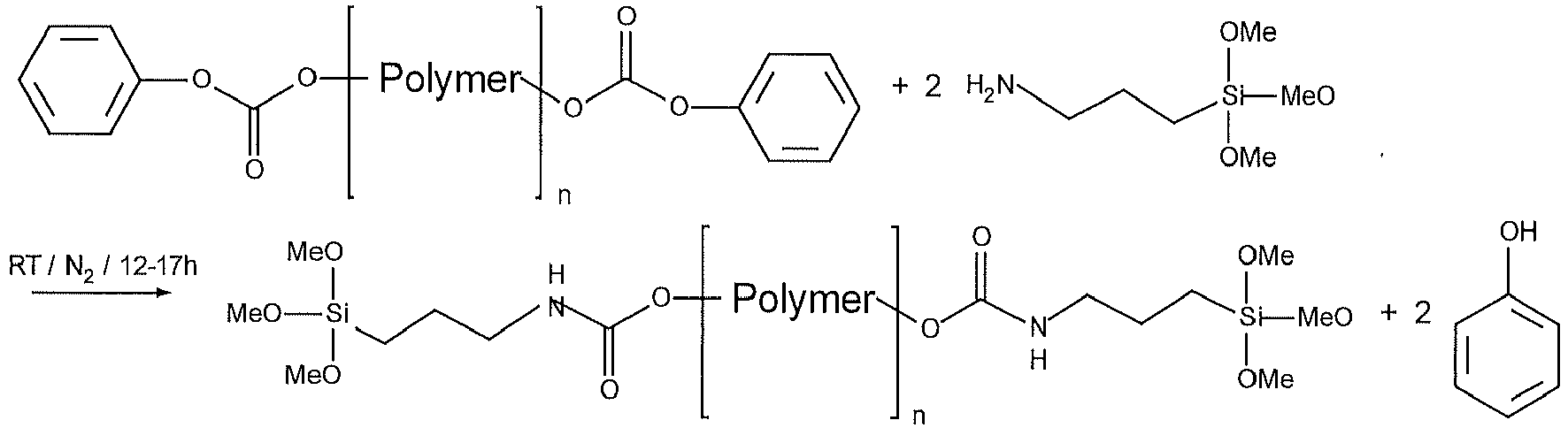
- Das Polymer kann zur Herstellung von feuchtigkeitshärtenden Kleb- Dicht- und Beschichtungsstoffen auf Basis silan-terminierter Polymere verwendet werden.
- 100g (0.016mol) Polyester-diol (Polyol P-6010 der Firma Kuraray mit einer Viskosität von 105Pas) werden mit 5.35g (0.033mol) Carbonyldiimidazol (CDI) während 12h bei 60°C unter Stickstoff gerührt. Als Produkt wird Imidazolcarbamat-terminierter Polyether mit einer Viskosität von 124Pas erhalten.
- 50g (0.008mol) des Imidazolcarbamat-terminierten Polymers werden mit 3.0g(0.016mol) 3-Aminopropyltrimethoxysilan (Evonik) während 24h bei 60°C reagiert. Als Produkt wird Trimethoxysilan-terminierter Polyether mit einer Viskosität von 190Pas erhalten. Die Trimethoxysilangruppen sind über eine Urethanbindung mit dem Polyether verbunden.
- Die folgenden Formulierungen (Angaben in Gewichtsprozent) wurden in einem Speedmixer (DAC 1100 FVZ, Hauschild) gemischt und in 310ml PE-Kartuschen (Ritter) abgefüllt. Die fertigen Formulierungen wurden im Normalklima gelagert (23°C/50% r.f.), und die Viskosität nach Lagerung mit einem Rheometer (RS6000, Haake) gemessen. Während Formulierungsbeispiel 7 die für silanterminierte Polymere typische Erhöhung der Viskosität mit der Lagerung aufweist, sinkt beim Formulierungsbeispiel 8 die Viskosität mit der Lagerung. Dies deutet auf einen Abbau der Polymerketten hin.
Formulierungsbeispiel 7 Formulierungsbeispiel 8 Trimethoxysilan-terminierter Polyester aus Bsp 6 34.9% Trimethoxysilan-terminierter Polyester aus Vergleichsbeispiel 34.9% Vinyltrimethoxysilan 1% 1% Omyalite 95T 50% 50% Titandioxid 2% 2% Thixatrol MAX 2% 2% Diisononylphthalsäureester 9% 9% 3-Aminopropyltrimethoxysilan 1% 1% 1,8-Diazabicyclo[5.4.0]undec-7-en 0.1% 0.1% Viskosität bei 10 s-1 [Pas] nach 1d Lagerung der Kartusche im Normalklima 331 303 Viskosität bei 10 s-1 [Pas] nach 7d Lagerung der Kartusche im Normalklima 399 224 - 80g (0.02mol) Polyether-diamin mit einer mittleren molaren Masse von 4000g/mol (erhältlich bei der Firma Sigma-Aldrich) werden in 100mL Toluol bei Raumtemperatur (25°C) gelöst. Anschliessend werden 5.1g (0.05mol) Triethylamin zugegeben. Die nach kurzer Zeit homogene Lösung ist gelb und klar. Während 45 - 75 Minuten werden der Reaktionslösung 2.5g (0.016mol) Phenylchlorformiat vorgelöst in 8mL Toluol gleichmässig zu getropft. Die Reaktionsmischung wird für mindestens 8 Stunden weitergerührt. Anschliessend wird das Reaktionsgemisch auf ca. 8°C heruntergekühlt. Der entstandene Niederschlag von Triethylaminhydrochlorid wird abfiltriert und mit wenig Toluol abgewaschen. Das Lösungsmittel wird anschliessend im Vakuum abgezogen. Als Produkt wird Phenylcarbamatterminierter Polyether in hoher Ausbeute erhalten.

- 42g (0.01mol) des Phenylcarbonat-terminierten Polymers werden mit 3.6g(0.02mol) 3-Aminopropyltrimethoxysilan (Evonik) bei einer Badtemperatur von 50°C umgesetzt. Als Katalysator werden der Reaktionsmischung 0.03g 1,5,7-Triazabicyclo[4.4.0]dec-5-en (Sigma-Aldrich) dazugegeben.
- Die Reaktion ist nach spätestens 17h vollständig. Das entstandene Phenol bleibt in gelöster Form in der gelben, klaren Reaktionsmischung zurück. Als Produkt wird Trimethoxysilan-terminierter Polyether erhalten. Die Trimethoxysilangruppen sind über eine Harnstoffbindung mit dem Polyether verbunden.
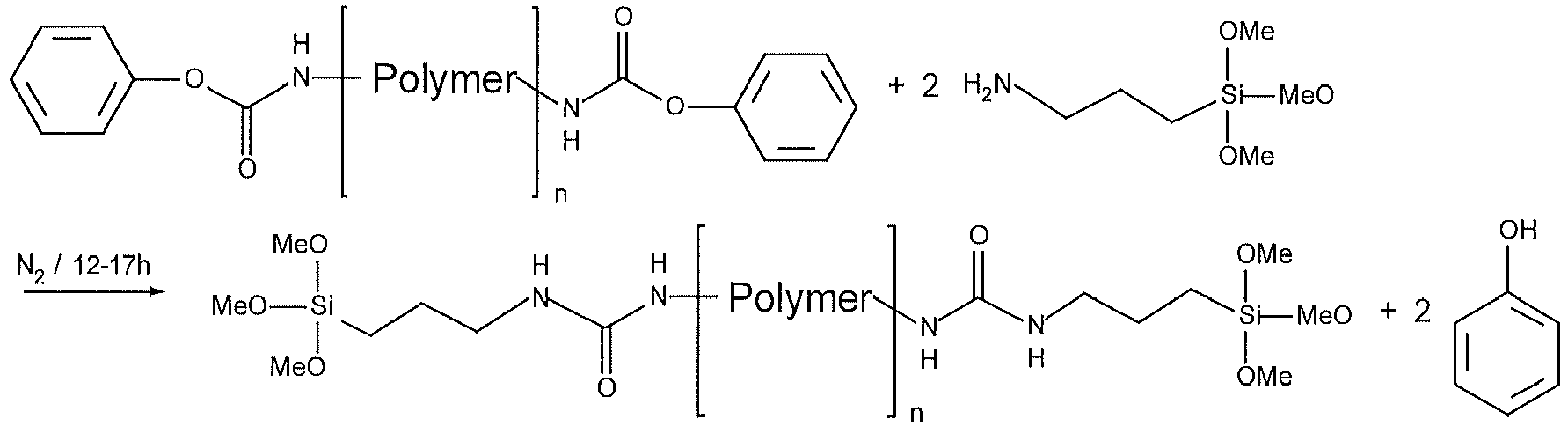
- Das Polymer kann zur Herstellung von feuchtigkeitshärtenden Kleb- Dicht- und Beschichtungsstoffen auf Basis silan-terminierter Polymere verwendet werden.
Claims (13)
- Verfahren zur Herstellung eines Alkoxysilan-Polymers über ein Carbamat-, Thiocarbonat- oder Carbonat-terminiertes Präpolymer (IIIa) oder (IIIb), wobei die Herstellung des Carbamat-, Thiocarbonat- oder Carbonat-terminierten Präpolymers eine Umsetzung eines mit wenigstens zwei Amino, Mercapto- oder Hydroxylgruppen terminierten Polymer-Rückgrats der Formel (I) mit einem Chlorameisensäureester der Formel (IIa) oder einem Pyrocarbonat der Formel (IIb)
 R1 und R3 eine lineare oder verzweigte, gesättigte oder ungesättigte Alkyl- oder Alkenylgruppe mit 1 bis 10 Kohlenstoffatomen oder ein mono- oder polycyclisches aliphatisches oder aromatisches Ringsystem mit 5 bis 18 Kohlenstoffatomen im Ringsystem darstellt, das optional durch einen oder mehrere Reste R2 substituiert ist, wobei R2 ausgewählt ist aus der Gruppe bestehend aus einer linearen oder verzweigten, gesättigten oder ungesättigten Alkyl- oder Alkenylgruppe mit 1 bis 10 Kohlenstoffatomen, einer Nitrogruppe, einer Carbonsäurestergruppe, einer Carbonsäuregruppe, einer Sulfongruppe und einer HalogengruppeX ist Sauerstoff, Stickstoff oder Schwefely ist 1, wenn X Sauerstoff oder Schwefel ist und 1 oder 2, wenn X Stickstoff ist,n im Falle einer linearen oder verzweigten, gesättigten oder ungesättigten Alkyl- oder Alkenylgruppe 0 und im Falle eines mono- oder polycyclischen aliphatisches oder aromatisches Ringsystems 0, 1 oder 2 ist undA für ein Polymer-Rückgrat steht.
 - Verfahren nach Anspruch 1, wobei die Umsetzung mit einem Chlorameisensäureester der Formel (IIa) erfolgt.
- Verfahren nach Anspruch 1, dadurch gekennzeichnet, dass die Reaktion in Abwesenheit eines ersten Katalysators (I) durchgeführt wird.
- Verfahren nach einem der vorangehenden Ansprüchen, dadurch gekennzeichnet, dass R1 ein mono- oder polycyclisches aromatisches Ringsystem mit 6 bis 18 Kohlenstoffatomen im Ringsystem darstellt, das ausgewählt ist aus der Gruppe bestehend aus Phenyl, 1-Naphthyl, 2-Naphthyl, 1-Anthryl, 2-Anthryl, 9-Anthryl, 1-Phenanthryl und 9-Phenanthryl und n 0 oder 1 ist.
- Verfahren nach einem der Ansprüche 1 bis 4, dadurch gekennzeichnet, dass R1 eine Alkylgruppe ausgewählt aus der Gruppe bestehend aus Methyl, Ethyl, Propyl, iso-Propyl, n-Butyl, iso-Butyl, tert-Butyl, n-Pentyl, iso-Pentyl, n-Hexyl, n-Heptyl, n-Octyl, n-Nonyl und n-Decyl ist.
- Verfahren nach einem der vorangehenden Ansprüche, dadurch gekennzeichnet, dass das Polymer-Rückgrat der Formel (I) genau zwei Amino-, Mercapto- oder Hydroxylgruppen aufweist.
- Verfahren nach einem der Ansprüche 1 bis 5, dadurch gekennzeichnet, dass das Polymer-Rückgrat der Formel (I) mehr als zwei Amino-, Mercapto- oder Hydroxylgruppen aufweist.
- Verfahren nach Anspruch 7, dadurch gekennzeichnet, dass im Wesentlichen jede Monomereinheit des Polymer-Rückgrats eine Seitenkette mit einer Amino-, Mercapto- oder Hydroxylgruppe aufweist.
- Verfahren nach einem der vorangehenden Ansprüche, dadurch gekennzeichnet, dass das Polymer-Rückgrat A ausgewählt ist aus der Gruppe bestehend aus Polyethern, Polyalkohole, Polyolefinen, Polyestern, Polycarbonaten, Polyamine, Polyamide , Polyacrylaten, Polysulfiden, Polysiloxanen, Polyacetalen und Copolymeren davon.
- Verfahren nach Anspruch 9, dadurch gekennzeichnet, dass das Polymer-Rückgrat A Polypropylenglycol oder ein Polyester, vorzugsweise ein Poly(3-methyl-1,5-pentandiol adipate ist.
- Verfahren nach einem der vorangehenden Ansprüche, dadurch gekennzeichnet, dass das Präpolymer (III) in einem weiteren Schritt mit(A) einem Aminoalkoxysilan oder einem Mercaptoalkoxysilan gegebenenfalls in Anwesenheit eines zweiten Katalysators (II) oder(B) einem Diamin, einem Triamin, einem Dithiol oder einem Trithiol zu einem modifizierten Präpolymer umgesetzt wird undanschliessend mit einer eine Epoxidgruppe aufweisenden Alkoxysilanverbindung umgesetzt wird, wobei ein Alkoxysilan-Polymer ausgebildet wird.
- Verfahren gemäss Anspruch 11, indem das Präpolymer vor den Reaktionsschritten gemäss Variante (A) oder Variante (B) mit einem Alkohol oder einem aktivierten Alkohol umgesetzt wird, wobei der aktivierte Alkohol vorzugsweise Glycerincarbonat ist.
- Verfahren gemäss einem der Ansprüche 11 oder 12, indem in Variante (A) das Aminoalkoxysilan ausgewählt ist aus der Gruppe von 3-Aminopropyltrimethoxysilan, 3-Aminopropyltriethoxysilan, N- (n-Butyl) -3-aminopropyltrimethoxysilan, N- (n-Butyl) -3-aminopropylmethyldimethoxysilan, N- (n-Butyl) -3-aminopropyltriethoxysilan, N-ethyl-aminoisobutyltrimethoxysilan, N-ethyl-aminoisobutylmethyldimethoxysilan, 3-piperazinopropyltrimethoxysilan, 3-piperazinopropylmethyldimethoxysilan, 3-piperazinopropyltriethoxysilan, N- (2-aminoethyl) -3-aminopropyltrimethoxysilan, N- (2-aminoethyl) -3-aminopropyltriethoxysilan, N- (2-aminoethyl) -3-aminopropylmethyldimethoxysilan und ein äquimolares Reaktionsprodukt aus Piperazin und Glycidoxypropyltrimethoxysilan und das Mercaptoalkoxysilan ausgewählt ist aus der Gruppe von 3-Mercaptopropyltrimethoxysilan, 3-Mercaptopropyltriethoxysilan, 3-Mercaptopropylmethyldimethoxysilane und 3-Mercaptopropyltrimethoxysilan.
Applications Claiming Priority (2)
| Application Number | Priority Date | Filing Date | Title |
|---|---|---|---|
| EP18204858 | 2018-11-07 | ||
| PCT/EP2019/080326 WO2020094685A1 (de) | 2018-11-07 | 2019-11-06 | Verfahren zur herstellung von silanmodifizierten polymeren |
Publications (3)
| Publication Number | Publication Date |
|---|---|
| EP3877438A1 EP3877438A1 (de) | 2021-09-15 |
| EP3877438B1 true EP3877438B1 (de) | 2023-06-14 |
| EP3877438C0 EP3877438C0 (de) | 2023-06-14 |
Family
ID=64183925
Family Applications (1)
| Application Number | Title | Priority Date | Filing Date |
|---|---|---|---|
| EP19797739.0A Active EP3877438B1 (de) | 2018-11-07 | 2019-11-06 | Verfahren zur herstellung von silanmodifizierten polymeren |
Country Status (6)
| Country | Link |
|---|---|
| US (1) | US12018122B2 (de) |
| EP (1) | EP3877438B1 (de) |
| JP (1) | JP7535508B2 (de) |
| CN (1) | CN113166358B (de) |
| MY (1) | MY201841A (de) |
| WO (1) | WO2020094685A1 (de) |
Families Citing this family (4)
| Publication number | Priority date | Publication date | Assignee | Title |
|---|---|---|---|---|
| KR102776100B1 (ko) * | 2019-02-08 | 2025-03-07 | 바스프 에스이 | 우레탄 기 및 규소 원자를 포함하는 경화 중합체의 제조 |
| CN114015036A (zh) * | 2021-11-01 | 2022-02-08 | 三棵树(上海)新材料研究有限公司 | 低粘度硅烷改性聚醚树脂及其制备方法 |
| EP4558538A1 (de) | 2022-07-22 | 2025-05-28 | Merz + Benteli Ag | Silanterminierte polymere |
| US20260062596A1 (en) | 2022-07-22 | 2026-03-05 | Merz + Benteli Ag | Silane-terminated polymers |
Family Cites Families (11)
| Publication number | Priority date | Publication date | Assignee | Title |
|---|---|---|---|---|
| DE10053545A1 (de) * | 2000-10-27 | 2002-05-08 | Henkel Kgaa | Polymere mit Harnstoffgruppen und Silylgruppen, deren Herstellung und Verwendung |
| WO2002068482A1 (en) | 2001-02-28 | 2002-09-06 | Kaneka Corporation | Novel polymer and liquid gasket for in-place forming |
| JP4099451B2 (ja) | 2001-08-28 | 2008-06-11 | ワッカー ケミー アクチエンゲゼルシャフト | アルコキシシラン末端のポリマーを含有する速硬性1成分混合物 |
| US6998072B2 (en) * | 2001-11-01 | 2006-02-14 | Transitions Optical, Inc. | Photochromic polymerizable compositions |
| JP5353007B2 (ja) | 2005-10-31 | 2013-11-27 | 宇部興産株式会社 | ポリチオカーボネートポリ(チオ)エポキシド |
| EP1852455B1 (de) | 2006-05-04 | 2008-12-31 | Wacker Chemie AG | Verfahren zur Herstellung von Urethangruppen aufweisenden Organosiliciumverbindungen |
| ITMI20061766A1 (it) | 2006-09-15 | 2008-03-16 | N P T S R L | Prepolimeri silano-terminati e relativi formulati adesivo-sigillanti |
| WO2010013579A1 (ja) | 2008-08-01 | 2010-02-04 | 宇部興産株式会社 | ポリカ-ボネートジオール及びポリカーボネートジオール共重合体 |
| EP2341116B1 (de) | 2009-12-31 | 2016-11-30 | Merz+Benteli AG | Polymere Verbindung umfassend eine Polymerkette und mindestens eine an die Polymerkette gebundene Silylgruppe |
| CN103930466B (zh) * | 2011-10-18 | 2016-02-17 | 出光兴产株式会社 | 聚碳酸酯-聚有机硅氧烷共聚物及其制造方法 |
| MY189884A (en) | 2016-09-05 | 2022-03-17 | Merz Benteli Ag | Use of an organocarbonate-modified prepolymer as reactant for preparation of isocyanate-free and isothiocyanate-free alkoxysilane polymers |
-
2019
- 2019-11-06 EP EP19797739.0A patent/EP3877438B1/de active Active
- 2019-11-06 JP JP2021523663A patent/JP7535508B2/ja active Active
- 2019-11-06 CN CN201980072912.0A patent/CN113166358B/zh active Active
- 2019-11-06 MY MYPI2021002421A patent/MY201841A/en unknown
- 2019-11-06 WO PCT/EP2019/080326 patent/WO2020094685A1/de not_active Ceased
- 2019-11-06 US US17/292,139 patent/US12018122B2/en active Active
Also Published As
| Publication number | Publication date |
|---|---|
| CN113166358A (zh) | 2021-07-23 |
| US20210395450A1 (en) | 2021-12-23 |
| CN113166358B (zh) | 2023-03-28 |
| JP2022506344A (ja) | 2022-01-17 |
| JP7535508B2 (ja) | 2024-08-16 |
| WO2020094685A1 (de) | 2020-05-14 |
| EP3877438A1 (de) | 2021-09-15 |
| EP3877438C0 (de) | 2023-06-14 |
| MY201841A (en) | 2024-03-19 |
| US12018122B2 (en) | 2024-06-25 |
Similar Documents
| Publication | Publication Date | Title |
|---|---|---|
| EP3877438B1 (de) | Verfahren zur herstellung von silanmodifizierten polymeren | |
| EP3507320B1 (de) | Verwendung eines organcarbonat modifizierten praepolymers als edukt zur herstellung von isocyanatfreien und isothiocyanatfreien alkoxysilan-polymeren | |
| EP2840087B1 (de) | Verwendung von guanidingruppen aufweisenden semi-organischen siliciumgruppen enthaltenden verbindungen zur härtung von alkoxysilylgruppenhaltigen verbindungen | |
| EP2748263B1 (de) | Zweikomponentige zusammensetzung auf basis von silan-funktionellen polymeren | |
| DE102007038030B4 (de) | Härtbare Zusammensetzungen aus Dimethoxysilanen | |
| EP1521790B1 (de) | Silanvernetzbare beschichtungsformulierungen | |
| EP2076568B1 (de) | Zusammensetzungen aus teilweise silylterminierten polymeren | |
| EP3380542A1 (de) | Bindemittelsysteme enthaltend alkoxysilylgruppen tragende präpolymere und epoxidverbindungen sowie deren verwendung | |
| WO2003018658A1 (de) | Einkomponentige alkoxysilanterminierte polymere enthaltende schnell härtende abmischungen | |
| DE10237271A1 (de) | Polymermassen auf Basis alkoxysilanterminierter Polymere mit regulierbarer Härtungsgeschwindigkeit | |
| DE102008020979A1 (de) | Härtbare Zusammensetzungen enthaltend silylierte Polyurethane | |
| WO2006136211A1 (de) | Silanvernetzende kleb- oder dichtstoffmassen, verfahren zu ihrer herstellung und ihre verwendung | |
| EP3224264B1 (de) | Silangruppen-haltiges polymer | |
| DE102007056524A1 (de) | Härtbare Zusammensetzungen aus Trimethoxysilanen | |
| WO2016041666A1 (en) | A curable organic polymer comprising at least one acylurea unit, its preparation and use | |
| EP3168248B1 (de) | Härtungsverfahren für polyurethane | |
| EP3131993B1 (de) | Zusammensetzung auf basis von silanterminierten polymeren mit carbodiimid-additiven zur verbesserung der mechanischen eigenschaften | |
| WO2017081120A1 (de) | Verfahren zur herstellung oder härtung von polymeren mittels thiol-en polyadditionsreaktionen | |
| EP2341116A1 (de) | Polymere Verbindung umfassend eine Polymerkette und mindestens eine an die Polymerkette und mindestens eine an die Polymerkette gebundene Silylgruppe | |
| WO2012107386A1 (de) | Gewebekleber auf basis trifunktioneller aspartate |
Legal Events
| Date | Code | Title | Description |
|---|---|---|---|
| STAA | Information on the status of an ep patent application or granted ep patent |
Free format text: STATUS: UNKNOWN |
|
| STAA | Information on the status of an ep patent application or granted ep patent |
Free format text: STATUS: THE INTERNATIONAL PUBLICATION HAS BEEN MADE |
|
| PUAI | Public reference made under article 153(3) epc to a published international application that has entered the european phase |
Free format text: ORIGINAL CODE: 0009012 |
|
| STAA | Information on the status of an ep patent application or granted ep patent |
Free format text: STATUS: REQUEST FOR EXAMINATION WAS MADE |
|
| 17P | Request for examination filed |
Effective date: 20210531 |
|
| AK | Designated contracting states |
Kind code of ref document: A1 Designated state(s): AL AT BE BG CH CY CZ DE DK EE ES FI FR GB GR HR HU IE IS IT LI LT LU LV MC MK MT NL NO PL PT RO RS SE SI SK SM TR |
|
| DAV | Request for validation of the european patent (deleted) | ||
| DAX | Request for extension of the european patent (deleted) | ||
| GRAP | Despatch of communication of intention to grant a patent |
Free format text: ORIGINAL CODE: EPIDOSNIGR1 |
|
| STAA | Information on the status of an ep patent application or granted ep patent |
Free format text: STATUS: GRANT OF PATENT IS INTENDED |
|
| INTG | Intention to grant announced |
Effective date: 20220725 |
|
| GRAJ | Information related to disapproval of communication of intention to grant by the applicant or resumption of examination proceedings by the epo deleted |
Free format text: ORIGINAL CODE: EPIDOSDIGR1 |
|
| STAA | Information on the status of an ep patent application or granted ep patent |
Free format text: STATUS: REQUEST FOR EXAMINATION WAS MADE |
|
| INTC | Intention to grant announced (deleted) | ||
| GRAP | Despatch of communication of intention to grant a patent |
Free format text: ORIGINAL CODE: EPIDOSNIGR1 |
|
| STAA | Information on the status of an ep patent application or granted ep patent |
Free format text: STATUS: GRANT OF PATENT IS INTENDED |
|
| INTG | Intention to grant announced |
Effective date: 20230111 |
|
| GRAS | Grant fee paid |
Free format text: ORIGINAL CODE: EPIDOSNIGR3 |
|
| GRAA | (expected) grant |
Free format text: ORIGINAL CODE: 0009210 |
|
| STAA | Information on the status of an ep patent application or granted ep patent |
Free format text: STATUS: THE PATENT HAS BEEN GRANTED |
|
| AK | Designated contracting states |
Kind code of ref document: B1 Designated state(s): AL AT BE BG CH CY CZ DE DK EE ES FI FR GB GR HR HU IE IS IT LI LT LU LV MC MK MT NL NO PL PT RO RS SE SI SK SM TR |
|
| REG | Reference to a national code |
Ref country code: CH Ref legal event code: EP |
|
| REG | Reference to a national code |
Ref country code: DE Ref legal event code: R096 Ref document number: 502019008213 Country of ref document: DE |
|
| REG | Reference to a national code |
Ref country code: AT Ref legal event code: REF Ref document number: 1579203 Country of ref document: AT Kind code of ref document: T Effective date: 20230715 |
|
| U01 | Request for unitary effect filed |
Effective date: 20230620 |
|
| RAP4 | Party data changed (patent owner data changed or rights of a patent transferred) |
Owner name: MERZ + BENTELI AG |
|
| U07 | Unitary effect registered |
Designated state(s): AT BE BG DE DK EE FI FR IT LT LU LV MT NL PT SE SI Effective date: 20230719 |
|
| REG | Reference to a national code |
Ref country code: LT Ref legal event code: MG9D |
|
| PG25 | Lapsed in a contracting state [announced via postgrant information from national office to epo] |
Ref country code: NO Free format text: LAPSE BECAUSE OF FAILURE TO SUBMIT A TRANSLATION OF THE DESCRIPTION OR TO PAY THE FEE WITHIN THE PRESCRIBED TIME-LIMIT Effective date: 20230914 Ref country code: ES Free format text: LAPSE BECAUSE OF FAILURE TO SUBMIT A TRANSLATION OF THE DESCRIPTION OR TO PAY THE FEE WITHIN THE PRESCRIBED TIME-LIMIT Effective date: 20230614 |
|
| PG25 | Lapsed in a contracting state [announced via postgrant information from national office to epo] |
Ref country code: RS Free format text: LAPSE BECAUSE OF FAILURE TO SUBMIT A TRANSLATION OF THE DESCRIPTION OR TO PAY THE FEE WITHIN THE PRESCRIBED TIME-LIMIT Effective date: 20230614 Ref country code: HR Free format text: LAPSE BECAUSE OF FAILURE TO SUBMIT A TRANSLATION OF THE DESCRIPTION OR TO PAY THE FEE WITHIN THE PRESCRIBED TIME-LIMIT Effective date: 20230614 Ref country code: GR Free format text: LAPSE BECAUSE OF FAILURE TO SUBMIT A TRANSLATION OF THE DESCRIPTION OR TO PAY THE FEE WITHIN THE PRESCRIBED TIME-LIMIT Effective date: 20230915 |
|
| U20 | Renewal fee for the european patent with unitary effect paid |
Year of fee payment: 5 Effective date: 20231116 |
|
| PG25 | Lapsed in a contracting state [announced via postgrant information from national office to epo] |
Ref country code: SK Free format text: LAPSE BECAUSE OF FAILURE TO SUBMIT A TRANSLATION OF THE DESCRIPTION OR TO PAY THE FEE WITHIN THE PRESCRIBED TIME-LIMIT Effective date: 20230614 |
|
| PG25 | Lapsed in a contracting state [announced via postgrant information from national office to epo] |
Ref country code: IS Free format text: LAPSE BECAUSE OF FAILURE TO SUBMIT A TRANSLATION OF THE DESCRIPTION OR TO PAY THE FEE WITHIN THE PRESCRIBED TIME-LIMIT Effective date: 20231014 |
|
| PG25 | Lapsed in a contracting state [announced via postgrant information from national office to epo] |
Ref country code: SM Free format text: LAPSE BECAUSE OF FAILURE TO SUBMIT A TRANSLATION OF THE DESCRIPTION OR TO PAY THE FEE WITHIN THE PRESCRIBED TIME-LIMIT Effective date: 20230614 Ref country code: SK Free format text: LAPSE BECAUSE OF FAILURE TO SUBMIT A TRANSLATION OF THE DESCRIPTION OR TO PAY THE FEE WITHIN THE PRESCRIBED TIME-LIMIT Effective date: 20230614 Ref country code: RO Free format text: LAPSE BECAUSE OF FAILURE TO SUBMIT A TRANSLATION OF THE DESCRIPTION OR TO PAY THE FEE WITHIN THE PRESCRIBED TIME-LIMIT Effective date: 20230614 Ref country code: IS Free format text: LAPSE BECAUSE OF FAILURE TO SUBMIT A TRANSLATION OF THE DESCRIPTION OR TO PAY THE FEE WITHIN THE PRESCRIBED TIME-LIMIT Effective date: 20231014 Ref country code: CZ Free format text: LAPSE BECAUSE OF FAILURE TO SUBMIT A TRANSLATION OF THE DESCRIPTION OR TO PAY THE FEE WITHIN THE PRESCRIBED TIME-LIMIT Effective date: 20230614 |
|
| PG25 | Lapsed in a contracting state [announced via postgrant information from national office to epo] |
Ref country code: PL Free format text: LAPSE BECAUSE OF FAILURE TO SUBMIT A TRANSLATION OF THE DESCRIPTION OR TO PAY THE FEE WITHIN THE PRESCRIBED TIME-LIMIT Effective date: 20230614 |
|
| REG | Reference to a national code |
Ref country code: DE Ref legal event code: R097 Ref document number: 502019008213 Country of ref document: DE |
|
| PLBE | No opposition filed within time limit |
Free format text: ORIGINAL CODE: 0009261 |
|
| STAA | Information on the status of an ep patent application or granted ep patent |
Free format text: STATUS: NO OPPOSITION FILED WITHIN TIME LIMIT |
|
| 26N | No opposition filed |
Effective date: 20240315 |
|
| PG25 | Lapsed in a contracting state [announced via postgrant information from national office to epo] |
Ref country code: MC Free format text: LAPSE BECAUSE OF FAILURE TO SUBMIT A TRANSLATION OF THE DESCRIPTION OR TO PAY THE FEE WITHIN THE PRESCRIBED TIME-LIMIT Effective date: 20230614 |
|
| PG25 | Lapsed in a contracting state [announced via postgrant information from national office to epo] |
Ref country code: MC Free format text: LAPSE BECAUSE OF FAILURE TO SUBMIT A TRANSLATION OF THE DESCRIPTION OR TO PAY THE FEE WITHIN THE PRESCRIBED TIME-LIMIT Effective date: 20230614 |
|
| REG | Reference to a national code |
Ref country code: IE Ref legal event code: MM4A |
|
| PG25 | Lapsed in a contracting state [announced via postgrant information from national office to epo] |
Ref country code: IE Free format text: LAPSE BECAUSE OF NON-PAYMENT OF DUE FEES Effective date: 20231106 |
|
| PG25 | Lapsed in a contracting state [announced via postgrant information from national office to epo] |
Ref country code: IE Free format text: LAPSE BECAUSE OF NON-PAYMENT OF DUE FEES Effective date: 20231106 |
|
| U20 | Renewal fee for the european patent with unitary effect paid |
Year of fee payment: 6 Effective date: 20241113 |
|
| PG25 | Lapsed in a contracting state [announced via postgrant information from national office to epo] |
Ref country code: CY Free format text: LAPSE BECAUSE OF FAILURE TO SUBMIT A TRANSLATION OF THE DESCRIPTION OR TO PAY THE FEE WITHIN THE PRESCRIBED TIME-LIMIT; INVALID AB INITIO Effective date: 20191106 |
|
| PG25 | Lapsed in a contracting state [announced via postgrant information from national office to epo] |
Ref country code: HU Free format text: LAPSE BECAUSE OF FAILURE TO SUBMIT A TRANSLATION OF THE DESCRIPTION OR TO PAY THE FEE WITHIN THE PRESCRIBED TIME-LIMIT; INVALID AB INITIO Effective date: 20191106 |
|
| REG | Reference to a national code |
Ref country code: CH Ref legal event code: U11 Free format text: ST27 STATUS EVENT CODE: U-0-0-U10-U11 (AS PROVIDED BY THE NATIONAL OFFICE) Effective date: 20251201 |
|
| PG25 | Lapsed in a contracting state [announced via postgrant information from national office to epo] |
Ref country code: TR Free format text: LAPSE BECAUSE OF FAILURE TO SUBMIT A TRANSLATION OF THE DESCRIPTION OR TO PAY THE FEE WITHIN THE PRESCRIBED TIME-LIMIT Effective date: 20230614 |
|
| U20 | Renewal fee for the european patent with unitary effect paid |
Year of fee payment: 7 Effective date: 20251107 |
|
| PGFP | Annual fee paid to national office [announced via postgrant information from national office to epo] |
Ref country code: GB Payment date: 20251121 Year of fee payment: 7 |
|
| PGFP | Annual fee paid to national office [announced via postgrant information from national office to epo] |
Ref country code: CH Payment date: 20251201 Year of fee payment: 7 |