EP3886859B1 - Nouvelles dihydroquinazolinones ayant une activite protectrice vis-a-vis de toxines au mode d'action intracellulaire, de virus et de bacteries intracellulaires - Google Patents
Nouvelles dihydroquinazolinones ayant une activite protectrice vis-a-vis de toxines au mode d'action intracellulaire, de virus et de bacteries intracellulaires Download PDFInfo
- Publication number
- EP3886859B1 EP3886859B1 EP19858717.2A EP19858717A EP3886859B1 EP 3886859 B1 EP3886859 B1 EP 3886859B1 EP 19858717 A EP19858717 A EP 19858717A EP 3886859 B1 EP3886859 B1 EP 3886859B1
- Authority
- EP
- European Patent Office
- Prior art keywords
- compound
- virus
- general formula
- viruses
- toxins
- Prior art date
- Legal status (The legal status is an assumption and is not a legal conclusion. Google has not performed a legal analysis and makes no representation as to the accuracy of the status listed.)
- Active
Links
Images


Classifications
-
- A—HUMAN NECESSITIES
- A61—MEDICAL OR VETERINARY SCIENCE; HYGIENE
- A61K—PREPARATIONS FOR MEDICAL, DENTAL OR TOILETRY PURPOSES
- A61K31/00—Medicinal preparations containing organic active ingredients
- A61K31/33—Heterocyclic compounds
- A61K31/395—Heterocyclic compounds having nitrogen as a ring hetero atom, e.g. guanethidine or rifamycins
- A61K31/495—Heterocyclic compounds having nitrogen as a ring hetero atom, e.g. guanethidine or rifamycins having six-membered rings with two or more nitrogen atoms as the only ring heteroatoms, e.g. piperazine or tetrazines
- A61K31/505—Pyrimidines; Hydrogenated pyrimidines, e.g. trimethoprim
- A61K31/517—Pyrimidines; Hydrogenated pyrimidines, e.g. trimethoprim ortho- or peri-condensed with carbocyclic ring systems, e.g. quinazoline, perimidine
-
- A—HUMAN NECESSITIES
- A61—MEDICAL OR VETERINARY SCIENCE; HYGIENE
- A61K—PREPARATIONS FOR MEDICAL, DENTAL OR TOILETRY PURPOSES
- A61K47/00—Medicinal preparations characterised by the non-active ingredients used, e.g. carriers or inert additives; Targeting or modifying agents chemically bound to the active ingredient
- A61K47/50—Medicinal preparations characterised by the non-active ingredients used, e.g. carriers or inert additives; Targeting or modifying agents chemically bound to the active ingredient the non-active ingredient being chemically bound to the active ingredient, e.g. polymer-drug conjugates
- A61K47/51—Medicinal preparations characterised by the non-active ingredients used, e.g. carriers or inert additives; Targeting or modifying agents chemically bound to the active ingredient the non-active ingredient being chemically bound to the active ingredient, e.g. polymer-drug conjugates the non-active ingredient being a modifying agent
- A61K47/56—Medicinal preparations characterised by the non-active ingredients used, e.g. carriers or inert additives; Targeting or modifying agents chemically bound to the active ingredient the non-active ingredient being chemically bound to the active ingredient, e.g. polymer-drug conjugates the non-active ingredient being a modifying agent the modifying agent being an organic macromolecular compound, e.g. an oligomeric, polymeric or dendrimeric molecule
- A61K47/59—Medicinal preparations characterised by the non-active ingredients used, e.g. carriers or inert additives; Targeting or modifying agents chemically bound to the active ingredient the non-active ingredient being chemically bound to the active ingredient, e.g. polymer-drug conjugates the non-active ingredient being a modifying agent the modifying agent being an organic macromolecular compound, e.g. an oligomeric, polymeric or dendrimeric molecule obtained otherwise than by reactions only involving carbon-to-carbon unsaturated bonds, e.g. polyureas or polyurethanes
- A61K47/593—Polyesters, e.g. PLGA or polylactide-co-glycolide
-
- A—HUMAN NECESSITIES
- A61—MEDICAL OR VETERINARY SCIENCE; HYGIENE
- A61K—PREPARATIONS FOR MEDICAL, DENTAL OR TOILETRY PURPOSES
- A61K47/00—Medicinal preparations characterised by the non-active ingredients used, e.g. carriers or inert additives; Targeting or modifying agents chemically bound to the active ingredient
- A61K47/50—Medicinal preparations characterised by the non-active ingredients used, e.g. carriers or inert additives; Targeting or modifying agents chemically bound to the active ingredient the non-active ingredient being chemically bound to the active ingredient, e.g. polymer-drug conjugates
- A61K47/51—Medicinal preparations characterised by the non-active ingredients used, e.g. carriers or inert additives; Targeting or modifying agents chemically bound to the active ingredient the non-active ingredient being chemically bound to the active ingredient, e.g. polymer-drug conjugates the non-active ingredient being a modifying agent
- A61K47/56—Medicinal preparations characterised by the non-active ingredients used, e.g. carriers or inert additives; Targeting or modifying agents chemically bound to the active ingredient the non-active ingredient being chemically bound to the active ingredient, e.g. polymer-drug conjugates the non-active ingredient being a modifying agent the modifying agent being an organic macromolecular compound, e.g. an oligomeric, polymeric or dendrimeric molecule
- A61K47/59—Medicinal preparations characterised by the non-active ingredients used, e.g. carriers or inert additives; Targeting or modifying agents chemically bound to the active ingredient the non-active ingredient being chemically bound to the active ingredient, e.g. polymer-drug conjugates the non-active ingredient being a modifying agent the modifying agent being an organic macromolecular compound, e.g. an oligomeric, polymeric or dendrimeric molecule obtained otherwise than by reactions only involving carbon-to-carbon unsaturated bonds, e.g. polyureas or polyurethanes
- A61K47/60—Medicinal preparations characterised by the non-active ingredients used, e.g. carriers or inert additives; Targeting or modifying agents chemically bound to the active ingredient the non-active ingredient being chemically bound to the active ingredient, e.g. polymer-drug conjugates the non-active ingredient being a modifying agent the modifying agent being an organic macromolecular compound, e.g. an oligomeric, polymeric or dendrimeric molecule obtained otherwise than by reactions only involving carbon-to-carbon unsaturated bonds, e.g. polyureas or polyurethanes the organic macromolecular compound being a polyoxyalkylene oligomer, polymer or dendrimer, e.g. PEG, PPG, PEO or polyglycerol
-
- A—HUMAN NECESSITIES
- A61—MEDICAL OR VETERINARY SCIENCE; HYGIENE
- A61P—SPECIFIC THERAPEUTIC ACTIVITY OF CHEMICAL COMPOUNDS OR MEDICINAL PREPARATIONS
- A61P31/00—Antiinfectives, i.e. antibiotics, antiseptics, chemotherapeutics
-
- A—HUMAN NECESSITIES
- A61—MEDICAL OR VETERINARY SCIENCE; HYGIENE
- A61P—SPECIFIC THERAPEUTIC ACTIVITY OF CHEMICAL COMPOUNDS OR MEDICINAL PREPARATIONS
- A61P39/00—General protective or antinoxious agents
- A61P39/02—Antidotes
-
- C—CHEMISTRY; METALLURGY
- C07—ORGANIC CHEMISTRY
- C07D—HETEROCYCLIC COMPOUNDS
- C07D417/00—Heterocyclic compounds containing two or more hetero rings, at least one ring having nitrogen and sulfur atoms as the only ring hetero atoms, not provided for by group C07D415/00
- C07D417/14—Heterocyclic compounds containing two or more hetero rings, at least one ring having nitrogen and sulfur atoms as the only ring hetero atoms, not provided for by group C07D415/00 containing three or more hetero rings
-
- Y—GENERAL TAGGING OF NEW TECHNOLOGICAL DEVELOPMENTS; GENERAL TAGGING OF CROSS-SECTIONAL TECHNOLOGIES SPANNING OVER SEVERAL SECTIONS OF THE IPC; TECHNICAL SUBJECTS COVERED BY FORMER USPC CROSS-REFERENCE ART COLLECTIONS [XRACs] AND DIGESTS
- Y02—TECHNOLOGIES OR APPLICATIONS FOR MITIGATION OR ADAPTATION AGAINST CLIMATE CHANGE
- Y02A—TECHNOLOGIES FOR ADAPTATION TO CLIMATE CHANGE
- Y02A50/00—TECHNOLOGIES FOR ADAPTATION TO CLIMATE CHANGE in human health protection, e.g. against extreme weather
- Y02A50/30—Against vector-borne diseases, e.g. mosquito-borne, fly-borne, tick-borne or waterborne diseases whose impact is exacerbated by climate change
Definitions
- the subject of the present invention is a new family of compounds of the 2,3-dihydroquinazolin-4(1 H )-one type and their use as inhibitors of the toxic effects of toxins with intracellular activity, such as for example ricin, Shiga toxins and cholera toxin, using retrograde transport to intoxicate cells, or viruses or bacteria using retrograde and/or syntaxin 5-dependent transport to infect cells, including viruses or bacteria entering cells by endocytosis , or intracellular parasites.
- toxins with intracellular activity such as for example ricin, Shiga toxins and cholera toxin
- Toxins with intracellular activity that use retrograde transport represent a major public health risk and are, in some cases, associated with more than a million deaths each year worldwide.
- These toxins include ricin (produced in the seeds of the Ricinus communis plant) , Shiga toxin and Shiga-like toxins (Stxs) produced by Shigella dysenteriae (Stx) and E. coli (Stx1 and Stx2), the toxin cholera (Ctx of Vibrio cholerae responsible for cholera), pertussis toxin ( Bordetella pertussis agent of whooping cough), cytotoxin subtilase and heat-labile enterotoxin (E. coli).
- ricin produced in the seeds of the Ricinus communis plant
- Shiga toxin and Shiga-like toxins Stxs
- Shigella dysenteriae Stx
- E. coli E. coli
- Ricin is a 66 kDa glycoprotein composed of two polypeptide chains linked by a disulfide bridge ( Figure 1A ).
- the B chain (RTB, lectin of 262 residues) allows the toxin to bind to the glycolipids and glycoproteins of cell membranes and ensure its entry into the cell ( Figure 1A ).
- the A chain (RTA, 267 amino acids) provides the N-glycosidase enzymatic function of ricin, catalyzes the removal of adenine 4324 from the 28S RNA of targeted cells and causes the cessation of protein synthesis.
- Shiga toxins include Shiga toxin (Stx) produced by Shigella dysenteriae and Shiga-like toxins 1 (Stx1) and 2 (Stx2) produced by enterohemorrhagic strains of E. coli.
- the Stx and Stx1 toxins are 99% identical while Stx1 and Stx2 share only 56% amino acid sequence identity.
- the toxin subunit A (StxA) carries the same enzymatic activity as ricin and identically targets 28S RNA ( Figure 1B ).
- the B subunit (StxB) which is in pentameric form, allows the toxin to bind to the cell via its interaction with the globo-triaosylceramide Gb3, which ensures its internalization and intracellular routing.
- ricin After binding to its membrane receptors, ricin is internalized into these cells by multiple endocytic pathways to reach the trans -Golgi network where it is transported to the endoplasmic reticulum (ER) by retrograde transport ( Johannes, L. et al., Cell 2008, 135, 1175-87 ). Shiga toxins are internalized by a unique endocytosis pathway and also reach the Golgi apparatus and then the endoplasmic reticulum ( ibid .) .
- the toxins are then partially unfolded and the A chain/subunit is translocated into the cytosol ( Lord, JM et al., Biochemical Society Transactions 2003, 31, 1260 ). The final stage of the action of these toxins therefore takes place in the cytoplasm of the cells, the toxins bind to the ribosomes with great efficiency and cleave adenine 4324 of the 28S RNA of the 60S subunit of the ribosome . This depurination of 28S RNA causes the cessation of protein synthesis and leads to cell death.
- antitoxins To counter the threat posed by these toxins, several types of antitoxins have been developed: neutralizing antibodies, inhibitors of enzymatic activity (small molecules, substrate analogues), soluble receptor mimics and chemical compounds acting on the cells targeted by the toxin.
- NEETU GUPTA ET AL "(S)-N-Methyldihydroquinazolinones are the Active Enantiomers of Retro-2 Derived Compounds against Toxins",ACS MEDICINAL CHEMISTRY LETTERS, December 4, 2013,ISSN: 1948-5875, DOI: 10.1021/ml400457j ), and therefore a marked interest in the prevention and/or treatment of poisoning with at least one toxin with an intracellular mode of action using retrograde transport to infect eukaryotic mammalian cells, but also for the prevention and/or treatment infections by viruses or bacteria using retrograde transport and/or dependent on syntaxin 5 to infect cells, in particular viruses or bacteria entering cells by endocytosis, or to intracellular parasites.
- R 2 represents a group chosen from -OH, -NH 2 , - SO 2 -NH 2
- R 3 represents a group chosen from H, -OH, -NH 2 , -SO 2 -NH 2 .
- R 3 represents a hydrogen atom.
- R 2 represents a hydrogen atom.
- R 2 and R 3 independently represent a group chosen from -OH, -NH 2 , -SO 2 -NH 2 , R 2 and R 3 representing in particular -OH.
- p is equal to 1.
- the compound of general formula (I) according to the invention has the following formula: R 1 , R 2 and R 3 being as defined above, R 2 and R 3 representing in particular, independently of each other, a group chosen from -OH, -NH 2 , -SO 2 -NH 2 , R 2 and R 3 representing for example -OH.
- the compound of general formula (I) according to the invention has the following formula:
- the compound of general formula (I) according to the invention has the following formula:
- R 1 represents a halogen atom, in particular a fluorine atom.
- the compound of general formula (I) according to the invention has the following formula (Ia):
- the compound of general formula (I) according to the invention has the following formula (Ib):
- the compound of general formula (I) according to the invention is chosen from:
- the invention relates to a compound of general formula (I) in which R 2 and R 3 represent, independently of each other, a group chosen from H, -OH, -OR 4 , -NH 2 , -NHR 5 , -SO 2 -NH 2 , -SO 2 -NH-R 6 , on the condition that at least one of R 2 and R 3 , in particular R 2 , represents a group chosen from-OR 4 , -NHR 5 and - SO 2 -NH-R 6 , R 4 , R 5 and R 6 being defined as previously.
- the compound of general formula (I) has the following formula (III): the groups mentioned in formula (III) being as defined above.
- the invention relates to a pharmaceutical composition or medicament comprising at least one compound of general formula (I) as defined above, as active principle, and a pharmaceutically acceptable vehicle, said pharmaceutical composition or said medicament being in particular suitable for administration by the air, oral, parenteral or local routes.
- the invention relates to a compound of general formula (I) as defined above, for its use for the prevention and/or treatment of disorders induced by toxins with an intracellular mode of action using retrograde transport, or by viruses or bacteria using retrograde transport and/or dependent on syntaxin 5 to infect cells, in particular viruses or bacteria entering cells by endocytosis, or by intracellular parasites.
- the invention relates to a compound of general formula (I) as defined above, for its use for the prevention and/or treatment disorders induced by toxins with an intracellular mode of action using retrograde transport.
- said toxins with an intracellular mode of action using retrograde transport are chosen from ricin, Shiga toxin and Shiga-like toxins (Stxs) produced by Shigella dysenteriae (Stx) and E.
- coli Stx1 and Stx2, Stx, Stx1a, Stx2a, Stx2c, Stx2d, Stx2e as described for example by Melton-Celsa, Microbiol Spectr 2014), cholera toxin (Ctx from Vibrio cholerae responsible for cholera), pertussis toxin ( Bordetella pertussis, the agent of whooping cough), cytotoxin subtilase and heat-labile enterotoxin ( E. coli ) .
- the invention relates to a compound of general formula (I) as defined above, for its use for the prevention and/or treatment of disorders induced by viruses or bacteria using retrograde and/or dependent transport.
- syntaxin 5 to infect cells, in particular viruses or bacteria entering cells by endocytosis, or intracellular parasites.
- the viruses are pox viruses, in particular the smallpox virus and the Vaccinia virus, cytomegaloviruses, adenoviruses, in particular adeno-associated viruses, in particular serotype 2, polyomaviruses, in particular the JC polyomavirus and polyomavirus BK, papillomaviruses, filoviruses, in particular Ebola viruses and Marburg virus, enteroviruses, in particular enterovirus 71, herpes viruses, in particular Herpes simplex virus type 2, viruses of the Arenavirus genus , notably lymphocytic choriomeningitis virus, influenza viruses, notably influenza A viruses.
- pox viruses in particular the smallpox virus and the Vaccinia virus
- cytomegaloviruses cytomegaloviruses
- adenoviruses in particular adeno-associated viruses, in particular serotype 2
- polyomaviruses in particular the JC polyo
- the viruses are pox viruses, in particular smallpox virus, monkeypox virus, Vaccinia virus and leporipoxviruses, in particular myxomatosis virus, cytomegaloviruses, adeno-associated viruses, in particular serotype 2, polyomaviruses, in particular polyomavirus JC and polyomavirus BK, papillomaviruses, filoviruses, in particular Ebola viruses and Marburg virus, enteroviruses, in particular enterovirus 71, herpes viruses, in particular the virus Herpes simplex type 2, viruses of the Arenavirus genus, notably lymphocytic choriomeningitis virus, influenza viruses, notably influenza A viruses, pneumoviruses, notably respiratory syncytial virus.
- pox viruses in particular smallpox virus, monkeypox virus, Vaccinia virus and leporipoxviruses, in particular myxomatosis virus, cytomegalovirus
- the bacteria are bacteria of the order Chlamydiales, in particular of the genus Chlamydia, such as Chlamydia trachomatis, Chlamydophila pneumoniae, Chlamydophila psyttaci, or Symkania, like Symkania negevensis.
- Chlamydiales in particular of the genus Chlamydia, such as Chlamydia trachomatis, Chlamydophila pneumoniae, Chlamydophila psyttaci, or Symkania, like Symkania negevensis.
- the disorders induced by intracellular parasites are leishmaniasis, in particular induced by trypanosomes of the Leishmania genus, in particular Leishmania infantum, Leishmania donovani or Leishmania infantum / donovani hybrid.
- the present invention also relates to a method for preventing and/or treating disorders induced by toxins with intracellular activity using retrograde transport and comprising the administration of an effective quantity of at least one compound of general formula (I ) as defined previously.
- the compounds of the present invention may be prepared according to methods well known to those skilled in the art, including, but not limited to, those described below, or by modifications of these methods by applying techniques standard known to those skilled in the art of organic synthesis. Appropriate modifications and substitutions will be well known, readily apparent, or readily accessible from the scientific literature to those skilled in the art. In particular, such methods can be found in RC Larock, Comprehensive Organic Transformations, Wiley-VCH Publishers, 1999 .
- the compounds of the present invention may comprise an asymmetrically substituted carbon atom, and may be isolated in optically active or racemic forms.
- optically active or racemic forms all chiral, diastereomeric, racemic, isomeric forms of a structure are considered, unless the specific stereochemistry or isomeric form is specifically indicated. It is well known to prepare and isolate such optically active forms.
- mixtures of stereoisomers can be separated by standard techniques including, but not limited to, resolution of racemic forms, conventional, reversed phase chromatography and chiral, preferential salt formation, recrystallization and others, or by chiral synthesis from chiral raw materials or by deliberate synthesis of target chiral centers.
- the compounds of the present invention can be prepared by various synthetic routes.
- This reaction can in particular be carried out in an organic solvent.
- the three starting compounds are mixed in an organic solvent, in particular acetic acid.
- the organic solvent is heated, in particular under reflux or under microwave irradiation, for example at a temperature comprised from 100°C to 180°C, in particular from 110°C to 140°C, more particularly from 120°C. °C to 130°C.
- the duration of heating is from 10 minutes to 6 hours, in particular from 30 minutes to 5 hours, in particular from 1 hour to 4 hours, more particularly from 2 to 3 hours.
- R 1 and p are as defined above.
- R 2 'and R 3 ' correspond respectively to the groups R 2 and R 3 , or to ad hoc protection groups.
- R 2 ' and R 3 ' represent, independently of each other, a group chosen from H, -OH, -NO 2 , -SO 2 -NH 2 , on the condition that one at less than R 2 and R 3 does not represent H.
- R 2 'and/or R 3 ' represent -NO 2
- the term “approximately” refers to a range of values of ⁇ 10% of a specific value.
- the expression “approximately 120 mg” includes the values of 120 mg ⁇ 10%, i.e. the values of 108 mg to 132 mg.
- percentages refer to percentages by weight relative to the total weight of the formulation, unless otherwise indicated.
- the value ranges in the form of “x-y” or “from x to y” or “between x and y” include the limits x and y as well as the integers between these limits.
- “1-5”, or “from 1 to 5” or “between 1 and 5” designate the integers 1, 2, 3, 4 and 5.
- the preferred embodiments include each integer taken individually in the value range, as well as any subcombination of these integers.
- preferred values for "1-5" may include the integers 1, 2, 3, 4, 5, 1-2, 1-3, 1-4, 1-5, 2-3, 2 -4, 2-5, etc.
- pharmaceutically acceptable salt refers to salts which are, within the scope of sound medical judgment, suitable for contact with the tissues of humans and animals without toxicity. excessive, irritation, allergic response, or other problematic complications in proportion to a reasonable benefit/risk ratio.
- salt of the compounds of general formula (I) is meant in particular hydrochlorides, bromhydrates, sulfates or bisulfates, phosphates or hydrogen phosphates, acetates, oxalates, benzoates, succinates, fumarates, maleates, lactates, citrates, tartrates, gluconates, methanesulphonates, benzene sulphonates and paratoluene sulphonates.
- halogen atom we mean the chemical elements of group VII of the periodic table of elements, in particular fluorine, chlorine, bromine and iodine.
- alkyl radical of 1 to 3 or 4 carbon atoms designates a linear or branched hydrogencarbon radical; we can cite for example methyl, ethyl, propyl, isopropyl or tert-butyl.
- PEG poly(ethylene glycol) or “polyethylene glycol”, we mean in particular groups -(CH 2 -CH 2 -O) m -, optionally terminated by a group chosen from H, a C 1 alkyl to C 3 , or groups -(-O-CH 2 -CH 2 ) m -, optionally terminated by a group chosen from H, -OH, and an O-C 1 to C 3 alkyl, m being chosen from 1 to 500, in particular from 4 to 500, in particular from 30 to 60.
- the average molar mass of PEG can in particular be indicated after the term “PEG” after the name, for example PEG-1450 (1,450 g ⁇ mol -1 ).
- the average molar mass of PLA can in particular be indicated after the term “PLA” after the name, for example PLA-1036 (1,036 g.mol -1 ).
- p, q and r are in particular such that the molar percentage of lactic acid in the PLGA is approximately 20%.
- p, q and r are such that the PLGA consists of 12 units of lactic acid and 3 units of glycolic acid.
- the purification was notably carried out on a CombiFlash with a UV-vis detector and RediSep columns.
- the samples were adsorbed on Celite or silica and loaded into solid charge cartridges.
- An ethyl acetate/cyclohexane or methanol/dichloromethane gradient was notably used.
- the fractions were notably collected on the basis of detection at 254 nm.
- HPLC-MS The analysis and purification by HPLC-MS were notably carried out using a Waters system (binary gradient module 2525, online degasser, sample manager 2767, photodiode array detector 2996) with a system binary for the solvent gradient.
- the eluent was in particular a gradient of (99.9% water / 0.1% HCOOH) and (99.9% MeCN / 0.1% HCOOH) or (99.9% water / 0.1% HCOOH) and (99.9% MeOH / 0.1% HCOOH).
- Each compound was loaded onto a 100-4.6mm (5mm) Zorbax SB-C18 column equilibrated with H 2 O/MeCN or H 2 O/MeOH 95:5.
- This system was, for example, coupled to a Waters Micromass ZQ system with a ZQ2000 quadrupole analyzer. Ionization was carried out by electrospray and other parameters were as follows: source temperature 120 °C, cone voltage 20 V, and continuous injection of the sample at a flow rate of 0.3 mL per min. Mass spectra were recorded in positive and negative ion mode in the range m/z 100–2000 and processed with Mass Lynx 4.0 software.
- the infrared spectra were recorded on a Spectrum Two equipped with a UATR Two (Perkin Elmer), Diamond/ZnSe (1 reflection).
- the NMR analyzes were notably carried out on a Bruker Avance 400 Ultrashield spectrometer.
- the 1H-NMR and 13C spectra were recorded at room temperature at 400 MHz and 100 MHz respectively, the samples were dissolved in DMSO-d6 or CDCl 3 at a concentration of approximately 5 mM.
- the DMSO singlet signal was set at 2.50 ppm. Chemical shifts are given in ppm and coupling constants in Hz. The spectral data are consistent with the associated structures.
- the compounds were tested either on A549 cells (human lung epithelial cells) or on HeLa cells (human uterine cancer cells), against Shiga toxins (Stx-1 and/or Stx-2).
- the human cells are cultured at 37°C in an atmosphere containing 5% CO 2 in 150 cm 2 culture flasks in DMEM medium (Dulbecco's Modified Eagle Medium) containing 100 U/mL of penicillin and 100 ⁇ g/mL of streptomycin.
- the cells are seeded at a density of 50,000 cells per well in 96-well plates with Cytostar-T solid scintillation bottom ( Figure 2 ).
- the cells (100 ⁇ L in complete DMEM: DMEM + 10% fetal calf serum, FBS) are pre-incubated or not with the inhibitors (50 ⁇ L; different concentrations, 3 h pre-incubation).
- the complete medium supplemented with toxin (50 ⁇ L, variable concentration range) is then added to each well. After an incubation of 20 h, the medium (200 ⁇ L) is removed and replaced with leucine-free DMEM medium (Eurobio) containing 10% FCS and 0.5 ⁇ Ci/mL of 14 C-leucine (GE). After an incubation from 7 h to 37° C., the incorporation of radioactivity by the cells is determined by reading the plates using a Wallac 1450 Microbeta trilux (PE) scintillation counter.
- PE Microbeta trilux
- the IC 50 is then calculated, using the Prism software by non-linear regression, from a graph where the corresponding percentage of cellular protection is reported for each concentration of compound ( cf. Figure 3 ).
- IC 50 corresponds to the concentration of compound giving 50% of its inhibitory power. The lower this concentration, the more powerful the inhibitor.
- the Retro-2.1 compound has the following formula:
- Virology 332:20-7 or ANCHOR virus provided by NEOVIRTECH. These viruses are capable of replication and exhibit normal pathogenesis in animals.
- the cells were then fixed using 10% formalin for the time indicated below. Cell nuclei were stained with DAPI according to standard methods. The infection was then analyzed by photographing each well using an epifluorescent microscope. Total and infected cells were counted by counting DAPI-stained cells and green fluorescent cells, respectively, using Cell Profiler software. The fraction of infected cells was calculated by dividing the number of green fluorescent cells by the total number of cells. The evaluation of IC 50 was carried out according to the number of cells using the Combenefit software ( DiVeroli et al. Bioinformatics 2016, 32(18), 2866-8 ).
- Concentrations of compound of the invention of 100 ⁇ M to 0.2 ⁇ M were tested (twice).
- the cells as described above were fixed 72 hours after addition of the compounds of the invention.
- the number of cells counted per well is normalized to the number of cells counted in the corresponding wells treated with DMSO only.
- the evaluation of CC 50 was carried out according to the number of cells using the aforementioned Combenefit software.
- HeLa229 cells are pretreated with the compound of the invention to be evaluated at concentrations of 25, 50 and 75 ⁇ M for 30 minutes until the bacteria is added to the cells.
- Cells treated with said compound are also lysed 48 h after infection and the lysate obtained is used to infect new HeLa229 cells, which are lysed 24 h after infection and analyzed with the primary infection samples by immunoblotting.
- the growth of the bacteria is detected using ad hoc antibodies and actin is used as a control.
- the compounds thus obtained have excellent solubility in water (>700 mg/mL, possible administration by minipumps, infusion, iv injection). Their cleavage by plasma amidases and/or esterases is rapid (for example with a t 1/2 of 2.6 hours in mouse plasma at 37°C).
- thermogelling polymers Other prodrugs, in the form of thermogelling polymers, were obtained as follows:
- PLGA1036-PEG1450-PLGA1036 is for example obtained as follows:
Landscapes
- Health & Medical Sciences (AREA)
- Chemical & Material Sciences (AREA)
- Organic Chemistry (AREA)
- General Health & Medical Sciences (AREA)
- Veterinary Medicine (AREA)
- Medicinal Chemistry (AREA)
- Pharmacology & Pharmacy (AREA)
- Public Health (AREA)
- Life Sciences & Earth Sciences (AREA)
- Animal Behavior & Ethology (AREA)
- Epidemiology (AREA)
- Chemical Kinetics & Catalysis (AREA)
- General Chemical & Material Sciences (AREA)
- Nuclear Medicine, Radiotherapy & Molecular Imaging (AREA)
- Engineering & Computer Science (AREA)
- Bioinformatics & Cheminformatics (AREA)
- Toxicology (AREA)
- Communicable Diseases (AREA)
- Oncology (AREA)
- Pharmaceuticals Containing Other Organic And Inorganic Compounds (AREA)
- Plural Heterocyclic Compounds (AREA)
- Medicinal Preparation (AREA)
Description
- La présente invention a pour objet une nouvelle famille de composés du type 2,3-dihydroquinazolin-4(1H)-one et leur utilisation en tant qu'inhibiteurs des effets toxiques des toxines à activité intracellulaire, comme par exemple la ricine, les toxines de Shiga et la toxine cholérique, utilisant le transport rétrograde pour intoxiquer les cellules, ou des virus ou bactéries utilisant le transport rétrograde et/ou dépendant de la syntaxine 5 pour infecter les cellules, notamment les virus ou bactéries entrant dans les cellules par endocytose, ou des parasites intracellulaires.
- Les toxines à activité intracellulaire qui utilisent le transport rétrograde représentent un risque majeur de santé publique et sont associées pour certaines à plus d'un million de décès chaque année dans le monde. Ces toxines sont notamment la ricine (produite dans les graines de la plante Ricinus communis), la toxine de Shiga et les toxines Shiga-like (Stxs) produite par Shigella dysenteriae (Stx) et E. coli (Stx1 et Stx2), la toxine cholérique (Ctx de Vibrio cholerae responsable du choléra), la toxine pertussique (Bordetella pertussis agent de la coqueluche), la cytotoxine subtilase et l'entérotoxine thermolabile (E. coli).
- La ricine est une glycoprotéine de 66 kDa composée de deux chaînes polypeptidiques reliées par un pont disulfure (
Figure 1A ). La chaîne B (RTB, lectine de 262 résidus) permet à la toxine de se lier aux glycolipides et glycoprotéines des membranes cellulaires et d'assurer son entrée dans la cellule (Figure 1A ). La chaîne A (RTA, 267 acides aminés) assure la fonction enzymatique N-glycosidase de la ricine, catalyse l'élimination de l'adénine 4324 de l'ARN 28S des cellules ciblées et provoque l'arrêt de la synthèse des protéines. - Les toxines de Shiga incluent la toxine de Shiga (Stx) produite par Shigella dysenteriae et les toxines Shiga-like 1 (Stx1) et 2 (Stx2) produites par des souches entérohémorragiques d'E. coli. Les toxines Stx et Stx1 sont à 99% identiques alors que les Stx1 et Stx2 partagent seulement 56% d'identité de leur séquence en acides aminés. La sous-unité A de la toxine (StxA) porte la même activité enzymatique que la ricine et cible de manière identique l'ARN 28S (
Figure 1B ). La sous-unité B (StxB), qui se présente sous forme pentamérique, permet la liaison de la toxine avec la cellule via son interaction avec le globo-triaosylcéramide Gb3, ce qui assure son internalisation et son routage intracellulaire. - Après liaison à ses récepteurs membranaires, la ricine est internalisée dans ces cellules par de multiples voies d'endocytose pour atteindre le réseau trans-golgien où elle est acheminée vers le réticulum endoplasmique (RE) par transport rétrograde (Johannes, L. et al., Cell 2008, 135, 1175-87). Les toxines de Shiga sont internalisées quant à elles par une voie d'endocytose unique et atteignent également l'appareil de Golgi puis le réticulum endoplasmique (ibid.).
- Les toxines sont alors partiellement dépliées et la chaîne/sous-unité A est transloquée dans le cytosol (Lord, J.M. et al., Biochemical Society Transactions 2003, 31, 1260). L'étape ultime de l'action de ces toxines a donc lieu dans le cytoplasme des cellules, les toxines se fixent sur les ribosomes avec une grande efficacité et clivent l'adénine 4324 de l'ARN 28S de la sous-unité 60S du ribosome. Cette dépurination de l'ARN 28S provoque l'arrêt de la synthèse des protéines et conduit à la mort cellulaire.
- Pour contrer la menace posée par ces toxines, plusieurs types d'antitoxines ont été développés : anticorps neutralisants, inhibiteurs de l'activité enzymatique (petites molécules, analogues de substrat), mimes solubles de récepteurs et composés chimiques agissant sur les cellules ciblées par la toxine.
- Ces dernières années, la recherche de nouvelles molécules visant à bloquer le routage intracellulaire des toxines à activité intracellulaire s'est accélérée. Le principal avantage de ce type de molécules est leur activité de type large spectre puisque ces molécules peuvent protéger efficacement les cellules contre les différentes toxines qui utilisent la voie rétrograde.
- Dans le cadre de ses recherches sur des composés bloquant le transport rétrograde et plus particulièrement d'études sur des composés plus avantageux que ceux des travaux précités, la Demanderesse a identifié une nouvelle famille de composés dérivés de 2,3-dihydroquinazolin-4(1H)-one, portant un phényle spécifiquement substitué en position ortho ou méta, qui présentent de manière inattendue une activité biologique supérieure à celle de Retro-2.1, la plus active des molécules déjà décrites (ROMAIN NOEL ET AL: "N -Methyldihydroquinazolinone Dérivatives of Retro-2 with Enhanced Efficacy against Shiga Toxin",JOURNAL OF MEDICINAL CHEMISTRY, vol. 56, no. 8, 25 avril 2013, pages 3404-3413; NEETU GUPTA ET AL: "( S )- N -Methyldihydroquinazolinones are the Active Enantiomers of Retro-2 Derived Compounds against Toxins",ACS MEDICINAL CHEMISTRY LETTERS, 4 décembre 2013,ISSN: 1948-5875, DOI: 10.1021/ml400457j), et donc un intérêt marqué pour la prévention et/ou le traitement des intoxications à au moins une toxine à mode d'action intracellulaire utilisant le transport rétrograde pour infecter les cellules eucaryotes de mammifères, mais également pour la prévention et/ou le traitement des infections par des virus ou bactéries utilisant le transport rétrograde et/ou dépendant de la syntaxine 5 pour infecter les cellules, notamment les virus ou bactéries entrant dans les cellules par endocytose, ou à des parasites intracellulaires.
- Ainsi, la présente invention se rapporte à un composé de formule générale (I) :

- p est égal à 1, 2 ou 3 ;
- R1 représente à chaque occurrence, de façon indépendante, un atome d'hydrogène, un atome d'halogène, un radical alcoxy de 1 à 3 atomes de carbone, notamment un groupe méthoxy, -NO2, ou -NH2 ;
- R2 et R3 représentent indépendamment l'un de l'autre un groupe choisi parmi H, -OH, -OR4, -NH2, -NHR5, -SO2-NH2, -SO2-NH-R6, à la condition que l'un au moins de R2 et R3 ne représente pas H ;
- R4, R5 et R6 représentent indépendamment les uns des autres un groupe de formule (II) -L-(X)i-(PEG)-(Y)j-Z, où :
- i et j représentent indépendamment l'un de l'autre 0 ou 1 ;
- L représente -C(=O)- ou -C(=O)-(CH2)k-C(=O)-, avec k étant égal à 1, 2 ou 3, en particulier 2 ;
- X et Y représentent indépendamment l'un de l'autre un poly(acide lactique) ou un poly(acide lactique-co-acide glycolique) ;
- PEG représente un poly(éthylène glycol) ;
- Z représente un groupe choisi parmi H, un alkyle en C1 à C3, -OH, un O-alkyle en C1 à C3, ou -L-Re, où L est défini tel que précédemment et Re est un résidu de formule (I) relié audit groupe -L-(X)i-(PEG)-(Y)j- défini précédemment par l'intermédiaire de son groupe R2 ou R3, ledit groupe R2 ou R3 étant -OH, -NH2 ou - SO2-NH2;
- La présente invention se rapporte également à un composé de formule générale (I) :

- p est égal à 1, 2 ou 3 ;
- R1 représente à chaque occurrence, de façon indépendante, un atome d'hydrogène, un atome d'halogène ou un radical alcoxy de 1 à 3 atomes de carbone, notamment un groupe méthoxy ;
- R2 et R3 représentent indépendamment l'un de l'autre un groupe choisi parmi H, -OH, -NH2, -SO2-NH2, à la condition que l'un au moins de R2 et R3 ne représente pas H;
- Selon un mode de réalisation, R2 représente un groupe choisi parmi -OH, -NH2, - SO2-NH2, et R3 représente un groupe choisi parmi H, -OH, -NH2, -SO2-NH2.
- Selon un mode de réalisation, R3 représente un atome d'hydrogène. Le composé de formule générale (I) selon l'invention est alors de formule suivante :

- Selon un mode de réalisation, R2 représente un atome d'hydrogène. Le composé de formule générale (I) selon l'invention est alors de formule suivante :

- Selon un mode de réalisation, R2 et R3 représentent indépendamment l'un de l'autre un groupe choisi parmi -OH, -NH2, -SO2-NH2, R2 et R3 représentant notamment -OH.
- Selon un mode de réalisation, p est égal à 1.
- Selon un mode de réalisation, le composé de formule générale (I) selon l'invention est de formule suivante :

- Selon un mode de réalisation particulier, le composé de formule générale (I) selon l'invention est de formule suivante :

- Selon un mode de réalisation particulier, le composé de formule générale (I) selon l'invention est de formule suivante :

- Selon un mode de réalisation, R1 représente un atome d'halogène, en particulier un atome de fluor.
- Selon un mode de réalisation, le composé de formule générale (I) selon l'invention est de formule (Ia) suivante :

- Selon un mode de réalisation, le composé de formule générale (I) selon l'invention est de formule (Ib) suivante :

- Selon un mode de réalisation, le composé de formule générale (I) selon l'invention est choisi parmi :


- Selon un mode de réalisation, l'invention concerne un composé de formule générale (I) dans laquelle R2 et R3 représentent indépendamment l'un de l'autre un groupe choisi parmi H, -OH, -OR4, -NH2, -NHR5, -SO2-NH2, -SO2-NH-R6, à la condition que l'un au moins de R2 et R3, en particulier R2, représente un groupe choisi parmi-OR4, -NHR5 et - SO2-NH-R6, R4, R5 et R6 étant définis tel que précédemment.
- En ce qui concerne le groupe de formule (II) -L-(X)i-(PEG)-(Y)j-Z, L représente notamment -C(=O)- lorsque R2 ou R3 représente -NHR5 ou -SO2-NH-R6, et L représente notamment-C(=O)-(CH2)k-C(=O)- lorsque R2 ou R3 représente -OR4.
- Selon un mode de réalisation, le groupe de formule (II) -L-(X)i-(PEG)-(Y)j-Z est choisi parmi -L-PEG, -L-PEG-PLA, et -L-PLGA-PEG-PLGA, avec L représentant notamment -C(=O)- lorsque R2 ou R3 représente -NHR5 ou -SO2-NH-R6, ou notamment-C(=O)-(CH2)k-C(=O)- lorsque R2 ou R3 représente -OR4.
- Selon un mode de réalisation, le groupe de formule (II) -L-(X)i-(PEG)-(Y)j-Z est choisi parmi -C(=O)-(CH2-CH2-O)m-CH3, notamment lorsque R2 ou R3 représente -NHR5 ou -SO2-NH-R6, et -C(=O)-(CH2)k-C(=O)-(O-CH2-CH2)m-OCH3, notamment lorsque R2 ou R3 représente -OR4, m étant compris de 1 à 500, notamment de 4 à 500, m étant en particulier compris de 30 à 60, plus particulièrement de 45.
- Selon un mode de réalisation, le composé de formule générale (I) est de formule (III) suivante :

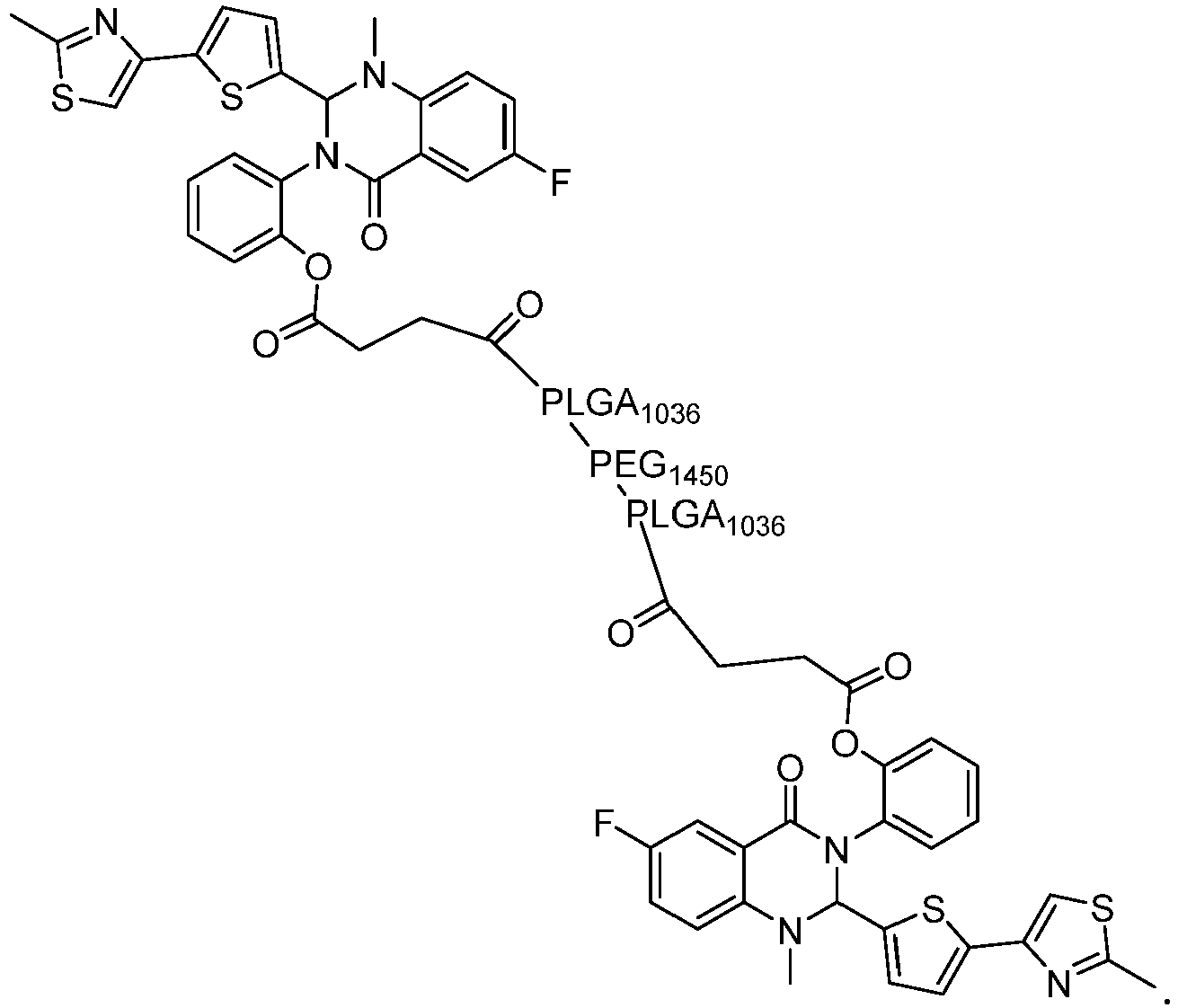
- Selon un mode de réalisation, le composé de formule générale (I) selon l'invention est choisi parmi :


- Selon un autre aspect, l'invention concerne une composition pharmaceutique ou médicament comprenant au moins un composé de formule générale (I) tel que défini précédemment, en tant que principe actif, et un véhicule pharmaceutiquement acceptable, ladite composition pharmaceutique ou ledit médicament étant notamment adapté à une administration par les voies aérienne, orale, parentérale ou locale.
- Il est à noter que tous les modes de réalisation mentionnés ci-dessus à propos du composé de formule générale (I) s'appliquent également ici, seuls ou en combinaison.
- Selon un autre aspect, l'invention concerne un composé de formule générale (I) tel que défini précédemment, pour son utilisation pour la prévention et/ou le traitement des désordres induits par les toxines à mode d'action intracellulaire utilisant le transport rétrograde, ou par les virus ou bactéries utilisant le transport rétrograde et/ou dépendant de la syntaxine 5 pour infecter les cellules, notamment les virus ou bactéries entrant dans les cellules par endocytose, ou par des parasites intracellulaires.
- Il est à noter que tous les modes de réalisation mentionnés ci-dessus à propos du composé de formule générale (I) s'appliquent également ici, seuls ou en combinaison.
- Selon un mode de réalisation, l'invention concerne un composé de formule générale (I) tel que défini précédemment, pour son utilisation pour la prévention et/ou le traitement des désordres induits par les toxines à mode d'action intracellulaire utilisant le transport rétrograde.
- Selon un mode de réalisation particulier, lesdites toxines à mode d'action intracellulaire utilisant le transport rétrograde sont choisies parmi la ricine, la toxine de Shiga et les toxines Shiga-like (Stxs) produites par Shigella dysenteriae (Stx) et E. coli (Stx1 et Stx2, Stx, Stx1a, Stx2a, Stx2c, Stx2d, Stx2e tels que décrites par exemple par Melton-Celsa, Microbiol Spectr. 2014 ; 2(2)), la toxine cholérique (Ctx de Vibrio cholerae responsable du choléra), la toxine pertussique (Bordetella pertussis agent de la coqueluche), la cytotoxine subtilase et l'entérotoxine thermolabile (E. coli).
- Selon un mode de réalisation, l'invention concerne un composé de formule générale (I) tel que défini précédemment, pour son utilisation pour la prévention et/ou le traitement des désordres induits par les virus ou bactéries utilisant le transport rétrograde et/ou dépendant de la syntaxine 5 pour infecter les cellules, notamment les virus ou bactéries entrant dans les cellules par endocytose, ou les parasites intracellulaires.
- Selon un mode de réalisation particulier, les virus sont les virus pox, notamment le virus de variole et le virus Vaccinia, les cytomégalovirus, les adénovirus, notamment les virus adéno-associés, en particulier de sérotype 2, les polyomavirus, notamment le polyomavirus JC et le polyomavirus BK, les papillomavirus, les filovirus, notamment les virus Ebola et le virus Marburg, les entérovirus, notamment l'entérovirus 71, les virus de l'herpès, notamment le virus Herpes simplex de type 2, les virus du genre Arenavirus, notamment le virus de la chorioméningite lymphocytaire, les virus de la grippe, notamment les influenzavirus A.
- Selon un mode de réalisation particulier, les virus sont les virus pox, notamment le virus de variole, le virus monkeypox, le virus Vaccinia et les leporipoxvirus, en particulier le virus de la myxomatose, les cytomégalovirus, les virus adéno-associés, en particulier de sérotype 2, les polyomavirus, notamment le polyomavirus JC et le polyomavirus BK, les papillomavirus, les filovirus, notamment les virus Ebola et le virus Marburg, les entérovirus, notamment l'entérovirus 71, les virus de l'herpès, notamment le virus Herpes simplex de type 2, les virus du genre Arenavirus, notamment le virus de la chorioméningite lymphocytaire, les virus de la grippe, notamment les influenzavirus A, les pneumovirus, notamment le virus respiratoire syncytial.
- Selon un mode de réalisation particulier, les bactéries sont des bactéries de l'ordre des Chlamydiales, en particulier du genre Chlamydia, telles que Chlamydia trachomatis, Chlamydophila pneumoniae, Chlamydophila psyttaci, ou Symkania, comme Symkania negevensis.
- Selon un mode de réalisation particulier, les désordres induits par les parasites intracellulaires sont la leishmaniose, notamment induite par des trypanosomes du genre Leishmania, en particulier Leishmania infantum, Leishmania donovani ou Leishmania infantum/donovani hybrid.
- La présente invention se rapporte également à une méthode de prévention et/ou de traitement des désordres induits par les toxines à activité intracellulaire utilisant le transport rétrograde et comprenant l'administration d'une quantité efficace d'au moins un composé de formule générale (I) tel que défini précédemment.
- Il est à noter que tous les modes de réalisation mentionnés ci-dessus à propos du composé de formule générale (I) s'appliquent également ici, seuls ou en combinaison.
- Les composés de la présente invention peuvent être préparés selon des méthodes bien connues de l'homme du métier, y compris, mais sans s'y limiter, celles qui sont décrites ci-dessous, ou par des modifications de ces méthodes en appliquant des techniques standard connues de l'homme du métier de la synthèse organique. Les modifications et les substitutions appropriées seront bien connues, facilement apparentes, ou facilement accessibles de la littérature scientifique à l'homme du métier. En particulier, on peut trouver de telles méthodes dans R.C. Larock, Comprehensive Organic Transformations, Wiley-VCH Publishers, 1999.
- Tous les procédés divulgués dans le cadre de la présente invention sont envisagés pour être pratiqués à n'importe quelle échelle, y compris le milligramme, le gramme, le multigramme, le kilogramme, le multikilogramme ou l'échelle industrielle commerciale.
- Il est à noter que les composés de la présente invention peuvent comprendre un atome de carbone asymétriquement substitué, et peuvent être isolés sous des formes optiquement actives ou racémiques. Ainsi, toutes les formes chirales, diastéréoisomères, racémiques, isomères d'une structure sont envisagées, à moins que la stéréochimie ou la forme isomère spécifique ne soit spécifiquement indiquée. Il est bien connu de préparer et d'isoler de telles formes optiquement actives. Par exemple, les mélanges de stéréoisomères peuvent être séparés par des techniques standard, y compris, mais sans s'y limiter, la résolution des formes racémiques, la chromatographie classique, en phase inverse et chirale, la formation préférentielle de sel, la recristallisation et autres, ou par synthèse chirale à partir de matières premières chirales ou par synthèse délibérée des centres chiraux cibles.
- Les composés de la présente invention peuvent être préparés par diverses voies synthétiques.
- Dans les réactions décrites ci-après, il peut être nécessaire de protéger les groupes fonctionnels réactifs, par exemple les groupes hydroxy, amino ou thio, lorsque ceux-ci sont présents dans le produit final, afin d'éviter leur participation à des réactions secondaires, non désirées. Les groupes de protection conventionnels peuvent être utilisés conformément à la pratique courante, par exemple, voir T.W. Greene and P. G. M. Wuts in Protective Groups in Organic Chemistry, 3rd ed., John Wiley and Sons, 1999; J. F. W. McOmie in Protective Groups in Organic Chemistry, Plénum Press, 1973.
- Les réactifs et les composés de départ sont disponibles sur le marché, ou facilement synthétisés par des techniques bien connues de l'homme du métier. Tous les substituants, sauf indication contraire, sont tels que définis précédemment.
- Les composés de formule générale (I) peuvent être obtenus selon la réaction suivante :

- Cette réaction peut notamment être réalisée dans un solvant organique.
- Selon un mode de réalisation, les trois composés de départ sont mélangés dans un solvant organique, notamment l'acide acétique.
- Selon un mode de réalisation, le solvant organique est chauffé, notamment au reflux ou sous irradiations microondes, par exemple à une température comprise de 100°C à 180°C, en particulier de 110°C à 140°C, plus particulièrement de 120°C à 130°C.
- La durée du chauffage est comprise de 10 minutes à 6 heures, notamment de 30 minutes à 5 heures, en particulier de 1 heure à 4 heures, plus particulièrement de 2 à 3 heures.
- R1 et p sont tels que définis plus haut.
- R2' et R3' correspondent respectivement aux groupes R2 et R3, ou à des groupes de protections ad hoc.
- Selon un mode de réalisation, R2' et R3' représentent indépendamment l'un de l'autre un groupe choisi parmi H, -OH, -NO2, -SO2-NH2, à la condition que l'un au moins de R2 et R3 ne représente pas H.
- Selon un mode de réalisation particulier, lorsque R2' et/ou R3' représentent -NO2, R2' et/ou R3' sont alors converti en R2 et/ou R3 = -NH2, notamment par l'une des techniques bien connues de l'homme du métier, par exemple par action de zinc au contact d'acide acétique.
- Tel qu'on l'utilise dans la présente description, le terme « environ » se réfère à un intervalle de valeurs de ± 10 % d'une valeur spécifique. A titre d'exemple, l'expression « environ 120 mg » comprend les valeurs de 120 mg ± 10 %, soit les valeurs de 108 mg à 132 mg.
- Au sens de la présente description, les pourcentages se réfèrent à des pourcentages en poids par rapport au poids total de la formulation, sauf indication contraire.
- Tel qu'on l'entend ici, les plages de valeur sous forme de « x-y » ou « de x à y » ou « entre x et y » incluent les bornes x et y ainsi que les entiers compris entre ces bornes. A titre d'exemple, « 1-5 », ou « de 1 à 5 » ou « entre 1 et 5 » désignent les entiers 1, 2, 3, 4 et 5. Les modes de réalisations préférés incluent chaque entier pris individuellement dans la plage de valeur, ainsi que toute sous-combinaison de ces entiers. A titre d'exemple, les valeurs préférées pour « 1-5 » peuvent comprendre les entiers 1, 2, 3, 4, 5, 1-2, 1-3, 1-4, 1-5, 2-3, 2-4, 2-5, etc.
- Tel qu'il est utilisé ici, le terme «sel pharmaceutiquement acceptable» se réfère à des sels qui sont, dans la portée d'un jugement médical sensé, appropriés pour le contact avec les tissus d'êtres humains et d'animaux sans toxicité excessive, irritation, réponse allergique, ou autres complications problématiques en proportion avec un rapport bénéfice / risque raisonnable.
- Par sel pharmaceutiquement acceptable des composés de formule générale (I), on entend notamment les chlorhydrates, bromhydrates, sulfates ou bisulfates, phosphates ou hydrogénophosphates, acétates, oxalates, benzoates, succinates, fumarates, maléates, lactates, citrates, tartrates, gluconates, méthanesulphonates, benzène-sulphonates et paratoluène- sulphonates.
- Par atome d'halogène, on entend les éléments chimiques du groupe VII du tableau périodique des éléments, notamment, le fluor, le chlore, le brome et l'iode.
- Le terme radical alkyle de 1 à 3 ou 4 atomes de carbone désigne un radical hydrogénocarboné, linéaire ou ramifié ; on peut citer par exemple le méthyle, l'éthyle, le propyle, l'isopropyle ou le tertiobutyle.
- Par « PEG » ou « poly(éthylène glycol) » ou « polyéthylène glycol », on entend notamment des groupes -(CH2-CH2-O)m-, éventuellement terminés par un groupe choisi parmi H, un alkyle en C1 à C3, ou des groupes -(-O-CH2-CH2)m-, éventuellement terminés par un groupe choisi parmi H, -OH, et un O-alkyle en C1 à C3, m étant choisi de 1 à 500, en particulier de 4 à 500, notamment de 30 à 60.
- La masse molaire moyenne du PEG peut notamment être indiquée après le terme « PEG » après le nom, par exemple PEG-1450 (1 450 g·mol-1).
- Par « PLA » ou « poly(acide lactique) » ou « acide polylactique », on entend notamment des groupes -(C(=O)-CH(CH3)-O)p-, éventuellement terminés par un groupe choisi parmi H, un alkyle en C1 à C3, ou des groupes -(O-CH(CH3)-C(=O))p-, éventuellement terminés par un groupe choisi parmi -OH, et un O-alkyle en C1 à C3, p étant choisi de 1 à 2000, notamment de 5 à 500, particulièrement de 10 à 50.
- La masse molaire moyenne du PLA peut notamment être indiquée après le terme « PLA » après le nom, par exemple PLA-1036 (1 036 g.mol-1).
- Par « PLGA » ou « PLG », on entend un poly(acide lactique-co-acide glycolique), et notamment des groupes -((C(=O)-CH(CH3)-O)p-(C(=O)-CH2-O)q)r-, éventuellement terminés par un groupe choisi parmi H, un alkyle en C1 à C3, ou des groupes -((O-CH2-C(=O))q-(O-CH(CH3)-C(=O))p)r-, éventuellement terminés par un groupe choisi parmi - OH, et un O-alkyle en C1 à C3, p, q et r étant tels que le polymère PLGA soit statistique ou à blocs, en particulier statistique, et notamment tels que la masse molaire moyenne du PLGA, par exemple indiquée après le terme « PLGA » après le nom, soit comprise de 200 à 4000, notamment de 800 à 1200 g.mol-1. p, q et r sont notamment tels que le pourcentage molaire d'acide lactique dans le PLGA est d'environ 20%. En particulier, p, q et r sont tels que le PLGA soit constitué de 12 unités d'acide lactique et de 3 unités d'acide glycolique.
-
- La
Figure 1 représente les structures cristallographiques de la ricine (A, dont le nom dans la base de données des structures cristallographiques est pdb 2AAI) et de la Stx2 (B, pdb 1R4P). - La
Figure 2 est une représentation schématique du test cellulaire mis en oeuvre dans la partie expérimentale. - La
Figure 3 illustre la méthode de calcul de l'IC50 réalisée dans la partie II des exemples ; les courbes de toxicité sont réalisées en l'absence d'inhibiteur (Contrôle) puis en présence d'inhibiteur à différentes concentrations. - Tous les produits chimiques et solvants utilisés dans les synthèses sont de grade réactif et ont été utilisés sans purification supplémentaire. Le CH2Cl2 a été distillé sur hydrure de calcium avant utilisation. La verrerie a été séchée à la flamme sous vide et refroidie sous azote à température ambiante. Toutes les réactions ont été effectuées sous azote sec et contrôlées par TLC.
- La purification a notamment été réalisée sur un CombiFlash avec un détecteur UV-vis et des colonnes RediSep. Les échantillons ont notamment été adsorbés sur de la Célite ou de la silice et chargés dans des cartouches à charge solide. Un gradient acétate d'éthyle/cyclohexane ou méthanol/dichlorométhane a notamment été utilisé. Les fractions ont notamment été collectées sur la base d'une détection à 254 nm.
- L'analyse et la purification par CLHP-SM ont notamment été effectuées à l'aide d'un système Waters (module de gradient binaire 2525, dégazeur en ligne, gestionnaire d'échantillons 2767, détecteur à barrettes de photodiodes 2996) avec un système binaire pour le gradient de solvant. L'éluant était en particulier un gradient de (99,9 % eau / 0,1 % HCOOH) et (99,9 % MeCN / 0,1 % HCOOH) ou (99,9 % eau / 0,1 % HCOOH) et (99,9 % MeOH / 0,1 % HCOOH). Chaque composé a été déposé sur une colonne Zorbax SB-C18 de 100-4.6mm (5mm) équilibrée avec H2O/MeCN ou H2O/MeOH 95:5.
- Ce système a été par exemple couplé à un système Waters Micromass ZQ avec un analyseur quadripolaire ZQ2000. L'ionisation a été réalisée par électropulvérisation et les autres paramètres étaient les suivants : température de la source 120 °C, tension du cône 20 V, et injection continue de l'échantillon à un débit de 0,3 mL par min. Les spectres de masse ont été enregistrés en mode ion positif et négatif dans la plage m/z 100-2000 et traités avec le logiciel Mass Lynx 4.0.
- Les spectres infrarouges ont notamment été enregistrés sur un Spectrum Two équipé d'un UATR Two (Perkin Elmer), Diamond/ZnSe (1 réflexion).
- Les analyses RMN ont notamment été réalisées sur un spectromètre Bruker Avance 400 Ultrashield. Les spectres 1H-NMR et 13C ont été enregistrés à température ambiante à 400 MHz et 100 MHz respectivement, les échantillons ont été dissous dans du DMSO-d6 ou CDCl3 à une concentration d'environ 5 mM. Le signal singulet DMSO a été réglé à 2,50 ppm. Les déplacements chimiques sont donnés en ppm et les constantes de couplage en Hz. Les données spectrales sont cohérentes avec les structures associées.
-

Réactifs éq. M (g/mol) d n (mmol) m (mg) V (mL) Anhydride 5-fluoro-N-méthylisatoïque 1 195.15 / 1 195 / 2-nitroaniline 1 138.13 / 1 138 / 5-(2-méthyl-1,3-thiazol-4-yl)-2-thiophènecarbaldéhyde 1 209.00 / 1 209 / Acide acétique / / / / / 2 - Le mélange a été agité à 120°C pendant 3 heures sous irradiation micro-ondes. Le résidu a été dissous dans de l'EtOAc et lavé successivement avec une solution saturée de NaHCO3 (trois fois), de la saumure (deux fois) et de l'eau (une fois). La phase organique a été séchée sur MgSO4, filtrée et concentrée. Le résidu a été purifié par chromatographie (dépôt solide), éluée par un mélange cyclohexane/EtOAc : 9/1 -> 1/1 (rendement : 62%).
-

Réactifs éq. M (g/mol) n (mmol) m (mg) V (mL) 1' 1 480.07 0.44 273 / Zn 30 65.39 13.2 860 / EtOH / / / / 10 H2O / / / / 1.8 AcOH / / / / 0.9 - Le mélange a été agité une nuit à température ambiante, à l'abri de la lumière.
- Le résidu obtenu a été purifié par chromatographie (dépôt solide), éluée par un mélange cyclohexane/EtOAc : 95/5 -> 0/1, puis reprécipité par dissolution dans le minimum d'EtOAc et ajout de pentane (rendement : 63 %).
- RMN 1H (CDCl3) : 2,69 (s, 3H) ; 2,91 (s, 3H) ; 4 (s large, 2H) ; 5,76 (s, 1H) ; 6,54 (dd, 1H, J: 4, J: 8,9) ; 6,60 (td, 1H, J: 1.3, J: 7,8) ; 6,66 (d, 1H, J: 3,7) ; 6,75 (dd, 1H, J: 1.2, J: 8) ; 6,84 (dd, 1H, J: 1.4, J: 7,9) ; 7-7.1 (m, 3H) ; 7,1 (dd, 1H, J: 3.1, J: 8,7) ; 7.72 (dd, 1H, J: 3, J: 8,6).
- RMN 13C (CDCl3) : 19,1 ; 36 ; 76,2 ; 111,9 ; 114.4 (d, J: 7,1), 115.5 (d, J: 24) ; 116,7 ; 118,8 (d, J: 7,4) ; 118,9 ; 121,3 (d, J: 23,1) ; 122,7 ; 125,2 ; 128,3 ; 129,2 ; 129,5 ; 137,8 ; 138,6 ; 142 ; 143,1 ; 148,7 ; 156,6 (d, J: 239) ; 161 ; 166,4.
- LC/MS : temps de rétention : 3,23 min.
- M+H. : 451,4.
-

Réactifs éq. M (g/mol) n (mmol) m (mg) V (mL) Anhydride 5-fluoro-N-méthylisatoïque 1 195.03 1 195 / 2-aminophénol 1 109.13 1 109 / 5-(2-méthyl-1,3-thiazol-4-yl)-2-thiophènecarbaldéhyde 1 209.00 1 209 / Acide acétique / / / / 2 - Le mélange a été agité à 130°C pendant 2 heures. Le résidu a été dissous dans de l'EtOAc et lavé successivement avec une solution saturée de NaHCO3 (trois fois), de la saumure (deux fois) et de l'eau (une fois). La phase organique a été séchée sur MgSO4, filtrée et concentrée. Le résidu a été purifié par chromatographie (dépôt solide), éluée par un mélange cyclohexane/EtOAc : 95/5 -> 1/1, puis reprécipité par dissolution dans le minimum d'EtOAc et ajout de pentane (rendement : 25%).
- RMN 1H (DMSO-d6) : 2,62 (s, 3H) ; 2,9 (s, 3H) ; 6,16 (s, 1H) ; 6,75 (td, 1H, J : 1,3, J : 7,7) ; 6,79 (dd, 1H, J : 4, J : 9) ; 6,93-7.01 (m, 3H) ; 7,15 (td, 1H, J : 1,7, J : 7,5) ; 7,28 (d, 1H, J : 3,6) ; 7,35 (td, 1H, J : 3,2, J : 8,8) ; 7,58 (dd, 1H, J : 3,1, J : 8,8) ; 7,71 (s, 1H).
- RMN 13C (DMSO-d6) : 18,5 ; 35,5 ; 75,3 ; 112,7 ; 113,7 (d, J : 23,6) ; 115 (d, J : 7) ; 116,7 ; 117,8 (d, J : 7) ; 118,8 ; 121.1 (d, J : 23,1) ; 122,6 ; 126,2 ; 128,3 ; 128,7 ; 129,9 ; 137,6 ; 139 ; 143,3 ; 147,8 ; 152,6 ; 155,3 (d, J : 235) ; 159,5 ; 165,9.
- IR : 1646 ; 1496 ; 1450 ; 1163 ; 806 ; 740
- LC/MS : temps de rétention : 3,24 min.
- M+H. : 452,4.
-

Réactifs Formule Masse moléculaire Masse (g) Volume (mL) n (mmol) Anhydride N-méthyl-5-fluoroisatoïque C6H4FNO3 195,15 0,195 / 1,0 3-aminophénol C6H7NO 109,13 0,109 / 1,0 5-(2-methyl-1,3-thiazol-4-yl)-2-thiophènecarbaldéhyde C9H7NOS2 209,28 0,209 / 1,0 Acide acétique C2H4O2 60,05 / 2,00 / - Le mélange a été agité à 130°C pendant 2 heures. Le résidu a été dissous dans de l'EtOAc et la phase organique lavée successivement avec une solution saturée de NaHCO3 et de l'eau distillée. La phase organique a été séchée sur MgSO4, filtrée et concentrée sous vide. Le solide brun ainsi obtenu a été lavé avec une petite quantité d'EtOAc chaud pour donner une poudre jaune (17%).
- RMN 1H (DMSO-d6) : 2,62 (s, 3H) ; 2,95 (s, 3H) ; 6,43 (s, 1H) ; 6,7- 6,78 (m, 3H) ; 6,81 (dd, 1H, J : 4,2, J : 9) ; 6,97 (d, 1H, J : 3.7) ; 7,20 (t, 1H, J : 8) ; 7,33 ( d, 1H, J : 3,6) ; 7,36 (dd, 1H, J : 3, J : 8,8) ; 7,61 (dd, 1H, J : 3, J : 8,8) ; 7,71 (s, 1H).
- RMN 13C (DMSO-d6) : 18,5 ; 35,4 ; 76 ; 112,8 ; 113,7 ; 113,7 (d, J : 23) ; 114 ; 115,4 (d, J : 7) ; 116,8 ; 118 (d, J : 7) ; 121.3 (d, J : 23) ; 122,9 ; 128,2 ; 129,5 ; 137,7 ; 138,7 ; 140,8 ; 143,2 ; 147,7 ; 155,5 (d, J : 235) ; 157,6 ; 159,8 ; 166.
- IR : 3161 (large) ; 1612 ; 1499 ; 1452 ; 1187 ; 1156 ; 795 ; 766 ; 730.
- LC/MS : temps de rétention = 3,16 min.
- M+H. : 452,3.
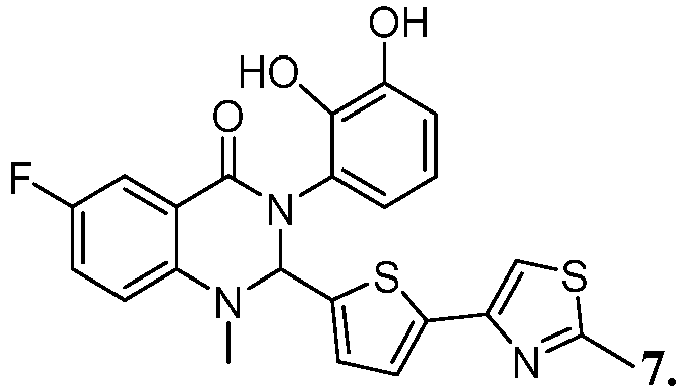
- Le composé 7, de formule suivante, est préparé de façon analogue au composé 2 ou 3.
-

Réactifs éq. M (g/mol) n (mmol) m (mg) V (mL) Anhydride N-méthylisatoïque 1 177,04 1 177 / 2-nitroaniline 1 138,13 1 138 / 5-(2-méthyl-1,3-thiazol-4-yl)-2-thiophènecarbaldéhyde 1 209,00 1 209 / Acide acétique / / / / 2 - Le mélange a été agité à 120°C pendant 3 heures sous irradiation micro-ondes. Le résidu a été dissous dans de l'EtOAc et lavé successivement avec une solution saturée de NaHCO3 (trois fois), de la saumure (deux fois) et de l'eau (une fois). La phase organique a été séchée sur MgSO4, filtrée et concentrée sous vide. Le résidu a été purifié par chromatographie (dépôt solide), éluée par un mélange cyclohexane/EtOAc : 9/1 -> 1/1 (rendement : 49%).
-

Réactifs éq. M (g/mol) n (mmol) m (mg) V (mL) 4' 1 462,08 0,79 365 / Zn 30 65,39 30 1500 / EtOH / / / / 10 H2O / / / / 1,8 AcOH / / / / 0,9 - Le mélange a été agité une nuit à température ambiante, à l'abri de la lumière.
- Le résidu obtenu a été purifié par chromatographie (dépôt solide), éluée par un mélange cyclohexane/EtOAc : 95/5 -> 0/1, puis reprécipité par dissolution dans le minimum d'EtOAc et ajout de pentane (rendement : 81%).
- RMN 1H (DMSO-d6) : 2,62 (s, 3H) ; 2,90 (s, 3H) ; 5,04 (s, 2H) ; 5,97 (s, 1H) ; 6,48 (td, 1H, J : 1,2, J : 7,3) ; 6,68 (dd, 1H, J : 1,2, J : 7,7) ; 6,77 (d, 1H, J : 8,2) ; 6 ; 6.87 (dd, 1H, J : 1, J : 8) ; 6,9-6,96 (m, 2H) ; 7,03 (td, 1H, J : 1,3, J : 8,4) ; 7,3 (d, 1H, J : 3,6) ; 7,48 (td, 1H, J : 1,5, J : 8,6) ; 7,72 (s, 1H) ; 7,88 (dd, 1H, J : 1,5, J : 7,7).
- RMN 13C (DMSO-d6) : 18,5 ; 34,9 ; 74,5 ; 112,7 ; 113 ; 115,9 ; 116,1 ; 117 ; 118,3 ; 122,6 ; 124,2 ; 128,1 ; 128,4 ; 128,7 ; 129,4 ; 134,2 ; 137,6 ; 138,7 ; 143,8 ; 143,8 ; 146,7 ; 147,8 ; 160,9 ; 165,9.
- LC/MS : temps de rétention = 3,18 min.
- M+H. : 433,4.
-

Réactifs éq. M (g/mol) n (mmol) m (mg) V (mL) 2-aminobenzènesulfonamide 1 172,20 0,4 69 / Anhydride 6-fluoro-N-méthylisatoïque 1 195,03 0,4 78 / 5-(2-méthyl-1,3-thiazol-4-yl)-2-thiophènecarbaldéhyde 1 209,28 0,4 84 / Acide acétique / / / / 1 - Le mélange a été agité à 120°C pendant 2 heures sous irradiation micro-ondes. Le résidu a été dissous dans du dichlorométhane et lavé successivement avec une solution saturée de NaHCO3 (trois fois), de la saumure (deux fois) et de l'eau (une fois). La phase organique a été séchée sur MgSO4, filtrée et concentrée sous vide. Le résidu a été purifié par chromatographie (dépôt solide), éluée par un mélange cyclohexane/EtOAc : 9/1 -> 0/1, puis recristallisé dans le dichlorométhane (rendement : 13%).
- RMN 1H (DMSO-d6) : 2,63 (s, 3H) ; 2,85 (s, 3H) ; 6,18 (s, 1H) ; 6,85 (dd, 1 H, J : 4,2, J : 9,1)] ; 6,89 (dd, 1H, J : 1,3, J : 7,4) ; 6,91 (d, 1H, J : 3.6) ; 7,32 (d, 1H, J : 7,6) ; 7,39 (td, 1H, J : 3,2, J : 8,7) ; 7,47 (s, 2H) ; 7,57-7,59 (m, 3H) ; 7,78 (s, 1H) ; 8,02 (dd, 1H, J : 1,9, J : 7,5).
- RMN 13C (DMSO-d6) : 18,5 ; 35,24 ; 76,7 ; 113,09 ; 113,7 (J : 23,6) 114,9 (J : 7) ; 116,6 (J : 7) ; 121,6 (J : 22,9) ; 122.6 ; 128.3 ; 128.84 ; 129.4 ; 132.1 ; 132.5 ; 136.1 ; 137.6 ; 138 ; 141.2 ; 143.3 ; 147.7 ; 155.1 (J : 235) ; 160.4 ; 166.
- IR : 3175 ; 1653 ; 1496 ; 1474 ; 1450 ; 1357 ; 1342 ; 1160 ; 821 ; 810 ; 710.
- LC/MS : temps de rétention = 3,20 min.
- M+H. : 515,4.
-

Réactifs Formule Masse moléculaire Masse (g) Volume (mL) n (mmol) Anhydride N-méthyl-5-fluoroisatoïque C6H4FNO3 195,15 0,180 / 0,92 4-aminophénol C6H7NO 109,13 0,100 / 0,92 5-(2-méthyl-1,3-thiazol-4-yl)-2-thiophènecarbaldéhyde C9H7NOS2 209,28 0,192 / 0,92 Acide acétique C2H4O2 60,05 / 2,00 / - Le mélange a été agité à 130°C pendant 2 heures sous irradiation micro-ondes. Le résidu a été dissous dans de l'acétate d'éthyle et la phase organique a été lavée successivement avec une solution saturée de NaHCO3 et de l'eau distillée. La phase organique a été séchée sur MgSO4, filtrée et concentrée sous vide. Le solide brun ainsi obtenu a été lavé avec une petite quantité d'EtOAc chaud pour donner une poudre jaune (73%).
- RMN 1H (DMSO-d6) : 2,60 (s, 3H) ; 2,89 (s, 3H) ; 6,32 (s, 1H) ; 6,74-6,77 (m, 3H) ; 6,92 (s large, 1H) ; 7,06 (d, 2H, J : 8,1) ; 7,3-7,35 (m, 2H) ; 7,57 (d, 1H, J : 6,6) ; 7,72 (s, 1H) ; 9,59 (s, 1H).
- RMN 13C (DMSO-d6) : 18,5 ; 35,3 ; 76,4 ; 112,8 ; 113,7 (J : 24) ; 115,2 (J : 7) ; 115,4 ; 117,9 (J : 7) ; 121.2 (J : 23) ; 122,8 ; 128 ; 128,4 ; 131 ; 137,7 ; 138,5 ; 143,3 ; 147,7 ; 155,5 (J : 235) ; 156,3 ; 159,9 ; 166.
- IR : 3216 (large) ; 1630 ; 1513 ; 1498 ; 1267 ; 1163 ; 888 ; 811 ; 737 ; 711.
- LC/MS : temps de rétention = 3,33 min.
- M+H. : 452,4.
- Les composés ont été testés soit sur cellules A549 (cellules épithéliales pulmonaires humaines) soit sur cellules HeLa (cellules de cancer utérin humain), contre les toxines de Shiga (Stx-1 et/ou Stx-2). Les cellules humaines sont cultivées à 37°C dans une atmosphère contenant 5% de CO2 sur des flasques de culture de 150 cm2 dans du milieu DMEM (Dulbecco's Modified Eagle Medium) contenant 100 U/mL de pénicilline et 100 µg/mL de streptomycine. Les cellules sont ensemencées à une densité de 50000 cellules par puits dans des plaques 96 puits à fond en scintillant solide Cytostar-T (
Figure 2 ). Les cellules (100 µL dans du DMEM complet: DMEM + 10% de sérum de veau foetal, SVF) sont pré-incubées ou non avec les inhibiteurs (50 µL; différentes concentrations, pré-incubation de 3 h). Le milieu complet complémenté de toxine (50 µL, gamme de concentration variable) est ensuite ajouté à chaque puits. Après une incubation de 20 h, le milieu (200 µL) est éliminé et remplacé par un milieu DMEM sans leucine (Eurobio) contenant 10% de SVF et 0,5 µCi/mL de 14C-leucine (GE). Après une incubation de 7 h à 37°C, l'incorporation de radioactivité par les cellules est déterminée par lecture des plaques par un compteur à scintillation Wallac 1450 Microbeta trilux (PE). - Comme ces toxines bloquent la synthèse des protéines, les cellules affectées ne sont plus capables d'incorporer la leucine radiomarquée. Par contre, les cellules traitées par des inhibiteurs synthétisent toujours des protéines et incorporent donc l'acide aminé radiomarqué. Comme les cellules concentrent le radioélément suffisamment près du fond du puits, cela entraine une excitation du scintillant contenu dans les plaques et conduit à l'émission de photons détectée par le compteur à scintillation (mesure en coups par minutes, cpm). Ces données sont ensuite exprimées en pourcentage de synthèse de protéine par les cellules. Les courbes de cytotoxicité peuvent ainsi être tracées (
Figure 2 ) sans inhibiteur (ronds blancs) ou en présence d'un inhibiteur (ronds noirs). L'analyse des données par régression non linéaire permet d'estimer l'EC50, soit la concentration efficace pour laquelle on observe 50 % d'assimilation de leucine radioactive ce qui correspond à 50% de cellules viables. Plus la valeur de l'EC50 est élevée, plus la protection cellulaire est importante car il faut alors une concentration plus élevée de toxine pour générer la même cytotoxicité. Il est ainsi possible de déterminer l'efficacité des inhibiteurs en calculant le ratio R des EC50 (Figure 2 ). Plus la valeur est élevée (> 1), plus la protection des cellules est importante. - Six courbes de cytototoxicité sont obtenues en l'absence puis en présence de concentrations croissantes d'inhibiteur. Pour chaque concentration (C) d'inhibiteur, un pourcentage de protection est déterminé à partir de la valeur de R calculée par le logiciel Prism avec Rmax correspondant à la valeur maximale de R de la série:

- L'IC50 est ensuite calculée, à l'aide du logiciel Prism par régression non linéaire, à partir d'un graphique où sont reportés pour chaque concentration de composé le pourcentage de protection cellulaire correspondant (cf.
Figure 3 ). - IC50 correspond à la concentration de composé donnant 50% de son pouvoir inhibiteur. Plus cette concentration est faible, plus l'inhibiteur est puissant.
-
Composé IC50(nM) Retro-2.1 (Contrôle) 100,0 4 78,6 1 14,2 2 20,0 3 55,0 5 35,0 7 41,0 6 (hors invention) 483,0 - Le composé Retro-2.1 est de formule suivante :

- Ces résultats montrent que les composés testés sont tous des inhibiteurs de l'effet cellulaire de la toxine Shiga plus puissants que le composé Retro-2.1 (contrôle hors invention, dans lequel la dihydroquinazolinone porte un phényle non substitué), ainsi que le composé 6 (hors invention, dans lequel la dihydroquinazolinone porte un phényle substitué en para par un groupe hydroxyle).
- Le protocole et le calcul de l'IC50 des composés de l'invention est analogue à celui présenté au paragraphe II, en prenant pour toxine la ricine.
- Des cellules comme indiquées ci-après ont été ensemencées à une densité de 50 % dans des plaques de 96 puits dans un milieu MEM additionné de 10 % de sérum foetal bovin et incubées à 37 °C, 5 % de CO2. On a laissé les cellules reposer pendant la nuit. Les composés à tester ont été dissous dans le DMSO à 20 mM chacun. Le jour suivant, chaque composé a été dilué 100 fois dans du MEM avec du sérum, dilué en série (à 5 concentrations) et ajouté en volume égal au milieu cellulaire dans chaque puits. Après 1 heure de préincubation, le virus a été ajouté à une multiplicité d'infection (MOI) telle qu'indiquée ci-après. Les virus utilisés sont notamment des virus recombinant qui codent une protéine fluorescente verte (Towner et al. 2005. Virology 332:20-7 ; ou virus ANCHOR fournis par NEOVIRTECH). Ces virus sont capables de se répliquer et présentent une pathogenèse normale chez l'animal. Les cellules ont ensuite été fixées à l'aide de formol à 10 % pendant le temps indiqué ci-après. Les noyaux des cellules ont été colorés avec du DAPI selon des méthodes habituelles. L'infection a ensuite été analysée en photographiant chaque puits à l'aide d'un microscope épifluorescent. Les cellules totales et infectées ont été comptées en comptant respectivement les cellules colorées par DAPI et les cellules fluorescentes vertes à l'aide du logiciel Cell Profiler. La fraction de cellules infectées a été calculée en divisant le nombre de cellules fluorescentes vertes par le nombre total de cellules. L'évaluation de la CI50 a été effectuée en fonction du nombre de cellules à l'aide du logiciel Combenefit (Di Veroli et al. Bioinformatics 2016, 32(18), 2866-8).
- Conditions d'infection et de fixation :
- Cellules MRC5 avec hCMV-ANCHOR, MOI 1 ; fixation à 6 jours ;
- Cellules HeLa avec VACV-ANCHOR, MOI 0,1 ; fixation à 48 heures ;
- Cellules RK13 avec Myxomavirus T1-ANCHOR, MOI 0,05 ; fixation à 6 jours ;
- Cellules Hep2 avec RSV ; MOI 0,2 ; fixation à 72 heures.
- Des concentrations en composé de l'invention de 100 µM à 0,2 µM ont été testées (2 fois). Les cellules telles que décrites ci-dessus ont été fixées 72 heures après ajout des composés de l'invention. Le nombre de cellules comptées par puits est normalisé sur le nombre de cellules comptées dans les puits correspondants traités uniquement avec du DMSO. L'évaluation de la CC50 a été effectuée en fonction du nombre de cellules à l'aide du logiciel Combenefit précité.
- Les résultats obtenus sont consignés dans le tableau suivant :
Retro-2.1 2 1 6 (hors invention) HeLa / VacV CC50 (nM) > 50 000 32 300 >50 000 20 400 CI50 (nM) 37,8 3,61 1,05 628 Index de sélectivité 1 323 8 947 47 619 32 RK13 / MyxV T1 CC50 (nM) 3 350 ND 7 460 12 900 CI50 (nM) 74,5 14,2 1,44 5 800 Index de sélectivité 45 ND 5 181 2 MRC5 / hCMV CC50 (nM) > 50 000 21 000 21 500 16 700 CI50 (nM) 11,6 < 1 < 1 281 Index de sélectivité 4 310 21 000 21 500 59 Hep2 / RSV CC50 (nM) > 50 000 37 600 > 50 000 25 600 CI50 (nM) 162 20 ND 2200 Index de sélectivité 309 1880 ND 12 - Des cellules HeLa229 sont prétraitées avec le composé de l'invention à évaluer à des concentrations de 25, 50 et 75 µM pendant 30 minutes jusqu'à ce que la bactérie soit ajoutée aux cellules.
- Les cellules présentant une infection primaire sont lysées 24 h après l'infection (hpi).
- Des cellules traitées avec ledit composé sont également lysées 48 h après l'infection et le lysat obtenu est utilisé pour infecter de nouvelles cellules HeLa229, lesquelles sont lysées 24 h après l'infection et analysées avec les échantillons d'infection primaire par immunoblot. La croissance de la bactérie est détectée à l'aide d'anticorps ad hoc et l'actine est utilisée comme contrôle.
- Des prodrogues selon la présente invention ont été synthétisées comme suit :


- Les composés ainsi obtenus ont une excellente solubilité dans l'eau (>700 mg/mL, administration possible en minipompes, perfusion, injection i.v.). Leur clivage par les amidases et/ou les estérases plasmatiques est rapide (par exemple avec un t1/2 de 2,6 heures dans du plasma de souris à 37°C).
- D'autres prodrogues, sous la forme de polymères thermogélifiants ont été obtenus comme suit :

- (Composé 2)-PLGA1036-PEG1450-PLGA1036-(Composé 2) (Mn = 4393 g/mol) ou (Composé 2)-C(=O)-(CH2)2-C(=O)-PLGA1036-PEG1450-PLGA1036-C(=O)-(CH2)2-C(=O)-(Composé 2), en particulier de formule suivante :

- Le PLGA1036-PEG1450-PLGA1036 est par exemple obtenu comme suit :

- Le poly(éthylène glycol) 1450 (3,00g - 2,07mmol) est placé dans un schlenk, chauffé à 100°C dans un bain d'huile. Le schlenk est placé sous vide pendant 2h sous agitation. Le glycolide (0,6g - 5,13mmol) et le D,L-Lactide (2,64g - 18,3 mmol) sont ajoutés au schlenk et le mélange est chauffé à 130°C jusqu'à fusion complète des solides. Le Sn(Oct)2 (une goutte) est ajouté. Le mélange est chauffé 20h à 130°C sous agitation, sous azote. Le mélange est ramené à TA puis dissous dans 20mL d'acétone. La solution est ajoutée goutte à goutte à de l'eau distillée à 4°C sous agitation. Le mélange est agité à 4°C jusqu'à solubilisation complète du polymère puis le mélange est chauffé à 80°C. Le polymère est récupéré par décantation. Cette séquence est répétée puis le solide est dissous dans du dichlorométhane. La phase organique est séchée sur MgSO4, filtrée et évaporée pour donner une gomme translucide qui est séchée sous vide à 40°C pendant 15h.
- Produit purifié : 3,8g (49%).
- Masse molaire (PLA)=1707 g/mol ; Masse molaire (PGA)=365 g/mol, correspondant à un composé PLGA1036-PEG1450-PLGA1036 (Mn=3522g/mol ; LA/GA=3,8).
Claims (11)
- Composé de formule générale (I) :
 - p est égal à 1, 2 ou 3 ;- Ri représente à chaque occurrence, de façon indépendante, un atome d'hydrogène, un atome d'halogène, un radical alcoxy de 1 à 3 atomes de carbone, notamment un groupe méthoxy, -NO2, ou -NH2 ;- R2 et R3 représentent indépendamment l'un de l'autre un groupe choisi parmi H, -OH, -OR4, -NH2, -NHR5, -SO2-NH2, -SO2-NH-R6, à la condition que l'un au moins de R2 et R3 ne représente pas H ;- R4, R5 et R6 représentent indépendamment les uns des autres un groupe de formule (II) -L-(X)i-(PEG)-(Y)j-Z, où :- i et j représentent indépendamment l'un de l'autre 0 ou 1 ;- L représente -C(=O)- ou -C(=O)-(CH2)k-C(=O)-, avec k étant égal à 1, 2 ou 3, en particulier 2 ;- X et Y représentent indépendamment l'un de l'autre un poly(acide lactique) ou un poly(acide lactique-co-acide glycolique) ;- PEG représente un poly(éthylène glycol) ;- Z représente un groupe choisi parmi H, un alkyle en C1 à C3, -OH, un O-alkyle en C1 à C3, ou -L-Re, où L est défini tel que précédemment et Re est un résidu de formule (I) relié audit groupe -L-(X)i-(PEG)-(Y)j- défini précédemment par l'intermédiaire de son groupe R2 ou R3, ledit groupe R2 ou R3 étant -OH, -NH2 ou -SO2-NH2;ainsi que les formes stéréoisomères, les mélanges de formes stéréoisomères ou leurs sels pharmaceutiquement acceptables.
 - Composé de formule générale (I) selon la revendication 1, dans lequel R3 représente un atome d'hydrogène.
- Composé de formule générale (I) selon l'une quelconque des revendications précédentes, dans lequel R2 représente un atome d'hydrogène.
- Composé de formule générale (I) selon l'une quelconque des revendications précédentes, dans lequel p est égal à 1.
- Composé de formule générale (I) selon l'une quelconque des revendications précédentes, dans lequel R1 représente un atome d'halogène, en particulier un atome de fluor.
- Composé de formule générale (I) selon la revendication 1, de formule (Ia) suivante :

- Composé de formule générale (I) selon la revendication 1, choisi parmi :


- Composé de formule générale (I) tel que défini dans l'une quelconque des revendications 1 à 7, pour son utilisation pour la prévention et/ou le traitement des désordres induits par les toxines à mode d'action intracellulaire utilisant le transport rétrograde choisies parmi la ricine, la toxine de Shiga et les toxines Shiga-like (Stxs) produites par Shigella dysenteriae (Stx) et E. coli, la toxine cholérique, la toxine pertussique, la cytotoxine subtilase et l'entérotoxine thermolabile, par les virus utilisant le transport rétrograde et/ou dépendant de la syntaxine 5 pour infecter les cellules, choisis parmi les virus pox, les cytomégalovirus, les adénovirus et les virus adéno-associés, les polyomavirus, les papillomavirus, les filovirus, les entérovirus, les virus de l'herpès, les virus du genre Arenavirus, les virus de la grippe, et les pneumovirus, les bactéries utilisant le transport rétrograde et/ou dépendant de la syntaxine 5 pour infecter les cellules, choisies parmi les bactéries de l'ordre des Chlamydiales ou Symkania, ou par les parasites intracellulaires.
- Composé pour son utilisation selon la revendication 8, caractérisé en ce que lesdites toxines à mode d'action intracellulaire sont choisies parmi la ricine, la toxine de Shiga et les toxines Shiga-like (Stxs) produite par Shigella dysenteriae (Stx) et E. coli (Stx1 et Stx2), la toxine cholérique (Ctx de Vibrio cholerae responsable du choléra), la toxine pertussique (Bordetella pertussis agent de la coqueluche), la cytotoxine subtilase et l'entérotoxine thermolabile (E. coli).
- Composé pour son utilisation selon la revendication 8, caractérisé en ce que lesdits virus sont les virus pox, notamment le virus de variole, le virus monkeypox, le virus Vaccinia et les leporipoxvirus, en particulier le virus de la myxomatose, les cytomégalovirus, les virus adéno-associés, en particulier de sérotype 2, les polyomavirus, notamment le polyomavirus JC et le polyomavirus BK, les papillomavirus, les filovirus, notamment les virus Ebola et le virus Marburg, les entérovirus, notamment l'entérovirus 71, les virus de l'herpès, notamment le virus Herpes simplex de type 2, les virus du genre Arenavirus, notamment le virus de la chorioméningite lymphocytaire, les virus de la grippe, notamment les influenzavirus A, les pneumovirus, notamment le virus respiratoire syncytial.
- Composition pharmaceutique ou médicament comprenant au moins un composé de formule générale (I) tel que défini dans l'une quelconque des revendications 1 à 7 en tant que principe actif, et un véhicule pharmaceutiquement acceptable, ladite composition pharmaceutique ou ledit médicament étant notamment adapté à une administration par les voies aérienne, orale, parentérale ou locale.
Applications Claiming Priority (2)
| Application Number | Priority Date | Filing Date | Title |
|---|---|---|---|
| FR1872016A FR3088823B1 (fr) | 2018-11-28 | 2018-11-28 | Nouvelles dihydroquinazolinones ayant une activite protectrice vis-a-vis de toxines au mode d’action intracellulaire, de virus et de bacteries |
| PCT/EP2019/082976 WO2020109510A1 (fr) | 2018-11-28 | 2019-11-28 | Nouvelles dihydroquinazolinones ayant une activite protectrice vis-a-vis de toxines au mode d'action intracellulaire, de virus et de bacteries intracellulaires |
Publications (2)
| Publication Number | Publication Date |
|---|---|
| EP3886859A1 EP3886859A1 (fr) | 2021-10-06 |
| EP3886859B1 true EP3886859B1 (fr) | 2024-06-26 |
Family
ID=66542320
Family Applications (1)
| Application Number | Title | Priority Date | Filing Date |
|---|---|---|---|
| EP19858717.2A Active EP3886859B1 (fr) | 2018-11-28 | 2019-11-28 | Nouvelles dihydroquinazolinones ayant une activite protectrice vis-a-vis de toxines au mode d'action intracellulaire, de virus et de bacteries intracellulaires |
Country Status (9)
| Country | Link |
|---|---|
| US (1) | US12024508B2 (fr) |
| EP (1) | EP3886859B1 (fr) |
| JP (1) | JP7499766B2 (fr) |
| KR (1) | KR102867272B1 (fr) |
| CN (1) | CN113164482B (fr) |
| AU (1) | AU2019387338B2 (fr) |
| BR (1) | BR112021010117A2 (fr) |
| FR (1) | FR3088823B1 (fr) |
| WO (1) | WO2020109510A1 (fr) |
Families Citing this family (1)
| Publication number | Priority date | Publication date | Assignee | Title |
|---|---|---|---|---|
| FR3134389B1 (fr) | 2022-04-08 | 2024-04-12 | Commissariat Energie Atomique | Nouvelles dihydroquinazolinones ayant une activite protectrice amelioree vis-a-vis de toxines au mode d’action intracellulaire, de virus et de bacteries intracellulaires |
Family Cites Families (7)
| Publication number | Priority date | Publication date | Assignee | Title |
|---|---|---|---|---|
| US7053216B2 (en) | 2001-11-19 | 2006-05-30 | Iconix Pharmaceuticals, Inc. | Modulators of Rho C activity |
| US7893260B2 (en) | 2005-11-04 | 2011-02-22 | Hydra Biosciences, Inc. | Substituted quinazolin-4-one compounds for antagonizing TRPV3 function |
| US9695156B2 (en) | 2012-07-16 | 2017-07-04 | Brown University | Compounds for the treatment and prevention of infections |
| EP2722047A1 (fr) | 2012-10-19 | 2014-04-23 | Commissariat A L'energie Atomique Et Aux Energies Alternatives | Dérivés de la 2,3-dihydroquinazolin-4(1H)-one pour leur utilisation de le traitement d'infections virales |
| EP2722328A1 (fr) * | 2012-10-19 | 2014-04-23 | Commissariat A L'energie Atomique Et Aux Energies Alternatives | Nouveaux composés ayant une activité protectrice vis-à-vis de toxines au mode d'action intracellulaire |
| US9598406B2 (en) * | 2015-04-21 | 2017-03-21 | Commissariat A L'energie Atomique Et Aux Energies Alternatives | Quinazolinone derivatives for use in the treatment of chlamydiales infections |
| US10781203B2 (en) | 2016-07-20 | 2020-09-22 | The Penn State Research Foundation | Nontoxic compounds for the treatment and prevention of herpesvirus infections |
-
2018
- 2018-11-28 FR FR1872016A patent/FR3088823B1/fr active Active
-
2019
- 2019-11-28 WO PCT/EP2019/082976 patent/WO2020109510A1/fr not_active Ceased
- 2019-11-28 US US17/296,612 patent/US12024508B2/en active Active
- 2019-11-28 EP EP19858717.2A patent/EP3886859B1/fr active Active
- 2019-11-28 KR KR1020217017699A patent/KR102867272B1/ko active Active
- 2019-11-28 JP JP2021529488A patent/JP7499766B2/ja active Active
- 2019-11-28 BR BR112021010117-9A patent/BR112021010117A2/pt active Search and Examination
- 2019-11-28 CN CN201980077953.9A patent/CN113164482B/zh active Active
- 2019-11-28 AU AU2019387338A patent/AU2019387338B2/en active Active
Non-Patent Citations (1)
| Title |
|---|
| DESAI DHIMANT ET AL: "Inhibition of diverse opportunistic viruses by structurally optimized retrograde trafficking inhibitors", BIOORGANIC & MEDICINAL CHEMISTRY, vol. 27, no. 9, 13 March 2019 (2019-03-13), pages 1795 - 1803, XP085652495, ISSN: 0968-0896, DOI: 10.1016/J.BMC.2019.03.026 * |
Also Published As
| Publication number | Publication date |
|---|---|
| EP3886859A1 (fr) | 2021-10-06 |
| KR20210096132A (ko) | 2021-08-04 |
| CN113164482B (zh) | 2024-04-09 |
| US12024508B2 (en) | 2024-07-02 |
| WO2020109510A1 (fr) | 2020-06-04 |
| FR3088823B1 (fr) | 2020-12-11 |
| AU2019387338B2 (en) | 2024-09-05 |
| CA3120813A1 (fr) | 2020-06-04 |
| AU2019387338A1 (en) | 2021-06-24 |
| KR102867272B1 (ko) | 2025-09-30 |
| CN113164482A (zh) | 2021-07-23 |
| JP2022510880A (ja) | 2022-01-28 |
| JP7499766B2 (ja) | 2024-06-14 |
| FR3088823A1 (fr) | 2020-05-29 |
| BR112021010117A2 (pt) | 2021-08-24 |
| US20220002289A1 (en) | 2022-01-06 |
Similar Documents
| Publication | Publication Date | Title |
|---|---|---|
| Gerhart et al. | 2-(4-Amino-4-carboxybutyl) aziridine-2-carboxylic acid. A potent irreversible inhibitor of diaminopimelic acid epimerase. Spontaneous formation from. alpha.-(halomethyl) diaminopimelic acids | |
| FR2804959A1 (fr) | Utilisation de derives de paullones pour la fabrication de medicaments | |
| EP1231916A2 (fr) | Utilisation de derives d'indirubine pour la fabrication de medicaments | |
| CA2754283A1 (fr) | Derives indoliques pour le traitement de maladies neurodegeneratives | |
| EP3886859B1 (fr) | Nouvelles dihydroquinazolinones ayant une activite protectrice vis-a-vis de toxines au mode d'action intracellulaire, de virus et de bacteries intracellulaires | |
| EP2300424B1 (fr) | Utilisation de derives d'indole comme activateurs de nurr-1, pour le traitement de la maladie de parkinson | |
| EP2321323B9 (fr) | Derives dimeriques d'artemisinine et application en therapie anticancereuse | |
| LU82185A1 (fr) | Nouveaux derives hydroxyles de la pyrimidine, leur preparation et leur utilisation therapeutique | |
| CA3120813C (fr) | Dihydroquinazolinones ayant une activite protectrice vis-a-vis de toxines au mode d'action intracellulaire, de virus et de bacteries intracellulaires | |
| EP1704136B1 (fr) | Derives du gossypol, leur methode d obtention et leurs utilisations | |
| FR3134389A1 (fr) | Nouvelles dihydroquinazolinones ayant une activite protectrice amelioree vis-a-vis de toxines au mode d’action intracellulaire, de virus et de bacteries intracellulaires | |
| EP1461319A1 (fr) | Derives de quinoleine, procede de synthese, et medicaments renfermant ces derives | |
| FR2851919A1 (fr) | Lignanes utilisables comme inhibiteurs de cathepsines et leurs applications | |
| US10285978B2 (en) | Heterocycle analogs of CAI-1 as agonists of quorum sensing in vibrio | |
| EP3237015B1 (fr) | Derives hydroxybisphosphoniques hydrosolubles de la doxorubicine | |
| CN114907288B (zh) | 硝基苯类化合物在制备铜绿假单胞菌群体感应抑制剂中的应用 | |
| EP0466586A1 (fr) | Polyméthylène - imines disubstituées, leur procédé de préparation et les compositions pharmaceutiques les contentant | |
| JP6175399B2 (ja) | スチルベン類縁化合物を有効成分とする抗炎症剤 | |
| EP1622895A2 (fr) | 1-aryl-3-(indol-5-yl)-prop-2-en-1-ones, compositions les contenant et utilisation | |
| JPS6248628A (ja) | 内部寄生虫防除用ジアザホスホリン類の使用 | |
| EP0292365A2 (fr) | Dérivés de l'amino-4 quinazolinedione-5,8, leur procédé de préparation et compositions pharmaceutiques les contenant |
Legal Events
| Date | Code | Title | Description |
|---|---|---|---|
| STAA | Information on the status of an ep patent application or granted ep patent |
Free format text: STATUS: UNKNOWN |
|
| STAA | Information on the status of an ep patent application or granted ep patent |
Free format text: STATUS: THE INTERNATIONAL PUBLICATION HAS BEEN MADE |
|
| PUAI | Public reference made under article 153(3) epc to a published international application that has entered the european phase |
Free format text: ORIGINAL CODE: 0009012 |
|
| STAA | Information on the status of an ep patent application or granted ep patent |
Free format text: STATUS: REQUEST FOR EXAMINATION WAS MADE |
|
| 17P | Request for examination filed |
Effective date: 20210611 |
|
| AK | Designated contracting states |
Kind code of ref document: A1 Designated state(s): AL AT BE BG CH CY CZ DE DK EE ES FI FR GB GR HR HU IE IS IT LI LT LU LV MC MK MT NL NO PL PT RO RS SE SI SK SM TR |
|
| DAV | Request for validation of the european patent (deleted) | ||
| DAX | Request for extension of the european patent (deleted) | ||
| GRAP | Despatch of communication of intention to grant a patent |
Free format text: ORIGINAL CODE: EPIDOSNIGR1 |
|
| STAA | Information on the status of an ep patent application or granted ep patent |
Free format text: STATUS: GRANT OF PATENT IS INTENDED |
|
| INTG | Intention to grant announced |
Effective date: 20240123 |
|
| GRAS | Grant fee paid |
Free format text: ORIGINAL CODE: EPIDOSNIGR3 |
|
| GRAA | (expected) grant |
Free format text: ORIGINAL CODE: 0009210 |
|
| STAA | Information on the status of an ep patent application or granted ep patent |
Free format text: STATUS: THE PATENT HAS BEEN GRANTED |
|
| AK | Designated contracting states |
Kind code of ref document: B1 Designated state(s): AL AT BE BG CH CY CZ DE DK EE ES FI FR GB GR HR HU IE IS IT LI LT LU LV MC MK MT NL NO PL PT RO RS SE SI SK SM TR |
|
| REG | Reference to a national code |
Ref country code: GB Ref legal event code: FG4D Free format text: NOT ENGLISH |
|
| REG | Reference to a national code |
Ref country code: CH Ref legal event code: EP |
|
| REG | Reference to a national code |
Ref country code: DE Ref legal event code: R096 Ref document number: 602019054358 Country of ref document: DE |
|
| PG25 | Lapsed in a contracting state [announced via postgrant information from national office to epo] |
Ref country code: BG Free format text: LAPSE BECAUSE OF FAILURE TO SUBMIT A TRANSLATION OF THE DESCRIPTION OR TO PAY THE FEE WITHIN THE PRESCRIBED TIME-LIMIT Effective date: 20240626 |
|
| PG25 | Lapsed in a contracting state [announced via postgrant information from national office to epo] |
Ref country code: FI Free format text: LAPSE BECAUSE OF FAILURE TO SUBMIT A TRANSLATION OF THE DESCRIPTION OR TO PAY THE FEE WITHIN THE PRESCRIBED TIME-LIMIT Effective date: 20240626 Ref country code: HR Free format text: LAPSE BECAUSE OF FAILURE TO SUBMIT A TRANSLATION OF THE DESCRIPTION OR TO PAY THE FEE WITHIN THE PRESCRIBED TIME-LIMIT Effective date: 20240626 |
|
| REG | Reference to a national code |
Ref country code: LT Ref legal event code: MG9D |
|
| PG25 | Lapsed in a contracting state [announced via postgrant information from national office to epo] |
Ref country code: GR Free format text: LAPSE BECAUSE OF FAILURE TO SUBMIT A TRANSLATION OF THE DESCRIPTION OR TO PAY THE FEE WITHIN THE PRESCRIBED TIME-LIMIT Effective date: 20240927 |
|
| PG25 | Lapsed in a contracting state [announced via postgrant information from national office to epo] |
Ref country code: LV Free format text: LAPSE BECAUSE OF FAILURE TO SUBMIT A TRANSLATION OF THE DESCRIPTION OR TO PAY THE FEE WITHIN THE PRESCRIBED TIME-LIMIT Effective date: 20240626 |
|
| RAP4 | Party data changed (patent owner data changed or rights of a patent transferred) |
Owner name: COMMISSARIAT A L'ENERGIE ATOMIQUE ET AUX ENERGIESALTERNATIVES |
|
| REG | Reference to a national code |
Ref country code: NL Ref legal event code: MP Effective date: 20240626 |
|
| PG25 | Lapsed in a contracting state [announced via postgrant information from national office to epo] |
Ref country code: NO Free format text: LAPSE BECAUSE OF FAILURE TO SUBMIT A TRANSLATION OF THE DESCRIPTION OR TO PAY THE FEE WITHIN THE PRESCRIBED TIME-LIMIT Effective date: 20240926 Ref country code: LV Free format text: LAPSE BECAUSE OF FAILURE TO SUBMIT A TRANSLATION OF THE DESCRIPTION OR TO PAY THE FEE WITHIN THE PRESCRIBED TIME-LIMIT Effective date: 20240626 Ref country code: HR Free format text: LAPSE BECAUSE OF FAILURE TO SUBMIT A TRANSLATION OF THE DESCRIPTION OR TO PAY THE FEE WITHIN THE PRESCRIBED TIME-LIMIT Effective date: 20240626 Ref country code: GR Free format text: LAPSE BECAUSE OF FAILURE TO SUBMIT A TRANSLATION OF THE DESCRIPTION OR TO PAY THE FEE WITHIN THE PRESCRIBED TIME-LIMIT Effective date: 20240927 Ref country code: FI Free format text: LAPSE BECAUSE OF FAILURE TO SUBMIT A TRANSLATION OF THE DESCRIPTION OR TO PAY THE FEE WITHIN THE PRESCRIBED TIME-LIMIT Effective date: 20240626 Ref country code: BG Free format text: LAPSE BECAUSE OF FAILURE TO SUBMIT A TRANSLATION OF THE DESCRIPTION OR TO PAY THE FEE WITHIN THE PRESCRIBED TIME-LIMIT Effective date: 20240626 Ref country code: RS Free format text: LAPSE BECAUSE OF FAILURE TO SUBMIT A TRANSLATION OF THE DESCRIPTION OR TO PAY THE FEE WITHIN THE PRESCRIBED TIME-LIMIT Effective date: 20240926 |
|
| PG25 | Lapsed in a contracting state [announced via postgrant information from national office to epo] |
Ref country code: NL Free format text: LAPSE BECAUSE OF FAILURE TO SUBMIT A TRANSLATION OF THE DESCRIPTION OR TO PAY THE FEE WITHIN THE PRESCRIBED TIME-LIMIT Effective date: 20240626 |
|
| REG | Reference to a national code |
Ref country code: AT Ref legal event code: MK05 Ref document number: 1697140 Country of ref document: AT Kind code of ref document: T Effective date: 20240626 |
|
| PG25 | Lapsed in a contracting state [announced via postgrant information from national office to epo] |
Ref country code: NL Free format text: LAPSE BECAUSE OF FAILURE TO SUBMIT A TRANSLATION OF THE DESCRIPTION OR TO PAY THE FEE WITHIN THE PRESCRIBED TIME-LIMIT Effective date: 20240626 |
|
| PG25 | Lapsed in a contracting state [announced via postgrant information from national office to epo] |
Ref country code: PT Free format text: LAPSE BECAUSE OF FAILURE TO SUBMIT A TRANSLATION OF THE DESCRIPTION OR TO PAY THE FEE WITHIN THE PRESCRIBED TIME-LIMIT Effective date: 20241028 |
|
| PG25 | Lapsed in a contracting state [announced via postgrant information from national office to epo] |
Ref country code: PT Free format text: LAPSE BECAUSE OF FAILURE TO SUBMIT A TRANSLATION OF THE DESCRIPTION OR TO PAY THE FEE WITHIN THE PRESCRIBED TIME-LIMIT Effective date: 20241028 |
|
| PG25 | Lapsed in a contracting state [announced via postgrant information from national office to epo] |
Ref country code: PL Free format text: LAPSE BECAUSE OF FAILURE TO SUBMIT A TRANSLATION OF THE DESCRIPTION OR TO PAY THE FEE WITHIN THE PRESCRIBED TIME-LIMIT Effective date: 20240626 |
|
| PG25 | Lapsed in a contracting state [announced via postgrant information from national office to epo] |
Ref country code: EE Free format text: LAPSE BECAUSE OF FAILURE TO SUBMIT A TRANSLATION OF THE DESCRIPTION OR TO PAY THE FEE WITHIN THE PRESCRIBED TIME-LIMIT Effective date: 20240626 |
|
| PG25 | Lapsed in a contracting state [announced via postgrant information from national office to epo] |
Ref country code: AT Free format text: LAPSE BECAUSE OF FAILURE TO SUBMIT A TRANSLATION OF THE DESCRIPTION OR TO PAY THE FEE WITHIN THE PRESCRIBED TIME-LIMIT Effective date: 20240626 Ref country code: IS Free format text: LAPSE BECAUSE OF FAILURE TO SUBMIT A TRANSLATION OF THE DESCRIPTION OR TO PAY THE FEE WITHIN THE PRESCRIBED TIME-LIMIT Effective date: 20241026 |
|
| PG25 | Lapsed in a contracting state [announced via postgrant information from national office to epo] |
Ref country code: CZ Free format text: LAPSE BECAUSE OF FAILURE TO SUBMIT A TRANSLATION OF THE DESCRIPTION OR TO PAY THE FEE WITHIN THE PRESCRIBED TIME-LIMIT Effective date: 20240626 |
|
| PG25 | Lapsed in a contracting state [announced via postgrant information from national office to epo] |
Ref country code: RO Free format text: LAPSE BECAUSE OF FAILURE TO SUBMIT A TRANSLATION OF THE DESCRIPTION OR TO PAY THE FEE WITHIN THE PRESCRIBED TIME-LIMIT Effective date: 20240626 Ref country code: SK Free format text: LAPSE BECAUSE OF FAILURE TO SUBMIT A TRANSLATION OF THE DESCRIPTION OR TO PAY THE FEE WITHIN THE PRESCRIBED TIME-LIMIT Effective date: 20240626 |
|
| PG25 | Lapsed in a contracting state [announced via postgrant information from national office to epo] |
Ref country code: SM Free format text: LAPSE BECAUSE OF FAILURE TO SUBMIT A TRANSLATION OF THE DESCRIPTION OR TO PAY THE FEE WITHIN THE PRESCRIBED TIME-LIMIT Effective date: 20240626 Ref country code: ES Free format text: LAPSE BECAUSE OF FAILURE TO SUBMIT A TRANSLATION OF THE DESCRIPTION OR TO PAY THE FEE WITHIN THE PRESCRIBED TIME-LIMIT Effective date: 20240626 |
|
| PG25 | Lapsed in a contracting state [announced via postgrant information from national office to epo] |
Ref country code: SM Free format text: LAPSE BECAUSE OF FAILURE TO SUBMIT A TRANSLATION OF THE DESCRIPTION OR TO PAY THE FEE WITHIN THE PRESCRIBED TIME-LIMIT Effective date: 20240626 Ref country code: SK Free format text: LAPSE BECAUSE OF FAILURE TO SUBMIT A TRANSLATION OF THE DESCRIPTION OR TO PAY THE FEE WITHIN THE PRESCRIBED TIME-LIMIT Effective date: 20240626 Ref country code: RO Free format text: LAPSE BECAUSE OF FAILURE TO SUBMIT A TRANSLATION OF THE DESCRIPTION OR TO PAY THE FEE WITHIN THE PRESCRIBED TIME-LIMIT Effective date: 20240626 Ref country code: PL Free format text: LAPSE BECAUSE OF FAILURE TO SUBMIT A TRANSLATION OF THE DESCRIPTION OR TO PAY THE FEE WITHIN THE PRESCRIBED TIME-LIMIT Effective date: 20240626 Ref country code: IS Free format text: LAPSE BECAUSE OF FAILURE TO SUBMIT A TRANSLATION OF THE DESCRIPTION OR TO PAY THE FEE WITHIN THE PRESCRIBED TIME-LIMIT Effective date: 20241026 Ref country code: ES Free format text: LAPSE BECAUSE OF FAILURE TO SUBMIT A TRANSLATION OF THE DESCRIPTION OR TO PAY THE FEE WITHIN THE PRESCRIBED TIME-LIMIT Effective date: 20240626 Ref country code: EE Free format text: LAPSE BECAUSE OF FAILURE TO SUBMIT A TRANSLATION OF THE DESCRIPTION OR TO PAY THE FEE WITHIN THE PRESCRIBED TIME-LIMIT Effective date: 20240626 Ref country code: CZ Free format text: LAPSE BECAUSE OF FAILURE TO SUBMIT A TRANSLATION OF THE DESCRIPTION OR TO PAY THE FEE WITHIN THE PRESCRIBED TIME-LIMIT Effective date: 20240626 Ref country code: AT Free format text: LAPSE BECAUSE OF FAILURE TO SUBMIT A TRANSLATION OF THE DESCRIPTION OR TO PAY THE FEE WITHIN THE PRESCRIBED TIME-LIMIT Effective date: 20240626 |
|
| PG25 | Lapsed in a contracting state [announced via postgrant information from national office to epo] |
Ref country code: IT Free format text: LAPSE BECAUSE OF FAILURE TO SUBMIT A TRANSLATION OF THE DESCRIPTION OR TO PAY THE FEE WITHIN THE PRESCRIBED TIME-LIMIT Effective date: 20240626 |
|
| REG | Reference to a national code |
Ref country code: DE Ref legal event code: R097 Ref document number: 602019054358 Country of ref document: DE |
|
| PG25 | Lapsed in a contracting state [announced via postgrant information from national office to epo] |
Ref country code: DK Free format text: LAPSE BECAUSE OF FAILURE TO SUBMIT A TRANSLATION OF THE DESCRIPTION OR TO PAY THE FEE WITHIN THE PRESCRIBED TIME-LIMIT Effective date: 20240626 |
|
| PLBE | No opposition filed within time limit |
Free format text: ORIGINAL CODE: 0009261 |
|
| STAA | Information on the status of an ep patent application or granted ep patent |
Free format text: STATUS: NO OPPOSITION FILED WITHIN TIME LIMIT |
|
| 26N | No opposition filed |
Effective date: 20250327 |
|
| REG | Reference to a national code |
Ref country code: CH Ref legal event code: PL |
|
| PG25 | Lapsed in a contracting state [announced via postgrant information from national office to epo] |
Ref country code: MC Free format text: LAPSE BECAUSE OF FAILURE TO SUBMIT A TRANSLATION OF THE DESCRIPTION OR TO PAY THE FEE WITHIN THE PRESCRIBED TIME-LIMIT Effective date: 20240626 |
|
| PG25 | Lapsed in a contracting state [announced via postgrant information from national office to epo] |
Ref country code: LU Free format text: LAPSE BECAUSE OF NON-PAYMENT OF DUE FEES Effective date: 20241128 |
|
| REG | Reference to a national code |
Ref country code: CH Ref legal event code: PL |
|
| PG25 | Lapsed in a contracting state [announced via postgrant information from national office to epo] |
Ref country code: CH Free format text: LAPSE BECAUSE OF NON-PAYMENT OF DUE FEES Effective date: 20241130 |
|
| REG | Reference to a national code |
Ref country code: BE Ref legal event code: MM Effective date: 20241130 |
|
| PG25 | Lapsed in a contracting state [announced via postgrant information from national office to epo] |
Ref country code: SE Free format text: LAPSE BECAUSE OF FAILURE TO SUBMIT A TRANSLATION OF THE DESCRIPTION OR TO PAY THE FEE WITHIN THE PRESCRIBED TIME-LIMIT Effective date: 20240626 |
|
| PG25 | Lapsed in a contracting state [announced via postgrant information from national office to epo] |
Ref country code: BE Free format text: LAPSE BECAUSE OF NON-PAYMENT OF DUE FEES Effective date: 20241130 |
|
| PG25 | Lapsed in a contracting state [announced via postgrant information from national office to epo] |
Ref country code: IE Free format text: LAPSE BECAUSE OF NON-PAYMENT OF DUE FEES Effective date: 20241128 |
|
| PGFP | Annual fee paid to national office [announced via postgrant information from national office to epo] |
Ref country code: DE Payment date: 20251118 Year of fee payment: 7 |
|
| PGFP | Annual fee paid to national office [announced via postgrant information from national office to epo] |
Ref country code: GB Payment date: 20251125 Year of fee payment: 7 |
|
| PGFP | Annual fee paid to national office [announced via postgrant information from national office to epo] |
Ref country code: FR Payment date: 20251125 Year of fee payment: 7 |
|
| PG25 | Lapsed in a contracting state [announced via postgrant information from national office to epo] |
Ref country code: HU Free format text: LAPSE BECAUSE OF FAILURE TO SUBMIT A TRANSLATION OF THE DESCRIPTION OR TO PAY THE FEE WITHIN THE PRESCRIBED TIME-LIMIT; INVALID AB INITIO Effective date: 20191128 |
|
| PG25 | Lapsed in a contracting state [announced via postgrant information from national office to epo] |
Ref country code: CY Free format text: LAPSE BECAUSE OF FAILURE TO SUBMIT A TRANSLATION OF THE DESCRIPTION OR TO PAY THE FEE WITHIN THE PRESCRIBED TIME-LIMIT; INVALID AB INITIO Effective date: 20191128 |