EP3887406B1 - Processus de lavage - Google Patents
Processus de lavage Download PDFInfo
- Publication number
- EP3887406B1 EP3887406B1 EP19808613.4A EP19808613A EP3887406B1 EP 3887406 B1 EP3887406 B1 EP 3887406B1 EP 19808613 A EP19808613 A EP 19808613A EP 3887406 B1 EP3887406 B1 EP 3887406B1
- Authority
- EP
- European Patent Office
- Prior art keywords
- catalyst component
- hydrocyclone
- product stream
- component particles
- washing
- Prior art date
- Legal status (The legal status is an assumption and is not a legal conclusion. Google has not performed a legal analysis and makes no representation as to the accuracy of the status listed.)
- Active
Links
Images

Classifications
-
- C—CHEMISTRY; METALLURGY
- C08—ORGANIC MACROMOLECULAR COMPOUNDS; THEIR PREPARATION OR CHEMICAL WORKING-UP; COMPOSITIONS BASED THEREON
- C08F—MACROMOLECULAR COMPOUNDS OBTAINED BY REACTIONS ONLY INVOLVING CARBON-TO-CARBON UNSATURATED BONDS
- C08F4/00—Polymerisation catalysts
-
- C—CHEMISTRY; METALLURGY
- C08—ORGANIC MACROMOLECULAR COMPOUNDS; THEIR PREPARATION OR CHEMICAL WORKING-UP; COMPOSITIONS BASED THEREON
- C08F—MACROMOLECULAR COMPOUNDS OBTAINED BY REACTIONS ONLY INVOLVING CARBON-TO-CARBON UNSATURATED BONDS
- C08F4/00—Polymerisation catalysts
- C08F4/42—Metals; Metal hydrides; Metallo-organic compounds; Use thereof as catalyst precursors
- C08F4/44—Metals; Metal hydrides; Metallo-organic compounds; Use thereof as catalyst precursors selected from light metals, zinc, cadmium, mercury, copper, silver, gold, boron, gallium, indium, thallium, rare earths or actinides
- C08F4/60—Metals; Metal hydrides; Metallo-organic compounds; Use thereof as catalyst precursors selected from light metals, zinc, cadmium, mercury, copper, silver, gold, boron, gallium, indium, thallium, rare earths or actinides together with refractory metals, iron group metals, platinum group metals, manganese, rhenium technetium or compounds thereof
- C08F4/62—Refractory metals or compounds thereof
- C08F4/64—Titanium, zirconium, hafnium or compounds thereof
- C08F4/643—Component covered by group C08F4/64 with a metal or compound covered by group C08F4/44 other than an organo-aluminium compound
-
- B—PERFORMING OPERATIONS; TRANSPORTING
- B01—PHYSICAL OR CHEMICAL PROCESSES OR APPARATUS IN GENERAL
- B01D—SEPARATION
- B01D21/00—Separation of suspended solid particles from liquids by sedimentation
- B01D21/26—Separation of sediment aided by centrifugal force or centripetal force
- B01D21/267—Separation of sediment aided by centrifugal force or centripetal force by using a cyclone
-
- B—PERFORMING OPERATIONS; TRANSPORTING
- B01—PHYSICAL OR CHEMICAL PROCESSES OR APPARATUS IN GENERAL
- B01J—CHEMICAL OR PHYSICAL PROCESSES, e.g. CATALYSIS OR COLLOID CHEMISTRY; THEIR RELEVANT APPARATUS
- B01J19/00—Chemical, physical or physico-chemical processes in general; Their relevant apparatus
- B01J19/18—Stationary reactors having moving elements inside
- B01J19/1856—Stationary reactors having moving elements inside placed in parallel
-
- B—PERFORMING OPERATIONS; TRANSPORTING
- B01—PHYSICAL OR CHEMICAL PROCESSES OR APPARATUS IN GENERAL
- B01J—CHEMICAL OR PHYSICAL PROCESSES, e.g. CATALYSIS OR COLLOID CHEMISTRY; THEIR RELEVANT APPARATUS
- B01J19/00—Chemical, physical or physico-chemical processes in general; Their relevant apparatus
- B01J19/18—Stationary reactors having moving elements inside
- B01J19/1862—Stationary reactors having moving elements inside placed in series
-
- B—PERFORMING OPERATIONS; TRANSPORTING
- B01—PHYSICAL OR CHEMICAL PROCESSES OR APPARATUS IN GENERAL
- B01J—CHEMICAL OR PHYSICAL PROCESSES, e.g. CATALYSIS OR COLLOID CHEMISTRY; THEIR RELEVANT APPARATUS
- B01J8/00—Chemical or physical processes in general, conducted in the presence of fluids and solid particles; Apparatus for such processes
- B01J8/005—Separating solid material from the gas/liquid stream
- B01J8/0055—Separating solid material from the gas/liquid stream using cyclones
-
- C—CHEMISTRY; METALLURGY
- C08—ORGANIC MACROMOLECULAR COMPOUNDS; THEIR PREPARATION OR CHEMICAL WORKING-UP; COMPOSITIONS BASED THEREON
- C08F—MACROMOLECULAR COMPOUNDS OBTAINED BY REACTIONS ONLY INVOLVING CARBON-TO-CARBON UNSATURATED BONDS
- C08F10/00—Homopolymers and copolymers of unsaturated aliphatic hydrocarbons having only one carbon-to-carbon double bond
-
- B—PERFORMING OPERATIONS; TRANSPORTING
- B01—PHYSICAL OR CHEMICAL PROCESSES OR APPARATUS IN GENERAL
- B01J—CHEMICAL OR PHYSICAL PROCESSES, e.g. CATALYSIS OR COLLOID CHEMISTRY; THEIR RELEVANT APPARATUS
- B01J2208/00—Processes carried out in the presence of solid particles; Reactors therefor
- B01J2208/00743—Feeding or discharging of solids
- B01J2208/00769—Details of feeding or discharging
- B01J2208/00787—Bringing the solid in the form of a slurry before feeding it to the reactor
-
- B—PERFORMING OPERATIONS; TRANSPORTING
- B01—PHYSICAL OR CHEMICAL PROCESSES OR APPARATUS IN GENERAL
- B01J—CHEMICAL OR PHYSICAL PROCESSES, e.g. CATALYSIS OR COLLOID CHEMISTRY; THEIR RELEVANT APPARATUS
- B01J2208/00—Processes carried out in the presence of solid particles; Reactors therefor
- B01J2208/00796—Details of the reactor or of the particulate material
- B01J2208/00823—Mixing elements
- B01J2208/00858—Moving elements
- B01J2208/00867—Moving elements inside the bed, e.g. rotary mixer
-
- B—PERFORMING OPERATIONS; TRANSPORTING
- B01—PHYSICAL OR CHEMICAL PROCESSES OR APPARATUS IN GENERAL
- B01J—CHEMICAL OR PHYSICAL PROCESSES, e.g. CATALYSIS OR COLLOID CHEMISTRY; THEIR RELEVANT APPARATUS
- B01J2219/00—Chemical, physical or physico-chemical processes in general; Their relevant apparatus
- B01J2219/00049—Controlling or regulating processes
- B01J2219/00051—Controlling the temperature
-
- B—PERFORMING OPERATIONS; TRANSPORTING
- B01—PHYSICAL OR CHEMICAL PROCESSES OR APPARATUS IN GENERAL
- B01J—CHEMICAL OR PHYSICAL PROCESSES, e.g. CATALYSIS OR COLLOID CHEMISTRY; THEIR RELEVANT APPARATUS
- B01J2219/00—Chemical, physical or physico-chemical processes in general; Their relevant apparatus
- B01J2219/00049—Controlling or regulating processes
- B01J2219/00189—Controlling or regulating processes controlling the stirring velocity
Definitions
- solid olefin polymerisation catalysts to prepare polyolefins such as polyethylene and polypropylene is well known.
- these solid catalysts comprise an external support.
- Supported Ziegler - Natta (ZN) catalysts may be based on MgCl 2 and contain a titanium compound and optionally a Group 13 compound, typically an aluminium compound. Such catalysts are disclosed, for instance, in EP376936 , EP591224 , WO 2005/118655 and EP 810235 disclosing e.g. spray-drying or spray-crystallisation methods for producing MgCl 2 -based support materials.
- the supported ZN catalyst component may also be prepared by sequentially contacting an inorganic support with compounds of Group 2, like Mg, Group 4 to 6, like Ti, and Group 13, like Al, as described e.g. in EP 688794 and WO 99/51646 .
- a catalyst component may be prepared by first preparing a solution from the catalyst compounds, and then contacting the solution with a support, as described in WO 01/55230 .
- Still another way to produce solid ZN catalyst components is based on a method, where catalyst component ingredients are reacted in solution. Depending on the preparation conditions, like temperature, an emulsion is formed, wherein the droplets of the dispersed phase are solidified to form solid catalyst component particles. Alternatively, the catalyst solution is precipitated to obtain the solid catalyst particles.
- Such preparation methods are described e.g. in patent publications WO2003/000757 , WO2003/000754 , WO2004/029112 WO2007/137849 , WO2007/137853 , WO2012/007430 , WO2013/098149 , WO2013/098137 and WO2013098138 .
- WO03/051934 also discloses a process for the preparation of a solid but carrier free olefin polymerisation catalyst, especially a single site catalyst, based on the formation of a liquid/liquid emulsion system comprising a solution of the catalyst components dispersed in a solvent.
- the catalyst components are located inside the dispersed droplets within the continuous phase of the emulsion.
- Solid catalyst component particles are then formed by solidifying said dispersed droplets.
- the solid catalyst component particles can be separated from the mother liquor by allowing the catalyst component particles to settle in the mother liquor and subsequently siphoning or decanting off the liquid.
- Solid catalyst component particles being either supported catalyst particles or prepared by emulsion-solidification or precipitation method are then washed using conventional solvents to remove impurities.
- the solid olefin polymerisation catalyst component particles do not dissolve in the washing solvent but form a suspension or slurry therein.
- a settling process has been used. Once the solidification step or washing step is complete, the solid olefin polymerisation catalyst component particles settle in the mother liquor or washing medium and the liquid can be decanted or siphoned away to leave the particles.
- One problem with the industrial scale preparation is that the settling step takes a lot longer than on bench scale. Whereas a bench scale settling step might be 15 minutes in duration, an industrial scale settling process can take much longer On industrial scale, the long settling time limits the capacity of the catalyst plant.
- one washing step consists of following steps: Dosing of the washing medium (such TiCl 4 solution, toluene or heptane) to the particles, washing the particles, settling and siphoning off the media.
- the washing medium such TiCl 4 solution, toluene or heptane
- One of these washing steps can take 3 to 4 hours. If there are 6 washings steps the entire washing procedure can last 20 hrs or more.
- the present inventors therefore sought a new process for the separation of these solid catalyst component particles from the mother liquor and from the washing media that avoids a prolonged settling step. Enabling faster separation of the solid particles from the mother liquor and the washing medium may lead to an increase in plant capacity. Moreover, shorter separation time might also allow optimization of the washing steps and catalyst quality. In some cases, short contact time between the catalyst and washing media can be beneficial for the catalyst performance.
- a hydrocyclone has been found to effect the separation of the particles and the mother liquor or washing media in a short period of time, such as within 10 to 30 minutes.
- the use of a hydrocyclone is compatible with the desired catalyst component particle sizes, does not lead to catalyst component particle damage and maintains good particle morphology. It might have been expected that a relatively rigorous separation process such as hydrocyclone separation might damage the catalyst component particles in some way, e.g. agglomerate them or break them up, but this is not observed. Particle morphology is maintained.
- the process is based on the use of a first vessel, a hydrocyclone and a second vessel, with slurry from the first vessel being transferred to the hydrocyclone for separation and the product stream transferred to the second vessel for a second washing step. Subsequently, slurry from the second vessel is transferred back to the hydrocyclone and optionally the product stream is transferred back to the first vessel for a third washing step.
- a pendulum process herein.
- the first vessel in the process of the invention may also be the one in which the catalyst component particles are formed and hence the first step may involve separation of catalyst component particles from a liquid medium, e.g. a mother liquor, in which the solid particles are slurried or are formed using the hydrocyclone. This separation step is followed by one or more washing steps in which the hydrocyclone is used to separate the particles from the washing medium.
- a liquid medium e.g. a mother liquor
- the invention provides a process for separating solid olefin catalyst component particles from a medium in which they are present which process comprises:
- Steps (iv) to (vi) or steps (iv) to (ix) can then be repeated as required.
- the hydrocyclone comprises an overhead outlet, e.g. for removal of the by-product stream, a bottom outlet e.g. for removal of the product stream and a separate inlet for supplying the slurry to the hydrocyclone in such a way to create a vortex within the hydrocyclone.
- the overhead outlet may be for removal of the product stream, and the bottom outlet for removal of the by-product stream.
- the invention provides a process for producing solid olefin polymerization catalyst component particles from an emulsion comprising the steps of:
- the solid olefin polymerization catalyst component particles will be called the particulate substance herein.
- the particulate substance comprises a plurality of particles.
- a volumetric mean particles size may be in the range of 5 to 400 ⁇ m, preferably 10 to 200 ⁇ m.
- the particulate substance is solid olefin catalyst component particles.
- Said catalyst component particles may comprise an external carrier, i.e. are supported catalyst particles or the catalyst component particles may be in solid form but do not contain an external carrier.
- external carrier is meant a support such as silica, MgCl 2 or alumina on which a catalyst might be carried.
- solid catalyst component free of external carrier is meant a catalyst prepared without adding any external support material, like silica or MgCl 2 , into the catalyst synthesis, but the solid catalyst is formed during the synthesis of the catalyst.
- the solid catalyst component particles of the invention are designed for use in heterogeneous polymerisations. Catalysts in heterogeneous polymerisation stay essentially in solid form in the reaction medium under the polymerisation conditions.
- the term solid olefin catalyst component particle is used to define an actual catalyst or a precursor thereto.
- the solid olefin catalyst component particles might be an actual catalyst, i.e. the particles contain all required catalyst compounds to effect a polymerisation.
- the solid olefin catalyst component particles might be combined, in use, with a cocatalyst, and optionally with an external electron donor, which are not part of the solid catalyst component, but fed as separate components to the polymerisation process.
- the process of the invention allows for the particles to be a final catalyst or a precursor thereto and the term solid olefin catalyst component particles is intended to cover both these embodiments.
- the solid olefin catalyst component particles are the product of the solidification step defined herein.
- a hydrocyclone (often referred to by the shortened form cyclone) is a device to classify, separate or sort particles in a liquid suspension based on the ratio of their centripetal force to fluid resistance. This ratio is higher for dense particles and larger particles, and lower for lighter and finer particles.
- the hydrocyclone relies on the different density of the contents of the hydrocyclone and imparts centripetal forces or centrifugal forces within a vortex.
- a mixture is injected into the hydrocyclone in such a way as to create the vortex and, depending upon the relative densities of the two phases, the centrifugal acceleration will cause the dispersed phase to move away from or towards the central core of the vortex.
- a hydrocyclone will normally have a cylindrical section at the top where liquid is fed tangentially, and a conical base.
- the angle, and hence length of the conical section plays a role in determining operating characteristics.
- the hydrocyclone typically has two exits on the central axis: one on the bottom (underflow or reject) and one at the top (overflow or accept).
- the underflow exit is generally for the denser or coarser fraction, while the overflow is the lighter or finer fraction. It has no moving parts and its operation depends on the injection characteristics of the feed stream and the geometry of the cyclone.
- inertia is countered by the resistance of the liquid, with the effect that larger or denser particles are transported to the wall for eventual exit at the underflow side with a limited amount of liquid, while the less dense liquid exits at the overflow side through a tube which typically extends slightly into the cylindrical body of the cyclone at the centre.
- Hydrocyclones are mostly made of steel, ceramic or plastic (such as polyurethane, polypropylene, or other types).
- Hydrocyclones are related to centrifuges but are not the same. Centrifuges generate the separation force by rotation of the entire equipment; hydrocyclones utilise centrifugal forces caused during injection to create a vortex. Separation occurs from the movement of the fluids to achieve separation.
- the present invention provides a new process for washing solid olefin polymerization catalyst component particles.
- the invention provides a process in which a solid olefin polymerization catalyst component particles are separated from the medium in which they are prepared and are subsequently washed.
- a pendulum process using a hydrocyclone is employed to separate the liquid medium from the particulate substance.
- the process of the invention allows the isolation of the particulate substance with retained catalyst morphology, in high yield and ideal particle size.
- the invention relates to the washing of particulate substances in multiple washing steps using a pendulum process to accelerate the washing process.
- the present invention includes the implementation of a cyclone operation to wash solid olefin polymerisation catalyst component particles, more specifically Ziegler Natta catalyst component particles in multiple washing steps using a pendulum process.
- hydrocyclone allows a general reduction in the time required for washing steps. Shorter washing time allows optimisation of the catalyst properties by adjusting the contact time of the catalyst in different washing steps.
- the invention relates to the preparation of a particulate substance in a liquid medium, separation of the particulate substance from that liquid medium using a hydrocyclone and washing of the particulate substance using a pendulum process to accelerate the process.
- the present invention includes the implementation of a cyclone operation to separate then wash solid olefin polymerisation catalyst component particles, more specifically Ziegler Natta catalyst component particles in multiple washing steps.
- the invention concerns a process in which multiple washing steps are carried out using a "pendulum process".
- the process preferably involves a single hydrocyclone connected to two vessels, such as two stirred tank reactors, in which washing can take place. Whilst it is possible to use more than two vessels or more than one hydrocyclone, this is not preferred. Ideally, the process uses 2 vessels and one hydrocyclone only.
- the washing medium can be any suitable washing medium and is not limited. It is a function of the nature of the particulate substance. Typical washing media are well known organic solvents such as aromatic or aliphatic solvents. The nature of the washing medium will depend on the nature of the particulate substance being washed. For e.g. ZN catalyst components an aromatic or aliphatic hydrocarbon washing medium, preferably toluene, benzene, aliphatic hydrocarbon of 5 to 9 C-atoms, such as pentane, hexane or heptane or mixtures thereof are ideal. In addition TiCl 4 may be used alone or as a mixture with the hydrocarbons as a washing medium. The washing medium should remain as a liquid at the temperature and pressure under which the washing step is carried out.
- the washing medium may contain also other chemicals suitable for catalysts, e.g. Al compounds, internal electron donors etc.
- the solid olefin polymerisation catalyst component particles may comprise a catalyst support or the particles may be in solid form, but without any external support material added to the catalyst preparation process.
- a first process requires the use of two washing vessels and a hydrocyclone.
- a first washing vessel the particulate substance is washed in the presence of a first washing medium.
- the combination of washing medium and particulate substance creates a slurry.
- the washing process may be encouraged by stirring of the slurry. It is also possible to operate the washing process under pressure and/or at elevated temperature.
- the washing medium may be present in the first vessel when the particulate substance is added, it may be added simultaneously with the particulate substance or may be added subsequently. In one embodiment, the washing medium is added before the particulate substance in order to allow for the washing medium to be heated to the desired temperature before the particulate substance is added.
- the particulate substance may be fed to the vessel at a level above the top of heated washing medium in any vessel or alternatively, the particulate substance is preferably fed to the vessel below the top of the heated washing medium in any reactor.
- Any washing step of the invention may be carried out at a temperature of 20 to 120 0 C, such as 40 to 100 0 C depending on the material to be washed and on the washing medium.
- the slurry is transferred to a hydrocyclone to separate the particulate substance from the washing medium.
- Hydrocyclones of the invention preferably comprise an upper cylindrical section and a lower conical section.
- the slurry enters through an inlet which is typically positioned in the cylindrial portion of the hydrocyclone.
- the slurry enters the hydrocyclone in such a way that a vortex is generated, i.e. tangentially.
- the flow pattern in a hydrocyclone is cyclonic. This is induced by tangential injection of the feed into the cylindrical chamber, which causes the development of a vortex.
- the chamber has a restricted axial bottom outlet such that all of the liquid in the vortex cannot escape via this outlet. Some of the liquid has to reverse its path and flow counter currently to an axial top outlet.
- the hydrocyclone comprises an outlet for removal of the by-product stream, an outlet for removal of the product stream and a separate inlet for supplying the slurry to the hydrocyclone in such a way to create a vortex within the hydrocyclone.
- the by-product stream is removed via an overhead outlet with removal of the product stream via a bottom outlet, if the by-product stream has a lower density than said product stream.
- the by-product stream is removed via a bottom outlet and the product stream removed via an overhead outlet, if the by-product stream has a higher density than the product stream.
- the density difference between the solid and liquid components to be separated in the hydrocyclone is in the range of 0,2 to 2,0 g/dm 3 .
- a stream depleted of particulate substance is removed and a stream enriched in particulate substance is removed.
- the stream enriched in particulate substance is still a slurry containing, however, a much lower amount of liquid.
- the temperature of the slurry within the hydrocyclone can be adjusted as required. It is preferred if the slurry entering the hydrocyclone is at a temperature of 10 to 150 °C, typically in the range of 25 to 100 °C. It is also preferred if the feed to the hydrocyclone used according to the present invention is under pressure in order to create the necessary vortex. Feed pressures are preferably 2 to 10 bars, such as 2to 8 bars, like 3 to 6 bars. It is preferred if the pressure difference between the inlet and outlets of the hydrocyclone, is in the range of 0,5 to 5 bar, preferably 2 to 5 bar. In the hydrocyclone, the particles are separated from the washing medium.
- the amount of particles in the stream depleted is preferably in the range from 0 to 2.0 wt% and particularly in the range from 0.05 to 1.5 wt%.
- the stream enriched in particles preferably also has a temperature in the range from 10 to 150°C, particularly in the range from 25 to 100°C
- the amount of particles in this stream is preferably is in the range from 4 to 20wt% and particularly in the range from 7 to 15wt%. If any washing medium is present this can be removed by evaporation, filtration or is removed by diluting it during the following washing steps.
- the hydrocyclone which is used in connection with the present invention preferably is dimensioned such that a defined cut size is reached.
- the cut size is the particle size for which 50% of the particles would leave the hydrocyclone through the overflow (product stream depleted of catalyst) and 50% of the particles leave the hydrocyclone through the underflow (product stream enriched in catalyst).
- the cut size can be adjusted to make sure that the collected particles have a particular minimum or maximum diameter.
- a preferred cut size is 5 to 50 ⁇ m, preferably 5 to 40 ⁇ m, more preferably 10 to 20 ⁇ m.
- hydrocyclones Depending on the flow rate to be processed it is possible to use one or more hydrocyclones. When more than one hydrocyclone is used, the hydrocyclones are connected in parallel.
- the particulate substance removed from the hydrocyclone is passed to a second washing vessel and in the presence of a second washing medium, a second washing step is carried out. Again, a slurry is formed between the particulate substance and the washing medium.
- the washing medium may be present in the second vessel when the particulate substance is added, it may be added simultaneously with the particulate substance or may be added subsequently. In one embodiment, the washing medium is added before the particulate substance in order to allow for the washing medium to be heated before the particulate substance is added. This allows the washing medium to be heated to a desired washing temperature whilst the first washing step and hydrocyclone separation step are taking place. This speeds up the washing process.
- the second washing step may involve the same or different washing medium as the first step.
- the types of washing medium are governed by the nature of the particulate substance and are typically selected from the same options above in connection with the first washing step.
- the particulate substance is preferably fed to the vessel at a level above the top of heated washing medium in the reactor or alternatively, the particulate substance is preferably fed to the vessel below the top of the heated washing medium in the reactor.
- this second slurry can then be transferred back to the hydrocyclone for separation following protocols above.
- the particulate substance obtained from the hydrocyclone can then, if required be transferred back to the first vessel (or in theory a third vessel) for a further washing step.
- That washing step can be carried out analoguously to washing step 1.
- the first washing vessel can contain a third washing medium (which can be the same or different to any washing medium used in the first or second washing steps).
- the third washing medium can advantageously be supplied to the first washing vessel (or third vessel) before the particulate substance and heated to a desired temperature, e.g. whilst the second washing step is carried out.
- the slurry from the third washing step can be transferred back to the hydrocyclone for separation.
- This pendulum type washing process can be continued, cycling between vessels 1 and 2 until all washing steps have been completed. It is envisaged that this pendulum washing separation method is generally applicable to a broad range of washing/separation scenarios. Whilst the present inventors have concentrated on the separation of solid olefin polymerization catalyst component particles, this process is applicable to any process that involves the separation of a particulate from a washing medium, especially where filtration is not a viable option.
- the invention relates to the use of the "pendulum” process to first separate the particulate substance from the medium in which the particulate substance is prepared followed by at least one washing process as hereinbefore defined.
- the process preferably involves a single hydrocyclone connected to two vessels, such as two stirred tank reactors, in which washing can take place. Whilst it is possible to use more than two vessels or more than one hydrocyclone, this is not preferred.
- the solid olefin catalyst component particles used in the invention may be Ziegler Natta (ZN) catalyst component particles or single site catalyst component particles.
- Ziegler-Natta catalyst component particles comprises a solid component comprising a compound of a transition metal of Group 4 to 10, or of a lanthanide or actinide, preferably of transition metal of Group 4 to 6 of IUPAC, and a Group 2 metal compound.
- cocatalyst(s) and optionally external donor(s) are typically used in the polymerisation process.
- the solid ZN catalyst component particles may also comprise an electron donor (internal electron donor) and optionally a compound of Group 13 metal, preferably an aluminum compound, like chlorine containing aluminum alkyl.
- an electron donor internal electron donor
- a compound of Group 13 metal preferably an aluminum compound, like chlorine containing aluminum alkyl.
- Suitable internal electron donors are, among others, esters of carboxylic acids or dicarboxylic acids, like phthalates, maleates, substituted maleates, benzoates, and succinates, ethers and diethers, amines, ketones, alcohols, anhydrides or nitriles or oxygen or nitrogen containing silicon compounds, or mixtures thereof.
- the Group 2 metal compound is preferably a Mg compound.
- the transition metal compound of Group 4 to 6 is preferably a titanium or vanadium compound, more preferably a halogen containing titanium compound, most preferably chlorine containing titanium compound, especially titanium tetrachloride.
- the catalyst can be supported on a carrier or is. free of carrier.
- the catalyst component particles are solid and are supported on a conventional particulate support.
- the particulate support material used is preferably an inorganic oxide, like silica or alumina, titania, silica-alumina, silica-titania, or magnesium halide may form the solid support.
- the support is silica or MgCl 2 based support.
- the particulate silica support material is preferably calcined, i.e. heat treated, preferably under a non-reactive gas such as nitrogen.
- This treatment is preferably at a temperature in excess of 100°C, more preferably 200°C or higher, e.g. 200-800°C, particularly about 300°C.
- the calcination treatment is preferably effected for several hours, e.g. 2 to 30 hours, more preferably about 10 hours.
- the active metal i.e. the metal of the catalyst
- the active metal is preferably loaded onto the support material at from 0.1 to 4%, preferably 0.5 to 3.0%, especially 1.0 to 2.0%, by weight metal relative to the dry weight of the support material.
- the supported catalyst can be prepared by sequentially contacting the carrier with the above mentioned compounds. Alternatively, it can be prepared by first preparing a solution from the components and then contacting the solution with a carrier.
- Suitable solvents for the loading procedure include organic solvents such as aliphatic and aromatic hydrocarbon solvents. Toluene is a preferred option.
- the particles need to be separated from the liquid medium in which they were slurried. This step can occur immediately after loading or after one or more washing steps are effected. It is preferred to effect separation of the supported solid particles and then wash the supported solid particles.
- the pendulum process of the invention can be adapted to all these options.
- the slurry that is transferred to the hydrocyclone may comprise washing solvent in addition to any liquids used in the catalyst preparation process.
- hydrocyclones of the invention are described above and preferred embodiments defined in that section apply here too.
- a preferred Ziegler-Natta (ZN) catalyst contains a titanium compound together with a magnesium halide compound acting as a support.
- the catalyst contains a titanium compound and optionally a Group 13 compound, for example an aluminium compound on a magnesium dihalide, like magnesium dichloride.
- Solid ZN catalyst components may also be formed without using any external support material, like silica, alumina or separately prepared MgCl 2 based solid support, onto which catalyst components are loaded. Instead, a solid catalyst may be formed by a method where all catalyst compounds are contacted and/or reacted in liquid with each other, and after that the solid catalyst is formed. The solid catalyst particles are formed via an emulsion-solidification or via a precipitation method.
- the dispersed phase in the form of liquid droplets of the emulsion forms the catalyst part, which is transformed to solid catalyst component particles during a solidification step.
- the cocatalyst for a ZN catalyst typically comprises a compound of group 13 metal, typically an aluminum compound, such as aluminum alkyl or aluminum alkyl halide compound.
- Suitable external electron donors used especially in propylene polymerisation are well known in the art and include ethers, ketones, amines, alcohols, phenols, phosphines and silanes.
- Silane type external donors are typically organosilane compounds containing Si-OCOR, Si-OR, or Si-NR 2 bonds, having silicon as the central atom, and R is an alkyl, alkenyl, aryl, arylalkyl or cycloalkyl with 1-20 carbon atoms are known in the art.
- ZN catalysts and catalyst components are disclosed among others, in WO 87/07620 , WO 92/21705 , WO 93/11165 , WO 93/11166 , WO 93/19100 , WO 97/36939 , WO 98/12234 , WO 99/33842 , WO 03/000756 , WO 03/000757 , WO 03/000754 , WO 03/000755 , WO 2004/029112 , EP 2610271 , WO 2012/007430 .
- the solid catalyst component particles prepared by emulsion-solidification method are in the form of spherical particles with a low surface area. Further, these catalysts particles may feature a uniform distribution of catalytically active sites thorough the catalyst particles.
- the catalyst is free of any undesired phthalic compounds, like phthalates, which have been typically used as internal electron donors. Instead, as internal electron donors are used non-phthalic compounds.
- the catalyst component in the form of a solid particulate free of phthalic electron donors and free of external support material is obtainable by the following general procedure:
- the internal donor (ID) or precursor thereof is added preferably to the solution of step a) or to the solution of a transition metal compound of step b) or after completing step c).
- all catalyst compounds are preferably contacted in solution form before the solid particles are formed.
- the solid catalyst can be obtained via precipitation method or via emulsion - solidification method depending on the physical conditions, especially on the temperature used in steps c) and d).
- Emulsion is also called liquid/liquid two-phase system.
- step c) is carried out and the whole reaction mixture is kept at least at 50 °C, more preferably in the temperature range of 55 to 110 °C, more preferably in the range of 70 to 100 °C, to secure full precipitation of the catalyst component in form of a solid particles (step d).
- step c) i.e. adding the solution of step a) to the solution of step b) at a lower temperature, such as from -10 to below 50°C, preferably from -5 to 30°C. During agitation of the emulsion the temperature is typically kept at -10 to below 40°C, preferably from -5 to 30°C. Droplets of the dispersed phase of the emulsion form the active catalyst composition. Solidification (step d) of the droplets is suitably carried out by heating the emulsion to a temperature of 70 to 150°C, preferably to 80 to 110°C.
- the Group 2 metal alkoxy compounds (Ax), (Ax') and (Bx), preferably magnesium alkoxy compounds, can be prepared in situ in the first step of the catalyst preparation process, step a), by reacting the magnesium compound with the alcohol(s) as described above, or said magnesium alkoxy compounds can be separately prepared magnesium alkoxy compounds or they can be even commercially available as ready magnesium alkoxy compounds (a 4 )) and used as such in the catalyst preparation process of the invention.
- step a) the solution of a 2 ) or a 3 ) are used, i.e. a solution of (Ax') or a solution of a mixture of (Ax) and (Bx).
- alcohols (A) are glycol monoethers.
- Preferred alcohols (A) are C 2 to C 4 glycol monoethers, wherein the ether moieties comprise from 2 to 18 carbon atoms, preferably from 4 to 12 carbon atoms.
- Preferred examples are 2-(2-ethylhexyloxy)ethanol, 2-butyloxy ethanol, 2-hexyloxy ethanol and 1,3-propylene-glycol-monobutyl ether, 3-butoxy-2-propanol, with 2-(2-ethylhexyloxy)ethanol and 1,3-propylene-glycol-monobutyl ether, 3-butoxy-2-propanol being particularly preferred.
- Illustrative monohydric alcohols (B) are of formula ROH, with R being straight-chain or branched C 2 -C 16 alkyl residue, preferably C 4 to C 10 , more preferably C 6 to C 8 alkyl residue
- R being straight-chain or branched C 2 -C 16 alkyl residue, preferably C 4 to C 10 , more preferably C 6 to C 8 alkyl residue
- the most preferred monohydric alcohol is 2-ethyl-1-hexanol or octanol.
- a mixture of Mg alkoxy compounds (Ax) and (Bx) or mixture of alcohols (A) and (B), respectively, are used and employed in a mole ratio of Bx:Ax or B:A from 10:1 to 1:10, more preferably 6:1 to 1:6, still more preferably 5:1 to 1: 3, most preferably 5:1 to 3:1.
- Magnesium alkoxy compound may be a reaction product of alcohol(s), as defined above, and a magnesium compound selected from dialkyl magnesiums, alkyl magnesium alkoxides, magnesium dialkoxides, alkoxy magnesium halides and alkyl magnesium halides or a mixture thereof or with magnesium dihalide. Further, magnesium dialkoxides, magnesium diaryloxides, magnesium aryloxyhalides, magnesium aryloxides and magnesium alkyl aryloxides can be used. Alkyl groups can be similar or different C 1 -C 20 alkyls, preferably C 2 -C 10 alkyl.
- Typical alkyl-alkoxy magnesium compounds when used, are ethyl magnesium butoxide, butyl magnesium pentoxide, octyl magnesium butoxide and octyl magnesium octoxide.
- the dialkyl magnesiums are used. Most preferred dialkyl magnesiums are butyl octyl magnesium or butyl ethyl magnesium.
- the magnesium alkoxy compounds of step a) are thus selected from the group consisting of magnesium dialkoxides, diaryloxy magnesiums, alkyloxy magnesium halides, aryloxy magnesium halides, alkyl magnesium alkoxides, aryl magnesium alkoxides and alkyl magnesium aryloxides.
- a mixture of magnesium dihalide and a magnesium dialkoxide can be used.
- the solvents to be employed for the preparation of the present catalyst may be selected among aromatic and aliphatic straight chain, branched and cyclic hydrocarbons with 5 to 20 carbon atoms, more preferably 5 to 12 carbon atoms, still more preferably 5 to 9 carbon atoms or mixtures thereof.
- Suitable solvents include benzene, toluene, cumene, xylol, pentane, hexane, heptane, octane and nonane. Toluene, heptane and pentane are particular preferred.
- the reaction for the preparation of the magnesium alkoxy compound may be carried out at a temperature of 0° to 80°C, preferably at a temperature of 20° to 70°C Most suitable temperature is selected depending on the Mg compound and alcohol(s) used.
- the transition metal compound is preferably a compound of a Group 4 to 6 metal, is more preferably a titanium compound, most preferably a titanium halide, like TiCl 4 .
- the internal donor (ID) used in the preparation of the catalyst used in the present invention is preferably selected from (di)esters of non-phthalic carboxylic (di)acids, ethers, 1,3-diethers, derivatives and mixtures thereof.
- Preferred ethers are of 2 to 20 carbon-atoms and especially mono, di or multicyclic saturated or unsaturated ethers comprising 3 to 6 ring atoms.
- Typical cyclic ethers suitable in the present invention are tetrahydrofuran (THF), substituted THF, like 2-methyl THF, di-cyclic ethers, like 2,2-di(2-tetrahydrofuryl)propane, 2,2-di-(2-furan)-propane, or isomers or mixtures thereof.
- THF tetrahydrofuran
- substituted THF like 2-methyl THF
- di-cyclic ethers like 2,2-di(2-tetrahydrofuryl)propane, 2,2-di-(2-furan)-propane, or isomers or mixtures thereof.
- Preferred examples are e.g. substituted maleates, like citraconates, most preferably citraconates, especially di-2-ethylhexyl citraconate, and di-cyclic ethers, like 2,2-di(2-tetrahydrofuryl)propane, 2,2-di-(2-furan)-propane, or isomers or mixtures thereof.
- the two phase liquid-liquid system may be formed by simple stirring and optionally adding (further) solvent(s) and additives, such as the turbulence minimizing agent (TMA) and/or the emulsifying agents and/or emulsion stabilizers, like surfactants, which are used in a manner known in the art for facilitating the formation of and/or stabilize the emulsion.
- surfactants are acrylic or methacrylic polymers.
- Particular preferred are unbranched C 12 to C 20 (meth)acrylates such as poly(hexadecyl)-methacrylate and poly(octadecyl)-methacrylate and mixtures thereof.
- Turbulence minimizing agent if used, is preferably selected from ⁇ -olefin polymers of ⁇ -olefin monomers with 6 to 20 carbon atoms, like polyoctene, polynonene, polydecene, polyundecene or polydodecene or mixtures thereof. Most preferable it is polydecene.
- the solid particulate product obtained by precipitation or emulsion - solidification method may be washed at least three times, more preferably at least five times with aromatic and/or aliphatic hydrocarbons, preferably with toluene, heptane or pentane and/or with TiCl 4 .
- Washing solutions can also contain donors and/or compounds of Group 13, like trialkyl aluminum, halogenated alkyl aluminum compounds, alkyl alkoxy aluminum compounds or halogenated alkyl alkoxy aluminum compounds.
- Aluminum compounds can also be added during the catalyst synthesis.
- the solid catalyst particle components can then be separated from the mother liquor using a hydrocyclone.
- the finally obtained solid Ziegler-Natta catalyst component is desirably in the form of solid particles having generally a volumetric mean particle size in the range of 5 to 200 ⁇ m, preferably in the range of 10 to 100 ⁇ m.
- Particles produced by emulsion-solidification method have a surface area below 20 g/m 2 , more preferably below 10 g/m 2 ,or even below 5 m 2 /g, which is typically below a detection limit of a BET measurement method.
- the amount of Ti is 1 to 6 wt-%, Mg 10 to 20 wt-% and of donor 5 to 40 wt-% in the solid catalyst component.
- the catalyst may also comprise a cocatalyst being typically an aluminium trialkyl or aluminium alkyl halide compound, wherein alkyl groups typically contain 1 to 20 C-atoms, e.g. 1 to 10 C-atoms.
- the aluminium alkyl compound is preferably trialkyl aluminium such as trimethylaluminium, triethylaluminium, triisobutylaluminium or tri-n-octylaluminium or dialkylaluminium halide, alkyl aluminium dihalide or alkyl aluminium sesquihalide, such as diethylaluminium chloride, dimethylaluminium chloride, ethylaluminium dichloride or ethylaluminium sesquichloride.
- the catalyst may also comprise an external electron donor.
- Suitable electron donors known in the art include ethers, ketones, amines, alcohols, phenols, phosphines and silanes. Examples of these compounds are given, among others, in WO 95/32994 , US 4107414 , US 4186107 , US 4226963 , US 4347160 , US 4382019 , US 4435550 , US 4465782 , US 4472524 , US 4473660 , US 4522930 , US 4530912 , US 4532313 , US 4560671 and US 4657882 .
- External electron donors consisting of organosilane compounds, containing Si-OCOR, Si-OR, and/or Si-NR 2 bonds, having silicon as the central atom, and R is an alkyl, alkenyl, aryl, arylalkyl or cycloalkyl with 1-20 carbon atoms are known in the art and commonly used especially in propylene polymerisation processes.. Such compounds are described in US 4472524 , US 4522930 , US 4560671 , US 4581342 , US 4657882 , EP 45976 , EP 45977 and EP1538167 .
- silanes selected from compounds of the general formula R a p R b q Si(OR c ) (4-p-q)
- silanes selected from (tert-butyl) 2 Si(OCH 3 ) 2 , (cyclohexyl)(methyl)Si(OCH 3 ) 2 , (phenyl) 2 Si(OCH 3 ) 2 and (cyclopentyl) 2 Si(OCH 3 ) 2 .
- a suitable ratio between the co-catalyst (Co) and the external donor (ED) [Co/ED] and/or the ratio between the co-catalyst (Co) and the transition metal (TM) [Co/TM] should be carefully chosen for each process.
- Emulsion solidification is the preferred method.
- an emulsion is formed in the emulsification stage.
- the emulsion comprises a dispersed phase which is in the form of droplets in a continuous phase.
- the emulsification stage may be operated either batch-wise or continuously.
- the catalyst is a single site catalyst, preferably metallocene catalyst.
- Such catalysts comprise a transition metal compound comprising at least one cyclopentadienyl, indenyl or fluorenyl ligand.
- the catalyst contains two bridged cyclopentadienyl, indenyl or fluorenyl ligands.
- the ligands may have substituents, such as alkyl groups, aryl groups, arylalkyl groups, alkylaryl groups, silyl groups, siloxy groups, alkoxy groups or other heteroatom groups.
- the organometallic compound (C) comprises a transition metal (M) of Group 3 to 10 of the Periodic Table (IUPAC 2007) or of an actinide or lanthanide.
- an organometallic compound (C) in accordance with the present invention includes any metallocene or non-metallocene compound of a transition metal which bears at least one organic (coordination) ligand and exhibits the catalytic activity alone or together with a cocatalyst.
- the transition metal compounds are well known in the art and the present invention covers compounds of metals from Group 3 to 10, e.g. Group 3 to 7, or 3 to 6, such as Group 4 to 6 of the Periodic Table, (IUPAC 2007), as well lanthanides or actinides.
- the organometallic compound (C) has the following formula (I): (L) m R n MX q (I) wherein
- M is preferably selected from the group consisting of zirconium (Zr), hafnium (Hf), or titanium (Ti), more preferably selected from the group consisting of zirconium (Zr) and hafnium (Hf).
- each organic ligand (L) is independently
- At least one of the organic ligands (L), preferably both organic ligands (L), is (are) selected from the group consisting of cyclopentadienyl, indenyl, tetrahydroindenyl, fluorenyl, which can be independently substituted or unsubstituted.
- organic ligands (L) are substituted it is preferred that at least one organic ligand (L), preferably both organic ligands (L), comprise one or more substituents independently selected from C 1 to C 20 hydrocarbyl or silyl groups, which optionally contain one or more heteroatoms selected from groups 14 to 16 and/or are optionally substituted by halogen atom(s).
- ⁇ -ligand is meant throughout the invention a group bonded to the transition metal (M) via a sigma bond.
- the ligands "X" are preferably independently selected from the group consisting of hydrogen, halogen, C 1 to C 20 alkyl, C 1 to C 20 alkoxy, C 2 to C 20 alkenyl, C 2 to C 20 alkynyl, C 3 to C 12 cycloalkyl, C 6 to C 20 aryl, C 6 to C 20 aryloxy, C 7 to C 20 arylalkyl, C 7 to C 20 arylalkenyl, -SR", -PR" 3 , -SiR" 3 , -OSiR” 3 and -NR" 2 , wherein each R" is independently hydrogen, C 1 to C 20 alkyl, C 2 to C 20 alkenyl, C 2 to C 20 alkynyl, C 3 to C 12 cycloalkyl or C 6 to C 20 aryl.
- the bridging group "R” may be a divalent bridge, preferably selected from - R' 2 C-, -R' 2 C-CR' 2 -, -R' 2 Si-, -R' 2 Si-Si R' 2 -, -R' 2 Ge-, wherein each R' is independently a hydrogen atom, C 1 to C 20 alkyl, C 2 to C 10 cycloalkyl, tri(C 1 -C 20 -alkyl)silyl, C 6 - C 20 -aryl, C 7 - C 20 arylalkyl and C 7 - C 20 -alkylaryl .
- Single site catalysts in solid form are typically supported on a particulate support, such as inorganic oxide, typically silica or alumina, or they may be prepared by emulsion-solidification method.
- the catalyst components are in the droplets of the dispersed phase immiscible with the continuous phase. Said droplets are solidified to form solid catalyst component. The method is described e.g. in WO03/051934 .
- the solution of the catalyst component (s) and the solvent used as the continuous liquid phase have to be essentially immiscible at least during the dispersing step. This can be achieved by choosing said two liquids and/or the temperature of the dispersing step/solidifying step accordingly.
- a solvent may be employed to form the solution of the catalyst component (s).
- Said solvent is chosen so that it dissolves said catalyst component (s).
- the solvent can be preferably an organic solvent such as used in the field, comprising an optionally substituted hydrocarbon such as linear or branched aliphatic, alicyclic or aromatic hydrocarbon, such as a linear or cyclic alkane, an aromatic hydrocarbon and/or a halogen containing hydrocarbon.
- Such a solvent can thus be used to facilitate the emulsion formation, and usually does not form part of the solidified particles, but e.g. is removed after the solidification step together with the continuous phase.
- the solvent used to form the continuous liquid phase is a single solvent or a mixture of different solvents and may be immiscible with the solution of the catalyst components at least at the conditions (e.g. temperatures) used during the dispersing step.
- said solvent is inert in relation to said compounds.
- in relation to said compounds means herein that the solvent of the continuous phase is chemically inert, i.e. undergoes no chemical reaction with any catalyst forming component.
- the solid particles of the catalyst are formed in the droplets from the compounds which originate from the dispersed phase, i.e. are provided to the emulsion in a solution dispersed into the continuous phase.
- Solidification takes place essentially after the droplets are formed, i.e. the solidification is effected within the droplets.
- said solvent forming the continuous phase is an inert solvent including a halogenated organic solvent or mixtures thereof, preferably fluorinated organic solvents and particularly semi, highly or perfluorinated organic solvents and functionalised derivatives thereof.
- the emulsion can be formed by any means known in the art: by mixing, such as by stirring said solution vigorously to said solvent forming the continuous phase or by means of mixing mills, or by means of ultra sonic wave, or by using a so called phase change method for preparing the emulsion by first forming a homogeneous system which is then transferred by changing the temperature of the system to a biphasic system so that droplets will be formed.
- the two phase state is maintained during the emulsion formation step and the solidification step, as, for example, by appropriate stirring.
- emulsifying agents/emulsion stabilisers can be used, preferably in a manner known in the art, for facilitating the formation and/or stability of the emulsion.
- surfactants e.g. a class based on hydrocarbons (including polymeric hydrocarbons with a molecular weight e.g. up to 10 000 and optionally interrupted with a heteroatom(s)), like halogenated hydrocarbons, such as semi- or highly fluorinated hydrocarbons optionally having a functional group(s).
- the surfactants can be added to the catalyst solution, which forms the dispersed phase of the emulsion, to facilitate the forming of the emulsion and to stabilize the emulsion.
- the catalyst component particles are obtained after solidifying said droplets of the dispersed phase.
- the solidification can be done, for instance, by heating.
- the temperature at the solidification stage is from 70 °C to 150 °C, more preferably form 70 °C to 110 °C and especially preferably from 90 °C to 110 °C.
- Metallocene catalyst is used together with an activator, which may also called as cocatalysts.
- Suitable activators are metal alkyl compounds and especially aluminium alkyl compounds known in the art.
- Especially suitable activators used with metallocene catalysts are alkylaluminium oxy-compounds, such as methylalumoxane (MAO), tetraisobutylalumoxane (TIBAO) or hexaisobutylalumoxane (HIBAO).
- boron containing compounds may be used as activators.
- the hydrocyclone can be used to separate the supported solid polymerisation catalyst component particles or solid polymerisation catalyst component particles being free of external support material from the medium in which they are slurried and/or produced.
- the solid particles are washed with a washing medium, preferably a hydrocarbon as defined above, such as toluene, pentane, hexane or heptane, suitably heptane or mixtures thereof. It is also possible to wash with a solution of titanium tetrachloride as such or as a mixture with a hydrocarbon, when the target catalyst is a Ziegler Natta catalyst. The hydrocyclone is then used to separate the particles from the washing medium.
- a washing medium preferably a hydrocarbon as defined above, such as toluene, pentane, hexane or heptane, suitably heptane or mixtures thereof. It is also possible to wash with a solution of titanium tetrachloride as such or as a mixture with a hydrocarbon, when the target catalyst is a Ziegler Natta catalyst. The hydrocyclone is then used to separate the particles from the washing medium.
- the invention therefore relates to the use of a hydrocyclone to separate the catalyst component particles from washing medium.
- the particles do not dissolve. Rather, a slurry is formed which conventionally has been allowed to settle in order to separate the particles from the washing solvent. In our invention this is passed back to the hydrocyclone.
- This washing process can be repeated as many times as necessary depending on the washing regime desired with the hydrocyclone being used for one or more (such as all) of the post washing separation steps. Washing steps are described above and the same processes apply here.
- the solid olefin polymerization catalyst component particles are preferably washed at least twice and a "pendulum" separation technique is used to separate the solid olefin polymerization catalyst component particles in the hydrocyclone.
- a hydrocylone is installed between two (preferably identical) vessels, such as stirred tank reactors.
- solid catalyst component particles are prepared in the first reactor.
- washing medium is dosed to the second reactor and heated up to the washing temperature.
- the solid catalyst component particles from reactor 1 are separated from the mother liquor by feeding through the hydrocyclone.
- the concentrated product stream from the hydrocyclone is then fed to reactor 2.
- By-product flow is directed to waste or to recovery.
- Product flow from the hydrocyclone is a concentrated solid catalyst component particle slurry which is fed to the reactor containing the heated up washing media.
- the slurry is concentrated again by feeding it through the hydrocyclone.
- the product stream from the hydrocyclone can then be passed to the first vessel for further washing if required.
- heating of the washing media may become the rate limiting step in the washing sequence using this technique.
- the washing liquid is often heated to 50-80°C and that can take 30 mins or more given the volumes involved.
- the washing medium can be heated whilst a first separation is taking place. In this way, one washing step can take 30-45 minutes thus the total time for six washes was 4 hours, a considerable reduction on current processes.
- the time required for washing steps can be shortened significantly. Shorter washing time allows optimisation of the catalyst properties by adjusting the contact time of the catalyst in different washing steps. Separation split % can be optimized for each washing step.
- the washed particles can be dried or the particles can be slurried into an oil and used as a catalyst-oil slurry in polymerisation process.
- the invention provides a process for producing solid olefin polymerization catalyst component particles from an emulsion comprising the steps of:
- the invention provides a process for producing solid olefin polymerization Ziegler-Natta catalyst component particles free from an external carrier comprising the steps of:
- solid olefin catalyst component particles are prepared in stirred tank reactor 1 following the protocol described in example 1.
- First washing medium is dosed into stirred tank reactor (2) and heated to the washing temperature.
- the slurry of solid particles and at least a part of the liquid medium are transferred via lines 4 and 5 to hydrocyclone (3) where separation occurs.
- the bottom product stream enriched in catalyst particles is transferred from the hydrocylcone via lines 7 and 8 to reactor (2) and washed therein.
- Said stream (typically a slurry) is fed to the heated wash liquid in reactor (2).
- a stream depleted in catalyst particles is removed from the hydrocyclone via line 10 and taken to a storage vessel (not shown in the figure) for further treatments.
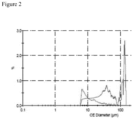
- Figure 2 shows volume transformation CE Diameter ( ⁇ m) smoothed over 11 points for the catalyst component particles obtained in example 2.
- the solid material was washed with 100 ml of toluene, with 30 ml of TiCl4, with 100 ml of toluene and two times with 60 ml of heptane. Washings were made at 80 °C under stirring 30 min with 170 rpm. Washing steps were carried as described in example 3.
- Catalyst slurry prepared according to the procedure as described above was transferred to a hydrocyclone.
- a hydrocyclone with cut size d50 of 13 ⁇ m was purchased from Krebs. The particles smaller than 13 ⁇ m substantially go to the waste stream from the top of the cyclone.
- a trial was executed using the hydrocyclone, which was connected to the catalyst preparation reactor unit 1 with connecting lines 4 and 5. Catalyst was prepared according to the procedure as described in example 1.
- Separation in the hydrocyclone was effected in less than 25 minutes.
- the solid catalyst particles and liquid medium are separated by transferring the mixture from reactor 1 through the hydrocyclone.
- the bottom stream is removed from the hydrocyclone and transferred to reactor 2. Pressure difference between inlet-overhead was 0.7 bar.
- the solid catalysts particles are prepared according to the procedure as described in example 1. They are then subject to a first hydrocyclone separation as described in example 2. As further illustrated in figure 1 , catalyst was prepared in reactor 1 and at the same time toluene wash liquid was dosed to the reactor 2 and heated up to required washing temperature, where upon a 1 st toluene wash is performed due to the presence of the toluene within reactor 2.
- Overhead flow from the hydrocyclone which is primarily mother liquor, is directed to waste. Separation/Concentration efficiency is adjusted by controlling the hydrocyclone split (overhead flow fraction of the inlet flow) by flow measurements and control valves.
- catalyst slurry is concentrated again by transferring it through the hydrocyclone 3. Washing solvent can be removed overhead and sent to waste. Bottom particles are recovered and subjected to a second washing step.
- the second washing step takes place in reactor 1.
- This "Pendulum" washing sequence is repeated for the following heptane washing steps.Each washing step can take roughly 10 to 15 minutes. On industrial scale, typically it takes 30-60 minutes to heat up sufficient washing liquid to the target temperature (50-120 °C). One washing step can therefore last 50-65 minutes. The total time for e.g. six washes was only 4-6 hours in comparison to the previous 20 hours when settling is required after each step.
Landscapes
- Chemical & Material Sciences (AREA)
- Chemical Kinetics & Catalysis (AREA)
- Organic Chemistry (AREA)
- Health & Medical Sciences (AREA)
- Medicinal Chemistry (AREA)
- Polymers & Plastics (AREA)
- Engineering & Computer Science (AREA)
- Materials Engineering (AREA)
- Transition And Organic Metals Composition Catalysts For Addition Polymerization (AREA)
- Organic Low-Molecular-Weight Compounds And Preparation Thereof (AREA)
Claims (16)
- Processus de séparation de particules de composant catalyseur oléfinique solides d'un milieu dans lequel elles sont présentes, lequel processus comprenant :(i) la fourniture, dans un premier récipient, d'une suspension composée d'un milieu liquide et de particules de composant catalyseur oléfinique solides ;(ii) le transfert de la suspension dans un hydrocyclone ;(iii) l'élimination, de l'hydrocyclone, d'un premier flux de sous-produit appauvri en particules de composant catalyseur de polymérisation oléfinique solides et d'un premier flux de produit enrichi en particules de composant catalyseur de polymérisation oléfinique solides ;(iv) le transfert du premier flux de produit vers un second récipient et en présence d'un milieu de lavage pour former une suspension et le lavage des particules de composant catalyseur de polymérisation oléfinique solides avec ledit milieu de lavage, par exemple par agitation de celui-ci ;(v) le transfert de la suspension en retour vers l'hydrocyclone ;(vi) l'élimination, de l'hydrocyclone, d'un deuxième flux de sous-produit appauvri en particules de composant catalyseur de polymérisation oléfinique solides et d'un deuxième flux de produit enrichi en particules de composant catalyseur de polymérisation oléfinique solides.
- Processus selon la revendication 1 comprenant en outre :(vii) le transfert du deuxième flux de produit vers ledit premier récipient et en présence d'un milieu de lavage pour former une suspension et le lavage des particules de composant catalyseur de polymérisation oléfinique solides avec ledit milieu de lavage, par exemple par agitation de celui-ci ;(viii) le transfert de la suspension en retour vers l'hydrocyclone ;(ix) l'élimination, de l'hydrocyclone, d'un troisième flux de sous-produit appauvri en particules de composant catalyseur de polymérisation oléfinique solides et d'un troisième flux de produit enrichi en particules de composant catalyseur de polymérisation oléfinique solides ;(x) la répétition facultative des étapes (iv) à (vi) ou des étapes (iv) à (ix) jusqu'à ce que le processus de lavage soit terminé.
- Processus selon la revendication 1 ou 2 dans lequel l'hydrocyclone comprend une sortie pour l'élimination du flux de sous-produit, une sortie pour l'élimination du flux de produit et une entrée séparée pour apporter la suspension à l'hydrocyclone de manière à créer un vortex au sein de l'hydrocyclone.
- Processus selon les revendications 1 à 3 comprenant l'élimination d'un flux de sous-produit via une sortie supérieure et l'élimination d'un flux de produit via une sortie inférieure, si le flux de sous-produit présente une densité inférieure à celle dudit flux de produit, ou l'élimination du flux de sous-produit via une sortie inférieure et l'élimination du flux de produit via une sortie supérieure, si le flux de sous-produit présente une densité supérieure à celle du flux de produit.
- Processus selon les revendications 1 à 4 dans lequel les particules de composant catalyseur oléfinique solides comprennent des particules de composant catalyseur Ziegler-Natta supporté ou à site unique supporté ou des particules de composant catalyseur Ziegler-Natta solides ou catalyseur à site unique solides sans aucun matériau support externe.
- Processus selon la revendication 5 dans lequel les particules de composant catalyseur oléfinique solides sont des particules de catalyseur Ziegler-Natta comprenant Mg, Ti et un donneur d'électrons interne facultatif, ou des précurseurs de celui-ci.
- Processus selon une quelconque revendication précédente dans lequel la taille coupée dans l'hydrocyclone est de 5 à 50 µm, de préférence de 5 à 40 µm, plus préférentiellement de 10 à 20 µm.
- Processus selon une quelconque revendication précédente dans lequel les particules de composant catalyseur oléfinique solides présentent une taille de particule moyenne volumétrique de 5 à 400 µm, de préférence de 10 à 200 µm, lorsqu'elle est mesurée en utilisant une analyse de taille de particule de Malvern.
- Processus selon une quelconque revendication précédente dans lequel le milieu de lavage est introduit dans le second récipient avant que le flux de produit ne soit introduit dans le second récipient et le milieu de lavage est chauffé pendant que la substance particulaire est lavée dans le premier récipient et/ou pendant que les particules de composant catalyseur oléfinique solides sont préparées dans le premier récipient.
- Processus selon une quelconque revendication précédente dans lequel les premier et second récipients sont des réacteurs agités et le lavage est réalisé en agitant la suspension.
- Processus selon une quelconque revendication précédente dans lequel il y a 3 ou plus, tels que 4 ou plus, par exemple 4 à 7 étapes de lavage.
- Processus selon une quelconque revendication précédente dans lequel le milieu de lavage à chaque étape est identique ou différent et comprend un solvant hydrocarboné tel qu'un solvant aliphatique ou aromatique ou une solution liquide de tétrachlorure de titane ou des mélanges de ceux-ci.
- Processus selon une quelconque revendication précédente dans lequel tout flux de produit enrichi en particules de composant catalyseur de polymérisation oléfinique solides comprend 4 à 20, de préférence 7 à 15 % en poids desdites particules de composant catalyseur de polymérisation oléfinique solides.
- Processus selon une quelconque revendication précédente dans lequel la température d'étape de lavage est dans la plage de 20 à 120 °C.
- Processus selon la revendication 1 pour produire des particules de composant catalyseur de polymérisation oléfinique solides à partir d'une émulsion comprenant les étapes de :(i) production dans un premier récipient d'une émulsion comprenant des gouttelettes d'une phase dispersée dans une phase continue, les gouttelettes comprenant un composé de métal de transition ;(ii) solidification des gouttelettes pour produire une suspension comprenant des particules de composant catalyseur de polymérisation oléfinique solides dans une liqueur mère résiduelle ;(iii) transfert de la suspension dans un hydrocyclone et séparation des particules de composant catalyseur de polymérisation oléfinique solides de la liqueur mère en utilisant un hydrocyclone ;(iv) élimination, de l'hydrocyclone, d'un flux de sous-produit appauvri en particules de composant catalyseur de polymérisation oléfinique solides et d'un flux de produit enrichi en particules de composant catalyseur de polymérisation oléfinique solides ;(v) transfert du flux de produit vers un second récipient et en présence d'un milieu de lavage formant une suspension et lavage des particules avec un milieu de lavage, par exemple par agitation de celui-ci ;(vi) transfert de la suspension en retour vers l'hydrocyclone ;(vii) élimination, de l'hydrocyclone, d'un deuxième flux de sous-produit appauvri en particules de composant catalyseur de polymérisation oléfinique solides et d'un deuxième flux de produit enrichi en particules de composant catalyseur de polymérisation oléfinique solides,(viii) lavage du flux de produit enrichi en particules de composant catalyseur de polymérisation oléfinique solides avec un second milieu de lavage dans ledit premier récipient ;(ix) séparation des particules de composant catalyseur de polymérisation oléfinique solides du milieu de lavage en utilisant l'hydrocyclone.
- Processus selon la revendication 1 pour produire des particules de composant catalyseur Ziegler-Natta de polymérisation oléfinique solides dépourvues d'un support externe comprenant les étapes de :a) fourniture d'une solution d'au moins un composé métallique du groupe 2, de préférence d'au moins un alcoxyde métallique du groupe 2,b) fourniture d'une solution d'au moins un composé d'un métal de transition du groupe 4 à 10, de préférence d'un métal de transition du groupe 4 à 6,c) combinaison des solutions de l'étape a) et de l'étape b) dans un premier récipient ;d) ajout facultatif d'un donneur d'électrons interne ou d'un précurseur de celui-ci à toute étape a) à c),e) formation, dans ledit premier récipient, d'une suspension de particules de composant catalyseur Ziegler-Natta solides dans une liqueur mère résiduelle,f) transfert de ladite suspension dans un hydrocyclone et séparation des particules de composant catalyseur Ziegler-Natta de polymérisation oléfinique solides de la liqueur mère ;g) élimination, de l'hydrocyclone, d'un flux de sous-produit appauvri en particules de composant catalyseur Ziegler-Natta de polymérisation oléfinique solides et d'un flux de produit enrichi en particules de composant catalyseur de polymérisation oléfinique solides ;h) transfert du premier flux de produit vers un second récipient et en présence d'un milieu de lavage pour former une suspension et lavage des particules de composant catalyseur de polymérisation oléfinique solides avec ledit milieu de lavage, par exemple par agitation de celui-ci ;i) transfert de la suspension en retour vers l'hydrocyclone ;j) élimination, de l'hydrocyclone, d'un deuxième flux de sous-produit appauvri en particules de catalyseur de polymérisation Ziegler-Natta oléfinique solides et d'un deuxième flux de produit enrichi en particules de catalyseur de polymérisation Ziegler-Natta oléfinique solides,k) lavage du flux de produit enrichi en particules de catalyseur de polymérisation Ziegler-Natta oléfinique solides avec un second milieu de lavage dans ledit premier récipient ;l) séparation des particules de composant catalyseur de polymérisation oléfinique solides du milieu de lavage en utilisant l'hydrocyclone.
Applications Claiming Priority (2)
| Application Number | Priority Date | Filing Date | Title |
|---|---|---|---|
| EP18209613 | 2018-11-30 | ||
| PCT/EP2019/082872 WO2020109452A1 (fr) | 2018-11-30 | 2019-11-28 | Procédé de lavage |
Publications (2)
| Publication Number | Publication Date |
|---|---|
| EP3887406A1 EP3887406A1 (fr) | 2021-10-06 |
| EP3887406B1 true EP3887406B1 (fr) | 2024-07-17 |
Family
ID=64899173
Family Applications (1)
| Application Number | Title | Priority Date | Filing Date |
|---|---|---|---|
| EP19808613.4A Active EP3887406B1 (fr) | 2018-11-30 | 2019-11-28 | Processus de lavage |
Country Status (5)
| Country | Link |
|---|---|
| US (1) | US12146019B2 (fr) |
| EP (1) | EP3887406B1 (fr) |
| CN (1) | CN113166292A (fr) |
| ES (1) | ES2986685T3 (fr) |
| WO (1) | WO2020109452A1 (fr) |
Families Citing this family (5)
| Publication number | Priority date | Publication date | Assignee | Title |
|---|---|---|---|---|
| US11124586B1 (en) | 2020-11-09 | 2021-09-21 | Chevron Phillips Chemical Company Lp | Particle size control of metallocene catalyst systems in loop slurry polymerization reactors |
| CN112500917B (zh) * | 2020-11-12 | 2022-04-26 | 青岛翌星环保技术有限公司 | 一种废润滑油加氢循环利用方法 |
| CN112500916B (zh) * | 2020-11-12 | 2022-04-15 | 中国石油大学(华东) | 一种废润滑油临氢预处理提纯方法 |
| EP4259670A2 (fr) | 2020-12-08 | 2023-10-18 | Chevron Phillips Chemical Company Lp | Contrôle de taille de particules de catalyseurs au chrome supportés dans des réacteurs de polymérisation à boues liquides à boucle |
| MX2024003133A (es) | 2021-09-13 | 2024-06-19 | Chevron Phillips Chemical Co Lp | Modificacion con hidrociclon de componentes de sistema catalizador para uso en polimerizaciones de olefina. |
Family Cites Families (90)
| Publication number | Priority date | Publication date | Assignee | Title |
|---|---|---|---|---|
| US4226963A (en) | 1971-06-25 | 1980-10-07 | Montedison S.P.A. | Process for the stereoregular polymerization of alpha-olephins |
| US4107414A (en) | 1971-06-25 | 1978-08-15 | Montecatini Edison S.P.A. | Process for the stereoregular polymerization of alpha olefins |
| US4186107A (en) | 1978-04-14 | 1980-01-29 | Hercules Incorporated | Solid catalyst component for olefin polymerization |
| US4347160A (en) | 1980-06-27 | 1982-08-31 | Stauffer Chemical Company | Titanium halide catalyst system |
| IT1209255B (it) | 1980-08-13 | 1989-07-16 | Montedison Spa | Catalizzatori per la polimerizzazione di olefine. |
| JPS57153005A (en) | 1981-03-19 | 1982-09-21 | Ube Ind Ltd | Polymerization of alpha-olefin |
| US4530912A (en) | 1981-06-04 | 1985-07-23 | Chemplex Company | Polymerization catalyst and method |
| DE3271544D1 (en) | 1981-08-07 | 1986-07-10 | Ici Plc | Supported transition metal composition |
| US4382019A (en) | 1981-09-10 | 1983-05-03 | Stauffer Chemical Company | Purified catalyst support |
| IT1190683B (it) | 1982-02-12 | 1988-02-24 | Montedison Spa | Componenti e catalizzatori per la polimerizzazione di olefine |
| IT1190682B (it) | 1982-02-12 | 1988-02-24 | Montedison Spa | Catalizzatori per la polimerizzazione di olefine |
| IT1190681B (it) | 1982-02-12 | 1988-02-24 | Montedison Spa | Componenti e catalizzatori per la polimerizzazione di olefine |
| US4532313A (en) | 1982-10-13 | 1985-07-30 | Himont Incorporated | Method for preparing an improved catalyst support, Ziegler-Natta catalyst utilizing said support and polymerization of 1-olefins utilizing said catalyst |
| US4560671A (en) | 1983-07-01 | 1985-12-24 | Union Carbide Corporation | Olefin polymerization catalysts adapted for gas phase processes |
| US4657882A (en) | 1984-11-26 | 1987-04-14 | Amoco Corporation | Supported olefin polymerization catalyst produced from a magnesium alkyl/organophosphoryl complex |
| US4581342A (en) | 1984-11-26 | 1986-04-08 | Standard Oil Company (Indiana) | Supported olefin polymerization catalyst |
| US5215733A (en) | 1986-04-25 | 1993-06-01 | Unilever Patent Holdings B.V. | Manufacture of silica gels using shear to reduce the particle size prior to washing with a hydrocyclone |
| FI80055C (fi) | 1986-06-09 | 1990-04-10 | Neste Oy | Foerfarande foer framstaellning av katalytkomponenter foer polymerisation av olefiner. |
| US5077255A (en) | 1986-09-09 | 1991-12-31 | Exxon Chemical Patents Inc. | New supported polymerization catalyst |
| FI83331C (fi) | 1988-12-30 | 1991-06-25 | Neste Oy | Framstaellning och anvaendning av en ny ziegler-natta-katalysatorkomponent. |
| US5036034A (en) | 1989-10-10 | 1991-07-30 | Fina Technology, Inc. | Catalyst for producing hemiisotactic polypropylene |
| FI88048C (fi) | 1991-05-09 | 1993-03-25 | Neste Oy | Grovkornig polyolefin, dess framstaellningsmetod och en i metoden anvaend katalysator |
| FI88049C (fi) | 1991-05-09 | 1993-03-25 | Neste Oy | Polyolefin med stora porer, foerfarande foer dess framstaellning och en i foerfarandet anvaend katalysator |
| FI88047C (fi) | 1991-05-09 | 1993-03-25 | Neste Oy | Pao tvenne elektrondonorer baserad katalysator foer polymerisation av olefiner |
| FI90247C (fi) | 1991-05-31 | 1994-01-10 | Borealis As | Menetelmä polymerointikatalyytin aktiivisten ja tasakokoisten kantajahiukkasten valmistamiseksi |
| US5416228A (en) | 1991-10-07 | 1995-05-16 | Fina Technology, Inc. | Process and catalyst for producing isotactic polyolefins |
| FI90248C (fi) | 1991-11-29 | 1994-01-10 | Borealis As | Menetelmä hiukkasmaisen kantajan valmistamiseksi olefiinipolymerointikatalyyttiä varten |
| FI91967C (fi) | 1991-11-29 | 1994-09-12 | Borealis Polymers Oy | Menetelmä olefiinipolymerointikatalyyttien valmistamiseksi |
| FI95715C (fi) | 1992-03-24 | 1996-03-11 | Neste Oy | Suihkukiteyttämällä valmistetun polymerointikatalyyttikantajan valmistus |
| EP0629632B2 (fr) | 1993-06-07 | 2015-01-21 | Mitsui Chemicals, Inc. | Polypropylène |
| DE69434709T2 (de) | 1993-06-07 | 2006-10-19 | Mitsui Chemicals, Inc. | Propylenelastomere |
| FI96214C (fi) | 1994-05-31 | 1996-05-27 | Borealis As | Olefiinien polymerointiin tarkoitettu stereospesifinen katalyyttisysteemi |
| FI942949A0 (fi) | 1994-06-20 | 1994-06-20 | Borealis Polymers Oy | Prokatalysator foer producering av etenpolymerer och foerfarande foer framstaellning daerav |
| US6143686A (en) | 1994-08-03 | 2000-11-07 | Exxon Chemical Patents, Inc. | Supported ionic catalyst compositions |
| DE19544828A1 (de) | 1995-12-01 | 1997-06-05 | Hoechst Ag | Hochmolekulare Copolymere |
| FI104826B (fi) | 1996-01-30 | 2000-04-14 | Borealis As | Heteroatomilla substituoituja metalloseeniyhdisteitä olefiinipolymerointikatalyytti-systeemejä varten ja menetelmä niiden valmistamiseksi |
| FI102070B (fi) | 1996-03-29 | 1998-10-15 | Borealis As | Uusi kompleksiyhdiste, sen valmistus ja käyttö |
| US5767034A (en) | 1996-05-31 | 1998-06-16 | Intevep, S.A. | Olefin polymerization catalyst with additive comprising aluminum-silicon composition, calixarene derivatives or cyclodextrin derivatives |
| FI963707A0 (fi) | 1996-09-19 | 1996-09-19 | Borealis Polymers Oy | Foerfarande foer polymerisering av alfa-olefiner, vid polymerisering anvaendbar katalysator och foerfarande foer framstaellning av densamma |
| FI971565A7 (fi) | 1997-04-14 | 1998-10-15 | Borealis As | Olefiinien polymerointiin tarkoitettujen katalysaattorisysteemien substituoituja metalloseeniyhdisteitä, niiden välituotteet ja valmistusmenetelmä |
| AU6401098A (en) | 1997-03-07 | 1998-09-29 | Targor Gmbh | Preparation of preparing substituted indanones |
| GB9708487D0 (en) | 1997-04-25 | 1997-06-18 | Bp Chem Int Ltd | Novel catalysts for olefin polymerisation |
| ES2182336T3 (es) | 1997-06-10 | 2003-03-01 | Peroxid Chemie Gmbh & Co Kg | Nuevos sistemas de catalizadores para reacciones de (co-)polimerizacion, halogenuros-amidas de metalocenos y su utilizacion. |
| CN1246341C (zh) | 1997-09-05 | 2006-03-22 | 英国石油化学品有限公司 | 聚合催化剂 |
| DE19739946A1 (de) | 1997-09-11 | 1999-03-18 | Targor Gmbh | Verfahren zur Herstellung von Metallocenen |
| GB9721559D0 (en) | 1997-10-11 | 1997-12-10 | Bp Chem Int Ltd | Novel polymerisation catalysts |
| ATE234310T1 (de) | 1997-12-23 | 2003-03-15 | Borealis Tech Oy | Magnesium-,halogen- und alkoxy-enthaldendes produkt |
| DE19806918A1 (de) | 1998-02-19 | 1999-08-26 | Aventis Res & Tech Gmbh & Co | Katalysatorsystem, Verfahren zu seiner Herstellung und seine Verwendung zur Polymerisation von Olefinen |
| FI111372B (fi) | 1998-04-06 | 2003-07-15 | Borealis Polymers Oy | Olefiinien polymerointiin tarkoitettu katalyyttikomponentti, sen valmistus ja käyttö |
| FI981148A7 (fi) | 1998-05-25 | 1999-11-26 | Borealis As | Uusia aktivaattorijärjestelmä metalloseeniyhdisteitä varten |
| GB9826874D0 (en) | 1998-12-07 | 1999-01-27 | Borealis As | Process |
| IT1306630B1 (it) | 1999-02-09 | 2001-10-02 | Optiproject S R L | Componenti di occhiali da assemblare alle lenti. |
| EP1074557A3 (fr) | 1999-07-31 | 2003-02-26 | Basell Polyolefine GmbH | Complexes de métaux de transition, ligandes, catalyseurs, et leur utilisation dans la polymérisation d'oléfines |
| GB0001914D0 (en) | 2000-01-27 | 2000-03-22 | Borealis Polymers Oy | Catalyst |
| WO2002002576A1 (fr) | 2000-06-30 | 2002-01-10 | Exxonmobil Chemical Patents Inc. | Composes bis (indenyle) metallocenes pontes |
| ATE260289T1 (de) | 2000-06-30 | 2004-03-15 | Exxonmobil Chem Patents Inc | Verbrückte bisindenyl substituierte metallocen- verbindungen |
| PT1273595E (pt) | 2001-06-20 | 2006-10-31 | Borealis Tech Oy | Preparacao de um componente catalisador para polimerizacao de olefina |
| DE60120141T2 (de) | 2001-06-20 | 2007-03-29 | Borealis Technology Oy | Herstellung einer Olefinpolymerisationskatalysatorkomponente |
| GB0118010D0 (en) | 2001-07-24 | 2001-09-19 | Borealis Tech Oy | Catalysts |
| EP1323747A1 (fr) | 2001-12-19 | 2003-07-02 | Borealis Technology Oy | Procédé pour la préparation des catalyseurs pour la polymérisation oléfinique |
| ES2321806T3 (es) | 2001-12-19 | 2009-06-12 | Borealis Technology Oy | Produccion de catalizadores soportados para la polimerizacion de olefinas. |
| WO2004016662A1 (fr) | 2002-08-19 | 2004-02-26 | Ube Industries, Ltd. | Catalyseurs de polymerisation ou de copolymerisation d'$g(a)-olefines, elements constituant ces catalyseurs et procedes servant a polymeriser des $g(a)-olefines au moyen de ces catalyseurs |
| EP1403292B1 (fr) | 2002-09-30 | 2016-04-13 | Borealis Polymers Oy | Procédé pour la préparation d'un catalyseur pour la polymérisation d'olefins avec une amélioration d'activité à haute temperature |
| EP1462464A1 (fr) | 2003-03-25 | 2004-09-29 | Borealis Technology Oy | Catalyseurs du type métallocène et leur utilisation pour la polymérisation d' oléfines |
| US7285608B2 (en) | 2004-04-21 | 2007-10-23 | Novolen Technology Holdings C.V. | Metallocene ligands, metallocene compounds and metallocene catalysts, their synthesis and their use for the polymerization of olefins |
| FI20040755A0 (fi) | 2004-06-02 | 2004-06-02 | Borealis Tech Oy | Menetelmä olefiinipolymerointikatalyytin valmistamiseksi ja tällä menetelmällä valmistettu katalyytti |
| KR101293405B1 (ko) | 2005-03-18 | 2013-08-05 | 바젤 폴리올레핀 게엠베하 | 메탈로센 화합물 |
| EP1739103A1 (fr) | 2005-06-30 | 2007-01-03 | Borealis Technology Oy | Catalyseur |
| JP2007039529A (ja) * | 2005-08-02 | 2007-02-15 | Toho Catalyst Co Ltd | オレフィン類重合用固体触媒成分及び触媒並びにこれを用いたオレフィン類重合体の重合方法 |
| DE602005013376D1 (de) | 2005-08-09 | 2009-04-30 | Borealis Tech Oy | Siloxy substituierte Metallocenkatalysatoren |
| JP2009530341A (ja) | 2006-03-17 | 2009-08-27 | バーゼル・ポリオレフィン・ゲーエムベーハー | メタロセン化合物類 |
| WO2007116034A1 (fr) | 2006-04-12 | 2007-10-18 | Basell Polyolefine Gmbh | Composes de metallocene |
| EP1862479A1 (fr) | 2006-05-31 | 2007-12-05 | Borealis Technology Oy | Catalyseur pour la polymérisation d'oléfines |
| EP1862481B1 (fr) | 2006-05-31 | 2016-08-31 | Borealis Technology Oy | Catalyseur avec un composant d'al-alkoxy |
| CN101815727B (zh) | 2007-08-27 | 2013-05-15 | 保瑞利斯科技公司 | 催化剂 |
| US8299287B2 (en) | 2007-10-25 | 2012-10-30 | Lammus Novolen Technology GmbH | Metallocene compounds, catalysts comprising them, process for producing an olefin polymer by use of the catalysts, and olefin homo- and copolymers |
| US8603933B2 (en) * | 2009-11-13 | 2013-12-10 | Borealis Ag | Process for recovering a transition metal compound |
| ES2424958T3 (es) * | 2009-11-13 | 2013-10-10 | Borealis Ag | Proceso para polimerización de olefinas |
| EP2402353B1 (fr) | 2010-07-01 | 2018-04-25 | Borealis AG | Métallocènes des métaux de groupe 4 comme catalyseurs pour la polymérisation d'oléfines |
| EP2415790B1 (fr) | 2010-07-13 | 2014-09-24 | Borealis AG | Composant de catalyseur |
| EP2532687A3 (fr) | 2011-06-10 | 2013-04-10 | Borealis AG | Catalyseurs à base de metallocènes pontés |
| KR101918175B1 (ko) | 2011-07-08 | 2019-01-29 | 보레알리스 아게 | 헤테로상 공중합체 |
| EP2610271B1 (fr) | 2011-12-30 | 2019-03-20 | Borealis AG | Préparation de catalyseurs ZN PP sans phthalate |
| EP2610270B1 (fr) | 2011-12-30 | 2015-10-07 | Borealis AG | Composant de catalyseur |
| EP2610272B1 (fr) | 2011-12-30 | 2017-05-10 | Borealis AG | Composant de catalyseur |
| EP2746289B1 (fr) | 2012-12-21 | 2017-09-27 | Borealis AG | Catalyseurs |
| ES2653868T3 (es) | 2012-12-21 | 2018-02-09 | Borealis Ag | Procatalizador de Ziegler Natta soportado para la polimerización de etileno |
| CN107108803B (zh) | 2014-12-18 | 2021-03-16 | 博里利斯股份公司 | 齐格勒-纳塔催化剂及其制备 |
| CN106554438B (zh) * | 2015-09-30 | 2019-11-12 | 中国石油化工股份有限公司 | 一种烯烃聚合催化剂悬浮液的分级方法 |
| EP3181220A1 (fr) | 2015-12-16 | 2017-06-21 | Basf Se | Procédé permettant d'éliminer un catalyseur hétérogène à partir d'un produit de réaction et procédé de production d'une amine aromatique |
-
2019
- 2019-11-28 ES ES19808613T patent/ES2986685T3/es active Active
- 2019-11-28 EP EP19808613.4A patent/EP3887406B1/fr active Active
- 2019-11-28 CN CN201980079347.0A patent/CN113166292A/zh active Pending
- 2019-11-28 US US17/413,765 patent/US12146019B2/en active Active
- 2019-11-28 WO PCT/EP2019/082872 patent/WO2020109452A1/fr not_active Ceased
Also Published As
| Publication number | Publication date |
|---|---|
| US20220177613A1 (en) | 2022-06-09 |
| EP3887406A1 (fr) | 2021-10-06 |
| ES2986685T3 (es) | 2024-11-12 |
| US12146019B2 (en) | 2024-11-19 |
| CN113166292A (zh) | 2021-07-23 |
| WO2020109452A1 (fr) | 2020-06-04 |
Similar Documents
| Publication | Publication Date | Title |
|---|---|---|
| EP3887406B1 (fr) | Processus de lavage | |
| TWI785263B (zh) | 在多階段式聚合方法中聚合乙烯之方法 | |
| CN100471884C (zh) | 烯烃聚合催化剂载体的制备方法以及烯烃聚合催化剂 | |
| CN105722869B (zh) | 具有高聚合活性的固体单点催化剂 | |
| CN112979842B (zh) | 用于生产聚乙烯的方法 | |
| US9068025B2 (en) | Catalyst component for polymerization of olefin and preparation method | |
| TWI714860B (zh) | 製備聚合物的方法、設備、及該設備之用途 | |
| CN1489602A (zh) | 双位烯烃聚合催化剂组合物 | |
| CN1300188C (zh) | 担载的聚合催化剂 | |
| CN1414980A (zh) | 用于制备聚烯烃的混合金属醇盐和环二烯基催化剂 | |
| CN108602899B (zh) | 用于制备丙烯共聚物组合物的方法 | |
| JP7022206B2 (ja) | 気固オレフィン重合反応器における返送流動化ガスを分割する方法 | |
| CN111072804B (zh) | 烯烃聚合催化剂组分及其应用和烯烃聚合催化剂及烯烃聚合方法 | |
| CN102039191B (zh) | 负载型非茂金属催化剂、其制备方法及其应用 | |
| CN111072803B (zh) | 烯烃聚合催化剂载体及其制备方法和应用 | |
| US10946357B2 (en) | Process for feeding a polymerisation catalyst | |
| CN108137717A (zh) | 用于烯烃聚合的方法 | |
| JP5577219B2 (ja) | プロピレン重合反応装置及びプロピレン系重合体の製造方法 | |
| CN102964489A (zh) | 负载型非茂金属催化剂、其制备方法及其应用 | |
| CN120677187A (zh) | 催化剂转换方法 |
Legal Events
| Date | Code | Title | Description |
|---|---|---|---|
| STAA | Information on the status of an ep patent application or granted ep patent |
Free format text: STATUS: UNKNOWN |
|
| STAA | Information on the status of an ep patent application or granted ep patent |
Free format text: STATUS: THE INTERNATIONAL PUBLICATION HAS BEEN MADE |
|
| PUAI | Public reference made under article 153(3) epc to a published international application that has entered the european phase |
Free format text: ORIGINAL CODE: 0009012 |
|
| STAA | Information on the status of an ep patent application or granted ep patent |
Free format text: STATUS: REQUEST FOR EXAMINATION WAS MADE |
|
| 17P | Request for examination filed |
Effective date: 20210630 |
|
| AK | Designated contracting states |
Kind code of ref document: A1 Designated state(s): AL AT BE BG CH CY CZ DE DK EE ES FI FR GB GR HR HU IE IS IT LI LT LU LV MC MK MT NL NO PL PT RO RS SE SI SK SM TR |
|
| DAV | Request for validation of the european patent (deleted) | ||
| DAX | Request for extension of the european patent (deleted) | ||
| RAP3 | Party data changed (applicant data changed or rights of an application transferred) |
Owner name: BOREALIS AG |
|
| STAA | Information on the status of an ep patent application or granted ep patent |
Free format text: STATUS: EXAMINATION IS IN PROGRESS |
|
| 17Q | First examination report despatched |
Effective date: 20230214 |
|
| GRAP | Despatch of communication of intention to grant a patent |
Free format text: ORIGINAL CODE: EPIDOSNIGR1 |
|
| STAA | Information on the status of an ep patent application or granted ep patent |
Free format text: STATUS: GRANT OF PATENT IS INTENDED |
|
| INTG | Intention to grant announced |
Effective date: 20240403 |
|
| GRAS | Grant fee paid |
Free format text: ORIGINAL CODE: EPIDOSNIGR3 |
|
| GRAA | (expected) grant |
Free format text: ORIGINAL CODE: 0009210 |
|
| STAA | Information on the status of an ep patent application or granted ep patent |
Free format text: STATUS: THE PATENT HAS BEEN GRANTED |
|
| AK | Designated contracting states |
Kind code of ref document: B1 Designated state(s): AL AT BE BG CH CY CZ DE DK EE ES FI FR GB GR HR HU IE IS IT LI LT LU LV MC MK MT NL NO PL PT RO RS SE SI SK SM TR |
|
| P01 | Opt-out of the competence of the unified patent court (upc) registered |
Free format text: CASE NUMBER: APP_34178/2024 Effective date: 20240607 |
|
| REG | Reference to a national code |
Ref country code: CH Ref legal event code: EP |
|
| REG | Reference to a national code |
Ref country code: DE Ref legal event code: R096 Ref document number: 602019055440 Country of ref document: DE |
|
| REG | Reference to a national code |
Ref country code: IE Ref legal event code: FG4D |
|
| REG | Reference to a national code |
Ref country code: SE Ref legal event code: TRGR |
|
| REG | Reference to a national code |
Ref country code: LT Ref legal event code: MG9D |
|
| REG | Reference to a national code |
Ref country code: ES Ref legal event code: FG2A Ref document number: 2986685 Country of ref document: ES Kind code of ref document: T3 Effective date: 20241112 |
|
| REG | Reference to a national code |
Ref country code: NL Ref legal event code: MP Effective date: 20240717 |
|
| PG25 | Lapsed in a contracting state [announced via postgrant information from national office to epo] |
Ref country code: PT Free format text: LAPSE BECAUSE OF FAILURE TO SUBMIT A TRANSLATION OF THE DESCRIPTION OR TO PAY THE FEE WITHIN THE PRESCRIBED TIME-LIMIT Effective date: 20241118 |
|
| REG | Reference to a national code |
Ref country code: AT Ref legal event code: MK05 Ref document number: 1704054 Country of ref document: AT Kind code of ref document: T Effective date: 20240717 |
|
| PG25 | Lapsed in a contracting state [announced via postgrant information from national office to epo] |
Ref country code: NL Free format text: LAPSE BECAUSE OF FAILURE TO SUBMIT A TRANSLATION OF THE DESCRIPTION OR TO PAY THE FEE WITHIN THE PRESCRIBED TIME-LIMIT Effective date: 20240717 |
|
| PG25 | Lapsed in a contracting state [announced via postgrant information from national office to epo] |
Ref country code: PT Free format text: LAPSE BECAUSE OF FAILURE TO SUBMIT A TRANSLATION OF THE DESCRIPTION OR TO PAY THE FEE WITHIN THE PRESCRIBED TIME-LIMIT Effective date: 20241118 Ref country code: NL Free format text: LAPSE BECAUSE OF FAILURE TO SUBMIT A TRANSLATION OF THE DESCRIPTION OR TO PAY THE FEE WITHIN THE PRESCRIBED TIME-LIMIT Effective date: 20240717 |
|
| PG25 | Lapsed in a contracting state [announced via postgrant information from national office to epo] |
Ref country code: NO Free format text: LAPSE BECAUSE OF FAILURE TO SUBMIT A TRANSLATION OF THE DESCRIPTION OR TO PAY THE FEE WITHIN THE PRESCRIBED TIME-LIMIT Effective date: 20241017 |
|
| PG25 | Lapsed in a contracting state [announced via postgrant information from national office to epo] |
Ref country code: GR Free format text: LAPSE BECAUSE OF FAILURE TO SUBMIT A TRANSLATION OF THE DESCRIPTION OR TO PAY THE FEE WITHIN THE PRESCRIBED TIME-LIMIT Effective date: 20241018 Ref country code: FI Free format text: LAPSE BECAUSE OF FAILURE TO SUBMIT A TRANSLATION OF THE DESCRIPTION OR TO PAY THE FEE WITHIN THE PRESCRIBED TIME-LIMIT Effective date: 20240717 Ref country code: PL Free format text: LAPSE BECAUSE OF FAILURE TO SUBMIT A TRANSLATION OF THE DESCRIPTION OR TO PAY THE FEE WITHIN THE PRESCRIBED TIME-LIMIT Effective date: 20240717 |
|
| PG25 | Lapsed in a contracting state [announced via postgrant information from national office to epo] |
Ref country code: BG Free format text: LAPSE BECAUSE OF FAILURE TO SUBMIT A TRANSLATION OF THE DESCRIPTION OR TO PAY THE FEE WITHIN THE PRESCRIBED TIME-LIMIT Effective date: 20240717 |
|
| PG25 | Lapsed in a contracting state [announced via postgrant information from national office to epo] |
Ref country code: LV Free format text: LAPSE BECAUSE OF FAILURE TO SUBMIT A TRANSLATION OF THE DESCRIPTION OR TO PAY THE FEE WITHIN THE PRESCRIBED TIME-LIMIT Effective date: 20240717 |
|
| PG25 | Lapsed in a contracting state [announced via postgrant information from national office to epo] |
Ref country code: AT Free format text: LAPSE BECAUSE OF FAILURE TO SUBMIT A TRANSLATION OF THE DESCRIPTION OR TO PAY THE FEE WITHIN THE PRESCRIBED TIME-LIMIT Effective date: 20240717 Ref country code: IS Free format text: LAPSE BECAUSE OF FAILURE TO SUBMIT A TRANSLATION OF THE DESCRIPTION OR TO PAY THE FEE WITHIN THE PRESCRIBED TIME-LIMIT Effective date: 20241117 |
|
| PG25 | Lapsed in a contracting state [announced via postgrant information from national office to epo] |
Ref country code: HR Free format text: LAPSE BECAUSE OF FAILURE TO SUBMIT A TRANSLATION OF THE DESCRIPTION OR TO PAY THE FEE WITHIN THE PRESCRIBED TIME-LIMIT Effective date: 20240717 |
|
| PG25 | Lapsed in a contracting state [announced via postgrant information from national office to epo] |
Ref country code: RS Free format text: LAPSE BECAUSE OF FAILURE TO SUBMIT A TRANSLATION OF THE DESCRIPTION OR TO PAY THE FEE WITHIN THE PRESCRIBED TIME-LIMIT Effective date: 20241017 |
|
| PGFP | Annual fee paid to national office [announced via postgrant information from national office to epo] |
Ref country code: ES Payment date: 20241230 Year of fee payment: 6 |
|
| PGFP | Annual fee paid to national office [announced via postgrant information from national office to epo] |
Ref country code: SE Payment date: 20241120 Year of fee payment: 6 |
|
| PG25 | Lapsed in a contracting state [announced via postgrant information from national office to epo] |
Ref country code: RS Free format text: LAPSE BECAUSE OF FAILURE TO SUBMIT A TRANSLATION OF THE DESCRIPTION OR TO PAY THE FEE WITHIN THE PRESCRIBED TIME-LIMIT Effective date: 20241017 Ref country code: PL Free format text: LAPSE BECAUSE OF FAILURE TO SUBMIT A TRANSLATION OF THE DESCRIPTION OR TO PAY THE FEE WITHIN THE PRESCRIBED TIME-LIMIT Effective date: 20240717 Ref country code: NO Free format text: LAPSE BECAUSE OF FAILURE TO SUBMIT A TRANSLATION OF THE DESCRIPTION OR TO PAY THE FEE WITHIN THE PRESCRIBED TIME-LIMIT Effective date: 20241017 Ref country code: LV Free format text: LAPSE BECAUSE OF FAILURE TO SUBMIT A TRANSLATION OF THE DESCRIPTION OR TO PAY THE FEE WITHIN THE PRESCRIBED TIME-LIMIT Effective date: 20240717 Ref country code: IS Free format text: LAPSE BECAUSE OF FAILURE TO SUBMIT A TRANSLATION OF THE DESCRIPTION OR TO PAY THE FEE WITHIN THE PRESCRIBED TIME-LIMIT Effective date: 20241117 Ref country code: HR Free format text: LAPSE BECAUSE OF FAILURE TO SUBMIT A TRANSLATION OF THE DESCRIPTION OR TO PAY THE FEE WITHIN THE PRESCRIBED TIME-LIMIT Effective date: 20240717 Ref country code: GR Free format text: LAPSE BECAUSE OF FAILURE TO SUBMIT A TRANSLATION OF THE DESCRIPTION OR TO PAY THE FEE WITHIN THE PRESCRIBED TIME-LIMIT Effective date: 20241018 Ref country code: FI Free format text: LAPSE BECAUSE OF FAILURE TO SUBMIT A TRANSLATION OF THE DESCRIPTION OR TO PAY THE FEE WITHIN THE PRESCRIBED TIME-LIMIT Effective date: 20240717 Ref country code: BG Free format text: LAPSE BECAUSE OF FAILURE TO SUBMIT A TRANSLATION OF THE DESCRIPTION OR TO PAY THE FEE WITHIN THE PRESCRIBED TIME-LIMIT Effective date: 20240717 Ref country code: AT Free format text: LAPSE BECAUSE OF FAILURE TO SUBMIT A TRANSLATION OF THE DESCRIPTION OR TO PAY THE FEE WITHIN THE PRESCRIBED TIME-LIMIT Effective date: 20240717 |
|
| PG25 | Lapsed in a contracting state [announced via postgrant information from national office to epo] |
Ref country code: RO Free format text: LAPSE BECAUSE OF FAILURE TO SUBMIT A TRANSLATION OF THE DESCRIPTION OR TO PAY THE FEE WITHIN THE PRESCRIBED TIME-LIMIT Effective date: 20240717 Ref country code: DK Free format text: LAPSE BECAUSE OF FAILURE TO SUBMIT A TRANSLATION OF THE DESCRIPTION OR TO PAY THE FEE WITHIN THE PRESCRIBED TIME-LIMIT Effective date: 20240717 Ref country code: SM Free format text: LAPSE BECAUSE OF FAILURE TO SUBMIT A TRANSLATION OF THE DESCRIPTION OR TO PAY THE FEE WITHIN THE PRESCRIBED TIME-LIMIT Effective date: 20240717 |
|
| REG | Reference to a national code |
Ref country code: DE Ref legal event code: R097 Ref document number: 602019055440 Country of ref document: DE |
|
| PG25 | Lapsed in a contracting state [announced via postgrant information from national office to epo] |
Ref country code: EE Free format text: LAPSE BECAUSE OF FAILURE TO SUBMIT A TRANSLATION OF THE DESCRIPTION OR TO PAY THE FEE WITHIN THE PRESCRIBED TIME-LIMIT Effective date: 20240717 |
|
| PG25 | Lapsed in a contracting state [announced via postgrant information from national office to epo] |
Ref country code: CZ Free format text: LAPSE BECAUSE OF FAILURE TO SUBMIT A TRANSLATION OF THE DESCRIPTION OR TO PAY THE FEE WITHIN THE PRESCRIBED TIME-LIMIT Effective date: 20240717 |
|
| PG25 | Lapsed in a contracting state [announced via postgrant information from national office to epo] |
Ref country code: SK Free format text: LAPSE BECAUSE OF FAILURE TO SUBMIT A TRANSLATION OF THE DESCRIPTION OR TO PAY THE FEE WITHIN THE PRESCRIBED TIME-LIMIT Effective date: 20240717 |
|
| PLBE | No opposition filed within time limit |
Free format text: ORIGINAL CODE: 0009261 |
|
| STAA | Information on the status of an ep patent application or granted ep patent |
Free format text: STATUS: NO OPPOSITION FILED WITHIN TIME LIMIT |
|
| 26N | No opposition filed |
Effective date: 20250422 |
|
| REG | Reference to a national code |
Ref country code: CH Ref legal event code: PL |
|
| PG25 | Lapsed in a contracting state [announced via postgrant information from national office to epo] |
Ref country code: MC Free format text: LAPSE BECAUSE OF FAILURE TO SUBMIT A TRANSLATION OF THE DESCRIPTION OR TO PAY THE FEE WITHIN THE PRESCRIBED TIME-LIMIT Effective date: 20240717 |
|
| PG25 | Lapsed in a contracting state [announced via postgrant information from national office to epo] |
Ref country code: LU Free format text: LAPSE BECAUSE OF NON-PAYMENT OF DUE FEES Effective date: 20241128 |
|
| REG | Reference to a national code |
Ref country code: CH Ref legal event code: PL |
|
| GBPC | Gb: european patent ceased through non-payment of renewal fee |
Effective date: 20241128 |
|
| PG25 | Lapsed in a contracting state [announced via postgrant information from national office to epo] |
Ref country code: CH Free format text: LAPSE BECAUSE OF NON-PAYMENT OF DUE FEES Effective date: 20241130 |
|
| REG | Reference to a national code |
Ref country code: BE Ref legal event code: MM Effective date: 20241130 |
|
| PG25 | Lapsed in a contracting state [announced via postgrant information from national office to epo] |
Ref country code: GB Free format text: LAPSE BECAUSE OF NON-PAYMENT OF DUE FEES Effective date: 20241128 Ref country code: BE Free format text: LAPSE BECAUSE OF NON-PAYMENT OF DUE FEES Effective date: 20241130 |
|
| PG25 | Lapsed in a contracting state [announced via postgrant information from national office to epo] |
Ref country code: FR Free format text: LAPSE BECAUSE OF NON-PAYMENT OF DUE FEES Effective date: 20241130 |
|
| PG25 | Lapsed in a contracting state [announced via postgrant information from national office to epo] |
Ref country code: IE Free format text: LAPSE BECAUSE OF NON-PAYMENT OF DUE FEES Effective date: 20241128 |
|
| PGFP | Annual fee paid to national office [announced via postgrant information from national office to epo] |
Ref country code: DE Payment date: 20251119 Year of fee payment: 7 |
|
| PG25 | Lapsed in a contracting state [announced via postgrant information from national office to epo] |
Ref country code: IT Free format text: LAPSE BECAUSE OF FAILURE TO SUBMIT A TRANSLATION OF THE DESCRIPTION OR TO PAY THE FEE WITHIN THE PRESCRIBED TIME-LIMIT Effective date: 20240717 |
|
| PG25 | Lapsed in a contracting state [announced via postgrant information from national office to epo] |
Ref country code: HU Free format text: LAPSE BECAUSE OF FAILURE TO SUBMIT A TRANSLATION OF THE DESCRIPTION OR TO PAY THE FEE WITHIN THE PRESCRIBED TIME-LIMIT; INVALID AB INITIO Effective date: 20191128 |
|
| PG25 | Lapsed in a contracting state [announced via postgrant information from national office to epo] |
Ref country code: CY Free format text: LAPSE BECAUSE OF FAILURE TO SUBMIT A TRANSLATION OF THE DESCRIPTION OR TO PAY THE FEE WITHIN THE PRESCRIBED TIME-LIMIT; INVALID AB INITIO Effective date: 20191128 |