EP3888906A2 - Tôle en acier électrique et son procédé de fabrication - Google Patents
Tôle en acier électrique et son procédé de fabrication Download PDFInfo
- Publication number
- EP3888906A2 EP3888906A2 EP19888551.9A EP19888551A EP3888906A2 EP 3888906 A2 EP3888906 A2 EP 3888906A2 EP 19888551 A EP19888551 A EP 19888551A EP 3888906 A2 EP3888906 A2 EP 3888906A2
- Authority
- EP
- European Patent Office
- Prior art keywords
- adhesive layer
- electrical steel
- resin
- steel sheet
- hardener
- Prior art date
- Legal status (The legal status is an assumption and is not a legal conclusion. Google has not performed a legal analysis and makes no representation as to the accuracy of the status listed.)
- Pending
Links
Images

Classifications
-
- C—CHEMISTRY; METALLURGY
- C09—DYES; PAINTS; POLISHES; NATURAL RESINS; ADHESIVES; COMPOSITIONS NOT OTHERWISE PROVIDED FOR; APPLICATIONS OF MATERIALS NOT OTHERWISE PROVIDED FOR
- C09J—ADHESIVES; NON-MECHANICAL ASPECTS OF ADHESIVE PROCESSES IN GENERAL; ADHESIVE PROCESSES NOT PROVIDED FOR ELSEWHERE; USE OF MATERIALS AS ADHESIVES
- C09J5/00—Adhesive processes in general; Adhesive processes not provided for elsewhere, e.g. relating to primers
- C09J5/04—Adhesive processes in general; Adhesive processes not provided for elsewhere, e.g. relating to primers involving separate application of adhesive ingredients to the different surfaces to be joined
-
- C—CHEMISTRY; METALLURGY
- C09—DYES; PAINTS; POLISHES; NATURAL RESINS; ADHESIVES; COMPOSITIONS NOT OTHERWISE PROVIDED FOR; APPLICATIONS OF MATERIALS NOT OTHERWISE PROVIDED FOR
- C09J—ADHESIVES; NON-MECHANICAL ASPECTS OF ADHESIVE PROCESSES IN GENERAL; ADHESIVE PROCESSES NOT PROVIDED FOR ELSEWHERE; USE OF MATERIALS AS ADHESIVES
- C09J175/00—Adhesives based on polyureas or polyurethanes; Adhesives based on derivatives of such polymers
- C09J175/04—Polyurethanes
-
- B—PERFORMING OPERATIONS; TRANSPORTING
- B32—LAYERED PRODUCTS
- B32B—LAYERED PRODUCTS, i.e. PRODUCTS BUILT-UP OF STRATA OF FLAT OR NON-FLAT, e.g. CELLULAR OR HONEYCOMB, FORM
- B32B1/00—Layered products having a non-planar shape
-
- B—PERFORMING OPERATIONS; TRANSPORTING
- B32—LAYERED PRODUCTS
- B32B—LAYERED PRODUCTS, i.e. PRODUCTS BUILT-UP OF STRATA OF FLAT OR NON-FLAT, e.g. CELLULAR OR HONEYCOMB, FORM
- B32B15/00—Layered products comprising a layer of metal
- B32B15/01—Layered products comprising a layer of metal all layers being exclusively metallic
- B32B15/011—Layered products comprising a layer of metal all layers being exclusively metallic all layers being formed of iron alloys or steels
-
- B—PERFORMING OPERATIONS; TRANSPORTING
- B32—LAYERED PRODUCTS
- B32B—LAYERED PRODUCTS, i.e. PRODUCTS BUILT-UP OF STRATA OF FLAT OR NON-FLAT, e.g. CELLULAR OR HONEYCOMB, FORM
- B32B15/00—Layered products comprising a layer of metal
- B32B15/04—Layered products comprising a layer of metal comprising metal as the main or only constituent of a layer, which is next to another layer of the same or of a different material
- B32B15/043—Layered products comprising a layer of metal comprising metal as the main or only constituent of a layer, which is next to another layer of the same or of a different material of metal
-
- B—PERFORMING OPERATIONS; TRANSPORTING
- B32—LAYERED PRODUCTS
- B32B—LAYERED PRODUCTS, i.e. PRODUCTS BUILT-UP OF STRATA OF FLAT OR NON-FLAT, e.g. CELLULAR OR HONEYCOMB, FORM
- B32B15/00—Layered products comprising a layer of metal
- B32B15/18—Layered products comprising a layer of metal comprising iron or steel
-
- B—PERFORMING OPERATIONS; TRANSPORTING
- B32—LAYERED PRODUCTS
- B32B—LAYERED PRODUCTS, i.e. PRODUCTS BUILT-UP OF STRATA OF FLAT OR NON-FLAT, e.g. CELLULAR OR HONEYCOMB, FORM
- B32B37/00—Methods or apparatus for laminating, e.g. by curing or by ultrasonic bonding
- B32B37/06—Methods or apparatus for laminating, e.g. by curing or by ultrasonic bonding characterised by the heating method
-
- B—PERFORMING OPERATIONS; TRANSPORTING
- B32—LAYERED PRODUCTS
- B32B—LAYERED PRODUCTS, i.e. PRODUCTS BUILT-UP OF STRATA OF FLAT OR NON-FLAT, e.g. CELLULAR OR HONEYCOMB, FORM
- B32B37/00—Methods or apparatus for laminating, e.g. by curing or by ultrasonic bonding
- B32B37/12—Methods or apparatus for laminating, e.g. by curing or by ultrasonic bonding characterised by using adhesives
-
- B—PERFORMING OPERATIONS; TRANSPORTING
- B32—LAYERED PRODUCTS
- B32B—LAYERED PRODUCTS, i.e. PRODUCTS BUILT-UP OF STRATA OF FLAT OR NON-FLAT, e.g. CELLULAR OR HONEYCOMB, FORM
- B32B7/00—Layered products characterised by the relation between layers; Layered products characterised by the relative orientation of features between layers, or by the relative values of a measurable parameter between layers, i.e. products comprising layers having different physical, chemical or physicochemical properties; Layered products characterised by the interconnection of layers
- B32B7/04—Interconnection of layers
- B32B7/12—Interconnection of layers using interposed adhesives or interposed materials with bonding properties
-
- C—CHEMISTRY; METALLURGY
- C09—DYES; PAINTS; POLISHES; NATURAL RESINS; ADHESIVES; COMPOSITIONS NOT OTHERWISE PROVIDED FOR; APPLICATIONS OF MATERIALS NOT OTHERWISE PROVIDED FOR
- C09J—ADHESIVES; NON-MECHANICAL ASPECTS OF ADHESIVE PROCESSES IN GENERAL; ADHESIVE PROCESSES NOT PROVIDED FOR ELSEWHERE; USE OF MATERIALS AS ADHESIVES
- C09J11/00—Features of adhesives not provided for in group C09J9/00, e.g. additives
- C09J11/02—Non-macromolecular additives
- C09J11/06—Non-macromolecular additives organic
-
- C—CHEMISTRY; METALLURGY
- C09—DYES; PAINTS; POLISHES; NATURAL RESINS; ADHESIVES; COMPOSITIONS NOT OTHERWISE PROVIDED FOR; APPLICATIONS OF MATERIALS NOT OTHERWISE PROVIDED FOR
- C09J—ADHESIVES; NON-MECHANICAL ASPECTS OF ADHESIVE PROCESSES IN GENERAL; ADHESIVE PROCESSES NOT PROVIDED FOR ELSEWHERE; USE OF MATERIALS AS ADHESIVES
- C09J133/00—Adhesives based on homopolymers or copolymers of compounds having one or more unsaturated aliphatic radicals, each having only one carbon-to-carbon double bond, and at least one being terminated by only one carboxyl radical, or of salts, anhydrides, esters, amides, imides, or nitriles thereof; Adhesives based on derivatives of such polymers
-
- C—CHEMISTRY; METALLURGY
- C09—DYES; PAINTS; POLISHES; NATURAL RESINS; ADHESIVES; COMPOSITIONS NOT OTHERWISE PROVIDED FOR; APPLICATIONS OF MATERIALS NOT OTHERWISE PROVIDED FOR
- C09J—ADHESIVES; NON-MECHANICAL ASPECTS OF ADHESIVE PROCESSES IN GENERAL; ADHESIVE PROCESSES NOT PROVIDED FOR ELSEWHERE; USE OF MATERIALS AS ADHESIVES
- C09J161/00—Adhesives based on condensation polymers of aldehydes or ketones; Adhesives based on derivatives of such polymers
- C09J161/04—Condensation polymers of aldehydes or ketones with phenols only
-
- C—CHEMISTRY; METALLURGY
- C09—DYES; PAINTS; POLISHES; NATURAL RESINS; ADHESIVES; COMPOSITIONS NOT OTHERWISE PROVIDED FOR; APPLICATIONS OF MATERIALS NOT OTHERWISE PROVIDED FOR
- C09J—ADHESIVES; NON-MECHANICAL ASPECTS OF ADHESIVE PROCESSES IN GENERAL; ADHESIVE PROCESSES NOT PROVIDED FOR ELSEWHERE; USE OF MATERIALS AS ADHESIVES
- C09J163/00—Adhesives based on epoxy resins; Adhesives based on derivatives of epoxy resins
-
- C—CHEMISTRY; METALLURGY
- C09—DYES; PAINTS; POLISHES; NATURAL RESINS; ADHESIVES; COMPOSITIONS NOT OTHERWISE PROVIDED FOR; APPLICATIONS OF MATERIALS NOT OTHERWISE PROVIDED FOR
- C09J—ADHESIVES; NON-MECHANICAL ASPECTS OF ADHESIVE PROCESSES IN GENERAL; ADHESIVE PROCESSES NOT PROVIDED FOR ELSEWHERE; USE OF MATERIALS AS ADHESIVES
- C09J167/00—Adhesives based on polyesters obtained by reactions forming a carboxylic ester link in the main chain; Adhesives based on derivatives of such polymers
-
- C—CHEMISTRY; METALLURGY
- C09—DYES; PAINTS; POLISHES; NATURAL RESINS; ADHESIVES; COMPOSITIONS NOT OTHERWISE PROVIDED FOR; APPLICATIONS OF MATERIALS NOT OTHERWISE PROVIDED FOR
- C09J—ADHESIVES; NON-MECHANICAL ASPECTS OF ADHESIVE PROCESSES IN GENERAL; ADHESIVE PROCESSES NOT PROVIDED FOR ELSEWHERE; USE OF MATERIALS AS ADHESIVES
- C09J7/00—Adhesives in the form of films or foils
- C09J7/20—Adhesives in the form of films or foils characterised by their carriers
- C09J7/28—Metal sheet
-
- H—ELECTRICITY
- H01—ELECTRIC ELEMENTS
- H01F—MAGNETS; INDUCTANCES; TRANSFORMERS; SELECTION OF MATERIALS FOR THEIR MAGNETIC PROPERTIES
- H01F1/00—Magnets or magnetic bodies characterised by the magnetic materials therefor; Selection of materials for their magnetic properties
- H01F1/01—Magnets or magnetic bodies characterised by the magnetic materials therefor; Selection of materials for their magnetic properties of inorganic materials
- H01F1/03—Magnets or magnetic bodies characterised by the magnetic materials therefor; Selection of materials for their magnetic properties of inorganic materials characterised by their coercivity
- H01F1/12—Magnets or magnetic bodies characterised by the magnetic materials therefor; Selection of materials for their magnetic properties of inorganic materials characterised by their coercivity of soft-magnetic materials
- H01F1/14—Magnets or magnetic bodies characterised by the magnetic materials therefor; Selection of materials for their magnetic properties of inorganic materials characterised by their coercivity of soft-magnetic materials metals or alloys
- H01F1/147—Alloys characterised by their composition
-
- H—ELECTRICITY
- H01—ELECTRIC ELEMENTS
- H01F—MAGNETS; INDUCTANCES; TRANSFORMERS; SELECTION OF MATERIALS FOR THEIR MAGNETIC PROPERTIES
- H01F1/00—Magnets or magnetic bodies characterised by the magnetic materials therefor; Selection of materials for their magnetic properties
- H01F1/01—Magnets or magnetic bodies characterised by the magnetic materials therefor; Selection of materials for their magnetic properties of inorganic materials
- H01F1/03—Magnets or magnetic bodies characterised by the magnetic materials therefor; Selection of materials for their magnetic properties of inorganic materials characterised by their coercivity
- H01F1/12—Magnets or magnetic bodies characterised by the magnetic materials therefor; Selection of materials for their magnetic properties of inorganic materials characterised by their coercivity of soft-magnetic materials
- H01F1/14—Magnets or magnetic bodies characterised by the magnetic materials therefor; Selection of materials for their magnetic properties of inorganic materials characterised by their coercivity of soft-magnetic materials metals or alloys
- H01F1/16—Magnets or magnetic bodies characterised by the magnetic materials therefor; Selection of materials for their magnetic properties of inorganic materials characterised by their coercivity of soft-magnetic materials metals or alloys in the form of sheets
-
- H—ELECTRICITY
- H01—ELECTRIC ELEMENTS
- H01F—MAGNETS; INDUCTANCES; TRANSFORMERS; SELECTION OF MATERIALS FOR THEIR MAGNETIC PROPERTIES
- H01F1/00—Magnets or magnetic bodies characterised by the magnetic materials therefor; Selection of materials for their magnetic properties
- H01F1/01—Magnets or magnetic bodies characterised by the magnetic materials therefor; Selection of materials for their magnetic properties of inorganic materials
- H01F1/03—Magnets or magnetic bodies characterised by the magnetic materials therefor; Selection of materials for their magnetic properties of inorganic materials characterised by their coercivity
- H01F1/12—Magnets or magnetic bodies characterised by the magnetic materials therefor; Selection of materials for their magnetic properties of inorganic materials characterised by their coercivity of soft-magnetic materials
- H01F1/14—Magnets or magnetic bodies characterised by the magnetic materials therefor; Selection of materials for their magnetic properties of inorganic materials characterised by their coercivity of soft-magnetic materials metals or alloys
- H01F1/16—Magnets or magnetic bodies characterised by the magnetic materials therefor; Selection of materials for their magnetic properties of inorganic materials characterised by their coercivity of soft-magnetic materials metals or alloys in the form of sheets
- H01F1/18—Magnets or magnetic bodies characterised by the magnetic materials therefor; Selection of materials for their magnetic properties of inorganic materials characterised by their coercivity of soft-magnetic materials metals or alloys in the form of sheets with insulating coating
-
- H—ELECTRICITY
- H01—ELECTRIC ELEMENTS
- H01F—MAGNETS; INDUCTANCES; TRANSFORMERS; SELECTION OF MATERIALS FOR THEIR MAGNETIC PROPERTIES
- H01F41/00—Apparatus or processes specially adapted for manufacturing or assembling magnets, inductances or transformers; Apparatus or processes specially adapted for manufacturing materials characterised by their magnetic properties
- H01F41/02—Apparatus or processes specially adapted for manufacturing or assembling magnets, inductances or transformers; Apparatus or processes specially adapted for manufacturing materials characterised by their magnetic properties for manufacturing cores, coils, or magnets
-
- B—PERFORMING OPERATIONS; TRANSPORTING
- B32—LAYERED PRODUCTS
- B32B—LAYERED PRODUCTS, i.e. PRODUCTS BUILT-UP OF STRATA OF FLAT OR NON-FLAT, e.g. CELLULAR OR HONEYCOMB, FORM
- B32B2255/00—Coating on the layer surface
- B32B2255/06—Coating on the layer surface on metal layer
-
- B—PERFORMING OPERATIONS; TRANSPORTING
- B32—LAYERED PRODUCTS
- B32B—LAYERED PRODUCTS, i.e. PRODUCTS BUILT-UP OF STRATA OF FLAT OR NON-FLAT, e.g. CELLULAR OR HONEYCOMB, FORM
- B32B2255/00—Coating on the layer surface
- B32B2255/26—Polymeric coating
-
- B—PERFORMING OPERATIONS; TRANSPORTING
- B32—LAYERED PRODUCTS
- B32B—LAYERED PRODUCTS, i.e. PRODUCTS BUILT-UP OF STRATA OF FLAT OR NON-FLAT, e.g. CELLULAR OR HONEYCOMB, FORM
- B32B2307/00—Properties of the layers or laminate
- B32B2307/20—Properties of the layers or laminate having particular electrical or magnetic properties, e.g. piezoelectric
- B32B2307/202—Conductive
-
- B—PERFORMING OPERATIONS; TRANSPORTING
- B32—LAYERED PRODUCTS
- B32B—LAYERED PRODUCTS, i.e. PRODUCTS BUILT-UP OF STRATA OF FLAT OR NON-FLAT, e.g. CELLULAR OR HONEYCOMB, FORM
- B32B2307/00—Properties of the layers or laminate
- B32B2307/20—Properties of the layers or laminate having particular electrical or magnetic properties, e.g. piezoelectric
- B32B2307/208—Magnetic, paramagnetic
-
- B—PERFORMING OPERATIONS; TRANSPORTING
- B32—LAYERED PRODUCTS
- B32B—LAYERED PRODUCTS, i.e. PRODUCTS BUILT-UP OF STRATA OF FLAT OR NON-FLAT, e.g. CELLULAR OR HONEYCOMB, FORM
- B32B2307/00—Properties of the layers or laminate
- B32B2307/50—Properties of the layers or laminate having particular mechanical properties
- B32B2307/536—Hardness
-
- B—PERFORMING OPERATIONS; TRANSPORTING
- B32—LAYERED PRODUCTS
- B32B—LAYERED PRODUCTS, i.e. PRODUCTS BUILT-UP OF STRATA OF FLAT OR NON-FLAT, e.g. CELLULAR OR HONEYCOMB, FORM
- B32B2307/00—Properties of the layers or laminate
- B32B2307/50—Properties of the layers or laminate having particular mechanical properties
- B32B2307/584—Scratch resistance
-
- B—PERFORMING OPERATIONS; TRANSPORTING
- B32—LAYERED PRODUCTS
- B32B—LAYERED PRODUCTS, i.e. PRODUCTS BUILT-UP OF STRATA OF FLAT OR NON-FLAT, e.g. CELLULAR OR HONEYCOMB, FORM
- B32B2457/00—Electrical equipment
-
- C—CHEMISTRY; METALLURGY
- C09—DYES; PAINTS; POLISHES; NATURAL RESINS; ADHESIVES; COMPOSITIONS NOT OTHERWISE PROVIDED FOR; APPLICATIONS OF MATERIALS NOT OTHERWISE PROVIDED FOR
- C09J—ADHESIVES; NON-MECHANICAL ASPECTS OF ADHESIVE PROCESSES IN GENERAL; ADHESIVE PROCESSES NOT PROVIDED FOR ELSEWHERE; USE OF MATERIALS AS ADHESIVES
- C09J125/00—Adhesives based on homopolymers or copolymers of compounds having one or more unsaturated aliphatic radicals, each having only one carbon-to-carbon double bond, and at least one being terminated by an aromatic carbocyclic ring; Adhesives based on derivatives of such polymers
-
- C—CHEMISTRY; METALLURGY
- C09—DYES; PAINTS; POLISHES; NATURAL RESINS; ADHESIVES; COMPOSITIONS NOT OTHERWISE PROVIDED FOR; APPLICATIONS OF MATERIALS NOT OTHERWISE PROVIDED FOR
- C09J—ADHESIVES; NON-MECHANICAL ASPECTS OF ADHESIVE PROCESSES IN GENERAL; ADHESIVE PROCESSES NOT PROVIDED FOR ELSEWHERE; USE OF MATERIALS AS ADHESIVES
- C09J2301/00—Additional features of adhesives in the form of films or foils
- C09J2301/10—Additional features of adhesives in the form of films or foils characterized by the structural features of the adhesive tape or sheet
- C09J2301/12—Additional features of adhesives in the form of films or foils characterized by the structural features of the adhesive tape or sheet by the arrangement of layers
- C09J2301/124—Additional features of adhesives in the form of films or foils characterized by the structural features of the adhesive tape or sheet by the arrangement of layers the adhesive layer being present on both sides of the carrier, e.g. double-sided adhesive tape
- C09J2301/1242—Additional features of adhesives in the form of films or foils characterized by the structural features of the adhesive tape or sheet by the arrangement of layers the adhesive layer being present on both sides of the carrier, e.g. double-sided adhesive tape the opposite adhesive layers being different
-
- C—CHEMISTRY; METALLURGY
- C09—DYES; PAINTS; POLISHES; NATURAL RESINS; ADHESIVES; COMPOSITIONS NOT OTHERWISE PROVIDED FOR; APPLICATIONS OF MATERIALS NOT OTHERWISE PROVIDED FOR
- C09J—ADHESIVES; NON-MECHANICAL ASPECTS OF ADHESIVE PROCESSES IN GENERAL; ADHESIVE PROCESSES NOT PROVIDED FOR ELSEWHERE; USE OF MATERIALS AS ADHESIVES
- C09J2301/00—Additional features of adhesives in the form of films or foils
- C09J2301/30—Additional features of adhesives in the form of films or foils characterized by the chemical, physicochemical or physical properties of the adhesive or the carrier
- C09J2301/314—Additional features of adhesives in the form of films or foils characterized by the chemical, physicochemical or physical properties of the adhesive or the carrier the adhesive layer and/or the carrier being conductive
-
- C—CHEMISTRY; METALLURGY
- C09—DYES; PAINTS; POLISHES; NATURAL RESINS; ADHESIVES; COMPOSITIONS NOT OTHERWISE PROVIDED FOR; APPLICATIONS OF MATERIALS NOT OTHERWISE PROVIDED FOR
- C09J—ADHESIVES; NON-MECHANICAL ASPECTS OF ADHESIVE PROCESSES IN GENERAL; ADHESIVE PROCESSES NOT PROVIDED FOR ELSEWHERE; USE OF MATERIALS AS ADHESIVES
- C09J2400/00—Presence of inorganic and organic materials
- C09J2400/10—Presence of inorganic materials
- C09J2400/16—Metal
- C09J2400/163—Metal in the substrate
-
- C—CHEMISTRY; METALLURGY
- C09—DYES; PAINTS; POLISHES; NATURAL RESINS; ADHESIVES; COMPOSITIONS NOT OTHERWISE PROVIDED FOR; APPLICATIONS OF MATERIALS NOT OTHERWISE PROVIDED FOR
- C09J—ADHESIVES; NON-MECHANICAL ASPECTS OF ADHESIVE PROCESSES IN GENERAL; ADHESIVE PROCESSES NOT PROVIDED FOR ELSEWHERE; USE OF MATERIALS AS ADHESIVES
- C09J2400/00—Presence of inorganic and organic materials
- C09J2400/10—Presence of inorganic materials
- C09J2400/16—Metal
- C09J2400/166—Metal in the pretreated surface to be joined
-
- C—CHEMISTRY; METALLURGY
- C09—DYES; PAINTS; POLISHES; NATURAL RESINS; ADHESIVES; COMPOSITIONS NOT OTHERWISE PROVIDED FOR; APPLICATIONS OF MATERIALS NOT OTHERWISE PROVIDED FOR
- C09J—ADHESIVES; NON-MECHANICAL ASPECTS OF ADHESIVE PROCESSES IN GENERAL; ADHESIVE PROCESSES NOT PROVIDED FOR ELSEWHERE; USE OF MATERIALS AS ADHESIVES
- C09J2423/00—Presence of polyolefin
- C09J2423/04—Presence of homo or copolymers of ethene
-
- C—CHEMISTRY; METALLURGY
- C09—DYES; PAINTS; POLISHES; NATURAL RESINS; ADHESIVES; COMPOSITIONS NOT OTHERWISE PROVIDED FOR; APPLICATIONS OF MATERIALS NOT OTHERWISE PROVIDED FOR
- C09J—ADHESIVES; NON-MECHANICAL ASPECTS OF ADHESIVE PROCESSES IN GENERAL; ADHESIVE PROCESSES NOT PROVIDED FOR ELSEWHERE; USE OF MATERIALS AS ADHESIVES
- C09J2425/00—Presence of styrenic polymer
-
- C—CHEMISTRY; METALLURGY
- C09—DYES; PAINTS; POLISHES; NATURAL RESINS; ADHESIVES; COMPOSITIONS NOT OTHERWISE PROVIDED FOR; APPLICATIONS OF MATERIALS NOT OTHERWISE PROVIDED FOR
- C09J—ADHESIVES; NON-MECHANICAL ASPECTS OF ADHESIVE PROCESSES IN GENERAL; ADHESIVE PROCESSES NOT PROVIDED FOR ELSEWHERE; USE OF MATERIALS AS ADHESIVES
- C09J2433/00—Presence of (meth)acrylic polymer
-
- C—CHEMISTRY; METALLURGY
- C09—DYES; PAINTS; POLISHES; NATURAL RESINS; ADHESIVES; COMPOSITIONS NOT OTHERWISE PROVIDED FOR; APPLICATIONS OF MATERIALS NOT OTHERWISE PROVIDED FOR
- C09J—ADHESIVES; NON-MECHANICAL ASPECTS OF ADHESIVE PROCESSES IN GENERAL; ADHESIVE PROCESSES NOT PROVIDED FOR ELSEWHERE; USE OF MATERIALS AS ADHESIVES
- C09J2461/00—Presence of condensation polymers of aldehydes or ketones
-
- C—CHEMISTRY; METALLURGY
- C09—DYES; PAINTS; POLISHES; NATURAL RESINS; ADHESIVES; COMPOSITIONS NOT OTHERWISE PROVIDED FOR; APPLICATIONS OF MATERIALS NOT OTHERWISE PROVIDED FOR
- C09J—ADHESIVES; NON-MECHANICAL ASPECTS OF ADHESIVE PROCESSES IN GENERAL; ADHESIVE PROCESSES NOT PROVIDED FOR ELSEWHERE; USE OF MATERIALS AS ADHESIVES
- C09J2463/00—Presence of epoxy resin
-
- C—CHEMISTRY; METALLURGY
- C09—DYES; PAINTS; POLISHES; NATURAL RESINS; ADHESIVES; COMPOSITIONS NOT OTHERWISE PROVIDED FOR; APPLICATIONS OF MATERIALS NOT OTHERWISE PROVIDED FOR
- C09J—ADHESIVES; NON-MECHANICAL ASPECTS OF ADHESIVE PROCESSES IN GENERAL; ADHESIVE PROCESSES NOT PROVIDED FOR ELSEWHERE; USE OF MATERIALS AS ADHESIVES
- C09J2467/00—Presence of polyester
-
- C—CHEMISTRY; METALLURGY
- C09—DYES; PAINTS; POLISHES; NATURAL RESINS; ADHESIVES; COMPOSITIONS NOT OTHERWISE PROVIDED FOR; APPLICATIONS OF MATERIALS NOT OTHERWISE PROVIDED FOR
- C09J—ADHESIVES; NON-MECHANICAL ASPECTS OF ADHESIVE PROCESSES IN GENERAL; ADHESIVE PROCESSES NOT PROVIDED FOR ELSEWHERE; USE OF MATERIALS AS ADHESIVES
- C09J2475/00—Presence of polyurethane
-
- C—CHEMISTRY; METALLURGY
- C09—DYES; PAINTS; POLISHES; NATURAL RESINS; ADHESIVES; COMPOSITIONS NOT OTHERWISE PROVIDED FOR; APPLICATIONS OF MATERIALS NOT OTHERWISE PROVIDED FOR
- C09J—ADHESIVES; NON-MECHANICAL ASPECTS OF ADHESIVE PROCESSES IN GENERAL; ADHESIVE PROCESSES NOT PROVIDED FOR ELSEWHERE; USE OF MATERIALS AS ADHESIVES
- C09J2483/00—Presence of polysiloxane
-
- C—CHEMISTRY; METALLURGY
- C22—METALLURGY; FERROUS OR NON-FERROUS ALLOYS; TREATMENT OF ALLOYS OR NON-FERROUS METALS
- C22C—ALLOYS
- C22C38/00—Ferrous alloys, e.g. steel alloys
- C22C38/02—Ferrous alloys, e.g. steel alloys containing silicon
-
- H—ELECTRICITY
- H01—ELECTRIC ELEMENTS
- H01F—MAGNETS; INDUCTANCES; TRANSFORMERS; SELECTION OF MATERIALS FOR THEIR MAGNETIC PROPERTIES
- H01F41/00—Apparatus or processes specially adapted for manufacturing or assembling magnets, inductances or transformers; Apparatus or processes specially adapted for manufacturing materials characterised by their magnetic properties
- H01F41/02—Apparatus or processes specially adapted for manufacturing or assembling magnets, inductances or transformers; Apparatus or processes specially adapted for manufacturing materials characterised by their magnetic properties for manufacturing cores, coils, or magnets
- H01F41/0206—Manufacturing of magnetic cores by mechanical means
- H01F41/0233—Manufacturing of magnetic circuits made from sheets
Definitions
- the present invention relates to an electrical steel sheet and a manufacturing method thereof. More specifically, the present invention relates to an electrical steel sheet and a manufacturing method thereof that may secure excellent adhesion and surface characteristics by forming different kinds of adhesive layers on upper and lower surfaces of the electrical steel sheet.
- Electrical steel is a product used as a material for transformers, motors, and electric machines, and unlike general carbon steel, which places importance on workability such as mechanical characteristics, it is a functional product that places importance on electric characteristics.
- the required electric characteristics include low iron loss, high magnetic flux density, high magnetic permeability, and a high stacking factor.
- the electrical steel sheet is classified into a grain-oriented electrical steel sheets and a non-oriented electrical steel sheet.
- the grain-oriented electrical steel sheet has excellent magnetic characteristics in a rolling direction by forming a Goss texture ( ⁇ 110 ⁇ 001> texture) on an entire steel sheet by using an abnormal grain growth phenomenon called secondary recrystallization.
- the non-oriented electrical steel sheet is an electrical steel sheet with uniform magnetic characteristics in all directions on a rolled sheet.
- the electrical steel sheet may be classified into two types, such as one in which stress-removing annealing (SRA) for improving the magnetic characteristic after punching work should be practiced, and the other in which the SRA is omitted if a cost loss is larger than the effect of the magnetic characteristic by the SRA.
- SRA stress-removing annealing
- insulating film formation is a process that corresponds to the finishing manufacturing process of a product, when punching into a predetermined shape and stacking a number of them to make an iron core in addition to the electrical characteristics that generally inhibit the occurrence of eddy currents, it requires continuous punching processability to inhibit abrasion of the mold, and sticking resistance and surface adhesion in which core steel sheets do not closely contact each other after the SRA process, which recovers magnetic characteristics by removing processing stress of steel sheets. In addition to these characteristics, excellent coating workability of a coating solution and stability of a solution that may be used for a long time after mixing are also required.
- an adhesive coating layer capable of bonding (fastening) electrical steel sheets without using conventional fastening methods such as welding, clamping, and interlocking is also known.
- An electrical steel sheet and a manufacturing method thereof are provided. More specifically, an electrical steel sheet and a manufacturing method thereof that may secure excellent adhesion and surface characteristics by forming different kinds of adhesive layers on upper and lower surfaces of the electrical steel sheet are provided.
- An embodiment of the present invention provides an electrical steel sheet including: an upper adhesive layer positioned on an upper surface of an electrical steel sheet; and an lower adhesive layer positioned on a lower surface of the electrical steel sheet, wherein the upper adhesive layer has a pencil hardness of F or lower, and the lower adhesive layer has a pencil hardness of H or higher.
- the upper adhesive layer may include a resin having a hydroxyl group equivalent of 1 to 10 mgKOH/g
- the lower adhesive layer may include a resin having a hydroxyl group equivalent of 15 to 20 mgKOH/g.
- the upper adhesive layer may include a resin having a weight average molecular weight of 15000 to 50,000, and the lower adhesive layer may include a resin having a weight average molecular weight of 1000 to 10,000.
- the upper adhesive layer may further include a hardener of 3 wt% or less, and the lower adhesive layer may further include a hardener of 5 to 10 wt%.
- the upper adhesive layer may have a pencil hardness of F or lower, and the lower adhesive layer may have a pencil hardness of H or higher.
- the resin may include one or more of an epoxy-based resin, a siloxane-based resin, an acryl-based resin, a phenolic resin, a styrene-based resin, a vinyl-based resin, an ethylene-based resin, an ester-based resin, and a urethane-based resin.
- the hardener may include one or more of a melamine-based hardener, a urethane-based hardener, an aliphatic polyamine hardener, a modified aliphatic polyamine hardener, an aromatic polyamine hardener, and an organic acid anhydride hardener.
- Another embodiment of the present invention provides a manufacturing method of an electrical steel sheet, including: applying an upper adhesive composition to an upper surface of an electrical steel sheet to form an upper adhesive layer; and applying a lower adhesive composition to a lower surface of the electrical steel sheet to form a lower adhesive layer, wherein the upper adhesive composition includes a resin having a hydroxyl group equivalent of 1 to 10 mgKOH/g, and the lower adhesive composition includes a resin having a hydroxyl group equivalent of 15 to 20 mgKOH/g.
- the upper adhesive composition may include a resin having a weight average molecular weight of 15000 to 50,000, and the lower adhesive composition may include a resin having a weight average molecular weight of 1000 to 10,000.
- the upper adhesive composition may further include 3 wt% or less of a hardener with respect to 100 wt% of a solid content, and the lower adhesive composition may further include 5 to 10 wt% of a hardener with respect to 100 wt% of a solid content.
- Another embodiment of the present invention provides an electrical steel sheet laminate in which a plurality of electrical steel sheets are stacked, and an upper adhesive layer and a lower adhesive layer are interposed in an order between the electrical steel sheets.
- the upper adhesive layer may have a pencil hardness of F or lower, and the lower adhesive layer may have a pencil hardness of H or higher.
- the upper adhesive layer may include a resin having a weight average molecular weight of 15,000 to 50,000, and the lower adhesive layer may include a resin having a weight average molecular weight of 1000 to 10,000.
- the upper adhesive layer may further include a hardener of 3 wt% or less, and the lower adhesive layer may further include a hardener of 5 to 10 wt%.
- the upper adhesive layer may include a resin having a hydroxyl group equivalent of 1 to 10 mgKOH/g
- the lower adhesive layer may include a resin having a hydroxyl group equivalent of 15 to 20 mgKOH/g.
- first, second, third, etc. may be used herein to describe various elements, components, regions, layers, and/or sections, they are not limited thereto. These terms are only used to distinguish one element, component, region, layer, or section from another element, component, region, layer, or section. Therefore, a first part, component, area, layer, or section to be described below may be referred to as second part, component, area, layer, or section within the range of the present invention.
- FIG. 1 illustrates a schematic view of a cross-section of an electrical steel sheet according to an embodiment of the present invention.
- a structure of an electrical steel sheet according to an embodiment of the present invention will be described with reference to FIG. 1 .
- the electrical steel sheet of FIG. 1 is only for illustrating the present invention, and the present invention is not limited thereto. Therefore, a structure of the electrical steel sheet may be variously modified.
- the electrical steel sheet according to the embodiment of the present invention includes an upper adhesive layer 20 positioned on an upper surface of an electrical steel sheet 10 and a lower adhesive layer 30 positioned on a lower surface of the electrical steel sheet 10.
- the electrical steel sheet 10 may be a non-oriented electrical steel sheet or a grain-oriented electrical steel sheet.
- an alloy component of the electrical steel sheet 10 may be used without limitation.
- the electrical steel sheet 10 may include: in wt%, C at 0.1 % or less, Si at 6.0 % or less, P at 0.5% or less, S at 0.005 % or less, Mn at 1.0 % or less, Al at 2.0 % or less, N at 0.005 % or less, Ti at 0.005 % or less, Cr at 0.5 % or less, and the balance of Fe and inevitable impurities.
- the upper adhesive layer 20 is positioned on the upper surface of the electrical steel sheet 10.
- the upper adhesive layer 20 includes a resin having a hydroxyl group equivalent of 1 to 10 mgKOH/g.
- the resin includes an appropriate amount of a hydroxyl group, and when manufacturing a laminate 100 by laminating the electrical steel sheet 10, adherence to the lower adhesive layer 30 may be improved.
- By improving the adherence it is possible to bond electrical steel sheets without using conventional fastening methods such as welding, clamping, and interlocking, and magnetism is improved because no deformation is added to the steel sheets.
- the upper adhesive layer 20 may include a resin having a hydroxyl group equivalent of 3 to 5 mgKOH/g.
- the hydroxyl group (-OH) equivalent means a weight of a hydroxyl group (-OH) to a weight of the resin, and 1 g of a dried solid content is obtained from a weight of KOH required to neutralize an acid value that may be acetylated.
- the upper adhesive layer 20 may include a resin having a weight average molecular weight of 15,000 to 50,000. When a resin with an appropriate molecular weight is included, adherence to the lower adhesive layer 30 may be improved. When the weight average molecular weight is too low, the adherence to the lower adhesive layer 30 may be deteriorated. When the weight average molecular weight is too high, a defect may occur in which the upper adhesive layer 20 and the lower adhesive layer 30 are adhered by coil winding after production of the product. More specifically, the upper adhesive layer 20 may include a resin having a weight average molecular weight of 20,000 to 40,000.
- the upper adhesive layer 20 may further include 3 wt% or less of a hardener.
- the hardener may be 0 wt%, that is, it may not be included. When too much hardener is included, the adherence to the lower adhesive layer 30 may be deteriorated.
- the balance, excluding the hardener, may be the resin. More specifically, the hardener may not be included. That is, the upper adhesive layer 20 may be configured of only resin.
- the upper adhesive layer 20 may have a pencil hardness of F or less.
- the pencil hardness may be measured by visually checking presence or absence of an indentation on a surface of a coating layer by drawing a line at a 45 degree angle with a load of 500 g by using a standard pencil.
- the highest hardness that does not cause the indentation is a hardness of the adhesive layer.
- the upper adhesive layer 20 may have a pencil hardness of B to F.
- the kind of resin is not particularly limited.
- the resin may include one or more of an epoxy-based resin, a siloxane-based resin, an acryl-based resin, a phenolic resin, a styrene-based resin, a vinyl-based resin, an ethylene-based resin, an ester-based resin, and a urethane-based resin. More specifically, it may include one or more of an epoxy-based resin, an ester-based resin, a urethane-based resin, and an acryl-based resin.
- the hardener may include one or more of a melamine-based hardener, a urethane-based hardener, an aliphatic polyamine hardener, a modified aliphatic polyamine hardener, an aromatic polyamine hardener, and an organic acid anhydride hardener.
- the aliphatic polyamine hardener may include diethylenetriamine, triethylenetetramine, and the like.
- the modified aliphatic polyamine hardener may include epoxy polyamine, oxyethylene polyamine, and the like.
- the aromatic polyamine hardener may include meta-phenylenediamine, diaminodiphenylmethane, diaminopediphenylsulfone, and the like.
- the organic acid anhydride-based hardener may include tetrahydrophthalic anhydride, pyromellitic anhydride, and the like.
- a metal phosphate and a metal crontrim salt may be further included.
- the lower adhesive layer 30 is positioned on the lower surface of the electrical steel sheet 10.
- the lower adhesive layer 30 includes a resin having a hydroxyl group equivalent of 15 to 20 mgKOH/g.
- the resin includes an appropriate amount of a hydroxyl group, and when manufacturing a laminate 100 by laminating the electrical steel sheet 10, adherence to the upper adhesive layer 20 may be improved. At the same time, it is possible to prevent scratch-type defects in the production line during production of the lower adhesive layer 30. In the production of electrical steel sheet, a roll and the lower surface contact each other to be transferred. In this case, when the hydroxyl group equivalent of the lower adhesive layer 30 is too low, a larger number of scratch-type defects may occur.
- the lower adhesive layer 30 may include a resin having a weight average molecular weight of 1000 to 10,000. When a resin with an appropriate molecular weight is included, adherence to the upper adhesive layer 20 may be improved. When the weight average molecular weight is too low, the adherence to the upper adhesive layer 20 may be deteriorated. When the weight average molecular weight is too high, a large number of scratch-type defects may occur. More specifically, the lower adhesive layer 30 may include a resin having a weight average molecular weight of 1500 to 5000. More specifically, the lower adhesive layer 30 may include a resin having a weight average molecular weight of 2000 to 3000.
- the lower adhesive layer 30 may further include 5 to 10 wt% of a hardener.
- a hardener When too much hardener is included, the adherence to the upper adhesive layer 20 may be deteriorated. When too little hardener is included, a large number of scratch-type defects may occur.
- the balance, excluding the hardener, may be the resin. Specifically, the hardener may be included in an amount of 5 to 8 wt%.
- the lower adhesive layer 30 may have a pencil hardness of H or more.
- the pencil hardness may be measured by visually checking presence or absence of an indentation on a surface of a coating layer by drawing a line at a 45 degree angle with a load of 500 g by using a standard pencil.
- the highest hardness that does not cause the indentation is a hardness of the adhesive layer.
- the lower adhesive layer 30 may have a pencil hardness of H to 4H. More specifically, the lower adhesive layer 30 may have a pencil hardness of H to 3H.
- the kind of resin is not particularly limited.
- the resin may include one or more of an epoxy-based resin, a siloxane-based resin, an acryl-based resin, a phenolic resin, a styrene-based resin, a vinyl-based resin, an ethylene-based resin, an ester-based resin, and a urethane-based resin. More specifically, it may include one or more of an epoxy-based resin, an ester-based resin, a urethane-based resin, and an acryl-based resin. It may be the same as or different from the resin of the above-described upper adhesive layer 20.
- the hardener may include one or more of a melamine-based hardener, a urethane-based hardener, an aliphatic polyamine hardener, a modified aliphatic polyamine hardener, an aromatic polyamine hardener, and an organic acid anhydride hardener. It may be the same as or different from the hardener of the above-described upper adhesive layer 20.
- a metal phosphate and a metal crontrim salt may be further included.
- Thicknesses of the upper adhesive layer 20 and the lower adhesive layer 30 may be 1 to 10 ⁇ m, respectively.
- a manufacturing method of an electrical steel sheet according to an embodiment of the present invention includes forming an upper adhesive layer by applying an upper adhesive composition to an upper surface of an electrical steel sheet, and forming a lower adhesive layer by applying a lower adhesive composition to a lower surface of the electrical steel sheet.
- the upper adhesive composition is applied to the upper surface of the electrical steel sheet 10 to form the upper adhesive layer 20.
- the upper adhesive composition includes a resin having a hydroxyl group equivalent of 1 to 10 mgKOH/g.
- the resin includes an appropriate amount of a hydroxyl group, and when manufacturing the laminate 100 by laminating the electrical steel sheet 10, the adherence to the lower adhesive layer 30 may be improved.
- By improving the adherence it is possible to bond the electrical steel sheets without using conventional fastening methods such as welding, clamping, and interlocking, and magnetism is improved because no deformation is added to the steel sheets.
- the upper adhesive composition may include a resin having a hydroxyl equivalent of 3 to 5 mgKOH/g.
- the hydroxyl group (-OH) equivalent means a weight of a hydroxyl group (-OH) to a weight of the resin, and 1 g of a dried solid content is obtained from a weight of KOH required to neutralize an acid value that may be acetylated.
- the upper adhesive composition may include a resin having a weight average molecular weight of 15,000 to 50,000.
- a resin with an appropriate molecular weight included, the adherence to the lower adhesive layer 30 may be improved.
- the weight average molecular weight is too high, a defect may occur in which the upper adhesive layer 20 and the lower adhesive layer 30 are adhered by coil winding after production of the product.
- the upper adhesive composition may include a resin having a weight average molecular weight of 20,000 to 40,000.
- the upper adhesive composition may further include 3 wt% or less of the hardener with respect to 100 wt% of the solid content.
- the hardener may be 0 wt%, that is, it may not be included. When too much hardener is included, the adherence to the lower adhesive layer 30 may be deteriorated.
- the balance, excluding the hardener may be the resin. More specifically, the hardener may not be included. That is, the solid content of the upper adhesive composition may be composed of only resin.
- the upper adhesive composition may further include a solvent in addition to the solid content.
- the solvent a general solvent used for a coating composition may be used, and a detailed description thereof will be omitted.
- the solvent may include one or more of water and an organic solvent.
- the kind of resin is not particularly limited.
- the resin may include one or more of an epoxy-based resin, a siloxane-based resin, an acryl-based resin, a phenolic resin, a styrene-based resin, a vinyl-based resin, an ethylene-based resin, an ester-based resin, and a urethane-based resin. More specifically, it may include one or more of an epoxy-based resin, an ester-based resin, a urethane-based resin, and an acryl-based resin.
- the hardener may include one or more of a melamine-based hardener, a urethane-based hardener, an aliphatic polyamine hardener, a modified aliphatic polyamine hardener, an aromatic polyamine hardener, and an organic acid anhydride hardener.
- the upper adhesive composition After the upper adhesive composition is applied, it is cured to form the upper adhesive layer 20. This step may be performed in a temperature range of 100 to 300 °C to cure the adhesive coating composition.
- the characteristics (hydroxyl group equivalent, weight average molecular weight) of the components in the upper adhesive composition before and after the curing are substantially unchanged.
- the lower adhesive composition is applied to the lower surface of the electrical steel sheet 10 to form the lower adhesive layer 30.
- the forming of the above-described upper adhesive layer 20 and the forming of the lower adhesive layer 30 may be configured regardless of their sequence. That is, after the forming of the upper adhesive layer 20, the lower adhesive layer 30 may be formed, and after the forming of the lower adhesive layer 30, the upper adhesive layer 20 may be formed. It is also possible to simultaneously form the upper adhesive layer 20 and the adhesive layer 30.
- the lower adhesive composition includes a resin having a hydroxyl group equivalent of 15 to 20 mgKOH/g.
- the resin includes an appropriate amount of a hydroxyl group, and when manufacturing the laminate 100 by laminating the electrical steel sheet 10, the adherence to the upper adhesive layer 20 may be improved. At the same time, it is possible to prevent scratch-type defects in the production line during production of the lower adhesive layer 30. In the production of the electrical steel sheet, a roll and the lower surface contact each other to be transferred. In this case, when the hydroxyl group equivalent of the lower adhesive composition is too low, a larger number of scratch-type defects may occur.
- the lower adhesive composition may include a resin having a weight average molecular weight of 1000 to 10,000.
- a resin with an appropriate molecular weight included, the adherence to the upper adhesive layer 20 may be improved.
- the weight average molecular weight is too low, the adherence to the upper adhesive layer 20 may be deteriorated.
- the weight average molecular weight is too high, a large number of scratch-type defects may occur.
- the lower adhesive composition may include a resin having a weight average molecular weight of 1500 to 5000. More specifically, the lower adhesive composition may include a resin having a weight average molecular weight of 2000 to 3000.
- the lower adhesive composition may further include 5 to 10 wt% of the hardener with respect to 100 wt% of the solid content.
- the balance, excluding the hardener may be the resin.
- the hardener may be included in an amount of 5 to 8 wt%.
- the lower adhesive composition may further include a solvent in addition to the solid content.
- the solvent a general solvent used for a coating composition may be used, and a detailed description thereof will be omitted.
- the solvent may include one or more of water and an organic solvent.
- the kind of resin is not particularly limited.
- the resin may include one or more of an epoxy-based resin, a siloxane-based resin, an acryl-based resin, a phenolic resin, a styrene-based resin, a vinyl-based resin, an ethylene-based resin, an ester-based resin, and a urethane-based resin. More specifically, it may include one or more of an epoxy-based resin, an ester-based resin, a urethane-based resin, and an acryl-based resin. It may be the same as or different from the resin of the above-described upper adhesive composition.
- the hardener may include one or more of a melamine-based hardener, a urethane-based hardener, an aliphatic polyamine hardener, a modified aliphatic polyamine hardener, an aromatic polyamine hardener, and an organic acid anhydride hardener. It may be the same as or different from the hardener of the above-described upper adhesive composition.
- the lower adhesive composition After the lower adhesive composition is applied, it is cured to form the lower adhesive layer 30.
- This step may be performed in a temperature range of 100 to 300 °C to cure the adhesive coating composition.
- the characteristics (hydroxyl group equivalent, weight average molecular weight) of the components in the lower adhesive composition before and after the curing are substantially unchanged.
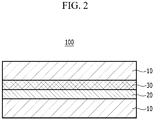
- FIG. 2 illustrates a schematic cross-sectional view of an electrical steel sheet laminate according to an embodiment of the present invention.
- a structure of an electrical steel sheet laminate according to an embodiment of the present invention will be described with reference to FIG. 2 .
- the electrical steel sheet laminate of FIG. 2 is only for illustrating the present invention, and the present invention is not limited thereto. Therefore, a structure of the electrical steel sheet laminate may be variously modified.
- the electrical steel sheet laminate 100 As shown in FIG. 2 , in the electrical steel sheet laminate 100 according to the embodiment of the present invention, a plurality of electrical steel sheets 10 are laminated, and the upper adhesive layer 20 and the lower adhesive layer 30 are interposed in an order between the electrical steel sheets.
- the manufacturing method of the electrical steel sheet laminate 100 includes laminating a plurality of the electrical steel sheets 10 on which the upper adhesive layer 20 and the adhesive layer 30 are formed, and thermal-bonding them. Through the thermal-bonding, the resin components in the upper adhesive layer 20 and the lower adhesive layer 30 are thermal-bonded to form a thermal-bonding layer.
- the thermal-bonding may be performed under conditions of a temperature of 100 to 300 °C, a pressure of 0.05 to 5.0 MPa, and 0.1 to 120 minutes.
- the conditions may each independently be satisfied, and two or more conditions may be simultaneously satisfied.
- the non-oriented electrical steel sheets may be densely thermal-bonded without gaps or pores therebetween.
- the thermal-bonding includes increasing a temperature and bonding, and a temperature increase rate in the increasing of the temperature may be 10 °C/min to 1000 °C/min.
- the electrical steel sheet laminate according to the embodiment of the present invention not only improves magnetism of the electrical steel sheet itself (specifically, iron loss, magnetic flux density, etc.), but also has excellent adhesion by the adhesive coating layer.
- a non-oriented electrical steel sheet (50 ⁇ 50 mm) including 3.15 wt% of silicon (Si) and subjected to an annealing treatment to a sheet thickness of 0.35 mm was prepared as a blank specimen.
- the adhesive composition composed of the solid contents summarized in Table 1 below was applied to the upper and lower portions of each prepared blank specimen by using a bar coater to have a predetermined thickness, and it was cured at a standard 150 to 250 °C for 20 seconds, and then slowly cooled in air to form an adhesive coating layer having a thickness of about 3.0 ⁇ m.
- the electrical steel sheet coated with the adhesive coating layer was laminated to a height of 20 mm, it was pressurized with a pressure of 0.1 MPa and thermal-bonded at 120 °C for 10 minutes. The adherence of the electrical steel sheet thermal-bonded under each condition was measured by the shear surface tension method.
- Adherence After the specimen prepared by the shear strength was fixed to upper/lower jigs with a certain force, the adherence was measured by using a device that measures the tensile force of the stacked samples while pulling them at a constant speed. At this time, in the case of the shear strength, the measured value was a value measured at the point at which the interface with the minimum adherence was peel out among the interfaces of the laminated samples.
- the pencil hardness measurement method is used as a method of measuring the surface hardness of the coating layer. An indentation on the surface of the coating layer is visually checked by drawing a line at an angle of 45 degrees with a standard pencil (Mitsubishi pencil, 8B to 10H) with a load of 500 g.
- a standard pencil Mitsubishi pencil, 8B to 10H
- Example 1 and Example 2 As shown in Table 1 and Table 2, it can be confirmed that the surface characteristics and adherence of Example 1 and Example 2 were excellent.
Landscapes
- Chemical & Material Sciences (AREA)
- Organic Chemistry (AREA)
- Engineering & Computer Science (AREA)
- Power Engineering (AREA)
- Dispersion Chemistry (AREA)
- Manufacturing & Machinery (AREA)
- Physics & Mathematics (AREA)
- Electromagnetism (AREA)
- Mechanical Engineering (AREA)
- Chemical Kinetics & Catalysis (AREA)
- Laminated Bodies (AREA)
- Adhesives Or Adhesive Processes (AREA)
- Manufacturing Of Steel Electrode Plates (AREA)
- Other Surface Treatments For Metallic Materials (AREA)
- Manufacturing Cores, Coils, And Magnets (AREA)
- Soft Magnetic Materials (AREA)
Applications Claiming Priority (2)
| Application Number | Priority Date | Filing Date | Title |
|---|---|---|---|
| KR1020180153083A KR102156189B1 (ko) | 2018-11-30 | 2018-11-30 | 전기강판 및 그 제조 방법 |
| PCT/KR2019/016387 WO2020111742A2 (fr) | 2018-11-30 | 2019-11-26 | Tôle en acier électrique et son procédé de fabrication |
Publications (2)
| Publication Number | Publication Date |
|---|---|
| EP3888906A2 true EP3888906A2 (fr) | 2021-10-06 |
| EP3888906A4 EP3888906A4 (fr) | 2022-01-26 |
Family
ID=70852876
Family Applications (1)
| Application Number | Title | Priority Date | Filing Date |
|---|---|---|---|
| EP19888551.9A Pending EP3888906A4 (fr) | 2018-11-30 | 2019-11-26 | Tôle en acier électrique et son procédé de fabrication |
Country Status (6)
| Country | Link |
|---|---|
| US (1) | US12163066B2 (fr) |
| EP (1) | EP3888906A4 (fr) |
| JP (1) | JP7354249B2 (fr) |
| KR (1) | KR102156189B1 (fr) |
| CN (1) | CN113165332B (fr) |
| WO (1) | WO2020111742A2 (fr) |
Families Citing this family (8)
| Publication number | Priority date | Publication date | Assignee | Title |
|---|---|---|---|---|
| KR102223865B1 (ko) | 2018-09-27 | 2021-03-04 | 주식회사 포스코 | 전기강판 적층체 |
| KR102156189B1 (ko) | 2018-11-30 | 2020-09-16 | 주식회사 포스코 | 전기강판 및 그 제조 방법 |
| JP7847418B2 (ja) * | 2020-06-17 | 2026-04-17 | 日本製鉄株式会社 | 電磁鋼板及び積層コア |
| TWI769867B (zh) * | 2020-06-17 | 2022-07-01 | 日商日本製鐵股份有限公司 | 電磁鋼板、積層鐵芯及積層鐵芯製造方法 |
| US20250226704A1 (en) * | 2022-04-06 | 2025-07-10 | Nippon Steel Corporation | Laminated core |
| CA3246668A1 (fr) * | 2022-04-06 | 2025-07-08 | Nippon Steel Corporation | Noyau stratifié |
| KR102868350B1 (ko) * | 2022-09-08 | 2025-10-14 | 닛폰세이테츠 가부시키가이샤 | 적층 코어 및 적층 코어의 제조 방법 |
| CN116809357A (zh) * | 2023-06-02 | 2023-09-29 | 山西太钢不锈钢股份有限公司 | 电工钢自粘结复合涂层的生产方法 |
Family Cites Families (30)
| Publication number | Priority date | Publication date | Assignee | Title |
|---|---|---|---|---|
| JPH0715015B2 (ja) | 1989-06-30 | 1995-02-22 | 積水化学工業株式会社 | 熱硬化性被覆用シートと被覆物 |
| JPH0715014B2 (ja) | 1989-06-30 | 1995-02-22 | 積水化学工業株式会社 | 熱硬化性被覆用シートと被覆物 |
| JP3486962B2 (ja) * | 1994-07-15 | 2004-01-13 | 住友金属工業株式会社 | 接着用塗装鋼板 |
| JP3196564B2 (ja) | 1995-04-25 | 2001-08-06 | 株式会社神戸製鋼所 | 感熱接着性樹脂塗装金属板およびその製法並びに該樹脂塗装金属板の接合方法 |
| JP3221285B2 (ja) | 1995-06-05 | 2001-10-22 | 株式会社神戸製鋼所 | 感熱接着性樹脂塗装金属板およびその製造方法 |
| JP3756674B2 (ja) * | 1998-07-13 | 2006-03-15 | 新日本製鐵株式会社 | 安定した接着強度をもつ積層接着鉄心用電磁鋼板 |
| JP3732971B2 (ja) * | 1999-05-28 | 2006-01-11 | Jfeスチール株式会社 | 剪断強度及び剥離強度に優れた接着鉄芯用電磁鋼板の製造方法 |
| CN100476030C (zh) | 2003-02-03 | 2009-04-08 | 新日本制铁株式会社 | 粘接用表面涂覆电磁钢板 |
| CN101048461A (zh) | 2004-10-27 | 2007-10-03 | 纳幕尔杜邦公司 | 自粘合涂料组合物 |
| JP4680728B2 (ja) | 2005-09-14 | 2011-05-11 | 三井化学東セロ株式会社 | 粘着フィルム |
| US20070087201A1 (en) | 2005-10-13 | 2007-04-19 | Michael Wimmer | Self-bonding coating composition |
| AU2010270696B2 (en) | 2009-07-07 | 2012-12-13 | Ak Steel Properties, Inc. | Polymer coated metallic substrate and method for making |
| JP5516958B2 (ja) | 2010-03-31 | 2014-06-11 | Dic株式会社 | ラジカル重合性硬化性組成物、粘着剤及びそれを用いて得られる積層体 |
| JP2012124466A (ja) | 2010-11-18 | 2012-06-28 | Nitto Denko Corp | 半導体装置用接着フィルム、及び、半導体装置 |
| JP5885029B2 (ja) | 2012-03-29 | 2016-03-15 | Dic株式会社 | 水性複合樹脂組成物及びそれを用いたコーティング剤 |
| CN102746725B (zh) * | 2012-06-29 | 2015-09-23 | 宝山钢铁股份有限公司 | 硅钢水溶性环保极厚绝缘涂层及其制备方法 |
| KR101439506B1 (ko) | 2012-12-27 | 2014-09-11 | 주식회사 포스코 | 무방향성 전기강판용 절연피막 조성물 |
| KR101561280B1 (ko) | 2013-11-27 | 2015-10-16 | 주식회사 포스코 | 무방향성 전기 강판 코팅 조성물, 무방향성 전기 강판 제품의 제조 방법 및 무방향성 전기 강판 제품 |
| KR101540373B1 (ko) | 2013-12-24 | 2015-07-29 | 주식회사 포스코 | 무방향성 전기강판 접착 코팅 조성물, 무방향성 전기강판 제품, 및 이의 제조 방법 |
| KR101532015B1 (ko) | 2013-12-24 | 2015-06-26 | 주식회사 포스코 | 열 융착형 모터 코어 본딩장치 |
| JP6372132B2 (ja) | 2014-03-31 | 2018-08-15 | 東洋紡株式会社 | 高分子フィルム積層体、および、それを用いたフレキシブル電子デバイスの製造方法 |
| JP6086098B2 (ja) * | 2014-06-23 | 2017-03-01 | Jfeスチール株式会社 | 積層電磁鋼板およびその製造方法 |
| JP6037055B2 (ja) * | 2014-07-29 | 2016-11-30 | Jfeスチール株式会社 | 積層用電磁鋼板、積層型電磁鋼板、積層型電磁鋼板の製造方法、および自動車モーター用鉄心 |
| JP6632846B2 (ja) * | 2014-09-30 | 2020-01-22 | 日東電工株式会社 | 粘着シート |
| KR102444224B1 (ko) | 2015-12-23 | 2022-09-16 | 주식회사 포스코 | 무방향성 전기강판 접착 코팅 조성물, 무방향성 전기강판 제품, 및 이의 제조 방법 |
| KR101904306B1 (ko) | 2016-12-23 | 2018-10-04 | 주식회사 포스코 | 무방향성 전기강판 접착 코팅 조성물 및 무방향성 전기강판 제품의 제조 방법 |
| KR102223865B1 (ko) | 2018-09-27 | 2021-03-04 | 주식회사 포스코 | 전기강판 적층체 |
| KR102176342B1 (ko) | 2018-09-28 | 2020-11-09 | 주식회사 포스코 | 전기강판 제품의 제조 방법 |
| KR102156189B1 (ko) | 2018-11-30 | 2020-09-16 | 주식회사 포스코 | 전기강판 및 그 제조 방법 |
| TWI769867B (zh) * | 2020-06-17 | 2022-07-01 | 日商日本製鐵股份有限公司 | 電磁鋼板、積層鐵芯及積層鐵芯製造方法 |
-
2018
- 2018-11-30 KR KR1020180153083A patent/KR102156189B1/ko active Active
-
2019
- 2019-11-26 EP EP19888551.9A patent/EP3888906A4/fr active Pending
- 2019-11-26 CN CN201980079004.4A patent/CN113165332B/zh active Active
- 2019-11-26 US US17/297,737 patent/US12163066B2/en active Active
- 2019-11-26 WO PCT/KR2019/016387 patent/WO2020111742A2/fr not_active Ceased
- 2019-11-26 JP JP2021531051A patent/JP7354249B2/ja active Active
Also Published As
| Publication number | Publication date |
|---|---|
| KR102156189B1 (ko) | 2020-09-16 |
| US12163066B2 (en) | 2024-12-10 |
| CN113165332B (zh) | 2023-08-15 |
| US20220041893A1 (en) | 2022-02-10 |
| EP3888906A4 (fr) | 2022-01-26 |
| WO2020111742A2 (fr) | 2020-06-04 |
| CN113165332A (zh) | 2021-07-23 |
| JP2022513168A (ja) | 2022-02-07 |
| JP7354249B2 (ja) | 2023-10-02 |
| WO2020111742A3 (fr) | 2020-09-10 |
| KR20200066509A (ko) | 2020-06-10 |
Similar Documents
| Publication | Publication Date | Title |
|---|---|---|
| US12163066B2 (en) | Electrical steel sheet and method for manufacturing same | |
| EP3572535B1 (fr) | Procédé de fabrication d'une plaque d'acier électromagnétique à grains non orientés et procédé de fabrication de noyau de moteur | |
| US12601038B2 (en) | Non-oriented electrical steel sheet, motor core, and production methods thereof | |
| US8943677B2 (en) | Method for joining core laminations by adhesive force to form a soft-magnetic laminated core | |
| US10742077B2 (en) | Soft magnetic laminated core and method of producing a laminated core for a stator and/or rotor of an electric machine | |
| EP2537958B1 (fr) | Tôle d'acier électromagnétique non orientée et son procédé de fabrication | |
| KR102444224B1 (ko) | 무방향성 전기강판 접착 코팅 조성물, 무방향성 전기강판 제품, 및 이의 제조 방법 | |
| US11613101B2 (en) | Magnetic material, laminated magnetic material, laminated packet, and laminated core using magnetic material, and magnetic material producing method | |
| JP6086098B2 (ja) | 積層電磁鋼板およびその製造方法 | |
| EP3858601A1 (fr) | Procédé de fabrication d'un produit en tôle magnétique en acier | |
| EP2746415A1 (fr) | Tôle d'acier magnétique non orientée et son procédé de fabrication ainsi que corps laminé pour noyau de moteur et son procédé de fabrication | |
| GB2059168A (en) | Electrical steel laminated article | |
| US11848131B2 (en) | Electrical steel sheet laminate | |
| JPH0785457B2 (ja) | 超高珪素電磁鋼板を用いた低騒音の積層鉄芯及び巻き鉄芯 | |
| JP2007056303A (ja) | 磁気特性に優れた無方向性電磁鋼板の製造方法 | |
| JPS6163004A (ja) | 接着ラミネート方向性けい素鋼板 | |
| JPH01168014A (ja) | 電子機器用コイル、トランス類の製造方法 | |
| KR20240098314A (ko) | 전기강판 및 그 제조 방법 | |
| US20250223676A1 (en) | Grain-Oriented Electrical Steel Sheet Coated with a Resin and Used for Stacking | |
| EP4266560A1 (fr) | Noyau de fer stratifié et son procédé de fabrication | |
| JP7096016B2 (ja) | 電磁鋼板の製造方法 | |
| JP2023093343A (ja) | 積鉄心および積鉄心の製造方法 | |
| JP2026041002A (ja) | 軟磁性アモルファス積層体、軟磁性アモルファス積層磁心及びその製造方法 | |
| KR20250116615A (ko) | 무방향성 전기강판 및 그 제조 방법 | |
| CN101336304A (zh) | 特别适合于生产电磁叠片组的热扎钢带材 |
Legal Events
| Date | Code | Title | Description |
|---|---|---|---|
| STAA | Information on the status of an ep patent application or granted ep patent |
Free format text: STATUS: THE INTERNATIONAL PUBLICATION HAS BEEN MADE |
|
| PUAI | Public reference made under article 153(3) epc to a published international application that has entered the european phase |
Free format text: ORIGINAL CODE: 0009012 |
|
| STAA | Information on the status of an ep patent application or granted ep patent |
Free format text: STATUS: REQUEST FOR EXAMINATION WAS MADE |
|
| 17P | Request for examination filed |
Effective date: 20210624 |
|
| AK | Designated contracting states |
Kind code of ref document: A2 Designated state(s): AL AT BE BG CH CY CZ DE DK EE ES FI FR GB GR HR HU IE IS IT LI LT LU LV MC MK MT NL NO PL PT RO RS SE SI SK SM TR |
|
| A4 | Supplementary search report drawn up and despatched |
Effective date: 20220104 |
|
| RIC1 | Information provided on ipc code assigned before grant |
Ipc: B32B 15/18 20060101ALI20211221BHEP Ipc: B32B 15/01 20060101ALI20211221BHEP Ipc: B32B 1/00 20060101ALI20211221BHEP Ipc: B32B 7/12 20060101AFI20211221BHEP |
|
| RAP3 | Party data changed (applicant data changed or rights of an application transferred) |
Owner name: POSCO HOLDINGS INC. |
|
| RAP1 | Party data changed (applicant data changed or rights of an application transferred) |
Owner name: POSCO CO., LTD |
|
| STAA | Information on the status of an ep patent application or granted ep patent |
Free format text: STATUS: EXAMINATION IS IN PROGRESS |
|
| 17Q | First examination report despatched |
Effective date: 20240515 |