EP3890148A1 - Procédé de charge de plusieurs batteries - Google Patents
Procédé de charge de plusieurs batteries Download PDFInfo
- Publication number
- EP3890148A1 EP3890148A1 EP21163398.7A EP21163398A EP3890148A1 EP 3890148 A1 EP3890148 A1 EP 3890148A1 EP 21163398 A EP21163398 A EP 21163398A EP 3890148 A1 EP3890148 A1 EP 3890148A1
- Authority
- EP
- European Patent Office
- Prior art keywords
- charging
- batteries
- battery
- charging power
- started
- Prior art date
- Legal status (The legal status is an assumption and is not a legal conclusion. Google has not performed a legal analysis and makes no representation as to the accuracy of the status listed.)
- Pending
Links
Images

Classifications
-
- B—PERFORMING OPERATIONS; TRANSPORTING
- B60—VEHICLES IN GENERAL
- B60L—PROPULSION OF ELECTRICALLY-PROPELLED VEHICLES; SUPPLYING ELECTRIC POWER FOR AUXILIARY EQUIPMENT OF ELECTRICALLY-PROPELLED VEHICLES; ELECTRODYNAMIC BRAKE SYSTEMS FOR VEHICLES IN GENERAL; MAGNETIC SUSPENSION OR LEVITATION FOR VEHICLES; MONITORING OPERATING VARIABLES OF ELECTRICALLY-PROPELLED VEHICLES; ELECTRIC SAFETY DEVICES FOR ELECTRICALLY-PROPELLED VEHICLES
- B60L53/00—Methods of charging batteries, specially adapted for electric vehicles; Charging stations or on-board charging equipment therefor; Exchange of energy storage elements in electric vehicles
- B60L53/60—Monitoring or controlling charging stations
- B60L53/67—Controlling two or more charging stations
-
- B—PERFORMING OPERATIONS; TRANSPORTING
- B60—VEHICLES IN GENERAL
- B60L—PROPULSION OF ELECTRICALLY-PROPELLED VEHICLES; SUPPLYING ELECTRIC POWER FOR AUXILIARY EQUIPMENT OF ELECTRICALLY-PROPELLED VEHICLES; ELECTRODYNAMIC BRAKE SYSTEMS FOR VEHICLES IN GENERAL; MAGNETIC SUSPENSION OR LEVITATION FOR VEHICLES; MONITORING OPERATING VARIABLES OF ELECTRICALLY-PROPELLED VEHICLES; ELECTRIC SAFETY DEVICES FOR ELECTRICALLY-PROPELLED VEHICLES
- B60L53/00—Methods of charging batteries, specially adapted for electric vehicles; Charging stations or on-board charging equipment therefor; Exchange of energy storage elements in electric vehicles
- B60L53/60—Monitoring or controlling charging stations
- B60L53/62—Monitoring or controlling charging stations in response to charging parameters, e.g. current, voltage or electrical charge
-
- H—ELECTRICITY
- H02—GENERATION; CONVERSION OR DISTRIBUTION OF ELECTRIC POWER
- H02J—ELECTRIC POWER NETWORKS; CIRCUIT ARRANGEMENTS OR SYSTEMS FOR SUPPLYING OR DISTRIBUTING ELECTRIC POWER; SYSTEMS FOR STORING ELECTRIC ENERGY
- H02J7/00—Circuit arrangements for charging or discharging batteries or for supplying loads from batteries
- H02J7/50—Circuit arrangements for charging or discharging batteries or for supplying loads from batteries acting upon multiple batteries simultaneously or sequentially
- H02J7/585—Sequential battery discharge in systems with a plurality of batteries
-
- H—ELECTRICITY
- H02—GENERATION; CONVERSION OR DISTRIBUTION OF ELECTRIC POWER
- H02J—ELECTRIC POWER NETWORKS; CIRCUIT ARRANGEMENTS OR SYSTEMS FOR SUPPLYING OR DISTRIBUTING ELECTRIC POWER; SYSTEMS FOR STORING ELECTRIC ENERGY
- H02J7/00—Circuit arrangements for charging or discharging batteries or for supplying loads from batteries
- H02J7/90—Regulation of charging or discharging current or voltage
- H02J7/933—Regulation of charging or discharging current or voltage the cycle being controlled or terminated in response to electric parameters
-
- Y—GENERAL TAGGING OF NEW TECHNOLOGICAL DEVELOPMENTS; GENERAL TAGGING OF CROSS-SECTIONAL TECHNOLOGIES SPANNING OVER SEVERAL SECTIONS OF THE IPC; TECHNICAL SUBJECTS COVERED BY FORMER USPC CROSS-REFERENCE ART COLLECTIONS [XRACs] AND DIGESTS
- Y02—TECHNOLOGIES OR APPLICATIONS FOR MITIGATION OR ADAPTATION AGAINST CLIMATE CHANGE
- Y02T—CLIMATE CHANGE MITIGATION TECHNOLOGIES RELATED TO TRANSPORTATION
- Y02T10/00—Road transport of goods or passengers
- Y02T10/60—Other road transportation technologies with climate change mitigation effect
- Y02T10/70—Energy storage systems for electromobility, e.g. batteries
-
- Y—GENERAL TAGGING OF NEW TECHNOLOGICAL DEVELOPMENTS; GENERAL TAGGING OF CROSS-SECTIONAL TECHNOLOGIES SPANNING OVER SEVERAL SECTIONS OF THE IPC; TECHNICAL SUBJECTS COVERED BY FORMER USPC CROSS-REFERENCE ART COLLECTIONS [XRACs] AND DIGESTS
- Y02—TECHNOLOGIES OR APPLICATIONS FOR MITIGATION OR ADAPTATION AGAINST CLIMATE CHANGE
- Y02T—CLIMATE CHANGE MITIGATION TECHNOLOGIES RELATED TO TRANSPORTATION
- Y02T10/00—Road transport of goods or passengers
- Y02T10/60—Other road transportation technologies with climate change mitigation effect
- Y02T10/7072—Electromobility specific charging systems or methods for batteries, ultracapacitors, supercapacitors or double-layer capacitors
-
- Y—GENERAL TAGGING OF NEW TECHNOLOGICAL DEVELOPMENTS; GENERAL TAGGING OF CROSS-SECTIONAL TECHNOLOGIES SPANNING OVER SEVERAL SECTIONS OF THE IPC; TECHNICAL SUBJECTS COVERED BY FORMER USPC CROSS-REFERENCE ART COLLECTIONS [XRACs] AND DIGESTS
- Y02—TECHNOLOGIES OR APPLICATIONS FOR MITIGATION OR ADAPTATION AGAINST CLIMATE CHANGE
- Y02T—CLIMATE CHANGE MITIGATION TECHNOLOGIES RELATED TO TRANSPORTATION
- Y02T90/00—Enabling technologies or technologies with a potential or indirect contribution to GHG emissions mitigation
- Y02T90/10—Technologies relating to charging of electric vehicles
- Y02T90/12—Electric charging stations
Definitions
- the invention relates to a method for charging a sequence of at least two batteries.
- the term battery includes rechargeable batteries, which are referred to in the strict sense as accumulators.
- the term battery or traction battery has also become established for this, so that it will be used in the following.
- traction batteries are either removed from a battery compartment for charging during multi-shift operation and exchanged for a charged traction battery, or the driver connects a charger to the traction battery via a plug connection at the end of his work shift in order to keep it in place during to charge the work break. This is typically done once per work shift, as a traction battery of a battery-powered industrial truck is usually dimensioned so that a complete work shift can be driven and worked with one charge of the traction battery.
- the total charging power possible when charging several batteries at the same time is limited by the network installation, in particular by cables, fuses and plugs, as well as by the power converters in the chargers.
- the present invention is based on the object of designing a method of the type mentioned at the outset in such a way that the overall charging time is reduced when charging several batteries.
- this object is achieved in that a charging process for a subsequent battery is started before the end of a previously started charging process, as soon as a predetermined limit value of the charging power of the previously started charging process is undershot.
- the charging processes preferably have charging power characteristics which, after a plateau-like maximum level of a maximum charging power, drop in a steep slope to a plateau-like low level of a low charging power, the charging process of the subsequent battery starting as soon as possible the charging power characteristic curve of the charging process started before has dropped to a middle range between the maximum level and the low level, so that the increasing charging power characteristic curve of the charging process started in the subsequent battery corresponds to the falling edge of the charging power characteristic curve of the charging process started previously middle area cuts.
- This operating strategy makes use of the fact that, particularly when charging lead-acid batteries, the maximum charging power is only required for a short time.
- the charging power typically only remains at a high level of, for example, 7000 to 8000 watts over a period of about three hours and then decreases to about 2000 watts within about an hour.
- a graphical representation therefore results in a charging power characteristic curve that drops off with a steep slope after about three hours.
- the invention is based on the consideration that the total charging power can be reduced when charging several batteries if the charging process of the next battery is already started when the charging power characteristic curve of the previous charging process drops.
- the charging power characteristic of the subsequent charging process rises steeply and intersects the charging power characteristic curve of the previous charging process in the middle of the falling edge, if possible. This results in an overall charging capacity at a high level that is extended over time.
- the predetermined limit value of the charging power is preferably 50 to 80%, in particular 60 to 70%, of the maximum charging power of the charging process of the previous battery. Since the charging power characteristic curve of the previous charging process does not drop to zero, but rather stabilizes after the decrease at a low level, for example 2000 watts, this specification means that the charging power characteristic curves are roughly in the middle of the falling edge cut.
- the charging process of the subsequent battery is started with a low charging current and the charging current is increased gradually.
- Another embodiment provides that after the start of the charging process of the subsequent battery, the charging current of the previous battery is reduced.
- the charging processes of the batteries are expediently carried out with at least one multiple charger that is connected to a network installation.
- the charging processes of the batteries can also be carried out with charging devices that communicate with one another and / or with a central control unit, which are expediently connected to a common network installation.
- the invention can be used with particular advantage in vehicle fleets of battery-electrically operated industrial trucks.
- traction batteries from industrial trucks are advantageously used as batteries.
- Lead-acid batteries are particularly preferably used as batteries.
- Lithium-ion batteries can also be used as batteries.
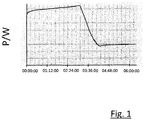
- FIG. 1 a typical charging power curve of a lead-acid battery is shown graphically, which is designed as a traction battery of an industrial truck.
- the time in hours: minutes: seconds is plotted on the horizontal axis and the charging power P in watts (W) is plotted on the vertical axis.
- the charging performance remains at a high level for about the first three hours and then falls within steeply for about an hour before stabilizing at a low level afterwards.
- This graphic shows that when charging a lead-acid battery in particular, the maximum charging power is only required for a short time. This fact is exploited with the method according to the invention in order to reduce the total charging time when charging several batteries.
- the Figure 2 shows in the upper figure a graphical representation of the charging power characteristics of three superimposed charging processes of three lead-acid batteries, which are designed as traction batteries for industrial trucks, according to the operating strategy according to the invention.
- the three batteries can be charged with a multiple charger to which the three batteries are connected.
- the charging of the three batteries can be carried out with several chargers, with one charger charging a battery and the chargers communicating with one another directly or by means of a central control unit.
- the time in hours is plotted on the horizontal axis and the charging power P in watts (W) is plotted on the vertical axis.
- W watts
- two batteries are charged at the same time.
- the two charging power characteristics of the two batteries are labeled L1 and L2.
- the charging power characteristics L1 and L2 initially remain at a high level of approx. 7000 watts (L1) and 9000 to 10000 watts (L2) over a period of around three hours. They then drop sharply within about an hour and stabilize at a low level of about 3000 watts for about two hours before dropping to zero.
- the operating strategy according to the invention now provides that there is no waiting to start the charging process of the third battery until the charging processes of the two other batteries have already ended. Instead, the new charging process is already started when the charging power of the previous charging process has dropped to the specified charging power of 60 to 70% of the maximum charging power.
- the charging power characteristic curve L3 of the third battery which rises steeply after the start, thus intersects the charging power characteristic curves L1 and L2 of the two other batteries approximately in the middle of the falling edges of L1 and L2.
Landscapes
- Engineering & Computer Science (AREA)
- Power Engineering (AREA)
- Transportation (AREA)
- Mechanical Engineering (AREA)
- Charge And Discharge Circuits For Batteries Or The Like (AREA)
- Secondary Cells (AREA)
Applications Claiming Priority (1)
| Application Number | Priority Date | Filing Date | Title |
|---|---|---|---|
| DE102020109214.8A DE102020109214A1 (de) | 2020-04-02 | 2020-04-02 | Verfahren zum Laden von mehreren Batterien |
Publications (1)
| Publication Number | Publication Date |
|---|---|
| EP3890148A1 true EP3890148A1 (fr) | 2021-10-06 |
Family
ID=75108189
Family Applications (1)
| Application Number | Title | Priority Date | Filing Date |
|---|---|---|---|
| EP21163398.7A Pending EP3890148A1 (fr) | 2020-04-02 | 2021-03-18 | Procédé de charge de plusieurs batteries |
Country Status (2)
| Country | Link |
|---|---|
| EP (1) | EP3890148A1 (fr) |
| DE (1) | DE102020109214A1 (fr) |
Families Citing this family (1)
| Publication number | Priority date | Publication date | Assignee | Title |
|---|---|---|---|---|
| CN115037020A (zh) * | 2022-08-12 | 2022-09-09 | 四川嘉逸新能源科技有限公司 | 一种光伏电动车充电方法及光伏电动车 |
Citations (4)
| Publication number | Priority date | Publication date | Assignee | Title |
|---|---|---|---|---|
| JPH1080071A (ja) * | 1996-09-02 | 1998-03-24 | Japan Storage Battery Co Ltd | 電気自動車の充電制御装置 |
| US5808442A (en) * | 1995-09-29 | 1998-09-15 | Sanyo Electric Co., Ltd. | Method of charging a plurality of lithium ion rechargeable batteries |
| EP2388884A2 (fr) * | 2010-05-19 | 2011-11-23 | Hitachi, Ltd. | Procédé de réception de charge, procédé de contrôle de charge, unité de contrôle de charge et équipement de chargement |
| DE102013020879A1 (de) * | 2013-12-11 | 2014-08-14 | Daimler Ag | Verfahren zum sukzessiven Aufladen einer ersten Batterie und einer zweiten Batterie |
-
2020
- 2020-04-02 DE DE102020109214.8A patent/DE102020109214A1/de active Pending
-
2021
- 2021-03-18 EP EP21163398.7A patent/EP3890148A1/fr active Pending
Patent Citations (4)
| Publication number | Priority date | Publication date | Assignee | Title |
|---|---|---|---|---|
| US5808442A (en) * | 1995-09-29 | 1998-09-15 | Sanyo Electric Co., Ltd. | Method of charging a plurality of lithium ion rechargeable batteries |
| JPH1080071A (ja) * | 1996-09-02 | 1998-03-24 | Japan Storage Battery Co Ltd | 電気自動車の充電制御装置 |
| EP2388884A2 (fr) * | 2010-05-19 | 2011-11-23 | Hitachi, Ltd. | Procédé de réception de charge, procédé de contrôle de charge, unité de contrôle de charge et équipement de chargement |
| DE102013020879A1 (de) * | 2013-12-11 | 2014-08-14 | Daimler Ag | Verfahren zum sukzessiven Aufladen einer ersten Batterie und einer zweiten Batterie |
Also Published As
| Publication number | Publication date |
|---|---|
| DE102020109214A1 (de) | 2021-10-07 |
Similar Documents
| Publication | Publication Date | Title |
|---|---|---|
| EP1325542B1 (fr) | Procede de regulation de la tension d'un generateur dans une automobile | |
| EP2248239A1 (fr) | Procede et dispositif destines a la decharge d'un reseau de tension elevee | |
| DE102009001670A1 (de) | Ladeverfahren und Ladesystem | |
| EP2750922B1 (fr) | Procédé et dispositif permettant de charger un accumulateur d'énergie dans un véhicule | |
| EP3148837B1 (fr) | Procédé de gestion de batterie, et système de gestion de batterie | |
| DE102011012316A1 (de) | Verfahren und Vorrichtung zum Laden einer Niedervoltbatterie in einem elektrischen Antriebssystem | |
| DE102014203417A1 (de) | Verfahren zum Überwachen eines Ladezustandes | |
| DE102021109317A1 (de) | Verfahren und Vorrichtung zum Betrieb eines elektrischen Energiespeichers | |
| EP3720733B1 (fr) | Procédé de commande d'une installation électrique d'un véhicule à moteur à entraînement électrique, dotée de plusieurs batteries et installation électrique d'un véhicule à entraînement électrique | |
| DE102017206497A1 (de) | Ladevorrichtung und Verfahren zum Laden eines elektrischen Energiespeichers eines Fahrzeugs, sowie Kraftfahrzeug | |
| EP4399779A1 (fr) | Procédé de charge pour un bloc-batterie d'un outil électrique portatif | |
| DE102015206871A1 (de) | Energiespeichersystem | |
| EP2824321A1 (fr) | Procédé de chargement d'un accumulateur d'énergie de secours électrique | |
| DE102020109214A1 (de) | Verfahren zum Laden von mehreren Batterien | |
| DE102019213980B3 (de) | Verfahren zum Betrieb eines Elektrofahrzeugs und Elektrofahrzeug | |
| DE102016219624A1 (de) | Verfahren zur Steuerung eines elektrischen Energiespeichers | |
| DE102014217921A1 (de) | Verfahren zum Laden einer Traktionsbatterie eines Elektrofahrzeugs und Elektrofahrzeug | |
| DE102020109212A1 (de) | Mehrfachladeeinrichtung zum Laden mehrerer Batterien | |
| DE102016207574A1 (de) | Verfahren zum Betrieb eines Batteriesystems, Batteriemanagementsystem und Batteriesystem | |
| DE102018209614A1 (de) | Verfahren zum Versorgen eines Niederspannungsbordnetzes eines Kraftfahrzeugs, Steuereinrichtung für ein Kraftfahrzeug und Kraftfahrzeug | |
| WO2020237270A1 (fr) | Dispositif de batterie pour un véhicule | |
| DE102019216961A1 (de) | Verfahren zum Laden von zumindest zwei elektrischen Energiespeichern und Fahrzeug | |
| DE102024101916A1 (de) | Kraftfahrzeug und Verfahren zum Laden einer Batterie eines Fahrzeugbordnetzes | |
| DE102017221251A1 (de) | Verfahren zum Betrieb eines Energiespeichers und Batteriesystem sowie Kraftfahrzeug | |
| DE102014205167A1 (de) | Verfahren zum Nachladen von in Fahrzeugen eingesetzten Batteriezellen und Laderegler zum Ausführen eines solchen Verfahrens |
Legal Events
| Date | Code | Title | Description |
|---|---|---|---|
| PUAI | Public reference made under article 153(3) epc to a published international application that has entered the european phase |
Free format text: ORIGINAL CODE: 0009012 |
|
| STAA | Information on the status of an ep patent application or granted ep patent |
Free format text: STATUS: THE APPLICATION HAS BEEN PUBLISHED |
|
| AK | Designated contracting states |
Kind code of ref document: A1 Designated state(s): AL AT BE BG CH CY CZ DE DK EE ES FI FR GB GR HR HU IE IS IT LI LT LU LV MC MK MT NL NO PL PT RO RS SE SI SK SM TR |
|
| STAA | Information on the status of an ep patent application or granted ep patent |
Free format text: STATUS: REQUEST FOR EXAMINATION WAS MADE |
|
| 17P | Request for examination filed |
Effective date: 20220405 |
|
| RBV | Designated contracting states (corrected) |
Designated state(s): AL AT BE BG CH CY CZ DE DK EE ES FI FR GB GR HR HU IE IS IT LI LT LU LV MC MK MT NL NO PL PT RO RS SE SI SK SM TR |
|
| REG | Reference to a national code |
Ref country code: DE Ref legal event code: R079 Free format text: PREVIOUS MAIN CLASS: H02J0007000000 Ipc: H02J0007500000 |
|
| GRAP | Despatch of communication of intention to grant a patent |
Free format text: ORIGINAL CODE: EPIDOSNIGR1 |
|
| STAA | Information on the status of an ep patent application or granted ep patent |
Free format text: STATUS: GRANT OF PATENT IS INTENDED |
|
| RIC1 | Information provided on ipc code assigned before grant |
Ipc: H02J 7/50 20260101AFI20260619BHEP Ipc: H02J 7/00 20060101ALI20260619BHEP Ipc: B60L 53/62 20190101ALI20260619BHEP Ipc: B60L 53/67 20190101ALI20260619BHEP |