EP3900923A1 - Procédé de fabrication automatisée de comprimés individualisés et presse à comprimés destinée à la fabrication automatisée de comprimés individualisés - Google Patents
Procédé de fabrication automatisée de comprimés individualisés et presse à comprimés destinée à la fabrication automatisée de comprimés individualisés Download PDFInfo
- Publication number
- EP3900923A1 EP3900923A1 EP20170820.3A EP20170820A EP3900923A1 EP 3900923 A1 EP3900923 A1 EP 3900923A1 EP 20170820 A EP20170820 A EP 20170820A EP 3900923 A1 EP3900923 A1 EP 3900923A1
- Authority
- EP
- European Patent Office
- Prior art keywords
- die
- active ingredient
- lower punch
- punch
- central opening
- Prior art date
- Legal status (The legal status is an assumption and is not a legal conclusion. Google has not performed a legal analysis and makes no representation as to the accuracy of the status listed.)
- Granted
Links
Images



Classifications
-
- A—HUMAN NECESSITIES
- A61—MEDICAL OR VETERINARY SCIENCE; HYGIENE
- A61K—PREPARATIONS FOR MEDICAL, DENTAL OR TOILETRY PURPOSES
- A61K9/00—Medicinal preparations characterised by special physical form
- A61K9/20—Pills, tablets, discs, rods
- A61K9/2095—Tabletting processes
-
- B—PERFORMING OPERATIONS; TRANSPORTING
- B30—PRESSES
- B30B—PRESSES IN GENERAL
- B30B15/00—Details of, or accessories for, presses; Auxiliary measures in connection with pressing
- B30B15/30—Feeding material to presses
- B30B15/302—Feeding material in particulate or plastic state to moulding presses
-
- A—HUMAN NECESSITIES
- A61—MEDICAL OR VETERINARY SCIENCE; HYGIENE
- A61J—CONTAINERS SPECIALLY ADAPTED FOR MEDICAL OR PHARMACEUTICAL PURPOSES; DEVICES OR METHODS SPECIALLY ADAPTED FOR BRINGING PHARMACEUTICAL PRODUCTS INTO PARTICULAR PHYSICAL OR ADMINISTERING FORMS; DEVICES FOR ADMINISTERING FOOD OR MEDICINES ORALLY; BABY COMFORTERS; DEVICES FOR RECEIVING SPITTLE
- A61J3/00—Devices or methods specially adapted for bringing pharmaceutical products into particular physical or administering forms
- A61J3/10—Devices or methods specially adapted for bringing pharmaceutical products into particular physical or administering forms into the form of compressed tablets
-
- A—HUMAN NECESSITIES
- A61—MEDICAL OR VETERINARY SCIENCE; HYGIENE
- A61K—PREPARATIONS FOR MEDICAL, DENTAL OR TOILETRY PURPOSES
- A61K9/00—Medicinal preparations characterised by special physical form
- A61K9/20—Pills, tablets, discs, rods
- A61K9/2004—Excipients; Inactive ingredients
- A61K9/2022—Organic macromolecular compounds
- A61K9/205—Polysaccharides, e.g. alginate, gums; Cyclodextrin
- A61K9/2054—Cellulose; Cellulose derivatives, e.g. hydroxypropyl methylcellulose
-
- A—HUMAN NECESSITIES
- A61—MEDICAL OR VETERINARY SCIENCE; HYGIENE
- A61K—PREPARATIONS FOR MEDICAL, DENTAL OR TOILETRY PURPOSES
- A61K9/00—Medicinal preparations characterised by special physical form
- A61K9/20—Pills, tablets, discs, rods
- A61K9/2072—Pills, tablets, discs, rods characterised by shape, structure or size; Tablets with holes, special break lines or identification marks; Partially coated tablets; Disintegrating flat shaped forms
- A61K9/2086—Layered tablets, e.g. bilayer tablets; Tablets of the type inert core-active coat
- A61K9/209—Layered tablets, e.g. bilayer tablets; Tablets of the type inert core-active coat containing drug in at least two layers or in the core and in at least one outer layer
-
- B—PERFORMING OPERATIONS; TRANSPORTING
- B30—PRESSES
- B30B—PRESSES IN GENERAL
- B30B11/00—Presses specially adapted for forming shaped articles from material in particulate or plastic state, e.g. briquetting presses, tabletting presses
- B30B11/005—Control arrangements
-
- B—PERFORMING OPERATIONS; TRANSPORTING
- B30—PRESSES
- B30B—PRESSES IN GENERAL
- B30B11/00—Presses specially adapted for forming shaped articles from material in particulate or plastic state, e.g. briquetting presses, tabletting presses
- B30B11/02—Presses specially adapted for forming shaped articles from material in particulate or plastic state, e.g. briquetting presses, tabletting presses using a ram exerting pressure on the material in a moulding space
-
- B—PERFORMING OPERATIONS; TRANSPORTING
- B30—PRESSES
- B30B—PRESSES IN GENERAL
- B30B11/00—Presses specially adapted for forming shaped articles from material in particulate or plastic state, e.g. briquetting presses, tabletting presses
- B30B11/02—Presses specially adapted for forming shaped articles from material in particulate or plastic state, e.g. briquetting presses, tabletting presses using a ram exerting pressure on the material in a moulding space
- B30B11/08—Presses specially adapted for forming shaped articles from material in particulate or plastic state, e.g. briquetting presses, tabletting presses using a ram exerting pressure on the material in a moulding space co-operating with moulds carried by a turntable
-
- B—PERFORMING OPERATIONS; TRANSPORTING
- B30—PRESSES
- B30B—PRESSES IN GENERAL
- B30B15/00—Details of, or accessories for, presses; Auxiliary measures in connection with pressing
- B30B15/0082—Dust eliminating means; Mould or press ram cleaning means
-
- B—PERFORMING OPERATIONS; TRANSPORTING
- B30—PRESSES
- B30B—PRESSES IN GENERAL
- B30B15/00—Details of, or accessories for, presses; Auxiliary measures in connection with pressing
- B30B15/06—Platens or press rams
- B30B15/065—Press rams
-
- B—PERFORMING OPERATIONS; TRANSPORTING
- B30—PRESSES
- B30B—PRESSES IN GENERAL
- B30B15/00—Details of, or accessories for, presses; Auxiliary measures in connection with pressing
- B30B15/30—Feeding material to presses
- B30B15/302—Feeding material in particulate or plastic state to moulding presses
- B30B15/304—Feeding material in particulate or plastic state to moulding presses by using feed frames or shoes with relative movement with regard to the mould or moulds
- B30B15/306—Feeding material in particulate or plastic state to moulding presses by using feed frames or shoes with relative movement with regard to the mould or moulds for multi-layer articles
Definitions
- the invention relates to a method for the automated production of a predeterminable number of individualized tablets with a predeterminable amount of a first active ingredient by means of a tablet press.
- the invention further relates to a tablet press for the automated production of a predeterminable number of individualized tablets with a predeterminable amount of a first active ingredient.
- Tablets play an indispensable role in medical and non-medical fields these days, from drug delivery to nutritional supplements.
- a die with a central opening is often used, into which the active ingredient from which the tablet is to be produced is filled.
- the active ingredient is pressed into a tablet in the central opening by means of a lower punch and an upper punch.
- rotary presses are used, for example, which comprise up to a hundred dies and punch pairs, which are rotated and driven in a synchronized manner by means of a turntable. Such rotary presses can produce up to 1.6 million tablets per hour.
- the amounts of active ingredient to be administered depend on the individual patient, the capacity for active ingredient absorption and the current state of health of these patients. Especially, but not only, children or the elderly require a specially tailored dosage adjustment.
- tablets are often in tablet packaging with a given number of tablets sold. This leads to a waste of pharmaceutical raw materials and excess tablets that are not needed by the patient and are thrown away.
- a tablet container is arranged in a receiving space of the tablet press and, after the pressed tablet has been released, this tablet is transferred into the tablet container by means of a transfer device controlled by the control system.
- This method provides the patient with a prescribable target number of individualized tablets with a prescribable target mass of the first active substance.
- the target mass is determined, for example, by a doctor or a pharmacist, taking into account the state of health and the physical characteristics of the patient, such as his body weight. Since the amount of active ingredient contained in the tablet corresponds exactly to the target mass, there is no need to divide the tablet. In this way, overdosing is advantageously avoided and it is easier for the patient to take the tablets.
- the mass of the first active ingredient filled into the central opening can be measured precisely and reliably during the filling process.
- the target number is also determined by the doctor or the pharmacist, for example. In doing so, it is preferred to take into account how quickly the patient's state of health changes and how often an adjustment of the dosage is required.
- the target number is preferably selected so that the tablets produced are sufficient for the treatment of the patient until the next diagnosis without unnecessary tablets being produced. A waste of tablets by dispensing standardized tablet packaging which contains more than the required tablets is advantageously avoided.
- the tablet press is advantageously compact. This is achieved in particular in that the tablet press comprises only a single upper punch and / or a single lower punch.
- the tablet press can be found, for example, in a doctor's practice, a pharmacy or at the patient's home.
- the tablets are preferably produced directly after the target mass and the target number have been determined in the doctor's office, in the pharmacy or by the patient himself at home.
- a decentralized method for the production of individualized tablets outside of industrial production plants is thus made available. Since the number of individualized tablets required by a patient is comparatively small, a high production speed is not necessary for their production. Instead, it is advantageously provided that a large number of tablet presses according to the invention in a large number of medical practices, pharmacies or patient apartments meet the patient's need for individualized tablets.
- the first material container is in particular releasably fixed to a first metering opening, in particular a pressing chamber, of the tablet press.
- the first material container can advantageously be exchanged quickly, for example when tablets with a different active ingredient are to be produced.
- the first metering device is in particular a component of the first material container and forms a unit with it.
- the first active ingredient is either a single active ingredient or a mixture of different active ingredients.
- the upper punch and / or the lower punch can in particular be deflected vertically.
- the outer circumference of the pressure surface of the upper punch and / or the pressure surface of the lower punch corresponds to an inner circumference of the central opening of the die.
- the pressure surface of the lower punch closes the central opening from below in that the pressure surface of the lower punch is pushed into the central opening from below. This creates a trough, the walls of which are formed by the central opening and the bottom of the pressure surface of the lower punch.
- the pressure surface of the upper punch is deflected vertically from above into the central opening during the pressing.
- the pressure surface of the upper punch is moved back up and the pressure surface of the lower punch is deflected upwards until it is in particular level with the upper edge of the die.
- the input device comprises input means for inputting the target mass and the target number and is in particular a touch-sensitive screen.
- the input device is also set up to display the entered target number and / or the entered target mass and / or additional information, in particular patient data and / or information about, on a data display the first active ingredient to display.
- the input device comprises an input means with which the production of the tablets is started.
- the input device comprises an access security system.
- the input device is secured by means of an access code or comprises a fingerprint scanner.
- the input device is an integral part of the tablet press.
- the input device is an external device that transmits the target number and the target mass to the control system.
- the input device is an interface of the tablet press, via which the target number and the target mass are transmitted from an external device to the control system.
- the target number and the target mass are encoded in an identifier, in particular a bar code, which is in particular printed on a prescription issued to the patient.
- the identifier is preferably read in by means of an image recording device of the input device, in particular a camera, and transmitted to the control system, the control system determining the target number and the target mass from the identifier.
- the pressing space is releasably fixed in the tablet press.
- the pressing chamber together with the lower punch arranged therein and the die arranged therein, is designed as an exchangeable pressing chamber insert.
- the control system is, in particular, a computer that is set up to read out the target mass and target number entered into the input device and the first metering device, the weighing device, to control the upper punch, the lower punch and the transfer device.
- the transfer device comprises in particular a pushing device by means of which the tablet produced is pushed down from the pressure surface of the lower punch. Furthermore, in particular, the transfer device comprises a channel which opens out above a tablet container arranged in the receiving space. The tablets pushed down by the pressure surface of the lower punch fall through the channel into the tablet container. Immediately after the pressed tablet has been transferred, the next tablet is made until the target number is reached.
- the control system calculates a filling volume and thus a target circumference, taking into account the target mass, and possibly a bulk density, of the first active ingredient, and selects a target matrix from at least two matrices with different inner circumferences arranged in the tablet press whose inner circumference of its central opening corresponds to the target circumference , and controls a first positioning device so that the target die is arranged above the lower punch, the first positioning device in particular being a rail device on which the at least two dies arranged in the tablet press are arranged, in particular fixed.
- the size of the pressed tablets can advantageously be varied.
- the control system automatically determines a filling volume and thus a suitable target size based on the target mass and, if necessary, the bulk density of the first active ingredient, selects a suitable target die and arranges it over the lower punch. Manual replacement of the die is therefore unnecessary. Due to the variability of the size of the pressed tablets Manufacture individualized tablets with widely differing amounts of active ingredient.
- At least three matrices with different inner circumferences of their central openings are fixed on the first positioning device.
- the outer circumference of the pressure surface of the upper punch for pressing the first active ingredient is preferably adapted to the inner circumference of the die by deflecting a number of vertically telescoping upper punch shafts of the upper punch downwards, the outer circumference of the outer deflected upper punch shaft corresponding to the inner circumference of the die.
- the outer circumference of the pressure surface of the upper punch By adapting the outer circumference of the pressure surface of the upper punch to the inner circumference of the die, there is advantageously no need to replace the upper punch when using dies with different inner circumferences.
- the adjustment of the outer circumference of the pressure surface of the upper punch takes place by deflecting the upper punch shafts.
- the pressure area of the upper punch corresponds to the totality of the pressure areas of the deflected upper punch shafts.
- the pressure surfaces of the upper punch shafts are designed in such a way that the pressure surface of the upper punch is always continuous.
- the upper punch comprises an associated upper punch shaft for each die arranged on the first positioning device, the cross-sectional shape of which corresponds to the cross-sectional shape of the central opening of one of the dies.
- the upper punch shaft assigned to the central opening and all those further inside are always used for pressing the first active substance
- the upper punch shafts are arranged one inside the other essentially without any gaps. In this way, the pressure surface of the upper punch is always free of grooves, so that tablets with a smooth surface are produced.
- the outer circumference of the pressure surface of the lower punch is adapted to the inner circumference of the die before the amount of the first active ingredient is filled, in that a number of vertically telescoping lower punch shafts of the lower punch are deflected upwards, the outer circumference of the outer deflected lower punch shaft corresponding to the inner circumference of the die is equivalent to.
- the outer circumference of the pressure surface of the lower punch is adapted to the inner circumference of the dies before the pressure surface of the lower punch is deflected from below into the central opening in order to close it from below.
- the lower punch shafts are preferably made in mirror image of the upper punch shafts, so that the advantages and properties described with regard to the upper punch shafts also apply to the lower punch shafts.
- the lower punch and the die form a unit, with the lower punch and the die being movable relative to one another, in particular in the vertical direction.
- the lower punch and the die are coupled by means of a spring. The spring pulls the lower punch after the lower punch has been deflected back to its original position through its spring force.
- the mass of the first active ingredient filled into the central opening is preferably measured by placing the die and the lower punch on the weighing device prior to filling, in particular by means of at least one lifting device, the weighing device measuring the total mass acting on it during filling, which the Comprises the mass of the die, the mass of the lower ram and the mass of the first active ingredient filled into the central opening, the die and the lower ram being raised after the filling and before the pressing of the first active ingredient, in particular by means of the at least one lifting device.
- the total mass in particular is measured in order to obtain a measured value for the unfilled state. This measured value is subtracted from the total mass during filling in order to calculate the mass of the first active substance filled into the central opening. Filling is ended when the mass of the first active substance filled into the central opening corresponds to the nominal mass.
- the measurement data of the total mass recorded by the weighing device are transmitted to the control system. This calculates the current mass of the first active substance filled into the central opening from the measurement data of the total mass.
- the control device couples the weighing device to the first metering device by means of an algorithm.
- the lifting and lowering is carried out in particular by means of at least one lifting device.
- the lifting device is set up in particular to move the die and the lower punch in the vertical direction.
- the lower punch and / or the at least one die rest on a platform which can be moved in the vertical direction by the at least one lifting device.
- the platform in particular is lowered so far that the lower punch and the die rest exclusively on the weighing device and no longer on the platform during filling.
- the pressure acting on the lower punch and / or the upper punch is preferably measured at the at least one lifting device, in particular by means of a pressure measuring device.
- the pressure measuring device is in particular a force transducer in the sense of a pressure measuring cell.
- the pressure can advantageously be monitored during the production of the tablets, a tablet hardness and / or breaking strength of the tablets can be controlled and damage to the punches and / or matrices can be prevented.
- the first metering device is arranged vertically above the central opening by means of a second positioning device, in particular a rail device that can be moved in the horizontal direction, before the amount of the first active substance is filled
- a second positioning device in particular a rail device that can be moved in the horizontal direction
- Upper punch by means of the second Positioning device is arranged vertically above the central opening, wherein the first metering device is arranged, in particular fixed, on the second positioning device, in particular also movable in the vertical direction.
- the filling of the first active ingredient is advantageously facilitated by the second positioning device.
- the first metering device By arranging the first metering device over the central opening, the first active substance can be filled directly and without loss from above. After the first active ingredient has been filled, the first metering device is moved to the side so that the upper punch is arranged over the central opening.
- the first metering device is moved in the horizontal direction by means of the second positioning device while the first active substance is being filled.
- the first metering device is moved repeatedly in the horizontal direction from left to right in the die by means of the second positioning device during filling. This is particularly advantageous when filling large and / or oval matrices in order to distribute the active ingredient evenly.
- a second metering device is moved in the horizontal direction by means of the second positioning device.
- the first metering device is moved over a first corner of the die and the second metering device is moved over a second corner of the matrix, the first corner is filled with the first active substance by means of the first metering device and the second corner is filled with a second active substance by means of the second metering device and then a Two-layer tablet, pressed with adjacent layers.
- a rail device represents a reliable and compact positioning device by means of which the first metering device and the upper punch can be moved in the horizontal direction. Since the first metering device can also be moved in the vertical direction, the first metering device can be lowered after the positioning of the first metering device over the central opening so that the lower edge of the first positioning device is arranged under the upper edge of the at least one die. In other words, the first metering device is lowered into the central opening. This prevents the active ingredient from spilling during the filling process, so that the entire amount of the active ingredient reaches the central opening.
- the second material container which is filled with the second active substance, is fixed to the tablet press in such a way that it can be moved in the horizontal direction by means of the second positioning device.
- the first material container and / or the second material container comprise an RFID chip.
- the tablet press can clearly identify the material containers, regardless of the position in which the respective material containers are installed in the tablet press.
- the second layer target mass is measured in the same way as the target mass is measured.
- the die and the lower punch are placed on the weighing device and the total mass is then measured.
- the first active substance is pressed in particular with a lower pressure than the pressing of the second active substance. In this way, pressing the first active ingredient creates a cavity for the second active ingredient and prevents the two tablet hemispheres from falling apart after the second active ingredient has been pressed.
- individualized two-layer tablets which are adapted to the patient's needs can advantageously be produced.
- the second dosing device is arranged over the central opening by means of the second positioning device and the central opening is filled with the second layer target mass of the second active ingredient.
- the second active ingredient is then pressed into a second layer over the first layer by means of the upper punch.
- the two-layer tablet produced is then released from the die in the manner described above and transferred into the tablet container.
- a tablet press for the automated production of a predeterminable number of individualized tablets with a predeterminable amount of a first active ingredient, comprising a press chamber, a first material container that can be filled with the first active ingredient, a first dosing device, a control system and an input device
- the Press chamber has a deflectable upper punch, a deflectable lower punch, at least one die and a weighing device arranged under the at least one die, by means of which a mass of a material filled into a central opening of the die can be measured by placing the die and the lower die on the weighing device
- the input device is set up to transmit a setpoint number and a setpoint mass of the individualized tablets to be produced to the control system
- the control system is set up to transmit measurement data from the weighing device ung to read and to control the first metering device, the upper punch and the lower punch in such a way that a quantity of the first active ingredient, which corresponds to the target mass, is filled into
- the tablet press embodies the same advantages, features and properties as the previously described method for the automated production of a predeterminable number of individualized tablets with a predeterminable amount of a first active ingredient by means of a tablet press.
- the tablet press according to the invention advantageously represents a decentralized device for the production of individualized tablets.
- the individualized tablets are produced directly on site, ie in a practice, a pharmacy or a pharmaceutical production facility by skilled doctors or pharmacists or by appropriately trained patients.
- the individualized tablets avoid incorrect dosages / overdoses and make it easier for the patient to take the tablets, as they no longer have to be divided.
- the upper punch and / or the lower punch can in particular be deflected vertically.
- the lower punch is arranged in a stationary manner in the press chamber. According to this embodiment, the position of the lower punch in the press chamber does not change in the horizontal direction; the lower punch is merely deflected and raised or lowered in the vertical direction. This allows the pressing force acting on the lower punch to be measured well.
- the pressed tablet is released by deflecting the lower punch into the central opening.
- the tablet press includes in particular a receiving space for receiving a tablet container.
- the first metering device is designed in particular as part of the first material container or separately from it.
- the input device includes, in particular, input means for inputting the target number, which indicates the number of individualized tablets to be produced.
- the tablet press comprises at least two matrices, the central openings of which have different inner circumferences, the control system being set up to calculate a filling volume and thus a target circumference from the at least two, taking into account the target mass and possibly a bulk density of the first active ingredient Matrices to select a target die whose inner circumference of its central opening corresponds to the target circumference, and to control a first positioning device in such a way that the target die is arranged above the lower punch, wherein in particular the first positioning device is a rail device arranged between the upper punch and the lower punch, on which the at least two matrices are arranged, in particular fixed.
- the upper punch preferably comprises at least two vertically telescoping upper punch shafts, by means of which an outer circumference of a pressure surface of the upper punch can be adapted to the inner circumference of the central opening of the at least one die by individual deflection of the upper punch shaft.
- the lower punch preferably comprises at least two lower punch shafts arranged vertically telescoping one inside the other, by means of which an outer circumference of a pressure surface of the lower punch can be adapted to the inner circumference of the central opening of the at least one die by individual deflection of the lower punch shafts.
- the pressing chamber preferably comprises a first pushing and pulling device, by means of which at least one upper locking bolt can be pushed into a horizontal bore in the side walls of the upper punch shafts in order to vertically fix a definable number of the upper punch shafts, wherein in particular the pressing chamber comprises a second pushing and pulling device, by means of which at least one lower locking bolt can be pushed into a horizontal bore in the side walls of the lower punch shafts in order to vertically fix a definable number of the lower punch shafts.
- the locking bolt ensures that when the upper punch and the lower punch are deflected, only the desired punch shafts are deflected.
- the upper punch is deflected in particular via an upper piston which presses on the upper punch from above.
- the lower punch is correspondingly deflected via a lower piston which presses on the lower punch from below.
- the upper piston is connected exclusively to the innermost upper punch shaft and the lower piston is connected exclusively to the innermost lower punch shaft.
- additional upper punch shafts and / or lower punch shafts are to be deflected, these additional upper punch shafts and / or lower punch shafts are coupled to the inner upper punch shaft and / or lower punch shaft by means of a coupling bolt.
- the coupling bolt is driven in particular by a rod-shaped pushing and pulling device.
- the pushing and pulling device is guided in particular in a vertically running groove within a stamp carrier, so that it can also follow the vertical movement of the deflected upper punch shafts and / or lower punch shafts.
- the tablet press preferably comprises at least one lifting device which is set up to raise and lower the at least one die and the lower punch, in particular in the vertical direction.
- the die and the lower punch are set down on the weighing device by means of the at least one lifting device before the first active substance and the second active substance are filled, and are raised again after the first active substance and the second active substance have been filled.
- a second positioning device is also preferably included, by means of which the upper punch and the first metering device, and in particular a second metering device of a second material container, can be arranged vertically above the central opening of the die arranged above the lower punch.
- the second positioning device is preferably a rail device on which the first metering device and the upper punch are arranged, in particular fixed, and movable in the horizontal direction, the first metering device being arranged, in particular fixed, on the rail device, in particular also movable in the vertical direction.
- the pressing space is dust-tight, and in particular the receiving space can be closed in a dust-tight manner.
- Contamination of the receiving space is advantageous as a result and / or a tablet container arranged in the receiving space and / or the area outside the tablet press avoided.
- the lower punch and the die form a unit.
- the lower punch and the die are coupled to one another in the vertical direction by means of a spring.
- the lower punch preferably has a recess on its underside which is formed in a form-fitting manner with respect to an elevation on the upper side of the weighing device.
- Embodiments according to the invention can fulfill individual features or a combination of several features.
- FIG. 1 an exemplary embodiment of a tablet press 1 according to the invention is shown in a schematically simplified manner.
- the tablet press 1 comprises a pressing chamber 2, a first material container 10 which is filled with a first active substance 14, a receiving chamber 3 in which a tablet container 100 can be arranged, a transfer device 4 for transporting the tablets produced from the pressing chamber 2 into the tablet container 100 , a control system 6 for controlling the tablet press 1 and an input device 30 for operating the tablet press 1.
- the first material container 10 is in the FIG Fig. 1
- the embodiment of the tablet press 1 shown is arranged in a housing of the tablet press 1 and is releasably fixed there.
- the first material container 10 can be removed from the housing by means of a flap (not shown) in order to replace it or to refill it.
- the input device 30 comprises an access security system.
- the input device 30 is secured by means of an access code or comprises a fingerprint scanner.
- the pressing chamber 2 is designed as an exchangeable pressing chamber insert.
- the pressing chamber 2 is releasably fixed in the tablet press 1.
- the compression chamber insert can be pulled out of the tablet press and replaced with another compression chamber insert.
- the control system 6 is, for example, a computer which is set up to control the tablet press 1 in such a way that a target number of individualized tablets with a target mass of the first active ingredient 14 is automatically produced.
- the receiving space 3 can be closed so that no dust escapes from the tablet press 1 and no contamination gets into the tablet press 1 during the production of the tablets.
- Fig. 2 shows a schematically simplified detailed view of the input device 30, which in the embodiment shown is a touch-sensitive screen (English: “touch screen”) on the tablet press 1.
- the input device 30 comprises a data display 31, for example an area of the screen on which information about the first active substance 14 and / or a patient is displayed.
- the input device 30 comprises a plurality of input means 32, 33, 34, which are, for example, further areas of the screen.
- the target number 35, the target mass 36 and, if necessary, a second layer target mass 37 can be entered by means of the input means 32, 33, 34.
- the entered values are displayed for checking.
- a further input means (not shown) is provided with which the production of the tablets can be started.
- input device 30 is an external device or an interface for communication with an external device. In this case, the target number 35, the target mass 36 and possibly enter the second-layer nominal mass 37 on the external device and transmit it to the control system 6.
- Fig. 3 a schematically simplified cross-sectional view of an embodiment of the tablet press 1 with the pressing chamber 2 and the first material container 10 is shown.
- the first material container 10 comprises a first metering device 12 for filling the first active ingredient 14 into the central opening of a die 60.
- the first material container 10 is connected to the first metering device 12.
- the first metering device 12 is, for example, a closable funnel.
- a lower punch 50 is arranged in the press chamber 2 in such a way that it protrudes into the die 60 from below.
- the lower punch 50 can be deflected in the vertical direction. Before the first active substance 14 is filled into the die 60, the lower punch 50 is deflected from below into the die 60, so that a trough for receiving the first active substance 14 is created.
- the lower punch 50 is arranged permanently in the die 60. In both cases, the lower punch 50 can be moved in the central opening of the die in the vertical direction 120.
- the die 60 and / or the lower punch 50 are arranged on a platform 70.
- the platform 70 is a first positioning device.
- this first positioning device there are more, in Fig. 3 not shown, fixed dies, which can be moved into a position above the lower punch 50 by the first positioning device.
- only one die 60 and one lower punch 50 are fixed on the platform 70.
- the platform 70 and thus also the die 60 and the lower punch 50 can be raised and lowered in the vertical direction 120 by means of a lifting device 130, which comprises a first spindle 131 and a second spindle 132.
- the pressure acting on the lower punch 50 during the pressing process can also be determined via a pressure measuring device (not shown) on the lifting device 130 and / or via the power consumption of the lifting device 130.
- a weighing device 16 is arranged under the die 60 and the lower punch 50.
- an upper punch 40 is also arranged, which is encompassed and supported by an upper punch carrier 41.
- the upper punch 40 can be deflected in the vertical direction by means of an upper piston 96.
- the first metering device 12 and the upper punch 40 are fixed to a second positioning device 80 which, in the embodiment shown, is a rail device.
- the second positioning device 80 is activated by the control system 6, so that the first metering device 12 is arranged above the lower punch 50 and the die 60, as in FIG Fig. 3 shown. Of course, this only happens if the first metering device 12 is not yet arranged above the lower punch 50.
- the die 60 and the lower punch 50 are placed on the weighing device 16 so that the total weight of the die 60, the lower punch 50 and the first active ingredient 14 filled into the die are measured by means of the weighing device 16.
- the first metering device 12 is lowered so that the lower end of the first metering device 12 is below the upper edge of the die 60 is located.
- the central opening of the die 60 is then filled with the first active substance 14 by means of the first metering device 12 until the target mass 36 is reached. This is monitored with the weighing device 16.
- the first active substance 14 is pressed. This is in Fig. 4 shown.
- the die 60 and the lower punch 60 are lifted by the weighing device 16 by means of the lifting device 130, the dosing device 12 is moved vertically upwards and the second positioning device 80 is controlled by the control system 6, so that the upper punch 40 is above the lower punch 50 and the die 60 is arranged.
- the upper punch 40 is then deflected from above into the central opening of the die 60 by means of the upper piston 96. In this way, the first active substance 14 is pressed between the pressure surfaces of the lower punch 50 and the upper punch 40 to form a tablet.
- both the upper punch 40 and the lower punch 50 move upwards in order to release the tablet from the die 60.
- the tablet is then pushed down from the lower punch 50, for example by means of a pusher device (not shown) of the transfer device 4, so that it falls through a channel of the transfer device 4 into the tablet container 100.
- the receiving space 3 can then be opened and the tablet container 100 can be removed.
- the tablet container 100 is now filled with the target number 35 of individualized tablets with the target mass 36 of the first active ingredient 14.
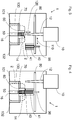
- FIG. 3 is a schematically simplified cross-sectional view of a Exemplary embodiment of a weighing device 16, a die 60 and a lower punch 50 are shown.
- a die 60 which forms a unit with the lower punch 50 and which are coupled to one another by means of a spring 65.
- the spring 65 is compressed, whereby the lower punch 50 extends to the upper edge of the central opening 60a of the die. This is useful, for example, when ejecting a compressed tablet.
- the unit comprising lower punch 50 and die 60 is arranged on platform 70, which can be moved in vertical direction 120 by means of lifting device 130.
- the weighing device 16 is arranged below the die 60 and the lower punch 50.
- the weighing device 15 has an elevation 17 on its upper side, which is formed in a form-fitting manner with respect to a recess 51 on the lower side of the lower punch 50.
- the recess 51 of the lower punch 51 rests against a recess 71 in the platform 70, which together form a cavity that is shown in FIG Figure 4b is shown in dashed lines.
- the weighing device 16 can be moved through the platform 70 through the recess 71 so that it comes into contact with the lower punch.
- FIG 4c the system is off Figure 4b shown during the filling of an active ingredient.
- the die 60 and the lower punch 50 are pulled apart in the vertical direction 120 by the spring force of the spring 65, as a result of which a depression is created in the central opening 60a of the die 60, into which the active substance is filled.
- the lower punch 50 rests on the weighing device 16 so that the elevation 17 engages in the receptacle 51 in a form-fitting manner.
- the platform 70 has moved down so far that the lower ram 50 rests exclusively on the weighing device 16 and not on the platform 70. In this way, the weighing device 16 measures the total mass of the lower punch 50, the die 60 and the active substance filled into the trough during the filling process.
- the active substance is filled as usual by means of the metering device 12, which is in the Figures 4b and 4c is not shown.
- Fig. 5 shows a schematically simplified plan view of a platform 70 designed as a first positioning device according to a possible embodiment of the tablet press 1.
- the first positioning device is designed as a rail device.
- Three matrices 60, 61, 62 are fixed to the first positioning device.
- the matrices 60, 61, 62 each have a central opening 60a, 61a, 62a with different, circular inner circumferences 60b, 61b, 62b.
- the central openings 60a, 61a, 62a extend through the platform 70 so that the punches 40, 50 are not blocked by the platform 70.
- the first positioning device By translating the first positioning device in the horizontal direction 110, it is possible to set which of the dies 60, 61, 62 is arranged above the lower punch 50. In this way, a target size of the tablets produced can be set, so that tablets with a wide range of target masses 36 of the first active ingredient 14 can be produced by means of the tablet press 1.
- Fig. 6 shows a schematically simplified plan view of the second positioning device 80.
- this is designed as a rail device.
- the upper punch 40, the first material container 10 and, in the embodiment shown, a second material container 20 are fixed to the rail device, which can be translated horizontally by means of the rail device Arrange direction 110 alternately above lower punch 50.
- the second material container 20 is filled with a second active substance 24 for the production of a two-layer tablet.
- the second metering device of the second material container 20 is arranged above the lower punch 50 and the central opening 60a of the die 60 arranged on it is filled with the second active substance 24.
- the upper punch 40 is then moved over the lower punch 50 and the two-layer tablet is pressed.
- a first corner of the die 60 is filled with the first active substance 14 by means of the first metering device 12 and a second corner of the die 60 is filled with the second active substance 24 by means of the second metering device, and the tablet is then pressed.
- Figures 7a and 7b show an embodiment of a telescopic upper punch 40.
- the upper punch 40 comprises three upper punch shafts 44, 45, 46 arranged telescopically one inside the other Figure 7a all three upper punch shafts 44, 45, 46 are jointly deflected, so that the outer circumference 43 of the pressure surface 42 of the upper punch 40 corresponds to the outer circumference of the outermost upper punch shaft 46.
- Figure 7b only the innermost upper punch shaft 44 is deflected, so that the outer circumference 43 of the pressure surface 42 of the upper punch 40 corresponds to the outer circumference of the innermost upper punch shaft 44.
- the outer receptacles of the upper punch shafts 44, 45, 46 are each complementary in shape to the inner circumferences 60b, 61b, 62b of the dies 60, 61, 62.
- Figures 7c and 7d show an embodiment of a telescopic Lower punch 50, which is designed as a mirror image of upper punch 40.
- the outer circumference 53 of the pressure surface 52 of the lower punch 50 can be varied by individually deflecting the lower punch shafts 54, 55, 56.
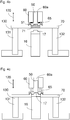
- FIG 8a A schematically simplified cross-sectional view of a telescopic upper punch 40, a telescopic lower punch 50 and a die 60 during the pressing of a large tablet 101 is shown.
- the die 60 with the large central opening 60a is used here.
- All of the upper punch shafts 44, 45, 46 and lower punch shafts 54, 55, 56 are used to press the tablet 101.
- one or more horizontal bores 47 are provided in the upper punch shafts 44, 45, 46, into which upper locking bolts 48 can be inserted by means of one or more schematically indicated first pushing and pulling devices 49.
- one or more horizontal bores 57 are provided in the lower punch shafts 54, 55, 56 in the embodiment shown, into which lower locking bolts 58 can be inserted by means of one or more schematically indicated second pushing and pulling devices 59. Since the largest die 60 is used, the locking bolts 48, 58 are retracted in such a way that they do not engage in the horizontal bores 47, 57. The direction of thrust of the upper piston 96 is shown by an arrow.
- FIG. 11 shows a schematically simplified cross-sectional view during the production of a tablet 102 with a medium size.
- the die 61 is used, which has the central opening 61a of medium size.
- the locking bolts 48, 58 are partially inserted into the bores 47, 57 so that the outermost punch shafts 46, 56 are fixed vertically and only the middle and inner punch shafts 44, 45, 54, 55 are deflected.
- the outer circumferences 43, 53, of the pressure surfaces 42, 52 are adapted to the inner circumference 61b of the die 61.
- Figure 8c shows a schematically simplified cross-sectional view during the production of a small tablet 103.
- the die 62 is used, which has the smallest central opening 62a.
- the locking bolts 48, 58 are completely retracted into the bores 47, 57 so that the outermost and the middle punch shafts 45, 46, 55, 56 are fixed vertically and only the inner punch shafts 44, 45, 54, 55 are deflected.
- the outer circumferences 43, 53 of the pressure surfaces 42, 52 are adapted to the inner circumference 62b of the die 62.
- FIG. 11 shows a schematically simplified plan view of FIG Figure 8a with additional representation of the upper punch carrier 41 as the outermost ring.
- Another horizontal bore 91 is provided perpendicular to the bores 47.
- a coupling bolt 92 is guided in the bore 91 and is moved back and forth in the bore 91 by means of a third pushing and pulling device 90.
- the upper piston 96 drives into the Figures 8a, 8b, 8c , 9a, 9b, 9c shown embodiment exclusively to the inner upper punch shaft 44 directly, while a lower piston (not shown) exclusively drives the inner lower punch shaft 54 directly.
- the upper punch shafts 44, 45, 46 are optionally coupled to one another by means of the coupling bolt 92 so that they are moved up and down synchronously. This is provided analogously for the lower punch 50.
- the coupling bolt 92 couples all three upper punch shafts 44, 45, 46 to one another so that they are vertically deflected together. So that the third pushing and pulling device 90 does not block in the upper punch carrier 41, a vertical groove is provided in the upper punch carrier 41.
- FIG. 11 shows a schematically simplified plan view of FIG Figure 8b .
- the coupling bolt 92 only couples the inner upper punch shaft 44 with the middle upper punch shaft 45, while the outer upper punch shaft 46 is fixed vertically.
- FIG. 11 shows a schematically simplified plan view of FIG Figure 8c .
- the coupling bolt 92 is retracted so that only the inner upper punch shaft 44 is deflected, while the middle upper punch shaft 45 and the outer upper punch shaft 46 are fixed vertically.
Landscapes
- Engineering & Computer Science (AREA)
- Health & Medical Sciences (AREA)
- Mechanical Engineering (AREA)
- Pharmacology & Pharmacy (AREA)
- Chemical & Material Sciences (AREA)
- Medicinal Chemistry (AREA)
- Life Sciences & Earth Sciences (AREA)
- Animal Behavior & Ethology (AREA)
- General Health & Medical Sciences (AREA)
- Public Health (AREA)
- Veterinary Medicine (AREA)
- Epidemiology (AREA)
- Bioinformatics & Cheminformatics (AREA)
- Basic Packing Technique (AREA)
- Medical Preparation Storing Or Oral Administration Devices (AREA)
Priority Applications (5)
| Application Number | Priority Date | Filing Date | Title |
|---|---|---|---|
| PL20170820.3T PL3900923T3 (pl) | 2020-04-22 | 2020-04-22 | Sposób zautomatyzowanego wytwarzania zindywidualizowanych tabletek i tabletkarka do zautomatyzowanego wytwarzania zindywidualizowanych tabletek |
| EP20170820.3A EP3900923B1 (fr) | 2020-04-22 | 2020-04-22 | Procédé de fabrication automatisée de comprimés individualisés et presse à comprimés destinée à la fabrication automatisée de comprimés individualisés |
| JP2022564782A JP7734692B2 (ja) | 2020-04-22 | 2021-02-15 | 個別化された錠剤の自動製造のための方法および個別化された錠剤の自動製造のための錠剤プレス機 |
| PCT/EP2021/053607 WO2021213709A1 (fr) | 2020-04-22 | 2021-02-15 | Procédé de production automatisée de comprimés individualisés et presse à comprimés pour la production automatisée de comprimés individualisés |
| US17/970,837 US20230042678A1 (en) | 2020-04-22 | 2022-10-21 | Method for the automated production of individualized tablets, and tablet press for the automated production of individualized tablets |
Applications Claiming Priority (1)
| Application Number | Priority Date | Filing Date | Title |
|---|---|---|---|
| EP20170820.3A EP3900923B1 (fr) | 2020-04-22 | 2020-04-22 | Procédé de fabrication automatisée de comprimés individualisés et presse à comprimés destinée à la fabrication automatisée de comprimés individualisés |
Publications (3)
| Publication Number | Publication Date |
|---|---|
| EP3900923A1 true EP3900923A1 (fr) | 2021-10-27 |
| EP3900923C0 EP3900923C0 (fr) | 2023-11-01 |
| EP3900923B1 EP3900923B1 (fr) | 2023-11-01 |
Family
ID=70390994
Family Applications (1)
| Application Number | Title | Priority Date | Filing Date |
|---|---|---|---|
| EP20170820.3A Active EP3900923B1 (fr) | 2020-04-22 | 2020-04-22 | Procédé de fabrication automatisée de comprimés individualisés et presse à comprimés destinée à la fabrication automatisée de comprimés individualisés |
Country Status (5)
| Country | Link |
|---|---|
| US (1) | US20230042678A1 (fr) |
| EP (1) | EP3900923B1 (fr) |
| JP (1) | JP7734692B2 (fr) |
| PL (1) | PL3900923T3 (fr) |
| WO (1) | WO2021213709A1 (fr) |
Cited By (1)
| Publication number | Priority date | Publication date | Assignee | Title |
|---|---|---|---|---|
| CN115214181A (zh) * | 2022-09-19 | 2022-10-21 | 兰州和盛堂制药股份有限公司 | 一种片剂中成药成型设备 |
Citations (6)
| Publication number | Priority date | Publication date | Assignee | Title |
|---|---|---|---|---|
| GB1183354A (en) * | 1966-03-12 | 1970-03-04 | Rheinische Kalksteinwerke | Process and Apparatus for Pressing Moulding Materials |
| CH668032A5 (en) * | 1984-06-16 | 1988-11-30 | Laeis Gmbh | Unevenly-pressed ceramic item detection method - measures pressure distribution over surface and compares with desired value |
| WO2007022336A2 (fr) * | 2005-08-18 | 2007-02-22 | Tdy Industries, Inc. | Inserts de découpage composites et procédés de fabrication de ceux-ci |
| EP1844924A2 (fr) * | 2006-04-12 | 2007-10-17 | Fette GmbH | Procédé de régulation de la quantité d'agents actifs de tablettes pendant la production d'une presse rotative pour comprimés |
| WO2014001805A1 (fr) * | 2012-06-26 | 2014-01-03 | Michael Gamlen | Presse à comprimés |
| CN107718675A (zh) * | 2017-10-30 | 2018-02-23 | 浙江物产汽车安全科技有限公司 | 一种压片机 |
Family Cites Families (6)
| Publication number | Priority date | Publication date | Assignee | Title |
|---|---|---|---|---|
| JP4346011B2 (ja) | 2003-03-28 | 2009-10-14 | 日立粉末冶金株式会社 | 多層圧粉体の成形装置 |
| GB2489658B (en) | 2011-01-31 | 2014-09-03 | Michael Gamlen | Tablet press |
| DE102015201785A1 (de) | 2015-02-02 | 2016-08-04 | Gkn Sinter Metals Engineering Gmbh | Pulverpresse mit kegeligem Unterstempel |
| GB2543579B (en) | 2015-10-23 | 2018-06-06 | Gamlen Michael | Pivoting tablet die |
| DE102016120195A1 (de) | 2016-10-24 | 2018-04-26 | Dorst Technologies Gmbh & Co. Kg | Presseneinrichtung |
| EP3650212B1 (fr) * | 2018-11-12 | 2024-04-03 | PrivMed X AB | Procédé de fabrication automatisée de comprimés individualisés et presse à comprimés destinée à la fabrication automatisée de comprimés individualisés |
-
2020
- 2020-04-22 EP EP20170820.3A patent/EP3900923B1/fr active Active
- 2020-04-22 PL PL20170820.3T patent/PL3900923T3/pl unknown
-
2021
- 2021-02-15 WO PCT/EP2021/053607 patent/WO2021213709A1/fr not_active Ceased
- 2021-02-15 JP JP2022564782A patent/JP7734692B2/ja active Active
-
2022
- 2022-10-21 US US17/970,837 patent/US20230042678A1/en active Pending
Patent Citations (6)
| Publication number | Priority date | Publication date | Assignee | Title |
|---|---|---|---|---|
| GB1183354A (en) * | 1966-03-12 | 1970-03-04 | Rheinische Kalksteinwerke | Process and Apparatus for Pressing Moulding Materials |
| CH668032A5 (en) * | 1984-06-16 | 1988-11-30 | Laeis Gmbh | Unevenly-pressed ceramic item detection method - measures pressure distribution over surface and compares with desired value |
| WO2007022336A2 (fr) * | 2005-08-18 | 2007-02-22 | Tdy Industries, Inc. | Inserts de découpage composites et procédés de fabrication de ceux-ci |
| EP1844924A2 (fr) * | 2006-04-12 | 2007-10-17 | Fette GmbH | Procédé de régulation de la quantité d'agents actifs de tablettes pendant la production d'une presse rotative pour comprimés |
| WO2014001805A1 (fr) * | 2012-06-26 | 2014-01-03 | Michael Gamlen | Presse à comprimés |
| CN107718675A (zh) * | 2017-10-30 | 2018-02-23 | 浙江物产汽车安全科技有限公司 | 一种压片机 |
Cited By (2)
| Publication number | Priority date | Publication date | Assignee | Title |
|---|---|---|---|---|
| CN115214181A (zh) * | 2022-09-19 | 2022-10-21 | 兰州和盛堂制药股份有限公司 | 一种片剂中成药成型设备 |
| CN115214181B (zh) * | 2022-09-19 | 2022-12-30 | 兰州和盛堂制药股份有限公司 | 一种片剂中成药成型设备 |
Also Published As
| Publication number | Publication date |
|---|---|
| EP3900923C0 (fr) | 2023-11-01 |
| JP2023522768A (ja) | 2023-05-31 |
| US20230042678A1 (en) | 2023-02-09 |
| JP7734692B2 (ja) | 2025-09-05 |
| WO2021213709A1 (fr) | 2021-10-28 |
| PL3900923T3 (pl) | 2024-03-25 |
| EP3900923B1 (fr) | 2023-11-01 |
Similar Documents
| Publication | Publication Date | Title |
|---|---|---|
| DE69905393T2 (de) | Dosiervorrichtung für gelatinehartkapseln | |
| EP3650212B1 (fr) | Procédé de fabrication automatisée de comprimés individualisés et presse à comprimés destinée à la fabrication automatisée de comprimés individualisés | |
| EP2389919B1 (fr) | Dispositif et procédé destinés à transférer une capsule dans une machine d'emballage | |
| EP2872102B1 (fr) | Dispositif de pesée de capsules, machine de remplissage de capsules et procédé pour la pesée d'une capsule | |
| EP3704033B1 (fr) | Machine d'emballage de production d'un emballage coque individuel | |
| DE19617014A1 (de) | Verfahren und Vorrichtung zum Nachfüllen von Füllgut in Näpfe einer Folienbahn | |
| EP3079894B1 (fr) | Procédé de fabrication d'une pièce moulée | |
| EP3595973A1 (fr) | Système avec remplissage alterné de conteneurs et procédé associé | |
| EP3925590A1 (fr) | Récipient de stockage pour une station de distribution et de stockage | |
| EP3900923B1 (fr) | Procédé de fabrication automatisée de comprimés individualisés et presse à comprimés destinée à la fabrication automatisée de comprimés individualisés | |
| EP2823958A2 (fr) | Presse à comprimés et procédé de fabrication d'un comprimé | |
| EP3369409B1 (fr) | Dispositif et procédé de dosage de matériaux de remplissage pulvérulents | |
| EP2707213B1 (fr) | Presse à plateau tournant et procédé permettant de faire fonctionner une presse à plateau tournant | |
| EP3908244B1 (fr) | Dispositif et procédé de mise en comprimés d'une composition de principes actifs pulvérulente, liquide, pâteuse, encapsulée ou granulaire | |
| EP4391986A1 (fr) | Dispositif de préparation d'un produit pharmaceutique, d'un complément alimentaire ou d'un produit cosmétique | |
| DE102009028372A1 (de) | Wägestation zum Wiegen eines Produktes, insbesondere Kapselunterteil | |
| DE102007004152A1 (de) | Vorrichtung und Verfahren zum Befüllen von Patientenblistern | |
| DE102019134284A1 (de) | Vorrichtung und Verfahren zum Drucken von 3D Medikamenten in Form von Tabletten und biologischem Material | |
| WO2025061530A1 (fr) | Dispositif de dosage de matériau de remplissage pulvérulent | |
| EP4419430B1 (fr) | Dispositif de remplissage, de bouchage et de fermeture de capsules remplissables | |
| EP3492394B1 (fr) | Dispositif de remplissage dosé d'une paille pour boisson avec un produit de remplissage | |
| EP3492395B1 (fr) | Dispositif et procédé destinés au remplissage dosé de récipients à l'aide d'un produit de remplissage | |
| DE102005036167B4 (de) | Vorrichtung zur Füllung einer Medikamentenkapsel mit einem pulverförmigen Stoff | |
| WO2025149401A1 (fr) | Conteneur de stockage pour un poste de stockage et de distribution pour une machine à blister, et procédé d'adaptation du conteneur de stockage | |
| DE102023127940A1 (de) | Verfahren zur Versuchspressung von Presslingen in einer Rundläuferpresse sowie Rundläuferpresse |
Legal Events
| Date | Code | Title | Description |
|---|---|---|---|
| PUAI | Public reference made under article 153(3) epc to a published international application that has entered the european phase |
Free format text: ORIGINAL CODE: 0009012 |
|
| STAA | Information on the status of an ep patent application or granted ep patent |
Free format text: STATUS: THE APPLICATION HAS BEEN PUBLISHED |
|
| AK | Designated contracting states |
Kind code of ref document: A1 Designated state(s): AL AT BE BG CH CY CZ DE DK EE ES FI FR GB GR HR HU IE IS IT LI LT LU LV MC MK MT NL NO PL PT RO RS SE SI SK SM TR |
|
| B565 | Issuance of search results under rule 164(2) epc |
Effective date: 20201002 |
|
| RAP1 | Party data changed (applicant data changed or rights of an application transferred) |
Owner name: KRAUSE, INGO |
|
| STAA | Information on the status of an ep patent application or granted ep patent |
Free format text: STATUS: REQUEST FOR EXAMINATION WAS MADE |
|
| 17P | Request for examination filed |
Effective date: 20220314 |
|
| RBV | Designated contracting states (corrected) |
Designated state(s): AL AT BE BG CH CY CZ DE DK EE ES FI FR GB GR HR HU IE IS IT LI LT LU LV MC MK MT NL NO PL PT RO RS SE SI SK SM TR |
|
| RAP1 | Party data changed (applicant data changed or rights of an application transferred) |
Owner name: PRIVMED X AB |
|
| GRAP | Despatch of communication of intention to grant a patent |
Free format text: ORIGINAL CODE: EPIDOSNIGR1 |
|
| STAA | Information on the status of an ep patent application or granted ep patent |
Free format text: STATUS: GRANT OF PATENT IS INTENDED |
|
| INTG | Intention to grant announced |
Effective date: 20230621 |
|
| GRAS | Grant fee paid |
Free format text: ORIGINAL CODE: EPIDOSNIGR3 |
|
| GRAA | (expected) grant |
Free format text: ORIGINAL CODE: 0009210 |
|
| STAA | Information on the status of an ep patent application or granted ep patent |
Free format text: STATUS: THE PATENT HAS BEEN GRANTED |
|
| AK | Designated contracting states |
Kind code of ref document: B1 Designated state(s): AL AT BE BG CH CY CZ DE DK EE ES FI FR GB GR HR HU IE IS IT LI LT LU LV MC MK MT NL NO PL PT RO RS SE SI SK SM TR |
|
| REG | Reference to a national code |
Ref country code: GB Ref legal event code: FG4D Free format text: NOT ENGLISH |
|
| REG | Reference to a national code |
Ref country code: CH Ref legal event code: EP |
|
| REG | Reference to a national code |
Ref country code: DE Ref legal event code: R096 Ref document number: 502020005817 Country of ref document: DE |
|
| REG | Reference to a national code |
Ref country code: IE Ref legal event code: FG4D Free format text: LANGUAGE OF EP DOCUMENT: GERMAN |
|
| U01 | Request for unitary effect filed |
Effective date: 20231114 |
|
| U07 | Unitary effect registered |
Designated state(s): AT BE BG DE DK EE FI FR IT LT LU LV MT NL PT SE SI Effective date: 20231120 |
|
| REG | Reference to a national code |
Ref country code: NO Ref legal event code: T2 Effective date: 20231101 |
|
| PG25 | Lapsed in a contracting state [announced via postgrant information from national office to epo] |
Ref country code: GR Free format text: LAPSE BECAUSE OF FAILURE TO SUBMIT A TRANSLATION OF THE DESCRIPTION OR TO PAY THE FEE WITHIN THE PRESCRIBED TIME-LIMIT Effective date: 20240202 |
|
| PG25 | Lapsed in a contracting state [announced via postgrant information from national office to epo] |
Ref country code: IS Free format text: LAPSE BECAUSE OF FAILURE TO SUBMIT A TRANSLATION OF THE DESCRIPTION OR TO PAY THE FEE WITHIN THE PRESCRIBED TIME-LIMIT Effective date: 20240301 |
|
| PG25 | Lapsed in a contracting state [announced via postgrant information from national office to epo] |
Ref country code: ES Free format text: LAPSE BECAUSE OF FAILURE TO SUBMIT A TRANSLATION OF THE DESCRIPTION OR TO PAY THE FEE WITHIN THE PRESCRIBED TIME-LIMIT Effective date: 20231101 |
|
| PG25 | Lapsed in a contracting state [announced via postgrant information from national office to epo] |
Ref country code: IS Free format text: LAPSE BECAUSE OF FAILURE TO SUBMIT A TRANSLATION OF THE DESCRIPTION OR TO PAY THE FEE WITHIN THE PRESCRIBED TIME-LIMIT Effective date: 20240301 Ref country code: GR Free format text: LAPSE BECAUSE OF FAILURE TO SUBMIT A TRANSLATION OF THE DESCRIPTION OR TO PAY THE FEE WITHIN THE PRESCRIBED TIME-LIMIT Effective date: 20240202 Ref country code: ES Free format text: LAPSE BECAUSE OF FAILURE TO SUBMIT A TRANSLATION OF THE DESCRIPTION OR TO PAY THE FEE WITHIN THE PRESCRIBED TIME-LIMIT Effective date: 20231101 |
|
| U20 | Renewal fee for the european patent with unitary effect paid |
Year of fee payment: 5 Effective date: 20240417 |
|
| PG25 | Lapsed in a contracting state [announced via postgrant information from national office to epo] |
Ref country code: RS Free format text: LAPSE BECAUSE OF FAILURE TO SUBMIT A TRANSLATION OF THE DESCRIPTION OR TO PAY THE FEE WITHIN THE PRESCRIBED TIME-LIMIT Effective date: 20231101 Ref country code: HR Free format text: LAPSE BECAUSE OF FAILURE TO SUBMIT A TRANSLATION OF THE DESCRIPTION OR TO PAY THE FEE WITHIN THE PRESCRIBED TIME-LIMIT Effective date: 20231101 |
|
| PG25 | Lapsed in a contracting state [announced via postgrant information from national office to epo] |
Ref country code: CZ Free format text: LAPSE BECAUSE OF FAILURE TO SUBMIT A TRANSLATION OF THE DESCRIPTION OR TO PAY THE FEE WITHIN THE PRESCRIBED TIME-LIMIT Effective date: 20231101 |
|
| PG25 | Lapsed in a contracting state [announced via postgrant information from national office to epo] |
Ref country code: SK Free format text: LAPSE BECAUSE OF FAILURE TO SUBMIT A TRANSLATION OF THE DESCRIPTION OR TO PAY THE FEE WITHIN THE PRESCRIBED TIME-LIMIT Effective date: 20231101 |
|
| PG25 | Lapsed in a contracting state [announced via postgrant information from national office to epo] |
Ref country code: SM Free format text: LAPSE BECAUSE OF FAILURE TO SUBMIT A TRANSLATION OF THE DESCRIPTION OR TO PAY THE FEE WITHIN THE PRESCRIBED TIME-LIMIT Effective date: 20231101 Ref country code: SK Free format text: LAPSE BECAUSE OF FAILURE TO SUBMIT A TRANSLATION OF THE DESCRIPTION OR TO PAY THE FEE WITHIN THE PRESCRIBED TIME-LIMIT Effective date: 20231101 Ref country code: CZ Free format text: LAPSE BECAUSE OF FAILURE TO SUBMIT A TRANSLATION OF THE DESCRIPTION OR TO PAY THE FEE WITHIN THE PRESCRIBED TIME-LIMIT Effective date: 20231101 |
|
| REG | Reference to a national code |
Ref country code: DE Ref legal event code: R097 Ref document number: 502020005817 Country of ref document: DE |
|
| PLBE | No opposition filed within time limit |
Free format text: ORIGINAL CODE: 0009261 |
|
| STAA | Information on the status of an ep patent application or granted ep patent |
Free format text: STATUS: NO OPPOSITION FILED WITHIN TIME LIMIT |
|
| 26N | No opposition filed |
Effective date: 20240802 |
|
| PG25 | Lapsed in a contracting state [announced via postgrant information from national office to epo] |
Ref country code: MC Free format text: LAPSE BECAUSE OF FAILURE TO SUBMIT A TRANSLATION OF THE DESCRIPTION OR TO PAY THE FEE WITHIN THE PRESCRIBED TIME-LIMIT Effective date: 20231101 |
|
| PG25 | Lapsed in a contracting state [announced via postgrant information from national office to epo] |
Ref country code: MC Free format text: LAPSE BECAUSE OF FAILURE TO SUBMIT A TRANSLATION OF THE DESCRIPTION OR TO PAY THE FEE WITHIN THE PRESCRIBED TIME-LIMIT Effective date: 20231101 |
|
| PG25 | Lapsed in a contracting state [announced via postgrant information from national office to epo] |
Ref country code: IE Free format text: LAPSE BECAUSE OF NON-PAYMENT OF DUE FEES Effective date: 20240422 |
|
| U20 | Renewal fee for the european patent with unitary effect paid |
Year of fee payment: 6 Effective date: 20250429 |
|
| PGFP | Annual fee paid to national office [announced via postgrant information from national office to epo] |
Ref country code: PL Payment date: 20250509 Year of fee payment: 6 |
|
| PGFP | Annual fee paid to national office [announced via postgrant information from national office to epo] |
Ref country code: GB Payment date: 20250522 Year of fee payment: 6 |
|
| PGFP | Annual fee paid to national office [announced via postgrant information from national office to epo] |
Ref country code: NO Payment date: 20250430 Year of fee payment: 6 |
|
| PGFP | Annual fee paid to national office [announced via postgrant information from national office to epo] |
Ref country code: CH Payment date: 20250522 Year of fee payment: 6 |
|
| PG25 | Lapsed in a contracting state [announced via postgrant information from national office to epo] |
Ref country code: CY Free format text: LAPSE BECAUSE OF FAILURE TO SUBMIT A TRANSLATION OF THE DESCRIPTION OR TO PAY THE FEE WITHIN THE PRESCRIBED TIME-LIMIT; INVALID AB INITIO Effective date: 20200422 |
|
| PG25 | Lapsed in a contracting state [announced via postgrant information from national office to epo] |
Ref country code: RO Free format text: LAPSE BECAUSE OF FAILURE TO SUBMIT A TRANSLATION OF THE DESCRIPTION OR TO PAY THE FEE WITHIN THE PRESCRIBED TIME-LIMIT Effective date: 20231101 |
|
| PG25 | Lapsed in a contracting state [announced via postgrant information from national office to epo] |
Ref country code: HU Free format text: LAPSE BECAUSE OF FAILURE TO SUBMIT A TRANSLATION OF THE DESCRIPTION OR TO PAY THE FEE WITHIN THE PRESCRIBED TIME-LIMIT; INVALID AB INITIO Effective date: 20200422 |