EP3904282A1 - Composition pour la cavité buccale - Google Patents
Composition pour la cavité buccale Download PDFInfo
- Publication number
- EP3904282A1 EP3904282A1 EP19904702.8A EP19904702A EP3904282A1 EP 3904282 A1 EP3904282 A1 EP 3904282A1 EP 19904702 A EP19904702 A EP 19904702A EP 3904282 A1 EP3904282 A1 EP 3904282A1
- Authority
- EP
- European Patent Office
- Prior art keywords
- oral composition
- hydroxyapatite particles
- particles
- hydroxyapatite
- diffraction
- Prior art date
- Legal status (The legal status is an assumption and is not a legal conclusion. Google has not performed a legal analysis and makes no representation as to the accuracy of the status listed.)
- Pending
Links
- 239000000203 mixture Substances 0.000 title claims abstract description 189
- 210000000214 mouth Anatomy 0.000 title description 6
- 239000002245 particle Substances 0.000 claims abstract description 207
- 229910052588 hydroxylapatite Inorganic materials 0.000 claims abstract description 164
- XYJRXVWERLGGKC-UHFFFAOYSA-D pentacalcium;hydroxide;triphosphate Chemical compound [OH-].[Ca+2].[Ca+2].[Ca+2].[Ca+2].[Ca+2].[O-]P([O-])([O-])=O.[O-]P([O-])([O-])=O.[O-]P([O-])([O-])=O XYJRXVWERLGGKC-UHFFFAOYSA-D 0.000 claims abstract description 164
- 238000000634 powder X-ray diffraction Methods 0.000 claims abstract description 7
- VYPSYNLAJGMNEJ-UHFFFAOYSA-N Silicium dioxide Chemical compound O=[Si]=O VYPSYNLAJGMNEJ-UHFFFAOYSA-N 0.000 claims description 78
- 239000013078 crystal Substances 0.000 claims description 46
- FGIUAXJPYTZDNR-UHFFFAOYSA-N potassium nitrate Chemical compound [K+].[O-][N+]([O-])=O FGIUAXJPYTZDNR-UHFFFAOYSA-N 0.000 claims description 44
- 239000000377 silicon dioxide Substances 0.000 claims description 36
- VXYADVIJALMOEQ-UHFFFAOYSA-K tris(lactato)aluminium Chemical compound CC(O)C(=O)O[Al](OC(=O)C(C)O)OC(=O)C(C)O VXYADVIJALMOEQ-UHFFFAOYSA-K 0.000 claims description 25
- 239000004323 potassium nitrate Substances 0.000 claims description 22
- 235000010333 potassium nitrate Nutrition 0.000 claims description 22
- 150000002222 fluorine compounds Chemical class 0.000 claims description 18
- YUOWTJMRMWQJDA-UHFFFAOYSA-J tin(iv) fluoride Chemical compound [F-].[F-].[F-].[F-].[Sn+4] YUOWTJMRMWQJDA-UHFFFAOYSA-J 0.000 claims description 16
- 206010020751 Hypersensitivity Diseases 0.000 claims description 15
- 208000026935 allergic disease Diseases 0.000 claims description 14
- 230000009610 hypersensitivity Effects 0.000 claims description 13
- 230000006872 improvement Effects 0.000 claims description 4
- 230000002265 prevention Effects 0.000 claims description 3
- 210000005239 tubule Anatomy 0.000 abstract description 39
- MUBZPKHOEPUJKR-UHFFFAOYSA-N Oxalic acid Chemical compound OC(=O)C(O)=O MUBZPKHOEPUJKR-UHFFFAOYSA-N 0.000 description 70
- AXCZMVOFGPJBDE-UHFFFAOYSA-L calcium dihydroxide Chemical compound [OH-].[OH-].[Ca+2] AXCZMVOFGPJBDE-UHFFFAOYSA-L 0.000 description 57
- 239000000920 calcium hydroxide Substances 0.000 description 57
- 229910001861 calcium hydroxide Inorganic materials 0.000 description 57
- 239000002002 slurry Substances 0.000 description 54
- XLYOFNOQVPJJNP-UHFFFAOYSA-N water Substances O XLYOFNOQVPJJNP-UHFFFAOYSA-N 0.000 description 45
- 238000002360 preparation method Methods 0.000 description 42
- 238000012360 testing method Methods 0.000 description 41
- 230000000052 comparative effect Effects 0.000 description 38
- HEMHJVSKTPXQMS-UHFFFAOYSA-M Sodium hydroxide Chemical compound [OH-].[Na+] HEMHJVSKTPXQMS-UHFFFAOYSA-M 0.000 description 36
- 239000000243 solution Substances 0.000 description 35
- 239000007864 aqueous solution Substances 0.000 description 33
- 210000004268 dentin Anatomy 0.000 description 33
- 229910019142 PO4 Inorganic materials 0.000 description 31
- 235000021317 phosphate Nutrition 0.000 description 31
- 238000000034 method Methods 0.000 description 30
- 239000010452 phosphate Substances 0.000 description 30
- NBIIXXVUZAFLBC-UHFFFAOYSA-K phosphate Chemical compound [O-]P([O-])([O-])=O NBIIXXVUZAFLBC-UHFFFAOYSA-K 0.000 description 30
- 239000011575 calcium Substances 0.000 description 25
- -1 PTL 1) Chemical class 0.000 description 24
- 235000006408 oxalic acid Nutrition 0.000 description 23
- 238000002441 X-ray diffraction Methods 0.000 description 22
- 238000005259 measurement Methods 0.000 description 22
- 239000000523 sample Substances 0.000 description 22
- PEDCQBHIVMGVHV-UHFFFAOYSA-N Glycerine Chemical compound OCC(O)CO PEDCQBHIVMGVHV-UHFFFAOYSA-N 0.000 description 21
- 230000009257 reactivity Effects 0.000 description 21
- 238000003756 stirring Methods 0.000 description 21
- 239000007788 liquid Substances 0.000 description 18
- 239000007787 solid Substances 0.000 description 17
- XONPDZSGENTBNJ-UHFFFAOYSA-N molecular hydrogen;sodium Chemical compound [Na].[H][H] XONPDZSGENTBNJ-UHFFFAOYSA-N 0.000 description 16
- 230000000694 effects Effects 0.000 description 15
- 239000000551 dentifrice Substances 0.000 description 14
- 238000004383 yellowing Methods 0.000 description 14
- YCKRFDGAMUMZLT-UHFFFAOYSA-N Fluorine atom Chemical compound [F] YCKRFDGAMUMZLT-UHFFFAOYSA-N 0.000 description 13
- 238000001035 drying Methods 0.000 description 13
- 239000011737 fluorine Substances 0.000 description 13
- 229910052731 fluorine Inorganic materials 0.000 description 13
- 239000000843 powder Substances 0.000 description 12
- PUZPDOWCWNUUKD-UHFFFAOYSA-M sodium fluoride Chemical compound [F-].[Na+] PUZPDOWCWNUUKD-UHFFFAOYSA-M 0.000 description 12
- 235000011121 sodium hydroxide Nutrition 0.000 description 12
- 229910001220 stainless steel Inorganic materials 0.000 description 12
- 239000010935 stainless steel Substances 0.000 description 12
- 239000000120 Artificial Saliva Substances 0.000 description 11
- 229920003171 Poly (ethylene oxide) Polymers 0.000 description 11
- 230000001680 brushing effect Effects 0.000 description 11
- 239000003153 chemical reaction reagent Substances 0.000 description 11
- 229910000403 monosodium phosphate Inorganic materials 0.000 description 11
- 235000019799 monosodium phosphate Nutrition 0.000 description 11
- AJPJDKMHJJGVTQ-UHFFFAOYSA-M sodium dihydrogen phosphate Chemical compound [Na+].OP(O)([O-])=O AJPJDKMHJJGVTQ-UHFFFAOYSA-M 0.000 description 11
- 230000008859 change Effects 0.000 description 10
- XGRSAFKZAGGXJV-UHFFFAOYSA-N 3-azaniumyl-3-cyclohexylpropanoate Chemical compound OC(=O)CC(N)C1CCCCC1 XGRSAFKZAGGXJV-UHFFFAOYSA-N 0.000 description 9
- 235000014113 dietary fatty acids Nutrition 0.000 description 9
- 239000000194 fatty acid Substances 0.000 description 9
- 229930195729 fatty acid Natural products 0.000 description 9
- 229960004711 sodium monofluorophosphate Drugs 0.000 description 9
- 241000283690 Bos taurus Species 0.000 description 8
- DPXJVFZANSGRMM-UHFFFAOYSA-N acetic acid;2,3,4,5,6-pentahydroxyhexanal;sodium Chemical compound [Na].CC(O)=O.OCC(O)C(O)C(O)C(O)C=O DPXJVFZANSGRMM-UHFFFAOYSA-N 0.000 description 8
- 239000001768 carboxy methyl cellulose Substances 0.000 description 8
- 235000011187 glycerol Nutrition 0.000 description 8
- 235000019812 sodium carboxymethyl cellulose Nutrition 0.000 description 8
- 229920001027 sodium carboxymethylcellulose Polymers 0.000 description 8
- ODINCKMPIJJUCX-UHFFFAOYSA-N Calcium oxide Chemical compound [Ca]=O ODINCKMPIJJUCX-UHFFFAOYSA-N 0.000 description 7
- 239000004615 ingredient Substances 0.000 description 7
- 238000002156 mixing Methods 0.000 description 7
- 238000007789 sealing Methods 0.000 description 7
- 238000000926 separation method Methods 0.000 description 7
- FTLYMKDSHNWQKD-UHFFFAOYSA-N (2,4,5-trichlorophenyl)boronic acid Chemical compound OB(O)C1=CC(Cl)=C(Cl)C=C1Cl FTLYMKDSHNWQKD-UHFFFAOYSA-N 0.000 description 6
- FBPFZTCFMRRESA-FSIIMWSLSA-N D-Glucitol Natural products OC[C@H](O)[C@H](O)[C@@H](O)[C@H](O)CO FBPFZTCFMRRESA-FSIIMWSLSA-N 0.000 description 6
- 241000178435 Eliokarmos dubius Species 0.000 description 6
- DGAQECJNVWCQMB-PUAWFVPOSA-M Ilexoside XXIX Chemical compound C[C@@H]1CC[C@@]2(CC[C@@]3(C(=CC[C@H]4[C@]3(CC[C@@H]5[C@@]4(CC[C@@H](C5(C)C)OS(=O)(=O)[O-])C)C)[C@@H]2[C@]1(C)O)C)C(=O)O[C@H]6[C@@H]([C@H]([C@@H]([C@H](O6)CO)O)O)O.[Na+] DGAQECJNVWCQMB-PUAWFVPOSA-M 0.000 description 6
- DNIAPMSPPWPWGF-UHFFFAOYSA-N Propylene glycol Chemical compound CC(O)CO DNIAPMSPPWPWGF-UHFFFAOYSA-N 0.000 description 6
- 239000004359 castor oil Substances 0.000 description 6
- 235000019438 castor oil Nutrition 0.000 description 6
- 238000009826 distribution Methods 0.000 description 6
- ZEMPKEQAKRGZGQ-XOQCFJPHSA-N glycerol triricinoleate Natural products CCCCCC[C@@H](O)CC=CCCCCCCCC(=O)OC[C@@H](COC(=O)CCCCCCCC=CC[C@@H](O)CCCCCC)OC(=O)CCCCCCCC=CC[C@H](O)CCCCCC ZEMPKEQAKRGZGQ-XOQCFJPHSA-N 0.000 description 6
- 230000014759 maintenance of location Effects 0.000 description 6
- 229910000402 monopotassium phosphate Inorganic materials 0.000 description 6
- 239000000049 pigment Substances 0.000 description 6
- 229940085605 saccharin sodium Drugs 0.000 description 6
- 239000011734 sodium Substances 0.000 description 6
- 229910052708 sodium Inorganic materials 0.000 description 6
- 239000011775 sodium fluoride Substances 0.000 description 6
- 235000013024 sodium fluoride Nutrition 0.000 description 6
- 239000000600 sorbitol Substances 0.000 description 6
- 238000003860 storage Methods 0.000 description 6
- 238000010998 test method Methods 0.000 description 6
- JKMHFZQWWAIEOD-UHFFFAOYSA-N 2-[4-(2-hydroxyethyl)piperazin-1-yl]ethanesulfonic acid Chemical compound OCC[NH+]1CCN(CCS([O-])(=O)=O)CC1 JKMHFZQWWAIEOD-UHFFFAOYSA-N 0.000 description 5
- UXVMQQNJUSDDNG-UHFFFAOYSA-L Calcium chloride Chemical compound [Cl-].[Cl-].[Ca+2] UXVMQQNJUSDDNG-UHFFFAOYSA-L 0.000 description 5
- 239000007995 HEPES buffer Substances 0.000 description 5
- 239000007836 KH2PO4 Substances 0.000 description 5
- 239000001110 calcium chloride Substances 0.000 description 5
- 229910001628 calcium chloride Inorganic materials 0.000 description 5
- 239000000645 desinfectant Substances 0.000 description 5
- 239000012153 distilled water Substances 0.000 description 5
- 239000000796 flavoring agent Substances 0.000 description 5
- 235000013355 food flavoring agent Nutrition 0.000 description 5
- 238000009472 formulation Methods 0.000 description 5
- 238000004519 manufacturing process Methods 0.000 description 5
- GNSKLFRGEWLPPA-UHFFFAOYSA-M potassium dihydrogen phosphate Chemical compound [K+].OP(O)([O-])=O GNSKLFRGEWLPPA-UHFFFAOYSA-M 0.000 description 5
- 239000008213 purified water Substances 0.000 description 5
- 210000003296 saliva Anatomy 0.000 description 5
- 239000000126 substance Substances 0.000 description 5
- AZUYLZMQTIKGSC-UHFFFAOYSA-N 1-[6-[4-(5-chloro-6-methyl-1H-indazol-4-yl)-5-methyl-3-(1-methylindazol-5-yl)pyrazol-1-yl]-2-azaspiro[3.3]heptan-2-yl]prop-2-en-1-one Chemical compound ClC=1C(=C2C=NNC2=CC=1C)C=1C(=NN(C=1C)C1CC2(CN(C2)C(C=C)=O)C1)C=1C=C2C=NN(C2=CC=1)C AZUYLZMQTIKGSC-UHFFFAOYSA-N 0.000 description 4
- KCXVZYZYPLLWCC-UHFFFAOYSA-N EDTA Chemical compound OC(=O)CN(CC(O)=O)CCN(CC(O)=O)CC(O)=O KCXVZYZYPLLWCC-UHFFFAOYSA-N 0.000 description 4
- KRHYYFGTRYWZRS-UHFFFAOYSA-M Fluoride anion Chemical compound [F-] KRHYYFGTRYWZRS-UHFFFAOYSA-M 0.000 description 4
- GWEVSGVZZGPLCZ-UHFFFAOYSA-N Titan oxide Chemical compound O=[Ti]=O GWEVSGVZZGPLCZ-UHFFFAOYSA-N 0.000 description 4
- 239000002253 acid Substances 0.000 description 4
- 239000011230 binding agent Substances 0.000 description 4
- 239000000292 calcium oxide Substances 0.000 description 4
- 235000012255 calcium oxide Nutrition 0.000 description 4
- 239000003085 diluting agent Substances 0.000 description 4
- BNIILDVGGAEEIG-UHFFFAOYSA-L disodium hydrogen phosphate Chemical compound [Na+].[Na+].OP([O-])([O-])=O BNIILDVGGAEEIG-UHFFFAOYSA-L 0.000 description 4
- 150000004665 fatty acids Chemical class 0.000 description 4
- 239000012634 fragment Substances 0.000 description 4
- KWIUHFFTVRNATP-UHFFFAOYSA-N glycine betaine Chemical compound C[N+](C)(C)CC([O-])=O KWIUHFFTVRNATP-UHFFFAOYSA-N 0.000 description 4
- 238000000227 grinding Methods 0.000 description 4
- 238000007654 immersion Methods 0.000 description 4
- 239000006072 paste Substances 0.000 description 4
- 238000005498 polishing Methods 0.000 description 4
- 238000005070 sampling Methods 0.000 description 4
- 238000000527 sonication Methods 0.000 description 4
- OGIDPMRJRNCKJF-UHFFFAOYSA-N titanium oxide Inorganic materials [Ti]=O OGIDPMRJRNCKJF-UHFFFAOYSA-N 0.000 description 4
- 239000000606 toothpaste Substances 0.000 description 4
- 229940034610 toothpaste Drugs 0.000 description 4
- 238000007740 vapor deposition Methods 0.000 description 4
- 235000010493 xanthan gum Nutrition 0.000 description 4
- 239000000230 xanthan gum Substances 0.000 description 4
- 229920001285 xanthan gum Polymers 0.000 description 4
- 229940082509 xanthan gum Drugs 0.000 description 4
- QTBSBXVTEAMEQO-UHFFFAOYSA-N Acetic acid Chemical compound CC(O)=O QTBSBXVTEAMEQO-UHFFFAOYSA-N 0.000 description 3
- 239000004793 Polystyrene Substances 0.000 description 3
- DBMJMQXJHONAFJ-UHFFFAOYSA-M Sodium laurylsulphate Chemical compound [Na+].CCCCCCCCCCCCOS([O-])(=O)=O DBMJMQXJHONAFJ-UHFFFAOYSA-M 0.000 description 3
- 239000012190 activator Substances 0.000 description 3
- 150000008064 anhydrides Chemical class 0.000 description 3
- 229910052791 calcium Inorganic materials 0.000 description 3
- KRKNYBCHXYNGOX-UHFFFAOYSA-N citric acid Chemical compound OC(=O)CC(O)(C(O)=O)CC(O)=O KRKNYBCHXYNGOX-UHFFFAOYSA-N 0.000 description 3
- 238000004140 cleaning Methods 0.000 description 3
- 150000002148 esters Chemical class 0.000 description 3
- 235000003599 food sweetener Nutrition 0.000 description 3
- 238000002354 inductively-coupled plasma atomic emission spectroscopy Methods 0.000 description 3
- 229920003229 poly(methyl methacrylate) Polymers 0.000 description 3
- 239000004926 polymethyl methacrylate Substances 0.000 description 3
- 229920002223 polystyrene Polymers 0.000 description 3
- 239000011347 resin Substances 0.000 description 3
- 229920005989 resin Polymers 0.000 description 3
- 150000003839 salts Chemical class 0.000 description 3
- 235000002639 sodium chloride Nutrition 0.000 description 3
- 235000019333 sodium laurylsulphate Nutrition 0.000 description 3
- 239000001488 sodium phosphate Substances 0.000 description 3
- 239000004094 surface-active agent Substances 0.000 description 3
- 239000003765 sweetening agent Substances 0.000 description 3
- RYFMWSXOAZQYPI-UHFFFAOYSA-K trisodium phosphate Chemical compound [Na+].[Na+].[Na+].[O-]P([O-])([O-])=O RYFMWSXOAZQYPI-UHFFFAOYSA-K 0.000 description 3
- GVJHHUAWPYXKBD-UHFFFAOYSA-N (±)-α-Tocopherol Chemical compound OC1=C(C)C(C)=C2OC(CCCC(C)CCCC(C)CCCC(C)C)(C)CCC2=C1C GVJHHUAWPYXKBD-UHFFFAOYSA-N 0.000 description 2
- IJGRMHOSHXDMSA-UHFFFAOYSA-N Atomic nitrogen Chemical compound N#N IJGRMHOSHXDMSA-UHFFFAOYSA-N 0.000 description 2
- QFOHBWFCKVYLES-UHFFFAOYSA-N Butylparaben Chemical compound CCCCOC(=O)C1=CC=C(O)C=C1 QFOHBWFCKVYLES-UHFFFAOYSA-N 0.000 description 2
- LYCAIKOWRPUZTN-UHFFFAOYSA-N Ethylene glycol Chemical compound OCCO LYCAIKOWRPUZTN-UHFFFAOYSA-N 0.000 description 2
- 239000004354 Hydroxyethyl cellulose Substances 0.000 description 2
- 229920000663 Hydroxyethyl cellulose Polymers 0.000 description 2
- 235000019738 Limestone Nutrition 0.000 description 2
- NBIIXXVUZAFLBC-UHFFFAOYSA-N Phosphoric acid Chemical compound OP(O)(O)=O NBIIXXVUZAFLBC-UHFFFAOYSA-N 0.000 description 2
- 230000002378 acidificating effect Effects 0.000 description 2
- 125000000217 alkyl group Chemical group 0.000 description 2
- 239000003945 anionic surfactant Substances 0.000 description 2
- IRERQBUNZFJFGC-UHFFFAOYSA-L azure blue Chemical compound [Na+].[Na+].[Na+].[Na+].[Na+].[Na+].[Na+].[Na+].[Al+3].[Al+3].[Al+3].[Al+3].[Al+3].[Al+3].[S-]S[S-].[O-][Si]([O-])([O-])[O-].[O-][Si]([O-])([O-])[O-].[O-][Si]([O-])([O-])[O-].[O-][Si]([O-])([O-])[O-].[O-][Si]([O-])([O-])[O-].[O-][Si]([O-])([O-])[O-] IRERQBUNZFJFGC-UHFFFAOYSA-L 0.000 description 2
- FUWUEFKEXZQKKA-UHFFFAOYSA-N beta-thujaplicin Chemical compound CC(C)C=1C=CC=C(O)C(=O)C=1 FUWUEFKEXZQKKA-UHFFFAOYSA-N 0.000 description 2
- 229960003237 betaine Drugs 0.000 description 2
- HGKOWIQVWAQWDS-UHFFFAOYSA-N bis(16-methylheptadecyl) 2-hydroxybutanedioate Chemical compound CC(C)CCCCCCCCCCCCCCCOC(=O)CC(O)C(=O)OCCCCCCCCCCCCCCCC(C)C HGKOWIQVWAQWDS-UHFFFAOYSA-N 0.000 description 2
- 238000001354 calcination Methods 0.000 description 2
- 239000001506 calcium phosphate Substances 0.000 description 2
- 229910000389 calcium phosphate Inorganic materials 0.000 description 2
- 235000011010 calcium phosphates Nutrition 0.000 description 2
- 125000004432 carbon atom Chemical group C* 0.000 description 2
- 125000002091 cationic group Chemical group 0.000 description 2
- 229910001873 dinitrogen Inorganic materials 0.000 description 2
- 239000010419 fine particle Substances 0.000 description 2
- 229940091249 fluoride supplement Drugs 0.000 description 2
- 239000011521 glass Substances 0.000 description 2
- 235000019447 hydroxyethyl cellulose Nutrition 0.000 description 2
- 239000002563 ionic surfactant Substances 0.000 description 2
- JVTAAEKCZFNVCJ-UHFFFAOYSA-N lactic acid Chemical compound CC(O)C(O)=O JVTAAEKCZFNVCJ-UHFFFAOYSA-N 0.000 description 2
- 239000006028 limestone Substances 0.000 description 2
- 229940040145 liniment Drugs 0.000 description 2
- 239000000865 liniment Substances 0.000 description 2
- 239000000463 material Substances 0.000 description 2
- LXCFILQKKLGQFO-UHFFFAOYSA-N methylparaben Chemical compound COC(=O)C1=CC=C(O)C=C1 LXCFILQKKLGQFO-UHFFFAOYSA-N 0.000 description 2
- 239000002324 mouth wash Substances 0.000 description 2
- 229940051866 mouthwash Drugs 0.000 description 2
- 210000005036 nerve Anatomy 0.000 description 2
- 239000002736 nonionic surfactant Substances 0.000 description 2
- ZWLPBLYKEWSWPD-UHFFFAOYSA-M o-toluate Chemical compound CC1=CC=CC=C1C([O-])=O ZWLPBLYKEWSWPD-UHFFFAOYSA-M 0.000 description 2
- VLTRZXGMWDSKGL-UHFFFAOYSA-N perchloric acid Chemical compound OCl(=O)(=O)=O VLTRZXGMWDSKGL-UHFFFAOYSA-N 0.000 description 2
- 239000000825 pharmaceutical preparation Substances 0.000 description 2
- 229940127557 pharmaceutical product Drugs 0.000 description 2
- 229910052698 phosphorus Inorganic materials 0.000 description 2
- 239000000902 placebo Substances 0.000 description 2
- 229940068196 placebo Drugs 0.000 description 2
- QELSKZZBTMNZEB-UHFFFAOYSA-N propylparaben Chemical compound CCCOC(=O)C1=CC=C(O)C=C1 QELSKZZBTMNZEB-UHFFFAOYSA-N 0.000 description 2
- 238000000746 purification Methods 0.000 description 2
- 238000011160 research Methods 0.000 description 2
- 239000012488 sample solution Substances 0.000 description 2
- 238000001179 sorption measurement Methods 0.000 description 2
- 239000007921 spray Substances 0.000 description 2
- PRAKJMSDJKAYCZ-UHFFFAOYSA-N squalane Chemical compound CC(C)CCCC(C)CCCC(C)CCCCC(C)CCCC(C)CCCC(C)C PRAKJMSDJKAYCZ-UHFFFAOYSA-N 0.000 description 2
- ANOBYBYXJXCGBS-UHFFFAOYSA-L stannous fluoride Chemical compound F[Sn]F ANOBYBYXJXCGBS-UHFFFAOYSA-L 0.000 description 2
- QORWJWZARLRLPR-UHFFFAOYSA-H tricalcium bis(phosphate) Chemical compound [Ca+2].[Ca+2].[Ca+2].[O-]P([O-])([O-])=O.[O-]P([O-])([O-])=O QORWJWZARLRLPR-UHFFFAOYSA-H 0.000 description 2
- LWIHDJKSTIGBAC-UHFFFAOYSA-K tripotassium phosphate Chemical compound [K+].[K+].[K+].[O-]P([O-])([O-])=O LWIHDJKSTIGBAC-UHFFFAOYSA-K 0.000 description 2
- 229910000406 trisodium phosphate Inorganic materials 0.000 description 2
- 235000019801 trisodium phosphate Nutrition 0.000 description 2
- BJEPYKJPYRNKOW-REOHCLBHSA-N (S)-malic acid Chemical compound OC(=O)[C@@H](O)CC(O)=O BJEPYKJPYRNKOW-REOHCLBHSA-N 0.000 description 1
- LDVVTQMJQSCDMK-UHFFFAOYSA-N 1,3-dihydroxypropan-2-yl formate Chemical compound OCC(CO)OC=O LDVVTQMJQSCDMK-UHFFFAOYSA-N 0.000 description 1
- OWEGMIWEEQEYGQ-UHFFFAOYSA-N 100676-05-9 Natural products OC1C(O)C(O)C(CO)OC1OCC1C(O)C(O)C(O)C(OC2C(OC(O)C(O)C2O)CO)O1 OWEGMIWEEQEYGQ-UHFFFAOYSA-N 0.000 description 1
- SVIJYLPSHPPVQF-UHFFFAOYSA-N 2-[2,2-diaminoethyl(dodecyl)amino]acetic acid Chemical compound CCCCCCCCCCCCN(CC(N)N)CC(O)=O SVIJYLPSHPPVQF-UHFFFAOYSA-N 0.000 description 1
- QCDWFXQBSFUVSP-UHFFFAOYSA-N 2-phenoxyethanol Chemical compound OCCOC1=CC=CC=C1 QCDWFXQBSFUVSP-UHFFFAOYSA-N 0.000 description 1
- IJALWSVNUBBQRA-UHFFFAOYSA-N 4-Isopropyl-3-methylphenol Chemical compound CC(C)C1=CC=C(O)C=C1C IJALWSVNUBBQRA-UHFFFAOYSA-N 0.000 description 1
- AXCXHFKZHDEKTP-NSCUHMNNSA-N 4-methoxycinnamaldehyde Chemical compound COC1=CC=C(\C=C\C=O)C=C1 AXCXHFKZHDEKTP-NSCUHMNNSA-N 0.000 description 1
- 244000215068 Acacia senegal Species 0.000 description 1
- WBZFUFAFFUEMEI-UHFFFAOYSA-M Acesulfame k Chemical compound [K+].CC1=CC(=O)[N-]S(=O)(=O)O1 WBZFUFAFFUEMEI-UHFFFAOYSA-M 0.000 description 1
- QTBSBXVTEAMEQO-UHFFFAOYSA-M Acetate Chemical compound CC([O-])=O QTBSBXVTEAMEQO-UHFFFAOYSA-M 0.000 description 1
- 108010011485 Aspartame Proteins 0.000 description 1
- 241000416162 Astragalus gummifer Species 0.000 description 1
- SGHZXLIDFTYFHQ-UHFFFAOYSA-L Brilliant Blue Chemical compound [Na+].[Na+].C=1C=C(C(=C2C=CC(C=C2)=[N+](CC)CC=2C=C(C=CC=2)S([O-])(=O)=O)C=2C(=CC=CC=2)S([O-])(=O)=O)C=CC=1N(CC)CC1=CC=CC(S([O-])(=O)=O)=C1 SGHZXLIDFTYFHQ-UHFFFAOYSA-L 0.000 description 1
- FVOMOIJBFCSRDB-UHFFFAOYSA-N CCCCN(C)OC(C)=O Chemical compound CCCCN(C)OC(C)=O FVOMOIJBFCSRDB-UHFFFAOYSA-N 0.000 description 1
- OYPRJOBELJOOCE-UHFFFAOYSA-N Calcium Chemical compound [Ca] OYPRJOBELJOOCE-UHFFFAOYSA-N 0.000 description 1
- WJLVQTJZDCGNJN-UHFFFAOYSA-N Chlorhexidine hydrochloride Chemical compound Cl.Cl.C=1C=C(Cl)C=CC=1NC(N)=NC(N)=NCCCCCCN=C(N)N=C(N)NC1=CC=C(Cl)C=C1 WJLVQTJZDCGNJN-UHFFFAOYSA-N 0.000 description 1
- VEXZGXHMUGYJMC-UHFFFAOYSA-M Chloride anion Chemical compound [Cl-] VEXZGXHMUGYJMC-UHFFFAOYSA-M 0.000 description 1
- IELOKBJPULMYRW-NJQVLOCASA-N D-alpha-Tocopheryl Acid Succinate Chemical compound OC(=O)CCC(=O)OC1=C(C)C(C)=C2O[C@@](CCC[C@H](C)CCC[C@H](C)CCCC(C)C)(C)CCC2=C1C IELOKBJPULMYRW-NJQVLOCASA-N 0.000 description 1
- ZAKOWWREFLAJOT-CEFNRUSXSA-N D-alpha-tocopherylacetate Chemical compound CC(=O)OC1=C(C)C(C)=C2O[C@@](CCC[C@H](C)CCC[C@H](C)CCCC(C)C)(C)CCC2=C1C ZAKOWWREFLAJOT-CEFNRUSXSA-N 0.000 description 1
- FBPFZTCFMRRESA-JGWLITMVSA-N D-glucitol Chemical compound OC[C@H](O)[C@@H](O)[C@H](O)[C@H](O)CO FBPFZTCFMRRESA-JGWLITMVSA-N 0.000 description 1
- 239000011626 DL-alpha-tocopherylacetate Substances 0.000 description 1
- 235000001809 DL-alpha-tocopherylacetate Nutrition 0.000 description 1
- 239000004375 Dextrin Substances 0.000 description 1
- 229920001353 Dextrin Polymers 0.000 description 1
- FEWJPZIEWOKRBE-JCYAYHJZSA-N Dextrotartaric acid Chemical compound OC(=O)[C@H](O)[C@@H](O)C(O)=O FEWJPZIEWOKRBE-JCYAYHJZSA-N 0.000 description 1
- LFQSCWFLJHTTHZ-UHFFFAOYSA-N Ethanol Chemical compound CCO LFQSCWFLJHTTHZ-UHFFFAOYSA-N 0.000 description 1
- 239000001329 FEMA 3811 Substances 0.000 description 1
- 229920002148 Gellan gum Polymers 0.000 description 1
- DHMQDGOQFOQNFH-UHFFFAOYSA-N Glycine Natural products NCC(O)=O DHMQDGOQFOQNFH-UHFFFAOYSA-N 0.000 description 1
- 239000004471 Glycine Substances 0.000 description 1
- BIVBRWYINDPWKA-VLQRKCJKSA-L Glycyrrhizinate dipotassium Chemical compound [K+].[K+].O([C@@H]1[C@@H](O)[C@H](O)[C@H](O[C@@H]1O[C@H]1CC[C@]2(C)[C@H]3C(=O)C=C4[C@@H]5C[C@](C)(CC[C@@]5(CC[C@@]4(C)[C@]3(C)CC[C@H]2C1(C)C)C)C(O)=O)C([O-])=O)[C@@H]1O[C@H](C([O-])=O)[C@@H](O)[C@H](O)[C@H]1O BIVBRWYINDPWKA-VLQRKCJKSA-L 0.000 description 1
- 229920000084 Gum arabic Polymers 0.000 description 1
- 229920000569 Gum karaya Polymers 0.000 description 1
- 244000043261 Hevea brasiliensis Species 0.000 description 1
- VEXZGXHMUGYJMC-UHFFFAOYSA-N Hydrochloric acid Chemical compound Cl VEXZGXHMUGYJMC-UHFFFAOYSA-N 0.000 description 1
- 229920002153 Hydroxypropyl cellulose Polymers 0.000 description 1
- GUBGYTABKSRVRQ-QKKXKWKRSA-N Lactose Natural products OC[C@H]1O[C@@H](O[C@H]2[C@H](O)[C@@H](O)C(O)O[C@@H]2CO)[C@H](O)[C@@H](O)[C@H]1O GUBGYTABKSRVRQ-QKKXKWKRSA-N 0.000 description 1
- GUBGYTABKSRVRQ-PICCSMPSSA-N Maltose Natural products O[C@@H]1[C@@H](O)[C@H](O)[C@@H](CO)O[C@@H]1O[C@@H]1[C@@H](CO)OC(O)[C@H](O)[C@H]1O GUBGYTABKSRVRQ-PICCSMPSSA-N 0.000 description 1
- SUZRRICLUFMAQD-UHFFFAOYSA-N N-Methyltaurine Chemical compound CNCCS(O)(=O)=O SUZRRICLUFMAQD-UHFFFAOYSA-N 0.000 description 1
- GRYLNZFGIOXLOG-UHFFFAOYSA-N Nitric acid Chemical compound O[N+]([O-])=O GRYLNZFGIOXLOG-UHFFFAOYSA-N 0.000 description 1
- 240000007594 Oryza sativa Species 0.000 description 1
- 235000007164 Oryza sativa Nutrition 0.000 description 1
- 229920001214 Polysorbate 60 Polymers 0.000 description 1
- 239000004372 Polyvinyl alcohol Substances 0.000 description 1
- XUIMIQQOPSSXEZ-UHFFFAOYSA-N Silicon Chemical compound [Si] XUIMIQQOPSSXEZ-UHFFFAOYSA-N 0.000 description 1
- 208000002599 Smear Layer Diseases 0.000 description 1
- UEDUENGHJMELGK-HYDKPPNVSA-N Stevioside Chemical compound O([C@@H]1[C@@H](O)[C@H](O)[C@@H](CO)O[C@H]1O[C@]12C(=C)C[C@@]3(C1)CC[C@@H]1[C@@](C)(CCC[C@]1([C@@H]3CC2)C)C(=O)O[C@H]1[C@@H]([C@@H](O)[C@H](O)[C@@H](CO)O1)O)[C@@H]1O[C@H](CO)[C@@H](O)[C@H](O)[C@H]1O UEDUENGHJMELGK-HYDKPPNVSA-N 0.000 description 1
- 229930006000 Sucrose Natural products 0.000 description 1
- ULUAUXLGCMPNKK-UHFFFAOYSA-N Sulfobutanedioic acid Chemical class OC(=O)CC(C(O)=O)S(O)(=O)=O ULUAUXLGCMPNKK-UHFFFAOYSA-N 0.000 description 1
- FEWJPZIEWOKRBE-UHFFFAOYSA-N Tartaric acid Natural products [H+].[H+].[O-]C(=O)C(O)C(O)C([O-])=O FEWJPZIEWOKRBE-UHFFFAOYSA-N 0.000 description 1
- MSCCTZZBYHQMQJ-AZAGJHQNSA-N Tocopheryl nicotinate Chemical compound C([C@@](OC1=C(C)C=2C)(C)CCC[C@H](C)CCC[C@H](C)CCCC(C)C)CC1=C(C)C=2OC(=O)C1=CC=CN=C1 MSCCTZZBYHQMQJ-AZAGJHQNSA-N 0.000 description 1
- 229920001615 Tragacanth Polymers 0.000 description 1
- XEFQLINVKFYRCS-UHFFFAOYSA-N Triclosan Chemical compound OC1=CC(Cl)=CC=C1OC1=CC=C(Cl)C=C1Cl XEFQLINVKFYRCS-UHFFFAOYSA-N 0.000 description 1
- 229930003427 Vitamin E Natural products 0.000 description 1
- UUGFSANEJDLBBJ-UQKRIMTDSA-N [Na].CCCCCCCCCCCC(=O)N(C)[C@@H](C)C(O)=O Chemical compound [Na].CCCCCCCCCCCC(=O)N(C)[C@@H](C)C(O)=O UUGFSANEJDLBBJ-UQKRIMTDSA-N 0.000 description 1
- 235000010489 acacia gum Nutrition 0.000 description 1
- 239000000205 acacia gum Substances 0.000 description 1
- 235000010358 acesulfame potassium Nutrition 0.000 description 1
- 229960004998 acesulfame potassium Drugs 0.000 description 1
- 239000000619 acesulfame-K Substances 0.000 description 1
- 239000008351 acetate buffer Substances 0.000 description 1
- 150000007513 acids Chemical class 0.000 description 1
- 125000004442 acylamino group Chemical group 0.000 description 1
- 150000005215 alkyl ethers Chemical class 0.000 description 1
- 125000005037 alkyl phenyl group Chemical group 0.000 description 1
- TUFYVOCKVJOUIR-UHFFFAOYSA-N alpha-Thujaplicin Natural products CC(C)C=1C=CC=CC(=O)C=1O TUFYVOCKVJOUIR-UHFFFAOYSA-N 0.000 description 1
- AWUCVROLDVIAJX-UHFFFAOYSA-N alpha-glycerophosphate Natural products OCC(O)COP(O)(O)=O AWUCVROLDVIAJX-UHFFFAOYSA-N 0.000 description 1
- BJEPYKJPYRNKOW-UHFFFAOYSA-N alpha-hydroxysuccinic acid Natural products OC(=O)C(O)CC(O)=O BJEPYKJPYRNKOW-UHFFFAOYSA-N 0.000 description 1
- AZDRQVAHHNSJOQ-UHFFFAOYSA-N alumane Chemical class [AlH3] AZDRQVAHHNSJOQ-UHFFFAOYSA-N 0.000 description 1
- 229910000147 aluminium phosphate Inorganic materials 0.000 description 1
- 150000001413 amino acids Chemical class 0.000 description 1
- 229910052586 apatite Inorganic materials 0.000 description 1
- IAOZJIPTCAWIRG-QWRGUYRKSA-N aspartame Chemical compound OC(=O)C[C@H](N)C(=O)N[C@H](C(=O)OC)CC1=CC=CC=C1 IAOZJIPTCAWIRG-QWRGUYRKSA-N 0.000 description 1
- 239000011324 bead Substances 0.000 description 1
- 229960000686 benzalkonium chloride Drugs 0.000 description 1
- 229960001950 benzethonium chloride Drugs 0.000 description 1
- UREZNYTWGJKWBI-UHFFFAOYSA-M benzethonium chloride Chemical compound [Cl-].C1=CC(C(C)(C)CC(C)(C)C)=CC=C1OCCOCC[N+](C)(C)CC1=CC=CC=C1 UREZNYTWGJKWBI-UHFFFAOYSA-M 0.000 description 1
- CADWTSSKOVRVJC-UHFFFAOYSA-N benzyl(dimethyl)azanium;chloride Chemical compound [Cl-].C[NH+](C)CC1=CC=CC=C1 CADWTSSKOVRVJC-UHFFFAOYSA-N 0.000 description 1
- 229940067596 butylparaben Drugs 0.000 description 1
- BRPQOXSCLDDYGP-UHFFFAOYSA-N calcium oxide Chemical compound [O-2].[Ca+2] BRPQOXSCLDDYGP-UHFFFAOYSA-N 0.000 description 1
- 229910052799 carbon Inorganic materials 0.000 description 1
- 235000010418 carrageenan Nutrition 0.000 description 1
- 239000000679 carrageenan Substances 0.000 description 1
- 229920001525 carrageenan Polymers 0.000 description 1
- 229940113118 carrageenan Drugs 0.000 description 1
- 229920002678 cellulose Polymers 0.000 description 1
- 239000001913 cellulose Substances 0.000 description 1
- 235000013339 cereals Nutrition 0.000 description 1
- 229960001927 cetylpyridinium chloride Drugs 0.000 description 1
- NFCRBQADEGXVDL-UHFFFAOYSA-M cetylpyridinium chloride monohydrate Chemical compound O.[Cl-].CCCCCCCCCCCCCCCC[N+]1=CC=CC=C1 NFCRBQADEGXVDL-UHFFFAOYSA-M 0.000 description 1
- 229960003333 chlorhexidine gluconate Drugs 0.000 description 1
- YZIYKJHYYHPJIB-UUPCJSQJSA-N chlorhexidine gluconate Chemical compound OC[C@@H](O)[C@@H](O)[C@H](O)[C@@H](O)C(O)=O.OC[C@@H](O)[C@@H](O)[C@H](O)[C@@H](O)C(O)=O.C1=CC(Cl)=CC=C1NC(=N)NC(=N)NCCCCCCNC(=N)NC(=N)NC1=CC=C(Cl)C=C1 YZIYKJHYYHPJIB-UUPCJSQJSA-N 0.000 description 1
- 229960004504 chlorhexidine hydrochloride Drugs 0.000 description 1
- 239000003240 coconut oil Substances 0.000 description 1
- 235000019864 coconut oil Nutrition 0.000 description 1
- 239000003086 colorant Substances 0.000 description 1
- 238000012790 confirmation Methods 0.000 description 1
- 238000007796 conventional method Methods 0.000 description 1
- 238000001816 cooling Methods 0.000 description 1
- 239000002537 cosmetic Substances 0.000 description 1
- 229940099418 d- alpha-tocopherol succinate Drugs 0.000 description 1
- 230000003247 decreasing effect Effects 0.000 description 1
- 238000013461 design Methods 0.000 description 1
- 235000019425 dextrin Nutrition 0.000 description 1
- XPPKVPWEQAFLFU-UHFFFAOYSA-N diphosphoric acid Chemical compound OP(O)(=O)OP(O)(O)=O XPPKVPWEQAFLFU-UHFFFAOYSA-N 0.000 description 1
- 229940101029 dipotassium glycyrrhizinate Drugs 0.000 description 1
- ZPWVASYFFYYZEW-UHFFFAOYSA-L dipotassium hydrogen phosphate Chemical compound [K+].[K+].OP([O-])([O-])=O ZPWVASYFFYYZEW-UHFFFAOYSA-L 0.000 description 1
- 239000002552 dosage form Substances 0.000 description 1
- 229940079593 drug Drugs 0.000 description 1
- 239000003814 drug Substances 0.000 description 1
- 229920001971 elastomer Polymers 0.000 description 1
- 230000002708 enhancing effect Effects 0.000 description 1
- 229960001617 ethyl hydroxybenzoate Drugs 0.000 description 1
- 235000010944 ethyl methyl cellulose Nutrition 0.000 description 1
- 239000004403 ethyl p-hydroxybenzoate Substances 0.000 description 1
- 235000010228 ethyl p-hydroxybenzoate Nutrition 0.000 description 1
- NUVBSKCKDOMJSU-UHFFFAOYSA-N ethylparaben Chemical compound CCOC(=O)C1=CC=C(O)C=C1 NUVBSKCKDOMJSU-UHFFFAOYSA-N 0.000 description 1
- 210000000887 face Anatomy 0.000 description 1
- 229940073322 ferric hexacyanoferrate Drugs 0.000 description 1
- 238000001914 filtration Methods 0.000 description 1
- 238000005187 foaming Methods 0.000 description 1
- 229910021485 fumed silica Inorganic materials 0.000 description 1
- WIGCFUFOHFEKBI-UHFFFAOYSA-N gamma-tocopherol Natural products CC(C)CCCC(C)CCCC(C)CCCC1CCC2C(C)C(O)C(C)C(C)C2O1 WIGCFUFOHFEKBI-UHFFFAOYSA-N 0.000 description 1
- 235000010492 gellan gum Nutrition 0.000 description 1
- 239000000216 gellan gum Substances 0.000 description 1
- 230000002650 habitual effect Effects 0.000 description 1
- 150000004677 hydrates Chemical class 0.000 description 1
- WGCNASOHLSPBMP-UHFFFAOYSA-N hydroxyacetaldehyde Natural products OCC=O WGCNASOHLSPBMP-UHFFFAOYSA-N 0.000 description 1
- 235000010977 hydroxypropyl cellulose Nutrition 0.000 description 1
- 239000001863 hydroxypropyl cellulose Substances 0.000 description 1
- 235000010979 hydroxypropyl methyl cellulose Nutrition 0.000 description 1
- 239000001866 hydroxypropyl methyl cellulose Substances 0.000 description 1
- 229920003088 hydroxypropyl methyl cellulose Polymers 0.000 description 1
- UFVKGYZPFZQRLF-UHFFFAOYSA-N hydroxypropyl methyl cellulose Chemical compound OC1C(O)C(OC)OC(CO)C1OC1C(O)C(O)C(OC2C(C(O)C(OC3C(C(O)C(O)C(CO)O3)O)C(CO)O2)O)C(CO)O1 UFVKGYZPFZQRLF-UHFFFAOYSA-N 0.000 description 1
- MTNDZQHUAFNZQY-UHFFFAOYSA-N imidazoline Chemical compound C1CN=CN1 MTNDZQHUAFNZQY-UHFFFAOYSA-N 0.000 description 1
- 230000001771 impaired effect Effects 0.000 description 1
- 229910052500 inorganic mineral Inorganic materials 0.000 description 1
- 150000002500 ions Chemical class 0.000 description 1
- NFIDBGJMFKNGGQ-UHFFFAOYSA-N isopropylmethylphenol Natural products CC(C)CC1=CC=CC=C1O NFIDBGJMFKNGGQ-UHFFFAOYSA-N 0.000 description 1
- 235000010494 karaya gum Nutrition 0.000 description 1
- 239000004310 lactic acid Substances 0.000 description 1
- 235000014655 lactic acid Nutrition 0.000 description 1
- VQHSOMBJVWLPSR-JVCRWLNRSA-N lactitol Chemical compound OC[C@H](O)[C@@H](O)[C@@H]([C@H](O)CO)O[C@@H]1O[C@H](CO)[C@H](O)[C@H](O)[C@H]1O VQHSOMBJVWLPSR-JVCRWLNRSA-N 0.000 description 1
- 239000008101 lactose Substances 0.000 description 1
- 229940057995 liquid paraffin Drugs 0.000 description 1
- 239000001630 malic acid Substances 0.000 description 1
- 235000011090 malic acid Nutrition 0.000 description 1
- VQHSOMBJVWLPSR-WUJBLJFYSA-N maltitol Chemical compound OC[C@H](O)[C@@H](O)[C@@H]([C@H](O)CO)O[C@H]1O[C@H](CO)[C@@H](O)[C@H](O)[C@H]1O VQHSOMBJVWLPSR-WUJBLJFYSA-N 0.000 description 1
- 235000012054 meals Nutrition 0.000 description 1
- 239000004292 methyl p-hydroxybenzoate Substances 0.000 description 1
- 235000010270 methyl p-hydroxybenzoate Nutrition 0.000 description 1
- 229920003087 methylethyl cellulose Polymers 0.000 description 1
- 229960002216 methylparaben Drugs 0.000 description 1
- 230000000813 microbial effect Effects 0.000 description 1
- 239000004200 microcrystalline wax Substances 0.000 description 1
- 235000019808 microcrystalline wax Nutrition 0.000 description 1
- 229940114937 microcrystalline wax Drugs 0.000 description 1
- 235000010755 mineral Nutrition 0.000 description 1
- 239000011707 mineral Substances 0.000 description 1
- 235000019796 monopotassium phosphate Nutrition 0.000 description 1
- JXTPJDDICSTXJX-UHFFFAOYSA-N n-Triacontane Natural products CCCCCCCCCCCCCCCCCCCCCCCCCCCCCC JXTPJDDICSTXJX-UHFFFAOYSA-N 0.000 description 1
- DVEKCXOJTLDBFE-UHFFFAOYSA-N n-dodecyl-n,n-dimethylglycinate Chemical compound CCCCCCCCCCCC[N+](C)(C)CC([O-])=O DVEKCXOJTLDBFE-UHFFFAOYSA-N 0.000 description 1
- 229920003052 natural elastomer Polymers 0.000 description 1
- 229920005615 natural polymer Polymers 0.000 description 1
- 229920001194 natural rubber Polymers 0.000 description 1
- ITVGXXMINPYUHD-CUVHLRMHSA-N neohesperidin dihydrochalcone Chemical compound C1=C(O)C(OC)=CC=C1CCC(=O)C(C(=C1)O)=C(O)C=C1O[C@H]1[C@H](O[C@H]2[C@@H]([C@H](O)[C@@H](O)[C@H](C)O2)O)[C@@H](O)[C@H](O)[C@@H](CO)O1 ITVGXXMINPYUHD-CUVHLRMHSA-N 0.000 description 1
- 229940089953 neohesperidin dihydrochalcone Drugs 0.000 description 1
- 235000010434 neohesperidine DC Nutrition 0.000 description 1
- 229910017604 nitric acid Inorganic materials 0.000 description 1
- KSCKTBJJRVPGKM-UHFFFAOYSA-N octan-1-olate;titanium(4+) Chemical compound [Ti+4].CCCCCCCC[O-].CCCCCCCC[O-].CCCCCCCC[O-].CCCCCCCC[O-] KSCKTBJJRVPGKM-UHFFFAOYSA-N 0.000 description 1
- 239000002674 ointment Substances 0.000 description 1
- 239000003002 pH adjusting agent Substances 0.000 description 1
- AXCXHFKZHDEKTP-UHFFFAOYSA-N para-methoxycinnamaldehyde Natural products COC1=CC=C(C=CC=O)C=C1 AXCXHFKZHDEKTP-UHFFFAOYSA-N 0.000 description 1
- 229940056211 paraffin Drugs 0.000 description 1
- 239000012188 paraffin wax Substances 0.000 description 1
- VSIIXMUUUJUKCM-UHFFFAOYSA-D pentacalcium;fluoride;triphosphate Chemical compound [F-].[Ca+2].[Ca+2].[Ca+2].[Ca+2].[Ca+2].[O-]P([O-])([O-])=O.[O-]P([O-])([O-])=O.[O-]P([O-])([O-])=O VSIIXMUUUJUKCM-UHFFFAOYSA-D 0.000 description 1
- 230000002688 persistence Effects 0.000 description 1
- 229960005323 phenoxyethanol Drugs 0.000 description 1
- 150000003013 phosphoric acid derivatives Chemical class 0.000 description 1
- PJNZPQUBCPKICU-UHFFFAOYSA-N phosphoric acid;potassium Chemical compound [K].OP(O)(O)=O PJNZPQUBCPKICU-UHFFFAOYSA-N 0.000 description 1
- 230000000704 physical effect Effects 0.000 description 1
- 229920000642 polymer Polymers 0.000 description 1
- 229920001451 polypropylene glycol Polymers 0.000 description 1
- 229920002451 polyvinyl alcohol Polymers 0.000 description 1
- 239000001267 polyvinylpyrrolidone Substances 0.000 description 1
- 235000013855 polyvinylpyrrolidone Nutrition 0.000 description 1
- 229920000036 polyvinylpyrrolidone Polymers 0.000 description 1
- 239000003755 preservative agent Substances 0.000 description 1
- 239000004405 propyl p-hydroxybenzoate Substances 0.000 description 1
- 235000010232 propyl p-hydroxybenzoate Nutrition 0.000 description 1
- 229960003415 propylparaben Drugs 0.000 description 1
- 229940005657 pyrophosphoric acid Drugs 0.000 description 1
- 239000011541 reaction mixture Substances 0.000 description 1
- 230000035484 reaction time Effects 0.000 description 1
- 235000009566 rice Nutrition 0.000 description 1
- FSYKKLYZXJSNPZ-UHFFFAOYSA-N sarcosine Chemical compound C[NH2+]CC([O-])=O FSYKKLYZXJSNPZ-UHFFFAOYSA-N 0.000 description 1
- 229910052710 silicon Inorganic materials 0.000 description 1
- 239000010703 silicon Substances 0.000 description 1
- AWUCVROLDVIAJX-GSVOUGTGSA-N sn-glycerol 3-phosphate Chemical compound OC[C@@H](O)COP(O)(O)=O AWUCVROLDVIAJX-GSVOUGTGSA-N 0.000 description 1
- WXMKPNITSTVMEF-UHFFFAOYSA-M sodium benzoate Chemical compound [Na+].[O-]C(=O)C1=CC=CC=C1 WXMKPNITSTVMEF-UHFFFAOYSA-M 0.000 description 1
- 239000004299 sodium benzoate Substances 0.000 description 1
- 235000010234 sodium benzoate Nutrition 0.000 description 1
- 229960003885 sodium benzoate Drugs 0.000 description 1
- FQENQNTWSFEDLI-UHFFFAOYSA-J sodium diphosphate Chemical compound [Na+].[Na+].[Na+].[Na+].[O-]P([O-])(=O)OP([O-])([O-])=O FQENQNTWSFEDLI-UHFFFAOYSA-J 0.000 description 1
- 229910000162 sodium phosphate Inorganic materials 0.000 description 1
- 235000011008 sodium phosphates Nutrition 0.000 description 1
- SLBXZQMMERXQAL-UHFFFAOYSA-M sodium;1-dodecoxy-4-hydroxy-1,4-dioxobutane-2-sulfonate Chemical compound [Na+].CCCCCCCCCCCCOC(=O)C(S(O)(=O)=O)CC([O-])=O SLBXZQMMERXQAL-UHFFFAOYSA-M 0.000 description 1
- 229940032094 squalane Drugs 0.000 description 1
- 239000012086 standard solution Substances 0.000 description 1
- 229960002799 stannous fluoride Drugs 0.000 description 1
- 239000007858 starting material Substances 0.000 description 1
- 229940013618 stevioside Drugs 0.000 description 1
- OHHNJQXIOPOJSC-UHFFFAOYSA-N stevioside Natural products CC1(CCCC2(C)C3(C)CCC4(CC3(CCC12C)CC4=C)OC5OC(CO)C(O)C(O)C5OC6OC(CO)C(O)C(O)C6O)C(=O)OC7OC(CO)C(O)C(O)C7O OHHNJQXIOPOJSC-UHFFFAOYSA-N 0.000 description 1
- 235000019202 steviosides Nutrition 0.000 description 1
- 239000005720 sucrose Substances 0.000 description 1
- 238000000967 suction filtration Methods 0.000 description 1
- 150000003467 sulfuric acid derivatives Chemical class 0.000 description 1
- 230000001629 suppression Effects 0.000 description 1
- 229920001059 synthetic polymer Polymers 0.000 description 1
- 239000011975 tartaric acid Substances 0.000 description 1
- 235000002906 tartaric acid Nutrition 0.000 description 1
- 239000012085 test solution Substances 0.000 description 1
- 235000019818 tetrasodium diphosphate Nutrition 0.000 description 1
- 239000000892 thaumatin Substances 0.000 description 1
- 235000010436 thaumatin Nutrition 0.000 description 1
- 230000008719 thickening Effects 0.000 description 1
- 229940042585 tocopherol acetate Drugs 0.000 description 1
- 229950009883 tocopheryl nicotinate Drugs 0.000 description 1
- 229960003500 triclosan Drugs 0.000 description 1
- 229910000404 tripotassium phosphate Inorganic materials 0.000 description 1
- 235000019798 tripotassium phosphate Nutrition 0.000 description 1
- 230000000007 visual effect Effects 0.000 description 1
- 229940046009 vitamin E Drugs 0.000 description 1
- 239000011709 vitamin E Substances 0.000 description 1
- 235000019165 vitamin E Nutrition 0.000 description 1
- 230000002618 waking effect Effects 0.000 description 1
- 238000005406 washing Methods 0.000 description 1
- 239000000080 wetting agent Substances 0.000 description 1
- 239000003871 white petrolatum Substances 0.000 description 1
- HEBKCHPVOIAQTA-SCDXWVJYSA-N xylitol Chemical compound OC[C@H](O)[C@@H](O)[C@H](O)CO HEBKCHPVOIAQTA-SCDXWVJYSA-N 0.000 description 1
- UHVMMEOXYDMDKI-JKYCWFKZSA-L zinc;1-(5-cyanopyridin-2-yl)-3-[(1s,2s)-2-(6-fluoro-2-hydroxy-3-propanoylphenyl)cyclopropyl]urea;diacetate Chemical compound [Zn+2].CC([O-])=O.CC([O-])=O.CCC(=O)C1=CC=C(F)C([C@H]2[C@H](C2)NC(=O)NC=2N=CC(=CC=2)C#N)=C1O UHVMMEOXYDMDKI-JKYCWFKZSA-L 0.000 description 1
- 229930007845 β-thujaplicin Natural products 0.000 description 1
Images











Classifications
-
- A—HUMAN NECESSITIES
- A61—MEDICAL OR VETERINARY SCIENCE; HYGIENE
- A61K—PREPARATIONS FOR MEDICAL, DENTAL OR TOILETRY PURPOSES
- A61K6/00—Preparations for dentistry
- A61K6/80—Preparations for artificial teeth, for filling teeth or for capping teeth
- A61K6/831—Preparations for artificial teeth, for filling teeth or for capping teeth comprising non-metallic elements or compounds thereof, e.g. carbon
- A61K6/838—Phosphorus compounds, e.g. apatite
-
- A—HUMAN NECESSITIES
- A61—MEDICAL OR VETERINARY SCIENCE; HYGIENE
- A61Q—SPECIFIC USE OF COSMETICS OR SIMILAR TOILETRY PREPARATIONS
- A61Q11/00—Preparations for care of the teeth, of the oral cavity or of dentures; Dentifrices, e.g. toothpastes; Mouth rinses
-
- A—HUMAN NECESSITIES
- A61—MEDICAL OR VETERINARY SCIENCE; HYGIENE
- A61K—PREPARATIONS FOR MEDICAL, DENTAL OR TOILETRY PURPOSES
- A61K6/00—Preparations for dentistry
- A61K6/15—Compositions characterised by their physical properties
- A61K6/17—Particle size
-
- A—HUMAN NECESSITIES
- A61—MEDICAL OR VETERINARY SCIENCE; HYGIENE
- A61K—PREPARATIONS FOR MEDICAL, DENTAL OR TOILETRY PURPOSES
- A61K8/00—Cosmetics or similar toiletry preparations
- A61K8/02—Cosmetics or similar toiletry preparations characterised by special physical form
- A61K8/0241—Containing particulates characterized by their shape and/or structure
-
- A—HUMAN NECESSITIES
- A61—MEDICAL OR VETERINARY SCIENCE; HYGIENE
- A61K—PREPARATIONS FOR MEDICAL, DENTAL OR TOILETRY PURPOSES
- A61K8/00—Cosmetics or similar toiletry preparations
- A61K8/18—Cosmetics or similar toiletry preparations characterised by the composition
- A61K8/19—Cosmetics or similar toiletry preparations characterised by the composition containing inorganic ingredients
-
- A—HUMAN NECESSITIES
- A61—MEDICAL OR VETERINARY SCIENCE; HYGIENE
- A61K—PREPARATIONS FOR MEDICAL, DENTAL OR TOILETRY PURPOSES
- A61K8/00—Cosmetics or similar toiletry preparations
- A61K8/18—Cosmetics or similar toiletry preparations characterised by the composition
- A61K8/19—Cosmetics or similar toiletry preparations characterised by the composition containing inorganic ingredients
- A61K8/20—Halogens; Compounds thereof
- A61K8/21—Fluorides; Derivatives thereof
-
- A—HUMAN NECESSITIES
- A61—MEDICAL OR VETERINARY SCIENCE; HYGIENE
- A61K—PREPARATIONS FOR MEDICAL, DENTAL OR TOILETRY PURPOSES
- A61K8/00—Cosmetics or similar toiletry preparations
- A61K8/18—Cosmetics or similar toiletry preparations characterised by the composition
- A61K8/19—Cosmetics or similar toiletry preparations characterised by the composition containing inorganic ingredients
- A61K8/24—Phosphorous; Compounds thereof
-
- A—HUMAN NECESSITIES
- A61—MEDICAL OR VETERINARY SCIENCE; HYGIENE
- A61K—PREPARATIONS FOR MEDICAL, DENTAL OR TOILETRY PURPOSES
- A61K8/00—Cosmetics or similar toiletry preparations
- A61K8/18—Cosmetics or similar toiletry preparations characterised by the composition
- A61K8/19—Cosmetics or similar toiletry preparations characterised by the composition containing inorganic ingredients
- A61K8/25—Silicon; Compounds thereof
-
- A—HUMAN NECESSITIES
- A61—MEDICAL OR VETERINARY SCIENCE; HYGIENE
- A61K—PREPARATIONS FOR MEDICAL, DENTAL OR TOILETRY PURPOSES
- A61K8/00—Cosmetics or similar toiletry preparations
- A61K8/18—Cosmetics or similar toiletry preparations characterised by the composition
- A61K8/19—Cosmetics or similar toiletry preparations characterised by the composition containing inorganic ingredients
- A61K8/26—Aluminium; Compounds thereof
-
- C—CHEMISTRY; METALLURGY
- C01—INORGANIC CHEMISTRY
- C01B—NON-METALLIC ELEMENTS; COMPOUNDS THEREOF; METALLOIDS OR COMPOUNDS THEREOF NOT COVERED BY SUBCLASS C01C
- C01B25/00—Phosphorus; Compounds thereof
- C01B25/16—Oxyacids of phosphorus; Salts thereof
- C01B25/26—Phosphates
- C01B25/32—Phosphates of magnesium, calcium, strontium, or barium
-
- A—HUMAN NECESSITIES
- A61—MEDICAL OR VETERINARY SCIENCE; HYGIENE
- A61K—PREPARATIONS FOR MEDICAL, DENTAL OR TOILETRY PURPOSES
- A61K2800/00—Properties of cosmetic compositions or active ingredients thereof or formulation aids used therein and process related aspects
- A61K2800/40—Chemical, physico-chemical or functional or structural properties of particular ingredients
- A61K2800/60—Particulates further characterized by their structure or composition
- A61K2800/65—Characterized by the composition of the particulate/core
- A61K2800/651—The particulate/core comprising inorganic material
-
- C—CHEMISTRY; METALLURGY
- C01—INORGANIC CHEMISTRY
- C01P—INDEXING SCHEME RELATING TO STRUCTURAL AND PHYSICAL ASPECTS OF SOLID INORGANIC COMPOUNDS
- C01P2002/00—Crystal-structural characteristics
- C01P2002/70—Crystal-structural characteristics defined by measured X-ray, neutron or electron diffraction data
- C01P2002/72—Crystal-structural characteristics defined by measured X-ray, neutron or electron diffraction data by d-values or two theta-values, e.g. as X-ray diagram
-
- C—CHEMISTRY; METALLURGY
- C01—INORGANIC CHEMISTRY
- C01P—INDEXING SCHEME RELATING TO STRUCTURAL AND PHYSICAL ASPECTS OF SOLID INORGANIC COMPOUNDS
- C01P2002/00—Crystal-structural characteristics
- C01P2002/70—Crystal-structural characteristics defined by measured X-ray, neutron or electron diffraction data
- C01P2002/74—Crystal-structural characteristics defined by measured X-ray, neutron or electron diffraction data by peak-intensities or a ratio thereof only
-
- C—CHEMISTRY; METALLURGY
- C01—INORGANIC CHEMISTRY
- C01P—INDEXING SCHEME RELATING TO STRUCTURAL AND PHYSICAL ASPECTS OF SOLID INORGANIC COMPOUNDS
- C01P2006/00—Physical properties of inorganic compounds
- C01P2006/12—Surface area
Definitions
- the present disclosure relates to an oral composition, and more specifically to an oral composition containing hydroxyapatite particles.
- the disclosures of the references (in particular, JP2017-036176A ) cited in the present specification are incorporated herein by reference in their entirety.
- Hypersensitivity in teeth develops when dentin of the teeth is exposed, for example, due to physical wear caused by brushing or chemical wear caused by acids. When the dentin is exposed, external stimuli impact nerves in the dentinal tubules in the dentin, making pain likely to occur.
- Hypersensitivity has been addressed by sealing the dentinal tubules by using, for example, particles of fluoride or aluminum salts (e.g., PTL 1), to prevent external stimuli from reaching the nerves.
- particles of fluoride or aluminum salts e.g., PTL 1
- PTL 1 particles of fluoride or aluminum salts
- the present inventors conducted research with the aim of providing a technique for reducing hypersensitivity in teeth.
- the inventors then found that the particles could reduce hypersensitivity in teeth, and conducted further research based on these findings.
- the present disclosure includes, for example, the subject matter described in the following items.
- hydroxyapatite particles are each an aggregate of plate-like crystals of hydroxyapatite.
- hydroxyapatite particles are those produced by a method for producing a hydroxyapatite particle comprising mixing an aqueous alkaline phosphate solution with a pH of 4 or more and less than 7 with a calcium hydroxide slurry to react the mixture at 35 to 85°C.
- the oral composition containing novel hydroxyapatite particles is provided.
- the oral composition has properties to seal dentinal tubules and excellent adhesion properties in dentinal tubules.
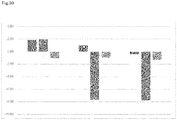
- Fig. 30 shows the b* value of each oral composition in Comparative Example 1e, Example 1e, Comparative Example 2e, Comparative Example 1f, Example 1f, Comparative Example 2f, Comparative Example 1g, Example 1g, and Comparative Example 2g in the order from the left.
- Embodiments encompassed in the present disclosure are described in more detail below.
- the present disclosure preferably encompasses oral compositions, in particular, oral compositions containing specific hydroxyapatite particles.
- the present disclosure is not limited to the compositions, and the present disclosure encompasses everything that is disclosed in the present specification and recognizable by those skilled in the art.
- the oral compositions encompassed in the present disclosure contain specific hydroxyapatite particles.
- such an oral composition may be referred to as "the oral composition according to the present disclosure.”
- the hydroxyapatite particles may be referred to as "the particles according to the present disclosure.”
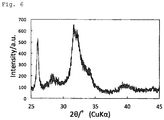
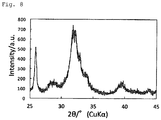
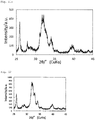
- the X-ray diffraction pattern is an x-ray powder diffraction pattern measured with CuK ⁇ characteristic X-rays.
- the measurement conditions are one of the following:
- the measurement device for use may be, for example, a MultiFlex 2kW X-ray diffractometer (Rigaku Co., Ltd.) or a Miniflex 500 X-ray diffractometer (Rigaku Co., Ltd.). It is preferable to perform measurement with a MultiFlex 2kW X-ray diffractometer under Measurement Condition 1 or to perform measurement with a Miniflex 500 X-ray diffractometer under Measurement Condition 2.
- the upper limit or the lower limit of the ratio of peak intensity may be, for example, 0.85, 0.9, 0.95, 1.0, 1.05, 1.1, 1.15, 1.2, 1.25, 1.3, 1.35, 1.4, 1.45, 1.5, or 1.55.
- the ratio of peak intensity is preferably 0.8 to 1.5, more preferably 0.9 to 1.3, still more preferably 1.0 to 1.25, yet more preferably 1.05 to 1.2, and particularly preferably 1.05 to 1.15.
- the upper limit of the ratio of peak intensity may be 1.59 or 1.58.
- the particles according to the present disclosure are each preferably an aggregate of plate-like crystals of hydroxyapatite.
- the plate-like crystals that constitute each particle according to the present disclosure may be of any shape; examples of the shape include a circle, a polygon (in particular, a hexagon), a rod-like shape, and combinations of these shapes.
- the plate-like crystals may be either in a state in which the plate-like crystals are folded at their plane or a state in which the plate-like crystals are not folded at their plane, with the planar structure maintained.
- plate-like hydroxyapatite crystals have a structure called a "hexagonal crystal," in which the top faces are c-planes and the side faces are a-planes.
- each crystal is called “crystallite.”
- the particle according to the present disclosure contains hydroxyapatite as a major component, and is preferably a particle consisting essentially of hydroxyapatite.
- peaks of other substances e.g., monetite
- the particle according to the present disclosure is distinguished from these particles whose peaks have a high peak intensity.
- the particle according to the present disclosure exhibits excellent properties to seal dentinal tubules and excellent adhesion properties in dentinal tubules.
- the ratio of peak intensity is preferably 0.1 to 1, more preferably 0.2 to 0.9, still more preferably 0.3 to 0.8, yet more preferably 0.4 to 0.7, and particularly preferably 0.4 to 0.6.
- the sum of the areas of all of the diffraction peaks within 25.5° ⁇ 2 ⁇ 26.5° and the areas of all of the diffraction peaks within 31.5° ⁇ 2 ⁇ 32.5° is 30 to 45% based on the sum of the areas of all diffraction peaks within 25° ⁇ 2 ⁇ 35° taken as 100%.
- This value is preferably 33 to 42%, and more preferably 35 to 40%.
- the relatively low crystallinity facilitates the crystal growth in the dentinal tubules after the tubules are sealed, and thereby further improves the adhesion properties in the dentinal tubules.
- the Ca/P molar ratio of the particles according to the present disclosure can be any value that hydroxyapatite can take. Not wishing to be bound by limited interpretation, some calcium is believed to be replaced with another element (e.g., sodium) in the particles according to the present disclosure. Thus, the Ca/P molar ratio can be a relatively low value. From this viewpoint, the Ca/P molar ratio of the particles according to the present disclosure is preferably less than 1.67, more preferably 1.65 or less or 1.60 or less, still more preferably 1.55 or less or 1.50 or less, and yet still more preferably 1.45 or less or 1.40 or less.
- the lower limit of the Ca/P molar ratio of the particles according to the present disclosure is not particularly limited, and may be, for example, 1.0, 1.1, or 1.2.
- the Ca/P molar ratio refers to a value determined by measuring the content of Ca and P in the particles according to the present disclosure by inductively coupled plasma optical emission spectroscopy and calculating the value from the measurement values.
- the particles according to the present disclosure may have any median diameter (d50).
- the median diameter of the particles according to the present disclosure is preferably 5 ⁇ m or less, and more preferably 4.5 ⁇ m or less.
- the lower limit of the median diameter is not particularly limited, and can be, for example, 1 ⁇ m or more, 2 ⁇ m or more, or 3 ⁇ m or more. More specifically, the median diameter is, for example, 1 to 5 ⁇ m.
- the median diameter refers to a value measured by a laser diffraction-scattering technique. More specifically, the median diameter refers to a value measured by dry particle size distribution measurement with a laser diffraction particle size distribution analyzer.
- the particles according to the present disclosure may have any specific surface area.
- the specific surface area of the particles according to the present disclosure is, for example, 30 m 2 /g or more, preferably 40 m 2 /g or more, more preferably 50 m 2 /g or more, and still more preferably 55 m 2 /g or more.
- the upper limit of the specific surface area is not particularly limited, and is, for example, 200 m 2 /g, 170 m 2 /g, 150 m 2 /g, 120 m 2 /g, 100 m 2 /g, or 90 m 2 /g.
- the specific surface area refers to a value measured by the nitrogen gas adsorption method.
- the particles according to the present disclosure preferably react with saliva to exhibit improved crystallinity.
- "Improved crystallinity" as used here means that sharpness of at least one peak (preferably 1, 2, 3, 4, or more peaks) is improved after the reaction with saliva as compared with that before the reaction with saliva (more specifically, the diffraction intensity is improved) in an x-ray powder diffraction pattern measured with CuK ⁇ characteristic X-rays.
- Saliva for use is artificial saliva (CaCl 2 : 1.5 mM, KH 2 PO 4 : 0.9mM, KCl: 130 mM, HEPES: 20 mM, pH 7.0 (KOH)). The reaction is performed by immersing the particles in saliva for 7 days.
- the particles according to the present disclosure can be prepared, for example, by a method for producing a hydroxyapatite particle comprising mixing an aqueous alkaline phosphate solution with a pH of 4 or more and less than 7 with a calcium hydroxide slurry to react the mixture at 35 to 85°C.
- the alkaline phosphate can be any alkaline phosphate, and includes hydrates and anhydrides.
- alkaline phosphates include sodium dihydrogen phosphate, disodium hydrogen phosphate, trisodium phosphate, tetrasodium pyrophosphate, potassium dihydrogen phosphate, dipotassium hydrogen phosphate, and tripotassium phosphate; the alkaline phosphate is preferably a sodium phosphate, such as sodium dihydrogen phosphate, disodium hydrogen phosphate, and trisodium phosphate, and more preferably sodium dihydrogen phosphate.
- the concentration of the alkaline phosphate in the aqueous alkaline phosphate solution is not particularly limited, and is, for example 3 to 50 mass%.
- the concentration of the alkaline phosphate is preferably 3 to 30 mass%, more preferably 5 to 20 mass%, and still more preferably 7 to 15 mass%.
- the pH of the aqueous alkaline phosphate solution is preferably 4 or more and less than 7.
- the pH of the aqueous alkaline phosphate solution is more preferably 5 to 6.5.
- an anhydride be used as an alkaline phosphate, and that the reaction temperature be set to a relatively high temperature, for example, 65 to 85°C, preferably 70 to 85°C, and more preferably 75 to 85°C.
- the calcium hydroxide slurry is reactive with oxalic acid.
- the calcium hydroxide slurry is preferably a slurry of calcium hydroxide that has specific reactivity with oxalic acid.
- the reactivity with oxalic acid is expressed, for example, by the following definition.
- Reactivity with Oxalic Acid a period of time (minutes) until a pH of 7.0 is achieved after 40 g of an aqueous oxalic acid solution that is maintained at 25 ⁇ 1°C and that has a concentration of 0.5 mol/L is added at one time to 50 g of a calcium hydroxide slurry that is adjusted to a concentration of 5 mass% and that is maintained at 25 ⁇ 1°C.
- the specific reactivity with oxalic acid expressed by the above definition is preferably 1 to 40 minutes, more preferably 5 to 30 minutes, and still more preferably 10 to 20 minutes.
- the calcium hydroxide slurry has a BET specific surface area of preferably 5 m 2 /g or more, and more preferably 6 m 2 /g or more.
- the upper limit of the BET specific surface area is not particularly limited, and is, for example, 20 m 2 /g, 15 m 2 /g, or 10 m 2 /g.
- a calcium hydroxide slurry with a high reactivity with oxalic acid can be typically obtained by grinding a calcium hydroxide slurry. Grinding can further increase the reactivity with oxalic acid (the period of time defined above is further shortened). Grinding is performed by using, for example, a bead mill.
- the conditions for grinding are not particularly limited. For example, the conditions according to the method disclosed in JP2017-036176A can be used.
- the calcium hydroxide slurry is prepared, for example, by reacting quicklime (calcium oxide) obtained by calcining limestone with water.
- quicklime calcium oxide
- a calcium hydroxide slurry can be obtained by calcining limestone in a kiln at about 1000°C to form quicklime, pouring in hot water in an amount about 10 times that of the quicklime, and stirring the mixture for 30 minutes.
- the solids concentration of the calcium hydroxide slurry is not particularly limited, and is, for example, 1 to 30 mass%, preferably 3 to 20 mass%, more preferably 5 to 15 mass%, and still more preferably 6 to 12 mass%.
- the amount ratio of the calcium hydroxide slurry to the aqueous alkaline phosphate solution is not particularly limited as long as hydroxyapatite particles can be produced.
- the amount ratio is preferably adjusted such that the Ca/P molar ratio results in preferably 0.3 to 0.7, more preferably 0.4 to 0.6, and still more preferably 0.45 to 0.55.
- the mode in which the aqueous alkaline phosphate solution is mixed with the calcium hydroxide slurry is not particularly limited. Examples include a mode in which the calcium hydroxide slurry is added to a reaction vessel containing the aqueous alkaline phosphate solution (mode 1), a mode in which the aqueous alkaline phosphate solution is added to a reaction vessel containing the calcium hydroxide slurry (mode 2), and a mode in which the aqueous alkaline phosphate solution and the calcium hydroxide slurry are added to a reaction vessel simultaneously (mode 3). Of these, mode 1 is preferable. When the aqueous alkaline phosphate solution and/or the calcium hydroxide slurry is added to a reaction vessel, the liquid in the reaction vessel is typically stirred.
- the addition of the aqueous alkaline phosphate solution and/or the calcium hydroxide slurry to a reaction vessel is preferably performed for a predetermined period of time.
- the period of time from the start of addition until the end of addition is, for example, 10 to 90 minutes, preferably 20 to 60 minutes, and more preferably 20 to 40 minutes.
- the reaction is typically performed with stirring.
- the reaction temperature is 35 to 85°C.
- the reaction temperature is preferably 40 to 75°C, more preferably 45 to 70°C, still more preferably 50 to 70°C, and yet more preferably 55 to 65°C.
- the reaction temperature is a relatively high temperature, for example, 65 to 85°C, preferably 70 to 85°C, and more preferably 75 to 85°C.
- the reaction time (a time period that starts after the aqueous alkaline phosphate solution and the calcium hydroxide slurry have been fully mixed; in modes 1 to 3, a time period that starts after the addition of the aqueous alkaline phosphate solution and the calcium hydroxide slurry is ended) is, for example, 10 to 180 minutes, preferably 20 to 120 minutes, more preferably 40 to 90 minutes, and still more preferably 50 to 70 minutes.
- the alkaline phosphate for use is an anhydride
- the alkaline phosphate for use is a hydrate
- a relatively high pH e.g., a pH of 5 or more and 6.5 or less
- the calcium hydroxide slurry for use preferably has a reactivity with oxalic acid of about 5 to 30 minutes.
- the particles that have the properties described above according to the present disclosure can be preferably obtained by producing the particles while paying attention to these conditions.
- the particles according to the present disclosure formed by performing the above step can be optionally subjected to purification.
- purification include filtration and washing with water.
- the particles according to the present disclosure can also optionally be subjected to drying.
- the particles according to the present disclosure have properties to seal dentinal tubules and excellent adhesion properties in dentinal tubules.
- an oral composition containing the particles according to the present disclosure i.e., the oral composition according to the present disclosure
- the particles according to the present disclosure may be present in an oral composition, for example, in an amount of about 0.1 to 10 mass%.
- the upper limit or the lower limit of the amount may be, for example, 0.2, 0.3, 0.4, 0.5, 0.6, 0.7, 0.8, 0.9, 1, 1.5, 2, 2.5, 3, 3.5, 4, 4.5, 5, 5.5, 6, 6.5, 7, 7.5, 8, 8.5, 9, or 9.5 mass%.
- the range of amount may be 0.2 to 9.5 mass%, 0.5 to 9 mass%, or 1 to 8 mass%.
- the oral composition according to the present disclosure can be produced by an ordinary method and can be used in, for example, pharmaceutical products, quasi-pharmaceutical products, and cosmetics.
- the form of the oral composition according to the present disclosure is not particularly limited, the oral composition can be made into a form (dosage form), such as an ointment, a paste, a dermatological paste, a gel, a liquid, a spray, a mouthwash, a liquid dentifrice, a toothpaste, or a liniment in accordance with an ordinary method.
- a mouthwash, a liquid dentifrice, a toothpaste, paste, a liquid, a spray, a gel, and a liniment are preferable, and a toothpaste, a paste, and a gel are more preferable.
- the oral composition is preferably in the form suitable for brushing. Brushing can push the particles according to the present disclosure into to the cavities of the tooth dentin, thus providing the effects more effectively.
- the oral composition according to the present disclosure may further contain one or a combination of two or more optional components that can be formulated into oral compositions to the extent that the effects are not impaired.
- the oral composition according to the present disclosure preferably contains the particles according to the present disclosure and silica.
- Silica is preferably silica particles.
- the particles according to the present disclosure can provide the effect of greatly preventing an oral composition from dripping off a toothbrush when the particles according to the present disclosure are contained in combination with silica in the oral composition. This also greatly improves the usability of the oral composition and is thus preferable.
- the silica can be any silica as long as the above effects are brought about in the oral composition according to the present disclosure. Any silica known in the art is usable. For example, precipitated silica is usable. Polishing silica and/or thickening silica is also usable. Additionally, silica such as fumed silica and molten silica is also usable. Although there is no particular limitation, the silica preferably has a mean particle size of 2 to 20 ⁇ m. The mean particle size refers to a value measured by a laser diffraction-scattering technique. The silica preferably has a pH (5 aq. sol.) of, for example, about 5.5 to 7.5 or about 6 to 7. The pH (5 aq.
- sol. refers to a pH at a point when 5 g of silica is dispersed in 95 mL of purified water.
- the silica can be contained in an amount of, for example, about 1 to 30 mass% in the oral composition.
- the upper limit or the lower limit of the amount may be, for example, 2, 3, 4, 5, 6, 7, 8, 9, 10, 11, 12, 13, 14, 15, 16, 17, 18, 19, 20, 21, 22, 23, 24, 25, 26, 27, 28, or 29 mass%.
- the range of amount is more preferably 2 to 25 mass% or 3 to 20 mass%.
- the oral composition containing the particles according to the present disclosure and silica is preferred because such an oral composition can provide improved usability due to suppressed dropping-off of the composition from a toothbrush as well as reduced tooth hypersensitivity. Additionally, the oral composition is also advantageous in that the oral composition is unlikely to undergo water release and favorably maintains its color (white) when stored at high temperatures (e.g., 55°C) for a long period of time (e.g., 4 months).
- Another preferable example of components to be added to the oral composition is aluminum lactate.
- the oral composition according to the present disclosure preferably encompasses oral compositions in which the yellowing caused by aluminum lactate is suppressed by the particles according to the present disclosure.
- the particles according to the present disclosure can also be considered suitably usable in suppressing the yellowing of oral compositions caused by aluminum lactate.
- Aluminum lactate can be present in an amount of, for example, about 1 to 3 mass%, and more preferably about 1 to 2.5 mass% in the oral composition.
- the mass ratio of the aluminum lactate to the particles according to the present disclosure contained in the oral composition is preferably about 0.05 to 5 (the ratio of aluminum lactate to the particles according to the present disclosure taken as 1).
- the upper limit or the lower limit of the range may be 0.1, 0.2, 0.3, 0.4, 0.5, 0.6, 0.7, 0.8, 0.9, 1, 1.5, 2, 2.5, 3, 3.5, 4, or 4.5.
- the range of the mass ratio may be about 0.2 to 4 or 0.5 to 3.
- Potassium nitrate like aluminum lactate, is also a medicinal ingredient for preventing hypersensitivity.
- Another preferable example of components to be added to the oral composition is a fluorine compound.
- the particles according to the present disclosure can provide the effect of greatly preventing an oral composition from turning yellow (i.e., yellowing) when the particles according to the present disclosure are contained in combination with a fluorine compound in the oral composition. It is preferable to suppress yellowing because yellowing can be a reason for consumers to avoid selecting oral compositions.
- the fluorine compound for preferable use can be, for example, a fluorine compound known in the field of oral compositions. More specifically, the fluorine compound for use includes, for example, sodium monofluorophosphate, sodium fluoride, and tin fluoride, with sodium monofluorophosphate and sodium fluoride being more preferable.
- the fluorine compound is present in an amount of preferably 2000 ppm or less, and more preferably 50 to 2000 ppm in the oral composition on a fluoride-ion concentration basis.
- the upper limit or the lower limit may be, for example, 100, 150, 200, 250, 300, 350, 400, 450, 500, 550, 600, 650, 700, 750, 800, 850, 900, 950, 1000, 1050, 1100, 1150, 1200, 1250, 1300, 1350, 1400, 1450, 1500, 1550, 1600, 1650, 1700, 1750, 1800, 1850, 1900, or 1950 ppm.
- the range is more preferably 100 to 1800 ppm or 200 to 1600 ppm.
- the particles according to the present disclosure can provide the effect of greatly enhancing shape retention (in particular, stability over time) and preventing the oral composition from dropping off a toothbrush when the particles according to the present disclosure are contained in combination with tin fluoride in the oral composition.
- This also greatly improves the usability of the oral composition and is thus preferable.
- tin fluoride not only provides a yellowing suppression effect but also contributes to improving usability when contained in the oral composition.
- tin fluoride is preferably stannous fluoride (SnF 2 ).
- tin fluoride is present in an amount of preferably 1 mass% or less, and more preferably 0.01 to 1 mass%, in the oral composition.
- the upper limit or the lower limit may be, for example, 0.95, 0.9, 0.85, 0.8, 0.75, 0.7, 0.65, 0.6, 0.55, 0.5, 0.45, 0.4, 0.35, 0.3, 0.25, 0.2, 0.15, 0.1, or 0.05 mass%.
- the range may be 0.01 to 0.75 mass% or 0.05 to 0.5 mass%.
- Tin fluoride can be preferably present in the amount within the ranges described above on a fluoride-ion concentration basis in the oral composition in either case: when tin fluoride alone is used as a fluorine compound, and when tin fluoride is used in combination with other fluorine compounds (e.g., sodium monofluorophosphate and/or sodium fluoride).
- fluorine compounds e.g., sodium monofluorophosphate and/or sodium fluoride
- the present inventors found that oral compositions containing potassium nitrate in addition to known hydroxyapatite particles and a fluorine compound exhibit low stability of contained fluorine.
- the inventors also found that the use of the particles according to the present disclosure as hydroxyapatite particles in an oral composition containing a fluorine compound and potassium nitrate can suppress the decrease in stability of fluorine.
- the present disclosure also preferably encompasses oral compositions containing the particles according to the present disclosure, potassium nitrate, and a fluorine compound.
- the amount of potassium nitrate added to an oral composition is preferably within a range in which the effects can be brought about, and is not particularly limited.
- the amount of potassium nitrate is, for example, about 1 to 10 mass%, about 2 to 8 mass%, or about 3 to 7 mass%.
- nonionic surfactants examples include sugar fatty acid esters, such as sucrose fatty acid esters, maltose fatty acid esters, and lactose fatty acid esters; fatty acid alkanolamides; sorbitan fatty acid esters; fatty acid monoglyceride; polyoxyethylene alkyl ethers with a polyoxyethylene addition factor of 8 to 10, and 13 to 15 carbon atoms in the alkyl group; polyoxyethylene alkyl phenyl ethers with a polyoxyethylene addition factor of 10 to 18, and 9 carbon atoms in the alkyl group; diethyl sebacate; polyoxyethylene hydrogenated castor oil; and fatty acid polyoxyethylene sorbitan.
- sugar fatty acid esters such as sucrose fatty acid esters, maltose fatty acid esters, and lactose fatty acid esters
- fatty acid alkanolamides such as sucrose fatty acid esters, maltose fatty acid esters, and lactose fatty
- anionic surfactants include sulfates, such as sodium lauryl sulfate and sodium polyoxyethylene lauryl ether sulfate; sulfosuccinates, such as sodium lauryl sulfosuccinate and sodium polyoxyethylene lauryl ether sulfosuccinate; acyl amino acid salts, such as sodium cocoyl sarcosine and sodium lauroyl methylalanine; and sodium cocoyl methyl taurine.
- sulfates such as sodium lauryl sulfate and sodium polyoxyethylene lauryl ether sulfate
- sulfosuccinates such as sodium lauryl sulfosuccinate and sodium polyoxyethylene lauryl ether sulfosuccinate
- acyl amino acid salts such as sodium cocoyl sarcosine and sodium lauroyl methylalanine
- sodium cocoyl methyl taurine sodium cocoyl methyl taurine
- ampholytic surfactants include betaine acetate activators, such as betaine lauryl dimethylamino acetate and coconut oil fatty acid amide propyldimethylamino acetate betaine; imidazoline activators, such as sodium N-cocoyl-N-carboxymethyl-N-hydroxyethylethylenediamine; and amino acid activators, such as N-lauryl diaminoethyl glycine.
- betaine acetate activators such as betaine lauryl dimethylamino acetate and coconut oil fatty acid amide propyldimethylamino acetate betaine
- imidazoline activators such as sodium N-cocoyl-N-carboxymethyl-N-hydroxyethylethylenediamine
- amino acid activators such as N-lauryl diaminoethyl glycine.
- a sweetener such as saccharin sodium, acesulfame potassium, stevioside, neohesperidin dihydrochalcone, perillatin, thaumatin, aspartylphenylalanine methyl ester, and p-methoxycinnamic aldehyde, can be added.
- sweeteners can be used singly or in a combination of two or more.
- the sweetener can be added in an amount of 0.01 to 1 mass% based on the total amount of the composition.
- the binder for use can be, for example, one, or a combination of two or more, of the following binders:
- wetting agents such as the following can be added singly or in a combination of two or more: sorbitol, glycerol, polypropylene glycol, xylit, maltit, lactit, and polyoxyethylene glycol.
- Preservatives such as the following can be added singly or in a combination of two or more: parabens, such as methylparaben, ethylparaben, propylparaben, and butylparaben, sodium benzoate, phenoxyethanol, and alkyldiaminoethylglycine hydrochloride.
- parabens such as methylparaben, ethylparaben, propylparaben, and butylparaben, sodium benzoate, phenoxyethanol, and alkyldiaminoethylglycine hydrochloride.
- Colorants such as the following can be added singly or in a combination of two or more: legally permitted pigments such as blue No. 1, yellow No. 4, red No. 202, and green No. 3; mineral-based pigments such as ultramarine, enhanced ultramarine, and ferric hexacyanoferrate; and titanium oxide.
- pH Adjusters such as the following can be added: citric acid, phosphoric acid, malic acid, pyrophosphoric acid, lactic acid, tartaric acid, glycerophosphoric acid, acetic acid, nitric acid, chemically possible salts thereof, and sodium hydroxide.
- pH adjusters can be added singly or in a combination of two or more such that the composition has a pH of 4 to 8, and preferably 5 to 7.
- the amount of the pH adjuster is, for example, 0.01 to 2 wt%.
- a disinfectant may be added.
- cationic disinfectants such as cetylpyridinium chloride, benzalkonium chloride, benzethonium chloride, chlorhexidine hydrochloride, and chlorhexidine gluconate
- ampholytic disinfectants such as dodecyl diaminoethylglycine
- nonionic disinfectants such as triclosan, and isopropyl methylphenol
- hinokitiol can be added.
- vitamin E such as dl- ⁇ -tocopherol acetate, tocopherol succinate, or tocopherol nicotinate may be added in addition to the above fluoride such as sodium fluoride, sodium monofluorophosphate, and tin fluoride, aluminum lactate, and potassium nitrate.
- fluoride such as sodium fluoride, sodium monofluorophosphate, and tin fluoride, aluminum lactate, and potassium nitrate.
- These medicinal ingredients cane be added singly or in a combination of two or more.
- the following can also be added as a base singly or in a combination of two or more: for example, alcohol, silicon, apatite, white Vaseline, paraffin, liquid paraffin, microcrystalline wax, squalane, and Plastibase.
- a 10.7 mass% aqueous solution of sodium dihydrogen phosphate-2 hydrate and a ground calcium hydroxide slurry with a solids concentration of 8.6 mass% (BET specific surface area: 6.7 m 2 /g, reactivity with oxalic acid: 15 minutes and 30 seconds, JP2017-036176A ) were prepared so as to give a Ca/P molar ratio of 0.5.
- the aqueous solution of sodium dihydrogen phosphate-2 hydrate was placed in a stainless-steel beaker and heated to 60°C with stirring. This temperature was maintained until the end of stirring. A 10% aqueous solution of NaOH was added to adjust the pH to 5.5.
- the calcium hydroxide slurry was added thereto for a period of 30 minutes. After completion of the addition, the mixture was further stirred for 1 hour, and then filtered and washed with water, followed by drying at 80°C, thereby obtaining hydroxyapatite particles (powder).
- the obtained hydroxyapatite particles were measured for X-ray crystal diffraction, specific surface area, particle size distribution, and Ca/P molar ratio, and observed for shape.
- Fig. 1 shows the results.
- Fig. 2 shows the X-ray diffraction pattern of hydroxyapatite, which is a commercially available reagent (reagent HAp).
- the specific surface area of the hydroxyapatite particles was measured by the nitrogen gas adsorption method with a fully automatic specific surface area analyzer (Macsorb HM model-1208, produced by Mountech Co. Ltd.). The specific surface area was 61.9 m 2 /g.
- the particle size distribution of the hydroxyapatite particles was measured in accordance with dry particle size distribution measurement with a laser diffraction particle size distribution analyzer (Mastersizer 3000).
- the median diameter (d50) was 3.76 ⁇ m.
- the Ca/P molar ratio of the hydroxyapatite particles was determined by measuring the content of Ca and P with an iCAP6000 ICP-OES (produced by Thermo Fisher Scientific) by inductively coupled plasma optical emission spectroscopy, and calculating the ratio from the measurement values.
- the Ca/P molar ratio was 1.33.
- Fig. 3 shows the results. The results indicated that the obtained hydroxyapatite particles were each an aggregate of plate-like crystals.
- a 10.7 mass% aqueous solution of sodium dihydrogen phosphate-2 hydrate and a ground calcium hydroxide slurry with a solids concentration of 8.6 mass% (BET specific surface area: 7.9 m 2 /g, reactivity with oxalic acid: 12 minutes and 30 seconds, JP2017-036176A ) were prepared so as to give a Ca/P molar ratio of 0.5.
- the aqueous solution of sodium dihydrogen phosphate-2 hydrate was placed in a stainless-steel beaker and heated to 60°C with stirring. This temperature was maintained until the end of stirring.
- a 10% aqueous solution of NaOH was added to adjust the pH to 6.0.
- the calcium hydroxide slurry was added thereto for a period of 30 minutes. After completion of the addition, the mixture was further stirred for 1 hour, and then filtered and washed with water, followed by drying at 80°C, thereby obtaining hydroxyapatite particles (powder).
- the obtained hydroxyapatite particles were measured for X-ray crystal diffraction and specific surface area, and observed for shape in the same manner as in Example 1.
- Fig. 4 shows the results of X-ray crystal diffraction.
- the sum of the areas of all of the diffraction peaks within the range of 25.5° ⁇ 2 ⁇ 26.5° and the areas of all of the diffraction peaks within the range of 31.5° ⁇ 2 ⁇ 32.5° was 38.6% based on the sum of the areas of all of the diffraction peaks within the range of 25° ⁇ 2 ⁇ 35° taken as 100%.
- the specific surface area was 75.4 m 2 /g.
- Fig. 5 shows the results of shape observation. The results indicated that the obtained hydroxyapatite was in the form of aggregates of plate-like crystals, as in Example 1.
- a 10.7 mass% aqueous solution of sodium dihydrogen phosphate-2 hydrate and a ground calcium hydroxide slurry with a solids concentration of 8.6 mass% (BET specific surface area: 7.9 m 2 /g, reactivity with oxalic acid: 12 minutes and 30 seconds, JP2017-036176A ) were prepared so as to give a Ca/P molar ratio of 0.5.
- the aqueous solution of sodium dihydrogen phosphate-2 hydrate was placed in a stainless-steel beaker and heated to 40°C with stirring. This temperature was maintained until the end of stirring.
- a 10% aqueous solution of NaOH was added to adjust the pH to 5.5.
- the calcium hydroxide slurry was added thereto for a period of 50 minutes. After completion of the addition, the mixture was further stirred for 1 hour, and then filtered and washed with water, followed by drying at 80°C, thereby obtaining hydroxyapatite particles (powder).
- the obtained hydroxyapatite particles were measured for X-ray crystal diffraction and specific surface area, and observed for shape in the same manner as in Example 1.
- Fig. 6 shows the results of X-ray crystal diffraction.
- the sum of the areas of all of the diffraction peaks within the range of 25.5° ⁇ 2 ⁇ 26.5° and the areas of all of the diffraction peaks within the range of 31.5° ⁇ 2 ⁇ 32.5° was 36.0% based on the sum of the areas of all of the diffraction peaks within the range of 25° ⁇ 2 ⁇ 35° taken as 100%.
- the specific surface area was 81.5 m 2 /g.
- Fig. 7 shows the results of shape observation. The results indicated that the obtained hydroxyapatite particles were each an aggregate of plate-like crystals, as in Example 1.
- a 10.7 mass% aqueous solution of anhydrous sodium dihydrogen phosphate and a ground calcium hydroxide slurry with a solids concentration of 8.6 mass% were prepared so as to give a Ca/P molar ratio of 0.5.
- the aqueous solution of anhydrous sodium dihydrogen phosphate was placed in a stainless-steel beaker and heated to 80°C with stirring. The pH was left at 4.2 and not adjusted.
- the calcium hydroxide slurry was added thereto for a period of 30 minutes. After completion of the addition, the mixture was further stirred for 1 hour, and then filtered and washed with water, followed by drying at 80°C, thereby obtaining hydroxyapatite particles (powder).
- the obtained hydroxyapatite particles were measured for X-ray crystal diffraction and specific surface area, and observed for shape in the same manner as in Example 1.
- Fig. 8 shows the results of X-ray crystal diffraction.
- the sum of the areas of all of the diffraction peaks within the range of 25.5° ⁇ 2 ⁇ 26.5° and the areas of all of the diffraction peaks within the range of 31.5° ⁇ 2 ⁇ 32.5° was 37.8% based on the sum of the areas of all of the diffraction peaks within the range of 25° ⁇ 2 ⁇ 35° taken as 100%.
- the specific surface area was 163.4 m 2 /g.
- Fig. 9 shows the results of shape observation. The results indicated that the obtained hydroxyapatite particles were each an aggregate of plate-like crystals, as in Example 1.
- a 10.7 mass% aqueous solution of anhydrous sodium dihydrogen phosphate and a ground calcium hydroxide slurry with a solids concentration of 8.6 mass% were prepared so as to give a Ca/P molar ratio of 0.5.
- the aqueous solution of anhydrous sodium dihydrogen phosphate was placed in a stainless-steel beaker and heated to 60°C with stirring. The pH was left at 4.2 and not adjusted.
- the calcium hydroxide slurry was added thereto for a period of 30 minutes. After completion of the addition, the mixture was further stirred for 1 hour, and then filtered and washed with water, followed by drying at 80°C, thereby obtaining fine hydroxyapatite particles (powder).
- the obtained fine hydroxyapatite particles were measured for X-ray crystal diffraction and specific surface area, and observed for shape in the same manner as in Example 1.
- Fig. 10a shows the results of X-ray crystal diffraction.
- the sum of the areas of all of the diffraction peaks within the range of 25.5° ⁇ 2 ⁇ 26.5° and the areas of all of the diffraction peaks within the range of 31.5° ⁇ 2 ⁇ 32.5° was 31.6%, based on the sum of the areas of all of the diffraction peaks within the range of 25° ⁇ 2 ⁇ 35° taken as 100%.
- the specific surface area was 94.7 m 2 /g.
- Fig. 10b shows the results of shape observation. The results indicated that the obtained hydroxyapatite was in the form of aggregates of plate-like fine particles, as in Example 1.
- a 10.7 mass% aqueous solution of anhydrous sodium dihydrogen phosphate and a ground calcium hydroxide slurry with a solids concentration of 8.6 mass% were prepared so as to give a Ca/P molar ratio of 0.5.
- the aqueous solution of anhydrous sodium dihydrogen phosphate was placed in a stainless-steel beaker and heated to 80°C with stirring. The pH was left at 4.2 and not adjusted.
- the calcium hydroxide slurry was added thereto for a period of 30 minutes. After completion of the addition, the mixture was further stirred for 1 hour, and then filtered and washed with water, followed by drying at 80°C, thereby obtaining fine hydroxyapatite particles (powder).
- the obtained fine hydroxyapatite particles were measured for X-ray crystal diffraction and specific surface area, and observed for shape in the same manner as in Example 1.
- Fig. 11a shows the results of X-ray crystal diffraction.
- the sum of the areas of all of the diffraction peaks within the range of 25.5° ⁇ 2 ⁇ 26.5° and the areas of all of the diffraction peaks within the range of 31.5° ⁇ 2 ⁇ 32.5° was 40.9%, based on the sum of the areas of all of the diffraction peaks within the range of 25° ⁇ 2 ⁇ 35° taken as 100%.
- the specific surface area was 105.0 m 2 /g.
- Fig. 11b shows the results of shape observation. The results indicated that the obtained hydroxyapatite was in the form of aggregates of plate-like fine particles, as in Example 1.
- a 10.7 mass% aqueous solution of sodium dihydrogen phosphate-2 hydrate and a ground calcium hydroxide slurry with a solids concentration of 8.6 mass% (BET specific surface area: 6.7 m 2 /g, reactivity with oxalic acid: 15 minutes and 30 seconds, JP2017-036176A ) were prepared so as to give a Ca/P molar ratio of 0.5.
- the aqueous solution of sodium dihydrogen phosphate-2 hydrate was placed in a stainless-steel beaker, and heated to 60°C with stirring. This temperature was maintained until the end of stirring.
- a 10% aqueous solution of NaOH was added to adjust the pH to 5.5.
- the calcium hydroxide slurry was added thereto for a period of 30 minutes. After completion of the addition, the mixture was further stirred for 1 hour, and then filtered and washed with water, followed by drying at 80°C. After that, the mixture was allowed to stand at 40°C and at 75% RH for 6 months, thereby obtaining fine hydroxyapatite particles (powder).
- the obtained fine hydroxyapatite particles were measured for X-ray crystal diffraction and specific surface area, and observed for shape in the same manner as in Example 1.
- Fig. 11c shows the results of X-ray crystal diffraction.
- the sum of the areas of all of the diffraction peaks within the range of 25.5° ⁇ 2 ⁇ 26.5° and the areas of all of the diffraction peaks within the range of 31.5° ⁇ 2 ⁇ 32.5° was 39.4%, based on the sum of the areas of all of the diffraction peaks within the range of 25° ⁇ 2 ⁇ 35° taken as 100%.
- the specific surface area was 34.8 m 2 /g.
- a 10.7 mass% aqueous solution of anhydrous sodium dihydrogen phosphate and a ground calcium hydroxide slurry with a solids concentration of 8.6 mass% (BET specific surface area: 7.9 m 2 /g, reactivity with oxalic acid: 12 minutes and 30 seconds, JP2017-036176A ) were prepared so as to give a Ca/P molar ratio of 0.5.
- the calcium hydroxide slurry was placed in a stainless-steel beaker and heated to 40°C with stirring.
- the aqueous solution of anhydrous sodium dihydrogen phosphate (pH: 4.2) was added thereto for a period of 30 minutes. After completion of the addition, the mixture was further stirred for 1 hour, and then filtered and washed with water, followed by drying at 80°C, thereby obtaining hydroxyapatite particles (powder).
- the obtained hydroxyapatite particles were measured for X-ray crystal diffraction and specific surface area, and observed for shape in the same manner as in Example 1.
- Fig. 12 shows the results of X-ray crystal diffraction.
- the diffraction peaks of the (300) plane around 2 ⁇ 33° appeared separately.
- the specific surface area was 50.9 m 2 /g.
- Fig. 13 shows the results of shape observation. The results indicated that the obtained hydroxyapatite particles were in the form of aggregates of spindle-like crystals.
- a 10.7 mass% aqueous solution of sodium dihydrogen phosphate-2 hydrate and a ground calcium hydroxide slurry with a solids concentration of 8.6 mass% ( JP2017-036176A ) were prepared so as to give a Ca/P molar ratio of 0.5.
- the aqueous solution of sodium dihydrogen phosphate-2 hydrate was placed in a stainless-steel beaker and heated to 60°C with stirring. This temperature was maintained until the end of stirring. The pH was left at 4.2 and not adjusted.
- the calcium hydroxide slurry was added thereto for a period of 45 minutes. After completion of the addition, the mixture was further stirred for 1 hour, and then filtered and washed with water, followed by drying at 80°C, thereby obtaining a sample.
- the obtained sample was measured for X-ray crystal diffraction and observed for shape in the same manner as in Example 1.
- Fig. 14 shows the results of X-ray crystal diffraction. Diffraction peaks of other substances were confirmed. The peaks indicated by solid black circles in Fig. 14 are diffraction peaks of monetite, which is calcium phosphate that tends to form under acidic conditions.
- Fig. 15 shows the results of shape observation. Large plate-like particles of monetite were confirmed.
- a 10.7 mass% aqueous solution of sodium dihydrogen phosphate-2 hydrate and a high-purity calcium hydroxide slurry with a solids concentration of 8.6 mass% were prepared so as to give a Ca/P molar ratio of 0.5.
- the aqueous solution of sodium dihydrogen phosphate-2 hydrate was placed in a stainless-steel beaker and heated to 60°C with stirring. This temperature was maintained until the end of stirring.
- a 10% aqueous solution of NaOH was added to adjust the pH to 5.5.
- the calcium hydroxide slurry was added thereto for a period of 30 minutes. After completion of the addition, the mixture was further stirred for 1 hour, and then filtered and washed with water, followed by drying at 80°C, thereby obtaining a sample.
- the obtained sample was measured for X-ray crystal diffraction in the same manner as in Example 1.
- Fig. 16 shows the results of X-ray crystal diffraction.
- Fig. 17 shows the results of shape observation. Large plate-like particles of calcium hydroxide were confirmed. The difference from Example 1 was speculated to be due to the physical properties of the calcium hydroxide used as a starting material.
- a 10.7 mass% aqueous solution of sodium dihydrogen phosphate-2 hydrate and a ground calcium hydroxide slurry with a solids concentration of 8.6 mass% (BET specific surface area: 7.9 m 2 /g, reactivity with oxalic acid: 12 minutes and 30 seconds, JP2017-036176A ) were prepared so as to give a Ca/P molar ratio of 0.5.
- the aqueous solution of sodium dihydrogen phosphate-2 hydrate was placed in a stainless-steel beaker, and a 10% aqueous solution of NaOH was added thereto to adjust the pH to 5.5.
- the calcium hydroxide slurry was then added thereto for a period of 50 minutes.
- the obtained hydroxyapatite particles were measured for X-ray crystal diffraction and observed for shape in the same manner as in Example 1.
- Fig. 18 shows the results of X-ray crystal diffraction.
- Fig. 19 shows the results of shape observation.
- the shape of the particles was confirmed to be an aggregate of microscopic spindle-shaped particles.
- a 10.7 mass% aqueous solution of sodium dihydrogen phosphate-2 hydrate and a ground calcium hydroxide slurry with a solids concentration of 8.6 mass% ( JP2017-036176A ) were prepared so as to give a Ca/P molar ratio of 0.5.
- the aqueous solution of sodium dihydrogen phosphate-2 hydrate was placed in a stainless-steel beaker and heated to 80°C with stirring. This temperature was maintained until the end of stirring. The pH was left at 4.2 and not adjusted.
- the calcium hydroxide slurry was added thereto for a period of 50 minutes. After completion of the addition, the mixture was further stirred for 1 hour, and then filtered and washed with water, followed by drying at 80°C, thereby obtaining a sample.
- the obtained sample was measured for X-ray crystal diffraction and observed for shape in the same manner as in Example 1.
- Fig. 20 shows the results of X-ray crystal diffraction.
- the diffraction peaks of other substances were confirmed.
- the peaks indicated by solid black circles are diffraction peaks of monetite, which is calcium phosphate that tends to form under acidic conditions.
- Fig. 21 shows the results of shape observation. Large plate-like particles of monetite were confirmed.
- hydroxyapatite particles obtained in the same manner as in Example 1 were immersed in 200 mL of artificial saliva (CaCl 2 : 1.5 mM; KH 2 PO 4 : 0.9 mM; KCl: 130 mM; HEPES: 20 mM; pH 7.0 (KOH)) for 7 days.
- Powder separated by suction filtration was measured with a powder X-ray diffractometer, and changes in crystallinity before and after immersion in artificial saliva were observed.
- Fig. 22 shows the results.
- the immersion in artificial saliva was confirmed to have improved crystallinity (increased peak sharpness and appearance of broad, hidden peaks). This indicates that the hydroxyapatite particles change in the oral cavity (i.e., they are reactive).
- Test Example 2 Test on Properties to Seal Dentinal Tubules of Hydroxyapatite Particles
- hydroxyapatite particles obtained in the same manner as in Example 1 were suspended in 39.7 g of a viscous diluent, thereby obtaining a liquid of hydroxyapatite particles.
- the viscous diluent was an aqueous solution containing 0.5 w/w% sodium carboxymethyl cellulose and 10 w/w% glycerol.
- the dentin block was brushed in the liquid of hydroxyapatite particles (40 g) for 30 seconds with a toothbrush (GUM #211) (stroke: 150 rpm, load: 160 g).
- the surface was vapor-deposited and observed with an electron microscope.
- Fig. 23 shows the results. Dentinal tubules were confirmed to have been sealed by brushing in the liquid of hydroxyapatite particles. This indicates that the hydroxyapatite particles seal the dentinal tubules present on the surface of dentin.
- hydroxyapatite particles obtained in the same manner as in Example 1 were suspended in 39 g of a viscous diluent, thereby obtaining a liquid of hydroxyapatite particles.
- the viscous diluent was an aqueous solution containing 0.5 w/w% sodium carboxymethyl cellulose and 10 w/w% glycerol.
- a dentin disc was brushed in the liquid of hydroxyapatite particles (40 g) for 30 seconds with a toothbrush (GUM #211) (stroke: 150 rpm, load: 160 g).
- the disc was washed with water and immersed in artificial saliva (CaCl 2 : 1.5 mM; KH 2 PO 4 : 0.9 mM; KCl: 130 mM; HEPES: 20 mM; pH 7.0 (KOH)) for 5 minutes.
- the disc was immersed in artificial saliva for 7 days.
- the surface was vapor-deposited and observed with an electron microscope.
- Fig. 24 shows the results.
- the dentinal tubules were confirmed to have been sealed after water-pressure treatment. This indicates that the hydroxyapatite particles adhere within dentinal tubules and continue to seal dentinal tubules.
- Test Example 4 Test on Properties to Seal Dentinal Tubules of Dentifrice
- the surface was vapor-deposited and observed with an electron microscope.
- Fig. 25 shows the results. Dentinal tubules were confirmed to have been sealed by brushing in the dentifrice solution containing hydroxyapatite particles. This indicates that the dentifrice containing hydroxyapatite particles is highly effective in sealing dentinal tubules.
- Test Example 5 Test on Properties to Seal Dentinal Tubules of Gel Preparation Applied With Soft-Pick
- a gel preparation was applied to the surface of bovine dentin with a Soft-pick (interdental brush made from rubber), and the degree of dentinal tubule sealing was examined by observation with an electron microscope (SEM).
- SEM electron microscope
- a gel preparation containing (or not containing) hydroxyapatite particles obtained in the same manner as in Example 1 was placed on the brush portion of a Soft-pick (Gum Soft-picks, curved: Sunstar Inc.). The Soft-pick was inserted into the space and moved back and forth 5 times. Table 2 below shows the formulation of the gel preparation. 7. The dentin blocks were washed with water.
- the surface was vapor-deposited and observed with an electron microscope.
- Fig. 26 shows the results. Dentinal tubules were confirmed to have been sealed by applying the gel preparation containing hydroxyapatite particles with a Soft-pick.
- hydroxyapatite particles prepared in the same manner as in Example 1 were used as hydroxyapatite particles.
- Hypersensitivity Care Set indicates gel preparations (i) to (iii) above
- “Hypersensitivity Care Set indicates a gel preparation formed by removing potassium nitrate from gel preparation (iii).
- Subjects were asked to use a gel preparation (test product) twice a day (morning and evening; when the subjects should use a gel preparation, such as after waking up, after a meal, or before going to bed, was not specified; the subjects were allowed to use the preparation on the basis of their habitual oral cleaning). Specifically, first, the subjects were asked to brush their teeth with a designated toothbrush (G.U.M Pro's Dental Brush #3c; Sunstar Inc.) and a dentifrice (CO-OP non-foaming toothpaste N), to rinse their mouth with about 10 mL of water for 20 seconds (the brushing time period was not specified), and then to use a gel preparation.
- a designated toothbrush G.U.M Pro's Dental Brush #3c; Sunstar Inc.
- CO-OP non-foaming toothpaste N a dentifrice
- the subjects were asked to apply about 0.04 g of a gel preparation (test product; about the size of a rice grain) per test tooth to a test site with a tuft brush (Butler single-tuft brush #01F: Sunstar Inc.), and brush the test site and the two teeth next to the test site for at least 5 seconds per tooth. If a designated interdental cleaning tool (Gum Soft-picks, curved: Sunstar Inc.) could be inserted into the space between the test site and the next teeth, the interdental cleaning tool was inserted into the space between the test site and the next teeth from the cheek side, and the tool was moved back and forth 5 times. After using the gel preparation (test product), the subjects were asked to rinse their mouth with about 10 mL of water for 20 seconds.
- test product about the size of a rice grain
- Fig. 28 shows the results of evaluating the intensity of rubbing pain on a VAS scale.
- the group of subjects who used the hydroxyapatite-containing preparation exhibited significant improvement in rubbing pain, as compared with the group of subjects who used the preparation containing no hydroxyapatite. This indicates that the hydroxyapatite-containing preparation is effective in reducing hypersensitivity symptoms at an early stage when used in combination with aluminum lactate and/or potassium nitrate, which are known medicinal ingredients for preventing hypersensitivity.
- Test Example 7 Study on Oral Composition Containing Hydroxyapatite Particles and Silica Particles
- An oral composition was prepared by using hydroxyapatite particles prepared in the same manner as in Example 1 (HAp produced in accordance with the procedure in Example 1) or commercially available hydroxyapatite particles (commercially available HAp, produced by Tomita Pharmaceutical Co., Ltd.; commercially available hydroxyapatite different from the above reagent HAp) with commercially available silica (silica a or silica b: both precipitated silica).
- the components described in Table 4A and Table 4B were mixed to prepare oral compositions.
- the values of the components shown in Table 4A and Table 4B are indicated in mass%.
- the mean particle size of silica a is 2.4 ⁇ m
- the mean particle size of silica b is 17 ⁇ m.
- the pH of silica (5 aq. sol.; i.e., the pH determined with 5 g of silica dispersed in 95 mL of purified water) is the following: pH of silica a, 6.7; pH of silica b, 5.5 to 7.5.
- the HAp produced in accordance with the procedure in Example 1 and commercially available HAp were measured for X-ray crystal diffraction in the same manner as in Example 1.
- the oral compositions obtained in accordance with the formulations shown in Table 4A were examined for the period of time until the oral compositions dropped off after each composition was placed on a toothbrush, and the toothbrush was turned over.
- 25 g of each oral composition was placed in a laminate tube (aperture diameter: 8 mm), and the tubes were stored at room temperature (about 25°C) or at 55°C in a dark room for two months.
- the oral compositions stored at 55°C were brought back to room temperature.
- the oral compositions were pushed out; about 0.5 g of each oral composition was weighed with an electronic balance and placed on a toothbrush (G.U.M Dental Brush #211M: Sunstar Inc.).
- the oral compositions obtained in accordance with the formulations shown in Table 4B were stored at 55°C in a dark room for a long period of time, and then the water separation percentage and whiteness were determined in the following manner.
- each obtained oral composition (aperture diameter: 8 mm) was placed in a laminate tube and stored at 55°C in a dark room for 4 months. Thereafter, the oral compositions in laminate tubes were brought back to room temperature and measured for color difference. Specifically, the oral compositions after storage were each placed in a polystyrene container to a height of 2 cm and photographed on a white board with an FD-5 fluorescence spectrodensitometer (produced by Konica Minolta, Inc.). The shooting conditions were the following: constant lighting, shutter speed, aperture, and focal length. Each value of the L*a*b* color system was measured at 6 measurement points, and the average was determined. The average was then applied to the following formula to determine the whiteness of each oral composition.
- Test Example 8 Study on Yellowing of Oral Composition Due to Aluminum Lactate
- Oral compositions were prepared by using hydroxyapatite particles obtained in the same manner as in Example 1 (HAp produced in accordance with the procedure of Example 1) or commercially available hydroxyapatite particles (commercially available HAp, produced by Tomita Pharmaceutical Co., Ltd.; commercially available hydroxyapatite different from the above reagent HAp) with aluminum lactate. Specifically, oral compositions were prepared by mixing the components shown in Table 5. The value of each component shown in Table 5 is indicated in mass%. HAp produced in accordance with the procedure of Example 1 and commercially available HAp were measured for X-ray crystal diffraction in the same manner as in Example 1.
- Caustic soda was also added to the compositions containing aluminum lactate to adjust the pH to around 7.
- each obtained oral composition was placed in a colorless transparent glass container (produced by Hakuyo Glass Co., Ltd.) and stored at 55°C in a dark room for 3 months. Thereafter, the oral compositions were measured for color difference as described below.
- the oral compositions after storage were each placed in a polystyrene container to a height of 2 cm and photographed on a white board with an FD-5 fluorescence spectrodensitometer (produced by Konica Minolta, Inc.).
- the shooting conditions were the following: constant lighting, shutter speed, aperture, and focal length.
- Fig. 29 shows the results (the b* value of each oral composition). From the left, the six bars in Fig. 29 show the b* value of Comparative Example 1c, Example 1c, Comparative Example 2c, Comparative Example 1d, Example 1d, and Comparative Example 2d.
- Oral compositions were prepared by using hydroxyapatite particles obtained in the same manner as in Example 1 (HAp produced in accordance with the procedure of Example 1) or commercially available hydroxyapatite particles (commercially available HAp, produced by Tomita Pharmaceutical Co., Ltd.; commercially available hydroxyapatite different from the above reagent HAp) with sodium monofluorophosphate or sodium fluoride.
- oral compositions were prepared by mixing the components shown in Table 6. The value of each component shown in Table 6 is indicated in mass%.
- the HAp produced in accordance with the procedure of Example 1 and commercially available HAp were measured for X-ray crystal diffraction in the same manner as in Example 1.
- each obtained oral composition was placed in a laminate tube (aperture diameter: 8 mm) and stored at 55°C in a dark room for 6 months.
- the oral compositions were brought back to room temperature and then measured for color difference in the following manner.
- the oral compositions after storage were each placed in a polystyrene container to a height of 2 cm and photographed on a white board with an FD-5 fluorescence spectrodensitometer (produced by Konica Minolta, Inc.).
- the shooting conditions were the following: constant lighting, shutter speed, aperture, and focal length.
- the b* value of the L*a*b* color system was measured at 6 measurement points, and the average was determined to use it as an index for evaluating the change in color to yellow (yellowing).
- FIG. 30 shows the results (the b* value of each oral composition). From the left, the nine bars in Fig. 30 show the b* value of Comparative Example 1e, Example 1e, Comparative Example 2e, Comparative Example 1f, Example 1f, Comparative Example 2f, Comparative Example 1g, Example 1g, and Comparative Example 2g.
- Oral compositions were prepared by using hydroxyapatite particles obtained in the same manner as in Example 1 (HAp produced in accordance with the procedure of Example 1) or commercially available hydroxyapatite particles (commercially available HAp, produced by Tomita Pharmaceutical Co., Ltd.; commercially available hydroxyapatite different from the above reagent HAp) with tin fluoride (stannous fluoride).
- oral compositions were prepared by mixing the components shown in Table 7. The value of each component shown in Table 7 is indicated in mass%.
- the HAp produced in accordance with the procedure of Example 1 and commercially available HAp were measured for X-ray crystal diffraction in the same manner as in Example 1.
- each obtained oral composition was placed in a laminate tube (aperture diameter: 8 mm) and stored at room temperature (about 25°C) or 55°C in a dark room for 5 months.
- the oral compositions stored at 55°C were brought back to room temperature.
- the oral compositions were pushed out; about 0.5 g of each oral composition was weighed with an electronic balance and placed on a toothbrush (G.U.M Dental Brush #211M; Sunstar Inc.). The period of time was measured until the oral composition dropped off the toothbrush after the toothbrush was turned over at a height of 2.5 cm so that the bristles faced downward. The period of time was determined to be the time required for dropping off. Table 7 also shows the results of this study.
- the oral compositions were each pushed out by a length of 2 cm on coarse paper and allowed to stand at room temperature for 5 minutes. Thereafter, the length of the oral compositions was measured, and the broadening percentage (%) was determined from the following formula. Table 7 also shows the results.
- the broadening percentage % the length of an oral composition after being allowed to stand for 5 minutes / the length of the oral composition pushed out on coarse paper ⁇ 100
- the oral compositions immediately after preparation were warmed in a thermostatic bath at 30°C for 30 minutes, and then the pH of the oral compositions was measured with a glass-electrode pH meter (LAQUA F-72, produced by Horiba, Ltd.). Table 7 also shows the measured pH values.
- Oral compositions were prepared by using hydroxyapatite particles obtained in the same manner as in Example 1 (HAp produced in accordance with the procedure of Example 1) or commercially available hydroxyapatite particles (commercially available HAp, produced by Tomita Pharmaceutical Co., Ltd.; commercially available hydroxyapatite different from the above reagent HAp) with sodium monofluorophosphate or sodium fluoride.
- oral compositions were prepared by mixing the compositions shown in Table 8. The value of each component in Table 8 is indicated in mass%.
- the HAp produced in accordance with the procedure of Example 1 and commercially available HAp were the same as those used in Test Example 7, and measured for X-ray crystal diffraction in the same manner as in Example 1.
- the fluorine content (ppm) of oral compositions was determined in accordance with the following procedure immediately after production of the oral compositions and after 25 g of each oral composition was placed in a laminate tube (aperture diameter: 8 mm) and stored at 55°'C for 2 months in a dark room. About 0.5 g of a specimen was precisely weighed, and 5 mL of a 2 mol/L perchloric acid test solution was added thereto. After the mixture was shaken well, the mixture was heated for 5 minutes. After cooling, water was added to form a precise volume of 100 mL. 15 mL of an acetate buffer (pH 5.3) was precisely added to 5 mL of this liquid, thereby preparing a sample solution. The fluorine content of the sample solution and a separately prepared fluorine standard solution was determined by reading their electrical potential by using fluorine test method 2 (ion electrode method) described in the Japanese Standards of Quasi-Drug Ingredients 2006 .
- Percentage of the change in fluorine content (the fluorine content after storage at 55°C for 2 months) /(the fluorine content immediately after production)
Landscapes
- Health & Medical Sciences (AREA)
- Life Sciences & Earth Sciences (AREA)
- Veterinary Medicine (AREA)
- Animal Behavior & Ethology (AREA)
- General Health & Medical Sciences (AREA)
- Public Health (AREA)
- Epidemiology (AREA)
- Chemical & Material Sciences (AREA)
- Birds (AREA)
- Inorganic Chemistry (AREA)
- Oral & Maxillofacial Surgery (AREA)
- Organic Chemistry (AREA)
- Plastic & Reconstructive Surgery (AREA)
- Cosmetics (AREA)
Applications Claiming Priority (6)
| Application Number | Priority Date | Filing Date | Title |
|---|---|---|---|
| JP2018245027A JP7676099B2 (ja) | 2018-12-27 | 2018-12-27 | 口腔用組成物 |
| JP2019121916A JP2021008418A (ja) | 2019-06-28 | 2019-06-28 | 口腔用組成物 |
| JP2019121912A JP7676105B2 (ja) | 2019-06-28 | 2019-06-28 | 口腔用組成物 |
| JP2019121905A JP7676104B2 (ja) | 2019-06-28 | 2019-06-28 | 口腔用組成物 |
| JP2019121902A JP7676103B2 (ja) | 2019-06-28 | 2019-06-28 | 口腔用組成物 |
| PCT/JP2019/051625 WO2020138500A1 (fr) | 2018-12-27 | 2019-12-27 | Composition pour la cavité buccale |
Publications (2)
| Publication Number | Publication Date |
|---|---|
| EP3904282A1 true EP3904282A1 (fr) | 2021-11-03 |
| EP3904282A4 EP3904282A4 (fr) | 2022-10-26 |
Family
ID=71125956
Family Applications (1)
| Application Number | Title | Priority Date | Filing Date |
|---|---|---|---|
| EP19904702.8A Pending EP3904282A4 (fr) | 2018-12-27 | 2019-12-27 | Composition pour la cavité buccale |
Country Status (4)
| Country | Link |
|---|---|
| US (1) | US11759405B2 (fr) |
| EP (1) | EP3904282A4 (fr) |
| CN (1) | CN113226984A (fr) |
| WO (1) | WO2020138500A1 (fr) |
Families Citing this family (2)
| Publication number | Priority date | Publication date | Assignee | Title |
|---|---|---|---|---|
| CN113260592A (zh) * | 2018-12-27 | 2021-08-13 | 白石钙新加坡有限公司 | 羟基磷灰石颗粒 |
| CN114751389B (zh) * | 2022-04-27 | 2023-10-03 | 广东省地质实验测试中心 | 一种硒基改性纳米羟基磷灰石材料及其制备方法与在Cd污染土壤修复中的应用 |
Family Cites Families (27)
| Publication number | Priority date | Publication date | Assignee | Title |
|---|---|---|---|---|
| JPS5557514A (en) | 1978-10-26 | 1980-04-28 | Dentaru Kagaku Kk | Dentifrice and its preparation |
| JPS62273907A (ja) | 1986-05-22 | 1987-11-28 | Sangi:Kk | 化粧品用顔料 |
| GB8811828D0 (en) | 1988-05-19 | 1988-06-22 | Unilever Plc | Oral compositions |
| GB8811830D0 (en) | 1988-05-19 | 1988-06-22 | Unilever Plc | Oral compositions |
| JP2990335B2 (ja) * | 1995-07-06 | 1999-12-13 | 富田製薬株式会社 | 歯磨き配合用ヒドロキシアパタイト及びその製造法 |
| JPH1017449A (ja) | 1996-07-05 | 1998-01-20 | Sangi Co Ltd | 知覚過敏症用組成物 |
| JP3971877B2 (ja) * | 1999-10-25 | 2007-09-05 | 株式会社サンギ | 口腔用組成物 |
| US6400058B1 (en) * | 2000-08-01 | 2002-06-04 | Primax Electronics Ltd. | Universal motor with reduced EMI characteristics |
| JP3681108B2 (ja) * | 2000-12-08 | 2005-08-10 | サンスター株式会社 | カチオン性殺菌剤を含む口腔用組成物 |
| KR100593262B1 (ko) | 2003-08-28 | 2006-06-26 | 재단법인서울대학교산학협력재단 | 아파타이트 분말 제조 방법 |
| JP2005325102A (ja) * | 2004-04-13 | 2005-11-24 | Japan Science & Technology Agency | 象牙細管封鎖材 |
| JP5061341B2 (ja) * | 2006-05-23 | 2012-10-31 | 国立大学法人 岡山大学 | 結晶性ヒドロキシアパタイト微粒子の製造方法 |
| WO2008056453A1 (fr) * | 2006-11-10 | 2008-05-15 | Matsutani Chemical Industry Co., Ltd. | Matériau non carieux et agent anti-caries contenant un sucre rare |
| CN101385856A (zh) * | 2008-10-17 | 2009-03-18 | 同济大学 | 对溶菌酶有高效吸附和可控缓释的纳米羟基磷灰石及制备 |
| JP5467432B2 (ja) | 2009-03-10 | 2014-04-09 | 学校法人明治大学 | 板状ヒドロキシアパタイト単結晶の製造方法 |
| JP5613990B2 (ja) | 2009-03-25 | 2014-10-29 | ライオン株式会社 | 歯牙の象牙細管封鎖剤及び口腔用組成物 |
| JP5597970B2 (ja) * | 2009-11-06 | 2014-10-01 | ライオン株式会社 | 歯磨剤組成物 |
| JP5605780B2 (ja) | 2009-11-20 | 2014-10-15 | 白石工業株式会社 | 高純度水酸化カルシウムの製造方法 |
| GB201202341D0 (en) | 2012-02-10 | 2012-03-28 | Periproducts Ltd | Multicomponent oral care compostion |
| CA2881621C (fr) * | 2012-09-05 | 2016-10-11 | Kabushiki Kaisha Sangi | Composition orale |
| JP6351929B2 (ja) * | 2013-03-21 | 2018-07-04 | 株式会社ロッテ | 知覚過敏緩和用口腔組成物 |
| JP2015086083A (ja) * | 2013-10-28 | 2015-05-07 | 三菱製紙株式会社 | (炭酸)ヒドロキシアパタイトおよびその微粒子の製造方法 |
| CN105686960B (zh) * | 2014-11-24 | 2018-10-02 | 好来化工(中山)有限公司 | 牙齿抗敏组合物 |
| JP6302435B2 (ja) | 2015-08-10 | 2018-03-28 | 黒崎播磨株式会社 | 湿式吹付材用急結剤、その製造方法、それを含む湿式吹付材及び湿式吹付材の施工方法 |
| JP6602608B2 (ja) * | 2015-09-04 | 2019-11-06 | ライオン株式会社 | 口腔用組成物 |
| JP2018104302A (ja) * | 2016-12-22 | 2018-07-05 | 花王株式会社 | 歯磨剤用顆粒の製造方法 |
| CN113260592A (zh) * | 2018-12-27 | 2021-08-13 | 白石钙新加坡有限公司 | 羟基磷灰石颗粒 |
-
2019
- 2019-12-27 EP EP19904702.8A patent/EP3904282A4/fr active Pending
- 2019-12-27 US US17/417,305 patent/US11759405B2/en active Active
- 2019-12-27 WO PCT/JP2019/051625 patent/WO2020138500A1/fr not_active Ceased
- 2019-12-27 CN CN201980086240.9A patent/CN113226984A/zh active Pending
Also Published As
| Publication number | Publication date |
|---|---|
| WO2020138500A1 (fr) | 2020-07-02 |
| CN113226984A (zh) | 2021-08-06 |
| US11759405B2 (en) | 2023-09-19 |
| EP3904282A4 (fr) | 2022-10-26 |
| US20220071853A1 (en) | 2022-03-10 |
Similar Documents
| Publication | Publication Date | Title |
|---|---|---|
| JP7060600B2 (ja) | 第一スズ適合性シリカ | |
| JP2023096085A (ja) | 口腔用組成物 | |
| KR20120022781A (ko) | 치면 수복재 | |
| US20050106110A1 (en) | Stabilized vaterite | |
| US20100189663A1 (en) | Mouth rinse compositions including chemically modified silica or silicate materials for sustained delivery to tooth surfaces | |
| US8940278B2 (en) | Oral hygiene compositions | |
| US11759405B2 (en) | Composition for oral cavity | |
| HUE035706T2 (en) | Dental products containing carbonate-substituted fluoro-hydroxyapatite particles | |
| JP2021008418A (ja) | 口腔用組成物 | |
| JP7676105B2 (ja) | 口腔用組成物 | |
| JP7676103B2 (ja) | 口腔用組成物 | |
| JP7676104B2 (ja) | 口腔用組成物 | |
| JP7562255B2 (ja) | 口腔用組成物 | |
| JP7341749B2 (ja) | 口腔用組成物 | |
| JP7341748B2 (ja) | 口腔用組成物 | |
| JP7346102B2 (ja) | 口腔用組成物 | |
| JP7358088B2 (ja) | 口腔用組成物 | |
| JP7711249B2 (ja) | 口腔用組成物 | |
| JP7682602B2 (ja) | 口腔用組成物 | |
| US20250122088A1 (en) | Amorphous calcium magnesium fluoride phosphate particles | |
| JP7341751B2 (ja) | 口腔用組成物 | |
| KR20250013223A (ko) | 구형 칼슘 실리케이트 | |
| WO2006011872A1 (fr) | Vaterite stabilisee | |
| JP2003081795A (ja) | 歯磨組成物 |
Legal Events
| Date | Code | Title | Description |
|---|---|---|---|
| STAA | Information on the status of an ep patent application or granted ep patent |
Free format text: STATUS: THE INTERNATIONAL PUBLICATION HAS BEEN MADE |
|
| TPAC | Observations filed by third parties |
Free format text: ORIGINAL CODE: EPIDOSNTIPA |
|
| PUAI | Public reference made under article 153(3) epc to a published international application that has entered the european phase |
Free format text: ORIGINAL CODE: 0009012 |
|
| STAA | Information on the status of an ep patent application or granted ep patent |
Free format text: STATUS: REQUEST FOR EXAMINATION WAS MADE |
|
| 17P | Request for examination filed |
Effective date: 20210701 |
|
| AK | Designated contracting states |
Kind code of ref document: A1 Designated state(s): AL AT BE BG CH CY CZ DE DK EE ES FI FR GB GR HR HU IE IS IT LI LT LU LV MC MK MT NL NO PL PT RO RS SE SI SK SM TR |
|
| DAV | Request for validation of the european patent (deleted) | ||
| DAX | Request for extension of the european patent (deleted) | ||
| A4 | Supplementary search report drawn up and despatched |
Effective date: 20220926 |
|
| RIC1 | Information provided on ipc code assigned before grant |
Ipc: A61K 8/02 20060101ALI20220920BHEP Ipc: A61K 8/365 20060101ALI20220920BHEP Ipc: A61K 8/25 20060101ALI20220920BHEP Ipc: A61K 8/24 20060101ALI20220920BHEP Ipc: A61K 8/21 20060101ALI20220920BHEP Ipc: A61Q 11/00 20060101ALI20220920BHEP Ipc: C01B 25/32 20060101AFI20220920BHEP |
|
| TPAC | Observations filed by third parties |
Free format text: ORIGINAL CODE: EPIDOSNTIPA |
|
| TPAC | Observations filed by third parties |
Free format text: ORIGINAL CODE: EPIDOSNTIPA |