EP3904308A1 - Composition d'isolation thermique résistant au feu, suspension de composition d'isolation thermique résistant au feu, panneau d'isolation thermique résistant au feu et structure d'isolation thermique résistant au feu - Google Patents
Composition d'isolation thermique résistant au feu, suspension de composition d'isolation thermique résistant au feu, panneau d'isolation thermique résistant au feu et structure d'isolation thermique résistant au feu Download PDFInfo
- Publication number
- EP3904308A1 EP3904308A1 EP19905785.2A EP19905785A EP3904308A1 EP 3904308 A1 EP3904308 A1 EP 3904308A1 EP 19905785 A EP19905785 A EP 19905785A EP 3904308 A1 EP3904308 A1 EP 3904308A1
- Authority
- EP
- European Patent Office
- Prior art keywords
- fire
- resistant heat
- insulation
- mass
- parts
- Prior art date
- Legal status (The legal status is an assumption and is not a legal conclusion. Google has not performed a legal analysis and makes no representation as to the accuracy of the status listed.)
- Granted
Links
Images

Classifications
-
- C—CHEMISTRY; METALLURGY
- C04—CEMENTS; CONCRETE; ARTIFICIAL STONE; CERAMICS; REFRACTORIES
- C04B—LIME, MAGNESIA; SLAG; CEMENTS; COMPOSITIONS THEREOF, e.g. MORTARS, CONCRETE OR LIKE BUILDING MATERIALS; ARTIFICIAL STONE; CERAMICS; REFRACTORIES; TREATMENT OF NATURAL STONE
- C04B28/00—Compositions of mortars, concrete or artificial stone, containing inorganic binders or the reaction product of an inorganic and an organic binder, e.g. polycarboxylate cements
- C04B28/14—Compositions of mortars, concrete or artificial stone, containing inorganic binders or the reaction product of an inorganic and an organic binder, e.g. polycarboxylate cements containing calcium sulfate cements
-
- C—CHEMISTRY; METALLURGY
- C04—CEMENTS; CONCRETE; ARTIFICIAL STONE; CERAMICS; REFRACTORIES
- C04B—LIME, MAGNESIA; SLAG; CEMENTS; COMPOSITIONS THEREOF, e.g. MORTARS, CONCRETE OR LIKE BUILDING MATERIALS; ARTIFICIAL STONE; CERAMICS; REFRACTORIES; TREATMENT OF NATURAL STONE
- C04B14/00—Use of inorganic materials as fillers, e.g. pigments, for mortars, concrete or artificial stone; Treatment of inorganic materials specially adapted to enhance their filling properties in mortars, concrete or artificial stone
- C04B14/02—Granular materials, e.g. microballoons
- C04B14/04—Silica-rich materials; Silicates
- C04B14/10—Clay
-
- C—CHEMISTRY; METALLURGY
- C04—CEMENTS; CONCRETE; ARTIFICIAL STONE; CERAMICS; REFRACTORIES
- C04B—LIME, MAGNESIA; SLAG; CEMENTS; COMPOSITIONS THEREOF, e.g. MORTARS, CONCRETE OR LIKE BUILDING MATERIALS; ARTIFICIAL STONE; CERAMICS; REFRACTORIES; TREATMENT OF NATURAL STONE
- C04B28/00—Compositions of mortars, concrete or artificial stone, containing inorganic binders or the reaction product of an inorganic and an organic binder, e.g. polycarboxylate cements
- C04B28/02—Compositions of mortars, concrete or artificial stone, containing inorganic binders or the reaction product of an inorganic and an organic binder, e.g. polycarboxylate cements containing hydraulic cements other than calcium sulfates
- C04B28/06—Aluminous cements
- C04B28/065—Calcium aluminosulfate cements, e.g. cements hydrating into ettringite
-
- C—CHEMISTRY; METALLURGY
- C04—CEMENTS; CONCRETE; ARTIFICIAL STONE; CERAMICS; REFRACTORIES
- C04B—LIME, MAGNESIA; SLAG; CEMENTS; COMPOSITIONS THEREOF, e.g. MORTARS, CONCRETE OR LIKE BUILDING MATERIALS; ARTIFICIAL STONE; CERAMICS; REFRACTORIES; TREATMENT OF NATURAL STONE
- C04B38/00—Porous mortars, concrete, artificial stone or ceramic ware; Preparation thereof
- C04B38/08—Porous mortars, concrete, artificial stone or ceramic ware; Preparation thereof by adding porous substances
-
- C—CHEMISTRY; METALLURGY
- C08—ORGANIC MACROMOLECULAR COMPOUNDS; THEIR PREPARATION OR CHEMICAL WORKING-UP; COMPOSITIONS BASED THEREON
- C08J—WORKING-UP; GENERAL PROCESSES OF COMPOUNDING; AFTER-TREATMENT NOT COVERED BY SUBCLASSES C08B, C08C, C08F, C08G or C08H
- C08J9/00—Working-up of macromolecular substances to porous or cellular articles or materials; After-treatment thereof
- C08J9/36—After-treatment
- C08J9/40—Impregnation
-
- E—FIXED CONSTRUCTIONS
- E04—BUILDING
- E04B—GENERAL BUILDING CONSTRUCTIONS; WALLS, e.g. PARTITIONS; ROOFS; FLOORS; CEILINGS; INSULATION OR OTHER PROTECTION OF BUILDINGS
- E04B1/00—Constructions in general; Structures which are not restricted either to walls, e.g. partitions, or floors or ceilings or roofs
- E04B1/62—Insulation or other protection; Elements or use of specified material therefor
- E04B1/74—Heat, sound or noise insulation, absorption, or reflection; Other building methods affording favourable thermal or acoustical conditions, e.g. accumulating of heat within walls
- E04B1/76—Heat, sound or noise insulation, absorption, or reflection; Other building methods affording favourable thermal or acoustical conditions, e.g. accumulating of heat within walls specifically with respect to heat only
- E04B1/78—Heat insulating elements
- E04B1/80—Heat insulating elements slab-shaped
-
- E—FIXED CONSTRUCTIONS
- E04—BUILDING
- E04B—GENERAL BUILDING CONSTRUCTIONS; WALLS, e.g. PARTITIONS; ROOFS; FLOORS; CEILINGS; INSULATION OR OTHER PROTECTION OF BUILDINGS
- E04B1/00—Constructions in general; Structures which are not restricted either to walls, e.g. partitions, or floors or ceilings or roofs
- E04B1/62—Insulation or other protection; Elements or use of specified material therefor
- E04B1/92—Protection against other undesired influences or dangers
- E04B1/94—Protection against other undesired influences or dangers against fire
- E04B1/941—Building elements specially adapted therefor
- E04B1/942—Building elements specially adapted therefor slab-shaped
-
- C—CHEMISTRY; METALLURGY
- C04—CEMENTS; CONCRETE; ARTIFICIAL STONE; CERAMICS; REFRACTORIES
- C04B—LIME, MAGNESIA; SLAG; CEMENTS; COMPOSITIONS THEREOF, e.g. MORTARS, CONCRETE OR LIKE BUILDING MATERIALS; ARTIFICIAL STONE; CERAMICS; REFRACTORIES; TREATMENT OF NATURAL STONE
- C04B2103/00—Function or property of ingredients for mortars, concrete or artificial stone
- C04B2103/10—Accelerators; Activators
-
- C—CHEMISTRY; METALLURGY
- C04—CEMENTS; CONCRETE; ARTIFICIAL STONE; CERAMICS; REFRACTORIES
- C04B—LIME, MAGNESIA; SLAG; CEMENTS; COMPOSITIONS THEREOF, e.g. MORTARS, CONCRETE OR LIKE BUILDING MATERIALS; ARTIFICIAL STONE; CERAMICS; REFRACTORIES; TREATMENT OF NATURAL STONE
- C04B2103/00—Function or property of ingredients for mortars, concrete or artificial stone
- C04B2103/20—Retarders
- C04B2103/22—Set retarders
-
- C—CHEMISTRY; METALLURGY
- C04—CEMENTS; CONCRETE; ARTIFICIAL STONE; CERAMICS; REFRACTORIES
- C04B—LIME, MAGNESIA; SLAG; CEMENTS; COMPOSITIONS THEREOF, e.g. MORTARS, CONCRETE OR LIKE BUILDING MATERIALS; ARTIFICIAL STONE; CERAMICS; REFRACTORIES; TREATMENT OF NATURAL STONE
- C04B2111/00—Mortars, concrete or artificial stone or mixtures to prepare them, characterised by specific function, property or use
- C04B2111/00474—Uses not provided for elsewhere in C04B2111/00
- C04B2111/00482—Coating or impregnation materials
- C04B2111/00534—Coating or impregnation materials for plastic surfaces, e.g. polyurethane foams
-
- C—CHEMISTRY; METALLURGY
- C04—CEMENTS; CONCRETE; ARTIFICIAL STONE; CERAMICS; REFRACTORIES
- C04B—LIME, MAGNESIA; SLAG; CEMENTS; COMPOSITIONS THEREOF, e.g. MORTARS, CONCRETE OR LIKE BUILDING MATERIALS; ARTIFICIAL STONE; CERAMICS; REFRACTORIES; TREATMENT OF NATURAL STONE
- C04B2111/00—Mortars, concrete or artificial stone or mixtures to prepare them, characterised by specific function, property or use
- C04B2111/20—Resistance against chemical, physical or biological attack
- C04B2111/28—Fire resistance, i.e. materials resistant to accidental fires or high temperatures
-
- C—CHEMISTRY; METALLURGY
- C08—ORGANIC MACROMOLECULAR COMPOUNDS; THEIR PREPARATION OR CHEMICAL WORKING-UP; COMPOSITIONS BASED THEREON
- C08J—WORKING-UP; GENERAL PROCESSES OF COMPOUNDING; AFTER-TREATMENT NOT COVERED BY SUBCLASSES C08B, C08C, C08F, C08G or C08H
- C08J2201/00—Foams characterised by the foaming process
- C08J2201/02—Foams characterised by the foaming process characterised by mechanical pre- or post-treatments
- C08J2201/038—Use of an inorganic compound to impregnate, bind or coat a foam, e.g. waterglass
-
- C—CHEMISTRY; METALLURGY
- C08—ORGANIC MACROMOLECULAR COMPOUNDS; THEIR PREPARATION OR CHEMICAL WORKING-UP; COMPOSITIONS BASED THEREON
- C08J—WORKING-UP; GENERAL PROCESSES OF COMPOUNDING; AFTER-TREATMENT NOT COVERED BY SUBCLASSES C08B, C08C, C08F, C08G or C08H
- C08J2325/00—Characterised by the use of homopolymers or copolymers of compounds having one or more unsaturated aliphatic radicals, each having only one carbon-to-carbon double bond, and at least one being terminated by an aromatic carbocyclic ring; Derivatives of such polymers
- C08J2325/02—Homopolymers or copolymers of hydrocarbons
- C08J2325/04—Homopolymers or copolymers of styrene
- C08J2325/06—Polystyrene
-
- Y—GENERAL TAGGING OF NEW TECHNOLOGICAL DEVELOPMENTS; GENERAL TAGGING OF CROSS-SECTIONAL TECHNOLOGIES SPANNING OVER SEVERAL SECTIONS OF THE IPC; TECHNICAL SUBJECTS COVERED BY FORMER USPC CROSS-REFERENCE ART COLLECTIONS [XRACs] AND DIGESTS
- Y02—TECHNOLOGIES OR APPLICATIONS FOR MITIGATION OR ADAPTATION AGAINST CLIMATE CHANGE
- Y02W—CLIMATE CHANGE MITIGATION TECHNOLOGIES RELATED TO WASTEWATER TREATMENT OR WASTE MANAGEMENT
- Y02W30/00—Technologies for solid waste management
- Y02W30/50—Reuse, recycling or recovery technologies
- Y02W30/91—Use of waste materials as fillers for mortars or concrete
Definitions
- the present invention relates to a fire-resistant heat-insulation composition to construct a fire-resistant heat-insulation structure of a building, a fire-resistant heat-insulation composition slurry, a fire-resistant heat-insulation board and a fire-resistant heat-insulation structure.
- heat-insulation materials and fire-resistant materials are used, and as heat-insulation materials, polyurethane foam, polystyrene foam, phenol foam, etc., which are each a resin foam having a high heat-insulation effect, light weight and good workability, are used, and further, low-cost inorganic fiber assemblies such as glass wool and rock wool are also used.
- the resin foams are organic substances, they burn when a fire occurs, and often cause the extent of damage, so that measures for that have been desired.
- the inorganic fiber assemblies such as glass wool and rock wool are mainly constituted of unburnable materials, but they tend to have high thermal conductivity as compared with the resin foams and are inferior in heat insulation properties, and moreover, there is prickle feeling because they are fibrous, so that they have a problem of inferior workability.
- the fiber assembly takes a packing style in which it is placed in a plastic bag, in the construction, and a method of fitting this between a pillar and an exterior wall of a house has been adopted, but there are problems of occurrence of a gap and falling off over time.
- heat-insulation materials obtained by imparting incombustibility to resin foams are already on the market.
- a heat-insulation material is, for example, an incombustible heat-insulation board having a structure in which an incombustible material, such as aluminum foil, aluminum hydroxide paper or gypsum-based plate material, is laminated on one or both surfaces of a phenol foam board.
- Patent Literature 1 a technique relating to a heat-insulation material that forms a foam using an alkali metal carbonate, isocyanates, water and a reaction catalyst
- Patent Literature 2 a technique relating to a grouting agent mainly for ground improvement for a tunnel, which is a hardenable composition composed of one or two or more of inorganic compounds selected from the group consisting of hydroxides, oxides, carbonates, sulfates, nitrates, aluminates, borates and phosphates of metals selected from the group consisting of lithium, sodium, potassium, boron and aluminum, water and isocyanates
- Patent Literature 2 is one having been developed for ground improvement and does not aim to obtain heat insulation properties.
- the conventional technique to cause an aqueous solution of an alkali metal carbonate of 30% or more to react with isocyanates, as particularly in Patent Literature 1 a large amount of unreacted water remains because a large amount of water is used, and therefore, in order to use it as a heat-insulation material, drying is necessary, and moreover, a cell size of the resulting foam is large, so that it is thought that the heat insulation properties are not high.
- Patent Literature 5 a technique relating to a foamed resin composite structure wherein connecting voids formed among expanded beads in a foamed resin formed of a bead method polystyrene foam are filled with a filling material composed of an organic substance having an oxygen index of more than 21
- Patent Literature 6 a technique relating to a composite molded body wherein voids of a thermoplastic resin foamed particle molded body having connecting voids and having a void ratio of 5 to 60% are filled with a hardened substance of cement containing smectite or gypsum
- Patent Literature 5 the connecting voids are filled with a filling material that is an organic substance, and therefore, improvement in combustion resistance to non-combustible level cannot be expected.
- a target of Patent Literature 5 is an expanded polystyrene foam having a void ratio of about 3% and having extremely solid voids, and it is hard to say that the voids can be effectively utilized.
- Patent Literature 6 it is preferable that a hardened substance of cement contain ettringite, and an example of cement containing ettringite is given with a trade name, and it is stated that smectite that is thought to be one of segregation reducing agents is contained.
- Patent Literature 7 describes a composition containing calcium aluminate having a CaO content of 40 mass% or more, gypsum, an inorganic powder having hollow structure and having an average particle size of 20 to 60 ⁇ m, and a waste glass foam powder having an average particle size of 20 to 130 ⁇ m, but the object of the literature is neither to achieve segregation reduction nor to improve fire resistance taking into consideration ratios of water of crystallization of talc, sepiolite and zeolite and crystal structure thereof.
- the materials disclosed in Patent Literatures 7 and 8 are used for the purpose of protecting a steel frame surface from fire by coating it with the materials, and it is thought that they do not have great heat insulation properties.
- a composition for fire-resistant coating comprising ettringite as the main component and further comprising an inorganic compound powder or a titanium oxide powder that releases an incombustible gas at 100 to 1000°C is also known (Patent Literature 9).
- a technique relating to an unburned fire-resistant heat-insulation material comprising a heat-resistant aggregate, a lightweight aggregate, an alumina-based binder, silicon carbide and a reinforcing fiber is disclosed, and Shirasu balloon as the lightweight aggregate and calcium aluminate as the alumina-based binder are described (Patent Literature 10).
- Patent Literatures 9 and 10 are on the premise that such techniques are used for a fire-resistant heat-insulation material that is used for iron manufacture or steel manufacture and is used in a high-temperature region, so that both the heat insulation properties in normal environment and the fire resistance in case of fire are insufficient. On this account, a technique making heat insulation properties and fire resistance compatible with each other has been desired.
- the present inventors have made various studies, and as a result, have found that by using specific formulation, a composition that solves such a problem as described above to makes high heat insulation properties and high fire resistance compatible with each other, and have completed the present invention.
- the embodiments of the present invention may provide the following aspects.
- the fire-resistant heat-insulation composition according to the embodiment of the present invention (also referred to as “composition” simply hereinafter) is characterized by comprising predetermined calcium aluminate, gypsum and a fibrous inorganic clay mineral in predetermined ratios.
- the calcium aluminate is a generic term for substances having hydration activity and containing, as main components, CaO and Al 2 O 3 , which can be obtained by mixing a calcia raw material, an alumina raw material, etc., then calcining the mixture in a kiln or melting the mixture by an electric furnace, and cooling it.
- the calcium aluminate is not particularly limited, but from the viewpoint of initial strength development after hardening, it is preferably amorphous calcium aluminate having been quenched after melting.
- the CaO content of the calcium aluminate is preferably 34% or more, and more preferably 40% or more, from the viewpoint of reaction activity. If the CaO content is less than 34%, sufficient fire resistance is not exhibited.
- a compound wherein part of Cao or Al 2 O 3 of calcium aluminate is substituted by an alkali metal oxide, an alkaline earth metal oxide, silicon oxide, titanium oxide, iron oxide, an alkali metal halide, an alkaline earth metal halide, an alkali metal sulfate, an alkaline earth metal sulfate, or the like may be used, or a compound containing CaO and Al 2 O 3 as main components and containing any of the above substances in a small amount as a solid solution may be used.
- the vitrification ratio of the calcium aluminate may preferably be 8% or more, more preferably 50% or more, and most preferably 90% or more.
- a Blaine specific surface area thereof is preferably 3,000 cm 2 /g or more, and more preferably 5,000 cm 2 /g or more, from the viewpoint of initial strength development.
- the Blaine specific surface area is 3,000 cm 2 /g or more, initial strength development is enhanced.
- the Blaine specific surface area is a value measured in accordance with JIS R5201:2015, "Physical Testing Methods for Cement".
- any of anhydrous gypsum, hemihydrate gypsum and dihydrate gypsum can be used without any restriction.
- Anhydrous gypsum is a generic term for a compound that is anhydrous calcium sulfate and is represented by a molecular formula of CaSO 4
- hemihydrate gypsum is a generic term for a compound represented by a molecular formula of CaSO 4 ⁇ 1/2H 2 O
- dihydrate gypsum is a generic term for a compound represented by a molecular formula of CaSO 4 ⁇ 2H 2 O.
- an average particle size thereof may preferably be 1 to 30 ⁇ m, and more preferably 5 to 25 ⁇ m, from the viewpoint of obtaining incombustibility, initial strength development and appropriate working time.
- the average particle size is a value measured using a measuring laser diffraction type particle size distribution meter in a state where gypsum has been dispersed using an ultrasonic device.
- the amount of gypsum used in the composition may preferably be 70 to 250 parts by mass, and more preferably 100 to 200 parts by mass, based on 100 parts by mass of the calcium aluminate. If the amount of gypsum is less than 70 parts by mass or exceeds 300 parts by mass, sufficient fire resistance may not be imparted.
- the fibrous inorganic clay mineral (also referred to as "fibrous mineral” simply hereinafter) contained in the composition needs to have a water content of at least 5% or more, from the viewpoint of obtaining heat insulation properties and fire resistance.
- the fibrous inorganic clay mineral not only imparts segregation reducing effect to the composition but also enhances fire resistance.
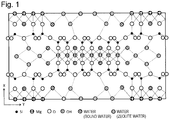
- Figure 1 is a schematic diagram of the crystal structure of the fibrous inorganic clay mineral which is sepiolite in Figure 1 . The diagram relies on to the structural model of Brauner and Preisinger; see also Japanese Patent Laid-Open No. 2004-59347 , Japanese Patent Laid-Open No. 2002-338236 .
- the fibrous mineral is a kind of a hydrous magnesium silicate mineral and is a fibrous clay mineral having such crystal structure as shown in Figure 1 and being characterized in that pores are present inside the crystal, and in the pores, water of crystallization is present in the form of bound water or zeolite water.
- the two-dimensional crystal structure forms fibrous crystal structure wherein bricks are alternately stacked.
- this unit crystal structure four hydroxyl groups bonded to Mg atoms, four bound water bonded to Mg atoms, and eight zeolite water are present, as shown in Figure 1.
- Figure 1 indicates that the number of zeolite water in the unit structure is considered to be 8.
- the fibrous mineral preferably has a specific surface area of 50 to 500 m 2 /g, a fiber length of 0.1 to 50 ⁇ m, and an aspect ratio, as represented by fiber length/fiber diameter, of 0.1 to 5000, though they vary depending upon the type of the fibrous mineral.
- the specific surface area is a value measured in accordance with BET method and JIS Z8830:2013.
- Typical examples of the fibrous minerals include, but are not limited to, sepiolite ((OH 2 ) 4 (OH) 4 Mg 8 Si 12 O 30 ⁇ 6-8H 2 O), palygorskite (attapulgite; (OH 2 ) 4 (OH) 2 Mg 5 Si 8 O 20 ⁇ 4H 2 O), wollastonite, and loglinite.
- sepiolite (OH 2 ) 4 (OH) 4 Mg 8 Si 12 O 30 ⁇ 6-8H 2 O)
- the water content of the fibrous mineral may preferably be 7% or more, and more preferably 9% or more.
- the upper limit of the water content is not particularly limited, but may preferably be, for example, 30% or less.
- the amount of the fibrous mineral used in the composition may preferably be 0.1 to 20 parts by mass, and more preferably 3 to 15 parts by mass, based on 100 parts by mass of the total of the calcium aluminate and the gypsum. If the amount of the fibrous mineral is less than 0.1 part by mass, there is a possibility that fire resistance and heat insulation properties may not be enhanced, and if the amount thereof exceeds 20 parts by mass, there is a possibility that fire resistance and heat insulation properties may be lowered.
- the fibrous mineral may be used by premixing it with calcium aluminate and gypsum, or may be used by dispersing it in water in advance.
- the composition may further contain an inorganic powder having pores (also referred to as "inorganic powder” simply hereinafter).
- the inorganic powder is not particularly limited as long as it is a powder of an inorganic material having pores, and any of such powders is employable.
- the inorganic powders may include an inorganic powder obtained from a foam prepared by heating volcanic deposits at a high temperature, which is typified by Shirasu balloon, fly ash balloon generated from a thermal power plant, an inorganic powder obtained by calcining obsidian, perlite or shale, and a waste glass foam powder (recycled glass balloon) obtained by crushing a waste such as a glass bottle, then calcining the crushed waste and subjecting it to particle size adjustment, and one or more of these are employable.
- fly ash balloon one having an ignition loss of 5% or less is preferably used from the viewpoint of small amount of unburned carbon.
- the inorganic powder is an inorganic powder other than the aforesaid calcium aluminate, gypsum and fibrous inorganic clay mineral.
- an average particle size thereof may preferably be 1 to 150 ⁇ m, and more preferably 15 to 100 ⁇ m.
- the average particle size is a value measured using a measuring laser diffraction type particle size distribution meter in a state where the powder has been dispersed by an ultrasonic device.
- the amount of the inorganic powder used in the composition may preferably be 2 to 100 parts by mass, and more preferably 5 to 80 parts by mass, based on 100 parts by mass of the total of the calcium aluminate and the gypsum.
- the amount of the inorganic powder is 2 parts by mass or more, heat insulation properties are enhanced, and when the amount thereof is 100 parts by mass or less, fire resistance is enhanced.
- the composition may further contain a setting retarder.
- the setting retarder is a substance to adjust a usable time of the fire-resistant heat-insulation composition slurry.
- the setting retarders include inorganic setting retarders and organic setting retarders.
- the inorganic setting retarders include salts of phosphoric acid, silicofluoride, copper hydroxide, boric acid or its salt, zinc oxide, zinc chloride, and zinc carbonate.
- organic setting retarders examples include oxycarboxylic acids (citric acid, gluconic acid, malic acid, tartaric acid, glucoheptonic acid, oxymalonic acid, lactic acid, etc.) or salts thereof (sodium salt, potassium salt, etc.), and saccharides typified by sugar. One or more of these are employable. Also, mixtures of combinations of the inorganic setting retarders, such as carbonate, bicarbonate, nitrate, hydroxide and silicate, and the above oxycarboxylic acids or their salts may be used.
- the setting retarder is a setting retarder other than the aforesaid calcium aluminate, gypsum, fibrous inorganic clay mineral and inorganic powder having pores.
- the amount of the setting retarder used in the composition may preferably be 0.02 to 2.0 parts by mass, and more preferably 0.05 to 1.0 part by mass, based on 100 parts by mass of the total of the calcium aluminate and the gypsum.
- the amount of the setting retarder is 0.02 part by mass or more, adjustment to a necessary usable time is facilitated, and when the amount thereof is 2.0 parts by mass or less, the hardening time does not become too long, and poor hardening does not easily occur.
- the composition may further contain a hydration accelerator.
- the hydration accelerator is a substance that accelerates reaction of calcium aluminate with gypsum to increase the amount of water of crystallization, thereby enhancing fire resistance, and is not particularly limited.
- the hydration accelerators include a hydroxide such as calcium hydroxide, an alkali metal silicate, aluminum sulfate such as anhydrous aluminum sulfate, an alkali metal carbonate such as sodium carbonate, a nitrate, a nitrite, various Portland cement such as ordinary Portland cement, and various inorganic filler fine powders, and one or more of these are employable.
- the hydration accelerator is a hydration accelerator other than the aforesaid calcium aluminate, gypsum, fibrous inorganic clay mineral, inorganic powder having pores and setting retarder.
- the amount of the hydration accelerator used in the composition is preferably 0.1 to 15 parts by mass, and more preferably 0.5 to 10 parts by mass, based on 100 parts by mass of the total of the calcium aluminate and the gypsum.
- the amount of the hydration accelerator is 0.1 part by mass or more, a sufficient hydration acceleration effect is obtained, and when the amount thereof is 15 parts by mass or less, an effect of securing a sufficient usable time is exerted.
- a fire-resistant heat-insulation composition slurry may be prepared.
- the amount of water for preparing the slurry is not particularly limited, but may preferably be 40 to 300 parts by mass, and more preferably 80 to 250 parts by mass, based on 100 parts by mass of the total of the calcium aluminate and the gypsum.
- the amount of water is 40 parts by mass or more, the filling of voids becomes homogeneous, and the fire resistance is enhanced, and when the amount thereof is 300 parts by mass or less, the ettringite content in the hardened body in the void increases, and the fire resistance is enhanced.
- a fire-resistant heat-insulation board By filling voids of a resin molded body having a continuous void ratio of 25 to 70 vol% (also referred to as "resin molded body” simply hereinafter) with the fire-resistant heat-insulation composition slurry according to an embodiment of the present invention and solidifying the slurry, a fire-resistant heat-insulation board may be produced.
- the resin molded body is a resin having continuous voids and refers to one having voids capable of being filled with the slurry. Examples of types of the resins include an expanded polyvinyl alcohol resin, an expanded polyurethane resin, an expanded polystyrene resin, an expanded polyolefin resin, and an expanded phenolic resin.
- the resin molded body is obtained.
- the continuous void ratio of the resin molded body may be adjusted by the degree of pressurization during the production.
- the resin molded body having continuous voids may be produced in accordance with a method for producing a bead method polystyrene foam.
- an expanded polystyrene resin molded body is preferable from the viewpoint of versatility.
- the continuous void ratio of the resin molded body can be determined by, for example, the following method.
- a rectangular parallelepiped sample is cut out from a thermoplastic resin foamed particle molded body having been allowed to stand for 24 hours or longer in an environment of the temperature of 23°C and the relative humidity of 50%, and an apparent volume Va [cm 3 ] is determined from external dimensions of the sample.
- the sample is sunk in a measuring cylinder containing ethanol of 23°C using a tool such as a wire cloth, and slight vibration or the like is applied to the sample to remove air present in the voids of the molded body.
- a true volume Vb [cm 3 ] of the sample which is read out from a water level rise taking into consideration a volume of the tool such as a wire cloth, is measured.
- the slurry filled in the continuous voids undergoes hydration reaction to produce a hydration product, and the product is hardened.
- the continuous voids in the resin molded body are filled with the hydration product.
- the hydration product is, for example, ettringite formed by the reaction of calcium aluminate with gypsum. Since ettringite has a large amount of water as water of crystallization in molecules, it is dehydrated by heating, exhibits fire extinguishing action, and imparts incombustibility to the resin molded body. In the embodiment of the present invention, ettringite is actively produced by using calcium aluminate having a CaO content of 34% or more, and enhances incombustibility of the resin molded body.
- Examples of methods for filling the resin molded body with the fire-resistant heat-insulation composition slurry include, but are not limited to, a method of injecting the slurry with compressed air or sucking the slurry by reducing the pressure with a vacuum pump to perform filling, and a method of filling the voids while applying vibration of 30 to 60 Hz to the resin molded body set on a vibration table.
- a method of filling the voids while applying vibration is preferable from the viewpoint of quality stability.
- a method for curing the fire-resistant heat-insulation board after filling of voids with the fire-resistant heat-insulation composition slurry is not particularly limited, but is, for example, a method of air-curing the board at ordinary temperature after filling or a method of coating the board surface with a plastic film and air-curing it at ordinary temperature.
- the fire-resistant heat-insulation board may be cured at a temperature of 30 to 50°C.
- the whole board may be further coated with a non-woven fabric, or a reinforcing material such as a lattice-like fiber sheet may be arranged on one or both surfaces of the board, or a non-woven fabric and a fiber sheet may be used in combination.
- a reinforcing material such as a lattice-like fiber sheet may be arranged on one or both surfaces of the board, or a non-woven fabric and a fiber sheet may be used in combination.
- the shape of the fire-resistant heat-insulation board of the present invention is not particularly limited, but the board may preferably have a length of 500 to 1000 mm, a width of 1000 to 2000 mm, and a thickness of 10 to 100 mm. The thickness may more preferably be 50 to 100 mm. When the size is small, the fire-resistant heat-insulation board becomes lightweight, and workability during setting is improved.
- one or more of various additives may be used as long as they have no influence on performance.
- additives include a surfactant, an air entraining agent, a carbonization accelerator, a flame retardant, a fire spread preventing agent, an inorganic substance, a rust preventive, an antifreezing agent, a shrinkage reducing agent, a clay mineral and an anion exchanger.
- the density of the fire-resistant heat-insulation board according to the embodiment of the present invention is preferably 100 to 800 kg/m 3 , and more preferably 200 to 500 kg/m 3 , from the viewpoint that the fire resistance and the heat insulation properties are not impaired.
- the density is 100 kg/m 3 or more, sufficient fire resistance can be secured, and when the density is 800 kg/m 3 or less, sufficient heat insulation properties are obtained.
- a fire-resistant structure of a building can be constructed.
- a fire-resistant structure is, for example, a structure which consists of layers of a siding board, a moisture-permeable waterproof sheet, the fire-resistant heat-insulation board, structural plywood and a reinforced gypsum board arranged in this order when shown by layer construction from the exterior wall side and in which a space (i.e., space for placing therein a heat-insulation material such as glass wool) of about 100 mm is provided between the structural plywood and the reinforced gypsum board by means of studs.
- a space i.e., space for placing therein a heat-insulation material such as glass wool
- a fire-resistant heat-insulation structure including the fire-resistant heat-insulation board is obtained.
- a plurality of the fire-resistant heat-insulation boards may be piled up one upon another and bonded to one another, or the fire-resistant heat-insulation board may be used together with a reinforced gypsum board, depending upon the fireproof specifications required.
- the lower part of a foamed resin molded body (size: length 20 cm ⁇ width 20 cm ⁇ thickness 5 cm) having continuous voids was reinforced with alkali-resistant glass fibers, and a polyester non-woven fabric was further superposed thereon.
- the fire-resistant heat-insulation board was taken out from the device and cured at ordinary temperature for 3 days.
- the content of water of crystallization, fire resistance, shape retention, the shape retention ratio and the thermal conductivity were evaluated. The results are set forth in Table 1.
- Foamed resin molded body A The molded body was produced by filling a molding machine (manufactured by DAISEN INDUSTRY Co., Ltd., VS-500) with commercial polystyrene expanded beads (diameter: 1 to 5 mm) and heating the beads by steam to fusion-bond foamed particles to one another in a state where there were voids among the foamed particles.
- the continuous void ratio was controlled by adjusting the degree of pressurization. continuous void ratio: 36.8%, density of polystyrene expanded beads molded body: 10.5 kg/m 3 , thermal conductivity of polystyrene expanded beads molded body: 0.033 W/ (m ⁇ K)
- CA1 Calcium aluminate 1
- CA1 amorphous calcium aluminate obtained by adjusting compounding ratios to CAO: 43% and Al 2 O 3 : 53% and subjecting them to melting and quenching by an electric furnace; vitrification ratio: 98% or more, Blaine specific surface area: 6050 cm 2 /g
- CA2 Calcium aluminate 2
- CaO 36%
- vitrification ratio 15%
- Blaine specific surface area 4570 cm 2 /g
- CA3 Calcium aluminate 3
- CaO 37%
- vitrification ratio 12%
- Blaine specific surface area 3500 cm 2 /g
- Calcium aluminate 4 (CA4): Denka High Alumina Cement manufactured by Denka Company Limited, CaO: 26%, vitrification ratio: 13%
- Ettringite 1 (ET1): ettringite powder obtained by using slaked lime, aluminum sulfate and gypsum as staring raw materials, and by performing hydrothermal synthesis and subjecting the resulting product to filtration and drying; ratio of water of crystallization: 46%
- Gypsum 1 II type anhydrous gypsum manufactured by Noritake Co., Limited, trade name: D-101A, purity: 95%, average particle size 20 ⁇ m
- Gypsum 2 (CS2): ⁇ type hemihydrate gypsum manufactured by Noritake Co., Limited, trade name: FT-2, purity: 95%, average particle size 20 ⁇ m
- Gypsum 3 dihydrate gypsum manufactured by Noritake Co., Limited, trade name: P52B, purity: 95%, average particle size: 20 ⁇ m
- Fibrous mineral (F1) sepiolite manufactured by TOLSA, trade name: PANGEL AD, water content: 13.2%, fiber length: 5 ⁇ m, fiber diameter: 0.1 ⁇ m, specific surface area: 270 m 2 /g
- Fibrous mineral (F3) wollastonite manufactured by KANSAI MATEC CO., LTD., trade name: KTP-H02, water content: 2.0%, fiber length: 75 ⁇ m, fiber diameter: 10 ⁇ m, specific surface area: 4200 cm 2 /g
- Non-fibrous mineral (N1) bentonite manufactured by KUNIMINE INDUSTRIES CO. LTD., trade name: KUNIGEL V1, the ratio of water of crystallization: 3.5%, specific surface area: 60 m 2 /g
- gypsum was added in the amount shown in Table 1 to prepare a mixture, then to 100 parts by mass of the mixture, a fibrous mineral of the type and the amount shown in Table 1 and 100 parts by mass of water were added, and they were stirred for 5 minutes to prepare a slurry.
- the prepared slurry was poured onto the upper surface of the foamed resin molded body in an amount of 810 cm 3 (i.e., 1.1 times the void volume of the resin molded body).
- synthetic ettringite 100 parts by mass of the synthetic ettringite were mixed with a predetermined amount of a fibrous mineral to prepare a mixture, then to 100 parts by mass of the mixture, 100 parts by mass of water were added, and they were stirred for 5 minutes to prepare a slurry.
- the water of crystallization in the present specification refers to water contained in the fire-resistant heat-insulation board and chemically or physically bonded thereto, except free water capable of being removed by drying of acetone or the like.
- Fire resistance Reaction-to-fire tests by a cone calorimeter shown in ISO-5660-1:2002 were carried out, and fire resistance was simply evaluated. It is preferable that the gross calorific value, as measured under the conditions of a heating time of 20 minutes using a specimen having length 10 cm ⁇ width 10 cm ⁇ thickness 5 cm, be 8 MJ/m 2 or less because the specimen has fire resistance (incombustibility).
- Thermal conductivity Using a specimen having length 10 cm ⁇ width 5 cm ⁇ thickness 5 cm obtained from the fire-resistant heat-insulation board, a thermal conductivity was measured by a quick thermal conductivity meter (box type probe method).
- Shape retention A specimen was subjected to a combustion test by a cone calorimeter, then a case where the specimen was free from crack, breakage, collapse, defective part and shrinkage was evaluated as circle (OK), and a case where the specimen had been confirmed to have crack, breakage, collapse and defective part was evaluated as X-mark (NG).
- Shape retention ratio A shape retention ratio was measured by comparing a volume of a specimen after a combustion test by a cone calorimeter with a volume of the specimen before the test.
- CA type CS part(s) by mass
- F part(s) by mass
- Amount of water of crystallization % Fire resistance (MJ/m 2 )
- Shape retention Shape retention ratio %) Thermal conductivity (W/mK) Remarks 1-1 CA1 CS1 100 - 0 32.0 8.9 ⁇ unmeasurable 0.088 Comparative Example 1-2 CA1 CS1 100 F1 7 36.0 3.9 ⁇ 96.8 0.049
- Example 1-3 CA1 CS2 100 F1 7 35.2 4.3 ⁇ 96.5 0.051
- Example 1-4 CA1 CS3 100 F1 7 35.0 4.4 ⁇ 96.4 0.055
- Example 1-5 CA2 CS1 100 F1 7 34.0 6.5 ⁇ 97.0 0.058
- Example 1-6 CA3 CS1 100 F1 7 33.0 6.8 ⁇ 95.6
- the amount of gypsum (CS) is an amount in terms of part(s) by mass based on 100 parts by mass of calcium aluminate (CA).
- the amount of the fibrous mineral (F) is an amount in terms of part(s) by mass based on 100 parts by mass of the mixture of calcium aluminate (CA) and gypsum (CS).
- Inorganic powder 1 (P1): Shirasu balloon manufactured by AXYZ Chemical Co. Ltd., trade name: MSB-301, average particle size: 50 ⁇ m
- Inorganic powder 2 (P2): Shirasu balloon manufactured by AXYZ Chemical Co. Ltd., trade name: ISM-F015, average particle size: 22 ⁇ m
- Inorganic powder 3 Shirasu balloon manufactured by AXYZ Chemical Co. Ltd., trade name: MSB-5011, average particle size: 96 ⁇ m
- Inorganic powder 4 fly ash balloon manufactured by TOMOE Engineering Co., Ltd., trade name: Cenolite SA, average particle size: 80 ⁇ m
- Inorganic powder 5 (P5): waste glass foam powder manufactured by DENNERT PORAVER GMBH, trade name: Poraver (0.04-0.125 mm particle size product, average particle size: 90 ⁇ m [Table 2]
- Experiment No. P (part(s) by mass) Amount of water of crystallization (%) Fire resistance (MJ/m 2 ) Shape retention Shape retention ratio (%) Thermal conductivity (W/m K) Remarks 1-9 - 0 36.5 3.7 ⁇ 97.1 0.046
- Example 2-1 15 35.0 4.7 ⁇ 99.1 0.042
- Example 2-2 P2 15 35.2 4.8 ⁇ 99.2 0.042
- Example 2-3 P3 15 35.1 5.0 ⁇ 98.9 0.043
- Example 2-5 P5 15 35.1 4.9 ⁇ 99.2 0.043
- Example 2-6 P1 2 36.2 4.4 ⁇ 97.8 0.045
- Example 2-7 P1 5 35
- the amount of the inorganic powder (P) is an amount in terms of part(s) by mass based on 100 parts by mass of the mixture of calcium aluminate (CA) and gypsum (CS).
- R1 first grade reagent sodium citrate Setting retarder
- R2 first grade reagent tartaric acid Setting retarder
- R3 first grade reagent sodium gluconate
- the amount of the setting retarder (R) is an amount in terms of part(s) by mass based on 100 parts by mass of the mixture of calcium aluminate (CA) and gypsum (CS).
- ACC1 Hydration accelerator 1
- ACC2 Hydration accelerator 2 (ACC2): ordinary Portland cement manufactured by Denka Company Limited
- ACC3 Hydration accelerator 3
- ACC4 Hydration accelerator 4 (ACC4): first grade reagent anhydrous aluminum sulfate [Table 4] Experiment No. ACC (part(s) by mass) Gelation time (min) Amount of water of crystallization (%) Fire resistance (MJ/m 2 ) Shape retention Shape retention ratio (%) Thermal conductivity (W/mK) Remarks 3-4 - 0 60 36.0 3.9 ⁇ 96.8 0.047
- Example 4-1 ACC1 5 30 38.2 3.6 ⁇ 97.6 0.046
- Example 4-2 ACC2 5 45 38.0 3.6 ⁇ 97.3 0.046
- Example 4-5 ACC1 0.1 60 36.5 3.8 ⁇ 97.2 0.047
- Example 4-7 ACC1 3 50 37.6 3.7 ⁇ 97.5 0.047
- Example 4-8 ACC1
- the amount of the hydration accelerator (ACC) is an amount in terms of part(s) by mass based on 100 parts by mass of the mixture of calcium aluminate (CA) and gypsum (CS) .
- the amount of water is an amount in terms of part(s) by mass based on 100 parts by mass of the mixture of calcium aluminate (CA) and gypsum (CS).
- Foamed resin molded body B The molded body was produced by filling a molding machine (manufactured by DAISEN INDUSTRY Co., Ltd., VS-500) with commercial polystyrene expanded beads (diameter: 1 to 5 mm) and heating the beads by steam to fusion-bond foamed particles to one another in a state where there were voids among the foamed particles.
- the continuous void ratio was controlled by adjusting the degree of pressurization. Continuous void ratio: 25.3%, density of polystyrene expanded beads molded body: 10.5 kg/m 3 , thermal conductivity of polystyrene expanded beads molded body: 0.033 W/m ⁇ K
- Foamed resin molded body C The molded body was produced by filling a molding machine (manufactured by DAISEN INDUSTRY Co., Ltd., VS-500) with commercial polystyrene expanded beads (diameter: 1 to 5 mm) and heating the beads by steam to fusion-bond foamed particles to one another in a state where there were voids among the foamed particles.
- the continuous void ratio was controlled by adjusting the degree of pressurization. continuous void ratio: 43.9%, density of polystyrene expanded beads molded body: 10.5 kg/m 3 , thermal conductivity of polystyrene expanded beads molded body: 0.033 W/m ⁇ K
- Foamed resin molded body D The molded body was produced by filling a molding machine (manufactured by DAISEN INDUSTRY Co., Ltd., VS-500) with commercial polystyrene expanded beads (diameter: 1 to 5 mm) and heating the beads by steam to fusion-bond foamed particles to one another in a state where there were voids among the foamed particles.
- the continuous void ratio was controlled by adjusting the degree of pressurization. continuous void ratio: 58.7%, density of polystyrene expanded beads molded body: 10.5 kg/m 3 , thermal conductivity of polystyrene expanded beads molded body: 0.033 W/m ⁇ K
- Foamed resin molded body E The molded body was produced by filling a molding machine (manufactured by DAISEN INDUSTRY Co., Ltd., VS-500) with commercial polystyrene expanded beads (diameter: 1 to 5 mm) and heating the beads by steam to fusion-bond foamed particles to one another in a state where there were voids among the foamed particles.
- the continuous void ratio was controlled by adjusting the degree of pressurization. continuous void ratio: 69.4%, density of polystyrene expanded beads molded body: 10.5 kg/m 3 , thermal conductivity of polystyrene expanded beads molded body: 0.033 W/m ⁇ K [Table 6] Experiment No.
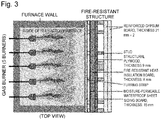
- Fire-resistant heat-insulation boards (length 1000 mm ⁇ width 1000 mm ⁇ thickness 25 mm) were prepared from fire-resistant heat-insulation compositions of Experiments No. 1-7, 1-9 and 4-1, and they were each assembled so as to form a fire-resistant structure shown in Figures 2 and 3 , and the fire-resistant structure was set in a refractory furnace. The size of the fire-resistant structure was adjusted to width 2200 mm ⁇ length 1200 mm. The test was carried out by changing the type and the thickness of the fire-resistant heat-insulation composition of the fire-resistant heat-insulation board, and the state of combustion of the fire-resistant structure after the test was confirmed. Change of the thickness was carried out by changing the number of boards set. The results are set forth in Table 7.
- the fire-resistant structure was set in a refractory furnace, and heating was carried out on the side of the siding board simulating an exterior wall, that is, flames from gas burners (five in total) were applied to heat the fire-resistant structure for 1 hour in accordance with a standard heating curve based on ISO 834. Thereafter, heating was terminated, and the state where the fire-resistant structure had been set in the refractory furnace was kept for 3 hours. The structure was removed from the refractory furnace, and the siding board on the heating side was peeled off to confirm the combustion state. [Table 7] Experiment No.
- the thickness of the fire-resistant heat-insulation board corresponds to the thickness X in Figure 3 .
- a fire-resistant heat-insulation board having fire resistance and heat insulation properties can be obtained.
- a structure such as a wall or a pillar is constructed by using the board, the structure can retain its shape even if it is exposed to a flame, so that the structure has an effect of inhibiting spread of fire in case of fire.
- the embodiment of the present invention can contribute to construction of buildings, vehicles, aircrafts, ships, freezing facilities and refrigerating facilities having high fire safety.
Landscapes
- Chemical & Material Sciences (AREA)
- Engineering & Computer Science (AREA)
- Ceramic Engineering (AREA)
- Structural Engineering (AREA)
- Architecture (AREA)
- Materials Engineering (AREA)
- Organic Chemistry (AREA)
- Physics & Mathematics (AREA)
- Civil Engineering (AREA)
- Chemical Kinetics & Catalysis (AREA)
- Electromagnetism (AREA)
- Inorganic Chemistry (AREA)
- Acoustics & Sound (AREA)
- Health & Medical Sciences (AREA)
- Medicinal Chemistry (AREA)
- Polymers & Plastics (AREA)
- Dispersion Chemistry (AREA)
- Building Environments (AREA)
- Curing Cements, Concrete, And Artificial Stone (AREA)
Applications Claiming Priority (2)
| Application Number | Priority Date | Filing Date | Title |
|---|---|---|---|
| JP2018248463 | 2018-12-28 | ||
| PCT/JP2019/050394 WO2020137987A1 (fr) | 2018-12-28 | 2019-12-23 | Composition d'isolation thermique résistant au feu, suspension de composition d'isolation thermique résistant au feu, panneau d'isolation thermique résistant au feu et structure d'isolation thermique résistant au feu |
Publications (3)
| Publication Number | Publication Date |
|---|---|
| EP3904308A1 true EP3904308A1 (fr) | 2021-11-03 |
| EP3904308A4 EP3904308A4 (fr) | 2022-02-23 |
| EP3904308B1 EP3904308B1 (fr) | 2023-07-05 |
Family
ID=71127258
Family Applications (1)
| Application Number | Title | Priority Date | Filing Date |
|---|---|---|---|
| EP19905785.2A Active EP3904308B1 (fr) | 2018-12-28 | 2019-12-23 | Composition d'isolation thermique résistant au feu, suspension de composition d'isolation thermique résistant au feu, panneau d'isolation thermique résistant au feu et structure d'isolation thermique résistant au feu |
Country Status (6)
| Country | Link |
|---|---|
| US (1) | US20220017421A1 (fr) |
| EP (1) | EP3904308B1 (fr) |
| JP (1) | JPWO2020137987A1 (fr) |
| CN (1) | CN113242842A (fr) |
| CA (1) | CA3124927A1 (fr) |
| WO (1) | WO2020137987A1 (fr) |
Families Citing this family (4)
| Publication number | Priority date | Publication date | Assignee | Title |
|---|---|---|---|---|
| CN112521058A (zh) * | 2020-11-19 | 2021-03-19 | 中猫科技有限公司 | 蜂巢结构陶瓷保温绝热复合材料及其制造方法 |
| JP7750778B2 (ja) * | 2022-03-15 | 2025-10-07 | 鹿島建設株式会社 | 水硬性硬化体の製造方法および炭酸化養生用セメント組成物 |
| CN115448675B (zh) * | 2022-09-16 | 2023-05-09 | 河南安筑新材料科技有限公司 | 一种漂珠耐火隔热复合板及其制备方法 |
| CN121406175B (zh) * | 2025-12-29 | 2026-03-24 | 湖北科郢新材料科技有限公司 | 一种功能填料及其制备方法、防火隔热涂料和应用 |
Family Cites Families (16)
| Publication number | Priority date | Publication date | Assignee | Title |
|---|---|---|---|---|
| JPS6241774A (ja) | 1985-08-15 | 1987-02-23 | 株式会社アスク | 不焼成耐火断熱材 |
| JPH0615420B2 (ja) * | 1987-05-29 | 1994-03-02 | ニチアス株式会社 | 湿式吹付材 |
| JP3382673B2 (ja) | 1993-08-02 | 2003-03-04 | 電気化学工業株式会社 | 吹付け耐火被覆材 |
| JP3181152B2 (ja) * | 1993-08-23 | 2001-07-03 | スチライト工業株式会社 | 耐火被覆用組成物 |
| JP3543277B2 (ja) | 1993-11-08 | 2004-07-14 | 電気化学工業株式会社 | 硬化性組成物 |
| JPH1067576A (ja) | 1996-08-26 | 1998-03-10 | Denki Kagaku Kogyo Kk | 断熱材料、その製造方法、及びそれを用いた施工方法 |
| JP2001329629A (ja) | 2000-05-24 | 2001-11-30 | Hitachi Chem Co Ltd | 断熱性被覆粒体 |
| JP2002338236A (ja) | 2001-01-30 | 2002-11-27 | Mizusawa Ind Chem Ltd | オルガノポリシロキサン・鎖状粘土鉱物錯体及び用途 |
| JP4344510B2 (ja) | 2002-07-25 | 2009-10-14 | 水澤化学工業株式会社 | 鎖状粘土鉱物錯体及び用途 |
| FR2900653B1 (fr) * | 2006-05-05 | 2008-09-26 | Univ Sud Toulon Var | Composition pour la fabrication de materiaux pour isolation thermique et protection incendie, procede pour obtenir un materiau, et materiau obtenu par le procede |
| KR101462324B1 (ko) * | 2010-01-07 | 2014-11-14 | 니찌아스 카부시키카이샤 | 무기 섬유질 내화 성형체, 무기 섬유질 내화 성형체의 제조 방법 및 무기 섬유질 부정형 내화 조성물 |
| WO2011108700A2 (fr) * | 2010-03-05 | 2011-09-09 | ニチアス株式会社 | Article réfractaire moulé, procédé de fabrication d'un article réfractaire moulé et élément permettant un coulage de métaux |
| JP4983967B2 (ja) | 2010-08-05 | 2012-07-25 | 金山化成株式会社 | 発泡樹脂複合構造体およびその製造方法 |
| JP2012102305A (ja) | 2010-11-05 | 2012-05-31 | Hironori Hatano | 無機物含有合成樹脂発泡体とその製造方法 |
| JP6393650B2 (ja) | 2014-03-31 | 2018-09-19 | 株式会社ジェイエスピー | 複合成形体 |
| JP6556017B2 (ja) * | 2015-10-21 | 2019-08-07 | デンカ株式会社 | 組成物及び不燃材 |
-
2019
- 2019-12-23 WO PCT/JP2019/050394 patent/WO2020137987A1/fr not_active Ceased
- 2019-12-23 CN CN201980082634.7A patent/CN113242842A/zh active Pending
- 2019-12-23 EP EP19905785.2A patent/EP3904308B1/fr active Active
- 2019-12-23 CA CA3124927A patent/CA3124927A1/fr active Pending
- 2019-12-23 JP JP2020563258A patent/JPWO2020137987A1/ja not_active Ceased
- 2019-12-23 US US17/311,531 patent/US20220017421A1/en not_active Abandoned
Also Published As
| Publication number | Publication date |
|---|---|
| CN113242842A (zh) | 2021-08-10 |
| EP3904308A4 (fr) | 2022-02-23 |
| JPWO2020137987A1 (fr) | 2020-07-02 |
| WO2020137987A1 (fr) | 2020-07-02 |
| US20220017421A1 (en) | 2022-01-20 |
| CA3124927A1 (fr) | 2020-07-02 |
| EP3904308B1 (fr) | 2023-07-05 |
Similar Documents
| Publication | Publication Date | Title |
|---|---|---|
| EP3904308B1 (fr) | Composition d'isolation thermique résistant au feu, suspension de composition d'isolation thermique résistant au feu, panneau d'isolation thermique résistant au feu et structure d'isolation thermique résistant au feu | |
| TWI706074B (zh) | 石膏內芯及用於製作彼之漿料 | |
| EP3245175B1 (fr) | Plaque coupe-feu et procédé de fabrication de ladite plaque coupe-feu | |
| KR101731666B1 (ko) | 세포성 인산염 세라믹, 그 제조 방법 및 용도 | |
| Liu et al. | Fabrication and properties of foam geopolymer using circulating fluidized bed combustion fly ash | |
| WO2021067920A1 (fr) | Ciment géopolymère | |
| KR20100079863A (ko) | 마감성을 보유한 고강도 콘크리트시멘트계 고밀도 내화피복재 조성물 | |
| TW201518074A (zh) | 含有矽膠之石膏製品 | |
| JP6953171B2 (ja) | 不燃性建材及び不燃断熱性建材 | |
| JP6681272B2 (ja) | 組成物及び不燃材 | |
| EP4116279A1 (fr) | Panneau d'isolation thermique ignifuge et corps structural d'isolation thermique ignifuge | |
| KR20230046943A (ko) | 팽창 펄라이트를 이용한 불연 건축용 패널의 조성물 | |
| AU2014201626B2 (en) | Lightweight, Reduced Density Fire Rated Gypsum Panels | |
| JP6556017B2 (ja) | 組成物及び不燃材 | |
| JP7551064B2 (ja) | 耐火断熱組成物、耐火断熱組成物スラリー、耐火断熱ボード及び耐火断熱構造体 | |
| WO2022004750A1 (fr) | Composition d'isolation résistante au feu, suspension de composition d'isolation résistante au feu, panneau d'isolation résistant au feu et corps de structure d'isolation résistant au feu | |
| JP6681273B2 (ja) | 組成物及び不燃材 | |
| JP2024172438A (ja) | 耐火断熱ボード、耐火断熱構造体 | |
| JP2024172439A (ja) | 耐火断熱ボード、耐火断熱構造体 | |
| JP2024142045A (ja) | 材料、耐火材、耐火断熱ボード、構造体 | |
| JP2024172440A (ja) | 耐火断熱ボード、耐火断熱構造体 | |
| CHOKKHA et al. | Fabrication of porous geopolymers utilizing aluminum wastes as foaming agent | |
| JP2023146922A (ja) | 耐火断熱組成物、耐火断熱組成物スラリー、耐火断熱板及び耐火断熱構造体 | |
| KR800000415B1 (ko) | 입상내화물(造粒耐火物)의 제조방법 | |
| JP2004182485A (ja) | 水硬性材料および水硬性硬化体並びにその製造方法 |
Legal Events
| Date | Code | Title | Description |
|---|---|---|---|
| STAA | Information on the status of an ep patent application or granted ep patent |
Free format text: STATUS: THE INTERNATIONAL PUBLICATION HAS BEEN MADE |
|
| PUAI | Public reference made under article 153(3) epc to a published international application that has entered the european phase |
Free format text: ORIGINAL CODE: 0009012 |
|
| STAA | Information on the status of an ep patent application or granted ep patent |
Free format text: STATUS: REQUEST FOR EXAMINATION WAS MADE |
|
| 17P | Request for examination filed |
Effective date: 20210707 |
|
| AK | Designated contracting states |
Kind code of ref document: A1 Designated state(s): AL AT BE BG CH CY CZ DE DK EE ES FI FR GB GR HR HU IE IS IT LI LT LU LV MC MK MT NL NO PL PT RO RS SE SI SK SM TR |
|
| A4 | Supplementary search report drawn up and despatched |
Effective date: 20220120 |
|
| RIC1 | Information provided on ipc code assigned before grant |
Ipc: C04B 111/28 20060101ALN20220114BHEP Ipc: C08J 9/36 20060101ALI20220114BHEP Ipc: C04B 28/06 20060101ALI20220114BHEP Ipc: E04B 1/94 20060101ALI20220114BHEP Ipc: E04B 1/80 20060101ALI20220114BHEP Ipc: E04B 1/76 20060101ALI20220114BHEP Ipc: C04B 38/08 20060101ALI20220114BHEP Ipc: C04B 28/08 20060101ALI20220114BHEP Ipc: C04B 24/06 20060101ALI20220114BHEP Ipc: C04B 22/14 20060101ALI20220114BHEP Ipc: C04B 22/10 20060101ALI20220114BHEP Ipc: C04B 22/08 20060101ALI20220114BHEP Ipc: C04B 22/06 20060101ALI20220114BHEP Ipc: C04B 14/10 20060101AFI20220114BHEP |
|
| DAV | Request for validation of the european patent (deleted) | ||
| DAX | Request for extension of the european patent (deleted) | ||
| GRAP | Despatch of communication of intention to grant a patent |
Free format text: ORIGINAL CODE: EPIDOSNIGR1 |
|
| STAA | Information on the status of an ep patent application or granted ep patent |
Free format text: STATUS: GRANT OF PATENT IS INTENDED |
|
| RIC1 | Information provided on ipc code assigned before grant |
Ipc: C04B 111/28 19950101ALN20230110BHEP Ipc: C08J 9/40 19740701ALI20230110BHEP Ipc: C04B 28/06 19850101ALI20230110BHEP Ipc: E04B 1/94 19680901ALI20230110BHEP Ipc: E04B 1/80 19680901ALI20230110BHEP Ipc: E04B 1/76 19680901ALI20230110BHEP Ipc: C04B 38/08 19850101ALI20230110BHEP Ipc: C04B 28/14 19850101ALI20230110BHEP Ipc: C04B 14/10 19850101AFI20230110BHEP |
|
| INTG | Intention to grant announced |
Effective date: 20230203 |
|
| RIC1 | Information provided on ipc code assigned before grant |
Ipc: C04B 111/28 20060101ALN20230123BHEP Ipc: C08J 9/40 20060101ALI20230123BHEP Ipc: C04B 28/06 20060101ALI20230123BHEP Ipc: E04B 1/94 20060101ALI20230123BHEP Ipc: E04B 1/80 20060101ALI20230123BHEP Ipc: E04B 1/76 20060101ALI20230123BHEP Ipc: C04B 38/08 20060101ALI20230123BHEP Ipc: C04B 28/14 20060101ALI20230123BHEP Ipc: C04B 14/10 20060101AFI20230123BHEP |
|
| RIN1 | Information on inventor provided before grant (corrected) |
Inventor name: SHIMOJO, YOSHINORI Inventor name: MITSUMOTO, MASANORI Inventor name: MIZUTA, KOHEI Inventor name: NAGASAKI, HIRONORI Inventor name: TABARA, KAZUTO |
|
| GRAS | Grant fee paid |
Free format text: ORIGINAL CODE: EPIDOSNIGR3 |
|
| GRAA | (expected) grant |
Free format text: ORIGINAL CODE: 0009210 |
|
| STAA | Information on the status of an ep patent application or granted ep patent |
Free format text: STATUS: THE PATENT HAS BEEN GRANTED |
|
| AK | Designated contracting states |
Kind code of ref document: B1 Designated state(s): AL AT BE BG CH CY CZ DE DK EE ES FI FR GB GR HR HU IE IS IT LI LT LU LV MC MK MT NL NO PL PT RO RS SE SI SK SM TR |
|
| RAP1 | Party data changed (applicant data changed or rights of an application transferred) |
Owner name: JSP CORPORATION |
|
| REG | Reference to a national code |
Ref country code: CH Ref legal event code: EP |
|
| REG | Reference to a national code |
Ref country code: AT Ref legal event code: REF Ref document number: 1584730 Country of ref document: AT Kind code of ref document: T Effective date: 20230715 |
|
| P01 | Opt-out of the competence of the unified patent court (upc) registered |
Effective date: 20230616 |
|
| REG | Reference to a national code |
Ref country code: DE Ref legal event code: R096 Ref document number: 602019032357 Country of ref document: DE |
|
| REG | Reference to a national code |
Ref country code: IE Ref legal event code: FG4D |
|
| REG | Reference to a national code |
Ref country code: LT Ref legal event code: MG9D |
|
| REG | Reference to a national code |
Ref country code: NL Ref legal event code: MP Effective date: 20230705 |
|
| REG | Reference to a national code |
Ref country code: AT Ref legal event code: MK05 Ref document number: 1584730 Country of ref document: AT Kind code of ref document: T Effective date: 20230705 |
|
| PG25 | Lapsed in a contracting state [announced via postgrant information from national office to epo] |
Ref country code: NL Free format text: LAPSE BECAUSE OF FAILURE TO SUBMIT A TRANSLATION OF THE DESCRIPTION OR TO PAY THE FEE WITHIN THE PRESCRIBED TIME-LIMIT Effective date: 20230705 |
|
| PG25 | Lapsed in a contracting state [announced via postgrant information from national office to epo] |
Ref country code: GR Free format text: LAPSE BECAUSE OF FAILURE TO SUBMIT A TRANSLATION OF THE DESCRIPTION OR TO PAY THE FEE WITHIN THE PRESCRIBED TIME-LIMIT Effective date: 20231006 |
|
| PGFP | Annual fee paid to national office [announced via postgrant information from national office to epo] |
Ref country code: GB Payment date: 20231220 Year of fee payment: 5 |
|
| PG25 | Lapsed in a contracting state [announced via postgrant information from national office to epo] |
Ref country code: ES Free format text: LAPSE BECAUSE OF FAILURE TO SUBMIT A TRANSLATION OF THE DESCRIPTION OR TO PAY THE FEE WITHIN THE PRESCRIBED TIME-LIMIT Effective date: 20230705 |
|
| PG25 | Lapsed in a contracting state [announced via postgrant information from national office to epo] |
Ref country code: IS Free format text: LAPSE BECAUSE OF FAILURE TO SUBMIT A TRANSLATION OF THE DESCRIPTION OR TO PAY THE FEE WITHIN THE PRESCRIBED TIME-LIMIT Effective date: 20231105 |
|
| PG25 | Lapsed in a contracting state [announced via postgrant information from national office to epo] |
Ref country code: SE Free format text: LAPSE BECAUSE OF FAILURE TO SUBMIT A TRANSLATION OF THE DESCRIPTION OR TO PAY THE FEE WITHIN THE PRESCRIBED TIME-LIMIT Effective date: 20230705 Ref country code: RS Free format text: LAPSE BECAUSE OF FAILURE TO SUBMIT A TRANSLATION OF THE DESCRIPTION OR TO PAY THE FEE WITHIN THE PRESCRIBED TIME-LIMIT Effective date: 20230705 Ref country code: PT Free format text: LAPSE BECAUSE OF FAILURE TO SUBMIT A TRANSLATION OF THE DESCRIPTION OR TO PAY THE FEE WITHIN THE PRESCRIBED TIME-LIMIT Effective date: 20231106 Ref country code: NO Free format text: LAPSE BECAUSE OF FAILURE TO SUBMIT A TRANSLATION OF THE DESCRIPTION OR TO PAY THE FEE WITHIN THE PRESCRIBED TIME-LIMIT Effective date: 20231005 Ref country code: LV Free format text: LAPSE BECAUSE OF FAILURE TO SUBMIT A TRANSLATION OF THE DESCRIPTION OR TO PAY THE FEE WITHIN THE PRESCRIBED TIME-LIMIT Effective date: 20230705 Ref country code: LT Free format text: LAPSE BECAUSE OF FAILURE TO SUBMIT A TRANSLATION OF THE DESCRIPTION OR TO PAY THE FEE WITHIN THE PRESCRIBED TIME-LIMIT Effective date: 20230705 Ref country code: IS Free format text: LAPSE BECAUSE OF FAILURE TO SUBMIT A TRANSLATION OF THE DESCRIPTION OR TO PAY THE FEE WITHIN THE PRESCRIBED TIME-LIMIT Effective date: 20231105 Ref country code: HR Free format text: LAPSE BECAUSE OF FAILURE TO SUBMIT A TRANSLATION OF THE DESCRIPTION OR TO PAY THE FEE WITHIN THE PRESCRIBED TIME-LIMIT Effective date: 20230705 Ref country code: GR Free format text: LAPSE BECAUSE OF FAILURE TO SUBMIT A TRANSLATION OF THE DESCRIPTION OR TO PAY THE FEE WITHIN THE PRESCRIBED TIME-LIMIT Effective date: 20231006 Ref country code: FI Free format text: LAPSE BECAUSE OF FAILURE TO SUBMIT A TRANSLATION OF THE DESCRIPTION OR TO PAY THE FEE WITHIN THE PRESCRIBED TIME-LIMIT Effective date: 20230705 Ref country code: ES Free format text: LAPSE BECAUSE OF FAILURE TO SUBMIT A TRANSLATION OF THE DESCRIPTION OR TO PAY THE FEE WITHIN THE PRESCRIBED TIME-LIMIT Effective date: 20230705 Ref country code: AT Free format text: LAPSE BECAUSE OF FAILURE TO SUBMIT A TRANSLATION OF THE DESCRIPTION OR TO PAY THE FEE WITHIN THE PRESCRIBED TIME-LIMIT Effective date: 20230705 |
|
| PGFP | Annual fee paid to national office [announced via postgrant information from national office to epo] |
Ref country code: FR Payment date: 20231219 Year of fee payment: 5 |
|
| PG25 | Lapsed in a contracting state [announced via postgrant information from national office to epo] |
Ref country code: PL Free format text: LAPSE BECAUSE OF FAILURE TO SUBMIT A TRANSLATION OF THE DESCRIPTION OR TO PAY THE FEE WITHIN THE PRESCRIBED TIME-LIMIT Effective date: 20230705 |
|
| REG | Reference to a national code |
Ref country code: DE Ref legal event code: R097 Ref document number: 602019032357 Country of ref document: DE |
|
| PG25 | Lapsed in a contracting state [announced via postgrant information from national office to epo] |
Ref country code: SM Free format text: LAPSE BECAUSE OF FAILURE TO SUBMIT A TRANSLATION OF THE DESCRIPTION OR TO PAY THE FEE WITHIN THE PRESCRIBED TIME-LIMIT Effective date: 20230705 Ref country code: RO Free format text: LAPSE BECAUSE OF FAILURE TO SUBMIT A TRANSLATION OF THE DESCRIPTION OR TO PAY THE FEE WITHIN THE PRESCRIBED TIME-LIMIT Effective date: 20230705 Ref country code: EE Free format text: LAPSE BECAUSE OF FAILURE TO SUBMIT A TRANSLATION OF THE DESCRIPTION OR TO PAY THE FEE WITHIN THE PRESCRIBED TIME-LIMIT Effective date: 20230705 Ref country code: DK Free format text: LAPSE BECAUSE OF FAILURE TO SUBMIT A TRANSLATION OF THE DESCRIPTION OR TO PAY THE FEE WITHIN THE PRESCRIBED TIME-LIMIT Effective date: 20230705 Ref country code: CZ Free format text: LAPSE BECAUSE OF FAILURE TO SUBMIT A TRANSLATION OF THE DESCRIPTION OR TO PAY THE FEE WITHIN THE PRESCRIBED TIME-LIMIT Effective date: 20230705 Ref country code: SK Free format text: LAPSE BECAUSE OF FAILURE TO SUBMIT A TRANSLATION OF THE DESCRIPTION OR TO PAY THE FEE WITHIN THE PRESCRIBED TIME-LIMIT Effective date: 20230705 |
|
| PLBE | No opposition filed within time limit |
Free format text: ORIGINAL CODE: 0009261 |
|
| STAA | Information on the status of an ep patent application or granted ep patent |
Free format text: STATUS: NO OPPOSITION FILED WITHIN TIME LIMIT |
|
| PG25 | Lapsed in a contracting state [announced via postgrant information from national office to epo] |
Ref country code: IT Free format text: LAPSE BECAUSE OF FAILURE TO SUBMIT A TRANSLATION OF THE DESCRIPTION OR TO PAY THE FEE WITHIN THE PRESCRIBED TIME-LIMIT Effective date: 20230705 |
|
| 26N | No opposition filed |
Effective date: 20240408 |
|
| PG25 | Lapsed in a contracting state [announced via postgrant information from national office to epo] |
Ref country code: SI Free format text: LAPSE BECAUSE OF FAILURE TO SUBMIT A TRANSLATION OF THE DESCRIPTION OR TO PAY THE FEE WITHIN THE PRESCRIBED TIME-LIMIT Effective date: 20230705 |
|
| REG | Reference to a national code |
Ref country code: CH Ref legal event code: PL |
|
| PG25 | Lapsed in a contracting state [announced via postgrant information from national office to epo] |
Ref country code: LU Free format text: LAPSE BECAUSE OF NON-PAYMENT OF DUE FEES Effective date: 20231223 |
|
| PG25 | Lapsed in a contracting state [announced via postgrant information from national office to epo] |
Ref country code: MC Free format text: LAPSE BECAUSE OF FAILURE TO SUBMIT A TRANSLATION OF THE DESCRIPTION OR TO PAY THE FEE WITHIN THE PRESCRIBED TIME-LIMIT Effective date: 20230705 |
|
| REG | Reference to a national code |
Ref country code: BE Ref legal event code: MM Effective date: 20231231 |
|
| PG25 | Lapsed in a contracting state [announced via postgrant information from national office to epo] |
Ref country code: MC Free format text: LAPSE BECAUSE OF FAILURE TO SUBMIT A TRANSLATION OF THE DESCRIPTION OR TO PAY THE FEE WITHIN THE PRESCRIBED TIME-LIMIT Effective date: 20230705 Ref country code: LU Free format text: LAPSE BECAUSE OF NON-PAYMENT OF DUE FEES Effective date: 20231223 |
|
| REG | Reference to a national code |
Ref country code: IE Ref legal event code: MM4A |
|
| PG25 | Lapsed in a contracting state [announced via postgrant information from national office to epo] |
Ref country code: IE Free format text: LAPSE BECAUSE OF NON-PAYMENT OF DUE FEES Effective date: 20231223 |
|
| PG25 | Lapsed in a contracting state [announced via postgrant information from national office to epo] |
Ref country code: BE Free format text: LAPSE BECAUSE OF NON-PAYMENT OF DUE FEES Effective date: 20231231 |
|
| PG25 | Lapsed in a contracting state [announced via postgrant information from national office to epo] |
Ref country code: CH Free format text: LAPSE BECAUSE OF NON-PAYMENT OF DUE FEES Effective date: 20231231 |
|
| PG25 | Lapsed in a contracting state [announced via postgrant information from national office to epo] |
Ref country code: IE Free format text: LAPSE BECAUSE OF NON-PAYMENT OF DUE FEES Effective date: 20231223 Ref country code: CH Free format text: LAPSE BECAUSE OF NON-PAYMENT OF DUE FEES Effective date: 20231231 Ref country code: BE Free format text: LAPSE BECAUSE OF NON-PAYMENT OF DUE FEES Effective date: 20231231 |
|
| PG25 | Lapsed in a contracting state [announced via postgrant information from national office to epo] |
Ref country code: BG Free format text: LAPSE BECAUSE OF FAILURE TO SUBMIT A TRANSLATION OF THE DESCRIPTION OR TO PAY THE FEE WITHIN THE PRESCRIBED TIME-LIMIT Effective date: 20230705 |
|
| PG25 | Lapsed in a contracting state [announced via postgrant information from national office to epo] |
Ref country code: BG Free format text: LAPSE BECAUSE OF FAILURE TO SUBMIT A TRANSLATION OF THE DESCRIPTION OR TO PAY THE FEE WITHIN THE PRESCRIBED TIME-LIMIT Effective date: 20230705 |
|
| PG25 | Lapsed in a contracting state [announced via postgrant information from national office to epo] |
Ref country code: CY Free format text: LAPSE BECAUSE OF FAILURE TO SUBMIT A TRANSLATION OF THE DESCRIPTION OR TO PAY THE FEE WITHIN THE PRESCRIBED TIME-LIMIT; INVALID AB INITIO Effective date: 20191223 |
|
| PG25 | Lapsed in a contracting state [announced via postgrant information from national office to epo] |
Ref country code: HU Free format text: LAPSE BECAUSE OF FAILURE TO SUBMIT A TRANSLATION OF THE DESCRIPTION OR TO PAY THE FEE WITHIN THE PRESCRIBED TIME-LIMIT; INVALID AB INITIO Effective date: 20191223 |
|
| GBPC | Gb: european patent ceased through non-payment of renewal fee |
Effective date: 20241223 |
|
| PG25 | Lapsed in a contracting state [announced via postgrant information from national office to epo] |
Ref country code: GB Free format text: LAPSE BECAUSE OF NON-PAYMENT OF DUE FEES Effective date: 20241223 |
|
| PG25 | Lapsed in a contracting state [announced via postgrant information from national office to epo] |
Ref country code: FR Free format text: LAPSE BECAUSE OF NON-PAYMENT OF DUE FEES Effective date: 20241231 |
|
| PG25 | Lapsed in a contracting state [announced via postgrant information from national office to epo] |
Ref country code: TR Free format text: LAPSE BECAUSE OF FAILURE TO SUBMIT A TRANSLATION OF THE DESCRIPTION OR TO PAY THE FEE WITHIN THE PRESCRIBED TIME-LIMIT Effective date: 20230705 |
|
| PGFP | Annual fee paid to national office [announced via postgrant information from national office to epo] |
Ref country code: DE Payment date: 20251230 Year of fee payment: 7 |