EP3910085A1 - Kupferlegierungsmaterial - Google Patents
Kupferlegierungsmaterial Download PDFInfo
- Publication number
- EP3910085A1 EP3910085A1 EP20738054.4A EP20738054A EP3910085A1 EP 3910085 A1 EP3910085 A1 EP 3910085A1 EP 20738054 A EP20738054 A EP 20738054A EP 3910085 A1 EP3910085 A1 EP 3910085A1
- Authority
- EP
- European Patent Office
- Prior art keywords
- copper alloy
- mass
- alloy material
- less
- elongation
- Prior art date
- Legal status (The legal status is an assumption and is not a legal conclusion. Google has not performed a legal analysis and makes no representation as to the accuracy of the status listed.)
- Withdrawn
Links
- 229910000881 Cu alloy Inorganic materials 0.000 title claims abstract description 85
- 239000000956 alloy Substances 0.000 title claims abstract description 74
- 229910052802 copper Inorganic materials 0.000 claims abstract description 26
- 239000010949 copper Substances 0.000 claims abstract description 26
- 239000000203 mixture Substances 0.000 claims abstract description 12
- 239000012535 impurity Substances 0.000 claims abstract description 8
- 239000000463 material Substances 0.000 claims description 35
- 229910052804 chromium Inorganic materials 0.000 abstract description 7
- RYGMFSIKBFXOCR-UHFFFAOYSA-N Copper Chemical compound [Cu] RYGMFSIKBFXOCR-UHFFFAOYSA-N 0.000 description 28
- 238000005482 strain hardening Methods 0.000 description 17
- 229910045601 alloy Inorganic materials 0.000 description 14
- 230000032683 aging Effects 0.000 description 11
- 238000000034 method Methods 0.000 description 11
- 238000010438 heat treatment Methods 0.000 description 9
- 239000002244 precipitate Substances 0.000 description 9
- 230000007547 defect Effects 0.000 description 8
- 239000006104 solid solution Substances 0.000 description 8
- 238000005728 strengthening Methods 0.000 description 8
- 238000001816 cooling Methods 0.000 description 7
- 239000002994 raw material Substances 0.000 description 7
- 238000004519 manufacturing process Methods 0.000 description 6
- 238000005096 rolling process Methods 0.000 description 6
- 238000005496 tempering Methods 0.000 description 6
- 229910017818 Cu—Mg Inorganic materials 0.000 description 5
- 230000000052 comparative effect Effects 0.000 description 5
- 230000000694 effects Effects 0.000 description 5
- 238000011156 evaluation Methods 0.000 description 5
- 229910017755 Cu-Sn Inorganic materials 0.000 description 4
- 229910017927 Cu—Sn Inorganic materials 0.000 description 4
- KUNSUQLRTQLHQQ-UHFFFAOYSA-N copper tin Chemical compound [Cu].[Sn] KUNSUQLRTQLHQQ-UHFFFAOYSA-N 0.000 description 4
- 229910052749 magnesium Inorganic materials 0.000 description 4
- 238000002844 melting Methods 0.000 description 4
- 230000008018 melting Effects 0.000 description 4
- 238000001556 precipitation Methods 0.000 description 4
- 229910017876 Cu—Ni—Si Inorganic materials 0.000 description 3
- 229910001096 P alloy Inorganic materials 0.000 description 3
- 229910052799 carbon Inorganic materials 0.000 description 3
- 238000001125 extrusion Methods 0.000 description 3
- 238000005242 forging Methods 0.000 description 3
- 238000003825 pressing Methods 0.000 description 3
- 239000000047 product Substances 0.000 description 3
- 230000009467 reduction Effects 0.000 description 3
- XLYOFNOQVPJJNP-UHFFFAOYSA-N water Substances O XLYOFNOQVPJJNP-UHFFFAOYSA-N 0.000 description 3
- 239000013585 weight reducing agent Substances 0.000 description 3
- OKTJSMMVPCPJKN-UHFFFAOYSA-N Carbon Chemical compound [C] OKTJSMMVPCPJKN-UHFFFAOYSA-N 0.000 description 2
- CURLTUGMZLYLDI-UHFFFAOYSA-N Carbon dioxide Chemical compound O=C=O CURLTUGMZLYLDI-UHFFFAOYSA-N 0.000 description 2
- 229910017813 Cu—Cr Inorganic materials 0.000 description 2
- 230000009471 action Effects 0.000 description 2
- 238000005266 casting Methods 0.000 description 2
- 239000004020 conductor Substances 0.000 description 2
- 230000006872 improvement Effects 0.000 description 2
- 230000001965 increasing effect Effects 0.000 description 2
- 239000011261 inert gas Substances 0.000 description 2
- 229910052759 nickel Inorganic materials 0.000 description 2
- 229910052698 phosphorus Inorganic materials 0.000 description 2
- 230000002250 progressing effect Effects 0.000 description 2
- 239000000523 sample Substances 0.000 description 2
- 229910052719 titanium Inorganic materials 0.000 description 2
- 229910001018 Cast iron Inorganic materials 0.000 description 1
- 229910052782 aluminium Inorganic materials 0.000 description 1
- 238000004458 analytical method Methods 0.000 description 1
- 229910052787 antimony Inorganic materials 0.000 description 1
- 229910052785 arsenic Inorganic materials 0.000 description 1
- 230000008901 benefit Effects 0.000 description 1
- 229910052790 beryllium Inorganic materials 0.000 description 1
- 229910052796 boron Inorganic materials 0.000 description 1
- 229910052792 caesium Inorganic materials 0.000 description 1
- 229910002092 carbon dioxide Inorganic materials 0.000 description 1
- 239000001569 carbon dioxide Substances 0.000 description 1
- 230000008859 change Effects 0.000 description 1
- 150000001875 compounds Chemical class 0.000 description 1
- 238000012790 confirmation Methods 0.000 description 1
- 238000009749 continuous casting Methods 0.000 description 1
- 239000013078 crystal Substances 0.000 description 1
- 238000011161 development Methods 0.000 description 1
- 230000018109 developmental process Effects 0.000 description 1
- 230000005489 elastic deformation Effects 0.000 description 1
- 230000002708 enhancing effect Effects 0.000 description 1
- 230000007613 environmental effect Effects 0.000 description 1
- 238000002474 experimental method Methods 0.000 description 1
- 229910052733 gallium Inorganic materials 0.000 description 1
- 229910052735 hafnium Inorganic materials 0.000 description 1
- 238000005098 hot rolling Methods 0.000 description 1
- 229910052739 hydrogen Inorganic materials 0.000 description 1
- 229910052738 indium Inorganic materials 0.000 description 1
- 238000001095 inductively coupled plasma mass spectrometry Methods 0.000 description 1
- 229910052741 iridium Inorganic materials 0.000 description 1
- 229910052742 iron Inorganic materials 0.000 description 1
- XEEYBQQBJWHFJM-UHFFFAOYSA-N iron Substances [Fe] XEEYBQQBJWHFJM-UHFFFAOYSA-N 0.000 description 1
- 229910052747 lanthanoid Inorganic materials 0.000 description 1
- 150000002602 lanthanoids Chemical class 0.000 description 1
- 229910052745 lead Inorganic materials 0.000 description 1
- 229910052748 manganese Inorganic materials 0.000 description 1
- 229910052751 metal Inorganic materials 0.000 description 1
- 239000002184 metal Substances 0.000 description 1
- 229910052750 molybdenum Inorganic materials 0.000 description 1
- 238000000465 moulding Methods 0.000 description 1
- 229910052758 niobium Inorganic materials 0.000 description 1
- 229910052757 nitrogen Inorganic materials 0.000 description 1
- 229910052762 osmium Inorganic materials 0.000 description 1
- 229910052760 oxygen Inorganic materials 0.000 description 1
- 229910052763 palladium Inorganic materials 0.000 description 1
- 229910052697 platinum Inorganic materials 0.000 description 1
- 229910052700 potassium Inorganic materials 0.000 description 1
- 230000001376 precipitating effect Effects 0.000 description 1
- 230000001105 regulatory effect Effects 0.000 description 1
- 229910052702 rhenium Inorganic materials 0.000 description 1
- 229910052701 rubidium Inorganic materials 0.000 description 1
- 229910052707 ruthenium Inorganic materials 0.000 description 1
- 229910052710 silicon Inorganic materials 0.000 description 1
- 238000005549 size reduction Methods 0.000 description 1
- 229910052708 sodium Inorganic materials 0.000 description 1
- 239000000243 solution Substances 0.000 description 1
- 229910052712 strontium Inorganic materials 0.000 description 1
- 229910052717 sulfur Inorganic materials 0.000 description 1
- 229910052715 tantalum Inorganic materials 0.000 description 1
- 238000009864 tensile test Methods 0.000 description 1
- 238000012360 testing method Methods 0.000 description 1
- 229910052716 thallium Inorganic materials 0.000 description 1
- 238000012546 transfer Methods 0.000 description 1
- 229910052721 tungsten Inorganic materials 0.000 description 1
- 229910052720 vanadium Inorganic materials 0.000 description 1
- 229910052727 yttrium Inorganic materials 0.000 description 1
- 229910052725 zinc Inorganic materials 0.000 description 1
- 229910052726 zirconium Inorganic materials 0.000 description 1
Images
Classifications
-
- C—CHEMISTRY; METALLURGY
- C22—METALLURGY; FERROUS OR NON-FERROUS ALLOYS; TREATMENT OF ALLOYS OR NON-FERROUS METALS
- C22C—ALLOYS
- C22C9/00—Alloys based on copper
-
- C—CHEMISTRY; METALLURGY
- C22—METALLURGY; FERROUS OR NON-FERROUS ALLOYS; TREATMENT OF ALLOYS OR NON-FERROUS METALS
- C22C—ALLOYS
- C22C1/00—Making non-ferrous alloys
- C22C1/02—Making non-ferrous alloys by melting
-
- C—CHEMISTRY; METALLURGY
- C22—METALLURGY; FERROUS OR NON-FERROUS ALLOYS; TREATMENT OF ALLOYS OR NON-FERROUS METALS
- C22C—ALLOYS
- C22C1/00—Making non-ferrous alloys
- C22C1/02—Making non-ferrous alloys by melting
- C22C1/03—Making non-ferrous alloys by melting using master alloys
-
- C—CHEMISTRY; METALLURGY
- C22—METALLURGY; FERROUS OR NON-FERROUS ALLOYS; TREATMENT OF ALLOYS OR NON-FERROUS METALS
- C22F—CHANGING THE PHYSICAL STRUCTURE OF NON-FERROUS METALS AND NON-FERROUS ALLOYS
- C22F1/00—Changing the physical structure of non-ferrous metals or alloys by heat treatment or by hot or cold working
- C22F1/08—Changing the physical structure of non-ferrous metals or alloys by heat treatment or by hot or cold working of copper or alloys based thereon
-
- H—ELECTRICITY
- H01—ELECTRIC ELEMENTS
- H01B—CABLES; CONDUCTORS; INSULATORS; SELECTION OF MATERIALS FOR THEIR CONDUCTIVE, INSULATING OR DIELECTRIC PROPERTIES
- H01B1/00—Conductors or conductive bodies characterised by the conductive materials; Selection of materials as conductors
- H01B1/02—Conductors or conductive bodies characterised by the conductive materials; Selection of materials as conductors mainly consisting of metals or alloys
-
- H—ELECTRICITY
- H01—ELECTRIC ELEMENTS
- H01B—CABLES; CONDUCTORS; INSULATORS; SELECTION OF MATERIALS FOR THEIR CONDUCTIVE, INSULATING OR DIELECTRIC PROPERTIES
- H01B1/00—Conductors or conductive bodies characterised by the conductive materials; Selection of materials as conductors
- H01B1/02—Conductors or conductive bodies characterised by the conductive materials; Selection of materials as conductors mainly consisting of metals or alloys
- H01B1/026—Alloys based on copper
-
- H—ELECTRICITY
- H01—ELECTRIC ELEMENTS
- H01B—CABLES; CONDUCTORS; INSULATORS; SELECTION OF MATERIALS FOR THEIR CONDUCTIVE, INSULATING OR DIELECTRIC PROPERTIES
- H01B5/00—Non-insulated conductors or conductive bodies characterised by their form
- H01B5/02—Single bars, rods, wires, or strips
Definitions
- the present invention relates to, for example, a copper alloy material used for wiring of vehicles and equipment, wires for robots, wires for airplanes, and the like.
- the cross-sectional area of electric wires and copper wires is reduced.
- the wire harness can be reduced in weight and size, and there is an advantage in that the wiring space can be effectively utilized.
- a copper wire formed of a pure copper material such as tough pitch copper has been primarily used, and a soft copper wire heat-treated at a high temperature is used to absorb the impact due to vibration during assembling of the wire harness or after vehicle mounting. Since the pure copper material has a high elongation, it has excellent handleability.
- the pure copper material is extremely weak against a tensile load applied instantaneously, easily exceeds the elastic deformation region, and reaches the plastic deformation region. In a case where a higher load is applied thereto, the pure copper material breaks. That is, a copper wire made of the pure copper material has a sufficient elongation, and its strength is not sufficient.
- the copper wire made of the pure copper material does not secure sufficient strength, it has not been possible to achieve the weight reduction and size reduction by a reduction in the cross-sectional area.
- Patent Documents 1 and 2 propose a copper alloy wire made of a Cu-Sn alloy containing Sn.
- Patent Document 3 proposes a copper alloy wire made of a Cu-Mg alloy containing Mg.
- the Cu-Sn alloy and the Cu-Mg alloy described above are solid solution strengthening type copper alloys in which the strength is improved by solid solution in copper, and these have sufficiently improved strength as compared with the above-described pure copper material.
- Patent Documents 4 to 6 propose a copper alloy wire made of a Cu-Co-P alloy containing Co and P.
- Patent Documents 7 and 8 propose a copper alloy wire made of a Cu-Ni-Si alloy containing Ni and Si.
- the Cu-Co-P alloy and the Cu-Ni-Si alloy are precipitation strengthening type copper alloys in which the strength is improved by dispersing precipitates in a parent phase of copper, and these have sufficiently improved strength as compared with the above-described pure copper material.
- the solid solution strengthening type copper alloys such as a Cu-Sn alloy and a Cu-Mg alloy have high strength, but do not have sufficient elongation in a state of being molded by cold working, and these were difficult to handle since wire spattering or wire entanglement was likely to occur during assembling of a wire harness.
- a method of enhancing the elongation of the solid solution strengthening type copper alloy it is considered that a heat treatment is performed to recover the structure. However, in a case where the heat treatment temperature reaches the softening point, the tensile strength and the elongation rapidly change in the solid solution strengthening type copper alloy.
- the temperature range during a heat treatment is wide, and thus control is relatively easily performed, and it is possible to improve a spring property and an elongation.
- the present invention is contrived with the above circumstances as a background, and an object of the present invention is to provide a copper alloy material which is sufficiently excellent in strength and elongation and can be handled well even in a case where a cross-sectional area is reduced.
- a copper alloy material having a composition comprising: Mg in a range of 0.15 mass% or more and 0.50 mass% or less; Cr in a range of 0.20 mass% or more and 0.90 mass% or less; and a balance consisting of Cu and inevitable impurities, in which tensile strength is 600 MPa or more, and elongation is 3% or more.
- the copper alloy material having the above configuration contains Mg in the above-described range, the strength can be sufficiently improved by solid solution hardening. Furthermore, since Cr is contained in the above-described range, the temperature range during the heat treatment for dispersing the Cr-based precipitates is wide, and thus control is relatively easily performed, and it is possible to stably improve the strength and the elongation.
- the tensile strength is 600 MPa or more, and the elongation is 3% or more. Accordingly, even in a case where the copper alloy material has a small cross-sectional area, it is possible to suppress the occurrence of disconnection or the like during handling, and easy handling is possible.
- electric conductivity is preferably 60% IACS or more.
- the electric conductivity is 60% IACS or more
- the Cr-based precipitates are sufficiently precipitated and dispersed, and the strength and elongation can be sufficiently improved.
- the copper alloy material is particularly suitable as a material for a conductive member, a heat transfer member, or the like.
- the copper alloy material may be provided as a wire material, and a cross-sectional area perpendicular to a longitudinal direction may be in a range of 0.0003 mm 2 or more and 0.2 mm 2 or less.
- the wire material is excellent in strength and elongation, the wire material can be easily handled even in a case where the cross-sectional area is reduced.
- the cross-sectional area perpendicular to the longitudinal direction is in a range of 0.0003 mm 2 or more and 0.2 mm 2 or less, it is possible to reduce the size and weight of various components such as wire harnesses using the copper alloy wire.
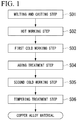
- Fig. 1 is a flowchart showing a method of producing a copper alloy material according to an embodiment of the present invention.
- a copper alloy material according to this embodiment is used as, for example, a wire of an insulated wire constituting a wire harness which is used for wiring of a vehicle or the like.
- the copper alloy material according to this embodiment has a shape corresponding to a working method during component molding, and constitutes, for example, a plate strip material, a wire rod material, or a tubular material.
- the copper alloy material is provided as a wire material.
- a composition of the copper alloy material according to this embodiment contains Mg in a range of 0.15 mass% or more and 0.50 mass% or less, Cr in a range of 0.20 mass% or more and 0.90 mass% or less, and the balance consisting of Cu and inevitable impurities.
- the tensile strength is 600 MPa or more, and the elongation is 3% or more.
- the copper alloy material according to this embodiment preferably has electric conductivity of 60% IACS or more.
- a cross-sectional area perpendicular to a longitudinal direction is preferably in a range of 0.0003 mm 2 or more and 0.2 mm 2 or less.
- Mg is an element which acts to sufficiently improve strength by being solid-dissolved in a parent phase of a copper alloy.
- the action and effect may not be sufficiently exhibited.
- the electric conductivity may be significantly reduced, the viscosity of the molten copper alloy may be increased, and the castability may be reduced.
- a coarse Mg compound may be generated, and defects such as cracks may occur during working.
- the Mg content is set in a range of 0.15 mass% or more and 0.50 mass% or less.
- the lower limit of the Mg content is preferably 0.16 mass% or more, and more preferably 0.17 mass% or more.
- the upper limit of the Mg content is preferably 0.48 mass% or less, and more preferably 0.46 mass% or less.
- Cr is an element which has an effect on improvement of strength and electric conductivity as well as elongation by precipitating fine Cr-based precipitates (for example, Cu-Cr) in crystal grains of the parent phase by an aging treatment.
- the precipitation amount is not sufficient in the aging treatment, and the improvement of the strength, electric conductivity, and elongation may not be sufficiently achieved.
- the Cr content is more than 0.90 mass%, relatively coarse Cr crystallized products may be generated, which may cause defects.
- the Cr content is set in a range of 0.20 mass% or more and 0.90 mass% or less.
- the lower limit of the Cr content is preferably 0.22 mass% or more, and more preferably 0.24 mass% or more.
- the upper limit of the Cr content is preferably 0.85 mass% or less, and more preferably 0.80 mass% or less.
- Examples of inevitable impurities other than Mg and Cr described above include Al, Fe, Ni, Zn, Mn, Co, Ti, B, Ag, Ca, Si, Te, Sr, Ba, Sc, Y, Ti, Zr, Hf, V, Nb, Ta, Mo, W, Re, Ru, Os, Se, Rh, Ir, Pd, Pt, Au, Cd, Ga, In, Li, Ge, As, Sb, Tl, Pb, Be, N, H, Hg, Tc, Na, K, Rb, Cs, Po, Bi, lanthanoid, O, S, C, and P. Since the inevitable impurities may reduce conductive property (heat conductive property), the total amount thereof is preferably 0.05 mass% or less.
- the strength in a case where the tensile strength is less than 600 MPa, the strength is not sufficient, and breakage may occur during handling. In particular, the strength is likely to be insufficient in a case where the copper alloy material is used after a reduction in the cross-sectional area.
- the tensile strength is set to 600 MPa or more.
- the tensile strength of the copper alloy material according to this embodiment is preferably 620 MPa or more, and more preferably 640 MPa or more.
- the upper limit of the tensile strength of the copper alloy material according to this embodiment is not particularly limited, but is practically 1,200 MPa or less.
- the elongation in a case where the elongation is less than 3%, the elongation is not sufficient, and spattering or entanglement may occur during handling. Accordingly, it is difficult to assemble a wire harness or the like.
- the elongation is set to 3% or more.
- the elongation of the copper alloy material according to this embodiment is preferably 4% or more, and more preferably 5% or more.
- the upper limit of the elongation of the copper alloy material according to this embodiment is not particularly limited, but is practically 30% or less.
- the copper alloy material according to this embodiment in a case where the electric conductivity is 60% IACS or more, the Cr-based precipitates are sufficiently dispersed. Accordingly, the copper alloy material is excellent in strength, elongation, and conductive property (heat conductive property).
- the electric conductivity is preferably 60% IACS or more.
- the electric conductivity of the copper alloy material according to this embodiment is more preferably 62% IACS or more, and even more preferably 64% IACS or more.
- the upper limit of the electric conductivity of the copper alloy material according to this embodiment is not particularly limited, but is practically 90% IACS or less.
- the copper alloy material according to this embodiment constitutes a wire material.
- a cross-sectional area of the wire material perpendicular to a longitudinal direction is 0.0003 mm 2 or more, the strength of the copper alloy material is secured, and thus it is possible to sufficiently suppress the occurrence of disconnection during handling.
- the cross-sectional area perpendicular to the longitudinal direction is 0.2 mm 2 or less, the cross-sectional area is sufficiently reduced, and various components made of the copper alloy member can be further reduced in size and weight.
- the cross-sectional area perpendicular to the longitudinal direction is preferably in a range of 0.0003 mm 2 or more and 0.2 mm 2 or less.
- the lower limit of the cross-sectional area perpendicular to the longitudinal direction of the copper alloy material according to this embodiment is more preferably 0.001 mm 2 or more, and even more preferably 0.005 mm 2 or more.
- the upper limit of the cross-sectional area perpendicular to the longitudinal direction is more preferably 0.16 mm 2 or less, and even more preferably 0.13 mm 2 or less.
- a copper raw material formed of oxygen-free copper having a copper purity of 99.99 mass% or more is put into a carbon crucible and melted using a vacuum melting furnace to obtain molten copper.
- Mg and Cr are added to the obtained molten metal so as to obtain a predetermined concentration, and thus the components are adjusted and a molten copper alloy is obtained.
- a material having a purity of 99.9 mass% or more is preferably used as the raw material of Mg, and a material having a purity of 99.9 mass% or more is preferably used as the raw material of Cr.
- a Cu-Mg mother alloy or a Cu-Cr mother alloy may be used.
- the molten copper alloy whose components have been adjusted is poured into a mold to obtain a copper alloy ingot.
- the copper alloy ingot is subjected to hot working.
- Preferable conditions for the hot working are as follows: temperature: 600°C or higher and 1,050°C or lower, working rate: 50% or more and 99.5% or less.
- the ingot is immediately cooled by water cooling.
- the working method in the hot working step S02 is not particularly limited, but in a case where the final shape is a plate or a strip, rolling may be applied. In a case where the final shape is a line or a rod, extrusion or groove rolling may be applied. In a case where the final shape is a bulk shape, forging or pressing may be applied.
- the hot worked material which has undergone the hot working step S02 is subjected to cold working.
- the working rate is preferably in a range of 50% or more and 99.5% or less.
- the working method in the first cold working step S03 is not particularly limited, but in a case where the final shape is a plate or a strip, rolling may be applied. In a case where the final shape is a line or a rod, extrusion or groove rolling may be applied. In a case where the final shape is a bulk shape, forging or pressing may be applied.
- the cold worked material obtained in the first cold working step S03 is subjected to an aging treatment to precipitate fine precipitates such as Cr-based precipitates.
- Preferable conditions for the aging treatment are as follows: holding temperature: 350°C or higher and 550°C or lower, holding time at holding temperature: 0.5 hours or longer and 6 hours or shorter.
- the heat treatment method during the aging treatment is not particularly limited, but the treatment is preferably performed in an inert gas atmosphere.
- the cooling method after the heating is not particularly limited, but water cooling is preferably performed for rapid cooling.
- the aging-treated material which has undergone the aging treatment step S04 is subjected to cold working.
- the working rate is preferably in a range of 90% or more and 99.99% or less.
- the working method in the second cold working step S05 is not particularly limited, but in a case where the final shape is a plate or a strip, rolling may be applied. In a case where the final shape is a line or a rod, extrusion or groove rolling may be applied. In a case where the final shape is a bulk shape, forging or pressing may be applied.
- the cross-sectional area perpendicular to the longitudinal direction is in a range of 0.0003 mm 2 or more and 0.2 mm 2 or less.
- the cold worked material obtained in the second cold working step S05 is subjected to a tempering treatment to improve its elongation.
- Preferable conditions for the tempering treatment are as follows: holding temperature: 350°C or higher and 550°C or lower, holding time at holding temperature: 0.5 hours or longer and 6 hours or shorter.
- the method for the tempering treatment is not particularly limited, but the treatment is preferably performed in an inert gas atmosphere.
- the cooling method after the heating is not particularly limited, but water cooling is preferably performed for rapid cooling.
- the copper alloy material according to this embodiment is produced.
- Mg is contained in a range of 0.15 mass% or more and 0.50 mass% or less, and thus the strength can be sufficiently improved by solid solution hardening.
- the copper alloy material according to this embodiment has tensile strength of 600 MPa or more and elongation of 3% or more. Accordingly, even in a case where the copper alloy material has a small cross-sectional area, it is possible to suppress the occurrence of disconnection or the like during handling, and stable handling is possible.
- the electric conductivity is 60% IACS or more
- the Cr-based precipitates are sufficiently precipitated and dispersed, and it is possible to sufficiently improve the strength and the elongation.
- the copper alloy material is particularly suitable for use requiring conductive property (heat conductive property).
- the copper alloy material is provided as a wire material, and a cross-sectional area perpendicular to a longitudinal direction is in a range of 0.0003 mm 2 or more and 0.2 mm 2 or less. Accordingly, the copper alloy material is excellent in strength and elongation and has a sufficiently small cross-sectional area, and various components using the copper alloy material can be reduced in size and weight.
- the method of producing the copper alloy material is not limited to this embodiment, and the copper alloy material may be produced by another producing method.
- a continuous casting device may be used in the melting and casting step.
- a copper raw material formed of oxygen-free copper having a purity of 99.99 mass% or more was prepared, put into a carbon crucible, and melted in a vacuum melting furnace (degree of vacuum: 10 -2 Pa or less) to obtain molten copper.
- Mg and Cr were added to the obtained molten copper to adjust a component composition shown in Table 1, and after holding for 5 minutes, the molten copper alloy was poured into a cast iron mold to obtain a copper alloy ingot.
- the ingot was about 60 mm in width and about 100 mm in thickness.
- a material having a purity of 99.9 mass% or more was used, and as a raw material of Cr, a material having a purity of 99.99 mass% or more was used.
- the obtained copper alloy ingot was cut into a predetermined size, and then subjected to hot working (hot rolling) under conditions shown in Table 1 to obtain a hot rolled material.
- the hot worked material was subjected to first cold working (drawing) under conditions shown in Table 1, and a first cold worked material was obtained.
- the first cold worked material was heated and held in an atmospheric furnace under conditions shown in Table 1, and then water-cooled and subjected to an aging treatment.
- the obtained aging-treated material was subjected to second cold working (drawing) so as to obtain a cross-sectional area shown in Table 1, and a second cold worked material was obtained.
- the second cold worked material was subjected to a tempering treatment under conditions shown in Table 1, and various copper alloy materials were obtained.
- the component composition, workability, tensile strength, elongation, and electric conductivity of each copper alloy material obtained were evaluated.
- the component composition of the obtained copper alloy material was measured by ICP-MS analysis. As a result, a composition shown in Table 1 was confirmed.
- Comparative Example 1 in which the Mg content was 0.08 mass%, which was less than the range of the present invention, the tensile strength was as low as 550 MPa. In addition, defects occurred during the manufacturing process, and the workability was not sufficient.
- Comparative Example 4 in which the Cr content was 1.50 mass%, which was more than the range of the present invention, disconnection occurred during the working in which the cross-sectional area was reduced to 0.0003 mm 2 in the second cold working, and thus it was not possible to produce the copper alloy wire. Accordingly, the subsequent evaluation was stopped.
- Invention Examples 1 to 5 containing, as a composition, Mg in a range of 0.15 mass% or more and 0.50 mass% or less, Cr in a range of 0.20 mass% or more and 0.90 mass% or less, and a balance consisting of Cu and inevitable impurities, in which tensile strength was 600 MPa or more, and an elongation was 3% or more, the workability was excellent, and the electric conductivity could also be secured.
Landscapes
- Chemical & Material Sciences (AREA)
- Engineering & Computer Science (AREA)
- Materials Engineering (AREA)
- Mechanical Engineering (AREA)
- Metallurgy (AREA)
- Organic Chemistry (AREA)
- Physics & Mathematics (AREA)
- Thermal Sciences (AREA)
- Crystallography & Structural Chemistry (AREA)
- Conductive Materials (AREA)
- Non-Insulated Conductors (AREA)
Applications Claiming Priority (2)
| Application Number | Priority Date | Filing Date | Title |
|---|---|---|---|
| JP2019003371A JP2020111789A (ja) | 2019-01-11 | 2019-01-11 | 銅合金材 |
| PCT/JP2020/000730 WO2020145397A1 (ja) | 2019-01-11 | 2020-01-10 | 銅合金材 |
Publications (2)
| Publication Number | Publication Date |
|---|---|
| EP3910085A1 true EP3910085A1 (de) | 2021-11-17 |
| EP3910085A4 EP3910085A4 (de) | 2022-11-02 |
Family
ID=71521345
Family Applications (1)
| Application Number | Title | Priority Date | Filing Date |
|---|---|---|---|
| EP20738054.4A Withdrawn EP3910085A4 (de) | 2019-01-11 | 2020-01-10 | Kupferlegierungsmaterial |
Country Status (7)
| Country | Link |
|---|---|
| US (1) | US20220106669A1 (de) |
| EP (1) | EP3910085A4 (de) |
| JP (1) | JP2020111789A (de) |
| KR (1) | KR20210113213A (de) |
| CN (1) | CN113272464A (de) |
| MX (1) | MX2021008292A (de) |
| WO (1) | WO2020145397A1 (de) |
Families Citing this family (3)
| Publication number | Priority date | Publication date | Assignee | Title |
|---|---|---|---|---|
| JP7630327B2 (ja) * | 2021-03-26 | 2025-02-17 | 古河電気工業株式会社 | 電気・電子部品用材料及び電気・電子部品用材料の製造方法 |
| CN114505452A (zh) * | 2022-01-20 | 2022-05-17 | 浙江力博实业股份有限公司 | 一种调控铜铬银合金晶粒尺寸和晶粒取向的方法 |
| CN116987928B (zh) * | 2023-09-14 | 2025-09-09 | 中南大学 | 一种无磁蚀刻框架用铜合金及其制备方法 |
Family Cites Families (21)
| Publication number | Priority date | Publication date | Assignee | Title |
|---|---|---|---|---|
| JPS4871323A (de) * | 1971-12-28 | 1973-09-27 | ||
| SU490854A1 (ru) * | 1974-03-28 | 1975-11-05 | Государственный Научно-Исследовательский И Проектный Институт Сплавов И Обработки Цветных Металлов | Сплав на основе меди |
| JPS62247039A (ja) * | 1985-12-16 | 1987-10-28 | Furukawa Electric Co Ltd:The | 電子機器用銅合金 |
| JP2709178B2 (ja) | 1990-05-10 | 1998-02-04 | 住友電気工業株式会社 | ハーネス用電線導体 |
| JPH06322461A (ja) * | 1993-03-19 | 1994-11-22 | Hitachi Cable Ltd | 銅合金線 |
| JPH0813066A (ja) * | 1994-06-23 | 1996-01-16 | Mitsubishi Shindoh Co Ltd | スタンピング性に優れた銅合金または銅合金薄板 |
| JPH11323463A (ja) * | 1998-05-14 | 1999-11-26 | Kobe Steel Ltd | 電気・電子部品用銅合金 |
| JP4132451B2 (ja) * | 1999-08-09 | 2008-08-13 | 株式会社神戸製鋼所 | 耐熱性に優れた高強度高導電性銅合金 |
| JP5355865B2 (ja) | 2006-06-01 | 2013-11-27 | 古河電気工業株式会社 | 銅合金線材の製造方法および銅合金線材 |
| JP4986522B2 (ja) | 2006-07-19 | 2012-07-25 | 矢崎総業株式会社 | 自動車電線用素線及び自動車用電線 |
| JP5202921B2 (ja) | 2007-10-09 | 2013-06-05 | 古河電気工業株式会社 | 銅合金線材の製造方法、銅合金線材および銅合金線材の製造装置 |
| JP2009174038A (ja) | 2008-01-28 | 2009-08-06 | Hitachi Cable Ltd | 銅合金導体の製造方法および銅合金導体ならびにケーブルならびにトロリー線 |
| JP5380117B2 (ja) | 2009-03-11 | 2014-01-08 | 三菱伸銅株式会社 | 電線導体の製造方法、電線導体、絶縁電線及びワイヤーハーネス |
| US8821655B1 (en) * | 2010-12-02 | 2014-09-02 | Fisk Alloy Inc. | High strength, high conductivity copper alloys and electrical conductors made therefrom |
| WO2012169405A1 (ja) * | 2011-06-06 | 2012-12-13 | 三菱マテリアル株式会社 | 電子機器用銅合金、電子機器用銅合金の製造方法、電子機器用銅合金塑性加工材、及び電子機器用部品 |
| JP6131543B2 (ja) | 2012-07-30 | 2017-05-24 | 三菱マテリアル株式会社 | 銅合金線及び銅合金線の製造方法、撚り線 |
| JP5773015B2 (ja) | 2013-05-24 | 2015-09-02 | 三菱マテリアル株式会社 | 銅合金線 |
| JP6900795B2 (ja) | 2017-06-14 | 2021-07-07 | トヨタ紡織株式会社 | 合力の解析方法 |
| CN107287468B (zh) * | 2017-08-14 | 2019-05-03 | 中南大学 | 一种高强高导耐热的铜合金材料及其制备方法 |
| CN108526422B (zh) * | 2018-05-23 | 2020-05-19 | 中南大学 | 一种高强高导耐热铜合金的生产方法 |
| JP7263953B2 (ja) * | 2019-07-10 | 2023-04-25 | 三菱マテリアル株式会社 | 銅合金トロリ線 |
-
2019
- 2019-01-11 JP JP2019003371A patent/JP2020111789A/ja active Pending
-
2020
- 2020-01-10 MX MX2021008292A patent/MX2021008292A/es unknown
- 2020-01-10 EP EP20738054.4A patent/EP3910085A4/de not_active Withdrawn
- 2020-01-10 US US17/421,074 patent/US20220106669A1/en not_active Abandoned
- 2020-01-10 KR KR1020217021160A patent/KR20210113213A/ko not_active Withdrawn
- 2020-01-10 WO PCT/JP2020/000730 patent/WO2020145397A1/ja not_active Ceased
- 2020-01-10 CN CN202080008245.2A patent/CN113272464A/zh active Pending
Also Published As
| Publication number | Publication date |
|---|---|
| JP2020111789A (ja) | 2020-07-27 |
| WO2020145397A1 (ja) | 2020-07-16 |
| CN113272464A (zh) | 2021-08-17 |
| US20220106669A1 (en) | 2022-04-07 |
| EP3910085A4 (de) | 2022-11-02 |
| MX2021008292A (es) | 2021-08-05 |
| KR20210113213A (ko) | 2021-09-15 |
Similar Documents
| Publication | Publication Date | Title |
|---|---|---|
| EP3037561B1 (de) | Kupferlegierung für elektrische und elektronische vorrichtungen, blech aus einer kupferlegierung für für elektrische und elektronische vorrichtungen, komponente für für elektrische und elektronische vorrichtungen, endgerät und sammelschiene | |
| EP3438298B1 (de) | Kupferlegierung für elektronische/elektrische vorrichtungen, kupferlegierungsband für elektronische und elektrische vorrichtungen, komponente für elektronische und elektrische vorrichtung, endgerät, sammelschiene und bewegliches teil für relais | |
| EP3438299B1 (de) | Kupferlegierungsband für elektronische und elektrische vorrichtungen, komponente, anschlussklemme, sammelschiene und bewegliches teil für relais | |
| CN103502487B (zh) | 电子设备用铜合金、电子设备用铜合金的制造方法、电子设备用铜合金塑性加工材料、及电子设备用组件 | |
| EP3348659B1 (de) | Kupferlegierung für elektronische/elektrische vorrichtung, plastisch bearbeitetes kupferlegierungsmaterial für elektronische/elektrische vorrichtung, komponente für elektronische/elektrische vorrichtung, endgerät und sammelschiene | |
| EP3243918B1 (de) | Kupferlegierung für elektronische/elektrische vorrichtung, plastisch bearbeitetes kupferlegierungsmaterial für elektronische/elektrische vorrichtung, komponente für elektronische/elektrische vorrichtung, endgerät und sammelschiene | |
| US11203806B2 (en) | Copper alloy for electronic and electrical equipment, copper alloy plate strip for electronic and electrical equipment, component for electronic and electrical equipment, terminal, busbar, and movable piece for relay | |
| KR20130010018A (ko) | 전자 기기용 구리 합금, 전자 기기용 구리 합금의 제조 방법, 전자 기기용 구리 합금 압연재, 및 전자 기기용 구리 합금이나 전자 기기용 구리 합금 압연재로 이루어지는 전자 전기 부품, 단자 또는 커넥터 | |
| EP2940166B1 (de) | Kupferlegierung für elektrische und elektronische einrichtung, kupferlegierungsdünnschicht für elektrische und elektronische einrichtung sowie leitfähiges teil und endgerät für elektrische und elektronische einrichtung | |
| TWI429764B (zh) | Cu-Co-Si alloy for electronic materials | |
| EP3910085A1 (de) | Kupferlegierungsmaterial | |
| US9496064B2 (en) | Copper alloy for electric and electronic device, copper alloy sheet for electric and electronic device, conductive component for electric and electronic device, and terminal | |
| EP3348657B1 (de) | Kupferlegierung für eine elektronische/elektrische vorrichtung, komponente für eine elektronische/elektrische vorrichtung, endgerät und stromschiene | |
| TWI509091B (zh) | 電子電氣機器用銅合金、電子電氣機器用銅合金薄板、電子電氣機器用導電零件及端子 | |
| CN107923001B (zh) | 电子电气设备用铜合金、电子电气设备用铜合金薄板、电子电气设备用导电部件及端子 |
Legal Events
| Date | Code | Title | Description |
|---|---|---|---|
| STAA | Information on the status of an ep patent application or granted ep patent |
Free format text: STATUS: THE INTERNATIONAL PUBLICATION HAS BEEN MADE |
|
| PUAI | Public reference made under article 153(3) epc to a published international application that has entered the european phase |
Free format text: ORIGINAL CODE: 0009012 |
|
| STAA | Information on the status of an ep patent application or granted ep patent |
Free format text: STATUS: REQUEST FOR EXAMINATION WAS MADE |
|
| 17P | Request for examination filed |
Effective date: 20210707 |
|
| AK | Designated contracting states |
Kind code of ref document: A1 Designated state(s): AL AT BE BG CH CY CZ DE DK EE ES FI FR GB GR HR HU IE IS IT LI LT LU LV MC MK MT NL NO PL PT RO RS SE SI SK SM TR |
|
| DAV | Request for validation of the european patent (deleted) | ||
| DAX | Request for extension of the european patent (deleted) | ||
| A4 | Supplementary search report drawn up and despatched |
Effective date: 20221004 |
|
| RIC1 | Information provided on ipc code assigned before grant |
Ipc: C22F 1/08 20060101ALN20220927BHEP Ipc: C22C 1/02 20060101ALI20220927BHEP Ipc: C22C 1/03 20060101ALI20220927BHEP Ipc: H01B 1/02 20060101ALI20220927BHEP Ipc: C22C 9/00 20060101AFI20220927BHEP |
|
| STAA | Information on the status of an ep patent application or granted ep patent |
Free format text: STATUS: THE APPLICATION IS DEEMED TO BE WITHDRAWN |
|
| 18D | Application deemed to be withdrawn |
Effective date: 20230503 |