EP3913268A1 - Câble ombilical adapté pour le transport de gaz hydrogène - Google Patents
Câble ombilical adapté pour le transport de gaz hydrogène Download PDFInfo
- Publication number
- EP3913268A1 EP3913268A1 EP20305527.2A EP20305527A EP3913268A1 EP 3913268 A1 EP3913268 A1 EP 3913268A1 EP 20305527 A EP20305527 A EP 20305527A EP 3913268 A1 EP3913268 A1 EP 3913268A1
- Authority
- EP
- European Patent Office
- Prior art keywords
- umbilical cable
- rest
- unavoidable impurities
- tube wall
- cable according
- Prior art date
- Legal status (The legal status is an assumption and is not a legal conclusion. Google has not performed a legal analysis and makes no representation as to the accuracy of the status listed.)
- Pending
Links
- UFHFLCQGNIYNRP-UHFFFAOYSA-N Hydrogen Chemical compound [H][H] UFHFLCQGNIYNRP-UHFFFAOYSA-N 0.000 title claims abstract description 45
- 239000001257 hydrogen Substances 0.000 claims abstract description 41
- 229910052739 hydrogen Inorganic materials 0.000 claims abstract description 41
- 239000004020 conductor Substances 0.000 claims abstract description 28
- 239000000463 material Substances 0.000 claims abstract description 27
- 229910052759 nickel Inorganic materials 0.000 claims description 36
- 239000010949 copper Substances 0.000 claims description 35
- 229910045601 alloy Inorganic materials 0.000 claims description 34
- 239000000956 alloy Substances 0.000 claims description 34
- 239000012535 impurity Substances 0.000 claims description 28
- 229910052748 manganese Inorganic materials 0.000 claims description 20
- 229910000881 Cu alloy Inorganic materials 0.000 claims description 17
- XEEYBQQBJWHFJM-UHFFFAOYSA-N iron Substances [Fe] XEEYBQQBJWHFJM-UHFFFAOYSA-N 0.000 claims description 17
- 229910052742 iron Inorganic materials 0.000 claims description 14
- 229910000831 Steel Inorganic materials 0.000 claims description 11
- 239000010959 steel Substances 0.000 claims description 11
- 229910052782 aluminium Inorganic materials 0.000 claims description 10
- 229910052718 tin Inorganic materials 0.000 claims description 8
- 229910018594 Si-Cu Inorganic materials 0.000 claims description 6
- 229910008465 Si—Cu Inorganic materials 0.000 claims description 6
- 229910052804 chromium Inorganic materials 0.000 claims description 6
- 229910001220 stainless steel Inorganic materials 0.000 claims description 6
- 229910052725 zinc Inorganic materials 0.000 claims description 6
- 229910018182 Al—Cu Inorganic materials 0.000 claims description 4
- 229910020888 Sn-Cu Inorganic materials 0.000 claims description 4
- 229910019204 Sn—Cu Inorganic materials 0.000 claims description 4
- 150000002431 hydrogen Chemical class 0.000 claims description 4
- 229910052758 niobium Inorganic materials 0.000 claims description 4
- 239000010935 stainless steel Substances 0.000 claims description 4
- 229910000838 Al alloy Inorganic materials 0.000 claims description 3
- 229910018054 Ni-Cu Inorganic materials 0.000 claims description 3
- 229910018481 Ni—Cu Inorganic materials 0.000 claims description 3
- 229910000963 austenitic stainless steel Inorganic materials 0.000 claims description 3
- 229920001903 high density polyethylene Polymers 0.000 claims description 3
- 239000004700 high-density polyethylene Substances 0.000 claims description 3
- 239000004411 aluminium Substances 0.000 claims description 2
- XAGFODPZIPBFFR-UHFFFAOYSA-N aluminium Chemical compound [Al] XAGFODPZIPBFFR-UHFFFAOYSA-N 0.000 claims description 2
- 229910001039 duplex stainless steel Inorganic materials 0.000 claims description 2
- 239000000835 fiber Substances 0.000 claims description 2
- 239000007789 gas Substances 0.000 claims description 2
- 229920000642 polymer Polymers 0.000 claims description 2
- 229910052726 zirconium Inorganic materials 0.000 claims description 2
- 239000012530 fluid Substances 0.000 claims 1
- PXHVJJICTQNCMI-UHFFFAOYSA-N nickel Substances [Ni] PXHVJJICTQNCMI-UHFFFAOYSA-N 0.000 description 27
- 239000010410 layer Substances 0.000 description 16
- 239000011572 manganese Substances 0.000 description 12
- 238000009413 insulation Methods 0.000 description 9
- XLYOFNOQVPJJNP-UHFFFAOYSA-N water Substances O XLYOFNOQVPJJNP-UHFFFAOYSA-N 0.000 description 8
- 229910052802 copper Inorganic materials 0.000 description 5
- -1 polyethylene Polymers 0.000 description 5
- 238000003466 welding Methods 0.000 description 5
- RYGMFSIKBFXOCR-UHFFFAOYSA-N Copper Chemical compound [Cu] RYGMFSIKBFXOCR-UHFFFAOYSA-N 0.000 description 4
- 230000004888 barrier function Effects 0.000 description 4
- 238000005260 corrosion Methods 0.000 description 4
- 230000007797 corrosion Effects 0.000 description 4
- 238000010438 heat treatment Methods 0.000 description 4
- 239000011810 insulating material Substances 0.000 description 4
- 230000032258 transport Effects 0.000 description 4
- 239000004698 Polyethylene Substances 0.000 description 3
- 238000004519 manufacturing process Methods 0.000 description 3
- 229910052751 metal Inorganic materials 0.000 description 3
- 239000002184 metal Substances 0.000 description 3
- 229920000573 polyethylene Polymers 0.000 description 3
- IJGRMHOSHXDMSA-UHFFFAOYSA-N Atomic nitrogen Chemical compound N#N IJGRMHOSHXDMSA-UHFFFAOYSA-N 0.000 description 2
- 229920000181 Ethylene propylene rubber Polymers 0.000 description 2
- 239000004743 Polypropylene Substances 0.000 description 2
- DMFGNRRURHSENX-UHFFFAOYSA-N beryllium copper Chemical compound [Be].[Cu] DMFGNRRURHSENX-UHFFFAOYSA-N 0.000 description 2
- 150000001875 compounds Chemical class 0.000 description 2
- 229920003020 cross-linked polyethylene Polymers 0.000 description 2
- 239000004703 cross-linked polyethylene Substances 0.000 description 2
- 230000000694 effects Effects 0.000 description 2
- 230000033001 locomotion Effects 0.000 description 2
- 239000011159 matrix material Substances 0.000 description 2
- 238000000034 method Methods 0.000 description 2
- 229920001155 polypropylene Polymers 0.000 description 2
- 229920002635 polyurethane Polymers 0.000 description 2
- 239000004814 polyurethane Substances 0.000 description 2
- 239000002244 precipitate Substances 0.000 description 2
- 238000005728 strengthening Methods 0.000 description 2
- 239000000126 substance Substances 0.000 description 2
- 229910000851 Alloy steel Inorganic materials 0.000 description 1
- 229910000952 Be alloy Inorganic materials 0.000 description 1
- 229910000570 Cupronickel Inorganic materials 0.000 description 1
- 229910002482 Cu–Ni Inorganic materials 0.000 description 1
- 229920002943 EPDM rubber Polymers 0.000 description 1
- PWHULOQIROXLJO-UHFFFAOYSA-N Manganese Chemical compound [Mn] PWHULOQIROXLJO-UHFFFAOYSA-N 0.000 description 1
- 229910018098 Ni-Si Inorganic materials 0.000 description 1
- 229910005487 Ni2Si Inorganic materials 0.000 description 1
- 229910018529 Ni—Si Inorganic materials 0.000 description 1
- 230000032683 aging Effects 0.000 description 1
- 238000005275 alloying Methods 0.000 description 1
- 238000000137 annealing Methods 0.000 description 1
- QVGXLLKOCUKJST-UHFFFAOYSA-N atomic oxygen Chemical compound [O] QVGXLLKOCUKJST-UHFFFAOYSA-N 0.000 description 1
- 238000005452 bending Methods 0.000 description 1
- 230000008901 benefit Effects 0.000 description 1
- 230000015572 biosynthetic process Effects 0.000 description 1
- 230000015556 catabolic process Effects 0.000 description 1
- 238000001816 cooling Methods 0.000 description 1
- YOCUPQPZWBBYIX-UHFFFAOYSA-N copper nickel Chemical compound [Ni].[Cu] YOCUPQPZWBBYIX-UHFFFAOYSA-N 0.000 description 1
- 238000005336 cracking Methods 0.000 description 1
- 230000007423 decrease Effects 0.000 description 1
- 238000006731 degradation reaction Methods 0.000 description 1
- 239000003989 dielectric material Substances 0.000 description 1
- 230000009977 dual effect Effects 0.000 description 1
- 239000002355 dual-layer Substances 0.000 description 1
- 229920001971 elastomer Polymers 0.000 description 1
- 239000012777 electrically insulating material Substances 0.000 description 1
- 230000005611 electricity Effects 0.000 description 1
- 238000004146 energy storage Methods 0.000 description 1
- 238000005516 engineering process Methods 0.000 description 1
- 239000000945 filler Substances 0.000 description 1
- 239000001307 helium Substances 0.000 description 1
- 229910052734 helium Inorganic materials 0.000 description 1
- SWQJXJOGLNCZEY-UHFFFAOYSA-N helium atom Chemical compound [He] SWQJXJOGLNCZEY-UHFFFAOYSA-N 0.000 description 1
- 125000004435 hydrogen atom Chemical group [H]* 0.000 description 1
- 230000002706 hydrostatic effect Effects 0.000 description 1
- 238000009434 installation Methods 0.000 description 1
- 238000010338 mechanical breakdown Methods 0.000 description 1
- 229910052757 nitrogen Inorganic materials 0.000 description 1
- 239000001301 oxygen Substances 0.000 description 1
- 229910052760 oxygen Inorganic materials 0.000 description 1
- 230000002093 peripheral effect Effects 0.000 description 1
- 238000004881 precipitation hardening Methods 0.000 description 1
- 239000002243 precursor Substances 0.000 description 1
- 230000008569 process Effects 0.000 description 1
- 238000002310 reflectometry Methods 0.000 description 1
- 239000012779 reinforcing material Substances 0.000 description 1
- 230000004044 response Effects 0.000 description 1
- 238000005096 rolling process Methods 0.000 description 1
- 238000000926 separation method Methods 0.000 description 1
- 239000006104 solid solution Substances 0.000 description 1
- 239000000243 solution Substances 0.000 description 1
- 238000001179 sorption measurement Methods 0.000 description 1
- 238000003860 storage Methods 0.000 description 1
- 230000000930 thermomechanical effect Effects 0.000 description 1
- 229920001169 thermoplastic Polymers 0.000 description 1
- 239000004416 thermosoftening plastic Substances 0.000 description 1
- 210000003954 umbilical cord Anatomy 0.000 description 1
Images

Classifications
-
- C—CHEMISTRY; METALLURGY
- C22—METALLURGY; FERROUS OR NON-FERROUS ALLOYS; TREATMENT OF ALLOYS OR NON-FERROUS METALS
- C22C—ALLOYS
- C22C9/00—Alloys based on copper
- C22C9/06—Alloys based on copper with nickel or cobalt as the next major constituent
-
- C—CHEMISTRY; METALLURGY
- C22—METALLURGY; FERROUS OR NON-FERROUS ALLOYS; TREATMENT OF ALLOYS OR NON-FERROUS METALS
- C22C—ALLOYS
- C22C21/00—Alloys based on aluminium
-
- C—CHEMISTRY; METALLURGY
- C22—METALLURGY; FERROUS OR NON-FERROUS ALLOYS; TREATMENT OF ALLOYS OR NON-FERROUS METALS
- C22C—ALLOYS
- C22C38/00—Ferrous alloys, e.g. steel alloys
-
- C—CHEMISTRY; METALLURGY
- C22—METALLURGY; FERROUS OR NON-FERROUS ALLOYS; TREATMENT OF ALLOYS OR NON-FERROUS METALS
- C22C—ALLOYS
- C22C38/00—Ferrous alloys, e.g. steel alloys
- C22C38/18—Ferrous alloys, e.g. steel alloys containing chromium
- C22C38/40—Ferrous alloys, e.g. steel alloys containing chromium with nickel
- C22C38/44—Ferrous alloys, e.g. steel alloys containing chromium with nickel with molybdenum or tungsten
-
- C—CHEMISTRY; METALLURGY
- C22—METALLURGY; FERROUS OR NON-FERROUS ALLOYS; TREATMENT OF ALLOYS OR NON-FERROUS METALS
- C22C—ALLOYS
- C22C9/00—Alloys based on copper
- C22C9/08—Alloys based on copper with lead as the next major constituent
-
- F—MECHANICAL ENGINEERING; LIGHTING; HEATING; WEAPONS; BLASTING
- F16—ENGINEERING ELEMENTS AND UNITS; GENERAL MEASURES FOR PRODUCING AND MAINTAINING EFFECTIVE FUNCTIONING OF MACHINES OR INSTALLATIONS; THERMAL INSULATION IN GENERAL
- F16L—PIPES; JOINTS OR FITTINGS FOR PIPES; SUPPORTS FOR PIPES, CABLES OR PROTECTIVE TUBING; MEANS FOR THERMAL INSULATION IN GENERAL
- F16L11/00—Hoses, i.e. flexible pipes
- F16L11/22—Multi-channel hoses
-
- F—MECHANICAL ENGINEERING; LIGHTING; HEATING; WEAPONS; BLASTING
- F16—ENGINEERING ELEMENTS AND UNITS; GENERAL MEASURES FOR PRODUCING AND MAINTAINING EFFECTIVE FUNCTIONING OF MACHINES OR INSTALLATIONS; THERMAL INSULATION IN GENERAL
- F16L—PIPES; JOINTS OR FITTINGS FOR PIPES; SUPPORTS FOR PIPES, CABLES OR PROTECTIVE TUBING; MEANS FOR THERMAL INSULATION IN GENERAL
- F16L9/00—Rigid pipes
- F16L9/02—Rigid pipes of metal
- F16L9/04—Reinforced pipes
-
- F—MECHANICAL ENGINEERING; LIGHTING; HEATING; WEAPONS; BLASTING
- F16—ENGINEERING ELEMENTS AND UNITS; GENERAL MEASURES FOR PRODUCING AND MAINTAINING EFFECTIVE FUNCTIONING OF MACHINES OR INSTALLATIONS; THERMAL INSULATION IN GENERAL
- F16L—PIPES; JOINTS OR FITTINGS FOR PIPES; SUPPORTS FOR PIPES, CABLES OR PROTECTIVE TUBING; MEANS FOR THERMAL INSULATION IN GENERAL
- F16L9/00—Rigid pipes
- F16L9/18—Double-walled pipes; Multi-channel pipes or pipe assemblies
- F16L9/19—Multi-channel pipes or pipe assemblies
-
- H—ELECTRICITY
- H01—ELECTRIC ELEMENTS
- H01B—CABLES; CONDUCTORS; INSULATORS; SELECTION OF MATERIALS FOR THEIR CONDUCTIVE, INSULATING OR DIELECTRIC PROPERTIES
- H01B1/00—Conductors or conductive bodies characterised by the conductive materials; Selection of materials as conductors
- H01B1/14—Conductive material dispersed in non-conductive inorganic material
- H01B1/16—Conductive material dispersed in non-conductive inorganic material the conductive material comprising metals or alloys
-
- F—MECHANICAL ENGINEERING; LIGHTING; HEATING; WEAPONS; BLASTING
- F16—ENGINEERING ELEMENTS AND UNITS; GENERAL MEASURES FOR PRODUCING AND MAINTAINING EFFECTIVE FUNCTIONING OF MACHINES OR INSTALLATIONS; THERMAL INSULATION IN GENERAL
- F16L—PIPES; JOINTS OR FITTINGS FOR PIPES; SUPPORTS FOR PIPES, CABLES OR PROTECTIVE TUBING; MEANS FOR THERMAL INSULATION IN GENERAL
- F16L13/00—Non-disconnectable pipe joints, e.g. soldered, adhesive, or caulked joints
- F16L13/02—Welded joints
-
- F—MECHANICAL ENGINEERING; LIGHTING; HEATING; WEAPONS; BLASTING
- F16—ENGINEERING ELEMENTS AND UNITS; GENERAL MEASURES FOR PRODUCING AND MAINTAINING EFFECTIVE FUNCTIONING OF MACHINES OR INSTALLATIONS; THERMAL INSULATION IN GENERAL
- F16L—PIPES; JOINTS OR FITTINGS FOR PIPES; SUPPORTS FOR PIPES, CABLES OR PROTECTIVE TUBING; MEANS FOR THERMAL INSULATION IN GENERAL
- F16L9/00—Rigid pipes
- F16L9/17—Rigid pipes obtained by bending a sheet longitudinally and connecting the edges
-
- H—ELECTRICITY
- H01—ELECTRIC ELEMENTS
- H01B—CABLES; CONDUCTORS; INSULATORS; SELECTION OF MATERIALS FOR THEIR CONDUCTIVE, INSULATING OR DIELECTRIC PROPERTIES
- H01B7/00—Insulated conductors or cables characterised by their form
- H01B7/14—Submarine cables
Definitions
- the present invention relates to an umbilical cable suited for transporting hydrogen gas.
- Electric power and hydrogen gas are both believed to play a vital role in the decarbonisation of the economy to meet the targets of the Paris Agreement.
- An umbilical cable is, as the analogy to the umbilical cord implies, a cable which transports required consumables between a source and recipient.
- the umbilical cable is typically a bundle of cables and conduits enclosed in an over-sheath and may transport both chemical compounds, hydraulic power, electric power and/or digital data in its cables and/or conduits.
- umbilical cables typically comprise conduits made of various corrosion resistant steels.
- steel especially high-strength steel, is known to be subject to hydrogen embrittlement which is adsorption of hydrogen atoms/- molecules in the metal reducing its ductility and making the metal more brittle.
- umbilical cables may be subject to various mechanical loading including hydrostatic water pressure, internal pressure according to the substance it transfers, bending and tensioning during manufacture and installation, and dynamic flexing for long periods of time. This requiring excellent mechanical strength, ductility and fatigue properties of the materials in the umbilical. It is generally a challenge to obtain a material with sufficient high strength while being insensitivity to hydrogen.
- EP 2 706 539 B1 discloses the use of various alloys, including CuNi-alloys having between 10 and 50 wt% Ni, in a fatigue resistant water barrier layer/inner sheathing around a core of dynamical power cables.
- EP 3 438 993 A1 teaches use of CuNi-alloys having from 6 to 20 wt% Ni in a fatigue resistant water barrier layer in submarine dynamical power cables.
- the main objective of the invention is the provision of a umbilical cable comprising a tube for transportation of hydrogen.
- the present invention relates to an umbilical cable for transportation of electric power and hydrogen, characterised in that the umbilical cable (1) comprises:
- the tube wall (4) may be made of any material being found resistant to hydrogen embrittlement according to ISO 11114-4:2017.
- the tube wall (4) is monolithic consisting of a single material.
- the tube wall (4) may be at least a dual-layered wall wherein the inner layer is made of the material resistant to hydrogen embrittlement.
- the one or more additional layers may advantageously be a reinforcing material such as e.g. stainless steel.
- the tube may further comprise a sheathing/over-layer in the form of a coaxial tube overlaying the tube (3), a pressure armouring or transversal armouring made of stainless steel laid onto the tube wall (4).
- FIG. 1a An example of a single-layered monolithic tube wall is given schematically in figure 1a).
- Figure 1b illustrates schematically another embodiment of the tube (3) where the tube wall (4) is a dual layer wall where the inner layer facing the interior of the tube (3) is made of a material resistant to hydrogen embrittlement and an outer layer (5) which typically may be an armouring of stainless steel.
- Examples of hydrogen embrittlement resistant materials suited for use as the tube wall (4) includes or a 25Cr-6Mo-5Ni duplex stainless steel, an austenitic stainless steel, an aluminium alloy, e.g. wrought alloy which can be formed into a tube and welded such as AAlxxx through AA7xxx series according to the Aluminium Association Standard, a polymer-liner, e.g. a thermoplastic such as high-density polyethylene (HDPE), or a copper alloy.
- a 25Cr-6Mo-5Ni duplex stainless steel an austenitic stainless steel
- an aluminium alloy e.g. wrought alloy which can be formed into a tube and welded such as AAlxxx through AA7xxx series according to the Aluminium Association Standard
- a polymer-liner e.g. a thermoplastic such as high-density polyethylene (HDPE), or a copper alloy.
- HDPE high-density polyethylene
- the austenitic stainless steel may preferably be a steel classified as the 200 or 300 series according to the American Iron and Steel Institute (AISI), preferably a 316 steel.
- AISI American Iron and Steel Institute
- the 300 series stainless steels achieve their austenitic structure primarily by its nickel content while 200 series stainless steels substitute some of its nickel content with manganese and nitrogen.
- the copper alloy may preferably be a copper alloy containing:
- the copper alloy may preferably be a Ni-Si-Cu alloy containing:
- the Ni-Si-Cu alloy may contain from 6.0 to 8.0 wt% Ni, from 1.5 to 2.5 wt% Si, from 0.7 to 1.2 wt% Cr, and the rest being Cu and unavoidable impurities.
- the Ni-Si-Cu alloy may contain from 2.2 to 4.2 wt% Ni, from 0.25 to 1.2 wt% Si, from 0.05 to 0.30 wt% Mg, and the rest being Cu and unavoidable impurities.
- the Ni-Si-Cu alloy may contain from 1.0 to 5.0 wt% Ni, from 0.50 to 2.0 wt% Si, 0.1 wt% Mg, from 0.8 to 2.0 wt% Co, and the rest being Cu and unavoidable impurities.
- the Ni-Si-Cu alloy may contain from 2.0 to 3.5 wt% Ni, from 0.3 to 0.7 wt% Si, and the rest being Cu and unavoidable impurities.
- the copper alloy may preferably be a Ni-Sn-Cu alloy containing:
- the Ni-Sn-Cu alloy may contain from 14.5 to 15.5 wt% Ni, from 7.5 to 8.5 wt% Sn, and the rest being Cu and unavoidable impurities.
- the Ni-Sn-Cu alloy may contain from 8.5 to 9.5 wt% Ni, from 0.05 to 0.3 wt% Mn, from 5.5 to 6.5 wt% Sn, and the rest being Cu and unavoidable impurities.
- the copper alloy may preferably be a Ni-Mn-Al-Cu alloy containing:
- the Ni-Mn-Al-Cu alloy may contain from 13.5 to 16.5 wt% Ni, from 3.5 to 5.5 wt% Mn, from 1.0 to 2.0 wt% Al, from 0.0 to 1.0 wt% Fe, and the rest being Cu and unavoidable impurities.
- the Ni-Mn-Al-Cu alloy may contain from 10.0 to 30.0 wt% Ni, from 4.0 to 6.0 wt% Mn, from 1.0 to 2.50 wt% Al, and the rest being Cu and unavoidable impurities.
- the copper alloy may preferably be a Ni-Cu alloy containing:
- the Ni-Cu alloy may contain from 23.0 to 26.0 wt% Ni, from 0.2 to 0.5 wt% Mn, from 0.1 to 0.2 wt% Fe, from 0.2 to 0.5 wt% Zn, and the rest being Cu and unavoidable impurities.
- All copper alloys specified above have excellent corrosion resistance making them suitable for making tubes intended for use in tubes in marine environments, such as e.g. a submarine umbilical. They have further a yield limit of at least 400 MPa and they have excellent resistance towards hydrogen embrittlement.
- the amount of material i.e. the thickness of the tube wall, determined as the shortest distance between the inner and outer surface of the tube wall, may depend on several factors including the inner diameter of the tube, the expected physical and chemical loads/strains induced by the environment of the umbilical cable, use of an outer armouring layer and other factors.
- the thickness of the tube wall (4) may in practice preferably be in the range of from 1.0 to 25.0 mm, more preferably of from 0.2 to 4.0 mm, more preferably of from 0.3 to 3.0 mm, more preferably of from 0.3 to 2.0 mm, and most preferably of from 5.0 to 10.0 mm.
- the thickness of the tube wall may in practice preferably be in the range of from 0.2 to 5.0 mm, preferably of from 0.2 to 4.0 mm, more preferably of from 0.3 to 3.0 mm, more preferably of from 0.3 to 2.0 mm, and most preferably of from 0.4 to 1.5 mm.
- the characterising part of the umbilical cable according to the invention is that the umbilical comprises at least one tube (3) having an tube wall (4) made of a hydrogen embrittlement resistant material.
- An especially preferred material for use as the tube wall material is a CuNiSi alloy as specified above.
- CuNiSi-alloys can have suitable corrosion and mechanical properties for use as umbilical tubes for hydrogen transport.
- Ni and Si alloying elements added to a copper matrix followed by suitable heat treatment to cause precipitation hardening by the formation of Ni2Si precipitates in the Cu metal structure.
- This can create materials with strengths in excess of 500 MPa yield strength and completely unaffected by a hydrogen environment. Specifically, embrittlement which is known to affect high strength steel alloys and cause catastrophic failure.
- the material is also readably weldable- either prior to or after the heat treatment above.
- Si forms oxides in the weld zone and reduces porosity in the weld
- Si and Ni improves fluidity and weld microstructure
- Ni provides solid solution strengthening in weld and base material
- Ni increases thermal resistance to reduce geometrical distortion and reduces the heat affected zone when subjected to any welding process
- Ni increases reflectivity to improve autogenous laser welding.
- the addition of Fe and Mn to the CuNiSi alloy has the benefit of improved corrosion resistance from the Fe and the Mn acting as deoxidant.
- the CuSiNi alloy may be subject to a solution annealing at 800 - 1000 °C for 60 - 180 minutes to solve the Ni and Si content in the Cu matrix. It may further be quenched and aging-treated by heating it to a temperature of 400 - 500 °C for about 5 to 10 hours to precipitate Ni-Si causing hardening of the CuSiNi alloy.
- the tube wall (4) may be manufactured by rolling a precursor sheet into a tubular form and welding along the seam to make a sealed tubular structure.
- the manufacturing may be made continuous with or without an outer armouring.
- the tube can be extruded in shorter lengths followed by assembly by orbital welding to create longer continuous lengths.
- umbilical cable as used herein encompasses any known or conceivable umbilical cable comprising at least one tubular element intended for transportation of hydrogen gas made of one of the alloys according to the first aspect of the invention.
- the umbilical will transport hydrogen and potentially electricity between offshore structures including subsea structures, or to and onshore structure.
- An umbilical cable usually comprises a bundle of one or more of electric conductors, fibre optic cables, electric signal cables, tubes etc. encapsulated by an over-sheath comprising an armouring and an outer polymer sheathing.
- the term "electric conductor” as used herein refers to a current carrying cable.
- the umbilical may apply any known current carrying cable, including but not limited to a single strand of an electrically conductive material, a plurality of strands of an electrically conductive material arranged in a bunt, etc. In the latter case of applying an electric conductor comprising a bunt of strands, the space in-between the strands of electrically conductive material may be occupied by a semiconducting filler compound.
- the electric conductor may further comprise a semiconducting conductor screen arranged radially around and encompassing the single strand or bunt of strands.
- the electrically conductive material being applied as conductor(s) in power cables may advantageously have an electric conductivity of at least 4.8 ⁇ 10 6 S/m at 20 °C, preferably of at least 1.0 ⁇ 10 7 S/m at 20 °C and most preferably of at least 3.6 ⁇ 10 7 S/m at 20 °C.
- Each electric conductor of the umbilical should be individually electrically insulated. This is typically obtained by covering the surface of the conductor by a layer of an electric insulating material, i.e. to make the conductor being sheathed in the electrically insulating material.
- the invention may apply any known or conceivable material, including dielectric materials, known to the skilled person as being suited as insulation of the current carrying conductor(s) of power cables.
- the electric conductivity of the material being applied as insulation may advantageously have an electric conductivity of less than 10 -14 S/m at 20 °C, preferably less than 10 -16 S/m at 20 °C, preferably less than 10 -18 S/m at 20 °C, and most preferably less than 10 -20 S/m at 20 °C.
- Examples of materials suited for being applied to form the electric insulation of the conductor(s) include, but are not limited to; ethylene propylene rubber (EPR), ethylene propylene diene monomer (EDPM), rubber, polyethylene (EP), polypropylene (PP), polyurethane (PUR), cross-linked polyethylene (XLPE), and mass-impregnated (MI) paper.
- EPR ethylene propylene rubber
- EDPM ethylene propylene diene monomer
- EP polyethylene
- PP polypropylene
- PUR polyurethane
- XLPE cross-linked polyethylene
- MI mass-impregnated
- the electric conductors and their electric insulation should be protected towards intrusion of water/moisture. An ingress of moisture into the core can lead to a failure of the cable.
- the inner sheathing of submarine power cables should be excellent water barriers able to completely block any intrusion of water and/or moisture to the conductor(s) and its(their) electric insulation for the duration of its design life.
- the inner sheathing of subsea cables should endure any movements imposed on the cable by wave motions, under water currents etc. without fatigue, unintended separation between the layers, cracking or any other mechanical breakdown destroying the water barrier function of the inner sheathing during the desired lifetime of the power cable, which may be many years.
- the inner sheathing may advantageously also function as an emergency earthing conductor leading eventual short circuit currents and/or eventual capacitive charging currents in the power cable to ground. I.e. there are rather stringent mechanical requirements imposed on the inner sheathing of power cables such that the inner sheathing is usually a metallic tube of sufficient diameter to house at least the electrically insulated conductor(s).
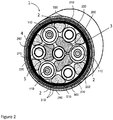
- FIG 2 An example embodiment of a subsea power umbilical cable according to the invention for transporting electric power and hydrogen is presented in figure 2 .
- the figure is a cut-view drawing of a cross-section of the umbilical cable (1).
- the power umbilical cable (1) comprises three electrical conductors (100), one centre tube (3), and three peripheral tubes (210, 220) distributed and held in place by profile elements (250, 260) of polyethylene. These elements fill the inner space inside an over-sheath comprising an armouring (310) of steel wires and an outer polyethylene sheathing (300).
- the centre tube (3) of this example embodiment has a dual layered tube wall (4) where the inner layer is made of a CuSiNi alloy according to claim 6.
- the tube wall comprises further an outer steel armouring (5).
- the electric conductors (100) comprises a polyethylene core element (110) having a layer of copper wires followed by a layer of semiconducting sheathing. These parts define the core of the conductor. Then follows a polymeric electric insulation layer, a semiconductive sheathing (60), a cupper-wrapping (70), and an outer polymeric electric insulation (80).
Landscapes
- Chemical & Material Sciences (AREA)
- Engineering & Computer Science (AREA)
- Mechanical Engineering (AREA)
- General Engineering & Computer Science (AREA)
- Materials Engineering (AREA)
- Metallurgy (AREA)
- Organic Chemistry (AREA)
- Dispersion Chemistry (AREA)
- Inorganic Chemistry (AREA)
- Insulated Conductors (AREA)
Priority Applications (1)
| Application Number | Priority Date | Filing Date | Title |
|---|---|---|---|
| EP20305527.2A EP3913268A1 (fr) | 2020-05-20 | 2020-05-20 | Câble ombilical adapté pour le transport de gaz hydrogène |
Applications Claiming Priority (1)
| Application Number | Priority Date | Filing Date | Title |
|---|---|---|---|
| EP20305527.2A EP3913268A1 (fr) | 2020-05-20 | 2020-05-20 | Câble ombilical adapté pour le transport de gaz hydrogène |
Publications (1)
| Publication Number | Publication Date |
|---|---|
| EP3913268A1 true EP3913268A1 (fr) | 2021-11-24 |
Family
ID=71465248
Family Applications (1)
| Application Number | Title | Priority Date | Filing Date |
|---|---|---|---|
| EP20305527.2A Pending EP3913268A1 (fr) | 2020-05-20 | 2020-05-20 | Câble ombilical adapté pour le transport de gaz hydrogène |
Country Status (1)
| Country | Link |
|---|---|
| EP (1) | EP3913268A1 (fr) |
Cited By (4)
| Publication number | Priority date | Publication date | Assignee | Title |
|---|---|---|---|---|
| EP4036938A1 (fr) * | 2021-02-01 | 2022-08-03 | Nexans | Ensemble sous-marin composite pour le transport d'hydrogène dans un tube bimétallique |
| CN116144975A (zh) * | 2023-01-04 | 2023-05-23 | 宁波金田铜业(集团)股份有限公司 | 一种铜合金棒材及其制备方法 |
| EP4306256A1 (fr) | 2022-07-13 | 2024-01-17 | Nexans | Assemblage de tubes à haute résistance par soudage par friction rotative |
| EP4418283A1 (fr) * | 2023-02-20 | 2024-08-21 | NKT HV Cables AB | Câble d'alimentation sous-marin à capacité de transport de fluide |
Citations (8)
| Publication number | Priority date | Publication date | Assignee | Title |
|---|---|---|---|---|
| WO2007027084A1 (fr) * | 2005-09-02 | 2007-03-08 | Technische Universiteit Delft | Dispositif et procede de transport d'energie |
| US20090007594A1 (en) * | 2003-11-04 | 2009-01-08 | Anett Dylla | Conduit component for a power supply network, use thereof, method for transporting cryogenic energy carriers in conduits and devices suitable therefor |
| US20100044068A1 (en) * | 2006-09-14 | 2010-02-25 | Biovidvienda S.I. | Subsea umbilical |
| US20160215133A1 (en) * | 2013-09-02 | 2016-07-28 | Arkema France | Method for preparing a crosslinked fluorinated polymer composition |
| EP2706539B1 (fr) | 2012-09-05 | 2019-01-02 | BPP Cables Ltd | Câbles sous-marins |
| CN109140064A (zh) * | 2018-07-20 | 2019-01-04 | 中国科学院电工研究所 | 一种低温燃料传导冷却的超导能源管道 |
| EP3434961A1 (fr) | 2016-04-22 | 2019-01-30 | Tatsuno Corporation | Dispositif de remplissage de gaz |
| EP3438993A1 (fr) | 2017-08-02 | 2019-02-06 | Nexans | Câ?ble de puissance dynamique |
-
2020
- 2020-05-20 EP EP20305527.2A patent/EP3913268A1/fr active Pending
Patent Citations (8)
| Publication number | Priority date | Publication date | Assignee | Title |
|---|---|---|---|---|
| US20090007594A1 (en) * | 2003-11-04 | 2009-01-08 | Anett Dylla | Conduit component for a power supply network, use thereof, method for transporting cryogenic energy carriers in conduits and devices suitable therefor |
| WO2007027084A1 (fr) * | 2005-09-02 | 2007-03-08 | Technische Universiteit Delft | Dispositif et procede de transport d'energie |
| US20100044068A1 (en) * | 2006-09-14 | 2010-02-25 | Biovidvienda S.I. | Subsea umbilical |
| EP2706539B1 (fr) | 2012-09-05 | 2019-01-02 | BPP Cables Ltd | Câbles sous-marins |
| US20160215133A1 (en) * | 2013-09-02 | 2016-07-28 | Arkema France | Method for preparing a crosslinked fluorinated polymer composition |
| EP3434961A1 (fr) | 2016-04-22 | 2019-01-30 | Tatsuno Corporation | Dispositif de remplissage de gaz |
| EP3438993A1 (fr) | 2017-08-02 | 2019-02-06 | Nexans | Câ?ble de puissance dynamique |
| CN109140064A (zh) * | 2018-07-20 | 2019-01-04 | 中国科学院电工研究所 | 一种低温燃料传导冷却的超导能源管道 |
Non-Patent Citations (3)
| Title |
|---|
| OGAWA ET AL.: "Material performance of age-hardened beryllium-copper alloy, CDA-C17200, in a high-pressure, gaseous hydrogen environment", INTERNATIONAL JOURNAL OF HYDROGEN ENERGY, vol. 42, no. 26, 29 June 2017 (2017-06-29), pages 16887 - 16900, XP085108167, Retrieved from the Internet <URL:https://doi.org/10.1016/j.ijhydene.2017.04.270> DOI: 10.1016/j.ijhydene.2017.04.270 |
| SUDARSHAN ET AL.: "Hydrogen and Humidity Effects of Fatigue Behaviour of a 70-30 Copper-Nickel alloy", J. MATERIALS FOR ENERGY SYSTEMS, vol. 8, no. 3, December 1986 (1986-12-01), pages 291 - 296 |
| YAMABE ET AL.: "High-strength copper-based alloy with excellent resistance to hydrogen embrittlement", INTERNATIONAL JOURNAL OF HYDROGEN ENERGY, vol. 41, no. 33, 7 September 2015 (2015-09-07), pages 15089 - 15094 |
Cited By (5)
| Publication number | Priority date | Publication date | Assignee | Title |
|---|---|---|---|---|
| EP4036938A1 (fr) * | 2021-02-01 | 2022-08-03 | Nexans | Ensemble sous-marin composite pour le transport d'hydrogène dans un tube bimétallique |
| EP4306256A1 (fr) | 2022-07-13 | 2024-01-17 | Nexans | Assemblage de tubes à haute résistance par soudage par friction rotative |
| CN116144975A (zh) * | 2023-01-04 | 2023-05-23 | 宁波金田铜业(集团)股份有限公司 | 一种铜合金棒材及其制备方法 |
| CN116144975B (zh) * | 2023-01-04 | 2025-06-13 | 宁波金田铜业(集团)股份有限公司 | 一种铜合金棒材及其制备方法 |
| EP4418283A1 (fr) * | 2023-02-20 | 2024-08-21 | NKT HV Cables AB | Câble d'alimentation sous-marin à capacité de transport de fluide |
Similar Documents
| Publication | Publication Date | Title |
|---|---|---|
| EP3913268A1 (fr) | Câble ombilical adapté pour le transport de gaz hydrogène | |
| EP3786982B1 (fr) | Gaine de câble en alliage cunisi | |
| EP2706539B1 (fr) | Câbles sous-marins | |
| EP2500911A2 (fr) | Câble ombilical électrique | |
| US9934887B2 (en) | Umbilical | |
| EP3375001B1 (fr) | Procédé de fabrication d'un câble de puissance électrique | |
| US5527995A (en) | Cable for conducting energy | |
| US20140138115A1 (en) | Subsea umbilical | |
| EP3926645A1 (fr) | Câble ombilical pour le transport combiné de puissance et de fluide | |
| US12542224B2 (en) | Wireline and slickline cables for downhole operations | |
| US20230335310A1 (en) | Water barrier materials for a dynamic power cable for submarine applications | |
| US20230395283A1 (en) | Submarine cable comprising at least one aluminium tensile reinforcement strand, related umbilical, installation and method | |
| EP4306256A1 (fr) | Assemblage de tubes à haute résistance par soudage par friction rotative | |
| US20230178268A1 (en) | HVAC-cable with composite conductor | |
| EP4273890B1 (fr) | Câbles dynamiques dotés d'une gaine thermoplastique renforcée par des fibres enroulées | |
| EP4478382A1 (fr) | Câble d'alimentation sous-marin | |
| WO2025215421A1 (fr) | Ombilical d'alimentation sous-marin | |
| KR20260035783A (ko) | 동적 고전압 해저 케이블 및 동적 고전압 해저 케이블을 제조하는 방법 | |
| KR20250124955A (ko) | 해저케이블 | |
| KR20260040552A (ko) | 아연 및 아연 합금을 포함하는 케이블 시스 |
Legal Events
| Date | Code | Title | Description |
|---|---|---|---|
| PUAI | Public reference made under article 153(3) epc to a published international application that has entered the european phase |
Free format text: ORIGINAL CODE: 0009012 |
|
| STAA | Information on the status of an ep patent application or granted ep patent |
Free format text: STATUS: THE APPLICATION HAS BEEN PUBLISHED |
|
| AK | Designated contracting states |
Kind code of ref document: A1 Designated state(s): AL AT BE BG CH CY CZ DE DK EE ES FI FR GB GR HR HU IE IS IT LI LT LU LV MC MK MT NL NO PL PT RO RS SE SI SK SM TR |
|
| B565 | Issuance of search results under rule 164(2) epc |
Effective date: 20200928 |
|
| STAA | Information on the status of an ep patent application or granted ep patent |
Free format text: STATUS: REQUEST FOR EXAMINATION WAS MADE |
|
| 17P | Request for examination filed |
Effective date: 20220524 |
|
| RBV | Designated contracting states (corrected) |
Designated state(s): AL AT BE BG CH CY CZ DE DK EE ES FI FR GB GR HR HU IE IS IT LI LT LU LV MC MK MT NL NO PL PT RO RS SE SI SK SM TR |